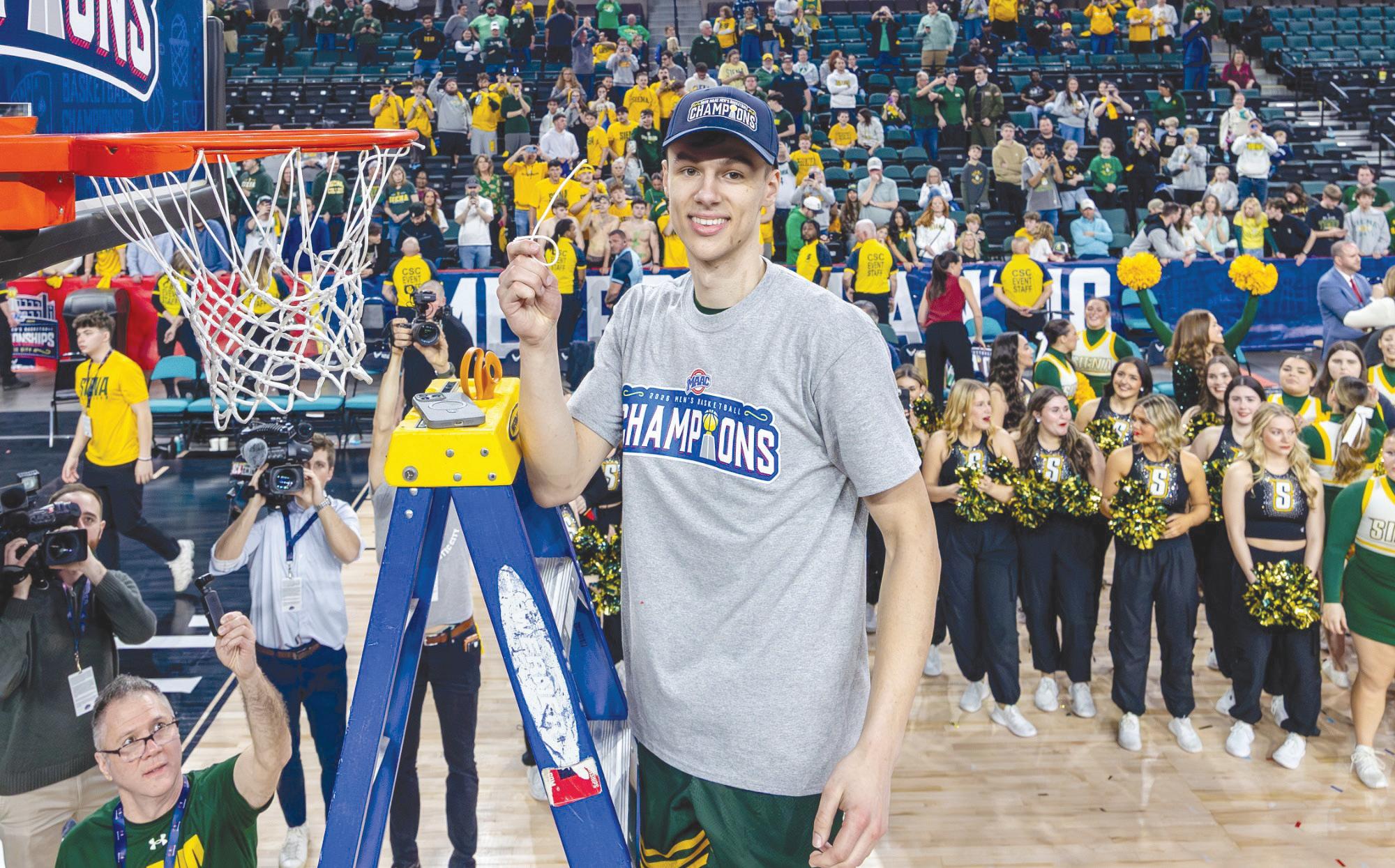
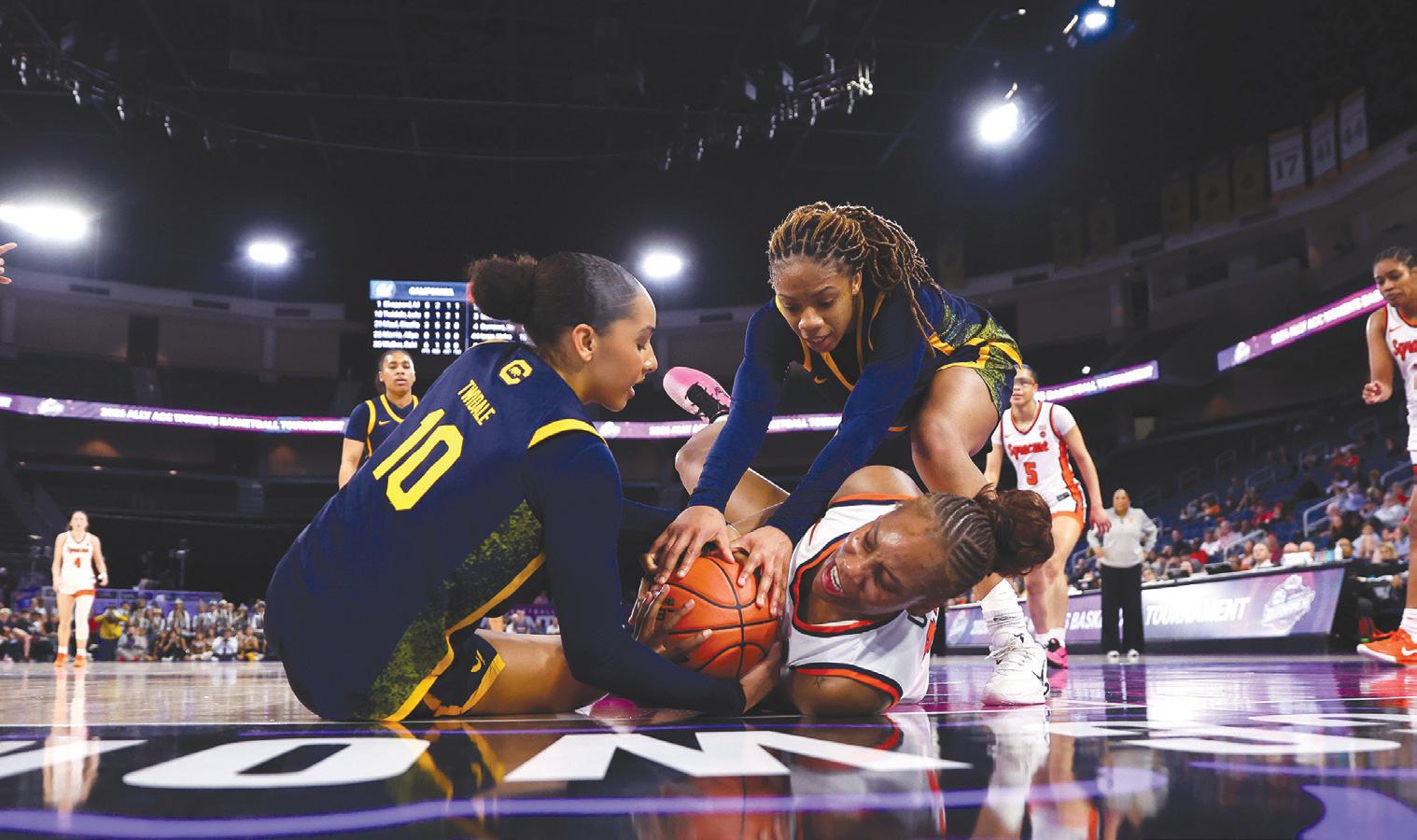
Timothée Chalamet’s recent viral comments dissmissing ballet and opera devalue influential fine art forms.
Page 10
122 years
C • Pawfessors
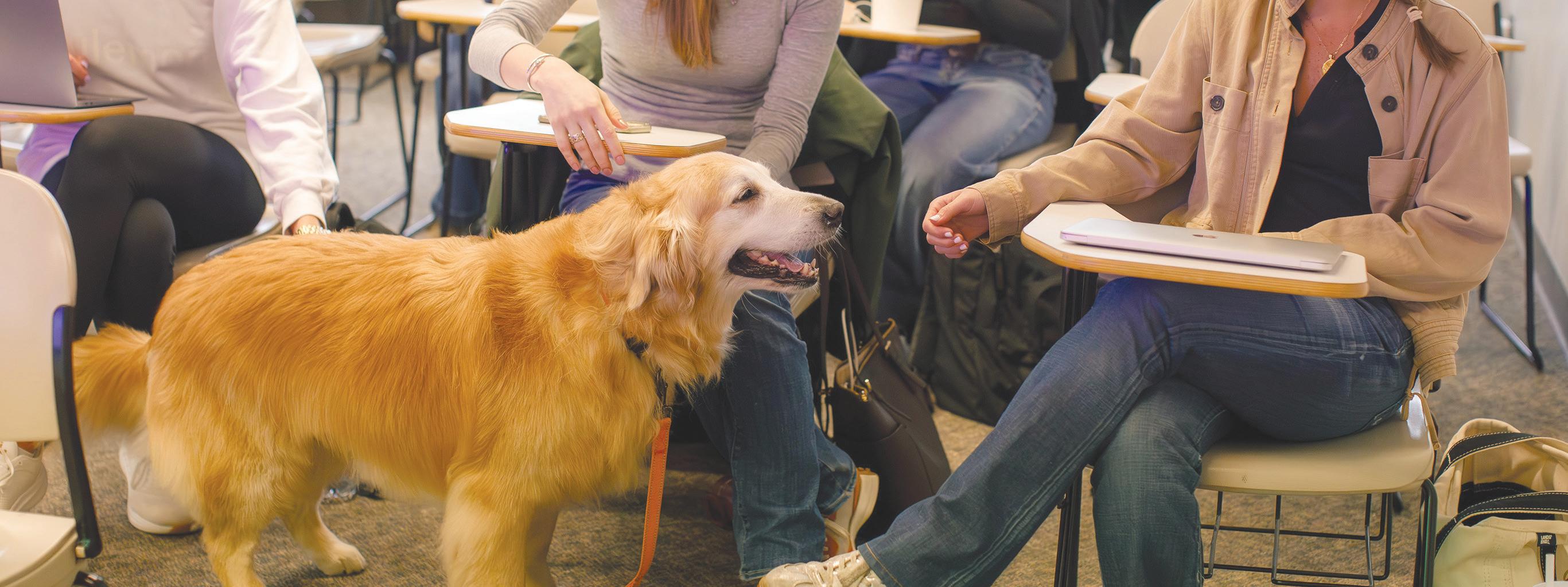
By bringing their dogs to campus, professors and faculty connect with students and increase attendance.
6
Promises, not guarantees
Locals press Micron for legal commitment to green goals, new
By Brenne Sheehan and Owen Smith the daily orange
As a child growing up in central New York, Bonita Siegel watched a major infrastructure project reshape the region in the 1960s. Most people cheered the Rust Belt city’s development. Decades later, Siegel wasn’t so sure.
When the New York State Department of Transportation completed construction of the Interstate-81 Viaduct Project through Syracuse’s 15th ward, a historically Black neighborhood, she remembered watching the city near her hometown of Clay shift. Although the project promised revolutionized transportation between Pennsylvania and Canada and increased traffic into Syracuse, what followed were years of Black residential displacement and redlining.
jobs
After retiring, Siegel returned to Clay, determined to help repair Syracuse by joining community service organizations like the Urban Jobs Task Force. In 2022, when Micron Technology announced its plans to invest $100 billion in a multi-plant semiconductor facility in Clay — Siegel and other advocates were eager to see its several promises fulfilled.
“When you start doing things with infrastructure to serve people, you shouldn’t be disadvantaging people that might be in vulnerable classes of society just because you can or just because you’re powerful,” Siegel said.
From 2022 to its groundbreaking in January, Micron has touted plans to create 50,000 jobs, with 9,000 high-paying positions by 2045, practicing “good faith” hiring practices to “disadvantaged communities.” As part of New York state’s see micron page 5
ilana zahavy presentation director | leonardo eriman daily
free
S • The big leagues
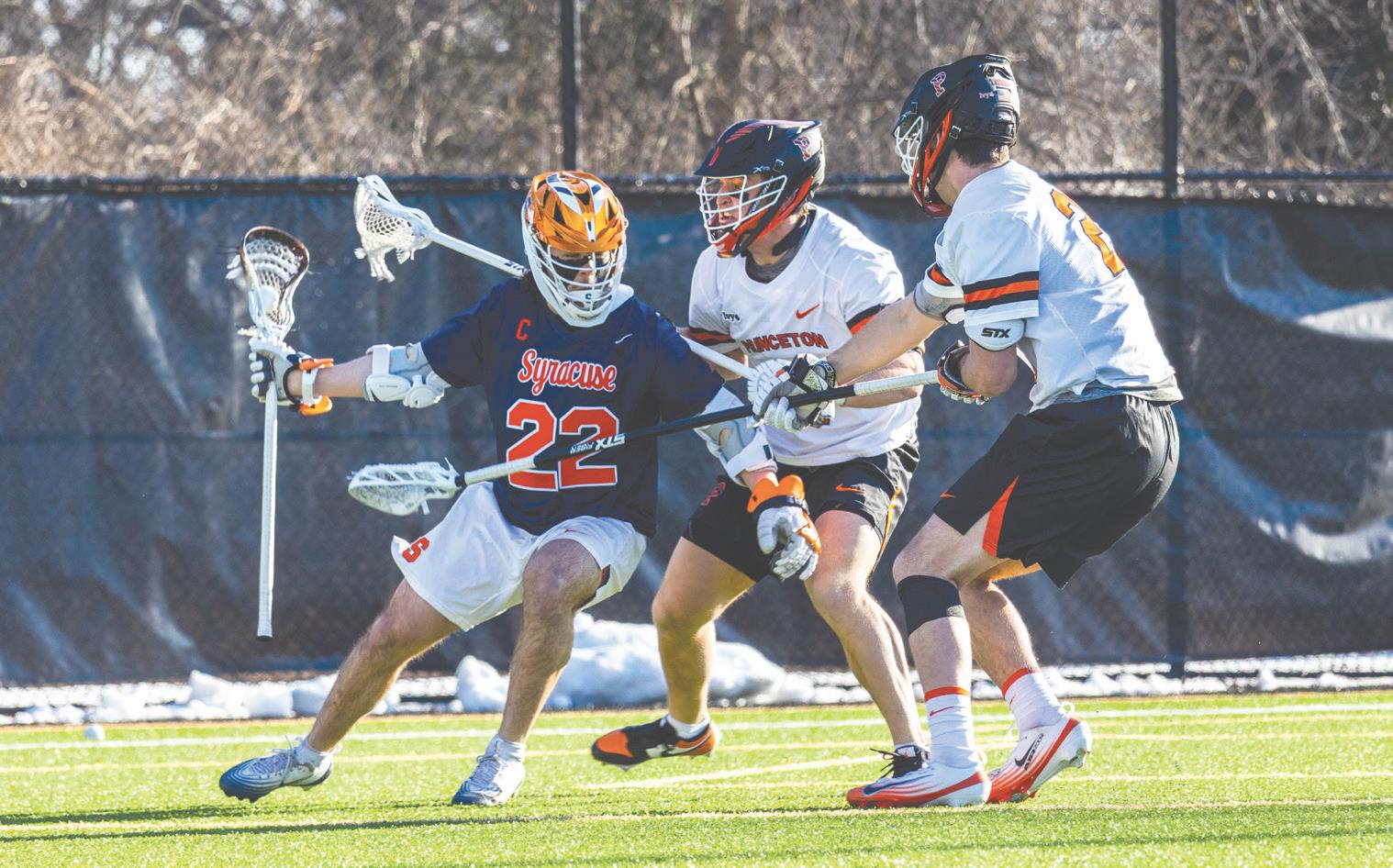
Joey Spallina’s prolific play at Syracuse and summer box lacrosse experience has prepared him to play professionally.
Page 16
By Samantha Olander enterprise editor
Syracuse University’s total faculty decreased by 44 positions from 2024 to 2025, while the share of tenured and tenuretrack professors increased, according to data presented at Wednesday’s University Senate meeting.
The annual Faculty Census, compiled by the senate’s Academic Affairs Committee, found that tenured and tenure-track faculty made up a little over 50% of faculty in 2025, up from 49.6% the previous year. The number of those tenured positions still fell from 922 to 919, while the university’s total faculty count decreased by 44.
“The big trend that we talked about and noticed is that pretty sizable decrease in the overall faculty workforce in the last year,” Academic Affairs Co-Chair Matthew Huber said. “Even though we got over the symbolic 50% category in 2025, the overall number of tenured and tenure-track faculty actually declined.”
The share of tenured and tenure-track faculty has hovered around the 50% mark over the past four years, with only minor fluctuations, the committee reported.
Tenure is the “indefinite appointment that can be terminated only for cause or under extraordinary circumstances such as financial exigency and program discontinuation,” according to the American Association of University Professors.
National debates over tenure have intensified as universities rely more heavily on non-tenure-track and part-time faculty. At SU, faculty leaders have previously framed tenure as a key protection for academic freedom and shared governance, arguing it allows professors to teach and research controversial issues without fear of discipline or censorship.
Since 2016, the Academic Affairs Committee has collected faculty data annually and compiled it into the Faculty Census, which tracks changes in tenure status, instructional roles and demographics across the university.
The latest data showed continued shifts in who’s teaching classes at SU. Part-time instructional faculty decreased slightly by over 30 positions, while full-time instructional faculty outside the tenure track — including teaching professors and professors of practice — increased by 10.
According to the data, tenured and tenure-track faculty accounted for 45.6% of credit hours taught in 2025. Full-time and non-tenure-track faculty accounted for about one-third of credit hours, while parttime faculty taught 21.4%, down from 30.6% the year before.
The census compared SU with 16 other peer institutions using 2024 data. SU reported 49% tenured and tenure-track faculty that year, placing it near the middle of the group — behind Carnegie Mellon University and ahead of Boston University and George Washington University.
The census also included demographic data. In 2025, about 53.9% of faculty iden see
orange file photo
Editor@dailyorange.com
News@dailyorange.com
Opinion@dailyorange.com
Culture@dailyorange.com
Sports@dailyorange.com
Digital@dailyorange.com
Design@dailyorange.com
Photo@dailyorange.com
BUSINESS 315-443-2315
how to join us
The Daily Orange is an independent, nonprofit newspaper published in Syracuse, New York. The editorial content of the paper — which started in 1903 and went independent in 1971 — is entirely run by Syracuse University students.
The D.O., a 501(c)(3) nonprofit, is editorially and financially independent from SU, and the paper receives no funding from the university. Instead, The D.O. relies on advertising revenue and donations to sustain operations.
This spring, the paper will be published Thursday when SU classes are in session. The D.O.’s online coverage is 24/7, including while SU is on break.
To show your support to The D.O.’s independent journalism, please visit dailyorange.com/donate. Donations are tax deductible.
If you are a Syracuse University or SUNY-ESF student interested in contributing to The D.O. on either its advertising or editorial teams, please email editor@dailyorange.com.
corrections policy
The D.O. strives to be as accurate in our reporting as possible. Please email editor@dailyorange.com to report a correction.
letter to the editor policy
The D.O. prides itself as an outlet for community discussion. To learn more about our submission guidelines, please email opinion@dailyorange.com with your full name and affiliation within the Syracuse community. Please note letters should not include any personal information pertaining to other people unless it is relevant to the topic at hand. All letters will be edited for style and grammar.
The forecast for this upcoming week, per The Weather Channel.
LACROSSE
EDITOR-IN-CHIEF
Kendall Luther
Rosina Boehm
Griffin Uribe Brown
nicholas alumkal sports editor
scribble
university senate
Syverud commends chancellor, AD picks in USen remarks
By Griffin Uribe Brown digital managing editor
Syracuse University Chancellor Kent Syverud commended the university’s recent chancellor and director of athletics selections at Wednesday’s University Senate meeting.
In recent weeks, search committees filled two high-level openings at SU, naming current Vice Chancellor of Strategic Affairs Mike Haynie chancellor-elect and tapping Bryan Blair to replace outgoing Director of Athletics John Wildhack.
“I have asked a lot of Mike over the last 12 years, and he has consistently delivered for our university,” Syverud said. “Chancellor-elect Haynie’s two decades of extraordinary experience and commitment at Syracuse, I think, make him an ideal leader for Syracuse University at this moment.”
Syverud, who is leaving SU at the end of the academic year to become president of the University of Michigan, thanked members of the senate who served on the Chancellor Search Committee — a process from which he recused himself.
The chancellor also praised Haynie’s “first official order of business,” helping select Blair as SU’s next director of athletics.
Blair has worked as the University of Toledo’s vice president and athletics director since 2022, and held other leadership roles at Wash-
county
ington State University, Rice University and the University of South Carolina.
“Bryan has earned national acclaim as an innovator in the changing athletics landscape, while achieving both competitive and academic success,” Syverud said.
Up first for Blair is likely the search for Syracuse’s men’s basketball head coach. The university fired Adrian Autry last week after three seasons. Syverud briefly mentioned the basketball search as he voiced confidence in Blair’s new role.
“From everything I’ve learned about him, Bryan Blair is the right person to lead Orange Athletics forward,” he said.
Syverud said he plans to meet with representatives from the Athletics Policy Committee, which presented on the shifting national athletics landscape during January’s senate meeting.
The last senate meeting of the semester, Syverud’s 120th and final one, is scheduled for April 15.
“I am committed to doing everything in my power to position the university and Chancellor-elect Haynie for success in these last weeks this semester,” Syverud said. “I believe the best way the senate can help is to give Chancellorelect Haynie some grace through the transition, which I can testify is somewhat overwhelming in Syracuse.”
gbrown19@syr.edu
Candidates run affordability campaign on housing, transportation
By Vivian Collins and Mirren Grimason the daily orange
Affordable housing, transportation and childcare are priorities held by three Onondaga County political activists turned local political candidates. When the three connected through the Syracuse Democratic Socialists of America, they collaborated to form a new ticket — the “Affordability Slate.”
As these issues continue to shape life in the city of Syracuse, legislature candidates Jo Bennett and Tammy Honeywell along with state assembly candidate Maurice Brown plan to run on a joint campaign focused on lifting the financial burden of Syracuse residents.
The candidates launched the joint campaign, titled the “Affordability Slate” on Feb. 23. Brown, Bennett and Honeywell are currently running for a seat on the New York State Assembly and Onondaga County Legislator for the 15th and 8th districts, respectively.
The slate is built upon three pillars — safe and affordable housing, universal childcare and free transportation.
“They’re the issues that come up when I talk to people. They’re the issues that come up in emails and conversations,” Brown, Onondaga County’s current 16th district legislator, said. “Those are issues that we’ve not done a good job of addressing as local government, whether it’s the city, county or state.”
Because the Syracuse DSA endorsed each candidate during their past campaigns for local offices, the candidates said they were all familiar with each other. Bennett, Honeywell and Brown also worked together through political activism and collaboration within Syracuse DSA outside of their campaigns.
Bennett has canvassed for both Brown and Honeywell in their respective 2023 and 2025 campaigns.
Honeywell said running separate campaigns can be isolating, and the three wanted to work together to use shared resources and support.
“When we have shared principles, shared values, shared platform, it makes it easier to run together,” Honeywell said. “We can utilize our resources through DSA and the people that have known us for years, who have seen us organize in the community to come together to try to move forward all three of our campaigns.”
Mae Carden, a seven-year member of Syracuse DSA, said Brown, Bennett and Honeywell have championed the ideals of DSA for years. Carden said DSA sees two major crises today — a lack of affordability and “the rise of fascism” — both of which the slate’s candidates are working to combat.
“Fascists want us to turn on our neighbors, and we want to create a new politics that is: ‘No I love my neighbor, and we have more in common than I thought, which is that our rent is too high and our child care bills are unaffordable,’” Carden said.
Brown said he is running for the state assembly because many county issues are decided and funded at the state level. He said he ran for an
assembly seat six years ago and lost to William Magnarelli, who spent almost 30 years serving the 129th District of New York.
Throughout his time as a local politician, Brown said he’s brought up issues such as the Community Grid Vision Plan and the need for safer roads, including protected bike lanes and more appropriate speed limits. However, Brown said he has not seen movement on these topics since his initial campaign.
Brown said he deviates from the other members of the slate when it comes to public transportation. He said he will be prioritizing improving availability, rather than cost. Brown spoke to Centro, Syracuse’s contracted bus company, and supports the Bus Rapid Transit model — a bus system created by the Federal Transit Administration that works to make service more efficient.
Bennett, running for Brown’s current position as Onondaga County legislature for the 15th district, received his endorsement.
“There was a short list of people that I spoke to when I was exploring my assembly run, and Jo was at the top of it,” Brown said. “I’m glad that ultimately they did decide to run, because our community needs a champion representing the 15th district, and now we’re going to get one.”
Growing up in Syracuse and working as a public school teacher in the city’s school district for 10 years, Bennett said they’ve seen how issues
such as safe and affordable housing and lack of transportation affect residents first hand.
Bennett said their students struggle to attend school due to lack of transportation, or having to watch their siblings, while also living in unsafe housing or being homeless.
“I see it every day as a teacher, I see my students struggling with housing. One in 10 of them are homeless, and I think it’s actually pushing closer to two in 10 right now,” Bennett said. “They’re dealing with unsafe conditions that are similar to what I dealt with but even worse.”
Having run in 2021 against his same opponent Bill Kinne, this won’t be Bennett’s first bid for county legislature. When they heard Brown was running for state assembly, Bennett said they knew Syracuse needed a “fighter,” so they stepped up.
Honeywell ran for Onondaga County Legislator for the 8th district in 2025 and lost to Chad Ryan. She said she wanted to run for government before, but a win would have meant resigning from her Onondaga County job at the Department of Social Services, which she said she was unable to do at the time.
“The three of us have always been focused on affordability and community needs over these big corporate projects,” Honeywell said. “There was a conversation about running together and how important it was, because if Mo was going
to be running at the state level, we were going to need to work with him as county legislators to implement our platform.”
Ryan criticized the slate’s practicality. While he said he isn’t opposed to any of the slate’s pillars, he questioned how feasible they are to achieve.
“They’re very hot button issues. They are front and center in everybody’s mind,” Ryan said. “But the devil is in the details.”
Brown is running for a state level position while Honeywell and Bennett remain local, which Ryan said “incredibly different” scopes of work. He cited universal healthcare as an example, explaining that county legislators have no jurisdiction over that because “it’s a state and federal thing.”
If elected, the trio plans to enact tangible changes to Syracuse right away, Bennett said. Brown plans to take on National Grid bills, combatting potential price gouging, while Honeywell will look to increase collaboration between county and state level legislators.
“We might have to focus on one thing at a time and kind of see where it lands us,” Bennett said. “But I’m hoping that (citizens will) see all these changes, and they’ll be able to afford just living.”
The Democratic primary will be held June 23 and early voting begins June 13. news@dailyorange.com
SU Chancellor Kent Syverud commended Mike Haynie as chancellor-elect and Bryan Blair as incoming director of athletics at Wednesday’s Senate meeting. avery magee photo editor
As rising costs impact Syracuse and beyond, a trio of local politicians is running a joint campaign focused on lifting residents’ financial burden. courtesy of maurice brown
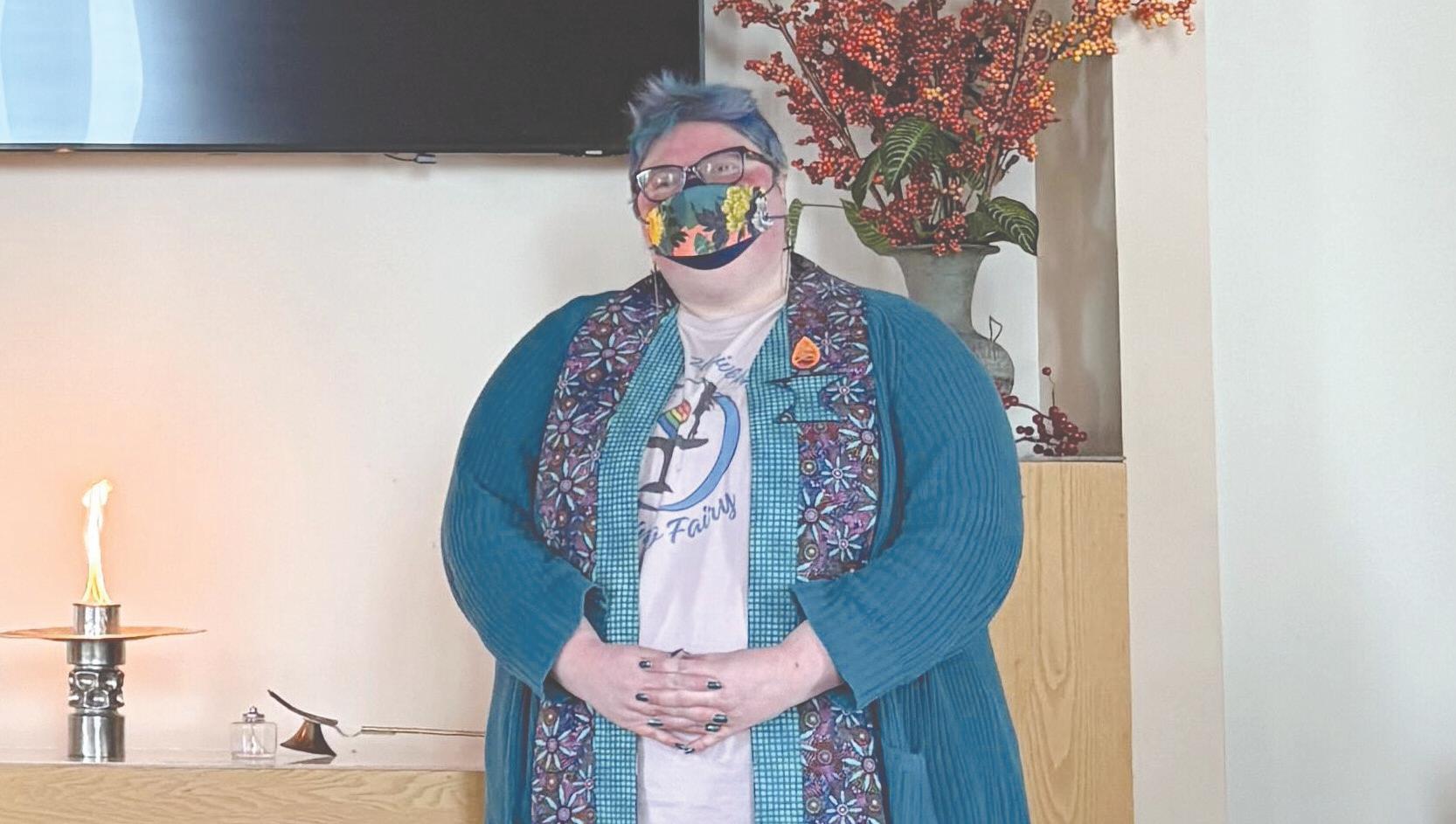
Minister blends nonbinary identity, faith to lead Syracuse church
By Lillie Kochis contributing writer
Molly Hammerhand entered a church for the first time as an adult, looking for a choir to sing in.
Welcoming people of all different religious beliefs, Hammerhand thought the Allen Avenue Unitarian Universalist Church in Portland, Maine, sounded like a good choice. Singing in the church’s choir led to involvement on the board, social justice team and lay preaching and their enrollment in a Master of Divinity program.
It was in seminary that Hammerhand came to realize they are nonbinary. To them, being nonbinary means they “don’t experience (themself) as either a man or a woman.”
In 2022, the First Unitarian Universalist Society of Syracuse hired Hammerhand, 39, as a minister. Since then, they have left a legacy that makes LGBTQ+ identities visible within the Unitarian Universalist faith.
While many state legislators attempt to pass laws limiting rights for transgender people, authenticity remains at the forefront of Hammerhand’s work, as well as the inclusion of LGBTQ+ identities, they said.
“All of these things are at the front of my ministry, not because they’re my only concern, but because they shape the way I am received in the world to such a degree that I can’t not talk about them,” Hammerhand said.
For someone not raised in a religious household, Hammerhand is effusive when it comes to religious topics. As a child, they were interested in mythology and Wicca, a neo-pagan religion.
The more Hammerhand participated in church life at Allen Avenue UU, the more inescapable their thought of a new career path became. The work is something they said was intensely fulfilling, but they remained skeptical of being a Unitarian Universalist minister as a legitimate career path.
“I was kind of in the middle of that quarterlife crisis that you kind of get when you’re about 26 or 27 and you don’t know what you’re doing with your life,” they said.
Despite going to college for illustration, Hammerhand said they wanted a more justicefocused career, so they followed their hunch to Meadville Lombard Theological School — one of two historically Unitarian Universalist seminaries in the United States.
Openly identifying as nonbinary was a much slower process, they said. Hammerhand found that when thinking of themself as nonbinary, certain events in their life made more sense.
“Becoming an adult woman was never something that I vibed with,” Hammerhand said. “I can be an adult, but being a woman does not sound even a little bit right.”
While Hammerhand said they did not feel they “were in the wrong body,” they felt uncomfortable with others seeing them as a woman.
“The process of becoming a minister was radical self-acceptance all the way down for me, and it was life-changing,” Hammerhand said.
Hammerhand said they were welcomed by FUUSS and that they see FUUSS as being
“ahead” of the “average” Unitarian Universalist congregation, after they had interviews with churches that were reluctant to hire them.
“It’s not a given that our churches will be able to accept nonbinary identity on the part of somebody who is in their leadership,” Hammerhand said.
The Unitarian Universalist Association was founded in 1961, merging two liberal Protestant Christian traditions: Unitarianism and Universalism. While the tradition has Christian roots, it’s developed into a religion that is more expansive in its theological beliefs. Practitioners of the religion have no shared creed and hold all sorts of religious beliefs.
While Hammerhand identifies as a polytheist and pagan, their goal is to minister to people of all different beliefs. This is one of their favorite parts of the job.
“Being able to witness people being real and being authentic,” Hammerhand said, “that’s uniquely wonderful.”
Coran Claver, an associate professor at Syracuse University, has been a member of FUUSS for more than 20 years and leads a monthly queer and trans knitting group, which she said Hammerhand is very supportive of.
Seeking guidance on supporting her nonbinary child through transition, Claver approached Hammerhand, who shared their own experiences of being parented as a nonbinary person.
“They are really committed to having ministry not just be top-down,” Claver said. “It’s not just about them,” Claver said. “It was one of those moments where I just felt there was deep compassion and deep understanding.”
Spencer Dean, Claver’s child, was raised attending church at FUUSS. While their busy schedule prevents them from attending church often, they’ve remained close to the community.
In 2025, Spencer said they and their partner Kristen Dean became increasingly worried about their legal rights as an unmarried couple. With some encouragement from Hammerhand, the two decided to legally marry.
Hammerhand acted as the legal officiant at the wedding, quickly throwing together a ceremony at FUUSS. Spencer’s parents attended in person, and Kristen’s parents over Zoom.
Kristen, who was raised Catholic, has become a member of FUUSS and assists with the church’s coffee hour and attends Claver’s knitting group.
Spencer and Kristen described FUUSS as an affirming congregation, amplified by Hammerhand’s leadership.
“Reverend Molly will fight with us,” Kristen said.
To Hammerhand, bridging LGBTQ+ and religious communities is an extension of their signature authenticity.
“Our experience is not an outlier. It’s a fully human one,” Hammerhand said. “It’s a fully human one, and it has always existed as a fully human experience.”
lkochis@syr.edu
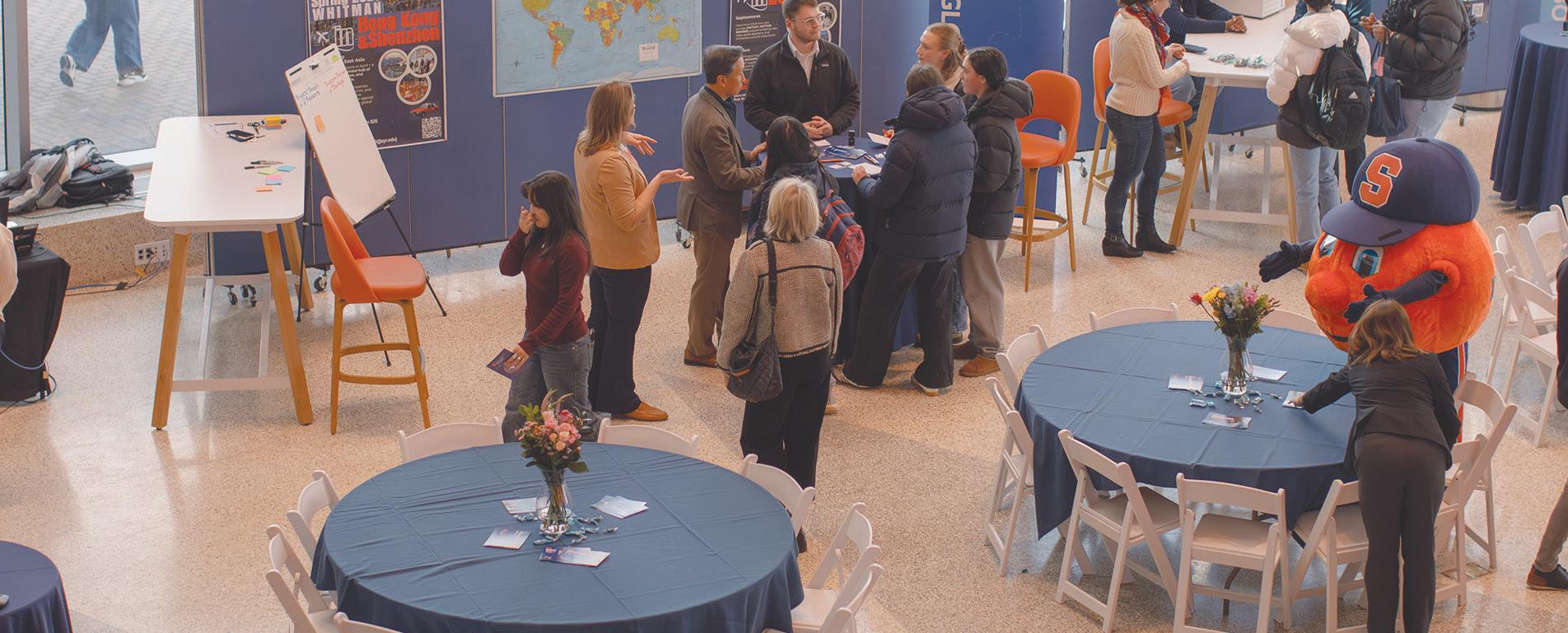
Whitman launches new Experiential Center for hands-on learning
By Sean Harrington staff writer
Syracuse University’s Whitman School of Management launched its Experiential Center at a public ceremony Wednesday, marking another move to increase its notoriety among national business programs.
A central aspect of Whitman’s “Transformation 2030” push for modernized business education, the center will expand hands-on, experience-based activities already available with enhanced technological, research and professional development opportunities.
Alexander McKelvie, Whitman’s interim dean, spoke to an audience of faculty, students, Otto the Orange and Chancellor-elect Michael Haynie, hailing the program as an “essential centerpiece” of the “Whitman experience.”
“Transformation 2030 is Whitman’s roadmap to become a top 25 undergraduate business program, given that the best business education doesn’t only happen in a classroom,” McKelvie said.
This effort to elevate the school’s reputation is not only a curriculum boost, but a “defining commitment” the school pledges to its students, McKelvie said.
Flaum Grand Hall’s four corners highlighted the four pillars of Whitman: collaboration, innovation, global study and preparation. The “innovation corner” introduced Virtual Speech, a program that combines interactive virtual reality with artificial intelligence to engage users with mock interviews, presentation practice and communication practice in real time.
Lynne Vincent, chair of the management department at Whitman, said the featured program is not meant to just enrich an educational experience but take pedagogical strategies from “theory to practice.”
“We are taking education from the classroom to the real world … taking what you learn in the classroom and figure out, ‘how does this actually apply, and how do I develop my skills there?’” Vincent said.
Vincent added programs like Virtual Speech are truly engaging by being fun but with a purpose, she said.
“All of these centers and everything that they’re doing really can make an impact in their skill development,” Vincent said.
Moreover, programs like Virtual Speech aim to increase accessibility and availability of resources that can improve the concrete skills students need to stand out in the job market, she said. Over 450 students in MGT 248: Managing and Leading People in Organizations, a “core” class, have access to the programs for immediate use.
The new program aims to engage students with the corporate world they seek to enter and connect them with academic skills and professional development.
“Experiential learning happens everywhere at Whitman, and that’s exactly how it should be,” Erin Draper, Whitman’s director of experiential programs, said during remarks at the event.
Practical, job-ready skills are already a focal point of a Whitman education, and students have learned how to foster the opportunities Transformation 2030 presents. Olivia Simons, a Whitman senior, said that even though she is
finishing up her time at SU, she sees immense value in the prospect of the program.
“It’s a way for (students) to step outside their comfort zone but have the support they need, and it makes going out and learning about the professional world so much easier,” Simons said.
The programs the Experiential Center provides are “genuinely important,” Experiential Programs Coordinator Melissa McFarlane said while supervising the “collaboration” corner of the forum. Whitman’s leadership seeks to get students out of the classroom, take what they’ve learned there and implement it in the real world, McFarlane said.
As future business leaders are in their collegiate years, Whitman is looking to not only develop its prestige, but also the talents of those earning their degrees who will represent SU at the corporate level.
“Understanding how to communicate with each other and what role you play in the team, it’s really important to make you successful,” McFarlane said.
sharri43@syr.edu
Singing in a church choir led Hammerhand to enroll in a Master of Divinity program and help promote inclusivity at the church. lillie kochis contributing writer
on campus
SU’s Whitman School of Management launched its Experiential Center at a ceremony Wednesday.
avery magee photo editor
Green CHIPS program, which provided the company $5.5 billion in state incentives — alongside roughly $6.1 billion in federal CHIPS Act funding — Micron also made several sustainability effort promises, such as “utilizing 100% renewable energy.”
But most, if not all, of Micron’s promises don’t have enforceable measures — a major red flag to Siegel and her recently-formed neighborhood coalition, Neighbors for a Better Micron.
Days after Micron broke ground, the group, along with national labor organization Jobs to Move America, filed a class-action lawsuit against Micron and the Onondaga County Industrial Development Agency, calling for a reassessment of the project’s final Environmental Impact Statement.
The lawsuit claims the final EIS was not up to standard with the New York Environmental Quality Review Act, pushing for greater community involvement and a “more thorough investigation” before Micron begins construction. The company has almost completed clearing 330 acres of forest from its site at White Pine Commerce Park and will soon begin removing topsoil and conducting other groundwork.
Local environmental experts have warned of the ambiguity surrounding Micron’s environmental commitments, stemming from a lack of specific regulation around manufacturing chemicals to a shift in language from 100% “renewable energy” to “carbon-free energy” in its most recent posts.
“One of the traits of a sustainable community is citizen engagement for the public to have trust,” Greening USA president John Przepiora said. “Not that all of the environmental problems can be solved, but stakeholders deserve an opportunity to know what the heck is going on and have a chance to provide good feedback.”
For other Clay residents like Gracia Roulan, also a plaintiff in the lawsuit, driving past stacks of uprooted trees at the site brings about feelings of discomfort. While Micron has announced public hearings and info sessions in The Post Standard and on its website, she said she still feels many Clay residents lack easy access to the opportunity of sharing their input.
“They know how to get our taxes, but do they know how to let us know that we’re going to have a hearing about something that’s very important?” Roulan said. “I think they didn’t really want us to be there, like they just wanted to push this (project) through.”
A spokesperson for Micron declined The Daily Orange’s request for comment surrounding the company’s promises, the ongoing lawsuit and other accusations of a lack of community input, citing a quiet period ahead of the company’s annual earnings announcement.
A spokesperson for OCIDA — the county agency that oversees most regulation of the Micron project — also declined to comment on the same topics due to ongoing litigation.
“This project is the most studied in the history of the country, especially as it pertains to any and all environmental impacts. No company has done more or committed to doing more to address environmental concerns than Micron,” Justin Sayles, executive communications director for Onondaga County Executive Ryan McMahon, wrote in a statement to The D.O. “The actual group that is funding this frivolous lawsuit is
tified as male and 46.1% as female, with the percentage of female faculty increasing by 0.2% from the previous year.
This was the first year since the committee began tracking the data that the faculty became “more white” rather than less, Huber said. A race and ethnicity breakdown presented at the meeting showed that 65.4% of faculty identified as white, followed by smaller shares identifying as Asian (12.0%), Black or African American (5.6%) and Hispanic or Latino (4%).
The census showed differences across faculty categories, including substantial numbers of teaching professors and professors of practice, positions typically not on the tenure track. In 2025, the university reported 115 assistant teaching professors, 79 associate teaching professors, 35 teaching professors and 93 professors of practice.
Later in the meeting, Provost Lois Agnew addressed a February faculty resolution from the College of Arts and Sciences and Maxwell School of Citizenship and Public Affairs calling for faculty approval over program closures and pauses. The resolution follows months of frustration over SU’s ongoing academic portfolio review and concerns over limited faculty input.
Senator Harvey Teres, a member of the Curriculum and Instruction Committee, said an “overwhelming” majority of Arts and Sciences faculty, 188-51, voted in favor of requiring pro -
called ‘Jobs to Move America’ and they seem far more focused on moving jobs out of America.”
Beginning March 30, Micron will host its first-ever “community week,” featuring information sessions for locals, a meet-and-greet with former NASA astronaut Jeanette Epps and a STEM festival designed to share the potential impact of the company’s future investments.
But, without legally-binding documents like a community benefits agreement, a contract between developers, governmental bodies and residents, Siegel and other advocates have little faith such impacts will occur — at least not in the way Micron has promised.
“Those kinds of agreements that are enforceable can exist, they can be put into action,” Siegel said. “(It’s) the best promise for people who live in an area with a massive project coming in who wants to be a good neighbor and willing to make more certain promises.”
Lack of state environmental regulations worries local experts, DEC assures progress is being made
Don Hughes, a professor of chemistry at Le Moyne College, has watched Syracuse industries rise and fall during his decades in central New York. From General Motors, to General Electric to Allied Chemical throughout the 20th century, he said he was excited to see how Micron could stand out as a contemporary and clean manufacturer.
“I’ve been around quite a few years, and I’ve seen industry by industry fall by the wayside,” Hughes said. “I thought this one was clean, but then I got to learn more and more about it, and the benefits versus the risks started to change.”
Hughes, along with Przepiora and other concerned residents, has raised alarms about the semiconductor plant’s use of polyfluoroalkyl substances, also known as PFAS, a broad group of “forever chemicals” known to contaminate water and ecosystems.
PFAS are widely used within semiconductor manufacturing, mostly during etching and heat transferring processes. Hughes said because semiconductor manufacturing is a novice industry in the U.S., existing state and national regulations won’t be enough to firmly oversee Micron’s remediation of the chemicals.
“The problem here is that the regulatory agencies are just getting up to speed, so there’s no data, and we don’t really know how much PFAS are coming out of these places,” Hughes said. “No one has made a commitment to actually destroy PFAS.”
The New York State Department of Environmental Conservation has several regulations and monitoring practices to control and remediate such chemicals. Two PFAS chemicals, PFOA and PFOS, are regulated in drinking water at the state and federal levels, measured in parts per trillion, officials at the DEC wrote in a statement.
The DEC also uses Environmental Protection Agency testing protocols to monitor for 40 recognized PFAS chemicals through discharge permits for industrial facilities.
However, Hughes said these regulations aren’t specific enough to address the variety of PFAS chemicals Micron will use, adding the company itself hasn’t been transparent about how it will manage and dispose of such chemicals.
In its final EIS, Micron acknowledges PFAS will likely be used in its manufacturing.
“Micron is evaluating potential non-PFAS containing alternatives, but at present, there are no known substitutes for many PFAS uses,” section three of the EIS reads. “The lack of vali-
gram closure decisions to be submitted to faculty for approval. He asked if university leaders would follow that process.
Agnew said faculty votes are not part of the university’s standard process for program closures, adding that administrators have access to broader financial information.
“This is an area where administrators have information about the overall financial picture of the university that faculty don’t have,” Agnew said.
Final decisions on programs under the ongoing portfolio review are expected to be finalized this month.
Senators also heard a final report from the Parking and Transportation Advisory Committee, convened in summer 2025 to review campus parking policies.
The council recommended creating a new reduced-cost parking tier for part-time, temporary, adjunct and limited-appointment employees, as well as more flexible permit options such as semesterly and daily rates.
The report also proposed an accessible parking pilot, allowing those with governmentissued disability placards and a valid university permit to use accessible parking spaces across campus, regardless of their assigned lot.
Additional recommendations included creating a formal intake process for parking concerns, publishing a comprehensive FAQ and establishing a permanent, chancellorappointed parking and transportation advisory council. The senate is expected to vote on the recommendations at its April meeting.
dated methods for accurately identifying and quantifying PFAS creates challenges for PFAS regulation and management. Government and industry groups, including semiconductor trade groups in which Micron actively participates, are working to advance these capabilities.”
The introduction of such chemicals has been a concern for Clay residents, Siegel and Roulan said. With little easily accessible information available on Micron’s PFAS use and uncertain chemical impacts, many are pressing the company for greater transparency.
“We know about PFAS. We have reason to be concerned,” Siegel said. “Now, we want to be sure that Micron, a very rich company, is doing their part in coming here to protect central New Yorkers who don’t want to be endangered by anything coming to this area.”
Projecting to use up to 48 million gallons of water daily, Micron has promised to develop a two-plant wastewater treatment system that will “aim to” recycle 100% of its water — potentially limiting the exposure of chemical waste into sewage waterways.
In a statement to The D.O., DEC officials said they are “working closely with local partners” to further refine PFAS protocol based on the state’s “rigorous” standards.
Chemicals aren’t locals’ only concern — some also worry about traffic and transportation infrastructure. Micron projects the plant will include a 9,000-space parking lot, leaving many wondering about increased local traffic.
Planning and negotiation surrounding parking is already underway between Micron and local municipalities. In a statement to The D.O., Baxter Hankin, SustainCNY’s convener of Community Planning, said preparation is crucial when a major project reshapes local infrastructure.
“When this opportunity of a lifetime for growth in our community comes our way, we need to make sure the city is planning for the right kinds of growth,” Hankin wrote. “If we get changes to our street network wrong now, fixing them will be very difficult.”
Przepiora said the project’s size and significant number of employees should prompt more investment in public transportation, such as trains and buses, in an effort to decrease greenhouse gas emissions.
“We always thought, ‘Why? Why do we need to have so many cars when we could perhaps build some sort of better mass transit system to get workers to that plant?’” Przepiora said.
Residents also have voiced concerns over noise from construction and when the plant is in commission. On March 17, Clay held a town hall meeting to address public concerns about noise.
Currently, plant construction can occur from 7 a.m. to 7 p.m. on weekdays and 8 a.m. to 5 p.m. on weekends. Changes proposed would allow construction to take place 24 hours a day, seven days a week.
Micron and political leaders boast the project’s impacts, but some question what such impact looks like
At the plant’s groundbreaking, bipartisan national leaders applauded Micron for its investment in Clay. Many locals also feel optimistic about Micron, including Earl Hall, the executive director of the Construction Employers Association of Central New York. Hall feels that the opportunity is “once in a generation.”
While Hall acknowledged that the environmental issues were worthy of being discussed,
he came to the conclusion that the benefits outweighed protest from the community.
“Micron has endured a couple of hiccups along the way relative to opposition. I do believe it’s been handled appropriately,” Hall said. “In my opinion, there are ways to work with Micron. One of the ways you don’t do that is suing them. Those folks still deserve their day in court. I just hope they don’t disrupt the project along the way.”
The number of “megafab” projects has increased following the explosive artificial intelligence boom and direction from the Trump and Biden administrations to move chip manufacturing to the U.S.
Hall said the Micron facility marks a national security need to move semiconductor manufacturing back to the U.S. from places like Taiwan and China.
“It will change the fabric of our society here for generations to come. All of the supply chain businesses that Micron relies upon, the majority of them are going to relocate here,” Hall said.
At the same time, advocates like Neighbors for a Better Micron, Jobs to Move America and others are pressing for contracts that will solidify the project’s economic goals from assurances to enforceable guarantees.
Rand Wilson, the strategic advisor for Chips Communities United, said changes must be monitored and mistakes made during the industrial age of America cannot be repeated.
At the nationwide advocacy group, Wilson works with local communities to negotiate with tech companies once they decide to build manufacturing plants and data centers. A key issue for advocacy groups is the lack of enforcement from tech companies, including Micron. Wilson said a CBA would have the ability to be upheld in court.
“It’s one thing for the company to say, ‘We’re going to do this, we’re going to do that,’ but who’s going to hold them accountable to that? They think it’s none of the community’s business about the details of who gets hired and how much they get paid, but it is our business,” Wilson said.
In addition, Wilson questioned claims from Micron and political leaders that the company will hire workers locally. U.S. Sen. Chuck Schumer and New York Gov. Kathy Hochul have both previously stated Micron will commit to hiring local workers.
For Wilson and many other community members across the country facing similar issues, the outcome depends on whether the company will follow through on its commitments to locals.
“There’s a huge opportunity here for Syracuse,” Wilson said. “But it has to be done the right way.”
There is currently no CBA being publicly negotiated. For now, Micron maintains that its existing commitments are sufficient, with its pledges to fund $250 million of the $500 million Community Investment Fund, and active investment of over $15 million in local educational institutions and community organizations, a Micron spokesperson told WAER in January.
For Siegel, she said her greatest success so far has been watching her community unite, both in recognizing local impacts from the project’s tangible benefits and its caveats.
“Frankly, it matters that people come together,” Siegel said. “They don’t have to agree on everything, but they have to understand that we are together in wanting to be good neighbors to each other.”
news@dailyorange.com
If approved, Chancellor Kent Syverud said he intends to “move forward” with the council’s recommendations.
Other business:
The Agenda Committee announced Wednesday it will form an ad hoc committee for the upcoming year to review the university’s Idea, formerly IDEA, course requirement, following discussion at the senate’s February meeting and a request from the Committee on Curriculum and Instruction.
The committee will review the current criteria of the requirement, evaluate recent changes to its language and conduct a fiveyear review of the program, as well as make a recommendation to the senate on those changes, Agenda Committee Chair Heather Coleman said.
The committee’s formal charge will be presented at the senate’s April meeting, Coleman added. saolande@syr.edu
SU’s 24-25 faculty workforce decreased by 44 positions, while tenured professors increased, according to the annual Faculty Census. solange jain senior staff photographer
CULTURE
Teachers’ pets
SU professors’ student-loving pups ease stress with wagging tails
By Lily Zuckerman asst. culture editor
Photos by Avery Magee photo editor
Passing through the corridors of the Newhouse School of Public Communications, a four-legged creature may seem out of place, like he’s wandering aimlessly. But the 9-year-old golden retriever is not lost; Willow knows his way around.
Willow’s owner, department chair and associate professor of advertising at Newhouse, Edward Russell, jokes that Willow knows her way around Newhouse more than most of his students. Willow can successfully complete one of the (arguably) most challenging
tasks of a Newhouse student or teacher: navigating between the three Newhouse buildings without getting lost.
Before the pandemic, Russell’s office was in Newhouse 2, and Willow knew how to move from his office to his colleague, Kristen Northrop, assistant director of Newhouse’s Office of Research and Creative Activity (who Russell said is Willow’s biggest fan).
“I’d go, ‘go to Kristen.’ Willow would literally go over to Newhouse 3 — down the hall, cut across and go right to her office,” Russell said. “She knew the way all by herself. I hadn’t seen her in three minutes of the walk, and sure enough, she was in there.”
Willow is not the only dog to join their parents for work at Syracuse University. Many professors and faculty bring their pets to classes, office hours and exam
review sessions. Some join their guardians only on special occasions, while others are regular class guests.
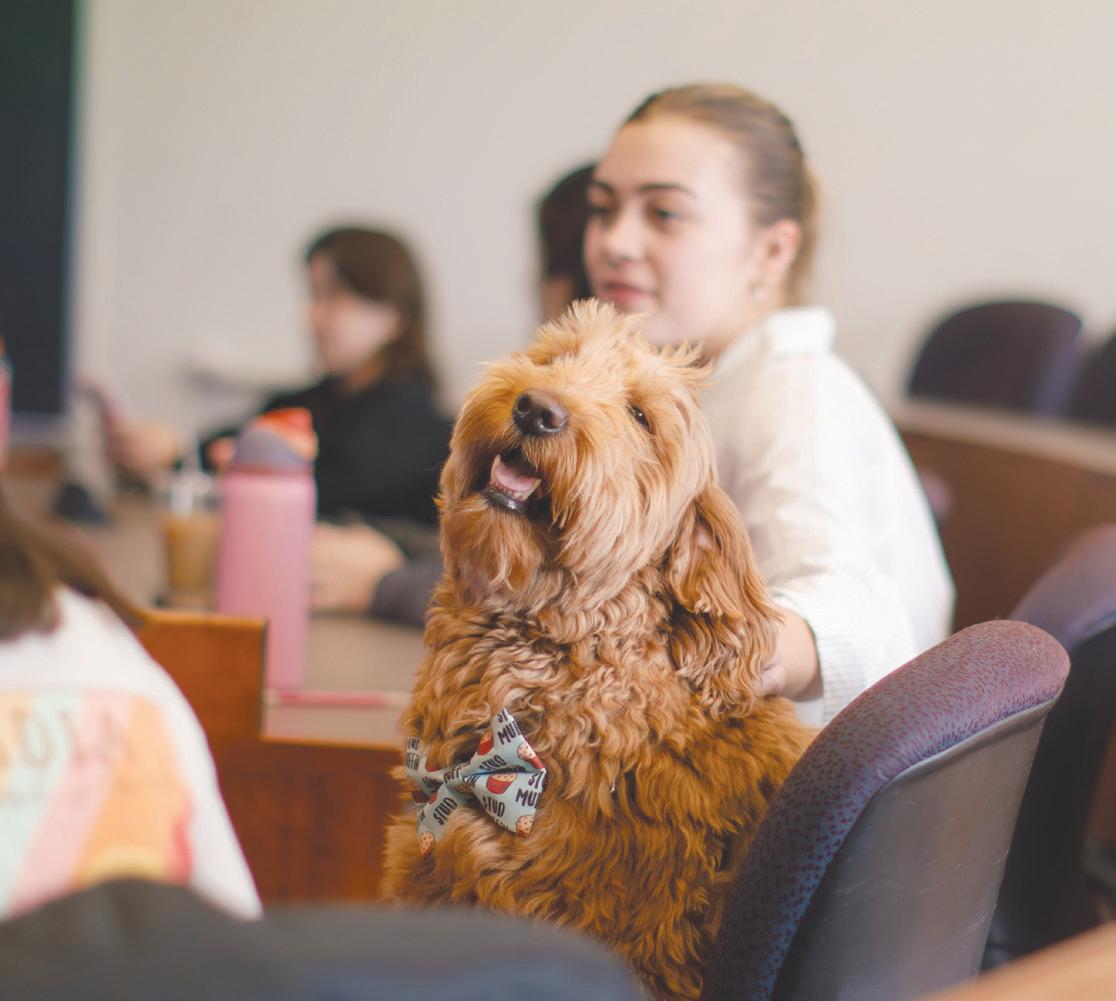
That’s the case for 3-year-old golden doodle Bauer. He is one of the most recognized faces in the Whitman School of Management — not just because both his parents are Whitman professors. Every other Wednesday, he can be found surrounded by students for Bauer Hour: Pet Therapy. But, that’s not the only time students can interact with Bauer; he is a frequent student in his mom’s classes and a visitor in his dad’s.
Bauer’s mom, Elizabeth Wimer, said she wanted to have a dog who could also serve her students. Bauer began his training to be a therapy dog at 12 weeks old, while Wimer became a certified pet handler — that means Bauer goes everywhere his mom goes.
Brittany Broski turns Goldstein Auditorium into ‘Royal Court’
By Alex Rice asst. copy editor
The royal thrones were set with two lush purple capes draped over chairs. A fancy table was set with candlesticks and decorative vines.
This was no longer the Goldstein Auditorium; this was the “Royal Court” calling comedian Brittany Broski to the stand.
On Wednesday evening, University Union hosted “A Royal Evening with Brittany Broski,” allowing the comedian and internet personality to open up about her career, give advice to students and share behind-the-scenes anecdotes about her interviews.
Broski has hosted her podcast, “BroskiReport,” since 2023. Broski is also known for her medieval-themed
YouTube interview show, “Royal Court,” where she hosts celebrities like Colman Domingo, Saoirse Ronan, Niecy Nash and recently, Harry Styles.
Tickets sold out the day the show was announced, so UU offered a livestream in Schine Underground for any students who were unable to get one. The first 200 students in line for the show also received a green
dragon stuffed animal with a UU bandana as part of a giveaway from the organization. The show’s moderator, sophomore Kyle McMahan, first saw Broski’s TikToks in 2020 and has followed her since. McMahan said he was initially very nervous to meet Broski, but her welcoming tone calmed him down and allowed him to have a natural onstage conversation with her.
“She’s just chill, like that’s my friend,” McMahan said.
To prepare for Wednesday’s show, McMahan rewatched “Royal Court” to understand how Broski interviewed her own guests. In a typical “Royal Court” episode, the show begins with Broski and her interviewee sitting on their thrones. As Broski claps twice, two
Alum returns to Syracuse as ‘The Book of Mormon’ lead
By Kendall Luther editor-in-chief
While waiting onstage before his first entrance, hidden behind a backdrop, Dylan Knight Weaver — donning a suit and tie with a “The Book of Mormon” prop in hand — takes a moment to close his eyes and feel the energy of the audience.
In this ritual, Weaver just focuses on channeling and feeling the audience’s energy.
“There’s thousands of people sitting together waiting to see the same thing. All of (the) energy is focused on one person or one thing happening on the stage,” Weaver said. “And so I try to just feel that energy and let it come into my body, and then just release all that and just go into the show.”
But, the energy in the audience this weekend may feel a little different than the other cities where Weaver has performed in the national tour of “The Book of Mormon.”
Several seats will be filled by former professors who taught him at his “home away from home” for four years: Syracuse University’s Department of Drama.
“When I saw that Syracuse was on the schedule this year, I was just literally beside myself with excitement,” Weaver said. “I have so many professors that are going to come through and that’s going to be so cool to kind of show them that I’ve done the thing.”
Weaver, who grew up in Colorado and graduated from SU’s College of Visual and Performing Arts in 2023 with a degree in musical theater, is returning to his alma mater’s hometown this weekend at the Landmark Theatre to play Elder Price, the lead role of “The Book of Mormon” musical.
From the creators of “South Park,” “The Book of Mormon” is hailed as an outrageous musical comedy, telling the story of a mismatched pair of missionaries sent halfway across the world to “spread the Good Word.” Weaver, an understudy for Elder Price, typically plays Elder Grant and Elder Church. This month, he took over full-time playing Elder Price. After playing Elder Price about 150 times in the last two years, the month happened to align with his return to the role and the return to the hometown of his alma mater.
In the show, Elder Price is an exciting and fun role to play — especially when you can tell the audience is “biting on it.” He described the character as a kind of “golden boy” who’s so enamored by his own greatness that he doesn’t see the world for what it truly is.
“It’s a great, well-written show and the character is just one of those characters that I’ve always wanted to play,” Weaver said. “To be able to do it is just so, so, so fun and, even for this limited run, I love doing it every single night.”
At SU, Weaver appeared in Syracuse Stage’s production of “The Little Mermaid” as Prince Eric, as well as in “Sweet Charity,” “As You Like It” and “Sender” with SU Drama.
These experiences as a student working in professional theater taught Weaver what a professional production would be like, he said.
Fashion
By Claire Zhang
asst. digital editor
Paige Mathes has lived her whole life with a stutter. It’s impacted the way she approaches everything in life, she said. It’s changed the way she understands dialogue and how it manifests in fashion.
“What does it mean to communicate when you struggle to speak, when you can’t speak?” Mathes, a Syracuse University senior, said. “How can you express the things that aren’t said?”
Mathes, one of the 26 seniors in the SU College of Visual Performing and Arts fashion program, explores this idea in her senior collection. Through her pants, dresses and skirts, she explores how communication isn’t always inherently spoken — many times it’s relayed through art.
Being able to explore the theme of finding her voice has been therapeutic for her, and the showcase is an opportunity that, as a child, she never could have imagined having, she said.
“This is a chance to start afresh and create,” Mathes said. “The world is kind of open to me.”
For the past five months, SU VPA senior fashion design majors have spent late nights into early mornings at the Nancy Cantor Warehouse. Thousands of hours of sketching designs, sourcing fabric and putting together garments will pay off at Thursday’s Senior Fashion Show.
He learned how to properly take care of his voice and his body.
Weaver first heard about the audition through an SU alum, who had served as the Dance Captain/Swing for “The Book of Mormon” on Broadway and the national tour. Now, Weaver performs “The Book of Mormon” eight times a week, totaling around 500 shows so far in his two years on tour. Learning how to pace yourself is important in this industry — something he said he learned while juggling schoolwork and performances of “The Little Mermaid.”
“It’s quite difficult and it’s really rewarding though to be able to kind of do this marathon week in, week out. And I think I really learned that through Syracuse Stage,” Weaver said.
David Lowenstein, an SU Department of Drama alum and now SU professor who performed alongside Weaver in “The Little Mermaid,” said Weaver met every challenge with maturity and a “relaxed confidence.”
“He has a great combination because he’s really talented, and he has this maturity and this confidence, and he’s just a really nice young man,” said Lowenstein, who also directed Weaver in “Sweet Charity” and taught him in class. “It’s really nice to see great things happen to nice people.”
Early on in his time at SU, Weaver said his professors “hammered” the importance of work ethic into him. Persevering through classes in the COVID-19 pandemic — which he acknowledged could’ve been a reason to pivot careers — strengthened his commitment to pursuing musical theater professionally.
Sometimes, it can be tempting for students to sleep through early morning classes or take the “easy way out” if they can, said Danita Emma, a ballet instructor in the drama department. But, Weaver — who Emma taught ballet for three years at SU — was always there at Emma’s 8:25 a.m. ballet class, smiling.
“He was very dedicated. He was always present. He always came and he took on challenges,” Emma said. “He took everything very seriously, and he grew immensely in SU, but part of that is the character, and his character is what is the foundation of his success.”
Weaver said his dance faculty helped him dance at the level he is today; many things he learned at SU prepared him to dance in “The Book of Mormon.”
Emma, who already has her ticket to see Weaver Friday night, said she gets teary-eyed when she sees her former students onstage.
“I see them onstage and it’s like, wow, where they were (for) four or three and a
half years, and where they are now, and I’m seeing their dream come true,” Emma said. “It’s very rewarding and exciting and heartfelt for me. It’s nothing more than seeing the success of a former student, and I can’t wait to see him.”
Lowenstein also graduated from the program and was cast in a tour just a few months later that eventually came back to the Landmark Theatre. He said he understands how Weaver feels.
“It’s like I have the dual emotional response to ‘I know exactly how that feels,’ and experiencing it from this side of it as the teacher,” Lowenstein said. “(I’m) just so proud and so excited to see my students just do the thing, do the thing that we practiced doing in class and through their four years at SU.”
When Weaver is not onstage this weekend, he is hoping to stop at his favorite spots around town, like Water Street Bagel Co., Pastabilities and Salt City Coffee — where he worked during his time as a student.
“I love Syracuse. It was my home away from home for four years,” Weaver said. “It’s gonna be so surreal and just a really exciting, full-circle moment for me.”
kaluther@syr.edu
“We all have different inspirations, different fabrics, different techniques,” SU senior Kieran Romano said. “Not one of the collections is alike, so seeing them all together will be really fun.”
This year’s senior class is one of the largest classes in years, SU senior Anya von Wolff said. That means the show, which has previously been hosted at the Warehouse, will instead take place in Goldstein Auditorium this year. Being able to display their pieces on a larger scale than before is particularly special, Romano said.
Each senior compiles a collection of six clothing pieces, all with different stories behind them.
Romano’s wardrobe reflects 1950s workwear apparel with a focus on sustainability and sourcing period-accurate materials. By hand-dyeing fabrics, he learned the authentic practices of making clothing rather than sourcing massproduced materials.
Von Wolff also prioritized the “nitty-gritty” process of making her garments. Titled “Warped Silence,” her collection reimagines the life of a garment from its fiber phase to the final product. On the surface, it’s business casual clothing, but every piece was hand-woven and dyed by von Wolff.
By sourcing fibers from wool farms all over the country, she aimed to answer the question: “Can clothing come entirely from America?” In her process, she found it could.
Dylan Knight Weaver performs in the national tour of “The Book of Mormon” eight times a week. In his two years on the tour, Weaver has performed in roughly 500 shows so far. courtesy of julia cervantes
This year, SU’s senior fashion design showcase will be held
handmade collections.
“He is really good at connecting students that sometimes hang out at the edges of social groups or maybe aren’t as engaged in class as others. So he’s obviously not trained for that, it’s just kind of the personality of who he is,” Wimer said. “He is good at finding the person that’s a little quieter or that might have some trouble fully engaging in a highpaced class.”
Most of the time, Bauer gravitates toward these people naturally. He then attracts more students to socialize with one other, Wimer said. Bauer is so “popular” among students that he has nearly 1,000 LinkedIn connections.
But Bauer isn’t the only friendly face in Whitman. Bear, a 12-year-old cavachon, has been attending exam review sessions, office hours and more with his mom, MaryAnn Monforte, who’s been an accounting professor in Whitman since 2007. Monforte said Bear still feels like a “puppy” because of his enthusiasm to be at Whitman. Sometimes, Bear can be spotted wearing a Syracusebranded leash and collar.
Monforte often also brought her neighbor’s and best friend’s dog Hazel to office hours and exam review sessions. Before Hazel died last month, she and Bear were inseparable, Monforte said.
“As soon as I pulled into the university garage, Hazel would start whimpering and then, of course, Bear would get all excited,” Monforte said. “They’d be barking to get out and get into Whitman.”
The dogs’ tails would wag as they approached the Whitman steps, eager to meet with Monforte’s students. That excitement is mutual. Freshman Phoebe Lemmon said it has been hard to be away from her pets in college, but Bear and Hazel’s appearances at review sessions and visits to Monforte’s office hours made the transition a little easier.
Instead of dreading accounting exams, Lemmon said she looked forward to a test because it meant guest appearances from the pups.
Sometimes, Bear is the only reason that Monforte’s students even attend her review sessions or office hours, she said. But she doesn’t mind, because most of the students end up staying the whole review session and complete the review questions.
Monforte isn’t alone. Some professors, like Russell, have been bringing their pets to SU since they first came to campus. In Russell’s case, that was nearly 22 years ago. At the time, David Rubin, a Newhouse dean from 1990 to 2008, encouraged professors to bring their dogs to school. Russell brought his late dog, Holly, and since then, Russell’s brought three generations of his dogs to Newhouse: Holly, Lucy and now, Willow.
As Willow grows older, Russell doesn’t bring her quite as often. But when he does, she’s a hot commodity in the classroom, he said. In Russell’s senior capstone class, Willow acts as a student herself, sitting through an 80-minute class in one of the chairs as if she were a student herself.
In other classrooms, dogs aren’t just another student or furry friend. When discussing “difficult subjects” like foreign exchange markets in Wimer’s classes, she incorporates Bauer into the concepts to make them more approachable — like saying “Bauer bucks” instead of currency.
Bauer can sometimes appear as any other student in his mom’s class: sitting up in the rolling chairs, his back-straight up against the chair, following his mom as she moves from the chalkboard to the smart board. Even Bauer’s “fellow classmates,” like SU sophomore Lilly DeWildt, notice how concentrated he is on his mom’s lectures.
“Most of the (dogs) that I’ve met up and run at you, they’re kind of chaotic in that way,” DeWildt, who has taken five of Wimer’s classes, said. “Bauer is kind of the opposite of that. He’s a very chill guy.”
DeWildt said the presence of a furry friend, like Bauer, can reduce her stress. During a visit last semester to Wimer’s office, DeWildt was feeling stressed and sought advice from Wimer. But the comfort came from more than just her professor; having Bauer to pet calmed her down, DeWildt said.
DeWildt has been connected with the pet’s LinkedIn page since last fall, when Wimer urged her students to add Bauer and use his page as an example for what their own networking pages should include.
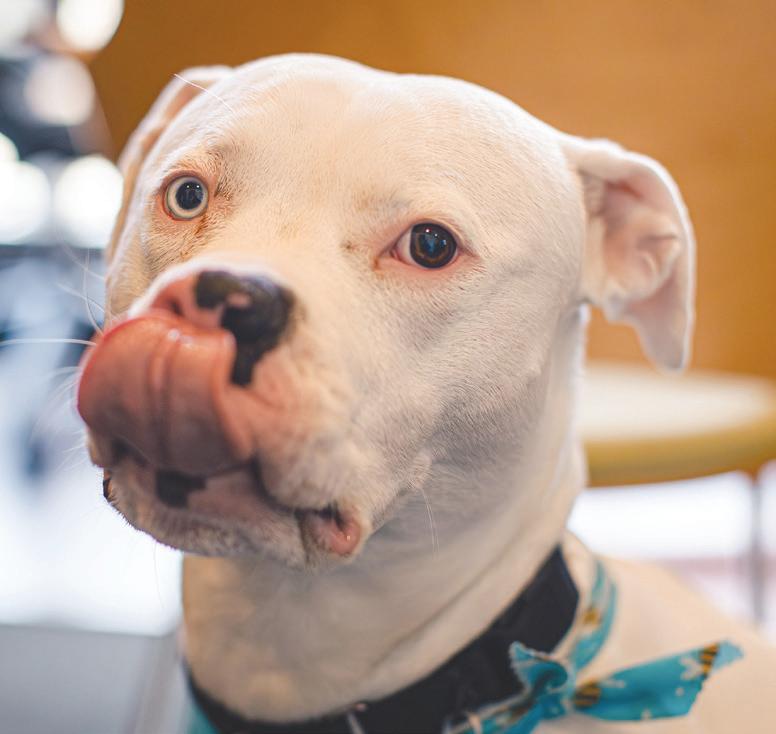
When Wes Whiteside, office’s associate director, brings his rescue dog, Franklin, to work, Whiteside can probably be found in his office — with a baby-proof dog gate outside the door — or walking Franklin during his lunch break. If it’s cold outside,
Franklin, a 2-year-old terrier mix, stays warm with his orange Carhartt jacket.
But before Franklin, there was Archie, who died in February 2024. Many of the students who stopped by the Newhouse 3 Office of Community, Culture and Engagement to see Archie, returned to see Franklin, Whiteside said.
Since Franklin became acclimated after his rescue last February, he has become a frequent guest in the office. Although Whiteside hasn’t brought Franklin to any of his COM 100 classes, he always emails his students to let them know Franklin is in so they can visit.
Like Wimer, Whiteside said having Franklin can make the college experience easier for students who may be having a bad day or missing their dogs at home.
“Being in an open office and having somebody as friendly as this, I think it goes a long way. And it makes me happy to see him bring them joy,” Whiteside said.
Similarly, the reason Russell still brings his dog to work with him leads back to one moment years ago when Lucy’s presence in Russell’s office during finals week made a freshman’s day. The student knocked on his office door, asking to pet Lucy — which Russell agreed to and returned to his work.
Five minutes later, Whiteside looked up, and the freshman had his arms around the dog. Lucy’s head was leaning against the student’s shoulder.
“That’s why they’re here,” Russell said. lvzucker@syr.edu
“Dirty Dancing” in Concert
Relive the unforgettable music of the 1987 romance flick “Dirty Dancing” on Thursday night. The concert will project the classic film, accompanied by a live band and singers performing the film’s soundtrack.
WHEN : Thursday, 7:30 p.m.
PRICE: $52.46 to $101.36
WHERE: The Oncenter Crouse Hinds Theater
“The Book of Mormon”
The nine-time Tony Award-winning musical “The Book of Mormon” will be making its Syracuse stop from Friday to Sunday. Syracuse University musical theater alum Dylan Knight Weaver will be playing the lead role of Elder Price for his homecoming return.
WHEN : Friday at 7:30 p.m., Saturday at 2 p.m. and 7:30 p.m., Sunday at 1 p.m. and 6:30 p.m.
PRICE: $43.30 to $112
WHERE: Landmark Theatre
Chuck Ragan
Start your weekend with a slow night of folk music from Houston native Chuck Ragan. Ragan is a vocalist and guitarist for the band Hot Water Music. As a solo artist, Ragan has released 11 albums and soundtracks. WHEN : Friday, doors at 7 p.m., show at 8 p.m.
PRICE: $31.59
WHERE: The Song & Dance
Crystal Ship - A Tribute to The Doors
Reminisce over the glory rock days with Crystal Ship, The Doors tribute band. Dedicated to preserving the lasting legacy of Jim Morrison and The Doors, the band will transport audiences to rock’s most electric era.
WHEN : Saturday, doors at 7 p.m., show at 8 p.m.
PRICE: $24.95
WHERE: Middle Ages Brewing Company
KJ & LOLO: UNPLUGGED 2026 BENEFIT CONCERT FOR ACR HEALTH
Local R&B band Kj & Lolo will be performing alongside SMX Band, Jykeise Thomas and Malichi Simmons for a benefit concert at Funk ‘n Waffles this Saturday. All funds raised will support local nonprofit ACR Health, which provides support services for people with chronic diseases. You must be 18 or older to attend.
WHEN : Saturday, doors at 7 p.m., show at 8 p.m.
PRICE: $34.45
WHERE: Funk ‘n Waffles
from page 6 pets
franklin whiteside’s terrier mix willow prof. russell’s golden retriever bear prof. monforte’s cavachon
bauer prof. wimer’s golden doodle
bright spotlights flash, and she says “let the trials begin.”
Wednesday’s show was no different. After briefly introducing Broski, McMahan clapped, spotlights came on and the questioning began.
“I first let her open up with the funny questions and then getting deeper and really understand how much she appreciates her career and life. So just studying her approach to ‘Royal Court’ and going from there,” McMahan said.
SU sophomore Grace Mulholland has been watching Broski’s videos for about four years, and her favorite “Royal Court” episode was with Styles. Mulholland hoped Broski would expand more on her experience with interviewing Styles.
Broski opened up about her struggles with balancing her inner “fan girl” while maintaining a professional and meaningful interview with her guests. Since Broski has been very vocal about being a huge fan of Styles, Broski told the audience having him on “Royal Court” was a “crapshoot,” but said he “knocked it out of the park.”
SU freshman and longtime fan of Broski Addie Swenson, said she enjoys the formatting of Broski’s interviews and how she allows her guests to be comfortable.
“She humanizes celebrities and then she has grown that platform and become a celebrity herself,” Swenson said. “It breaks that barrier of these people being superior or beyond human, they are just people on stage talking about what they like.”
McMahan asked Broski about a potential return of her art history video series, “(F)art History,” where she dove into different artists or art pieces. Broski said the videos take time to prep, but she really values academia and the conversations the videos have sparked.
Broski told the audience that she is inspired by people in school and thinks that if “all of this went away tomorrow,” she would go back to school and pursue a Ph.D. in Spanish to become a professor.
Broski also shared how she stays positive during difficult times and urged the audience to understand that they have agency over the media they consume. She advised that “your energy is your currency,” so consumers should be selective with where they give it. Ironically, though, Broski mentioned she sets time limits on her apps, but she joked that she always bypasses them.
After the questioning from McMahan, he turned it over to the audience, where Broski had a personal Q&A with the crowd. Questions ranged from serious journalistic advice to what her current fanfic lineup is.
Other fans of Broski had similar sentiments. SUNY ESF sophomore Sofia Ward said she has been a fan for around six years and finds Broski to be genuine and funny.
“She’s authentic, she’s herself, she understands people, and she’s not full of herself,” Ward said.
Swenson has been a fan of Broski since 2019 and said she could probably recognize Broski’s headboard solely from seeing her TikToks. Swenson said she appreciated Broski’s ability to balance comedic content with discussions about deeper topics. Broski is relatable to college kids because of her “silly” nature but is also able to talk about the current world and things that she’s passionate about, Swenson said.
At the end of the Q&A, a student asked Broski what she would tell her college self. She reminded students to not take their friendships for granted and to make a conscious effort to stay involved in each other’s lives. She also added to relish the time that college gives students and to always take chances to discover oneself.
Swenson said she was grateful for the opportunity to hear from someone like Broski, who is prevalent in the social media world. She said she sees herself in Broski and appreciated getting to see her in the spotlight.
“It’s important to know the person you’re seeing behind the screen is a person and they don’t just solely exist online,” Swenson said. arice19@syr.edu
this for the Black girls who come from that spiritual, ancestral and religious background.”
“I wanted to showcase that this type of effort can create clothing that you would wear on an everyday basis,” von Wolff said.
Some collections stemmed from personal backgrounds, like Jada Williams’, titled “Salt, Bone and Indigo.” Growing up in Natchez, Mississippi, Williams hopes to pay homage to her heritage and the people and cultures that shaped her.
As a child, Williams found herself drawn to the clothing she saw family wear at church. She is expressing the nature of the Natchez region by embellishing her handmade suits and dresses with pearls, then pleating and burning them.
“It’s very inspired by ancestry, but it’s also modernized to today,” Williams said. “I’m doing
While each piece will be modeled as clothing, some seniors experimented with unconventional mediums for their pieces. “THANK YU NY,” Amaya Evans’ collection, pays tribute to New York City, the place she credits with shaping her into the creative she is today.
Her pieces take the textures, sights and senses of urban life and translate them into wearable garments. One of her sets, a brick-looking top and skirt, is meant to represent the architecture of an MTA train station.
Evans hopes the positive energy she channels into her pieces will shine through those who wear them.
“By wearing my clothes, I want to evoke that confidence,” Evans said. “It’s all very bold, uplifting, colorful and very new.”
Though every senior has their own collection, this year of planning and designing has been a collaborative process, Romano said. The whole class has been through every step of the process together, Evans said, from learning to thread sewing machines as underclassmen to realizing their ideas as seniors.
The final “roller coaster” will all pay off on Thursday, von Wolff said.
For the designers, a platform like the showcase is a way for audiences to get a glimpse of their work, as well as the passions and stories that drive them.
“This is like our first announcement to the audience, to the world, saying, ‘Hey, this is my name. This is what I’m designing,’” Evans said.
cmzhang@syr.edu
brittany broski stopped by Syracuse University for “A Royal Evening with Brittany Broski” on Wednesday. Broski opened up about her career, gave advice to students and shared behind-the-scenes anecdotes about her show “Royal Court.” courtesy of university union
Many Syracuse University fans of Brittany Broski appreciated how she’s able to balance being funny while diving into deep topics with her guests on “Royal Court.” madison cox staff photographer
“I
By Gain Lim columnist
In late February, actor Timothée Chalamet — known for his roles in films such as “Call Me By Your Name,” “Little Women” and his most recent work “Marty Supreme” — sparked controversy when he suggested that “no one cares” about ballet or opera anymore.
The remark was made during a public conversation about film and culture with actor Matthew McConaughey on Variety’s YouTube channel. What may have been intended as an offhand comment quickly drew backlash from artists and fellow performers, who argued that dismissing centuries-old art forms reflects a misunderstanding of their role in society.
On the surface, the reaction cycle followed a familiar script: a celebrity makes an ignorant remark, social media erupts and the story becomes fodder for awards show monologues. At the 2026 Oscars, host Conan O’Brien even poked fun at the moment, joking that the ballet and opera communities might be after Chalamet for his comment.
But the real issue isn’t whether one actor misspoke. Moments like this are more useful as reminders of something larger: The arts only disappear when people decide they no longer matter.
After bringing up ballet and opera, Chalamet quipped that he had “just lost 14 cents of viewership.” The line was meant to be humorous, but it revealed something deeper about the way culture is measured today. In an era dominated by streaming metrics and engagement statistics, artistic value is increasingly framed in terms of views, clicks, revenue and audience share.
By those standards, ballet and opera will always seem irrelevant. These art forms were never designed to compete with the speed and accessibility of modern media. A ballet performance requires months of rehearsal for a production that exists only in the moment. An opera may unfold over three hours or be sung
in another language, demanding patience and focus from the audience.
But, the attention required to appreciate ballet and opera is what makes them such powerful art forms.
The arts aren’t simply entertainment — they’re one of the ways communities make meaning together. A theater filled with people watching the same performance creates a shared cultural experience that can’t be replicated anywhere else. This is why artists responded so strongly to Chalamet’s comment, with many pointing out that cinema
itself owes much to the traditions of opera and theater.
Film scores, for example, often draw directly from operatic structure. Composer James Horner famously drew inspiration from Sergei Prokofiev’s “The Battle on the Ice” when composing the score for “Star Trek II: The Wrath of Khan.” The influence of classical music is embedded in the way films build tension through sound.
Stagecraft has also shaped the visual language of filmmaking. Directors have long borrowed techniques from theatrical production, from painted backdrops to dramatic lighting.
Victor Fleming’s “The Wizard of Oz,” for example, relied heavily on techniques that originated in stage musicals, such as elaborate sets and vibrant costumes.
Furthermore, choreography informs the way movement is used to tell stories on screen. Jerome Robbins translated Broadway dance choreography into cinematic storytelling in “West Side Story,” where conflicts are expressed through movement instead of dialogue. In moments like these, dance becomes a form of narrative language.
To dismiss these art forms is to overlook the foundation on which modern entertainment stands.
Of course, Chalamet’s criticism shouldn’t be discredited entirely. Ballet and opera do face real challenges such as declining attendance, high ticket prices and a reputation for elitism. But if younger audiences feel disconnected from these traditions, cultural institutions have a responsibility to adapt and experiment with accessibility and outreach.
In fact, this adaptation has already begun. Ballet companies collaborate with contemporary choreographers, opera houses stage modern reinterpretations of classic works and community programs bring performances into schools and public spaces.
But acknowledging those challenges isn’t the same as declaring the arts irrelevant. If anything, the intensity of the reaction to Chalamet’s comment shows the opposite. People care deeply about these art forms because they understand what would be lost if they were gone.
The question, then, isn’t whether ballet and opera still matter. It’s whether we’re willing to defend the spaces where art can exist — by showing up, supporting institutions and refusing to dismiss them as irrelevant. Once we start saying “no one cares,” it becomes easier for that statement to become true.
Gain Lim is a freshman majoring in Health & Exercise Science. She can be reached at glim06@syr.edu.
Embracing aging brings you closer to yourself, form of intimacy
By Saimun Uddin essayist
The frontal lobe is the last part of the human brain to fully mature. Scientists tell us it isn’t complete until our mid-to-late 20s, sometimes longer. It governs judgment, impulse control, to know when something is worth it and when it’s not. The more I age, the more I feel like myself.
The realization feels strangely at odds with the world we are in. We live in a culture that treats aging like a slow leak, something that has to be patched and hidden before others notice. Advertisements sell us youth in a bottle. Social media shows us a world where time itself passing is a kind of failure. We are encouraged to fight aging, resist it, defy it, as though the years accumulating in our lives are something to fear rather than the very thing shaping who we are.
I used to feel that pull too. The pensive anxiety of a birthday approaching, the mental arithmetic of where I was supposed to be by now. But somewhere in the slow accumulation of days, something shifted. I stopped feeling afraid of time passing. I started feeling grateful for all I have achieved.
When I was younger, I thought absorbing pain quietly was a virtue. It took years to understand that walking away from what diminishes you is not weakness. It’s one of the most dignified realizations you can arrive at. Aging has a way of teaching this lesson gently, but persistently. With time, you begin to see more clearly what deserves your energy and what doesn’t.
There’s a particular softness that comes with this feeling and it surprised me. I expected wisdom to feel more certain; instead, it’s simple and gentle. I find myself moved by things that once slid past me — the particular way light falls in the afternoon, the way a friendship can hold silence without discomfort, the ordinary fact of being present on a typical Tuesday.
I have more respect for myself than I ever have. A respect that is internal and quiet, free from external opinions. It exists simply because I have lived long enough to understand the shape of my own life a little better.
Perhaps that is the strange gift aging offers us, clarity. Not the dramatic kind that arrives in a single moment, but the slow understanding that builds over years. Every experience removes a little more noise. What remains is simpler and far more honest.
For students at Syracuse University, this realization can feel distant. College is a strange moment in life, balanced between youth and whatever comes next. There is pressure to decide who you are, what you will become and how quickly you can get there. The future often feels like something rushing toward you, demanding answers you’re not sure you have yet. But there is a quiet reality that often goes unnoticed in the middle of the uncertainty: You’re already in the process of becoming yourself.
Aging doesn’t arrive all at once. It unfolds gradually, through friendships that shape you, mistakes that humble you, small moments that seem ordinary until you realize they changed you. The fear of getting older comes from the idea
that time is taking something away. In truth, it often gives perspective, patience and the courage to live more honestly.
If you walk across campus early in the morning, before the rush of classes begins, there is stillness in the air. The brick paths are damp, the trees move slowly in the wind and the university feels suspended in a quiet moment of possibility. It’s a reminder that life rarely moves forward in dramatic leaps. More often, it moves quietly, shaping us day by day. There is comfort in realizing that the person you’re becoming doesn’t need to be fully formed right now. Time will continue its patient work.
The anxieties that feel overwhelming today will soften. The questions that seem impossible to answer will slowly begin to resolve themselves.
Getting older can feel frightening because it asks us to confront change. But it offers something deeply reassuring, the chance to know ourselves more honestly with each passing year.
In that way, aging is not a loss at all. It’s a slow solidifying of oneself, the gradual discovery of who we are meant to be. For anyone walking through the uncertain years of adulthood, do your best to remind yourself as often as I do. Beyond the stress, the deadlines and the constant pressure to have everything figured out, there is a quiet comfort waiting in the future.
khloe scalise contributing illustrator
julia rodenberger contributing illustrator
September, Doty pointed up to the MVP Arena rafters and said he was “just excited to have a banner up there: 2025-26 MAAC champs.”
He’s always been confident and energetic. Just ask his mom, Nicole Doty. She spent the first 13 years of his life coaching him in basketball, soccer and lacrosse. As a toddler, she recalls Doty had a penchant for leaping from one piece of furniture to another.
“He was kind of a daredevil and had no fear from the minute he could walk,” Nicole said. “We joked that he had nine lives.”
The indoor parkour phase waned, but Doty’s dynamism didn’t. During the COVID-19 lockdown, he and his brothers went to an abandoned lot near their house, cleaned off some bricks and set up a basketball hoop. When snow blanketed the makeshift court in the winter, Doty shoveled it to keep playing.
Doty’s desire to progress didn’t fade, either. He started playing Amateur Athletic Union in his 14U season with BBA Team Amazing and moved to the Adidas 3Stripes Select Basketball for his 15U season. For his final two years of youth eligibility, Doty joined City Rocks in the Nike EYBL.
But when Niver died, and Doty decided to stay home, his college search stressed him out. The same energy that once drove him physically seemed to work against his college decision. He debated doing a college preparatory postgraduate season, but with visits already scheduled to Siena, Buffalo, Binghamton and Colgate towards the end of his senior year of
it’ll be difficult for Legette-Jack to “find the next Uche Izoje.” And keep the current one. Izoje will be one of the country’s most sought-after players.
Yet Legette-Jack proved she can turn funding into positive production, and it may be convincing enough for Izoje to stay. Darius is aiming for a sixth year of eligibility and even said she’d love to return to the Orange if her waiver is approved.
That foundation is something SU lacked last year. The Orange didn’t have a single player hit the portal after 2024-25, but did they really have a favorable resume? Not at all. A 12-18 team will do that for you, especially one that lost to midmajors UAlbany and Saint Joseph’s.
This year, though, starting fresh was non-negotiable. Six players — all out of eligibility — departed,
Simply put, Syracuse has failed to show up in big games this year. Sure, it’s taken care of business at just about every turn, picking up five Quad 2 wins and going undefeated in Quad 3 and 4 play. At some point, to show you’re legit, you have to hang with the big dogs.
That’s something other ACC teams of SU’s caliber have done. Take Clemson, which the Orange beat in February. The Tigers stunned Duke to snap its 16-game winning streak. Virginia knocked off Louisville late in the year, too. There’s optimism that these teams can go on a run in March because they’ve shown they can beat top teams. Syracuse hasn’t… yet.
I say “yet” because, as I mentioned, I don’t believe Syracuse has played to its fullest poten-
goes down against an NCAA Tournamentcaliber opponent, so do the Orange.
Felisha Legette-Jack has tried to find that fifth starter all season. For a time, it looked like Shy Hawkins was the answer. The sophomore ranks fifth on the team with an average of 5.5 points per game, and she’s started 17 of SU’s 31 games on the season.
“She’s so special,” Legette-Jack said of Hawkins back in January. “She cares about the team more than herself.”
It’s impossible to know exactly what LegetteJack thinks of Hawkins now, but if her playing time is any indication, that opinion might have shifted recently. She started just one of Syracuse’s last four games and received single-digit minutes in both of its ACC Tournament matchups.
Journey Thompson has been LegetteJack’s fifth starter lately, but outside of a four-point first quarter against Cal, she hasn’t been as impactful as the other four. How about Aurora Almon? A good rebounder, yes, but she can’t be the bench scorer SU needs. Jasmyn Cooper, maybe? While her 11-point performance against the Cardinals showed promise, she’s still a freshman and hasn’t gotten consistent volume.
high school, it increasingly seemed he’d head straight to the NCAA.
At the time, Doty was exploring Christianity further, so he asked his Team Amazing coach, Justin Fatica, for guidance. Fatica has traveled the world as a motivational speaker. He handed out Bibles at practice, and he frequently took Doty and his team to Mass.
“God has given you a gift,” Fatica recalled telling him. “And he wants you to have freedom.”
“I was having anxiety and worrying a lot,” Doty added. “I feel like God picked me up at my lowest points, and it’s changed my life for the better.”
Once Doty eventually met McNamara during his visit to Siena, he did a complete 180.
Perhaps it was that aforementioned similarity the former SU player alluded to, or the feeling that God had led him there, but Doty and McNamara clicked instantly. Before the meeting was over, Doty had mentally crossed off the next three visits.
To this day, Fatica still prays with Doty before his games, and he feels religion has reinvigorated Doty’s confidence and energy.
“He’s worked hard. He’s got the special sauce,” Fatica said. “He’s always been competitive, but it turned to a whole ‘nother level when he started playing for Jesus.”
He officially signed in the summer of 2024 and earned a starting spot midway through his freshman year. He began his sophomore year by receiving Siena all-time scorer Marc Brown’s blessing to wear the previously retired No. 4 and prophesying that the Saints would bring a MAAC championship back to Loudonville.
Five months later, he made good on that promise with a game-high 23 points against Merrimack in the MAAC Championship.
headlined by Georgia Woolley and Kyra Wood. Woolley was the Orange’s offensive cornerstone, and Wood, at the time, seemed like an irreplaceable big with 12 points and seven boards a game.
But Legette-Jack didn’t pout. She said she immediately began making phone calls and setting up visits. Nearly a year later, the proof is in the pudding. Syracuse has 11 more wins than it finished with last season and flipped its ACC record from 6-12 to 12-6.
The Orange are averaging nearly five more points per game on improved shooting efficiency, have built one of the most dangerous frontcourts in the ACC and have formed a new culture consisting of late-night phone calls to talk about basketball after a silent prior season.
The turnaround is helping Syracuse attract top recruits’ attention. Kaleena Smith — the No. 1-ranked player in the 2027 class — visited the JMA Wireless Dome on Feb. 8 when the Orange
tial. The Orange are at their best when their star scorers are churning, they’re rebounding well and their bench is thriving when needed.
SU is unquestionably top-heavy. Aside from Izoje, Dominique Darius, Laila Phelia and Sophie Burrows, the Orange don’t have another consistent offensive contributor. Subtract Darius from that equation — who’s been ruled out for the tournament with a left hand injury — and their offense is now three players. That makes playing your best game a lot more difficult.
But if depth pieces Journey Thompson, Shy Hawkins, Maddy Potts, Olivia Schmitt and Jasmyn Cooper can contribute — whether it be on the glass or from 3-point range — the Orange will be a far better team.
That — or some ridiculous performances from Izoje — is what SU will need to grab a signature win in March.
After the meet and greet where Doty made his bold prediction, Nicole and Doty’s father, Travis, joked that, given Doty’s mindset, it could come true.
“We weren’t shocked (when they won),” Nicole said. “Anything he puts his mind to, usually, it comes true.”
Now, Doty’s mind turns to Duke’s Cameron Boozer.
They last played 14 months after Niver’s death, in Doty’s final game with City Rocks. The Boozer twins’ Nightrydas Elite won that
hosted Louisville. A player like Smith would be a monumental get for the program.
After last offseason’s success, there’s reason to believe Legette-Jack can make it happen. She has the history to back it up. She earned Dyaisha Fair’s commitment despite South Carolina, Miami and Arizona vying for the guard. Could Legette-Jack do the same with Smith?
Even if Smith doesn’t join the Orange, Legette-Jack can continue to move forward with other top recruits. She can also use the ones she currently has in her back pocket. Jasmyn Cooper became the head coach’s top commit last season, and four-star Camdyn Nelson was expected to take the reins of SU’s point guard position.
Although both players hovered around 10 minutes per game, they showed glimpses that remain key pieces of a puzzle Legette-Jack has proven she can put together.
The Orange were in a somewhat similar situation two seasons ago when they traveled to Storrs as a No. 6 seed and teed off against UConn in Round 2. While they lost, SU stayed close with a team that finished two points short of reaching the national championship.
However, SU failed miserably to capitalize on that late-season performance in the 2024-25 season. But Felisha Legette-Jack clearly learned from her mistakes, constructing this year’s roster through the transfer portal and with a homerun freshman signing.
In all likelihood, the Orange will lose both Darius and Phelia this offseason and look to the portal for replacements. A win on the national stage this March could make SU look like a more attractive destination. Because Legette-Jack is clearly building something with strong momentum.
In his 19-year tenure as Louisville’s head coach, Jeff Walz has won 513 games and been to four Final Fours. He knows what it takes to make a run in March, and his rosters are optimized to do so. After his team’s victory over SU, Walz pointed out that Elif
Istanbulluoğlu — who ranks fourth on the team with 9.8 points per game — only scored five against Syracuse.
But, Walz said that when the Orange focused on her, it opened up opportunities for secondary players like Reyna Scott and Mackenly Randolph to
game by 20. Ten days later, Doty officially joined Siena.
He’s found his place with the Saints. And this time, the stage is college basketball’s largest. But don’t tell Doty how daunting the task ahead of him is. He has his own take on it.
“I am a little delusional with that stuff, but they’re lacing up the same way we are,” Doty said. “They gotta put an orange ball into a hoop the same way I do. So, we’re gonna go out there, defend hard and hope to come up with a win.” peterhradosh@gmail.com
Just look at last season for proof. Syracuse hadn’t capitalized on prior success in what LegetteJack called a “rebuild” year, and it paid the price. It finished 14th in the ACC, and its schedule was marred with losses, including five different multi-game skids.
There wasn’t a margin for error this time around. Legette-Jack’s vision has always been to contend for a national title, and SU had to strengthen its core with firepower to make that a realistic possibility. The Orange got who they needed. They made a memorable run with it. That part is complete.
What comes next is ensuring Syracuse doesn’t let that progress go to waste.
“They said that we’re good enough to be here,” Legette-Jack said. “Now we gotta prove we’re good enough to stay.”
jordankimball28@gmail.com @JordanKimball_
And if the Orange can take advantage of just that — momentum — this could be an even scarier team next year. Last season’s disappointment seemingly interrupted SU’s forward momentum from its 24-win 2023-24 campaign, but this season got it back on track.
The best teams, though, will be remembered for how they performed against the Goliaths. And while Syracuse’s success this season is encouraging, it’ll feel unsubstantiated if the Orange don’t capitalize on the opportunity to compete in March. It won’t be easy, especially given SU’s track record against Quad 1 teams this year, plus the absence of Darius. But Saturday is Syracuse’s final chance to prove it belongs in the NCAA Tournament. Otherwise, this special season will end without a crowning moment. harrispemberton@gmail.com @HarrisPemb6
shine with 15 and 12 points, respectively. It’s not just a single knockout blow — it’s death by a million cuts.
“That’s what’s made us good all year,” Walz said postgame. “Our ability to have seven or eight (players) that can score the basketball.”
Syracuse hasn’t had that luxury all year. It’s the reason why — despite how impressive this season’s turnaround has been — there’s still a gulf separating teams like Louisville from teams like SU.
After that defeat, I asked Legette-Jack what makes game-planning against a team like the Cardinals so tough, with so many players who can score at any time.
“We did it the year before (last) — we beat them — and we had people that understood the assignment,” Legette-Jack said. “They were just better than us today, and we’ll continue to grow and get better, too.”
Correct. Louisville was better than Syracuse on that day.
Here’s the kicker: If the Orange don’t find secondary scoring options, particularly ones who can replace Darius’ absence down the stretch, odds are the Cardinals — and high-caliber, 20+ win teams like them — will be better than Syracuse on the next day. The day after that. And the day after that. And every other day until SU’s inevitably brief NCAA Tournament run ends. mjpalmar@syr.edu @mpalmarDO
After leading the Saints to their seventh Metro Atlantic Athletic Conference title, Gavin Doty was named the tournament’s most valuable player. courtesy of siena university athletics
Syracuse primarily relied on four scorers in its resurgent 23-win season, lacking depth that’ll prove costly in March Madness. courtesy of the atlantic coast conference
SU alums react to Autry’s firing: ‘It’s definitely unfortunate’
By Aiden Stepansky senior staff writer
Elijah Hughes and Tyus Battle heard the backlash with their own ears. When North Carolina came to town on Feb. 21, the Tar Heels pulled away in the final minutes to continue the Orange’s disappointing third year under head coach Adrian Autry. Frustration in the JMA Wireless Dome boiled over.
Chants began. The message was loud and clear. SU’s student section wanted Autry to be fired.
“I just wish that didn’t happen on the home floor with our head coach, just because that’s not how I think it should be. That was disheartening a little bit,” Hughes said. “But I also understand the fans. They want to see Syracuse back at the top.”
The Orange fired Autry on March 11 after the head coach went 49-48 over three seasons, missing the NCAA Tournament all three times and falling under .500 in back-to-back seasons. But before a lackluster run as head coach, Autry was a star point guard for SU in the 1990s and, as an assistant coach, helped Jim Boeheim build multiple March Madness teams in the 2010s.
The Daily Orange spoke with multiple Syracuse alums who played under Autry to hear their perspective on his recent firing. The former SU players shared the impact Autry made on them in their time with the Orange, and how the head coach dealt with pressure in his three years helming his alma mater.
“It’s definitely unfortunate what happened this year, and over the past couple years,” Battle said. “But that should never diminish how much Autry has given to this program and to the Syracuse community.”
Even as Autry was busy running SU’s program, he stayed in contact with his former players who found professional opportunities overseas or around the United States. Mike Gbinije saw Syracuse play on the road against UVA and UNC this season, catching up with Autry and “encouraging him” after seeing immense pressure on social media. He felt Autry handled the noise as best he could.
Former NBA first-round pick Tyler Lydon now works as a skills coach for his own basketball training company. He’d often call Autry when he worked with players he felt would be a good fit
That expectation changed about three days before Snake Island’s first game in Ottawa, when Spallina called Mitchell to say he was ready to go.
“He seems to be one of the guys that’s happiest when he’s got a stick in his hand,” Mitchell said.
Spallina’s don’t-stop attitude is why the grind of simultaneously playing in the PLL and NLL likely won’t concern him.
It’s far from an easy path, though. Dan Arestia, host of the “Sticks In” podcast, recalled Josh Byrne putting his body through the wringer in 2022. Byrne went right from the NLL Final with the Buffalo Bandits to the PLL with the Carolina Chaos. When the Chaos made the PLL Final, he had two weeks to rest before NLL training camp started. Arestia remembers Byrne talking about how beat up he was.
Arestia pointed out that others take a simpler route for a few years before working lucrative jobs on Wall Street. But playing in the PLL is becoming more viable. Rabil said on Arestia’s podcast that the average PLL salary is $40,000 a year, and the top 5% make $60,000.
“There are more and more guys now who say, ‘I want to be a pro lacrosse player.’ And (Spallina) wants to be a pro lacrosse player,” Arestia said.
As the world’s biggest professional lacrosse league, the PLL can give Spallina the best chance to shine. Lamberti sees him as a productive X attack and right-handed wing dodger in the PLL. Though Lamberti thinks Spallina is best fit for teams that have pieces in place, so he’s not always the guy.
It’s why he sees Spallina as a good option for the Maryland Whipsnakes, who hold the third pick in the draft. The Utah Archers and Boston Cannons pick first and already have attacks in place, meaning they may pass on Spallina. Meanwhile, the Whipsnakes are looking for a piece to play alongside strong dodgers T.J. Malone and Aidan Carroll, who Lamberti thinks could take the playmaking weight off Spallina’s shoulders.
There’s also a possibility Joe — the current general manager of the California Redwoods, who hold the sixth pick — tries to trade up for Spallina.
When Lamberti released his first big board in late January, Spallina was No. 6. Lamberti admitted he was influenced by Spallina’s onepoint performance against Maryland and Will Schaller — Lamberti’s No. 2 prospect — in the 2025 Final Four. Then, Spallina’s four-goal performance against UMD on Feb. 13 boosted his stock in Lamberti’s eyes.
for Syracuse. When news broke of Autry’s firing, Lydon texted his former position coach. Autry got back to him less than a minute later.
“It was kind of inevitable. I think everybody saw that this was going to be happening the way the tail end of the season went,” Lydon said of Autry’s firing. “But, a big part of me felt crushed for him, because I know what the university means to him.”
As the Orange continually competed for national championships in the 2010s, Autry was at the forefront. Gbinije built a relationship with Autry through AAU basketball and eventually transferred from Duke to Syracuse after his freshman season. A few years later, Gbinije helped SU reach the Final Four.
Hughes was in his dorm room at East Carolina in 2017 when he saw a call from a Syracuse phone number. The guard was in the transfer portal and picked up the call. On the other end was Autry, who broke down how Hughes would fit into SU’s system for over 40 minutes. Hughes transferred to Syracuse and became a First Team All-ACC player.
“I felt the realness in his voice,” Hughes said of Autry. “That phone call changed the whole trajectory of my life. He saw something in me early
“That’s just super valuable in the PLL, where you just need an attacker that you can trust to make the right decisions, and someone that just knows how to score and find open teammates,” Lamberti said. “And, obviously, that’s something that (Spallina’s) been doing his whole career.”
The PLL is much faster-paced than college, with a 60-second shot clock instead of 90 seconds. But Lamberti thinks Spallina’s quick decisionmaking will make for a smooth transition. Spallina’s lacrosse IQ is as high as anyone’s. That’s evidenced by his 161 career assists, which are the most of any active Division I player.
He might not have the scoring prowess of guys like Kirst, O’Neill and reigning MVP Connor Shellenberger — all of whom Spallina sometimes gets unfairly compared to, per Lamberti — but he’s produced at every level.
Lamberti mentioned multiple PLL coaches have told him Spallina’s high floor is part of his intrigue as a prospect. Meanwhile, his ceiling is an all-pro caliber player. Lamberti wouldn’t commit to labeling him an MVP-level talent, but based on Spallina’s prowess, it’s hard to put it past him.
For now, Lamberti’s closest comparison for Spallina is Cannon attack Asher Nolting. He regularly uses his body to initiate contact when dodging and backs down players while finding off-ball cutters.
that I didn’t necessarily see in myself as a player.”
As Hughes averaged 19.0 points per game throughout the 2019-20 season, agents began reaching out to Autry about the forward. He still had another year of eligibility if he wanted to use it, and Autry and Hughes agreed it’d be best not to worry about the next level until the season was over.
Once Syracuse’s season abruptly ended due to COVID-19, Hughes went straight to Autry to see what the assistant coach thought he should do. Autry told him it was time to go. Hughes was selected in the second round of the 2020 NBA Draft.
Gbinije said Autry was often the “good cop” to Boeheim, acting as a positive voice. Battle added that Autry’s perspective as a former student-athlete under Boeheim made him easy to relate to.
Tyler Roberson, a forward for the Orange from 2013-17, believes Autry was best at balancing the ups and downs of basketball, both in individual seasons and throughout his career. But Autry still pushed players to their limits.
Lydon, who became a first-round pick in 2017, said Autry led some of the toughest workouts he’d ever experienced.
When watching Syracuse’s 2025-26 team, most alums couldn’t quite pinpoint what went wrong. At this point, they’ve become outsid -
“Joey’s such a unique player that I was struggling to find a comparison that would make sense to the common fan,” Lamberti said. “So, the shades of the physical dodging (from Nolting) that you see without saying was what I wanted to go with.”
The biggest challenge for Spallina at the next level, according to Lamberti, is not to constantly go at defenders one-on-one. It’s not that he can’t win a matchup, but in a league full of high-level players, there could be an adjustment period. Lamberti noted he’s seen Spallina display more patience this season, hence the senior’s rise on his latest big board.
The PLL is an ever-growing league, but Arestia feels Spallina’s ceiling is higher in the NLL. Rochester Knighthawks forward Ryan Lanchbury, who played with Spallina this summer, agrees with that. Spallina dominated in the OJLL, recording 378 points in two seasons and led Snake Island to a Presidents Cup Championship this offseason.
Whether he’s selected with the top pick is unknown. Similar to the PLL, teams might draft for fit rather than talent. With the NLL season still in full swing, the draft order remains undecided. Fellow SU attack Finn Thomson is a candidate for the first pick, alongside Johns Hopkins midfielder Matt Collison.
What’s clear is that Spallina’s indoor game is polished. Arestia highlighted the attack’s
ers — just like fans — watching from afar and detached from the day-to-day operation.
Battle saw the Orange play in the Players Era Festival in Las Vegas and then at home against UNC. He said SU showed signs of a good team, but didn’t seem to have the cohesiveness to overcome adversity. Battle added he “didn’t see as much fight as he would’ve liked.”
Hughes, who plays overseas, often has to stay up late to watch Syracuse due to the time difference. He put it simply. Sometimes teams don’t click. Lydon agreed with Boeheim’s opinion, saying SU’s best players didn’t play well.
“If I’m just being as blunt and straightforward as possible, I just don’t think the guys played to the level of what Syracuse basketball is,” Lydon said. With Autry’s struggles as a head coach, his legacy as a player and masterful recruiter will forever be altered. It became apparent Syracuse would move away from Autry as the year went on. But he’s far from SU’s only issue, as proven through its inability to remain in the running for South Florida’s Bryan Hodgson. One alum felt that with more time and resources, maybe Autry could’ve turned things around.
“I know how great of a coach he is, and there’s a lot that goes into coaching, especially now,” Roberson said. “I wish he had maybe got another year or two to prove that he can do what it is I’m sure he intended on doing.”
What happens next for Syracuse will decide whether it reestablishes itself as a top program or continues to decline into irrelevance. Multiple alumni see the benefit of keeping the head coach “in the family,” which would likely mean Gerry McNamara or Mike Hopkins filling the role. Going outside the program’s roots is becoming increasingly unlikely, as Hodgson and Josh Schertz are off the board.
However, former SU players know what’s at stake. In the modern age of college basketball, the coach can only do so much. It’s the dollar signs that make up much of the difference.
“You could go out and get the best coach in the country,” Lydon said. “But, if you don’t give them the resources and the financial backing at this point to get them to that next step, it doesn’t matter who you hire.”
amstepan@syr.edu
@AidenStepansky
ability to play through contact and get to his spot, while understanding leverage against defenders. Spallina often used speed dodges to dust defenders at Mount Sinai, but he’s evolved in college against better defenders.
He represents a shift among Americans toward box lacrosse. Canadians traditionally dominate the indoor game and are known for maneuvering in tight spaces, while speed dodges are Americans’ bread and butter.
But players like Spallina are mastering the nuances of box lacrosse, and for someone who isn’t physically overpowering, it’s helping Spallina become a complete player.
“There’s plenty of people who are going to say seeing high-end pro-level defensemen will limit (Spallina), because he doesn’t perform against this guy or that guy in college,” Arestia said. “But there’s no player more capable of erasing that kind of criticism on his first day as a pro.”
While playing for Snake Island, Spallina picked Lanchbury’s brain about the ins and outs of the NLL. They roomed together in hotels on the Akwesasne reservation in Ontario every weekend. Spallina said it was good to get Lanchbury’s perspective about the league, especially amid a collective bargaining dispute that prevented a lockout in October 2025.
Lanchbury raved about Spallina’s skill and feel for the game, mentioning it’ll only get better as time goes on.
“He really wants to learn, which is something that I think is a really good quality, especially for a guy that’s as talented as he is,” Lanchbury said. Wherever Spallina ends up, he’ll be the face of his team. Not because he’ll instantly be the best player, but due to the noise that follows him everywhere he goes.
Spallina’s 40,000-plus followers on Instagram represent a new social-media-coded era in lacrosse. He’s been in the spotlight since playing for Mount Sinai in eighth grade, a nascent step in Spallina’s path to going pro. In a few months, Spallina will finally be there.
Amid a pressure-filled 2026 campaign, Spallina isn’t thinking about anything other than a championship. But the allure of becoming a polished pro lingers in the background.
“I rank guys based on who’s the safest bet to have a long and very successful and exemplary pro career,” Arestia said. “I don’t think there’s anybody in this draft who’s more likely to do that than Joey.”
Many Syracuse alums who played under Adrian Autry share perspectives on the head coach’s firing and what should happen next for the Orange. tara deluca asst. photo editor
joey spallina grew up on professional sidelines, which gave him a glimpse of what the lifestyle is like. eli schwartz asst. photo editor
spallina
women’s
basketball
SU’s turnaround was remarkable but will be hard to sustain
JORDAN KIMBALL KIMBALL’S CALL
On Sunday, Felisha Legette-Jack had something to say before the room filled with players, fans and media energized by Syracuse’s special season. After first announcing Dominique Darius would undergo surgery for the left-hand injury she sustained in the Atlantic Coast Conference Tournament, Legette-Jack started her spiel.
Addressing SU’s mammoth matchup looming Saturday in Storrs, Connecticut, versus Iowa State, could wait. Legette-Jack first recognized the strides Syracuse has taken. How bringing in Darius, Uche Izoje and Laila Phelia, among others, helped return the Orange to the Big Dance.
women’s basketball
Then, the head coach spoke about the future.
“We’re gonna win some games,” Legette-Jack started. “We’re gonna lose some games. But guess what we’re never gonna do. We’re never gonna quit.
“We will continue to see it through.”
A loud applause followed, revealing the extent of SU’s growth. Just a year ago, tears were shed at Syracuse’s postgame press conference after it capped a nightmarish season by blowing a 19-point lead in the first round of the ACC Tournament.
Now, an offseason haul featuring eight newcomers and greater buy-in from seven returners, per Journey Thompson, sparked the Orange’s (23-8, 12-6 ACC) second March Madness berth in the last three years. It was a remarkable turnaround, and more impressively, an unforeseen one. As Legette-Jack said, Syracuse saw it through. Now comes the harder part: sustaining the success.
The Orange weren’t supposed to be this good. Predicted 13th in the ACC Preseason Poll, their season was expected to end in a similar spot for the second successive year. Izoje was, respectfully, an enigma with no collegiate basketball experience. Phelia was recovering from a detached retina. Darius had barely seen the floor at UCLA and USC.
Attacking the portal is one thing. Attacking it and succeeding is another. It’s not easy to do; just look at Angelica Velez and Thompson’s lackluster 2024-25 campaigns. There was little reason to believe this year’s group would be different. Legette-Jack proved otherwise.
“This is what this game does,” LegetteJack said Sunday regarding what her offseason acquisitions have brought to the program. “It’s a game that has no boundaries. It has no color. It has no sex. It just has fun and commitment to each other.”
It might not have boundaries, but it definitely has limits — especially financial ones. SU’s fourthyear head coach didn’t just make a few calls to field a competitive team. Building a contender requires resources, and she’s long fantasized over what Syracuse could become if given them. Before this season, it had all been talk. Now, it’s reality.
The goal moving forward is making sure the turnaround isn’t temporary. Keeping a player like Izoje, who became Syracuse’s second-ever ACC Rookie of the Year, is a tall task. The 6-foot-3 freshman leads the Orange in points (15.5), rebounds (9.4) and blocks (2.6), and she’ll be a hot commodity when the portal opens on April 6.
In January, Legette-Jack spoke about the importance of funding in retaining players like Izoje. Syracuse and third-party entities are paying Izoje, but without continuous financial help,
SU’s stellar season isn’t complete without signature March win
Syracuse couldn’t have asked for much more in the 2025-26 season. The Orange rebounded from a 12-win campaign for their first 20-win season in two years. They nailed just about every transfer portal addition. They uncovered the best freshman in the conference. Now, they’re headed to the NCAA Tournament.
But something about this season — one that’s been riddled with the most unpredictable bits of success — still feels incomplete. It feels like Syracuse hasn’t played its best yet. Plus, it’s lacking a true signature win.
basketball
Despite a 23-8 record, the Orange went 1-7 in Quad 1 games. Their only win was against a Virginia team that snuck into the NCAA Tournament as a No. 10 seed. The seven losses came by an average of 17 points. Syracuse has hardly even played a complete four quarters against a team in the top 40 of the NET Rankings.
Don’t get me wrong, this has undoubtedly been a successful season for Syracuse. The fact the Orange are still playing meaningful games this late in March is an accomplishment few could’ve predicted at the start of the year. But the reality is, SU hasn’t reached the level of top opponents this year. Until Syracuse does, this season — one that’s seemingly gone right at every turn — won’t feel complete or go on much longer.
Lucky for the Orange, the NCAA Tournament is the perfect opportunity to do so.
Meeting No. 8 seed Iowa State in the NCAA Tournament First Round Saturday provides a chance for SU to regain national relevance. A win over superstar center Audi Crooks and the Cyclones would spark a crucial tailwind. Even putting up a fight against top-seeded UConn, which looms in Round 2, would rewrite the narrative.
“They said that we’re good enough to be here,” Legette-Jack said of being selected for the tournament. “Now, we gotta prove we’re good enough to stay.”
That’s precisely been Syracuse’s dilemma all season. The Orange are clearly good enough to contend but haven’t shown they’re good enough to beat any powerhouses.
During Atlantic Coast Conference play, Syracuse turned into the conference’s proverbial gatekeeper. The Orange seemingly held the key that unlocks the upper echelon of the ACC.
SU didn’t beat a single team seeded above it in the conference tournament. It also didn’t lose to a single team seeded below it. A game against Syracuse was almost like a test of who was legit. Beat the Orange, and that means you’re really good. Lose to them, you might contend, but you probably won’t make much real noise.
That applied to the NCAA Tournament, too.
The Orange only beat one team seeded No. 8 or higher in the NCAA Tournament: Clemson. Otherwise, Syracuse struggled in almost every Quad 1 game, especially against ranked opponents. It was thrashed by Michigan, Duke and Louisville twice. Its best performance was an overtime loss to a good North Carolina team, but it only stayed afloat down the stretch thanks to an Uche Izoje masterclass.
ACC Tournament proved Syracuse lacks depth to win in March
Less than two weeks ago, I sat on press row in Gas South Arena, watching Syracuse get boat-raced by Louisville in the first quarter of its Atlantic Coast Conference Tournament Quarterfinal matchup. It lost that game 87-61. That’s all I had to see.
Not even an hour after the final buzzer, I began writing my dispatch in a media workroom in the bowels of the building. A nearby television displayed North Carolina’s quarterfinal matchup against Virginia Tech. The Tar Heels separated late, advancing to the ACC Tournament Semifinals with an 85-68 victory over the Hokies.
The parallels were striking. Louisville and UNC don’t have a single player averaging at least 12 points per game, and yet, they both reached the ACC Tournament Semifinals.
There are seven Cardinals averaging more than eight points per game, and six Tar Heels doing the same. Duke — the eventual ACC Tournament champions — also has six players scoring at least eight points per game. Even the final ACC Tournament semifinalist, Notre Dame — a team widely viewed as the quintessential example of heliocentrism around Hannah Hidalgo — has six players averaging at least seven points per game. Do you see the trend here?
These are teams that are built to win. It doesn’t take long to see Syracuse doesn’t fit that mold.
It’s not the first time I’ve made this observation, but I’ll say it again. The Orange have four starters — Dominique Darius, Laila Phelia,
Sophie Burrows and Uche Izoje — averaging double digits, and no one else averaging even six points per game. When No. 9 seed Syracuse (238, 12-6 ACC) takes on No. 8 seed Iowa State (22-9, 10-8 Big 12) in the NCAA Tournament Saturday, that lack of depth is why it’s doomed to suffer an early exit.
On the surface, SU’s roster construction doesn’t have any glaring drawbacks. After all, that very roster led the Orange to an 11-win turnaround in one year.
But that’s easy to say when Syracuse has somehow managed to avoid any significant injuries nearly all year. When one of those four is hurt — like Darius is, missing March Madness with a hand injury — or has an off night? SU is in a world of trouble. There’s no way around it.
As soon as Darius went down in the third quarter against Cal, the Golden Bears turned a 21-point halftime deficit into a four-point game. Syracuse’s offense looked stagnant
without its primary ball-handler, and if not for Izoje’s heroics, SU could’ve easily gone home a round earlier.
The Orange ultimately survived against a Cal team that didn’t qualify for the NCAA Tournament. But Darius’ absence loomed large against the Cardinals the next day. Syracuse tried out Olivia Schmitt and Camdyn Nelson at the point, but both struggled to facilitate its offense. That led to SU’s lowestscoring day since Jan. 8.
“We just have to handle the ball,” Phelia said after the ACC Tournament defeat. “And understand that, because Dom is not out there, everyone needs to be able to partake in that.”
It’s wishful thinking but unrealistic. Syracuse doesn’t have a roster built to withstand the loss of Darius. Or Phelia. Or Burrows. Or Izoje, for that matter. When one
Our columnists assess the Orange’s season ahead of the Big Dance this weekend.
courtesy of the atlantic coast conference
women’s
pro prospect
Joey Spallina grew up on pro sidelines. He’s preparing to join their ranks.
By Zak Wolf senior staff writer
Professional all-star games are reserved for superstars. Not diminutive 8-year-olds. Clearly, someone didn’t tell that to Joey Spallina at the 2012 Major League Lacrosse showcase.
Before announcing himself to the lacrosse world, Spallina stood alone at midfield during halftime.
First, he tried a casual around-the-world shot with Scott Rodgers in net. Then, he curled around the cage off a pass from his father Joe — then the head coach of the Long Island Lizards — who Spallina said was more nervous than him. That was evident in the second around-the-world finish. Third came a myriad of fakes and a simple shot. To top it off, Spallina ran from X and went airborne for a backhand score.
“It was my first time being in an atmosphere like that,” Spallina said. “I just thought it was cool and great to just be in front of that crowd.”
By Peter Radosh asst. copy editor
Gavin Doty was supposed to be in Texas with his Nike Elite Youth Basketball League squad, the Albany City Rocks, facing off against Cooper Flagg. Instead, the 16-year-old Doty carried his cousin’s casket. The past two weeks had been a blur. On April 30, 2023, a car accident left Brady Niver in critical condition. Doty learned of the news the same night. By morning, he boarded a plane back to Syracuse to visit his cousin in the hospital.
Yes, it was casual halftime entertainment with no real defense, but Spallina’s skill was evident. Don’t believe it? Listen to the crowd’s oohs and ahs. Little did they know, over a decade later, that 8-year-old would become a top pro lacrosse prospect.
Spallina’s professional lacrosse journey hasn’t commenced. He seldom talks about it — his focus is on helping Syracuse win a national championship. Still, it’s impossible to ignore Spallina’s pro prospects, especially considering he wants to play outdoors in the Professional Lacrosse League and indoors in the National Lacrosse League.
To some, he’s a polarizing PLL prospect. Draft expert Adam Lamberti has him ranked No. 4 on his 2026 big board. ESPN’s Paul Carcaterra has him No. 1. Spallina might have a better shot at going No. 1 in the NLL, due to his box lacrosse proficiency, but if he’s the top pick in both leagues, he’d follow CJ Kirst and Brennan O’Neill as the third straight player to do so. That won’t be determined until April 14’s PLL Draft and this fall’s NLL Draft.
“I was five hours away from my family, sitting in my dorm room, just a young kid,” Doty said. “I didn’t know what to think. I was just like, ‘Wow, I need to get home to my family right now.’”
Niver survived the next week but died from his injuries on May 8, 2023. The subsequent weekend, Doty served as a pallbearer at the funeral in New York.
Doty’s dream was to play Division I basketball. Niver used to say it wasn’t a question of if his cousin would make it, but where. Doty’s search led him away
from his family to the Phelps School in Pennsylvania, where he was solely focused on going D-I.
But Niver’s death reminded Doty that time with his family was finite. After spending a year away, his heart was at home. Doty moved back to central New York, closing out his high school career at G. Ray Bodley High School in Fulton, though he didn’t know if it’d affect his dream.
It’s fair to say Doty’s made it now. After breaking Siena’s 16-year NCAA Tournament drought by
With Joe leading the Lizards, Spallina grew up surrounded by professionals. He was often on the sidelines with a stick in hand. He idolized Rob Pannell, former Lizards attack and MLL MVP, and witnessed the greatness of legends like current PLL President Paul Rabil.
“I learned how to be a pro before I was even close to being a pro,” Spallina said. “Seeing everything and just being aware of everything that’s been going on helped me.”
It helped Spallina develop his desire to be the best. Playing as much lacrosse as possible was a prerequisite for that. It’s why, following his freshman and sophomore seasons, Spallina trekked up north to play box in the Ontario Junior Lacrosse League for the Orangeville Northmen.
Even a Final Four defeat against Maryland didn’t delay his last offseason plans to play for the Snake Island Muskies in the Three Nations Senior Lacrosse League. Muskies head coach Kariwate Mitchell said Spallina was supposed to play occasionally after arriving late.
see spallina page 13
leading the Saints to their seventh Metro Atlantic Athletic Conference title last Tuesday, the First Team All-MAAC sophomore was named the tournament’s most valuable player. Back in his senior year of high school, when Doty decided to stay in central New York, he was unsure if that decision would affect his dream. Now, he’s finally realized it.
Doty is Siena’s engine. He’s played the fourth-most total minutes of any D-I player this season and ranks 18th in the nation with 36.4 minutes
per game. He leads the Saints with 17.9 points and seven rebounds per game, and when Siena faces No. 1 Duke Thursday in the Round of 64, he’ll again lead the charge.
“Gavin Doty is probably as close to me as anybody I’ve ever (met),” Siena head coach Gerry McNamara said after the MAAC Championship. “In terms of like, he’s a psycho. He’s an absolute maniac competitor.”
Doty predicted this. At a preseason meet and greet for members of the Loudonville community in
From playing at the 2012 MLL All-Star Game’s youth halftime game to Syracuse’s storied men’s lacrosse team, Joey Spallina’s next step is to go pro. eli schwartz asst. photo editor