thursday, january 29, 2026 celebrating 122 years
‘A
thursday, january 29, 2026 celebrating 122 years
‘A
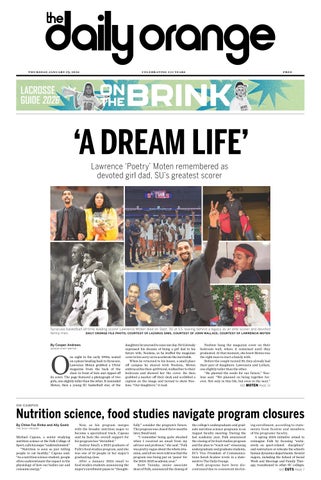
Lawrence ‘Poetry’ Moten remembered as devoted girl dad, SU’s greatest scorer

By Cooper Andrews senior staff writer
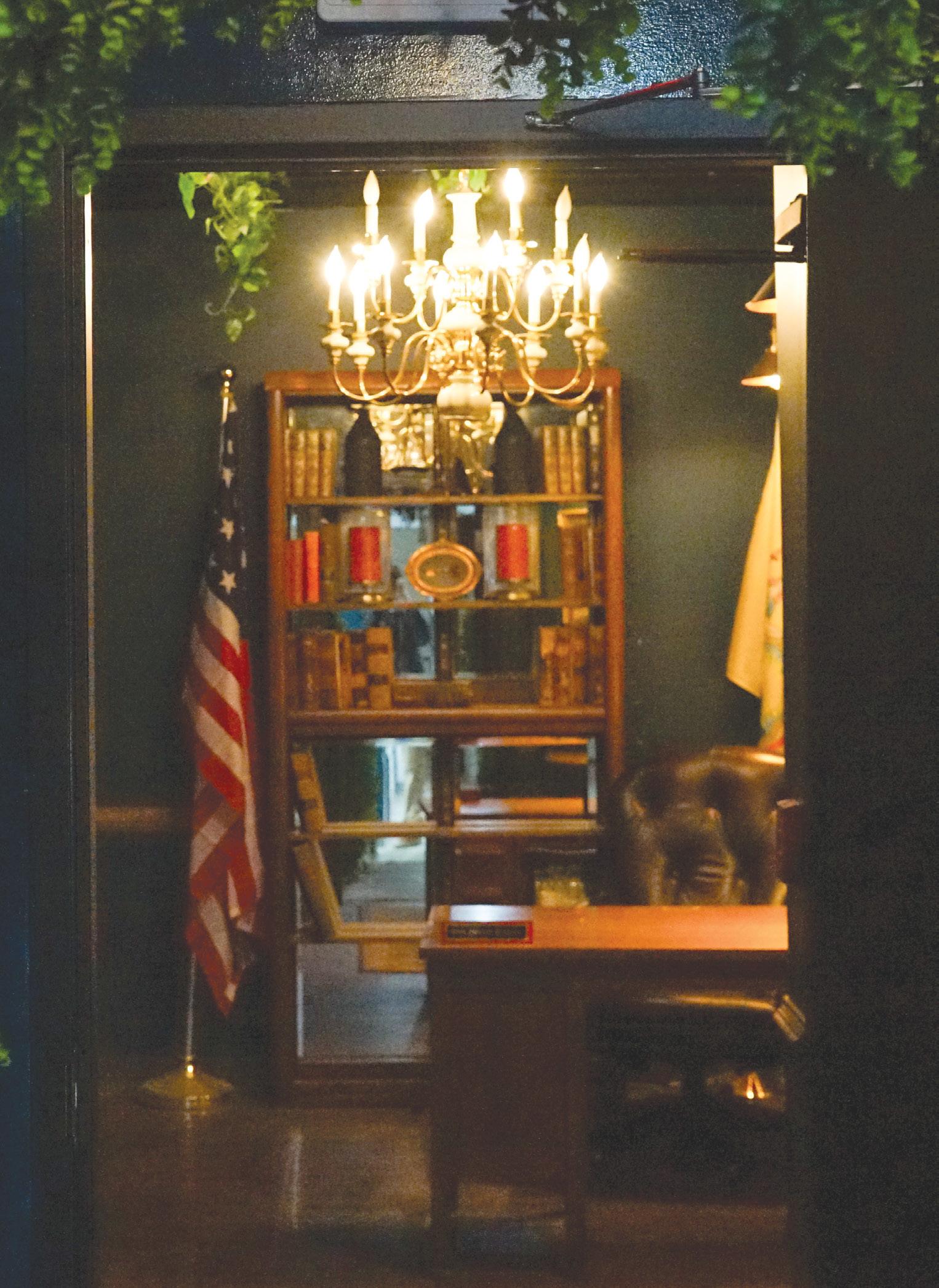
One night in the early 1990s, seated on a plane heading back to Syracuse, Lawrence Moten grabbed a USAir magazine from the back of the chair in front of him and ripped off its cover. The page featured a photograph of two girls, one slightly taller than the other. It reminded Moten, then a young SU basketball star, of the
By Chloe Fox Rinka and Ally Goelz the
Michael Capous, a senior studying nutrition science at the Falk College of Sport, calls his major “underestimated.”
“Nutrition is seen as just telling people to eat healthy,” Capous said.
“As a nutrition science student, people often underestimate the impact in the physiology of how our bodies use and consume energy.”
daughters he yearned to raise one day. He’d already expressed his dreams of being a girl dad to his future wife, Noelene, so he stuffed the magazine cover in his carry-on to accelerate the inevitable. When he returned to his house, a small place off campus he shared with Noelene, Moten embraced his then-girlfriend, walked her to their bedroom and showed her the cover. He then grabbed a marker off their desk and scribbled a caption on the image and turned to show Noelene. “Our daughters,” it read.
Now, as his program merges with the broader nutrition major to become a specialized track, Capous said he feels the overall support for his program has “dwindled.”
Audrey Small, a 2025 graduate of Falk’s food studies program, said she was one of 10 people in her major’s graduating class.
After a January 2024 email to food studies students announcing the major’s enrollment pause to “thought-
fully” consider the program’s future. The program was closed three months later, Small said.
“I remember being quite shocked when I received an email from my advisor and professor,” she said. “Falk was pretty vague about the whole situation, and all we were told was that the program was being put on ‘pause’ for the 2024-2025 academic year.”
Scott Tainsky, senior associate dean of Falk, announced the closing of
Noelene hung the magazine cover on their bedroom wall, where it remained until they graduated. At that moment, she knew Moten was the right man to start a family with.
Before the couple turned 30, they already had their pair of daughters: Lawrencia and Leilani, one slightly taller than the other.
“He planted the seeds for our future,” Noelene said. “We planned on being together forever. Not only in this life, but even in the next.”
see moten page 13
the college’s undergraduate and graduate nutrition science programs in an August faculty meeting. During the last academic year, Falk announced the closing of its food studies program and the plan to “teach out” remaining undergraduate and graduate students, SU’s Vice President of Communications Sarah Scalese wrote in a statement to The Daily Orange. Both programs have been discontinued due to consistent declin -
ing enrollment, according to statements from Scalese and members of the programs’ faculty.
A spring 2024 initiative aimed to reimagine Falk by focusing “exclusively on sport-related disciplines” and restructure or relocate the school’s human dynamics departments. Several majors, including the School of Social Work and Marriage and Family Therapy, transitioned to other SU colleges.

Editor@dailyorange.com
News@dailyorange.com
Opinion@dailyorange.com
Culture@dailyorange.com
Sports@dailyorange.com
Digital@dailyorange.com
Design@dailyorange.com
Photo@dailyorange.com
BUSINESS 315-443-2315
how to join us
The Daily Orange is an independent, nonprofit newspaper published in Syracuse, New York. The editorial content of the paper — which started in 1903 and went independent in 1971 — is entirely run by Syracuse University students.
The D.O., a 501(c)(3) nonprofit, is editorially and financially independent from SU, and the paper receives no funding from the university. Instead, The D.O. relies on advertising revenue and donations to sustain operations.
This spring, the paper will be published Thursday when SU classes are in session. The D.O.’s online coverage is 24/7, including while SU is on break.
To show your support to The D.O.’s independent journalism, please visit dailyorange.com/donate. Donations are tax deductible.
If you are a Syracuse University or SUNY-ESF student interested in contributing to The D.O. on either its advertising or editorial teams, please email editor@dailyorange.com.
corrections policy
The D.O. strives to be as accurate in our reporting as possible. Please email editor@dailyorange.com to report a correction.
letter to the editor policy
The D.O. prides itself as an outlet for community discussion. To learn more about our submission guidelines, please email opinion@dailyorange.com with your full name and affiliation within the Syracuse community. Please note letters should not include any personal information pertaining to other people unless it is relevant to the topic at hand. All letters will be edited for style and grammar.
The D.O. is published weekdays during the Syracuse University academic year by The Daily Orange Corp., 230 Euclid Ave., Syracuse, NY 13210. All contents Copyright 2026 by The Daily Orange Corp. and may not be reprinted without the expressed written permission of the editor-in-chief. The Daily Orange is in no way a subsidy or associated with Syracuse University. All contents © 2026 The Daily Orange Corporation
The forecast for this upcoming week, per The Weather Channel.







EDITOR-IN-CHIEF

wednesday, january 28
SYRACUSE 68, NC STATE 88
coming up saturday, january 31

men’s women’s

SYRACUSE VS NOTRE DAME
tuesday, november 11
SYRACUSE 71, UNC 77
coming up thursday, january 29
SYRACUSE VS GEORGIA TECH
National puzzle and corn chip day
Share feedback. 1.
We want to hear what you think about our content. Email editor@dailyorange.com or send us a message on social media.
Send tips and story ideas 2.
Help us report on stories that matter to you. Email editor@dailyorange.com with your ideas. Tips may be shared anonymously.
Become a member. 3.
Help us produce meaningful coverage by making a monthly tax-deductible donation at dailyorange.com/donate. You can receive a spot on our digital donor recognition wall.
By Remi Turner asst. copy editor
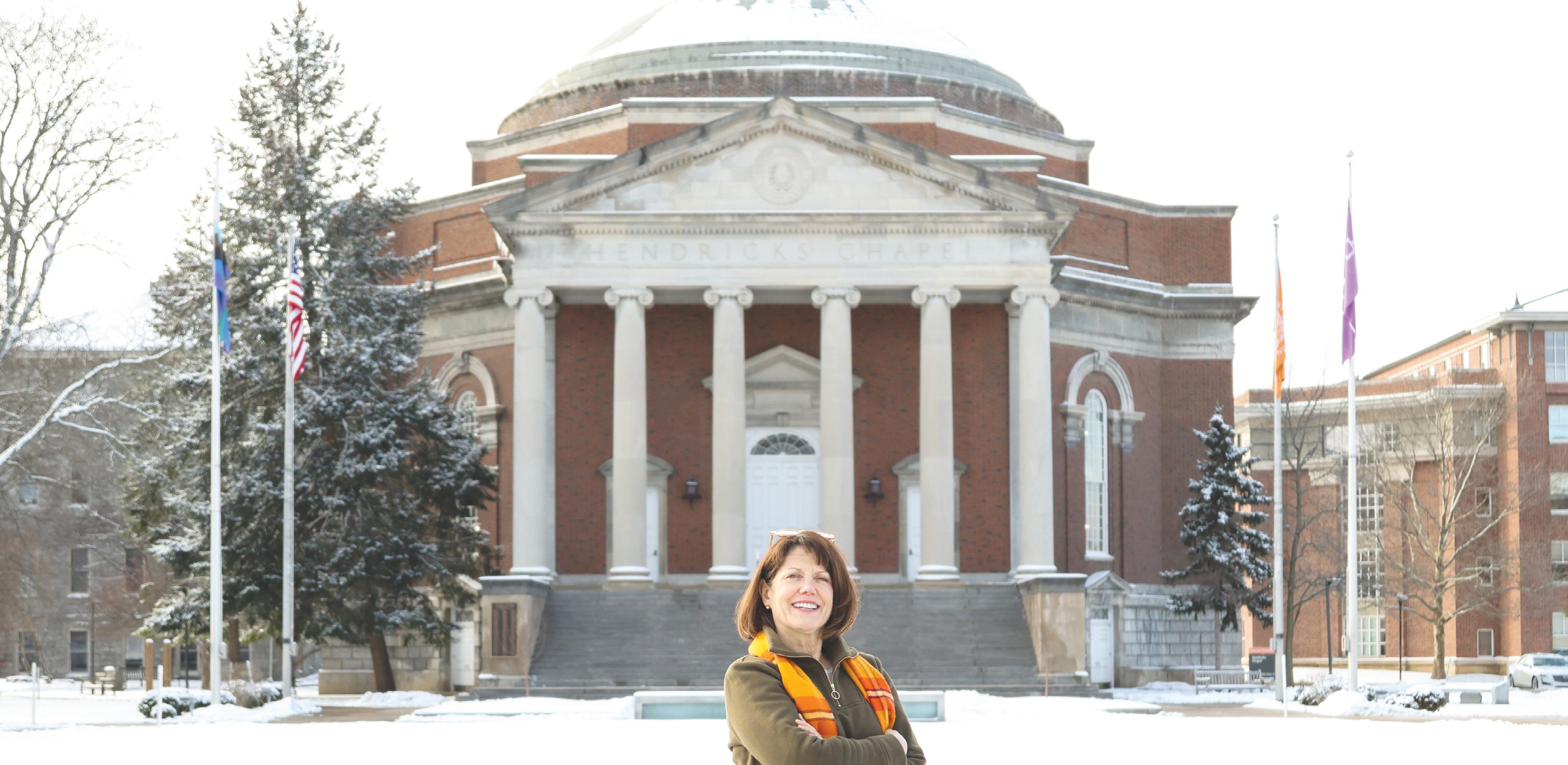
Despite SU’s empty campus and the silence in the Hendricks Chapel throughout winter break, Rebecca Reed Kantrowitz stepped into the role of Hendricks Chapel’s interim dean. She rolled up her sleeves and tried her best to get organized, but something was missing – the students.
“When People’s Place closes, the building just gets very quiet,” Kantrowitz said. “I had a moment where on the one hand I really appreciate that it’s quiet and on the other hand like where are the students? Where are the chaplains?”
Earlier this month, SU announced that Kantrowitz is serving as interim dean following Dean Rev. Brian Konkol’s departure to Valparaiso University, a small, private Lutheran college in Indiana.
Kantrowitz said she was honored when SU Chancellor Kent Syverud asked her to step into this role.
“I’ve been very blessed to be able to have great opportunities and work with great people,” Kantrowitz said. “On a college campus, there’s such a diversity of people and ideas and the ability to really grow and to accompany people who are doing the same.”
Before her appointment, Kantrowitz was the first ever to serve as associate dean of Hendricks, working closely with Konkol. She focused on internal programming for the chapel — including supporting its 15 chaplains and over 25 religious organizations.
Bits of Konkol are left behind at Hendricks — colorful artwork lining the walls of Kantrowitz’s new office.
Kantrowitz said she plans to carry forward pieces of Konkol’s leadership style, including his signature mantra: “Model the world you want to live in instead of mirroring the world you see.”
During her time as associate dean, Kantrowitz worked closely with her former office neighbor Rev. Devon Bartholomew, Hendricks’ nondenominational Christian chaplain.
Kantrowitz has always had an accessible, open-door policy, Bartholomew said. For the past 12 years, he said he’s spoken with Kantrowitz nearly every day they’ve worked next to each other.
The two first met while Kantrowitz was interim senior vice president and dean of student affairs in 2013. At the time, Bartholomew said he was still “young in his role” as chaplain and needed assistance with organizing a disaster relief trip to Nepal.
“I remember being nervous, anxious, but I found her just so approachable,” Bartholomew said.
When he found out Kantrowitz would be temporarily leading Hendricks, Bartholomew said he felt immediate joy.
“She has a heart for people.” Bartholomew said. “She’s here and eager to support the work that happens on campus, especially our chaplaincy.”
Although Kantrowitz has moved from the chapel’s chaplains suite to the dean’s suite, she
said she still plans on supporting the chaplaincy and has scheduled one-on-one meetings with each Hendricks staff member.
A core part of Kantrowitz’s new role involves representing Hendricks as a member of the Chancellor’s Executive Team and Chancellor’s Council. She said she will ensure to support the chancellor and senior leadership team.
The new interim dean has over 10 years of senior leadership experience at SU. She served as the university’s director of residence life before becoming Hendricks’ associate dean in 2018, just months after Konkol’s appointment.
Before that, Kantrowitz worked as a resident hall director at SU in the late 1980s before going on to work at the University of California, Berkeley as a residential life coordinator and later as assistant dean of Hamilton College.
At Hamilton she met her husband, Robert Kantrowitz, a professor of mathematics. Robert and the interim dean were both at SU during the 80s — he, a grad student and she, a resident hall director — but didn’t cross paths until they both took jobs at Hamilton college.
Robert said although her new appointment was “unexpected,” he was confident his wife could handle the responsibility.
“She’s not judgmental and she’s an extremely hard worker. She’s very, very dedicated and in particular, she’s dedicated to Syracuse and Hendricks,” Robert Kantrowitz said. “We’re both purely orange-blooded.”
While the two try their best to avoid talking about their roles in higher education, they attend SU men’s basketball games together.
Born and raised in Buffalo, Kantrowitz said her love for the university environment began when she was just a teen.
Kantrowitz served as a resident’s assistant during her undergraduate years at Allegheny College in Pennsylvania, where she quickly realized working with students was her calling. Kantrowitz received her master’s in counseling from Niagara University, where she also served as a hall director for two years and then the dean of students.
Kantrowitz said she enjoys helping students meet their needs so that each student can have an “unsurpassed experience.”
Since starting her time at Hendricks, Kantrowitz has focused on helping with student-led projects. She relocated the chapel’s Coach Mac Food Pantry near the Chaplain’s suite and formed the Student Assembly of Interfaith Leaders, a service-based leadership group assembled of students from different backgrounds.
“We want to make it as easy as possible to help [students] out so that they can have the same experience that every other student has on campus,” Kantrowitz said. “I just love to work with the students who are just so bright and have so many great ideas.”
Mian Muhammad Abdul Mahid, an SU graduate student studying applied data science, met Kantrowitz through SAIL. As someone who always has struggled with anxiety, Mahid said he was intimidated to apply to a leadership
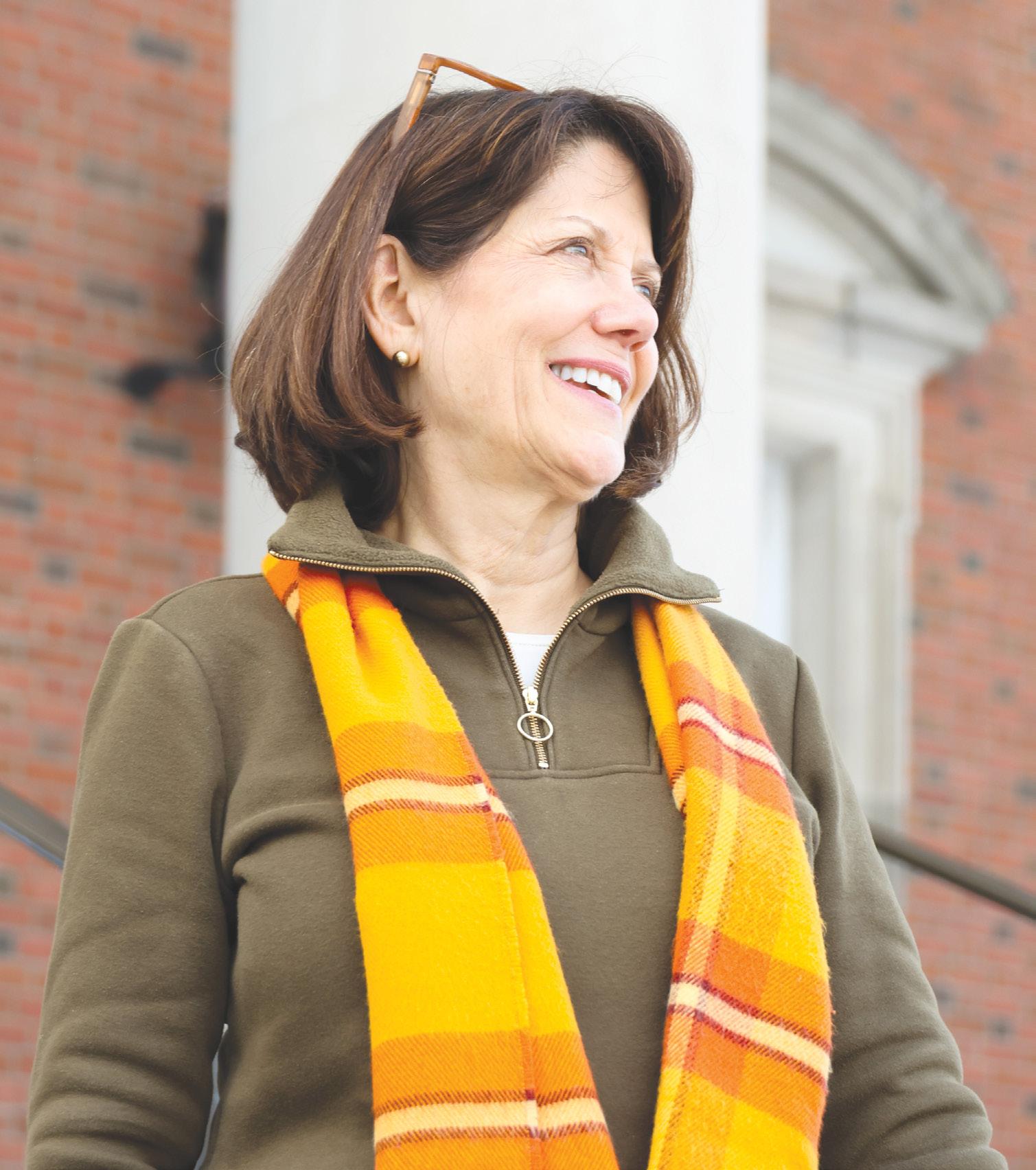
position at SAIL his sophomore year, but Kantrowitz helped him find his confidence.
“She’s been a really big mentor for me. She really motivated me and mentioned that she would help me along the way,” Mahid said. “Since then, me and Rebecca meet every week and she always checks up on me and how I’m doing.”
Kantrowitz helped Mahid secure a grant through Hendricks’ Student Opportunity Fund, available for students who need financial support to reach their academic goals.
For Mahid, receiving the SOF allowed him to fulfill his dream of studying abroad. While he was worried about the cost of living while in Madrid, he said the SOF helped him tremendously.
Along with the SOF, Kantrowitz also created employment opportunities for students. She’s created student positions such as SOF grant coordinators who interview applicants and connect them to campus resources.
“Of things accomplished at Syracuse University near Hendricks Chapel, that’s one that I’m very proud of,” Kantrowitz said.
Kantrowitz said her work at Hendricks has not only satisfied her desire to better student
life, but also aided in reaffirming her Jewish faith. Kantrowitz hopes to continue Hendricks’ mission as a place of interfaith practice — an initiative Konkol touted during his tenure.
“I’ve learned a lot,” Kantrowitz said. “I think the interfaith piece has really resonated with me, and the importance of just bringing people together.”
She’s explored other faith traditions, including a Muslim Jumu’ah prayer, one of Father Gerry Waterman’s masses and buddhist meditation during various Interfaith Exploration Weeks, a Konkol-era initiative she said she is excited to oversee this year.
As Hendricks begins the search for its new dean, Kantrowitz said she plans on assisting with the search while also fulfilling her new duties. Above all, Kantrowitz said she’s always looking for new avenues to reach students and improve their college experience.
“I just really enjoy working in higher education,” Kantrowitz said. “I think working with students is really meaningful and I think students are our future.”
rturne03@syr.edu





In a neighborhood dominated by students, Susan Chase operates a daycare from her childhood apartment
By Kelly Matlock senior staff writer
by Cassie Roshu senior staff photographer
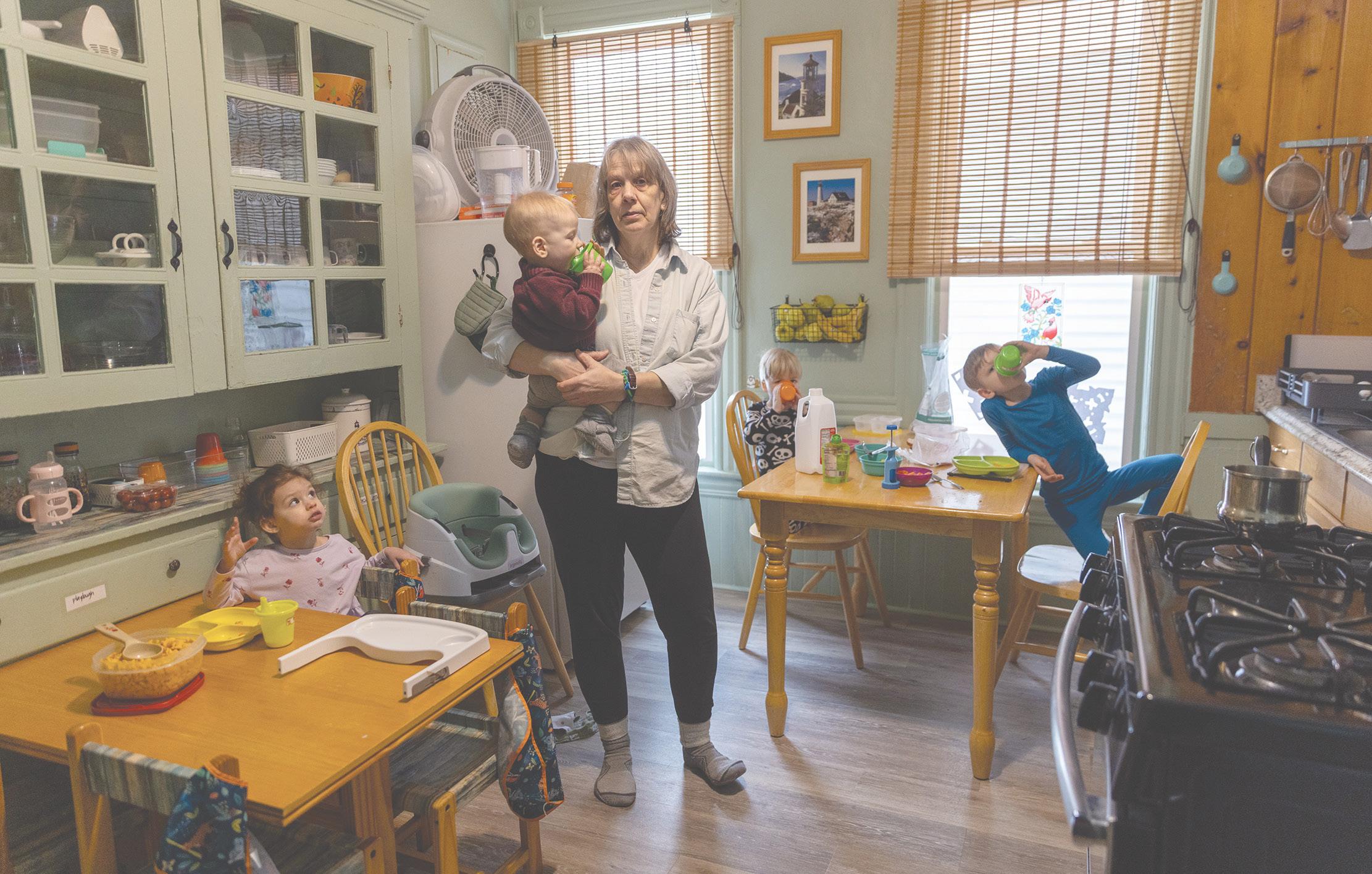
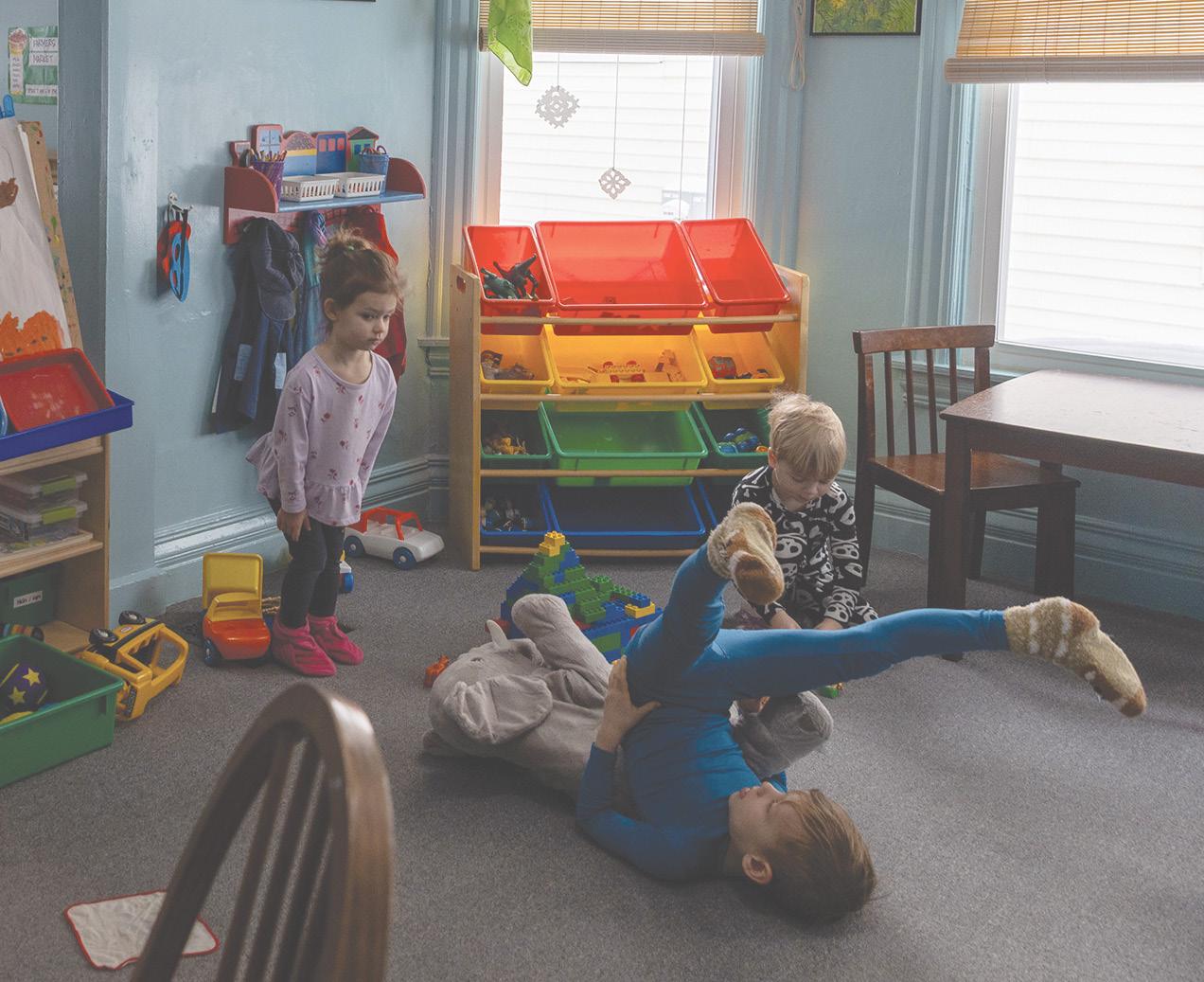
Kids happily knocked over building blocks and played with stuffed animals in front of walls covered with children’s art. With a two-year-old boy perched on her lap and another at her feet grabbing her pant leg, Susan Chase looked completely at ease.
“(It’s overwhelming) at times, but I love it. I’ve always loved kids, being around kids,” Chase said. “I’m just one of those people.”
In 1993, Chase opened a day care in her childhood home – the downstairs apartment below her current residence. Her day care is nestled between student residences in the University Neighborhood, near Syracuse University’s campus, and has become a fixture in the community.
She finds clients through word of mouth and is known in the community as Sue’s day care. She’s run her registered business for over 30 years, and after taking care of 120 kids along the way, Chase has no plans to retire anytime soon.
Chase has always been surrounded by kids. When she was 11, her sister had a baby, so she grew up taking care of her niece. As an adult, she worked at the child care facility at Onondaga Community College and completed an internship at Erwin Nursery School before starting her own day care.
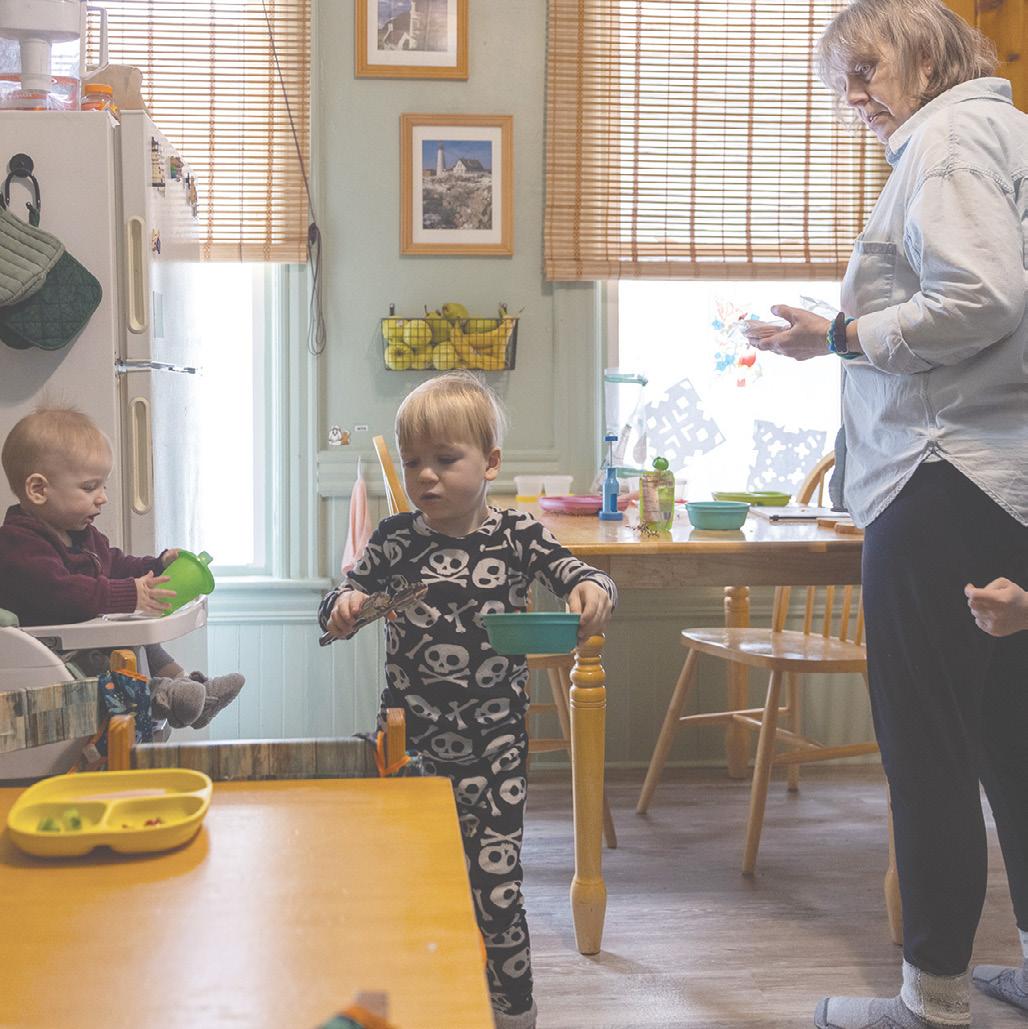
“My approach to child care is family child care. It’s not like a center. It’s not like a preschool,” Chase said. “I know they’re not my kids, but sometimes I feel like they are.”
My approach to child care is family child care. It’s not like a center. It’s not like a preschool, I know they’re not my kids, but sometimes I feel like they are.
Susan Chase day care founder
Chase has two children: a son and a daughter who were 6 and 2 years old when she started the daycare in 1993. She was a single mom who needed to go back to work, and her sister moved out of her apartment downstairs, providing the perfect opportunity for a new business. After a few months of painting and preparing, Chase’s daycare was born.
Chase’s day care is situated in the middle of a street of college-aged neighbors. She said there’s always been students on the street, but in the 90s, she noticed more families nearby. Now, she said she is one of only two residences on the street that don’t belong to students.
Gabriella Nalon, a Syracuse University senior, lives next door to Chase. Coming and going from her apartment, she often sees

Chase’s day care kids playing in their backyard jungle gym.
During the warmer months, Nalon said she often says hello when she sees Chase’s day care kids playing in the backyard or walking down the street. She likes having the day care next door, because it adds “more stability” to the neighborhood.
“It gives a little more of a family vibe,” Nalon said. “It feels like you’re in an actual home and not a temporary house.”
Chase said she doesn’t mind having students around, as long as they are respectful. To make sure they follow Chase’s expectations, Nalon and her roommates always let Chase know when they are hosting friends or having a barbecue outside.
Chase said most students are great, but the noise level, parties and language have gotten worse over the past 10 years. She blames headphones for students’ general lack of awareness but appreciates when students still say hi when she goes on walks with her day care kids.
Nalon introduced herself to Chase at the beginning of the year and said she was incredibly kind.
“Sue is the sweetest,” Nalon said. “Thanksgiving break, she got us some caramel chocolate cookies. She made them herself. It was delicious.”
The day care’s ties to the SU community go beyond proximity. Some SU students enroll their children in her day care, including students with children and international students from Russia and Saudi Arabia. Sometimes, for-

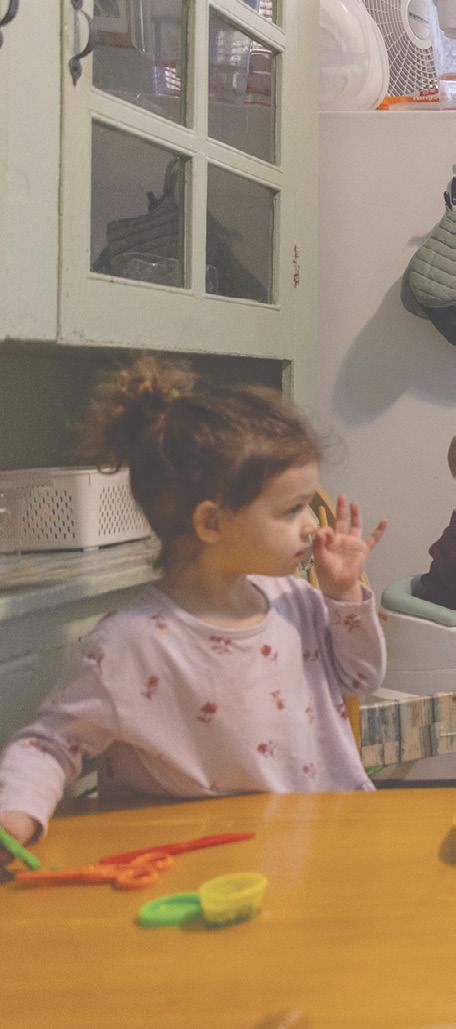


mer day care kids go on to attend SU and send their children to Chase later on.
“One little guy came back, he goes, ‘I don’t know if you remember me,” Chase said. “I remember everybody, and I had him when he was 5, and his wife and him just had a baby,” Chase said. “They live over here and they’re on my list (for day care).”
Chase’s day care is a stable presence not just for families in the area, but also for local businesses. Every Friday, Chase brings her day care kids to the Petit Branch Library in the Westcott neighborhood for storytime with children’s librarian Quinn Gardner.
During the colder winter months, Gardner comes to Chase’s day care in person because the kids can’t walk to Westcott. They call her Miss Quinn and refer to the library as “Miss Quinn’s house.”
Gardner went to an at-home day care when she was young, but said the woman who ran it
was scary. Gardner said Chase is “wonderful,” and is impressed by how Chase creates an environment where all the kids feel comfortable and happy with her.
“Even after the kids are older … (to Sue) they’ll be like, ‘Hey, can we spend the night?’” Gardner said. “It just shows how great she is with all of the kids and how much they really love her.”
Chase has a wall of photographs of every kid that attended her day care program. She works with parents to maintain relationships with the kids over the years and some still come back when they are in high school and college to say hello.
“The kids were really young when I had them, so they feel like I’m part of their life, you know,” Chase said. “I’m just grateful to be able to do something that I love.”
kamatloc@syr.edu
By Brenne Sheehan news editor
After nearly five months of litigation, a judge found the Syracuse Regional Airport Authority’s refusal to display an advertisement by Syracuse workplace harassment lawyer Megan Thomas unconstitutional, according to a decision filed Jan. 15.
Thomas, an alumna of Syracuse University’s Maxwell School of Citizenship and Public Affairs and the College of Law, filed a federal complaint against the airport authority in August alleging her right to free speech was violated and her contract, set to begin Aug. 1, wasn’t fulfilled.
Over the summer, the SRAA refused to display a billboard-style ad for Thomas’s law firm, Megan Thomas Law, PLLC, with a slogan reading “When HR called it ‘harmless flirting’… We called it exhibit A.”
The airport claimed in August the advertisement was “unprofessional, inflammatory, and unnecessary,” and attempted to negotiate with Thomas in creating a new slogan, according to evidence presented in Thomas’s August lawsuit. She maintained that her slogan remained within the airport’s advertising policy and claimed other ads, such as ones promoting plastic surgery, were more offensive.
The decision mirrored Thomas’ argument, determining that the airport’s rejection of Thomas’s ad under its advertising policy violated the First Amendment, and the rejection of the ad was “viewpoint-based and unreasonable.” The decision also denied the SRAA’s motion to dismiss the case entirely.
The airport argued its decision to refuse the ad was content-neutral, citing the SRAA’s brief, which claims they would have rejected similar ads regardless of viewpoint.
“SRAA highlighted the practical concerns and implications associated with the proposed advertising copy in its brief, writing: ‘Indeed, the Authority would have just as readily rejected an advertisement from an employer-side law firm that used similar language disparaging or threatening ‘disgruntled employees’ or implying that victims of sexual harassment should not be believed,’” Ben Yaus, the counsel to the authority wrote in a statement to The Daily Orange.
While the decision does not immediately order the airport to display Thomas’s ad — which she said is her ultimate goal — it does order the SRAA and Thomas to negotiate options for injunctive relief, which could include posting the ad immediately, allowing the authority to revise its policy again and other “legitimate outcomes.”
As she awaits her next court date, Thomas said she still hopes her ad can be displayed and

her attorney fees for her self-representation can be covered.
“I knew the law was on my side,” Thomas said. “I was very clear. I did my research. The law is very clear, so I’m glad the judge held their feet to the fire here.”
Roy Gutterman, a professor of communications law at SU’s Newhouse School of Public Communications, said there are no reasonable grounds to reject her ad, and the decision was a pretrial procedural matter.
“The most obvious resolution would be for the airport to accept the advertisements,” Gutterman said. “But because this went to court with a constitutional question, there might be some other relief the plaintiff might seek as well.”
When Thomas signed her contract, the authority’s 2023 advertising policy stated that ads the SRAA deems inappropriate, offensive, objectionable, political or religious were not permitted.
During litigation, the SRAA began enforcing a revised advertising policy in September, Yaus confirmed. The airport’s new policy states ads should not “diminish or negatively affect the goodwill or reputation of the Airport or the SRAA” or “negatively impact or agitate Airport passengers and/or tenants.”
The airport authority claimed the policy change is to give prospective advertisers “additional guidance” on what types of ads are acceptable “after the airport’s experience with the law firm,” according to documents refer-
enced in the judge’s decision. The judge noted the policy change was “suspect.”
“Certainly, the Authority is entitled to revise its policy,” the decision reads. “But the suspect timing and the fact that its renewed rejection rests on the same grounds under both policies only underscore that the request for injunctive relief is not moot.”
I knew the law was on my side. I was very clear. I did my research. The law is very clear, so I’m glad the judge held their feet to the fire here.
The SRAA later claimed Thomas’s ad falsely implied that “harmless flirting” is actionable harassment. The court also dismissed this point, referencing several other of the airport’s ads.
“The tagline does not claim, suggest, or ‘falsely impl(y)’ any such position — at least, no more than Chick-fil-A’s Authority-approved tagline ‘falsely implies’ that chicken dinners
will always make a person happy, or that cows can speak,” the decision reads.
While Thomas said she was confident the law would be on her side, the experience with the airport has made her feel “unwelcomed” as a female business owner and attorney – in the airport and the county.
“The first time a woman wants to be on a billboard by herself, there’s a problem,” Thomas said. “That sends a message to me that my services are not welcome, and also that I, as a woman, leader, business owner, I’m not welcome in this space. I think that’s a real problem.”
Thomas maintains she wants her advertisement displayed, noting many of her female clients often encounter situations of sexual harassment on business trips. For the most part, she’s had community support. Thomas received the public support of New York State Sen. Rachel May and gathered over 1,000 signatures on a petition condemning the airport’s “censorship.”
The SRAA has until Feb. 6 to respond to Thomas’s proposal for injunctive relief. After that, Thomas’s relief — which could include displaying her ad — will be passed.
“This shows what a need there is for these services, for more people to stand up for the rights of women and others who are being treated poorly in the workplace on the basis of a protected class,” Thomas said. “These things are happening left and right in this county, I have more work than I can take on.” brennesheehan@dailyorange.com
By Brenne Sheehan news editor
The trial for the man accused of crafting the bomb used in the Pan Am Flight 103 terrorist attack has been delayed by four months from its original April 20 court date, according to several case files released by the United States Department of Justice.
years after the Pan Am 103
Due to “unforeseen circumstances” by both legal parties, the jury selection process for the trial of Abu Agela Mohamed Mas’ud Kheir AlMarimi, accused of building the bomb, will now begin Aug. 24, pending court approval, according to a Dec. 2 status update. The update did not specify what the “unforeseen circumstances” are.
The delayed deadline comes with a June and July timeline for the defense and prosecution to resolve and settle the case’s several pre-trial briefings.
The 1988 attack over Lockerbie, Scotland, killed 270 people, including 35 Syracuse University students and 11 residents on the ground in Lockerbie. The attack targeted the flight on its way to New York City from London with a bomb planted in a suitcase within the plane’s cargo hold. The bomb-
ing killed all 259 people on board, including the SU students and two from SUNY Oswego.
Al-Marimi, a Libyan national known as Mas’ud, has been in U.S. custody since December 2022. He pleaded not guilty in 2023 to three federal charges, including two counts of destruction of an aircraft resulting in death and one count of destruction of a vehicle used in foreign commerce by means of an explosive, resulting in death.
The case’s evidentiary and testimonial complications occurred over 37 years after the attack. Mas’ud is now 74 years old. Both parties have continuously argued over the validity of the prosecution’s Rule 15 depositions, which are video-recorded witness testimonies taken before a trial.
The defense argued Mas’ud’s alleged 2012 confession to Libyan police was coerced and based on hearsay, according to a pre-trial document filed in December. They’ve also challenged that U.S. courts lack jurisdiction to continue pursuing the case because the event happened in Scotland and involved a Libyan national, according to a document filed Jan. 8.
The U.S. government, the prosecution, has also objected to one of the defense’s expert testimonies, Rebecca Murray, who the defense describes as an expert on Libyan prison conditions.
Mas’ud’s defense has also motioned to dismiss the trial, claiming he was put in U.S. custody without due process, which has also delayed the case as the U.S. government moved to extend the deadline to respond to the motion to Jan. 30.
All parties must finalize their briefings by March 19. brennesheehan@dailyorange.com

Scalese said nutrition science faculty have been vital to developing the new nutrition science track, and the university is not cutting faculty in any departments or programs. Faculty will also continue their research within the redesigned program structure, she wrote.
Despite promises to create a plan for the remaining undergraduate and graduate students to complete their degrees while staying in the now sports-centered college, students and faculty in food studies – which Scalese said “was identified for closure before Falk’s reimagining” — and nutrition science said they were put in a vulnerable position after programmatic changes.
“I personally feel out of place,” Capous said. “I’m not interested in sports. I resonated a lot more with the human dynamics aspect of the college, I have no interest in working with athletes or in the world of sport.”
Nutrition sciences
The closure of the nutrition sciences program followed consultation with faculty on declining enrollment and significant overlap between the nutrition science and nutrition majors, Scalese said. She added that the meeting maintained an open-door policy and several faculty members offered their perspectives privately.
“We felt it was critical to have open lines of communication with faculty from the start and throughout the process,” Scalese wrote.
Maria Erdman, an associate teaching professor in the Department of Nutrition and Food Studies, said SU Vice Chancellor and Provost Lois Agnew told faculty about the changes to the nutrition science master’s, bachelor’s and minor programs without prior notice before an October University Senate meeting.
“They’ve been meaning to do this, but why it suddenly had to be popped on us, literally, with no discussion,” Erdman said. “Then we were told, ‘Okay, you have two months to come up with the final plan.’ It was very sudden, it was shocking.”
Department of Nutrition and Food Studies professor Margaret Voss also said there was a lack of faculty notice. In a statement to The D.O., Voss wrote she does not know why her account, as well as her colleagues’, differ from the university’s.
“From a faculty perspective, it does seem that the roll out of closures in our college was handled differently than in other colleges,” Voss said in the statement. “When I speak to colleagues in other units, they did seem to be part of the discussion and planning process for program closures.”
Scalese said Falk College is making datainformed decisions about the structure of its programs to streamline its academic offerings. Nutrition science’s restructuring aligns with Falk’s “strategic work” to prioritize academics, she said.
SU conducted portfolio reviews throughout the fall semester to “identify strengths” and “areas of improvement” in the university’s programs. Agnew said each school’s dean was given enrollment trends and market analysis to help guide reviews.
Chelsea Turner, the food justice chair at Cafe Sankofa, a nonprofit providing health education to Syracuse’s South Side neighborhood, said nutrition science programs help contribute to community betterment and health.
“One reason why, specifically at SU, it’s really good to have a nutrition science program is (that) the South Side is a food desert,” Turner said. “When you have people who can go to a college, not have to pay the additional fees for housing and maybe extra transportation costs, things like that, makes health education more accessible.”
Voss said faculty are “developing an alternative pathway” within the nutrition B.S. major to accommodate students. However, she said she had nothing to do with the program’s closure and could not speak to the “rationale or decision-making process.”
Consolidating the nutrition science and nutrition majors into a single major with specialized tracks allows the university “to build a more robust offering,” Scalese said, and avoid “diluting” resources across two programs with “significant duplication.”
Erdman said enrollment in the nutrition science program was low last year. Last year’s nutrition science graduating class consisted of 11 students, Voss wrote. Eight undergraduate students are currently enrolled in the program, Erdman said.
Capous said it was “eye-opening” to see that the major closing isn’t being widely talked about in the college.
Tracey Rodriguez, a junior studying nutrition science, said she wasn’t aware of the major’s transition. Despite this, she said she’s
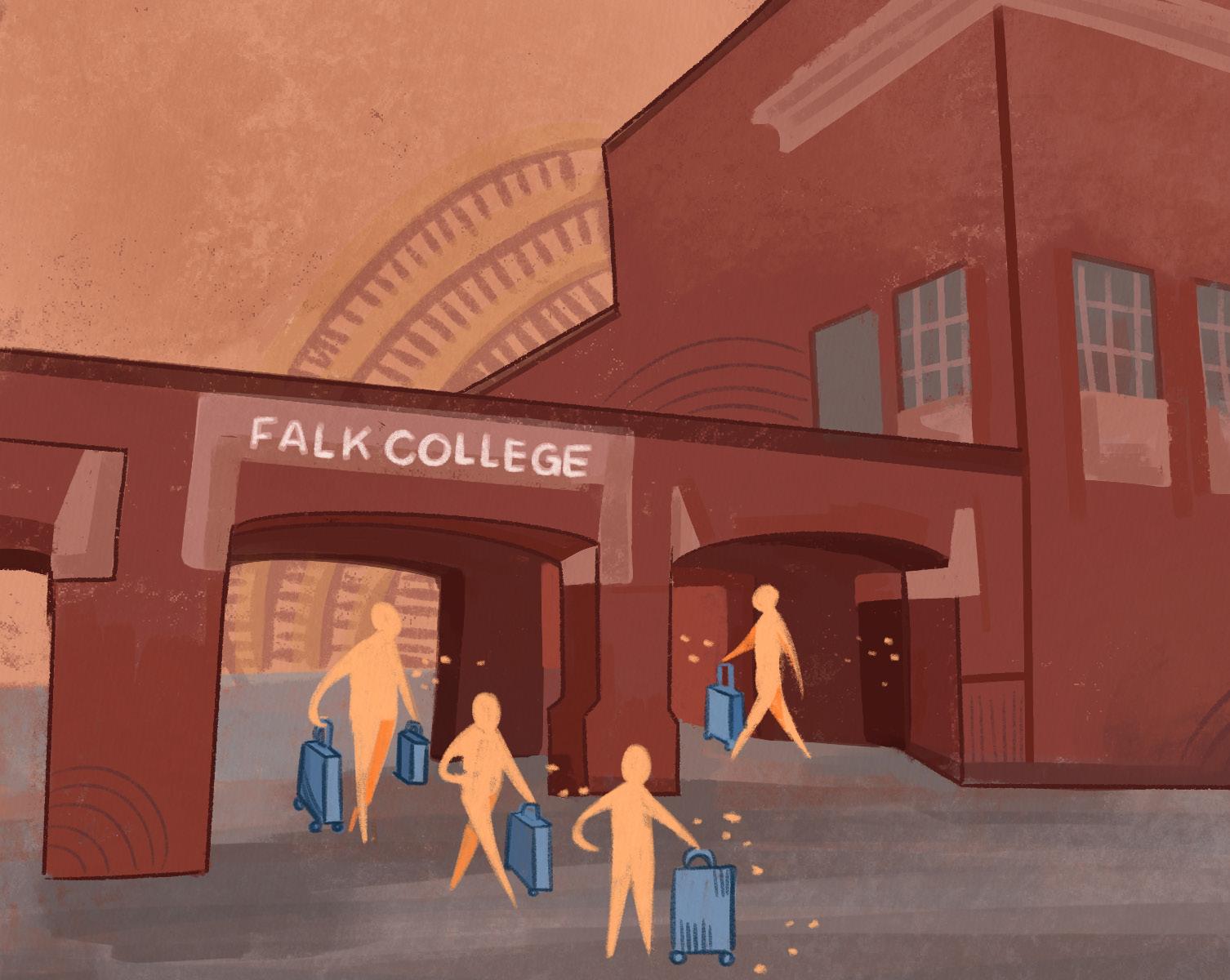
noticed a cultural shift in what Falk markets toward students.
“There’s definitely more of an emphasis on sports, and even in the emails we get from faculty,” Rodriguez said. “A lot of the opportunities that they talk about for ‘interesting people we’re bringing to campus’ are a lot more sports focused, whereas my freshman year, there were a lot more in different fields of healthcare and public health.”
Food studies
The food studies program explores the human connection to food and its impact on identity, politics, nutrition, environment and history, Small said. Throughout her four years, she has had the opportunity to volunteer at local food pantries and take cooking lessons in Falk’s teaching kitchen.
“The program was very tight-knit, so the food studies professors and students shared equal disappointment about the news,” Small said.
In the January 2024 email to food studies students, Falk Dean Jeremy Jordan said the school would “provide an opportunity to thoughtfully consider the future” of the program. The email added the program would not accept any new students for the Fall 2024 semester.
Small said she had a feeling this marked the program’s end. Three months later, the university cut the program entirely, she said.
“At this point, everyone was fairly certain this meant the pause was permanent, and I think a lot of us were still worried about how this would affect what classes would be available to us,” Small said.
Rick Welsh, a current sociology professor at the Maxwell School of Citizenship and Public Affairs, was hired in 2012 to start the food studies program after Falk phased out its hospitality management program. He served as the program’s department chair for seven years.
Scalese confirmed the food studies program experienced “consistent enrollment decline” over the past few years, leading to its closure. Welsh said that while the program’s closure was “sudden,” it wasn’t a huge surprise.
When creating the food studies program, Falk was developing its sports management program, Welsh said. He said he knew the college as a whole was going to experience big changes as it became “sports-focused.”
“I don’t want to say I’m glad food studies is closed, because we had some really great students, at the undergrad but especially at the master’s level, we went on to do really cool stuff,” Welsh said.
During the transition period, faculty moved to different departments, Small said. However, because the food studies department overlapped with the nutrition department, she felt a lot of her courses were kept the same, still taking cooking classes, agroecology and labor in the food chain.
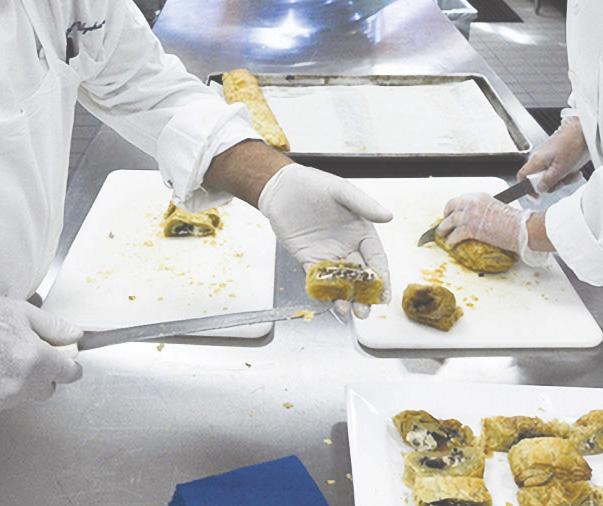
“Our program grew closer as a result of this transition, as we felt our species was on the brink of extinction,” Small said.
In 2024, SU arranged a deal with Welsh to slowly stop teaching food studies courses at Falk and begin teaching sociology courses at Maxwell, he said.
Welsh currently teaches a course called “Farm to Fork,” a hands-on lecture class followed by a cooking lab. It allows undergraduates still enrolled in food studies to finish their degree.
Next year will be his last time teaching a food studies course, he said.
“We did that because they wanted us to continue to teach because they were still paying us and they also needed to get the undergraduates through,” Welsh said. “We got our grad students all through, but we still have a couple undergrads who need to get their electives.”
Despite the support of Falk faculty, Welsh said the transition was “otherwise difficult,” especially as he continues to teach food studies courses in the Falk building.
“It’s emotional for me to go back over there to teach food studies classes, knowing all the work we put into it, and it’s not a clean break,” Welsh said. “But I understand why we’re doing it.”
Welsh said he’s glad the food studies cut was handled with “some humanity” and that most of the faculty stayed together during the program’s closure. However, he said he’s “much happier” and “better off” teaching at Maxwell.
All former food studies faculty are still employed at SU, and most have transitioned to
positions at Maxwell. One is still employed at Falk, but is pending retirement, Scalese said.
“It was just such a heavy lift to keep that program going. There were very few of us,” Welsh said. “It was just increasingly not a good fit.”
Looking forward
There are no plans to reinstate the food studies program as a whole, Scalese confirmed in November. However, Small still hopes to see SU implement the fundamental aspects of the program on campus in other ways.
“I am really sad but honored to be one of the last Food Studies alumni,” Small said. “Most people I meet have no idea what food studies entails, but it really is such an underrated and understudied field, because food impacts most aspects of our life.”
SU will continue to offer select food studies and culinary courses under the “NSD” prefix, Scalese said.
As the new nutrition science track faces review by the University Senate Curriculum Committee, Voss is confident the merged program will supplement the former major’s cut.
“We are deeply committed to maintaining this record of student success,” Vass wrote. ”(The track) is specifically structured to allow students to complete the full set of allied health prerequisites.”
Both Food Studies and Nutrition Science, as it stands, will be phased out as the majors graduate. The last class of Nutrition Science will graduate in 2029.
news@dailyorange.com





Numerous SU-bred influencers have found success in content creation
By Lily Zuckerman asst. culture editor
Syracuse University alum Ilana Dunn
Solomon’s 2016 senior capstone, titled “After Hours,” was a six-episode, radiostyle show that focused on different topics each episode. At the time, Dunn Solomon didn’t realize she was making a podcast, now a popular medium.
Ten years later, her capstone project is her fulltime career and she has been running her own full-fledged podcast for nearly five years.
“‘After Hours’ is representative of my time at Syracuse, I was doing everything that I’m doing now, just in a different font,” Dunn Solomon said.
Dunn Solomon is not the only SU graduate or current student to pursue content creation. She is among many other influencers — like Quincy Whipple, Ziek Diallo, Hannah Krohne, “Chef Bae,” Ariel Helwani, Roger Moore “Metronade” and Arielle Charnas — whose content creation origin stories began at SU.
SU has been a hotspot for influencers and content creators like these for years. But, at the beginning of
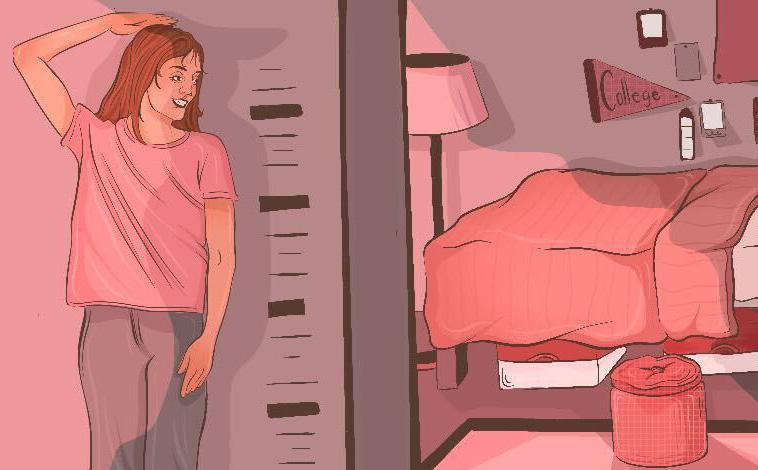
legislative books and a metal watering can painted with the word “PUSH” where The Cabinet Room lies.
many may not realize that tucked behind Harvey’s main space is a speakeasy remnant of the 1800s.
In the back of Harvey’s, customers discover a bookshelf filled with old
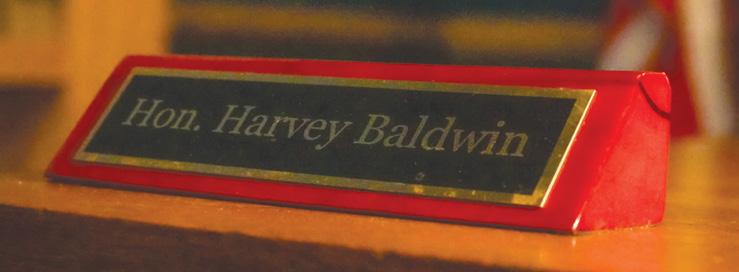
“People love the entrance,” Alyssa Lampert, The Cabinet Room’s cocktail supervisor, said. “We get a lot of wow’s and there’s a lot of excited yelling. It’s very cute.” The speakeasy’s name is inspired by the cabinet members of Harvey Baldwin, Syracuse’s first mayor, who
served from 1848 to 1849. When The Cabinet Room opened in 2024, the space initially only invited Harvey’s loyal customers, owner Mike Greene said.
By Claire Zhang asst. digital editor
With a snowstorm passing through the area earlier this week, central New York’s hills and mountains now have a fresh layer of powder, making it the perfect time to put on skis or snowboarding boots. Whether you’re taking advantage of Syracuse University’s ski trips or venturing out on your own time, The Daily Orange has compiled a list of the most popular spots for winter sports this season.
Drumlins Country Club
If you’re an SU or SUNY ESF student skiing on a budget, register through the Wellness Portal for a day of free cross-country skiing just under two miles from campus. Whether you’re a seasoned pro or a total beginner, this is a good place to start. All equipment, transportation and preparation are provided through registration.
Greek Peak Mountain Resort
Central New York’s home mountain and largest ski resort houses 45 ski trails, terrain parks, tubing conveyor belts and more. Founded in 1958, the resort has served the Finger Lakes region for years, with numerous amenities and trails. Take an hour trip south of Syracuse to Cortland, NY for a full
day or weekend at this key spot. A full-access ticket costs $120 for one full day.
Song Mountain Just 30 minutes south of SU’s campus is Song Mountain in Tully, NY. The resort offers 24 trails in varying difficulty levels. With powder machines running and machine groomed runs, the mountain is a popular spot for locals. Purchase a two mountain package season pass through SkiCNY or a day ski/snowboard pass through SU’s Wellness Portal. An eight-hour adult pass is $69 for college students who show their ID.
Labrador Mountain
Travel 20 minutes east of Song Mountain to SkiCNY’s other resort at Labrador Mountain. The resort has 22 trails with more blue and black diamond runs, fit for experienced skiers and snowboarders. Stop at the Puffin Bird after for a classic American meal and a variety of craft beers. SU offers students a reduced price night pass for $10 to $34 through the Wellness Portal.
Woods Valley Ski Area
If your experience with snow sports is limited, Woods Valley Ski Area’s large beginner terrain and lessons are for you. During your visit in West-
ernville, NY, you can either stay near the base to get familiar with skis or a snowboard, or take a lift up to the more advanced runs. A “Learning Zone” lift ticket, which allows you to ski from 4 to 8 p.m., costs $25.
Sunnycrest Park
If steep mountain runs are not for you, take a trip to Sunnycrest Park located near Lincoln Hill in Syracuse. When weather permits and snow is ample, the Winter Lodge at the park is open 10 a.m. to 2 p.m. on weekends. With over 2.5 miles of groomed cross-country trails, you can ski around the Sunnycrest Park Golf Course and a loop of wooded areas.
Osceola Tug Hill Cross Country Ski Center
For just $10 to $40 a trip, SU and ESF students can register for this cross country ski trip on the famous Tug Hill Plateau, east of Lake Ontario. Transportation is included to explore over 100 acres of gorgeous trails. Registration opens one month prior to the trip date and includes equipment and basic technique instruction. Their open trip is scheduled for Feb. 28.
cmzhang@syr.edu
By Parisa Nosrati staff writer
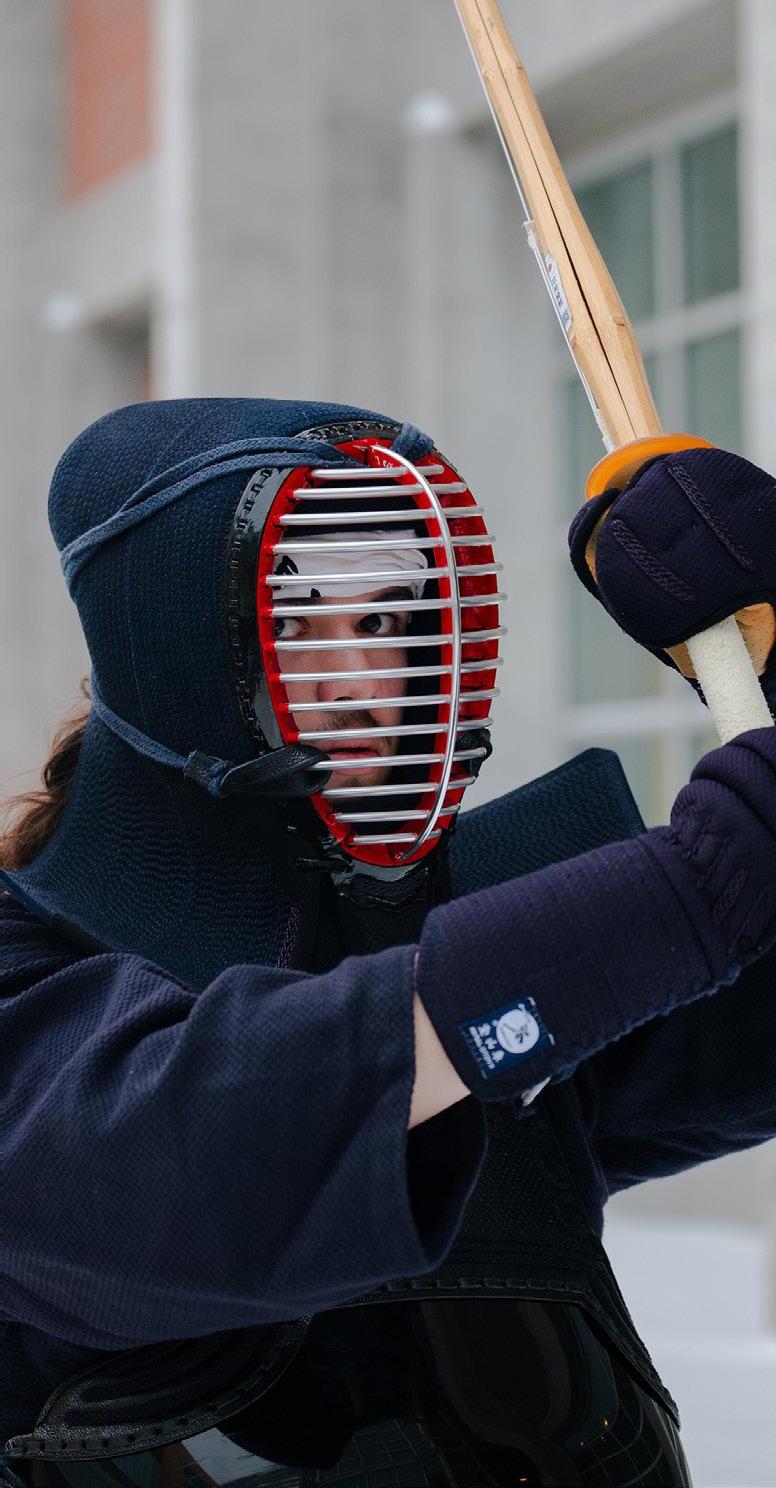
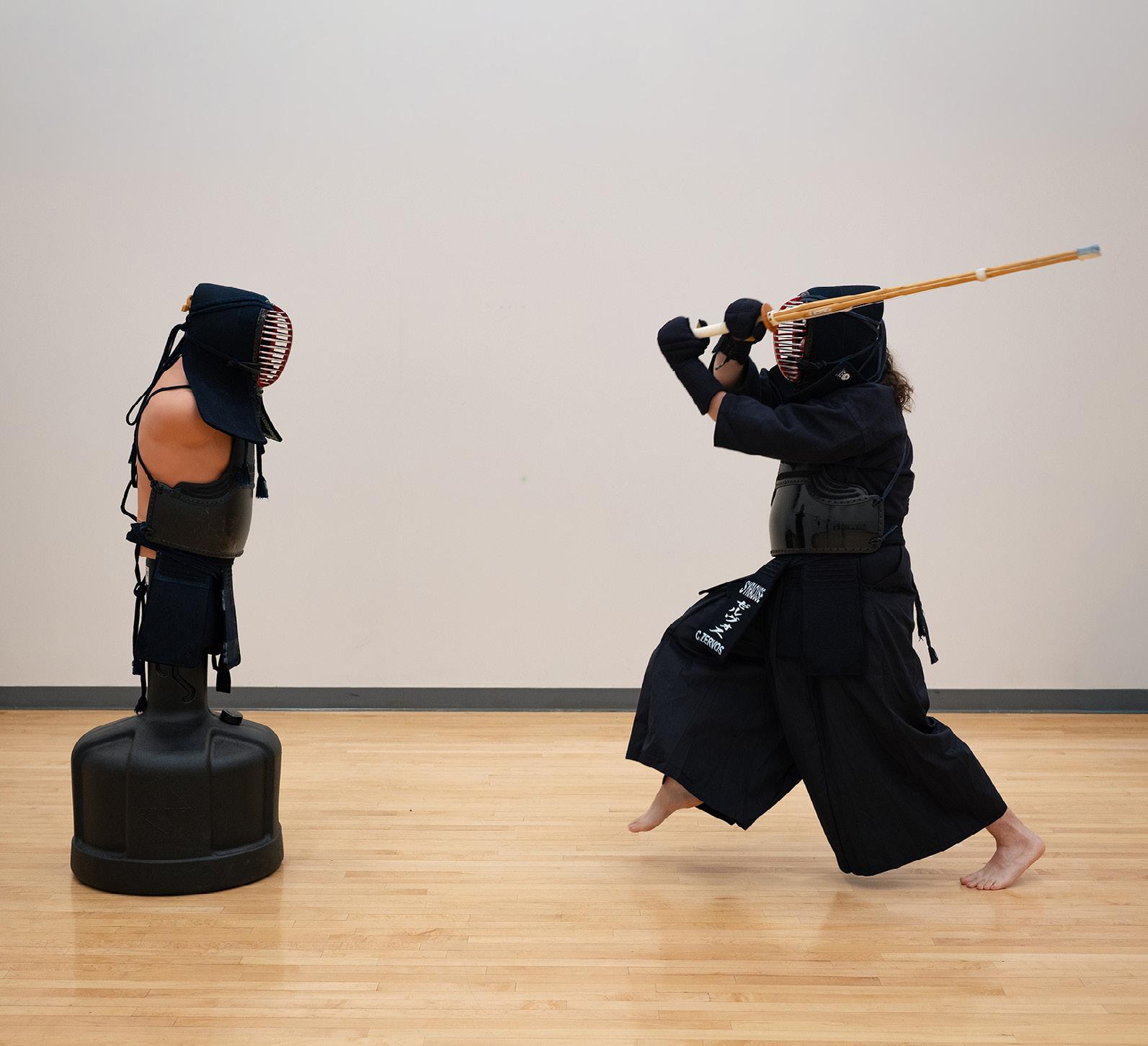
Armor clanks and shinais, a traditional Japanese bamboo sword, clash as members of Syracuse University’s Kendo Club put on their helmets. This close community is ready to spend the next two hours chasing a perfect strike.
“While we were competing with each other, there was this form of brotherhood among all of us,” said Christopher Zervos, SUNY ESF sophomore and Kendo Club social media manager. “We all share this one thing: the sword, the shinai and our love for this sport.”
Started in 2007, the Kendo Club gathers SU and ESF’s martial arts enthusiasts twice a week to practice the sport of kendo. The sport’s origins are rooted in Japan. Its popularity grew in the early 19th century when samurais were no longer fighting warlords but still wanted to train with each other, Zervos said. The sport blends physical activity with mental strategy and is open to both beginners and more advanced martial artists.
Before joining the Kendo Club, Zervos had experience with karate, which is another form of martial arts. Zervos holds a brown belt and said that while karate and kendo have similar aspects, they are very different overall. Kendo is offensive and aggressive; karate is more defensive, Zervos said.
SU sophomore and Kendo Club president Christian Han said kendo relieved his stress, especially during his hectic schedule as an ROTC student in his freshman year. Practicing the sport since 2020, Han said he appreciates the sport’s decompressing abilities.
“When school gets busy, it’s really nice to just show up there and just beat someone up with a stick. It doesn’t hurt or anything, but overall, it provided a lot of community enjoyment there,” Han said.
Because the club doesn’t have a sensei, Han said it was difficult for them to continue to grow their skill levels in the club. Han invited sensei Lewis Murphy to travel from New York City to attend two of the club’s practices during the fall semester.
Han has taken on the responsibility of the club’s head coach. Since Kendo Club doesn’t have an official sensei, Han uses his prior experience in the sport and teaches it to others. While Han is teaching the other members what he already knows about Kendo, he is also learning something from them.
Like other Japanese martial arts, the practice of kendo has much formality, Zervos said. Without a sensei, it can be difficult to ingrain these traditions. One of these traditions is the three bows taken at the beginning of each practice, Han said.
“The first bow is to the spirit of kendo, the second bow is supposed to be to your sensei, but most times we don’t have a sensei, so we skip that one. The third one is to show respect to each other,” Han said.
Kendo Club attends tournaments during the year, traveling to universities like University of Rochester, University of Buffalo, Cornell University and Harvard University. Competing in tournaments is beneficial to broaden knowledge and experience with kendo, Zervos said; it allows members to be prepared when battling another opponent with different fighting styles.
During practice, members often work on sparring, practicing techniques with each other to mirror an actual tournament. After each match, Han said he and the other members go over what worked and what didn’t.
“It’s a good moment where we can reflect. For the most part, we don’t have a sensei or a teacher or anything like that. So we just have to talk about it afterward to get as much reflection as possible to see what happened,” Han said.
SU sophomore Sean Hinchey said that the environment in Kendo Club is determined by the fact that the club is open to everyone. All the members are focused on improving and work to help each other get better, he said.
Hinchey lived on a military base in Sagamihara, Japan in high school, and joined the Kendo Club to stay in touch with the culture in college. Since joining the club, Hinchey has put more of a focus on discipline, he said.
“It stabilizes you, it gives you a ground and I think that comes from the practice of just focusing on yourself and how you’re moving, what you’re trying to accomplish,” Hinchey said.
Han said he feels joy when he sees that the members of the club are applying what he taught them and finding purpose within that. Because most of the members are beginners, it fulfills Han to see the members achieve his skill level, or even surpass it, he said.
“Now this is something that they love, this is something that they enjoy,” Han said. “They come regularly, they want to pursue maybe going forward. That’s just what matters.”
pnosrati@syr.edu
Double Tiger + The Emanuel Washington Project
Brooklyn-based producer Double Tiger collaborates with the Syracuse-based group, The Emanuel Washington Project, to create a blend of reggae rhythms and gospel-rooted drums. Don’t miss out on their groovy performance this weekend.
WHEN : Friday, 8 to 11 p.m.
PRICE: $15.13
WHERE: Funk ‘n Waffles
Cheat Codes are an electronic DJ and production trio, most known for their hit “No Promises (ft. Demi Lovato).” The group combines pop, dance and electronic music influences and has become a force in popular culture, performing at festivals like Lollapalooza and Stagecoach.
WHEN : Saturday, doors at 7 p.m., show at 9 p.m.
PRICE: $47.19
WHERE: Westcott Theater
Sydney Irving
Syracuse’s local rock artist Sydney Irving is bringing the tunes from her latest album, “Unfashioned Creatures,” to The Whiskey Coop this weekend. Since graduating high school, Irving has pursued her music career and recently signed with Deko Entertainment.
WHEN : Sunday, 12 p.m.
PRICE: Free
WHERE: The Whiskey Coop
Badfish: A Tribute to Sublime
Experience the energy of the California reggae-punk band Sublime with their tribute performance from Badfish. The Rhode Island-based group gets their name from the hit “Badfish.”
WHEN : Sunday, 8 to 11 p.m.
PRICE: $30.86 for general admission, $135.38 for VIP
experience
WHERE: Middle Ages Beer Hall
LAUNDRY DAY
Formed in 2018, the Manhattanbased pop rock band LAUNDRY DAY is bringing their catchy sound to Syracuse. The five-person band is most known for their viral social media presence and popular tracks like “FRIENDS.”
WHEN : Tuesday, doors at 7 p.m., show at 8 p.m.
PRICE: $26.96
WHERE: The Song & Dance

the fall semester, it was also the first institution in the United States to launch a center dedicated to the creator economy on the college campus. The Center for the Creator Economy is a joint venture between the Newhouse School of Public Communications and Whitman School of Management.
It shows SU’s commitment to the culture that has been brewing for years, Mark Lodato, dean of Newhouse, said.
“We’ve seen it develop organically through our students, and that has only continued to build over the years,” Lodato said. “It’s really important to not to close our eyes to what our students are doing, but oftentimes embrace the new frontiers that they are finding and conquering.”
The university is no stranger to the creator economy, Lodato said. Before the surge in digital creator jobs in 2024, SU alums and students were producing content and getting paid for it. Dunn Solomon began making videos in 2018, for example, while Newhouse alum Andrew Graham signed with influencers as early as 2020.
Despite a packed class schedule, SU students have embraced a similar work ethic and commitment to building their own brand as alums have.
SU senior Sylvie Feldman has posted makeup videos on TikTok for almost six years — before she attended SU.
The senior public relations major has accumulated over 100,000 TikTok followers on her @sparklysyl page, where she creates elaborate makeup looks, transforming her face into Elphaba from “Wicked” or Charli XCX’s “brat” album cover.
period were brought from the Onondaga Historical Association.
Sticking to the “Cabinet” concept, The Cabinet Room previously featured a ballot-themed drink special, where customers could purchase two cocktails and vote on which one was better. The menu has since been adjusted to feature signature cocktails like the Old Fashioned and the standard Martini, Lampert said. Lampert also curates a rotating, seasonal menu for the speakeasy.
Creating an apt seasonal menu can take anywhere from a minute to weeks, Lampert said. She combines the season’s themes with trendy themes, constantly taking in input from customers and her staff. This winter’s seasonal menu features a Fig and Honey Old Fashioned and a Sugar Plum Fairy Martini.
Syracuse University graduate student Ava Wales ordered a Moscow Mule from The Cabinet Room’s standard menu on Saturday night. Coming from Wisconsin, where speakeasies are prominent, Wales was introduced to The Cabinet Room this summer by her classmate, Enzo Cupani.
Since discovering it, the pair have revisited The Cabinet Room several more times, slowly drawing more of their friends to the speakeasy. Though Cupani has visited other speakeasies, The Cabinet Room sticks out from the ones he visited.
“They set it up so well with the Murphy door and the bookshelf. It’s definitely super, super well hidden and a secret well kept. I think that kind of adds to the whole speakeasy vibe,” Cupani said.
On Saturday, Cupani and his friends, a group of 20, made their way to The Cabinet Room to spend time together outside of the classroom. While some customers, like Cupani and his friends, visited the speakeasy for some downtime, The Cabinet Room has also been used for private events — from a wedding reception to birthday parties.
For Greene, the best memory at The Cabinet Room was witnessing an engagement. It signified the reason why Greene started the speakeasy, he said. He said he is honored people want to have important moments there.
Before Syracuse became an official city in New York, Baldwin gave a speech about what he

Feldman said she wouldn’t be as successful in creating her brand had it not been for SU. Over her four years at SU, Feldman has been encouraged by her Newhouse professors to try everything and that “every opportunity is an audition,” she said.
“If you had spoken to me four years ago, I might have wanted to make a personal brand, but I wouldn’t have known how to go about it,” Feldman said. “Even just the repetition of the classes that I’ve taken, I feel like they have really helped me in learning more about how to make my content.”
Feldman is among other SU students, like Reyanna Dundas, John Spina, Maeve Lewis and Caroline Colby, pursuing content creation alongside their classes.
While SU alum Chloe Hechter wasn’t on campus when the Center for the Creator Economy started, she still credits her alma mater for her success. The now full-time influencer with over 180,000 TikTok followers never took any classes in content creation.
“Something that’s so awesome about Syracuse is obviously you do have your required classes, but they really do give you this freedom to forge your own path,” Hechter said. “I feel like the programs that I was a part of and the people I met really did give me the push I needed.”
Hechter didn’t start posting regularly on TikTok until she graduated from SU. But, she said she wouldn’t be where she is if it weren’t for the encouragement from professors and the confidence she built as the former editor-inchief of University Girl magazine.
Hechter said that she regularly sees SU alums at brand events, she said that there’s “lowkey is a Syracuse-to-influencer pipeline,”
envisioned Syracuse would be. In his speech, Baldwin saw Syracuse covered in “hanging gardens.” Greene wanted to honor Baldwin’s vision through Harvey’s and The Cabinet Room.
“We thought it would be a fun fulfillment of his prophecy,” Greene said. tabintes@syr.edu


crediting the school in prioritizing creativity and independent thinkers.
When Hechter learned of the Center for Creator Economy’s inception, she said several people sent it to her. Hechter had always said she expected SU to create a content creation major in the next few years, especially after noticing the significant number of students and alums who were becoming successful influencers.
Mike Haynie, SU’s vice chancellor for strategic initiatives and innovation and executive dean of Whitman, said he noticed a similar trend, especially after he saw the amount of content creators who returned to campus for the university’s annual CUSE 50 event.
“I started to find all these Syracuse students that had big followings on social media,” Haynie said. “Typically we think about what we have to teach students, but this was an opportunity to say, ‘What do students have to teach us?’”
That’s when Haynie realized SU’s potential to produce even more content creators. He contacted Lodato in October 2024 to pitch the creator economy center.
“I met students who were paying their college tuition with brand deals,” Haynie said. “These were 19 to 21 year old kids who have created a trusted following on social media that have had real impact.”
When Haynie discovered a student content creator, he would send them an email and ask them to meet him in his office. Some students thought they were getting in trouble, but Haynie said he just wanted to learn how they were managing their social media.
Then-senior Thomas O’Brien, who graduated in 2025 from the College of Visual and Performing Arts, was one of the students called to Haynie’s office. While at SU, O’Brien launched
his own music video production brand, Project FreeFall with his classmate, Nick Moscatiello.
“You’re in an environment where you have so many people with so many different perspectives and so many different backgrounds,” O’Brien said. “Through collaboration and being around those people, it sparks creativity.”
O’Brien’s social media and entrepreneurship experience was gained outside of the classroom, he said, from creative projects on campus like the Blackstone LaunchPad and Project FreeFall. This October, O’Brien returned to his alma mater when he was hired as a project coordinator at the new creator economy center.
But, supporting and embracing content creation as a career wasn’t always as prevalent. When Dunn Solomon attended SU, digital creator jobs were less popular and she felt less supported. To empower young creators, Dunn Solomon returned to SU for the creator economy center’s launch.
“At the time, I did not want to be an influencer. There was really a negative connotation associated with the word, so I really tried to position myself as a podcast host,” Dunn Solomon said. “But in order to make money and get more listeners, I became a content creator and an influencer as a side effect.”
When Dunn Solomon is asked about her time at SU, she said she always tells them that every class, project and group assignment prepared her for the skills she now utilizes in content creation.
“I will always say that I didn’t know it at the time, but every single thing I learned at Syracuse was preparing me for this career,” Dunn Solomon said. “At the time, I just had no idea.”
lvzucker@syr.edu

By Sudiksha Khemka columnst
Artificial intelligence has officially entered the chat ... and lately, it’s been giving dietary advice.
From calorie calculators to full meal plans, more people are turning to tools like ChatGPT and Google Gemini to answer questions traditionally handled in clinical settings. This is both fascinating and concerning. While AI can technically make nutrition advice more accessible, it also blurs the line between education and nutrition counseling in ways we’re not fully prepared for.
Lawmakers have already stepped in to regulate AI “therapists” for mental health, and Illinois recently went so far as to ban AI from offering therapeutic decision making. But nutrition chatbots remain largely unregulated, even as more people use them to manage chronic conditions like diabetes, obesity and fatty liver disease, among others.
The question remains whether AI can safely act as a dietitian.
Recent studies suggest AI is decent at giving rudimentary nutritional advice but falls short on personalized and clinical judgment, struggling to account for medical history, lifestyle and individual needs.
A 2024 study evaluating ChatGPT’s dietary guidance for noncommunicable diseases found its accuracy ranged from about 55% to 73%, depending on the condition. For cases like fatty liver disease, responses were fairly aligned with clinical guidelines. But when multiple health conditions overlapped, such as diabetes and chronic kidney disease, the chatbot often provided contradictory or incomplete advice.
Another 2025 study comparing ChatGPT to Gemini in diabetes nutrition management found that while both tools showed promise, Gemini performed better in complex scenarios. The findings suggest AI health tools are improving but remain inconsistent in their future potential.
AI can explain what a balanced diet looks like, but it can’t reliably tailor guidance to reallife health situations, and this is exactly where healthcare professionals matter most.
To be fair, AI does have its benefits. It’s free, fast and available 24/7. It can help people who lack access to health care providers, especially in underserved or rural areas. AI can answer basic questions, explain food labels, generate meal ideas and reinforce general healthy eating patterns.
For Syracuse University students juggling stress, limited budgets and inconsistent dining hall options, AI can seem like a convenient standin for professional guidance that feels expensive or inaccessible. Between packed class schedules, late-night studying, gym culture and social media pressure, it’s tempting to turn to ChatGPT or even

TikTok for quick answers about bulking, cutting calories, using supplements or eating “clean.”
But that’s the thing, nutrition isn’t just about diet “tips.” AI can’t evaluate lab values, assess food allergies, recognize disordered eating patterns or read body language and emotional cues the way a human clinician can. It also doesn’t always account for updated guidelines, cultural dietary practices or especially nuanced medical needs.
Moreover, errors like recommending the wrong protein intake for kidney disease or unsafe foods for someone with allergies can carry real health risks. Unlike a licensed professional, AI isn’t liable when it gets things wrong.
Right now, mental health chatbots are under growing legal scrutiny, but nutrition AI seems to be influencing health decisions daily.
As states debate who should regulate AI in health care, an important issue is determining where the line is drawn between education and nutrition counseling. When AI starts replacing healthcare professionals – even
unintentionally – the consequences are no longer hypothetical.
Students are more vulnerable to diet culture, disordered eating patterns and misinformation that frames health in extremes – eat this, cut that, avoid everything. AI cannot often recognize when someone might be under- or overeating, or dealing with a medical condition that makes generic advice unsafe. What reads as “motivation” online can quickly turn into harmful restriction or anxiety around food, especially in such a highpressure academic environment like SU.
At the same time, this raises a broader equity issue. Many students rely on AI because they lack easy access to personalized care or reliable nutrition counseling. If AI is going to play a role in how young adults make health decisions, it shouldn’t replace professional support. Instead, the technology should highlight the need for better health care resources, clearer nutrition pedagogy or systems that make credible nutrition education more accessible than algorithmic advice.
At SU, students have access to free nutrition counseling with registered dietitians through the Barnes Center at The Arch, providing professional support without the aforementioned risks of misinformation or oversimplified advice. Unlike AI, campus dietitians can consider medical history, mental health, dietary restrictions, etc. AI shouldn’t be banned from nutrition, but it must stay in its own lane. It can serve as a support tool, not a replacement for registered dietitians. AI can help people learn, explore food options and better understand elementary health concepts. When it comes to individualized care or complex dietary needs, human expertise remains essential. Using AI for meal ideas or straightforward advice is fine. But if an AI ever starts calling itself your dietitian, that’s when we should start questioning our reliance.
You haven’t changed from freshman year, but you’ve learned
By Gracie Lebersfeld essayist
Approaching my final semester at Syracuse University, the most important thing I’ve learned is that you don’t need to be changed. You need to be embraced. The past, present and future versions of yourself are all deserving of acknowledgement and appreciation.
The phrase “I’ve been changed as a person” is a fairly common one. I’ve heard it frequently with graduation creeping around the corner. As I hear people reflect on their college careers, many claim SU has changed them, that the person they were when they started college is no longer who they are as they graduate.
Full transparency: I think that’s a silly thing to say. But, to be fair, I used to see no problem with it. On the contrary, I used to look forward to the day I’d post my graduation photos and craft a caption saying a similar phrase. But now that I’m getting closer to wrapping up at SU, I don’t think that way at all anymore.
I don’t think I’m a different person than I was four years ago. In fact, I know I’m not. The scared, unsure freshman is still within me. I don’t want to forget that she existed, and I don’t want to overlook all the work she did. It wouldn’t be fair to that version of myself.
SU didn’t change me; it taught me. It taught me how to embrace the parts of myself I had previously tried to keep hidden. My path from freshman year to now wasn’t always smooth sailing and posed many moments of self-doubt. At times, I even felt like the core of my personality was under threat.
I sacrificed parts of myself to try to be someone else, hoping I would fit into places
where I didn’t belong. I used to beat myself up for my past decisions. But I don’t hold it against myself anymore. I was naive and confused, doing what I could to stay afloat. The more time I spent here, and the more people I became close with, the more I learned to stop concealing myself and be authentic.
Many of the decisions I made are worlds apart from how I would approach them today. But I’ve come to learn that without making those ridiculous choices, I never would’ve learned why they were so ridiculous. The virtues and values I hold close now have all surfaced through those past experiences.
Freshman year, I spent a decent amount of time filtering myself — what I would say around certain people, how I would act, even what I would wear. I watered down the version of myself I previously had been proud to be, fearing the people around me wouldn’t like me. I worried they’d think I was too much.
For the first few weeks of school, it seemed to work. I was hanging out with girls who seemed to like me, except it wasn’t me that they liked, it was this polished and filtered version of myself. That version of myself was really boring and had no discernable personality. She never wore her
favorite colors. She never talked about her niche interests that she had extensive knowledge of. But they liked her well enough, so for a while, I saw no sense in changing.
It wasn’t until a chance encounter that I found my real group of friends — the friends that I still consider my best friends three and a half years later — that I realized there was no need to water myself down. My best friends embraced the girl whom I hid away. They loved my loud personality. They would always remember my favorite color. They sat and listened to me talking about random video game lore and the history of Point Nemo, the most remote place on earth. They didn’t change me, nor did they expect me to change. Instead, they showed me that the girl underneath was just as deserving of friendship and love. While it hurts to know it took watering myself down to get to the real friends, I know it was worth it. Had I not questioned my authentic self, I never would’ve learned to love her even louder and prouder. I would never have understood that it’s my uniqueness that draws genuine friends to me.
Don’t discredit the past version of yourself for getting you to where you are now. Even if they made some questionable decisions, and even if you’re happy to be free of what they were going through, it’s because of the past that you are who you are today. You haven’t changed; you’ve learned. It was your past self who led you to uncover the parts of yourself you’re proud of today, so give yourself credit for that.
Sudiksha Khemka is a sophomore nutrition major. Her column appears bi-weekly. She can be reached at skhemka@syr.edu. Gracie Lebersfeld is a senior majoring in selected studies in education and creative writing. She can be reached at gmlebers@syr.edu.
Moten poured every ounce of energy he had into raising his girls. His warmth, honesty and vibrant spirit shaped their lives. That’s why accepting reality is difficult for them.
As Leilani, Moten’s youngest, grew older, she began referring to her dad as her “living legend.”
Now she says she can’t anymore.
On Sept. 30, 2025, Moten died inside his home in Washington, D.C. He was 53.
Moten’s life as the leading scorer in Syracuse basketball history is only one part of his story. He was a family man first. If he rocked with you, as Noelene said, he brought you into his life without hesitation. The smooth-talking, high-sock-wearing hooper from D.C. was larger than life to those closest to him. Moten’s legacy as the man nicknamed “Poetry in Moten” is one of loyalty. One of perseverance. One of charity. One of love — pure, girl dad love.
What keeps the Moten family pushing through tragedy is their belief that their patriarch lived “a dream life,” a magnificent existence that touched countless others. Seeing over 5,000 people show up to Moten’s funeral in October — former teammates, friends, neighbors and relatives — made them realize Moten’s life should be celebrated, not mourned.
“It makes sense to me why he was taken,” Lawrencia said. “I think because God wanted somebody so great to be in heaven. He did so many amazing things on this Earth. My dad’s purpose was to change lives, and he did that.”
• • • Moten revved the engine of his 1991 red Acura Legend and parked in front of John Wallace’s house. Little did they know that’d be the start of a four-year war.
It was freshman orientation week. Moten and Wallace had just met for the first time earlier in the day. Moten, the lowest-rated recruit of Syracuse’s six-man rookie class that season, challenged Wallace to a one-on-one at Thornden Park, looking to prove himself. Wallace, a 6-foot-8 Rochester native and highly-rated SU basketball recruit, uptook the offer.
Once they arrived, the two stepped on the court’s black asphalt. They stretched. They laced their shoes. Then Moten, after pulling his white socks up to his kneecaps, set the ground rules.
“First to 100,” he said.
“Shoot, alright,” Wallace answered.
Wallace’s size and brute strength matched up against Moten’s smooth shot and killer crossover made for a hotly-contested first battle. Moten won this one, 100-98. Wallace, bewildered, called for another game the next day. Then another. And another.
“He beat me the very first time we played, it was shocking to me. But that’s when you realize the greatness of Lawrence,” Wallace said. “His nickname is so fitting, because he looked like he was going so slow, but he wasn’t. The way he was able to maneuver and get angles on you, it was poetry.”
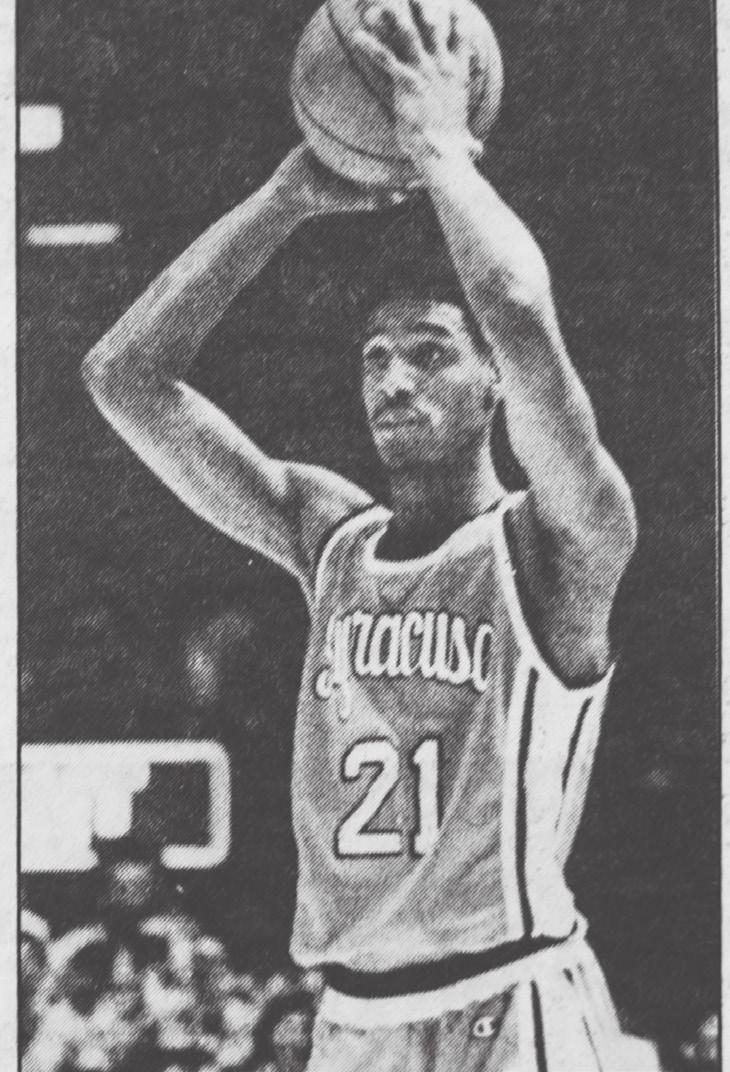
Moten squared off against Wallace in thousands of one-on-ones over their four years together at SU. The two now rank as Syracuse’s highest-scoring duo of all-time. But in hindsight, it was an unfair matchup for Wallace. From 1991-95, Moten racked up the most points in Syracuse men’s basketball history — 2,334 — and the most points in Big East history — 1,405.
Moten’s No. 21 jersey was retired in the JMA Wireless Dome rafters on March 3, 2018. He went on to play for the NBA’s then-Vancouver Grizzlies and Washington Wizards.
But Syracuse is where he truly made a name for himself. His four All-Big East Team selections, conference Rookie of the Year honor (199192) and career scoring average of 19.3 points per game is a collection of achievements that likely won’t be replicated again.
He even helped recruit Carmelo Anthony to Syracuse, per Noelene, who says he called Melo for about 30 minutes before his commitment and sold him on how he could become a legend at SU. Moten’s legacy stands alone among the Orange’s all-time great hoopers, both for his place in the record books and for his signature silky-smooth playstyle — what teammates hailed as “Poetry in Moten” — that defined SU in the early ’90s.
“He’s the most underrated player that’s ever played here,” said Hall of Fame head coach Jim Boeheim, who helmed Syracuse from 1976 to 2023. “He’s in the top tier of players I ever coached. He made it look so easy.”
Moten grew up in D.C. playing basketball and football. Boeheim said Moten was probably a better football player before coming to SU, but he chose basketball.
He came to Syracuse as one of six freshmen in Boeheim’s 1991 class, along with Wallace, Anthony Harris, Glenn Sekunda, Stephen Keating and Luke Jackson. All five were ranked above Moten. But, as a freshman, he played more than all of them combined.
His road to glory began in Atlanta on Dec. 3, 1991, against Florida State. After a standout preseason camp where he drained shots and
exerted stout defense, Boeheim said, Moten finally earned his first start.
Jackson said the freshmen on the bench looked at each other in amazement when Moten took the floor with a fiery gaze and his white socks pulled to his knees — a signature D.C. hooper’s look.
“Here comes the separation,” Jackson recalled saying from SU’s bench.
Moten dropped 18 points on 8-of-13 shooting in 36 minutes, helping the Orange to a 89-71 victory. He never looked back, winning Big East Rookie of the Year honors and evolving into Boeheim’s most trusted player with the ball in his hands.
As the years went on at SU, Moten’s confidence grew. He’d let you hear it, too. Moten, a mild-mannered man away from the court, had a killer instinct on the hardwood. You could tell Moten locked in when his voice got high-pitched, said Jackson and fellow teammate Adrian Autry, now Syracuse’s head coach.
It was frightening to hear, Jackson said, when Moten’s voice picked up a tune during practice. He got into others’ heads just by stating the obvious in a condescendingly squeaky tone.
“They can’t guard me, mannnn,” Michael Lloyd, Moten’s teammate in 1994-95, recalled Moten telling opponents. “And he’d have those sneaky little quotes he’d be saying like, ‘Twentyfour and five. I’m gonna give him 24 (points) and five (rebounds).’ He wasn’t real sneaky with it. He’d be like, ‘That’s gonna be all night.’”
“He was cocky but not arrogant,” added Lazarus Sims, who played with Moten at SU from 1992-95. “I’d try to get under his skin, and then he’d be in practice tearing Mike (Hopkins) up or Luke Jackson. Then it’d be me. I’d be like, ‘Man, why you doing this to me?’”
It was all in good fun, of course. Moten had the authority to boss his teammates around a bit, as long as they brought their all on the floor together. They all knew he was unstoppable, with his long arms, precise shot and deceptive speed making him an offensive weapon. So they didn’t get too bothered by Moten schooling them in practice.
He encouraged them plenty. One time in a game against UConn, Hopkins missed a free throw. Rather than giving him the old clap on the hand, Moten walked over and kissed Hopkins on the cheek. That was his way of telling Hopkins to move on to the next one.
“If you don’t like Lawrence, something’s wrong with you,” Autry said.
Moten looked out for his guys away from the court, too.
He showed Lloyd how to get to his classes. He showed Sims around campus and gave him an immediate role model, despite being his peer. He even gave Todd Burgan an unforgettable moment, one that allowed him to acclimate to a new environment he was hesitant to enter.
Waiting for a bus at College Place early in the fall of 1994, Burgan was surrounded by throngs of strangers competing for a spot on the next bus. Burgan, who finished his high school career at New Hampton Prep — Moten’s alma mater — looked up to the prolific scorer as a hero. Now, he was his teammate.
Luckily for Burgan, Moten — then a senior — rolled up to the bus stop in his sportscar, eliciting oohs and ahhs from the students around him. They knew it was the king.
“Of course I see him, but I don’t know if he has something to do,” Burgan said. “It’s a bus stop full of people.”
Moten singled out Burgan.
“Get in, man,” Moten directed Burgan, who happily obliged and got a ride home.
“I mean, come on. It’s Lawrence Moten,” Burgan said. “That’s my big brother.”
• • •
On occasion, Leilani opens her iMessage history with her father and reads heartwarming texts from him. He never went a day without telling her “good morning,”

“good night,” “I love you” and a few inspirational one-liners, too.
There’s a message from 2021 that Leilani keeps circling back to. Leilani didn’t follow a similar path to her father or older sister. She didn’t play college athletics like Moten and Lawrencia did, and graduated with a bachelor’s degree in finance from Morgan State University — the first in her family to attend an HBCU.
Sometimes, Leilani felt uneasy about venturing away from sports. Finance isn’t an industry where she has many Black women colleagues, Leilani said, and she didn’t know how Moten would feel about how she’d fit in. But all Moten cared about was his daughters’ fulfillment. He reminded Leilani of this repeatedly. After she got a job with Chase as a leadership development analyst in the summer of 2021, Moten couldn’t wait to congratulate her.
“Just wanted you to know that I’m extremely proud of you and what you have accomplished so far in your life. Keep following your dreams. Stay positive and passionate. You are a shining light. Keep pushing for your own greatness, I love you. Every day is an audition,” the text reads.
That last line was something Moten lived by, Leilani said. If you treat every day as an audition, her father would say, doing your best will consistently reward you. Nowadays, Lawrencia, a sports broadcaster, and Leilani, a financial advisor for Merrill Lynch Wealth Management, are thriving in their upper-20s, success they credit to their father’s unconditional support. By all accounts, Moten’s greatest achievement was raising his daughters. And his daughters’ greatest experience was knowing their father.
“It wasn’t tough love, it was the opposite. It was true love,” Lawrencia said of how her father parented her. “He was so caring and so connected with us. He was a girl dad through and through.”
Moten’s journey to fatherhood began when he found Noelene. In her freshman year at SU, Noelene met Moten in the spring of 1991, while he was a high-school senior on a recruiting visit to Syracuse. The two locked eyes when they passed each other on campus. Noelene thought Moten — sporting his jet black high-top fade and flashing an inviting smile — was cute.
That fall, Noelene was in the middle of the Quad when she first heard her soulmate calling her name.
“Noeeee-” Moten shouted across the Quad.
“Oh my goodness, he actually came,” Noelene blushed.
They hit it off. Noelene was committed to Moten’s lifestyle. They went long distance several times, including when Moten played for the Vancouver Grizzlies, but that never derailed them.
“Once we stepped out of the friendship zone, there was no ever going back,” Noelene said. “We had to be together by any means necessary.”
Noelene admired Moten’s kindness and generosity, as well as his ability to make everyone around him feel at home. Looking back, she can’t think of her husband’s death without realizing how lucky she was to be in the majority of his life.
“I had a moment — ‘Oh my gosh, I was married to an angel,’” Noelene said. “I didn’t realize all this time. I really feel like he was an agent for God, and that’s why he’s gone so soon.”
The angel Noelene speaks of was as much involved with waking the kids up for school, making dinner and taking the girls to basketball practice as she was. Moten woke up and planned out the whole day for the family, she said, beaming ear to ear each second he could spend with Lawrencia and Leilani.
He took them on picnics, to D.C. museums and zoos, out to eat Maryland soft-shell crab, to sporting events and parks, anywhere they wanted to go. At home, he was a ball of energy that could make any sad day a good one. He always danced to whatever music he blared across the living room — Moten loved groovy go-go music artists
like Chuck Brown. And he’d entertain his daughters by playing Just Dance on the Wii with them. They’d laugh for hours watching their father’s silly dance moves to pop songs. He’d always win, too. Moten was fun when he needed to be fun, and serious when he needed to be serious.
Growing up, his mother, Lorraine Burgess, always told him a phrase: “Don’t just stand up on the hill.” It meant to have a drive to succeed in all facets of life, even when the going seems tough.
For Leilani, she said she couldn’t have gone on to find stability for herself in an unknown field without her father reinforcing positivity into her and the direction she’d chosen. Moten expected his daughters to follow their own legacy, and never stopped believing they’d reach their full potential.
“We were always pouring love into each other, we never stopped pouring into each other,” Leilani said. “That’s why this is still so unbelievable. And we’re having a difficult time accepting it, because the roots are so deeply-planted with him.”
Moten’s words also advanced Lawrencia’s journalism aspirations. She’s worked in sports broadcasting for a few years after graduating from the University of Hartford, where she also played basketball, and wants to venture into other areas, like entertainment reporting.
But having her father’s blessing to hang up her basketball shoes gave her the confidence to jump into journalism headfirst.
“That’s something we can all take away from (him) — even when you’re dropping 30 (points) on the court, you can still make everyone feel loved,” Lawrencia said of her dad. “If we all do that more, the world would be a better place.”
Moten’s work outside parenting was philanthropic. He founded the Willow Street Foundation to help financially disadvantaged children in Syracuse. From at home to out in the world, there was never a time Moten wasn’t trying to do what his mother did for him — set kids on a stable path forward.
Moten serves as an everlasting example of how to be a good dad. His close pals, who are also fathers, grew inspired by him.
Romeo Roach, Moten’s best friend from the D.C. area, would see the way Moten raised his daughters and incorporate it into his own parenting. The time, the care, the unconditional love, the acceptance and unwavering encouragement he had for their personal choices — Moten’s parenting style was rare.
“I’m trying to do what he was doing with his daughters with my kids,” Roach said. “His girls were his number one.”
“They say Kobe Bryant was the ultimate girl dad. Mo’s got him beat by one thousand,” added Sims, who said Moten’s way of never judging his daughters for anything is something he’s applied to his own parenting.
More than anything, all a kid wants from their parents is to hear them say they’re proud. With Lawrencia and Leilani, it was never a question.
Whether a simple text, a congratulatory hug or a heartfelt paragraph to congratulate Leilani on becoming the first in their family to attend an HBCU, Moten never failed to remind his daughters he loved them. Even in death, the girls can still feel their father’s pride.
“I’ll never have to guess how proud he was of me,” Lawrencia said.
• • •
When Moten died, he still flashed a six-pack of abs. He could still dunk a basketball. He was in an unbreakable spirit. He was texting his daughters daily; calling friends weekly.
This was a man who many saw as superhuman. Yet, far too often, his friends and family are reminded of their worst memory of Moten — the day their world stopped.
“I still can’t quite wrap my arms around it right now,” Boeheim said of Moten’s death. “It was unfathomable. Life happens sometimes. I just can’t understand it.”
Among all his former teammates, the memories hit particularly hard for Wallace, who became as close to an uncle to Moten’s children as a nonblood relative could be. Every now and then, when walking through his house, Wallace spots the invitation he received for Moten’s funeral service. For him, Sept. 30, 2025, feels like yesterday.
That morning, Wallace was driving back home to Rochester from New York City. He received a text from Burgan. Wallace checked his phone, making sure it wasn’t anything urgent. But he refused to believe what he read. Wallace called Lloyd, knowing he must’ve been in recent contact with Moten. Lloyd confirmed the news. Wallace flicked his turn signal and pulled off to the right side of the road on Interstate-81. His mind turned to Moten’s daughters. Lawrencia was the first to pick up, and the two sobbed on the phone for a while.
Nothing could change Wallace’s disbelief in the moment. He still took the time to comfort his unofficial niece during her darkest hour — because that’s what Moten would do.
Teamwork, one last time.
“My brother’s not here,” Wallace often reminds himself. “He was in such good shape. It’s just crazy.” ccandrew@syr.edu @cooper_andrews
“(Ava) continues to be a pretty consistent threat for us on the net,” SU head coach Britni Smith said. “I’ve said it a number of times, but she’s a pretty mature goalie for us in the way she handles her emotions.”
Going into U11, Drabyk wasn’t even a goalie. She began her career on defense, but she realized the position clicked after playing a three-on-three game as a goalie.
During her transition to goalie, the only thing that didn’t come naturally was the different skating technique. She adapted easily as she joined the boys’ game after being the only girl in her U15 league for the Saskatoon Stallions during COVID-19.
“She had the drive and skill set to compete at the boys’ level,” Goertzen said. “I watched her grow her game as a smaller goaltender. She was very accurate in her movements, very fast.”
Drabyk switched to girls’ hockey after her freshman year of high school and began playing at the U18 level in 2022. Goertzen had his eye on Drabyk since the pandemic and began giving her feedback after the Team Canada National Women’s U18 Summer Showcase in August 2024. Goertzen said he wanted Drabyk to focus on her stance, positioning and posture in net.
Three months later, Goertzen said Drabyk implemented the feedback. She propelled Team Saskatchewan to a national championship in Kelowna, allowing just 1.74 goals per game and saving 94% of shots.
She is the backbone of our team. When she’s playing her best, we’re all playing our best.
syracuse defender
“She was able to work on those pieces (of feedback) and really show a lot of poise and confidence as she progressed through the national championship,” Goertzen said.
By then, Goertzen knew Drabyk’s strengths. He knew she deserved a shot on Team Canada.
Off the field, players carry the same mindset. They wear ties and dress shirts to class. The only time in the year they don’t train as a team is during finals week. Every player in the class of 2025 got accepted to a 4-year institution.
“I can’t make a kid feel a loss, but I can make them look up to what the people before them did,” Bruno said. “We have a lot of great success stories. We try to point to the guys who did it the right way.
“Our success isn’t always defined in wins and losses. It’s defined by how many kids we can get to college who maybe wouldn’t have without football.”
• • •
Reality set in for Brown as he reevaluated his program in 2018. He was naive.
It was his fourth season as head coach, and his program was declining. Players weren’t lifting together. Worse, they’d stopped believing in Brown’s vision.
After taking the helm from his mentor, Lasallian Hall of Famer Joe Casamento, Brown’s second season ended with sectional hardware and a deep playoff run to the 2016 state semifinals, led by juniors SirVocea Dennis and Stevie Scott. When both got injured the next season, nobody stepped up. The Brothers didn’t qualify for the sectional playoffs.
Brown realized that all of his success had come with Casamento’s leftovers. When a roadblock approached, his players looked for Casamento.
“You are never going to be able to fill the shoes of the man before you. I’m never going to be Coach Caz,” Brown said. “I had to find myself, I had to find what I was going to be.”
Brown emphasized development and work ethic at the junior high and JV levels. Instead of moving younger players up as soon as he felt they could compete at the varsity level, he kept them with their age groups to build solid grassroots teams. While the varsity squad went 1-7 in both 2018 and 2019, the JV teams had winning records.
“When those JV kids who were used to winning came up, that was all they knew,” offensive coordinator Bruce Williams said. “Jordan Rae, Amarri Pitts and Syair Torrence had a different mindset.”
The changes made in 2018 and 2019 set the gears in motion for the 2020s. When school
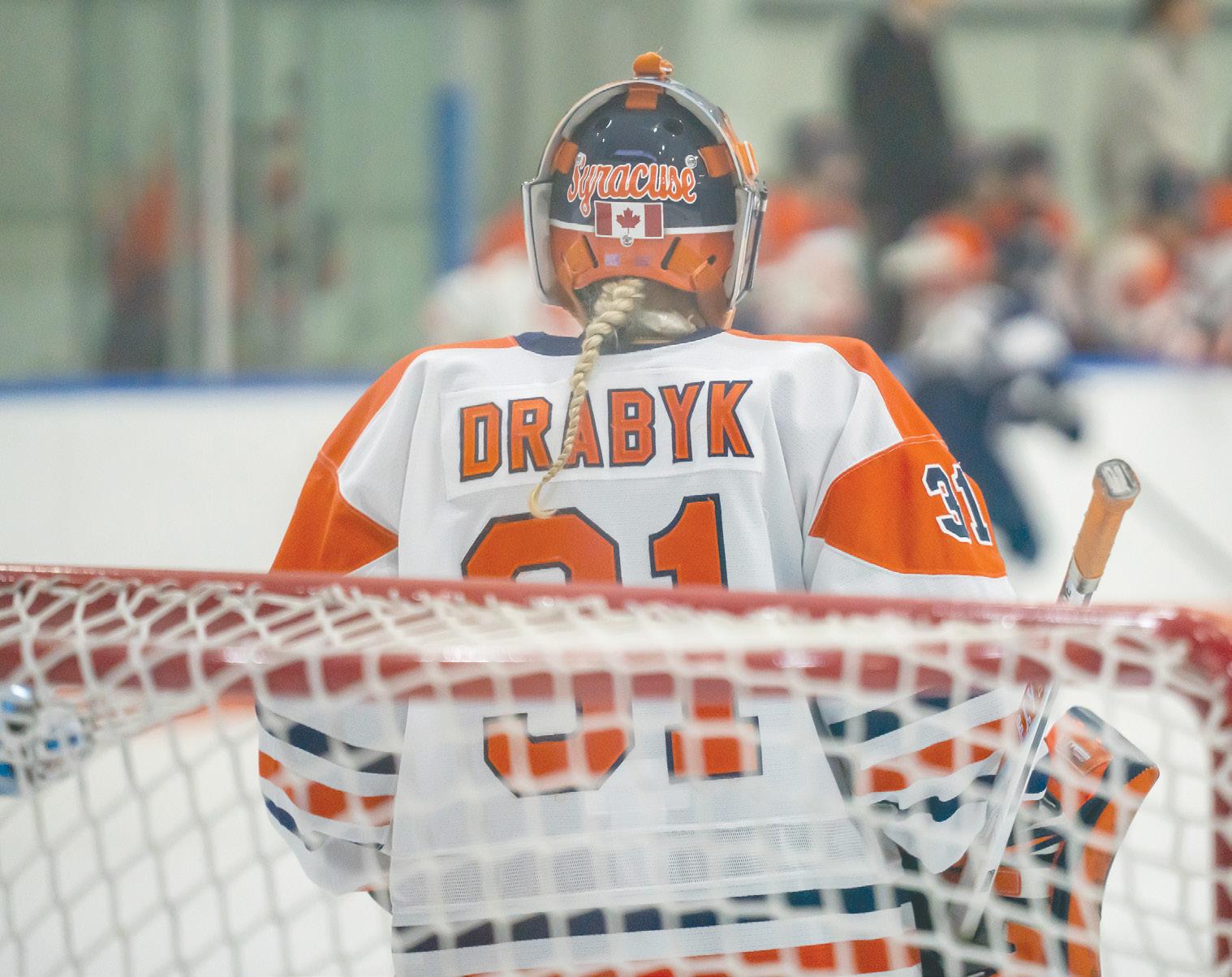
From Dec. 29, 2024, to Jan. 12, 2025, Drabyk practiced and competed for Team Canada in Finland.
Even though she didn’t start, Drabyk leaned on starting goalie Marilou Grenier for advice and support throughout the tournament. Grenier, a Minnesota-Duluth class of 2026 commit, inspired Drabyk with her poised playstyle.
“(Greinier) is one of my best friends ever,” Drabyk said. “I definitely learned how to play more of a calmer game style. She plays very calm and simple but can make the big saves when she has to.”
While Drabyk said it was difficult to quickly get a team together for the competition, her squad still topped Japan and Czechia before blanking the United States 3-0 in the finals.
“Playing at a high level gave me experience against top scorers, shooters and girls,” Drabyk said. “I think (Team Canada) just helped me see that side of the game and helped me have some prior experience before coming (to Syracuse).”
Although Drabyk didn’t receive the playing time she’d hoped for, she honed her craft through extensive training. Goertzen said
facilities were closed due to COVID-19, players trained in Williams’ basement with masks on. With no fall season, they organized 7-on-7 games together.
Perhaps the most impactful change in the staff’s rhetoric was one Williams suggested, inspired from his own time at CBA-Syracuse. Williams led the 2004 state championshipwinning team in receiving yards, and he recalled his quarterback, Greg Paulus, routinely hugging his teammates and showing them he cared about them.
The CBA-Syracuse staff wanted their program to have that same sense of unity. So, they showed it.
Brown hugs every coach when he gets to practice. If he has a difficult conversation with a player, he begins it by reminding them he cares about them.
Bruno still employs around 12-14 players each summer at his restaurant, catering and vending service businesses, he said. He’s even taught some how to cook.
“It’s not the Xs and Os that matter,” Brown said. “It’s how they’ve learned to care about each other and support each other through games, through family situations, through tough classes, through breakups. These guys know how to support each other and lift each other up.
•
•
•
With less than 80 seconds left in the 2021 Class A state championship, the Brothers’ sideline was a mess.
CBA-Syracuse had just given up a touchdown, and Somers, down 32-31, readied for a two-point conversion to flip the score in its favor. As Brown and his staff scrambled to organize their players, junior defensive back Dan Anderson turned to his closest teammate and spoke up.
“I love you,” Anderson said. “I’m not gonna let you down.”
Then another player turned to his teammate, following in Anderson’s lead. Soon enough, it’d become a full-on chain of players turning to the person next to them and sharing the same message.
“Everybody came together,” Pitts said. “Everybody knew that we had each other’s backs. We all felt the energy and embraced it. We just had to let each other know.”
It was the in-game manifestation of Brown’s emphasis on “playing for each other.” For Pitts, it was a reminder the team’s support
he always added a competitive element to practices, such as rebounding drills that created an “internal competitiveness” among the goalies.
Goertzen also designed drills after scouting opponents, which gave Drabyk and others a clear idea of what to expect in upcoming games.
Throughout the tournament, Drabyk and Goertzen worked together frequently. When Drabyk allowed a goal in practice before Canada’s first game, Goertzen walked through specific movements and processes to ensure it didn’t happen again.
“When the result ends up in a goal, we really try to focus on what the process was to get there,” Goertzen said.
Drabyk may not have started. But she gave Goertzen every reason to look at her.
“She never backed down. She’s always pushing to do better,” Goertzen said. “And that alone, that competitive side, makes others around her better.”
SU had more questions than answers at goalie entering this season. Allie Kelley, the NCAA alltime saves leader (4,594), graduated after two
remained constant at the end of an otherwise chaotic season.
Despite starting the 2021 season with three straight wins, CBA-Syracuse was blown out in its next two games. The Brothers lost 51-30 at Indian River, before being shut out 21-0 in their last regular season home game against West Genesee. The loss broke them.
“It hurt because we had seniors who had been through the dog days,” Pitts said. “Now we were fighting for something, and the season was spiraling downward.”
Players pointed fingers on the sideline. And the team, who always went out to eat together after each game, went straight home.
“There was a divide in the team,” Rae said. “When you lose, it’s bound to happen. Me and a few other leaders had to get everybody’s minds straight, on how we’re all together in this.”
Brown made defensive adjustments. Although the Brothers lost their final regular-season matchup by five, their .500 record was enough to secure a playoff berth. They then rattled off wins over several top teams through the bracket.
The team rallied around the phrase, “Charlie Mike,” a military term meaning “Continue Mission.” Brown got it from a former student-athlete of his who served on SEAL Team Two.
“Something would happen, and I’d just hear, ‘Charlie Mike, Charlie Mike, Charlie Mike,’” Brown said. “They just believed in each other, all the way up to the last play in the state championship.”
Sophomore Jason Brunson intercepted Somers’ quarterback Matt Fitzsimmons’ pass on that two-point conversion. Mission complete. The first team Brown had fully developed sealed his first championship.
• • •
Javon Edenfield still felt the Brothers had something to prove, even though he’d spent two years with them at the summit of New York high school football.
In 2023, the two-way wide receiver and linebacker was pulled up from JV as a freshman, he watched from the sideline as CBA-Syracuse averaged 33-point wins during its 14-0 run to their second state title of the decade.
The next year, he was in the end zone when Darien Williams caught a last-second Hail Mary
years, prompting Syracuse to choose between Drabyk, Maïka Paquin and Bella Gould.
Drabyk won the job and ran with it. Her competitiveness with Team Canada carried over to her freshman year, where she single-handedly kept SU in games when its offense sputtered.
“Stepping in after Allie Kelley is definitely some big shoes to fill, but I think (Ava) did it very well,” SU defender Maya D’Arcy said. “All freshmen, no matter your position, there’s some nerves your first couple of games. But she handled it very well.”
“She was able to ask questions and feel confident in her role,” D’Arcy added.
Drabyk tallied 44 saves in SU’s season opener against then-No. 6 Minnesota Duluth. She claimed another 34 the next day against UMD. On Oct. 18, 2025, she earned her first career shutout in a 1-0 win over Delaware. It was a torrid start, but it didn’t last.
On Nov. 14 and 15, 2025, against then-No. 4 Penn State, Drabyk was pulled early after allowing a career-high six goals in the first game and four in one period the next day.
Yet, just like she did with Goertzen after allowing a goal in practice, Drabyk keyed in on why she was struggling and refined her movements. She specifically focused on reading her opponent’s blades more to anticipate shot paths.
“After that Penn State weekend, there’s a reset … you can’t dwell on the past, you’ve got to move forward,” Syracuse associate head coach Heather Farrell said. “You try to make adjustments to your game or focus.”
Drabyk made more than just simple adjustments after the nightmarish slate. She returned with a vengeance.
Between Nov. 21, 2025, and Jan. 23, Drabyk never conceded more than three goals in a game. She tallied a career-high 48 saves in a tie against then-No. 5 Cornell, engineering Syracuse’s first non-loss against the Big Red since 2010. From there, the awards piled in. AHA Rookie of the Week. AHA Goaltender of the Week. Rinse and repeat.
Drabyk has noticed a more intense pace since transitioning to college. But the lessons and instruction from her time with Team Canada have allowed her to play situational hockey and quickly find her footing at SU.
“She is the backbone of our team,” D’Arcy said. “When she’s playing her best, we’re all playing our best.”
sabrod@syr.edu @spencerbrod20
to win the 2024 championship. It was the No. 1 play on ESPN’s SportsCenter that week.
Local eyes were now on the Brothers.
Two weeks into the season, the team faced their first test. Dubbed the second-ever “Battle of the Brothers,” CBA-Syracuse faced their Lasallian brethren CBA-Albany in a rematch of the 2024 state championship.
The locker room was silent before the game.
“We were itching to hit somebody,” Edenfield said. “We all wanted to make a statement of why we’re the best in the state, why we’re the big brother. We blew them up.”
Junior quarterback Gradyn Dixon passed for two touchdowns, three separate players logged ground scores and Edenfield had a pick-6 in the 42-9 win.
The season’s only hiccup was against Cicero-North Syracuse in their last regular season game. The team went in with a weak mindset, defensive lineman Mac Andrews said. Focused on the playoffs, the team overlooked the game in front of them.
The Brothers lacked their usual energy, and failed to reach the end zone in the first half. They barely escaped with a 21-20 win after a blocked field goal attempt on the game’s final play. Dixon watched from the sideline; the game was a reminder of why Brown stresses his players “live in the moment.”
“It’s hard not to think about what’s on the line as far as undefeated records from past teams,” Dixon said. “I’d be lying if I said that wasn’t a thought, but we always try to focus on the task in front of us.”
Against Cicero-North, the Brothers weren’t. With a new task ahead — the playoffs — they refused to let such a close game happen again. They lived up to that promise. On their run to the JMA Wireless Dome, the Brothers defeated their opponents by an average of 31 points. By the time he stood in the SU locker room, readying his team for the 2025 state championship, all Brown had to do was echo the sentiment he’d built his program around seven years ago. He recited the same words his players had heard since they were seventh graders.
“Take this opportunity today. Nothing is given. You gotta work to get what you get to,” Brown told them. “Rent’s due, if you want a payday, you have to get to work today. Put on your hard helmet, bring your hammer, pack your lunch. It’s time to go to work. phradosh@syr.edu

ZAK WOLF PHILLY PHILLY SENIOR STAFF WRITER
2026 is a high-stakes season for Syracuse. It’s the most important since Gary Gait took over in 2021, and it’s on the head coach to deliver a national championship.
Since Gait’s disastrous first campaign, in which SU won four games, it has steadily improved. The Orange claimed eight victories in 2023, missing the NCAA Tournament with an extremely young roster. Over the past two seasons, Syracuse put itself in contention for the national championship. In 2024, it fell to Denver in the quarterfinals. Last year, the Orange made their first Final Four appearance since 2013, which ended with a disappointing loss to Maryland.
SU returns a senior-laden group, led by Joey Spallina, Michael Leo, Billy Dwan, Riley Figueiras and Luke Rhoa.
The Orange have the pieces to win. That’s why it’s championship or bust for Syracuse in 2026.
Gait might not get a better shot in the next decade. The core of his squad has been through battles over the past three seasons, and it’s gotten a taste of success. Gait can no longer rely on the excuse of inexperience. The 58-year-old has been with this group long enough to know how to get the best out of them. And if he can’t, the past four years might be looked at as a disappointment.
“They’ve demonstrated the growth over the last three or four years here, that they’ve been getting better every year, and that are strategies and recruiting and everything’s kind of paid off,” Gait said on Jan. 22. “And we’ve developed these kids so that we’re in that level where we can win any game that we play this year, so that gives us a chance to win a championship.”
Everyone within the program knows the pressure’s on this season. Its famed 2022 recruiting class started as a young and reckless group. Now, they’re seasoned veterans
with their eyes on delivering the Orange’s first national championship since 2009.
As Spallina, the Tewaaraton Award favorite, put it: “winning the national championship is the only thing I give a sh— about.”
There’s no true dominant team heading into this season. Cornell’s CJ Kirst — one of the best college lacrosse players in recent memory — graduated and, though the Big Red are talented, life without Kirst will be an adjustment.
There are also questions in the Atlantic Coast Conference. No. 8 Notre Dame won’t have Chris or Pat Kavanagh, the driving forces behind their back-to-back national titles in 2023 and 2024. No. 11 Duke also has plenty of questions offensively, while No. 14 Virginia is coming off its lowest win total (six) since 1978.
SU’s main challengers will be explosive offenses like No. 6 North Carolina and No. 2 Princeton, which the Orange beat in the NCAA Quarterfinals last season.
Oh, and No. 1 Maryland. Yes, the team Gait can’t seem to solve, with five straight losses against. Syracuse will meet the top two-ranked teams during the regular season, which will be a good barometer to see what this team is made of.
Gait’s mettle will be tested in those games. Talent-wise, the Orange can match up with anyone in the country. The difference will be whether Gait can outsmart someone like John Tillman, which, so far, he hasn’t proved he can do.
In every meeting, the two-time national title-winning coach has outwitted Gait. SU looked unprepared in its defeat last May and withered away in the second half of the regular season meeting.
It’s harsh to bash Gait for losing to Tillman. Everyone does. But Syracuse also fell short in 2024 against an experienced Denver team, where you can say Matt Brown outcoached Gait. The Orange likely should’ve lost in the opening round of last season’s tournament, too. They trailed by six goals against Harvard, and Gerry Byrne was coaching circles around Gait.
Sometimes that can boil down to players not executing, but when a team comes out as flat as Syracuse did, that’s a coaching issue. SU
can’t afford those missteps this year. Not with how much is riding on the season.
Outside of Payton Anderson, John Mullen and Jimmy McCool, every key contributor will be gone after this year. The 2022 recruiting class was supposed to bring Syracuse “back.”
The definition of “back” is always debated, but Syracuse is the most successful college lacrosse program in history, so the easiest answer is with a national championship.
And with that comes a sense of urgency.
“It’s easy when you haven’t played anybody to say all the right things, and we’re doing the right things right now, and we’re going to be tested,” Gait said. “It’s how we handle pressure and adversity as the season goes on, but our goal is to get back to the Final Four and win a national championship. So these guys are dialed in. They’re pretty focused, and they’re driven to get that done.”
Syracuse graduated four starters from last season: attack Owen Hiltz, midfielder Sam English, defender Michael Grace and shortstick defensive midfielder Carter Rice. Hiltz provided consistent offensive production, while English did it all as a two-way force. Rice and Grace were crucial to SU’s defense, meaning there are holes to fill.
But every program around the country lost starters. Few retained as much as Syracuse did.
Former Ohio State SSDM Dante Bowen was SU’s lone transfer portal addition, signaling Gait trusts his in-house players will step up.
SU’s head coach certainly doesn’t lack confidence in his group. Just look at the schedule he constructed. Syracuse will face nine NCAA Tournament teams from 2025, including four quarterfinalists. Even the games against nontournament teams — No. 15 Johns Hopkins, UVA and No. 17 BU — will be challenging.
The Orange will also play eight road games, two more than Gait’s ever scheduled before.
“People always complain that we don’t play enough on the road, so now’s our chance to prove that we can do that and do it well,” Gait said of the mammoth schedule.
That quote is telling. Gait seemingly wants to prove a point with this team. He knows they’re uber-talented and are driven to bring
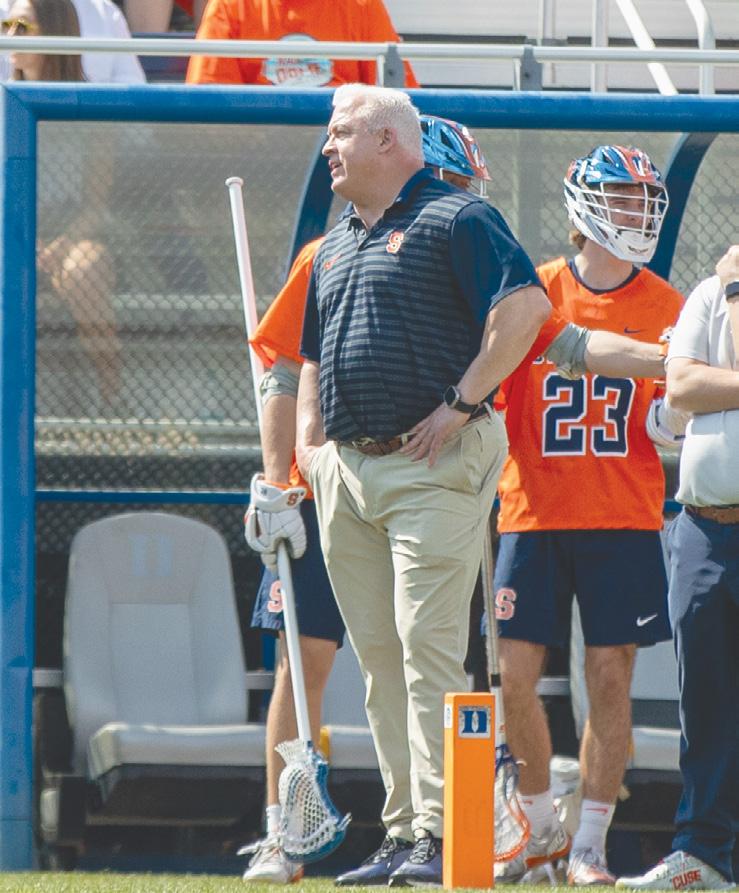
glory back to Syracuse. Maybe it’s naive to craft a schedule with virtually no layups. Challenges every week could burn the Orange out come tournament time in May.
Or maybe it’s being cocky. Either way, Syracuse is arguably the best team that.
He played for one of the best lacrosse coaches of all time in Roy Simmons Jr., a creative force who revolutionized the sport. Simmons Jr.’s assistant John Desko took over for his mentor in 1998 and equaled his five national championships.
Desko’s final decade in charge was mediocre for Syracuse’s standards, with one Final Four (2013), leaving Gait to rebuild the program. Still, like Simmons Jr., Desko knew how to win.
Gait has the chance to carry on that tradition. He won championships as a player and his first four years at the helm for SU have all built to this moment.
Now, it’s time to live up to the legacy of those before him in a do-or-die season for Syracuse. zakwolf784254@gmail.com @ZakWolf22
By Jason Glick asst. digital editor
Another year, another Emma leads the charge.
In 2024, Emma Tyrrell’s 70-goal, 92-point campaign placed her eighth in Syracuse women’s lacrosse goal and point record books. Still, the Orange were swamped 10-7 by No. 2 seed Boston College in the Final Four.
Doubt permeated the air when Tyrrell graduated, but SU had another hoorah with Emma Ward, its all-time assists leader. It couldn’t abscond No. 7 seed Yale, falling 9-8 in the NCAA Tournament Second Round.
Now, senior Emma Muchnick takes the reins under first-year head coach Regy Thorpe. With a front-loaded schedule, featuring three top-7 opponents to start the season, SU can’t afford to start flat. Twenty-five returners join 13 newcomers on all sides of the field.
Here are positional grades for No. 11 Syracuse before it embarks on a grueling 2026 campaign: Attack: C+
No position took a larger hit this offseason than attack. Ward’s 76 points — 33 higher than any teammate — will be challenging to replicate, and 2024 leading scorer Olivia Adamson (58 goals) fled for NCAA runner-up Northwestern.
SU knows what life’s like without Adamson after she was sidelined with a lower-body injury early last year and never returned. It also lost draw control specialist Meghan Rode to Richmond but has reinforcements in the midfield.
Gracie Britton and Ashlee Volpe return to lead the unit, but their 35 combined goals last season won’t match Ward and Adamson, who reached 30 apiece in every full season at SU. Carlie Desimone started five games last season and could receive increased playing time. Ward and Adamson’s replacements won’t be determined overnight, but the Orange have the right idea. One of their biggest gets was Ella Peers, Inside Lacrosse’s No. 35 recruit in the class of 2025. She’s apt on the draw, accruing 249 draw controls at Fairport High School (New York), and could replace Rode.
In the portal, SU gambled on three sophomore attacks — Savannah Hodges, Angela Beardsley and Harper Jones — who played sparingly in 2025. Its one proven product is graduate student
Courtney Maclay, who improved her output in each of her four years at Stony Brook. After scoring zero goals her freshman year, Maclay recorded 30 last season; six of which came in the NCAA Tournament First Round against Loyola.
It’d be shocking if this unit reaches the heights it did under former head coach Kayla Treanor, but Syracuse has long-term pieces. Britton, Volpe and Co. must step up sooner rather than later to give SU a respectable attack.
Midfield: A
Syracuse’s midfield is full of gems.
When the Orange needed someone to complement Ward, Muchnick stepped up, increasing her goal total from 14 to a team-high 34 in 2025. Caroline Trinkaus was a pleasant surprise, too, earning All-Atlantic Coast Conference Third Team honors after scoring 32 goals as a freshman — Syracuse’s second most.
Outside of SU’s top two scorers, the Orange return plenty of depth. Alexa Vogelman and Mileena Cotter each found back iron 21 times and started double-digit games. Even Joely Caramelli and Molly Guzik scored 10-plus goals.
The unit is loaded front to back, and it was bolstered through the high school recruiting ranks. Syracuse’s five-star and top recruit — Mackenzie Borbi — set season-high (172) and all-time (555) draw control marks at Shawnee High School (New Jersey). Another draw option is top-80 freshman Ireland Mistretta, who notched 354 at Brighton High School (New York).
This is a near-perfect position group, but something’s keeping it from an A+.
The Orange had their hands on the nation’s top freshman recruit in Alexa Spallina, who joined SU on Sept. 21, 2023. But less than a year later, she flipped to Clemson. Spallina could’ve continued Syracuse lacrosse’s legacy with top recruits, as her brother — class of 2022 No. 1 recruit Joey Spallina — plays on the men’s team.
Nonetheless, the midfield is the Orange’s preeminent unit. It would’ve been encouraging to see SU bounce back from the Spallina loss with a portal addition, but aside from Sam DeVito’s graduation, it didn’t lose anyone too crucial.
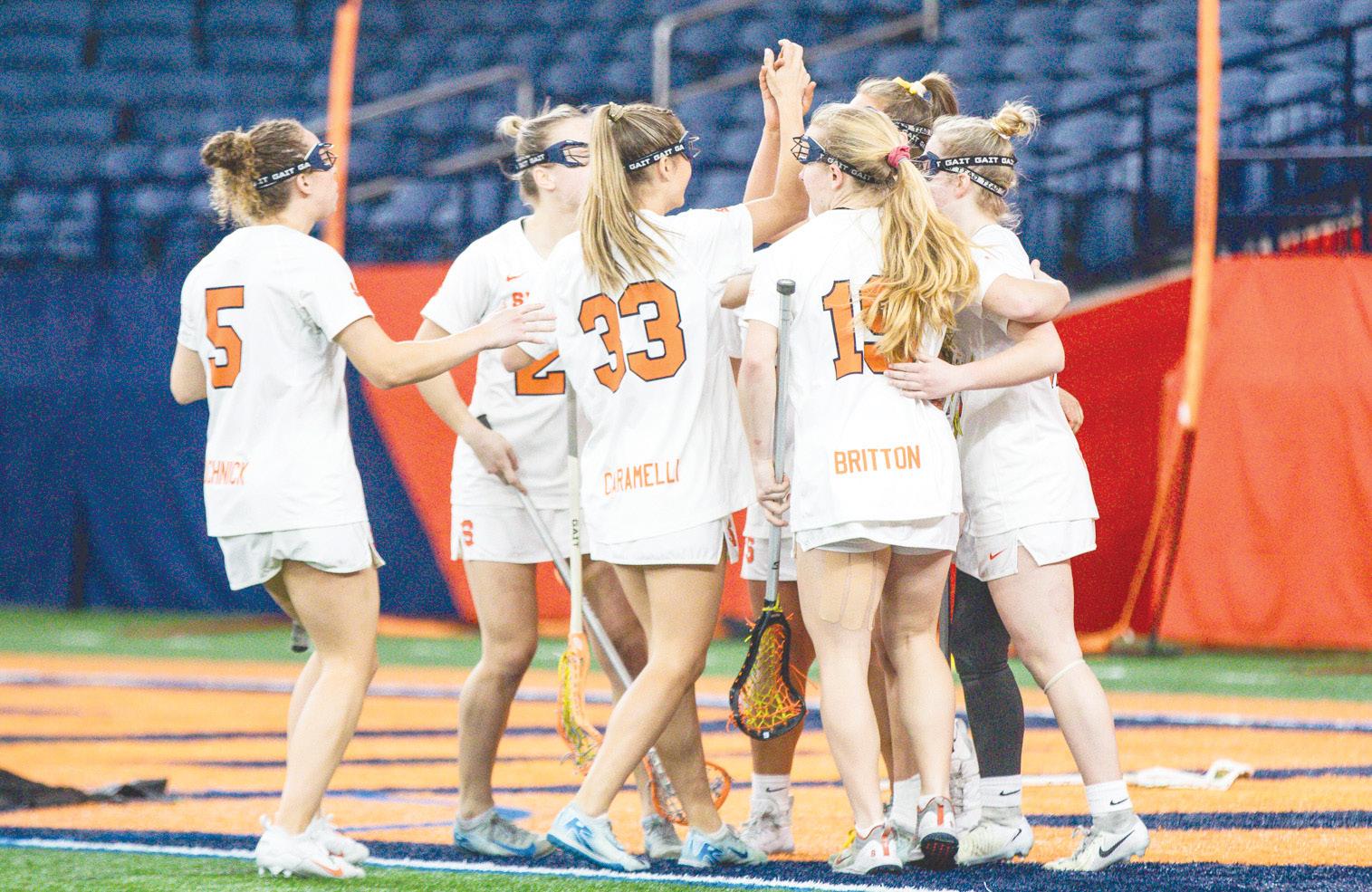
Syracuse doesn’t return much on its backline, but it brings back stability. All eyes are on Coco Vandiver to lead the unit in Year 4 after breaking out with 34 ground balls as a junior. She’ll have Kaci Benoit at her side, who notched the same mark last year.
How the rest of the defense will fare is a mystery. The No. 14 recruit in the class of 2024, Lexi Reber, returns from a leg injury that sidelined her after eight games. The unit stays young with SU’s second-ranked freshman, Julia May O’Connor, who could see immediate action. One of its biggest mysteries is 2025 commit Nina Autry — the daughter of Syracuse men’s basketball head coach Adrian Autry — who played locally at Jamesville-DeWitt.
SU’s biggest defensive loss is Superia Clark, who joined Florida State in its inaugural season. But Syracuse replaced her with UAlbany transfer Mackenzie Salentre, who scooped up 92 ground balls and caused 70 turnovers in four years with the Great Danes.
After all, SU needs four capable starters and at least one competent reserve to thrive in the ACC, which it has. It’s not a deep group, and it certainly has question marks. But by no means is it a liability.
This is Daniella Guyette’s position to lose, and there’s no reason she should. After briefly subbing in for Delaney Sweitzer in 2024, Guyette emerged with 162 saves as a junior, the secondmost in the ACC. But her 11.36 goals against average placed eighth in the conference.
Behind Guyette, sophomore Allie Hanlon and freshman Kalena Mandeville slot in as reserves. But barring egregiously subpar play or an injury from Guyette, they shouldn’t see much time.
It’s a prove-it year for Guyette, and she has the tools to emerge as one of the ACC’s premier netminders.
Disclaimer: Courtney Maclay is a contributing writer for The Daily Orange. She did not influence the editorial content of this article.

Ava Drabyk’s “high level” experience on Team Canada prepared her for Syracuse
By Spencer Brod asst. digital editor
Ava Drabyk was shopping at Aritzia in December 2024 when she got a call from Sheldon Goertzen.
Goertzen, Drabyk’s longtime goalie coach and an assistant for Team Canada, told her she’d made Team Canada’s U18 team for the World Championships in Vantaa, Finland.
At the time, Drabyk was living with a guest family. She’d moved away from her Saskatoon, Saskatchewan, home to prioritize hockey in 12th grade, but she immediately called her parents to tell them the news. Soon after, neighbors congratulated her by bringing cookies.
“Making Team Canada was a big moment for me,” Drabyk said. “It’s been a dream of mine since I was a little girl, so it was awesome to live that out.”
By Peter Radosh asst. copy editor
Brian Bruno has a problem: How is he supposed to keep his squad hungry, when no rostered player has ever experienced a loss in their varsity careers at Christian Brothers Academy?
Sure, there have been close calls, last-second Hail Mary passes and one-point games. But in the last three years, they’ve never had that feeling of sitting on the bus home, in silence, stewing in the bitter taste of defeat.
“You have to make players understand that we’ve become the mountain,” Bruno said. “(Football is like) you’re climbing a mountain. At some point, you become the mountain, and everybody’s trying to climb to you.”
It’s hard to argue with the defensive coordinator’s assessment. After its 2025 state championship win over Saratoga Springs — its third consecutive state title — CBA-Syracuse is firmly at the peak of New York high school football. The Brothers have won 41 consecu -
tive games and are the first team in NYSPHSAA history to achieve a three-peat in Class AA, the highest tier of New York football.
CBA-Syracuse now has the same number of undefeated seasons (three) and state championships (four) as losses (seven), since 2020. In that timeframe, the Brothers outscored their opponents 2,749-964, nearly tripling their competitors’ output each game.
But despite their current success, the Brothers haven’t always had the pressure of being the paragon of New York high school football. Before
Goertzen’s call was the culmination of Drabyk’s hockey career. Watching her father play since age 6, Drabyk has played at the highest levels with boys and girls in Saskatchewan. After helping Canada win the U18 Women’s World Championship in January 2025, she became Syracuse’s starting goalie. Through 27 games, Drabyk’s 745 saves lead Atlantic Hockey America, and she also has five shutouts.
see drabyk page 14
2020, they had the opposite problem. Though it returned, two 1-7 seasons yielded CBA-Syracuse’s demotion from Class AA to Class A. Those failures shaped CBA-Syracuse’s approach to football. It’s why scores and records don’t matter to head coach Casey Brown — all he cares about is whether his team gives 100% of its effort each day. It’s why, at the 2025 state final, defensive line coach Chris Achuff donned a shirt that read “Next Play.” And it’s why, just a week after winning state, the team was back in the weight room together.
“I don’t know the scores, my mindset is, ‘Today’s the most important day, because it’s today,’” Brown said. “We live in the moment, we live where our feet are. What we did yesterday, we want to be able to learn from.” Brown’s team either wins or learns, he said. Sometimes they do both at once, but they never lose. To Brown, a true loss doesn’t reside on the scoreboard — rather, it resides in a player or coach’s head, and comes when they give up. see cba