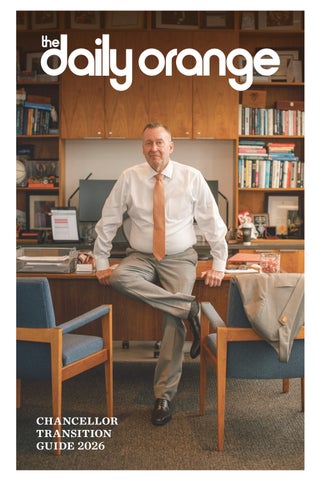
Stepping in
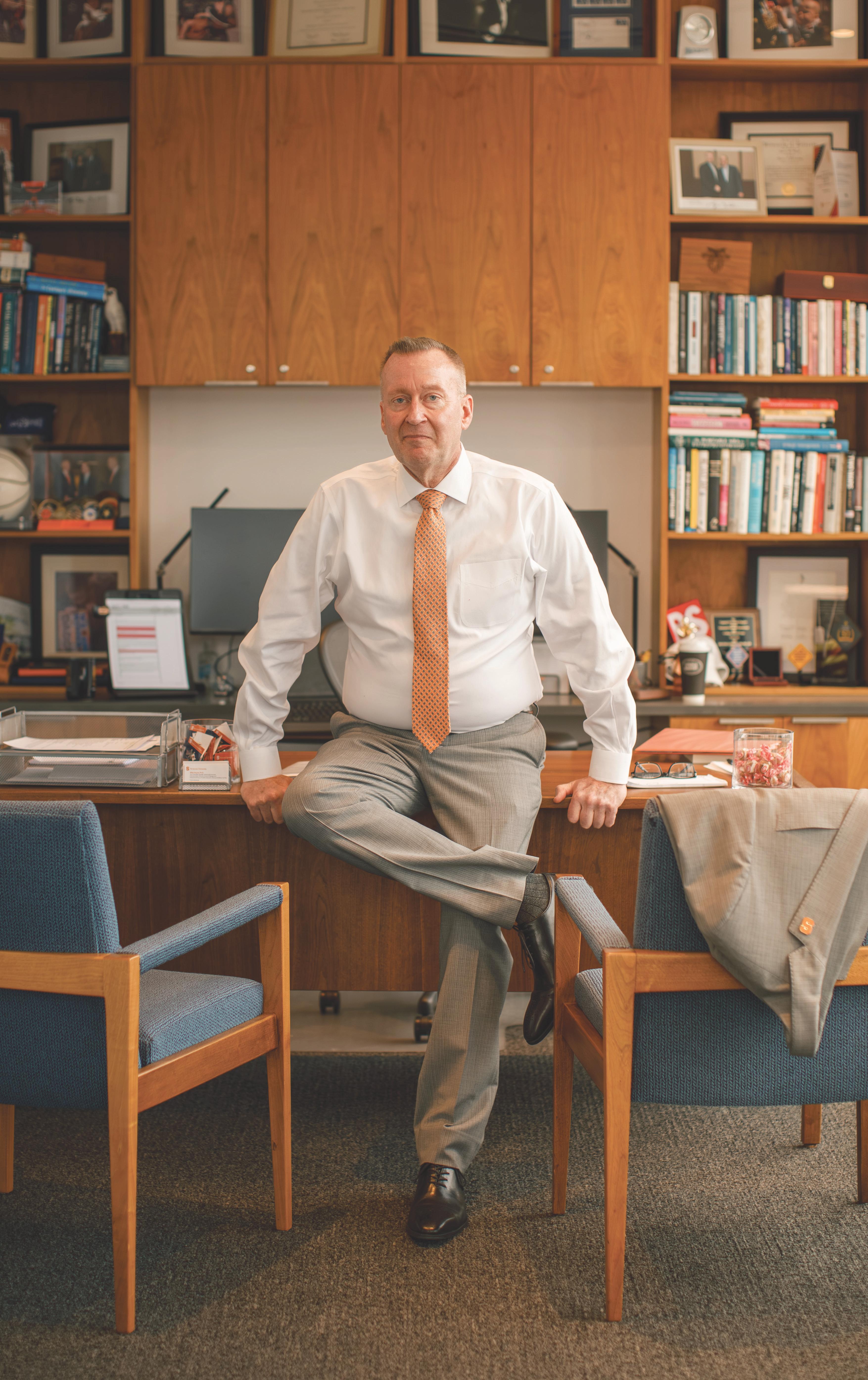
Mike Haynie’s entrepreneurship, authenticity mark ascent to chancellor
By Griffin Uribe Brown digital managing editor
Mike Haynie learns something new every year.
Last year, the vice chancellor for strategic initiatives and innovation chose artificial intelligence as his self-prescribed lesson. This year, a recently acquired shipment of bees and an Amazon beekeeping suit pointed to a year of studying apiculture.
As he officially sheds the “vice” from his title and assumes the chancellorship at Syracuse University, Haynie is in for a series of new lessons.
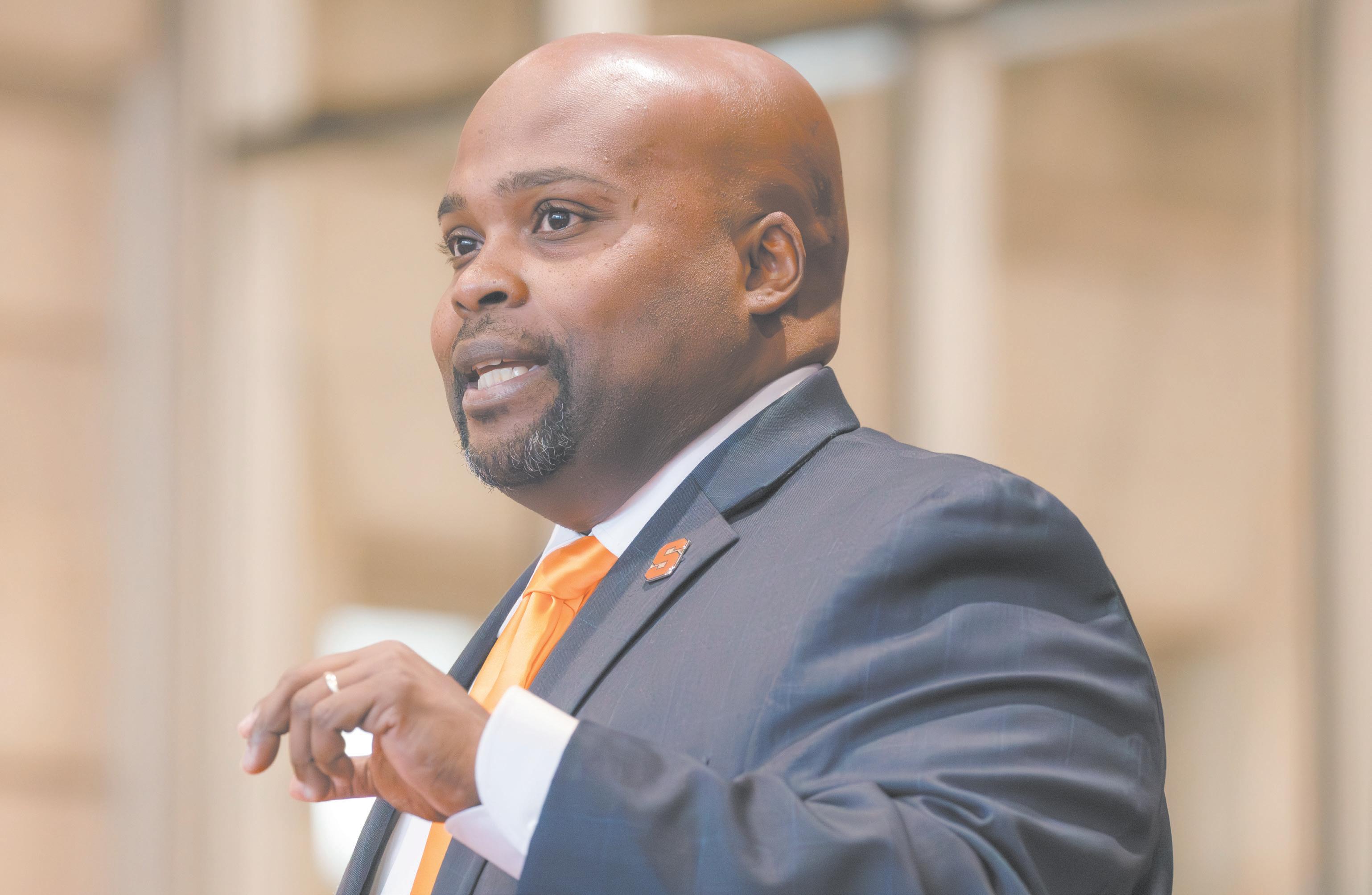
Haynie took over as acting chancellor last week after Kent Syverud announced he would step down after a brain cancer diagnosis. He steps into the role in an era during which higher education is, in his words, “one of the most disrupted sectors of American society.”
Universities today are navigating hostility from the federal government and battling the reality that potential domestic and international applicants are increasingly uninterested in spending hundreds of thousands to attend top schools.
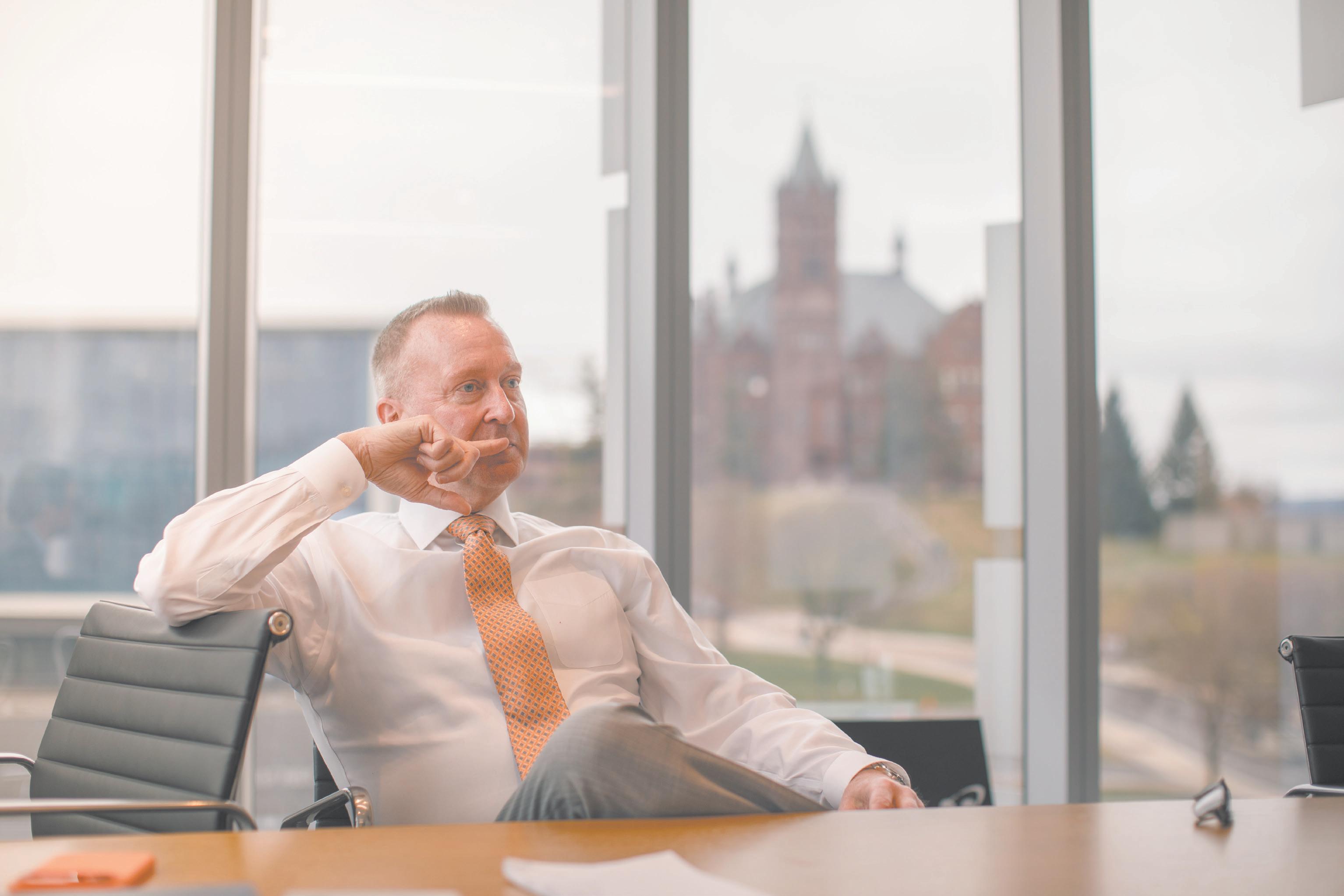
“Candidly, if my situation were different, meaning the opportunity for me to do this job somewhere else, I would have thought very differently about it,” Haynie said in a sit-down with The Daily Orange. “But I’ve been here 20 years, and I love this university.”
Haynie arrived at SU as a Whitman School of Management professor in 2006. In 2014, he jumped up to senior leadership alongside outgoing Chancellor Syverud, who arrived at SU that year.
Syverud added a second vice chancellor to his senior leadership — in addition to the traditionally singular vice chancellor and provost — because he wanted a person who could tackle issues that didn’t fit into the university’s “traditional structures,” Haynie said.
“It doesn’t fit anywhere? Okay, that’s what Mike’s going to do,” he quipped.
As a result, Haynie has held a “seemingly odd collection of assignments” in his time as vice chancellor. In addition to teaching at Whitman, Haynie serves as the school’s executive dean, a Syverud-schemed arrangement aligned with Whitman’s goals to become a top 25 undergraduate business program by 2030.
Beyond Whitman, Haynie managed the university’s COVID-19 response, and his portfolio today includes SU’s relationship with Micron Technology and his role as founder and executive director of the D’Aniello Institute for Veterans and Military Families. In 2018, Haynie was named a University Professor, SU’s most senior academic faculty rank.
“His selection came as no surprise to those who know his record — two decades of extraordinary service that have shaped Syracuse,” Syverud wrote in a statement to The D.O.
After Syverud announced in August that he would depart the university at the end of the academic year, SU formed the Chancellor Search Committee to find his successor. Haynie said he was nominated by other faculty, and, at the end of 2025, told the committee he would move forward in the process.
Following multiple rounds of interviews with trustees, committee co-chairs Shelly Fisher and Lisa Fontenelli flew to campus to deliver their decision. On March 3, Haynie was announced as SU’s 13th chancellor in the building he paved the way for, the National Veterans Resource Center.
The NVRC represents an initiative Haynie championed since he arrived at SU.
For Haynie, the son of a school teacher and a guidance counselor-turned-small business owner outside of Philadelphia, joining the Reserve Officers’ Training Corps was the only way to afford college.
Inspired by the original “Top Gun,” Haynie chased his dreams of flying jets to the University of Delaware’s Air Force ROTC program —
although his less-than-20/20 vision meant he had to ditch his flying dream.
From his first station in Idaho to an aid-decamp job for a four-star general at Air Force Materiel Command, Haynie spent over a decade in the Air Force “leading people, managing big things and deploying all over the world.” He moved nine times in 14 years.
In 1998, the Air Force sent Haynie to get a Master’s of Business Administration at the University of Oregon and then teach at the academy in Colorado Springs. Two years later, the Air Force sent him to the University of Colorado Boulder, where he got a Ph.D. in entrepreneurship.
“I loved teaching in ways I did not expect,” Haynie said. “I loved being around students. It was energizing for me.”
After teaching at the Air Force Academy, Haynie realized he couldn’t imagine taking a non-teaching gig. So, he decided to leave the military and enter the civilian academic job market. He was on the precipice of taking a job at Oregon State University before he embarked on a campus visit at SU.
My joy in this work is students.
Mike Haynie acting chancellor
Just months into his first job at Whitman, Haynie started pitching programs for veterans. Where other institutions would’ve shut him down, Haynie said SU was encouraging of his proposed ventures.
“That’s not typical of a lot of places,” Haynie said. “I appreciate the entrepreneurial bent of this place, and people’s willingness to let you be who you are.”
Since launching the Entrepreneurship Bootcamp for Veterans in 2007, the IVMF has hosted over 100,000 veterans and militaryconnected entrepreneurs through a handful of programs, such as Boots to Business for uniformed service members and EBV for transitioning veterans.
Susan Vernick, an alum of Veteran Women Igniting the Spirit of Entrepreneurship’s 2024 programming in Atlanta, came to SU in February to lead an etiquette luncheon at the NVRC. While she was setting up, Haynie came over to her.
“He was like, ‘I had to come up and see you because I remember that you were a graduate of V-WISE Atlanta,’” Vernick said. “I said to him, ‘I remember your one seminar, some things really stuck out to me.’”
As he pitched initiatives and opened a new institute, Haynie remained active in the classroom. Alumni who took his classes describe him as an authentic, energetic teacher who stood out to them. Many of them remain in contact with him today.
Juliana Cirillo, a 2022 alum who dualmajored in finance and accounting, took her senior capstone twice a week at 8 a.m. with Haynie in fall 2021.
“He chose only one section to teach, and he picked the 8 a.m. because he was like, ‘If there are seniors that signed up for an 8 a.m. capstone, I want to be the one to teach them,’” Cirillo remembers him telling the class.
Cirillo said Haynie was a dedicated professor who made the early class enjoyable and “felt like a friend.”
“It’s a very involved class, so we were meeting a lot outside of the classroom,” Cirillo said. “Having Haynie was awesome for that because his office in the veterans center was so nice. He was always making time for us.”
Daniel Porcaro had Haynie as a professor back in 2008. The 2009 alum and Haynie bonded over their shared interest in cars and remained in touch after Porcaro graduated. Both he and Cirillo sent him an email after he was announced, and both received a response.
Porcaro said Haynie’s class was unlike others he took at SU. To him, it didn’t feel like Haynie was there to do work, but rather for the students, who called him “Haynie” and “Mike.”
Years after graduating from SU, Porcaro joined the Navy. He said he is proud to promote SU’s “best place for veterans” promise, a commitment Syverud pledged early on — and one he’s sure will continue with Haynie in charge.
“I had thought for years now I was going to see an announcement for Haynie being a chancellor or president, but at another school,” Porcaro said. “I thought, ‘He’s publicly recognized as being awesome, somebody’s going to pluck him.’”
Outside of the classroom, the entrepreneurship evident in professor Haynie’s early months at SU is on full display in acting Chancellor Haynie — who also had a hand in SU’s satellite campus in Washington, D.C., and the recent Whitman-Newhouse School of Public Communications Center for the Creator Economy.
see haynie page 10
Cautious optimism
Mike Haynie’s early presence won’t define his chancellor tenure. Consistency will.
By The Daily Orange Editorial Board
Mike Haynie stepped into leadership as the 13th chancellor and president of Syracuse University after outgoing Chancellor Kent Syverud shared on April 15 that he had been diagnosed with a form of brain cancer.
The transition, moved earlier twice, invokes a need for steady leadership and an assured commitment to the university and its students. Haynie’s early effort to directly engage with students signals intentional collaboration, which he has publicly stated as central to his approach.
The challenge is ensuring this studentcentered start continues past his opening weeks and into his tenure.
As an independent, nonprofit student newspaper, The Daily Orange meets this new leadership with cautious optimism, encouraged by Haynie’s early approachability while demanding transparency and consistency through a permanent culture of engagement.
Transparency cannot exist as a passive, occasional release of information; it must function as an active, collaborative process, one that consistently incorporates student perspectives into decision-making and ensures the chancellor’s priorities, progress, missteps and obstacles are visible and acknowledged.
As a university with a premier communications school, we expect consistent communication from the SU’s new leadership. We are taught the importance of holding institutions accountable, and student journalists must be able to apply those same standards to the university itself.
For student media, this standard is especially critical. Haynie said he values student journalism, and that must be upheld.
The D.O. is seeking professional correspondence and an open relationship with Haynie that keeps the university wellinformed. Student media shouldn’t replace communication from the university itself. If students rely on campus and local media for information, then that connection must be strengthened.
That said, we understand Haynie faces a turbulent political climate in which national pressures, including policies under the federal government, continue to strain higher education. It’s undoubtedly a difficult time to lead SU. Leadership in this context demands clarity about the pressures the university faces. Students must not be distanced from the forces shaping their own institution, particularly when educational freedom is in flux.
Amid institutional change, SU also wrestles with its identity. The reputation alumni remember differs from the reality students face, leaving its alignment with student interests unsettled.
SU’s identity is inextricably linked to its athletics and remains a strong reason students choose to enroll. As such, the men’s March Madness drought, other declining Syracuse
sports teams and a broader frustration with the athletics department naturally fall onto this new leadership.
The allocation of tuition dollars and affordability are, as with any new leadership, topical concerns. SU is increasingly investing in areas like the creator economy, artificial intelligence and esports, signaling a broader shift toward market-driven academic expansion. While these investments reflect emerging technologies, they also raise the question of what is being elevated at the expense of other areas.
The recent academic restructuring, for many, reflects a misdirection within the university, in which humanities and foundational sciences appear entangled with racialized and gendered political pressures. Equally disconcerting was the manner of its announcement. The vague invocation of “sunsetting” majors without initial clarity or context left students grappling with uncertainty. In both substance and form, this exemplified the need for transparency and clarity moving forward.
Haynie’s experience as an SU professor offers reassurance. But he cannot rely solely on institutional familiarity.
SU needs leadership equipped to keep up with the demands of modern higher education. Much of Haynie’s approach holds promise, beginning with open dialogue with student organizations and an effort to maintain regular interaction with students across campus.
The promise of this administration cannot be measured in rhetoric or aspiration; it hinges on the courage to enact fundamental change and the discipline to see it through.
The Daily Orange Editorial Board serves as the voice of the organization and aims to contribute the perspectives of students to discussions that concern Syracuse University and the greater Syracuse community. The editorial board’s stances are determined by a majority of its members.
“From my point of view, one of the least impressive features of the last 10 or 12 years is the lack of adequate attention to building facilities that serve fundamentally academic purposes,” Gorovitz said. We desperately need much better instructional facilities, especially for the humanities.”
Slipping in the ranks
When Syverud took office, SU nationally ranked 62nd in best colleges and universities by U.S. News & World Report. In the 2026 edition, it sits at 75th — tied with Clemson University, Rutgers University-Newark, the University at Buffalo and the University of California, Riverside. The ranking has declined for seven consecutive years.
The drops extend beyond the flagship list. SU fell 15 spots in Best Value Schools in a single year, landing at 95th. Its ranking among Top Performers on Social Mobility has dropped roughly 30 spots over the past two years. The Military Times has ranked SU among the best private universities for veterans several times since 2017, though SU’s Best Colleges for Veterans ranking in U.S. News slipped two spots to 45th.
Individual schools have fared better. The Maxwell School recently ranked first in the country for “best public affairs programs.” SU remains in the top 10 nationally for study abroad programs and in the top 15 for learning communities.
The decline in social mobility coincides with a drop in the share of students receiving Pell grants — federal aid given to students from low-income families. In 2013-14, 27% of SU undergraduates were Pell recipients, according to federal IPEDS data. By 2023-24, that figure had dropped to 18%. SU now sits below average in The New York Times’ College-Access Index report published in November 2023.
Osborne pointed to the university’s decision to scale back its Posse scholarship program as one contributor. Posse recruits cohorts of students from underserved urban communities and provides them with full-tuition scholarships and built-in peer support networks.
“When I got here, I think we had relationships with five Posse programs, and we have systematically cut that back,” Osborne said. “Speaking as a first-generation college student, I really appreciate where our commitments used to be, and I would love to see us get back to that level of commitment.”
A shifting student body
SU’s total enrollment has grown modestly under Syverud, from 21,267 in fall 2014 to 22,589 in fall 2024, according to university financial records. Undergraduate applications have set records for five consecutive years, reaching 47,169 in fall 2025, Syverud told the University Senate in September.
Graduate enrollment, however, has moved in the opposite direction, declining from a peak of 6,985 in fall 2019 to 5,881 in fall 2025 — a drop of more than 1,100 students. Syverud told USen the decline was driven “largely by declines in international enrollment and master’s numbers.”
In fall 2023, international students made up 12% of the entering undergraduate class. By fall 2025, they composed just 5%, Syverud said at the September senate meeting. He attributed the decline in part to students “especially from China” facing visa difficulties.
The Trump administration’s revocation of three SU international students’ visas in April 2025 — which were later reinstated — and a weeks-long pause of visa interviews in May and June further disrupted enrollment. SU’s Center for International Services lost just over a third of its key staff over the summer of 2025, with additional staff losses also noted in a February USen forum.
Craig Dudczak, a retired professor of communication and rhetorical studies who chaired the USen Budget Committee from 2012 to 2014, said the financial impact of declining international student enrollment is significant. When he served on the committee, international students almost always paid close to full tuition, while domestic students, on average, received discounts of nearly 40%, he said.
“Even if you got an additional American student for an international student, you’d need multiple American students to make up for the difference,” Dudczak said.
In a 2013 budget report — a year before Syverud arrived — Dudczak’s committee warned that SU’s growing reliance on international tuition revenue was a vulnerability, noting that about two-thirds of graduate students came from just two countries: China and India.
The concentration of international students from a few countries could make the university “subject to political or economic disruptions that would reduce their numbers precipitously,” the report, obtained by The D.O., cautioned.
Under Syverud, SU’s annual revenue rose 59%, to $1.4 billion in 2025. The university’s long-term debt increased by about 160% to $1.185 billion between 2014 and June 2025.
$1.4b revenue long-term debt
$1.185b
$886.1m
$456.9m
Twelve years later, Dudczak said the committee’s warning proved “prescient,” echoing broader concerns about universities’ reliance on international tuition revenue.
Pramod Varshney, a distinguished professor of electrical engineering and computer science, wrote in a statement to The D.O. that the drop in international students is one of the most pressing challenges Haynie will face.
“This has significantly impacted the revenue, and one has to figure out how to handle this shortfall,” Varshney wrote.
SU’s most recent admissions cycle suggested broader enrollment pressure. A New York Times report in June 2025 found that after the May 1 deposit deadline, SU sent escalating merit aid offers to students who had already committed elsewhere — in one case totaling $50,000 per year.
One area of enrollment that has grown steadily is military-connected students. As of fall 2025, more than 1,000 veteran and military-connected students were enrolled at SU, up 60% since 2014, according to the university’s 2025 report.
$92k
The total cost of attendance for an undergraduate living on campus has risen to a little over $92,000 for the 2025-26 academic year, according to SU’s website.
SU’s ROTC program has seen its highest enrollment in 20 years, and 15 Pat Tillman scholars have studied at the university since Syverud took office.
“The veterans building and bulking up of the veterans program is a significant achievement, and goes along with SU’s history of embracing veterans’ education,” Dutkowsky said. “(Syverud) has taken some forward-thinking actions, especially in a time in which so much of higher education is retrenching.”
Changing priorities, growing tensions
Grant Reeher, a professor of political science at Maxwell, said Syverud’s academic leadership went through distinct phases.
The early years, he wrote, were “primarily concerned with bolstering the traditional academic reputation of the university” after Cantor’s community-oriented approach, which emphasized engagement with the city.
Major investments in veteran programming followed, then COVID-19 — which Reeher said SU was generally perceived to have managed well financially — then the Micron semiconductor partnership and, in the final years, a period of spending reductions and program closures.
“As he has come closer to the end of his time here, we have seen more efforts at belttightening and program cutbacks, which are typical in a transition period, and were also necessary in response to declines in tuition income from overseas students,” Reeher wrote. “Some of these efforts, and in particular the way they have been done, have not been popular with a lot of the faculty.”
In a recent university-wide academic portfolio review, approximately 26 active programs have been slated to be closed, including nine in the College of Arts and Sciences. The closures follow Provost Lois Agnew’s university-wide portfolio review, which directed deans to carry out across their respective schools and colleges. The decisions have prompted concern from faculty, students and alumni over the process and the future of humanities programs at SU.
The closures also raised questions about earlier plans to grow SU’s faculty. In 2017, SU launched a $100 million “Invest Syracuse” fundraising plan, which — alongside its “Signature and Cluster Hires” initiatives — aimed to bring in up to 200 new faculty members. According to
When Syverud took office, SU nationally rankied 62nd in best colleges and universities by U.S. News & World Report. In the 2026 edition, it sits at 75th.
Syverud takes office
university financial reports, SU added 100 faculty over those eight years, though the number of tenured and tenure-track employees grew by just three.
Osborne said with resources being “tightened” over Syverud’s tenure, faculty have been left to “figure out how to do more with less.”
Multiple faculty members also pointed to the rapid turnover of provosts and chief academic officers as one of the most damaging features of the Syverud era. Six provosts served during Syverud’s 12-year tenure, three of them in an interim capacity.
“If you look over the 12 years and ask how many chief academic officers has he had? How many provosts and acting provosts and interim provosts … it’s very distressing,” Gorovitz said. “It’s a very big number. And that churning has a cost. You lose people with institutional memory. A lot of what is important about the history of a university is not written down … it is in people’s minds and their memories.”
Concerns about transparency and limited faculty input in decision-making persisted throughout Syverud’s tenure, several faculty members said. Dutkowsky, for example, praised Syverud’s “loyalty to the university,” national profile and infrastructural investments, but said the administration’s communication was a weakness.
“My biggest critique of Syverud would be the continued positive spin put forth by his tenure,” Dutkowsky wrote. “Bad news for SU … tends to be either glossed over or ignored.”
Mark Rupert, a professor emeritus of political science, concurred and said his decision to retire was shaped in part by the changes he observed during Syverud’s tenure.
“I regret the diminished role of faculty in what we used to refer to as a system of ‘shared governance’ on campus, the pervasive tendency to view the university as a business and students as customers,” Rupert wrote.
Others defended Syverud’s record. Philip Arnold, a professor of religion who’s been at SU for 30 years, praised his commitment to centering the Haudenosaunee and the Onondaga Nation in campus life. Since his inauguration, the university has adopted a policy of opening public events with a land acknowledgment recognizing the Onondaga Nation.
“I’m going to miss Chancellor Syverud … (he) was really kind of a class act,” Arnold said.
Francine D’Amico, a teaching professor emerita of political science who served on a chancellor-appointed Workgroup on Diversity and Inclusion, said Syverud’s leadership was tested repeatedly.
“Syverud led this university through some very challenging years — including the student movement for social justice, an equity lawsuit by women faculty, and a global pandemic … and he did so with extraordinary care, compassion, and commitment to change for the better,” D’Amico wrote in a statement to The D.O. “Above all, he listened.”
Campus culture under pressure Syverud’s 12 years also saw significant changes in free expression on campus. He inherited an institution that the Foundation for Individual Rights and Expression named the worst school in the country for free speech in 2011, three years before he arrived. FIRE later awarded SU its Lifetime Censorship Award in 2021.
Syverud created a Free Speech Working Group in October 2019 to review university policies. The university later formalized its stance on free expression and academic freedom in a 2024 “Syracuse Statement.” By 2025, SU climbed to No. 76 out of 257 schools in FIRE’s rankings — still a “D-” score, but a 170-place improvement.
Zach Greenberg, FIRE’s director of faculty legal defense and a SU College of Law graduate, called Syverud’s record on free speech “a mixed bag, with several egregious violations of expressive rights earlier in his tenure, and then improving more recently” in a statement to The D.O.
At the beginning of his tenure, Syverud closed the Advocacy Center, the university’s support service for victims of sexual assault, as
End of Syverud's tenure
part of his Fast Forward Syracuse framework. The decision catalyzed THE General Body, a coalition of student organizations that led to an 18-day sit-in in Crouse-Hinds Hall. The group came together to create a 45-page list of grievances and demands.
THE General Body saw some of its demands met, but not others. The Advocacy Center was divided into the Counseling Center, the Office of Student Assistance and the Office of Health Promotion. Syverud also created a workgroup on diversity and inclusion, among other solutions.
Five years later, #NotAgainSU resurfaced many of the same concerns. The movement, led by Black students, drew national attention after at least 33 racist, antisemitic and homophobic incidents occurred on campus. Jesús Tiburcio Zane, SU junior and president of Latiné Undergraduates Creating History in America, wrote that it was “one of the most defining moments” of Syverud’s tenure.
In November 2019, there was an eight-day sitin in the Barnes Center where organizers created a list of demands. Syverud signed 16 of 19 of them on Nov. 21, 2019, but organizers clarified they were not done.
On Feb. 17, 2020, #NotAgainSU began a 31-day occupation of Crouse-Hinds Hall after organizers said the university was not honoring its commitments. They revised their demands and called for the resignation of Syverud and three other administrators. By November 2020, #NotAgainSU organizers told The D.O. there had been progress, but not enough.
Since then, the university has made additional changes to its diversity and inclusion efforts. In July 2025, SU closed its Office of Diversity and Inclusion, replacing it with a human resources unit named People and Culture. The move came alongside a national trend of higher education institutions revising programs to comply with President Donald Trump’s executive order targeting DEI language.
In October 2025, Syverud declined to sign the Trump administration’s “Compact for Academic Excellence in Higher Education,” which offered universities priority federal funding in exchange for policy changes. He also didn’t join more than 200 university presidents who signed a letter condemning what they called “unprecedented government overreach” in higher education months earlier.
Several faculty said they wish SU had taken a firmer public stance on diversity during this period. Osborne said the university’s decision to downplay its diversity commitments, even if driven by external pressure, sends a message.
“I think in not amplifying them, we are communicating something about our commitment to having a diverse university,” she said.
Zane wrote that while the university has introduced diversity-related initiatives in response to student activism, many students of color felt they were “more symbolic than transformative.”
“This era has also been marked by a heightened willingness among students to organize, speak out, and hold the university accountable,” Zane wrote. “However, institutional responses have often felt reactive rather than proactive, contributing to a sense of fatigue among students who continue to push for meaningful change.”
With his departure, Syverud leaves Syracuse for UMich, where he will serve as a law professor and special advisor to its Board of Regents, bringing an end to more than a decade of leadership. His successor, Haynie, has been part of the university’s leadership throughout that period, serving in administrative roles under Syverud. As he prepares to take over, he inherits a changed university, alongside the challenges that come with it.
“Syverud will leave him a solid foundation and Haynie knows the university well,” Dutkowsky wrote. “Haynie’s go-getting, outgoing, visible nature will enable SU to deal forthrightly with the serious challenges of higher education today.” —30—
Managing Editor Rosina Boehm contributed reporting to this article.
Director of International Student Success
Ling Gao LeBeau has met many higher education leaders who support and collaborate with international students — but none of them compare to Chen.
“She’ll exhaust her efforts and then (do) anything to help a student out,” LeBeau said. “I think that’s something we don’t see that often.”
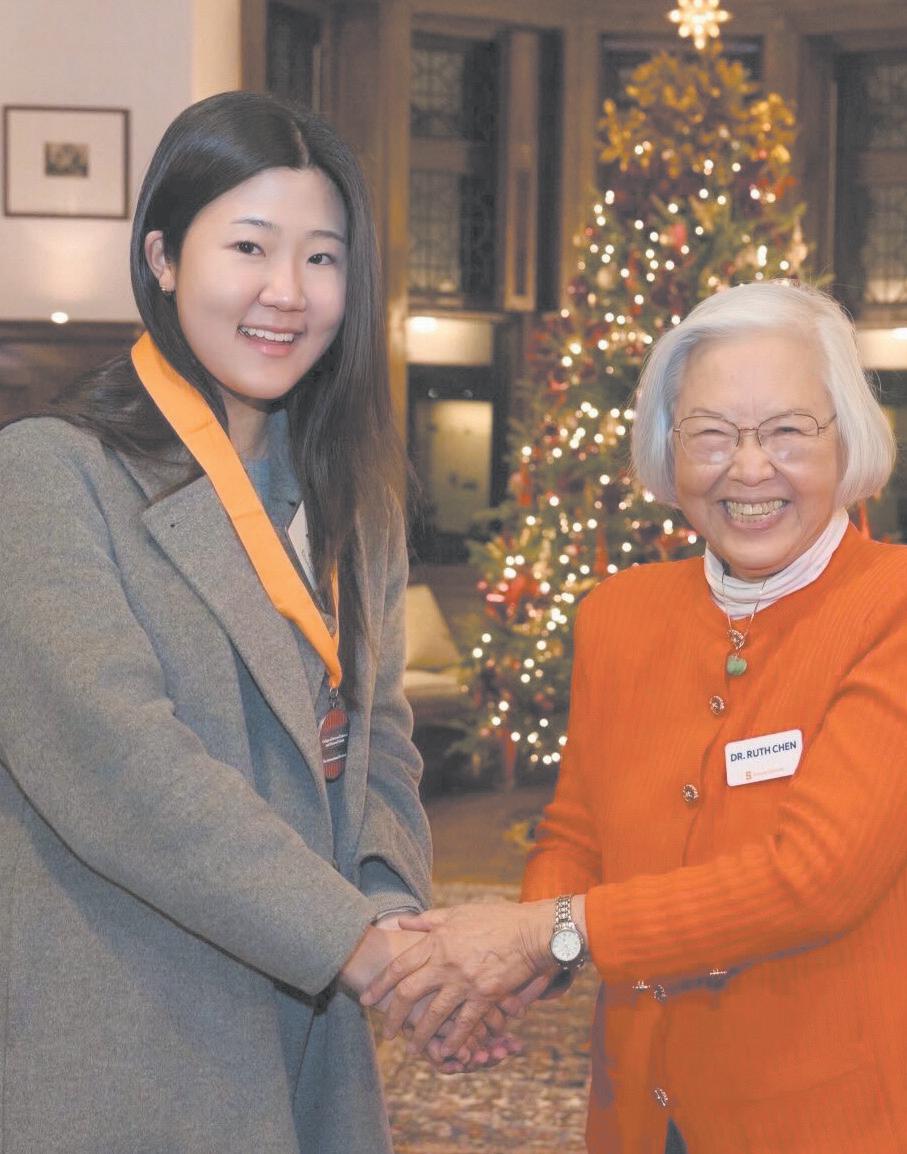
Chen also expressed support for LeBeau’s peer mentorship program, which helps international students navigate their freshman year at SU. Ashley Kim, an international student who has served as a mentor for two consecutive semesters, said Chen was always there to support the program — whether attending in person at events or commenting on LinkedIn posts.
“She gives this aura of being there for us, no matter what we need help with or when we need help. And I can clearly see how she works hard, especially for the international students,” Kim, a junior studying economics and information management and technology, said.
Jenny Dombroske, executive director of community engagement, recalled Chen’s excitement when discussing her planning of the International Thanksgiving Celebration — an annual event typically held in the JMA Wireless Dome that introduces international students to the American Thanksgiving experience.
“That holiday is an opportunity to bring our international students to a place where they can be with each other and be with people who want to celebrate together and get to know each other. And I think that was very important to her, and I know that she was very proud of that,” Dombroske said.
The tradition was established in the 1980s by the late Rev. T.E. Koshy, a former SU chaplain and international student. After stopping for a few years, Syverud and Chen brought the tradition back to campus, Jay Koshy, Evangelical Christian chaplain and T.E. Koshy’s son said in a statement.
“We have such a great diversity here, and the approach I always witnessed with Dr. Chen was how we can make every student feel (at) home here. And Thanksgiving dinner for international students was one of those,” Imam Amir Durić, assistant dean for religious and spiritual life at Hendricks Chapel, said.
The International Thanksgiving Dinner, Hands for Wuhan project and Chen’s advocacy for innovative programs to support international student success demonstrate how Chen has given of herself in ways that deepen belonging and celebrate everyone’s contributions to the SU community, Syverud wrote.
Durić noticed a similar sentiment in Chen’s Operation Orange Warmup initiative, an annual
“One thing about Bryan is he wanted input from everyone,” Tomlinson said. “He’s a ‘measure twice, cut once’ leader. Very intentional about gathering feedback. But once we made a decision, we were aligned.”
Blair’s biggest project was a strategic five-year plan to enhance Toledo athletics called “Rise Together,” launched in 2022.
Under that plan, Blair helped launch the first NIL collective — an independent organization, usually formed by university supporters, alumni or boosters, that pools funds to create payment opportunities for college athletes — in the Mid-American Conference.
The collective, called Friends of Rocky for the Rockets’ mascot, changed the school’s ability to recruit and retain athletes, Harris said. Future NFL Draft first-round pick Quinyon Mitchell opted to stay at Toledo for four years due to the collective, Harris said. So did projected 2026 NFL Draft first-round pick Emmanuel McNeil-Warren.
“He has a unique ability to see around the corner,” Tomlinson said of Blair. “The NIL collective is a good example.”
“When you’re around him, you feel like you’re getting insight into the future of college athletics,” Tomlinson added. “He’s extremely informed and constantly thinking ahead. It challenges you to be better prepared and more thoughtful in your work.”
Tomlinson and Harris agree that Blair’s ability to build “authentic relationships” powers his success. That relationship can be with boosters, who helped fund the NIL collective. Harris recalls Blair serving up his brisket and pulled pork at dinners with donors and colleagues.
But it can also be with coaches and recruits. He was known as “the closer,” Harris said. Coaches wanted Blair to seal a recruit’s commitment.
“His passion and his energy, you feel that in his presence, and you want to be around him,” Harris said.
Blair showed up around campus and town, and when people heard his message, they were hooked, Harris said. They wanted to “run through a wall,” she added, because
coat drive collecting new and gently used coats for students and families in need. Chen, who had served as a board member for Interfaith Works — a local nonprofit and partner of the initiative — helped the Office of Community Engagement pull partners from across campus toward the unified objective of getting coats, Dombroske said.
“She really infused a lot of heart into this,” Dombroske said. “She really cared about our citizens around our community who in these cold winters don’t have what they need. And then also some of our students who maybe are here studying, but coming from a much warmer place and also may not have the things that they need for their first central New York winter.”
This emphasis on student needs stood out to Alison Murray, the assistant dean for student assistance at Hendricks. Murray said Chen was well-attuned to the campus’ diversity and varying needs. For instance, she noticed that, when the number of students identifying as food insecure increased, Chen and Syverud would donate food to the Coach Mac Food Pantry in Hendricks.
“She was a very student-first kind of figure at the university,” Dombroske said. “She’s thinking
about what the students’ experiences are, and if they have what they need, and if they have the things that make them feel comfortable and safe.”
Chen and Syverud furthered their support of the student experience through a focus on religious and spiritual life at SU. They opened their doors to various religious groups and supported new fellowships and programs, such as the Global Interfaith Leadership Project.
Chaplains and students look forward to these annual gatherings, Koshy wrote, which reflect their hospitality and intentional investment in Hendricks, the chaplaincies and broader student community. The dinners allowed students to interact personally with Chen and Syverud in a “welcoming and informal setting.”
Ivan Shen first met Chen at one of these dinners at the Chancellor’s House, specifically for the SU Catholic community — something he quickly realized was not typical of other universities. The two talked the whole night, he recalled, discussing Catholicism in China, religion on campus and Hendricks’ Chinese Christian Fellowship.
“I found it quite fascinating because it’s technically not part of her duty as the chancellor’s wife
to do anything, because her formal job is a professor of practice,” said Shen, who graduated in 2025 with a Bachelor of Architecture and a Bachelor of Arts in music history and cultures.
Chen is heavily involved behind the scenes of these events, Syracuse’s Hillel Jewish Student Union Executive Director Jillian Juni wrote in a statement. Chen tries to speak to as many students as possible throughout the night, modeling a welcoming presence with Syverud for the SU community.
Though dinners at the Chancellor’s House span back decades to Chancellor Melvin Eggers’ tenure, Sureshkumar said, Chen elevated and broadened this tradition, opening it to more faculty, students and staff.
Even in Ann Arbor, the couple plans to maintain its tradition of opening their doors. Gan said Chen offered him an invitation to their house for a meal the next time he visits UMich.
Though Chen leaves SU alongside Syverud, her former students and colleagues are confident that her commitment to fostering a culture of belonging will continue. And her love for the Orange will remain strong.
“She’ll leave the campus, but I truly believe that her support for the international students’ community, community and also her connection to Syracuse University will not fade,” Lebeau said. —30—
Disclaimer: Ally Price is an opinion columnist for The Daily Orange. Price did not influence the editorial content of this article.
kaluther@syr.edu
We want to wake this sleeping beast.
Bryan Blair incoming director of athletics
Before SU, Blair worked in compliance positions at Rice and South Carolina. He worked his way up back at Rice and Washington State before becoming Toledo’s athletic director.
Blair will motivate people and ease “any ounce of doubt.”
“If there was an event in town, Bryan was invited, and he was leaving an impact at that event,” Harris said. “Once one person heard him speak, the phone was ringing for him to continue to speak to others because his energy and his passion are extremely contagious.”
Blair had a mantra in all his staff meetings and interactions: “Give me the idea that will get me fired.” He didn’t care where it came from, Tomlinson said. So, Toledo hosted Barstool Sports at a football game in 2022. Even though Barstool was hit with a $250,000 fine, Blair kept innovating.
He brought the Zac Brown Band to headline the first major concert at Toledo’s Glass Bowl in 31 years in May 2025, drawing more than 20,000
fans. In September 2025, he turned an unused “closet” into Toledo’s basketball venue, Savage Arena, into premium courtside seating in two months. In October 2024, he helped Toledo earn a $4 million gift from Marcia and Roy Armes, the second-largest gift in the university’s history.
“Under his exceptional leadership, we have seen groundbreaking facility enhancements, innovative technology integration and a philanthropic surge that has redefined what is possible for our institution,” University of Toledo president James Holloway wrote in a statement to The D.O.
Blair was endlessly competitive in whatever he did. Even when his own football career ended after four seasons at Wofford, Tomlinson remembers Blair coming into work with
scratches on his arms and legs. The reason?
He was playing pickleball for the first time the previous night.
At Toledo, Blair was hired as the youngest athletic director in the Football Bowl Subdivision. He leaves four years later having been a “change agent,” Harris said, with an NIL collective and significant fundraising and projects. It was the latest step, the latest reminder of being an “exceptional leader,” Harris said.
Now, his next stop is Syracuse, and Harris said he’s a proven winner in every aspect.
“His ability to take an organization, an athletic department from good to great,” Harris began, “I think you're gonna see that there (at Syracuse), and you’re gonna flourish under his leadership.” njalumka@syr.edu
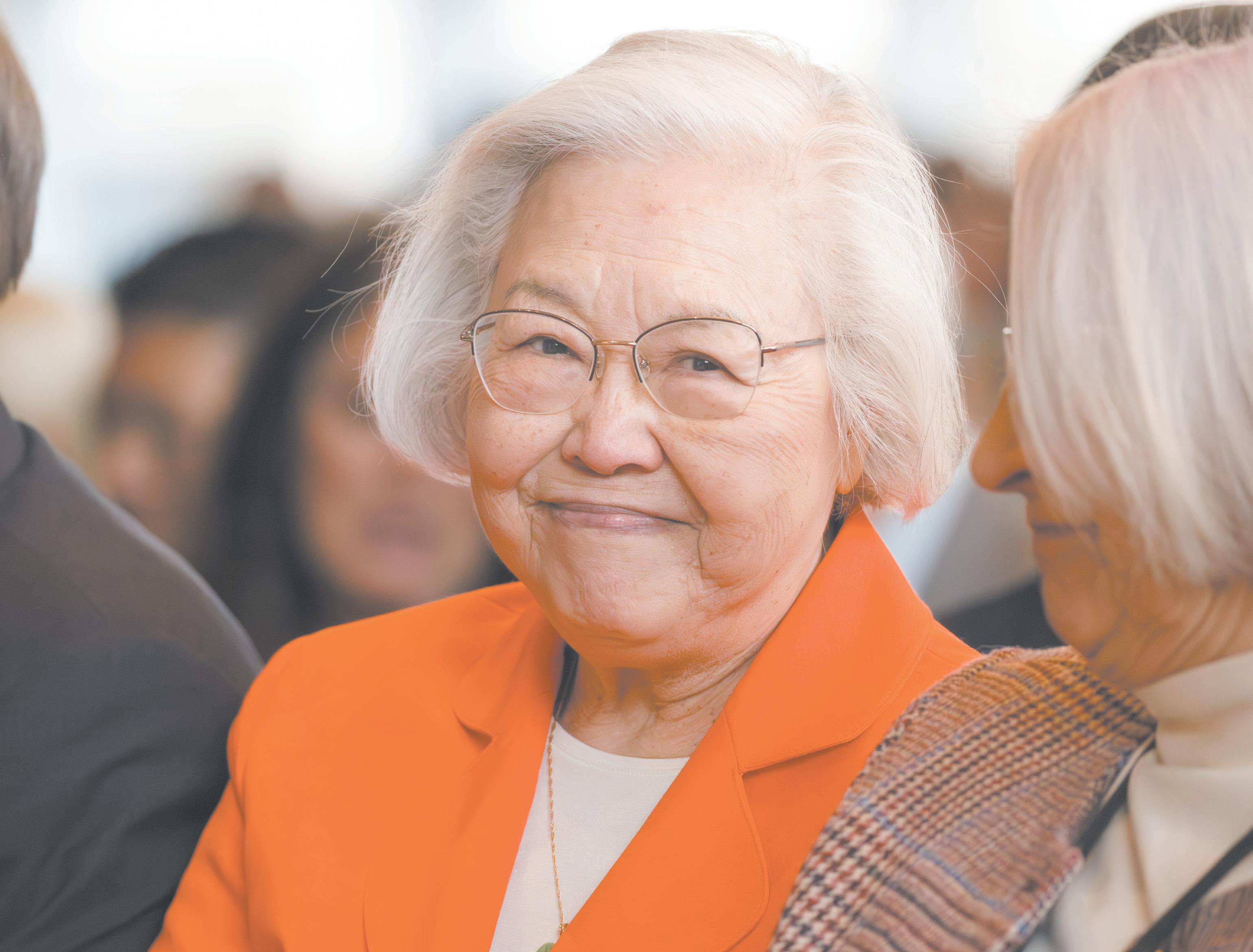
Ashley Kim (left), an international student and peer mentor, poses with Chen.
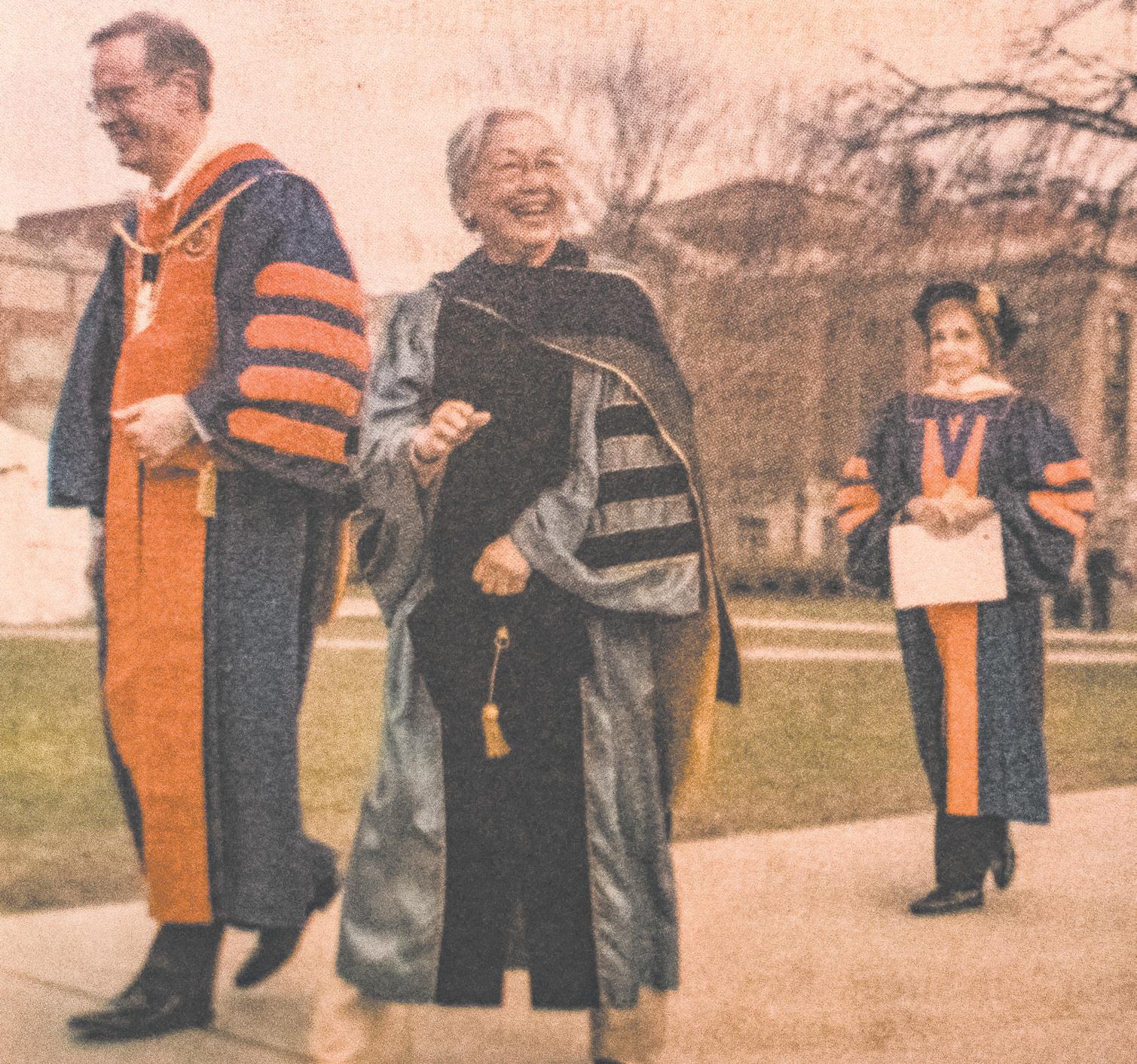
Outgoing Chancellor Kent Syverud (left) and Ruth Chen walk in an academic procession ahead of Syverud’s 2014 inaguration.
“Mike already knows that his greatest strength is his entrepreneurial approach to all that he does. He has a unique ability to cultivate the resources and relationships that bring his vision to life,” Syverud wrote. “My advice has been to lean into that strength.”
Elizabeth Wimer, an assistant teaching professor at Whitman, also knows Haynie from the many IVMF programs for which the two have worked together. She described Haynie as “authentic” and “committed.”
“When he says he’s going to do something, he’s going to do something,” Wimer said. “That is a remarkable trait to find in a leader.”
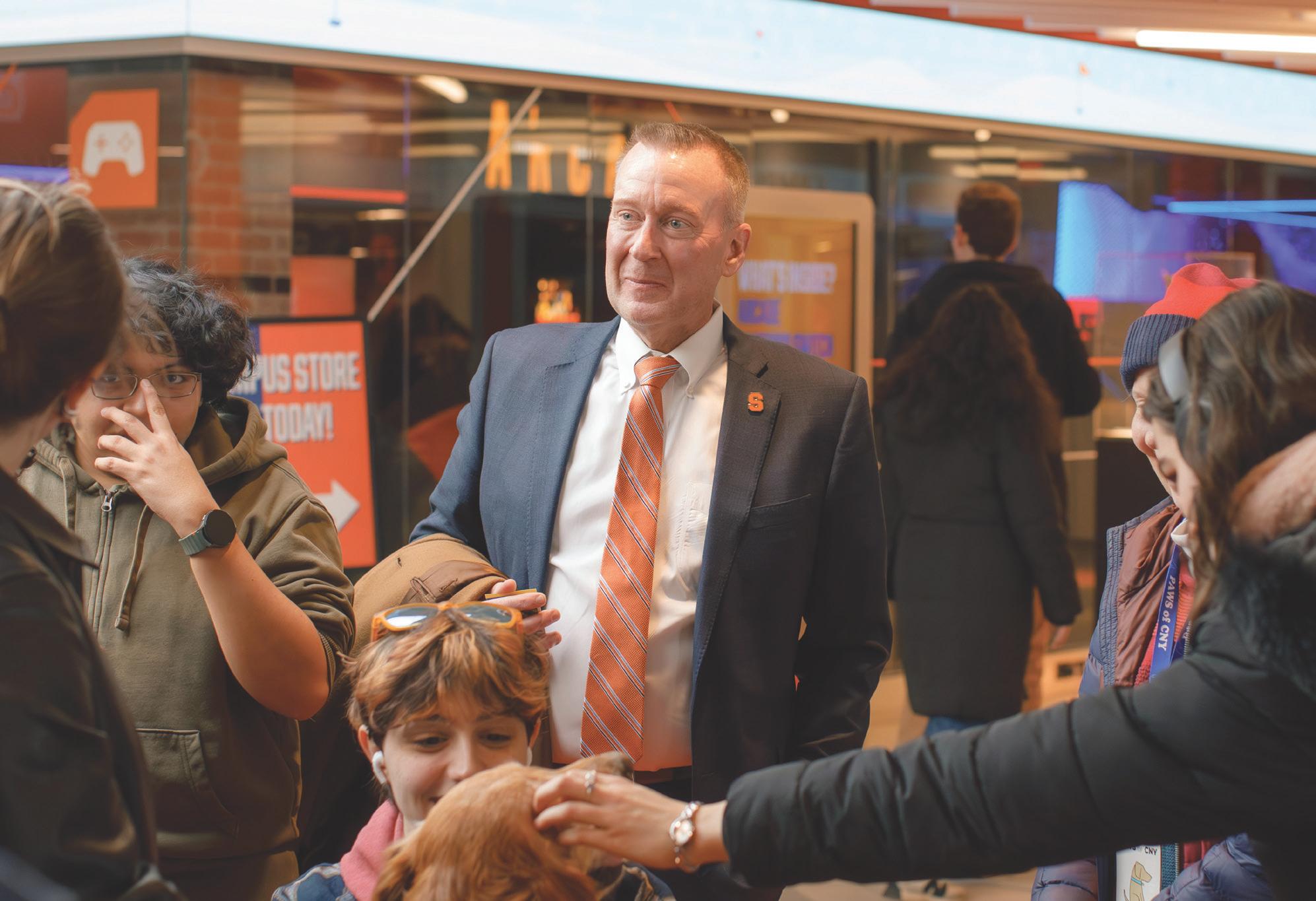
Wimer’s dog, Bauer, is Whitman’s therapy dog. She said Haynie sees him whenever he can, including spontaneously around the business school and at Bauer Hours.
“Any chance he has to connect with students, he will run at 100%,” Wimer said. “He’s served as a judge for my first-year business class presentations. He’s thrilled to be part of the student interaction.”
As a professor for Whitman’s “Shark Tank”-style capstone course, Haynie approaches many of his big ideas the same way his pupils do — with a pitch.
Much like the IVMF, which began with Haynie pitching his plans to then-Chancellor Nancy Cantor, the CCE traces its roots to a pitch deck on an iPad. Newhouse Dean Mark Lodato, who was on the Chancellor Search Committee, said Haynie took him to coffee to propose his CCE plans, and has since remained “hands-on” with the initiative.
“For me, it was sort of a lightbulb moment,” Lodato said. “It made a lot of sense, (Haynie) had clearly done his homework and had a clear vision of what this could be.”
While launching his own entrepreneurial undertakings, Haynie also mentored Whitman students doing the same. As he did with many students seeking to bring their big ideas to market, Haynie supported 2023 Whitman alum Jack Adler as he launched his business, Out2Win.
“You almost forget he is as busy as he always was, he never made it seem that way,” Adler said. “He always made time, and I’m sure he still will in the same way.”
Although he’s at work often — clocking in early to have breakfast at Orange or Ernie Davis dining halls, and staying late for Seder at the JMA Wireless Dome, basketball games or a Student Government Association meeting — he often spends his away-from-office time fishing and exploring the outdoors.
When he first arrived at SU, Haynie bought a house close to campus. Today, the acting chancellor lives at his 11-acre, lakefront home in Cazenovia with his partner, Kevin Clark, his golden retrievers, Ollie and Daisy, his tractor and his chickens.
In recent weeks, the university has gotten a taste of Haynie’s decision-making via two high-profile appointments, a new director of athletics and a men’s basketball coach.
The university was already well into the search for retiring Director of Athletics John Wildhack’s successor when Haynie was announced, he said. After Zoom interviews with the committee’s final candidate pool, Haynie met Bryan Blair in Detroit before deciding he was the man for the job.
Then came the next big decision: Gerry McNamara. When Haynie arrived at SU, Jim Boeheim’s
men’s basketball team was only a few years separated from its 2003 national title. The men’s team Haynie is inheriting is not like the one of years prior; it’s a half-decade deep in a March Madness drought and slipping away from national relevance.
“I thought it was funny that the first things they’re asking me to do are the things that if I get wrong, people will run me out of this town,” Haynie said, referring to the duo of athletics decisions.
Haynie interviewed McNamara on the phone from a Burger King parking lot on the drive back from watching women’s basketball’s NCAA Tournament campaign in Storrs, Connecticut. He said he was “involved” in the process, but deferred the final call to Blair.
Although Haynie is stepping into the chancellor role at a time of nationwide change, he’s been working atop university governance for over a decade. He is one of the only remaining members of Syverud’s original senior leadership team.
Reflecting on his time working with Syverud, whom he called “tremendously smart, thoughtful and demanding,” Haynie said he credits the outgoing chancellor with SU’s infrastructure improvements and focus on competitive strategy.
“That said, we are very different people,” Haynie said. “He and I often have had different views on how to move something forward.”
Looking ahead, the acting chancellor emphasized that students will be central to his tenure, a message he first made in his announcement speech.
“My joy in this work is students,” he said. “I want to focus everything that we do, and everything that we are, as we think about strategy for the institution (on students).”
Since March, students have seen the acting chancellor eating Panda Express at Schine Student Center, popping into dining halls and cheering at basketball games. The students who know Haynie well said this is nothing new.
Emily Hunnewell, a sophomore business management and policy studies student, said Haynie often crashes her Whitman tours. Back when she was on the tour as a prospective student in 2024, she recalls Haynie pushing her mother’s wheelchair and making sure she didn’t get separated from the group.
Haynie said he’s met with plenty of students, including a group of students who pitched him a new club, a violinist from the School of Visual and Performing Arts and some metalsmithing students who gifted him a fishing-themed lapel pin.
“He’s very student-facing. He emphasizes making sure student voices aren’t being left out of the rooms where important decisions are being made,” said Emily Castillo-Melean, the incoming SGA president. Haynie learns as much as he teaches. In addition to his annual self-imposed lessons, the acting chancellor spends his days at SU connecting with the people around him.
“He loves to learn from his students, too,” Cirillo said. “I would say he is equally willing to teach and learn.”
This year’s lesson will perhaps be more intense than most. But luckily, Haynie’s done almost two decades of studying for the job.
“If not me, who?” he said. “Given what’s ahead for the university, my argument for myself is I’m probably one of few people that is best positioned to actually help the university navigate what’s ahead.” —30— gbrown19@syr.edu
from page 3 haynie
FEB. 27 Mike Haynie interacts with students and emotional support animals in Schine Student Center after a quick lunch at Panda Express. The acting chancellor has two dogs, Ollie and Daisy, and often sees campus animals like the Whitman School of Management therapy dog, Bauer.
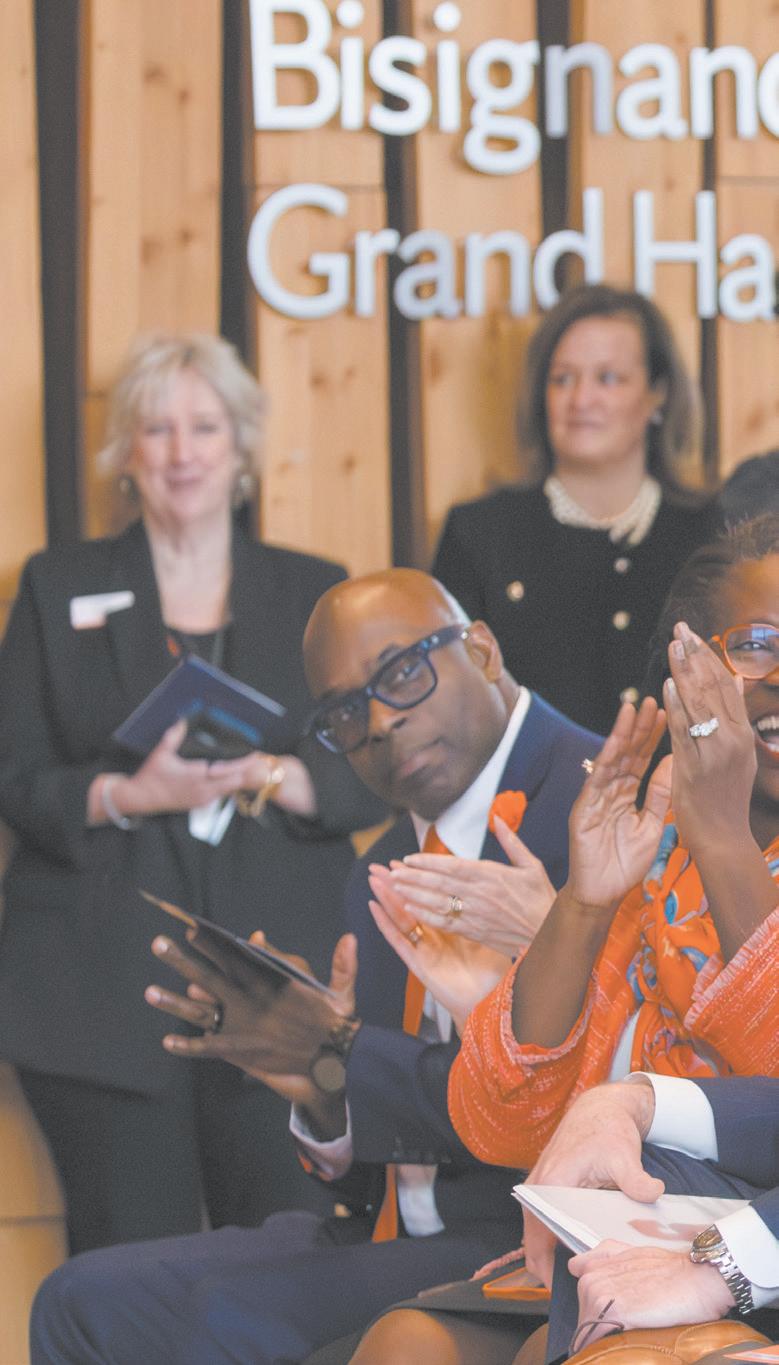
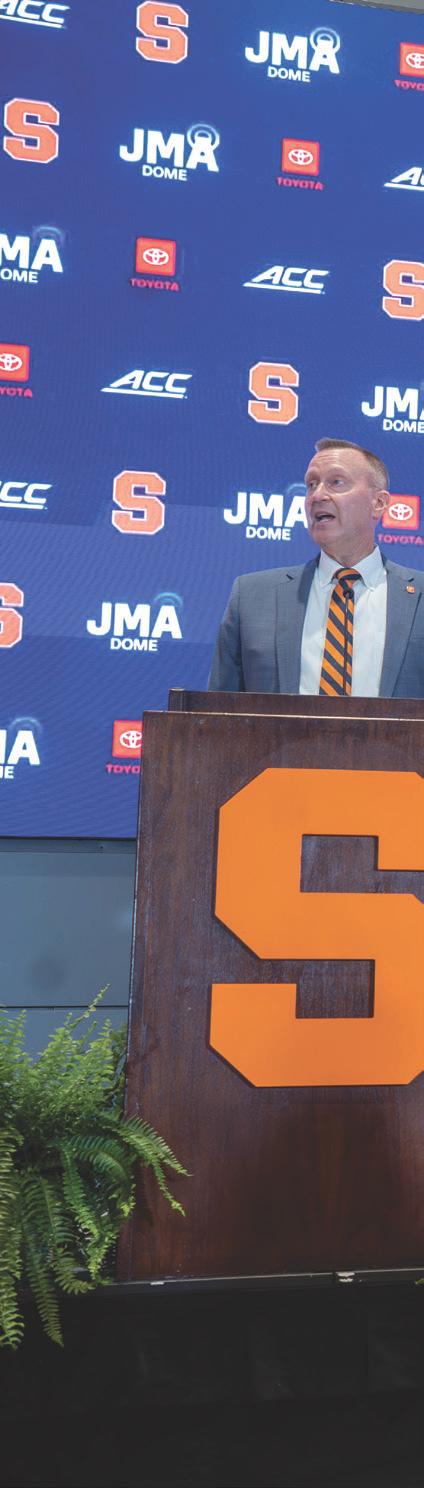
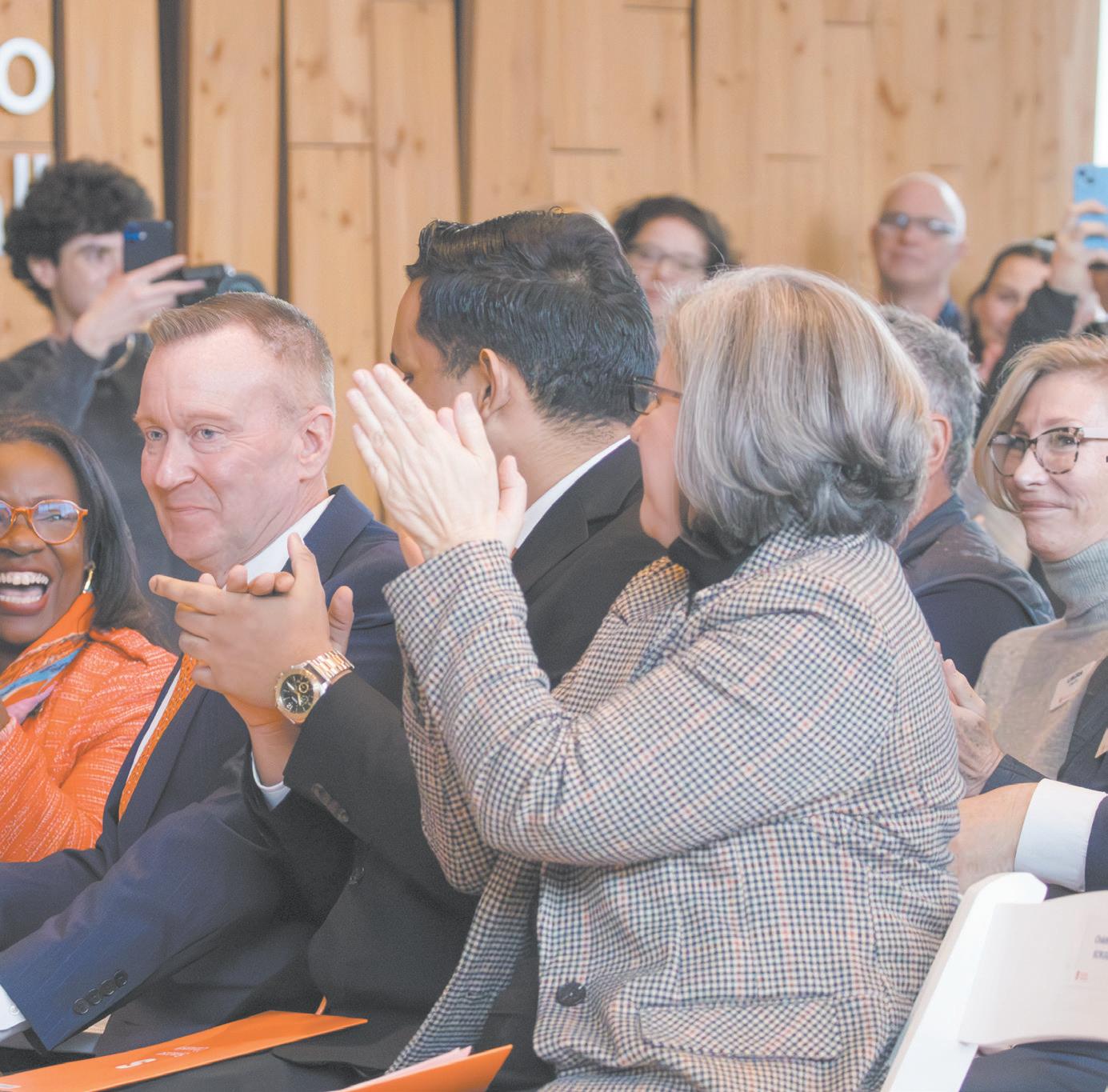
MARCH 3 Surrounded by members of the Chancellor 13th chancellor at the National Veterans Resource his entrepreneurial spirit and his history of leadership.
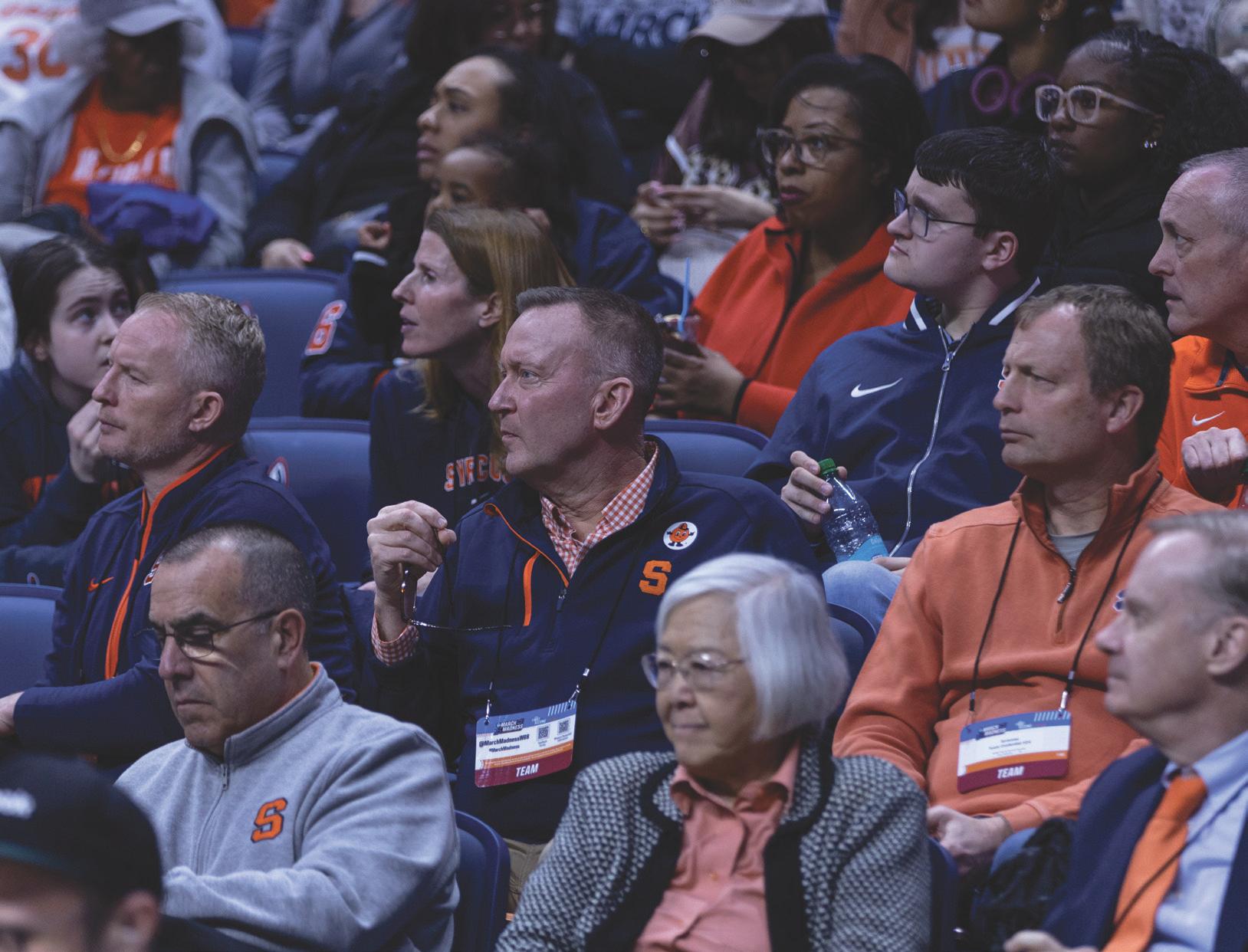
MARCH 21 Outgoing chancellor Kent Syverud, Ruth Chen and Haynie watch Syracuse women’s basketball win against Iowa State in the first round of March Madness. The acting chancellor said he loves attending as many basketball games as he can throughout the school year.
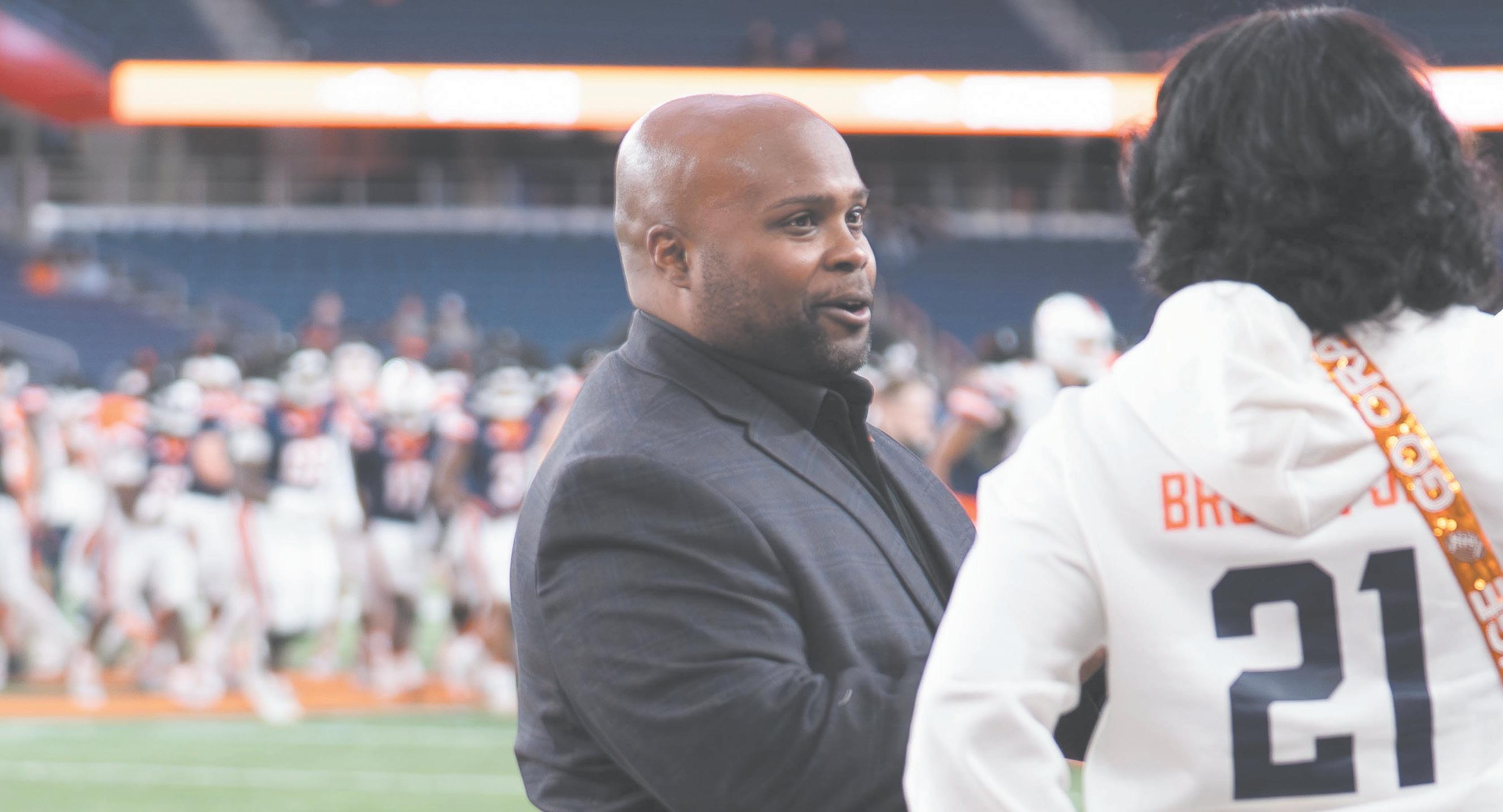
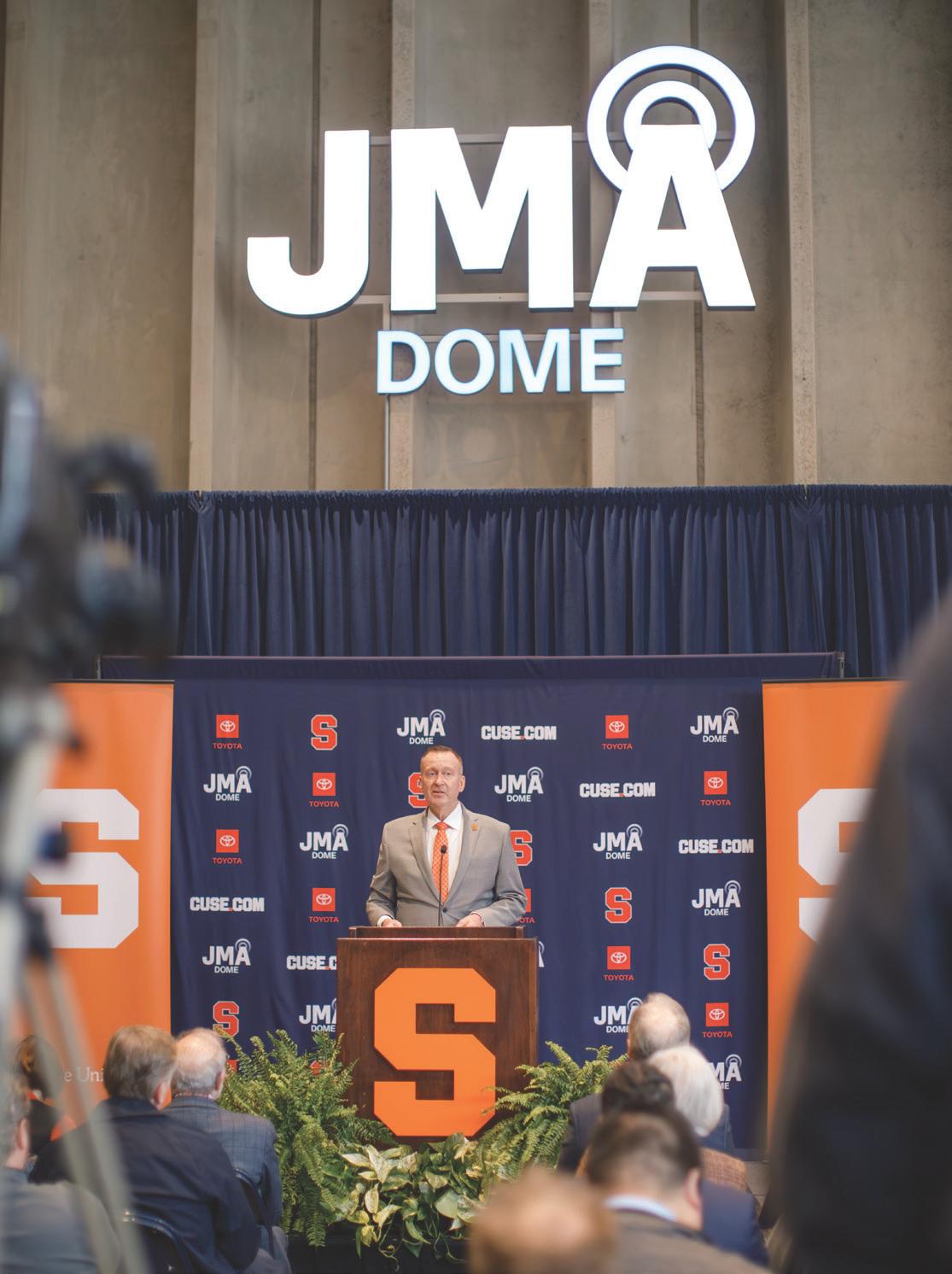
MARCH 30 Haynie speaks with the idea for the event, new head coach’s face.
APRIL 1 Haynie sits down interview with the paper since
Chancellor Search Committee, Haynie accepts his appointment as Syracuse University’s Resource Center. The committee said it selected Haynie because of his dedication to SU, leadership.
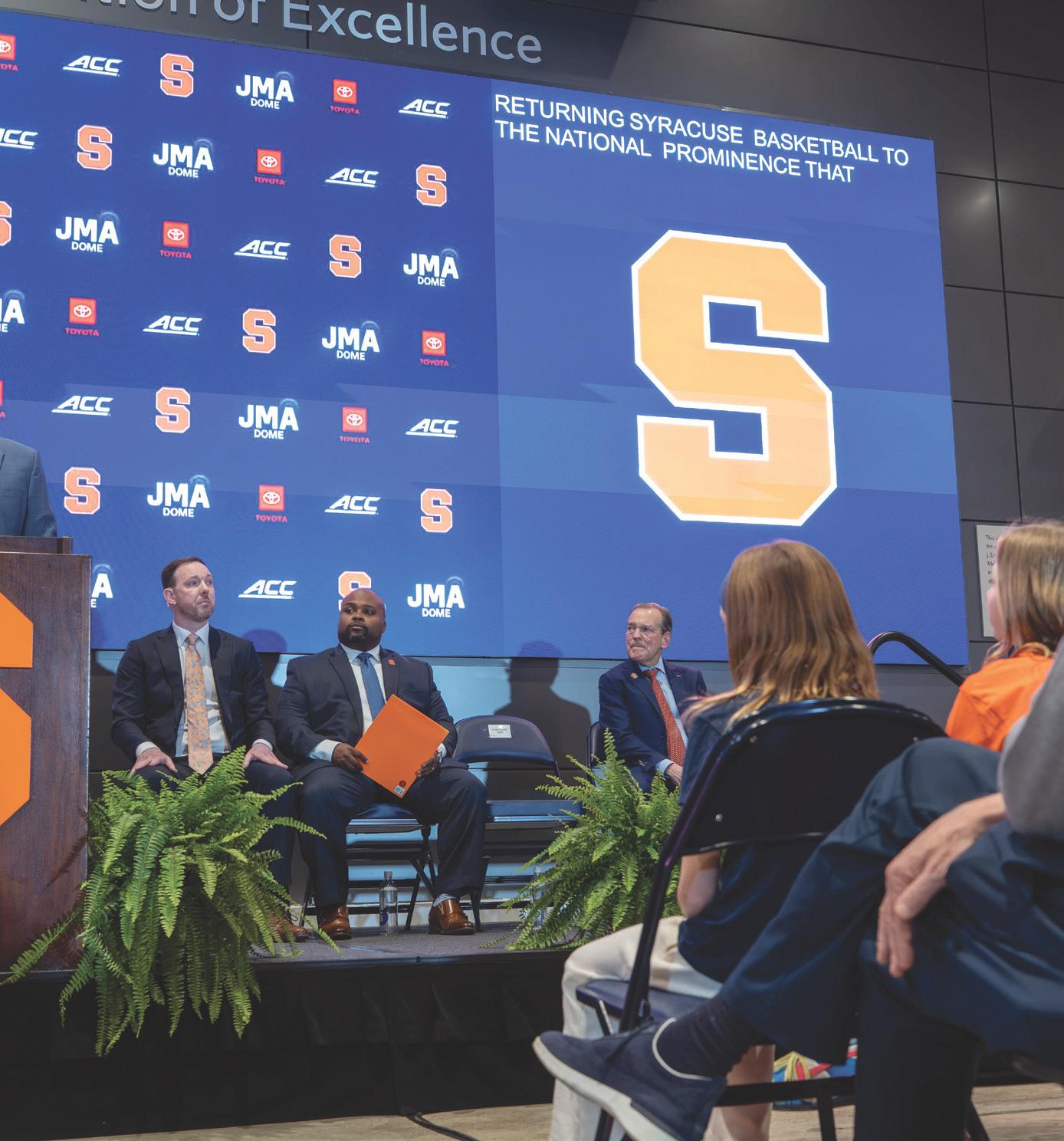
MARCH 19 Standing at a Syracuse University podium in the Miron Victory Court, Haynie introduces Bryan Blair, his director of athletics. The acting chancellor told The Daily Orange Blair is the “perfect combination” of an old-school and modern athletic director.
speaks at Gerry McNamara’s return event at Miron Victory Court. Haynie credited Blair event, which featured 2,000 fans welcoming McNamara with T-shirts and posters of the
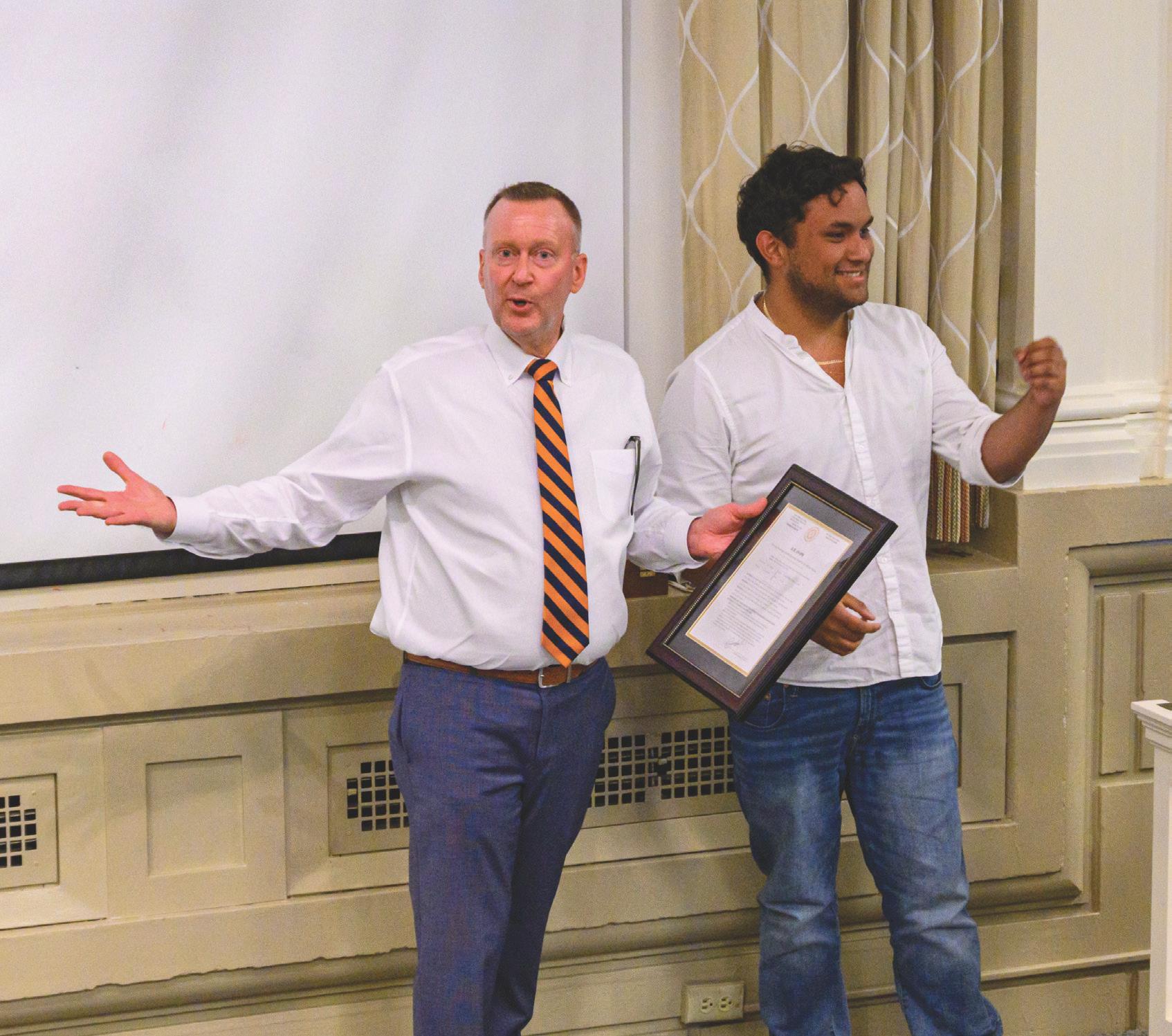
MARCH 31 Student Government Association President German Nolivos presents Haynie with a document affirming SGA’s partnership with the chancellor at an association meeting in Maxwell Auditorium. The acting chancellor said he plans to attend student-facing events like SGA.
with The Daily Orange for his first since his appointment as chancellor-to-be.
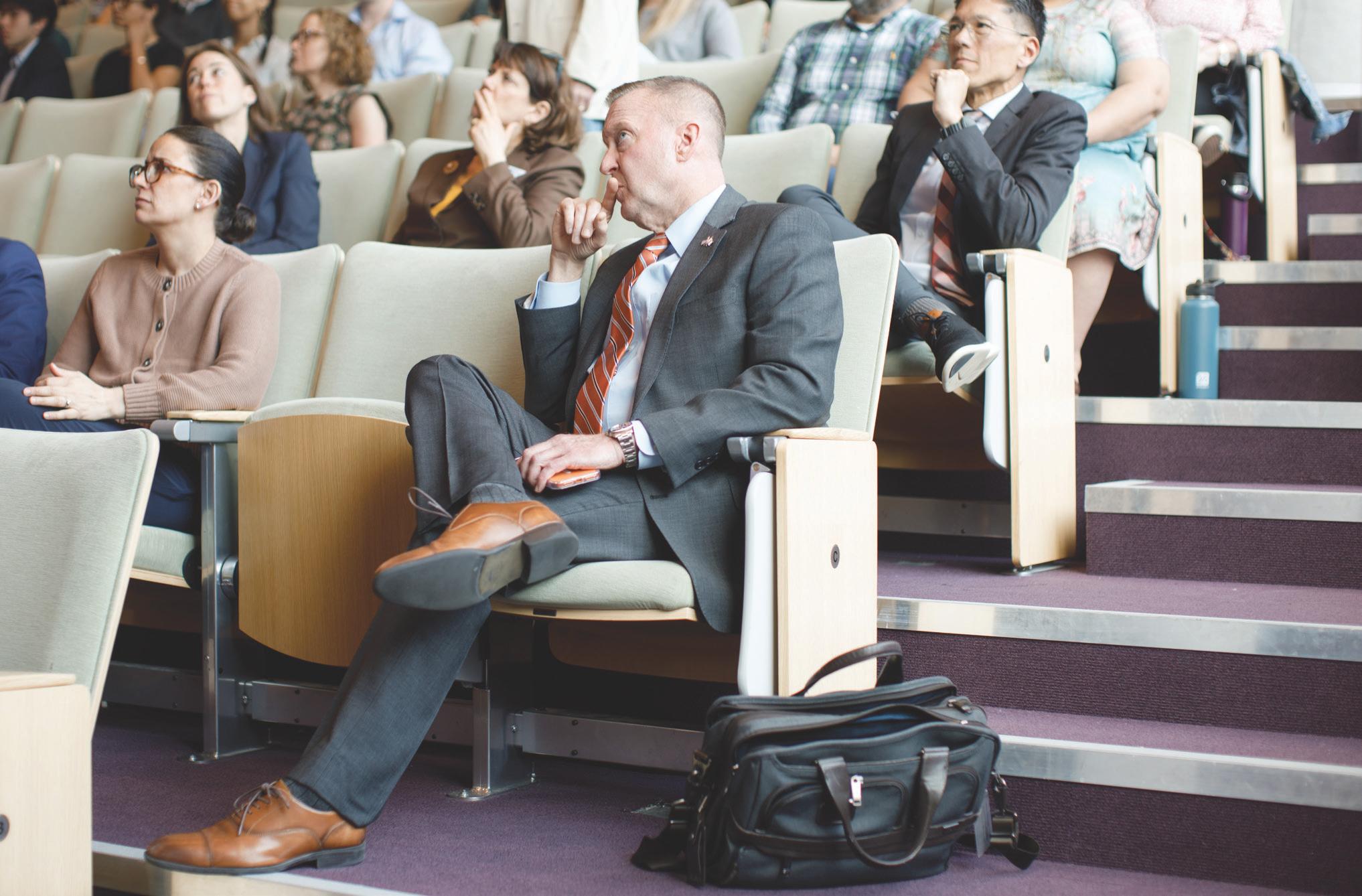
APRIL 15 Hours after being named acting chancellor, Haynie sits in the Melanie Gray Ceremonial Courtroom of Dineen Hall to observe the Syracuse University Senate’s final meeting of the semester.