BASKETBALL BACK TO
After a lost season with injuries and sanctions, Syracuse enters the year with a renewed focus



Dear readers,
The 2014-2015 men's basketball season had little to do with the on-court product. A postseason ban midway through the conference year ended any slim hope the Orange may have had at sliding into the NCAA Tournament. With a season that is set to start Friday, the focus is "Back to Basketball.” The stories in this guide detail the theme of the new season. Dajuan Coleman and Brittney Sykes are healthy after returning from debilitating multi-year injuries. Michael Gbinije is taking over as SU's point guard while his backup Kaleb Joseph has shown an improved shooting ability. The D.O. also commemorates Jim Boeheim, who is the face of a program that is hoping to reshape its reputation after a season that wasn't about basketball.
Thanks for reading, Sam Blum, sports editor

Portraits by
A NEW DAY
Dajuan Coleman set to return as SU’s big man following 22-month absence
By Jesse Dougherty
editor
IT WAS 5:02 P.M. IN A NEAR EMPTY CARRIER DOME and Dajuan Coleman was already sweating.
The back of his neck was slippery. His gray, dry-fit warmup shirt was soaked to a darker shade. At a break in a drill, with the sound of his power dribble still echoing off the stadium’s ceiling, Coleman grabbed a towel and dried his skin to stop sweat from reaching the ball in his hands.
He then took the white rag and pressed it against his face. When he lowered it he paused to look at the silver bleachers, bustling ushers and his teammates warming up at the other end of the floor. All familiar but at one time fleeting.
“Come on, Dajuan. Let’s go. Back at it,” SU assistant coach Mike Hopkins barked at him.
Coleman had just two more hours, before the Orange’s first scrimmage against Le Moyne on Nov. 2, to shake off a little more rust. He hadn’t played against a live opponent since Jan. 7, 2014, yet here he was. He snapped back into his pregame routine and started sweating some more.
“I just wanted to get out there and get going,” Coleman said after the exhibition win.
Three falls ago, Coleman’s college career was setting down a storybook-like path. He starred at nearby Jamesville-Dewitt (New York) High School, was named a McDonald’s All-American as a senior and made the short trip to Syracuse with compelling potential in tow. It wasn’t a matter of if he’d excel at center for the Orange. It was a matter of when.
But his left knee had other plans. A torn meniscus led to Coleman’s first surgery in January of his freshman year. He was healthy
[ EARLY DAYS ]
again at the start of the next season until a bruise sustained in practice led to another surgery, one year later, to repair cartilage in the same knee. And so began his second rehab in as many years, which seeped into the next season and made sitting out all of 2014–15 the best option for his future.
Now Coleman could be the difference between Syracuse competing in the postseason or living up to the zero votes it received for the preseason Associated Press poll. His comeback has inspired his teammates. His time off gave him a chance to observe the Orange’s offense and defense. He’s the unlikely anchor of a thin centers group, even if his experience is measured in perspective instead of games played.
“You want to win for him just because of how much he’s had to sit out and what’s he’s been through and stuff like that,” Michael Gbinije, SU’s senior starting point guard, said. “Hopefully he’ll continue to stay healthy, and if he does I think we’ll be good.”
In the extensive time he’s spent with Coleman, Brad Pike has only once heard him complain about pain. It was a few days after his second surgery in January 2014, an osteochondral autograft transfer procedure that moved cartilage from a non-weight bearing part of his left knee to where the cartilage was damaged.
Pike, who heads SU’s sports medicine department and works with the men’s basketball team, met with Coleman in the Carmelo K. Anthony Basketball Center and they started with a small but practical task.
Before doing anything, and even thinking about rehabbing his knee, Coleman had to learn to use crutches in the snow.
“I think that told him, right away, that it wasn’t going to be a short process,” Pike said.
Dajuan Coleman was a limited contributor in his freshman and sophomore seasons at Syracuse, both of which were riddled with left knee injuries 2012–13 2013–14
“But he listened to everything we said. If we told him you’re not going to do a certain task until a certain day, he said, ‘Ok.’ But he always followed with, ‘But you better believe I’ll be on schedule.’”
OBVIOUSLY TWO YEARS YOU’RE RUSTY. TIGER WOODS TOOK SIX MONTHS OFF AND HE COULDN’T PLAY ANYMORE. IT’S GOING TO TAKE TIME, IT’S NOT GOING TO HAPPEN OVERNIGHT. “
Jim Boeheim su head coach
Coleman was non-weight bearing for eight weeks and partial-weight bearing for another four. In those three months, Pike’s goal was to keep Coleman eating healthy so he didn’t gain any weight. Then they slowly put weight on his left leg. Then came exercises to regain his range of motion. Then they started lifting to build muscle and, in time, Coleman was nosedeep in another rehab and seeing Pike seven days a week.
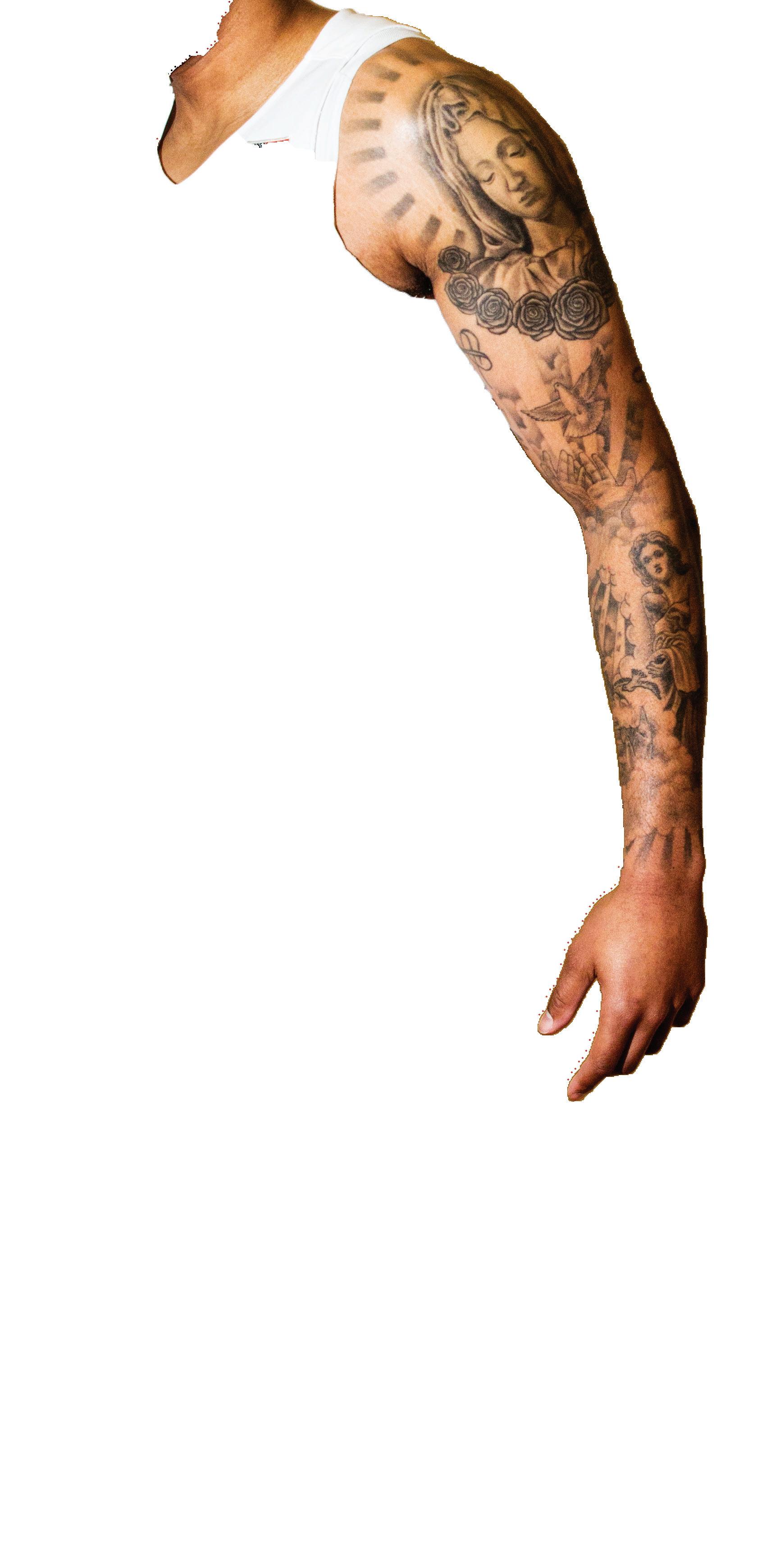
To motivate Coleman, Pike set weekly goals. Reaching them became all Coleman cared about, so much that he didn’t find time, in a year and a half, to add to the collection of tattoos on his body.
And he didn’t need to. The lion tattoo cov-
ering his forearm, as far as Pike could see, already said it all.
“He just never quit. I would always look at that lion and think, ‘That’s Dajuan. He’s just a lion,’” Pike said. “Every day, his attitude never changed in here. He brought it every day.”
Pike added that he always expected Coleman’s recovery to run into last season, and it never “would have been smart” for him to play. He was jumping and cutting well last winter, but his knee still ached when he ran up and down the floor. So he continued to work on building strength in his knee and, by May, the lingering pain was gone.
When Coleman first started playing in pickup scrimmages again, the knee was in the back of his mind. But he also noticed something different.
Two years watching Rakeem Christmas and Baye Moussa Keita play the center in the 2-3 zone translated to a better understanding of the slides he needed to make. When he got the ball on the block, he could sense when a shooter was open in the corner or when a second defender was coming to double team him. When guards penetrated, he instinctually slid into open space and scored easy buckets at the rim.
By the end of the summer, he stopped thinking about his knee altogether. He also felt like a new player capable of new things.
“Obviously two years you’re rusty. Tiger Woods took six months off and he couldn’t play anymore,” SU head coach Jim Boeheim said. “It’s going to take time, it’s not going to happen overnight.”
At the onset of the 2015–16 season, there’s no telling if Coleman will ever reach the potential he had three years ago. The thick, vertical scar that cuts down the middle of his left knee could be the symbol of a perpetually disappointing career. Or it could symbolize the climax of what’s already been an improbable comeback.
The Orange is best when Coleman is on the court, manning the middle of the zone and drawing attention in paint, and he worked for nearly two straight years to make sure he could be there.
It took resolve. It took grit. It took sweat. A whole lot of sweat.
And now it’s back to basketball.
“In the past I’d sometimes think to myself that I was sore, or tired, or frustrated,” Coleman said. “But I don’t think about that stuff now because I’m playing again. I mean, I’m really playing again.”
jcdoug01@syr.edu | @dougherty_jesse
Even if Dajuan Coleman hasn't played in a year and a half, he's unquestionably Syracuse's best option at center. Here are the Orange's three different options at the start of the season.
1. COLEMAN
He's the best fit for what SU does on both ends of the floor. He plays the zone well and can use his size to be an effective rebounder. On offense, he gives SU a strong post option.
2. CHINONSO OBOKOH
SU is less effective on offense with Obokoh in at center. He struggles with interior defense and rebounding. He didn't do much last year, and this year likely won’t be different.
3. THREE-FORWARD LINEUP
In two exhibition games, SU showcased a three-forward lineup that put Tyler Lydon at center. He has the length to protect the rim, but his biggest issue will be his strength against bigger players.
ON HER FEET
By Connor Grossman asst. sports editor
THE EXPERIENCE WAS ALL TOO FAMILIAR FOR BRITTNEY SYKES. The direction her knee bent. The popping sound. The rush of pain shooting down her body.
She tried grabbing the loose ball, tossing it up while stumbling toward the baseline, thinking she was fouled. There was no whistle. As Sykes latched onto the back post of the basket to avoid putting pressure on her shaking right knee, there was no denying it.
“I did it again,” she told head coach Quentin Hillsman, who huddled next to her.
Sykes knew she re-tore her ACL on Jan. 4 against Notre Dame, just three games into her return from tearing it in the 2014 NCAA tournament. As she hunched over on the court next to Hillsman — covering her face with her hands — something within Sykes urged her to move. She wanted to walk off under her own power.
Nine months prior, she lay on the Memorial Coliseum court in Lexington, Kentucky, writhing in pain after first tearing her right ACL. This time she got up. It was the first step to healing.
“It was more of an emotional pain and a mental pain than a physical pain,” Sykes said. “It didn’t hurt me.”
She pulled her jersey over her head to cover her tears as she limped off the court. Memories set off like fireworks. The monotonous workouts. The sleepless nights. The pain.
The flare has slowly been fading from that Sunday afternoon. Training room tables served as her therapy couch for 10 more months, allowing Sykes to patch her wounds. The redshirt junior is ready again to suit up for No. 23 Syracuse, with a reshaped foundation to work on.
She’s more of a shooter now with less explosiveness in her lower body. Her attention to detail is greater than ever from observing her teammates studiously from the end of the bench. She was cruelly reminded again that months of dedication poured into a cause could be snatched with one wrong move.
“It was crazy, honestly,” Sykes said. “I
After
2 ACL recoveries in 2 years, Brittney Sykes is primed to play for SU
can’t put into words the emotional and mental toll that it put on me.”
She was escorted off the court into an empty locker room. Dr. John Cannizzaro, her eventual surgeon, performed the Lachman test to see if her ACL was still intact. He tugged and pulled her knee to see if it would stop bending certain directions. It didn’t.
That’s when it hit Sykes — she wasn’t ready to hear about the three-letter acronym again. She drained herself of emotions in the ensuing hours, sitting alone on her bed after her moth-
I DEFINITELY TOLD BRITTNEY TO KEEP PUSHING. DON’T GIVE UP NOW BECAUSE I KNOW IT’S TOUGH THE SECOND TIME. “
er departed home to Newark, New Jersey.
She thought about her last nine months of recovery she was about to relive and began to countdown the 10 days until her surgery.
“I definitely told Brittney to keep pushing,” former teammate Diamond Henderson, who has also had two ACL tears, said. “’Don’t give up now because I know it’s tough the second time. You’ve got to just keep pushing if this is your dream.’”
After three or four days of rest, Sykes sat on the training room table looking down at her first task. Trainer Karen McKinney instructed her to flex her quad. Sykes clenched her leg. She squeezed her muscle. She mightily tried to budge it. Nothing.
Sykes likened her weakened muscle to a
baby; it needed to be trained to fire. She initially drew upon memories and checkpoints of her first recovery, but decided she needed to check them at the training room door. She couldn’t go forward — or relearn to flex her muscle — if she kept looking back.
“It’s frustrating because you were just able to do this literally a week ago,” Sykes said. “Just like that it’s gone and you have to start from scratch.”
Hillsman phoned his star player “about every two hours,” and Sykes’ mother, Regina Sykes, “about every 30 minutes to an hour.” Sykes didn’t have a lot to say, often caught up in the emotional toll of the situation.
She’d tell her head coach robotically, “I’m good, thanks for calling,” just to get him off the phone. But she didn’t want to say she was OK, knowing she wasn’t. The mundane nature of the recovery left substantial conversations few and far between.
“I don’t know if there’s much you can really tell them,” Hillsman said. “You’re trying to let the players know that you are there for them, that you understand the amount of work they’re putting in.”
McKinney — labeled both as a best friend and worst enemy by Sykes — gradually brought vitality back into the disabled 5-foot-9 guard. Slowly Sykes progressed through quad flexing, leg lifts, squats and eventually walking on her own power.
Sykes has yet to forget the walking, “heeltoe,” mantra professed frequently by McKinney. She would alternate walking five minutes around the training room on her heels, then her toes, while McKinney punctuated each step with the phrase.
With each set Sykes would ask, “Ms. Karen, are we done?” McKinney sighed.
This time around, daily workouts proved to be both fulfilling and humbling. Sykes often found herself asking McKinney to remind her what week she was in, rather than announcing each passing week as she did in her first ACL recovery.
“The second time around … I was just excited to walk,” Sykes said. “The first time I touched a basketball, I don’t know what month I was in.”
Sykes steadily began basketball activities, shooting stationary with no jumps or cuts before adding movement. She tried to be around the team often, but was limited in participation until her anticipated test came: Boot camp.
It was Sykes’ first participation in the activities in two years. Ten sprints in 65 seconds. She took off, cutting back on each line of the court. Despite nursing a fatigued lower body, she finished in time. She finished in first.
“To see a kid come back and be like she never really had the injuries is phenomenal,” Hillsman said. “Now it’s back to being Brittney Time.”
At basketball media day on Oct. 16, the Syracuse head coach stood behind a podium and spoke positively of the perseverance and toughness exhibited by Sykes.
Two ACL recoveries later, Hillsman believes the team-leading scorer of two years ago will perform similarly, “because nothing else makes sense.” Sykes once again has the legs under her to pick of the pieces of a promising career, and once again, she’s back to basketball.
cgrossma@syr.edu | @connorgrossman
Brittney Sykes burst onto the scene for Syracuse as a freshman in 2012-13, scoring nearly nine points per game for the fourth highest average on the team.
8.9 POINTS PER GAME FRESHMAN YEAR
16.6 POINTS PER GAME SOPHOMORE YEAR
She continued to rise as a sophomore, leading SU with 16.6 points per game.
She played only three games last season on the heels of her first ACL recovery, shooting just 3-of-13.
Since her second ACL tear, she said she's become more of a shooter and won't be as reliant on drives to the basket as before.
Her endurance will be tested after being dormant on the court for much of last season. She proved to be one of SU’s biggest presences on the court in her first two seasons.
Follow @DOSports on Twitter

SAM BLUM
Record: 21-8 (11-7)
NCAA Tournament finish: Round of 32
Team MVP: Michael Gbinije
Biggest surprise: Tyler Lydon
Syracuse this season is probably somewhere in between where it was the two seasons prior. Not anywhere close to the nation’s top team. Not at risk of missing out on the Big Dance completely. A lot hinges on Dajuan Coleman's ability to come back and play to the five-star capability that arrived with him at Syracuse four years ago. And a great deal also rests on newly-minted starting point guard Michael Gbinije. The Orange's lack of frontcourt depth will eventually be its downfall.

MATT SCHNEIDMAN
Record: 20-9 (12-6)
NCAA Tournament finish: Sweet 16
Team MVP: Malachi Richardson
Biggest surprise: Kaleb Joseph



Syracuse faces more questions than anything else heading into a fresh season. Coleman’s health and Gbinije’s ability to play full-time point guard lead the list, and all three scholarship freshmen pose an intrigue before ever playing a regular season college game. That’s the reason SU flies under the radar this year, but don’t expect the Orange to finish as low as ninth in a conference top-heavy with national contenders North Carolina, Duke and Virginia. Syracuse isn’t quite at that level, but those preseason questions turn into a successful season many don’t expect.

JESSE DOUGHERTY
Record: 18-11 (9-9)
NCAA Tournament finish: Round of 64
Team MVP: Michael Gbinije
Biggest surprise: Kaleb Joseph
In a very good year for the Atlantic Coast Conference, a 9-9 league record gets Syracuse into the NCAA tournament as a No. 8 or 9 seed. The Orange’s most notable wins are on the road at St. John’s, at home against North Carolina State and at home against what could be a ranked Florida State team on Feb. 11. It doesn’t make for the most glamorous resume, but staying afloat in what could be the country’s best conference will count for something when deliberation day comes. But the front court is too thin for the Orange to regularly beat teams it shouldn’t, and that will be the story of the season.


[ WOMEN’S BASKETBALL BEAT WRITER PREDICTIONS ]

CONNOR GROSSMAN
Record: 23-6 (11-5)
NCAA Tournament finish: Sweet 16
Team MVP: Alexis Peterson
Biggest surprise: Cornelia Fondren
Syracuse will continue its upward swing this season and benefit from lineup continuity, complemented by a crop of seven freshmen. Alexis Peterson headlined the Orange’s offense last season while Briana Day anchored the defense. Former team-leading scorer Brittney Sykes is returning from her second ACL injury and said she’s become more of a shooter. The trio of players will have a large say in Syracuse’s fate, and SU rides its blend of experience and young talent to the Sweet 16.

JON METTUS
Record: 21-8 (12-4)
NCAA Tournament finish: Elite eight
Team MVP: Alexis Peterson
Biggest surprise: Abby Grant
The Orange is returning all five starters from last season, plus Sykes will try to return from another ACL injury that kept her out for most of last season. Peterson is coming off a standout year in which she led the team in scoring and head coach Quentin Hillsman said he expects Sykes to be back to pre-injury form and Brianna Butler to make more than 100 3-pointers this year. The trio could make for a dangerous Syracuse offense, but its postseason success will depend on its depth outside of the top three.

PAUL SCHWEDELSON
Record: 23-6 (12-4)
NCAA Tournament finish: Sweet 16
Team MVP: Alexis Peterson
Biggest surprise: Brittney Sykes
Syracuse only loses one contributor from last season while Sykes returns from injury. Peterson and Briana Day remain among the ACC’s best at their respective positions. Peterson’s team-high 16.2 points per game gets even better as she leads the guard-heavy team that has to figure out how to split playing time between Sykes, Butler and Fondren. It’s a good problem to have and one that will be sorted out when SU navigates another tough
schedule, which preps the Orange to play in the best conference in the country. Ultimately Syracuse does just enough to advance to its first-ever Sweet 16.

Michael Gbinije completes years-long transition to become Syracuse’s starting point guard
By Sam Blum sports editor
MICHAEL GBINIJE BROUGHT THE BALL UP THE COURT for the first time during a Syracuse practice. It had been four years of high school and another season at Duke since the then-pre-teen, middle school-aged Gbinije had been asked to play point guard. The stakes weren’t high — it was a practice during his redshirt season. It would be almost a full year until he’d have to play the position on the Carrier Dome court. And the expectations were only as great as they could be for a bona fide small forward now asked to run a power-conference offense, if only for a few minutes here or there.
As he crossed half court on offense, his immediate thought was to come down and shoot. The offense wasn’t set up. The ball wasn’t protected. The head coach, Jim Boeheim, wasn’t pleased.
“A lot of yelling. A lot of getting subbed out for mistakes,” Gbinije said. “But it comes with the price of being a basketball player for Syracuse.”
Gbinije’s first season on the court thrust him into a backup point guard role behind freshman phenom Tyler Ennis. The lanky, 6-foot 7-inch Gbinije had always possessed ball-handling skills, but almost no point guard experience. Last season, switching from guard to forward on a regular basis, he scored at a 12.7 points per game clip. Four times he scored more than 20, including a career-high
27 points against Duke in February.
It’s three years removed from getting yelled at by Boeheim. Three years removed from grueling extra practices with Gerry McNamara to refine his ball-handling. Three years removed from playing a position that may have took him out of the running to contribute where he felt most comfortable.
Three years later, he’s Syracuse’s starting point guard.
“Mike’s grown as much, or more, of any player I’ve ever coached,” Boeheim said. “The first year when he sat out he worked hard, he got better.
“I don’t think he really believed, ‘I’m one of the best players in this league.’ He needs to have that attitude, and I think he has it.”
At Benedictine (Virginia) College Preparatory, Gbinije handled the ball, but not in point guard duty. Whoever got the rebound would have to bring the ball up, so sometimes that fell on Gbinije. But it wasn’t his job to
“
MIKE’S GROWN AS MUCH, OR MORE, OF ANY PLAYER I’VE EVER COACHED. THE FIRST YEAR WHEN HE SAT OUT HE WORKED HARD, HE GOT BETTER.
Jim Boeheim su head coach
captain the offense. His size was too much of an advantage at that level to stick him at the point.
In middle school, he was one of a few kids on his team to handle the point. But as he got

BY THE NUMBERS
40 YEARS
[ 1976 ]
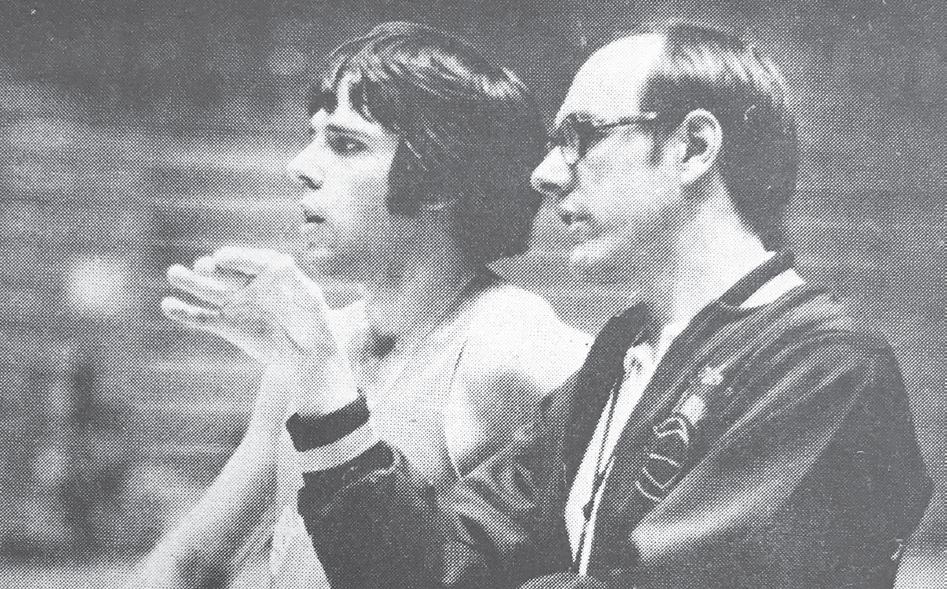
APRIL 3
Jim Boeheim replaces Roy Danforth as Syracuse’s head coach
In his resignation speech delivered two days after a scheduled press conference he never showed up to, Roy Danforth recommended Jim Boeheim become the next SU head coach. Danforth’s resignation was clouded by political involvement. “There’s no real change in coaching philosophy between Roy and myself. I plan to stress defense a little more, but that’s about it,” Boeheim said.
[ 2003 ] [
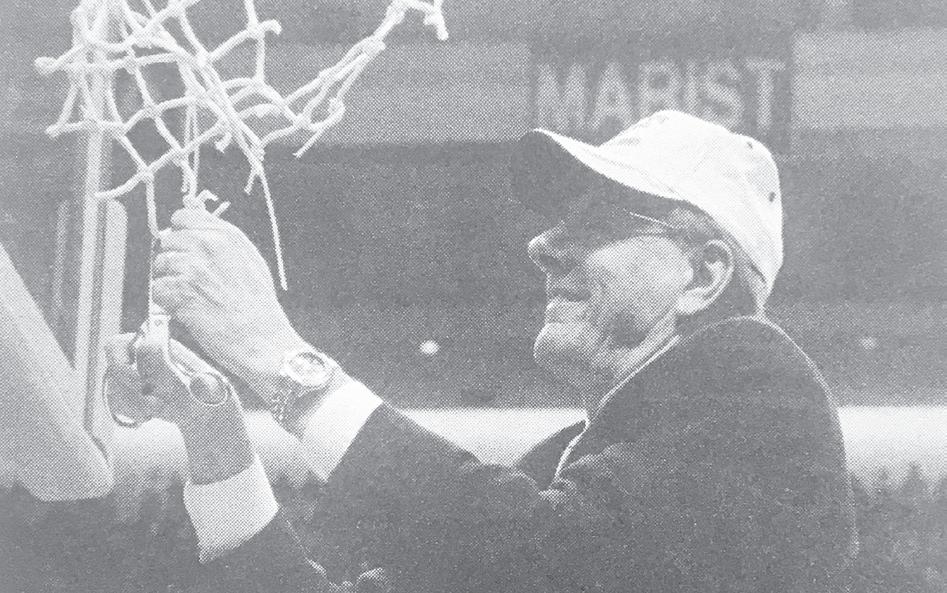
APRIL 7
Syracuse beats Kansas to win national championship
In his 27th season, third national championship game and 879th game overall, Boeheim won his first national championship, beating Kansas, 81-78. Carmelo Anthony racked up 20 points and 10 rebounds, while Gerry McNamara drilled six three-pointers in the first half. “Well, I don’t feel any smarter yet,” Boeheim said. “Maybe tomorrow. As I said before the tournament, I want to win this thing. I’m tremendously happy.”
THE BIGGEST STAGE
Despite the by title. at body great

SEPT. 9
Induction into the Nasmith
Boeheim was inducted into Sept. 9, 2005 along with Calhoun and several others. coach for 29 years at the him full-force when he arrived mony. “It’s really beyond get to,” Boeheim said. “It’s
Five times Syracuse has sent three players to the NBA with Boeheim at the helm. Big man Danny Schayes enced the longest amount of professional success, bouncing around seven different teams from 1981-82 to
Marty Headd, Eddie Moss, Danny
Tony Bruin, Erich Santifer, Leo Rautins
Pearl Washington, Rafael Addison, Wendell
Keith Hughes, LeRon Ellis, Billy Owens
Kris Joseph, Fab Melo, Dion Waiters
ryan maccammon staff photographer
YEARS OF BOEHEIM
From NCAA sanctions to national champions, here are the highlights of Jim Boeheim’s 40 seasons as SU’s head coach.
[ 1987 ] [ 1992 ] [ 2001 ]
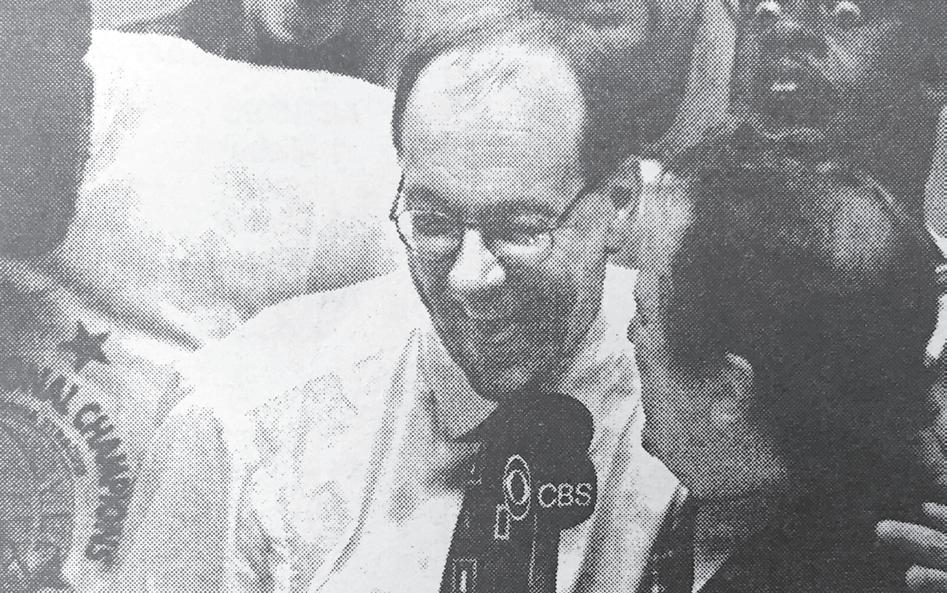
MARCH 30
Boeheim reaches first NCAA Championship, loses to Indiana
Despite Syracuse leading 73-72 with four seconds left in the 1987 National Championship game, a 16-foot jump shot by Keith Smart halted Boeheim’s first attempt at a national title. It would take Boeheim nine years to get another shot at a title. “Smart made a great play,” Boeheim said. “Somebody had to make a play at the end and Indiana made a great play — that’s why they won the game.”
[ 2005 ]
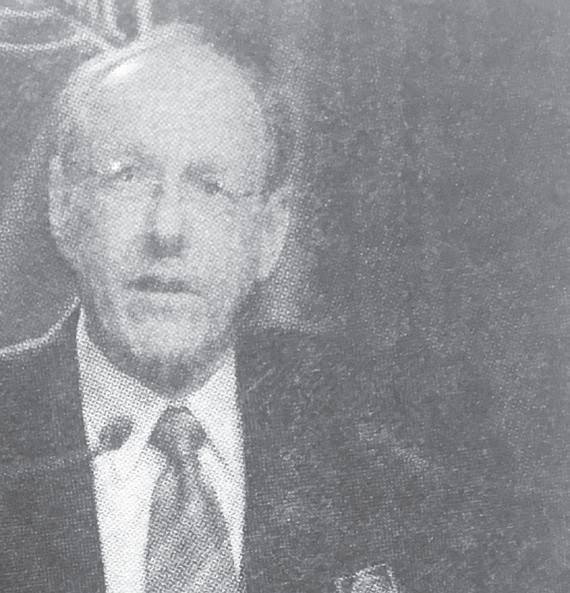
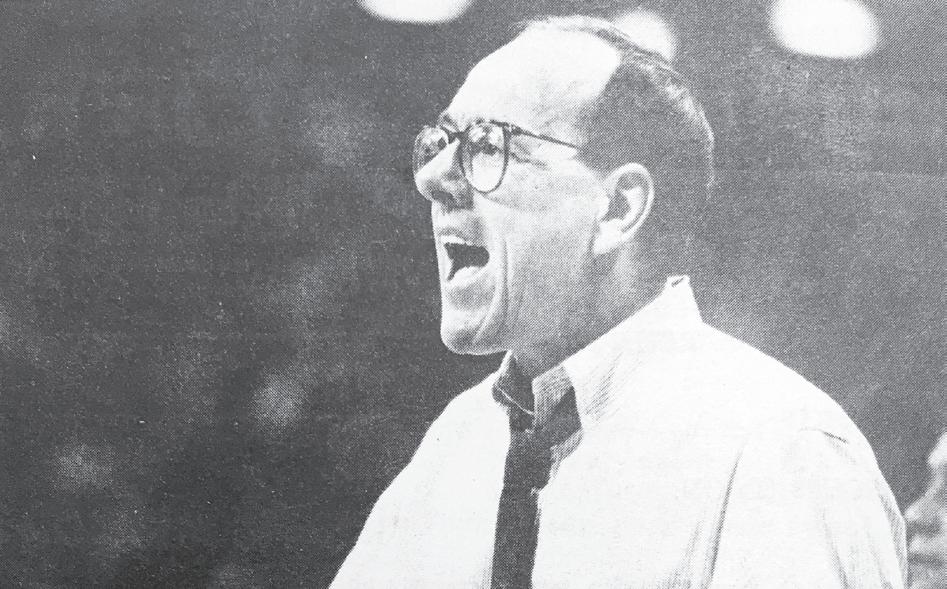
OCT.
1
Syracuse banned from NCAA Tournament in 1992-93
Syracuse was banned from the NCAA Tournament by the NCAA Committee on Infractions on Oct. 1, 1992. The Orangemen lost one scholarship each in the 1992-93 and 1993-94 seasons and coaches weren’t allowed to recruit off-campus for six months. “We’re happy to see this is over and we can go on and know what’s ahead of us,” Boeheim said.
[ 2011 ]
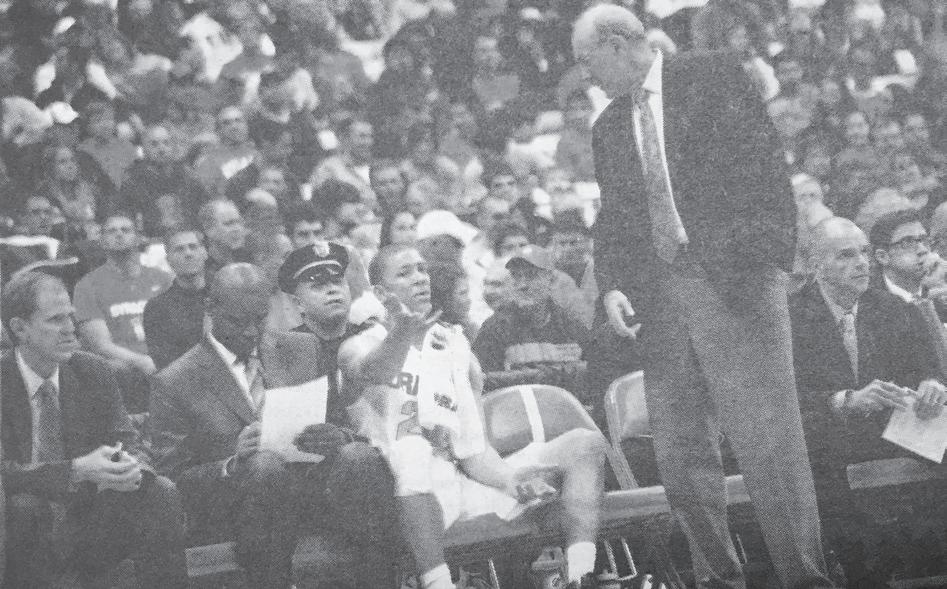
NOV. 17
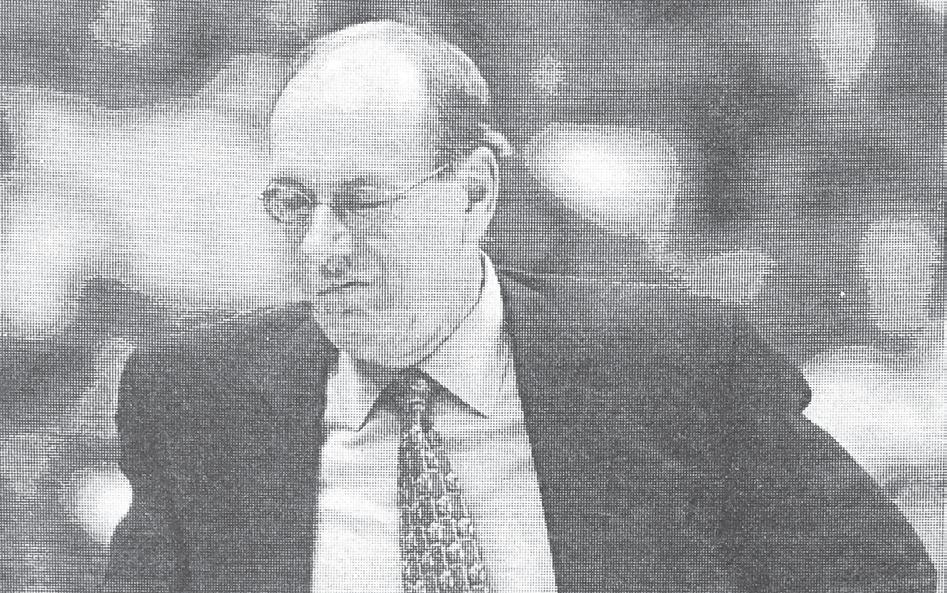
DEC. 4
Boeheim leaves to deal with enlarged prostate into the Basketball Hall of Fame on former Connecticut coach Jim others. He’d been the Syracuse head the time and said being enshrined hit arrived in Springfield for the cere -
beyond anything you could ever hope to “It’s really overwhelming.” Nasmith Memorial Basketball Hall of Fame
Boeheim calls out former ball boys regarding Bernie Fine
Allegations that 30-year assistant coach Bernie Fine molested former ball boys Bobby Davis and Michael Lang surfaced on Nov. 17, 2011 and Boeheim said they were liars out to get money. “So, we are supposed to what? Stop the presses 26 years later?” Boeheim said. “For a false allegation? For what I absolutely believe is a false allegation?” A defamation case against Boeheim was settled in August.
MARCH MASTERS
Syracuse has frequented NCAA tournament play in Boeheim’s tenure, reaching the postseason in 26 different campaigns since 1976-77.
INELIGIBLE
MISSED NCAA TOURNAMENT
SWEET 16
ROUND OF 32
ROUND OF 64
NATIONAL RUNNER-UP
ELITE EIGHT
For the first time in 25 years in Boeheim’s coaching tenure, he wasn’t present at a game. Before SU’s 91-65 win over Hofstra, the head coach informed his team of his enlarged prostate and that assistant Bernie Fine would take over in the interim. “Everybody had their mouth open like, ‘Wow.’ We couldn’t believe it. We hope he’s all right,” forward Jeremy McNeil said at the time. Boeheim came back after three games.
[ 2015 ]
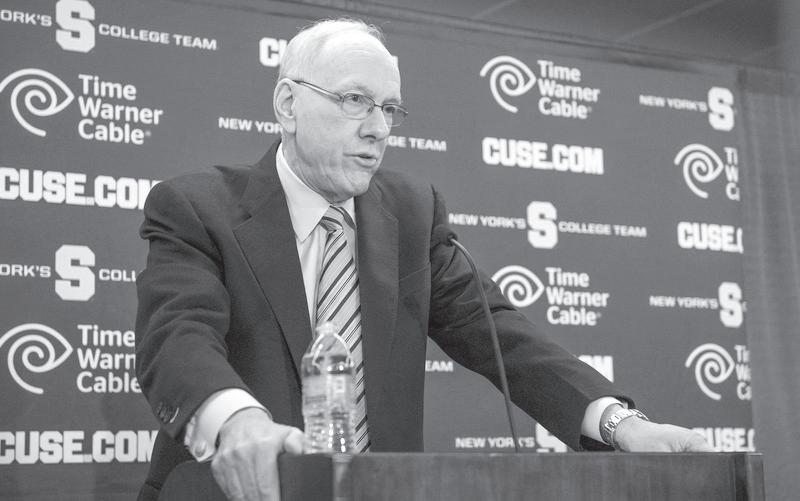
MARCH 19
Boeheim speaks on NCAA sanctions
On March 19, Boeheim addressed the media for the first time since the NCAA released its report on Syracuse, and the announcement of his retirement in three years. While he said he accepts the responsibility as the head coach while the violations occurred, Boeheim said the punishments were too harsh. “I feel that the NCAA is punishing current and future student-athletes for the conduct of a few individuals,” he said.
PLAYING HIS GAME
Boeheim has coached nearly every one of Syracuse’s games since 1976-77. Here are the highlights of games not featured above.
BEST GAMES
March 7, 1981


March 12–13, 2009

March 13, 2013

Syracuse beats Villanova 83-80 in triple overtime to win its first Big East tournament, which was played in the Carrier Dome.
Syracuse defeats Connecticut in the quarterfinals of the Big East tournament in six overtimes, 127-117
Syracuse beats Georgetown 58-55 in overtime in the semifinals of the Big East tournament, the Orange’s final one as a member of the conference.
Feb. 12, 1980

March 14, 1991

WORST GAMES
Syracuse’s 57-game home winning streak is snapped against Georgetown, 52-50, in the last game played in Manley Field House.
SU becomes the first No. 2 seed to lose to a No. 15 seed, falling to Rhode Island, 73-69, in the opening round of the 1991 NCAA Tournament.
March 18, 2005 No. 13 Vermont unseats No. 4 Syracuse, handing the Orange a 60-57 loss behind the hot-shooting T.J. Sorrentine, who hit five 3-pointers.

drew osumi staff photographer
daily orange file photos

older, the duty fell more on the smaller players.
“We didn’t have him bring the ball up and call plays,” Sean McAloon, Gbinije’s high school coach, said. “Mike wasn’t a very vocal kid on the court. To get you in an offensive set or whatever it may be consistently, Mike wasn’t ready at that point for that. He wouldn’t talk or hold people accountable the way most point guards would. That wasn’t him.”
At Duke, Gbinije wasn’t a good ball-handler and wasn’t a good shooter. “There’s a reason he didn’t play,” Boeheim said. He had 33 points in 19 games. He had eight turnovers to his three assists. Becoming a point guard at Syracuse was as much about necessity from lack of depth as it was about sensibility atop a zone that demands length.
Gbinije used his speed and athleticism at point guard to elude defenders. At SU, McNamara helped him use his size to control the tempo at his pace. He made Gbinije keep the ball low despite his tall frame and make “second-level reads.”
“We always had high expectations for Michael,” McNamara said. “And he’s put himself in position to be the guy with the basketball. That’s a testament to what he’s done … There’s a lot of things he can do. It was just about him putting it together.”
His father, Frank Gbinije, said he was disappointed when Gbinije first changed positions. It wasn’t his strength at the time. He had the skills, but not the experience.
It wasn’t a sentiment that Frank wanted to pass on to his son, who he hoped to see develop a good rapport with his new coaching staff. The
two didn’t really talked about it.
“He could have done a little bit more that year,” Frank said. “He could have contributed a little bit more if he had the opportunity to come in … it set him back a little bit.”
It set him back, briefly, only to eventually set him up. Getting him better was as simple as playing more. Every scrimmage, all summer, it was his ball to bring up. Every
[ BY THE NUMBERS ] 21
19
POINTS GBINIJE SCORED IN THE FIRST HALF AGAINST DUKE IN FEBRUARY
GAMES
practice, every day, even when he was redshirting, he ran the point the whole time. Boeheim said his offense is geared to a Gbinije-type point guard. Tall on defense, and scoring-minded on offense. His 15-20 minutes at that position a season ago will dramatically increase.
He’s still not the most vocal player. His experience is still far more limited. He may not have been the conventional choice. The reasons not to put him at the position still exist.
The difference now, though, is that Gbinije has proven that they don’t matter.
“I feel comfortable at this position,” Gbinije said. “… I do kind of feel like it’s my team this year.”
sblum@syr.edu | @SamBlum3


HEART OF A LION
Alex Rosenberg leads
Columbia
in his return from a Jones fracture before last season
By Chris Libonati asst. copy editor
N HIS HOME IN SHORT HILLS, NEW JERSEY, Alex
Rosenberg lay on his back, an uncomfortable position for someone who is normally a side sleeper. He couldn’t get up and go to the fridge or cook. He could only dress himself
sometimes, when his foot would cooperate.
When he wasn’t trying to sleep on his back, he was facing the ceiling, slinging a basketball up toward it. That was the closest he could get to the gym at Columbia, where he had played college basketball for the last three years.
“The littlest things, to take a shower, I had to take baths … for about four weeks,” Rosen-
berg said. “… The simplest things you do every day, you need help with.”
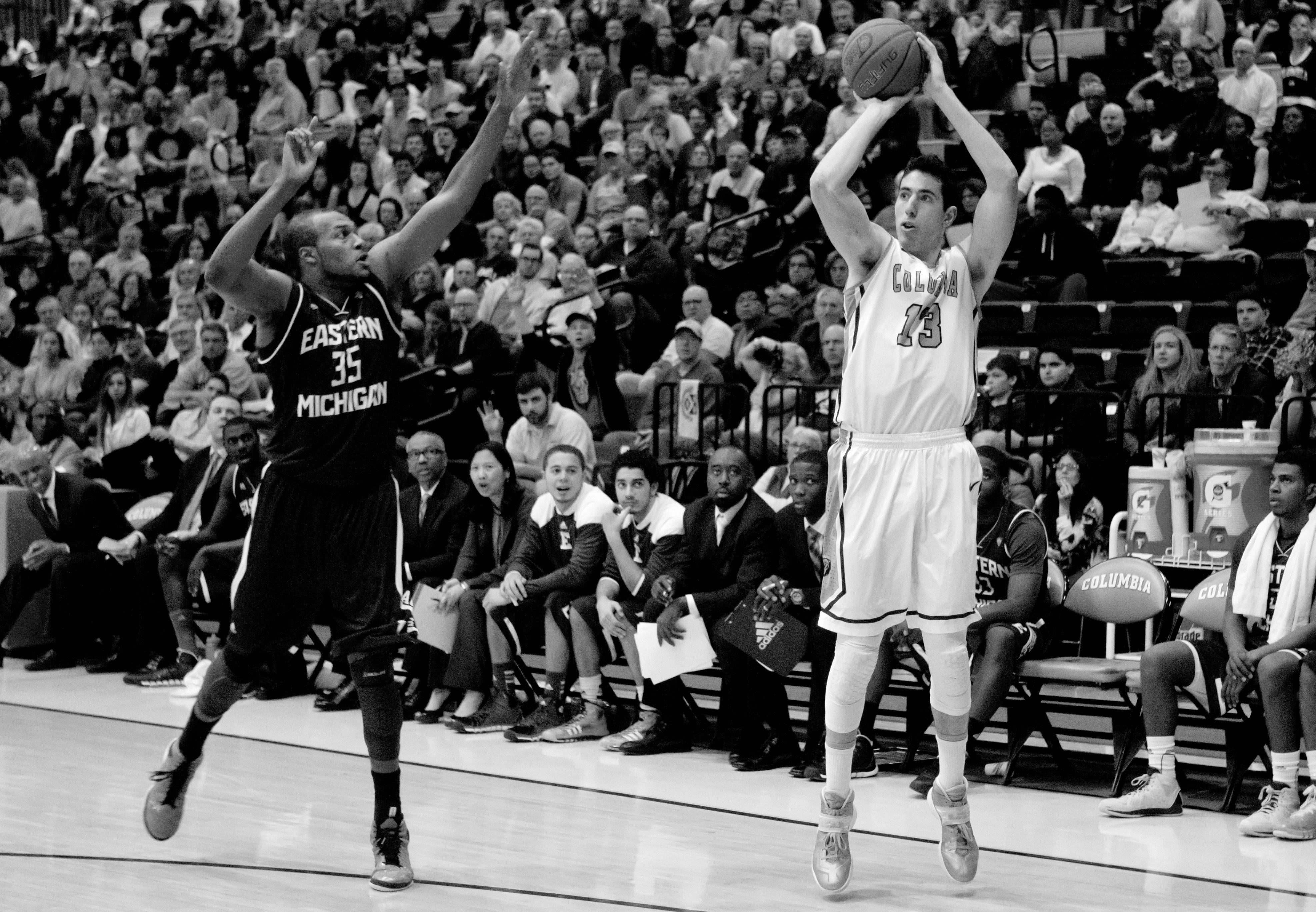
A Jones fracture in his right foot forced Columbia’s leading scorer from the 2013-14 season to elevate his leg for “90 percent” of the time. Rosenberg didn’t shoot a basketball for four months, the longest stretch he can remember because typically he shoots each day.
Rosenberg not only missed last season but also withdrew from school. He maintains that it would have been too difficult to get around Columbia on crutches. Had he stayed in school, he would’ve lost a year of eligibility because of Ivy League rules, which do not allow players to redshirt.
“The decision was primarily from an academic standpoint,” Rosenberg said. “… It would have been completely unreasonable. I can’t go to class, I can’t compete as an athlete, too, so I had to withdraw.”
Rosenberg stopped, pivoted and planted as he guarded a teammate in practice on Oct. 24, 2014. He felt a crack in his right foot and pain rushing from the middle of it. Rosenberg had ankle sprains in the past, so he knew this wasn’t the case.
Initially he thought he would miss a month of classes in the second semester, the rest of the first semester and most of basketball season. He talked to Columbia head coach Kyle Smith and his parents about withdrawing from Columbia, and they OK’d the move.
“I’ve been coaching 23 years and there’s only a handful of guys that care as much as he does,” Smith said.
[ LEADER OF THE PRIDE ]
Rosenberg led Columbia in scoring in his junior season before a Jones fracture forced him to withdraw from school.
YEAR 16.0 POINTS PER GAME
About two weeks prior to Rosenberg’s foot fracture, NBA star Kevin Durant suffered the same injury. Rosenberg saw the Thunder rush Durant back, he said, and he didn’t want to do the same with his own injury.
Doctor Jonathan Deland at the Hospital for Special Surgery gave Rosenberg deadlines to meet for rehab. Slowly, Rosenberg progressed from having his ankle elevated to walking around. The forward started doing upper-body lifts with a trainer when he couldn’t walk around. By the end of Columbia’s season, Rosenberg wasn’t even off his crutches, but he didn’t miss a single home game. He sat about 15 rows behind the Lions’ bench for each game. His dad would drive the hour-long trip because Rosenberg couldn’t and that meant his dad had to leave work early sometimes.
“Even when I was feeling down and just see columbia page 18
ALEX ROSENBERG (13) didn’t shoot a basketball for about four months, the longest stretch since he started playing basketball because of a Jones fracture before last season started. The forward was Columbia’s leading scorer in 2013-14 and will help take pressure off of guard Maodo Lo, the Lions’ leading scorer last season.
courtesy of columbia athletics
SCHEDULE
ON THE OUTSIDE
Tyler
Roberson stays contained while expanding his game for Syracuse
By Matt Schneidman asst. sports editor
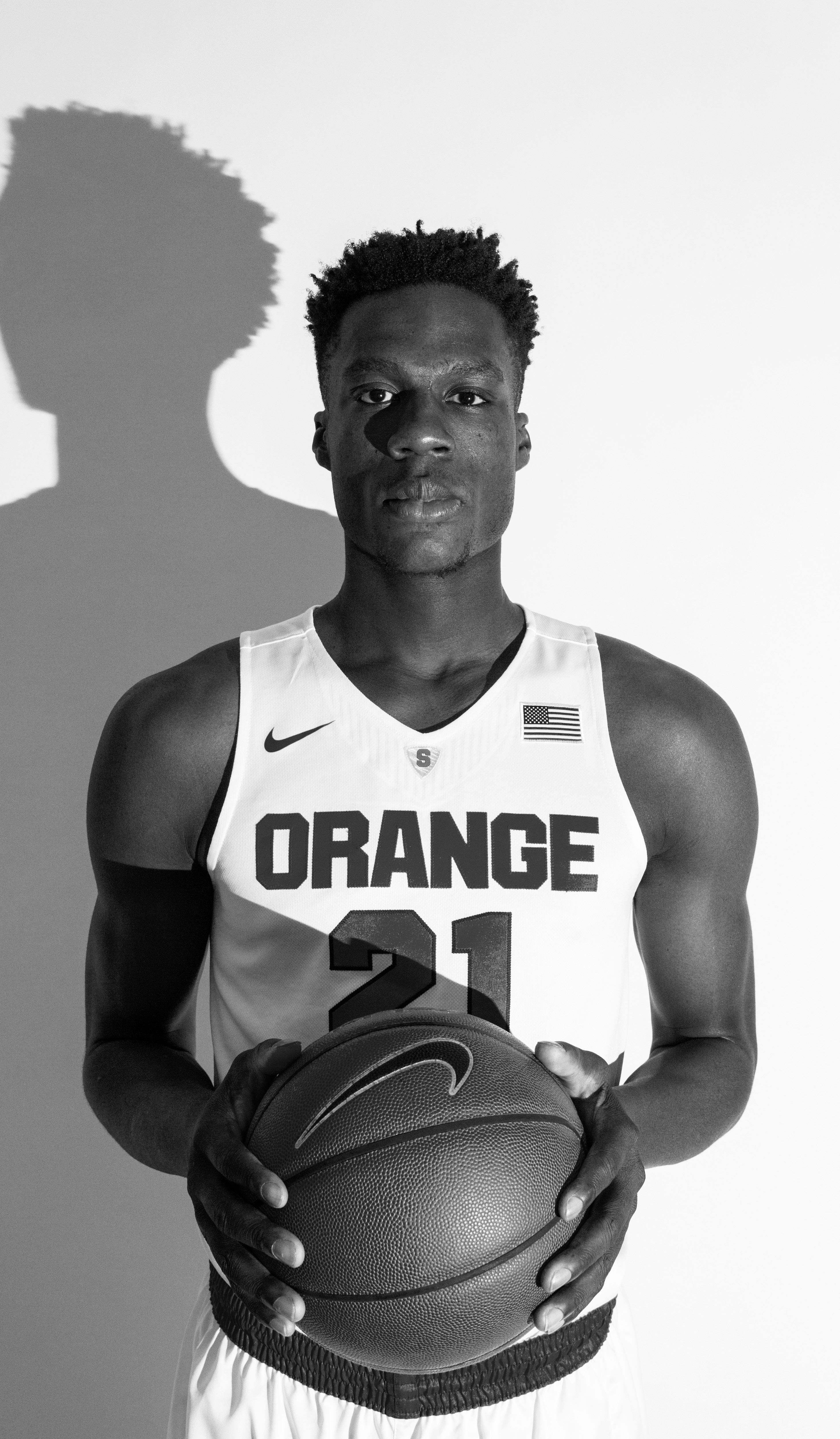
TYLER ROBERSON LEANS AGAINST A BASKET STANCHION inside the Carmelo K. Anthony Basketball Center 17 days from Syracuse’s season opener. He just dribbled a ball off his right foot, got it back and traveled before missing a left-handed hook shot while being fouled.
Assistant coach Adrian Autry yells at Roberson twice to “play defense” after freshman wing Malachi Richardson scores on him. Roberson walks to the sideline, wipes the sweat off his nose with a white towel and returns. Freshman forward Tyler Lydon hits a mid-range jumper in his face on the next play.
Throughout the drill, Roberson is inaudible and his facial expression remains stoic. Lydon screams in frustration after one miscue and Richardson flips his palms up at his sides, mumbling under his breath after another. But the junior forward keeps his mouth slightly agape, watching from under the hoop when he’s not on the court.
“Tyler has always been, even since he was a child and he used to play, he’s always been very reserved,” Roberson’s mom, Carla Roberson said. “He constantly observes. He’s very cerebral and that’s what he’s doing.”
In watching the two freshmen face off, Roberson is observing a mix of what he’s strived to become, a player big enough to bang in the low post and one who makes his living on the perimeter. It’s what the expanding role of the power forward demands in today’s game. This offseason, Roberson methodically managed his diet and lived in the gym and weight room, inching closer to that prototype.
Unlike last year when he began games observing from the bench to start the season, Roberson will be Syracuse’s primary four in 2015-16. His reserved nature masks the breakout year some expect him to have, but at the same time defines a player sometimes misunderstood.
“
TYLER HAS ALWAYS BEEN, EVEN SINCE HE WAS A CHILD AND HE USED TO PLAY, HE’S ALWAYS BEEN VERY RESERVED.
“When he was playing in high school, there were some people, from what I understood, that tended to take his disposition as being, because he was so quiet, maybe he’s arrogant or maybe he’s this and maybe he’s that,” Carla said. “…He’s always going to be who he is. He can’t fake it. This is Tyler.”
Roberson started every day this summer with a bowl of oatmeal topped with cinnamon and vanilla. Two hours later, he’d have the same thing, sometimes accompanied by chicken sausage and pancakes.
For lunch, Roberson ate pasta and vegetables, straying away from fatty foods. He went to the gym at 2 p.m., worked mainly on his jump shot and returned to the house around 6 p.m. before lifting weights with his oldest brother. He came back for the night around 11 p.m. and after eating
Carla Roberson tyler roberson’s mom
OFF SEASON
Kaleb Joseph is moving on from a lackluster freshman season after refining his game and body
By Paul Schwedelson asst. copy editor
BEFORE THE SEASON HE WASN’T READY FOR CAME TO AN END, Kaleb Joseph began pondering what he could improve on.
One made field goal in the last five games. Benched with two games remaining. A need to improve shooting, get stronger and make better decisions.
The year went by faster than Joseph expected and ended sooner than he hoped.
Since, Joseph has become feistier, more efficient with his time and knows what he’s actually preparing for.
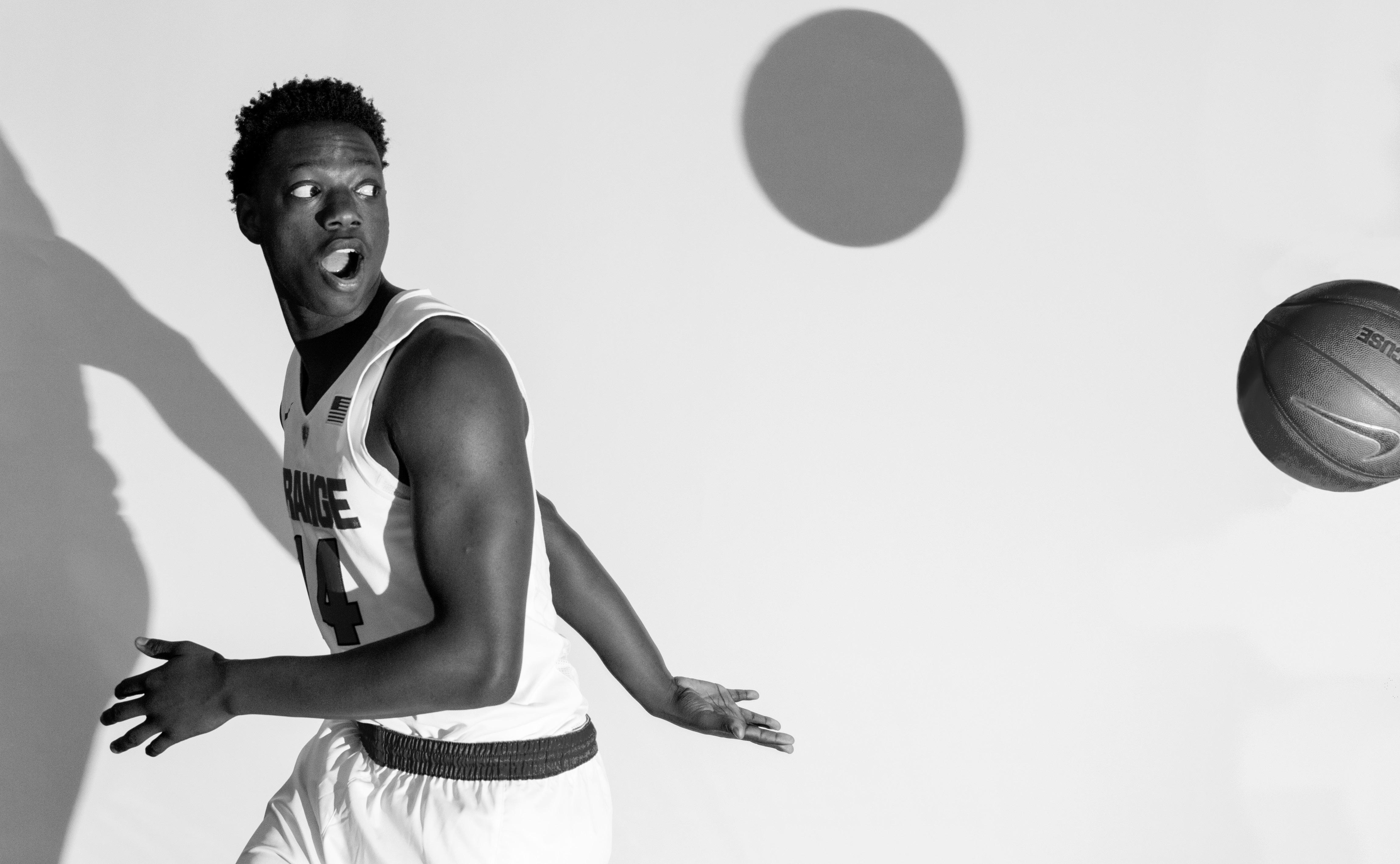
“Kaleb’s made the biggest offseason improvements physically of anybody that I can remember,” said 40-year Syracuse head coach Jim Boeheim.
Joseph used to worry about things he couldn’t control. His decisions were rushed. His shots weren’t falling.
“It’s always a fear of the unknown,” Joseph said of his freshman self. “But now I’ll be better for it. I know what to expect going into a season.”
The 6-foot-3, 165-pound wiry freshman point guard wasn’t supposed to start. Tyler Ennis
was. But Ennis left for the NBA and Joseph was thrust into the lineup. Joseph used his first offseason in college to prepare for what he’s already been through, something he couldn’t do last summer, and it’s resulted in 15 added pounds of muscle and renewed confidence.
Joseph will likely come off the bench this year as fifth-year senior Michael Gbinije is SU’s new starting point guard. Gbinije started at small forward last year and, toward the end of the season, played the point late in games instead of Joseph.
But with an offseason to continue building his late-developing body, Joseph’s confidence is rubbing off.
“If Mike Gbinije had graduated, I’d be very comfortable with Kaleb starting at the point,” Boeheim said. “Very comfortable. Unlike last year when I was not that comfortable.”
With all the working out Joseph did, he had to eat more calories and protein. He ate “heavy foods” like chicken, steak and pasta. Joseph had to discipline himself to eat even when he wasn’t hungry.
It’s all a result of inner motivation — to win in college, be the best he can be and make it to the NBA — a requirement to be good at
anything, he says.
In high school, Joseph’s body wasn’t as developed as much as his peers, either, which frustrated him.
So he’d respond.
“If he was in the gym on a Friday or Saturday night, I wouldn’t have been surprised,” said Vin Pastore, the coach of Joseph’s Mass Rivals AAU team.
“The thing about Kaleb is he works his ass off everyday,” said Barry Connors, Joseph’s coach at Cushing (Massachusetts) Academy. “People would be out socializing, people would be sleeping and he’d be in the gym.”
So, how Joseph responded this offseason is what he knows best. Syracuse’s self-proclaimed biggest gym rat trained three times a day — practicing his shooting while also lifting weights and working with director of strength and conditioning Ryan Cabiles.
Wake up, shoot and go home to eat. Come back to lift, stretch and go home again. Come back a third time. Work out more. Go home. Sleep.
It was repetitive, consistent and even tedious, Joseph admitted.
There were days he felt tired. He did it anyway.
“I’m only human,” Joseph said. “… But those are usually the days where you know you need to go.”
Boeheim said Joseph tells him he’s going to be the best shooter on the team, his conviction a testament to the work he put in over the summer.
In practice, Joseph’s demonstrated his improved shot to teammates and coaches. He can match up with bigger opponents and plays with more intensity.
“He’s really pushing people,” Gbinije said.
“He’s pushing me, Trevor (Cooney) and whoever he’s playing against. He’s getting everybody better, including himself.”
BULKING UP ]
Kaleb Joseph converted on just 7-of-35 3-pointers as a freshman. His outside shot was an area of focus this offseason.
56.2
Kaleb Joseph’s added muscle this summer. It will help the sophomore guard be better equipped to be effective this season.
19.4
16 POUNDS WERE ADDED BY KALEB JOESEPH THIS OFFSEASON
Joseph wasn’t satisfied with his performance last year, but still sees the value it provided. Nothing can substitute experience, and the offseason that followed was the result.
“He was put in an almost impossible situation last year,” Boeheim said. “He just wasn’t physically or mentally ready for it. And I think he is this year.” pmschwed@syr.edu | @pschweds


again, had totaled six or seven meals on the day.
When Roberson returned home after his freshman year, he struggled to maintain the weight he’d gained at Syracuse. Cuse.com listed him at 212 pounds heading into both his freshman and sophomore years. Now, he’s at 226.
“I think he’s stronger, more physical,” SU head coach Jim Boeheim said. “He’s a very strong, physical player and that’s what he is, that’s what he does.”
Before practice on Oct. 27, Autry set up three cones in a small triangular formation in different spots just inside the 3-point arc. He threw sharp underhand passes to both Roberson and Lydon, forcing the forwards to stay inside the cones when they shot from mid-range. Last year, Roberson released from the center part of his chest, his father, Edmon Roberson said. This year, he’s catching and shooting more toward the right side of his body, allowing for a quicker release.
He’s even shown flashes of improved passing from the outside, threading a no-look bullet from the wing to a streaking Lydon, who finished an open layup during a half-court drill last Tuesday.
“I think I’ll be able to expand out a little more toward the perimeter,” Roberson said. “That’s one thing I really focused on improving this offseason.”
Roberson continues to flesh out his game all while staying contained. He softly makes two layups during a post-up drill while Lydon throws down two slams. Trevor Cooney pounds his chest and screams after a layup-line dunk, while Roberson finger-rolls the ball off the backboard before jogging to the back of the line.
His family suggests to pump up his teammates and show more emotion. He acknowl-
edges them with an “OK,” but when they watch him on TV, it’s still the same.
“He smiles more than he did, I can tell you that,” assistant coach Mike Hopkins said.
Tyler Roberson pulled down over three rebounds more in ACC play than he did in nonconference play. The junior forward will start at power forward for SU this season.
8.4
5.2
wanted to stay home,” Rosenberg said, “(My dad) was like, ‘Listen, let’s go,’ and he really got me trying to feel in a better mindset.”
Because he had withdrawn, he was not allowed to be involved in team activities, but would wait for his teammates after games to talk to them. When he was healthy enough to be off crutches, Rosenberg started rehabbing and started interning at a wealth management firm in Midtown Manhattan.
Rosenberg returned to the team once he enrolled again. His calf muscle had deteriorated from being in a boot and being elevated. It took another two to three months after he got off crutches to fully get back his jump shot back.
Now, Columbia has a player back that has grown

Roberson has a tendency to stand out in the spotlight – he held top 2015 NBA Draft pick Karl-Anthony Towns to six points in a high school game and posted 19 points and 10 rebounds against Duke in the Carrier Dome last season. He’s flashed his potential; it just may not be noticed. He dives after a lose ball in practice, falling on top of walk-on guard Christian White before the play is blown dead. Assistant coach Gerry McNamara screams “Good tackle, Ro-Ro” and as Roberson walks back to his spot, he grins ear to ear. It’s about all he’ll show, but that’s just who he is.
“Inside I’m fired up … but it doesn’t show,” Roberson said. “That’s always been me.” mcschnei@syr.edu | @matt_schneidman
with the program. Four seasons ago, Rosenberg started molding into the player Smith wanted and expected. Columbia had amassed a 21-point lead against Yale at home, who went on to finish fourth in the Ivy League. The Bulldogs started pressing Columbia about midway through the second half.
As one of the guards in a “press break,” he corralled a pass as a second defender trapped him. He tried lobbing the ball over the trap and it flew out of bounds. The next Yale possession started a run that ended with a 59-58 loss for the Lions.
Smith reamed out Rosenberg in the locker room after the game for the mistake.
“He basically said, ‘Either it’s you’re all in or you can go somewhere else,’” Rosenberg said. “You never expect to hear that from a coach, so when I heard that I’m not gonna lie, I broke down a little bit.”
The chewing out pushed Rosenberg to start watching more film so he could read the game better.
After the game, Smith said Rosenberg became more of a “team player.” That’s what Columbia missed out on in addition to the 16 points and 3.7 rebounds he averaged two seasons ago.
Rosenberg’s return will help take pressure off of senior guard Maodo Lo, a potential NBA draft pick and scored 18.4 points per game to lead the Lions last season.
“Yes (it takes pressure off me),” Lo said. “Now we have a low-post player with Alex who is able to score.”
Now, Rosenberg can sleep on his side and dress himself. He’s been able to get back to class work. And on Nov. 13, when Columbia takes on Kean in its season opener, he’ll be suiting up for the first time in a year.
cjlibona@syr.edu | @ChrisLibonati
‘WHAT SHE DOES’
Brianna Butler will keep shooting 3s for Syracuse after disappointing season
By Jon Mettus
editor
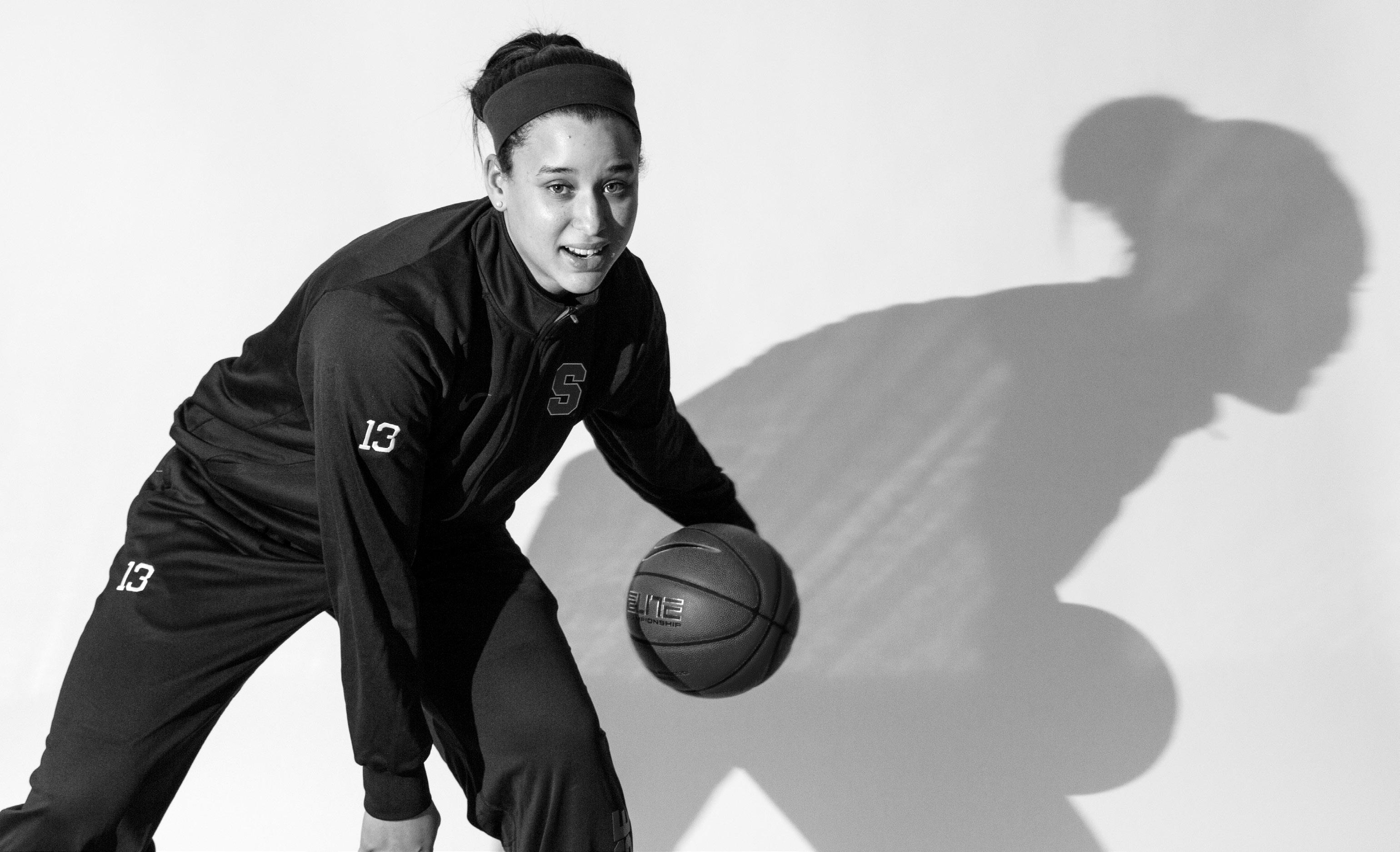
COMING OFF THE COURT AFTER ANY GIVEN GAME, Brianna Butler doesn’t know how many shots she took. She doesn’t know how many baskets she made either — even after several record-setting performances.
What she does know, though, is her number of misses. Each one seared into the back of her mind creating a running tally. Each one a blemish that she feels she has to make up for by creating a turnover or grabbing the next rebound.
“It’s always frustrating,” Butler said. “I’m kind of a perfectionist so when I don’t see the ball in the net I kind of get bummed out.”
Three-hundred-fifty times last season, Butler had something to remember. Her 30 and 28.2 percent shooting percentages from the floor and 3-point land, respectively, were the worst in her career. They overshadowed a season in which she reached 1,000 points and broke SU’s all-time record for three pointers.
With Brittney Sykes out for the majority of the year, Butler had to the shoulder much of the scoring load. Opponents adapted to her breakout season a year earlier, chasing her off the 3-point line with multiple defenders.
Heading into her senior season, Butler says she’s
ready to shed the struggles for last year and solidify her legacy as what head coach Quentin Hillsman calls the “best shooter” in Syracuse history.
“She’s going to shoot 300 3s this year,” Hillsman said. “She’s going to make over 100 3s this year. That’s just what she does.”
At William Penn Charter (Pennsylvania) School, Butler focused on repetition and perfected her jump shot so that there was little variation in her shooting off the dribble or on a step back 3-pointer, former Penn Charter head coach Diana Caramanico said.
A silent assassin, as Caramanico describes her, Butler would brandish a slight twinkle in her eye with each big shot made.
The 5-foot-11 guard started all 32 games her freshman season at SU, but it was the next year that she came into her own. Two hundred ninety-two threes rained down from Butler’s hands.
Brianna Butler is coming off the worst shooting season of her career. In 2013-14, she broke out, hitting 100 3-pointers and 34.4 percent of her 3-point attempts. She’s worked to better her shooting numbers for this season.
One hundred of them went in — eclipsing the previous single season school record by nearly 30.
But the notoriety came at a cost. After the standout season, defenders covered Butler tighter around the 3-point line for her junior year. Instead of one defender, it was two, or sometimes three running at her with their hands in the air, yelling “shooter.”
The previous year’s leading scorer, Sykes, wasn’t there to draw attention away from Butler and the pressure led to more misses than anyone on the team.
Assistant coach Vonn Read looked at plays run for legendary NBA shooters Ray Allen and Reggie Miller to draw inspiration from to get Butler open. But 35 minutes on the floor each game, many of them spent running around screens, was taxing.
“I wasn’t really satisfied with how I finished the year,” Butler said. “I didn’t think I did poorly
32.6 %
but I didn’t think I did the best of my capability.” For the first time in her career, Butler spent this summer in Syracuse, in part, to work in the gym and weight room. She focused on conditioning, being able to shoot when she’s tired and shooting with defenders in her face. At home, gym time is hard to come by, her mother said. Already, in practice, forward Taylor Ford has noticed a quicker release on Butler’s shots. Ford will think she has Butler guarded, but then she’ll shoot before Ford even realizes she’s open.
This year’s squad has more depth, Hillsman said, which will allow Butler more time on the bench to rest her legs, allowing for her to make 10-12 more 3s.
If not, her conditioning has gone from “pretty good” to the next level, Read said.
“(She’s) saying, ‘You know what? You can work me all day, but just like a Ray Allen or a Reggie Miller, we’re going to be in the type of shape that we need to be in to be able to make shots,’” Read said.
Read said he thinks Butler will be an All-Atlantic Coast Conference player. She has a shot at cracking the top 10 in all-time scoring for SU and taking the crown for 3s made in a career, regardless if she even knows how many she’s made.
“You come in here as a shooter and you leave as the best shooter,” Hillsman said. “There’s not getting better than that.”
jrmettus@syr.edu | @jmettus
Butler’s career shooting percentage at SU
3-point attempts Butler has made in her Orange career
31.0 %
3
1