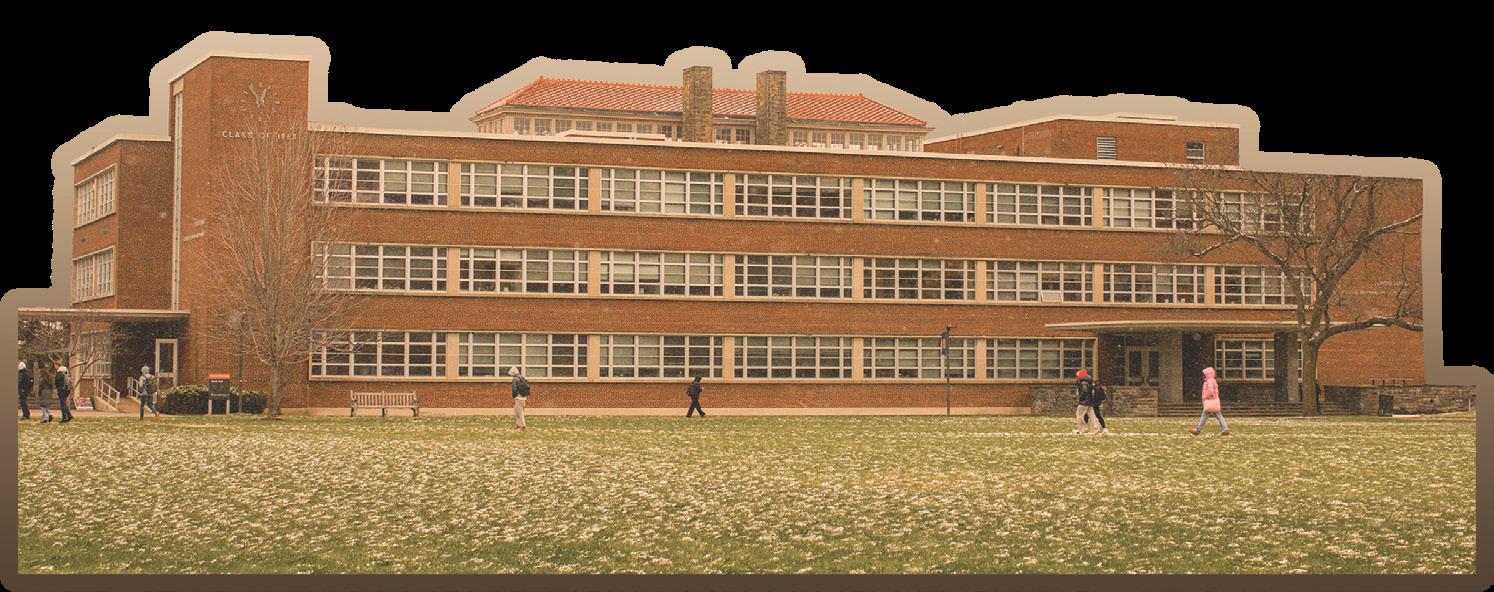
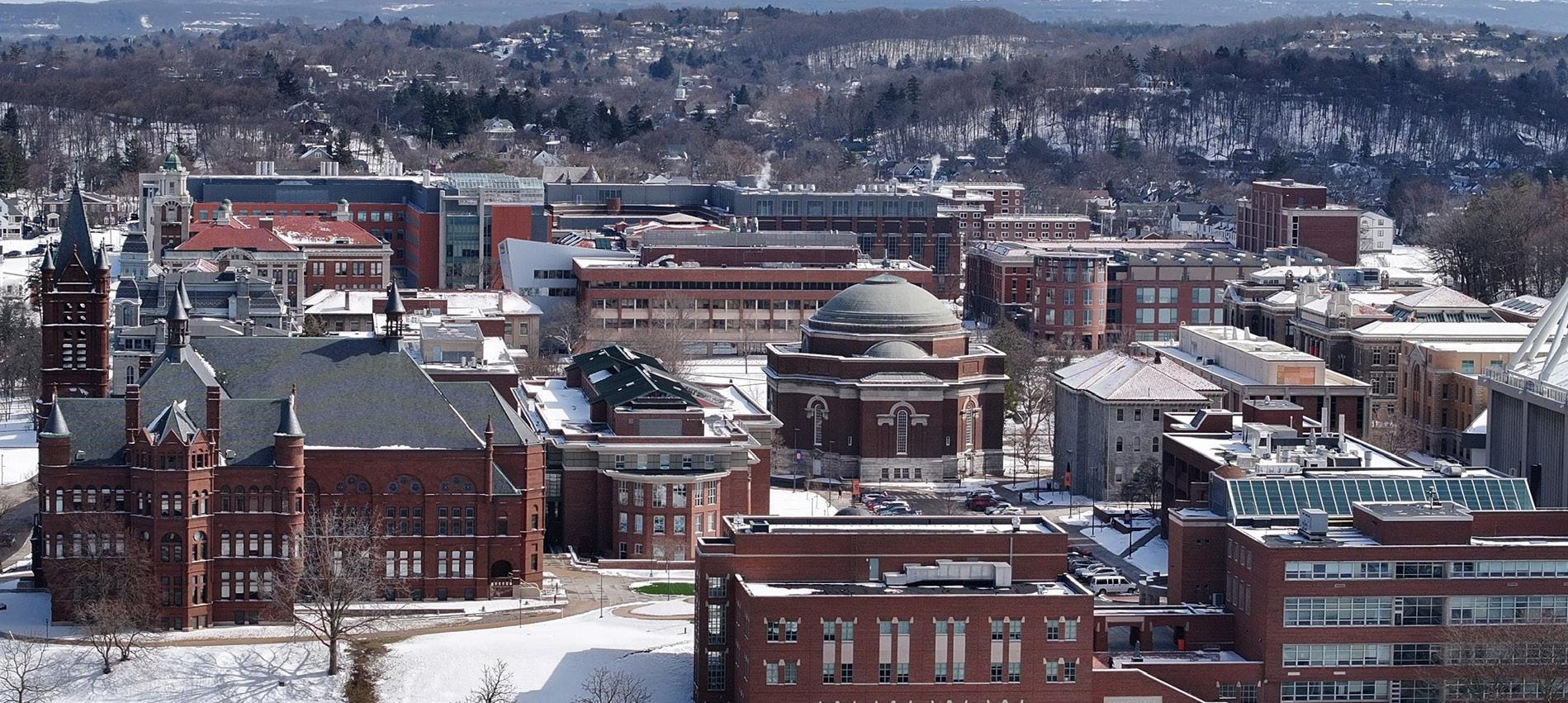
SU fails to recognize the contribution of the classical world by “sunsetting” its classical civilizations program, our columnist writes.
12
C • Double life
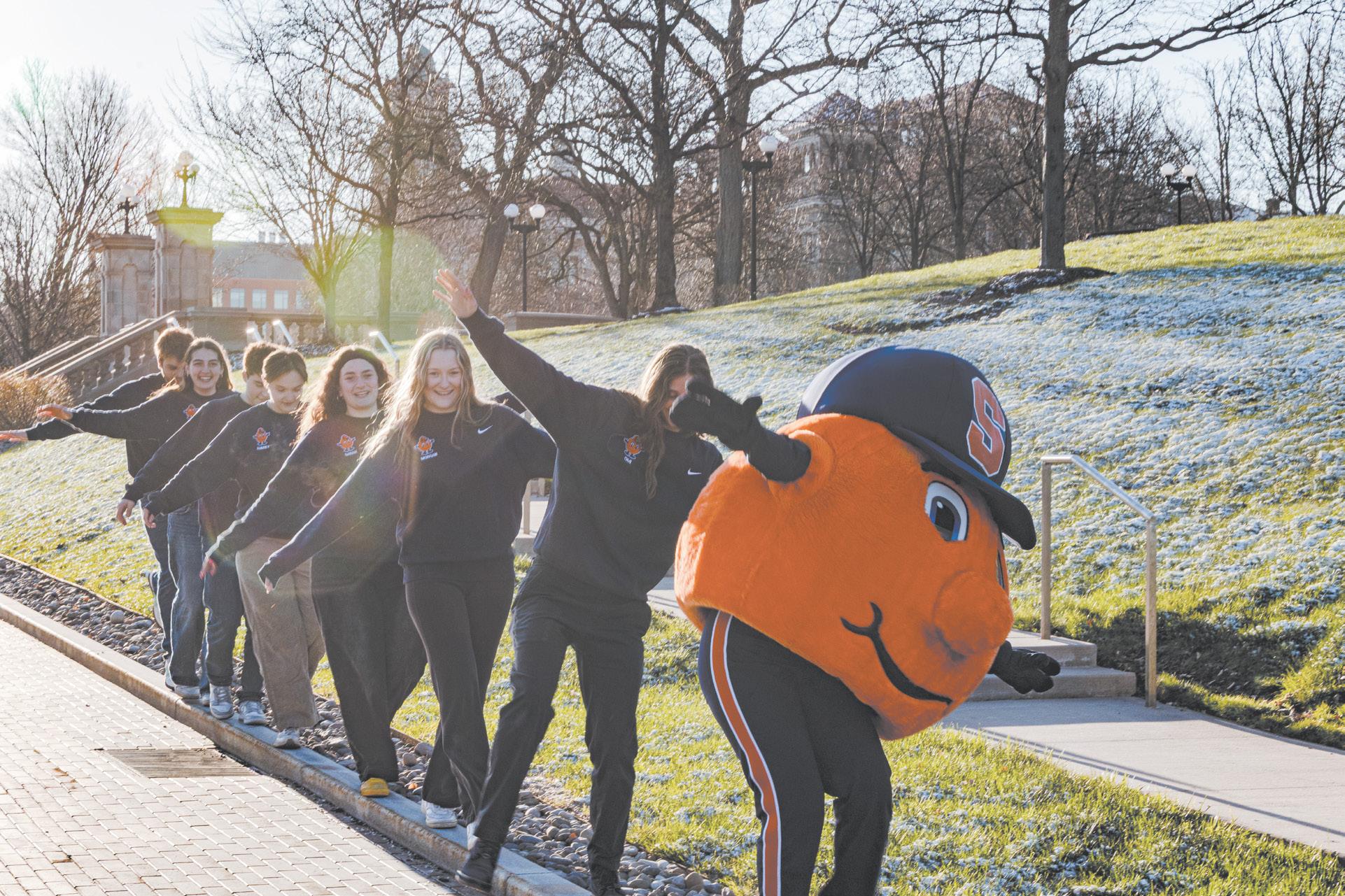
Every March 24, senior Otto the Oranges get to unveil their longtime secret on National Orange Day.
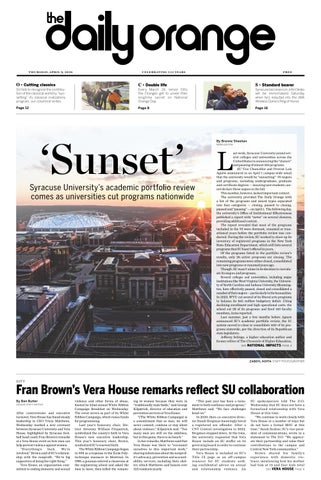
‘Sunset’
Syracuse University’s academic portfolio review comes as universities cut programs nationwide
S • Standard bearer
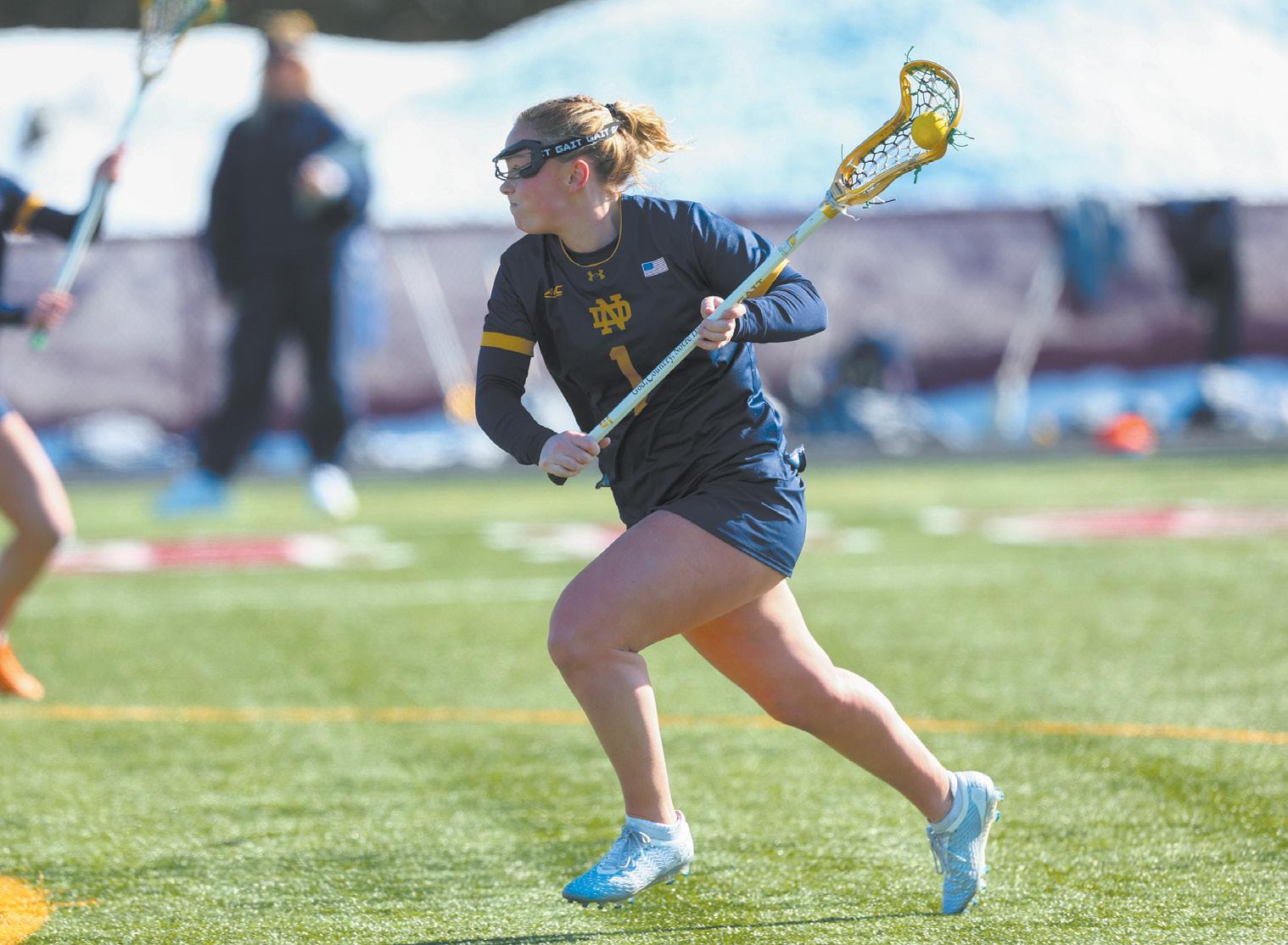
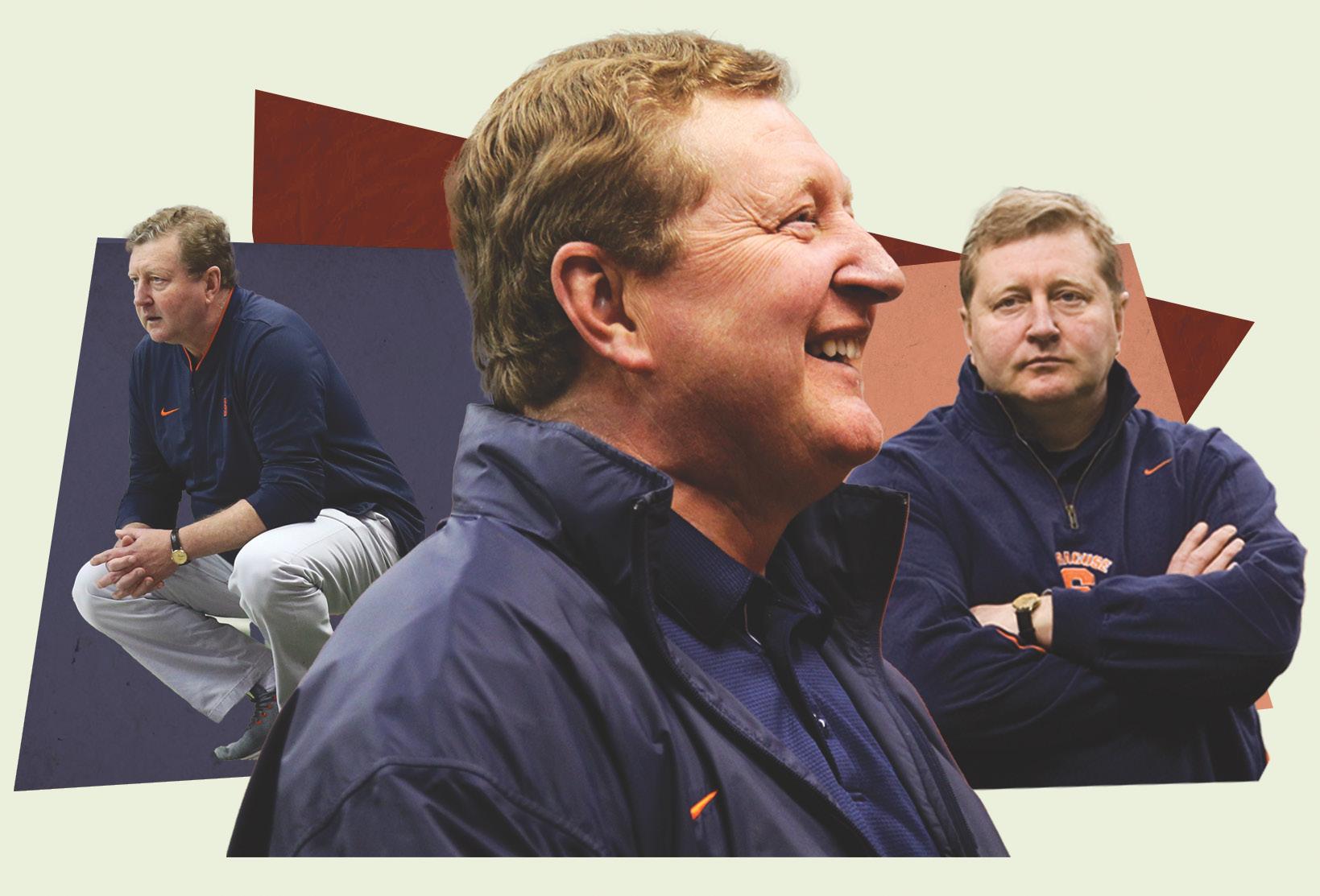
Syracuse lacrosse icon John Desko will be immortalized Saturday when he’s inducted into the JMA Wireless Dome’s Ring of Honor.
Page 16
By Brenne Sheehan news editor
Last week, Syracuse University joined several colleges and universities across the United States in announcing the “closure” and pausing of almost 100 programs.
SU Vice Chancellor and Provost Lois Agnew announced in an April 1 campus-wide email that the university would be “sunsetting” 93 majors and programs, including undergraduate, graduate and certificate degrees — meaning new students cannot declare these majors in the fall.
This number, however, lacked important context.
The university provided The Daily Orange with a list of the programs and award types separated into four categories — closing, paused to closing, paused and “pausing” — on April 1. The following day, the university’s Office of Institutional Effectiveness published a report with “notes” on several closures, providing additional context.
The report revealed that most of the programs included in the 93 were dormant, renamed or transitioned years before the portfolio review was conducted. During the review, SU worked to clean up its inventory of registered programs in the New York State Education Department, which still lists several programs that SU hasn’t offered in years.
Of the programs listed in the portfolio review’s results, only 26 active programs are closing. The remaining programs were either closed, consolidated into new programs or renamed years ago.
Though, SU wasn’t alone in its decision to reevaluate its majors and programs.
Several colleges and universities, including major institutions like West Virginia University, the University of North Carolina and Indiana University Bloomington, have effectively paused, closed and consolidated a number of their majors — particularly in the humanities. In 2023, WVU cut several of its liberal arts programs to balance its $45 million budgetary deficit. Citing declining enrollment and high operational costs, the school cut 28 of its programs and fired 140 faculty members, Axios reported.
Last summer, just a few months before Agnew announced SU’s academic portfolio review, the IU system moved to close or consolidate 400 of its programs statewide, per the direction of its Republican state legislators.
Jefferey Selingo, a higher education author and former editor of The Chronicle of Higher Education,
see national impacts page 4
Fran Brown’s Vera House remarks reflect SU collaboration
By Ben Butler senior staff writer
After controversies and executive turnover, Vera House has found steady leadership in CEO Tricia Matthews. Wednesday marked a new covenant between Syracuse University and Vera House, highlighted by Syracuse football head coach Fran Brown’s remarks at a Vera House event on how men can help prevent violence against women.
“Everything’s back. We’re involved,” Brown said of SU’s relationship with the nonprofit. “We’re big supporters of doing the right thing.”
Vera House, an organization committed to ending domestic and sexual
violence and other forms of abuse, hosted its 32nd annual White Ribbon Campaign Breakfast on Wednesday. The event serves as part of its White Ribbon Campaign, which raises funds for programming.
Last year’s honorary chair, District Attorney William Fitzpatrick, symbolized the county’s faith in Vera House’s new executive leadership.
This year’s honorary chair, Brown, symbolized SU’s renewed faith.
The White Ribbon Campaign began in 1991 as a response to the École Polytechnique massacre in Montreal. In 1989, a gunman entered a classroom at the engineering school and asked the men to leave, then killed the remain-
ing 14 women because they were in “traditionally male fields,” said George Kilpatrick, director of education and prevention services at Vera House.
“(The White Ribbon Campaign) is a commitment that as men, we will never commit, condone or stay silent about violence,” Kilpatrick said. “Too many men are still on the sidelines, but in this game, there is no bench.”
In her remarks, Matthews said that Vera House was there to “recommit ourselves to this important work,” sharing milestones about the nonprofit’s advocacy, prevention and accountability services, including their shelter, which Matthews said houses over 325 residents yearly.
“This past year has been a testament to both resilience and progress,” Matthews said. “We face challenges head-on.”
In 2020, then-co-executive director Randi Bregman knowingly hired a registered sex offender. After a CNY Central investigation in 2022, Bregman stepped down. At the time, the university requested that Vera House include an SU staffer on its governing board in order to continue their partnership.
Vera House is included on SU’s Title IX page as an off-campus resource for SU students seeking confidential advice on sexual and relationship violence. An
SU spokesperson told The D.O. Wednesday that SU does not have a formalized relationship with Vera House at this time.
“We continue to work closely with Vera House in a number of ways but do not have a formal MOU at this time,” Sarah Scalese, SU’s vice president of communications, wrote in a statement to The D.O. “We appreciate their partnership and value their contributions to the campus and Central New York communities.” Brown shared his family’s experience with domestic violence, mentioning how his mother had him at 13 and four kids total
zabdyl koffa staff photographer
Editor@dailyorange.com
News@dailyorange.com
Opinion@dailyorange.com
Culture@dailyorange.com
Sports@dailyorange.com
Digital@dailyorange.com
Design@dailyorange.com
Photo@dailyorange.com
BUSINESS 315-443-2315
how to join us
The Daily Orange is an independent, nonprofit newspaper published in Syracuse, New York. The editorial content of the paper — which started in 1903 and went independent in 1971 — is entirely run by Syracuse University students.
The D.O., a 501(c)(3) nonprofit, is editorially and financially independent from SU, and the paper receives no funding from the university. Instead, The D.O. relies on advertising revenue and donations to sustain operations.
This spring, the paper will be published Thursday when SU classes are in session. The D.O.’s online coverage is 24/7, including while SU is on break.
To show your support to The D.O.’s independent journalism, please visit dailyorange.com/donate. Donations are tax deductible.
If you are a Syracuse University or SUNY-ESF student interested in contributing to The D.O. on either its advertising or editorial teams, please email editor@dailyorange.com.
corrections policy
The D.O. strives to be as accurate in our reporting as possible. Please email editor@dailyorange.com to report a correction.
letter to the editor policy
The D.O. prides itself as an outlet for community discussion. To learn more about our submission guidelines, please email opinion@dailyorange.com with your full name and affiliation within the Syracuse community. Please note letters should not include any personal information pertaining to other people unless it is relevant to the topic at hand. All letters will be edited for style and grammar.
The forecast for this upcoming week, per The Weather Channel.
4/9
april
april 11
april 4
april 11
Faculty warn of shared governance’s ‘erosion’ after ‘sunsets’
By Kate Jackson and Samantha Olander the daily orange
Syracuse University philosophy professor Robert Van Gulick said he’s spent 42 years watching shared governance between faculty and the administration decline. When the university announced it would “sunset” nine undergraduate majors without a faculty vote, he said it was the latest step in a pattern he’s observed for decades.
“It’s definitely shrunk, and administrations have become less and less believers in faculty governance,” Van Gulick said. «It’s sort of a gradual erosion.”
As the university closes and restructures programs following its academic portfolio review, some faculty members say they’ve been removed from any formal role in the decisionmaking process.
On April 1, SU announced it would ‘sunset’ 93 programs, the final outcome of a university-wide academic portfolio review. The review, launched by SU Vice Chancellor and Provost Lois Agnew in August 2025, directed deans to evaluate programs based on enrollment, resources and long-term viability.
But many of those 93 programs were already closed, inactive or restructured before the review concluded — with some remaining in SU’s state inventory despite being long dormant. Of the 93, 55 had zero enrolled students.
As part of the review, 18 College of Arts and Sciences majors were paused in September, and departments were asked to submit stabilization plans for the majors by mid-December. Associate deans followed with recommendations for “lowdeclared” majors, and Agnew later extended the deadline for deans to submit their final recommendations to Jan 23.
Faculty across Arts and Sciences, the Maxwell School of Citizenship and Public Affairs and the College of Visual and Performing Arts said the process has revived longstanding concerns over shared governance at the university.
“Shared governance was central to this process,” an SU spokesperson wrote in a statement to The D.O. “The university conducted a campuswide survey, held extensive meetings with faculty across schools and colleges, and maintained ongoing dialogue with faculty throughout.”
At a Feb. 6 “special meeting” called in reaction to the portfolio review, Van Gulick said Arts and Sciences and Maxwell faculty voted 185-51 in favor of a resolution stating that eliminating
any program in the respective schools requires approval through the colleges’ curriculum committee and faculty body.
The resolution, according to its text, was intended to “reaffirm” existing governance practices rather than establish new ones. SU’s bylaws state that faculty, “subject to approval of the Senate and the Board,” hold jurisdiction over their college’s education program, including curriculum and instruction.
“If you need faculty approval to create a major, if you need faculty approval to change a major, why don’t you need faculty approval to eliminate a major?” Van Gulick said.
The spokesperson wrote that program closure decisions are not subject to a faculty vote because they affect the entire institution and require a full “financial and institutional picture” that no single school or college faculty body possesses.
Under the bylaws of the University Senate, the Committee on Curriculum and Instruction is tasked with considering “all requests for curriculum and course changes” and making recommendations on “curricular matters affecting the University as a whole.”
Two days before the March 20 email, humanities professor Harvey Teres addressed the resolution directly at a USen meeting and
asked whether administrators intended to submit program closure decisions to the Arts & SciencesMaxwell curriculum committee for approval.
Agnew said they would not.
“It is not part of the regular process for faculty to vote on program closures,” Agnew told senators.
Crystal Bartolovich, an English professor, senator for the Agenda Committee and president of SU’s American Association of University Professors chapter, said the administration’s defense missed an “important distinction.” Programs have been closed without going to the curriculum committee before, she said, but those decisions were historically initiated by faculty within departments.
“There is a massive difference between faculty in their own departments determining that programs are no longer viable — which has been the usual way program closure has been initiated in the past — and such closure decisions being made solely by administrators,” Bartolovich wrote in a statement to The D.O. “No administrator or even group of administrators can possibly have the knowledge of the faculty as a collective body.”
Concerns of shared governance extend beyond Arts and Sciences.
Kathleen Roland-Silverstein, chair of the voice pedagogy program at the Setnor School of Music in the College of Visual and Performing Arts — whose program is also closing following the review — claimed faculty governance in the process was “really minimal.”
She and her colleagues submitted proposals on how to revise and grow their program after it was placed on pause in September, she said, but did not believe those suggestions were taken into account.
“We were assured that pause did not mean cut … pause meant paused,” Roland-Silverstein said. “And that program could be paused, and then brought back. But it hasn’t been as clear or straightforward as we would’ve hoped.”
Van Gulick pointed to the 2002 closure of SU’s College of Nursing as the closest comparison, when then-Provost Deborah Freund brought the decision to USen as a formal resolution, requiring a vote before it could advance to the chancellor and the Board of Trustees. The senate voted 73-68 to approve the College of Nursing’s closure. At the time, SU’s administration felt the need to put it to a vote, Van Gulick said. Now, they don’t even put it to a “consultation,” he said.
Jean Jonassaint, French and Francophone studies graduate advisor, said he’s seen the level of faculty involvement in decisions decrease over the last 15 years, citing the appointment of new chancellors, provosts and deans. He said he stopped attending faculty meetings because he didn’t feel his opinion was being heard.
“It’s not transparent, because you are not part of the conversation,” Jonassaint said. “They will never listen to you. I’m not happy with this administration, and unfortunately, I’m stuck here.” Gareth Fisher, chair of SU’s Department of Religion — one of three Arts and Sciences majors slated to be “re-envisioned” — said his program’s experience differed.
The department had already begun restructuring its major before the pause was announced, he said. It was able to demonstrate engagement and a plan for growth, which he said the administration recognized.
Fisher said the department’s faculty input was adequately reflected in the final decision. He added that while faculty governance remains essential, he understands the challenges administrators face in making swift institutional decisions.
“I think there are ways that the administration can think about including faculty governance more in these kinds of
National challenges await Haynie’s ‘impossibly difficult’ role
By Brenne Sheehan news editor
Chancellor-elect Mike Haynie made it clear he knew what he was stepping into as the university’s next leader during a press conference on the day Syracuse University announced his appointment.
“There was an article in The Atlantic six, eight months ago talking about college and university presidencies. I think the first paragraph of that article described this job as a form of ‘self-harm,’” Haynie said. “There’s a lot to think about.”
But the chancellor-elect, with a decadeslong tenure at SU, maintains he’s up for the challenges ahead.
“I would be a hypocrite on one hand, to have put roots down and invested in this university the way I have over 20 years, to then to say, ‘Oh, this job is going to be hard,’” he said. “Not for me.”
Haynie will enter his new position at a time when the federal government, under the direction of President Donald Trump, has cracked down on several aspects of higher education, amid greater cultural strides away from the value of a college education.
From federal directives discouraging language about diversity, equity, inclusion and accessibility to a nationwide movement in dismantling college humanities programs, it’s clear that Haynie’s rise to power comes at an uncertain time for universities.
The new chancellor will also inherit several intra-university controversies from within the last year of Chancellor Kent Syverud’s tenure: the removal of DEIA language in SU’s newly stylized Idea courses, conversations surrounding “shared governance” and the restructuring, combining and “sunsetting” of several majors and programs in the academic portfolio review.
At a March 30 Student Government Association meeting, Haynie told attendees higher education faces “political attacks,” as well as broader
critiques of the “values” of higher education and the demographic cliff.
SU isn’t alone in its challenges. Calvin Jillson, a Southern Methodist University professor with expertise on national and state-level higher education policies, says institutions across the country are facing declining enrollment, cuts to federal research funding and a loss of international students due to federal policy changes and cultural shifts.
In May 2025, Syverud issued a campus-wide statement expressing concerns over federal policy changes, warning that SU “risks its place” as a higher education institution if drastic federal funding cuts are made to the university.
“In recent weeks, I’ve heard from many people, on campus and beyond, concerned about federal policy changes that have significantly impacted colleges and universities, and ones that may be forthcoming,” Syverud wrote in the May 2025 statement. “The reality is that higher education institutions, including those here in Central New York, face tremendous uncertainty.”
Jillson said universities across the country face two “dominant frameworks” when addressing the political shift in higher education: give up or fight back. Institutions like the University of Texas have already formally agreed to enter federal compacts, promising they’ll eliminate DEIA language. Others, like Columbia University and Harvard University, have pushed back.
Haynie’s primary focus should be on earning the trust of university faculty, Jillson said, a sentiment the chancellor-elect has shared since his appointment. While being the executive dean of the Whitman School of Management markets Haynie as a sustainable financial head, Jillson said it’s important to value the university’s humanities program as a research institution.
“When you are a new chancellor coming out of schools of business, entrepreneurship and innovation the way he is, oftentimes, you
don’t have an immediate feel for the humanities and social sciences, which are a large part of a research institution like Syracuse,” Jillson said.
“So, the question is whether the language of innovation and entrepreneurship, and building a new university for the 21st century, is going to strike the sort of standard academics in the mainline department as a promising future.”
Haynie made it a point to prioritize academics in his first remarks as chancellor-elect. At his appointment, he outlined commitments to academics, solidifying SU’s role in central New York’s economy and “reinvention.” As Haynie closed, he cited the university’s mantra of “Academic Excellence” as a key factor in SU’s success.
“As a moral obligation in the face of all the change and all the uncertainty that higher education must confront, I am convinced that Academic Excellence is the engine that will sustain everything that we value about this institution today and also fuel everything that we aspire to
achieve into the future,” Haynie told an audience at the National Veterans Resource Center.
John Torrens, an entrepreneurship professor at Whitman, who said he was brought to SU by Haynie himself, describes the chancellor-elect as someone who is “very competitive” and aims to “put Syracuse front and center” in academics, athletics and entrepreneurship.
“He’s an academic at heart,” Torrens said. “He loves research. He’s good at it. He knows that side of the university’s business model. I don’t think that’s gonna be a head scratcher for him at all.”
Crystal Bartolovich, a professor at SU’s College of Arts and Sciences and president of SU’s chapter of the American Association of University Professors, said she has hope for the new chancellor’s leadership, particularly because of the time he’s spent as a member of the university’s faculty.
“Given the almost impossibly difficult role being a chancellor of a university, any university,
abigail aggarwala design editor
said colleges and universities are restructuring their academic programs at an accelerated rate — something he said they should be doing every year.
As colleges face declining enrollment — particularly from international students — federal funding challenges and a broader trend questioning the value of higher education, it’s essential for institutions to consider how to best fiscally maintain their academic programs, Selingo said.
“It’s much like your closet, right where you just keep buying things, and you never really go through them to decide what to keep and what not to keep,” Selingo said. “That’s what’s finally happening now.”
The University of Chicago, a private institution like SU, also scaled back several of its Ph.D. and master’s programs in the humanities, alongside other major institutions like Boston University and the University of Pennsylvania.
Experts and some SU leaders alike said the academic portfolio review is “necessary” for SU’s longevity.
Robert Kelchen, a professor of educational leadership at the University of Tennessee, Knoxville, said colleges and universities are facing unprecedented financial challenges that have sparked this national movement.
“For decades, universities have tried to grow their way out of financial and enrollment challenges, and the landscape has changed where that’s much more difficult to do,” Kelchen said. “Now, more universities are looking at cuts to balance their budget.”
In her April 1 email announcing the portfolio review, Agnew reaffirmed that the academic portfolio review is “not a cost-cutting exercise.”
As of now, no positions have been “identified for closure,” and all students in each program will finish their degree, she wrote.
Selingo said SU’s transparency and public relations during the portfolio review process are
notable, whereas many universities plan to cut and consolidate programs in a “very quiet way.”
“What ends up happening is that some colleges and universities do this in a very public way, or they do it in a very quiet way because they don’t want people to think, ‘Oh, we’re closing programs because we’re in trouble,’” Selingo said. “They’re really just closing programs because enrollment is low in those programs, and they probably should have closed them years ago.”
Kelly Chandler-Olcott, dean of SU’s School of Education, said the campus-wide academic portfolio review comes years after the home college started its own reassessment of programs. The School of Education designed several of its novel inclusive adolescence and childhood teacher education programs in 2024, and designed a new consolidated Ph.D. in education in 2023.
“Part of our redesign and then our strategic plan involved being really intentional about examining our portfolio, long before
the central administration talked about that,” Chandler-Olcott said. “We’re glad everyone else is catching up.”
The portfolio review and other institutions’ reassessments “may” be a sign of institutional struggle, Kelchen said. But, echoing Selingo, Kelchen affirms that a reassessment of programs should be an annual practice and likely will be in the coming years.
Closing programs likely won’t generate revenue for several years during the phaseout process, Kelchen added — so, if an institution is in immediate distress, programmatic closures won’t help.
“It could be a sign of struggling, but it can also be a good strategic decision if you’re spending money that’s getting a relatively low return,” Kelchen said. “You can reallocate that money to areas where you can get a higher return on your investment and serve more students.”
brennesheehan@dailyorange.com
SU’s portfolio review elicits response from faculty and students
A&S faculty, students react as SU ‘sunsets’ 9 majors
By Samantha Olander and Kate Jackson
the daily orange
When Alexandra Brownstein chose to major in Middle Eastern studies at Syracuse University, she expected the program would still exist for students who came after her. Now, finishing her final semester, she’s among the last who will be able to declare it.
“When I leave this university and graduate in May, and when people ask, ‘What did you study? Or, for future generations, when my kids ask, ‘What did I study?’” Brownstein said. “That that’s not going to be an option for them … is just highly disappointing.”
Brownstein is one of several students, faculty and alumni affected by the outcomes of SU’s College of Arts and Sciences academic portfolio
Setnor students, faculty ponder future after VPA review
By Laura Lemgruber and Arabella Klonowski the daily orange
Syria Jarvis-Herbert, a sound recording technology major at Syracuse University, has surrounded herself with music since she was five years old — learning concert piano, then viola, eventually diving into the world of composition.
During her college search, Jarvis-Herbert discovered SU’s sound recording technology major — a program she felt offered an opportunity to work in the music industry beyond the realm of performance.
feels disheartened and frustrated to hear about the consolidation of the major she’s grown to love following a university-wide portfolio review.
grams as a result of the review. Within the College of Visual and Performing Arts, 13 undergraduate majors were included in the review’s results. Across VPA’s seven schools, the Setnor School of Music and the School of Art saw the most majors included in the review’s results.
majors, including ceramics, painting and illustra tion, were listed in the portfolio review results, but were integrated into a studio arts degree struc ture over a decade ago.
‘Sunsetting’ seems to be the word of the academic year here at SU. It refers to the closing of programs without saying so and it covers up much wider and deeper losses.
Karina Von Tippelskirch german program coordinator
review, ordered by Vice Chancellor and Provost Lois Agnew in August 2025. As part of the review, 18 Arts and Sciences majors were paused in September, removing them from the Common Application while departments submitted stabilization plans.
The nearly eight-month-long process left many in affected programs «uncertain» and raised concerns about the metrics behind the decisions, the transparency of the review and the future of humanities at SU.
In a March 20 email to department chairs obtained by The Daily Orange, Dean Behzad
The individual programs’ inclusion prompted the School of Art to issue a statement on its Instagram page, affirming its programs remain “fully supported” in the school’s studio arts programs.
But at Setnor, the decision to consolidate several music majors into other programs has left some worried about a negative impact on future students.
In an April 2 report by SU’s Office of Institutional Effectiveness, the university said it aims to create “flexible pathways” for students with majors being incorporated into broader programs, like the music bachelor of science.
Kathleen Roland-Silverstein — the coordinator of VPA’s voice pedagogy program, which closed for future students following the academic portfolio review — said she felt confused following university communications about the major. Initially told that the voice pedagogy
Mortazavi announced that nine majors would be closed to incoming students, including: classical civilization, classics (Greek and Latin), digital humanities, fine arts, German, Latino-Latin American studies, Middle Eastern studies, modern Jewish studies and Russian.
Three majors — African American studies, religion and music, history and cultures — will be “re-envisioned,” and five others will merge, consolidate or rebrand. Courses in sunsetted majors will continue through “minors, general education and/or interdisciplinary programs,” Mortazavi wrote. Students currently enrolled
sure what paused meant actually,” RolandSilverstein said. “And I think many of us were really working hard to see that the pause didn’t mean that.”
Following the announcement of the program’s closure, Roland-Silverstein said she wished there was more transparency since the process began last year. She added she would have liked to see “much greater” faculty governance during the process, something she said many other professors agree on.
Although Roland-Silverstein said she loves her program and is sad to hear about its closure, she said that the program’s cut, along with others in the school of music, shed light on the larger effects of SU’s portfolio review as a whole.
“I think faculty and students are distressed and trying to cope with all of it,” Roland-Silverstein said. “We’re unfortunately going to lose people. We’re going to lose not only programs, but faculty, staff, students. It’s regrettable.”
The sound recording technology major is set to close and become integrated into the music B.S. following the university’s portfolio review, according to the OIE report. Although JarvisHerbert said she knows her major is small, she feels the program’s content fits best with a more
“I feel like people don’t understand, so they just look at the numbers and they’re like, ‘Okay, they don’t have enough, let’s cut them,’” Jarvis-
Sound recording technology senior Benny Tuong said she thinks the new program may provide a better experience for prospective students
“Music and business definitely go hand in hand as an industry in general,” Tuong said.
“So baking that into your education would give a good insight to possibly what the real For Tuong, the opportunity to learn about business and other industries outside of sound technology is what drove her to choose SU. She said she thinks the new curriculum can help expand the range of study topics. However, Tuong acknowledged that many of her peers who chose SU for their majors’ focus on sound technology may feel differently.
will be able to complete their degrees.
The nine Arts and Sciences majors are among several SU announced on April 1 that would sunset university-wide. Of the listed majors and programs, 55 had zero enrolled students and many were already closed, inactive or restructured before the review concluded.
For several faculty and students, the word “sunsetting” itself became a point of contention. Karina von Tippelskirch, coordinator of SU’s nowsunsetted German major, said the language used by the university to describe the closures didn’t encompass the full impact of the portfolio review.
“‘Sunsetting’ seems to be the word of the academic year here at SU,” von Tippelskirch wrote in a statement to The D.O. “It refers to the closing of programs without saying so and it covers up much wider and deeper losses.”
Lucy Lee-Moore, a junior classics and anthropology major, said the language shift from “pausing” to “sunsetting” felt deliberately “secretive,” noting a lack of clear communication from the university.
When meeting with administrators to discuss the SRT program’s closure a couple of months before the portfolio review’s release, Jarvis-Herbert said students were told to “not worry” about the changes since current students will be able to finish their degrees.
But, Jarvis-Herbert said she’s concerned future students will be unable to have the same opportunities.
“We all know how valuable our program is, and I have learned so, so much within my three years here,” Jarvis-Herbert said. “It’s so disheartening that people are going to lose that knowledge, and people who have (an) interest in audio engineering won’t get that opportunity anymore at Syracuse.”
After she found out about the alterations to her major, Jarvis-Herbert said she’s felt a lack of communication from university administration, leaving her confused by the changes.
Amaya Corrinne, a violin performance junior in VPA, said she worries the changes may leave students less prepared post-graduation and harm the program’s reputation.
“My concern is that it’s going to severely diminish the reputation of the music school,” she said. “Because it won’t be considered the same level of education that is expected of someone who wants a career as a professional musician.”
Although Corrinne said she doesn’t know exactly what the new program will look like, she’s worried that a “less rigorous” program may exclude classes she views as essential for students hoping to become professional musicians. Corrinne said she is also worried that the portfolio review reflects a broader trend in declining support for the arts — and not just at SU.
“I think we’re losing the point in the sense that life is art, art is life,” she said. “It just feels really bleak as to what the future of the world could look like, because we’re also not the only school that’s experiencing this.”
Something Jarvis-Herbert loves most about her program is the community within it, she said, which the university may miss out on following the changes. She said she’s felt immense support from the program’s director, faculty and fellow students during her time at SU.
“I could just text someone and be like, ‘Hey, do you mind showing up really late at night to record saxophone for me?’ and they’ll say yes with a big smile on their face,” Jarvis-Herbert said. “Everyone’s so eager to help everyone, and (that’s) something that I feel like I probably wouldn’t get in any other program.” news@dailyorange.com
A little over a third of programs listed as closing in Syracuse University’s academic portfolio review were certificate programs.
Certificate programs are undergraduate or professional credential degrees designed to be “flexible.” In Syracuse University’s academic portfolio review results, 32 certificate programs were listed as “closed” across all of SU’s schools and colleges.
The only “paused” certificate program is the College of Professional Studies’ full stack development program, which was labeled as “in review for further direction,” according to the review.
The review included several advanced and non-advanced certificate programs, including
Overlap, low demand led SU to close iSchool’s IST major
By Vivian Collins asst. news editor
Almost four years after it was created, Syracuse University’s School of Information studies is closing its Bachelor of Science in innovation, society and technology.
The major was first paused in the fall semester but is now officially closing following its academic portfolio review — one of several across the university — according to the university. The results found innovation, society and technology has “substantial overlap” with the iSchool’s B.S. in information management and technology.
Bruce Kingma, a current SU professor who teaches at the iSchool and the Whitman School of Management, was responsible for adding the IST major to Syracuse in 2020 when he served as the iSchool’s director of undergraduate programs.
Kingma said that when he started working as the programs director, there was an opportunity to increase undergraduate programs and Chancellor Kent Syverud was promoting online majors. In addition to the IST major, Kingma added a B.S. program in Applied Data Analytics and an online B.S. in IMT.
“We did a lot of analysis, an extensive analysis
Previously closed majors included results cause ‘chaos’
By Julia Boehning enterprise editor
When Tula Goenka and other professors in Syracuse University’s Newhouse School of Public Communications saw officials had told media outlets the Television, Radio and Film Master of Arts program — along with two other graduate programs — had closed, they were “shocked.”
The news emerged after SU announced the conclusion of its academic portfolio review, stating in an April 1 campus-wide email that 93 programs were set to “sunset.” But Goenka said the TRF, Advertising and Photography programs weren’t actually closing, instead previously switching to a Master of Science degree of the same name.
“The amount of confusion it has created among current students, among alumni, among new students who are looking to put down their deposit by April 15 … it’s just chaos,” Goenka said.
According to a Thursday report from SU’s Office of Institutional Effectiveness, nearly half of the 93 programs will not see immediate change as a result of the review. Prior to the review, many were either already closed, paused or consolidated, dormant, had no students enrolled or went through name changes and replacement.
But, faculty said this was not immediately clear following SU’s initial list of impacted programs, which was provided to The Daily Orange on Wednesday and included in a Thursday SU News release that is now unavailable online. SU’s move to label “sunsetting” programs as either “closed” or “paused” drew national attention and, in turn, calls from campus members distressed about their programs’ futures.
The university later amended its list of sun-
four at the College of Arts and Sciences, one at the College of Engineering and Computer Science, eight Maxwell School of Citizenship and Public Affairs programs, seven School of Information Sciences programs, six at the College of Professional Studies and seven at the School of Education.
Of the listed certificate programs, 26 had zero students enrolled, according to a list given to The D.O. by the university on April 1. College of Professional Studies Senior Associate Dean Ryan Williams said the online knowledge management certificate program is closed, adding that the other four programs are paused and “have not yet gone away.”
However, the review labeled five out of six College of Professional Studies certificate programs and two graduate programs as “closed,” and all are not listed on the College of Professional Studies’ list of online degrees and certificates.
SU’s School of Education closed seven of its certificate programs, some of which Dean Kelly Chandler-Olcott said were “zombie programs.” The decision to close many of its programs came from already-existing
of similar majors all over the country to see what fit with the iSchool and what students were interested in,” Kingma said.
In response to the IST program closure, Kingma said the university must be “nimble and willing” to close programs that lack sufficient demand.
“If there’s student demand for something, we should be offering it, and if there isn’t student demand for something, we shouldn’t be offering it,” Kingma said “And you don’t get things perfect, right?”
Referencing SU’s claim of overlap between the IST and IMT majors, Kingma agreed that a lot of the coursework is the same, but that the IST major focuses more on social justice, while IMT focuses on “management technology.”
Representatives from the iSchool’s dean’s office declined The Daily Orange’s request for comment. Laurie Ferger, the current iSchool undergraduate programs director, did not immediately respond to The D.O.’s request for comment.
Sophomore and IST major Katha Strenk said she was unaware her program had been closed. She said it makes sense as she always thought there wasn’t a need for both IST and IMT.
“For a while, I thought about switching to IMT, but every time I would look at the coursework, literally, IST and IMT have the exact same coursework,” Strenk said. “It would just be more work for no difference.”
Students currently majoring in IST, and any other “sunset” program, will be able to complete their degree.
setted programs in the OIE report Thursday, providing additional context.
“There’s been some miscommunications,” George Theoharis, a School of Education professor, said. “The list said the inclusive elementary program is closed. I actually got some texts from alumni that day saying, ‘What happened?’ And that’s all not true. That program has been revised and renamed based on state licensure.”
Multiple professors in programs listed — but not slated for closure as a result of the 2025-26 review — told The D.O. that SU’s announcement led to “misinformation” and confusion among their respective communities.
Of the 93 programs, 11 were closed or “retired” prior to the portfolio review. An additional 12 were already dormant or inactive. In Theoharis’ case, alumni asked about the inclusive elementary and special education teacher prep Bachelor of Science program being listed as “closed” in SU’s initial list. The program, which SU later clarified in its report, changed its name to “Inclusive Childhood Education” in 2024.
Similarly, three other programs listed at Newhouse — the advertising M.A., photography M.A. and TRF M.A. — were replaced with an M.S. equivalent between 2018 and 2025, Newhouse Associate Dean for Professional Graduate Programs Carolyn Hedges wrote in a Friday email to faculty.
To address uncertainty that arose following SU’s announcement, some academic departments and programs took to social media to clarify their statuses. On Monday, the College of Visual and Performing Arts’ School of Art clarified in an Instagram post that “their work, resources, and disciplines are not going anywhere.”
Six of the programs listed as “closed” — the jewelry and metalsmithing B.A. and M.A., ceramics B.A., painting B.A., printmaking B.A. and sculpture B.A. — were consolidated into the Studio Art program back in 2014, the school’s Instagram post confirmed.
In SU’s list, VPA is the college with the sec-
“companion” graduate programs that left the certificate programs with no students enrolled, like the advanced study in school counseling program.
>35%
of closed programs in the portfolio review are certificate programs
“There was some thinking that if we have additional pathways, people could get extra certificates, more training,” Chandler-Olcott said. “But really, we only need one program in school counseling, and that’s the master’s.”
Chandler-Olcott said the college’s closed certificate programs were the “smallest” of their programs, with low student enrollment.
“These are almost entirely what we affectionately call ‘zombie programs’ that didn’t have the students, and in most cases, they were a companion to a program that did have students in it,” Chandler-Olcott said.
Williams said College of Professional Studies faculty and student reactions to the review have been “straightforward and efficient.”
“It’s mostly the main campus schools and colleges where there’s confusion,” Williams said. “There really hasn’t been too much confusion here at the College of Professional Studies.”
Williams said that the college’s process for reviewing the future of paused programs is a collaborative effort.
“Our faculty get together, and we decide as a group of faculty what we’re going to do,”
Williams said.
Chandler-Olcott said that the School of Education has been “engaged in significant curriculum review” and reexamining its programs since 2021, and will continue that process through the fall semester. ChandlerOlcott said that the list is incomplete.
“That’s almost entirely what you see on the list, because that is the work that you could see in the time period that the university called portfolio review,” Chandler-Olcott said. “We did a bunch of work before that, and we are in the midst of a bunch of work that’s going to finish after that.”
news@dailyorange.com
Strenk said she found the program to be “more people-focused with a side of business.”
Maddie Casamento, an SU senior and current IST major, said she never expected Syracuse to close her program because the iSchool is “small as it is.” Casamento said she chose to major in IST because it “felt like the only creative major” in the iSchool.
“It is very bittersweet that the program is being closed. I loved my time in the iSchool. Especially as a graduating senior, it is sad to see my major go,” Casamento wrote in a statement to The D.O. “I think with the creator economy opening it makes sense that my major would close.”
Other programs at the iSchool impacted by the portfolio review include an online M.S. in information systems, which is closed due to SU’s “online program restructuring,” according to an April 2 report by SU’s Office of Institutional Effectiveness.
ond-most closed programs, with 17. In reality, 12 of these programs were either closed prior to the review or consolidated.
Another former VPA major listed on the initial list was the piano Bachelor of Music, which Department of Applied Music and Performance Chair José Calvar said has been consolidated under the performance B.Mus. “for as long as (he) can remember.”
The performance major is being reimagined under the music B.S., along with the music composition master of music and music composition B.Mus., according to the OIE report.
“My assumption is that for whatever reason, some step was skipped along the way and they were essentially put into bureaucratic purgatory but not fully erased,” Chris Wildrick, a VPA associate professor and Studio Arts area lead, wrote in an April 1 statement to The D.O. “Their current deletion is just a formality based on our intentional curriculum change from a long time ago.”
Echoing Wildrick, School of Education Dean Kelly Chandler-Olcott said SU’s inclusion of dormant and already closed programs was to reduce “administrative” overhead.
The New York State Department of Education keeps a list of all registered academic programs offered at colleges and universities. ChandlerOlcott said SU may have listed inactive programs to remain compliant with state guidelines. An SU spokesperson confirmed Monday that updating the programs reported to the NYSED was a “parallel administrative task” to the main review.
“It’s really important that we have a clean relationship with New York State, right?” ChandlerOlcott said. “We have to make sure that we’re matching up so that there’s no jeopardy for students.”
The College of Arts and Sciences had the largest number of programs directly impacted by the review, eliminating or consolidating 17 total B.A. and B.S. degree options.
At the College of Engineering and Computer Science, no active programs were cut as a result of the review — despite seven initially being listed as “closed,” Jonathan Hoster, ECS’s asso -
Seven of the iSchool’s advanced certificate programs are closed, six of which have zero students enrolled, according to the report. The information technology management, online and in-person, programs are closing as advanced certificates but “will continue as an extension of the school’s M.S. program.”
Other closing certificate programs include Cloud management and online and in-person data science and information security management.
Kingma said the IST program had only 40-50 students total and was bringing in roughly 10 new students a year, not reaching the enrollment that may have protected it from closure.
“I think some of the faculty were hopeful that a lot of students would be drawn into it,” Kingma said. “But that simply wasn’t the case.” viviancollins@dailyorange.com
ciate director for undergraduate admissions and recruitment, said.
Five programs — the computational journalism M.S., computational science M.S., systems and information science B.S. and M.S., and the systems assurance advanced certificate — had no students enrolled. The other two, the computer engineering C.E. and electrical engineering E.E., were dormant and have a B.S. equivalent.
One ECS associate professor, Ed Bogucz, said he didn’t hear about the reported closures until he read about them in The New York Times.
Similarly, in the Whitman School of Management, Management Department Chair Lynne Vincent said its lone program listed as closed in the portfolio review — the general studies in management B.S. has not been active for years.
Even programs that will change as a result of the review said media coverage of the results led to confusion among students and their families.
The day following last week’s announcement, the Italian program — which is being absorbed into a new world languages and cultures B.A. program — sent out an email to the program calling the “closed” designation “factually and demonstrably” wrong.
In a Monday Instagram post, the American Association for Italian Studies wrote SU’s Italian program was “not being closed, sunsetted, eliminated, etc.,” citing SU Italian Program Coordinator Lauren Surovi.
All students enrolled in the affected programs will be able to complete their degrees, Provost Lois Agnew wrote in her initial April 1 message.
“I just wish in that first round that there had been some explanation of why things were being done, right?” Goenka said. “It’s a lot of minute details, but I think being transparent with your information is the most important thing.”
The Daily Orange news staff contributed reporting to this article.
jmboehni@syr.edu
by the time she was 21. She was a survivor of domestic violence, and Brown said he shouldered a lot of responsibility in his household when he was young. He said she could’ve found better love out there, but often survivors “stay there and sit there because that’s all you know.”
Seeing the abuse his mom went through when he was young was difficult, but it taught him how essential education about self-worth and love is for young women and men.
quick decisions,” Fisher said. “But I also sympathize … it is not really easy to run a large institution like this in a climate that is changing as fast as ours is.”
When the resolution came up a month earlier at the February USen meeting, outgoing Chancellor Kent Syverud acknowledged the faculty vote but said closures cannot be subject to a faculty veto.
“I also believe it’s not the case that no program can be closed if the faculty in that program vote against it,” Syverud said, “Because as a practical matter, that would be quite a problem for the university as a whole and historically hasn’t been how it’s worked.”
At the same meeting, Bartolovich said the faculty’s concern was about the process, not about preserving programs regardless of merit.
“What we are suggesting is that elected faculty bodies … engage in these processes, as we are enjoined to do by the faculty control over the curriculum in the shared governance procedures that have been in place for ages and ages,” Bartolovich told senators. “They’re there
is today, my first response that anyone is willing to do it is awe and gratitude,” Bartolovich wrote in a statement to The Daily Orange. “I’ve also always known Mike Haynie personally to be an extremely hard worker and direct, both of which I appreciate.”
When it comes to the chancellor-elect’s upcoming tenure, faculty shared how they are curious and, in some ways, hopeful for change under Haynie’s leadership.
Margaret Susan Thompson, a Maxwell School of Citizenship and Public Affairs professor and co-chair of the University Senate’s
“The language of sunsetting feels so insidious,” Lee-Moore said. “Okay, you’re canceling our majors, you’re getting rid of them. It’s not a beautiful sunset … If I was applying now, I would never have gone to Syracuse.”
In a previous statement to The D.O., a SU spokesperson said decisions to close programs are not subject to faculty vote within individual colleges or schools because they require a full financial and institutional picture.
“Our approach at Syracuse University is consistent with standard practice across higher education,” the spokesperson said. “Policies vary by institution, but a binding faculty vote on program closures is rare.”
SU’s cuts come as humanities programs face growing pressure nationwide amid a broader crackdown on higher education. Across public and private institutions, departments tied to the humanities and diversity-related fields have been restructured, consolidated or eliminated.
Several faculty also questioned whether the number of declared majors alone could capture the value of what they offered. Classics Chair Jeffrey Carnes said the classics program had seven declared majors across a two-person department — a metric he said the review didn’t fully account for.
Modern Jewish Studies Director Zachary Braiterman concurred, saying he doesn’t believe the university does enough to support the humanities.
“From their perspective, why do you need a major if nobody’s majoring?” Braiterman said. “But, the flip side of it is that the university does nothing to encourage students majoring in the humanities.”
Braiterman and Middle Eastern Studies Director Yael Zeira said they were informed their respective majors were closing in early February — weeks before Mortazavi’s email announcing the nine programs went out. Zeira wrote to affiliated faculty the following day that the dean’s office had decided to “teach out” the program.
“I believe it undermines shared governance and is also quite shortsighted,” Zeira wrote in a
“It’s our job to tell these young ladies, at a young age, how important they are. There’s a young boy who’s seen this violence, this trained behavior. All he understands and knows when things don’t go his way is rage,” Brown said. “Let’s fix this trained behavior. Let’s show them love.”
The breakfast was well attended by local officials, Brown and several Syracuse football players. SU was a platinum sponsor of the breakfast, and Rebecca Shiroff, Vera House’s director of strategic partnerships and intergovernmental affairs, said SU Chancellorelect Mike Haynie has been communicative about partnering with Vera House.
because faculty expertise actually matters to these decisions.”
In October 2025, 81% of senators passed a resolution affirming faculty’s «primary control” over curriculum and calling for a formal USen role in the review. A subcommittee of the curricular committee, discussed at the Feb. 25 USen meeting, is now gathering information from schools and colleges about their procedures for pauses and closures.
The university spokesperson said the AAUP calls for early and meaningful faculty involvement in program closure decisions, “a professional standard (they) met and exceeded,” and that final authority typically rests with administrators.
Jeffery Carnes, a classics professor, said it was clear to him that the university had already made its decision to sunset the classics and classical civilizations majors when the original 18 Arts and Sciences programs were paused. He said because “sunsetting” is a new term, the senate has no established precedent for handling the closure of such programs.
“We’ve never really been a faculty-driven, faculty-run institution,” Carnes said. “There are certain limited things that we do, but I think there’s mostly lip service to shared governance and an
academic affairs committee, said while the chancellor-elect places emphasis on SU’s state of athletics, she’s curious to see the chancellor’s vision for academics.
In the first few days after Haynie’s announcement, Thompson said she and her USen colleagues emailed the chancellor asking for a meeting before he begins his tenure, and he responded the same day.
“I see that as a really good sign that he wants to meet with different constituencies,” Thompson said. “We obviously are going to be asking him some of the same questions about the academic dimension of his vision. So, I think that is a good sign that he didn’t try to put us off.”
statement to The D.O. “At a time when the U.S. is undertaking its largest military operation in over 20 years — again in the Middle East — the University should be expanding opportunities for students to study the region, not cutting them.”
Brownstein, who holds an international relations major with a Middle East and North Africa regional concentration alongside her MES major, said the timing was hard to reconcile with ongoing conflicts in the region.
Some are concerned about what will happen to programs, including minors and individual courses, once faculty retire or contracts aren’t renewed.
Russian coordinator Erika Haber is retiring in December and said SU has not hired a replacement. Without faculty to staff upperlevel classes, Haber said, sustaining a minor isn’t realistic.
“Considering the world today, we desperately need Americans who know not only the Russian language, but the culture and literature as well,” Haber said. “It’s a critical language and a loss to SU if we lose the opportunity to teach it.”
Jean Jonassaint, a French professor and graduate advisor, said he’s watched the languages department shrink since joining the university in 2005. While the French major will continue as a track in the world languages and cultures major, he said he’s concerned it will be similarly phased out in the future.
In an email to The D.O., Jonassaint said that faculty bear some responsibility for the program’s closure, though he largely blamed the administration, which he said “doesn’t think that humanities matter.”
“We lost every single possibility to have our say in this university, completely,” Jonassaint said. “It’s all top down, top down, top down, without transparency, without any discussion.”
Beginning this fall, German and Russian students will be directed toward a new world languages and cultures major. While French and Italian remain standalone concentrations requiring 27 credits, German and Russian will only continue in a combined track where students can take 15 credits of two languages.
Gail Bulman, the chair of SU’s Languages, Literatures and Linguistics (LLL) department,
Shiroff has worked at Vera House since August, jokingly referring to herself as “the master solicitor” in her remarks. She raises money for Vera House’s initiatives, including their 24-hour crisis hotline, prevention training and the White Ribbon Campaign Walk, which is on April 24.
In addition to his role at Vera House, Kilpatrick also runs the 12 Men Model program, which mobilizes men to end misogynistic violence by having each man recruit 11 other men to the program and commit to ending violence against women.
A 12 Men Model member previously pointed out to Kilpatrick that violence against
illusion of it, and occasional real input from the faculty and things like curriculum. But you know, now they’re taking that away from us too.”
Faculty concerns about shared governance extend beyond the portfolio review.
In November 2024, Arts and Sciences Dean Behzad Mortazavi and Maxwell Dean David Van Slyke overrode a faculty vote approving a Liberal Arts Core curriculum revision that included a foreign language requirement, citing financial feasibility.
Over 220 faculty members signed a petition warning the move set a “dangerous precedent.”
In recent USen discussions, faculty also flagged issues with changes to the Renée Crown University Honors Program, revisions to the university’s IDEA curriculum requirement, the appointment of Provost Agnew without senate input and the university’s handling of the Graduate Student Organization, including its deregistration.
Agnew, at the February senate meeting, said recent changes reflect the university’s responsibility to adapt to shifting conditions in higher education, adding that the current moment calls for “seizing opportunities to realize our educational mission in ways that are appropriate to an ever-changing world.”
Bartolovich stressed the importance of prioritizing shared governance — a standard she has upheld — and understands the university’s distinction as an institution rooted in it.
“A university is a union of faculties, of necessity, each responsible for collecting, advancing and disseminating branches of knowledge,” Bartolovich wrote. “Whatever else the university has become, or may become, that is irreducible. I expect Chancellor Haynie to respect that.”
Torrens said Haynie, as Whitman’s executive dean, constantly collaborated with faculty and campus leaders.
“He’s very collaborative,” Torrens said. “I don’t know what his plan is, but I’m sure that he’s going to be a collaborator.”
said the administration rejected her department’s proposal to include German as a main concentration in the world languages and cultures major.
Bulman attributed the decision to low enrollment in higher-level courses and a lack of declared majors, despite attempts from faculty to increase student interest. She said the LLL department has not been allowed to search for new faculty to replace those retiring in “quite a few years,” and expressed concern over the longevity of courses if there’s limited faculty.
“We should be strengthening and supporting the humanities, especially at this time, more than ever,” Bulman said. “It’s very disheartening.”
When asked about plans for hiring new faculty, an SU spokesperson said hiring proposals are submitted annually by deans and are contingent on “enrollment trends, student demand, program direction, and anticipated retirements.”
“Decisions about future faculty lines in any program will reflect the outcomes of the review and the long-term direction of the program,” the spokesperson said in a statement ahead of the review’s release.
Not every program outcome was met with resistance. Art History and Architecture History Chair Wayne Franits welcomed his programs’ consolidation, saying the two are frequently combined at other institutions.
Theo Cateforis, director of undergraduate studies in both fine arts and music history and cultures, said current students will still be able to complete the fine arts major, and that music history and cultures — designated for re-envisioning — will continue its full course offerings under a revised curriculum.
In the mathematics department, geometry professor Steven Diaz said folding statistics into an applied mathematics track was a reasonable response to the department’s difficulty recruiting statisticians, though he raised questions about how voluntary the decision was.
“I got the impression that while, in the end, it was our initiative, the dean made it clear to us that we better come up with something,” Diaz said.
women continues because some men “‘don’t want to be that guy that interrupts the sexist comments, the homophobic comments,’” Kilpatrick recalled.
Kilpatrick said men need to be “that guy” to stand up against violence. Brown said he has 107 players willing to be “extra help” for Vera House. The right people can help break the cycle of violence, Brown said.
“Vulnerability is extremely big. It’s hard for men to get up there and tell each other their love. A lot of them don’t want to cry,” Brown said. “I cry a lot.”
bnbutler@syr.edu
Van Gulick said SU is not alone in facing pressures from declining enrollment, cuts to federal research funding and a drop in international students. The trend, he said, reflects what he considers a nationwide shift toward a “management ethos” where universities are increasingly taking on the outlook of a business operation.
Mark Rupert, a political science professor who retired from SU five years ago, said that shift predates the portfolio review. In an email to The D.O., he cited what he called “the pervasive tendency” to view the university as a “business and students as customers” as one of the developments that ultimately contributed to his decision to retire from the faculty.
“I regret the diminished role of faculty in what we used to refer to as a system of ‘shared governance’ on campus,” Rupert wrote.
For faculty who have spent decades at SU, Van Gulick said, the change is more difficult to accept.
“Most of us have been here at least 20 years, and some of us much longer,” Van Gulick said. “And that’s why it bothers us, because we say this isn’t the way it has to be, because this isn’t the way it was.”
news@dailyorange.com
But Jillson, who has watched state legislation effectively eliminate shared governance in his home state of Texas, said shared governance is a “myth” as universities are pressured to exercise more administrative power.
“Shared governance is largely mythological, and becoming more and more mythological over time, as university administrations increasingly gain the upper hand over faculty structures,” Jillson said. “Shared administration is both mythological and under siege.”
Haynie is slated to begin his position sooner than expected on May 11 with Syverud’s departure to Ann Arbor to serve as president at the University of Michigan.
brennesheehan@dailyorange.com
The religion department — one of three majors designated for “re-envisioning”— had already restructured its major the year before the review began, simplifying requirements and creating more pathways for students to declare, Chair Gareth Fisher said. He added the department was able to demonstrate a “proactive” plan for growth, which he believes influenced the outcome.
“Re-envisioning is not something that was done to us. It was something we were already doing,” he said, noting that the administration has not provided clear guidelines on what being “re-envisioned” requires going forward.
Bulman said while the initial announcement to pause majors lacked transparency and collaboration, the relationship between faculty has since improved.
In the African American studies department, professor Horace Campbell raised a different concern about what the “re-envision” label means in practice. He said the department has lost seven or eight faculty over the past seven years without replacements.
“You cannot re-envision something after you’ve destroyed it consciously,” he said. “In other words, they’re predisposing the faculty to failure, and then they blame the faculty.”
He said the review raised broader questions about what kind of institution SU wants to be, adding he believes administrators acted out of political pressure rather than academic judgment.
“There are concerns about the derogation of humanities,” he said. “The philosophical question here is not about African American studies. It’s about a technocratic vision that disarms the citizens from all around thinking.” Von Tippelskirch, in her statement, addressed the university’s framing directly.
“When the sun is setting, the world becomes darker and less bright,” she wrote. “You may say that the sun is always rising. But for the B.A. in German Language, Literature and Culture and 92 other programs that the university is now closing, this will not be the case.”
news@dailyorange.com
Peeling back
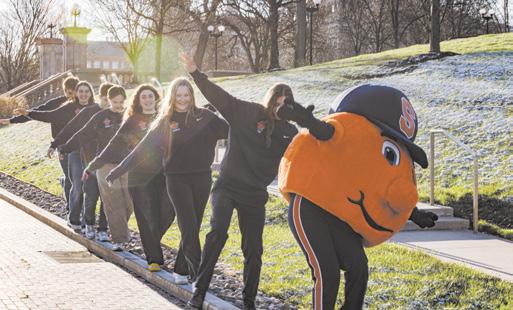
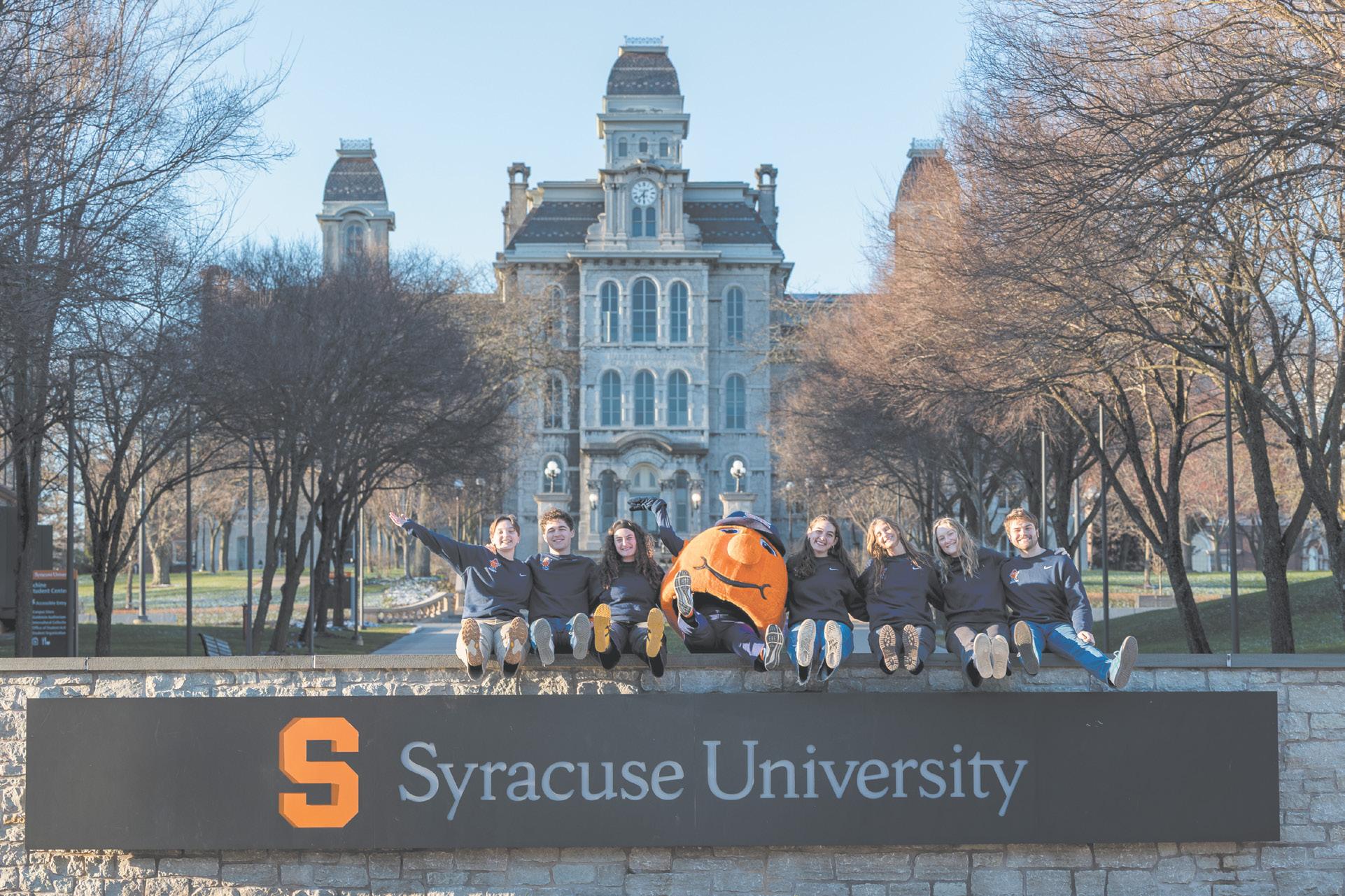
8 SU seniors lived a double life as beloved mascot Otto the Orange
By Tara Binte Sharil asst. culture editor
At every Syracuse University football and basketball game, Diamonte “D” Giacovelli can be spotted sitting all the way at the front of the stands, cheering on the players or calling out for Otto the Orange. At a basketball game Giacovelli attended two years ago, Otto gave him a hug; though this particular hug felt different from others.
“It was nothing out of the ordinary for Otto to give hugs, but I had the intuition that there’s extra love with this hug,” Giacovelli said.
In a literal sense, you are a large orange. But in a more sentimental sense, you get to be this free, childish — in the best way possible — presence that can light up a room.
Audrey Becker
As it turns out, on the day before the senior Otto’s reveal, his friend Omi Wolfe told Giacovelli that she had been Otto since the end of her freshman year. Giacovelli wasn’t surprised; Wolf e has a big heart and down to earth personality fitting of the Orange mascot, he said. Though Wolfe never confirmed if it was her in the Otto costume that day, the possibility is enough for Giacovelli.
SU officially adopted its mascot, Otto the Orange, in 1995. Though students who are Otto train like D1 athletes and have an NIL deal, Otto’s identity is a well-kept secret. But, their contagious energy allowed Otto to become an unforgettable face in Syracuse.
When March Madness brackets flop, chaotic punishments roll in
By Caroline Erskine asst.
March means a lot of things on a college campus — the end of midterms, the first warm days of spring and, for many students, the sometimes-friendly competition of March Madness brackets.
Syracuse University sophomore
Aaliyah Avalo played basketball growing up and enjoys watching the NBA. This year, she ventured into college basketball, participating in multiple March Madness bracket pools for the first time, one of them with her close friends.
“We were just bullying each other,” Avalo said. “Like, I need to win. I hope they lose.”
This year, all men’s brackets had to be submitted before the NCAA Tournament began on March 19.
The tournament ended Monday, with the University of Michigan taking the men’s title. SU men’s basketball hasn’t reached March Madness since 2021, but the women’s team made it to the second round this season.
College basketball fans participate in the season by making brackets, selecting which teams will win each game and who will come out on top.
Many SU students are enrolled in multiple brackets simultaneously. With friend groups, campus jobs and student organizations all running their own
pools, some competitive brackets came with punishments for the losers.
That’s not a new concept, though. Fantasy football leagues have long been defined by elaborate loser punishments, gaining popularity in the 2000s and establishing the norm that losing a sports pool should cost something beyond bragging rights.
One viral punishment came during the 2017-18 season, when a lastplace fantasy football finisher was forced to spend 24 hours in a Waffle House. Now, videos of similar stunts after March Madness spread across TikTok, turning personal humiliation into content and raising the stakes each year.
Between 60 and 100 million brackets are estimated to be submitted every year, and this year’s ESPN Tournament Challenge alone recorded 26.6 million completed brackets, a new record. The tournament’s single-elimination chaos has yet to produce a single perfect bracket, making anyone a candidate for punishment. Avalo entered two brackets this year, both for the men’s tournament. One was called “Let’s Go Otto” with a group of six; the other had 16 entrants from her professional fraternity, Kappa Theta Pi. She meticulously crafted her brackets, looking at the teams’ statistics and potential previous matchups.
In the KTP bracket, the effort paid off: She finished fourth. In Let’s Go Otto, Avalo had Gonzaga University going all the way. The Bulldogs did not. They were eliminated by the University of Texas in the Round of 32.
The rule for the Let’s Go Otto bracket was that the winner gets to choose the loser’s punishment. Sophomore Sarah Gorenstein won the pool and made the “difficult” decision. Though Avalo doesn’t know it yet, Gorenstein plans to make Avalo take a practice SAT during a friend group game night this weekend, while everyone else plays around her. This punishment is see march madness page 11
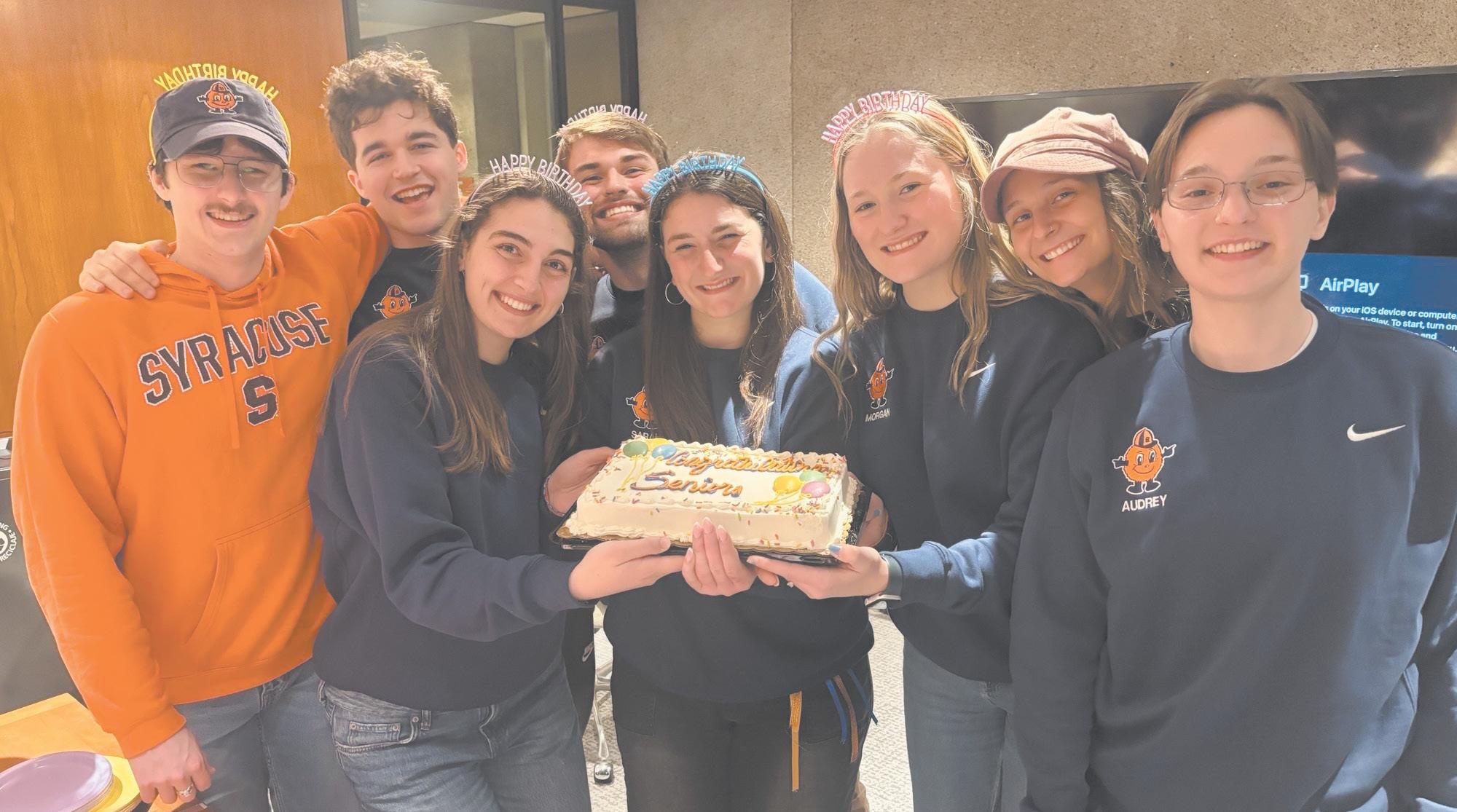
Seven of the eight senior Ottos pose for a photo. On March 24, the seniors’ identities were revealed, a shock and a delight for unaware friends and family. eli schwartz asst. photo editor
digital editor
Spot ‘unicycling kid’ proudly wheeling around Syracuse
By Lily Zuckerman asst. culture editor
People in Josh Nielson’s classes have likely seen him store a unicycle in the front of the room.
Nielson was reluctant to use his one-wheel vehicle in public when he was a freshman. Now, the senior uses his unicycle as his main mode of transportation around campus.
“It’s taught me that a lot of times being yourself is actually a lot more exciting than it is terrifying,” Nielson said.
Nielson first learned to unicycle in high school when he tried one of his camp counselors’ mountain unicycles. Despite the learning curve, the 22-year-old has learned how to maintain balance and stay controlled while riding it. He’s traversed all over Syracuse University’s campus and traveled all the way from Ackerman Avenue to Falk College — using his unicycle so much that the pedals literally fell off on the unicycle he’s owned since he learned in high school.
Though Nielson’s major in computer science has nothing to do with unicycling, the mode of transport has become integral to his college journey. It’s easy for Nielson’s friends, like SU senior Danny Whelan, to recognize him across the Shaw Quadrangle.
“I unmistakably know it’s him because he’s the only person I know that uses unicycles,” Whelan said. “It’s always nice to see him out and about, it’s a staple of some of my walks to campus.”
Whelan learned of Nielson’s special talent for unicycling when they joined the same professional fraternity; he remembers Nielson arriving to meetings with his unicycle in hand. Whelan said he recalls being in awe that Nielson uses a unicycle.
One of Nielson’s favorite t-shirts has the phrase “do what you love” printed on it. Unicycling is his way of telling himself that it’s OK to practice and embrace activities that you love to do.
arts
It’s not hard to spot Syracuse University senior Josh Nielson. If you see someone riding a one-wheeled vehicle from a distance, it’s probably Nielson on his unicycle. avery magee photo editor
Nielson’s current roommate, SU senior
Connor Moulton had never seen anyone unicycle as their main mode of transportation before he met Nielson.
“It’s fitting that he unicycles with his personality,” Moulton said. “He is the type of person to just kind of pick up a hobby or have an interest and really give it all he has.”
Much like Nielson, his friends aren’t embarrassed to know the “unicycling kid.”
On one occasion, Whelan opened Yik Yak to a photo of someone unicycling across the Quad: It was Nielson.
“I guess it’s just a way of letting people know that I can accept a strange part about myself,” Nielson said.
Compared to a bicycle, Nielson said a unicycle requires forward and backward balance,
as well as left and right balance. When Nielson zooms past pedestrians, he loves hearing their reactions of surprise and pointing him out.
Nielson even created an Instagram page called “suunicycle” dedicated to his journey on the one-wheeled vehicle. His bio reads “I’m a guy riding a unicycle around @syracuseu.”
Moulton helped Nielson film one of the Instagram videos. Now, whenever Moulton returns to the page, he’s reminded of one of his favorite memories with Nielson — making edits to the video. Every time Moulton replays them, he said he remembers the laughs they made that one afternoon.
Because most people don’t know how to successfully ride a unicycle, Nielson said he can walk away from it with a level of certainty that someone won’t steal it while he’s in class.
Nielson’s unicycle is not just another hobby; it’s a way for him to brighten strangers’ days, from just a glance across the Quad, he said.
“He always uplifts my mood, I feel like that kind of goes in tandem with the unicycle, because it’s a very whimsical activity,” Whelan said.
Anytime someone stops Nielson while he’s on his unicycle, Nielson said he likes to explain how he began and the story behind it.
Nielson’s favorite memory of riding his unicycle around campus is when he heard someone shout “‘yo, that’s awesome’” from above him as he pedaled and attempted to say thank you.
“Any reaction is acceptable,” Nielson said. “I understand that it’s a bit of a ridiculous form of transportation.”
lvzucker@syr.edu
SU fashion senior tackles ‘plight of womanhood’ in poignant thesis
By Ava Demcher staff writer
Perry Schmitz learned how to sew at a young age from her grandmother and father, but wasn’t sure where she would fit inside the fashion industry.
When she walked into the Nancy Cantor Warehouse on campus, everything changed.
“It was love at first sight,” Schmitz, a Syracuse University senior, said. “It sounds silly, but I fell in love with a staircase in the Warehouse. That’s how I realized I belonged here.”
Schmitz has fashion in her family line, including relatives who sew and a grandmother she describes as “incredibly fashionable.”
Taking inspiration from her lineage, Schmitz uses fashion to communicate bold and subversive messages, she said
Preparing to close out her time at SU, Schmitz is showcasing her senior thesis, “The Feminine Form,” on April 25. The exhibit is a six-piece clothing collection showcased on a runway, accompanied by a short film and editorial shoot Schmitz made in collaboration with fellow students from the College of Visual and Performing Arts and Newhouse School of Public Communications.
Schmitz’s thesis is a collection of outfits representing six different topics that have shaped her into the woman she is today. Schmitz grew up in a small town in New Hampshire
and said coming to SU gave her a “worldly perspective” through internships and other opportunities. She aimed to push her creative boundaries when showcasing her collection.
SU fashion design associate professor Todd Conover has taught Schmitz for the last four years. Conover said he has seen Schmitz grow as a student through her time at SU.
“Perry came in with basic fashion knowledge like any other design student, and quickly learned that the industry isn’t necessarily what you think,” Conover said. “She learned that the most important thing for an artist to be is inspired.”
Schmitz draws creativity from her personal style, she said. She described her sense of
fashion as a mix of masculine and feminine energy and said she enjoys pushing boundaries as a form of expression.
“I find fashion to be very political,” Schmitz said. “The way I dress reflects the way I see myself in the world.”
The clothes themselves play with bold tones of green, purple and brown. Some ensembles are decidedly feminine, with flowing silhouettes and light, airy fabric. A tan turtleneck dress is inspired by Schmitz’s grandmother, and her experience as a teacher and real estate agent; it was difficult not to rip her stockings during her workday. In response, Schmitz created the gown by ripping out threads of silk.
University Union screens ‘Parasite’ to celebrate AANHPI month
By Mirren Grimason staff writer
On Wednesday evening, Schine Underground featured an origami craft station and a buffet of foods like cold noodle salad, tteok, popcorn chicken, fish balls, BBQ pork bao buns and mochi. Alongside the foods and stations, the historic, award-winning film “Parasite” was being screened.
“We’re highlighting people who are successful in this industry and are a part of those (AANHPI) communities, and it’s about kind of inviting people into that culture,” UU president Kate McKenna said.
On Wednesday, University Union hosted a movie celebration, screening the South Korean film “Parasite” for Asian American, Native Hawaiian and Pacific Islander Heritage Month.
A dark-comedic thriller, “Parasite” follows the low-class Kim family as they pose as highly qualified house servants for the Park family as a way to enter their wealthy, glamorous lifestyle. The movie was the first non-English film to win Best Picture at the Oscars, which is one reason why UU wanted to show the film for AANHPI Heritage Month, co-cinema director Jordan Burda said.
“‘Parasite’ is definitely groundbreaking for Asian cinema and just Asians in general being the Best Picture and Best International Picture winner,” Burda said. “And I know a lot of people that love it.”
McKenna said the organization had done other heritage month events in the past, but
never through film. Last year, UU invited Disney actress Brenda Song to speak to students, touching on her experience of being AsianAmerican in the entertainment industry.
UU had a smaller budget for AANHPI this year, so McKenna reached out to the cinema directors to see if they could host a film screening to celebrate the month. They agreed and started working to plan the event.
Junior Bernice Martinez said she and her friends often attend UU events, especially the movie screenings. They allow the group to unwind, she said.
“That’s one of the things that we love about the school, is that they make events like these, where we can get merch or food and snacks,” Martinez said. “It’s really fun and you get to meet a lot of people too.”
Junior Ashley Lopez was already a fan of “Parasite,” so she knew she had to attend the event. She really appreciated the break in an otherwise hectic time in the semester.
“It’s definitely such a fun activity to go with a friend too, and just relax a little bit, especially now that things are kind of amping up a bit. It’s just a great way to de-stress,” Lopez said.
In recent years, McKenna said UU has increased the amount of programming they have done surrounding cultural heritage months, not just AANHPI. McKenna said this was made possible for UU through a budget given by the Student Government Association, allowing them to work on cultural heritage month programming.
University Union screened “Parasite” on Wednesday, a movie that made history for being the first non-English film to win Best Picture at the Oscars. eli schwartz asst. photo editor
At a predominantly white institution like SU, it’s crucial to find ways to make sure all students from different cultural backgrounds are represented in the campus organizations, co-PR director Charlotte Wall said.
“Since we are such a big programming organization, and one of the biggest ones on campus, it’s important to host events that showcase the students that go to school here and the students who are represented,” Wall said.
The film screening was meant to feel inclusive to all communities at Syracuse and bring the student body together, Burda said. UU intends to do similar events for heritage month celebrations in the future.
“It’s not just their event for people who are part of the AANHPI community, but people who want to learn more about that community and some love for that culture, that goes along with it,” McKenna said. msgrimas@syr.edu
CONCERTS THIS WEEKEND
Shayfer James
The multi-genre musician is celebrating 15 years of his album “Counterfeit Arcade” and one year of “Summoning” with a set including both works. He’s joined by singersongwriter Maiah Wynee.
WHEN : Thursday, doors at 7 p.m., show at 8 p.m.
PRICE: $30.56
WHERE: The Song & Dance
From scootering around campus to their dance moves, Otto has become integral to SU and was even inducted to the Mascot Hall of Fame in 2023.
March 24 is National Orange Day, marking the day when SU was founded and Otto’s birthday. This year was the 12th time SU celebrated Otto’s birthday on campus. Since 2014, revealing the seniors behind the mascot has become a big part of the day’s tradition, said Julie Walas, Otto the Orange coach and program manager.
This year, Wolfe, along with Audrey Becker, Morgan Kingdeski, Sarah Jacoby, Jackson Martin, Thomas Condon, Leda Rossmann and Colin Yavinsky made school history as the largest Otto class, Walas said.
Becker became an Otto during her sophomore year. What started out as a joke turned into an “awesome” journey, she said. Becker’s first time as Otto was nerve-wracking. But thanks to Walas’ and former upperclassmen’s advice, it didn’t last long.
“Once I was doing my thing and Otto was out there, all of my worries melted away because it wasn’t me,” Becker said. “It wasn’t nervous Audrey greeting these people, it was Otto.”
All eight Ottos are “very different people,” but it makes their dynamic richer, Jacoby said. From human development to civil engineering majors, every senior represents different personalities and colleges at SU.
“It’s just so beautiful that all eight of us can come together and portray this sweet, silly mascot,” Jacoby said. “Our voices have become very unified over the years, and we all have different perspectives.”
Throughout the years, the group had to be discreet about their friendship so they did not raise any suspicions. But, on the morning of March 24, all eight members could finally “publicly be friends,” Wolfe said.
At around 8 a.m. on National Orange Day, Walas and the senior Ottos made their way to Rise N Shine Diner to have breakfast one last time under their concealed identities. When a waiter approached their table, she noted the seniors’ athletic gear and asked what sport they played. There was less than an hour before the reveal video drops. With little time left before the truth was unveiled, the group decided to let their waiter in on their secret.
“She was so sweet. She took a picture with us, and she was very kind and just very excited, which was a nice appetizer for how the rest of the day would go,” Becker said.
Unveiling one’s identity can be a lot to deal with, so Walas prepared the seniors on handling the reveal, holding meetings with the seniors beginning in January. The meetings went over how the students were feeling that day, updates in their lives and what they should expect for the National Orange Day events.
Though Walas spent weeks guiding the seniors for the mental and emotional outcomes of the big reveal, it was still a whirlwind of chaos, Jacoby said. When the reveal video was released on March 24, all of the seniors’ phones blew up. Texts kept flowing, calls were never-ending and people were constantly approaching them.
After hiding behind a mask for so long, some seniors decided to spend their reveal day on the “facey-ist parts of campus.” Becker, a television, radio and film major, spent her day in some of the most bustling places on campus like Schine Student Center or Food.com, catching the surprised looks on her friends’ faces. Others, like Jacoby, attended classes like any other day — with
the consistent questioning from classmates as a bonus to her already hectic day.
When Wolfe revealed to Giacovelli that she was Otto, he was more proud than suspicious.
SU has been Giacovelli’s dream school for as long as he could remember. Wolfe said Giacovelli carries the most orange spirit than anyone she’s ever met. Giacovelli could’ve been the perfect Otto, Wolfe said, but he didn’t try out because he thought he was too tall.
In some way, having his best friend as Otto fulfilled his dream of being the mascot, Giacovelli said.
“When I found out, I was so proud of her,” Giacovelli said. “Regardless of whoever’s in that suit, I wanted to make sure they knew that they were doing a good job and that what they’re doing is important.”
Senior Naomi Imhoff said she grew suspicious of her friend Morgan’s whereabouts.
They became close friends their sophomore year when the pair studied abroad together in Strasbourg, France. After they returned, they became roommates and still are. That’s when Imhoff began to notice how busy Morgan was and couldn’t figure out why.
Then, on the morning of March 24, Imhoff woke up and opened Instagram, where she found the truth about why Morgan was so busy: Morgan’s days were filled with her duties as Otto.
“I immediately texted Morgan. I was like ‘There’s no way,’ I couldn’t believe it. I was always a little confused, but I was so shocked when I found out,” Imhoff said.
Being Otto was a huge revelation for Morgan’s friends. Morgan held a more reserved and shy personality, especially in the classroom. By embodying Otto’s outgoing and infectious personality, Imhoff saw a new side of Morgan, especially when Imhoff saw Morgan run out on stage at the reveal day celebrations.
“I just have never seen (her) in that way. I saw a completely different side of Morgan. It just felt like it was a complete picture of who she was. I’m just so happy for her to have this moment,” Imhoff said.
Born and raised in Syracuse, Morgan frequented SU’s campus as a child, when her mom, Holly Kingdeski, works in the school’s financial aid office. When she’d visit her mom at work, Morgan would often see Otto around campus. Becoming the very mascot she grew up seeing was like seeing “the world change,” Morgan said.
Since most of her friends and family are from Syracuse, everyone in Morgan’s life joked about how funny it would be if someone became the
city’s most recognizable mascot. Morgan decided to become Otto as a joke during her freshman year. Running into her family as Otto was a funny full-circle moment for her.
“I was always looking at Otto as kind of a stuffed animal. But now I look at Otto and I think this person who’s playing it could be the polar opposite,” Holly said.
When Jacoby arrived at SU from Los Angeles as a freshman, she was looking for a community on campus. After the joy of her first interaction with Otto, Jacoby immediately knew she wanted to bring that to others.
Jacoby is the first “legacy Otto,” she said. Her father was one of the first Ottos when he attended SU in the 1990s and was part of the group that named the mascot Otto, Jacoby said.
“This has completely strengthened our relationship. Every time he comes back for homecoming, I get to see the orange spirit in his eyes,” Jacoby said. “It’s very, very full circle for me, just because of how I’ve seen (being Otto) affected his life and how much he loves this university.”
Being Otto has helped Jacoby, a communication sciences and disorders major, plan her future career. She hopes to be a speech language pathologist, working primarily with kids. Whether it’s greeting young SU fans in football games or fist-bumping kids at a local elementary school for their “Fist Bump Friday,” Jacoby said Otto’s empathy has helped prepare her for a path of helping children.
Thanks to Otto, Wolfe’s planning to pursue a career as a child life specialist after graduation. This career would never be in the works had it not been for Otto, Wolfe said.
“I didn’t even realize that I wanted to do something in this until I was immersed in (being Otto) and realized it, that I wanted to do something and impact the world as Omi and that it was so closely linked to what I was doing as Otto,” Wolfe said.
While Otto is present at sporting events, the mascot also goes beyond the field and into the community. Whether it’s being invited to an alumni’s wedding or attending a local fundraiser, Otto sparks joy wherever they are, Morgan said.
“Otto means being something bigger than yourself,” Becker said. “In a literal sense, you are a large orange. But in a more sentimental sense, you get to be this free, childish — in the best way possible — presence that can light up a room.” tabintes@syr.edu
Master Thieves
The five-person rock ‘n’ roll group blends vocal harmonies with original arrangements and takes inspiration from bands like the Grateful Dead. Nominated for a Syracuse Area Music Award in 2011, the local band is bringing its sound back to the city.
WHEN : Friday, 8 p.m.
PRICE: Free
WHERE: Shifty’s Bar & Grill
Join emerging Syracuse musician PHEN and special guest Claymation, whose contemporary music focuses on authentic, relatable lyrics.
WHEN : Friday, doors at 7 p.m., show at 8 p.m.
PRICE: $31.59
WHERE: The Song & Dance PHEN
Sophistafunk & Friends
Meshing funk, rap and other genres, Sophistafunk brings its beats to underground shows, international festivals, the Food Network and more. Catch them this weekend with a collection of other touring artists.
WHEN : Saturday, doors at 7 p.m., show 8 to 11 p.m.
PRICE: $18.22
WHERE: Funk ‘n Waffles
Open mic hosted by Attamizk & friends
Try your hand at performing this weekend with Syracuse-based musician Attamizk. Every Sunday, aspiring singers, poets and artists are invited to take the stage at Funk ‘n Waffles.
WHEN : Sunday, 7 to 11 p.m.
PRICE: Free WHERE: Funk ‘n Waffles
This year’s class of graduating Ottos is the largest yet. Thomas Condon, Colin Yavinsky, Leda Rossmann, Jackson Martin, Sarah Jacoby, Morgan Kingdeski, Omi Wolfe and Audrey Becker are among the eight senior Ottos (left to right). courtesy of julie walas
morgan kingdeski at 8 years old with Otto. Born and raised in Syracuse, Kingdeski grew up near the mascot; then, became Otto when she enrolled at SU. courtesy of holly kingdeski
one of the more well-known viral fantasy football punishments.
Last year, the group’s punishment was wearing an embarrassing Five Below T-shirt in public.
The competitive edge, Avalo said, comes naturally when you watch games with people whose selections differ from yours. Her bracket group often studies together in the Schine Student Center, where they watch basketball games on the video wall.
She remembered one game in particular in the second round — Iowa State versus Kentucky — where Avalo was the only one in her group who had Iowa State winning.
The trash talk was immediate once the Cyclones prevailed. That investment is part of what makes bracket culture feel distinct on a college campus, Avalo said.
“You see a lot of people talking about it, so you’re just more inclined to do it,” she said.
SU senior Giavanna Rebstock also sees bracketmaking as an essential college experience. She joined her bracket, a 22-person pool called “Orange Woman,” because her guy friends sent it to their group chat and asked everyone to join, “bribing” them by providing a prize for the winner.
The prize is a free beer and a packed bowl, courtesy of the guys’ apartment. Rebstock said the incentive worked.
“We’re broke college students. I don’t even smoke weed, but I’ll take a free beer any day,” Rebstock said.
Rebstock picked Villanova University to win the tournament, and she came in last place after it was eliminated in the first round. Initially, there wasn’t supposed to be a punishment for the loser, but when Rebstock’s friends
realized it’d be her, they knew they had to think of something.
Ironically, the punishment was self-inflicted, she said. Her friends suggested she go out and take shots, but Rebstock countered with something better: She would perform the worm at Faegan’s Cafe & Pub. Her friends thought it was hilarious and agreed immediately.
“I’m actually just gonna be super chill and nonchalant in the bar and then I’m just gonna do it,” Rebstock said.
The punishment is beside the point. Rebstock saw the bracket as less about basketball and more about one more thing to do with her friends before they graduate.
“I’m trying to just say yes to things these days because I know I only have a certain amount of time,” Rebstock said. “I have literally two seconds left, I’m not gonna say no.”
Not every bracket pool operates on punishments. At the Ernie Davis Fitness Center, Syracuse graduate student and supervisor Dylan Phillips had a different vision. A few weeks before the tournament, he left a stack of paper brackets at the center’s front desk with a sticky note: fill one out and we’ll have a little competition. No prize or punishment, just something to keep track of between shifts.
“Every time I came in to work, I was checking which teams had been crossed off and how my bracket was doing,” said Caitlin Shephard, an SU sophomore who works at the center. “It was fun to have something to check in on every time I came in.”
Shephard had never participated in a bracket before. She chose Michigan to win because her boyfriend lives there, then she finished second in the pool when the Wolverines captured the title.
Maya Philips, a senior who has worked at Ernie Davis Fitness Center since her freshman
year, came 16th in the bracket of 20. She said she completed her choices by assessing the teams “vibes,” only noticing the win-loss record numbers partway through filling out her bracket.
What made the pool fun, Shephard said, was not basketball knowledge or competition. Instead, it was because it sparked conversations between coworkers.
Phillips constantly sent score updates to the work group chat. One co-worker drew a picture on his bracket instead of filling it out and received zero points, until their boss advocated for him to get 20 points for artistic merit. He still placed last.
Philips and Shephard both agreed the pool would benefit from stakes next year. Though when told that another group’s last-place finisher would be taking a practice SAT as punishment, Shephard was quick to respond.
“Oh my God, that’s horrible,” she said. “I would die.”
Despite the grueling punishment, some believe the competition was never really about basketball. For Rebstock, it was about having one more reason to say yes before the year ends.
“I’m gonna have a punishment,” she said, “but we’ll all be together. It’ll be a funny memory to tell.”
cberskin@syr.edu
of the suit represents the beauty and power women hold as professionals, Schmitz said.
difficult, intimate topics of womanhood and identity through the outlet of fashion.
The intentional rip reclaims what it means to be a woman, and represents the social expectation to put in immense effort to look “clean” and refined, Schmitz said.
The other garments have harsher lines and cuts, akin to menswear. One piece is an oversized yellow suit. The suit represents data bias - the idea that a lack of women in professional fields leads to a lack of representation. Schmitz rejects the concept of the “invisible women” with the suit in a bold color, texture and structure. The nude undershirt symbolizes the female form that women try to hide when conforming to masculine roles. However, the striking nature
“Listen, nobody needs to know I’m here. Just forget about me for a few months until I come back reeking of sulfur!”
“That’s what I love about Perry, she harnesses inspiration in a different way,” Conover said. “Where some students can worry about time periods or external aesthetics, Perry takes things from her own life that are much more raw and esoteric.”
SU fashion design senior Charlotte McNair met Schmitz the second semester of their freshman years. They quickly became close friends and decided to take a fashion systems class in Paris that summer, where their friendship grew.
In the fashion design program, each senior must create a thesis as a culmination of their work. McNair said that Schmitz explored
“She gets hyperfocused on things and makes big demands of herself,” McNair said. “Professors and other students always say, ‘How is she going to accomplish that?’, but she will get it done. Perry always finds a way.”
Conover said he calls himself a “maker” and an “open book,” striving to know his students on a closer level and better understand their work. Schmitz’s work has taken on a new level of maturity and refinement throughout her years at SU, he said.
Schmitz’s work itself challenges the ideas of what it means to be a woman, Schmitz said. McNair said Schmitz is interested in “the plight of womanhood.” Many of the fashion students
picked subversive, complex topics for their senior theses, each with its own “je ne sais quoi,” McNair said.
“I say that the design process is like postpartum,” McNair said. “It’s like you’ve been wanting and waiting for something so long, and now that it’s done, you have to see it from a new perspective.”
Schmitz said her time at SU has taught her how to be an artist and trust herself to create. Meeting her goals, she received the Craftsmanship Excellence award at the annual School of Design Senior Capstone Fashion Show and is ending the year with opportunities to grow in the fashion industry, she said.
ahdemche@syr.edu
rené vetter cartoonist
jay cronkrite contributing illustrator
Perry Schmitz’s senior thesis, “The Feminine Form,” will be on display on April 25, drawing inspiration from her own personal style. . tara deluca asst. photo editor
letter to the editor
‘Sunsetting’ Syracuse University’s classics B.A. overlooks its value
By Brooke Waldack writer
To the Syracuse University community,
I’d describe my freshman year, 2022-23, as exhausting, uninspired and disconnected. I’d always been drawn to the sciences, but felt little passion for what I was studying at the time, which was pre-med biochemistry. In the fall of my sophomore year, I switched to biology and forensics, which helped me find some of the passion I was searching for, but I still felt as though I was missing a key piece to my higher education puzzle.
Now, by the end of my final semester, I’ll have completed a minor in classical civilizations on top of my dual major program, providing the historical, literary and humanitarian substance I felt was lacking in my education. It led me to discover anthropology as a biological discipline and allowed me to understand the past through the application of science — science we wouldn’t have without classical philosophers and poets.
My previous mindset on science was two dimensional: There’s science, the arts and humanities, and they occasionally overlap but not significantly — a closed mindset many people share.
That was until I registered for a class titled Roman Literature, taught by professor Jeffery Carnes in the Classical Civilizations Department, which was initially going to only fill my humanities sequence. Within the first two weeks of classes, I realized this class would provide far more than just degree requirements, but a new avenue of education that I’d never considered.
“Nil posse creari de nihilo”
“Nothing can be created from nothing”
- Lucretius, De Rerum Natura, On the Nature of Things
My introduction to the classical world was Lucretius, a first-century B.C.E. Roman poet and philosopher, who emphasized the acceptance of the natural world and its functions as the driver of life in a world of divine creationism. He built on the work of Greek philosophers such as Democritus, who first used the word atomos (atom) to describe the building blocks of life.
Today, this concept is something we’ve accepted across the board as scientific law.
Being exposed to a whole new world of foundational philosophy and civilization, and
discovering the connections within science, was both new and exciting. I’d previously perceived these scientific ideas as modern advancements in understanding the world and medicine — when in reality, they’re ancient concepts that have built off one another continuously over centuries.
Learning the origins of modern science allows us to better understand the development of ideas. In the ancient world, it was paganistic beliefs against science — the divine were in charge of the world around us. Today, we see a similar dichotomy, where political efforts and religion still attempt to undermine science, as seen with aggression toward evolutionary theory and global warming.
Any great educator will stress the importance of learning the history of your discipline. In sociology, we study the history of sociological theory. In political science, we examine the rise and fall of governments. In communications, we explore the history of media industries.
Most don’t realize just how much we inherit from the classical world: atomic theory, the structure of the United States Senate, democracy, civil virtue and countless other ideas spanning medicine, art and beyond.
The Bachelor of Arts in classical civilizations is one of the 93 programs being “sunset” by Syracuse University.
Despite its significance across nearly every field of study, its low enrollment is the university’s determining factor in deciding the program’s fate. Its marketing as a major or minor is consolidated to history classes and vaguely describes it as a study of the classical period. In reality, it’s the study of our origins in education, law, civil life, art, science and global perception — topics that span all colleges at SU.
One can’t help but think that if SU had focused on expanding the scope in which the study of classics could be applied, the program might not be in its current position.
With no plans to re-equip, reorganize or reestablish the classics and classical civilizations program, access to courses that fundamentally support fields across the university will rapidly decrease in the coming years with no promised stability.
While minors are still available for the time being, there’s no solid security for the future of classics on campus as a primary area of study. Even though roughly two-thirds of my higher
education career has been spent in classical civilizations, I still feel that a minor in classics isn’t enough.
I will end my time at SU wishing I’d taken more classes, read more epics, discussed more philosophers and made more vibrant connections across scientific principles.
The classical civilizations program has been one of the most important parts of my academic journey. It provided me with the history and humanity that the sciences don’t always offer. It put my discipline in perspective: the science, concepts, laws and theories we treat as truth today have deep roots in classics, and understanding the development of ideas across multiple fields is crucial to the quality of our education.
“Nescire autem quid ante quam natus sis accidertit, id est semper esse perum” “To be ignorant of what occurred before you were born is to remain always a child”
- Cicero, Orator Ad M. Brutum, Orator
Low-paying, unpaid internships are a job barrier, not a bridge
By Ella DeCamp columnist
Entry-level jobs used to serve a clear purpose: They were the first rung on the career ladder. They allowed young adults to learn, contribute and earn a living as they transitioned from college students to career professionals.
Today, that rung is disappearing, replaced by internships that often fail to provide meaningful experience or fair compensation. As a result, an entire generation of college students is being locked out of the workplaces they’re trying to enter.
The shift is subtle but significant. Many supposed entry-level roles are now offered as internships or require applicants to already have years of work experience. This creates a paradox in which employers expect students and graduates to have experience before they are able to gain any.
Data from 2023 and 2024 shows that only 60% of internships in the United States are paid. What was once an accessible launch point has become a gated system where only those who can afford to work with little or no pay can participate.
The heart of the issue is a split between what internships promise and what they deliver. In theory, internships are designed to provide hands-on learning, mentorship and exposure to a workplace environment. In practice, many interns find themselves relegated to low-skill, administrative tasks — busywork that 70% of hiring managers believe could be done by an artificial intelligence.
While these tasks may offer a glimpse into professional operations, they rarely build the substantive skills that employers later demand.
The unfortunate answer to why internships have become the primary path into so many industries, despite not providing meaningful training, mainly lies in cost.
By relying on underpaid interns, companies can reduce labor expenses while still maintaining productivity. Formerly
compensated entry-level work is now outsourced to a rotating pool of temporary, disposable workers. Only around 50% of interns in the U.S. become full-time employees upon completing their internship.
The internship model exacerbates inequality among college students. For those with financial support from family, accepting a lowpaying or unpaid internship may be feasible. For others, it’s simply not an option. Students who need to earn money to pay for student loans, housing or basic necessities can’t afford to spend a summer — or an entire semester — working for free.
Students who can afford internships gain the credentials required for full-time roles, while those who can’t are left behind, regardless of their talent or work ethic. By the time hiring decisions are made, this disparity is clear.
Employers interpret this lack of internship as a lack of initiative, rather than a reflection of economic reality.
The internship economy distorts what experience means. Instead of signaling capability, experience has become a checkbox — something to accumulate rather than a reflection of actual skill.
Employers and educators encourage students to stack multiple internships, sometimes across entirely different fields. This isn’t because each one builds expertise, but because each added line on your resume boosts your marketability. The result is a generation of applicants who appear experienced on paper but have had little opportunity to develop depth in any one role.
Internships are no longer confined to summers; many students now juggle parttime internships alongside full course loads, extracurriculars and, for some, paying jobs. Many universities even require students to meet a certain number of internship hours to graduate. Syracuse University’s Whitman School of Management requires a minimum of 120 internship hours for undergraduates.
Unlike traditional entry-level roles, which begin after graduation and provide stability, internships often demand professional commitment without proper compensation or security. Students who intern during the academic year are effectively working two jobs — one they pay for, and one that’s supposed to “pay off” later.
The irony is that most college students and recent graduates are already capable of contributing meaningfully in true entry-level roles. They have completed coursework, developed critical thinking skills and often held part-time jobs that require responsibility and adaptability. Yet, instead of being trusted with real work and fair pay, they’re funneled into positions that neither challenge nor compensate them.
If the goal is to prepare young adults for the workforce, the current system is failing. Internships should supplement — not replace — entry-level jobs. They should offer structured training, mentorship and pay that reflects the value of the work being performed. Most importantly, they should be accessible to all students, not just those who can afford to participate.
Reversing this trend will require structural and cultural change. Employers must reevaluate their reliance on internships as a substitute for paid labor and invest in entry-level positions that provide valuable experience. Universities, too, should be more critical of internship pipelines that exploit students under the guise of professional development.
The transition from college to career shouldn’t be designed to filter out those without financial safety nets. It should be a bridge that allows all students to step into the workforce with dignity, experience and the opportunity to succeed. Right now, that bridge is crumbling. It’s time to rebuild it.
The programs SU plans to “sunset” are crucial, our writer claims. She argues the university’s decision, particularly with civilizations programs, will negatively affect students. zabdyl koffa staff photographer
emma lee contributing illustrator
Senior Brooke Waldack submitted this letter, majoring in biology and forensics and minoring in classical civilizations, bawaldac@syr.edu.
Ella DeCamp is a junior majoring in english and textual studies. She can be reached at emdecamp@syr.edu.
Jovan Miller (2008-11) shared one. After letting Loyola score on a man-down, Desko’s white-walker blue eyes bore down on him from the sideline, waiting to curse out the midfielder. Carcaterra remembers another, when he was a captain, and Desko blamed him for some players taking it easy on a conditioning drill. Then there’s Desko making Ric Beardsley (1992-95) run the Dome steps for an hour, punishment for having “too much fun” the night before a Saturday morning practice.
Desko’s blowups were rare. He allowed mistakes, letting players throw behind-the-back passes, push the pace and play with freedom. He never pulled players, trusting they’d clean up their mistakes. However, Pat McCabe (1988-91) said his anger never came at the expense of the fundamentals.
“He just held a high standard,” Miller said, “So, when you hold the high standard in general, it was easy for everybody else to fall in line because (Desko) already set the table.”
Desko’s standard mixed the most desirable coaching traits. The championship pedigree of UConn women’s basketball coach Geno Auriemma. The steadiness of former Alabama football coach Nick Saban or six-time Super Bowl winner Bill Belichick. The loyalty of former SU basketball coach Jim Boeheim.
Whatever the comparison, Desko’s greatness can’t be questioned. Yes, he could be cold at times. The lack of instant gratification after a good play left you yearning for a stamp of approval, per Miller. It was never going to come, but that was Desko’s secret sauce.
“He made sure our heads didn’t get too big,” said current SU head coach and former midfielder Gary Gait (1987-90). “We were always ready to do the work, and there was never a problem.”
• • •
When Simmons Jr. retired in 1998, Desko was the only person he wanted to replace him. Jake Crouthamel, then SU’s director of athletics, told Simmons Jr. they were legally obligated to advertise the job.
But, after watching Desko spend 18 years as his assistant, Simmons Jr. felt there was no need.
“Any coach in Division I right now would take my job if it were available,” Simmons Jr. recalled telling Crouthamel. “I don’t want it to be available … (Desko) had earned his stripes.
“I owed him.”
Simmons Jr. ultimately got his wish. In the late 1970s, Simmons Jr. only had one allocated scholarship due to financial limitations for nonrevenue athletic programs at SU. So, he split the scholarship in two, despite the athletic department advising against it. He gave half to Desko and the other to his West Genesee High School teammate Tim O’Hara.
After spending the first two weeks of fall ball as a midfielder, Simmons Jr.’s first assistant, Jay
“Knock on wood, I’m surprised he honestly didn’t get more injuries from overuse,” Burns said. “It’s actually insane how many shots that kid gets.”
If anyone, Burns would know. He saw Luke’s maturation firsthand. The Tiger attack first met Luke when they were on the Rockville Football League’s Steelers in second grade. They weren’t nearly as good as their NFL namesake, but Luke might not have been that far off.
Burns remembers Luke being the team’s best player. Before Luke’s shot became his premiere athletic trait, it was his speed. Luke doesn’t know where it came from. His best guess? It’s from running around his dining room, evading his parents after ruining birthday parties by taking premature bites from his cakes.
Back in those days, Luke played with the son of Alonzo Babers, a former Olympian sprinter. After practices, Luke and Babers’ son — who was also “extremely fast,” Joe recalls — would race with the rest of the Steelers.
“He was lightning, a super good athlete,” Joe said, referring to Babers’ son. “But it was always Luke No. 1, and he was No. 2.”
Cliff Gross was the head coach of that Steelers team, but what really got him going was lacrosse. Gross was an All-American defender at Yale in the 1980s, and as he got older, he began coaching at Bethesda Youth Lacrosse.
When Gross saw Luke, the lightning-quick 9-year-old, he knew he had to get him on his Bethesda teams. But unlike some of Luke’s other coaches, Gross doesn’t remember him ripping his trademark outrageous stepdowns, shots most other players would get benched for even trying.
“Now, he’s got the three-quarter (angle shots), different shots, lefty,” Gross said. “That’s all probably more high school and later.”
But being a speedster is one thing. If you can also put the ball anywhere you want from any
Gallagher, recommended the then-junior move to defense. Two seasons later, Desko was a twotime All-American and a leader on Syracuse’s first-ever Final Four team.
When Desko graduated, Simmons Jr. offered him a spot as the freshman coach. The only compensation Simmons Jr. could give was the money Desko earned from working at Simmons Jr.’s summer lacrosse camps. In the evenings, Desko bartended and waited tables at R.J. O’Toole’s in Nottingham. He even painted houses in the summertime and substitute taught at high schools.
Because of the minimal compensation, Simmons Jr. worried Desko would leave for a head coaching gig. As a central New York native, Desko said he never considered leaving.
“It’s definitely home,” Desko said of Syracuse.
He earned a reputation for his candor. With his love of art, Simmons Jr. was known for talking about anything but lacrosse. Desko was the opposite. X’s and O’s became his forte.
In his first season, Desko was coaching people he had played with the year prior. Even in his early 20s, Desko commanded respect. Mess around in practice, Simmons Jr. recalled, and he’d tell players to run up the Dome steps until he said they were done.
“They respected what (Desko) wanted,” Simmons Jr. said. “They weren’t always happy with it, but he was gentle.”
years John Desko spent at Syracuse as a player and coach
Eventually, Simmons Jr. decided it was time for Desko to take over. It never crossed Desko’s mind he could replace Simmons Jr. But, certain conversations gave him the idea that Simmons Jr. was nearing the end.
When Desko got the job, he knew he had a tough act to follow. But he also had Simmons Jr.’s full confidence. His only worry was Desko would unfairly get compared to him after 16 straight Final Fours and four national championships. Simmons Jr. watched how former SU football coach Frank Maloney crumbled under the weight of replacing its winningest coach, Ben Schwartzwalder.
The burden of upholding Syracuse’s reputation was immense. Championship weekends were guaranteed under Simmons Jr., and that didn’t change with Desko.
Does that mean he feared failure?
“No,” Desko said bluntly. “I was so confident that I wasn’t thinking about it.”
• • •
The championships obviously pop off the page for Desko, but many feel his lacrosse IQ gets overlooked. Simmons Jr. was the face of
spot on the field, opposing defenses can’t do anything about you.
That evolution began in his Potomac backyard, a flat, decently-sized grassy area. It was just a goal and a backstop at first, but Luke has since added a few rebounding nets, courtesy of his neighbors. They catch any balls he misfires so he can shoot endlessly.
Joe never had to tell Luke to practice his shot. After receiving Rabil’s advice, he was in that yard every chance he got from eighth grade onward, often with Burns. They’d throw the indie band Dispatch on a speaker, listening to the album “America, Location 12.” They’d do crossbar challenges, or pick a spot and see how many times in a row they could hit it. Even when Burns was done, Luke would stay out there, shooting the daylight out of the ball.
Quite literally. When Luke began driving, Burns recalls, he would pull his Jeep around, park it in front of the backyard and flick on the headlights so they could shoot deep into the night.
“There were definitely some times where I’d be out there until 2 o’clock, 3 o’clock in the morning with the light on,” Luke said. “My neighbors are like, ‘Turn your music off.’”
He followed Rabil’s routine obsessively. He can’t tell you how many shots he gave each angle of the clock. He says he simply “lived on the wall,” firing balls in his basement when he headed indoors. He was building the skillset that allowed him to do “Luke Rhoa things,” as St. John’s head coach Wesley Speaks put it.
Years ago, some of Luke’s St. John’s teammates — Figueiras, Trujillo and current Navy attack Mac Haley — often slept at his house during weeknights, since he lived closer to the school. They played “goalie wars” in that basement for hours, and Luke would embarrass them by pulling out behind-the-back, between-thelegs tricks. Some days, Figueiras recalls, they’d leave practice just for Luke to shoot alone for another four to five hours.
“You don’t become the best shooter in the country by not working that hard,” Figueiras said.
SU’s success in the 1980s and 1990s, while Desko lurked in the shadows.
Carcaterra said Simmons Jr. was more of a spiritual guru, whom players went to for life advice. Desko’s office was where players went to watch film.
Once he took over for Simmons Jr., Desko realized how little coaching the job actually entailed. It was much more man-management. Former SU goalie Dominic Lamolinara (2012-14) and faceoff man Chris Daddio (2011-14) described Desko as the “CEO of Syracuse lacrosse.”
Like an executive, Desko knew when to step in. If Syracuse needed a goal, a clear or a defensive stop, he was the one designing the play, Tom Hardy (1999-02) said. It’s hard to recall a singular moment, though Tom remembers the big ones came on Championship Weekend.
“He could really take control of the game, set players up and put them in the right spots,” Tom said. And situationally, he could draw up a great play from a dead ball.”
Tom thinks people don’t give him nearly enough credit for that aspect of his coaching, and he doesn’t want Desko’s lacrosse mind to get overlooked. Syracuse has built an identity of playing fast and free. That doesn’t mean it wasn’t disciplined.
Desko instilled that with repeated work in practice. It’s why Syracuse’s run-and-gun style was so defined, even as he let stars such as Mike and Ryan Powell — along with Nims and countless others — play freely.
“(Desko) understood to just let them play, and they’ll start to figure things out, and they’ll build chemistry, and things will click,” McCabe said.
• • •
Desko felt his heart stop.
He’d already received one Gatorade bath following Syracuse’s 2008 National Championship win over Johns Hopkins. Then came an ice bath, courtesy of Anthony Bucco (2006-09) and Jack Harmatuk (2008).
While Harmatuk ran off in celebration, Bucco — who didn’t see the first cooler dump — was left to face Desko’s wrath.
“I think I was initially just upset, because I felt like I could have died,” Desko joked. He wasn’t going to let a mix-up spoil his enjoyment. The year before, Syracuse hit a nadir. The Orange finished 5-8 in 2007 and missed the NCAA Tournament for the first time since 1982. Two years prior, their 22-year Final Four streak was broken.
Desko hadn’t faced adversity like this at Syracuse. Abbott attributed SU’s down year to off-field issues and key player injuries. He said it acted as a reboot for the program. Desko shuffled his staff, moving Kevin Donahue from offense to defense, and Roy Simmons III vice versa.
Syracuse started working with strength and conditioning coach Hal Luther, whose strict workout plan got players in better shape. SU’s iconic recruiting class, featuring legends such as White, John Galloway, Miller and Josh Amidon,
Luke started as a freshman on a St. John’s squad that, by his senior year, was widely hailed as one of the greatest high school lacrosse teams ever. Burns played on Georgetown Prep (D.C.) during those years, and he doesn’t recall beating Luke once. Luke was the Cadets’ best midfielder in 2022, when they went 19-0 and walked away with the Washington Catholic Athletic Conference Championship.
If Luke wanted to rack up stats, Haley said, he certainly could’ve had more goals. Opposing teams knew it, too. He’d dish a pass, and long poles would linger near him instead of sliding off, opening up players like Haley to cut in on the backside.
And when Luke managed to get free? Forget it. His shots became automatic, to the point where Speaks would think, “Rhoa’s got his hands free? It’s going in.” Speaks still remembers how it sounded when he “labeled” his shots, the visceral snap the ball would make as it hit the ticket on the net’s upper corner.
“Unfortunately, you come to take it for granted,” Speaks said. “That’s just what you come to expect, because he’s such a high level player.”
That blazing speed, Luke’s first standout trait? It’s a bonus now. The shot’s the main event, his agility just a preliminary bout. That incredible gravity, Luke’s knack for attracting defensive attention by just existing? It’s still there, probably the co-main event, if anything.
Harvard goalie Graham Stevens has faced Luke twice — this February and in last year’s NCAA Tournament — and both times, he’s given up at least three goals to him. He compares Luke to Golden State Warriors point guard Stephen Curry. Defenders naturally overcommit to him, so his shot fakes create more space than most. And the one thing Luke cannot be given is space.
Because when he has it, he’ll make you pay. Every. Single. Time.
“He’s always gonna be a threat,” Stevens said. “No matter what.” Stevens has never seen a shooter like Luke. He’s told him that to his face. His shot’s too
also helped. Miller wanted to prove that 2007 was a blip in the system.
“It lit a fire under guys, players on the team, as well as the coaching staff,” Abbott said. “It reinvigorated that (the) end result was not acceptable or what we all wanted, so we needed to do something about it.
“The results speak for themselves.”
• • • Life looks a lot different for Desko these days. There are no 95-degree summer days, sitting in lawn chairs watching club lacrosse. He doesn’t spend hours dissecting film, crafting detailed game plans.
Desko uses his free time with his family at his house on Lake Skaneateles. He travels to Sarasota, Florida, to escape Syracuse winters. Desko even took up golf, a sport he’d only played about 15 times before retirement. He isn’t very good. The 68-year-old “doesn’t pretend to get excited if he hits it straight once in a while.” He just enjoys the camaraderie with friends.
That autonomy was never there for Desko before Syracuse’s 18-8 loss to Georgetown in the 2021 NCAA Tournament. After that turbulent season, Desko knew he was done “fairly soon after.” His last decade in charge was mediocre by Syracuse standards. The Orange made the Final Four just once after the 2009 National Championship.
Underachieving seasons still bother Desko. He isn’t over the 2017 squad that saw its season end with an upset NCAA Tournament loss to Towson, or the 2020 squad that saw the COVID-19 pandemic ruin its five-game season-opening win streak.
“It was such a grind,” Desko said. “I was still enjoying it, but with the expectations and the 24/7-ness, it was about right.”
Five years removed from Gait taking over, Desko’s impact is still felt. Syracuse’s senior core of Joey Spallina, Michael Leo, Billy Dwan III and others were recruited by Desko. That group is trying to uphold the standard Desko set and win SU’s first national title since 2009.
He regularly attends Syracuse games, where it’s hard to stay incognito. It’ll be even harder Saturday, when Desko will be the center of attention.
Desko knows lacrosse has evolved since his heyday. The talent is more spread out. Syracuse, where Championship Weekend appearances were almost guaranteed, is no longer the dominant force.
At the height of Desko’s powers, Syracuse was a machine. Every year, the Orange were contending. The day after the seasons ended — whether that was with a national championship or not — Syracuse fans figured out the location of the next Final Four and booked hotel reservations.
It wasn’t cockiness or brashness. It was just the norm. The standard that Desko set.
“It was the kind of thinking we created,” Desko said.
zakwolf784254@gmail.com @ZakWolf22
unorthodox, with tons of arm and shoulder movement. His stick is too, strung so tightly it’d cause problems for almost anyone else. Dan Arestia, a USA Lacrosse writer, recently wrote on X that he doubts he could shoot a ball eight yards with it. Haley’s the one who strings it, and even he can’t fathom how Luke plays lacrosse with it.
It makes perfect sense. If you shoot more than anyone, why would your game be comparable to anyone else’s?
“I don’t think there’s anybody like him in the country that is as deceptive as he is when he shoots,” Syracuse head coach Gary Gait said. “I think you could ask Denver goalie (Grayson Manning), because he’s the best goalie in the country, and he had a tough time stopping him.”
Luke’s the kind of guy, Trujillo says, who’d wake up at 5:30 a.m., ever the early bird, and go shoot; who’d struggle to sleep at midnight, ever the insomniac, and go shoot. The tortured artist, burdened by the price of perfection. God knows if he’ll ever get there.
When Luke goes to a field, either at the crack of dawn or deep into a restless night, he only ever brings a single lacrosse ball. He’ll wind his stick back, shoot it, methodically walk to the net and pick up the ball he just released. It seems redundant, but the walk forces him to think. His brain’s the tape recorder. All he does is rewind it.
He controls his actions, and in these moments, he controls the ball as well. He decides where it goes and how fast it gets there. Lacrosse is the medicine game. There’s surely something sacred about this scene. It’s just Luke and the net, the only words spoken from the latter via an unmistakable snap. The sound’s indecipherable to most, but it’s all Luke needs to hear. He returns to his spot. The ball’s in his stick, and the two become one. They’ll say their goodbyes soon enough.
In Christine Halfpenny’s 15 years helming Notre Dame women’s lacrosse, she’s never seen a player like Maura Irish. When the Fighting Irish faced Clemson on March 18, Maura showed exactly why.
She came away with two assists in Notre Dame’s 13-9 loss to the Tigers, all while sustaining a scar from taking a stick to the face in the first quarter. Days later, the small mark had grown into a black eye. But Maura didn’t even consider taking time off.
“I’ve never had a young woman who gets pummeled in the face and says, ‘It looks tough,’” Halfpenny said. “That’s Maura Irish in a nutshell.”
Maura has excelled in the physical Atlantic Coast Conference all season. She’s ND’s only player who ranks in the team’s top five in goals, assists, ground balls and caused turnovers, making her one of the most complete midfielders in the ACC.
When Maura and No. 15 Notre Dame (113, 5-3 ACC) enter the JMA Wireless Dome to face No. 3 Syracuse (11-3, 6-2 ACC) Saturday, the freshman midfielder will look to run rogue against one of the nation’s top defenses.
Now, Maura is a do-it-all midfielder for the Fighting Irish. Yes, that’s correct — Maura Irish plays for the Fighting Irish, which she jokes is a match made in heaven. She promised her decision to join ND had nothing to do with her name. She was confused hearing so many “Go Irish” chants early in the season, but she’s now grown accustomed to it.
Maura’s first time suiting up for Notre Dame was during a preseason bout with Ohio State. The scoreboard lit up, and the lights turned on.
“It really hit me,” Maura said. “Wow, this is it. This is my moment.”
Maura made an immediate impact. She forced multiple turnovers and generated
many scoring opportunities in the back-andforth affair.
“When we saw what her response was to those moments, we knew this kid’s going to be a player this year. She’s good,” Halfpenny said.
It was the latest example she’s willing to take a hit or block a shot. Halfpenny said she’s seen scars on Maura’s face multiple times this season.
That physicality doesn’t show up on the statsheet, but it defined Maura long before her collegiate career began.
In a high school matchup against rival William Penn Charter last year, Episcopal Acad-
emy (Pennsylvania) head coach Josie Tomaino noticed Maura limping after sustaining an injury. She refused to leave the field until she was helped off by others.
Maura’s younger sister, Maeve, didn’t get a clear look from the bench at what happened. But it was later revealed Maura severely rolled her ankle and would miss the next two games.
Once the games passed, she remained on the sideline and faced a difficult decision.
Episcopal was set to take on the McDonogh School, marking a matchup between two of the nation’s top 15 teams. Should Maura play while
not being 100%? Or would Maeve, a freshman at the time, take her place?
Maeve ended up taking her spot. Maeve felt very nervous before stepping on the field, knowing she’d be depended on. But as she prepared for the larger role, Maura was with her at every step.
The night before the game, Maura sat down with her sister to discuss every possible outcome and play, guiding Maeve on where to be and how to react.
On the way to the game, Maura kept reassuring the anxious Maeve, saying, “You’re gonna be great. Everything’s gonna be fine. I really want to play right now, but I need you to go be strong for me.”
After the first quarter, Maeve was constantly second-guessing herself. She wondered if she was where she was supposed to be. When she turned to the sideline, she regained confidence after hearing a simple “Just have fun” from her older sister.
Maeve went on to score four goals, matching McDonogh alone in Episcopal’s 12-4 victory. Although it pained Maura that she couldn’t play, she was overjoyed to see her sister have a standout game as a freshman.
“That was so special because I’ve always looked up to her,” Maeve said. “To see how she leads by example, it was something amazing to be a part of.”
Off the field, Maura is the complete opposite of the relentless competitor Syracuse will see Saturday. Tomaino said she’s funny and incredibly caring, which she’s demonstrated when babysitting Tomaino’s two daughters, Kacie and Taylor. Although she’s left for college this season, the two girls continue to ask their mother if “No. 4” would be coming over.
Unfortunately for them, she’s too busy carving up the best defenses in college lacrosse. jfendric@syr.edu
4 key points to look for during Syracuse’s spring football game
By Jordan Kimball asst. sports editor
Saturday brings a fresh start. Five months after ending a nightmarish season, Syracuse hosts its annual spring game in the JMA Wireless Dome. Some of SU’s top players and coaches from last year have departed, but head coach Fran Brown has reloaded, and he’s bullish on the squad he’s assembled.
The Orange were injury-riddled in 2025, and their season practically ended on Sept. 20, the moment Steve Angeli went down against Clemson. SU lost its next eight games and finished last in the Atlantic Coast Conference.
Brown partially blamed himself for the ordeal. His backups weren’t experienced, and he and his coaches weren’t always on the same page. This year, he’s confident he’s ironed out those kinks. Saturday is his first chance to prove it.
“We’re gonna compete,” Brown said on April 1. “We like contact. I’m gonna make sure guys are hitting. There’s a lot of details that we’re still fixing up, so we can go out and be extremely physical but be able to take care of each other.”
Here are four key points to watch for in Syracuse’s spring game:
The next QB carousel
When Angeli got hurt, everything the Orange were building came to a screeching halt. Rickie Collins, Joe Filardi and Luke Carney flashed promise at times, but none of them could secure SU’s starting spot.
SU’s lackluster depth was the most glaring issue behind its season-ending skid. So, Syracuse replenished its quarterback room with three transfers, recruited Zaid Lott and retained Angeli, Filardi and Rich Belin.
Although Angeli is steadily progressing after his Achilles injury, per Brown, he won’t be active Saturday. Brown’s biggest goal in the transfer portal was to add experience. He’s seemingly hit the mark, with five of his seven QBs starting games at the Division I level last year.
Amari Odom, who Brown called a “freak athlete,” threw for over 2,500 yards and 19 touchdowns as Kennesaw State’s 2025 starter, leading the Owls to a bowl game. Malachi Nelson, a former top recruit, threw for 1,163 yards and eight touchdowns despite starting sparingly at UTEP.
As for the rest of the quarterback room, Danny Lauter was Georgetown’s starter in 2024, but he started just three games in 2025. Belin redshirted his freshman year with the Orange, and Lott was a three-star recruit from North Carolina. With new quarterbacks coach Sean
Ryan, Syracuse will look to show off its improved depth under center Saturday.
Passing to who?
Syracuse’s inconsistent quarterback carousel led to a drop-off in receiving production. Now, many of its pass-catchers have left the program. Johntay Cook II and Darrell Gill Jr. both departed for Ole Miss, while Justus Ross-Simmons and Dan Villari are off to the NFL. So, who will those aforementioned new quarterbacks throw to?
Well, wide receivers coach Josh Gattis has been impressed with SU’s depth thus far in spring camp. Two-way phenom Demetres Samuel Jr., who spent most of his freshman season on defense, could see an increased role in the air attack. Gattis has noticed Samuel’s maturity, a crucial trait in a relatively inexperienced receiver room.
Umari Hatcher is another seasoned veteran returning to the Orange. Hatcher tore his ACL in November 2024 and entered the transfer portal on Dec. 26, 2025. But after withdrawing his name on Jan. 8, it seems Brown and Hatcher have reconciled.
Many questions surround the rest of the receiving room. Brown said rising sophomore Darien Williams is “making a big play every day,” and SU’s head coach added that Tyshawn Russell and Darius “Boobie” Johnson keep getting better.
“Really, really excited about the depth and the direction of that room,” Gattis said. “Those guys have made plays all spring that have really impressed the coaching staff.”
The main setback is Calvin Russell’s torn Achilles. The five-star recruit will miss a good chunk of the 2026 campaign, but his rehab has already begun. He’s been spotted participating in drills while wearing full pads on a scooter.
1st look at Kehres-led defense
Just when it seemed Syracuse’s offense was the problem last season, the defense found a way to cast a much larger shadow. The Orange’s defense was the worst among Power Four schools and seventhworst in Division I, allowing 34.9 points per game.
Most of the remnants have left, including defensive coordinator Elijah Robinson. Replacing him is Vince Kehres, who led one of the nation’s top-ranked defenses last season at Toledo. Kehres also brought along safety Amare Snowden and linebacker Chris D’Appolonia from the Rockets, bolstering SU’s front seven and secondary after losing Derek McDonald and Duce Chestnut.
Despite their brief experience practicing in Kehres’ scheme, many Syracuse returners have already expressed excitement for what’s
next. Samuel said Kehres’ system is more friendly and “lets them play (their) game,” while star linebacker Antoine Deslauriers said he’s gained a lot of knowledge since Kehres was hired in December.
“We’re running a defense that I’m pretty comfortable with,” Kehres said. “Now it’s a matter of getting the players on board with that.”
Toledo excelled defensively across the board last season. The Rockets’ 13.3 points allowed per game ranked fourth in Division I, and their 254.3 yards allowed finished second. They also ranked top-10 in passing and rushing yards allowed per game and had six contests in which they held opponents to single-digit points.
On Saturday, Kehres will get his first chance to turn the Orange’s defensive fortunes around.
Backfield battle
Syracuse’s running back room has the talent to succeed, Brown said, but it’s largely unproven. The Orange have six running backs listed on their current roster, but only three of them appeared in a game for SU last year.
Ahmad Miller and Ju’Juan Johnson headline the group. Miller, a Memphis, Tennessee, native, was the Southwestern Athletic Conference’s lone 1,000-yard rusher in 2025, finishing with
1,035 yards on 163 carries (6.3 yards per carry) at Jackson State.
If Miller isn’t SU’s Week 1 starter, Johnson is the Orange’s next best option. Johnson spent two seasons at LSU, where he was buried on the depth chart behind Caden Durham and Harlem Berry. Syracuse gives the junior — who rushed for just 169 yards with the Tigers — an opportunity to compete for a secure role.
Tylik Hill, Malachi Coleman and Davion Kerr — the Orange’s three familiar faces — didn’t make much of an impact in 2025. Hill received the most playing time last year, but only had 129 yards on 24 carries. Coleman finished with 31 rushing yards on nine carries. Kerr rushed five times for -3 yards. Shavane Anderson Jr., an incoming freshman, is the sixth rostered halfback.
Since Brown took over, the Orange’s offensive identity has been their air attack. Kyle McCord led the nation in passing in 2024, and Angeli was atop the country until he got injured.
This season, however, with Angeli recovering and the rest of its signal-callers uncertain, SU may rely more on its backfield. Saturday’s usage could be a telltale sign. jordankimball28@gmail.com @JordanKimball_
Notre Dame midfielder Maura Irish charges toward the net in the Fighting Irish’s victory over Harvard. Maura has tallied 15 goals and 15 assists this season. courtesy of notre dame athletics
Syracuse hosts its annual spring game Saturday in the JMA Wireless Dome, five months after its nightmarish season concluded. leonardo eriman daily orange file photo
men’s lacrosse
CNY’s Lars Tiffany took a lacrosse stick and ran with it
By Nicholas Alumkal sports editor
One day in late 1973, Bradford Tiffany opened the front door of his sprawling LaFayette farm. Onondaga faithkeeper Oren Lyons stood on his doorstep with a question for Bradford, the owner of a 250-acre former dairy farm about 10 miles south of Syracuse.
“What do you do with those buffalo?” Lyons asked.
“I’ve been patiently waiting for you to call,” Lyons remembered Bradford replying.
Bradford, a white former United States Marine and wealthy restaurant owner, had started buying buffalo. By 1971, he’d accrued 71, building the largest enclave east of the Mississippi River. He was happy to provide some to the neighboring Native Americans.
The two reached a deal in 1974. Eleven buffalo were handed over. The original plan was 10, but an extra buffalo slipped on Bradford’s truck, and he didn’t want to risk losing them all just to unload one. Six years later, the Onondagas agreed to return 11 buffalo to Bradford.
Talk about being born in the right place at the right time.
The treaty — which wasn’t recorded on paper — fulfilled Onondaga elders’ foretelling that the bison, which Lyons describes as a “spiritual force,” would return 300 years after their disappearance. The agreement also spawned one of today’s foremost figures in lacrosse, a sport created by the Haudenosaunee — which the Onondaga are part of — to honor nature, heal and foster community.
Bradford’s eldest son, Lars Tiffany, was 5 at the time. The cordial agreement led him to spend time with the Onondaga, attending their festivals, meeting their people and playing the game they created. That childhood set Tiffany on course to become the first white man to play for the Haudenosaunee (then called the Iroquois Nationals) internationally. It charted the path for him to coach the Haudenosaunee at the 2018 World Championships as an assistant and become the head coach for the 2023 tournament.
“He has a much deeper understanding (of lacrosse),” Lyons said. “That comes from being associated with us (Native Americans) for so long. You can’t teach that. That’s part of our cosmology, part of ceremony. It’s not just a game. I know it’s a sport, but it’s more than that.”
S.L. Price, who authored the book “The American Game” about lacrosse, said Tiffany “bridges” the lacrosse’s two major “strains”: the “prep school traditional caricature” of the sport and its “Native American roots.”
“Lars is a really important figure in American sports,” said Price, a former Sports Illustrated senior writer for 26 years. “He’s tying together these two strains, and showing the most dominant population on this continent that the respect for the indigenous forces on this continent, the Indigenous people on this continent, are something he takes great spiritual sustenance from.”
Tiffany has won two national championships as the University of Virginia’s head coach. When his No. 8 Cavaliers (7-4, 2-0 Atlantic Coast) take on No. 6 Syracuse (9-3, 1-1 ACC) Saturday, it’ll be a return home for Tiffany.
• • •
Despite “growing up in the shadows of the Carrier Dome,” there were no lacrosse sticks in Tiffany’s childhood home. His first exposure to the sport was during a fair on the Onondaga Nation reservation his family had been invited to. There was a carnival-style box lacrosse event there, where participants paid a quarter to take three shots.
“That looks impossible,” Tiffany thought to himself.
His whole life in lacrosse, Tiffany said he’s been a “fortunate bystander of geography.” Had Bradford Tiffany made the family home just a half mile away, Lars said he would have gone to Fabius-Pompey High School, which had no lacrosse and far fewer Native students compared to LaFayette High School.
“I was that close to never playing lacrosse,” Tiffany said in Price’s book. “Talk about being born in the right place at the right time.” LaFayette introduced organized lacrosse when Tiffany was in seventh grade. Seated in the back of a classroom — an unusual spot for the
self-proclaimed “nerdy” Tiffany — he watched many of his Native American classmates in rows ahead announce their desired role on the team.
“All I’m hearing is attack and middie, which makes sense,” Tiffany said. “And so, by the time it gets to the back row, ‘Lars Tiffany, defense?’”
The Onondaga prefer to have a high-pace, aggressive, attacking style, so Tiffany thought he’d fill in on defense. Once his mother picked him up from LaFayette after that first meeting, he told her he might need a longer stick.
Tiffany’s closest friend on his first LaFayette teams was Onondaga classmate Joe Solomon. Joe’s older brother, Travis, went on to be a starting goalie at Syracuse.
In Tiffany’s freshman year of high school in 1983, he joined Joe on Syracuse’s family bus to the NCAA National Championship. In Piscataway, New Jersey, Tiffany witnessed the thenOrangemen comeback to upset their bitter rival Johns Hopkins 17-16. Tiffany was all in.
“I had those two connections. One, my dad giving us that relationship with the Native Americans, because of the gift of the buffalo. And then my friend, Joe Solomon, and the success of his brother,” Tiffany said. “So, those are two real driving the stake deep into building a connection with Syracuse lacrosse.”
• • •
Around that same time, in 1984, the Iroquois Nationals field lacrosse team was formed. The Haudenosaunee Six Nations (Mohawk, Oneida, Onondaga, Cayuga, Seneca and Tuscarora) that span upstate New York and Canada had only played organized box lacrosse at that point. But Lyons wanted to start a field lacrosse team to play in a Baltimore exhibition.
“I knew our field skills would be rusty, but the idea was intriguing,” Lyons said. “I took the question to our players, coaches and leaders. Their response was, ‘Why not?’”
By the summer of 1985, the still-incipient team needed a long-pole defender for an exhibition in Ottawa. Tiffany fit the bill. While Lyons said the Onondaga had to close their longhouse ceremonies to non-Natives to allow enough room for Native Americans, Tiffany was always welcome there — and on the national team.
That’s how he, at age 17, became the first white man to represent the team.
“He (had) more community with us,” Lyons said. “He grew up with us as a youngster. He’s not a stranger whatsoever.”
As Tiffany recalls it, his friend Joe asked him to join the trip to Ottawa, and Tiffany wasn’t going to say no. He hopped in the flat bed of Travis’ pickup truck with Joe and former Syracuse great Mark Burnam for the 200-mile trip. He doesn’t remember anything about the game itself.
“How lucky am I, right?” Tiffany said, recalling the trip.
He represented the Iroquois again in 1993, when he was a biology teacher at a private school in Pebble Beach, California. The Nationals again needed some long poles for a three-game series in Santa Barbara. This time, Tiffany went under an alias.
Luke Warmwater.
Tiffany laughs about the pseudonym to this day.
“What an incredible honor,” Tiffany said of playing for the Nationals. “It wasn’t some sort of international event. No one was going to check our IDs and say if we truly were of native birth. But for me to be able to be a part of that was almost an affirmation that, ‘You matter to us. You and your family have been good to us, and we accept you into our family.’”
• • • Brown head coach Dom Starsia came to central New York to recruit Joe. He left with Tiffany, who would become a longtime assistant and ultimate replacement at Virginia.
It was February 1986. Starsia couldn’t convince Joe; he chose to attend the Naval Academy instead. But at the end of his visit, according to Price’s book, Starsia asked Joe’s dad, Bo Solomon, if he knew any other promising locals.
Bo suggested Tiffany. That’s how he got to playing under Starsia at Brown, co-captaining the team to its first NCAA Tournament win in 1990. No. 1 seed Syracuse, though, eliminated the Bears in the quarterfinals.
With Starsia’s backing, Tiffany became Brown’s head coach in 2007. When Starsia retired In 2016, Tiffany replaced him at Virginia. He arrived to find a program in disarray, rampant with alcohol, drug use and tragedy. Everyone on the team had to try out to earn their spot.
“He came in with a bang and set his culture right away,” said Dox Aitken, a Virginia midfielder from 2016-21. “He made some tough decisions early, which was contentious at times, but it was about establishing what he wanted the program to be. He was always transparent and honest with players — about where they
stood, what they needed to do, and what the expectations were.”
Through it all, Tiffany coached the way he learned the game without culturally appropriating the Natives, he said. He grew up five miles away from the Onondaga Nation, but he’s aware enough to admit he didn’t live on the nation and hence is no expert.
“It’s ever-present but never forced,” said Sean Kirwan, who spent two years at Brown and seven at UVA with Tiffany. “It just feels natural. Those reminders help players understand the history and the spiritual connection to the game.”
Still, Tiffany wanted to implement the “highflying” offensive style he grew up learning with the Onondaga, Kirwan said, even before the shot clock was instituted in 2019.
“My freshman year, it was like an air raid — we just shot all the time,” Aitken said. “We were talented, but not always smart. (Tiffany) wanted us to take risks, but also learn which risks were the right ones. As we got older, we figured that out, and that’s when we really took off.”
Tiffany said the original Native American purpose of lacrosse was to turn boys into men. He seeks to do the same at UVA. He holds Cultural Thursdays, where the team selects a chosen book each semester and discusses it each week. Aitken recalls reading “Boys in the Boat” about the University of Washington crew team and “The Gates of Fire” about a captured Spartan soldier. They were always trying to take life lessons from the books, Aitken said.
During the run to the 2019 National Championship, the Cavaliers abstained from alcohol for the duration of the season. Even after dropping two of their first three contests, the players stuck to the plan.
It paid off.
“That season felt like we had nine lives. Every comeback felt more possible than the last,” Kirwan said. “In the championship, we were ahead comfortably, and it felt strange because we weren’t used to that.”
The Gatorade got dumped, the Cavaliers dogpiled on the field, and there was a brief moment where Kirwan could soak the moment in. Tiffany used the Memorial Day platform to showcase the game’s Native roots. During the celebration, he held a traditional wooden stick, made by the late Onondaga stickmaker Alfie Jacques, a sacred item for the Haudenosaunee.
It was a gift from his father, Bradford, who died of a stroke on Jan. 28, 2019. Tiffany went to central New York for the funeral in early February. After the service, Tiffany went to a restaurant where Joe gave him the stick, which Bradford commissioned for Tiffany’s 50th birthday.
the number of buffalo Lars Tiffany’s father, Bradford, gave the Onondaga 11 to help them start their land
“‘(Bradford) wanted to create a wooden stick for you, and it’s finally finished,’ Tiffany recalled Joe telling him. “So there I was, receiving a gift from my father at his funeral. It was incredible.”
Tiffany originally wanted to hang the stick up on his wall, leaving it untouched for eternity. But Lyons insisted the stick was made to play with. So, Tiffany carried the stick during every game of UVA’s title-winning season and still gives the stick to either the practice player of the week or the player who records the hardest hit in its most recent game.
“The stick, it really held a power to him,” Price said.
As Virginia completed inexplicable comeback after inexplicable comeback to keep its season alive, the stick was along the way. Then, the tens of thousands of fans watching — both at Lincoln Financial Field and at home — saw the stick pregame and again in celebration when the Cavaliers overcame Yale to win the 2019 title.
With the stick in his hand, Tiffany celebrated. • • • Tiffany wondered if the Haudenosaunee Nationals had read his letter.
After serving as the team’s assistant coach at the 2018 World Championships in Israel, Tiffany applied for the same role for the 2023 edition in San Diego, California.
After leaving home to play at Brown in 1986, Tiffany felt like he “was sent off on a mission” in his early 20s to learn the field lacrosse game, with the idea he’d someday come back to teach it.
He wanted to continue doing that in 2022 as an assistant. But in late September 2022, two weeks after applying, Nationals board member Vince Schiffert called Tiffany.
He wanted to offer him the head coach position.
“First of all, did you read my letter?” Tiffany asked him. “I asked to be the assistant coach. I really think a Haudenosaunee man should be the head coach.”
“‘We really want you to do this,” Tiffany recalled Schiffert telling him.
Tiffany couldn’t refuse. His stock was high coming off two straight national championships. The Onondaga faithkeeper Lyons said he was like “family” and knew the Haudenosaunee style.
“To me, Lars cares more about the Native culture than a lot of Native people,” Zed Williams, who played for Tiffany at Virginia and with the Haudenosaunee, was quoted as saying in Price’s book. “I don’t know who’ll get mad, because it’s a white guy and their whole race thing, but it’s true. Lars genuinely cares about Native people and will stand up for Native culture and Native people more than Native people in our own community. You can see it.”
Williams showed up to play field lacrosse for the Haudenosaunee for the first time since 2012. The 2020 Premier League Lacrosse MVP brought a long pole, volunteering to play defense. Williams even agreed to use Tiffany’s wooden stick in the first shift of games, even though it was heavy and fragile. It was meant to be played with.
There was one vocal detractor to Tiffany’s hiring. Haudenosaunee attack Austin Staats tweeted: “One thing I can’t get my head around is having @HAU_Nationals have white peoples lead us.”
But the Haudenosaunee Nationals stuck behind Tiffany. On a conference call, the 11-person board told Staats it’d kick him off the team, Price wrote. Staats soon deleted his tweet.
The Nationals’ faith in Tiffany was rewarded. The Haudenosaunee finished third for the third successive tournament, but narrowly lost to Canada and the United States.
Price, who was at the tournament, remembers a moment after the Haudenosaunee’s 11-6 win in the bronze medal match, where Tiffany and Staats conversed in the locker room. The coach told his player, who scored a competitionhigh 30 goals in eight games, he could be the championship’s Most Valuable Player.
“They had their moments of tension where the team, like Austin, wasn’t listening during the tournament,” Price said. “It didn’t matter, he still played incredibly.”
The two men hugged. Staats thanked Tiffany. The coach, ever-sunny, walked away grinning. • • •
The story of the Tiffanys gifting the Onondaga 11 buffalo has passed down generations. The handpainted deerskin treaty, done by Lyons shortly after the agreement, now sits on display at the Onondaga Historical Society.
But what about the promise to return those 11 buffalo?
Six years passed. None came back.
For years, both sides believed something different. Tiffany and his family admitted they never received any buffalo back. Lyons believed they had. The record, like the deal itself, lived mostly in memory.
Late in his life, Bradford reached an understanding with Vincent Johnson of the Onondaga buffalo medicine society. He’d redistribute the buffalo to other tribes.
Bradford told no one about his decision. The Onondaga spent 42 years aiming to redistribute the buffalo. It was Price who informed the Tiffany family recently after speaking to Johnson.
“I wish they had told me that,” Tiffany said, jokingly.
In 2021, the Onondaga sent 20 buffalo to the Seneca. More followed in the years after. Their own herd grew, too — now more than 80.
“That’s a heck of a seed to plant on this planet,” Tiffany said.
Tiffany still carries that connection to his upstate New York upbringing through coaching the way he learned from the Onondaga, helming the Haudenosaunee team and prizing the wooden stick his father gave him. He learned the stick was never meant to hang on a wall. It was made to be used. He still carries it. And like the offense he learns and aims to emulate, he’s moving at a fast speed.
“(I’m) a guy who was lucky enough to grow up in LaFayette, New York, and to learn the game from the Onondaga people, and his Onondaga friends,” Tiffany said. “And really lucky to have a father and a family who pushed a relationship with the Onondaga, and shared the bison from our ranch.
“I’m just a fortunate bystander of all that, taking the stick and running with it.” njalumka@syr.edu @nalumkal
Lars Tiffany virginia men’s lacrosse head coach
THE FOUNDATION
John Desko’s 46-year Ring of Honor career morphed Syracuse into powerhouse
By Zak Wolf senior staff writer
The play speaks for itself. Joel White’s miraculous wrap check at midfield. Steven Keogh’s instinctive behind-the-back pass to Matt Abbott. The midfielder’s lofted feed, which deflected off Roy Lang’s stick. The ball somehow landing in Kenny Nims’ pocket, finding the net with mere seconds left, tying it up at 9-9. Delirium. Elation. Mayhem. Words can’t describe the most chaotic college lacrosse sequence of all time.
men’s lacrosse
By Mauricio Palmar asst. sports editor
There are a couple of golf courses near the affluent suburb of Potomac, Maryland. With its perpetually fresh-cut grass and opulent fairways, the Congressional Country Club might just be the finest of them all, and that’s where Joe Rhoa is shooting the breeze with Paul Rabil. It’s no big deal, though. He just happens to be golfing buddies with one of the greatest lacrosse midfielders ever.
Then there’s John Desko, stoic as always, briefly raising his fist — wearing a slight grin across his face — and then back to business.
Abbott will never forget the ensuing huddle from that 2009 national championship game. Amid the bedlam, Syracuse’s head coach remained calm. Abbott remembers Desko telling his team to look at Cornell’s bench.
They’re done.
Desko was never one to overcomplicate a situation. He knew the game was over if Syracuse got the ball. After Cornell began overtime with an empty offensive possession, Cody Jameison proved him right, scoring the winner off a feed from Dan Hardy. Desko could finally celebrate.
“That game is the perfect example of what coach Desko is all about,” said former SU midfielder Pat Perritt (2006-09).
If an anthology were written about Syracuse lacrosse, Desko would take up most of the chapters. That’s what happens when you spend 46 years at one program.
Desko’s resume speaks for itself. Ten national championships — five each as an assistant and head coach — with an additional one vacated by the NCAA. Twenty-six Final Fours. Two hundred and
His oldest son, Luke Rhoa, is in eighth grade at this point. Luke’s a pretty decent midfielder himself. He’s fallen in love with lacrosse over the past few years, but the sport hasn’t loved him back. The neighboring club teams in Washington, D.C., keep cutting him. Joe’s got Rabil’s uninterrupted attention for 18 holes, so he figures it wouldn’t hurt to ask a quick question. Who knows? It might even help Luke down the line. “I know you get this a lot,” Joe began, “but what’s your training routine?”
Rabil told him he split his shots up equally between his right and left hands. He played wall ball and tried shots from each arm angle, dividing them up around the clock. Start at 12 o’clock, then move to 1, then 2 and so on.
This became Luke’s gospel, procrastinating assignments for those backyard drills. The results are for all to bear witness. Princeton attack Colin Burns — Luke’s neighbor — says that, excluding his teammates, Luke’s the best shooter in the country. Syracuse defender Riley Figueiras — who’s
sixty-five career wins. Name any Syracuse icon, and Desko taught them. There aren’t many coaches in any sport, let alone in lacrosse, that hold a candle to him.
Come Saturday, Desko will be immortalized when he’s inducted into the JMA Wireless Dome’s Ring of Honor. He’s just the third lacrosse figure to achieve that feat, joining his mentor, Roy Simmons Jr. and Jim Brown. “(It) never crossed my mind,” Desko told The Daily Orange, when asked about the accomplishment. “Not even for a second.”
• • •
Everyone knows the look. The Crayola red-shaded face. Neck veins popping out. Maybe even a Tums chewable tab getting spat out in anger. Nobody wanted to be on the end of a Desko “head gasket,” said former SU midfielder and ESPN analyst Paul Carcaterra (1994-97).
“He was not the type of person you wanted to get mad,” Carcaterra said. “Because it’s like anything you hear about the teacher that never yells. When they yell, you take it seriously.”
Any former Desko player has a memory of a blowup. Many aren’t repeatable.
see desko page 13
played with Luke at SU and St. John’s College High School (D.C.) — says he’s the nation’s best shooter, period. Syracuse attack Finn Thomson won’t boost his teammate’s ego, but even he can’t deny Luke’s a top-three shooter on the team.
“It’s good,” Luke says, a grin spreading across his face as he talks about his shot. “It’s good.”
If you were to watch SU’s midfield for a while, seeing how easily the ball leaves Luke’s stick and hits the net from 15 yards out, no one would blame you if
you chalked it up to luck. Vinnie Trujillo, a former Syracuse and St. John’s midfielder, remembers the preternatural ease with which their shooting drills came to Luke. “This kid is just unreal,” he’d often think to himself. But you don’t get that reputation by accident. The distinction Luke’s earned — the best shooter in the country — is one that’s been chiseled through years of work and gets renewed each time he scores one of his 76 goals across four years at Syracuse. see rhoa page 13
john desko spent decades coaching Syracuse men’s lacrosse into a powerhouse program. His legacy will be immortalized in the JMA Wireless Dome Ring of Honor Saturday. katie crews digital design director | courtesy of su athletics