Recognize personal change that’s occurred while at Syracuse in order to enjoy your summer break.
Page 10
C • Four years framed Ahead of graduation, photographers roam campus cameras in hand capturing soon-tobe graduates.
S • Outsized impact
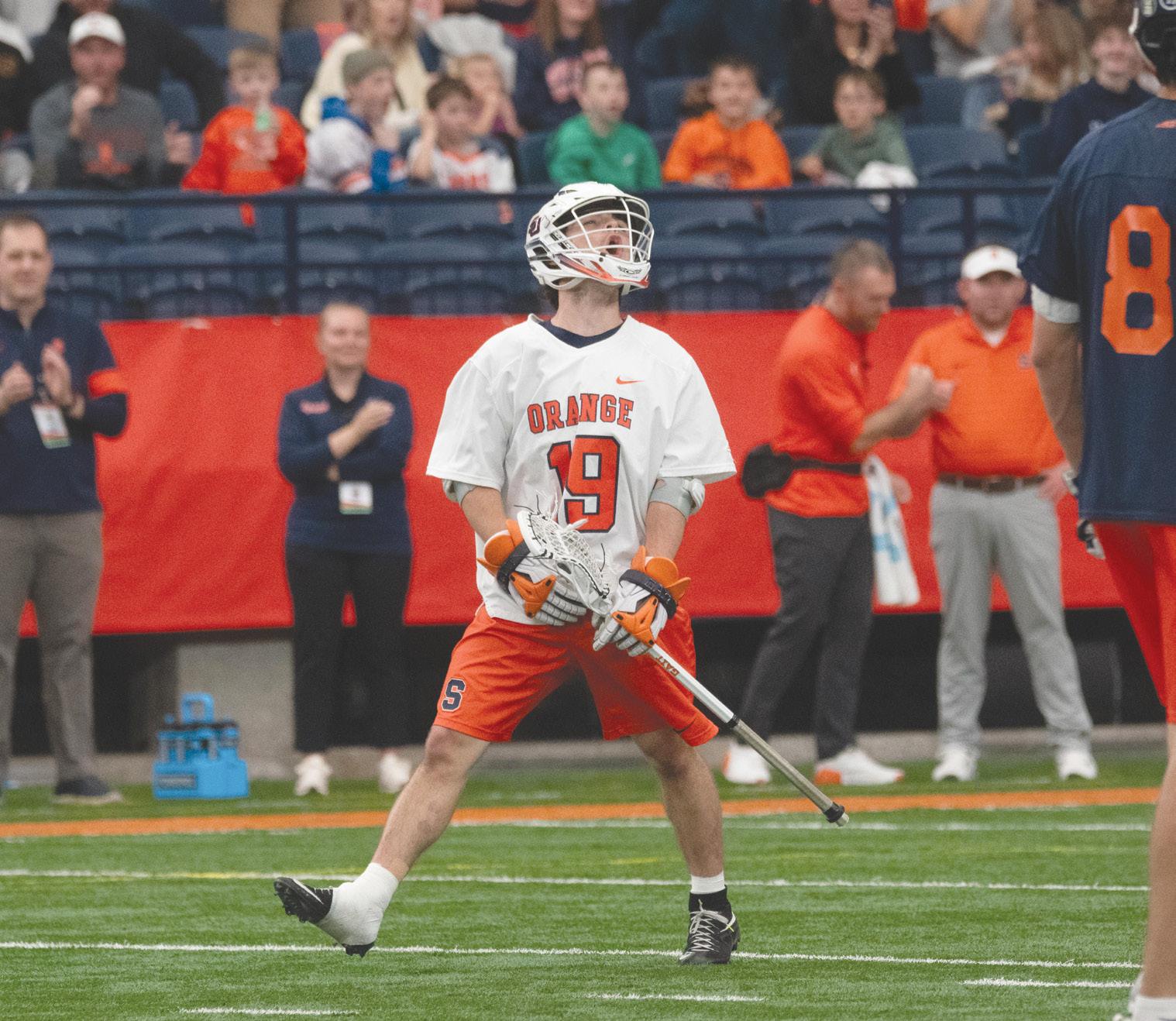
As the shortest player on Syracuse men’s lacrosse, starting midfielder Wyatt Hottle is proving his height is an advantage.
Page 11
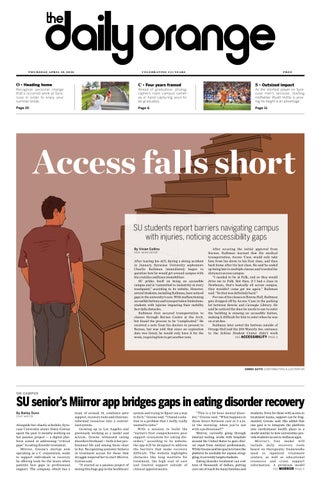
Access falls short
SU students report barriers navigating campus with injuries, noticing accessibility gaps
By Vivian Collins asst. news editor
After tearing his ACL during a skiing accident in January, Syracuse University sophomore Charlie Raibman immediately began to question how he would get around campus with his crutches and knee immobilizer.
SU prides itself on being an accessible campus and is “committed to inclusivity at every touchpoint,” according to its website. However, several students, including Raibman, have noticed gaps in the university’s care. With malfunctioning accessible buttons and transportation limitations, students with injuries impacting their mobility face daily obstacles.
Raibman first secured transportation to classes through Barnes Center at the Arch, but found the process to be “complicated.” He received a note from his doctors to present to Barnes, but was told that since no expiration date was listed, he would only have it for the week, requiring him to get another note.
After securing the initial approval from Barnes, Raibman learned that the medical transportation, Access ‘Cuse, would only take him from his dorm to his first class, and then back home after his last class. He said he ended up being late to multiple classes and traveled far distances across campus.
“I needed to be at Falk, and so they would drive me to Falk. But then, if I had a class in Newhouse, that’s basically all across campus, they wouldn’t come get me again,” Raibman said. “So that was definitely hard.”
For one of his classes in Bowne Hall, Raibman gets dropped off by Access ‘Cuse in the parking lot between Bowne and Carnegie Library. He said he noticed the door he needs to use to enter the building is missing an accessible button, making it difficult for him to enter when he was on crutches.
Raibman later noted the buttons outside of Orange Hall and the 200 Waverly Ave. entrance to the Schine Student Center didn’t work see accessibility page 5
SU senior’s Miirror app bridges gaps in eating disorder recovery
By Bailey Dunn staff writer
Alongside her chaotic schedule, Syracuse University senior Haley Greene spent the past 11 months working on her passion project — a digital platform aimed at addressing “critical gaps” in eating disorder treatment.
Miirror, Greene’s startup now operating as a C corporation, seeks to support individuals in recovery by offering tools for the hours when patients face gaps in professional support. The company, which has a
team of around 15, combines peer support, recovery tools and clinicianinformed resources into a centralized system.
Growing up in Los Angeles and previously working as a model and actress, Greene witnessed eating disorders firsthand — both in her professional life and among those close to her. Recognizing systemic failures in treatment access for those that struggle inspired her to start Miirror, Greene said.
“It started as a passion project of seeing this huge gap in the healthcare
system and trying to figure out a way to fix it,” Greene said. “I found a solution to a problem that I really, really wanted to solve.”
With a mission to build the “nation’s first comprehensive peer support ecosystem for eating disorders,” according to its website, the app will be designed to address the barriers that make recovery difficult. The website highlights obstacles like long waitlists for treatment, the high cost of care and limited support outside of clinical appointments.
“This is a 24-hour mental disorder,” Greene said. “What happens in those hours between care at 3 a.m. in the morning, when you’re not with a professional?”
Miirror, currently going through internal testing, works with hospitals around the United States to gain clinical input from medical professionals. While Greene said her goal is to have the platform be available for anyone struggling, it currently targets students.
Eating disorder treatment can cost tens of thousands of dollars, putting care out of reach for many families and
students. Even for those with access to treatment teams, support can be fragmented, Greene said. She added that one goal is to integrate the platform into institutional health plans in a model similar to how universities provide students access to wellness apps. Miirror’s free model will include daily recovery tools based on therapeutic frameworks used in inpatient treatment centers, as well as educational resources and crisis support information. A premium model see m iirror page 5
emma soto
Editor@dailyorange.com
News@dailyorange.com
Opinion@dailyorange.com
Culture@dailyorange.com
Sports@dailyorange.com
Digital@dailyorange.com
Design@dailyorange.com
Photo@dailyorange.com
BUSINESS 315-443-2315
how to join us
The Daily Orange is an independent, nonprofit newspaper published in Syracuse, New York. The editorial content of the paper — which started in 1903 and went independent in 1971 — is entirely run by Syracuse University students.
The D.O., a 501(c)(3) nonprofit, is editorially and financially independent from SU, and the paper receives no funding from the university. Instead, The D.O. relies on advertising revenue and donations to sustain operations.
This spring, the paper will be published Thursday when SU classes are in session. The D.O.’s online coverage is 24/7, including while SU is on break.
To show your support to The D.O.’s independent journalism, please visit dailyorange.com/donate. Donations are tax deductible.
If you are a Syracuse University or SUNY-ESF student interested in contributing to The D.O. on either its advertising or editorial teams, please email editor@dailyorange.com.
corrections policy
The D.O. strives to be as accurate in our reporting as possible. Please email editor@dailyorange.com to report a correction.
letter to the editor policy
The D.O. prides itself as an outlet for community discussion. To learn more about our submission guidelines, please email opinion@dailyorange.com with your full name and affiliation within the Syracuse community. Please note letters should not include any personal information pertaining to other people unless it is relevant to the topic at hand. All letters will be edited for style and grammar.
The forecast for this upcoming week, per The Weather Channel.
EDITOR-IN-CHIEF
Kendall Luther
Rosina Boehm
Griffin Uribe Brown
On Denim Day, jeans are more than a piece of clothing
By Fiona McHugh asst. copy editor
For some, wearing jeans on the last Wednesday in April is more than just an outfit choice.
On Denim Day, the worldwide organization encourages people to wear jeans in solidarity with victims of sexual violence. The annual day promotes sexual assault awareness and aims to challenge myths of consent.
On Wednesday, Syracuse University’s Barnes Center at the Arch’s Health and Wellness department invited SU students to post themselves wearing denim on Instagram, tagging the Barnes Instagram account and using the hashtag #SAAM2026 to raise awareness for Sexual Assault Awareness Month.
Denim Day’s history dates back to a 1998 Italian Supreme Court case, a ruling which overturned a 1992 rape conviction. The justices determined that because the victim was wearing tight jeans, she must have helped the defendant remove them and therefore consent was implied. This reasoning is known as the “jeans alibi.”
In response, women in the Italian Parliament wore jeans to work and launched a protest on the steps of the Italian Supreme Court. The movement traveled around the world to the California State Capitol. Denim Day in LA was held in April 1999 to contest myths about why women and girls experience sexual violence.
Denim Day is now observed on college campuses nationwide on the last Wednesday in April.
city
“It is critical to invest in evidence-based prevention education,” Tracey Vitchers, executive director of It’s On Us, wrote in a statement to The Daily Orange.
It’s On Us is a program that resulted from a 2014 public awareness campaign to help combat sexual assault on college campuses.
“Now more than ever, using our voices matters, an open letter from Denim Day founder Patricia Giggans reads. “In a time when injustice, violence, and abuse of power continue to surface across our institutions and communities, silence is not an option.”
Twenty-seven years after Denim Day’s start, it remains a powerful initiative across college campuses, including at SU.
“When millions of us participate in Denim Day—wearing denim, jeans, jackets, and hats as symbols of protest and solidarity—we make visible a powerful truth: survivors are not alone, sexual violence will not be tolerated, and together we can change the future,” Giggins wrote.
In a nationally representative survey of female adults conducted by the National Sexual Violence Resource Center, 34.4% of female rape victims experienced rape between the ages of 18 and 24. Over 40% of students experienced at least one harassing behavior while in college, according to the survey.
In 2024, the biennial Survey on Sexual and Relationship Violence, required on college campuses by New York state law, found that 11% of SU students said they had witnessed a verbal statement they thought might lead to sexual assault. The bill requiring the survey, titled “Enough is
Enough,” first went into effect in July 2015 as part of a broader initiative about sexual assault on college campuses.
“Moments like Denim Day help start conversations about sexual violence and the importance of consent within campus communities, serving as an entry point for students who otherwise may not be engaged in the fight to combat campus sexual assault,” Vitchers wrote.
The theme of Denim Day 2026 is “Use Your Voice,” encouraging people to speak up about sexual assault. Past themes include “Be an ally,” “Let’s protect each other” and “Be an upstander”
from 2023, along with “We Believe Survivors” and “We Protect Each Other” from its 2021 campaign.
According to the Rape, Abuse and Incest Network, 4 out of 5 students nationwide do not report the sexual violence they experience to law enforcement. At SU, roughly one of every six survey respondents who experienced sexual assault filed a report, according to the 2024 SSRV survey.
“Denim Day makes it clear: it doesn’t matter what a survivor was wearing — the only person responsible for sexual assault is the perpetrator,” Vitchers wrote.
fmchugh@syr.edu
Common Council introduces fiscal year budget in weekly meeting
By Ryan Garipoli staff writer
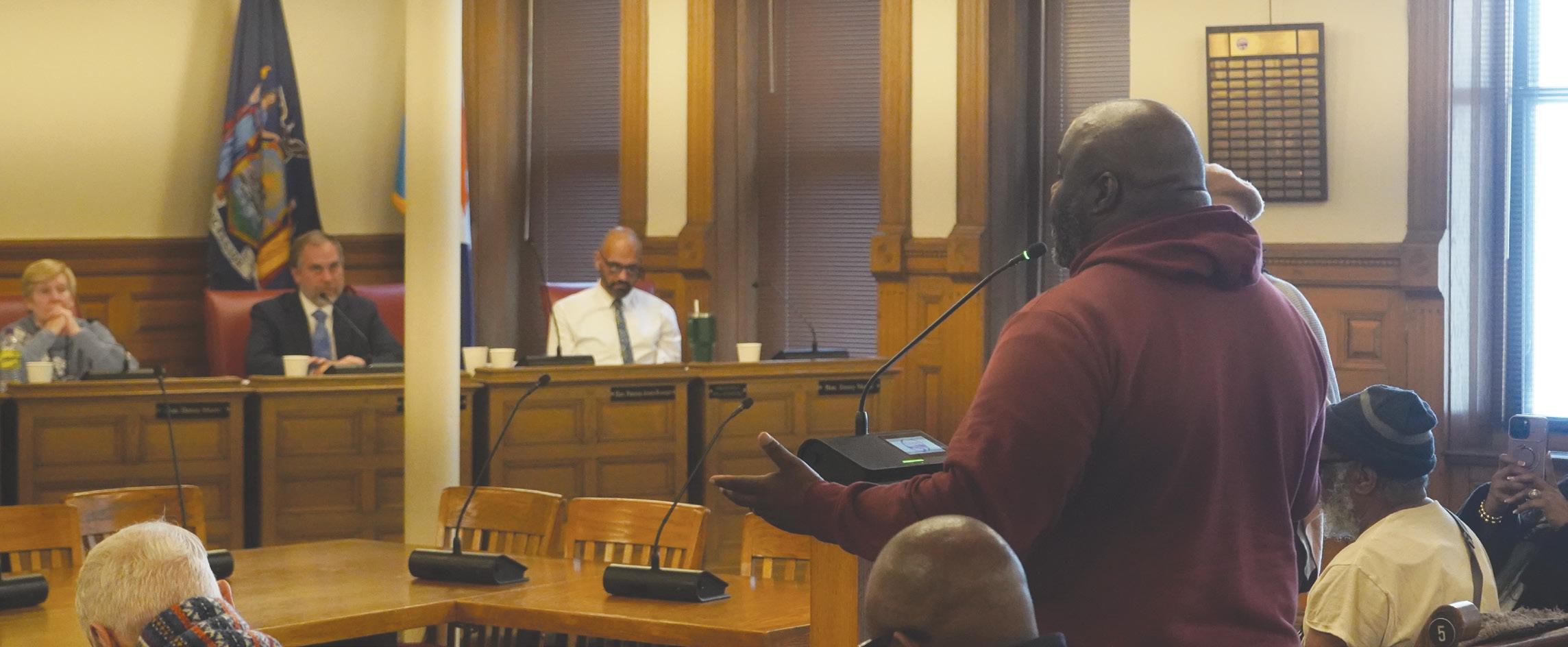
Syracuse Common Council introduced its $354.5 million 2026-27 fiscal year budget proposal and faced backlash over its failure to pass Good Cause Eviction at its budget hearing Wednesday.
The budget proposal is an approximately $6.1 million increase from the $348.4 million city budget for the 2025-26 fiscal year. The hearing also opened the podium to attendees to promote laws or pitch their own city contracts.
The 2026-27 budget proposal includes a 4% water rate increase, with no increase in the property tax rate. The proposal also delegates $2.25 million for the Housing Strategy Corporation.
Multiple attendees spoke out against recent actions of the council that have increased living costs for Syracuse residents.
John Meyer, a Syracuse resident and leader of the Washington Square Task Force and Neighborhood Watch, spoke about his concern with Syracuse taking on another budget deficit. He said it’s “nice” that they don’t have a tax increase this year, but called the deficits a “ticking time bomb.”
Meyer expressed frustration with increasing budgets for city employees, resulting in more people hired who “do the same thing.” He emphasized “consolidation” as a way for the city to save money.
“We trust you as our elected officials to be prudent with our money, it’s not a matter of being liberal or conservative,” Meyer said. “You can make these cuts without being a terrible person.”
Andrew Sievers, a resident of Syracuse’s second district, used the open podium as a chance to scold the council for not adopting Good Cause Eviction, a tenant-friendly rent law that would prevent landlords from evicting tenants without “good cause.”
Sievers demonstrated particular frustration with Councilor Donna Moore, the representative from Syracuse’s second district and one of the councilors who flipped their vote against the law.
on campus
Syracuse Common Council introduced its $354 million 26-27 budget proposal and heard concerns from attendees during its weekly Wednesday meeting. steven wright daily orange file photo
“Donna, since I’m still one of your constituents for the next 24 hours, let me say publicly, shame on you,” Sievers said. “Your wishy-washiness makes you an embarrassment to this chamber.”
Sievers said he is confident Good Cause will get approved by the council in time, but will require some changes on the council.
“There is plenty of energy still out there. I think the energy is more focused on getting these people replaced,” Sievers said. “When you have representatives like Donna, who simply only make time for less than 10% of her constituents, what are you going to do?”
Some attendees spoke at the hearing about a potential opportunity for the city to save money or even generate additional revenue.
Kim Cameron, a volunteer speaker for activist organization Beyond Plastics, spoke in support of the “Bigger Better Bottle Bill,” a bill designed to save Syracuse taxpayers money by increasing the bottle return deposit from five to 10 cents.
Cameron explained that while New York has a 68.3% bottle return rate, other states that have increased their deposit costs have seen return rates increase to 90%. Bottle deposit data shows Oregon has the highest return rate in the United States at 87%.
Cameron said that if passed, the bill could save Syracuse taxpayers as much as $190,000 annually. She urged the council to show residents that they will do everything in their power to reduce costs.
SU alum Zane Connell and Cliff Ryan Jr., founder of OG’s Against Violence, attended
the budget hearing to continue their support of a city contract for their startup Cavline, a business that allows small businesses to utilize screens in private and public spaces for advertising.
Connell said he believes Syracuse would financially benefit from a city contract with Cavline, because it allows the city to make money by allowing campaigns to advertise on public screens.
“Any person that’s running a campaign in the city, they’re actually putting money back into the city by using campaign funds,” Connell said.
The Common Council will vote on the 202627 fiscal year budget on May 8. rcgaripo@syr.edu
SU to award 6 honorary degrees at 2026 commencement ceremony
By Mirren Grimason staff writer
Syracuse University will award honorary degrees to outgoing Chancellor Kent Syverud, Dr. Ruth Chen and four others at the 2026 commencement ceremony, according to a Wednesday release.
To award such degrees, the university bypasses typical degree requirements to be awarded to a distinguished person in their field of work or to society. SU’s University Senate deliberates over each nominee, with the Board of Trustees deciding the final recipients.
Syverud will be honored at the ceremony for the “record applications and enrollment” during his term, his impact on economic “resurgence” in the central New York region and his support for veterans and military families.
“Chancellor Syverud has led Syracuse University through 12 years of transformational change, reshaping the campus, strengthening research and academic excellence, and expanding Syracuse University’s impact in Central New York and beyond,” the release said.
Professor of Practice in the College of Engineering and Computer Science and Environ-
mental Toxicologist Chen, wife of Syverud, was chosen as a recipient for her “commitment to students, scholarship, service and the public good,” the release said.
Before working as a professor at SU, Chen was state toxicologist for the Tennessee Department of Environment and Conservation, where she assessed and managed toxic substances and provided expert advice to other state divisions, according to the release.
The four additional recipients include:
• Dr. Mantosh Dewan, president of SUNY Upstate Medical University
• Clifford J. Ensley, former Syracuse ath-
lete and founder of Leisure Merchandising Corporation
• Linda M. LeMura, president of LeMoyne College
• Joanne M. Mahoney, president of SUNY ESF
Dewan and Chen will each receive a Doctor of Science, and Ensley and LeMura a Doctor of Humane Letters. Both Mahoney and Syverud will be given a Doctor of Laws.
The six recipients will be awarded their honorary doctorates on May 10 at the universitywide commencement ceremony.
msgrimas@syr.edu
sarah yudichak contributing illustrator
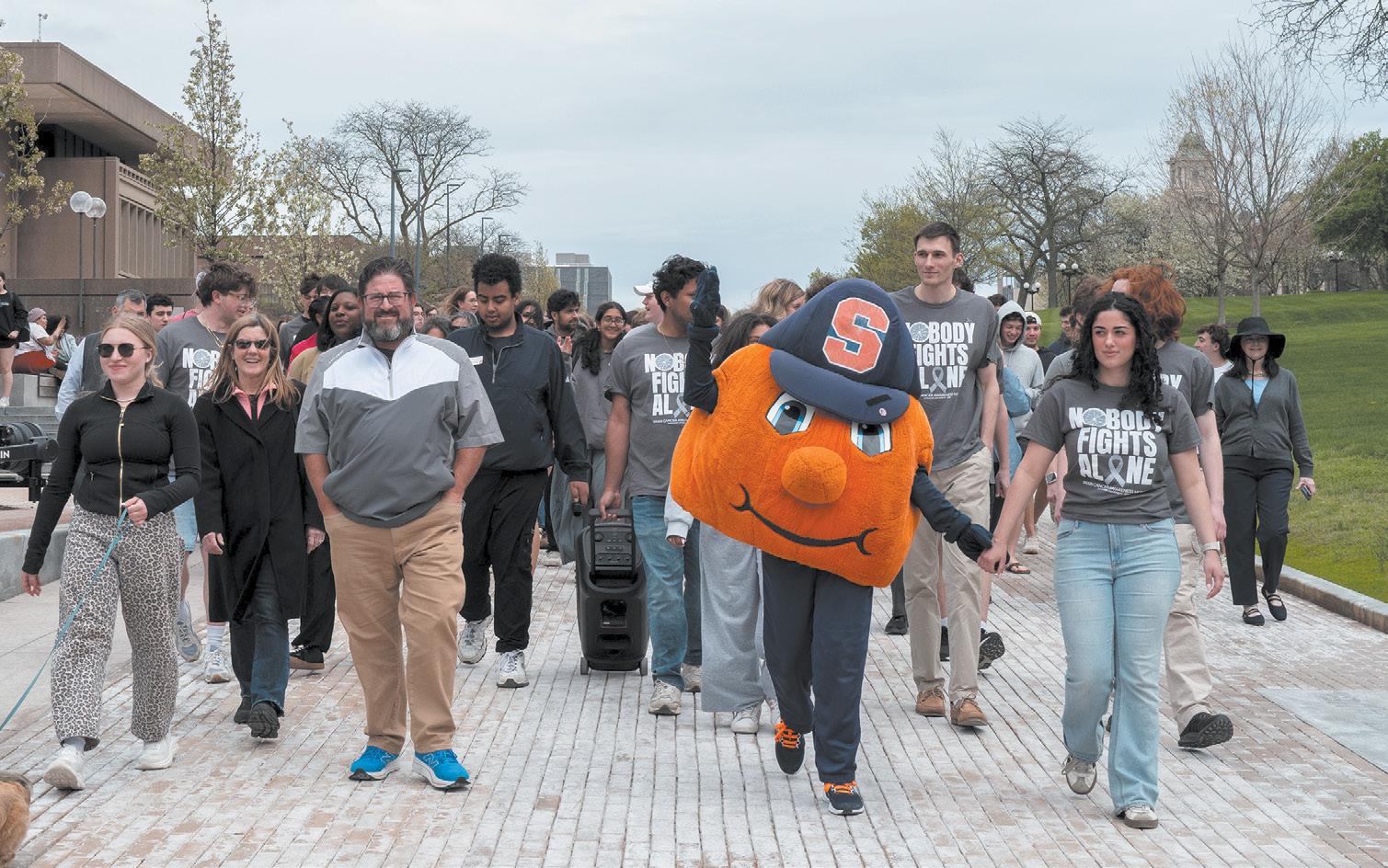
Current and former SGA executives, alongside Otto the Orange, lead the walk for Syverud. Student organizations represented their respective groups, with over 60 organizations appearing throughout the crowd.
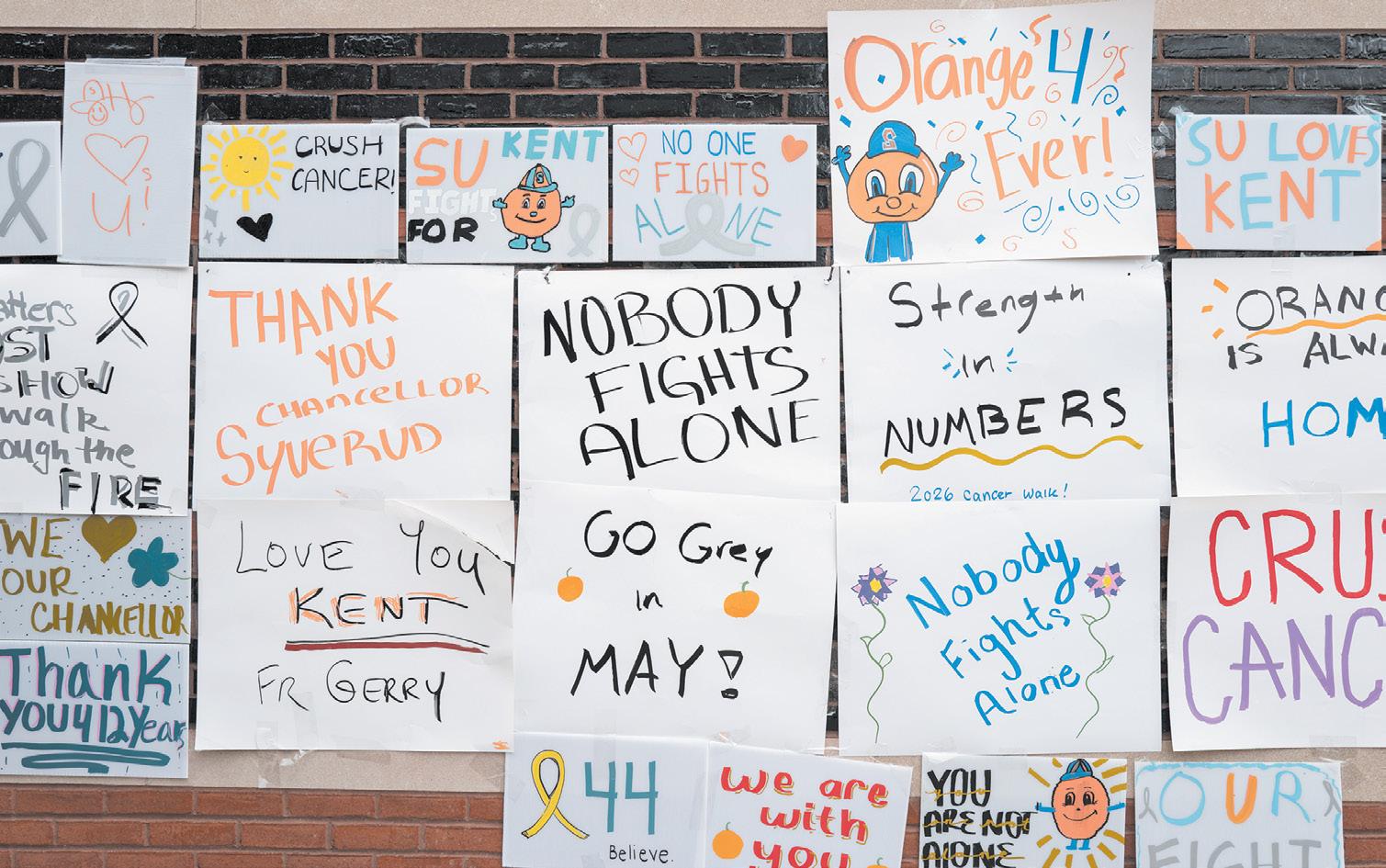
SGA displays the visitors’ posters on one of Schine Student Center’s walls, leaving encouraging messages for Syverud. By the end of the event, over 30 signs covered the bricks — despite gusts of wind nearly knocking them down.
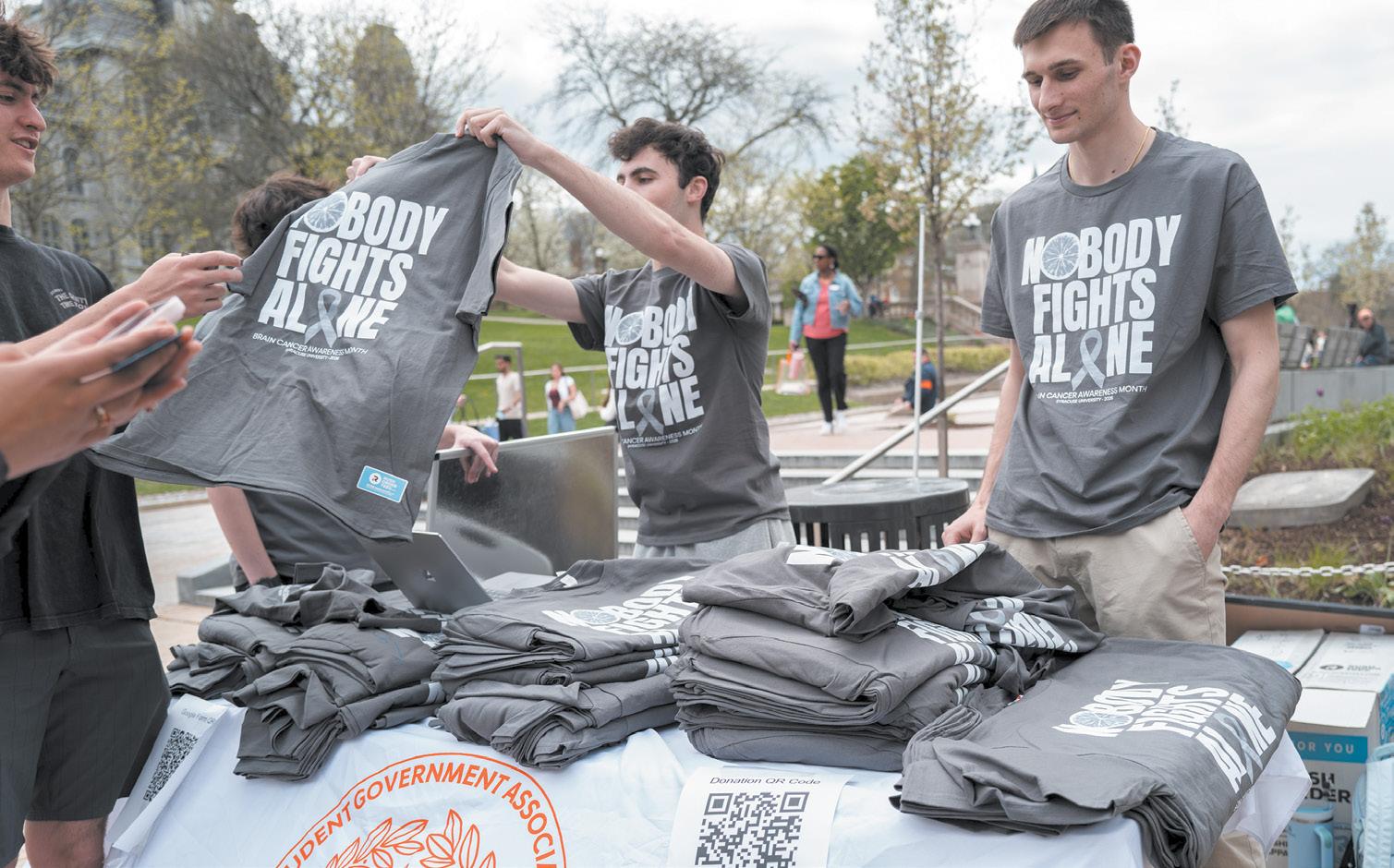
Members of SGAgive out T-shirts to attendees. The shirts, reading “nobody fights alone,” were distributed to those who donated at least $15 to the Brain Tumor Foundation.
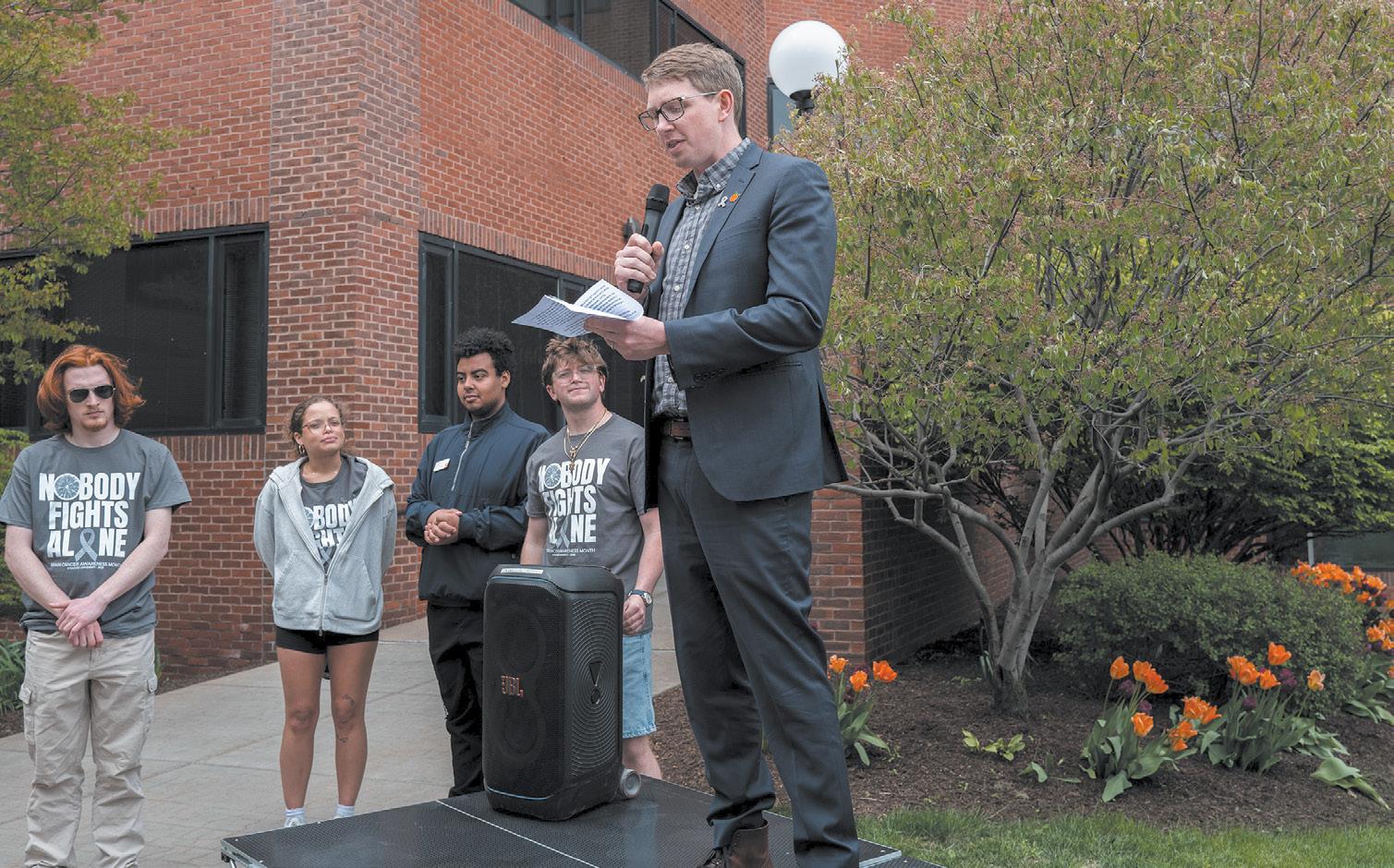
Bartholomew speaks to the crowd, talking about his personal experiences with brain cancer. He shared that, within the past 10 months, two other people he knows have also been diagnosed with the illness.
on campus
Over 200 walk for brain cancer awareness after Syverud’s diagnosis
SU community makes posters and wears gray for Brain Cancer Awareness Month
By Julia Boehning enterprise editor
While leaving Syracuse University’s Schine Student Center Tuesday afternoon, freshman Ayan Haque came across a collection of tables covered in drawings of gray ribbons, postermaking materials and T-shirts.
Although Haque didn’t know what it was for at first, when he saw a sign urging passersby to write letters in support of outgoing Chancellor Kent Syverud following his brain cancer diagnosis a few weeks earlier, he stopped to pen his own message. Despite not knowing the chancellor well, he said he understands Syverud’s struggle.
Haque said his brother had leukemia when they were children. While his brother recovered from the illness, Haque said the fight wasn’t easy — he still remembers the ports that ran from his younger sibling’s chest to his back.
“It was hard seeing (my brother) go through all that … but I want to tell the chancellor nothing’s impossible,” Haque said. “He can overcome it.”
Haque was one of hundreds who showed their support during Tuesday’s brain cancer awareness event and walk. The walk, from Schine to Crouse-Hinds Hall, drew over 200 people from across the SU community to support Syverud and raise money for brain cancer research.
The event, hosted by SU’s Student Government Association and over 60 other on-campus organizations, raised money for research on the disease through the Brain Tumor Foundation. It also marked the start of Brain Cancer Awareness Month, which officially begins on Friday.
“Go Gray in May” took place outside of Schine from 12 to 2:30 p.m., allowing visitors to make posters in support of Syverud, write letters to the former chancellor and his wife, Professor of Practice Ruth Chen, eat snacks and donate to the Brain Tumor Foundation. Those who donated $15 or more received a shirt reading, “Nobody fights alone.”
Several campus administrators and leaders — including acting Chancellor Mike Haynie, Vice Chancellor and Provost Lois Agnew and Department of Public Safety Chief Michael Bunker — stopped by the event throughout the afternoon. SU mascot Otto the Orange also joined supporters on their walk to CrouseHinds, which houses the chancellor’s office.
Syverud first shared his cancer diagnosis on April 15, less than a month before he was set to become president of the University of Michigan. In the message, he announced his decision to step down from SU’s chancellorship — bringing chancellor-elect Haynie into the role earlier than expected.
The former chancellor shared an update on his condition last week, confirming he would be receiving treatment in Michigan for the remainder of the semester. Syverud thanked the SU community for its “overwhelming wave of support, love, and care” following his diagnosis.
Emily Castillo-Melean, SGA presidentelect, said the walk in Syverud’s honor was one of the largest collaborations between the association and other organizations in university history.
“(The event) really shows the power of how much we can do,” Castillo-Melean said, addressing the crowd. “To everyone who participated today, thank you. Your presence reflects a commitment to community, compassion and awareness that defines (the) Syracuse University family.”
One attendee, SU senior Salome Abdushelishvili, decorated her poster in silver and black writing with the message: “What matters MOST is how you walk through the FIRE.” Abdushelishvili was one of the first non-SGAaffiliated attendees to make a sign.
Dozens of colorful signs created by SU offices, student organizations and visitors covered a wall in Schine by the end of the afternoon. Some of the messages read, “Crush cancer,” “Nobody fights alone” and “Thank you, Chancellor Syverud,” among others.
While Abdushelishvili said she initially decided to attend the event in support of her boyfriend, Julian Hernandez, who was officially appointed as SGA’s director of student technology affairs, she said rallying behind Syverud resonated with her personally, as someone who wants to work in the healthcare industry and knows someone with cancer.
“The whole thing about battling cancer is the focus, especially in healthcare, it’s how you go through the motions of dealing with the illness, because you can choose to have a positive mindset even though it’s really difficult,” Abdushelishvili said.
Another student, freshman Zack Felker — a friend of Haque’s — said he’s connected with cancer, as two of his grandparents had the disease. He said he hopes his note will encourage Syverud to move forward, like his grandfather — who beat cancer twice — did.
In remarks at the end of the walk, Hendricks Chapel Rev. Devon Bartholomew shared his own experiences with brain cancer — saying he knew someone who died from the illness in December and another who’s back to working after undergoing surgery in February.
“Thank you Student Government Association for responding to Chancellor Syverud’s diagnosis by asking the right questions: ‘How do we respond?’ You have responded with conscience and with clarity,” Bartholomew said before leading the group in prayer.
When something is wrong, we need to learn to build each other up, and we need to stand by each other. I don’t find that for just brain cancer. I find that for anything
Juanita Goncalves corelife eatery employee
Not all attendees were able to attend the walk itself, but many arrived to donate or write a letter before leaving. One visitor, Juanita Goncalves, said she decided to spend part of her lunch break from working a shift at CoreLife Eatery to write a message for the former chancellor.
Syverud once hosted Goncalves and other Food Services workers at the Chancellor’s House when she first arrived at SU “many years ago,” she said with a laugh. Goncalves said Syverud and Chen’s positivity immediately struck her, making it important to her to offer her support today.
Goncalves teared up when reflecting on her letter to Syverud and her reasons for attending “Go Gray in May.” She said she hopes the campus community continues to support the former chancellor and keeps in mind that cancer “can hit anybody, young to old.”
“This is a painful time for him,” Goncalves said. “We’re going to have to deal with this as a community, not just as one human being or one person.”
Hernandez said he hopes events like “Go Gray in May” show the university community can “pull together” and rally behind someone they care about. He added that this is especially true for someone like Syverud, who’s been with SU for over a decade.
SGA’s April 15 resolution “Honoring Kent Syverud and Extending Love and Support,” which was released the day the former chancellor shared his diagnosis, echoed this sentiment. The resolution specifically wished the chancellor well and commended his “enduring contributions” to SU.
“When something is wrong, we need to learn to build each other up, and we need to stand by each other. I don’t find that for just brain cancer. I find that for anything,” Goncalves said. “We’re very negative in this world that we’re living in lately, and we just need to … be more positive and more selfless.”
jmboehni@syr.edu
either. In a statement to The Daily Orange, a university spokesperson said the entrances are compliant with the Americans with Disabilities Act, adding that students can report facility accessibility issues by calling its office.
In 2016, the university conducted a “comprehensive accessibility audit.” The university spokesperson noted that identified issues are addressed through a dedicated accessibility fund.
Katherine Macfarlane, professor at SU’s College of Law and Director of the Disability Law and Policy Program, emphasized the importance of working accessible buttons.
“Something that appears to be as simple as a push button could determine whether a student remains trapped in a parking structure after hours or is able to enter a building and get to class on time,” Macfarlane wrote in a statement to The D.O. “They are essential to free movement about campus and often ensure personal safety and prevent injury.”
This is not the first time SU students have raised accessibility concerns. In 2021, a prospective student filed a class-action lawsuit against the university alleging the website was not compliant with federal accessibility standards.
Freshman Jessica Hooton experienced similar challenges to Raibman last semester when she broke one ankle and sprained the other during practice for the SU club gymnastics team. She also received transportation from Access ‘Cuse and was able to work with the coordinator to get rides from one class to another.
According to SU, the university offers two different transportation service options for students who require accommodations — Access ‘Cuse and SU Ambulance. Deciding which service a student needs is determined by “the individual in consultation” with CDR or the Barnes Center.
Raibman and Hooton both said they had been late to classes because the medical transportation was running behind.
Sophomore Molly Tracy was in a non-weightbearing hard cast with a scooter for seven weeks last semester. She said she scheduled her pickups hours in advance to ensure she would make it to class on time.
“Students are asked to be flexible, as the transport company accommodates a wide variety of students and their schedules,” the university wrote in a statement to The D.O. “If a student has concerns, they can always return to CDR for additional support.”
Tracy currently lives off campus and has a car with her. As she injured her left leg, she was
still able to drive. However, when Tracy asked the university if she could have a temporary parking pass so she could drive to classes, she was denied.
While Tracy said she was grateful for the medical transport, she was “really frustrated with the school” when they wouldn’t permit her to park on campus.
“In a city like Syracuse, where sidewalks remain icy and dangerous for months, a car is often the only safe form of accessible transportation available to students with mobility disabilities,” Macfarlane wrote. “Access to safe disabled parking across campus, parking that requires as little time spent on icy ground as possible, should be an immediate priority.”
A representative from SU’s Center for Disability Resources said their office welcomes complaints and concerns from students. But for the most part, they said, it doesn’t receive many, so it assumes most places are accessible. If a student comes to them with an issue, their office does “a pretty good job” helping them, the representative said.
“If a student comes in and they have a real accessibility issue, on crutches, in a wheelchair, whatever it might be, we do a pretty good job of making sure that their buildings are accessible,” the representative said. “And the facilities here, they’re on top
of it and make sure that all of the buttons are working.”
CDR works with several other campus departments, including housing, dining and parking to support students.
While many students may not think about accessibility on campus, injuries such as Raibman’s can happen at any time and disrupt a student’s daily routine. Raibman described an instance where he was waiting for the elevator at Falk and no one moved out of the way to let him on, so he missed it.
“I never really would have thought about the fact that when I’m fully capable of walking, I should maybe not use the elevator, until then I’m standing there and I’m like, ‘no one is moving out of the way for me,’ I need to use the elevator,” Raibman said.
For Raibman and other students navigating similar situations, accessibility is not just about formal accommodations, but about the realities of moving through campus.
“The first step is acknowledging that a campus built on steep hills, with lots of staircases, which is subject to difficult-to-navigate weather conditions, is not inherently accessible,” Mcfarlane wrote. “(What’s) also important to assume is the constant, and not temporary, presence of people with disabilities. Ask disabled people what they need before the problem arises.” viviancollins@dailyorange.com
would offer therapy matching, peer mentorship and personalized care pathways.
A major component of the platform is its peer-support network, which would connect users with people who’ve been in recovery for two or more years.
SU senior Fernanda Kligerman, the user interface and user experience designer for the team, said in addition to the peer support system, the “voice journaling” aspect is what she most valued contributing to.
The system allows users to record themselves talking about their struggles and prog-
ress. The information users share will be synthesized, and key themes will be analyzed to form a response with advice.
“Its so simple yet so effective, because things that a lot of people struggle with don’t just pertain to eating disorders,” Kligerman said.
The startup is developing tools clinicians can use to monitor patient progress between appointments, allowing them to identify patterns, recommend coping skills and better understand patients’ triggers outside of clinical settings, Greene said.
Miirror is entering a field with few specialized digital tools despite the prevalence of eating disorders.
“There’s over 10,000 mental health apps, and there’s zero in eating disorder recovery with any proven outcome,” Greene said.
For people who have experienced an eating disorder, the lack of consistent support between formal treatment settings can be felt deeply, Greene said.
“Eating disorders are very competitive, so if you don’t have the right kind of support or professionals looking after that, it can become a spiral,” SU senior Isabel Marin Young said.
Using her own experience to help others with eating disorder struggles, Young has seen many societal misconceptions around them including what Greene hopes to address through her platform.
“It’s not about the food, it’s not about the look. It’s not about vanity or this shallow layer that people assume it is. It’s all based on fear, trauma and need for control,” Young said.
Young said Miirror will be a “good middle ground” for people who want to take a next step in recovery by getting “honest advice” from people who have previously gone through similar things. But “being ready to recover yourself” is an important step.
“Give yourself some love, you have to give yourself grace,” Young said. “When you do reach the moments in recovery where you are in a better place, life is more fun.”
haley greene pitches her platform Miirror to Syracuse Launchpad panelists for potential funding.
courtesy of haley greene
CULTURE
Four years framed
Ahead of graduation, cameras capture almost graduates around campus
By Joel Pelachik asst. copy editor
Less than two weeks before graduation, caps went airborne, gowns flowed and scraps of champagne labels covered the sidewalks of Syracuse University’s campus.
One of those soon-to-be SU graduates was Marcia Ciriello’s daughter.
Ciriello, a New York City-based photographer, had never taken college graduation photos. On Friday, that
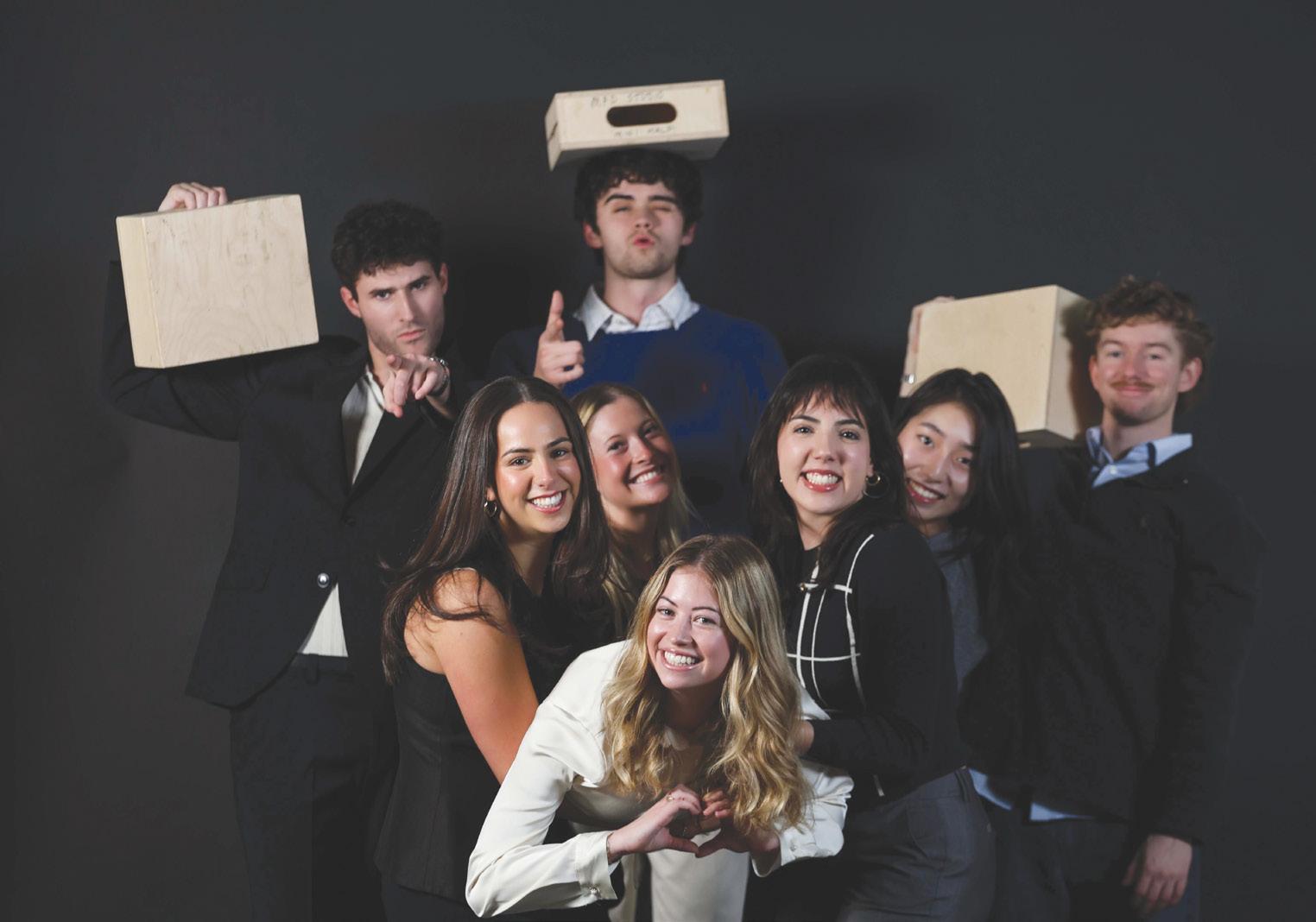
changed; Ciriello traveled to SU to photograph her daughter and six of her friends.
“It was really lovely to be able to have them and also just see your daughter not just as your daughter, but as this person, this lovely adult that’s moving on to this new phase of life,” Ciriello said.
On that sunny April day in Syracuse, students sprawled out on the lawns and others attended Block Party’s Soundcheck. But Ciriello, a full-time photographer who’s owned her business for around 25 years, see photographers page 9
By Lily Zuckerman asst. culture editor
Originally, J-Michael Shoes wasn’t J-Michael Shoes. It began in 1969 as Townsend Shoe Store in downtown Syracuse and moved to Syracuse University’s Marshall Street in 1983.
The shoe store — that sold a lot more than just shoes — will close for good on May 30.
“Syracuse was really good to us,” John Michael Vavalo said. In 2024, StreeTgame, a sneaker store with several upstate New York
locations, bought the shoe store from the Vavalo family. At the ripe age of 12, John Michael began working at the store, helping his dad with whatever he could — which he credits to developing his drive. John Vavalo, who is now 86 years old, named the store after his son, who was born in 1982 and 1-year-old at the time of J-Michael’s inception. John Michael’s ties to J-Michael go beyond his name. While the Vavalo family doesn’t own the store anymore, John Michael essentially grew up inside J-Michael.
Birkenstock sandals. Canada Goose coats. Barbour jackets. UGG slippers. OnCloud sneakers. These are only a few of the brands and styles that J-Michael carries. Since the store is across the street from SU’s Whitman School of Management, these products were easily accessible in between classes.
Under the original ownership, employee Deborah Snyder worked at J-Michael from 1986-88 during her freshman and sophomore year at SU. Snyder remembers J-Michael as “a landmark,” and its
closing is just another “M-Street legend” to disappear.
Snyder said losing J-Michael is like losing a piece of SU’s history. If you worked at J-Michael, you were practically part of the Vavalo family.
A typical J-Michael shift for Snyder included visits from friends, wholesome conversations with John, helping size customers in Timberland shoes and a stop by Cosmos Pizza and Grill for their toasted honey bun — which Snyder notably calls “THB.”
“It never really felt like work. It just felt like I was just being
paid to socialize with my friends,” Snyder said.
Former J-Michael general manager, Erik Hicks, followed in the footsteps of his late father, Jim Hicks, who began working for John in the 1970s when he still owned Townsend Shoes. Jim later became J-Michael’s general manager. Erik always grew up around the Vavalos, but it wasn’t until 1999 that he was employed by them. With no job after college graduation, Erik began his more than 20-year career at J-Michael. see j-michael page 9
Standing on top of the winding Crouse College steps, Francesca Vasconi photographs her friend Maya D’Arcy’s graduation photos. As the former social media intern for the women’s ice hockey team, she said seeing her friends grow was a “full circle” moment. eli schwartz asst. photo editor
Flip-flops are stylish to some students, sole offenders to others
By Claire Zhang asst. digital editor
Whenever Tommy Handen checks his weather app and sees the temperature is anywhere above 50 degrees, he knows it’s time to whip out his favorite shoe: flip-flops.
Handen’s classic way of styling his Rainbows (the “most comfortable, best looking flip-flops on this planet”) is simple.
“Probably just put my left one in first, then my right and then it’s perfect,” the Syracuse University freshman said.
On SU’s campus, the sandal is a popular footwear option, though the weather may not always warrant wearing them. After long months of a bitter Syracuse winter, it’s no question that students like Handen want to wear a shoe that symbolizes sunnier seasons. While they’re not the most durable option, flip-flops are easiest to slide on straight out of bed.
Whatever the brand or style may be — leather Rainbows or plastic Havaianas — flip-flops are making a resurgence.
Sophomore Pippa Nilson breaks them out whenever she has the chance, a habit she’s carried since high school. She bought her Rainbows over two years ago, and they’re now perfectly molded to the shape of her foot. The band’s braided design is fashionable, Nilson said. And, they make for a comfortable sandal that doesn’t restrict her feet.
“If I’m wearing sneakers, I’m wearing socks, but I don’t like shoes very much,” Nilson said. “I would rather just be barefoot, but obviously it’s not socially acceptable.”
So, flip-flops are the simple solution. When lounging on any campus green, it’s easy to throw them off and touch the grass.
To some students who are adamantly opposed to the shoe, like junior Taylor Whitmore, Nilson’s reasoning is exactly why flip-flops are unreasonable. When first asked about her opinion on the sandal, Whitmore said she was “pretty neutral.” But the more she thought about it, the more irritated she got.
“It’s a poor excuse for a shoe,” Whitmore said. “You know what it is? It’s for the people that like to just not wear shoes in public, it genuinely feels like a psyop.”
This hatred started at a young age. She’d never agreed with the placement of the strap between the toes and felt it was “invasive” to her feet. On top of that, the lack of support makes them
impractical — it’s impossible to walk or run in flip-flops without them falling off your feet, Whitmore said.
Though Nilson and Handen are fans of flipflops, they’ve sometimes received backlash. In high school, Handen tried to sport them every day of the year. Handen, who’s from Maryland, said there were definitely cold days when he got some strange looks.
On some occasions, Nilson wore sandals and had her close friends take pictures of her, poking fun at her footwear choice.
Aside from the convenience of flip-flops, part of the appeal of Rainbows is the aesthetic, Nilson said. Among members of Generation Z like
For 25 years, Zamboni Revolution runs jokes
By Tara Binte Sharil asst. culture editor
Living in Oklahoma and New Jersey, Dylan Welch and Ronan Mansfield are now living nearly 1,500 miles apart, but their friendship still runs deep.
While at Syracuse University, Mansfield earned the nickname “mini Dylan,” not only because Mansfield is younger than Welch, but because they are both tall, brunette, share similar humor and were always seen together throughout their time at SU.
But if it wasn’t for Zamboni Revolution, the two 2025 graduates wouldn’t have been friends.
“Ronan was kind of my right-hand man when I was president last year, and he was always really helpful. He’s one of many lifelong friends that I’ve made out of Zamboni,” Welch said.
On April 18, Zamboni Revolution, an improvisation comedy club, celebrated its 25th anniversary. The group was started in 2001 by Matthew Artus, Justin Weinberger, Dan Reitz and John Kazanjian. They were inspired to start the club by Newhouse School of Public Communications professor Richard Dubin, Weinberger said. 25 years later, Zamboni Revolution still practices twice a week and performs two to three times per semester.
During their two-hour practices, the group spends the first 10 minutes catching up on day-to-day events before diving into improv. Then, the 11 members act out a scene one by one. While there aren’t many guidelines on how each person should perform a scene, there is one rule that everyone has to follow: keep the joke running.
“A lot of improv is rolling with the punches,” SU senior and Zamboni Revolution president Alec Sturm said. Everyone has a different idea in their head about where the scene is gonna go. You have to build that continuity and be able to be malleable.”
During the fall of his freshman year, Sturm saw a flyer on a Bird Library wall. That was the start of his Zamboni Revolution tenure. Sturm didn’t have any improv or comedy experience beforehand, but he still wanted to try out. After an unfortunate mistake with a buried email thread, Sturm wasn’t able to attend the group’s callback.
Then, it happened again. When Sturm auditioned the following semester, the club was only looking for one member and, unfortunately, he didn’t get in for a second time.
Understandably, Sturm lost his motivation to try out for the group again. But when Sturm ran into Mary Shalaby, Zamboni Revolution’s president at the time, Shalaby encouraged Sturm to join. He had some reservations.
“I said, ‘Mary, I really don’t know if I can do it. My pride has been hit a few times.’ But she said, ‘No, no, I really want you to.’ And so I did,” Sturm said.
Three years later, Sturm is now its president.
Sturm initially found out the group was turning 25 when his friend came across the 2001 yearbook as he was working with archival pieces at the Special Collections Resource Center. On April 10, Sturm turned the group’s last show into a 25th anniversary celebration while honoring graduating seniors with a 95-photo slideshow sent from alumni and current members.
Throughout the years, Zamboni Revolution has produced successful comedians and artists like Mary Shalaby, whose witty humor propelled her social media stardom and landed her an upcoming NBC pilot. Other alumni include Dan Gurewitch, comedy writer known for his former Emmy-winning work on “Last Week Tonight with John Oliver,” and Josh Simpson, who writes sketches for pregame shows on Fox Sports’ NFL Sundays.
Simpson joined Zamboni Revolution during his sophomore year in 2003. While Simpson had always enjoyed comedy, he’d never thought of joining an improv club until visiting several shows in Milwaukee. With some comedy experience, Simpson was accepted into Zamboni Revolution on his first try.
Initially, Zamboni Revolution focused on short-form improv. Between two people, one person would say a line, and the next person would start their line with the last letter from the previous person’s sentence.
However, when Simpson and the rest of the group visited New York City in 2004 to watch other improvisational troupes perform, they saw a performance from the Upright Citizens Brigade, which focused on long-form comedy.
When Simpson, Gurewitch and David Young took over Zamboni Revolution the following year, the three decided to pursue long-form improv instead, which is what the group currently does.
With Zamboni Revolution’s current model, the group has to be quick to think of a scene on the spot. In a typical show, the group asks an audience member to give them a random word. Every member of Zamboni Revolution creates and acts out a 60 to 90-second scene based on the word — something they also emulate in practice.
It was hard to pick out what sophomore Ariana Plotas’ favorite scene is because of how quickly each scene moves. However, an exception was a scene from her friend and fellow Zamboni Revolution member, junior Ava Aguero.
“She’d whip out a typewriter, imaginary, and start clacking away. There’s so much you could do off of that,” Plotas said. “Everyone could ad
Nilson, they still hold the same appeal as they did when they were founded.
Started by Californian Jay Longley in the 1970s, they quickly gained popularity among surfers. In the 2000s, they became even more mainstream for their durability and casual fashion appeal.
For girls, they’re stylish and comfortable. On the other hand, the influx of men wearing sandals has birthed the trend of “frat flops.”
Both Nilson and Whitmore were wary of supporting frat men exposing their feet.
“If you wear flip-flops, you kind of have an obligation to everybody else around you to not have gross feet,” Nilson said.
Flip-flops are often a regional trend, as Nilson’s always been around flip-flops growing up in Boston and Cape Cod. She was originally influenced to buy them by her friends back home. But Whitmore, who’s from the Bay Area, stands strong in her belief that flip-flops should only be worn near a body of water, not on a college campus like SU.
“If you’re wearing flip-flops and you’re not like 50 feet from sand or actively on a beach, you have problems,” Whitmore said.
A clear crowd divider among students, flipflops signal a change on SU’s campus — whether you love or hate them. When the open-toed shoes first start showing up, Nilson said it means the warmth has started. But when it comes to Syracuse’s notoriously cold weather, she said people are trying to force the sunshine.
Though a surge of flip-flops around SU’s campus means spring has fully arrived, and summer’s soon to approach.
“If I see a bunch of people wearing flip-flops on campus, it just puts a smile on my face,” Handen said. “You know the day is going to be good.”
cmzhang@syr.edu
through improv
lib the sounds of the typewriter. We could form a class, like so much could be done. But it cracks me up to no end.”
Thanks to Zamboni Revolution, Simpson, along with other alumni, is pursuing comedy full-time. Even if comedy isn’t their dream career, members have found other benefits of being part of the club.
Welch, who moved on to law school after graduating from SU, said being in Zamboni Revolution helped him get comfortable with public speaking, especially when it comes to practicing for legal cases and being able to talk in front of a judge.
Mansfield, a waiter, said being part of Zamboni Revolution allowed him to think on his feet quickly, no matter the situation, which is what a typical Zamboni Revolution performance looks like.
Plotas plans on going into medicine after SU, where she’s now taking EMT classes. In those classes, she learns about crisis management and strategic thinking. Being part of Zamboni Revolution has helped her handle tough situations more easily than others.
“While shadowing on ride times, a lot of it can be related to the things that I’ve been implementing with the group in improv, that type of quick thinking,” Plotas said. “But they’re not just
quick-thinking, they’re random thoughts. Intentional quick thinking formed by times and trials of gut reactions that really, truly work.”
Unlike Plotas, Simpson is not only a writer for Fox Sports but an actor who recently starred in the “PBC Series,” a workplace comedy that’s available on YouTube. Everyone in Zamboni Revolution had the same level of passion for improv as Simpson did. He not only had countless memories with the group, but was also inspired to go into comedy because of it. 20 years after Simpson graduated from SU, his success is indebted to Zamboni Revolution, he said.
“When there’s people that are on the same wavelength and have the right energy as you, embrace that. Because that’s not as prevalent when you get older, in your late 20s and 30s,” Simpson said. “Sometimes you really luck out, that group that you find will be like an extraordinary one. And I do think that was the case for Zamboni Revolution. It was really an extraordinary group of people.”
Disclaimer: Alec Sturm is a Staff Writer for The Daily Orange. Sturm did not influence the editorial content of this article.
kendall thompson contributing illustrator
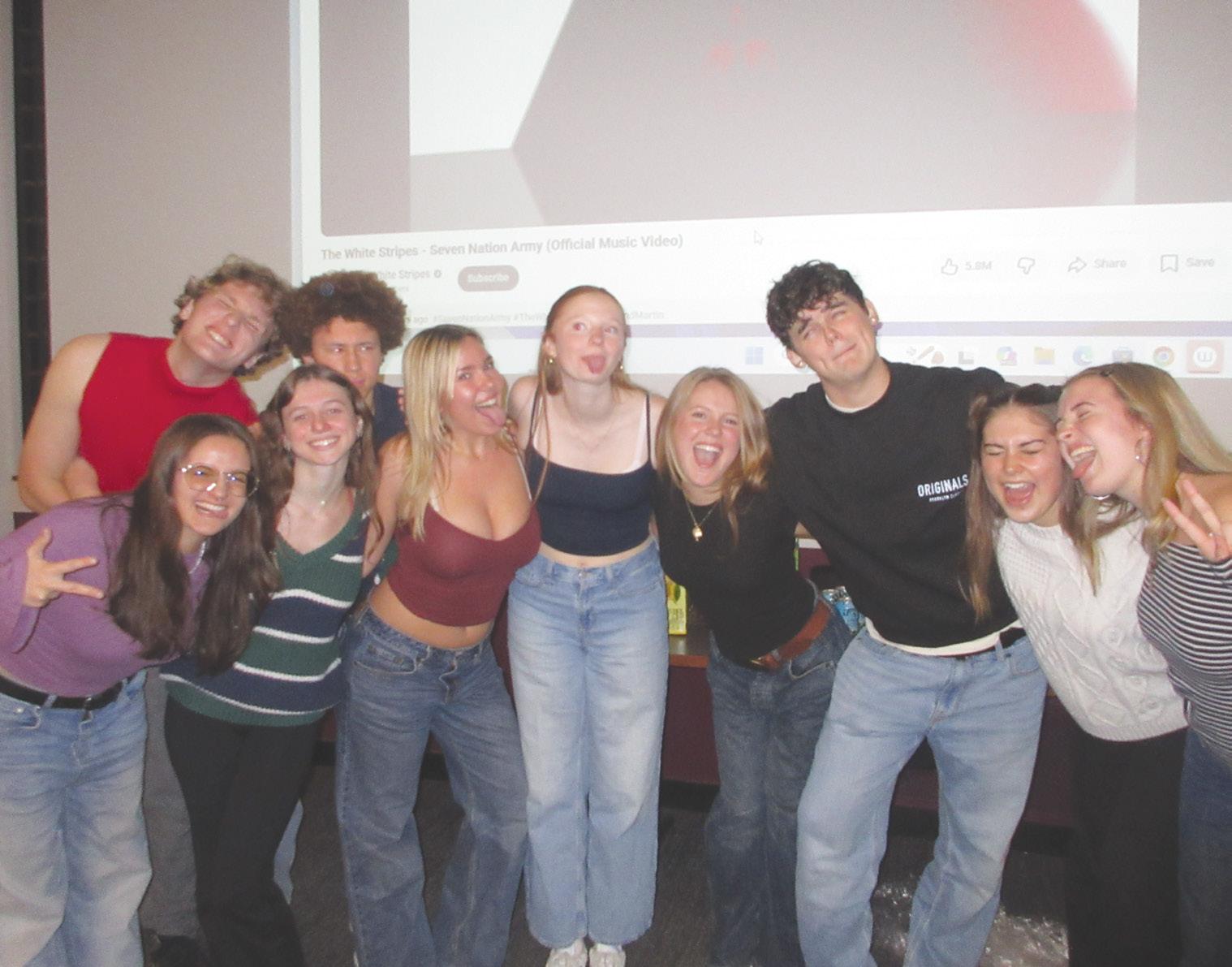
Members of Zamboni Revolution make funny faces. The improvisation comedy group practices twice a week and performs two to three times a semester. courtesy of alec sturm
By Alex Rice asst. copy editor
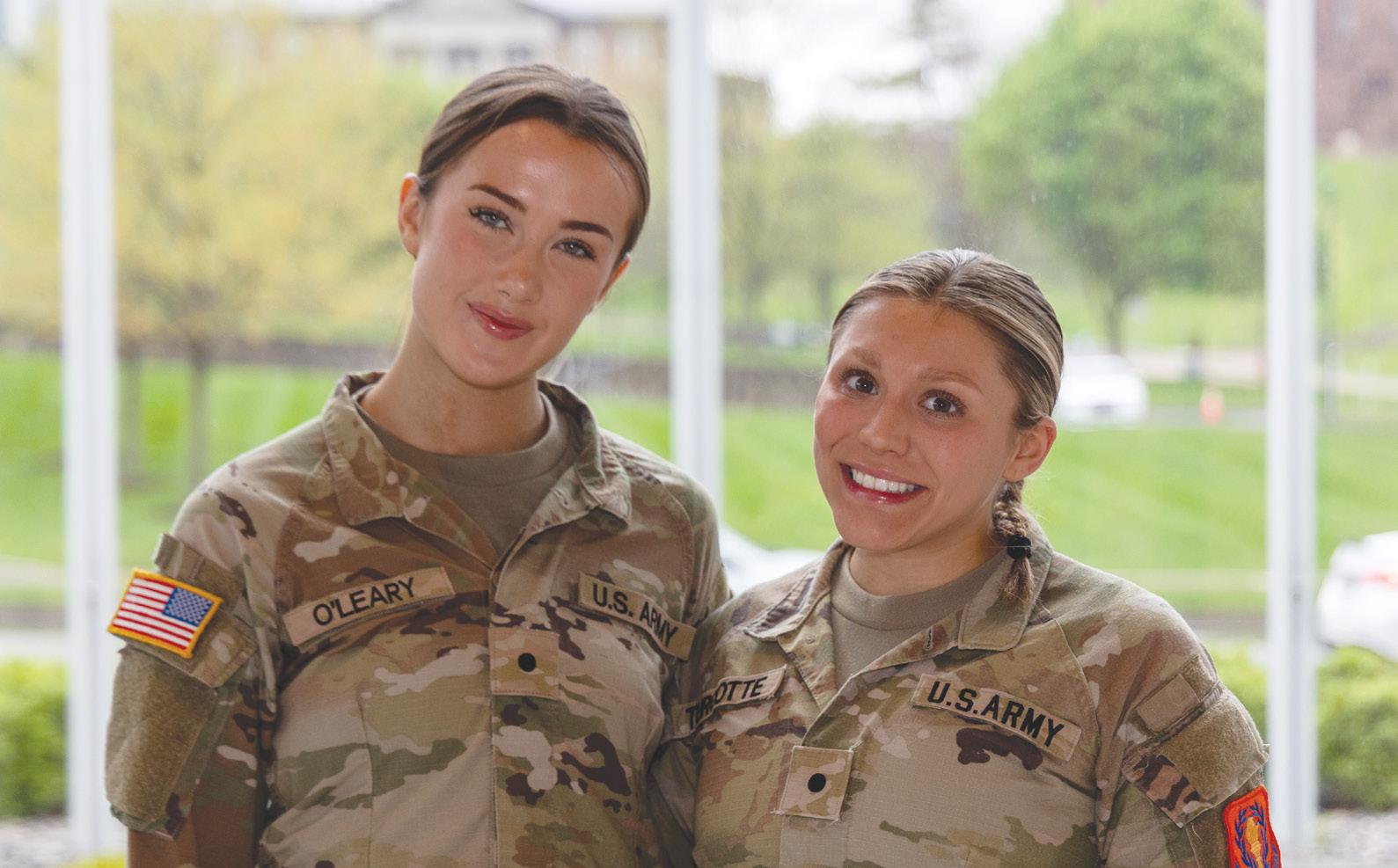
Amanda Turcotte wakes up for a 12-mile ruck march at Onondaga Lake at 3 a.m. She doesn’t get back to her dorm until around 7:30 a.m.
After removing her weighted backpack, she hops in the shower to get ready for class like any other college student, which she is, except for when she attends ROTC classes.
Outside of ROTC, Turcotte, a Syracuse University freshman, is also a member of Delta Delta Delta and the Syracuse University cheerleading team, which she’s fit into her schedule alongside her other commitments. Given that cheerleading practices are typically at night, Turcotte can commit her mornings to the Army, she said.
She and other ROTC students wear operational camouflage pattern uniforms to all of their ROTC-related classes and labs. In their lab, they go over field training, drills, situational training exercises, lanes and high-intensity physical training scenarios.
Turcotte admits that sometimes the schedule can be overwhelming, especially because she’s expected to be in so many different places at once, but she’s gotten used to the rigorous routine.
While a typical student may attend classes, work out, study and see their friends daily, students in SU’s ROTC program are meeting for physical training (PT) three times a week, usually from 6:30 to 7:30 a.m., taking military-specific classes on top of a normal course load and training for high intensity scenarios.
In ROTC, students also have a four-hour military class each week, usually split up between Tuesdays and Thursdays. The course is taught by military instructors, who students call “the cadre.”
Saoirse O’Leary, a member of ROTC, could’ve chosen to be like any other freshman, but joining the ROTC program was non-negotiable for her. Being raised by a father who was in the Marine Corps, honoring her familial roots was why she joined.
At first, O’Leary felt like an outsider as an ROTC participant, especially because her roommate and many of her friends weren’t in the program. The summer before joining the program, freshmen
food and drink
military students, or MS1’s, were put into groups.
Eventually they began DM’ing each other on Instagram to get familiar with one another, O’Leary said. So far, O’Leary said it’s worked.
“I was like, ‘Gosh I hope I make friends in the program,’ but all the MS1 girls are actu
ally amazing. We definitely have a good group of people to stick with for the next couple of years,” O’Leary said.
As a business analytics major, O’Leary sees herself going into finances or logistics in the Army, where she said the opportunities are endless.
Seth Waxler, a sophomore in the Air Force ROTC Detachment 535 — a specific military training unit at SU — said he was accepted to the Air Force Academy but was talked out of going by his parents who wanted him to have a traditional college experience.
However, he chose to join ROTC at SU. He sees it as one of the best decisions he made, Waxler said.
“I had no intention of joining the military (program) and then like second week of school I
saw people walking around in uniform and was like, ‘this is it, I’m going to do it,’” Waxler said.
Last summer, Waxler received a call from his commander saying he was chosen for scholarship through SU’s ROTC program. Receiving a military scholarship while in college means the military is helping pay for a student’s education in exchange for a service commitment once the person has graduated.
Other students, like Turcotte, weren’t sure what to expect when it came to being in ROTC but were pleasantly surprised by how hands-on everything had been.
For ROTC students, PT is a commitment in itself, O’Leary said. But other parts of the program, such as the ruck marches, take up more time in their schedule.
But the countless hours are worth it for O’Leary.
“Coming out of college, we’re getting the same rank as West Point students, and their entire life is based off the army. We have a commitment four
see rotc page 9
Cafe Blue offers ‘familiar’ atmosphere, varied menu
By Kosta Konstantopoulos staff writer
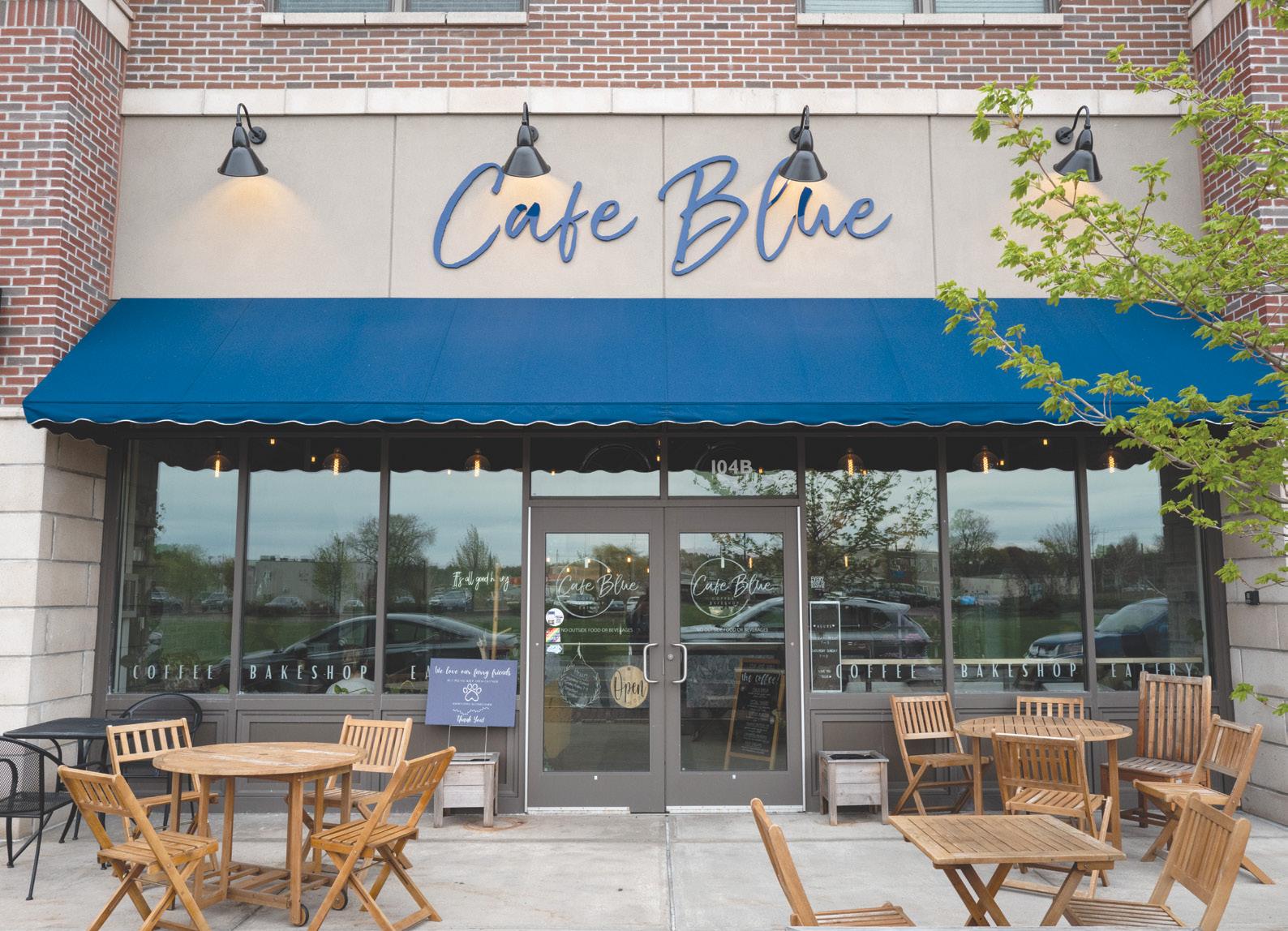
On Tuesday morning, customers filter into Cafe Blue. Some stop in for a quick coffee, while others settle down with their laptops and a sweet treat. Customer conversations, espresso machines humming and clinking mugs from behind the counter create a rhythm felt throughout the cafe.
“I love it here,” Cafe Blue regular Teresa Clarke said. “I love the food, the atmosphere and there’s something about the vibe that makes it worth the drive.”
Clarke, who’s from Marcellus, has been making the drive to Syracuse’s Inner Harbor daily. Cafe Blue has grown into a local staple since opening its doors in 2023. For its two-year anniversary last May, the coffeehouse has expanded its seating — reflecting a growing customer base of regulars and visitors passing through the city.
Cafe Blue’s menu offers around 50 food and beverage items, balancing variety without being overwhelming, cafe owner Olivia Orlando said. The cafe serves breakfast all day — or at least until it closes at 2 p.m. on weekends and 3 p.m. on weekdays — with options ranging from smoothie bowls and avocado toast to egg sandwiches and house-made pastries.
The cafe’s sandwiches, known as “Sammys” on the menu, include options like the Chicken & The Fig, made with oven-roasted chicken, apple slices, brie and fig jam, as well as more classic choices like a chipotle turkey panini and a chicken Caesar sandwich.
Still, coffee remains central to the menu with drinks like classic drip coffee, espressobased options and the cafe’s nitrogen-infused vanilla draft latte — which Orlando said customers are “obsessed with.” The cafe also rotates monthly specials like April’s Peach Dahlia draft and Petal+Berry lattes, giving returning customers new options while maintaining staples like the americano.
While Cafe Blue prioritizes its menu quality, the balance between food and experience is what resonates with customers, Orlando said.
Angelina Rodriguez, a Le Moyne College junior, has frequented the cafe for the last three years. She returns weekly with her friend Mackenzie Ples, another Le Moyne College junior, for the menu and atmosphere. The cafe’s recent
expansion feels like a second home, especially the plant wall, Ples said.
“The vibe is really nice. The music, the staff and the food is always great when we come together,” Ples said.
Even for customers like Clarke who go out of their way to visit Cafe Blue, the consistency makes the drive worth it. Clarke said she passes several coffee shops on her way to the cafe, but prefers the staff, the quality of the food and the cafe’s “energy.”
She often orders a smoothie bowl and settles at a table in the back with a book. Clarke said seeing the same staff regularly adds to the experience, making the space feel more “familiar.”
That familiarity has helped Cafe Blue build a loyal customer base, Orlando said.
The cafe sees a mix of longtime regulars and new customers, including travelers staying in nearby hotels. Many of those customers visit daily — sometimes multiple times per day.
“We’ve done really well. I’m super grateful, and I couldn’t have done it without my team,” Orlando said.
The cafe continues to expand beyond its
LOOSE CHANGE
LOOSE CHANGE, a local jam band, is bringing a Grateful Dead tribute to Syracuse this weekend. The band uses tenor sax, keyboards and dual guitars for electric music. You must be 18 or older to attend.
WHEN : Thursday, 8 to 11 p.m.
PRICE: $13.07
WHERE: Funk ‘n Waffles
Gatecreeper
American death metal band Gatecreeper will perform singles like “Caught in the Treads” and “The Black Curtain” this weekend. The event will also include performances from Eternal, Dying Remains and Krusade.
WHEN : Friday, 7:30 p.m.
PRICE: $32.62
WHERE: The Song & Dance
Like a Hurricane
A Neil Young tribute band is coming to Funk ‘n Waffles this weekend. Like a Hurricane brings its audience on a journey through music from Buffalo Springfield, Neil Young, Crazy Horse and others. You must be 18 or older to attend.
WHEN : Friday, 8 to 11 p.m.
PRICE: $13.07
WHERE: Funk ‘n Waffles
Unity Street Band
The Syracuse Crawfish Festival is hosting Unity Street Band, a multilevel community group, as its first performer of the celebration. The event will have various band performances on two stages throughout the day.
WHEN : Saturday, 11:05 a.m. to 12 p.m.
PRICE: Free
WHERE: Clinton Square
Still in its first year, School of Rock is a local music school for students of all ages. Previous showcases throughout the year have garnered hundreds of attendees. Sunday’s showcase will include multiple student bands performing sets with Led Zeppelin songs, 1980s classics and rock ‘n roll.
WHEN : Sunday, 4 to 10 p.m.
PRICE: $12.88
WHERE: Middle Ages Music Hall
storefront, Orlando said. In March, Cafe Blue introduced a food truck for catering events, reaching customers outside of its Van Rensselaer Street location.
Despite the cafe’s success, running a small business in Syracuse still comes with challenges. Orlando emphasized rising food costs, noting that “even as a normal consumer, it’s expensive.”
She added that operational costs require constant adjustment, from sourcing ingredients to maintaining menu prices while keeping cafe offerings accessible to customers.
Even so, Orlando said her focus remains on community. Cafe Blue prioritizes creating a safe environment for its customers and plans to continue building that message moving forward, she said.
“We’re super strongly based on community and family,” Orlando said. “We try to make our space as inclusive as we can for every person. We want it to be a place for gathering, for meetings, for work, we want it to be for everybody.” kkonstan@syr.edu
Saorise O’Leary (left) and Amanda Turcotte stand inside the National Veterans Resource Center. They are in the Army ROTC program. eli schwartz asst. photo editor
Cafe Blue, a coffee shop in Syracuse’s Inner Harbor, basks in the morning sunlight. Owner Olivia Orlando said the cafe’s focus remains on community. tara deluca asst. photo editor
buzzed around SU’s Hall of Languages snapping graduation photos of her daughter and her friends. But she wasn’t the only one, with plenty of others navigating SU’s campus to take photos of graduates.
“I think there’s incredible growth that happens between freshman year and senior year, and they go from these sort of scared freshmen to beautiful, accomplished women,” Ciriello said.
Meanwhile, on the steps outside Crouse College, Francesca Vasconi, an SU senior studying sport management, photographed women’s ice hockey player Maya D’Arcy, who donned her own jersey.
Vasconi, who was a social media intern for the hockey team for roughly two years, started taking graduation photos this spring but received her first camera in high school. She mainly captures graduation flicks for friends that are also members of the team, she said.
“These athletes I’ve known since they were freshmen, and now I’m photographing them as seniors, we’ve kind of grown up together,” Vasconi said. “It’s been really fun and really bittersweet.”
Just across from the Crouse steps, Hayden Kim, an SU graduate student studying business administration, held his camera. Kim shot students’ portraits outside the Newhouse School of Public Communications’ First Amendmentetched glass wall.
Kim graduated from Newhouse last May with a degree in magazine, news and digital journalism, but he’s been practicing photography for four years — two years professionally. He said he learned camera techniques from his executive producer role on Orange Television Network’s “The Esports Juice Box” show. Kim said his journalism background has helped him; he asks unfamiliar clients interview-style questions to get to know them during shoots.
Kim started taking graduation photos last year, including some for his best friend, Anthony Solt. Kim had a summer internship in Solt’s hometown in Denver, where he shot
“I grew up there. I spent most of my adult life there,” Erik said. “It hasn’t quite sunk in for me yet.”
While Erik and John Michael didn’t continue their J-Michael journeys under the new ownership, employees like 25-year-old Colin Smith did.
Smith, who is Erik’s nephew, is the third generation of the Hicks family to work at J-Michael. Before beginning his own career at J-Michael, Smith remembers visiting his family during their shifts at the shoe store.
He began plying his trade full time at J-Michael in 2021 and is now a manager under the new ownership. Smith declined to comment on why the store is going out of business, but he said it’ll be a huge loss for the entire Syracuse community, even beyond SU.
“I had a lot of milestones shared here. This is a huge part of my identity personally,” Smith said. “So it’s definitely going to be a tough loss for me.”
J-Michael is just another store that won’t exist anymore for SU alumni, like Eydie Balsam, to drop by and reminisce whenever she revisits her alma mater.
Before and after Balsam graduated SU in 1990, J-Michael was a consistent stop whenever she visited Syracuse. As a student, Balsam remembers going into J-Michael for random occurrences more than she shopped there. But when Balsam did buy something there in the late 1980s, it was probably E.G. Smith socks, she said.
“It was a little piece of New York City or Long Island in upstate New York,” Balsam said. “It was a place where you could get an overpriced T-shirt that you probably shouldn’t be spending your money on.”
times a week, but I think it’s going to be so worth it,” O’Leary said. “We are going to be 2nd Lieutenants right out of college, I don’t think you can get any better than that.”
Going into the program, both Turcotte and O’Leary were involved with sports. O’Leary was captain of both her high school softball and basketball teams, and Turcotte was a gymnast and cheerleader. Turcotte believes her background in sports has helped her be comfortable working in a team dynamic, making it easier to build relationships in college, she said.
Not only have their sports backgrounds helped with social dynamics, but they’ve helped with the physically demanding parts of the program, like the Army Combat Fitness Test. The students in MS1 get ranked on a scale called the order of merit. This ranking includes factors
the photos in exchange for summer housing, Kim said.
“By the time I moved out there, his dad had already printed out a bunch of the grad pictures and hung them around his house,” Kim said. “So I walked into the house, and I saw all of my own pictures that I took, which is kind of crazy.”
For Malcolm Taylor, an SU senior majoring in photography, his favorite graduation photo collaboration was with a close friend, Layla Abudayeh, who graduated with a fashion design degree last May.
Taylor and Abudayeh had experience working together at Major Magazine where Taylor photographed Abudayeh’s senior thesis fashion design collection. Abudayeh described their collaboration as “effortless.”
“When it came time for my grad photos, I texted him the most random blurb of like, ‘I want majestic (photos)’ and really niche adjectives of what kind of photos I wanted,” Abudayeh said. “And he was like, ‘OK, we could do that.’ He just completely understood.”
For the photo shoot, they had one location planned — a stairwell inside Crouse featuring stained-glass windows. Taylor and Abudayeh walked up and down that Crouse stairwell 30 to 40 times, Abudayeh said, experimenting with the light shining through the windows to get various shots.
Outside of that, every location was spontaneously chosen. Abudayeh said she trusted Taylor’s creativity — after all, Taylor did mention he started taking photos at age 2.
“There was a really special and natural energy to those photos and to the whole shoot,” Taylor said. “But also it felt extra special because she was going to be graduating and going to be gone, it was kind of our last time seeing each other at that point, too.”
Corey Sulser, who also worked with Taylor at Major Magazine, said she appreciated having a friend take photos of her and her roommates. Sulser, who graduated from SU in May 2024, said oftentimes photo shoots can be “serious” and sometimes “aggressive,” but Taylor made her session “comfortable” and “chill.” She said it was a nice break from the stress that arises with graduating.
Paired with her classic Reebok high-top sneakers, Balsam’s white and multicolored thick socks were much more than a sock, they were a J-Michael staple, she said.
Now, Balsam is a parent of an SU sophomore. Currently, Balsam buys a lot more as an adult than she did when she was at SU.
The closure of J-Michael is just another storefront on what Balsam famously calls “M-Street” to fold.
“We didn’t have the internet, so you either went shopping at home or you went to J-Michael,” Balsam said.
When John owned J-Michael, the lodestar of his business was “if it’s hot, it’s here,” John Michael said. John Michael said, in order to sell “hot products,” the atmosphere had to be inviting, and it was.
In the 2000s, John Michael remembers returning to help his father at J-Michael during his school breaks. But when John Michael’s winter break rolled around, John would invite all employees to a big Christmas dinner, amassing more than 25 people. Working at J-Michael was very much like an old-school family, John Michael said.
That familial connection is what kept employees like Erik around until 2024, the end of the Vavalo ownership. Every day at J-Michael was different; some days it was busy, while others weren’t. Whether it was SU students, Syracuse locals or celebrities like Britney Spears or Shaquille O’Neal — who Erik both met at the store — he enjoyed working at J-Michael.
“That’s the special thing about that place, is that there was never an average shift,” Erik said.
While he doesn’t know the exact reason for his eponymous store’s closure, John Michael felt like it was inevitable, he said.
like GPA, the Army Combat Fitness Test and military labs.
“Everyone has to be competitive at some point because everyone wants to be at the top,” O’Leary said.
If you put a lot of hard work into the program, you’re gonna get what you want out of it.
Saoirse O’Leary su freshman
While balancing different activities on campus, like being a member of Alpha Phi sorority, O’Leary tries to keep a positive mindset.
“He just made it super relaxing. It did not feel like a task or a chore,” Sulser said. “It just felt like a fun hanging-out-with-friends activity. It took a solid amount of stress off of my plate.”
Though Sulser’s session was brief and featured basic photo locations, she said Taylor still made the experience special.
Another special moment was when Vasconi photographed her best friend from freshman year, now-SU senior Izzy Carlino, on Sunday.
“It was just very full circle. I looked at her and I was like, ‘I can’t believe we’re going from being the little freshmen in BBB, and now I’m wearing my grad regalia, and we’re taking photos together and just sharing this moment,’” Carlino, who’s studying advertising and marketing management, said.
Capturing photos for one of her first friends at SU was nostalgic, Vasconi said. As freshmen, they were figuring out college, and now they’ve grown into who they are today.
On the other side of the lens, Vasconi said she didn’t put much thought into her own graduation photos; she put her friends first. Vasconi and Taylor are both having their friends snap their graduation flicks, they said.
Once Taylor finishes photographing his friends, they will turn the lens toward him. Taylor said he’s excited to see what his friends without photography experience come up with. Taylor enjoys that people trust him with their graduation photos — a culmination of their fouryear journey.
While taking photos of her daughter, Ciriello said she became emotional — necessitating a few breaks. Days before the session, Ciriello found her daughter’s preschool diploma. In less than two weeks, her daughter will receive the college version.
Ciriello said graduating college feels much bigger than graduating high school; you’re not moving to college, you’re going into your life and career.
“There’s just a little bit of a different feeling of separation I think, when you graduate from college, and I was feeling that from them,” Ciriello said. “It was beautiful to watch them together and all the emotions they were going through.”
Disclaimer: Malcolm Taylor is a staff photographer for The Daily Orange. Taylor did not influence the editorial content of this article.
jdpelach@syr.ed
He suspects the high rent rates for a spot on Marshall Street could be the rationale behind J-Michael’s extinction.
When John Michael told his father that the store with his nomenclature was officially coming to an end, John responded to his son’s text with a thumb’s up emoji, already foreseeing these circumstances.
“If you put a lot of hard work into the program, you’re gonna get what you want out of it. If you work hard you’re gonna get a reward in return,” O’Leary said.
While many see ROTC students walking around in uniform, they don’t see Air Force cadets practicing combat techniques, including handling improvised explosive devices, Waxler said. Cadets are also put into group leadership practices, where they’re given problems and have to work their way out of them — most of which Waxler says are nearly impossible.
Within his squadron, Waxler has a job as the Finance Non-Commissioned Officer in Charge (NCOIC). Waxler manages four other cadets and controls the finances, bookings and has regular meetings with the school.
“It’s definitely a commitment, but it’s super doable and definitely gave me a sense of purpose. I’ve learned a lot, probably more than what college could teach me,” Waxler said.
But the loss of J-Michael marks a void in a trove of memories for generations of owners like the Vavalos and managers like the Hicks lineage.
“Without them, I don’t think we would have kept up the stamina that long. But really, my dad, Erik and Jim, I give them all the credit in the world,” John Michael said.
lvzucker@syr.edu
Outside of ROTC, Waxler was involved in Syracuse University Ambulance and is now involved in the Phi Delta Theta fraternity. On top of that, he’s a biotechnology major taking a full schedule of classes.
During his time in the ROTC program, Waxler has learned valuable lessons he hopes to take with him into the military.
To him, one of the most important lessons he’s learned is about stewardship: being the last person to eat after serving everyone and the last person to sit down sets the standard for others, Waxler said. That is why he takes his role in the program so seriously.
“ROTC isn’t just a club or a thing. It’s a career. And you have to treat it like a job because I do, I get paid to go to school,” Waxler said. “Once you get the priorities down, it’s relatively easy to manage your time.”
arice19@syr.edu
hayden kim takes advantage of the weather as he photographs Jackie Arbogast’s graduation photos. Kim has been photographing for four years. eli schwartz asst. photo editor
J-Michael Shoes advertises its final sale before the store’s closure on May 30. The Marshall Street shop was owned by the Vavalo family for decades. eli schwartz asst. photo editor
Acknowledge personal change to ease summer transition
By William Dumond essayist
There’s a specific kind of whiplash that hits around Day 3 of summer break. For me, it looks like putting my clothes back into the drawers I’ve used my whole life, my mom sarcastically commenting on my poor sleep schedule and realizing I once again have to share a car with my brother, something neither of us missed. The last two semesters have been spent managing my own time, cooking my own food and making decisions without a second, third or fourth opinion.
Welcome home, sort of.
This tension isn’t anyone’s fault. College changes your brain — your rhythms, your autonomy, your sense of identity when nobody’s watching. But your childhood home hasn’t changed nearly as much as you, and neither have the people in it. Failing to confront this reality will lead to spending the summer straddling two versions of yourself, feeling like a guest in both places.
It’s crucial to distinguish life at home from life at school, but this doesn’t mean everything has to change. I’ve established a few strategies to help navigate this transition.
To start, I like to treat the first week back home as jet lag.
It takes time to reacquaint with an environment that’s been so distant for most of the year. The weeks before starting my summer job lack structure — especially without assignments and classes on a daily basis. It’s important not to mistake this for a sign that something is wrong. Giving yourself time to reacquaint yourself with the familiarity of home is essential. Additionally, keeping an open mind will show friends and family that I’m excited to be back, and that positivity is infectious.
I also like to pick one activity, make it uniquely mine and carve out time for it.
College is all about falling into a routine. Our weekly activities become ingrained in our personality. Coming home can be difficult, especially since these routines can be disrupted. Finding something that you enjoy is key. For me, this looks like going for a stroll on my town’s boardwalk.
Whether going to grab coffee on Tuesday mornings, getting in a morning lift or calling a friend at the same time each week, you must find repetition so some part of you feels the same. Without implementing a routine, going home can feel like you’re regressing all the growth college has provided, which can lead to a rough transition when you go back to school. That’s why this time to myself is paramount.
Conversely, I try not to live mentally at school. Summer is a balancing act, but it’s important to live in the moment. Many students spend breaks feeling reverse homesickness, killing time until they can return to their college lives.
I’ve found that framing summer break in this way makes me distracted, ungrateful and halfpresent. My parents have spent too much time
raising my brother and I to deal with a version of us that feels entitled to live our own lives; we owe it to them to remain present.
Home isn’t a waiting room. Family and friends aren’t extras in the story of these college years. Summer is a valuable part of our lives, not a commercial break between semesters. The sooner we embrace being home, the more we’ll get out of it.
Lastly, I try to take everything in stride and let both worlds influence each other to allow for a healthy balance of home and school.
I’ve found that the initial discomfort of being home helps me realize how much I’ve grown and learned while away. Finding what parts of my life still fit into being home and which don’t allow for a well-rounded summer. Further,
learning to bring parts of home back to school can also show my college friends who I really am, and that authenticity is just as important. It can be strenuous when pivoting back and forth between two worlds in three months. But I’m confident that the students who figure out how to navigate this transition without losing themselves in either one will return to campus in the fall with something their peers don’t — the knowledge that they can feel at home in more than one place at a time.
That’s not a small thing; that might be the whole point.
William Dumond is a sophomore studying political science and policy studies. He can be reached at whdumond@syr.edu.
On April 10, President Donald Trump’s administration unveiled its latest design for the United States Triumphal Arch. The 250-foot monument is set to be built at the end of the Memorial Bridge in Washington, D.C., to commemorate the nation’s 250th anniversary this July.
Often referred to as the Arc de Trump, the arch will be modeled after the Arc de Triomphe in Paris, France. The structure will feature a 60-foot statue resembling Lady Liberty atop the monument, surrounded by two eagles and four lions, all gilded in the president’s now-infamous signature gold.
Although Trump has yet to disclose the cost of this obnoxious monument, officials have confirmed that taxpayers will play a significant role in its funding. It’s estimated the project will have a $100 million price tag.
This isn’t the first time Trump has tried to force his way into indelibility. In July 2025, the administration announced the construction of the White House State Ballroom, another edifice plastered with tacky golden chandeliers and torches. This project will cost the government an astonishing $400 million, paid by private donors. The cost isn’t the issue, but rather the president showcasing that his lavish desires outweigh the needs of the average American.
Officially, the arch is meant to commemorate 250 years of our nation’s lifetime.
“It will serve… as a visual reminder of the noble sacrifices borne by so many American heroes throughout the 250-year history so we can enjoy our freedoms today,” Davis Ingle, a White House spokesperson, told the BBC.
But the sitting president seems to have a different understanding of the monument’s purpose. When a CBS News reporter asked Trump who the arch would be for, he replied with a single word: “me.”
It appears the president isn’t the only one with this view. During a public forum regarding the Triumphal Arch, over 1,000 comments unanimously expressed a great distaste for the
project, urging the committee to block it from moving forward.
The project comes at an incredibly divisive period of American history, and as job growth slows and the economy plunges, the last thing this nation needs to do is enable an egocentric leader with an outrageously costly monument.
Throughout Trump’s second term, social welfare programs have endured large losses in funding. Programs such as the Supplemental Nutrition Assistance Program, the Low-Income Home Energy Assistance Program and disability
benefits have struggled to aid Americans following the loss of funding.
Trump has made it clear that he has no interest in helping the average American, despite leaning so heavily on that sentiment during his 2024 Presidential campaign.
We need a leader who truly cares about struggling Americans, but Trump has shown time and time again that he is unwilling to do so. If we want to spark true change in our country, voicing our grievances in the upcoming midterms is our ticket out of this totalitarian nightmare.
Students need to realize that their voices matter, too. Whether you’re voting in person or sending in your ballot by mail, you must make your voice heard. Trump’s self-centered actions affect all of us; refusing to vote is just another way of expressing indifference. College students can’t underestimate their voice. Even in states that lean heavily to one side of the political spectrum, your vote still matters.
James Reed is a freshman studying political science. He can be reached at
emma soto contributing illustrator
emma soto contributing illustrator
prove ‘em wrong
Syracuse’s Wyatt Hottle has spent his life showing height doesn’t matter
By Mauricio Palmar asst. sports editor
ANNAPOLIS, Md. — The thing about Ed Hottle’s office is that there’s nothing in Ed Hottle’s office. He’s been working at the Anne Arundel County Parks and Recreation Department for 14 days, so the room is as furnished as a college graduate’s first apartment. The department plans to move this office, so Ed hasn’t bothered to decorate it.
An
By Jordan Kimball asst. sports editor
It was time for Courtney Maclay to cross the chasm from doubter to believer.
Her Stony Brook squad was gearing up for its NCAA Tournament First Round matchup against Loyola on May 9, 2025. The Seawolves’ senior midfielder wasn’t feeling like herself. Just ask her father, Chas Maclay, who’s been by her side through her entire 11-year lacrosse career.
“(Division I) sports are an incredible, intense, emotional cauldron between the kids, their desires, their fears and the constant
There’s little save for a dark brown wooden shelving unit with a sandpaper-colored Wilson football encased in glass atop it. It’s not his. That football is the lone mildly intriguing thing in the room, and Ed — who spent 15 years coaching football at Stevenson University — has zero idea where it’s from.
The setting was unintentional, a pivot in lieu of lunch, but it’s fitting. It’s a room as unassuming as the stature of Ed’s son, Wyatt Hottle, who’s the topic of conversation on this March afternoon. Ed sits in his office chair, leaning back and forth, his hands locked together as he speaks. He unclasps them when he wants to make a point, and he wants to do so now.
“‘Well, he’s just not very big,’” Ed says, mimicking the tired talking points surrounding Wyatt for years. “OK, well, that clearly doesn’t matter, right?”
He’s heard it all. Wyatt has, too. It’s impossible to avoid. Turn on a Syracuse lacrosse game, and you’ll need more than 10 fingers to count every time commentators bring up Wyatt’s height. The junior
battle for approval,” he said. “Courtney had a fight with confidence.”
Courtney expected to be a “very high-level offensive presence” on a Stony Brook team that fluctuated in and out of the top 20. Instead, she entered the 2025 NCAA Tournament with just 22 goals and 10 assists.
As Courtney walked into Alumni Stadium in Chestnut Hill, Massachusetts, to face Loyola, she knew it could very well be her last game. A loss, despite her denial, could mean the job search would begin.
Torrential rain soaked Boston College’s dark green turf. Courtney couldn’t shake an illness. But 60
minutes after taking the field, she left with a career-high six goals. Stony Brook lived to see another day with an 11-8 win.
“That game was my high,” Courtney said. “Probably as high as it could get.”
Courtney, her Williamsville East High School (New York) coach Emily Peters and her Stony Brook teammate Avery Hines agreed Courtney’s 72-hour stretch, which began with the sock trick against the Greyhounds and ended with a brace versus Boston College two days later, opened the door to her future.
The “killer” weekend — and an additional year of eligibility — led
midfielder is listed at 5-foot-7, 148 pounds, making him both the shortest and lightest player on SU’s roster. It’s a fact that’s followed Wyatt throughout his entire career, like a parasite that’s been inexorably attached to him.
“It’s so baked into the fabric of who he’s become,” Ed said.
But Ed’s right. It doesn’t matter. At least not nearly as much as broadcasters and fans like to think it does.
Wyatt’s already tallied a career-high 17 goals and 27 points for Syracuse this season, and the Atlantic Coast Conference Tournament is still on deck. If his height mattered that much, he wouldn’t be starting for a top-10 team in the country.
“I really, honestly, don’t think about it at all,” Wyatt said. “I just go out there and play.”
Because when you grow up in the environment Wyatt did, why would it matter? Spending time in Stevenson’s locker room, he traded nursery rhymes for 50 Cent songs and learned to swear before he
hottle page 13
to visits at BC, Pitt and Florida State, among other schools. It eventually resulted in Courtney transferring to Syracuse for her graduate year, a program she dreamed of playing for since growing up in Buffalo.
“What better time to be a star than an NCAA playoff game,” Stony Brook head coach Joe Spallina said postgame. “It was just a matter of time.” The conditions couldn’t have been much worse. Courtney didn’t like the rain. She wasn’t much of a coffee drinker, either. For Courtney, who Hines called a “nervous wreck,” getting sick during the NCAA Tournament was dreadful timing.
She kept her mysterious ailment to herself and her closest teammates, one of whom was Hines, her roommate on every road trip since their sophomore year.
The Loyola game was set for 4 p.m., but Courtney considered it an evening affair after 11 of the Seawolves’ previous 19 matchups began before 3. Stony Brook had a walkthrough that morning. Courtney said she’s more of a doer than a thinker, so those few hours were key.
She then returned to the team hotel and took a rare afternoon nap to calm her nerves before Stony Brook’s “Super Bowl” began. When she woke up, see maclay page 14
women’s lacrosse
wyatt hottle cradles the ball in SU’s win over Duke on March 28. Hottle, standing at 5-foot-7, has spent his entire career proving that’s an advantage — not an issue. eli schwartz asst. photo editor
Dad’s advice helped Burney garner SU’s top batting average
By Peter Radosh asst. copy editor
Maurice Burney poses a riddle: you and Johnny are hungry. Johnny can satisfy his cravings with just an apple and orange. But you need some vegetables to accompany the fruit to be full. Broccoli, maybe some carrots or even tomatoes.
Who deserves the food? Johnny, who eats less, or you, who needs more? The answer is simple for Maurice. It doesn’t matter how much Johnny eats.
“That don’t change that both of y’all still hungry,” Maurice said. “Some people just have a stronger appetite sometimes.”
Thirteen hundred miles away from Maurice, his daughter, Jadyn Burney, has evolved into Syracuse’s starting shortstop and most consistent hitter. But at the beginning of April, Jadyn was in the worst hitting slump of her SU career, leading to two benchings against Notre Dame. The metaphor was Maurice’s way of detailing how he helped Jadyn weather her drought. He knows she’s hungry to hit; she just has to wait for her chance.
Since the Notre Dame series from April 17-19, Jadyn has logged a hit in each of SU’s last five games. She’s back near the top of its lineup, now as the No. 2 hitter behind Madison Knight instead of her former leadoff spot. Her .321 batting average and 27 runs lead the Orange, while her 20 stolen bases are tied for third in the Atlantic Coast Conference.
Maurice is a single parent. By coaching Jadyn until she was 14 and advising throughout her collegiate career, Maurice said he’s connected with his daughter through softball. Maurice was part of Jadyn’s decision to start her career at junior college at Chipola instead of in the Southeastern Conference, where she was recruited by Ole Miss and LSU.
Maurice often can’t make it up north from Mississippi, so the two have a ritual. They call after each game to analyze each play.
“Sometimes I have to recharge her,” Maurice said. “It’s almost like getting a jump off the jumper cable. Just to let her know, at the end of the day, we don’t stop.”
Recently, their calls focused on Jadyn getting to first base. Maurice implores her to study the infielders warming up, specifically checking whether the third baseman and catcher field and throw well. Since Jadyn is naturally fast and left-handed, it allows her to play to her strengths.
Jadyn can read whether she’s quick enough to make it to first on either a bunt or slap hit. She’s second on SU in both on-base percentage (.445) and on-base plus slugging (.900). All three of her singles in Syracuse’s last series, against then-No. 25 Louisville, came on bunts.
Perhaps most notable is her .371 batting average on balls in play, meaning that, when she makes contact, she gets on base nearly 40% of the time. Jadyn has slotted in as the Orange’s leadoff or No. 2 batter in 36 of their 41 contests.
“As the leadoff batter, or batting No. 2, we need you to get on base,” Maurice said. “Whether that’s by bunt or walk, do it by any means necessary.”
Throughout nonconference and early ACC play, Jadyn thrived in that role. Her overall batting average hit a season-high .483 after going 3-for-4 in a 5-3 win over Liberty on Feb. 20.
Jadyn followed that performance with a grand slam against UMBC and two consecutive leadoff triples against Providence and UAlbany.
Even when the Orange began their ACC slate 1-9, Jadyn didn’t skip a beat. She hit another grand slam in an 11-6 loss to thenNo. 10 Florida State on March 15. She kept her batting average above .400. Despite SU’s “rollercoaster” year, head coach Shannon Doepking praised Burney.
“The most consistency we’ve had is Jadyn Burney,” Doepking told 247Sports. “The rest of the team, we can’t win ball games with just Jadyn, though, right? She’s a hitter that is going to get herself on base, and we need somebody behind her to actually hit her in for it to help.”
In a twist Maurice calls “ironic,” Syracuse began winning, but Jadyn fell into a slump. Across 10 games from April 3-19, where SU went 5-5, Jadyn went 1-for-22 through eight and was benched for the final two matchups. Still, Maurice continued to call Jadyn.
“‘We can’t do nothing about yesterday,’” Maurice recalled telling her the week of the Colgate doubleheader. “‘It’s gone. It’s over. So it’s back to the lab right now.
Let’s get ready for this weekend. Let’s forget all about what (happened before).’”
The aforementioned fruit, lab and jumper cable metaphors aren’t the only ones Maurice
devised. He’s concocted a multitude of nonsoftball situations to advise Jadyn’s role on SU. Maybe she’s at a party, adjusting to whatever the DJ plays. Other times, he compares her rebound after her benching to navigating life in a company.
But if you asked Maurice how exactly Jadyn got out of her slump, he’ll tell you it’s all on the field. The fact she outpaces the rest of Syracuse by .034 in batting average and five hits, or that — since Notre Dame — she has a hit in every game.
Of course, he’ll use another metaphor.
“If you play softball long enough, sometimes it’s gonna be dips and daps,” Maurice said. “It’s gonna be that stock market. The number goes up a little bit, comes down a little bit. At the same time, you just weather the storm.”
peterhradosh@gmail.com
@PeterRadosh
Erika Zamora is on cusp of breakout after rebuilding her swing
By Gabe Ewen staff writer
Sean Brashear has watched a lot of softball. As vice president of Firecrackers Softball — a national fastpitch organization — and architect of the Southern California-based Firecrackers Brashear youth pipeline, it comes with the job. He’s seen plenty of softball players with powerful swings. Erika Zamora stood out.
Zamora was a senior at Rancho Cucamonga High School (California) searching for her first collegiate offer. She and her family reached out to Brashear, inquiring if his 18-U Firecrackers team needed another infielder.
When older players contact Brashear about playing for him, he does his research. He talks to the player and their family and, of course, assesses their skills. What first caught his eye regarding Zamora was “the way she swings the bat.” Zamora hit her way into a starting spot on Brashear’s team and an offer from Syracuse. Now, the sophomore infielder has started 20 of her 23 appearances this season at third base and shortstop. Although her .147 batting average and .324 slugging percentage don’t jump off the statsheet, she’s shown breakout potential at the plate, flashing upside to elevate her production in her next two seasons.
“She’s always had a really high ceiling,” said Darrin Smith, Zamora’s club coach at Athletics Mercado, where she played before joining Firecrackers Brashear.
Brashear and former SU assistant Will Loredo, who initially recruited Zamora, weren’t the only people to see something in her.
As she did to Brashear, Zamora stood out to Smith. But it wasn’t her swing that immediately impressed him. Instead, Smith remembers first watching Zamora patrol the left side of the infield early in her senior year of high school. He describes what sounds like an instruction manual for constructing the ideal infielder: An element of smoothness. Consis -
tent posture. Clean footwork. Soft hands. A bullet arm.
But at the plate, Smith noticed a few “swing deficiencies.” A private hitting instructor, he offered help.
“It’s like building Legos,” Smith told Zamora. “It might not start as anything cool, but eventually, you’re a really cool castle or a pirate ship.” Zamora embraced the reconstruction of her swing. It’s in character for her. When Zamora was in high school, her father, Eric, recalls her regularly working out well before he woke up. She watched hundreds of YouTube videos — backyard tee drills, 30-minute HIIT workouts and
zamora page
jadyn burney prepares for a pitch in SU’s loss to ND on April 17. In her second year at Syracuse, Burney has become its most reliable hitter. charlie hynes staff photographer
erika zamora winds up to throw during SU’s loss to Notre Dame on April 18. The sophomore refined her hitting skills before college en route to a breakout. charlie hynes staff photographer
men’s lacrosse
Previewing SU’s ACC Tournament Semifinal matchup vs. UNC
By Mauricio Palmar asst. sports editor
Gary Gait said the obvious. There’s a target on his team’s back.
“Well, I guess we’re going in as defending champs,” Gait said Tuesday. “So that pressure is on us now.”
But if you take his word for it, his team is ready to accept the challenge. SU played one of its best halves of the year against No. 1 Notre Dame last Saturday, but capitulated late and struggled to put together sustained possessions. It wasn’t the note Syracuse wanted to end its regular season on.
However, with the ACC Tournament on the horizon, Gait’s determined to have his team ready to take on North Carolina on Friday.
Here’s everything to know about No. 2 seed UNC (11-3, 2-2 ACC) before its ACC Tournament matchup against No. 3 seed Syracuse (114, 2-2 ACC):
All-time series Syracuse leads 20-14.
Last time they played It was a clash of titans on April 4. Richmond entered the week as Inside Lacrosse’s No. 1
women’s lacrosse
team, but was handily defeated by Notre Dame, promptly losing its rank. The result left the nation’s top spot up for grabs, and with North Carolina and Syracuse both sitting in the top three, whoever won that matchup would claim the title of the nation’s best squad.
But the Orange didn’t show up to play. It was a nightmare across the board. Syracuse head coach Gary Gait said UNC booked its grass fields during SU’s allotted practice time, which meant his team didn’t have a chance to adjust. That led to a nightmarish Jimmy McCool performance, silence from Joey Spallina and a 14-9 loss to the Tar Heels.
The Tar Heel report
Owen Duffy and Dominic Pietramala. That’s all there is to say.
Josh Marcus has been fine in net, saving 47.6% of the shots on goal he’s seen this season. Ty English has been a wrecking ball at short-stick defensive midfield, causing 10 turnovers and picking up 31 groundballs.
Abby Wambach’s nephew has become one of the best faceoff men in the nation — more on him later.
But if we’re being honest, UNC is powered by its offense above all, and that offense is
see north carolina page 14
Syracuse’s Dan Guyette named ACC Goalkeeper of the Year
By Jason Glick asst. digital editor
Syracuse goalie Dan Guyette was named the Atlantic Coast Conference Goalkeeper of the Year, the conference announced Wednesday. The senior was SU’s lone player to earn one of the four ACC awards. Guyette placed second in the conference in goals against average (7.81) and save percentage (46.1%). She held her opponents to single-digit goals in 12 straight games, a streak lasting from
learned his times tables. He was lifting weights before he set foot into a high school. With that upbringing, no matter his height, lacrosse was never going to be too physical for him.
It certainly wasn’t when he started it. Even back then, the 7-year-old was one of the smallest kids on his teams, but that never prevented him from playing with kids a year above his age group. His first team, Traditions, wasn’t very good — Ed said they won about three games in the handful of years he spent there — but it certainly wasn’t Wyatt’s fault.
He was determined to prove he could hang with the best, age or height be damned. A couple years into his lacrosse career, a club team popped up in Baltimore County — the name of which Ed chose not to disclose — and Wyatt tried out for its class of 2022 team. The club told Ed that Wyatt made the team, but they wouldn’t let him play a year above his age group.
“Why can’t he play on the team?” Ed asked. “We’re good with it, his mom and I are comfortable.”
Ed’s question got dispatched with a simple answer.
It’s against club policy.
But having Wyatt play against kids his own age was against Ed’s policy. All of Wyatt’s friends were older than him, and neither Ed nor Wyatt would be pushed around. So, they found a club that would allow Wyatt to keep playing up.
They turned to FCA Lacrosse, which gave Wyatt a leg up on his peers. Bryan Kelly — who coached Wyatt at FCA and at Calvert Hall High School (Maryland) — said that, once Wyatt joined, he displayed an unflappable desire to go after anybody, no matter their size.
“Playing up gives you a little bit of an advantage with your skills,” said Ashley Hottle, his mother.
Ironically enough, Wyatt’s height was also an advantage. Here’s how Ed explains it. There are kids who were much bigger than Wyatt — that’s just the nature of the beast — and those kids could often bully their way to the goal. These kids, Ed posits, never developed deft stick skills. They didn’t need to at that young age, so from that standpoint, they are essentially stunted.
Ed’s son never had that option.
“Wyatt was always one that had to continue to evolve his skillset,” Ed said. “Because he wasn’t always on the bigger end of things.”
If you ask Wyatt, he’ll quickly point out he needed to develop those skills on his own.
the beginning of March until Friday’s 19-9 ACC Tournament Semifinal battering to No. 1 seed North Carolina. The netminder conceded five goals or fewer five times.
While the Tar Heels’ 19 goals were the most Guyette’s conceded in her career, she’s rebounded mightily from last year’s debacle. In 2025, she surrendered double-digit scores 13 times to this season’s three.
Last season, the Newbury Park, California, native’s 43.4% saves percentage and 11.36 goals
against average barely squeaked into the conference’s top 10. Guyette stopped just nine of her opponents’ 46 shots across the regularseason finale, ACC Tournament and NCAA Tournament First Round.
While she nearly rebounded in the second round of the NCAA Tournament against Yale, she let up two late goals in the final seven minutes, squandering the Orange’s narrow lead. But Guyette’s put those doubts to sleep this season, recovering against the Bulldogs
“Everything I’ve done has been all by myself,” Wyatt says, and no one disputes it.
Ed was a football guy — he may have watched lacrosse once in his life before Wyatt began playing, he guesses — and Ashley only played it recreationally in high school. They only put their son in the sport to escape the mind-numbing boredom of watching an 8-year-old fail to throw a strike to Wyatt in kid pitch baseball.
But their relative inexperience didn’t hinder him. Wyatt never needed his parents to hold his hand. Ed described him as “intrinsically driven.” Sometimes, Ed would pull his van into the driveway, and his son would hop out to shoot before it came to a full stop. Other times, Wyatt went a month without even touching his stick, and Ed would almost sideeye him before glancing at it, questioning his son’s methods. But whenever Wyatt picked the stick back up, without fail, he could feel he was better than before.
“It’s the same thing with golf. Sometimes, I’ll put down my clubs for a while, I’ll play
one or two rounds, and hit the ball very well,” Wyatt said. “And then, when I’m practicing a lot, I’m not hitting the ball very well because I’m overthinking.”
Ed introduced him to weightlifting around middle school, setting him up with then-Stevenson head strength and conditioning coach Anthony Pedrotti. The work ethic that molded his skillset followed Wyatt into the gym. He often joined Pedrotti’s Stevenson lifting group at the crack of dawn before his Calvert Hall schooldays, and if you let Pedrotti tell it, Wyatt was outlifting some of his peers.
“He would be in our 6 a.m. group, lifting with college football athletes as a ninth grader, and kind of holding his own,” Pedrotti said. He corrects himself. “Not kind of. Absolutely holding his own.”
Kelly said Wyatt was always the smallest kid on his teams, but also one of the strongest. Pedrotti — who now coaches at Syracuse — said that strength gives Wyatt a good center of gravity, which made it difficult for larger attacks to move him when he
with 10 saves. The senior recorded seven saves after the third quarter in SU’s longest game in program history against Notre Dame to keep it afloat.
By embracing a “childlike” mindset with internal rock and roll concerts, drawing smiley faces on her cleats and not taking herself seriously, Guyette unlocked the tools she needed to become the ACC’s top netminder.
jaglick@syr.edu @jason_glick
played defensive midfielder as a freshman with the Orange.
Two years later, now a starter on SU’s offense, he’s even more of a matchup nightmare. “I think, honestly, most guys are sometimes more worried about having to guard me,” Wyatt said. “I don’t really think anybody’s like, ‘Oh, his size.’ Everybody’s like, ‘Oh, damn. This guy’s pretty f—ing good.’”
Wyatt scored his first collegiate hat trick on April 11, facing off against his former Calvert Hall teammate, Virginia attack Truitt Sunderland. Before the game, Sunderland said, the Cavaliers’ defensive midfielders told him guarding Wyatt would be challenging, since they had to get lower to the ground to defend him.
For the umpteenth time, Wyatt proved his height is far from a problem. Back when Sunderland played alongside Wyatt, he barely noticed it. Kelly said Wyatt has always played much bigger than his size suggests. Dan Mulford, Kelly’s Calvert Hall assistant, emphatically said he’s “never once” viewed it as an issue. Wyatt said he’s never thought about it, but Ed said the discourse around his stature “fuels him.”
It’s a renewable energy source. It will never go away.
Even if it does, the JMA Wireless Dome will always restore it. There’s a vivid memory in Ed’s mind, from one of Wyatt’s first games at Syracuse. He was in the Dome, seated directly behind an SU fan heckling his son. The stress in the crowd was palpable. Ed could feel it emanating from the man, who seemed incredibly confused as to why No. 19 was out there playing for his Syracuse Orange.
“Who’s No. 19?” the fan jeered. “He’s little! He can’t play!”
The funny thing, Ed said, is the fan didn’t have any kids playing. He probably took off work just to be there, motivated solely by a burning desire to see SU win. That’s what makes the Dome special. As he recounts this tale, Ed’s sitting in his office that’s remained empty since he arrived at this job. Some things were never meant to change.
His son’s height is one of them. The narrative surrounding it is another. Writers will write, broadcasters will talk, fans will heckle, and, just like the room in which he’s currently sitting, Ed’s response to that chatter wasn’t meant to change all that much either. You could ask him what it is. But the answer probably won’t surprise you.
“I laugh.” mjpalmar@syr.edu
Syracuse celebrates a goal in its win over Colgate on April 18. After finishing its regular-season slate, SU takes on North Carolina in the ACC Tournament Friday. eli schwartz asst. photo editor
wyatt hottle celebrates during Syracuse’s win over Virginia on April 11. Hottle ranks sixth on the Orange with 27 points this season. jacob halsema staff photographer
rain clattered against the pavement outside. All Courtney thought was, “Oh my God, here we go.”
The opening draw was hours away, and Courtney, who normally ate a full pregame meal, wasn’t hungry. So, she settled for a cold brew chocolate protein shake, which she enjoyed so much that she screenshotted the recipe.
The drink was new to Courtney, but otherwise, the scene was familiar. In her first three seasons, the Seawolves made two NCAA Tournament second-round appearances and an Elite Eight. The NCAA Tournament was Stony Brook’s standard, deriving from Spallina’s hard-nosed, high-intensity philosophy.
Spallina often preached that if you can handle hard things in practice, they’ll be nothing more than a blink of an eye in high-pressure situations. That mindset appealed to Courtney when she committed to the Seawolves as a freshman and resurfaced as she weighed whether her illness was enough to keep her sidelined against Loyola.
“I could stand up, I could walk, I could talk, I was playing,” Courtney said. “I just vowed to myself that no matter what happens, I’m gonna go out there … and give it all I got.”
The problem is, at Stony Brook, giving all you’ve got is far more demanding than at other programs. Courtney said the Seawolves ran a system called “Vibes.” The defensive and offensive schemes didn’t change regardless of the opponent. Players’ mileage trackers often read anywhere from four to eight miles per day, with a defender once clocking 13, Courtney said.
So, if Courtney wanted to play, she needed to be in the right headspace. As she looked toward the stands during the national anthem, she found her motivation. Courtney’s parents, Chas and Darlene, along with her siblings, Trey, Lindsey and Kayden, perched on the bleachers in BC’s 44,500-seat stadium.
They were together for one of the few times in Courtney’s career. They proudly waved Fathead posters as Courtney readied for her eighth straight performance off the bench.
She’d never scored with them in attendance, but her family now jokes she had six goals for all six family members.
The game started as usual. Stony Brook opened the scoring for the fifth straight game off of Courtney’s stick. Although Loyola answered with two consecutive goals, Courtney stopped the bleeding with a second first-quarter goal.
Then, the rain came down harder. Courtney said she couldn’t see. She fell into a trance for the next 45 minutes as the natural light faded. But there she was, scoring the next goal and two more across the final two quarters to turn a tie into a three-goal lead.
“I don’t even know what was happening,” Courtney said. “I was just hot every time I shot it on the net.”
After the game, Courtney stayed up all night with her siblings. She was riding a new high and carried it into Saturday morning practice before Stony Brook faced Boston College Sunday.
Hines laid in bed before the BC game, scrolling Instagram. A post from Inside Lacrosse appeared on her feed, reading, “Who’s a Courtney Maclay fan?” In that moment, even
Courtney, who’d struggled with self-doubt throughout her career, could raise her hand.
“The best part about that weekend was seeing her finally have enough confidence to take shots I knew she could make that she didn’t know she could make,” Chas said. “It wasn’t so much the six goals as that moment where you go, ‘Holy sh*t, I can do this.’”
Although the Seawolves’ season ended against Boston College 48 hours later, Courtney’s display versus the Greyhounds had a lasting impact. The next week, Courtney entered the transfer portal. Most of her friends were graduating, and she needed a fresh start as she applied for a fifth year of eligibility.
The process of earning an extra year was “a fight, a struggle and a huge relief when it finally happened,” Chas said. Even before it formalized, Courtney began visiting other programs, including Boston College.
Sam Apuzzo, BC’s assistant coach, called Courtney shortly after she hit the portal.
During Courtney’s six-goal performance, the Eagles’ entire coaching staff sat in a stadium box, all thinking the same thing.
“Holy F, who’s this girl we don’t even know about?” BC ultimately wasn’t the right fit. Syracuse, however, a program Courtney long yearned to play for, was on the table. Courtney’s youth club team often took yellow school buses to the JMA Wireless Dome to watch SU women’s lacrosse games. Courtney said it felt like watching the New York Knicks play at Madison Square Garden. The players were “untouchable superstars.”
When Syracuse head coach Regy Thorpe was at Florida, he recruited Courtney in high school, so this was also his second chance. SU was Courtney’s final visit, occurring a few days before her graduate program at the S.I. Newhouse School of Public Communications was set to begin. Courtney sat down with Thorpe in his newly furnished office. She said he knew more about her than she did. He spoke about attending former players’ weddings over the summers. Their conversation checked all of Courtney’s boxes. She returned to Buffalo for a few days before calling Thorpe to commit to Syracuse.
“(Playing at SU used to feel) so completely out of reach and something I couldn’t even dream of,” Courtney said. “The standard is so high.”
Eighteen games into her Syracuse career, Courtney knows the end is near. But SU doesn’t want it to come any time soon. The Orange expect the same benchmark Stony Brook did — a deep playoff run. Courtney has met that standard before. She knows what it takes.
A lot has changed since that fateful day last May. Courtney loves playing in the rain, an inconvenient fact given the Orange are one of few teams that play indoors. She also can’t get enough of her cold brew chocolate protein shake, which Darlene retrieved for her in Chestnut Hill when SU faced BC on April 16. In Syracuse, she’s found a similar option at Recess Coffee for her semiweekly fix.
The biggest difference, though, is Courtney has crossed the chasm. She believes in herself. All because of a rainy night in Chestnut Hill, six goals and a protein shake she can’t stop ordering. The rest, she figured out herself.
jordankimball28@gmail.com
@JordanKimball_
20-step agility ladder progressions — she could complete at home. Zamora has always embraced discomfort and trained in the margins.
When she began working with Smith, he replaced her bat with PVC pipes, medicine balls and resistance bands. As fluid as Zamora was in the infield, she was stiff in the batter’s box. Rather than driving with her rear hip, her top half initiated the swing. Her shoulders rotated too much and her hips too little.
“It was a sequencing issue,” Smith said. “(We created) a more connected turn.”
The two reshuffled the order in which Zamora fired her body to generate the correct “feel.” They got her back hip going first, driving with her lower half and syncing her hips with her hands. Nearly three years later?
“That’s where I feel she’s at now,” Smith said. “She’s starting to understand the whole process. Between the mental, the physical, the mechanical side and she’s just executing movement more flawlessly.”
Zamora’s progress is most apparent when she puts down the PVC pipes, medicine balls and resistance bands and picks up a bat again. Consider the HitTrax data Smith uses from private lessons in the batting cage to quantify his clients’ progress. Across four sessions this winter, Zamora nearly doubled her expected flyball percentage, almost quadrupled her expected extra-base-hit rate and improved her maximum exit velocity by more than five miles per hour.
It’s one thing to square up balls in a batting cage. It’s another to step into the batter’s box against Atlantic Coast Conference pitching and lay off a diving drop ball or sit
powered by Duffy and Pietramala. Duffy has racked up an outrageous 61 points in 14 games, dishing out 33 assists. Many of them have gone to Pietramala, who’s tied for ninth in the nation with 41 goals. Few teams boast a duo as dynamic as North Carolina. SU learned that the hard way when these teams first faced off. Duffy’s performance was far from his usual standard, notching just three points. But Pietramala picked up the slack, lighting Syracuse up with five scores. North Carolina is reeling right now, having lost two of its last three contests to Notre Dame and Duke. Still, UNC is a dangerous out, and it’s because of its formidable attacking duo.
How Syracuse beats North Carolina For starters, it would be nice if Syracuse
on a pitch breaking outside and drive it the opposite way.
After making just two plate appearances as a freshman, Zamora was left out of Syracuse’s season-opening lineup on Feb. 6 against Binghamton. Her first action came on Feb. 13 at Texas. Ever since, she’s bounced in and out of SU’s lineup, slotting in the 7-9 spots all but two times.
She took regular at-bats early in ACC play but went 0-for-3 at Boston College on April 10.
Zamora didn’t step to the plate again until head coach Shannon Doepking removed then-leadoff hitter and starting shortstop Jadyn Burney from the lineup during SU’s Notre Dame series.
Yet, more offense could be on the way. Even though her hits have rarely fallen, Zamora has consistently reached base. Her .412 on-base percentage ranks third on the Orange, and she’s walked more times (14) than she’s struck out (11). She leads Syracuse in walk rate at 27.5%.
And Zamora doesn’t just lift the ball in the cage. Nearly half (45.8%) of her contact this season has resulted in fly balls. Her 18.2% HR/ FB rate ranks third on Syracuse.
You can take it from Brashear. He hadn’t seen Zamora take a swing since she left his team almost three years ago. But he was in Pittsburgh in early April, the same time the Orange faced the Panthers in a three-game set. He sat in the stands of Vartabedian Field and watched Syracuse’s 9-6 win.
In the second inning, Zamora belted a ball over the left-field wall. It was the product of her adjustments three years prior.
“I always watch how they step in and out of the box,” Brashear said. “How they look when they get beat (on a pitch). And what I liked was she had a look of commitment to succeed.” gfewen@syr.edu @gabe_ewen from page 12
could avoid having just about everything that could go wrong go wrong.
North Carolina isn’t an insurmountable worldbeater. The Tar Heels are certainly a top-five team in the nation, and there’s little doubt about that. But those aforementioned losses to Duke and ND exposed the weaknesses in their game plan. Duke — a team the Orange already defeated on March 28 — just kept pouring unassisted goals on Marcus’ head, and it sent UNC down 11-3 by half.
In a matchup between two high-octane offenses — such as Syracuse and North Carolina — goalie play will almost always be the differentiator, and on a normal day, the Orange would undoubtedly have the edge there. Marcus doesn’t hold a candle to McCool’s 55.3% save rate.
SU has the firepower to put UNC down early, and it can begin the game on a similar type of run. It’s just a matter of whether or not they’re ready to do so come Friday.
Stat to know: 196
This stat is a double-edged sword. It represents the number of goals both Syracuse and North Carolina have scored this season.
Statistically, these teams are about as even as it gets in a lot of ways. Both have 11 wins. Both have two ACC wins. UNC has given up 67 assists. SU has given up slightly more with 71. North Carolina has scored 20 man-up goals, Syracuse has netted 24.
But the fact both of these teams have scored 196 goals — tied for fourth in the nation and first in the ACC — should be a harbinger of things to come Friday. Goals will come hard. They will come fast. And whoever scores more will be moving on to Sunday.
Player to watch: Brady Wambach, faceoff, No. 12 Now, more on Abby Wambach’s nephew. It’s not unreasonable to say he’s about as good at his respective sport as his aunt is at hers.
North Carolina ranks first in the nation with a 66.2% win rate on faceoffs. No one else has broken 63.0%. The Tar Heels rank first in the country with 253 faceoff wins, and similarly, no one else is within 10 of that mark. Wambach has won 238 of them, a mark towering above any other specialist. It was certainly a debate last season, but it’s indisputable now. Brady Wambach is the best faceoff man in the country.
After Notre Dame took over the second half in Syracuse’s loss to the Fighting Irish last Saturday, Gait said the reason behind the defeat was simple. It’s all about maximizing possessions. The Orange just couldn’t win faceoffs — John Mullen went 13-for-28 on the day — and when they did, they often turned the ball over. Winning more possessions isn’t going to get any easier for SU Friday. Against Wambach, it’ll simply have to do more with less. mjpalmar@syr.edu @mpalmarDO
courtney maclay jogs upfield in Syracuse’s loss to Boston College on April 16. On that same field, Maclay scored six goals in the 2025 NCAA Tournament First Round. avery magee photo editor
erika zamora awaits a pitch during SU’s loss to ND on April 18. The infielder is primed for a breakout campaign after retooling her swing. charlie hynes staff photographer