thursday, april 23, 2026

thursday, april 23, 2026
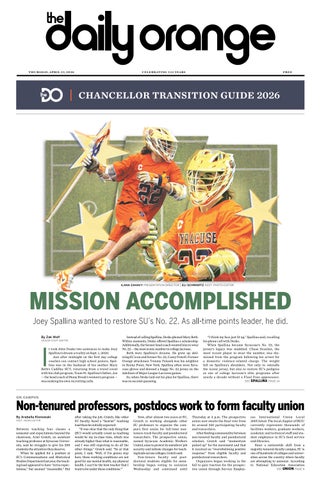
Joey Spallina wanted to restore SU’s No. 22. As all-time points leader, he did.
By Zak Wolf senior staff writer
It took John Desko two sentences to make Joey Spallina’s dream a reality on Sept. 1, 2020.
Just after midnight on the first day college coaches can contact high school juniors, Spallina was in the backseat of his mother Mary Beth’s Cadillac SUV, returning from a travel event with his club program, Team 91. Spallina’s father, Joe — the head coach of Stony Brook’s women’s program — was making his own recruiting calls.
Instead of calling Spallina, Desko phoned Mary Beth. Within moments, Desko offered Spallina a scholarship. Additionally, the former head coach wanted him to wear No. 22 — the most iconic number in college lacrosse. Both were Spallina’s dreams. He grew up idolizing SU icon and former No. 22, Casey Powell. Former Orange attackman Tommy Palasek was his neighbor in Rocky Point, New York. Spallina often wore Syracuse gloves and donned a baggy No. 22 jersey on the sidelines of Major League Lacrosse games.
So, when Desko laid out his plan for Spallina, there was no second-guessing.
“I think my face just lit up,” Spallina said, recalling his phone call with Desko.
When Spallina became Syracuse’s No. 22, the jersey’s legacy was muddied. Chase Scanlan, the most recent player to wear the number, was dismissed from the program following his arrest for a domestic violence-related charge. The weight fell on Spallina’s shoulders. Not only to rekindle the iconic jersey, but also to restore SU’s pedigree as one of college lacrosse’s elite programs after nearly a decade without a Final Four appearance.
see s pallina page 14
By Arabella Klonowski asst. news editor
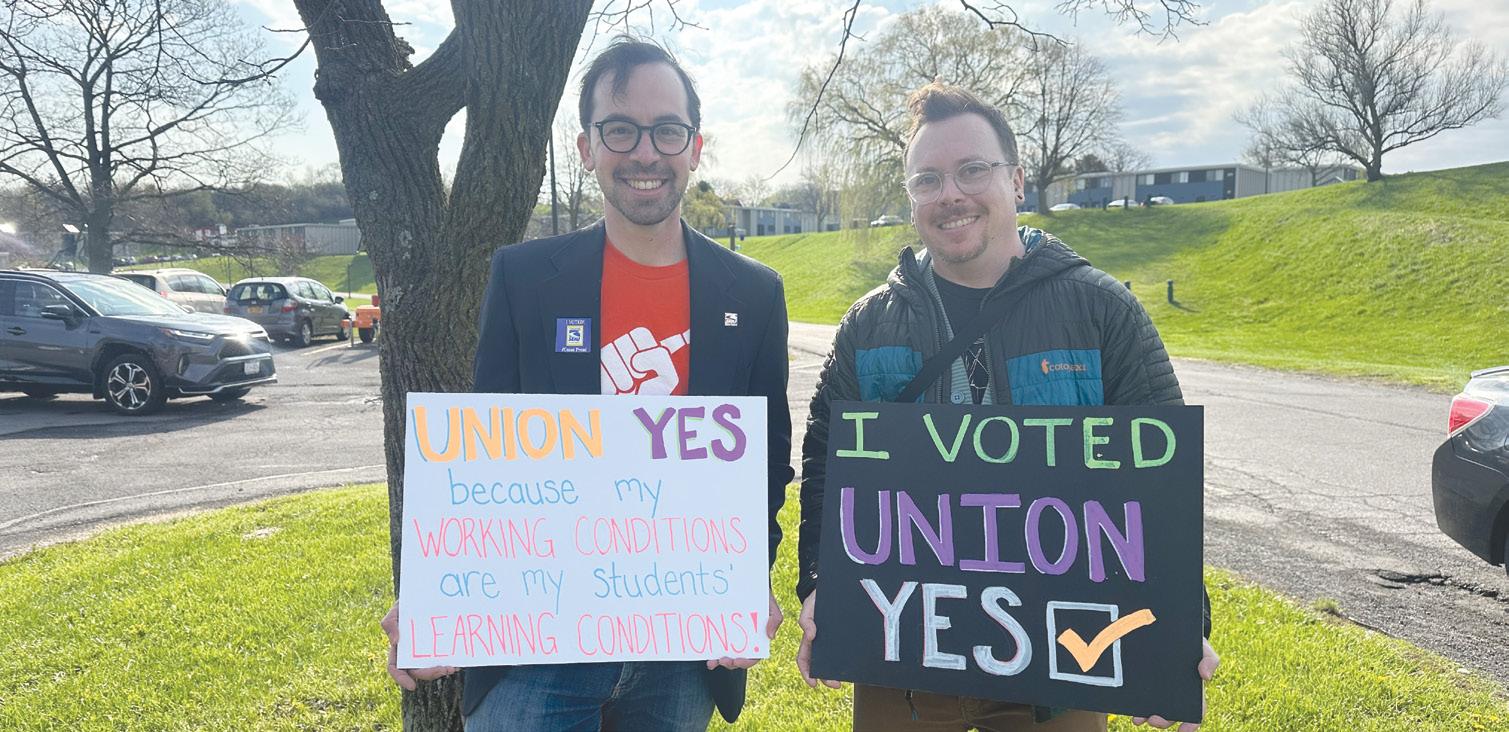
Between teaching four classes a semester and expectations beyond the classroom, Ariel Gratch, an assistant teaching professor at Syracuse University, said he struggles to give his 200 students the attention they deserve.
When he applied for a position at SU’s Communications and Rhetorical Studies Department last year, the teaching load appeared to have “extra expectations,” but seemed “reasonable.” But
after taking the job, Gratch, like other SU faculty, faced a “heavier” teaching load than he initially expected.
“It was clear that the only thing that (SU) would actually count as teaching would be my in-class time, which was already higher than what is reasonable, and I was still expecting to do all the other things,” Gratch said. “So at that point, I said, ‘Well, if I’m gonna stay here, these working conditions are not good for my mental health, my physical health. I can’t be the best teacher that I want to be under these conditions.’”
Now, after almost two years at SU, Gratch is working alongside other SU professors to organize the campus’s first union for full-time nontenure-track faculty and postdoctoral researchers. The prospective union, named Syracuse Academic Workers United, aims to protect its members’ job security and initiate changes for teaching loads across colleges, Gratch said. Non-tenure faculty and postdoctoral students eligible for membership began voting to unionize Wednesday and continued until
Thursday at 4 p.m. The prospective union now awaits the final vote from its around 350 participating faculty and researchers.
After finding commonality between non-tenured faculty and postdoctoral scholars, Gratch said “momentum picked up” for the movement and that it received an “overwhelming positive response” from eligible faculty and postdoctoral researchers.
Organizers began working in the fall to gain traction for the prospective union through Service Employ-
ees International Union Local 200United. The local chapter of SEIU currently represents thousands of facilities workers, graduate workers, academic and technical staff and student employees in SU’s food service and libraries. Since a nationwide shift from a majority tenured-faculty campus, SU is one of hundreds of colleges and universities across the country where faculty are attempting to unionize. According to National Education Association see union page 6

Editor@dailyorange.com
News@dailyorange.com
Opinion@dailyorange.com
Culture@dailyorange.com
Sports@dailyorange.com
Digital@dailyorange.com
Design@dailyorange.com
Photo@dailyorange.com
BUSINESS 315-443-2315
how to join us
The Daily Orange is an independent, nonprofit newspaper published in Syracuse, New York. The editorial content of the paper — which started in 1903 and went independent in 1971 — is entirely run by Syracuse University students.
The D.O., a 501(c)(3) nonprofit, is editorially and financially independent from SU, and the paper receives no funding from the university. Instead, The D.O. relies on advertising revenue and donations to sustain operations.
This spring, the paper will be published Thursday when SU classes are in session. The D.O.’s online coverage is 24/7, including while SU is on break.
To show your support to The D.O.’s independent journalism, please visit dailyorange.com/donate. Donations are tax deductible.
If you are a Syracuse University or SUNY-ESF student interested in contributing to The D.O. on either its advertising or editorial teams, please email editor@dailyorange.com.
corrections policy
The D.O. strives to be as accurate in our reporting as possible. Please email editor@dailyorange.com to report a correction.
letter to the editor policy
The D.O. prides itself as an outlet for community discussion. To learn more about our submission guidelines, please email opinion@dailyorange.com with your full name and affiliation within the Syracuse community. Please note letters should not include any personal information pertaining to other people unless it is relevant to the topic at hand. All letters will be edited for style and grammar.
of the editor-in-chief. The Daily Orange is in no way a subsidy or associated with Syracuse University. All contents © 2026 The Daily Orange Corporation











By Laura Lemgruber asst. copy editor
On paper, Syracuse University’s incoming Student Government Association President Emily Castillo-Melean and Executive Vice President Max Lachut may not seem like they have a lot in common.
They study subjects in completely different areas, come from opposite sides of the country, participate in vastly different extracurriculars, and are about a foot apart in height.
But, after winning an uncontested election for SGA’s 70th assembly, the two said they’re prepared to lead SGA amid a time of change with new campus leadership and SGA policies.
They have one message for the campus community — they’re here to serve students.
“We are not here for ourselves,” Lachut said. “Everything we’re doing, everything we’re advocating for, it’s for students, by students.”
For Castillo-Melean, making students feel welcome on campus regardless of their background is a key part of her mission as president. As the first person in her family to attend a private university, she said there’s a lot she’s had to learn on her own.
While Castillo-Melean has support from her Posse Foundation scholarship and mentors, she said learning how to navigate the college application process on her own while supporting a family member through medical issues was difficult to balance — but it helped shape her as a leader on campus.
“You never know what someone’s going through,” Castillo-Melean said. “That extra layer of empathy is something that I bring into my leadership, and with the students on campus.”
When Castillo-Melean arrived at SU from her hometown of Miami, she quickly began joining campus organizations. As a highly involved student in high school, she knew she wanted to take full advantage of her time at SU, joining SGA and the pre-law and government professional fraternity, Kappa Alpha Pi.
“She brings so much enthusiasm and passion to everything that she does,” said Jonathan Hoster, Castillo-Melean’s Posse mentor. “And that is infectious.”
Her leadership skills shine in her extracurriculars and her classes. In her

second semester, she took on a teaching assistant role for her policy studies class, where she developed skills that would later help her in SGA.
“She’s often direct and will challenge someone’s idea or position and do it while smiling,” policy studies professor Richard Barton said. “She does a great job at disagreeing with people while sending the signal that this isn’t a personal thing.”
Barton said he was impressed by CastilloMelean’s ability to engage in challenging conversations with her peers. He thinks her “tremendous integrity” and commitment to the public good will make her an excellent student body president.
To balance all of her roles on campus, Castillo-Melean said she keeps three calendars to track her responsibilities and consumes a healthy amount of coffee to keep her going. Next semester, she plans to bring her espresso machine into her office.
Lachut, who admitted he never drinks caffeine, also juggles a handful of roles at SU.
Some of his days start as early as 6 a.m. when he gets ready for his shift as a research assistant at Upstate Medical University. When he’s not at the hospital or the SGA office, he’s attending
classes for one of his three majors: biotechnology, biochemistry and neuroscience.
As seen in Lachut’s seven-line email signature, he’s also a Renée Crown University Honors Program student, works as a men’s basketball team manager, a barback at Orange Crate and is a member of the Pi Kappa Alpha fraternity.
Castillo-Melean and Lachut said their range of on-campus involvement gives them the perspective they need to be able to bring fresh ideas to SGA.
As SGA members are typically humanities majors, Lachut said he’s excited to represent the university’s STEM students. This semester, he introduced a free EKG heart screening initiative for students, which detected 10 students with irregular EKGs who are receiving follow-up care.
During his freshman year, Lachut took the lead in organizing an SGA farmer’s market with over 30 vendors, which has become a regular SGA event.
As someone who grew up in Syracuse, Lachut said the two hope to get SGA more involved beyond campus through local volunteer work. Although she’s not a local, Castillo-Melean has also worked with different nonprofits in the Syracuse area, including La Casita Cultural
Center, the Onondaga County Legislature and working as a college fellow for the New York State Democratic Party in 2024.
Beyond community service, Castillo-Melean and Lachut said they want to emphasize student engagement and plan routine in-person tabling in the Schine Student Center during the fall semester for students to voice their concerns.
Germán Nolivos, SGA’s current president, said the pair’s passion for serving their fellow students was evident from the moment he met them during their freshman year. Watching the two grow in SGA, he’s seen their determination, leadership and passion.
Nolivos acknowledged that their term might be challenging. But, he said, Castillo-Melean and Lachut’s knowledge of SGA and their “Type A” work styles make them the perfect candidates to take on these roles.
“If I have that trust in someone to go through this journey, it’s them,” he said.
Although the pair said changing university administration could be a challenge during their term, they’ve already begun connecting with university faculty and developing relationships with university administrators, like Acting Chancellor Mike Haynie.
“I’m excited to work with them,” Haynie said. “I appreciate their passion. There’s no doubt that they authentically care about the university and the university students.”
Haynie said he wants to build a strong relationship with the two. While they lead SGA, his door will always be open to them, he said. He hopes to have Lachut, a Syracuse local, attend summer meetings with him to share students’ perspectives.
Increasing transparency and communication with the student body is another goal for their term. As Castillo-Melean and Lachut prepare for the fall, they’re hiring a press secretary to act as a liaison between student media and SGA.
To ensure they stay committed to delivering their campaign promises, Castillo-Melean and Lachut said they plan to write all of their semester’s goals on their office’s whiteboard.
“Every time that we fulfill one of those promises, we’re going to erase it,” Lachut said. “By the end of our term next year, we’re going to have a blank board.”
lalemgru@syr.edu
By Vivian Collins and Sean Harrington the daily orange
Every Monday, the New York Public Interest Group takes to Syracuse University’s Student Government Association’s weekly meetings to speak during public comment about its programming and work around campus.
But the past few weeks, the group has used the meetings to urge the assembly to restore its recently denied 2026-27 budget.
At an April 6 SGA meeting, NYPIRG, a nonpartisan outreach organization that’s had an SU and SUNY ESF chapter for over 50 years, announced SGA had cut the entirety of its annual budget during its advanced allocations process. SGA said it did this because of its nonRegistered Student Organization status, which places the group in a unique position compared to other advocacy groups on campus.
NYPIRG’s funding request, which totaled $95,000, was reduced to $0 for the 2026-27 academic year. SGA said the funds are largely allocated to a full-time salary and a physical office space, located on Marshall Street.
NYPIRG and SGA first established a relationship in 1999 that’s been governed by a contract, according to a joint statement issued Wednesday by SGA President-Elect Emily Castillo-Melean, Comptroller Alexis Leach and current President Germán Nolivos. However, the university terminated the contract after SGA cut all of NYPIRG’s funding during its advanced allocations process.
Members of NYPIRG, like Leandra Hernandez and Natallie Cox, told The Daily Orange the decision to cut its funding came down to the resources their organization receives as a result of its non-RSO status, regardless of the work they partake in. NYPIRG receives its funding outside of SGA’s four-tier funding system.
“We are doing something every single day, and we’re doing at least seven different campaigns all at the same time,” Cox said. “It’s stuff both in the Syracuse community, but … in New York state as a whole, we do a lot of work. I think that fundamentally makes us a little bit different.”
SGA, however, maintains that the decision came down to NYPIRG’s place among student advocacy groups and the privileges they receive while not being an RSO.
“This decision was grounded in careful review, objective data, and extensive discussion among elected student representatives,” SGA’s statement said. “At its core, the decision reflects a responsibility to prioritize the needs and sustainability of the more than 350 recognized student-led organizations on campus.”
Prior to the budget cut, NYPIRG received $6 from each enrolled undergraduate student’s student activity fee, according to the 2025-26 tuition and fees handbook. The fee is given to NYPIRG “on a mandatory basis at the time of registration,” but can be refunded if students contact the organization, according to the handbook.
In the statement, SGA said the decision to cut funding stems from limited student participation in “NYPIRG-led initiatives,” compared to the growing number of student-led advocacy organizations on campus.
Notably, the statement highlighted that the total amount received by over 35 advocacy and service RSO’s was $44,079.60 for the 2025-26 academic year, including 1,909 members, while NYPIRG requested more than double that for the 2026-27 academic year.
NYPIRG’s full-time program coordinator, Azaria Chapman-Walker, whose position is paid for by annual SGA funding, said her role won’t be the only one affected by the cuts. She pointed out NYPIRG’s connection with a course in the Maxwell School of Citizenship and Public Affairs, where students are required to attain 35 hours of community service.
“This class relies on us to get students credit,” Chapman-Walker said. “Having $95,000 and going completely to zero… means that can’t happen.”
Interns who facilitate NYPIRG’s campaigns take leadership roles within the organization, addressing issues from homelessness and hunger to transportation and higher education costs, Chapman-Walker said. She said this will become “impossible” to continue without funding.
Other students associated with NYPIRG expressed concern about the program’s future without the funding to sustain a full-time staff member and a dedicated space.
Callie Morales, a SUNY ESF sophomore and NYPIRG member, said that a full-time program coordinator is “absolutely” necessary for the organization to function and continue functioning as is.
“To do the sheer amount of work we’re doing, yes,” Morales said. “She’s very much a part of the greater NYPIRG, so she has a lot of interconnectivity with them.”
In response to the imposed budget cuts, NYPIRG circulated a petition advocating to restore its funding to Chief Student Experience Officer Allen Groves, which the group distributed at Monday’s SGA meeting.
NYPIRG reported 2,209 students and 79 faculty members signed its petition. However, SGA claimed some of the signatures were repeated or used fictitious names. Some entries are duplicated, with a change in capitalization, or only include a first or last name.
Chapman-Walker said the petition included outside community members who came across petitioners and wished to offer support, indicating the petition went beyond SU affiliates in its purported numbers. The petition only includes 27 signatures labeled as faculty and 37 as staff, according to the support petition distributed by NYPIRG.
As a non-RSO organization on campus, NYPIRG’s ambiguous status made response efforts challenging for student members, including Xochitl Quinones, who said they’ve encountered “complications” since the funding cut.
“It gets kind of muddy on what we are, and we’re just continuing to try to fight the appeal process and possibly be an official RSO next semester,” Quinones said.
Others, including SUNY ESF sophomore Scott Newman, are angered by the move. In a statement to The D.O., he argued that a lack of attention and care from SGA prompted this decision.
“SU’s administration pushed the decision, and executives rolled over, assembly members played games on their phones while ignoring
NYPIRG when they speak,” Newman said. “The SGA is a powerful, yet pointless organization that wields privilege and power defensively, lashing out when criticized.”
In its Wednesday statement, SGA recognized NYPIRG’s impact on campus and the Syracuse community and suggested that the interest group take the steps to become a student-led RSO. Chapman-Walker said NYPIRG is “happy” to become an RSO.
“I think the real opposition to (becoming an RSO) for us comes from the fact that when (SGA is) saying we can be an RSO, they’re not saying ‘We’re gonna keep funding you at what we’re funding you,’” Chapman-Walker said. “We’re happy to become an RSO. But the issue is (that) they still plan to have us zeroed out.”
SGA also criticized NYPIRG for the accuracy of its efforts to garner student and faculty support, claiming the information shared with students is often misleading or incorrect. The statement also notes that a number of students have shared with SGA that they felt “pressured” to sign the petition or lacked full context when doing so.
Moving forward, NYPIRG members shared deep concerns about the organization’s viability without a program coordinator to lead them.
“There’s always a fear of what’s going to happen with this club next year,” Cox said. “There seems to be a revolving door of different members and different E-boards, and that’s great, but that can really sometimes put a club’s survival in danger.”
Chapman-Walker maintained that while she was disappointed in the decision, she hopes the future holds a continued partnership with SGA that allows NYPIRG to continue to operate on campus.
“NYPIRG is an organization that wants to uplift the community … we want to uplift the people around us, and we want to uplift the organizations around us, and obviously we can’t if we don’t have the funding,” Chapman-Walker said. “I think that this was an oversight of democracy at the end of the day.” news@dailyorange.com
By Charlotte Price social media editor
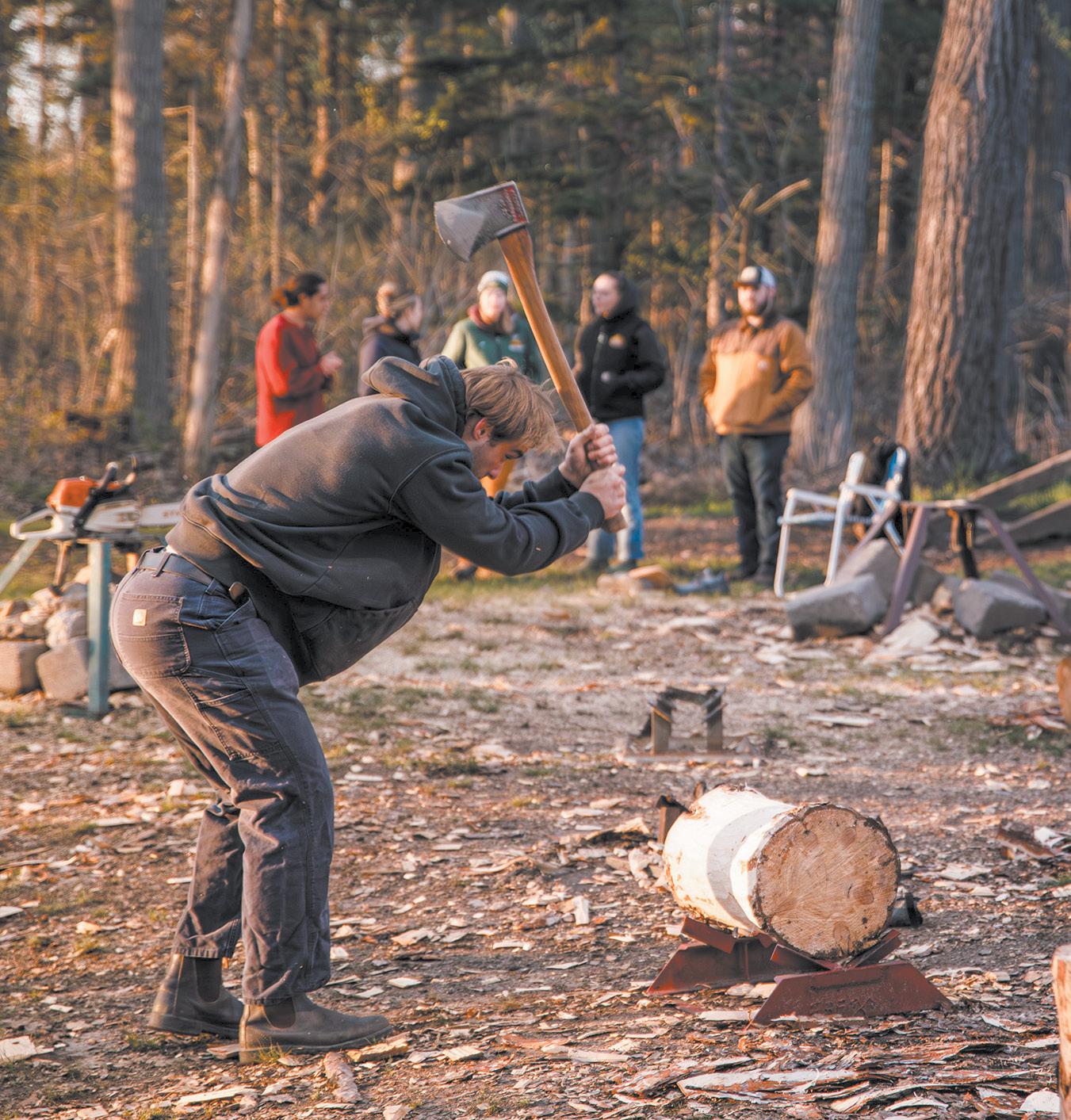
Head south, past South Campus, to a part of Syracuse you’ve probably never seen before. Turn into the SUNY ESF Lafayette Road Experiment Station and drive past a barn and a greenhouse. Turn right onto the gravel road and drive through the forest to the back of the property. In the clearing right behind the tree line, you’ll find a hive of activity: an ESF Timbersports team practice.
The sun is starting to set on a scene that feels like it’s not just from beyond University Hill, but from an entirely different state — maybe somewhere in the Pacific Northwest. Here, ESF students trade backpacks for razor-sharp axes slung over their shoulders, and their sneakers for spiked cleats layered with chainmail shin guards to reduce the damage caused by a wayward swing.
The club team, founded in 1912, is preparing for their upcoming meet, the Annual Northeast Collegiate Woodsmen Conclave, this weekend. ESF is hosting the regional championship for the first time, drawing over 40 timbersports teams from across the Northeast.
The Woodsmen are preparing by analyzing their performance at their meet from last weekend, explained senior Luke Myers, the captain of the men’s team and vice president — occasionally interrupted by the sounds of chainsaws hefted by teammates.
“We are very much gritty teams,” Myers said. “All the other teams can tend to comply to things. We really take things on the chin when we lose and try to get better.”
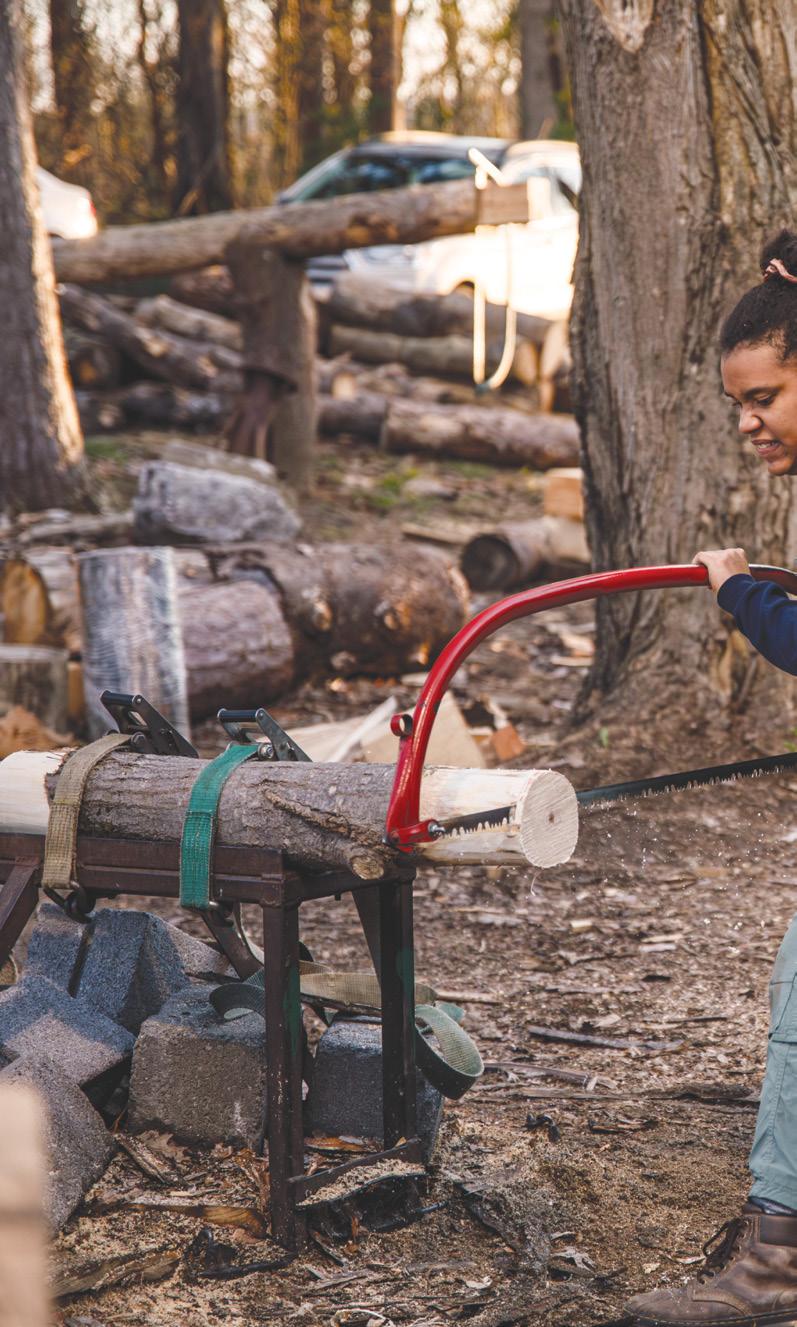

As Myers walks around the clearing, he directs team members on what to practice and when, splitting their time between individual and team events. It’s a delicate balance between the sport’s 19 possible events and the 40 team members. Only 24 woodsmen, members of the men’s and women’s A teams and two Jack and Jill (men and women) teams, compete at each meet.
At meets, the top time for each event receives 100 points, with slower times bringing in lower points. The points for each event are totaled at the end of the meet to determine the winner.
The clearing is carpeted with wood shavings and full of activity, centered around a fire barrel where the woodsmen warm up on an uncharacteristically chilly April evening. Each event has a dedicated space, and woodsmen rotate through them based on what they need to work on, Coach and ESF class of 2022 alum Emily Ellithorpe said. It’s a balance between preparing the competitors for the weekend and priming underclassmen to compete in later years, she said.
The team has been successful at recent meets, Myers said. The women’s team consistently places first or second, and the men’s has climbed from fifth at their first meet to first at their most recent competition last weekend. They’re hoping to replicate the performance at the upcoming meet, Myers said.
“We have to be calmer than the other teams,” President Sophia Ryan said, looking up from marking a log with a crayon to prepare it for underhand chop.
“The other teams tend to go into meets really psyched out and hyped up, really angry, and they tend to get really frazzled,” Ryan said. “And our teams do a really good job at staying calm, keeping our heads on our body and not freaking out, not letting little things trip us up.”
For underhand chop, a woodsman straddles a log and chops wedges out of it, following marks like the ones Ryan is drawing. The marks represent the most efficient path for an ax, which must be swung at exactly the right angle.
Once those marks are made, it’s time to move away.
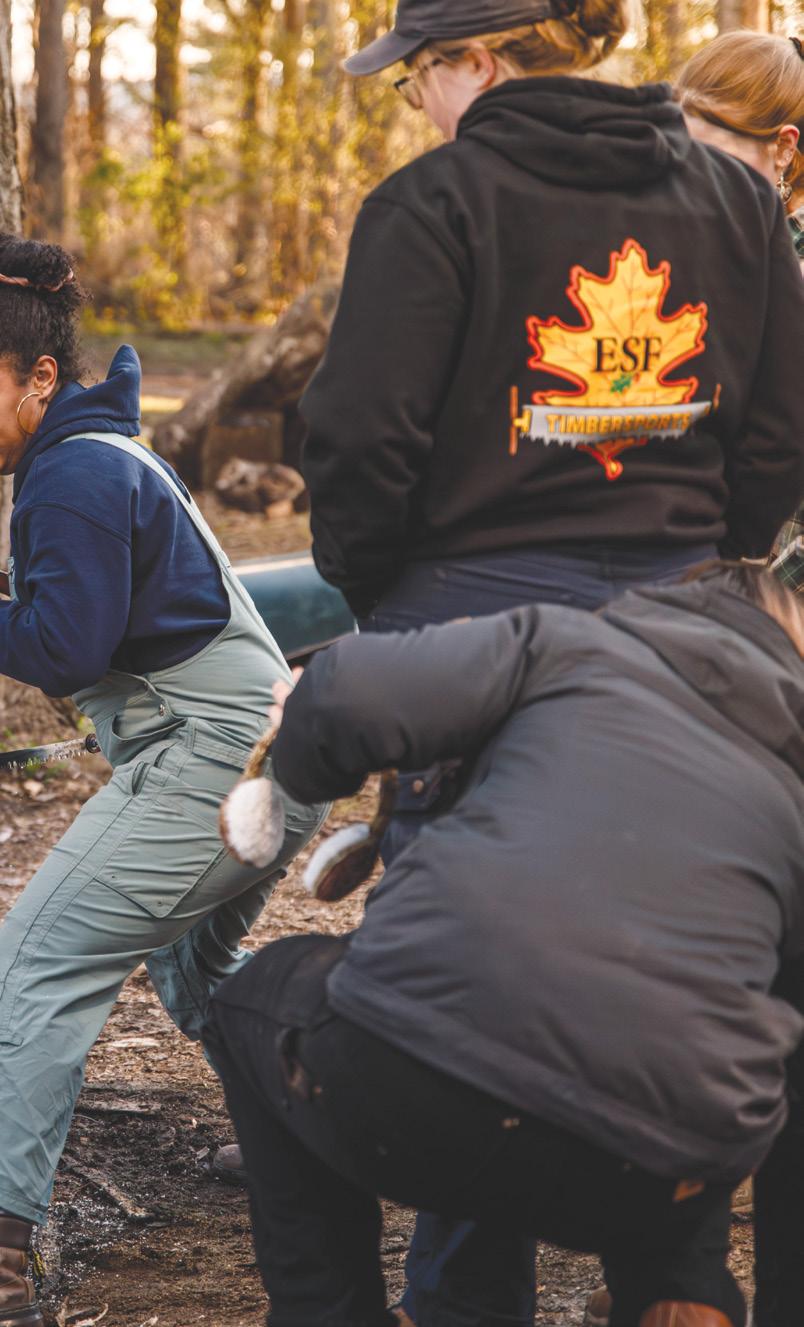
“I’d take a step, because he’s gonna swing that ax,” Myers warns. Most timbersports events are timed, which gets adrenaline pumping, ESF senior Kennon Gardner said. In the full-team bow saw event, all six members of the team line up to cut slices — called cookies — off of a log, rapidly handing the saw off to the next person as soon as they finish.
“Everybody’s screaming the whole time,” Gardner said.
A few seconds can make or break an event, Myers said as he watched a woodsman practice the start of her stock saw event over and over again. The woodsman wears noise cancelling headphones, protective eyewear and overalls. She kneels in front of a log ratchet strapped to a platform and rests her hands on top of it.
Like the official in a track race, a teammate calls her to start. She picks up the chainsaw and places its teeth on the log as quickly as she can, stopping short of cutting the wood.
She practices the motion again and again. If she doesn’t make the necessary cuts within the six inch allotment of wood, she’ll be disqualified. If she sets the saw too far in and has to pick it back up to reset, she’s already lost.
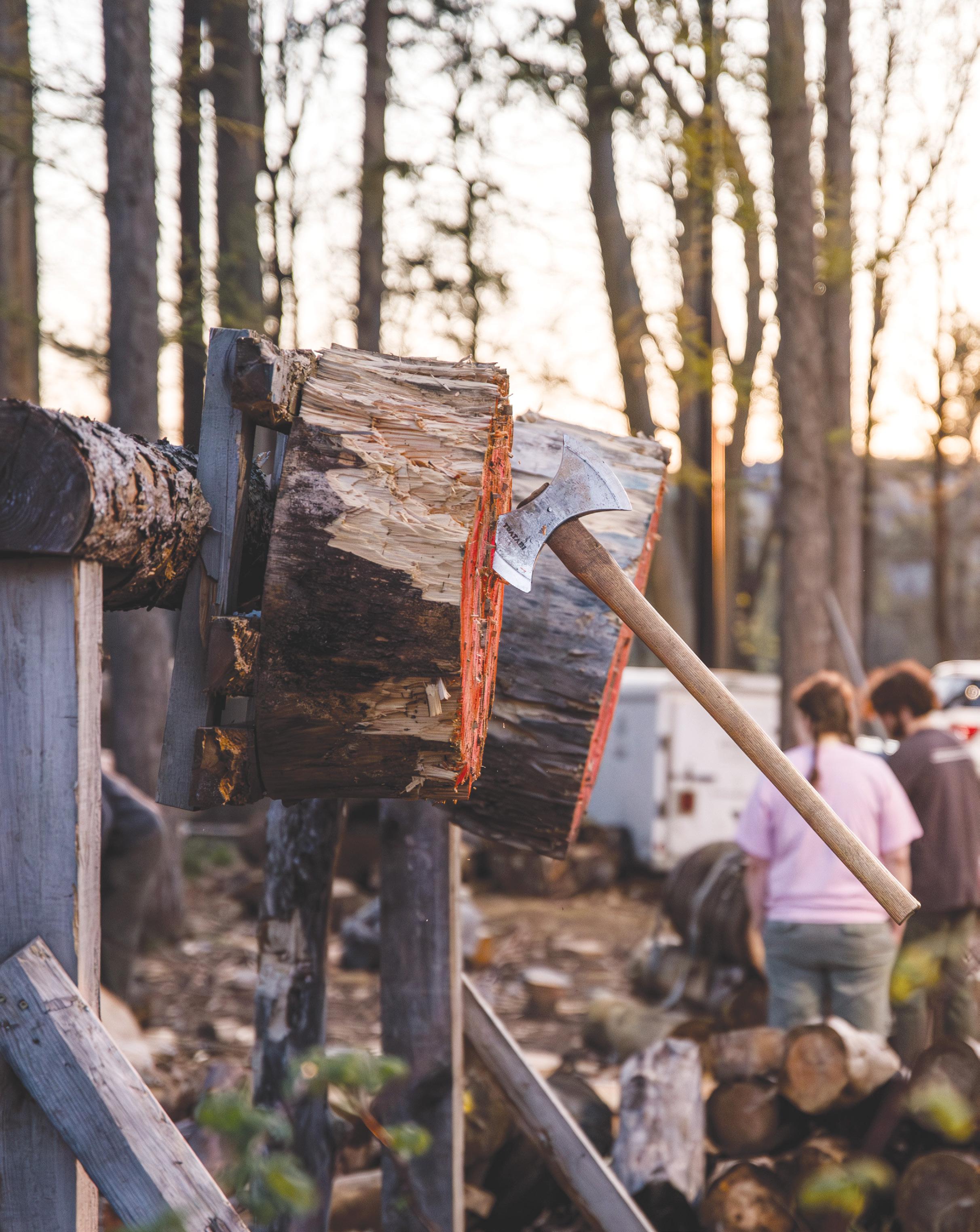
Ax throwing is one of the few untimed timbersports events. Gardner picked it up this semester after the former men’s A team ax thrower left to study abroad. Gardner was bad at first, he said, but he took home an ax throwing target over winter break to hone his skills.
Though it’s not done under a time crunch, ax throwing gets adrenaline pumping in a different way, Gardner said.
“It’s how to not psych yourself out,” Gardner said. “Like, to not get up to the line and freak out that I have to hit it. It has to be perfect. And then you’re just rigid, tense, not dialed in on what you’re actually doing,” he said.
At a meet, an ax thrower is allotted one practice throw and five throws. When Gardner is competing
at meets, he reevaluates after his practice throw to see what he needs to adjust based on the position of the ax on the target. If it’s too high, he knows his hips are tight. If it’s too low, he needs to adjust the position of his hands when he releases the ax.
“I grew up two hours north of here in a real small town and so I’ve been splitting firewood my whole life,” Gardner said. “It kind of felt like when I came to the field, ‘Oh, I get to do the work that I like doing and do it for fun.’”
Unlike Gardner, most who join the team are former athletes from sports like rowing or track and don’t have any prior experience with timbersports. Myers is from Long Island and didn’t grow up chopping any wood, he said.
Myers saw the team on ESF’s website and “showed up” his freshman fall. He points to a friend across the clearing — they’ve been doubles event partners for four years now. The team is a real community, he said.
“Nice job,” he calls out to someone just completing a cookie cut — cutting as many horizontal cookies from the log as possible in a given amount of time while keeping them stacked.
“So that was seven or eight. A good stack will be like, upwards of 15 to 20. Yeah, he’s new,” Myers said.
Freshmen who are new to the team find their events mostly based on what the team needs, Ellithorpe said. Bigger, more muscular people tend to get put on events like single buck, she said. That’s how ESF junior James Dziergas, who didn’t have any prior timbersports experience, ended up specializing in what he described as “meathead” events: ones where the main requirements are being strong and fast enough.
Dziergas balances bodybuilding with timbersports, which helps with events like standing block chop and underhand chop. Though not all of the men’s A team are bodybuilders, they often lift together to build strength, endurance and their team bond. That connection is what keeps Dziergas coming back to the team, he said.
“I’m just here for my friends, I bodybuild mostly full time,” Dziergas said. “This is something that I love to do, and I love all the people that I do it with. I’m willing to sacrifice a little bit of progress in the gym so I can hang out with all my friends. That’s what I love about this team.”
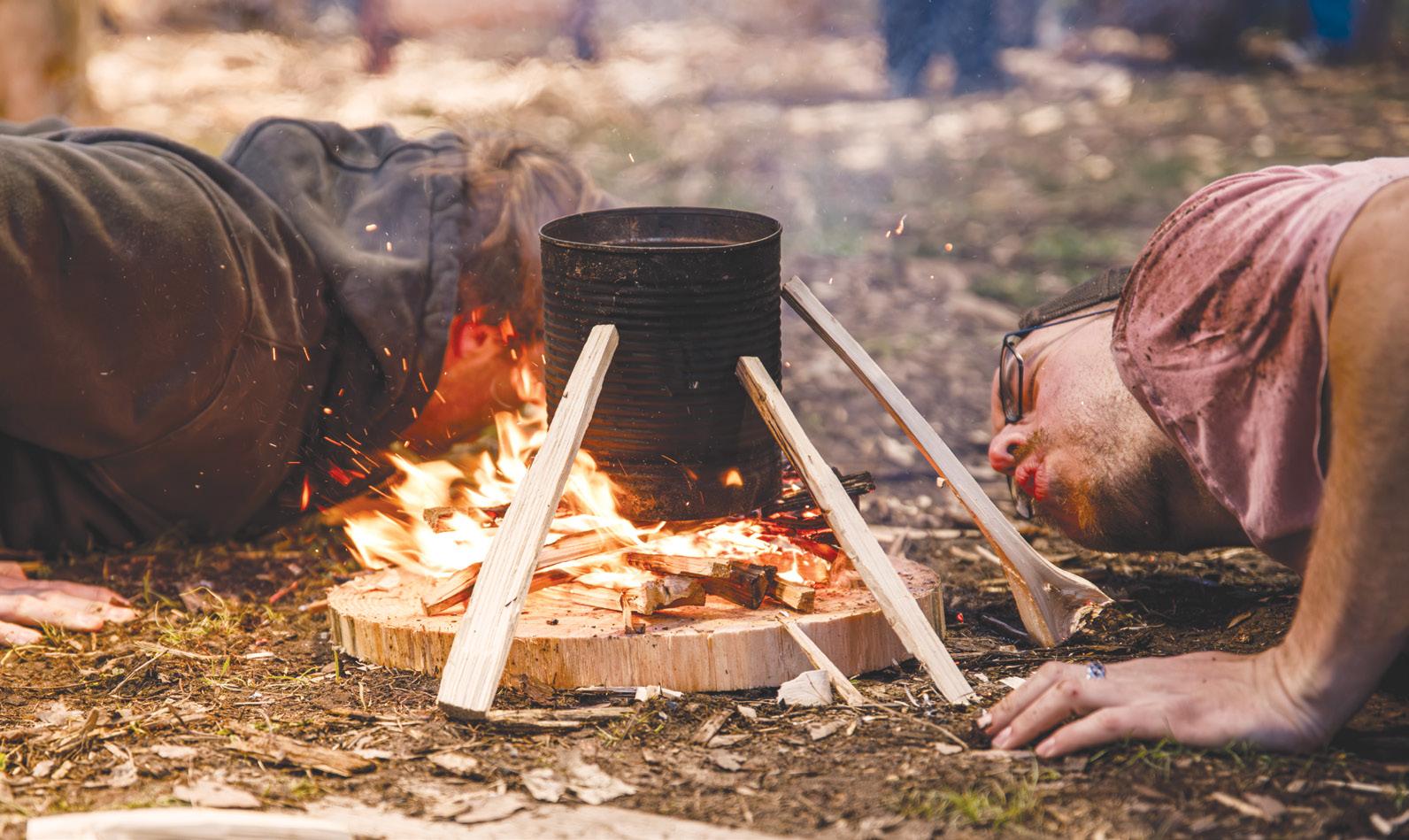
That team connection is especially important for fire build, a technique-based event. Dziergas and Gardner start by gathering the limited materials they need — a few logs, a tin can filled with water and soap, matches, an ax and a knife.
Dziergas stands poised with the ax while Gardner kneels. When the timer starts, they spring into action: Dziergas splits the wood then tosses it to Gardner, who immediately slices it into smaller kindling, holding the knife horizontally and pressing down to slice the wood like a block of cheese. The tools they’re using are incredibly sharp. Gardner arranges the pieces into a small log cabin shape and lights the middle. Once it’s a few inches tall, they place the can on the top and both get on their stomachs, cheeks pressed to the ground with their elbows propped up to their sides.
They start to alternate blowing on the small flame, pitching their heads back over their shoulders to gulp breaths of air and immediately blowing them back into the fire, like human bellows. The goal is to use breath to keep heat underneath the can, making the water boil as quickly as possible.
Gardner calls out “flip” and they simultaneously scramble to opposite sides of the fire like wrestlers doing a drill. They don’t talk much, and they don’t need to. They’re completely in rhythm.
“It’s a little unspoken,” Dziergas said. “It was rough at the beginning of the semester, just because you’re trying to get a vibe off the other person and figure out how the other person’s brain works.”
As woodsmen warm their hands around the central bonfire, it’s easy to tell who’s just practiced a fire build — their palms are caked in mud from scrambling on the ground.
Charlie Harkness, a sophomore and a women’s team alternate, is standing around the fire and can’t do much else — she’s on crutches after dislocating her knee while substituting in for the women’s A team at the woodsmen’s last meet during the obstacle pole event. The athlete runs up a diagonal log, saws off a piece and runs back down. Things turned out alright though, she said. Her knee “popped right back in” as she fell, and the women’s A team ended up winning.
Injuries like Harkness’ aren’t common on the team, Ryan said. Usually when people are injured it’s because they’re misusing the equipment, she said, cutting their hands or fingers on axes or saws. Harkness is watching someone chainsaw two pieces of wood off of a log for the stock saw event. It was an impressively “smooth” run, Harkness said. The goal is to be as quick and smooth as possible without breaking any cookies.
Timbersports was featured heavily in Harkness’ supplemental essays for ESF. She’d never done sports before, but promised to show up to every practice and event in her essays. Once she got to try it, it was “invigorating,” she said.
Encouraging calls like “yeah buddy,” sound from athlete to athlete throughout the practice. That’s part of the environment that keeps everyone coming back to the woods.
“We have a really, really great community, really supportive of each other and really dedicated to what we do,” Ryan said. “It’s super fun and very, very competitive. It’s so niche, and it’s kind of addicting to get good at really weird, niche skills. And you meet weird people. Weird in a good way.” cprice04@syr.edu

By Bailey Dunn staff writer
In “recognizing the legacy” of Martin J. Whitman, Syracuse University’s Whitman School of Management’s namesake, Acting Chancellor Mike Haynie recalled a lesson he learned from Whitman himself that’s stuck with him for decades.
“Syracuse University is an institution that gives people a chance when others would not,” Haynie said.
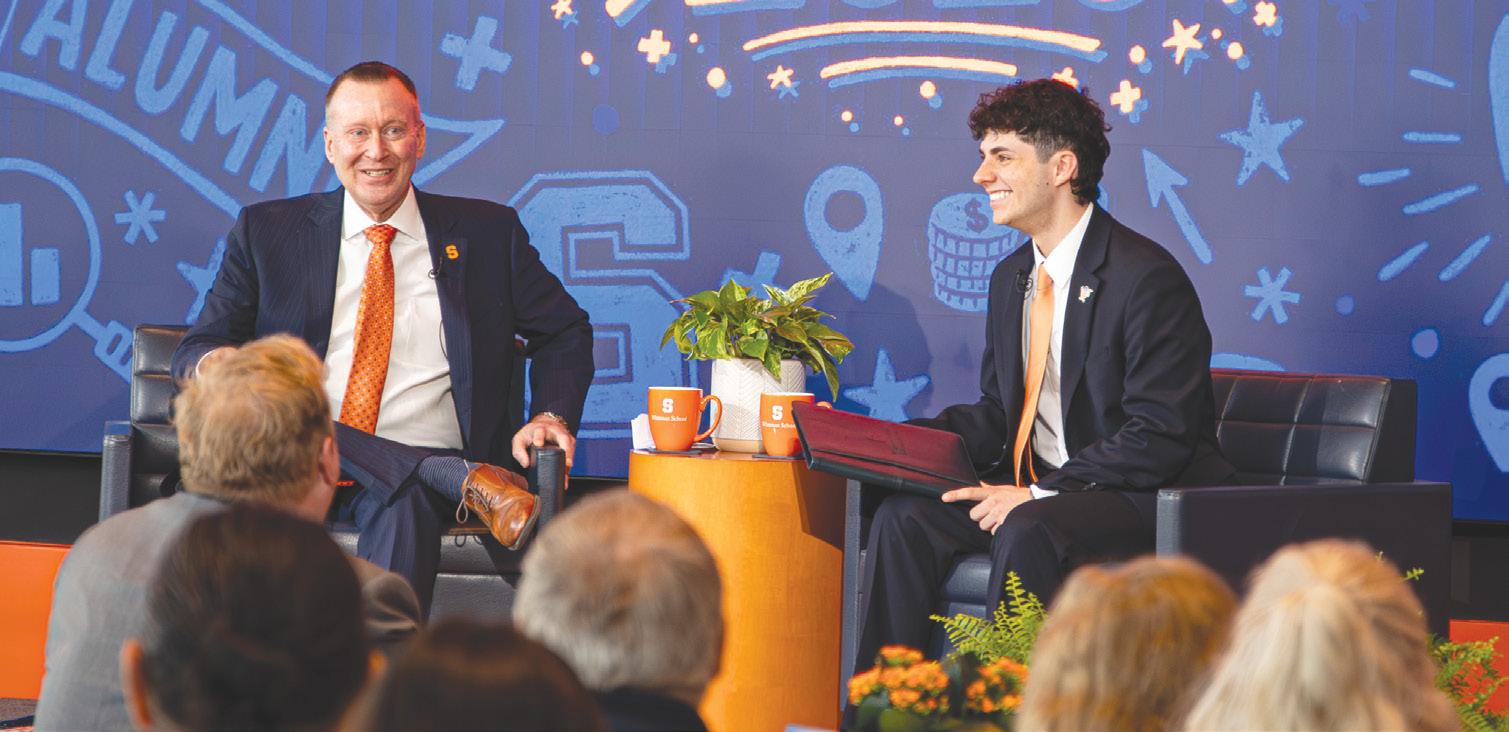
In an intimate Wednesday “fireside chat” with students and faculty, Haynie elaborated on the lesson as a guiding principle in his current role. He said he uses it to help draw a line between what must change and what shouldn’t.
Throughout the chat — part of SU’s annual “Whitman Day” — Haynie discussed his work leading the university through COVID-19, working with veterans through the Institute for Veterans and Military Families and current challenges facing higher education in the United States.
The speaker and breakfast reception was moderated by Whitman senior Marc Pantano. Pantano was a familiar face for Haynie, as the two met at a dinner during Remembrance Week, Pantano said.
The two continued running into each other on campus after their first encounter, something which the acting chancellor said shows the importance of students “showing up.”
Stepping into the chancellorship after over two decades at SU and his experience as a U.S. Air Force veteran, Haynie gave advice on leadership throughout the discussion.
“We certainly can’t shrink away from the change that’s required for us to thrive in the future,” Haynie said. “But there are things about this place that should never change. I think one of those things that should never change is being an institution that’s willing to give people a chance.”
Whitman freshman Kaveri Deepak said she resonated with this sentiment, as she said a common goal of business students like herself is to “grab” opportunities.
“The willingness to say yes and being able to learn new opportunities like how he did is one of the most important things I learned,” Deepak said.
Haynie said the reason he’s stayed at SU for so long is influenced by the Whitman School’s ability to say “yes” to innovation. When he originally wanted to start the IVMF with no experience leading a program, he wasn’t turned down, but instead supported by his peers.
Throughout his chat, Haynie also addressed the current challenges facing higher education. In 2025, international student enrollment dropped across the nation. At SU, international student enrollment dropped to 5% from 12% in 2023.
Haynie said statistically, the number of American families that question the value of
a four-year degree has increased in the last few years.
“Over the past five years, no American institution has lost more public trust than higher ed,” he said. “It should be a wake-up call to those of us who have worked in that space over the last five years.”
He pointed to shifting student habits as both a challenge and an opportunity. He said the traditional understanding of education has now shifted into uncertainty, and that those
assumptions should now be challenged in order to make progress.
“This generation consumes content differently, and as a consequence, we need to teach and train differently,” Haynie said. “The exciting thing about what’s ahead is being innovative and entrepreneurial in how we respond to the challenges coming at higher education.”
badunn@syr.edu
By Brenne Sheehan news editor
Outgoing Syracuse University Chancellor Kent Syverud will remain in Michigan for brain cancer treatment in the weeks before commencement, he announced in a Wednesday campuswide email.
The departing chancellor, who announced he’d step down from his position ahead of his official May 11 departure date due to a cancer diagnosis, said he would begin “aggressive” treatment that requires him to stay in Michigan.
Today, about 83% of new faculty unions include non-tenured faculty, contingent or adjunct faculty.
In a statement to The Daily Orange, Sarah Scalese, SU’s Vice President for Communications, said the university “respects the important role of labor unions,” but will refrain from taking a formal position on the union vote.
“If a union is elected as the exclusive bargaining representative for either or both groups, the university will negotiate in good faith,” Scalese said in the statement.
Over 60 faculty members, including associate teaching professors, professors of practice and postdoctoral members across SU signed a “Dear Colleagues” letter, urging university support across all departments.
The letter, obtained by The D.O., highlights challenges organizers seek to address through the union, including “academic and intellectual” protection for non-tenured faculty members, job security for postdocs and acknowledgment of “teaching and service labor.”
Another letter, signed by over 75 tenured and tenure-stream faculty members, urges acting Chancellor Mike Haynie, Provost Lois Agnew and SU’s Board of Trustees to: “Commit to a stance of neutrality and provide a fair process for any and all NTT faculty and postdocs on campus to form a union.”
Jiwoon Yulee, an assistant teaching professor in the Women and Gender Studies Department, emphasized that, while the “Dear Colleagues” letter highlights the union’s primary goals, there is a need for “more intense conversations” surrounding the identified concerns.
In the few months she worked with faculty at SU and representatives from SEIU, she said the efforts “unfolded like a storm,” leading to a “quick, surprisingly successful” campaign. As a researcher focused on labor movements, she said she was “very passionate” about helping organize.
“This is my first time being the person who is leading the campaign, and at the same time, I’ve been reflecting back on what I studied and what I’ve been writing about,” Yulee said. “So it was kind of a very intense, meaningful experience to me.”
“This saddens me, because I had envisioned spending these final weeks before commencement thanking hundreds of you individually for your acts of brilliance, kindness, and judgment in building the extraordinary community that Syracuse University has become over these past 12 years,” Syverud wrote. “Those conversations may not be possible now, and that weighs on me.”
Syverud announced in August he’d be leaving SU at the end of the academic year and was slated to become the next president of the University of Michigan, his alma mater. Amid his
diagnosis, he announced he’d no longer serve as president and instead will continue as a law professor and special advisor to the UMich Board of Regents.
The departing chancellor, replaced by acting Chancellor Mike Haynie on April 15, used the email to share his thanks for the well-wishes from the Syracuse and broader central New York community.
“I have heard from and felt the presence of everyone, from the Otto team to the marching band, from my brothers at Delta Kappa Epsilon to students, faculty, staff, and trustees from
student emails, she said, leaving her with no time to focus on her own research and book contract.
“I’ve been just doing this in the past few years, which turned out to be completely unsustainable as a scholar,” Yulee said. “My daily routine became almost impossible to accommodate all the tasks that I’ve been involved in as a productive scholar in my field.”
Yulee pointed to the 4/4 teaching arrangement — where faculty are responsible for four courses per semester out of the academic year — which has been a main concern in her experience at SU and with the union.
“When I was teaching 3/3, somehow it was manageable, but when it turned to 4/4, it changed my everyday routine completely,” Yulee said. “I don’t know what’s the level of intensity between three and four, but somehow it really created kind of a vicious cycle in my daily routine.”
Within administration, Scalese referenced attempts to address organizer concerns within drafts of a proposed faculty workload policy, which was discussed at an April 15 University Senate meeting.
publish the draft of the policy to hear comments from faculty and students.
Before the union vote, Yulee said she, along with other organizers, attempted to meet with every non-tenured and postdoc faculty member at SU to hear their thoughts and input to inform the requests.
Rusty Bartels, an associate teaching professor also working on the organizing team, said the policy only became public knowledge after efforts to unionize had already begun at SU.
“The faculty workload policy document is separate and distinctive from what we are doing, but part of (conversations) as we kind of think about things like workload and class sizes,” Bartels said. “These would be conversations that the union through bargaining would be having with the university.”
Gratch said organizers are working to secure representatives from a majority of the schools at SU, noting that some asked to “not be included in the union.”
across the University,” he wrote. “Your words and deeds have meant more than you know.”
Since his announcement, several figures on and off SU’s campus have issued statements in support of Syverud, including Syracuse women’s basketball team Coach Felisha Legette-Jack, SU Board of Trustees Chairman Jeffrey Scruggs and Haynie.
“Your prayers, your kind thoughts, and your expressions of concern have given me comfort, strength, and inspiration in ways that have profoundly affected my care—especially in the hard moments,” Syevrud wrote.
brennesheehan@dailyorange.com
vided by the University, as well as the rules, costs, and risks involved with union membership.”
Expanding upon the “rules, costs, and risks,” Doherty highlighted required union dues, and the possibility for members to receive more, less or no change to pay, following collective bargaining. “Regardless of whether bargaining results in better, the same, or worse employment terms,” she said union members will “likely” be required to pay dues.
In an open letter sent to The D.O., executive board members of SUs chapter of the American Association of University Professors said the email from Doherty includes “many key antilabor talking points” and could be seen as an “act of intimidation” against their colleagues.
The letter emphasizes the “difficult decisions” voters face when deciding the “best course of action to move forward with their professional lives.”
“By communicating your office’s disapproval of their choices in such stark terms, the clear conclusion is that your office would view with disfavor anyone who promotes or elects to form a union,” AAUP’s executive board wrote in the letter.
AAUP’s executive board also said Doherty’s email counters the “values” of SU and is an “affront” to faculty members eligible to vote.
“We urge you to rescind the notice and to make clear to the union-eligible faculty involved that there is no potential threat of retaliation for participating in the union election or choosing to form a union,” AAUP’s executive board wrote. Doherty did not immediately respond to The D.O.’s request for comment.
If the union is successful following Wednesday and Thursday’s vote, it will begin conversations about creating a bargaining survey to hear opinions about membership and set the groundwork for an initial contract with SU.
Due to the number of students Yulee teaches per semester — which she said ranges from 80 to 100 — and four classes a week, she said it forces her to prepare teaching plans on weekends, outside her work week. This led to Yulee working on weekends, from Friday to Sunday, to grade and respond to
“The policy is intentionally designed to place most decision-making authority at the school and college level, where faculty are best positioned to define expectations within their disciplines,” Scalese said in the statement. “The university is committed to continuing to engage with faculty as schools and colleges implement their individual workload policies.”
“We respect that, so they’re not going to be part of the union,” Gratch said. “If they ever decide if they want to, they’ll be welcomed back in terms of the organizing committee.”
Wednesday morning, ahead of the union vote, Senior Associate Dean of the College of Arts and Sciences Karen Doherty sent an email to A&S faculty containing “additional considerations” about voting to unionize ahead of the election.
“The National Labor Relations Act requires both parties to bargain in good faith, but does not require either party to agree to any particular proposal,” Scalese wrote.
Ahead of the vote, Gratch, Bartels and Yulee all described their outlook as “hopeful.”
Gratch, who found his passion for teaching through faculty at his alma mater, said he hopes the creation of Syracuse Academic Workers United will allow him to focus on the part of his job that he loves the most.
“We’re teaching faculty because we love teaching. We love students,” Gratch said. “That’s my problem. We’re unionizing because we don’t have the time to be the teachers that we know we can be.” arabellaklonowski@dailyorange.com from page 1 union
Scalese said the policy was informed by input from faculty council chairs and those whom they represent, and that SU will “soon”
“You have the right to make your own choice about whether to support or join a union,” Doherty wrote in the email obtained by The D.O. “We want to share some information about the benefits pro-
from “What is the best state?” to
avery magee photo editor
Abram Speek spices up his checkout counter shifts with “deep but not personal” questions
By Eliana Rosen culture editor
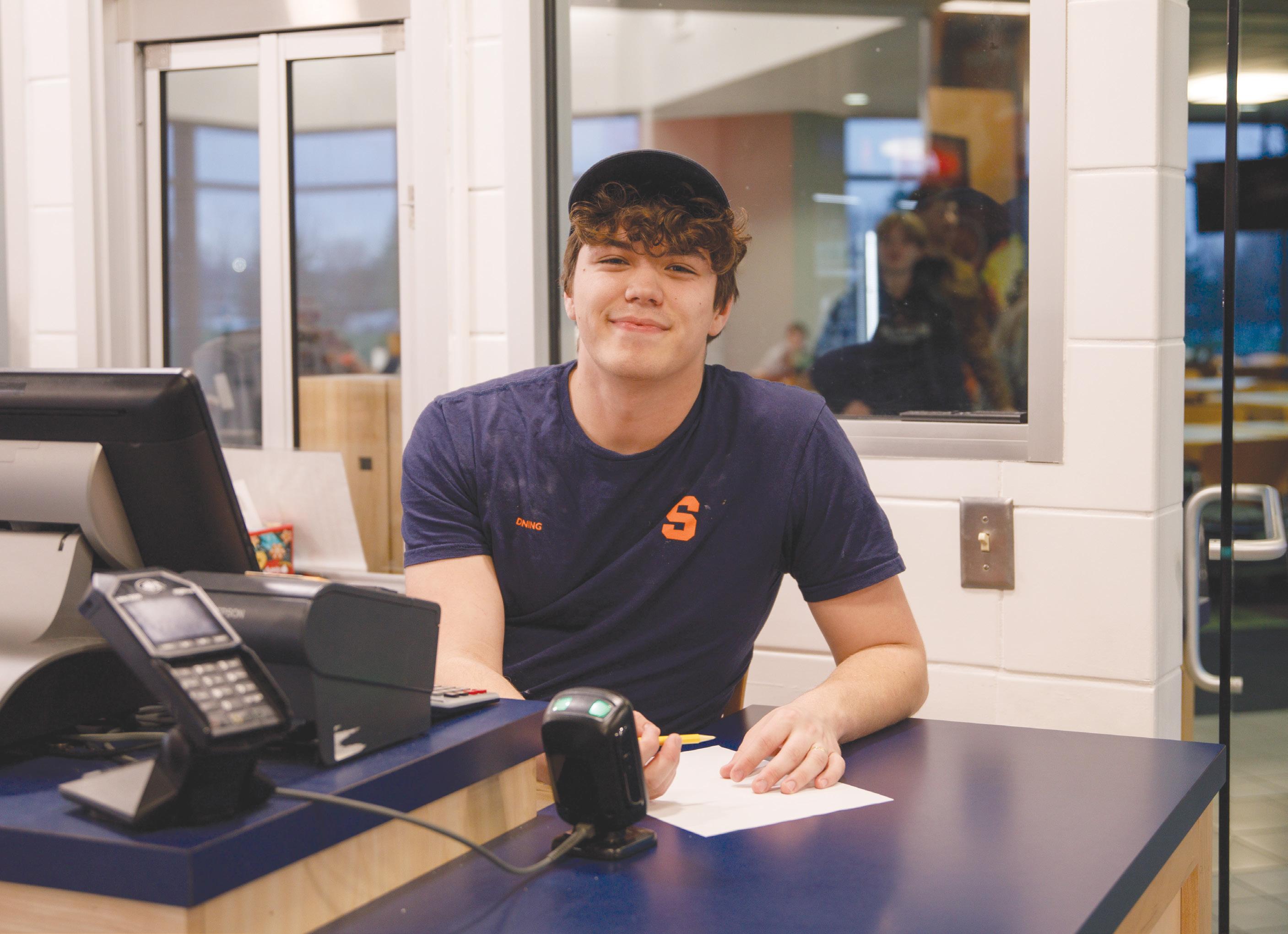
Abram Speek has been working in Goldstein Food Hall since his sophomore year. But this semester, when his job tightened regulations on phone usage during shifts, the Syracuse University senior looked for ways to cure his boredom.
So, he started asking questions.
Each shift at the checkout counter, Speek probes the same question to passing customers. The question changes every shift, but Speek aims to keep them “deep but not personal” — just enough to make customers stop in their tracks. Each customer’s answer is recorded on Speek’s sheet of paper, a sea of tally marks representing the various hot takes he hears throughout the shift.
His goal is simple: to spark genuine human interaction between strangers.
“I generally feel like the way that Syracuse campus is, it does not have a lot of interaction,” Speek said. “People don’t have a lot of overall interaction with random people on campus. I wanted to increase that and have those random interactions in your day that brighten your day.”
As a linguistics and international relations major, Speek said he’s always been fascinated by varying human behaviors. Conversation comes easily
see goldstein page 9
By Claire Zhang asst. digital editor
Kathryn White vividly remembers her first time celebrating Earth Day. Sat in front of a computer with her first-grade class, she played educational games, virtually cleaning up trash and planting trees. At just seven years old, White already knew she wanted to do more.
“I thought it was so fun just doing it on the computer, but I was like ‘I want to do this in real life,’” White said. “Why is this not a bigger thing if Earth Day is that important?”
From then on, the SUNY ESF junior made it a priority to celebrate Earth Day every year. The holiday, which takes place annually on April 22, is a reminder to love the planet we live on and it’s something we should all be thinking about every day, not just once a year, White said. The first Earth Day was in 1970 and has been important to environmental movements for decades. But throughout the year, celebrating the planet is a common ritual for many Syracuse University and ESF students, from spearheading campus initiatives to researching bio-based materials.
For some Syracuse University students, like senior Carmela Garcia, that awareness for the planet runs deep and has grown into in-depth passion projects.
After Garcia attended a Cornell University-hosted workshop on hempcrete last September, she’s since learned everything about the material. A biodegradable and eco-friendly material, hempcrete is made from the woody inner core of industrial hemp plants, mixed with a lime-based binder and water.
Hempcrete is primarily used for insulating infill for walls, floors and roofs of buildings, but with a lack of
established supply chains, it’s not widely used for construction in the United States. Over the past month, Garcia’s been working with the material, handmixing and packing hempcrete blocks with her father and friends to build a greenhouse as part of her senior thesis. It’s currently taking shape in the backyard of her Syracuse home, which they moved into a year ago.
Currently, the greenhouse is fully equipped with plexiglass walls and windows. Garcia’s original senior thesis was on renewable furniture. However, when her hometown in Kerrville, Texas, was obliterated by the Guada-
lupe River floods in summer 2025, Garcia officially landed on hempcrete architecture as her senior thesis topic. If a hempcrete building is destroyed, the pieces can be collected and remolded with little negative impact. After the flood, seeing building debris strung over Texas made Garcia realize how much infrastructure is built mindlessly, decaying and eroding over time. The experience reaffirmed her notion that architecture should be more environmentally forward.
For Garcia, a large motivator for her passions in sustainable architecture see sustainability page 9
By Remi Turner asst. copy editor
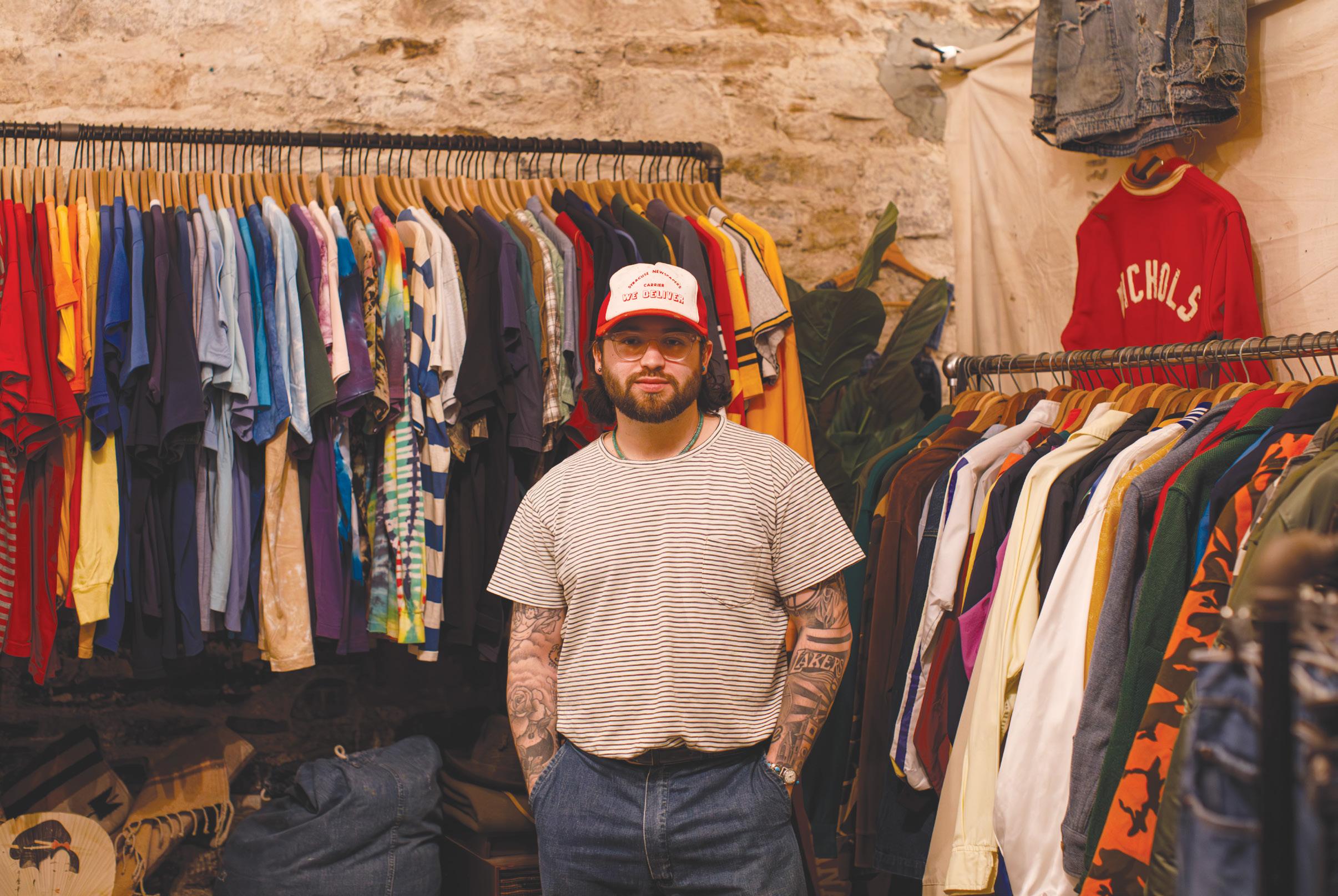
Metal hangers screech against The Salvation Army clothing racks as Rocco Leone digs for his next golden thrift find. Leone fashions an outfit true to his vintage shop’s style — faded jeans and a “distressed” T-shirt that have lived on this planet longer than him. With each screech, he searches for one-of-a-kind garments to enhance Salt City Wearhouse’s “true Americana” aesthetic.
One found garment at a time, Leone tries to inspire appreciation for true vintage, while remaining true to himself.
“It wasn’t always about making the most profit. It was mostly about displaying clothes in a way that I wanted, basically creating a shop that I would want to shop in every day,” Leone said.
Located on the lower level of the McCarthy Mercantile building in downtown Syracuse, Salt City Wearhouse breaks the mold of the current ecommerce-driven fashion industry with entirely in-person shopping. Home to vintage sports memorabilia, bomber jackets, baskets of vinyls and knit sweaters, Salt City Wearhouse creates an atmosphere that feels like your grandfather’s basement, Leone said.
Leone opened Salt City Wearhouse in September. Before establishing the storefront, he participated in different thrift pop-ups in the area. Now approaching its seven-month anniversary, the Wearhouse is solidifying itself in the local secondhand scene.
As a full-time SEO content analyst, Leone said Salt City Wearhouse is his side hustle. But where his true creativity — and love for sports — shines through is within the store’s brick walls.
Colorful college pennants line the walls, wooden lacrosse sticks lean against one corner and a store favorite, a Yankees baby tee, sits alone on a high shelf. Unfortunately for many interested customers, the authentic 1950s shirt is not for sale. Other “museum pieces” like 1940’s SU men’s basketball player Francis Miller’s varsity cardigan offer a slice of Syracuse University history as decor, not merchandise.
On Thursday, Salt City Wearhouse participated in Syracuse Fashion Week, a semi-annual celebration of “style and fashion” in central New York. As the only vintage store on the event’s roster, the Wearhouse gave Syracuse residents a taste of true vintage, which Leone defines as pre-1980s clothing.
Valentino Indelicato, a Syracuse University sophomore, started Salt City Wearhouse’s segment. An aspiring model and certified Timothée Chalamet look-alike, he appeared in black straight-leg jeans and a light blue button-down with red stitching while introducing the Wearhouse’s nostalgia-fueled line as “Zealots” by the Fugees rang through the speakers.
“I really messed with the look,” Indelicato said. “I was like, ‘wow, I could see myself in it.’ I think that goes to show that (Leone) definitely can provide an image for people.”
As a personal friend of Leone’s, Indelicato has witnessed him grow as a collector over the past
GRATEFUL DUB & Roots of Creation
With finals season quickly approaching, enjoy an evening of chill beats with GRATEFUL DUB & Roots of Creation. The Grateful Dead tribute band infuses rock and reggae to create a relaxing spin on the iconic rock band.
WHEN : Thursday, doors at 7 p.m., show at 8 p.m.
WHERE: Middle Ages Brewing Company PRICE: $22.90 to $30.86
Block Party
On Friday, Syracuse University’s University Union is hosting its annual Block Party. EDM duo Snow Strippers, R&B singer Ravyn Lenae and pop-rock pair The Driver Era are headed to the JMA Wireless Dome. Before Block Party, UU is holding SoundCheck on the Shaw Quadrangle for an afternoon of live student music, food trucks and large inflatables.
WHEN : Friday, 6 p.m.
WHERE: JMA Wireless Dome
PRICE: $20 for SU and SUNY ESF students
two years while participating in Keep Going Market, a monthly pop-up event series founded by Indelicato’s sister, Bianca Indelicato.
“To be able to model for a brand that’s really trying to make its own message and purpose in Syracuse is really cool,” Indelicato said.
Leone styled 10 looks for the show, worn by an all-male ensemble. For weeks ahead of the show, Indelicato visited Leone’s “underrated” shopping space to find the perfect fit, he said. Leone closed the walk in a distressed strawberry-red T-shirt with more holes than fabric.
It’s about making money, but also making people happy. And also opening people’s eyes that these types of clothes exist.
Rocco Leone salt city wearhouse owner
In its 12th year, Syracuse Fashion Week partners with the Food Bank of Central New York to raise funds for families experiencing food insecurity. Leone was invited to participate in the show by the event organizer and founder, Lisa Butler.
Although the runway posed as an outlet for increasing brand awareness, Leone prioritized the audience and his models over himself.
“To open people’s eyes, especially men, that there are timeless outfits that still can be worn in modern day, or go outside the norms of what they usually wear,” Leone said of his goals for the event.
For Leone, the event was also an opportunity to help models — like Indelicato and Conner Frigon, an emerging secondhand seller — network within the fashion industry.
“He definitely had a great way of just guiding the whole thing together, like what he was looking for with his first fashion show,” Indelicato said. “Because it’s big to him, and it’s big to all of us,” Indelicato said.
As the owner of Salt City Wearhouse, Leone said his life revolves around the local thrift scene. He visits thrift shops every week to find new, yet old inventory.
Before adding an item to his cart, Leone ensures that all potential Salt City Wearhouse merchandise passes the “true vintage test.” Thick necklines are required for T-shirts. Other garments need a heavy or distressed “feel.”
Open weekly from Thursday to Sunday, Salt City Wearhouse aims to ignite a public interest in quality vintage clothing at a reasonable price, Leone said. Although profitization is an integral
part of the Wearhouse’s business model, it’s not the main reason he enjoys running his own business, Leone said.
“I really like seeing somebody specifically look for something and find it, or be able to express themselves through the clothes in a way that they weren’t able to before,” Leone said.
In a society where everyone seems to be dabbling in thrifting themselves, Leone said he tries to remain humble in the sometimes “greedy” secondhand scene. Thrift chains like The Salvation Army and Goodwill are taking notice of the shifting trends by increasing their sale prices, he mentioned.
“There are characters in the vintage game,” Leone said. “Some people might try to abuse that power, but there’s no reason for me to do that.”
Johnny Cazzola, owner of Fragile Threads and a longtime friend of Leone’s, has been there from the start. Before Salt City Wearhouse’s brick-and-mortar store, Leone and Cazzola were among the first few vendors at Keep Going Market. Leone’s brand and personal style have evolved over the years, but his respect for the craft hasn’t changed, Cazzola said.
“(He’s) very respectful, always treats the clothes with care, always treats you with care,” Cazzola said. “He’s one of the nicest people I’ve got to know in my lifetime here.”
Leone and Cazzola have known each other since their days as Liverpool High School students. Now, the pair hits the thrift stores together to supply their own vintage brands, but also for fun, or what Cazzola calls their “high”.
The clothing pieces that line the racks of Leone’s underground shop showcase only a sliver of his secondhand selection. Leone often trades and sells with other collectors, like Frigon, to keep his inventory fresh.
A weekly frequenter of Salt City Wearhouse, Frigon assisted Leone with selecting the looks for the fashion show. Frigon also walked the runway himself in an earthy look featuring layered distressed T-shirts and ripped khakicolored jeans.
Frigon said he’s run into some disingenuous people in the secondhand industry as an independent collector, but working with Leone is different.
“What I respect about him and having his stuff is that he’s true to himself,” Frigon said. “And I respect that cuz I’m true to myself.”
Looking forward, Leone wants to see his business grow, but that doesn’t necessarily mean going bigger or street-level, he said. Syracuse Fashion Week has already invited Salt City Wearhouse to participate in its fall shows. Whether it’s at the local thrifts, estate sales or on social media, Leone continues to hunt for rare Americana apparel.
“I just want to grow in the sense of getting more people down here, meeting new people,” Leone said. “It’s about making money, but also making people happy. And also opening people’s eyes that these types of clothes exist.” rturne03@syr.edu
Boogie Down Broadway: A Singalong Dance Party!
Boogie Down Broadway is the perfect night for Broadway lovers. From “Wicked” to “Mamma Mia!,” sing and dance along to some of the most iconic Broadway songs on Friday night.
WHEN : Friday, doors at 6 p.m., show at 7 p.m.
WHERE: Westcott Theater PRICE: $41.98
Spend your last day of classes at the CAGE COLLECTIVE. Student DJs Troy Conner and Sam Tonks will bring a night of upbeat music.
WHEN : Friday, doors at 6 p.m., show at 7 p.m.
WHERE: DM for address
PRICE: DM for presale, $5 at the door CAGE
John Legend
Round out your school year with John Legend. The GRAMMY winner is making his way to the Landmark Theatre for a stop on his tour, “An Evening with John Legend — A Night of Songs & Stories.”
WHEN : Tuesday, 8 p.m.
WHERE: Landmark Theatre PRICE: Starting from $54.50

to Speek. It’s why questions were a no-brainer to cure his boredom during shifts.
“I just have a genuine want to have an understanding for people and how they work and how society works,” Speek said.
Speek’s first-ever question was an arguably controversial one: “What is the best state?”
The seemingly straightforward question invited passionate debates among state loyalists and rivals. Pennsylvanians had a blind support for their home state, even if they admitted they didn’t love living there. New Jerseyans and New Yorkers took the opportunity to hate on each other.
Even Speek himself couldn’t lock down one answer; Vermont is close to home, but Massachusetts is where he’s from. He couldn’t choose between the two.
At the time, Speek was conducting a research project on politeness in the Northeast. He decided to use his customers as a population sample to gauge the makeup of the student body and what states they like the best. It’s not the most scientific research method, but enough for him.
Now, the questions come naturally. He rarely thinks of them ahead of time, instead brainstorming as his shift begins.
The first 10 customers are Speek’s test sample; he asks different types of questions, field testing with the first few customers who come through. By the 10th person, he usually finds one that sticks. That’s when he brings out his paper and pencil to keep track of the results for the rest of the shift. Answers are written down on whatever Speek finds underneath the checkout desk, on the back of leftover papers or shipping labels.
After his third or fourth shift of asking questions, Speek said someone came up to him asking what the question of the day was before he even began ringing him up. That’s when Speek knew the questions resonated with his customers. And it has. Now, students often stop him on campus, recognizing him as “the guy who asks questions at the checkout counter.”
The best questions are ones that spark debate, Speek said. One of his most contentious questions he asked was “Would you rather travel anywhere for free for the rest of your life or eat free at any restaurant?” 264 customers weighed in — Speek’s paper receipt counted.
There’s a lot to consider here, Speek said. Free transportation means you can go anywhere in the world, but you still have to pay for hotels, excursions and food once you get there. Free food at restaurants might mean lighter grocery bills and cause more Michelin-star food tastings, but it does mean you’d still have to pay for food at home or eat out all the time.
is the health benefits. When she and her dad were renovating their home, they found mold all along the concrete walls and removed it.
“It’s kind of insane we don’t really take into consideration that we’re living in a plastic bubble,” Garcia said. “That can’t be good for our health, it can’t be good for a lot of things.”
Joshua Richter shared similar sentiments. The SU senior is the co-director of SU’s Sustainability Forum, a Student Government Association committee. If there’s any harm enacted to the environment, people are bound to feel the long-term health effects, he said.
For Richter and Garcia, being conscious of their actions and the subsequent ecological implications was something they became aware of at a young age.
Garcia was raised by eco-conscious parents, who drilled a green-thinking mindset into her early on. From watching her family in construction use sustainable materials to biking and walking to school throughout her life, Garcia has experienced firsthand the importance of sustainability, she said.
“(Construction) really has no meaning unless it’s helping the environment or taking something that isn’t used and making it useful,” Garcia said. Growing up in California, Richter has been separating plastic and paper for as long as he can remember. As he’s gotten older, Richter has held onto that responsibility, even recently convincing his parents to get more involved in personal composting.
But on a college campus, those good intentions can be harder to implement, Richter said. He tries to keep composting at SU, but it’s not always as easy. If more students put in the work to educate themselves on the benefits of sustainability, real change can happen, he said.
“I know a lot of students don’t care, but it does have more of an impact than they might realize,” Richter said.
In his time working for the forum so far, Richter has worked on initiatives like Ecosia, a search engine
Speek sent the tally to his family group chat for their opinions, where his mom, who buys the family’s groceries, thought free food was a “no-brainer.” His sister disagreed, arguing that free transportation would allow her to travel the world like she’s always wanted.
The final results? An exact split down the middle.
You’ll have to take Speek’s word for it, though. He rarely keeps the results after his shift, usually throwing the paper away after he clocks out.
Still, Speek makes it a point to remember the top three answers so he can report back if customers return and ask for updates on the final tally. He never forgets the weirdest responses, like an especially offensive answer of “tomato juice” to “what is your favorite drink?” (Speek’s personal choice is apple juice.)
If asked, Speek will reveal his own answer to the daily question, but he gets more satisfaction out of connecting to others’ responses.
Initially, some people were wary of his intentions behind asking questions out of the blue, but almost no one denies him an answer, Speek said.
“You have this conception that when you go up to random people, they’re going to really hate it or ignore you, or it’s really awkward. But, in reality you could walk up to almost any person at the university and ask them a question,” Speek said. “They might be confused at first, but then at the end of the day, usually they don’t care, or they’re bettered by the interaction.”
In fact, most people have positive reactions to his questions or look forward to seeing him at the checkout. His coworker Whitney Miller said she thinks some people come to Goldstein just for his questions.
“There’s people who thank me or clearly, visibly smile or brighten up after I ask them a question,” Speek said.
Sometimes he does “fancy things with the math,” breaking the data up into groups or looking for trends among different demographics. About a month ago, when Speek asked customers “At what age would you let your child walk to the park alone?” he made a dot plot. He marked an X for everyone’s answers on the graph. 10 was the most common, and the X’s made a generally normal distribution, Speek said.
SU sophomore Brett Holleran’s answer was represented by an X on the eight. Holleran said he and other people in line were initially surprised when Speek interrupted their usual checkout routine with his question. But, eventually everyone chuckled and exchanged smiles. Holleran said the whole interaction brightened his day.
“I can’t say I really recount any other cash register experience I’ve had,” Holleran said. “But I remember this one clear as day.”
Speek said he naturally notices patterns in the results.
that uses 100% of its profits to plant trees. ESF enacted it on campus last October, and now over 2,000 students use it a day, planting hundreds of trees.
Ecosia is the resource that inspired White the most, she said. She recalls discovering it during the COVID-19 pandemic, when she and her sister were looking for ways to help the environment while quarantined.
Making a difference can start from just changing your search engine; it can be “as simple as that,” she said.
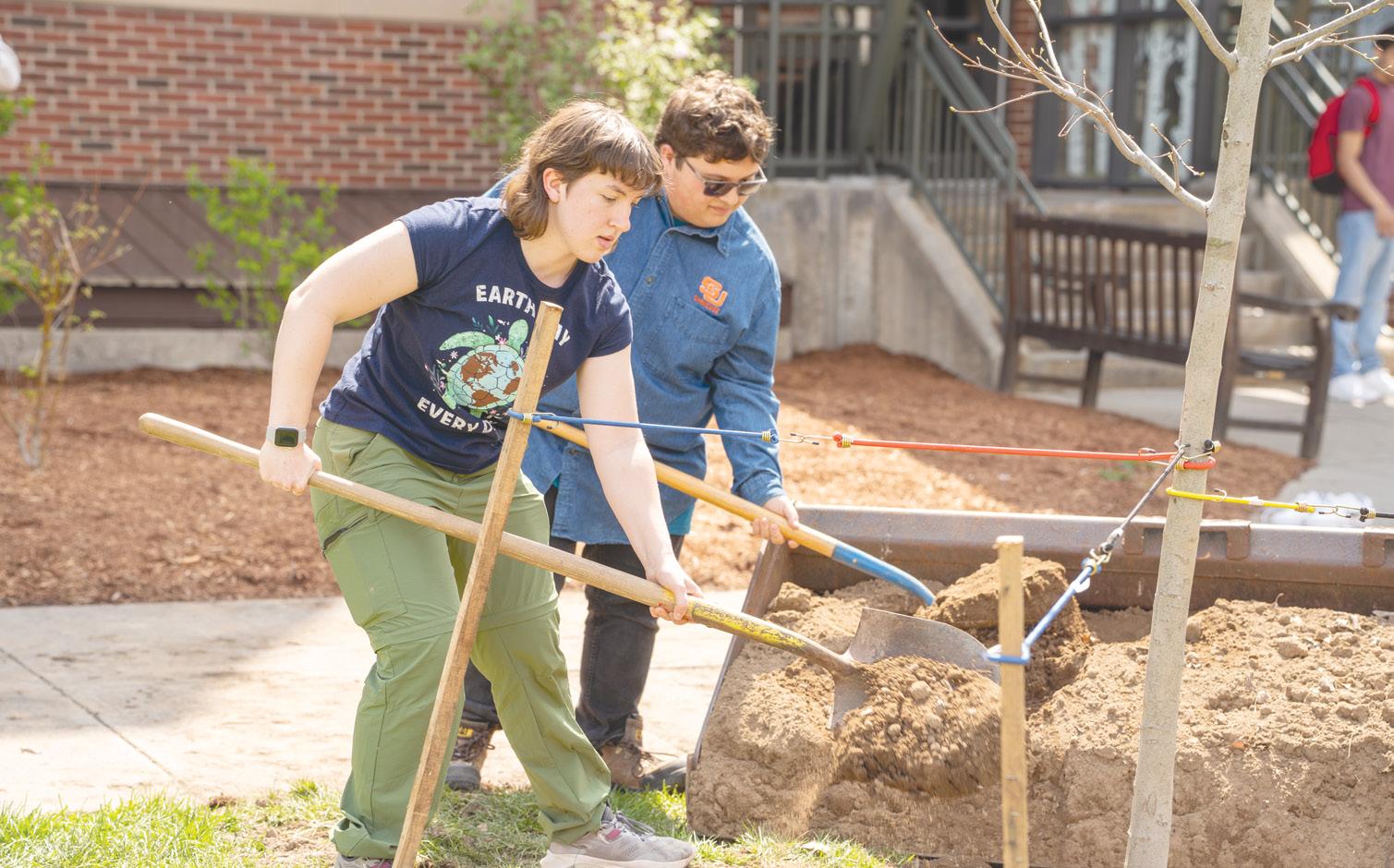
White is president of ESF’s Oakie’s Green Team, which hosted a tree-planting event on Wednesday on ESF’s Quadrangle sponsored by Ecosia. To continue her annual tradition of an eco-themed outfit, White wore an “Earth Day, every day” T-shirt to the planting. Students gathered on ESF’s quad, all pitching in to shovel and pack dirt around the growing sunset maple tree.
ESF junior Savi-Cartier Stewart was one of those students, and she said participating made her think of everything “beautiful” that’s growing on campus.
“I was thinking that as an alumni, what will I come back and look at and be like, ‘Hey, I was there when that was started.’” Stewart said. “I feel like every alumni has that moment.”
Richter hopes to make Ecosia a norm on SU’s campus as well. He’s also worked with SU to try and increase composting bins in more dining areas. But Richter said sometimes being more environmentally aware starts small, like drinking out of a reusable water bottle or separating your trash.
“Stuff like that, students can do on a regular basis,” Richter said. “It doesn’t have to be some big policy change, it can be also joining the forum or bringing ideas up to us.”
Whether it be thinking twice about what you’re throwing away or diving deep into a renewable resource, there are plenty of ways to give back to the Earth. Even just getting outside more often will nourish a deeper connection and appreciation for the planet, Richter said.
“Ultimately, the Earth wasn’t born on Earth Day,” White said. “It exists every day, and we should be taking care of it.”
cmzhang@syr.edu
Preferences between free restaurant food or free transportation, for example, differed throughout the shift, depending on people’s current priorities. When the dinner rush kicked in and customers’ hunger elevated, more people chose free food. Later in the night when the buses stopped running regularly, more people chose free transportation. Over the whole shift, though, it evened out.
Speek also said he gets the best answers working the night shift, when there’s a slower stream of customers and people have less responsibilities to rush off to.
Admittedly, Speek is “naturally pretty good at math,” but he’s lost track of the amount of questions he’s asked this semester. Though, he said it’s likely in the double digits.
A lot more people want to interact than you might think.
Abram Speek goldstein cashier
“The numbers aren’t really important to me,” Speek said. “It’s just the interaction and the general consensus that I remember.”
Some questions require more difficult tracking methods, like when he asked “What is the most important quality in a partner for you?”
This question prompted customers to “launch into something” about their own experiences and preferences, Speek said.
With more complex answers, Speek divided his sheet into responses from men and women and took notes on the top qualities. Speek expected women to want humor in their hypothetical partner, but that wasn’t the case; only three women said humor. Overall, he found men were more likely to prioritize loyalty, while women looked for empathy and compassion.
This wasn’t true for everyone, though. When Speek showed the results to an international student from China who came through the checkout line halfway through his shift, he was appalled. He told Speek he didn’t even think about loyalty as a characteristic. In China, loyalty is the baseline, without it he wouldn’t even consider it a relationship in the first place.
One of Speek’s regular customers is nonspeaking. But, the two have a routine down. After he swipes his dining dollars (his usual payment method – Speek doesn’t have to ask), Speek hands him the pen and paper so the student can record his own answer on the tally.
Some questions have a bigger purpose. One of Speek’s supervisors, Richard Roberts, was brought onto the Goldstein Dining team to experiment with expanding different food
options. In this vein, he had Speek ask customers, “What is your favorite side for Thanksgiving?” It was one of the biggest surveys, with nearly 200 responses, Roberts said.
That question worked because it connected to people’s families, Speek said. Customers often shared cultural dishes as their favorites.
Roberts has been working with Speek since he came on as a supervisor in February. He said he noticed Speek’s engagement with students from the first shift they worked together.
“It’s something they actually look forward to, and it breaks up the monotony a little bit,” Roberts said.
Roberts said the questions don’t slow down the checkout line because Speek is competent enough to multitask. Even if it does take a few extra seconds, Speek said it’s worth it for the sake of human connection.
When the line dies down and there are no customers to check out, Speek goes around to his coworkers asking them the question of the day. They often get into “small debates,” Miller said.
Miller, an SU junior, has been working with Speek for about a year. She said the Thanksgiving question was especially debatable. Macaroni was the winning choice at the time she saw the score card, and Miller was appalled. “Macaroni cannot be in the lead,” she remembers saying. Casserole was the obvious choice, she said. Speek told her that was the craziest thing he’d ever heard.
Along with fostering camaraderie between staff and customers, Miller said Speek’s question ritual has made the Goldstein staff closer.
“If he wasn’t asking these questions, I don’t think any of us would talk to each other,” Miller said.
Speek said he’s always had an innate curiosity and an easy time talking to people — the perfect storm for his in-shift hobby. He said he loves “picking people’s minds.”
“You know when you’re at that delirious point at like 1 a.m. and you’re just yapping about who knows what, you just ask random questions and then you just get into a conversation?” Speek said. “I love that and I’ll just stay up forever for it.”
Speek said he could play 20 questions forever. Even before he started asking questions in Goldstein, his go-to question to approach people has always been, “What is your favorite fruit?” He can talk at length about the merits of a mango or a blueberry. Are you talking about the fruit during peak season or just an average one from the supermarket? That changes the whole question, he said.
People often don’t have the opportunity to speak about “inward things,” Speek said. His goal is to give them that chance.
“A lot more people want to interact than you might think,” Speek said.
ehrosen@syr.edu






By Brian Taylor and Gail Bulman writers
Syracuse University’s Academic Strategic Plan, “Leading With Distinction,” commits the university to five areas of “distinctive and aspirational excellence.” One of these areas is “global diversity.”
The plan describes SU as “a leader in global engagement” and “a national leader in international education.”
“The University commits to embedding in all activities the values of internationalization,” the strategic plan states. “The implications of this commitment are significant. Living these values is the responsibility of every member of our campus community and requires a collective effort.”
This strategic plan was adopted in September 2023 and remains in force. Yet last month, the university cut the number of foreign language majors in half as a result of the academic portfolio review. Going forward, students will only be able to major in three European Romance languages: French, Italian and Spanish. The French and Italian Bachelor of Arts programs will consolidate into a rebranded world languages and cultures B.A.
Before the cuts, and despite its professed commitment to being a national leader in international education, SU offered fewer foreign language majors than other private research universities of comparable size and reputation. For example, Washington University offers 11 undergraduate language majors. Tulane University offers 15 and the University of Rochester offers 10. Even Colgate University, with a population of just 3,000 students, and Hamilton College, with 2,000 students, offer nine language majors.
With these new cuts, the gap between SU and our peer institutions has grown larger.
The portfolio review was explicitly “not a cost-cutting exercise” and focused primarily on programs with low student demand, Vice Chancellor and Provost Lois Angew wrote in a campus-wide emailsaid. SU isn’t alone in facing declining enrollment in foreign languages, nor in subjecting language programs to severe cuts. A recent study by the American Council of Trustees and Alumni reported an alarming decline in the study of foreign languages at American colleges and universities: a drop of 59% between 1965 and 2016, followed by a further decline of 17% from 2016 to 2021.
There is no denying that enrollment in some of our language programs is low. Language courses are, after all, small by design. Historically, a lower average class size was seen as a key indicator of academic quality; every student and professor on campus knows that often the most important and meaningful learning happens in smaller classes and seminars.
personal essay
The strategic plan is correct in emphasizing the importance of global engagement for a diverse society and a globalizing world. The evidence on the value of foreign language study is immense. As the ACTA report states, scientific research shows that foreign language learning has lifelong cognitive benefits, increases tolerance and cultural awareness.
For students looking for a leg up on the job market, multilingual employees are paid more. Knowledge of foreign languages is important for a range of fields that cut across the entire campus, including journalism, business, the health sciences, education and the social sciences. The people of the United States are more linguistically diverse than ever, and this diversity, coupled with globalization, means increasing demand for people with intermediate to advanced foreign language skills.
Given how languages are foundational for advanced work in many humanities and social science fields, as well as in certain professions, investment in foreign language learning is a public good for the entire university and a fundamental attribute of a contemporary research university with global reach and standing.
Languages should be seen not just as distinct and niche areas of study, but as valuable tools for students from across campus, in the same way that knowledge of math and statistics applies across many fields and disciplines.
SU is rightfully proud of select students — more than 25 per year between 2021 and 2025 — who win prestigious awards that involve foreign language knowledge and study, including Fulbright, Boren and Critical Language Scholarships. Yet going forward, an SU student can’t major in any of the U.S. government-designated critical languages. More narrowly, students won’t be able to major in Arabic, Chinese or Russian, three of the six official United Nations languages.
The language majors being closed — Russian, German and Classics — have existed at the university since at least World War II. Russian has been taught for more than more than 80 years, and Latin for over 150 years. We suspect that German has existed at the university for well over 100 years.
While we value every language and world culture, we question the wisdom of cutting majors in German and Russian, as well as cancelling all courses in Hindi and Turkish, during a time when these world regions are increasing in importance and impact. And the Classics? These are the bedrock of Western civilization; their philosophers taught us to think and question the universe, and their governments warned us of the pitfalls of dictatorship.
The two units we lead — the Department of Languages, Literatures and Linguistics and the Moynihan Institute of Global Affairs — have built a close partnership over the years because of our shared commitment to educating students
about the world beyond our borders. Foreign language knowledge has value both for its own sake and for fostering “engaged citizens,” a second pillar of the strategic plan.
“Syracuse University aspires to be a preeminent and inclusive student-focused research university, preparing engaged citizens, scholars, and leaders for participation in a changing global society,” the strategic plan states.
It will be difficult for students to “lead with distinction” in an increasingly interconnected yet divided world when they can only choose majors in three European Romance languages. We believe these cuts to foreign language study are misguided and contrary to the mission of the university. We realize the university faces fiscal challenges. Yet many of our academic peers, and even our much smaller neighbors, have managed to sustain and nurture much more robust foreign language programs than SU’s.
Ultimately, there are some fields of study that are central to what makes an internationally recognized research university what it is. It should be a priority for the entire university, not just one college, to support these programs.
This letter was submitted by Brian Taylor, Director of Moynihan Institute of Global Affairs and Gail Bulman, Chair of Department of Languages, Literatures and Linguistics. They can be reached at bdtaylor@syr.edu and gabulman@syr.edu.
By Christy Joshy essayist
After a challenging fall semester, I was grateful for the opportunity to unwind and let go of my inhibitions during my spring semester abroad in Strasbourg, France. But I soon realized this experience would force me to confront some uncomfortable realities about my identity, especially in relation to my parents.
I wanted to come to Strasbourg to improve my intermediate French and immerse myself in a multicultural, mid-sized European city. Although most locals I meet, on the tram or in cafes, are relatively friendly and cooperative with my choppy French, the inevitable moments when I’m met with less patience remind me of my parents. They leave me feeling a sense of hurt — not for myself, but for them.
English is a useful crutch in France when my limited French fails me, as around 30% to 50% of French people speak English. When English fails, online translation services can save the day. But for immigrants like my parents, migrating to a country where they had no crutch or Google Translate and were immediately pushed into the workforce and the demands of daily life, continues to be a harrowing experience. There’s less forgiveness for honest mistakes and real stakes at hand.
Studying abroad has often felt like a glorified form of migration, a realization that has often made me feel uncomfortable and guilty during my time in Strasbourg.
The immigrant experience is something I felt deeply connected to through my parents,

but it wasn’t until experiencing firsthand being the target of annoyance that I realized I understood very little about the emotional side of immigration. While abroad, my most common daily obstacles include making sure I’m at the right bus stop or deciphering a cafe menu. For immigrants, the everyday struggle includes navigating unfamiliar billing and administrative
systems, communicating with customers and coworkers and enduring social isolation. Especially given the tumultuous past few months in the United States, with Immigration and Customs Enforcement ravaging neighborhoods, schools and streets around the country, and with President Donald Trump’s administration carelessly wielding anti-immigrant and
xenophobic rhetoric regularly, the added guilt of escaping the chaos has weighed on me.
Although I’ll return to the U.S. soon, I’m reminded of all the immigrants and refugees who’ve escaped violent regimes, terrorist attacks and poverty in their home countries to never return again, and the guilt they must feel at leaving others behind. My privilege as a legal citizen who’s enjoyed a relatively safe and comfortable life in the U.S., and now in France, has never been clearer to me than this semester.
All of this being said, my four months here have left me more grateful — not just for the opportunity to experience life abroad, but also for the ability to step into my parents’ shoes. It helped me feel more connected and appreciative of their sacrifices for me and proud of how far they have come — not only adjusting to the U.S., but also keeping their culture, traditions and native language alive in our home and within me.
As I reach the end of my semester abroad, I’m overwhelmed by the amount of growth and introspection I’ve experienced here.
Although the current political climate in the U.S. intimidates me as I prepare to return home, I leave this experience still knowing that multiculturalism is America’s greatest strength and that we will hopefully come away from this difficult time with greater solidarity, understanding and compassion for those whose shoes we haven’t walked in.
Christy Joshy is a junior international relations and supply chain major. She can be reached at cjoshy@syr.edu.
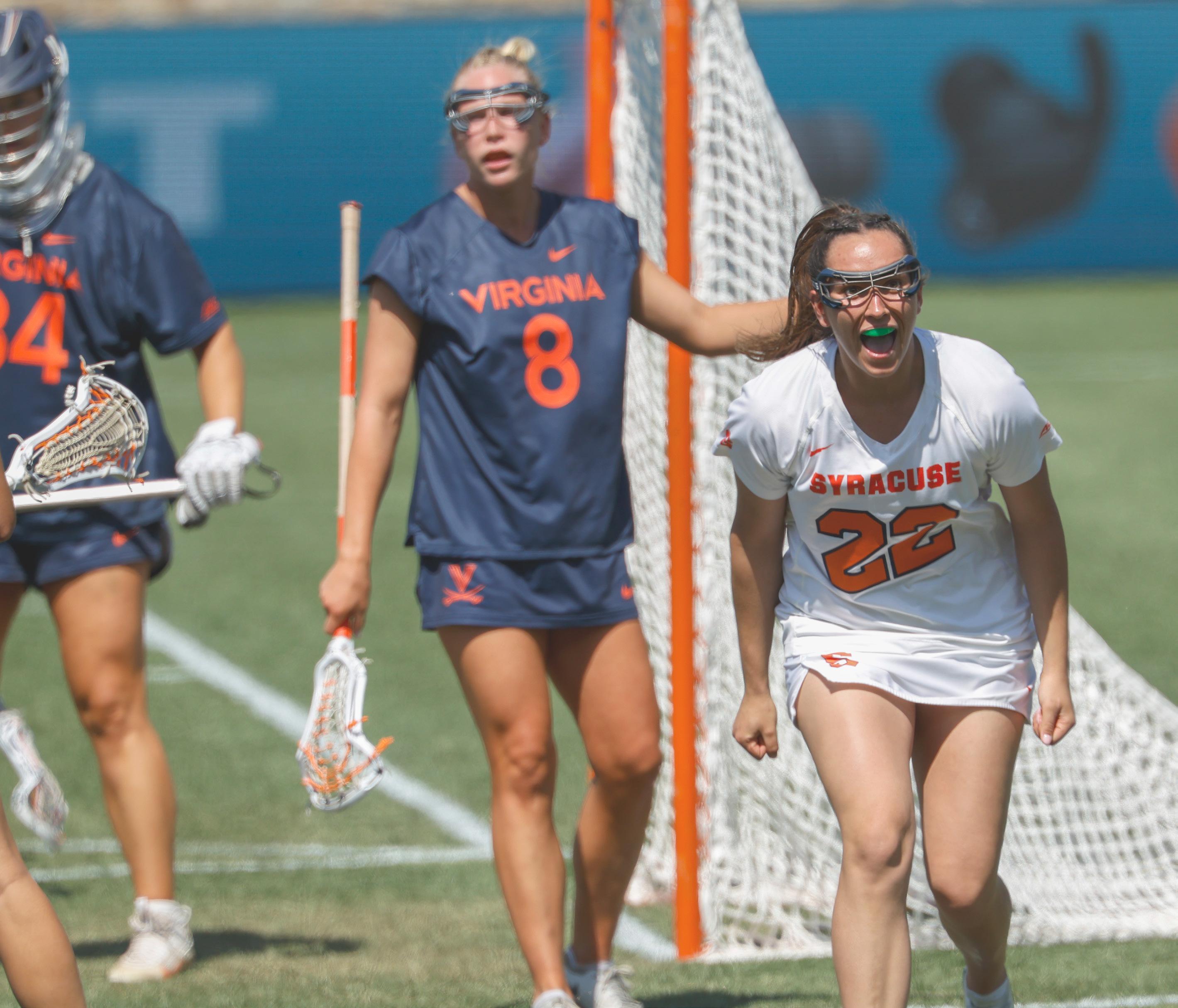
No. 4 seed SU beats No. 5 seed UVA 11-9 in ACC Tournament Quarterfinals
They came storming back, but we kept our composure and made a few plays down the line.
By Mauricio Palmar asst. sports editor
Whatever qualifier goes above “dream job,” John Wildhack has worked it for 10 years.
But the dream is over now.
After becoming SU’s Director of Athletics in July 2016, Wildhack elected to retire on Feb. 11. Bryan Blair, Toledo’s athletic director, was hired to replace Wildhack on March 11, just a month after Wildhack’s retirement.
By Harris Pemberton asst. sports editor
Syracuse’s season hinged on a last-ditch poke check from Joely Caramelli.
With two minutes remaining in SU’s Atlantic Coast Conference Quarterfinal matchup against Virginia, the Orange led 10-9. The advantage had once been as high as five. UVA clawed into striking distance, while SU’s offense had been silent for 10 minutes.
“We want to wake this sleeping beast,” Blair said at his introductory press conference. Compared to his predecessor, Blair enters his role in a much better position to do that. Wildhack took the job after Mark Coyle, SU’s former director of athletics, spent 311 days at Syracuse before bolting for Minnesota. Before Coyle, former Director of Athletics Daryl Gross resigned after an NCAA investigation revealed alleged academic misconduct. The program Wildhack passed on to Blair is far more steady, after
The shot clock wound down. On a crucial offensive possession, Ashlee Volpe fed a cutting Molly Guzik, who tried to rip a behind-the-back prayer on goal. Her bid was stuffed before it even got close to goaltender Elyse Finnelle, spilling in front of the net. As the ball sat on the ground, UVA’s Kate Demark and Finnelle shielded it off, having forced the turnover it needed to keep its season alive. That was until Caramelli reached out, poking Finnelle’s stick as she tried corralling the rock. The ball squirted around the turf, and Emma Muchnick collected it at the edge of the fan. She
a decade spent restoring stability to SU’s athletic department. Before Wildhack formally leaves, The Daily Orange compiled a list of his five best accomplishments as Syracuse’s director of athletics.
1. Helping restore Syracuse lacrosse Syracuse and lacrosse are synonymous. That’s why, when given the option to handpick head coaches in both men’s and women’s lacrosse during his tenure, it was imperative Wildhack nail both.
kept her eyes up and whipped a pass to Guzik, who faked high and placed a shot past Finnelle.
Eleven to nine. Two minutes left.
The Orange could finally exhale.
The late score was the final touch Syracuse needed Wednesday, as the Orange (134, 7-3 ACC) beat Virginia (8-9, 6-4 ACC) 11-9 in the ACC Tournament Quarterfinals. Despite tallying just six goals last time out against the Cavaliers, SU ignited for 11 scores Wednesday, including a season-high four from Muchnick. UVA outscored SU 7-5
see virginia page 15
On May 12, 2021, longtime Syracuse men’s lacrosse head coach John Desko said he intended to return to the Orange. Less than a month later, he announced his retirement in a press conference. He spent 46 years with Syracuse, was involved in all 11 of its national championships — although one was vacated — but stepped down at a time when SU was struggling to reclaim its powerhouse status and dealing with the aftermath of Chase Scanlan’s domestic abuse case.
Wildhack couldn’t afford to flub this hire. Syracuse’s status as a lacrosse blue blood was at stake. Luckily, he had Gary Gait coaching SU’s women’s team, a built-in successor for Desko. It wasn’t an easy rebuild — Gait won just four games in his first year as SU’s head coach — but with the arrival of the vaunted 2022 recruiting class, he’s fully restored Syracuse’s status as one of college lacrosse’s premier programs. In 2025, he led SU back see wildhack page 15
By Jordan Kimball asst. sports editor
Somewhere in the back of Dan Guyette’s head, Dora the Explorer is playing on loop. If you’re inches away from Syracuse’s senior goalie, you might hear her murmur the words. But it’s subtle. Wait. What’s she singing now?
Is that the theme song of SpongeBob, the comedic mischief recommended for 7-year-olds? No, hold on, now she’s muttering Amy Winehouse’s 2007 classic, Valerie.
If you ask Guyette why she hums — sometimes even sings — these tunes in front of SU’s net, she won’t give you a philosophical treatise. She’ll just tell you it makes her laugh. That’s kind of the whole point.
“I really try not to take myself too seriously,” Guyette said. “It’s really just staying loose, staying positive. If I can keep the energy up, my God, that’s what I’ll do.”
As the starting goalie on the sixth-ranked team in the nation, it’s ironic Guyette tries not to take herself seriously. Because being in net on a team like the Orange is far from easy.
She’s the Orange’s “last resort,” head coach Regy Thorpe said, and she’s been as reliable as they come, ranking second in the Atlantic Coast Conference with a 48.6% save rate while allowing just 7.02 goals per game. As SU aims to make a deep postseason run, Guyette’s calm presence — and her sidekicks, Dora and SpongeBob — could spell the difference.
“It’s truly trying to stay as childlike as I can,” Guyette said. “Because I find I have the most fun when I keep things simple, trying my best not to overthink things.”
Guyette knows goalie is one of the most mentally demanding positions in sports. She also knows how quickly things can spiral out of control. Once you go down that dark path, she said it takes “far too long” to emerge on the other end.
Just look at her back-to-back poor performances in detrimental losses last year against Boston College and Stanford, two games in which Guyette hovered around the 20% save clip.
Scan the statsheet this year, though, and those sort of showings have generally disappeared. Guyette credits her senior-year success to a mindset shift, which she said began on March 12 against Northwestern.
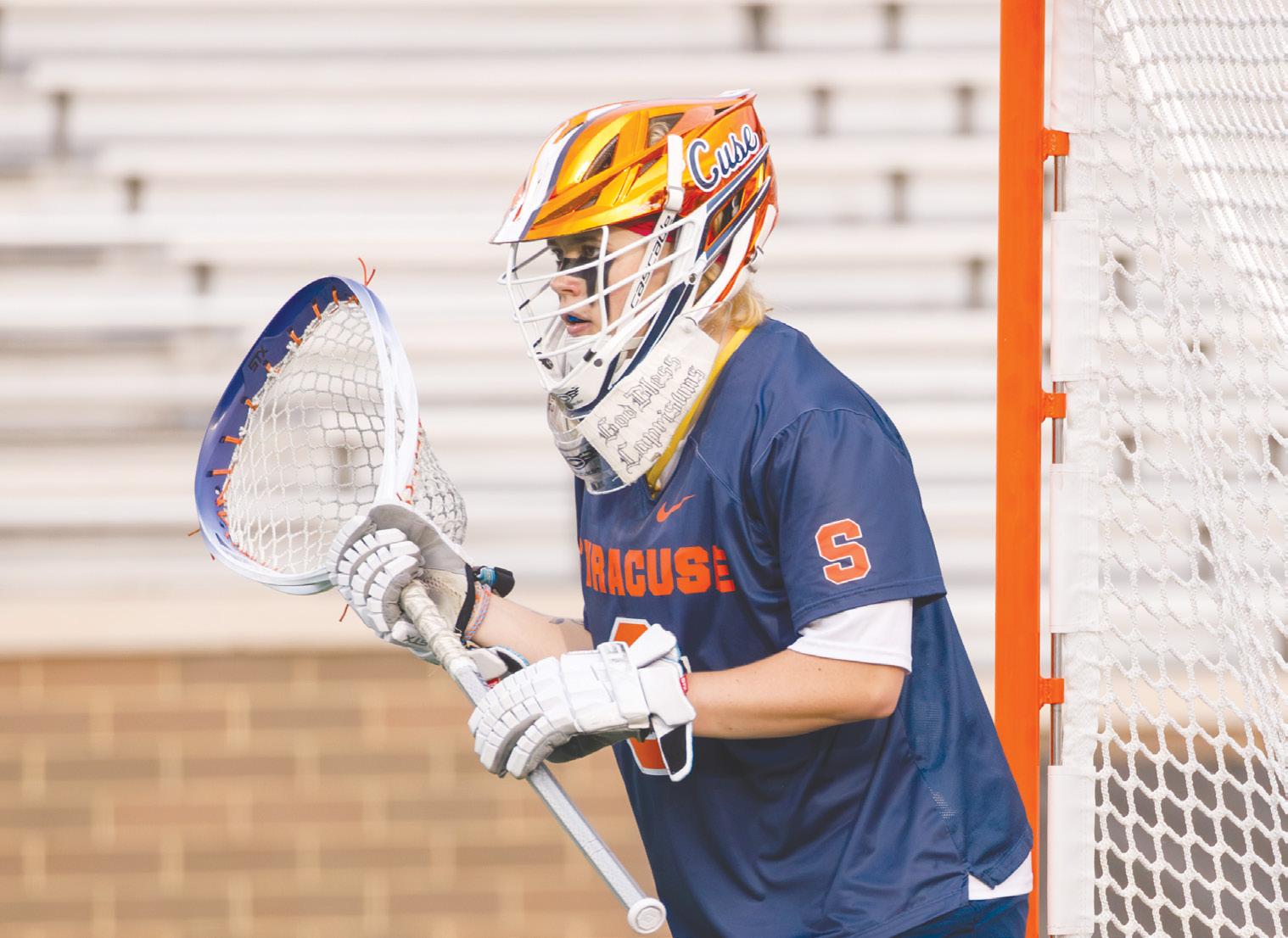
Yet to Guyette, it doesn’t matter who’s on the other side. Northwestern’s Ryan Fieldhouse might as well have been Guyette’s Newbury Park High School field in California, and Guyette could be Asa Goldstock or Delaney Sweitzer, two SU goalies she emulated before joining the Orange. Syracuse led 5-4 at halftime, tacking on two unanswered goals in the third quarter. Then, Guyette said, an internal flip switched.
“It was just, ‘Oh my God, I’m playing a game? This is awesome. I get to play the game I’ve always loved growing up,’” Guyette remembers thinking against the Wildcats. “‘This is my game. All I have to do is have fun. Treat it like any other game I’ve had in the past.’”
Guyette said she channeled her high school days, when she played a carefree, loose brand of lacrosse. She drew inspiration from former USC goalie Gussie Johns and UNC netminder Taylor Moreno. The Orange picked up a 9-6 win against the Wildcats, the largest victory of Thorpe’s nascent tenure.
met and gloves, getting a rubber ball pelted her way over 20 times per game. When that’s happening, she turns off her brain. The mindset shifts to: “As long as I can see the ball and save it, that’s what I’ll do.”
“If I have little reminders, like sing a song to myself, do a little dance, even if it’s really ugly, it’ll translate to all the other defenders as well,” Guyette said.
That playful mindset has worked wonders for SU’s defense. The Orange’s 7.31 goals surrendered a game ranks fifth in the nation, with Guyette behind the whole operation.
Take a closer look at SU’s goalie, and you’ll notice her go-to white cleats. Look closer, and you’ll see a smiley face. Guyette drew it to help settle her mind, and she looks down at it in times of crisis.
“I think it’s really helpful trying to keep our team as composed as possible,” Guyette said. “We’ve done a really great job so far, really being the anchor for this team, holding it down and limiting how much the opposing offense scores.”
But when she did find the correct net, she’d simply react to any shot as best she could. She said her brain was too tired to function. At that point, it was all habitual reflexes. She finished with 11 saves, seven of which came after halftime.
“I don’t know if there’s another team in the country that’s been through the ups and downs and the challenges that we’ve been through,” SU midfielder Emma Muchnick said postgame. “Obviously a little close for our liking, but it’s an experience, and now going into May, those are experiences that we have under our belt.”
Muchnick brings up a good point. But when playoff lacrosse intensifies, Guyette won’t be thinking about the 80-minute game she played one month earlier. Instead, she’ll likely be thinking about Capri Suns. Yes, the aluminum pouch drink that peaked around third grade.
At this point, her affection for the beverage is well-documented. On the left side of Guyette’s helmet, the words “God Bless Capri Suns” are scribbled on athletic tape in a gothic font.
“She’s obsessed with Capri Suns,” SU defender Coco Vandiver said. “That’s her go-to. When I think of Dan, I think of Capri Suns.”
The teammates know the Capri Suns. Spectators might recognize the bleached hair, which started a few weeks ago when Guyette was “a little tired” and thought, “You know what, I’ll make the switch.” The goalie approached her teammate, Mackenzie Borbi, for advice.
Borbi also sports a bright head of hair. Before the Notre Dame game, the broadcasters mentioned Guyette’s orange hair, which infuriated the goalie. It was supposed to be blonde. The comments didn’t stop her from playing one of the best games of her career.
When she eventually rebleaches it, Guyette said she’ll turn right back to Borbi. Hopefully, this time, the color will be a little clearer.
“It’s just keeping it loose,” Guyette said. “Enjoying all the moments I can in my senior year.”
Expectations surrounding this Syracuse squad have only risen since the season began, and Guyette’s sat at the center of the noise. Virginia is over, but with No. 1 North Carolina on deck Friday, the pressure piles on Syracuse’s goalie.
Entering that game, the Orange had flipped a discouraging 0-3 start to a 4-3 record. Guyette spearheaded the effort by allowing four combined goals in the previous two games. But that was against Virginia Tech and Cal. The Wildcats were a different animal.
Guyette finally felt she was reaching her maximum potential. In two years behind Sweitzer, Guyette said she appreciated every opportunity she received but didn’t fully grasp the nuances of the role.
Now, the vision is different. Lacrosse is a privilege. Guyette is prancing around in a hel-
Even in Syracuse’s quadruple-overtime win over Notre Dame, the longest game of her collegiate career, Guyette remained composed. She joked she lost track of which quarter it was. She was often yelled at by teammates and coaches when she trotted to the wrong side of the field after a team huddle.
But she doesn’t feel it. Every game is the same. Guyette is between the pipes, a spot she dreamed of occupying for years. She’s playing lacrosse at one of the highest levels, and she’s jamming out to her favorite childhood songs.
But don’t be deceived by her playfulness. Even if you get close enough to hear her tunes, good luck knocking her out of her rhythm. jordankimball28@gmail.com
@JordanKimball_ women’s
By Jack Wood staff writer
The once-bright blue sky that hung over Wake Forest turned pitch black. After nearly four hours of play, Syracuse found itself in a deadlock with the Demon Deacons. There was one match left to decide the duel’s outcome.
The No. 4 singles match between Monika Wojcik and Heidi Bulger seemed to never end. The two had faced each other as high schoolers, and they’d spent the past three hours adding the next chapter to their long-lasting rivalry. The first two sets were wire-to-wire, but the third was a different story. Holding a 5-3 lead, Wojcik was on the verge of clinching victory for the Orange.
Bulger’s serve came. One return was all it took for Wojcik to end the match. The sophomore was mobbed by her teammates, showing how much her energy meant to them.
In her sophomore season this year, Wojcik built off of her strong freshman campaign with a team-best 10 wins for the second straight year. Although SU’s season ended with an April 15 loss to Wake Forest in the ACC Tournament, the confidence she built over the past two seasons allowed her to step up as the Orange’s emotional leader.
“The environment’s pretty similar from last year to this year,” Wojcik said. “Being used to the format (of collegiate tennis) is pretty helpful for confidence.”
That confidence begins with Wojcik’s doubles partner, Serafima Shastova. Wojcik has played with Shastova for the last two seasons, boosting their relationship to an off-court friendship by finding common interests.
Their bond led to 15 wins in their two seasons together, more than any other Syracuse doubles pairing in that span.
Because they’ve played together for so long, Shastova said she and Wojcik developed an intu-
ition for each other, often reading the other’s thoughts without a word. Even in singles, the pair couldn’t escape each other. Shastova and Wojcik played the No. 2 and No. 4 matches for most of the season, always lining up on adjacent courts, where they could see how the other was playing.
It also meant they could communicate with each other to keep their spirits up, regardless of the score of their matches. As they dealt with late-season skids this year, that was especially important for refinding their footing.
“With our courts being next to each other, it’s really inspiring to watch (Wojcik) fighting,” Shastova said. “She fights from beginning to end, and that pumps all of us up.”
Wojcik didn’t wear her emotions on her sleeve until she arrived at Syracuse. Before her college career, tennis felt more individual. Now, it’s a team game. Wojcik said the main adjustment was adapting to a team environment in college, which makes the sport more rewarding.
“The second your match is over, you start being there for your teammates,” Wojcik said. “Bringing them drinks, bananas or whatever they need and cheering them on.”
Wojcik is one of Syracuse’s loudest voices while she plays. Several times throughout a match, she’ll erupt into a primal scream, piercing the silence in Drumlins Country Club. It’s almost always because Wojcik has scored a big point.
“I love when Monika screams like that,” Shastova said. “It shows the rest of us how much she cares and how we are all connected and fighting for the same thing.”
This year, Wojcik played much better competition than in her freshman season. Her win total decreased from 12 in 2025 to 10 a year later, but she was still Syracuse’s wins leader in 2026.
Wojcik’s passion has helped her maintain her intensity through matches much longer
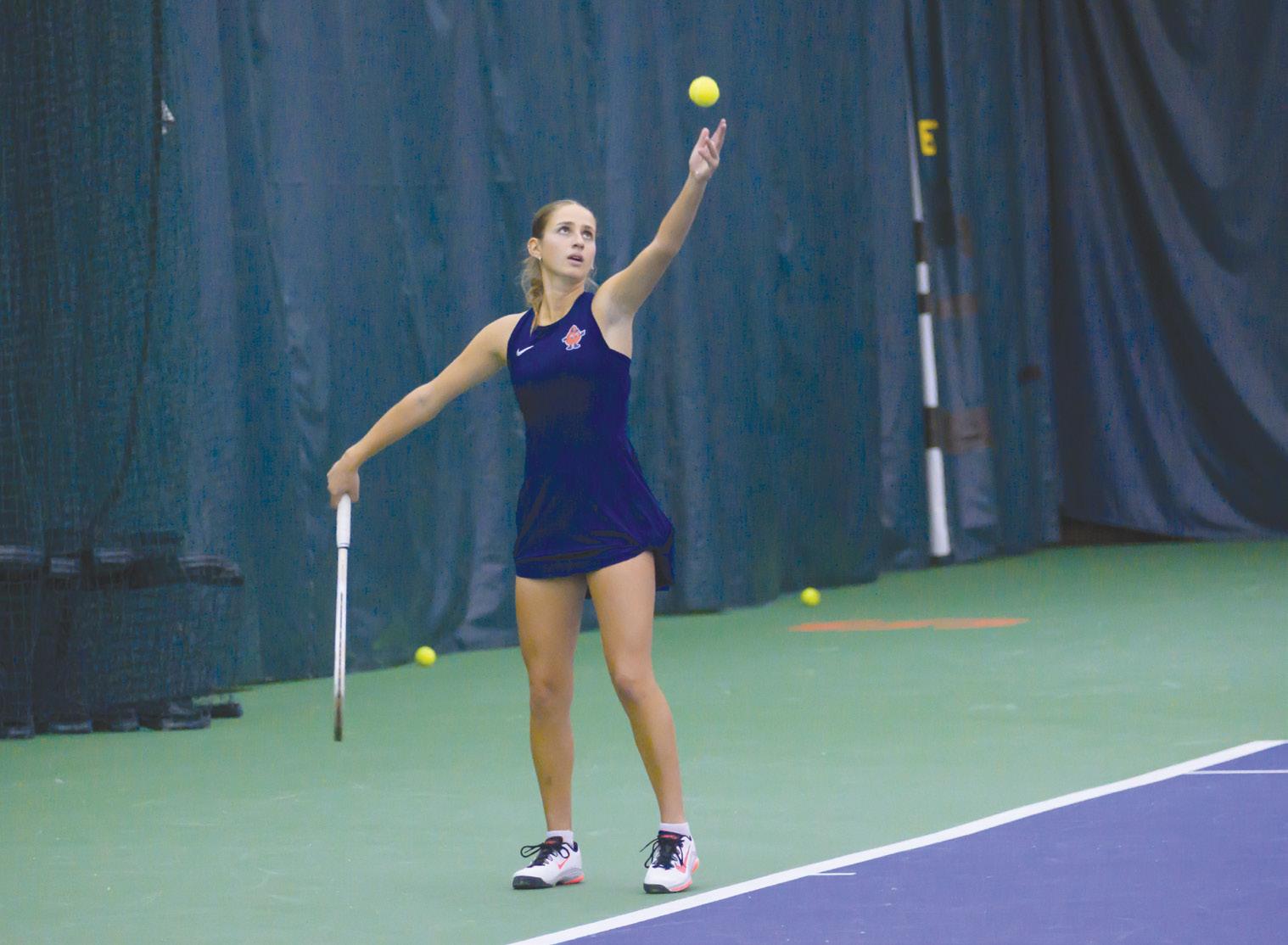
than those she’d been accustomed to playing.
Just like the win against Bulger at Wake Forest in March.
“I don’t feel like that was my best match in terms of the tennis I played,” Wojcik said. “But I was feeding off of everyone’s energy, and that helped me win.”
Two weeks after Wojcik downed Bulger, SU’s sophomore earned her 10th win of the season in Syracuse’s penultimate regular-season match against Georgia Tech. After the match, SU head coach Younes Limam wasn’t shy when asked about Wojcik’s importance.
“I love the energy that she brings to the team,” Limam said. “I’m super happy for her.”
Ask anyone on the Orange, and they’ll tell you energy is one of Wojcik’s most valuable assets. She still has two seasons left at SU. With more time to improve on and off the court, that trait isn’t going anywhere.
“I’m playing my own tournaments this summer,” Wojcik said. “But I can’t wait to be back with my teammates in Syracuse getting ready for
in the fall and the duals in the spring.” jwood20@syr.edu @JackWood_55
By Nicholas Alumkal sports editor
Notre Dame looks like Notre Dame again. After a 9-5 record — its most losses since 2019 — and NCAA Tournament Quarterfinal exit in 2025, ND looks to return to its regal best. This year, the Fighting Irish appear to be back to the form that led them to national championships in 2023 and 2024.
ND has the results and recent form to prove it, knocking off the No. 1 ranked teams in consecutive weeks to begin April.
Syracuse, on the other hand, is firmly a topfive team, having beaten No. 7 Johns Hopkins and No. 8 Virginia by four goals each. However, the Orange haven’t proven they can defeat the elite, falling to No. 3 North Carolina on April 4 and No. 2 Princeton on Feb. 27.
In Syracuse’s nonconference finale — a 14-7 victory over Colgate Saturday — Joey Spallina set the program points record and the Orange built confidence heading into the final stretch of their season. With that rhythm, SU can secure a statement win in a place it hasn’t won since 2017.
Here’s everything you need to know about No. 1 Notre Dame (9-1, 2-1 ACC) before its ACC regular-season finale matchup versus No. 5 Syracuse (11-3, 2-1 ACC) Saturday: All-time series Syracuse leads 12-11.
Last time they played
The Orange had Notre Dame’s number last year, beating it twice. The last time the two ACC giants met was in the ACC Tournament Semifinal, when No. 4 seed SU upset No. 1 seed
from page 1 spallina
Three hundred and eight points later, Spallina has done that. In No. 5 Syracuse’s 14-7 win over Colgate Saturday, he passed Mike Powell to become Syracuse’s all-time points leader. Still, Spallina has more on his mind. The senior is dead set on winning a national championship. But, despite Spallina downplaying the accomplishment, it shouldn’t be glossed over.
“Everybody has personal goals, and just to break a record from a Powell is awesome,” Spallina told The Daily Orange on April 2. “Right now, when you think of Syracuse lacrosse, probably the second, or even maybe the first name that comes to mind is Powell.”
• • •
If you’re going to break a record, you might as well do it in style. With Syracuse leading 3-2 in the first quarter on Saturday, Bogue Hahn flipped the ball to Spallina as he gained momentum along the wing. Colgate’s Sam Erickson locked his eyes on Spallina, and the attack quickly whipped a behind-the-back pass on the money for Michael Leo, who followed suit with a behind-the-back finish.
The assist is everything Syracuse and Mike stood for. Playing with freedom, mixing in skill with creativity and playing without thinking too hard, so, ironically, that was the record-breaking play.
“That was very much instinctive,” Spallina said of the assist. “It’s not the first time that we’ve done it, but it just so happened that we did it on that goal. So it was awesome.”
“I’m super proud of Joey,” Leo added. “I’ve seen the work that, really, none of you guys really see. Since he was younger, he was just always a guy that was the last guy at practice, first guy at practice. So I’ve seen all the stuff, but it’s special.”
Spallina simply pointed to the sky in celebration. Then, his teammates mobbed him, before chants of “Joey, Joey, Joey” echoed around the JMA Wireless Dome. Spallina said he was more excited about his assist to his brother, Jake, in the third quarter.
Go figure.
It was still special for Spallina, who had plenty of family in attendance. He started the night by walking out for the senior day ceremony with Joe and Mary Beth at his side, along with brothers Jake and Brett and his younger sister Olivia balanced on his shoulders.
Once the game began, Spallina didn’t make them wait long to celebrate. He intercepted a pass on an aggressive ride and scored into an open net in the first quarter. His feed to Leo minutes later confirmed his place as Syracuse’s all-time points leader.
Detractors will bring up previous greats played without a shot clock, or that Spallina racks up points against bad teams. Well, in 46 games against top 20 opponents, Spallina has 185 points. Mike had 182 in 42 contests.
People will always attempt to knock Spallina down a peg. But 308 points is 308 points no matter how you slice it.
ND 14-12. The score indicates a tighter contest than it actually was. The Fighting Irish scored two cosmetic goals in the final 30 seconds. The damage was already done.
SU attack Owen Hiltz produced a teamhigh five goals, but the real difference was at the faceoff X, where Syracuse’s John Mullen won 21-of-26 draws. In net, goalie Jimmy McCool turned in a career-high 20 saves on a .625 save percentage. Syracuse’s well-rounded performance allowed it to snap a then-threegame losing run and send it into the conference championship game, which it won.
The Fighting Irish report Notre Dame’s down 2025 season seemed to mark the end of a dynastic run. When the Fighting Irish’s season ended versus No. 5 seed Penn State in the NCAA Tournament Quarterfinals, prolific attack Chris Kavanagh’s collegiate career ended. It concluded a five-year run of ND’s offense being led by Chris or his older brother Pat, who rank third and first in program career points, respectively. Jake Taylor, who spent six years in South Bend, also departed.
But ND hasn’t skipped a beat. It’s back to the top of the collegiate rankings. That’s courtesy of some terrific returners, a high-impact transfer and the country’s best recruiting class. Reigning William C. Schmeisser Co-Defensive Player of the Year Shawn Lyght helms the backline in his junior year and continues to erase opponents’ No. 1 option.
On the attacking end, head coach Kevin Corrigan earned the commitment of Air Force transfer Josh Yago. The attack has hit the ground running, leading the team with 20 goals in 10 games.
What’s that saying? Records are meant to be broken. Despite Mike’s staggering points total, Casey thought someone would eventually surpass his brother.
“Joey is that kind of player, where he’s putting up those kinds of numbers each and every game, meaning he’s a big factor every time he has the ball, there’s a chance something’s gonna happen, which was very similar to Mike,” Casey said.
• • •
Before Gary Gait, No. 22 was just any number at Syracuse. As a freshman, Gait wore No. 38. He switched to the now-iconic number to honor his friend, John Crowther. A fellow British Columbia product, Crowther played at Rutgers and was murdered after a practice with Gait.
Three straight national championships — one of which was vacated — and 253 points later, the jersey held a little more weight. After Gait, then-SU head coach Roy Simmons Jr. gave No. 22 to Charlie Lockwood, one of the top recruits in the country. Gait said Simmons Jr. challenged Lockwood to fill Gait’s shoes.
Lockwood was a four-time All-American and led Syracuse to a national championship in 1993. From there, it became customary for Syracuse’s best player to wear No. 22. Casey, Ryan and Mike Powell all donned the number, along with Cody Jamieson, Dan Hardy and others. For the past four years, Spallina has had the honor.
“(It’s) a simple way of putting pressure on, right from the get-go,” Gait said. “Most of the guys have been able to handle that pressure and be successful, and sometimes it doesn’t go as well as they hoped.”
Spallina embraced the weight as the No. 1 recruit in the class of 2022. Immediately, he became fully immersed in the “22 brotherhood,” connecting with former players who wore the number.
Casey used to play catch with Spallina on MLL sidelines when Joe coached the New York Lizards. Spallina and Casey exchange texts about the nuances of the game. After the Colgate game Saturday, Spallina said his favorite piece of advice from Casey was to be “22 easy,” meaning “play your game and you just do what you’re supposed to do, and the rest will take care of itself.”
Casey has tried to give Spallina room this season, but reached out before SU’s win over then-No. 1 Maryland.
Spallina’s relationships extend to Ryan and Mike, along with Jojo Marasco and Hardy. As his head coach, Gait spends every day with Spallina and is a resource for advice. Then there’s Lockwood — the upstate director for Team 91, Spallina’s former travel team — who Spallina has also grown close with.
Jordan Evans reached out to Spallina prior to his freshman season. Evans said former No. 22s didn’t contact him during his injury-riddled and turbulent time at SU. He didn’t want a repeat, so he gave Spallina advice on how to focus.
“I just reminded him that it’s a jersey first and foremost,” Evans said. “Everyone wears a jersey, and it’s not him who put the pressure on himself to get there. Just do what you love to do, and that’s play lacrosse.”
ND’s freshmen have also proved themselves early in their careers. Dylan Faison, the brother of Jordan, who played lacrosse at Notre Dame for two years before focusing on football, scored twice in the Fighting Irish’s one-goal win over Duke Saturday. First-year faceoff man Aidan Diaz-Matos has won 54.3% of his draws, while attack Teddy Lally has pitched in 10 goals.
The results have been impressive. After losing 11-9 at Virginia, the Fighting Irish flattened then-No. 1 Richmond in Evanston, Illinois. ND led 8-0 after one quarter and ended the game with a 12-8 win. The next week, Notre Dame crushed the No. 1 team again. This time, it was a 10-5 victory against North Carolina.
How Syracuse beats Notre Dame It won’t be easy for the Orange to overcome the Fighting Irish — especially on the road — but an upset victory for SU begins in net, like it did the last time these two teams played. McCool has been in fine form after he was benched at North Carolina, rattling off save percentages above 55% in his last two outings. While ND has attacking weapons and will get looks, the game may come down to McCool snuffing out some key opportunities.
And Syracuse might need to punch above its weight at the faceoff dot. It’s been a down year for Mullen — his winning percentage has fallen from 63.0% last year to 53.2%. However, in a likely tight game, possessions will be paramount. ND doesn’t boast the best faceoff corps in the country, so a possession battle may ensue.
Once the Orange have the ball, it’ll be a question of if Spallina can make an impact against Lyght. Spallina scored four times in the regular
• • •
Records are the last thing on Spallina’s mind. He’s talked about winning a national championship ad nauseam, saying before the 2026 season: “(It’s) the only thing I really give a sh-t about.”
Joe has emphasized how special Mike’s record is, but it’s often in one of his son’s ears and out the other.
“That’s the way he’s wired,” Joe said. “He doesn’t know another way.”
Going out on top is crucial to Spallina’s legacy. Championships are one of three tenets Spallina outlined when asked about what’s important for a No. 22. There’s the simplicity of being a good teammate and outworking everyone. Then there’s actually winning.
The most iconic No. 22s are known for reaching the peak. Casey and Ryan won one title each, and Mike won two. Jamieson scored the winner in the 2009 national title game, SU’s most recent championship. Spallina won’t be forgotten without one — especially considering his new record — though he isn’t satisfied with his current standing.
“When you think of the 22s here, you think of championships,” Spallina said. “You think of scoring goals, and doing the things that champions do, and that’s really the next step, and probably the last step.”
He’s everything it stands for. He’s got a great pedigree, and he’s striving for excellence.
Casey Powell former su men’s lacrosse no. 22
It’s hard to compare Spallina to other No. 22s. The shot clock wasn’t around until 2019. Play styles differ. The talent is more spread out. For three decades, Syracuse was virtually guaranteed a spot in the Final Four. As lacrosse has grown, that’s no longer the case.
Social media also adds some weight. Spallina’s often accused of going missing in big games. His doughnuts in losses to then-No. 7 Princeton and then-No. 2 North Carolina this season don’t help his case, along with getting blanked in the 2024 NCAA Quarterfinal against Denver.
Still, it’s ridiculous to say Spallina has underwhelmed at Syracuse.
“He’s everything it stands for,” Casey said of Spallina living up to the number. “He’s got a great pedigree, and he’s striving for excellence. … He’s a gamer (with a) nonstop motor. He’s never comfortable where he is. He’s always striving to be better, and that’s what it’s all about.”
• • • Win or lose, Spallina is usually the last one off the field. That’s by choice. Young Syracuse fans
season last year. He may need to replicate that Saturday to give Syracuse a chance at an upset.
Stat to know: 69th
Notre Dame’s one glaring weakness may be its man-down defense. It’s so disciplined that it’s allowed the sixth-fewest opponent man-up opportunities, but the Fighting Irish have the 69th-best man-down defense of 75 Division I teams. They concede goals on 52.4% of opponents’ extra-man opportunities. Syracuse is 15th nationally in man-up offense, converting on 45.8% of its man-up chances. So, though the man-up opportunities may be rare versus ND, the Orange will have a good chance of capitalizing on any that they get.
Player to watch: Thomas Ricciardelli, goalie, No. 1
The man backstopping the Fighting Irish’s third-best scoring defense in the country is goalie Thomas Ricciardelli. The netminder has been in fine form during ACC play, averaging 14.25 saves per game in his last four outings. He’s held opponents in single digits in all but one of his games. Even then, that was 11 goals against Virginia in Notre Dame’s sole loss. In his most recent outing, he compiled a seasonhigh 17 saves in a one-goal win at Duke.
The senior is near the top of the charts in every key goalkeeping statistic. He’s second in goals against average at 7.75 and in save percentage at .606 in the nation. The New Canaan, Connecticut, native has lived up to the billing as the Inside Lacrosse’s No. 4 overall recruit in the 2022 class, the top goalie in that group.
njalumka@syr.edu @nalumkal
clamor for an autograph or picture from the stands, and Spallina fulfills every request. Spallina was never in that position growing up. He was often playing catch with professional players when Joe was with the Lizards, not clamoring for their signatures. Still, Spallina saw how stars like Casey Powell and Paul Rabil treated young fans with respect, and he followed suit.
“People ask if that stuff gets annoying, but it’s really the best part about this,” Spallina said. “It’s why I play.”
Being a role model for teens is important to Spallina. It boosts your ego when fans worship you and wear jerseys with your number. But Spallina tries to keep a level head.
“That’s part of what I was saying, where I wanted to bring that magic and juice back to Syracuse,” Spallina said. “And I think stuff like that really kind of brings it back. It makes Syracuse, Syracuse.” Hardy reached out to Spallina earlier this year, inquiring if he’d do a training session when his club team from Columbus, Ohio, traveled to Syracuse for the Georgetown game. With no hesitation, Spallina agreed.
The morning of the session, Hardy’s players bought Spallina jerseys on Marshall Street, oblivious that they’d meet him hours later. Once he walked into the OLR Indoor Training Center in Liverpool for the session, the kids “went crazy.”
“It’s stuff like that that really makes it so special,” Spallina said.
“These guys are gonna remember that forever, and now they’re gonna want the same thing,” Hardy added. “They’re gonna want to go to Syracuse, and they’re gonna want to wear No. 22.
“But they’re gonna want to break Joey’s record.” • • •
Only during Spallina’s freshman year did he think about what was needed to restore No. 22’s image. The Scanlan saga was fresh and briefly clouded the number’s perception. Spallina got the perfect chance to show why the jersey is so special.
“It was more of making the number better, putting the number into a brighter spot, which now, people are talking about it nonstop,” Spallina said. “And I think it’s becoming a relevant number again, and it’s something that people look at and see it in more of a positive light.”
`Mission accomplished. Spallina is the most talked-about player in the country, and he’s done nothing but put up numbers in four years with Syracuse. Along with his senior teammates, he’s helped bring a fire back to the program.
As for what Spallina wants his legacy to be?
“That I worked my ass off every day to try to get Syracuse back to the way it should be,” Spallina said.
Spallina’s story isn’t finished, and his legacy isn’t set in stone. That’ll be determined in May. He could be looked at as an all-time great if he brings SU to the mountaintop. National championship or not, Spallina’s name will be etched at the top of Syracuse’s record books. And nobody can dispute that.
zakwolf784254@gmail.com
in the second half, but the Orange held on, advancing to play No. 1 North Carolina in the semifinals Friday.
“There’s just no easy outs,” Syracuse head coach Regy Thorpe said postgame. “We got a lead, they came storming back, but we kept our composure and made a few plays down the line.”
Guzik’s last goal was the biggest of those key plays Thorpe alluded to, but Muchnick came up with another crucial one moments after Guzik restored the two-goal advantage.
With a minute remaining, Muchnick made a crucial interception on UVA’s last possession. She completed the clear, allowing SU to chew the clock and secure its first ACC Tournament victory since 2024.
It was one of Muchnick’s best performances for Syracuse. The senior’s four goals ignited SU from the start.
“She was just all over the field today,” Thorpe said of Muchnick. “At this time of the year, you need your seniors to step up in big moments, and I thought she did that.”
They were all necessary in Wednesday’s contest. When Virginia and SU met in March, the Orange scored just six goals. But with three scores in the first frame, Syracuse was already halfway to its total from that last matchup. By halftime, the Orange matched it.
Syracuse’s defense kept UVA off the board for 21 minutes straight, including 13 in the second quarter, allowing the Orange to take a four-goal lead into the half. SU shot 6-of-22 against the Cavaliers in March. It started the game 6-of-9 Wednesday.
Virginia eventually woke up, though. After an Alexa Vogelman goal opened the frame, the Cavaliers went on a quick 3-1 run late in the third, sparked by seven straight draw wins.
Megan Rocklein, Cady Flaherty and Madison Alaimo all found the net in quick succession, pulling the game back within three at the 2:09 mark in the third. Muchnick helped settle the nerves with a swift bouncing finish with a minute to play, though, putting SU up 9-5 after three frames.
“I think we came out with great intensity,” Thorpe said. “We made some mistakes in the third and they capitalized, but it’s not like we were doing them at half speed.”
to the Final Four for the first time since 2013, and the Orange have been firmly in the top five throughout most of 2026.
“He is the Michael Jordan of lacrosse,” Wildhack said in 2021 at Gait’s introductory press conference. “Gait is more than capable of leading our men’s program back to the championship level that we all covet.”
On the women’s side, Wildhack chose to replace Gait with former SU attack Kayla Treanor. She led the Orange to three Final Fours from 2021-24 but never got them over the hump. She left Syracuse for Penn State after 2025, a campaign where SU went 10-9 and suffered one of its worst losses in program history against Boston College.
In one of the last coaching hires of his tenure, Wildhack entrusted Florida associate head coach Regy Thorpe — a former Syracuse defender — with reestablishing SU’s standard of success for the women’s team. And thus far, he’s led it to 12 regular season wins and a top-five ranking throughout 2026.
Wildhack, as a parting gift to Syracuse, helped give the Orange two top-five lacrosse teams in his final season at the helm. SU, once again, is a lacrosse school.
2. Hiring Felisha Legette-Jack
Replacing Quentin Hillsman was never going to be easy. It was even more difficult under the circumstances in which Wildhack had to do it.
Hillsman took over a Syracuse program that had never been much of anything in women’s basketball and brought it to the national championship game in the span of a decade. Before Hillsman took the reins, SU had won 20 games just once, and it qualified for the NCAA Tournament three times. It took Hillsman two years to accomplish both of those feats.
So, when Hillsman resigned in August 2021 after allegations of bullying surfaced from his players, Wildhack faced a tall task.
After a year with Vonn Read as an interim head coach, he chose SU alum and Buffalo head coach Felisha Legette-Jack. Her hiring has been an unequivocal success.
Legette-Jack has won at least 20 games in three of her four seasons at Syracuse and made the NCAA Tournament in two of them. She earned Atlantic Coast Conference Coach of the Year honors in the 2023-2024 season, and after a disappointing 2024-25 campaign, discovered Uche Izoje and a variety of transfers
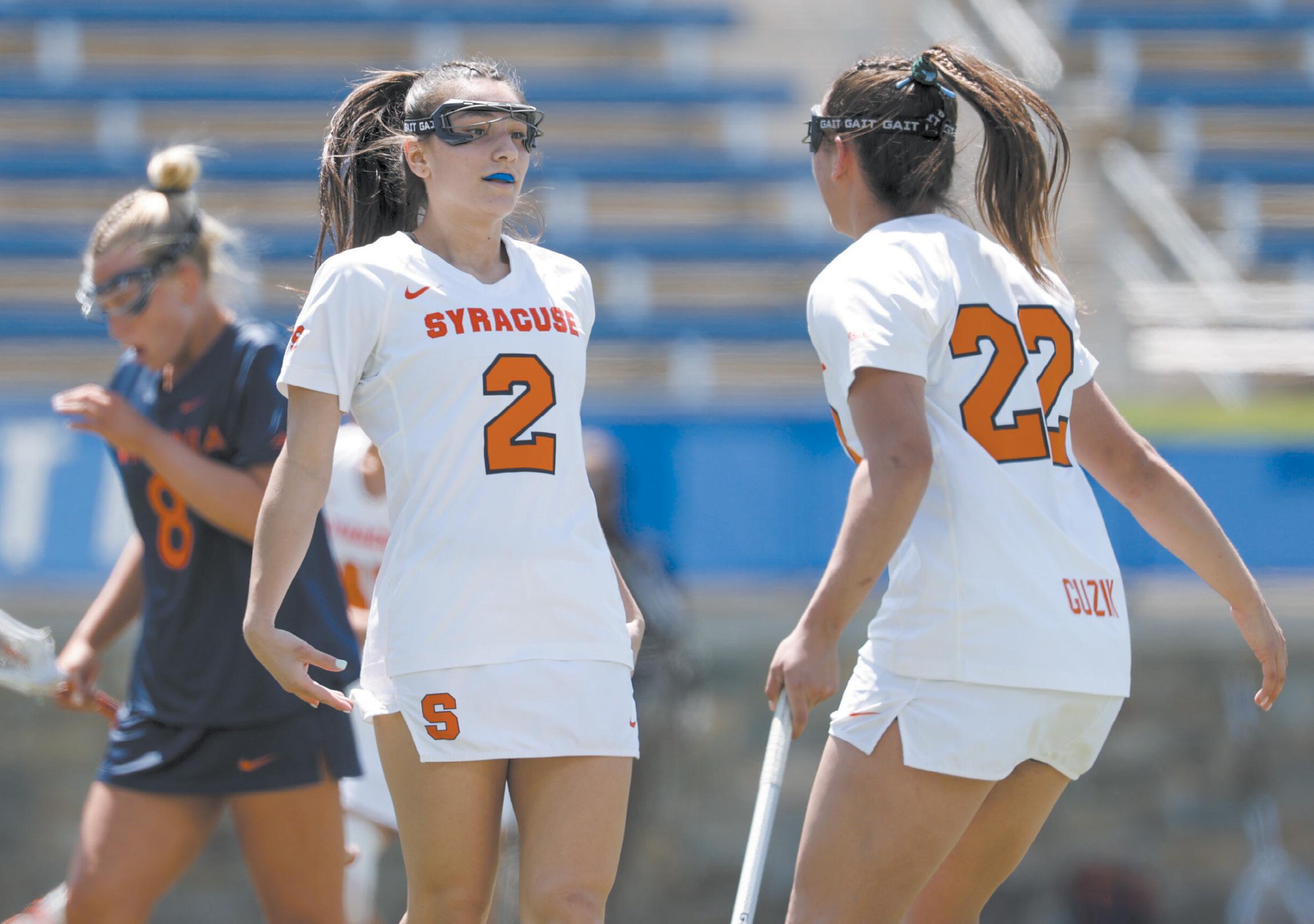
In the fourth quarter, the Cavaliers cut the lead to one for the first time since the first quarter, following three quick goals from Allen and Gabby LaVerghetta. But, while UVA had a chance to tie the game at 10 with four minutes remaining, Daniella Guyette stood tall and denied a great look in transition.
With momentum completely against the Orange, they needed a score on one of their final possessions to solidify the result. And with two minutes remaining and four seconds on the shot clock, Guzik got it.
Out of a timeout, SU struggled to break down UVA’s defense. The Cavaliers jarred the ball free on Guzik’s initial behind-theback and looked to start the attack the other way after Finnelle corralled the ground ball. But Caramelli’s timely check set up the eventual game-sealing goal, and Muchnick’s interception on the other end gave Syracuse sure-fire safety.
It was another contest where the Orange had to hold their breath late. But with the amount of close games his squad has played, Thorpe says
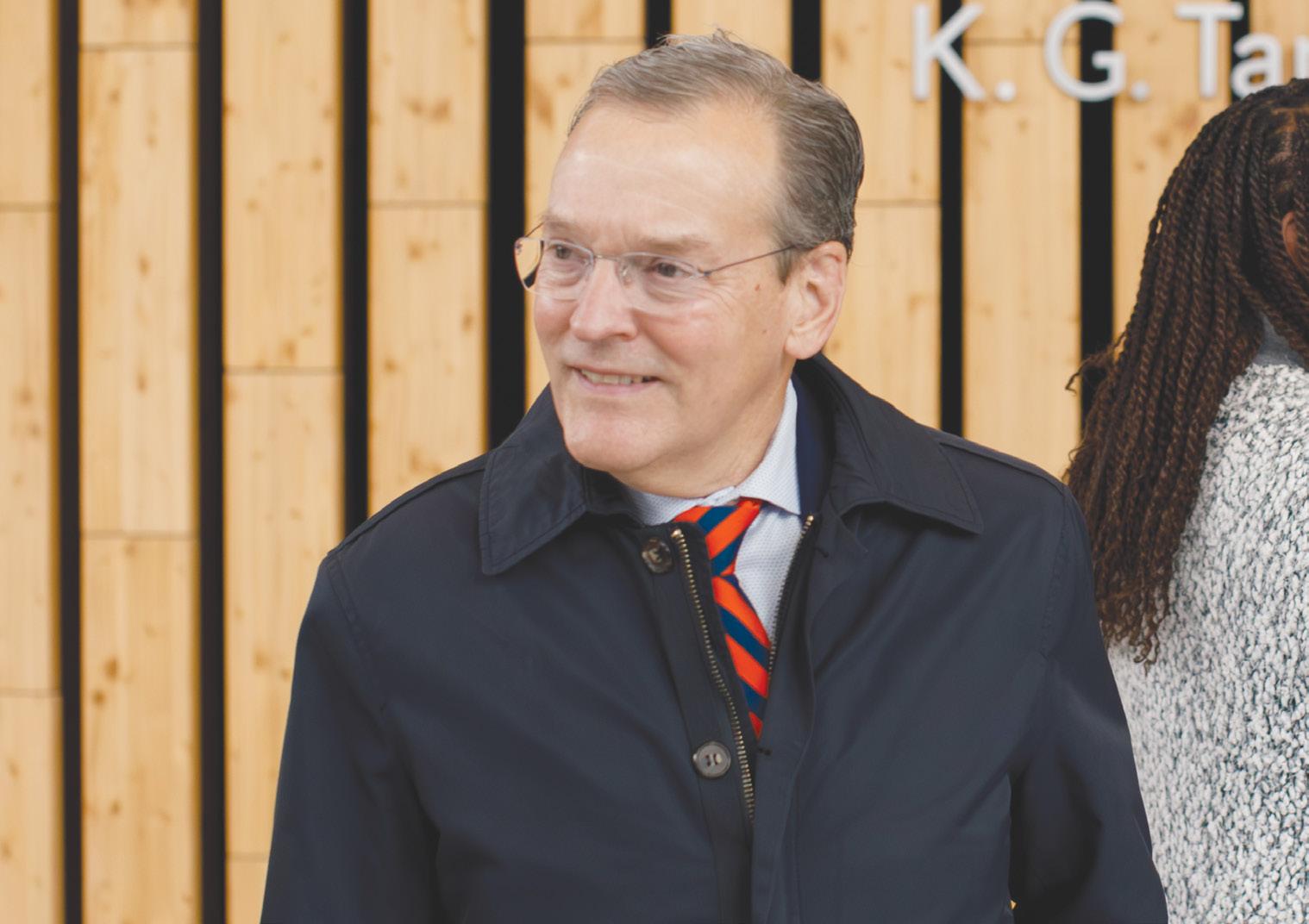
to lead SU back to the NCAA Tournament this past season.
Wildhack bet on Legette-Jack. She’s paid that off tenfold.
3. Hiring Fran Brown
Let’s face it. Late into Wildhack’s tenure, Syracuse football hadn’t been a topic of conversation in years.
Under Dino Babers, SU had sunk to a low perhaps worse than rock bottom: irrelevancy. No one spared a single thought for the Orange. Babers had the program in a constant state of five-win purgatory — nothing more, nothing less. Wildhack needed someone who’d make people remember that Syracuse even had a football team. It’s why, after deciding to cut ties with Babers, Wildhack made possibly the boldest hire of his tenure, selecting Georgia defensive backs coach Fran Brown as Babers’ replacement on Nov. 28, 2023. Brown hadn’t been anything more than a position coach at the Power Five level, but he’d developed a reputation as one of the top recruiters in the Northeast. He leveraged those connections to restore SU to prominence in 2024. Once he got the job, Brown recruited blue-chip transfers using his New Jersey ties such as Ohio State quarterback Kyle McCord and Texas A&M defensive end Fadil Diggs.
Those players helped Brown become the first Syracuse football head coach to win 10 games in his first year since Paul Pasqualoni in 1991. Brown’s first regular season was punctuated with an emphatic 42-38 victory over then-No. 6 Miami, the program’s first top-10 win since 2017.
The jury’s still out on his tenure — Brown’s squad won just three games in 2025 — but the program needed an injection of life. Brown definitely provided it.
4. Renovating the Dome
Many athletic directors had tried — and failed — to get renovations of the JMA Wireless Dome off the ground since Jake Crouthamel’s departure in 2004, The D.O. reported in 2020. Gross couldn’t. Coyle couldn’t. But Wildhack did.
Syracuse’s men’s lacrosse team has repeatedly said the Dome is indisputably the best Division I lacrosse venue. It’s easy to imagine they’re not the only team on campus that feels the same way about the stadium.
Cultivating that environment wouldn’t have been possible without the renovations Wildhack helped spearhead. The $118-million project, completed in 2020 amid the COVID-19 pandemic, included the four-panel video board hanging
they’re simply immune to them. It’s surely a good trait to have in the postseason. Perhaps if Caramelli hadn’t stuck with that play, though, it would’ve been a different story. The Orange could have lost back-to-back games for the first time since February. Syracuse could have spent the weekend anxiously waiting to see if it’d done enough to get an NCAA Tournament top-eight seed. But SU showed its immunity. Now, it’ll get another shot at the nation’s top team because of it. harrispemberton@gmail.com @HarrisPemb6
over the stadium turf, a full air conditioning system, accessibility measures and revamped concession stands and bathrooms.
The Dome has, quite literally, never been better. You can thank Wildhack for that.
5. Leading SU men’s basketball into NIL era
Consider this spot a catch-all placement for Wildhack’s decisions regarding Syracuse’s men’s basketball program over his 10-year tenure. There were a lot of them, and their success can be debated endlessly. That’s why this only occupies the No. 5 spot on this list.
If the conversation is about importance, the decisions Wildhack made regarding Syracuse’s men’s basketball program were arguably the most consequential choices of his tenure. He was tasked with replacing longtime head coach Jim Boeheim after his retirement in March 2023.
When Adrian Autry, Boeheim’s in-house successor, failed to reach March Madness for three consecutive seasons, it fell on Wildhack to replace him. He obviously wasn’t alone in selecting Siena head coach Gerry McNamara as Autry’s successor, but after McNamara was formally introduced as SU’s head coach, Wildhack showed his words still hold weight.
“When I met with our team last week, I was very direct and candid when I told them why I hired Gerry,” Wildhack said at McNamara’s introductory press conference, before correcting himself to say it was a collaborative process.
After the U.S. Supreme Court opened college athletics to the world of name, image and likeness money in 2021, he helped SU’s athletic department revitalize its fundraising efforts. The 2024-25 campaign featured lackluster financial support, which forced SU to settle for mid-major transfers such as Jaquan Carlos and Jyáre Davis.
But Wildhack helped level up its NIL game the following season. The Daily Orange previously reported that Syracuse had about $8 million to spend on its 2025-26 roster, building arguably the most talented team of Autry’s tenure. He laid the groundwork for Blair’s introduction of the One Orange Alliance, a third-party NIL entity designed to support SU Athletics.
The results are yet to match that investment, and the Orange still haven’t truly established themselves as one of the stronger financial programs in the ACC. But for better or worse, in the NIL era, Wildhack is the architect that constructed the future of Syracuse basketball.