Former Washington Post editor and D.O. alumnus Harry Rosenfeld talks about his new memoir in a Q&A.
PAGES 2-3
A ‘Lucky Guy’ Friends reminisce about late Daily News columnist Mike McAlary. PAGE 5
Alumni updates
Find out what your peers are up to on PAGE 4 and where the Class of 2013 ended up on PAGE 8
ONLINE
Check out the redesigned dailyorange.com Click to see the updated and refreshed Daily Orange website, and let us know what you think and what you want to see.
From the editor’s desk: Staffers update print look, adapt to changes in new era
Whenyou work at The Daily Orange, it’s hard not to get caught up in the past. The history is on the walls, from the filing cabinet that management teams sign to the ducks that wallpaper the office. You can’t escape it.
But despite our fascination with the past, times are changing for newspapers, so we have to look to the future. It’s something we’ve been doing a lot of at The Daily Orange recently, particularly in the redesign of the print edition, which debuted at the start of the spring semester.
Although discussed often in recent years, the redesign project picked up steam last year when the board of directors invested in a series of focus groups, which helped guide much of the process.
We then formed a redesign committee, bringing together management and presentation directors past and present. Our presentation director, Lizzie Hart, met with staff members to discuss what they wanted out of the redesign. Lizzie also blogged about
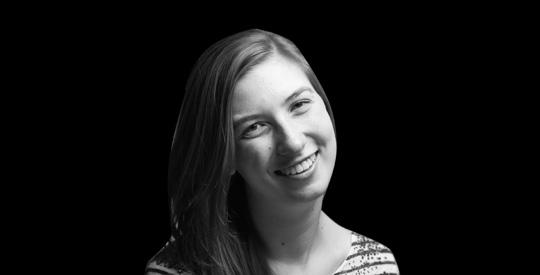
CASEY FABRIS
hail to the chief
her experience for the Society of News Design.
READ MORE
Often when people hear the word “redesign,” they think only of typefaces and color palettes. A redesign, at its heart, is a way to improve your product. For us, that also extends to the paper’s editorial content.
Read about The Daily Orange’s redesign on SND. org by clicking the link.
For example, the redesign creates space for news summaries, including a “newsbar” that could illustrate current events with a graphic, and student-focused features that spotlight campus fashion and profile peers.
As we adapt to the changing world of journalism in print, we also adapt
online. We’ve pushed to add video to our online stories, such as a series on student entrepreneurs. In the meantime, The Daily Orange received Editor and Publisher’s award for best college/university newspaper website. And our social media presence continues to grow. The @dailyorange Twitter handle recently surpassed 10,000 followers.
The last semester at The D.O. was a busy one. Syracuse University announced the hire of its new chancellor and Nancy Cantor departed. The football team appeared in its third bowl game in four years. There was also the 25th anniversary of the Pan Am Flight 103 bombing, which we marked with a special edition.
When I am not producing papers, I am a junior magazine journalism major. Before entering management, I worked in the newsroom, most recently as news editor. I knew I wanted to work at The D.O. when I started researching SU in high school, even if working at a newspaper does
SEE FABRIS PAGE 4
JOIN US FOR DOPALOOZA 2014
FEBRUARY 14-16
SYRACUSE, N.Y.
This year marks The Daily Orange’s 110th birthday — a great reason to make the trip to Syracuse for DO Palooza! We’d love for you to join us for our annual alumni weekend. DO Palooza is a great opportunity for staffers to interact with professional journalists and for alumni to reconnect and network.
The year’s theme is enterprise. How can we be better enterprise reporters? What makes an enterprise story? How do we delve deeper into stories? How do we present these stories visually, making use of the web and supplementary graphics? These are some of the topics we’ll be exploring in panels and presentations. The weekend will feature a meet-and-greet at 744 Ostrom, an alumni brunch and the opportunity to watch the men’s basketball team take on N.C. State in the Carrier Dome. For details and schedule, see PAGE 5!
the independent student newspaper of syracuse, n.y.
A newspaperman reflects on a storied life
Woodward and Bernstein’s former editor discusses recent memoir with The D.O.
By Annie Palmer | News Editor
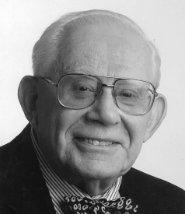
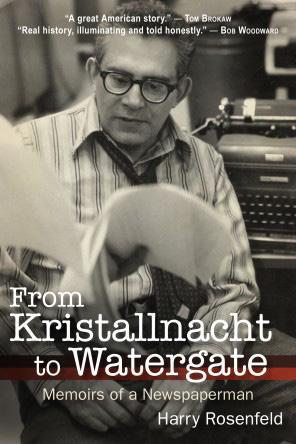
Harry Rosenfeld, 84, is the editor at large of the Albany Times Union and the author of the recently released memoir “From Kristallnacht to Watergate.” The ‘52 alumnus spoke with The Daily Orange about his experience fleeing Nazi Germany, his career as a journalist and his perspective as Bob Woodward and Carl Bernstein’s metro editor. An edited transcript appears below.
The Daily Orange: You released a memoir in September. What was it like reflecting on your life?
Harry Rosenfeld: I really wrote this some years ago when I started collecting notes about my own family. I knew so little about my own family’s background. I failed to assume these questions while they were still living because I was focused on my career. Ten to 12 years after I became editor at the Albany newspaper, I came under pressure from friends to write my story — by which they meant my Watergate story. I didn’t want to write another Watergate story because so many had already been written. I thought I could contribute my own recollections of these historic events. It took in my beginnings in Nazi Germany, but it also took in my work as an American editor. When I arrived in America in 1939, I was immediately in love with the country, but I never would have thought I would have ended up shaking hands with five presidents of the United States. That is a tiny example of what it means to come to America and live here and develop your life — even if there had been no Hitler, no vicious persecution of the Jews, even if we’d lived in a tolerant Germany and tolerant Europe, my life would have been very different. It was part of the myth of the
country; you decided your own future. That was my story and that has been the overwhelming reaction by those who have read the book. Because it is a memoir, and because it encompasses so many things, so many people take out of it what they want to take out of it.
The DO: Can you talk a little bit about what it was like fleeing from Nazi Germany and coming to New York?
HR: It was really a tale of two different worlds. I had grown up in Nazi Germany and that’s all I knew — that sort of pervading Jew hatred that I grew up in as a part of my normal life, the kind of isolation and segregation that it produced and registered in a relatively innocent 9-year-old. But the minute I came to America, I put everything Germany behind me. I forgot the language on purpose, I had nothing to do with it and wanted nothing to do with it. I threw myself into becoming American. I was entirely absorbed in becoming an American and I have been from that day on.
The DO: You came to SU in the late 1940s. What was SU like and what was The D.O. like?
ROSENFELD ON THE D.O.
My most fond memories are of those days, setting the type, holding the forms in my hand and seeing the newspaper be put together. That became a very important part of my education as a newspaperman. We just had the best of times. It was a marvelous bunch of people connected with the Orange, and some of them became lifelong friends.
HR: It was a great bit of fun. I selected Syracuse because of its journalism program, but when I got there, I was not in love with the journalism program. When I took the early journalism classes, I was only impressed with two people up there. The rest of them left me unimpressed. I shifted my intention from journalism to American studies, which combined American literature with political science. I
knew I wanted to be a journalist — that didn’t change, just the way to get to it changed.
Work on The D.O. was a major component on that commitment. I covered sports and eventually became a junior editor. My most fond memories are of those days, setting the type, holding the forms in my hand and seeing the newspaper be put together. That became a very important part of my education as a newspaperman. We just had the best of times. It was a marvelous bunch of people connected with the Orange, and some of them became lifelong friends.
The DO: It seems like each generation of journalists has its own focus. Was The D.O. as committed to investigative journalism at that time?
HR: I was focused on my sports obligations, so I was not focused on what else the Orange was doing at that time, but my impression is — and it may be an incorrect one — that it didn’t do a lot of investigating work in revealing what needed to be revealed in its own universe. Which I think is its own obligation — to cover what’s in its own universe. Certainly I was not involved in doing that, but again it’s a matter of what I don’t remember. But my suspicion is that we were at that time not very audacious — we sort of went along with the flow of things.
The DO: Do you think that had anything to do with the fact that we weren’t an independent newspaper at the time?
HR: I would say that that could be a logical assumption, but that was also an attitudinal one. There are certain newspapers now that are very rambunctious but aren’t independent. But it seems to me — now, I’m speaking under the perspective of something learned over 50 years as a newspaperman — that the obligations of a college newspaper are to do the same things that a professional newspa-
per does in its universe. The same standards should apply.
The DO: What was your first impression of the newspaper business?
HR: I always loved the newspaper business. I began to read the Herald Tribune in high school. I went to Stuyvesant High School in New York City and we were required to read a newspaper. Almost everybody subscribed to the New York Times — that was sort of the attitude of the faculty, and I didn’t want to be shoehorned into what everyone else was feeling. I took the Herald Tribune and I loved it. I loved reading it, I loved looking at it. So I was in love with newspapering by the time I graduated high school. I knew what I wanted to do for a living.
The DO: After the Tribune, you went to The Washington Post. How did the Tribune differ from the Post?
HR: The Tribune was a far more sophisticated operation, even in its dying days, than the Post. It had a work atmosphere that was both collegial and competitive. People got along very well, or even if they didn’t get along very well, they shared the spree of working at a newspaper trying to keep its nose above water. A couple years after Mrs. Graham had taken over as publisher, the Post was in a building phase. They wanted to be better than they were. I was one of those early hires. The Post was known for the high quality of its editorial pages, but Ben Bradlee was changing part of that. In a very short time, The Washington Post came to distinguish itself in national recognition.
The DO: Many newspapers didn’t fully grasp the true implications of the Watergate scandal while it was going on. How did you weigh the situation when you were first covering it?
HR: That was an issue that came up, while we were covering Watergate. Mrs. Graham would ask, “How come if this story is so good we’re so alone?” She was concerned that maybe we were barking up the wrong tree, but I on the other hand was delighted. I had full confidence in what we had because we had the quality reporting. I knew how rigorous we were in making sure we were right.
The DO: I also read that you kept all Watergate coverage assigned to local staff. Why did you decide to do that?
HR: It was our story. We were often covering whether one panda was making love to another panda at the local zoo, so it put us into a whole new world, a whole new atmosphere. Here was a chance for us to soar, and we were not going to give that up without a fight. There was pressure on Ben Bradlee, after we established recognition, that national news wanted to take over the coverage because they thought that we would bring The Washington Post down to ruin. But we didn’t — we brought it to a Pulitzer gold medal.
The DO: After spending all these years in the newspaper industry, how do you reflect upon where it is today?
HR: We’re still in the middle of this process of evolving, seeing that digitization which really exceeds, in my mind. The reason that newspapers are declining are that there are fewer readers and fewer advertisers. Readers are distracted by the internet. The new technologies could also enhance the kinds of investigative, explanatory journalism that is the core of the mission of a newspaper that envelops itself in the First Amendment. How will these technologies foster this kind of reporting and how does it detract from it? We don’t have the final answer. We’re still in the process of finding it out. apalme05@syr.edu
COMING UP NEXT
Check your mailbox this spring for our next newsletter — in print for the first time since 2010!
In the meantime:
• Consider a $110 newsletter sponsorship to celebrate The Daily Orange’s 110th year. A sponsorship helps cover the cost of printing and mailing the newsletter and ensuring that it’s the best issue it can be. Email pwaack@dailyorange.com.
• Advertise in the next issue. Have a photography, design, editing or consulting company?
Reach 2,000 people who already know D.O. alumni do great work. Email pwaack@dailyorange.com.
• Send us any life updates you’d like to be included in the next issue (marriage/ birth announcements, job changes, recent honors/awards, new book releases, etc.). Email alumni@dailyorange.com.
• Update your home mailing address if you’ve moved recently. Email alumni@dailyorange.com.
CHECK OUT THE D.O. ARCHIVES PROJECT!
For the past three years, The Daily Orange has undertaken a significant push to digitize 110 years of print archives. The project is significant in its scope, both digitally and financially. The archives committee, comprised of current and former staffers, is indebted to those who have donated. Be sure to look in the next newsletter, due out mid-spring, for more details. See what alumni donations have produced and learn how you can donate by visiting dailyorange.com/archives.
ALUMNI UPDATES
SUBMIT YOUR UPDATES FOR OUR SPRING NEWSLETTER AT ALUMNI@DAILY ORANGE.COM.
’82
Jay Blotcher is the librettist of “Holding On,” a musical in development about Harlem in the 1960s. He is working with fellow Syracuse alumnus Neil Klein (‘82) (www.holdingonthemusical. com). A former D.O. reporter, Blotcher has been an arts writer since 2001 for Chronogram, a monthly magazine in the Hudson Valley of N.Y. state (www. Chronogram.com).
’99
Aileen Gallagher married Adam Crowley on June 15 in Syracuse. D.O. alumni Meredith Goldstein (‘99), Roy Gutterman (‘93) and Pete Thamel (‘99) were in attendance. Meredith gave us a popsicle maker. It’s amazing.
’02
Jessica Vedder, a former asst. photo editor, joined the project management team at Fingerpaint, a dynamic marketing and branding company in Saratoga Springs, N.Y.
’10
Sahar Vahidi, a former presentation director, is now a design editor at Variety magazine, after working for New York Press.
’12
Yiwei Wu is a proud D.O. ad rep alum and a Pete Waack fan. Recently, Yiwei started working in product development at Xaxis (part of GroupM). Prior to Xaxis, she worked in global client development at Wunderman. She now lives in Manhattan.
FABRIS
FROM PAGE 1
get me the occasional dirty look from fellow magazine students.
Last semester, I was joined in the management office by Maddy Berner, a senior newspaper major and former copy chief. This semester, Maddy will be enjoying the remainder of her senior year and working as development editor, organizing workshops and resources to help our staff grow.
This semester’s managing editor is Chase Gaewski, a junior photojournalism major who served as photo editor for the past three semesters.
Times are changing at newspapers, including college ones. At The Daily Orange, we see that in the redesign, we see it in the way we cover breaking news, and we see it in our ever-expanding web presence.
Though we all have our eyes on the future, we still take time to look to the past.
This year, we celebrate The Daily Orange’s 110th birthday. That anniversary makes us simultaneously look back and look forward: back on all the things that have been accomplished in the past 110 years and forward at what we want to see in the next 110.
Casey Fabris (’15) is the editor in chief and former news editor of The Daily Orange. She also serves as president of the paper’s board of directors. Please feel free to contact her with ideas, comments or stories from your piece in history at The D.O. at editor@dailyorange.com and on Twitter @caseyfabris.
DOPALOOZA 2014
The value of DO Palooza to current students cannot be overstated, and we’re always grateful for any and all help. If you are interested in attending, doing a presentation and/ or reserving basketball tickets, please contact management at editor@dailyorange.com.
Note: this is a preliminary schedule. Be sure to RSVP to keep up to date with possible changes.
FRIDAY,
FEB. 14
Meet-and-greet
7 p.m., 744 Ostrom Ave.
Kick off the weekend with a meet-and-greet Friday night. Catch up with former colleagues and meet the current staff.
SATURDAY, FEB. 15
Alumni workshops and panels
10 a.m.-2 p.m. (with break for a catered lunch), Newhouse
Topics will include:
IT’S NOT JUST NUMBERS
Business reporting is a huge growth area in journalism right now. What does it take to be a business reporter? Learn the ropes and the basics of business.
LAW
Journalists need to know their rights, the importance of free speech and their way around legal documents. Get your answers on all things law from this panel with law experts. HOW TO KEEP THEM READING
Increasingly, we see longer stories getting elaborate treatment when it comes to online presentation. This panel will explore the best ways to present stories
online in terms of supplementary elements, web design and reader engagement.
ON THE BEAT
What’s the best way to get a source to open up to you? How do you find interesting personal stories and delve beneath the surface? What’s the best way to maintain relationships? These are important questions beat reporters must ask themselves, especially in sports. Move beyond game coverage and find the story that no one else can write.
REDESIGN REFLECTION
The Daily Orange recently underwent a redesign. How is it working? What do we still need to change? How can we get editorial to meet design halfway?
TELLING THE STORY VISUALLY
This panel will discuss how photographers can find and create their own stories. What makes a good photo essay? Why are they important? What’s the best way to present a photo essay? We will also discuss how best to collaborate with editors on visual storytelling.
THE JOB HUNT
What’s the next step after The Daily Orange? Recent graduates will discuss how they got to where they are today, how to start the job hunt and what life is like after 744.
CAN’T ATTEND? WE’LL MISS YOU. JOIN OUR ALUMNI LISTSERV AND FIND OUT ABOUT OUR NEXT EVENT BY EMAILING ALUMNI@DAILYORANGE.COM
LOOKING BIG PICTURE
From breaking news to enterprise, learn to develop a bigpicture story that goes beyond the five W’s. Get tips on delving deeper and taking a broader look at complicated issues.
BREAKING DOWN PULP
How do we define the feature section? How do we differentiate between news and feature?
Syracuse-N.C. State basketball game
3 p.m., Carrier Dome
Watch the men’s basketball team take on its new ACC opponent with 30,000 other fans. Please let us know if you would like one of our reserved tickets for alumni. Numbers are limited so let us know if you want one!
SUNDAY, FEB. 16
Brunch, 11 a.m.
Rachel’s Restaurant (at the Sheraton on campus)
We will hold a brunch to say our goodbyes, reflect on what we learned and celebrate 110 years of The Daily Orange.
Friends say Tom Hanks ‘got it’ as Mike McAlary in Nora Ephron’s
‘Lucky Guy’
‘MAC’ MAKES BROADWAY
By Alfred Ng
ASST. FEATURE EDITOR
When Jacqui Salmon watched “Lucky Guy” on Broadway, it was as if the ghost of former classmate Mike McAlary was onstage.
“Mike was a very distinctive personality, he had a very distinctive walk, he was very loud, he gestured very broadly, and Tom Hanks got Mike, he just nailed him,” said Salmon (’79). “He got the look, he got the posture, the
accent, the voice, and I’m not sure how he did it.”
McAlary (’79), who was often referred to as “Mac,” was sports editor at The Daily Orange and later went on to the New York Daily News, where he became a star columnist and won a Pulitzer Prize shortly before he died from colon cancer in 1998. His life was portrayed by Tom Hanks in Nora Ephron’s play “Lucky Guy,” which ran on Broadway from April to
July. The play, Ephron’s final work, received six Tony Award nominations.
During the play’s brief but celebrated run, Salmon saw “Lucky Guy” with 12 other D.O. alumni who still keep in touch after graduating in the early ’80s and late ’70s, she said.
By the end of the show, they sat in the first-row balcony in tears, astonished to see a late friend brought back to life on the stage.
Not only was Hanks able to capture McAlary’s physical attributes — mustache included — but his personality and talent as well, said Tom Coffey (’80), a former D.O. editor in chief.
“We really felt the same way, that he got it — the brashness and the lovable charm and the risktaking that would sometimes get Mac into trouble,” he said.
In the play, McAlary was often declaring his goals and then accomplishing them, which Coffey said McAlary did a lot in real life.
The play showed the confident and determined personality that McAlary was known for, as well as his knack for reporting. In the first act, McAlary was able to get a crooked cop to speak on the record by showing empathy and journalistic instincts, Coffey said.
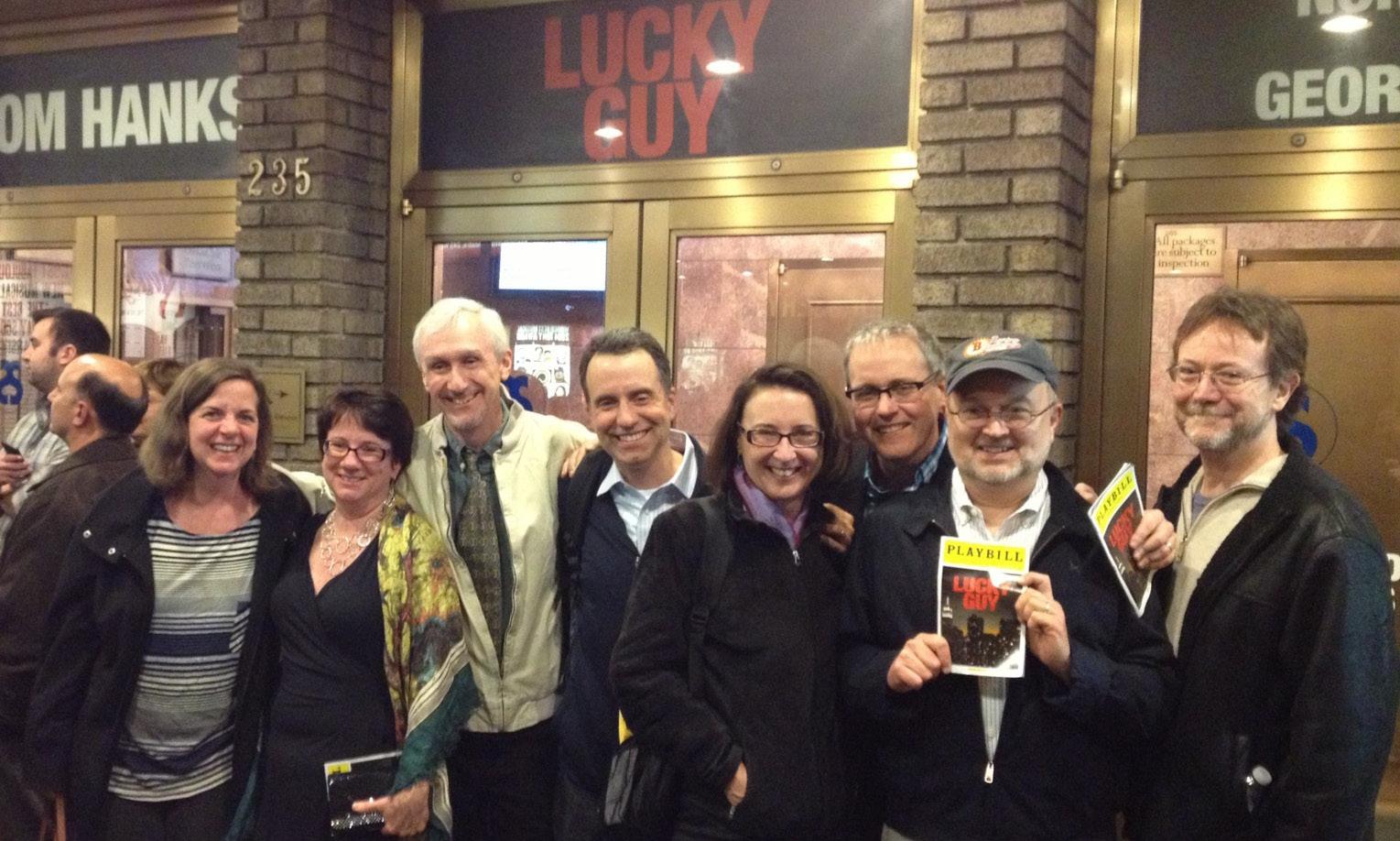
Former Syracuse classmates and D.O. colleagues of Mike McAlary, from left, Walecia Konrad (’81), Maura McEnaney (’79), Tom Coffey (’80), Tim Wendel (’78), Jacqui Salmon (’79), Dave Bauder (’81), Jim Naughton (’79) and Kevin Haynes (’79) stand in front of the Broadhurst Theatre, where “Lucky Guy” made its run on Broadway. PHOTO COURTESY OF MIKE SULLIVAN
IN MEMORIAM
Stan Brooks (’49), radio pioneer and a voice for NYC
By Chase Gaewski MANAGING EDITOR
Stan Brooks had seen it all because he covered it all. From the 68th Democratic National Convention in Chicago to the Sept. 11 terrorist attacks, Brooks reported on nearly every major story on New York City radio since 1962.
But before his voice echoed throughout the streets of the city, he was a student at Syracuse University and a junior editor for The Daily Orange.
Brooks, known for helping establish New York City’s first allnews radio station, 1010 WINS, died Dec. 23 from lung cancer. He was 86.
Brooks was honest, direct and
Robert
competitive, said Ben Mevorach, the director of news and programming at 1010 WINS. He was an architect of format — he knew how to get to the core of a story before anyone else, Mevorach said.
“He was the guy to go to. You have a question, you go to Stan. Not sure how to frame a story, you go to Stan. A story about the city, you go to Stan,” Mevorach said.
Covering every New York City mayor since Robert F. Wagner Jr. in 1965, Brooks could boil down a mayor’s speech to 40 seconds, Mevorach said
And those mayors respected him.
“Stan was loved by his colleagues and friends inside and outside the business,” former New
York City Mayor Michael Bloomberg said in a statement. “And maybe the most telling measure about him: He was even liked and respected by his most cranky listeners — the many mayors he covered.”
After Brooks’ death, Bloomberg announced City Hall’s radio media room would be renamed in his honor.
Brooks’ son, George Brooks, remembers the excitement from the days when he’d listen to his father at work.
“We’d follow his adventures by listening to the radio,” George Brooks said.
Brooks loved being a journalist. “He lived and breathed it,” his son said.
But it was Brooks’ commitment to his family, not journalism, that led him to switch from newsprint to radio, Mevorach said.
After graduating from Syracuse in 1949, Brooks began his career in newspaper journalism. But his late nights at Newsday took too much time away from his family, Mevorach said.
And as soon as he started doing radio, Mevorach said, he developed a passion for it, working until the month before he died.
“If you were to map out in a new world the ideal person to be a reporter, it would be Stan,” Mevorach said. “There was no one like him.”
dcgaewsk@syr.edu, @chasegaewski
Shogan (’51), reporter ‘among the best of the best’
By Maddy Berner DEVELOPMENT EDITOR
When plagued with homesickness, Robert Shogan found comfort within the walls of The Daily Orange.
It was there that Shogan found a best friend, a second family and a knack for choosing article deadlines over homework, recalled family members.
“He was quite lonely, but I think he found his home working with The Daily Orange,” said daughter Cindy Shogan.
Shogan, who went on to become a valued political journalist for The Los Angeles Times and other publications, died of pneumonia Oct. 30 at age 83.
Shogan’s other daughter, Amy, described him as unrelenting and detail-oriented. His daughters often experienced that persistence when they tagged along to the occasional news conference.
Following his graduation from Syracuse in 1951, Shogan worked for The Detroit Free Press, Newsweek and The Wall Street Journal — and even the Peace Corps — before joining The Los Angeles Times. There, he became a national political correspondent, covering Washington, D.C., for more than 30 years.
While at Syracuse, Shogan was The Daily Orange’s managing editor. He became close with Mel Elfin — his college roommate, fellow editor and dear friend.
Throughout his career, he was always writing, Cindy said. She remembers trying to sleep as a child and hearing the “tap, tap” of her father’s typewriter. He would go on to write 15 books in his lifetime.
The pair met in 1947 on the steps of SU’s old journalism school, Elfin said. It was the start of a 66-year friendship filled with nights at “the old hell box,” dinners in Washington and plenty of journalism.
“Bob was as close to a brother that I never had but always wished I had,” said Elfin. “We never had a lifelong fight or anything.”
Elfin said he was overjoyed when Shogan returned to D.C. and the two were able to “work together and play together,” despite Shogan’s Yankee fandom and Elfin’s love for the Dodgers.
While at The Los Angeles Times’ Washington Bureau, Shogan knew a vast array of politicians on and off the campaign trail, then-editor Richard Cooper recalled.
“He was a John Madden of political reporters in that period,”
Cooper said, referring to the NFL football player, head coach and commentator. In return, Shogan’s sources felt comfortable with him, he said.
Cooper recalled a moment when Shogan accompanied Ted Kennedy to a campaign speech in West Virginia. When Kennedy stepped down to shake hands with voters, he invited Shogan to join him, Cooper said, exhibiting a sense of personal trust.
Shogan had little patience for stubborn politicians, Cooper said. He never wavered and continued to ask questions. He was dismissive of naïve ideas, he said, and had an extensive understanding of the political system.
“Those are rare qualities in reporters,” Cooper said, “and that’s why he was considered among the best of the best.” mjberner@syr.edu, @mjberner
Former Daily Orange staffers and their lives beyond the Hill
ALUMNI NEWSMAKERS
MEG PARADISE ’06
Post-it notes cover the walls of Meg Paradise’s apartment.
One holds a song lyric by The National: “All we’ve gotta do is be brave and be kind.” It’s almost an anthem for the former Daily Orange art director, now cofounder of the fledgling branding company Guts & Glory.
“I try to keep it in mind as we go about our days,” Paradise (‘06) said of herself and her business partner and fiancée, Faun Chapin. “What we really want to do is do good work with good people. It’s easy to get caught up in the dayto-day stresses, but design isn’t rocket science.”
She learned this basic truth at The Daily Orange, where she started working in 2003 and became art director in May 2005.
“It was the first time I worked with a group of people who were so incredibly talented and driven to make something happen,” Paradise, 30, said of her time at the paper.
Paradise remembers a power outage at 744 Ostrom that forced the staff to relocate to a computer lab to get the paper out on time. She said experiences like that helped her establish the work ethic she’d need in the real world.
Paradise met Chapin at Fahrenheit 212, an innovation consultancy in New York City.
“Faun has a background in branding and advertising and is an incredibly strategically minded designer, and I have more of a traditional graphic design craft
Then: Design editor and art director Now: Co-founder of the branding company Guts & Glory, behind Helvetica the Perfume and TheyDontWorkForYou.org
background,” Paradise said. “We brought those two elements together to create Guts & Glory.”
On its website, Guts & Glory is described as a design collective with “oomph.” Paradise said this is embodied in projects like TheyDontWorkForYou.org, a website created after the U.S. Senate refused to pass the ManchinToomey gun-control compromise in April. The site pairs the faces of senators who voted against the bill with images of children killed in acts of gun violence.
Within a week, the site had nearly 80,000 online hits, Paradise
said, as well as attention from media outlets such as MSNBC.
“We’re just two people who had an opinion and felt like we needed to make something to share that opinion,” Paradise said. “Projects like that are the ‘oomph.’ So many people have great ideas, but unless you do something about it, it is nothing more than an idea.”
Guts & Glory’s latest project, “Helvetica the Perfume,” launched in November, also received media attention.
The product’s website describes the perfume as “the scent of nothing.”
New York Magazine’s The Cut blog wrote about the fragrance upon its release. “If you’re wondering if this is just a fancy bottle full of water, then you’d be right!” it said.
But Paradise counters that the product is not intended as “a trick,” but rather, it has a greater message.
“It’s an homage to the ubiquity of Helvetica while touching on the complete absurdity of the perfume industry and all of the language we use to describe perfume,” Paradise said.
She said while the perfume has garnered criticism, there are also fans.
“We love that dichotomy,” Paradise said. “We love getting in the middle and creating stuff that you have a strong opinion about.”
Guts & Glory, in business for nearly a year and a half, is headquartered in the couple’s apartment in Oakland, Calif.
Paradise said she looks forward to the company’s expansion, which will include 12 to 15 employees and more client-based work.
For now, the Post-it notes lining the walls of her apartment preview ideas the company could build on for the future.
“I hope to continue to create provocative work that is interesting to me and interesting to other people,” Paradise said. “Design is a job, but it is also a way we see the world.”
— Anna Hodge, staff writer, ahodge@syr.edu
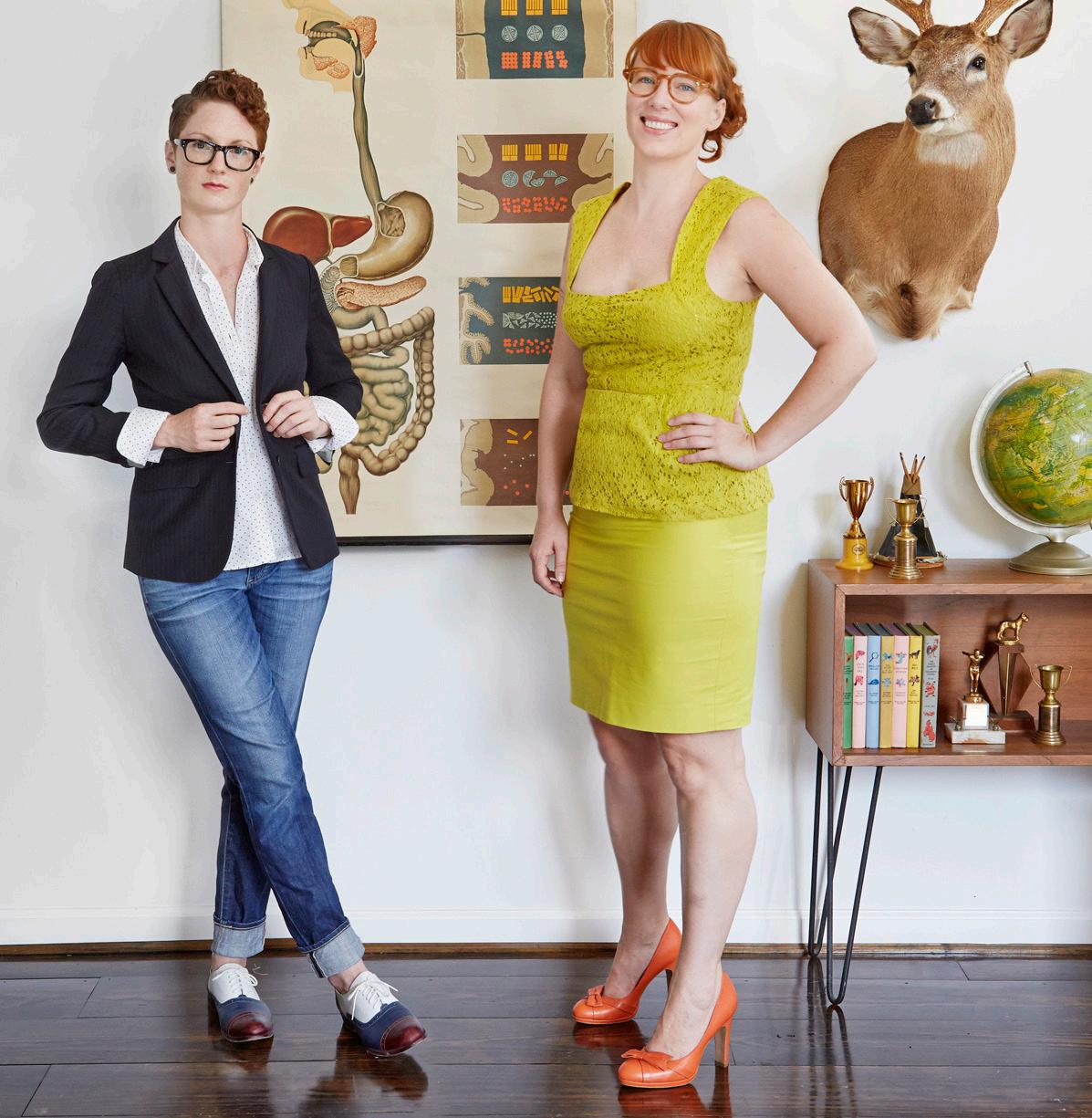
On their website, Meg Paradise, left, and Faun Chapin describe Oakland, Calif.-based company Guts & Glory as a design collective with “oomph.” MARSHALL TROY/COURTESY OF GUTS & GLORY
CONGRATS TO THE CLASS OF 2013
MCALARY
While many remember McAlary for his confidence and his brash mannerisms, he also had a compassionate side. Scenes with McAlary’s wife, Alice McAlary, showed that he had been devoted to his wife and children, even with his career as a columnist, Coffey said.
Todd Maisel, a veteran photographer at the Daily News who worked with McAlary on several assignments, said that when McAlary would show up on a story, he knew he would be in good hands.
“There are reporters that go into this job and feel unsure,” Maisel said. “He understood his
role as the eyes and ears of the public.”
Maisel added that McAlary had an ability to get anyone to open up — from murderers to murder victims’ families, people wanted to talk to Mac.
McAlary had that ability even when he was writing for The D.O., said Mark Sullivan (’79), who worked with McAlary on The Summer Orange in 1978.
“For all that Mike had going on, there was a certain element of him that was down to earth and empathetic,” Sullivan said. “Mike was comfortable with himself and I think the fact that he was so comfortable with himself made other people comfortable with talking to him.”
McAlary had a knack for draw-
ing readers into his stories as well. During the summer, McAlary knew students still on campus didn’t care for hard, serious news and offered them a lighter touch with his perspective, Sullivan said.
“He was always funny, he was always upbeat, and the life of the party,” he said. “I think that was counter-balanced by the fact that even in college, he was very ambitious.”
It would only take five minutes after somebody met McAlary to know all of his goals and dreams, Sullivan said. In The D.O.’s offices, he had a reputation for being charismatic, and being able to draw people to him, Sullivan said.
There had always been a heartfelt side that complemented
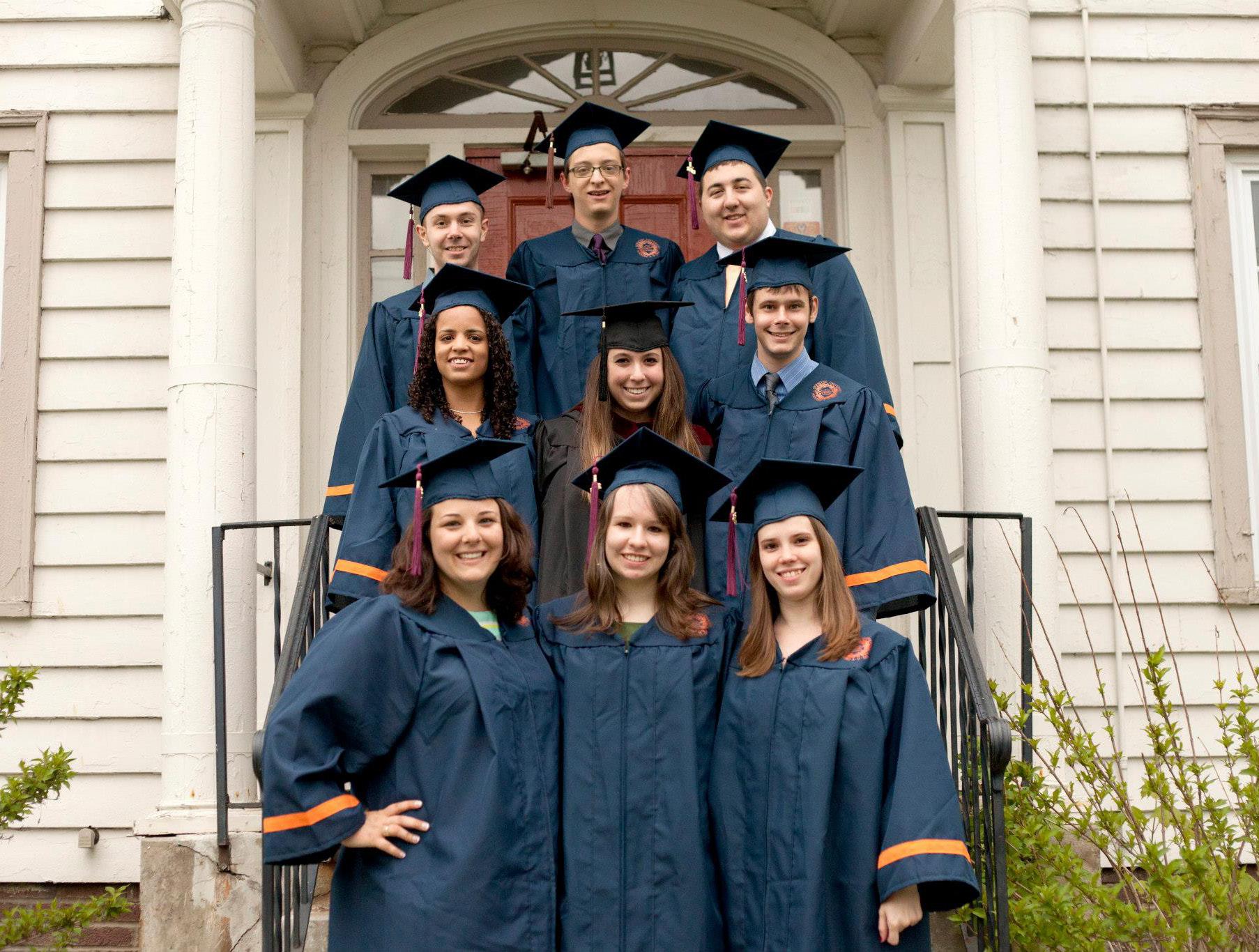
Staff members gather on 744 Ostrom’s front steps for the traditional senior photo before graduation in May. The Class of 2013 is represented at, among other places: The (Bergen) Record, The Orange County (Calif.) Register, The Victoria (Texas) Advocate, Community Newspaper Group, The Reading (Pa.) Eagle, The (Binghamton) Press & Sun Bulletin, the Cecil (Md.) Whig, Grey Healthcare Group, The (Memphis) Commercial Appeal, Syracuse Media Group, Flavorwire, ESPN and NFL Network.
his abrasive and crazy behavior, recalled Sullivan. Sullivan saw this in “Lucky Guy” and was reminded of it when he ran into McAlary later in life.
More than 10 years after he produced The Summer Orange with McAlary, Sullivan attended a Mets game on his birthday in the city, where his girlfriend gave him a copy of McAlary’s book, “The Buddy Boys.”
Later on, McAlary showed up two rows behind him, with other Daily News reporters.
After the two caught up, Sullivan asked McAlary to sign his book.
McAlary wrote: “Mark, we learned how to do this stuff together.”
alng@syr.edu, @alfredwkng This newsletter was edited by Mark Cooper, Brittney Davies, Casey Fabris and Dara McBride. It was designed by Katie McInerney. Send feedback to ALUMNI@DAILYORANGE.COM