








































































































PAGE 3


























PAGE 4

PAGE 6
After growing up in Nigeria and moving to Japan to play basketball at age 13, Syracuse is Uche Izoje’s latest stop on a cross-continental journey to achieve her dreams. next stop
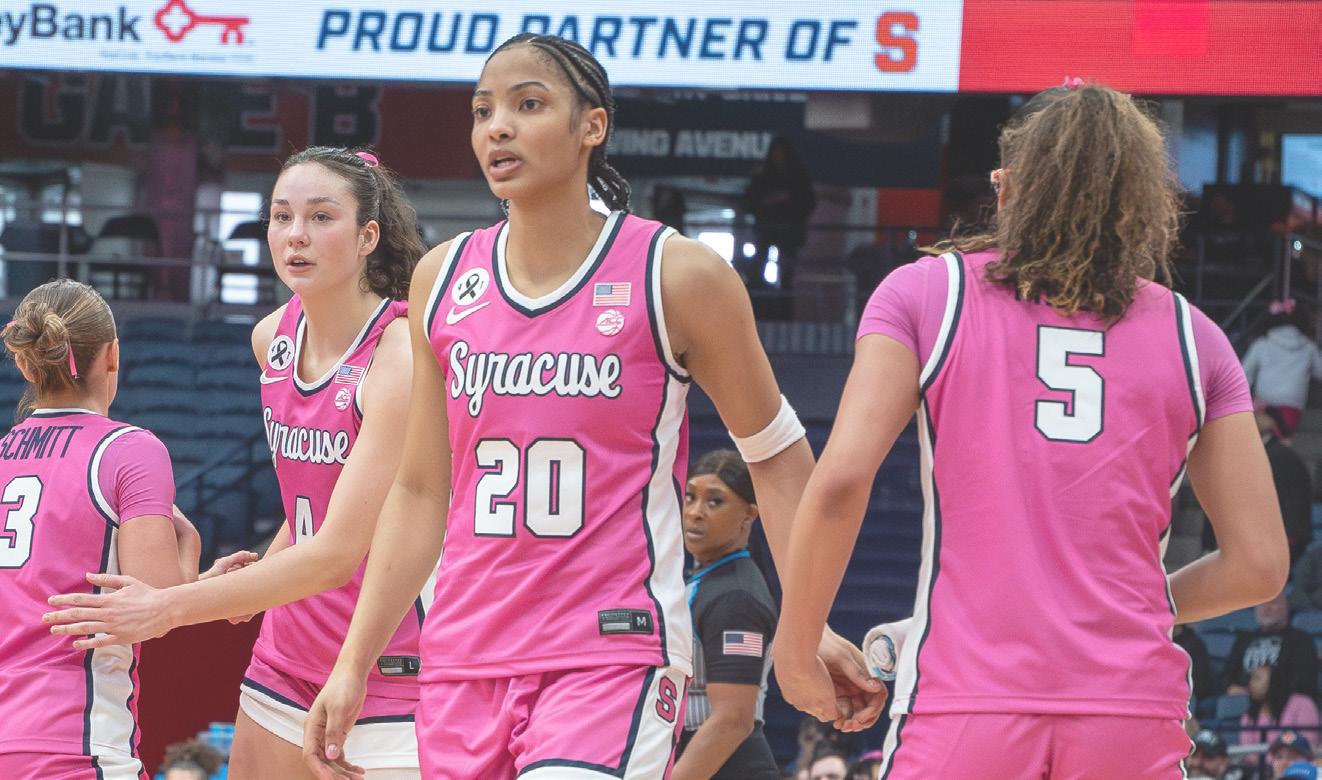
As it gears up for the postseason, Syracuse leans on Sophie Burrows, Dominique Darius and Laila Phelia for their NCAA Tournament experience. postseason pedigree















Becoming Syracuse’s head coach was Adrian Autry’s dream job. Nearing the end of his third season at the helm, Autry’s future is in jeopardy. uncertain future



The Daily Orange is an independent, nonprofit newspaper published in Syracuse, New York. The editorial content of the paper — which started in 1903 and went independent in 1971 — is entirely run by Syracuse University students.
The D.O., a 501(c)(3) nonprofit, is editorially and financially independent from SU, and the paper receives no funding from the university. Instead, The D.O. relies on advertising revenue and donations to sustain operations.
This spring, the paper will be published Thursday when SU classes are in session. The D.O.’s online coverage is 24/7, including while SU is on break.
To show your support to The D.O.’s independent journalism, please visit dailyorange.com/donate. Donations are tax deductible.
As Syracuse’s basketball teams near the Atlantic Coast Conference Tournament, one team has shown significant growth this season, while the other remains stagnant.
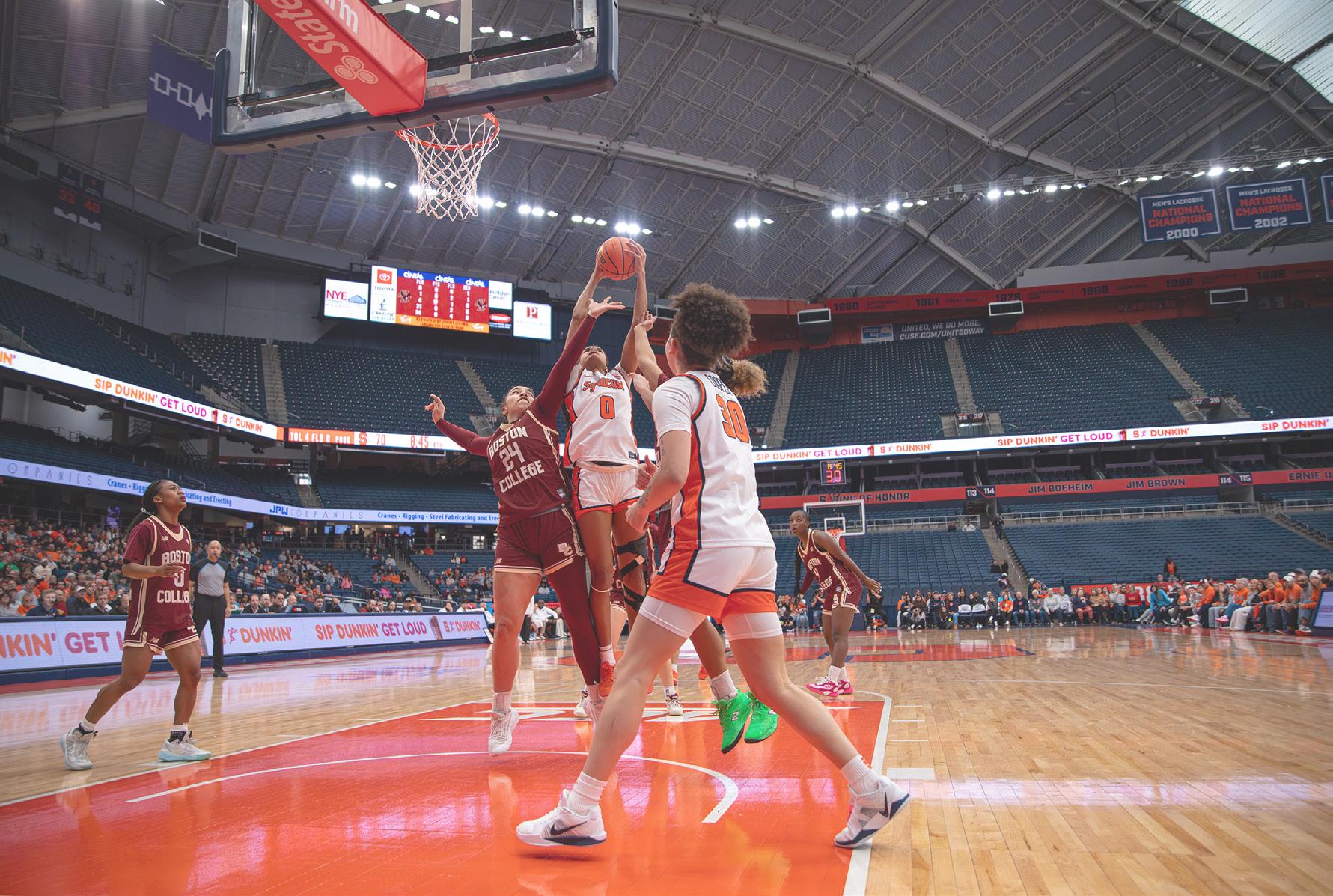
The women’s squad has gone from squeaking into the ACC Tournament a year ago to being No. 7 seed in 2026. They’ve flipped their regular-season conference record from 6-12 last campaign to 12-6 this year. Newcomers and returners with experience have keyed that improvement. Nigerian center Uche Izoje has been a revelation in her first year and was named the conference’s Rookie of the Year Tuesday. New associate head coach Natasha Adair has brought knowledge to the bench. And transfers Laila Phelia and Dominique Darius have brought March Madness experience — along with returner Sophie Burrows — to offer SU as it looks on pace to return to the Big Dance.
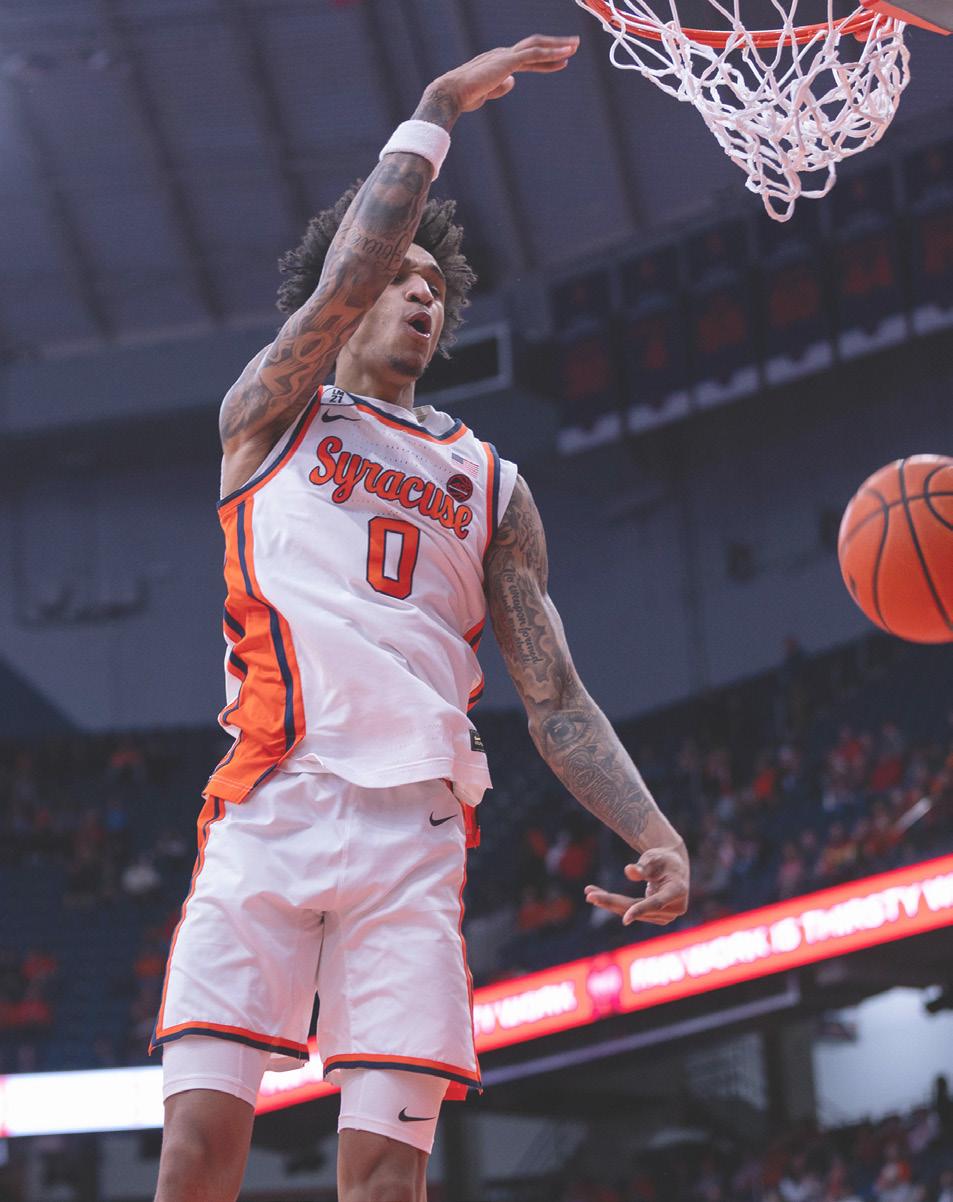
As for the men’s squad, change may be in the cards after another disappointing campaign creeps to a close. Becoming Syracuse’s head coach was Adrian Autry’s dream job, but his time in the job may be nearing an end after three years. A late-season spark from two transfers he acquired ahead of this season could help him remain in the post. Guard Nate Kingz has been a consistent 3-point threat after seeking refuge in basketball during early-life obstacles. Meanwhile, Georgia Tech transfer Naithan George has brought his playmaking ability to central New York.
The Daily Orange has everything you need to know about Syracuse basketball before it embarks at the ACC Tournament.
Thanks for reading,

nicholas alumkal SPORTS EDITOR
jordan kimball ASST. SPORTS EDITOR
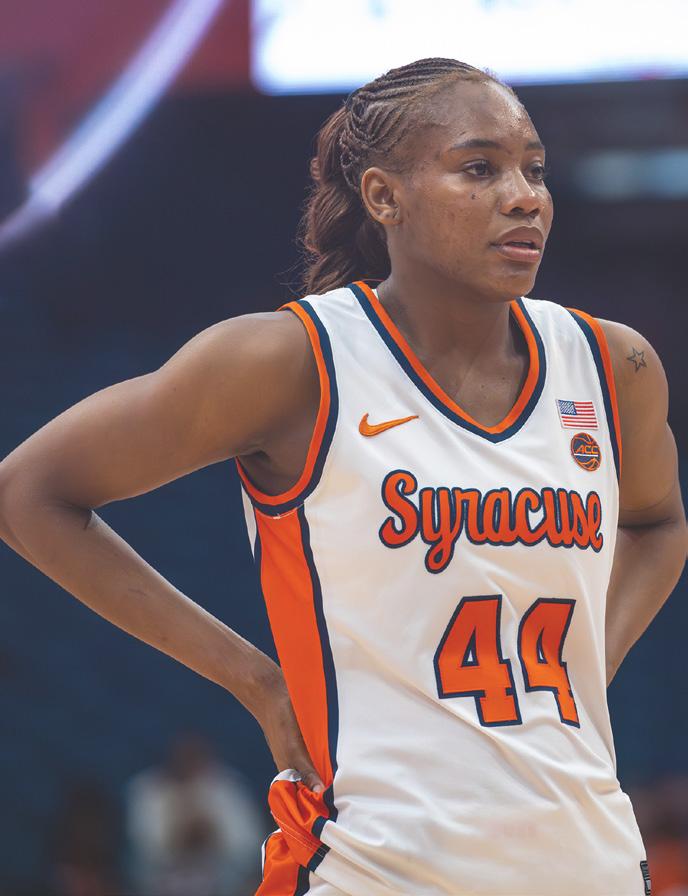
Uche Izoje refuses to turn around as she walks deeper into Lagos’ Murtala Muhammed International Airport. The view is too painful. The look on her parents’ faces — tears streaming down their cheeks, embracing each other and waving as she inches away — is her last memory.
But this is what they want. More importantly, this is what Izoje wants. She knows Nigeria was a temporary home. It was her first, but as an aspiring basketball player, she knows it won’t be her last.
So, as Izoje boards a plane for Japan — with over 20 hours of solo travel ahead — all she carries are reminders of the past and expectations for the future.
The next day, her new life begins. There’s no time to dwell or cry. Make a quick phone call and take a few pictures — that’s it. Time to get to work.
“Nigeria is no place for basketball,” Izoje said. “I wanted to play. I wanted to see different places. When I saw this opportunity, I knew I needed to leave and play better basketball.”
As a 13-year-old moving across the world solo, Izoje downplayed her nerves. She saw the move as non-negotiable. And eight years later, it’s paid off.
Izoje is a star at Syracuse. Eight months ago, she’d never set foot in the United States. Now, just 29 games into her U.S. college career, she’s drawing national attention as one of the top freshmen in the sport, even becoming SU’s second-ever Atlantic Coast Conference Rookie of the
ms. worldwide
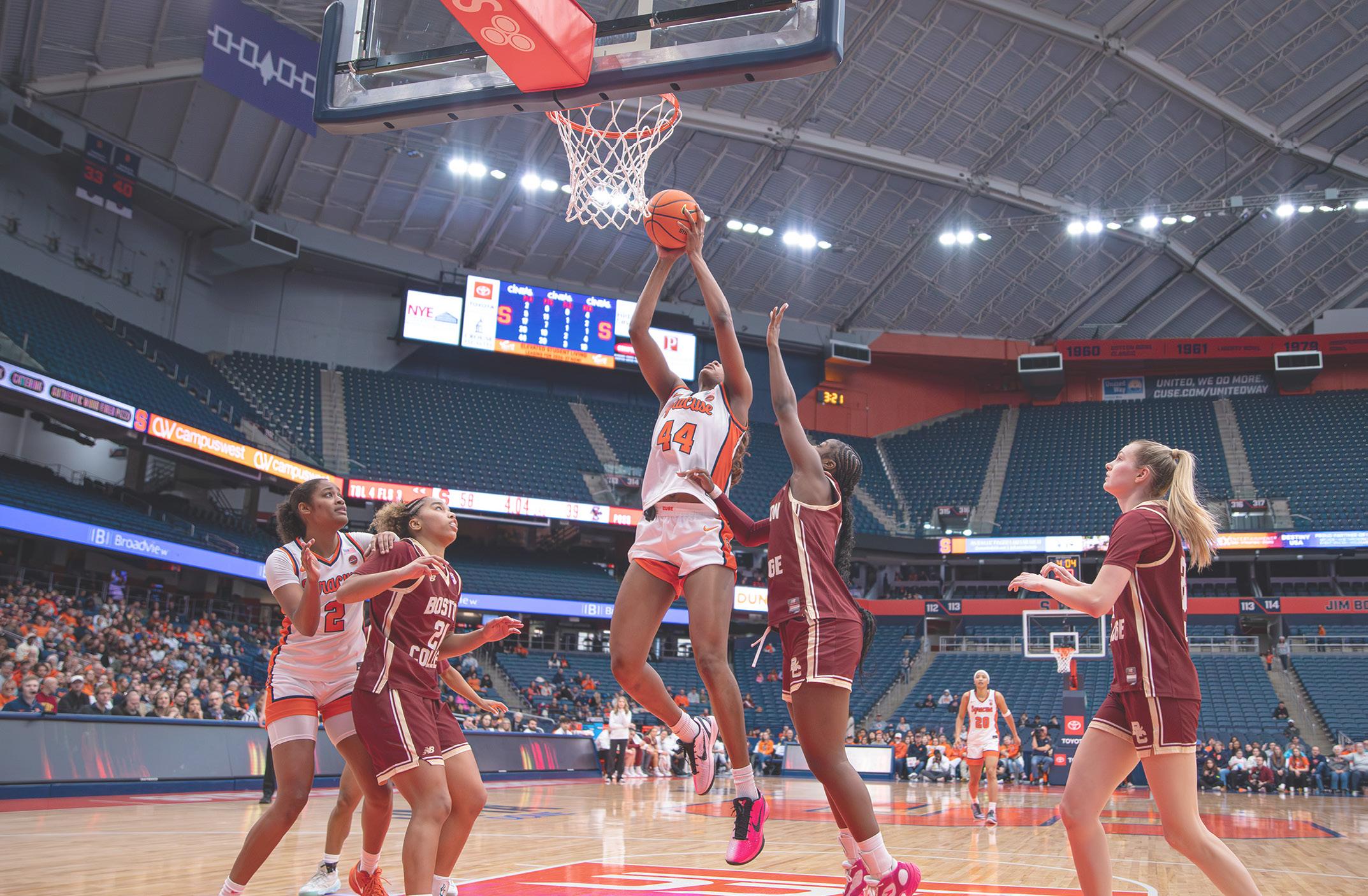
Year Tuesday. Her rise wasn’t typical, but neither is her game.
“She’s a unique player. Everyone’s seeing that right now. She’s one of the best post players in the country,” said Gerard Colomé, Izoje’s agent. “Nobody knows where her ceiling is because she’s still far behind the peak of her career.”
That’s the thing. With two years of NCAA eligibility left and a pro stint in the Women’s Japan Basketball League under her belt, Izoje’s not your average college standout. She’s a 21-year-old freshman, a two-time WJBL All-Star and the league’s 2024 Rookie of the Year.
It’s a different story off the court. Marvey Victor, Izoje’s teammate on the WJBL’s Chanson V-Magic, remembers Izoje being shy when they first met. But her poise on the hardwood spoke volumes.
That same shyness was evident when SU head coach Felisha Legette-Jack picked up Izoje from Syracuse Hancock International Airport in June 2025. It was Legette-Jack’s first time meeting Izoje despite dozens of calls in the prior months.
Uche Izoje moved from Nigeria to Japan at 13, becoming a two-time WJBL All-Star. She’s leaned on her Japanese experience to flourish at SU.







Eventually, her confidence on the court shone through.
“She is a kid that came here with the idea she could be something significant,” LegetteJack said. “And she has walked into that situation time and time again.”
At SU, Izoje feels like she’s found a second family. Legette-Jack hosted Thanksgiving, and Izoje joined Camdyn Nelson’s family in Connecticut for Christmas, where they welcomed her as one of their own. One of Izoje’s favorite activities is TikTok dancing with teammates before or after games, something that’s repeatedly brought her comfort.
That love of movement isn’t new. Growing up, Izoje wanted to be a dancer, not a basketball player.
Back home in Nigeria’s southern Delta State, Izoje spent hours on end dancing. She showed her emotions through her moves. But as she aged, Izoje was told it wasn’t her destiny.
“Uche, that’s not gonna take you anywhere. You need to go to a sport like basketball,” Izoje recalled her parents telling her. “Basketball is going to take you to many places.”
Basketball wasn’t supposed to be forever for Izoje. In her mind, she’d one day return to dance. Though her towering frame overwhelmed others in the paint, she missed the feeling of contouring her body to music.
“You’re just free. You do what you love doing,” Izoje said. “That personality, that attitude, was just cool.”
That same demeanor rose to the fore when Kyoto Seika Gakuen High School came calling in need of an international big. Izoje knew her career wouldn’t sustain itself in Nigeria. If it wasn’t soccer, there was no future for her there. Japan, on the other hand, seemed like a perfect fit.
“It wasn’t a hard decision,” Izoje said. “I really wanted to play in a different country.” Despite never having met her coach, Yamamoto Tsunayoshi, or having gone to Japan, Izoje took the gamble. Seeing her parents cry in the airport terrorized her. Izoje said she mentally prepared for the bustling streets and to eat foods she wasn’t used to.
Her hometown of Asaba was now 8,000 miles away. She was in Tsunayoshi’s home in Kyoto, Japan’s former capital and a city of more than a million people. As Izoje gazed around, few people looked like her. There were two Malians on the team. Everyone else was Japanese. Izoje decided she’d give it her all to prove she belonged.
The first hurdle was the language barrier. Izoje’s peers took English classes, focusing on vocabulary rather than full sentences, she said. They could pick apart certain phrases, but conversations were a different beast.
Izoje’s always been a food person. She indulged in jollof rice and Nigerian red stew back in Asaba, but those were hard to find on the streets of Kyoto. That was obstacle No. 2.
Even at home, Tsunayoshi’s wife cooked recipes that blended Nigerian and Japanese cuisine. Izoje chose not to take the bait, instead eating hot dogs and bread. Occasionally, an orange. Then a hot dog and bread again. The cycle repeated.
“I was so hungry,” Izoje groaned.


In fourth grade, Izoje began skipping basketball practices because she felt inspired to dance. But when word spread and her parents found out, her dreams of being a dancer disappeared. Izoje was heartbroken. But she needed financial stability, and basketball would bring that. Therefore, her two-year hiatus from the sport ended, and she began early-morning workouts with Impression Basketball Academy coach Kenneth Mfon.
Kaine Uche, who played at Impression with Izoje and currently plays at South Georgia Tech, was overjoyed watching Izoje play with Mfon. Over their few weeks together, Kaine noticed Izoje’s relaxed, open-minded demeanor most other players didn’t possess.
Izoje never doubted herself. She knew she could make it.
But she didn’t have enough time to think about food. Her schedule was full, with wakeup at 6 or 7 a.m. She’d then head to school with her teammates — several of whom she lived with — for their first practice of the day.
The fast-paced routine was new to Izoje. But her intelligence and natural speed led to massive growth in her first season. Then, more Nigerians arrived, aiding her adjustment. By her second season, Jessica Dimaro had joined. Bolanle Yussuf made the move in Year 3. Then came Marian Kareem, albeit at a different school.
Laila Phelia couldn’t believe what she was hearing. It was 2020, and Phelia was finally ready. She’d slept on the decision for one final night, but her mind was made up. The four-star recruit was going to ink her commitment to UCLA, joining a stacked roster that won 26 games the year before.
That was, until head coach Cori Close called her with some unexpected news: Phelia no longer had an offer. Someone had taken the Bruins’ final scholarship the day before. Some 5-foot-10 guard from a prep school in New Jersey, who Phelia had met at a camp in middle school. Her name was Dominique Darius.
Phelia was frustrated. Shocked. Regretful for not committing one day sooner. While Darius held her spot at UCLA, Phelia was forced to turn her allegiance to Michigan.
Perhaps if Phelia had made that call one day sooner, though, she might’ve never teamed up with Darius four years later at Syracuse. Last summer, they both hit the transfer portal, joining Sophie Burrows at SU to form one of the best backcourt trios in the Atlantic Coast Conference.
stepping up
With Alaina Rice sidelined in the 2024 NCAA Tournament Round of 32 vs. UConn, Sophie Burrows stepped up with 18 points and six 3s
39 Minutes 18 Points




time to shine
After ranking second in points among Syracuse women’s basketball guards, Dominique Darius is primed for a significant playoff role
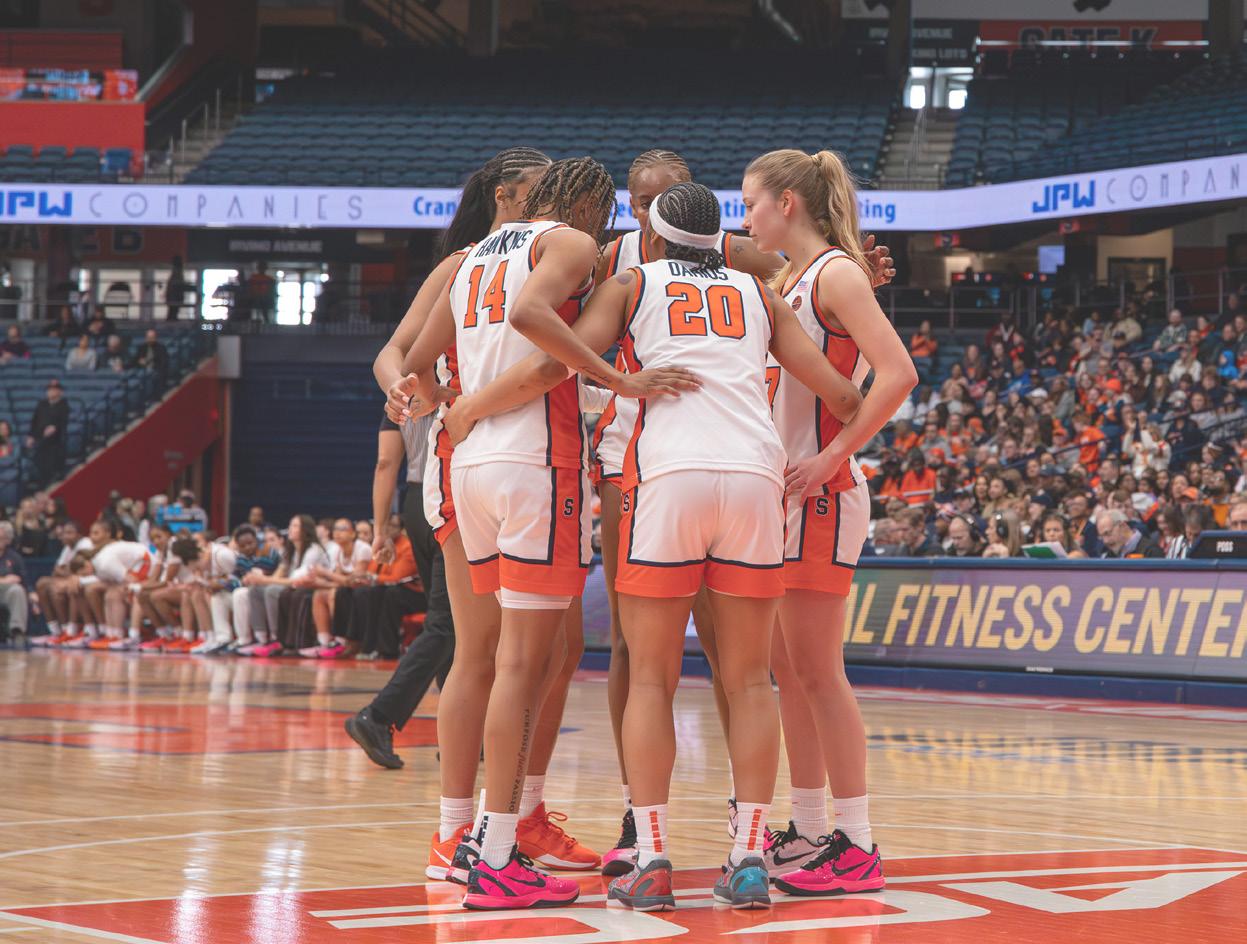
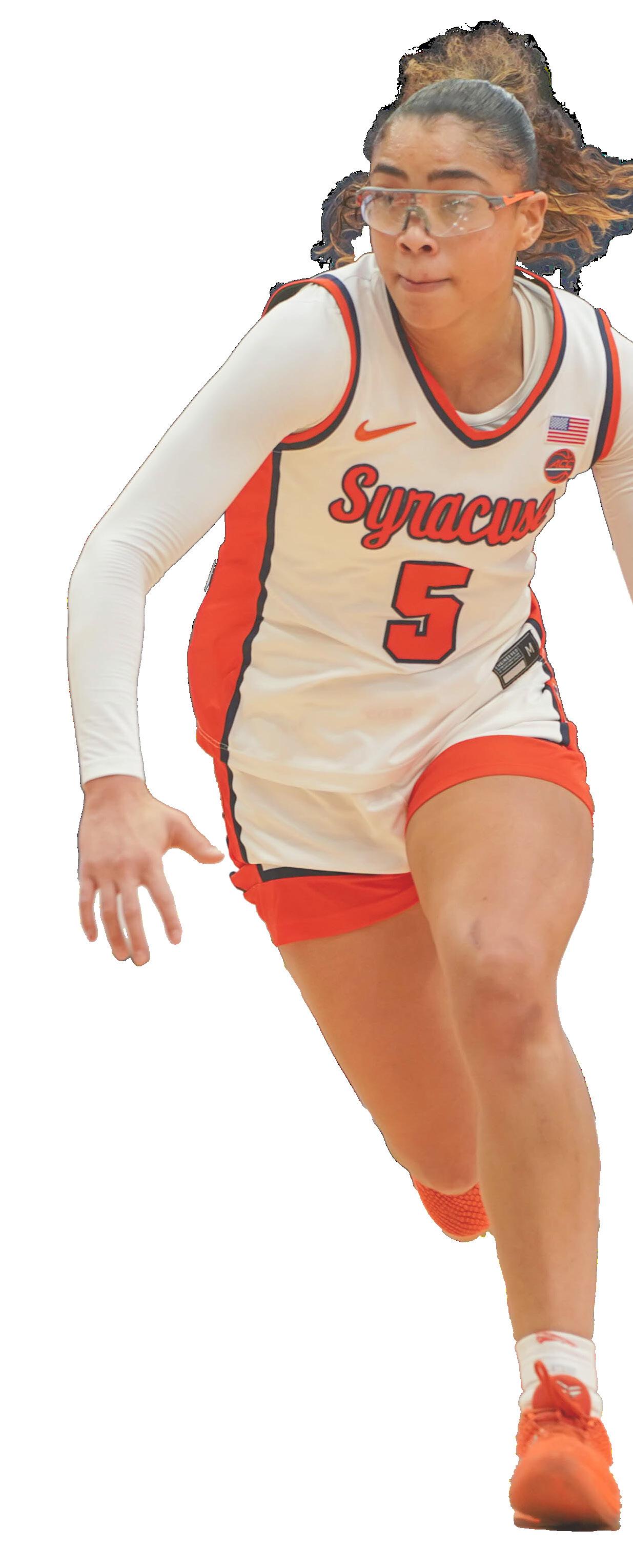
The three guards — Syracuse’s team captains this year — have steadied the Orange all season, each averaging over 11 points per game. Their efforts have put SU in prime position for the NCAA Tournament. They’ll lean on their experience as the only three Syracuse players who’ve seen significant playing time in March Madness to guide the Orange this postseason.
“We all have that NCAA Tournament experience, but it's from very different perspectives,” Burrows said. “I think that's really important for leadership on a basketball team. We're able to help different people on the team depending on what they need and their perspective.”
Indeed, each one of SU’s guards has seen March from a different view. That’s given them different values that’ll be key to its postseason run.
Phelia — through her time at Michigan and Texas — carried the burden of being a star. She’s played over 200 minutes in March Madness since first suiting up with the Wolverines in 2021.
When she suited up for her first season with Michigan, Phelia instantly became the go-to guard on a budding No. 3 seed. The Wolverines turned to her almost every time they needed a bucket.
That’s why, in a 2022 Sweet 16 matchup against South Dakota, Phelia was fed the ball on the left wing in a tie game with 30 seconds remaining. She drove to the cup for a smooth right-handed layup, which was the game-winner that sent Michigan to its first Elite Eight in program history.
Phelia transferred to Texas in 2024 to be a starter on a legitimate title contender. Yet an eye injury stood between her and another potential breakout in March, forcing her to sit on the bench while the Longhorns made a run to the Final Four.
“Just being able to go out to Tampa and seeing how they treated us, and all the perks of being in the Final Four, it was definitely a dream come true,” Phelia said. “And that’s something I believe that we can do, (with) the depth and the talent we have.”
Burrows, meanwhile, took the role of a plug-andplay scorer for Syracuse in its 2024 run. Stepping in for an injured Alaina Rice in the Round of 32 against UConn, Burrows saw a then-career-high 39 minutes and dropped 18 points on six 3-pointers. While the Orange lost by eight, Burrows called it “one of the best experiences of (her) life.”
Just a freshman back then, Burrows said she’d never played in an environment like that one in Storrs, Connecticut. But she said she tends to focus best in intense atmospheres like those. Now that she has a taste of them, the Orange hope that rings true this postseason.
“Having been (to the NCAA Tournament) before and knowing what it takes to get there, I definitely want to be able to help my teammates get to that point,” Burrows said.
Unlike Phelia and Burrows, Darius spent most of her time in March on the bench. She played for two
legitimate title contenders over four years at UCLA and USC but never regularly saw the floor at either school. 2021 run, Darius remembers some of her biggest takeaways coming from observing the players she sat behind. At UCLA, Darius got tips from future WNBA players like Charisma Osborne, and she practiced against Naismith Player of the Year JuJu Watkins every day after transferring to USC. how they approached the game,” Darius said. “I just take little bits and pieces of what they did and apply it.” tant thing she learned was to approach










two seasons, Burrows offered valuable perspective on how the fourth-year head coach wants it run. Darius and Phelia provided the veteran voices that reestablished LegetteFive months later — alongside superstar freshman Uche Izoje — they’ve helped the Orange earn a favorable spot in bracket. Now, it’s up to the three of them to prepare the youngsters, like Izoje, for what lies ahead.

And the best part? Darius and Phelia say there’s no outside pressure this time around. No expectation to be playing in the Final Four, like some teams they’ve been on in the past. The only expectation is the one they’ve set for themselves, Darius said. That, of course, is still a hefty one. LegetteJack’s preseason goal of contending for a title persists.
So, at 7:30 a.m. on Feb. 24, Legette-Jack and her entire staff met with her three team captains. Her message was clear. She thanked them for getting the Orange to this point, where they can smell the NCAA Tournament like a steaming pie on a windowsill.
But, Legette-Jack said, if they think that whiff of success is enough, they’d be gravely mistaken.
“We need more,” she told her captains. “We got to go higher.”
It’s uncertain just how high the Orange can fly.

That’ll be determined in the next month, one that’s sure to have both hope and heartbreak. But Burrows, Darius and Phelia will be the wings that uplift Syracuse. They know what it takes to win in March. Now, it’s up to them to
“We've been there before, so I think we all know what's at stake,” Darius said.
“But we also know, we just got to enjoy the moment.”
harrispemberton@gmail.com @HarrisPemb6
seasoned vet
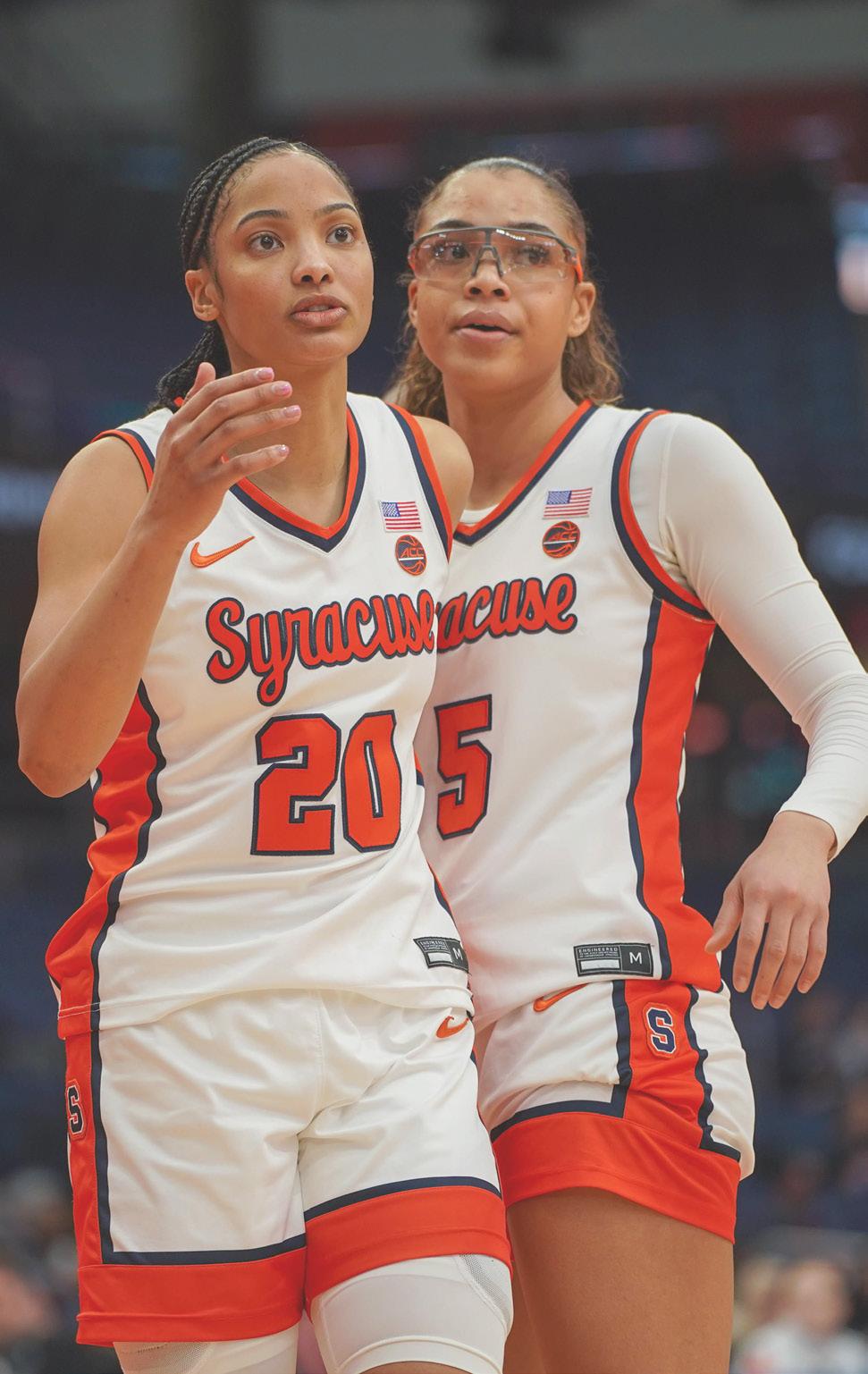
Laila Phelia has the most March Madness experience of players on SU’s roster. She played over 100 minutes in Michigan’s 2022 run to the Elite 8.

209 minutes of play across 7 games
Elite 8 appearance in 2022

justin girshon
SEnIOR STA ff w RITER
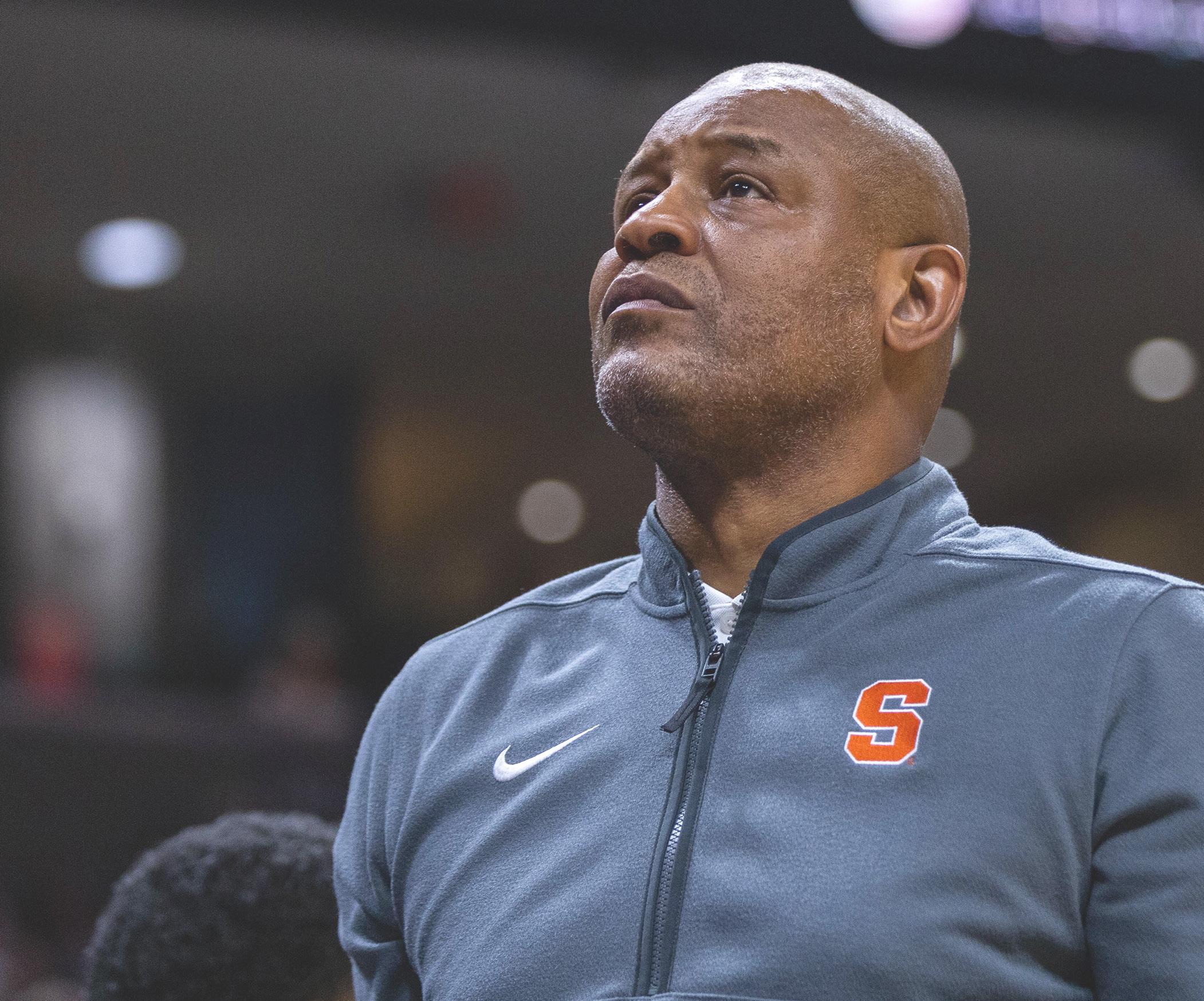
Six Final Four banners loomed behind Adrian Autry. To his left, pennants commemorating postseason runs filled nearly the entire wall. To his right, program legends are immortalized with pictures.
And in the middle of it all stood Autry. SU’s history and pedigree, collapsing on him. Questions about how Autry would return the Orange to the standard set around him flew one after another.
“I want to make the tournament every year. I’m not here just to be mediocre,” Autry said during Syracuse’s media day in October.
“That’s not why I’m here. This place is where I grew up at. I learned a lot, I raised my family here, so I know how much this program means to the community and my family.”
The sad reality for Autry, working a job he calls “a dream come true,” is that the results haven’t met the expectations. In his third season at the helm, the Orange (15-14, 6-11 Atlantic Coast) are on the brink of missing their fifth consecutive NCAA Tournament — something the program hasn’t endured in more than five decades.
Following his stout playing career before climbing the coaching staff’s ladder, Autry was entrusted to succeed Jim Boeheim and restore the “Orange Standard.” Now, barring an improbable ACC Tournament title, SU faces a defining question: Is the man who embodies Syracuse basketball still the right person to lead it?
Patience, something Boeheim pleaded for in December, is required for new head coaches. But in college basketball’s new landscape, there’s more urgency than ever.
“I knew the challenges ahead, and knew it wouldn't be easy,” Autry said during the ACC Coaches call on Feb. 23. “But this is my alma mater. I have nothing but love for this place and want the best for the place.” •••
The mild-mannered Autry had to break character. It was that frustrating.
“We get another chance, and we walk under the f— king basketball, under the rim and we don’t get the rebound,” he said after hitting the side of the podium with each of his hands.
Syracuse just fell to .500 in ACC play after a 76-74 home loss to Virginia Tech in January. A game later, Autry was barraged with “fire Autry” chants during the Orange’s loss to Miami.
“Just give him a chance,” point guard Naithan George pleaded postgame. “It’s just always bashing and bashing, but they don’t see what goes on behind the scenes.



“I feel like that’s very disrespectful, the way they treat (Autry). I’m just very disappointed. I thought it was a very respected fanbase.”
But frustrations were still boiling. Five days later, a caller on Autry’s radio show asked him who his best replacements would be.
“We got to get back to where we’re at least in the tournament, and it's a foregone conclusion that we’re going to be in the tournament. And I can assure you, that’s what Red wants more than anyone,” said John Wallace, who played with Autry at SU.
Following a 14-19 campaign last season, the program’s worst since 1968-69, Syracuse significantly increased its financial investment and transfer portal preparation to build a newlook roster capable of returning to the NCAA Tournament for the first time since 2021.
A source familiar with the program’s thinking, who was granted anonym -
ity to speak freely, told The Daily Orange that SU spent just under $8 million on its roster this season. They said the figure was seventh-toninth spending-wise in the ACC this year, triple the cost of the Orange’s 2024-25 roster.
With one regular-season game remaining, SU sits 13th in the conference.
Eight ACC teams are projected to make the NCAA Tournament, per ESPN’s latest bracketology.
“Obviously, the results speak, but I think it’s really been a challenge because college has changed,” Autry said on the March 2 ACC Coaches Call about how he’d define his tenure thus far.
“Whether it's the rosters and the rules, or the financial piece of it, everything just changed so fast. That’s a bigger impact on results than more people give credit to.”
Since losing their first Quad 1 game of the season to then-No. 3 Houston in overtime during the Players Era Festival, possibly the biggest what-if of the Autry era, the Orange are 11-15, and their KenPom ranking has dwindled from No. 51 to No. 79 as of Tuesday night.
Throughout SU’s slide, porous offense and lack of an offensive identity have been at the forefront. Additionally, a once-stout defense — which was seen as Syracuse’s new identity — has crumbled as the season has gone awry.
The investment and talent were improved, and early results suggested Syracuse could snap its four-year March
Madness skid. Instead, it’s become a season worthy of frustration.
Autry grew up with his mother and sister in the Martin Luther King Jr. Towers on 115th Street, between Fifth Avenue and Lenox Avenue in Harlem. For younger kids in the neighborhood who developed a reputation, there were always people trying to pull them in the wrong direction, said John Sarandrea, Autry’s first varsity head coach.
Beginning in middle school, Autry joined the historic Riverside Church AAU program, helping him earn a respected status. But it also helped lay a foundation.
“Riverside’s gym was open a lot of the time and made available for kids like a Red Autry to have some place to go, someplace to hone their craft and keep them off the street, which is what Riverside is all about,” said Tony Hargraves, a former Riverside Hawk and its current program director.
Eventually, Riverside paid Autry’s tuition to attend St. Nicholas of Tolentine High School instead of enrolling in a public high school, Sarandrea said. Tolentine competed in the Catholic High School Athletic Association, then widely regarded as the nation’s top league before national circuits like the EYBL Scholastic Conference existed.
Alongside Malik Sealy and Brian Reese — among several future Division I players — Autry helped Tolentine win the 1988 CHSAA championship, becoming one of the most sought-after prospects in the 1990 class.
In the mind of Sarandrea — who left Tolentine after the championship season to become an assistant coach at Pitt, where he tried to earn Autry’s commitment — Syracuse was always the clear favorite.
Sarandrea said Autry grew up watching SU and really liked the program. It also helped the Orange that Autry’s recruitment, which see AUTRY page 11
Natasha Adair couldn’t care less about the clock. It’s 11:09 a.m. on a frigid January morning, nine minutes past the start of a coaches’ meeting before Syracuse’s upcoming matchup against Cal. For well over an hour, she’s been rolling. Sitting in the Carmelo K. Anthony Basketball Center, she can’t stop waxing poetic about her life. Because why would she?
When you’ve had a coaching career that’s spanned four decades, six programs and taken you coast-to-coast, you want to talk about it.
So, she tells her story. She weaves in notes of triumph; how she got into coaching by chance and hit her pinnacle decades later, leading Delaware back to the NCAA Tournament. She weaves in notes of tribulation; how she left UD to go 29-62 in three seasons at Arizona State, fighting for support that never came. And she weaves in notes of redemption; how Felisha Legette-Jack plucked her out of unem ployment to be Syracuse’s “second head coach” this past offseason.
“How long is your ther apy session?” SU assistant coach Khyreed Carter yells out from across the court, midway through her reflec tion on her time at Dela ware.
You want a real answer? Maybe forever. Multiple people tell her to wrap this story up along the way, but she’s not planning on cutting this short. Because the most important thing to know about Natasha Adair is that, once she starts something, she doesn’t stop until it’s finished. That’s why she’s at Syracuse, after leading differ ent programs for 13 years, taking a step back to move forward in her career as SU’s associate head coach.
“The title may be different, but I think the experience, opportunity, the players,” Adair begins, stam mering as she collects her thoughts. “I love coaching and teaching. And if this is the opportunity that allows me to get back to that, that hasn't hap pened in a long time.”
No one, including Adair, knows how this ride will end. But it’s a fitting denouement. To be frank, she didn’t even mean for it to begin.
Her Plan A was broadcasting. It’s why she got her degree in communications. She envisioned herself doing play-by-play on ESPN, not holding a clipboard on the sidelines.
Pat Knapp changed all of that. Back in 1998, Adair ran into Knapp — then Georgetown’s head coach — at an event in Washington, D.C., and Knapp recognized Adair as the skilled forward he tried to recruit out of high school. Evidently, that first impression was meaningful enough for him to offer her a coaching position without any experience.
Just 26 when she joined the Hoyas, Adair could still compete with the best of them, and she wanted to show it. So, she’d often face her players in drills. It was the perfect way to prepare them — in her eyes, she was the best post player any of them would face.
She’d talk trash, too. One of her favor ite bits was challenging her team to stop her from getting another rebound. Fail? Get ready to run.
She’d run these drills the whole time she was there, until she left at the age of 31.
“I was petty,” Adair said. “I could tell them about my story: ‘If I could do it at 27, if I could do it at 28, if I could do it at 30, then you can go hard now.’”
If Knapp was the one who helped Adair get her foot in the door, Mike Petersen was the one who prepared her to kick it down entirely. After six seasons at Georgetown, Adair had built a reputation for herself in the coaching world.
Natasha Adair has been an associate head coach or head coach at

recommend Adair. Clark was the third person to do so, Petersen told him.
“She had come super highly recommended,” Petersen recalls. “This was obviously a super skilled, super impressive person that would be an awesome member of the staff.”
It was a first assistant role, making her third-in-command. One of the biggest things that stood out to Petersen was her ability to form relationships, which made
That’s how she brought Dearica Hamby to Winston-Salem, helping the lightly-touted forward develop into a three-time WNBA All-Star. It only took Adair three seasons to be promoted to associate head coach, with Petersen progressively preparing her to
Instead of solely working with the post players, she oversaw team-wide units, like the defense. Instead of staying behind the scenes, she met with boosters and had pre-and-postgame radio shows to prepare her for inevitable media
“It is the head coach saying, ‘I trust you. In the event, God forbid, I can't be the head coach tonight, you have this program,’” Adair said. “You don't take that responsibil-
So, when Charleston came calling in 2012, she was ready to take the keys.
Adair was a fixer. Taking over the Cougars on the heels of a seven-win campaign, she led them to two consecutive Women’s Basketball Invitational appearances, going 35-31 in her tenure as their head coach. Georgetown brought her back to engineer a rebuild in 2014 when Keith Brown resigned after alle-
The first year was a dismal 4-27 campaign, and Adair said she had to do a lot of healing that season. But she “got back to basketball” the following two seasons, finishing with winning records and making Women’s National Invitation Tournament appearances both years.
“I think the belief in Coach (Adair), knowing that she was there for them, they really started playing hard for her,” said David White, Adair’s director of basketball operations at Georgetown. “There was a little bit of hesitancy to believe in a coach.” But there’s something about the Hoyas that Adair could never escape. When you think of Georgetown’s venerable brand, you always think of men’s basketball. That’s why, when Delaware athletic director Chrissi Rawak first called her, she didn’t immediately hang up the phone.
Rawak understood how it sounded; the sheer ridiculousness of poaching a head coach from the Hoya Paranoia. But she’s never lacked confidence. Once Adair opened the door for Rawak, there was no closing it.
“She says, ‘This is not something that I think I'm gonna pursue,’” Rawak recalls. “And I was like, ‘That's not an option.’”
Through conversations with Blue Hen players and some of the sport’s top coaches — like Dawn Staley and Brenda Frese — Rawak had developed a vision for what she sought in a leader. It took just one conversation for her to realize Adair was the perfect fit. Adair prayed on it for a while, and realized she could make Delaware a destination for women’s basketball.
She took the job in the spring of 2017. Before her first season, Blue Hen forward Nicole Enabosi walked into Adair’s office, fully intending to transfer. Adair told Enabosi she wasn’t going to leave.
So, Enabosi stayed, becoming the Colonial Athletic Association Player of the Year. She wasn’t the last Adair coached to do so — the other was Jasmine Dickey.
When Adair first recruited her, Dickey was a 5-foot-10 forward who wasn’t a consistent shooter. But Adair saw a kind of tenacity she couldn’t coach. As she recruited Dickey, she promised her parents she’d make their daughter a professional.
Four years and two CAA Player of the Year awards later, Blue Hens surrounded Dickey at a rented banquet hall, awaiting the 2022 WNBA Draft. When she got selected in the third round, Adair wrapped her arms around Dickey, hugging her protege with the joy and pride of a promise fulfilled.
“One of the best days of my life,” Dickey said. Success begat more success. In 2022, after Adair led UD to its first NCAA Tournament appearance in nine years, former Arizona State athletic director Ray Anderson fixed his search on her. Rawak tried everything to convince Adair to stay, but Rawak understood when Adair decided to leave for the draw of rebuilding a Power Five program.
“It was certainly heartbreaking, I'm not gonna lie,” Rawak said. “This is where, as humans, we can feel two different things. I was proud.”
Throughout an ‘irregular upbringing,’ basketball is Nate
aiden stepansky SEnIOR STA ff w RITER
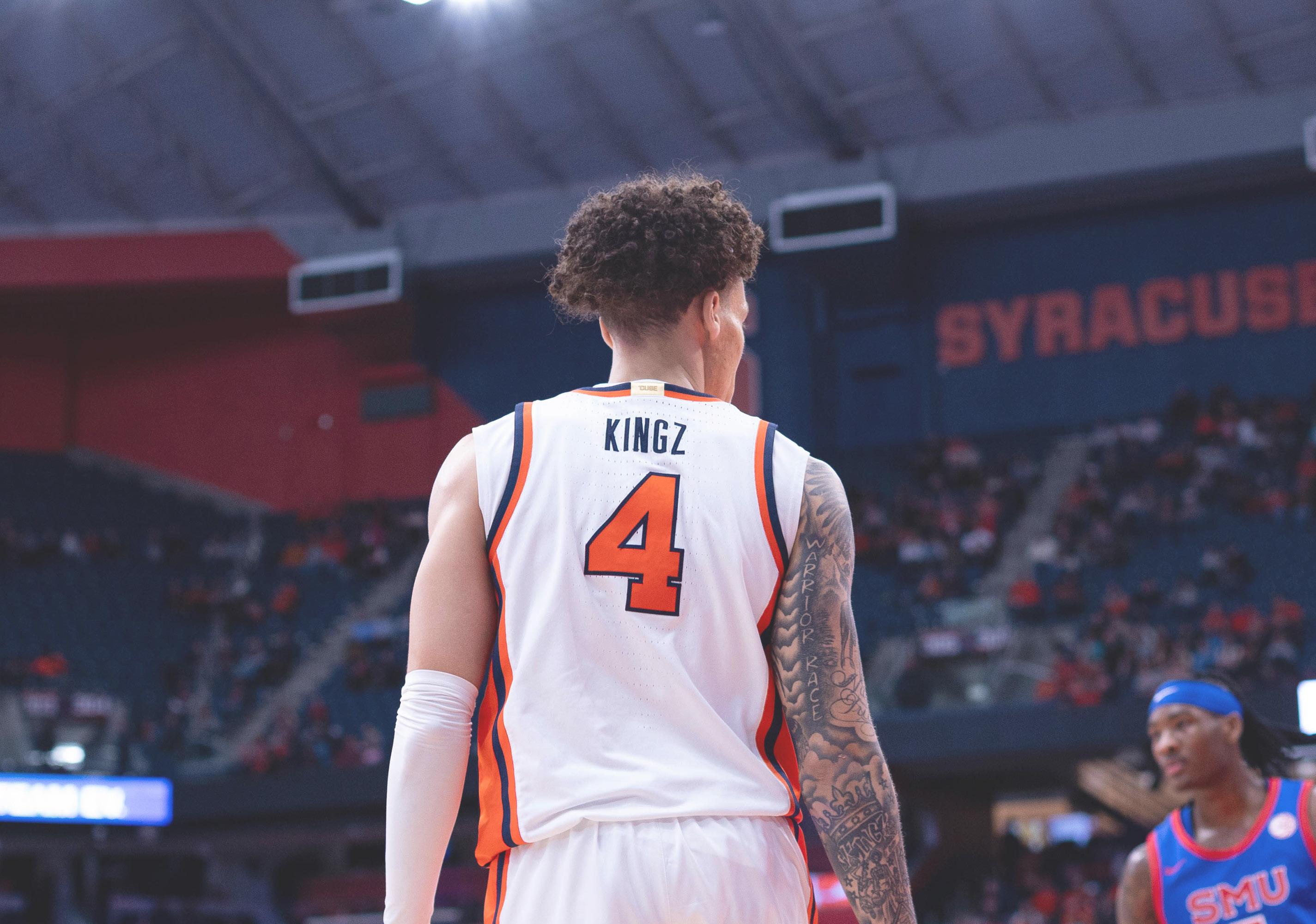
Nate Kingz didn’t grow up with typical role models. Instead, he turned to fictional characters Goku and Vegeta from “Dragon Ball Z.”
In the famous anime series, both push each other through their rivalry, which turns into an alliance that saves the Earth on multiple occasions. Kingz isn’t saving the world. He plays basketball. However, basketball saved him.
“I feel like I've been alone most of my life in terms of trying to get it out of the mud with basketball … Them dudes work hard and make no excuses in life,” Kingz said of his childhood idols.
Kingz has been given plenty of reasons to make excuses throughout his life. He grew up in a foster home in Oregon, struggling to find comfort before he was adopted as a teenager. Although he starred on the court while training at the local Salvation Army and recreation centers, giving him purpose and an escape.
In his fifth college season and first with Syracuse, Kingz evolved into SU's glue. He’s its top 3-point threat while often defending the opponent's best guard. Kingz already earned an extra year of eligibility through a medical redshirt, which he used this season. And with two of his college seasons at the NAIA and junior college level, he holds a strong case for adding another year through a waiver.
Kingz said the waiver process is definitely something he’s thought about pursuing after the season. For now, though, he’s focusing on keeping Syracuse’s March Madness hopes alive through a miraculous Atlantic Coast Conference Tournament run in Charlotte.
“Basketball has been his outlet, his thing he can control,” said Ryan Kirsch, Kingz’s McNary High School coach. “He hasn't had stability anywhere else. And so I think part of that drive to be really good is it's something he has total power over.”
Kingz entered his name in the transfer portal after the 2024-25 season. He’d spent the last two years playing for his hometown team at Oregon State, helping the Beavers to a 20-win season while receiving his degree.
Kingz told his former Oregon State recruiter, Tim Shelton, he wanted to make a quick decision so he could get back to work. He fielded plenty of offers but chose Syracuse because of his trust in Adrian Autry,
per Kingz’s mentor and former AAU coach
Devon Richardson. Kingz’s agent is also the coach's son, Adrian Autry Jr. Moving across the country didn’t cause any hesitation.
“He was like, ‘I'm a hooper,’” Richardson remembers Kingz saying. “‘Hoopers can live anywhere.’”
Kingz fit Autry and general manager Alex Kline’s defensive-minded vision. Offensively, Autry said they had Kingz “pigeonholed” as a catch-and-shoot guy because of his 44.6% mark from 3 a year ago. But he’s surprised the coaching staff with his playmaking, becoming one of Syracuse’s top options.
“He surpassed what we had him penciled in as, and we got a little bit more than we thought,” Autry admitted.
When it came to name, image and likeness money, Kingz wasn’t too worried, as most offers were on an even playing field, Richardson said. Any amount was far more than Kingz could’ve dreamed of.
Growing up, Kingz struggled to fit his body to his game. Kirsch said he was around 120 pounds as a freshman at McNary and didn’t eat much at home. Throughout high school, he rode his bike everywhere because he didn’t have his driver’s license.
Kingz sat on the bench as a freshman at McNary before developing into a starter as a sophomore. In his junior year, he became an all-state player. Kirsch said that, after the team’s daily two-hour practices, Kingz would bike home before heading back to the gym for another two hours to get shots up. The coaching staff told him to go home, but he refused.
“I don’t think I’ve met a kid that has had as many odds stacked against him as what Nate had,” Kirsch said.
While Kingz has become one of SU’s consistent bright spots, it didn’t start well. He shot just 31.8% from 3 in Syracuse’s 13 nonconference games. Before the Orange’s matchup with Boston College on Jan. 17, Kingz made a mental switch. He accepted he wouldn’t be able to play perfectly every game, alleviating pressure off himself.
The new mindset helped him shoot 41.6% from 3 through 17 ACC games and hit a gamewinning layup against SMU. Now, those NAIA days are a distant memory.
Kingz’s senior year of high school was cut short by COVID-19, leaving him with few
options to play at the next level. Richardson connected with a childhood friend, Landon Boucher, the head coach at Westmont College in Santa Barbara, California, to give Kingz an opportunity. Boucher thought he was obsessed with basketball. Then he met Kingz.
Before committing to Westmont, Kingz asked Kirsch three times to confirm he’d received a $70,000 per year scholarship. Kingz couldn’t believe it. More importantly, he had unlimited swipes at the campus dining halls.
I’m gonna go play, anywhere, anytime. That’s just the person I am, and that’s best for me. That’s been my whole life.
Boucher previously only watched Kingz play on a “fuzzy screen” with empty crowds, but it took him 15 minutes in the first open gym to identify Kingz as the best player on his team. On one of the first weeks on campus, Boucher remembers Kingz looking him dead in the eyes and saying he wanted to play in the NBA. His work matched his goal.
“He had an irregular upbringing, and his escape was going to the gym and practicing by himself,” Boucher said. “When he came to Westmont, he did the same thing.”
After a prolific year at Westmont, Kingz looked to upgrade. Richardson said Kingz received multiple offers to move to the Division I level, but they weren’t good fits. Instead, he moved to the College of Southern Idaho to play for one of the nation’s top JUCO squads.
Trace Ross was a walk-on guard for CSI, while Kingz was one of its stars. But after nearly every practice, the two squared off like it was Game 7 of the NBA Finals. Kingz further developed his game through one-on-
ones with teammates, something he’s continued at Syracuse.
“He loves the game more than any other person that I know,” Ross said. “I think he would say basketball saved his life.”
In the 2021 and 2022 offseasons, Kingz worked part-time at Jamba Juice for some extra cash. He worked at McDonald’s in the summer of 2023 and 2024, too. Kingz still stayed consistent on the court, leading the Golden Eagles in points per game and to a 29-2 record.
“He’s a great story of survival,” Reinert said. “He’s a pro in how he operates his life.” Starring at the JUCO level produces attention. Once Southern Idaho excelled with Kingz at the forefront, he again fielded D-I offers. Then, a homecoming ensued.
Shelton, now an assistant coach at Colorado State, invited Kingz on an unofficial visit to Oregon State while home on winter break in 2022. Shelton saw Kingz’s eyes light up on campus, envisioning himself playing for his hometown team.
Later in the season, with Southern Idaho playing in Hutchinson, Kansas, at the NJCAA championships, Shelton and Oregon State head coach Wayne Tinkle watched Kingz. Shelton remembers Kingz playing within the offense, doing little worth noting. Then, in the second half, Kingz exploded for multiple 3s, grabbing Tinkle and other coaches’ attention.
Although he had more options, Kingz decided to return home. But just like most of his life, survival didn’t come easy. Shelton departed for Colorado State, and ahead of the 2023-24 season, Kingz tore his ACL. He was forced to watch from the sidelines.
When he returned to action, Kingz became one of the Beavers' top options. He started every game he played in for Oregon State, and his 20 points in 39 minutes against then-No. 16 Gonzaga helped deliver an overtime upset. Kingz emerged as one of the nation’s top 3-point threats. His work had paid off.
“It’s fuel to the fire,” Richardson said. “He’s been in one place before. And knowing that you've been in one place before and knowing that you have a chance to change your life for the better and can potentially change your family’s life, that's all the drive that he’s ever had and ever needed.”
Nate Kingz SyRAcuSE GuARD see KINGZ page 11
It’s time for Naithan George to remind Syracuse fans why he’s here
cooper andrews SEnIOR STA ff w RITER
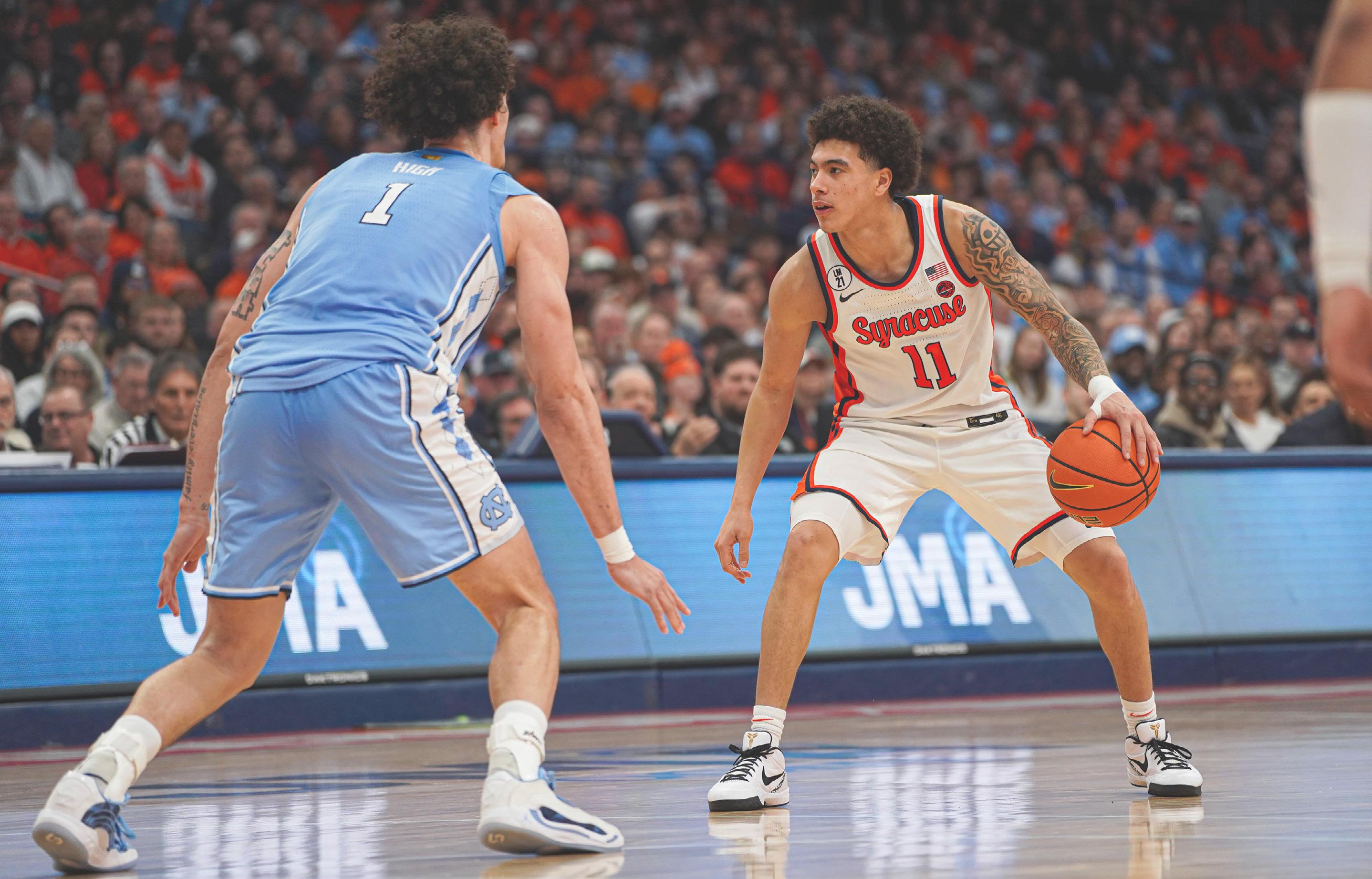
Naithan George learned about Syracuse’s passionate fan base the hard way. On Jan. 24, in the heart of another rough season for the Orange, fans ruthlessly booed head coach Adrian Autry and SU’s players during a home loss to Miami. George said he expected better from Syracuse fans. He understands their frustrations, but can’t wrap his head around the hate.
Then things got personal. Following George’s comments — in which he said SU’s home crowd was “disrespectful” for how they treated the team — fans directed negative messages at George. For George, a junior guard who transferred to Syracuse in the offseason after two years at Georgia Tech, it was an unfamiliar scenario. He didn’t enjoy it one bit.
“I know everybody’s a die-hard fan,” said his father, Anthony George. “But to go after a man like that, you got to keep in mind that he is a human being. I think some people lost sight of that.”
Through the adversity, though, George has stayed true to himself. A soft-spoken yet authoritative presence as a point guard, George’s facilitating is among the few bright spots for this year’s Orange squad. His 5.4 assists per game rank fifth in the Atlantic Coast Conference. Per EvanMiya, he’s in the country’s 98th percentile for assist rate. Sure, it hasn’t been the season he envisioned, but he’s doing his part as Syracuse’s floor general. Now, as SU finishes its regular season and heads into the ACC Tournament, George could be playing his final games in an Orange uniform. With one more year of collegiate eligibility, a crucial transferportal decision looms this offseason for George and his family.
This is his last chance to remind Syracuse fans why they were so giddy about his arrival
last offseason — a sentiment that’s since disappeared amid the Orange’s 15-15 record with one regular-season contest remaining.
“I mean, we show flashes (of greatness),” George said back on Jan. 24, pleading with SU fans to give him and his team a chance. “It’s just that little detail, that little play that we’re missing that could turn our season around, and that could potentially happen.”
Since then, however, those little details haven’t been there, and that turnaround hasn’t happened. Syracuse is fresh off a 2-5 February, which included a comeback victory over SMU but featured a 37-point blowout loss to No. 1 Duke and a porous defensive showing in a defeat to Wake Forest to close the month.
Growing up in Toronto with eight siblings, George always tried to stand out as the best. This season’s string of defeats affected him more than usual. After all, he was Syracuse’s marquee transfer-portal acquisition. He feels personal responsibility for each loss.
“You see him after games that we’ve lost, and he’s super emotional,” said freshman guard Kiyan Anthony on Feb. 14.
5.3
George's assists per game in the 2025-26 season
A month ago in the visitors’ locker room following SU’s 87-77 loss at North Carolina, Anthony walked over to a forlorn George sitting with his head down. The two talked for half an hour. George, who’s averaging more than three turnovers per game, was tired of coughing the ball up. Anthony sensed
George’s confidence sinking. He tried to inject belief into his point guard.
In moments like these, George doesn’t sulk for long. His father, Anthony George, says that sometimes after games, even if his son logs 35 to 40 minutes, he’ll go to the gym. He’ll ponder what he could have done better and manifest a better result.
George balled out in the immediate aftermath of that UNC loss. His confidence returned after a 19-point, 8-for-9 shooting performance against Virginia on Feb. 7. Then, he posted 10 assists in a double-overtime win over California.
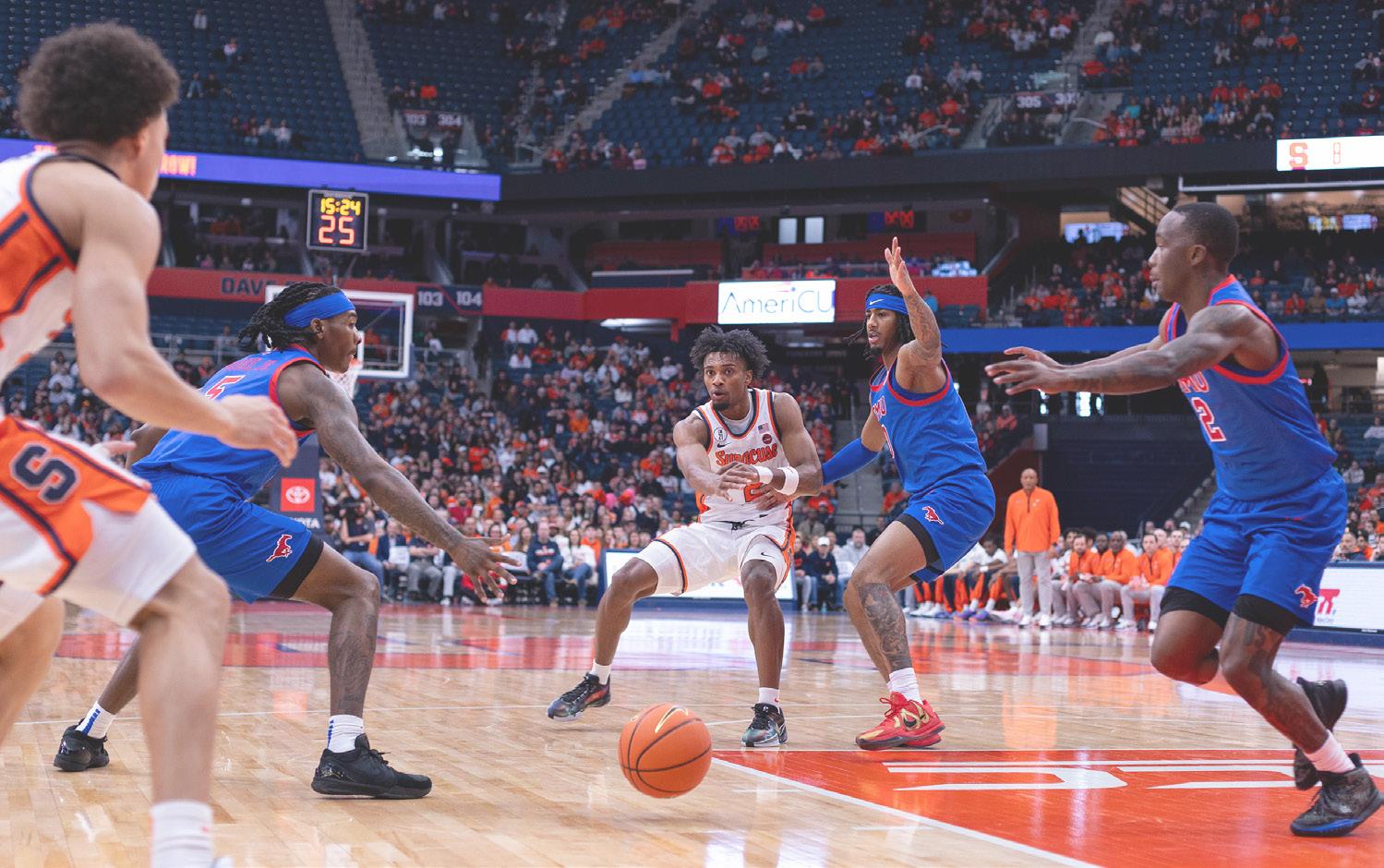
The cherry on top? Against SMU on Feb. 14, George’s patience and backcourt ball-handling set Nate Kingz up for the game-winning bucket. He also hit two crucial 3s as Syracuse mounted a 12-point comeback.
“I’m super happy to see him flourish in that role,” Anthony said of George after beating the Mustangs. “We’re all excited to see him grow.”
Moments like that — as well as his five double-digit assist games — are precisely why Autry wanted George so badly.
Autry, who said the Orange were “all-in” on George after he hit the transfer portal, was ecstatic to have an experienced distributor running his backcourt.
“You don’t have to teach him the position,” Autry said before the season. “He’s proven (to be good) at this level.”
But Anthony George said his son has found it difficult to play within SU’s offense — which George’s father assessed as “slow” in half-court sets. George prefers a fast-paced style, and though Autry’s desire was for the Orange to build a breakneck offense, the numbers say they’re slower than they were in 2024-25.
George spoke about Syracuse’s lack of pace a few times early in the season. He felt the little details were missing, and
players overthought SU’s offensive sets at times, preventing it from performing at full speed.
“I’d just say running our stuff harder,” George said on Dec. 17 regarding a solution to the Orange’s inconsistent offense. “And just executing at a high level — because the close games all come down to that halfcourt execution.”
Anthony George also said his son has acknowledged the weaknesses of Syracuse’s roster. George has told his father the Orange have too many ball-dominant players, which Autry publicly identified as an issue. George doesn’t say that to bash his teammates; it’s simply an honest assessment from the team’s backcourt commander.
But all these factors have contributed to SU’s disappointing year. Anthony George thinks this team could have won at least 19 or 20 regular-season games, especially with his son’s ability.
George’s father said of course his son wants to win for Autry. But at the end of the day, college basketball is a business that players can’t control. It’s not George’s responsibility to save Autry’s job; it’s just added weight.
Still, heading into an uncertain 2026 offseason, one of George’s lasting memories of Syracuse will be getting booed off the JMA Wireless Dome court numerous times. George and his father want SU fans to know that as long as he’s repping the Block ‘S,’ he’s going to give his all for them — even if next week in Charlotte is indeed his last dance with the Orange.
“Everything’s in the cards right now,” Anthony George said about where his son will play in his senior year. “We’re going to wait it out until the end of the season.
“A lot could change.”
ccandrew@syr.edu @cooper_andrews
For the first time in two years, Syracuse women’s basketball enters the postseason with some promise. After being selected 13th in the Atlantic Coast Conference preseason poll, the Orange have exceeded all expectations, going 22-7 in the regular season as a projected No. 9 seed in the NCAA Tournament.
Syracuse’s first event of March, though, is the ACC Tournament. SU, sporting a 12-6 conference record, secured the No. 7 seed after Virginia Tech’s win over Virginia and Notre Dame’s victory over Louisville Sunday pushed the Orange down from fifth. Nonetheless, Syracuse enters the tournament looking to make some serious noise before March Madness.
The Orange kick off the postseason Thursday with a matchup against the winner of Wednesday’s game between No. 10 seed Cal and No. 15 seed Wake Forest. SU would need to win three more games from there to be crowned conference champions.
Here’s how our beat writers think Syracuse (22-7, 12-6 ACC) will fare in the ACC Tournament:

jordan kimball
this is (kind of) the one finish: semifinals
Three months ago, there was no reason to believe Syracuse would be as good as it is right now. Landing Laila Phelia was monumental, but Uche Izoje and Dominique Darius’ rises came out of nowhere. In my last prediction, I was sure SU would fail to back up Felisha Legette-Jack’s preseason claims a championship was reachable.
But all year, Legette-Jack has said this team was the one. I’ll finally take the bait. Kind of. Syracuse is 1-6 in Quad 1 games, yet I’ll be optimistic and assume this squad has overcome those blunders to reach the ACC Tournament Semifinals.
My biggest concern at the start of the season was SU’s lack of depth from 3-point range. There’s been glimpses of inefficiency, but Sophie Burrows is hitting her stride, Phelia can heat up unannounced and Darius and Maddy Potts serve as threats when those two are covered.
And, Izoje has proven time and time again she’s nearly unguardable inside.
Assuming Cal prevails over Wake Forest in the first round, there’d be a rematch of January’s triple-overtime thriller. Syracuse worked its magic with a Darius buzzer-beating 3, and I expect more magic to set SU up to face No. 2 seed Louisville in the quarterfinals.
This is where it gets a bit harder. On Feb. 8, the Orange trailed by as much as 22 points to the Cardinals, and although they cut it to five, they couldn’t emerge victorious. This time, Syracuse will punch first. That loss and a slow start against Pitt four days later served as a wake-up call.
But one Quad 1 win will be enough. North Carolina is a different beast, most recently downing a Duke squad that’s arguably the best in the conference. Syracuse will hang around but fall apart late, ending its ACC Tournament run in the semifinals.
Nevertheless, this is Syracuse’s best chance in recent memory to return to glory. Its run in the conference tournament will be yet another step toward that.
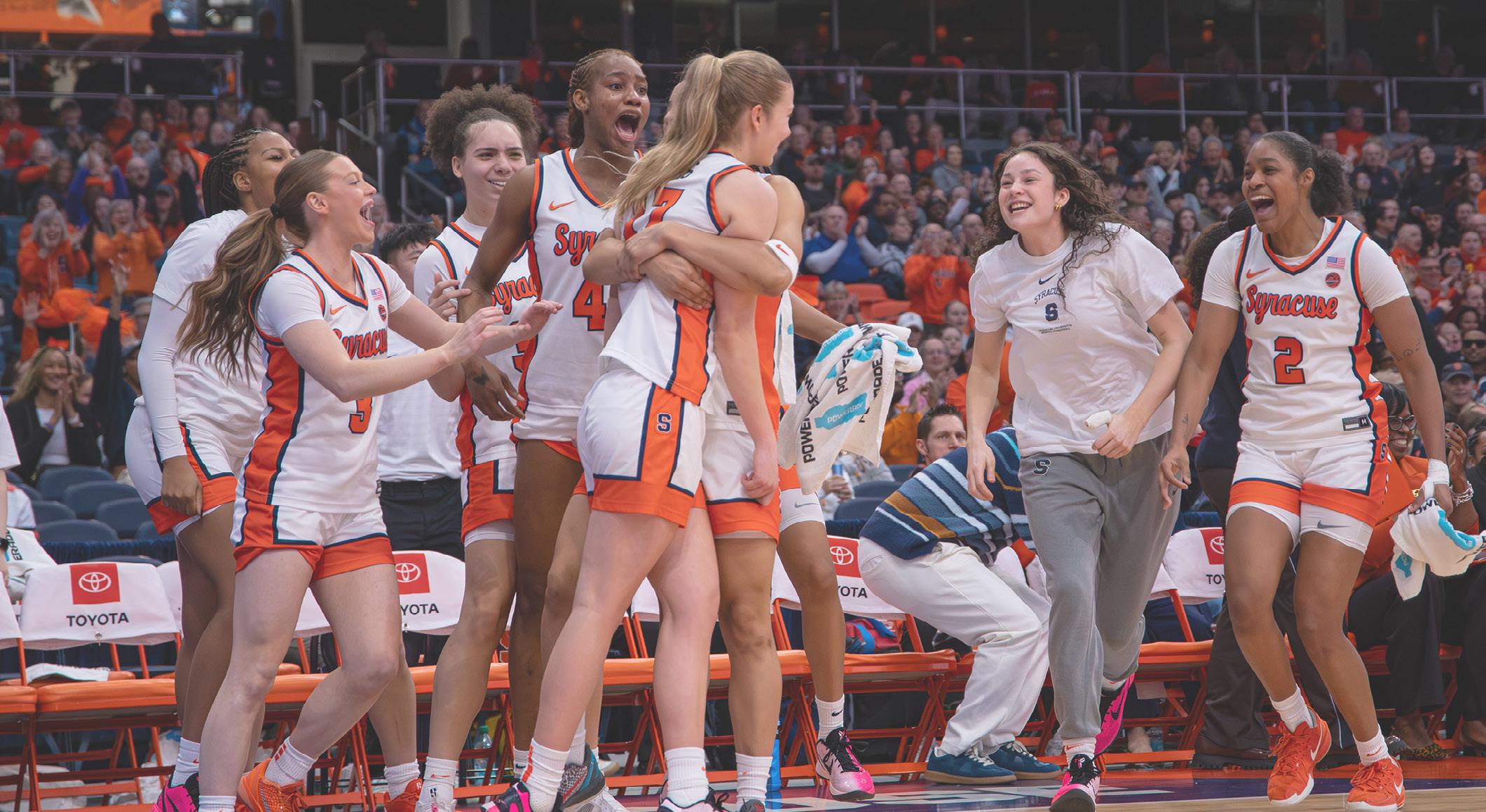

harris pemberton the madness begins finish: quarterfinals
After our predictions to start the season, I wouldn’t blame you if you wouldn’t want to believe a thing we say here. But I will humbly gloat that I was the only one who predicted the Orange would have a winning record this year. And boy did they blow those expectations out of the water.
What’s made this Syracuse team so special is that nobody could’ve predicted the magnitude of this turnaround. Izoje’s rise. Phelia’s resurgence. Darius’ breakout. All the

mauricio palmar have a safe flight finish: quarterfinals
The return has been booked for the night of March 7. Let’s see if Syracuse can beat me here.
I will be covering this team’s run in Duluth alongside my fellow scribe Harris, and thus, I have to book a flight home at some point during the weekend. I decided March 7 was the safest bet possible, since that would be the date of the ACC Semifinals — and I don’t foresee Syracuse making it that far to begin with.
Out of my fellow scribes, I’ve probably been the least bullish on this team all year.
pieces have fallen into place for a special season. The Orange have simply taken care of business at just about every turn and are almost certainly going to be in the NCAA Tournament because of it.
But at some point, to be the best, you have to beat the best. And Syracuse just hasn’t done that this season, sitting at 1-6 in Quad 1. So, my prediction is for the Orange to do what they’ve done all year — handle business against lower seeds but fold against the best.
SU’s first round matchup against either Cal or Wake Forest shouldn’t cause too many problems, although I would certainly be wary of a Golden Bears squad that pushed Syracuse to the brink and beyond
Before the season, I predicted, with a fair degree of confidence, for the Orange to go 14-16. I was wrong by a good margin, but it’s understandable.
Phelia was coming off a serious season-ending eye injury, Darius had never been a starter at any point in her career and Izoje was such an enigma that her high school isn’t even listed on her player biography. The question marks were far too plentiful for me to bet on SU to return to March.
But here it is, holding 22 wins heading into this week’s ACC Tournament. The last time I had to predict anything related to this team, the only data I had about this team was a 15-minute scrimmage in the Carmelo K. Anthony Basketball Center
when they met in January. The major test lies in the quarterfinals against Louisville, a team that cruised to a 19-point win over the Orange Feb. 8 after taking a 28-6 firstquarter advantage.
The Orange should hope they aren’t on the same 6 a.m. flight to Duluth that Mauricio and I are. Because, in a tournament as quick-paced as the ACC’s, there’s no room to come out tired and sluggish. Syracuse learned that the hard way when they last played the Cardinals. And either way, I just haven’t seen enough from SU to believe they can pull off a stunning upset over a top-15 team.
But maybe they’ll once again prove me wrong. I guess that’s what March is all about.
against the scout team. I have a much greater sample to base my prediction off of this time around.
And still, I’m just as pessimistic on this team’s outlook as I was before the season. Time and time again, I’ve watched this team crumble against high-level opponents. The Orange have played eight games against an opponent with a Simple Rating Score over 20.0, and they’ve lost seven of them.
Spoiler alert: If Syracuse advances to the quarterfinals, it’ll play Louisville, which sports a 33.22 SRS and shellacked SU in February. This team could certainly force me to eat crow and stomach a rescheduling fee. But something tells me that’s simply not going to happen here.
Syracuse women’s basketball went from losing 12 ACC games last season to winning 12 conference games this season.
With the new arrivals, Izoje created a group chat called Naija Family, where she shared advice and knowledge about Japan.
She texted and talked like she knew everything. Her game backed it up. After those morning practices, classes lasted until 4 p.m. Then, Izoje was back on the court getting more shots up for the second practice of the day.
“She’s never changed. If she just keeps doing that, she’s gonna make it,” Yussuf said.
Basketball occupied so much of Izoje’s life that she didn’t have time for much else. As her muscles tensed and her stomach rumbled, she chose to cook fufu with Yussuf and Dimaro or make TikToks when she wasn’t at practice or in class. When she healed, she’d explore local parks, and — years after arriving — finally eat Japan’s cuisine, especially miso soup and curry.
When Izoje’s high school career wound down, she was presented with different paths. She could move to America to play collegiately. She
could stay in Japan to do the same. Or she could join a professional WJBL team.
Izoje always wanted to go to America. She dreamed of eventually reaching the pinnacle of women’s basketball: the WNBA. But she knew she wasn’t strong enough.
She insisted she wouldn’t play at a Japanese college. She said it would’ve been like jail, lacking the freedom she yearned for. But a team like the Chanson V-Magic offered her a chance to improve and make money. After that, Izoje would have the foundation to become a star in the U.S.
“She had that fire,” Colomé said. “That unique sense of awareness or commitment to work hard that only superstars have. She really wanted to make it big.”
Joining the V-Magic forced yet another move, this time just a three-hour drive from Kyoto to Shizuoka. Shizuoka’s known for its picturesque views of Mount Fuji. But Izoje, respectfully, wasn’t there for that. She wanted to play basketball, then get out.
That’s precisely what she did. Colomé and his team helped her navigate the transition to the
U.S. In the meantime, she led the WJBL in blocks per game while finishing second in points and rebounds per game in 2024.
She met the fellow Nigerian Kareem for the first time, but Kareem was well aware of who Izoje was. She’d looked up to her for years. Yussuf and Dimaro occasionally attended her games, where Izoje was as energetic as she was in high school. Off the court, Victor and Izoje, of course, made TikToks. They’d dance until they couldn’t anymore.
“She was once a shy person but became a very outgoing person,” Victor said. “She likes the crowd. She likes being out there. She likes doing her thing in front of people.”
There were few better places for Izoje to do that than the JMA Wireless Dome, the largest on-campus basketball arena in the U.S. Izoje’s stats and film were sent to Legette-Jack and former SU assistant Kristen Sharkey. They both realized Izoje was a generational talent who could help Syracuse build something special.
Luckily for Legette-Jack, a few phone calls were all Izoje needed. She loved what Legette-
Jack was offering and committed to the Orange in January 2025, fulfilling a dream she’d had since those workouts with Mfon.
“I just think she’s one of a kind,” Legette-Jack said. “I just don’t know how to put into words how far this young lady has come. She’s been driven by a dream.”
Only one thing is missing in Izoje’s college career thus far. Her parents haven’t seen her play in person. In fact, she hasn’t seen them since that day eight years ago in the Lagos airport. She talks to them daily through phone calls and FaceTime. Sometimes, she’s disconnected due to data errors and technological difficulties, but it’s worth it for Izoje to share all the exciting new things happening in her life.
Legette-Jack can see that joy. She’s said it’s her dream to bring Izoje’s parents to watch her dominate. And when they finally see her in person, whenever that may be, there’s no telling how far she’ll have come. But one way or another, it’ll be proof they were right to wave goodbye. jordankimball28@gmail.com @JordanKimball_
included interest from Kentucky, Louisville and St. John’s, came just after fellow New York City point guard Pearl Washington starred at Syracuse.
“Red comes from humble beginnings and has been a real success story, and will continue to be, because he used (basketball) the way it's supposed to be used, as opposed to letting the game use him,” Sarandrea said.
Autry took over SU’s reins at point guard in 1990. Forward Billy Owens said Autry quickly worked his way into the starting role, instantly becoming a leader and motivator. Over time, Owens added that Autry became an “extension of the head coach.”
During Autry’s playing career, in which he was a four-year starter, SU won at least 20 games each season and reached three NCAA Tournaments — only missing the 1993 tournament due to sanctions. Looking back, Owens calls Autry one of the top five point guards he’s seen play for the Orange.
But now, the program that helped shape Autry is weighing whether he’s the right person to lead it. •••
In 2011, when Rob Murphy left Boeheim’s staff, Autry returned to Syracuse instead of going to Dayton.
Following three seasons at Virginia Tech, Autry began coaching SU’s forwards. His playing background and grassroots basketball coaching experience helped him become one of Syracuse’s top recruiters. Alongside his coaching, he helped recruit and develop Jerami Grant, Chris McCullough and Tyler Lydon into NBA Draft picks.
Former walk-on guard Ky Feldman, who was Lydon’s roommate before the forward became the Orange’s most recent first-round draft pick (2017), said Autry did an “awesome job” developing the forwards and that everyone in the position group “loved him.” To Feldman, Autry’s investment in the relationships he built stood out most.
I knew the challenges ahead, and knew it wouldn't be easy. But this is my alma mater. I have nothing but love for this place and want the best for the place.
Adrian Autry
SyRAcuSE hEAD cOAch
Once Mike Hopkins departed for Washington in 2017, Autry earned the Orange’s associate head coach title. Six years later, following Boeheim’s retirement, Autry became the heir apparent.
Like Hopkins, Autry could’ve jumped ship to lead a program earlier. But that was never his end goal.
“He had other opportunities to become a head coach, but he really wanted to coach at his alma mater,” Reese, now an assistant at Monmouth, said.
But once Autry became the head coach in 2023, Syracuse wasn’t Syracuse.
Across Boeheim’s final five seasons, SU reached just two NCAA Tournaments while averaging 17.8 wins per season. That five-year stretch includes the worst two-year stretch of the Boeheim era (winning just 33 games across his final two campaigns, including his only losing season in 2021-22).
“Let's face it, let's be honest here,” Sarandrea said. “Red didn't bring this program down. It was down when he got it.”
The start of the downfall depends on who you ask. But one thing is clear: Syracuse hasn’t built itself back up during Autry’s tenure.
Year 1 under Autry, a 20-win season, temporarily showed growth, but the Orange again missed March Madness.
A year later, SU reached a new low it’s yet to recover from.
•••
Owens feels Syracuse is currently a hard sell because “kids don’t care about history.” The same banners, pennants and pictures of players
that surrounded Autry during his media day press conference don’t hold the same weight they used to.
It used to help the Orange build a pipeline. “Great players wore the orange; that’s for freaking sure,” Sarandrea said while reminiscing about Pitt’s matchups with SU.
But name, image and likeness and the transfer portal have tilted the scale. While SU wasn’t ahead of the curve, it had players early in the Autry era to eventually get the program back to March Madness.
And then, within weeks of Autry’s first season concluding, Quadir Copeland and Maliq Brown, now respectively two of the best players in the ACC at NC State and Duke, entered the portal with two years of eligibility remaining. Meanwhile, Judah Mintz, an All-ACC Second Team Selection, forwent his final two years of college to play professionally.
All of a sudden, the budding core was gone. Autry and the Orange — albeit with limited money — failed to replace the departed production, and injuries led to the program’s worst season of the modern era.
After the season, John Wildhack, SU’s director of athletics, said, “the goal of this program is we should be playing meaningful games in March.” It set the expectation for Autry’s third season.
With Alex Kline settled into his general manager role and SU operating with a more detailed, structured process, the program entered the 2025 offseason far better equipped than it was a year earlier. The pressure was on.
“Right now, I feel sorry for college coaches, because you got to build just for one year, to win one year, because you never know what your roster is going to look like the following year,” Owens said.
Autry said SU built its roster with the “best ideas in mind that you get the best versions” of each player. But with a middling campaign nearing the end, it’s clear Autry never got everything to click.
In today’s college basketball landscape, patience is a luxury few programs afford. Turnarounds are expected immediately, and the possibility of a new hire sparking one looms over every struggling tenure.
•••
The situation Autry finds himself in is unusually complicated. With Chancellor Kent Syverud departing for Michigan and Wildhack scheduled to retire on July 1, the university is approaching one of its most consequential athletic decisions amid an administrative transition.
Complications help define Autry’s threeyear run at the helm. When Autry became the Orange’s head coach, the NIL and portal era was just beginning. Each day, the college basketball he played and previously coached in became different.
“It's a crazy situation that Adrian came in on,” Owens said. “If it was a perfect world and we had money, I actually feel we'd be winning.”
Given where Syracuse’s program stood and college basketball’s direction, Autry inherited instability. But above all, he inherited expectations.
The Final Four banners, pennants and pictures in the Carmelo K. Anthony Basketball Center show success isn’t asked for at Syracuse — it’s demanded.
Autry saw that as a kid in New York who dreamed of playing for SU. He saw it again as a player and later as Boeheim’s understudy. As head coach, he hasn’t matched it.
At Syracuse, that matters.
justingirshon@gmail.com
@JustinGirshon
Though Adair could never get the same alignment in Arizona as she could in Delaware. Anderson resigned after Adair’s first season, an eight-win slog of a campaign. That challenged Adair because “he was the one I said yes to,” she said.
She didn’t say “yes” to Anderson’s replacement, Graham Rossini. Multiple sources indicated they felt like the team lacked financial support from ASU’s administration. Carter Caplan, Adair’s director of basketball operations, pointed to the team’s lack of chartered flights as an example, saying he felt they were in the bottom tier of resources among Big 12 programs.
And, in a time where name, image and likeness money became ubiquitous in college athletics, multiple sources indicated they felt there wasn’t enough financial support in that realm either. Darrell Mosley, Adair’s associate head coach with the Sun Devils, said the program had “zero” when it came to NIL — which, in turn, led to Adair’s 29-62 record in Tempe.
ASU athletics declined to comment on Adair’s tenure.
“We were literally stuck bringing in midmajor players and JUCO kids to Power Four, which is unheard of,” Mosley said. “That's all the interest we can get, because that's all we could afford.”
Adair was fired on March 8, 2025, having won just 10 games in her third season. LegetteJack called her within 24 hours. SU’s head coach doesn’t remember when she first met Adair — she posits it must’ve been at least two decades
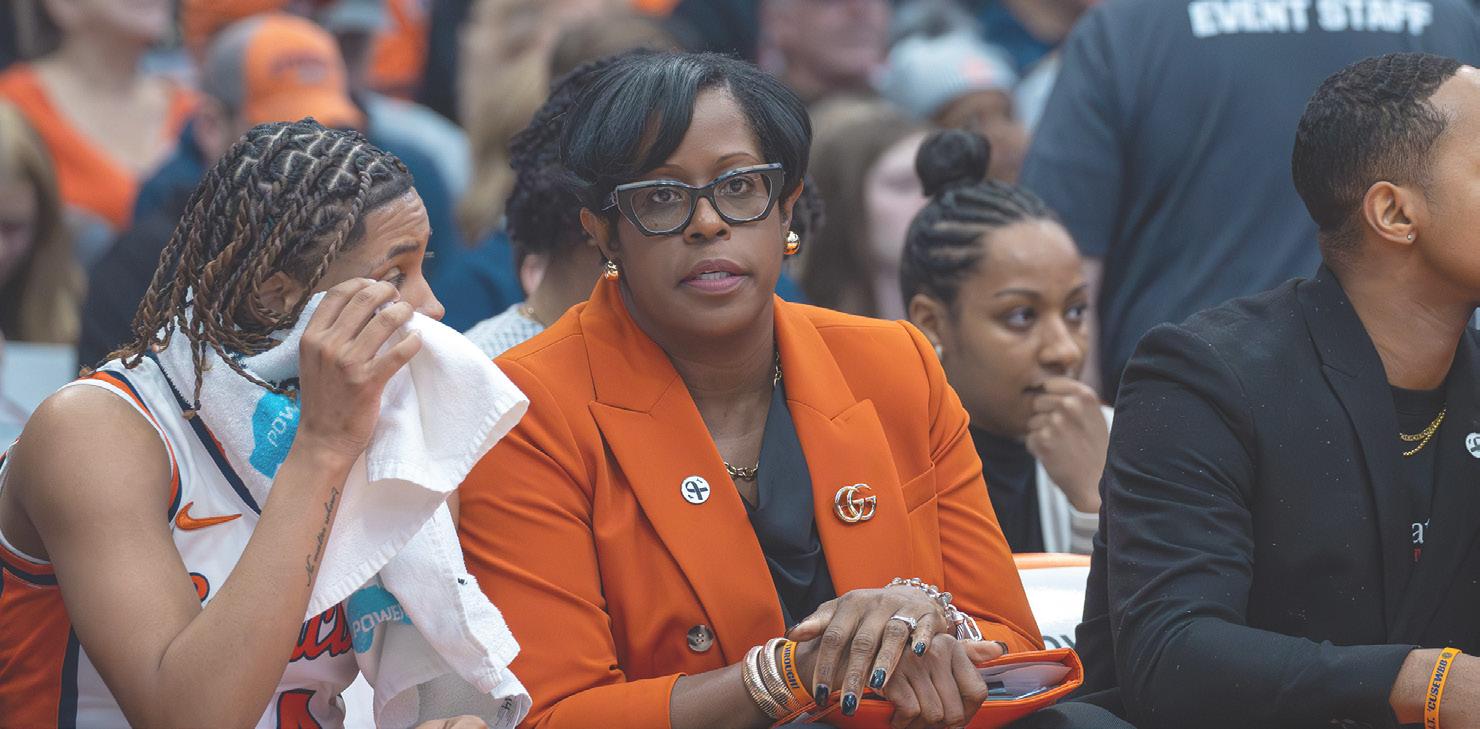
ago — but she does remember needing a “second head coach.” Adair fit the bill to a T.
Years of head coaching experience taught Adair what she needed from her assistants. That makes her the perfect assistant for SU, LegetteJack said. They talk to the players in equal measure, together. The Orange have affectionately nicknamed them “The Golden Girls.”
SU forward Journey Thompson, who played under Adair at Arizona State, remembers the sheer excitement she felt when she heard Adair was coming to Syracuse. It’s a different dynamic now, with Adair as an assistant, and she feels she can confide in her more than she ever could at ASU. A lot of things have fallen into place for SU in its revitalized season, and Adair is one of them.
“She's such a meticulous person, so disciplined in everything that her teams have
done,” Legette-Jack said. “I wanted that for my staff.”
Now that she's here — on the Carmelo K. Anthony Basketball Center court, sitting in a little white chair — she’s asked if she has any regrets. If she could do it all over again, would she change anything about the way her career played out?
She doesn’t even let the question register.
“Not one,” Adair says. “I absolutely wouldn’t change a thing.”
Then she rises from her seat, shakes hands, says her farewell and steps off the court into a hallway, ostensibly off toward the meeting she’s late to. The clock reads 11:15 a.m. Someone will have to get her up to speed on everything she’s missed.
mjpalmar@syr.edu
@mpalmarDO
Kingz changed his last name from Meithof — the name of his adopted family — to Kingz in May 2024 ahead of his breakout campaign. It’s a childhood nickname and a way for Kingz to forge his own legacy while leaving past troubles behind.
Even with success at Oregon State, it wasn’t home. Basketball is, wherever that may be.
44.6
Nate Kingz's 3-point percentage at Oregon State last year
Richardson said Kingz and his team have “got the ball rolling” on gathering information to present a case for another year of college eligibility. He’s not sure if any paperwork has been formally submitted, but knows Kingz will exert all options to add to his resume if given the chance.
The case of former Vanderbilt quarterback and JUCO product Diego Pavia certainly gives Kingz a chance at gaining another year. After all he’s been through, Syracuse’s trip to Charlotte can’t be the end.
“I’m gonna go play, anywhere, anytime,” Kingz said. “That’s just the person I am, and that’s best for me. That’s been my whole life.” amstepan@syr.edu