Serving the Northwestern and Evanston communities since 1881
The Daily Northwestern Find us online @thedailynu
Wednesday, October 14, 2026
DAILYNORTHWESTERN.COM
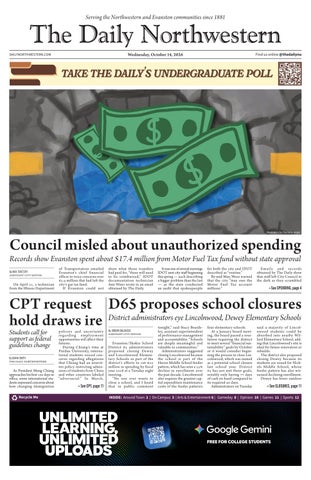
Illustration by Charlotte Nagel
Council misled about unauthorized spending Records show Evanston spent about $17.4 million from Motor Fuel Tax fund without state approval By MAX TURETZKY
assistant city editor
On April 21, a technician from the Illinois Department
of Transportation emailed Evanston’s chief financial officer to voice concerns over $3.9 million that had left the city’s gas tax fund. If Evanston could not
show what these transfers had paid for, “these will need to be reimbursed,” IDOT documentation technician Ami Wenz wrote in an email obtained by The Daily.
It was one of several warnings IDOT sent city staff beginning this spring — each describing a bigger problem than the last — as the state conducted an audit that spokespeople
for both the city and IDOT described as “routine.” By mid-May, Wenz warned that the city “may owe the Motor Fuel Tax account millions.”
Emai l s and record s obtained by The Daily show that staff left City Council in the dark as they scrambled
» See SPENDING, page 4
CPT request D65 proposes school closures District administrators eye Lincolnwood, Dewey Elementary Schools hold draws ire
Students call for support as federal guidelines change By DIANA SMITH
the daily northwestern
As President Mung Chiang approaches his first 100 days in office, some international students expressed concerns about how changing immigration
policies and uncertainty regard i ng em pl oy m ent opportunities will affect their futures. During Chiang’s time at Purdue University, international students voiced concerns regarding allegations that Chiang had an unwritten policy restricting admissions of students from China and other countries labeled “adversarial.” In March,
» See CPT, page 11
tonight,” said Stacy Beardsley, assistant superintendent assistant city editor of performance management and accountability. “Schools Evanston/Skokie School are deeply meaningful and District 65 administrators valuable to communities.” proposed closing Dewey Administrators suggested and Lincolnwood Elemen- closing Lincolnwood because tary Schools as part of the the school is part of the district’s efforts to cut $20 Haven Middle School feeder million in spending by fiscal pattern, which has seen a 33% year 2028 at a Tuesday night decline in enrollment over meeting. the past decade. Lincolnwood “No one ever wants to also requires the greatest capclose a school, and I heard ital expenditure maintenance that in public comment costs of the feeder pattern’s B:10.25" By JORDAN BALOUSEK
four elementary schools. At a January board meeting, the board passed a resolution requiring the district to meet several “financial sustainability” goals by October or it would consider beginning the process to close Lincolnwood, which was named as a potential school closure last school year. District 65 has not met these goals, notably only having 77 days of cash on hand compared to its required 90 days. Administrators on Tuesday
said a majority of Lincolnwood students could be absorbed into nearby Willard Elementary School, adding that Lincolnwood’s site is ideal for future renovation or rebuilds. The district also proposed closing Dewey because its students are zoned for Nichols Middle School, whose feeder pattern has also witnessed declining enrollment. Dewey has fewer outdoor
» See CLOSURES, page 11
T:10"
Recycle Me
INSIDE: Around Town 2 | S:9.75" On Campus 3 | Arts & Entertainment 6 | Gameday 8 | Opinion 10 | Games 11 | Sports 12
T:2"
S:1.75"
2 THE DAILY NORTHWESTERN
WEDNESDAY, OCTOBER 14, 2026
AROUND TOWN
TWI parents reflect on transition to Foster School By JORDAN BALOUSEK and ALLISON KUESTER
the daily northwestern
When the Evanston/Skokie School District 65 Board of Education voted to close Willard Elementary School’s Two-Way Immersion strand and gave its students the option to continue services at Foster Elementary School, 6th Ward resident Jennifer Cameros “reluctantly” made the decision to transfer her children the day before the deadline. Cameros, who said she moved to Evanston for District 65’s TWI program, described the Willard community as “tight-knit.” She told her children they would always have the option to return to Willard, their home school. During the first week of school, her daughter came home every day asking to return to Willard. “This is the point where I’m trying to teach my kids resilience, and life comes at us hard and fast and how to roll with the punches and deal with change, and so it’s been difficult,” Cameros said. As the district tackles a severe budget deficit, Cameros’ family is one of many that has been affected by the shuttering of TWI strands at Willard and Dr. Bessie Rhodes School of Global Studies. Both schools’ TWI strands were consolidated into a single strand at Foster. Parents said their children encountered various successes and difficulties throughout the transition process, but were mostly optimistic about their children’s future at Foster. District 65’s TWI program puts English-proficient students and Spanish-speaking students receiving English Learner services in the same classroom. The program aims to help students develop strong literacy and language proficiency skills in both Spanish and English. At the K-5 level, TWI is offered at Dawes, Dewey, Oakton and Washington Elementary Schools — and now Foster, too Fifth Ward parent Heather Huddleston said it made sense for her children to attend Foster, their neighborhood school. But regardless of zoning, she said she wants her kids to continue attending school with their friends, who they have known since preschool and kindergarten. “We have a really close community of parents and
families that get together,” Huddleston said. “And I’m sure that exists at other schools too, but it takes a few years before you can really build that level of trust that we have.” Like Cameros, former Willard parent Celia Carlino said her daughter initially kept telling her that she missed Willard. But now, she said her daughter is adapting and making new friends. She said she recognized the change would affect families in different ways, and that she’s approaching the situation with an open mind. “You are not fighting alone,” Carlino said. “You are not dealing (with) your emotions alone, especially with the children, and some parents. So it depends. Every parent is different.” Huddleston, meanwhile, called the transition process “really smooth.” She said her daughter has asked if “she could go to school on the weekends, too.” Most parents said there were no notable curriculum differences or educational challenges at the new school. Seventh Ward resident Erika Crowther said Foster Principal Charlise Berkel put together a “really strong team” of teachers. Some former Bessie Rhodes and Willard TWI teachers now teach in the Foster strand. “My son actually has the same teacher my daughter had last year,” Huddleston said. In the 2025-26 school year — the final year before it closed — Bessie Rhodes began offering dual language instruction in sixth and seventh grade. This year, the program is available in all grades at Haven Middle School and sixth grade at Nichols Middle School. A plan on District 65’s website outlines a proposal by the district’s Dual Language Committee involving the rollout of dual-language instruction programs at all grade levels in each of the district’s three middle schools by the 2029-30 school year. Former Willard parent Meg Knapik said she hopes to keep her children, who are now enrolled in Foster TWI, in the program through middle school. “It’s been a really positive learning experience, and we certainly want to see that continue,” Knapik said. But the transition carries additional considerations for some parents. Fifth Ward parent Sylvia Carlson explained that her family and others were initially told their cohort would have the option of transitioning to Haven
together. However, they were later told that once TWI strands opened at all the middle schools, students would have to attend the school their homes are zoned for. While this doesn’t directly impact Carlson’s family she said she has not received a clear answer on what this means for families that could potentially have students attending two different middle schools. “It just feels like another assault on the Bessie Rhodes community, because the Willard TWI doesn’t have that problem. They all get to go to Haven,” Carlson said. “But for us, they’re telling us that the younger grades can’t. And it’s such a small number of kids, too. I just don’t understand why they wouldn’t just let us all go to Haven together.” Foster families also faced difficulties that complicated long-term planning. In March 2022, the District 65 board approved a redistricting plan, which included a K-8 school in the 5th Ward. But in January 2024, board members pivoted to building a K-5 school, largely due to budget concerns. Former Bessie Rhodes parent Jo Ann Flores-Deter said her family felt the impact of this change. She said that she was initially excited to enroll her kids at Foster so they could all stay in one school for an extended period of time. But after the district announced that Foster would be an elementary school, she decided to enroll her kids at Dr. Martin Luther King Jr. Literary and Fine Arts School, which doesn’t have a TWI program. “I’m very sad about it,” they said. “It’s a little discouraging that King Arts doesn’t have TWI, that it doesn’t have that language.” For now, families said they’re focusing on the best ways to build their new community at Foster. Former Willard parent Sharon Tam said parents have formed group chats and let each other know about community activities. “I think (the community is) still in the process of being built,” Tam said. “But certainly, I think everyone makes an effort. I think it’s just the nature of where all the kids are coming from that makes it a little bit harder to coordinate these things.” For TWI families already living in the 5th Ward, parents said the transition has brought neighbors closer together.
Huddleston said it’s been “bananas” to realize how many TWI families live down the street from her. “I understand now the fight for bringing a school back to the neighborhood. It really does, I think, help build community,” Huddleston said. Former Bessie Rhodes parent Aaron Shaw touched on the historical significance of Foster’s opening. The original Foster School closed in 1979 as part of Evanston’s desegregation plan in the city’s 5th ward, which has historically been predominantly Black. Residents have since engaged in a decades-long push to restore the 5th Ward’s neighborhood school. “I think that opening a school in this part of Evanston again is probably a bigger deal than any shifts with TWI that have happened there,” he said. While families expressed excitement about Foster’s opening, substantial changes remain on the horizon. Last month, the district announced it is aiming to cut about $20 million from its budget by fiscal year 2028 and close two schools. Community members have since voiced various concerns during a series of community meetings. Fifth Ward resident David Hauser said community members are now more equipped to understand the choices the district is making and how they can make their voices heard. “I really sincerely think if Evanston is being Evanston, then we need to solve these problems with empathy, thinking about children first and not just recklessly doing things that then just create more problems a decade or two from now and a whole new generation of children,” he said. Many parents said the transition to Foster wasn’t without its challenges. But a month into the school year, most said their children have adapted well. Despite the “frustrating” nature of navigating a school closure, Huddleston said the outcome of enrolling at the new Foster School has given her some “peace.” “We went through like a couple of years of this, so I feel for the families that are going to go through it, but also I know it’ll be okay,” she said. “Honestly, if anything, it’s worked out really great.” j.balousek@dailynorthwestern.com a.kuester@dailynorthwestern.com
. . . PENDING DELIVERY. . .
The Daily’s
BIGGEST HEADLINES right in your inbox
Scan below or sign up at dailynorthwestern.com/email
1
WEDNESDAY, OCTOBER 14, 2026
THE DAILY NORTHWESTERN
3
ON CAMPUS
NU considers new building plans By DESIREE LUO
The Daily Northwestern www.dailynorthwestern.com Editor in Chief Anavi Prakash
eic@dailynorthwestern.com
senior staffer
Northwestern leadership is laying the groundwork for a new engineering-focused building on the University’s Evanston campus, multiple people familiar with the plans confirmed to The Daily. Board of Trustees Chair Peter Barris (McCormick ’74) told The Daily on Thursday that the Board has not yet officially approved the project. Barris said NU leadership is still discussing the building’s exact function, size, location and source of funding. “It will be a building that, if it goes forward the way it’s being structured now, will be McCormickdriven,” Barris said. “But it’s going to work with all other aspects of our university, not just STEMrelated stuff.” While the project is still in its early stages, trustee Steve Cahillane (Weinberg ’87) said it has already received financial contributions. The plans have emerged as University leadership aims to advance NU’s engineering program, Cahillane said. “President (Mung) Chiang, the trustees, many in the University have really high ambitions for our engineering program,” Cahillane told The Daily on Friday. “We think it can be even better than it is today, and there’s been a number of very generous donations made toward that.” NU worked with London-based company Malcolm Reading Consultants to identify a longlist of 12 architecture and engineering firms to design the building, according to a June 3 MRC news release. That search has reached an “advanced stage,” according to a September update to the news release. MRC did not respond to The Daily’s requests for comment. Jason Arnold, NU’s director of portfolio innovation and industry engagement, reposted both MRC’s announcement launching the search for firms on April 1 and the longlist announcement on June 3 to LinkedIn. Two of the 12 firms — Skidmore, Owings & Merrill and Studio Gang — are headquartered
General Manager Stacia Campbell
stacia@dailynorthwestern.com
Holly and John Madigan Newsroom Phone | 847.491.3222 Campus desk
campus@dailynorthwestern.com
City desk
city@dailynorthwestern.com
Sports desk
sports@dailynorthwestern.com
Ad Office | 847.491.7206
spc-compshop@northwestern.edu
Daily file photo by Cayla Labgold-Carroll The plans have emerged as University leadership aims to advance NU’s engineering program.
in Chicago. Others hail from across the U.S. and Europe. “The University continues to evaluate our needs for future research space, but we are still early in those processes,” a University spokesperson wrote Monday in an email to The Daily. “We don’t have any plans or updates to share at this time.” Two large-scale ongoing construction projects on the Evanston campus are slated for completion by 2027, according to the NU Facilities website. The Ann McIlrath Drake Executive Center, formerly the Allen Center, broke ground in spring 2025. Scheduled to open fall 2027, the new building will house the Kellogg School of Management’s Executive MBA and Executive Education programs. Renovations to Bobb-McCulloch Hall, a student dormitory on North Campus, began in summer 2025. The complex is slated for full occupancy in August 2027. The start of the 2026-27 academic year also marked the completion of two long-anticipated projects.
More than two years after breaking ground, NU’s $875 million new Ryan Field opened Oct. 2 with an NU football victory over Penn State. And 2001 Sheridan Road, previously home to Kellogg as the Donald P. Jacobs Center overlooking Deering Meadow, now houses a variety of social science departments, institutes and the School of Education and Social Policy. The project received a $10 million gift from Cahillane and his wife, Tracy (Weinberg ’88). Both Cahillane and Barris emphasized that a new building, while centered on engineering, would foster an interdisciplinary atmosphere. Barris, a longtime member of the McCormick Advisory Council, said the engineering school has long looked to grow. “There’s been a need for expanded space for McCormick for years and years and years now,” he said. d.luo@dailynorthwestern.com
THE DAILY NORTHWESTERN is printed each Wednesday during the academic year, except vacation periods, the two weeks preceding them and once during August, by Students Publishing Co., Inc. of Northwestern University, 1999 Campus Drive, Evanston, IL 60208. All news is published 24/7 online at Dailynorthwestern.com. First copy of THE DAILY is free, additional copies are 50 cents. All material published herein, except advertising or where indicated otherwise, is Copyright 2025 THE DAILY NORTHWESTERN and protected under the “work made for hire” and “periodical publication” clauses of copyright law. POSTMASTER: Send address changes to THE DAILY NORTHWESTERN, 1999 Campus Drive, Evanston, IL 60208. Subscriptions are $100 for the academic year. THE DAILY NORTHWESTERN is not responsible for more than one incorrect ad insertion.
Check out
DAILYNORTHWESTERN.COM for breaking news
Get notified with our latest headlines in an instant Pilates the way it was meant to be!
15% OFF FOR NU STUDENTS Fully equipped Pilates studio in downtown Evanston Private & small group classes • Monday–Saturday by appointment 847-492-7200 • 1609 Oak Ave, Downtown Evanston www.pilatesconnectionchicago.com
Follow @thedailynu on Instagram
The Daily is back in print.
Wednesdays on the NU campus & Evanston.
24/7 online @thedailynu & dailynorthwestern.com
For delivery suggestions & comments, contact The Daily Business Office at ads@dailynorthwestern.com or 847.491.7206
4 THE DAILY NORTHWESTERN
SPENDING From page 1
to account for missing funds and filed paperwork that was years overdue. At times, they provided misleading explanations that contradicted what IDOT was telling the city in writing, and an IDOT review revealing the scale of the problem was also kept from Council. Illinois levies a Motor Fuel Tax on all gasoline, diesel and kerosene sold in the state. It sends a portion of this revenue to municipalities for local road work, but those funds can only be used for projects approved by IDOT. For years, Evanston spent this state money
WEDNESDAY, OCTOBER 14, 2026
other ways the city was mishandling its MFT account, including improperly transferring funds to other city accounts. She warned that the city needed “to modify its procedures.” “There will be millions in deficiencies/ negatives and a number of ineligible expenditures as proper MFT procedures were not followed,” Wenz wrote. Within hours, Desai forwarded the email to four additional city staff members. “Can we fix both financial and operational issues?” Desai wrote. “We should discuss this before we start spending MFT MONEY in 2026.”
Illustration by Charlotte Nagel
without proper authorization, a Daily analysis found. By the end of 2024, IDOT’s books recorded that Evanston should have had about $24.4 million in its MFT account. Instead, the city only had about $7 million. The roughly $17.4 million discrepancy represents funds the city spent on road work and maintenance contracts without state approval, as well as other transfers that IDOT could not trace. ‘Not our money yet’ Since the beginning of the year, Ald. Clare Kelly (1st) has been asking city staff to explain the gap. She said the MFT fund came to her attention last year when city staff asked Council to approve bonds to pay for infrastructure improvements. Kelly asked why the city could not pay for the project with MFT money, and staff told her the account was down to just a few million dollars, she recalled. Unsatisfied with the city’s answers, Kelly said she called IDOT in January. She learned that state records showed Evanston’s balance should have been millions higher than it was. “You can have a little lag of a million, or two or three, but not 20,” Kelly told The Daily. Kelly, the self-described “fiscal conservative on the dais,” raised this discrepancy to city staff. At a January meeting of the Administration and Public Works Committee, which Kelly chaired at the time, she asked Assistant City Engineer Chris Sous about the “21 million they say we have and the seven million we say we have.” “It’s in the future,” Sous said. “That’s how much they have as a set amount, in which they plan on giving to the City of Evanston in (the) future.” But Sous’ explanation was backward. Records show the gap actually represented millions of dollars in past city spending that IDOT had never approved. Sous previously spent more than eight years as an IDOT engineer before joining the city, where he now handles its MFT resolutions. Kelly raised the issue again at a Finance and Budget Committee meeting in February. The city’s CFO and treasurer, Hitesh Desai, repeated Sous’ explanation, claiming that the funds were “not our money yet.” “No, it’s a running balance,” Kelly said. “That’s money that we’ve been getting every month. That’s not money to come in the future.” Desai conceded, affirming that the funds were “allocated but not authorized.” He then said comparing the two balances was like comparing “apple(s) to oranges.” Eventually, the committee’s chair, Ald. Matt Rodgers (8th), cut their exchange short. “That’s a bigger discussion, I think,” Rodgers said. Rodgers did not immediately respond to The Daily’s request for comment. IDOT soon began spelling out how big. ‘Just a paperwork issue’ In addition to the untraceable $3.9 million, Wenz’s April 21 email to Desai flagged several
Nine days later, on April 30, Wenz advised staff that the city was not advertising in IDOT’s Notice to Contractors Bulletin, a statewide listing where contractors can find public road work projects to bid on. State rules require municipalities to post all MFT-funded contracts over $25,000 in the bulletin. State and city records indicate the city has only posted five projects in the bulletin since 2020, and more than a dozen contracts paid for with MFT money were not properly advertised. Wenz told city staff that this was not allowed, adding that those contracts “technically” should be repaid. In a Monday statement to The Daily, city spokesperson Cynthia Vargas said the city had “followed applicable state law regarding bid advertising, and IDOT has accepted the City’s approach as meeting the applicable bid selection requirements.” By May 13, Wenz was requesting that Evanston stop transferring money out of its MFT fund altogether until its “current issues” were resolved. “Hopefully, this is just a paperwork issue, but I don’t want the deficiencies to increase while this is addressed,” she wrote. Wenz emailed her completed review of the city’s MFT fund — titled “Documentation Review No. 69” — to City Clerk Stephanie Mendoza on June 4. It found $17.4 million in unapproved spending between January 2018 and December 2024, including almost $5.1 million that could not be tied to any projects. Wenz asked staff to “address the deficiencies” or else “reimbursement may be required.” IDOT’s cover letter instructed that the review “should be presented to the Mayor and City Council at the first regular meeting after receipt.” Mendoza, who is running for mayor, replied to Wenz six days later. She wrote that she would “ensure this is added to the agenda for our upcoming meeting” and copied City Manager Luke Stowe on her reply. Half an hour later, she wrote to Stowe separately that she was “hopeful that we will receive a positive outcome on Document Review #69 by the time it is presented to Council.” On June 15, Wenz asked city officials, including Mendoza and Stowe, to bring supplemental resolutions to Council “as soon as possible” for road work projects that had cost more than what councilmembers had originally approved. More than two months later, in an Aug. 21 email, Mendoza promised that she would schedule those supplemental resolutions “for the September 14th City Council meeting along with document Review #69.” Council has met six times since Mendoza’s initial response, but neither the documentation review nor two outstanding supplemental resolutions have appeared on Council’s agenda. Kelly told The Daily she obtained a copy of the review only after contacting a law firm, which sent a demand letter to the city. City staff then turned over more than 30,000 pages of emails, bank records and other documents, including Documentation Review No. 69. Why the review never made it to the dais remains unclear. “It’s a whole can of worms,” Kelly said.
‘Shell game’ As spring turned to summer, Kelly continued to press staff members on what she perceived as the city’s lack of transparency. Deputy CFO Clayton Black told the Finance and Budget Committee during a July 8 meeting that the blame lay with IDOT, which he said was “many, many, many years behind” in approving the city’s old expenses. But records show it was Evanston — not the state — that was years behind. From January 2020 to late June 2025, IDOT approved the city’s MFT spending only twice, both for old projects, largely because Evanston had failed to file the forms needed for state approval. In June 2025, facing a state deadline, the city signed state forms for five projects completed between 2020 and 2024. This June, days after Wenz asked for more missing paperwork, the city finally submitted resolutions for years of past maintenance spending. At the July 8 Finance and Budget Committee meeting, Desai said staff had been discussing the issue with IDOT and that the city “might have a better picture within a couple of months.” He did not mention the documentation review received a month earlier that put the city’s unapproved balance at $17.4 million. Over the preceding months, Black and Desai had each received several warnings from IDOT about Evanston’s MFT fund. Desai was also copied on the completed IDOT review in June. Kelly said she became increasingly frustrated by what she considered staff flouting IDOT rules and misinforming Council. She told The Daily that she believed officials were engaged in a “shell game” to move funds behind the scenes. She introduced an ordinance with Rodgers and Ald. Thomas Suffredin (6th) requiring the city to advertise MFT-funded contracts in IDOT’s bulletin. At an Aug. 24 Referrals
review, completed in 2019, noted that “the City has been advised of missing (Bureau of Local Roads) forms and proper MFT procedures.” This time, the state would “not do another lump sum authorization,” Wenz wrote in her April 30 email. Still, IDOT has since approved much of the old MFT spending after the fact. It has also allowed the city to cover expenses it could not document by substituting other MFT-eligible costs, such as maintenance and staff payroll. Kelly called this substitution of expenses a “switcheroo” that bypassed Council. “To me, that’s completely non-transparent, undemocratic,” Kelly told The Daily. “The Council back then voted on a project or voted on an expenditure and voted on the funding source.” The city eventually accounted for the missing $3.9 million, most of which had been moved to a separate investment fund in 2021 and then into a new MFT account two years later. This explanation was not relayed to IDOT until this September, and it contradicted a city employee’s previous claim that the money had gone to a different fund to pay for MFT expenses. In her statement to The Daily, Vargas said the city is working with IDOT to “ensure that all required documentation is submitted for projects funded in whole or in part with MFT funds.” She added that updated resolutions would be scheduled for the Oct. 26 City Council meeting. “The City of Evanston remains committed to complying with all applicable laws, regulations, and policies governing the use of MFT funds for street improvement projects within the City,” Vargas wrote. “The City will continue to work with IDOT to ensure it maintains and submits required documentation and follows IDOT’s recommendations in future projects.” None of the city staff named in this
Illustration by Charlotte Nagel
Committee meeting on the proposal, Sous incorrectly stated the city “typically” does so. Kelly subsequently sent three emails to Stowe and Evanston Police Chief Schenita Stewart, the acting deputy city manager, requesting that Sous, Desai and City Engineer Lara Biggs — Sous’ supervisor — correct the record. “It’s difficult for me, as an elected official, to effectively carry out my responsibilities to residents when I can’t rely on the accuracy of a staff member who has repeatedly misinformed the Council and the public regarding the MFT Fund,” Kelly wrote in an Aug. 27 email. “The City Council relies on the accuracy of staff information when making decisions with millions of taxpayer dollars.” No corrections have been issued. ‘Good stewards’ This is not the first time IDOT has flagged issues to the city. In 2017, the state cleared $9.1 million in old spending — covering nearly two decades of missing paperwork — with a single lump-sum payment. Its next
story responded to The Daily’s requests for comment. Millions more in MFT expenditures remain unresolved. Wenz wrote in a Sept. 1 email to city staff that another nearly $4 million still could not be tied to any project. Unless the city finds other eligible expenses, Wenz wrote that it “owes the MFT account” that amount. The $4 million figure could also grow. It does not include projects that IDOT did not approve because they had not been advertised, and it assumes IDOT will accept all maintenance costs the city submitted for previous years. The state’s audit, which IDOT previously indicated would be finished by late August, is still ongoing. “The city of Evanston has consistently shown that they are good stewards of MFT dollars,” an IDOT spokesperson wrote in a Sept. 30 statement to The Daily. The spokesperson declined to give an updated timeline for the audit. m.turetzky@dailynorthwestern.com
WEDNESDAY, OCTOBER 14, 2026
THE DAILY NORTHWESTERN
5
El Diario
Disponible en línea aquí: www.dailynorthwestern.com/category/el-diario
Los exalumnos de NU celebran Homecoming Por SAMANTHA MONJE
editora asistente de el diario
Las cajuelas estaban llenas de conchas de varios sabores, aguas frescas y duritos mexicanos mientras la música hispana llenaba el aire. Fue el ambiente festivo de la décima celebración anual de homecoming de la asociación de exalumnos latinos de Northwestern este fin de semana. La asociación, conocida como LANU, ha organizado fiestas tailgate cada año durante el festejo de homecoming. Tienen como objetivo de reunir a la comunidad latina de NU y reconectar a los estudiantes con sus raíces a través de la gastronomía, la música y las presentaciones artísticas. Este año, el tailgate se festejó en el estacionamiento frente al Technological Institute. LANU fue fundado en el año 2000 para financiar becas mediante donaciones y para animar a los exalumnos a construir un legado en la universidad. Sigue la regla de las tres R’s: reclutar, retener y regresar, y es una manera de motivar a los estudiantes y exalumnos a establecer contactos. El evento resonó con los ritmos del DJ peruano Junior Pomalaza, quien mezcló merengue, cumbias, reggaetón y los clásicos de la música pop latina. La junta de LANU prioriza proveer comida
de negocios latinos en estos festejos. Según el copresidente de LANU, Daniel Flores (Comunicaciones ’14, Kellogg ’15), “la idea es representación”. Este año se dio comida de Bravo Bakery, una panadería mexicana especializada en productos de panadería tradicionales, ubicada en Mount Prospect, Illinois. “Obviamente, si queremos hacer un evento latino, queremos trabajar con empresas que invierten con nosotros y nos importan”, dijo Flores. Las cajuelas estaban llenas de conchas de varCompartió el ejemplo de Mi Costeñita, un negocio en el área de Chicago que vende especias y dulces auténticamente mexicanos. Patrocinaron el último tailgate de LANU con música, comida y regalos para los estudiantes. Es una de las empresas latinas más grandes del estado, agregó Flores. La comida y la música definitivamente fueron un elemento atractivo para muchos estudiantes. Mientras los estudiantes platicaban con amigos y bailaban, el exalumno de LANU, Juan Cabrera (SESP ’15), y su hermano cocinaron tacos de pollo, asada y tacos al pastor en una parrilla para la taquiza. Los estudiantes también podían servirse cilantro, cebolla picada y salsa para sus tacos. Gabriela Hernandez, una estudiante de cuarto año de McCormick, compartió sus comidas favoritas del evento: una concha y unos tacos al
Samantha Monje/El Diario Northwestern
pastor, que fueron “de los más ricos”. “Fue padrísimo poder comer comida que está realmente buena”, dijo Hernandez. Mientras esperaban en línea por sus tacos, muchos estudiantes se reían y platicaban con amigos, se reconectaban con colegas y hacían nuevas amistades. Como estudiante en el camino de pre-medicina, Hernandez mencionó que conoció a una estudiante de posgrado que trabaja en el campo de la protésica, y que disfrutó de la oportunidad de conocerla. “Nada más empezamos a hablar [y] ya me estaba dando consejos. Estábamos hablando sobre esta carrera”, exclamó Hernandez. “Eso fue chido”. El tailgate aspira a crear conexiones como estas, al mismo tiempo que eleva la presencia de la comunidad latina en la universidad, según Robert Maldonado, quien asistió brevemente a Northwestern y es miembro de la junta del Club de Northwestern de Chicago. Maldonado compartió que espera que los estudiantes entiendan que una parte del tailgate es establecer contactos y ver que todos pueden trabajar juntos. Ellos deberían conocer quiénes están allí para ayudarlos y crear comunidad desde allí. “Hay tanto talento aquí. Jamás voy a traer a
un mariachi ajeno porque tenemos un mariachi que lleva más de una década acá. La misma cosa del Ballet Folklórico”, explicó Flores. LANU invitó a grupos estudiantiles para que se presentaran, entre ellos Latin Music Ensemble, Ritmo de mis Ancestros: Ballet Folklórico y Mariachi Northwestern. Flores y otros miembros de la junta de LANU, Vanessa Garcia (Weinberg ’22) y Kassie Ramirez (McCormick ’25), introdujeron las presentaciones e incluso anunciaron sorteos sorpresa, que incluyeron una taza Yeti y un marco de fotos de Northwestern. A través de los sorteos organizados con los aliados de la comunidad, dijo Flores, LANU espera hacer que los estudiantes se sientan en casa con regalos y gastronomía cultural. Es algo que les faltaba a los exalumnos cuando asistieron a Northwestern, explicó. “Queremos dar y cambiar la realidad y el futuro para los estudiantes”, dijo Flores. “Crear una tradición [para] que ellos puedan decir cada año: ‘Okay, no como durante el año escolar, pero este fin de semana voy a poder gozar de nuestra música, ver a nuestra gente, y, más que todo, comer y sentirnos en casa’”. eldiario@dailynorthwestern.com s.monje@dailynorthwestern.com
Samantha Monje/El Diario Northwestern
Samantha Monje/El Diario Northwestern
WEDNESDAY, OCTOBER 14, 2026
Christina Lin/The Daily Northwestern
Christina Lin/The Daily Northwestern
A & E Christina Lin/The Daily Northwestern
ARTS A N D E N T ER TA I N M E N T
6 THE DAILY NORTHWESTERN
Christina Lin/The Daily Northwestern
‘School of Rock’ electrifies Shanley Pavilion By IAN DODD
assistant features editor
Arts Alliance brought a dramatic, high energy production of Andrew Lloyd Webber’s “School of Rock” to Shanley Pavilion across four performances Friday and Saturday. The Saturday evening performance of “School of Rock The Musical” was a testament to the talent of NU’s drama program. You would’ve never guessed there were four shows in one weekend with the energy that each cast member carried through into the production. NU students and alumni packed into the intimate Shanley Pavilion to watch the performance. Despite starting at 10 p.m., the audience seemed
to get more and more fired up throughout the night. The final reprise of “Stick It To The Man” turned into a high energy mosh pit as cast members encouraged the audience to get up and dance with them. The story follows Dewey Finn (Communication sophomore Reeve Green) and his quest to win the Battle of the Bands. After his rock band kicks him out, he turns to students from Horace Green Prep to be his band. Although Dewey doesn’t win the Battle, the school hires him to continue its band — The School of Rock. The highlight of the show was Green’s consistent electric performance. Near the end of Act 1, Dewey fires the kids up for the battle by encouraging them to infuse their rage into rock music. Green’s energy was a lightning bolt to everyone on
stage, inspiring an electric performance of “Stick It To The Man.” Every great band leader needs a great band and Green’s onstage band was on fire the whole night. Communication junior Holly Simon, Communication junior Eloise Nelson, Communication sophomore Carys Venneman and Communication sophomore Rachel Alvarez cranked up the heat in every song they were featured on. The final performance of the night was particularly exciting, as it featured an epic guitar solo from Alvarez. The performance was also backed up by a pit band out of the audience’s view. Led by keyboard player Bienen sophomore Ethan Kasparian Weisman, the band had great energy throughout, ensuring there was always music to rock out to. Another highlight was Rosalie Mullins
(Communication and Bienen sophomore Sasha Durta). Durta beautifully portrayed Mullins and her transformation from uptight principal to free spirited young woman. She owned the high tessaturia of “Queen of the Night” while being equally comfortable in the rock numbers. However, her standout moment was a vulnerable scene with Green. In this scene, Mullins opens up to Dewey and tells him she used to be passionate about rock‘n’ roll. As Mullins’ uptight image slowly disaggregated, Durta made the transition feel natural and genuine. I can safely say that Arts Alliance successfully climbed and summited Mount Rock with this incredible production. i.dodd@dailynorthwestern.com
Olivia Rodrigo reborn on ‘The Unraveled Tour’ By GABE HAWKINS and CHRISTINA CARO
the daily northwestern
When Olivia Rodrigo emerged from the stage covered in pink and white flowers, her affection for fans was palpable. In “The Unraveled Tour,” which visited Chicago’s United Center on Sunday and Monday, Rodrigo demonstrated she adores her fans just as much as they revere her. The tour has seen record-breaking demand. Rodrigo’s loyal fans have sold out all of her tours, donning pink and purple tank tops, mini skirts and the occasional shirt that says “Dad Idea, Right?” On her first night in Chicago, she appeared deeply moved by her fans’ support, throwing flowers into the crowd, locking eyes with concertgoers and delighting them with songs that defined their adolescence. Though the concert centered on her 2026 album “you seem pretty sad for a girl so in love,” the show was ultimately a celebration of
girlhood. Rodrigo structured the setlist into six acts, spanning the four seasons with an added “Summer Twilight” and encore sections. Each act played to distinct effects, from high-energy love songs and girl-power anthems for the spring and summer to introspective ballads for autumn and winter. After a fiery opening by British rock band Wolf Alice, which radiated the same pop-rock angst that has drawn many to Rodrigo’s music, the woman of the hour took center stage. In opening track “drop dead,” Rodrigo sported a floaty white dress, embarking on a trip through her newer discography. She then revisited hits like “so american” and “bad idea right?” from her sophomore album “GUTS.” For lovers of her debut album “SOUR ,” Rodrigo had much in store. Hit tracks like “traitor,” “good 4 u” and “deja vu” were sandwiched throughout the show, at times eliciting more enthusiasm from the audience than her more recent work.
Though “The Unraveled Tour” emanated Rodrigo’s signature nostalgia for teenage girlhood, the theme of rebirth was also undeniable. Rodrigo appeared fully at peace on stage, despite the angst, desperation and heartbreak that has defined her music. Still, the raw emotional core of her work remained intact as she performed devastating tracks like “honeybee” and “begged.” Rodrigo’s ability to lyrically tap into specific fragments of her life, while remaining relatable to more than 10,000 fans in the audience, makes her on par with the greatest entertainers of her time. The set list may leave fans wondering why popular tracks like “lacy” or “logical” didn’t make the cut. Instead, Rodrigo opted for a few songs with stronger political undertones. One was “serena joy,” named after one of the commander’s wives from “The Handmaid’s Tale,” a dystopian novel about the derailing of women’s autonomy.
Lyrics like “If they do it to them / They’ll do it to you” and “Everything is just fine” allude to a society that simultaneously cultivates and ignores gendered oppression and violence. Those perpetually in awe of Rodrigo might be thrown by the self-doubt her lyrics allude to, particularly in “stupid song,” an anthem of romantic angst. Elevated on a platform toward the back of the arena, she sings: “And all the girls at this party are so cool / That’s never been a thing that I could do.” Rodrigo shares the insecurities of her fans, even though they may deem her the coolest girl in the world. Rodrigo’s artistry has deeply evolved as she’s grown into a generational songwriting talent. Fans lucky enough to see “The Unraveled Tour” will experience the emotional depth of a therapy session and the thrill of a night out with friends. g.hawkins@dailynorthwestern.com christinacaro2029@u.northwestern.edu
WEDNESDAY, OCTOBER 14, 2026
THE DAILY NORTHWESTERN
7
‘The French Illusion’ left me feeling disillusioned By RAINEE LI
design editor
This review contains spoilers. Given his illustrious reputation for producing over 50 consecutive No.1 bestsellers, I was disappointed when “The French Illusion” left me with a blase first impression of John Grisham. Grisham published his debut espionage thriller Sept. 29. His blurb sums it up as a suspense novel about a couple who were kidnapped on their Paris honeymoon. However, the plot quickly deepens as multiple countries get involved in rescuing three — yes, three — couples snatched out of newlywed bliss. Part one of the three-part book largely focuses on Paul and Chelsea Tanner, the most recent pair to disappear while frolicking in France. Written in third person, the prose alternates between their perspectives in captivity and the view of their families while they handle ransom demands. At this point, I was thoroughly invested. The writing style is detached: emotions and thoughts are stated rather than described, which keeps the reader at a distance. This choice actually heightened the atmospheric tension, and I found myself theorizing about and casting suspicion over every single character. Grisham’s prose shines here; this section is a dynamic and enthralling read. Once the plot expands, however, the suspense rapidly deteriorates. As more characters come into play, the impersonal style makes them blur together. Most seem like caricatures of their occupations rather than real people. I could tell you the job history of all the CIA agents without being able to name their eye color. Across the second and third parts, only one
Published on Sept. 29, “The French Illusion” drops from dynamic to disappointing.
character felt like a real person: Stuart Nash, a federal lawyer turned spy. He had a distinct presence and voice that made his scenes the most engaging. Once I discovered Nash had been the subject of a previous novella, his depth as a character made sense, as Grisham had already developed him in a prior work. It is a pity the same care was not extended to the rest of the ensemble. By the time the umpteenth government agent who has no idea what is going on and is simply following orders gets introduced, boredom sets in. This is an issue because half the book centers
Illustration by Raine Wang
around these mindless drones. The poor pacing compounds this problem. The opening was tense despite having less plot progression, while the remainder felt tedious even though there was far more activity. All of the productive events of this 352-page novel occur in the final 40 pages, so the middle of the story drags as officials meander aimlessly through the mystery. An espionage thriller involving international politics is expected to have many moving parts, and part of the genre’s appeal is piecing information together. However, too many details are
learned through sheer convenience. There is no investigation, no explanation — the authorities just happen to have the knowledge on hand. And because so many characters hold the same job, information gets repeated to the reader as the perspective shifts. This overreliance on convenience becomes more grating near the end. The main storylines wrap up a little too neatly, even though both sides seemed rather lacking in brain cells. A highlevel government operation takes a hit because of a used condom, and the kidnappers keep revealing their identities to people they don’t intend to kill. Grisham seems to be making political commentary on the post-9/11 torture of prisoners by the U.S. military through the Middle Eastern identities and vengeful motivations of the perpetrators, but their actions come across as nonsensical. While I could understand their perspective, they lack an endgame and their plan has too many holes for supposedly “elusive” criminals. The authorities fare no better. There are intriguing themes about the secrecy and influence of government, but thanks to some questionable decisions, everyone comes across as simply dense, not malicious. Grisham may have intended to show that no one truly wins in conflict, but it instead reads like a situation where everyone “wins” because no one is competent enough to take a stand. “The French Illusion” marks Grisham’s break from legal thrillers, a sub-genre he dominates. I respect the desire to explore new creative territory with a dose of political commentary, and I may give his more well-practiced works a chance in the future. But I think I’ll pass on Paris for now. r.li@dailynorthwestern
Grove Gallery exhibit brings music to canvas By CAROLINE ZIRUI ZENG
the daily northwestern
With sweeping, fluid strokes of crimson and emerald oil paint, Evanston artist Patrick Perry brought to life a girl with her hands pressed against her headphones, head and shoulders tilted back. Thick, overlapping slashes of paint carve out her features to form “Viridian,” a portrait that seems to pulse with a song viewers cannot hear. “Viridian” is among the works of the more than 30 artists featured in “Got Rhythm?,” an exhibition at Grove Gallery in downtown Evanston. It explores how artists translate music into lines, shapes and colors. The exhibition opened on Sept. 5 and runs through Oct. 31, concluding with a closing reception and a Halloween costume party from 5 to 8 p.m. Perry, who has experienced hearing damage in recent years, said he sometimes struggles to appreciate live music. At Riot Fest in Chicago this summer, he watched rain streak through laser lights and droplets bounce on a railing, vibrating to a hard rock beat. His attention shifted away from the band to the physical manifestations of sound, a sensation he sought to capture on canvas with “Viridian,” he said. “I wanted the viewer to kind of feel like they were in her space, they were in a very intimate spot with her,” Perry said. Gallery director Sarah Kaiser recruited three jurors, who reviewed submissions and selected works for the exhibition, to bring together artists from across the Midwest. Their selections range from paintings
and collage-based art to triptychs and a relief sculpture of slate and stained glass embedded in wood. Kaiser arranged the paintings, photographs and mixed media works by color, texture and theme. She grouped earthy scenes of natural rhythms and contrasted them with saturated synthetic magentas and electric blues elsewhere in the gallery. Juana M. Fernández-Hamer’s “Salt of the Earth” is an acrylic portrait inspired by the photo series book “Gordon Parks: Segregation Story.” The piece anchors the smaller, more abstract pieces peppered around it, creating a visual dialogue between different interpretations of rhythm, including the absence of sound, Kaiser said. Fernández-Hamer said she was struck by a photograph in the book called “Young Boy Standing in a Cornfield,” in which a young boy stands in a cornfield, nearly lost amid the green. Rather than reproduce the photograph, she focused on details that caught her attention, using a mixture of brown, honey yellow and jade blue to accentuate his expression and dignity. “Instead of being lost in his world, I wanted to bring him out,” Fernández-Hamer said. She added that she sought to draw viewers into a deeper connection with the subject through his gaze. While painting “Salt of the Earth,” FernándezHamer said she listened to Cuban, Afro-Cuban and soul music in the background, finding rhythm in her impressionistic layering of color. By combining heavy and fluid acrylics, she was able to create textures that shift between watercolor-like transparency and the richness of an oil painting, she said. Rhythm is not confined to musical subjects, Kaiser
said. She added it emerges in repeated, loose gestural lines, and even the stillness of a snowy landscape, as artists find different ways to give visual form to sounds and sensations. The exhibition reflects Kaiser’s broader vision for Grove Gallery: presenting narrative art that invites viewers to form their own connections to stories within the artwork, without
requiring specialized knowledge. “I want there to be room for people to put themselves into (the art),” Kaiser said. “Sometimes it just gets so esoteric and elitist that people are afraid of it, and they don’t understand it. I’m trying to break that down.” carolinezeng2030@u.northwestern.edu
Caroline Zirui Zeng/The Daily Northwestern Grove Gallery’s “Got Rhythm?” exhibit explores music through paintings, photographs and mixed-media works.
‘The Social Reckoning’ falls short of predecessor By ALLIE DEUTSCH
the daily northwestern
This review contains spoilers. “The Social Reckoning” didn’t show much of a reckoning. A sequel to the 2010 hit “The Social Network,” Aaron Sorkin’s new film follows Facebook engineer Frances Haugen (Mikey Madison) as she reveals her company’s dangerous algorithm to The Wall Street Journal investigator Jeff Horwitz ( Jeremy Allen White). “The Social Reckoning” is an entertaining film, but it lacks the infuriating brilliance of its predecessor. “The Social Reckoning” is marketed as a “David and Goliath” story. Except in this version, David lands a tiny needle in Goliath’s ankle and the story just…ends. Given the movie is based on a true story, Sorkin can’t fabricate Goliath’s
downfall when it never actually happened. Nevertheless, the aftermath of the supposedly devastating investigative piece barely exists, with much of the fallout conveyed through captions at the end of the movie. The underlying question of the film, whether Facebook has an ethical obligation to prevent the spread of hurtful and dangerous content, is a timely and powerful topic. The film’s message is clear and damning: Facebook, through its amplification of outrage-inducing content, intentionally sows division to turn a profit. Although Sorkin’s dialogue conveyed the problems with Mark Zuckerberg’s so-called “free speech absolutism” well, the Marvel-ified attempts at levity often fell flat. The film featured an abundance of intentionally bad metaphors, cliché characters and cringeworthy lines like “You’re gonna want to see this!” Sorkin’s characters in “The Social Reckoning”
were likeable, but they lacked real complexity. Haugen, who has her so-called dream job in a Facebook cubicle, is “awkward” (as they say explicitly), with an unfulfilling dating life (as they show repeatedly). She says several times that she believes in the mission of Facebook but not its trajectory, and her singular focus is investigating how Facebook’s algorithm radicalized her once-sensible friend into a screaming, racist maniac. Horwitz, on the other hand, is meant to represent the enduring power of investigative journalism in the digital age, which would be a touching message if the duo had actually succeeded in stimulating change at Facebook. Except they didn’t. However, the film had several high points. Jeremy Strong embodies Mark Zuckerberg’s stilted mannerisms with uncanny accuracy, and he remains as maddening as ever.
The story’s time-jumps and setting changes also provided some color and variety to the linear plot. Sorkin included scenes from the COVID-19 pandemic and Trump’s first presidency, including memorable cross-cutting between violent depictions of the Jan. 6 Capitol riot and Zuckerberg’s frozen inaction in the Facebook office. On the surface, the sequel barely connects to the original given its entirely new cast of characters and deviation from Zuckerberg’s personal journey. “The Social Reckoning” did, however, evoke the same feeling of passionate, righteous rage as the original, albeit without the same potency. “The Social Reckoning” merits a watch and discussion, but viewers shouldn’t expect it to live up to its namesake. alliedeutsch2029@u.northwestern.edu
8 THE DAILY NORTHWESTERN
GAMEDAY
Xuan Day Tran/The Daily Northwestern Following their blowout wins against the Cardinals and Penn State, the ‘Cats are ranked No. 25 in the AP poll.
WEDNESDAY, OCTOBER 14, 2026
Wilde stars vs. Ball State By KAMRAN NIA
senior staffer
Northwestern offensive coordinator Chip Kelly’s system may look complex to viewers, mixing traditional run plays with a heavy dose of Wing-T concepts, lots of pre-snap movement and two-yard offensive line splits. But players just learn to live within the playbook as it evolves each week, graduate student tight end Alex Honig said. Kelly feeds their strengths and adjusts the playbook to opponents as he concocts the perfect storm. That is why senior wide receiver Griffin Wilde — a player used to getting fed in a typical receiving game — is satisfied with his ever-changing role. One game, he gets dirty in the run game and barely touches the ball; the next, he high-points catch after catch for a career day. In the Wildcats’ (4-1,1-1 Big Ten) 45-14 win over Ball State on Saturday, Wilde did the latter, setting a high for his NU career with 144 yards. He finished just shy of his collegiate high of 150 yards, which he posted at his previous school, South Dakota State, but crushed his previous ’Cats high of 111 yards against Minnesota last season. “We kind of just do what works,” Wilde said. “Whatever is working, just keep doing it.” Against the Cardinals (1-5, 0-2 MAC), it was senior quarterback Aidan Chiles’ connection with Wilde that worked before NU emptied the bench in the fourth quarter. Chiles first found Wilde on the first play of the game for 16 yards on a drive that ended with a Chiles rushing touchdown. His ability to extend plays before finding Wilde or another target proved useful as the ’Cats stormed to a 31-14 halftime lead, scoring on all four of its first-half drives. On the ’Cats’ second drive, Wilde made two catches — the latter being a 19-yard reception in NU’s blacked-out end zone for a 14-0 lead. In the late third quarter, Wilde caught three receptions on one drive to set up a Honig touchdown that put the ’Cats’ up 45-14. “The amount of options that we have to go to,”
Wilde said, “just creates so much explosiveness for this offense.” After a more than 100-yard day in Week 1 against his former team, Wilde had been less involved in NU’s passing attack until Saturday. He caught five passes for 56 yards in a Week 4 loss to Indiana and two for 36 yards in a Week 5 win against Penn State. Hosting Penn State, Wilde was not needed much as the ’Cats rushed for over 400 yards. Coach David Braun compared Wilde to Green Bay Packers receiver Christian Watson, who played at North Dakota State when Braun coached on defense. Wilde wants to be challenged as a run blocker and improve on the aspects of the game without the ball in his hands, like Watson, Braun said. “That guy,” Braun said of Wilde, “prepares as well as anyone in the country.” For a receiver who made the power-conference leap after a 1,147-yard sophomore season and posted 880 yards as a junior at NU, Wilde’s role has certainly changed this season. When Wilde is involved in the passing game, he separates himself by making contested catches and earning the quarterback’s trust. And he’s ninth in the Big Ten with 425 receiving yards this season. When he is occasionally not as visible as a receiver, he is polishing a valuable skill, blocking, to make his next jump: the NFL. “When we’re throwing the ball around the yard, the running backs are taking blitzing linebackers right in the nose, right off their mouth,” Wilde said. “So, for them to do that, we have to do it as well. We have to do the dirty work.” The ’Cats next face Michigan State on Saturday, Chiles’ former school and former NU coach Pat Fitzgerald’s first stop since his 2023 firing. Wilde — whether he is heavily involved as a receiver or lightly involved while he boosts the run game with nasty blocks — will be content either way. “We have an emphasis on just being the best team that we can after each week,” Wilde said. “That’s kind of a week-in-and-week-out thing.” k.nia@dailynorthwestern.com
NU blocks out noise ahead of Fitzgerald matchup By ANDREW LITTLE
gameday editor
Senior quarterback Aidan Chiles has been transformative foAs the team enters a matchup against former coach Pat Fitzgerald ranked in the AP Top 25 for the first time since 2020, chatter is growing loud around Northwestern football. After weeks of building excitement for Ryan Field and a surging Wildcats’ (4-1, 1-1 Big Ten) team, coach David Braun has set his team’s focus solely on the task ahead: beating the Spartans (2-4, 0-3 Big Ten) on Saturday. At his weekly press conference Monday, Braun said he holds gratitude for his relationship with Fitzgerald, but maintained that Saturday’s game is not about any outside storylines. “I wouldn’t be here today without the opportunity that he gave me and my family,” Braun said Monday. “It’s also acknowledging very clearly that the game has nothing to do with that. It’ll be great to see him pregame, but it’s so critical that I do a great job of modeling my level of focus for our entire team.” Braun called Fitzgerald “one of the most revered individuals” in NU football as a player and a coach. Fitzgerald, a two-time
All-American linebacker for the ’Cats, is the winningest coach in program history with 110 wins having led NU for 17 years before he was fired after the team faced hazing allegations in 2023. After three years away from college football, Michigan State hired Fitzgerald to take over its program. When he was hired, the team was coming out of an 18-30 stretch the past four seasons under three different coaches. “This week and this game’s not about me, it’s about the players on both teams,” Fitzgerald told reporters Monday. “I’m very proud of my experience as a player there and the great teammates I had. Very proud of the teams and coaches that I worked with and the players I had the privilege to coach. Very thankful for that experience, but I’m a Spartan and I’m proud to be a Spartan.” NU has lost its last four Big Ten road games, including a 29-23 loss on Sept. 25 to at-the-time No. 5 Indiana. Now on the road for the second time this season, Braun and graduate student linebacker Braydon Brus both spoke to the importance of carrying the momentum from NU’s 4-1 start to away environments. Brus is one of the current ’Cats whom Fitzgerald recruited
to NU. Like Braun, Brus said he still holds Fitzgerald in high regard, but the team is keeping its focus strictly on the game. “I have nothing but love, gratitude for Coach Fitz,” Brus told The Daily on Tuesday. “He gave me a chance to play college football here at Northwestern and for that I am just so grateful, but at the end of the day it is just another Big Ten road game. We’ve emphasized this year being road warriors.” With personnel overlap on the NU and Michigan State sidelines, Braun said Fitzgerald’s team plays with a similar intensity that he expects out of the ’Cats. Although Saturday’s matchup with the Spartans carries these additional narratives, NU has dealt with the spotlight all season. The team opened Ryan Field with a 34-13 win over Penn State on Oct. 2. Brus said the ’Cats are ready to handle any additional emotions Saturday’s bout may bring. “Penn State, that was a game where emotions were heightened in the new stadium but we came out and we did what we needed to do,” Brus said. “We were focused, just taking it one play at a time. This week it’s gonna be no different. Every single game we play this year, no different.” a.little@dailynorthwestern.com
Chiles ‘excited’ to face former team at helm of NU By AANYA GUPTA
sports editor
Senior quarterback Aidan Chiles has been transformative for No. 25 Northwestern in his first five games this season. He has shown off his arm, speed and athleticism — recording nine passing touchdowns and six rushing touchdowns with zero interceptions while leading the Wildcats to a 4-1 start. But beyond his improved statistics, Chiles said he is finding joy in the game again. “I feel like I’ve regained my confidence,” Chiles told reporters Tuesday. “The last few years haven’t been as fun playing football, and this year I came back, and it took a little minute, but at the end of the day football’s been fun recently.” The 6-foot-4 quarterback spent the last two seasons at Michigan State and will face his former team for the first time this Saturday. The Spartans (2-4, 0-3 Big Ten) hired former NU coach Pat Fitzgerald in the offseason, and will host the ’Cats on Saturday in a highly anticipated conference matchup. “I’m excited,” Chiles told The Daily following the ’Cats’ lopsided win over Ball State on Saturday. “Do I look excited?” Chiles followed former Michigan State coach Jonathan Smith from Oregon State in 2024, going 8-12 as a starter. However, Chiles struggled with turnovers, finishing the 2024 and 2025 seasons with a total of 14 interceptions and seven fumbles.
Since transferring to the ’Cats this season, Chiles has extinguished any concerns over his ability to protect the football and lead an explosive offense. With Chiles at the helm, NU is off to a 4-1 start and its first AP Top 25 ranking in over five years. “A lot of things are going to happen. A lot of things aren’t going to go exactly how you plan,” Chiles said Tuesday of the adversity he has faced in his career. “But at the end of the day, how are you going to respond? Nobody can feel sorry for you, you can’t feel sorry for yourself. It’s how you respond. I feel like I responded pretty well right now.” Working with offensive coordinator Chip Kelly and quarterbacks coach Jerry Neuheisel, Chiles has transformed into one of the most efficient passers in college football. He currently leads the Big Ten with a 71.4% completion percentage, ahead of preseason Heisman favorites Ohio State’s Julian Sayin and Oregon’s Dante Moore. Chiles has also become a true dual threat, extending plays as a scrambler and rushing for six touchdowns. “Aidan’s ability, when things break down, to extend things with his feet is a critical piece of what we’re doing,” coach David Braun said Saturday. After starting 20 games for the Spartans, Chiles was benched in November while dealing with a foot injury. Michigan State quarterback Alessio Milivojevic replaced Chiles for the final four games of the 2025 season, and he remained the team’s starter this year despite its coaching change. Milivojevic had high praise at Big Ten Media Days for his
former teammate, who he said remains a good friend. “I think (Chiles) just takes everything play by play,” Milivojevic told The Daily in July. “He’s got all the tools in the world. He can throw it, I don’t even know how far, and he can throw it in small windows. He can make plays with his legs. I think he’s got all the tools you want in a player.” Despite the storylines surrounding Chiles and Fitzgerald, Braun made it clear at his Monday weekly press conference that all focus remains on preparing for the field. “This isn’t about Aidan playing his former program,” Braun said. ”This is about this team preparing to be at our best on the road in a hostile environment and making sure we position ourselves to go on the road and come back with a win in the Big Ten.” Leading the ’Cats back to the Top 25 and riding a two-game home win streak, Chiles is playing with a new found freedom on Kelly’s offense. While Chiles said he is pleased with NU’s early-season success, he emphasized that his team remains unsatisfied and hungry for more wins. “I didn’t go anywhere to lose, so my expectations are definitely high and my standards are high for myself and my teammates,” Chiles said Tuesday. “Yes, I expected this (success), but at the same time, we want more.” Andrew Little contributed reporting. a.gupta@dailynorthwestern.com
WEDNESDAY, OCTOBER 14, 2026
THE DAILY NORTHWESTERN
9
Transfers talk early-season success at No. 25 NU By YONI ZACKS
social media editor
As coach David Braun readied the team for a new era, No. 25 Northwestern brought in the highest-rated transfer portal class in program history in the offseason. Coming off a 7-6 season, the Wildcats (4-1, 1-1 Big Ten) have placed several transfers in impact roles from the get go. Graduate student linebacker Kobie McKinzie wears the “green dot” on his helmet, meaning he is the only defensive player with playercoach communications in his ear throughout the game. For defensive coordinator and linebackers coach Tim McGarigle, McKinzie’s leadership and effort on the field are not a surprise. “He was the guy that we thought could come in here and contribute right away,” McGarigle said. And the Oklahoma transfer has delivered. He has recorded 35 tackles, placing him third on the team, only behind redshirt senior defensive back Robert Fitzgerald and graduate student linebacker Braydon Brus. Brus and McKinzie form a dynamic duo in the middle of the field for NU. They aren’t the only ’Cat pair making waves. Graduate student defensive backs Brenden Deasfernandes and Montae Pate are teaming up in NU’s secondary and facing off in the bowling lanes off the field. “That’s my boy,” Deasfernandes said of Pate.
The duo have stepped up after injuries to returning defensive back starters redshirt junior Josh Fussell and redshirt senior Braden Turner. Pate and Deasfernandes have grown close in part due to their similar experiences as graduate transfers. “With transfers, it’s like freshmen coming into school,” Deasfernandes said. Deasfernandes, who spent the last two seasons at Central Michigan and his first four years at Iowa, said he embodies the “next man up” mentality to support the ’Cats. The Detroit native said NU’s attention to detail and emphasis on communication stand out. “We’ve got to let everybody know what we’re doing,” Deasfernandes said. He added that this emphasis on communication creates a culture of brotherhood on and off the field. Deasfernandes noted that he was similarly impressed with the messaging from the ’Cats coaching staff. He said his first meeting with McGarigle during his official visit left him motivated to line up and play for NU. “After the meeting, I was ready to put my helmet and pads on, (even though) this was right after the season,” Deasfernandes said. McGarigle believes dialogue across the board is important because it allows the players to lead and gives coaches time to focus on other aspects of football. The former NU linebacker, who is the program’s all-time leading tackler, said he’s seen
McKinzie and others set an example for the younger players by holding the team to a high standard. “When those guys hold each other to a high standard every single day, us coaches get to coach football and don’t have to coach effort,” McGarigle said. “And that’s where you could really become a better football player and a better defense.” Graduate student tight end Alex Honig, meanwhile, noted that the tight-knit culture in Evanston has created a clear system of accountability. Honig said he survived the “speed-dating” experience of the transfer portal, coming out a stronger player who feels more prepared for his future after half a season working with offensive coordinator Chip Kelly. “I think this is the first locker room I’ve been in where it’s not a single ego in the locker room that can hurt others, but rather it’s a team ego,” Honig said. “We’re all just so worried about the Wildcats rather than worried about ourselves.” In NU’s nonconference battles against South Dakota State and Ball State, Honig stood out. He caught the first touchdown for the ’Cats this season and made a highlight-reel catch in the corner of the end zone Saturday against the Cardinals. Tight end coach Bob Bicknell, who has spent over 30 years as an NFL assistant, told The Daily the Germany native has quickly stepped up as a leader at NU. “With all his experiences, (Honig’s) really been a leader and been a guy that kind of shows
everybody how to do it, the way to do it, and he’s been outstanding,” Bicknell said. Off the field, Honig has enjoyed living in Chicago with his wife Lisa. The UConn transfer has also grown closer with his fellow tight end transfer, redshirt sophomore Luke Dehnicke. After transferring from Division II school University of Minnesota Duluth, Dehnicke has shown he can hold his own against Big Ten defenses. “I’ve never felt anything was too big for him,” Bicknell said. In NU’s 29-23 loss to Indiana, Dehnicke’s Big Ten debut, the Andover, Minnesota, native exploded onto the scene, putting up seven receptions for 140 yards. NU has played its last two games without Dehnicke after he was injured late against Indiana. After the ’Cats defeated Ball State on Saturday, Braun said he’s “excited” about what the tight end group has done and where they can go in the future. “It’s a special group,” Braun said. The players feel that closeness too. Honig said he’s been savoring every moment with the team. “Every day we get to spend together in the tight end room is a joy, and, we’re running out of days — the season’s (going) by quick,” Honig said. “So, I’m trying to cherish and value all the time we get together, because it’s fleeting.” y.zacks@dailynorthwestern.com
Daily file photo by Alex Boyko Graduate transfer defensive backs Brenden Deasfernandes and Montae Pate have built a relationship on and off the field.
wildcats vs. spartans | Series history: 18-41 POINTS PER GAME
POINTS ALLOWED PER GAME
TOTAL YARDS PER GAME
PASSING YARDS PER GAME
35.4 VS 2I.3
I6.2 VS 25.7
437.4 VS 3II.7
234.4 VS I87.5
RUSHING YARDS PER GAME
TOTAL YARDS ALLOWED PER GAME
PASSING YARDS ALLOWED PER GAME
RUSHING YARDS ALLOWED PER GAME
203 VS I24.2
380.6 VS 339.7 233.4 VS I97.8
I47.2 VS I4I.8
PENALTIES PER GAME
TURNOVER DIFFERENTIAL
PENALTY YARDS PER GAME
SACKS PER GAME
8.2 VS 4.2
+6 VS -I
6I.8 VS 39.8
I.6 VS I.2
10 THE DAILY NORTHWESTERN
WEDNESDAY, OCTOBER 14, 2026
OPINION
Join the online conversation at www.dailynorthwestern.com
Slotkin: My slow and steady Chicago Marathon race SYLVIE SLOTKIN
COMMUNAL SHOWER THOUGHTS
I went into the Chicago Marathon on Sunday with two goals. The first and foremost was to finish. And finish, I did. But honestly, as nervous as I was, I knew I would. I’d have had to be physically unable to move my legs for me to not have crossed the finish line, even if it meant having to walk part of the marathon. Of course, that was not my hope. My hope, actually, was to run a five-hour marathon at a solid 12-minute-per-mile pace. Which I was totally on track — pun intended — to do, until
my stomach screamed at me, “You’re going to have to take a pretty long break,” four times throughout the course. I think that’s a pretty tasteful way to say I had some significant unforeseen bodily challenges during the race that had nothing to do with my legs. I was debating not putting that into my column because of my digital footprint and all, but I’m not attempting to pretend that I don’t poop — that might be even weirder than discussing it. Also, I have an immense amount of pride and am not really able to admit I wasn’t able to run a 5:00, or even a 5:30 marathon, without somewhat qualifying it. I guess one type of embarrassment beat the other? Albeit easily explained, my unfortunate timing is still causing a damper on my overall
excitement regarding my experience. Don’t get me wrong, when I was actually running, I had more fun than I’ve ever had on a run, and I quite enjoy running. And when I ran past the finish line, I sobbed tears of joy. But I’m still pretty disappointed in my body and its inability to do its thing so I could do my thing to the best of my ability. I don’t necessarily like that I feel this way, but it is what it is, and I’m trying my best to focus on being proud of my tremendous accomplishment. You win some, you lose some. The good thing about a marathon is that every finisher gets a medal, and even if I don’t 100% feel like it, I am a winner. Oh, I forgot about my second goal. I wanted to have an experience that made it so that I would want to run another marathon again
soon. Knowing that I could have done better led me to already start thinking about when I’ll make my grand return. My … crappy … experience wasn’t the inspiration I was looking for, but hey — I’ll take it. Now, I can’t believe I’m saying this, but I have another marathon next weekend. Except not the running kind, the partying kind. I don’t think my stomach is ready. Sylvie Slotkin is a Medill senior and author of “Communal Shower Thoughts.” She can be contacted at sylvieslotkin2027@u.northwestern.edu. If you would like to respond publicly to this op-ed, send a Letter to the Editor to opinion@dailynorthwestern.com. The views expressed in this piece do not necessarily reflect the views of all staff members of The Daily Northwestern.
Belfer: Addressing recent Table Talk hate comments JOSIE BELFER
TABLE TALK
Last week, when I came into the newsroom the day after my column was published, an editor turned their computer around to show me a post on X. The post was my high school senior portrait with the caption, “I go to a big 10 school and want to write about how much sports suck hahahahahah look at me go.” I immediately pulled out my phone to check if there were any other comments on my article. Although I know The Daily has a large readership, I still don’t expect many people, aside from my family and friends, to read my articles. The fact that someone not only left a hate comment, but also cared enough to post a picture of me was slightly terrifying. After logging on to X, I started to read through more than 100 comments — mostly negative — about my article. My post had hundreds of
thousands of views. I was going viral! At first, I found the hate comments to be more hilarious than harmful. Yes, I may have described myself as “anti-team-sports,” and discussed my general lack of excitement for football, but when I wrote the piece, I believed it to be extremely kind and positive. I enjoyed my experience at the new stadium last week and wanted to write praise for the new facilities from an outsider’s perspective. Most of the people in the comments, many of whom I believe did not actually read my article, were horrified by the concept of someone not loving football. Yes, it may shock some of you, but people like me do exist. For the next few days, I spent probably too much time scrolling through comments on my article. The hate kept coming, but soon I also had defenders. Alumni emailed me, describing their experience with football, the impact the sport had on their lives and how it connected them to their
alma mater years after graduation. Sports reporters emailed me to tell me about their own complicated relationship with sports and journey to sports writing. At the peak of the hate, even coach David Braun sent me an email to tell me he enjoyed my column. (Thank you!) I felt like a micro-celebrity. That’s not to say it was easy to read comments telling me how out of touch, privileged or stupid I was. I think of myself as someone who has pretty thick skin, but experiencing just a tiny hint of an online harassment campaign has given me immense empathy for those who face the wrath of internet mobs. The reason why I love the Opinion Desk is that it is deeply personal to share one’s thoughts and opinions. Especially in an online space with echo chambers, algorithm-driven polarization and anonymity, it now feels like a harder time than ever to be vulnerable online. While I didn’t even think I was being very vulnerable in my last column, the backlash to
the personal experience I did share has motivated me to continue to be as personal and authentic in my writing as I can, no matter what others have to say. For all the people who were astounded by my disregard for football, there were just as many people who told me they related to my opinion. I hope that my experience encourages others to put themselves out there with their writing. The worst that could happen kind of already happened to me, so trust me, it’s only up from here. Josie Belfer is a Medill sophomore and author of “Table Talk.” She can be contacted at j.belfer@ dailynorthwestern.com. If you would like to respond publicly to this op-ed, send a Letter to the Editor to opinion@dailynorthwestern.com. The views expressed in this piece do not necessarily reflect the views of all staff members of The Daily Northwestern.
Frater: Twin telepathy taught me to think differently IVY FRATER
JOKE WALK
My twin brother Basil and I like to pretend to be able to read each other’s minds. It is a simple prank — we have a predetermined number, then put our hands to our temples and say it in sync, pretending like we can see right into each other’s brains. Bam! Twin telepathy. Now, when I really want to read his mind, I’ll ask to see his search history. My brother uses Google more than anyone I know — I’m pretty sure that about 95% of his thoughts end in question marks. His main niches are Ancient Rome, lucid dreaming and general health queries, but he dabbles in pretty much every subject. Recently, he’s been especially interested in an Australian shark tracker, which, according to him, is broken and urgently needs to be fixed.
He searches “Ancient roman pictures” then, “Ancient roman pictures of dogs,” and the piece de resistance, “Ancient roman pictures of lions FROM TIME PERIOD.” But Google is only a fallback if he can’t physically track someone down to answer his questions. On a trip to a museum recently, he spotted a docent, turned to me and said, “He’s not ready for me,” before peppering this elderly volunteer with just about every question he could think of about the French Revolution. At home, I field at least a question an hour, mostly about logistics and the timing of plans we have had for months. Yet it works out perfectly — he loves to ask questions and I like to know the answer. Even though I have a recurring joke where I tell people we have switched places, I don’t think my brother and I look particularly alike and — as you may have guessed — he’s about as Type B as they come. But I like to think of him as a more gutsy version of me.
When I was younger, I was so shy that I would avoid asking questions at all costs. I wouldn’t really consider myself a laid-back person, and I thought fourth grade English class was the ultimate battle of wits, so I saw asking questions as a sign of weakness. It was an admission that you don’t know something and, at the ripe age of 10, I prided myself on knowing everything. My brother, however, has never been embarrassed of his curiosity. He’s not afraid to ask me how to spell the word saliva or ask the stranger on the train what stop he’s supposed to get off at or Google, “If the gas station is closed, does the pump still work?” — a question that I honestly still don’t know the answer to. At Northwestern, surrounded by people who have had the next fifteen years of their lives planned out since the day they got their McKinsey interview, I find it particularly refreshing to hear the words “I don’t know.” There’s something powerful in admitting that
you don’t have all the answers. Yeah, you might know how to coffee chat, but do you know the average height by state? Or if the middle finger is universal? Or how much land Alexander the Great conquered? My brother does — all because he wasn’t afraid to ask. I’m at a point in my life where I feel like I know less about my future than I did at 15. I am suffocated by all the things I don’t know, and too afraid to admit that I have more questions than ever. Maybe the path forward is to stop answering, and start asking. Ivy Frater is a Medill sophomore and author of “Joke Walk.” She can be contacted at i.frater@dailynorthwestern.com. If you would like to respond publicly to this op-ed, send a Letter to the Editor to opinion@dailynorthwestern.com. The views expressed in this piece do not necessarily reflect the views of all staff members of The Daily Northwestern.
The Daily Northwestern Volume 147, Issue 5
Editor in Chief Anavi Prakash
Print Managing Editors Marissa Fernandez Jonah McClure Sophie Baker Jack Baker
Multimedia Managing Editors Liam Barrett Siri Reddy Josh Singer
Creative Director Cayla Labgold-Carroll
Opinion Editor Ivy Frater
Assistant Opinion Editor Josie Belfer
LETTERS TO THE EDITOR may be sent to 1999 Campus Drive, Evanston, IL 60208, via fax at 847-491-9905, via e-mail to opinion@ dailynorthwestern.com or by dropping a letter in the box outside The Daily office. Letters have the following requirements: • Should be typed and double-spaced • Should include the author’s name, signature, school, class and phone number. • Should be fewer than 800 words They will be checked for authenticity and may be edited for length, clarity, style and grammar. Letters, columns and cartoons contain the opinion of the authors, not Students Publishing Co. Inc. Submissions signed by more than three people must include at least one and no more than three names designated to represent the group.
WEDNESDAY, OCTOBER 14, 2026
THE DAILY NORTHWESTERN
CPT
From page 1
Purdue rejected having such a policy, according to The Purdue Exponent, the school’s student newspaper. Curricular Practical Training policies allow eligible F-1 international students to participate in work experience. However, in light of more restrictive CPT policies, many students
feel uncertain about their academic and career plans due to increased restrictions on their ability to pursue internships and other practical training opportunities. In August, Northwestern announced a hold on requests for CPT following new federal guidance that narrowed how the government interprets program eligibility. Weinberg junior Luiza Lima, an international student from Brazil, said the policy change highlighted the lack of support for
Daily file photo by Cayla Labgold-Carroll In August, Northwestern announced a hold on requests for CPT following new federal guidance.
international students at NU. “To be really, really honest with you, now knowing this, I feel like I don’t have support,” Lima said. Lima decided to attend NU because of its proximity to Chicago, its network of opportunities and the chance to remain in the U.S. after graduation. She said that Chiang should speak publicly about issues affecting students more often. “I don’t see him really being communicative with things that actually matter,” Lima said. McCormick first-year Sean Tey, who is from Singapore, said NU’s Office of International Student and Scholar Services has reported policy updates promptly, although uncertainty surrounding CPT has made planning for internships more complicated. In his first days on campus, Tey said he discovered that many opportunities may not be available to international students anymore. “There’s a lingering feeling of uncertainty,” Tey said. Tey said the feeling extends beyond internships too — on Oct. 7, the Trump administration suggested charging a $70,000 fee for specific students in Optional Practice Training, which provides work experience for students’ studies. The proposal has not been finalized. Tey said they believe that it would be helpful to international students for Chiang to engage with them more directly through oneon-one conversations and school-sponsored events. “I feel like just some more communication,
11
especially from the head of the school, would help as well,” Tey said. Medill junior Junseo Lee said he does not necessarily blame Chiang for these new policies. But, Lee also said that the University could do more to preserve international students’ internship access. Lee pointed to the University of Southern California’s Marshall School of Business as a potential example, highlighting how its courses contribute to a work-experience requirement and can help qualify students for CPT. Lee also said he asked a Medill adviser if a Journalism Residency could replace an internship, but he was given no definitive answer. “I really do wish that, seeing that USC Marshall has done that, seeing that it is a possibility to find a loophole,” Lee said. “Northwestern should absolutely be jumping onto those opportunities actively.” NU’s CPT guidance states that eligible training must be central and required for a student’s curriculum. As Chiang’s presidency continues, Lima, Tey and Lee said they are seeking more direct support from University leadership in navigating difficult decisions relating to the uncertainty of their education and futures. “I was thinking, ‘What’s going to happen after four years? Am I even gonna make it to four years? Is something gonna happen in the next few months that’s gonna radically change the decision of my educational journey?’” Tey said. dianasmith2030@u.northwestern.edu
CLOSURES From page 1
areas, classrooms and breakout spaces than other buildings in the Nichols feeder pattern, according to administrators’ presentation. The presentation noted Dewey also has a lower percentage of marginalized students and a location that could be “used as a swing school” — a building to temporarily rehouse students while other schools undergo future renovations. The district estimates that it will save about $2.9 million from the school closures and plans to retain both properties for potential renovations, according to the presentation.
Jordan Balousek/The Daily Northwestern The district estimates it will save about $2.9 million from the school closures and plans to retain both properties for potential renovations, according to administrators’ presentation.
Administrators also proposed cutting $11.3 million from the district’s staffing and compensation, $1.9 million from nonmandated programs,
$2.4 million from transportation and about $2.4 million from other purchased services. The board will take action to advance the
proposed cuts at its Nov. 9 meeting. j.balousek@dailynorthwestern.com
WEEKLY CROSSWORD ACROSS
DOWN
1. Acclaimed Japanese director of the 1954 film “Seven Samurai” 4. 1995 American crime thriller starring Brad Pitt and Morgan Freeman. 6. Old-fashioned device to record and play back video and audio 8. Landlocked Southeast Asian country whose capital is Vientiane 12. Train one might take from Manhattan to Bridgehampton 14. Device for taking pictures, as opposed to phone or film 17. “The Sixth Sense” director “M.” 20. What allows software components to interact with each other, abbr. 21. Norway’s capital, as well as the nation’s most populous city 22. Rear or posterior 25. What the god Mars represents in ancient Roman mythology 27. Reverse, on Google Docs 28. Northwestern alumnus Stephen Colbert has thirteen of these awards 30. Scottish or Northern Irish slang meaning to retch or vomit 31. This open world video game series is also a name for the crime of motor vehicle theft, abbr. 33. Gave the go-ahead 34. Visual, digital keyboard on your computer or device screen 38. Alliterative abbreviation meaning away from the office or not currently working 40. Group of jurors deliberate over a murder in this 1957 courtroom drama 46. This alternative rock band covers “Cruel to Be Kind” and “I Want You to Want Me” in the 1999 romantic comedy “10 Things I Hate About You” 47. Medical scans which use magnetic fields to create high resolution images of the body 48. Standardized test required for law school admission, on which Elle Woods famously scored a 179 49. Gen Z slang term for fun 50. Country where the Rosetta Stone was discovered in 1799 51. Actor who plays Rusty Ryan, right hand to Danny in “Ocean’s 11” (2001)
2. Thank you, in Rio de Janeiro 3. Medically, involving the removal or destruction of tissue 5. Infectious, online or IRL 6. Unique 17-character identifier for vehicles 7. Christopher Nolan heavily restricts the use of this technology, abbr., favoring practical effects and physical sets 9. Lou Gehrig’s disease, abbr. 10. Eight, en Español 11. Children’s game “Simon __” 12. Defective car 13. Irish paramilitary group 15. Plant-derived compound Tetrahydropalmatine, studied for its potential effects on the nervous system, abbr. 16. Prefix meaning “bad” or “wrong” 18. Katy Perry song “Wide _____,” inspired by the singer’s divorce from Russel Brand 19. Derogatory term for a person known to engage in violent or criminal behavior 23. To bring, lead, or have someone or something following closely behind you; “those two always have their kids __ ___”. 24. Rumor has it that every attendee of the Swift-Kelce wedding had to sign one of these contracts 25. Bowl-shaped pan with deep, sloped sides, which originated in China around 3,000 years ago 26. Do over, on Google Docs 29. A brief midday meal in England 30. This onomatopoeic Charli XCX single peaked at number eight on the Billboard Hot 100 in 2014 32. The ruling bodies of multiple countries, abbr. 35. Collection of matching items 36. This American film critic wrote for “The New Yorker” from 1967 to 1991; Known for her “witty, biting, highly opinionated and sharply focused” reviews, Pauline ___ often defied the consensus of her contemporaries 37. Multiple refusals of resuscitation, abbr. 39. She heard something in Spanish? 41. Actor and football player Hirsch, also known as “Crazylegs”
42. Though traditionally made of flowers, this graduation garland can also be made of cash 43. Federal agency that manages government property 44. Yale student, traditionally 45. Assets minus liabilities 47. He is, abbr.
CHECK YOUR ANSWERS WITH THE QR CODE
Crossword by Maggie Kniskern
12 THE DAILY NORTHWESTERN
WEDNESDAY, OCTOBER 14, 2026
SPORTS VOLLEYBALL
’Cats struggle to overcome blocking challenges By ISAIAH STEINBERG
senior staffer
Northwestern first-year setter Ellie Stiernagle stuffed Maryland outside hitter Sydney Bryant at the net twice in the closing stretch of the fourth set on Saturday. The first block, shared with sophomore middle blocker Kayla Kauffman, made the score 21-16 in favor of the Wildcats (7-10, 0-6 Big Ten). The second was Stiernagle’s alone, a solo block that put NU at set point against the Terrapins (12-5, 2-4 Big Ten). Stiernagle’s career-high six blocks were part of 13 blocks NU recorded despite losing 3-2 in College Park, Maryland. It marked a season-high for the ’Cats, who ranked 17th in the Big Ten in blocks per set last year and currently rank last. Kauffman tallied a career-high eight blocks against Maryland. Four of NU’s blocks featured Stiernagle and Kauffman together. Thirteen blocks across five sets equates to 2.60 blocks per set. The ’Cats averaged 1.62 before facing the Terrapins, achieving double digit block totals only against Green Bay and American — their other two five-set matches of the season. Maryland matched NU’s 13 blocks, and neither team recorded a single blocking error. The ’Cats now average 1.70 but still trail Ohio State to remain in last place. The struggle is not new. NU ranked 14th in blocks per set in the Big Ten in 2024 and 17th in 2025, despite Kauffman tying the program’s firstyear blocks record with 98 last season. Coach Tim Nollan added two new middle blockers this season: first-years Maya Stillwell and Hayley Schaaf. Before the season, Nollan told The Daily the team’s blocking had improved in the offseason. “We’ll have to wait till we get into some live play to see really what that looks like and translates to,” Nollan said on Aug. 7. “But we’ve taken, in my
opinion, a big step forward in that area.” Instead, the ’Cats have taken a step back. Whether it’s double blocks that jump slightly out of sync, hands tilted so the ball careens out of bounds or a lone blocker when NU could benefit from two, technical mishaps have often cost the ’Cats in key moments. On the final point of the first set, Stiernagle and Stillwell covered Terrapin outside hitter Brooklynne Brass, leaving sophomore outside hitter Bella Bullington alone against middle blocker Eva Rohrbach on a set to the right. Bullington was still out of position, and Rohrbach swung around her block to win the set. Following NU’s 3-0 loss to UCLA on Sept. 26, sophomore libero Lauren Dignan told The Daily she reacts at the back line based on her teammates’ blocking.
“The block is all the information I need,” she said. The same day, Nollan identified hitting the serving target and the positioning of the ’Cats blockers and defenders as key components of defensive strategy while acknowledging that “at times we do one and not the other.” Across the Big Ten, in each of the past three seasons, teams that block more in each set have tended to hold opponents to lower hitting percentages. NU is in last place in the latter category, with opponents hitting an average of .254. On Saturday, the ’Cats’ block faded as the match progressed. NU out-blocked Maryland 8-2 across the first two sets yet were out-blocked 11-5 over the final three, including 4-2 in the fifth. Blocks also decided the match. The ’Cats led 14-11 in the fifth set, one point from victory. The
Terrapins scored the next four points, three of them on blocks against junior outside hitter Mara Štiglic. At 17-17, Bryant’s kill went off Stillwell and senior outside hitter Campbell Paris’ block and out of bounds, and NU never led again. The loss left the ’Cats 0-6 in conference play, keeping them the only winless team in the Big Ten. The conference’s top 15 will qualify for the inaugural Big Ten Tournament in November. Currently three places below the cutoff, NU has 11 conference matches remaining, beginning with No. 1 Nebraska on Thursday. “We have these little pieces and we just need to put them together,” Štiglic told The Daily on Tuesday. “I hope that will happen soon.” i.steinberg@dailynorthwestern.com
Daily file photo by Isaiah Steinberg Senior middle blocker Gabrielle Gerry and first-year setter Ellie Stiernagle attempt to block a hit. Stiernagle recorded a career-high six blocks Saturday.
FIELD HOCKEY
NU beats Iowa for 600th win, stunned by Princeton By BEN DANNEMILLER, AANYA GUPTA AND JONAH MCCLURE
the daily northwestern
No. 1 Northwestern defeated No. 6 Iowa on Friday, earning its 600th program victory, before losing to No. 10 Princeton on Sunday. Against the Hawkeyes (11-2, 3-2 Big Ten), senior forward Ashley Sessa scored both goals for the home side, her 10th and 11th of the year. “She’s minimum, top two players in the country right now, but when she’s in the circle, she’s deadly,” coach Tracey Fuchs said. “So I’m glad she’s wearing purple.” On an early penalty corner, Hawkeye midfielder Dionne van Aalsum put the first shot of the game wide left. The Wildcats (13-1, 4-0 Big Ten) earned another penalty corner in the 14th minute. On the second shot from the corner, Sessa sent the ball careening into the bottom-left corner of the cage
to give NU the lead. The first quarter ended with a score of 1-0. In the 17th minute, junior goalkeeper Juliana Boon went airborne to save a high shot by Iowa forward Reine van Hoof. The Hawkeyes earned two successive penalty corners, and midfielder Jordan Byers scored to equalize on the latter corner. Both teams traded opportunities down the stretch in the back half of the second quarter, but neither found the back of the cage before halftime. The ’Cats outshot Iowa 9-6 in the first half, forcing Hawkeye goalkeeper Julia Claessens to make five saves. “I know the first half was, our energy wasn’t there,” Sessa said. “And we came out to prove that we can give so much more out there, and I think that really showed in the second half.” In the 42nd minute, senior forward Olivia Bent-Cole made a solo run into the right side of the circle and found the wide-open Sessa for the ’Cats’ second goal. A short review confirmed the
goal, and NU led by one through three quarters. Iowa won another penalty corner in the 47th minute, but van Aalsum sent the subsequent shot wide. The Hawkeyes continued to pressure the ’Cats’ defense in the last ten minutes and earned a penalty corner in the 54th minute. Defender Téa Fortpied forced Boon to make an acrobatic save, denying the equalizer for the visitors once again. Iowa pulled Claessens with four minutes to go to get a one-player advantage. It was unable to take advantage of the extra field player, as NU kept the ball for the remainder of the game. The ’Cats then traveled to New Jersey to take on Princeton on Sunday. NU went into its matchup with the Tigers (8-4, 3-1 Ivy League) undefeated, but left the East Coast with its first loss after overtime. The ’Cats fell 2-1 in overtime despite holding a 1-0 lead with 1:13 remaining in the fourth quarter. Since the start of the 2023 season, NU has lost
Daily file photo by Thomas Hurley No. 1 Northwestern succumbed to a late surge by No. 10 Princeton, ending its undefeated streak.
just three regular-season games, boasting a record of 63-3. Two of those defeats have come at the hands of Princeton. The ’Cats last faced the Tigers in the 2025 national championship, when NU won the title with a 2-1 double-overtime victory. Princeton threatened early, earning two corners in the first two minutes. But the hosts weren’t able to capitalize. The Tigers took one shot after the first corner, which was their only attempt during the first 15 minutes. On the other end of the field, the ’Cats took one corner and tallied two shots. The second quarter contained much more action, with the teams combining for five shots and seven corners during the period, but the score remained deadlocked at 0-0 at the end of the half. NU dominated possession throughout the third quarter, and after 41 minutes played, the visitors broke the tie thanks to senior defender Kerry McCormick. She scored the ’Cats’ lone goal on a deflection of senior defender Ilse Tromp’s dragflick shot. In the fourth quarter, Tiger forward Pru Lindsey scored a late equalizer on a penalty stroke. In a 1-1 tie, the game headed into overtime. Princeton dominated possession during the extra period, and after a string of three consecutive blocked shots, midfielder Ella Cashman got the putback for the game-winning goal for the Tigers in the ninth minute of overtime. Over the course of the game, NU outshot Princeton 16-11 and drew 14 corners compared to the Tigers’ six. In overtime, however, Princeton had six shots while the ’Cats had zero. The now-one-loss ’Cats will likely fall from their top spot in the NFHCA Division I Coaches Poll when the Week 7 rankings are released Tuesday. NU held the poll’s top spot last season until it lost to Princeton, which dropped the ’Cats to No. 2. NU next travels to Bloomington, Ind. to take on Indiana on Friday. The Hoosiers (9-3, 4-0 Big Ten) are one of three teams, including the ’Cats and Maryland, that are undefeated in Big Ten play. b.dannemiller@dailynorthwestern.com a.gupta@dailynorthwestern.com j.mcclure@dailynorthwestern.com