Serving the Northwestern and Evanston communities since 1881
The Daily Northwestern Wednesday, January 14, 2026
DAILYNORTHWESTERN.COM
Find us online @thedailynu
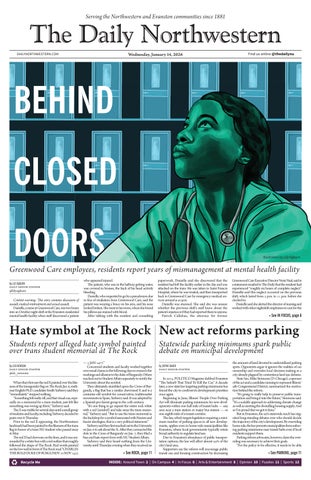
BEHIND CLOSED DOORS
S
Illustration by Lily Ogburn
Greenwood Care employees, residents report years of mismanagement at mental health facility By LILY OGBURN
daily senior staffer @lilyogburn
Content warning: This story contains discussion of assault, medical mistreatment and sexual assault. Danielle, a nurse at Greenwood Care, was two hours into an October night shift at the Evanston residential mental health facility when staff discovered a patient
who appeared injured. The patient, who was in the hallway getting water, was covered in bruises, the back of his head actively bleeding. Danielle, who requested to go by a pseudonym due to fear of retaliation from Greenwood Care, said the patient was wearing a brace on his arm, and his nose looked broken. She went to his room, where she found his pillowcase stained with blood. After talking with the resident and consulting
paperwork, Danielle said she discovered that the resident had left the facility earlier in the day and was attacked on the train. He was taken to Saint Francis Hospital, where he was treated, and then transported back to Greenwood Care by emergency medical services around 9:30 p.m. Danielle was stunned. She said she was unsure whether the previous shift’s staff knew about the patient’s injuries or if they had reported them to anyone. Patrick Callahan, the attorney for former
Greenwood Care Executive Director Venis Neal, said in a statement emailed to The Daily that the resident had experienced “roughly six hours of complete neglect.” Danielle said this neglect occurred on the previous shift, which lasted from 3 p.m. to 11 p.m. before she clocked in. Danielle said she alerted the director of nursing and worked with other nightshift employees to care for the
» See IN FOCUS, page 6
Hate symbol at The Rock New act reforms parking Students report alleged hate symbol painted over trans student memorial at The Rock
By LEXI NEWSOM
daily senior staffer @ak_newsom
When they first saw the red X painted over the likeness of the transgender flag on The Rock Jan. 6, sixthyear English Ph.D. candidate Smith Yarberry said they “immediately” stopped walking. “Something felt really off, and that visual cue, especially on a memorial for a trans student, just felt like something was wrong up there,” Yarberry said. The X was visible for several days until a small group of students and faculty, including Yarberry, decided to paint over it Thursday. Prior to the red X appearing, the Northwestern landmark had been painted to the likeness of the trans flag in honor of a trans NU student who passed away in May. The red X had chevrons on the lines, and it was surrounded by a white box with a red outline that roughly followed the shape of The Rock. Red words painted on the low wall in front of The Rock read “CHARLES THE BOLD DUKE OF BURGUNDY 10 NOV 1433
Recycle Me
— 5 JAN 1477.” Concerned students and faculty worked together over email chains in the following days to research the markings and allusion to the duke of Burgundy. Others reached out to Student Affairs separately to notify the University about the symbol. They ultimately stumbled upon the Cross of Burgundy, a flag that has a similar chevroned X and is a centuries-old symbol for conservative, traditionalist movements in Spain, Yarberry said. It was adopted by a Spanish pro-fascist group in the 20th century. “It’s one thing to go repaint the entire rock white with a red (symbol) and take away the trans memorial,” Yarberry said. “But to use the trans memorial as the backdrop for a symbol associated with Nazism and fascist ideologies, that is a very political statement.” Yarberry said they first reached out to the University on Jan. 6 to ask about the X. After they connected the dots to the Cross of Burgundy on Jan. 7, they filed a bias and hate report form with NU Student Affairs. Yarberry said they heard nothing from the University until Thursday evening when they received an
» See ROCK, page 11
Statewide parking minimums spark public debate on municipal development By SOPHIE BAKER
daily senior staffer
In 2015, POLITICO Magazine dubbed Evanston “The Suburb That Tried To Kill the Car.” A decade later, a new state law targeting parking minimums has forced the city to confront its development priorities once again. Beginning in June, Illinois’ People Over Parking Act will eliminate parking minimums for new developments within one-half mile of transit hubs — any area near a train station or major bus station — or one-eighth mile of a transit corridor. The law, which targets legislation requiring a minimum number of parking spaces in all new developments, applies even in home-rule municipalities like Evanston, where local governments typically retain broad authority to regulate land use. Due to Evanston’s abundance of public transportation options, the law will affect almost 93% of the city’s land area. Supporters say the reform will encourage public transit use and housing construction by decreasing
the amount of land devoted to underutilized parking spots. Opponents argue it ignores the realities of car ownership and overrides local decision-making in a city already plagued by contentious land use debates. State Sen. Mike Simmons (D-Chicago), a sponsor of the act and a candidate running to represent Illinois’ 9th Congressional District, summarized the motivation behind the reform. “It’s going to really help to preserve public transportation and bring it into the future,” Simmons said. “It’s a scalable approach to addressing climate change as well as meeting the dwindling housing supply. And so I’m proud that we got it done.” But in Evanston, the act’s statewide reach has reignited long-standing debates over who should decide the trajectory of the city’s development. By overriding home rule, the law prevents municipalities from enforcing parking minimums near transit hubs even if local residents support them. Parking reform advocates, however, claim the overriding was necessary to achieve their goals. “For the policy to be effective, it needs to be able
» See PARKING, page 11
INSIDE: Around Town 2 | On Campus 4 | In Focus 6 | Arts & Entertainment 8 | Opinion 10 | Puzzles 11 | Sports 12
2 THE DAILY NORTHWESTERN
WEDNESDAY, JANUARY 14, 2026
AROUND TOWN
$1B freeze impacts Evanston childcare By YONG-YU HUANG
daily senior staffer @yong_yuhuang
In almost three decades of working in childcare, Toddler Town Children’s Learning Academy Executive Director Angelo Nikolov said he’s never seen uncertainty like this — a federal funding freeze that could strip $1 billion from Illinois childcare providers. Now, he’s worried about what the loss of that money might mean for his employees and the families and children they serve. On Jan. 6, the Trump administration froze $10 billion in federal funding for childcare programs in California, Colorado, Illinois, Minnesota and New York based on “serious concerns about widespread fraud and misuse of taxpayer dollars in state-administered programs,” according to a press release from the Department of Health and Human Services. Illinois received letters from the federal government informing the state about an immediate freeze of the Child Care and Development Fund, Temporary Assistance for Needy Families and Social Services Block Grant funding programs. The letters also demanded that the state provide “the entire universe” of documents related to these funds. This follows allegations of widespread fraud in Minnesota, which has implicated billions of dollars and prompted Minnesota Gov. Tim Walz to end his reelection campaign. In December, conservative content creator Nick Shirley alleged corruption at childcare centers in Minnesota, renewing national scrutiny of welfare funding. Shirley’s allegations have not been verified. Illinois stands to lose about $1 billion in funding for its childcare programs. The CCDBG and TANF support the Illinois Child Care Assistance Program. According to a state press release, CCAP serves around 100,000 families across the state, including more than 152,000 children. Nikolov said the decision has left providers scrambling for answers. He has already contacted his bank and vendors as he tries to prepare for CCAP funding disruptions. According to Nikolov, Toddler Town’s two locations in Evanston and Chicago serve 76 and 86 children, respectively. Families using CCAP programs are generally from lower-income to middle-class families, he added, with most of the parents using his services being hourly
employees. “So for them not to have childcare that’s quality and reliable — what are they gonna do? How are they gonna go to work?” Nikolov said. “They can only call off so much. Are they gonna lose their job? What’s gonna happen?” On Thursday, Illinois Attorney General Kwame Raoul joined attorneys general of other affected states in filing a lawsuit challenging the freeze, which he called “callous” in a news release from his office. The attorneys general are seeking a court order to stop the freeze, arguing that it is an “unlawful overreach of executive power,” according to the news release. “This move comes with zero justification, and in the administration’s own words, targets only Democrat-led states,” Raoul wrote. “This unlawful action will hurt families and harm state economies.” On Friday, U.S. District Judge Arun Subramanian of New York’s Southern District temporarily blocked the freeze, directing the federal government to let funds flow for the next two weeks. That same day, U.S. Rep. Raja Krishnamoorthi (D-Schaumburg) visited the Infant Welfare Society of Evanston, where he announced the Kids Before Cuts Act — if passed, the legislation would prohibit the withholding of federal funds for TANF, CCDBG and SSBG, barring explicit congressional approval. Krishnamoorthi’s own family relied on similar federal aid programs when he was a child, according to a Friday news release from his office. “Cutting off this funding without evidence isn’t oversight,” Krishamoorthi said. “It’s punishing families who are doing their best.” In terms of immediate impact, IWSE Director Stephen Vick said that CCAP provides his organization with approximately $60,000 each month — critical funds that support its biweekly payroll of about $90,000. IWSE serves roughly 200 children, according to Vick. However, Vick said the government is already behind on their payments, as IWSE has yet to receive its November funding. The impact on other childcare organizations and programs in Evanston could be even worse, Vick added. “Some programs are CCAP-only. That’s their only subsidy. And so to lose their only subsidy — they could literally have to shut down,” Vick said. “So there’s a lot of programs that I know of in the community that would have immediate, devastating consequences.”
WINTER CHAMBER MUSIC FESTIVAL
Evanston Early Childhood Council Executive Director Jesse Rojo leads a coalition of local early childhood organizations. He described the situation as “chaos.” Childcare funding impacts people from all political backgrounds, he said, which should make it more of a bipartisan unifier. The lack of clarity from the federal government severely impacts childcare providers, according to Rojo, as some organizations’ funding situations already require them to survive paycheck-to-paycheck. She warned that if centers can’t meet payroll, layoffs could number “in the hundreds,” putting “thousands of children” at risk of losing care. “Every public dollar wasted is a wasted opportunity to invest in our families,” Rojo said. “Unfortunately, though, this isn’t about investigating waste. This isn’t about investigating fraud.” Nadia Gronkowski, the policy manager of national policy at Start Early — a Chicago-based nonprofit focused on early childhood development — said that fraud prevention and investigation procedures are already built into the funding stream. According to her, SSBG and TANF also support initiatives such as maternal health home visiting, early intervention for children with disabilities and nutrition programs. Gronkowski added that, to receive these funds, every state is required to define what fraudulent use of SSBG and TANF funds means in their state and have a federally-approved plan in place in the event of such activity. This means that fraud prevention and investigation procedures are already built into the funding stream, she said. She said that as of last week, the federal government had added new “Defend the Spend” questions to CCDF, the Low Income Home Energy Assistance Program and other social services systems to verify that fraud is not taking place. According to Gronkowski, this is causing “minimal delays” but remains an extra hurdle for distributors trying to send funding to families. “Childcare providers and our childcare state administrators and other social service administrators are putting kids and families at the center of every single decision that they make every day,” Gronkowski said. “What it comes down to is the federal government needs to do the same and make sure that this funding gets out to the people who need it.”
The Daily Northwestern www.dailynorthwestern.com Editor in Chief Emily Lichty
eic@dailynorthwestern.com
General Manager Stacia Campbell
stacia@dailynorthwestern.com
Holly and John Madigan Newsroom Phone | 847.491.3222 Campus desk
campus@dailynorthwestern.com
City desk
city@dailynorthwestern.com
Sports desk
sports@dailynorthwestern.com
Ad Office | 847.491.7206
spc-compshop@northwestern.edu THE DAILY NORTHWESTERN is printed each Wednesday during the academic year, except vacation periods, the two weeks preceding them and once during August, by Students Publishing Co., Inc. of Northwestern University, 1999 Campus Drive, Evanston, IL 60208. All news is published 24/7 online at Dailynorthwestern.com. First copy of THE DAILY is free, additional copies are 50 cents. All material published herein, except advertising or where indicated otherwise, is Copyright 2025 THE DAILY NORTHWESTERN and protected under the “work made for hire” and “periodical publication” clauses of copyright law. POSTMASTER: Send address changes to THE DAILY NORTHWESTERN, 1999 Campus Drive, Evanston, IL 60208. Subscriptions are $100 for the academic year. THE DAILY NORTHWESTERN is not responsible for more than one incorrect ad insertion.
Check out
DAILYNORTHWESTERN.COM for breaking news
y.huang@dailynorthwestern.com
ARIEL QUARTET Friday, January 16, 7:30 p.m. Haydn, Berg, and Beethoven
TRIO SEOUL Sunday, January 18, 3 p.m. Haydn, Seo, Liszt, and Ravel
Through February 14 Pick-Staiger Concert Hall Blair Milton, director The Winter Chamber Music Festival is made possible in part by the Allan R. and Ellen Drebin Opportunities Fund.
ISIDORE STRING QUARTET Friday, January 23, 7:30 p.m. Haydn, Ligeti, and Brahms
DOVER QUARTET Saturday, February 14, 7:30 p.m. 847-467-4000 concertsatbienen.org
Schubert, Bacewicz, and Mendelssohn
Part of college is learning to pause the race,
so open Connects and explore a cultural space. Explore Now
4 THE DAILY NORTHWESTERN
WEDNESDAY, JANUARY 14, 2026
ON CAMPUS
Students perform hits at Luna’s first karaoke night By SUMMER HU
the daily northwestern @summer_huu
Luna’s Pub and Grill’s inaugural karaoke night Tuesday opened with “Unwritten” by Natasha Bedingfield — sung by a participant named “Lapis 3145.” Following the pub’s Monday grand opening ceremony, students flocked to Norris University Center for dinner with a side of Tuesday evening karaoke. Karaoke night is one of the weekly events offered at Luna’s, alongside trivia starting Thursday and variety nights planned to start in February. Karaoke got off to a slow start, but when Weinberg junior Imani Munene, the person behind “Lapis 3145,” noticed that no one was going up on the stage, she decided to take the first step, despite normally only singing for friends in classrooms. “I was like, ‘You know what? Let me just sing a song in an actual karaoke place,’” Munene said. After Munene finished, the momentum began to build. Students soon queued up songs using a QR code on flyers spread across the pub, signing up with nicknames that would be announced by the hosts. The night’s queue spanned a variety of genres, languages and styles, ranging from ballads like “Die With a Smile” by Lady Gaga and Bruno Mars and “My Way” by Frank Sinatra, to Japanese and Spanish karaoke classics, such as “Usseewa” by Ado and “Amor Prohibido” by Selena. Medill and SESP freshman Micaela Rivera sang “Amor Prohibido.” “Every Latino person knows it, and it’s such an internationally known song,” Rivera said. “‘Amor Prohibido’ brings the vibes that I feel that every karaoke needs every night.” Rivera said the crowd was “charming” and “always cheering it up.” Other singers echoed this sentiment, saying they felt supported by the crowd. Students also performed in duos and groups. A quartet of friends harmonized on “Just the Way
Summer Hu/The Daily Northwestern
Four students sang “Just the Way You Are” by Bruno Mars at Luna’s Pub and Grill’s inaugural karaoke night Tuesday.
You Are” by Bruno Mars. Communication junior Diane Li said the stage environment helped them sing together. “When you’re up there, and the lights are on you, and everyone’s around you, you want to be in the moment with the people that matter the most on stage,” Li said. “You just want to harmonize and make something beautiful.” One group of friends went up to the
microphone multiple times in pairs. Two members of the friend group, SESP senior Adrian Ayala-Pérez and Medill senior Will Kramer, sang “Valerie” by Amy Winehouse together. AyalaPérez said he went up with Kramer to support his love for Winehouse’s music. By the end of the night, students and pubgoers were belting “Forget You” by CeeLo Green together.
McCormick sophomore Jasmine Porter, supervisor of a department overseeing programs at Norris, emphasized that Luna’s pub environment was much-needed on campus. She said the space allows “the community to get together and have some light-hearted fun on any given afternoon and given evening.”” summerhu2029@u.northwestern.edu
WEDNESDAY, JANUARY 14, 2026
THE DAILY NORTHWESTERN
5
ON CAMPUS
Advisory council aims to support Jewish well-being By LUCAS KUBOVCHIK
the daily northwestern
As part of Northwestern’s deal with the Trump administration to restore frozen research funding, the federal government mandated the University to continue its Advisory Council to the President on Jewish Life. The council, which emerged last spring, seeks to support Jewish students and monitor University policies, training and programs, following alleged spikes in antisemitism on campus in 2023 and 2024, said Michael Simon, NU Hillel Executive Director and council member. Medill junior and council member Claire Conner said the council’s goals shift depending
on what is happening on campus. Yet, she said the council’s focus is broader than combating antisemitism. “We want to make sure that everyone who’s Jewish feels like they belong at Northwestern and are able to succeed as Wildcats, and to feel like they’re a part of this beautiful family that we have here,” Conner said. The council had its first meeting of the 202526 academic year in early November, Simon said. However, former NU President Michael Schill’s resignation in September left council members concerned about its longevity. “It’s a president’s (council), but it was formed under the previous president,” Simon said. “I don’t think that President Bienen had any mandate that he had to continue the (council), but he
made it pretty clear soon after he began that he wanted this committee to continue.” A University spokesperson wrote in a statement to The Daily that the council remains active under Bienen’s leadership. Medill senior and council board member Tobias Khabie said NU’s decision to continue the council after Schill’s resignation was a symbol of hope for the Jewish community. Khabie added that he believed the administration were active listeners and participants in the conversation on how to progress the council under new leadership. “I still have two quarters left, and it gives me hope that we can work towards a better future for Jewish students at Northwestern,” Khabie said. In an Aug. 5 progress report on NU’s efforts
to combat alleged antisemitism, the University shared that the number of reports of antisemetic discrimination or harassment decreased by 83% between April 2024 and April 2025. As the council continues into next year, Conner said it remains important to council members that Jewish students feel proud to embrace their culture while simultaneously having the freedom to blend into the NU community. “I also want Jewish students, including myself, to be able to exist at Northwestern, just as Wildcats,” Conner said. “It’s important to be able to step into a classroom, or into Welsh-Ryan Arena, or into a hammock on the Lakefill and just feel at home in purple and feel at home at Northwestern.” lucaskbovchik2029@u.northwestern.edu
MENA hosts Dabke dance fundraiser for Gaza aid By DESIREE LUO
daily senior staffer @desiree_luo
The sound of synchronized stomps filled Parkes Hall 122 during the Middle Eastern North African Student Association’s Dabke dance workshop Monday evening. The event doubled as a fundraiser, with entry costing $5 per person. Ticket proceeds will go toward Gaza’s Roots, an on-the-ground initiative providing aid to people in Gaza, according to MENA’s Instagram post. Dabke is a traditional folk dance popular in the Levant region of the Middle East. Chicago-based instructor Mary Mulcahey taught attendees the Lebanese style of the dance during Monday’s hour-long session. And sound is crucial to the Dabke experience, according to Mulcahey. She said she has danced Dabke for 12 years and has taught for six. “It’s not Dabke if you don’t hear a stomp,”
Mulcahey said. She told attendees Dabke did not begin as a dance. It started among construction workers, who stomped in a circle to level ground surfaces for building foundations. Those fundamentals remain, although Mulcahey said Dabke is now usually performed at celebratory events. Monday’s routines involved students holding hands in a line or circle while dancing to Lebanese festival music. The style was new to several students, including first-year McCormick Ph.D. candidate Emory Apodaca. “It was honestly really nice to hold hands with people because it’s not really something you do in any kind of dance I’m used to,” Apodaca said. “The rhythm is so different, too. It’s like everybody’s on the same rhythm, as opposed to dancing with their own rhythm.” To keep everyone on beat, Mulcahey adorned her outfit with a coin belt that jingled with her movements. She also wore Converse high top sneakers,
which she said is often her students’ footwear of choice for ankle support. By the workshop’s end, Medill sophomore and former Daily staffer Mintesinot Sturm said his right leg was “very tired.” “I’m Ethiopian, and a lot of our dances involve similar kinds of movements with legs and full-body workout,” he said. “So, definitely something I was able to connect with.” Even when routines concluded, the room never fell silent. Applause erupted among dancers after every song. Mulcahey praised their progress throughout the evening and told them at the end of the workshop they could now dance at any Arab wedding or party. Although countries have different styles of Dabke, she said the dance is ultimately a “very unifying force that we have in the Middle East.” “Dabke is rooted in resilience,” Mulcahey said. “And if you can Dabke together, you can do anything together.” desireeluo2028@u.northwestern.edu
Desiree Luo/The Daily Northwestern
Dabke is a folk dance popular in the Levant region.
GET THE DAILY IN YOUR INBOX dailynorthwestern.com/email
WINTER IS HERE!
GEORGE R. R. MARTIN CREATOR OF "GAME OF THRONES" CLASS OF 1970 NU SYLLABUS YEARBOOK PORTRAIT PHOTOGRAPHERS WILL BE IN NORRIS FOR A LIMITED TIME. Several poses will be taken – in your own clothes and with cap and gown. Your choice will be available for purchase. All senior portraits must be taken by Stuart-Rodgers Photography. $15 sitting fee required.
SIGN UP FOR YOUR SENIOR YEARBOOK PORTRAIT BEFORE IT'S TOO LATE.
PHOTOGRAPHERS RETURN JAN. 14, 2026 To sign up, scan the QR code or visit tinyurl.com/nusenybportraits questions? email: syllabus@northwestern.edu or go to: www.NUsyllabusYearbook.com
6 THE DAILY NORTHWESTERN
WEDNESDAY, JANUARY 14, 2026
to its website, the 145-bed facility serves 2024. Within a month, she left the facility, too. Greenwood Care resident. Her son was diagnosed with “SHE JUST COULDN’T According residents with various conditions, including schizoafAnother employee who started around the same schizophrenia in his young adulthood, and Greenwood fective disorder, major depression, bipolar disorder time as Poole once tried to raise questions with Care offered the care he needed. He moved into the and schizophrenia. Greenwood Care is currently Neal over email, Poole said. She said Neal allegedly facility in 2017, she said. KEEP ANYBODY home to about 116 residents, according to a state- responded by threatening his job via email. Grace said that as her son’s representative payee, to The Daily. “She took off, basically telling him that we can be she received his bills from Greenwood Care and Social WORKING THERE. SHE mentThemailed e facility is one of about 20 Specialized Mental replaced. … Whatever we won’t do, you know, there’s Security. She discovered that Greenwood Care had Health Rehabilitation Facilities in Illinois. SMHRFs other people that will,” Poole said. allowed her son to sign a financial contract for dental WOULD FIRE YOU AT are licensed by the Illinois Department of Public Callahan said in his statement that Neal maintains services, charging him more than $2,000 a year. Health and provide rehabilitation, crisis stabilization that staff were replaceable, but that the consumers they A Greenwood Care spokesperson wrote in a statetransitional living assistance to prepare residents served were not. ment that if a resident has a legal guardian, the staff THE DROP OF A DIME.” and with mental illnesses to live independently. “No doubt, the staff there that was finally held is required to notify them of “certain actions taken”
- Kennedy Jones, former Greenwood Care employee
“It’s our intention to make sure everyone goes back into the community, if possible,” Neal said in a video posted on Greenwood Care’s Facebook page in 2021. While the goal is to help residents leave Greenwood Care within about six months or a year, a few residents have lived there for more than 15 years, according to two former employees. Greenwood Care wrote in its statement to The Daily that some residents need to stay at the facility for “many years.” Neal, a licensed nursing home administrator in Illinois, has been in health care since 1996. Neal joined Greenwood Care as executive director in December 2020 after the previous executive director resigned, according to a Greenwood Care spokesperson. In this role, she led the facility and worked with department managers to make hiring and firing decisions, the spokesperson said. Callahan said in an email statement that Neal was hired to “clean up the misconduct” at Greenwood
accountable did not appreciate her efforts,” Callahan wrote. “Many of them left voluntarily, but others were fired due to neglect, theft, or lack of concern for consumers.” Sarah, a former employee who asked to use a pseudonym for fear of retaliation, said she worked at Greenwood Care from June to September 2024. She left the facility after Neal demanded Sarah respond to her calls and texts “24/7,” a standard Callahan said Neal applied to all department heads at Greenwood Care. In daily meetings among leadership, Neal would consistently “attack” employees and accuse them of wrongdoing, Sarah said. She witnessed at least two coworkers cry at the meetings, she said. “It creates this tone where everyone feels like they have to stay quiet,” Sarah said. “So you’re watching your coworkers being abused and crying during meetings and abandoning themselves, just to (avoid) her attack.” Callahan wrote in a statement that the meetings were meant to encourage open discussion, but employees — including Neal — frequently became emotional during them. He wrote that Neal denies that she treated her employees dismissively or with hostility. But Sarah said she felt employees feared Neal’s reprimands, describing Greenwood Care as an “environment of submissiveness.”
Neal allegedly directed ‘abusive language’ toward residents
IN FOCUS From page 1
patient. She documented what she saw, performed neural checks on the patient and alerted a doctor of the incident, Danielle said. Danielle said that within days of the October incident, she received notice from her supervisor that Neal, then executive director, planned to punish her and staff on the night shift for failing to care for the resident correctly. Callahan told The Daily that the disciplinary action taken related to the incident was “supported by written documentation of each employee’s specific failures.” Danielle said she received no written documentation related to the incident. The October incident was one of many troubling incidents that have occurred at Greenwood Care, both under Neal’s leadership and beyond, employees said. At least six current or former Greenwood Care employees alleged that Neal mistreated staff and residents, arbitrarily fired employees and mismanaged the facility. Some had been reporting Neal’s behavior and other issues at the facility to management and the state for years, only for Neal to remain in her post. “She was like cancer to that building,” Danielle said. Callahan denied that Neal treated employees with hostility in his statement to The Daily. He wrote that Neal, who has worked in healthcare for about 30 years, had to address major issues at the facility from the time she was hired. Greenwood Care had a “successful program that had only the lowest violations” under Neal’s leadership, Callahan wrote. Danielle had seen punishments at Greenwood Care range from write-ups to suspensions and firings. Feeling the decision to pursue disciplinary action against her was unfair, Danielle and another employee decided to take action. Danielle said she reported Neal’s alleged arbitrary punishment to Halima Maynard, the regional nurse consultant at S.I.R. Management, a health care consulting company that has a complex advisory role in Greenwood Care’s operations. Maynard allegedly brought the incident to Patrick Baalke, the chief operating officer at Generations Healthcare Network, which S.I.R. contracts with. Baalke planned to visit the facility on Oct. 14, 2025, Danielle said. Callahan said the visit was unrelated to the incident. According to Callahan, Neal resigned Oct. 14, 2025, the same day Baalke allegedly visited the facility after the employees’ reports. Baalke did not respond to multiple requests for comment, and Greenwood Care declined to comment on employment-related matters. In Danielle’s view, Neal’s resignation was for the best. But she said the problems at Greenwood Care spread beyond Neal. “It wasn’t just (Neal) that’s a problem. It’s the culture of the building. It’s the culture of the company,” Danielle said.
Greenwood Care’s role in the Evanston and Chicago areas Greenwood Care is a residential mental health care facility located at 1406 Chicago Ave. in Evanston.
Care, claiming that the facility had serious issues such as inappropriate staff-resident relationships and theft of hours worked. Callahan wrote that Neal generally “gave leadership the autonomy to hire and fire their own staff and she would not know about disciplinary action until it had already been presented to the staff.” But several employees said Neal was more involved in the disciplinary process. While Neal was executive director, Greenwood Care was issued a probationary license and struggled to retain employees.
‘An environment of submissiveness’
The Daily spoke to three employees who were fired by Neal in the span of about a year. Several current and former employees said others were also fired or left Greenwood Care due to poor work conditions during Neal’s tenure. Six current and former employees said Greenwood Care had a high employee turnover rate, in part due to the culture Neal created. “She just couldn’t keep anybody working there,” said Kennedy Jones, a former Greenwood Care mental health professional. “She would fire you at the drop of a dime.” Nadine, a former nurse at Greenwood Care who asked to go by a pseudonym due to fear of retaliation, said she was fired by Neal in 2024. Nadine said she had worked at the facility on and off since 2018, and she enjoyed working there before Neal’s arrival. In July 2024, Nadine recalled, a former resident walked into Greenwood Care claiming that he did not like the new facility where he was living. Nadine said that because he was no longer Greenwood Care’s patient, she should either call his new facility or the police and allow them to coordinate his care. She noted the former resident could have been missing, so it was important to notify his new facility or the police. But Neal insisted that Nadine send him to a hospital and then evaluate whether the resident should come back to Greenwood Care. The facility’s resident population was low at the time, Nadine said, and she believed Neal wanted to readmit the resident to Greenwood Care. Nadine said Neal snapped at her during the disagreement. “She just told me, ‘Girl, get out of here. I don’t need you,’” she said. In the moment, Nadine dismissed the comment; she said it wasn’t uncommon for Neal to speak to employees that way. But when Nadine came back for her next shift, Neal fired her, she said. Other former employees also observed the revolving door of colleagues at the facility. Toni Poole, another former Greenwood Care mental health professional, said that the employee who had been training her on her first day complained about Neal. “He was like, ‘(Neal) expects so much, but she only gives so little. She don’t know how to talk to people.’ And I didn’t understand that until I actually was working,” Poole said. On her second day, the employee was not there, Poole said. She then learned he had left the company. Poole started working at Greenwood Care in May
Former and current employees said Neal’s behavior also impacted residents at the facility. In December 2024, the Illinois Department of Financial and Professional Regulation served Neal a notice to appear at a hearing in response to a complaint about her communication with residents. The complaint alleged that Neal “used Greenwood’s intercom system to direct abusive language toward Greenwood residents and threatened them with expulsion from Greenwood” in September 2024. If proven, the allegation would violate the Nursing Home Administrators Licensing and Disciplinary Act and could result in disciplinary action against Neal’s license. Neal and her lawyer denied the allegations in a signed letter to IDFPR obtained by The Daily. According to an IDFPR document, Neal’s hearing was scheduled for April 21, 2025. Neal’s license is currently active and has never been disciplined, according to IDFPR’s license search. In an email to The Daily, IDFPR declined to comment on open investigations. An IDFPR spokesperson said in an email that licenses usually can’t be disciplined until the enforcement process is complete, and investigations undertaken by IDFPR are “confidential unless they result in public disciplinary action.” In an audio recording obtained by The Daily, Neal used Greenwood Care’s intercom system to reprimand residents in September 2024. “If you don’t want to follow my rules, you will leave, you will get out of my facility ASAP,” Neal yelled over the intercom to residents in the recording. Callahan did not respond to questions regarding the recording or the IDFPR investigation. Sarah said Neal’s communication with residents drew concern from residents’ families and guardians. Residents’ family members frequently called the facility after residents told them about Neal’s behavior, Sarah said. In text messages obtained by The Daily, Neal called a resident’s family “trashy” after they expressed concerns about the resident’s treatment in 2024. “Some families that were not used to having their loved ones be expected to participate in their own care were contentious at times,” Callahan wrote in a statement in response to allegations that Neal’s behavior drew concern from residents’ families. Sarah said she felt that many residents’ symptoms worsened as a result of Neal’s mistreatment. “They’re deteriorating because they don’t have any structure. They don’t have any support,” Sarah said. “They’re not being cared for in a way that’s nurturing and meaningful.”
Residents and their families faced challenges during Neal’s tenure Grace, who asked to go by a pseudonym due to fear of retaliation from Greenwood Care and its consultants, is the mother and legal guardian of a former
“SHE WAS LIKE CANCER TO THAT BUILDING.” - Danielle, Greenwood Care employee
regarding the resident. “All of the paperwork identifies me as his mother and his legal guardian,” Grace said. “How does he sign a contract for dental services?” Grace said she argued with Neal over the phone about the dental plan. She said Neal once called Grace in February 2025 and threatened to give her son an emergency discharge from Greenwood Care, she said. Callahan said Neal had “absolutely nothing to do with financials or dental plans.” He said Neal denies ever being hostile toward the residents’ families. Grace said her son was issued an emergency discharge and sent to Saint Francis Hospital for drug use in July 2025. Her son told Grace that he obtained the drugs from other Greenwood Care residents. Hospital staff told her that while there was a low level of drugs in his system, her son had no medical or behavioral reason to be in the hospital. Grace said her son stayed in the hospital for a week as she searched for a new home for him. It wasn’t the first time Greenwood Care sent her son to the hospital, Grace said. In 2024, her son was sent to St. Bernard Hospital in Englewood. She said she was told he had a behavioral issue related to taking medication in the morning, but she didn’t know he was being sent to the hospital — let alone a hospital far from Evanston — until he was in an ambulance around 8 p.m. Hospital staff at St. Bernard told her they saw no medical or behavioral reason for her son to be in the hospital, Grace said. “Sitting a disabled individual on a long ambulance ride to a hospital where they really don’t need to be there — that’s abuse,” Grace said. Callahan said the facility’s physician had oversight over sending Grace’s son to the hospital. “Neal and her staff simply followed the clinical team’s orders on where to send a consumer,” Callahan said. “I have no doubt that this was frustrating for the guardian, but Ms. Neal was not the person responsible for it and would have only informed the guardian about what the clinical team ordered.” Grace said she moved her son to a new facility in the area in the summer of 2025. She said she reported Neal and the issues with the dental payments to IDPH. She attended hearings with IDPH and representation from Greenwood Care, she said. Grace said she was told the case was dismissed because her son is no longer a Greenwood Care resident.
IDPH issues Greenwood Care a probationary license In March, a female resident at Greenwood Care was sexually assaulted by a male resident at the facility, according to documents from an IDPH investigation. IDPH surveyed the facility in April after receiving a complaint about the incident. Callahan said the facility itself reported the incident to IDPH. According to the IDPH documents, the male resident had entered the female resident’s room twice before the incident, forcing her to kiss him.
WEDNESDAY, JANUARY 14, 2026
THE DAILY NORTHWESTERN
7
“THEY’RE DETERIORATING BECAUSE THEY DON’T HAVE ANY STRUCTURE. THEY DON’T HAVE ANY SUPPORT. THEY’RE NOT BEING CARED FOR IN A WAY THAT’S NURTURING AND MEANINGFUL.” - Sarah, former Greenwood Care employee
Illustrations by Lily Ogburn
On the third instance of forced entry, the male resident “approached her from the side of the bed where she lay and choked her as he forced his penis into her mouth,” the documents stated. The female resident “became tearful as she described the events with trembling hands” to the IDPH surveyor, according to the investigation. In the documents, Neal said staff struggles to communicate with the female resident. When investigators tried to interview the resident, she said she does not speak English, according to the documents. The female resident alerted Greenwood Care staff of the incident, but asked them not to take her to the hospital or call the police, the documents stated. Neal told the investigator that the patient who committed the assault “is an identified offender but not for sex crimes,” the documents said. The facility ultimately discharged the male resident. IDPH protocol requires SMHRFs to report all alleged incidents of sexual assault to law enforcement, preserve as much evidence of the assault as possible and ensure the affected resident receives all possible and necessary medical treatment. Greenwood Care did not report the incident to police or take the female resident to the hospital for medical treatment, according to the documents. IDPH’s investigation concluded that Greenwood Care’s management and staff failed to “conduct a formal reassessment in a treatment plan after a traumatic incident for a resident, report a potentially criminal incident to law enforcement authorities, prevent sexual abuse to a consumer, (and) document timely care for a sexual assault survivor.” As a result, IDPH determined that Greenwood Care had committed a Level 4 Violation, meaning the facility’s compliance with the rules of the Specialized Mental Health Rehabilitation Act of 2013 was “minimally acceptable and (necessitated) immediate corrective action.” In July, IDPH notified Greenwood Care that it would be placed on a probationary license, requiring the facility to make corrective changes and temporarily prohibiting admission of new residents. IDPH documents show that last year, Greenwood Care submitted a plan of correction on Aug. 12, the probationary license went into effect on Aug. 15 and IDPH deemed the facility in compliance with the plan on Aug. 28. Greenwood Care was released from probation Aug. 29. With the violation, Greenwood Care also incurred a $12,500 fee. However, the fee is currently stayed by the court because the facility challenged the violation in a joint lawsuit with Albany Care, another Evanston mental health care facility, in August. In comments submitted to IDPH by Greenwood Care regarding its probationary license, the facility stated that it “disagrees” with the state’s assessment of its response to the alleged sexual assault. In the comments,
Greenwood Care argued that it conducted a proper screening after the incident and that “the consumer refused all the care offered after the alleged incident.” The facility also challenged the notion that the assault was preventable. “Sometimes, even when the facility does everything perfectly, abuse still occurs,” the comments read. In Callahan’s statement, he claimed that “all of the appropriate assessments were charted properly” but were not all reviewed by the surveyor. In a statement to The Daily, Greenwood Care wrote that the facility is “entitled to due process before punishment is meted out by the state and in this instance, those rights were violated.” IDPH declined to comment on the investigation or the lawsuit challenging the violation.
Greenwood Care’s complex relationship with S.I.R. Management and Generations Healthcare Network S.I.R. Management is a consulting company that advises five rehabilitation and nursing facilities in Illinois, including Greenwood Care and Albany Care, another SMHRF that has also faced license restrictions from IDPH in recent years. S.I.R. contracts with Generations Healthcare Network, a consulting firm and nursing and rehabilitation services provider, according to a Greenwood Care spokesperson. Greenwood Care’s statement said that S.I.R. advises Greenwood Care, but all decisions are made by Greenwood Care independently. It also said that Generations is “completely unaffiliated” with Greenwood Care. However, according to the Illinois Secretary of State Business Entity Search, Generations, S.I.R. and Greenwood Care LLC all share the same principal address in Lincolnwood, Illinois. The site also lists the same agent, Thomas Winter, for both Generations and Greenwood Care. Winter is also the chief financial officer and treasurer of Generations. The site lists Bryan Barrish and Michael Giannini as officers for S.I.R. The two men are also principals and managing members of Generations, and Barrish and his wife have 31% ownership of Greenwood Care. S.I.R. and Generations also appear to be involved in addressing employee concerns. Danielle first brought her grievance to Maynard — an employee at S.I.R. — and then was referred to Baalke, the COO at Generations. Other Greenwood Care employees also said they discussed concerns with employees at S.I.R. and Generations. When The Daily attempted to send questions to Baalke at Generations, a Greenwood Care spokesperson responded to the request. When Grace was searching for a new mental health
care facility for her son, she said she did extensive research to ensure she didn’t choose a facility with ties to S.I.R. and Generations. “I (had) to get outside of this group because I didn’t want there to be negative repercussions for me and my son,” Grace said.
Staff and residents reported issues for years Several current or former employees allege that Greenwood Care, S.I.R. and Generations knew about Neal’s behavior and allowed her to maintain her role as executive director. Employees said they reported Neal themselves and knew other employees, residents and residents’ families who reported issues at the facility. In a letter obtained by The Daily, a former employee reported issues at the facility — including Neal’s alleged arbitrary firings and her alleged poor treatment of staff and residents — to Barrish and Baalke in 2023. “Many people tried to contact (Baalke) and either got nothing, or if they did get a meeting, it didn’t go anywhere,” Nadine said. “He would be like, ‘Oh, yeah, we’ll look into it.’ Nothing changed.” Grace said she also reported Neal’s actions and the high employee turnover rate at Greenwood Care to Baalke, first in 2023, after the dental plan incident. She later contacted Baalke again in 2024, she said. Several current or former employees said some residents and their families spoke with Candice Mitchell — Evanston’s long-term care ombudsman, who advocates for residents’ rights — about conditions at Greenwood Care, including Grace. According to Evanston 311 records, Mitchell texted the city on behalf of Greenwood Care residents in May 2025 to request a food inspection, citing reports of allergen cross-contamination and cockroaches. Sarah said Neal discouraged her from talking to the ombudsman. Neal criticized Mitchell and said employees should take their issues directly to Neal, Sarah said. Callahan said in a statement that IDPH visited Greenwood Care often due to complaints made by the ombudsman. He said there were more than 50 complaints that were reviewed and dismissed. Callahan also said the ombudsman filed complaints against Neal with the Office of Inspector General and IDFPR. Employees and residents sometimes looked to the state to help resolve the issues at the facility they said were caused by Neal, such as the complaint that resulted in the ongoing IDFPR investigation regarding Neal’s language over the intercom and Grace’s complaint to IDPH. A spokesperson for the City of Evanston declined to answer a list of questions about the ombudsman’s interactions with Greenwood Care, instead directing The Daily to Kelly Richards, the state long-term care ombudsman. Richards did not respond to questions
specifically about Greenwood Care due to confidentiality restrictions.
Challenges persist after Neal’s resignation After Neal’s departure, Baalke helped run the facility temporarily, according to Danielle and a Greenwood Care spokesperson. Greenwood Care then appointed Priscilla Huley, a licensed clinical professional counselor who previously worked at Pathways to Healing Therapeutic Services, to be the facility’s new executive director. She started her new position Nov. 17, 2025. Callahan said Neal is “highly supportive” of Huley’s hiring. While Danielle acknowledged conditions at Greenwood Care have improved since Neal’s resignation, issues remain at the facility. Danielle said that there are employees at Greenwood Care in roles they have not been trained for, which results in confusion and increased incidents with residents. Danielle and Nadine said many residents at Greenwood Care have issues with substance abuse in addition to the conditions that qualify them for care at the facility. They said they think the facility needs more support for residents suffering from addiction. On Jan. 2, a resident was transported to the hospital after the resident ingested an unknown powdered substance, according to a Greenwood Care spokesperson. Evanston Fire Department personnel discovered the substance and called in a hazmat team to investigate the situation. Danielle also criticized Greenwood Care and S.I.R. for the years Neal remained in her role at Greenwood Care. She said her expectations of “competent staff and quality care” were not met. “She did whatever she wanted, and she had the company backing her,” Danielle said. Like Danielle, Sarah said she thinks the issues at Greenwood Care go beyond Neal. Other members of the facility’s management let Neal “bully” staff and residents at Greenwood Care for far too long and were complicit in the wrongdoing, she said. Sarah also noted that the revolving door of employees should have raised red flags with Greenwood Care, S.I.R. and Generations. She said it was “negligent to not look at what’s happening internally.” Poole echoed Sarah and Danielle’s sentiments. She said Greenwood Care needs to hire caring people for leadership roles. “(The residents) are in critical times in their life. They may be homeless. They may have a drug addiction. Whatever the case may be, it’s the reason that they’re there,” Poole said. “They’re still human and they ought to be treated as such.” l.ogburn@dailynorthwestern.com
8 THE DAILY NORTHWESTERN
WEDNESDAY, JANUARY 14, 2026
Illustration by Siri Reddy
Doja Cat, pajamas and things we’re leaving in 2026 By ALEXANDER HERNANDEZ GONZALEZ, GABE HAWKINS and RAINEE LI
the daily northwestern @alexbespeakin / @gabejournalist / @rainydayrecord
As Wildcats begin to settle into the new year and Winter Quarter, it is a much-needed time for change. The colder weather does not just bring a chill to Evanston and Chicago, but it also allows for moments of reflection to seep in and choices to be made. These choices can be categorized into two parts: “In” (something you are bringing to the new year) and “Out” (something that will be left behind in the previous year). Explore trends, actions and individuals/groups selected by Arts & Entertainment Editor Alexander Hernandez Gonzalez and Assistant A&E Editors Gabe Hawkins and Rainee Li. Alexander: In – Listening to albums in their entirety: Although we are officially in the second quarter of the century, I was listening to Apple Music’s “2024 100 Best Albums” list and their explanations for the rankings just last week. When Lauryn Hill’s “The Miseducation of Lauryn Hill” was revealed as the streaming platform’s best album, I had to check it for myself. Not only was I intrigued by the three-part series behind the record, but the listening experience brought tears of both sadness and joy. Needless to say, with the amount of music that will be released this year, take the time to appreciate the entirety of an album, not just a “hit single” that will be lost in your playlist. In – Wearing your parents’ clothes: Every year, my family and I head to Valparaíso, Zacatecas, México to unplug from work, burnout and realities that linger in the United States. Even with the rodeos, endless errands and spotty cell service, I love looking at the clothes that my father wore when he lived in Valparaíso. From his vaquero-esque wedding suit to bootcut Levi jeans, let’s just say my dad knows how to style and rock almost anything. So,
I’ve made it a yearly tradition to leave a garment of clothing from the U.S. and take something from my dad’s closet to freshen up. This time around, a black leather jacket with faux fur lining is my treasured staple for the year. Take a look at your parents’ closet, try on some clothes and sport it. Trust me, it’ll bring your parents to the past and some happy tears. Out – Sleepwear to class: Ever since I stepped foot onto the Northwestern campus about three years ago, I would always assume that garments like pajamas, sleep sets and the casual baggy T-shirt with sweatpants were meant for one location: home. However, as the quarters continued, I kept noticing that people held the “bedhead” look to classes. Regardless of your stance, stunting sleepwear anywhere besides your residence is like eating food or wearing dirty shoes on the bed. You wouldn’t want hot sauce or outside dirt on your sheets, right? So, instead of rolling out of bed and straight to class, set an outfit aside so you can rock the day in comfortable yet appropriate clothes. Gabe: In – Doja Cat: Before 2025, I was a begrudging fan of the genre-bending superstar, but I will henceforth be passionately defending her name. This September, Doja Cat released “Vie,” a 1980s-inspired album blending funk pop and R&B, which featured prominently on my Spotify rotation last year. Through a random string of events, I happened to see the artist live twice last year. Last August, I attended her headlining set at Outside Lands in San Francisco after winning a ticket raffle. In October, a friend invited me to attend the episode of Saturday Night Live in which she appeared as the musical guest. On both occasions, I was transfixed by her magnetic stage presence, minimalist set design and dogged commitment to theatricality. To my regret, “Vie” did not generate the commercial popularity it deserved, but I look forward to seeing where Doja Cat takes her career in 2026. In – The Women’s National Basketball
Association: Last summer, I had a front row seat to the inaugural season of the WNBA’s latest expansion team, the Golden State Valkyries, who played just a ten-minute walk from my apartment. All summer, tens of thousands of fans showed up to Chase Center, selling out every home game and proudly donning team merchandise. While they boasted the highest average attendance in the league, the Valkyries were only one example of the skyrocketing popularity of the WNBA. I look forward to experiencing this ongoing momentum in 2026 — and cheering on the Valkyries each game! Out – “Wicked” franchise: The light is finally beginning to dim on “Wicked.” After years of buildup, a persistent marketing campaign and an irritating omnipresence on social media, I am enthusiastically bidding goodbye to this franchise. The films irked me in multiple ways, as I outlined in my November review of “Wicked: For Good.” Whether it was the soulless added numbers, agonizing length or the fact that the second film sacrificed quality for excess, I have long been ready to leave “Wicked” in the past. In 2026, I hope to see original works of cinema achieve commercial success, rather than poor adaptations of stage productions that would be better left alone. I hope I never again have to see off-key recreations of Cynthia Erivo’s viral “Defying Gravity” riff on my For You page. Rainee: In – Public pop-up performances: Imagine you’re walking through a completely unsuspicious avenue when windows suddenly burst open to reveal a cappella singers, a carriage of violinists and a street pianist playing “Hopelessly Devoted To You.” From airport serenaders to public K-pop covers, I love running into these spectacles while roaming around, and I wish they occurred more often. I think spontaneous performances add a sense of humor and warmth to our typically distanced social situations. While I was vacationing recently, there was a drummer on the side of the road, and it made my simple stroll feel so much more magical. People
gathered to enjoy the music or smiled at him, and it conjured up a feeling of togetherness that I feel is often lacking in our current sociopolitical climate. In – Whimsy for the sake of whimsy: In an era where media is being weaponized, propagandized and manipulated at every turn, the value in using art for change is undeniable. The importance of recognizing the abuse of art to spread harmful ideals is absolutely real. However, not everything needs to be a message. If we were to form a debate over every single detail in our lives, we wouldn’t be able to handle the emotional strain. Learn the “Lush Life” choreography just because it’s lively and brings back memories from your childhood. Stop tearing other people down for their cringey interests when they are just living their life to the fullest. Turning nothing into something quickly devolves into conspiracy and hate. Sometimes, girls just wanna have fun! Out – Commodifying Chinese culture: Long before the Labubu, China has made ugly dolls that I never understood the appeal of. China has been drinking matcha for centuries. What do you, a modern-day man, know about a whisk? Tanghulu is actually really good and has been even in its preTikTok years. I’m glad Chinese culture is being embraced by more people around the world, but I’m concerned about the continued mockery of the aspects overwhelmed by Western influence. Why is someone performative simply because they are immersed in Chinese trends? Why is participation in Chinese culture deemed laughable? I will always emphasize the value of sharing traditions and trends, but why is it exclusively Asian culture that is consistently being transformed into memes and social media gimmicks? There is a deeper disrespect for these communities that I would like left in 2025. a.hernandez@dailynorthwestern.com gabehawkins2028@u.northwestern.edu raineeli2029@u.northwestern.edu
Queer liberation takes the stage in ‘Green Room’ By ELIZA MARTIN
the daily northwestern
For those who write off opera as a lost art, Cosmia Opera Collective wants to rock your world. Cosmia premiered “Green Room” in the Ryan Opera Theatre on Friday, continuing its pursuit of bringing student-written work to the stage. Blending electronic pop elements with those of a traditional opera score, “Green Room” tests the boundaries of the genre. “Green Room” is the second opera created by Bienen senior and Cosmia founder Cecelia Olszewski. She cites her main inspiration as an article by Iris Rachamimov, which details the presence of drag and female impersonation in theatrical productions staged by World War I prisoners.
“It was a really interesting social phenomenon where there were no women in the camp, so they had to improvise,” Olszewski said. “It’s very interesting to analyze how these men in drag changed the social dynamics of the camp and were both a stabilizing and a destabilizing presence for these officers.” The opera itself is set in the green room of one such production. Much of the libretto, or script, is adapted from Rachamimov’s research and translations to accurately and powerfully portray the emotions of the time. Through a 40-minute series of vignettes, “Green Room” tells the stories of several prisoners struggling to balance the fluidity of their gender and sexuality with traditional norms. Bienen graduate student Solamada Pando Girard plays Prima Donna, a female-presenting character who serves as a role model for Emmerich, a new
prisoner starting to explore their gender. Pando Girard saw her lived experience as a transgender woman reflected in the characters’ relationship. “I think of that relationship of sisterhood, of support,” Pando Girard said. “That’s still how a lot of transgender women relate to each other, and I think about the people who have helped me in my transition.” The mentorship that Prima Donna provides Emmerich embodies the opera’s focus on how LGBTQ+ individuals find safe spaces with one another. The green room itself serves as one such third space, as it is used for identity exploration and transformation. As Emmerich and other prisoners interact, the opera’s score reflects their rising inner dissonance through a unique use of microphones. “Normally in opera, we are unamplified,” said Bienen senior and “Green Room” co-producer Claire
Coven. “In this opera, the singers could be singing unamplified, but the microphones are here to distort the voices.” Coven believes that the electronics and vocal distortion add a pop aspect to the score, making the show feel more modernized than most operas. “Green Room” ties its story to the present through music and message. The electronically modified vocals and the tumultuous story culminate in a parallel to a Berlin nightclub scene, a modern-day example of a queer third space. “By transforming into this space where people are truly free to be themselves,” said Olszewski. “The green room exists in all these different timelines.” A recording of “Green Room” will be published in the coming weeks on YouTube. elizamartin@u.northwestern.edu
WEDNESDAY, JANUARY 14, 2026
THE DAILY NORTHWESTERN
9
The Golden Globes bring the stars and the snubs By YANA JOHNSON
daily senior staffer
On Sunday evening, Hollywood’s brightest stars gathered in Los Angeles, California to commemorate the 83rd annual Golden Globe Awards. The ceremony was held in the Beverly Hills Hotel, and added wit, sincerity and, of course, glamour to the current awards season. The far boozier cousin of the stiff, premier Academy Awards, the Golden Globes celebrated its den of starpower talent in cheery, cheeky fashion. Comedian Nikki Glaser poked fun at the event’s inherent frivolity during a time of worldwide crisis in her second stellar turn as host, sarcastically describing the ceremony as “the most important thing happening right now.” Minus the sparse appearance of anti-Immigrations and Customs Enforcement pins and a stirring red carpet interview from actor Mark Ruffalo, the show indeed lacked reminders of the cataclysm beyond the ceremony’s gilded walls. Regardless of the awards’ international relevance, the ceremony fulfilled and exceeded its core responsibility: to serve and surprise not only those who create film and television, but those who love it, too. The first pleasant bit of service to cinephiles everywhere came with “One Battle After Another” actress Teyana Taylor receiving the award for Best Supporting Actress in a Motion Picture. Despite gracing the screen of Paul Thomas Anderson’s epic thriller for less than twenty minutes, the memory of Taylor’s presence as
rogue revolutionary Perfidia Beverly Hills lingers even with acting heavyweights such as Benicio del Toro and Leonardo DiCaprio following after her on screen. Unfortunately, the inspiring momentum of Taylor’s deserved win and stirring speech did not last. The award for Best Actor in a Motion Picture – Musical or Comedy that rightfully should have gone to Jesse Plemons for his transformation in “Bugonia,” or DiCaprio for leading the warp-speed freight train that was “One Battle After Another,” tragically landed in Timothée Chalamet’s undeserving hands. The young heartthrob won for the role of Marty Mauser in “Marty Supreme.” The young heartthrob did not do a poor job leading the table tennis thriller “Marty Supreme.” However, Chalamet’s turn as the Odysseus of international ping-pong simply failed to find its superlative or do enough of anything to be considered the best. Additionally, it leaves a bilious taste in the mouth to see Chalamet’s months of desperate, cloying awards campaigning — during which he referred to his own body of work as “top-level s--t” in an interview with journalist Margaret Gardiner — rewarded. Despite their leading men’s snubs, Anderson’s “One Battle After Another” and Chloé Zhao’s “Hamnet” positioned themselves nicely for the ensuing race to the 98th Academy Awards. Both movies took home the chief award for their respective categories — Musical or Comedy and Drama — with Anderson also being awarded Best Director of a Motion Picture. The Golden Globes may not exist as a perfect forecaster of the Oscars, but the awards of the night offer
Illustration by Nicole Cheah
The Addams family opens the show with the musical number “When You’re an Addams.”
insight into who the key players may be. In this case, setting Anderson and Zhao up as exciting opposition. Another beloved motion picture, “Sinners,” was awarded the Cinematic and Box Office Achievement Award. A recently created award, this honor reeks of being a manufactured opportunity to spotlight great feats of cinema without ceding the esteemed acting, directing and production awards they deserve. Still, watching the expansive “Sinners” cast being celebrated on stage is never a sore sight to see. This year’s Golden Globes offered humor, beauty
and bite at a time when all are desperately needed. It was predictably long, poked predictable fun at DiCaprio’s carousel of barely-legal girlfriends and was an extravagantly entertaining love letter to the minds who keep cinema alive. Not everything went as audiences might have preferred — but that’s cinema, and for a show that celebrates it, there could be no better way for it to occur. yanajohnson2028@u.northwestern.edu
‘Primate’ delivers more bite than its trailer promised By BIANCIA DISHMON
daily senior staffer
Content Warning: This story contains mentions of violence. When the trailer for “Primate” first released, it
Illustration by Chelsea Lim
Ben the chimpanzee becomes the main antagonist after being infected with rabies.
echoed spoof horror classics like “Scary Movie” and “A Haunted House.” As I walked into the theater, I was prepared to laugh for the next 90 minutes as this movie tried to comically convince me to fear a rabid chimpanzee. However, that primate proved me wrong. Directed by Johannes Roberts, “Primate” follows Lucy ( Johnny Sequoyah), a woman returning home to Hawaii for the first time after her mother died of cancer. Her family includes a “domesticated” chimpanzee named Ben, whom Lucy and her sister Erin (Gia Hunter) have grown up alongside because of their mother’s career as a linguist. At first, Ben seems like a sweet, intelligent chimpanzee. However, after getting bitten by a mongoose and contracting rabies, Ben terrorizes Lucy, Erin and their friends, leaving them with no way to escape. Presenting animals as the antagonist is nothing new to the horror genre. With films like “Cujo,” “Jaws” and more recently, “Cocaine Bear,” audiences have feared animals gone wild for decades. While he doesn’t hold a candle to his predecessors, Ben the chimpanzee is a nice addition to the trope. After Ben is infected, he torments the home’s inhabitants and audiences watching from the comfort of a theater. There were multiple moments where I was covering my eyes, afraid of Ben’s next move. Albeit in a rabid state, the lengths Ben goes to when murdering those around him are inhumane and grossly uncharacteristic of an animal that was
considered part of the family. Men are pushed to their deaths, hair is ripped from scalps and, most frighteningly, faces are ripped in half. Call me dramatic, but I will be wary of chimpanzees for the next few months. Ben holds a terrifying grip over the audience for most of his screentime, but there were moments when the film tried to push his villain agenda too far, making it seem insignificant. In one of the final scenes, Ben trades blows with Lucy as she fights to protect her father. I’m no Jane Goodall, but I am pretty sure it is uncommon for chimpanzees to slap people. Moments like this draw the audience out of an otherwise realistic world and cripples the movie’s horror aspect. Where Ben failed, however, the score picked up the slack. Composer and frequent collaborator of Roberts’ Adrian Johnston wrote a synth-heavy score that added to the suspense and drama of Ben’s unpredictability. Unlike other horror movies, the score was not used solely as a tool to signal impending doom. In fact, the consistent appearance of the score made the film more volatile and left the audience on the edge of its seats. While the trailer downplays the serious horror portrayed in “Primate,” it is a must-watch. Ben is nowhere near the ranks of other murderous primates. But the film is fun, camp and gory, which makes it a great horror movie in my books. biancadishmon2028@u.northwestern.edu
From feathers to frocks: Stars shine on the Globes’ carpet By SIRI REDDY
daily senior staffer @siriii_r
The 2026 awards season is well underway, and with it comes the joy of scrutinizing million-dollar celebrity fashion choices from the comfort of our own couches. Luckily for us, several A-list icons took to the red carpet Sunday night for the Golden Globe Awards, sporting showstopping styles and fashion faux pas aplenty. A standout look of the night came from reality TV star Olandria Carthen. Fresh off her viral “Love Island USA” run this past summer, Carthen donned an emerald green Christian Siriano gown for the event. The gown’s fitted corset bodice and flared mermaid skirt made for a dramatic, Hollywoodglamour silhouette, especially paired with Carthen’s auburn-dyed updo and statement diamond jewelry. Carthen wasn’t the only star to take inspiration from old Hollywood for this year’s Globes. Nominated for her starring role in “Only Murders in the Building,” Selena Gomez arrived on the red carpet in a dramatically feathered Chanel outfit with a bold maroon lip and a sculpted ‘50s bob. Ariana Grande traded in her bubblegum-pink Glinda attire for a textured black Vivienne Westwood gown, complete with an asymmetrical off-the-shoulder neckline. The gown’s structured skirt ballooned and cascaded in classic Westwood fashion, though on Grande it appeared bulky and
almost unfitted. Grande also sported a subdued version of her iconic ponytail for the event and featured many of her own R.E.M. Beauty products in her soft, natural makeup look. The glam was certainly gorgeous, but it felt far too understated compared to the drama of her gown. Considering stylist Law Roach’s track record of dressing his celebrity clientele to the nines, I have to admit — I was underwhelmed. Similarly underwhelming: many of the Globes’ male attendees hit the red carpet in classic black suits and tuxedos, with few daring to stray from the status quo. Even internet sweetheart Jacob Elordi, nominated twice this year for his roles in “Frankenstein” and “The Narrow Road to the Deep North,” turned up in a bland Bottega Veneta tuxedo, with his most notable accessory being a pair of blue-tinted sunglasses. A refreshing departure from this norm, “Heated Rivalry” star Hudson Williams made his Golden Globes debut in a white Giorgio Armani dinner jacket and cummerbund. The silk evening shirt underneath even gaped open to show off a snakeshaped Bulgari necklace. Actor Chris Perfetti pushed the envelope even further, wearing a vibrant cobalt blue Christian Cowan suit pinned shut by an oversized metal rose. While not abundantly fashion-forward, I have to commend the “Abbott Elementary” star for taking such a risk with his ensemble. But my favorite look of the night? Best Actress nominee Jennifer Lawrence in a see-through
Givenchy gown covered in strategically-placed floral appliques and cutouts, paired with a matching floral shawl and blunt blond bangs. As a dyed-inthe-wool Hunger Games fan, I’m obsessed. Overall, most celebrities showed out for this year’s Golden Globes. And while the show
provided us with plenty of controversial wins to discuss, I’m personally more excited to see what outlandish outfits these A-listers will don in the award shows to come this season. s.reddy@dailynorthwestern.edu
Illustration by Leyton Jackson
With all eyes on the red carpet this awards season, stars vie for “Best Actor,” “Best Actress” — and “Best Dressed.”
10 THE DAILY NORTHWESTERN
WEDNESDAY, JANUARY 14, 2026
OPINION
Join the online conversation at www.dailynorthwestern.com
Buckner: As a trans man, I object to pharmacy closure RAY BUCKNER
OP-ED CONTRIBUTOR
On Dec. 10, students across Northwestern received a PawPrint Student Newsletter in their inbox. Under a banner containing a photo of smiling students, an announcement read, “Pharmacy Closure: The on-campus pharmacy located at Northwestern Medicine Student Health Service in Evanston will permanently close on 12/15.” On a linked webpage, we were told that the University decided to close the on-campus pharmacy by “studying historical and current utilization of the campus pharmacy and the availability of convenient options near campus that maintain evening and weekend hours.” As I read the email and accompanying webpage, I searched not for numbers (or trends that justified the University’s economic decision) but names. I looked for “Amber” and “Jan,” two pharmacists who have helmed the pharmacy for
years. I did not see them. I also did not see whether they would still be employed by the University. Only at the end, in the very last sentences, I read that the University was “proud of the pharmacy staff and the outstanding care and service they have provided to the Northwestern community.” Because the University decided to prioritize profits over people, students lost an essential, personalized and affirming resource for medical care. As a transgender man, I have long struggled to fill my testosterone prescriptions at nonNU pharmacies. When I first started as a Ph.D. student in the Religious Studies department, I filled my prescriptions at an off-campus pharmacy located near my apartment. To inject my testosterone, I require two different lengths of needles — one for drawing the hormone and another for injection. This pharmacy once mistakenly supplied me with the wrong needles. Because this pharmacy had filled my hormone prescriptions incorrectly several times prior, I knew that rectifying this situation would take time and prove tedious.
With a box of 100 needles before me, I asked myself the difficult question: Do I let these needles go to waste? Or should I use them even if they are wrong? Letting guilt overcome me, I decided to use the incorrect needles. For an entire year, until the box ran out, I injected these longer, thicker and more painful needles into my abdomen. In my second year at NU, I decided to try the on-campus pharmacy instead. My previous doctor, Dr. Kristin Abbott, had mentioned the name “Amber” to me. Dr. Abbott told me that the pharmacy was very good and filled with good people. In the five years since, I have come to know Amber, Jan and the other pharmacy workers well. This pharmacy was not just a more convenient dispenser of medication. It was full of people who cared about NU students and actively wanted them to receive good and affordable care. These pharmacists prided themselves on not marking up the price of Band-Aids, ointments and other over-the-counter items. They maintained close relationships with campus doctors. As such, they consulted with them to
see if alternate medications were available and covered by the student insurance plan. They asked me about the quality of my injection needles and were responsive to my feedback. They cared. They knew me. I grieve for those students, especially marginalized, who may now have to stress about their medication, about receiving affirming care (including trans affirming care) and who must now look outside of the University to find it. I ask that the University re-consider its decision to close the on-campus pharmacy. To thrive as students and scholars, we need medical care that supports our bodies and minds. We need good pharmacists who know us, who advocate for us and who, for so many of us, help to make our education possible. Ray Buckner is a Ph.D. Candidate in Religious Studies. He can be contacted at raybuckner@u.northwestern. edu. If you would like to respond publicly to this op-ed, send a Letter to the Editor to opinion@dailynorthwestern.com. The views expressed in this piece do not necessarily reflect the views of all staff members of The Daily Northwestern.
Medailleu: Is the United States at war with Venezuela? GABRIELA HAMBURGER MEDAILLEU
OPINION COLUMNIST
I was in Cali, Colombia — a city less than 500 miles from the border between Venezuela and Colombia — when reports of explosions in Caracas, Venezuela began circulating. By the time I had made it back to the United States, so had Venezuelan President Nicolás Maduro — in handcuffs, and on the way to his arraignment in Manhattan on federal drugs, weapons and narco-terrorism conspiracy charges. While Venezuelans from Spain to Mexico have had their own celebrations around the world, I’ve found that American reactions, both Latino and not, have been subdued. President Donald Trump stated that the United States will “run the country” until a proper transition of power can be arranged. But what does U.S. involvement at this scale actually mean, and how did Venezuela reach a point where such action was considered necessary? For those unfamiliar with how we got here, it is important to understand that Venezuela’s political unraveling did not happen overnight. Just as importantly, the country has not always been as poor or unstable as it has been in recent years. In 1998, former Venezuelan President Hugo Chavez was democratically elected, riding a wave of public frustration with
corruption and inequality. What followed was a gradual consolidation of power that dismantled the country’s democratic institutions. Over the next two and a half decades, Venezuela shifted from an electoral democracy into an entrenched authoritarian system. I do not deny this: the removal of Maduro from his role as president is beneficial for many Venezuelans. Maduro was an unfit leader by the standards of both international law and American democratic ideals. However, does that make his removal ethically correct or nationally beneficial for the United States? Trump has backed leaders internationally recognized as dictators before, which raises doubts about whether Maduro’s authoritarianism was the true motivation for his capture. This time, the president has been unusually direct. While his administration has offered a range of justifications for intervention, Trump has been plain about his central interest: oil. In a press conference in Mar-a-Lago, he mentioned oil over 20 times and did not mention democracy once. The avenues the United States used to remove Maduro are dangerous, not only because they are likely illegal under international law, but because of what they signal about power, precedent and escalation. Forcibly removing a sitting head of state without an internationally recognized legal framework undermines the very norms the United States claims to defend. It invites other nations to justify similar interventions, destabilizing an already fragile regional and global order.
If Americans are concerned about immigration, U.S. policy should prioritize economic stability in Venezuela, not extraction. Migration from Venezuela did not happen in a vacuum. It followed years of economic collapse, sanctions, corruption and institutional breakdown. Exploiting the country’s oil while sidelining long-term recovery efforts will not reduce migration pressures. It will intensify them. If Americans want oil, history demands skepticism. U.S. involvement in oil-rich nations has repeatedly produced prolonged conflict rather than stability, from Iraq to Syria. Control over resources has not translated into peace or prosperity, either for those countries or for Americans at home. And if Americans want democracy, history again offers a warning. Propping up a U.S.-backed government or maintaining direct control over Venezuela risks associating democracy with foreign domination. In places like Afghanistan, nation-building efforts by the U.S. failed, resulting in the Taliban assuming control of the government in 2021. The same pattern has played out elsewhere, swinging political momentum toward authoritarianism or radical alternatives in direct response to outside control. Historically, U.S. interference in foreign governments has not ended well, from Iraq to Afghanistan to Libya. Whether the United States occupies Venezuela for an extended period, as President Trump has suggested, or installs a government dependent on American backing, people tend to resist a “helping hand” that also seeks control over their
Slotkin: On braving cold Chicago nights
SYLVIE SLOTKIN
OPINION COLUMNIST
One week back at school, and I’m noticing a vicious cycle beginning to occur in my life. At night, my friends go into Chicago to have fun and make memories, while I keep going to bed. Then, in the morning, I feel guilty for not having fun the night before, but not enough to go out that night, either. This would probably be the point where I write, “Dear Sylvie, what do I do? How do I remedy my behavior?” But this isn’t an advice column and, in any case, I am the columnist, so that wouldn’t work. In my senior year of high school, I took a computer science class where I learned that programmers often consult inanimate rubber ducks when debugging code. The duck serves as a sort of sounding board, which I appreciated at the time, given that my collection was already pretty sizable. I tried to consult a couple of my ducks for this piece, but they looked at me kind of funny and offered no advice.
I can think of at least one good reason why I don’t love venturing into the city at night. I often get bored sooner than my friends, and getting home can be rather costly. Chicago to Evanston in an Uber past 10 p.m. can be more than 50 dollars, easily. That’s a lot of money to shell out every time I find myself checking my phone to see what time it is, rather than engaging with my peers. And, as comfortable as I am on public transportation, I find the “L” to be a little seedy at night. At least on the subway back at home in New York, it feels like there’s only one or two designated cars to avoid. Not the “L”: any car is fair game. I don’t know why I always find myself over things sooner than my peers. It’s kind of like a short attention span, I guess. Even when I’ve tried to commit to things in the longterm, I don’t stick with them for more than a year or two: baseball, violin, soccer, gymnastics, the list goes on. Going to the city at night with my friends isn’t like learning to play violin in second grade, where I would say that my bow needed more rosin so I could sit out for a few minutes. I know I like having fun with my friends — it isn’t an activity I’m ever going to ask
my mom to please let me stop doing the next year. And, as I pointed out to my boss the other day when contemplating whether I should go out that night (I didn’t), I won’t make memories in college if I keep choosing to stay in. It’s time to face the potentially too loud and grating music: It’s worth spending an hour or so bored, even if I would rather be sleeping to avoid shelling out the big bucks on an early Uber home. Any tiredness in the morning will be worth the satisfaction of knowing that I took the brave choice — not the safe choice — the night before. Because, really, it’s freaking cold in Chicago, so choosing to spend my evenings partially outside instead of in my nice warm bed is super brave. And when you (maybe) see me out next week, you should reaffirm that. Sylvie Slotkin is a Medill junior and author of “Communal Shower Thoughts.” She can be contacted at sylvieslotkin2027@u.northwestern.edu or by fax. If you would like to respond publicly to this op-ed, send a Letter to the Editor to opinion@dailynorthwestern.com. The views expressed in this piece do not necessarily reflect the views of all staff members of The Daily Northwestern.
natural resources. There is no undoing the capture of Nicolás Maduro, and the end of his presidency is not necessarily a loss. But expanding U.S. military power and relying yet again on coercion abroad does not protect American interests. It strains them. President Trump ran on the promise of “America First” foreign policy, yet engaging in conflicts that divert public funds toward defense, endangering American soldiers in unnecessary wars and creating conditions that repeatedly lead to extremism and instability does the opposite. In practice, it puts Americans last. Gabriela Hamburger Medailleu is a Medill junior and author of “Off the Record.” She can be contacted at gabrielahamburgermedailleu2 027@u.northwestern.edu. If you would like to respond publicly to this op-ed, send a Letter to the Editor to opinion@dailynorthwestern.com. The views expressed in this piece do not necessarily reflect the views of all staff members of The Daily Northwestern.
The Daily Northwestern Volume 150, Issue 12 Editor in Chief Emily Lichty Managing Editors Marisa Guerra Echeverria Nineth Kanieski Koso Femi Horrall Yong-Yu Huang Betsy Lecy Jonah McClure Anavi Prakash Opinion Editor Aidan Klineman Assistant Opinion Editor DJ Harrison George Koutrouvelis LETTERS TO THE EDITOR may be sent to 1999 Campus Drive, Evanston, IL 60208, via fax at 847-491-9905, via e-mail to opinion@ dailynorthwestern.com or by dropping a letter in the box outside THE DAILY office. Letters have the following requirements: • Should be typed and double-spaced • Should include the author’s name, signature, school, class and phone number. • Should be fewer than 300 words They will be checked for authenticity and may be edited for length, clarity, style and grammar. Letters, columns and cartoons contain the opinion of the authors, not Students Publishing Co. Inc. Submissions signed by more than three people must include at least one and no more than three names designated to represent the group. Editorials reflect the majority opinion of THE DAILY’s student editorial board and not the opinions of either Northwestern University or Students Publishing Co. Inc.
WEDNESDAY, JANUARY 14, 2026
THE DAILY NORTHWESTERN
ROCK
From page 1
email from Assistant Vice President of Campus Inclusion and Community Tabitha Wiggins and Assistant Vice President for Wellness and Dean of Students Mona Dugo. In the email obtained by The Daily, Wiggins and Dugo wrote that while a group of administrators was determining what to do about the red symbol, they learned that someone had already painted over it. “The University does not review, approve, or remove paintings (on The Rock) based on viewpoint,” the two administrators wrote. “Unless there is an immediate threat, explicit harassment, or prohibited vulgarity, the University does not intervene or paint over its content. We recognize that this can feel difficult at times.” Wiggins and Dugo wrote that they read the reports and acknowledged this is a “painful” time for transgender students. They encouraged students to repaint The Rock if they disagreed with a message displayed on it. Adam Syvertsen (Weinberg ’24), a postdoctoral fellow in humanities program administration at the Alice Kaplan Institute for the Humanities, specializes in 19th century history. He said he immediately made the connection between the X and the Cross of Burgundy. While he personally disagrees with the message, Syvertsen said he was especially concerned that it overlaid the trans flag — and disappointed that the
PARKING From page 1
to do that,” said Steven Vance, a co-lead at Abundant Housing Illinois. “Otherwise, it would not be worth introducing such a policy.” Some residents have also taken issue with how the People Over Parking Act became law. After similar legislation stalled in the Illinois House of Representatives Rules Committee earlier last year, the parking reform was folded into a larger transit reform bill that had already advanced enough to meet legislative deadlines. Sixth Ward resident Jeff Smith said this process lacked transparency. Vance, however, said this legislative move was justified. “It actually makes a lot of sense to do so,” Vance said. “They’re both transit related, and parking mandates are a significant barrier to development.” Supporters and opponents describe the People Over Parking Act in sharply different terms. Smith considers the act unreasonable because it’s not reflective of the way that cars are actually used in
University did not respond given the context. “The ask is not (for the University) to take punitive action towards, or turn this into some kind of trial or attempt to find the student responsible,” Syvertsen said. “The ask is to protect Northwestern’s queer community, right? So I struggle with (NU) not wanting to intervene because this seemed to me so apparently targeted in the manner in which it was done.” Yarberry, Syvertsen and Kaplan Program Assistant Leon Hedstrom told The Daily that while they were “restoring” The Rock, a student approached them and took responsibility for painting the cross. They said the student mostly defended the decision as solely expressing interest in the duke of Burgundy. The person did not identify themself. “The context of the deployment of these terms matters,” Syvertsen said. “Whether or not the student intended this to be offensive, it is offensive, right? Simply because this symbol has meanings that they may or may not have been aware of — meanings that are very hostile to queer students.” When asked about the symbol and NU’s policies for deciding if something painted on The Rock is expression or harassment, a University spokesperson copied the email Wiggins and Dugo sent to students like Yarberry who had contacted Student Affairs or filed a bias report form. Faculty members and students in LGBTQ+ communities reached out to Spanish and Portuguese Prof. Miguel Caballero, who specializes in Iberian Studies
and is originally from Spain, to ask about the history of the symbol. Caballero said the Cross of Burgundy is commonly used at Spanish alt-right protests and by “reactionary” groups. The flag has been associated with several movements over the last several centuries, which have advocated for a return to traditionalist values. “I wasn’t surprised to see it against the trans flag, because in Spain, the people that use that flag are definitely not friendly at all with LGBTQ anything,” Caballero, who identifies as queer, said. “But what was surprising to me was to see it here, in the U.S.” The flag first adopted a conservative ideology in the 19th century to advocate for a new king to succeed the throne instead of the heir, who was a woman, according to Syvertsen. Caballero said the Carlists, a pro-fascist group, adopted the Cross of Burgundy in the following century for their conservative advocacy during the Spanish Civil War. Caballero added that it is now common in Spain for anti-LGBTQ+ groups to cover flags of queer communities with the Spanish flag. For him, painting the cross over the transgender flag on The Rock mirrored this practice. Second-year English graduate student Annie Howard works with Yarberry at the Workshop in Trans Studies. She said it was “especially disappointing and painful” to see an alleged hate symbol painted over a memorial to a trans student. The obscure reference to
a Spanish movement also gives the painter an opportunity to deflect from the implications of the cross, according to Howard. However, they added that it was not surprising to see such a symbol on campus. Students have previously told The Daily they are concerned about whether the University supports members of LGBTQ+ communities, especially after the Nov. 28 deal with the federal administration restricted transgender care options and gender definitions on campus. “It’s very degrading and cruel, and just kind of shows the natural consequences of these top-down decisions that make us more vulnerable, and then it just sort of emboldens this kind of cruel behavior,” Howard said. Yarberry sent an email to hundreds of students and faculty about the symbol painted on The Rock, and they posted about it to their personal Instagram Monday. They said many students and faculty have responded in support of queer communities at NU after learning more about the symbol painted over the memorial displayed at The Rock — and the lack of University action. “It’s a really confusing message, and that is what is also leading to that feeling of unsafety — is not having clarity with actually whether or not the University is supporting their trans students,” Yarberry said.
Evanston. “Eliminating parking minimums is based in aspiration, to put it benignly, and fantasy, to put it less charitably,” Smith said. Smith worries that the act will cause developers to build less parking, which he said would trigger congestion of existing street parking. He decried the act as an example of “lifestyle authoritarianism.” “Ultimately, you’re trying to change behavior by increasing misery,” Smith said. “We have to solve the problem of why people don’t use mass transit — and just making it more painful to own a car doesn’t seem like the right approach.” Advocates counter that parking minimums themselves are the problem. David Herriges, policy director at the Parking Reform Network, described parking minimums as a “poorly understood, poorly examined” and “destructive” policy. Herriges added that there was limited evidence to support the U.S.’s widespread adoption of parking minimums and that they have led to the systemic
overbuilding of parking, further inhibiting housing construction. Many fears surrounding parking reform stem from a misunderstanding of what eliminating minimums actually means, Herriges said. Michael Manville, a professor of Urban Planning at UCLA emphasized that Illinois’ new law does not outlaw parking construction. “Ending a mandate is not the same as enacting a ban,” Manville said. In places where parking requirements have been removed, Manville explained, developers don’t stop building parking entirely as it is still considered an amenity many tenants are willing to pay for. Instead, developers tend to provide less parking than zoning codes previously required or meet demand through alternatives like leased spots in nearby office buildings. Manville acknowledged that increased demand for street parking might pose an issue, but said that cities can overcome this challenge through more “active curb management.” The parking debate is not new in Evanston. For decades, the city has strived to reduce car dependency,
especially downtown. More recently, parking reform has cropped up in debates surrounding the city’s comprehensive plan. The initial draft of Envision Evanston 2045 called for the full-scale removal of parking minimums to “allow more housing units and reduce development costs.” Subsequent revisions softened the approach — the newest draft proposes eliminating parking minimums downtown and along some transit-adjacent corridors. Despite these ambitions, cars largely remain central to daily life in Evanston. According to the Chicago Metropolitan Agency for Planning, 83.5% of Evanston households between 2019 and 2023 had at least one vehicle. Among residents that commuted to work, 42% drove alone. Still, Vance and Abundant Housing Illinois hope to see parking minimums wholly eliminated statewide. He said these reforms are all in the service of a single goal. “What we want to see is just more housing,” Vance said.
Nineth Kanieski Koso contributed reporting. l.newsom@dailynorthwestern.edu
s.baker@dailynorthwestern.com
1/13/26, 11:38 PM
The Daily Northwestern Weekly Crossword
Hail to Purple, By Games Editorto White! Hail Crossword ACROSS 1 Relative of Northwestern purple 5 Many Bienen students can do this 13 “Knives Out” actress ___ de Armas 14 Home of “The White Lotus” and “Euphoria” 16 To repair a basket or fabric 17 “’Cause I’m ___, I’m dynamite” 18 Not the first choice, abbr. 19 Irish theologian _______ McGrath 20 Slang used to express frustration 21 Nuisance 22 A blue moon or total eclipse are examples 23 Shared by laptop users and bar patrons 26 Had great confidence in 27 Shirt style or water sport 28 Gives up 29 What many students will do this Monday 32 Dern who co-stars in Bradley Cooper’s “Is This Thing On?” 33 Importantly 36 See 58-Across 39 Leslie ____ Jr. of Hamilton’s original Broadway cast 40 Pen name of British author David John Moore Cornwell
11
42 “No ___!” 43 Mini percussive instruments used in Spanish music 46 See 1-Across 47 Documents that bind signers to secrecy 48 _______ Avanzini of Katseye 51 Played by Ryan Gosling, Ncuti Gatwa, and more in “Barbie” 52 Past tense of 10-Down 54 Airline from the Arabian Peninsula 55 “Hereditary” and “Midsommar” director ___ Aster 56 “Halloween” actress Jamie ___ Curtis 57 Biblical do-gooder 58 Relative of Northwestern white
DOWN 1 Jewish potato pancakes 2 Like the Independence and the Dragonfly in “Gilmore Girls” 3 Muscle worked by a pulldown or a raise, abbr. 4 Burned 5 “That’s what I hear!” 6 See 1-Across 7 Queen whose beauty catalyzed the Trojan War 8 Often followed by a shout 9 Silence, in sheet music
1
2
3
4
13
14
17
18
5 15
6
7
8
9
12
23
24
25
By Kate Pollot
19 21
22 26
crossword & games
27 28
29
31
30
Editor Kate Pollot
32 34
35
36
39
37
38
40
42
43
44
49
Assistant Editor Tanat Johnny Tungsubutra
47
50
54
51
52
55
56
57
10 You do it at breakfast, lunch and dinner 11 Green Day’s “Stuart and the ___.” 12 Comes from, abbr. 15 An ice cream brand or a flower 20 Obstacle for prospective lawyers 22 Giant bird of Arabic mythology 23 Where Beyoncé puts love on 24 Famed boxer Muhammad ___ 25 See 58-Across 27 Domesticated sewer dwellers
41
45
46 48
11
16
20
33
10
53
58
29 Native of Colombo or Negombo
45 Like many watches and phones
31 See 58-Across
46 SpongeBob’s home, en español
34 Many a Pablo Neruda poem 35 Common Christmas gift for a child
48 ___ Bros, a Chipotle competitor popular with Northwestern students
37 “_______ Feeling,” a song by Lorde
49 You can host one on Reddit
30 See 1-Across
38 365-day periods, abbr. 41 Regard
43 Transparent
44 _____ Cravalho of “Mean Girls” and “Moana”
50 International organization with 120 members, abbr. 52 Can be ginger or pale 53 Earl Grey or chamomile, e.g.
SCAN FOR ANSWERS
SPORTS
Wednesday, January 14, 2026
@DailyNU_Sports
FOOTBALL
Quarterback Aidan Chiles commits to Northwestern By KAMRAN NIA and YONI ZACKS
the daily northwestern @kamran_nia / @yonizacks
The new look-Northwestern has its quarterback. First reported by ESPN’s Pete Thamel Jan. 6, former Michigan State junior signalcaller Aidan Chiles announced Wednesday will be joining the ’Cats in Evanston for the upcoming season. The Long Beach, California native is currently the 95th-ranked player in the transfer portal and the 14th-best quarterback, according to 247 Sports’ rankings. Thamel said that Chiles was the ’Cats’ top target and the first quarterback they brought to campus since the transfer portal opened Jan. 2. ESPN’s Adam Rittenberg reported that Chiles visited NU Monday night and Tuesday. Recently hired offensive coordinator Chip Kelly has typically used a system that relies on a dual-threat quarterback, and Chiles fits right in. “If (NU) can get somebody who can run the ball as well as an accurate passer, I think it’s going to take their offense to the next level,” said Ben Bolch (Medill ’96), the Los Angeles Times’ UCLA beat writer and former deputy sports editor for The Daily Northwestern, before the announcement. Chiles threw for 1,392 yards, 10 touchdowns and three interceptions, while adding another 227 yards on the ground in eight games with the Spartans last season. In his three-year college career — which began at Oregon State before he transferred to Michigan State before the 2024 season — he has amassed 4,116 passing yards and 531 rushing yards. The quarterback position was a sore spot for NU last season, as graduate student Preston Stone’s quarterback rating of 52.5 ranked a measly 95th in the country. As the team finished its 7-6 season with a bowl win, Stone’s 12 interceptions were tied for the fifth-highest in the FBS. After ranking 98th in scoring offense, the ’Cats declined to renew former offensive coordinator Zach Lujan’s contract, according to The Athletic, and replaced him with Kelly. Since bringing in the 35-year coaching veteran, NU has been building a staff with ties to his previous roles as the Las Vegas Raiders’ offensive coordinator and UCLA head coach. According to PFF, Chiles has an 83.7 rushing grade since 2024, second among Big Ten quarterbacks. As Northwestern moves into its new $862 million stadium and expects to build off its seven-win season from 2025, Chiles will likely be the one leading the charge. kamrannia2027@u.northwestern.edu yonizacks2029@u.northwestern.edu
Illustration by Nicole Cheah
Northwestern landed a quarterback in former Michigan State University signal-caller Aidan Chiles.
Boanoh: Chiles can fix NU’s QB woes By BRYAN BOANOH
the daily northwestern
Amidst an offseason already full of high-profile moves from Northwestern, Jan. 6 night’s news of former Michigan State quarterback Aidan Chiles’ transfer commitment to NU may prove to be the most exciting so far. As Chiles might step in as the Wildcats’ primary signal-caller, he could relieve the team of its woes from graduate student Preston Stone’s interception-ridden 2025 campaign. While the dual-threat quarterback’s 3,807 passing yards, 23 touchdowns and 14 interceptions in 21 games with the Spartans don’t jump off the page, NU fans should expect more from coach David Braun and new offensive coordinator Chip Kelly’s supposed number one offseason target, according to ESPN’s Pete Thamel. For one, Chiles’ physical talents should be the main source of enthusiasm for ’Cats fans. The most promising aspect of the current junior’s game is undoubtedly his rushing ability. His 25.2 yards per game on the ground was good for seventh in the Big Ten, and his six touchdowns were tied for second despite not playing in three games. Chiles was consistently used on designed runs in the red zone last season and led the Spartans in rushing touchdowns. Chiles also has the arm strength to hit 20-yard out routes from the far hash marks and can put enough zip on the ball to fit it into tight windows. NU’s new quarterback has more tools in his kit than Stone, making it easier to structure a passing offense around his talents. In a 45-31 loss to USC last season, Chiles’ pocket presence stood out. Numerous times throughout the game, he was able to evade Trojan pass rushers and maneuver the pocket to buy himself more time or leave it to escape would-be sacks. When he gets outside the pocket, he has enough
arm talent to make accurate throws on the run. Chiles did admittedly take 21 sacks in eight full games, but that can be chalked up more to the quality of Michigan State’s offensive line rather than the signal caller, especially considering the team averaged 3.5 sacks a game in the four contests that he didn’t start last season. Chiles had only three interceptions in the eight full games he played this season, showing that he is capable of playing clean, turnover-free football. If Chiles can protect the ball the same way at NU, he could fuel improved outcomes for the team. Last season, in games where Stone didn’t commit a turnover, the ’Cats were 5-2, but in games where he did, they went 2-4. NU typically relied on the run game when facing Big Ten opponents to prevent them from turning the ball over. In the seven games where Stone didn’t turn the ball over, five were against Big Ten opponents. But in those five games, he only eclipsed 200 yards through the air once and averaged exactly one touchdown per game, while the rushing attack averaged 145.8 yards. The offense succeeded and the turnovers went down when Stone was reeled back. In no game was this more apparent than in the landmark win at Penn State, where Stone’s passing diet consisted almost entirely of screens and quick checkdowns. Redshirt junior running back Joseph Himon II and redshirt sophomore running back Caleb Komolafe combined for five of Stone’s 17 completions and junior wide receiver Griffin Wilde was the only wide receiver who had a reception go for more than 10 yards. With Chiles under center, his rushing ability offers ’Cats more options to keep the offense from stalling. He gashed defenses for 452 yards and nine scores on the ground during his time for the Spartans. Chiles’ legs will be an added option to an already strong NU rushing attack, especially in goal-to-go situations. Meanwhile, NU’s offensive
line is vastly superior to Michigan State’s, which should help Chiles in the option game. From an X’s-and-O’s standpoint, the current junior excels in the play-action passing game, something that the ’Cats found lots of success in this past season. Teams will need to respect the run, making play fakes that much more potent next season. Chiles’ athleticism should also open up the playbook for Kelly, as there shouldn’t be a need to rely on checkdowns and short throws next season because Chiles has the arm strength to stretch the field. Kelly should be able to make use of the full route tree with a quarterback who can make every throw. The pairing of Kelly and Chiles is especially exciting, as Kelly is no stranger to coaching mobile quarterbacks. In his Oregon days, quarterback Jeremiah Masoli ran for 660-plus yards and 10-plus touchdowns in back-to-back seasons while Kelly coached one of the nation’s top offenses. In the NFL, Kelly worked with Michael Vick and Colin Kaepernick. Admittedly, it would be silly to pretend like Chiles is a perfect quarterback. He was in the portal for a reason, after all. For all of the physical traits of NU’s new signal caller, he is terribly inconsistent. He can be inaccurate even in a clean pocket with both feet set. He often struggles to hit the deep ball, and his vision is lacking in both the running and passing game. When throwing under pressure, his sometimes streaky accuracy becomes even less reliable. But what the NU coaching staff sees in Chiles is upside. It felt like the 2025 iteration of the NU football team was on the doorstep of an eight, nine or even 10-win season. Now, Kelly and Braun are putting their faith in Chiles to bridge that gap. bryanboanoh2029@u.northwestern.edu
MEN’S BASKETBALL
NU desperate to revive season against No. 13 Illinois By CHARLIE PERLMAN
the daily northwestern @charlie_perlman
As Northwestern faces a tough test against No. 13 Illinois at Welsh-Ryan Arena on Wednesday, coach Chris Collins is emphasizing 40 minutes of grit. “If we are not a team that’s playing with a blue-collar desperation in this game, then we are not going to have a chance,” Collins said. “I know our guys are going to fight.” After dropping its fifth conference game in an excruciating overtime loss to Rutgers 77-75, the Wildcats (8-8, 0-5 Big Ten) are still
searching for their first conference win. Despite the NCAA’s Division I leading scorer and senior forward Nick Martinelli scoring a career-high 34 points, NU couldn’t fend off the Scarlet Knights. When Illinois faced Rutgers last week, the Fighting Illini took care of business, winning by 26 points at home. The losing streak has been devastating for Martinelli, but he said he has maintained his focus on what is in front of him. “It doesn’t matter how many games we lose in a row,” Martinelli said. “I’m going to continue to come here with the same mindset and drive to win the next one.” Following the team’s fourth blown secondhalf lead or tie in conference play, Collins and
Martinelli both stressed that more discipline and fewer mental lapses could help the ’Cats find their first Big Ten win this season. That focus starts with defensive rebounding, which has been a point of emphasis for Collins this season. “We know they are going to shoot a lot of threes, but you have got to limit them to one shot the best that you can,” Collins said. “They are the best offensive rebounding team in our league and if I’m looking at the box score Wednesday night and I see 20, 22, 24 offensive rebounds, that’s not going to be good for the ’Cats.” Illinois’ best attributes inversely match NU’s as it excels in 3-point shooting,
utilizing multiple offensive threats and grabbing rebounds. The ’Cats must hone in on what’s been working well and find another gear in the second half to get rolling. As NU attempts to defend home court against an in-state rival, it will need its star player and captain to guide it to victory. “I’ve never been the most outspoken person, but over the last couple of weeks, I have been super motivated to change it,” Martinelli said. “Things are hitting the fan, and it’s my senior year, and we really have to dig ourselves out of a ditch in order to go to the tournament and reach the dreams that we work so hard for.” charlesperlman2029@u.northwestern.edu