The Daily Northwestern
3 CAMPUS / Cafe MCC
Multicultural Student A airs o ers students cafe space to study, connect

3 CAMPUS / Cafe MCC
Multicultural Student A airs o ers students cafe space to study, connect
con
By LUCAS KUBOVCHIK illustrations editor
As a sta er in Northwestern’s o ce for Sponsored Research, Anna Roth’s regular preventative health screening had previously been covered annually under NU’s Blue Cross Blue Shield insurance plan with a copay of about $45.
e University shi ed to UnitedHealthcare as its third-party health insurance administrator for faculty and sta on Jan. 1. Under the new plan, the treatment cost Roth $192.
e change was one of many alterations to sta bene ts Roth experienced following NU’s temporary pause of salary raises and freeze in hiring a er the Trump Administration froze $790 million in federal funding last April. Roth said her local management communicated the switch to UnitedHealthcare as a nancial decision following the funding freeze. On Nov. 28, the University struck a deal with the federal
government to restore funding.
“It’s frustrating in that we’re being asked to view some of these ‘wins,’ like tuition and raises, as something to be grateful for, when in reality, I’m nancially struggling,” Roth said.
e shi to UnitedHealthcare was part of a larger e ort by the University to manage healthcare costs for faculty and sta , said Vice President for Human Resources and Chief Human Resources
O cer Lorraine Go e during a December Faculty Senate meeting.
“ e University has been grappling with financial challenges for some time,” Go e said at the December meeting. “Managing that significant healthcare expense has been something we have focused on for a long time.”
The decision was made by NU Welfare Plan Administrators, appointed to “act solely in the best interest of plan participants and bene ciaries,” a University spokesperson wrote in a statement to e Daily.
No changes were made to preventative care under UnitedHealthcare for 2026, the
» See HEALTHCARE , page 10
12 SPORTS / Lacrosse ’Cats clinch Big Ten regular season title with 9-7 win

By JACK BAKER senior staffer
Lincolnwood Elementary School parent Ande Breunig said her community is “tired of being angry.”
In January, the Evanston/
Skokie School District 65 Board of Education unanimously voted to close nearby Kingsley Elementary School and revisit Lincolnwood’s future in the fall. e school will remain open for the 202627 academic year, but the board’s October decision will
By LYDIA PARK the daily northwestern
Coloring the Lake ll with vibrant hues, Northwestern’s South Asian Student Alliance held its annual Holi celebration Saturday.
More than 200 participants took part in throwing gulal, colored powder, at one another, Weinberg sophomore and SASA co-president Jainik Shro said. Attendees drank the Indian mango- avored drink Frooti, chased each other with water guns and enjoyed South Asian music.
“It’s been a lot of work, but it’s also so rewarding to see it pay o right now with everyone on the Lake ll,” Shro said. “Honestly, I’m just so grateful to have the opportunity.

While celebrated around the world, Holi festivals are predominantly held in India, Nepal and other South Asian countries over the course of two days. Also known as the Festival of Colors, the Hindu holiday

unites friends and strangers alike to celebrate love, renewal and the beginning of spring.
Weinberg rst-year Ayesha Jacob, who is an international
student from India, said she was excited to celebrate her favorite holiday at NU. “Look at the color,” she
» See HOLI, page 11

Lincolnwood PTA President Katie Karlin said
» See LINCOLNWOOD, page 11
hinge on the district’s nancial sustainability and K-5 building utilization rate. This resolution followed months of heated debate over potential school closures as part of Phase 3 of the district’s Structural De cit Reduction Plan. In total, the SDRP aims to cut between $16 to $18 million from the district’s budget by scal year 2030, according to Superintendent Angel Turner.
Pritzker aims to build more units, lower housing costs
By TIA BETHKE assisstant city editor
In January, Evanston adopted its rst comprehensive plan in more than 25 years. Now the city is turning to a divisive zoning overhaul. Before it manages to complete these rezoning measures, the city may nd the state has already se led its most contested housing debates.
Gov. JB Pritzker’s Building Up Illinois Developments plan would override local zoning laws across the state to legalize duplexes, fourplexes and accessory dwelling units on virtually any residential lot;
streamline housing permitting; and pour $250 million in state funding into a ordable, middle housing development.
“ is is an ambitious slate of reforms designed to eliminate unnecessary barriers and lower costs for housing construction, produce a wider range of family-friendly housing types and streamline construction processes,” Pritzker said in his February State of the State address.
e city’s comprehensive plan and the state’s BUILD plan share many of the same goals. e comprehensive plan calls for the development of multi-unit housing in certain mixed-use and downtown districts, allowing for new buildings without special permits or discretionary review.
e city’s 1993 zoning
» See BUILD INITIATIVE , page 10
By ALLISON KUESTER and JORDAN BALOUSEK the daily northwestern
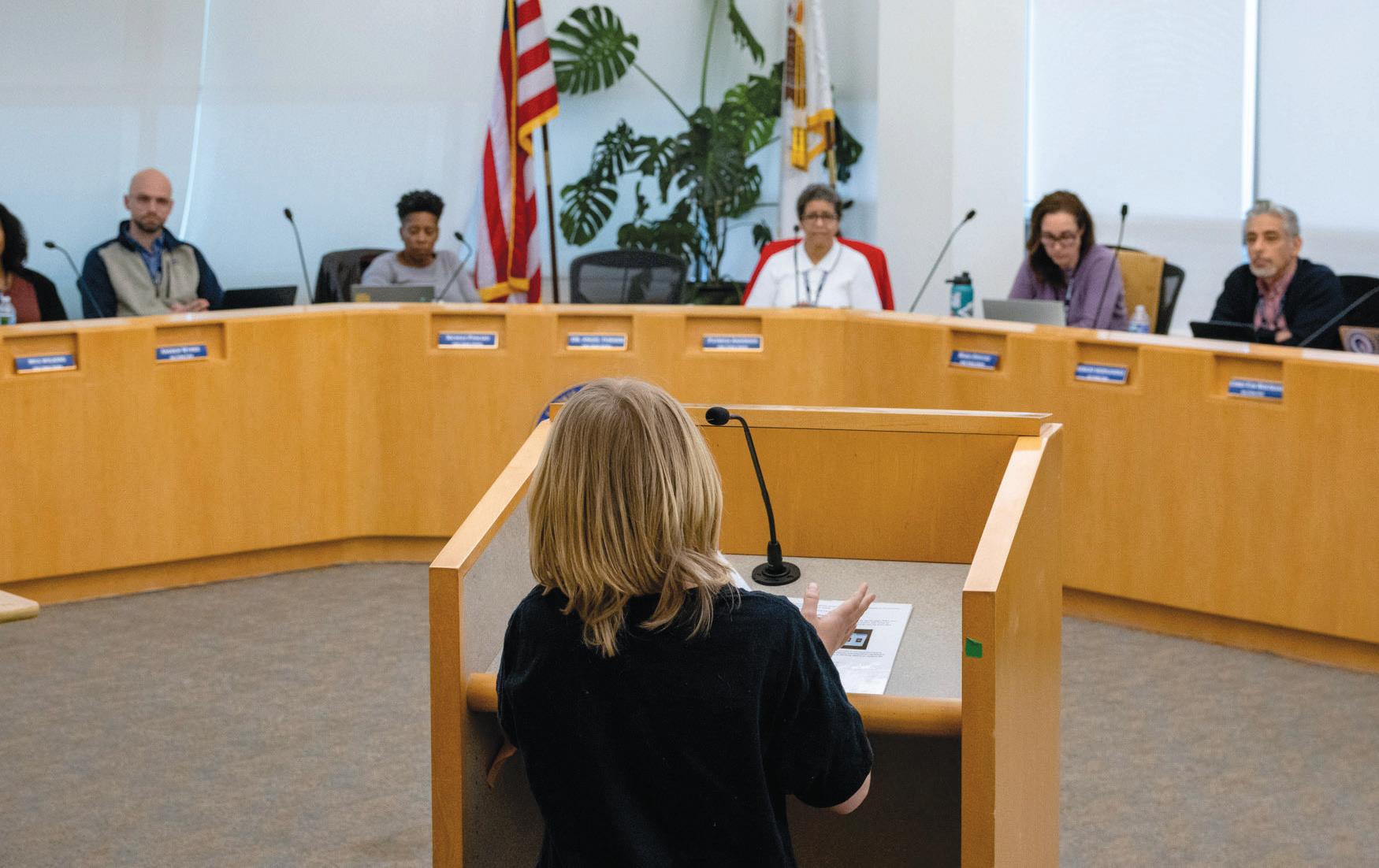
As parents protested the recently announced reassignment of middle school librarians, the Evanston/ Skokie School District 65 Board of Education discussed alternative spending cuts at its Monday meeting.
The proposed personnel changes come as board members look to complete Phase 3 of the district’s Structural Deficit Reduction Plan, which now aims to cut $16 million to $18 million from the district’s budget by fiscal year 2030.
According to Superintendent Angel Turner, the board must decide where to cut an additional $635,077 of spending before the next fiscal year in order to meet the target $6.3 million budget reduction for the 2027 fiscal year.
On Saturday, Turner announced in a written statement that the district plans “to reassign middle school librarians,” effectively eliminating the librarian position at the district’s middle schools.
During public comment at Monday’s meeting, parents, librarians, teachers and students spoke out against this action.
One Dr. Martin Luther King Jr. Literary and Fine Arts School fifth grader spoke about how Shalana Jaquess, the school’s librarian, recommended a book with an autistic main character that made them “proud” of their autistic brother.
“I believe that everyone should be represented in what we read,” the student said. “Every kid should have the chance to have a librarian in their school and help them have experiences like this.”
After board member Chris Van Nostrand questioned whether the cuts would be effective, Tamara Mitchell, the district’s chief financial officer, said the reassignment would save the district an estimated $387,631.
On April 13, the board voted to eliminate two counselor positions across Haven and Nichols Middle Schools, walking back an earlier plan to cut nine school counselor positions following criticism from residents. Some public commentators referenced that decision
on Monday.
“I spoke last week for the counseling staff. Another week and here we are again — this time for the librarians,” Nichols parent Michael Davis said. “Another vital school position on the chopping block. Who will it be next week?”
Some parents criticized the district’s moves to cut student-facing personnel, especially in light of the board’s March 23 approval of an around $520,000 purchase of iPads and accompanying keyboard cases.
Greer Beckman, a member of parent group Screen Sense Evanston, said many in the community had expressed dissatisfaction with this move and would rather retain “important” student-facing roles than spend money on education technology.
Parents, educators advocate to preserve preschool busing
Joseph E. Hill Early Childhood Center parents and educators also spoke during public comment to advocate for the preservation of busing to the preschool. The district is considering eliminating the service, which would account for about $1 million of the total $6.3 million reduction needed for fiscal year 2027.
While Illinois law doesn’t require preschool busing — except in the case of special education or to service students who are unhoused — busing advocates said it is necessary to maintain equity and access to pre-K programs.
“We have received direct feedback from families indicating that without district transportation, they will be forced to forgo essential (individualized education program) services,”
JEHECC psychologist Lexi St. John said. “Furthermore, our population includes a large number of marginalized and at-risk general education students who greatly benefit from access to highly trained early childhood teachers and related services.”
District 65 parent Sarah Forst said busing is critical to her children’s ability to attend school. She added that she would be willing to pay for the service.
Forst referenced the idea of a sliding scale, in which families would pay different amounts for access to bus services.
“As a family that is not low-income, I am more than happy to pay for the bus. In fact, considering the budget crisis, I think it’s fair and right that I do so,” Forst said. “I understand that many of the families using the bus

are low-income and will not be charged, and that’s kind of the point.”
Board members agreed to explore a sliding financial scale for busing at a district-wide level.
Board discusses cuts to FACE liaisons
The board also considered cutting positions of Family and Community Engagement liaisons, who support students and families both academically and socially.
District 65 Director of Climate & Safety Bryon Harris said FACE liaisons tend to work primarily with marginalized communities. According to Harris, 73% of Black students are connected with a FACE liaison.
“They’re connecting with families, and they’re connecting with the most marginalized families in our district, which usually are families of color,” Harris said.
The district currently employs five FACE liaisons, including Lachisa Barton, who spoke during the public comment portion of the meeting.
Barton serves five schools and emphasized the importance of her role.
“This is not just our work,” Barton said. “It is our lived experience, and our lived experience can never be learned or duplicated. We are not just positions on paper; we are trusted voices in the community. When you diminish us, you diminish the very families you say you are here to support.”
a.kuester@dailynorthwestern.com
j.balousek@dailynorthwestern.com
Scan this QR code to listen to an audio version of Assistant Audio Editor Claire Coffey’s coverage for the Everything Evanston podcast.

By NOELLE CABRERA diversity & inclusion editor
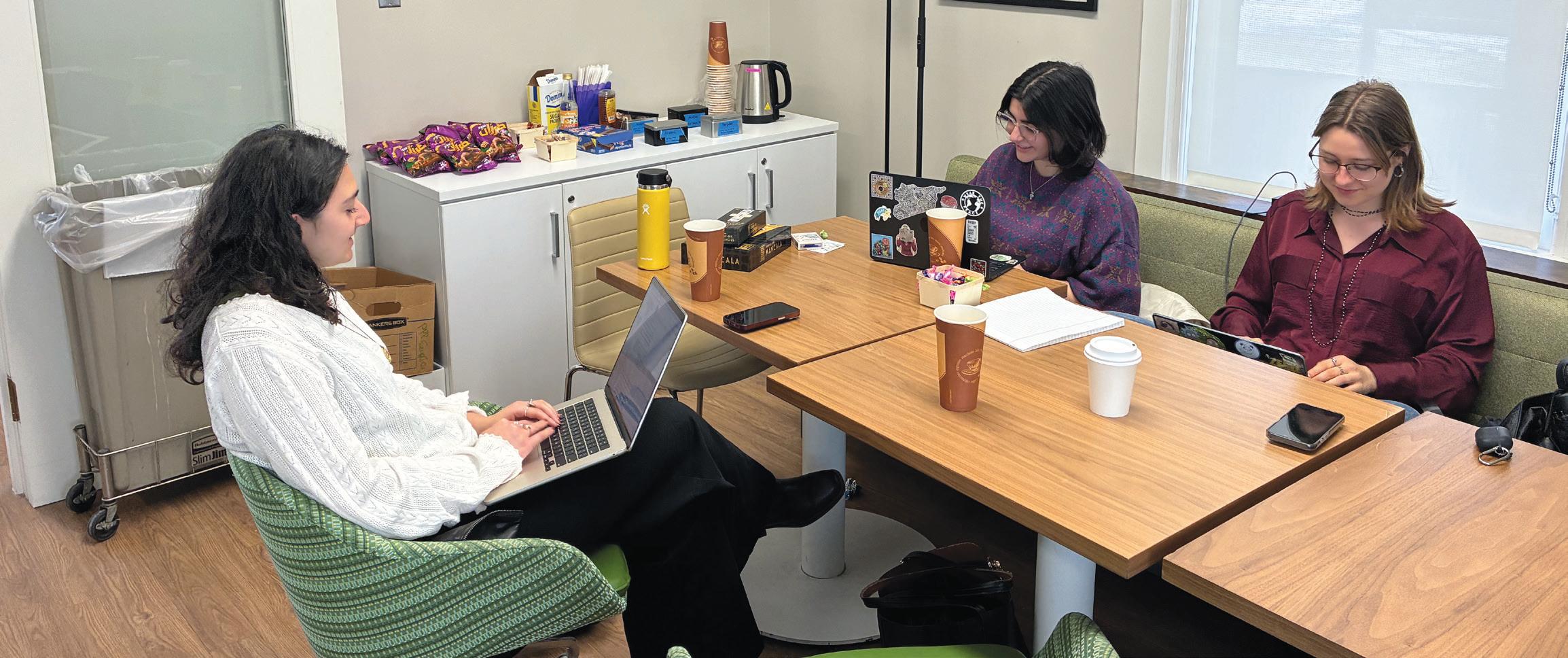
Each week in April, students gather on the Multicultural Center’s rst oor to sip Arabic and Persian teas, listen to Southwest Asian and North African music, study and socialize.
e new Multicultural Student A airs-organized programming, called Cafe MCC, runs from 2 to 4 p.m. every Tuesday in April.
MSA Assistant Director Aliah Ajamoughl said SWANA cafe culture inspired her to host these events.
“Cafes across Southwest Asia and North Africa are an essential cultural third space dating back centuries,” Ajamoughli wrote in a statement to e Daily.
“Because April is a time to celebrate our SWANA communities, I wanted to recreate that atmosphere through Cafe MCC at the Multicultural Center this month.”
Cafe MCC programming follows Persian Heritage Month in March and coincides with Arab Heritage
Month, Assyrian Heritage Month and Armenian Heritage Month in April.
Each event features a free ra e with prizes including books, Palestinian soaps and Egyptian loofahs. Cafe MCC events also o er a variety of Persian and Arabic teas, sweets, snacks and games.
Weinberg senior and Cafe MCC a endee Sarine Meguerditchian said the environment reminded her of cafes in Middle Eastern communities, where people converse and enjoy tea and sweets for hours.
“It’s been really nice to talk to people that I’ve never met in my life, and (to) get to meet other people from similar regions with similar backgrounds,” Meguerditchian said.
Medill sophomore Naya Yazigi, an international student from Syria, learned about Cafe MCC through an MSA SWANA outreach email that included a GIF of an actress doing a zalghouta, a joyous, high-pitched ululation o en used in some Middle Eastern and African communities.
e GIF, paired with album covers she recognized and other references in the email, made Yazigi feel like
Meet the artist Vernon Reid as he shares stories of his unlikely career journey defined by evolving media, community, relationships, and encounters with remarkable people— all set against the backdrop of extraordinary social events, and the work of artists and producers who helped to create the very times that they were simultaneously responding to. Reid will engage with the audience to explore the unintended consequences of actively disruptive change.
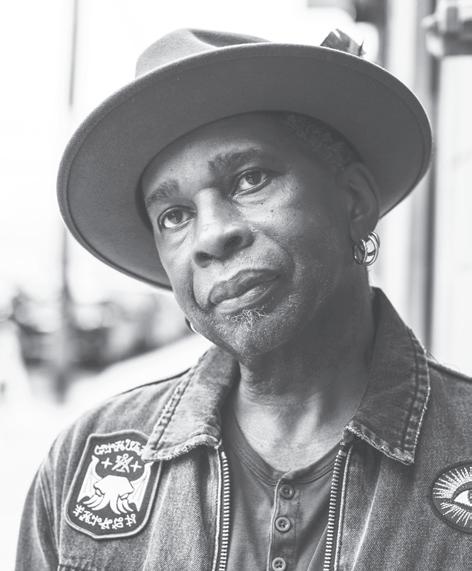

Vernon Reid is a visionary guitarist, composer, and producer best known as the founder and lead guitarist of the groundbreaking rock band Living Colour. Born on August 22, 1958, in London, England, he emigrated to America as an infant with his Caribbean parents. Reid grew up in Brooklyn, New York. He established himself as a force in the Downtown NYC music scene, initially via his association with the brilliant composer and drummer Ronald Shannon Jackson, and his dynamic, Ornette Coleman inspired ensemble The Decoding Society, which skillfully blended rock, jazz, funk, and experimental genres to create a unique and influential sound. Reid formed Living Colour in 1984, and the band achieved widespread acclaim with their 1988 debut album “Vivid,” featuring the hit single “Cult of Personality.” The band went on to release several more successful albums, earning multiple Grammy Awards and becoming one of the most celebrated bands of their era. Reid has also pursued various solo projects and collaborations with artists such as Public Enemy, Carlos Santana, Garland Jeffries, Mariah Carey, Tricky, Grace Jones, The Ramones, Wayne Kramer, James Blood Ulmer, George Clinton, Jack Bruce, and many others. He has also been a tireless advocate for social justice and racial equality, co-founding the Black Rock Coalition with the journalist Greg Tate, artist manager Konda Mason, and producer Craig Street, using music as a platform to create community, raise awareness and inspire change.

the event was “calling for” her, she said.
“Since coming to Northwestern, I’ve really hoped to nd events that speak to me personally and ll my nostalgia for home. And that hasn’t been easy,” Yazigi said. “A lot of the events that happen on campus are either done in a good intention, but don’t actually end up ful lling their goal, or are genuinely not even trying. But all these elements that happened today in the MCC Cafe are exactly what I wished I would have (had) as a freshman.”
Cafe MCC events also aim to connect students with MSA resources and support and encourage continued engagement with the MCC, Ajamoughli said. e inaugural Cafe MCC event drew more than 10 student a endees. Ajamoughli said the rst two “went incredibly well.” Depending on student feedback, Ajamoughli said she hopes to continue the weekly event a er April.
“ e mission I had as a freshman was to nd this place,” Yazigi said. “I found it now.”
n.cabrera@dailynorthwestern.com
General
Holly
Evanston, IL 60208. All news is
24/7 online at
of
is
additional copies are
herein,
or where indicated
is
NORTHWESTERN and protected under the “work made for hire” and “periodical publication” clauses of copyright law. POSTMASTER: Send address changes to THE DAILY NORTHWESTERN, 1999 Campus Drive, Evanston, IL 60208. Subscriptions are $100 for the academic year. THE DAILY NORTHWESTERN is not responsible for more than one incorrect ad insertion.
Wednesday, April 29, 2026 • 5:00 p.m.
Guild Lounge Scott Hall • 601 University Place • Northwestern University Free and open to the public No tickets or reservations required


For more information, contact Suzette Denose at 847.491.5122 • s-denose@northwestern.edu












By JAMES FRAZIER-WILSON
opinion columnist
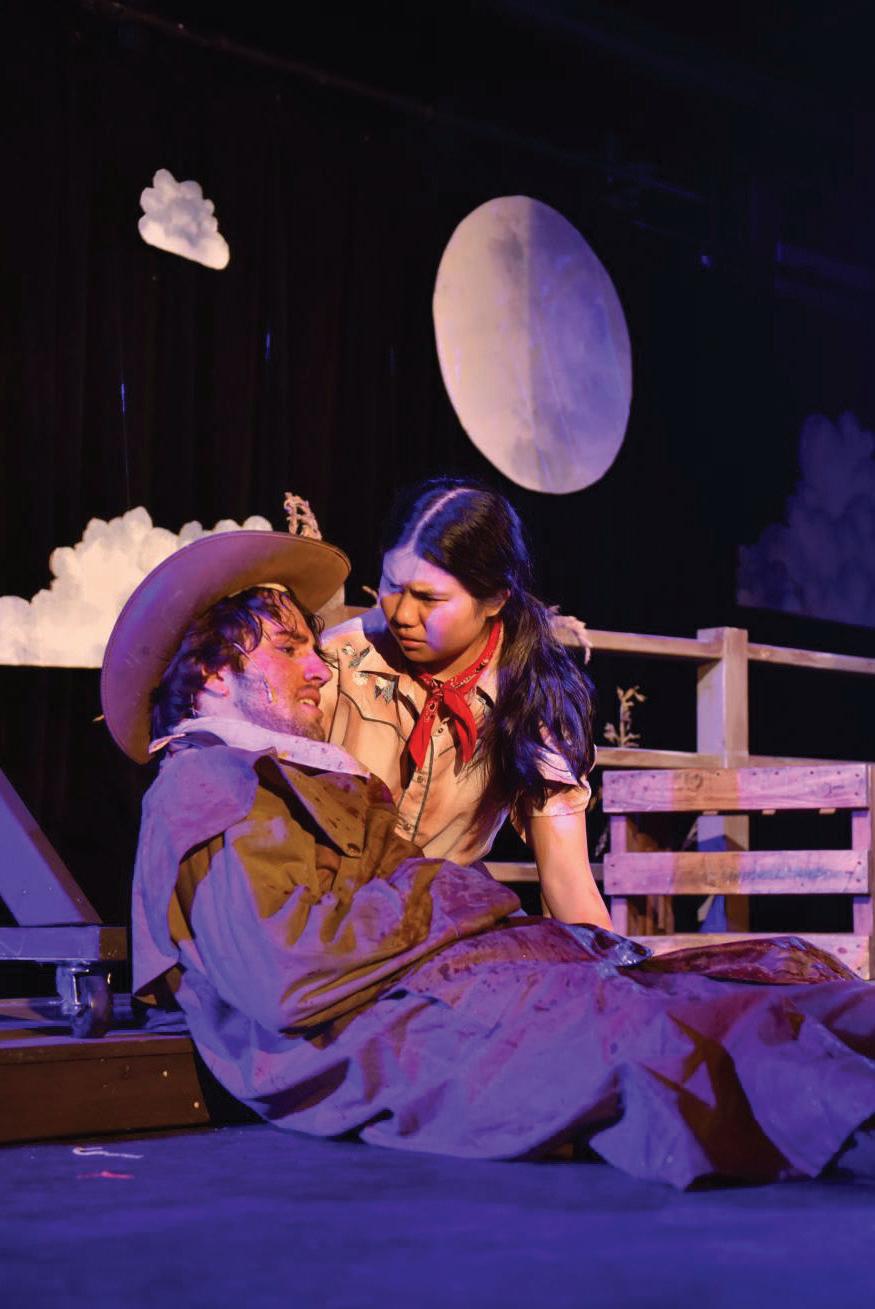
“The Ballad of Ricky Jo,” an original play set in the Wild West, premiered to an enthusiastic crowd on Friday at Shanley Pavilion. Featuring five original songs, the show was written by Medill junior Sophia Casa and directed by Communication sophomore Jeffrey Rohr.
An impressive amalgamation of an adventure story with a garnish of comedy and a musical finish, “The Ballad of Ricky Jo” walks a difficult tonal line throughout, but one that ultimately solidifies it as a truly unique viewing experience.
The play kicks into motion when Rory Collins (Communication sophomore Kyle Vetter), an established cowboy, meets Ricky Jo in a chance encounter in the wilderness and is killed by a stray bullet. This provokes the wrath of the Balladeer, a fate-like figure who sings the praises of legendary heroes
throughout history. In reparation for the loss, he sends Ricky Jo on a quest to kill a legendary gunman only known as The Chimera.
Ricky Jo proceeds through a series of episodic encounters with strange characters who populate the surrounding landscape. These characters include a spurned female cowboy and love interest, a strangely friendly assassin who kills with a bowie knife, a former gunman turned priest and finally, Ricky Jo’s long-abandoned father.
Throughout his journey, Ricky Jo hears a variety of perspectives on what it means to live a meaningful life, the central theme of the play.
Particularly memorable is the philosophy of hired gun Grizzly Carver, played by Communication junior Zachary Read. He is a willfully amoral automaton of violence who impulsively flits between jobs, cracking jokes as he goes. After being shot, Carver muses on his deathbed, “I hope I got it right,” providing one of the show’s most touching moments.
The play is a fable at heart, and set on the open frontier which has been represented in Western books, TV shows and especially films over the years. The story understands it lives in the wake of its predecessors; that is, it revels in and parodies the cultural idea of the West rather than representing the gritty, brutal reality of the time period.
The cast went to lengths to replicate the classic physicality of the Western genre while lacing it with comedic exaggeration, from hobbling on stick horses to waving knives through the air to pantomiming a square dance. The show’s energy often peaked during musical segments. Uptempo songs like “Ode to a Hired Gun” brought the entire cast to the stage for a few moments of unified chorus lines.
Titular performer and Communication sophomore Ellie Kim brought a quivering kindness to a character in a world where such a trait is rare. Such personable softness is both the trait that Ricky Jo tries to overcome to become a venerable cowboy and his greatest strength as a character.
The Balladeer (Communication first-year Jacob Toole), the fourth-wall-breaking host of the show, is an ambiguous figure who embodies the spirit of the West and seems to know more than the audience does. The role was most memorable when Toole leaned into the creepy undertones of the all-seeing, mischievous figure.
Underneath its frequently comedic surface, “The Ballad of Ricky Jo” asks questions about morality, freedom and personal development, ultimately leaving the audience to judge the ethics of each character for themselves. Ricky Jo never gets to kill The Chimera, but he survives with a new appreciation for his own self-worth. As he reflects towards the end of the play, “After a while of people telling you what you’re supposed to do … you believe it.”
For anyone searching for a different kind of play, “The Ballad of Ricky Jo” delivers everything a theatre fan could want alongside some unexpected twists. jameswilson2028@u.northwestern.edu
By JORDAN BALOUSEK copy chief
Against the vibrantly colored stained glass and intricately painted ceiling, Patrick Radden Keefe’s neutral-cladden outfit and unassuming posture were far from the most visually engaging sight in the First United Methodist Church at the Chicago Temple.
But his charisma, humor and reflective nature enraptured the sold-out crowd for more than an hour as he discussed his new book and writing processes in a discussion with author Gillian Flynn (Medill MSJ ’97) Thursday night.
Keefe’s latest book, “London Falling,” was released April 7 and recently earned a place on The New York Times’ bestseller list. He’s a staff writer for The New Yorker, and has also received critical acclaim for many of his books, including “Say Nothing,” which was adapted into an award-winning limited television series.
“London Falling” was originally published as a magazine article in The New Yorker in 2024. The extended nonfiction book begins with the death of seemingly normal 19-year-old London resident Zac Brettler, but extensively focuses on his alter ego — one who had connections within London’s criminal underworld that might have contributed to his death.
Book talk attendee Ruth Lyons said she’s a fan of both Keefe’s magazine articles and nonfiction books. She added that she was interested in hearing more about what inspires Keefe’s projects.
“I think it’s interesting how he can find seemingly innocuous things, … little nuggets, and then extrapolate huge stories out of them,” Lyons said.
In the case of “London Falling,” Keefe said he found the story through a suggestion he received while on set for “Say Nothing.”
He said that he is typically skeptical of story ideas
that others pitch to him.
“Usually, I develop this feeling in my stomach as they start talking. Because within about a minute, I can tell, it’s like — you have a story. It’s not a story for me.”
But this pitch ended up becoming the basis for the article version of “London Falling.”
He noted that the experience of writing “London Falling” differed from some of his other journalistic work because the main subjects — the Brettler family — were cooperative, even though they had previously been very private about Zac’s death.
Keefe said he warned the family about the story’s potential implications at the very beginning of the process.
“What I said to them was, ‘I think this is a great story. I would kill to write this story. But I don’t want to twist your arm in a way that you might later regret,’” Keefe said.
Keefe said he also told the family upfront that once he began researching and writing, he would publish the work even if they changed their minds.
He said he included many family secrets in his writing that the Brettlers “didn’t realize would end up in the book,” and that they may have preferred to be omitted, but the family recognized the need to include these details and handled it in a “resilient, sophisticated” way.
“This is a book about a boy who lies,” Keefe said. “And in a book about lies, it’s important that you really embrace the truth, not just as a philosophical concept but as a process.”
Book talk attendee Jack Folstein said he had already read the book and enjoyed it.
“His writing style is really good,” Folstein said. “I think it’s very narrative, even though it’s still nonfiction, and it was like 300-some pages and felt much shorter. You really fly through it.”
Beyond speaking about “London Falling,” Keefe
discussed his broader journalistic techniques. He said this often involves conversations with strangers, which his teenage sons find embarrassing.
Keefe said he is unconvinced the best stories can be found online, and that they instead tend to find him by accident.
“I just think of myself as a guy who’s walking along the beach looking for an interesting seashell,” Keefe said. “It’s all out there. I just have to keep moving and picking stuff up.”
Near the end of the talk, Keefe was asked to explain something he said in a profile of him in The New York Times by journalist Jonah E. Bromwich, in which
Keefe said he felt like he was “living a righteous life.”
While Keefe noted that the quote sounded “better in context,” he went on to explain some of the more altruistic motivations behind his work.
“What I was trying to get across in that article was that I’m no hero,” Keefe said. “I make no claims for my own virtue. There’s a million little ethical compromises that I make every day. But broadly speaking, I can look at my kids, and I think I’ll be able to look at my grandkids and say, in those moments, I tried to do the right thing.”
j.balousek@dailynorthwestern.com

Thomas Hurley/The
By BIANCA DISHMON arts & entertainment editor
Chef and sociologist Iman Sediqe (Weinberg M.A.’14, Doctorate ’19) will appear on an episode of Fox Network’s cooking show “MasterChef” Wednesday. The season’s “Global Gauntlet” theme was inspired by the upcoming World Cup, and in the episode Sediqe represents the continent of Asia and her Afghan heritage.
Sediqe said her memories with cooking began at age five, when she would follow her mother around the kitchen. The kitchen was the heart of her family’s home, Sedique said. As she got older, cooking became a therapeutic outlet, leading her to create a cooking blog during the COVID-19 pandemic.
The Daily spoke with Sediqe about the intersection between cooking and sociology, her blog “Imanistan” and her “MasterChef” experience.
This interview has been edited for brevity and clarity.
The Daily: How does sociology influence your relationship with cooking?
Sediqe: I think my journey with food changed mostly through my Ph.D. Doing my Ph.D. was very stressful. My stress relief outlet became this hobby of making beautiful food and hosting people. I would intentionally have 20 friends over in my tiny apartment at one time and cook an enormous amount of food. That’s when I could forget about everything else in the world and focus on the perfection
of this art and creating joy.
Food is an amazing way that people have an opportunity to travel to places they would have never traveled to all through a plate of food. As a sociologist, it’s really fascinating for me to see how food can be something that crosses boundaries, crosses languages, crosses cultures and allows people to get outside of their comfort zone.
The Daily: You launched your blog, “Imanistan,” during the pandemic. What inspired you to do so?
Sediqe: Before I did my Ph.D., I had gotten my master’s at Harvard. When I was graduating, my family knew I was always the family historian in a way, so they gifted me a Canon SLR. And, what did I like to do? Make beautiful food and then photograph the food and post it on my Facebook because I’m an archaic millennial.
I would always post my beautiful food photos on Facebook. And I had like, at this point I’ve lived in like 5,000 cities, so I have like 2,000 friends on Facebook. These food photos would go viral. And when COVID happened, so many people kept asking me, “Can you please teach me how to make Afghan food?” I was like, “I’m not gonna one by one teach everybody. I’m just gonna make one YouTube video, I’m gonna post it and you can just watch that.” By the end of the day, the video had like 3,000 views and I was like, “Apparently people want to learn how to make Afghan food.”
The power and impact of it is more than just teaching someone how to make something. It’s about being able to share a community that often doesn’t necessarily have their voice
presented from their own vantage point.
The Daily: How did you end up on this season of “MasterChef?”
Sediqe: Some of the producers from the show reached out to me on Instagram and I got a DM. I thought it was spam at first because I was like, “This is not real.” And they’re like, “I’m so-and-so from ‘MasterChef,’ and we’d love to connect with you if you would consider our show and whatever.” And then, after a week, I was like, “You know what? What if it’s not spam? Let me just reply back.”
It ended up not being spam. It was a casting producer for “MasterChef” and so at first I was like, “There’s no way. I have a toddler, I’m not leaving her, I’ve never left her before.” My husband was like, “This is a great opportunity just to learn about the food industry from a different vantage point and like what goes on behind a food show. You don’t actually have to go on the show.” The casting process — this was September — turned out to be four months long, and it is so arduous. I didn’t know. Apparently over 10,000 people apply, and only 40 people make it onto the show.
The Daily: What was the filming experience like?
Sediqe: It was an incredible experience. It was really cool. Meeting Gordon Ramsay was really awesome. My favorite part honestly was meeting the other contestants because I’ve never had the opportunity to meet people who are so passionate about the thing I’m most passionate about in life and have all of us in one space and also have them come from so many unique backgrounds.
There is a lady who’s representing Scotland and she’s a dark romance mystery novelist. Another girl I met there that I became friends with is an Indigenous American who grew up in Alaska and she cooks whale and berry cured salmon. Had I not even been featured on the show, I think I still would have walked away with a life-changing experience just having met all those people.
The Daily: What are you hoping people will take away from watching you on “MasterChef?”
Sediqe: One, I really hope that they can see how beautiful Afghan culture is and how beautiful Afghanistan is. I don’t know if many of us will ever have a chance to go there in our lifetime, but I think it is one of the most underrated cultures just because we haven’t had a lot of opportunity to explore it.
Two, I really hope that other women, mothers and people in all stages of life can be inspired. I’m 38 now, and that’s not old to me, but, a lot of people think your career, if you don’t do it right when you’re 21, it’s over. I’ve started a totally different career path that I don’t think I would have expected after COVID. And just know — especially young girls and women — you really are the creator of your own destiny. There may be certain limits and struggles that we face that are unique to us, but that I hope you could persist to pursue your passions at all times and give yourself permission to do that and really forge your own path, no matter what society tells you, to just take life by the horns.
b.dishmon@dailynorthwestern.com
By ALEX INGVOLSTAD
the daily northwestern
Walking out onto a glamorous navy and burgundy Persian rug, fusion horn band New Nostalgia began its April 17 show at Evanston’s Studio5 with an astounding trumpet solo from band member Connor Bernhard. This introduction was just a taste of the continued mastery that would follow.
Formed in 2017, the nine-piece band is composed of three saxophones, a trombone, a trumpet, a guitar, a bass, keys and drums. They created an incredibly full sound, never leaving the audience needing more.
As a saxophonist myself, I was truly excited for such a saxophone-forward band, with horns as the epicenter rather than just as flourishes in respect to the other instruments.
From the beginning of the approximately
two-hour show, it was difficult to take one’s eyes off of band leader and alto saxophonist Neil Carson, as his consistent dancing and headbanging — with a head full of long curls — set the tone for each song and encouraged audience members to match his energy. Carson’s stage presence and unmistakable enjoyment in music-making were highlights of the performance.
The band played a combination of covers and originals — my favorite cover was of Radiohead’s “Just.” Carson said it was a relatively new arrangement, but that notion couldn’t have been less obvious to the audience. Throughout the tune, the rhythm section added unique and intentional gaps and beat changes that evoked positive grimaces and whistles from the crowd. The ending was extravagant, punchy and clean, earning a round of roaring applause.
New Nostalgia has mastered the art of
balancing tension and release in their musicianship. Throughout the performance, that balance became remarkably clear, particularly in the original song, “One for All,” written by bassist Tim Seisser. The horns were in sync, never missing a beat, even in astoundingly technical licks.
However, the peak of this piece was the solo battle between tenor saxophonist Kevin King and trombonist Matt Kowalski. Starting the section as two separate entities and ending as duet partners, the pair blended their sound beautifully and easily referenced other recognizable pieces.
It’s evident how fluent the entire band is in the language of their respective instruments, but in this particular moment, it became indisputable.
The rhythm section kept a tight groove during the show and worked well together. With seamless dynamic changes and wordless
communication, they maintained the structure of each piece with artistry and ease.
Closing the night with an arrangement of “Message In A Bottle” by The Police, New Nostalgia showcased every instrument, every intensely expressive aspect of their playing style and the band’s musical chemistry. Every moving part was distinct, while effortlessly blended. Solos were strong and intentional, adding a new life to the already familiar song.
From “yacht-rock” originals to Sabrina Carpenter covers, New Nostalgia’s performance at Studio5 was one to be remembered. Their stage presence, musical knowledge and harmonious collaboration made for an excellent concert.
The talent of each band member alone is extraordinary. Combined, they make an outof-this-world band.
a.ingvoldstad@dailynorthwestern.com
PopUp Bagels opened a new location in Lincoln Park Friday — its rst location in the Midwest.












PopUp Bagels products.
While we had a blast trying all the menu’s items, there were some holes in the experience. Founded in 2020 in Westport, Connecticut, PopUp Bagels operates with a simple menu, o ering ve bagel avors, three permanent schmears and two limited edition schmears that rotate weekly. is week’s specialty avors were the cake batter cream cheese and the vanilla berry bu er. Its motto, “Not famous but known,” has become questionable in recent years, as the chain has gone viral on social
























































We waited in line for 45 minutes to enter the storefront, which features Chicago-themed decor, a mirror for customer sel es and pictures of celebrities from Adam Sandler to Donald Glover posing with

Bagels are made fresh every ve minutes and sold by the bag, requiring customers to purchase a minimum of three bagels and one schmear for $15, so we recommend going with a group. We bought ve bagels and two schmears for $27.66, including tax and a 10% tip, and were given an extra bagel for free. Perhaps listing our order name as Willie — in honor of our mascot — gave us street cred with the PopUp Bagels sta . PopUp Bagels encourages customers to “grip, rip and dip” their bagels and schmear, a technique that walks the line of useful and (cream)-cheesy. ough not all of the bagels were easy to rip, doing so allowed us to mix and match the sweet and savory spreads.

e sesame bagel is a must-have for sesame lovers. Its exterior was so , warm and coated with seeds, and biting into it felt similar to eating a sesame ball. Even though its texture was reminiscent of a sweet sesame treat, we preferred pairing it with the savory schmear. e plain bagel certainly lived up to its name; we preferred the salt bagel as a simple option. It created a satisfying salty-sweet combination when dipped in the cake ba er cream cheese.
e cream cheese’s sweet avor is unidenti able at rst, but once the cake ba er avor hits, it packs a powerful punch. It was almost impossible to stop eating, and we took the le over cream cheese home with us to nish later. Unfortunately, the cake ba er cream cheese is one of PopUp Bagel’s limited edition avors, but we hope it reappears sooner rather than later.

















The everything bagel was our favorite of the bunch. Sprinkled with seasoning on the outside and u y and warm on the inside, it was the perfect blend of chewy and tough.













Paired with scallion cream cheese, it was an exquisite bite.

While the scallion cream cheese complemented the everything bagel wonderfully, its avor was a li le muted. We would have welcomed more scallions.





e poppyseed bagel was our least favorite avor. Like the everything bagel, it didn’t skimp out on the seasoning. In this case, however, the amount of poppyseeds was overwhelming and made the bagel less enjoyable to eat. We tried pairing it with both schmears and recommend eating it with scallion cream cheese rather than a sweet option.














When the meal was done, we still had about half of each schmear container le over. If you’re planning on purchasing, and you hate wasting food as much as we do, make sure you have extra bagels at home to use up the rest later. PopUp Bagels is a good spot to visit if you’re looking for a special weekend treat or want to try the weekly schmear avor. But with a $15 minimum price, if you’re looking for a frequent breakfast order, it’s not everything.

While PopUp Bagels’ current rise in popularity contradicts its motto, the hype might be slightly unjustified.
By ISABELLA JACOB
is week, we wanted to highlight our wonderful multimedia desks. In this corner of the paper, you can nd stories from the Audio, Video and Photo Desks.
As someone whose rst Daily story was a podcast, the chance to spotlight multimedia stories is an exciting opportunity that we hope to expand in the future.
From our podcast series “What’s New At NU” to covering Admi ed Students Day and the Vietnamese Student Association show, these stories capture authentic voices and showcase stunning visuals. Bringing multimedia to our print paper gives these desks the chance to be introduced to a new audience. is quarter, e Daily has prioritized incorperating multimedia into all aspects of our coverage. So, as you see QR codes in our paper, give them a scan and see, watch or hear some of our coverage. As our editor-in-chief Anavi Prakash says, “multimedia is the future.”
i.jacob@dailynorthwestern.com
VIDEO
Northwestern K-Dance presented its sixth annual Spring Show on Friday. The “Star Athletic Championships” pitted members against each other through dances, videos and lighthearted competition.
WHAT’S NEW AT NU: GROUP EXERCISE CLASSES ARE MORE THAN JUST A SWEAT
The Daily Northwestern tours Schapiro Hall. Hear resident perspectives and learn about the dorm’s location and amenities. This video is part of The Daily’s Dorm Digest series covering each dorm’s offerings.
From barbells to Latin Dancing, students, faculty and Evanston residents have found more than a workout through Northwestern Recreation’s group fitness classes.
THE WEEKLY: YOUR RECAP OF CAMPUS AND CITY NEWS
Last week, Northwestern Medicine’s Human Longevity Clinic conducted a study on biological age, Evanston City Council rejected the “Circuit Breaker” program and the Northwestern Figure Skating Club placed 13th at Nationals.




























































Ina Choe/ e Daily Northwestern
















As a little girl living in Guyana, I developed a tradition of sitting on the stairs of my grandmother’s countryside home to read the Sunday edition of local newspapers. I would always turn to the back pages of Stabroek News to peruse the sports section.
These early moments sparked an insatiable curiosity in sports, setting the tone for my future endeavors in the realm of athletics. I started out playing cricket, a popular sport played by people of all ages and skill levels in the Caribbean. I would pick up my dad’s heavy cricket bat and

I envy the people who can so easily say “I love you.”
In my house, where we speak Chinese, “wo ài ni” always felt unfamiliar in my mouth.
When spoken out loud, it feels hollow. The words have simply never belonged to me. They especially haven’t in the way they seem to belong to other families, where “I love you” slips easily into conversation, tossed effortlessly between parents and children.
In my family, love takes on a subtler shape. It is my favorite cantaloupe sliced and served after school. It is the certainty that I will succeed and the help provided to ensure I do. Love has, in some ways, felt transactionary.
Maybe I feared rejection — the unknown reaction I might receive for an “I love you.” It was safer to prove I was a worthy investment than try to be a warmer person.
I have always envied the girls who can hug and

It’s incredibly hard to imagine our day-to-day speech without filler words.
On average, a person speaks between 6,000 to 16,000 words each day, according to a wide range of published studies. It varies between different groups, depending on factors like fluency, gender or education — but the estimated range remains the same.
And yet, within the ocean of our linguistic composition, filler words in native English speakers account for over 10% of daily speech. Honestly, I was surprised it wasn’t more, because it seems as though we use them all the time.
Words such as “um,” “uh,” “you know,” “kinda” — and my personal worst — “like,” tend to be common in everyday conversation. They’re even more tempting to use in stressful situations such as interviews or presentations.
But filler words are ruining everything, and it’s time to try our best to put an end to them.
As I grew up in Greece trying to learn English, my teachers realized I was a stuttering kid. Whenever I didn’t know what or how to say something, I’d pause and fill the deafening silence with an “um” or, as we say in my native language, “em.” They were quick to posit that the more “meaningless” words I used, the more empty my speech became.
mimic his posture as best as I could.
As I grew up, I gradually began to explore other sports. Basketball, which I cultivated a passion for in high school, fundamentally changed my life. Coming to Northwestern would not have been possible without the influence of basketball in my holistic character development. In the early days of my first year, I found myself intrigued at the premise of experiencing sports at the NCAA Division I level through NU’s athletic program.
From attending a collegiate basketball game in Welsh-Ryan Arena to covering my first tennis game for The Daily Northwestern, I derived fond memories from NU sports.
I recall a feeling of awe as I walked into both Welsh-Ryan and Combe Tennis Center. In these moments, I reflected on the opportunity that was housed within the walls of these facilities and the countless stories that people have shared as they
recount their Wildcat experiences. My musings shifted from physical structure to game structure.
Box scores attribute a finitude to sports, presuming that the true events of a game could be replaced by the statistics recorded in solid lines. The thrill of an “and-one play,” the excitement of a 60-yard dash and touchdown or the slam to win a set point cannot be fully encapsulated by the numeric notations attached to athletes.
Sports should not be viewed through the polar lens of win-loss scenarios and first-last seed standings. Instead, consideration should be given to the off-court interactions that cultivate and sustain fan interest.
Athletes display their prowess and preparation on the playing field. Spectators and student sections at games, matches and meets bring energetic support that fuel performances. Facility staff and
officials ensure a fair methodical approach is taken to game execution. Yet, all of these individuals possess personhood and distinctive attributes beyond these scales of representation. This column calls for a reflection on the wholesome moments in sport, extending beyond a narrow focus on athletic performance. It begs the question that has inspired me to put my proverbial pen to paper: “What lies beyond the box score?”
Alisande Jaiserrisingh is a Weinberg first-year and author of “Beyond the Box Score.” She can be contacted at alisanderjaiserrisingh2029@u.northwestern.edu. If you would like to respond publicly to this op-ed, send a Letter to the Editor to opinion@ dailynorthwestern.com. The views expressed in this piece do not necessarily reflect the views of all staff members of The Daily Northwestern.
laugh and shout their affection into the open air.
The ones who scream “I love you” across hallways and in group chats. Their love feels uncontainable. Mine is folded inward, stretching against iron seams.
Direct affection is lacking in my love map. When friends pull me into a hug or stand just a smidge too close, I stiffen before I realize it is natural. When someone compliments me, I laugh it off because accepting love is just as uncomfortable as giving it.
Many Asian American households function this way. Love is softer and harsher all at once — embedded in action rather than language. Our parents show their love by working to give us more than what they had: “In five or 10 years, you will appreciate all we have done for you,” they say. That may be true. However, along the way, a fissure forms.
In my experience, some learn to bridge that gap. Others linger at its edge. I’ve watched as people fall into archetypes that feel easier than honesty: the overachiever with no room for relationships, the “Asian baby girls” who exude boldness and untouchability, the emotionally elusive Asian men who bounce from bed to bed.
We learn how to charm, how to mask ourselves for an expressively demanding world, but stop short
of real exposure. It looks like freedom. But underneath, there is an inability to say what we mean without flinching, freezing, stumbling over our words.
I don’t think I have ever said “I love you” to my closest friends from home. Even now, after years of reflection, I type “love you” and hover over send, absconding the “I” because it still feels too raw.
I want to be vulnerable, but vulnerability feels like being strung up on a butcher block.
I love my family and they love me the only way they know how. From what I have heard, this is a shared experience for many Asian American children — emotional reluctance is a generational inheritance, shaped by histories where survival barred softness.
What our parents gave us was care, in the most practical and enduring sense. But they never taught us the necessary empathy to love ourselves. And so we are left to rebuild, to convey an emotion we have not clearly identified.
For some, that comes easily after years of friendships and communities that melted their hearts. For me, it is slow work. It is feeling like your tongue weighs a ton when all you want is
to be warm and welcomed beyond this barrier of lovelessness. It is fearing that you are less valued in your relationships because you cannot communicate that you care.
Slowly, I am learning. To say what feels unnatural and to sit in the discomfort of being known. Still stuttering over “wo ài ni,” still unsure of how to make “I love you” feel like mine. But maybe the effort is enough for now.
Even typhoons, in all their force, eventually quiet. Maybe, if we let them, they can leave behind something softer than silence.
To the people who have a friend like me, I hope you know they love you, too.
And to those still searching for the right words to say, “wo ài ni” is never a bad place to start.
Rainee Li is a Medill first-year and author of “Threads of a Typhoon.” She can be contacted at r.li@dailynorthwestern.com. If you would like to respond publicly to this op-ed, send a Letter to the Editor to opinion@dailynorthwestern.com. The views expressed in this piece do not necessarily reflect the views of all staff members of The Daily Northwestern.members of The Daily Northwestern.
Initially, I didn’t get it. But the older I got, the more I started to notice how much poorer my language, and others’, sounded with that awkward vowel stretching.
“This is, like, the best thing ever,” someone would say, and the only thing I’d hear was that rolling “like,” stinging my brain in unpleasant ways.
Slowly, I began to notice how much more value words had with a quick breath of silence in between.
During class discussions, I tried my best to dodge “ums” and “likes” and instead take a fewseconds-long pause. Whenever I asked a question, I reminded myself to speak slower so I could find alternative, more meaningful phrasing, such as “it sounds as though you had a rough time,” or “let’s go in about an hour.”
Every chance I could, I tried to kill my “likes.”
When I reached eighth grade, one of my teachers told me that my English was “shockingly, very good.” It was a common, well-intentioned — though oftentimes backhanded — compliment from educators when I lived in the U.K.
Still, I felt proud of myself for having managed to sound almost fluent — “Even better than your native classmates at times,” my teacher said.
When I asked him why he felt that way, he told me I sounded “certain” in my vocabulary.
Once I came to Northwestern later down the road, I noticed other non-native speakers doing this too.
In the fall, a few friends and I gave a welcome presentation for a club we run. After the meeting was
over, somebody on our executive board pointed out in awe that one of my friends — who is from Korea — had “incredible” speaking skills because he’d almost entirely avoided filler words.
I looked into it more, and it seems that research backs this up: Non-native English speakers use about four fewer filler words for every 100 words spoken when compared to native English speakers, according to a 2019 study published in a blog run by the University of California, Los Angeles. This, in turn, simply makes us sound clearer.
I’ve attended meetings, held group discussions, watched presentations — and all were better when people just paused. When they took a second to think instead of reaching for a verbal crutch, everything sounded more deliberate, more precise, more worth listening to.
Of course, I’m not saying the goal is to sound perfect or robotic or freakishly prepared at all times. I’m not even saying we should erase “like” from our vocabulary entirely. However, maybe we could start by trying to be a little less afraid of silence — and just a breath more intentional with our words.
It’s, like, so much more powerful.
Zoe Chao is a Medill junior and author of “Undecided.” She can be contacted at zoechao2027@u. northwestern.edu. If you would like to respond publicly to this op-ed, send a Letter to the Editor to opinion@dailynorthwestern.com. The views expressed in this piece do not necessarily reflect the views of all staff members of The Daily Northwestern.

By KATE MOORES senior staffer
When Jason Prinzo was diagnosed with depression, he was five years old. His father was an alcoholic and a drug addict who was prone to violence, and therapy became a fixture in his childhood. But in sixth grade, he quit going. He said the embarrassment of being pulled out of class to meet with the school’s social worker was worse than whatever was happening inside his head.
“I was embarrassed by the diagnosis, so I just didn’t tell anybody,” Prinzo said.
He said after that, he got married and built a life that, “by any outside measure, looked like a good one.” Prinzo is now a mental health advocate and motivational speaker.
By the time he entered his 40s, he had cycled through a handful of medications without finding lasting relief.
“You start something new, you’re hoping it works, you find out it doesn’t,” Prinzo said. “Then you have to wean off that one while you’re starting a new one.” Eventually, his psychiatrist diagnosed him with treatment-resistant depression.
The Cleveland Clinic defines treatment-resistant depression as a condition in which a patient does not improve after at least two antidepressants. Of the 8.9 million American adults treated for major depressive disorder, 2.8 million are considered treatment-resistant.
For some with treatment-resistant depression, ketamine, a Vietnam War-era surgical anesthetic turned club drug now being used to treat severe depression, is what works when nothing else does. Clinical studies have found response rates between 60% and 70% in patients with the major depressive disorder.
In 2017, Prinzo decided to try ketamine. Unlike traditional antidepressants, it is administered through a series of IV sessions under medical supervision.
Prinzo received treatment at IV Solution and Ketamine Centers of Chicago, a ketamine clinic in the River North neighborhood. Founder and Medical Director Dr. Bal Nandra is a practicing anesthesiologist who has overseen more than 15,000 ketamine infusions since opening the clinic in 2017.
work until it did.”
He added that ketamine was an important step in his recovery process.
According to Dr. Brandon Hamm, a psychiatrist at Northwestern Medicine who runs the hospital’s Ketamine Infusion Clinic, the drug works differently from traditional antidepressants. By blocking receptors in the brain known as N-methyl-D-aspartate, or NMDA, it triggers a burst of neural activity that researchers believe can rapidly relieve depression symptoms.
“There’s very few treatments that are as fast as ketamine,” Hamm said. “It’s one of the fastest things out there, both for depression response and for resolving suicidal ideation.”
Clinical studies published by the National Institutes of Health have shown that ketamine can reduce suicidal thoughts within a single day, with effects lasting up to a week.
For Prinzo, that speed proved lifesaving during a suicidal episode in 2021.
“One treatment of ketamine was able to clear those thoughts out of my mind,” Prinzo said. “When I say ketamine saved my life, it absolutely saved my life.”
However, its antidepressant effects are not permanent, and depression symptoms can return once a patient stops treatment. Nandra said that most patients require maintenance infusions every three to four weeks to sustain their response.
Currently, ketamine is only approved by the Food and Drug Administration as an anesthetic, not for psychiatric use. This means most insurers won’t cover it. Clinicians who prescribe it for mental health do so offlabel, a practice that allows physicians to use approved drugs for unapproved purposes.
Without coverage, patients pay anywhere from $275 to $1,300 out of pocket per infusion, putting treatment out of reach for many who can’t afford it.
In response, Nandra founded the Serenity Foundation, a nonprofit that provides need-based financial assistance to patients who cannot afford ketamine treatment.
“We started the foundation so we could help people who really just can’t afford it, or who just need a supplement,” Nandra said.
Since its start, the organization has funded nearly 3,000 infusion sessions and raised around $800,000, more than 95% of which has gone directly to patients.
made all the difference.
Lutts was living in Grand Rapids, Michigan, when a friend told him about Chicago IV Solutions. Diagnosed with depression in 2019, he had tried three antidepressants, one of which left him with side effects worse than the depression itself.
“I felt like an empty shell,” he said. “It’s like somebody pulled the electric cord out.”
Having lost his job as a result of depression, the out-of-pocket cost put ketamine therapy out of reach. Then, he heard about the Serenity Foundation. Lutts applied, was approved and drove to Chicago for treatment.
“I sat down as one person, and when I woke up an hour and a half later, I felt like an entirely different human being,” Lutts said. “It was the first time I had felt joy in so long.”
In the five years since, he has had close to 30 infusions, all partially subsidized by the foundation. There are clinics closer to home in Grand Rapids, but none offer financial assistance of any kind.
Lutts is still on two antidepressants. He does not see ketamine as a replacement, but as an enhancement that fills a gap in existing mental health treatment.
“You can tell how your prescriptions affect you
and keep you at baseline,” he said. “Then you go get an infusion, and you’re like, ‘Oh, there’s this other, next-level version of me that gets to fully express itself without the bounds of limiting depression and apathy and hopelessness.’”
Even as ketamine clinics expand, broader access will likely depend on stronger clinical evidence and regulatory shifts that would allow for ketamine to be formally recognized as a standard treatment for mental health conditions.
Nandra points to Spravato, an esketamine nasal spray approved by the FDA in 2019 for treatmentresistant depression, as a sign of how that shift might happen.
While some clinicians, including Hamm and Nandra, argue the spray is less effective than IV ketamine, its FDA approval marks the first time a ketamine-related treatment has been cleared for psychiatric use. It could potentially open the door for similar therapies and broader insurance coverage.
“I probably would never have even gone if it had not been for even the chance that the cost would be lower,” Lutts said. “Without it, I don’t even know that I would be here today.”
katemoores2028@u.northwestern.edu
















By CLARA B. FREETH staff editor
When Weinberg sophomore Jackie Le was brainstorming themes for the third-annual Vietnamese Cultural Show, she said she couldn’t stop thinking about paralleling it to the hit Prime Video series “The Summer I Turned Pretty.”
And that’s just what the Vietnamese Student Association did — this year’s cultural show, performed in the Ryan Family Auditorium on Saturday, was titled “The Summer I Turned Vietnamese.”
The show featured modern dances and
From page 1
code, which restricts most residential land to singlefamily homes, will remain on the books until the rewrite is finished. BUILD would short-circuit that wait.
Some residents have expressed support for this move.
“I think it would be great if this happens because it eliminates all that debate around legalizing multi-units in Evanston,” Frank Hill, co-founder of Rezoning for a Better Evanston, said.
Hill added that the plan would allow the city to home in on anti-displacement measures, which he described as “what everyone says they’re worried about.”
Evanston’s Black population fell from 22.5% in 2000 to 14.4% in 2024, according to U.S. Census data. Roger Williams, Hill’s co-founder at Rezoning for a Better Evanston, attributes this to rising housing costs.
“The reason I’m in this game is the fact that so many Black people are being displaced out of Evanston,”
From page 1
spokesperson said.
“Northwestern has the responsibility to monitor the vendors that administer our health plans to ensure that they are charging reasonable fees for their services and administering our plan in accordance with the NU plan documents,” the spokesperson said.
Feinberg staff member Julie Bednark said her medication under NU’s plan with Blue Cross Blue Shield cost her $30 per month.
Under the University’s new plan with UnitedHealthcare, she said the same medication would have cost more than $1,000 per month as it fell out-of-network.
Following numerous appeals, Bednark said she switched to a medication proven less effective yet
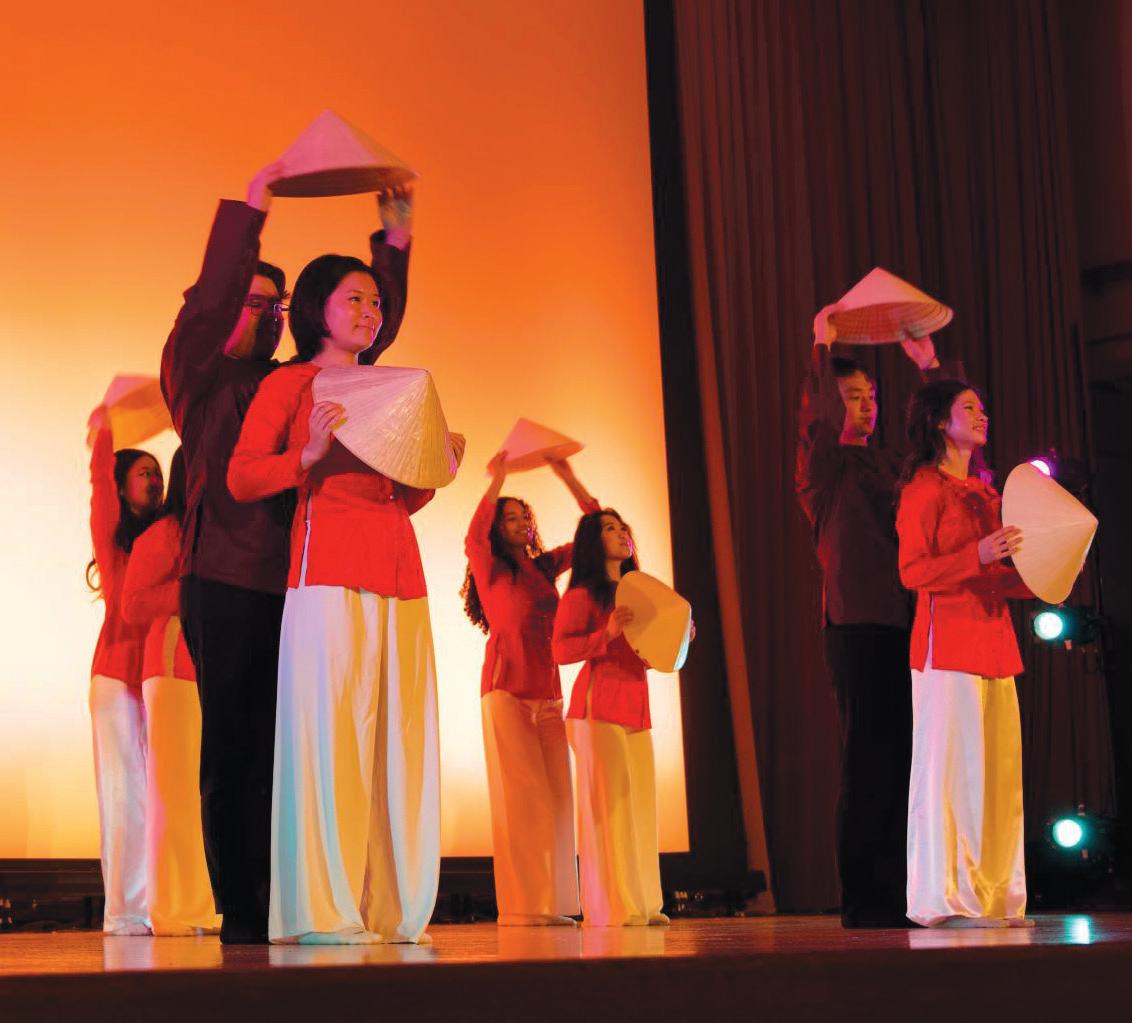
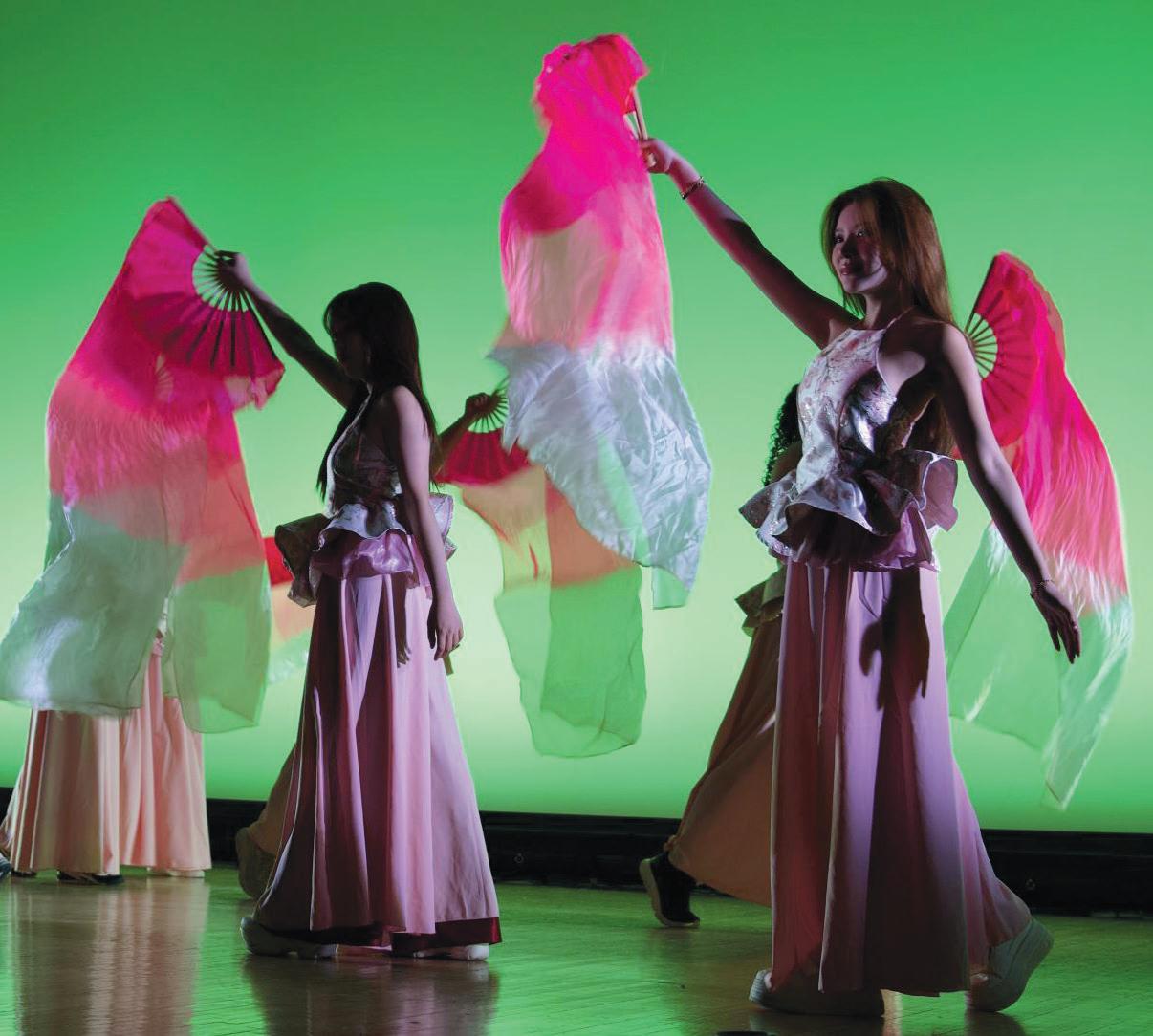
Vietnamese pop music as well as traditional Vietnamese dances and vocal numbers. Between performances, a series of pre-recorded skits based on “The Summer I Turned Pretty,” were projected on a screen.
“Every year previous to this year, I have cried,” Weinberg senior Barak Tucker said. “(The show) is absolutely stunning, and I recommend that anyone and everyone who goes to Northwestern go to the show.”
Le, who serves as VSA’s outreach chair, said VSA members started planning the show in the fall and began rehearsing Winter Quarter. The largest performance was the finale, “A Little Dream of Me,”
Williams said. “They can’t afford to live here. So if you start at least by increasing the supply of homes, you will attack that problem.”
BUILD targets the “missing middle,” which is defined as units affordable to households earning 80-140% of the area median income, according to a September 2024 report from the Ad-Hoc Missing Middle Housing Solutions Advisory Committee.
The plan aims to address a statewide shortage of 142,000 homes identified in a 2024 study conducted by the University of Illinois Urbana-Champaign and the Illinois Economic Policy Institute. However, it does not fund nor require anti-displacement programs.
Williams and Hill emphasized displacement as a key issue in addition to supply-side solutions. Some displacement-focused protections already exist in Evanston through its Inclusionary Housing Ordinance and just cause eviction protections.
“Many people talk about why they love Evanston because they love the diversity,” Williams said. “But Evanston is segregated by race and income. With antidisplacement strategies, we right some of the wrongs that were done in the past.”
$20 more than her original treatment under Blue Cross Blue Shield.
“The healthcare system is set up this way,” she said.
“It’s set up to make us give up.”
Bednark said the new plan also increased the cost of mental health care. While she said her therapy sessions were covered under Blue Cross Blue Shield, sessions under UnitedHealthcare now cost $40.
Staff members may cut down on their therapy visits to avoid the higher costs, she said.
“It is an expense for staff who make a very low wage,” Bednark said. “They’re having to do things like do their therapy or mental health sessions every other week now because they can’t afford an extra $160 a month.”
Laura Glick, the program coordinator and insurance and billing specialist for NU’s Center for Audiology, Speech, Language, and Learning, said UnitedHealthcare’s descriptions of covered services are “vague”
‘She’s A Rainbow’
By Tanat Johnny Tungsubutra
featuring the whole cast. Other large numbers included the “Hat Dance” and “Fan Dance.”
Weinberg first-year Vivian Luong, who joined VSA in the fall, participated in three performances in the show, including “Hat Dance” and “Fan Dance.”
“VSA is really important to me because it connects my Vietnamese cultural heritage with my personal identity,” Luong said. “It creates a family in this school for me, and I feel like the bond is really strong.”
The final act of the skit was performed live on stage.
Students played characters from the show — Belly, Conrad and Jeremiah — in an alternate ending.
After Belly decided to study abroad in Vietnam on her own in VSA’s reinterpretation, Conrad appeared
Seventh Ward resident Mary Rosinski is skeptical that a statewide framework can address Evanston’s specific affordability needs.
Rosinski pointed to existing affordable housing programs in Evanston that she said have not been assessed to determine “who is being serviced and how we can be more effective.” Individual municipalities should be able to conduct their own housing needs assessments before acceding to a statewide template, she said.
She also criticized the Housing Gap Analysis report, a 2025 study used to estimate affordability gaps in Evanston. Rosinski said the data is not granular enough to capture the nuances of housing needs in Evanston.
“Not knowing who you’re building for seems to be a folly,” she said.
BUILD would loosen restrictions on height, distance from the street and size of new developments.
Without more restrictive local zoning rules, Rosinski said she is worried that new construction will change the character of the city.
“If you don’t control how high you can put it or
compared to those of Blue Cross Blue Shield.
Glick said this lack of clarity inhibits the clinic from providing helpful information to patients.
“We want our patients to focus on receiving care, rather than having to deal with all of this extemporaneous stuff,” she said.
According to Catherine Fabian, assistant director at the Center for Audiology, Speech, Language, and Learning, the clinic became in-network with UnitedHealthcare on Jan. 1 to remain financially available for its patients at NU.
While Blue Cross Blue Shield took around one week to pay a patient’s claim, Fabian said, UnitedHealthcare takes around two weeks.
For patients prescribed specific treatments, Fabian said the delay in claim processing for costs may leave patients hesitant to return for subsequent care due to confusion over whether their treatment sessions will
in person while Jeremiah texted her a picture from a plane window. The skit ended there, leaving the audience unsure if Belly picked a brother — or if she chose herself.
To close out the night, the club’s executive board performed a dance, followed by thank you speeches to seniors. Finally, the club presidents signed a hat and handed it to the incoming presidents.
“VSA is such a place for home and family,” Le said. “We have such an amazing culture that we love to show off to the student body here, especially in shows like this.”
c.freeth@dailynorthwestern.com
make it have a roof line so light can shine in, you will create a city of boxes,” Rosinski said.
She added that building without knowing exactly what kind of affordable housing a community needs, or without establishing a clear path to homeownership, risks pushing out lower-income residents.
Sarah Petersen, executive director of Open Communities, an Evanston fair housing nonprofit, welcomed BUILD’s statewide ambitions but said the city’s local work remains important.
“With zoning reform and building housing, it’s great to have a regional approach,” Petersen said.
“When we try to address these solutions in little pockets, it’s not as effective.”
She pointed to the city’s Inclusionary Housing Ordinance and the goals laid out in the Housing4All plan, which City Council voted to table earlier this month, as key supplements to state-level pushes.
“Housing supply is essential,” she said. “You also need to look at other strategies to make sure that we’re preventing gentrification and displacement.”
t.bethke@dailynorthwestern.com
be paid under the new plan.
Practice Manager Josie Bodeker said confusion among the clinic’s staff over which treatments UnitedHealthcare covers are insufficiently addressed by the administrator’s customer service.
“Every time we call and talk to somebody, you don’t get any answers. You’re on hold. You’re transferred. They don’t know what you’re talking about,” Bodeker said.
Glick said the clinic aims to provide patients with clear guidance regarding their treatment.
The process of transitioning to UnitedHealthcare, she said, has limited the amount of information the clinic is able to relay to its patients.
“We haven’t received the level of support that we were hoping for,” she said.
l.kubovchik@dailynorthwestern.com
page 1
reactions among community members have varied, depending on whether they consider the board’s January resolution “binding.” Karlin added some assume the decision will only impact Kingsley while others believe it practically ensures Lincolnwood’s eventual closure.
Despite that uncertainty, she said Lincolnwood community members remain optimistic about next school year.
“I think most people are very invigorated by the fact that the school’s open, and they’re very focused,” Karlin said. “We have so much energy in the community about making it a positive and welcoming place.”
The board’s January vote also established new attendance boundaries, which impacted school assignments for more than 800 District 65 students.
Lincolnwood will welcome many former Kingsley students next school year, sparking volunteers to coordinate summer meetups and prompting the district to plan “field trips” for incoming students to tour the building, according to Karlin.
She added Lincolnwood families feel empathetic toward their Kinglsey counterparts.
“Ever since the deciding vote, it has been an outpouring of volunteers,” Karlin said. “Especially as the PTA president, I can’t tell you how many people have just walked up to me like, ‘I want to help out. I want to make those families feel welcome. What can I do?’”
Karlin noted the district’s new attendance boundaries will also split Lincolnwood’s existing student population across multiple schools. She emphasized the importance of reminding students they still belong to the “same larger community” and “that our community is sometimes bigger than our school.”
Many students will be reunited at Haven
From page 1
said. “Everyone’s so happy.”
Many participants wore white clothing during the festivities, symbolizing fresh starts, unity and purity during Holi. The white
Middle School, Karlin said, making their departures less of a “goodbye or permanent separation” and more like a friendly “see you later.” Still, Karlin said, Lincolnwood’s PTA is working to make the conclusion of this school year “really commemorative and special.”
Karlin noted Lincolnwood itself will be operating at “almost 100% capacity” next school year but could still close if District 65 does not meet goals including an overall 75% K-5 building utilization rate. This has prompted “a little bit of whiplash” among community members, she said.
She called the district’s objective “an unrealistic goal to reach in nine months,” but administrators have stood by their chosen metric.
“If that’s unmet, we need to prepare to propose the closure of Lincolnwood Elementary, but as you can see, consideration of potentially some additional school closures is going to have to be discussed among this school board,” Turner said at the board’s April 13 meeting during a presentation outlining the SDRP’s third phase.
Breunig, the parent of a Lincolnwood kindergartner, said an overall 75% building utilization rate is “almost impossible to meet by October,” calling the school’s return to the board’s “chopping block” both “disconcerting” and “unreasonable.”
Breunig said community members have acknowledged that the district’s “math isn’t mathing” and proposed alternative solutions. She explained that even though additional school closures seem likely, shuttering two buildings in northwest Evanston “seems kind of harsh.”
Lincolnwood’s location was a major reason her family purchased their home in the neighborhood five years ago, Breunig said. Throughout the fall, as the board considered more than 30 school closure scenarios, she weighed her options, including sending her kids to private
clothing served as a canvas for participants to cover each other from head to toe in pink, purple, blue and yellow powder.
McCormick sophomore Simran Bansal said Saturday was her first time celebrating Holi at NU.
“My favorite part is just acting kind of like a
school.
But earlier this year, Breunig said, she “came full circle” and recognized that anger surrounding the district’s cost-cutting measures was counterproductive.
“Of course, I want my kid to stay at Lincolnwood, but I know that might not happen, and if he has to go to another school, he’s still going to hopefully get a great public school education,” Breunig said. “But there were definitely times last year where I thought, ‘Maybe this district is not for us.’”
Breunig compared the past year — her first as a District 65 parent — to a “roller coaster” and said she sympathizes with Kingsley parents.
Both Breunig and Karlin also praised Lincolnwood’s teachers and support staff for navigating uncertainty.
“It’s not just stressful for the families. It’s of course really stressful for the teachers, it’s stressful for the support staff, the administration,” Breunig said. “I personally can’t even begin to comprehend the complex set of emotions our principal, Ms. (Laura) Pinsof, carries on a daily basis, but she does it day-in and dayout, always with grace and a smile.”
Andrew Schumacher, the parent of a Lincolnwood kindergartner and fourth grader, said Pinsof and the entire community have successfully learned to “live in that limbo.” The principal recognizes the uncertainty but highlights the school’s accomplishments, he said.
Breunig echoed Schumacher’s sentiment, noting that “nothing has fallen to the wayside” within the school’s programming. Nevertheless, she called for a timely resolution to the district’s school closure process.
“I just hope this doesn’t go on indefinitely because it’s so stressful, and I can’t imagine that it’s not at some point going to filter down to our kids, if it hasn’t already,” Breunig said. “And if we’re going to say, ‘Kids first, kids first, kids first,’ we really have to deliver on that promise.”
little kid, throwing powder at people and just having fun with it,” she said.
SESP first-year Rohin Jayaraman said he did not get the chance to celebrate Holi often while growing up in a community without a large Indian population.
Celebrating at NU with SASA made this
Schumacher helped organize the school’s annual rummage sale Saturday, which he called a “longstanding Lincolnwood tradition.” He said the event generates several thousand dollars each year.
He added that community events underscore the school’s importance beyond academics.
“A lot of us — as a part of Lincolnwood’s community — want to try to convey that to the school board, in terms of the hole that it would make if another school in this area were to close,” Schumacher said.
Janet Piehl, another parent of a Lincolnwood fourth grader, explained the school has experienced a “weird year.” Piehl, who organized the rummage sale alongside Schumacher, said events like Saturday’s laid the foundation for Lincolnwood’s community to unite, even with “trouble on the horizon.”
Piehl said she was disappointed by the board’s January resolution.
“When we found out about the school closures, it just felt like the bottom dropped out,” she said. “This area, not just the school but the whole grounds, is such a cornerstone of our neighborhood.”
Breunig said many Lincolnwood parents consistently attended board meetings throughout the fall, which she compared to an equally dramatic but less entertaining version of the popular HBO television series “The White Lotus.”
At this point, however, she said most Lincolnwood families are ready to “have a decision be made and move on.”
“I hope that we have an answer this year, no matter what it is,” Breunig said. “I don’t want the drama of ‘White Lotus’ any longer. I just want to move on and have my kid go to school, get a great education and be happy. That’s what I think we all want.”
j.baker@dailynorthwestern.com
year’s holiday enjoyable, he said.
“Getting to come here and being able to experience this has been one of the biggest things I’ve been looking forward to in college,” Jayaraman said. “And it’s lived up to the hype.”
l.park@dailynorthwestern.com







































By AVANTIKA SINGH assistant sports editor
No. 2 Northwestern has held the Big Ten regular season title since 2023 — and extended its reign a er securing a 9-7 victory over No. 11 Michigan in its regular season nale Saturday evening.
e Wildcats (13-3, 7-1 Big Ten) have never lost to the Wolverines (11-5, 5-3 Big Ten) in program history, with NU holding a 19-0 record against the conference foe. is victory came at U-M Lacrosse Stadium and brings the ’Cats’ road win streak to 17 games, the longest in the country.
NU’s ability to keep possession helped it maintain a lead for most of the game. rough the rst two quarters, the team allowed only one goal, a season-low when playing ranked opponents. e ’Cats also commi ed just seven turnovers throughout the contest, the lowest against a ranked opponent since 2018.
Michigan won the game’s opening draw, but a foul gave junior mid elder Taylor Lapointe a free position shot. She nailed it in for the game’s rst score. Just three minutes later, a er three unsuccessful shot a empts from the ’Cats, senior a acker Madison Taylor went around the back of the net. She drew Michigan’s goalkeeper to the right post before sending the ball to the unprotected le side.
rough the rst 15 minutes of the game, the Wolverines had just four shot a empts and only two were on goal. NU led 2-0 at the end of the rst quarter.
At the start of the second quarter, Michigan found the back of the net for the rst time. A er redshirt junior a acker Abby LoCascio’s shot went wide, sophomore a acker Aditi Foster carried the ball to the center of the 8-meter arc and scored head-on.



Neither team scored in the remaining 11 minutes of the quarter, despite there being two free position opportunities for both the ’Cats and the Wolverines. NU led 3-1 going into the second half.
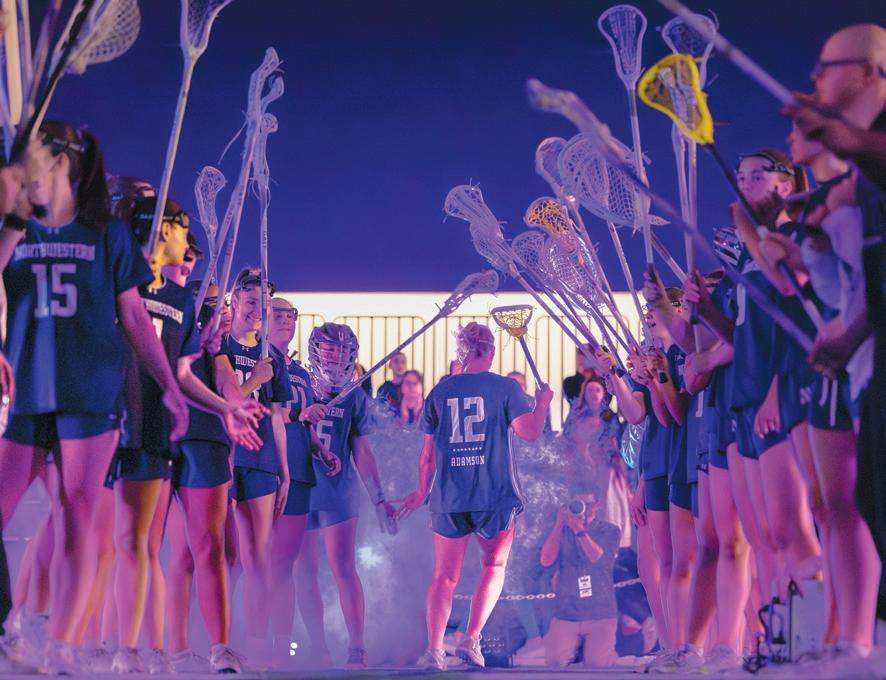




ree minutes into the third quarter, Foster scored her second goal of the game by dodging a Wolverine defender and ring a sidearm shot. Michigan responded by scoring four unanswered goals to close out the quarter. e rst came via a free position shot, and a er winning the ensuing draw, the Wolverines scored again. e nal two goals resulted from successful clears a er Michigan’s goalkeeper saved shots from the ’Cats. e Wolverines now held a 5-4 advantage, their rst lead of the game. e ’Cats entered the fourth quarter focused on taking back the lead. Redshirt sophomore mid elder Madison Smith controlled the opening draw, and 18 seconds later, senior a acker Lucy Munro scored from just outside the crease. A er a turnover by the ’Cats, the Wolverines answered right back and found the back of the net. Ten seconds later, Michigan scored again, but its goal would be its nal one of It was NU’s turn to respond.

Foster kicked things o with a shot to the vehole, bringing the de cit to one and securing a personal hat trick. Fouls from Michigan gave Taylor two free position shots in a ve-minute span. She converted on both opportunities, rst tying the game, then scoring the game-winner to complete a hat trick of her own. Junior mid elder Noel Cumberland’s goal marked the ’Cats’ fourth unanswered goal and brought the nal score to 9-7.
e ’Cats closed out their regular season with an outright Big Ten title, but they aren’t done with play against the conference. ey will return to Ann Arbor, Michigan, for the Big Ten Tournament, where they have earned the No. 1 seed and a rstround bye with Saturday’s win.




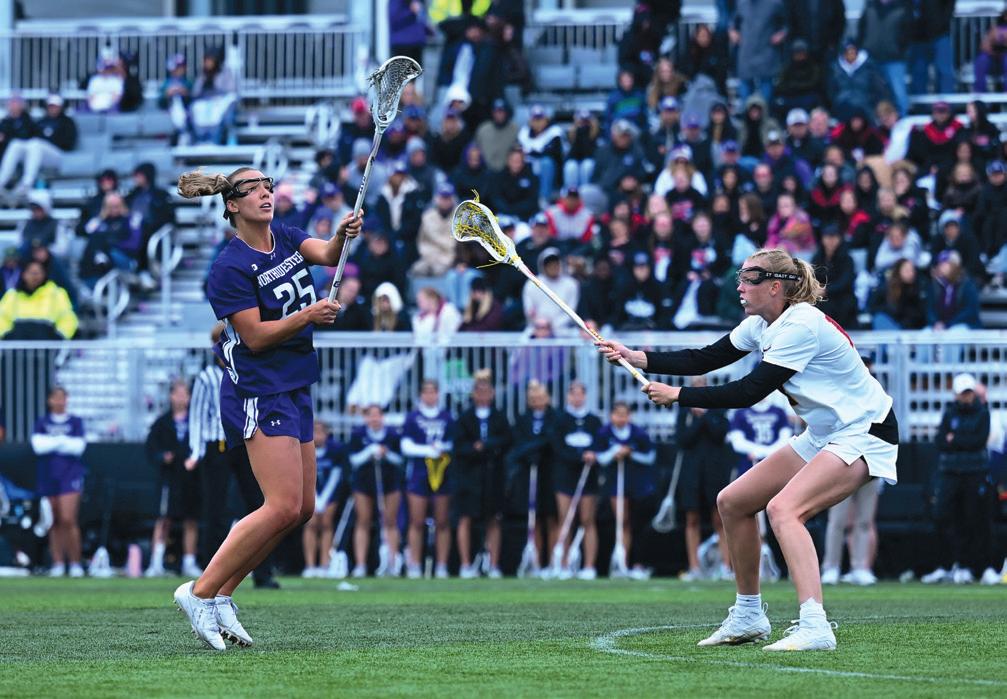

NU faces the winner of No. 4-seed Michigan and No. 5-seed Penn State in the tournament’s semi nals Friday, where the rst draw is set for 2 p.m. Central.


a.singh@dailynorthwestern.com
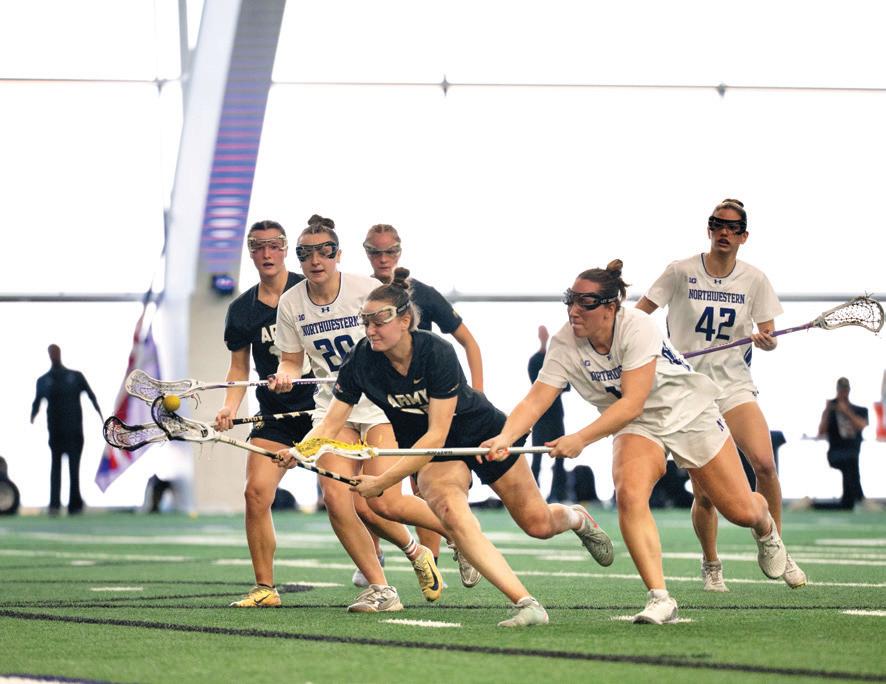




By AANYA GUPTA assistant digital sports editor
No. 46 Northwestern placed seventh of 15 at the Hoosier Collegiate Invitational, the team’s regular season finale.
The Wildcats played at The Pfau Course, a par-71, 7,355-yard course, at Indiana University in Bloomington, Indiana.
Rounds one and two were scheduled to be played Saturday, while round three was scheduled for Sunday. However, the ’Cats were unable to finish their second round on Saturday due to
play being called for darkness. They resumed the round on Sunday.
Freshman Monty Holcombe led NU, finishing eight-over par and tied for 17th out of 88, his highest result of the season.
Holcombe finished one-over par in both rounds one and two, but fell six places after finishing six-over par in round three. No. 57-ranked senior Daniel Svärd joined Holcombe in the top 25, completing his round 10-over par and tied for 22nd place.
Despite a strong start to the tournament, the ’Cats lost their footing in the third round of the tournament, falling three places to the seventh
place spot.
NU ended the first round with a score of 298, the second round with a 293 and the third round with a 305.
Redshirt sophomore Rowan Sullivan finished the tournament 13-over par, tied for 30th place.
Senior Ethan Tseng finished 15-over par, tied for 42nd place. Junior Jeremy Chen finished 18-over par, tied for 60th place. Rounding out the lineup was sophomore Mark Gazi, who competed as an individual and tied for 74th place with a score 25-over par.
The ’Cats were the lowest-placing ranked team. No. 39 Kansas claimed the top spot, while



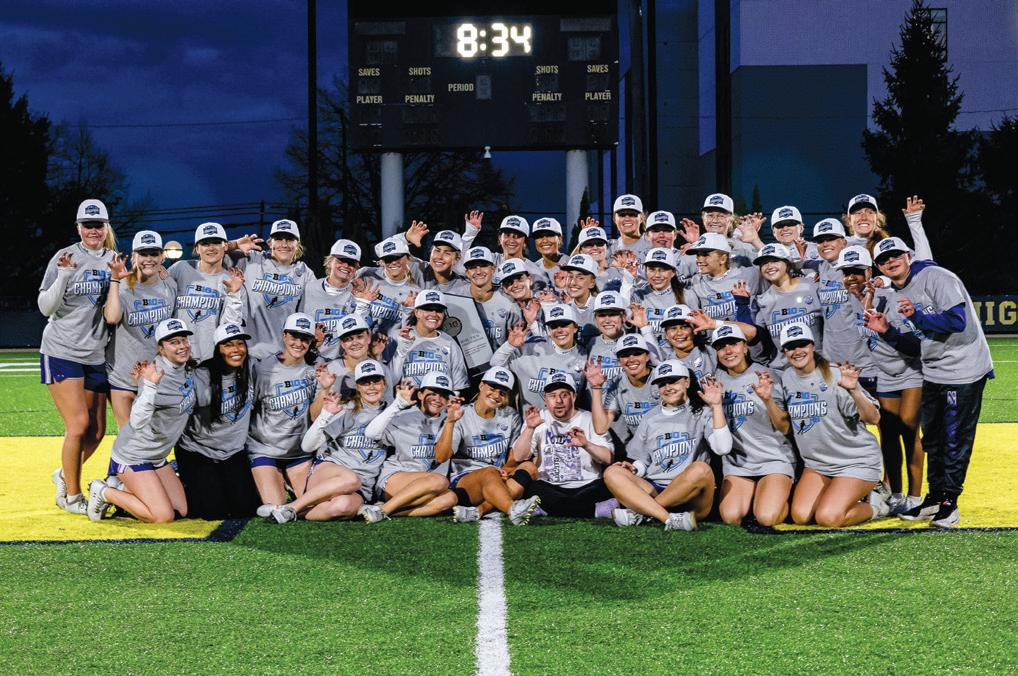
No. 13 Illinois, No. 41 Purdue, Little Rock, Maryland and Minnesota all placed higher than NU.
The ’Cats placed above Ohio State, Rutgers, Michigan, Toledo, Indiana, Wisconsin, Northern Illinois and Ball State.
NU ended the tournament with 25 birdies, 165 pars, 67 bogeys and 10 double bogeys or worse. It tied for fourth place for results on both par threes and par fours.
The team will next take on the Big Ten Championship in Portland, Oregon, from May 1-3.
a.gupta@dailynorthwestern.com
By AANYA GUPTA assistant digital sports editor
Junior Ashley Yun tied for h place in a 75-player eld as No. 28 Northwestern nished eighth of 14 teams at the erese Hession Buckeye Invitational this weekend.
e tournament was the Wildcats’ regular season nale. It was played at the par-72, 6,319-yard Scarlet Course at OSU Golf Club in Columbus, Ohio. NU was the lowest-placing ranked school at the tournament. e host school, No. 36 Ohio State, took home the title with a nal score of 890.
is was Yun’s season-high nish. She ended the tournament six-over par. Yun improved from her ve-over and two-over scores in the rst two rounds, nishing round three one-under and moving up 14 places. She nished the tournament with 12 birdies, the most among all players. No. 62 senior Dianna Lee also had a top-25 nish. She ended the tournament 12-over, tied for 20th place.
As a team, the ’Cats nished 49-over par at the end of three rounds, playing rounds one and two Friday and the nal round Saturday.
e ’Cats improved their scores a er every
round. They ended round one with a score of 309, round two with 306 and round three with 298.
Sophomore Megan Meng improved 21 places following day one of the tournament, tallying six birdies in her final round. She finished 16-over, tied for 29th place.
Sophomore Hsin Tai Lin improved five places on day two and finished 18-over, tied for 32nd place.
Freshman Lauren E. Lee improved four places and finished 20-over, tied for 38th place.
As a team, par fives were NU’s strength. The ’Cats finished even-par on par fives, tied for third
in the field. At the end of the tournament, NU had 34 birdies, 146 pars, 75 bogeys and 15 double bogeys or worse. No. 25 Iowa State, No. 30 Kent State, No. 40 Michigan State, Xavier, No. 43 Indiana and Harvard finished above the ’Cats, while NU placed above Rutgers, Ball State, Western Michigan, Youngstown State, Ohio and Toledo. The defending NCAA-champion ’Cats will next compete at the Big Ten Championships in Glendale, California, from April 24-26.
a.gupta@dailynorthwestern.com