The Daily Northwestern


New recusal rules ustrate students, faculty
By NINETH KANIESI KOSO AND KELLY LU
e reconstituted Advisory Committee on Investment Responsibility opened applications this fall to skepticism from students and faculty about the committee’s recusal policy for members with con icts of interest.
e commi ee, reestablished as part of the agreement to end the encampment on Deering Meadow, advises the Board of Trustees on investment concerns concerning the NU community.
University President Michael Schill will have nal approval over all the commi ee’s members — which will include students, alumni, faculty and sta members, including Chief Investment O cer Amy Falls.
In an Oct. 10 interview with e Daily, Schill said administrators expect to launch the commi ee by the end of the calendar year. e commi ee aims to hold its rst public meeting in January, according to its website.
In a news release, the University invited any member of the NU community to apply to
the commi ee by Nov. 27. e release also said commi ee members must serve as “independent evaluators” of issues presented to the commi ee or withdraw from decisions.
“Members must recuse themselves from decisions in which they may have a con ict, such as employment or research support by an industry in question, or a leadership role in an advocacy or other a nity group that may be impacted by the proposed actions,” the release read.
When asked if students actively involved in Jewish, Muslim or Arab a nity groups or proIsrael and pro-Palestine advocacy groups would be disqualified from the commi ee’s selection, University spokesperson Hilary Hurd Anyaso said membership in a nity groups would not disqualify an individual’s application.
e University did not respond to multiple requests for clari cation on who would determine if an ACIR member has a personal con ict with a proposal and how that decision would be made.
“My impression is that the recusal policy is just not that well thought out,” said Art History Prof. Rebecca Zorach, who serves on the executive and social responsibility commi ee of the Faculty Senate.
» See COMMITTEE , page 10
AUDIO/What’s New at NU How the Northwestern Prison Education Program changes lives

By FEMI HORRALL daily senior staffer
Only about two months remain until President-elect Donald Trump will be sworn into o ce. As the beginning of his non-consecutive second term nears, Evanston organizations continue to work
toward a brighter future despite concerns about Trump’s plans.
Local groups want to improve the community and maintain civic engagement for future elections, Evanston organizers said.
Some community members are worried about what a second Trump term could mean for environmental protection and stopping
By PHILIP LAM
On the campaign trail, President-elect Donald Trump vowed to dismantle the Department of Education a er taking o ce — a move that could usher in sweeping changes to the Free Application for Federal Student Aid.
Instituted in 1980, the Department of Education oversees Federal Student Aid, the o ce responsible for nancial aid disbursement. Federal nancial aid helps both incoming and current undergraduates through programs such as Pell Grants, federal loans and work-study opportunities.
As a recipient of both the federal Pell Grant and a Northwestern University Scholarship with plans to nd a work-study, Weinberg
freshman Janibeth Arroyo said she is concerned about the future of federal aid, which she added comprises about “a third” of her nancial aid package.
“If we were to dismantle (the Department), I think it would be almost anti-progressive in the way that less people would be receiving education, and those that are receiving education are receiving a less diverse (form),” Arroyo said. “Some people obviously would be ge ing less educational opportunities.”
Abolishing the Education Department is a logistically challenging — though not impossible — feat for the president-elect. e executive branch cannot exclusively dissolve the agency and requires Congressional approval.
Proponents of dismantling the Education Department
— primarily GOP lawmakers — point to the agency’s record of mismanagement and ine ciency. Critics argue that disrupting the disbursement process could adversely impact students reliant on nancial aid.
If the Education Department was dismantled, the consequences on the Federal Student Aid o ce and FAFSA could have varying e ects on NU students, particularly those who identify as rstgeneration or lower-income.
Weinberg freshman Isaiah omas, a recipient of e Gates Scholarship, said his scholarship covers most of his tuition.
“My biggest concern is for other people,” omas said. “If you’re not on an outside scholarship, and the Department of Education is updating (or) negating a lot of the aid that you would
receive, it will not be as a ordable to a end Northwestern.”
University spokesperson Hilary Hurd Anyaso wrote in a statement that NU will closely monitor and assess developments in Washington, D.C., collaborating with other universities to “collectively advocate for higher education” and to reinforce the University’s educational mission.
Political science Prof. Andrew Roberts said that it may be di cult for states to “pick up the slack” if federal funding were cut.
While states might have a “better nger on the pulse” of their citizens regarding education, returning the decision to the state level “may just be a pretext for reducing overall funding,” Roberts said. e federal government would likely
» See LOW INCOME , page 10
global warming. Evanston Township High School’s E-Town Sunrise organized a rally in Fountain Square on Saturday calling for the city and Northwestern to take stronger action to stop climate change.
Participants said their frustration with the election results was in part what drove them to act.
On Nov. 10, the Lake Street
Church of Evanston hosted four expert panelists at an event called “What Now? Organizing for Justice A er the Election.” At the event, DePaul Prof. Mark Potosnak said when it comes to the environment, impacts can be made locally.
“We can’t go down the despair
» See WHAT’S NEXT, page 10
By
ISAIAH STEINBERG and SHREYA SRINIVASAN daily senior staffers
@isaiahstei27 / @shreyasrin
More than ve months a er a $1.75 million proposal to address homelessness failed to gain City Council approval, the city is looking to install security cameras and lighting at the Howard Street homeless encampment and has sent the Crisis Alternative Response Evanston team to the area.
e earlier proposal, dra ed by Ald. Devon Reid (8th), would have provided $1.25 million to Connections for the Homeless for eviction prevention and shelter,
$300,000 for the city to address encampments by o ering drug treatment and case management and $200,000 for Evanston/Skokie School District 65 to provide temporary housing and administrative support to families in need. e largest homeless encampment in the city last year was on Howard Street, adjacent to its Chicago Transit Authority “L” Station, according to the initial proposal. Councilmembers showed support for spending $9,500 for cameras at their May 28 meeting. Since then, Reid said he has worked with City manager Luke Stowe to allocate funding to install cameras “soon” at the encampment, which he said will be increasingly monitored by both Evanston and Chicago police departments.
» See HOWARD STREET, page 10


By ISAIAH STEINBERG daily senior staffer @isaiahstei27
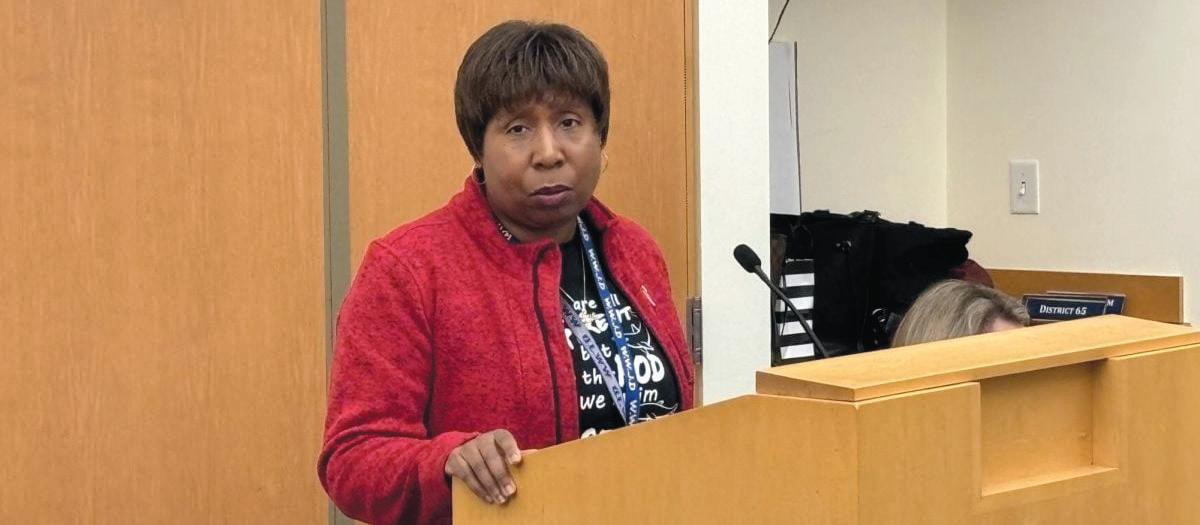
The Evanston/Skokie School District 65 Board of Education announced the district has reached an agreement with the District 65 Educators’ Council on a new contract for union members at its Monday meeting.
District 65 teachers have worked without a collectively bargained contract since August and have since been working under a continuation of a previous professional agreement.
“The path to this agreement is long, often challenging and filled with unforeseen twists, but it is proof that perseverance and preparation in the bargaining process yield results,” DEC Vice President and Washington Elementary School bilingual instructional coach Emily Castillo-Oh said at the meeting.
Castillo-Oh told The Daily it was difficult for some teachers to return to the classroom this fall without a contract. Negotiations began in March.
Executive Chief of Strategic Communications and Project Management Melissa Messinger said the district was unable to share further details about the contract. She added that the contract could be approved by the board in early December if it is promptly ratified by the union.
The board also presented its preliminary 2024 tax levy Monday night. District 65 is requesting roughly $138.4 million in property tax revenues, excluding debt service. The figure represents a 4.99% increase from last year’s levy, which totaled roughly $131.8 million.
Board Finance Chair Joseph Hailpern said the district should focus on “paring our administration down” instead of relying on raising taxes to reduce the deficit.
“We have to live within our means,” he said. The district currently faces a roughly $13.2 million deficit, excluding capital projects, in its fiscal year 2025 budget. Following the teachers’ union contract negotiations, debates persist on where the district should make cuts. The 2025 budget cuts teaching positions and
administrative positions. During an Oct. 15 meeting, Board President Sergio Hernandez said the construction of the Foster School would not worsen the district’s structural deficit. Meanwhile, the district has increased its proposed tax levy for the educational fund by nearly $10 million.
Union members urged the district to prioritize students and teachers over administrators and external consultants when making cuts by increasing teacher salaries and decreasing unnecessary administrative positions.
“The biggest investment in our students and in the future of our community and our district is in educators,” District 65 speech language pathologist Lisa Levine said at the meeting.
Multilingual Coordinator Cecilia Romero and Compliance Coordinator Kim Kelly presented an update on the district’s Dual Language program at the meeting. Parents have previously voiced concerns about the district’s plan to close the

Dr. Bessie Rhodes School of Global Studies, the district’s only school where all K-5 students participate in the Two-Way Immersion program, in 2026.
The Dual Language program, which provides equal Spanish and English language instruction, will move to Haven Middle School in 2026, according to a district presentation.
“We want to make sure that we are completing full biliteracy and making sure that our students who start in our districts are moving on into the high school and out of the high school to be very successful in their life,” Romero said at the meeting.
The district hopes to implement a full pre-K through eighth grade Dual Language program, she added. The multilingual program department will issue final recommendations to the board in September 2025.
Hernandez also reflected on the result of the
2024 presidential election and the effect it could have on Evanston. District 65 will be a “safe haven school district,” protecting students and families from deportation, he said.
“We will not cooperate with any immigration enforcement actions that threaten the safety, civility and well-being of our students and families,” he said.
Hernandez was met by thunderous applause from DEC members and others in attendance.
As District 65 faces financial hardship, its educators remain motivated to serve their students and stand in steadfast opposition to budget cuts that they argue could diminish educational opportunities, Castillo-Oh said.
“Together, we can achieve a District 65 that honors its promises and builds a stronger foundation for generations to come,” she said. isaiahsteinberg2027@u.northwestern.edu
By CASSIE SUN daily senior staffer @cassiesunl
roughout his time working in marketing and communications, there’s one thing that Communication Prof. Anas Ghazi (’15) said he’s noticed in the sphere of marketing storytelling: e disconnect between how the industry operates and what is taught in the classroom.
For the last three years, Ghazi said his goal as a professor has been to close the divide between theory and practical application. For his Digital Storytelling course, he’s turned to AI tools to provide his students with real-life experience working in marketing storytelling.
“ ere are ingredients to making a story work,” Ghazi said. “With AI being the forefront of everything that we’re doing, there has to be a technology out there that can help my students learn the skills within the AI realm and tell stories that ma er.”
In his search for the perfect AI tool, Ghazi found e Brandtech Group, a marketing technology company that owns the generative AI marketing platform known as Pencil Pro.
Ghazi said he tested the product rst, going through the training modules before working with the team at Brandtech to integrate Pencil into his course. Students received the prompt for their live midterm on the rst day of the class, Ghazi said, which instructed them to pitch a marketing campaign based on a provided Request for Information, a formal business document used to collect information for projects or contracts.
“I’ve never worked with an AI tool like this before,” said Communication graduate student ea Deng, who is enrolled in Ghazi’s class. “Pencil Pro integrates major generative AI tools all in one, so it doesn’t just create text or video or image. What makes it so special is it helps evaluate the outputs that you give, and it gives you feedback.”
e nal for the class similarly sets students in front of a panel of AI experts, the client, a coach and Ghazi to evaluate who presented their ideas best using the AI tools in the platform. e panel will then decide which campaign goes

live, which also determines which students will be selected for the two Brandtech internships o ered at the end of the course.
“Personally, I have some internship experience, but I don’t have experience (developing) a whole campaign,” said Communication graduate student Cindy Xinya Gong, who is enrolled in the course.
“I think this class really helped me know about the ow and structures of building up a real-world campaign for the company.”
According to Microso ’s 2024 Work Trend Index, 71% of employers stated that they would prefer an AI-skilled candidate with less experience than a more experienced candidate with no AI skills.
Ghazi said similar reports on company priorities illustrate the need to be literate in generative AI tools.
“ ere’s such a need for this talent, but the supply isn’t there if you will,” Ghazi said. “I think that’s
the part I’m excited about — giving my students tangible skills that they can o cially say, ‘We can do these things that are so in demand in the AI world.’”
Although only two internship spots are available, Ghazi said by the end of the quarter, all students in the class will have bene ed from the experience of storytelling in the professional world.
Students will also receive a LinkedIn certi cation for their new AI skills, helping them stand out to employers, Ghazi said.
“I remember when I was a student, I was like ‘I wish someone spoke to me about, how do I get my story heard? How do I navigate corporate politics? How do I position myself in a way that is effective and meaningful?’” Ghazi said. “As a practitioner, I’m able to bring that from the boardroom to the classroom, and this internship is just the beginning.”
cassiesun2027@u.northwestern.edu












The Daily Northwestern www.dailynorthwestern.com
Editor in Chief Jacob Wendler eic@dailynorthwestern.com
General Manager Stacia Campbell stacia@dailynorthwestern.com
Holly and John Madigan Newsroom
Phone | 847.491.3222
Campus desk campus@dailynorthwestern.com
City desk city@dailynorthwestern.com
Sports desk sports@dailynorthwestern.com
Ad Office | 847.491.7206 spc-compshop@northwestern.edu
THE DAILY NORTHWESTERN is printed each Wednesday during the academic year, except vacation periods, the two weeks preceding them and once during August, by Students Publishing Co., Inc. of Northwestern University, 1999 Campus Drive, Evanston, IL 60208. All news is published 24/7 online at Dailynorthwestern.com.
First copy of THE DAILY is free, additional copies are 50 cents. All material published herein, except advertising or where indicated otherwise, is Copyright 2024 THE DAILY NORTHWESTERN and protected under the “work made for hire” and “periodical publication” clauses of copyright law.
POSTMASTER: Send address changes to THE DAILY NORTHWESTERN, 1999 Campus Drive, Evanston, IL 60208. Subscriptions are $100 for the academic year. THE DAILY NORTHWESTERN is not responsible for more than one incorrect ad insertion.





































By DESIREE LUO
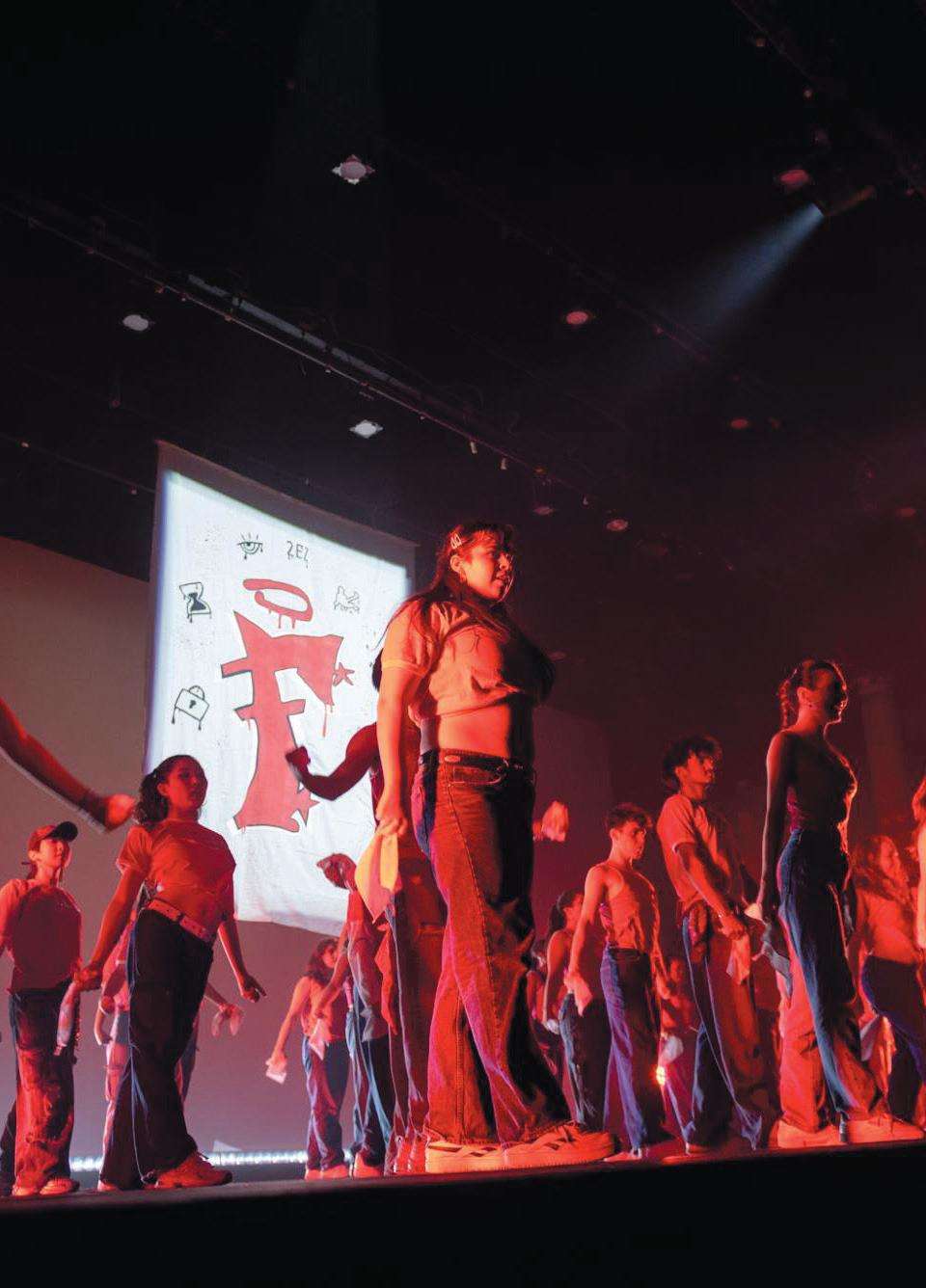
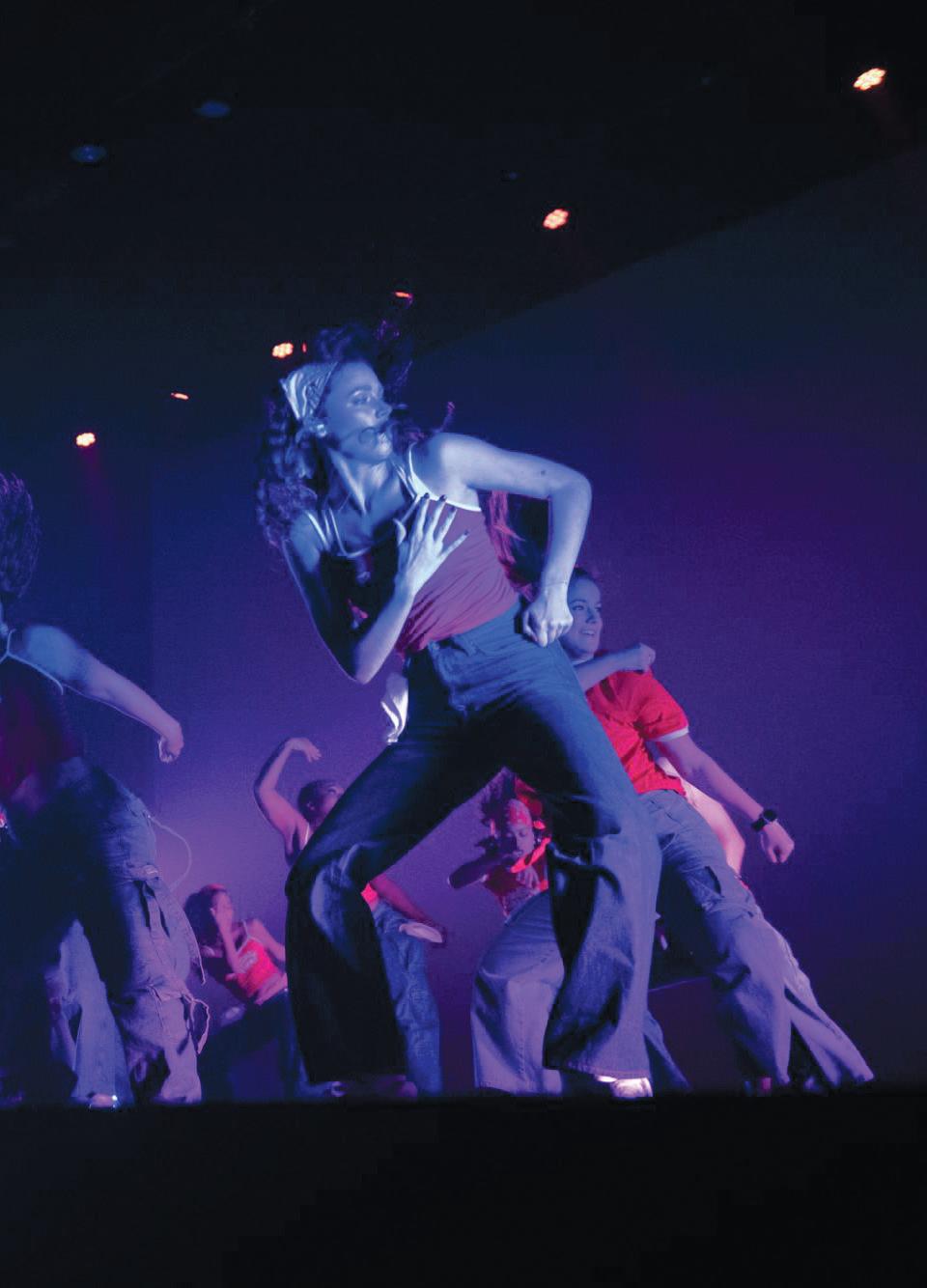
For two nights, Cahn Auditorium adopted the atmosphere of a concert venue.
Boomshaka, Fusion Dance Company and Refresh Dance Crew took the stage Friday and Saturday for their annual production ReFusionShaka. Flashing lights cast over 135 performers who danced to student-choreographed jazz and hiphop combinations. The crowd’s cheers eclipsed the thunderous music during the two-hour show. Medill graduate student Meredith Zhou attended the Friday show. She sat in the second row, where she watched a Boomshaka drummer in the aisles during the closing number. Zhou said the performance was “a little bit like a movie.”
Like some other attendees, Zhou brought handmade signs. Hers read “Flora Be My Bae” and “Joyce Look At Me” for her friends in Refresh.
Zhou said she was inspired by signs fans brought to K-pop concerts.
RFS was different from any of her undergraduate experiences at the University of WisconsinMadison, Zhou said.
“Because I’m a graduate student, it’s giving me the young, vibrant, college vibe,” Zhou said. “Usually graduate students don’t get to experience that part of college in NU.”
Each show featured different guest dance groups. K-pop group NU K-Dance and Bollywood troupe NU Deeva performed Friday. Saturday included contemporary dance group Graffiti Dancers and Latin dance group Dale Duro at 7 p.m., and Bhangra team NU Bhangra and African dance troupe Afrothunda at 10 p.m.
Despite audience praise, Weinberg senior and RFS President Anna Simmons said working behind the scenes made her nervous at times.
She wrote the drum aspect of some of Boomshaka’s routines. Simmons said most of the piece
came together during tech week, during which rehearsals took place every day leading up to the first show.
Until then, she said she worried whether the resulting number would match her vision.
“My advice to myself is always it’s going to work out because it has to,” Simmons said. “I tell myself that often when I’m producing or things are getting really stressful.”
Simmons said the RFS executive board booked the venue last year. They decided on performance themes this summer, selected sets early September and started rehearsals five weeks ago, she said.
Communication senior Melanie Ahn designed the lighting for Fusion’s opening and closing sets. She said the lighting and sound team members began discussing this year’s show before last year’s ended. They watched choreography videos down to the hundredth of a second to determine which lighting could highlight certain movements.
Ahn said she prioritizes the choreographer’s vision when creating sets.
“At the end of the day, that’s their baby, and they’ve been working on that for so long,” Ahn said. “In addition to wanting to accentuate the choreography, we treat it like a light show, almost.”
This production included 2,486 cues, which Ahn said was about 2,000 more than an average musical production.
Some audience members at the final Saturday show flocked to the orchestra pit during performers’ bows to Charli XCX’s “360.”
Communication junior and Refresh performer Savannah Spring said this crowd stood out to her the most.
“When the crowd is cheering you on, you’re so much less in your head or thinking about little things,” Spring said. “You feel the music and the moment and just have fun.”
desireeluo2028@u.northwestern.edu
By MADELINE LESCOTT
the daily northwestern
Northwestern students who have dreamed about being a contestant on reality television shows “The Bachelor” or “Love Island” are in luck. “Unscripted Love,” NU’s very own studentrun reality dating show, is coming to campus.
Created by Communication junior Ananya Paul, the show will provide interested Radio, Television and Film students with the opportunity to help produce a reality TV show and others the chance to find love as a contestant.
The premise of “Unscripted Love” is similar to other popular dating shows. Contestants will participate in group activities and go on dates with their contestants of choice.
“Northwestern’s boldest singles are thrown into the spotlight for their one shot at fame — maybe true love — but only if they can take the heat and the drama,” Paul said.
The show accepts contestant applications until Nov. 15. After receiving applications, the production team plans to conduct interviews and narrow down the applicant pool. The show will begin with 12 students, and an additional six will join the cast for added drama halfway
through the season.
As with any reality show, casting the right group of people is instrumental to the show’s success, Communication junior and story editor Caleb Mann said.
“People who want to be on reality TV need to be authentic and not afraid to show exactly who they are,” he said.
Communication sophomore and tech manager Levi Gillis said they’re looking for “characters” and people whose personalities will bounce off each other.
The show is entirely self-organized and selffunded by the production team, composed of its creator, casting and research directors, a story editor, tech manager, treasurer and line producers. The crew will purchase vlogging cameras, microphones and tripods with help from fundraising and grants.
Filming will take place every weekend from Friday to Sunday during the Spring Quarter. The crew plans to film confessionals, during which they’ll sit down with one contestant at a time, as well as group bonding activities. These might include hot yoga or body painting, Paul said.
On Sundays, contestants will try their hand at love by selecting who they’re most interested
in and attending a one-on-one date. If all goes well, they can go on another date the following Sunday, or they can opt to find a new match.
For students more interested in watching the drama unfold on the screen, the “Unscripted Love” team plans to host watch parties as episodes are released throughout Fall 2025. They hope to
premiere the pilot episode this spring before they finish editing the rest of the season.
“We all love reality TV so much,” Gillis said. “We wanted to create an actual reality TV show for students, by students.”
madelinelescott2028@u.northwestern.edu

By CLARE KIRWAN
It all began with a “join this super cool band” flyer hung in Kresge Hall by Communication junior Makena Carnahan. When Jamie Eder (Weinberg ’23) discovered the flyer and reached out to Carnahan in spring 2023, they clicked at their first meeting.
The two became the band “Widemouth,” whose name came from a symbolic wide-mouth mason jar that Carnahan broke at her first visit to Eder’s apartment, as well as Eder’s “way bigger mouth than people expect.” However, the two still felt something was missing.
“We started singing, playing together, but it was the two of us. We were Widemouth at that point, but we weren’t complete until Levi and Lily,” Eder said.
Bienen sophomore Lily Mitchell picked up the same flyer as Eder and reached out to Widemouth in December 2023. Mitchell took to the drums, and the three began playing basement concerts. They quickly realized, though, that they needed a bassist. They posted another flyer on campus searching for a bassist and found Weinberg senior Levi Saltzman shortly after. The four, along with Eder’s dog and honorary band member, Cleo, got to work.
“It’s just been so fun and deeply fulfilling. It has made me feel like I’m doing something that fills my cup,” Carnahan said.
The band has played over 30 live shows at bars and open mic events. They have also opened for Northwestern student band Tavern at Evanston Space and at Winnetka Music Festival. Over the summer, they embarked on a six-show tour, which included visits to Eder, Mitchell and Saltzman’s hometowns.
The band will release their first EP “Well,” which is composed of five songs, Friday. “Well” came to fruition after they met Producer and multi-instrumentalist Sam Genualdi at a songshare event in Chicago. Genualdi, after hearing Widemouth perform, offered to produce some of their songs in his studio basement in Andersonville.
Through a mix of drum recordings at Eder’s apartment and recording days in Genualdi’s basement, the album came to life.
“It was really cool because it was my first time ever doing a live recording in a studio, and Sam has this really cool setup in the basement of the house he lives in,” Mitchell said. “We were just in this room, and we started with the guitar track and recorded all the way through and then just started adding stuff.”
The group released two singles this October, and was featured in Rolling Stone’s “Songs You Need to
Know” in January.
The bandmates say they have surpassed the mere connection of bandmates or friends and are truly “family.” They each describe their experience making music together as “pure joy.”
“Everyone is super passionate about one thing at Northwestern and I feel like my thing was music, but
I didn’t really have a place to fully do that,” Carnahan said. “Then writing with Jamie and the band has just been pure happiness. It just gets more and more fun.” Widemouth will perform an EP Release Show at Evanston Space Dec. 6 at 7:30 p.m.
clarekirwan2028@u.northwestern.edu

Widemouth’s new EP “Well” will be released Friday. The EP
on Dec. 6.
By KATAREENA ROSKA and BEN SHAPIRO the daily northwestern @katareenaroska / @benshapiromedia
Growing up, clinical counselor and life coach Ben Shabad was often told that he looked like Jeremy Allen White, best known for the roles Phillip “Lip” Gallagher on “Shameless” and Carmen “Carmy” Berzatto on “The Bear.”
So when the Glenview resident heard that two Chicago residents were hosting a look-alike contest for the celebrity Saturday, he knew he had to compete. By the end of the afternoon, Shabad was crowned the contest’s winner.
“This is one of the coolest things I’ve ever experienced,” Shabad said. “People tell me I look like him a lot. I was encouraged by multiple people, so I figured I’d just show up and see what happens.”
As contest organizers and roommates Taylor Vaske and Kelsey Cassaro announced Shabad as the winner, they handed him his prize: $50 and a box of cigarettes.
The trend of celebrity look-alike contests began with New York City’s Timothée Chalamet rendition. Since then, the trend has gone global, from Dublin’s Paul Mescal contest to London’s Harry Styles contest.
“We were chatting about how Chicago has to do one,” Vaske said. “(Kelsey) texted me a mockup of a
flyer — just being funny. In the middle of laughing about it, we printed a whole bunch of copies. We each posted a TikTok and it blew up.”
Vaske and Cassaro did not think many contestants would turn out. To their surprise, more than 100 Chicagoans gathered on the sledding hill next to Little Cubs Field in Humboldt Park to judge the look-alikes.
According to Vaske, there were around 60 Jeremy look-alikes in attendance. Roscoe Village resident Aaron Feldman was one of the many contestants.
“When I was younger and he was playing Lip, people used to tell me I looked like him all the time. Now he’s got the muscles and the tattoos — I don’t have that,” Feldman said. “I’ve been training my whole life for this moment.”
Other city residents came to judge the contest, not win it.
For Humboldt Park resident Stefanía Briones, the contest was an opportunity for community connection.
“The complete randomness of it, I love so much,” Briones said. “Things are so bleak right now, and somebody just decided to do a Jeremy Allen White look-alike contest in our neighborhood. It was perfect.”
Creating unity was Vaske and Cassaro’s goal in hosting the contest.
Vaske said she wanted the contest to do more
than just find White’s doppelgänger. She wanted to bring joy to Chicago.
“Post-election, it was getting colder in Chicago and we just wanted a nice, happy day for everybody,”
Vaske said. “That’s what it was.”
katareenaroska2028@u.northwestern.edu
benshapiro2028@u.northwestern.edu

By NINETH KANIESKI KOSO
the daily northwestern
Inspired by Korean shamanism, third-year directing graduate student Tae-Heum Yeon’s version of “Antigone,” offers audiences a unique perspective of the classic Greek tragedy at the Virginia Wadsworth Wirtz Center. The show opened Friday and will run until Nov. 24.
“Antigone” is the third and final play of Greek playwright Sophocles’ Theban plays. The story follows a princess, who buries her brother Polyneikis against the orders of Kreon, the king of Thebes. Previously, Kreon had declared Polyneikis a traitor and forbade anyone to bury the prince. Due to Antigone’s defiance, Kreon sentences her to death.
The play began and ended with a traditional funeral
processional march song called “Sang Yeo So Ri.” The characters were dressed in garments inspired by traditional Korean clothing and styles.
“(Yeon) was really excited about blending this Korean influence and atmosphere with each member of the cast’s culture, making it a commentary on grief and how countries deal with leaders who are corrupt and don’t listen to the cultural sensitivities of its people,” said Communication sophomore Bryson Shaub, who plays Haimon — Kreon’s son and Antigone’s fiance.
Because Canadian poet Anne Carson’s translation of “Antigone” lacks almost any punctuation, Communication senior Augustus Glick, who plays Kreon, said Yeon worked with the cast to time the tempo of every phrasing.
Glick said Yeon also helped him add depth to his interpretation of Kreon. Initially, Glick said he only understood Kreon as an angry king and “misogynistic”

character who lashes out at Antigone in pure rage.
However, Glick said Yeon led him to find vulnerability through Kreon’s sense of being threatened by Antigone.
“Antigone is saying you should act this way, and Kreon is fighting that way,” Glick said. “There’s a certain suggestion of acceptance (while) being steadfast in your emotional beliefs, as opposed to some kind of constructed belief.”
Yeon said he chose to produce “Antigone” after learning about the deadly crowd-crushing in Seoul during Halloween festivities in 2022.
In the days that followed the disaster, the South Korean government said it was not its responsibility to maintain public safety on the streets of that night because the festivities had not been formally organized.
“What really drew me into ‘Antigone’ was the reaction of (the) Korean government, where it seems they were more interested in political interest or political propaganda, rather than really grieving or mourning,” Yeon said.
In traditional Korean shamanism, Yeon said villages have a hereditary shaman that people believe has superpowers and, therefore, has the duty to serve the village even if they don’t want to. If the shaman refuses, it is believed that the shaman will face retribution, he said.
Yeon said he connected these shamans to the royal family of Thebes that have been cursed since the reign of Oedipus in Sophocles’ plays.
“They are not just normal people, but they’re a royal family,” Yeon said. “(They) have this super burden. (This) cursed life of duty is aligned with (the) concept of a hereditary shaman.”
Communication senior Arwen-Vira Marsh, who plays Antigone, said she had some initial trepidation with the production because she has no Asian background.
However, Marsh said Yeon told her to understand this production as a learning opportunity and cultural exchange.
“Tae said ‘I am not asking you guys to put on any sort of persona,’” Marsh said. “Every single costume
piece that we wore, every single movement of the hand, every single word that was said that was being filtered in through this Korean shamanistic point of view, it felt like it was very intentional and purposeful and appreciative of this culture.”
The set featured knotted clothes hung from the ceiling — inspired by traditional Korean rituals. Since the knots are left in the fabric onstage, each cloth represents characters in the play who have not been properly mourned.
The back of the set had a cracked stone wall. As characters died throughout the play, they walked into the crack.
“I think it represents the location of (Antigone’s) homecoming. In Black culture, we have this idea of when you pass on, you’re not dead, you’re going back home,” Marsh said. “There is no more fear there because she’s being reunited with her family, who have also passed away.”
ninethkanieskikoso2027@u.northwestern.edu
Editor Betsy Lecy
Assistant Editors Karina Eid Alexander Hernandez-Gonzalez
Design Editors Paloma Leone-Getten Danny O’Grady
By JACK BAKER and DESIREE LUO the daily northwestern @jdowb2005
Evanston resident Kemone Hendricks said President-elect Donald Trump’s victory earlier this month was disappointing but not surprising.
In 2020, Hendricks founded Evanston Present and Future, an organization that aims to combat anti-Black discrimination. She said activists in Evanston are concerned about the future of reproductive rights during Trump’s second term.
“It’s going to make the work a lot harder for activists like me and others who are trying to ensure that Illinois remains a safe haven,” Hendricks said. “It’s also going to impact the organizations we support that provide services to people traveling from out-of-state to get their abortions.”
Trump’s public stance on abortion remains unclear. In a video he posted to Truth Social in April, he said he was proud of appointing three conservative Supreme Court justices who helped overturn Roe v. Wade in 2022.
During the 2024 presidential debate, Trump did not say whether he would veto legislation banning abortion nationwide. But in October, he wrote on Truth Social that he would veto a national ban.
Activists Gretchen Brewster and Alice Sachs started the Evanston Voices for Choice Coalition in 2022.
The coalition, consisting of local reproductive rights advocacy groups and individuals, has organized annual pro-choice rallies in Evanston for the past three years.
Brewster said she believes Trump would sign legislation banning abortion nationwide. Republicans won control of the House and Senate this year, and conservatives currently have a 6-3 majority on the Supreme Court. Trump supported a 2017 bill that would have banned all abortions after 20 weeks of pregnancy.
“He’s so underhanded, and he’s got a team who are equally underhanded, and they’ll do what they want to make life very difficult and scary,” Brewster said.
Beyond restrictions on abortion itself, Sachs

During the 2024 presidential debate, Trump did not say whether he would veto legislation banning abortion nationwide. But in October, he wrote on Truth Social that he would veto a national ban.
said she worries the new administration could track women traveling between states to receive abortion care.
Illinois Gov. JB Pritzker signed the Reproductive Health Act in 2019 to legally protect abortion access in the state.
Evanston City Council adopted a resolution in 2022 to reinforce the outlined protections. There are no abortion clinics in Evanston.
Chicago-based activist Kenyette Tisha Barnes spoke at the inaugural Evanston ProChoice Rally and March in October 2022. She said out-of-state anti-abortion groups might intimidate or use violence against reproductive
care centers in Illinois.
“I am concerned about that on a safety level,” Barnes said. “I think we are going to see increased violence against our abortion providers, against women who are seeking abortion services. I just don’t see this ending well.”
Candace Davis serves on the leadership team of Indivisible Evanston, a progressive organization that sponsors the annual Evanston ProChoice Rally and March, according to Brewster. Davis said the new Trump administration may carry out policies outlined in Project 2025, an initiative created by conservative think tank The Heritage Foundation.
Project 2025 recommends requiring states to report all abortions, the methods used and reasons for the procedures to the U.S. Department of Health and Human Services. States that do not comply risk losing federal healthcare funding.
Barnes said these requirements would make accessing abortion care in Illinois more expensive and time-consuming. She also said she worries the Food and Drug Administration will reverse its approval of Mifepristone, the drug used in most medical abortions.
Trump has denied his involvement in Project 2025.
“He is a well-known liar and will say anything to get elected,” Davis said. “I think what he says is less important than what the people behind him are saying. Project 2025 clearly is shooting for a nationwide ban and more restrictions on abortion.”
Most voters do not prioritize abortion because it does not affect them directly, Barnes said. Instead, she said she thinks many voters this cycle were dissatisfied with the current administration’s handling of “immediate, everyday needs” like inflation, healthcare and public safety.
Brewster and Sachs said they have had difficulty recruiting younger volunteers. The average age of Evanston Voices for Choice Coalition members is 80, Brewster said.
Sachs said she continues advocating for reproductive health because her friends and family may need it someday.
“We’re not going to get pregnant, but we have granddaughters, daughters,” Sachs said.
Brewster said the coalition plans to start a website and hold a fundraising concert next year to raise money for organizations like the Chicago Abortion Fund, which assists women from neighboring states with abortion bans. Davis said Indivisible Evanston will call on local members of Congress to preserve reproductive healthcare nationwide.
“We’re lucky to live in Illinois,” Davis said. “But that means putting pressure on our legislators to do everything they can to protect abortion rights.”
jackbaker2028@u.northwestern.edu
desireeluo2028@u.northwestern.edu






By MELODY XU
the daily northwestern @_melodyxu
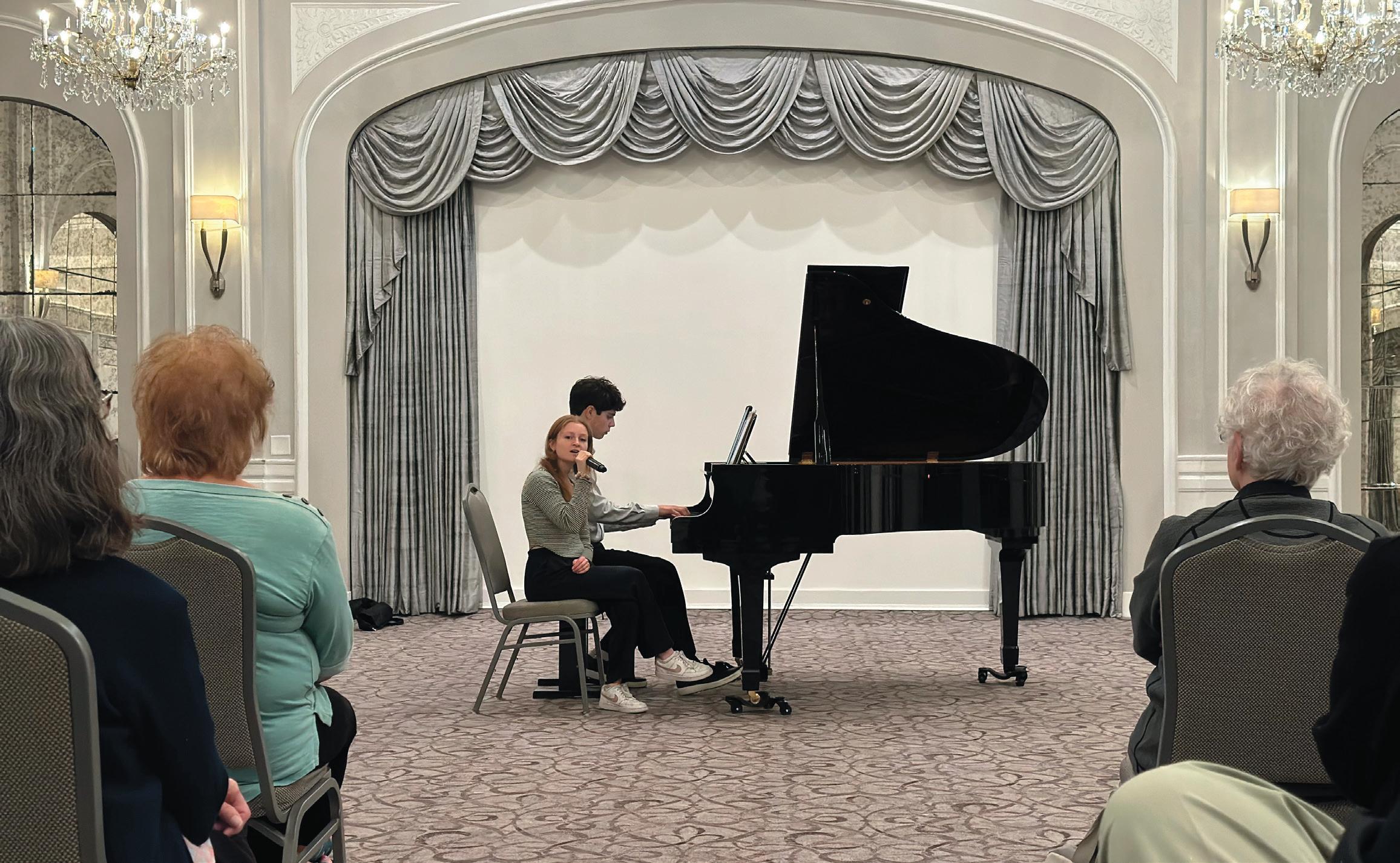
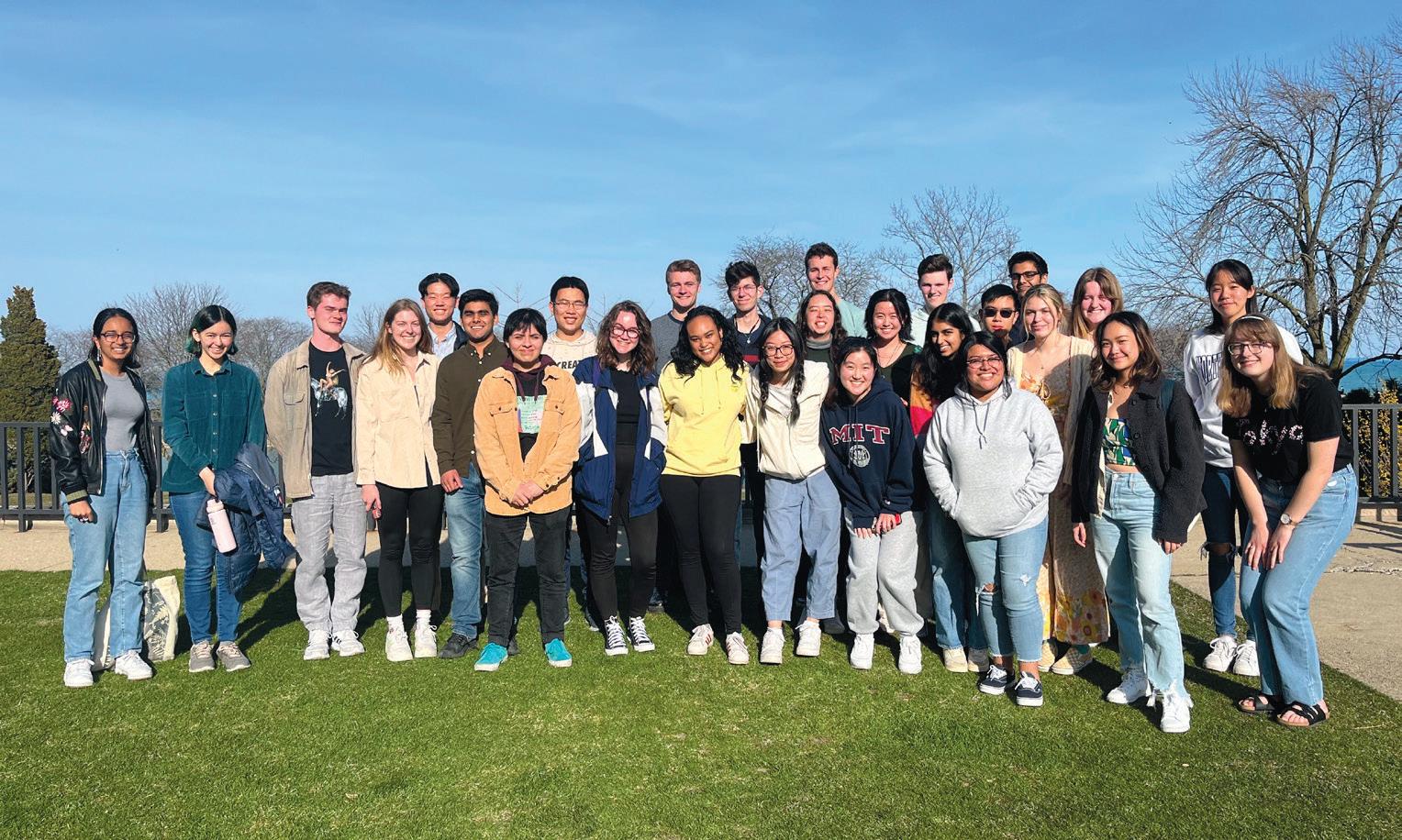
If you stop by one of Evanston’s senior living facilities at the right time, you might catch a musical performance from a group of Northwestern students brightening up its auditorium.
Crescendo for a Cause performs at local senior living facilities with the goal of spreading joy, Weinberg senior and co-President Nicole Ceriani said. The club plans to perform at local hospitals and start a music-related mentorship program with local elementary schoolers, Ceriani said.
“Interactions with the residents are always the best, especially when you can tell that this is the highlight of their week,” Ceriani said.
Crescendo primarily plays at The Merion, The Pearl of Evanston, Trulee Evanston and The Mather, Weinberg junior and co-President Jonathan Chen said.
An NU chapter of a national organization, Crescendo formed on campus about three years ago, Chen said. He added that the club does not require auditions to join, providing a space for students who may not otherwise have had opportunities to pursue music at NU.
“Not to ruffle feathers, but I think Northwestern compared to other peer institutions really doesn’t have as many opportunities for non-majors in music,” Chen said. “Usually, you don’t see that type of engagement with non-majors when you have a big conservatory on campus. But, if you’re coming to college with this huge, world renowned music school, you are expecting to have some sort of further engagement.”
Weinberg sophomore Ned Yu said he joined Crescendo to find an outlet for his musical passions as a non-major, adding that he wrote part of his NU application about his desire to pursue music in college. He said it can often be hard to find musical opportunities on his own.
“Seeing all of these seniors enjoy our music, whatever it is, it brings a smile to my face, and it makes me really happy inside,” Yu said.
Ceriani, who also does not major in music, said she enjoys how Crescendo members’ love
for music brings them together, despite their diverse areas of studies.
Ceriani said she credits part of her confidence in singing to her Crescendo experience, adding that the “low-stakes environment” and encouragement from audience members help to build musicians’ confidence.
“I’ve been singing my entire life. I was always scared to sing in front of people,” Ceriani said.
“One of the reasons that I really love this club is because it’s a very chill environment. If I can sing in front of my grandma, I can sing in front of these people who are other people’s grandmas.”
Bienen freshman Elizabeth Hsu, a voice and opera performance major, said the most meaningful experience for her has been rehearsing with new friends.
Hsu said the nature of Crescendo concerts allows her to branch out of the voice and opera pieces that she usually practices for her classes.
“There’s a lot of freedom in doing these kinds of performances that you get more freedom with the repertoire you play,” Hsu said. “I would normally never sing this repertoire, so it’s just really fun all around.”
Crescendo provides certified volunteer hours for students’ time spent performing.
Weinberg sophomore Erika Ruiz-Yamamoto said the club’s purpose of volunteering has also brightened her own days.
Ruiz-Yamamoto said one of her favorite memories dates back to her first concert with Crescendo.
“I’m performing, and I look up and I just see the smiles on all these residents’ faces,” Ruiz-Yamamoto said. “I take my bow and these people come up to me and they say, ‘Your music really touched me.’ And that’s really the greatest gift that you can have as a musician.”
melodyxu2027@u.northwestern.edu


Dear Reader, Week nine is in full swing, and as the holidays loom, I thought I would address some of the most common questions people have about how to navigate college, winter break and the deluge of special occasions and family events that occur around this time of year. Whether your main question is how to navigate public transit around Evanston or how to make the best of staying here all break, hopefully something in this column will make your season a little less chilly and a little more joyful.
How do I get to the airport? Who can I share an Uber with? Is the class GroupMe a good place to ask to split an Uber?
The quick answers: the bus, I’ve never had to try and I suspect not.
The long answer is that once you know how to use it, taking the bus to the airport is so absurdly easy that calling an Uber that probably costs more than thirty dollars, or sharing it with whichever GroupMe denizen has deigned to reply to you, is not worth it unless you are traveling to the airport in the dead of night or before 5 a.m.
People usually dither for at least a year before figuring out how to do it, but here’s the rundown: The Pulse Dempster Line or 250 bus goes literally from Davis Station (I promise it’s like a 10 minute walk from campus) to O’Hare Airport’s rental car facility, where it stops. From the rental car facility, you go up any escalator and you take a mini train directly to your terminal. They call the rental car facility the Multi-Modal Facility, which alarms people, but it’s the same thing. The bus costs two dollars, and the whole journey from start to finish takes about an hour and a half, compared to an Uber of undetermined but often exorbitant price, which takes a minimum of 40 minutes and often closer to 50. You do the
math.
To get back home, you can do the exact same thing, but in reverse. You just have to follow the directions for “Airport Transit” at O’Hare, take an escalator up, and then go to the MMF and board your bus. Here’s to never taking an Uber to O’Hare in daylight again!
I’m staying here for Thanksgiving/Winter Break and I have no idea what to do!
As someone who has spent every one of my (soon to be four) college Thanksgivings not at home, I can tell you that it’s not the end of the world, but it sure did feel like it at first! Luckily, you’re smart (because you read this column), so you’ve given yourself plenty of lead time.
What I did to make my rst anksgiving at college less terrifying was to pitifully mention
As someone who has spent every one of my (soon to be four) college anksgivings not at home, I can tell you that it’s not the end of the world, but it sure did feel like it at rst!
- MIKA ELLISON, assistant opinion editor
it to as many people as possible, with the result that I had a plan A, B, C and D when choosing what to do and where to go for anksgiving. is was less a result of my winning character and more to do with the fact that a) people feel obliged to be nice on a holiday built around the concept of being nice, and b) you’re absolutely not alone in being at Northwestern during anksgiving, so many dorms and organizations do mini anksgivings, and it’s very easy (see reason a) to nagle an invite even if you’re not a resident or member.
Of course, the real problem I had was the 24 hours before my rst on-campus anksgiving:
campus cleared out, it snowed and I suddenly felt like I was the only person on my dorm oor and also, possibly, the entire world. All my new college friends were in transit, so there was no one to call, and so I spent a few hours pacing the oor of my single, went for a walk and generally panicked. e best thing I can suggest for moments like these is to watch a movie about the exact thing that’s happening to you, like “ e Holdovers.” Or watch one that’s appropriately dramatic about how lonely you feel, like “ e Martian” or “Frances Ha.” Like I’ve said before, no ma er how isolated you feel, you’re not the only one. If it gets really bad, start walking around your dorm and nding the other stragglers to form a weird li le friend group, and generally treat this whole interlude like a side plot in the story of your life. It’s one of the few times that you know you will only be lonely for a very speci c period of time, before everyone is forced to come back for nals (or Winter Quarter).
What do I get my cousin/friend/aunt/ mother/dog for Christmas/Hanukkah/winter solstice?
If you have the grand good fortune (like I do) of going to college in a different state from your family, do what I do and get them various Chicagoland souvenirs of varying price points (I scale by how much I like them, but you can use other metrics, obviously), which they cannot complain about because the souvenirs you have gotten them are Authentic™. My favorite iteration of this is giving everyone “Christmas” cards that are just postcards from the Art Institute of Chicago.
How do I deal with the deluge of relatives and friends asking me how college is?
The most important thing to realize about people asking you stressful things like “What’s your plan after school?” and “How are the friends you’ve met so far?” is that they really aren’t expecting an answer. It’s just that the only thing they know about you is that you’re an undergraduate in college, and those are the only things they remember people asking them, or at least the only things they can
remember from when they were your age. Of course, questions like this usually speed my heart rate up to a rate that is genuinely dangerous.
When moments like this happen, I like to remind myself that the real question they are asking me is, “Do you have anything we could
Whether your holidays are lled with the silence of snow on the Bobb basketball courts or many, many awkward conversations about college, know that Best Guess is here for you, if you ever need advice.
- MIKA ELLISON, assistant opinion editor
possibly talk about that might make this conversation less excruciating?” Just respond with a funny story from class, an interesting thing that happened to you in the last three months or something cool you learned last week. They won’t call you on it, probably, and if they do, just laugh like they said something really funny and then immediately ask them a question about their job.
The holidays can be difficult for a lot of reasons, sometimes contradictory ones. They can feel incredibly lonely and stifling all at once. So make sure you take time this season to take care of yourself. And whether your holidays are filled with the silence of snow on the Bobb basketball courts or many, many awkward conversations about college, know that Best Guess is here for you, if you ever need advice. Mika Ellison is a Medill senior. She can be contacted at mikaellison2025@u.northwestern.edu. If you would like to respond publicly to this op-ed, send a Le er to the Editor to opinion@dailynorthwestern. com. e views expressed in this piece do not necessarily re ect the views of all sta members of e Daily Northwestern.

What do Steven Spielberg, the famous American lm director; Richard Branson, the infamous British billionaire; Charles Schwab, the founder of the brokerage rm which holds his name; and Albert Einstein, the father of the theory of relativity, all have in common? ey are all dyslexic. But these remarkable individuals who have achieved so much are the exception, not the rule. eir extreme success is not the case for the overwhelming majority of people with dyslexia.
For almost 200 years, the U.S. public education system has failed to provide the adequate education needed for dyslexic students to succeed. For most dyslexic students, the lack of proper support in public schools severely limits their potential. Public schools must properly diagnose those with dyslexia, teach reading using the phonics method and provide dyslexic students with specialized reading instruction and needed accommodations to give all people with dyslexia a fair chance of succeeding in school and beyond.
e American Brain Foundation de nes dyslexia as “a brain-based learning disorder that causes di culties with reading and processing wri en language.” Dyslexia, a ecting 20% of the population, is a common neurocognitive disorder unrelated to intelligence, according to the Yale Center for Dyslexia and Creativity. Yet, dropout rates for people with dyslexia in high school are estimated to reach 34%, compared to 5% of the general dropout rate. Additionally, it is estimated that 70% of juvenile delinquents have dyslexia. Spielberg, Branson, Schwab and Einstein weren’t the only people with dyslexia to become successful: Out of a survey of nearly 70,000 selfmade millionaires, 40% showed signs of dyslexia, according to CEO Magazine. But how do we change the education system, which holds back the next generation of leaders in engineering,
business, lm, physics, government and art?
Under the Individuals with Disabilities Education Act, public schools must diagnose and support students with disabilities, yet many fail to provide accurate dyslexia diagnoses, according to Mary Wennersten of the International Dyslexia Association. She said in a 2023 Education Week article that most public school systems lack sta quali ed in diagnosing dyslexia and that an educational psychologist would need to provide the dyslexia diagnosis a er an extensive evaluation process. However, school psychologists are in short supply in the U.S.
For almost 200 years, the U.S. public education system has failed to provide the adequate education needed for dyslexic students to succeed.
- KNOX WEST, op-ed contributor
IDEA also gives parents the right to pursue legal action against local public school systems if their child’s educational needs are not being met. Lehigh University Prof. Perry Zirkel conducted a study on 64 families who sued the local school system for inadequate education. ese families sought Orton-Gillingham instruction paid for by their local public school system; OG is suited and structured to teach dyslexic learners to read. Only 23% of those families won their court cases against the local public school system, and the rest of the kids continued to receive inadequate education. Le untreated, dyslexia leads “to low selfesteem, behavior problems, anxiety, aggression, and withdrawal from friends, parents and teachers,” according to the Mayo Clinic. e clinic also emphasizes adverse long-term e ects in education, social success and economic well-being.
Because dyslexic students cannot succeed academically in their youth, they are more susceptible to dropping out of school, living in poverty or being incarcerated. For years, there has been a war over how to teach children to read most e ectively. An overwhelming number of schools have resisted changing from the old way of teaching reading called the “whole language” approach, which emphasizes the recognition of whole words. is method of teaching children how to read has proven less e ective than the phonics method for both dyslexic and nondyslexic children. e phonics method of teaching children how to read consists of breaking words down into sounds. is approach is especially bene cial for dyslexic students, as it builds foundational phonemic awareness, a core area of di culty for them. By teaching reading as a system of sounds rather than a string to be memorized, phonics o ers a structured, reliable method that helps dyslexic students overcome one of their main hurdles in reading comprehension.
Here in Evanston, public schools have taken action to address the issues at hand. Inside the classroom, the curriculum is based on systematic phonics instruction and screening for dyslexia conducted by quali ed individuals. e Illinois State Board of Education employs ve dyslexia specialists who focus on technical assistance and training.
The time to act is now. Northwestern must advocate for schools across the country to adopt proven solutions, starting with phonicsbased instruction, which has shown clear benefits for dyslexic learners. Properly diagnosing dyslexia, training educators and implementing specialized reading programs are not optional; they are necessary steps to prevent a generation of students from being left behind. Each day we delay, more dyslexic students face obstacles that could easily be mitigated with these solutions. Our education system must prioritize these changes to give all students a fair chance at success. By embracing these methods, we can unlock the potential of millions, ensuring that no student is held back.
Knox West is a Weinberg sophomore. He can be contacted at KnoxWest2027@u.northwestern.edu. If you would like to respond publicly to this op-ed, send a Le er to the Editor to opinion@dailynorthwestern.com. e views expressed in this piece do not necessarily re ect the views of all sta members of e Daily Northwestern.
The Daily Northwestern Volume 147, Issue 9
Editor in Chief Jacob Wendler
Opinion Editor Nora Collins
Assistant
Opinion Editor Mika Ellison
Managing Editors Joyce Li Lily Ogburn William Tong Carlotta Angiolillo Sasha Draeger-Mazer
LETTERS TO THE EDITOR may be sent to 1999 Campus Drive, Evanston, IL 60208, via fax at 847-491-9905, via e-mail to opinion@ dailynorthwestern.com or by dropping a letter in the box outside THE DAILY office.
Letters have the following requirements:
• Should be typed and double-spaced
• Should include the author’s name, signature, school, class and phone number.
• Should be fewer than 300 words They will be checked for authenticity and may be edited for length, clarity, style and grammar.
Letters, columns and cartoons contain the opinion of the authors, not Students Publishing Co. Inc. Submissions signed by more than three people must include at least one and no more than three names designated to represent the group.
Editorials reflect the majority opinion of THE DAILY’s student editorial board and not the opinions of either Northwestern University or Students Publishing Co. Inc.
By LEAH SCHROEDER daily senior staffer @lmschroeder
Voters belonging to labor unions have long been an important fixture of the Democratic party. However, in today’s political climate, these voters are increasingly being drawn to the Republican party.
When President-elect Donald Trump first entered the political scene, his style of economic populism attracted many working-class voters to the Republicans.
To reckon with this shift in demographics, Trump has continuously worked to appeal to working-class voters, especially during his third campaign for the presidency, experts say.
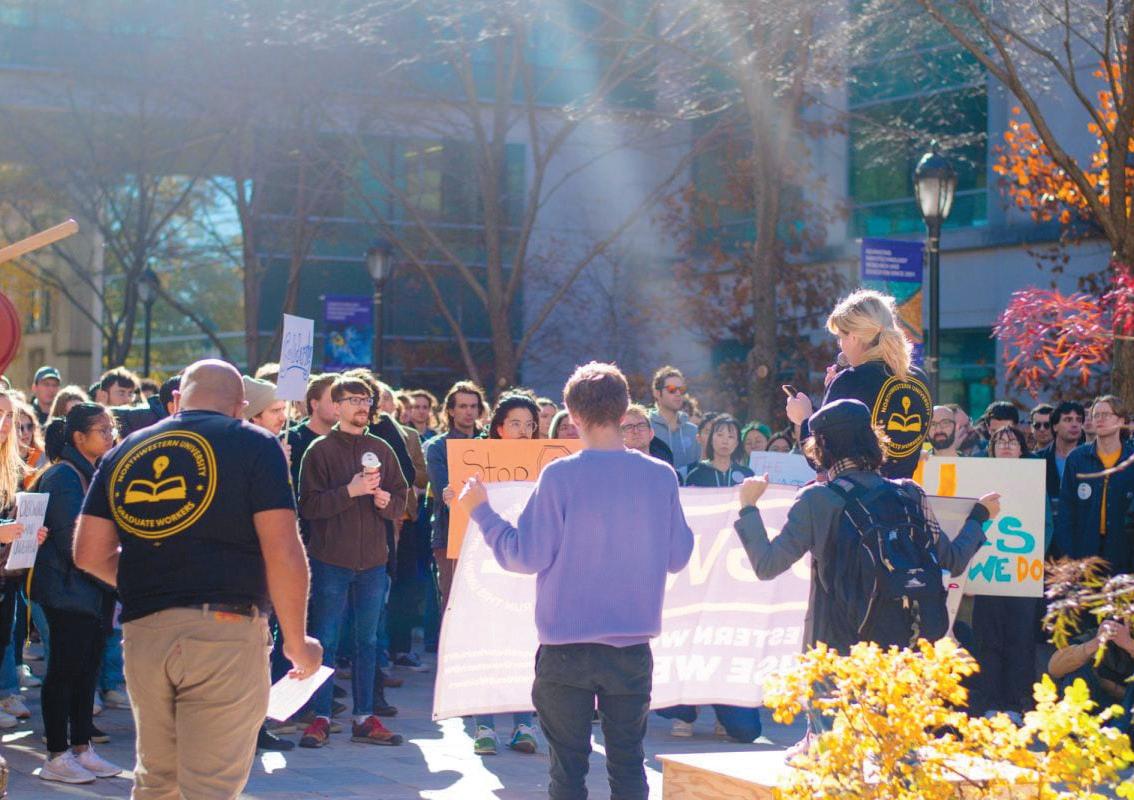
Several labor organizers and faculty members at Northwestern said a second Trump administration could lead to an environment with fewer safeguards for workers and union leaders and a rollback of key protections put in place under President Joe Biden.
Fourth-year Ph.D. candidate in political science Jack McGovern, a member of the Northwestern University Graduate Workers union, studies the evolution of the Republican Party since the 1960s. He said he found it noteworthy that Trump invited Sean O’Brien, president of the International Brotherhood of Teamsters, to speak at the Republican National Convention in July.
“This was unusual to have a union leader speaking at the Republican Convention, but the Trump administration was generally not favorable to labor unions, not favorable to grad student unions in its first administration, and I don’t think it should be expected to be favorable to unions going forward,” McGovern said.
Many are concerned about what the impending Trump administration could mean for unions. Trump’s political track record has not always aligned with his supportive rhetoric about labor unions.
During his first run as president, most of Trump’s appointments and decisions were not favorable to labor unions and made it easier to decertify them, McGovern said.
Political science Prof. Daniel Galvin, who studies labor policies and labor unions,
foresees two ways in which the Trump administration could seriously damage the state of labor unions: supporting legal challenges to labor policies and rolling back progress made toward supporting unions under the Biden administration.
These predictions are in tune with the “movement on the right to try to undermine collective bargaining rights for private sector workers,” he said.
Large companies, including Amazon and SpaceX, are currently challenging the constitutionality of the 1935 National Labor Relations Act in federal court.
Depending on the outcome of this case, Galvin said Trump’s second term could spell the end of collective bargaining for labor unions.
“We might actually see the total elimination of private sector collective bargaining rights,” Galvin said. “That would be pretty major and catastrophic for workers.”
Galvin also forecasts the rollback of many advances toward supporting labor unions that took place under the Biden administration.
Some of these advances include streamlining the union representation process, banning captive audience meetings and passing the Cemex ruling, which created new guidelines for when employers must recognize and engage with employee unions.
“If they do these things that I’ve suggested, it’ll make it that much harder for workers in the private sector to exercise their collective bargaining rights,” Galvin said. “It’s already really hard.”
NUGW President Emma Kennedy said the union is fully aware of these impending threats and has begun to have internal conversations about how to address them.
Along with these conversations, the group also plans to organize trainings to increase involvement due to concerns that Trump will
continue to stoke a culture of fear around union elections and union rights.
“We always want to be building our collective power and empowering our co-workers to know that we can stand up and fight against our boss,” Kennedy said. “People need to really remember that our power is in the collective and coming together across industries, across different unions across this country to stand up for our rights together.”
Under Trump’s first term, the National Labor Relations Board, composed of individuals appointed by Trump, attracted criticism from pro-labor groups for making decisions that interfered with the ability of labor unions and workers to participate in collective bargaining. Despite this record, McGovern remains curious about how Trump’s policy and rhetoric will mesh in his coming four-year term.
“I think what I’ll be watching is whether the policy matches the rhetoric,” McGovern said. “While the rhetoric has suggested that the Republicans are the party of the working class and support aspects of the labor movement, what we haven’t seen yet is whether the policy is going to align under the second Trump administration.”
Members of NUGW also fear potential policies that could affect some of their members more directly.
Mounica Sreesai, a third-year Ph.D. candidate in anthropology, is a NUGW union area chief steward, as well as an international student.
Amid threats made by Trump towards immigrants, Sreesai said many members of NUGW who are also international students are experiencing great anxiety over potential policies under Trump’s administration.
“It’s hard to keep organizing to protect your fellow workers and yourself when there’s such policies,” Sreesai said. “It really restricts my ability to keep myself safe because I cannot participate in this organizing because people are facing disciplinary actions that affect our visa statuses. Obviously, we are going to continue to organize because that’s where our collective strength lies and that’s what’s going to keep us safe.”
leahschroeder2026@u.northwestern.edu


























































From page 1
“I particularly care about child poverty, but I care about homelessness overall,” Reid said. “I’ve had mothers reach out and who have had concerns about the safety of their children because of the homelessness that we’re seeing in these encampments that are on Howard Street and in other places.”
Eric Ruder, director of communications for Connections for the Homeless, said conversations between the organization and city sta are ongoing. Reid mentioned that Connections is “the only game in town” to provide necessary on-the-ground case management. He added that although Connections is able to provide services without the funding, the $1.25 million
From page 1
Zorach said she is concerned the policy will prevent the commi ee from advocating for changes to the University’s current investment strategy given the nature of who will be appointed to the commi ee.
SESP sophomore Shepard Lee Williams said he is concerned the recusal policy will a ect the diversity of voices on the commi ee.
“A lot of a nity groups are based o of things that people cannot change about themselves,” Williams said. “( e recusal policy) will bar them from being able to
From page 1
pass the responsibility to the states but without funding or adequate resources, he said.
Roberts added that certain policies relating to welfare,
From page 1
route,” he said. “We’ve been down the despair route, so I think we have to look positive. We have to think about places we can make change. At the state level, city level, there’s ways to a ect change.”
Stephanie Skora, co-founder and chief development o cer of Brave Space Alliance and author and editor of the “Girl, I guess” Progressive Voter Guide, stressed the importance of the 2026 midterm elections, particularly for those who are disappointed with Trump’s win. If the Democrats lose again in 2026 or 2028, there won’t be another chance to “turn back the clock” on the
would have allowed more eviction prevention services to north suburban Cook County residents.
“ e housing crisis that exists in our country continues to worsen because we’re just literally millions of units short of what’s needed,” Ruder said. “We ultimately need more resources to meet all the need that is around us in northern suburban Cook County.”
Reid, who recounted experiencing homelessness as a teenager, estimated that there were roughly 20 people living at the Howard Street encampment when it was established last year. Reid added that the number has decreased since the city installed lighting on the Evanston side of the Howard CTA station.
At the May Council meeting, Mayor Daniel Biss expressed concern that the proposal had no clear funding source. Ald. Bobby Burns (5th) said the council needed
engage with that facet of their identity.
Zorach added that the commi ee lacks transparency on how it will function. She’s concerned about a non-democratic selection process, she said.
When the ACIR was rst established in 2016 it used to hold space for undergraduate students “engaged in demonstrable popular advocacy for socially responsible investment policies,” these students would likely have to recuse themselves from some investment deliberations under the new policy.
A previous ACIR student representative, who asked to remain anonymous for fear of employer retribution, said the commi ee originated from student activists.
Without the ASG nomination process, they are
including education, should be exercised at the national level, otherwise competition between states to lower taxes and bene ts could facilitate a “race to the bo om.”
McCormick freshman Alex Kosowski, a QuestBridge scholar, said in the absence of federal nancial aid, Questbridge would cover his remaining tuition.
consequences, she said. Skora was another panelist at the Lake Street Church event.
Michelle Jordan, president of the League of Women Voters of Evanston, told e Daily she’s looking forward to the 2026 midterm elections.
“ e one thing that I think a lot of people will be looking forward to are the midterms, and the reason why is because, generally, the party that’s in power, the conventional wisdom is that there’s some correction there,” she said. “And because the Republicans hold all the levers of power, I imagine there’ll be some.”
But local conservatives said they also have more work to do. Evanston Township Republicans is looking to increase its volunteer base, Deputy Commi eeman
more time to determine how to address the Howard Street encampment. All motions on the issue were withdrawn.
In an August 2023 memo to City Council, former District 65 Assistant Superintendent of Student Services Romy DeCristofaro said the district had 278 students experiencing housing insecurity or homelessness at that time. In response, the district has provided temporary housing, rent assistance, administrative support and more to these students and their families.
e district has utilized Connections funding to assist families with housing costs, but DeCristofaro said in the memo that the funding did not meet the needs of housing-insecure students.
Interfaith Action, a local nonpro t providing meals and overnight shelter for people experiencing homelessness, has received Community Development Block
concerned about the commi ee turning into an “echo chamber,” they said.
“ is commi ee came from those marginalized communities who did not want the University to continue to invest in this practice of death,” they said. “ e fact that I was able to have relationships with folks, I was able to bring up concerns or issues that were relevant in ways that somebody else who wasn’t wasn’t able to.”
Zorach said the new restrictions have an “inherent bias” toward those who favor the current University investment strategy, rather than representatives who bring up concerns with the “status quo.”
A faculty member of NU’s chapter of Educators for Justice in Palestine, who asked to remain anonymous
Kosowski said nancial aid means “everything, really everything” for him and his family, especially for him to go to a school as expensive as NU.
He added that inconsistencies in nancial aid could have made all the di erence between receiving a degree at a local state school “and ge ing out” versus
John Foley said. at will be a challenge, he said, as Evanston is a resoundingly Democratic city: Over 90% of its voters voted for President Joe Biden in 2020.
“We have to grow the party,” Foley said. “We’re going to, once we get into early next year, try and do some be er outreach. We need more young people to be a part of the Republican Party of Evanston.” e organization has reached out to NU College Republicans to recruit volunteers but never received a response, according to Foley.
On the other side of the aisle, the Democratic Party of Evanston partnered with Operation Swing State to mobilize volunteers to canvas in Wisconsin and
Grants from the city and has worked with the city’s CARE team for support, Interfaith Action Executive Director Susan Murphy Berbue said. Currently, Interfaith Action’s budget sits at $500,000 according to Berbue, which she said is “very small.” Berube said the organization would like more funding from the city and other sources to operate its shelter yearround, but said she is optimistic about zoning changes the city is considering to build more a ordable housing.
“Homeless people get ‘no’ answers everywhere they go,” Berube said. “‘No, you can’t have money. No, you can’t sit there.’ So I learned from that, and what we do is nd ways to say yes.”
isaiahsteinberg2027@u.northwestern.edu
shreyasrinivasan2026@u.northwestern.edu
for fear of University retribution, said she believes no commi ee member should have to recuse themselves. She said the wording of the recusal policy targeted student advocacy more than any other group. She added there is no such thing as ultimate neutrality.
“ e way this commi ee is set up, being so small and appointed by the president, and every member that is not a student has a longer term than a student, really raises questions about the extent to which discussions will be serious and open to the community,” she said.
ninethkanieskikoso2027@u.northwestern.edu
kelleylu2027@u.northwestern.edu
experiencing life as an NU student.
“When you can’t just make it out, you need some type of rubber band to pull you up,” Kosowski said.
philiplam2028@u.northwestern.edu
Michigan prior to election day.
DPOE President Kathy Hayes said the organization plans to focus on Evanston’s upcoming municipal election, enabling people to have their voices and ideas heard. Local campaigns are equally as important as presidential campaigns, she said. Evanston’s consolidated general election will take place April 1.
“No ma er if it’s a presidential election or a municipal election, all issues are local issues,” Hayes said. “I think I’ve heard in the past other people say that, ‘Oh, I’m not really interested in the local stu .’ Well, all of it’s local stu . All of it.”
femihorrall2027@u.northwestern.edu


By CHARLIE SPUNGIN
daily senior staffer @charliespungin
After Saturday’s 31-7 loss to No. 2 Ohio State, coach David Braun repeatedly emphasized his hopes for his squad to reach a bowl game. He did the same at his Monday press conference.
“We have two more guaranteed opportunities, and (I’m) excited to go on the road and put ourselves in a position to win a football game and work toward bowl eligibility,” Braun said. Opportunity No. 1 for the Wildcats (4-6, 2-5 Big Ten) is Michigan. NU’s loss to the Buckeyes this past weekend was its second-most lopsided loss of the season, only behind its 40-14 loss against Iowa on Oct. 26.
Just as the ’Cats bounced back for a road win after the Iowa defeat, Braun is hunting for a win at the Big House.
NU isn’t the only team vying for a bowl game as the Wolverines (5-5, 3-4 Big Ten) sit just one game short of securing eligibility with a sixth win. Coach Sherrone Moore’s team is fresh off a bye week following consecutive losses to No. 1 Oregon and No. 5 Indiana.
The ’Cats have lost six straight games to Michigan, dating back to 2012.
Here’s what to watch for as NU looks to snap its losing streak against the Wolverines in Ann Arbor.
Can Lausch carry momentum from his outing against the Buckeyes?
Redshirt sophomore quarterback Jack Lausch led the ’Cats to a 7-0 lead and two red zone trips on the offense’s first two drives against Ohio State.
From then on, the Buckeyes scored 31 unanswered points. Still, Lausch — with 201 passing yards — became just the second quarterback this season to throw for more than 200 yards in a game versus Ohio State this season. Eightyfive of these yards came in the game’s opening quarter.
Braun said his young signal caller’s confidence continually increases with more ingame repetitions.
“As you looked at the way Jack performed versus pressure this past weekend, I think Jack did a really good job,” Braun said.
The reigning Big Ten Coach of the Year credited Lausch for his connection with graduate student wide receivers A.J. Henning and Bryce Kirtz.
In his return from a two-game absence, Kirtz recorded seven receptions for 92 yards. Saturday marked Kirtz’s fourth game with more than 90 receiving yards this season.
Braun said he expects Michigan to be “very much pressure oriented,” similar to what NU faced at Wrigley Field this past weekend.
“What Jack was at his best on Saturday
was with his decisive decision making and trusting what he was seeing and trusting his wide receivers,” Braun said. “That’ll have to continue.”
How will NU approach the Wolverines’ low volume passing offense?
Michigan’s 134.6 passing yards per game ranks 18th in the Big Ten and is the sixthlowest figure in the FBS.
Last season, the Wolverines threw for more than 200 yards per game. This season, Michigan quarterback Davis Warren has completed 61.6% of his passes, throwing more interceptions (6) than touchdowns (5).
Braun said this will shift the team’s defensive focus more toward running backs Kalel Mullings and Donovan Edwards, who have rushed for 740 and 513 yards this season, respectively.
“If we don’t effectively stop the run against Michigan, it’s not going to be the outcome we’re looking for,” Braun said.
A centerpiece of stopping the run for NU is graduate student linebacker Xander Mueller, whose status is “up in the air,” according to Braun. Mueller has not appeared in a contest since Oct. 19.
With 560 receiving yards, Michigan tight end Colston Loveland is the only Wolverine to have eclipsed 200 receiving yards. Braun specifically noted the importance of slowing down Loveland.
“You always have to evaluate what you’re potentially giving up or exposing yourself to in that commitment to stopping the run game,” Braun said. “Some of the plays that Michigan was able to hit in the passing game was against some loaded boxes.”
Will the ’Cats capitalize on their red zone opportunities?
After Lausch and his offense marched up the field on the first drive of the game against the Buckeyes, they landed on the opposing 18-yard line.
As Lausch scrambled, an Ohio State defensive player poked the ball loose, and NU squandered possession.
“The expectation is that when we get down there, we’re scoring touchdowns, and worst case scenario, we’re kicking field goals and taking threes away,” Braun said. “And obviously, turnovers — crushing in those scenarios.”
The ’Cats’ red zone efficiency is the Big Ten’s worst and the fifth worst in the entire nation. NU is walking away with points on just 69% of its red zone trips.
On the second drive of the game against the Buckeyes, the ’Cats marched down the field and bounced back from its error on the previous drive. With a 92-yard drive, tied for
its longest of the season, the offense scored
a touchdown to take a 7-0 lead.
“The following drive, you see a really well-executed red zone offensive series,” Braun said. “Great run by (graduate student running back) Cam Porter, great run by Jack.”
That’s why Braun said NU’s red zone

offense is “improving,” pointing out newfound developments in his offense inside the opposing 20-yard line.
“A critical piece that’s starting to show up that I’m excited about is a level of balance,” Braun said.
charliespungin2027@u.northwestern.edu






















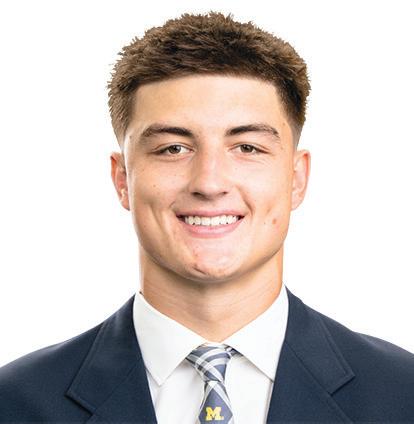

Wednesday, November 20, 2024
By HENRY FRIEMAN daily senior staffer @henryfrieman
Sophomore forward Ashley Sessa sent an a acking penalty corner into the circle just over two minutes into overtime Sunday as No. 2 Northwestern stood deadlocked with Virginia 2-2.
Senior mid elder Maddie Zimmer corralled the ball with a stick-stop before graduate student mid elder Lauren Wadas took control and red a hit that found the back of the net. Immediately a er, their teammates ran over to mob the mid elders as celebrations ensued.
“I kept telling Maddie today, ‘Go a li le bit right, go a li le bit right, a li le bit more.’ I wanted her exactly where I wanted it,” Wadas said. “I knew in my head it was going to go to the post side.”
Wadas secured a 3-2 win for the Wildcats (21-1, 8-0 Big Ten) and a trip to Ann Arbor, Michigan, for the Final Four.
It will be NU’s fourth appearance in the NCAA semi nals in as many years.
“So incredibly proud of our resilience, our relentlessness and how we just fought as a team, not just today –– all weekend, all season,” NU coach Tracey Fuchs said. “I couldn’t be more proud as a coach.”
Sunday’s contest, played at Lakeside Field on an uncharacteristically warm mid-November day, was a back-and-forth a air.
e Cavaliers’ (14-5, 6-2 ACC) backline proved a tough nut to crack for the ’Cats’ usually highpowered o ense, which only logged four shots in the rst half. Virginia, a defensive-minded team, utilized its strong shot-stopping core to reach the NCAA quarter nal.
Fuchs said playing similarly-minded teams like Michigan State and Rutgers during the regular season prepared her squad for Sunday’s contest.
“ at was an area early in the season that we needed to get better at,” Fuchs said. “And we really did grow and get better.”
e Cavaliers struck rst in the contest a er earning a penalty corner with two minutes le in the rst half. Virginia’s Jans Croon found Suze Leemans, who pushed a sweep by NU’s graduate student goalkeeper

Annabel Skubisz to take a 1-0 lead, which carried into hal ime.
In the hal ime huddle, Fuchs told her team to keep pushing for chances. e message was received.
Ninety seconds into the second half, Zimmer found graduate student back Katie Jones in the shooting circle. Jones’s centering stroke was redirected by freshman mid elder Elaine Velthuizen past Cavaliers goalkeeper Nilou Lempers, equalizing the contest.
“She just brings so much to the team, on and o the eld,” Zimmer said of Velthuizen. “She’s really grown into how we play hockey here. … I think she’s starting to nally nd her stride and she’s putting in those goals and, you know, there’s no better time to do it.”
With ve minutes le in the third frame, Sessa readied for an attacking penalty corner as NU held a player-up advantage thanks to a Virginia green card. Sessa sent the ball into the circle before oating around the near post. Junior mid elder Greta Hinke made a stick stop and sent a sweep toward net.
Sessa, wide open at the near post, de ected the shot past Lempers and put NU up 2-1. But Virginia didn’t go down without a ght.
One minute into the fourth quarter, Virginia’s Dani Mendez-Trendler took a penalty corner.
A er a Cavaliers shot and ensuing save by Skubisz, Mendez-Trendler collected the rebound and red on open goal to knot the contest at 2-2.
NU, and the sizable crowd in attendance at Lakeside Field, thought sophomore forward Olivia Bent-Cole scored the go-ahead goal with seven minutes remaining in the nal period of regulation. But a er an o cial review took a few minutes, the goal was waved o .
Sophomore back Ilse Tromp made some huge plays defensively down the stretch, and the two teams ventured to an overtime period.
e ’Cats earned two penalty corners in the overtime period. e second, and ninth attacking penalty corner overall, was Wadas’s strike.
“One of our values is relentlessness,” Wadas said. “Going into every game, knowing it’s not over until the nal whistle, never nervous about being down and staying con dent in our game.”
NU had a home- eld advantage in its rst two matches. at vanishes next week, as Michigan is hosting the Final Four and national championship. e ’Cats will take on UMass next Friday on Phyllis Ocker Field Hockey Field, the site of NU’s 2021 national championship victory, as Ann Arbor awaits. With a win, it will face either No. 1 North Carolina or No. 4 St. Joseph’s in the national championship match on Sunday.
“Records don’t matter at this point, and every game is like a fresh start for every team,” Wadas said. “I think that our team really embodies that. And that’s why we can be successful in the postseason.” henry ieman2027@u.northwestern.edu
By CHARLIE SPUNGIN
daily senior staffer @charliespungin
In 24 of her 25 seasons as Northwestern’s women’s tennis head coach, Claire Pollard has led her program to the NCAA Tournament. e fall season, the rst component of year 26, is now complete.
Last season, the Wildcats reached the NCAA Tournament and fell in a 4-3 rst-round nailbiter to Arizona State. e 2024-25 season marks a new chapter for the program.
Maria Shusharina, a unanimous All-Big Ten Team selection as NU’s No. 1 singles player, graduated a er last season. Pollard’s No. 1 doubles team — Justine Leong and Christina Hand — have also exhausted their eligibility.
Entering the fall season, Pollard said she knew the season would be di erent with the loss of the three program cornerstones, but she took it in a positive light.
“( ere was) a lot of optimism and anticipation of a new beginning and a new start, and I think that was exciting and motivating,” Pollard said. “As sad as it was to lose three unbelievable players, the excitement and energy of new players is always good for a team.”
At the fall season’s conclusion, Pollard sat down with e Daily to look back on the past few months and glimpse at the future of the approaching dual season. Here are ve takeaways from the conversation with the Big Ten’s second-most winningest coach.
1. e decision-making that goes into the fall season is complex
While the dual season has a set schedule, it is up to the coaching sta to decide each time and place a player will play in fall competition.
“If you were in our o ce and you listened to the amount of time that we put into deciding who was going where, you might be questioning our sanity,” Pollard said.
e individual NCAA Tournament was moved to the fall this year a er previously being held in the spring, which Pollard said put a new dimension in scheduling considerations for her and assistant coaches Ellyse Hamlin and Georgia Munns.
A variety of considerations led her players to
di erent cities across the country, including Fort Worth, Texas, East Lansing, Michigan, and Nashville.
“We spent hours and hours thinking about what was best for everyone,” Pollard said. “Did they need to win? Did they need to maybe get challenged more? Who had a chance to make the NCAAs? What did they need? It was kind of really fun doing it.”
2. An improbable doubles team nearly reached the NCAA Tournament
e coaching sta also had the task of deciding which players would pair up to play doubles. For NU, graduate student Britany Lau — who led the ’Cats with 19 doubles wins last season — and freshman Mika Dagan Fruchtman marked Pollard’s most successful fall pairing.
Pollard said she changes around her doubles teams o en to get a glimpse of who plays well together during the early fall. She added that Lau and Dagan Fruchtman instantly proved incredible.
“When we saw Brit and Mika together, all three of us immediately went, ‘Hmm, OK. We might be onto something here,’” Pollard said. “ at, going into the fall, was not a partnership we had wri en down.”
e two reached the semi nals in both the ITA Regional Championship and the ITA Sectional Championship. ey were named alternates for the NCAA Doubles Tournament held in Waco, Texas, this week but will not participate.
Pollard said their success can be a ributed to their playstyles, which mesh very well together.
“Mika’s ability to build a point cross-court is very, very good,” Pollard said. “(Lau’s) nishing style and her ability to a ack and Mika’s ability to set her up just complement each other very, very nicely.”
3. Veterans exemplify a strong fall performance
Lau’s success extended beyond doubles. She was the lone NU player to qualify for the ITA Sectional Championship in singles, where she reached the second round and took a top 60 player in the nation to a close third-set match.
Pollard heaped signi cant praise on the sixth-year athlete.
“Brit’s come back a totally di erent player from last year,” the ve-time Big Ten Coach of the Year said. “If there’s anyone the MVP of the fall, it’s Brit. … Her
whole sort of a acking mentality and aggressiveness is just totally di erent than it was a year ago.”
Lau wasn’t the only veteran to command applause during the fall slate. Senior Kiley Rabjohns earned Big Ten Player of the Week for the week of Oct. 30 a er she registered a 6-1 record — including a 3-0 singles record — at the Spartan Invite.
“ is girl sacri ces her body for the game of tennis and for Northwestern a lot, and we just have to manage it,” Pollard said. “When she is fresh and her body is cooperating, she plays an incredibly high level.”
Pollard said senior Sydney Pra , who was the ’Cats’ No. 4 singles player last year and the highest-ranked returner, “wants to go out on her best season ever.”
4. e team is li ered with talent
Although Pollard dubbed Lau the fall season MVP, she wasn’t the player who led NU in singles victories. It wasn’t even a returning competitor.
It was freshman Maia Loureiro, who registered nine singles wins during the fall campaign.
“She didn’t lose much,” Pollard said. “She really had a great fall. We made a lot of changes to her game this summer, and she embraced it and is coachable and is eager to learn and get be er.”
Beyond Loureiro, Pollard raved about her squad depth. Sophomore Neena Feldman — who appeared as part of the ’Cats’ No. 2 doubles for a chunk of last season — posted a 3-0 singles record in the June Stewart Invitational.
Freshman Erica Jessel reached the singles round of 16 at the ITA Regional Championship, defeating a seeded player in the process.
“We’re deeper than we’ve probably ever been,” Pollard said. “I think this is a special group.”
5. Dual season expectations remain high Pollard said in lieu of the fall season’s completion, she has yet to make any decisions on her dual season lineup.
“It’s tough — we are 10 deep,” Pollard said. “I’m not looking forward to those decisions at all.”
NU was a bubble NCAA Tournament team last season, and Pollard hopes her squad can avoid that fate with an even be er 2025 campaign.
She pointed to her team’s ability to win the doubles point — something NU did in 21 of 27 matches and
nine of the nal 10 matches last season — and her team’s depth as to how it can take a performance leap. “We don’t want to be (ranked) 33, 38 in the country, worrying, looking over our shoulder, ‘Are we going to make the NCAAs?’” Pollard said. “Our goal is to be between 15 and 25, and I think we did a lot of things this fall that will help propel that to happen.” charliespungin2027@u.northwestern.edu