8 SPORTS/Women’s Soccer Wildcats’ lossless streak ends against MSU


The Feinberg School of Medicine recently published a study revealing physician discrimination toward peo ple with disabilities.
The study, which was published earlier this month in Health Affairs, focused on people with intellectual disabilities, as well as dis abilities related to mobility, hearing, vision and mental health. Researchers also asked broader questions regarding attitudes physi cians have about people with disabilities, finding many held explicit biases against them. Feinberg produced the study in collaboration with the University of Massachu setts and Harvard Medical School.
Co-author and Feinberg Prof. Tara Lagu said she wasn’t surprised to learn some physicians deny health care to people with disabili ties, but was surprised by the underlying ableist attitudes
of some health care work ers. Some doctors in focus groups for the study made statements about how dis abled people are an “enti tled population,” are “too demanding” and providing them care takes “too much time,” Lagu said.
Lagu said one of the research staff members who had to rewatch the inter views for transcription pur poses struggled listening to them.
“At one point, she came to me sobbing because she was so upset that doctors were sitting in a room say ing these things and I agreed with her — I was very upset,” Lagu said.
Co-author and Feinberg Research Assistant Prof. Carol Haywood said medical education perpetuates bias in medical trainees, leav ing physicians inadequately prepared to provide care for people with disabilities.
Haywood was displeased by some physicians’ unwill ingness to conduct stan dard practices with patients with disabilities — a com plication that doesn’t exist between physicians and people without disabilities.

After six years without access to the Evanston dog beach, furry friends ran along

the shore, dug in the sand and jumped into the lake Saturday morning. They accompanied their owners at a rally to sup port the reopening of the area as a dog beach.
The strip of sandy land just south of Clark Street Beach
The bass dropped as Beyoncé’s “Cuff It” echoed across the Louis Room in Norris University Center.
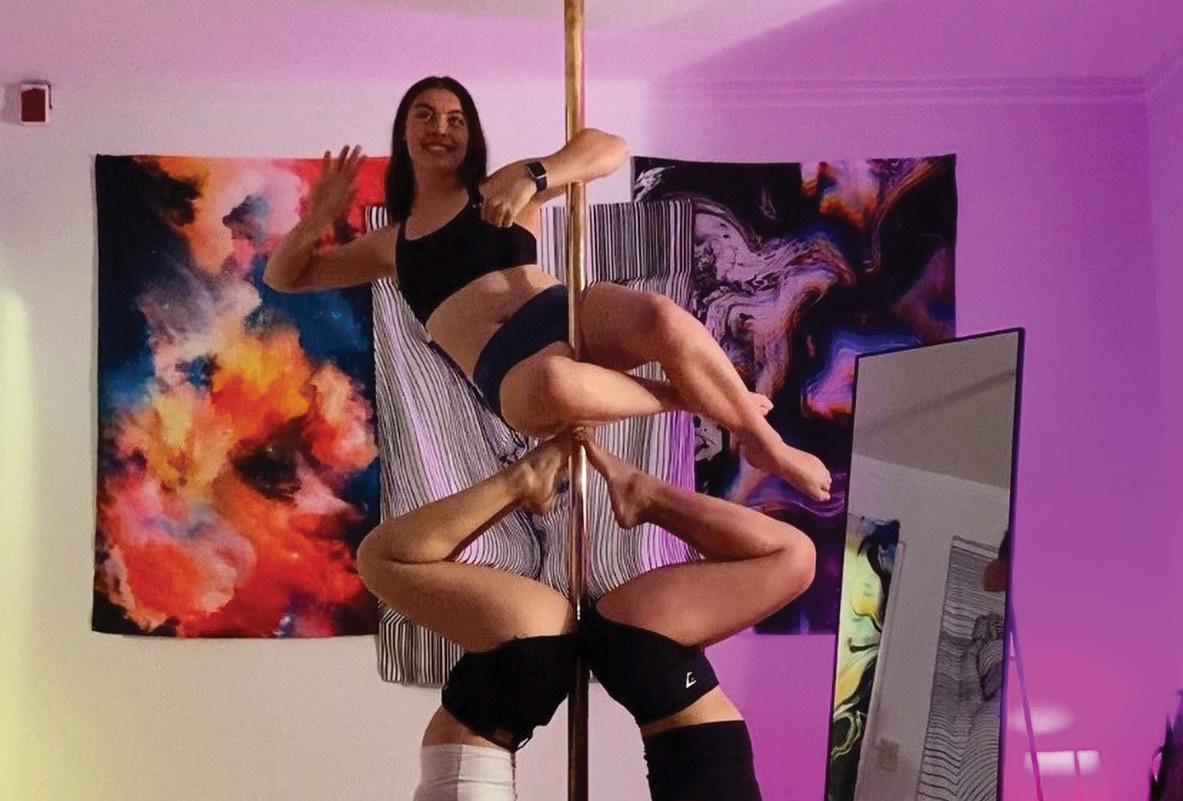
From pirouettes to climbs, students took turns moving their bodies around three gleaming poles to the beat of the song.
Polerize, NU’s pole dance organization, hosted an open pole jam Sunday for students to practice their moves. Wein berg senior Dani Zhang, Communication senior Kate Lee and Bienen junior Greta McNamee founded the club, which launched this fall.
“A pole studio is essentially a space where any person can explore their body away from the male gaze,” Zhang said. “We’re feeling ourselves, and no man has to be there to see us to feel good about it.”
Zhang said she posted a video of herself pole dancing on Facebook chats last winter, inviting students to sign up for classes with her. Through
Facebook, Zhang came into contact with Lee and McNa mee, and the three worked to turn the idea of an NU pole dancing club into a reality.
So far, the club has hosted events including parties, workshops and pole jams.
Whereas workshops are more structured, pole jams provide a casual atmosphere for students to practice tricks, McNamee said. The club also plans to host a Q&A panel with sex workers and social activists, who will share their
experiences.
Weinberg senior Isabel Azpiroz, who attended the pole jam, said Polerize makes pole dancing more accessible. Azpiroz said she enjoys seeing
first closed in 2016 due to high lake levels and unsafe condi tions. As water levels have receded and conditions have improved, residents created a petition calling on the city to reopen the beach.
“There was a good reason to
close it down, and now there’s a good reason to bring it back,” resident and rally organizer Mike Meyers said. “Mother Nature said it’s time to bring the dogs back to the beach.”
See DOG BEACH RALLY,his motorized wheelchair in emergency situations about two to three times a year, and is left immobile as a result.
By ZELLA MILFRED the daily northwestern @zmilfredFor local disability rights activist Michael Grice, having his motorized wheelchair with him is essential. His ability to move freely determines his independence.
Because ambulance vehicles lack the space to carry assistive devices such as wheelchairs, walkers and speech boxes for patients with disabilities, many people who are taken to the hospital are forced to leave their wheelchairs behind.
Motorized wheelchairs are especially difficult to trans port due to their large size and weight. But some people, like Grice, who only has use of one of his arms, can’t use the manual wheelchairs provided at hospitals.
Grice, who lives in Oak Park, said he is separated from
“We’re stuck,” Grice said. “That’s not just a problem for me, it’s a problem for my friends and other col leagues … There’s no way to get (my wheelchair) into the ambulance … It’s very discouraging.”
Depending on the loca tion of the health emergency, mobility devices could be left anywhere from patients’ resi dences to the side of the street. Patients with disabilities must coordinate with friends and family to keep track of their mobility devices.
Grice is working with the local disability rights orga nization Access Living to address these concerns in Chicago through an effort called the Emergency Services Campaign.
After months of communi cation with the Chicago Office of Public Safety Administra tion, the office told Access
WHEELCHAIRSAdvocates call for more accessible emergency services
The overwhelming majority of Evanston’s green house gas emissions do not come from what residents drive, eat or buy. Instead, it comes from where they live and work.
In the 2018 Climate Action and Resilience Plan, City Council reported that 80% of the city’s emissions came from residential and commercial buildings ––44% from electricity and 36% from natural gas.
The city’s Environment Board, community groups like Citizens’ Greener Evanston and local construc tion firms are all working to chip away at building emissions. But coordination and communica tion between the many apparatuses is an ongoing challenge.

The Evanston Development Cooperative said accessory dwelling units offer a solution to reducing total building emissions that will simultaneously cre ate more affordable housing options.
ADUs can be standalone units, converted garages or even part of an existing home. According to EDC co-founder Robbie Markus (Communica tion ‘19), ADUs are a minimally disruptive way to increase affordable housing options in low-density neighborhoods.
Restrictive zoning laws have hindered some com munities’ access to ADU construction. In Evanston, duplexes were not eligible to have ADUs until Sep tember 2020. EDC found that most duplexes are in West Evanston in predominantly Black and brown neighborhoods.
“This was inherently a race issue. It was locking a certain part of the city out from this opportunity to build generational wealth,” Markus said.
According to EDC, equitable zoning is essential to ensuring all Evanston residents can access affordable housing. After years of advocacy by the organization, the city passed a new zoning ordinance in September 2020 that greatly expanded opportunities for ADU construction.
However, the bulk of Evanston’s building emissions comes from previously-existing housing stock. Henry Love, senior director of municipal and community
programs at Chicago-based nonprofit Elevate, said helping communities affordably renovate decades-old buildings is Elevate’s main goal.
“If you are increasing their cost of utilities, you are not really meeting that nexus of climate and equity benefits. [We] try to make sure that we’re solving for both at the same time,” Love said.
But encouraging community members to renovate their homes is difficult when retrofitting can be diz zyingly complex.
Each improvement, from weatherization to elec trification to solar, is typically completed by different organizations in Evanston.
“[Homeowners] have to reach out to three differ ent agencies, go through three different application processes and schedule three different visits,” Love said, “and that’s all put on top of somebody who has limited resources and time already.”
Evanston is partnering with the Center for
Neighborhood Technology, Elevate and the EDC to create the “One Stop Shop for Affordable, Resilient Net-Zero Homes” initiative.
In July, City Council approved the allocation of $1 million from the American Rescue Plan Act Fund to fund a two-year pilot program that will help 50 inter ested homeowners sustainably retrofit their homes.
The One Stop Shop is an equity-centered program that emphasizes serving low to moderate-income Black and Latine residents, according to a memoran dum sent by Evanston Sustainability and Resilience Coordinator Cara Pratt to City Council.
As deliberations for the city’s 2023 budget approach, Ald. Eleanor Revelle (7th) said the city may fund two additional positions in the Office of Sustainability.
One position would be dedicated to helping sustainability-oriented community organizations work together more effectively and obtain feedback
from residents. The other position would be focused on following up on Evanston’s 2016 benchmarking ordinance, which requires building owners to annu ally report their energy and water usage to a national Environmental Protection Agency database.
“We [want to] move beyond just the data collec tion to actually make some changes that will reduce energy emissions,” Revelle said.
CARP aims to secure a 100% renewable electricity supply by 2030 and make Evanston carbon-neutral by 2050. The goal is for the $1 million dedicated to the One Stop Shop to be just the beginning, not the end, Love said.
“[We need to] build an infrastructure for climateresilient retrofitting in the community. With the pilot, the goal is [to retrofit] up to 50 units. But that’s pea nuts compared to the scale of the problem,” Love said.
avamandoli2025@u.northwestern.edu
PHOTOGRAPHERS WILL BE IN NORRIS FOR A LIMITED TIME. Several poses will be taken – in your own clothes and with cap and gown. Your choice will be available for purchase. All senior portraits must be taken by Prestige Portraits/Life Touch. $10 sitting fee required.
Monday Nov. 1 through Friday, November 20 @ NORRIS Sign up at: www.OurYear.com NU Code: 87150 questions? email: syllabus@northwestern.edu or go to: www.NUsyllabus.com
Communication sophomore Jillian Olson had “known for a bit” that she needed a therapist. But it wasn’t until after TimelyCare’s launch at Northwest ern that she sought the help she needed.
Olson began using TimelyCare, a virtual platform for 24/7 mental health support, in August. She has continued to use its therapy services ever since and has recommended the resource to friends.
TimelyCare offers free access to a variety of mental health services, including 12 scheduled counseling appointments a year, health coaching, guided medita tions, yoga and TalkNow, an on-demand call service connecting users with a mental health professional.

Since NU partnered with TimelyCare in April, more than 1,000 undergraduate and grad uate students have scheduled appointments on the platform, according to Mona Dugo, assistant vice president for wellness.
“(TimelyCare) is meant to be supplemental to (Counseling and Psychological Services) and is more aimed at students who want longer-term individualized support or who want other forms of support, like some wellness coaching or some body to talk to now,” Dugo said.
Although Olson said though it can be harder to connect with someone on a computer screen, she is sticking with virtual services through TimelyCare because of the ease of completing therapy from her bed.
Olson added that she appreciates the platform’s quick and easy online scheduling process.
“It’s a good jumping-off point if you have any immediate concerns you want to get addressed, or you just want a short-term therapist (while) you’re looking for an in-person (therapist),” Olson said.
Medill sophomore Isabela Lisco said she chose TimelyCare as her first-ever therapy platform instead of CAPS because she could easily get an appointment. Students have historically voiced complaints about long wait times for CAPS services.
At the recommendation of her parents, Lisco turned to TimelyCare after experiencing a traumatic head injury one week before school started. Though
she enjoyed her time with her counselor, Lisco said she decided not to move forward with therapy.
“It’s tricky because I don’t have anything to compare (the therapist’s) tactics to, but I felt very comfortable with him,” Lisco said.
Dugo said TimelyCare should help alleviate common barriers to mental health resources such as finances and scheduling. The Univer sity also appreciated that TimelyCare allows students to choose counselors with whom they share certain identities, she said.
As of Oct. 10, Dugo said that of the 1,103 students who have created TimelyCare accounts, 158 students have used the TalkNow function. These numbers, although lower than she said she would have liked, are not her primary concern.
“It’s not so much about the numbers for Timely Care for me, as much as it is, ‘Do students feel like they have access to the support they need?’” Dugo said.
Dugo said efforts to promote TimelyCare have included tabling at Norris University Cen ter, along with advertising on social media and televisions in Searle Hall.
However, some students believe the service needs more visibility. Olson said TimelyCare isn’t advertised enough, and McCormick senior Sahibzada Mayed said they don’t know anyone who has used the platform.
Mayed is a co-leader of Reform CAPS, a stu dent activist group advocating for CAPS to bet ter serve students. They said Reform CAPS sees TimelyCare as a “Band-Aid” solution to mental health on campus by not addressing the long wait times and lack of counselors at CAPS.
“If someone uses TimelyCare and they like it and they’ve got the help that they need, I would be extremely happy,” Mayed said. “But from a perspective as a group on campus, we think Time lyCare is just inadequate (and) insufficient.”
Mayed said they also had concerns about the app’s confidentiality. When signing up for Timely Care and agreeing to its terms of service, students consent to their records being shared with licensed University medical providers and counselors.
Dugo said NU has yet to conduct an assess ment of student experiences with the platform, but that administrators have spoken with Timely Care about implementing an avenue for feedback.
“I do want students to know (TimelyCare) is there,” Dugo said. “If you’re sitting alone in your room and you’re freaking out about something and you need a confidential person to talk to … I want students to know that they have access to that kind of support.”
evelyndriscoll2025@u.northwestern.edu
Editor in Chief Jacob Fulton eic@dailynorthwestern.com
General Manager Stacia Campbell stacia@dailynorthwestern.com
Holly and John Madigan Newsroom Phone | 847.491.3222
Campus desk campus@dailynorthwestern.com City desk city@dailynorthwestern.com Sports desk sports@dailynorthwestern.com Ad Office | 847.491.7206 spc-compshop@northwestern.edu
The Daily Northwestern is published Monday and Thursday during the academic year, except vacation periods and two weeks preceding them and once during August, by Students Publishing Co., Inc. of Northwestern University, 1999 Campus Drive, Evanston, IL 60208; 847491-7206.

First copy of The Daily is free, additional copies are 50 cents. All material published herein, except advertising or where indi cated otherwise, is Copyright 2022 The Daily Northwestern and protected under the “work made for hire” and “periodical publication” clauses of copyright law.
POSTMASTER: Send address changes to The Daily Northwestern, 1999 Campus Drive, Evanston, IL 60208. Subscriptions are $100 for the academic year. The Daily Northwestern is not responsible for more than one incorrect ad insertion. All dis play ad corrections must be received by 3 p.m. one day prior to when the ad is run.



& Thursdays fall quarter on the NU campus & Evanston.
Dailynorthwestern.
For delivery suggestions & comments, contact The Daily Business Office at ads@dailynorthwestern. com or 847.491.7206.
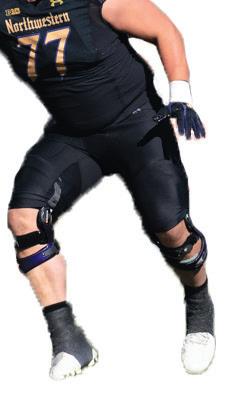
Northwestern Director of Football Performance Jay Hooten needed someone to change the Wildcats’ culture in the weight room, but he knew the driving force couldn’t be a coach.
NU had just completed a disappointing 2021 season in which the Cats limped their way to a 3-9 record and lost to in-state rival Illinois for the first time since 2014. The physical separa- tion of the panhad taken
and 280 pounds — relatively undersized for a top defensive lineman — Adebawore disrupted opposing offenses with his rare combination of speed and power.
“It’s the optical illusion — you think ‘Here’s a guy I can snatch him up and use my body,’ and the reality is he can keep his distance while being explosive and being athletic and being shifty,” offensive line coach Kurt Anderson said. “He’s very slippery when you’re trying to block him.”
The following year, both linemen continued their ascent and received All-Big Ten honors, Skoronski on the coaches’ All-Big Ten First Team and Adebawore on the All-Big Ten honorable mention list. But with the Cats free-falling from a 7-2 record to 3-9 in 2021, both players entered the offseason motivated to return NU to contender status in the Big Ten West.
NU’s coaches wanted Adebawore to become an every-down type of player and increase his number of plays per game from 40 to 60, so the Kansas City product worked tirelessly on his conditioning to complement his off-the-charts power. Hooten said Skoronski developed a Slater-like “grit factor” over the offseason and made massive strides in his strength, improving his bench press by 80 pounds and squat by 120 pounds.
“Both guys also have freakazoid strength numbers,” head coach Pat Fitzgerald said. “Just to watch both of their maturations athletically, competitively, fundamentally on the field — both have really pushed each other, which has been fun to watch.”
NU’s culture.
In January 2022, Hooten received a call from then-junior defensive lineman Adetomiwa Adebawore with a simple question: “What do we need to do?” The two began talking daily about how to restore the Cats’ winning ways, and Adebawore, along with then-sophomore offensive tackle Peter Skoronski, embraced the challenge of turning around the team’s attitude.
“Adebawore changed our culture this offseason,” Hooten said. “He helped rebuild our culture, and he was the catalyst behind it, and then Peter followed him. They have been unbelievable. It’s been less about sets and reps and more about the culture of the team.”
In 2022, Adebawore and Skoronski have become more than just NU’s best players — they have formed a crucial part of the program’s identity and set the tone in the trenches. Both made immediate contributions to the Cats early in their college careers, but as captains and leaders in the weight room, their influence has extended beyond their own play this season.
At the heart of that bond is their shared competitive fire and respect for each other’s games.
“They’re two of the best players we have right now,” Hooten said. “They’re very dependable because of that training, because of that leadership, because they feed off each other.”
When Skoronski joined the Cats in 2020 from Chicago suburb Park Ridge as a fourstar offensive line prospect and NU’s fourthhighest signee of all-time, the coaches and fanbase had high expectations for how he could contribute to the program. Facing Adebawore, a sophomore with eight games of college football under his belt, was a major shock to his system.
“He probably put me on my butt my first day of practice,” Skoronski said. “I was like, ‘Oh, this is how it is, you’ve got to be ready.’ It’s great to have someone like that in practice, and to not have to go up against in a game.”
Both players blossomed into key contributors for NU in 2020, when the Cats won the Big Ten West for the second time in three seasons and recorded their first top-10 finish in the AP Top 25 since 1995. When future NFL All-Pro Rashawn Slater opted out of playing in 2020 to prepare for the draft, Skoronski stepped in as a true first-year and exceeded all expectations, earning a selection to the All-Big Ten Second Team. Adebawore also shined in his time on the field, registering six tackles for a loss and two sacks in nine games.
For opposing defensive linemen, Skoronski proved a nearly impossible matchup due to his consistency and impeccable form.
“He’s smart, has great technique, he’s very patient and stays disciplined through every rep,” Adebawore said. “He doesn’t change who he is, (and) he’s really consistent as a player.”
For Skoronski’s defensive counterpart, deception and explosiveness paved the way for a breakout season. Standing at 6-foot-2
The Cats’ coaches view the months from February to July as the crucial time to build the foundation for a successful season and build momentum heading into preseason camp in August. This offseason, Adebawore and Skoronski sought out a chal-
Adebawore and Skoronski’s commitment to improving themselves and their team made them natural fits to be among the Cats’ five captains for 2022. For most of their careers in Evanston, both players have preferred to let their play do the talking, but coaches say they’ve noticed both emerging as more vocal leaders this season.
“When your leaders are your best players, guys will immediately look to see what their tempo is, what their attitude is, what their approach to the daily grind is,” Anderson said. “Now they’re using their voice, voicing their opinions, their thoughts, their mindset.”
Therein lies the most difficult challenge each player faces: bringing their teammates with them.
Skoronski leads all collegiate offensive linemen in Pro Football Focus’s pass-blocking grade metric and made the site’s Midseason All-America Team, while Adebawore’s athleticism has helped him gain traction as a potential first-round pick. Still, the goal that fueled the players’ offseason grind — team success and a return to the Big Ten Championship — has eluded the Cats so far.
could elevate their established games even further: facing each other.
“They look to go against each other, especially in pass rush and in combo,” defensive line coach Marty Long said. “You’ll see them finding each other to play against each other.”
According to coaches — and Adebawore and Skoronski themselves — each player has won his share of the on-field battles through the spring and summer camps. Skoronski remembers one play in practice in which Adebawore dropped into coverage, intercepted a pass and ran it back for a touchdown, which made even the offensive linemen marvel.
“I try to go hard whoever I go against, but especially with Peter, you’re not going to have a choice to not go hard,” Adebawore said. “I’m really focused on trying to go against the best every day, and with him, that definitely helps.”
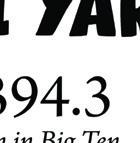
The friendly competition has followed Adebawore and Skoronski into the weight room. Adebawore’s strength numbers have become the stuff of legend, earning him the No. 30 spot on college football insider Bruce Feldman’s College football Freaks List, with max lifts of 410 pounds on the bench press and 685 on squats this offseason. Skoronski’s own progression has made him a clear candidate to follow Slater into the NFL Draft’s first round.
Still, what impressed Hooten most about both players’ approach this offseason was how they approached their weaknesses.
After edging out Nebraska 31-28 in the season opener, NU has lost five straight games, including all four of its home games. The Cats are in danger of finishing at the bottom of the conference for a second straight year, with ranked squads in No. 2 Ohio State and No. 18 Illinois still ahead.
“Things aren’t going the way that we want them to go right now, and they’re doing an unbelievable job of keeping that culture,” Hooten said. “That’s the number-one thing, and they’re the catalyst for that.”




































































































































































































































































Before Northwestern’s game against Wisconsin, sophomore quarterback Brendan Sullivan hadn’t taken a live snap in nearly two years.
e last time was a huge one, though, as the thenDavison high schooler helped lead his team to 48-19 victory over Grand Blanc, clinching the 2020 Division 1 district title on Nov. 13.
Yet with Sullivan’s senior season up in the air due to Michigan high school football’s COVID-19 cancellation, three weeks later the NU commit made a life-changing decision — enrolling in college early. Sullivan tweeted that he would be closing the door on his high school career and opening up the college door at the start of the new year.
Sullivan’s eagerness to make a collegiate name for himself had to wait, as he didn’t see any action his rst year in Evanston. A er rising up the depth chart and ba ling it out with junior quarterback Ryan Hilinski this past spring and summer for the starting job, it still
wasn’t Sullivan’s time to shine.
But on the third drive of NU’s homecoming contest against Wisconsin, coach Pat Fitzgerald called on the backup to man the ship.
“He had a really good week of practice last week, but he’s practiced well all year,” Fitzgerald said about Sullivan. “When he came in, I thought he was gri y, I thought he was gutsy, I thought he did some things really well, and I also think it looked at times like it was his rst time being out there.”
Sullivan’s taste of the action was short-lived in the second quarter — three straight three-and-outs — leading to Hilinski entering back into the game for the rest of the half.
is seemed to be the script for the rest of the game, as Hilinski was still under center at the beginning of the third quarter. However, a er su ering a concussion on the rst drive of the half, Hilinski’s day was done, allowing Sullivan another chance at game action.

By the end of the contest, Sullivan completed 11 of his 17 passes for 114 yards, a touchdown, all while leading the team with 33 rushing yards.
“First couple of drives, I’m running all around there
just like a chicken with his head cut o ,” Sullivan said at his postgame press conference a er the Wisconsin loss. “Just se ling down and trusting everybody, that’s the main thing that happened between those drives.”






Sullivan said a huge part of his mindset on the sidelines as he readied for his rst bite of collegiate ball was believing in his preparation and the importance of a next play mentality, especially a er not seeing live competition in so long.
And that’s exactly what the sophomore did. Sullivan found his groove in the rst drive back at the helm, completing three passes for 26 yards and rushing for 20. However, the quarterback was unable to react in time to Wisconsin defender Nick Herbig’s pressure o the le edge, resulting in his rst fumble and turnover as a Wildcat.
Two drives later, though, Sullivan’s 41-yard back shoulder dot to junior wide receiver Bryce Kirtz put NU into the red zone for the second time the entire contest. Nearly three minutes later, Sullivan’s on-therun throw found sophomore running back Anthony Tyus III for a touchdown — the Cats’ lone score of the game.
Senior wideout and return man Raymond Niro III
had some high praise for the sophomore.
“He’s been my guy since the rst time he stepped on campus,” Niro III said. “Seeing him get on the eld and play the way he did, like con dence and stu , just kind of shows the type of guy he is.”
As NU (1-5, 1-2 Big Ten) heads to Maryland (5-2, 2-2) this weekend, Fitzgerald didn’t give an update on Hilinski’s concussion protocol status, leaving the question of who will start at quarterback on Saturday up in the air. Fitzgerald added that both are receiving reps.
But with the ashes of game-changing potential that he exed against the Badgers, Sullivan’s ready to take the o ensive keys. Whether it be moving the chains with his feet similar to 2020 starting quarterback Peyton Ramsey, or le ing the cannon loose to change sides of the eld, the Davison native can add a new dynamic to coach Mike Bajakian’s o ense.
“My athletic ability is what separates me, the ability to make big plays on the run and in the pocket,” Sullivan said. “I stayed the course and worked hard to prepare like I was the starter every day, so I feel like that’s just a testament to who I am as a person.” lawrenceprice2024@u.northwestern.edu

It feels like an eternity has separated Northwestern’s rst game of the 2022 campaign — a thrilling comeback victory in Ireland over Nebraska — and the Wildcats’ current stretch back home in the United States.
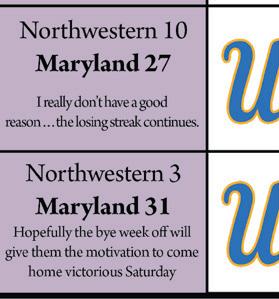
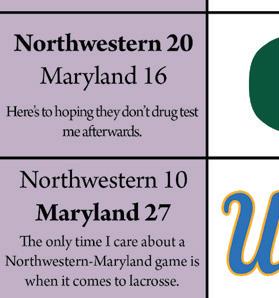
Fueled by the newfound optimism of a fresh season and a tad of Irish luck, NU put in a compelling performance to start the year 1-0. But when the Cats (1-5, 1-2 Big Ten) returned to Evanston for a three-game nonconference homestand, the season’s woes took full shape.
Nevertheless, the fact remains — NU is .500 in games away from Evanston and winless at Ryan Field, where opponents have outscored the Cats 121-68.
“We’re a team that always kind of has success when our back is against the wall,” junior running back Cam Porter said. “We love going into environments and proving people wrong.”
NU did well to prove the doubters wrong against Nebraska, but the team failed to build on its early momentum. Victories during the squad’s next ve games — four of which are on the road — would go a long way in shi ing that narrative.
Before the 2022 season commenced, only two Cats squads had been winless at home by mid-October, the 2003 and 2018 teams. is year’s NU team joins that list. e 2018 Cats dropped their opening three contests at Ryan Field before defeating Nebraska in a nailbiter on Oct. 13 of that year. 15 years earlier, NU similarly dropped its rst three games at home as opponents outscored the Cats 108-52 in that span. A victory against No. 20 Wisconsin on Oct. 25, 2003 broke the losing skid in Evanston.
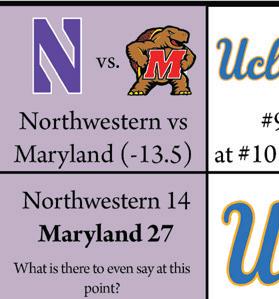

Despite the struggles at home, both NU squads earned a bowl game bid in their respective seasons, largely because of their success away from Ryan Field. Before the win against the Badgers, the ‘03 Cats were 3-1 on the road, with the only loss coming to No. 4 Ohio State. Meanwhile in 2018, coach Pat Fitzgerald’s squad
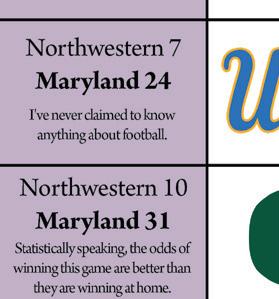
was a perfect 5-0 away from home.
If NU is to replicate the road triumphs of years past, ensuring the squad has a con dent mentality heading into opposing atmospheres is a good place to start.
“It’s de nitely exciting going in there and being outnumbered as far as fans go,” senior wide receiver Donny Navarro III said. “You kind of have to play with a li le bit more of a chip on your shoulder. You want to silence the crowd. We look forward to being on the road this week.” ough it’s considered a neutral venue, Ireland felt like a road game due to the large swaths of Cornhusker supporters, redshirt senior defensive back Jeremiah Lewis said. e ba le at Penn State on Oct. 1 was another game in a hostile environment, both due to the fans and the weather.
In a season of horrors, the two games have been the Cats’ best performances as the defense forced a combined eight turnovers. Conversely, NU has forced just two turnovers in four home games.
“We’re working against the crowd the whole game,” Lewis said of the team’s road mentality. “ e best thing
for us to do is to show that we can stop the run (and) limit big plays in an e ort to essentially keep the crowd out of it.”


Now, NU travels to College Park to take on a Maryland squad that could be without starting quarterback Taulia Tagovailoa, who su ered a sprained MCL against Indiana last Saturday and is a game-time decision. A week later, the Cats will hit the road to face a middling Iowa Hawkeyes team which hasn’t scored more than 27 points in a game this season.

Regardless of whether Tagovailoa suits up for the Terrapins on Saturday, both contests are likely NU’s best opportunities to nab a victory this season, especially coming o of a bye week.

“Overall, we try to keep the same approach, both home and away,” Lewis said. “But playing on the road kind of gives everyone a spark.”
Elena Hubert contributed reporting.
alexcervantes2024@u.northwestern.edu

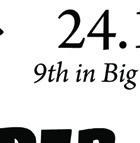
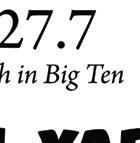
4 Michigan (4-0, 7-0)
2 Ohio State (3-0, 6-0)















16 Penn State (2-1, 5-1) Maryland (2-2, 5-2) Michigan State (1-3, 3-4) Indiana (1-3, 3-4) Rutgers (0-3, 3-3)




18 Illinois (3-1, 6-1)




Purdue (3-1, 5-2) Nebraska (2-2, 3-4) Minnesota (1-2, 4-2) Iowa (1-2, 3-3) Northwestern (1-2, 1-5) Wisconsin (1-2, 3-4)



Gameday is a publication of Students Publishing Co. A four-page issue is usually published on the ursday prior to Northwestern home games and a two-page issue is published on the ursday prior to Northwestern road games.




















All material is © 2021 Students Publishing Co. Questions or comments should be sent c/o Gameday Editor John Riker, 1999 Campus Dr., Evanston, IL 60208.


























Join the online conversation at www.dailynorthwestern.com
Last week, The Daily Northwestern pub lished its 2021-22 diversity report. Its results — and reactions to it — were mixed, reveal ing stark differences in how staffers of vary ing identities experience our newsroom.
The metrics for racial diversity within the newsroom were alarming and disgraceful. The Spring 2022 staff was only 5.5% Black and 12.3% Latine, compared to 12% and 16.8% respectively in the class of 2025. The editorial board — the students who establish content and newsroom culture at The Daily — was only 3.4% Black and 10.3% Latine. There was only one Indigenous staffer in a leadership role.
On the other hand, some may consider the diver sity report a suc cess because of the LGBTQ+ metrics. Last year, 43.8% of staffers and 62.5% of edit board did not identify as hetero sexual. Compara tively, only 15.9% of Generation Z identi fies as LGBTQ+ according to a 2021 Gallup poll. The queerness of The Daily has been established by past diversity reports and is often joked about by those familiar with the paper — I remember hearing this at my first informational meeting as a selling point as to why I should join The Daily.
— I can attest to the fact that the lack of Black, Latine and Indigenous staffers is more than just a statistic. It contributes to a per vasive culture of whiteness in the newsroom and an institutional failure to effectively cover marginalized communities that extends beyond just the last quarter or year.
While The Daily may be a welcoming envi ronment for white queer staffers, the same cannot be said for BIPOC staffers, queer or not. This sense of safety for white queer staff ers, especially members of edit board, can lead to an oblivion of their white privilege and perpetuate a harmful newsroom environ ment for other marginalized staffers.
to hold their queerness on a pedestal instead of acknowledging their white privilege — which further marginalizes the people of color around them. This pattern is evident in both The Daily’s coverage and newsroom culture.
their own — leading to accelerated burnout.
While The Daily may be a wel coming environment for white queer staffers, the same cannot be said for BIPOC staffers, queer or not.
- LUCIA BARNUM, ColumnistWhite queer people’s blindness to their privilege due to their separate marginal ized identity is not exclusive to The Daily. In a 2021 study published in the Journal Committed to Social Change on Race and Ethnicity, Nicho las Havey, Ph.D. found that white college students identifying “with one marginalized or disadvantaged group may obscure or suppress the very real privilege and immunity afforded by whiteness.” While the study focuses on gay men, the results have applications to many other queer people. Participants in his study “leveraged queerness as a defense of whiteness,” down playing their systemic racial privilege because they face oppression as part of LGBTQ+ communities.
As a queer person, I’m glad The Daily pro vides a safe space to so many other queer peo ple, especially for those who may not have had a space to express themselves elsewhere. I’m no stranger to the difficulties of finding queeraffirming spaces on campus, nor to the over whelming relief that comes when you finally do.
But after serving on Spring 2022 edit board — one of the 10.3% of Latine members
A 2014 study in the Journal of Lesbian Studies found the normative archetype of a queer woman is white, which renders queer women of color “invisible in both queer and racialized communities.” The prevailing culture of whiteness within queer communi ties marginalizes BIPOC women beyond the oppression experienced by their white peers.

In other words, white participants in these studies thought their queerness was more important than their race. This belief led them
An example of this behavior lies in the his tory of the Diversity and Inclusion Chair at The Daily. In a 2019 “From the Newsroom,” former Editor-inchief Marissa Mar tinez, the originator of the role, wrote she was driven to help create the D&I posi tion in part because of her experiences as a Black and Latine woman in the news room. Martinez and other marginalized students saw a need for a role that would force The Daily to engage in larger con versations about their “prejudices, biases and shortcomings.”
This diversity report should be a wakeup call for all of us. This harmful culture is not just about individual staffers, but rather the fact that the newsroom operates as a white queer space.
In five out of the past six quarters, there has been at least one white, queer D&I Chair. At a newspaper with an edit board that is over 60% queer, it is much more pertinent that D&I roles be filled by people of color. It would be frowned upon for a white straight person to hold that position, but white queer people serve in the role as if their queerness overrides their whiteness and the privilege that comes with it.
The dominant culture of white queerness also ostracizes queer people of color from their own community. Every quarter, The Daily hosts both BIPOC and queer affinity spaces outside of the newsroom — they are meant to help marginalized students to find community and a sense of belonging at the paper. But in my experience, the queer affin ity spaces are overwhelmingly white.
It is absurd to consider The Daily a wel coming work environment when queer people of color feel uncomfortable attending queer affinity spaces. Without a space that holds room for queer BIPOC identities, they are forced to do that kind of care work on
The Daily prides itself on being a learn ing newspaper, selling itself as a supplement to the Medill School of Journalism, Media and Integrated Marketing Communications curriculum. And yet, this toxic environment of whiteness perpetuated by members of the edit board contributes to a staggering, undue burden on the people of color who make The Daily function. This paper is actively discourag ing young journalists of color from work ing in the industry. While I am Latine, I’m also white; I have access to these white queer spaces. I wholeheartedly acknowledge my contributions to this destructive culture, but also realize that the toxicity of white queer spaces is uni versal and manifests in workplaces other than The Daily.
This diversity report should be a wakeup call for all of us. This harmful culture is not just about individual staffers, but rather the fact that the newsroom operates as a white queer space. It requires a complete reforma tion of how The Daily functions, and par ticularly, a rethinking of who is selected for leadership positions.
White queer staffers must think critically about the space they take up in the news room, why they feel entitled to it and how their white privilege contributes to that. Most importantly, they must think about how they can genuinely support the staffers of color who power this newspaper.
Lucia Barnum is a Medill Sophomore. They can be contacted at luciabarnum2025@u.northwest ern.edu. If you would like to respond publicly to this op-ed, send a Letter to the Editor to opin ion@dailynorthwestern.com. The views expressed in this piece do not necessarily reflect the views of all staff members of The Daily Northwestern.
Native Americans, as you might have guessed, have had a rocky relationship with the Supreme Court. Even the most revered justices, like Ruth Bader Ginsburg, have ruled against the sovereignty of Native nations. Bader Ginsburg wrote in the 8-1 majority opinion in 2005’s Sherrill v. Oneida Indian Nation, “we hold that the (Oneida) tribe cannot unilaterally revive its ancient sovereignty.” While the law was obviously up for deliberation, the near-unanimous deci sion was only one instance in a long history of Indian Law.
R.B.G is gone and a new Supreme Court term began Oct. 3, one that’s shaping up to be just as controversial as the previous. In the court’s last term, the justices made it clear they are unafraid to overturn landmark deci sions and decades of precedent.
News to no one are the rolling repercus sions from the overturning of Roe v. Wade. The decision in Dobbs v. Jackson Women’s Health Organization undid decades of prec edent on women’s rights and opened a can of worms concerning the implied right to per sonal privacy.
The high court also ruled on Oklahoma v. Castro-Huerta, which walks back the deci sion in McGirt v. Oklahoma from 2020, along with nearly 200 years of precedent in Indian Law. The McGirt decision, favoring Oklahoma, limits tribal sovereignty and gives states the right to prosecute non-Native indi viduals who commit crimes against Native persons on tribal lands. This rocked Indig enous communities nationwide as a threat to sovereignty.
In the Castro-Huerta dissent, Justice Neil
Gorsuch argues the ruling was a mistake of the court. Why, he urged, would it not be in the interest of tribes to prosecute those who commit crimes against its citizens on its land?
This term, the Supreme Court is hearing a cornucopia of contentious cases on affir mative action, voting rights and yet another business refusing to serve a gay couple.
Another case coming before the court involving clean water regulations, Sackett v. EPA, directly impacts Indian Country. Native peoples have fought hard and long to secure protections for clean air and water. Tribes have established their own agencies to step up when the U.S. fails. The Indian Child Wel fare Act is a product of this same sentiment. This term it is under attack.
In 1978, Congress passed ICWA, which was enacted to “protect the best interest of Indian Children and to promote the stability and security of Indian tribes and families.”
ICWA ensures children who are eligible for enrollment in a Native American nation
Our futures are on the line. Indigenous sovereignty in the U.S. is always at risk, especially in a court that has dismissed the importance of precedent.
will be adopted to Native American families whenever possible.
The Supreme Court will hear Haaland v. Brackeen, three cases against ICWA from
plaintiffs who feel ICWA is unfair, claiming it discriminates based on race and takes power away from the states. ICWA’s opponents see the law as government overreach. They often cite talking points that claim the act is not in the best interest of children, placing them in the very homes in which they are abused. This is simply the regurgitated rhetoric of non-Natives desperate to adopt Native American children, and these arguments fail to recognize the complex relationship Native nations have with the U.S. government.
Prior to ICWA, 25%-35% of Native Ameri can children were taken by “indian agents” and adopted to white families. This was a continuation of the assimilative U.S. policy to “Kill the Indian, save the man.” Today, Native American children are still dispropor tionately represented in the country’s foster care system. At the time ICWA was passed, “25%–35% of all Native children were being removed; of these, 85% were placed outside of their families and communities — even when fit and willing relatives were available,” according to the National Indian Child Wel fare Association.
The Constitution recognizes tribal nations as sovereign nations, though domestic depen dents. Indian Law has long held that states do not have jurisdiction over the sovereign tribal nations residing in their imaginary dotted bor ders. Native advocates and activists have long taken to the steps of the court, and in some cases they saw justice.There is no denying pre vious impacts the Supreme Court has had for the better, but I am anxious for this term.
Our futures are on the line. Indigenous sovereignty in the U.S. is always at risk, espe cially in a court that has dismissed the impor tance of precedent. The so-called Founding Fathers, in the Declaration of Independence, call Natives “merciless Indian Savages.” How does an originalist interpret that? If precedent can be thrown out as “egregiously wrong,” who are we left to trust?
We can’t afford for the court to continue to fail.
Kadin Mills is a Medill Junior. He can be contacted at kadinmills2024@u.northwestern.edu. If you would like to respond publicly to this op-ed, send a Letter to the Editor to opinion@dailynorthwestern.com. The views expressed in this piece do not necessarily reflect the views of all staff members of The Daily Northwestern.
LETTERS TO THE EDITOR may be sent to 1999 Campus Drive, Evanston, IL 60208, via fax at 847-491-9905, via e-mail to opinion@ dailynorthwestern.com or by dropping a letter in the box outside The Daily office.
Letters have the following requirements:
• Should be typed and double-spaced
• Should include the author’s name, signature, school, class and phone number.
• Should be fewer than 300 words
They will be checked for authenticity and may be edited for length, clarity, style and grammar.
Letters, columns and cartoons contain the opinion of the authors, not Students Publishing Co. Inc. Submissions signed by more than three people must include at least one and no more than three names designated to represent the group.
Editorials reflect the majority opinion of The Daily’s student editorial board and not the opinions of either Northwestern University or Students Publishing Co. Inc.
”
- KADIN MILLS, Opinion Editor
”
- LUCIA BARNUM, Columnist
Meyers and other residents spoke at the Oct. 10 City Council meeting requesting the council dedicate time and money to finally reopen ing the beach. The space is Evanston’s only dog park aside from the joint Evanston-Skokie Pooch Park.
The day after residents spoke at City Coun cil, the city put up a fence and gate around the beach –– the first step toward reopening it. Meyers said the park has gone untouched for so long because openings take time and money that the city didn’t want to invest. But City Manager Luke Stowe said there were ongo ing internal discussions about dog parks, and when residents brought up their concerns, the city acted quickly.
Ald. Clare Kelly (1st), who joined the residents Saturday, said the city’s swift action reflects a change in leadership, including at the city manager and alderperson level.
“It didn’t take that long. It didn’t take months of work and consultants,” Kelly said. “They did it. They got it up and it’s improved the quality of life for so many people now with dogs.”
Dog parks have been a discussion in the city for a while, Kelly said. After the initial dog beach closure, the city received several requests to open a park within city limits. Evanston also budgeted money for a dog park
From page 1
Living Monday that the city will allocate money to address this issue, according to Access Liv ing organizer Ryan McGraw. It is now up to the Chicago Fire Department to decide how to proceed with these funds, which are still unspecified.
“It was great to hear, but we have to stay vigi lant to make sure they do as they say,” McGraw said.
In the coming months, McGraw said mem bers of the Emergency Services Campaign plan to contact Chicago alderpeople and discuss creating a local law that would force the city to address this issue.
In 2019, Salt Lake City bought two wheel chair lift trailers for the fire department to hitch onto SUVs. The Emergency Services Campaign is hoping for something similar in the Chicago area.
These trailers each cost about $500, McGraw said. One design option would be for Chicago to purchase a wheelchair lift trailer for each of the five fire districts in the city.
Evanston Fire Department deputy chief Bill Muno said he has witnessed the separa tion of people from their wheelchairs “quite often” during his 35 years working for the fire
project with $110,000 in funding from the 2021 Capital Improvement Fund money as well as an $85,000 donation from Northwestern as part of its 2020 Good Neighbor Fund.
The city initiated a survey to look at several location options for a park in 2021, but no work had been done to create one.
Resident Leslie McMillan said the current dog beach is the perfect location for a park because the dogs can enjoy the long shoreline and the water.
“They love it. There’s not a whole lot of open land for them to run in otherwise, because we don’t have a dog park, although it’s been prom ised to the residents for a long time,” she said.
Stowe said there is still work to be done to make the park more ADA accessible, improve fencing and expand the area by excavating the boulders lining the beach. NU’s donations will help make these improvements, Stowe said.
As dog owners entered the gates to the beach, Meyers encouraged them to sign a petition supporting the permanent reopening of the dog beach by next season, which runs from April to November 2023. He said after the event, the petition got about 50 signatures.
“Combining love of dogs with the beach, there’s just nothing better than that,” said McMillan. “Here in the city of Evanston, I think this is what our crown jewel is.”
shannontyler2025@u.northwestern.edudepartment. He said this generally happens at patients’ residences.
The few times a patient has been separated from their motorized wheelchair on the street, Muno said Evanston firefighters have secured it onto the back of a fire engine to transport it back to the patient’s residence, or worked with a towing business to help with this transport.
“But if there’s a municipality or city that has a lot of that happening, especially the size of Chicago, I think it definitely has its place if they have the resources to accommodate it,” Muno said.
Muno said it would also be possible to create a partnership between the fire department and a third-party paratransit vehicle service. The service could be called to collect or transport mobility devices when necessary.
No matter the solution, Grice emphasized the need for those with disabilities to have a voice in the design process, and for firefight ers to receive official training on how to safely handle motorized wheelchairs.
“What the city needs to do is involve peo ple with disabilities and seniors in the design part of the vehicles,” Grice said. “People with disabilities and seniors need to be directly involved in that process.”
zellamilfred2025@u.northwestern.eduFrom page 1
her body accomplish moves it couldn’t before.
“We don’t have teachers. The people that are organizing this are just students that are trying to learn as well,” Azpiroz said. “It’s fun when we go around and see what you can do.”
Polerize also seeks to acknowledge the his tory of pole dancing, McNamee said, espe cially with regard to how Black and non-white pole dancers invented and popularized the art form.
Pole can be such an empowering space, Zhang said, but also one with potential for cultural appropriation.
“We want to be ethical about the way we’re hosting these classes,” Zhang said. “(Some studios) never talk about the issues behind (pole) or the people behind it. That discon nection makes it difficult for the sex-working community to feel heard.”
At first, the co-founders bounced around ideas for the club name, such as “Cats Gone Wild” and “Pur-Pole.” They ultimately took up Zhang’s suggestion — “Polerize.”
Pole dancing is polarizing, Zhang said, and the club’s name takes on different meanings.
“Polerize can also be seen as a verb, where we change someone from a regular human into a poler,” Zhang said. “We can also view it as
From page 1
“We’ve really struggled with these results because people don’t get into medicine to deny care,” Haywood said. “These physi cians, although they may reflect some ideas in broader society, they are gatekeepers to care.”
Lagu and Haywood also included questions about the Americans with Disabilities Act, a civil rights law that prohibits discrimination toward people with disabilities, during their interviews.
Most physicians in the study said they had little knowledge about the ADA, but told researchers they feared being sued, Lagu said.
Pritzker Prof. and Center for Racial and Disability Justice faculty director Jamelia Mor gan previously worked with Lagu and Hay wood, and has written on ADA law in the past.
Morgan said the ADA is powerful because it states denying reasonable accommodations is discriminatory. However, she said there are troubles with the law’s enforcement.
“It’s very difficult to enforce federal antidiscrimination laws nationwide and the ADA is included in that — you’re not going to catch every issue,” Morgan said. “You don’t have enough time to go after every possible incident.”
People with disabilities have to file a
polerizing Northwestern — turning North western into a space where women and queer people (can) explore their bodies and have conversations.”
Zhang said Polerize challenges the status quo and patriarchy, as the club prompts con versations related to the sex industry, gender identity and gender fluidity — topics people typically don’t talk about.
Running the club has its challenges, Lee said. Each pole is about 209 pounds. Pull ing the poles into place is a massive physical endeavor, she said.
For Polerize’s first workshop, the three founders felt exhausted after setting up and breaking down the poles, Lee said. However, she said their efforts were worth it when they saw everyone come together.
Ultimately, Lee said, Polerize provides a safe space for students to find empower ment. They can explore strength and sensual ity — to whatever extent with which they feel comfortable.
“I really hope that people can come and feel like they are given the permission to unleash the version of themselves they’ve always secretly wanted to be,” Lee said. “People will come and leave with a different perspective of what pole is.”
jessicama2025@u.northwestern.edulawsuit, typically with qualified plaintiffs, to get justice, Morgan said. But she said lawyers are getting overwhelmed and there aren’t enough to take all the cases.
Health care-related lawsuits can also place a burden on people with disabilities. Haywood said some patients fear retaliation in the form of burdens to accessing health care when they bring complaints against physicians.
Since the release of the study, Haywood said many people felt validated by the findings and reached out to the authors about experi ences they have faced.
“That’s something I’ve never experienced with publishing research before, having people so moved by what they see in the findings that their patient experiences have been reflected within what we’re describing among these physician attitudes,” Haywood said.
Haywood and Lagu said the research can be used to find solutions to the problem.
While there is minimal research in the field, Lagu said NU provided her with the opportu nity to investigate further.
“I do think that Northwestern understands that this is a problem and wants to fix it,” Lagu said. “And I have seen a willingness and an interest from senior leaders at Northwestern that I have not seen in other places.”
ericaschmitt2025@u.northwestern.eduTHE DAILY NORTHWESTERN is not responsible for more than one incor rect insertion of an ad. Corrections must be received by 10am on the day before ad runs again, call 847-4917206. All Classifieds must be paid in advance and are not accepted over the phone. To run online, ad must run in print on same day. The Daily does not knowingly accept misleading or false ads and does not guarantee any ad or claim, or endorse any advertised product or service. Please use caution when answering ads, especially when sending money.
It is the policy of The Daily Northwestern to accept housing advertising only from those whose housing is available without discrimination with respect to sexual orientation, race, creed or national origin. The presumption is therefore, that any housing listing appearing here is non-discriminatory.
THE DAILY NORTHWESTERN is not responsible for more than one incor rect insertion of an ad. Corrections must be received by 10am on the day before ad runs again, call 847-4917206. All Classifieds must be paid in advance and are not accepted over the phone. To run online, ad must run in print on same day. The Daily does not knowingly accept misleading or false ads and does not guarantee any ad or claim, or endorse any advertised product or service. Please use caution when answering ads, especially when sending money.
HELP WANTED ADS are accepted only from advertisers who are equal opportu nity employers. The presumption, there fore, is that all positions offered here are available to qualified persons without discrimination on the basis of race, color, religion, national origin, sex, sexual ori entation, marital status, age, handicap, or veteran status.
Complete the grid so each ROW, COLUMN and 3-by-3 BOX (in bold borders) contains every digit, 1 to 9. For strategies on how to solve Sudoku, visit www.sudoku.org.uk
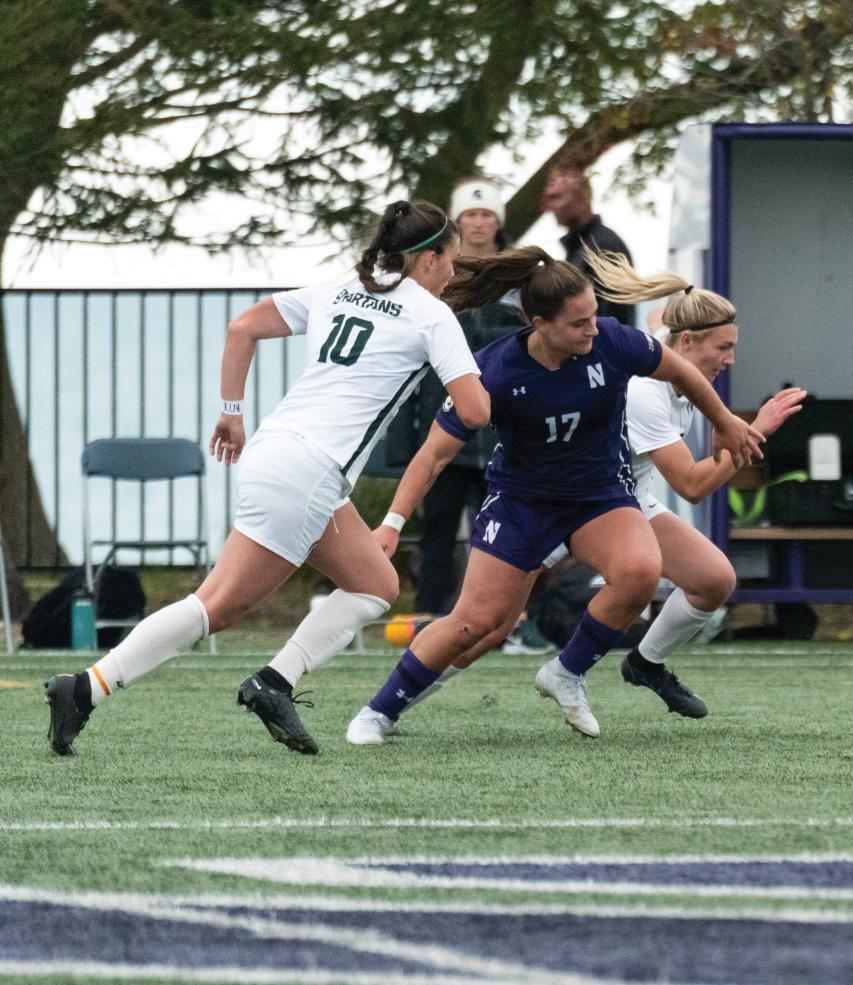
After nearly two months, the Wild cats have snapped their programrecord undefeated streak of 13 games with a 2-1 loss to No. 15 Michigan State over the weekend.
No. 5 Northwestern (12-2-2, 6-1-1 Big Ten) entered Sunday’s match tied with the Spartans (12-1-3, 7-0-1 Big Ten) as the top seed in the Big Ten. The Cats now trail Michigan State by three points in the conference standings.
It was a tale of two halves for NU, who fell behind early and failed to get a shot on goal in the first half. After just 20 minutes of play, the Cats found themselves down 2-0, their largest deficit in any game this year.
According to coach Michael Moynihan, the Spartans came out with an unexpected formation that countered NU’s three-person back line.
“We prepared for what we’ve seen from Michigan State pretty much all year, which is a 4-4-2 variation, and they surprised us a little bit,” Moynihan said. “They came out and mirrored our shape in a three-back system where they bottled things up for us.”
The first goal came off a 12th-min ute Michigan State corner kick as the Cats failed to clear the ball out of the box. That’s where graduate defender Samantha White buried the ball just out of the reach of graduate goal keeper Mia Raben.
Eight minutes later, the Spartans converted on another corner kick, this time from a header that bounced over Raben’s outstretched arm.
In the first half, Michigan State outnumbered NU in shots 6-1 and corner kicks 4-0.
Following several tactical
adjustments made by the Cats through out the first half into halftime, the tra jectory of the game altered.
“We actually shifted a little bit in the first half. I thought once we made the change to a four-back system, it forced them to change again,” Moyni han said. “Being behind, we had to be aggressive in how we pressed, and I thought we pressed a lot more aggres sively in the second half.”
This aggressiveness led to an out burst of scoring chances for NU, who outshot the Spartans 7-6 and gained three more corner kicks in the sec ond half.
The Cats’ only goal came in the 54th minute after senior forward Aurea del Carmen made an impres sive run into the left side of the box where she was tripped by her defender.
On the resulting penalty kick, senior midfielder Rowan Lapi hit the ball past the keeper to put NU on the board. This was Lapi’s fifth goal of the year.
For the Cats, however, it was a case of too little, too late as they failed to score throughout the rest of the match.
“We know we can play with any body,” Moynihan said. “Once we found our feet in this game, we felt like we were the better team, so it’s just getting back after it and hope fully next Thursday we get back on the right track.”
Sunday marked NU’s first con ference loss and first home loss of the season. With sole possession of first place in the conference standings, the Spartans must lose at least one of their last two regular season games if the Cats hope to catch them.
NU’s next game comes against Iowa at home for Senior Night on Thursday.
lucaskim2025@u.northwestern.edu MEN’S GOLFComing off a final round collapse and subsequent second-place finish at the Marquette Intercollegiate, North western turned its attention to the Quail Valley Collegiate Invitational this past weekend.
The Wildcats carded a 7-under 281 in the opening round but found themselves tied for tenth with Indi ana and seven strokes behind leaders Notre Dame. Freshman Daniel Svärd and sophomore Cameron Adam both posted a 3-under 69 to nab a tie at 16th place after the first round.
NU’s second round was more of the same. The Cats once again fired off a 7-under 281, climbing to a tie for sev enth with Rutgers. Svärd continued to lead the charge, posting another 3-under 69, while graduate student David Nyfjäll and senior John Driscoll III both shot a 2-under 70.
Through 36 holes, four of five NU golfers were under par and sat in the top-45 individually — senior James Imai was 1-over and in a tie for 60th — though 14 strokes separated the Cats and first-place North Florida.
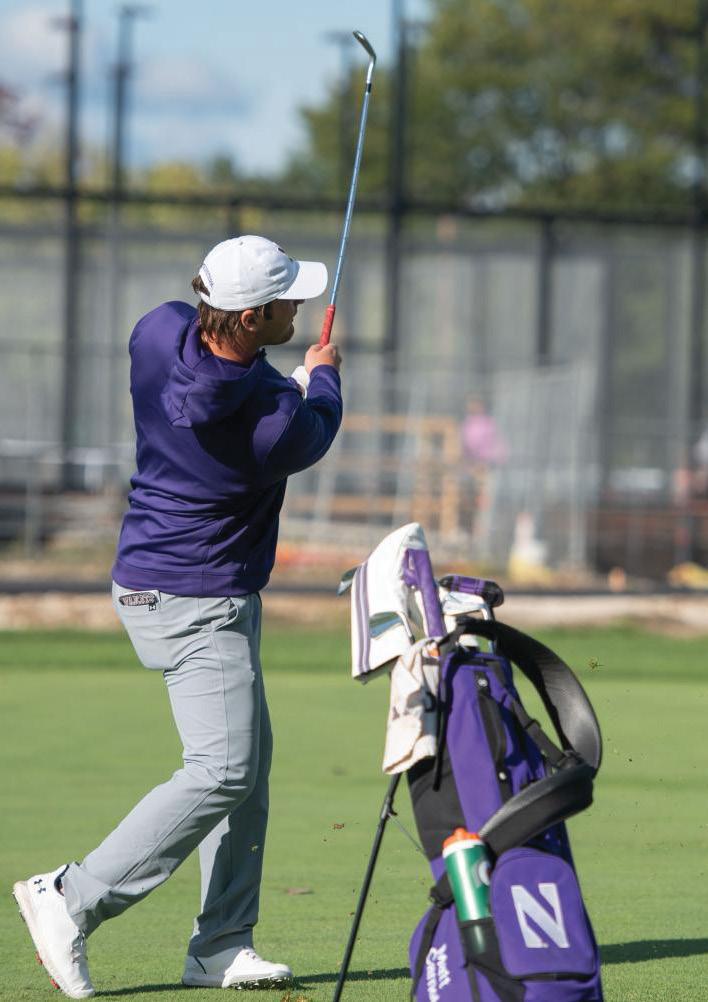
NU’s ascension up the leaderboard at Quail Valley Golf Club in Vero Beach, Florida, continued into the final round.
The Cats’ top five golfers all carded a score at even par (72) or under in
round three. Altogether, NU fired off a 19-under 269 to record the secondlowest round in the entire tournament and earn a fifth-place finish.
In the final 18 holes, Imai surged up the leaderboard, posting a tie for tour nament-best with a tally of 8-under 64.
His spectacular closing round landed him in a tie for 23rd place in the tour nament. Still, despite Imai’s late push, Driscoll finished as the top Cat, carding a 6-under 66 to earn a top-14 finish.
After returning to Evanston, NU will travel west to California for the Cal Poly Invitational from Oct. 31 to Nov. 2.
alexcervantes2024@u.northwestern.edu
CROSS COUNTRYComing off a hard training block, coach Jill Miller said Northwestern entered the Bradley Pink Classic on Fri day focused on executing race strategies, rather than results.
But a first place finish and a handful of PRs later, the Wildcats’ grit was on full display.
“I was really impressed with their toughness because I knew there was nobody out there that was feeling full of energy or feeling great by any stretch of the means,” Miller said. “They did a great job of sticking with each other off the line, and then really pushing each other throughout the race.”
Graduate student Rachel McCardell finished fourth and led the charge for the Cats, setting a new personal best time of 20:11 in the 6k. Sophomores Ava Earl and Anna Hightower finished as NU’s second and third runners for the day, placing 14th (20:38) and 15th (20:39), respectively.
Both also achieved personal bests alongside McCardell. Earl said she and Hightower have similar running styles, calling it “joyous” to run with her.
Senior Kalea Bartolotto and gradu ate student Ari Marks crossed the line in 19th (20:46) and 20th (20:48), rounding out NU’s top five.
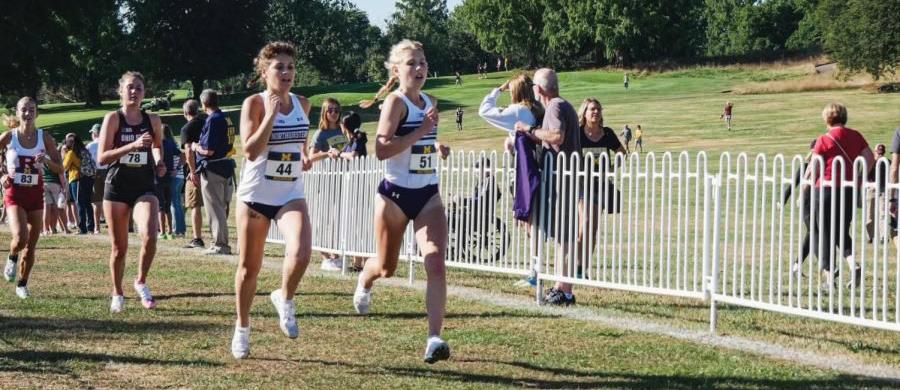
McCardell applauded this pack of four for their impressive showing at the meet, saying they did a great job work ing together and “feeding off each other’s
strengths.”
She said the team is proud of its win, but also focused on the road ahead.
“While we’re very excited about it, and very proud of how far we’ve come, we’re definitely by no means taking our foot off the gas pedal and very much looking at it as a stepping stone for our future races,” McCardell said.
The Cats are currently ranked third in the Midwest region, up one spot from their ranking last month. After placing behind Big Ten foe Illinois at the Gans Creek Classic last month, the Cats came roaring back to best the Fighting Illini this weekend. Bradley, the host of the meet, took third.
Miller said the Cats pride themselves on a dedication to the philosophy that “hard work is fun.” McCardell said this outlook helps the team keep perspec tive throughout the grind of training and competition.
“This is meant to be fun … always keeping that in mind when we’re doing these really difficult things, painful work outs, just remembering that it is our choice to be there,” McCardell said. ”It’s
so much better when you can recognize the joy and the fun in it.”
After capping off the regular season with a win, NU now looks to build on its 2021 championship season performance.
Last year, the Cats finished fourth at Regionals, their highest finish in the last two decades, and McCardell qualified for NCAA Championships. The team took seventh at the Big Ten championship.
Now, in her fourth season at the helm, Miller said NU is ready to embrace the challenge of a competitive champion ship season. The team is aware things will get harder from here, Miller said, but she feels the team is well-prepared.
Earl said the team has a saying they rely on to channel the nerves of the post season into excitement: “We’re getting our butterflies into formation.”
“Taking those nervous butterflies and kind of making them into excitement is something that we do really well,” Earl said.