The Daily Northwestern
AUDIO/The Weekly City, campus editors discuss Clark Street Beach shooting

AUDIO/The Weekly City, campus editors discuss Clark Street Beach shooting
Content warning: This story includes mentions of workplace abuse and racism.
Two names have been changed in this story to protect the safety of workers who are currently employed. Both workers requested anonymity because they wanted to protect themselves against further retaliation from their supervisors. These sources will be indicated with an asterisk next to
their name on first mention. Quotes from Rojas and Daisy* were translated from Spanish. Some quotes from Christina* were also translated.
When now-retired Northwestern Maintenance Technician Maria Rojas worked for
WWE and UFC merger bad for wrestling industry
Evanston resident Barbara Hiller moved into The Mather, an Evanston senior living residency, four years ago. A retired math teacher and former Evanston/Skokie School District 65 administrator, Hiller began tutoring middle school and high school students online when the COVID-19 pandemic began.
“I found (online tutoring) very helpful to me as well as to the student,” Hiller said. “I think that not feeling isolated and that you still contribute (to the community) is, for us the elderly, important.”
conversation and enjoy snacks.
A recent grant of $58,100 from Evanston’s American Rescue Plan Act funds, matched by an equivalent investment from Mather, will continue and expand fellowship programs like the one Hiller is in. It will also create internships for high school students and award scholarships for students at Oakton College. Together, the three initiatives create Mather’s new eMerge workforce development programs.
Hiller said she appreciates the opportunity to connect with students and continue pursuing her passion in education, remembering one who practiced his science class presentation with the residents.
However, Hiller stressed the fellowship extends beyond tutoring. The program creates a space for students to engage with Mather residents and each other in a supportive environment, she said.
Residential Services, she struggled to take cleaning supplies up multiple flights of stairs and lift heavy boxes. But when she raised concerns to her supervisors, they told her
» See MAINTENANCE , page 6
When Mather, the nonprofit that manages her residency, reached out to Hiller about participating in a fellowship to partner with mentoring organization Boys Hope Girls Hope, Hiller said she signed up “without hesitation.”
Two days a week, BHGH students come to The Mather to spend time with the residents, Hiller said. Over an hour and a half, the students work on their homework with the residents’ help or simply strike up a
“I’ve never seen kids sit down and work so fast in my life. It is just a delight,” she said. “So we really hope that they feel empowered.”
Yvonne Jung, Mather’s senior vice president of human resources, said the organization hopes to show jobs in the healthcare and hospitality industries to young people in Evanston through the program.
“You may have never thought about working with an older adult or being a nurse or a nursing
» See MATHER , page 6

daily northwestern
@charcole27Open Communities Housing
Associate Dominic Voz and Shorefront Legacy Center Founder Dino Robinson presented causes for Evanston’s housing segregation at the Unitarian Church of Evanston for Fair Housing Month on Tuesday night.

In a 2-hour presentation on American and Evanston’s housing history, Voz and Robinson explained how racist housing covenants, redlining and exclusionary zoning policies dating as far back to the early 1900s forced many of Evanston’s Black residents to reside in the 5th Ward.
Past racist housing practices have never truly left, they’ve only changed form, Robinson said.
“These things are repeated over and over again,” he said during the event.
Robinson talked about an early-1900s Evanston that was initially racially integrated. In the city, the three oldest historically Black churches — Second Baptist Church, Ebenezer A.M.E Church and Mount Zion Missionary Baptist Church — are all
located in downtown Evanston, which he said shows that Black people once lived throughout Evanston in its entirety.
He said modern-day segregation by ward in Evanston isn’t natural but was caused by racist practices.
Voz said public policy is the primary catalyst for the city’s current housing landscape. He guided the group of about 30 attendees through a history of racist covenants, or policies preventing sales of houses to Black people, that prevented them from buying houses in certain areas of the city.
When the Supreme Court banned explicitly racialized zoning in 1917, the federal government systematically denied Black families loans to purchase homes in “best” and “desirable” neighborhoods.
If Black families wanted to apply for loans, they would have to engage in predatory lending schemes, Voz said. Citing data from a joint Duke University and University of Illinois Chicago study, Voz said the lending schemes cost Black families in Chicago between $3 and $4 billion during the 1950s and 1960s.
Voz said his account of the city’s housing history was an attempt to
reframe how Evanston residents tell the story of racism and understand present racial disparities.
“We grow up hearing about white supremacist groups, and they’re these scary individuals that harass Black people,” Voz said. “The segregated environment that we have on a racial basis, is due not to private action, but to public policy. Those things work together. I think that story hasn’t been told as much.”

While Voz spoke on national trends in housing discrimination, Robinson told a local story. He showed attendees a series of legal documents that facilitated segregation in Evanston, from 20th century housing deeds with racial covenants to redlining maps used to disburse loans in the 1930s and 1940s.
Robinson also compared the redlining maps to an annotated map of Evanston that circulated online during the 2010s in which the historically Black 5th Ward was marked with “NO” in bold lettering. He also said many Northwestern students are told not to go to the 5th Ward because they think it’s “dangerous.”

Racist apportioning of Evanston lives on in many residents’ understanding of the city,
Robinson said. The problem is perception, he said, not policy.
“You can write all the laws, but it’s very hard to eradicate these perceptions,” Robinson said.
These perceptions, he said, condition how people approach Evanston, whether it’s NU students navigating the city or where realtors will tour their clients. He told stories of Evanston realty agencies, as late as the 1990s, showing different homes to clients of different races, even if they had similar jobs
or socioeconomic positions.
At the end of the presentation, Voz and Robinson answered questions from attendees about solutions to address the segregated housing landscape. Voz talked through a litany of policy changes, and proposed the city construct public housing and establish a “just cause” eviction ordinance that mandates some units of new developments must be affordable.
To address housing segregation, residents also discussed reforming
the credit system, opposing City Council members’ reluctance to discuss housing developments at meetings and funding the creation of a separatist Black community in Africa.
Additionally, Voz suggested using public shaming to spur action from people who aren’t attentive to housing inequities. However, Evanston resident Jasamine Young-Paulhill disagreed
A 2021 study by the Illinois Department of Healthcare and Family Services found that more than 900,000 Illinois residents are living without health insurance — and about a third of them qualify for Medicaid but are not enrolled.
But, a bill passed in the Illinois House of Representatives this March aims to lower both of those numbers.

If signed into law, House Bill 2719 would require that hospitals screen each uninsured patient for eligibility in state and federal health insurance programs and financial assistance programs when they are admitted. According to the bill, hospitals would not be allowed to pursue collection actions against patients if they did not complete screening requirements.

State Rep. Dagmara Avelar (D-Bolingbrook), a sponsor of the bill, said the legislation aims to protect residents from “unnecessary medical debt.” She added that the bill could help immigrant and refugee communities, who she said historically have low healthcare enrollment numbers.
“Whether you were born here, whether you were first, second (or) third generation American when it comes to barriers to access to services, health care is probably one of the main things people are concerned about,” Avelar said.
In February, Avelar independently filed the bill in the Illinois House of Representatives. The bill is sponsored by 34 House members and three state senators as of Tuesday. It currently awaits a vote in the Illinois Senate.
HB2719’s introduction comes amid efforts in multiple states to limit residents’ medical debt. States like New Mexico and Minnesota have passed similar legislation in the past few years, requiring hospitals to screen uninsured patients for financial assistance programs.
According to a March 2023 study by the Illinois Coalition for Immigrant and Refugee Rights, in-state medical debt is disproportionately affecting communities with higher numbers of low-income Black and immigrant residents. The study also said a screening process could save hospitals money while also making it easier for patients to navigate the “complex health system.”


Avelar, who was director of programs for ICIRR
from 2017 to 2023, added that language barriers can disrupt access to health care.
HB2719 would require that hospital screenings and assistance are “culturally competent” and in the patient’s primary language.
Kathi Franklin, President and CEO of Cook County-based non-profit and health care service provider Access to Care, said the bill could benefit hospitals as well as patients.
“It’s good for the hospital because the hospital gets those services paid for, but it’s also great for the patient because the patient is likely going to need follow-up care,” she said.
Franklin also said she believes the bill will have a
“tangible” impact on people in Evanston residents who are low-income. However, she added that some undocumented residents residents who Access to Care works with are afraid to enroll in health care programs. Immigrants without permanent legal status are unable to enroll in Medicaid.
According to Norrina Allen, the Quentin D. Young Professor of Health Policy at Northwestern’s Feinberg School of Medicine, though some patients may be hesitant, the new bill could help connect uninsured or underinsured individuals with resources.
But, she added that supporters of the bill should make sure financial resources offered by hospitals are “fair for all individuals,” especially
undocumented residents.
“Hopefully the resources that are considered and offered by health care institutions are broad and general and include a variety of services beyond just Medicaid,” Allen said.
She believes the new legislation is especially important for younger people, aged 19 to 39, who are the least likely to have health insurance coverage.
“If we can make sure that they are receiving preventative care and not incurring any additional debt and economic impact, then I think that will improve the health and well-being of the state,” Allen said. pavanacharya2025@u.northwestern.edu
 By KARA PEELER daily senior staffer @karapeeler
McCormick junior Julian Baldwin learned about Effective Altruism Northwestern, a philosophical club, during his freshman year. He read more about effective altruism the following summer and found himself drawn to the club’s mission: exploring how the community can do the most good the most efficiently. Now, he’s the club’s co-president.
According to its website, EANU consists of a group of students who are unified by a desire to do the most they can to “improve the world.” The purpose of effective altruism, the website says, is to analyze how to allocate resources and make the best possible efforts to help others — and then take action.
Practicing effective altruism often means making measurable, evidence-based changes to approach world issues, according to club member and Weinberg freshman Samarth Arul.
EANU runs multiple discussion-based fellowships and programs in cohorts throughout the academic year. The sequences include readings and discussions on topics like longtermism, biosecurity and animal welfare.
New EANU members join the Introductory Fellowship for seven weeks and examine central ideas about effective altruism, such as tradeoffs and marginal impact. The In-Depth Fellowship, for those who have completed the introductory course, allows members to dive deeper into the movement’s nuances and the concept of cause prioritization.
“It’s more like offering a framework for people to launch and actually try to really do something with their career,” Baldwin said. “If you take philosophy classes I think it can be kind of frustrating, because it’s very easy to just spiral off endlessly into things that don’t feel as important to define.”
Baldwin, a computer science major, helped lead the club’s AI Safety Fundamentals Program. The quarter-long seminar dives into ethical issues surrounding artificial intelligence. It also explores governance and the interactions between AI systems and the real world. The program’s first cohort convened in Spring Quarter 2022.
Effective Altruism Northwestern is a club dedicated to quantifying impact and examining how to best use careers and resources for the most good possible.
“One of the biggest, most neglected problems in the world is trying to solve the technical problems of how we make AI actually be aligned with humanity’s interests,” he said.
Arul joined EANU because he had a prior interest in philosophy and effective altruism.
He said he participated in the AI Safety Program because he’s seen issues surrounding artificial intelligence become more “pressing” in recent years.
“In terms of a lot of metrics, it seems like AI has a potential to become extremely intelligent and hard to control,” Arul said. “One of the goals of not really that group, but more just the field in general is to think about how we can best align AI to be safe for human use.”
Each Friday, the club socializes with dinner, games and discussion.
These casual hangouts attracted Weinberg sophomore Eduardo Andrade, a general board member, to the club.
“It’s definitely very welcoming, which was nice
Farah Jasmine Griffin is the William B. Ransford Professor of English and Comparative Literature at African American Studies at Columbia University where she also served as the inaugural Chair of the African American and African Diaspora Studies Department. Professor Griffin received her B.A. from Harvard and her Ph.D. in American Studies from Yale. She is the author or editor of eight books including Who Set You Flowin?: The African American Migration Narrative (Oxford, 1995), If You Can’t Be Free, Be a Mystery: In Search of Billie Holiday (Free Press, 2001), Clawing at the Limits of Cool: Miles Davis, John Coltrane and the Greatest Jazz Collaboration Ever (with Salim Washington, Thomas Dunne Press, 2008), and Harlem Nocturne: Women Artists and Progressive Politics During World War II (Basic Books, 2013). Her most recent book, the critically acclaimed Read Until You Understand: The Profound Wisdom of Black Life and Literature, was published by W.W. Norton in September, 2021. Her collected essays, In Search of a Beautiful Freedom: New and Selected Essays, is forthcoming from W.W. Norton.

She collaborated with composer, pianist, Geri Allen and director, actor S. Epatha Merkerson on two theatrical projects, for which she wrote the book: The first, “Geri Allen and Friends Celebrate the Great Jazz Women of the Apollo,” with Lizz Wright, Dianne Reeves, Teri Lyne Carrington and others, premiered on the main stage of the Apollo Theater in May of 2013. The second, “A Conversation with Mary Lou” featuring vocalist Carmen Lundy, premiered at Harlem Stage in March 2014 and was performed at The John F. Kennedy Center in May of 2016. Griffin was 2021 Guggenheim Fellow and Mellon Foundation Fellow in Residence.
Wednesday,
The Leon Forrest Lecture Series is sponsored by the Department of African American Studies, and Weinberg College of Arts and Sciences.
when I first got involved,” he said. “It’s also nice to be around people that care about things and are working on structuring their lives so that they’re able to impact and improve the world in a long-term way.”
The EANU community encourages people to challenge one another to be open to new viewpoints, according to Andrade. He said the club has helped him hone his critical thinking skills.
The club attracts members from a variety of majors, according to Baldwin. He said there are currently about 40 to 50 members in EANU, including computer science, philosophy and journalism majors.
Arul said the club community is “very intellectually driven.”
“It’s just an amazing place to be around people who are really motivated to learn and really, genuinely curious about world issues and how to solve them and how to approach them,” Arul said. karapeeler2025@u.northwestern.edu
The Daily Northwestern www.dailynorthwestern.com
Editor in Chief Alex Perry eic@dailynorthwestern.com
General Manager Stacia Campbell stacia@dailynorthwestern.com
Holly and John Madigan Newsroom Phone | 847.491.3222
Campus desk campus@dailynorthwestern.com
City desk city@dailynorthwestern.com
Sports desk sports@dailynorthwestern.com
Ad Office | 847.491.7206 spc-compshop@northwestern.edu

The Daily NorThwesTerN is published Monday and Thursday during the academic year, except vacation periods and two weeks preceding them and once during August, by Students Publishing Co., Inc. of Northwestern University, 1999 Campus Drive, Evanston, IL 60208; 847491-7206.
First copy of The Daily is free, additional copies are 50 cents. All material published herein, except advertising or where indicated otherwise, is Copyright 2020 The Daily NorThwesTerN and protected under the “work made for hire” and “periodical publication” clauses of copyright law.
POSTMASTER: Send address changes to The Daily NorThwesTerN, 1999 Campus Drive, Evanston, IL 60208. Subscriptions are $175 for the academic year. The Daily NorThwesTerN is not responsible for more than one incorrect ad insertion. All display ad corrections must be received by 3 p.m. one day prior to when the ad is run.
Check
light,
And a transfer girl couldn’t have asked for something more right, I think there are things we could do to make it more bright.
No more snow days, no more delays, A dome to protect us from the storm, Enclosing a space where learning can take form, Oh, how it would make our days, A dream come true in so many ways.
Oh, how it would make our days, Northwestern would earn even further praise!
5. Meal exchanges for Evanston restaurants
Some of the greatest written works of this age are early-2000s children’s picture books. They’re the ideal avenue for communicating important messages, given the books’ proclivity for including eccentric characters, wacky antics, and, of course, a healthy sprinkling of basic rhyme. But, perhaps most important, picture books take place in a land of endless possibilities.
Last year, when I was contemplating whether I should leave Boston College for greener (or windier) pastures, I spent a lot of time imagining a school that could fit the needs of a modern college student. I soon realized that my outlandish wants and needs were more suited for the pages of a child’s picture book, where fantasies can be realized in an instant through the imagination of a quirky kid thinking her best thoughts (with mad rhyming skills) in the backseat of a car.
In an effort to put my thoughts on paper, I decided to take a literal page out of Chris Van Dusen’s book, “If I Built a Car,” in which the narrator lays out his plan for a totally radical (albeit completely fantastical) car. I now write for you a just-as-fanciful but much more relatable version of Chris Van Dusen’s tour de force to paint a picture of the school of my dreams. Now presenting: “If I Built a School.”
Tabitha, from the comfort of her dorm, said to her friend
This school is great, this school is quite grand But it’s nothing quite like the school I have planned.
I’ve worked through the night to create a design
I’ve constantly analyzed, tweaked and refined

I’ve studied universities and looked at hallowed halls
Contemplated seminaries, academies and ivycovered walls
To make it as prestigious and esteemed as those in “the league”
I’ve recreated NU but with added pizzazz and intrigue.
So sit back, relax, and pull up a stool, It’s time to reveal my spectacular school! Though Northwestern shines like a beacon of
So, to make this school even better than ever, Here’s a list of some things we can do to make NU more clever:
1. A conveyor belt from North to South
Though I myself never mind
The daily walk that is such a grind, I still think this campus could do with a little doohickey to carry us through: With this in mind, I would create A mode to take us from North to South, Oh, how it would ease our daily route, The miles we walk, the time we waste, A conveyor belt would set our pace. No more hurrying to catch my class, No more stress, no need to gasp, The belt would take us all on a ride, Effortlessly side by side.
The snow and rain wouldn’t bother us, On the belt, we’d travel without fuss, Oh, how it would make our day, If President Michael Schill would heed what we pray, I’d build a conveyor belt and call it a day!
This school is quite grand But it’s
I have planned.
- TABI PARENT, Columnist
2. A weather-controlling dome
A conveyor belt would be quite nice To carry us to class in spite of the ice But wouldn’t it be much more clever If we could alter the weather?
With this dome, Northwestern would deserve praise.
The dome would control the perilous weather, Rain or shine, it wouldn’t matter, The dome would shield us from the patter, A perfect climate, through day and night, With this invention, Northwestern would be a sight.
3. Scent machines
With the creation of this dome, I’ll have fixed our weather, But what’s to be done of another aggressor — The smell of the Lakefill in warm weather?
To fix this nose tormentor, I will add The scent of freshly baked bread, Or perhaps some cinnamon spread, Imagine walking through the campus green, Surrounded by beautiful, fragrant scenes.
A machine that pumps and smells divine, Aromatic bliss, oh so fine, No more stale smells, no more frowns, Northwestern would be fragrant all around. And that stinky smell behind Norris, oh my, A problem that no longer would cause outcry, For the machine would spread its magic, And make the Lakefill smell fantastic. With the smell of roses or maybe pine, The possibilities would be sublime.
4. Ice cream in ALL the dining halls
While we’re contemplating adding machines, I can think of one that must enter the Northwestern scene:
An appliance that churns and also swirls, No more waiting in line … outside, Our dining halls would be a place to glide, Vanilla, chocolate, or strawberry swirl, And options aplenty — oh what a twirl, With sprinkles or nuts, or perhaps some fudge, Our ice cream cravings, the machines would nudge. In the heat of summer or the chill of fall, Ice cream would be a treat to enthrall, For ice cream lovers like you and me, A machine that would make us smile, A treat to go the extra mile,
Alas’ there’s Evanston — a foodie’s delight — where meals of all kinds come to light, So just imagine if we had an exchange, that would allow us to dine at our convenience within a range.
A meal exchange to satisfy, With options wide, we won’t deny, Our University will thrive, With students happy and revived, No need to worry ‘bout the cost, Our meals will never be lost, With exchanges that work so well, Northwestern students will excel.
Pause! Reader, be advised — here I step out of my Chris Van Dusen disguise for just a moment to say that in almost every way, Northwestern continues to make my day. There is very little I wish for on a daily basis here, and as someone known to struggle over decisions as small as selecting which shower stall to use I can honestly say that transferring to NU was the best decision I’ve ever made. No one loves Northwestern like transfers do. However, when all is said and done, there is one thing in which BC comes out as #1…
6. Collective Effervescence
Northwestern is missing this one thing I know, And it’s not a conveyor belt that makes us go, Or a meal exchange to use at Colectivo, No, it’s something that bubbles in times of joy When heartbeats, hands, and feet are in sync Or when eyes lock and sweatshirted arms link. It’s an effervescence that is collective and true That keeps a community together almost like glue,
It’s when we’re all hearing the same beat at once When our minds are all focused on all the same fronts … Northwestern becomes better … despite our wacky weather.
Tabi Parent is a Medill sophomore. She can be contacted at tabiparent2025@u.northwestern. edu. If you would like to respond publicly to this op-ed, send a Letter to the Editor to opinion@ dailynorthwestern.com. The views expressed in this piece do not necessarily reflect the views of all staff members of The Daily Northwestern.
Endeavor, the parent company of the Ultimate Fighting Championship, announced earlier this month it would buy 51% of World Wrestling Entertainment and merge the two companies under one name. This move would combine the biggest companies in mixed martial arts and professional wrestling, respectively, and form a powerful $21.4 billion conglomerate later this year. It merges two companies that control their markets and have authority figures involved in the abuse of women and maintain ties to repressive countries. But, given potential massive profits for Endeavor and its shareholders, the chances the company focuses on rectifying these issues are slim.
Both the UFC and WWE have been hit with respective antitrust lawsuits, with plaintiffs accusing them of monopolistic practices. The lawsuit argues the neartotal market control that the UFC and WWE have has made it impossible for athletes to find promising wages.
UFC and WWE athletes earn a measly 16%-20% and 10% of company profits, respectively. Athletes’ wages in other sports leagues like MLB and the NFL make up 50% of the total league revenue. This gap exists because while other sports leagues have players’ unions, the UFC and WWE actively lobby against them. Moreover, other sports leagues allow players to shift teams, which typically allows for a pay increase. The options for UFC and WWE athletes are just to stay or move to a smaller organization, decreasing the athlete’s popularity and financial opportunities. UFC and WWE athlete contracts also have strict clauses, including non-compete clauses, which make it even more difficult to leave the organization in the first place.
Plus, fan-beloved figures who run the UFC and WWE have been accused and found guilty of domestic and sexual abuse of women. After UFC President Dana White was caught on video slapping his wife at a nightclub, he said in a tone-deaf statement that the public embarrassment was enough punishment for him. That reasoning was sufficient for Endeavor CEO Ari Emanuel, as White has faced zero punishment for the incident. WWE CEO Vince McMahon has been involved in several sexual misconduct court cases. He stepped down as CEO of WWE for a few years but returned after the outrage blew over earlier this year.
The UFC and WWE live by their own rules; if an NFL or MLB team owner commits abuse or a crime, there is precedent for the owner to resign. Endeavor has a financial motivation to avoid removing fan-favorite figures, but what kind of precedent does this set within the organization? UFC fighters’ countless domestic abuse incidents indicate they won’t be met with consequences because they supposedly bring value to the company.
was brutally murdered by high-ranking government officials. All of this is gross, but not entirely new in the world of sports. The NBA’s unyielding loyalty to China deters players from speaking out against the country’s human rights atrocities because it makes 10% of the league’s revenue. When profit is involved, companies will turn a blind eye to murder.
When profit is involved, companies will turn a blind eye to murder.
- MELISSA DUDA, Columnist
This merger is a match made in heaven for the UFC and WWE. Both White and McMahon will have further protection because Endeavor will likely not punish either of them. The merger will likely increase the value of both companies, but it will also worsen players’ working conditions. The very athletes who put their bodies on the line for the UFC and WWE will not see any benefit from this merger — only the shareholders.
The Daily Northwestern Volume 146, Issue 8
Editor in Chief Alex Perry
The UFC and WWE regularly hold events in Saudi Arabia because the market benefits them. In doing so, both organizations turn a blind eye to the country’s human rights violations. To make matters worse, some of the very arenas used for their events were built by migrants who work in abhorrent, fatal conditions. Moreover, the UFC and WWE did not cut ties with Saudi Arabia when the U.N. and Turkish officials determined that Jamal Khashoggi, a Saudi journalist who fell out of favor with the kingdom’s crown prince,
On the other hand, the merger could also bring the sports into the mainstream limelight, attracting more scrutiny. As they become more mainstream and the antitrust lawsuits make their way through the courts, White and McMahon may have to answer for the deplorble working conditions, their abuse of women and their ties to controversial governments. Still, fans should not hold their breath. These corrupt behaviors are ingrained in both organizations.
Melissa Duda is a Weinberg first-year graduate student. She can be contacted at melissaduda2024@u.northwestern. edu. If you would like to respond publicly to this op-ed, send a Letter to the Editor to opinion@dailynorthwestern.com.
The views expressed in this piece do not necessarily reflect the views of all staff members of The Daily Northwestern.
Opinion Editor Micah Sandy
Opinion Editor Micah Sandy
Assistant Opinion Editor Grant Li
Assistant Opinion Editor Grant Li
Managing Editors Pavan Acharya Aviva Bechky Avani Kalra Russell Leung Ava Mandoli Erica Schmitt Wendy Zhu
LETTERS TO THE EDITOR may be sent to 1999 Campus Drive, Evanston, IL 60208, via fax at 847-491-9905, via e-mail to opinion@ dailynorthwestern.com or by dropping a letter in the box outside The Daily office.
Letters have the following requirements:
• Should be typed and double-spaced
• Should include the author’s name, signature, school, class and phone number.
• Should be fewer than 300 words They will be checked for authenticity and may be edited for length, clarity, style and grammar.
Letters, columns and cartoons contain the opinion of the authors, not Students Publishing Co. Inc. Submissions signed by more than three people must include at least one and no more than three names designated to represent the group. Editorials reflect the majority opinion of The Daily’s student editorial board and not the opinions of either Northwestern University or Students Publishing Co. Inc.
nothing quite like the school that
”
”
On April 12, Northwestern Mock Trial traveled to Memphis, Tennessee, to compete with the nation’s top programs. The team finished 10th in the competition — its fourth consecutive year in the top 10.
Weinberg senior and Mock Trial President Abigail Roman-Ahlgrim, who is in her fourth year on the team, said the competition was a highlight of her college career and a great way to close out her time on mock trial.
“It was gratifying. It was super bittersweet,” Roman-Ahlgrim said. “It was just such a great opportunity to leave it all on the floor. Knowing that this was going to be the last time, that was the best I could have done after four years of practice. It just felt right.”
The team competes by simulating a fictional trial in the imaginary land of “Midland.” Each case is different — this year, it centered around whether an airline company should be charged with negligence after a fictitious plane crash.
This year, two team members won All-American awards honoring exemplary performances at the competition: Weinberg senior and Vice President Tahj Burnett and Medill junior and Social and Public Relations Chair Claire Foltz.

The team also won the Spirit of American Mock Trial Association award for being the nicest team. NU was nominated by other competing teams for the honor.
“That really was fun,” Weinberg senior and Mock Trial member Ben Swedberg said. “We go out of our way to be professional and kind, and it’s nice to have that recognized.”
Swedberg added that NU’s mock trial team is a unique group of people because the competition combines several disciplines. Some students interested in law act as attorneys, according to Swedberg, while aspiring actors are often attracted to the witness roles.


“What sets mock trial apart is that it’s a combination of public speaking and acting,” Swedberg said. “It brings two really interesting activities together … It’s collaborative work, and it combines a lot of different interests at NU.”
For Burnett, the mock trial community has always been important to him, and he said it’s grown closer over the years.
He said this year’s performance indicates the team has a bright future.
“I’ve always had a family here, but now everybody on Mock Trial knows everybody,” Burnett said. “I’m really good friends with even the freshmen on the team, and I’m a senior … If you ask someone on Mock Trial if they know someone else, they’re gonna say, ‘Absolutely, that’s my best friend.’”

Overall, Swedberg said, the team is proud of its progress this year and its performance at nationals.
“We were having our best moments this weekend, like every single round, we just kept performing better and better,” Swedberg said. “It was just a huge privilege to do the best mock trial I’ve ever seen Northwestern do. It was just, like, really sick.” avanikalra2025@u.northwestern.edu
Northwestern will incorporate its remaining COVID-19 protocols into broader health operations beginning June 13, according to a University news release.
Starting this summer, the University will discontinue isolation housing in 1835 Hinman, oncampus testing in the Jacobs Center and the current COVID-19 vaccine requirement for most students.
The changes follow the Biden administration’s decision to end the COVID-19 national emergency this month, with plans to end the national public health emergency in May. Other universities nationwide are adopting similar changes, the release said.
“We deeply appreciate the Northwestern community’s commitment to the mission of the University while adapting to abrupt shifts and changes in the trajectory of COVID-19 that presented significant challenges at work and at home,” Vice President for Operations Luke Figora said in the release.
While the “overwhelming majority” of the
campus community is vaccinated, according to the release, the University will cease to require all students to get the COVID-19 vaccination and booster shots. This excludes students in clinical programs who need to comply with site requirements.
Students who want to be tested can contact the Northwestern Medicine Student Health Service, but NU encourages faculty to make their own testing arrangements. When students do test positive, they will not be required to report it to the University, a requirement which NU lifted for faculty in January.
The University recommends students defer to
guidelines from the Centers for Disease Control and Prevention regarding booster vaccines and isolation protocols. With the discontinuation of isolation housing except for a few emergency spaces, the University will ask students who test positive to isolate in their own dorms going forward.
“We thank our students, faculty and staff for their sacrifices and understanding throughout our response to COVID-19,” Figora said in the release. “We will remain vigilant in monitoring COVID-19 and other threats to public health as we continue to safeguard our community in the years to come.”
Samantha PowersFrom page 1 with that strategy because “shame causes paralysis.” She said change needs to come from interpersonal action, not policy reforms.
“We can’t just keep saying ‘let’s fix the system,’” she said. “The system is doing what it’s meant to do the whole time.”
colereynolds2026@u.northwestern.edu
From page 1
assistant,” Jung said. “So (eMerge) is really a chance for The Mather to provide opportunities for students to come into an industry that they may never have thought about and try different roles.”
Jung said Mather is currently working with Evanston Township High School to place four students in dining services and culinary internships at Mather’s Evanston residency, with more positions planned for the future.
Nathan Norman, Evanston’s workforce development manager, said he began meeting with Mather in 2022 to collaborate on eMerge.
“We see efficacy and intergenerational connectivity,” Norman said. “You have elderly individuals who easily would trust and build relationships with young people, but also offer them things that would cultivate them in their lives far beyond just a normal employment experience.”
In turn, young people can provide company and assistance to The Mather’s residents, for example by helping them navigate technology, he added.
At the height of the pandemic, Norman said many employers couldn’t provide internships and jobs to youth and young adults. Now, he said the city made it a priority to create programs like eMerge that help introduce young people to various industries and employment opportunities.
Norman pointed to the ASPIRE-Evanston Community Healthcare Workforce Development Program as another example. ASPIRE partners with local healthcare organizations and schools to provide job shadowing, scholarships and internships in the healthcare industry. In February 2022, Evanston approved a grant of $200,000 in ARPA funds to the program.
“My hope is that (eMerge) would be continuous in that individuals who go through the program would eventually end up as employees of Mather, and we would be able to continue this program as a pipeline (and) as a model for future collaborative initiatives,” Norman said.
Jung said she hopes eMerge will create a “feeder of talent” into permanent positions at The Mather.
Over time, she said she wants the number of internships, fellowship positions and scholarships to grow.
“The real goal for us is to get students exposure to not only our industry but also positions within The Mather that are really sparking interest,” Jung said. caseyhe2026@u.northwestern.edu


From page 1
upper management would not provide any additional help.
Rojas, who is 66, worked on the maintenance team for about ten years before retiring in March 2022. As an older worker, she said she physically could not complete tasks like cleaning windows, but her supervisors told her she needed to provide medical documentation to prove it. By the time Rojas left NU, she felt “really tired and exhausted,” and said the work had become “too much” for her.
“(When I went to clean) in 630 Emerson, it was horrible,” Rojas said. “I needed help because I was older and carrying boxes to the third floor. When I cleaned the floors, (my supervisor) would tell me that it was ‘alright.’ But it was so clean, and they did not value my hard work.”
Like Rojas, some other current and former maintenance technicians at NU have reported being overworked, verbally abused and facing retaliation from supervisors for speaking up about concerns they had.
Technicians provide custodial services in residential halls on campus. They clean common spaces like bathrooms, lounges and kitchens, and replace lights. At the start of each academic year, Residential Services randomly assigns technicians to clean certain parts or floors of residence halls on campus.
University spokesperson Hilary Hurd Anyaso said Residential Services is exploring using factors like square footage, fixtures and the type of amenities in a space to distribute work evenly among technicians in the future.
Christina*, a current Maintenance Technician, said the current division of labor is not equitable. She said some spaces are easier to clean because they are less frequented than others. Other spaces might have more appliances, which makes them more frustrating to clean than an empty room of a similar size, she added.
Favoritism toward certain workers also affects work assignments, Christina said. She added that while at NU, the maintenance team has been “regularly” understaffed.
When some employees could not finish cleaning their assigned areas, workers who supervisors dislike often have additional work added on to their plates. She said this favoritism is applied arbitrarily.
Though all workers have eight-hour shifts, Christina said those who perform well are often asked to help colleagues or take on additional cleaning duties. As one of these workers, she said this increases her workload to a point where she can barely complete it. Additionally, supervisors punish workers by increasing their assignments, she said.
“Respect us as employees, or like equals,” the worker said. “At the end of the day, (our supervisors) are going by preference. For me, that’s discrimination.”
Anyaso said supervisors do not increase technicians’ workload unless another co-worker takes a
THE DAILY NORTHWESTERN is not responsible for more than one incorrect insertion of an ad. Corrections must be received by 10am on the day before ad runs again, call 847-4917206. All Classifieds must be paid in advance and are not accepted over the phone. To run online, ad must run in print on same day. The Daily does not knowingly accept misleading or false ads and does not guarantee any ad or claim, or endorse any advertised product or service. Please use caution when answering ads, especially when sending money.
It is the policy of The Daily Northwestern to accept housing advertising only from those whose housing is available without discrimination with respect to sexual orientation, race, creed or national origin. The presumption is therefore, that any housing listing appearing here is non-discriminatory.
vacation or calls off work. She added staff should report their concerns directly to their supervisors or through EthicsPoint, a confidential reporting tool.
“Student Affairs and Residential Services are committed to creating positive work environments for maintenance technicians, as their work is essential and incredibly valued across the University,” Anyaso said. “Northwestern policy strictly prohibits retaliation.”
But Christina and Rojas both said they have experienced retaliation from supervisors.
In instances where Christina has spoken to supervisors about her concerns with shouldering additional work, she said they have doubled her workload and refused to provide her additional help to complete extra assignments. Other times, she said supervisors have given “condescending” responses, telling her the work is “just eight hours.”
“If I see something they are doing wrong, they will take it bad,” the worker said. “They have retaliated against me various times. You can’t say anything because (the retaliation) is heavy and it (gets) worse.”
Rojas said her direct supervisors have embarrassed her multiple times during staff meetings. One of her fellow co-workers, who retired early, had to go to therapy because the high levels of stress she faced at work caused her to think she was “crazy.” Rojas added she has seen workers burst into tears in front of their supervisors.
Supervisors she worked under created a culture of fear, she said.

“(My supervisor) told us explicitly, ‘If you have evidence of accusations of me, tell me. If not, be quiet,’” Rojas said. “How can we go to a supervisor if they do nothing for us? Sometimes we do feel intimidated.”
When both workers would try reporting discrimination to the Office of Civil Rights and Title IX Compliance, formerly the Office of Equity, Christina said HR would just circle back to supervisors about worker complaints, which defeated the purpose of reporting.


Latine workers who are not fluent in English face additional racial and linguistic discrimination from their supervisors, according to Daisy*, also a current Maintenance Technician. She said language barriers cause lapses in communication between her and her supervisors, leading to misunderstandings about which spaces she needed to clean. At times, these misinterpretations have caused her to do “double the work,” she said.
Navigating language barriers has also caused high stress and anxiety, Daisy said. Managers think workers who don’t complete their assigned tasks are “incapable” when in reality, she said some just don’t understand what’s being asked of them.
“To the Hispanics who are most available for work, they give us more work,” she said. “Other people of other races can defend themselves. They speak English. But we’re the victims because we don’t speak English.”
Anyaso said supervisors conduct all staff meetings in English and Spanish. She said Residential
THE DAILY NORTHWESTERN is not responsible for more than one incorrect insertion of an ad. Corrections must be received by 10am on the day before ad runs again, call 847-4917206. All Classifieds must be paid in advance and are not accepted over the phone. To run online, ad must run in print on same day. The Daily does not knowingly accept misleading or false ads and does not guarantee any ad or claim, or endorse any advertised product or service. Please use caution when answering ads, especially when sending money.
HELP WANTED ADS are accepted only from advertisers who are equal opportunity employers. The presumption, therefore, is that all positions offered here are available to qualified persons without discrimination on the basis of race, color, religion, national origin, sex, sexual orientation, marital status, age, handicap, or veteran status.
The workers said the high-stress environment has already caused many workers to quit their positions, and the current workers said they felt overwhelmed by their work loads.
I can be in my home and I can be really happy and feel good,” Daisy said. “But as soon as I think about working, I just feel a knot in my stomach and I feel like I can no longer go through and work under those conditions.”
After failing to get their supervisors to listen to them, some maintenance staff turned to Students Organizing for Labor Rights, an NU student organization advocating for better treatment of campus workers.
SESP senior and SOLR member Neva Legallet said students have an “outsized voice” on campus and can help keep the University accountable. On March 10, the organization delivered a petition to the University, calling on NU administrators to take action and address demands from workers after hearing about what maintenance technicians are experiencing. The petition’s demands included addressing discrimination, excessive workloads and short staffing on the maintenance team.
“The day I came to SOLR I cried,” Christina said. “I was at the point of quitting my job.”
After SOLR sent the petition to the University, all maintenance technicians on campus received a dollar raise in their hourly salary, making their base pay $17.50. Christina said she felt the raise was given to “silence” her and her colleagues.
Weinberg sophomore and SOLR member Jennifer Salvador said the organization has reached out to the University three times in the last few weeks to try and arrange a meeting to discuss maintenance technicians’ concerns. SOLR has not heard back, Salvador said.
“(The University’s) response is very inadequate because this is very urgent and it seems they still do not care about what is going on,” Salvador said. “The raise is a very specific way to shut (maintenance technicians) up. They haven’t responded because they don’t want further questions from us.”
Anyaso said the University’s delay in communication with SOLR is unintentional, and Residential Services should reach out to the group soon to set up a meeting. She added the wage increase was not related to the petition. Residential Services began conducting annual market analyses on maintenance technician pay in 2022, she said, and the 2023 analysis resulted in a wage increase implemented in early April.
All three workers said they hope the University will start treating them with respect and dignity. This includes raising wages to about $22 an hour, standardizing salaries and wages, and eliminating favoritism.
“The reality is that it’s ugly. It’s horrible,” Daisy said. “We are suffering too much for what they are paying.”
joannahou2025@u.northwestern.edu
 By JACOB WENDLER daily senior staffer @jacob_wendler

Evanston’s Redistricting Committee voted to implement public input on a proposed new ward map Tuesday night. The changes, which would be implemented in the 2025 elections, would keep Sherman Plaza in Ward 1 rather than moving it to Ward 4, make the wards more even in population and change fewer citizens’ current ward than the previously proposed map.

Evanston began its redistricting process in December 2021 to determine a new ward map based on the 2020 census. The overall city population did not change enough to require redistricting under state law. But under the current map, there is a 20.4% deviation in population across wards. This has been in place since 2003. That number far exceeds the 10% threshold that federal courts have determined as a requisite of the “one person, one vote” principle.
The map proposed by the committee last month and discussed by City Council on April 10 would reduce the deviation in population across the wards to 3.4%. The map would change wards for around 4,600 residents. If the changes proposed Tuesday night are implemented, the deviation would drop to less than 2.6% and only 4,175 people would be impacted. In addition to redistributing residents across the city, the committee’s work has been guided by three main goals: maintaining three wards with majority non-white populations, ensuring Downtown Evanston is still represented by three councilmembers and implementing changes through an incremental approach.
Ald. Melissa Wynne (3rd) said the goal of splitting Downtown Evanston between multiple wards has worked for Evanston in the past and should be continued.

“It’s a big burden to share, but it’s actually helpful that it is shared,” Wynne said. “It also brings more voices from the Council on to address the downtown issues. It doesn’t concentrate power in a single member.”



Wynne said she thinks the committee is “pretty close” to a final product, noting the new map only makes small changes to existing
ward boundaries.
While many residents expressed concerns about their homes being categorized into new wards, Evanston resident Meleika Gardner said the city needs to completely change their current redistricting plans. Gardner wants the city to start redistricting from scratch to avoid reinforcing historical inequities.
“Wipe the ward lines clean so that we are not continuing the harm that was put in place years ago.” Gardner said. “Let’s not continue to build upon the harm with just minor tweaks to


the map. Change it.”
Wynne defended the city’s incremental approach to redistricting, emphasizing the committee aims to keep neighborhoods within their current wards as much as possible.
Evanston resident Percy Berger Sr., who has lived in Evanston for more than 50 years and lived in seven of the nine wards, said the redistricting process is reinforcing divisions rather than unifying the city.
“I think there’s an overarching opportunity for the city (and) the aldermen to look at what




contributions a redistricting of the wards can have on making the city a total unified city, ” Berger said.
Ald. Jonathan Nieuwsma (4th) said the altered map from Tuesday night’s meeting will be released to the public for further feedback before the committee makes a formal recommendation to council at its final meeting next month. The council will vote on the final map June 12.
jacobwendler2025@u.northwestern.edu


With the outright Big Ten regular season title on the line Saturday night, a sellout Martin Stadium was the place to be. Then-No. 2 Northwestern found itself firmly entrenched in a grueling defensive duel against then-No. 12 Maryland as temperatures continually plummeted.
Though the nation’s highest scoring attack tallied three goals in under six minutes to kick off the contest, the Wildcats’ offensive firepower quickly simmered after its hot start. NU failed to find twine in a quarter for the first time all season. By halftime, the score settled at 4-4, and with an unexpected offensive stall, the onus shifted to the defense.
But even before halftime, sophomore defender Samantha White brought a much-needed tenacious edge from the contest’s opening draw, matching up against Maryland’s top attacker Libby May — renewing an old cross-town rivalry in Baltimore County, Maryland, between the Hereford High School and Dulaney High School graduates.
“So many girls from my area go to Maryland,” White said. “I was like ‘no, forget that.’ I don’t want to go somewhere where everyone else goes. I want to build my own legacy here.”
White’s play in the first half set an early tone, holding May to just one goal and causing two turnovers. But with tensions running sky-high, White only elevated her intensity when the teams returned from the locker rooms.
The sophomore corralled two draws in the third frame, but the bulk of her work didn’t fill the statsheet. She tirelessly sealed off shooting angles, frustrating every opponent that dared cross her path while helping her team build a four-goal lead.
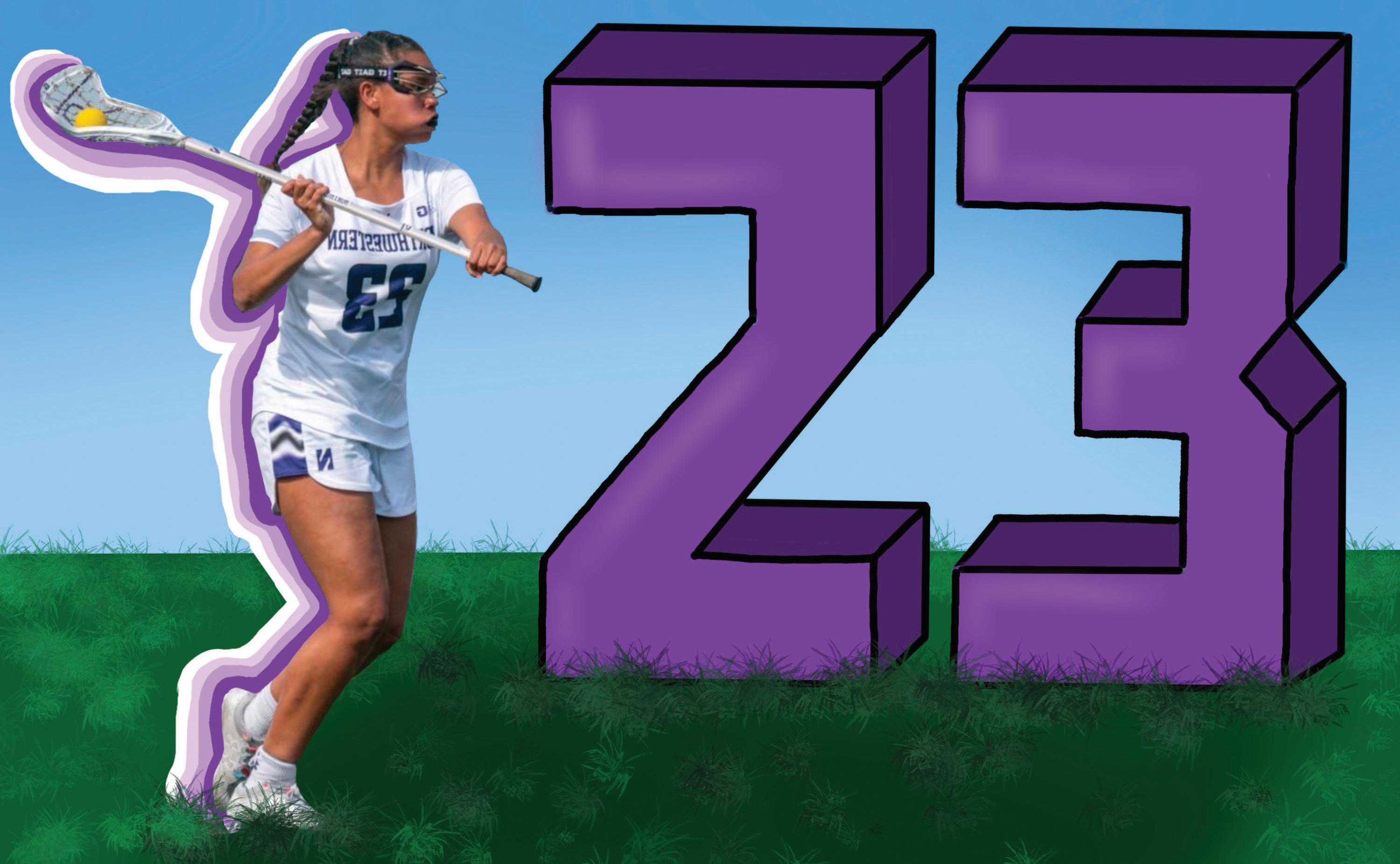
Coach Kelly Amonte Hiller leaned on the sophomore superstar to right an unsteady ship — and White delivered — as she’s done all season. In a battle that carried the greatest weight of the Cats’ regular-season slate, White shined brightest, registering a co-team high four draw controls, a game-high three caused turnovers and two ground balls in a winning effort.
The defensive wizard beamed with pride as she approached the sideline, embracing her family ––who flew in to catch the conference coronation. She played the game of her life minutes prior, proving once again why the first-team All-Big Ten honoree and two-time conference defensive player of the week is a staple in NU’s powerhouse pedigree.
“She has the greatest mix of competitiveness and fun,” Amonte Hiller said. “You see the smile on her face — she’s just a really fun kid. When you have the mix of that, it really makes magic.”
Although the 2005 hit film “Wedding Crashers” popularized the phrase “crabcakes and football — that’s what Maryland does,” New England Patriots coach Bill Belichick once asserted that the Old Line State revolves around “crab and lacrosse.” White rose to the pinnacle of the crowded athletic ecosystem, first donning the black and red in high school, becoming the pride of her community.
While much of the lacrosse talent in metro Baltimore centers on the private schools of the Interscholastic Athletic Association of Maryland, White attended public Dulaney High School as a three-sport varsity athlete, lettering in soccer, basketball and lacrosse for the Lions.
White said she gained a lot by forgoing the private school route. She focused on “the opportunity to lead other girls while playing” throughout high school.
“Every time she stepped foot on the field, she could change the momentum of the game,” Dulaney High School Varsity Lacrosse Coach Kristi Korrow said. “She was an incredible team
player — but could also single handedly shift things and take the game in a different direction.”
Regardless of whether she was dribbling a soccer ball, shooting her patented jumper or unleashing a signature stick check, White commanded significant attention from opposing teams and coaches.
Her versatile skill set on the lacrosse field took root in her multisport prowess. She credits much of her continued success to her dedication on the hardwood.
“My dad always says that basketball is just like lacrosse — and it really is,” White said. “Kelly always talks about how good my one (versus) one defense is, and I owe it all to basketball. Having — not the ability to play with the stick — but just shifting my feet and not letting the defender get past me, and it also has helped me with playing with different groups of people.”
NU’s defensive cornerstone dominated Baltimore County’s basketball courts, amassing 1,000 career points by her junior season — cementing the foundation for her current success.
Being a 12-season sport athlete made White the ultimate competitor, as well as a selfless teammate, according to her former Dulaney High School Varsity basketball coach Jess Szymanski.
“She was probably the best player on my basketball team at the time, but (she) was in a really tough role,” Szymanski said. “The reality is you’re not competing with the person next to you to win every sprint — you’re the one that is supposed to lead. She never took a day off — she was an awesome kid to coach, and if there were multiple Sammys, I’d still be coaching.”
Building behind the scenes
After the Cats fell 20-9 to then-No. 2 North Carolina in blowout fashion last March, Amonte Hiller shifted White into the starting lineup in hopes of avoiding a midseason slump. There, White provided a plug-and-play presence rooted in her bluechip adaptability. From there, White remained a starter for the team’s final 15 games, featuring at attack, midfield and defense for NU, and winning the 2022 Big Ten Freshman of the Year.
But rather than resting on her laurels, White went straight to work following the Final Four loss to the National Champion Tar Heels last May. With a scoring-sensation sibling in her older brother Justin White, who lights up scoreboards
the ILWomen/IWLCA rankings for the first time since February 2013.
at Division II Rollins College, and a father always willing to help his kids thrive on and off the field, a sophomore slump was out of the cards for White. After all, shining on the field and in the classroom encapsulates the family’s mantra.
“I focused on my strength and conditioning a lot over the summer,” White said. “I worked with some trainers, trying to get my overall play better. I worked out with my dad almost every day, going to some random field just to shoot (and) get ground balls — to make sure I was keeping a stick in my hand.”
In addition to honing nearly every facet of her craft, White helped the next generation of lacrosse talent gain their footing, coaching for her childhood club: Sky Walkers.
When White joined the club at a young age, her career trajectory shifted instantly. By high school, the do-it-all defender earned a spot among the nation’s top prospects, with Inside Lacrosse ranking her as the No. 8 recruit in the class of 2021.
She said Sky Walkers is “one of the best programs,” and allowed her to gain a new perspective on the sport. Additionally, it helped instill the fundamentals and will to work that prepared her for competing on a college level.
“Teaching younger girls on my Sky Walkers team really helped too because I was then processing the information to them, which I feel always helps someone learn better,” White said. “If you know the information, telling it to someone else really helps you practice it in a different way.”
The sensational second stint
With All-Big Ten defender Ally Palermo graduating last season, many fans and pundits alike raised concerns about the future of the Cats’ defense. Skepticism intensified following NU’s opening loss to then-No. 5 Syracuse. Although NU secured a high-scoring win over then-No. 14 Notre Dame, the team’s defense conceded goals in bunches in its next contest.
Just three days later, Amonte Hiller’s squad faced another daunting challenge: a four-goal halftime deficit versus then-No. 3 Boston College. The veteran coach, who primarily handles the team’s defensive scheme, moved White back from midfield into her natural role as a lockdown defender in a crucial shift.
The Cats reaped instant benefits, grabbing a come-from-behind statement victory that
propelled the team to its current 15-game winning streak. Meanwhile, Amonte Hiller minted the crucial piece to her shot stopping unit: a 5-foot-6 defender with remarkable coverage skills and the lethal mix of speed and awareness to turn a turnover into instant offense.
“We really decided that the offense is so good, but the defense wants to be good too,” White said. “If we want to get to our high expectation goals — in order for us to be a championship team — our defense has to be strong too. We really focus on working for each other.”
The second-year star matched her 21-game point total from last season in her first 15 starts, making her presence known whenever she stepped on the field. White accumulated 22 ground balls, 24 caused turnovers and 44 draw controls in the 16-game regular-season slate.
Her efforts earned her a spot as one of 25 nominees for the 2023 women’s Tewaaraton Award. She is one of just three sophomores in contention for collegiate lacrosse’s highest honor.
For Amonte Hiller, a seven-time national champion coach, the stats and accolades don’t surprise her — instead they provide a testament to White’s relentless drive to improve.
“She’s a phenomenal player,” Amonte Hiller said. “She just has great poise. She’s a competitor, (and) she fights hard.”
However, through all of her personal and team successes this season — recently highlighted by NU’s first No. 1 ranking in more than 10 years Monday and a first team All-Big Ten nod for the sophomore virtuoso Wednesday — White and her teammates continue to focus on the future.
The sophomore said the team’s extended hot streak means a lot, but many of the Cats’ goals are still in front of them. As she told her high school hoops coach, White held a major impetus for accepting a coveted role in the Lake Show. When Szymanski asked the customary “Why Northwestern” question, White gave the bluntest of retorts:
“Because I want to win a damn championship.”
“We talk a lot about how we’re not done yet,” White said. “We’re doing great — making great strides — but it won’t really matter until we get that Big Ten (Tournament) Championship, or that National Championship. So, I’m really excited to progress and just keep seeing that success on the field every game.”
jacobepstein2026@u.northwestern.edu
After knocking off then-No. 12 Maryland and clinching the outright Big Ten regular-season crown Saturday, No. 1 Northwestern now sits atop
The Wildcats (15-1, 6-0 Big Ten) claimed the top spot Monday after previously undefeated No. 2 Syracuse dropped its final conference matchup against then-No. 5 Boston College. The Orange (15-1, 8-1 ACC) defeated NU in a season-opening thriller and held the No. 1 ranking for five consecutive weeks.
Coach Kelly Amonte Hiller’s team will begin
postseason play May 4 in the Big Ten Tournament semifinal in Columbus, Ohio — where it will face the winner of the quarterfinal game between No. 19 Michigan and No. 18 Penn State. The seven-time national champion coach said the Cats’ depth has a crucial role in their continued success.
“There’s so many players that contribute to this that don’t even get in the game,” Amonte Hiller said. “Working in practice, setting scout — anytime you
want a championship, it’s a team effort. It’s staying humble.”
Following the culmination of the conference tournament, NU will enter the NCAA Tournament as a likely host site and look to make its first National Championship appearance since 2012 — when the program won its seventh national title.
— Jake EpsteinNorthwestern lacrosse ranked number one in Ill. women’s rankings Thurs.Illustration by Lily Ogburn