The Daily Northwestern

AUDIO/ e Weekly
e Daily’s editors discuss football and Evanston’s budget on new installment of e Weekly PAGES


Community members watched and participated in traditional dances and dressed in powwow regalia to commemorate

AUDIO/ e Weekly
e Daily’s editors discuss football and Evanston’s budget on new installment of e Weekly PAGES
Community members watched and participated in traditional dances and dressed in powwow regalia to commemorate
By BEN SHAPIRO
the daily northwestern @benshapiromedia
English literature graduate student Rafael Reza, a member of the Fort McDowell Yavapai Nation,
served wild rice soup and fry bread to a endees at the Mitchell Museum of the American Indian’s rst Indigenous Peoples’ Day Powwow in partnership with Evanston Township High School on Monday. He came to the powwow to support his niece and nephew as
e Illinois Economic Policy Institute says RBOs ensure that quality standards, levels of cra smanship and economic development practices would be met.
By NINETH KANIESKI KOSO daily senior staffer
e Minority, Women, Disadvantage and Evanston Business Enterprises Commi ee is currently debating a Responsible Bidder Ordinance, which would establish “fair” criteria and standards for businesses applying to take on city projects.
Ald. Clare Kelly (1st) proposed the ordinance in March with co-sponsors Ald. Tom Suffredin (6th) and Mayor Daniel Bliss, as well as support from many local construction trade unions. Kelly aims to bring the ordinance to City Council by February.
The RBO would require bidders and subcontractors on public works contracts of at least $25,000 to businesses to have apprenticeship programs, a program for the prevention of substance abuse and increased safety training.

RBOs have already passed in Des Plaines, Forest Park, Oak Forest and Cook County.
The Carpenters Local 58 Union and Laborers Local One declined to comment on the ordinance.
However, last year, local labor organizers, including some members of Carpenters Local 58 Union and Laborers Local One, rallied on Sherman Avenue in October of 2023 to support the ordinance with a eet of giant inflatable rats. The protesters pointed out that the lower bidder isn’t always the “best.”
“I proposed this ordinance to really provide our city, our city council and our taxpayers with more solid assurances that we’ll use objective criteria when seeing what bidder’s responsible,” Kelly said. “It’s like a ‘protection plan’ for our city government.” Kelly said the city has had continued issues with projects. With
they performed traditional dance.
“Events like these create the perfect circumstances to be around people that are very similar — people who have similar shared experiences, people who, even though we might not come from the same tribe or from the
By THE DAILY NORTHWESTERN STAFF the daily northwestern
For the rst time since student protests erupted on campus calling for a cease re in Gaza and University divestment from Israel during Spring Quarter, Northwestern President Michael Schill sat down with e Daily for a wide-ranging interview. He re ected on his handling of April’s encampment on Deering Meadow and discussed the University’s path forward.
Now two years into his tenure, Schill also addressed progress on the commitments made in the encampment agreement, his perception of current campus climate for students, recent free speech policies and navigating admissions in the post-a rmative action landscape.
is interview has been edited lightly for clarity and brevity.
The Daily: The University recently released preliminary data demonstrating that the Class of 2028 is the most diverse class ever admi ed to Northwestern. How did admissions continue promoting racial and socioeconomic
same area, we have a shared understanding of what it means to be Indigenous,” Reza said.
More than 100 community members participated in and watched traditional dances,
Graduate workers union pushes
By JERRY WU daily senior staffers @jerrwu
Members of Northwestern University Graduate Workers voted 82-13 to adopt a resolution endorsing the Boyco , Divestment, and Sanctions movement against Israel at the union’s Oct. 9 general members meeting.
Almost two decades old, BDS is a Palestinian-led movement that calls for the boyco of companies and institutions with nancial ties to Israel. e organization’s boyco practices rst drew inspiration from those used in the South African anti-apartheid ght and the U.S. civil rights movement.
NUGW’s resolution includes a bevy of action items. One stipulates that the union’s funds shall not be spent on goods or services from any of the companies identi ed by the BDS National Commi ee for a targeted boyco .
Another states that the union shall not co-sponsor events that are held in conjunction with or that collaborate in any manner with Israeli universities. A third declares that NUGW will not cooperate on NU’s partnerships with Israeli
universities.
“As graduate workers, we’re uniquely positioned, because we’re workers and students in a university,” said Mounica Sreesai, a thirdyear Ph.D. candidate in anthropology and a union area chief steward.
“ is is a step in the direction that joins the student’s government and the People’s Resolution to call the University to disclose and divest.” e People’s Resolution was rst circulated in April by NU’s chapters of Educators for Justice in Palestine, Students for Justice in Palestine and Jewish Voice for Peace, demanding the University protect the civil liberties of proPalestine speech and cut ties with Israeli institutions.
A few days later, the Associated Student Government Senate passed legislation to add its signature to the resolution.
University spokesperson Hilary Hurd Anyaso told e Daily the University remains “commi ed to our connection to Israel” and has “made no commitments to divest.”
The resolution states that NUGW “will support the rights of all students and scholars to engage in research about Palestine and Israel, and voice their support of Palestine and of the boyco , divestment and sanctions (BDS) movement.”
Not all members of the
diversity while complying with the Supreme Court’s a rmative action ruling?
Schill: I’m really delighted with the class and the composition of the class. If you go back a year and a half, I think a lot of us were very concerned about what would happen to diversity on campus. At an educational institution like ours, diversity is incredibly important, because we want to bring people together who are di erent from each other, so we can learn from each other.
So what we did was we doubled down. Race was out of consideration with regard to the selection of the students, and we abided by the Supreme Court ruling. But we had the good fortune of having strong relationships with pipeline organizations and communitybased organizations such as Posse or Questbridge, and we made good use of those in basically building our pool of diverse candidates.
e Daily: Students, sta and faculty have continued to criticize the University’s response to the Deering Meadow encampment since May, with several external groups calling for your resignation following your testimony before
the House Commi ee on Education and the Workforce. Looking back on the previous academic year, do you have any regrets about the University’s response to student activism?
Schill: We could always do things be er, but I think we did the right thing, and that’s what we set out to do. We are an institution of learning, and we don’t come out ahead by bringing in police and ruining students’ lives. At the same time, there do have to be consequences, and one of the things that we learned as a result of the encampment on Deering was that our rules were insu cient for us to be able to make sure that people who broke them had consequences. We didn’t have any time, place and manner rules. Our code of conduct was just insu cient.
So what we saw coming out of that year was that we needed to x some of this, and we spent all summer working on that. But when I look back at what the school did, I look at our peer schools, and I look at Columbia, I look at Harvard, I look at any number of schools that we would consider in our group, in the top 10 universities in the country, and I’m pre y proud where we ended up.
e Daily: What progress has the University made on the commitments laid out in the April “Agreement on Deering Meadow”?
Schill: We have Israeli students. We have Palestinian students. Obviously we agreed to do these things at the very end of the school year, so it was di cult to get everything implemented this year. ere’s temporary space for our (Middle Eastern and North African) students in Norris. We said we would do work on a house in a couple years when Jacobs is done. So obviously, that’s not being done. e (Advisory Commi ee on Investment Responsibility) is being worked on. e Board of Trustees talked about this at this past meeting, and we anticipate rolling it out by the end of the calendar year.
e Daily: Given that several candidates seeking seats on Evanston City Council in the upcoming election have positioned themselves in opposition to the Rebuild Ryan Field project, how do you foresee Northwestern’s relationship with the city changing?
Schill: I don’t think we’ve ever
By FEMI HORRALL the daily northwestern
Eggs with Benefits, a Loyola-area Koreaninspired breakfast spot, is set to open an Evanston location within a month.
The restaurant will be replacing the 527 Cafe at 527 Davis St., and is currently in the process of acquiring a building permit, according to Eggs with Benefits operating partner Andrew Oh.
Oh created the restaurant last October alongside two other operating partners: Will Song and Ricardo Chavez.
The menu includes a short and focused list of elevated egg bowls and sandwiches. Prices range from $6.99 for the Soft-Scramble sandwich to $12.99 for the Tonkatsu, Japanese Curry and Egg bowl. Oh said Eggs with Benefits aims to serve Loyola University Chicago — and soon, Northwestern — students affordable and satiating meals.
“There’s this weird stereotype that college kids don’t really care — they’re on their parents’ dime, they’ll splurge,” Oh said. “That’s absolutely not true. What I’ve noticed is that if there’s a deal to be had, you guys will take it.”
Oh said the idea for Eggs with Benefits was inspired by popular breakfast sandwich restaurants on the West Coast such as Eggslut. He and the other operating partners wanted to bring something similar to the Chicago area.
The restaurant will be adding to a recent wave of new Evanston restaurants, including Mensch’s Deli, Inspired Indian Co. and Dos Bros.
Downtown Evanston Executive Director Andy Vick said his organization, working closely with the city’s Economic Development Committee, wants to make Evanston as attractive to new businesses as possible. For example, he said he believes this summer’s programming, highlighted by the 2024 Downtown Summer Sounds free concert series, has helped bring positivity to the community.
“That kind of energy spreads out, and

hopefully people pick up on that and say, ‘Hey, that’s the kind of place I want to be,’” he said.
“And on top of that, in general, I think Evanston has always been a very desirable place to be.”
When it joins Evanston’s wide array of brunch restaurants, such as Le Peep and Ovo Frito Café, affordability could be an important factor in Eggs with Benefits’ ability to succeed.
Nina Kroll, a junior at Loyola University, said she and her friends have hesitated to eat at Eggs with Benefits because they’d rather not
Se ing the record straight
An article in last Wednesday’s paper titled “Evanston’s budget down $9.3 million” misrepresented Ald. Devon Reid’s (8th) proposal to reduce the city’s trash collection services as a “discontinuation” of services. Reid’s proposal would decrease the number of trash collection points or establish more centralized locations, not discontinue services.
An article published in last Wednesday’s paper titled “NU dining workers’ union launches petition for Allen Center workers” misstated the number of workers who will be displaced om the Allen Center when construction begins. As of Oct. 7, 11 workers — not over 100 — will be displaced when construction begins, according to Compass Group.
A byline in last Wednesday’s paper misa ributed the article “Construction on Main Street to wrap up by Oct. 20” to senior sta er Kelley Lu. e article was wri en by Diya Raj.
A byline in last Wednesday’s paper under the article “‘Sweet, Juicy & Rebellious’ exhibit opens at Di mar” misspelled the name of Daily sta er Claire Kirwan. e Daily regrets these errors.
spend any money on breakfast at all.
“I don’t think a lot of college students go out for breakfast that much, because everybody’s on a budget,” she said. “If they’re gonna eat out, it’s probably gonna be at games or something for dinner.”
Song, Chavez and Oh have plenty of experience providing Evanstonians with cheap meals. Before opening their restaurant, Oh said they spent five years working together at 10Q Chicken, which The Daily recognized as
having Evanston’s Best Budget Menu in 2024.
Oh said the three of them enjoy working in college towns. He added that, at 10Q, catering for NU’s football team and serving high numbers of students on Dillo Day always brought in a significant amount of revenue.
“I’m excited to be back in Evanston,” he said. “I love Northwestern University; you guys are so much fun. We’ll see you there.”
femihorrall2027@u.northwestern.edu


















By NINETH KANIESKI KOSO daily senior staffer
As a part of April’s agreement to end the encampment on Deering Meadow, Northwestern agreed to reestablish the Advisory Committee on Investment Responsibility, a body that advises the Board of Trustees on investment concerns. But a look at the ACIR’s history and divestment efforts across the country casts doubt on the committee’s likelihood of influencing NU’s investment strategy.
University President Michael Schill told The Daily in an Oct. 10 interview that administrators expect to roll out the ACIR by the end of the calendar year. The application deadline for the ACIR is Nov. 27, according to University spokesperson Hilary Hurd Anyaso. The committee will include faculty, students, alumni and staff, including Chief Investment Officer Amy Falls. The ACIR will meet regularly to discuss issues raised by the NU community, though the Board of Trustees has authority over changes in the University’s investment policies, according to Hurd Anyaso. Given the University’s unwillingness to accept proposals from the previous iteration of the ACIR, students and faculty have questioned whether or not the newly constituted ACIR will bring change.
In his May interview with CNN, Schill said he will never recommend divestment to the Board of Trustees — a position he has reiterated in testimony before the House Committee on Education and the Workforce and in his October interview with The Daily. NU’s chapters of Educators for Justice in Palestine, Students for Justice in Palestine and Jewish Voice for Peace are among several organizations that have called for the University to divest from Israel. The NU Graduate Workers Union also passed a resolution on Oct. 9 pushing the University to divest from Israel.
Over the past 50 years, NU students have demanded divestment to varying degrees of success.
In 2005, the University instructed its management firms to sell holdings in four companies linked to supporting the Sudanese government regime .
Beginning in 2012, Fossil Free NU, formerly Divest NU, called for divestment from coal. In 2015, it presented a plan to the Board of Trustees asking the University to eliminate holdings in coal companies.
The Board of Trustees rejected the proposal, leading some students to negotiate for a more transparent relationship with the governing body. That resulted in the creation of the ACIR in November 2016.
The first meeting of the ACIR was held in May 2017 with the goal of facilitating communication between the NU community and the Board of Trustees’ investment committee.
“I never really fully understood what investment responsibility was,” said psychology and SESP Prof. David Uttal, who served on the ACIR from 2019 to 2021. “Investment responsibility could mean a lot of things, (but) it did come down to functionally, mostly about divestment.”
In June 2019, Fossil Free NU reintroduced a 2013 divestment proposal to the ACIR calling for the University to cut investments from the top 100 coal, oil and gas companies.
Months passed without students or the ACIR hearing from trustees about the proposal. Uttal said members of the ACIR kept “bugging” the board but that contact was scarce and took a long time.
After Fossil Free NU submitted its proposal in 2019, the Board of Trustees released a statement on investment responsibility.
“In most cases, divestment from the University’s Endowment is an ineffective means of exercising investment responsibility,” the statement said.
“However, the Trustees recognize that, on very rare occasions, a continued investment may be so morally reprehensible, such as investments that directly support slavery, apartheid or genocide, that such investment would necessitate the University’s divestment.”
Eight months after the proposal was submitted, the Board of Trustees rejected the proposal, saying it did not fit the criteria outlined in its statement on investment responsibility.
After the rejection, Uttal said three members of the Board of Trustees met with the ACIR and articulated their reasons for rejecting the proposal. The conversation would have been more productive if it had been held before the rejection, he said.
To be taken seriously, a new ACIR needs to have access to a subcommittee of the Board of Trustees and “good faith” it will report to the larger body, Uttal said.
Nationally, pushes for elite universities to cut ties with Israel have seen dismal prospects. After Brown

University agreed to schedule a vote on divestment in a deal ending the pro-Palestinian encampment on its campus, the school’s governing board rejected a student divestment proposal earlier this month.
Students have also questioned the new committee’s potential because how NU’s implemented its Deering Meadow Agreement commitment to answer community questions about University investments. In a June statement, NU SJP criticized the school for not disclosing investments below a “de minimis threshold,” defined as 0.1% of its endowment assets.
“(The University has) disclosed extremely little of what (students) requested from them,” said a Palestinian student who asked to remain anonymous for fear of retribution from the University and doxxing.
“Essentially, (I have) no faith that this committee will actually do anything, but in an ideal world, they would actually be transparent about their investments.”
Pritzker Prof. Max Schanzenbach said divestment from Israel is almost impossible under the University’s endowment management.
Most universities use outside management firms to oversee their investments. Typically, these firms don’t face many restrictions, Schanzenbach said. NU directly manages only about 8% of its endowment.
Schanzenbach said placing substantial restrictions on outside managers’ investments can cost the endowment millions. While NU can limit its direct ownership of interests, it would have a minimal effect since most of the endowment is managed indirectly, he said.
“It’s hard to think of a Board of Trustees saying we’re going to go back to a system of direct ownership so that we can engage in lots of social cause divestments,” Schanzenbach said.
Schanzenbach also said if the Board of Trustees divests for reasons other than financing education, it could face fiduciary liability by going against the University’s obligation to its charitable purpose of higher education under federal legislation.
“(Divestment is) ineffective as a matter of achieving the social ends, no matter what they are, because the board does face some meaningful legal constraints,” Schanzenbach said. “I think they would be better off lobbying for programmatic changes.”
ninethkanieskikoso2027@u.northwestern.edu

The Daily Northwestern www.dailynorthwestern.com
Editor in Chief Jacob Wendler eic@dailynorthwestern.com
General Manager Stacia Campbell stacia@dailynorthwestern.com
Holly and John Madigan Newsroom
Phone | 847.491.3222
Campus desk campus@dailynorthwestern.com
City desk city@dailynorthwestern.com
Sports desk sports@dailynorthwestern.com
Ad Office | 847.491.7206 spc-compshop@northwestern.edu
The Daily Northwestern is printed each Wednesday during the academic year, except vacation periods, the two weeks preceding them and once during August, by Students Publishing Co., Inc. of Northwestern University, 1999 Campus Drive, Evanston, IL 60208. All news is published 24/7 online at Dailynorthwestern.com.
First copy of The Daily is free, additional copies are 50 cents. All material published herein, except advertising or where indicated otherwise, is Copyright 2024 The Daily Northwestern and protected under the “work made for hire” and “periodical publication” clauses of copyright law.
POSTMASTER: Send address changes to The Daily Northwestern, 1999 Campus Drive, Evanston, IL 60208. Subscriptions are $100 for the academic year.TheDailyNorthwesternisnotresponsiblefor more than one incorrect ad insertion.
Check out DAILYNORTHWESTERN.COM for breaking news









By ASHLEY DONG the daily northwestern @ashleydong01
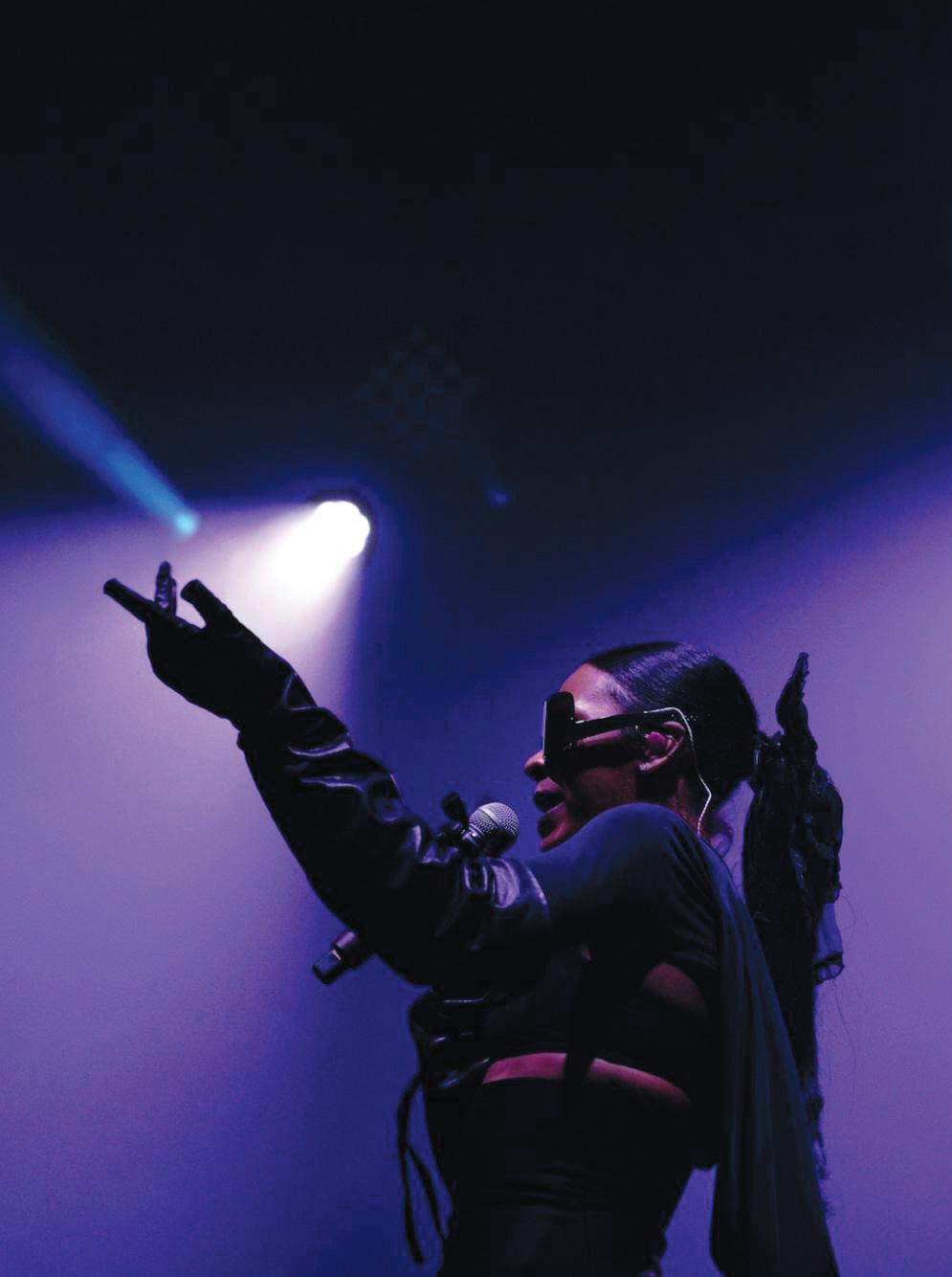
If you didn’t attend A&O Production’s Blowout concert on Oct. 11, you heard it here first — Rico Nasty just got a cat.
Along with learning her pet-owning status, attendees of this year’s Blowout in the WelshRyan Arena enjoyed a three-hour concert featuring three artists: student opener Perl, hiphop collective Grouptherapy, and headliner Rico Nasty.
Communication junior Sequina King was one of the first to start lining up for the free, student-exclusive event. As a longtime Rico Nasty and Grouptherapy fan, King said she looked forward to hearing some of her favorite
songs, including “Countin’ Up” by Rico Nasty and “FUNKFEST” by Grouptherapy.
“Both of them are kind of punk rock, popish, and I like that early 2000s kind of vibe,” King said.
The doors opened at 7 p.m. with A&O’s student opener Perl — Medill freshman Jared Perlmutter — already onstage. Manning the DJ deck, which he normally plays in his dorm room, Perl mixed some crowd favorites, ranging from an edit of “Smooth Operator” by Sade and his own bootleg of “Stayin’ Alive” by the Bee Gees.
“My goal was to mix in some pop songs and some disco with house because that’s my favorite thing ever,” Perl said.
Perl debuted two original songs, including one that he completed in his dorm room just a few days prior. He plans to release his song
“Never Letting You Go” (ft. Chloe Jane) in late November on Spotify and Apple Music. The theme of playing unreleased music continued with the next opening act, Grouptherapy, a Los Angeles-based group starring artists SWIM and Jadagrace. As the duo danced around the stage, they performed a range of songs from the slower, slinky beat of “TrunkPoppers.com” to the faster, heartpumping beats of “FUNKFEST,” which had audience members waving their hands back and forth.
Grouptherapy ended their set around 8:40 p.m., but not before they pumped up the crowd for the last performer, Rico Nasty.
“When I say ‘Rico’ you say ‘Nasty’!” SWIM yelled. “Rico!” “Nasty!” the audience cheered.
Rico performed her first set of songs at
an unrelenting pace, strutting along the stage in her all-black ensemble, an outfit she described as “tea.”
With the bass turned up so high the arena’s bleachers were audibly vibrating, Rico performed several songs, including “OHFR?”, “STFU” and “H.O.T.” — acronyms galore! — straight through, pausing only to read the song requests students had typed out on their phones and were holding up for her to see. To Rico’s faux dismay, the crowd requested her hit song, “Smack A Bitch.”
After her energetic set, Rico took a beat to chat with the rowdy crowd.
“I’m gonna leave my gum here in case anyone wants it. I know some of you are freaky like that,” she said. “Goodnight!”
ashleydong2028@u.northwestern.edu
By ALEXANDER HERNANDEZ GONZALEZ daily senior staffer @alexbespeain
Nine fashion designers, a variety of clothing and the art of storytelling astonished audience members at the “Threaded Stories: A Runway Show of Distinctive Fashion” show, presented by Evanston-based boutique cloth + home Sunday afternoon.
Co-owners of cloth + home Pam Kendall and Linda Johnston hosted the sold-out event of about 100 guests at the Woman’s Club of Evanston. The show highlighted designers with roots in New York, Japan and Chicago while presenting the latest pieces from their collections.
“This is their passion and their life,” Kendall said at the event. “Your presence here shows that you not only want to be at a great fashion show, but that you believe in supporting the arts. Fashion is art, and it brings all of us joy.”
Audience members paid a $75 fee for entrance. Kendall said a portion of the event’s proceeds will be donated to Bundled Blessings Diaper Bank, an outreach program of the First United Methodist Church of Evanston that supports families in need of diapers. The boutique has supported the program since the shop’s inception in May 2022, as Kendall is a board member.
Fashion designer and MasterChef contestant Tommy Walton said he was thrilled to support and cheer on some of Chicago’s up-and-coming
designers.
“If you can make it in Chicago, you can go anywhere you want to go,” Walton said. “And if you can do it here, you can definitely go to New York and eat them up, too.”
Brooklyn-based designer Parron EdwardsStimola showcased his Parron Allen “Fable” collection that consisted of floral prints, black lace-fabric and a hen-shaped handbag. Edwards-Stimola said he draws inspiration from his Mississippi roots and uses sustainable fabrics to create his looks.
Chicagoan and designer of EFJ Collections
Ernestine Fleming-Jones, presented her debut collection, “Urban Allure,” which consisted of denim ensembles, silk outfits and a long, cowprinted skirt.
Chicago-based Japanese designer Nana Okazaki Plotkin presented “Transitory winter sea,” the latest collection from her eponymous label that featured fringe tops, a soft, blue-gray fabric strip dress and wool ensembles.
Other brands that showcased their clothing included Andrea Reynders Design, Lola Élan Studio, The Checkroom, Christy Metz Design and The Blue Passion — all with Chicago connections.
Chelsey Carter-Sanders, founder and CEO of Alex Carter brand closed the fashion event by presenting her “Waves” collection, which featured sculpture-like waves on top of dresses and vests, a ruffled skirt and a black ruffled dress cinched by a long black belt. Carter said she considers herself an “emotional designer” because she adds an abstract flare to everyday
clothing.
“Our slogan is bridging the gap between simplicity and edge,” Carter said. “So, I find the most simplistic silhouettes and I keep them up in innovation, shape, motifs, texture or movement.”
As the event came to a close, each ticket was automatically entered into a raffle for three prizes, and the audience voted on three designer awards: Garment Construction, Creativity and Originality and Cohesive Collection. The winners of the audience-selected awards were Fleming-Jones, Plotkin and Carter-Sanders, respectively. The event wrapped up with a sale for audience members. The clothing is still available for purchase at cloth + home’s boutique located off Chicago Avenue and Grove Street.
alexanderhernandez-gonzalez2027@u.northwestern.edu

By SASHA DRAEGER-MAZER daily senior staffer @sashadm27
At 90 minutes long, “Clued In: An Invitation to Die For” is quite a feat of improvisational theatre. There are no props, no script, no intermission, just the creativity and imagination of the actors.
“We don’t know what’s happening in the show,” cast member James Dugan said. We’re creating the story on the fly. We don’t know who the murderer is, either.”
The improv troupe High Stakes Productions has performed a 45-minute rendition of “Clued In” for a number of years, and this October teamed up with The Second City to perform a Halloween version of the show at The Second City’s UP! Comedy Club in Chicago. Each show, a rotating cast of six actors from the High Stakes Productions ensemble perform.
To make the show feel more Halloweenthemed, it is structured using a classic Agatha Christie device: All of the improvised characters receive a mysterious invitation, said Simon Tessmer, an ensemble member. Props also contribute to the spooky theme.
The performance begins with a brief explanation of how the show will work. Then, the audience is asked to toss out ideas for a setting (the Oct. 10 show revolved around a murder at the Olympics). Over the years, the cast has had some strange suggestions.
“Think of any fast food restaurant — we’ve
done it,” said Dugan, who’s also solved “murders” at an amusement park, space station, submarine, the moon and even Antarctica. “That one was really fun,” he said.
Once the setting is determined, a cast member is chosen at random to be the detective. Another cast member gives an opening monologue sketching out and developing the premise. From there, the cast makes up the story as they go along. Given the show’s 90-minute runtime, keeping track of intricate details, like character names and backstories, can get tricky.
“What we’ve been practicing is ways that we can help out the detective … things like repeating names as much as we can, or reiterating big moments, or even just reacting in big ways to each other to give more of these moments impact,” Dugan said.
A live musician lends the show extra depth, underpinning plot twists with subtle musical cues via violin, cello and piano.
One of the show’s most brilliant aspects is the flashback bells hung around the stage within reach of the cast. Each time a bell is rung, cast members must act out a flashback of whatever event was just described. The bells are the source of the show’s funniest moments, as cast members gleefully ring the bells to make each other act out unexpected and hilarious scenes.
“Improv is a team sport,” said cast member Paige Maney.
She said she thinks that good improv is based on trust between cast members and knowing
she can count on other cast members to support her.
It’s easy to see that the cast members are enjoying themselves; Their enthusiasm is infectious.
“When you make an audience laugh,” Dugan
said, “that’s like nothing in the world.” The Halloween version will run until the end of October: Thursdays at 8 p.m and Sunday, Oct. 27 at 4 p.m.
sashadm@u.northwestern.edu

By ALEXANDER HERNANDEZ-GONZALEZ and MAYA WONG
daily northwestern
the
@alexbespeakin / @mayawong
When Charli XCX released her sixth studio album “Brat” in June, she took the world by storm with her inventive production and
brilliant marketing. The album’s neon green background and sans serif font became viral across all media platforms, with the word “brat” even taking on a new meaning: something fashionable and cool.
On Friday, Charli XCX dropped “Brat”’s remix album, “Brat and it’s completely di erent but also still brat.” Although each of the album’s 16 new
“Brat and it’s completely different but also still brat” is the definition of a clubrecord, no questions necessary. After “Brat” made Charli XCX a household name, at least among Generation Z, the singer-songwriter expressed how she has dealt with the fame and press that has followed after a wildly successful “brat summer.” With an emphasis on electronic beats and hyperpop music, along with deep lyrics, reality checks and personal experiences, this album will make you reflect on your past, live in the present and be hopeful for the future.
“Club classics featuring bb trickz” is ethereal, insane and unapologetically a modern club classic. Spanish rapper Bb trickz is the perfect complement to this track, and both artists have received a great amount of attention in recent months. The bass-heavy song samples “365” and relies on robotic autotune, which frankly, makes the song perfect for a night out. Charli XCX and Bb trickz have a substantial amount of “icon” potential and they aren’t afraid to use it, either.
“Mean girls featuring julian casablancas” is an interesting duo that I never thought would actually become a reality. But, here we are. The electronic hyperpop vocals and 80s-esque touches are what bratty dreams are made of. This song is for all my sassy folk who want to work it out and get down to classic, electronic club music.
“365 featuring shygirl” was finally released after months of leaks and a preview at a Boiler Room in March.
songs is a remix of the original album’s tracks, these songs are completely di erent. Select lyrics and beats remain the same, but most of the songs are completely reworked. e album is a brand new listening experience, but yes, it’s still brat. Charli XCX wanted to give her music a new sound and perspective.
“I’ve always had a bit of an issue with songs
coming out and being cemented as one thing for eternity … I think songs are endless and have the possibility to be continuously broken down, reworked, changed, morphed, mutilated into something completely unrecognizable,” Charli XCX said Friday on the social media platform X. Here’s what we thought about the remix album.

to stream. English
adds ambiance. While reflecting the avoidance truly makes a “partygirl.”
say / These interviews are so serious,” which adds balance and shows the duality of a brat.
everything is about partying, and brats have feelings too.
compliments this electronicat the BBC Radio 1 Big Weekend Luton 2024, as well as the BRAT and
mance. This song proves that music can bring people together.
“Sympathy is a knife featuring ariana jealous of a more renowned peer to feeling
did. She was not.
When Ariana Grande was slated to appear instead, many wondered how she would contribute to the song’s message — but the con-
This remix feels like a cheap deflection and Where “Brat and it’s completely different but also still brat” shines best is in Charli XCX’s lyricism. Although better known for being a producer and performer, Charli XCX has proven herself to be one of the most clever and “cheeky” lyricists in the industry today. In “Everything is romantic featuring caroline polachek,” finding “romance” moves from a Mediterranean beach to the streets of London. “Early nights in white sheets with lace curtains / Pompeii in the distance” beautifully transitions into “Late nights in black silk in East London / Church bells in the distance.” This skillful twist of words is poetic — moreover, romantic. Finally, “I think about it all the time featuring bon iver” is the album’s most heartfelt and vulnerable track. Charli XCX discusses balancing her career with her home life (she became engaged to The 1975’s George Daniel in 2023). The singer notes how she cannot take a break from music when her career is on the rise, but feels uncertainty about her future and chances at motherhood. “I’m so scared to run out of time,” she sings wistfully. Yet at 32 years old — 12 years after the release of her first viral song “I Love It” — Charli XCX’s career has hardly reached its peak. Time is undoubtedly on Charli XCX’s

Maya Wong

arts & entertainment
Editor Betsy Lecy
Assistant Editors
Karina Eid Alexander Hernandez-Gonzalez
Design Editors Paloma Leone-Getten
Danny O’Grady
By ANAVI PRAKASH
daily senior staffer @anavi_52
A er former Ald. Robin Rue Simmons (5th) retired from City Council in 2021, she said people all over the country still came to her asking for guidance on how to set up reparations initiatives in their own communities.
Rue Simmons, who was a council member from 2017-21, led Evanston’s reparations program, which now provides Black residents who lived in Evanston from 1919 to 1969 and their direct descendants with grants of up to $25,000.
Evanston’s reparations program became the rst of its kind in the nation in 2021 and was challenged in court in May by a conservative activist and nonBlack Evanston residents.
In response to the requests from communities across the country, Rue Simmons founded FirstRepair, a nonpro t that aims to create tools and share practices that lead to sustainable local reparations policies. FirstRepair does this by leading workshops and conferences around the country and conducting research.
FirstRepair, founded in 2021, now serves over 100 localities around the country, such as Tulsa, Oklahoma, and Denver.
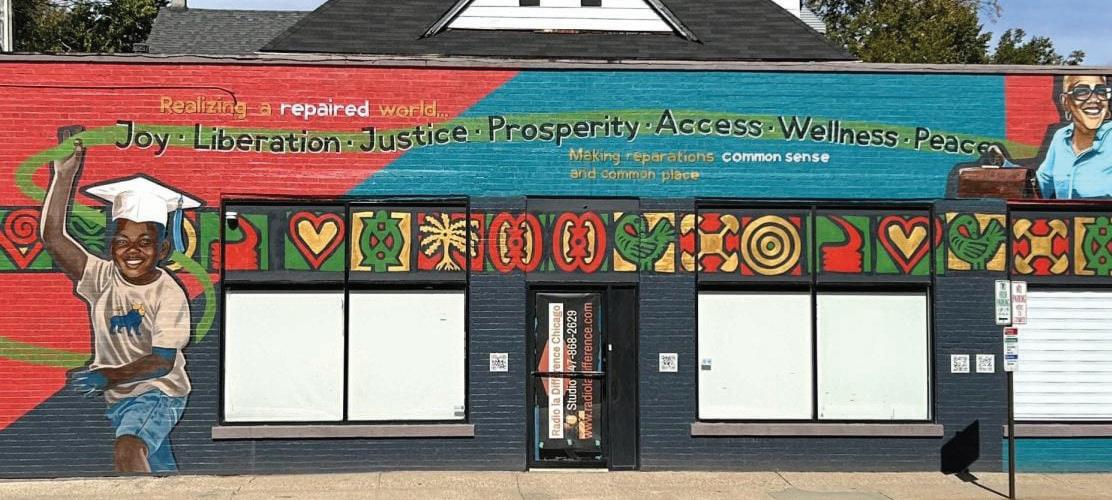
FirstRepair’s latest project is the National Resource Center for State and Local Reparations, located at the organization’s headquarters, 1900 Asbury Ave. e center will open on Dec. 4, the rst day of the organization’s fourth annual symposium, Rue Simmons said.
e center will include a library and other tools to support the reparations movement, she said.
A mural, unveiled in July, surrounds the center and celebrates Black excellence, she added.
e organization also holds monthly national strategy sessions for community leaders to collaborate and share ideas, Rue Simmons said. She added that there are also monthly meetings for FirstRepair’s west, east, midwest and south regions, which aim to allow community leaders to work more closely with each other.
e name ‘FirstRepair’ comes from Rue Simmons’ belief that before public policies can be implemented, communities should work to repair the harm that the Black community has endured, she said.
FirstRepair’s logo is three circles inside of each
other, the Adinkra symbol for leadership from West Africa, representing the leadership Evanston has shown in the reparations movement, Rue Simmons said.
She emphasized that helping local communities with their reparations programs is important because many national initiatives start with grassroots action.
All of the communities FirstRepair works with approach the organization for help, Rue Simmons said. e nonpro t doesn’t have the capacity to do its own outreach, she said.
More localities became interested in reparations in 2020 a er George Floyd was murdered and the Black Lives Ma er movement gained momentum, Rue Simmons said.
“(FirstRepair) was a direct response to a growing demand in this nation for racial redress,” Rue Simmons said.
Some localities, however, come to FirstRepair before they are ready to implement a reparations program, she said.
Rue Simmons said the criteria for a community to start its own reparations initiative includes
having a legislative champion — someone who will continuously advocate for reparation initiatives — communal political will and support for the Black community.
Vanessa Hall-Harper, Tulsa District 1 City Councilor, is one of the main advocates for a reparations initiative in Tulsa.
She said she began collaborating with FirstRepair in 2021, when Tulsa City Council was looking to pass resolutions to acknowledge the Tulsa Race Massacre of 1921, a race riot against Black residents and their homes and businesses.
In August, Tulsa created the Beyond Apology Commission, which is looking into a monetary reparations program for victims of the Tulsa Race Massacre and their descendants.
Hall-Harper said she attends FirstRepair’s annual symposiums to stay involved and learn from other communities starting their own reparations programs.
She calls the people at FirstRepair and these events her “reparations family,” she said.
“We are working together,” Hall-Harper said. “And
although one community’s repair or one community’s approach may even be di erent, the solution, or the end game, is the same and that’s justice.”
FirstRepair also holds general legal strategy sessions, focused on frameworks community leaders can use for their reparations initiatives, and events at local schools and at the United Nations in Geneva, Switzerland.
At the U.N.’s Permanent Forum for People of African Descent in April, FirstRepair, along with several U.S.-based law centers, hosted a side event focused on reparative justice, according to Elisa Walker, FirstRepair’s communications associate. Walker, who grew up in Evanston, said she feels especially close to the reparations movement because she has seen how it impacted her community.
“ en once I started to evolve in FirstRepair, it’s really the narratives and the stories that I hear from the community members of (other) municipalities, about their history, about what reparations means to them,” she said.
anaviprakash2027@u.northwestern.edu





























ONE LAST TIME AT
ONE LAST TIME AT

Oct. 19 @ 11am
Oct. 19 @ 11am
By CHARLIE SPUNGIN
daily senior staffer @charliespungin
Northwestern ran onto SECU Stadium’s turf as double-digit underdogs Friday night. That didn’t stop coach David Braun’s squad from leaving College Park as 37-10 victors in its largest margin of victory this season.
“Really proud of our entire program,” Braun said in the postgame press conference Friday. “(I’m) proud of the way that our guys stayed the course and found a way to win a game.”
Now, the Wildcats (3-3, 1-2 Big Ten) will host Wisconsin for this season’s final game at Northwestern Medicine Field at Martin Stadium Saturday.
Similar to NU, the Badgers (4-2, 2-1 Big Ten) will enter Saturday morning’s contest with a heap of momentum. During its two most recent outings, coach Luke Fickell’s unit dismantled Purdue and Rutgers with 52-6 and 42-7 victories.
Last year, the ’Cats entered Camp Randall Stadium and handed Wisconsin a 24-10 loss. NU hopes it can return to its locker room with wins in back-to-back years against the Badgers Saturday for the first time since the 2014 and 2015 seasons.
Here are three things to watch out for as the ’Cats look to win consecutive games for the first time this season.
Wisconsin offense’s radiating rhythm
After Badger quarterback Tyler Van Dyke tore his ACL against Alabama, quarterback Braedyn Locke stepped into the role. He completed only half of his passes and threw for just 125 yards as the Crimson Tide dismantled Wisconsin 42-10.
In his first Big Ten matchup, Locke completed half of his throws once again for under 200 yards in another loss. Then, the flip switched for the offense.
In its past two games, Saturday’s visitors have exceeded 40 points and 500 yards.
“Their quarterback play continues to trend in the right direction for them,” Braun said. “(Locke) came in against Alabama. That’s a tough situation to be thrust into, but you can tell that he continues to play with more and more confidence.”
Braun also highlighted the strength of the Badgers’ offensive line, which has allowed six
sacks and 21 tackles for loss on the season. Both figures rank top four in the Big Ten and top 15 in the nation.
He noted that Wisconsin’s offense becomes tough to defend when factoring in the team’s run game. Running back Tawee Walker has rushed for 439 yards and nine touchdowns — the second most rushing scores in the Big Ten — this season.
“What you’re seeing out of Wisconsin these last two weeks is they get up in a football game, they remain incredibly balanced — and with that balance — (the team) becomes really difficult to defend,” Braun said.
Henning, Kirtz finding form
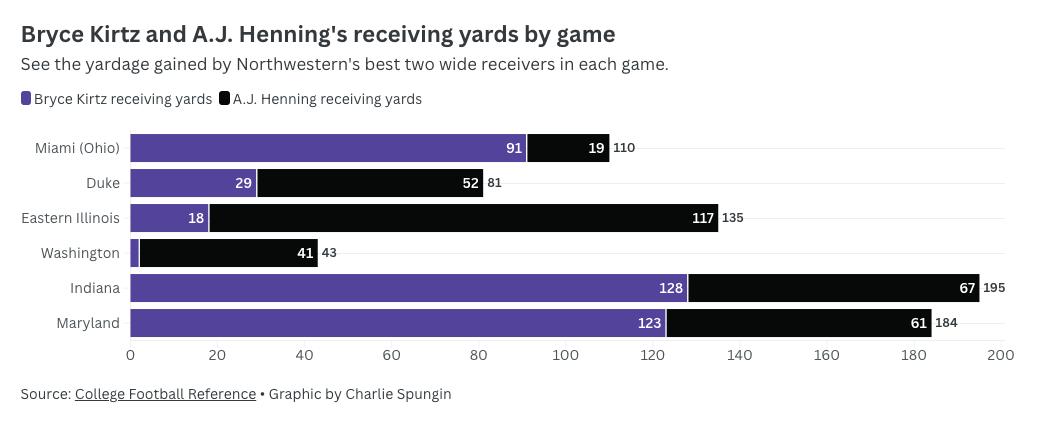
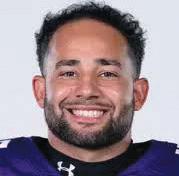
For the first time as teammates, graduate student wide receivers A.J. Henning and Bryce Kirtz combined for fewer than 50 receiving yards against Washington on Sept. 21.
Since that game, which was redshirt sophomore quarterback Jack Lausch’s Big Ten debut, the NU star receivers have shined, exceeding a combined 180 yards in back-to-back competitions.
“Bryce and A.J. are proven playmakers in the arena,” Braun said. “There’s no doubt that finding ways to get A.J. and Bryce the ball in their hands in critical situations and down the field is something we need to continue to do.”
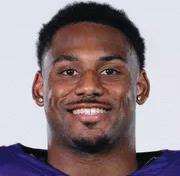
Both Henning and Kirtz — with 391 and 357 receiving yards apiece — rank in the top 15 in receiving yards in the Big Ten.
During Friday’s postgame press conference, Kirtz alluded to the constant communication between him and Lausch for their increased success over the past two games.
Braun has praised Lausch for the success of Henning and Kirtz, as the young play-caller has gotten the ball in his star receivers’ hands while playing turnover-free for the last eight quarters of football.
“You can see when a quarterback is playing confident,” Braun said. “He’s not waiting for the wide receivers to become open. He’s throwing the ball to a spot and knowing where his wide receivers are going to be.”
The Badgers’ secondary poses a potential threat to the ’Cats’ passing game. Their defense is allowing the fifth-fewest passing yards per game to opposing offenses in the Big Ten and may put more defensive attention on Henning and Kirtz in an attempt to slow them down this weekend.
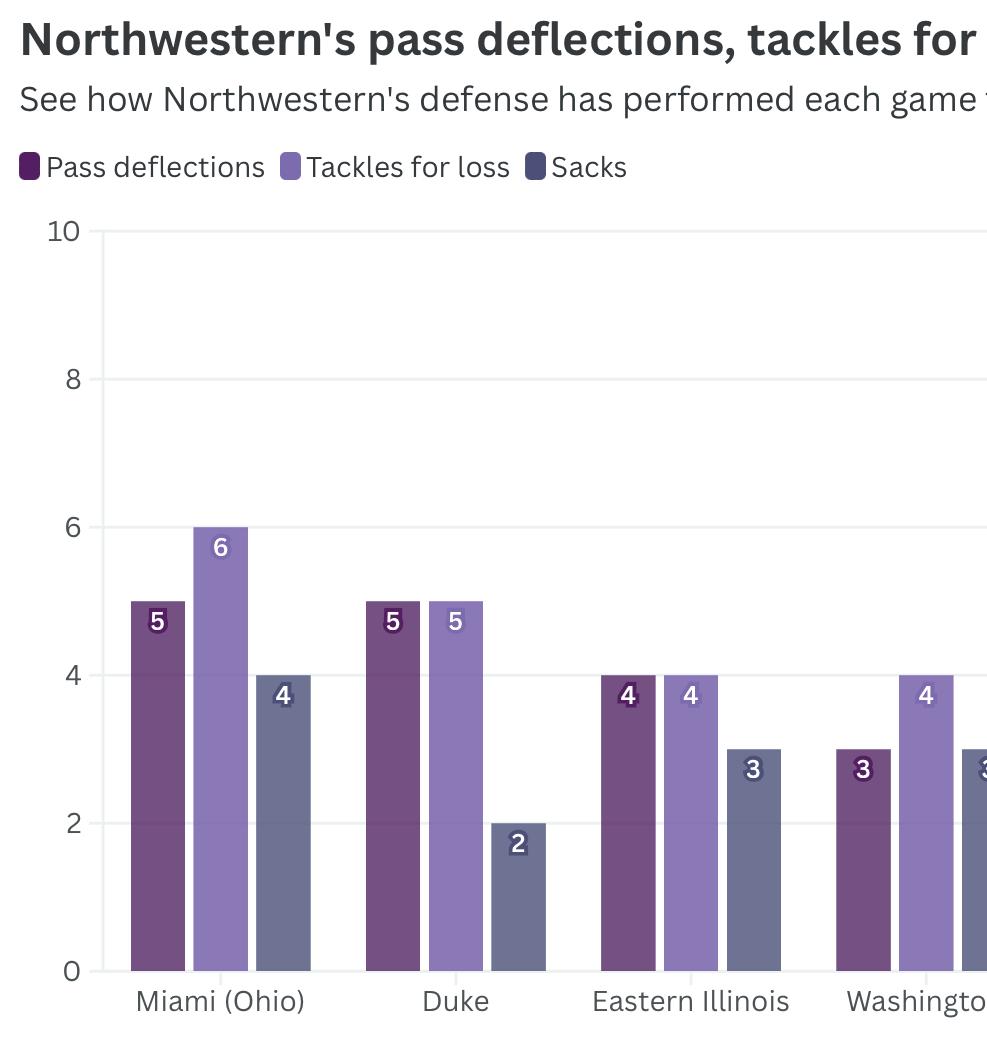
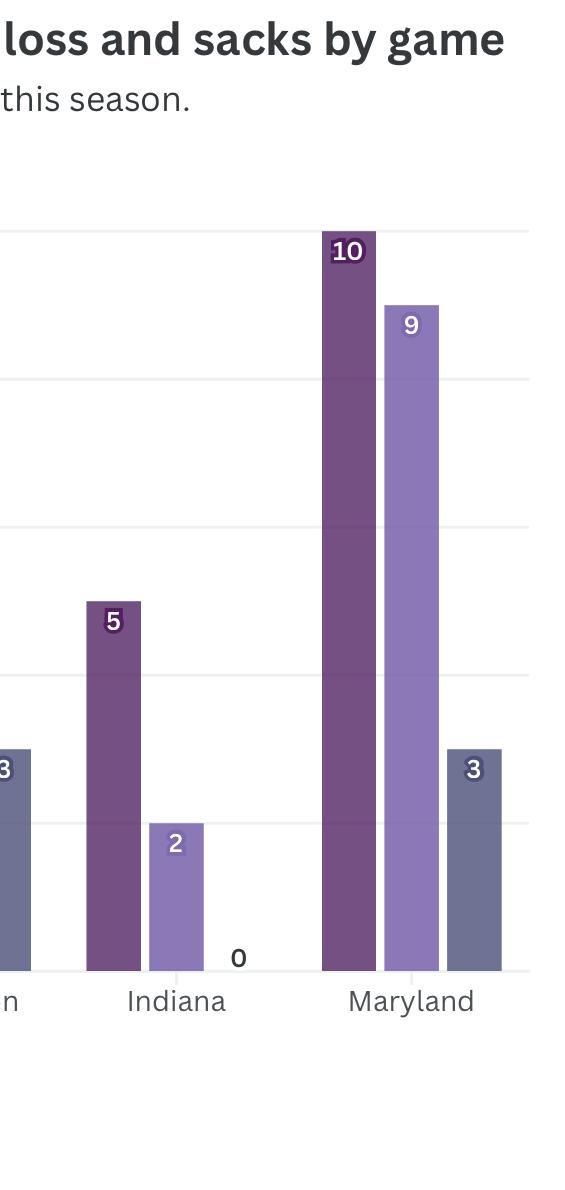
In the ’Cats’ blowout victory against Maryland, the defense notched season-highs with 10 pass deflections and nine tackles for loss. It fueled NU’s 37-10 landslide victory and the
fewest points allowed by the team’s defense in conference play this season.
“We did a good job Friday night of affecting Maryland’s quarterback early, and we’re going to have to find ways to do that on Saturday as well to not allow that offensive passing attack from Wisconsin to get into that rhythm,” Braun said.
In Wisconsin’s consecutive Big Ten blowouts, Locke has completed more than 65% of his passes for 599 yards and four passing touchdowns. However, he’s proven to be turnover-prone with three interceptions thrown in that span.
Braun stressed the importance of forcing Locke to feel uncomfortable in the pocket by forcing him to make decisions, a sentiment he said a week ago before the ’Cats win in Maryland. Defensive coordinator Tim McGarigle’s unit put immense pressure on Maryland quarterback Billy Edwards Jr. Friday, and Edwards completed just 28-of-51 passes. The defensive line sacked Edwards three times, while redshirt junior defensive back Theran Johnson notched three pass breakups. Johnson now leads the Big Ten in passes defended with nine.
“The easy stat to look at is sacks, which are drive killers for an offense,” Braun said. “We want that trend to continue, but it’s also just pressures and making a quarterback uncomfortable. It’ll be absolutely critical.”
charliespungin2027@u.northwestern.edu
By JAKE EPSTEIN daily senior staffer @jakeepste1n
Just days before Northwestern’s season-opener against Miami (Ohio) on Aug. 31, redshirt freshman cornerback Josh Fussell gained an unforeseen shot at signi cant playing time. He’d rotated in with the second-team defense throughout fall camp, and his coaches spoke highly of his developmental promise.
But when redshirt junior cornerback Ore Adeyi sustained a major leg injury in late August, Fussell found himself on the cusp of a starting spot. e physical corner with lockdown capabilities knew he had to seize his unlikely chance.
“You never know when your role could change,” Fussell told e Daily on Tuesday. “At that point, I was still ge ing reps, but I was a No. 2 for sure. Ore’s my brother, and I was just hoping and praying that it wasn’t that bad. But, then reality started hi ing real fast like, ‘Oh, you’re really about to be in the mix now.’”
During the season’s rst ve games, Fussell split reps with redshirt sophomore cornerback Evan Smith, who started the bulk of those contests.
However, once the Wildcats ipped the page from a 41-24 loss to Indiana on Oct. 5, Fussell saw his name listed on the depth chart as an NU starter against Maryland prior to Friday’s College Park clash.
A player who gave up just four catches for 29 yards in his entire high school career, Fussell faced o with the Terrapins’ high-octane passing a ack — and the redshirt freshman rewarded his coaches’ trust with three tackles and a goalline pass breakup on a target for Maryland wide receiver Tai Felton.
“ ere’s always competition in the room,” assistant cornerbacks coach LaMarcus Hicks said. “You have to be at your best every single day. When Ore went down, the next guy was ready to roll and excited for his opportunity to get in there and show what he had. And, that’s exactly what Fuss has done the last few weeks.”
While Fussell’s quiet, workmanlike demeanor o en shi ed him away from the spotlight throughout his football journey, the West Chester, Ohio, native said his years of training behind the scenes prepared him for this moment.
Now, the 6-foot, 189-pound defensive back stands right where he belongs, gaining valuable in-game repetitions with each passing week and striving for improvement whenever he steps on the eld. Fussell said his current role serves as a testament to his consistent commitment to his individual process, which he bought into long before he came to Evanston in 2023.
“I just give my all every day because that’s all you really can do,” Fussell said. “Just a ack every day with the same mindset and never get complacent. You never know who’s coming for you. You never know who else is working. If you continue to a ack, your role will eventually change.”
During his tenure as Eastern Michigan’s cornerbacks coach, Hicks came across a then-unheralded prospect on the recruiting trail in 2021 and knew he’d encountered a gem at Lakota West High School. Hicks said he was quickly enamored with Fussell’s ability on lm.
Despite leading the Greater Miami Conference with six interceptions as a junior, Fussell didn’t receive his rst Division I offer until a month following his third season.
He played in an elite secondary corps alongside Ohio State’s Malik Hartford, LSU’s Jyaire Brown, Notre Dame’s Ben Minich and Kentucky’s Alex Afari Jr., but Lakota West varsity football coach Tom Bolden promised every college coach he came across that they wouldn’t regret giving Fussell an opportunity.
“Josh a lot of times got overlooked because he was quiet, no-nonsense,” Bolden said. “Other teams were like, ‘Well, we need to throw at him.’ en, they gured out within the rst quarter of a game something like, ‘Oh my God. We can’t throw at this kid.
He might be be er.’”
For Fussell, playing alongside a slew of Power Four prospects proved especially bene cial, as they pushed one another every day in practice.
He said the secondary members established strong bonds while holding the entire group accountable with their collective e ort.
“It taught me to always compete and give it (my) all every day because if you don’t, guys at that level are going to expose you,” Fussell said. “We were like a brotherhood. We always found fun in competing and pushing each other to the highest level possible because we knew the type of potential we had as a team.”
Fussell entered high school as an undersized linebacker, but Bolden and his defensive sta swi ly shi ed him into the secondary. While they rst tried him at safety, Fussell’s footwork and technique made him a natural t at corner.
To learn his new position, Fussell dove into countless hours of tape. He said he studied corners like the Cleveland Browns’ Denzel Ward, the Denver Broncos’ Pat Surtain II and the Miami Dolphins’ Jalen Ramsey, marveling at Ward’s ability as a technician.
“His dedication to perfecting his cra is incredible,” Lakota West co-defensive coordinator Tyler Huls said. “If there was a video out there he could watch to improve his technique, he watched it. We haven’t seen anybody like him since. He just put an unbelievable amount of time working on the small details that not many kids do anymore.”
A four-year varsity le er winner, Fussell became a key cog for his squad as a junior. Time and time again, Bolden and Huls tasked the cornerback with shu ing down his side of the eld. Huls said Fussell delivered night in and night out.
Fussell’s diligent progress came to fruition in a state playo showdown with his rival Saint Xavier High School on Nov. 12, 2022. In a gutsy defensive e ort, Fussell cemented a 12-2 victory for the Firebirds, recording a game-sealing interception in the end zone. Huls said he knew at that moment that the then-junior cornerback could thrive at the highest level.
“Josh was never a big rah-rah guy because he was so focused all the time,” Bolden said. “He truly led by example. When he wasn’t in, he’s standing over there on the sideline and all of a sudden — unprompted — he’s going through the rst couple steps of his backpedal, working his hands. Kids would see that and understand that’s why he’s so good. at’s what it takes.”
Fussell’s father, Jerry Fussell, taught his son one of his most pertinent athletic and life lessons as his basketball coach. A marine veteran, Jerry Fussell instilled in his son and his teammates that no ma er the circumstances, they should move forward and focus on the next play.
It’s an invaluable mindset for a cornerback, who must trot right back to the line of scrimmage immediately following an opposing shot play.
“It was always no excuses, no ma er what,” Fussell said. “He would always get on me, (and my) biggest thing was ge ing too emotional, ge ing too down on myself during the game. At corner that really applies because things happen so fast. You may give up a catch here and there, but you never want to get too down on yourself. Just got to think
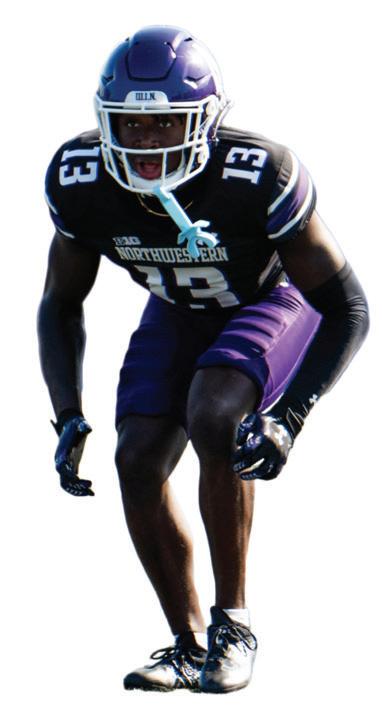
alongside a player he recruited at a prior stop.
“When he rst stepped on campus, you could see the talent that he had,” Hicks said. “It just needed to be re ned, ne-tuned. He’s a very intentional guy about technique, about where he’s aligned, so his focus is always there. You’ve really been able to see the growth since Day 1, when he stepped into the building, until now.”
Coach David Braun said he and his sta have been excited about Fussell’s game-changing potential since his rst practice. While Fussell preserved his eligibility last season, he saw game-action against Penn State and consistently leaned on experienced collegiate corners like Rod Heard II, Garne Hollis Jr., Johnson and Adeyi for guidance.
Fussell said he wouldn’t be half the player he is without the support his veteran teammates have given him.
“It just showed me the type of dedication and preparation that it took to play the (college) game,” Fussell said. “Being able to play some special teams helped me get adjusted to the speed of the game a




Fussell honored his father’s words throughout his recruiting process, as Bolden said the defensive back never sulked or envied his high school teammates’ elite o ers.
He applied that same perspective following the loss to the Hoosiers.
Fussell said he was disappointed in his performance, but he and the entire defense needed to focus on the next opportunity at hand.
Redshirt junior cornerback eran Johnson, the foremost veteran in his position group, said he’s seen Fussell’s con dence grow leaps and bounds since the campaign kicked o more than a month ago.
“We’ve seen him do it in practice for a year,” Johnson said. “It’s just a con dence thing, going out there and doing it against the best of the best. A er Duke, (he and I) were talking, and he felt really comfortable getting those reps in. ose reps have really taken his play up a level.”
Just as he did in high school, Fussell made an immediate impression on the ’Cats’ coaching sta when he arrived on campus as a three-star recruit.
Hicks, who had just stepped into his new role as cornerbacks coach at NU, said it was a full-circle moment to enter the fold
li le bit, but practicing with them day in and day out showed me what it all took and what I had to do to get to that level.”
Braun, who has long lauded his aspirations for the ’Cats to become a developmental beacon in the Big Ten, said Fussell’s desire to be coached and accept guidance makes him an ideal culture t.
With one nal test on Lake Michigan at Northwestern Medicine Field at Martin Stadium Saturday against Wisconsin, Braun said he looks forward to seeing Fussell continue his upward trajectory as both a present program piece and fundamental component of the team’s future.
“You’re starting to see a level of con dence show up through Josh’s play that comes with reps in the arena,” Braun said. “Josh, coming o the Indiana game, knew it wasn’t his best performance. What a credit to his character of bouncing back … Josh Fussell is going to be one heck of a corner in the Big Ten for a long, long time.
jacobepstein2026@u.northwestern.edu.edu




























By HENRY FRIEMAN daily senior staffer @henryfrieman
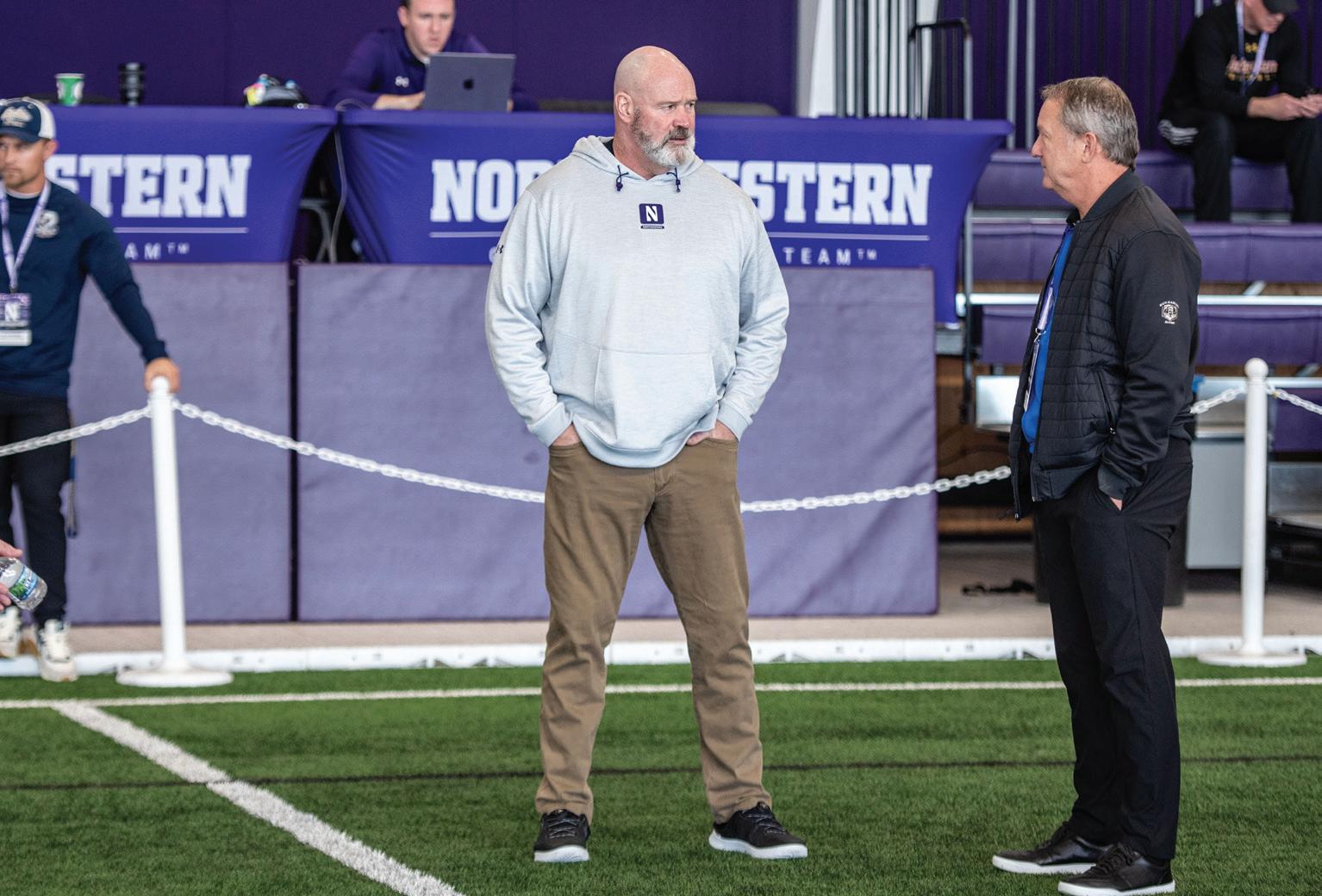
Offensive line coach Bill O’Boyle is in his first year at Northwestern, joining head coach David Braun’s staff last winter after spending the previous year with Colorado.
O’Boyle previously served as the head coach at Division II Chadron State, leading the Eagles to three Rocky Mountain Athletic Conference championship wins and guiding the squad to three NCAA Division II championship appearances. He was named the Liberty Mutual Division II National Coach of the Year in 2007.
The Daily spoke with O’Boyle on his background, the state of the Wildcats’ offensive line and more in a Tuesday conversation.
This interview has been edited lightly for clarity and brevity.
The Daily: What made you want to become a coach?
O’Boyle: I grew up in a coaching family. I have five older brothers and three of them were high school coaches. My dad was a little league coach. I planned on being a high school coach like my brothers. I ended up staying in college when I worked on my master’s degree, and I thought I’d stay with that route. That’s what I did.
The Daily: What were some of the biggest lessons you learned at Chadron State?
O’Boyle: We pretty much had to do everything there. We did our laundry, we mowed the fields, we painted the fields. … We did everything. You were responsible for the whole program, how it ran, including equipment and everything else, so I learned a lot.
(What) you learn at the (Division II) level, and at any level, but especially DII, really, is just the work ethic and who you surround yourself with. I was fortunate enough to have some great coaches and great kids. Man, the work ethic was phenomenal with those guys. It’s a different place. But those kids loved ball. That was the reason why we won.
The Daily: What is the difference going from Division II to Division I?
O’Boyle: You have a lot more depth, a lot more guys that are available. And, sizewise and numbers-wise, that was probably the biggest thing. I would say some of the kids I had at DII could play here. There would be no doubt in my mind, but it’s just numbers-wise, and what you have to work with.
The Daily: How was your experience with Colorado and working with coach Deion Sanders?
O’Boyle: It was definitely a learning experience. I’m glad I moved on and I’m fortunate to be here.
The Daily: What are your thoughts on the NU offensive line unit this season?
O’Boyle: They work extremely hard. We’ve got a really good group of young kids coming up. I wish our numbers were more, but where we’re at right now, we’ve just got to stay healthy. But these guys are dedicated. They work extremely hard.
The Daily: You mentioned some injuries. How does preparation shift when you have different players starting at different positions every week?
O’Boyle: You just have to be ready for that ‘next up’ attitude, man. You gotta have that mentality where somebody goes down, you
might have a kid that’s a tackle that is your next best kid in the rotation, that’s gotta be able to play guard. And those guys know that. And that’s the good thing about these guys. They know the system, they know the scheme, a very intelligent group of kids that put a lot of time in there.
The Daily: Coach Braun has spoken about redshirt junior left tackle Caleb Tiernan and redshirt junior right guard Josh Thompson taking on a more pronounced leadership role. Have you seen that?
O’Boyle: They’re more vocal. They
By ANNA WATSON daily senior staffer @adub_sports
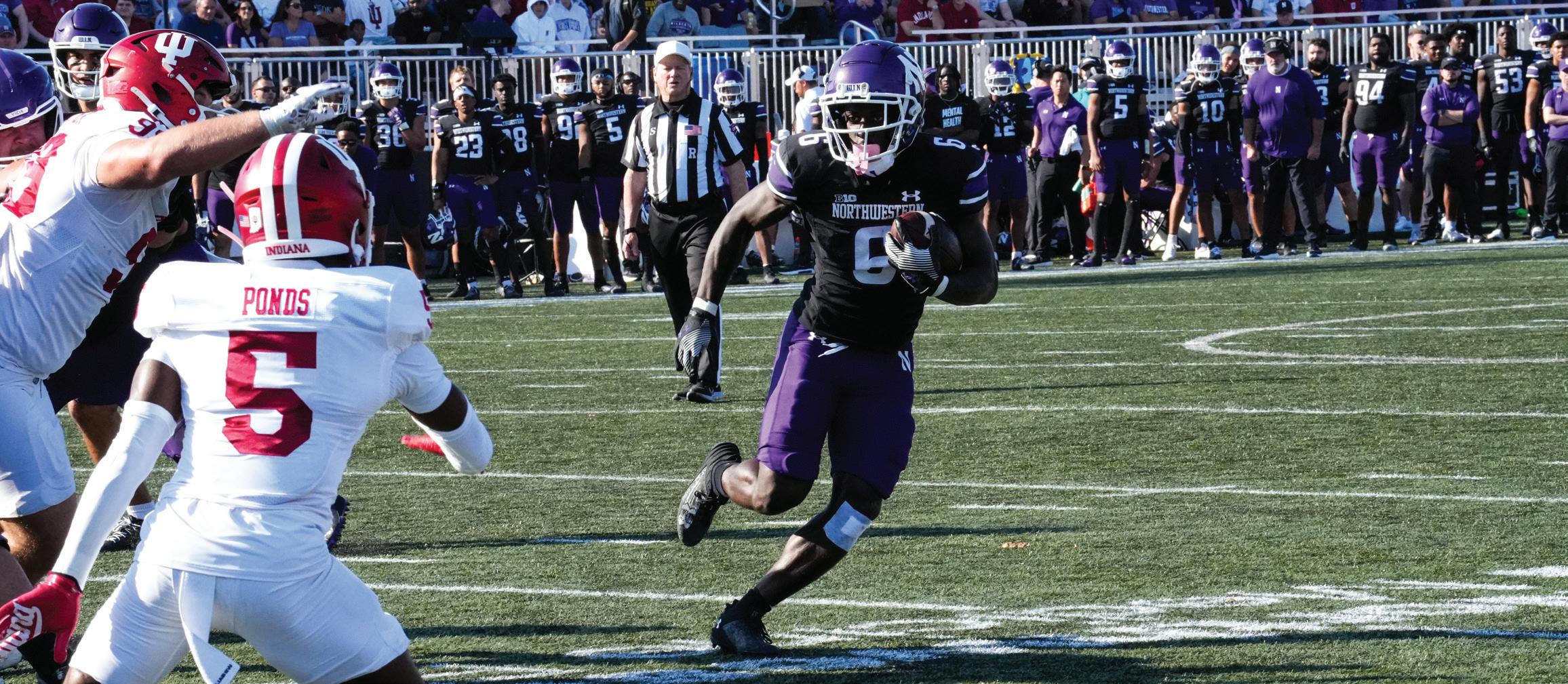
Just after Northwestern surrendered a touchdown to then No. 23 Indiana at the end of the first quarter Oct. 5, redshirt sophomore running back Joseph Himon II fielded the kickoff around the two-yard line and scampered up the left sideline, dodging Hoosier defenders before being tackled after a 30 yard return.
A facemask penalty at the end of the play added 15 yards, and the Wildcats started their 10-play scoring drive at their own 47-yard line.
“There’s just a level of energy that comes off the sideline when the offense is opening up a drive at the 40-yard line or 50-yard line,” coach David Braun said. “There’s a level of confidence right now when Joe has the ball in his hands and people are blocking for him.”
The play marked one of several instances in which Himon provided a spark for the NU offense. Through six games, the redshirt sophomore running back is one of the nation’s top kick returners, accumulating 304 return yards on 10 attempts. Himon’s 30.4 average kickoff return yards per attempt ranks fifth best in the country, as well as No. 1 in the Big Ten.
“It’s really just a testament to my teammates blocking for me,” Himon said. “Without those guys, I wouldn’t be able to get through those
holes that they open up for me and do what I do.
… It’s a testament to the coaches trusting me, putting me back there so I can do what I do best.”
Last season, however, the redshirt sophomore’s only kick return came in the ’Cats’ victory against Utah in the Las Vegas Bowl. Himon says he has returned kicks his whole life, so it was only a matter of time until he got the opportunity to do it at NU.
“Coach has always told me ‘Just stay ready,’ because I could be really vital in the kick return game,” Himon said. “That’s just me staying ready and me waiting my turn.”
Braun said seeing Himon take advantage of his returning opportunity has been especially exciting.
Last season, Himon served a spark plug role on offense, ripping off an 85-yard receiving touchdown in Braun’s first victory as a head coach against UTEP.
“We knew we had some special things with Joe on the offensive side of the ball, but to see that carry over into the special teams game has been really fun to watch,” Braun said.
The ’Cats face Wisconsin on Saturday, a team that has been stout against kickoff returns this season. The Badgers allow an average of 17 yards per kickoff return, a figure that ranks 32nd in the country.
Knowing this, Himon and the NU special teams unit are looking at different defensive schemes, but he is mainly focusing on his own execution.
“I really just focus on us,” said Himon. “I focus on looking at my reads, knowing where to hit, knowing what guys are blocking what guys, so it’s really just focusing on us.”
Under first-year special teams coordinator Paul Creighton, NU has steadily improved its kick return game since last season.
The ’Cats are averaging over five yards more per kickoff return this season. Additionally, in their first three games, they gained 111 yards on kick returns. Since the start of conference play, NU has gained 272 yards on kick returns. Himon’s 96-yard kickoff return against Washington is his team’s longest return this season.
Himon credits these improvements to hard work in practice and trusting the team’s explosive ability.
“We know we can make big plays on this team,” Himon said. “Really just going hard every day in practice, honing in on those little details.”
Himon has played in all six games this season, racking up 122 rushing yards and one touchdown on 28 attempts as the team’s second-string running back. The redshirt sophomore, though, has fully embraced the new part of his job.
“It feels really good to be able to contribute to my team. I try to contribute in any way that I can for the team’s success,” Himon said. “Really, I do anything and put everything on the line for my team.”
annawatson2027@u.northwestern.edu
understand the scheme more, and they’re doing a great job. So the physical part needs to keep coming with our whole group, and we’ve got to get our paddle down. To me, that’s a group. We’ve got to get better every day. There is no in-between.
The Daily: What are your group’s goals for the rest of the season?
O’Boyle: Win every week, man. Win our one-on-ones and win every week.
henry ieman2027@u.northwestern.edu
Gameday Editor
Writers
Henry Frieman
Jake Mozarsky
Charlie Spungin
Anna Watson
Gameday is a publication of Students Publishing Co. A four-page issue is usually published on the Wednesday prior to Northwestern home games and a two-page issue is published on the Wednesday prior to Northwestern road games.
All material is © 2024 Students Publishing Co. Questions or comments should be sent c/o Gameday Editor Jake Epstein, 1999 Campus Dr., Evanston, IL 60208.





Jake Epstein (6-0, 3-0) (6-0, 3-0) (6-0, 3-0) (5-1, 2-1) (5-1, 2-1) (5-1, 2-1) (4-2 2-1) (4-2, 2-1) (4-2, 2-1) (4-3, 2-2) (4-3, 2-2) (4-2, 1-0) (3-3, 1-2) (3-3, 1-2) (3-3, 1-3) (3-3, 0-3) (1-5, 0-3) (1-5, 0-4)
By MARISSA FERNANDEZ and LEXI NEWSOM the daily northwestern
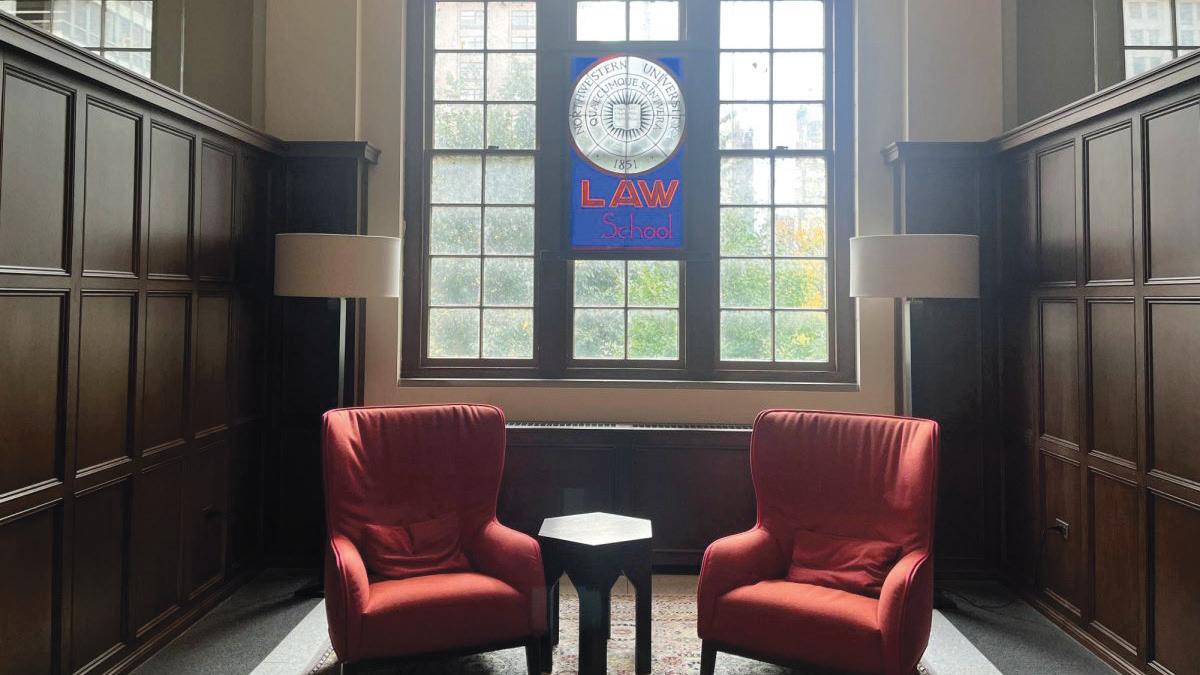
Since it was founded by the Bluhm Legal Clinic earlier this year, the LGBTQI+ Rights Clinic at the Pritzker School of Law has been working with clients and partner organizations to promote legal advocacy for the LGBTQ+ community and people living with HIV.
Law students are working at the clinic this semester to help four clients through the process of changing their names while also tackling separate research projects with outside institutions.
“All of our clients identify as nonbinary or transgender, and thus are seeking to change their names so that their legal name reflects better who they are,” said Pritzker Prof. Kara Ingelhart, the clinic’s director.
Ingelhart set the docket for the clinic over the summer and filed an amicus brief for the U.S. v. Skrmetti case in early September.
Ingelhart worked with historians on the brief to explain the history of gender-affirming care and gender dysphoria. The Supreme Court will consider the brief in its decision as it determines the constitutionality of Tennessee’s ban on gender-affirming care for minors.
According to the Human Rights Campaign, over 500 anti-LGBTQ bills were introduced across the U.S. in 2023 — a record number.
The clinic is partnering with the Transformative Justice Law Project of Illinois, an organization that provides name-change services in Cook County, to expand these services to the broader Chicago area.
“What’s so great about this clinic, too, is that we’re able to help people in the county next over,” Pritzker third-year Kailey Fairchild said. “Without us, I don’t know if that would happen.”
Ingelhart and her students have filed three of the clinic’s four cases for the year already. In a couple of weeks, Fairchild will represent her first client at a hearing.
To represent a client, students must have a 711 license and are only allowed to practice under a licensed attorney. Ingelhart will supervise students as they work with clients to file paperwork, represent name-change hearings

and update legal documentation.
“(Client work) is where your most amount of surprises are going to come up,” Fairchild said.
“We learned one of our clients had previously been married, so they’ve changed their name before, and they hadn’t included that until we got into the interview … It’s just been a good learning lesson.”
Assisting clients with name changes is only part of the work at the LGBTQI+ Rights Clinic. Fairchild and her partner are tracking various anti-LGBTQ and anti-transgender bills across the U.S. The Whitman-Walker Institute, an LGBTQ+ advocacy group and HIV research institution, will use the clinic’s data to identify similarities in ideology and language in antiLGBTQ bills.

Other students are partnering with The Center for HIV Law and Policy to research HIV legislation across the U.S. “I had no experience with HIV advocacy before the clinic, so it’s been really eye-opening and important to go through the research memos for the CHLP because it’s exposing me to the type of law I would have never had the opportunity to learn about and also understand how messed up the legal environment can be for people living with HIV,” Pritzker secondyear Aswini Melekote said. Melekote and their partner are working on writing a paper on the history of HIV law and recent changes to it, specifically regarding the military. The paper will also cover a recent court decision that allows anyone with an HIV


diagnosis to serve in the military.
The clinic is creating a research database accessible from the NU Libraries’ website for Pritzker students and the public. It will include legal resources such as a collection of interactive maps to track different types of legislation across the U.S.
“For Northwestern University to hold itself out there as an educational institution wanting to invest in the LGBTQI community is moving to me and a symbol to students that they are investing their educational careers at an institution that cares about them,” Ingelhart said.
marissafernandez2028@u.northwestern.edu lexinewsom2028@u.northwestern.edu



















ISABELLA BUTERA OP-ED CONTRIBUTOR
I am tired of my university exploiting my Jewish identity to silence those who speak out against genocide.
In the past year, Northwestern has repeatedly asserted its commitment to eradicating antisemitism on campus. Over the summer, Northwestern updated its student code of conduct in response to criticisms of the University’s handling of demonstrations in the spring, and last week, the University announced intentions to discipline students who violated the new demonstration guidelines. Between these policy changes, implementing a new antisemitism training and even our president testifying in front of Congress last spring, NU claims it wants to protect its Jewish students. Yet, as a Jewish student at NU, I fear that the University professes to combat antisemitism while actively suppressing freedom of speech.
I was a part of the NU Gaza solidarity encampment this past spring. Our encampment was a beautiful space of education, movement building and multifaith rituals, such as our Passover seder.
That is, until the fourth day of our encampment, when a group of about 150 proIsrael counterprotesters gathered on Deering Meadow. Unimpeded by a small metal barrier set up by University Police, they charged the field and verbally assaulted us with threats of violence. My peers linked arms and chanted calmly. Alongside my fellow Jewish students, I grabbed a sign that said “Jews for Palestine.” We wanted to make it clear that this is not a conflict of religion, as many erroneously suggest, but a struggle between those in power who support genocide and a diverse coalition of people, including many Jews, who resolutely oppose genocide.
The counterprotesters, a group of mostly non-students with connections to the AntiDefamation League, shoved cameras in our faces, yelling that we remove our masks so they could dox us. They laughed when we chanted, “Stop the genocide.”
They targeted me and my Jewish friends specifically using horrific slurs. They called us “k---s” and “k----s,” terms used to describe Jews who aided the Nazis in the Holocaust. They told us Hamas should kill and rape us. They told one of my friends she was “too ugly to be Jewish.” They told us to kill ourselves. At the same time, they hurled every possible racial slur at our fellow Black and Brown student organizers. They called them terrorists.
I have never felt so afraid in my entire life. I have never felt so afraid to be Jewish.
In a recent update to their code of conduct, the University carved out additional protections for counterprotesters. In the same document where it severely limits any demonstrations that impede any normal university function (with the potential consequence of expulsion), it also explicitly asserts the rights of non-student counterprotesters to assemble on campus.
How can I watch a university that has spent all year claiming to care about the wellbeing of Jewish students fail to condemn a mass act of antisemitism and racism against my peers? NU, quick to release statements that Palestinian flags are “antisemitic,” said nothing of the verbal assault on its own students. The directors of the only Jewish institutions serving NU students, Michael Simon of Hillel and Chabad Rabbis Dov Klein and Mendy Weg, watched the event occur and spoke cordially with the counterprotesters. UP officers patted counterprotesters on the back.
That leads me to a solemn conclusion: NU does not seek to protect all of its students, only those who fall in line with the institution’s politics. It will vehemently uphold the speech of students who support its financial ties to Israel and its endowment. The University does not care about actual experiences of
antisemitism — only about how it can weaponize concerns about the “safety” of Jewish students to suppress anyone who dares to speak out for Palestine.
NU claims to be a bastion of dialogue, liberal ideals and free speech, but it has spent the last months crafting — and now enforcing — draconian policies to punish anyone who dares to speak out against the Israeli military’s genocide in Gaza. However, students, including my fellow Jewish students, will not be silenced. We have seen how the Israeli military has killed upwards of 16,000 children in Gaza and destroyed or damaged every single university, according to the Gaza Health Ministry and Palestinian Ministry of Education and Higher Education, respectively. Like the young people before us who opposed the Vietnam War or called for divestment from the South African Apartheid, we know we are on the right side of history. We will follow in the footsteps of the student activists before us and not give up until Palestine is free.
Isabelle Butera is a Medill senior and former Daily staffer. She can be contacted at isabellebutera2025@u.northwestern.edu. If you would like to respond publicly to this op-ed, send a Letter to the Editor to opinion@dailynorthwestern.com. The views expressed in this piece do not necessarily reflect the views of all staff members of The Daily Northwestern.
Columbia University’s chapter of Students for Justice in Palestine recently came out in support of armed resistance by Hamas, which was designated a Foreign Terror Organization by the U.S. State Department in 1997. I mention this as Northwestern’s SJP chapter has previously expressed support for Columbia SJP and has repeatedly used rhetoric praising global intifada. SJP chapters have received funding and programmatic support from groups linked to foreign terror organizations like the Popular Front for the Liberation of Palestine, which use student organizations as means to project power across borders, in uence policy and undermine public institutions.
I am writing to state my support for the administration’s amended protest policies and move toward institutional neutrality, and as a response to a recent statement published by a group of 52 faculty in e Daily and a report issued by the Council on American-Islamic Relations. e university is an incredibly important venue for free speech. It is in our societal interest to ensure that it remains a platform for expression on issues of public concern. Accomplishing diverse representation in thought includes providing forums for expressing unpopular ideas, but there are practical limits to speech under the First Amendment. At times, speech by members of the University community have stretched free expression past its breaking point, both in condoning violence and by using political pressure tactics that assist foreign governments and terrorist organizations in advancing their policy goals.
FTOs seldom distinguish between combatants and noncombatants and have long stated their intention to kidnap and kill American and Israeli citizens worldwide; concern about their in uence on campuses thus transcends the current con ict. Columbia’s inability to rein in its violent protest behavior thrust the university into turmoil, and its radical institutional culture has opened it to global criticism and driven away potential students. NU is wise to institute guidance that prevents it from following a similar path.
ere is a paradox of tolerance in open societies: According to classicist Emily Anhalt, “A harmonious civil society requires tolerance, but cultivating the ability to recognize and value opposing viewpoints cannot mean becoming so broad-minded as to tolerate everything.” A notable example is a phenomenon of Russian civil society organizations that have weaponized norms of open dialogue in Europe. e Organization for Security and Co-operation in Europe and other deliberative institutions have found that numerous participants in its governance processes were bad-faith actors actively working to disrupt discourse on security and human rights.
Such is the dynamic we face now at some universities, where forums for legitimate speech are plentiful, but norms of free expression have been similarly weaponized. Unable to exact change through lobbying our political institutions, con ict has shi ed to higher education, where foreign interests seek to harm the state of Israel by promoting disengagement in academic programming and divestment of university endowments. e disruption of learning environments, cultures of harassment and intimidation,
destruction of property and vandalism, infringement of university operations, and violence are not speech — they are political tactics intended to forcibly impose policy change onto a larger academic community, and to compensate for their proponent’s failure to persuade through dialogue. NU’s strategic position within the higher education landscape makes it a target for badfaith actors that want to normalize institutional subversion as speech, radicalize future leaders of our political and civil institutions, and weaponize its culture of open dialogue. I applaud the administration’s commitment to preserving authentic forms of free expression while curtailing abusive behavior that undermines the University’s mission.
Stephen Kleinschmit is a faculty member within the School of Professional Studies. He can be contacted at stephen.kleinschmit@ northwestern.edu. If you would like to respond publicly to this op-ed, send a Letter to the Editor to opinion@dailynorthwestern.com. The views expressed in this piece do not necessarily reflect the views of all staff members of The Daily Northwestern. STEPHEN KLEINSCHMIT
- The Commission supported Environmental Justice Evanston, Evanston Interfaith family pride fest, and Wesley displaced residents and submitted a letter in support of equitable access to the Harley Clarke Mansion.
Dear Mayor Daniel Biss,
During my term on the Evanston Equity and Empowerment Commission, the Commission actively worked on several important initiatives. Some of the initiatives are listed here:
- The Commission supported and encouraged the City Council to create a community benefits agreement with Northwestern.
- The Commission created the Evanston Policy Racial Equity Scorecard and pushed for increased public engagement in City policies.
- The Commission also focused on improving the City’s community engagement policies and addressing racial equity.
- The Commission worked to ensure that marginalized voices are represented.
- The Commission tackled inequities in the city’s decision-making processes.
- The Commission collaborated with Chicago Ald. Byron Sigcho Lopez (25th) to bring forth affordable housing ordinances, one of which — an adjustment to the city’s demolition tax — has been successfully implemented.
I write to you today with a deep sense of disappointment, not only regarding the end of my term on Oct. 1 as Chair of the Evanston Equity and Empowerment Commission but also in the broader direction that the city seems to be taking in matters of equity and fairness. While I respect the office you hold and the responsibilities that come with it, I feel compelled to share my concerns about the Commission’s future and the importance of ensuring it remains a true voice for all Evanston residents.
The Equity and Empowerment Commission was established to bring critical issues of justice and fairness to the forefront of policy decisions. In a diverse community like ours, the role of this body is not simply to mirror the views of the mayor or any other elected official. It is to represent the often unheard voices, to challenge assumptions and to ensure that all policies are evaluated through a lens of equity. This is not a task that can be fulfilled if the commission is populated by individuals who merely align with a certain political agenda that benefits only those at the top. Instead, it requires people of integrity, independent thinkers who are
committed to fairness for every resident, regardless of race, socioeconomic status or background.
During my time as commission chair, I have witnessed decisions that raise concerns about the city’s commitment to these values. The culture of silence for Black employees and the subsequent alteration of the Black Employee Report — now sanitized and rebranded as the Employee Report — are examples of how the truth can be distorted when equity is not truly at the heart of decision-making. In the Black Employee Report, employees bravely spoke up about their experiences, but their voices have been stifled. This is not the Evanston we aspire to be. Moreover, the pattern of reappointments to boards and commissions raises further questions about fairness. While I understand that no one should assume they will be reappointed, the fact that I, along with one other commissioner who opposed the zoning changes and green-lighting of NU’s projects, have not been reappointed, is concerning. It gives the appearance that those who challenge or disagree with certain interests are excluded from public service. This sets a dangerous precedent, where civic engagement and dissent are discouraged, rather than embraced as essential to a healthy democracy.
The late Karen Chavers, a respected leader in our community, once said, “We can measure people by their intentions: Who you
for?” My answer has always been clear: I am for the people. My work on the Equity and Empowerment Commission was always driven by a commitment to fairness and justice for all Evanston residents, especially those who are too often marginalized. Mayor Daniel Biss, as you seek reelection, I urge you to consider the importance of the Equity and Empowerment Commission as an independent body that represents the true diversity of our city. The Commission cannot fulfill its mandate if it is filled with individuals who are more concerned about furthering a political agenda than advocating for genuine equity. The people of Evanston deserve a government that listens, values their input and ensures everyone has a seat at the table. I hope you will reflect on the need for unbiased leadership on the Equity and Empowerment Commission, and I remain hopeful that the city will continue to move toward a more just and equitable future for all.
Sincerely,
Darlene Murray Cannon
Darlene Cannon is an Evanston 2nd Ward resident and the former chair of Evanston’s Equity and Empowerment Commission. If you would like to respond publicly to this op-ed, send a Letter to the Editor to opinion@dailynorthwestern. com. The views expressed in this piece do not necessarily reflect the views of all staff members of The Daily Northwestern.
By EDWARD SIMON CRUZ daily senior staffer @edwardsimoncruz
Evanston City Council debated ideas for addressing projected deficits tied to the city’s proposed 2025 budget during its meeting Monday.
The overall budget will yield a deficit of approximately $23 million based on the projected difference between expenditures and revenues. If the city’s property tax levy remains flat as planned, the General Fund, used for day-today expenses, is forecasted to dip to nearly zero by 2027.
Through the coming year’s proposed budget, Evanston will generate revenue through accumulated reserves and permit revenue from Northwestern’s Rebuild Ryan Field project, according to a summary from City Manager Luke Stowe.
Councilmembers discussed a list of 38 alternative ideas for building revenue and addressing projected
deficits, previously presented at the Oct. 8 Finance and Budget Committee meeting.
Alongside other councilmembers, Ald. Thomas Suffredin (6th) supported using credit card processing fees to balance the budget. He said collecting these fees and outstanding fines could serve as simple preliminary solutions.
“We should start with the lowest-impact, least controversial ones and work our way through,” he said.
Councilmembers also discussed increasing permit fees and the wheel tax as other alternate ideas. And
Hitesh Desai, the city’s chief financial officer and treasurer, named the Illinois Local Debt Recovery Program as a way to collect unpaid debts for parking tickets, ordinance violations and other fines.
Ald. Eleanor Revelle (7th) told The Daily the city should not chip away at its reserves given the projected decreases to the General Fund balance and planned improvements to the Lorraine H. Morton Civic Center and Police and Fire Headquarters.
“Start now with a small increase in our property tax so
it isn’t such a huge shock when we have to really deal with it in the next year or two,” Revelle said at the meeting.
The council also heard updates to Evanston’s proposed Capital Improvement Program for 2025. In a memo to the council, City Engineer Lara Biggs identified $86.5 million in necessary funds for the program. Biggs said city staff will provide a final plan to the council in early November.
Biggs previewed four key projects within the program: improving alleys, replacing uneven brick sidewalks, replacing Fountain Square and organizing public engagement sessions when planning for projects.
In a memo to the council, Biggs said there are not enough staff members to handle multiple public engagement meetings alone, increasing the need to fund outside consultants.
“We want to look at how we can strategically use consultants to best leverage the staff that we have and really create the best work that we can developing the projects that we want to,” she said to the council.
Ald. Jonathan Nieuwsma (4th) was one of several councilmembers to support integrating participatory budgeting into public engagement. He said the city could use participatory budgeting and online surveys to reduce consulting expenses. Ald. Clare Kelly (1st) said the city’s existing boards, committees and commissions could represent the community’s needs and deliver a better product than consultants.
“It just doesn’t seem like a transparent, democratic process, what you’re suggesting,” she said.
Biggs said she was exploring ways to incorporate participatory budgeting, but the process would remain limited in the future if the overall budget did not incorporate additional funds for it.
City Council will hold a public hearing on the budget Oct. 28. City staff aims to adopt the budget at the council’s Nov. 25 meeting.
edwardcruz2027@u.northwestern.edu
By ISAIAH STEINBERG daily senior staffer @isaiahstei27
City Council authorized the city manager to negotiate a lease with Celadon Holdings, LLC to renovate the Harley Clarke Mansion to create 10 hotel rooms and host weddings Monday night.
The historic mansion, situated adjacent to the Grosse Pointe Lighthouse and Lighthouse Beach at 2603 Sheridan Rd., has been vacant since the Evanston Art Center moved out in 2016. Celadon would invest roughly $29 million to renovate the building, which would reopen in 2026, according to the proposal.
“This proposal represents the most viable opportunity for a successful rehabilitation of the property in over a decade, showing the public and private interests in the property do not have to be mutually exclusive,” Evanston Preservation Planner Cade Sterling said.
Facing a threat of demolition, 80% of voters in a 2018 advisory referendum elected to preserve Harley Clarke for public use. From 2019 to 2023, the Artists Book House failed to raise enough money to renovate the mansion.
City Council considered two proposals at Monday’s meeting — one from Celadon to build a hotel and event venue, and one from Evanston Community Lakehouse and Gardens to establish an event venue, a cafe, museum spaces and art galleries.
City Council rejected a separate proposal to establish a hotel at the mansion in 2013.
Several residents at public comment expressed concern that Celadon’s proposal could limit public access to the mansion by hosting up to two weddings per week at the venue.
Several public commenters also noted that the proposal was raised as a special order of business, which they said gave less time for community feedback.
“This is insidious,” Evanston Reparations Committee member Carlis Sutton said during public comment. “Consider our concerns from the past, and please do not do anything that will make any kind of arrangement that would limit access to Harley Clarke.”
Sutton said he wants the city to establish free, public access to the mansion so low-income residents can visit the lakefront.
During public comment, several community members, including 2nd Ward resident Ray Friedman, alleged a broader lack of transparency in the city
government, demonstrated by the frequent use of special orders of business, which allow measures to bypass committee discussion before going to a vote.
The city was found in violation of the Open Meetings Act in March after City Council approved an agreement with a real estate developer to represent the city in its search for a temporary location for the civic center in a closed session.
Mayor Daniel Biss said similar proposals have previously been presented as special orders of business, and that councilmembers will have time to provide input directly to City Manager Luke Stowe during lease negotiations.
“This would be far better had this not been presented in a (special order of business),” Ald. Clare Kelly (1st) said. “Ramrodding this through again, Mayor Biss, as you’ve done with other other proposals.”
Before the authorization passed in a 6-0 vote, Kelly said City Council should table the proposal until its Oct. 28 meeting to give councilmembers adequate time to collect feedback from their constituents. She added that weddings and commercial activity will restrict some public access to the mansion.
Celadon would lease Harley Clarke from the city for $1 per year for 99 years, according to its proposal. The
privatization of the mansion could generate roughly $1 million per year in revenue for the city over the next few years, Ald. Juan Geracaris (9th) said.
Jens Jensen Gardens, the landscaper which manages the grounds outside the mansion, endorses the Celadon proposal.
“I’ve been engaged with members of Lake House and Gardens since my first year on the council, back in 2016,” Ald. Eleanor Revelle (7th) said. “There is much to admire in their proposal. That said, I believe that the proposal from Celadon, a successful historic preservation developer with a demonstrated track record of successful rehabilitation and adaptive reuse projects, stands the greater chance of success.”
By choosing to partner with Celadon, the city hopes to increase revenue while ensuring continued public access to the historic mansion, Sterling said. Ald. Jonathan Nieuwsma (4th) said he is excited about the prospect of developing the mansion after a long period of vacancy with several failed attempts at rehabilitation.
“I am cautiously optimistic that we are starting the last chapter of this journey,” Nieuwsma said. isaiahsteinberg2027@u.northwestern.edu






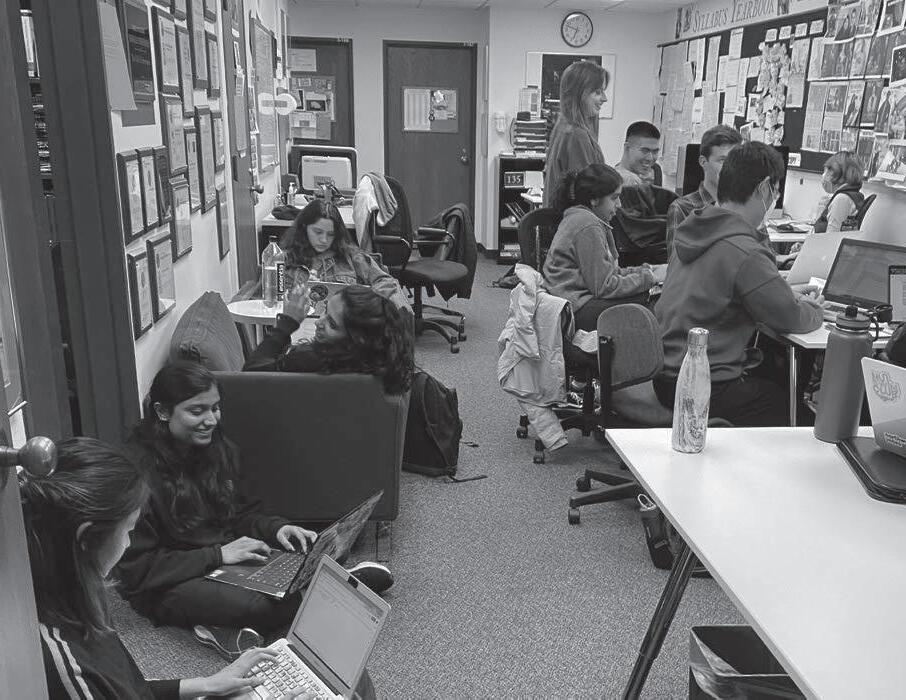











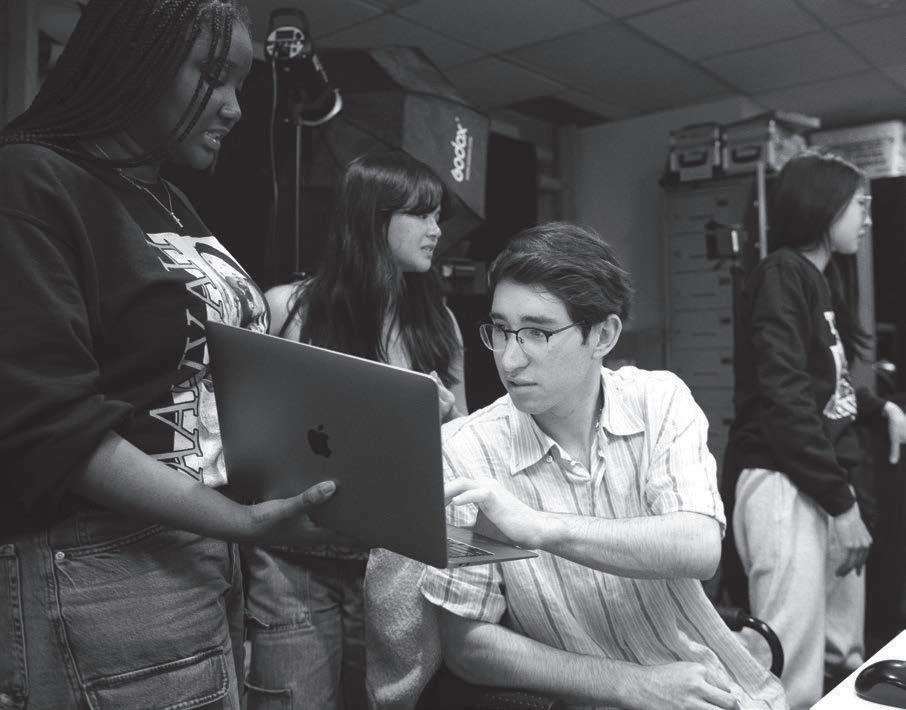










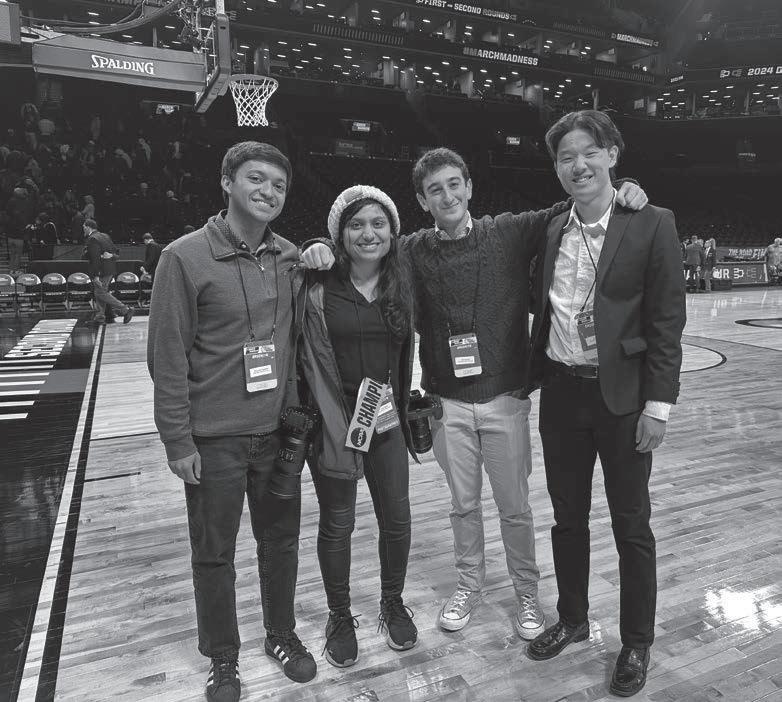

had a closer relationship with the city of Evanston. I do think that the process to approve Ryan Stadium was a di cult one, but I think we’re already implementing our Community Bene ts Agreement, which is $10 million (per year) over 15 years. We tripled our Good Neighbor Fund. We are on pace with 35% minority and women hiring in Ryan Field. We are talking with the city about an enormous array of things.
I think what’s important is to recognize that we don’t succeed as a University unless Evanston succeeds.
e Daily: Do you feel like campus is safe and
From page 1
union’s leadership were on board with the resolution.
“I don’t think it’s the kind of movement that organizations that claim to be representing people equally in labor issues should be adopting,” said Kellogg Chief Steward Daniel Cohen, second-year Ph.D. candidate in managerial economics and strategy. “I think it makes a lot of Jewish and Israeli Ph.D. students uncomfortable to reach out to the union … because before political
From page 1
these concerns, Kelly looked to see what the city could do to ensure bidders who work on those projects are experienced, she said.
comfortable for Jewish students?
Schill: I think that I would like to believe the answer is yes to both of those. I know the answer is yes, that it is safe. It’s my belief, based upon talking with Jewish students, that they feel physically safe. ey don’t fear for their physical well-being. It’s not 100%, but I think predominantly people feel safe. My guess is a number of people don’t feel comfortable.
If you were a Jewish student exiting Harris (Hall) or University Hall on Monday (Oct. 7), listening to some of what was being said and not able to get away from it because they were on the sidewalk, you have to walk through, you have to engage with it. at’s not comfortable. What I would hope, and what I would strive for, is that we get to the place where we engage with each other in a way that is human.
motives, the union’s main purpose is to serve as a labor resource for the campus.
In the NUGW resolution, the union also demanded that NU support e orts to divest from companies “invested in war” and ends its partnerships with Israeli Universities.
NU’s Israel Innovation Project was one of the programs mentioned in the provision. Established in 2020 within the Weinberg College of Arts and Sciences, the program has facilitated academic partnerships with Israeli universities.
“I feel like the (resolution) is another welcome step
I think that we just need to isolate the people who believe in hate. Some of that is, if they break the rules, we will enforce the rules. If they intimidate people, if they harass people, we will enforce the rules and potentially remove them from our community.
e Daily: In a similar vein, do you feel like campus is safe and comfortable for Middle Eastern and North African students, especially Palestinian students? Schill: I believe it’s safe. ere have been some incidents. But is it comfortable? Many of the students who I’ve met with, who are students either from the Middle East or Muslim students, would probably say the same thing, that it’s uncomfortable. And some of them would say that the surroundings are uncomfortable. Much of what has happened is happening o
that we want our union to practice and normalize such discussions and conversations, and that our working conditions are closely and tightly related to people across the world as well,” Sreesai said.
NUGW’s salvo joins a growing chorus of unions calling for an end to collaboration between the U.S. entities and the Israeli government.
In July, a joint le er signed by some of the largest U.S. unions, including United Auto Workers, United Electrical Workers and National Education Association, published an open le er to President Biden demanding that he cut o military aid to Israel.
campus, as opposed to on campus, in terms of Islamophobic statements or anti-Palestinian statements, and that’s unacceptable to us too. We’ve talked, obviously, with the police, and as you’ve probably seen, they’ve increased their patrols.
It’s not just the Jewish kids, it’s every student here deserves to feel they shouldn’t be in a cocoon where they’re not challenged. Students should feel challenged, and they should sometimes feel challenged by uncomfortable ideas, but they shouldn’t be threatened, where they can’t do their best work.
I truly believe that Northwestern, while we’ve had some incidents that I’m not proud of, has generally behaved well over the past year, and what we need to do is further up our game.
e resolution comes a er NUGW passed a referendum on a member-dra ed Solidarity Statement with Palestine in December.
“While I don’t anticipate that the University will respond to and adopt these demands, I imagine that like they’ll have to respond in some way, shape or form, that will bring back this discussion around Northwestern’s involvement with these companies,” said Molly Schi er, a third-year P.h.D. student in political science and a local union steward.
jerrywu2027@u.northwestern.edu
From page 1
dressed in powwow regalia and ate cultural foods to commemorate the day.
Kim Vigue, the museum’s executive director who is of Menominee and Oneida descent, said that she was impressed with the turnout at the powwow. e museum’s sta expected a large crowd, but the turnout among community members “really exceeded our
Michael McLean Jr., M/W/D/EBE Development Committee member and managing partner at Condor Partners, said he is concerned the ordinance does not provide a pathway for local disadvantaged businesses without
“We can make sure that we’re not hiring rms that have had constant overruns or even job injuries,” Kelly said. “Taxpayers end up picking up the tab for that.” Previously, the city did not require bidders to have any established apprenticeship programs. If the proposed ordinance passes, bidders will be required to provide documentation demonstrating that they have “actively participated for at least 12 months before the date of the bid opening, in apprenticeship training programs applicable to the work to be performance on the project.”
expectations,” she said. Evanston Mayor Daniel Biss was one of the many people in a endance.
Vigue said the goal of the powwow was to bring the community together to celebrate Native American history and culture. She said the museum wants to highlight the “living, breathing” culture of Native people.
Vendors set up booths around ETHS’ Fieldhouse featuring Indigenous regalia, art, food and jewelry.
Anna Johnson, a member of the Citizen Potawatomi Nation, created and displayed ribbon skirts and shirts during the event.
extensive apprenticeship programs to participate. “ ere’s a requirement to participate in some sort of apprenticeship program in order to be a quali ed bidder,” McLean Jr. said. “We don’t know what that means right now. e only apprenticeship programs we know of are union apprenticeship programs, which are not open and available to every resident of Evanston.” McLean Jr. said the ordinance needs to accommodate local businesses by creating an apprenticeship program that all Evanston-based businesses could participate in.
Johnson said engaging with traditional dress allows her to acknowledge the Indigenous residential school period when children were not allowed to wear traditional clothes while also having fun.
“We’re still here — it’s not just ancient history,” Johnson said.
At the back of the eldhouse, ETHS and the Mitchell Museum set up chairs around a makeshi dance oor. Madalene Big Bear emceed the song and dance performances, calling the powwow a “traveling Native American museum.”
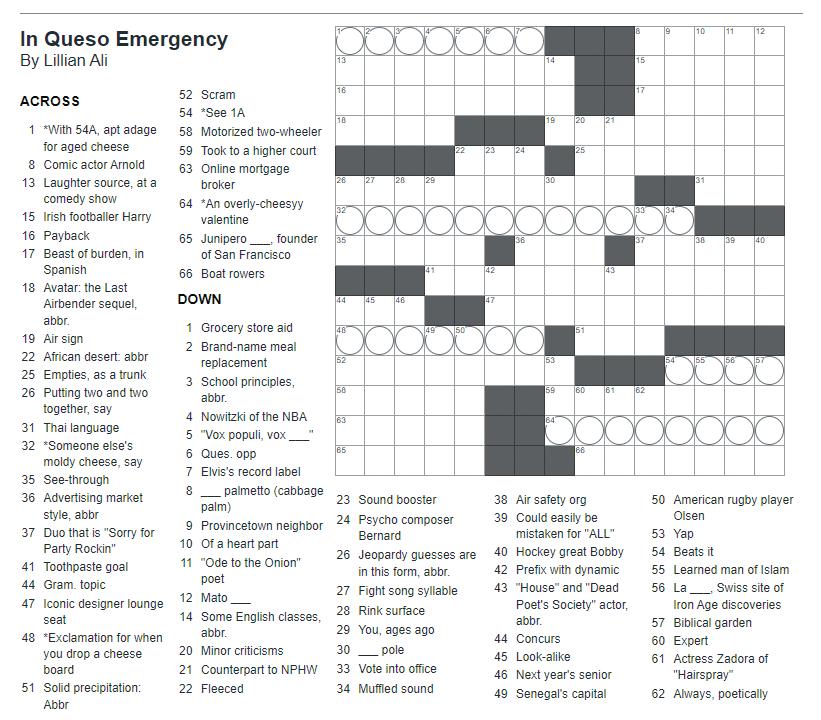
However, he said it is unclear how to create one. e M/W/D/EBE Development Commi ee is currently exploring how to make the ordinance equitable for everyone in Evanston, McLean Jr. said. Kelly said she expects the M/W/D/EBE Development Commi ee to recommend the ordinance for Council when it comes back to the commi ee in December.
ninethkanieskikoso2027@u.northwestern.edu
Big Bear, a member of the Pokagon Band of the Potawatomi Nation, said she was impressed with the community turnout and hopes that the powwow turns into an annual tradition.
“We ght for our di erences as Native American people. We ght for our right to be di erent,” Big Bear said. “A lot of oppressed, underrepresented groups are ghting for equality, but that’s not even on our radar. We’re ghting to be di erent and stay di erent.”
benshapiro2028@u.northwestern.edu







By MIGUEL TSANG and MAX OBREGON the daily northwestern
While enjoying a meal at Allison dining hall, students can’t help but feel welcomed by Mary Flemming’s warm hospitality.
Known on campus as “Ms. Mary,” Flemming is the self-described “Michael Jordan of the Allison staff.” Whether she’s scanning Wildcards, serving food or wiping down counters, Flemming said her mission is to make each guest’s day unique.
“I’m a people’s person,” Flemming said. “My thing is to make you feel welcome. I know you away from home … so I want to treat you how I treat my own kids — with love.”
Born and raised in Chicago, Flemming grew up playing volleyball and basketball and running track. She studied computer science at Mississippi Valley State University, choosing the school because of her mother’s Southern roots.
Flemming’s favorite memory about Mississippi is the friendliness of strangers, a quality she loved so much that she stayed on campus every summer after her sophomore year. Flemming brought her joy with her to Evanston.
After graduating, Flemming supervised
breakfast at a small elementary school. She switched from computer science to education, calling herself a “structured big kid.”
Flemming said she remembers challenging her students to use their “inside voices,” rewarding the quietest table with a laundry bag filled with goodies. She aimed to turn her students into the best versions of themselves and proved successful.
“School staff would bring people around to give donations to the school, like Oprah Winfrey,” Flemming said. “Oprah would say, ‘You sure there’s 350 kids downstairs?’ She couldn’t believe that we had 350 kids downstairs eating breakfast as quiet as it was.”
As the oldest of six, Flemming attributes her generous nature to helping her mother care for her siblings. She has always been a caretaker, from teaching her children how to play chess as toddlers to dropping her daughter off at law school.
Flemming holds a similar caretaker role in NU’s community, which she joined in 2020.
Communication freshman Zach Cook met Flemming during his first day at NU. He told her that he wasn’t a morning person, so she wouldn’t be seeing him much. Flemming took this comment to heart and connected with Cook over it.
“Every day she sees me, she’s like, ‘Oh, pleasure to see you again! You made it here another day!’” Cook said. “Love her.”
Flemming does not limit herself to just one role. She previously worked in management but felt guilty every time she delegated roles to her peers. Now, she takes on every responsibility herself: cooking for most meals, greeting every student and cleaning every inch of Allison.
Flemming recently received a surprise visit when an off-campus upperclassman brought her a “Mama Bear” themed cookie. For Flemming, this is not a rare occurrence.
“She’s very friendly with students and always likes to chat with them,” said Zahira Castillo, a coworker of Flemming’s. “We make a good team.”
Flemming loves sharing gifts with students who keep in touch. Last year, she bought 63 gifts for the graduating class. She created a close, personal bond to the students, she said.
While most students know Flemming from Allison, that makes up only half of her job on campus.
“Once I leave here, I go over there (Trienens Performance Center) and work until 2 or 3 o’clock in the morning, where I detail clean,” Flemming said.
As a massive NU sports fan, Flemming
strongly supports the teams practicing at Trienens.
She formed strong relationships with both the men’s and women’s basketball teams, the latter of which honored her on Instagram in their Black History Month post this past February.
“When I clean, I de-stress. I put music on and just do my thing,” Flemming said. “And the coaches, the student athletes show me nothing but respect because I treat them how I treat you guys.”
Flemming is also close friends with the players and coaches on the softball team, calling them “the real deal.” She even keeps in touch with former NU basketball star Boo Buie (SESP ’24) and jokes about his NBA contract with him over text.
Known for her positive attitude and uplifting quips, Flemming spreads joy wherever she ventures. She hopes to see more kindness on campus, reflecting what she makes a point to show everyone else.
“This is your kitchen away from home,” Flemming said. “So bring that plate over here, fix yourself a nice plate of food so you can enjoy.”
migueltsang2028@u.northwestern.edu
maxobregon2028@u.northwestern.edu
By JERRY WU and NINETH KANIESKI KOSO the daily northwestern
A billboard truck with signs calling for Northwestern to cut ties with Kellogg Professor Julia Vander Ploeg (Kellogg ’00) was seen cruising across the University’s Evanston campus on Monday and Tuesday. Plastered on the side and back of the vehicle were the messages “Professor Ploeg: Canceled Over Animal Cruelty” and “Kellogg cut ties with Professor Ploeg.”
After arriving at NU more than a year ago, Vander Ploeg is now an adjunct professor of executive education at the Kellogg School of
Management. She also serves as a senior advisor at McKinsey & Company and the board director at home service company Neighborly. Recently, Vander Ploeg has come under fire over her membership on the supervisory board of Dutch-Belgian food retail conglomerate Ahold Delhaize, which owns U.S. retail chains Giant and Food Lion — a role she’s had since April 2023.
Earlier this month, flyers calling for the University to cut ties with Vander Ploeg were also taped to light poles outside of Mudd Library.
The recent movement is spearheaded by an organization called the Center for Responsible Food Business. Members claim that Ahold Delhaize practices animal cruelty by continuing to
sell eggs from caged hens. In Ahold Delhaize’s 2023 Annual Report, one of the company’s ambitions was to meet a 100% cage-free egg commitment in 2025.
Ahold Delhaize spokesperson Christy Phillips-Brown told The Daily in an email that the company is not on track to meet its 2025 commitment. She said the “rate of supplier transition in some regions is slower than expected, mostly due to the required infrastructure upgrades and impact of avian flu on egg supply.” But the company is now planning to re-establish these targets and accelerate its progress, Phillips-Brown added.
Organizers from the Center for Responsible Food Business allege that Vander Ploeg has also “refused to engage with this issue despite
hearing concerns from stakeholders.”
“We believe it is in Northwestern’s best interest to separate itself from (Vander) Ploeg given her involvement in this animal cruelty scandal,” wrote Taylor Warren, the center’s president, in an email to The Daily. “By allowing this cruelty to persist when better alternatives are available, (Vander) Ploeg’s actions are in direct conflict with Northwestern’s stated principles and values.”
Warren said the truck’s first run will extend from Monday to Thursday.
Vander Ploeg and the University did not respond to multiple requests for comment. jerrywu2027@u.northwestern.edu ninethkanieskikoso2027@u.northwestern.edu
Spring 2024 | An independent voice since 1923 | Evanston, Illinois
EDITOR IN CHIEF | Jacob Wendler
PRINT MANAGING EDITORS | Lily Ogburn, Joyce Li, William Tong
DIGITAL MANAGING EDITORS | Carlotta Angiolillo, Sasha Draeger-Mazer
CAMPUS EDITOR | Jerry Wu
ASSISTANT EDITORS | Cassie Sun, Nineth Kanieski Koso, Janelle Mella
CITY EDITOR | Shreya Srinivasan
ASSISTANT EDITORS | Isaiah Steinberg, Naomi Taxay, Femi Horrall
SPORTS EDITOR | Henry Frieman
OPINION EDITOR | Nora Collins
ASSISTANT EDITOR | Mika Ellison
A&E EDITOR | Betsy Lecy
ASSISTANT EDITORS | Alexander Hernandez Gonzalez, Karina Eid
IN FOCUS EDITORS | Casey He, Beatrice Villaflor
AUDIO EDITOR | Edward Simon Cruz
ASSISTANT EDITOR | Jacob Hare, Shae Lake
VIDEO EDITOR | Ashley Lee
ASSISTANT EDITORS | Kara Peeler
PHOTO EDITOR | Shun Graves
ILLUSTRATIONS EDITOR | Iliana Garner
ASSISTANT EDITORS | Shveta Shah
DATA VISUALIZATION EDITOR | Charlie Spungin
DESIGN EDITORS | Danny O’Grady, Paloma Leone-Getten
ASSISTANT EDITORS | Micah Sandy, Rachel Schlueter
AUDIENCE ENGAGEMENT EDITOR | Jillian Moore
SOCIAL MEDIA EDITOR | Kelley Lu
ASSISTANT EDITOR | Sejal Mehta
POLLING EDITOR | Scott Hwang
NEWSLETTER EDITOR | Rachel Schlueter
ASSISTANT EDITOR | Misha Oberoi
WEB DEVELOPER | Yong-Yu Huang
COPY CHIEF | Grace Wu
COPY EDITORS | Sarah Serota, Jane Yu, Lydia Plahn
STAFF EDITOR | Charlotte Ehrlich
DEVELOPMENT AND RECRUITMENT EDITORS Nicole Markus, Anavi Prakash, Leah Schroeder, Maya Wong
DIVERSITY & INCLUSION CHAIR | Samanta Habashy, Micah Sandy
CROSSWORD & GAMES EDITOR | Lillian Ali
ASSISTANT EDITORS | Lizzie Ferrazza
STIPEND COORDINATOR | Micah Sandy
GENERAL MANAGER | Stacia Campbell SHOP MANAGER | Chris Widman
BUSINESS OFFICE STAFF
Jenny Aguilar, Jose Blancarte Ramirez, Branden Chen, Jonathan Fang, Mia Schmitt, Kevin Tang
ADVERTISING PRODUCTION STAFF Christina Feng, Sammi Li
By HENRY FRIEMAN daily senior staffer @henryfrieman
Girdwood, Alaska, population estimated at 2,500, sits in a valley at the base of Mount Alyeska, a ski resort in the winter and a hiking destination in the summer. The mountain town has one main road, a two-lane highway surrounded by hemlock and conifer.
There is one elementary school, but the nearest high school is 30 miles away in Anchorage. There is a fire department, but no police station. Further away from the resort, the paved roads turn to gravel.
It was on the gravel paths and dirt trails of the Alaskan woodlands where Northwestern cross country runner Ava Earl, now a senior, fell in love with running.
But it was nearly 3,000 miles away from home, on a terrain that couldn’t be more different than the undulating hills of her hometown, where Earl earned national acclaim.
Last season, Earl finished 64th in the NCAA Championships, the second-best individual placement in Wildcats cross country history.
This year, both Earl and the team have greater aspirations.
A rule in the Earl household growing up was that every child had to play an instrument and participate in a sport. Earl picked the guitar by herself, but the sport was selected for her.
When Earl was seven, her mother signed her up for a running program through her community’s school. She took an immediate liking to running and began winning races shortly thereafter.
“I started to get good at it, and that was just so fun,” Earl said. “Like, I didn’t expect to be winning these races when I was eight.”
But it was the outdoors that Earl fell in love with, running around her self-described “hippie town” as she continued racing through middle school and into high school.
You can hear Earl’s love of the wilderness through her music, soft guitar chords strumming a soundtrack for nature.
Getting to Earl’s high school, South Anchorage High School, meant taking a half-hour bus ride down state Route 1 with a stunning view of the Chugach Mountains across the Turnagain Arm.
At South Anchorage High School, Earl met Sara Miller, the school’s cross country coach. From the moment Earl came in as a freshman, Miller said she made an impact.
“You got that sense that she was adaptable, she was hungry, she wanted to learn,” Miller said.
Through four years of high school, Earl developed a bond with her teammates, emerging as a leader within the program. She burst onto the scene as a freshman with a successful campaign but, Miller said, felt pressured to deliver a strong performance against a rival school.
Miller said she struggled with the stress of high expectations but ultimately rose to the
occasion and found her stride during the meet.
“Watching her go through that progression of somebody that had success, dealt with the pressure and the mental demons and things like that, and came out the other side, it was awesome to see,” Miller said.
Earl’s magnetic presence drew new runners onto the team, strengthening the value of the Wolverines’ team culture.
Miller said during pre-race runs, Earl began a ritual called the “rock ceremony,” a sort of meditation period ahead of a meet. That ritual still occurs before Wolverine meets today, four years after Earl graduated from South Anchorage.
Another habit Earl began while running for the Wolverines: writing messages of positive reinforcement on her hands before a race.
“It can be really calming, to center myself in four things that I want to be able to do well,” Earl said. “Even if it’s as simple as ‘breathe,’ or something that I think is a lot more scary, like ‘fight.’ … it makes me feel slightly more prepared.”
Earl writes four messages, two on the outside of her hands and two on her palms, to keep herself locked in on the race she’s running. She doesn’t know who suggested the idea, her or Miller, but still carries the habit in her races today.
Miller is a guidance counselor at South Anchorage. She said during the lunch period, her office would turn into an impromptu concert venue.
“Twenty runners would pack in at lunch, and Ava would pick up a guitar and just make up songs in the office,” Miller said.
Earl, a prolific musician through high school and beyond, performed as an opening act for now-pop icon Maggie Rogers when she was 15 years old. Her debut self-titled album was released on Spotify in 2017. She has since released three others: “Am I Me Yet?,” “The Roses” and “Too Much.”
After the cross country season concludes, Earl has a gig on Nov. 29 at Uncommon Ground in Wrigleyville.
Miller described Earl as a “unicorn.”
“Ava was an amazing student,” Miller said. “And not only was she an amazing student, she would tutor all of her friends, and she’d give time to give back. And then she was a phenomenal athlete, and then she was a phenomenal musician and creative mind. And not only that, she still had time to bake her friends treats and be there for them.” ***
After a few conversations with NU cross country coach Jill Miller when she was recruited, Earl committed to run for the ’Cats, citing the athletic and academic potential of the school. She said she had a strong first impression of the program’s coaching staff.
Her first impression rang true, and when she arrived on campus, she quickly formed bonds with her coaches, specifically assistant coach Connor Boushon, who coached NU from 2019 to 2023. There is a life-sized cardboard cutout of Boushon standing in Earl’s bedroom.
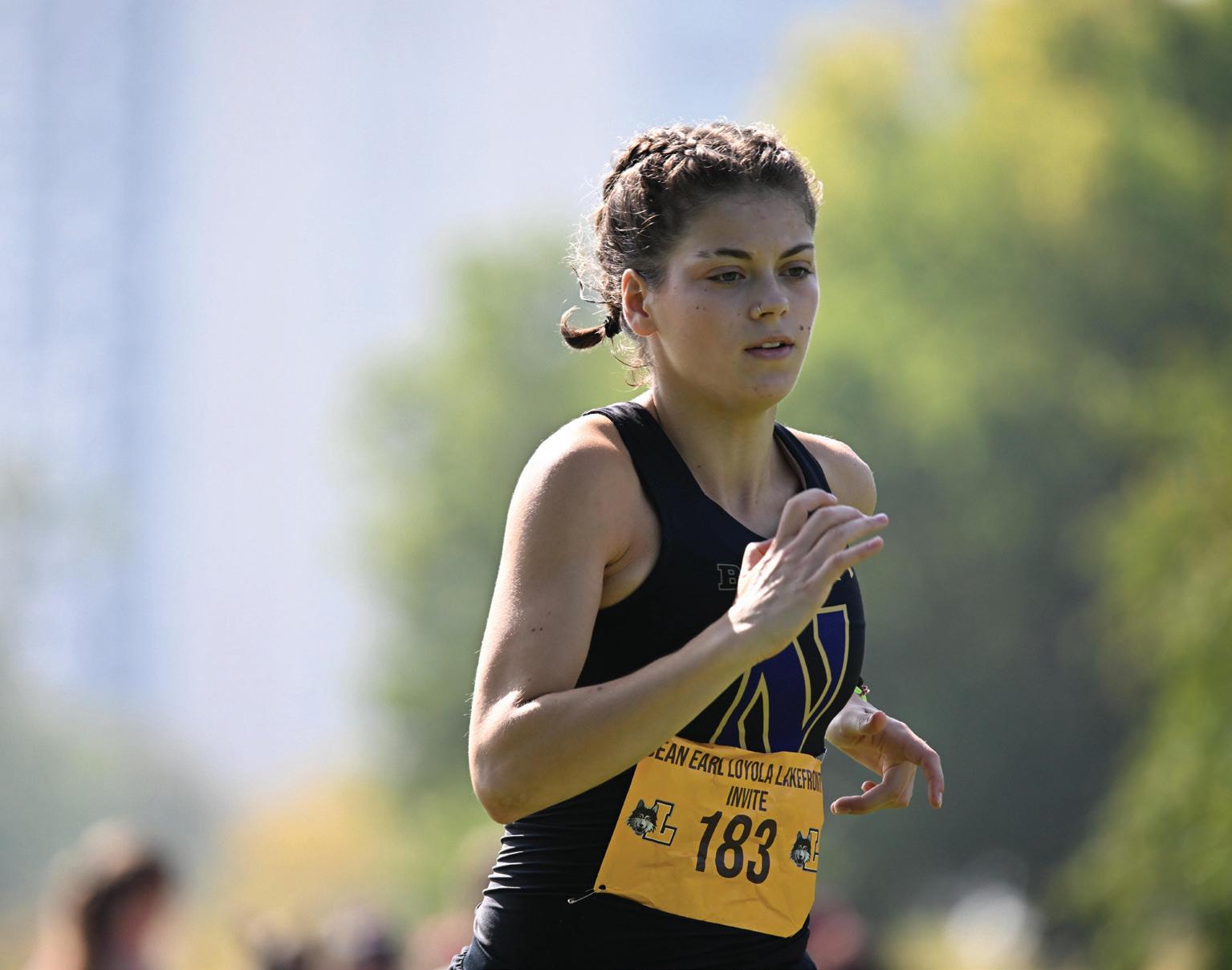
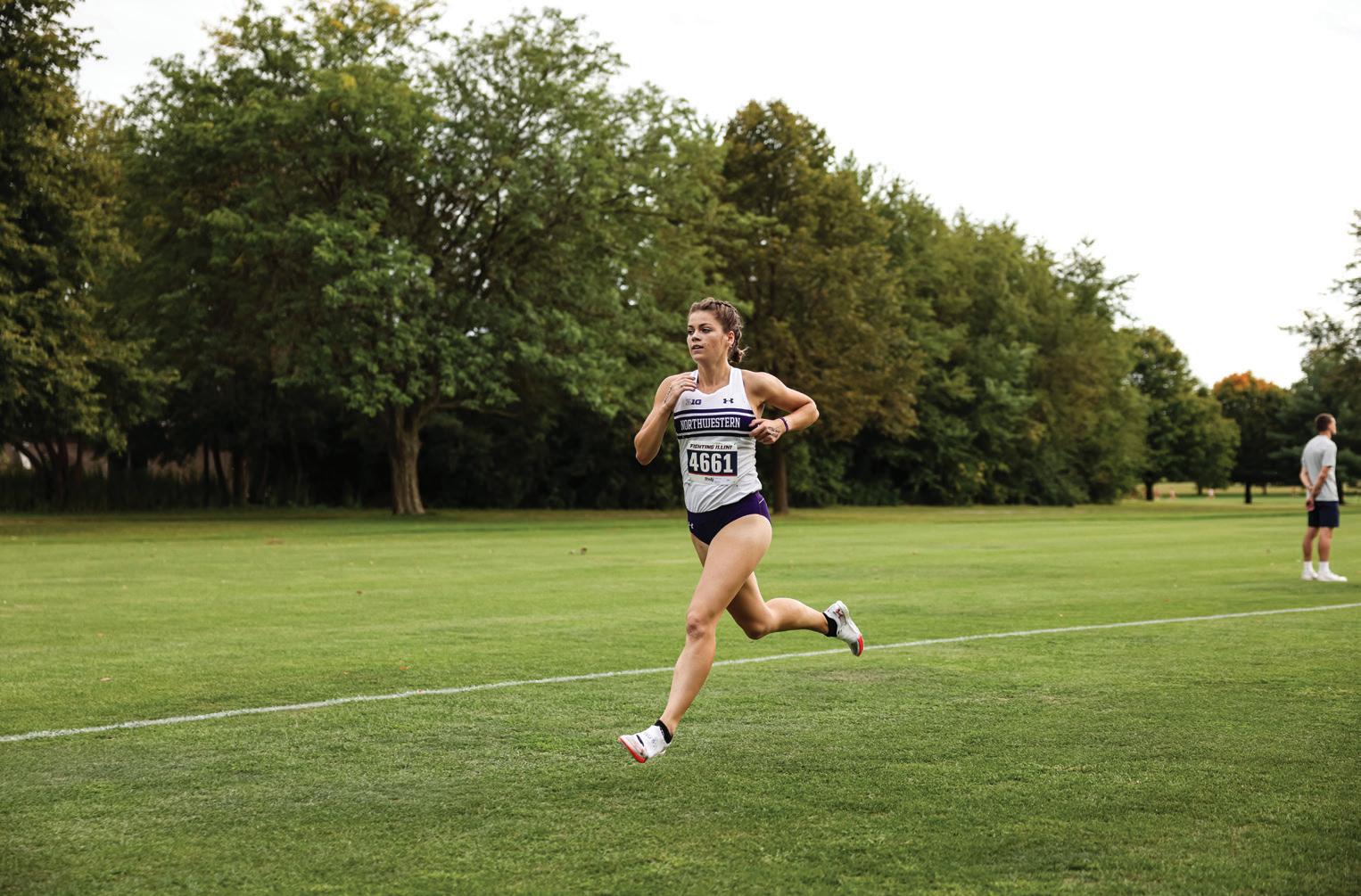
“We didn’t know just how vivacious Ava is until she stepped on campus,” Jill Miller said. “We quickly found out that she just had a personality that could really light up the room and get people very enthused about what we’re doing.”
NU cross country athletes run competitively in all three quarters of the school year. In the fall, the squad runs cross country. The winter and spring seasons are spent competing in indoor and outdoor track respectively.
In the spring of her freshman year, Earl won the 5000-meter race at the Drake Relays, logging her first career victory. Through the first season, Jill Miller saw potential and raw talent that could be molded into stardom.
“She had to learn over that first year and a half to really believe in herself and her abilities, that if she laid down the work and poured herself into the recovery, prioritizing the heavy hitters that we talk about –– sleep, nutrition and stress management –– that she could be really, really great,” Jill Miller said.
As the years have gone by, Earl has become one of the program’s top runners. Jill Miller called her a “true-born leader.” ***
Earl has made two NCAA Championships throughout her career. Her first, the one in her sophomore year, was a top-200 finish in the 6K, as the team punched its first ticket to the NCAA Championships in 20 years. It was also her least favorite.
“We were so excited to make it to the championships that when we got there, we were like, ‘Oh, shoot, we still have to run this,’” Earl said. “And I think that we had collectively used up our energy just getting there.”
The squad finished second to last in the team competition. But it was a step in the right direction, and the ’Cats punched their ticket to the NCAA Championships via Earl’s individual performance in 2023. Earl finished in eighth place at the NCAA Midwest Regionals, enabling her to compete in Charlottesville at collegiate cross country’s highest stage.
This, too, was bittersweet, she said, as her finish in the NCAA Midwest Regionals knocked out her teammate Kalea Bartolotto from individual qualification in Bartolotto’s final year of eligibility.
But Earl beat out every runner on Iowa State’s squad –– the team that earned the Midwest region’s qualifier that year.
“I look back on it really fondly, because I am really proud of myself and how I raced there,” Earl said. “I think it was one of my best races. I had a lot of mixed feelings about it, but, yeah, looking back on it now it’s like, I feel happy.”
This year, the team has soared to new heights. NU topped the USTFCCCA Midwest Region rankings for the first time in program history last month and climbed as high as No. 24 in the national rankings, its highest ever. Jill Miller’s philosophy of setting the bar high has rang true within the program so far this season, with several runners stepping up and delivering throughout meets this season. The team defeated then-No. 19 Wisconsin when it won the Big Ten Preview earlier this year.
“We feel that we want, year after year, to be at the National Championship,” Jill Miller said. “And going into the season, Ava’s goal was to be an All-American –– that’s top 40 at the national
championship, and that’s a big goal. She knows what she needs to do over the next six weeks to get herself there. … I know that she can get herself there by championship season.”
Earl has at least four seasons remaining as a member of NU cross country –– this year’s cross country, indoor track and outdoor track seasons as well as next year’s cross country season. Jill Miller said the squad is looking into seeing if Earl has eligibility for next year’s indoor and outdoor seasons.
Earl currently holds program records in the 800-meter indoor race, 1500-meter outdoor race and 5000-meter outdoor race.
Jill Miller says the growth Earl has displayed since she stepped foot on campus for the first time has been tremendous.
“Ava has shown that you don’t need to come in and be perfect, and you don’t need to come in and know everything and have a boatload of high school performances to say that you can go be great,” Jill Miller said. “She’s shown that if you’re open to learning, if you’re open to being really honest with yourself and your coaching staff, you can grow tremendously within our sport.”
Meanwhile, as the squad mounts its push for another NCAA championship berth, Earl has set lofty goals for herself.
“I would love to be one of the greatest people of my time here,” Earl said. “I want people to beat my records because that means that our program is growing. That means that we set a good foundation. But while I’m here, I want to be one of the best.”
henry ieman2027@u.northwestern.edu