THE Daily
Thursday, September 10, 2026
MISSISSIPPIAN theDMonline.com
Volume 115, No. 3
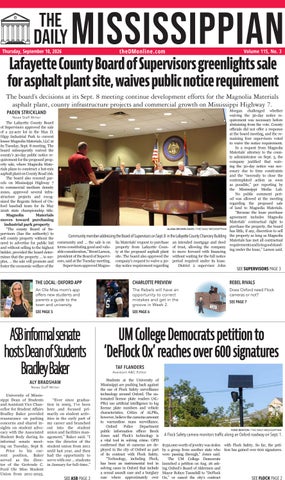
Lafayette County Board of Supervisors greenlights sale for asphalt plant site, waives public notice requirement
The board’s decisions at its Sept. 8 meeting continue development efforts for the Magnolia Materials asphalt plant, county infrastructure projects and commercial growth on Mississippi Highway 7. PADEN STRICKLAND News Staff Writer
The Lafayette County Board of Supervisors approved the sale of a 22-acre lot in the Max D. Hipp Industrial Park to current lessee Magnolia Materials, LLC at its Tuesday, Sept. 8 meeting. The board subsequently waived the county’s 30-day public notice requirement for the proposed property sale, where Magnolia Materials plans to construct a hot-mix asphalt plant on County Road 166. The board also rezoned parcels on Mississippi Highway 7 to commercial medium density zones, approved several infrastructure projects and recognized the Regents School of Oxford baseball team for its May 2026 state championship title. Magnolia Materials moves toward purchasing industrial park property “The county Board of Supervisors (has the authority) to sell county property without the need to advertise for public bid and without selling to the highest bidder, provided the board determines that the property … is surplus, … the sale will promote and foster the economic welfare of the
Morgan challenged whether waiving the 30-day notice requirement was necessary before abstaining from the vote. County officials did not offer a response at the board meeting, and the remaining four supervisors voted to waive the notice requirement. In a request from Magnolia Materials’ attorney to the county administrator on Sept. 3, the company justified that waiving the 30-day notice was necessary due to time constraints and the “necessity to close the contemplated action as soon as possible,” per reporting by the Mississippi Media Lab. No public comment period was allowed at the meeting regarding the proposed sale of land to Magnolia Materials. “Because the lease purchase agreement includes Magnolia Materials’ contractual right to purchase the property, the board ALANA BROWN-DAVIS / THE DAILY MISSISSIPPIAN has little, if any, discretion to sell Community member addressing the Board of Supervisors on Sept. 8 in the Lafayette County Chancery Building the property as long as Magnolia Materials has met all contractual community and … the sale is on lia Materials’ request to purchase an intended mortgage and deed requirements and is in good standterms constituting good and valu- property from Lafayette Coun- of trust, allowing the company ing under the lease,” Larson said. able consideration,” Brent Larson, ty at the proposed asphalt plant to move forward with financing president of the Board of Supervi- site. The board also approved the without waiting for the full notice sors, said at the Tuesday meeting. company’s request to waive a 30- period required under its lease. Supervisors approved Magno- day notice requirement regarding District 2 supervisor John
SEE SUPERVISORS PAGE 3
THE LOCAL: OXFORD APP
CHARLOTTE PREVIEW
REBEL RIVALS
An Ole Miss mom’s app offers new students and parents a guide to the town and university.
The Rebels will have an opportunity to correct mistakes and get in the groove in Week 2.
Does Oxford need Flock cameras or not?
SEE PAGE 5
SEE PAGE 6
ASB informal senate hosts Dean of Students Bradley Baker ALY BRADSHAW News Staff Writer
University of Mississippi Dean of Students and Assistant Vice Chancellor for Student Affairs Bradley Baker provided reassurance on parking concerns and shared insights on student advocacy with the Associated Student Body during its informal senate meeting on Tuesday, Sept 8. Prior to his current position, Baker served as the director of the Gertrude C. Ford Ole Miss Student Union from 2011-2025.
“Ever since graduation in 2005, I’ve been here and focused primarily on student activities in the early part of my career and branched out into the student union and facilities management,” Baker said. “I was the director of the student union from 2011 until last year, and then had the opportunity to serve with our … students in January for full-time.”
SEE ASB PAGE 3
SEE PAGE 7
UM College Democrats petition to ‘DeFlock Ox’ reaches over 600 signatures TAF FLANDERS
Assistant A&C Editor
Students at the University of Mississippi are pushing back against the use of Flock Safety surveillance technology around Oxford. The automated license plate readers (ALPRs) use artificial intelligence to log license plate numbers and vehicle characteristics. Critics of ALPRs, however, believe the cameras amount to warrantless mass surveillance. Oxford Police Department public information officer Breck Jones said Flock’s technology is a vital tool in solving crime. OPD confirmed that 16 cameras are deployed in the city of Oxford as part of its contract with Flock Safety. “Technology, including Flock, has been an instrumental tool in solving cases in Oxford that include a sexual assault case and a burglary case where approximately over
FORD BENTON / THE DAILY MISSISSIPPIAN
A Flock Safety camera monitors traffic along an Oxford roadway on Sept. 1. $150,000 worth of jewelry was stolen with Flock Safety. So far, the petiby a group from another state who tion has gained over 600 signatures. were passing through,” Jones said. The UM College Democrats launched a petition on Aug. 26 asking Oxford’s Board of Aldermen and Mayor Robyn Tannehill to “DeFlock Ox,” or cancel the city’s contract SEE FLOCK PAGE 2
PAGE 2 | THE DAILY MISSISSIPPIAN | 10 SEPTEMBER 2026
FLOCK
continued from page 1 According to Jacob Williams, a senior public policy major and the UM College Democrats public relations chair, the campaign boils down to three main issues with ALPRs: potential for abuse of footage, threats to freedom of speech and mass surveillance by a private corporation. “Given that over (120,000) of these cameras are up around the country, it amounts to mass surveillance by a private corporation,” Williams said. “Every time you pass a (Flock) camera … it collects data on you without your knowledge nor your consent.” ALPR cameras spread through Oxford OPD owns the footage collected by Flock Safety’s cameras, but Flock Safety owns the cameras themselves. The department has paid Flock Safety $2,500 per camera since 2022 to use its hardware and access Flock’s online platform to view footage. ALPR cameras in the Oxford city limits are located on the Square and throughout town. In the county, cameras appear to be stationed at major highway entrances and exits, including on Mississippi Highways 6 and 7. Lafayette County Sheriff Joey East said there are 30 ALPR cameras at approximately 15 locations throughout the county, including along county lines. Some of these cameras are owned by Flock Safety, per reporting by The Oxford Eagle. According to East, the Lafayette County Sheriff’s Department conducts audits to ensure appropriate use of ALPR technology and would terminate and prosecute deputies in the case of misuse. Some private housing complexes, such as Lark Oxford off of
their own cameras to track vehicles entering and exiting their property. A leasing agent at Lark Oxford said the complex’s four Flock cameras were “a source of extra protection in the parking lot” and that Lark Oxford shares its camera footage with OPD. The city of Oxford’s contract with Flock Safety is set to expire in early 2027. Flock reserves the right to “collect, analyze and anonymize” OPD footage and data uploaded to Flock’s platform to improve its own technology, including training AI models. Flock Safety users can choose the agencies with whom they share their data. The Daily Mississippian did not confirm which agencies OPD shares its Flock data with by the time of publication. A bipartisan swath of Americans have grown increasingly concerned about the presence of ALPRs in their communities. NPR reported cases of vandalism against Flock cameras in at least 36 states, as of Aug. 21. Recent polling by Data for Progress, a progressive think tank, reported a net favorability rating towards Flock cameras of -18 among Democrats, -28 among independents and -13 among Republicans, reflecting widespread disapproval. The Cato Institute, a conservative think tank, said opposition against Flock cameras was the “one thing that the right and left seem to agree on.” Mike Cavanaugh, a public policy leadership and economics double major and president of UM College Democrats, said the organization’s petition was just the beginning of its activism. “(The petition) gives us leverage to get in the door with the Board of Aldermen, if we get a substantial amount of petition signatures,” Cavanaugh said.
TAF FLANDERS / THE DAILY MISSISSIPPIAN
He hopes that mobilizing residents will put pressure on Oxford’s Board of Aldermen not to renew the city’s contract with Flock Safety. “We believe in strength in numbers,” Cavanaugh said. “We want to go to these meetings, and we want (the board) to see how passionate the people that live within Oxford and within Lafayette County feel about this issue.” Symphany Grier, who served as treasurer for Ole Miss Turning Point USA for the 2025-26 academic year, said opposition to ALPR cameras unites individuals across party lines. “The issue of Flock cameras is one of the only common sense, nonpartisan issues I can think of in the last two years,” Grier, a senior accountancy major from Godley, Texas, said. “They are a flagrant infringement upon our Fourth Amendment rights and a dangerous step towards a seemingly Orwellian future if our local, state and federal leaders do not implement meaningful regulations as soon as possible.” The Daily Mississippian asked dozens of students at the University of Mississippi for their opinions on ALPR use. The vast majority of students polled were opposed to ALPR use or indifferent. Only one student expressed support for ALPR use and declined to comment further. Usage Concerns Regarding the potential to abuse Flock’s technology, Williams cited recent cases of police officers who have used the technology to stalk their ex-partners. According to a Washington Post investigation, at least 50 law enforcement officers have been accused of or charged with unauthorized use of license plate readers — 46 of them using footage from Flock Safety cameras. Charges and accusations against law enforcement across the U.S. related to ALPR use include personal stalking, unauthorized cross-jurisdiction data sharing and department-wide misuse of footage. Jones said OPD is aware of the potential for misuse. He said OPD has already taken steps to safeguard access to the database of vehicle information. “We wanted to get ahead of that by creating a policy that does not authorize officers to use Flock for personal purposes or for any activity unrelated to legitimate law enforcement duties,” Jones said.
Reported Flock camera sightings in Oxford. Map data courtesy of DeFlock, OpenMapTiles and OpenStreetMap
THE DAILY MISSISSIPPIAN EDITORIAL staff Anderson Road, have deployed RAEGAN SETTLE editor-in-chief
dmeditor@gmail.com
SYDNEY STEPP managing editor
dmmanaging@gmail.com
NATE DONOHUE copy chief
thedmcopy@gmail.com
CAMERON LARKIN digital editor
dmdigitaleditor@gmail. com
TAF FLANDERS assistant arts and culture editor
thedmfeatures@gmail.com
RUSS EDDINS sports editor
thedmsports@gmail.com
REAGAN TAYLOR assistant sports editor
thedmsports@gmail.com
MACKENZIE MCDARIES opinion editor thedmopinion@gmail.com
DYLAN THOMAS university news editor
JACK KIRKLAND photo editor
CHANCE MARLOWE local news editor
DANIEL LAUBHAN assistant photo editor
thedmnews@gmail.com
thedmnews@gmail.com
TAYLOR HILL arts and culture editor
thedmfeatures@gmail.com
thedmphotos@gmail.com
thedmphotos@gmail.com
LAUREN JAMES design editor
thedmdesign@gmail.com
SOPHIE AMEN assistant design editor
thedmdesign@gmail.com
MELANY CARRASCO multimedia coordinator dailymissmedia@gmail. com
CHLOE GRIFFITHS social media manager
thedmsocialmedia@gmail. com
SUZETTE REINDL assistant social media manager
thedmsocialmedia@gmail. com
“Access is restricted to authorized personnel and is subject to audits. When it’s in use, our officers must enter a reason why it’s being used.” Delaney McNear, a senior philosophy major from Wheaton, Ill., said she does not believe OPD’s existing policies go far enough to safeguard the technology from misuse. “With all the cases that have already been documented in the news and everything (about) police officers stalking mostly women, (the officers) put in a reason and they say, ‘Oh, speeding’ or ‘Oh, warrant’ … but obviously (these reasons are) fake,” McNear said. Law enforcement can use information collected by Flock cameras to track vehicle movements, regardless of whether vehicle owners are suspected of a crime, which members of UM College Democrats consider a red flag. Flock Safety, according to its contract with OPD, can “access, use, preserve and/or disclose” the footage it collects to other law enforcement authorities, government officials and third parties to “protect the rights, property or safety of Flock, its users, a third party or the public as required or permitted by law.” Flock Safety does not sell any data collected, according to the contract. Jones said OPD expected Flock to follow the law when it comes to sharing OPD’s footage with third parties. “We expect the appropriate safeguards to be in place and for our vendors to comply with applicable laws and the terms of their agreements with the city (of Oxford),” Jones said. According to OPD’s contract with Flock, the law enforcement agency has 30 days to “view, save and/or transmit” the footage and data before Flock automatically deletes it. Before deletion, the department has the right to use and save the footage without a warrant as long as it falls under “investigative purposes.” Sam Line, a senior public policy leadership and German double major from Hattiesburg, Miss., said he was worried about the opportunities Flock provides to work inside legal loopholes. “There’s kind of a loophole where you just don’t necessarily need a warrant,” Line said. “That concerns me greatly.” In a similar thread, Caitlyn Zuege, a sophomore social work major from Starkville, Miss., said Mississippi’s lack of comprehensive privacy legislation made the presence of Flock cameras around her apartment more distressing. “We don’t have an overarch-
S. Gale denley student media center LARZ ROBERTS Director of Student Media
S
ing privacy law that would give us much protection at all,” Zu- c ege said. “It’s a worry of, if we bring anything to court, there’s typically good chances that it’s going to be dismissed because there’s not enough to prove that anything is being violated.” Jones, however, said OPD took citizens’ concerns seriously and believed that conversations about the technology were important. “Our goal is to make responsible decisions based on the effectiveness of these tools, appropriate oversight, legal requirements, cost and their ability to help us create a safe and connected community,” Jones said. McNear attributed the bipartisan nature of ALPR opposition to America’s core values. “It’s a very core American principle that we should have a right to privacy, and we should have a right to freedom of movement without being scrutinized and without being recorded every step of the way,” McNear said. Backlash against ALPRs is largely concentrated around the Flock Safety company. Students are concerned that directing opposition only toward Flock and not other ALPR companies, like Axon or Motorola Solutions, could slow the momentum of the ALPR opposition movement. “What worries me is … what happens when we get rid of Flock cameras and then Axon steps in and goes, ‘Hey, we’re not Flock,’” Line said. Mass digital surveillance is already prevalent in the U.S. Several law enforcement agencies use Real ID tracking, facial recognition, cellsite simulators and other methods of digital surveillance to work around privacy regulations and oversight. The use of surveillance strategies is already ingrained into law enforcement tactics, so some people do not view license plate and vehicle tracking as a signifiB cant concession of privacy rights. c Students like McNear, a however, argue digital monitoring is not a valid reason to e remain passive on the issue. c “Whenever someone is tella ing you this is for your own A good, you’ve got to really ask yourself: ‘Is this actually for t my own good?’” McNear said. b g s
CONTACT THE NEWS DESK AT thedmnews@gmail.com
FOLLOW US
DENNIS MOORE Editorial Director
THE DM INSTAGRAM @thedailymississippian THE DM SPORTS X @thedm_sports THE DM FACEBOOK @thedailymississippian
i y t t t e l e e
i a s a T r i c p p e
t t w t b T W a d m
SUPERVISORS
continued from page 1 Supervisors voted to obtain two fair market value appraisals for the property subject to the purchase notice. Elliott & Britt Engineering, PA, an engineering company based in North Mississippi, was also hired to prepare a legal description of the property. Once the county obtains two appraisals, it will offer the property for sale to Magnolia Materials based on the determined fair market value. Magnolia Materials will then have the choice to accept the offer or reject the sale and remain under the property lease. These developments represent the latest development in Magnolia Materials’ ongoing battle to construct an asphalt plant in Lafayette County. The board signed a 35-year lease with Magnolia Materials in December 2025 for property in the industrial park. Under the agreement, Magnolia Materials is to pay Lafayette County $5,000 annually for use of the property. The industrial park site was not Magnolia Materials’ original proposed location. Local developer JW McCurdy, owner of Magnolia Materials, initially sought to construct the plant on Mississippi Highway 328 near Taylor, Miss., but withdrew the rezoning application in October 2025 following opposition from nearby residents. McCurdy then moved his plans for the plant to the Max D. Hipp Industrial Park.
ASB
continued from page 1
Parking and construction The senators prompted Baker to address students’ concerns regarding parking and transportation on campus. “Many of our constituents are concerned about the current parking situation as senators,” Trey McKean, ASB Vice President, said. Baker responded to this question and others by referencing these struggles as part of the university’s growing process. “Parking is also challenging at any other institution you go to,” Baker said. “I think that we’ve done great things at responding to the traffic and parking challenges when it comes to the evolution of our parking garages or expanding outside the exterior parts of campus.” Construction surrounding the Tad Smith Coliseum and Kincannon Hall sites resulted in a combined loss of about 305 parking spaces. The university is also currently building a new parking garage in the northwest corner of the Oxford campus, which would hold 1,379 parking spaces and is expected to open in spring 2027. he dormitory being built on the Kincannon site is expected to be finished in August 2027, while the dorm being built on the West Row is expected to be completed in August 2028. The construction project on West Row includes not only a dormitory, but also a new dining facility and approximately 1,500 parking spots. “Any time that we have
Opposition continued following the relocation. In May, supervisors voted 3-1 against a request from residents to rezone portions of the industrial park from I-2 heavy industrial to I-1 light industrial. The change would have prevented the proposed plant from operating at the site without obtaining a conditional use permit. Residents opposing the plant subsequently appealed the board’s decision to the Lafayette County Circuit Court. Highway 7 property approved for commercial zoning Supervisors also approved a request from Alex Crossroads Properties, LLC to rezone two parcels in the 490 block of Mississippi Highway 7 South, north of Cross Creek Drive, to C-2 commercial medium density zones. The properties were previously rezoned R-1 residential low density — an area with residential single-family homes with an average of 0.4 to 1.2 homes per acre. A C-2 commercial medium density zone is meant to accommodate community commercial businesses, such as retail centers or restaurants. The decision followed a public hearing during which residents of the nearby Cross Creek neighborhood raised concerns about future development of the property, including additional traffic, construction and the negative effects that commercial development could have on surrounding homes. Cross Creek residents questioned how additional commer-
THE DAILY MISSISSIPPIAN | 10 SEPTEMBER 2026 | PAGE 3
ALANA BROWN-DAVIS / THE DAILY MISSISSIPPIAN
The Regents School of Oxford baseball team is recognized as the MAIS Class 2A Division 1 State Champions at the board meeting on Sept. 8. cial development could affect an area already experiencing traffic concerns. Residents asked for the impact of development on families living nearby to be considered as the property is developed. Tyler Gorum, speaking on behalf of the property owner, discussed plans for retail development and indicated that a future development would undergo site plan review. The board ultimately approved the rezoning request. District 4 Supervisor Scott Allen cast the lone dissenting vote. Roads and further approvals Supervisors approved a supplemental agreement for addi-
tional maintenance-of-traffic costs associated with the closure of the intersection of County Roads 166 and 101, where a roundabout is being constructed. The State Aid Road Construction program approved the supplemental agreement. The board also authorized the advertisement of bids for a bridge replacement project on County Road 436, acknowledged a $93,936.29 law enforcement officer grant awarded to the Lafayette County Sheriff’s Department for equipment purchases and approved final site plans for a warehouse addition at Fat Possum Records and the Eagle Tee
LLC-Yocona Station Golf Club. Regents Lions recognized for state championship The board adopted a resolution recognizing the Regents Lions as the 2026 MAIS Class 2A Division I baseball state champions. Regents finished its season 24-7 overall and was undefeated in district play with a 9-0 record. The championship marked the first state baseball title in school history.
CONTACT THE NEWS DESK AT thedmnews@gmail.com
growth, we’re going to have challenges,” Baker said. “That’s on campus, that’s in the city of Oxford, that’s in Lafayette County, and (everyone should understand) that … it takes a little bit of patience.” Baker pointed out that students should not think of certain parking spaces as being their own. “You’re not going to get that spot every day,” Baker said. He acknowledged the difficulties students face finding parking but emphasized that the bus system provides “quick and easy transportation.” Baker said the university Department of Parking and Transportation is open to suggestions on how to improve the system. “These challenges that students are facing come as the university has multiple construction projects underway,” Baker said. “We have ($1.3 billion) in infrastructure projects going on right now.” Policy and student engagement Baker also discussed how he does his best to turn students’ ideas into policies because he wants to accommodate student priorities. “The mentality that I have (is), ‘How do we get to the yes?’” Baker said. “At the end of the day, if it’s a no, it’s a no, but we want to get to the yes as best we can because it’s the things that the students want.” Baker told the senate that he has an open-door policy for all university students. “I am not saying I want to set up a meeting with all of you guys, but my door is always open,” Baker said. Baker elaborated on some of the support he could provide to the students.
REESE JOHNSON / THE DAILY MISSISSIPPIAN
Dean of Students Bradley Baker and ASB Vice President Trey McKean speak at ASB informal senate on Sept. 8. in the Gertrude C. Ford Ole Miss Student Union. “While I may not have every answer, I can at least point you in the right direction or provide you some advice for it,” Baker said. “It takes feedback from students for us to make decisions that may differ from what (the students) had in the past.” Baker shared advice on ways that the ASB Senate could advocate for students and registered student organizations. “ASB Senate is normally focused on projects and legislation,” Ben Bailey, the executive assistant, said. “What are appropriate ways for senators to advocate for individual students and RSOs to do different forms of service?” Baker answered that the
ASB Senate can effectively act as an advocate for students by working as a collective when presenting issues to administration. “It is important for (ASB Senate) to go to the RSOs as a collective group of students, not as the XYZ organization,” Baker said. “It takes feedback from students for (administration to) make decisions that may differ from … the past.” Ole Miss vs. LSU football game Baker acknowledged the importance of Ole Miss Football’s home game against LSU on Sept. 19. He also emphasized the university’s expectations for students and visitors to show respect
and a welcoming attitude to fans from both teams. Students should be welcoming to visitors at every game this season, Baker said, not just the game against LSU. “Hospitality is particularly important in the Grove,” Baker said.
CONTACT THE NEWS DESK AT thedmnews@gmail.com
PAGE 4 | THE DAILY MISSISSIPPIAN | 10 SEPTEMBER 2026
LOCATED SQUARE on the
916 E JACKSON AVE OXFORD, MS 38655 (662) 638-3580
24/7 Access | 10+ workouts RESULTS & BENEFITS Muscle Recovery Reduces Cellulite Stress Reduction Pain Relief Increased Calorie Burn Detoxification Lower Blood Pressure Anti-Aging & Skin Rejuvenation Improved Circulation Weight Loss
SCAN CODE FOR FREE WORKOUT
THE DAILY MISSISSIPPIAN | 10 SEPTEMBER 2026 | PAGE 5
Meet the artists behind Ole Miss sorority banners P.B. JERNIGAN A&C Staff Writer
Whether it’s a game day, holiday or time for a philanthropy event, a University of Mississippi sorority likely has a banner for it, painted by its very own members. Making the 12-foot banners that hang on the porches of sorority houses has been a standard practice among Panhellenic sororities for decades to commemorate a variety of occasions, such as sporting events, recruitment or organizational programming. Hanging the artwork from their houses offers sororities a unique way to distinguish themselves on campus through creative expression. Most banners made for sorority houses are designed and painted by the sorority’s banner chair(s), offering an authentic decoration made with teamwork and sisterhood. Meredith McClain, a junior dietetics and nutrition major from Jackson, Miss., is one of Chi Omega’s five banner chairs. McClain said her position has given her an opportunity to be both creative and involved in her sorority. “When I got to college, I knew I wasn’t majoring in art, so when Chi Omega was telling us all the
different ways to get involved, banner chair stuck out to me,” McClain said. “It’s calming for me to take a break and go paint whatever banner we’re working on.” Kappa Kappa Gamma’s co-banner chair, Lucy Allen, a junior entrepreneurship major from Jackson, Miss., expressed a similar perspective on her position. “I knew since before going through (sorority) recruitment that I wanted to paint banners,” Allen said. “There is nothing I love more than painting, and it seemed like a perfect way to stay active creatively while also helping me get involved in my sorority.” These banners are especially popular during the football season. These banners often feature cultural symbols at the university, like the Walk of Champions or Double Decker buses. Mary Emma Honeycutt, a junior elementary education major from Meridian, Miss., serves as co-banner chair for Delta Gamma. She spoke about the popularity of football banners. “I love that banners have become a kind of attraction during football season with everyone walking by and taking pictures with family and friends,” Honeycutt said.
Countless trips to Home Depot and an endless supply of paint primer are essential to the banner-making process. Since the banners are hand-painted — and can be up to 9 feet by 12 feet — the actual process of designing banners requires a lot of time. Designing and planning usually begins a month in advance, depending on the details required. Honeycutt spoke about the time it takes for her team to complete a banner. “It is definitely a labor of love,” Honeycutt said. “It typically takes us 20+ hours to finish each banner.” Many sororities begin working on banners in the summer to prepare for the three weeks of recruitment. McClain, who began working in July, said bid day is her favorite time of year for banners and that she enjoys seeing everyone’s hard work pay off. “My favorite is definitely bid day,” McClain said. “It’s really fun to drive around that morning and see what each sorority’s bid day theme is.” Additionally, throughout the year, sororities will design banners to promote fundraising events for their own chapters and for other organizations.
PHOTO COURTESY: MEREDITH MCCLAIN
Eliza Hollingsworth, Maggie Mae Waddle, Alex Williams and Hallie Ingram paint a banner at the Chi Omega house. Notable charitable events with involvement from multiple Greek chapters with banner competitions include the Court Appointed Special Advocate’s CASA Encore competition, Sigma Chi’s Derby Days and Sigma Alpha Epsilon’s Paddy Murphy week. “Last semester, we won the banner competition for (Sigma Alpha Epsilon’s) Paddy Murphy
week. This semester, we will be entering the CASA (Encore) banner competition,” Honeycutt said. “(Banners) help raise awareness for our philanthropic events, as well as other Greek events that raise money for amazing causes.”
CONTACT THE A&C DESK AT thedmfeatures@gmail.com
UM parent develops app for Oxford newcomers
BRIDGET MCGUIRE A&C Staff Writer
Moving to a new city for college requires finding new businesses and services to meet daily needs. For Ole Miss parent Chlee Lisi, the solution for her daughters was compiling all this information together in a mobile app called The Local: Oxford. Lisi is the mother of Ava Cathryn Henderson, a junior marketing student, and Elisabeth Kate Henderson, a high school senior from Meridian, Miss. She wanted an easy, accessible place for her daughters to find lunch spots, deals on dorm supplies, upcoming events and more. Lisi launched The Local: Oxford app in November 2025 to answer many of the questions she saw circulating in various parent Facebook groups. “I wanted to create one place where students and parents could quickly find reliable local information without having to search across multiple websites and
social media pages,” Lisi said. As a first-time Ole Miss parent, Lisi understood the struggles of assisting her child from afar. She said the app initially began as a simple local business directory. “As I spent more time talking with students and parents, it became clear they needed much more than that,” Lisi said. After researching how much it would cost her to hire an app developer, Lisi decided to give it a try herself. “I don’t have a background in app development at all,” Lisi said, “I got to work researching app development programs and finally found one that was able to provide most of the features I needed.” For the next year, Lisi would work on the app in her spare time and gathered suggestions from her children and their friends on features to include. Lisi said one of the hardest parts was actually getting the app approved. “I think we were rejected close to 10 times,” Lisi said. “Apple has very strict rules.”
The app’s features include the ever-evolving confusion that dorm and move-in resources, a comes with a student’s first year at “Life 101” blog containing college the university was an easy decision. tips and life advice, restaurant “The college years go by fast, recommendations, contact in- and Oxford has so much to offormation for local vendors and fer beyond campus,” Lisi said. professionals and Greek life re- “Being an Ole Miss parent has cruitment information. It even contains a freshman directory where new students can connect with other incoming freshmen. “The response has been incredibly encouraging,” Lisi said. “We’ve received great feedback from both students and parents, and many of our newest features have come directly from user suggestions.” Lisi said she is currently devel35- Hurler Hershiser 36- Summer quaff oping an offshoot of the app, The ACROSS 1- Czech, e.g. 37- Bailiwicks 5- Let’s just leave ___ Local: Starkville, and has the long- that 38- Jurist Fortas 39- Adopted son of 9- Reverberate term goal of expanding into addi- 13- Assistant, particularly Claudius 41- Shaving mishap to heads of state tional campuses across the SEC. 14- Deep sleeps 42- ___ Dame 44- Archaeological 16Earth’s satellite The Local: Oxford is free to object 17- Den 46- Sleeping disorder download. Full access to stu- 18- Diary bit 47- In ___ land 19- Marrow host 48- Dreadful dent guides and exclusive con- 20- Member of a largely 49- Underground Eastern people electric railroad tent, such as discounts or pro- Middle 21- Ques. response 52- Not neg. Soggy motions from participating 2253- Doll’s cry 24- Competitive 57- Palmist’s words local businesses, is available via advantage 58- Stable compartment 26- The closest one to us 60- Opaque gemstone sun a $1 per month membership. is27-theSlender 61- 1994 Jodie Foster boat film For Lisi, creating a solution to 29- Electrify 62- Conical native
SUDOKU© Puzzles by KrazyDad
HOW TO PLAY Complete the grid so that every row, column and 3x3 box contains the numbers 1 through 9 with no repeats.
DIFFICULTY LEVEL
EASY
33- Pale purple 34- K-6
American tent 63- Fury
given me a unique perspective on the questions, concerns and excitement that come with sending a student to college.”
CONTACT THE A&C DESK AT thedmfeatures@gmail.com
64- Like some history 65- Church service 66- A Great Lake
DOWN
1- Room in a casa 2- Untrustworthy one 3- 1998 Sarah McLachlan hit 4- Vervain 5- Glacial period 6- Heavy metric weight 7- Tsp. and tbsp. 8- Paving material 9- Restriction on commerce 10- Prepare food 11- Fine-tune 12- Like a line, briefly 15- Methods 23- Paddle 25- Dwarf with glasses 26- Move stealthily 27- Apple juice 28- Tip off
29- Vote in 30- Hopping mad 31- Horselike African mammal 32- Robert ___ 33- Actress Turner 34- “All My Children” vixen 37- Shrink 40- Drilling result 42- “Car Talk” airer 43- Another 45- JFK watchdog 46- Bridal paths 48- Bob and Elizabeth 49- Prefix with Tibetan 50- Computer owner 51- Actor Lugosi 52- Daddy 54- On ___ with 55- Biblical gift bearers 56- “Hard ___!” (sailor’s yell) 59- President pro ___;
PAGE 6 | THE DAILY MISSISSIPPIAN | 10 SEPTEMBER 2026
Ole Miss Football hosts Charlotte 49ers for first home game of 2026 REAGAN TAYLOR
Assistant Sports Editor
The No. 9 Ole Miss Rebels will host the Charlotte 49ers at Vaught-Hemingway Stadium on Saturday, Sept. 12. This meeting will mark the first time in history that the two programs will compete, and each team comes with much to prove after their Week 1 performances. The 49ers were upset by The Citadel in a triple overtime battle, 43-41. Though Charlotte may not be the most daunting opponent for Ole Miss, the 49ers certainly have attributes that cannot be overlooked. Charlotte’s offense put up good numbers against The Citadel. Quarterback Cole Gonzales threw for 332 yards and three touchdowns, and the 49ers put up 538 total offensive yards. Running back Khamani Alexander charted 138 yards on 14 carries. Wide receiver Jaylen Hampton accounted for 177 yards and two touchdowns on eight catches. The Rebel defense must find a way to tame efficient and multifaceted offenses. The Ole Miss defense did not have the strongest showing against the
Louisville Cardinals. The Rebels struggled to stop the run and had lots of broken coverages; they also gave up numerous big plays in critical moments, including 12 explosive plays (20+ yards) in the whole game. Even though the Rebels were down two defensive backs in Sharif Denson and Antonio Kite, the defense must still make things happen, especially in the secondary. Cornerback Jaylon Braxton took several poor angles on big gains and missed an opportunity to break up a 2-point conversion late in the third quarter. Safety Anthony Robinson III allowed a major touchdown in the third quarter that tied the game at 24. In the fourth quarter, Robinson gave up another touchdown which put the Cardinals within one score of the Rebels, 38-31. Additionally, the Rebel defense must find ways to get off the field. The 49ers converted on 64.7% of third downs in Week 1. The defense was spotty against the Cardinals. The defense lapsed in the third quarter, allowing 18 points in 15 minutes. Playing complete defense and having everything
click at the same time will be crucial for getting right for the remainder of the season. On the other side of the ball, the Charlotte defense is the 49ers’ biggest weakness. Against The Citadel, the unit gave up 268 rushing yards and missed several tackles. For the Ole Miss offense, running back Kewan Lacy suffered a minor leg injury in the first half against Louisville and did not return to the game after halftime. Lacy could be used sparingly, if at all, against Charlotte. Despite Lacy’s injury and potentially reduced playing time this week, the Rebel backfield should not have trouble putting up yards against the 49ers. Makhi Frazier and JT Lindsey stepped up in the backfield against Louisville, providing much-needed depth. Frazier rushed for 27 yards on seven carries, and Lindsey rushed for 25 yards on seven carries. Frazier’s strength in physical downfield running, and Lindsey’s speed show lots of upside against the 49ers’ struggling defense. The Charlotte defense also struggles against the pass and gives up many explosive plays.
The 49ers surrendered 14.67 yards per completion against The Citadel. While The Citadel only had nine completions, the offense totaled 132 passing yards. The Rebel offense will look to exploit this weakness. Even though the Ole Miss receiver room still has questions surrounding its depth, there are several playmakers with potential to step up. Deuce Alexander scored twice on 62-yard receiving touchdowns against Louisville, earning the honor of SEC Co-Offensive Player of the Week. Horatio
Fields caught five passes for 47 yards on seven targets. Traylon Ray also caught two passes on two targets and totaled 30 yards. Quarterback Trinidad Chambliss has a prime opportunity to put up large numbers and bring back the explosiveness that was partially missing in Week 1.
g n m T CONTACT THE SPORTS DESK AT i thedmsports@gmail.com e t
y h c e m a d o
s v a DANIEL LAUBHAN / THE DAILY MISSISSIPPIAN
Kam Franklin celebrates during the game against Louisville in Nissan Stadium on Sept. 6.
FAQ: What to know about student tickets
REESE JOHNSON / THE DAILY MISSISSIPPIAN
Students celebrate during the game against Florida in Vaught-Hemingway Stadium on Nov. 15, 2025.
RUSS EDDINS Sports Editor
With Ole Miss Football’s rise in popularity in recent years, purchasing student season tickets can be difficult. Here are answers to common questions surrounding student football tickets, plus new concession options available to football fans this season. How does Ole Miss sell student tickets? Ole Miss Athletics sold student section season tickets for $175, plus a $75 donation just before classes began. Ole Miss Athletics sent an email to students informing them of in-
structions, purchase dates and listings on social media such as times to secure season tickets. Instagram or Snapchat. This is a dangerous method that should A student’s time slot to buy be avoided. It is easy to get the ticket was based on classi- scammed out of money or tickets fication in Experience. Seniors when selling on social media. For and graduate students got top example, a student could pay an priority, juniors were next, soph- individual for a ticket electroniomores were third and fresh- cally and never receive the ticket. men were last. Student season tickets from athletics are now Ole Miss is partnered with sold out, and students still look- SeatGeek, a secondary ticket ing for tickets will need to buy platform, meaning individuals them off secondary markets. who buy tickets from Ole Miss Athletics can resell them on the How do I safely buy from site. Buying from SeatGeek is secondary sellers? much safer than relying on social media because, with SeatIf students were unable to Geek’s ticket protection, any conget season tickets, a common firmed purchase is guaranteed. practice is to buy tickets from
Ole Miss is also partnered with Will selling tickets imsecondary ticket platform Seat- pact my ability to buy tickets Stock, as announced in a Sept. 9 in later seasons? email. SeatStock functions similarly to SeatGeek, but is limited to Yes, Ole Miss Athletics prostudent section tickets, as a stu- hibits season ticket purchases dent email address is required. to those “with no intent to use the tickets or with the primary Tickets for Saturday’s game intent of reselling the tickets fort against Charlotte are as low as profit.” Athletics will mark stu-c $37, as of publication. The site dents who transfer tickets fors also offers tickets for away games. five or more games as broker ora reseller accounts, and those in-a How do I access my dividuals risk losing the abilityh ticket? to purchase season student tick-g ets for any future season. Stu-v All tickets bought from ath- dents can appeal the decision. t letics are sent from OleMisstix@olemiss.edu. Students can What else should I know?s add tickets from their emails to their Apple or Google Pay walStudents cannot leaveC lets. After that, all a student will and come back into the stu-M need to do for admission is open dent section. Staying the en-d his or her digital wallet, select tire game is a great way toe the proper ticket and present show support for the Rebels. it at the student entrance to Vaught-Hemingway Stadium. Any ticket with a barcode will not be accepted. All student How do I sell my tickets? tickets are near-field communication, which is contactless SeatStock and SeatGeek communication that makes enare the best ways to sell tickets. try into the stadium smoother. To do so, a student must create an account, list the ticket For the first time students can and will then receive the pay- buy concessions using Flex or ment 5-8 days after the event. Ole Miss Express from the GET app. All they have to do is place To transfer a ticket, a stu- an order on GET, select one of dent will have to enter the stu- three stands — N4, N6 or N10 — dent email of the individual and pick up their food or drinks. meant to receive the ticket on O the Ole Miss Athletics website. C Then, the transferee will receive b an email to accept the transfer. t CONTACT THE SPORTS DESK AT r thedmsports@gmail.com
THE DAILY MISSISSIPPIAN | 10 SEPTEMBER 2026 | PAGE 7
Flock cameras are not the problem The argument for Flock cameras can be impressively simple: They help solve crimes. PEGAH VASIGHI-ANSARIFAR Opinion Staff Writer
To be frank, artificial intelligence is concerning. Tech companies are ushering in a new era that many do not know how to accept. The University of Mississippi, in light of academic concerns, is even ushering in new AI policies to keep students’ usage in check. AI has infiltrated Oxford beyond college students’ essays, however. License plate readers, commonly known as Flock cameras for being popularized by manufacturer Flock Safety, are automated roadside surveillance devices that capture information on vehicles that pass by them. While I do not personally support or understand the devotion many have to the cameras, I can understand why many stand in strong defense. For local law enforcement agencies, Flock cameras are a great way to protect municipalities without overextending resources. Law enforcement agencies in Oxford and Lafayette County
use the controversial devices to “[help] officers locate vehicles and gather information in cases ranging from burglaries to domestic violence and missing persons,” per reporting by The Oxford Eagle. Oxford Police Chief Jeff McCutchen said the establishment of Flock cameras, dating back to 2022, has accurately assisted the department in numerous sexual assault and mental health cases in Oxford and Lafayette County. The Oxford Police Department is not the only police force to speak highly of the hardware. Authorities across the country openly utilize the devices. The argument for Flock cameras can be impressively simple: they help solve crimes. Departments like Oxford’s own rely on the cameras to make necessary arrests and keep communities safe. For law enforcement, Flock cameras are not a net negative. They are a lot like the surveillance cameras seen on doorbells, street corners and gas stations; the major difference is the people who have access to the devices’ data. Wall Street Journal opinion
columnist Emma Camp published a strong defense for why Flock cameras should remain on streets. Camp argued Flock cameras are not “fundamentally different” from current surveillance cameras or automatic license plate readers (ALPR); in fact, there is the added benefit of its national database. However, Camp does acknowledge the very real concern of who uses the cameras and for what purpose they are used. It is not the tool itself that poses a threat but, instead, the people who are allowed access to the information. However, in general, Flock cameras do possess the ability to reduce crime and can make the justice system fairer. In July 2026, Flock cameras spotlighted the cars and individuals involved with drug seizures in Tennessee, Ohio and Kentucky. Arrests rose and motor vehicle thefts decreased. Flock cameras can be used for good. With a lack of strong regulations in place, moral ALPR use is up to the discretion of each officer who swore to serve and protect his or her community.
MACKENZIE MCDARIES / THE DAILY MISSISSIPPIAN
Pegah Vasighi-AnsarThe cameras have the potential to be dangerous, but we must be ifar is a sophomore public quicker to criticize the individu- health and Southern studies als abusing the technology rather than the cameras themselves. CONTACT THE OPINION DESK AT thedmopinion@gmail.com
What the Flock? No more spying for ‘safety’ I believe officers should have access to every tool available to protect communities. However, Americans should not have to sacrifice privacy simply because technology makes surveillance easier. RILEY ALTIERE
Opinion Staff Writer
How many cameras do you think you pass on your way to class? There are cameras on the sides of buildings, in hallways, above cash registers — but there are also the cameras you may have never noticed, quietly photographing and documenting your vehicle as you drive down the road. If you live in Oxford, there may be more roadside cameras than you think. Many Oxford and Lafayette County residents, University of Mississippi students included, do not know that these cameras exist, how many there are local-
ly or who has access to the vehicle information they collect. That should concern all of us. Flock cameras are artificial-intelligence-automated license plate readers that photograph every passing vehicle and log information such as license plates, car descriptions, the place and time that vehicles are observed. The Flock Safety company markets the cameras as a tool to assist in solving crimes. However, the large network of cameras creates a searchable record of where ordinary civilians have visited in the past 30 days.The line between public safety and surveillance has begun to blur. I am not opposed to govern-
MACKENZIE MCDARIES / THE DAILY MISSISSIPPIAN
ment or law enforcement, and I am not against using technology to solve crimes. In fact, I believe police officers should have access to every tool available to help protect communities. However, Americans should not have to sacrifice privacy simply because technology makes surveillance easier. My argument regarding the cameras is simple: Government power should have its limits. The Fourth Amendment protects Americans from unreasonable searches and seizures without warrant. While the Bill of Rights was written long before AI and automated surveillance, its principles remain the same. Neither the government nor privately owned corporations should have unlimited access to regular civilians’ information. Flock cameras photograph every person that drives past, not just criminals. This means an innocent person heading to class, visiting family or even getting gas can have his or her vehicle monitored. As more cameras are installed, photos from several connected cameras map movements and daily routines. While the cameras themselves are not immediately harmful, the people that are responsible for handling these systems are not
immune from abusing power. In Savannah, Ga., four former police officers were recently arrested and fired after allegedly misusing Flock data to track family members and acquaintances for personal reasons. National reporting has also documented law enforcement officials allegedly using the license plate readers to track former and current romantic partners. This concern is not just hypothetical. If an officer can use a public surveillance system to find out where someone is or where they have been, the possibility of systematic abuse is sickeningly large. As we have all learned, technology — especially AI — can be wrong. License plates can be misread, and vehicle descriptions can be confused. The Institute for Justice has documented dozens of cases in which innocent people were wrongfully stopped, accused and detained for crimes they did not commit simply because of license plate reader errors. Computers should never replace human judgment, suspicion or due process. Flock cameras do have the power to help solve crimes, and that benefit matters. Still, useful technology can be dangerous. My question is not whether Flock cameras can catch
criminals, save civilians or stop crimes, but whether stopping criminals requires the creation of a system that records the movements of everyone. Americans should not have to choose between safety and liberty. We should demand both. Municipalities should regulate how Flock cameras are used and hold the people with access to their data accountable. Access should be limited to legitimate law enforcement purposes, searches should be logged and audited routinely and officers who misuse the system should face meaningful consequences. Public outreach and communication is vital to educate the public on what policies are in place to prevent misuse and how such policies are enforced. Before we allow local governments to install more license plate readers, we should be asking ourselves and our leaders one simple question: Who is watching the watchers? Riley Altiere is a sophomore journalism major from Alpharetta, Ga.
CONTACT THE OPINION DESK AT thedmopinion@gmail.com
Opinion Policies: Columns do not represent the views of The University of Mississippi or The Daily Mississippian. The Daily Mississippian welcomes letters to the editor, which should be emailed to thedmopinion@gmail.com. Letters should be no longer than 300 words. They may be edited for clarity, brevity and libel. Third-party letters and those with pseudonyms or no name will not be published. Letters are limited to one per individual per month. Letters should include contact information, including relationship to the university, if applicable.
PAGE 8 | THE DAILY MISSISSIPIAN | 10 SEPTEMBER 2026