THE Daily
Thursday, October 8, 2026
MISSISSIPPIAN theDMonline.com
Volume 115, No. 7
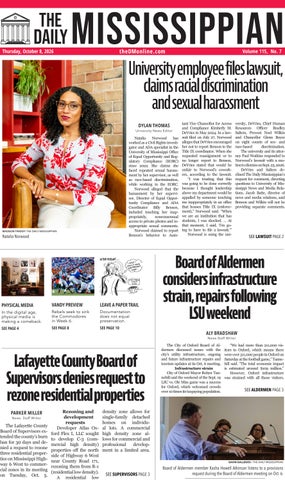
University employee files lawsuit, claims racial discrimination and sexual harassment DYLAN THOMAS
University News Editor
Natalia Norwood has worked as a Civil Rights investigator and ADA specialist in the University of Mississippi Office of Equal Opportunity and Regulatory Compliance (EORC) since 2022. She claims she faced repeated sexual harassment by her supervisor, as well as race-based discrimination, while working in the EORC. Norwood alleged that the harassment by her supervisor, Director of Equal Opportunity Compliance and ADA Coordinator Billy Benson, included touching her inappropriately, nonconsensual access to private photos and inappropriate sexual comments. Norwood claimed to report Benson’s behavior to Assis-
MADISON TWIDDY/ THE DAILY MISSISSIPPIAN
Natalia Norwood
PHYSICAL MEDIA
VANDY PREVIEW
LEAVE A PAPER TRAIL
In the digital age, physical media is making a comeback.
Rebels seek to sink the Commodores in Week 6.
Documentation does not equal preservation.
SEE PAGE 4
SEE PAGE 8
SEE PAGE 10
tant Vice Chancellor for Access and Compliance Kimberly M. DeVries in May 2024. In a lawsuit filed on July 27, Norwood alleges that DeVries encouraged her not to report Benson to the Title IX coordinator. When she requested reassignment or to no longer report to Benson, DeVries stated that would be unfair to Norwood’s coworkers, according to the lawsuit. “I was trusting that this was going to be done correctly because I thought leadership above my department would be appalled by someone touching me inappropriately in an office that houses Title IX (enforcement),” Norwood said. “When we are an institution that has students, I was shocked. … At that moment, I said, ‘I’m going to have to file a lawsuit.’” Norwood is suing the uni-
versity, DeVries, Chief Human Resources Officer Bradley Salters, Provost Noel Wilkin and Chancellor Glenn Boyce on eight counts of sex- and race-based discrimination. The university and its attorney Paul Watkins responded to Norwood’s lawsuit with a motion to dismiss on Sept. 25, 2026. DeVries and Salters declined The Daily Mississippian’s request for comment, directing questions to University of Mississippi News and Media Relations. Jacob Batte, director of news and media relations, said Benson and Wilkin will not be providing separate comments.
SEE LAWSUIT PAGE 2
Board of Aldermen considers infrastructure strain, repairs following LSU weekend ALY BRADSHAW News Staff Writer
Lafayette County Board of Supervisors denies request to rezone residential properties PARKER MILLER News Staff Writer
The Lafayette County Board of Supervisors extended the county’s burn ban for 30 days and denied a request to rezone three residential properties on Mississippi Highway 6 West to commercial zones in its meeting on Tuesday, Oct. 5.
Rezoning and development requests Developer Atlas Oxford Flex I, LLC sought to develop C-3 (commercial high density) properties off the north side of Highway 6 West near County Road 171, rezoning them from R-1 (residential low density). A residential low
The City of Oxford Board of Aldermen discussed issues with the city’s utility infrastructure, ongoing and future infrastructure repairs and tourism updates at its Oct. 6 meeting. Infrastructure strain City of Oxford Mayor Robyn Tannehill said the weekend of the Sept. 19 LSU vs. Ole Miss game was a success for Oxford, which welcomed crowds over 10 times its taxpaying population.
“We had more than 211,000 visitors to Oxford, which means there were over 311,000 people in Oxford on Saturday at the football game,” Tannehill said. “The total economic impact is estimated around $109 million.” However, Oxford infrastructure was strained with all those visitors.
SEE ALDERMEN PAGE 3
density zone allows for single-family detached homes on individual lots. A commercial high density zone allows for commercial and professional development in a limited area. GAVIN GALLEGOS / THE DAILY MISSISSIPPIAN
SEE SUPERVISORS PAGE 3
Board of Aldermen member Kasha Howell Atkinson listens to a provisions request during the Board of Aldermen meeting on Oct. 6.
PAGE 2 | THE DAILY MISSISSIPPIAN | 8 OCTOBER 2026
LAWSUIT
continued from page 1 Norwood, the plaintiff in the case, claimed the university violated Title VII of the Civil Rights Act of 1964, Title IX of the Education Amendments of 1972 and Section 504 of the Rehabilitation Act of 1973. She also asserts that the university improperly handled her ADA accommodations. “I have a want for the institution to see the allegations that I have made against some people,” Norwood said. “I am not angry. I don’t have that in me to be angry. I want betterment.” DeVries also serves as the executive director of EOCR. DeVries acted as Norwood’s second-line supervisor; Norwood has sued DeVries in her official and individual capacity. However, the filing against Salters, Wilkin and Boyce was only in their official capacity. The university’s stance The university’s motion to dismiss argues that the lawsuit does not state a claim and should also be dismissed because DeVries is entitled to qualified immunity. The motion to dismiss highlights the administrative requirement that a charge of discrimination must be filed with the Equal Employment Opportunity Commission no more than 180 days after the alleged discriminatory action occurred. The motion asserts that because of this timeline, any employment action that occurred before Oct. 25, 2025 should be time-barred. “Even if Plaintiff’s placement on administrative leave was an actionable employment event in and of itself, though, Plaintiff’s own allegations reflect that decision was made on October 22, 2025, three days outside the 180-day charging period,” the motion to dismiss said. “The only action Plaintiff identifies within the applicable 180-day window is Provost Wilkin’s denial of two ‘appeals’ on January 24, 2026. These ‘denials’ do not constitute an adverse employment action.” The motion to dismiss also claims that Norwood’s filing violates Rule Eight, which dictates that pleadings should be short, plain and concise to create simplicity and clarity, according to the U.S. Court of Appeals for the Fifth Circuit. “Plaintiff’s Complaint is 62 pages long, and it contains 243 enumerated paragraphs, most of which contain numerous allegations,” the motion to dismiss said. “While the Complaint violates Rule 8 by virtue of its length alone, the nature of the Plaintiff’s allegation also clearly violates the Rule purpose, as many of the allegations do not advance her claim.” Norwood’s current situation At the time of publication, Norwood is still on restrictive administrative leave. “Plaintiff remains on restrictive paid administrative leave without a defined return-to-work plan, despite her repeated requests for one,” the lawsuit said. “Her campus and systems access remain restricted, and she currently reports to (Vice Chancellor for Student Affairs) Shawnboda Mead rather than to DeVries or Benson. Plaintiff has consistently requested to continue working in a comparable role; UM has not provided that placement.” Norwood is a University of Mississippi School of Law alumna, graduating with her Juris Doctor degree in 2016. She also
serves as an adjunct professor for criminal justice and legal studies. By suing the university and select personnel, Norwood wants to inspire change and prevent what she claims to have endured from happening to anyone else, particularly students. “I don’t want this to happen to anyone else, and I don’t see how anyone else could change this,” Norwood said. Alleged instances of discrimination Norwood alleges that several instances of harassment related to sex or race that she reported to DeVries went ignored, according to the lawsuit. One instance of reported neglect provided in the lawsuit included a witness verbally harassing Norwood with racially motivated insults, she alleged. “In a separate interview, a white student employee (‘Respondent G’) stood over Plaintiff at her desk and repeatedly used the full racial slur while describing a family member’s leadership role in the Ku Klux Klan, after Plaintiff called him in to discuss a report against him,” the lawsuit said. “Plaintiff alleges she felt physically threatened and summoned a colleague for support.” The lawsuit states that when Norwood reported the situation to DeVries, stating that she had asked the student not to say the full racial slur, DeVries allegedly responded, “I hope you said it nicer than that,” and that the university’s general counsel was “big on First Amendment.” Norwood described a racially hostile work environment in the lawsuit. She alleged that she was racially tokenized in case assignments, being assigned burdensome, racially fraught cases without support. She also claimed that DeVries dismissed racial hostility directed at Norwood and that white respondents were protected from accountability. Dr. Nicole Turner, a staff physician with University Employee Health Services, wrote a letter recommending the university remove Norwood from her current workplace due to worsening symptoms of depression, anxiety and acute psychiatric distress on March 19, 2025. “I had an increase in depression and anxiety,” Norwood said. “I didn’t really have an issue with anxiety before, so I had two new medications that I had never taken before in my life, and that was literally just to survive in-office.” Norwood transitions to remote work Norwood requested an accommodation for interim full-time remote work and a transfer or reassignment to a similar position on campus on March 20, 2025. “(Norwood) contacted … Mead and explained that she needed another position, including through the ADA/Section 504 accommodation process, because she believed a transfer would be safer than remaining in the same reporting structure,” the lawsuit said. Human Resources approved Norwood’s work from home accommodation on April 7, 2025, and later extended the accommodation in July 2025. Notably, Norwood also requested to be reassigned to a new role at the university. However, that process has not occurred. Salters attributed the delay to ongoing investigations into Norwood’s workplace discrimination claims on April 17, 2025. However, Norwood also attests in her lawsuit that David Whitcomb, the university’s chief
legal officer, noted that an investigation of discrimination and an ADA accommodation request are two separate matters. “Whitcomb stated that he viewed ‘an ADA accommodation request and (Family and Medical Leave Act) issues’ as ‘separate from the investigation of discrimination,’” the lawsuit said. “He further stated that the ADA accommodation process has been ongoing and that FMLA issues ‘did not need to be held pending the outcome of the investigation.’ Whitcomb copied Salters, stated that he believed Salters was aware of the relevant FMLA issue and invited Salters’ Human Resources judgment concerning timing.” While working from home, Norwood filed a formal complaint against Benson under Title IX on Sept. 10, 2025. In her filing, Norwood requested supportive measures to minimize her contact with Benson and DeVries. She also requested punitive or disciplinary measures against Benson. After this filing, the university placed Norwood on restrictive paid administrative leave, while also limiting her access to the campus and university systems, on Oct. 22, 2025. “The package imposed exclusion from campus; termination of access to University email, Box and other systems, including systems containing evidence Plaintiff needed to pursue her claims; loss of adjunct-teaching work and its associated income; restrictions on library and dining access and no-contact restrictions,” the lawsuit said. “UM imposed each of these conditions unilaterally, without Plaintiff’s request and without medical justification.” The university characterized this package as a part of the supportive measures that Norwood had filed for in her complaint against Benson. Norwood also alleges that Benson did not receive similar restrictions. The university also denied Norwood’s request to restore her access to her university email and other university accounts on Jan. 24, 2026. After Norwood filed complaints with three separate offices on campus, Salters restored Norwood’s system access to her personal accounts on July 2, 2026. Human Resources finds allegations “not substantiated” Salters, the university’s chief human resources officer, signed a Summary of Findings document on Oct. 23, 2025, which outlined 18 allegations made by Norwood that were under investigation. Salters found all 18 allegations as “not substantiated.” Notably, Salters himself was a character named in Allegation 13. “Records confirm that you submitted a formal ADA accommodation request with medical documentation on March 20, 2025,” the Summary of Findings said. “Human Resources approved interim remote work on April 10, 2025. In an April 22 email, Mr. Salters acknowledged the delay and apologized. He confirmed that remote work was approved while the broader job transfer request was under review.” Norwood alleged in her lawsuit that Salters’ position as both a person mentioned in an allegation and as the person signing the Summary of Findings is a conflict of interest. “On information and belief, (Grand River Solutions, Inc.) prepared or materially contributed to the October 23, 2025 Summary of Findings,” the lawsuit said. “Salters — a subject of Allegation 13 —
JACK KIRKLAND / THE DAILY MISSISSIPPIAN
Lester Hall,Office of the ADA Coordinator
nevertheless signed and personally transmitted the document resolving the same allegation. This is not a generalized suspicion; it is a specific, identifiable conflict of interest: the person whose own conduct was at issue in Allegation 13 approved the finding that cleared him.” Grand River Solutions, Inc. is an external investigator the university hired to look into Norwood’s allegations against EORC. Norwood appealed the Summary of Findings to Provost Wilkin on Nov. 7, 2025, and also submitted a Mississippi Public Records Act appeal on Dec. 19, 2025. Both appeals went unaddressed by the university, until they were assigned an attorney on Jan. 21, 2026. Norwood notified the university that her appeals were assigned to an attorney on Jan. 23, 2026. Wilkin
denied both appeals 19 hours later. “Two appeals — one dormant for 76 days, the other for 36 days — were resolved and denied within 19 hours of Wilkin’s actual notice that Plaintiff’s external OCR complaint had reached the attorney-assignment stage,” the lawsuit said. “Close temporal proximity between protected activity and adverse action is itself evidence from which a reasonable factfinder may infer retaliatory action.” Norwood’s wish is to return to work on the University of Mississippi campus in a supportive environment free from harassment and discrimination. She is frustrated with the many obstacles preventing her return to the office and to teaching face-to-face classes.
CONTACT THE NEWS DESK AT thedmnews@gmail.com
THE DAILY MISSISSIPPIAN | 8 OCTOBER 2026 | PAGE 3
ALDERMEN continued from page 1
“We have a town of 28,000 taxpayers that have to be able to flush a toilet (when) an LSU game (brings) 311,000 people,” Tannehill said. “We’ve got to have help upgrading that infrastructure.” Tannehill and Oxford Utilities released statements on Sept. 2 asking Oxford residents to reduce water consumption, sper cifically outdoor irrigation, as drought conditions persisted. “To stabilize our system, we are requesting that customers cut back on their watering times by 50%, effective immediately,” Tannehill said in a statement on Facebook. “While we are currently working on multiple infrastructure projects … to add system capacity, these projects do take time.” Tannehill and Aldermen Kesha Howell Atkinson and Mary Martha Crowe traveled to Washington D.C two weeks ago to meet with Mississippi Sens. Roger Wicker and Cindy Hyde-Smith. They discussed challenges related to Oxford’s growth and infrastructure needs with the senators, according to Tannehill. Repairs in progress The Board of Aldermen also extended the local state of emergency from Winter Storm Fern to address outstanding projects on damaged infrastructure and landscaping across Oxford. This procedural move allows for faster contracting and greater flexibility for city staff to promptly address the remaining repairs.
SUPERVISORS
continued from page 1 “If rezoning is approved, the applicant intends to construct a commercial flex space project consisting of either one or two buildings totaling up to 35,000 square feet depending on site constraint,” the request from Atlas said. “Each individual unit would total approximately 5,000 square feet.” The Lafayette County Planning Commission agreed that the criteria for rezoning had not been met to grant the request from the applicant in a meeting on Aug. 24, 2026. County Planner Tristan Riddell presented the criteria for rezoning to the board. “The criteria for rezoning is that either there was a mistake made on the original zoning or that the character of the neighborhood has changed to such an extent that is justified by reclassification and that there is a public need for the result,” Riddell said. Riddell stated that the surrounding area has not
The board also discussed an emergency declaration for wastewater treatment repairs. “There’s two large valves that control flow into those tanks. One of them is hopelessly clogged, and one is hopelessly stuck open,” John Crawley, the city engineer, said. “We need to actually dig down and fix those.” Crawley said the estimated price for the repairs would be $111,066. The board approved a request from Delta Utilities to work overnight to repair the high pressure gas main that runs up Gertrude Ford Boulevard. “Rather than creating a nightmare with traffic predictions during the day, they have asked to do that work overnight and do one-lane closures (during) overnight hours as needed from the hours of 7 p.m to 7 a.m.,” Crawley said. “Football game weekends or big weekends, they will stop after Wednesday night, or you can work on Thursdays or Fridays or Saturdays.” Visit Oxford FY27 Action Plan Kinney Ferris, executive director of Visit Oxford, outlined the fiscal year 2027 action plan for Visit Oxford, the city’s tourism and destination marketing organization. To continue catering to the Oxford tourism experience, Ferris said the organization plans to install an interactive digital stand in the Visit Oxford center where visitors can personalize itineraries and find directions that can be sent directly to their phones. “We are working on a digital interactive kiosk, so think of a welcome center website that you can play with,” Ferris said. “It’s going to be right when you walk
grown or changed since the zoning ordinance was first established in 2018. “When requesting a zone change, you have to show your request is compatible with the county’s comprehensive plan. … In this instance, properties along the Highway 6 corridor show zero potential for commercial zoning changes,” Riddell said. Kyle Swafford, a representative for Atlas, said the company’s application is not a single event in an area where few developments have taken place. Swafford mentioned multiple commercial developments from recent years in areas just over a mile away from the proposed rezoning sites, which include Thompson Machinery, Roundabout Oxford RV and Water Resort. “I don’t view my application as a single domino hoping to fall here where there’s not been a lot of commercial developments in the area,” Swafford said. “I’m the fourth, possibly fifth domino to fall as new construction is being had on Highway 6 West in this area each year.” Atlas was previously denied its request to rezone the
THE DAILY MISSISSIPPIAN EDITORIAL staff
GAVIN GALLEGOS / THE DAILY MISSISSIPPIAN
The Board of Aldermen entertains a question during their meeting on Oct. 6 in the Lafayette County Chancery Courthouse.
in the door, and you can make itineraries there and it’ll give you directions — walking or driving — straight to your mobile device.” Ferris also said that Oxford has done very well this year in terms of media exposure. “We have had a record-breaking year with media coverage this past year, so we are going to continue those efforts,” Ferris said. “We are expecting more travel writers and influencers than ever, so we will keep that up.” Visit Oxford aims to include all parts of Oxford life for tourists. “We have quarterly meetings with all of our hotel sales managers, as well as our event venues,” “ Fer-
north side of a Mississippi Highway 6 area from an R-1 to a C-2 (community commercial zone) on May 18, 2026 in a 2-2 vote by the Lafayette County Planning Commission. The board approved plans for developments made to the Rebel Gas Mart property on Mississippi Highway 7. The company proposed the installment of a secondary ingress point that will access Creek Drive. The planning commission requested “No Trucks” and “Do Not Block Drive” signs in the ingress point to prevent traffic blockage. Burn ban extended Lafayette County Fire Chief Wes Anderson requested a 30-day extension on the county’s burn ban after less rain fell than expected over the weekend. The board approved the extension until Nov. 6. According to the Mississippi Forestry Commission, a burn ban is a restriction on outdoor burning during a drought or wildfire conditions. The ban has been in effect for the last 30 days and can be lifted at any time if environmental conditions improve. Bridge repairs
RAEGAN SETTLE editor-in-chief
CHANCE MARLOWE local news editor
MACKENZIE MCDARIES opinion editor
SYDNEY STEPP managing editor
TAYLOR HILL arts and culture editor
JACK KIRKLAND photo editor
dmeditor@gmail.com dmmanaging@gmail.com
NATE DONOHUE copy chief
thedmcopy@gmail.com
CAMERON LARKIN digital editor
dmdigitaleditor@gmail. com
DYLAN THOMAS university news editor
thedmnews@gmail.com
thedmnews@gmail.com
thedmfeatures@gmail.com
TAF FLANDERS assistant arts and culture editor
thedmfeatures@gmail.com
RUSS EDDINS sports editor
thedmsports@gmail.com
REAGAN TAYLOR assistant sports editor
thedmsports@gmail.com
thedmopinion@gmail.com thedmphotos@gmail.com
DANIEL LAUBHAN assistant photo editor
ris said. “Our goal is really to create a more balanced visitation mix. We want to increase those groups, meetings and sports travel, while we continue to strengthen travel.” Visit Oxford provides meeting partnership grants that organizations can apply to alleviate some of the costs that come with hosting events. Applicants can receive up to $3,000 for promotion, performance fees, meals and lodging. “Last year, we gave out $104,350, which the ROI (return on investment) was a visitor spend of $10.3 million to our local businesses and hotels,” Ferris said. Regarding upcoming events in town, Tannehill confirmed that
thedmnews@gmail.com
Lafayette County Fire Chief Wes Anderson discusses burn ban with the Board of
Supervisors at the Chancery Building on Oct 5.
The board also approved to be approved by the board. an encroachment agreement The meeting ended with an between Lafayette County and executive session on a video litthe Columbia Gulf Transmis- igation before going into recess. sion Co. facility in Water Valley, Miss. Lafayette County will replace a bridge on County Road 459, which is near the Columbia Gulf facility. The county and the company have gone CONTACT THE NEWS DESK AT back and forth on an encroachthedmnews@gmail.com ment agreement, which needed
CHLOE GRIFFITHS social media manager
FOLLOW US
thedmsocialmedia@gmail. com
SUZETTE REINDL assistant social media manager
thedmsocialmedia@gmail. com
thedmdesign@gmail.com
S. Gale denley student media center
dailymissmedia@gmail. com
LARZ ROBERTS Director of Student Media
MELANY CARRASCO multimedia coordinator
CONTACT THE NEWS DESK AT
NATALY TELLO / THE DAILY MISSISSIPPIAN
thedmphotos@gmail.com
LAUREN JAMES design editor
the Christmas parade will be held on Dec. 1, 2026 at 6:30 p.m. This year’s theme is “A Very Oxford Christmas.” Applications to have a float in the parade are open on the Stronger Together Oxford website.
THE DM INSTAGRAM THE DM SPORTS X @thedm_sports THE DM FACEBOOK
PAGE 4 | THE DAILY MISSISSIPPIAN | 8 OCTOBER 2026
Going analog: Why physical media still matters
GRACIE HUDSON A&C Staff Writer
Records, CDs, cassette tapes, film photos and other analog formats continue to find new audiences as people look for something tangible in an increasingly digital world. At the same time, libraries, archives and music stores are working to preserve media in older formats before they are lost forever. Katherine Tutor, a project coordinator at the University of Mississippi Libraries’ Department of Archives and Special Collections, is digitizing over 16,000 analog audiovisual recordings in an ongoing effort to make historic media accessible to future generations. “With the passage of time, older formats can physically deteriorate, requiring special interventions to ensure that their content is preserved,” Tutor said. “Many of these rare for-
mats require equipment that is tricky to access or no longer even made, making it difficult to actually listen to or watch a recording. … For decades, a lot of these recordings could not be played in special collections, until now.” Although the preservation process is long and challenging, digitizing is an important way to protect the information stored on older recordings. However, creating a digital copy does render the original object useless. “Physical media allows an individual or an institution to retain control over something tangible,” Tutor said. “Unlike a file that can be deleted, compromised by a virus or pulled by a service provider, physical media feels somewhat more permanent or lasting.” Physical media can reveal characteristics about the time period and culture in which it was created that may not be captured in a digital file. Even when the date of
PHOTO COURTESY: EVAN FARRELL.
Evan Farrell’s turntable and stereo system
a recording is unknown, its format, appearance and condition can offer clues about when it was created and the people who used it. “There is also a human element that makes them feel alive — smells, handwriting scrawled on the side of tapes, little imperfections in the audio quality that add to the overall experience,” Tutor said For Roland Hayes, a senior criminal justice major from Seattle, collecting CDs started out of necessity. When the radio in his car stopped working, he turned to Goodwill to find CDs he could play instead. What started as a way to listen to music on the road eventually became a collection of about 120 CDs. Unlike streaming services, where almost any song can be accessed instantly, collecting requires searching, and sometimes stumbling, across the unexpected. “For me, it’s the feeling of actually finding the CD, because what I do primarily is I thrift it,” Hayes said. “Streaming services have whatever you want at your fingertips. It makes it less special. But when I find a CD that I’ve been looking for, or one from an artist that I really like, it makes it a little bit more special.” Streaming encourages listeners to constantly move from song to song, while physical media prompts consumers to experience a piece of art as its whole. “I feel like a lot of people have been desensitized to music where you can go from place to place, constantly listen to music and always have something going,” Hayes said.
“With the CD, you need a setup or something that’s a little bit more bulky, and it makes listening to music more of a special experience.” Junior journalism major Evan Farrell from Vicksburg, Miss., said his record collection began with a similar curiosity for the physical experience of music. Farrell purchased his first vinyl this year when Bruno Mars released his new album, “The Romantic.” The only problem was that he did not have a record player. “So, I started looking into (vinyls),” Farrell said. “From there, I was like, ‘Well, I can’t just have one vinyl.’” He eventually began visiting End of All Music, a record store on the Square, and now has about 35 albums in his collection. “I like the contrast between a new artist and an older format,” Farrell said. “I feel like that really works.” For Farrell, the appeal of records is not only the music itself, but the opportunity to step away from the constant presence of technology. “I think just the ability to not have a screen in your face (is what I enjoy most),” Farrell said. “When I get home from school, I can just put my phone down (and) play some music, and I’m not having ads in between songs or having to skip to the next song on my phone. It’s just more physical and tactile.” Oxford’s Ian Kirkpatrick, an employee at End of All Music and a band member of Bassdrum of Death, said that record stores play an important role in connecting communities with physical music. “I think (record stores are) sort
of vital for having any pulse on a culture or anything,” Kirkpatrick said. Kirkpatrick said listening to a record can become an experience in itself rather than simply a noise to fill the silence. “There’s something about being at your house, maybe it’s a lazy Sunday and you just throw a record on,” Kirkpat-t rick said. “It’s just really nice.h There’s a ritualistic nature to it.”o Physical music can also create aa more direct connection between lis-o teners and the artists they support. “Buying physical media helpsf out the artists themselves,” Kirk-o patrick said. “Buying their merch,c buying their records at a show, if yous go to those, it helps them directly.”o Tutor said younger genera-c tions may be drawn to physical media because of its rarity andS the experience of being able toe tangibly interact with an object.h “People often experiencet a heightened awareness of anb item’s rarity when they’re physically handling it, especially in anc archival setting,” Tutor said. “Sot much of what we engage with online feels ephemeral and fleeting.”n That desire for somethingt tangible is one reason interestf in analog formats may contin-C ue, even as technology advances.a Farrell said physical media can function as more than a wayd to listen to music. Records cang also become pieces of art, as well as means of supporting artists.i M i a CONTACT THE A&C DESK AT w thedmfeatures@gmail.com a
Deborah Freeland captures the artistic history of BRIDGET MCGUIRE A&C Staff Writer
Local filmmaker and artist Deborah Freeland has spent decades preserving Oxford history and art through her photography and films. Her latest project highlights another piece of Oxford’s rich artistic culture. For over a year, Freeland has been documenting the creative process of sculptor Bill Beckwith. Beckwith, a nationally recognized sculptor based in Taylor, Miss., was commissioned by the city of Oxford to craft a bronze statue in May 2025. The statue honors Larry Brown, an Oxford native who was most known for his literary works including “Joe” and “Big Bad Love.” Brown also worked as an Oxford firefighter before becoming a full-time author. Freeland began photographing and filming the project in spring 2025 and has followed Beckwith’s sculpture from its earliest stages through its completion. The project has taken her from Beckwith’s studio to the University of Mississippi Archives and Special Collections and ultimately back to the heart of Oxford, where the bronze statue of Larry Brown now sits in Morgan Family Park. Freeland said the documentary wasnotjustaboutthestatue,though. “This documentary involves local music, local writing, local art, local photography and local storytelling,” Freeland said. “Altogether, it makes one documentary for one theatrical story.”
The first half of Freeland’s documentary explores the relationship between Beckwith and Brown, and the cultural environment of that time period. “The first part is basically about the times … when Bill knew Larry,” Freeland said. “They were actually friends, which makes it an even better project.” In the second half, Freeland dives into Beckwith’s craft. “Bill is a fantastic sculptor,” Freeland said. “In fact, he may be the greatest living sculptor in America.” Freeland’s documentation follows the process from its armature (which is like a sculpture’s skeleton) to its casting and, finally, the sculpture’s installation and dedication. At times, the timeline of Freeland’s documentary meant waiting for a phone call from Beckwith. “If something was about to happen, like they were going to make the mold or pull the mold off, then he would call me, and I would throw the camera in the car and run out there,” Freeland said. The statue is rich with symbols of the life Brown led. It honors Brown’s identities as both a local writer and firefighter, depicting him in his firefighter’s uniform while reading a book. In fact, Brown began writing while working shifts at the Oxford Fire Department. Adding to the sculpture’s symbolism, Morgan Family Park, where it currently stands, sits on the site of the former fire station where Brown worked. “Larry was a fireman before he became a writer, and he started writing in the firehouse at night,
waiting on a call,” Freeland said. “Where the (Morgan Family Park) is, and where (his statue is) looking, is the old firehouse that was torn down.” Freeland’s connection to the project and the subject is more complex than her passions for history and art. “I’ve known Bill (Beckwith) since graduate school, over 50 years,” Freeland said. “Plus, I knew Larry, and I was around during those time periods, so I know what to look for.” Freeland graduated from Northern Illinois University in 1974. She originally envisioned herself becoming a painter, but career paths for women in the arts were difficult to obtain at the time. “(Film and photography) wasn’t available,” Freeland said. “I have a master’s in art. Most women in those days went into education, it was unusual that I didn’t.” After graduate school at the university in 1976 where she earned her master’s degree in art, she worked in the university’s Archives and Special Collections, where she observed historic photographic techniques including glass plate negatives, ambrotypes and tintypes. Her career shifted toward photography and filmmaking when she participated in a project in Belize when she was sent to document the construction of a road that University of Mississippi students were working on. Freeland later served as editor, director and videographer for “Thinking of Home: Faulk-
ALANA BROWN-DAVIS / THE DAILY MISSISSIPPIAN
Deborah Freeland ner House and Rowan Oak,” a documentary film about famous writer William Faulkner and his home that aired on Mississippi Public Broadcasting in 2019. Freeland said her creative process involved more rabbit holes and less rigid planning. “You start with an idea, and then one idea trips over the next, and then leads to the next, and then leads to the next,” Freeland said. “Once you get a flow going, it just takes on a life of its own.” Her creative process is also why Freeland said she is rarely struggling for a new project. “I’m never between projects,” Freeland said. “They just line up.” Looking forward to the future, Freeland said inspiration for new projects often grows out of films on which she is already working. “Sometimes people come to me, and sometimes it’s just
my own idea. It’s often a spinoff of what I’d already been working on,” Freeland said. The documentary on Brown’s statue is anticipated to be completed by December. For Freeland, the project represents more than the simple creation of a statue. It’s another opportunity to document the artistic community of Oxford that is often overlooked. “I think the arts in Mississippi don’t get enough credit,” Freeland said. “There’s a huge art culture right here in Oxford — not just writers, but also visual storytellers.”
CONTACT THE A&C DESK AT thedmfeatures@gmail.com
THE DAILY MISSISSIPPIAN | 8 OCTOBER 2026 | PAGE 5
Student workers keep Oxford running during game days MADELEINE NEW A&C Staff Writer
While thousands of University of Mississippi students spend home football game weekends on the Square, in the Grove and at Vaught-Hemingway Stadium, others are clocking in to work. For students who work at Oxford’s restaurants, bars, stores and other businesses, football weekends can amount to some of the busiest shifts of the year — and missing out on the quintessential game day culture happening just outside. In a college town built around SEC football, the difference is especially noticeable. Ole Miss home games bring hundreds to thousands into Oxford, filling businesses with fans all weekend. For those businesses to serve the crowds, somebody has to work. Often, those employees are students. University of Mississippi senior Addison Johnston, an anthropology and classics major from Oxford, works at Lost Dog Coffee. Johnston said she works almost every game weekend. “Friday and Sunday are definitely more impacted by game day,” Johnston said. Bailee Brewer, a junior banking and finance major from Biloxi, Miss., and Nora Kelly, a senior criminal justice major from Chicago, agree with the sentiment. Kelly has worked at City Grocery since 2024, and Brewer works at El Charro. While Saturdays may be
the main event for fans or bars, Fridays can be the real challenge for restaurant employees. “The night before game days are the busiest shifts I have ever worked,” Brewer said. City Grocery serves around 200 people on the Friday night before a home game, according to Kelly. She said reservations can fill within minutes of becoming available, with customers waiting until midnight for reservations to open up online. “Football Fridays are some of the most hectic shifts you could possibly imagine,” Kelly said. The rush offers a different perspective on the football weekend that students experience outside the restaurant. “Game weekends are some of the busiest shifts we work, and people get impatient or rude,” Brewer said. “We’re dealing with way more people than any normal day, and we’re working as fast as we can.” For those working in Oxford’s service industry, those same weekends can mean spending hours on their feet serving the fans who have traveled to experience them. “I think students that tailgate or go to games don’t realize how many students have to work during them,” Johnston said. Working during the game itself can bring a different pace. Kelly said City Grocery is often slower during games, as fans spend their time in the Grove or inside
Vaught-Hemingway Stadium. “We are on our feet, moving and interacting with countless people, during shifts that can be over eight hours long and last until the late hours of the night,” Kelly said. “While other students are able to be in the Grove, go to the game and continue to party after, service workers see the opposite of those days.” Naturally, working while the rest of campus celebrates a beloved tradition can come with fear of missing out. “I do sometimes feel like I’m missing out on a part of the ‘typical college experience’ when I’m working during game days,” Kelly said. “But both my managers and coworkers do a fantastic job of keeping the game day energy and Ole Miss spirit alive for both the staff and patrons.” That game day energy is difficult to escape in Oxford, even from behind a restaurant’s doors. The Square becomes an extension of the football weekend as restaurants and bars fill with visitors before and after games. A win can send fans downtown ready to continue celebrating long after the stadium empties, and service workers cultivate that. “A lot of the people (working on game days) are students too, and they’re giving up their own game day to work,” Brewer said. “A lot of the people working game day are students balancing work with
TAYLOR HILL / THE DAILY MISSISSIPPIAN
Addison Johnston working at Lost Dog Coffee classes, schoolwork, sorority activities and other commitments.” Kelly said the attitude of the customers she serves can have a large impact on her game day experience as a student service worker. “Game days are long, difficult days, particularly for students who are balancing classes, homework and a physically demanding job,” Kelly said. “Kind words go a long way, and how you communicate with us could be the sole thing that determines how our shift may go.” During a tiring, emotional SEC football weekend, anything goes, and as these student workers prove, that applies for more than just on the field or in the Grove. “I wish people had a little more patience and empathy … to understand how much work is happening behind the
scenes to make game day enjoyable for everyone,” Brewer said. However, despite long, taxing shifts and the occasional feeling that she is missing out on making fun memories, Kelly said working football weekends has become another way of participating in them. “Being a part of the behindthe-scenes team that helps curate guests’ game day weekend experience is beyond rewarding,” Kelly said. “I thrive when I get to help others, even more so when I know that the work I’m doing can be a memorable part of someone’s weekend.”
CONTACT THE A&C DESK AT thedmfeatures@gmail.com
More mocktails, fewer headaches: Sober Ole Miss students share their experiences MADELEINE NEW A&C Staff Writer
The phrases “alcohol-free” and “Ole Miss” might sound like oxymorons. For generations, drinking has been treated as an unavoidable component of the American college experience. Football tailgates, fraternity parties and late nights at the bar have helped define the stereotypical image of life as a student at Ole Miss. For an increasing number of students, however, that relationship with alcohol may be changing. Research increasingly shows that young Americans are drinking less than previous generations did at the same age, continuing a decades-long decline in alcohol consumption among teenagers and young adults. A 2023 Gallup analysis found that 62% of Americans ages 18 to 34 reported drinking alcohol, down from 72% two decades earlier. Young adults were also drinking less frequently and were less likely to report drinking more than they believed they should. For students at Ole Miss — where Grove weekends, fraternity parties and nights on the Square can make drinking particularly visible — opting out can sometimes mean navigating social environments built around alcohol. But nationally, choosing not to
drink is becoming a social norm. Isabel Baker, a senior integrated marketing communications major from Fond du Lac, Wis., chooses not to consume alcohol. For Baker, the alcohol-free college life did not come without its challenges. “I definitely used to have (fear of missing out) because drinking is such a normal part of college,” Baker said. “I felt like I had to participate to have the full college experience.” However, Ryker Loprinzi, a sophomore psychology major from Oxford, said much of the social pressure depends on the people you surround yourself with. “I think most true friends won’t criticize you for electing to not drink,” Loprinzi said. Baker said she believes more students are beginning to ditch alcohol without sacrificing the classic Ole Miss experience. “I think people are starting to prioritize experiences more,” Baker said. “I also think it’s becoming more normal to still go out and just choose not to drink.” Carter Thompson, a junior economics major from Jackson, Miss., does not think alcohol consumption plays an essential role in having a good time at Ole Miss. “I don’t think (drinking) makes experiences that much better than if you were sober,” Thompson said. “I think when you are sober, you feel life, events, people in a different way.”
The decline coincides with a broader emphasis on health and wellness among young people. Fitness routines, sleep tracking, skin care, mental health and healthier eating habits have become parts of a college culture that can clash with the effects of a night of heavy drinking. Loprinzi, a distance runner, said his physical abilities are enhanced as a result of not drinking. “I appreciate being able to wake up in the mornings off good nights of sleep and run,” Loprinzi said. “Drinking would definitely impair my ability to recover and feel rested.” Thompson said the dreaded hangover after a night of drinking disincentivized him to consume alcohol. “I don’t want to drink two nights a week and feel bad for three days while my body has to recover,” Thompson said. For some students, drinking less is not necessarily a deep, personal statement against alcohol and those who drink it. Instead, it may simply be one of many decisions they are making to protect their health in the long term. “I feel better mentally and physically,” Baker said. “I didn’t realize how much drinking could affect me even beyond just the next morning.” For others, staying alcohol-free helps them to en-
joy
GRACE ANN COURTNEY / THE DAILY MISSISSIPPIAN
social activities more. “Instead of drinking, I just choose to be sober, and I enjoy being sober,” Thompson said. “When I go to a party, or out with friends, I enjoy the experience more when I don’t drink.” For a generation that has made wellness, productivity and self-care increasingly visible parts of their everyday lives, there’s a chance drinking eventually becomes more stigmatized than choosing to abstain.
CONTACT THE A&C DESK AT thedmfeatures@gmail.com
PAGE 6 | THE DAILY MISSISSIPPIAN | 8 OCTOBER 2026
LOCATED SQUARE on the
916 E JACKSON AVE OXFORD, MS 38655 (662) 638-3580
24/7 Access | 10+ workouts RESULTS & BENEFITS Muscle Recovery Reduces Cellulite Stress Reduction Pain Relief Increased Calorie Burn Detoxification Lower Blood Pressure Anti-Aging & Skin Rejuvenation Improved Circulation Weight Loss
j p — 5 l fi e o a s L
h s p fi s — c c i
s s w s w t s g
SCAN CODE FOR FREE WORKOUT
e m a d 1 — r m p
c l t a p d
THE DAILY MISSISSIPPIAN | 8 OCTOBER 2026 | PAGE 7
REAGAN TAYLOR
Ole Miss Athletics signs with Adidas, ends Nike partnership after 28 years
Assistant Sports Editor Ole Miss Athletics announced Oct. 7 that they have committed to a seven-year contract with Adidas worth $20 million per year. The Rebels are parting ways with Nike after 28 years in June 2027. The Rebels will maintain creative control and hopefully retain a consistent look, with the logo being the only change. The trefoil and three-stripe pattern will likely continue to be displayed on uniforms. “The two historic brands will unite for a transformative new partnership, prioritizing cutting-edge marketing opportunities for student-athletes and elevating fan traditions,” Ole Miss Athletics posted on X. With the contract, Ole Miss would be among Adidas’ top four national collegiate brands alongside Tennessee, Penn State and Texas A&M. The University of Tennessee also recently
made the switch from Nike to Adidas in July 2026 with a 10-year, $100 million deal. Penn State’s Adidas partnership is a 10-year, $300 million deal that took effect on July 1, 2026. The Nittany Lions also transitioned out of a deal with Nike, ending a 30-year partnership. Both Tennessee and Penn State’s partnerships with Adidas each feature an NIL ambassador program. Student-athletes across all varsity sports are eligible to participate in the program; participating student-athletes are able to earn direct commission through marketing and social media campaigns. These NIL ambassador programs can also lead to multi-year professional endorsement contracts for athletes. Prominent alumni from these universities have pitched in to be a part of these programs and helped boost marketing; they have also pitched in to help fund the switch to Adidas.
Peyton Manning was featured in a launch video among several Adidas NIL ambassadors from Tennessee to officially announce the school’s transition. For Penn State, NFL stars and former Nittany Lions Micah Parsons and Abdul Carter announced the launch of Penn State’s deal with Adidas. Adidas has significantly invested in Patrick Mahomes, an alumnus of Texas Tech. The Red Raiders are also an Adidas school and have an ambassador program named “Team Mahomes.” Texas Tech also features special jerseys with Mahomes’ personal logo, rather than just the Adidas three-stripe logo. The co-branded jersey follows a similar model to the Nike-Jordan collaboration. It will be interesting to see how Adidas interacts with Rebel athletes in potentially forming an ambassador program and to see if Adidas will choose to lead the campaign with former Ole Miss athletes. Adidas is clearly interested
JACK KIRKLAND / THE DAILY MISSISSIPPIAN
Athletics Administration Building in experimenting with branding in the new world of college athletics. The brand has shown its desire to grow the market and promote as many college athletes as possible. Nike allowed only a select few to be a part of their representation program, “Nike Blue Ribbon Elite.” At Ole Miss, only Trinidad Chambliss and Kewan Lacy were a part of this initiative. Alternatively, the Adidas NIL ambassador program allows all varsity student-athletes to participate. If Adidas chooses to implement that
program at Ole Miss, it would give all athletes the access to platforms to promote themselves further in the constantly changing environment of marketing and branding. Cooper contributed
Ferguson reporting.
CONTACT THE SPORTS DESK AT thedmsports@gmail.com
Column: Will men’s basketball bounce back in 2026? NATE DONOHUE Copy Chief
With college basketball season just a few weeks away, the transfer portal craziness has settled down — although, following the NCAA’s 5-for-5 eligibility model, which allows student-athletes to play for five seasons instead of four, several players who previously ran out of eligibility are now pursuing a return to college basketball despite appearing in NBA Summer League and G-League games. Ole Miss Men’s Basketball and head coach Chris Beard needed a strong portal class following the program’s second-to-last-place finish in conference play last season. With 15 players on the roster — two of whom have not yet been cleared to play due to eligibility concerns — will the team have what it takes to compete this season? Scoring was a problem last season, and the most obvious issue with last year’s portal class was the lack of proven offensive talent. Guard Kezza Giffa was the only incoming transfer to average double figures the season before (14.6 points per game at High Point in 2024-25). Though some players can be expected to make jumps in performance across seasons, especially in a new environment — and some did, with guard AJ Storr averaging 15.5 points per game for the Rebels — it is unrealistic to assume that a roster of mediocre scorers will magically be able to put up enough points to compete in the SEC. Until recently, this year’s portal class, though talented, seemed to lack a top-end scorer. Seton Hall transfer point guard Budd Clark averaged 12.7 points and 4.9 assists per game last season. Though undersized at 5 feet 10 inches, he is a
knockdown mid-range shooter and has beautiful footwork, along with one of the smoothest spin moves in the game. He is also a talented defender — he averaged two steals per game last season. However, he is at his best in the role of floor general rather than go-to scorer. Pittsburgh transfer forward Roman Siulepa averaged 10 points and 5.5 rebounds per game last season as a freshman, but the strength of his game is primarily his defense and rebounding. He led the ACC in offensive rebounds per game last year. He is mostly a threat in transition, when his athleticism is on full display. Many of his baskets came on sharp cuts to the basket or dump-offs in the low post and are not necessarily reflective of a polished offensive skillset. Transfer forwards Dasear Haskins (11.1 points and 6.4 rebounds per game) and Santiago Trouet (8.1 points and 6.1 rebounds per game) will also be contributors. Haskins has shades of former Rebel guard/forward Dre Davis with his long limbs and combination of physicality and finesse in the low post and along the baseline. He can also shoot the 3-pointer when necessary. Guards Ilias Kamardine and Patton Pinkins will return for the Rebels this season. Kamardine ran the offense last season and, though he lacks burst, is an excellent finisher and a solid shooter, even when contested. Pinkins, a true sophomore, was most impactful from beyond the arc last season — he shot 42.2% from three — and will hope to round out the rest of his game this season. Though all of these players are talented, Ole Miss still lacked a player to fit the mold of an elite bucket-getter who could take over a game — that was, until former FIU guard Corey Stephenson committed to the Rebels.
Stephenson averaged 18 points and 6.4 rebounds per game for the Panthers last season. He is a masterful scorer at all three levels; he shot nearly 40% from three in 2025-26, and his highlight reel is full of slam dunks. His level of competition raises some questions — FIU competes in the Conference USA — but Stephenson had exceptional performances against Power Four teams last season. He scored 25 points against LSU in November 2025 and scored 23 against Miami a month later. However, Stephenson’s eligibility is in question. After going undrafted in the 2026 NBA Draft, Stephenson signed an Exhibit 10 contract with the Detroit Pistons and played for the Pistons in the 2026 NBA Summer League. Considering the SEC’s recent ruling which forbids players who competed in any professional capacity to return to the conference, Stephenson’s eligibility may be in question. However, there has not yet been a definite ruling on his situation specifically. Assuming Stephenson is allowed to play, all the pieces should fall into place for the Rebels. Stephenson will carry the brunt of the scoring while Kamardine and Clark help run the offense; Clark should flourish in the non-primary scorer role. Siulepa, Pinkins and Haskins will give the Rebels speed, height and motor on the wings. Trouet and 7-foot center Stefan Cicic should form a tall frontcourt which, regardless of its offensive output, should serve to protect the rim — and this is to say nothing for 7-foot-1-inch center Micah Handlogten, who also has eligibility concerns. The Rebels also brought in a trio of high school recruits who could make an instant impact. Guards Jaron Saulsberry and
MADISON TWIDDY / THE DAILY MISSISSIPPIAN
Ilias Kamardine goes in for a dunk in the game against Mississippi State on Feb. 14. Yohance Connor are four-stars recruits according to ESPN, and forward Daniel Patton is a threestar recruit according to 247sports. The transfer portal has caused less emphasis to be placed on high school recruiting, but these three could still carve out roles for themselves, as Pinkins did last season — though, admittedly, class of 2025 forward Niko Bundalo, who was Ole Miss’ highest-rated recruit ever, averaged only 3.2 minutes per game last season. Beard also recruited former Australian professional Ben Henshall, who averaged 8.9 points per game for the Perth Wildcats of Australia’s National Basketball League last season. Henshall has excellent size at 6-feet-5-inches; last season, Kamardine, a former French professional, slotted in as an immediate starter, so hopefully Henshall’s professional experience will offer him a similarly smooth transition into college basketball. The other two players on the roster, guard Zach Day and forward Christian Brown, will
mainly serve as depth pieces. The team’s ceiling will depend on Stephenson’s eligibility. If Stephenson can average around 14-15 points per game, and three other players can regularly put up double digits, this team might have what it takes to climb back to the top of the SEC. However, even if Stephenson is ruled ineligible, this team’s floor, it seems, should still be higher than it was last season. Excluding Stephenson, the Rebels have four rostered players who averaged double figures in college basketball last season and a few others who were just at the cusp. The team should be athletic enough to fight for rebounds, push the pace in transition and wear out other teams. It is fair to be cautiously optimistic about Rebel basketball this season.
CONTACT THE SPORTS DESK AT thedmsports@gmail.com
PAGE 8 | THE DAILY MISSISSIPPIAN | 8 OCTOBER 2026
Rebel football seeks to right the ship against the Vanderbilt Commodores
prevent future injuries. “That’s going to be a conSports Staff Writer stant rotation based on how (Lacy) is and how healthy he No. 9 Ole Miss will take on is,” Golding said. “Even comVanderbilt in Nashville on Oct. ing back, he’s not going to take 10 at 2:30 p.m. The Rebels are the toll of 40 or 50 snaps.” hoping to get back on track Lacy’s return will be good against the Commodores follownews for Ole Miss following its ing a major defeat in The Swamp putrid rushing display against against Florida two weeks ago. Florida. It should also help It will be interesting to see open up more passing lanes for how Ole Miss’ run defense quarterback Trinidad Chamstacks up against the Vanderbliss and the receiving corps. bilt running game. Both units On the Commodore offense, rank as some of the worst in the team has struggled with consistency at the quarterback position. Freshman five-star recruit Jared Curtis has dealt with injuries, and senior Blaze Berlowitz started in Vanderbilt’s Week 5 contest. He threw for almost 200 yards, a touchdown and interception on the road against No. 2 Georgia. The Commodores lost that game, 38-14. Vanderbilt head coach Clark Lea discussed Curtis’ injury concerns going into the matchup against the Rebels. He does not foresee a lot of issues with the young phenom. DANIEL LAUBHAN / THE DAILY MISSISSIPPIAN “(Curtis) was able to practice today and, from my vanSophomore running back JT Lindsey runs the ball through an open gap tage point, was able to do that against the Florida Gators on Sept. 26 at Ben Hill Griffin Stadium in without much limitation,” Lea Gainesville, Fla. said in a press conference ear-
WILSON ENGERISER
the SEC, following the Rebel defense giving up 500 total yards to the Gators, including 300 on the ground. However, the Rebels’ Week 4 defeat came from a run game that Ole Miss could not establish consistently. Superstar running back Kewan Lacy was out with an injury but will be back for the Vanderbilt game. In his weekly press conference, Golding explained that even though Lacy is coming back, the Rebels will still try to use multiple running backs
to
lier this week. “He’ll still be a part of our injury report as we move through the week, but I’m encouraged by his progress.” Golding and the Rebels are preparing to see both quarterbacks in the game. “(We) have to work on both of them all week,” Golding said. “I think we’ll see both of them in the game, no doubt. (We will) probably see them both in the game at the same time, too.” Regardless of whether Curtis or Berlowitz starts, running backs Sedrick Alexander and Makhilyn Young will be key players to watch. Neither Alexander or Young are particularly flashy stars like Florida’s Jadan Baugh or Louisville’s Isaac Brown; however, they could explode against the Rebels’ front seven. Tackling has been an issue for Ole Miss, but the defense has lacked explosiveness. Outside of the LSU game, the Rebels have struggled to generate tackles for loss, sacks and other meaningful statistics. Golding said he liked the way the team worked in practice after the Florida loss. The Rebels did a lot of reflection over the bye week. Hopefully, the team can be more efficient and do a better job of controlling the game.
“(The Ole Miss players) came back and responded the right way. Accountability and ownership come from everyone right?” Golding said. “Started with me first, but you can’t watch the tape and be able to see certain things and be OK with it.” The front seven has been inadequate at stopping any opponent besides Charlotte, despite bringing in many highly valued transfers and returning high-level starters. Vanderbilt has also been more productive on defense, totaling 14 sacks to Ole Miss’ six. Ole Miss has had 10 pass breakups compared to Vanderbilt’s 18. Overall, the defense needs to step up this game. The Ole Miss offense will always be able to score points, but if the defense gives up 30 or more points, it is going to be hard for this team to win.
CONTACT THE SPORTS DESK AT thedmsports@gmail.com
Meet the future of the Ole Miss quarterback room MATTHEW LATHAM Sports Staff Writer
Current Ole Miss Football quarterback Trinidad Chambliss earned All-SEC second -team honors and was named the SEC Newcomer of the Year in 2025. He is considered a favorite for the Heisman Trophy this season. With backup quarterbacks Deuce Knight and AJ Maddox on the roster, the future for the most important position seems to be secure. Other standout quarterbacks from the Rebels’ past include Jaxson Dart, Matt Corral, Chad Kelly, Bo Wallace and Ole Miss legends Eli and Archie Manning. The future quarterback room looks promising and could continue this rich lineage of successful college quarterbacks. With Chambliss and Walker Howard as graduate seniors in the position group, the other quarterbacks on the roster are Knight, Maddox and Rees Wise. Knight, a sophomore transfer from Auburn, is expected to serve as the primary backup for Chambliss this season. He saw his first snaps as a Rebel against Charlotte on Saturday, Sept. 12, throwing for 68 yards with a 50% completion percentage. He also ran for 27 yards and a touchdown on four. One of the highlights of the game was when Knight hurdled a defender for a touchdown. He certainly seems to have the talent to be great after Chambliss leaves Oxford.
Knight was the No. 1 overall prospect in the state coming out of George County High School in Mississippi and was a top-30 recruit nationally in the 2025 recruiting class. He originally committed to Notre Dame before flipping his commitment to Auburn. Knight was selected to participate in the Navy All-American Bowl, an annual game featuring the top high school football players in the country, and the Mississippi/Alabama All-Star Game, which features the top high school players from Mississippi and Alabama. At 6 feet 5 inches and 230 pounds, Knight is a dynamic dual-threat quarterback who can extend plays with his athleticism. During his high school career, he recorded 7,855 passing yards and 56 touchdowns, while adding 1,361 rushing yards and 31 scores on the ground. Ole Miss quarterback AJ Maddox is entering his third season with the Rebels and has become familiar with the program after arriving as a highly touted recruit. The fourstar prospect from the class of 2024 chose the Rebels over Alabama, Texas A&M, Miami, Penn State and Louisville. A Hattiesburg, Miss., native, Maddox spent three seasons as the starting quarterback at Oak Grove High School, leading the program to its first MHSAA Class 7A state championship during his senior season. His stellar senior season at
Oak Grove earned him recognition as FOX23 Gatorade Player of the Year. He was also named a finalist for Mississippi Gatorade Player of the Year and earned All-State first team honors. Rees Wise provides another young option in the Ole Miss quarterback room. The talented freshman from Westlake High School in Texas finished his high school career with 6,443 passing yards and 58 touchdowns. A unanimous three-star prospect and top-50 quarterback in the 2026 recruiting class, Wise chose the Rebels over Nebraska, Texas Tech, SMU and Houston, among others. Behind Chambliss, the talent in the Ole Miss quarterback room is undeniable, and the Rebels’ recruiting class provides even more reason for optimism. The Rebels currently have two quarterbacks committed in its 2027 recruiting class. Keegan Croucher of Baylor School is a four-star recruit ranked No. 149 nationally, the No. 10 overall quarterback and the No. 7 overall prospect in Tennessee by 247Sports. Croucher chose Ole Miss over Kentucky, Penn State, Tennessee, Indiana, Georgia, Oregon, Miami and Michigan. This summer, Croucher competed in the Elite 11, an invite-only national high school quarterback competition, and was selected as a finalist. Crews Jenkins of Brentwood Academy in Tennessee is a three-star recruit rated among
PHOTO COURTESY: OLE MISS ATHLETICS
Deuce Knight hurdles a Charlotte defender in Vaught-Hemingway Stadium on Sept. 12. the nation’s top-100 quarterbacks. He is ranked the No. 55 overall prospect in Tennessee according to 247Sports. Jenkins committed to the Rebels over Memphis and USF last May. These two commits recently squared off in a matchup between their nationally ranked high school programs. Behind Croucher’s 172 passing yards and one touchdown through the air, No. 13 Baylor School defeated No. 18 Brentwood Academy 38-20 in the season opener, which was broadcast on ESPN2. From experienced play-
ers already on the roster to talented prospects preparing to arrive in Oxford, Ole Miss has positioned itself well for life after Chambliss. The Rebels have done what it takes to prepare for the future, and if the young talent develops as expected, fans could continue to see stellar quarterback play in Oxford for years to come.
CONTACT THE SPORTS DESK AT thedmsports@gmail.com
THE DAILY MISSISSIPPIAN | 8 OCTOBER 2026 | PAGE 9
What the Protect College Sports Act means and what’s next RUSS EDDINS Sports Editor
The Protect College Sports Act (PCSA), which would bring sweeping changes to college sports, passed through the U.S. Senate two weeks ago. The bill must still go through the U.S. House of Representatives, where it will likely be amended. The most notable features of the bill are a one-time transfer rule, a cap for teams per conference and a new revenue share limit. U.S. Sens. Ted Cruz (R-Texas) and Maria Cantwell (D-Wash.) introduced the bill on May 27. The PCSA passed 77 to 22 in the Senate, with both Mississippi Sens. Roger Wicker and Cindy HydeSmith voting to approve the bill. “College sports are at a breaking point. Fans can see their favorite teams being hollowed out by transfer chaos, fake NIL bidding wars, eligibility lawsuits and a system that allows the richest programs to keep pulling away,” Cruz said in a statement. “The Protect College Sports Act is a bipartisan plan to restore order.” Student-athletes can still profit from their name, image and likeness, Cruz said. The senator emphasized, however, that college sports still needs real rules, competitive balance, rivalries and a true connection to education. “This bill protects athletes and fans and keeps college sports from becoming a two-conference minor league,” Cruz said. With the PCSA through the Senate, it will now go to the House. The SCORE Act, the PCSA’s predecessor, could not get enough votes in the House, so it will be interesting to see how the House handles the latest bill that will shake up college sports.
Most notably, the bill would more than double the revenue share cap. Currently, college athletic departments can share $20.5 million with student athletes. With the bill, they can spend an additional $22.5 million for retaining players, plus $5 million specifically for women’s and Olympic sports. Ole Miss Vice Chancellor for Intercollegiate Athletics Keith Carter highlighted the need for legislation in an event at the Charles Overby Center for Southern Journalism and Politics on Sept. 17. “If we get to another football portal window and the (player) market increases another 50, 60, 70%, like we’ve been seeing every year,” Carter said, “basically, you’re going to be looking at $80 to $90 million, so can (Ole Miss) hang there for a while? Maybe. Can Texas hang there for a while? Maybe a little longer than us.” The longer college sports go without further regulation, the more money schools will spend on players. Ole Miss, and many other programs, may not be able to keep up if the checks get too big. The bill caps agent endorsement contract fees at 5%. Agent fees now are around 20-25%. Athlete-agent law will be updated to cover NIL. Athletic associations will have to maintain a public registry of agents, allowing associations to decertify or fine agents who break rules. The Senate attempted to vote on the PCSA in early August. Senate Majority Leader John Thune filed a cloture motion, which would end debate regarding the bill; however, the Senate went into August recess without taking action. The bill had numerous roadblocks that slowed its path to the floor, including objections from Sens. Tommy Tuberville and John Kennedy and
the Congressional Black Caucus. Florida Sens. Ashley Moody and Rick Sott voted against advancing the bill because it limits schools from changing conferences, which Miami and FSU may seek to do in the future. Both schools currently reside in the ACC and may look to move to a stronger conference. As currently written, the PCSA caps Power Four conferences at 20 teams. The SEC is currently at 16, the Big 10 at 18, the Big 12 at 16 and the ACC at 16. Additionally, a team would have to spend three seasons as an independent program before it could join another conference. The provision capping power conferences to 20 teams and making it harder to switch conferences prevented the bill from reaching the floor for a time. The House will almost certainly amend that portion of the bill. Reps. Neal Dunn (R-Fla.) and Mario Diaz-Balart (R-Fla.), along with 20 members of Congress, have already sent a letter to the House urging changes to the bill. If the House amends the bill then passes it, the bill must still go back through the Senate before it can be sent to the president. While the PCSA getting through the Senate is good news for many administrators, others are preparing for additional ways to regulate college sports. “There’s probably plans A, B and C right now. Plan A is probably the congressional bill that today moves through another step in the process of being passed as legislation,” Yahoo Sports college football writer Ross Dellenger said at the Overby Center event on Sept. 17. “(The bill) would put up guardrails, limitations, restrictions around athlete movement, athlete pay and some agent registry stuff. Plan B is a conference-only govAcross 1. Expose 5. ____ Sampras of tennis 9. Stone worker 14. Sources of metal 15. Stratford-on-____ 16. Wear down 17. Renovating 19. Summits 20. Compass pt. 21. Valley 22. Evaluate 23. Proportions 25. Train track 27. Sand 29. Respire 34. Andean country 37. Labor 39. Clean thoroughly 40. Realm 41. Actress ____ Barkin 43. Street edge 44. Property claims 46. In addition 47. Congers 48. Tranquilized 50. Williams and Kennedy 52. Love deity 54. Gloomy 58. Guarantee 62. Is sick 64. Self-esteem 65. Acquire knowledge 66. Not yet determined 68. Combine 69. Views 70. Finger jewelry 71. Slalom participant 72. Significant times 73. Model ____ Moss Down
o © e f Puzzles by KrazyDad . t , HOW TO PLAY s Complete the grid so e that every row, column y and 3x3 box contains . the numbers 1 through
SUDOKU
9 with no repeats.
DIFFICULTY LEVEL
INTERMEDIATE
GREYSON HOWARD / THE DAILY MISSISSIPPIAN
ernance structure where leagues make their own rules and enforce them as opposed to the NCAA.” The NCAA has constantly been sued for years over antitrust violations. According to Dellenger, if conferences can make their own rules and enforce them on a smaller scale, the conferences believe they could avoid some of the issues with legal challenges. Plan C has proved effective for many years, though it would bring a variety of new things to the sport, like employment status.
“(Plan) C is collective bargaining. It’s the NFL model or the pro model that has worked in professional leagues for decades now,” Dellenger said. “(Plan) ‘A’ is preferred and ‘B’ is being worked on, as ‘A’ continues to move through the U.S. Capitol right now. Then, ‘C’ is something that many college leaders don’t want to do yet.”
CONTACT THE SPORTS DESK AT
1. Termite, e.g. 2. Ring 3. Adjust again 4. Baltimore time zone (abbr.) 5. Flea, e.g. 6. Devilish 7. Copier’s need 8. London’s country (abbr.) 9. Childhood disease 10. Circle parts 11. Not all 12. Poems of praise 13. Famous loch 18. Fragrance 22. Tire filler 24. Large lizard 26. Most skillful 28. Ohio city 30. Entry 31. Factual 32. Fling 33. Subsides 34. Chums 35. Toledo’s waterfront 36. Wind instrument 38. Not healthy 42. Unnecessary 45. Stricter 49. Before, to Keats 51. Part of DJ 53. More rational 55. Newspapers and TV, e.g. 56. Contract negotiator 57. Skier’s cabin 58. Gifts to charity 59. Search for 60. Hindu garb 61. Goad 63. Inspiration 66. Manipulate 67. Pester
thedmsports@gmail.com
PAGE 10 | THE DAILY MISSISSIPPIAN | 8 OCTOBER 2026
Leave a paper trail or get lost in history
Documentation does not mean preservation. The internet may be where our generation lives, but physical records may be what allows future generations to remember us. LAUREN JAMES Design Editor
Growing up in the digital era has shaped the minds of Generation Z. Having family photo albums, carrying physical textbooks or even having to look someone up in a phone book is unfamiliar to many of us. We have documented our entire lives on social media, completed our assignments on computers and learned to trust the internet to have the answer to anything. Looking for a family photo? Check the cloud. Researching for a project? The World Wide Web will have a plethora of sources at your fingertips. But what happens if the internet is no longer accessible? The belief that the internet is the answer to any question and that anything can be found with a simple search has given us a false sense of permanence. We have become so accustomed to information being instantly available that it is easy to forget that access to information digitally can disappear just as easily. We must stop relying on the internet for everything we do. According to the Pew Research Center, a quarter of webpages existing between 2013 and 2023 no longer exist. Kathleen Maguire, a historian and lecturer in the University of Mississippi Department of History, said digital information is more tempo-
rary than people often realize. “We like to think of digital as permanent because we certainly see the ways that it continues to pop up in our lives,” Maguire said. “But it’s funny how impermanent it actually is.” The idea that everything is accessible online is not true. Most of history is not accessible in a digital archive. Many physical documents have not been digitized, and even digital archives can have access restrictions or cost money to access. The Internet Archive, the world’s largest digital library, was blocked by The New York Times from digitally archiving its newspaper, with other newspapers following suit. For decades, this was a credible source for journalists to access articles as they were originally published. Even notable TV shows, movies and books have been digitally altered by publishers and streaming networks to remove content later deemed “controversial.” The New York Times reported that works by authors such as Roald Dahl and R.L. Stine were edited to remove “potentially offensive material.” The internet is not the all-encompassing historical archive we sometimes treat it as. Countless documents, photographs, newspapers and other records still exist only in physical form. Even when
something has been digitized, that does not mean everyone can access it or view it as it was originally published. To understand past major world events, we have looked back at diaries, newspapers and written firsthand accounts of events. Today, people use social media to express their thoughts on some of the biggest things happening in the world, pop culture and politics. This makes it easier to lose firsthand experiences of these world events and the experiences that define our generation. How could we possibly be remembered without a record of these moments in history? There is no guarantee that these records will be around forever. Maguire looks to the Library of Congress as an example, which once made it a mission to preserve every tweet on the app Twitter. The library quickly realized that preserving everything was not feasible because of the number of tweets posted to the app daily. In 2018, it had to switch to a selection of tweets to preserve. This raises the issue that not everything our generation creates will be preserved, meaning someone will have to decide what is important enough to save. Maguire stresses that future historians will want to know what the “average
GRACE ANN COURTNEY / THE DAILY MISSISSIPPIAN
person” thought about the world around them. The experiences of everyday people are what humanize history, so it is important to preserve the personal stories alongside the major events of our generation. This is why physical archives still matter. The answer is not to abandon digital archives, as they have allowed historical information to be more accessible for public viewing. We should strive to preserve and create more physical media. Physical newspapers, photographs, letters, records and other forms of physical media provide an-
other way for future generations to understand us. Our generation has more of everyday life documented than any generation before us, but documentation does not mean preservation. The internet may be where our generation lives, but physical records may be what allows future generations to remember us. Lauren James is a junior integrated marketing communications major from Hernando, Miss.
CONTACT THE OPINION DESK AT thedmopinion@gmail.com
Letter to the Editor: Christians need to take the midterm elections seriously In America, we fight one way, and it is the same way we have fought and settled our domestic issues for centuries: We fight through our government. We have to take our fight to the ballot box.
ELI KEEL
Letter to the Editor
We are less than a month away from the midterm elections. The last midterm election was in 2022, when barely half of eligible voters nationwide exercised their voting rights. With one-third of the U.S. Senate and the entire U.S. House of Representatives up for election, plus a plethora of state and local officials, midterm voter turnout is not promising. As people on both sides of the political aisle say our country is headed in the wrong direction, it is more important than ever to right our country’s course in your upcoming trips to the ballot box. With that in mind, I feel it is important to address a very significant portion of voters: Christians. The University of Mississippi campus sits in one of the most Christian parts of the United States. Mississippi resides neatly in the Bible Belt, and the Southeast is known for its ties to Christianity, especially Evangelical Christianity. In Mississippi, 77% of people identify as Christian. In a 2024 survey, an esti-
mated 85 million self-identifying Christians were not expected to vote in the presidential election. That is about half of America’s Christians who were not expected to vote in an election that often sees 15-20% higher turnout than the midterms. That means we can expect more than half of American Christians to leave their vote on the table this election season. It saddens me to see Christians disavowing government and politics. In Chapter 5 of the Gospel of Matthew, Jesus preaches the Sermon on the Mount. He gives explicit instructions: “You are the salt of the earth. But if the salt loses its saltiness, how can it be made salty again? It is no longer good for anything, except to be thrown out and trampled underfoot.” Christians need to remember what being the salt of the earth means. Salt used to be more than what we put on our beans and potatoes. Salt was essential for preservation and flavor. Salt kept food from rotting and made it taste better. Jesus Christ’s command is twofold — be positive, love others. The world will taste better because of it. The hard part is preservation.
Christians should be fighting moral decay in society. In America, we fight one way, and it is the same way we have fought and settled our domestic issues for centuries: We fight through our government. We have to take our fight to the ballot box. If there are 160 million eligible Christian voters, we need all 160 million to fight. This can feel taboo. We have a separation of church and state. We are not, and should not be, a theocracy, a government run by the Church. However, that does not require separating religion from the person. If we do, we lose our saltiness and are good for nothing more than being thrown out, like the Bible says. People are practically inseparable from the state and its elections. Voting is not a sacrament. You cannot vote for a perfectly pure person, because no such person exists. Christians should vote for candidates whom they believe best protect the morals that are fundamental to our nation. John Adams, our second president, once wrote that our government was made for a “moral and religious” people, and that it was “wholly inadequate” for any other.
O and we can never stop fighting.C Our freedom might depend on it.D w n Eli Keel is a senior publ lic policy leadership mab jor from Vinemont, Ala. s i PHOTO COURTESY: ELI KEEL
We can, and should, use elections to be the salt of the earth. Christians must step up. President Ronald Reagan saw our liberty, the same liberty based in Christian morals, as a fragile thing. “(Freedom is) never more than one generation away from extinction,” Reagan said. Make a plan to vote. That CONTACT THE OPINION DESK AT is how we can be the salt of the thedmopinion@gmail.com earth. That is how we can stop societal decay. It is how we fight,
THE DAILY MISSISSIPPIAN | 8 OCTOBER 2026 | PAGE 11
Misinformation is more prevalent than you think
We must be able to think critically, with the facts and the fluff in mind, and come to a well-informed conclusion about what’s reality. GRIFFIN ARMSTRONG Opinion Staff Writer
University of Mississippi students have been bombarded with news in recent weeks. From reporters making news packages on our campus to having to listen to political attack ads every time you turn on a show or podcast, we’re all probably submerged in the madness. The key to staying afloat is simple: skepticism. Be skeptical about what you read and hear. Misinformation is the barrier to serenity, and it is everywhere. You must be shrewd enough to distinguish what is real from what is fake. Campaigns, from homecoming to the national mid-terms, will often be filled with .promises, most of which are elikely to never be thought of -again. Sift through and find -the ones that are genuine. n People will say things that .are false or irrelevant beecause they think people are ,not paying close enough atytention. Be the person to call -out the nonsense; stand up .for the truth and the facts. - I am not suggesting that -anyone go through life pro-claiming that everything is a .lie. Skepticism must be balanced with an appropriate level of receptivity. However, the classroom is a particularly concerning setting that disfigures that balance. Many professors will teach the significance of keeping an open mind, and I absolutely agree that the quickest route to ignorance is to narrow the brain. On the contrary, some instructors themselves can be resistant to narratives and statements that don’t align with their beliefs. Be skeptical of what you are hearing in the classroom. Recent rumors circulating around Oxford demonstrate the importance of vetting what some may portray as fact. For instance, on Sept. 24, major news outlet Fox News published the account of a University of Mississippi student who said she had been mistreated by the Oxford Police Department (OPD) after she claimed to have been drugged at a bar on the Square. She claimed students were “scared to leave” their homes and dorms,
and this was plastered in the headline of the article. The student’s statements were not corroborated. I caution that these sorts of articles could be selling a carefully crafted narrative or are just a display of incompetence in the workplace. OPD’s statement refuting the student’s claims, which was not initially included in the publication, was added later to the end of the article, buried by the more dramatic narrative that the University of Mississippi’s campus was absolutely unsafe and that students were cowering in fear. “The available video does not support the statement that she was abandoned or left alone by our officers,” OPD’s release to Fox News Digital said. Rather, the statement described that the officers assisted the student, took the situation seriously and ensured that the student arrived at her dorm safely. The officers clarified that she was able to state where she was going and that she was OK, but that she was intoxicated. We must think critically, separating facts from fluff, and come to a well-informed conclusion about what is reality. Large news companies are, at their core, businesses; they make money on ratings and views. No extra money is given for getting everything 100% correct. Keep that in mind when listening to the reporter on your For You page. The cycle continues. The American Kratom Association (AKA) reprimanded local law enforcement for announcing that packaged kratom was found at the scenes of both student deaths, when real drug found at both scenes was the synthetic, kratom-like product Smax Pseudo-DHM. Mac Haddow, senior fellow of public policy for the AKA, continued to vent the organization’s frustrations, explaining that the organization wanted to hold OPD and the Lafayette County Sheriff’s Department accountable for the confusion it caused. Sometimes, the news is all a game of “he said, she said,” and the real truth is buried somewhere in the middle. It can be a tall order to ask average people with jobs or
students with homework to take the time to sort, wash and fold the laundry, but it is our duty to search for the truth wherever it may be. Griffin Armstrong is a freshman political science major from Tuscaloosa, Ala.
CONTACT THE OPINION DESK AT thedmopinion@gmail.com
Opinion Policies: Columns do not represent the views of The University of Mississippi or The Daily Mississippian. The Daily Mississippian welcomes letters to the editor, which should be emailed to thedmopinion@gmail.com. Letters should be no longer than 300 words. They may be edited for clarity, brevity and libel. Third-party letters and those with pseudonyms or no name will not be published. Letters are limited to one per individual per month. Letters should include contact information, including relationship to the university, if applicable.
GRACE ANN COURTNEY / THE DAILY MISSISSIPPIAN
PAGE 12 | THE DAILY MISSISSIPPIAN | 8 OCTOBER 2026
$0 DELIVERY FEE
Get 12 months
FREE Save on Uber and Uber Eats Limited-time offer of 12 months of membership free is available while supplies last or through 10/21/26. Offer is subject to change or cancellation. Only those who are not currently active members of Uber One member are eligible. Offer is limited to eligible students. Uber reserves the right to revoke the offer if we determine that a recipient does not meet the student eligibility requirements.