Williford wins! McCarey, McKean face off in ASB VP runoff today
AIDAN PONIATOWSKI
Student voting in the runoff election for Associated Student Body vice president will be open from 7 a.m. to 7 p.m. today on myOleMiss. The winner will be announced on the steps of the
Lyceum after voting closes.
Candidates in the runoff are Josie McCarey, a sophomore public policy leadership and international studies major from Marietta, Ga., and Trey McKean, a junior public policy leadership major from Fairhope, Ala.
The runoff comes after spring election results for ASB were announced on Tuesday, March 24. Races for
ASB executive roles, senior class leadership and ASB Senate spots were announced Tuesday at the Lyceum steps.
In a five-way race for vice president, McCarey received 803 votes (27.63% of the total votes cast) and McKean received 627 votes (21.58%).
Upon the announcement Tuesday night, McCarey
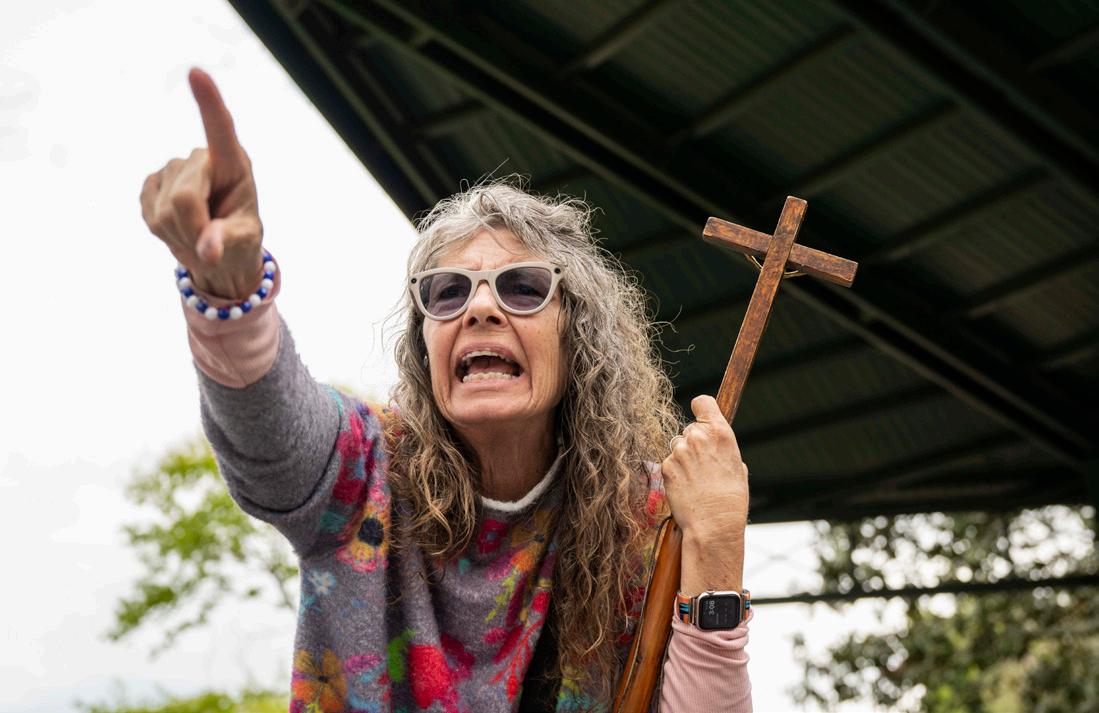
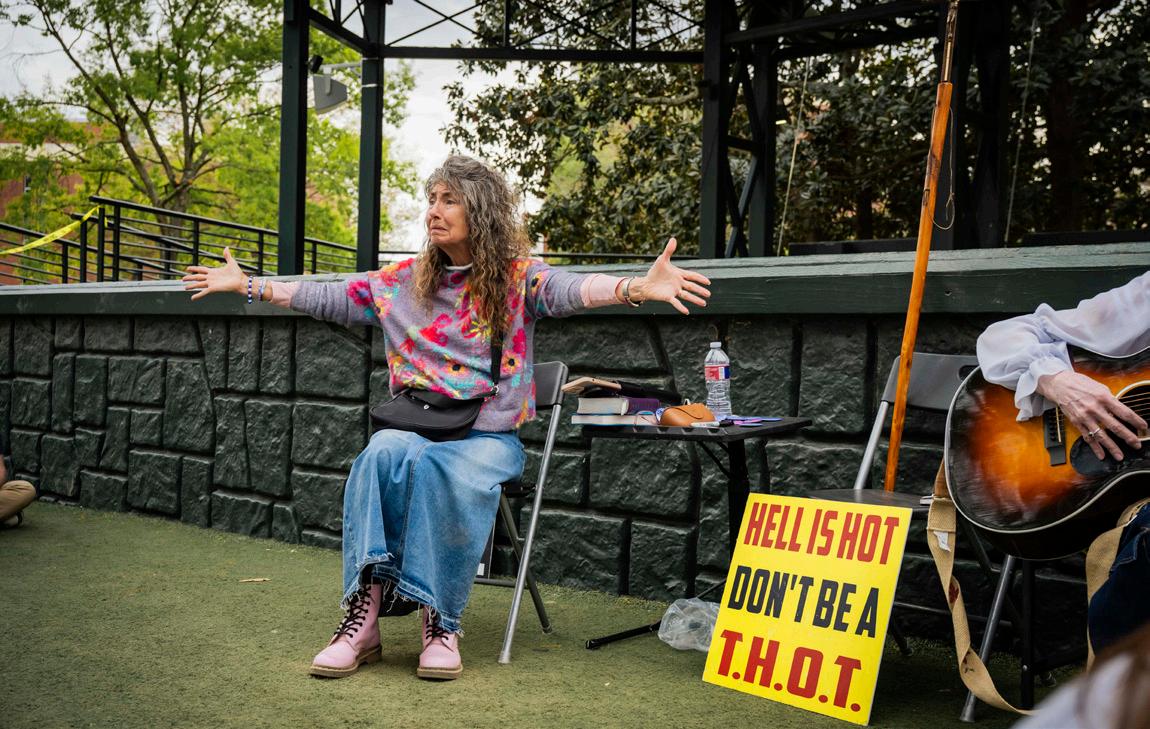
Viral TikTok evangelical preacher Cindy Smock, known as “Sister Cindy,” visited the University of Mississippi on Tuesday, March 24, drawing students to the Grove Stage for her lesson in what she calls “Ho-ology 101.”
Smock travels to college campuses to share her controversial message, which combines themes of evangelical Christianity with racy, habitually profane language against what she considers sexual immorality. Her lead plea encourages students to
join the “HoNoMo revolution.”
Videos of Smock’s sermons have circulated on social media and netted her a large following. She has more than 416,000 followers on TikTok and 40,000+ Instagram followers.
“Welcome to the raw, uncut Sister Cindy slut-shaming show,” Smock announced to her audience at the beginning of her sermon, which lasted more than three hours. Students responded to her message with cheers, applause and frequent laughter. Tuesday was Smock’s first time preaching at UM, but she was happy to do so after receiv-
Rising rent prices in Oxford are forcing some students at the University of Mississippi to rethink their futures, including whether pursuing graduate school in the city is financially realistic.
For Ben McCollum, a junior accounting major from Walnut, Miss., the numbers no longer add up.
“I definitely would consider staying longer and staying for graduate school here in Oxford if housing was more affordable,”

McCollum said. “I just cannot see myself being able to live here comfortably while there are more opportunities for me elsewhere.”
Between his sophomore and junior years, McCollum said his rent increased by $200 per month. It is set to rise by another $200 in his upcoming lease this fall.
“It seems pretty typical for most student apartment complexes to jump $150 to $300 between each school year now,” McCollum said. “My roommates and I have thought about moving, but it feels impossible to find places that are cheaper or even the same price.”
Some of his peers, he added,
are paying close to $1,000 per month, a cost that rivals housing prices in larger Mississippi cities.
According to RentCafe market data updated in February 2026, the average rent for an apartment in Oxford is now $2,283 per month, a 10.28% increase from the previous year, when the average stood at $2,070. One-bedroom apartments average $1,476 per month, while two-bedroom units rent for about $1,844.
Compared to other Mississippi cities, Oxford’s rental market remains significantly higher. The average rent in Jackson is $1,098, while Hattiesburg averages $1,244

and Gulfport $1,147, according to rental property website RentCafe.
For McCollum, those comparisons reinforce his hesitation about remaining in Oxford for graduate studies.
“As an accounting major, internships are really important,” McCollum said. “While I can gain access to those here at Ole Miss, I feel like I have a better chance if I move to a city I could see myself working in, and it would be about the same price to live there.”
Graduate students in particular are navigating unique challenges in Oxford’s tight rental market.
Annette Kluck, dean of the

graduate school and professor of leadership and counselor education, said rising rents are putting significant financial pressure on students whose stipends or income have not kept pace with the housing market.
“A $200 per month increase translates to a $2,400 increase in annual rent,” Kluck said. “This has been a common experience for our graduate students in recent years.” Timing also plays a role. Many complexes sign leases in the fall, but incoming graduate students often do not know their accep-
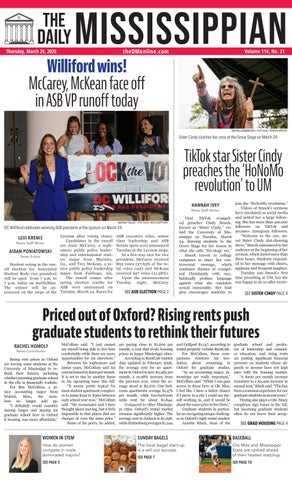
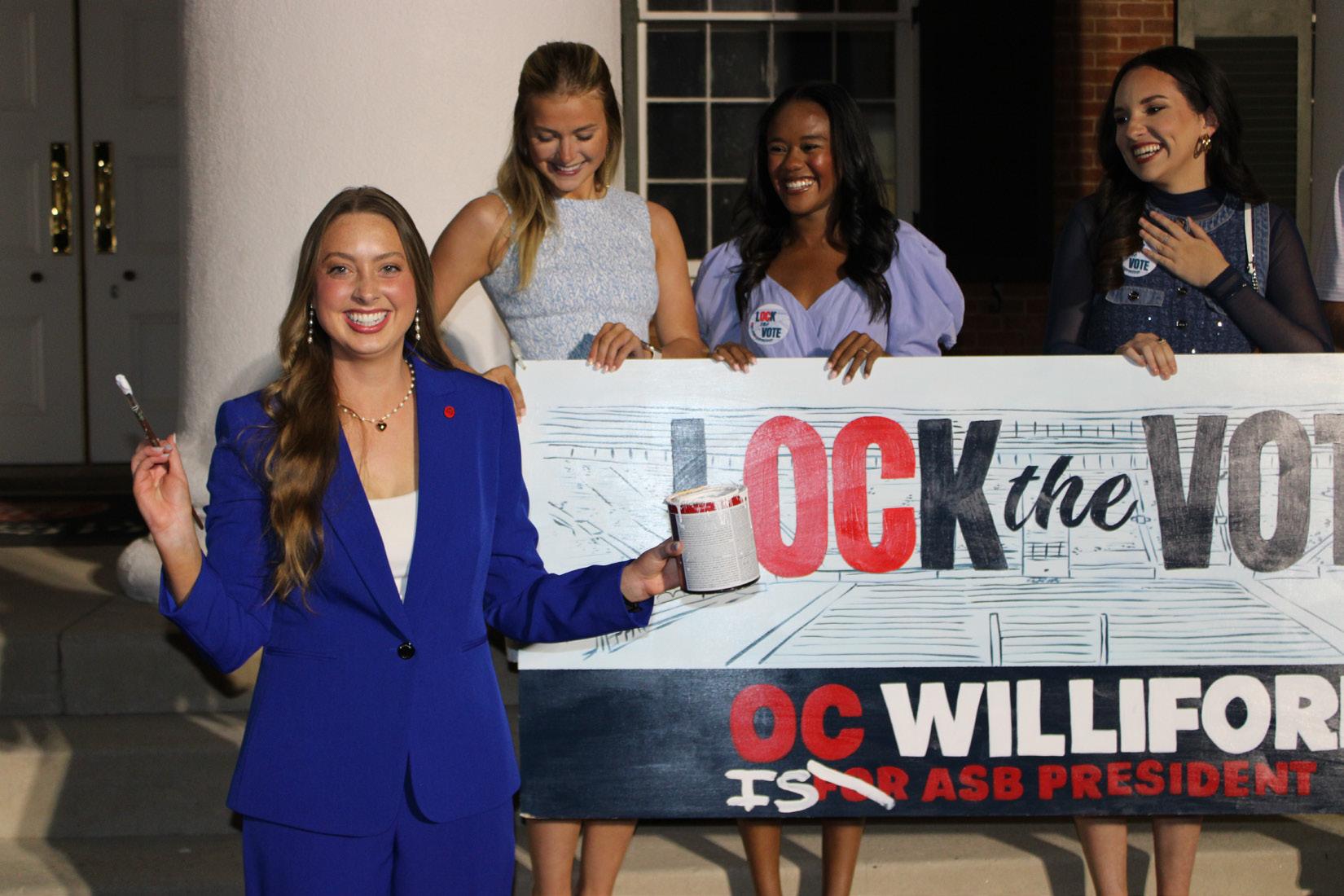
OC Williford celebrates winning ASB president at the Lyceum on March 24.
NATALY TELLO / THE DAILY MISSISSIPPIAN
LEXI KRENIS News Staff Writer
HANNAH IVEY News Staff Writer
Sister Cindy clutches her cross at the Grove Stage on March 24.
OLIVIA CANGELOSI / THE DAILY MISSISSIPPIAN
shared her excitement and relief upon making the runoff.
“I’m so excited. I was really nervous. I knew we’d probably go into runoffs because of how many candidates there are,” McCarey said. “I was really hoping for the best, which was obviously two more days of tabling, which I’m actually really excited about. I’m not ready for it to end, so I’m just really happy that I made it here.”
McCarey also expressed gratitude for her team and voters up to this point.
“I’m just so thankful that people have had trust in me and have supported me through this, regardless of what happens on Thursday,” McCarey said. “It’s just been such an awesome experience.”
McKean expressed a “survive and advance” mentality.
“I kind of knew it was going to be a runoff. I mean, it was five people. … Josie is great, (I’ve) known Josie for years — couldn’t ask for a better candidate. But yeah, it’s the mentality of ‘survive and advance’ right now,” McKean said.
McKean also expressed excitement to be back on the campaign trail.
“I was here last year as senator. … I was lucky enough to be victorious,” McKean said. “Hopefully Thursday will come around and I can get the same result. … I just want to do what’s best for the university — that’s why I ran for the position in the first place.”
While vice presidential candidates must wait for results in the runoff, newly elected candidates are ready to work in their new roles, including ASB president-elect OC Williford.
Williford, a junior public policy leadership major from Madison, Miss., won the ASB presidential election with 2,195 votes, or a 76.27% vote share.
The ASB president-elect says she is prepared to meet with staff and administrators to get initiatives moving forward.
“I’m so excited, and it’s going to be such a privilege to be able to serve,” Williford said after being elected ASB president for the upcoming year. “I’ve been serving as the chief of staff for a year now, and I’m more than ready to start day one.”
Junior public policy leadership and English major Caroline Croley, an Atlanta native, secured her re-election as secretary in an uncontested race. Croley also shared her eagerness to continue serving on ASB.
“I was very, very excited,” Croley said. “It’s such an honor to be voted in as secretary for another year by this campus that I love so much.”
Croley expressed her desire to build upon her previous term as secretary and improve upon her past work.
“I’m going to try, and I will


top everything that I did last year,” Croley said. “Just because I’ve already done it does not mean that I’m going to get lazy. I’m here to work, and I’m here to make the secretary’s department the best it can be.”
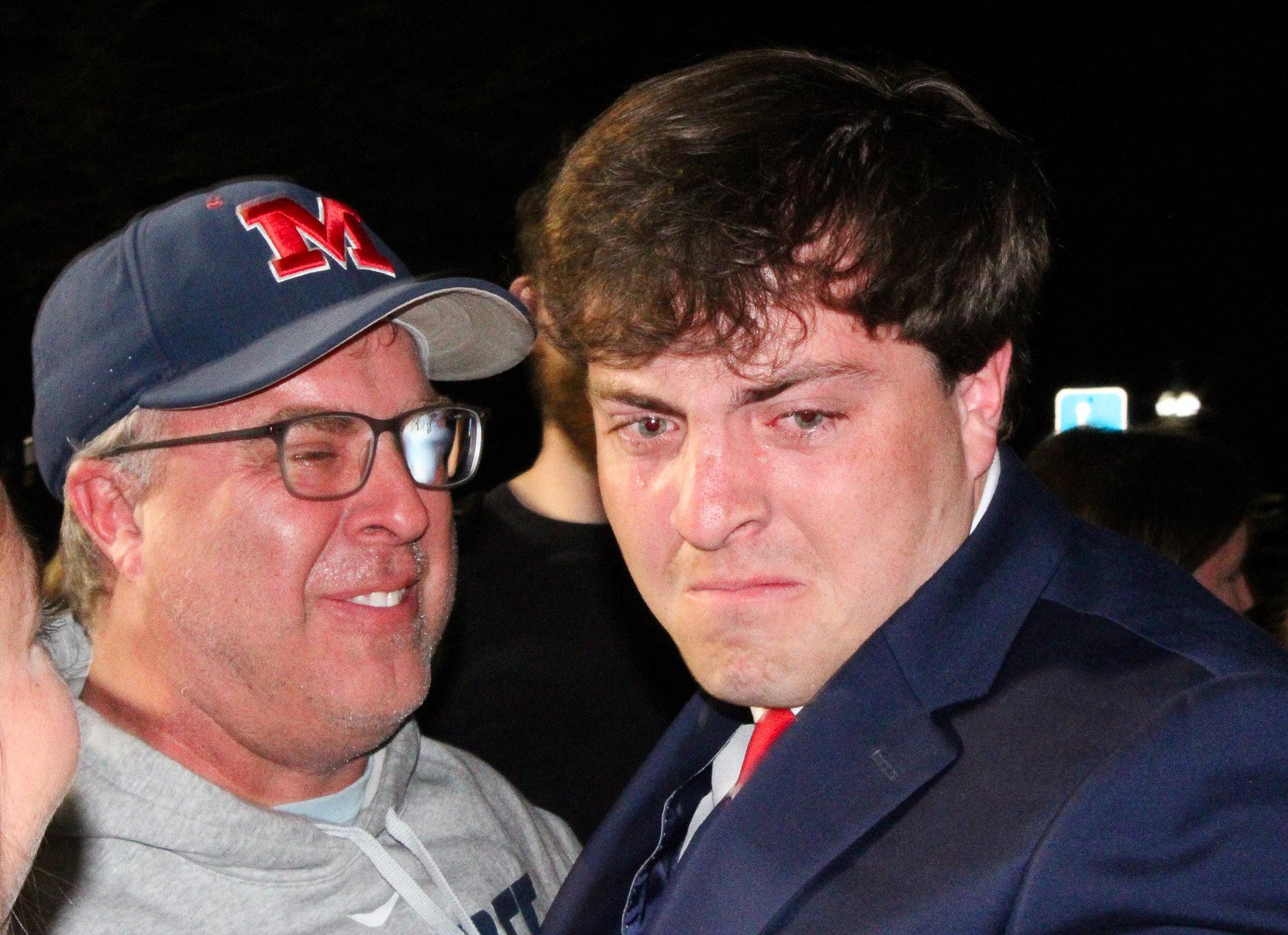
Jackson Doss, a sophomore public policy leadership and accountancy major from Oxford, won the treasurer’s race with 1,563 votes, or 56.61% of the votes cast.
“I’m feeling amazing, and I want to thank my entire team because every one of them has helped me throughout this process,” Doss said. “My platform was to raise money and market our student activities fund better, and that is what I intend to do.”
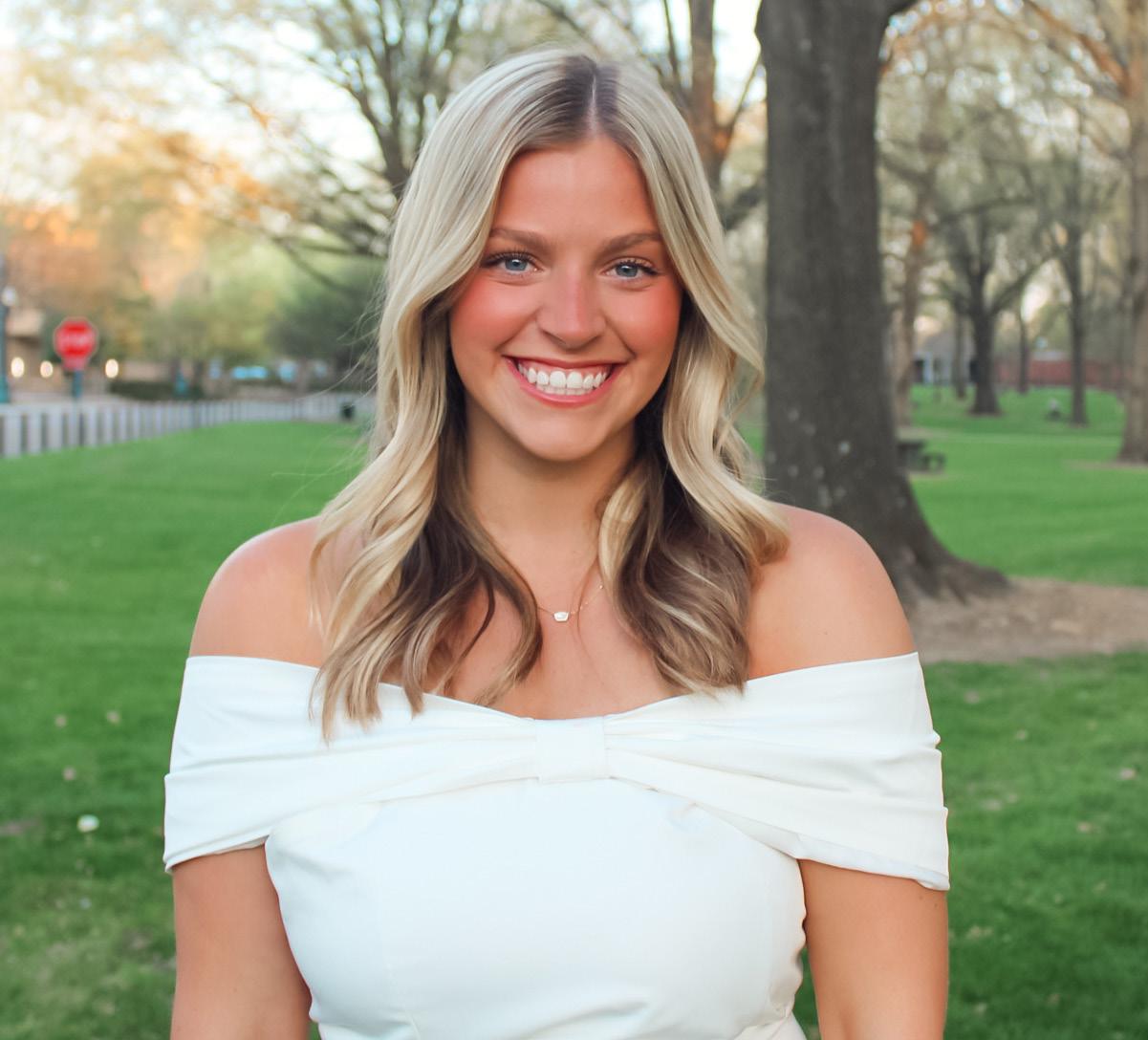
Newly elected attorney general Lucy Allen, a junior public policy leadership major from Brookhaven, Miss., won the position with 2,054 votes, or a 74.42% vote share.
Allen described her feelings upon winning, referencing the theme of love that has been so prevalent in her “Love Like Lucy” campaign.
“I’m so ecstatic, but I’m just very humbled and grateful. The community that’s come out and supported me this entire time — it’s just been incomparable,” Allen said. “I’ve known about the community that surrounds ASB and my people, but to truly see them in such a tangible expression of love has been so, so humbling, and I could not be more grateful for the opportunity. I’ve served in ASB for three years, and I can’t wait to do it for one more.”
Allen also expressed a desire to be approachable in her position and provide a trustful voice in ASB.
“Get ready, we’re bringing love back. It’s gonna be fun. I want to talk to everyone,” Allen said. “Feel free to knock on my door anytime. I’m always there. I want to be a supportive, loving voice that you know you can trust.”
Junior biomedical engineering major Ashlyn Minga, of Hattiesburg, Miss., won the judicial chair position in an uncontested race.
Despite running unopposed, Minga was nevertheless excited about her campaign win.
“I was very excited,” Minga said. “I did run unopposed,
so (it) wasn’t super shocking. But I was very excited. And I can’t wait for the year.” Minga also said that the university judicial process is designed to help students, not hurt them.
“I just want everyone to know that restorative justice is very alive at this university,” Minga said. “The conduct process does not exist to hurt people, but we want to help you get back on the track to success.”
Junior finance major and Diamondhead, Miss., native Ella Key will serve as the 2027 senior class president. Key won the election in an uncontested race.
Key said she will embrace her new role with enthusiasm.
“I’m so excited for what’s to come, and I’m really excited to serve my senior class,” Key said. “I’d like to thank my campaign manager, Julia Case, and the ASB department of justice for all of the hard work they put into this election cycle.”
Newly elected senior vice president and public policy leadership major Elle Nassar shared her eagerness to begin in her new position.
“I was really excited and grateful after I heard my name get called,” Nassar said. “It’s always stressful to run for any position, and I’d like to say thank you to all of my friends, (Delta Gamma) sisters and my good friend Neelie for her support this week.”
Maya Reilly, a senior marketing major of Southold, N.Y., won the position of senior class secretary.
In total, 2,878 students voted in the presidential race in this year’s ASB spring election by voting on myOleMiss. This year’s election will be the last ASB election conducted using the myOleMiss website, with new platform Experience slated to take over in the fall.
Winning candidates will be sworn in during a joint session of the ASB senate on March 31 and begin as new ASB representatives for the 2026-27 school year.
Jackson Doss with his father after being annoucned ASB treasurer in front of the Lyceum on March 24
NATALY TELLO / THE DAILY MISSISSIPPIAN
Lucy Allen celebrates winning ASB attorney general at the Lyceum on March 24.
NATALY TELLO / THE DAILY MISSISSIPPIAN
The end of an ASB era: Outgoing executive members reflect
MICAH OWENS News Staff Writer
As the Associated Student Body’s spring election season draws close to its end, senior ASB members will retire from their positions on March 31.
While election week highlights new platforms and fresh leadership goals, it also gives current ASB executive membership an opportunity to share their experiences. They are using these last few months to reflect on their time in office and give guidance to those seeking executive positions.
Jack Jones, a senior public policy leadership major from Murray, Ky., serves as ASB president. Prior to assuming ASB’s top elected position, Jones was the president’s chief of staff and vice president.
For Jones, some of the best training for the job came from outside of the executive branch. Jones joined ASB in the fall of his freshman year, winning an open seat election in the ASB senate.
“I think that the most challenging thing about being ASB president is that you were a part of a lot of conversations that started before you became ASB president,” Jones said. “It was helpful for me to start off in the legislative branch and understand ASB better. It’s the area that touches so much of the rest of the organization.”
Jones believes serving as president has taught him to learn from his experiences.
“Everything should be used as a learning opportunity and a learning experience,” Jones said. “I think that’s something that I will take with me throughout the rest of my life. Education never concludes. Everything is an educational opportunity.”
ASB Attorney General
Madison Waldrop is a senior integrated marketing communications major from Birmingham, Ala. She also began her ASB journey in the legislative branch as a legislative aide her freshman year.
“This year I was able to serve on the legislative council, which is awesome,” Waldrop said. “It’s full circle being able to end where I started.”
After serving as a legislative aide, Waldrop served as the vice president’s chief of staff before being elected attorney general in March 2025. Waldrop also reflected on how other members of the ASB have impacted her and her experience as an ASB member.
“Being involved in elections my sophomore year to now getting to run the department of justice and oversee (code and constitution) operations and election operations is really special to me,” Waldrop said.
Waldrop also cited the greater ASB community as a catalyst for personal growth.
“Last year, I had the opportunity to serve as Jack (Jones’) chief of staff, and the impact that he had on my leadership was insane,” Waldrop said. “I think being surrounded by people who build you up, on your best (and) on your worst day, is important.”
Diego Abele is a senior political science and philosophy major from Austin, Texas. He serves as ASB judicial chair, but he began his ASB journey as a judicial board member his freshman year.
For Abele, serving in the judicial council for four years was fulfilling.
“It’s been rewarding seeing principles of restorative justice being done in the community,” Abele said.
Abele also offered advice to potential office

THE DAILY MISSISSIPPIAN EDITORIAL staff
CLAY HALE editor-in-chief dmeditor@gmail.com
RAEGAN SETTLE managing editor dmmanaging@gmail.com
SYDNEY STEPP copy chief thedmcopy@gmail.com
CAMERON LARKIN digital editor dmdigitaleditor@gmail.com
AIDAN PONIATOWSKI news editor thedmnews@gmail.com
DYLAN THOMAS assistant news editor thedmnews@gmail.com
holders, highlighting the need for candidates to set goals and to rise to the description of their job title.
“We encourage everyone to run, but you really want to make sure you know what’s expected of you, how you can get that done,” Abele said.
Walker Jacklin, a senior public policy leadership and rhetoric major from Madison, Ala., serves as ASB vice president and runs the legislative branch. Jacklin believes students who are interested in ASB should examine their motivations.
“Always run for the right reasons,” Jacklin said. “Make sure that you feel as though you have a plan to make sure that change can occur, and inside that, you also have
to prioritize leadership.”
Jacklin shared that although much of the work that goes into ASB executive council may go unrecognized, it is nonetheless fulfilling.
“A lot of people don’t see the side of produced change that comes from being in positions, but also the amount of work it takes to produce it,” Jacklin added. “I always credit Jack (Jones) for our executive group. Executive council is always a cohesive group … that spends a lot of time together and a group that has its weaknesses and strengths.”
ASB President Pro-Tempore Wesley Templet, a senior political science and public policy leadership major from Vacherie, La., encouraged more students
to get involved in ASB.
“You have to put yourself out on that stage and do it. It’s worth it,” Templet said. “(ASB) helps you grow as a person and as a leader. No matter what the outcome, you come out learning something and hopefully (are) inspired to continue your work.”
JAYLYNN CONNER arts and culture editor thedmfeatures@gmail.com
JESSICA JOHNSON assistant arts and culture editor thedmfeatures@gmail.com
RUSS EDDINS sports editor thedmsports@gmail.com
NATE DONOHUE assistant sports editor thedmsports@gmail.com
LENORA COLLIER opinion editor thedmopinion@gmail.com
OLIVIA CANGELOSI photo editor thedmphotos@gmail.com
JOURNEY GLOVER assistant photo editor thedmphotos@gmail.com
MADELYNN LIBERTO design editor thedmdesign@gmail.com
ANNA GRACE LIKES assistant design editor thedmdesign@gmail.com
MARY EVANS multimedia coordinator dailymissmedia@gmail.com
AVERY THOMAS social media manager thedmsocialmedia@gmail.com
CADENCE MANNING assistant social media manager thedmsocialmedia@gmail.com
S. Gale denley student media center
LARZ ROBERTS Director of Student Media
DENNIS MOORE Editorial Director

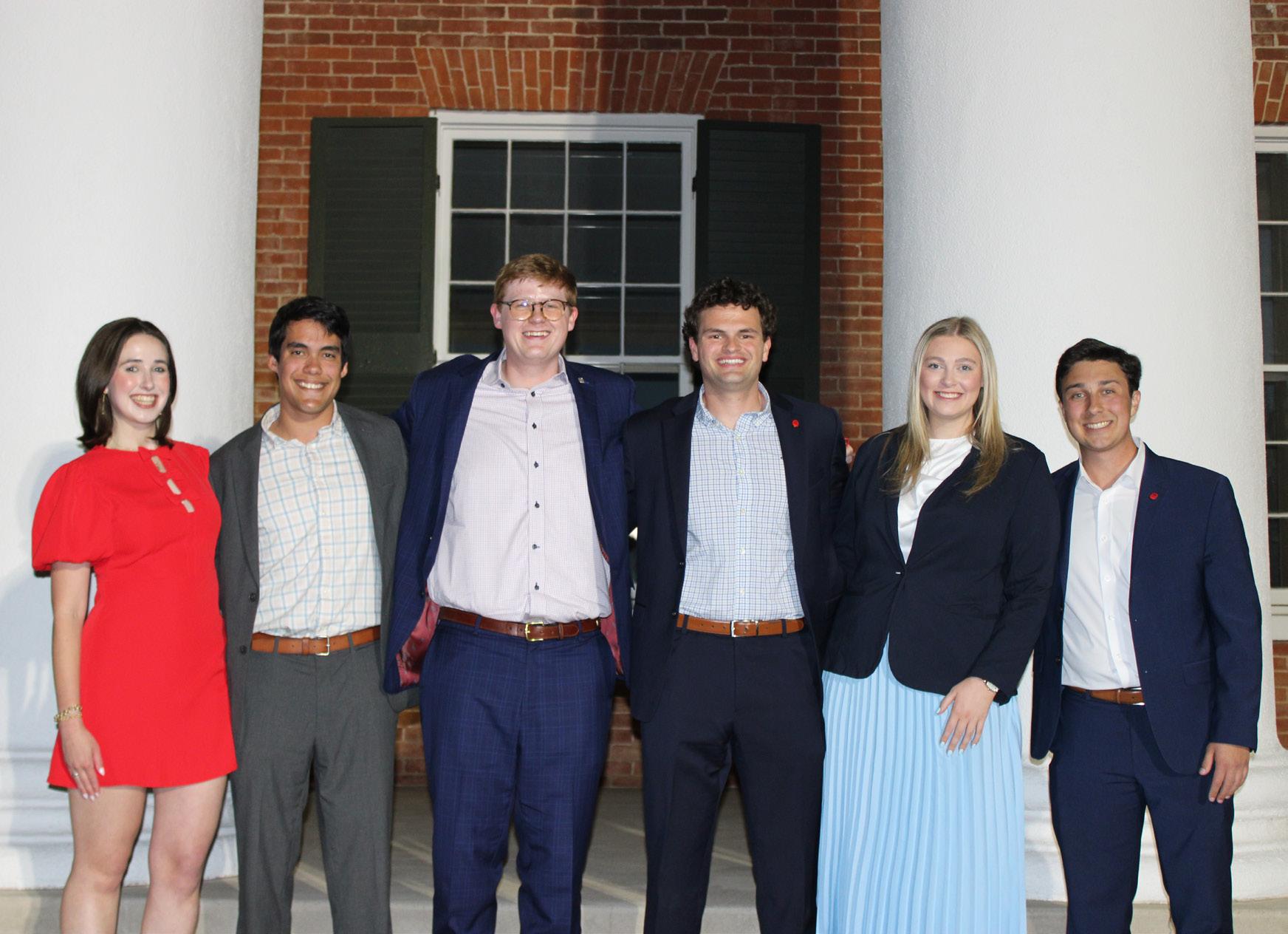
Members of the 2025-26 ASB executive branch in front of the Lyceum on March 24 Left to right: Caroline Croley, Diego Abele, Jack Jones, Sean Giamportone, Madison Waldrop, Walker Jacklin
ing messages from students inviting her to share her message.
“I thank you for your invitation to Ole Miss,” Smock said to the students. “This is my first time here, and I love Mississippi. You have the best-mannered hoes in the world.”
Smock proceeded to walk her audience through her “levels of hoeness,” with the final step being when one becomes a “HoNoMo,” meaning one who is no longer a “hoe” and has turned to her brand of Christianity.
Smock labeled her past self as a “vampire hoe” and shared her story of attempting to seduce a preacher named Jed Smock, better known as “Brother Jed,” who rejected her advances, led her to Christianity and later became her
husband. The two preached together at universities with their organization, Campus Ministry USA, until Jed’s death in 2022.
Smock urged students to cast aside their “hoe chains” as she once did.
“The hoe chain glitters, but after a while (it) starts to feel heavy,”
Smock said. “I used to wear it, but then I realized God planned for me to wear a crown. That’s what he intends for us: to be royalty. Ladies, you’re made to be a queen.”
Smock also preached on the dangers of alcohol and how she believes that drinking leads to sex. She listed the various sexual acts she believed might occur after each margarita a woman consumes, before issuing a warning.
“Whatever you do, don’t take one of these Ole Miss girls out for Mexican food,” Smock told the men in the audience. “She does not want a taco, or a burrito or an enchilada. She wants
“This is my first time here, and I love Mississippi. You have the best-mannered hoes in the world.”
- Sister Cindy viral TikTok evangelical preacher
GRAD HOUSING
continued from page 1
tance status until mid-spring. This leaves students at a disadvantage when trying to secure housing.
“Because graduate admissions are often determined by program-specific deadlines, moving up the timeline isn’t really an option,” Kluck said. “We’ve heard from students who struggle to find affordable housing during the typical lease cycle in Oxford.”
Graduate students also often need separate housing from undergraduates. Living with younger students can mean more distractions and less privacy, making it harder to focus on demanding coursework, research and assistantship responsibilities.
The UM Graduate School maintains a Slack channel for graduate students to communicate about available housing and potential roommates. However, collaborations between the university and local off-campus
housing are managed through the student housing department.
“We are eager to work with others on campus to create solutions to better serve graduate students and meet their needs for affordable housing while they pursue their advanced degrees,” Kluck added.
Housing insecurity isn’t unique to McCollum. A recent survey conducted by the University of Mississippi’s Associated Student Body Senate found that 24.5% of students have faced housing insecurity. Graduate students were the most affected, with 71% reporting difficulty and 81.9% citing affordability as their main concern. International students faced even higher barriers, often lacking a U.S. credit score or a guarantor.
The growing student population in Oxford is adding pressure to an already-tight rental market. As more graduate and international students enroll each year, competition for available housing intensifies, leaving some scrambling for suitable and affordable places.
Other graduate students are feeling similar pressures.
you to buy her a margarita.”
Although much of her message was directed at women, Smock also had messages for the “man hoes.”
“Just because a girl is dressed like a hoe, it doesn’t necessarily mean she wants to do you,” Smock said. “She may want to do your roommate. She may want to do your roommate’s girlfriend. We shouldn’t assume.”
Despite her focus on condemning promiscuous sexual behavior, when asked about what she hopes students take away from her sermons, Smock talked about her faith — the focal point for much of her sermon.
“The main thing is the gospel that Jesus died for our sins and rose again,” Smock said to The Daily Mississippian. “We were all made to live in a loving relationship with God that comes through repentance and faith in the death and the resurrection of the Lord. People relate to the ‘HoNoMo revolution’ because it offers hope that they can change through faith in Christ.”
Lexie House, a freshman majoring in allied health studies, enjoyed listening to Smock’s message, stayed to meet her and took a photo with her once Smock had finished preaching.
“I have followed Sister Cindy on TikTok for a couple years now, so I’m here to join the ‘HoNoMo’ revolution,” House said. “I think this is awesome, and I think that everyone should come out
Brooklyn Mills, a first-year communication sciences and disorders graduate student, said her rent has jumped from $700 when she started her program to $1,000 a month, and she has seen steady increases each year.
“Rising housing costs have made me more mindful about budgeting my money and creating more time for work,” Mills said. “I’ve had to make sure rent and tuition come first, and I’ve had to decrease time spent on hobbies and activities that are good for mental health, like working out, to make more time for work.”
While the financial strain has created added stress, Mills said it hasn’t affected her academic focus or involvement on campus.
“I considered a different program at first, but the Ole Miss program was ultimately better and more convenient for me,” Mills said.
Looking at the bigger picture, she worries about how rising rent might impact future students.
“As a grad student not receiving much school funding, the increased rent plus tuition can deter future students from coming here,” Mills said.
Mills added that steady costof-living increases can discourage students from choosing Oxford and that appropriate aid for graduate programs could help offset the financial stress.
Options like the Villa West complex, which rent by bedroom rather than entire units, help fill some gaps. Students can enjoy larger, more private homes while sharing costs with roommates, rather than paying for a whole house alone.
For many students, the challenge is not just financial. Housing decisions affect where they can study effectively, maintain a healthy lifestyle and plan for their academic and professional futures.
and hear a little bit of the Word and have a good little laugh.”
Keelin Duncan, a freshman double majoring in sports management and integrated marketing communications, was entertained by Smock’s sermon but disagreed with her methods.
“Being a Christian, it’s funny to hear her take on certain topics, so I really wanted to see her first-hand,” Duncan said. “I think she started off very genuine when she started the whole evangelism thing, but she’s using shame, which I think is a little wrong. I do think she’s a very funny woman, but I don’t think she’s the most religiously sound woman. I would go to her for entertainment, but I would not go to her if you’re looking for Jesus.”
Sophomore allied health studies major Erick Godoy at-
tended Smock’s sermon and received one of her many signed “HoNoMo” buttons after Smock questioned him on his atheism.
“I’ve seen her on TikTok a lot. I don’t know if it’s completely satirical or not, but I do appreciate how she is, for the most part, positive, even though I don’t agree with her viewpoints,” Godoy said. “I thought some of her viewpoints were a little iffy, but I think that her message as a whole was good. She means well, and I think that she believes that she’s doing good, and that’s what really matters. I personally don’t believe in God, but I believe in her.”

“Each person is responsible for their part of the rent,” Beaty said. “Even though they’re still sharing the space, they feel like it’s more at home than just being in an apartment. They have a whole house with a garage and can choose their roommates.”
Villa West sees interest from a mix of undergraduates, graduate students and young professionals.
“I did a tour this afternoon with a Ph.D. grad student in pharmacy,” Beaty said. “They’re willing to pay a premium for newer luxury-style housing, and it seems to give them more privacy and independence.”
Beaty said developments like Villa West give students the feeling of living on their own without paying for a whole house.
“Even renting one bedroom here can be cheaper than a one-bedroom apartment in other areas of Oxford,” she said. “It’s more space, more priva-
Students are increasingly turning to alternative housing options. Allison Beaty, assistant property manager at Villa West, said their detached homes and apartments, which rent by bedroom, have become a popular option for students seeking both privacy and affordability.
cy and more of a home feeling.” Villa West also received city support to make units more affordable. The Oxford Board of Aldermen approved incentives including waived building permits, water and sewer fees and tree mitigation costs, valued at about $171,000. All 57 units include three bedrooms and two bathrooms, ranging from 1,300 to 1,400 square feet. As Oxford and UM continue to grow, providing housing solutions for graduate students will become increasingly important. New developments help fill gaps, but rising costs mean students will continue making academic and career decisions based on whether they can afford to live in the city. For students like McCollum, that may mean leaving Oxford altogether.
Sister Cindy speaks to students at the Grove Stage on March 24.
OLIVIA CANGELOSI / THE DAILY MISSISSIPPIAN
Ben McCollum
PHOTO COURTESY: BEN MCCOLLUM
How women succeed in male-dominated fields
DYLAN THOMAS Assistant News Editor
It is a man’s world — at least for the women pursuing degrees in a science, technology, engineering and mathematics (STEM) field at the University of Mississippi, despite the growing number of women in academia.
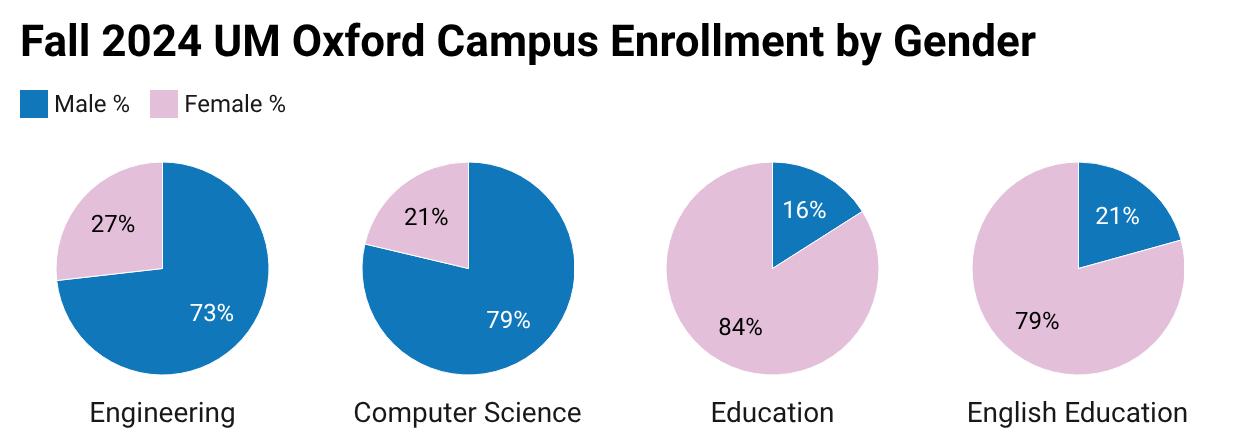
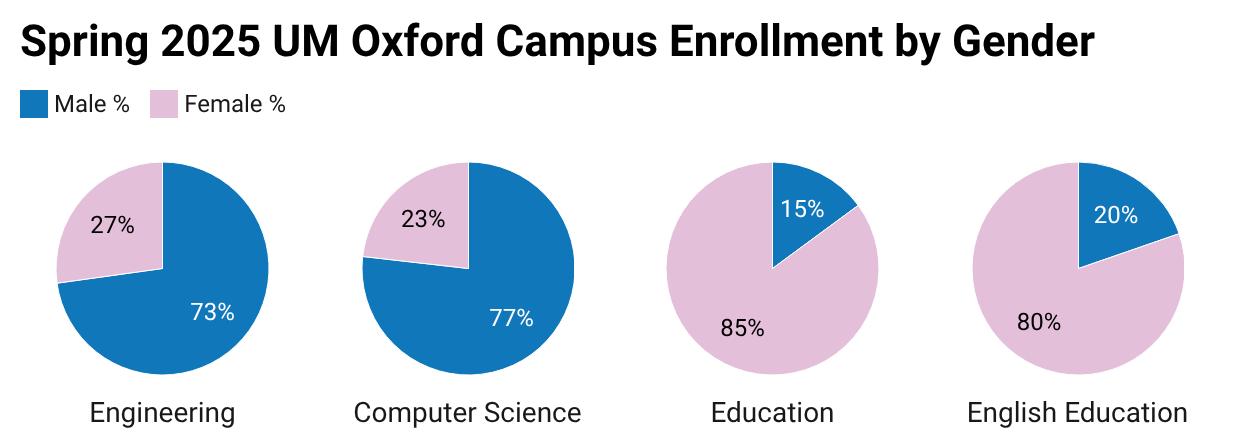
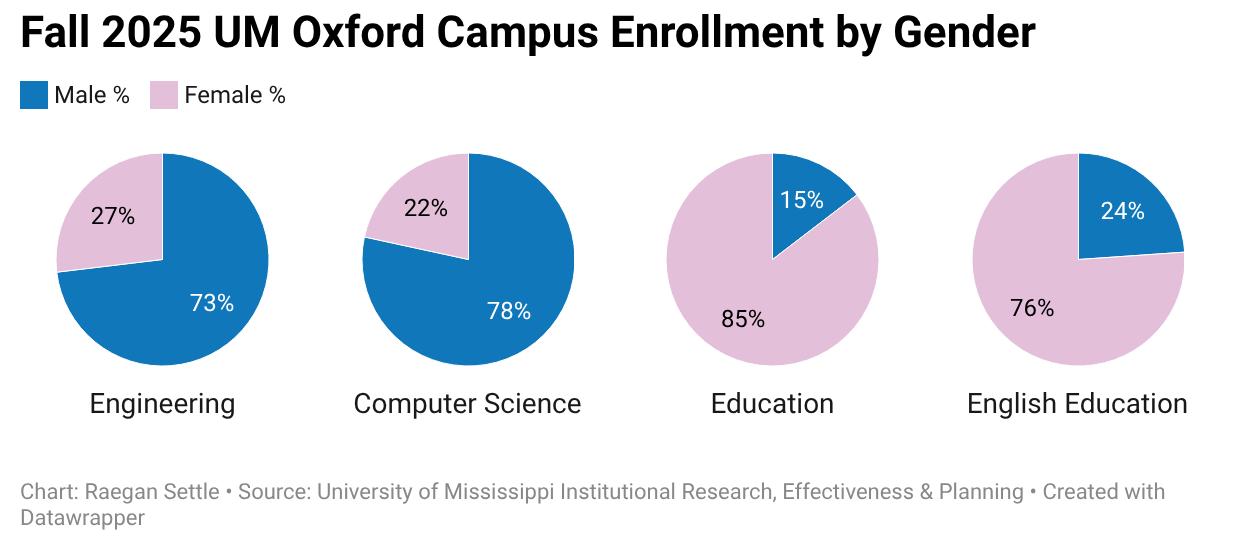
As of fall 2024, 57% of the University of Mississippi students enrolled were women and 43% were men, according to U.S. News & World Report.
Even though women make up a majority of the student body, they are a minority in many STEM degree programs on campus.
According to UM’s Office of Institutional Research, Effectiveness and Planning (IREP), men made up 74.1% of the students enrolled in the engineering department, while women made up 25.9% as of fall 2025. The computer science department has an even greater disparity, as men made up 78.9% of the department while women made up 21.1% as of fall 2025.
Teresa DiMeola, a Ph.D. candidate in the Department of Computer and Information Science from Berkeley, Calif., has served
on the board of the Association of Graduate Women in STEM.
DiMeola explained women’s historical relationship with computer science, how that has changed over time and why the industry is male-dominated in the modern era.
“(Computer science) wasn’t always (male-dominated). Women have been instrumental and influential in computer science since the beginning,” DiMeola said.
“Ada Lovelace wrote the first algorithm in the 1840s. Grace Hopper developed the first compiler and was a driving force behind COBOL, one of the earliest programming languages. The six women who programmed ENIAC, the first general-purpose electronic computer, essentially invented software programming as a discipline.”
Despite these advancements, computer science is, indeed, a male-dominated field. The reason behind this trend, DiMeola said, stems from perceptions regarding the industry.
“The reasons these achievements are often overlooked are layered and self-reinforcing,” DiMeola said. “Access is part of it: Studies have consistently shown

that boys are introduced to computers and coding earlier, often through gaming and hobbyist culture, (which) has historically been marketed to males. There’s also a cultural narrative problem. Computer science has been implicitly marketed as masculine for decades, despite its female origins.”
Because student environments in STEM departments are influenced by their male domination, women are underrepresented in the classroom. This phenomenon can result in negative experiences for the women in those programs.
Emma Donovan, a junior geological engineering major from Nolensville, Tenn., reflected on her experiences in a male-dominated field.
“A lot of the time, it feels as if my answers to questions are overlooked because I don’t interrupt others when they are answering,” Donovan said. “If I do better than my male classmates, there must be some sort of favoritism going on.”
Donovan explained other ways she has felt out of place or overlooked in the classroom.
“I think it is a generational curse of feeling like women may not be as smart; therefore, they do not need to answer or contribute,” Donovan said.
Brenda Prager, an associate professor of chemical engineering and faculty fellow for the Center for STEM Learning, has worked at UM for 11 years after moving to the United States from Australia, where she worked in the chemical engineering industry and in academia.
Prager is the only female professor in UM’s chemical engineering department. In her position, she is seen as a role model by her students, even if that was not her main
goal when going into teaching.
“I did quickly realize that there were a lot of female students, especially, that were really excited that I was here because they felt like they could talk to me and ask me the dumb question they might have been too scared to ask somebody else,” Prager said. “Even so, I don’t really know that I do anything particular to be a role model, but I think just sort of by default, I am a role model. I’ve certainly had a lot of discussions with students over the years about (how) just because you’re a woman, it doesn’t mean you can’t go off and be an engineer and have a career.”
Inversely, there are departments where women make up the majority and men are the minority. In UM’s Department of Education, men make up 14.6% of students enrolled, while women make up 85.4%, according to IREP.
Ethan Campbell, a freshman secondary English education major from Pass Christian, Miss., described his experience as a man in a female-dominated department and field.
“People told me whenever I talked about my future career path, ‘Do you really want to be a teacher?’ But never because I was a man,” Campbell said. “In fact, everybody that was on board with me being a teacher. It was because they think that we need more men in education just because of how lopsided the ratio is.”
Despite the fact that men are the minority in departments such as education, some say they do not have the same experiences that women in male-dominated departments do.
“(Being a gender minority in the classroom) has benefited me because being the only guy, if we’re in class and there’s

a streak of girls, the first person that they’re going to go to for a different opinion is me,” Campbell said. “So I feel like (I) probably participate more for that reason.”
Where men in female-dominated fields seem to have more opportunities to participate, women in male-dominated fields have less. Women in male-dominated fields also tend to feel overlooked and underappreciated by their peers.
“At Ole Miss, I have been treated fairly, and I don’t think being a woman has made much difference. However, I worked in industry for a long time before returning to finish my Ph.D., and that was tough,” DiMeola said. “The challenges weren’t competence — I knew my work was solid. The challenges were social and structure. Having your credentials quietly doubted. Finding that colleagues who seemed supportive would suddenly distance themselves. … It’s cumulative and designed to make you question yourself rather than the environment.”
WELLINGTON PLACE
Luxury Resort Living & Wellness Center
Spacious Two, Three & Four Bedroom Condos
Available August 1, 2026



Access controlled members only clubhouse includes over 10,000 sq. ft. of luxury amenities including but not limited to:
Homes range 1575 to 3200 square feet
10 foot ceilings throughout
Hardwood flooring
Stainless appliances
Screened in porches
Fenced in backyards
Lots of custom woodwork
Private commercial size gym
Infinity pool overlooking fully stocked lake

Game room
Two dry saunas and one steam sauna
Tanning bed and VersaSpa spray tanning booth
Private theater room
Fire pit
Hot tub
Four pavilions for private parties
Study rooms
Valet garbage pickup two times a day

JAYLYNN CONNER A&C Editor
Sunday Bagels, the seven-month old business run by a University of Mississippi student and an alum, sold out of its 200 bagels in just 18 minutes during the Oxford Community Market at the Old Armory Pavilion on Tuesday, March 24.
The young business is owned by Andrew Valone, a 2025 UM entrepreneurship graduate, and Lizzy Lamarche, a senior communication sciences and disorders major. The couple makes all of their sourdough bagels by hand with Valone’s personally crafted recipes.
“We cut all the dough, roll it, shape it all, boil it all and top them all,” Lamarche said. “So, it’s a lot of long hours. It helps to have an extra set of hands. … It’s a lot of labor, but it’s a labor of love.”
Though the business has seen recent popularity, it began as a small hobby for Valone and Lamarche’s friends.
“It started as Andrew bringing bagels over to me and my friends,” Lamarche said. “He was kind of tweaking with recipes, and then enough of our friends loved them and said we should sell them.”
Sunday Bagels bakes up long lines at Oxford Community Market
Valone grew up in a restaurant family, so he has always enjoyed making food. He started making bagels after experimenting with his sisters’ sourdough recipes. Originally, he was trying to recreate his father’s pizza recipes, but his bagel experiments are what became popular.
“The pizzas were and still are great, and I make them for my friends on occasion still, but the bagels are what ended up taking off once we perfected the recipe,” Valone said. “I honestly started making and selling them on accident.”
Sunday Bagels debuted on March 17 at the Oxford Community Market, and the booth was sold out within 30 minutes. Before that first setup at the community market, Valone and Lamarche were selling bagels out of Valone’s apartment on Sundays. Their first public sale was on Nov. 15. Now, the market is their main focus, and they only cater small orders on Sundays.
“We decided we needed to find somewhere a little bigger to sell out of that wasn’t my apartment, so we came to the market,” Valone said.
The decision to have a booth at the Oxford Community market came after Gracen Rinaudo, a senior integrated marketing commu-

nications major, made a TikTok video reviewing Sunday Bagels on Feb. 22. The video has more than 21,000 views and 1,377 likes.
“One girl made a TikTok about us that got like 25,000 views, and it just blew us up,” Valone said. “The next week we posted the link, we sold out in four minutes.”
Prior to Rinaudo’s TikTok, Sunday Bagels took days to sell out rather than minutes.
“In the beginning, it was not selling out by any means,” Lamarche said. “Most times, the order form would be open for a couple days.”
Before they gained popularity on social media, Valone thought about quitting.
“I didn’t really think it was worth it because we weren’t turning a profit at the end of each week,” Valone said. “Then, it just kind of started to flip, and we started selling out.”
When Valone graduated in May 2025, he had no intentions of staying in Oxford, but his booming bagel business changed all of his plans.
“I graduated last year, and I was ready to get out of here and go get a corporate job,” Valone said. “Then, this kind of took off. Now I’m looking at leases for next year, and we’re trying to find a spot to throw a bagel shop at.”
The business has become so successful that Valone has decided to focus on it full time.
“I just put my two weeks’ notice in at my other job because this is doing so well enough to the point where I can support myself selling bagels,” Valone said.
The next goal for Valone and Lamarche is to get a bigger kitchen to allow them to sell to more people.
“Our next step is to find a bigger commercial kitchen space,” Valone said. “We have capacity enough to do it out of where we’re doing it now, but to really expand and be able to give everybody a bagel that shows

up at the farmer’s market, we’re gonna have to find a bigger space.”
Though there are only two people running Sunday Bagels, there is one more vital member of their team — Remi, the mascot.
“Our mascot is a seven-yearold black lab named Remi,” Valone said. “I got her in high school as a Christmas gift. … She loves being around people. She’s definitely on the way to being a shop dog.”
The customers, some of whom lined up an hour prior to the market’s opening at 3 p.m., tried to get their hands on a bagel before they sold out.
Haley Weissbard, a junior finance and risk management and insurance major, was surprised at how long the line was.
“Oxford doesn’t really have anything like it, and I think it’s really cool that it’s started by a student,” Weissbard said. “I think the line is a bit outrageous, but I think it makes sense.”
Many people came after seeing social media posts and were excited to see what Sunday Bagels had to offer.
“I heard about them through Instagram,” William Campbell, a
senior civil engineering major, said. “Today I got the salt and cheese (bagels) and the chive cream cheese. I’m really excited to try them.”
Some people have been following Sunday Bagels from the start and were happy to get their hands on their favorites.
“I have loved and supported Sunday Bagels since the beginning,” Georgia Hanley, a senior finance major, said. “I’m just sticking with some classics today. I got the salt and cheddar, and I’m really excited to eat them.”
The bagels come in seven varieties: plain, sea salt, everything, cheese, jalepeño cheddar, sesame and cinnamon sugar. They also offer plain, pickle and hot honey cream cheese.
Valone and Lamarche are grateful for the popularity that Sunday Bagels has gotten, and they hope to keep the momentum going.
“It’s a unique opportunity that we’ve had with the popularity we’ve had,” Lamarche said. “We just hope it continues and hope it’s not a fluke.”
Review: ‘Project Hail Mary’ is out of this world
The arrival of the new Ryan Gosling-led science fiction adventure film “Project Hail
Mary” last Friday saw packed theaters across the country, including at Oxford’s branch of Malco Theatres. It’s easy to understand why this movie struck a major chord with audiences. Put simply, “Project Hail
Mary” is an earnest, optimistic and visually stimulating science fiction piece that plays well to almost any large audience.
“Project Hail Mary” is an adaptation of Andy Weir’s 2021 science fiction novel of the same name. The story follows Ryland Grace, a middle school biology teacher unwillingly brought onto an international space mission to uncover the mystery of an unknown parasite. The novel became a phenomenon for sci-fi fans upon its release, becoming a mega best-seller and Hugo Award finalist.
Weir had previously penned “The Martian,” which was adapted in a 2015 film starring Matt Damon. “Project Hail
Mary” and “The Martian” each tell stories of everyman heroes surviving nightmarish space travel scenarios, but the similarities end there. “Project Hail Mary” tells a much larger story than “The Martian,” with aliens, world-ending stakes and separate galaxies. The film adaptation comes through with some stunning visuals to accompany this escalation of stakes.
The film’s marketing materials have heavily promoted the stellar space photography, but props must also be given to the production designers. This is an immaculately lit film.
The film’s two directors, Phil Lord and Christopher Miller, got their start directing animated films such as “Cloudy With a Chance of Meatballs” and “The Lego Movie.” They have spent most of their time over the past few years as creative executives on Sony’s “Spiderverse” films, so their background in animation certainly rears its head at multiple points in the film.
The witty visuals interspersed throughout are delightful. I particularly enjoyed a silhouetted spacewalk early in the film.
Meanwhile, the shots of planets, stars and the ship itself conjure a sense of grandeur not unlike the original “Star Trek” film.
The visuals of the film are only part of why it succeeds. Gosling gives a predictably likable and relatable performance as Ryland Grace, thrust headfirst into a high-stakes mission to outer space. He is believable as a science teacher with his realistically nerdy performance. Despite the presence of his alien sidekick, the film is certainly a one-man show for Gosling. Sandra Hüller does make a brief appearance as Eva Strutt – head of the Hail Mary project who recruits Grace – and she has a couple standout moments before the attention shifts back to Gosling.
The film follows the book rather closely but omits large chunks of the hard science. It focuses more on the character moments between Grace and his companion on the journey instead. As a story about friendship, the film effectively tugs on heartstrings — just as the book did.
My biggest gripe was with the humor, which feels rather

dulled and dumbed-down from the book. The quips and jokes are not irritating, but I found the humor to be the least remarkable part of the film. The humor rarely, if ever, compromises tension, but sometimes the screenplay veers into redundancy. The film has a quality ending, but the third act does not feel nearly as tense or as thrilling as the early portions.
Regardless, “Project Hail Mary” is still absolutely a film
that deserves massive success. Similar to last summer’s “Superman,” this film continues a trend of colorful and good-hearted blockbusters. It is the kind of movie that is so likeable, it is an obvious recommendation.
Andrew Valone’s bagels on display PHOTO
CHARLIE SLUSHER
A&C Staff Writer
Ryan Gosling stars as Ryland Grace in “Project Hail Mary.”
PHOTO CREDIT: AMAZON
Owners of Sunday Bagels Andrew Valone and Lizzy Lamarche at the Oxford Community Market at the Old Armory Pavilion on March 24
MADISON TWIDDY / THE DAILY MISSISSIPPIAN
JAYLYNN CONNER
A&C Editor
The University of Mississippi’s first motorsport registered student organization began in, perhaps, an unexpected place — the Alpha Chi Omega group chat on the Flare messaging app.
Grid Girls, an organization formed to encourage women to participate in motorsport, was officially recognized on Jan. 19, 2026 — one day before the start of this spring semester. New to being a registered organization and composed mostly of executive members, the club is focusing on outreach and developing friendships.
“My whole goal is to make friends, and I want that to be kind of the whole thing,” Kat Brubaker, president of Grid Girls, said. “This is a safe space where we all like this one thing, and we can talk about this and hang out.”
Brubaker, a junior public policy major from Arlington, Va., and member of Alpha Chi Omega, started the group to find friends with common interests.
“I was the one who created the idea for and established Grid Girls because I was at a low with my social life, and I wanted to create closer connections,” Brubaker said.
Not knowing where else to start, Brubaker reached out to her sorority sisters to see if anyone would be interested in a motorsport club.
“I felt like it would be really great to start this with some girls in my sorority so we could have a tightknit executive board, and we could all do things together,” Brubaker said.
Several of Brubaker’s sorority sisters expressed interest, including Anna Watson, now the vice president of Grid Girls.
“Once I saw the text saying, ‘Hey, we’re starting up a club about girls who love
Grid Girls goes full throttle to support women in motorsport
motorsport,’ I decided to put myself out there and see if my motorsport love is reciprocated, and it is,” Watson, a sophomore integrated marketing communications major from Chicago, said.
Madelyn Rockwood, a sophomore marketing major and fellow Alpha Chi Omega member, also joined after seeing Brubaker’s message. She now serves as the club’s director of marketing and relations.
Like many of the other members, Brubaker’s love for motorsport is rooted in family tradition.
“My whole family is so into it,” Brubaker said. “I’ve been surrounded by it my whole life. My mom worked pit crew, and my grandpa worked in NASCAR races. My cousin still races (in) minor leagues, and my uncle on my dad’s side did Superbike racing.”
Watson’s love for the sport also developed through her family.
“My family lives in Indiana, so we’d go to the Indianapolis 500 every year … it got me into cars and racing, and I just fell in love with it,” Watson said.
Rockwood, who is from Flower Mound, Texas, also developed a love for cars at a young age, leading her to buy a 2019 Chevrolet Camaro Super Sport and begin street racing when she turned 18. Still a racer, she said the Grid Girls community is a welcoming learning environment.
“I just hope that we can continue to share the bond that we all have and pass that on to other Ole Miss girls to continue on this safe space for girls that have questions,” Rockwood said.
Though the organization started from a sisterhood, all students are welcome to join the club.
“The name Grid Girls is only because we founded it as a group of girls from a sorority, but it’s open to anybody, no matter

the gender,” Watson said.
The organization’s name was also inspired by reclaiming motorsport spaces for women in an updated way.
“In Formula One, grid girls would hold the signs and be in sexy little outfits,” Brubaker said. “So, I kind of wanted to bring that to a different side and give it a new meaning.”
A core part of Grid Girls’ mission is breaking down the stereotype that women in motorsport are merely decorative.
“I think just to show people and other girls who want to join that it isn’t just the image of it all is breaking stereotypes,” Brubaker said. “There are girls who enjoy engineering, speed, fast things and cool things like cool cars. I think it’s important to show that women can be smart in their own spaces as well as create a space where they are supported.”
Because the organization is still in its early stages, no events have been announced, but the group’s leaders are planning for many car-themed engagement opportunities.
“A car wash is one thing we think would be fun,” Watson said. “We also wanted to do a

HOW TO PLAY
Complete the grid so that every row, column and 3x3 box contains the numbers 1 through 9 with no repeats.
INTERMEDIATE

drive-in movie. We would like to get a table at the union to pass out some stuff and get our name out there. I think we also wanted to do a watch party for some races and some crafts. We were thinking about doing some little charms for cars.”
Brubaker appreciates the budding community Grid Girls has created and hopes that it will encourage women to engage with motorsport in a greater capacity.
“I think it’s just so cool that we have this,” Brubaker said. “We already have this group of people who love (motorsport) so much, and if we could get everybody to pursue

it, it would be even cooler.” Grid Girls hosted its first in-person meeting on March 4 in Bishop Hall. The next meeting is not scheduled yet, but more information can be found on The ForUM. “We want you to come,” Brubaker said. “We can’t start without people, and we can’t start without different perspectives.”


Kat Brubaker and Anna Watson
MADISON TWIDDY / THE DAILY MISSISSIPPIAN
RUSS EDDINS Sports Editor
President Donald Trump is considering signing an executive order to reel in NIL and set guardrails. Congress is also working on the Student Compensation and Opportunity through Rights and Endorsements (SCORE) Act — which would allow the NCAA to set transfer regulations — and two senators recently agreed to amend a decades-long sports broadcasting act.
Nearly a year after the House v. NCAA settlement, the fear of losing women’s and Olympic sports, TV deal issues, NIL problems and rampant transferring, the federal government has decided to take further action.
The House settlement allowed athletic departments to directly pay student athletes. This marked what many thought was the point of no return for college athletics, but recent comments from Trump have brought this into question.
Roundtable
The College Sports Roundtable is a group of commissioners, coaches, media executives, athletic directors and professional sports executives assembled by Trump to “probe what ails college sports — and how to fix it.”
The group met on Friday, March 6, to talk about the future of college sports. Members discussed NIL collectives, the SCORE Act, the transfer portal and the Olympics. Television rights are also a controversial topic amongst college sports executives.
All Power Four conference commissioners attended the roundtable, along with American Athletic Conference commissioner Tim Pernetti, Notre Dame Director of Athletics Pete Bevacqua and longtime college football coach Nick Saban. Most attendees did not speak.
Trump blames the courts for the current state of college athletes. He specifically cited the Supreme Court’s 9-0 decision in the NCAA v. Alston case, which determined that it was illegal to limit education-related compen-
The state of college athletics: Is change on the horizon?
sation. A lower court originally arrived at this decision; the NCAA brought it to a higher court, which agreed with the original court. The U.S. Supreme Court affirmed this decision in 2021.
Trump announced that he plans on signing a second executive order, college football writer Ross Dellenger reported on March 6.
“Donal Trump plans to release a second executive order – this one ‘more comprehensive’ – that, is appears, will return college sports to concepts of the pre-NIL era,” Dellenger said.
He originally signed a prior one on July 24, 2025. Entitled “Save College Sports,” the order “intended to protect and preserve college athletics.” It states “it is the policy of the executive branch that third-party, pay-forplay payments to collegiate athletes are improper and should not be permitted by universities.”
However, the first executive order carried little value since its provisions were not legally binding.
“I will have an executive order within one week, and it will be very all-encompassing,”
Trump said at the meeting, according to ESPN reporter Heather Dinich. “We’re going to put it forward, and we’re going to get sued and we’re going to see how it plays, but I’ll have an executive order which will solve every problem in this room.”
Trump has yet to sign the second order. While an executive order did not come within a week of the roundtable meeting, Dellenger reported that Trump’s staff had begun drafting the order.
“The goal of the order is, more so, to spur Congressional action, including movement on the SCORE Act,” Dellenger said on March 13.
Dellenger reported on March 19 that any vote for the SCORE Act has been pushed to mid-April at the earliest.
While the order seems to be a motivator for Congress, its contents reflect some of the biggest issues that college sports face: employment, transfers, eligibility, collectives and Olympic sports.
Former Ohio State Football head coach Urban Meyer said

April 10, 2018.
that collectives should go away.
“Donors put money in a pot. It’s distributed to the players through coaches and managers,” Meyer said, according to Dinich. “That’s not allowed. Not supposed to do that. That’s pay-for-play.”
Trump’s executive order would limit collectives. The order would also make a one-time transfer rule, in which players are immediately eligible at the first school they transfer to but are forced to sit out a season if they transfer more than once. SEC commissioner Greg Sankey is particularly concerned about older players staying in college sports.
“My advocacy would be, ‘Hey, we should be back to some type of one-time transfer exception,’” Sankey said. “We have to support educational continuity if we truly believe that academics is the heart of what we do, and I’m a true believer in that.”
The SCORE Act
At the meeting on March 6, U.S. Speaker of the House Mike Johnson and majority leader Steve Scalise said the SCORE Act has enough votes to pass

through the House. However, the Republican-proposed bill might encounter difficulty passing through the Senate. To have the 60 votes needed to pass, all Republicans and seven Democrats would need to vote in favor.
The SCORE Act would not allow student-athletes to be considered employees, give the NCAA the power to set transfer regulations, prevent the NCAA from restricting student-athletes’ ability to enter into NIL agreements and provide some antitrust immunity to the NCAA.
The act also seeks to protect non-revenue sports. Any school that generates more than $20 million would be required to have at least 16 varsity sports teams. Additionally, these schools would have to provide various benefits to student-athletes including mental health programs, legal and tax services and representation and career readiness counseling.
A common issue across the country in college sports is the varying NIL laws from state to state. The SCORE Act would set a national standard to establish uniformity in NIL rules throughout the country.
Those who oppose the bill say it would hurt student-athletes. U.S. Sen. Cory Booker is among those in opposition.
“I’ve been really happy that we have been able to make a lot of gains in recent years and they were fought for by college athletes … themselves,” Booker said in an October meeting with senators, college and professional athletes. “They won those gains. They earned them in court. They began to share in the revenues being created … to see some of the money that they were principally generating through their athleticism. We are now seeing, stunningly, a bill come out called the SCORE Act that would halt the progress that these athletes made. … Which is just, to me, outrageous.”
Booker stated that the government should empower athletes, protect their rights, health and education and create sta-
bility for the next generation.
The act has been delayed multiple times. It is set to be voted on in mid-April.
Television
While Trump and his roundtable were meeting, two senators agreed on a bill to amend the Sports Broadcasting Act (SBA) of 1961.
“Two U.S. senators, Maria Cantwell (D-Wash.) and Eric Schmitt (R-Mo.), agreed on a bipartisan bill to amend the Sports Broadcasting Act of 1961, permitting college conferences to consolidate and sell, presumably for more revenue, their media rights,” Dellenger wrote on Yahoo.
The pair released a discussion draft of the “College Sports Competitive Act” to amend the SBA, which gave antitrust exemptions to professional sports leagues and let them pool their television rights. It currently does not apply to college sports.
According to a U.S. Senate Committee on Commerce, Science and Transportation press release, the draft, which advocates for pooling rights, would ensure all schools receive more media rights revenue, give all schools a percentage of new revenue and allow performance-based awards for schools that drive viewership revenue and make the playoffs.
The SEC and Big Ten are against pooling rights. A study by the two conferences concluded that pooling rights would generate less revenue than if they sell their own games. If conferences pool their rights, it is estimated that they would make $7 billion over the next decade. The SEC and Big Ten argue that the bill fails to produce more revenue than the current structure and is unworkable.
President Donald Trump shakes hands with former Alabama head football coach Nick Saban at the White House on
PHOTO COURTESY: 247 SPORTS
President Donald Trump speaks with Secretary of State Marco Rubio at the College Sports Roundtable on March
No. 18 Ole Miss Baseball faces rival
No. 6 Mississippi State in critical weekend series
WILL WRIGHT Sports Staff Writer
College baseball’s Egg Bowl will take place this weekend when No. 6 Mississippi State travels to Oxford for a threegame series against Ole Miss.
The matchup shapes up as a statement series for the Rebels and a road test for a Bulldogs squad that has looked every bit like a national contender.
Ole Miss stands at 19-6 overall and 3-3 in SEC play heading into the weekend, riding the momentum of their
first conference series win of the year. The Rebels took two of three from No. 15 Kentucky at Swayze Field last weekend. Thanks to this win, they are ranked No. 18 in the country.
The Rebels won 5-0 on Thursday, March 19, before falling 1-3 a day later.
In the series finale, they rallied past the Wildcats, winning 12-9. Overall, this was a gritty, character-building series win that showcased what this team is capable of when it is clicking; however, Ole Miss took a 6-2 loss against
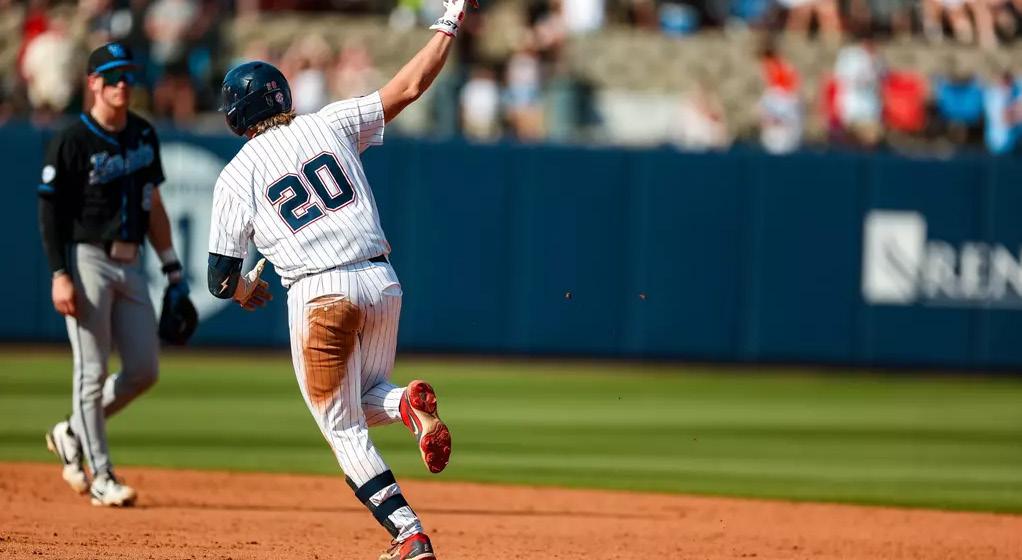
Collin Reuter rounds second base after hitting a home run in game three against Kentucky at Swayze Field on March 21.
Memphis on Tuesday night. Mississippi State, meanwhile, is one of the hottest teams in the country. The Bulldogs swept Vanderbilt last weekend, capping the series with a 17-7 win, which featured eight combined home runs.
They are coming off a 12-0, run-rule win over No. 11 Southern Miss. The Bulldogs sit at 21-4 overall and 4-2 in SEC play.
Bulldogs head coach Brian O’Connor came to Mississippi State from Virginia, where he served as head coach from 2004-25. He enters next weekend’s series with an overall collegiate record of 934-392-2.
The Bulldogs were predicted to finish third in the SEC in the preseason coaches’ poll, and, so far, the team is exceeding those expectations. The roster retained key holdovers from last season while also integrating new pieces. Ace Reese leads the team with a 1.181 OPS, 30 hits, 11 doubles, six home runs and 31 RBIs, while Bryce Chance is hitting .431 with seven stolen bases. Braden Holcomb leads the club with 11 home runs and 33 RBIs.
Ole Miss enters the series with a clear identity forming around its pitching staff and a lineup with legitimate pop.
Hunter Elliott, the left-handed ace, has been dominant. He pitched 6 ⅓ innings of shutout baseball against Kentucky on Thursday, contributing to a 5-0 Rebel win during which Tristan Bissetta homered twice. Elliott is now 3-0 on the season.
Will Furniss paced Ole Miss offensively in the series finale with three hits, while Bissetta remained hot at the plate with a homer. The Rebels have shown they can manufacture big innings in bunches — which will be a necessity against a rich Bulldog pitching staff.
Despite their recent success, the Rebels have struggled with leaving runners stranded on base. Though they won the series against Kentucky, they scored in spurts; many of their runs came off big hits rather than sustained, steady hitting at the plate.
Mississippi State pitcher Tomas Valincius has been arguably the best pitcher in the SEC. He went seven innings
Who are the top Rebel prospects ahead of the 2026 NFL Draft?
against Vanderbilt on Saturday, allowing just two hits and zero earned runs while striking out 14. He is now 5-0 on the season.
For Ole Miss, this is the biggest home series of the season so far. A series win against a Top 10 opponent at Swayze would vault the Rebels into the national conversation and provide legitimate momentum for a team that appears to be rounding into form at the right time.
For Mississippi State, this trip is about consummating their status as a juggernaut regardless of setting. The Bulldogs have been dominant at home all season, but the road is where national titles are built. A series win in Oxford would all but confirm this squad as one of the premier programs in the country this season. The first game of the series begins at 6:30 p.m. on Friday, March 27. SECN+ will broadcast the game.
CONTACT THE SPORTS DESK AT thedmsports@gmail.com
WILSON ENGERISER Sports Staff Writer
Though Ole Miss Football does not have quite as many highly touted NFL prospects ahead of the 2026 NFL Draft as it did in 2025, there is still plenty of talent in this year’s batch of soonto-be professional Rebels.
Five Ole Miss players were invited to participate in the 2026 NFL Combine in Indianapolis, Ind., from Feb. 27-March 2: defensive tackle Zxavian Harris, offensive tackle Diego Pounds, tight end Dae’Quan Wright and wide receivers De’Zhaun Stribling and Harrison Wallace III. Pounds’ immense frame assists him in muscling defenders, but it also hinders him against speedy edge rushers. Though Pounds did not allow a single sack this past season — which points to NFL-caliber protection — Ole Miss quarterback Trinidad Chambliss escaped some sticky situations thanks to his wizardry in the pocket.
Stribling wowed scouts with his 40-yard dash time of 4.36 seconds, which ranked No. 8 among receivers at the combine. Additionally, when taking into account his performances on the vertical and broad jumps, he ranked as the No. 5 receiver in terms of athleticism score.
Stribling’s production was inconsistent in 2025-26. Against Arkansas and Kentucky, he combined for three catches for 15 yards. However,
he found his stride late in the season; across three playoff games, he caught 17 passes for 278 yards and a touchdown.
Stribling’s ability to outrun defensive backs on vertical routes, his body contortion and strong hands shined in the Sugar Bowl, when he caught seven passes for 122 yards, including the game-sealing 40-yard reception in the final minute. Stribling’s combine performance could vault him into Day 2 NFL Draft conversations. His ceiling probably hovers around the late second round or early third round.
While Wallace was the more productive receiver in college, his athleticism knocks him down a few notches in comparison to Stribling and other receivers. At 6-feet-1inch, 192 pounds, he does not possess the length or reach that lankier receivers offer. He also does not look to be fast enough to make his mark as a deep threat and speedster, with his 40-yard dash time being 4.54 seconds.
Though Wallace’s production at Ole Miss speaks for itself — he caught 61 passes for 934 yards and four touchdowns — and he was an excellent jump ball receiver, whether his abilities will translate to the NFL remains to be seen.
While there are less athletically gifted receivers in the league, Wallace would be extremely fortunate to blossom into a top-producing receiver — comparable to Puka Nacua or Cooper Kupp, who were both select
ed in the mid to late rounds.
Wright made several crucial plays this season, but the tight end suffered from playing in an offense that did not utilize a tight end as much as some other teams. Wright’s highest yardage in a single game this season was 80, which is solid for his position, but his most receptions in a game was four.
While he is a skilled pass-catcher, he is not an exceptional blocker. Despite Wright standing at 6-feet4-inches and 255 pounds, NFL analyst Lance Zierlein pointed out some glaring weaknesses in Wright’s draft profile on NFL.com.
“Run-blocking technique at the point is below average. … Needs to become more consistently competitive as a blocker,” Zierlein wrote.
Since he lacks the upside to be a pronounced difference maker in the league, Wright projects as a Day 3 selection (rounds four-seven) — especially in an era when tight end is becoming an increasingly important position in the NFL. George Kittle and Brock Bowers, for example, are two of the best tight ends in the league thanks to excellence in both run blocking and pass catching.
Harris is a physical specimen, but that carries both strengths and weaknesses. At 6-feet-8-inches and 330 pounds, he generates plenty of power with his size. However, he often plays too high; players are often instructed to keep a low pad level.

Dae’Quan Wright jumps for the ball during Pro Day in the Archie and Olivia Manning Athletics Performance Center on March 18.
Harris’ potential to serve as a heavy, stalwart pillar plugging up the line of scrimmage strength will mean nothing if he cannot play low to the ground.
Scouts increasingly seem to favor nimble pass rushers. The Philadelphia Eagles’ Jordan Davis is a prime example of this. Davis is 6-feet-6-inches, 336 pounds, yet his 40-yard dash time was 4.78 seconds. Harris is two inches taller and only a few pounds lighter, but his projected 40-yard dash time is 5.40 seconds. Though Harris will be able to soak up running lanes just from his size and power alone, getting to the quarterback may be difficult for him. His production raised some red flags in college. This past season, he logged a career-high in sacks, but still only finished with three.
Harris may not be immediately available to play due to injury. At Pro Day, he was on a manual medical scooter with his right foot in a cast. He also did not compete at the combine. Harris may appeal to his NFL teams thanks to his size and strength, but he does not project as more than a rotational or depth piece with special teams value. He will probably be a Day 3 selection — not quite as complete as former Rebel defensive linemen Walter Nolen and JJ Pegues.
PHOTO COURTESY: OLE MISS ATHLETICS
Not enough students care about ASB elections
“It is our duty as students to vote in ASB elections. Our vote is our campus destiny, and each time we abstain, we revoke it.”
approximately 76% of the vote.
LENORA COLLIER
Opinion Editor
Each spring, the University of Mississippi’s student body selects the peers they wish to lead the Associated Student Body. Candidates go all out for campaign season, printing countless custom stickers, posting promotional content on social media and promising policies guaranteed to snatch the student vote.
A chaotic horse race erupts, coming down to who can form the most photogenic “core four,” win the Greek vote and spend campaign season politicking at as many parties as possible.
The campaign craze, however, seems to exist in a politically obsessed microcosm. In this year’s elections, approximately 10% of the campus body actually cast a ballot for ASB president, begging the question: Does the average student actually care about who runs the student government?
Out of this year’s record enrollment of 28,405 students, only 2,878 even voted in Tuesday’s presidential race between OC Williford and Jalon Hightower, where Williford ultimately won the election with
Opinion Policies:
Turnout was only slightly higher than in the 2025 ASB presidential race, where 2,638 students cast a ballot for ASB president, roughly the same proportion of the student population.
For many students, campus politics is just not interesting enough; the abysmally low turnout Tuesday night reflects that.
This, to be fair, does not represent the views of all students.
Lilly Bilbo, a sophomore international studies major from Carrollton, Ga., offered her perspective on ASB elections.
“I think voting is necessary, and there needs to be more voters,” Bilbo said. “What is happening on campus reflects what is happening in the U.S. as a whole. People aren’t going to the polls and exercising their constitutional right.”
It makes sense that the voter turnout problem for ASB might play out for real-world politics as well. The United States, on average, has far lower voting turnout rates than other developed nations, hovering at 60% for presidential elections and 40% for midterm elections, according to the United States Election Project.
Narrowing back down to our campus, a glaring disparity
that reveals something unsettling about voting culture is the difference in turnout during the homecoming and ASB election seasons. In the 2025 homecoming queen race, 4,075 total ballots were counted, according to the official ASB website.
While personality elections are an exciting way to bring students together, they are largely popularity races that have no implications on the everyday priorities of most students. It strikes me that 1,437 fewer people voted for their future student president than homecoming queen.
“Homecoming ballots are easy. You just pick the people,” ASB president-elect OC Williford said to The Daily Mississippian. “Student government can really require reading platforms, understanding roles, watching videos, comparing candidates, which obviously takes a lot more effort.”
Jalon Hightower, who lost his Tuesday election bid for ASB president against Williford, has his own theories.
“Policy is boring, especially campus policy,” Hightower said. “What I have learned is that I have to create a campaign and policy platform that is digestible to students. One way we can change that is how we
communicate with students.”
Hightower and Williford point to a problem that exists throughout politics, and that is making policy platforms accessible to the people they are meant to affect. That is, after all, the prerogative of any politician: convince the voter.
For voters to be convinced in the first place, they must be willing to vote. Looking forward, ASB leaders and average students should both be motivated to increase voter turnout, student participation in ASB events and greater discussions of current issues by all students.
This is a daunting task, but who better than UM students to confront it?
I have full faith in the ability of next year’s ASB leadership and even more in the passion that drives service-minded students. This commitment currently remains solely within ASB leadership; however, it should exist throughout the campus body. It is our duty as students to vote in ASB elections. Our vote is our campus destiny, and each time we abstain, we revoke it.
Lenora Collier is a sophomore international studies major from Hattiesburg, Miss.
CONTACT THE OPINION DESK AT thedmopinion@gmail.com
Columns do not represent the views of The University of Mississippi or The Daily Mississippian. The Daily Mississippian welcomes letters to the editor, which should be emailed to thedmopinion@gmail.com. Letters should be no longer than 300 words. They may be edited for clarity, brevity and libel. Third-party letters and those with pseudonyms or no name will not be published. Letters are limited to one per individual per month. Letters should include contact information, including relationship to the university, if applicable.


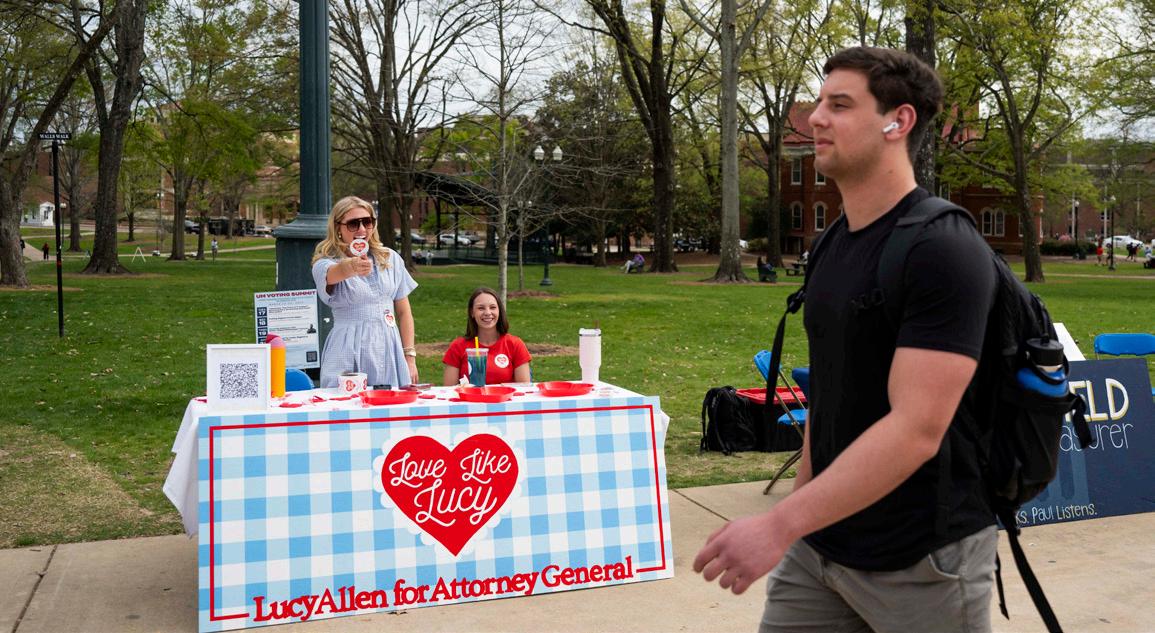
Student walks past ASB campaigners on the Union Plaza on March 24
OLIVIA CANGELOSI / THE DAILY MISSISSIPPIAN
Increased
Detoxification
Lower
Anti-Aging & Skin Rejuvenation
Improved Circulation
Weight Loss