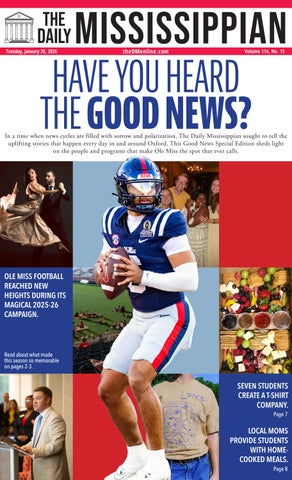
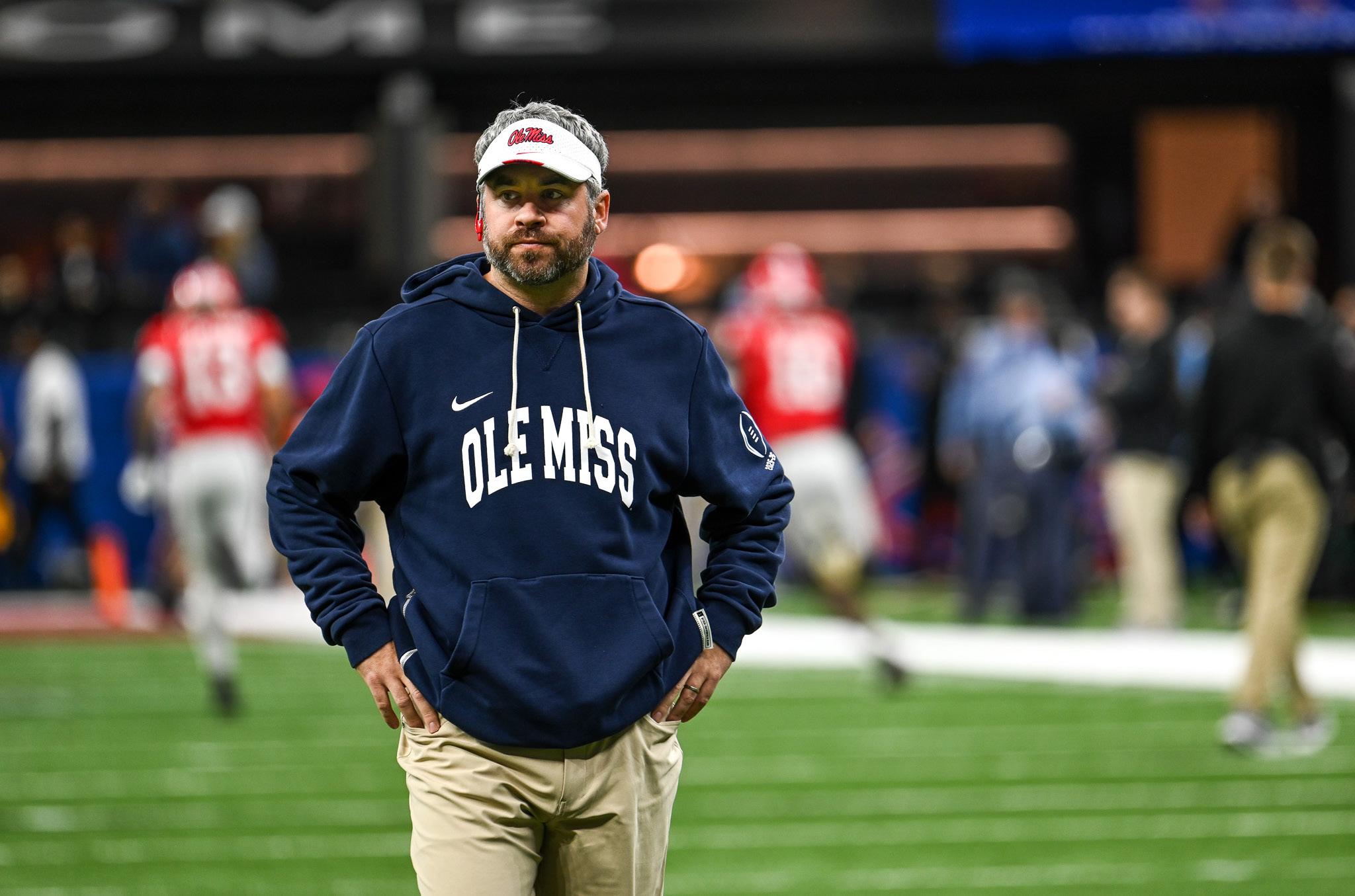
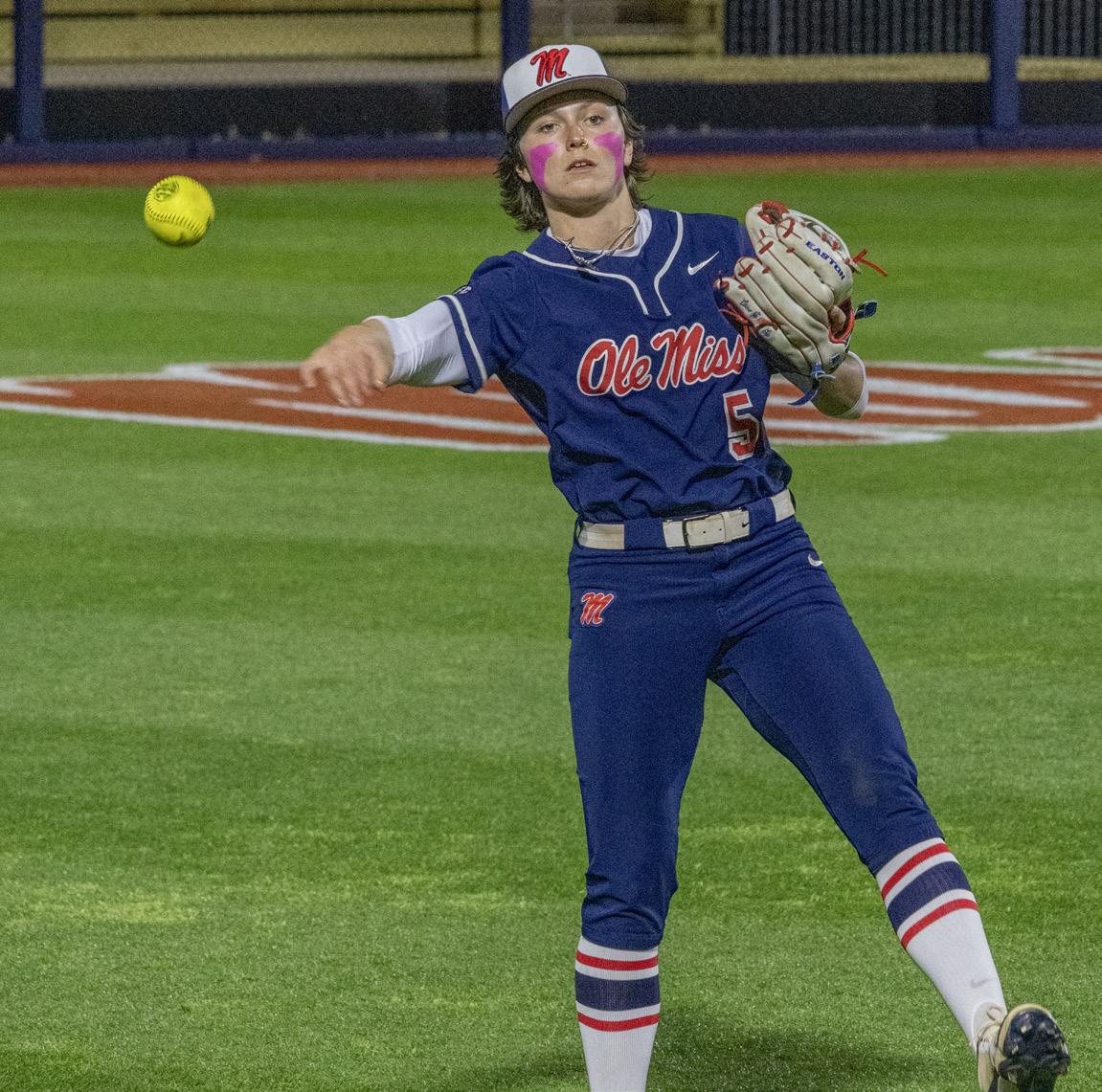
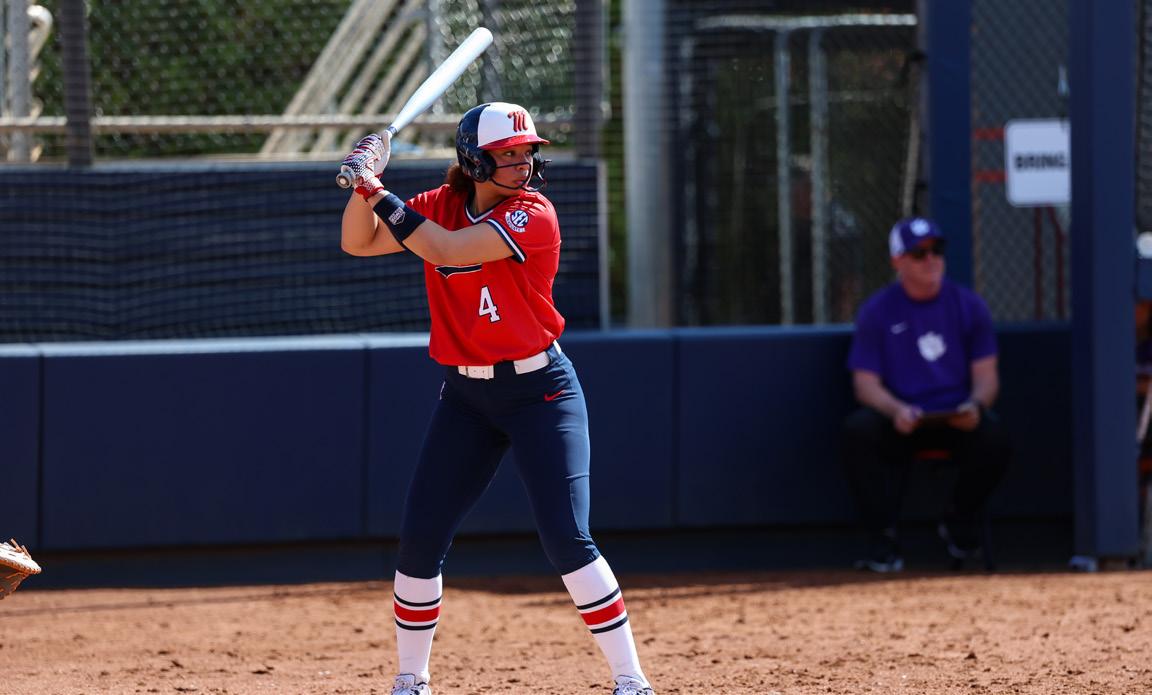
In a time when news cycles are filled with sorrow and polarization, The Daily Mississippian sought to tell the uplifting stories that happen every day in and around Oxford. This Good News Special Edition sheds light on the people and programs that make Ole Miss the spot that ever calls.
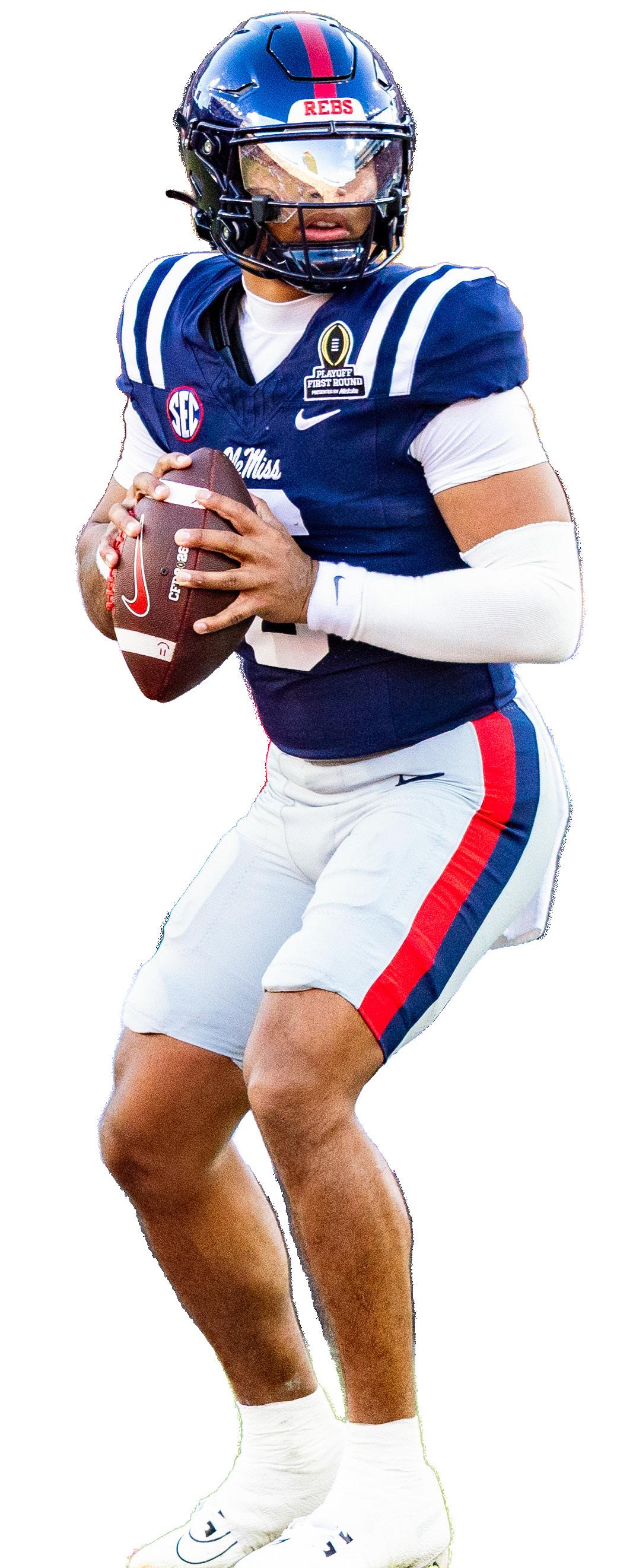
OLE MISS FOOTBALL REACHED NEW HEIGHTS DURING ITS MAGICAL 2025-26 CAMPAIGN.
Read about what made this season so memorable on pages 2-3.
SEVEN STUDENTS CREATE A T-SHIRT COMPANY. Page 7
LOCAL MOMS PROVIDE STUDENTS WITH HOMECOOKED MEALS.
8
LOOKING BACK ON OLE MISS FOOTBALL’S GREATEST SEASON
WILL WRIGHT
Sports Staff Writer
RUSS EDDINS Sports Editor
Imagine being an Ole Miss fan at the beginning of the 2025 season and a time traveler comes up and says that Lane Kiffin, who led Ole Miss to multiple New Year’s Six bowl games, will not finish the season as head coach. Pete Golding, who has never been a head coach, will now lead the program. Trinidad Chambliss, who never started a Division I game in his career, will be the Rebels’ star quarterback for most of the season.
The average Ole Miss fan in August would assume all of that information would lead to one of the worst, most devastating seasons in the history of Rebel football; yet, that was the opposite of true. This season of Ole Miss Football will go down in the history books in so many ways. College football historians will speak of the Lane Kiffin-Ole Miss-LSU drama forever, but Ole Miss fans will always remember the season for what it was: one of the greatest rides in program history. Here is a breakdown of the events of the 2025-26 season.
Weeks 1-4: a new dawn for the QB room
Ole Miss was coming off a solid, but ultimately disappointing, 2024-25 season that saw the Rebels miss the College Football Playoff with a 10-3 record. Quarterback Jaxson Dart and defensive tackle Walter Nolen headlined eight Rebel draftees to the NFL following last season’s campaign. By all accounts, Rebel fans thought 2025-26 would be a rebuilding year after the team lost so much talent in the offseason. Indeed, in the first few games, the Rebels looked good but not great. Starting quarterback Austin Simmons and Ole Miss began the season at home
against Georgia State, trouncing the Panthers 63-7. In his first collegiate start, Simmons threw for 341 yards and three touchdowns but also threw two interceptions. The offensive line allowed two sacks.
Ole Miss fans got their first look at former Missouri running back Kewan Lacy, who scored three times and ran for 108 yards. Penn State transfer wide receiver Harrison Wallace III also showed out for the fans with five receptions for 130 yards and a score.
In Week 2, the Rebels began SEC play against Kentucky. Unlike in 2024, when it started conference play in Week 5, Ole Miss had the chance to face higher quality teams early on.
It was not the team’s best game, but the Rebels left Lexington, Ky., with a 30-23 win. Simmons threw two picks again and was injured in the game.
Ole Miss came home to face Arkansas in Week 3. With Simmons injured, backup quarterback Chambliss got the start — and the former DII national champion shined. He went 21-of-29 for 353 yards and three total touchdowns.
It was a far-from-perfect game for the No. 17 Rebels. They won by only six points, 41-35, in a shootout at home. Moreover, the Razorbacks were marching down the field at the end of the fourth quarter and might have scored a game-winning touchdown if not for linebacker TJ Dottery’s game-saving forced fumble.
The defense was a significant concern in this game. The unit allowed quarterback Taylen Green to throw for 305 yards and run for 115. Arkansas outgained Ole Miss in total yards, 526 to 475. The Rebels also did not record a sack in this game.
Ole Miss followed the close win up with a 45-10 thumping of Tulane. Receivers Deuce Alexander and De’Zhaun Stribling — transfers from Wake Forest and Oklahoma State, respectively — fielded strong outings with 94 and
62 yards, respectively. Chambliss, once again, shined with over 400 yards of offense.
Weeks 5-9: battle testing
This was the most important stretch of games for the Rebels in the regular season, facing three then-Top 15 teams. They hosted No. 4 LSU, then visited No. 9 Georgia and No. 13 Oklahoma.
The Magnolia Bowl between Ole Miss and LSU has been a spectacular match the past several years, and 2025 was no different. LSU struck first with a touchdown, and Ole Miss followed with a field goal. Lacy pushed the Rebels ahead with a 15-yard touchdown run, and wide receiver Cayden Lee widened the lead to 10 with a touchdown reception. Ole Miss would continue to lead for the rest of the game.
Chambliss threw for 314 yards, and Lacy ran for 87, but what stood out most was the defense. The Rebels held LSU to 2-of-11 on third down along with only 254 total yards, while the Ole Miss offense had 480 total yards.
The win catapulted Ole Miss to No. 4 in the country — the team’s highest ranking since 2015 — going into its first bye week. Spirits were high in Oxford; at the time, college football fans and analysts widely regarded LSU as one of the best teams in the country.
After the break, though, Ole Miss came out flat footed against Washington State and narrowly won 24-21. The Rebels dropped only one spot in the rankings, to No. 5, but this stumble against the Cougars was concerning for many fans — especially since Ole Miss had to play against the No. 9 Bulldogs in Athens, Ga., the next week.
Yet, unlike the previous week, the Rebels started out fast against Georgia. Chambliss and the Ole Miss offense turned over a new leaf, scoring a touchdown on their first drive of the game. The Rebels did not slow down; they built a 35-26 lead heading into the fourth quarter. They scored touchdowns on all five of their possessions.
That was when the collapse began. The Rebels totaled only 13 yards in the entire fourth quarter and went scoreless across three drives.
This game marked another lackluster performance by the Ole Miss defense. Georgia’s offense scored points on every possession, which became an issue when the Reb -
el offense floundered late in the game. Ole Miss lost 43-35, falling to 6-1 on the season.
The Rebels did not have time to wallow, though. The next week, they were slated to visit Norman, Okla., to face the No. 13 Sooners. A second loss would put their playoff hopes in jeopardy.
This week also marked a milestone for this season when, ahead of the Oklahoma game, Florida fired head coach Billy Napier and was now on the hunt for a replacement, with Kiffin at the top of Florida fans’ dreamboards.
The Rebels managed to tune out the noise and defeat the Sooners 34-26. This was a breakout game for true freshman wide receiver Winston “Winnie” Watkins, who totaled four catches for 111 yards.
Weeks 10-14: consistency through the fire
This final stretch of the 2025 regular season consisted of some of the most crucial and nerve-wracking weeks for Rebel fans. Playoff brackets and projections began to form — which universally included Ole Miss — all while rumors about a potential Kiffin departure continued to swirl, especially after LSU fired head coach Brian Kelly. Despite all of this drama, Chambliss and Lacy led the team to a pair of dominant
Trinidad Chambliss runs the ball during the game against LSU in Vaught-Hemingway Stadium on Sept. 27.
FORD BENTON / THE DAILY MISSISSIPPIAN
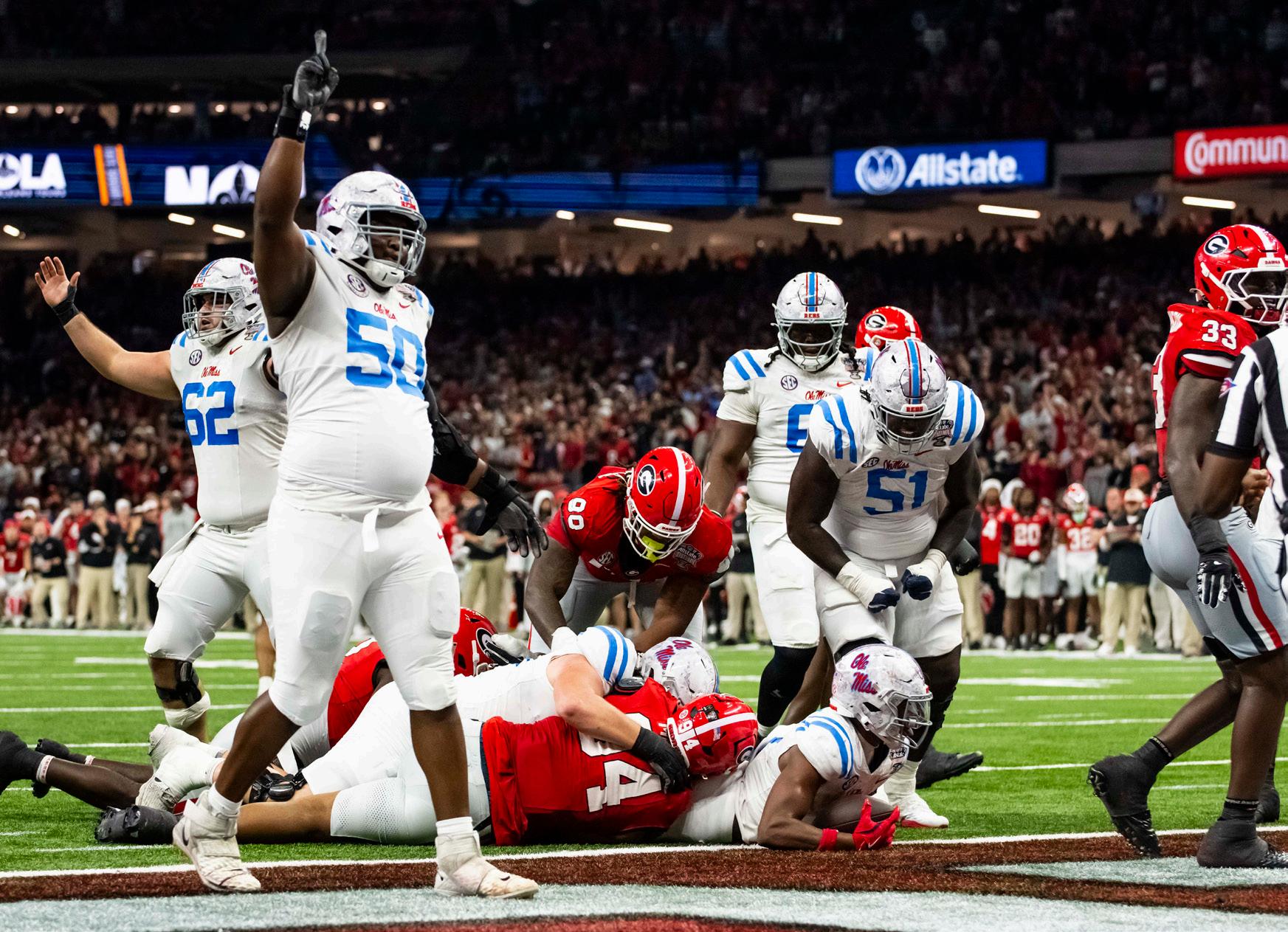
Kewan Lacy scores a touchdown during the Sugar Bowl on Jan. 1 in the Caesars Superdome.
OLIVIA CANGELOSI / THE DAILY MISSISSIPPIAN
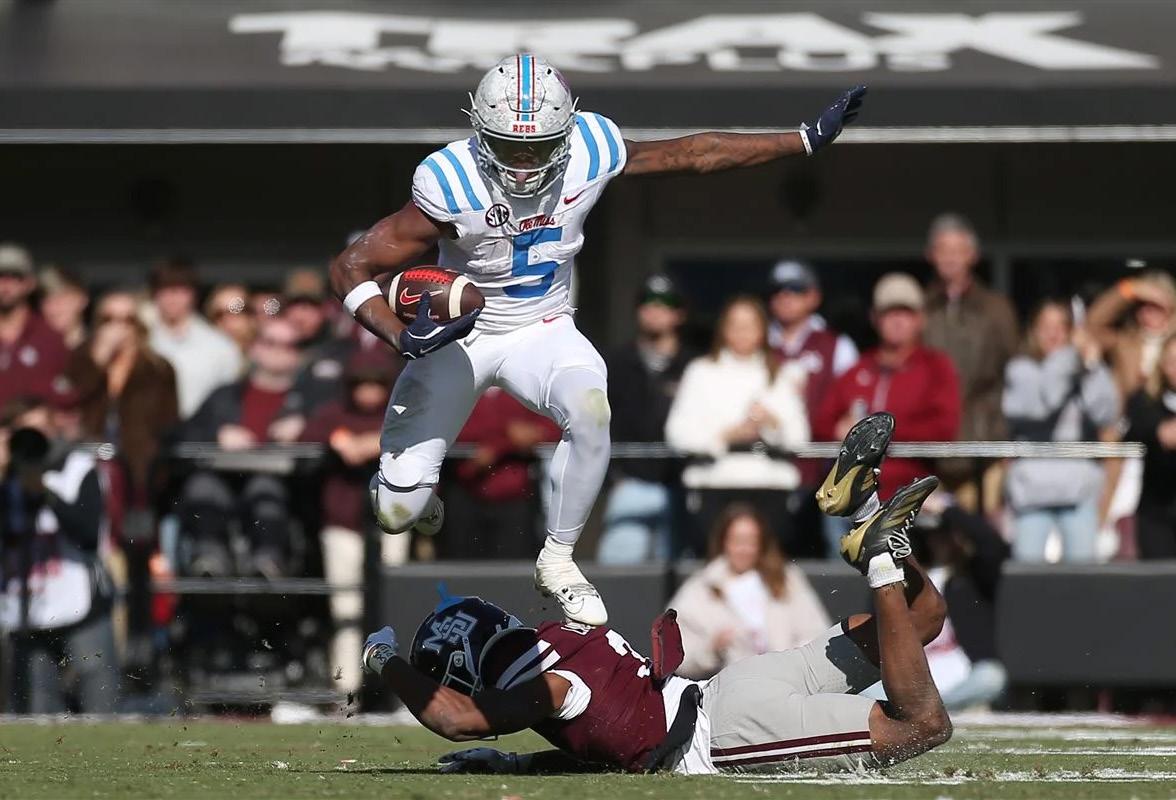
Kewan Lacy jumps over a defender during the game against Mississippi State in Davis Wade Stadium on Nov. 28.
PHOTO COURTESY: 247 SPORTS
home wins in Weeks 10 and 11. The Rebels beat South Carolina 30-14 and, a week later, trounced The Citadel 49-0.
By Week 12, Ole Miss was No. 7 in the country. The weekly College Football Playoff projections placed Ole Miss safely within the 12-team field.
As the Kiffin situation continued to swell, the Rebels prepared for their final home game of the season against Florida. Many speculated that the game’s outcome could be a deciding factor for whether Kiffin stayed in Oxford or relocated to Gainesville, Fla.
Ole Miss won 34-24, and as the clock hit zero, Vaught-Hemingway Stadium roared. Lacy rushed for 224 yards and three touchdowns, giving him the most all purpose touchdowns in a single season by a Rebel in program history. With just one game remaining, the Rebels had their sights set on two major points to wrap up their season. The first, and most important, was finishing the season 11-1 with a win against their biggest rival Mississippi State in the 122nd annual Egg Bowl. In doing so, they would solidify their playoff bid.
Kiffin’s future with the team remained uncertain heading into the matchup. In the week leading up to the game, Vice Chancellor for Intercollegiate Athletics Keith Carter announced that Kiffin’s decision would come the day after the Egg Bowl. Even though Florida was out of the picture, the LSU job was still open.
The Rebels took care of business in the Egg Bowl. Chambliss threw for 359 yards and four touchdowns, leading the Rebels to a 38-19 victory — the Rebels’ third straight win in the rivalry. Ole Miss closed the chapter on a historic sea -
son; the program recorded its first 11-win season in school history and had all but secured its first playoff appearance.
But the celebrations were short-lived. On Nov. 29, sources confirmed that Kiffin had accepted the head coaching position at LSU. Worse, he planned on taking most of his offensive staff with him, leaving Ole Miss in the lurch ahead of the playoffs. In response, Ole Miss quickly elevated defensive coordinator Golding to permanent head coach.
Don’t let the Rebs get hot
Ole Miss refused to let this turmoil ruin one its best regular season in history. In the aftermath of Kiffin’s lessthan-ideal exit, LSU allowed and Carter permitted offensive coordinator Charlie Weis Jr., as well as the other offensive coaches who planned to follow Kiffin to LSU, to coach at Ole Miss in the playoffs.
In a surprising turn of events, the selection committee moved the Rebels up one spot. At No. 6, they were slated to host the No. 11 Tulane, whom they had beat handily in Week 4.
Leading up to the game, the program rallied behind Golding. Fraternity houses on campus posted banners with messages such as “PETE FLEET 2026” and “GOLDING ERA.” Players voiced their support of the new head coach in press conferences.
In the first round of the playoffs, Ole Miss put the nation on notice with a 41-10 win over Tulane. Even without Kiffin, the team had not lost a step. The Rebels totaled almost 500 yards and advanced to the Allstate Sugar Bowl in New Orleans, where they would face No. 3 Geor -
gia, who had handed them their only loss of the season.
In the Sugar Bowl, the Rebels matched the Bulldogs’ physicality from the opening kickoff, trading punches in a fast-paced and hard-hitting contest.
At halftime, the game was beginning to look out of reach, though. Georgia, up 21-12 after its defense returned a Lacy fumble for a touchdown and set to receive the opening kickoff of the second half, was in command. Ole Miss’ poor clock management in its last drive of the half — amplified by tight end Dae’Quan Wright’s mistake of getting tackled in bounds — was a deflating way to head into the locker room.
During this tough stretch, it was the defense that kept Ole Miss alive. The unit forced a three-and-out on Georgia at the end of the first half and another at the start of the second half; even though the Rebel offense continued to struggle, the defense kept the Bulldogs off the scoreboard and provided the offense with chance after chance.
Finally, Chambliss and the offense surged. Against the Georgia defense stacked with NFL talent, Chambliss delivered in critical moments, breaking tackles, extending drives and delivering spotless throws on the run. The Rebels gained a 34-24 lead early with nine minutes to
play in the fourth quarter. Georgia came storming back, tying the game at 34 with less than a minute to play. On third-and-medium, Chambliss delivered a 40-yard strike to Stribling to put the Rebels in field goal range. Ole Miss won 39-34, earning the Rebels a spot in CFP semifinals at the VRBO Fiesta Bowl.
In the final game of their season, the Rebels battled hard. Lacy suffered a muscle strain on a 73-yard touchdown run in the first quarter, which stunted the Rebels’ run game. Though Chambliss’ performance was a step down from the statline he posted in the Sugar Bowl, his 277 yards and one touchdown were still enough to put the Rebels up 27-24 with about three minutes to play.
Miami quarterback Carson Beck led the Hurricanes on what turned out to be a game-winning touchdown drive. Down 31-27 with only 18 seconds, Chambliss managed to get the Rebels within throwing distance of the end zone, but his last-ditch heave to Stribling fell incomplete, and the Rebels lost.
The end of a season-long roller coaster
Though only one team can finish the season on top of the world, Ole Miss ended up where no one thought pos -
sible: a game away from the national championship. The program’s best regular season in school history turned into a playoff ride that much of Rebel nation will not forget. Fans, players and coaches experienced the highest of highs and the lowest of lows. Ole Miss started with one coach and finished with a new one; the Rebels began the season thinking one quarterback would head the team, but after an injury to the team’s starter, a relatively unknown DII product commanded the respect of the entire college football landscape as the new leading guy in Oxford. Ole Miss Football was in the shadows for a long time, but this season provided a sense of joy, excitement and promise that made the Rebel faithful believe. It was once said that Ole Miss could not compete on the national stage. Now, the Rebels will, in all likelihood, finish the season ranked in the Top 4.
THE
thedmsports@gmail.com
JAYLYNN CONNER arts and culture editor thedmfeatures@gmail.com
JESSICA JOHNSON assistant arts and culture editor thedmfeatures@gmail.com
MARY EVANS multimedia coordinator dailymissmedia@gmail.com
AVERY THOMAS social media manager thedmsocialmedia@gmail.com
CADENCE MANNING assistant social media manager thedmsocialmedia@gmail.com
S. Gale denley student media center
LARZ ROBERTS Director of Student Media
DENNIS MOORE Editorial Director
CONTACT
SPORTS DESK AT
Ole Miss students cheer during the Fiesta Bowl on Jan. 8 in State Farm Stadium.
REESE JOHNSON / THE DAILY MISSISSIPPIAN
Deuce Alexander makes a play in the game against Florida on Nov. 15 in Vaught-Hemingway Stadium
REESE JOHNSON / THE DAILY MISSISSIPPIAN
Students connect with Oxford community through volunteer work
ALY BRADSHAW News Staff Writer
During their time at the University of Mississippi, many students seek to take time out of their academic schedules to volunteer in the Oxford community. The university encourages students to do so on its student involvement page, emphasizing that it “is a great way to create life-long friendships, and volunteer experience can also increase your chances of landing a dream job.”
Many students required to perform community service are provided abundant opportunities to do so. For instance, the Sally McDonnell Barksdale Honors College and the Luckyday Scholars Program each require students to complete at least 10 hours of community service per semester. The Ole Miss First scholarship requires eight hours of community service, as well.
Additionally, Greek life provides students, like elementary education major from Columbus, Ohio, Olivia Brotherton, with opportunities to engage in volunteer work that they would otherwise know little about.
“I am a member of Pi Beta Phi, and during our four years we are given opportunities to volunteer around Oxford, for example, reading to students at Bramlett Elementary,” Brotherton said.
She volunteers with the Leap Frog Program, an after-school program that offers diverse learning opportunities to local elementary school students to become confident, lifelong learners. Volunteers are paired one-on-one with children, whom they teach and develop relationships with over the course of a semester. Brotherton said volunteers help children with homework, reading exercises and other learning activities.
“I started volunteering last year with the Leap Frog Program, and I try to be a tutor each semester that my school schedule allows,” Brotherton said.
Brotherton says she is driven to engage with a variety of opportunities during her time as a student.
“I feel that there are so many opportunities to give back and help out around campus that it’s inevitable during our time here. Each semester I try to spend a few hours somewhere new,” Brotherton said.
Grace Ribeiro, a junior elementary education major from Mattapoisett, Massachusetts , said that getting involved with Leap Frog connected her with a community outside of school.
“The only reason why I started to volunteer through Leap Frog was because I was a little homesick, and being able to give back to the community made it feel more like home and not just my college town,” Ribeiro said.
Through her volunteering, Ribeiro has been able to form bonds that nurture a love of learning in the children with whom she works.
“I love being able to work oneon-one with students for a whole semester and really form a bond with them, as well as seeing them progress into stronger readers throughout the semester,” Ribeiro said.
The university provides direct access to events and opportunities through GrovePulse, which helps students connect with the broader community by assisting them in identifying volunteer opportunities, supply drives, fundraisers and other opportunities to engage.
“The university’s primary tool for connecting students with meaningful service opportunities is GrovePulse (powered by GivePulse) — our university’s dedi-
cated platform for community engagement,” Assistant Director of Community Engagement Kathryn Kidd said. “Launched in fall 2025, the GrovePulse rebrand is our reminder that every act of service helps our community grow stronger and more connected. The platform itself remains the powerful tool for finding and managing volunteer opportunities, now with a name that’s uniquely ours.”
The platform has been a success, with thousands of volunteers working each year.
“On average, we have over 2,600 volunteers using GivePulse to find, track and share their impact per year,” Kidd said.
Kidd noted that many student volunteers gain positive experiences.
“From what I can see, a large chunk of volunteer hours is going to accounts like (Luckyday Scholars) and the Sally McDonnell Barksdale Honors College,” Kidd said. “Anecdotally, I know that students use GrovePulse to find opportunities to engage with the community, learn new skills and meet new people. We can see this through the comments volunteers leave when they submit impacts for their services.”
Notable venues for involvement include organizations such as the United Way of Oxford and the Grisham-McLean Institute for Public Service and Community Engagement. Doors of Hope is a non-profit that works to assist the homeless and at-risk families.
The student-run Big Event “has historically been the largest community service event in the history of the University of Mississippi,” according to the organization’s website.
Ella Wainwright, co-director of volunteer recruitment and retention for the Big Event, is drawn to the strong network of students who fre-
quently volunteer in the community.
“What draws me back to volunteering with the Big Event each year is the amazing network of people who share my same love for community service, and most importantly, for Oxford,” Wainwright, a junior public policy leadership major, said. “This organization does such an amazing job at using our strength in numbers to make a positive impact for the town that gives us so much. Whether it’s volunteering at the local animal shelter or helping out a neighbor in town, you can truly feel the impact that this organization has on the city of Oxford and the Ole Miss community.”
RebelTHON, another student service organization, raises money for Mississippi’s only Children’s Miracle Network Hospital, Children’s of Mississippi in Jackson, through a 12-hour dance marathon and fundraising activities throughout the year.
Emma Grace Hale, a senior
social work major, is a fourthyear volunteer for RebelTHON.
“I volunteer for RebelTHON because it is an amazing organization that gives me the ability to be a part of something that is bigger than myself,” Hale said. “I take pride in knowing that we are helping change kids’ lives! … I’ve met some of my best friends in the world through this organization, specifically my morale captain family, and I can’t imagine doing college without them.”
Ole Miss students have plenty of opportunities to make a positive difference in the community. Ribeiro believes that Oxford has done so much for her, so offering her time to make a positive impact is returning the favor.
“I get to feel like I am giving back to a town that has given me so much,” Ribeiro said.
The Leap Frog Program logo.
PHOTO
First-generation students find success, support on campus through university programs
TATUM STEWART News Staff Writer
First-generation college students feel a special excitement for their upcoming college experience. Some of them, however, also worry about the challenges that this new chapter brings, facing the added pressure of being the first person in their family to attend an institution of higher learning.
For many first-generation college students, whose parents or guardians did not complete a four-year college degree, success is about more than earning a degree.
“Being a first-generation college student means everything to me,” Suezette Salazar, a junior marketing major, said. “Being the first in my family to attend and graduate (college) shows that my parents’ sacrifices mattered, and it’s something I’m incredibly proud of.”
The University of Mississippi has made strides to welcome first-generation students through programs and organizations designed to provide support and assistance. The First-Generation Student Network, a registered student organization that organizes programming for first-generation students, was launched in 2020.
When Brooke Jankowsky, a senior marketing and management major, first arrived at UM, she felt the very same hopes as many new college students — excitement, nerves and a desire to succeed. But as a first-generation student, she was also navigating an experience her fam-
ily had never explored before.
For Jankowsky, now president of the First-Generation Student Network (FGSN), adjusting to college meant learning unfamiliar systems like financial aid, course registration and campus resources largely on her own.
“As a first-generation student, you don’t always know where to start or who to ask,” Jankowsky said. “Being involved in the First-Generation Student Network helped me gain confidence and learn how to navigate those systems.”
Other first-generation students echoed similar experiences, describing the balance between independence and pressure to succeed.
“At first, I struggled with imposter syndrome and didn’t feel like I deserved to be at Ole Miss,” Khloe Osborne, a senior biological sciences major, said. “Once I found campus organizations and friends who shared similar experiences, I was able to open up and truly enjoy my time here. There really is a place for everyone. You will find your people.”
At UM, the FGSN provides first-generation students with mentorship opportunities and offers information about campus resources.
The FGSN also hosts professional development meetings, information sessions on internships and employment opportunities and social events designed to give first-generation students a community on campus.
“FGSN isn’t just about academics — it’s a community you can turn to at any time,” Jankowsky said. “We want
first-generation students to feel welcomed, supported and confident as they navigate college.”
The organization meets biweekly on Mondays and emphasizes an inclusive and judgment-free environment.
“The First-Generation Student Network gave me a sense of community. It connected me with students who shared similar experiences and struggles, which made me feel less alone,” Salazar said. “I also learned about campus resources that I did not know were available to me. Through this experience, I realized I wanted to give back. Being selected as the Student Success and Resource Chair allowed me
to support other students and serve as a ‘big sister’ figure. I enjoy helping first-generation students navigate college and feel confident in their journey.”
This sense of community is also emphasized by Osborne.
“(The FGSN) has allowed me to meet lifelong friends, have support from peers, hear others’ stories and connect with faculty who truly care about your success and well-being,” Osborne said. “Also, it has connected me to many resources for networking, advice and anything that I would need help with.”
Other first-generation student organizations include the Alpha Alpha Alpha Honor So-
ciety, formed on the UM campus in 2024. The honor society is the only first-generation student honor society in the nation, with the University of Mississippi’s chapter being the first established in the state.
“It is an opportunity to recognize academic excellence among first-generation students and all they contribute to the university community,” Ashleen Williams, instructional assistant professor and faculty advisor to Tri-Alpha, said.
CONTACT THE NEWS DESK AT thedmnews@gmail.com
UM names Bradley Baker dean of students
CLAY HALE Editor-in-Chief
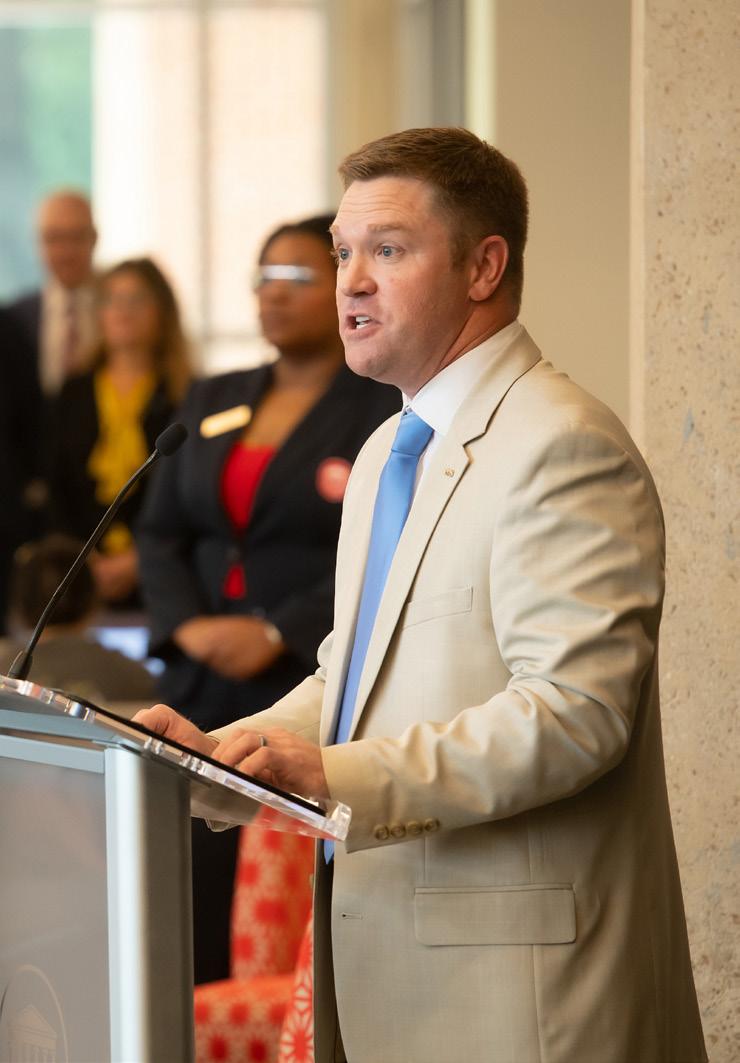
The University of Mississippi announced the selection of Bradley Baker as dean of students and assistant vice chancellor of student affairs in a press release on Jan. 13. Baker started his new role on Monday, Jan. 12, but he has served as the interim dean since Sept. 2, 2025.
“I am grateful for the opportunity to serve my alma mater,” Baker, an Olive Branch,
Miss., native, said in the press release. “Ole Miss has shaped my life in profound ways, and I’ve long admired how this role supports students both inside and outside the classroom. Working collaboratively with colleagues across campus, we will continue to create an environment where every student has the tools and opportunities to thrive.”
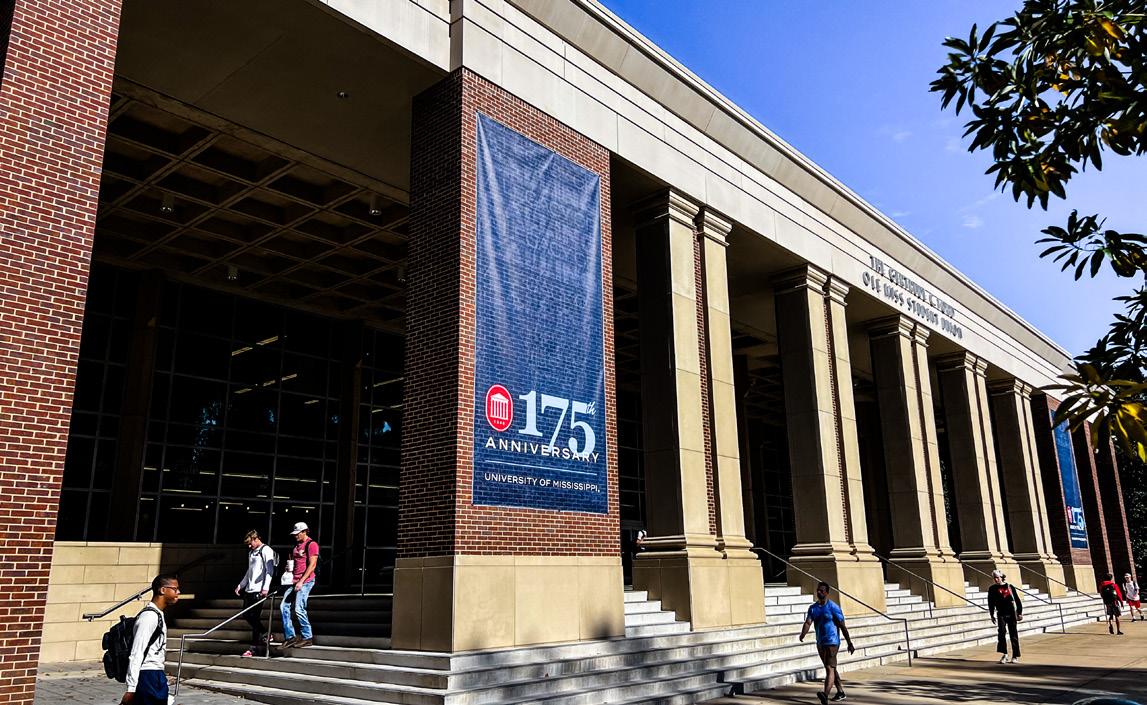
In his new role, Baker will oversee several departments and offices at UM, including the Office of Fraternity and Sorority Life, the Gertrude C. Ford Ole Miss Student Union, the Office of Conflict Resolution and Student Conduct, UMatter: Student Support and Advocacy, and Confidential Advocacy, Support and Education.
Before being selected as dean of students, Baker served as the director for the student union since July 2012.
“He leads with care and clear expectations,” Mead said in the press release. “Bradley brings fairness and consistency to hard decisions, and he builds trust across campus.”
Looking ahead, Baker said his focus is to support student success while strengthening co-curricular experiences, connecting students to campus resources and ensuring his staff members feel supported and equipped to do their jobs.
Associated Student Body President Jack Jones said he is excited for Baker’s entrance into the role.
“As a student leader, I’m excited to see Bradley Baker named dean of students,” Jones, a senior public policy major from Murray, Ky., said in the press release. “Mr. Baker is a true champion for students, and I’m confident he will be the kind of dean our students deserve.”
Baker fills the position formerly held by Assistant Vice Chancellor of Student Affairs and Dean of Students Brent Marsh, who left the university in August 2025. Marsh currently serves as the vice president for student affairs at Oklahoma State University.
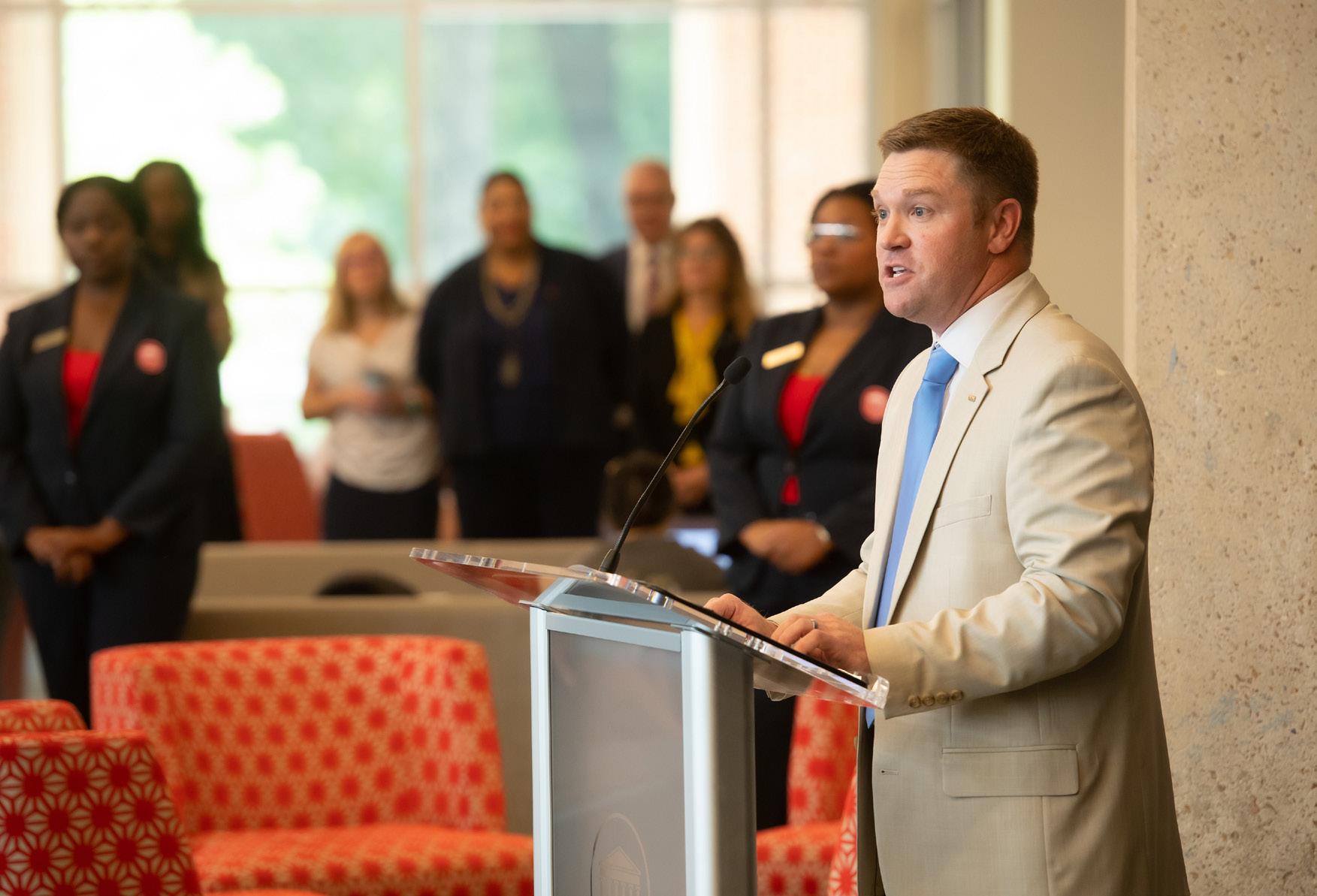
Bradley Baker PHOTO
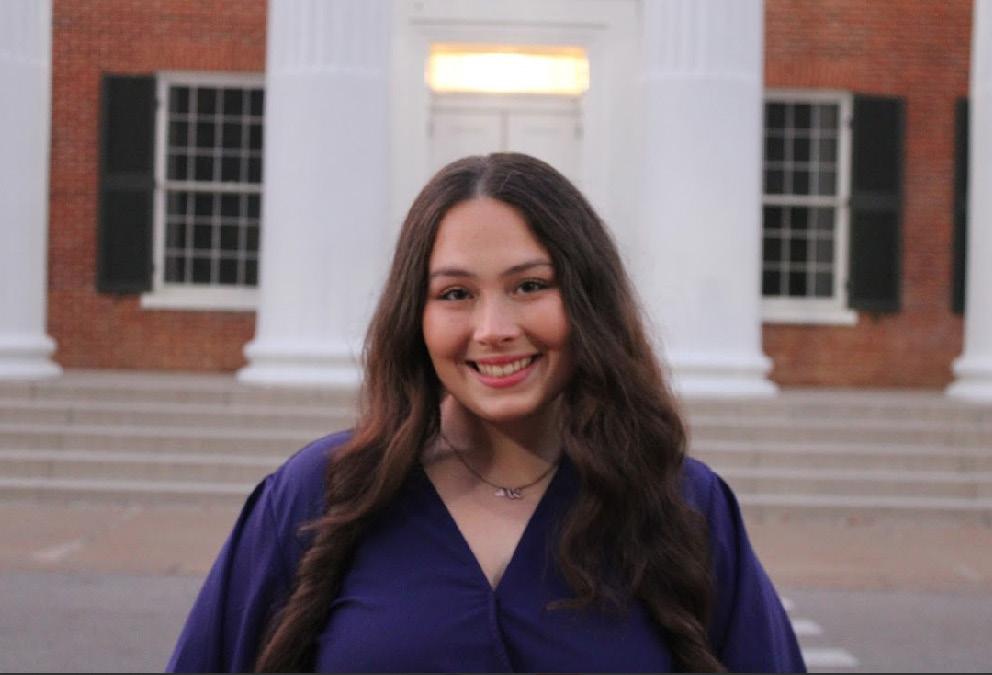
Khloe Osborne
PHOTO COURTESY: KHLOE OSBORNE
SAA helps students bounce back to campus
CHANCE MARLOWE
News Staff Writer
This spring, the Student Activities Association (SAA) is offering a slate of events. The student-led organization, focused on providing free activities for all University of Mississippi students, has sought to maintain traditions that improve social life on campus.
“The first day back, on Jan. 20, our campus traditions committee is jumping into the new year. So, we are going to have some bungee jumping outside on the Union Plaza and a couple other fun things to do,” Mr. Ole Miss Ryan Augustine said.
In addition to bungee jumping on the first day of classes, SAA plans to hold a murder mystery dinner night on Jan. 27 and will collaborate with the Associated Student Body for a Bingo night for Jan. 30. Augustine, a senior allied health studies major and Madison, Miss., native, serves as the executive director of the organization. Augustine believes that SAA is instrumental in producing a sense of community on campus.
“I feel like our goal is always to make sure our programming is purposeful. We’re not just doing some giveaway but making sure there’s a chance for students to actually talk to each other and do something fun that might brighten up their day,” Augustine said.
The organization’s leadership has been planning over the winter break.
“Our spring calendar is tentatively finalized; all the co-directors have been working during break to ensure everything happens,” Augustine said. “We should have at least 40 events this semester.”
SAA touts on its website that its events are “for students, by students.” Senior journalism major and Amory, Miss., native Hannah Hoang, who serves as one of three co-directors for the organization, says that student feedback plays a vital role in the organization’s planning and aims.
“One of the biggest changes coming back a second year as a co-director is I’ve been able to hear feedback from students, and it has challenged me, along with my co-direc-
tors, to be more creative when we plan events,” Hoang said.
The organization uses tools such as online forms that query students on their opinions.
“We’ve tried to look at a lot of different feedback from students,” Hoang said. “We have forms now that go out after events that can help us hear what students like.”
Hoang says that for these events, regular vendors will return, including some of her personal nostalgic favorites.
“We are going to have back our airbrush vendors, which people have loved for years. It was something I went to my freshman year,” Hoang said.
Augustine said the organization has revealed to him the importance of maintaining an inclusive community through service.
“There are a lot of people on campus who don’t have date parties to go to or a group house to go hang out with friends. And I think this organization really has taught me the importance of serving in any way possible, like whether it’s community service or just even planning things with
other people,” Augustine said.
SAA’s broad goal of building community is complex from a planning perspective, but Augustine emphasized that whatever shortcomings SAA may or may not have, intentionality is the best foot forward.
“There’s intentionality behind everything that’s meaningful,” Augustine said. “If you produce an event and people love it and they meet their best friends there,
that might have been the hardest thing to plan. The logistics might have been terrible, something might have broken the day earlier and so many logistics could have gone wrong beforehand, but you see the payoff of students actually finding a place on campus and feeling like they have things to do.”
Shows for spring: a sneak peak at live performances in Oxford
JESSICA JOHNSON Assistant A&C Editor
Oxford is a vibrant city for live shows with venues including Proud Larry’s, The Lyric and the Gertrude C. Ford Center. Here’s a look at performances scheduled this spring. Shows at the Ford Center are for all ages. Minors must be accompanied by a parent or guardian at Proud Larry’s and The Lyric, and those under 21 are required to pay a $5 cover fee in cash.
Artist: Guy Vincent
Venue: Proud Larry’s
When: Jan. 22 at 9 p.m.
Genre: Country Price: Free
Sophomore general studies major and emerging country star Guy Krauskopf, who performs as Guy Vincent, is kicking off the first week of the semester with a free performance at Proud Larry’s. Originally from San Antonio, Krauskopf was the winner of the 2024 Ole Miss Idol, and his song “Burn” reached No. 1 on the Texas Regional Radio chart based on airplay.
Artist: Pothole Paradise
Venue: Proud Larry’s
When: Jan. 23 at 9:30 p.m.
Genre: Indie rock Price: $20
From Jackson, Miss., Pothole Paradise is composed of four high school friends-turnedbandmates. The group frequently tours around the state, bringing its indie rock flair and high energy to every performance.
Artist: The Crowns with Van Buren
Venue: Proud Larry’s
When: Jan. 24 at 9:30 p.m.
Genre: Rock Price: $10
Southern rock band The Crowns, along with opening act Van Buren, brings local Oxford excellence to the stage. The Crowns have performed at multiple venues around Oxford and at fraternity events.
Artist: earspace, Chamber Ensemble
Venue: Ford Center
When: Jan. 26 at 7:30 p.m.
Genre: Orchestra Price: $20-$35
earspace is a contemporary orchestral group from Raleigh, N.C. The group features violin, viola, cello, flute, oboe, clarinet, piano and percussion and is perfect for those seeking a unique, experimental performance.
Artist: Yazoo
Venue: Proud Larry’s
When: Jan. 29 at 9 p.m.
Genre: Rock Price: $20
Oxford band Yazoo is no stranger to performances around town, opening for The Bends in September. Yazoo’s single “Angelina,” released in 2025, is always a crowd favorite.
Artist: The Choir of Man
Venue: Ford Center
When: Jan. 29 at 7:30 p.m.
Genre: Musical Price: $35-$70
The Olivier-nominated musical “The Choir of Man” brews up multi-talented entertainment. The show features a cast of nine male performers who tap dance, sing covers of popular songs and even serve drinks at a working bar on stage.
Artist: Joybomb, with The Half of It
Venue: Proud Larry’s
When: Jan. 30 at 9:30 p.m.
Genre: Alternative rock Price: $12
With gritty vocals and high-energy songs, Joybomb is good for anyone looking for an alternative show, paired with opener The Half of It, a pop-punk trio from Oxford. From Memphis, Joybomb notably opened for rock band Third Eye Blind in June.
Artist: Sam Barber
Venue: The Lyric
When: Jan. 30 and Jan. 31 at 7:30 p.m.
Genre: Country/rock Price: $46-$129
Country star Sam Barber is spending two nights in Oxford as part of his 2026 “American Route” tour. An “American Idol” alumnus, Barber has more than 8 million monthly listeners on Spotify. His latest project, the EP “Music for the Soul,” was released in August and features the singles “Man of the Year” and “Home Tonight.”
Artist: 49 Winchester
Venue: The Lyric
When: Feb. 5 at 8 p.m.
Genre: Country/alternative Price: $35
Alternative country group 49 Winchester has been making music since 2014. The band opened for Luke Combs on the European leg of his 2023 “Luke Combs World Tour” after Combs showed his support for the group, wearing one of its merch T-shirts in a 2022 Instagram post.
Artist: Pecos & The Rooftops
Venue: The Lyric
When: Feb. 6 at 8 p.m.
Genre: Country/rock
Price: $29
Pecos & The Rooftops, from Lubbock, Texas, blends rock and Americana with a country twang. The group’s latest album, “From Me,” was released in 2025.
Artist: The Jack Wharff Band
Venue: Proud Larry’s
When: Feb. 6 at 9 p.m.
Genre: Bluegrass/country Price: $20
Originally from Richmond, Va., the four-piece band led by frontman Jack Wharff formed at an open mic night in 2023. After catching the attention of Big Machine Records, the group moved to Nashville and has been touring to promote the 2025 EP “Richmond’s Most Wanted.”
Artist: Creed Fisher
Venue: Proud Larry’s
When: Feb. 12 at 9 p.m.
Genre: Country Price: $25
An Army veteran-turned-professional football player-turnedcountry-rock star, Creed Fisher is a self-proclaimed “all-American” musician. Fisher incorporates themes of patriotism and small-town life into his outlaw country songs.
Artist: Wax Monkey
Venue: Proud Larry’s
When: Feb. 13 at 9 p.m.
Genre: Rock Price: $15
Hailing from Birmingham, Ala., the five members of Wax Monkey formed the group while students at the University of Alabama in 2023. The quintet performs covers from bands such as Phish and the Allman Brothers Band, as well as improvisational jam sessions.
Artist: Vincent Mason
Venue: The Lyric
When: Feb. 13 at 8 p.m.
Genre: Country Price: $33-$156
After opening for country megastars such as Luke Bryan, Riley Green and Parker McCollum, singer-songwriter and former UM student Vincent Mason embarks on his own headlining tour. His breakthrough hit “Hell is a Dancefloor” has amassed more than 110 million streams on Spotify, cementing Mason as a star on the rise.
Artist: Eric Deaton Trio
Venue: Proud Larry’s
When: Feb. 14 at 9 p.m.
Genre: Blues Price: Free
The Eric Deaton Trio is a North Mississippi-based blues group that performs across the state. Its titular leader, Eric Deaton, is also a session musician who has recorded with artists such as Hank Williams Jr. and the Black Keys.
Artist: Tango After Dark
Venue: Ford Center
When: Feb. 16 at 7:30 p.m.
Genre: Dance Price: $30-$60
Led by winners of the 2003 and 2005 World Tango Championship, German Cornejo and Gisela Galeassi, “Tango After Dark” is a dance show that features a live band and an eight-dancer troupe. The group pays tribute to the Argentinian dance tradition through a theatrical experience.
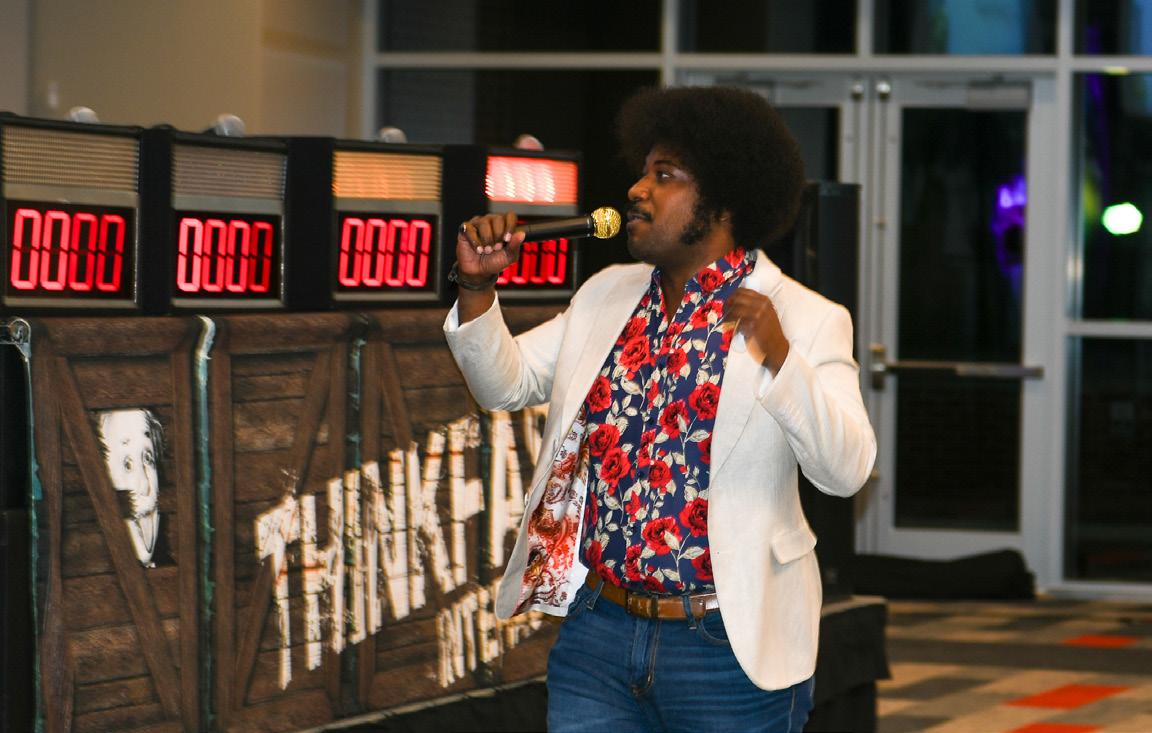
Mars O’Neal hosts SAA trivia in the Gertrude C. Ford Ole Miss Student Union Ballroom on Sept. 23, 2025.
From shelter to sofa: a second chance for both students and adopted animals
TAYLOR HILL
A&C Staff Writer
For some University of Mississippi students, animal adoption can be a positive experience that teaches responsibility and time management skills. Beyond that, in a college town like Oxford, students offer a unique opportunity to help local shelters.
Oxford Animal Resource Center (OARC) offers college students opportunities to observe the animals, volunteer at the facility or foster for a day – all of which gives animals the care, attention and stability they deserve.
Kelli Broscoe, the director of OARC, shared her insights into the relationships among college students, the shelter and the animals.
“The Foster For a Day and Foster Programs are what we have noticed have strengthened the relationship between shelters and colleges,” Briscoe said.
“Students have the ability to come and take a dog for a day or to foster short-term without the commitment of adoption.
During the foster process, all supplies are provided including toys, bowls, food and a crate.”
For some students, fostering does not always go as planned. Senior sociology ma-
jor Dymond Mitchell participated in the Foster for a Day program but found herself fostering for life after meeting her furry companion, Coco.
“I really just wanted to foster for a day,” Mitchell said. “That was the plan, and I ended up falling in love with her.”
Mitchell could not imagine returning Coco to the shelter.
“When I first got her, she was really nervous, and I could tell,” Mitchell said. “When she got to my house, she kept putting her head down, so I went and sat on the floor of my living room and she immediately came and sat in my lap and put her head into my shoulders and neck and snuggled.”
That moment of trust not only reassured Mitchell that Coco felt safe but also reshaped her summer in Oxford. What began as a simple foster quickly became a companion who gave her structure, purpose and a reason to step outside her routine.
“I was in Oxford for the summer and a lot of my friends were gone, so I just wanted a way to get out and do more things. I thought having a dog would be fun to take on walks, go to the trails and (give me) more of a reason to get out of the house,” Mitchell said.
For many college students, owning pets provides
unexpected personal benefits during a demanding and stressful stage of life.
“Having Coco did help with my stress and homesickness,” Mitchell said. “It always gave me a buddy to go walking with or cuddle with and just know that it’s not all over, these grades aren’t the end of the world.”
While adoptions directly benefit animals, the impact goes far past that. Many students find that animals in their lives positively affect their own well-being.
“There are so many shelter dogs in need of a home and of love and who can make your life so much better,” Mitchell said. “Yes, I know Coco’s life is better off with us, but genuinely she has made my life better too.”
Lafayette County Animal Shelter Director Daniel Christenbury finds the adoption experience to be more than a one-way street.
“It’s a symbiotic relationship between the adopted pet and the student,” Christenbury said. “They see the pet as a grounding experience from back home. To have one here is to add that touchstone from home. It benefits their well-being, and I know that’s the same case for the animals.”
Despite the many positives, adopting an animal during
college can come with challenges. Briscoe emphasized the importance of educating students before adopting.
“Adopting an animal is a big responsibility and takes time and patience,” Briscoe said. “Educating the student population in Oxford about all aspects of owning an animal is where we like to start: the good, bad, pretty and ugly parts of it.”
Briscoe said that animal shelters are often associated with negative stereotypes that are inaccurate.
“I think the misconception is that they are ‘damaged goods’ or not ‘trainable,’” Briscoe said. “Both of those
are highly false. We have had dogs from our rescue become service canines, explosive detection canines, successful bird dogs or your standard best friend. Just because an animal comes from a shelter or a rescue does not mean that they cannot be successful.”
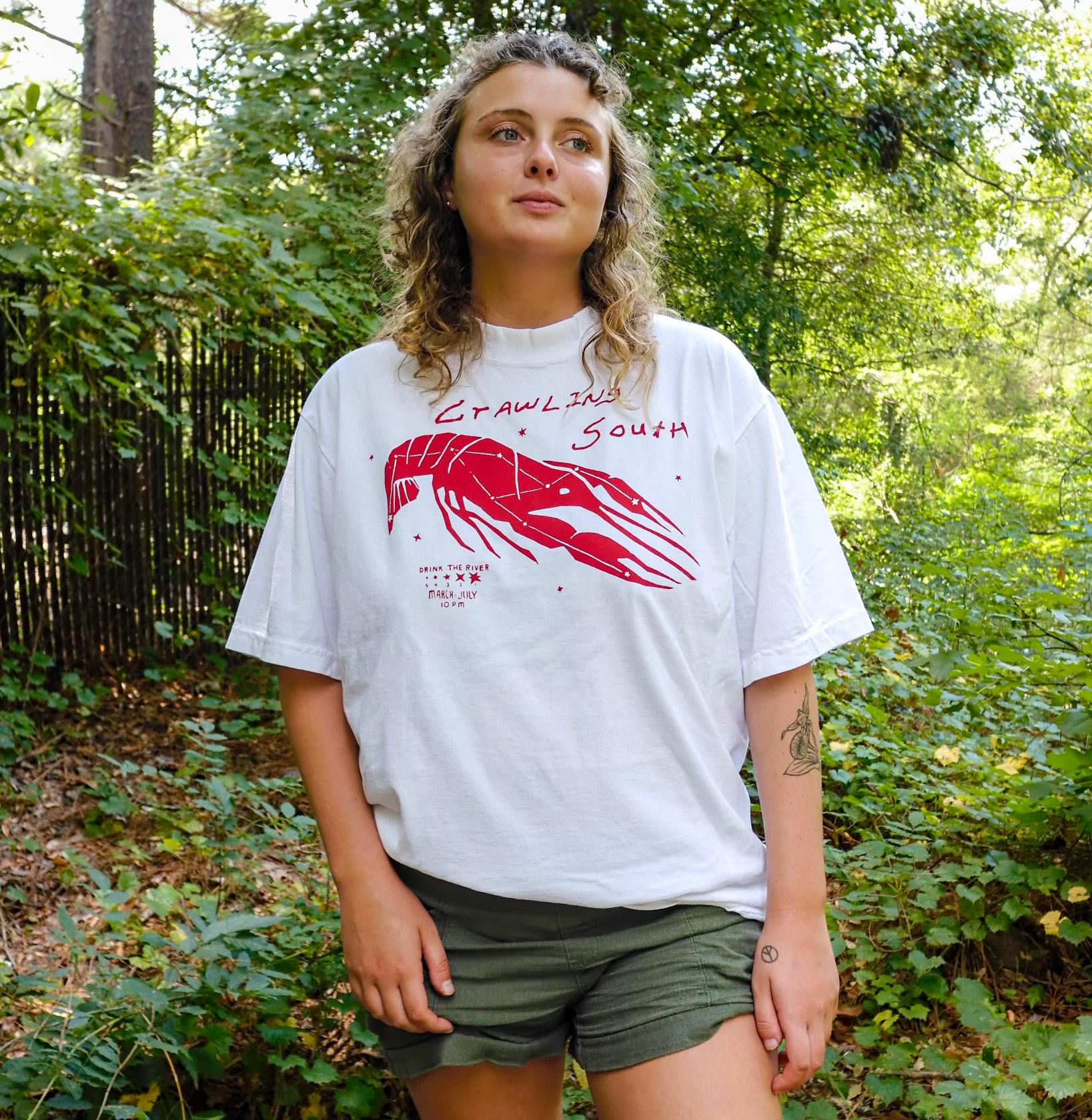
New Oxford T-shirt brand Drink The River celebrates Southern identity
P.B. JERNIGAN
Staff Writer
The up-and-coming T-shirt brand Drink The River (DTR) started when a group of young Oxford natives joined to celebrate their hometown’s landscape. Its designs feature cultural touchstones of Oxford and the state of Mississippi that highlight Southern identity.
Seven Oxford-based individuals founded the company, including University of Mississippi graduates Haihai Fisher, Caroline
Kincaid and William Carrington, as well as Jack Green, a graduate student at Mississippi State University. Current UM students Catherine Creekmore, Ellis Farese and Kesler Smith also co-crafted the company.
The name, Drink The River, was inspired by the Cowpasture River in western Virginia, where the friends visit frequently.
“It’s gorgeous, and it’s one of America’s cleanest rivers, something to drink from,” Green said. “Largely, it’s our vision and our picture of what
Mississippi and the South are.”
This name was metaphorical and symbolic of Mississippi and Southerners’ sometimes complicated relationship with home, according to Farese.
“We’re not drinking the river water literally … but we’re swimming in it, sleeping by it, watching it and appreciating it,” Farese, a senior creative writing major, said. “It’s easy to feel overwhelmed with feelings surrounding your home. To us, Drink The River is an attempt to consolidate those feelings of overwhelm. … To ‘Drink The River’ is to acknowledge and appreciate what we have access to in our home in the South and to share it with others.”
DTR’s concept was based on the idea of keeping Oxford locals close to home and close to each other.
“We (the founders) were talking in early 2025 and trying to think of something to do to stay connected to home and to each other,” Farese said. “Some of us were about to graduate and some of us were about to enter our last year, so we came up with DTR.”
Smith, a senior Southern studies major, said the company’s creative intention is to shape others’ perspectives on the South.
“We created the company based on our feelings about the South and the way the rest of the world views it,” Smith said. “We all wanted something we could do together that gave us an outlet creatively, but it also gave us
a chance to talk about the geography and history of the South.”
Smith also expressed the team’s hope for exploring Oxford’s identity outside of the university.
“As all of us are Oxford natives and Ole Miss students or graduates, we find that a lot of things are university-centered,” Smith said. “We wanted it to be more Oxford-based for the local experience but also for college students to know ‘the real Oxford’ and the place outside of campus.”
In summer 2025, the brand released three T-shirt designs in a variety of colors, featuring a crawfish, dueling deer and a map of Lafayette County.
Fisher, DTR’s main designer, detailed the creative influences for the brand.
“With DTR being very focused on nature, the seasons also play a large role with the first summer drop with imagery like deer, crawfish and swimming holes,” Fisher said. “We want to operate Drink The River as a living and changing thing, much like the natural world we aim to depict.”
Smith described the group’s decision to use T-shirt designs as their creative outlet. Team members built screen printers and created the shirts together.
“We decided to make T-shirts because we thought it was one of the more fun ways to break into what we want to eventually do with Drink The River, which is still up in the air,” Smith said, “I think it’s
the foundation for a really creative group of people to have an outlet.” DTR promoted and sold their designs at local art markets such as Chicory Market’s Holiday Open House and the Water Valley Art Crawl in hopes of boosting community engagement.
“We were really happy to have Chicory Market be our first place to sell in person,” Farese said. “We want to have something that holds value besides just being a material item but something that can connect people to the South and to home. It was really wonderful to talk to people about what we’re doing and why we decided to do it.”
Fisher described future plans for DTR and the hope for more community involvement for the brand.
“We definitely hope to smoothly scale the brand through more designs and a larger audience, as well as to find more opportunities for community engagement,” Fisher said. “With such a big part of DTR’s identity being centered on Mississippi and the South, we want to be able to help support the place that has raised us and are excited to find these opportunities in our second year of business.”
Editor’s note: Ellis Farese was an arts and culture staff writer for The Daily Mississippian in fall 2023.
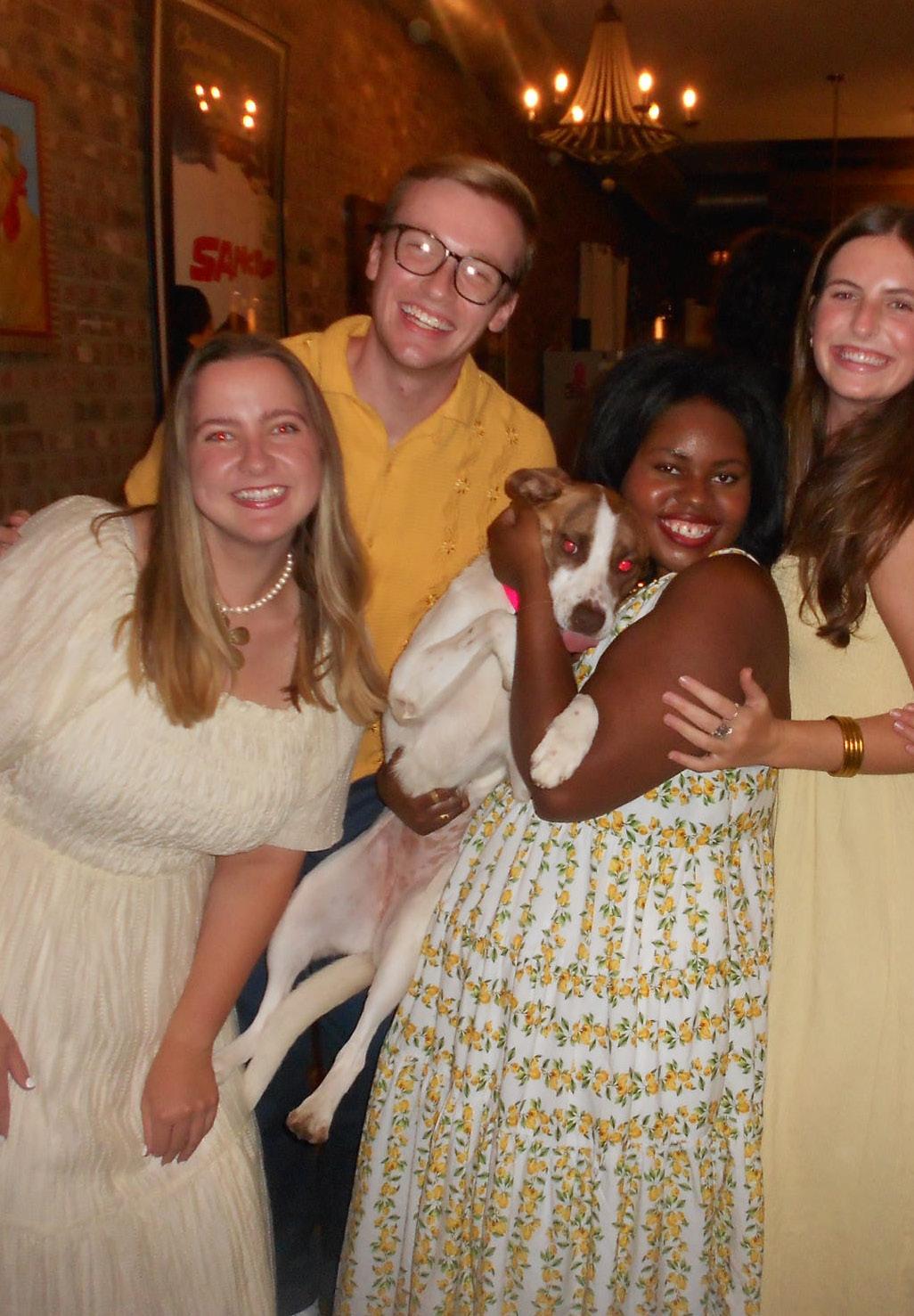
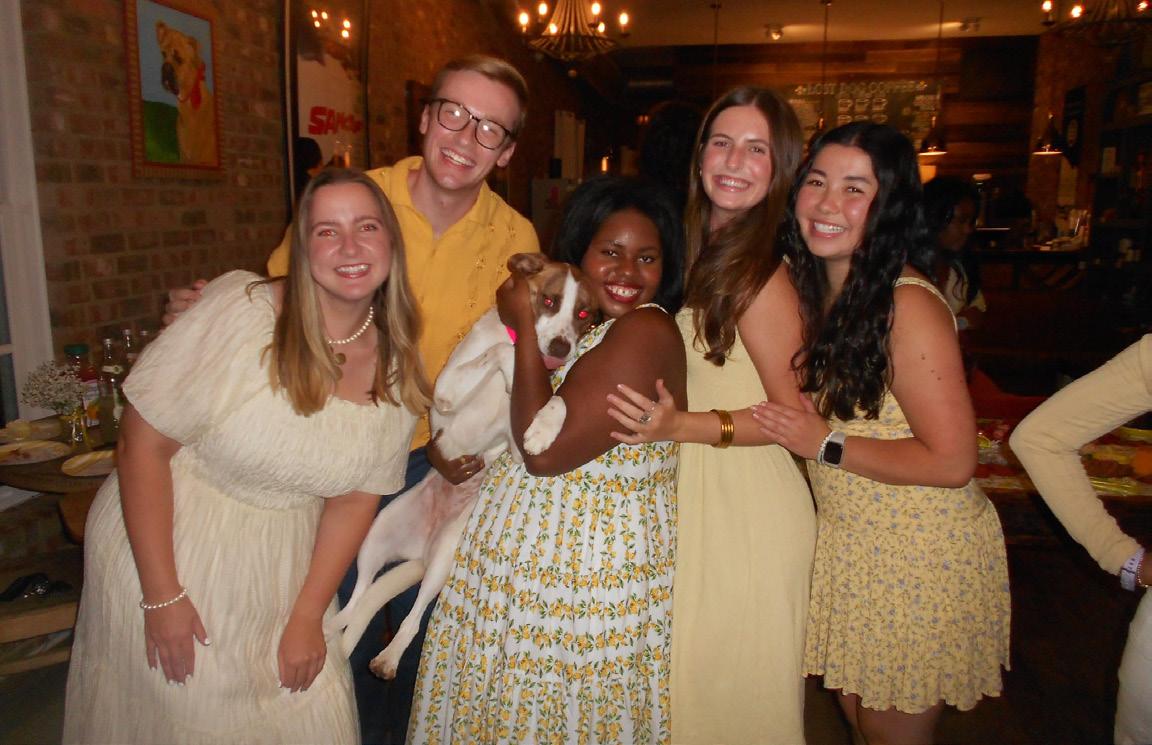
Dymond Mitchell holds her dog Coco while surrounded by friends at Lost Dog Coffee on Sept. 4, 2025.
PHOTO COURTESY: DYMOND MITCHELL
A&C
Stop paying for these 10 things as a student at the University of Mississippi
TAF FLANDERS
A&C Staff Writer
With tuition culminating in thousands of dollars each semester, students at the University of Mississippi can get their money’s worth by taking full advantage of the many services offered to them free of charge. From doctor’s appointments to tutoring, the university offers a wide variety of services for students to help them succeed in their academic and personal lives. Hereisalistof10freeservicesthat all UM students should check out.
Expensive equipment
If you want to “wow” your professor with a multimedia project, the library’s IDEAlab offers free equipment loans. Most equipment can be checked out for a maximum of three days and can be requested by sending an email to idealab@lib.olemiss.edu.
The equipment includes microphones, cameras and even MacBook Pros with access to Adobe Creative Cloud. The next time a big project comes around, filming on a phone is not the only option.
Professional clothing
While they might not say it outright, many employers expect applicants to “dress for success” at their interviews. If your closet is lacking in this area, the university’s Career Closet gives you access to create a complete professional
outfit ahead of a job interview, career fair or professional opportunity. Clothes, shoes and accessories can all be found at the South Oxford Center in room SW 1800. The closet is open Monday through Friday from 11 a.m. to 3 p.m.
Doctor’s appointments
Perhaps the highest-value service on this list, the university’s Student Health Services are a major time and cost saver for students.
“Students who utilize Student Health Services will only pay a one-time fee of $10 per semester for their first visit with a provider,” the Director of University Health Services Alex Langhart said. “Compare that with visits to an urgent care or private clinic whose office visit can range from $150 to $300 or more each time you visit.”
The university has two student health centers, which includes their newly opened South Oxford Center location. Langhart also noted that the Student Health Centers offer services typically only offered at specialist clinics.
“One service many students don’t realize we offer is comprehensive women’s health care, including gynecological services such as contraception counseling, IUD placement and routine preventive care,” Langhart said.
To schedule an appointment, students can call (662)-915-7274. If students are struggling to pay for additional services, such as lab work, they can apply for up
to $500 in assistance through the UHS Medical Expense Fund.
Tutoring
If a complicated concept, or even a whole unit, is standing in a student’s way of passing a particular course, most university departments offer free tutoring services. The Student Success Tutoring section on the UM website provides information on subject-specific tutoring and general student success workshops. Under the Departmental Tutoring subsection, there is information on tutoring services provided by each department.
The New York Times
All UM students have access to one of the nation’s premier newspapers and all of its perks. To activate the free New York Times membership, create an account with your university email on the NYT website and claim your digital pass. A membership gives you access to every article, game, recipe, review and podcast the Times produces. The membership expires upon graduation from the university.
Mental health care
Accessing mental health services can be an incredibly complicated and expensive process, even with a good insurance plan. However, the university provides students free counseling services through the University
Counseling Center in Lester Hall.
The UCC offers students the chance to talk through the stress of school, interpersonal relationships and trauma in a confidential setting. To book an appointment, the UCC can be reached by calling (662) 915-3784. For medication needs, students can speak with a UCC psychiatric professional for a one-time fee of $25. All following appointments are free.
Microsoft
Office 365
Many professors prefer using the Microsoft Office suite over newer applications, like the Google Workspace suite. For those who have not utilized their free Office membership, opening files with a “docx” at the end of them can be a dreaded task. No need to fear, though, because all UM students can log into Office using their email address and MyOleMiss password. Make sure to use the “olemiss.edu” domain at the end of your email instead of the “go.olemiss.edu” domain.
Films
A little-known library database accessible to UM students is movie streaming platform Kanopy. Before renting the movie you can’t find anywhere online, try checking Kanopy for the title. The platform includes cinephile favorites such as “Lady Bird,” “Parasite” and “The Florida Project,” all at no cost to students.
Paywalled literature
Nothing is more frustrating than running into a paywall on an article that would be perfect to include in an essay. The first place to look for the article is on the library’s “One Search,” which scans the university’s 400+ databases. If the article is still not free to access, the library can loan it from another university through the Interlibrary Loan Service (ILS). After filling out the ILS form, library staff can typically find the article in one or two days.
Proofreading and presentation help
With the amount of essays and oral presentations required of students in college, it can be hard to ask a friend to look over every project before submitting it. Fortunately, Lamar Hall houses a Writing Center and Speaking Center for students to speak with trained consultants about their assignments. Writing Center appointments assist in every stage of writing a paper, whether it is brainstorming, proofreading or formatting. Speaking Center appointments give students access to a consultant who can assist with any speech communication needs before a class presentation.
CONTACT THE A&C DESK AT thedmfeatures@gmail.com
Home is where the home-cooked meals are
JAYLYNN CONNER
A&C Editor
University of Mississippi students missing home can get a taste of what they are longing for with the home-cooked food services provided by North Mississippi locals.
Aimee Iceman, known as the Ole Miss Food Nanny, and Deanne Neely Hill, known as the Old Miss Godmother, are widely recognized and loved home cooks providing food services to students. While each approaches her food services differently, both have a passion for creating quality meals with local ingredients.
Iceman, who often makes comfort food, provides meal plans as well as special food requests, all made with meat and eggs from local farmers four times a week. In a typical week, Iceman provides food for around 50 people.
“As much as I can, I locally source things,” Iceman said. “For one, you know it’s local and supporting other locals, but I also want to make sure that I know where the food comes from that’s going into these kids’ bellies, as well.”
Similarly, Hill prioritizes using her homegrown herbs in meals that are personalized to meet any dietary restrictions her clients may have. Hill estimates that she served around 200 meals in the past year.
“I grow my own herbs,” Hill said. “I watch what I put in there. I know that it’s good quality stuff, and if they’re looking for a little less of something, then I’ll
tweak a recipe to not have a certain thing in it to provide for their nutritional or dietary needs.”
While Iceman often prepares meals that are portioned into individual servings, Hill primarily provides large portions of whatever a student orders.
“I’m not sitting there giving you a bowl of soup,” Hill said. “You call me up and you say ‘Could you make something for me?’ And, whatever it is, I make it. So, if you want a bowl of gumbo, you’re getting a pot of gumbo.”
Iceman began her food services last year, after her daughter, who is a student at the university, moved into her first apartment. Every Saturday, she would bring her daughter homemade meals from her home in Olive Branch, Miss., and she decided she wanted to provide the same for other students.
“On the way home from one of the (Ole Miss football) games I thought, I bet there are so many other parents out there that would want to be able to do this for their kid, but they’re not geographically able to,” Iceman said.
Iceman soon put this thought into action, and what started as making food for her daughter and friends turned into a food delivery service by September 2024. Since then, she has expanded her services to also include laundry, care packages and catering for tailgates and visitors.
Hill, an Oxford resident, began her meal service journey roughly five years ago, after getting to know families of univer-
sity students while providing transportation services in Oxford.
“You start knowing the whole family when you’re carrying their kids,” Hill said. “I know their mamas. I know their brothers. When they come to town, I get to know their whole family”
The relationships that Hill formed led to parents calling on the ‘Old Miss Godmother’ to take homecooked meals to their children.
“Then (cooking for sick students) spread by word of mouth, and then it’s more that students were missing home-cooked meals or needed something nutritious or couldn’t stand the meals on campus anymore,” Hill said.
Though Iceman and Hill provide many types of meals, both find that students enjoy a mix of comfort food and variety.
“Comfort food, I do a lot of,” Iceman said. “I do a lot of homemade lasagna. I do tamales, chicken alfredo and buffalo chicken mac and cheese. But I also do healthier options as well. Steak bowls, chicken bowls and shrimp bowls, I’ll do a lot of those. The kids love those.”
Hill also finds the students she serves ordering different kinds of meals, with popular items varying from chicken parmesan to chicken and broccoli.
“The kids seem to like my chicken parm,” Hill said. “I think my chicken pot pie is really good. It just depends on which people. A lot of people love my chicken and chicken and broccoli, but they like the comfort foods like my mashed po-
tatoes and roast beef or a pot roast.”
Evan Mayers, who has been a client of Iceman since the start of her business, chose to order meals to supplement his meal plan because of his busy schedule, but he found that he appreciated the comfort of a home-cooked meal.
“I found myself being in the library and doing school work,” Mayers, a senior public policy leadership major, said. “And coming home and cooking a meal did not sound like a feasible option with the amount of energy I had left. … One thing that I really enjoyed about Iceman’s meals was that they reminded me of home cooking.”
Joe Hagarty, a sophomore business management major, started ordering soup from Hill when he was sick, but he continued ordering to add quality meals to his diet.
“I had a meal plan, but it was nice to have a real meal instead of the
same union food,” Hagarty said. “I loved the amount of food she would give and how truly incredible it was.” Iceman hopes her services allow students to enjoy their time at the university with less stress.
“You guys are busy, and college should be the time of your life before you have to go to work as an adult, ’cause that’s what you’re gonna do the rest of your life,” Iceman said. Hill shares the sentiment of nourishing the well-being of students.
“Nurturing is at the heart of what I do,” Hill said. “I realized how much it was helping the kids adjust to being here. … I really am a safe haven for these families from out of state. I know I am because their parents tell me I am.”
Deanne Neely Hill’s twice-baked potatoes
PHOTO COURTESY: DEANNE NEELY HILL
Bebe Falkner shows her passion for the South through
ADA C. RICHARDSON
A&C Staff Writer
Some students struggle balancing the pursuit of their degree with their other job and volunteer responsibilities — others thrive. Bebe Falkner, a junior Southern Studies and interdisciplinary studies major from Christiana, Tenn., just about does it all with a smile on her face. “I’m a full-time student, so
“(I
environmentalism and compassion
I take 19 hours; most of those are in-person classes,” Falkner said. “On the weekends, I get close to 30 hours in at work.
I cook at a restaurant here in town in the back-of-house.”
Falkner is also the head of Flower of Life Food Rescue, a food distribution organization on campus.
“I probably put in about 15 hours or so into distribution,”
Falkner said. “We pick up from four houses (Delta Gamma,
Alpha Delta Pi, Chi Omega and Kappa Delta) primarily on campus. We take whatever excess food we have from the week that would originally go into waste and box it up into plates. And then, we take it to four locations across Oxford to low-income and government-housed individuals.”
Falkner takes this job seriously, considering it to be an important aspect of her life that allows her to serve and connect with others.
“For me, food is the heart of everything,” Falkner said. “I work in a kitchen, so distribution’s a big part of my life. And so, everyone is served a plate with dignity. It doesn’t matter if it’s something I give them at a restaurant or if it’s something I give them at food distribution.”
In addition to her work with Flower of Life Food Rescue, Falkner is involved with the UM Beekeepers Association, participating in the care and keeping of honey bees.
“I help maintain the campus bees, which are at the field station in Abbeville,” Falkner said. “That takes up a lot of my time at the beginning of the fall semester because we’re harvesting the last little bit of honey.”
Music is another one of Falkner’s passions. She shares this love with others on UM’s radio station, Rebel Radio 92.1.
“I have a radio show that I do on Wednesdays,” Falkner said. “It’s called ‘For Folk’s Sake,’ and it’s blues, bluegrass and folk music.”
Falkner is also heavily involved in her church, St. John’s the Evangelist Catholic Church, assuming a leadership role to educate children in her faith at weekly Sunday school sessions.
Rather than letting herself become overwhelmed with a full plate, Falkner handles it all with grace, driven by her passion for everything she dedicates her time to.
“Everything I do, I adore,” Falkner said. “I genuinely do feel like I give myself to everything because it’s things that I value and I cherish. And that goes from educating people and the importance of eating locally, like talking about honey.”
Falkner recommends two main ways for students to become more connected with others.
“One, take interesting classes,” Falkner said. “Interesting people take interesting classes. Last semester, I took a Bob Dylan class, so I met some of my very best friends in the world.”
Falkner also suggests seeking opportunities to learn through what the campus provides.
“I also really recommend looking at bulletin boards and look at speakers that are coming to campus,” Falkner said. “We have so many wonderful talks (in) the department of Southern studies.”
Falkner, whose family is from Mississippi, said her plan for the future is to work in environmental law, which she was inspired to do through her love
for the South and its people.
“I’m a seventh-generation Mississippi cattle farmer, and I grew up around farms, around farmers,” Falkner said. “I grew up around very common folk, and I love them.”
Falkner realized in high school, while working as a congressional page for Sen. Roger Wicker in Washington, D.C., that, despite what she had been told, going to school in the northeast was not necessary to achieve the type of change she thought was needed.
“I went north,” Falkner said. “And I got there, and I realized the people I love and I care about are not represented.”
This realization ultimately played a part in Falkner choosing to come to Ole Miss.
“I found the Southern studies department — it brought me here,” Falkner said. “Then I was like, well, I want to do more than that. I wanted to do politics and stuff, but now I want to do agricultural environmental law because so often, the small people are overlooked.”
Falkner said that so many of the major decisions she has had to make force her to realize what it is she truly cares about.
“(I care about) my people,” Falkner said. “Mississippians, Southerners — I care about everyone. Everyone’s God’s child. Who am I? I am a daughter of the South, a daughter of Christ.”
Bebe Falkner PHOTO
The good ol’ days are now for Ole Miss Athletics
NATE DONOHUE Assistant Sports Editor
If there was ever a time to be an Ole Miss sports fan, it is now.
In 2025-26, the Rebel football team advanced to the semifinals of the College Football Playoff — the best finish in program history. Both basketball teams are coming off Sweet Sixteen appearances; various other Ole Miss programs have broken records over the past few seasons.
With the help of Vice Chancellor for Intercollegiate Sports Keith Carter and NIL funds flowing in from fans and sponsors, the Rebels are in a great position for this season and the future.
“Coach (Chris) Beard and coach Yo (Yolett McPhee-McCuin), they just went to the Sweet 16. They want to go to the Elite Eight and the Final Four,” Carter said in an interview with The Daily Mississippian. “We have those lofty goals. So, I think the key is setting goals, trying to achieve those, and when you do move to the next goal, keep setting the bar even higher.”
With so many Ole Miss teams peaking at the same time, it is important to recognize the assistance of NIL. Launched in 2022, the Grove Collective has had an amazing impact on Ole Miss sports by generating revenue for NIL deals.
terfinals at the Sugar Bowl, where they beat No. 3 Georgia 39-34.
Though they lost to No. 10 Miami in the CFP semifinal game played in the Fiesta Bowl 31-27, the Rebels finished with a program-high 13 wins.
Despite this team’s success, next season will likely be a more accurate predictor of how the Rebels will perform in the foreseeable future. It will be the team’s first season since 2019 without head coach Lane Kiffin, who left Ole Miss for LSU at the end of the regular season.
Though many fans have negative opinions about Kiffin due to the manner of his departure, he is undeniably a good recruiter and coach. He transformed the Ole Miss program from a low-tomiddle tier SEC team to a perennial eight-win (or more) finisher.
There seemed to be no dropoff on the field, in recruiting or in the transfer portal when former defensive coordinator Pete Golding took the reins as head coach for the playoffs. With two new coordinators — John David Baker on offense and Patrick Toney on defense — as well as a plethora of new position coaches, the Ole Miss staff will look very different next season.
It seems like a good sign that even before the season ended, numerous key players announced their intent to return to Ole Miss next season, a list which includes
It has been widely recognized as a top collective for recruiting prime athletes from all over the country.
Ole Miss Athletics thrived in the NIL era. Now, after the House vs. NCAA settlement, which allows university athletic departments to pay athletes up to $20.5 million, Ole Miss will have to adapt again.
“We’re eager to see what this model looks like, and then we’re going to do everything we can do within the rules to continue to elevate the Ole Miss program,” Carter said. “And I think that’s exactly what we’ve done here.”
While the implications of the settlement are still being sorted out, it is a good time to take a closer look at where several Ole Miss sports currently stand and to consider the question: Are we living in the golden age of Ole Miss sports?
Football
The 2025-26 season was, undoubtedly, the greatest in program history. The Rebels finished 11-1 in the regular season and advanced to the College Football Playoff for the first time. They beat No. 11 Tulane 41-10 to advance to the quar-
looked to have found its stride. In only his second season as head coach, Beard led a stingy Rebel team to a Sweet 16 berth for the first time since 2001. The No. 6 seed Rebels lost 73-70 to Tom Izzo’s No. 2 Michigan State, which was by no means a shameful defeat. Izzo’s program has long been recognized as one of the best in the country.
This year, the team has taken a step back. The Rebels finished nonconference play 8-5. They lost games to postseason-hopeful teams such as Miami, NC State and St. John’s. While none of these losses are inexcusable, the postseason selection committee does not award teams for close losses.
Yet after two losses in conference play, the Rebels are beginning to find their stride. They have won three straight SEC games and currently sit at No. 3 in the conference. With upcoming matchups against unranked Auburn and Kentucky, the Rebels could very feasibly extend their win streak to five.
The Rebels have the talent to keep winning. The roster is potentially more skilled than it was last year.
Guard Ilias Kamardine played professionally in France before coming to Ole Miss. Guard AJ Storr averaged 16.8 points per game at Wisconsin two seasons ago and is a potential second round pick in the NBA, per NBA Draft Room. Forward Malik Dia, one of the few returners, averaged double figures last season, and Beard said at SEC Media Day a few months ago that he believes Dia can play in the NBA.
Women’s Basketball
The No. 16 Lady Rebels are as strong as ever. Ole Miss is 16-4 and 3-2 in conference play.
Ohio State transfer guard/ forward Cotie McMahon is averaging 18.7 points per game, and forward Christeen Iwuala, averaging 14.2 points, has taken a big step up from last season, when she averaged only 6.8 points. After the Lady Rebels’ victory over Wisconsin in the Coast 2 Classic in November, the forwards became the first pair of players on the same team to finish in double figures in the first six games in the 21st century.
The Lady Rebels have wins over then-No. 18 Notre Dame and then-No. 5 Okalohoma on the road.
advanced to the College World Series for the first time in 42 years.
In 2022, Vanderbilt bounced the Rebels in the first round of the SEC Tournament, but Ole Miss managed to sneak into the NCAA tournament as the last team in the field. From there, the Rebels caught fire; they went undefeated in the regional and super regional and lost only one game in the College World Series in Omaha, Neb., returning to Oxford as NCAA national champions.
Since then, the journey has not been smooth. In 2023, the Rebels ended the season with a six-game losing streak to finish 25-29. In 2024, the Rebels were 27-29, once again failing to qualify for the postseason.
Last season was a breath of fresh air and a return to form for Bianco’s program. The Rebels finished 43-21 (16-14 in the SEC). As the No. 7 seed in the SEC Tournament, Ole Miss beat three teams on the path to the conference championship, where they lost 3-2 against No. 4 seed Vanderbilt.
Thanks to this run, Ole Miss hosted a regional tournament. Unfortunately, they fell just short of the super regional, losing 12-11 to Murray State.
Pitcher Hunter Elliott and catcher Austin Fawley are both returning to Oxford, and a handful of transfer portal additions will fill some holes in the roster for 2026. Last season was a step back in the right direction.
Softball
running back Kewan Lacy and outside linebacker Suntarine Perkins.
Quarterback Trinidad Chambliss also hopes to return for a sixth year of college football. Ole Miss filed an appeal against the NCAA so Chambliss can have one more year of eligibility.
Golding and his staff have also done an excellent job with recruiting, specifically in the transfer portal, in their first few months. The Rebels currently have the No. 2 portal class in the nation thanks to commitments from players including Auburn corner Jay Crawford, the No. 2 defensive back in the portal, and LSU offensive lineman Carius Curne.
The Rebels landed former fivestar quarterback Deuce Knight, who played in only two games for Auburn this past season as a true freshman.
Ole Miss also brought in the No. 22 high school recruiting class this year days after Kiffin’s departure. Overall, Ole Miss has the No. 13 incoming class — a combination of high school recruits and transfers.
Men’s Basketball Last season, this program
This team is just one more in a long sequence of elite squads in recent years. Much of the program’s success is owed to coach McPhee-McCuin. She took over the team in 2018, and after a few bumpy seasons, her Lady Rebels have reached the NCAA Tournament in four consecutive seasons.
In 2022-23, the Lady Rebels advancedtotheSweetSixteenaftera5449 victory over No. 1 seed Stanford.
The Lady Rebels finished third in the SEC with a 12-4 conference record and won a postseason game against No. 10 seed Marquette during the 2023-24 season. This past season, Ole Miss finished with a 10-6 SEC record and earned a No. 5 seed in the postseason.
McPhee-McCuin has led Ole Miss to five NCAA Tournament wins, with a total postseason record of 5–5. This season, her team will once again look to make noise in the postseason.
Baseball
Mike Bianco took over as Ole Miss Baseball’s head coach in 2001; his overall record with the Rebels is 906-543. In 2014, his Rebels
The Ole Miss Softball team had major success in the 2025 season. The Rebels, under head coach Jamie Trachsel, went 42-21 and made it to their first Women’s College World Series.
The Rebels finished No. 8 in the final poll, the highest ranking in Ole Miss softball history. They have qualified for the NCAA Tournament nine times in the past 10 seasons.
The Rebels’ offense was among the best in the country. Lexie Brady hit 17 home runs, an Ole Miss single-season record, and added 51 RBIs. Aliyah Binford recorded 55 RBIs and 12 home runs of her own, and Persy Llamas had 55 RBIs and 10 home runs. Overall, the Rebels notched 67 home runs — a program season record — and had a team batting average of .302.
Ole Miss entered the SEC Tournament as the No. 11 seed. Thanks to a solid run, the Rebels got the nod for the NCAA Tournament. They won the Tucson Regional and then played No. 4 Arkansas in the super regional. Ole Miss defeated the Razorbacks in three games.
The Rebels ran out of gas in the World Series, though. They lost to No. 12 Texas Tech 1-0 and were knocked out after a 6-5 loss against No. 16 Oregon. Still, it was a season to remember.
In the portal, Coach Trachsel
landed commitments from twoway standout Hope Jenkins, DII National Player of the Year Emilee Boyer and base-stealing phenom Cassidy Patterson, among others.
Golf
Ole Miss Men’s Golf enjoyed a standout season in 2024, led by junior Michael La Sasso, who won the 2025 NCAA individual championship. The Rebels finished just short of the national championship, losing to Oklahoma State in the semifinals. They were ranked No. 4 in the country.
Coach Chris Malloy, who has been at the helm of Ole Miss Men’s Golf for 12 years, had his best season yet. Golfweek named Malloy, a former Rebel golf athlete, last season’s National Coach of the Year.
The Rebels finished fall 2025 ranked No. 10 in the country. They won The Invitational at The Honors Course in Ooltewah, Tenn., on Sept. 15-16. On the women’s side, the now graduated Caitlyn Macnab was perhaps the greatest women’s golfer to ever suit up for Ole Miss. She played the past two seasons with the Rebels and was a Women’s Golf Coaches’ Association All-American all four seasons of her collegiate career. Last season, she was the individual winner of the Women’s Golf SEC Tournament, the only Ole Miss women’s golfer to achieve this feat. Women’s golf finished the 2024-2025 season ranked No. 16 in the country with an overall record of 117-59-3. This finish was one spot higher than 2023-2024, when the Rebels were 112-75-0.
In fall 2025, the Rebels finished in the Top 5 in every tournament they competed in. Women’s golf is ranked No. 15 in the country and, like the men’s team, will hope to make some noise in the spring half of the 2025-26 season.
Rifle
2025 was an outstanding year for Ole Miss Rifle, as well. The team finished the season ranked No. 4 in the nation; they were led by freshman Audrey Gogniat, the first individual NCAA champion in Ole Miss Rifle history.
Coach Rachel Martin resigned this offseason after her second year as head coach, but new head coach Will Shaner has helped the team continue to perform well. This season, the Rebels continue to perform well. They are 6-2 and ranked No. 7 in the country. Most recently, sophomore Gracie Dinh shot a perfect 600 in air rifle against Murray State on Jan. 10. This squad looks primed to make a stab for the national title.
Yolett McPhee-McCuin
ANTONELLA RESCIGNO / THE DAILY MISSISSIPPIAN
Mike Bianco
ANTONELLA RESCIGNO / THE DAILY MISSISSIPPIAN
Column: Rebel football’s future is bright with Golding
EVAN HUGGINS Sports Staff Writer
The story of Ole Miss Football in 2025-26 is a tale unlike any other. On Nov. 30, former Ole Miss head coach Lane Kiffin left Oxford to take the head coach position at LSU — only weeks before Ole Miss was to embark on its first-ever College Football Playoff appearance. While fans initially were
upset about Kiffin’s departure, the Ole Miss football team knew it still had a mission to complete in preparing to make a national championship run. When one man stepped away from the bright lights, another man stepped up to lead the troops into battle.
That man was Pete Golding. Once the defensive coordinator of the Rebels, Golding is now the new head
“I’m not changing who I am. I ain’t changing what the hell I wear. I’m (not) going to yoga. I ain’t doing any of that s--t. I am who I am.”
- Pete Golding Ole Miss Football head coach
coach of a national championship-hungry program.
When Ole Miss Vice Chancellor of Intercollegiate Athletics Keith Carter announced in a Manning Center team meeting that Golding would be the next head coach, players erupted in applause. Carter called Golding a “leader of men.”
Golding led Ole Miss to its first CFP win over Tulane and then toppled No. 3 Georgia in the quarterfinal game in the Sugar Bowl. The Rebels were one game away from a national championship appearance but fell short to Miami in the semifinal game played in the Fiesta Bowl.
Throughout all of the success Ole Miss had in the postseason, Golding never took credit. He shifted the focus to the players who had been cast aside amid rampant Kiffin drama. That is the head coach Ole Miss has going into next year’s encore: an unselfish, player-first leader who immediately took responsibility for the program without hesitation.
“All I could think about is the promises that I made in recruiting and talking to parents and the things that I promised,” Golding said in a press conference on Dec. 8. “The example that I was trying to set and all their hard work to make sure that we didn’t lose that. And so I felt like, at that point, it was our responsibility to try to retain as many staff members as we possibly can.”
This team was special, and Rebel fans can expect to be in the bright lights again next year in the 2026-27 season. Golding has proved that he can rally his team and train players to perform their best no matter the circumstances.
Golding put players’ thoughts and feelings first and immediately sought to get their views on the situation when he was hired.
“We had a team meeting, and we kind of broke up into groups that we call ‘get real groups’ and just kind of let them talk and try to get a pulse on the team, try to get how they felt about the situation,” Golding said. “Then, I started meeting with them individually on Friday.”
Golding was a huge reason for the Rebels’ success in the playoffs. Star receiver Harrison Wallace III shared how Golding put Ole Miss in the right mindset before the Fiesta Bowl.
“We’re bought in to go win a national championship,” Wallace said in a press conference on Jan. 4. “So everybody’s mindset is on one thing. I feel like it’s hard for somebody to get shifted when we’re all aiming for the same goal.”
If the playoff run left any doubt for fans about Golding, there is still much more on his resume that will prove how coveted he is as a head coach. Golding is a defensive mind who comes from the Nick Saban coaching tree.
Golding often mentions his work with Saban at Alabama in press conferences. He draws on the experience of working with, arguably, the greatest head coach in the history of college football to make points and explain his way of thinking.
Golding has also been wheeling and dealing in the recruiting process. According to 247Sports, Ole Miss has the No. 2 transfer class nationwide. Recruits have been flying into Ole Miss. After a successful playoff run, transfers and recruits are heavily drawn to Oxford. Golding managed to retain Doak Walker Award-semifinalist running back Kewan Lacey.
This team is retaining players with playoff experience and adding a lot of talent, including four-star receiver Jase Mathews and former five-star quarterback Deuce Knight.
Golding is the reason for Ole Miss’ significant roster retention and continuation of portal success. Even when Kiffin had great portal classes, he was never able to keep players in Oxford. In 2025, Ole Miss had the fourth-best portal class, but 30 players transferred out.
Twenty-one former Rebels have transferred out so far under Golding, but the vast majority were not starters or would have less playing time because of the players transferring in. Ole Miss lost very few key players.
Golding has shown an ability to connect with his players
on both sides of the ball. In his first month as head coach, Golding brought in replacements for all the coaches Kiffin poached — necessary and proper moves to ensure the Rebels maintained their competitive edge for years to come.
Golding became the defensive coordinator for Ole Miss in 2023. The Rebels went 11-2 that year, then followed with a 10-3 season narrowly missing the playoffs. Prior to Golding joining the staff, Kiffin went 5-5 in his first year (SEC-only due to COVID-19), 10-3 with a Sugar Bowl loss and 8-5, the year the team fell apart after Kiffin was rumored to be leaving for Auburn.
Kiffin has an interesting personality, to say the least; however, that was mostly displayed on social media and an occasional sideline highlight, like tossing a clipboard into the air. Golding feels more real and does not use X to make backhanded remarks.
“I’m not changing who I am,” Golding said. “I ain’t changing what the hell I wear. I’m (not) going to yoga. I ain’t doing any of that s--t. I am who I am.”
Golding, on the contrary, keeps his humor in the real world.
“A lot of lack of sleep, probably the least amount of sleep I’ve had since Vegas in ’07,” Golding said about his life since becoming the Ole Miss head coach.
With this new-era beginning, Ole Miss will face a blast from the past in Week 3 of the 2026 season when Kiffin makes his return to Oxford with his first LSU team. He will face off against the team that he abandoned in an effort to pursue a national championship, while his new team was watching the playoffs from the couch. The team he left was in pursuit of greatness, which Golding will carry forth in stride. Next season’s schedule is tough, but it will give Ole Miss the chance to have one of the best resumes in the country and pursue success in the CFP. The sun is bright, Rebel fans. It is Golding hour in Oxford.
Former Rebel quarterback Jaxson Dart makes ‘Giant’ waves in NFL
ISAAC SCHEER Sports Staff Writer
Former Ole Miss quarterback Jaxson Dart’s rookie season with the New York Giants was a major success. The quarterback was with Ole Miss from 2022-24.
The New York Giants selected him at No. 25 in the first round of the 2025 NFL Draft, and in his first year in the pros, he managed to overcome struggles, defeat top teams in the league and establish himself as the franchise quarterback.
“He’s setting the tone for what Ole Miss can produce,” freshman allied health major Mayes Johnson said.
Dart has been nominated for Rookie of the Year. The winner will be announced during Super Bowl LX week. Fans can vote at NFL.com/rookies.
Early season
After the Giants started the season 0-3 behind quarterback Russell Wilson, Dart got the chance to prove himself when he was named the starter ahead of a matchup against the then-undefeated Los Angeles Chargers.
In his first start, Dart posted a completion percentage of 65%, but it was his ability to take off and run that led to a Giants win. Dart kept drives alive with his legs; he even found
the end zone on a 15-yard rush for his first career touchdown.
The Giants won 21-18. Dart finished 13-of-20 for 111 yards and added 54 rushing yards and a rushing touchdown. He became the first rookie quarterback to beat a team 3-0 or better in a first career start since 1979.
Dart said he was optimistic about the rest of the season in a postgame interview with CBS Sports.
“It was definitely a special ending,” Dart said. “(It is) just the start of the journey.”
However, the next game was a reality check for Dart. Against the New Orleans Saints, he threw two interceptions and fumbled once. His 202 passing yards and two passing touchdowns were both career highs, but the turnovers were critical. As a result, the Saints won their first game of the season.
Only a week later, Dart bounced back and led the Giants to a 34-17 victory over the reigning Super Bowl champions, the Philadelphia Eagles. Dart threw for 158 yards and a touchdown and added 58 rushing yards and a rushing touchdown. It was his third consecutive game with more than 50 rushing yards.
Midseason
Despite Dart’s dual threat abilities and early success, the Giants fell into a losing streak.
They reached a low point in Week 10 after blowing a 10-point fourth quarter lead to the Chicago Bears — their fourth straight loss. Afterwards, Giants ownership fired head coach Brian Daboll.
This was a difficult stretch for Dart and the Giants. In Week 8, rookie running back Cam Skattebo, who was enjoying a breakout season, suffered a season-ending ankle injury. Back in Dart’s first career win against the Chargers, second-year receiver Malik Nabers tore his ACL and was also sidelined for the remainder of the season.
Dart himself had injury trouble. He was evaluated for concussions five times in his first 10 NFL games. In the Week 10 Bears game, Dart suffered a concussion and exited the game early. He missed two weeks of action, and both fans and experts alike worried about the sustainability of his somewhat reckless playing style — yet Dart told the media that he does not plan to change this.
“This is football. I’m going to get hit if I’m in the pocket or outside the pocket,” Dart said. “You’re going to get hit, things happen. It’s part of the game.”
Late season
Dart finished the season on a high note and led the Giants to a 34-17 Week 18 victory over the Dallas Cowboys. The New York
Giants ended the season with a 4-13 record and secured the No. 5 pick in the 2026 NFL Draft.
Dart reflected on his season in the Cowboys postgame presser. He noted that he hopes to continue to make an impact on the Giants franchise.
“I’m confident in myself every time I step on the field,” Dart said. “I feel like I’m a player who can shift the game and change it in a way for our team to win, and that’s just the kind of confidence that I have from how I prepare each and every day.”
The Giants failed to make the playoffs, but Dart emphasized that offseason is not a time of rest for himself and the team — it’s an opportunity to prepare for next season.
“We can’t accept what hap-
pened this year to ever happen again,” Dart said. “I’m excited for the offseason to grow that culture and help put my hand in it.”
Dart finished the season with 24 touchdowns, 15 throwing and nine rushing, and only five interceptions. He threw for 2,272 yards and rushed for 487 yards. For the Giants’ faithful, Dart’s final words summed up his season and the hope he has brought them.
“I just try to give everything I have when I’m on the field,” Dart said. “I try to be a spark, and I definitely want people to believe because I believe.”
Jaxson Dart
Ole Miss women athletes lead the charge for the future of female sports
MADELEINE NEW Sports Staff Writer
Women’s sports have grown tremendously in recent years in American sports culture. According to ESPN, 2025 was the mostwatched season in WNBA history, with numbers continuing to rise.
The National Women’s Soccer League continues to expand with new franchises and rising attendance. NCAA women’s championship events are drawing record audiences and viewership numbers.
Women athletes may no longer have to wonder whether there is a future waiting for them after college. Several prominent former Ole Miss athletes are leading the charge for women’s professional sports leagues this year.
For decades, women’s sports have lived in a space of conditional support. Some fans showed up, but leagues struggled. Success always felt fragile; sponsorships and leagues were short-lived.
One such example was the Canadian Women’s Hockey
League. After operating for 10 years, the league began to pay its players in 2017 but disbanded just two years afterward.
Now, for the first time, the foundation for professional women’s sports leagues feels real and permanent. One of the biggest reasons is simple: There are more doors open than ever before.
Professional opportunities are no longer limited to just basketball and soccer, where former Ole Miss athletes such as Shakira Austin and Rafaelle Souza have found success, respectively. The WNBA and NWSL are home to some of the richest and most famous women athletes, yet they are no longer the only prominent women’s leagues.
Professional women’s leagues are rising in other sports including hockey, volleyball, softball and baseball. Two former Lady Rebel softball players, Aliyah Binford and Ashton Lansdell, are part of new softball and baseball leagues.
Teams from the Athletes Unlimited Softball League (AUSL) are drafting some of the biggest
stars from championship NCAA teams, including Binford, the No. 24 overall pick in the 2025 AUSL Draft, who helped guide the Ole Miss Softball team to the World Series last spring.
Lansdell, also a member of 2025’s Women’s College World Series team, was drafted No. 7 overall in the new Women’s Pro Baseball League — the first pro baseball league for women in the U.S. in 70 years.
“This is a worldwide league for any and all girls who have ever dreamed of playing baseball for a living,” Lansdell said on Instagram. “This is a huge step for women in sports and an even bigger stride for the game of baseball.”
League One Volleyball (LOVB) is starting its second season after one of the most-watched NCAA volleyball championships ever. Ole Miss Volleyball star Cammy Niesen spoke about the path to the pros for women’s volleyball players in a July interview with The Daily Mississippian.
“Even before the American league (LOVB) started coming out, I’ve always wanted to play past college. Obviously, the route was a little different. You still can go the international route,” Niesen said. “But with the rise of these leagues, staying in the States would be awesome. My family could get to come to games, and from what I’ve learned about those leagues, it seems like a much more stable actual job housing-wise, income-wise. … I think it definitely would be something I’m interested in.”
Additionally, the Professional Women’s Hockey League is booming as teams prepare to send their brightest stars to Italy for the 2026 Olympics.
Women athletes are also starting to see career options that mirror the variety male athletes have always had. They are no longer choosing between what country or league to play in, or if they should just get another job that makes more money. They can continue their career from college to the drafts like
men always have — and become household names in the process.
This change has major implications. It shifts how young athletes dream, how teams invest and recruit and how colleges develop players.
Women athletes today are recognizable beyond their sport like never before. They are marketable, followed, discussed and idolized. WNBA stars, soccer icons, softball aces and volleyball standouts now occupy a similar cultural space as male athletes.
These athletes are finally beginning to earn in ways that reflect their value. Salaries are rising, collective bargaining agreements are evolving and revenue sharing is entering conversations that once excluded women entirely. NIL has created pipelines from college to professional markets.
From commercials, campaigns, signature shoe deals and partnerships with global companies, women athletes are no longer winning fans over to the broad, vague premise of “women’s sports.” Instead, they are rallying support for themselves — their abilities, their personalities and their identities.
Even ownership has shifted. Big donors and influential figures are now investing directly in women’s leagues. Ole Miss alum Eli Manning’s ownership stake in the NWSL’s reigning champion Gotham FC is one example of how respected sports figures now see
women’s leagues as valuable business ventures, not charity projects.
While enormous strides have been made, there is still much work to be done.
Women athletes still earn less than their male counterparts. Media coverage still favors men. Facilities, resources and investments are not equal across the board — though recent state of the art facilities constructed for the WNBA’s Seattle Storm and Las Vegas Aces have certainly caught attention.
For women, careers are shorter and opportunities are fewer. Still, while progress does not mean perfection, the momentum of women’s pro sports is beginning to feel sustainable. What makes this era special is more than just the success? It is the confidence behind it. Women athletes are no longer begging for attention. Instead, they expect it, and they perform at a level that justifies every bit of it.
That shift in mindset may be the most important change of all. Women’s professional sports are no longer waiting for legitimacy. They are defining their own era. Athletes from schools like Ole Miss are not watching this movement from a distance; they are leading the charge.
Rifle athlete becomes third Rebel in program history to shoot a perfect score
RUSS EDDINS Sports Editor
Ole Miss Rifle’s Gracie Dinh shot a perfect score against Murray State on Saturday, Jan. 10 in Murray, Ky. The sophomore joined Lea Horvath and current Rebel Audrey Gogniat as the only women in Ole Miss Rifle history to shoot a perfect 600 in air rifle. Dinh spoke about her perfect score in an interview with The Daily Mississippian.
“It’s my first perfect score in a college match,” Dinh said. “I’ve done it before in high school, but it feels different when you’re in college because then everything’s riding on a championship and trying to get there and win.”
Dinh keeps her mindset simple going into each competition.
“I go into it hoping that I have a good day, and I don’t really think about whether or not it’s gonna be a good day,” Dinh said. “I’m just trying to do my job.”
Dinh’s perfect score came during Ole Miss’ first competition since before the Christmas holiday. The rifle team has a shortened winter break; athletes return to Oxford a week before other students for competitions, though they still train individually while at home. Since classes were not yet underway during the match against Murray State, Dinh was able to fully focus on her shooting.
“The semester hadn’t started yet, so there was no stress of school,” Dinh said. “I could just go in there and not be worried about any exams or quizzes
coming up. I could just shoot.”
The athlete also shot a 596 in small bore against Murray State. She does not favor one event over the other. Her biggest strength lies not in the gun but in her mind.
“I’m not really better (with) one gun or the other,” Dinh said. “I think my strength is mostly from my ability to just dig in and really be tough, because I do get myself in some bad situations sometimes, but I can pull myself out pretty quickly.”
Last season, the team finished No. 4 in the country. Dinh and the team are rolling again in 2025-26. She is cautiously optimistic that this could be the year the program brings home the gold on a national level.
“I think we can (win the championship),” Dinh said.
“Nothing’s ever set in stone, but we definitely have the ability to.”
Aliyah Binford steps up to the plate against Clemson on Feb. 6, 2025.
PHOTO COURTESY: OLE MISS ATHLETICS
Gracie Dinh
Ashton Lansdell throws the ball during a game against McNeese on Feb. 26, 2025. SABASTIAN LANZ / THE DAILY MISSISSIPPIAN
More Black students signifies positive change for the university
“The increasing enrollment of Black students at the University of Mississippi is a cause for celebration. However, rejoicing cannot be a catalyst for complacency.”
LAMARCUS LENOIR
Opinion Staff Writer
On Oct. 2, 1962, James Meredith became the first Black student at the University of Mississippi after a prolonged political clash involving then-Gov. Ross Barnett, U.S. Attorney General Robert Kennedy and President John F. Kennedy.
Meredith’s fight to enroll amidst institutional injustice represents a remarkable flashpoint in the history of our university. In the 63 years since Meredith’s start at UM, minority enrollment has increased significantly. This is not only a symbol
of diverse opportunity but also the promise of a student population that fully represents the Magnolia State.
Students have discussed the increase in the campus population excitedly and extensively. With this growth comes more Black students on campus, and as a Black student myself, I find this to be an incredible opportunity for further enrichment of Black involvement on campus.
I enthusiastically welcome this development. Walking around campus, I am often reminded of the university’s history. Its violent, cruel past, however, rears its ugly head every now
and then: take, for example, the vitriolic counter-protestors that drew national news attention in May 2024.
Meredith was, at his time, a lonesome pioneer. As of 2026, roughly 11% of students at the university are Black, a testament to the strides made by the Civil Rights Movement in shifting popular culture and reversing institutional injustice.
I am proud to see students and faculty that look like me. I feel more at home on campus. I feel like I belong.
Many see UM as a historic landmark in need of preservation without changes. Others view it as an institution culminating the racism and prejudice that is so prevalent in the South. I believe UM has a chance to deviate from this latter narrative, but the necessary work must originate from genuine care rather than perceived obligation.
The importance of increased minority enrollment cannot be undermined, but it certainly does not overwrite the university’s at-times cruel history. In 2014, university officials commenced an effort to provide historical context on campus for the sake of making a diverse student body feel more welcome. In 2018, six plaques were unveiled across campus, one of which explains that 10 of the university’s original buildings were constructed with the labor of enslaved Black people.
In September 2025, the university erected a plaque in front of Fulton Chapel honoring the Ole Miss 8, a group of eight Black students who in 1970 were expelled from the university for leading a peaceful protest at Fulton Chapel to demand racial equality.
But are these physical acknowledgements enough, especially considering that the legacies of racist figures in
Mississippi history continue to decorate campus buildings?
Take, for example, Vardaman Hall, named after James K. Vardaman, Mississippi’s governor from 1904 to 1908 and later a U.S senator who once called for the lynching of Black Americans to maintain white supremacy. His name remains on the campus building despite remarks in 2017 by Chancellor Jeffrey Vitter that the university would seek approval from the state Institutions of Higher Learning (IHL) for renaming it.
Though racism is not only limited to our school, it is uniquely entangled in such a difficult history.
The increasing enrollment of Black students at the University of Mississippi is a cause for celebration. However, rejoicing cannot be a catalyst for complacency. Good news must compel further action by students and administration.
Ole Miss must commemorate the increasingly diverse nature of its student body by continuing efforts to
facilitate the growth of minority enrollment, requiring students to take an African American studies class, redesigning or removing offensive monuments and paving the path for a future of institutional opportunity for all. Then, and only then, will the university be the hegemon of liberal education it strives to be.
Lamarcus Lenoir is a sophomore English major from Tupelo, Miss.
‘RuPaul’s Drag Race’ Season 18 shines light in shady times
“Shows like ‘RuPaul’s Drag Race’ can be more than just fun entertainment; they also can be a haven of inspiration for those daunted by the future and disillusioned by the systems that promised to protect them.”
LENORA COLLIER Opinion Editor
On Jan. 2, the Emmy-award winning reality television show “RuPaul’s Drag Race” premiered its 18th season. The tagline of the season — “in shady times, let there be light” — feels less like branding and more like reassurance as 14 dazzling new queens are introduced amid an increasingly hostile political climate.
Since 2009, drag legend RuPaul has hosted each season to search for “America’s next drag superstar,” throwing challenges ranging from fashion to comedy at competitors in a survival of the fittest and fabulous.
This year’s premiere set a viewership record, according to MTV. More important than its popularity, however, is its resonance to viewers — a reminder that joy, creativity and chosen family can thrive even in the bleakest of times.
The premiere episode featured Cardi B as the guest judge, the first of a stacked lineup of judges including Zara Larsson, Benny Blanco and Dove Cam -
eron, to name just a few.
For myself and many others, the series isn’t merely entertainment. Witnessing the light that shines through the creativity and camaraderie is a privilege that has inspired me at some of the lowest points in my life.
The season’s first “maxi-challenge” captured that energy perfectly, posing a design challenge with the theme “Reclaim, Renew, Rejoice.” The queens were tasked with transforming unorthodox relics of previous seasons into runway-worthy couture. Umbrellas were retrofitted to multidimensional ball gowns, shower curtains into spiffy suits and even paper bags upcycled into a stunningly geometric dress.
What stood out to me was not only the quality of craftsmanship but also a reminder of the potential in objects and people deemed worthless. As they say, one woman’s trash is another woman’s treasure.
Helena Cirafelli, a sophomore art and hospitality management double major from Port Washington, N.Y, weighed in on
how she sees the show and the creativity it celebrates.
“I perceive drag queens that truly refine their craft and work hard the same way that I perceive media artists, film directors and musicians,” Cirafelli said. “Art should be celebrated regardless of identity.”
Cirafelli also pushed back against common misconceptions.
“I think the whole argument that ‘men who do drag aren’t actually men’ makes zero sense,” Cirafelli said. “People who have enough confidence in their gender to completely flip it upside down and become someone else are much braver than someone who wouldn’t do so.”
Season 18 kicks off at a complicated time in American history. Queer and transgender people appear to be public enemy No. 1, the victims of vicious political scapegoating by politicians across the spectrum.
Cirafelli pushes against this narrative.
“Art should be celebrated regardless of identity, because being able to produce it in the first place is such a wonder -
ful privilege that we have as human beings,” Cirafelli said.
Shows like “RuPaul’s Drag Race” can be more than just fun entertainment; they also can be a haven of inspiration for those daunted by the future and disillusioned by the systems that promised to protect them. They inspire, uplift and give us hope when we’re feeling under the weather.
As a visibly queer person, I wear makeup and occasionally over-the-top outfits not for the sake of vanity, but because I feel most happy and confident when my identity shines through my presentation. Shows like “RuPaul’s Drag Race” affirm
Caught in the crossfire:
that authenticity and enable others to do the same.
As spring classes start and students trickle back onto campus, Season 18 will release a fresh episode every Friday. Even amongst uncertainty, that consistent celebration feels like its own kind of good news.
Lenora Collier is a sophomore international studies and Arabic major from Hattiesburg, Miss.
How Ole Miss RSOs confront SAF challenges
“While the University of Mississippi may be tangled in a complex cultural war clouded by legal jargon and state politics, the ability of our student body to adapt and overcome is something to celebrate.”
JOSE BREVIL JR. Opinion Staff Writer
If there is one thing I’ve learned this year, it is that the students at the University of Mississippi are fighters. We don’t sit down, we don’t back down and we certainly don’t give up when we face challenges.
Perhaps in no other scenario has our resilience been on full display than in the Student Activity Fee (SAF) shakeup — a legal and political fiasco that threw every Registered Student Organization (RSO) on campus for a loop as a result of Mississippi House Bill 1193.
A simple executive signature by Gov. Tate Reeves sent a simple message to students: “You are on your
own.” HB 1193, a bill signed into law by Reeves in April 2025, prohibited universities and other state institutions from supporting or operating any organization that advances diversity, equity or inclusion.
While not explicitly prohibiting the use of state funds to support student organizations, the broad language of the bill suggested potential legal exposure for the current SAF program.
This was a risk that no Mississippi university was willing to take.
Prior to HB 1193, RSOs at UM were funded through the SAF, a fund made up of fees assessed to all students at a rate of two dollars per credit hour. The Associated Student Body, specifically the
treasury department, managed and distributed funds to RSOs.
Since the SAF was considered a form of state funding in an opinion authored by Mississippi Attorney General Lynn Fitch, the university would be on the hook for any legal liabilities if it were found to “support” any organization covered by HB 1193’s broad definition of DEI.
The danger, then, lies in the ambiguity of consequence.
U.S. District Court Judge Henry Wingate initially issued a temporary restraining order on the bill in July 2025 and upgraded it to a preliminary injunction in August 2025, effectively countering specific parts of the bill while the lawsuit is in progress.
There is no doubt that this situation has caused a great deal of stress for our RSOs. On the bright side, the determination of student leaders — even when funding falls short — has shone through.
In a strong show of resilience, the Society of Women Engineers raised $20,000 to send its members to their national conference. In the face of a sudden funding crisis, this RSO demonstrated its capability to fight for something worthwhile. That is inspiring.
While student organizations found alternatives to the SAF, they did not do so alone. ASB worked diligently to find a solution.
ASB President Jack Jones announced a remedy in the form of a new funding scheme. Until the legal web is untangled, the Student Activity Fee will be used to cover minor operational funding, with RSOs able to request certain events to be hosted by the university.
While the autonomy of RSOs in planning events is limited, the generosity of the University in stepping up when possible tells us one thing: they are on the students’ side.
While not the most desirable outcome, it is a functional compromise that is certainly laudable.
In the meantime, HB 1193 remains blocked by Wingate’s injunction in the United States
District Court for the Southern District of Mississippi, citing potential first amendment concerns.
While UM may be tangled in a complex cultural war clouded by legal jargon and state politics, the ability of our student body to adapt and overcome is something to celebrate.
The funding formula in place now may not trump the previous plan, but it is good — because it represents the resilience of our students.
Jose Brevil Jr. is a sophomore public policy leadership and economics major from Cleveland, Miss.