Proposed dirt mine clears first hurdle with Lafayette County Planning Commission vote
LOGAN KENNEDY News Staff Writer
The Lafayette County Planning Commission voted 3-0 to recommend that the Lafayette County Board of Supervisors approve a four-acre dirt mining operation on Lafayette County Road 418 in the community of Fudgetown on Monday, April 27.
Two members of the five-person commission were absent.
The Lafayette County Zoning Ordinance defines dirt mining as the extraction of dirt, sand, gravel or other materials from the ground, which the ordinance said is subject to Mississippi Department of Environmental Quality (MDEQ) requirements.
The board of supervisors is scheduled to consider the project during its meeting on May 18.
A three-generation farm family in the area — Celeste Jordan, Courtney Rogers and Jordan Daniels of Fudgetown Farm — opposes the operation, and

Kingery elected president pro tempore of ASB Senate
ELI CROWLEY News Staff Writer
Corey Kingery was elected ASB President
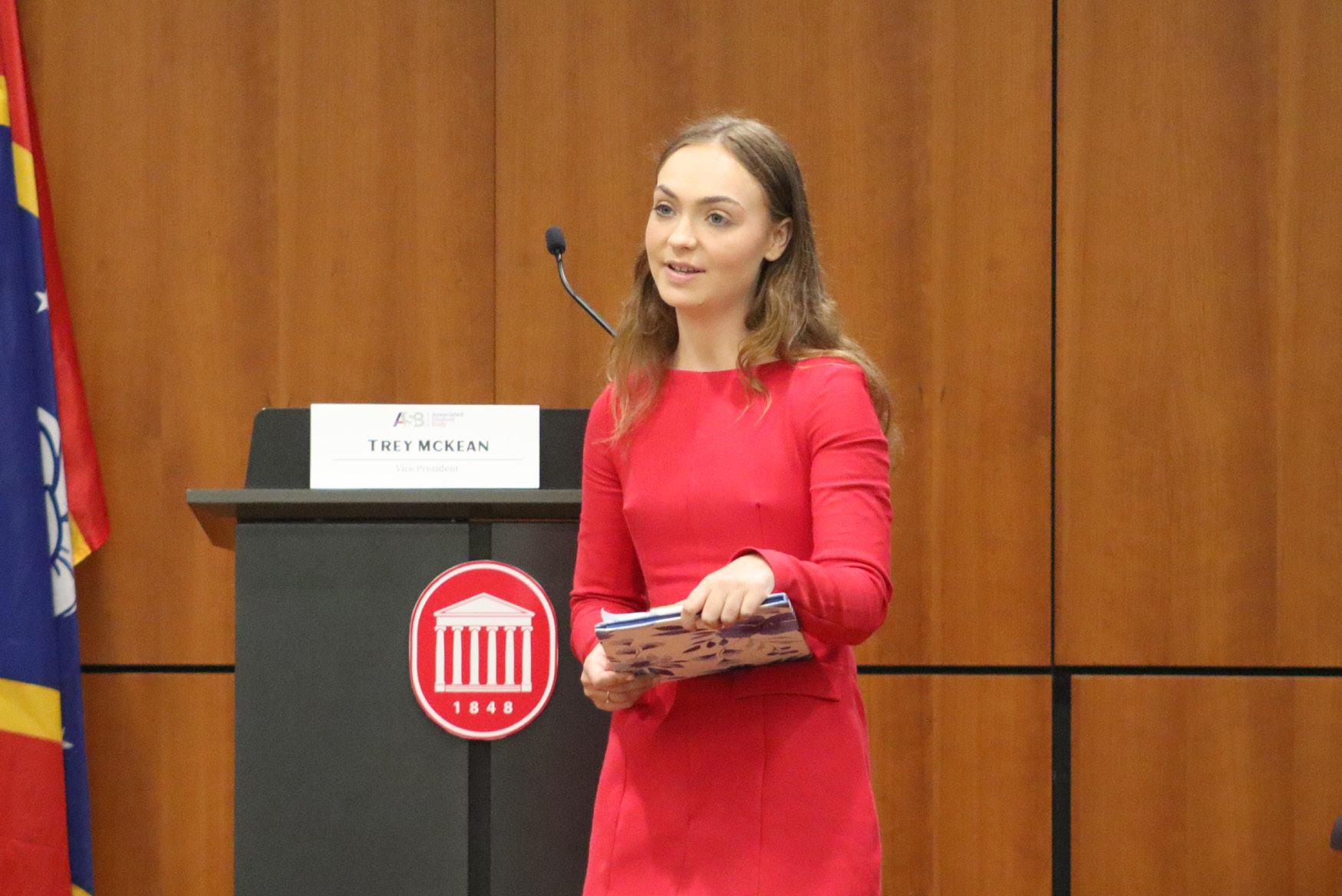
Pro Tempore via runoff ballot at the Associated Student Body Formal Senate on Monday, April 28, at the Gertrude C. Ford Ole Miss Student Union. In addition to presiding over the ASB Senate in the absence of the vice president, the president pro tempore serves as chair of
the rules committee and is an ex officio member on all other senate committees. The president pro tempore ensures each committee conducts regular meetings by collecting reports. Kingery previously ran for ASB Vice President in the 2026 spring election but lost in the run-
A look back at musical performances and activities from the 2026 art festival
SEE PAGE 7

CLIFF JOHNSON
residents of the Yocona Ridge neighborhood have signed a petition opposing the dirt mine.
The dirt mining operation would sit diagonally across from the farm that Jordan and her family have owned for more than 30 years.
“I like the peace, the quiet and the tranquility,” Jordan said. “When I bought this farm, I never would have imagined that any kind of business like this would be located next to my farm.”
The proposed dirt mine would be located on four acres of a 165-acre property owned by Wilson Matthews of Ste-Bil Grading, a local excavator contracting company; JW McCurdy of JWM Development, LLC; and William Matthews and Chandler Rogers of Lonesome Oaks, LLC, according to a deed of trust. The 165 acres are zoned A-1 Rural Agricultural, but on Monday, the planning commission approved
The Democratic nominee for Mississippi’s 1st Congressional District outlines his stances on political issues.
SEE PAGE 4
BASEBALL
The Rebels have what it takes to succeed in the postseason, but streakiness could be their downfall.
SEE PAGE 9
Faculty
DYLAN THOMAS News Editor
The University of Mississippi Faculty Senate passed a resolution stating its desire for student evaluations from this semester to be excluded from the conversation around each professor’s annual performance, potential promotion and tenure on April 7.
This resolution came after the semester was shortened due to disruptions by Winter Storm Fern, which caused decreased instructional time, syllabus changes and tension between students and professors.
The university was closed for two weeks, from Jan. 26-Feb. 7.
The resolution argues that the circumstances caused by Winter Storm Fern could result in data that is not reflective of what a professor’s performance would look like during a normal semester.
“Whereas given the significant impact of Winter Storm Fern to the Spring 2026 academic semester, data collected in student evaluation of instruction is likely to be uninterpretable, if not biased,” the resolution said.
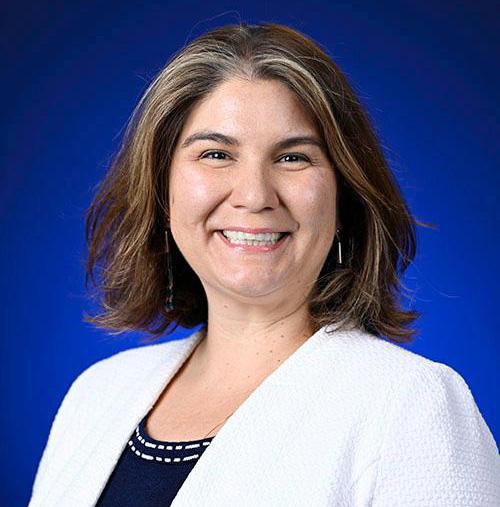
Stephanie Miller, a professor of psychology, is a faculty senator representing the psychology department. She is a leading force behind the resolution.
Miller said that because Winter Storm Fern forced professors to make changes to their curriculums, due dates and teaching pace, the data gathered from evaluations should not be held against professors.
“These evaluations are data — they help us understand how classes and teaching materials are being received so we can make necessary adjustments, and they allow others at the university (our chairs, administrators) to assess the quality of teaching being provided at the University of Mississippi,” Miller said. “Because this semester was so extraordinary, these data may not be an accurate reflec -
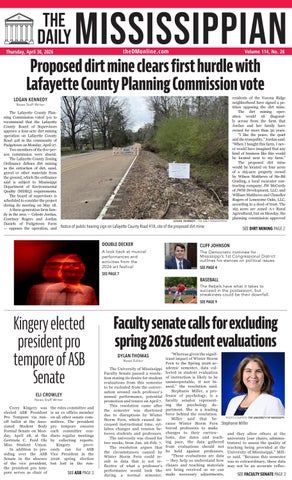
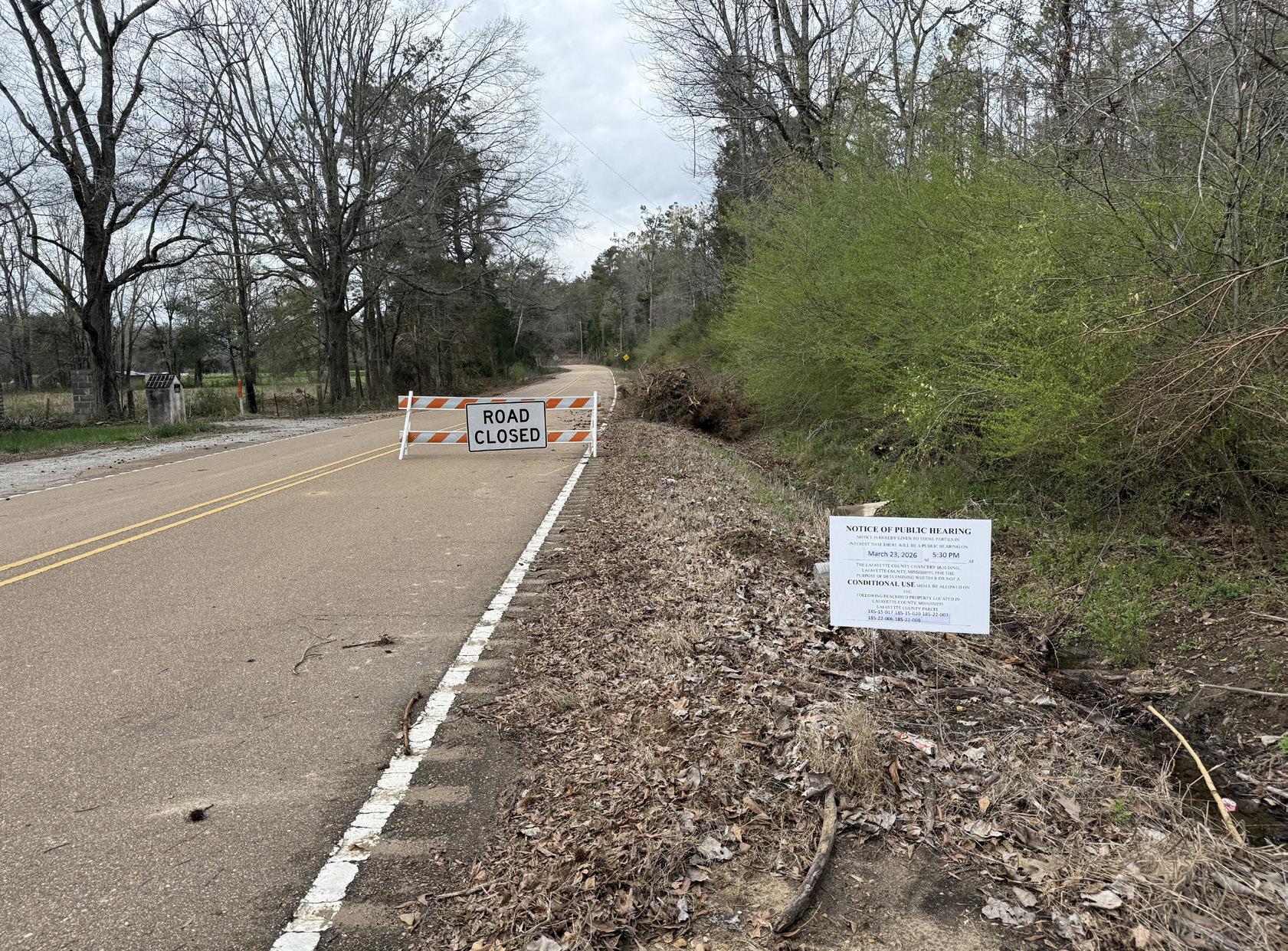
Notice of public hearing sign on Lafayette County Road 418, site of the proposed dirt mine
LOGAN KENNEDY / THE DAILY MISSISSIPPIAN
DOUBLE DECKER
Stephanie Miller
DYLAN THOMAS News Editor
Commencement ceremonies for graduating students at the University of Mississippi will be held from Tuesday, May 5, to Saturday, May 9. The ceremonies on Wednesday, May 6, will celebrate only graduate and doctoral students, while the rest of the ceremonies will honor undergraduate, graduate and PhD students together.
The first commencement ceremony is for the School of Nursing. It will occur at the Gertrude C. Ford Center for the Performing
Do you know when you graduate?
Arts on Tuesday, May 5, at 6 p.m.
Next, the Master’s of Business Administration will have its graduation ceremony at the Ford Center on Wednesday, May 6 at 9:30 a.m.
The College of Liberal Arts Master’s Commencement Ceremony will also be held in the Ford Center on Wednesday, May 6, at noon
The School of Applied Sciences Master’s Graduation Ceremony will take place at The Sandy and John Black Pavilion at 3:30 p.m. the same day.
The Graduate School Doctoral Hooding ceremony will be held at The Pavilion at 6 p.m. In the doc-

toral hooding ceremony, a candidate’s faculty advisor places a hood on the candidate’s head, symbolizing the completion of studies.
The graduation ceremonies will reconvene on Thursday, May 7, starting with the School of Pharmacy commencement ceremony at The Pavilion at 11:00 a.m. The School of Law commencement ceremony will be held at The Pavilion at 3:30 p.m.
The last ceremony of the day will be the Sally McDonnell Barksdale Honors College commencement ceremony. This graduation will be specifically for students graduating from the honors college and will take place at The Pavilion at 7 p.m.
The commencement ceremonies on Friday, May 8, will start with the School of Education at The Pavilion at 9:00 a.m. The School of Engineering graduation ceremony will take place at The Pavilion on Friday, May 8, at noon. Later, The School of Journalism and New Media commencement ceremony will be held at The Pavilion at 3 p.m.
The last graduation of the day will be the College of Liberal Arts commencement ceremony at The Pavilion at 6:30 p.m.
Saturday, May 9 will begin with
the 2026 Commencement Convocation, a campus-wide celebration for the graduating students. University alumnus Brett Young will deliver this year’s commencement address.
Brett Young is a country music star and a former Ole Miss baseball player, though he did not graduate from the University of Mississippi. The commencement convocation will be held in the Grove at 9 a.m. on May 9, and university awards will be given to students during the event.
After convocation, graduation ceremonies will resume with the General Studies commencement ceremony at the Ford Center at 11:00 a.m. This ceremony is the only one that requires printed tickets. Each student can request up to six guests; requests for guest tickets closed on Friday, April 10.
The School of Applied Sciences graduation ceremony will be held at the same time at The Pavilion.
Next, the Patterson School of Accountancy commencement ceremony will take place at The Pavilion at 2:30 p.m. The last graduation ceremony will be the School of Business Administration commencement ceremony at The Pavilion at 5:30 p.m.
All graduation events will be livestreamed. The deadline for graduation regalia, such as caps and gowns, closed in March for ship-to-home orders and in April for on-campus pick-up orders. However, if students did not order regalia by the deadline, they can still visit the main campus regalia distribution until May 4, 2026. There will be an additional $50 late fee on top of the cost of the regalia itself. Once students graduate, they can also join the Ole Miss Alumni Association. Students can order a personalized brick to be placed in the Circle in front of the Lyceum through the alumni association website. Members of the Alumni Association can access discounts at the University of Mississippi Bookstore and the Inn at Ole Miss, the alumni association’s member zone on game days and various other benefits.
a conditional-use permit that would allow the commercial dirt mining operation on four acres.
“The Highway 7 expansion is a huge accomplishment for the city and the county, but as anyone who has driven it has seen, it is going to require a ton of dirt,” McCurdy said. “We bought 160 acres and are going to be able to contribute some of the dirt to make the highway possible.”
Surface mining refers to removing the top layer of soil, vegetation and rock in order to access usable dirt and clay beneath.
The Lafayette County Zoning Ordinance defines surface mining as the “extraction of minerals, including dirt, soil, sand, gravel or other materials from the ground or water or from waste or stock piles or from pits or banks or natural occurrences by methods including but not limited to, strip, drift, open pit, contour or auger mining, dredging, placering, quarrying and leaching and activities related thereto, which will alter the surface.”
Dr. Eric Richardson shares a property line with the proposed location of the dirt mine. He also opposes the operation.
“It would sit directly across from the front porch of our house,” Richardson said. “This is in between two people’s houses that have been there for decades. It’s outrageous that the planning commission could even allow a dirt pit in between two homes.”
A public hearing about the proposed dirt mine operation was held by the planning commission on March 23, but action was tabled when commission members asked the developers to specify where on the 165-acre property the mine would be constructed.
After the developers identified the four acres on which the dirt mine would operate, the planning commission did not allow a second public hearing on the matter before the vote on Monday, April 27.
“I don’t understand how they can make a proposal and not have a public hearing concerning it,” Daniels said. “That would be the law, I would think. I also think it’s a contradiction to the zoning ordinance. It’s inconsistent with their own rules.”
According to the Lafayette County Zoning Ordinance, a public hearing must be held for all conditional uses of land.
“The fact that the development company gets to go back in and talk with them ought to enable the neighborhood to come back and have another chance to speak,” Richardson said. “It’s outrageous to me that the development people are going to be there, they’re going to get to directly communicate with the planning commission, and yet we’re not going to have that opportunity.”
Jordan worries that the planning commission’s approval of conditional use of the four acres could pave the way for more dirt mining on the 165-acre property.
“When they get these four acres, it opens the door for them to get another four acres and then another four acres,” Jordan said. “They’ll end up stripping all of the dirt off the top down as deep as they need to go.”
The owners of Fudgetown Farm, a property which cultivates produce and includes a nursery, believe that the dirt mining operation would impact their business and the natural environment of their community.
“We have events on the farm regularly, and a part of the appeal to coming out to the farm is getting to see the countryside,” Daniels said. “When you start dropping commercial and heavy industrial activity throughout the countryside, it loses its appeal.”
Richardson believes that having a dirt mining operation next to his home will lower his property value and could impact his animals.
“Surface mining can include lots of different types of activities,” Daniels said. “They have verbally said that they intend to dig up dirt and then haul it off to use for construction purposes.”
Details of the dirt mining operation are not described in the Ste-Bil conditional use permit application.
“Without any conditions placed upon approval of their application, (developers) can really expand (surface mining) as much as they’d like to,” Daniels said.
Daniels claimed that the developers began work on the property prior to the planning commission holding a public hearing on the matter on March 23, which was also before the commission granted the conditional use permit.
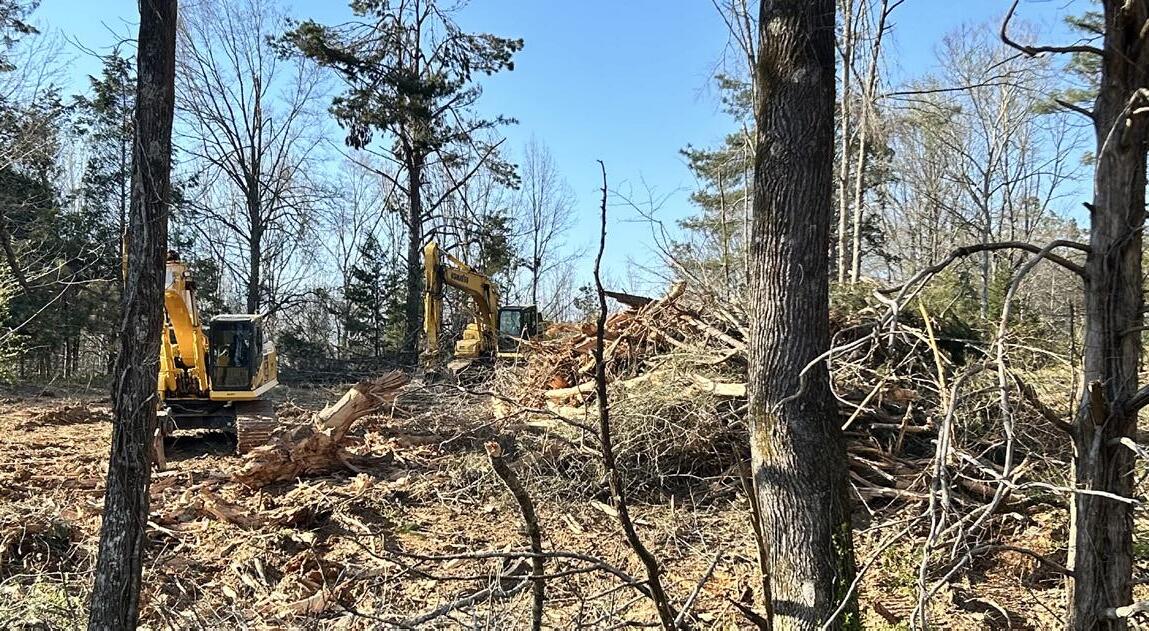
“One week before the public hearing, when this was first to be heard, they brought in two large excavators to the property in question,” Daniels said. “They trespassed on the neighboring property to get the excavators there, tearing down his fence and gate.”
Dennis Goldman, the neighboring property owner, did not respond to requests for comment.
Owners of Fudgetown Farm worry that the dirt mining operation could cause environmental problems such as erosion and air pollution from the dust that the mining would produce.
“It’s not just the dust that would be created from the dirt mining,” Daniels said. “That property in particular is right along Burney Branch Creek, which feeds directly into the Yocona River. Contamination of the waterways and disruption of the ecosystem is a huge threat to some of the best farmland we have in the county.”
MDEQ requires dirt mining operations to follow extensive environmental regulations relating to stormwater management, erosion control and maintenance of safe distances from bodies of water. McCurdy emphasized that the dirt mine would comply with all environmental regulations.
“The contractor will operate 100% by the book, fully compliant with all laws and regulations. If they don’t, just like anyone else, they will get shut down,” McCurdy said.
McCurdy was fined $14,000 by MDEQ in 2022 for failure to maintain erosion control, implement stormwater prevention
plans and maintain weekly inspections in the Highlands subdivision east of Oxford on Highway 6. In 2020, he was fined $6,275 for failure to maintain large stormwater drainage in his developments.
An increase in traffic is a concern for the Fudgetown Farm family, as well. The two-lane County Road 418 has become increasingly congested in recent months due to the closure of other roads in the area while a bridge is being repaired on County Road 418.
“This is a farm-to-market road,” Jordan said. “It’s not meant for the type of traffic that (dirt mine) would bring.”
A dirt mining operation would require heavy machinery entering and leaving the property several times a day, which Daniels believes would make the road dangerous.
The family first heard of the dirt mining operation in February when a sign placed by Lafayette County notified residents in the area of an impending public hearing.
Daniels said the sign was located on a closed road and was slanted in a direction so that it was not easily visible to passersby.
“I literally had to search for the sign,” Daniels said. “The road is closed. Nobody is going to drive down that road and see that sign. We didn’t even see it until we went looking for it, meaning they didn’t notify the public that this was happening.”
Richardson said that without Daniels, he would not have
known that the sign was there.
The planning commission then tabled the public hearing until March 23, placing a new sign next to the closed road sign.
“It is completely inadequate how they handle not just this notice, but all of their notices,” Daniels said. “They’re not circulating these notices in a local paper of record.” The Lafayette County Zoning Ordinance dictates that a notice for hearings should be published in an official newspaper at least 15 days before the hearing takes place.
“Notice of such hearing shall be given by publishing a notice to all interested persons one time at least 15 days prior to the date fixed for said hearing, such notice to be published in an official paper or newspaper of general circulation in the County, specifying the date, time and place for said hearing,” the Lafayette County Zoning Ordinance says.
A search of the Oxford Eagle database did not reveal a public hearing notice concerning the dirt mine. The Lafayette County Planning Commission did not respond to inquiries about the public notice.
2024 University of Mississippi pharmacy graduate
PHOTO COURTESY: OLE MISS DIGITAL IMAGING SERVICES
Excavators clear site of proposed dirt mine
off election to Trey McKean.
“My goal here is really simple,” Kingery said in an interview with The Daily Mississippian. “It’s to make sure every single one of my senators is able to do what they came here to do, not just to start their ideas but to finish them, not just to speak but to be heard and not to serve but to make a real impact.”
Kingery said she is focused on being a resource for senators, but she also wants to make sure that senators are a stable resource for their constituents.
“In the past, ASB hasn’t always done a great job of reaching out first; they kind of wait for organizations to come to them with problems,” Kingery said. “I want to make sure that, since senators are elected to represent their bodies, … making sure they reach out to every single RSO they represent and seeing what ASB can do for them and what they need. I think that’s something that I’m very passionate about this year and hoping to see implemented.”
The ASB Senate elects a round of nominees for president pro tempore before voting.
Alongside Kingery, Sens. Nicholas Menendez, Tres Jones, Paul Winfield, Edward Wilson and Eli Keel were nominated for the position along-
FACULTY SENATE
continued from page 1
tion. For example, professors may have needed to skip over particular topics or spend less time covering a topic. This is not what the professor wanted to do … but the situation demanded that changes be made.”
However, Director of News and Media Relations Jacob Batte said that the university is still collecting student evaluations for this semester. The university has not yet decided whether these evaluations will be taken into account in faculty evaluations regarding performance and promotions.
“Student evaluations will be collected this semester,” Batte said in a statement to The Daily Mississippian. “The university will consider whether they will be included in faculty evaluation processes.”
In the aftermath of the
side Kingery on the first ballot.
Before the first ballot, Sen. Tyler Boecker challenged the qualifications of Wilson and Kingery under Title IIA, Section 106 of the ASB Constitution and Code, which requires each senator to serve a full term before being nominated for president pro tempore.
ASB Attorney General Lucy Allen justified Wilson and Kingery’s eligibility.
“The end of a term has traditionally been joint senate,” Allen said. “These senators have served from the filling of their seats through the end of the senate term at joint senate.”
Sen. Menendez made a unique campaign promise to senators.
“You know, I get a little salary when I’m up here,” Menendez said. “I will be putting it to good use: After senate on Tuesdays, that salary is going out to the Square, and you guys can join me.”
After the first round of voting, Jones and Kingery were sent into a runoff election after receiving the two highest percentages of the vote. Jones received 27.5% of the vote, and Kingery received 37.5%.
During the debate, Sen. Cait Mayo weighed in on the election, expressing concern for Kingery’s ability to handle conflict in the senate.
“(Corey Kingery) is a really sweet, kind person and a really hard worker,” Mayo said. “I
shortened semester, professors responded by cutting material, speeding up lessons, assigning more homework and rearranging due dates. These adjustments impacted classroom environments and relationships between students and professors.
“The two-week closure due to this natural disaster was unprecedented and caused significant disruption for teaching and learning for both students and faculty at UM,” Miller said. “Many students and faculty did not have access to campus resources (nor) the internet and were dealing with significant damage during the closure. This disruption also carried across the entire semester, as the recovery for the community takes time, and the modifications to classes affected the whole semester.”
These changes caused some students to feel overwhelmed by their course load. Keely Garri, a freshman internation-
THE DAILY MISSISSIPPIAN EDITORIAL staff
RAEGAN SETTLE editor-in-chief dmeditor@gmail.com
SYDNEY STEPP managing editor dmmanaging@gmail.com
NATE DONOHUE copy chief thedmcopy@gmail.com
CAMERON LARKIN visual editor dmdigitaleditor@gmail.com
DYLAN THOMAS university news editor thedmnews@gmail.com
CHANCE MARLOWE local news editor thedmnews@gmail.com
have concerns about the way she handles conflict, though. She is not very good in high-pressure situations, and she does not do well with tension, conflict, hard conversations and hard choices, and I think that’s what some of this job is, especially in presiding over rules.”
Kingery won the vote for president pro tempore in the runoff with 52.3% of the vote.
After the election, Mayo emphasized her respect for the position.
al studies major from Roanoke, Va., expressed sympathy for her professors. However, she noted that in her Korean class, several lessons were eliminated from the curriculum. Additionally, assignment due dates overlapped.
“My professors essentially had to go through and cut a whole bunch,” Garri said. “With some, it was easier than others, but with my Korean class, we didn’t learn the last three lessons … It was a combination of everyone playing catch-up, but also major as
signments kept on falling on the same day because everything was so smushed together.”
“Corey Kingery is (president pro tempore) now, and it is our job to respect her,” Mayo said. “I also said that she would not make a bad president pro (tempore), and I can’t say that she doesn’t have a passion for it and doesn’t work hard.”
Kingery looks forward to supporting the new senators when ASB senate sessions resume in the fall.
“I’m really excited to work with all of them. We have a really good group this year,” Kingery
said. “It’s a lot of new senators, a lot of freshmen. I think that’s a really good thing, because we can kind of shape ASB today.”
TAYLOR HILL arts and culture editor thedmfeatures@gmail.com
TAF FLANDERS assistant arts and culture editor thedmfeatures@gmail.com
RUSS EDDINS sports editor thedmsports@gmail.com
REAGAN TAYLOR assistant sports editor thedmsports@gmail.com
MACKENZIE MCDARIES opinion editor thedmopinion@gmail.com
JACK KIRKLAND photo editor thedmphotos@gmail.com
DANIEL LAUBHAN assistant photo editor thedmphotos@gmail.com
MADELYNN LIBERTO design editor thedmdesign@gmail.com
GRACE ANN COURTNEY assistant design editor thedmdesign@gmail.com
MELANY CARRASCO multimedia coordinator dailymissmedia@gmail.com

CHLOE GRIFFITHS social media manager thedmsocialmedia@gmail.com
SUZETTE REINDL assistant social media manager thedmsocialmedia@gmail.com
S. Gale denley student media center
LARZ ROBERTS Director of Student Media
MOORE Editorial Director

Corey Kingery speaks during the ASB Formal Senate on April 28 in the Gertrude C. Ford Ole Miss Student Union.
Keely Garri
PHOTO COURTESY: KEELY GARRI

LOGAN KENNEDY A&C Staff Writer
Editor’s Note: This story is part of a series featuring candidates for the 2026 U.S. Senate and House of Representatives elections in Mississippi.
Cliff Johnson will participate in the general election in November as the Democratic nominee.
Cliff Johnson, the Democratic nominee for Mississippi’s 1st Congressional District election in November, attracted national attention to the North Mississippi race when Joseph Kennedy III, the former Massachusetts congressman and grandson of 64th U.S. Attorney General Robert F. Kennedy, hosted a fundraiser for Johnson at Big Bad Breakfast in Oxford on Friday, April 17 .
“(Johnson) has deep roots in Mississippi and is a very talented guy,” Kennedy said. “Candidates that are willing to step forward and try to channel the energy from global grassroots organizations are in a good race.”
Johnson, a clinical professor of law instruction at the University of Mississippi School of Law, said he is running on a platform for all Mississippians.
“I am committed, first and foremost, to representing those among us who are suffering the most,”
Johnson said during an interview with the Mississippi Media Lab on April 17. “That doesn’t mean you don’t represent everyone in the district, of course. The district as a whole does better — our communities are safer and happier — when we address those issues that cause people to suffer and be left behind.”
Johnson won the Democratic primary for the congressional seat on March 13, defeating Kelvin Buck. In the Nov. 3 general election, Johnson will face incumbent Republican Trent Kelly, who received approximately 70% of votes cast in 2024.
Johnson hopes to win over Republicans in the largely conservative 1st District who are frustrated with the Trump administration.
“I think that there are plenty of conservative Mississippians who recognize that whatever this is, (MAGA) this doesn’t represent Mississippi values, and it doesn’t represent what they thought they were getting into when they declared themselves Republicans,” Johnson said. “I love Mississippi, and I feel like we’ve gotten into this binary situation. They believe the choice between Democrats and Republicans is one of morale, but I want to push back on that a little. I hope people will take a closer look.”
Rep. Kelly did not respond to a request for an interview with the Mississippi Media Lab.
In addition to teaching at the UM law school, Johnson serves as director of the MacArthur Justice Center, which provides litigation support for civil rights and criminal justice issues.
Before becoming a professor, Johnson was an assistant U.S. attorney during the Clinton administration. Johnson believes that this experience has provided him with the backbone necessary to be an effective congressman.
“I’m not hesitant to be in an
CLIFF JOHNSON CAMPAIGNS FOR TRANSPARENCY AND ACCOUNTABILITY
adversarial posture,” Johnson said. “Whether it was big health care companies when I was prosecuting health care fraud cases, or CEOs of national health care conglomerates, or government contractors in the space industry bringing in whistleblower cases, or standing up to the United States government when I was defending people charged with crimes or taking on the state of Mississippi or sheriffs or judges.”
Johnson decided to run for office after his two children and his students voiced their frustrations regarding their perceived lack of representation in Congress.
Johnson lives in Water Valley, Miss., with his wife, Leigh Johnson. As a member of Idlewild Presbyterian Church, he described himself as a “church guy.”
Overall, Johnson aligns himself strongly with the Democratic Party’s stances on political issues.
Economics
Johnson supports raising the minimum wage in Mississippi from $7.25 an hour to $15 an hour.
“We have to immediately increase the minimum wage,” Johnson said. “It hasn’t increased in 16 years. During the same period of time, grocery prices have gone up 60%, but we still have people making low wages that aren’t really livable wages.”
For years, Republicans have pushed back against an increase in minimum wage, arguing that this would result in more expensive goods. Johnson acknowledged this but still argued that the current minimum wage is too low.
“Of course it does,” Johnson said. “Paying people an amount that supports the basic necessities is a much greater benefit than what we could see with prices being raised. Our economy will be stronger, not weaker, and families will be happier.”
Johnson believes that the current economic instability in the country is linked to what he perceives as Trump’s assertion of the executive branch above other branches and evading checks and balances in government.
“I think the best example of where Donald Trump, Trent Kelly and the Republican Party have gotten it wrong is that we have moved from a structure where you have a clear separation of powers, a system of checks and balances, limited power in the executive branch, to a world where a single person declares war, imposes tariffs, threatens the judiciary and in doing that creates tremendous economic uncertainty that drives up prices and makes things worse,” Johnson said.
War with Iran
In April, Johnson shared a video to his TikTok account in which he discussed the rising gas prices at a fuel station. In the video, Johnson criticized Kelly for his complicity in the United States’ war with Iran.
“Donald Trump owns this,” Johnson said. “He was supposed to be the candidate for peace, but this type of instability causes economic disruption and certainly higher gas prices. What this administration and those who enable this adminis-
tration, like Trent Kelly, have done is create so much uncertainty in economic markets from day to day that supply chains have disrupted.”
Johnson said that he is against the war with Iran and believes that the midterm election could be a fight to return to “normalcy.”
“I think the gas prices are a manifestation of a much larger problem, and that is a power grab by a president like we’ve never seen before,” Johnson said.
Immigration
“I think we can’t have an open Southern border,” Johnson said. “I think the majority of people agree that we need to have control of our border, so, to the extent that there are Republicans who take the position that we should control our border, I agree.”
However, Johnson does not believe that the U.S. border with Mexico should be closed. He believes that border control has two layers: securing the border and assisting undocumented Americans in gaining legal status.
“People come in search of asylum — people facing incredibly dangerous situations back home,” Johnson said. “We have to make careful and thoughtful decisions on who we allow in.”
Johnson supports undocumented Americans already living in the U.S., and he is against an aggressive presence of Immigration and Customs Enforcement (ICE) officials in communities.
“We have to quit chasing these folks,” Johnson said. “I believe that people who have been in this country undocumented for some period of time who have not committed a violent crime should have a path to permanent status. Now, if there are people who are undocumented and they’ve committed violent crimes, then they’ve got to go.”
Johnson does not support ICE acting violently toward community members or acting unlawfully.
“The version of ICE where people come in with masks and snatch people off the streets, ignoring Constitutional protections, that ICE has to go,” Johnson said. “I’ll vote to get rid of that ICE.”
However, Johnson is not ful-

ly against immigration enforcement. If elected, Johnson said, he would support agents with more training than they currently receive who implement immigration laws and enforce them.
“Anti-immigration rhetoric — vilifying these people — is the oldest political play in the book,” Johnson said. “As you tell people who they should hate, you tell people who they should fear, and then you act as the savior who protects them from this group of people. The anti- immigration rhetoric I hear in this country right now breaks my heart.”
Abortion
Johnson supports women’s healthcare rights relating to abortion.
“I believe that women should have access to the healthcare they need, and that includes reproductive health,” Johnson said. “I’ve got a mother, I’ve got a wife and I’ve got a daughter. I want them to have access to whatever healthcare they need in consultation with their physician.”
Building a relationship with constituents and the press
“The biggest criticism I’ve heard of Congressman Kelly is that (constituents) never see him,” Johnson said. “There are no town halls. There’s no coming to local communities. They just never see him.”
If elected, Johnson said he will maintain committed rela-
tionships with constituents and the press. He plans to travel across the district during his time away from Washington, D.C., when Congress is not in session.
“I will be across the district, not just making a speech from a podium and then stepping out without a chance for people to talk to me,” Johnson said. “I think you have to submit yourself to the cheers or people screaming at you and cussing you out. That’s the job.”
Part of Johnson’s platform is holding others accountable, and he plans to hold himself accountable by answering questions from the media.
“You have to subject yourself to hard questions from the media,” Johnson said. “Part of that process is that you keep telling the truth about what you’re doing — doing it not in the darkness but in the light.”
Transparency and accountability are attributes Johnson advocated for while working as a civil rights attorney in Mississippi, and he believes that this experience has prepared him to be an answerable congressman.

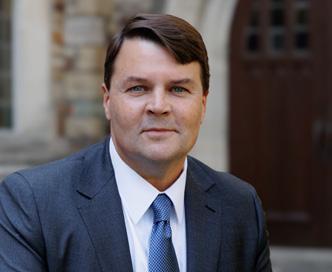
Cliff Johnson PHOTO
Professionally dress and fashionably impress: Who are UM’s most stylish professors?
They’re gracing the pages of The Daily Mississippian, but they’re dressing for the pages of Vogue.
LOGAN KENNEDY A&C Staff Writer
Business-casual dress takes center stage in many settings at the University of Mississippi, but some professors stretch the standard and use their work attire as a form of self-expression. From button-downs to sneakers, UM instructors have introduced their own sense of style to Ole Miss — and students are taking notice.
Mark Dolan
Mark Dolan, associate professor of journalism, is known by students for his vibrant suits and personal style, which he started cultivating at a young age.
“All of the sixties’ fashion shaped the way I saw fashion,” Dolan said. “I saw it as art.”
Wearing a seersucker suit, a fedora or a beret, Dolan has a wide variety of patterns and textures he likes to incorporate into his outfits for the classroom.
“I have favorite fabrics and textures more than I do brands,” Dolan said. “I like linen and imported cotton. It’s important to me to feel the fabrics and pick them from swatches before I have a suit made.”
Dolan sees his fashion as an expression of who he is as a person and professional. As advisor to the University of Mississippi Fashion Panel, fashion is meaningful to him.
“Fashion is about ideas, and what we wear is how we negotiate our aesthetic, our political identity, our sexual identity,” Dolan said. “It’s this outward expression of a lot of things that are inward.”
Senior integrated marketing communications major Amelia Sweeney is a fan of Dolan’s style. She enjoys observing his fashion in her IMC 205 class.
“His day-to-day outfits would not leave anyone to be surprised that he is a fashionable professor,” Sweeney said. “Dolan encourages all of us to show off our own personal style just like he does.”
As a professor, Dolan does not forget his area of expertise when it comes to what he wears, drawing on historical significance of twentieth-century newsrooms.
“Sometimes I wear things that are a little bit of a reference to journalistic eras, like seersucker,” Dolan said. “I bring my tie down, you know like I’m working in a newsroom and bent over a typewriter.”
Dolan reminds students that dressing professionally is important, especially in broadcast journalism. He serves as an example to students to combine a professional look with your inner self, creating an image that is uniquely individual.
“I think professional style and how you present yourself is important, especially in journalism,” Dolan said. “What we wear says something about who we are.”
Vanessa Charlot
Assistant professor of media communications Vanessa Charlot marries “street style” with professionalism. Charlot’s style was birthed from prior experience working in the media industry and her upbringing in Miami.
“I have extensive experience in the actual industry in both journalism and entertainment, so as a photographic artist, I am used to dressing in a very eclectic way,” Charlot said.
Charlot’s photography resume includes fashion houses such as Gucci and magazines such as Vogue, which she credits for keeping her style diverse.
“I like things that not a lot of people are wearing and that stand out,” Charlot said.
Doc Martens boots, particularly, are a staple in Charlot’s wardrobe.
“Everytime I go into Journalism 103, I see the shiny burgundy boots and a ’90s vibe from her that I think is really cool,” Awa Camara, a freshman journalism major, said.
Charlot acknowledged that her typical shoe choice and that she likes to accessorize to spruce up an outfit, often looking to Japanese streetwear for inspiration.
“I’m intentional about not going too over the top because I am a professor,” Charlot said. “But I think it is a fun thing when you’re able to show the aspect of who you are.”
Raja Malikah Rahim
Raja Malikah Rahim, an assistant professor of history and African American studies, wants to show students that she is professional but does not have to be too serious. She enjoys tying in things that she is teaching about into her attire.
“The other day I was lecturing about Malcolm X, so I wore a T-shirt with a quote from him on it,” Rahim said. “I consider what I wear ‘street style.’ I dress for the content that I am teaching that day.”
Rahim finds comfort in Steve Madden shoes and prefers to wear jeans, pairing her denim with a crew neck or cardigan. Her students admire how she ties trends of the early 2000s like skinny jeans into her closet rotation in modern, stylish ways.
“I love Steve Madden because they are affordable, they have great style and I love the history behind the brand, which is important,” Rahim said. “I think for me it is important for profes -

sors to reflect their humanity and identity. Staying true to that is most relatable to students in this climate.”
Harrison Lee
History of brands is something Harrison Lee, visiting professor of philosophy and religion, emphasizes, as well. Lee reads Permanent Style, a fashion blog from which he draws much outfit inspiration.
“There are a lot of traditions in fashion, and the blog gives good advice on how to be aware of the history of what you’re wearing,” Lee said. “It’s important to know the history of your clothing and what you are signaling by wearing it.”
Lee loves vintage clothing, including reproduced styles from the 20th century, such as military chinos. He sometimes wears chinos on Fridays with jeans, preferably Japanese denim.
“I really like TCB jeans, which are WWII-era jeans that have been re-constructed,” Lee said. “During the war, a lot of manufactures had to cut quality, so some of the jeans during that time
had mistakes, so the reproduced styles have the mistakes as well, which is neat.”
“He always looks very spiffy,” Morgan Smith, a sophomore public policy leadership major and student of Lee’s, said.
Reaching students is a goal for many professors, and Lee feels that by wearing formal clothing, you can build trust within your students.
“I dress on the more formal end of the spectrum,” Lee said. “I feel students are entrusting me with their education, and I want to dress professionally to honor that.”
Micah Carrisoza
Micah Carrisoza is a second-year graduate assistant working on his masters in mathematics who helps teach two sections of college algebra (Math 121), and his students have noticed his “shoe game.”
“He is definitely with the times,” Breanna Adams, a sophomore allied health studies major, said. “He always has a great shoe game and is really cool.”
Carrisoza wears sneak -
ers ranging from his favorite Nike Dunks to a pair of New Balance 480s, offering comfort and individuality in his style as a teacher.
“A lot of what I wear, I don’t have a choice because we are required to dress professionally,” Carrisoza said. “But they never said anything about shoes.”
GRACE ANN COURTNEY / THE DAILY MISSISSIPPIAN
Pro chef teaches fine dining to nutrition and hospitality students
CHARLIE SLUSHER
A&C Staff Writer
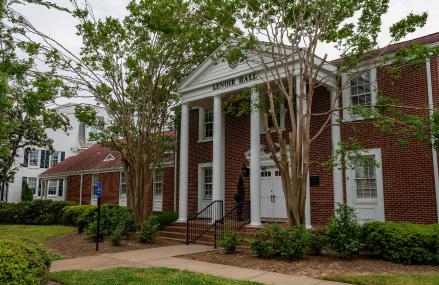
Lenoir Dining, a student-run restaurant located in Lenoir Hall on Sorority Row, is expanding its operations to the South Oxford Center on South Lamar Boulevard.
The University of Mississippi’s Department of Nutrition and Hospitality Management manages Lenoir Dining, which serves lunch in Lenoir Hall on Wednesdays and Thursdays from 11:30 a.m. to 1:30 p.m. While the restaurant encourages making a reservation, walk-ins are welcome and a takeout option is available.
Jeffrey Pittman II, an instructional assistant professor of nutrition and hospitality management, is working with his department to expand Lenoir Dining to allow more students to gain handson restaurant experience.
“We are trying to strategize a move to the South Oxford Center,” Pittman said. “We’ll have what’s called the Innovation Kitchen, where we will be able to expand Lenoir Dining from roughly 80 seats to double. We will be able to offer a variety of options outside of just your standard, casual-dining three-course meal, such as a ‘grab-and-go’ or a specialty bakery option.”
Innovation is a cornerstone of the department’s expansion plan, according to Pittman.
“Cooking is nothing but the science of food,” Pittman said. “That’s what we’re really trying to utilize — more of a science hub between hospitality, culinary and nutrition.”
Pittman is excited about the planned commercial kitchens, which could enable more collaboration with experienced restaurant professionals.
“(Local businesses) can utilize our commercial kitchens and even bring in various business owners from the community to be guest speakers and showcase their skills in front of our students,” Pittman said.
Oxford resident and retired certified public accountant
Hugh Lee, a 1972 graduate of the University of Mississippi is a regular at Lenoir Dining. He is ready to see the restaurant grow by mitigating current issues affecting the general public’s attendance.
“(My wife and I) love coming here. The food is great; the kids are great; it feels fresh and homemade,” Lee said.
“They should expand it to accommodate more people. It would be nice to have a facility that has more parking for the general public, because parking is difficult if you are not already located on campus.”
Pittman, or “Chef Jeff” to his students, has spent five years at the university. He
has served in his current role of instructional assistant professor for the past three years, and he served in many leadership roles, including an instructor role for Rebel Chefs Culinary and Baking Camp, in the two years prior. Originally from West Point, Miss., Pittman learned to cook from his grandmother and soon began shadowing chefs in the area.
After completing his culinary arts degree at Mississippi University for Women — the only university in the state that offers a four-year culinary program — Pittman served as a junior sous chef under Gordon Ramsay at the Gordon Ramsay Pub & Grill in Las Vegas.
Lenoir Dining has fostered a community beyond Pittman and the students who work there. For Jillian Anderson, a first-year experimental psychology graduate student, it has become a place to return with her friends.
“I really like the food here. I love the garlic knots,” Anderson said. “This is my second time coming. I actually found it on Facebook, and I followed them and now my roommate eats here, too.”
Pittman believes that the days of head chefs commanding their kitchens like drill sergeants are over.
“(Ramsey) taught me that managing a kitchen isn’t just about barking out orders,” Pittman said. “What you see is a TV persona. In real life, he’s really kind as long as you’re willing to learn and willing to help grow your trade, as we like to say, to grow your skills.”
Pittman tells his students that successful hospitality managers are, first and foremost, good with people. Poor communication can destroy any kitchen, whether that restaurant is a drive-thru or an upscale venue. To this end, Pittman emphasizes practicality in almost all of his lessons.
“Even though I love research, I’m very practical,” Pittman said. “It’s not just about getting the students through our hospitality management programs so they can just get on with their lives. It’s about developing them into effective leaders.
In order to be a successful hospitality manager, it’s not just knowing the skills, but how to actually do the aspects of your specific job.”
All hospitality management majors at the university are required to take the quantity food production and service (with lab) course at Lenoir Dining. During this time, students rotate through the restaurant, working both back-of-house and front-of-house positions and setting the menu.
“Oftentimes, the students want to do a lot of French food and Mexican food,” Pittman said. “A couple weeks ago, we went ahead and tried a three-course Mexican menu, where you get three choices of entrée — shrimp, chicken or some type of vegetarian entrée, and then a homemade dessert. … We always try to have that three-course menu where the desserts are as homemade as possible.”
The kitchen has a strict rule against using baking mixes. Lenoir’s student chefs have recently made sweet potato bread, cinnamon rolls and pudding. They have even reproduced Pittman’s famous cinnamon apple pie. Despite all the food being homemade, Lenoir Dining is surprisingly affordable. A three-course meal, which includes a drink, is only $15.
Hospitality students appreciate the experience Lenoir Dining offers.
“Lenoir Dining has been more than just a class I have taken,” Angie Mai, a junior hospitality management major from Corinth, Miss., said. “It’s helped me learn about the behind-the-scenes of the food service industry while building great relationships with my classmates and even our guests. I have learned more about what it takes to work in the service industry while also applying it to everyday interactions, and it has been one of the highlights of my college career.”
Singin’ in the rain: a look back at Double Decker 2026
CHARLIE SLUSHER A&C Staff Writer
The 2026 Double Decker Arts Festival hosted 10 bands and artists in Oxford on April 24-25.
Despite rain on Friday, April 24, bands The War And Treaty, Shane Smith and The Saints and Penelope Road drew in large crowds.
On Saturday, April 25, there were seven musical acts, capped by alternative rock band Wilco, the headliner of this year’s festival.
With classic releases such as “Jesus, Etc.,” and “California Stars,” Wilco was the most anticipated act of the weekend.
Peter Mueller, a 2025 University of Mississippi graduate who majored in integrated marketing communications, shared a song he was hoping the band would play.
“I am stoked about Wilco,” Mueller said. “I’m excited to hear them play ‘Heavy Metal Drummer,’ one of their hits. I’m just pumped.”
Wilco took the stage around 8:30 p.m. The indie rock group played a 90-minute set, featuring songs from the since-dissolved band Uncle Tupelo (whose former members formed Wilco). The band also played early hits like “Heavy Metal Drummer” from its album “Yankee Hotel Foxtrot” and material from its newer albums, including songs like “Annihilation.”
The set had a strong nostalgic air. A number of times, lead vocalist and guitarist Jeff Tweedy reminisced on his time with Uncle Tupelo. He even gave a shoutout to Square Books.
“That might be the first time we’ve ever given a shoutout to a bookstore,” Tweedy said.
The love Wilco showed for Oxford did not go unnoticed. Morgan Greene, an employee at The End of All Music, an independent record shop on the Square, was impressed by the performance.
“I thought they (Wilco) played really well. They paid nice homage to Oxford, and the show was just fun,” Greene said.
Annie and the Caldwells, a family gospel group from West Point, Miss., performed at 11:30 a.m. on Saturday. Annie Caldwell, the group’s lead vocalist, was backed up by her daughters, displaying harmonies that were a standout feature of the performance. They primarily played songs from their 2025 record, “Can’t Lose My Soul.”
The Animeros, a rock group from Austin, Texas, played af-
ter Annie and the Caldwells. The band’s set sounded a bit repetitive, but their blend of psychedelic and Latin influences created one of the most unique sounds of the festival. Mountain Grass Unit followed at 2:30 p.m. Guitarist Luke Black delivered a strong country sound and impressive guitar skills. The group played a number of its own songs, such as “Cicada Song,” and also showed skill with its covers. The group played a particularly strong cover of “Glendale Train” by New Riders of the Purple Sage. Later in the afternoon, British rock band The Heavy Heavy performed. The duo from Brighton, England, was particularly impressive to Merritt Tompkins, a firstyear graduate student pursuing her Master of Arts in Southern Studies.
“The Heavy Heavy set was really awesome,” Tompkins said. “They played two of their biggest hits, for me at least: ‘Happiness’ and ‘Go Down River,’ and it’s cool when you see a band live and they don’t sound that much different from the recording.”
Tompkins also watched Margo Price, the last act on Saturday before Wilco took the stage. Price is a country artist based in Nashville, Tenn., and she performed a varied set according to Tompkins.
“I’d never seen her live before or listened to much of her music, really, but I had a blast,” Tompkins said. “I think she sang a really good mixture of slower country ballads and more upbeat, danceable music. It seemed like the crowd was not as into it as much as The Heavy Heavy, but overall, it was great.”
This year’s Double Decker assembled an impressive lineup of musical acts with an excellent headliner to top it off, and the rainy weather on Friday simply could not put a damper on the enthusiasm. Senior accountancy major Everett Heuer, an Oxford native, explained why he thought the particular lineup was effective for Double Decker.
“I was definitely more excited for this year because I was familiar with the headliner and a few of the openers, so I would personally say the music promotion was better this year,” Heuer said. “I think Wilco was the perfect match for Double Decker. It was a union of generations.”

Lenoir Hall
JACK KIRKLAND / THE DAILY MISSISSIPPIAN









Double Decker Arts Festival main stage on April 24
JACK KIRKLAND / THE DAILY MISSISSIPPIAN
Guitarist for The Heavy Heavy on stage for the Double Decker Arts Festival on April 25
JACK KIRKLAND / THE DAILY MISSISSIPPIAN
Shane Smith and The Saints perform on April 24.
JACK KIRKLAND / THE DAILY MISSISSIPPIAN Cary Hudson and John Stirratt hug during Wilco’s set on April 25.
JACK KIRKLAND / THE DAILY MISSISSIPPIAN
Main stage at the Double Decker Arts Festival on April 25
JACK KIRKLAND / THE DAILY MISSISSIPPIAN Jeff Tweedy sings during Wilco performance on April 25.
JACK KIRKLAND / THE DAILY MISSISSIPPIAN
Runners participate in the Double Decker Spring Run on April 25 in downtown Oxford.
MADISON TWIDDY / THE DAILY MISSISSIPPIAN
John Stirratt of Wilco plays bass on April 25.
JACK KIRKLAND / THE DAILY MISSISSIPPIAN
Crowds gather for music and art vendors on April 25.
JACK KIRKLAND / THE DAILY MISSISSIPPIAN
Chris Malloy speaks on Rebel golf’s SEC Championship
RUSS EDDINS Sports Editor
Ole Miss Men’s Golf defeated No. 2 Florida in the SEC Championship on Sunday, April 26, marking the team’s first championship win in 41 years. Head coach Chris Malloy spoke to the media on Tuesday, April 28, about the historic victory.
The team has faced multiple obstacles this year. 2025 individual national champion Michael La Sasso departed Ole Miss for the professional golf league LIV in January 2026, and Winter Storm Fern interrupted the team’s preparation for the spring season.
“They rallied around each other. They have that confidence,” Malloy said. “We were thrown a couple haymakers — the (Michael La Sasso) thing, and then we had the ice storm. That affected a lot of people. In an outdoor sport, and a sport like golf, the ice storm was suboptimal to say the least, so that’s how our semester started.”
Malloy said the team had some on-course difficulties, as well. After setbacks and low points in play throughout the semester, the head coach pointed to a season-altering match.
“We played well down at Mississippi State. We blew an 11- or 12-shot lead at their event,” Malloy said. “On the
back nine and a couple of times this year, we’ve let the wheels come off a little bit in those moments. I thought that on that back nine, (the Ole Miss players) held it together. (They) came back and were co-champions at the end of the day. I walked away from that one, and I thought, ‘That was a turning point.’”
A big reason for the Rebels’ success was their mindset. Malloy and the Rebels found a mentality that guided them to the championship victory.
“I’ve said this many times this week — we haven’t been very good at being hunted. We’ve got to stay the hunters, and we’ve got to have that chip on our shoulder,” Malloy said. “Our mentality throughout the week … was, ‘Screw ‘em all,’ and ‘No one believes in us. It’s us against the world.’ They’re good with that mentality.”
Malloy has been the head coach of the men’s golf team since 2014. He spoke about his journey to this championship after 12 years.
“(There were) a lot of highs, a lot of lows, but that’s part of it,” Malloy said. “I told you guys that we’d be standing here, our guys would have that trophy in their hands, and we’re going to win a team national championship.
… In my heart, I believed it. I’ve never wavered in that.”
With the SEC Championship secured, the Rebels will
set their sights on winning the NCAA Championship. The Rebels have been close to acquiring that title in recent years, including a thirdplace finish last year, but this conference win will go a long way toward that next step.
Before they can get to the finals, however, the Rebels have to go through a regional competition, which is a daunting challenge in itself.
Regionals are set for May 18-20. A location has not yet been set for the regional.
“You got to be sharp that week and get through and have confidence. Sometimes people get into that week and try to pretend it’s something that it’s not,” Malloy said. “It is just another tournament. It’s a qualifier to get to finals. (The Ole Miss players) had success in that last year, so I think they can draw on that, and then from this week, there’s nothing but confidence they can draw on.”
While this win is a major accomplishment for the program, Malloy has bigger goals for Ole Miss.
“We’re still going through it. We’re not there yet. We’re still finishing up some facilities and some things that are needed to really continue to elevate our recruiting,” Malloy said. “My goal is to be a perennial Top-5 team, and we have to have the whole bag of things — golf courses, facilities, all

that stuff. We’re not there yet. We’re certainly going in the right direction, and this helped validate those things.”
Malloy, an Ole Miss alumnus, said he is wholeheartedly devoted to the university.
“I love Ole Miss, love it with all my heart. That’s what makes this even more special,” Malloy said. “I love what we have at Ole Miss. I love Ole Miss Golf, certainly. There’s nobody that (Rebel women’s golf head coach) Kory (Henkes) has rooting harder for her than me. There’s nobody that Jamie (Trachsel) at softball has rooting harder or harder. …I’m Ole Miss through and through and always will be.”
Malloy won conference
championships at South Florida and Florida State, but this victory is different.
“Those were all special. This is just a little bit more special. It’s (my) alma mater, and I love it with everything,” Malloy said.
Meet Ole Miss Track and Field influencer
Sterling Scott
ISAAC SCHEER Sports Staff Writer
While Ole Miss Men’s Track and Field triple jumper Sterling Scott is not competing or training, he is expanding upon his already impressive follower count on social media. Scott is a track content creator and has nearly 150,000 followers on TikTok and Instagram. He made a name for himself on social media and has brought his audience to Ole Miss.
Scott’s social media journey began when he attended Starkville High School in Oxford’s rival town of Starkville, Miss. Scott created his TikTok account after he switched the leg he jumped off in the triple jump and earned a five-foot personal record. Shortly afterward, he also created his Instagram account to share the unique accomplishment.
Scott’s high school accolades include three Mississippi state titles and a national title in triple jump. The summer before he began his college career at Missouri, he won a gold medal for the United States in the 2023 Pan-American U20 Championships.
As Scott’s success on the track grew, so did his social media following. Still, Scott decided to change his approach toward what he posted.
“I decided to not really document my journey. … I just kept posting and posting, and eventually, I realized I wanted to make more humorous or relatable (content),” Scott said in an interview with The Daily Mississippian. “I had a lot of fun doing all that, going out and recording all the clips of my friends.”
Before he arrived at the Velvet Ditch, Scott spent two seasons at Missouri. During his time there, his social media following continued to grow. Additionally, his teammates began to benefit from the content he posted.
“(My teammates and I) are not walking through Walmart like we are superstars, but I could see that the online presence of the team was getting better,” Scott said. “Just by seeing the Mizzou logo on my chest (and) every single video … I definitely saw people start to recognize us a lot more, and that’s big for track and field.”
Scott announced that he was transferring to Ole Miss in July 2025. He said that he took a short break from creating content to focus on his transition to Oxford and his new college courseload.
During this downtime, he kept up with another passion of his — helping young athletes succeed in the long
Via another Instagram account, @jumpprofessors, Scott and other SEC players and coaches, including Arkansas jumps coach Rob Jarvis, share tips and instructions for those looking to improve.
“I really enjoy posting and educating a lot of people, even though I might need help myself,” Scott said. “It’s always fun, and it kind of feels like I’m giving back to the community that supported me.”
Now that Scott has found his footing in Oxford, he plans to resume posting on his main accounts during the spring outdoor season. He also hopes to incorporate some new faces into his videos.
“I’m planning on recording some more stuff with some more people,” Scott said. “This semester, I’m not prioritizing recording or track or anything over school, but I just have a better opportunity to include more people and post more.”
Scott finds his content is enjoyable even for those who do not follow track and field closely.
“I wouldn’t say the majority but like a good chunk, like probably 30% to 40% of my followers, they don’t do track,” Scott said. “They might do another sport or maybe dabble with it, but I

think it’s important to be able to relate to all people, not just people in track and field.”
While Scott does not consider himself a celebrity, he is always willing to take photos with fans who approach him.
“I’ll never turn down a fan or somebody that wants to show their support,” Scott said.
Chris Malloy talks with a reporter at St. Simons Island on April 26.
PHOTO COURTESY: OLE MISS ATHLETICS
jump and the triple jump.
Sterling Scott
JACK KIRKLAND /
The highs and lows of 2026 Ole Miss Baseball
RUSS EDDINS Sports Editor
No. 17 Ole Miss Baseball is 11-10 in SEC play after losing the series to No. 5 Georgia at Swayze Field on April 25-26. The weekend was a roller coaster of highs and lows for the Rebels and encapsulated the story of the 2026 Ole Miss Baseball team.
The Rebels fell to 4-7 in SEC play after being swept by then-No. 6 Mississippi State at home March 27-29 and getting shut out in game two against then-No. 21 Florida, but a six-game SEC win streak pushed them back up to 10-7.
Now, after scoring only one run in 14 innings in the latter half of the Georgia series, there is some cause for concern. Tristan Bissetta and Judd Utermark were unproductive against the Bulldogs. They totaled four hits and 11 strikeouts in the series.
Utermark also struck out four times against Mississippi State in the Governor’s Cup on Tuesday, April 28.
Ole Miss needs those two bats to stay hot in order to succeed. The duo’s combined 36 homers and 91 RBIs this season are a large part of the offense’s success. Without these two, winning becomes much more difficult.
The first big test of the season was the BRUCE BOLT College Classic on Feb 27-March 1. Ole Miss beat Ohio State but lost to Baylor and thenNo. 9 Coastal Carolina. The biggest concern coming out of the classic was the Rebels’ reliance on home runs. Twelve of Ole Miss’ 15 runs came from homers; the Rebels did not produce much outside of this.
Bissetta’s two homers nearly carried the team to a victory against Baylor, but the Rebels lost in 10 innings. They only scratched across two runs against Coastal Carolina. Go-ahead or game-tying homers shifted momentum in their favor throughout the weekend, but they could not make this last.
Ole Miss began SEC play with a dramatic comeback

victory in game one against then-No. 2 Texas on the road. The Rebels trailed the Longhorns, 7-3, entering the ninth inning; however, they scored five runs, four off a Bissetta grand slam, to take the lead. Texas forced the game into extra innings, but the Rebels managed to steal the victory.
In game one, Bissetta and the Rebels showed that they could compete in the tough SEC. Despite being down by four against a top team like Texas, they clawed back.
Hunter Elliott was not sharp in his SEC season debut. He allowed four earned runs, and more concerningly, he threw 92 pitches in just five innings. He had eight strikeouts, but he was not efficient.
The bullpen was strong in nonconference play. In game one against Texas, the bullpen was also solid, aside from Hudson Calhoun giving up a threerun homer. The bats were lively, and they got timely hits.
However, that high did not last long. The Rebels lost the next two games against the Longhorns by a combined 15 runs. Starter Cade Townsend left game two after just one inning, so the bullpen was overworked. Still, the offense stalled in games two and three. The Rebels were 3-of22 with runners in scoring position and only scored four runs across these two games.
The Rebels rebounded well with a 5-0 victory in game one against then-No. 15 Kentucky, but, once again, they relied on homers. They went 1-of-6 with runners in scoring posi tion. In game two, they lost, 3-1. They totaled four hits and scored one run off a homer.
12 runs in game three, in cluding seven runs off hom ers, in an electric rubber match. The Rebels won, 12-9, and took the series.
els were still too reliant on the ho mer, this was a promis ing series. Will Furniss spoke about Ole Miss breaking out of the slump after the 12-run ex plosion against the Wildcats.
… We go through a little bit of ruts,” Furniss said. “We can’t control when they hap pen. These last couple weeks (are) just a rut. We know our offense is super talented. We’ve got the guys to do it.”
ments were a bit prema ture. They lost
a midweek game to Memphis before getting swept by then-No. 6 Mississippi State at the end of March; the Rebels were outscored 18-6 by their in-state rival.
Bissetta’s batting average dipped from a .369 to a .342 after the Mississippi State series; during the fourgame skid, Bissetta went hitless and struck out 10 times.
The next week, a game-one victory over then-No. 21 Florida on the road sparked hope. However, the Rebels then went on a 20-inning scoreless streak in the series. The Rebels lost game two, 2-0.
The turning point in the season was Utermark’s tworun homer in the ninth inning of game three against the Gators to break the drought and lift the Rebels to a victory, 5-2. This marked the beginning of a six-game SEC win streak that propelled the Rebels into the rankings and put them in the regional hosting conversation.
The Rebels rode this momentum to a sweep of thenNo. 24 LSU on April 10-12. The Rebels batted .394 with runners in scoring position in the series and beat the Tigers by run rule in game two. The offense clicked, and the team looked like it had pieced everything together. Ole Miss then defeated No. 22 Southern Miss in a midweek matchup, 10-3.
The next weekend, the Rebels traveled to Knoxville, Tenn., to face the Volunteers who, though unranked, were coming off a sweep of Mis -
tests. The Rebels dropped game three, but they were 8-1 in their past nine games. Against No. 5 Georgia this past weekend, however, Ole Miss reverted to its old ways of only scoring runs off homers. Of the 18 runs scored against the Bulldogs, 16 came via the long ball. In game two, despite seven batters reaching base on walks or hit by pitches, Ole Miss did not score in extra innings, and the team’s only run in game three was on a double play. This being said, the Rebels played well against Georgia — arguably the top team in the SEC. They won game one with an 8-run comeback win and had Georgia on the ropes in game two but failed to capitalize on numerous opportunities. Ole Miss’ streakiness is an issue. If the Rebels are unable to quickly get through low points, they will certainly fail in the postseason. This roster is capable of greatness — but it is also capable of another regional tournament exit.

You don’t have to dress nice for class to express yourself
“The idea that students are not ‘dressing up’ for class creates boundaries for how fashion, personal style and comfort intersect on campus.”
LAUREN JAMES Opinion Staff Writer
In today’s digital atmosphere, the distinctive fashion styles of University of Mississippi students remain relevant on social media. From freshmen going viral on TikTok for recruitment outfits to football fans turning the Grove into a fashion show on game days, the university has built a reputation around its students’ use of fashion to express themselves.
Dressing to the nines for every event is not just a suggestion; rather, it is part of an unwritten campus dress code. It is a staple of campus culture to dress up for all events, no matter how big or small — so why is this not the expectation for students going to class?
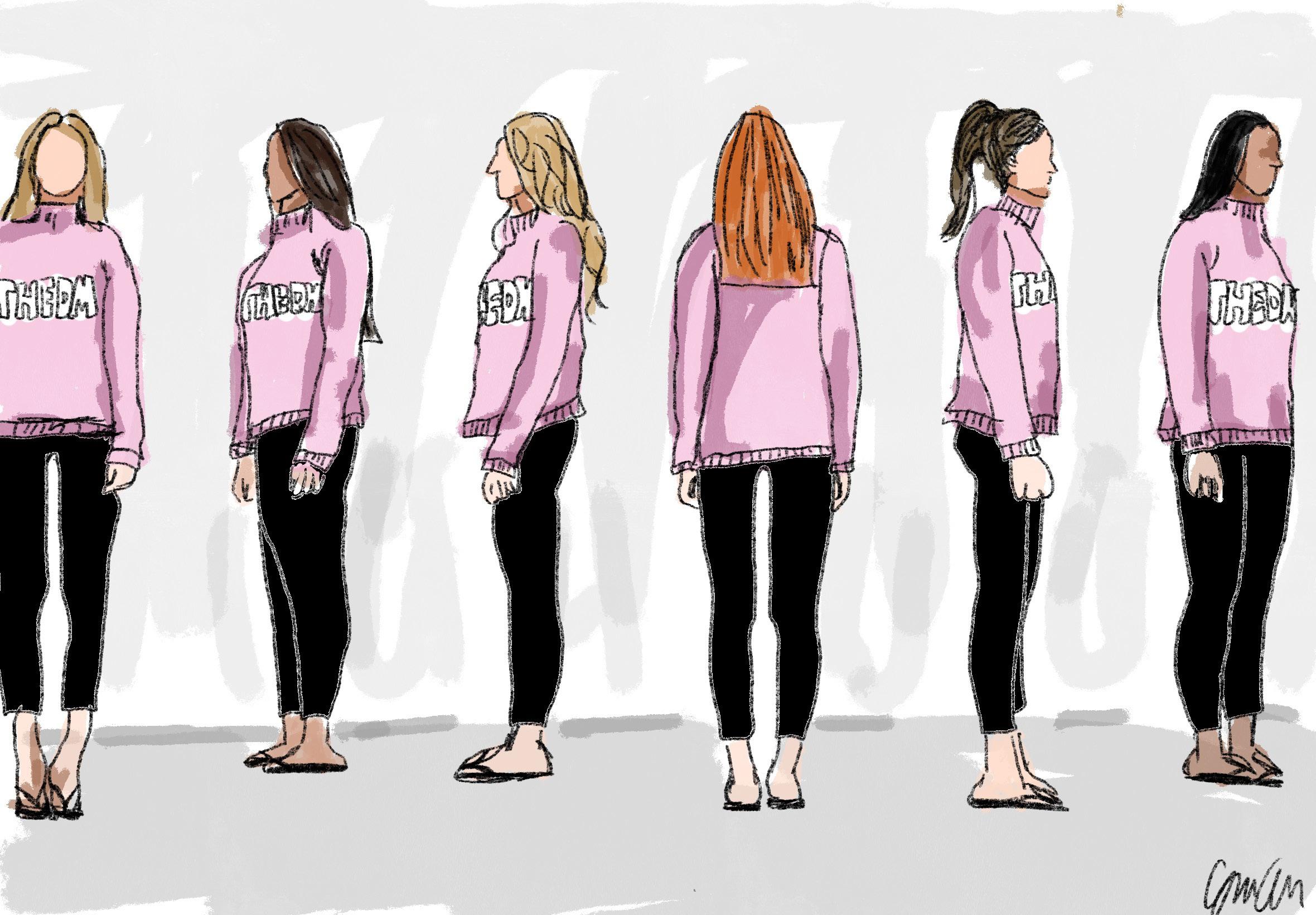
Walking around campus, it is a given that you will see influencer-branded sweatshirts, athleisure wear and coordinated sets that dom -
inate mainstream fashion. These outfits mark a sharp contrast from what you would see on game days or on any given weekend in Oxford.
This contrast may suggest that students don’t put effort into how they dress outside of social events. That criticism may seem valid, but it overlooks something important — here in Oxford, elevating simple athleisure and coordinated sets is the effort.
The trend of taking something as simple as a twopiece set and styling it with accessories, a tote bag and a trendy sneaker is not lazy. Instead, it is a reinvention of Southern fashion culture.
Ava Rosetti, a senior journalism major from Gulfport, Miss., believes fashion plays a significant role in student life.
“Fashion is an extremely important part of student life at Ole Miss,” Rosetti said. “It’s definitely a way to show your own personal style and per -
sonality through your outfits.”
For Rosetti, getting dressed for class is not about choosing between comfort and personal style but rather about blending the two.
“My main priority when getting dressed for class is a mix of comfort and style. I really like to wear athleisure and elevate it with jewelry or a cardigan to make my class outfits more my style,” Rosetti said.
Rosetti’s perspective reflects a larger trend across campus — students are still putting thought into what they wear, even if the outfits they wear to class look more relaxed than their game-day getups.
Rosetti also points out a deeper issue tied to societal expectations.
“There is definitely a stigma and expectation for students, especially female students, to dress a certain way and look like everyone else,” Rosetti said. “I think it should be encouraged for people to
SUDOKU©
Puzzles by KrazyDad

defy this expectation and dress in their own unique styles.”
This highlights the struggle between individuality and conformance that often shapes fashion choices at the university.
Gracie Hudson, a sophomore integrated marketing communications major from Ocean Springs, Miss., agrees that fashion is deeply embedded in campus culture.
“Fashion is definitely an important part of student life. With the rise of many fashion-based organizations on campus, fashion has become a big part of students’ everyday lives,” Hudson said.
“Whether it be fun and unique outfits to football games, or even for lunch on the Square, Oxford has become a breeding ground for exploring creativity through clothing.”
Ultimately, the idea that students are not dressing up for class creates boundaries for how fashion, personal style and comfort intersect. Assuming that putting in effort means dressing a specific way limits how students choose to express themselves on campus.
Lauren James is a sophomore integrated marketing communications major from Hernando, Miss.
HOW TO PLAY
Complete the grid so that every row, column and 3x3 box contains the numbers 1 through 9 with no repeats.
DIFFICULTY LEVEL




GRACE ANN COURTNEY / THE DAILY MISSISSIPPIAN
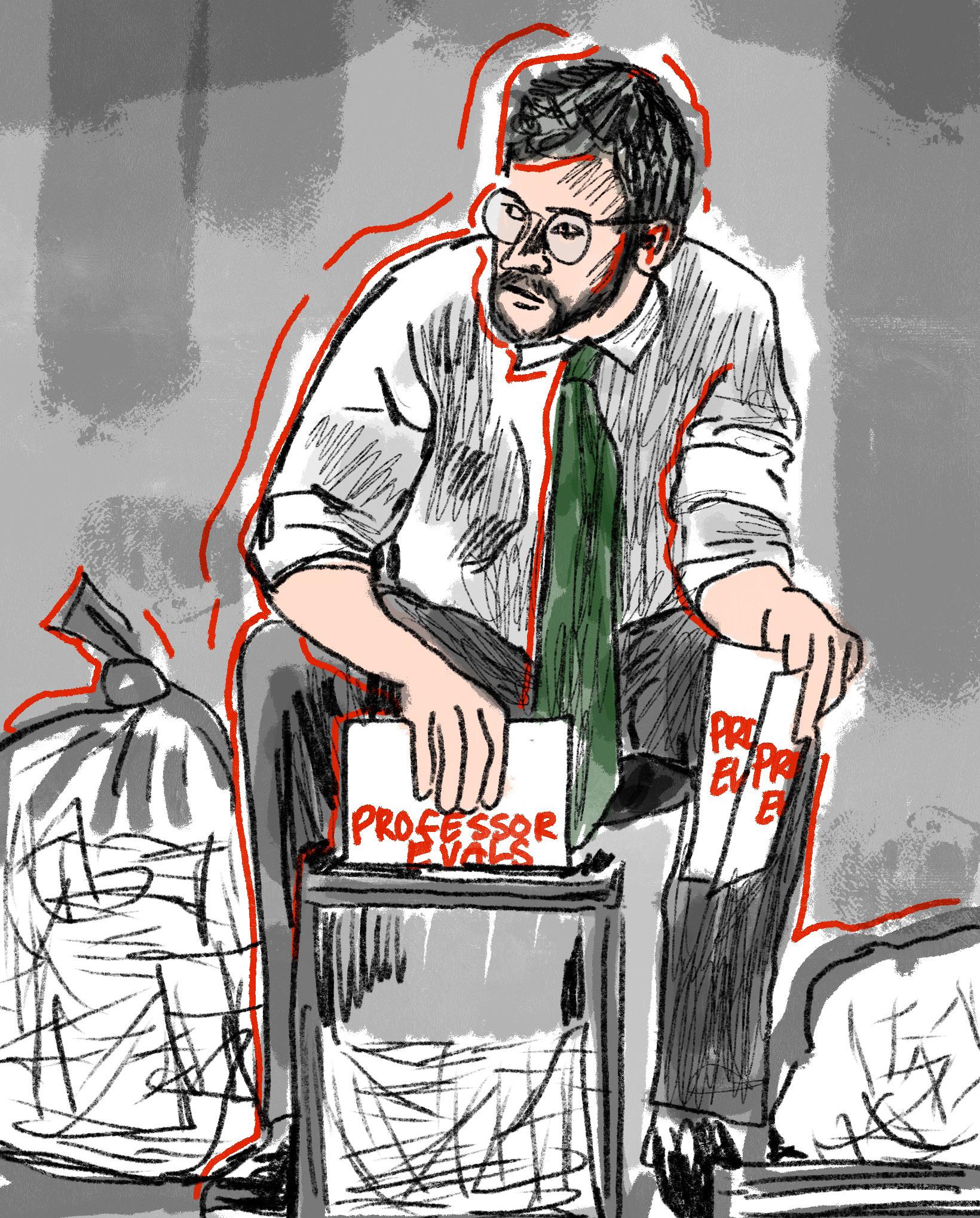
Teacher evaluations are important:
Why disregard them when it matters most?
“While it may seem unfair given the severity of Winter Storm Fern, university instructors should be held accountable for the decisions they make in the classroom.”
MACKENZIE MCDARIES Opinion Editor
It is not every semester that students get an impromptu two-week break from school due to a historic winter storm.
So, when Winter Storm Fern wrought havoc on Oxford and forced the last-minute, prolonged closure of the University of Mississippi earlier this semester, many students feared returning because of the sheer amount of work they had missed. Debates in online forums questioned whether professors would cram a standard semester’s worth of content into a shortened timeframe or choose to skip two weeks’ worth of material.
Once power was restored and classes resumed, that decision was ultimately left to instructors. While some professors shortened syllabi altogether, others opted to squeeze the previously planned content into the shortened class schedule.
Fern caused a disruption so abrupt that members of the university’s Center for Excellence in Teaching and Learning (CETL) hosted sessions guiding faculty on how to alter instruction plans to accommodate the storm, and the group even provided oneon-one advising for professors.
Despite the university’s attempt to mitigate the impacts of the storm, some students still feel shortchanged by how their professors managed the abnormal situation — which factored into the faculty senate’s recent recommendation to exclude this semester’s teacher evaluations in matters of annual review, promotion and tenure. The university is still considering whether this semester’s student evaluations will be included in the faculty evaluation process.
The faculty senate’s resolution states that student evaluations of instruction should “not be considered for matters of annual review, promotion or tenure decisions unless specifically allowed by the faculty member” due to the unique circumstances of Winter Storm Fern that resulted in “extraordinary tension between fac-
Opinion Policies:
ulty expectation of teaching and student expectation of learning.”
This means that student reflections of instructor performance during Fern may not be regarded throughout professional advancement processes. When professors attempt to seek promotion or tenure, their actions during Fern may not be taken into consideration.
A natural disaster, however, can serve as the perfect test for teacher competency. The “tension” between instructor and student expectations could have been avoided based on how the instructor chose to respond to the condensed semester.
In an unprecedented situation like Fern, students can assess instructors’ full capabilities of adapting to sudden change. In a time when professors show their true colors, why not count teacher evaluations?
Alyssa Terrell, a senior legal studies major from Dade, Fla., said class cancellations due to weather are nothing out of the ordinary in her hometown.
“I’m from Florida, so we would miss a lot of days for hurricanes and other similar disasters,” Terrell said. “If we had weeks off for hurricanes, that didn’t mean we just got rid of teacher evaluations.”
Terrell did not agree with the resolution. If an instructor failed to efficiently adapt to the situation, Terrell argued, that should be reflected in his or her evaluations and taken into account when career-related decisions are made.
“Teacher evaluations are meant to show what kind of professors they are and how they can adapt to change in circumstance,” Terrell said. “If a professor can’t handle a bump in the road, their ability as a teacher might be affected, and they probably shouldn’t be a professor.”
On the other hand, some students understand the faculty senate’s resolution. Michael Sangster, a freshman finance major from Newnan, Ga., thought that the abbreviated schedule might lead to a higher amount of student displeasure — some of which is beyond the teacher’s control.
“When some teachers crammed the material into a day or two in-
stead of skipping it, students probably weren’t the happiest with them,” Sangster said. “Therefore, the reviews would likely be skewed negatively.”
However, Sangster did admit that these extenuating circumstances could reveal important information about professors.
“It shows how teachers really deal with unexpected problems, though,” Sangster said.
“I think that reflects their character and how they actually are as teachers and as people.”
While it may seem unfair given the severity of Fern, university instructors should be held accountable for the decisions they make in the classroom. A truly effective professor can adjust to challenges and properly lead his or her students, no matter how drastically they must change their plans.
Columns do not represent the views of The University of Mississippi or The Daily Mississippian. The Daily Mississippian welcomes letters to the editor, which should be emailed to thedmopinion@gmail.com. Letters should be no longer than 300 words. They may be edited for clarity, brevity and libel. Third-party letters and those with pseudonyms or no name will not be published. Letters are limited to one per individual per month. Letters should include contact information, including relationship to the university, if applicable.
MacKenzie McDaries is a freshman Arabic and political science major from Murfreesboro, Tenn.
GRACE ANN COURTNEY / THE DAILY MISSISSIPPIAN
Increased
Detoxification
Lower Blood
Anti-Aging & Skin Rejuvenation
Improved Circulation
Weight Loss