MISSISSIPPIAN THE
Thursday, April 2, 2026
Thursday, April 2, 2026
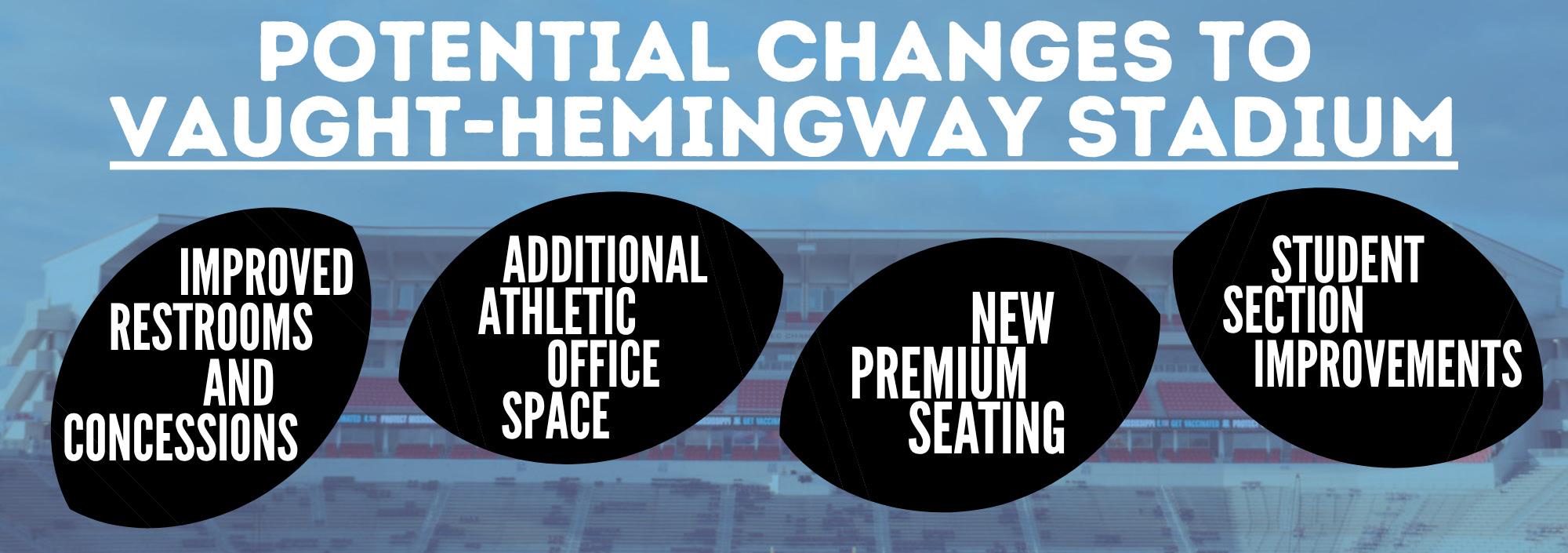
Selection of a developer to make upgrades to Vaught-Hemingway Stadium on campus – including premium suite seating, improvements to the student section, additional athletic office space and upgrades to restrooms – will be made in late April, according to Sports Business Journal.
The university requested bids from interested developers in December. The window for proposals closed in February.
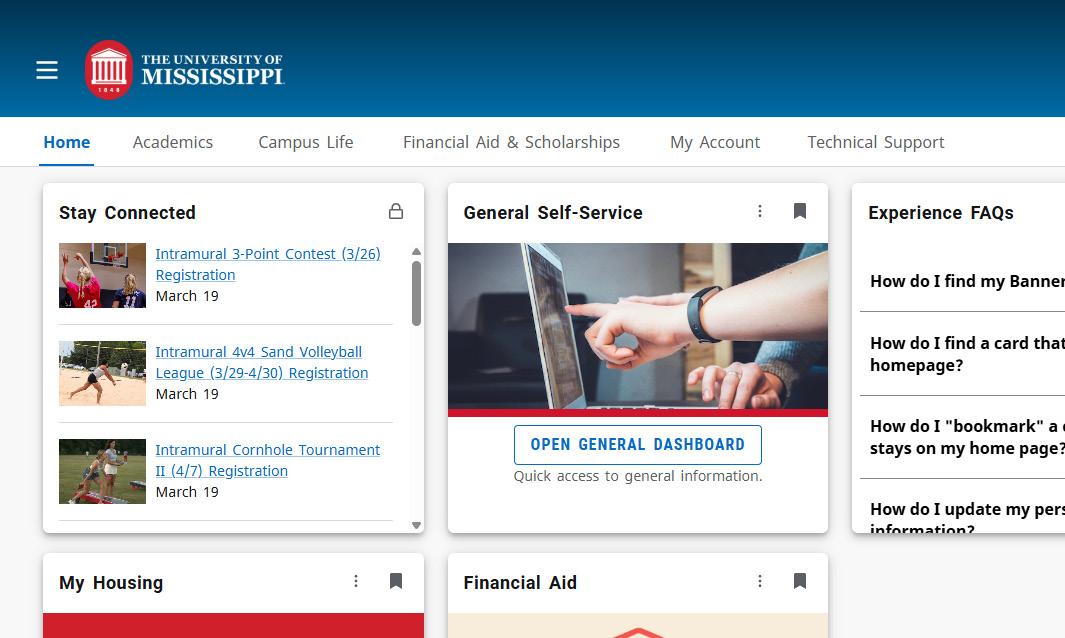
For the first time since its launch in 2008, myOleMiss will not be used by University of Mississippi students to register for fall classes starting April 13. Replacing the student portal is Experience, a student information service (SIS) of Banner by Ellucian.
The transition is part of a years-long initiative of the university, called Project Encompass, to modernize its infor-
mation systems. The initiative began in fall 2022, with the platforms of Banner by Ellucian selected for student information services, and Workday selected for administrative and employee services during spring 2025.
The university launched Experience on March 16 this year, though the platform will not take the place of myOleMiss as the primary academic portal until the fall semester. Starting April 13, students will complete their course registration using the new Experience platform.
Tony Ammeter, associate provost, co-chair of the Project Encompass initiative and the project director for the Banner student information system solution, said the change was to help provide a more user-friendly, streamlined experience for UM students.
“Experience, and the Banner system behind it, provides a more flexible and user-friendly platform that can better support students now and in the future,” Ammeter said. “For example,
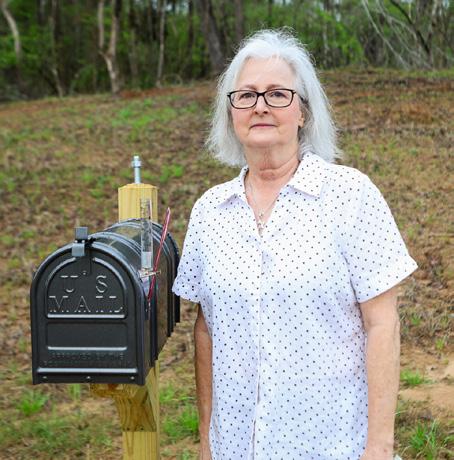
Lafayette County residents’ latest attempt to thwart the construction of a new asphalt plant at the industrial park failed. What’s next?
Additional seating is a critical need for the stadium, especially in the student section. While the stadium’s capacity is listed at approximately 64,000, attendance at football games during the 2025 season averaged 104% of capacity, among the top 10 in the country. Non-seated attendees, such as media members and spectators in luxury suites, were taken into account.
During the 2024 season, Ole Miss was among the top five nationally with 105%
of seating capacity filled. Since university enrollment has reached an alltime high in recent years, student tickets are in increasingly high demand. Students who miss out on university-distributed tickets are forced to purchase single-game tickets from resale marketplaces — none of whom are endorsed by the university, creating ripe opportunity for scams. Also included in the district development program is a “full-service luxury condotel” (a condominium which functions as a hotel) “with roughly 100 hotel keys and 30 condominium units,” as well as “35,000 square feet of retail and dining, a new plaza and public realm enhancements — most notably, the preservation and elevation of the iconic Walk of Champions — and modernized athletics offices relocated within the development footprint,” per Brailsford & Dunlavey, a planning and development advising firm. The Vaught was built
Country music star and former University of Mississippi athlete Brett Young will return to Oxford this spring as the 2026 Commencement speaker.
Although Young did not graduate from UM, he has maintained ties to the campus. His 2019 music video for “Catch” was filmed in Oxford and featured scenes at Swayze Field, highlighting his connection to the university and his time as a Rebel athlete.
SEE PAGES 2-3 PITCHING
Pitching is art, but how much science is involved?
SEE PAGE 7
The university announced Tuesday that Young, an award-winning singer and songwriter, will address graduates during the 173rd Convocation ceremony in the Grove on May 9. Before rising to country music fame, Young attended the university and spent one season as a pitcher for the Ole Miss Baseball team in 2000.
“My experience with true Southern hospitality at Ole Miss was more than something that made me feel welcome there,” Young said in a UM release. “It was a lesson in how to treat people in life and something that has stuck with me and will be taught and passed down to my family.”
Though Young is mostknown for his Diamond-certified single “In Case You Didn’t Know,” he holds six Billboard Country Airplay No. 1 hits and a win for New Male Vocalist of the Year at the 2018 Academy of Country Music Awards, marking a transition from student-athlete to nationally recognized artist.
Students reacted with excitement following the announcement.
“I think it’s really cool that they chose someone who actually has ties to Ole Miss,” senior integrated marketing communications major Shelby Wicker said. “It makes it feel more personal for students graduating.”

Chancellor Glenn Boyce is looking forward to Young’s return to Ole Miss for Commencement.
“We look forward to welcoming Brett Young back to campus to address the Class of 2026 for this meaningful, celebratory milestone in their lives,” Boyce said in the release. “His journey of perseverance from collegiate
pitcher to renowned country music vocalist with a devoted following will resonate with our students as they head into the world to chart their own paths of success.”
LOGAN KENNEDY A&C Staff Writer
Oxford residents’ most recent push against the construction of hot mix asphalt plant Magnolia Materials, owned by local developer JW McCurdy, failed on Monday, March 23 when the Lafayette County Planning Commission unanimously voted against the residents’ petition to rezone a parcel of the Max D. Hipp Industrial Park from I-2 heavy industrial to I-1 light industrial where the plant’s proposed site currently sits.
The rezoning would have essentially quashed the plan to construct the Magnolia Materials plant at the current site.
This decision was the latest development in an ongoing controversy over the plant’s construction.
After strong public opposition, McCurdy abandoned his plans to construct the Magnolia Materials plant on Mississippi Highway 328 across from Falkner Farms near Taylor, Miss. McCurdy withdrew his petition in October 2025 to rezone the land on Highway 328 and moved his plans for construction to the industrial park.
McCurdy said the location change to the industrial park fell in line with the public’s requests to abandon the first proposed Highway 328 site.
“The city and county badly need an additional asphalt option, and almost every single person who spoke up during our first proposal said, ‘Go to the industrial park,’” McCurdy said in an interview with The Daily Mississippian. “So, we listened. We will build the exact same, a state-of-the-art, relatively small production plant.”
The Lafayette County Board of Supervisors approved the location change for the site plan in a November 2025 executive session. They approved the site plan on Jan. 5.
McCurdy must obtain a construction stormwater permit and hot mix asphalt general permit from the Mississippi Department of Environmental Quality (MDEQ) to begin construction.
“As part of the process, a public hearing is anticipated to allow for public input,” Jan Schaefer, communications director for MDEQ, said. “Following that, the matter (asphalt plant) would be presented to the Mississippi Environmental Quality Permit Board for consideration and final action.”
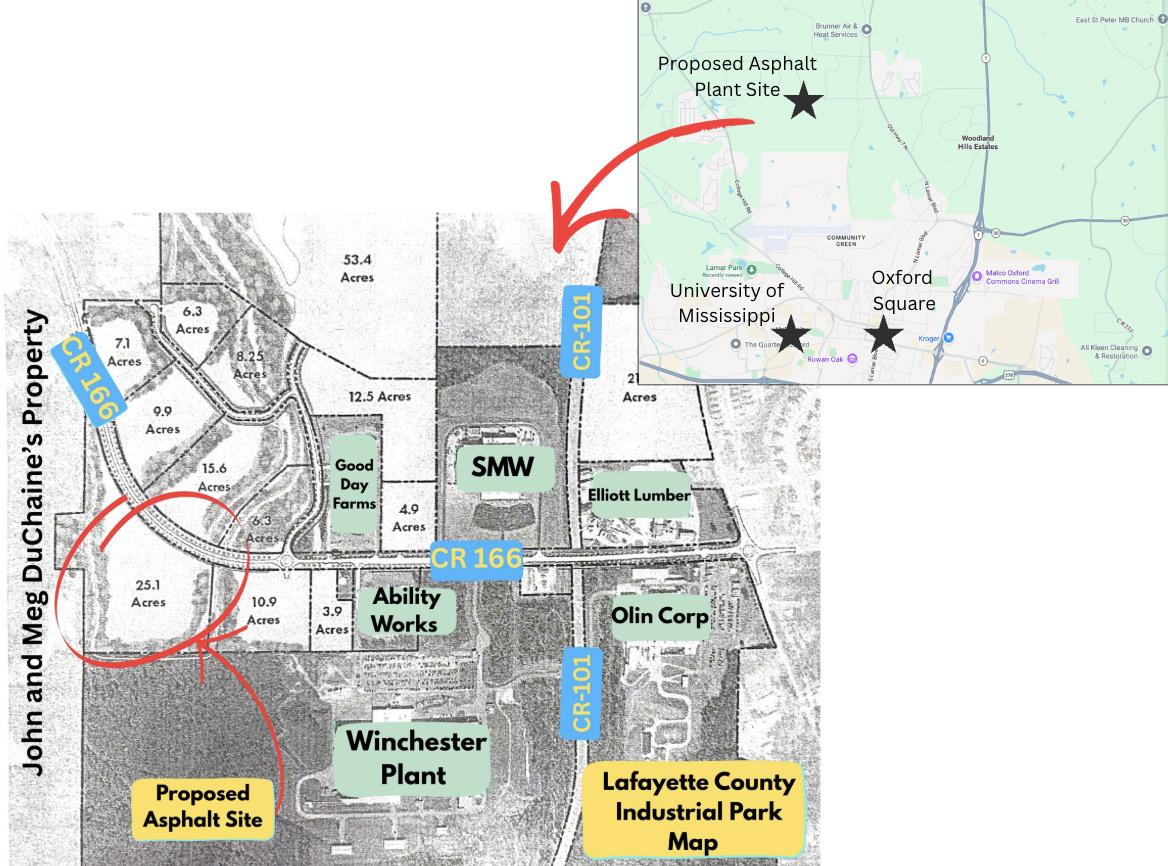
Currently, the entire 165acre industrial park is zoned I-2 heavy industrial. The industrial park is located north of Oxford along the newly built County Road 166 that connects West Oxford Loop to Highway 7.
According to descriptions in the Lafayette County Zoning Ordinance, the Magnolia Materials asphalt plant requires construction in an I-2 heavy industrial zone.
“These (I-2 heavy) industrial uses generally have extensive space requirements and/or generate substantial amounts of noise, vibration, odors or possess other objectionable characteristics,” Article XVII of the Lafayette County Zoning Ordinance says.
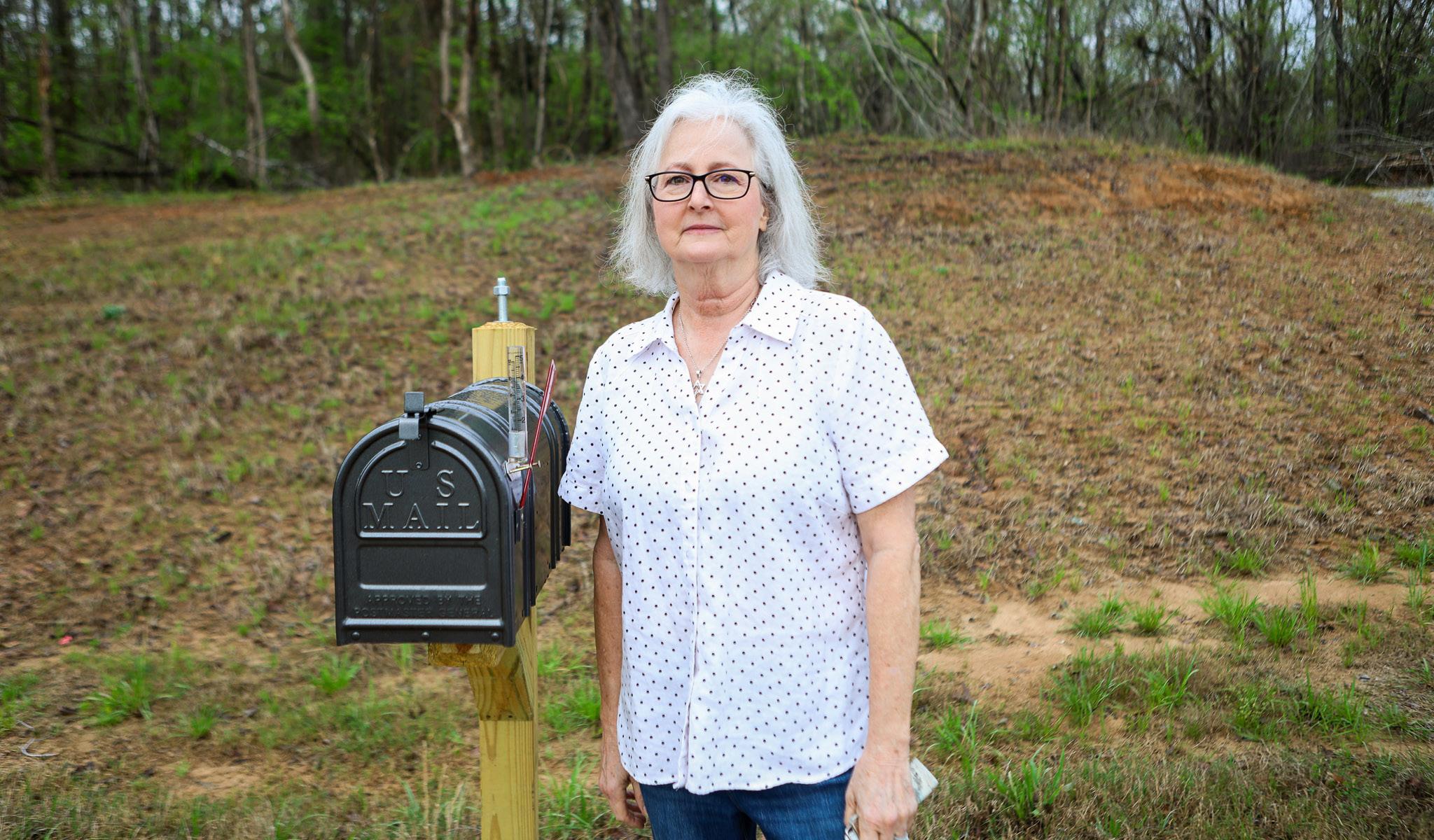
Oxford resident Meg Faulkner DuChaine attended the plan-
ning commission’s meeting. She described locals’ pleas to rezone part of the industrial park to I-1 light industrial as significant.
“It was deep, it was meaningful, and people poured their hearts out — and some people got blunt,” Faulkner DuChaine said. “After all was said and done, (the planning commission) still unanimously voted to not rezone. It took them about five seconds.”
The Lehman-Roberts Company currently operates a hot mix asphalt plant on County Road 101 in Oxford, approximately 2.1 miles from the proposed Magnolia Material plant site.
According to Kate Victor, Lafayette County Administrator, the industrial park is currently home to Olin Winchester Rim Fire, Olin Winchester Center Fire, Good Day Farm, SMW Manufacturing, Ability Works, Elliott Lumber, B&B Concrete, Innovative Construction Management, Lafayette County Animal Shelter and Lafayette County Road Department storage facility and laydown area.
“When I heard they were going to put it in the industrial park, I thought, ‘Absolutely not, they cannot put an asphalt plant there. There are way too many people that live close to it,’” Oxford resident Glynna McKendree said, who attended the March 23 planning commission meeting.
Residents in neighborhoods near the site of the proposed plant — Tara Estates, Quail Creek Estates and Whitetail Landing — formed “Save Oxford: Asphalt Plant Edition,” a Facebook group with almost 400 members. McKendree is a member of the group.
Approximately 335 homes are located in a one-mile radius of the proposed asphalt plant site, according to CalcMaps and U.S. Census data.
McKendree said local residents sent letters to the board of supervisors on March 12, stating that the board had not followed Lafayette County’s Zoning Ordinance and that the lease of the property between the county and Magnolia Materials puts the county in legal jeopardy.
The zoning ordinance
The Lafayette County Zoning Ordinance was adopted in 2018, outlining zoned areas in the county such as agricultural, residential, commercial, light-industrial and heavy-industrial.
“We went to the (board of supervisors) meeting on Dec. 15, 2025, and we asked them to please table the issue until such time as the public could be notified, and then (District 2 Supervisor) John Morgan slammed his hand down on the table and said, ‘What more do you want? It’s going in the industrial park,’” McKendree said. Morgan and fellow supervisors Brent Larson, Tim Gordon, Scott Allen and Greg Bynum did not respond to requests for comment for this article.
The difference between light and heavy industrial zones are defined by Lafayette County’s Comprehensive Plan. Both types of zones need “buffer zones” and are described as being away from residential areas.
“Industrial uses should be located away from, or well buffered from, residential uses,” the Lafayette County Comprehensive Plan said.
A buffer zone for the plant does not exist, according to site plans.
McCurdy did not respond to comment whether or not Magnolia Materials would build a buffer.
John and Meg Faulkner DuChaine’s 240-acre property, zoned an A-1 rural district, in Tara Estates has been in her family for generations. Meg Faulkner DuChaine is the great niece of author William Faulkner, and the DuChaine family’s home is almost 200 years old. The DuChaines’ home would be only 150 feet away from the proposed asphalt plant site.
During the planning commission’s meeting on March 23, Joel Hollowell, the Lafayette County director of developmental services, said that an A-1 rural district property adjacent to the asphalt plant — the property owned by the DuChaines — would act as the buffer between the I-2 heavy-industrial-zoned asphalt plant and the residential-zoned neighborhoods.
“Joel Hollowell had the audacity to say during the meeting, that the land around the asphalt plant zoned A-1 (rural district), which is ours, will serve as a buffer,” John DuChaine, a licensed realtor, said.
Hollowell did not comment on DuChaine’s response. After initially agreeing to answer questions about the site from The Daily Mississippian, Hollowell did not respond before the time of this story’s publication.
The zoning ordinance includes no language that would imply an A-1 rural district property can act as a buffer zone for an I-2 heavy industrial site like the proposed asphalt plant.
“It is the intent of this ordinance that such ‘heavy’ industrial districts be located insofar as possible adjacent only to C-3 (Commercial High Density) or I-1 (light industrial) districts, which shall serve as transitional zones (buffers) between I-2 (heavy industrial) districts and residential uses and lower-intensity commercial uses,” Article XVII of the Lafayette County Zoning Ordinance says.
The language of the ordi-
nance does not specify that the DuChaines’ land can be a buffer or transitional zone.
Lisa Chandler and her husband Mike Bennett’s property in Quail Creek is approximately 739 feet from the proposed plant’s driveway, according to a complaint filed by Chandler to the MDEQ on March 20.
Chandler is opposed to the plant’s location near the property she has owned for 30 years. She said she will be able to see the plant from her kitchen window, living room and back porch.
“We worked hard for this land,” Chandler said. “This used to be my piece of paradise until this happened.”
Chandler and the DuChaines thought a light-industrial area would look nice and attract visitors.
“We believed it would be this tech center, and there would be trails and paths for people to walk on,” Meg Faulkner DuChaine said.
John DuChaine asked the question: “Who is going to want to walk through an asphalt plant?”
In November 2025, when the asphalt plant was originally going to be located on Highway 328, McCurdy issued a press release explaining why the industrial park would not be a good place for the asphalt plant. The press release stated that the area surrounding the industrial park was too populated for an asphalt plant. This press release has since been deleted from the Magnolia Materials website.
The lease
McKendree, a former federal defense contractor of over 20 years, drafted many multi-million dollar contracts between the U.S. Department of Energy and Department of Defense. When she saw the lease signed between Lafayette County and McCurdy’s Magnolia Materials, she was shocked.
“It looks like a 6-year-old wrote it,” McKendree said. “I was mortified … that the board would sign this lease that gives no protections for the people of Lafayette County. Even the format of the lease is just appalling to be a government document.”
Lafayette County Attorney David O’Donnell declined The
Daily Mississippian’s request for comment about the lease.
The board of supervisors signed a lease agreement with Magnolia Materials on Dec. 15, 2025, then executed the lease three days later. Mississippi Code § 57-3-9 indicates a site plan has to be approved by the board of supervisors in a public hearing before a lease can be signed.
On Dec. 22, 2025, the planning commission approved Magnolia Materials’ preliminary site plan.
“How can you sign a lease when you don’t have a site plan?” McKendree said. “I asked (District 1 Supervisor) Brent Larson, ‘Why did you do this and bind the people of Lafayette County for 35 years?’ He looked at me and said, ‘Because I can.’” Larson did not respond to The Daily Mississippian’s requests for comment.
Magnolia Materials is to pay Lafayette County $5,000 a year for 35 years for the site in the industrial park, according to the lease signed.
According to a lease implemented in 2004 by the board of supervisors between Lafayette County and Olin Corporation, who owns the Winchester Ammunition plant at the industrial park, Winchester has paid $5,000 a year for rent, as well.
“I can go downtown and open a dress shop and pay the same amount for rent a month,” McKendree said. “Why would you lease land to an asphalt plant for that much when the people of Lafayette County could be getting a lot more for a toxic facility that is going to ruin their health?”
With regard to the environmental effects of the plant, McCurdy noted that the U.S. Environmental Protection Agency delisted hot mix asphalt plants as major sources of air pollution in 2002. He said that asphalt plants have reached over a 90% containment factor after 23 years of advancements in containment technologies.
Section 1.2.18 of the lease allows Magnolia Materials to assign the lease to another entity with the board of supervisors’ approval. Exhibit B of the lease also states that permitted hazardous substances include asphalt cement, aggregate ma-
terials, diesel fuel, gasoline, motor oil and lubricants, hydraulic fluid, antifreeze, cleaning solvents, paints and coating.
“Any other materials commonly used in the operation and maintenance of an asphalt plant, provided that such materials are used, stored and disposed of in compliance with all environmental laws and quantities reasonable for tenant’s permitted use, “ Exhibit B of the lease said.
McKendree claims that the language of “other materials commonly used” in the lease is too vague and does not provide parameters for other potentially toxic materials.
According to Section 4 of the lease, the leased land will promote economic development in the county, generate tax revenue and offer employment opportunities. It also said that the asphalt plant is necessary in the fast-growing community.
The “Save Oxford: Asphalt Plant” Edition Facebook group has raised other objections to the asphalt plant’s location for reasons of economics, health and safety.
Economic impact
McCurdy believes that Lafayette County needs an asphalt plant to improve the growing Lafayette-Oxford community’s infrastructure.
“With or without us, Lafayette County and the city are spending millions on asphalt with one local producer,” McCurdy said in an interview with The Daily Mississippian. “You don’t need me to tell you how bad of a situation that is for our local government, and it is imperative that we add another option for our governments and our schools.”
Magnolia Materials is required
to retain five full-time employees for the duration of the lease.
“(McCurdy’s) number one thing in the beginning was, ‘We need more asphalt.’ Of course he said his number one client was going to be the county, but the county has to bid their asphalt for the entire year in advance,”
John DuChaine said. “I think (the board of supervisors is) just saying what people want to hear and not fact-based information.”
On Chandler’s back porch, the proposed plant will be visible, as well as the asphalt trucks passing by on County Road 166.
“I will see, hear and smell the constant production of asphalt and the heavy asphalt truck traffic proposed to run 12 hours per day, filling and releasing numerous trucks per hour,” Chandler said in her complaint filed to MDEQ.
The DuChaines are concerned that their sprawling property that extends over 200 acres will diminish in value due to something that they believe the county does not really need.
The impact of hot mix asphalt plants on nearby property values is inconclusive.
The asphalt plant would require 20-25 asphalt trucks leaving and coming to the facility every hour, according to McKendree.
Because Regents School and Magnolia Montessori School are located close to the plant site, the “Save Oxford: Asphalt Plant Edition” members are concerned about potential safety hazards caused by the number of asphalt trucks that would be entering and exiting the Magnolia Materials facility.
“There are numerous gravel pits, concrete plants and an as-
phalt plant in our community, and they are strictly regulated and monitored,” McCurdy said in an interview with The Daily Mississippian. “Those regulations work, and we will be subject to the exact same ones. So, in a way, don’t take our word for it — look at the results. Lafayette County, the sheriff’s department and (Oxford Police Department) have made our roadways safe.”
Residents are concerned about health risks as a result from long-term exposure to the asphalt plant’s emissions. McKendree cites a study conducted by Lafay-

THE DAILY MISSISSIPPIAN
CLAY HALE editor-in-chief dmeditor@gmail.com
RAEGAN SETTLE managing editor dmmanaging@gmail.com
SYDNEY STEPP copy chief thedmcopy@gmail.com
CAMERON LARKIN digital editor dmdigitaleditor@gmail.com
AIDAN PONIATOWSKI news editor thedmnews@gmail.com
DYLAN THOMAS assistant news editor thedmnews@gmail.com
JAYLYNN CONNER arts and culture editor thedmfeatures@gmail.com
JESSICA JOHNSON assistant arts and culture editor thedmfeatures@gmail.com
RUSS EDDINS sports editor thedmsports@gmail.com
NATE DONOHUE assistant sports editor thedmsports@gmail.com
LENORA COLLIER opinion editor thedmopinion@gmail.com
OLIVIA CANGELOSI photo editor thedmphotos@gmail.com
JOURNEY GLOVER assistant photo editor thedmphotos@gmail.com
MADELYNN LIBERTO design editor thedmdesign@gmail.com
ANNA GRACE LIKES assistant design editor thedmdesign@gmail.com
MARY EVANS multimedia coordinator dailymissmedia@gmail.com
AVERY THOMAS social media manager thedmsocialmedia@gmail.com
ette County resident Betsy Johnston, which was corroborated by a University of Mississippi professor with background in environmental toxicity, as well as the Center for Environmental Justice’s findings on asphalt production. The professor was unnamed by Johnson due to privacy concerns.
McCurdy countered those claims about health risks.
“We have addressed and will address those concerns with, first, filtration systems, which eliminate this possibility 100%,” McCurdy said. “Complemented by regular, unannounced environmental official visits … if they find that we haven’t eliminated this concern to their standards, we’ll stop work that instant. It’s fail-safe.”
MDEQ communications director Schaefer said it is the department’s responsibility to ensure compliance for all regulated Mississippi facilities. MDEQ uses periodic, unannounced inspections to do so, Schaefer said.
While MDEQ will ensure Magnolia Materials’ compliance with the agency’s standards, there are still concerns about the proposed plant’s environmental toll.
Robert DeVries, instructional assistant professor of biology at UM, agreed, said that asphalt production can emit byproducts like hexavalent chromium — a human carcinogen that can cause lung cancer when inhaled. DeVries said if the chemical is involved in laying asphalt, hexavalent chromium has to be produced in the asphalt plant itself and would be released
CADENCE MANNING assistant social media manager thedmsocialmedia@gmail.com
S. Gale denley student media center
LARZ ROBERTS Director of Student Media
DENNIS MOORE Editorial Director
unless contained by the plant.
“A lot of the things that leach out from asphalt are carcinogens and can cause the turning off of tumor suppressor genes,” DeVries said. “It’s hard to see a scenario that doesn’t relate to some contamination at some level.”
McCurdy outlined plans for containing emissions in a Magnolia Materials flyer distributed at the District 5 Town Hall meeting on Oct. 2.
“This plant will have entire buildings that are nothing but filters (baghouses), and the final emission will be water vapor. In fact, the total annual emissions created by the two residential fireplaces over an average year of usage,” the flyer said. “An industry like this doesn’t go through eight years of Barack Obama and four years of Joe Biden without coming out on the other end as one of the most highly regulated industries in the nation.”
Potential contamination of the Berry Branch Creek that runs near the asphalt plant is a large concern of many local residents because it ties into Toby Tubby Creek, which flows into Sardis Lake.
Although opponents of the asphalt plant lost their bid to have the industrial property rezoned, they say they will mount additional efforts to stop construction of the Magnolia Materials facility near their homes.

ELI CROWLEY News Staff Writer
The 2025-26 Associated Student Body term concluded Tuesday, March 31 with a joint senate meeting between the newly inducted ASB executive board and senators and the 2025-26 ASB team. This joint senate marks the end of this past senate’s term, and the beginning of the new senate’s term.
The ASB senate passed SR 26-2, which voices support from the ASB for a new attendance policy to take effect in fall of 2026. This new attendance policy was developed by the Senate of the Faculty, the UM Graduate Student Council and ASB. The new policy would include a bereavement policy and excused absences for student-athletes.
The passing of SR 26-2 was the last step in an on-going process of joint legislation between the ASB senate and faculty. On Dec. 3, 2024, the ASB senate passed a resolution that was related to adjusting student attendance policies.
This resolution outlines different reasons why students could be approved for excused absences, including students participating in NCAA competitions and other university sponsored events. The
continued from page 1
when Banner is fully implemented, you will have a much better view of your academic program, allowing you to clearly see the courses you have already taken, those you need to take in the next semester and options to chart out the coming semesters right up to graduation.”
Ammeter also said that Experience will provide a better mobile adaptation than myOleMiss.
“(Experience) will be much more mobile-friendly and is designed to grow over time, allowing us to introduce new tools and features that just weren’t possible in myOleMiss,” Ammeter said.
Student reactions to the platform, however, have been mixed.
Mary Adeline Morris, a sophomore international studies and Spanish major, has used the Experience platform to browse for classes leading up to registration for fall semester.
“So far, it’s been interesting. I have mixed feelings about it. It’s not the most user-friendly I would say, because it’s hard to find certain aspects, and when registering for classes there’s a lot of steps you have to go through just to be able to see classes,” Morris said. “Additionally, I have had friends who the program has started working (for) and then immediately disappeared when they refreshed it, and they weren’t able to browse for their classes.”
While students have access to some features of Experience, the university sent out an email to students on March 26 stating that the registration self-service card and ability to build a draft schedule will be available after April 6. Ammeter touted the Banner interface, contrasting it with myOleMiss.
“While myOleMiss is built around menus and links, Experi-
current undergraduate absence policy does not allow for excused absences for students participating in NCAA competitions.
This resolution was then sent to the faculty senate, and ASB and faculty senate worked together to come to an agreed-upon resolution. This process concluded on March 20, 2026. This new resolution was brought to the senate floor so that its recorded policy would be in accordance with the faculty senate’s. SR 26-2 was passed unanimously.
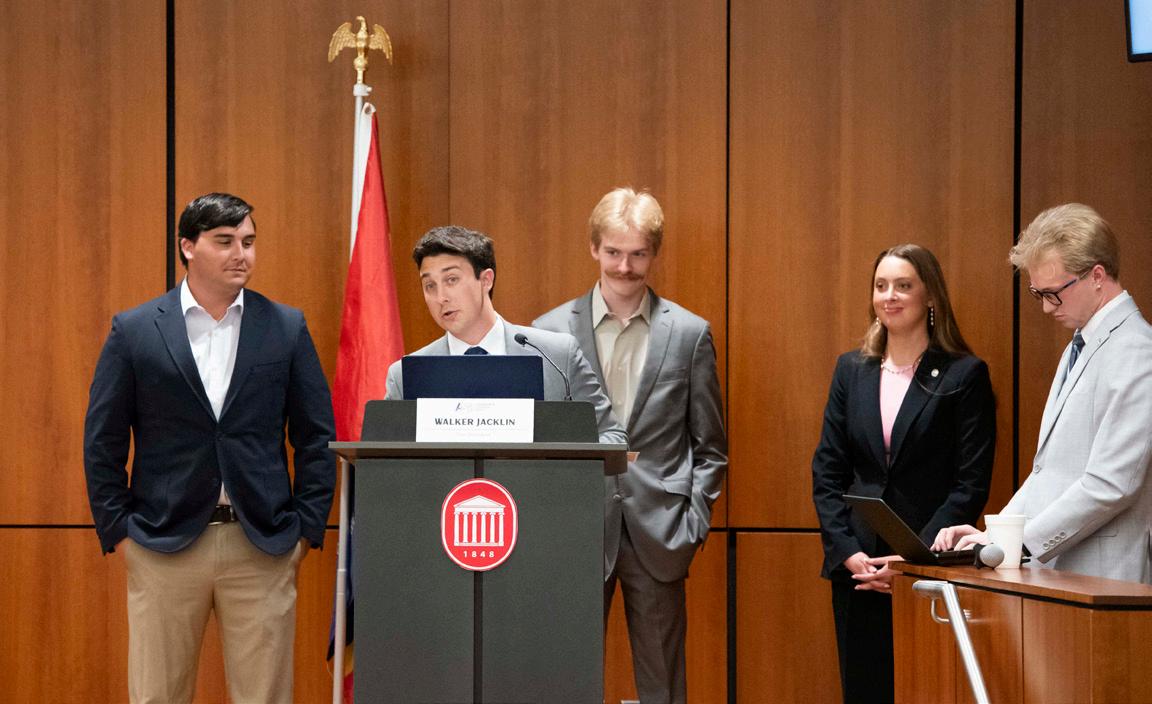
Previous ASB Vice President Walker Jacklin passed the power to the newly elected ASB Vice President Trey McKean.
As part of the passing of the power ceremony, Jacklin gave a final speech, as did President Pro Tempore Wesley Templet.
Jacklin reflected on the ASB’s accomplishments in his speech.
“Some say that the ASB does not make change. I come to you tonight to say that I am proud of the tangible differences that every single person in this room has made,” Jacklin said. “I think some people just forget what changes have happened in just two years: Our entire campus has an all-access New York Times subscription. We lowered concession prices, saving students over
ence organizes information into a streamlined, dashboard-style layout that includes modular tiles of content, or cards,” Ammeter said. “As more cards become available, students will be able to quickly access the tools and information they need in one place, without having to log in multiple times. Students can also customize their homepage to fit their needs.”
Cards can include everything from financial aid information, parking and student employee applications, housing information, transcript requests and more.
Preston Brent, a first-year student at the UM School of Law, completed his undergraduate degree at Samford University in Homewood, Ala. Samford uses a Banner program as its SIS.
Brent, having used both systems, believes that beyond the initial headache of an interface change, the new system will not have much of an effect on the student body.
“We used Banner, and it wasn’t that big of a deal. In terms of difference (to myOleMiss), it’s just the user interface, which is kind of annoying when they switch it up because you always get used to the other system,” Brent said. “Besides that, I don’t really feel like there’s too much that I’m aware of that will change from that.”
Morris mentioned the timing of switching to Experience weeks before class registration as “difficult.”
“It seems like a lot of hassle for a system that maybe wasn’t the best, but at least we knew how it worked,” Morris said. “I didn’t really have any concerns with myOleMiss. Maybe it was a little tricky to use originally, but all of us have been using it for multiple semesters at this point to register for classes, so having to learn a new system two weeks before we register is a lot more difficult and not fun.”
Freshman general business major Sam Wise also
$100,000. We placed portable chargers in various areas for athletic events. We advocated for a very successful ride-sharing program, and we have spent over 100 hours working on the attendance policy you just passed tonight.”
Templet highlighted his positivetakeawaysfromhistimeinASB.
“My time with the ASB has been incredibly rewarding and fulfilling,” Templet said. “I would not give it up for anything, and I am proud to pass the mantle of leadership to the next generation.”
Incoming ASB senators are looking to continue creating change through ASB. Incoming senator for the College of Liberal Arts Mike Cavanaugh, a freshman public policy leadership and economics double major from Grenada, Miss., wants to focus his efforts on the Lafayette-Oxford-University (LOU) housing crisis.
“Hopefully my first initiative will be to declare a housing crisis in the ASB as well as the faculty senate,” Cavanaugh said.
ASB Committee of Housing Senator Lawson Campbell, a junior political science major from Summit, Miss., offered this advice to incoming senators. Campbell plans on continuing in his senator position into the new term.
believes that myOleMiss was a reliable platform.
“I think myOleMiss gets the job done,” Wise said. “It seems slightly outdated — the way the website’s set up, the format is a little interesting, but it seems like most of the things that are necessary, most of the tools you need, are in there somewhere.”
Ammeter acknowledged myOleMiss’ reliability but noted that Experience is better suited for what the university needs.
“While myOleMiss has been a reliable system, it wasn’t built to meet current expectations for usability, integration with other platforms and mobile access,” Ammeter said.
At present, few of the functionalities on myOleMiss have been transcluded to Experience.
“Transitioning student information systems takes time, and the academic calendar does not pause. Because of this, the
“Put yourself out there, and try to remember names. I like to use the (ASB) website to double check,” Campbell said.
Orientations for new senators, where they will identify committees they are interested in serving on and learn about the legislative process, are still being scheduled.
Final reports from the various committee chairs revealed other initiatives taken by the ASB this year. The committee on inclusion and accessibility passed legislation this year to include menu items on campus dining locations appropriate for the Jewish holiday Passover.
The infrastructure and environment committee introduced measures to build mirrors and anti-suicide barriers in parking garages and to establish walking-only zones on campus. The community affairs committee has been working on introducing a student discount in the LOU community via partnerships with businesses.
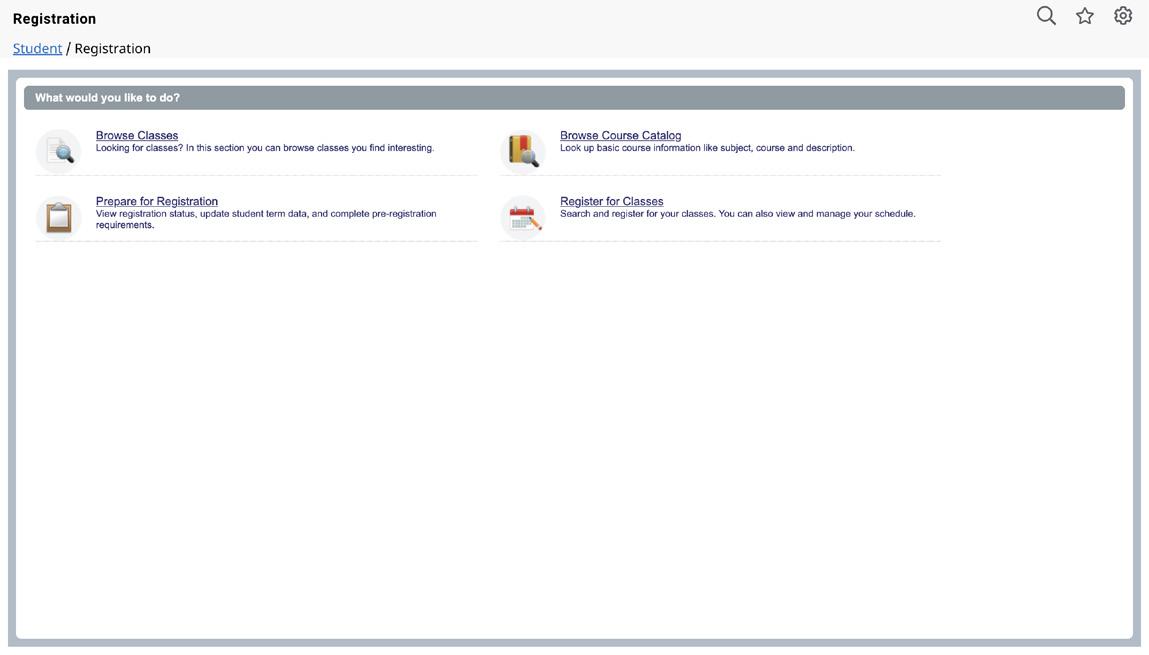
Screenshot of the registration page on Experience
university is taking a phased approach, with a full launch of Experience and the Banner (student information system) planned for the fall semester,” Ammeter said. “This approach allows students to become familiar with the new system early while ensuring that existing processes continue without disruption. It also gives the
university time to build out the capabilities of Experience before it becomes the primary portal.”

sociate professor of Arabic language, literature and culture at the University of Oklahoma.
The Arabic Language Flagship and Chinese Language Flagship programs hosted their third annual talent showcase at the Croft Institute on Monday, March 30. Highlighting two of the university’s most prestigious initiatives, the event aimed to celebrate language through musical numbers, poetry recitation, traditional dances and other demonstrations.
The Arabic Language Flagship at the University of Mississippi is one of only three federally funded intensive Arabic language programs in the country. The Chinese Language Flagship is likewise federally funded and competitive and maintains a reputation of rigorous curriculum.
Alongside students and faculty were two esteemed guests: Jianfen Wang, associate professor of Chinese at Berea College in Berea, Ky., and Mohammad Almasri, as-
The showcase opened with “Oxford Welcomes You,” a vocal and violin performance, and alternated between Arabic and Chinese presentations afterward. Presentations included poetry such as “The Visa for Hisham Al Gokh,” musical acts like “Love Scenario” and “All I Ask of You” and a student-produced video tour of UM students in Alexandria, Egypt.
“I performed in ‘Oxford Welcomes You,’ the first performance,” Drake Cox, a freshman Chinese and international studies major, said. “I was nervous going up first, but seeing all the shows really inspired me to work harder for next year to perform an even more complicated number.”
Other cultural demonstrations included presentations on the Moroccan zaffa — a traditional musical wedding procession — and henna traditions as well as an Up-


per Egyptian zaffa performance. Chinese cultural elements were equally present such as in the fashion show of traditional Han Chinese — Hanfu — and a saxophone solo of “On a Slow Boat to China.” Students also explored storytelling and structure through performances like “The Story Begins with the Root: How Words are Built in Arabic,” which explained the foundational system of Arabic word formation.
Junior Arabic and international studies major Ammar Dimachkie performed in “The Story Begins with the Root” presentation.
“It’s important that we do this showcase because Arabic is a derived language, and everything is derived from three letters,” Damachkie said. “This performance shows the basic understanding of how the language evolves and structures itself.”
One of the most anticipated moments of the evening was the interpretation game, in which students translated between Arabic, Chinese and English in real time. The segment showcased the quick thinking and adaptability required for high-level language proficiency.
“This performance brought back a lot of fond memories of my own journey as a language learner,” Wang said. “I remember I was also part of the interpretation show when I was studying Japanese at Ohio State University. Interpretation requires composure, quick think-
ing, deep cultural understanding and the courage to perform in real time. I think the students here today achieved all of this.”
The showcase concluded with a lively Levantine folk dance, dabke, involving students, faculty and staff, followed by closing remarks from visiting guests Wang and Almasri. The collaborative nature of the event reflected the type of community these campus programs are aiming to foster.
“Years ago, the two flagships would have their own events,” Daniel O’Sullivan, chair of the UM Modern Language Department and professor of French, said. “But both being flagship programs, even though they’re focused on different languages, the students have the same kind of mentalities and professional goals, so it drills a lot of synergy between the two. It’s always a lot of fun.”
Noell Wilson, director of the Croft Institute and associate professor of history, emphasized the importance of connecting the two flagship programs because of a shared commitment to a time-intensive language learning process.
“To be able to share experiences and show off to their classmates and friends — to see what they’ve accomplished in real time — is very rewarding,” Wilson said.
Some students attended the event to support their friends in the programs.
“These festivals are always super fun, so it’s a good way
to showcase the flagship programs,” Eli Striplin, a sophomore international studies and Chinese major, said. Holden Freemen, a freshman Chinese major, felt that the event was beneficial for those interested in Chinese culture.
“It’s a good experience for (my future), experiencing Chinese music and culture,” Freeman said.
Faculty and administrators praised the dedication and talent displayed throughout the evening, noting the balance of creativity and discipline required to reach this level of performance. The event highlighted the shared goals and experiences of students across both language tracks, reinforcing a sense of unity and purpose.
“I loved the performances,” Blair Thomson, senior international officer and director of the UM Study Abroad Office, said. “The students in the flagship programs are incredibly talented but also incredibly driven, and it shows.”
Editor’s note: The Daily Mississippian News Editor Aidan Poniatowski is a member of the UM Arabic Language Flagship Program.

continued from page 1
in 1915 with 24,000 seats. Steady upgrades over the years brought the stadium to over 50,000 seats in 1998, then increased again in 2002 to 60,580. The last renovation occurred in 2016 and included an addition of more than 4,000 seats. Grass also
replaced the artificial turf on Jerry Hollingsworth Field. The Lloyd Bell Tower and North Plaza were added in 2017 as part of renovations to the area surrounding the stadium, the same area which this request also seeks to renovate.
RUSS EDDINS Sports Editor
Ole Miss Football began its spring drills on Friday, March 27, and the media was permitted to attend a 12-minute practice window on Tuesday, March 31. Head coach Pete Golding and quarterback Trinidad Chambliss spoke at press conferences over the period.
During the open practice window, quarterbacks took snaps and worked on rolling outside the pocket while the rest of the team practiced punt returns and punt coverage. Izaiah Hartrup, Isreal Solomon, Cameron Miller and Isaiah Spencer all took reps at punt returner.
Golding said he modeled his offseason practice structure after that of NFL teams due to the volume of transfer portal additions.
“I think up to this point, it’s been a pretty productive offseason. (We) changed up the offseason philosophy based on the amount of transfers coming in,” Golding said in a press conference on Tuesday. “Obviously, our underclassmen are enrolling early, so (we) kind of broke (practice) up into a more NFL model, and (we) did three phases of OTAs (organized team activities).”
Phase two of OTAs will begin on Friday and will feature game speed drills. During phase three, full contact is permitted, and the team will have two mock game weeks during which they will prepare and practice as they would during the regular season leading up to a weekend game.
Golding spoke about the deep running back room, which includes returnees Kewan Lacy and Shekai Mills-Knight, transfer Makhi Frazier and freshman Damarius Yates. Golding said that because these players have different play styles, each one adds a unique dimension to the offense.
“I think the big thing in that room is their different skillsets. You have to have the ability to run the football in this league to win the ones you really need to win,” Golding said. “There (are) different packages based on skillsets and a lot of things that could do that provide a lot of issues from a defensive standpoint. … They can catch it out of the backfield, power runner, a scatback.”
One of the strongest position groups from last year’s team was the receiving corps; however, after De’Zhaun Stribling and Harrison Wallace III declared for the NFL Draft and Cayden Lee transferred to Missouri, the room looks largely different heading into next season.
Golding’s philosophy in replacing these receivers, he said, was to find players with top-end speed who could open the game up for the offense. Not only does this give the offense big-play ability, but it also eases the stress on Chambliss and Lacy in the running game.
“We wanted to go out, number one, and make sure that we’re still getting guys that can stretch the field vertically. That’s a big piece to that offense, especially from a coordinating standpoint,” Golding said.
“When you have an elite quarterback that’s really athletic, when you have an All-American running back, there’s gonna be a lot of attention on those two from a run game (standpoint). If you still have the ability to stretch the field vertically on the outside, it presents a lot of issues.”
Golding said that Syracuse transfer Darrell Gill Jr. is the type of speedster that the offense needs. Johntay Cook II, another Syracuse transfer, is “elusive” according to Golding. Golding also pointed out that some wide receivers, in his opinion, are not being talked about enough. He expects several of them to take a big step forward this season.

“There’s gonna be some breakout guys — y’all aren’t saying their names right now — just based on how they’re wired,” Golding said.
Chambliss also shared his thoughts on the new pass catchers.
“We didn’t drop off too much. We got some dudes from Syracuse. Johntay Cook, Darrell Gill can play. Horatio Fields, he’s a bigger receiver,” Chambliss said. “Then getting Caleb (Cunningham) going. Definitely looking forward to connecting with those guys and creating that chemistry.”
John David Baker is the new offensive coordinator for the Rebels. He was with Ole Miss for three seasons from 2021-23 before departing for East Carolina University. Baker brings a familiar offensive system with him, with a few new plays and slightly different terminology.
Chambliss was a spring transfer last year, meaning he joined the team in the middle of spring practice. This season, since he is already with the program, he will have a full offseason to prepare.
Ole Miss’ offensive interior remains unchanged, with Brycen Sanders, Patrick Kutas and Delano Townsend all returning. However, offensive tackles Jayden Williams and Diego Pounds graduated and will need to be replaced.
On the defensive line, the Rebels are anchored by veterans who are familiar with the system.
“It’s a group that’s got a lot of experience coming back,” Golding said. “Having Will Echoles come back, who I think is a really elite player, and Kam Franklin has continued to develop and (is) really showing what we thought he was going to be on a consistent basis, and still having Jamarious Brown who’s gonna be (in his) third year in the system. (He’s) played a lot of football. Andrew Maddox has
the ability to be a really good player. … Obviously (Suntarine) Perkins, from an edge standpoint, is a three-year starter for us.”
Transfers defensive ends Blake Purchase and Jordan Renaud have the potential to play big roles on the defensive line, too.
Tuesday’s press conference was the media’s first chance to speak to Golding since Clemson head football coach Dabo Swinney accused the Ole Miss head coach of tampering in the recruitment of transfer linebacker Luke Ferrelli. Golding did not seem bothered by Swinney’s comments.
“There’s two sides of every story, so I’m not going to sit up here and use the podium as a grandstand and all that,” Golding said. “That’s why there is enforcement. That’s why we have a compliance office. They do all that.”
This press conference was also Chambliss’ first time speaking with the media since his preliminary injunction trial in February. Most recently, on Friday, March 27, an NCAA petition to appeal the Mississippi Supreme Court’s ruling that

permitted Chambliss to play this upcoming season was denied, meaning that Chambliss is fully cleared to play this upcoming season. Chambliss was pleased with the news.
“(I’m) very excited to see the news that came out Friday,” Chambliss said. “Now I can just focus all my attention to spring ball and making sure that our team’s ready for the season.”
Golding is entering his first full season as head coach after taking over the program in December 2025. The title change has altered his life both on and off the field, he said.
“It is super different (as a head coach) when you try to go out to eat and do like normal s--t that you think is normal, that obviously is not normal,” Golding said. “It’s amazing to me how the world works when one title can change.”



WILL WRIGHT Sports Staff Writer
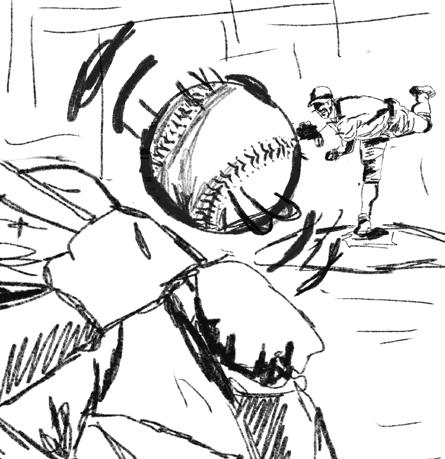
Pitching in baseball may seem simple; however, it is full of intricacies and complex subjects. Getting the ball to move and spin in ways that induce weak contact or miss bats is key. The forces of gravity and physics offer an answer as to how pitchers are able to generate what appears like gravity-defying pitches.
Over the decades, the art of pitching has changed. In the early days of baseball, pitchers hurled baseballs as hard as they could at home plate, relying on sheer pitch speed alone to strike out batters. Present-day pitchers have not abandoned this emphasis on speed — many are capable of throwing a ball more than 100 miles per hour — but they have also added breaking pitches into their repertoires.
When a pitcher releases the ball, physics takes over. Jake Bennett, an associate professor in the University of Mississippi Department of Physics and Astronomy, broke down exactly what is happening in that half-second flight from the mound to home plate.
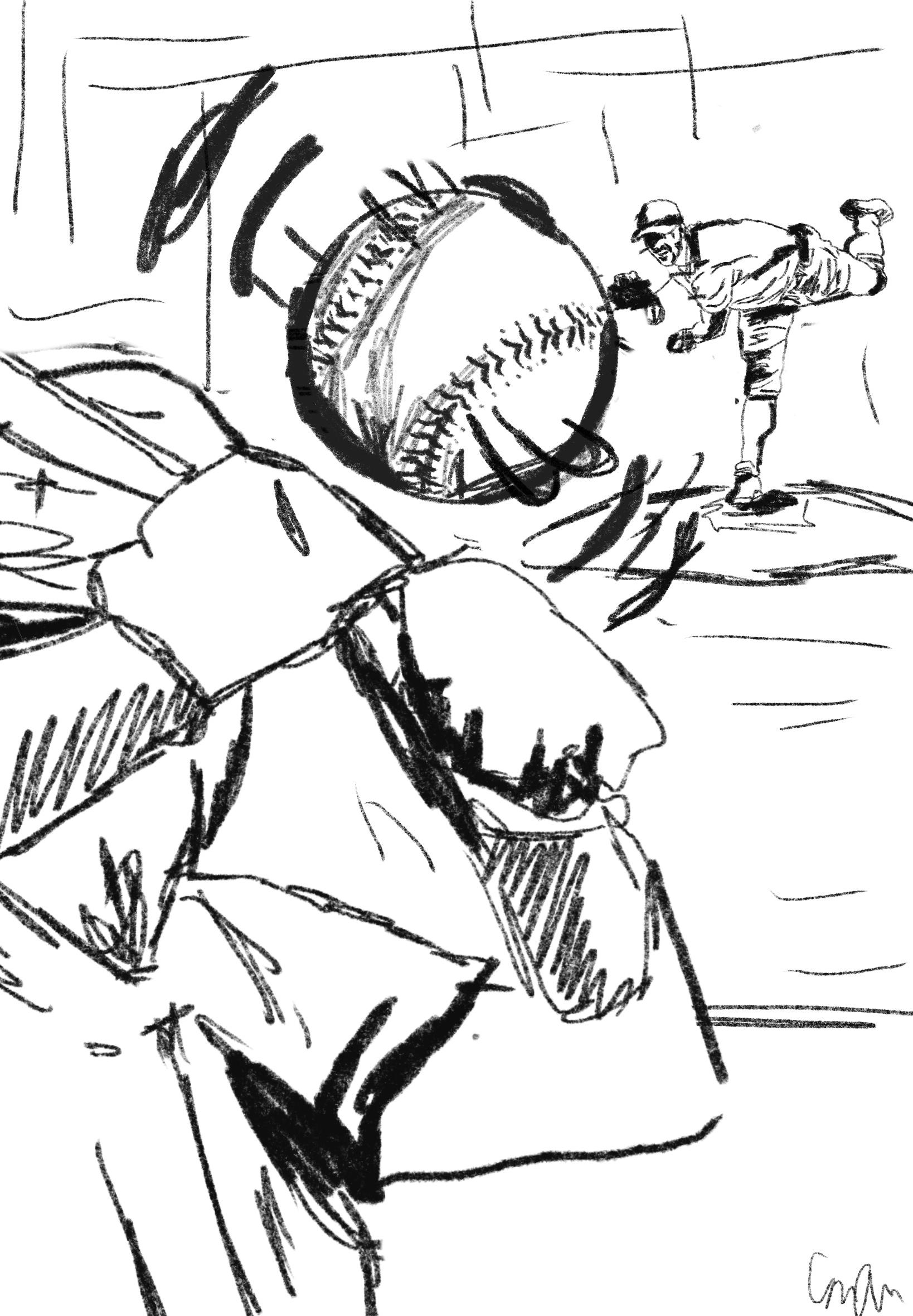
It starts with spin. The moment a ball leaves a pitcher’s hand, the rotation creates a pressure difference in the sur -
rounding air, a phenomenon known as the Magnus force.
“The Magnus force on a fastball is actually upward, so that’s why a fastball looks like it goes up. It’s actually just not falling,” Bennett said. “It doesn’t follow a parabolic trajectory. It kind of stays straight.”
A curveball flips that same principle.
“(With) a curveball, the pitcher’s fingers kind of come over the side. You get a force that’s down and to the left, so a curveball follows that sort of trajectory,” Bennett said. “This comes from Bernoulli’s principle. As the ball is rotating this way, it’s also moving, so if it’s rotating and moving, the part of the ball that’s moving faster will get more vortices, more motion. (It will) get a different pressure differential, and that causes the ball to move.”
Bernoulli’s principle states that as the speed of a fluid (liquid or gas) increases, the pressure of that fluid decreases. In this case, the decrease in pressure in the air on one side of the ball, due to its rotation, causes a change in its trajectory.
Since the placement and pressure of the fingers work to spin the ball, the appearance of the ball as it approaches home plate can indicate to the
batter how the pitch will move.
With a traditional curveball, the baseball has what appears to be a big red dot (created by the rapidly rotating laces) in its center as it leaves the pitcher’s hand. Despite all the advantages a pitcher builds through spin, a smart hitter can quickly read the pitch.
With this, throwing the right pitch is only half the battle. The other half is hiding it.
“A pitcher has to be able to change the spin and the motion of the ball by keeping the motion of his arm exactly the same,” Bennett said. “When it comes to the pitcher, what they really care about is, ‘How is my hand moving when the ball leaves it?’”
The seams also factor in. Baseballs used in Major League Baseball have flatter seams than baseballs used in amateur leagues, meaning major-league baseballs offer pitchers better grip and improved spin. At all levels, though, the torque required to whip the ball and generate spin is concentrated entirely at the elbow.
“All of that force is being centered right there on that pivot point where all my tendons are connected,” Bennett said. “Every force has an equal and opposite force. If I’m trying to whip my hand forward,

my elbow is feeling that force.”
Indeed, prolonged pitching takes a toll on players. Torn ligaments in the elbow often require a procedure wherein that torn ligament is replaced with a tendon from another part of the body, known as Tommy John surgery. The procedure requires more than a year of recovery and is often career-altering. The surgery can improve pitchers, but it is also difficult to return to pre-surgery performance levels.
Pitchers are still at risk of suffering the same injury again. If this happens, a pitcher may be forced to retire.
While pitchers and coaches can use data and science to improve their skills, the most efficient pitch is the one that the batter is not prepared for.
The best pitch is entirely dependent on the situation
of the game or who the batter is. The moment determines what pitch is needed. How many runners are on bases, the count or the batter are all factors in determining what will be thrown.
“The pitcher wants the batter to miss. So the perfect pitch is the one that the batter doesn’t expect,” Bennett said. “Sometimes you want the batter to make a connection, just in a way that he doesn’t want.”

Increased
Detoxification
Lower
Anti-Aging & Skin Rejuvenation
Improved Circulation
Weight Loss