The Daily Iowan
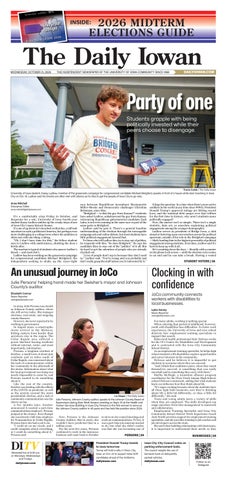
Party of one Students grapple with being politically invested while their peers choose to disengage.
It’s a comfortably crisp Friday in October, and desperate for a win, University of Iowa fourth-year student Kasey Ludlow ambles up the creaky steps of one of Iowa City’s many historic homes. It’s one of 35 doors he’s knocked on that day, a tall task anywhere in such a politicized America, but perhaps even more challenging in a college town where his ambition is often met with one thing: a shrug. “Uh, I don’t have time for this,” the fellow student says to Ludlow with ambivalence, shutting the door s hortly after. The reaction is typical of students who answer Ludlow’s knock — and most don’t. Ludlow has been working on the grassroots campaign for congressional candidate Michael Bridgford, the independent seeking to shake up the razor-tight
race between Republican incumbent Mariannette Miller-Meeks and Democratic challenger Christina Bohannan, since May. “Bridgford — is that the guy from Kansas?” residents have asked Ludlow, unbeknownst the guy from Kansas, referencing Republican gubernatorial candidate Zach Lahn, is not even running in the same race or part of the same party as Bridgford. Ludlow said he gets it. There’s a general baseline understanding of the election through the inescapable campaign ads and online debate, but most students have little political engagement beyond that. To those who tell Ludlow they try to stay out of politics, he responds with this: “So does Bridgford.” He says his candidate likes to stay out of the “politics” of it all. But its hard to get the attention of people who are already checked out. “A lot of people don’t tap in because they don’t need to,” Ludlow said. “You’re young and you probably just don’t really grasp the stuff unless you’re interested by it.”
An unusual journey in JoCo
In 2024, Julie Persons was elected as Johnson County auditor, where she still serves today. She manages elections, real estate, and outgoing county finances. However, she never expected to be working in government. In August 2020, a catastrophic storm arrived in the Midwest, hitting eastern Iowa harder than anywhere else in the region. The Cedar Rapids area suffered a power blackout leaving residents without internet, water, and most importantly, information. Persons, a longtime resident of Swisher, a small town of about 900 residents and 10 miles south of Cedar Rapids, was concerned about the lack of communication within her community in the aftermath of the storm. Information about what her local government was doing was nearly impossible to come by, and Persons wanted to do something about it. Like the rest of the country, Swisher was dealing with the effects of the COVID-19 pandemic as well as the anxiety around the 2020 presidential election, and a lack of community communication was the cherry on top. A few months later, Swisher announced it needed a part-time communications employee. Persons jumped at the chance. Even though she was already a full-time employee Now, Persons is the Johnson to sit in on city council meetings and for Transamerica in Cedar Rapids, County Auditor. But in 2020, she work on communications. To her, it wouldn’t have predicted that in a was a part-time job someone needed Persons knew she had a job to do. “I could sit on my couch, and I million years. to do, but what she didn’t realize could complain about everything, For the next few years, Persons was that she was becoming one of or I could do something about it,” continued to work in the insurance business and came back to Swisher Persons said.
Clocking in with confidence
Julie Persons’ helping hand made her Swisher’s mayor and Johnson County’s auditor.
It begs the question: In a time when there’s more active conflicts in the world at any time since WWII, President Donald Trump’s approval ratings are hitting record lows, and the national debt surges over $40 trillion for the first time in history, why aren’t students more politically engaged? Now, the answer isn’t so simple. There isn’t a single statistic, data set, or anecdote explaining political engagement among the younger demographic. Ludlow serves as president of Bridge Iowa, a club aimed at fostering open conversation across the political spectrum, outside of his role in the Bridgford campaign — likely landing him in the highest percentile of political engagement among students. Even then, Ludlow said it’s hard to keep up with it all. He’s counting down the days — literally with a counter on his phone lock screen — until the election cycle comes to an end and he can take a break. Having a vested
JoCo community connects workers with disabilities to local businesses.
For many adults, working is nothing special. When entering that period of adulthood, however, youth with disabilities face difficulties. To foster work experiences, the University of Iowa and area school districts hire employment training specialists to support that search. Behavioral health professional Kyle Delveau works for the UI’s Center for Disabilities and Development and is contracted with the Iowa City Community School District. As an employment training specialist, he helps high school students with disabilities explore opportunities and career interests in the community. Delveau said he believes it is impactful to put students in scenarios where they can succeed. “And I think that confidence piece, when they watch themselves succeed, is something that can really snowball and be something they carry with them.” Shelby McHugh, a transition alliance program coordinator for the Clear Creek Amana High School, echoed Delveau’s statement, adding that what students learn can influence how they think about life. “It's super exciting because when the students have all these light bulb moments, now they're thinking about life a little bit differently, or class a little bit differently,” she said. Teens and young adults learn a variety of skills when they are employed. The skills developed can range anywhere from time management to teamwork and collaboration. Employment Training Specialist and Iowa City Community School District Work Experience Coach Judy Warth provides support for employment training specialists, and she provides training to job coaches and job developers across the state. She said when building relationships with businesses, it is important to understand their needs so they
The Daily Iowan
the most knowledgeable people in Swisher regarding the goings-on of her local government. In 2023, all three women on the Swisher City Council decided not to run for reelection. Though just a communications employee, Persons felt there should be at least one woman on the city council, so she ran. Persons lost. However, former Swisher Mayor Christopher Taylor stepped down after ten years in the position. No one else ran for mayor, so Swisher had a dilemma. The auditor’s office was then left with the names voters had written in on their ballots. They called the person who won the write-in race, and he turned down the job. Then, the decision went back to the city council. At the council meeting, everyone in the room was at a loss. Until someone thought of Persons, sitting right there. Persons, who had sat in on every city council meeting for years. Persons, who had more knowledge about Swisher’s local government than anyone not already on city council. Persons, who felt very strongly there should be at least one woman on city council. She became the first woman to serve as Swisher’s mayor. Persons was swiftly sworn in and took her seat as mayor. She held the position for about a year, until she felt inclined to bring her skills to a new seat in November 2024. During Swisher’s 2024 summer festival, Persons was asked to be a part of the city’s parade by sitting in a golf cart. Not wanting to do it alone, Persons recruited a close colleague, ohnson County Sheriff Brad Kunkel. Kunkel sat in the golf cart with an idea: Julie Persons for Johnson County Auditor 2024. He held Persons in high esteem due to her willingness to learn and ability to lead. In his mind, she was the perfect candidate for the position. While driving around in the city parade, unkel floated the idea to Persons, and he was persuasive. “Clearly, she has a desire to work for the people and do the hard work of government,” Kunkel said. Eventually, Persons gave in. She ran a three-week campaign to get the nomination from the Johnson County Democratic Party, and won against three other candidates. There was no Republican candidate for the position, so Persons ran unopposed in the election. She was the first female auditor of Johnson County in 48 years. Once she was sworn in as county auditor, Persons hit the ground running. Her commitment to public service and experience in local government drove her to work hard, but she still had a lot to learn. The auditor’s office has four departments to manage: elections,
¡ ¢
outgoing finances, real estate, and meeting minutes of the Johnson County Board of Supervisors. In other words, Persons had a full plate. Luckily, she had a crew of people willing to help. One of them was her deputy auditor, Eric Van Lancker. Van Lancker had been the auditor of Clinton County for 16 years and had lost his campaign for Lieutenant Governor of Iowa. When Persons asked him to join her staff, he didn’t hesitate. Hiring Van Lancker was a strategic move by Persons. She had spent time with him over the summer and knew of his wisdom when it came to the role, so she was eager to have him around as a mentor. “Her willingness to ask the questions and learn was big. Along with that, you’ve got to be able to communicate and
listen, and those are the things I saw right away with her,” Van Lancker said. By focusing on outreach and voter education, Persons has aided residents both during election season and outside of it. Van Lancker admires the transparency of Persons’ auditor’s office, calling it a “forward facing county office.” Persons makes a point of partnering with community organizations to increase outreach. For example, she is currently partnered with a University of Iowa political science class to help teach about election administration. In the class, students train to be poll workers, learning the ins and outs of election administration. She also partnered with the Iowa City Foreign Relations Council to be part of their fall lecture series, "Voices into
Votes." The series focuses on many aspects of participatory democracy, especially elections. “County government isn’t flashy or particularly interesting to the layperson. She’s doing a good job of showing the public what all her office does, and making it accessible. Frankly, it’s something anybody in county government could do a little better,” Kunkel said. Persons never expected to be a leader. She majored in religious studies and dance at the UI and graduated fully planning to spend her life in the insurance business. Leading a small town and eventually a county were not on her agenda. Like many people, she was intimidated by difficulties that surround working in politics and government and didn’t want to get anywhere near government work. But when she saw her town in crisis and began working in Swisher Town Hall, she fell in love with helping people. “Everybody has these big ideas. They want to change the country. You can’t take 1000 steps forward instantly. You have to start somewhere and take the little steps that turn into big changes,” Persons said.
can be connected with the right student. “Sometimes getting your foot in the door can be a challenge, because there's always an assumption that we're coming with our hands out, when, really, we have valuable resources in terms of young workers entering the workforce,” Warth said. While business owners involved in the program have only reported positive e periences, Warth said when first connecting with potential employers they are worried that they could be sued under the Americans with Disabilities Act, or ADA. Warth always tells them, “I’ll help you hire, and I’ll help you fire.” According to the U.S. Equal Employment Opportunity Commission, Title I of the ADA requires employers to provide reasonable accommodations. If expectations are not met, the employer can consider reassigning the employee to a different e isting position. “If they are not meeting the standard, we need to talk to them,” Warth said. “That is your protection within the ADA. When you change the rules to make it so this worker can survive, when you lower the bar, that's in violation.” Warth said it is common for partnerships to be built because business owners talk to each other about the experience with the program, but this is not the only way. Smash Juice Bar and Eatery in North Liberty, owner Tina Whitney learned about the program because Delveau was a customer and then contacted her about working with one of his students. “It's been overall just a really nice program in general to help stay organized and notice if there are any flaws, and to make things very understandable for the staff,” Whitney said. Employment training specialists do strategies in terms of training, businesses are of industries, and Warth said that by helping not only provide support to the student, feeling the positivity and joy that some of the them create connections as young adults, they but to the business as well. Delveau said students share. are better equipped to develop and further sometimes employers will come talk to the “Working with her has brought me back to improve job skills later in life. coach instead of the student directly, and the basics of enjoying the experience of it,” “I believe that every person with a part of his role is to suggest they talk with Whitney said. disability who works and makes a meaningful the student together, and help facilitate that Whitney said it is not only excitement contribution changes the world. And I think over helping a customer, but working with what we do changes the world,” Warth said. constructive conversation. McHugh said many of the ways they help her peers from school that brings an air of et, like any ob, the first step is getting in their students can be easily transferable to happiness into the workplace. the door. other employees. “It's been wonderful because obviously “The most important thing is the “It's super exciting when we can work with wherever you work, you're going to have relationship, helping people see that we're businesses and have them see a different coworkers,” Whitney said. “And so for her to more alike, and we are different, and that we approach or e perience a different approach have people that she's a little bit more familiar all have gifts that we bring to the workplace, if they see how we talk to our students and how with, maybe she goes to school with, it's been and we can all materially benefit a business really nice.” we interact with them,” McHugh said. that works with us, and uses those talents,” Employees with disabilities are in all types Warth said. n top of learning different communication
interest in the political system, it seems to many, is an arduous, wearisome task. “[Students are] exhausted of everything going on and don’t even care about politics anymore because it feels like they’re fighting an uphill battle, and everything’s corrupt, and it doesn’t matter,” Ludlow said. He doesn’t blame those who don’t feel like they have the capacity to tune in to the election, sharing a sense of understanding that the younger generation doesn’t feel represented by those in Washington, and buying into the concept of politics as a hamsterwheel of negative rhetoric and polari ing conflict. That’s why, as Ludlow goes door to door, he said the task of making others care is futile. Ludlow’s instinct doesn’t exist in isolation. When polling students across campus about their top issues, The Daily Iowan found a notable trend: many students aren’t sure. Whether it be there’s too much going on or they are too disengaged to pick, the overwhelming nature of today’s political climate is undeniable. Many students may feel their votes don’t matter as much simply because they attend school in a state other than the one they grew up in. That factor, UI political science professor Alex Smith said, makes students less woven into the community they live in — as many know they will likely depart in the coming years. Different voter registration processes state-to-state also poses a complication. According to data from the Center for Information and Research on Civic Engagement, at Tufts University, or CIRCLE, 23 percent of college students who registered to vote but did not cast a ballot in the 2018 midterms cited not receiving an absentee ballot in time as the reason. Registration and turnout, the traditional measure of civic engagement, have seen modest increases nationally in recent years. And there’s no doubt barriers exist and provide a genuine hindrance to overall participation in politics. But there is no denying the boots-on-theground experience of those most attentive. On top of that, active engagement with the political system and filling in a bubble in November are not synonymous.
Iowa is home to some of the nation’s most prominent races this cycle. All eyes are on State Auditor and Democratic candidate Rob Sand, who vies for the open governor’s seat against Republican and self-proclaimed political outsider Lahn. On the national stage, Republican U.S. Rep Ashley Hinson is p i n n e d against Democratic hopeful Josh Turek in the open-seat Senate race, as Democrat Bohannan s e e k s to unseat Republican U.S. Rep. MillerMeeks in their third contest — this time with independent Bridgford in the mix. Alberto Medina, communications manager at CIRCLE, said the youth vote will have an undeniable influence on these races. Iowa ranks third and eighth, respectively, in the institute’s ratings of youth electoral significance in the gubernatorial and Senate races a statistic he said reflects where the youth is anticipated to make the biggest impact. According to CIRCLE’s most recent data from September, national youth voter registration saw a 2 percent increase compared to the last midterm election in 2022. In Iowa, though, registration was down 3 percent among youth. In this information age people are being told to care more about each election, Ludlow said, but it’s hard to say whether the message gets across. He sees a throughline with social media and a highly polari ing figure that being Trump in the Oval Office. Both
De
overwhelming factors discourage the youth from staying consistently engaged. But Smith points out that this disengagement isn’t unique to this administration or era of American politics. He said one statistic rings true of younger generations historically: they vote at l ower rates. In 2022, voters ages 18-29 turned out at
l o r t n co
To Ludlow, part of the difficulty in maintaining the attention of the youth is simply the period of politics the younger generation was born into. At 21 years old, coming of age in the Trump era, Ludlow said life itself has become politicized since Trump was first elected in . “We got forced into a world that required a dissonance between people close to you, and that can really turn off somebody who maybe is casually interested in politics,” he said. The contentious nature of politics itself is enough to spark a social pressure to disengage, according to Isaac Branch, a UI third-year student and vice president of Iowa’s Turning Point USA chapter. “If you are the guy constantly bringing up politics, people aren’t going to sit with you,” Branch said. “No one is going to sit with you at lunch.” This environment, he said, can lead to a lack of interest in the system altogether. Branch said outside of TPUSA, which drew an audience of over 1,000 at an Oct. 8 event with political commentator Ben Shapiro and Donald Trump Jr. at the Iowa Memorial Union, it doesn’t feel like many students care about politics at all — even if they check a box on election day. “Their parents vote blue, they’re going to vote blue. Their parents vote red, they’re going to vote red,” Branch said. “They aren’t really going to question it.” Branch said college is still a time in life when many people are privileged enough to not have to think about politics, which can lead to the social pressure to disengage. In some ways, these anecdotes contrast with data collected by CIRCLE, which found only 7 percent of survey respondents in its pre-election survey don’t participate in elections because they aren’t interested in politics. Medina said much of the youth does care, but lacks the access, information, or support necessary to engage in the system. Zach Saylan, UI third-year student and member of the University Democrats at Iowa, has been consistently more engaged with politics than those around him this cycle. But he said it doesn’t mean everyone is entirely unaware of the election, and that it has even become difficult to avoid — the governor’s race in particular — due to the constant surge of information surrounding it. “Especially on a college campus, where you have young voters, and there’s always people trying to get you to register to vote, it remains a popular topic,” Saylan said. Part of the discussion, though, should be how much time and energy it really takes to be involved beyond basic knowledge of the race itself. Ludlow said it can be hard to want to be engaged when it feels like there is too much content and not enough time to devote to it. Many young people avoid political conversations altogether if they feel undereducated on the subjects. Smith said the information overload can push students either deeper into or further out of the political discourse. Those who are engaged are more politically involved already, and those who aren’t would rather spend the mental energy elsewhere. According to data from the Pew Research Center, people who weren’t following the 2024 election closely were nearly twice as likely to feel worn out by it than those who were. Another factor, according to Smith, is low political efficacy. ounger populations are more likely to believe their vote doesn’t matter, or that the candidates don’t accurately represent their views. “If you don’t feel like the people running to represent you actually care what you think, it dissuades you from voting,” he said. Students often feel disconnected from those with political power because they aren’t particularly relatable to the population. They don’t look like students. They often come from different socioeconomic backgrounds, and have different live experiences. And most
r e t Wa y t i l a qu
y c a r moc
a rate of 25.5 percent — exactly 15 percent less than the second-lowest demographic of those 30-44. The figure is generally consistent across midterm cycles though has seen a slight narrowing in recent years. Turnout among the younger demographic was 17.8 points below the generation above 20 years ago in 2002. Part of the lower turnout is a concept S m i t h defined as voter efficacy; or the perception that the system is working to the benefit of the individuals casting the ballot. In this case, it’s the lack thereof.
Party
prominently, they tend to have different political priorities. Candidates will spend time and resources on Medicare and Social Security, Smith said, because they are the issues older voters care about. Older voters who are consistently more likely to turn out at the polls.
While political engagement may feel difficult for students in the era of the endless news cycle, political polarization, and increasing distrust in government, many are still amped up to cast their ballot this November. The Daily Iowan polled students across campus on their most important issues. The economy and affordability toppled all else and it wasn’t close. “When groceries seem to get more and more expensive, and gas seems to get more and more expensive, it feels like you get trapped,” Jane Reagan, a UI fourth-year student, said. As part of Generation Z, Reagan said “it would be nice” to own a home one day — a feat that is continuing to feel less possible when compounded with student loan debt and high grocery prices. About percent of young people said they are having trouble meeting basic financial needs, according to CIRCLE’s pre election survey. ecause of this, Medina said affordability is at the
Affordabilit
y
forefront for youth voters nationwide. Lagging only slightly behind the economy for UI students, Iowa’s water quality is also front of mind. Nitrate contamination in Iowa’s waterways is among the worst in the nation, which has been directly linked to the sky-high cancer rates — the second-highest in the country. “A lot of people don’t want to stay in Iowa after college,” Olivia Bartuska, a UI thirdyear student, said. “Its not safe to drink water here, the cancer rate is super high, everything is expensive.” The same goes for Saylan, who said improving water quality is essential to the health of the state. “It is so important we still care for the natural environment; it plays such a big part in our world,” he said. Saylan also said increased attention needs to be paid to Iowa’s public education system. Taking both into consideration, he said there’s one candidate who has been paying attention to what he cares about most — and that’s Sand. Affordability and water uality may be
the most prominent factors in the student vote, but the youth are not single issue voters. According to Medina, they are better than any other generation at seeing the intersections between issues. Beyond that, today’s eligible 18-29 year-old population of around 50 million
Health reprod care/ uctive rights
is the most diverse generation in American history. And many are still evolving in their political ideologies — which means their vote is up for grabs in Iowa’s midterms this November.
When properly situated in the context of civic participation, yes, the youth can be apathetic. But it doesn’t encompass the whole picture, Smith said. There are real, tangible barriers that prevent voter participation in elections. For some students it is simply too hard to keep up with registration laws across state lines. For others, external competing demands prevent the attention necessary for students to feel they know enough to thoughtfully engage. “If you don’t want to think about politics and candidates, you will likely seek out the opportunity to do anything else,” he said. Social media itself provides a barrier to participation for Ludlow, who said the flood of information can make it difficult to digest and form opinions on. “It dilutes the ability to have nuanced conversations with people who are not engaged with politics,” he said. For those who do pay attention, Smith said, many still feel that representatives don’t accurately represent the younger demographic — part of the broader distrust in the system — and another dissuading factor and barrier to participation. Following the 2024 presidential election, CIRCLE found the most prevalent barrier to voting for youth was dissatisfaction with the candidates — marking the lack of representation as a genuine hindrance in civic engagement. Nearly a third of young people who didn’t register to vote for the 2024 presidential election didn’t do so because they were too busy, ran out of time, or missed the registration deadline. More than a third didn’t register because it didn’t feel important. Whatever the barrier may be, the point remains true: younger populations vote less. As prices surge, Trump’s approval ratings hit record lows, and questions surrounding the health of Iowans only get louder, it’s time to see whether the political environment will persuade students to vote this November — in some of Iowa’s most contentious elections to date.
Taking polls with a margin of doubt As Iowa’s midterms approach, experts explain why polls differ, how they miss, and what voters can learn from the numbers.
A few percentage points can separate victory from defeat. For election pollsters, capturing that difference has been a challenge for decades, and as midterms in Iowa approach, voters face a familiar question: How much can the numbers actually tell them The answer depends partly on whose opinions the polls capture and whose gets left out. Joshua Clinton, political science professor at anderbilt niversity, chaired a task force evaluating the 2020 pre-election polls and serves as a senior election analyst at N B C N ews . In an interview with The Daily Iowan, Clinton said the underlying issue in modern day polling is simple — who is responding. A September report from the Pew Research Center supports this concern, finding growing evidence Republicans are less likely to participate in polls. Clinton said those differences can skew results, making it difficult to distinguish changes in public opinion from changes in who answers surveys. That uncertainty follows Iowa voters into the final weeks before the midterms, when interpreting polling results requires looking beyond who is ahead to how the numbers are produced. “Polling is a social science, not clairvoyance, and no responsible pollster can guarantee an election outcome,” longtime Iowa pollster J. Ann Selzer said in a September article published by the Foundation for Individual Rights and Expression. As Iowa voters weigh polling results just weeks ahead of the midterms, understanding how those numbers are produced is crucial to interpreting them. Polls offer a measure of public opinion, but differences in who responds, how results are adjusted, and ultimately who votes can shape their accuracy — and limit what they reveal about Election Day.
Recent Iowa Senate polls illustrate how results can vary. A Rasmussen Reports survey conducted Sept. showed Democratic .S.
Senate candidate Josh Turek ahead of his Republican opponent Ashley inson, percent to percent. n the other hand, an Emerson College Polling Ne star edia survey conducted ct. showed inson ahead percent to percent. Polls have also offered different pictures of Iowa’s gubernatorial race. A Suffolk niversity survey conducted ct. showed Democrat Rob Sand leading Republican ach Lahn by percentage points, percent to percent. An Emerson College Polling Ne star edia survey conducted ct. put Sand’s advantage at four points, percent to percent. Frederick Boehmke, professor of political science at the niversity of Iowa, said differences in how polling organi ations collect their responses, adjust their samples, and identify likely voters can produce different results, a phenomenon known as “house effects.” “ y making different decisions, that can make some polls overrepresent certain types of voters relative to other polls when they release their final results,” he said. The uncertainty also e tends beyond a poll’s reported margin of error. oehmke said the figure does not capture every challenge involved in producing a representative sample, including differences between people who respond to surveys and those who do not. Another uncertainty is who will actually cast a ballot. Clinton said national attention and competitive races could increase participation in Iowa, making past midterm voting patterns less useful for identifying likely voters. “They’re trying to figure out who’s likely to vote, so maybe past voting in midterm elections may be less predictive this time around,” he said. Clinton said those decisions make it important to consider multiple polls and place too much confidence in any single result. “Don’t get too despondent or too over oyed based on what the polls are showing,” he said. “There’s lots of ways those numbers could change, and pollsters are making a lot of decisions behind the scenes that could really move those numbers around.” Campaigns also use polling results to rally supporters and raise money. In a June Substack post, Turek highlighted a poll showing him ahead of Hinson.
“The big takeaway is, of course, that I’m LEADIN oni Ernst’s handpicked successor, Ashley inson, by two points,” he wrote before asking readers to contribute to his campaign. Lahn’s campaign similarly promoted his victory in the Iowa State Fair straw poll. In an August statement, his campaign spokesperson Dan Capodilupo said Sand “got crushed in the straw poll” and predicted the same outcome in November. Beyond individual surveys, election analysts assess the broader competitive landscape. The Cook Political Report, an independent, nonpartisan newsletter analy ing .S. federal campaigns, elections, and political trends, moved Iowa’s .S. Senate race from “lean Republican” to “toss up” and the governor’s race from “toss up” to “lean Democrat” in August. In ctober, Cook pollsters also shifted the st Congressional District from “toss up” to “lean Democrat.” Who is behind a poll and whether it aims to measure or influence opinion matters when evaluating its results. Boehmke urged readers to examine who conducted and funded the poll, how respondents were selected, and how results were adjusted. He also distinguished surveys intended for public opinion from “push polls,” which use leading questions to influence respondents. “Those kinds of surveys have biases either because they’re associated with the party or a group that’s associated with the party, and they want to make it look good for their party, or the whole purpose of the survey is actually to try and influence opinion,” he said.
Before a poll produces a percentage, researchers must decide who to survey, how to reach them, and how to make their responses reflect a larger population. oehmke, who taught awkeye Poll, a public opinion survey conducted by the I’s Political Science Department, said the experiential learning class gives students experience with the process. Students develop questions, work with the university’s Center for Social Science Innovation and a vendor to collect online responses and analyze the results. “There’s the challenge of hoping you’ve made good choices to produce results that are reflective of whatever the population or the target group is that you’re trying to talk about, Iowans or people in the .S.,” he said. But reaching respondents is only part of the challenge. Declining participation makes it harder to determine whether those who answer share the views of those who do not, Boehmke said. Pew Research Center reported its telephone survey response rates fell from percent in to the low single digits in recent years, increasing the risk of bias when respondents differ from people who do not participate. Pollsters use a process called weighting to ad ust how much different respondents count toward the results. Clinton said those adjustments can help a sample better reflect the
population researchers want to study. He said pollsters adjust survey results to better reflect the people they e pect to vote on Election Day, accounting for groups overrepresented or underrepresented among respondents. Clinton said election polls face another complication: identifying likely voters. Researchers can consider voting history and ask respondents whether they intend to vote, but the electorate remains uncertain until ballots are cast. “We don’t know what Iowa is going to look like in terms of who actually votes,” he said.
Arguments over polling’s inaccuracies stretch back decades, including to the aftermath of the election where polls incorrectly predicted Republican Thomas Dewey would defeat Democratic President Harry S. Truman. “ y hope is that ne t time polls are on the wrong side in a close election there will be less shouting and name calling,” eorge allup said in an address to the World Association for Public pinion Research around , according to the allup institution. Today, pollsters face a similar challenge: e plaining how surveys can offer useful insight into public opinion while still missing the final result. ost polls underestimated support for President Donald Trump in , marking the third consecutive presidential election in which pollsters underestimated his support, according to the Pew Research Center. In Iowa, the final Des M oines R eg is t er / M ed iac om Iowa poll showed Democrat amala arris leading Trump percent to percent. Conducted ct. , among 808 likely voters, the survey had a margin of error of . percentage points. Trump ultimately carried the state by percentage points. Polling errors can also matter even when surveys identify the eventual winner. In 2020, polls correctly pointed toward a former President oe iden victory but overstated his advantage over Trump, according to Pew Research Center. Clinton said a big part of the challenge is accounting for voters who do not respond to surveys. “If some people just won’t answer the phone, then you can’t get them, and you can’t account for their views,” he said. The methods pollsters use to collect opinions have also changed. Boehmke said surveys have evolved from face-to-face interviews and mailed questionnaires to telephone polling and online surveys. Some polling companies now recruit panels of people willing to answer surveys online, then draw samples from those participants. That shift creates new challenges in ensuring respondents reflect the broader population, he said. As polling methods evolve, Clinton said voters should recognize their limits without letting the numbers determine whether they participate. “You should act and vote in ways to kind of make sure that your voice is heard,” he said.
OPINIONS The end of a shared timeline
For many college students, seeing peers get engaged feels both exciting and surreal.
Growing up, weddings were events my parents went to. Every summer seemed to bring another save-the-date hanging on the fridge, another Saturday spent celebrating a couple taking the next step in life. The people getting married were adults. Real adults. Now, somehow, the people getting engaged are my peers. Over the past year, I’ve watched more engagement announcements pop up across my social media feeds than I ever expected to see in college. Every time it happens, my reaction is about the same: I’m genuinely happy for them, and then I need a second to remember we’re all roughly the same age. What do you mean you’re planning a wedding? We’re still in college. The strange thing is that marriage is happening later than ever in the United States. According to the U.S. Census ureau data, the median age at first marriage is now about 30 for men and nearly 29 for women, both significantly higher than they were a generation ago. People in their 20s who are getting engaged today are doing so earlier than the typical American. That might be part of why those announcements still catch me off guard. For many students, engagement feels like something that’s supposed to happen later. Not because there’s a right or wrong age to get married, but because so many of us still feel like we’re figuring adulthood out as we go. University of Iowa fourth-year student, Madeline Palas is going to be in two weddings this year and described the feeling perfectly. “I have a lot of mixed emotions about it. I’m happy for them. But at the same time, I don’t get it,” she said. Her statement doesn’t come from a place of judgement. It comes from the strange reality of being in your early 20s. Some people our age are planning weddings. Some are planning graduate school applications. Some are trying to find their first full time ob. Some are trying to figure out where they’re going to live next year. There is no single path anymore. What stood out most, and what I found most relatable, during my conversation with Palas was her explanation for why these engagements feel so surprising. “I don’t view myself as an adult, even though I’m 21,” she said. “I still think of myself as a child.” I think that feeling is more common than many college students would like to admit.
Yes, we’re adults on paper. We can vote, sign leases, and make our own decisions. But many of us are still learning how to exist independently. We’re balancing coursework, jobs, internships, and plans that seem to change every few months. ut marriage feels different. Whether it’s fair or not, marriage is one of the clearest markers of adulthood in American culture. It represents commitment, stability, and a long-term vision for the future. Meanwhile, many college students are still trying to decide what city they want to live in next year. That’s why seeing peers get engaged can feel surreal. It’s not because they’re doing something wrong. Many are in healthy, long-term relationships and making thoughtful decisions that are right for them. It’s because their timeline suddenly looks very different from mine. That feeling isn’t unique to me. Marriage itself is becoming less common among young adults. Recent reporting by The Daily Iowan cited research from the Marriage Foundation suggesting, based on current trends, only a little more than half of Generation Z is expected to marry at all. Researchers interviewed for the story noted that young adults are increasingly open to alternative paths beyond the traditional sequence of dating, marriage, and children.
Against that backdrop, engagement announcements can feel even more surprising. For most of our lives, everyone moved through the same stages together. We started school at the same time. We moved through junior high and high school at the same time. Many of us came to college at the same time. But somewhere along the way, our timelines began to split. Some students are building careers. Some are moving across the country. Some are getting married. Others still feel like they have no idea what they’re doing. And the older I get, the more I realize that’s normal. Watching peers get engaged hasn’t made me think people are growing up too quickly. If anything, it’s made me realize how different adulthood looks for everyone. Two people can be the same age and be in completely different stages of life, and neither one is doing it wrong. Maybe that’s why engagement announcements have such a strange effect on me. They aren’t ust reminders that some of my peers are getting married. They’re reminders that the neat timeline we all followed growing up no longer exists. or the first time in our lives, people our age are making radically different choices about what adulthood looks like. Maybe that’s what makes every engagement announcement feel so surreal. It’s not a reminder that my peers are getting married. It’s a reminder that we’re no longer growing up together.
Unpaid internships reward wealth, not hard work Unpaid internships give financially privileged students a career advantage, leaving students who need an income struggling to gain experience.
A college student faces a choice. Accept an unpaid internship that could open doors after graduation, or take a paying job that covers the bills. One option builds a resume, the other keeps the student financially stable. or students who cannot afford to work without pay, the choice is hardly a choice at all. Yet, in a job market where experience is increasingly expected before graduation, turning down an unpaid internship can mean falling behind before a career even begins. Internships are one of the most common pieces of career advice given to college students. They give students competitive resumes before graduation, satisfying the two years of experience needed for many entry-level positions. Yet, many internships are unpaid. It is an accepted sacrifice, to be hired as a glorified volunteer as a pay off for the career opportunities it could eventually provide. For students who rely on parents for financial support or do not have to worry about rent, this is a small ask from employers. However, for students who support themselves, this is financially impossible. The cost of rent, groceries, transportation, and tuition do not stop just because a student is working for free. Without financial support from family, students may have to take on additional paid work to make ends meet, leaving less time to dedicate to an internship or forcing students to turn down the offer altogether. This may be a temporary sacrifice to a student who is supported by family, but to a student who must support themselves, it is a ma or financial risk. In the NACE 2024 Student Survey Report, 24 percent of students said they were prevented from internship
participation because the opportunity was unpaid, while 26 percent stated they were not selected for a paid internship. Finances are a real barrier preventing students from having the experience employers value, giving those who can work without pay an advantage. When career advancement relies on e perience some students cannot afford to gain, unpaid internships stop being an equal opportunity and become a reservation for the wealthy. The issue with unpaid internships isn’t just the loss of income. In a competitive job market, internships have become one of the primary ways students gain experience and connections needed to secure employment or further education after graduation. Abigail Imm, a second-year at the University of Iowa, said internships are essentially expected for graduate school applications. “It is especially important because college can only teach you so much. Being in a classroom, it can teach you facts about the job, but it can’t teach you the demeanor you hold yourself with and the subtleties of proper communication within that field,” Imm said. Employers want employees who understand the industry and have skills that go further than the classroom. As a result, internships are becoming more of a prerequisite. The only way to get jobs post graduation is showing you already have experience, despite being freshly out of college. Students are told that hard work and dedication are what separate you from the rest. Yet, unpaid internships’ additional requirement, to work without pay, can dismantle the system that is supposed to reward merit. Students are not the only ones benefitting from an internship. Employers gain someone who assists in projects and everyday operations. Organizations benefit from interns’ work but leave them responsible for the cost of showing up, leaving the burden to fall on the people with the least amount of power
in the arrangement. When an internship is unpaid, an intern’s labor becomes ethically questionable. At what point does an internship become unpaid work that an employer can skip out on paying for? The Fair Labor Standards Act, or FLSA, establishes federal minimum wage and overtime for employees. This includes the “primary beneficiary test,” which helps determine if an internship should be paid. Under guidance from the U.S. Department of Labor, this test considers training, education, duration, contribution to work, and the understanding between employer and intern of what is expected in compensation. This requires the employer to pay the intern if they are primarily benefitting, however, if the intern is benefitting, there is no required reimbursement. This distinction can create ways for employers to justify unpaid positions, especially when internships are tied to academic programs or offer credits. Although academic credit has educational value, it does not cover the cost of living. Many of the most sought after
internships are in major cities where the cost of living is especially difficult to afford. y offering no compensation, employers shift these costs onto students. This creates a system where students who have the most financial support are the ones who can gain the most experience and become the most attractive to employers. Over time, existing inequalities carry into the workforce. We tell students success comes from hard work, but when getting ahead requires working for free, what are we really rewarding? Unpaid internships ask students to contribute their time and labor while taking on the financial risk themselves. They make access to professional experience dependent on wealth, allowing employers to benefit from a system that excludes students who cannot afford to participate. If unpaid internships are largely inaccessible to those who can’t afford it, they are not measuring dedication or skill. They measure if a student can afford the sacrifice. It measures privilege, making an unfair and unethical foundation for entering the workforce.
SPORTS
Raising the stakes Iowa City’s fantasy football culture brings renewed attention to the professional sport.
I
t’s late on a Saturday evening in Iowa City. The city’s downtown blocks are bustling with the nightlife crowd, and suddenly, just across the street from Yotopia, comes something, or someone, different. He’s not dressed for the bars — quite the opposite. Instead, he’s wearing a bright green wrestling singlet and a headband. n the back of his outfit, the word “L SER” is scrawled in big, blocky letters. When people think of fantasy football, some may picture moments like this one; the man donning the green ensemble as an embarrassing punishment for a last place finish in his league. While eye catching, there is much more to fantasy football than the humiliation that accompanies finishing dead last. or niversity of Iowa third year student Lucas esson, the most interesting aspect is the fact that the game sheds light on teams and players one might not necessarily care much about. “I’m a ikings fan, so I have no interest in watching the Dolphins play the Jets. But if I happen to have a Dolphins receiver or a Jets quarterback, it kind of opens up the game,” esson said. or esson, a member of four fantasy football leagues this season, this kind of exposure is good for the sport. “It not only brings more recognition to teams, but it increases viewership and makes you expand your football interests,” esson said. “If your team is playing at noon and they are done at 3 p.m., then you’re not necessarily limited to being done watching football that day.” The overall goal of an individual in fantasy football is not much different from that of an actual N L team. Over the course of a preseason draft, participants build a roster made of positions such as quarterback, wide receiver, tight end, and kicker. Individuals put players from different teams on the same roster in an attempt to win their weekly head-tohead matchup against another competitor in the league, a scramble that pi ues interest across different games, teams, players, and matchups. or I fourth year student Sergio on ale Ica a, the most interesting aspect of fantasy football is the dynamic it creates between friends. “It is good to have a little competition,” on ale Ica a said. “It is a great way to further my friendships. I like it when, instead of showing up on a Monday morning and just asking my friends the normal questions, I can come in with a little bit of a different approach in the fall.”
He said the questions extend beyond the status of someone’s roster into some healthy banter. “I can ask them how their fantasy team went,” on ale Ica a said. “If I was playing them, I can brag if I won or make excuses if I lost. That’s my favorite aspect of it.” A t t a c h i n g higher stakes to sporting events is far from a new concept. Civili ations as far back as ancient reece saw everyday citi ens place wagers on competing athletes. Now, arch adness bracket challenges and online sports betting are examples of the modern trend that has grown nationwide popularity in the 21st century.
Over the years, the idea of sports betting has trickled down to college campuses, with Iowa serving as a home for both independent leagues and groups like Pro ootball Pick Em, offered through the university’s intramurals program. Jacob Bryan, sport programs coordinator for Iowa intramurals, has been in his role for two and a half years. or ryan and others in recreational services, where College ootball owl Pick Em and an NCAA Tourney Challenge are also offered, the goal is to create a low effort method for students to participate in intramurals. “ iving people options as a single event, it’s low energy,” ryan said. “ ou’re ust doing it on your phone. It might only take a couple minutes out of your day to be involved, but it opens the door for you to be involved in more offerings.” or ryan, the element of chance is a component of the game that stands out to him.
“ ou don’t need to be an e pert,” ryan said. “There’s a lot of articles out there that can tell you which team’s going to win, which players are going to be the best, but a lot of times it just comes down to luck, so it’s really open to anybody.” Hesson acknowledged fantasy football has its ups and downs, especially when it comes to having a tangible stake in different games. “I think fantasy is good to a point,” esson said. “I know a lot of people that will literally spend all Sunday watching football, which is kind of a drawback.
Freshman libero digs deep Learning to slow down Iowa volleyball first-year Henlee Moszkowicz provides a strong, reliable effort as the starting libero for the Hawkeyes.
Iowa cross country third-year Kyle Montgomery, after adjusting to the increased demands of college running, is focused on patience, recovery, and peaking at the Big Ten Championships.
In a Big Ten conference loaded with offensive juggernauts like Nebraska and Wisconsin, defense is crucial for teams to stay afloat in the regular season. After a few seasons of acquiring their star ting liberos v ia the transfer portal — specifically Joy alles from Ari ona in and Milana Moisio from Miami in 2025 — the Hawkeyes opted for a younger recruit in 2026. Enter f irst year enlee os kowic , a agnolia, Te as, native has quickly made an impact in Iowa’s 2026 outing. The talent is
a little bit newer, but the defense must remain rock-solid in more ways than just the number of digs. Tempo a nd mora le on t he court have to be at a level that doesn’t prove detrimental to the squad’s efforts. “A big par t of my position is talking to people and being uplifting and bringing a lot of energy,” os kowic said. “It’s a lot of stuff that’s not skill focused.” Despite nav igating the ever-changing landscape of college athletics for the first time, the way os kowic views her role on the team is shared by teammate and fellow libero Allison Berent. “The significance is that you hold the team together,” erent
said. “It’s ust a big role that sometimes is overlooked.” Berent also noted, while liberos do not score points the way other positions do, they are in charge of keeping the ball alive. “ ills and blocks, they get your team going, but also just hustle plays and being steady in the back row is a very key part of the game that I feel like can be overlooked,” Berent said. Head coach Jim Barnes believes that os kowic has made her mark as a starting first-year, even if it wasn’t in the original plan. “We had some good returning liberos come in, and she’s made
or most runners, slowing down might feel like a step backward. or Iowa cross country third-year Kyle Montgomery, it became a part of moving forward. The reenwood, Indiana, native used to run his easy days at a 6:30 or minute pace. Now, he is more comfortable running closer to 7:30 minutes. It might not seem like progress, but for Montgomery, learning to take his easy days easy has been one of the biggest adjustments of his college career. Montgomery’s approach to training wasn’t always this way. rowing up in Indianapolis, running was initially something he picked up from his family. Both of his parents ran in high school, as did his older brother. After participating in an elementary school event and running the mile, ontgomery reali ed he enjoyed running. That experience eventually led Montgomery to make the switch from soccer to cross country. It wasn’t until his freshman year of high school, however, that Montgomery began to see running as something more than just another activity. He improved his 5K time by about a minute and a half over the course of the season, giving him confidence that he could become a serious runner. His development brought him to Iowa, where he found an opportunity to compete at the collegiate level while continuing his academics. “Iowa is one of the only schools I got a spot on the roster,” ontgomery said. “As far as academics, for my major, actuarial science, it’s one of the best schools that I could go to.” But getting to Iowa meant more than simply continuing what he had done in high school. Montgomery quickly learned that college running required a different approach. In high school, he said that he raced every week and often treated workouts like races. At Iowa, the longer races and increased mileage made that approach unsustainable. That meant Montgomery had to learn something that didn’t come naturally to a competitive runner: patience. One of the biggest adjustments at Iowa has been learning how to train smarter. Last year, ontgomery averaged around 80 miles a week. This year, that number has moved up to 90 miles.
Women’s tennis seizes success
First-year Emerey Gross and third-year Emma Tothová started the season with three victories at the Hoosier Invite.
A Q&A with Iowa cross country’s Miriam Sandeen
The Iowa women’s tennis fall season has been a time to experiment with pairings and work on improving games. Some of these doubles pairings, such as first-year Emerey Gross and third-year Emma Tothová, have proven successful for the program. For Gross, the Hoosier Invite, hosted Oct. 2-4 in Bloomington, Indiana, was her first chance to get reps at the collegiate level. The pairing of Gross and Tothová started the season off with three consecutive doubles victories to win their draw and start with momentum. “It’s early in the year, we’re trying pairs out, and they matched up because Emerey traditionally plays the ad side and Emma really likes the deuce side,” head coach Sasha Boros said. “They’re really comfortable on a very specific return side, so that helped me match them up.” The pair complemented each other’s game well, with Tothová being left-handed and having a big serve, which fit well with Gross’s comfort at the net and volleying. Facing a left-handed player presents a different challenge for opponents and partners. Gross, however, was already familiar partnering with a lefty from her history playing highlevel unior tournaments with a left-handed partner. Gross, who came to Iowa from St. Louis has adapted to college life right away. The team atmosphere and positivity in the program have both allowed the first-year to set herself up for success. “We focused on holding serve, doing our best to break, staying consistent on returns, and being super active at the net,” Gross said. The fall season allows a young roster a chance to get live action for the first time in the Hawkeye uniform. Invitationals and tournaments allow the athletes to get comfortable at the Division I level before the Big Ten season starts in the spring. “We mix and match partners,” Gross said.“ There are so many new people on the team, so we are still figuring out who we like to play with, but everyone on the team is good, and I love doubles.” This was the first opportunity for the pair to get competitive matches under their belt together, and it resulted in three wins. While the success was clear, the season is still ust getting started. The ability to mix and match partners
The fifth-year runner talks about her biggest inspirations and why she chose to come to Iowa.
in practice and tournaments has allowed the team to feel comfortable playing with different styles of athletes. Tothová feels more comfortable at the baseline with her groundstrokes, while Gross is an aggressive presence at the net that can capitalize on the former’s serve. The nature of doubles can lead players to feel more comfortable on a certain return side, and for some it doesn’t affect them. Boros has been experimenting with pairings to see what works best for each player. For Tothová, this was her first match action of her second season at Iowa, having dealt with a lingering knee in ury. The Hoosier Invite gave the Bratislava, Slovakia, native a chance to test out her knee. “I am trying to stay healthy and be as match-ready for the season as I can; right now I am struggling with a knee in ury,” Tothov said. “Every athlete is going through stuff like that, but I am trying to have a great rehab.” Tothová is one of three returners from last year’s team, and is someone for Gross and the other newcomers to lean on for leadership and advice. The lefty serve from Tothová and the extensive doubles
experience from tournaments as a high schooler from Gross helped the pair find their groove early in the season. “I knew Emerey would come here with a lot of doubles experience and confidence; she has played at nationals and gotten deep into draws,” Boros said. “It was a combination of Emma’s serve, leftiness, good deep groundstrokes, and Emerey’s doubles savviness right off the bat.” While the doubles pairings are nowhere near set for the season, the early season success from Gross and Tothová has given them something to build off of. Gross’s doubles experience she brought to the program helped her transition to college tennis. Both Gross and Tothová look to continue to improve on aspects of their game as the Big Ten season approaches. “I need to trust myself, stay aggressive, and since I’m tall I need to stay on the baseline and trust my game,” Tothová said. Gross’s sentiment was similar to that of her teammate. “I need to stay aggressive,” Gross said. “When I start being careful at either the baseline or the net, the points don’t go as well.”
Who will win the 2026-27 NBA Championship? Sports reporter Tate Balkenende argues for the San Antonio Spurs, while fellow sports reporter Regan Roberts believes the New York Knicks will go back-to-back.
A lot has changed since the conclusion of the 2025-26 NBA season, with LeBron ames and aylen rown oining the Philadelphia 76ers being one of the biggest headlines. However, one team has kept its identity the same: the San Antonio Spurs. The Spurs are coming off a tremendous season in which they reached the NBA championship, but fell ust short to the New York Knicks. They have already proven they have what it takes to be one of the best teams in the league they ust need to find a way to get over the hurdle of being a championship team. The main reason the Spurs have the best chance to win the NBA championship this season is Victor Wembanyama. Standing at a towering 7-foot-4, Wembanyama is unlike any other superstar in the league. He has the ability to shoot from anywhere on the court, while also being a nightmare protecting the rim on defense. For most opposing teams, the center is the main focus of their game plan.
“
No matter the sport, it’s hard to win back to back championships. However, I believe the New York Knicks have the starpower to accomplish that feat. Last season, the Knicks had one of the greatest NBA playoff runs in recent history, and with minimal turnover, they’re geared to do it once again. The Knicks’ success starts with the face of the team, Jalen Brunson, who is arguably one of the biggest stars in the league. Brunson averaged 26 points per game and was a Second Team All-NBA player last season. In the finals, the star guard averaged 32.6 points per game, featuring a 45-point performance in the team’s finals-clinching 94-90 win in game five against the San Antonio Spurs. Earning 2026 NBA Finals MVP, Brunson has already left his mark on the NBA and looks to continue that with another championship this year.
Next, the Knicks boast reigning AllNBA Third Team center Karl Anthony Towns, who averaged 20.1 points and 11.9 rebounds per game last season. The veteran will have a big impact on the Knicks’ success once again this season, pairing his dominant paint presence with Brunson’s elite versatility from the perimeter. In the first round of last year’s playoffs, the Knicks went down 2-1 to the Atlanta Hawks. Then, they got hot, winning 12 games in a row to reach the finals and take a 2-0 series lead against the Spurs. The Knicks cemented their dominant run by winning games four and five of the N A inals to take home their first championship since 1973. While many teams enter the upcoming season with strong rosters — such as the Spurs, that have practically the same roster — they don’t have what it takes to defeat this loaded Knicks team. The 76ers will also be a team to watch, having picked up LeBron James and Jaylen rown in the offseason to oin forces with Joel Embiid. While it’s tough to pick a champion at the beginning of the season, I truly believe there is no better team to rely on than the New York Knicks. They have a chance to repeat as champions and show the world they are the modern-day dynasty.
“
Alongside Wembanyama is a very talented roster filled with young stars and proven veterans. De’Aaron Fox brings veteran leadership, as well as his speed and scoring ability. Stephon Castle and Dylan Harper are two very promising young guards who have also shown that they can be key players for the future of this Spurs team. With these talented players, they have plenty of options available when it comes to needing a basket. One worry some may have with the youth of the team is inexperience, but they proved last season their age does not reflect the maturity of this roster. The Spurs went 62-20 last season, finishing second in the Western Conference and making it all the way to the NBA Finals. Although they were disappointed with the loss in the finals, it gave their young players experience playing under pressure. The Spurs aren’t the rebuilding young team they were a few years ago; they are now one of the powerhouses of the league. They have all the traits of a championship roster with their elite defense, explosive offense, and a young core that is going to be around for the long haul. The future is looking extremely bright for this team, and they are ready to take the final step and bring a championship home to San Antonio.
People get so entrenched in it that it kind of has an emotional impact on them.” Ultimately, finding the balance between healthy competition and overkill is the way to make the most of fantasy football. “When you bring the money aspect into that, where you’re putting money on games or putting money on players that you might have on your team, that’s where, at least in my opinion, it gets kind of dangerous,” Hesson said.
Gonzalez Icaza, although tuning in to all Green Bay Packers games as an avid
fan, watches more games across the league because of his fantasy team. “[Fantasy football] gives you a little bit of a stake in games that you otherwise wouldn’t have a stake in,” he said. The fourth-year said his fantasy leagues encourage his friends to spend more time together on NFL Sundays. From leagues with friends to coworkers, Gonzalez Icaza said fantasy football brings a competitive buzz to the fall semester. Hesson summarized that fantasy football is a strong social outlet for many — himself included. “It allows you to talk about more things and resonate with more people,” Hesson said. “It’s gotten me more inclined to watch football. I know a lot of my friends are the same way.”
a big impact just [in] consistency,” Barnes said. “That’s been the theme for this team. They all can do it, it’s who’s going to be the most consistent who will play in it. [Moszkowicz] has brought that to the table not only consistent in skill, but consistent vocally, consistent emotionally, and consistent in every phase.” Despite Moszkowicz’s newer status on the team compared to Berent, thirdyear Jaimie Marquardt, and fourth-year Greta Schlichter, all of whom have spent at least one season with the program, the first year described the relationship between the defensive players as a special one.
With that much mileage, pushing hard every day isn’t an option. “I had to really learn to be a lot more patient, so I wouldn’t burn myself out,” Montgomery said. One of the clearest examples of that change has been his approach to easy runs. Montgomery used to run them a bit faster than what one would call an easy run pace. This year, he has dialed it back to make it more manageable. “It’s not sustainable,” head coach Randy Hasenbank said. “I’ve cautioned [Montgomery] on a lot of that over the first two years, and this year, he’s being more deliberate, more patient, and letting the race come to him.” The increased mileage takes time and requires more attention to recovery, which is why it has been helpful for Montgomery to slow down his paces. He said running 90 miles a week can be tiring, and without enough recovery, he knows he can’t handle the workload without risking injury. The goal isn’t to prove something every time he steps onto a course or goes out for a run. It’s to be ready when the races that matter most arrive. While much of Montgomery’s development has come from changing his individual approach to training, his teammates also play a role in keeping him motivated. Montgomery lives with teammates and spends much of his time with them outside of practice,
whether it’s getting meals together or participating in a fantasy football league. He said the team’s relationships make it easier to maintain a positive attitude throughout a long season. “It’s hard to show up every day with a positive attitude and get through the whole season and not get mentally burnt out if you’re not friends with the people on the team,” Montgomery said. As Iowa wraps up its regular season meets, they approach the one meet that has stood out to Montgomery above the rest: the Big Ten Championships, held this season in Madison, Wisconsin. After struggling to put together performances he wanted at the meet during the past two seasons, Montgomery’s goal this year is to peak when it matters most. “The biggest goal is to peak at Big Tens,” Montgomery said. “I want to have a really good performance there because it’s one of the most important races
of the season.” That goal has also shaped how Iowa’s team has approached the season. Rather than setting a specific finishing-place goal, the Hawkeyes are focusing on the process. After injuries and other setbacks last season, Montgomery said the team wants to ensure everyone finishes the season healthy and ready to perform. The approach mirrors what Montgomery has learned individually. Instead of pushing for results too early, the Hawkeyes are working towards being at their best when championship season arrives. The emphasis is on getting everyone to the right point at the right time. For Montgomery, that means trusting the training he’s put in, even when that training means slowing down. Running has taught Montgomery that improvement doesn’t always look the way he once thought it did. Sometimes, it means
pushing through a difficult workout. Other times, it means slowing down, recovering, and trusting the process.
“All of the girls in my position are amazing,” Moszkowicz said. “We get along so well. We’re truly and genuinely so uplifting and positive with each other and just want to see each other succeed. That’s been huge both ways, them to me, me to them. It’s a huge part of how we succeed.” For Berent, that team chemistry is mutual, with the Alabama transfer quick to credit Moszkowicz as full of energy. “There’s a big role that she’s stepping into, and it’s a lot of pressure,” Berent said. “She uses it to her advantage with the energy and the pressure that’s on her and everything. It’s making her blossom into this little fi reball in the back row, and it’s very exciting to watch”.
As Montgomery prepares for the Big Ten Championships, he hopes the patience he’s developed at Iowa will help him
deliver the performance he’s been working toward. “He certainly is ready to break out now,” Hasenbank said.
Classifieds
RUN FOR THE SCHOOLS
The Iowa City Community School District hosted its annual Run for the Schools fundraiser on the morning of Oct. 18 in downtown Iowa City, drawing over 1,600 racers and raising thousands of dollars to support the ICCSD and Regina Catholic Schools.
8 HOURS
Where the dice land in Iowa City
Die tables are a familiar sight in Iowa City’s front yards, where students spend hours building and painting them with designs, Greek letters, and college mascots.
A
small die flies through the air, spinning toward the opposite side of the table. For a split second, all eyes follow its path, waiting to see where it lands. Around the table, players lean in, ready to catch it or watch as it plummets toward the ground. The action all unfolds on a uniquely decorated wooden tabletop, perched on four unusually tall legs. Known as die tables, they are built specifically for a drinking game — commonly known as “beer die” or “die” — that is played with small dice, four red solo cups, two teams of two, and exceptional hand-eye coordination. Players stand on opposite sides of the table, taking turns throwing the die skyhigh, scoring points by bouncing the die on the table and having it hit the ground before the opposing team has a chance to catch it. The game requires quick reflexes, accuracy, and exactly 11 points to bring home the win — often turning a casual afternoon into an hours-long rivalry. The rules can vary from house to house, but the game is simple to learn and competitive enough to keep college kids hooked. Like most college traditions, the culture of die in college towns includes a lot more than tossing around some dice and seeing who wins. Students will often build these abnormally tall and sturdy tables from scratch, collecting pieces of plywood and other materials from Lowe’s or Home Depot. Building the table has become a significant part of the tradition itself, giving young friend groups a project to work on before a single die can be thrown. From measuring and assembling the wood to decorating the surface with inside jokes, Greek letters, or giant depictions of college mascots, the lengthy process makes the first game on a brand new table quite rewarding. Across college campuses, drinking games have served as a way for college students to socialize, establish traditions, and compete outside the classroom. The game of die has become a familiar part of college life for many students, especially in nationally recognized party towns like Iowa City. As students graduate or move out of beloved college houses, their die tables sometimes stay behind, passed down to the next group of students who move in. As new students arrive, they get to decide what to do with the table, whether that means keeping it as is, adding to the layers of dried beer stains and sticky spills, or revamping it with their own personalized artwork.
With the warm fall weather sticking around in Iowa City, University of Iowa students are taking advantage of the days they have left to play outside. On a Monday afternoon, they can be seen tossing dice in front yards between classes, playing on a Thursday evening before heading to the bars, or squeezing in a game on a Saturday morning before heading to Kinnick Stadium for a football game. or Ale Swallow, a I first year, playing die has become a way for him to spend time with new friends and settle into college during his first semester in Iowa City. e said he decided on the table’s design with his fraternity brothers. “It took a lot of group effort,” Swallow said. “I’ve already done a table before, so I had different designs already in mind, and I just pulled from one of my previous ideas.” Swallow’s table is designed to mimic the iconic design of a Marlboro cigarette
box, featuring the distinctive red and white silhouette. Painting it was not an easy process for Swallow and his friends, especially since they hoped to recreate such a recognizable design. He said the project took time and a lot of patience. “It was a pain in the ass,” Swallow joked. “It took over two days — probably 20 hours. You have to sprawl out across the table to paint the middle. ” To avoid spending hours on painting the table themselves, other students have turned to friends for artistic assistance. UI fourth-year Mason Lerma asked his friend Jocie Hernandez and her roommates, also all UI fourth-years, to tackle the task of painting the table standing in his front yard on Lucas Street. “I wanted to have a die table at my house because it’s a fun game to play with my roommates,” Lerma said. “It really makes us all bond over a competitive game.” After being tasked with this exciting yet daunting project, Hernandez said she appointed her most design-savvy roommate to create a quick mock-up of their ideas on Canva. “We used Canva to plan out a photo collage on our wall last year so we thought this would be a good way to do this as well,” Hernandez said. “We decided on doing logos of our favorite bars in Iowa City, a Hawkeye, and other random designs.” For Hernandez and her roommates, the planning process was the most important part. Visualizing their personalized design before committing to it with that first colorful brush stroke made their creative process practically seamless. “Even with the mock up though, the process still took a long time — like multiple days,” she said. “But this was in August and the weather was so nice, so it was honestly ust a fun e cuse to be outside. We definitely enjoyed it.” Their table was divided into triangular sections, each with its own color scheme, logo, or pattern. The different sections served as a way for them to include many different themes while still fitting everything into one cohesive aesthetic. One section featured the logo of DC’s Sports Bar, the friend group’s favorite place to spend a Saturday night. Another section showcased the Green Bay Packers’ logo, depicted in the classic team colors: hunter green and athletic gold. Since Lerma is a die-hard Packers fan, Hernandez and her roommates considered the iconic logo a requirement on the table. The personalized nature of Hernandez and her roommates’ artistry is exactly what made Lerna’s specially-crafted table so special. “It’s sweet,” Lerma said.“It took them like a week to paint, but it looks amazing.”
The game itself brings players back around the table, beer in hand on a warm fall afternoon. The lighthearted trash talk and satisfaction of watching a die splash into an opponent’s cup or bounce off the ground is what can make the game so captivating. The addictive nature of this game has led it to grow far beyond individual college campuses. Dyeislife, a platform dedicated to the game, organizes and hosts tournaments at colleges across the country, giving students from far and wide the chance to show off their elite hand eye coordination and competitiveness. Originating on college campuses in the 1970s, die has remained a staple of college culture, gaining popularity in the early 2000s as the game spread from campus to campus. What started as a casual game played in the yards of college houses
has grown into a competition that some students even travel to play, although much of die culture still bounces back to the tables where it all began. For Isaac Koemptgen, a UI fourth-year, die has slowly become a casual part of college life. On a sunny, fall afternoon, he can be found with friends in his front yard on Davenport Street, gathered around their distinctive handpainted table. Koemptgen was recently inspired by a particularly eye-catching table he had seen around the neighborhood, and took it upon himself to tackle painting his own. “After a year of saying I was going to do it, I finally painted it this year,” he said. Koemptgen painted his table to look like the iconic Duke Slater Field at Kinnick Stadium — complete with yard lines and end zones. He said the design was not only visually appealing but also practical during actual games. Koemptgen explained that die tables need a halfway line, and on a football field, that’s already marked by the 50-yard line. Unlike many other die tables decorated by groups of friends, each person taking on a different task, oemptgen’s table was mostly a solo project. Although one of his roommates helped out, Koemptgen said he took on most of the planning and painting himself — although not without a few trialand-error moments. “It honestly was pretty easy. It took a lot of time because I had to keep waiting for the paint to dry — it took a few layers,” he said. “I originally had the tigerhawk in the middle, but I messed that up.” Koemptgen quickly recovered by painting over his mistake and replacing it with the iconic cursive “Iowa,” featured on the UI basketball jerseys. For Koemptgen, the satisfaction of finally finishing the table was only a small part of the experience. He said he enjoys going to different houses and seeing other people’s tables and
seeing his table get used makes the time and effort he spent painting all worth it. “While I was painting I was like, ‘Damn, I don’t want this to chip,’ but also it shows that it’s being put to use which is a good thing,” he said. Sam Koch, another die table owner and UI fourth-year, also has experience with designing and painting a table. Rather than taking time mapping out a detailed design beforehand, Koch’s table features graffiti style lettering giving it more of an impromptu, unconventional look. “It took around an hour-and-a-half to make,” Koch explained. “Our friend that moved away does graffiti so we let him do a piece on it before he left.” Although Koch and his friend’s table is an example of a quicker project, the personalized art featured on the table still holds cherished memories of his friend group. Koch’s table shows designs don’t have to be strategically planned out or involve much money or time to create. His friend’s passion for graffiti and art was all that was needed for their table to come together perfectly. For college students, tackling a project that’s creative, fun, and relatively cheap to put together offers a laid back way to spend an afternoon. Sometimes, the best part of the artistry is how personal each design can get — capturing the personality of the friend groups behind the art whether they meticulously planned or simply got some spray paint and went with it. Some students dedicate hours to building, designing, and painting their own personalized table, creating the perfect spot to hang out and play with friends. Others are just happy to gather around someone else’s table for a few rounds. Whether a table is freshly painted or has been around for years, being passed from house to house, each holds its own memories and will see many more games in the years ahead. As Koemptgen said: “The best part about building it was seeing it be used.”
2026 2022 OCTOBER 18-25
TIR E SA LE NOV. 1-26
Full schedule at
iowacitybookfestival.org THE IOWA CITY BOOK FESTIVAL: BRINGING BOOKS TO LIFE
Students find new music in the evolving online world With music recommendations getting less personal, UI students paved their own paths.
Years ago, most people would open their Spotify or YouTube to an array of new music curated based on their listening. In the age of TikTok, the experience was mainly the same, ust on a different platform. In today’s ever-changing world, the well of music seems to be saturated with sponsorships, trending songs, and AI. Whether it’s because these platforms prioritize views and clicks, or smaller artists simply aren’t getting as much traction online, students are having to take it upon themselves to find new music. niversity of Iowa students discussed how they have been finding music within these constraints and what they thought about their music recommendations across apps. Some students listen to music on Spotify as their main music platform. For a lot of them, they found their music through social media; however, the algorithm usually didn’t give them anything personali ed or niche. I first year student a Ascione talked about finding new music with the help of TikTok. “I use TikTok. When you add stuff to your playlist, it finds more niche stuff based on the playlist,” Ascione said. “So I find songs on TikTok, then I use Spotify to dig deep and find others.” Other students concurred that they use Instagram or TikTok as a “third party” to find
music, then discover more of that same genre themselves. Students see this as a way to sift out what music they like instead of relying on recommendations. “Sometimes, if I’m listening to an artist I like, I try to listen to their other albums and find more of their music I like,” annah ei , a I third year student said. When it came to social media recommendations, the bulk of students shared the opinion that the algorithms just showed them the more popular or trending songs, making it difficult to find music that fits their own style. “From Spotify, it honestly depends, lately my recommendations have been more popular songs on TikTok, but that’s not always the case,” Feiz said. “On Reels though, it’s never really niche, it’s usually popular stuff that’s trending.” I student Samantha Chronister shared the sentiment of listening to music she already knows she likes, and finding music based off of that. She e plained that some of the only times Spotify’s recommendations, especially their “Discover Weekly” playlists, are accurate is when it’s based on a specific playlist or artist instead of a general recommendation. “Sometimes I’ll listen to a song that’s different from what I usually listen to, and then Spotify recommends a bunch of songs from that genre, but that music is not the vibe I would usually go for,” Chronister said. “Most of the time, it recommends artists that I’m already listening to, so that’s the only
reason that I think it has an upside to it.” aylen Robinson, a I second year student, explained she has curated her playlist to a point where she doesn’t even listen to recommended music. Though she doesn’t seek it out, she agreed the songs and artists recommended while scrolling social media are usually popular or trending artists. Chronister felt like her social media algorithm was mixed when it came to music. She commented that she used to listen to Spotify’s Discover Weekly, but has recently resorted to finding music on Reels because of the changes she noticed in her Spotify algorithm. “If the Reel is not about the music, it will be a song that everybody knows, but if it’s specifically about the song, then it’s usually something underground,” Chronister said. She also discussed how videos are an easier way to discover new music, because you’re introduced to the best parts of the song right off the bat. ersus with Discover Weekly and similar playlists, you have to listen to the whole song to know if you like it or not. Numerous students also stated that some of their recommendations actually don’t come from an online source, but instead their friends. Like Robinson, many students don’t go out of their way to find new songs, they may just hear something in passing that piques their interest. Some students found their music through these routes, while some found it through friends
or acquaintances. There were some aspects of Spotify recommendations students did enjoy. Chronister commented that having Spotify suggest them music based on their own playlists allowed more concentrated recommendations. “ onestly, I really like Smart Shu e, when it pulls from your liked songs and tries to find songs that match those,” Chronister said. In the constantly evolving online world, personal music recommendations may be a thing of the past. ut I students have their ways of exploring and discovering new music if they’re willing.
Multiple choice vs. essays: Which is better for midterms? Arts reporter Anna You argues for exams, while arts reporter Allyson McGowan rallies behind essays.
I despise exam season as much as the next person, but if I were to choose what kind of exam I’d take, I’m going to stand ten toes down on a multiple-choice test every single time. h my beloved C s. ow I adore thee. Studying by itself takes so much time. eck, the act of even thinking about studying takes a lot of time. Coming from a notorious procrastinator, let’s be honest: the most vexing part of any assignment is motivating oneself to actually do it. And goodness, essays? Basically a golden ticket on a hectic ride to procrastination hell. There’s something so counterintuitive about knowing you have additional time to complete an assignment, but that’s where they get us gullible students. It’s a wicked trap. Although an essay sounds so tempting as you get more time on it — let’s say a week — that basically translates to
six days of convincing yourself that you’ll start tomorrow, all while repeatedly telling yourself you still have time. Knowing myself and being very honest with myself will play a huge role in whether this essay is gonna work out in my favor. Nine times out of , it will definitely not. No assignment tricks your brain into ignoring a deadline quite like an evil essay does. With a multiple-choice test, the answer is right there, basically begging and making puppy dog eyes, desperate to be chosen. There are always two completely bogus answers situated in the column of four, reducing the odds to a 50/50 chance every time. Although you should know the material, you technically don’t need to. Gut instinct and premonition will carry you across the finish line. Knowing there is a definitive right answer in front of you is genuinely a breath of fresh air. You’d also never have to worry about missing that scary, hideous 11:59 p.m. deadline on IC N. nce it’s done, it’s done. Midterms aren’t easy, and if I had the option to choose neither, I would. But, at the end of the day, I would rather battle it out and take my chances with A, , C, and D, than with my dire, incurable case of “procrastinitis.”
Midterm season is the epitome of hell, topped only by the even more dreadful finals week. or me, the only light during these dark and distressing times is coming across a glorious essay tucked away amid a class’s syllabus in lieu of an actual exam. Don’t get me wrong, I’m a major procrastinator. If I’m given a week to write an essay I’ve known about since the start of the semester, chances are I’m still going to be cranking it out a few hours before its taunting pm deadline. owever, I’m still getting that triumphant IC N confetti in the end. I love writing essays because as long as you write something academic enough, chances are that essay is coming back with top marks. Exams, not so much. Taking an exam means there’s both a right and a wrong answer. Don’t know which of the answer choices is the correct
one? Well, tough luck, because there goes some crucial points. With essays, there’s more wiggle room. Typically, classes will give students a selection of essay prompts they can choose from, with the intention of letting students pick whichever topic interests them the most — perfect for securing a favorable grade. For me, writing an essay helps to cement crucial ideas and theories into my mind, much more than cramming terminology for an exam ever has. Actually doing research on a topic is more influential on the brain than staring aimlessly at a study guide, trying to remember every piece of information brought up in a class.. Also, I love the sound of quick typing on a computer. Locking into an essay, fingers flying rapidly across the keyboard, ideas flowing together in smooth succession, is pure bliss. While it may take some time for my procrastinating self to reach this peak lock-in, once I do reach that ideal atmosphere, the essay prompt doesn’t stand a chance against me. If I had the option to neither write an essay nor take an exam, I would leap at the opportunity. Alas, that type of miracle never seems to happen, so I’ll continue to cheer when I have an essay over an exam.
Across 1 Important info to have while you’re waiting in a cellphone lot, for short 4 Fall or fell 10 Cause of a sudden change in interest, informally? 14 Close 15 Pho soup garnishes 16 Conduit of neural signals 17 Early models 19 Relative of a gull 20 “Ain’t gonna happen” 21 Big bang cause 22 Chilling 24 The remotest of remote
jobs? 27 Kid 28 Supermodel Banks 29 Break into loud cheers, as a crowd 31 Answer to “Who’s ready to go?” 33 Broadcast 35 Uno + due 36 Mononymous Irish singer 37 Animated film that was the highest-grossing movie of 1992 41 “Impossible!” 43 Hibernation spots 44 Dip target, maybe
46 Things entered in a sudoku grid: Abbr. 47 Messy dorm room, figuratively 48 Fruits often seen in still lifes 50 Take back, for short 53 City haze 55 Canine guard? 57 Dishwasher cycle 59 “A form of madness,” it’s said 60 Actress Pinkett Smith of “Girls Trip” 62 Singer/songwriter Mitchell 63 Fruits named after a mythical drink 66 Noted cartoon dog 67 Its first video, “Me at the zoo,” has over 400 million views 68 State whose outline can be made by connecting seven particular squares in this puzzle 69 Valley 70 Give a once-over 71 Crafty Down 1 Channel with “2” and “U ” spinoffs 2 Pharynx setting 3 Post-mortem 4 General on a Chinese menu 5 Decide one will 6 Hester of “The Scarlet Letter” 7 Grab-and-go breakfast option 8 Guitar relative 9 Gas brand seen in Edward Hopper’s “Portrait of Orleans”
10 Betting odds, e.g. 11 Concern for a gymnastics judge 12 Certain pickleball shot 13 Greenwich Village’s Stonewall, e.g. 18 Groups of four 23 Paper competing with the W.S.J. 25 Debugger? 26 Remedy for a missed exit 30 Lowly worker 32 Farm sound 34 Ready to eat 36 Small hound that doesn’t bark 37 What a premium subscription may help you avoid 38 “Time to go!” 39 Very soon 40 By 42 What “Coco” is a nickname for, for tennis’s Coco Gauff 45 Military hairstyles 48 Family-friendly movie ratings 49 The Sphinx, for one 51 Classic comic strip that’s the source for nine Emmys and two Tonys 52 Folding a fitted sheet, it may seem 54 Edible bulb 56 Many Moroccans 58 Mononymous Irish singer 61 Grayish 62 Profile pic format, in brief 64 Dawn deity 65 In medias ___