The Daily Iowan
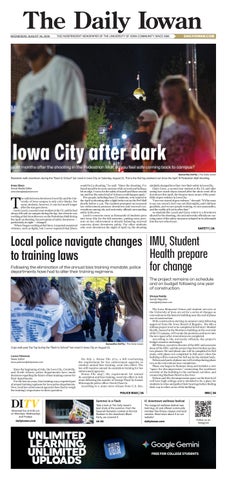
Iowa City after dark
Just months after the shooting in the Pedestrian Mall, do you feel safe coming back to campus?
T
he walk between downtown Iowa City and the University of Iowa campus is only a few blocks. For some students, however, it can feel much longer after the sun goes down. Gavin Leech, a second-year student at the UI, said he had always felt safe on campus during the day, but when he was working at ReUnion Brewery on the Pedestrian Mall during the April 19 shooting, his perception of safety downtown — particularly at night — changed. “When I began working at ReUnion, I expected occasional violence, such as fights, but I never expected that [there
would be] a shooting,” he said. “Since the shooting, I’ve found myself to be more anxious while at work and feeling a bit on edge. I worry for the safety of myself and those around me and fear the same kind of violence could happen again.” Five people, including three UI students, were injured in the April 19 shooting after a fight broke out on the Ped Mall shortly before 2 a.m. The incident prompted an increased law enforcement presence downtown and renewed conversations among city and university officials surrounding safety in the area. Leech’s concerns come as thousands of students pour into Iowa City for the fall semester, putting extra pressure on law enforcement is already balancing renewed concerns about downtown safety. For other students who were downtown the night of April 19, the shooting
similarly changed how they view their safety in Iowa City. Claire Carey, a second-year student at the UI, said after seeing how much chaos ensued after the shots went off in downtown this April, she became more aware of the possibility of gun violence in Iowa City. “I am very scared of gun violence,” she said. “It'd be crazy to say you weren't, but I was out [that night], and I did hear gunshots, and we saw people running, we saw paramedics, and the reality of it set in after that.” As students like Leech and Carey return to a downtown altered by the shooting, city and university officials are carrying some of the safety measures adopted in its aftermath into the new school year.
Local police navigate changes IMU, Student Health prepare to training laws for change Following the elimination of the annual bias training mandate, police departments have had to alter their training regimens.
The project remains on schedule and on budget following one year of construction.
On July 1, House File 2711, a bill overturning the requirement for law enforcement agencies to conduct annual bias training, went into effect. The law still requires annual de-escalation training for law enforcement agencies. House File 2647, the requirement for annual de-escalation and bias training, went into effect in July 2020 following the murder of George Floyd by former Minneapolis police officer Derek Chauvin. According to a 2020 news release from U.S. Sen.
The Iowa Memorial Union and student services at the University of Iowa are set for a series of changes as renovations to the historic building near the end of phase one of construction. With construction starting in summer 2025 following approval from the Iowa Board of Regents, the $81.4 million project is set to be completed in fall 2027. Student Health, housed in the Westlawn building on the west side of the UI campus, will vacate the premises and move into the new space after renovations are completed. According to the university officials, the project's budget remains unchanged. Bill Nelson, executive director of the IMU and associate dean of the IMU, said the project has been broken up into two phases. He said phase one will be completed in Fall 2026, with phase two completed in Fall 2027, when the building will be restored for full use by the student body. Nelson said parts of phase one will overlap during phase two as the renovations near completion. Phase one began in Summer 2025 and includes a new “space for decompression,” connecting the southeast corridor of the building to the northeast corridor, and connecting Madison Street to the river. Nelson said the decompression space on the first level will have high ceilings and is intended to be a place for students to relax and gather their bearings before finding their way to other areas of the building.
Since the beginning of July, the Iowa City, Coralville, and North Liberty police departments have made decisions regarding the future of bias training courses for their departments. For the last six years, bias training was a required part of annual training regimens for Iowa police departments. Now, local law enforcement agencies have had to weigh the training’s importance in their operation.