Iowa’s case for civil discourse Rising gas prices strain Iowa drivers
The civics initiative is growing despite difficulties in student and faculty networking.
Fuel costs climb due to global oil disruptions and inflation-driven tax proposals.


On the University of Iowa campus, a small group of students and faculty is joining a growing movement in higher education.
A new brand of institutions, scattered between campuses, is taking on different names and identifying with varying ideologies. There is one salient need that leaders of these organizations identify: discourse and free speech.
At the University of North Carolina at Chapel Hill, it is called the School of Civic Life and Leadership. At the University of Florida, it is called the Hamilton School for Classical and Civic Education. The University of Texas at Austin calls it the Initiative for Laws, Societies, and Justice.
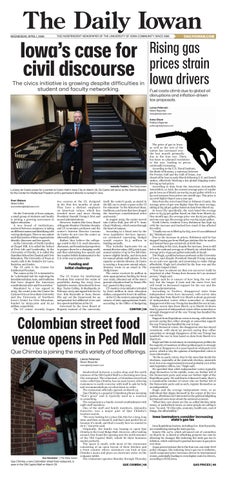
The UI calls it the Center for Intellectual Freedom.
The center at the UI is intended to be “a dedicated hub for exploring the foundational ideas, texts, and traditions that have shaped the American constitutional order and free societies.”
Mandated by a law signed in 2025, the center joins the Center for Cyclone Civics at Iowa State University and the University of Northern Iowa’s Center for Civic Education, funded by $250,000 and $1.22 million, respectively.
The UI center recently began
two courses at the UI, designed in the first few months of 2026. They have a distinct emphasis on American values, which has trended more and more during President Donald Trump’s first and second administrations.
However, leaders like Iowa Board of Regents Member Christine Hensley and UI economics professor and the center’s Interim Director Luciano de Castro do not view the center as inherently political.
Rather, they believe the collegeage youth in the U.S. need discourse, discussion, and broadened perspectives to prepare them for a changing world, and that celebrating free speech and free market beliefs fundamental to the U.S. is the way to achieve this.
The UI Center for Intellectual Freedom first entered the realm of possibility during the 2025 Iowa legislative session. Introduced by Iowa Rep. Taylor Collins, R-Mediapolis, in February 2025 and signed into law by Gov. Kim Reynolds in June, House File 437 set the framework for an independent but a liated civics and free speech institution at the UI. Governed by the Iowa Board of Regents instead of the university









itself, the center’s goals, as stated in the bill, are to create a space at the UI for education “in the historical ideas, traditions, a1nd texts that have shaped the American constitutional order and society.”
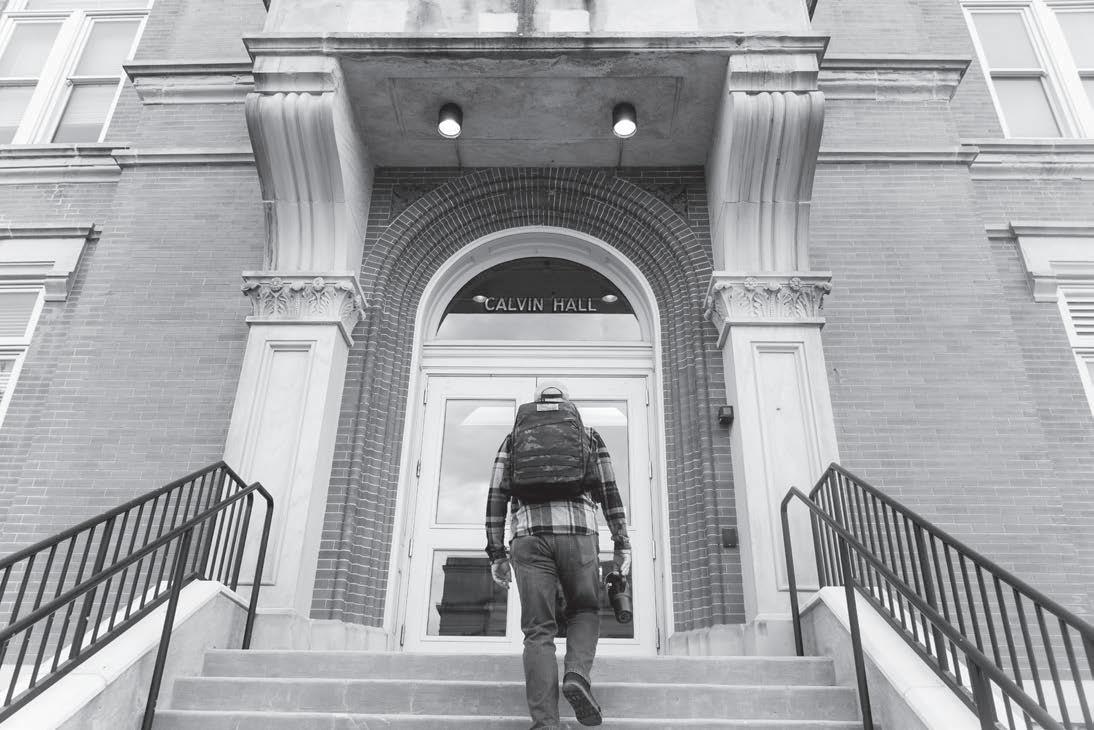
In August 2025, the center moved into Calvin Hall, just off of T. nne Cleary Walkway, which routes through the heart of campus.
According to a fiscal note by the Iowa Legislative Services Agency, an estimated operating budget would require $1.5 million in funding annually. This includes $400,000 for an annual director salary, $875,000 to pay annual salaries of up to five full-time, tenure-eligible faculty, and $174,000 for annual admin staff salaries. In his capacity as interim director, de Castro is earning a $140,000 annual salary, Hensley wrote in an email to The Daily Iowan. The center received $1 million in state appropriation funding for fiscal year 2026, allocated out of the state’s general education fund by Senate File 647, passed in May 2025.
UT-Austin’s civics initiative is funded by $100 million in state education dollars, compared to Iowa’s $1 million.
At the UI, the center is among the top earners of state appropriations funds, according to the ce of Budgeting
Colombian street food venue opens in Ped Mall
Que Chimba is joining the mall’s variety of food o erings.
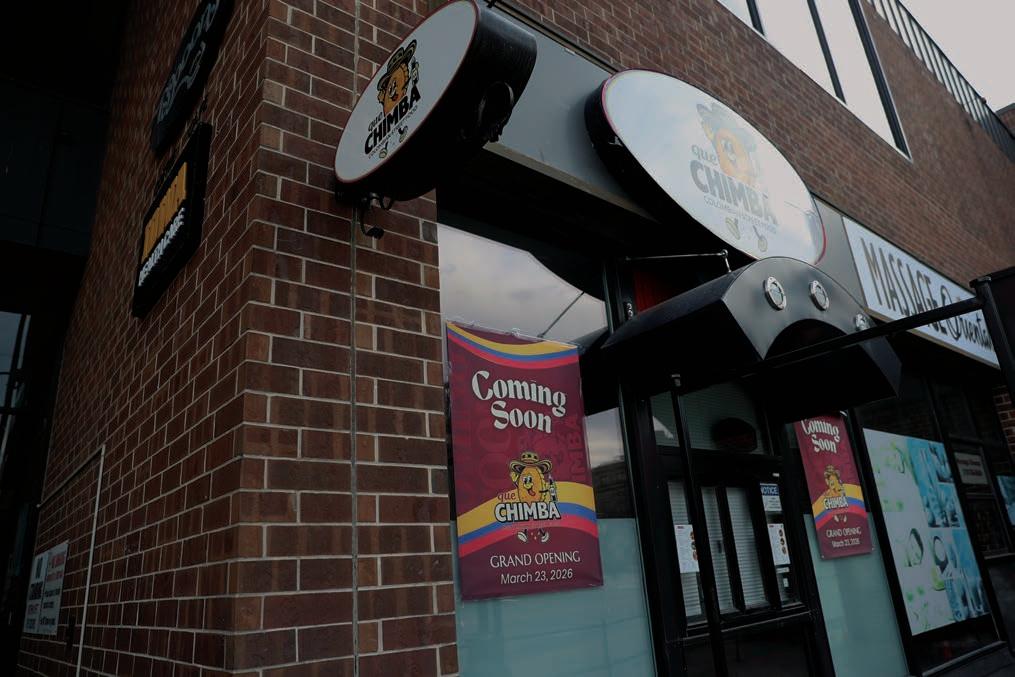
Sandwiched between a cookie shop and the north entrance of the Old Capitol Mall is a charming new Iowa City restaurant. The restaurant, a Colombian street food venue called Que Chimba, has an open layout, allowing customers to easily converse with staff to ask for help and recommendations on what items to order.
The restaurant officially opened on March 23.
Que Chimba is a popular Colombian phrase meaning “that’s great” and is typically used as a reaction
The restaurant is a family-owned establishment with One of the staff and family members, Alejandra Garavito, was a major part of Que Chimba’s
“We were looking for a place like this for a long, long time, and then we found it, and that’s just perfect for us because it’s small, and that’s exactly how we wanted to
Originally, the family was hoping to open Que Chimba in the Coral Ridge Mall. However, after looking around, they found the opening near the north entrance of the Old Capitol Mall, which fit their business
The space is small, with most of the restaurant consisting of an open layout of their kitchen and a front counter where customers can look at Que Chimba’s menu and place an electronic order on the company tablet.
The restaurant operates Monday through Thursday
















The price of gas in Iowa as well as the rest of the nation has increased over the last month primarily due to the Iran war. There has been no planned resolution to the war, leading to prices

















According to the U.S. Naval Institute, the Strait of Hormuz, a waterway between the Persian Gulf and the Gulf of Oman, was closed off by Iran in early arch following .S. and Israeli strikes, effectively blocking a key global shipping route, driving up fuel prices.












According to data from the American Automobile Association, or AAA, the current average price of regular gas in Iowa as of March 29 was $3.29 per gallon which is a 65 cent increase from prices one month ago. This price is 24 cents higher than it was a year ago.



Data from the AAA found that in Johnson County, the average price of gas was higher than the state average, sitting at $3.38 per gallon based on data from March 29.

In Iowa City specifically, the listed the average price at $3.39 per gallon based on data from March 29. One month ago, the average price was $2.65 per gallon, and one year ago, the average price was $3.03 per gallon.
North Liberty resident Corey Robinson has kept up with the increase and tracked how much it has affected his wallet. sually my car is filled up by , now it’s an additional $5,” Robinson said.
Due to the increase in prices, Robinson said he has stopped buying gas from Shell gas stations like he used to and instead buys gas exclusively at Kwik Star.
According to the AAA, despite the increase, Iowa is still below the national average as of March 29, which lists the average price of gas per gallon nationally at $3.98.
Tim Hagle, a political science professor at the University of Iowa, said despite President Donald Trump running on an anti-war agenda and promising to make things affordable, Hagle isn’t shocked by the Iran war and the economic impact it had.
“You have to almost say that you can never really be surprised at what Trump does because he’s an unusual person,” Hagle said.
Hagle said he is unsure of how long the war will last, but the longer it lasts and the more lives lost will result in decreased support for the war and the Trump administration.
According to YouGov, disapproval rates from independent voters have increased, with survey data showing that from March 6 to March 9 about 53 percent of independent voters either somewhat or strongly disapproved of the way Trump has handled the war in Iran.
More recent data from March 13 to March 16 shows that 63 percent of independent voters either somewhat or strongly disapproved of the way Trump has handled the war in Iran.
Support from Republican voters is strong, with about 81 percent saying they either strongly or somewhat support the way Trump has handled the war in Iran.
With Democrat voters, the disapproval rate has stayed consistent, with about 92 percent saying they either somewhat or strongly disapprove of the way Trump has handled the war in Iran based on data from March 6 to March 16.
Hagle said this is customary in contemporary politics for the majority of members of either political party to strongly support or disapprove of a cause based on what party is in power, which is why the opinion of independent voters is more informative.
“So the no party voters, they’re the ones that decide the elections, especially at the statewide election, statewide level, but even congressional level and probably a lot of the state legislative o ces, too, Hagle said.
He specified that while independent voters typically align themselves in the middle, some are further left of the Democratic party and some are further right of the Republican party. He said that in Johnson County, there’s a considerable number of voters who are further left of the Democratic party and as such, register themselves as an independent.
Hagle said the average independent voter, or an individual that aligns themself in the center of the two parties, oftentimes isn’t interested in the political infighting but instead cares more about the national economy.
“What they care about are the so-called kitchen table issues, or pocketbook issues, as some people are calling it now,” he said. “It’s like jobs, economy, health care, cost of things, the affordability.
Iowa Republican leaders, including Gov. Kim Reynolds, are considering raising the state gas tax.
Senate File 2472, which advanced out of committee on arch , is aimed at offsetting property tax cuts by allowing for changes like indexing the state gas tax to inflation, which could lead to gradual increases in gas prices over time.
As gas prices increase due to the Iran war, any state-level policy changes, like indexing Iowa’s gas tax to inflation, could compound price increases driven by international events, potentially leading to even higher costs for drivers, according to FUELIowa.
and Planning. Others include the university’s cancer assessment, which received $1 million, the Iowa Flood Center, which received over $1.2 million, and the College of Nursing, which received $2.8 million in appropriations.
Lower-funded programs include $200,000 for the Iowa Geological Survey’s groundwater surveying project, $143,410 for the State of Iowa Cancer Registry, and $41,667 for the John Pappajohn Entrepreneurial Center.
Hensley, Iowa Board of Regents and center advisory board member, highlighted the center’s need for additional funding at their Feb. 25 meeting. In an interview with the DI , Hensley said the center could need up to an additional $2 million in funding to cover long-term faculty and course design plans, bringing the total bill to $3 million.
In response to Hensley’s comments during her report, Regent Kurt Tjaden, who also sits on the center’s advisory committee alongside board President Robert Cramer, said conversations about future plans and additional funding would require more data and clearer targets.
This need for clarity is an ongoing concern for Hensley, who, alongside de Castro, has referenced “challenges” in launching the center since its inaugural event in December.
The center also delayed its courses from January due to low student enrollment.
One of the prevailing factors is student interest in the center. In the first three months of 2026, the center has designed two courses, taught in partnership with the university.
The first is Political and Economic Institutions in the United States, taught every Tuesday at 6:30 p.m. in the Pappajohn Business Building. The second is American Culture and Values, taught also at 6:30 each Thursday evening.
Total enrollment between the two two-hour lectures is 19 students, with 11 in the former and eight in the latter.
Despite de Castro hiring a dedicated marketing team, launching the center’s Instagram page, and attending club events across campus, Hensley said outreach with students has proven di cult.
Hensley said pushback from faculty on campus has created rifts in potential hiring and course design.
“It’s not been easy,” she said. “It has been more of a challenge, I think, than any of us recognized at the time, and it's been more of a challenge for a few reasons. One, just understanding the administrative process and how best to communicate with students. That’s not been as clear to, I guess, Luciano and others as I thought it might be.”
The first item on Hensley and the advisory board’s list for the center is the hiring of a dedicated, full-time director.
During Hensley’s Feb. 25 update, she said a nine-member executive committee, chaired by UT-Austin Associate Professor Richard Lowery, is heading a national search for the permanent director.
In October 2025, Lowery lost an appeal to U.S. Court of Appeals for the Fifth Circuit after suing the UT-Austin for requesting he temper his speech on campus and on social platforms such as X, where he frequently spoke out against the university’s DEI and critical race theory curriculum, according to a legal briefing by policy think tank The Cato Institute.
Hensley said during the meeting that the committee was finalizing a contract with a Chicago-based executive search firm, Heidrick & Struggles, to begin building a network of candidates.
However, Hensley said in an interview with the DI that the deal with Heidrick & Struggles fell through during contract negotiations.
“We are looking at some other firms right now
and trying to keep this as tight and streamlined as possible,” she said. The committee still expects to perform the search, conduct interviews, and make a selection by July 1. The Board of Regents will perform the final round of interviews.
The regents meet next in late April, which Hensley said is unrealistic for their timeline.
Ideally, she said, the search will yield a handful of candidates who can be interviewed, and the board can make a selection during their June meetings in order to have a director starting July 1.
De Castro has expressed interest in continuing his tenure as interim director into a full position.
Hensley said protocols have been put in place to separate de Castro from the search process.
Another priority placed upon the advisory committee and, by extension, de Castro by HF 437, is that the center conduct a “market assessment” to gauge student interest and identify how much staffing and faculty it will need.
As of mid-March, Hensley said the board has an early draft of the market report and plans on presenting it to the legislature before its session adjourns. In designing the center’s programming, Hensley said it has been an uphill process, though overall, most of their initial goals have been met.
“There were specific requests or items that we had to fulfill, as that was in the legislation, i.e., identifying the board, hiring an interim director, market research, and getting an event or two up and running,” Hensley said. “So we really have met all of those goals.”
The event Hensley referred to was the center’s two-day inaugural event in December, which featured panels and discussions led by professors from institutions across the U.S. and a speech from Reynolds. Panels at the event consisted of “What is wrong with universities?”, “Can universities be reformed?”, and “Possible actions and next steps.”
Assistant Secretary for the U.S. Department of Education and former Board of Regents member David Barker spoke at the event, saying the Trump administration’s priorities in higher education, which the center represents, are “a civic necessity.”
Other speakers said there is a need for a national push in civics discourse in higher education, specifically using the killing of conservative activist Charlie Kirk at Utah Valley University in September 2025 as an example of intolerance against free social discourse, necessitating that institutions like the center exist.
As for the center’s near future, Hensley said maintaining momentum in its first semester active on campus is most important.
“We are just completely focused on making sure that we have a solid foundation,” she said. “And we're beginning those discussions about what's going to be the course of action for next fall, the classes that will be there.”
Created by a Republicanmajority legislature — and requested to be named the Charlie Kirk Center for Intellectual Freedom by Iowa Republican U.S. Rep. Mariannette Miller-Meeks, R-Iowa, in a Sept. 11, 2025, post on the social platform X — detractors of the UI’s center and of those at other universities claim these institutions’ goals are to grow conservative influence in higher education.
Students aware of the center have expressed views that it is specifically designed to push conservative ideologies on campus.
UI third-year student Landen Freeman said he has never interacted with
the center, whether through advertising in clubs, classes, on social media, or through tabling events. Freeman said the dichotomy between the center’s desire for outreach and the seeming lack of it suggests the center is instead promoting exclusivity in its recruitment.
Referring to one lesson plan for the American Cultures and Values course, “Why Capitalism Rocks!”, Freeman said the course design is inherently biased and socially unaware.
“There are a lot of people in the local community who are suffering directly by the hands of capitalism,” he said. “So, for you to present this rhetoric, in this message that capitalism rocks, I cannot trust you. I cannot take you seriously.”
In an interview with the DI, de Castro said the center and its curriculum are focused on expanding students’ minds and embracing the benefits of American culture and not on catering to either side of the political aisle. He referenced Catholic philosopher Michael Novak and his teachings on democratization.
De Castro said Novak’s beliefs describe three main pillars in American culture: political institutions, capitalism as the economic pillar, and social values.
“And these three go together,” he said. “Freedom, that's a value here for America.”
De Castro briefly described his upbringing in an economically unstable Brazil, tying the rise of socialist ideologies in Europe in the mid-19th century, and their eventual progression to South America, to corruption and economic instability that continues in the modern day.
For him, America’s free market, democratic capitalist economic and political systems are a bastion.
“We saw everywhere, it is the erosion of freedom, poverty, and lack of perspectives,” he said. “And I feel very hard because I have relatives there in Brazil. I have friends. I saw how their lives are going through a lot of di culties. I see, I have a lot of friends that express that, ‘Well, if I could, I would leave Brazil.’”
De Castro said he has observed a phenomenon on the UI campus, which he said is occurring on campuses across the U.S., where perspectives are narrowing, especially by university faculty, particularly in academic research.
“There is a tendency in disciplines, academic disciplines, to become very isolated and focused because this is how research progresses,” he said. “You focus on a specific kind of problems, and then through this process of specialization, you lose the focus, the broad focus on society and the broad problems.”
Besides the center’s inaugural event, in its first
several months, its primary offerings are the two classes that began on March 24 and 26, in which generating student interest is among the challenges Hensley has described in finding its footing.
The courses, whose content was not made v iewable to the DI by center admin staff who referred to UI policy on protecting intellectual property, feature lectures on free speech, civics, and American history as it relates to the rights of citizens and modern social discourse.
Intended as a8n alternative amplification of existing UI history and civics education, each course will feature a lecture from one of a list of Iowa leaders in business and politics.
Hensley said names
has defined fighting words and obscenity, and finding those lines is important for students.
Once those are understood, Hagle said he will transition to the modern day, covering things like hate speech. He said he will entertain hypotheticals like whether or not hate speech should be illegal.
He referenced doxxing, cancel culture, and Carson King, an ISU student whose handmade sign asking for money for beer at an ISU football game ballooned into a donation of over $3 million to the University of Iowa Health Care Stead Family Children’s Hospital. King was later “canceled” after racist tweets from his years in high school were discovered and published by a Des Moines Register reporter and were referenced in an article on cancel culture published by UT-Austin.
He said misapplications of free speech and privacy are important delineations to make to college-age youth.
include Mike Whalen, founder and CEO of Heart of America Group, which owns Iowa restaurants and franchises such as Hyper Energy Bar; former Iowa Republican Rep. Greg Ganske; and U.S. Ambassador to China and former Republican Iowa Gov. Terry Branstad, all of whom are also on the 26-member advisory council.
UI faculty are also involved in the courses, including UI political science professor Tim Hagle. He taught the first lecture on March 24, which focused on the Federalist Papers, and plans to lecture at the April 2 session of American Cultures and Values, focusing on free speech and issues like cancel culture.
Hagle said political discourse needs to begin with a solid definition of free speech. He said free speech has exceptions, as in how the U.S. Supreme Court
“We’re talking about doxxing more generally,” he said, describing a hypothetical discussion on the applications of free speech. “You talk about with ICE agents in places that don't want them to wear masks. And the reason may be so that they can identify them and do things, and maybe threaten them in various ways. So maybe anonymity is appropriate under the circumstances, even if you don't like it.”
These fundamental beliefs, de Castro said, are increasingly important. Despite the effort exerted to get the center up and running and the potentially bumpy road ahead, that importance has maintained his enthusiasm.
“I believe this is really valuable, and I'm passionate about this, about this objective, and therefore all the challenges, all the effort that is required from me, I'm happy to take because I will feel in my heart that it's something that's worth pursuing,” de Castro said.



The annual 5K is hosted at MERF by University of Iowa Carver College of Medicine to raise funds for the Iowa City Free Medical and Dental Clinics & University of Iowa Free Mobile Clinic.
OPINIONS
Crossing the state line shouldn’t double your tuition
Most students still face significantly higher costs just miles from home.

For many students in the Midwest, the perfect opportunity for higher education may sit just across the state line, maybe even just a few hours from home.
The short drive from Illinois to Iowa may give a talented student access to the University of Iowa’s prestigious writing program. Crossing the Iowa-Wisconsin border could provide a different student with the college experience they have always wanted. However, in a region where states share economies and culture, college affordability seems to halt at the borders.
It’s important to mention that lawmakers are making efforts to aid in the cost of secondary education. Across the country, states are updating financial aid and tuition policies to make college more affordable, including expanding promise programs, adjusting eligibility for scholarships and grants, and modifying tuition rules to reduce barriers for students, showing that affordability is a priority.
Iowa recently passed a bill freezing tuition at public universities for in-state undergraduates through 2031, showing a commitment to keeping higher education affordable for residents. Policies like this highlight the importance of statewide action and expanding programs like the idwest Student Exchange Program could similarly reduce costs for students crossing state lines.
Despite Iowa’s efforts for residents, Midwestern states being so closely culturally and geographically linked need to create and expand statewide tuition reciprocity agreements to make higher education more accessible and equitable for students coming from other states in the region.
By expanding programs such as the idwest Student Exchange Program, students can access quality education across state lines without facing prohibitively high costs, instead of relying on individual colleges to offer limited discounts or selective programs. Aligning with national trends would help the region keep talent in-state while reducing debt and increasing equity in higher education.
The lack of a reciprocity program — which would allow for out-of-state students from nearby states to attend college with reciprocity to pay tuition at a discounted, near in-state rate — has led to inconsistencies and confusion, which has often left out-of-state students paying an amount over double what their in-state peers may be paying – even when they are just a few hours away.
There are programs that aim to bridge the gap between in- and out-of-state tuition. However, they are far from being universal
and also don’t entirely eliminate the cost barrier.
Carrie Wandler, senior director of policy initiatives at the Midwestern Higher Education Compact, wrote in an email to The Daily Iowan that eight of 12 states participate in the the Midwest Student Exchange Program, which is administered by the compact, including Indiana, Kansas, Minnesota, Missouri, Nebraska, North Dakota, Ohio, and Wisconsin.
This means that as a resident of any of these states, you potentially qualify for a reduced tuition rate with an annual tuition savings average of $7,000, according to the exchange program’s website. According to a study conducted by the Education Resources Information Center, families of students in participating states saved more than $60 million over the 2020-2021 academic year.
Under the exchange program, participating states choose the amount they charge out-of-state students while still following program guidelines.
Through SEP, public institutions agree to charge participating students no more than 150 percent of in-state tuition, while private institutions offer at least a percent tuition reduction,” Wandler said.
Some states, however, have stronger, specific reciprocity agreements within the exchange program.
As a Wisconsin resident, I had the option to attend college in Minnesota paying only the in-state tuition rate, which for the University of Minnesota, would be approximately $14,000 to $15,000 per year in tuition alone, according to their admissions data. Compared to the out-ofstate tuition rate of Minnesota, which is roughly $38,000 to $43,000 per year, this is a significant difference. However, the program on its own does not provide full in-state rates.
Still, considering the close proximity of Midwest states, more states, including Iowa and Illinois, should participate.
At the UI, roughly 57 percent of students come from the Hawkeye state, according to a study on College Factual done by their College Data Analytics Team. However, the same study also shows nearly 34 percent of the remaining students are from Illinois, with 2.5 percent of students coming from Wisconsin. Throughout Iowa schools, the majority of out-of-state students come from Wisconsin, Minnesota, and Illinois, according to the state regents website.
The majority of out-of-state commuters being from Illinois can be attributed to the state having an average in-state tuition rate of $15,000, which is over $5,000 above the national in-state tuition average of $9,750, setting the in-state rates of Illinois at third highest in the country.
At the UI, in-state tuition alone runs at roughly $11,000, according to admissions data.
But for Illinoisians, moving over to a nearly geographically identical location isn’t necessarily a cheap option, either. At the UI, many out-of-state students pay the full out-
The Oscars needs to get over itself
This year’s ceremony was indicative of the longstanding issue with the show.

As a lifelong film nerd, I’ve always enjoyed the Academy Awards. Growing up, it felt like a second Super Bowl in my house. My parents don’t watch nearly as many movies as I do — few people should, it’s frankly too much — but they always watched the Best Picture nominees.
While they weren’t the most invested in the film world, they enjoyed the comedy bits, red carpet glamour, and celebrity interactions. For most casual audiences, I’d say this is the general appeal of the Oscars ceremony. But for real diehards, it’s about celebrating the art form they invest far too much time in.
The Oscars need to lean further into this demographic because the general audience just isn’t showing up for the broadcast. This year, the show’s ratings hit 17.9 million viewers, down 9 percent from
2025’s 19.7 million, according to a March 17 article from Variety
Last year was the highest viewership the Oscars had in five years. Conan ’Brien’s first stint hosting saw an uptick in viewership in 2025 but that momentum did not carry over into this year.
Even with big, popular films such as “Sinners,” “One Battle After Another,” and “F1” in the running for the night’s biggest awards, ratings dipped. Those three movies dominated box o ce and online conversation last year, so if heavy hitting movies won’t drive engagement with the awards, what will?
ABC has been the exclusive broadcast for the Oscars since 1976, and throughout its run turned the Academy Awards into monocultural must-see television. Throughout the 1990s in particular, viewership consistently ranged between 40 and 50 million people, according to a March 1 The New York Times article peaking at 57.2 million in 1998 — likely thanks to “Titanic.” The only other broadcast to reach similar numbers is the Super Bowl.
There is no monoculture anymore, as everyone cultivates their own viewing
of-state tuition rate, which is $33,710 for the 2026-27 year.
With additional costs, including housing — whether on or off campus — books and supplies, personal expenses, and transportation, the average out-ofstate student can expect to spend roughly $53,584 per year.
It isn’t just expensive for those coming to Iowa, though. In fact, if someone from Illinois chooses to go to one of the other Midwest states, they will more than likely be paying as much, if not more, than what their home state charges for in-state tuition. This puts many Midwest students into a kind of tuition gridlock, where the cost is high no matter what they choose.
Beyond the money, however, comes the issue of interstate enrollment for specified majors and programs of study. The UI, for example, is world-renowned for its creative writing programs, both undergraduate and graduate. If a student from a nearby state wished to pursue creative writing, the UI would most likely be a better opportunity than a program that’s within their state. But again, as they cross the state border, the price for a suitable education could increase.
“One of the original goals of reciprocity programs was to give students access to programs that may not exist in their home state,” Wandler said.
Having more in-state reciprocity would do more than make college more affordable; in fact, reciprocity programs have highly regarded regional and national benefits that often get overlooked by universities in fear of a loss of funds.
Some Midwest states have already shown the possibilities of broader reciprocity agreements. Wisconsin and Minnesota, for example, allow students to cross state lines for education — to many public colleges in either state — and receive in-state tuition, without facing overwhelming financial barriers.
habits and hyper-niche interests based on streaming and social media algorithms, not based on what is coming up on TV Guide. ABC’s broadcast ratings already include Hulu numbers as well, meaning cable numbers are likely even worse.
Starting in 2029, the show will move to YouTube and, in turn, I think present a better show. Every issue I had with this year’s show, and most of the recent broadcasts, comes down to the platform it airs on.
One of the most uncomfortable, cringeworthy moments during the show came from the shameless cross-promotion between Disney-owned ABC and the upcoming “The Mandalorian and Grogu.”
Sigourney Weaver and Pedro Pascal took the stage to do a far-too-long bit with the Grogu puppet sitting in the audience.
Not only was the presentation unfunny, it also felt so obvious they were only there to promote their movie, which also got a trailer in what felt like every commercial break during the broadcast.
Annoying bits ran rampant this year, as they do every year, with a particularly annoying and awkward bit featuring Robert Downey Jr. and Chris Evans.
The duo were at the show to promote “Avengers: Doomsday” releasing later this year, but their script was so stiff I couldn’t actually tell if I was supposed to laugh. The muted audience in the room didn’t help, as there was zero energy for Downey r. and Evans to work off of. gain, corporate cross-promotion.
It’s especially frustrating to sit through these over-long banter moments when the show repeatedly cuts off speeches from winners.
-Pop Demon Hunters songwriter, Yu Han Lee, got cutoff accepting the award for Best Original Song,
Expanding reciprocity could keep students in Midwest states after graduation. With reciprocity agreements, students have lowered costs, reducing the overall debt burden, which allows students to begin their careers with more financial flexibility, making it more alluring for graduates to settle in the area.
Additionally, these programs help students foster regional ties and stay within the Midwest after graduation to work, helping address the concerns of population loss in the area. Still, reciprocity expansion has faced resistance.
“Research in MHEC’s report ‘Student Reciprocity Programs and SEP in the 21st Century’ shows that most barriers are practical rather than ideological,” Wandler said. “States often worry about net student migration, meaning more students leave their state than come in.”
Wandler said institutions are hesitant to give tuition control to the states. Many wish to maintain flexibility to manage enrollment and determine which programs are eligible to participate.
Although these concerns are valid, they show the exact reason why we need reciprocity agreements: many students are left navigating an inconsistent system, often having to forgo more adequate opportunities and experiences for them in order to afford higher education. Expanding statewide agreements, though, would make tuition more predictable and access more equitable, allowing students to choose schools based on opportunity rather than cost.
The Midwest is so interconnected, so higher education should reflect that reality. State lines shouldn’t determine whether a student can afford the right opportunity.
“At the end of the day, when students can find the right opportunity anywhere in the idwest, the whole region benefits, Wandler said.
a choice Oscars execs attributed to tight broadcast timelines in an IGN article from March 16. ABC has a hard start and end time for the broadcast, something it would not have to worry about when streaming live on YouTube. Thus, there could be more time for speeches.
Similarly, the channel needs to schedule dazzling presenters with lots of star power that make people want to tune in so they can drive ad sales, according to the Entertainment Data Oracle. But these presenters take up time and only direct the ceremony away from what should really be the focus of here: celebrating movies. Without worrying about viewership, cross promotion, and broadcast timelines, the ceremony’s run on YouTube may end up getting more movie lovers on board. I can only speak for myself, but I don’t tune into the Oscars to see celebrities and hear mediocre cocktail party jokes, I watch to see my favorite movies of the year celebrated — and to get more predictions correct than my friends.
YouTube is available internationally unlike Hulu and ABC, meaning no matter what, the new era of the show is guaranteed to garner more eyes. To me, moving to YouTube both allows the Oscars to naturally grow among casual audiences and can provide the space for the show to more effectively cater to a key demographic. The exact methods ABC and the Academy have taken to streamline the show and bring more general views in on the fun, the more people have seemed to switch it off. This year’s awards consisted of an embarrassing number of speech cut offs and awkward banter, so the cademy should be asking itself if the show is about ratings or about cinematic history.
ELIowa is a nonprofit serving as the primary voice for Iowa's fuel industry. They advocate for industry interests, promote renewable fuels like E15 and biodiesel, and offer services such as regulatory compliance, insurance, and safety training to members.
The proposal includes a provision that would cap those increases at 2 percent per year, meaning the gas tax could rise gradually rather than spike with higher inflation rates.
GOP supporters such as Reynolds and Republican lawmakers said the cap would help limit sudden jumps in costs for drivers while still allowing the tax to keep pace with inflation over time.
However, critics from advocacy groups including FUELIowa argued that even with the cap, the policy would still result in automatic yearly increases, adding to the financial burden for Iowans already dealing with rising prices at the pump.
In a news release sent out on March 10, FUELIowa opposed the legislation and warned the proposal could make already high prices even worse.
They argued that automatically raising the gas tax each year would gradually increase costs for both
consumers and businesses.
They pointed to rising fuel prices tied to the war in Iran and said adding an indexed tax, or a tax that automatically adjusts over time based on changes in inflation, on top of those increases, would drive-up fuel purchasing costs and raise the price of everyday goods.
They urged lawmakers to reject what they described as an untimely tax hike during a period of inflation and affordability concerns, with midwest consumer prices rising about 2.8 percent over the past year, according to the U.S. Bureau of Labor Statistics.
Additionally, housing affordability remains a significant concern in Iowa, particularly for lower-income residents.
According to the National Low Income Housing Coalition, 87 percent of extremely low-income renters in the state are costburdened, spending 30 percent of their income on housing.
“Fuel tax increases like this not only drive-up fuel purchasing costs on Iowans; they also drive up the costs Iowans pay for their daily essentials,” FUELIowa said in the release. “At a time when inflationary drivers and affordability are the key issues facing Iowans, now is not the time to impose tax increases on Iowa consumers and Iowa businesses.”

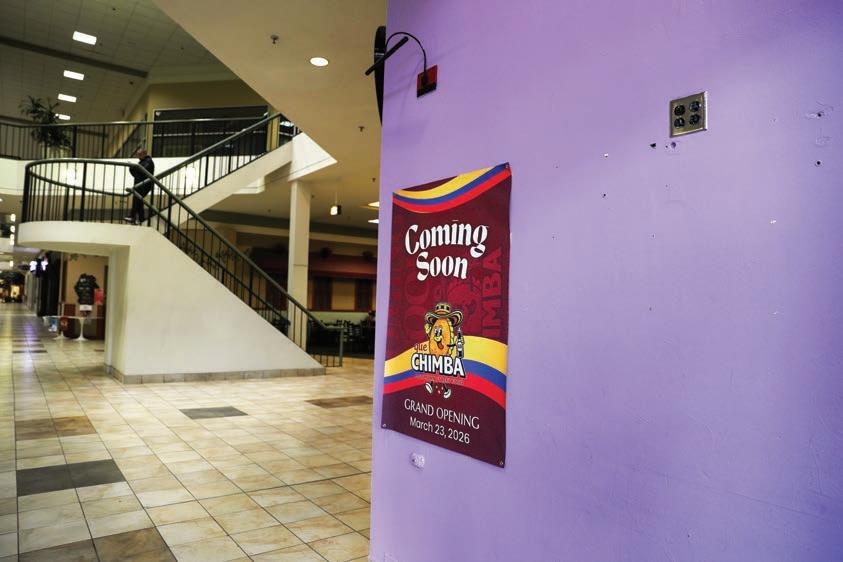
from 11 a.m. to 7 p.m. and on Fridays and Saturdays will stay open till 2:30 a.m. to sell and serve food to late night customers.
Despite the Old Capitol Mall closing at 7 p.m. on Fridays and 6


p.m. on Saturdays, Que Chimba can remain open through their kitchen window located near the north entrance. The staff is able to alter their business by closing the main entrance and taking orders and serving food from the outdoor window like a stationary food truck. Garavito said she and her family want
Que Chimba to be a place where students getting out of class or residents getting off work can stop by to have some quick and fresh Colombian food.
She said so far, the customers have enjoyed it.
Iowa City resident Aliese Gingerich stopped by during her break to try Que Chimba because she knew it would be fast and delicious, and she also wanted to support the local immigrant community.
Gingerich said the restaurant was recommended to her by a friend who’s from Colombia. She also mentioned that she and several of her Colombian friends were planning to try food from the restaurant.
Gingerich also took notice of Que Chimba’s concise menu.
“I like that there’s some variety, but also it’s not a million options,” Gingerich said. “I get overwhelmed when you go to a restaurant, and there’s a three-fold thing.”
Que Chimba offers empanadas, arepas, a type of flatbread made of ground maize dough stuffed with a variety of ingredients, patacón, a type of chip made of twice-fried smashed plantains, and tequenos, a fried piece of dough with solid queso inside of it.
They offer those options with either meat, chicken, or the vegetarian option that replaces the meat with more cheese.
For drinks, they offer fruit juices and Colombian sodas, with sides for customers, including sauces or chorizo.
Garavito said the family wanted to start the menu small but plan to expand

it going forward.
Garavito said one of the next menu items they want to add is Colombian hot dogs along with different toppings that can be added onto it.
A Colombian hot dog is characterized by its mix of sweet and savory flavors, with common toppings being crushed potato chips, pineapple sauce, ketchup, and mayo.
She also mentioned that Que Chimba is actively working on new flavors for its arepas.
UI graduate student Federico Rosero recently tried Que Chimba for the first time and hopes more items are added to the menu.
Rosero said he would love to see more sauces, buñelos, which are a type of fried pastry, and other desserts added to the menu.
“I’m Colombian, so of course, I have a tied relationship to Colombian food,” Rosero said. “So, I wanted to explore this option.”
After looking through the menu and the ingredients, Rosero said he noticed there was Venezuelan influence with some of the foods, as some ingredients were made the way they are in Venezuela.
Garavito said they have been much busier than expected in their first week and have seen a diverse demographic of customers eat at Que Chimba, most of their customers being younger residents.
“All the people have been really happy with our food,” Garavito said. “They’ve been waiting for a Colombian place for a long, long time here in Iowa.”






















































































































































































































The correct Easter candy ranking
How popular Easter candies stack up against each other in the competition of flavor and festivity.
He is HeisRisen! Risen!

Coming in at fifth, and unfortunately last place, are jelly beans. If these are your favorites, you are not only inherently wrong, but you also probably haven’t tried any of the other candies on this list. The waxy, tooth-sticking texture and quick-fading taste results in these unmagical beans doesn’t even break the seal of mediocre.
While I do think these sugar-coated marshmallows are overly hated, I don’t regard them as a top-tier treat. If a Peep was placed in front of me, there’s absolutely no doubt in my mind that I’d indulge in the chick-shaped sweet. But while these mallows are sugary and fun, they are just absolutely not worth going out of your way for. When they make an appearance, however, Peeps rise above those disappointing jelly beans and make for a slightly underrated Easter candy.
Who doesn’t look forward to a Lindt Gold or Russel Stover bunny? They’re decadent, classic, and undoubtedly a lovely addition to an Easter dining experience. However, their simple chocolate flavor doesn’t necessarily stand out — yes, it’s in the shape of a whimsical little bunny, but it’s still plain chocolate. Due to the lack of novelty, this candy finds itself settled into the middle of the pack.
This rich oval of milky, rich chocolate coated in a pastelcolored crunchy candy shell makes for quite the addicting Easter novelty. Currently trending on TikTok, these candies also prove to be incredibly versatile; creators are showing off their Cadbury egg cookies, ice creams, protein balls, puddings, and a plethora of other creative treats.
Rounding out this mouth-watering list and polishing its winners’ crown is the delectable Reese’s Eggs. Holiday specific Reese’s shapes typically contain more of that creamy, salty peanut butter filling, pairing with the soft milk chocolate shell to make each bite feel like a dream come true.
The unbeatable combination of flavors and precise golden ratio of each tear-jerkingly beautiful egg leaves no room for question — Reese’s peanut butter cup eggs are the best Easter candy.































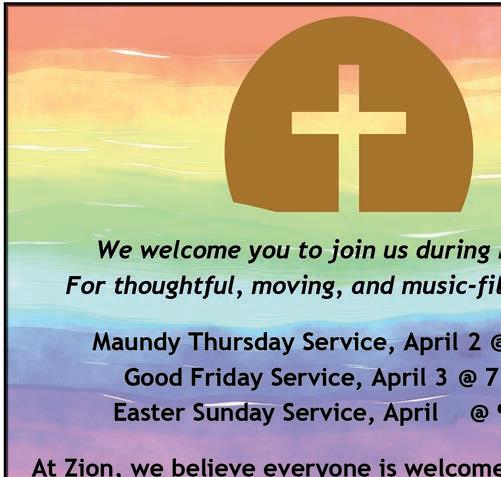
Good Friday Communion Service: April 3rd, 7pm
Children’s Easter Egg Hunt: Wetherby Park,2400Taylor Drive Saturday, April 4th, 11:00am Easter SundayWorship: April 5th, 10:45am












































































































‘The pendulum swings back and forth’
Experts discuss the shift in Iowa’s voting demographic as midterms approach.
fixture in the Iowa legislature and its longest-serving Republican serving in the House and the Senate. In , as Iowa voters shifted further right, c ean switched to the Democratic Party — an uncommon move that surprised colleagues and constituents.
concerns about the party’s direction during President Donald Trump’s first term, particularly what he saw as a shift further to the right and away from its traditional principles.
c ean said, echoing a line often associated with former President Ronald Reagan regarding his former time as a Democrat. The Republican Party left me.
tension in Iowa politics. s the state shifts ideologically, long-standing party loyalties are being tested, and individual voters and candidates must navigate a landscape that feels increasingly unpredictable and polari ed.
incumbent is running for governor, a .S. Senate seat, and two .S. House seats, which Tim Hagle, a niversity of Iowa political science professor, called unusual.
announced in pril she would not seek reelection, a personal decision she said was not easy in a video statement.
announced in September she would not seek reelection in the midterm.

.S. Rep. Randy eenstra, R-Iowa, launched his gubernatorial campaign in ctober , and .S. Rep. shley Hinson, R-Iowa, launched her campaign for Senate in September , leaving House seats open with no incumbent running in District or District .
State uditor Rob Sand, a Democrat, is vying for governor in what election analysts at the Cook Political Report describe as a newly competitive race, after Sand’s candidacy elevated the contest to a more competitive tier. He also raised . million in for his gubernatorial campaign, breaking the state record for most money raised during an off-year by over double.
Iowa Sen. ach Wahls, D-Coralville, and Iowa Rep. osh Turek, D-Council Bluffs, are throwing their hats into the .S. Senate race.
With many key seats open and high-profile candidates entering the races, Iowa voters will be deciding among names that are gaining increasing attention.
Hagle said this combination of open seats and media visibility could make the midterms particularly unpredictable, especially for voters who may not closely follow state and federal politics.
He said incumbents historically have an advantage in elections because uninformed voters simply recogni e their names. He said candidates like eenstra, Hinson, and Sand have seen a lot of attention in the media, which can further boost their visibility with voters who may not closely follow politics.
It’s name recognition that’s critically important in a lot of seats, especially if it’s somebody who maybe hasn’t run in some high-profile elections, Hagle said.
ccording to the Iowa Secretary of State, people can register as no-party voters, or independents.
Hagle said those voters tend to be more moderate but also less engaged, which makes them a key group candidates must work harder to reach. Because they make up such a large share of the electorate — over percent according to the Iowa Secretary of State — he said their decisions can ultimately determine the outcome of close races.
Even though Republicans have a voter registration advantage right now, it’s still the no-party voters who are going to decide who wins, he said.
Still, Iowa Republicans, including Reynolds and Ernst, said they are remaining optimistic the state will stay red.
I have no doubt that Iowa and our Republican Party will remain in great hands, Reynolds said in her video statement when she announced she was not seeking reelection. Together, we have built a foundation of strong conservative leadership that will continue to serve this state well. I’ve seen firsthand the passion and dedication of so many leaders, and I am confident that the next generation will continue to build on our success.
s Trump secured Iowa’s vote in , the .S. rural-urban divide sharpened dramatically, according to a study from Science Direct. Since then, rural voters have consistently become more Republican, while urban voters have consolidated Democratic support. Iowa has been no exception to this trend, reflecting the broader
national pattern of increasing political polari ation between rural and urban voters identified in recent research from Science Direct.
ccording to census data from , a vast majority of rural counties in Iowa have lost population in the past few decades. c ean said despite this trend, Republicans have consistently been able to hold a majority in the state’s rural counties.
I don’t know if you will find a single rural county that has more Democrats than Republicans, he said. I think every single rural county in Iowa has a Republican edge.
Iowa Secretary of State data from shows Republicans hold a voter registration advantage in rural counties across the state, with counties like dair and dams reporting Republican totals roughly double Democratic registration.
c ean said when he switched from Republican to Democrat in , had he been reelected, he would have been the only Democrat representing a rural
unn — marking a departure from as recently as , when Democrats held two seats.
Hagle said Iowa’s Republican dominance reflects a recent shift in voter registration in what has long been a politically competitive state, noting that Iowa supported former Democratic President Barack bama in back-toback presidential elections before voting Republican starting in . The pendulum swings back and forth, and right now it’s on the Republican side, he said.
o-party voters held a vast majority in Iowa until a steep drop in voter registration, which can be attributed to the C ID- pandemic, according to the Iowa Secretary of State.
Hagle said during C ID- , the state was trying to minimi e in-person voting, so the Iowa Secretary of State office mailed every voter an absentee ballot request form for the primary and general elections in .
This drove a surge in early and mail-in
the consequences was that it became very di cult for me to win reelection running in a district that was so heavily Republican, especially after speaking against Trump, who was very popular.
Since , ohnson County has consistently voted blue in every presidential election, according to the ohnson County uditor’s o ce. s voting patterns and party a liation in the county have remained steady, the ways candidates and local leaders engage with voters have evolved significantly over time.
These changes in outreach have reshaped how voters engage with local politics, particularly as digital platforms play a larger role. orty-two percent of social media users say these platforms are important in getting involved in political and social issues, according to data from Pew Research.
county in Iowa at the time.
That’s a really dramatic change because I can remember back in the years, there were plenty of Democrats representing rural districts, he said.
Colin Gordon, a I history professor, said Iowa’s political landscape is shaped not only by voter behavior but also by structural factors like redistricting and representation, which can amplify partisan divides across the state.
In Iowa, they can redraw the electoral map to lock down one party’s control of the state, he said. Polari ation is particularly acute at the state level because rural areas tend to be much more over-represented.
Gordon said this political polari ation has increasingly shaped how lawmakers interact, making bipartisan cooperation less common and deepening divisions between the two major parties.
It’s far less likely that a Democrat and a Republican lawmaker will cosponsor a piece of legislation. The parties are much farther apart than they used to be, he said. ou see that polari ation in the rhetoric of national candidates, where the party is considered an illegitimate enemy, rather than just somebody who’s competing with different policy ideas.
s of , all six members of Iowa’s congressional delegation are Republicans, marking unified Republican representation for Iowa in Washington, D.C.
.S. Sen. Chuck Grassley, R-Iowa, has held his seat since and served alongside former .S. Sen. Tom Harkin, D-Iowa, from to . Ernst won Harkin’s seat and has served Iowa in the Senate since . In the .S. House, all four of Iowa’s congressional districts are represented by Republicans — eenstra, Hinson, ariannette iller- eeks, and ach
voting, particularly on college campuses, at libraries, and among hospital employees, while also temporarily affecting voter registration totals.
ccording to the Iowa Legislature website, state Republican lawmakers have held a majority in the House since and in both chambers since . Republicans gained a supermajority, meaning they hold two-thirds of seats, in . In , Democrats flipped two seats in the Senate during special elections, ending the supermajority.
dditionally, Iowa has had a Republican governor since .
c ean served as a state representative from to and as a state senator from to . He retired from the legislature to focus on his law practice but decided to run for the House again in and served two more terms.
c ean has seen both parties hold control of the legislature. He said the shifts in party control that Iowa has seen in recent years has led to more partisan policymaking.
When the control swings to another party, then that party just passes things that may make their base happy, he said. But again, that may not be the will of the overall majority of Iowa citi ens.
When c ean became a Democrat, Iowa was trending increasingly Republican, at the state and federal levels, according to data from the Iowa Secretary of State. He lost his seat in the election.
c ean said his party affiliation concerns deepened during his return to o ce, especially as he felt the G P no longer emphasi ed local control or conservation with constituents, values he had long associated with Republicans.
c ean said at the time, running again as a Democrat in ones County, which is historically red, for state government that was swinging heavily Republican was increasingly di cult.
It was just a matter of my conscience and accepting the consequences of my decision, he said. nd one of
ccording to the study from Pew Research, this shift may widen the gap in who participates, as younger and more urban voters become easier to reach while older candidates and more rural voters may rely on traditional forms of outreach. aren ubby, owner of Beadology in downtown Iowa City, has lived in the community since the s and served on city council from to . ubby said in her time living in Iowa City as an activist and former leader in local government, she has seen different political figures communicate with the public in different ways throughout the county.
She said when she was on the Iowa City City Council, she held open, in-person o ce hours as a way to communicate with constituents and voters on a more personal level.
They felt connected, ubby said. That helped people understand the process and the content of what was going on. Then they would get involved on the next issue more on their own, and then they would bring their neighbors and their friends.
ubby said, due to an increased presence of technology, she has seen city councilors use online newsletters to connect to the public. They don’t expect people to come to City Hall, she said. They go out into neighborhoods. I think that’s really smart, and it’s a way to keep people involved.
However, ubby said she has seen the county lose a sense of connection and engagement over the years.
People don’t seem to have a lot of empathy, she said. nd I don’t just mean young people, I mean everybody. We’re really losing our connection to each other. We’re losing our community. ubby said for voters to stay well informed and involved, not just locally but on the state and national level, they need to put themselves in slightly uncomfortable situations that push their perspectives and encourage them to engage beyond their usual circles.
Get involved wherever it feels most comfortable, she said. nd then once you’ve done that, you’ll find a place that makes you just a little uncomfortable. s an activist working for social change my entire adult life, I’ve gotten comfortable being a little uncomfortable, and it also means I’m learning.
IC vendors go from Saturdays to storefronts
These entrepreneurs started at the Iowa City Farmers Market before opening permanent storefronts.
Iowa City’s downtown streets are lined with local businesses, their storefronts filled with loyal customers and familiar names. or many of those businesses, though, their stories didn’t begin behind glass windows; they started at the Iowa City armers arket, where weekend vendors lay the foundation for something more permanent.
ost recently, businesses like Bread Worthy have announced their transition to a storefront, with other businesses like Luna’s Tacos, indred Coffee, and Get resh Cafe starting as farmer’s market vendors on Saturdays all transitioning to store fronts.
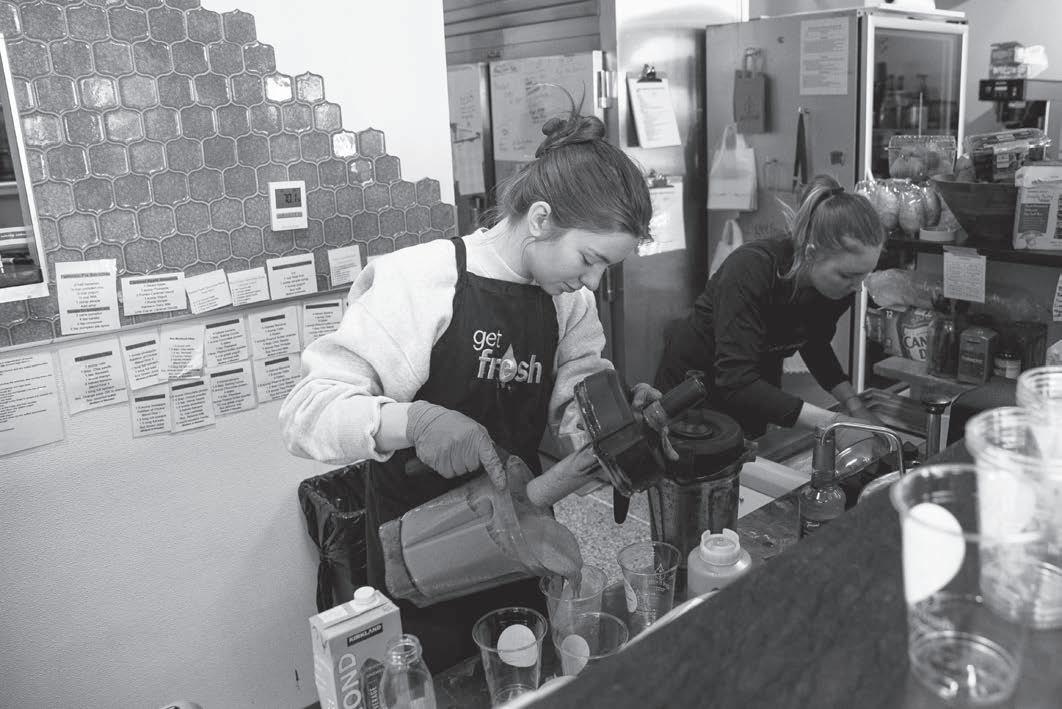
or Wendy immerman, owner of Get resh Cafe in Iowa City, she didn’t come in with an intricate business plan. Seeking a hobby, she saw an open market for healthier foods at the farmers market and decided to act on it.
I had two small children at the time who would come visit me at the farmers market, and all there was to drink for them was sugary lemonade and coffee, immerman said.
With immerman’s becoming a vendor in 2012, she said health juices were not very well known, and the theatrics of her blender got people’s attention.
uice was kind of a newer thing at the time, especially in Iowa. People wanted to know what we were doing, what kind of noise we were making over there, immerman said.
ne of the reasons immerman said the farmers market helps businesses succeed is that new establishments don’t have to rely on their sole business to attract customers.
ou’re at a farmers market or a public market or some sort of shared space. ou’re sharing customers. Like a customer might come to get a cupcake, but then they stop over to you and get a box of raspberries, or in my case, a smoothie, immerman said.
ver the many Saturdays immerman spent at the farmers market, she said she learned much from watching other business owners, preparing her to eventually open a brick-and-mortar.
I learned a lot. Even before it was a vendor, just watching other vendors, how they interact with their customers, what
kind of product mix they have, how they display their products, immerman said.
indred Coffee co-owner and Iowa City native Conner enkins and his business partner olly irby, who returned to Iowa inspired by gluten-free and vegetarian food in ri ona, and hope to bring variety to Iowa City. The cost to be a daily vendor at the farmers market is per day. enkins said this allows people to pursue a business at a low risk.
It’s a pretty low barrier to entry. The cost for the farmers market is so low, like it was only a day when we started, versus like multiple thousands of dollars a month on a lease, enkins said.
irby also said the market allows for flexibility when initially starting a business, with minimal penalties if you stop vending and the ability to maintain other jobs while getting started.
Bill Lane, recreation program supervisor of communications and special events for the City of Iowa City,
Arts and Humanities funds CLAS faculty projects
Faculty members in the fall and spring are awarded the grant for year-long projects.
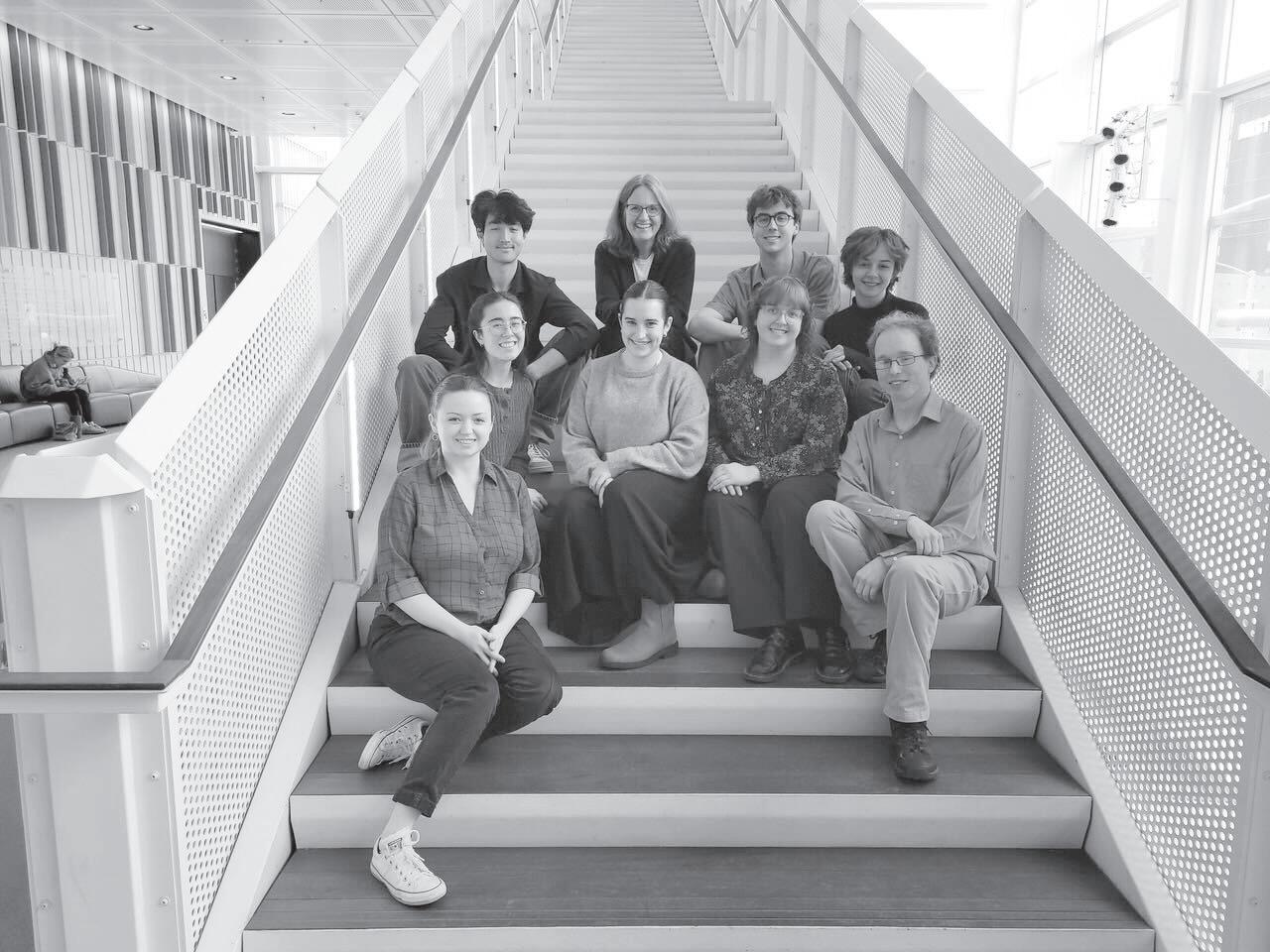
Eli abeth akes, director of the Iowa string quartet residency program, was one of nine faculty members to receive the rts and Humanities Initiative, or HI, award during the last award cycle. n annual program administered by the ce of the ice President for Research, the rts and Humanities Initiative awards three different types of grants to faculty members to fund creative work and research projects.
akes received the HI grant to provide funding to bring two string quartets on a study abroad trip to Prague for days in ugust, where they will study original works of Ludwig van Beethoven and nton n Dvo k, who wrote the merican uartet in Spillville, Iowa.
In my own work, I’ve just really come to understand that whatever music you’re studying, basing it in the geography and cultural context is so important, akes said. The HI seemed like a perfect opportunity to make my case about what I think the importance of this research is. nd from my perspective, it’s all true for the students as well.
ccording to the ffice of the ice President for Research, there are three different HI Grant categories, which include the HI Standard Grant for up to , for individual or collaborative grants; the HI ajor Project Grant for up to , for complex projects; and the HI ajor Conference Grant for up to , for new conferences, seminars, or workshops.
“The AHI is a really great internal funding opportunity for our colleagues who do work in the arts, humanities, and interdisciplinary work, risty abhan-
Warren, the associate vice president for research, said. akes’ study abroad trip will provide students with the opportunity to study the original collection of the composers in a more immersive environment and to perform their music.
said farmers market attendance ranges anywhere from , to , . Lane has worked with the farmers market for the last three years. Lane said over the years, he has continued to see the farmers market grow as he’s worked there. rom what I’ve noticed, especially with the vendors, we have so many vendors that are looking for additional space or looking for more dates, Lane said.
With high attendance at every farmers market, enkins said the experience helps businesses prepare for rushes.
It definitely prepared us to serve a bunch of people at once, which was very helpful. I’ve seen people go the other way, where they’re used to being only in a brick-and-mortar, and then they get to the farmers market, and you really have to learn how to quickly adapt, enkins said.
Beyond learning to handle crowds, the market also helped irby and
enkins to prepare financially for a permanent space. It allows you to generate income you can then reinvest in your business. We were able to upgrade our equipment and hire more staff. ur first couple of months’ rent we had ready to go from the farmers market when we first started our brick and mortar, irby said.
Iowa City’s farmers market is a producer-only market, meaning all products must be grown or produced by the vendor. Lane said this is a draw for Iowa City and the desire for many to shop local. It keeps it much more kind of community-based and much more locally based, Lane said. Especially when we’ve got a lot of things changing within our world, right now, I think that the farmers market can kind of provide that place where people can make sure that they can have that access to fresh and local produce.
Since we don’t have the actual people, much of the music we play is from people who are no longer living. Taking those scores and really immersing yourself and annotating them becomes the tool for passing on the information to the next generation, akes said. I’m so lucky that I get to work with these ama ing students who are going to be researching with me. aia lsen, professor of practice in
the Cinematic rts program, received the HI to develop a project called InTween Redux, an experimental moving-image narrative. The project will use performance-driven storytelling and advanced cinematography to create a visual narrative to tell stories through D imaging.
Olsen said the AHI grant allows the opportunity to integrate different ideas into a prototype that would be further researched and developed.
The fact that our school supports the arts and humanities is an important aspect because it’s so much of how we can
engage with the world and how we can try new things, lsen said. y work is very experimental, so it’s wonderful to have it supported. It gives me the ability to dig deeper on the research, run tests or experiments, begin doing the work behind the story, polish it off, and share it with the world.
During the application process, faculty include a list of budget line items for the project, an essay that describes how much HI funding they are seeking and justifies why it would be needed, a detailed proposal about their project and its foreseeable impact and importance to Iowa, and procedures and activities related to the project.
The recipients of the fall and spring funding cycles have one year to use the full grant they received. or the spring cycle, the application deadline was on arch , and recipients are set to be announced in ay.
During the spring funding cycle, a new requirement that was added onto the application, which is that an applicant has to have their budget approved by their department chair or administrator while they work on their application. abhan-Warren said a committee of faculty from performing arts, music, theater, and other related programs is formed to review and approve certain applications within three weeks.
Every reviewer is assigned three applications to look over, which include a primary, a secondary, and tertiary, abhan-Warren said. We encourage them to have discussions and meet, abhan-Warren said. We think that the process of having a primary, secondary, tertiary works really well. Everyone scores them, we add up the scores, and we fund the best top-ranked projects.
David Schwebel, the vice president for research, said the HI program brings more awareness and recognition to the different disciplines and the research that the faculty does.
“Those scholars are doing research in variation that is important for the whole world and makes society a better place, Schwebel said. It makes the university comprehensive. ur faculty and students do tremendous work, research, and scholarship creation in lots of different fields. We’re good at a lot of different areas and this initiative helps us be good in the arts and humanities.












‘NO KINGS’ in IC


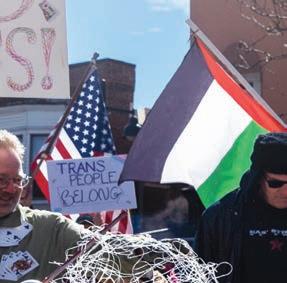
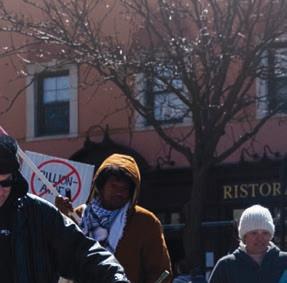
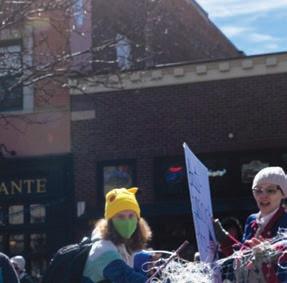
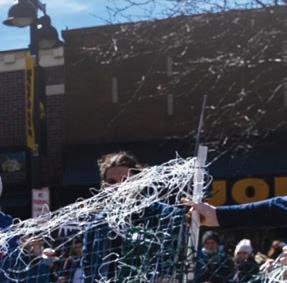
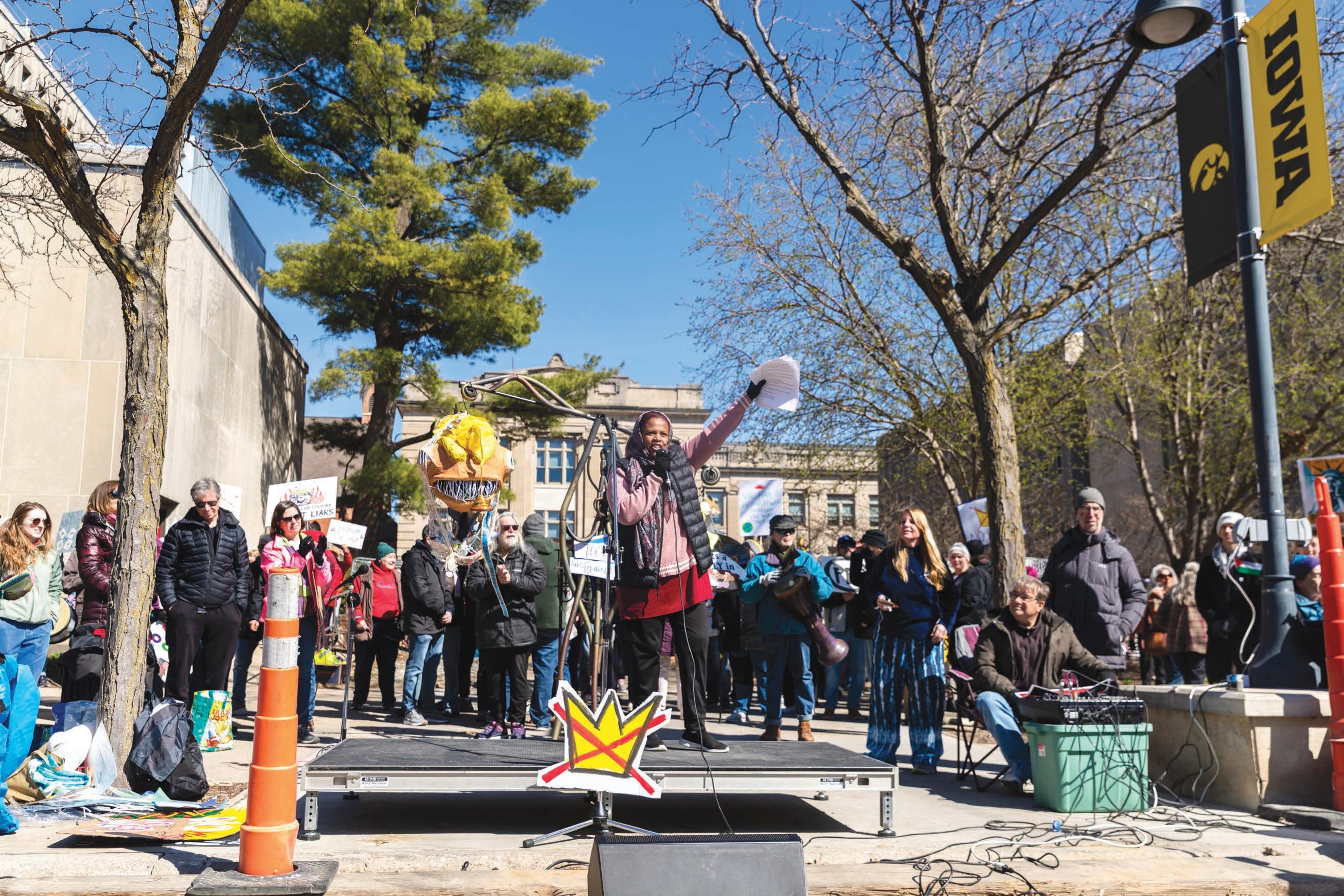
Around 1,000 protesters gathered in Iowa City on the morning of March 28 for the third “No Kings” protest, joining 3,300 rallies nationwide. Protesters of all ages marched around downtown Iowa City, sang, and made posters in reaction to the Trump administration’s policies.



















SPORTS McCollum’s historic run
Ben McCollum quickly established a winning culture in his first season coaching.
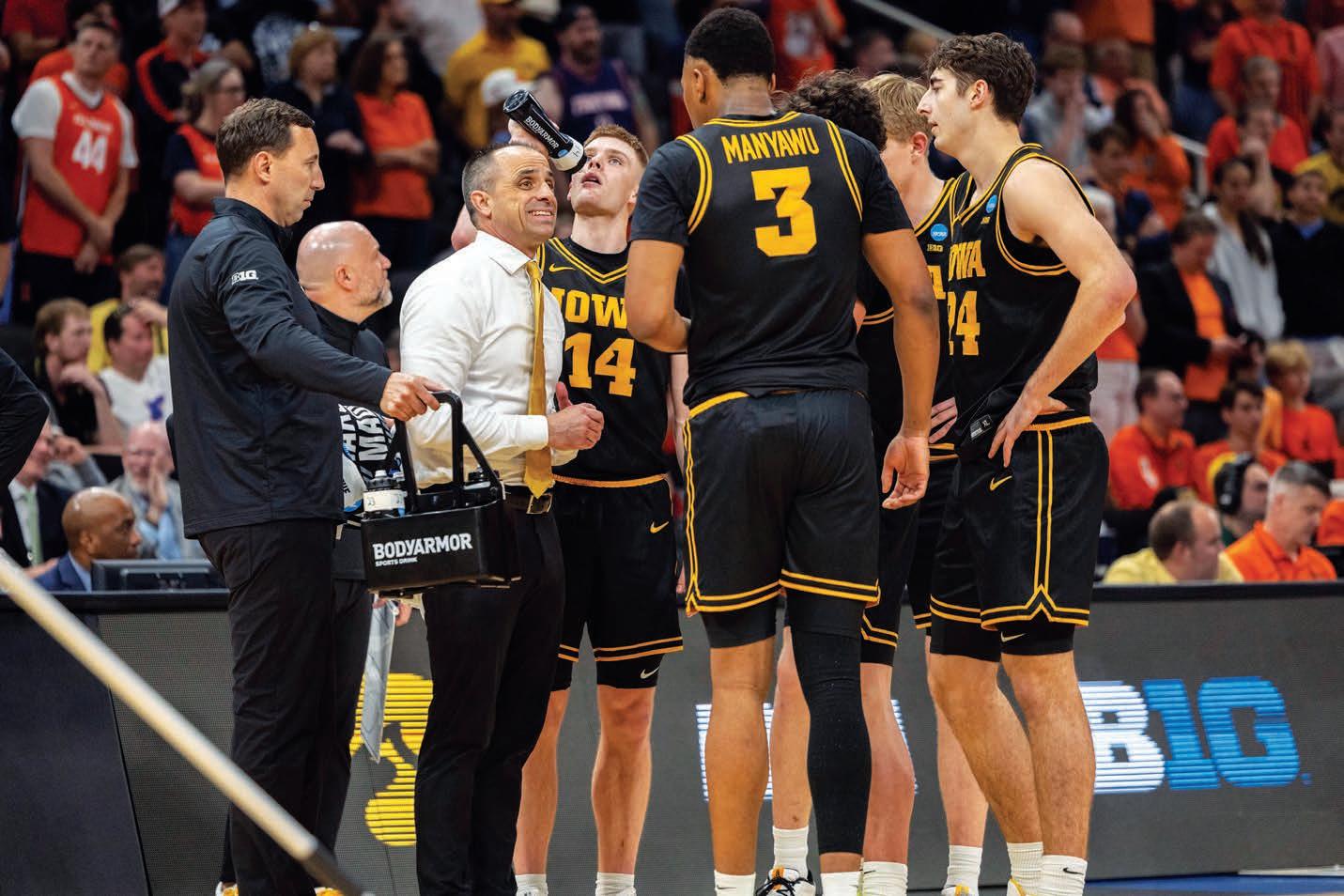
Ben McCollum has consistently tabbed Steve Tappmeyer as the best coach he’s ever been around. McCollum played at Northwest Missouri State under Tappmeyer from 2001 to 2003. There, he learned what “first-place culture” feels like.
McCollum detailed what that entails to Iowa realtor Gary Watts during a December 2025 appearance on the Watts Happening Podcast: extreme work ethic, competitive edge, and energy givers. Those are all intangible traits that can’t be taught; either you have it, or you don’t.
Since his playing days, McCollum has developed his version of a first-place
Relationship-building is the key to brutally honest coaching. Stay away from energy vampires.
Many more lessons have been woven into his winning mentality, which the world witnessed firsthand during Iowa men’s basketball’s magical 2026 NCAA Tournament run.
“When you have people that respect you, naturally, what you give is what you get back,” Iowa men’s basketball director of player development Xavier Kurth said. “And as honest as he’s been with us, in return, he gets a lot of loyalty, and he gets the best out of everybody.”
McCollum was only 27 years old when he succeeded Tappmeyer as the Bearcats’ head coach in 2009. By 28, he told his
15-point loss to 1-6 Truman State despite what he believed was a solid game plan. There was a clear disconnect between him and the players.
Timko asked her son to tell her what he said to his team in the same manner.
McCollum replied, “Stop! Stop playing so frustrated.” At that moment, he realized the negative energy he was coaching with and the change that was needed to turn things around.
After the 2010-11 season, Northwest Missouri State went on to win or tie for 12 of the next 13 regular-season titles — the 2012-13 season being the outlier — including seven straight outright titles during the rest of his tenure.
A lot of what McCollum preaches
Heartlanders defenseman reflects on career roller coaster
Nick Carabin has been with four ECHL franchises in two years.
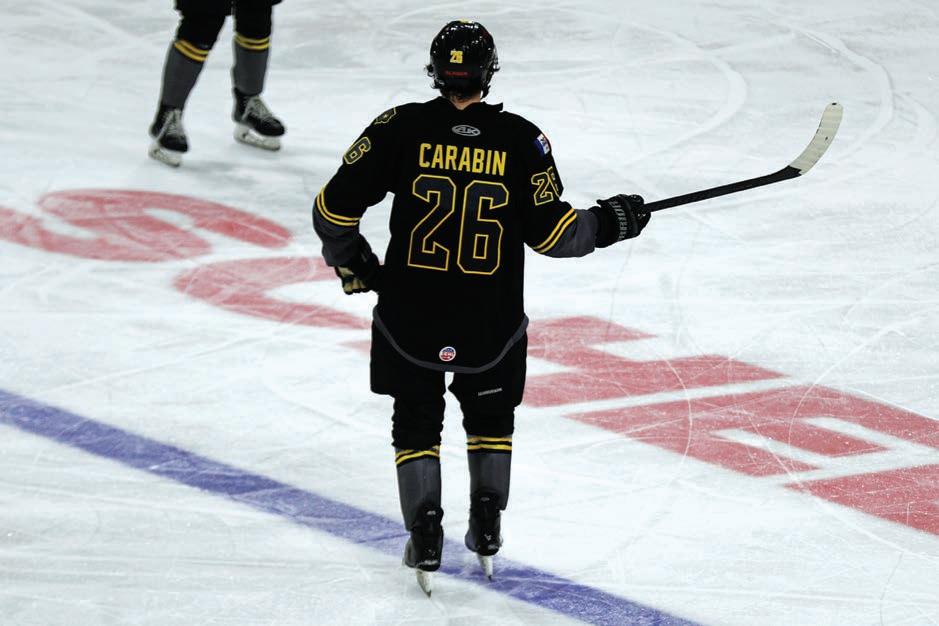
After getting into the game of hockey at the age of 5, Heartlanders defenseman Nick Carabin didn’t have to travel far to play for the next 13 years.
Carabin began playing for the North Jersey Avalanche, a youth hockey team near his hometown of Mahwah, New Jersey. The defenseman skated for the Avalanche from age 13 to 18. Carabin then stepped away from his childhood program, moving across the border to play for the Coquitlam Express, a junior team near Vancouver, Canada.
“I was only there for one season, unfortunately, but it was a great season, and I met a lot of friends that I’m still in touch with today,” Carabin said.
Princeton University began recruiting some of Carabin’s teammates at Coquitlam, but the New Jersey native caught the scouts’ attention with a couple of timely performances.
n his second tour of the campus, Princeton offered Carabin an opportunity to play hockey with its program.
Carabin joined his longtime teammate, Adam Robbins, at Princeton. Carabin and Robbins played together with the North Jersey Avalanche and the Coquitlam Express.
“We played about 16 years together, which is incredible because you rarely see that these days,” Carabin said.
With the prestigious history that Princeton carries, balancing academics and hockey was di cult, but Carabin and his teammates were along for the ride together.
It’s definitely a full-time job with the academics and the hockey, but going through the hardships together, and it was a lot of fun,” Carabin said.
While Carabin had an extra year of eligibility due to COVID-19, the Ivy League would not allow him to return to Princeton. Carabin decided to take the leap and transfer to Connecticut for his final season and start his B .
During his lone season with the Huskies, Carabin and the team made an appearance in the national tournament for the first time in franchise history.
“Our coaches really got the most out of our players that year,” Carabin said. “If they didn’t do as well as they did, I don’t think we
today stems from those first couple of seasons with the Bearcats, where he “hit rock bottom.”
“The lesson I learned is, be the change you want to see in others,” McCollum said during media availability ahead of Iowa’s Elite Eight matchup with Illinois on March 27. “If you want changes, change yourself first.
One of the lessons taught in McCollum’s favorite book, Good to Great by Jim Collins, is the Stockdale Paradox, named after U.S. Navy admiral James Stockdale, who was held prisoner of war during the Vietnam War. The ones who survived the imprisonment were those who accepted the harsh reality of the situation while holding the belief they’d
Coming full circle on the diamond
Pitcher Serayah Neiss followed her coach to Iowa, finding a welcoming home with the Hawkeyes.
In 2022, an estimated 13 percent of all Division I athletes across all sports entered the transfer portal, per the NCAA website.
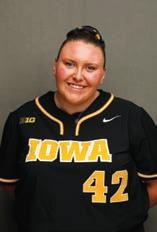
The portal, used by college athletes and programs alike, has streamlined the process of college athletes switching between different schools. As a Power Four program, Iowa has been a destination for many of these athletes, such as quarterback Mark Gronowski, guard Chazadi “Chit-Chat” Wright, and, after three years playing softball at Fresno State, pitcher Serayah Neiss.
“I honestly fell in love with Iowa,” Neiss said. “I really enjoyed the culture and community here and decided to transfer. It’s been so much fun.”
After a 2025 season that saw Neiss garner such accolades as Mountain West Pitcher of the Year and a first-team all-conference selection, the pitcher followed her head coach Stacy ay- ohnson, now in her first year in the same role at Iowa.
When Neiss discovered May-Johnson’s move, the pitcher wanted a shot to prove herself at the Big Ten level. May-Johnson, making her head coaching debut in the conference herself, was quick to praise Neiss for her competitiveness and skill.
“She’s got a lot of high intangibles,” May-Johnson said. “I think that a lot of what has gotten her to where she is are those intangibles. She could always spin the ball. She spins the ball really, really well, and that’s nothing new. She’s been able to do that for many, many years. But she just finds a way to get better and keeps improving.”
May-Johnson, a former collegiate player herself at Iowa from 2003-2006, also credited Neiss’s strength as a teammate, an underrated quality in today’s collegiate sports landscape with student-athlete compensation.
Finishing where it all began
Senior Riley Lewis will end her golf career at the end of this season.
s the mid-point of the season for the Iowa women’s golf team nears, senior Riley Lewis is hitting her stride. ollowing in her father’s footsteps, Lewis found herself on the golf course at a very young age.
I was always around golf, Lewis said. I tried a lot of different sports growing up, and golf was what I was best at. fter that, I just fell in love with it.
fter her sophomore year of high school, she decided against playing for her high school team and began to travel to national tournaments instead. The Illinois native then committed to head coach egan en el and her Iowa Hawkeyes at the beginning of her junior year and never looked back. fter my call with Coach egan, I knew Iowa was where I was meant to be, Lewis said. We instantly had a great connection, and I knew I was making the right choice. or en el, that feeling was reciprocated.
We knew that she was a feisty competitor, en el said. She was fearless, and we were really excited to have her.
When Lewis reached campus, she wasted no time getting to business.
In the spring of her freshman season, she earned the seventh best spring average at . as well as recorded the second lowest hole score of , both in program history.
unior emina Benites arrived just a few months after this incredible season and has looked up to her teammate ever since.
Riley is a great leader, Benites said. She always encourages us to do better and keep working hard, and it’s awesome to have a

teammate like that. The senior did indeed lead the way at their past weekend tournament in ri ona, finding herself with a sixth place individual finish.
y short game has been it for me lately, Lewis stated. I’ve been making a lot of putts and getting up and down to save pars. s the end of the women’s golf season approaches, the finale will be extra special for Lewis. The last tournament the Hawkeyes will attend before the Big Ten Tournament will be hosted by Southern ethodist niversity in Dallas, Texas — the very college her dad competed at during his collegiate years as well as where her younger brother is
Life-long Hawkeye reflects on
pursuing his golf career.
I’ve grown up playing this course since I was and it was first built, Lewis said. I’m basically wrapping up my college career at my home course with all of my family and friends there.
ollowing that occasion, the Hawkeyes will travel to California for the Big Ten championship, where they seek a regional bid.
Lewis will have competed in the Big Ten Tournament for all four years, something Iowa women’s golf hasn’t seen since . But for Coach en el, a different trait of Lewis’s stands out.
Riley is never afraid to tell you what’s on her mind or what she thinks about something,
Big Ten win
The Daily Iowan: What made you want to come to Iowa?
Kalen Walker: y decision to come to Iowa was a pretty easy choice for me, honestly. Both my parents went to Iowa, and I’ve been an Iowa fan my whole life.
I wanted to come to Iowa out of high school, but I didn’t have the marks, and I was already taking some dual credit classes at Indian Hills
unior College . When I was at Indian Hills, I improved and ran some good marks. Then Iowa track and field director oey Woody called me up and gave me the opportunity, and it was a no-brainer for me. I accepted right away. It was a walk-on, too, but it didn’t matter to me. I wanted to be a Hawkeye so bad.
What motivated you to start track and field?
I’ve been doing it since I was in junior high. I was at a small high school in Iowa, and we just
did all the sports. I played all the sports, and that’s what you did. I feel like at some of the big schools, you just have to do one and focus on because there’s so many good people. I think we had nine people on our track team at one point. ur basketball team had four seniors. Pretty much if you went out, you were on varsity, so it was fun. It wasn’t anything too cra y. Track was just another sport at the time. I was hanging out with my friends, and it was really fun because I wasn’t as worried about how I was doing. We would talk to girls from other schools and stuff at meets, too. That was fun.
en el said.
or seniors such as Lewis, it’s time to start thinking about what life might be like after graduation.
I have been accepted into nursing school, Lewis said. I haven’t totally decided where yet, but I’ve narrowed it down to about three choices. The senior hopes to complete a one-year accelerated nursing program and eventually become a pediatric nurse practitioner. But before then, Lewis hopes to soak in all the time she has left as a Hawkeye.
Don’t wish any time away, and be as present as you can, Lewis said. I’ve been very, very grateful lately for everything I’ve had here.

Do you have any other hobbies or interests outside of track? If so, what are they?
I love hunting and fishing and being outside. I like other sports, too. Like I said, I played football, basketball, baseball in high school. I like doing that kind of stuff, like hitting and batting practice, or going and shooting hoops, or playing pickup basketball. ishing and hunting is my favorite thing, though. I just bought a fishing pole last night in lorida, so I can go fishing here. That’s definitely one of my biggest hobbies for sure.
Who has been a big influence in your life and why?
What is your favorite track and field memory of all time?
y favorite track and field memory of all time is probably when I won Big Tens last year. I think the biggest reason for that is that I was going through a lot of injuries at the time, and I really had to work for that one.
ll of the struggles made it feel better when it actually came and happened. I also feel like I’ve been able to win the for a few years, but it just never lined up for me, so it felt really good to win.
Probably my dad, honestly. I don’t think he ran track ever in his life, but it’s inspiring how much he sacrifices for us. I know he goes through a bunch of crap in his life every day, but it just doesn’t matter.
He still gets up and does the work and provides all the time, no matter what. I’m having fun, but I know he probably is not having fun most days, but it doesn’t matter because he’s providing for us, and he’s happy we’re doing good. That’s pretty inspiring.
What sport should Iowa add?
Sports reporter Lauren Reed argues for lacrosse, and Logan Miller wants ice hockey.

When it comes to the hypothetical idea of adding a different sport to the niversity of Iowa’s athletics, there’s no doubt in my mind that lacrosse would be a popular choice.
irst of all, the noise behind lacrosse as an upcoming sport is loud. s of the spring season, over girls and boys competed in lacrosse leagues across the state of Iowa. It was declared by the C as one of the nation’s fastest growing sports, with interest from younger athletes peaking more by the day.
The Premier Lacrosse League, a men’s professional league that debuted in , saw a percent increase in year-over-year viewing numbers, per an ugust release. The Women’s Lacrosse League is now in its second year.
The fast-paced gameplay appeals
to audiences of all different sporting backgrounds, with its intense action and high scoring appeal. I mean, who wouldn’t want to watch players like former Duke Blue Devil Brennan ’ eill bulldo e through defenders and score dangerous goals from all lengths of the field? nd catering to this new team? o problem. The Iowa Soccer Complex already has a full-si e natural grass competition field with lights and seating. Lacrosse fields are almost the same si e as soccer fields and only need different nets and lines in the grass. ot too much of a burden for the university. ot to mention, the Big Ten conference already holds six schools with men’s and women’s lacrosse teams, including hio State, Rutgers, ohns Hopkins, Penn State, ichigan, and aryland. Why wouldn’t we want Iowa to join the bandwagon for a sport that’s consistently been on the rise? verall, adding lacrosse would bring attention to the university through increased high school recruits, new fan bases, and boost Hawkeye athletics as a whole. What’s not a win about that?

thletics and the niversity of Iowa are synonymous with each other. et one of the four major sports in merican culture has always been missing at Iowa and its varsity sports. It’s time to add men’s and women’s hockey to the I.
The sport has great momentum following the nited States’ victory against Canada at the ilan lympics, with both men and women’s teams taking home the gold medal and receiving national attention. t the end of , S hockey found that membership had grown by , players since the year prior. The timing couldn’t be better. The sport is on the rise. The Iowa volleyball team
already uses tream rena in Coralville, and it would be a perfect host for potential Iowa hockey teams. With the Iowa Heartlanders of the ECHL suspending operations for next season, the arena will sit dormant. This leaves a perfect opportunity for the I to not let the venue sit without a hockey team. The Big Ten features ichigan, ichigan State, hio State, Penn State, innesota, Wisconsin, and otre Dame with men’s squads. The Gophers, ittany Lions, Buckeyes, and Badgers also feature women’s squads. The Hawkeyes would fit in seamlessly and usher in a new chapter in I’s history. What Iowa fans wouldn’t want to watch the Hawks take on long-time rival innesota in hockey? The answer is easy; hockey being at the I is long overdue. The facilities are already in place, the conference is already there, and in a perfect world, the sport would exist at the varsity level.
make it through at some point.
This is the approach McCollum adopted this season. He and his staff knew the odds were stacked against the Iowa men’s basketball team. A team full of mid-major experience playing in what turned out to be the most competitive conference in all of college basketball. How well could the team adjust? And how fast?
The process was accelerated in terms of continuity within the Big Ten’s newest group. McCollum brought an army with him from Drake — five players, one incoming high school recruit, several assistant coaches, and many other moving parts to what made his lone year in Des Moines so successful.
But at the same time, there was no internal expectation with wins and losses, only to establish a culture. To do that, they needed to hit on the
Kurth being one of them. He played under McCollum from 2014-18, then was offered a graduate assistant spot right out of college. When the offer came through, Kurth was finishing his degree while working at Liberty High School alongside gym teacher and basketball coach Roger Stirtz.
Roger’s son was a then-15-year-old boy named Bennett Stirtz.
Stirtz was another follower of McCollum from the Division II level. The Bearcats were one of two offers coming out of high school for him. Now, he’s a potential fi rst-round B Draft pick thanks to McCollum bringing him along the last few years.
The star guard was always comfortable throughout high school, and McCollum was the fi rst person to ever push him outside that comfort zone. So when the head coach took what he called a “leap of faith” in going to Drake and then to Iowa, Stirtz jumped with him.
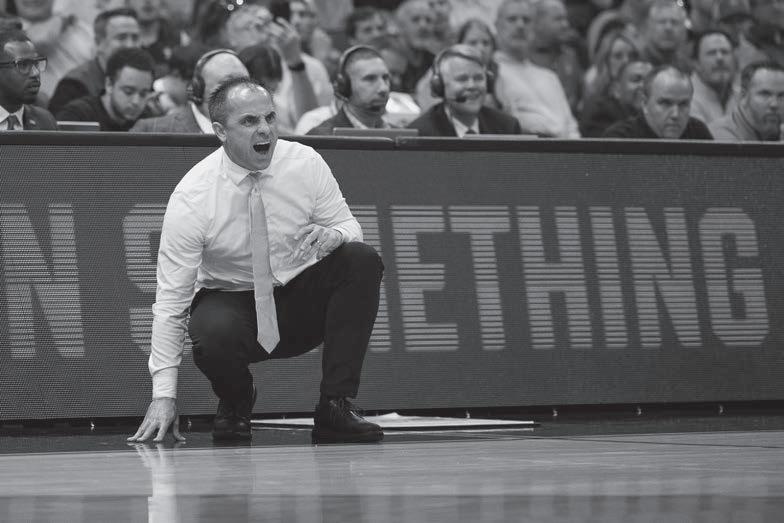
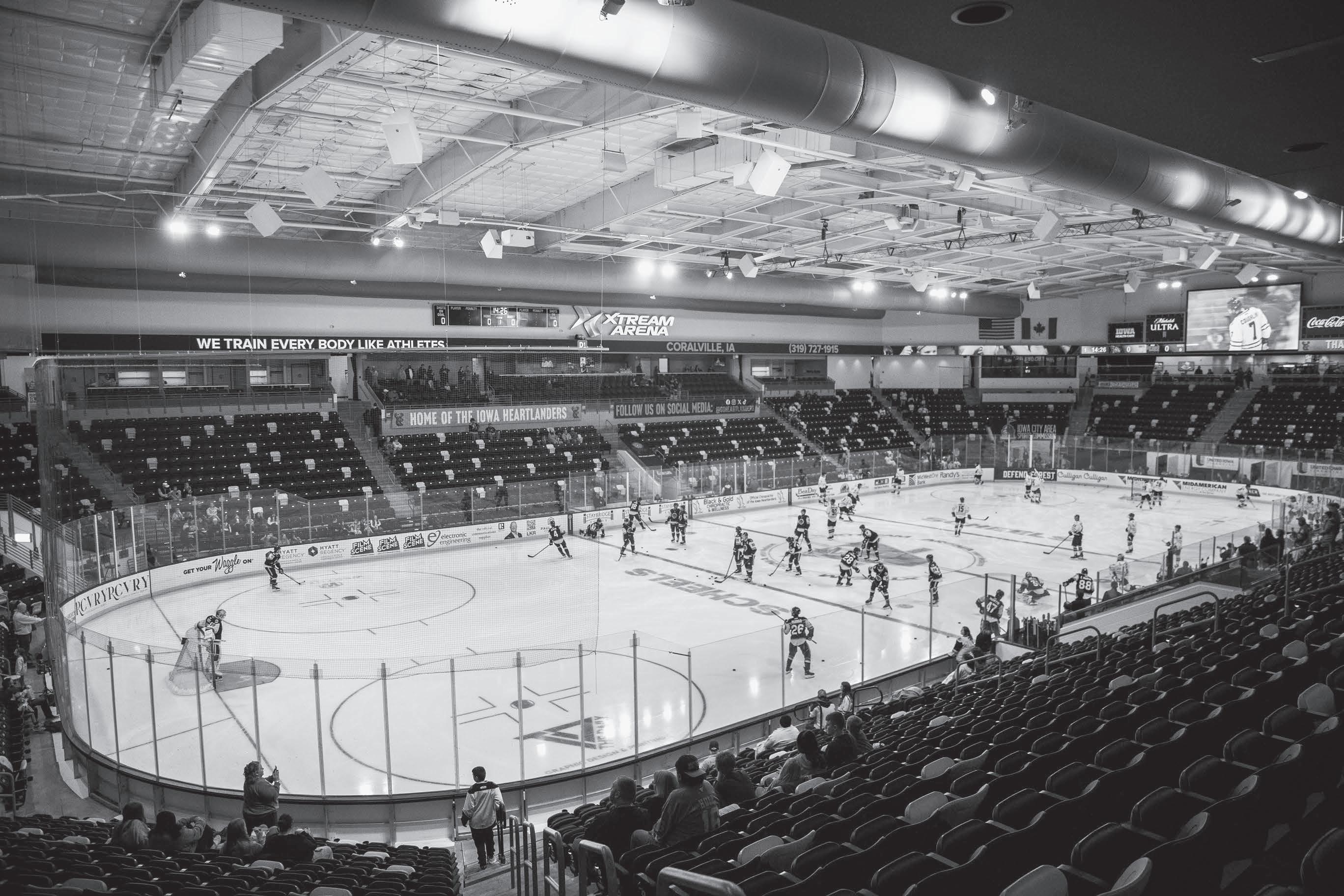
right players. That goal was clearly checked off.
It’s no different with the jump to midmajor, or to the Big Ten or Power Five,” Kurth said. “It’s the fact that you have a lot of people that believe in a common goal, and you fight for the common goal, and it has nothing to do with results.”
A select few people followed him from his Northwest Missouri State days,
“The discipline and everything sucks in the moment, but it makes you stronger mentally, physically, emotionally,” Stirtz said at media availability ahead of Iowa’s Elite Eight matchup with Illinois on March 27. “It makes you think that you can accomplish anything.”
He doubled down on his statement the next night after the season-ending loss.
“He made me into a better man and made me into the person that I am today,” Stirtz said. “These four years have been the best four years of my life.”
Ask him what his favorite McCollum trait is, and he’ll tell you that it’s his brutal honesty. Tavion Banks will say the same thing, too. The senior forward had his fair share of on- and off -court struggles, being benched and disciplined a few times throughout this season. Not once did he cave.
Banks has one potential year of eligibility left. He left no room for debate on where he’ll play next year if he retains it.
“I just took a leap of faith with [McCollum]. That’s how he got me here,” Banks said after the loss to Illinois on March 28. “Look at me, I made it to the Elite Eight. I just believe in him. Only time will tell.”
When asked why his confidence in McCollum was so high, Banks noted the relationship the two have built and how a big part of that was his head coach’s ability to “not sugarcoat anything.” Again, honesty. The picture gets clearer the more those a liated with the team talk about him.
McCollum is a top-notch gameprepper, an elite late-night crammer. He demands excellence and humbleness. He’s as good a relationship-builder as
any coach. He’s the most intense guy on any sideline he stands on. He wants to leave a lasting impact on anything he touches. His will to win is superior. More than anything, he’s honest — brutally honest with himself and everyone around him. That, of all things, has led to great success in all aspects of his life.
“If you’re a tough dude, this is a good spot for you. If you’re soft, and you like yourself way too much, this is probably not the spot for you,” McCollum said after Iowa’s upset win over No. 1 Florida on March 22. “We just try to recruit tough dudes who want to be a part of something bigger than themselves, and hopefully people see that, win or lose.”
between herself and Neiss, both athletes sharing playing time in the circle for the Hawkeyes, who rank ninth in the Big Ten with a 4.08 earned run average.
The chemistry between Neiss and Sapp, Iowa’s top two starters this season in terms
commitment to the future of the Iowa program remains the same.
“I’m really excited,” Neiss said. “I’m going to continue to just keep working hard for them and doing what I can, hopefully leaving this season with leaving it all out there on the field and having so
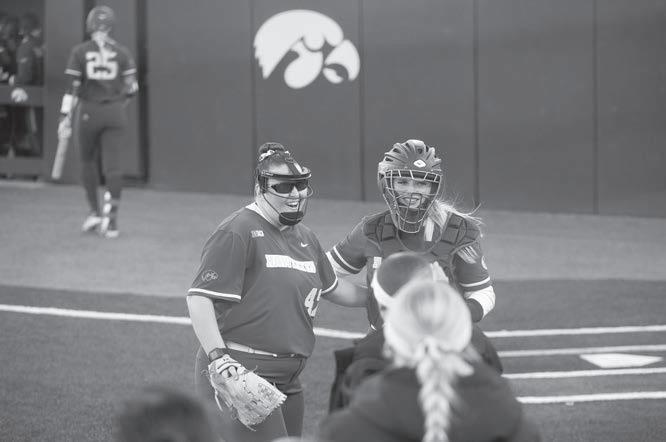
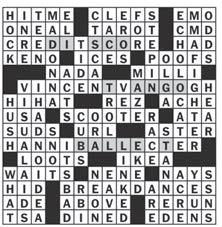









END OF THE ROAD
The No. 9 seed Iowa Hawkeyes men’s basketball team fell to the No. 3 seed Illinois Fighting Illini, 71-59, at the Toyota Center in Houston, Texas, on March 28. This was the Hawkeyes’ first time in the Elite Eight since 1987.
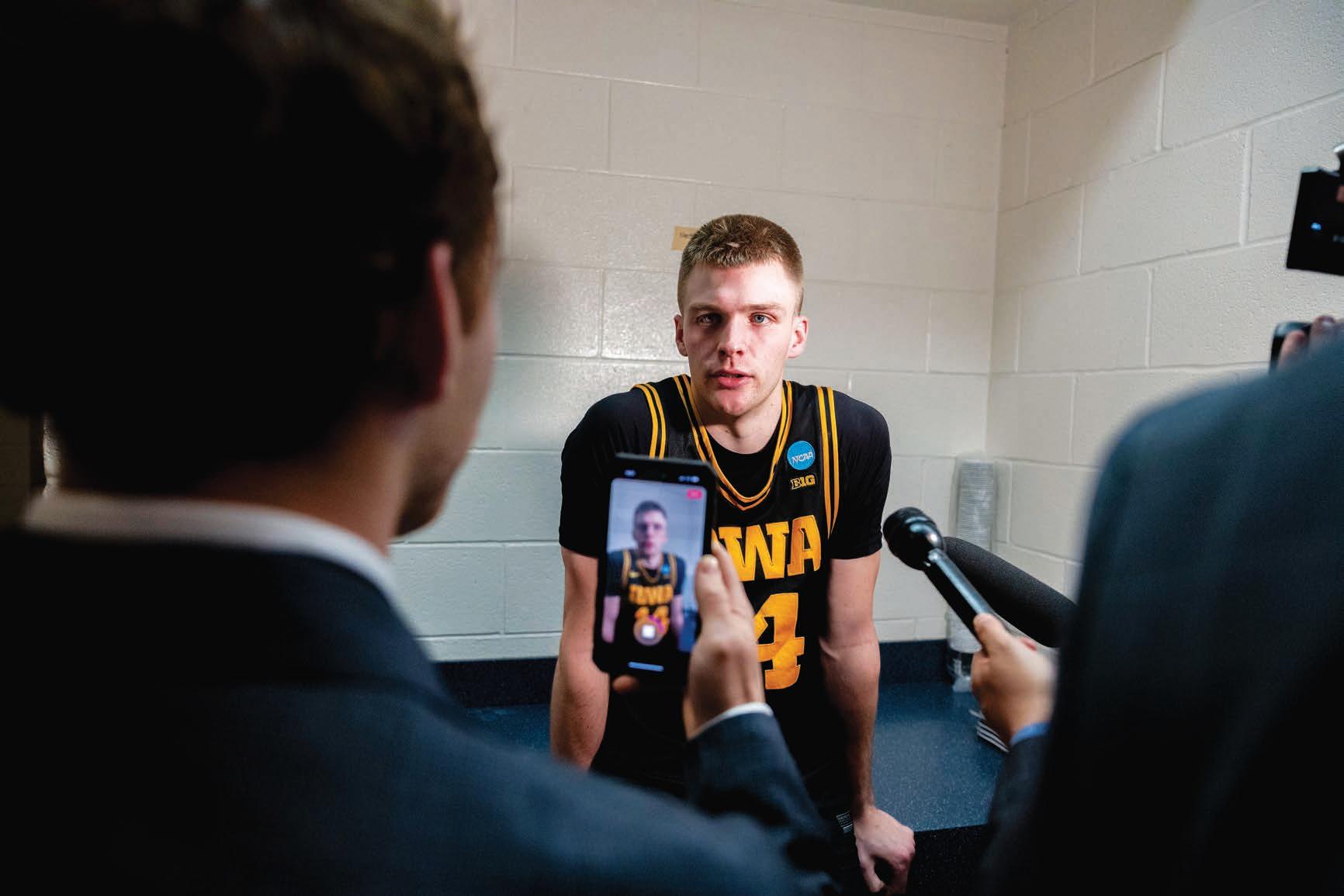
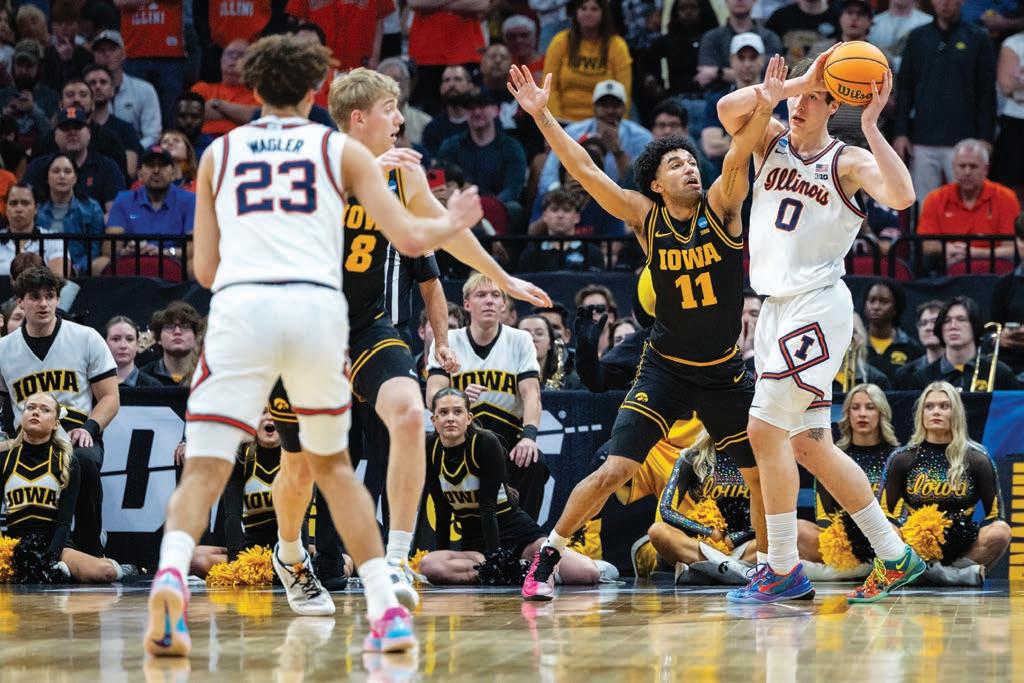
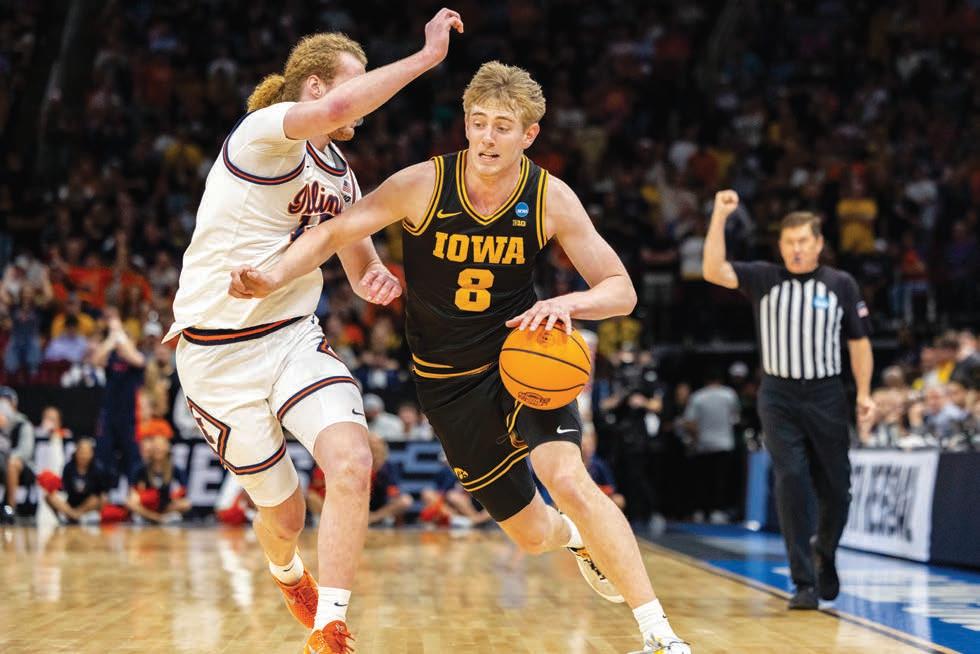

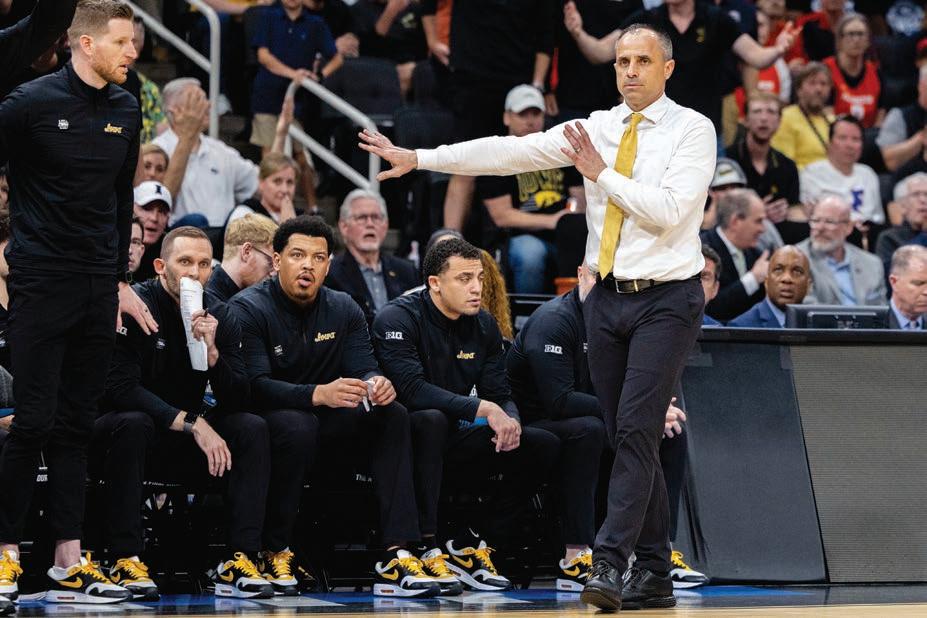
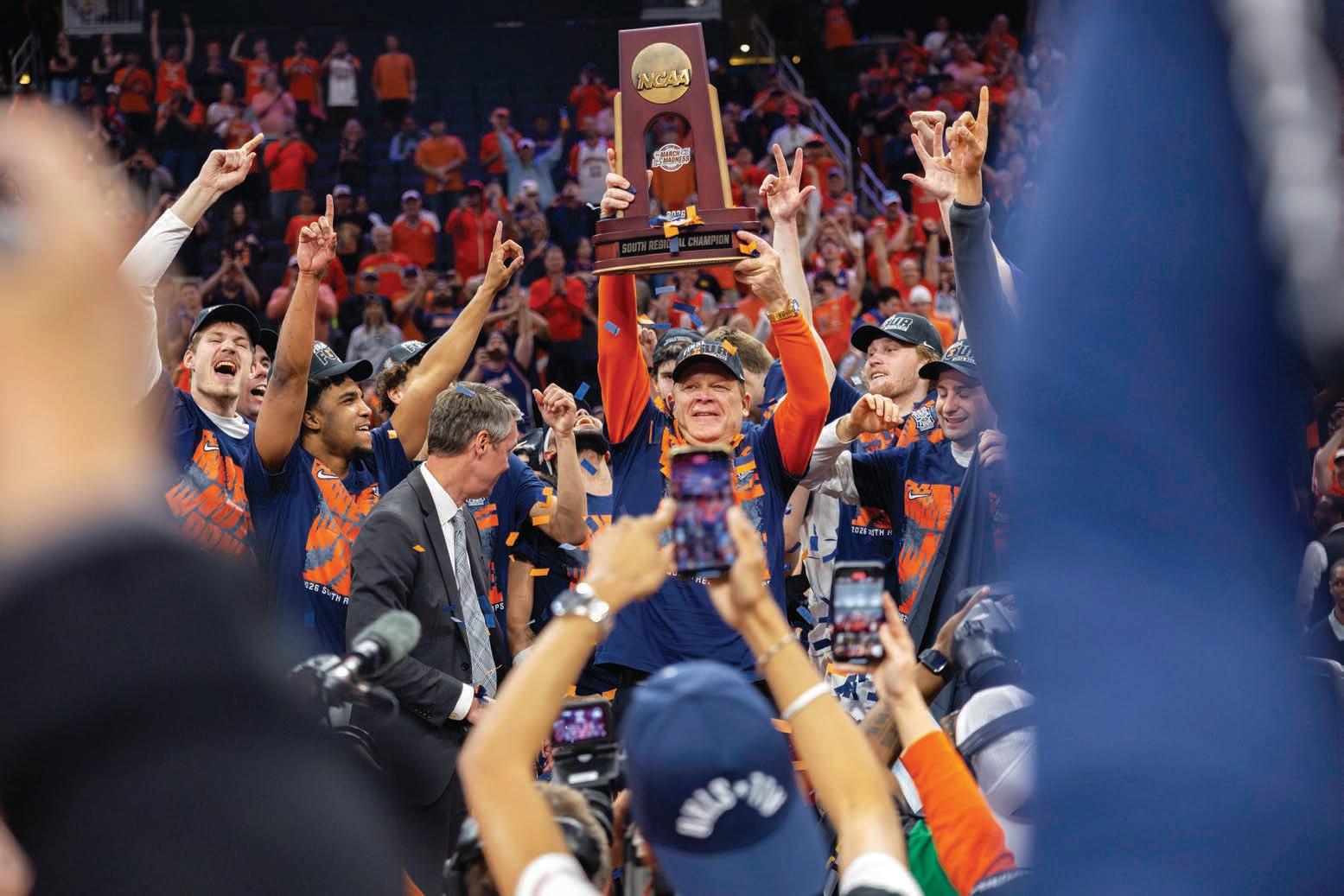











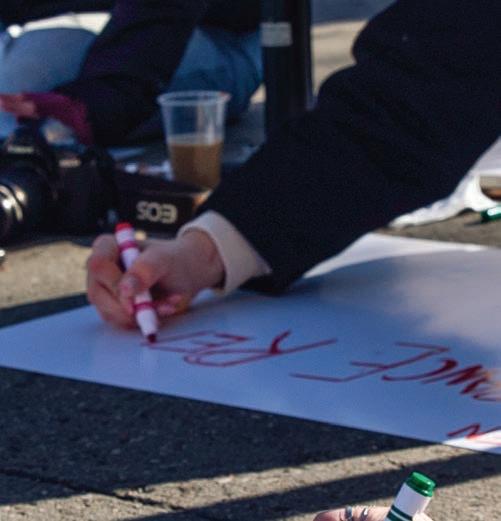


















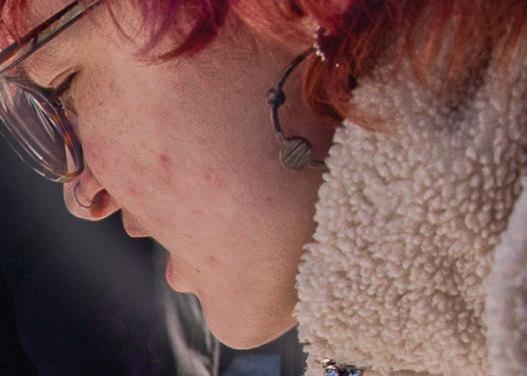
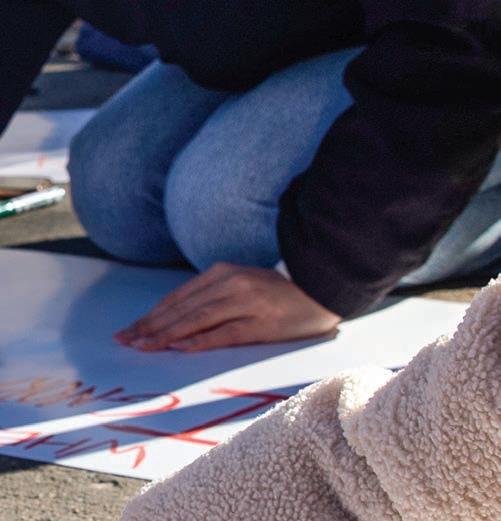
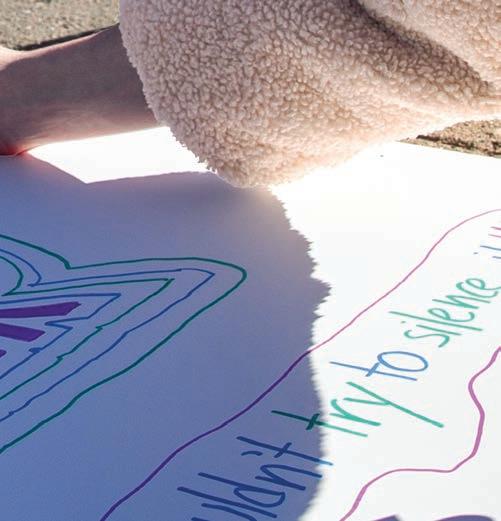





Posters and performance art communicated opinions at the "No Kings" protest. Artivism: the art of a protest


‘No Kings’ protesters communicate messages through art
From posters to performance art, a endees at the “No Kings” protest expressed their thoughts on various political issues.
Through small buttons, swaying flags, or posters to hold, protests become a unique form of artistic expression that allows people to not only communicate their beliefs vocally but also creatively.
n arch , attendees gathered on Iowa venue to make signs for the upcom ing o ings protest. The sign-making event was hosted by oters of Tomorrow, who had sent out a mass text to encourage Gen students to make signs.
College students sat on the ground drawing their messages on white posters, chatting and drinking coffee to stay warm.
ngelica Chaisson Cardenas, a thirdyear niversity of Iowa student and a lobbyist for the Child and amily Policy Center, was a recipient of the oters of Tomorrow’s mass text.
Her sign’s message read, This isn’t about politics, it’s about humanity. Because it really is, she said about her sign’s message. It’s so bad that it doesn’t even feel political anymore. To me, it’s black and white. What this administration is doing is fundamentally wrong. What they’re doing to people and to communities is just wrong. So I felt like my sign should express that.

Artist in Hancher’s Youth Art Show displays work
An
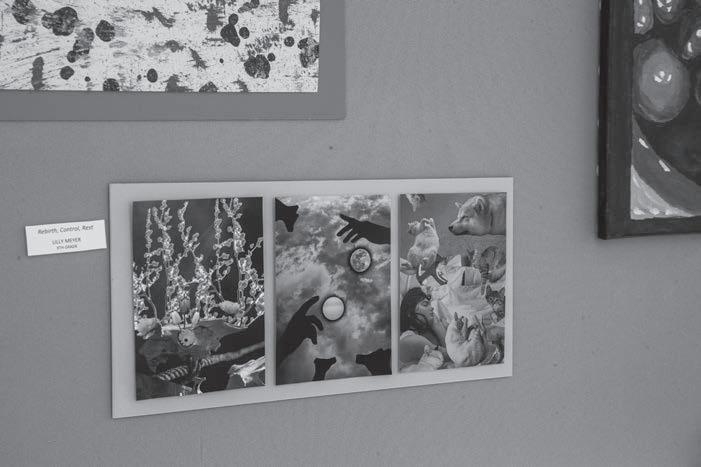
Lilly Meyer, a freshman at Liberty High School, talks
Lilly eyer, a freshman at Liberty High School, is one of many Iowa City students whose work was featured in Hancher’s outh rt Show. This year’s show consists of artworks from schools in the Iowa City Community School District, created by students in grades - . It will be displayed in Hancher uditorium’s lobby until pril . Lilly has been creating art since she was in third grade. Her interest is digital art, but she also draws and does sculpture. Her digital art piece titled, Rebirth, Control, Rest was featured in the show. or me, it’s just fun, Lilly said. I’m a wheelchair user, and art is something I can do that there’s no restrictions with my disability like a lot of other activities. Her piece consisted of three digital trading cards, as she described them, utili ing royalty-free photos online. or her first collage, Rebirth, she took a picture of an animal skull in her classroom and then added photos of flowers. The final collage featured pink, yellow, orange, and red flowers growing out of a grey animal skull.
The second collage, Control, featured the sun and moon set against a background of clouds. Surrounding the sun and moon were hand silhouettes and dog silhouettes in the bottom right of the collage. I named that one Control,’ like the hands are controlling something was the idea with it, Lilly said.
The third collage, Rest, also featured animals. s the name suggested, a dark-haired girl was asleep on a bed surrounded by cats and a dog also asleep. Lilly had chosen cats and dogs specifically because she liked those animals.
Hancher held a reception for the artists and their families on arch .
It’s a rming that someone liked something I made, then put it into an art show, Lilly said. ut of all of the kids that are in this school, mine out of -ish others was picked.
Hancher’s Patron Services anager Paris oung said that was one of their favorite things about the art show. oung has been in the position for nine years, and assisted
with the installation.
The kids get so excited, and their parents are so proud, and they get to come into this building that might seem really fancy or prestigious and they get to see their artwork up on the walls, oung said. I think that can have a really strong impact on kids to continue with the arts and arts education throughout their lives.
Their second favorite thing about the show was the impact it had on the community. Before and after shows, guests would walk around the lobby and have an opportunity to view all the artworks.
It’s just so fun to see everyone kind of come together around a single thing, before and after a show, and talk about the different pieces and be like, Hey, did you see this one?’ or I really like this one,’ or I know this kid’s parents,’ oung said. It really gives a sense of community.
Lilly’s piece was selected by egan Dehner, one of two art teachers at Liberty High School. The second art teacher, pril elly, also serves as a co-coordinator for the outh rt Show alongside Iowa City West High School teacher Christian anestad. elly had been the co-coordinator for approximately six years.
It’s so fun to see kids’ work all the way from kindergarten through seniors in high school displayed in the same space, because you get to see their journey along their art career, elly said. It’s a great way for the community to be able to experience the art curriculum and what we’re doing with students in our art rooms.
She hoped viewers would take away an appreciation for the works and the students’ creativity. She also hoped they would recogni e the importance of the - education system in the Iowa City district.
We have a massive amount of truly, truly talented students in our district that make ama ing things and will go out into our world and just continue to do ama ing things, elly said. There’s a lot that happens in the art room besides just putting paint on paper or sculpting something with clay we’re doing a lot of problem solving, a lot of st century thinking skills that employers are looking for later out in the real world.’ nd I think this is just the time that everybody can kind of see those skills come to life.
The survival horror game honors the series’ legacy.
Science fiction films are notorious for drawing thousands of eager fans to the cinema, and for many science fiction nerds like me, Project Hail ary was the next enticing film in the genre, and I was beyond stoked when it finally hit theaters after months of waiting.
While I was sitting in the nearly sold-out I theater — the movie only about halfway through — I knew that Project Hail ary had exceeded the expectations of myself and everyone else in the audience who were eagerly cheering and laughing along with the film.
Project Hail ary had amassed high expectations simply for the fact that the bestselling novel it was based on was written by ndy Weir, the same man who also wrote the novel for the highly rated film, The artian. lthough I hadn’t finished reading the novel before I saw the film, I felt like Project Hail ary was easily accessible for fans who were not familiar with the source material, while still staying consistent with many elements from the novel that book fans were sure to enjoy.
Ryan Gosling plays the main character of the film, Ryland Grace, and truly brings the character to life. Gosling’s performance was outstanding, portraying a range of both serious, heart-wrenching emotions and comedic, lighthearted ones. The audience was catapulted into an immersive rollercoaster of emotions throughout the film, riding along with Grace.
The alien species Grace meets, whom he names Rocky, was an awesome character overall, and I loved how diverse he was and how hilarious his scenes were. y favorite scene was when Rocky invites himself into Grace’s ship and decides to move in — it was hilariously adorable. ever in my life would I have expected to have such strong maternal instincts towards a pile of rocks, but here we are, because I would die for that little guy.
shocking aspect of the film I had learned after watching it was the minimal usage of green screens and CGI. Rocky was a fully operational puppet controlled by an actual person, and practically all of the sets were actually constructed for the film.
This gave Project Hail ary an added level of realness. ou could practically feel the care and attention the crew had put into making the film the best it could be, without having to rely on ample CGI. movie just feels better to watch when it’s filmed with real sets and props rather than poorly done CGI and special effects for everything. nother aspect of the film I really enjoyed was how accessible it was to a variety of fans. I’ve always been a science nerd, so watching all the experiments felt highly rewarding whenever I actually understood what the characters were doing. However, the film also explains all of the science involved in a very easily digestible way, allowing audiences not familiar with science terminology a chance at still understanding the film with ease.
It’s clear that Weir has a deep understanding of the science he speaks about in his novels, and it translates beautifully onto the big screen without feeling overwhelming or boring. This is also accomplished through the usage of comedic scenes that break apart the action and science talk, which were both extremely funny and good palette cleansers.
Honestly, I was just in awe throughout the entire film. rom the beautiful colors of space, the deeply complex and intriguing characters, and the high-stakes scenes that had me on the edge of my seat, I couldn’t pry my eyes away from the screen. or a film that was over two and a half hours long, I was surprised by how fast it passed by, and I can’t wait to watch it again, either in the theater or when it’s finally released on disk.
I recommend Project Hail ary to anyone looking to have an astronomical theater experience and anyone who wants a film that blends science fiction and comedy with ease.

Chalk Dance Theater creates space for personal fertility journeys
The theater weaves stories of pregnancy loss and infertility through dance on a shrouded stage.
humor, grief, and above all humanity to a common, yet not widely spoken about experience: pregnancy loss.
As a dancer and choreographer, dance is Marrs’ primary language of performance and communication. It is also a physical mode of performance.
The stage and performers are shrouded in black, a symbolic color of death and mourning, or power and protection. The canvas is blank, waiting to be covered with the powerful stories of an intimately connected past.
Slowly, this space is covered in white chalk, contrasting against the black emptiness.
Words are written down, lines are drawn and crossed out, and a circle is constructed center stage. The chalk moves with the performance, spreading across the stage and the performers’ costumes as they weave around each other in an abstract dance of reflection and storytelling.
“We have discovered that by storytelling through abstracted movement, we’ve been able to describe and embody things that are in some ways beyond words and really hard to talk about,” Kristin Marrs said.
Marrs is one of the co-creators and co-performers of the show “Chalk: Breaking the Silence Around Pregnancy Loss and Infertility,” which was shown at The James Theater from March 21-24.
In the show, she shares her personal story alongside fellow co-creator Anne Marie Nest, bringing complexity,
“Going through miscarriages, going through infertility treatments, are also super physical experiences,” Marrs said. “There’s something in a sense about reliving that in the body, and through that conveying the intensity of the situation to our audience.”
The utilization of chalk as a prop throughout the dance was inspired by the Bertolt Brecht play, “Caucasian Chalk Circle,” where a chalk circle is constructed to symbolize motherhood and the act of both holding on and letting go. For Marrs, this metaphor is what sparked the creation of “Chalk.”
“Connecting [“Caucasian Chalk Circle”] to my own infertility journey and how a lot of that journey was sort of recognizing what I have control over and what I don’t have control over, learning to let go was a big part of the process,” Marrs said. “Then I talked to Marie about this idea, and I was like, I think we should make a piece together about our shared journeys.”
Spurred on by the idea of collaborating with Marrs, Nest’s inspiration behind the creation of “Chalk” came from the connection between her own journey and that of her ancestors.
“I had wanted to tell the story of my journey with infertility and pregnancy
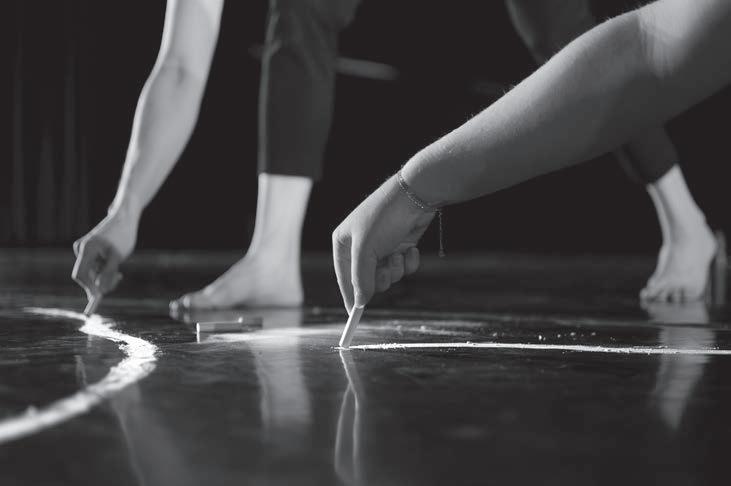
loss and miscarriage, and somehow, in my thinking, it was connected to my ancestors because both my grandmother and great-grandmother lost babies, and my grief felt in some way connected to theirs,” Nest said.
While “Chalk” is an intimate recollection of both Marrs’ and Nest’s journeys of infertility, they understand that their experiences are connected to the journeys of other women as well.
“From the beginning, we were very clear that we didn’t want this to just be about our own kind of emotional processing, not that that wouldn’t be valuable, but that we were reflecting on how isolated both of us felt as we went through these journeys,” Marrs said.
“Our hope is to be a presence for other women and their loved ones who have
In one segment of the show, voice messages from other women across the nation are overlaid and played back for the assembled audience.
Maximizing your spring semester
Ways that UI students can take full advantage of the warming temperatures this spring semester.
After terribly unforgiving winter conditions, the first ray of sunshine peaking through the obnoxiously strong winds and biting cold air seems like the most generous gift other ature can offer. Spring is finally here, bringing the long-awaited sun and gentler temperatures with it, and with that comes a noticeable change in energy across campus. In Iowa City, this moment feels almost magical and long overdue, especially for students who have spent weeks bundled up and rushing from building to building in a desperate escape from the cold. Suddenly, people seem to be lingering outside a bit longer, smiling a tad more, and looking for an excuse to soak in the warmer temperatures. With a refreshing change in attitude and campus-wide brimming of hope, there are plenty of underrated, simple ways for students to take full advantage of everything the spring months have to offer.
It hardly even matters where — at a café, spread out on a lawn, seated on a random

bench, on your balcony or patio if you’re lucky enough to have one. Studying and doing homework isn’t exactly everyone’s favorite pastime. Taking advantage of the fresh air, sunlight, and relaxing views, however, does wonders for your attitude during this unsavory task. Glamorizing the unavoidable work will not only make you less miserable while doing it, but it will also be more effective for many students who struggle to focus when locked up inside.
All that’s required is a net, some space, and a group of friends willing to have some competitive fun. With plenty of open fields available for setup around campus, spikeball or volleyball act as fun, active ways to take in the beautiful weather while spending time with your friends.
Beyond just fun, outdoor sports and physical activities also serve as a great friend-making method and low pressure way to meet new people.
Young adults are naturally drawn toward fun, and letting someone jump in on the game or asking to join another group is an easy, completely socially acceptable way to forge a new friendship.
As previously mentioned, a restaurant or coffee shop could operate as an ideal study spot for warmer weather. However, if you’re just looking for a dining experience or a serene spot to drink your coffee, outdoor seating offers an excellent opportunity to take advantage of spring weather and enjoy whatever you order with a side of fresh air.
Instead of staring at a wall or your laptop screen, you can now take full advantage of people watching, sun-soaking, and a lively campus atmosphere. After months of being cooped up indoors, it’s those little things that make life feel worth it again.
It’s finally time to ditch the bulky jackets that cover up any attempt toward a put-together outfit.
For students who express themselves through fashion and the way they present themselves, frosty temperatures provide a big obstacle. Without having to consider the possibility of freezing to death or how heavily you need to protect from harsh conditions, clothes and out-
fits become an easier, more fun aspect of everyday life. Bright colors, fun patterns, less layers, short sleeves — spring fashion exudes a fun, light air that shines in the place of thick, puffy coats. The prioritization of survival over style is in the past, taking limiting winter gear with it.
With our beautiful campus and the city surrounding it, there’s plenty of space to meander around between classes, get some exercise in, or simply avoid taking the CAMBUS everywhere. The days of struggling against the elements the second you step foot outdoors are behind us; now is the time to slow down, look around, and enjoy your surroundings. Even a quick outdoor walk can do wonders to help clear your mind, reduce anxiety, or simply break up the monotony of everyday life. Popping an earbud in and listening to your favorite music or podcast while breathing in the fresh air is an extremely underrated form of therapy. It’s a simple habit, but one that can have a big impact on your overall mood and well-being.

Dana Konz, a second-year UI student, had heard about the sign-making event through Instagram. For her sign, she had chosen the message, “Liberty, Justice for all, even people who don’t look like you, work like you, pray like you, and love like you.”
For the colors, she chose red, white, and blue.
“We’re doing this because we love America, and we care for it,” she said. “So, it’s important to show that we’re patriotic even in this administration because we love America, too.”
In contrast to the elaborate signs, Connor Buchanan, a first-year UI student, had written two words in black marker, “Send Barron.”
Buchanan was referring to President Donald Trump’s youngest son, Barron Trump.
“It’s protesting the Iran war and saying, ‘You wouldn’t send your own child, why should you send other people to die for it?’” he said.
He shared that he had chosen the simple, two words in black to convey a humorous message and state his beliefs against the war with Iran.
Anka Lampe, a first-year UI student, chose the message, “If your voice had no power, they wouldn’t try to silence it” for one side of their sign.
For the other side, they planned to write “No F—ing Way,” but to make it relevant to the “No Kings” protest, wanted to separate the “king” from the rest of the expletive.
“I just really like this because I think it encapsulates a lot of the reasons why people do things like this, you know?” they said.
“You could say it’s something little, and like your voice doesn’t do anything, but when a bunch of people come together, then it does matter.”
Some protest art communicates messages without words. Located on Iowa Avenue was a large art piece with a scale of justice and an inflated head of Trump on one side and paper fish with messages on the other.
Iowa City resident Lacy Powell had worked on the piece with a group of people from Indivisible Johnson County.
Powell, who attended the protest, explained that the fish aspect was inspired by the Iowa River and the idea of being more powerful as a group.
To further highlight the fish symbolism, Powell added there were people carrying fish posters at the protest.
“[Indivisible] had several signmaking parties, so you’ll see a lot of people today with protest signs that are actually shaped like fish and blue banners and things to kind of make it look kind of like a river,” Powell said.
“So, the tide of us all together even-

out of the corral until finally stomping the fence to the ground.
The act was a symbolic release of those imprisoned in deportation camps. The monarch butterfly makes a migrational journey to Mexico every year, symbolizing how migration is a natural phenomenon that borders — or in this case, fences — cannot keep out.
A performance is able to transpose an atrocity, emotion, or any deeper human experience in a way that brings the viewer face to face with what the consequences of current events. Artistic protest, like the forms found at “No Kings,” can often be more impactful than words.
On March 10, the Sacred Collective hosted the event “Making as Resistance: A Community Creative Workshop,” inviting people to create zines or personal booklets expressing their thoughts and feelings about current events. Participants at the event used their zines to convey their frustrations over the recent decisions surrounding the loss of funding within the Gender, Women’s and Sexuality Studies department.

Recent UI graduate Dana Egan is a protest artist who created the poster for the event.
Now holding a degree in anthropology, she had taken several gender, women’s,
tually could overcome, you know, the power of the few.”
On the other side, a large head of Trump hung from the scale. Powell described it as an anglerfish, or a predator on the food chain.
Plastic ice cubes along with other artifacts were hung in a net beneath the head, representing ICE, war, and other issues. The scale hung out of balance, the Trump head appearing lighter than the scale of fish on the other side.
“We are weightier,” Powell said. “We are more powerful than Trump, who thinks he’s the most powerful man in the world.”
These larger art pieces of protest can even become performance art. A large chicken-wire fence stood out.
With spiked design mimicking the look of barbed wire, a monarch butterfly was laid on the front facing side of the fence. In the middle of the corral, jackets stuffed with foil.
Throughout the protest, attendees around the fence took the stuffed jackets
sexuality, and African American studies in her time at the UI. She features those topics in her work which reflects her involvement in local and national political topics.
“I was already a very politically involved person, but those classes helped me not only be politically involved but also be really empathetic and sympathetic to everything going on around me and see how I can better help my community,” Egan said.
Her acts in creating art for protests don’t just stop at sign-making. Egan also creates stickers and buttons to hand out to people.
“I believe that my art is kind of a way to give back to the community in some way that will make people feel hopeful or remember what had happened so they don’t forget when they go home,” Egan said. “Having that symbol, like that physical symbol in your hand is just a reminder of ‘This happened. You were here. Thank you for being here and we have work to do.’”
She stressed how important art as a form of protest is to her and how that reflects in her signage.
“There’s a lot of times where I’m a little bit disappointed because there are not too many different body types or identities represented. So, I’ve been trying my best to do research about my own identities that I hold,” Egan said.
Egan added that while she works to include representation of who she is in her art, she also knows it is important to include representations of other kinds of identities.
“But then also with other body types and abilities and disabilities, and trying to put that in my art just to, first of all, make sure everybody’s included because I think that’s really important,” Egan said.
Egan described how she crafted a
poster for a “Gender, Race, and Politics: In and Beyond the University” event on March 9, an open mic night hosted by Lux, a political and cultural magazine, and other student organizations. Egan described the poster: a woman stood by a microphone with the words, “Speak your truth” written in cursive.
“The reason why I chose to draw her specifically is because I’m Jamaican, and the dress she’s wearing is a traditional Jamaican bandana dress,” Egan said.
“I did choose that very intentionally because that is part of my culture, and it’s something I don’t see represented very often, at least not here in Iowa City.”
“For the current students and previous students like myself, I just hope people can find different ways that they can contribute their talents to resistance efforts,” Egan said.
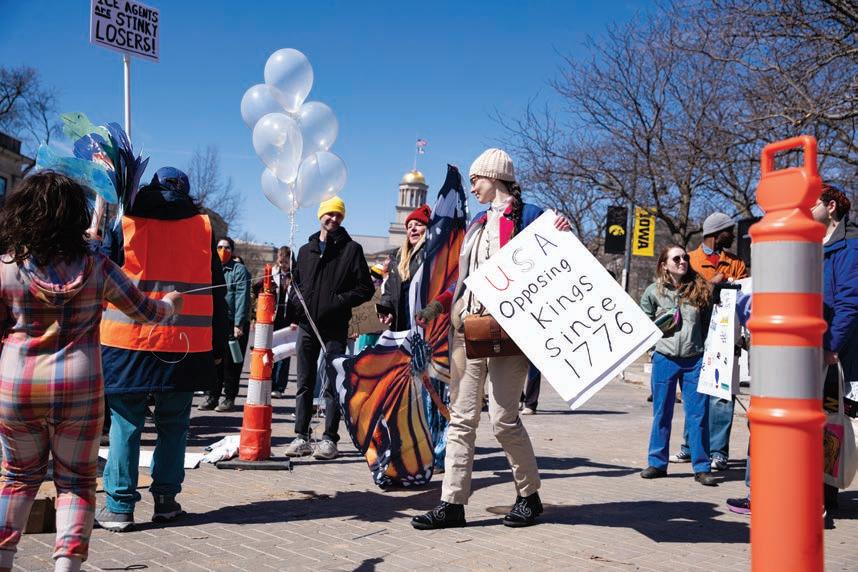










gone through this experience, so that they don’t feel alone.”
Another aspect of the show that reduced the feeling of isolation, which Marrs and Nest were trying to diminish, was the audience engagement and participation throughout. From holding onto and using various props to chanting along with the performance, the experience was a collaborative effort to push away the confinement women feel when dealing with infertility.
“As the show developed into this amazing work, I was just in awe,” Avery Provorse said. “It was so genuine — the way Anne Marie and Kristin performed felt like they were being so vulnerable and expressing their own experiences. They weren’t just performing, they were showing us what it was like and that really helped me draw connections.”
Provorse is a second-year University of Iowa student who worked to develop and manage Chalk’s website and social
media presence. She became involved in the show last year, after beginning an Independent Creative Research Fellowship with Marrs, who served as her advisor.
Provorse described Marrs as a “good mentor and human being,” and appreciated the fact that she always felt like a valued member of the team while developing the show.
“Being the youngest person in a group of people can be intimidating,” Provorse said. “But everyone was so inviting and treated me as an equal. I feel like that just built a space of comfort and understanding.”
Ultimately, comfort and connection are at the heart of what makes Chalk such a meaningful work of art. Nest and Marrs expressed their personal experiences through art, in the hope those experiences would resonate with others in the audience.
“In a time when reproductive health and rights are being so hotly debated and politicized, we hope that our artistic expression is just about the human heart and the soul,” Nest said.
Complete Idiot’s Guide to Jokes by Larry Getlin Idiocracy directed by Mike Judge