The Daily Iowan


























Iowa men’s basketball reaches Sweet 16 with historic upset, while the women’s squad misses out in double overtime.

knows this is what it can be,” McCollum said of the fan support after the win over the Cornhuskers. “It can be this every night, and it can be fun like this. I think [the crowd’s energy] willed us to victory.”
A grinning Ben McCollum stood at the podium with the Iowa Hawkeyes backdrop behind him, his iconic gold tie slightly skewed to his right. He scanned the room full of media members, some of his Drake-turnedIowa players, and other spectators welcoming him to Iowa City by wearing matching gold ties across their T-shirts.
The date was March 25, 2025. McCollum was officially announced as Iowa’s 23rd head coach in program history, three days after his Drake Bulldogs lost to Texas Tech in the second round of the NCAA Tournament.
He spent the first six minutes of his introductory press conference expressing his excitement to lead the team he idolized growing up in Storm Lake, Iowa. This is his dream job.
“I was born here. I lived here for four, five, six years of my life. And I cheered for the Hawkeyes for a long time. And now I get to be a part of their success,” McCollum said in his opening statement at his introductory press conference.
On March 22, exactly one year later after the NCAA Tournament loss with Drake, the Iowa men’s basketball head coach led the Hawkeyes to its first Sweet 16 appearance in 27 years. The on-court success is matched with the off-court achievement of rejuvenating a fading fanbase.
Former Iowa head coach Fran McCaffery struggled mightily through the last two years of his 15-year Hawkeye tenure, especially attendance-wise. What was once a program that averaged north of 12,000 fans annually saw numbers decline to under 10,000 fans a game. The 2023-24 season averaged 5,742 tickets scanned per contest, then declined further to 5,045 per game the following season, according to the Cedar Rapids Gazette.
With that, along with two-straight missed NCAA Tournament appearances, McCaffery was let go of his position. McCollum was very aware of the lack of fan support and constantly urged fans to show up if they wanted to see the winning results they so desperately wanted — and that’s what happened.
Not only did the Hawkeye men’s hoops host its best average home attendance since the 2022-23 season at 11,280 fans per game, but it compiled its best home record, 14-3, since that same season. One of those home games was a signature 57-52 victory over then-No. 9 Nebraska in front of a nearsold-out crowd. That win was a driver in the Hawkeyes making the 2026 NCAA Tournament.
“We’ve said it every single time we have something positive like this happen, we always make sure everybody
A 20-11 finish to the regular season tagged McCollum as the first Iowa head coach to secure 20 wins in their first season since Tom Davis had 30 wins in the 1986-87 season. However, a late-season collapse pushed Iowa down a 9-seed for the Big Ten Tournament.
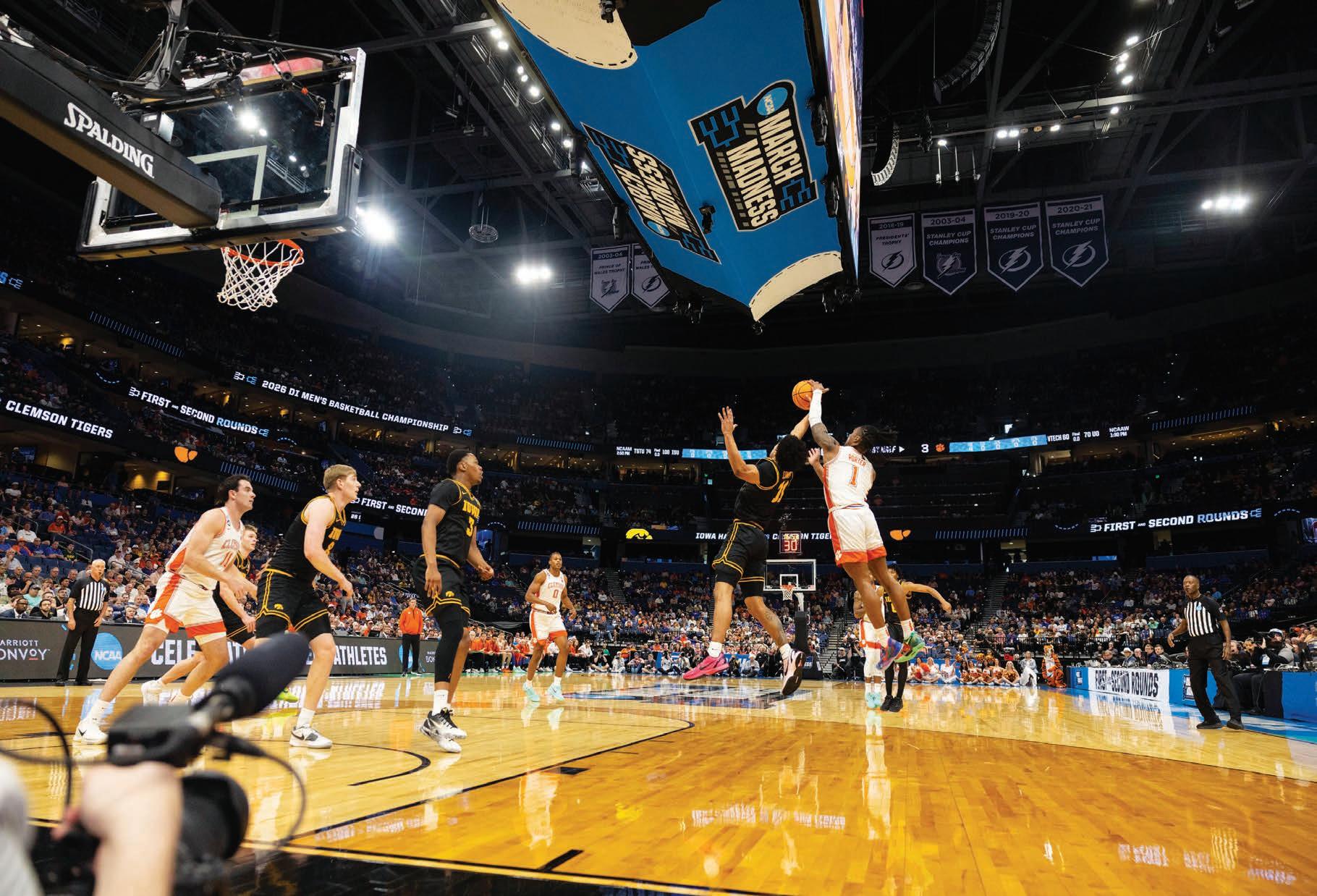
Iowa’s 75-64 win over Maryland secured another milestone for McCollum — his first Big Ten tournament win. The squad faced Ohio State the following round, a team they beat by 20 at home two weeks prior, and lost by three, 72-69. And then came the NCAA Tournament. The Hawkeyes did just enough to earn itself a 9-seed in the south region — the program’s first tournament appearance since 2023. Its March Madness road began in Tampa, Florida, against a banged up Clemson team. Iowa’s 67-61 first-round victory on March 20 marked its first tournament win since 2021.
Up next was its tallest task of the season in a second-round matchup with the defending national champion Florida Gators. The two opponents were virtual opposites in terms of size and rebounding, though McCollum already had Florida scouted before the Clemson game.
One of the reasons he’s been so successful as a head coach is because of his preparation. Bennett Stirtz and Cam Manyawu said McCollum approaches every practice and game like it’s an NCAA Tournament game. Now on the big stage, these games are no different than the other 34 games it played before mid-March.
“If you create the habit of being ready, then you don’t always have to motivate yourself to get ready for that game,” the Iowa head coach said during media availability on March 19.
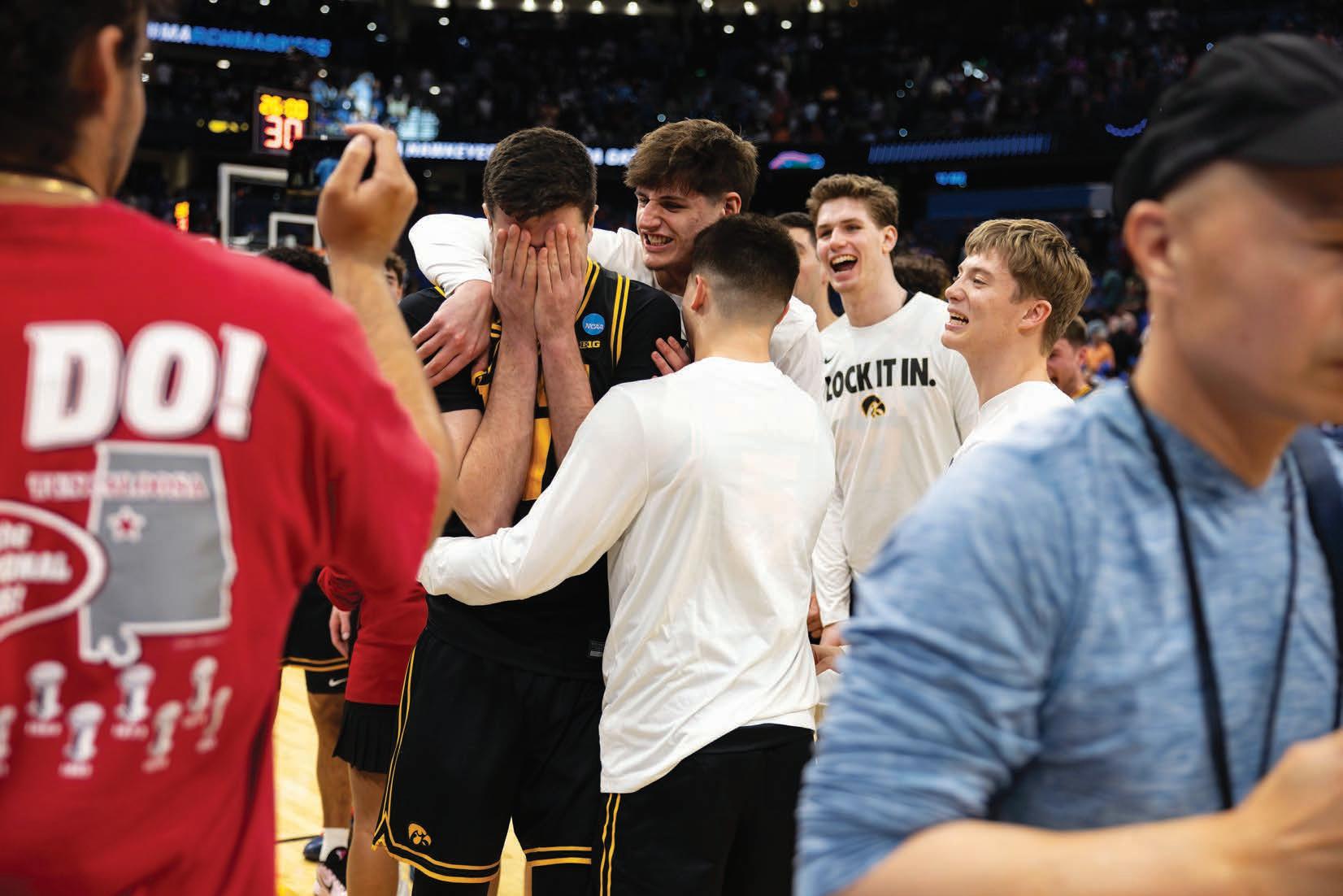
The Hawkeyes were more than ready for the moment when game time rolled around. After leading most of the game and a few lead changes in the last five minutes, it was Alvaro Folgueiras’ three with 4.5 seconds left to send Iowa to its first Sweet 1 appearance in nearly three decades.
McCollum’s resumé is now a lengthy one: four Division II men’s basketball titles at Northwest Missouri State, the firstever non-First Four NCAA Tournament victory for Drake since 1971 in his lone season with the Bulldogs, a 20-11 regular season record with Iowa in his first year in the Big Ten, Iowa’s first NCAA Tournament bid since 202 , first tournament win since 2021, first Sweet 16 bid since 1999, and the first -seed to beat a 1-seed since 2018.
“If you’re a tough dude, this is a good spot for you,” McCollum said of the effects this season will have on recruiting after his secondround NCAA Tournament
victory over Florida. “If you’re soft, and you like yourself way too much, this is probably not the spot for you. We just try to recruit tough dudes who want to be a part of something bigger than themselves, and hopefully people see that, win or lose.”
A joyous circle of orange juxtaposed by a line of stoic white: the picture of March inside Carver-Hawkeye Arena. Virginia women’s basketball players jumped among each other in excitement, reveling in their historic accomplishments while their Iowa counterparts stood waiting for postgame handshakes, restraining emotions, and staring at another season cut short.
Virginia won its third game in five days, becoming the first-ever women’s First Four team to advance to the Sweet 16 of the NCAA Tournament.
The 10th-seeded Cavaliers upset the second-seeded Hawkeyes, who failed to make the second weekend of the tournament in backto-back seasons. For a program with consecutive national title appearances in the rearview mirror, the road ahead features uphill expectations.
Such pressure was evident across Iowa’s first two games of the tournament against Fairleigh Dickinson and Virginia: a sold-out crowd collectively groaning with every clang off the rim, senior forward Hannah Stuelke clapping her hands in frustration after a critical missed free throw, head coach Jan Jensen gnashing her teeth on the sidelines on a contested shot.
On paper, advancement appeared given. Iowa was a 30-point betting favorite against Fairleigh Dickinson but survived by just 10 points. Nevertheless, the Hawkeyes were still favored by 13 against the Cavaliers. Call it the program’s recent legacy, its seeding, or its home court, where Iowa lost just one game this season, but outsiders predicted Iowa to thrive in the postseason. However, the program’s coaches and players never forgot their roots, where Iowa was predicted to finish outside of the top five in the Big Ten in preseason polls. Instead, the Hawkeyes took second-place in the regular season and advanced to the conference tournament title game. In two years with Jensen at the helm, Iowa is 50-18.
“I don’t think anybody expected us to be where we’re at,” senior forward Kylie Feuerbach said. Jensen said her team exceeded expectations, partly because of the star play of the underclassmen. Iowa’s roster is its youngest since 2012, when the Hawkeyes also lost in the second round of the NCAA Tournament. This season, two of Iowa’s three leading scorers were sophomores — point guard Chit-Chat Wright and Ava Heiden.
While the duo have previous NCAA tournament experience — Heiden two games last season and Wright one last year with Georgia Tech — they were never the focal points. Heiden came off the bench while Wright started but played off the ball, tallying 4 points and two assists in 33 minutes.
While the pair carried Iowa throughout the season, doing so amid the madness of March is a different challenge, one Jensen is still working the team through. The head coach lauded the pair for their success this season but also pointed out their limitations.
Heiden can simply take over a game when necessary. She scored 8 points in the fourth quarter in a February win over a ranked Michigan team, added 15 in the fourth against Fairleigh Dickinson, then tallied 10 in the third against Virginia. Nevertheless, she needs to stay on the court more often to have an opportunity to do so.
While not entirely in a player’s control, foul trouble hampered Heiden. The center recorded four or more fouls in a game 15 times this season. Against Virginia, she drew two whistles in the first five minutes and only played nine minutes in the first half.
“I think that we’re not here today without Ava,” Jensen said. “We’re extremely proud of her. I think today, that first five minutes was really the game.”
When Heiden is at her best, the center plays with feeling rather than thoughts, Jensen said. The head coach recruited Heiden out of Sherwood, Oregon, and remembered the player showing her a book on physics she bought as a Christmas present. Heiden was taking AP chemistry and calculus at the time and is now a finance major at Iowa. Jensen knows Heiden will soak up the analytics and strategy, but also needs to embrace the moment like she’s done in her productive stretches.
“If we can just get Ava a little freer and get her a little bit more understanding that she has just got to be her,” Jensen said. “I think she was kind of calculating all the things that she’s got to be and in the fourth quarter, was just like, ‘Forget it.’”
With Wright, the process begins with her being more assertive. She tied for the team lead in shots with 22 against Virginia, and her pull-up three-point attempt
at the beginning of the contest had Jensen clapping her encouragement. Wright improved her shooting from the field and deep from last year to this season, by five and 12 percent, respectively. Her head coach wants her to keep shooting but also take command of the offense.
“I don’t think I made as much strides with her to get a little bit more vocal, to get her a little bit more demanding,” Jensen said. “It’s hard in a big environment when the shot clock is winding down to get a play in or to get something set. That’s my big thing all year, to get her to take it over.”
At the end of regulation against Virginia, Wright settled for a missed turnaround jumper, but in the waning seconds of the first overtime period, penetrated the lane and fired a pass to Taylor Stremlow for an open look along the wing. Her attempt rimmed out, yet another example of Iowa’s perplexing shooting woes down the stretch.
Starting with its first round matchup against Illinois in the Big Ten Tournament, Iowa averaged 39 percent shooting from the floor, 2 percent from long range, and 52 percent from the free throw line over its five postseason games. These numbers are each at least 10 percentage points below the Hawkeyes’ season average.
“Super frustrating when you work so hard on shooting,” Stremlow said. “And I know everybody on our team works a lot. That’s a lot of hours. It’s just hard not to see that come to fruition.”
What Iowa’s roster will look like next season has yet to materialize. The Hawkeyes lose four seniors in Stuelke and Feuerbach as well as Taylor McCabe and Jada Gyamfi. The transfer portal can add, but it can also take away as players pursue greater opportunities elsewhere.
With Stuelke and Feuerbach leaving, the last player remnants of the Caitlin Clark era are gone, but the hype and attention around the team won’t diminish. As Iowa players walked off their home court one last time this season, they still stopped to sign autographs, faced swarms of reporters in the postgame locker room, and left hope for the future.
“My mom says college basketball is the hardest thing you’ll ever do,” Stremlow said. “But it’s the most rewarding.”

The decision leaves students, residents looking for a ordable alternatives.
seen the size of the products decrease because of tariffs.
This is an installment in in a multi-part series.
Iowa City grocery stores and residents have been feeling the impact of the Trump administration’s tariffs over the last year on items ranging from beef, milk, alcohol, imported goods, and national brands.
Last month, the Trump administration announced that global tariffs, which are import taxes used by the administration as trade bargaining chips, would be increased from 10 percent to 15 percent. The decision comes after the Supreme Court ruled 6-3 that imposing tariffs is a constitutional power of Congress and not the president. The ruling came on Feb. 20 with the tariff increase arriving just three days later on Feb. 23.
University of Iowa economics professor Anne Villamil said the U.S. Supreme Court ruling will be very impactful to the future of tariffs in the .S.
“The other thing about the Supreme Court ruling is that we’re going to get some of that certainty,” Villamil said.
Villamil said the tariffs President Donald Trump can enact will be 15 percent maximum and will last for 150 days. From there, the U.S. will have to negotiate trade agreements with the countries that have tariffs placed on them.
Villamil said Trump’s ever-changing tariff policy has created complications even before the ruling.
“Tariffs of 10 percent are not as high as they were earlier on,” Villamil said. “The president would impose tariffs of 25 percent, some days he’d say 50 percent on China, at one point they hit triple digits.”
While the ruling will offer stability going forward, much of the uncertainty stems from past tariff decisions and the timeline for them. Tariffs, she said, tend to have a lagging effect on markets.
“It usually takes about 12 to 18 months for tariffs to filter through,” illamil said, “So, we are starting to see some pricing pressure coming through.”
For Iowa City grocers, they have been feeling these effects for the last year.
The director of purchasing for New Pioneer Food Co-op, Sue Andrews, said most of their products aren’t heavily affected because they are from local vendors. However, some national products have been affected.
For national products such as General Mills’ Annie’s Homegrown organic macaroni and cheese, Andrews said she has not only seen price increases but also
“They’re shrinking the product but keeping it at the same price,” Andrews said. “That’s been reoccurring since the tariffs have been put in place.”
Andrews said the co-op has heard concerns from many customers regarding changing prices and sizes for items because of how educated the co-op’s customer base is. The co-op has tried to be as transparent as possible and works to have engaging conversations with its customers regarding the changing economics of food.
“Sometimes we might say, ‘Do you want to try this local brand, that is going to support the local economy?’”
Andrews said.
Andrews said the key for New Pioneer going forward is to focus on local and everyday low-price items to ensure customers can afford groceries.
For John’s Grocery in downtown Iowa City, the business has faced economic pressure from tariffs because of the store’s international alcohol products, General Manager Chris Moore said.
“The import beer has been the most disappointing because I feel like the margin is skinny enough that a lot of imported beer has just disappeared from the shelves,” Moore said.

Moore, who has been with John’s Grocery for 13 years, said the store’s imported alcohol selection is something that they have been proud of in the past and now it has become more expensive than ever to keep up.
According to an exclusive report from “Reuters,” when President Trump placed 15 percent tariffs on European Union, exports last July, it was predicted that prices of wholesale wine and spirits would increase by 80 cents per gallon on average. Some of the alcoholic beverages listed in the report were French champagne, Irish whiskey, and Italian prosecco.
Moore said that the brunt of the tariffs has been offloaded on distributors and consumers.
For consumers in Iowa City, they have felt the brunt of financial pressures of the tariffs over the last year.
Nadia Nik, a second-year law student at the UI, said she has noticed prices rising every month.
“I definitely feel it, especially when I am paying off my credit card,” Nik said. “I have noticed, like milk and eggs especially, I just feel like they have never gone down, also ground beef.”
According to a February 2026 data forecast report from the U.S. Department of Agriculture, the price of beef was 15
percent higher in January 2026 compared to January 2025. The department also predicts the price of beef to increase by 5.5 percent throughout 2026.
The national average for a pound of ground beef in January 2026 was $6.75, according to the Federal Reserve Bank of St. Louis. The national average in January 2025 was $5.54.
To combat the rising beef prices, the Trump administration decided to increase its beef imports from Argentina in late October 2025. This decision drew criticism from U.S. cattle producers who said the decision would hurt U.S. cattlemen and women, and it wouldn’t lower the price of beef.
The .S. then changed the tariff rate quota to allow Argentina to import 80,000 metric tons of beef without tariffs. An import tax structure that places tariffs on supplies of foreign goods that exceed an established quota.
When it comes to eggs, the same U.S. Department of Agriculture report says the price is predicted to decrease by 27.4 percent throughout 2026.
Every item listed in the report, except eggs, is predicted to increase in price throughout 2026. The other items listed
were pork, poultry, fresh vegetables, fresh fruits, sweets, and alcoholic drinks.
UI third-year business student Sam Jacobs has also faced financial problems with some of the same items as Nik. Jacobs said he has seen rising prices for all items and specifically pointed out eggs and milk, and it has had an effect on his monthly spending.
“I would probably say $20 more,” Jacobs said.
Villamil said the best practice to avoid rising grocery costs is to substitute your items. This can look like buying similar items that are cheaper or buying storebrand items instead of name-brand.
Nik said she has had to start switching out her pantry staple items with cheaper store-brand items as prices increase.
Iowa City resident Jack McGrane said he has already been substituting food items due to rising costs of name-brand items.
“I tend to do that anyway,” McGrane said. “Especially if something’s a little higher, I’ll get a store-brand version.”
Mc rane said he tries to stay flexible with his spending habits based on prices, but has still felt the financial pressures.
“Definitely eats away at the extra spending money,” McGrane said.
The U.S. Department of Agriculture reports six flocks in Iowa have avian influenza.
According to the United States Department of Agriculture, or USDA, six flocks in Iowa have been infected with H5N1 avian influenza in 2026. By the end of March 2025, USDA reported that Iowa had the same number of flocks, ending the year with ten total flocks infected.
Four of the flu ridden flocks this year have been small, backyard poultry farms, while the other two have been larger-scale, multi-species hatcheries, a facility that breeds and hatches birds raised for hunting or release.
There have been no detections in commercial poultry flocks, or a flock that is intended for large-scale production and sale, in Iowa as of March 23.
One of Johnson County’s small poultry flocks lies in Simple Maple Farm in Solon, which keeps around 50-60 egglaying hens at any time of the year.
Bethany Bird, the owner of Silver Maple Farms, a diverse 20-acre farm that grows organic produce and raises poultry and livestock using chemicalfree practices, said it is hard to predict if this year’s influenza outbreak will lead to a period of rising egg prices as it did last year.
Bird said that during the 2025 egg shortage, Simple Maple Farms and other local options drew more demand because their egg prices remained steady while commercial egg prices continued to rise.
“Suddenly our eggs were more affordable when previously they had not been,” she said. “So we saw a lot of people, especially at the Farmers Market, shifting over to getting their eggs locally, and we’ve just kept our price consistent.”
Bird said Simple Maple Farms raises its birds on a mobile tractor system rather than allowing them to free-range or roam on their own on the pasture.
Bird said their mobile coop comes with a tarp roof and chain-link fencing, providing the benefits of being outdoors without the risks of predator exposure or cross-contamination with other species.
Bird said the mobile tractor system puts the farm at less of a risk of influenza exposure than other small backyard operations or large commercial operations.
“It’s hard to control what’s in your area and, like, what your birds are exposed to if they’re just free-ranging
in your backyard,” she said. “The risk with the large operations is if one bird is exposed, and then the whole flock has to be culled. That’s hard to recover from financially.”
Yuko Sato, a veterinarian and researcher at Iowa State who specializes in poultry health, said avian influenza has affected roughly equal numbers of commercial and backyard flocks nationwide.
The USDA reports an equal split between commercial and backyard flocks: 40 flocks in each category from Feb. 21 to March 23, totaling 80 flocks and 10.1 million birds affected by the outbreak.
Since the beginning of the outbreak in 2022, bird flu has been detected in 2,170 flocks: 989 commercial and 1,181 backyard, according to the USDA.
Sato said that while the virus can theoretically infect any flock, backyard birds have a unique risk of being exposed to wild birds that carry the virus.
“Most of the commercial poultry, they are raised indoors,” she said. “The risk of backyard poultry is that most of them have some sort of outdoor access, that’s usually the point of introduction, basically the contact, whether that’s direct or indirect, with wild birds.”

Sato said she tallied the numbers of laying hen losses reported by the USDA and found that roughly 13 percent of production was affected by avian influenza in 2022, 5 percent in 2023, 13 percent in 2024, and 15 percent in 2025.
Sato said egg prices could rise in 2026, similar to last year, if the outbreak continues to mount, especially as the Easter season brings high demand for shelled eggs.
“At this point, we have lost about four and a half percent of egg production, and we’re in March,” she said. “At this point, we’re already near the 5 percent mark, which is what we had in 23. It could be as bad, or just as equal to 2025.”
Sato said the avian influenza is problematic because it is highly contagious; once it has entered a flock, all poultry operators and health officials can do is attempt to prevent it from spreading to other flocks.
“It’s not like you can segregate the birds that are affected and the birds that are not affected, that are fine,” she said. “The common practice is, if you have a site that is infected, the whole flock goes down.”
Sato said quarantining the six Iowa flocks with avian influenza is key to preventing its spread to other flocks
across the state.
“It’s no different than COVID,” she said. “As soon as you know you have COVID, and you hunker down, you are less likely to spread it to someone else or a group of people. You’re not going to go to a church event, you’re not going to work because you’re like, ‘I’m still infectious.’”
Sam Jarvis, community health division manager for Johnson County Public Health, said that while the county is vigilantly monitoring the outbreak of avian influenza, Johnson County birds are rarely affected by the disease.
“We don’t get a whole lot of those alerts for our area,” he said. “We have a small amount of dairy farms or industry in our area. Certainly, our surrounding counties have a lot more agriculture in terms of dairy and poultry.”
Jarvis said if the disease were detected in counties near Johnson County, the public health department would continue to monitor cases reported by the Iowa Department of Agriculture and Land Stewardship and would work with state partners, such as Iowa Health and Human Services, to alert residents.
“Obviously, if there were to be a risk
that would expand to others in the general population, we would make sure that information is shared with the general public,” he said.
Jarvis said he advises Johnson County residents to get vaccinated against the seasonal flu to protect themselves from future concerns about avian influenza and other flu outbreaks.
Jarvis also said residents should refrain from approaching dead birds. If residents, such as backyard poultry farm operators, must handle dead birds, Jarvis said they should wear proper personal protective equipment, or PPE, and maintain good hand hygiene to prevent themselves from the flu.
Bird said that as avian influenza continues to spread across the nation, she hopes customers will purchase from local options, which are able to set their prices outside of the typical market price for eggs.
“When we have monocrops or huge operations that are not diversified in any way, the risk is super high; their whole business can be wiped out for a period of months,” she said. “We’ll see smallerscale diversified local sheds stepping in as an affordable solution.”

Incel culture and anonymous image boards like 4chan are responsible for looksmaxxing, a new trend largely embraced by younger men, focused on meeting impossible beauty standards through bone crushing, leg lengthening, mogging, and unconventional techniques.
Looksmaxxing is fuel to the beauty standard fire, further perpetuating toxic masculinity and increasing the risk of body dysmorphia and social comparison in younger men.
According to Northeastern Global News, looksmaxxing is the optimization of achieving “peak” physical appearance through mild strategies, soft-maxxing, like skin care, fitness, dieting, grooming, and style to more extreme approaches, hard-maxxing, that involve surgery, disordered eating, self mutilation, and more, all for the sake of peak physical worth.
Looksmaxxing’s initial popularity grew out of obscure online subculture communities in male-centered message boards and forums, such as lookism.net and incels.me.
They discuss “lookism,” or discrimination based on appearance, and encourage these sometimes extreme methods to each other and other users.
Clavicular, a 20-year-old U.S. streamer and influencer, has been credited in bringing looksmaxxing into mainstream content with being a so-called leader for the community. His growing social media platforms include content sharing his “aesthetic engineering” and
extreme methods he has done himself to achieve prime physique and enhance attractiveness. His terminology within the community has become popular slang, such as mogging, displaying physical superiority, or ascending, successfully improving one’s physical appearance.
The jargon itself tells its own story. The term “looksmaxxing” rebrands insecurity as optimization. It is like you can just upgrade yourself, hit a final level of attractiveness, and be “maxed out.”
Marketing and online culture often make traditionally stigmatized behaviors seem more palatable for men.
For example, Coca-Cola Zero Sugar was first introduced and marketed as a more “masculine” alternative to diet soda, avoiding the feminized connotations of dieting culture. In the same way, looksmaxxing cloaks vulnerability and insecurity with the language of dominance and control.

For influencers like Clavicular, looks are everything. According to the New York Times, Clavicular, whose real name is Braden Peters, began injecting hormones and ingesting other controlled substances starting at age 14 for the sole purpose of “ascending.”
He has mentioned many times his desire for double-jaw surgery for an optimal midface ratio.
He is most known for his IRL streaming, which usually involves him going out in public to interact with or “mog” strangers, which is standing next to them and making them feel mediocre by physical comparison to him, and rating women’s appearances.
Bella amudio, a first-year student at the University of Iowa, describes it as yet another way for men to pick apart women
and set a beauty standard.
“It’s also a strange restriction they’re putting on themselves and another form of negging women. It feels like there has been this rise in conservatism among Gen Z and Gen Alpha men,” Zamudio said.
It is concerning how far looksmaxxing has come as a trend and how seriously some people are taking it, especially with the more extreme methods.
It is also safe to say that much of the culture and the history within the community of looksmaxxing is tied to misogyny, racism, and overall narcissism in online spaces.
Mia Kingery, an Iowa City resident, said looksmaxxing is seen mostly in
the beauty industry, where companies have built a billion dollar industry off of women’s insecurities.
“I have also heard of different variations of looksmaxxing. Someone could simply apply makeup and call it a day whereas another person may have a surgical procedure to permanently change their appearance,” Kingery said. While looksmaxxing started more as a social commentary and community against discrimination based on appearance, it is ironic how the people behind the trend are inadvertently normalizing the same sexist biases it initially sought to question in the first place.
Proposed legislation to eliminate multilingual driver’s license exams would disproportionately a ect immigrants.

In a state where daily life often depends on being able to drive, access to a driver’s license matters. But, a newly proposed bill in the Iowa legislature could make it harder for residents who don’t use English as their primary language to get behind the wheel legally.
House File 2102 passed the House in February and is on its way to becoming law. If enacted, it would require driver’s license exams to be conducted only in English, removing the existing exception that allowed tests to be offered in 20 other languages, according to the Iowa Department of Transportation, including Spanish and Arabic.
Undocumented immigrants in Iowa are already unable to obtain driver’s licenses.
This bill negatively affects legal immigrants who are already living and working in this country.
Supporters frame the policy as a matter of safety. On March 9, during a subcommittee hearing about the bill, Iowa Sen. Mark Costello, R-Imogene, defended it, saying, “If you can’t speak English well enough to pass this exam, there might be issues understanding signs and understanding what you should be doing very quickly.”
But rather than improving road safety, the policy targets immigrant and minority communities who are simply trying to follow the law.
As of 2023, about 60 percent of noncitizens in Iowa have reported speaking English less than “very well,” according to the Migration Policy Institute. Among foreign-born individuals, naturalized citizens still account for a relatively high percentage at 38.2 percent.
Ensuring that drivers understand traffic laws is essential, but restricting driver’s license exams to English alone does little to improve that goal, since comprehension and safety are not inherently tied to taking a test in English.
Instead, it would punish those still learning the language.
If the goal is safer roads, limiting access to testing may have the opposite effect. If the legal pathway becomes too hard, people will just adapt. As Iowa Rep. Angel Ramirez, D-Cedar Rapids, has warned, restricting access to licenses could push more people to drive without one, undermining the very safety the bill claims to promote.
Multilingual testing can help ensure that drivers fully understand the rules of the road, rather than forcing them to struggle through a language barrier that may not reflect their actual driving ability. Only six other states have exclusively English examinations, with others offering more than 20 languages to accommodate their diverse populations, according to U.S. English.
Nineteen states in the U.S. have tried a different, better solution, but Iowa is not one of them. These states allow unauthorized immigrants to obtain driver’s licenses. Under AB 60 in California, the ID cannot be used for federal purposes, like passing through TSA or verifying identity to federal law enforcement. But they do allow individuals to drive legally, which should be the priority.

Two years after its implementation, a 2017 study found no significant effect of AB 60 on overall car accidents or fatalities. While fatalities did not decline, there was also no evidence that they increased. However, more notably, the data did show a decrease in hit-andrun incidents, possibly because unauthorized immigrants no longer feared deportation if they were caught.
“This bill is a continuation of an unfortunate history our state has of blocking people whose first language isn’t English from accessing life in Iowa,” Erica Johnson, the founding executive director at Iowa Migrant Movement for Justice, said.
Johnson pointed to a pattern in Iowa history aimed at stopping immigrants or non-English speakers from being fully integrated in the state. In 1918, Gov. William Harding issued the Babel Proclamation, which banned the use of foreign languages in public, except
English. For centuries, English has been used as a barrier to participation, and now, it is being weaponized against communities.
In 2002, Iowa passed a law to make English the official state language.
The argument for the bill was to “encourage every citizen of this state to become more proficient in the English language, thereby facilitating participation in the economic, political, and cultural activities of this state,” according to Iowa Code 1.18.
That same reasoning is now being used to defend HF 2102. State Rep. Josh Meggers, a Republican from Grundy Center, said requiring driver’s license exams to be given only in English would improve clarity by aligning with state law.
But the issue is access, not consistency.
Johnson continued, “Iowa is not really a state known for its public transportation. And so people have to drive to get to school, to get to church, and to get to the doctor. We want people on those roads, who understand the rules of the road, to have learned those rules in a way that is accessible to them.” Iowa City might see its fair share of public transportation, but outside of the bubble, hundreds of residents rely almost entirely on driving to get to work.
Immigrants make up about 5.8 percent of Iowa’s population, with more than 120,000 participating in the labor force.
“It does not have to go in this direction. Iowans of all walks of life can choose a different direction by telling their representatives that bills like this are not a solution. This bill is not doing anything to make Iowa a better place,” Johnson said.
As Ann Browning departs, she leaves a strong foundation, sta commi ed to continuing her work.
For over a decade, Ann Browning has been a steady presence for students at Tate High School in Iowa City. Now, after 14 years leading the alternative high school, Browning is preparing to retire. According to the National Center for Education Statistics, the average time a K-12 principal in the state of Iowa serves at a school is just over six years, making Browning’s time at Tate double the Iowa average.
Browning has served as the principal of the Iowa City alternative high school since 2012, working with students who often come to Tate after facing academic or personal challenges in traditional school settings.
According to the high school’s website, Tate was built in 2005 and made it possible to serve a population of students in the district with different needs than a traditional high school could provide. These needs can range from different behavioral programs, smaller class sizes, and alternative graduation paths.
For Browning, seeing her students walking across the graduation stage is always an a rming moment for the work she does. Browning said Tate High School’s average graduation class is around 60 students per year, in comparison to the average of 300 to 400 students at Liberty, West, and City, according to district websites.
“Graduation is always a big deal, and these students are so thrilled to be crossing the stage,” Browning said. “They are warriors, and they've all battled some unique things. I just feel really proud when they walk that stage because I know how hard fought that diploma was.”
Browning’s focus during her time at Tate has been building relationships with students and creating a supportive environment where they can succeed. Alternative schools like Tate often offer smaller class si es and more flexible learning options for students who may not thrive at a traditional high school.
“Our mission is to maximize every student's academic potential and personal well-being through individualized education,” Browning said. “We are really invested in these kids.”
When she first came to Tate, Browning implemented a behavioral system that she said changed the culture of the school in a positive way. The Positive Behavioral Interventional Support system has played an important role in shaping the school’s approach to student behavior.
Rather than focusing on punishment, the behavioral system highlights clear

supportive of growth for her staff, even
if that growth takes them away from Tate.
expectations, consistency, and positive reinforcement. Staff members recogni e and reward behaviors by handing out behavioral system “tickets,” which can be used for prizes like snacks and clothes.
“The kids just love that we're focusing on the positive and that we're acknowledging them because these kids never hear anything good about themselves,” Browning said.
Browning also created a student advisory center at Tate, where students are sent by teachers when they display disruptive behaviors. The room is staffed with two faculty members who de-escalate behavior and help to repair teacher-student relationships.
Students are given time in the room to calm down, and when students are ready, they speak with their teacher regarding their behavior and make a plan
for the future.
“You need to be positive, but you need to hold them up to high expectations,” Browning said. “When we treat them like adults, when we recognize all that they're doing and trying, and we listen to them, it really helps. So we've had a lot of success.”
Ebony Hawkins is one of the full-time staff members working in the student advisory center. Hawkins graduated from Tate in 2011 and was hired by Browning in 2016.
“I tell students all the time that the changes she helped implement have been for the better,” Hawkins said. “The support she established when she took over was always focused on the betterment of students and staff. You can see that in the culture here.”
Hawkins said through her time working at Tate, Browning has always been flexible and adaptable.
She said Browning is always
“She celebrates your wins just as she would her own,” Hawkins said. “As a staff, we are a little apprehensive about her retirement, not in a bad way, but because her leadership has meant so much to this school and to all of us.” ICCSD School board President Ruthina Malone said Browning is one of the reasons why Tate has been so successful.
Malone said Browning hires excellent staff who help to ensure students get a quality education at Tate.
“She has hands down left big shoes that will be hard to follow,” Malone said. “She has given so much of herself to ensure that Tate is seen and is a building that educates serious students that can go on and be successful.”
Browning said her retirement comes with mixed emotions as the school year begins to wrap up. She said she is looking forward to spending more time with her grandkids and traveling.
“It was so painful to retire. I absolutely loved it here, and I loved what we've built, but I just felt the time was right for me to leave,” Browning said. “I have so much faith in my staff. They re here for the kids, and they're here for the right reason.”
Amanda Gavin will debut her retail destination early this summer.
Inspired by her love of curated retail shops, Iowa City entrepreneur Amanda Gavin will open the doors to her own store, Gavin Mercantile, in Iowa City’s Northside.
Located at 205 N. Linn Street, the retail destination will open early this summer.
“I have always dreamt of opening up my own little shop someday,” Gavin said.
Displaying items like candles, ceramics, greeting cards, and other novelties, Gavin Mercantile will feature a curated selection of homewares, paper products, and gifts. The items avin will bring in to sell reflect her daily life entertaining and spending quality time with family and friends.
“I love curating for our own home and love entertaining. So I’ve always been drawn to shops that have those elements in them,” Gavin said.
Gavin said elegant retail shops have always fascinated her. During years spent traveling with her husband, Gavin found a love for the hunt of unique products and new brands. Drawing on this inspiration, Gavin thought it would be fun to curate her own place. She imagined an elevated boutique where someone could buy something nice for themselves, a loved one, or a party. As she continues to put together her brand list, she imagines a revolving set of wares that cater to each season. She is driven by a love of finding new products and brands during travels and personal shopping.
The shop will offer four categories of goods, including home decor, kitchen and pantry, self-care, and paper goods. The particular range of products will include pieces from European brands not yet represented in Iowa City, including items from il Buca Vita, a line of handmade Italian ceramics, and Mason de Vacances, a French linen company based in Paris.
Gavin envisions the shop as a twist on vintage modern, featuring a warm-neutral color palette, restored wood flooring, library sconces, and tall built-ins for storage and display.
Gavin and her husband grew up near Iowa City, and Gavin graduated from the University of Iowa with a bachelor’s degree in communications and sociology. After receiving a master’s in education from DePaul University, Gavin taught elementary special education for several years before staying home to raise her own kids.
“I often joke that I’m like the CEO of our household, so just running the day to day with five kids I think has prepared me for

this,” Gavin said. For the past 20 years, Gavin has worked at home to raise her kids. Managing her own family and home for so many years has prepared her for this publicfacing endeavour. With her oldest son now away at college, she decided it was time to take a leap of faith and pursue her business dream.
Having lived in cities like New York City and Chicago, Gavin and her husband settled back down in Iowa City with a great deal of love for the community and atmosphere, where they have lived and raised a family for 17 years.
Olivia Dziemian is a third-year student at the I who lives above Coffee Emporium, at the same intersection as the building Gavin Mercantile will move into.
Dziemian frequently shops downtown but feels she often has to go outside Iowa City for gift shopping. She’s been excited about the Northside development and appreciates the unique variety of stores that all occupy their own niches.
“They’re all unique, you’ve got something for everybody,” Dziemian said.
She noticed that the Northside has
grown busier over the past years and expects that Gavin Mercantile will fit in well with the newly bustling Linn Street businesses.
“I love the Downtown District, and there’s so many great shops. I’ve really enjoyed getting to know the shop owners,” Gavin said.
She said she appreciates the vibrant and laid-back atmosphere of the Northside.
“It almost reminds me of a Parisian street,” Gavin said.
Gavin said a general contractor is in the space working on the built-ins, lighting, and painting.
She has been able to set foot in the space during construction and hopes it will be ready at the beginning of May so she can begin placing more orders for wares with a place to store them.
For the last year, it’s been just Gavin, with the support of her husband, working on the project and fine-tuning her brand list.
“It’s pretty much just been my baby,” Gavin said.
Gavin has begun the process of hiring employees and has found a
general manager whose name has not been released.
“Now that we’re getting closer, I feel more confident that I have a great team that we’re building, which will definitely help take the load off of all the unknown for me,” Gavin said.
Christopher Hunter, director of marketing and communications for the Iowa City Downtown District, said the Northside is always growing and evolving. The growing number of Northside businesses, such as Paper Crane, which opened in October 2024, and the even newer Claude, which opened January, allows visitors to walk around and spend a whole day exploring the Northside, from coffee and vintage goods to dining to cultivated modern retail like Gavin Mercantile.
Gavin said her new store will bring a certain niche that will be beneficial for the Northside and Iowa City community.
“I feel honored to be on that street with Webster, Prairie Kitchen, RSVP, Claude, all the cool shops, but also to be in a building that has so much history,” Gavin said.
Brian Meyer and Kevin McCarthy built a partnership shaped by politics and role reversals.
his volunteer campaign manager.
Despite losing that election, McCarthy continued to rely on Meyer’s dedication, even when resources were scarce.
For nearly 30 years, Brian Meyer and Kevin McCarthy have moved through politics together — so closely that after years of working beside each other, the two Democrats have effectively swapped jobs in the Iowa legislature.
What began as a friendship in the late 1990s has grown into an enduring political partnership.
Meyer, the House minority leader, and McCarthy, who served as House majority leader from 2007 to 2010 and minority leader from 2010 to 2013 when the chamber flipped Republican, have campaigned together, traded advice, and even taken turns serving as each other’s chiefs of staff.
“I was so impressed with his work ethic,” McCarthy said about Meyer’s early work on his campaigns.
Long before either rose to leadership positions in the Iowa legislature, the pair got their start under the mentorship of Iowa’s former Attorney General Tom Miller, the nation’s longest-serving state attorney general who worked in the position for 40 years.
Miller hired McCarthy out of college and later brought Meyer on after law school, helping to launch both of their political careers.
“I interviewed Kevin and saw how he had great personal qualities of getting things done and integrity and loyalty,” Miller said. “I decided we’d hire him. [His political instincts] kicked in right away, and we made him campaign manager after not too long.”
McCarthy introduced the attorney general to Meyer and Meyer eventually worked in Miller’s o ce.
“Brian is a guy who functions really well in politics,” Miller said. “He has good judgment, good instincts for candidates and for issues, and is moving the Democratic Party in a good direction.”
McCarthy said he met Meyer through mutual friends. The pair are Drake University Law School alumni.
When McCarthy ran for his first legislative primary in 2000, Meyer became
“I had $512 left in my account, plus I was in debt,” McCarthy said. “But I paid him the rest of the money in my account, and I worked with that. He did such a good job and I was impressed with his loyalty and his common sense.”
McCarthy moved to Washington, D.C. for a year but stayed in touch with Meyer.
Still a Des Moines resident, McCarthy decided to run a second time when redistricting created an open seat in Polk County with no incumbent.
“Brian ran my campaign again, and we learned a lot from our first race and our first loss,” McCarthy said. “We ran a much tighter ship, much more of a grassroots campaign, and we won comfortably in 2002.”
During McCarthy’s first two terms in the Iowa House as a ranking member for the Public Safety Committee, Meyer worked on legislative advocacy at the Attorney General’s Office. Democrats gained majority in the House and Senate in 2006, and McCarthy was elected House majority leader.
In the summer of 2007, he asked Meyer, who was recently elected to Des Moines City Council, to serve as his chief of staff, managing the legislative agenda, coordinating between lawmakers and staff, advising on policy decisions, and overseeing the day-to-day operations of the o ce.
“Brian worked as my right hand person and confidant,” McCarthy said.
Meyer said it was awkward working under McCarthy at first because of their friendship.
“We were friends, but I knew at the end of the day, he could fire me,” Meyer said.
Still, Meyer settled into the role and continued as chief of staff for just under seven years, until McCarthy retired from the legislature in 2013.
Meyer decided to run for McCarthy’s vacant Iowa House seat and won,

succeeding his former boss. He has served in the Iowa House ever since.
McCarthy said after Meyer’s election, the two remained close, staying in regular contact as his former chief navigated his political career.
“We would just talk, and I would give him whatever counsel I thought regarding his aspirations,” McCarthy said.
When Rep. Jennifer Konfrst, D-West Des Moines, stepped down from her role as Iowa House minority leader in 2025 to run for Congress, Meyer was elected to the role that May. At the same time, he had an opening for a chief of staff role.
Meyer knew exactly what he wanted: someone loyal, honest, and unafraid to push back. He said McCarthy fit the mold.
Meyer said the shift from longtime colleagues to boss and staffer came with some uncertainty, especially given McCarthy’s past as a legislative leader.
“We were friends, and the roles were reversed,” Meyer said. “I thought the biggest challenge would be how he would handle not being a legislator when conversations
happen — being staff and not being an actual legislator.”
McCarthy said adjusting to the new dynamic was a humbling experience. After years of being in the spotlight as a legislator, he had to step back and embrace a new dynamic.
“It didn’t take too long to just remember that you’re staff, you’re not in charge, you’re not elected anymore,” McCarthy said. “You have a job to play that’s a supportive role and also to be quiet until somebody asks you your opinion, too.”
Meyer said McCarthy’s adjustment went smoothly, and those early concerns never materialized. What began as a calculated decision — rooted in McCarthy’s experience and relationships — has turned into a strong working partnership, one Meyer said has been both effective and enjoyable.
“I told him, ‘We did this 10 years ago with the roles reversed, let’s flip it around and see how it goes. Let’s enjoy the time,’” Meyer said. “We have this great thing going, and we work in this great building, and we never really took that all in.”
The DOGE Task Force recommended the pay structure in its October 2025 report.
therapy, is all separate and would complicate an assessment of teacher merit.
Lawmakers and school administrators are unsure how a merit-based pay system for educators in Iowa would operate. The structure, proposed by Gov. Kim Reynolds’ DOGE Task Force, would give teachers bonuses based on how effectively they increase student achievement.
The DOGE Task Force was created in February 2025 to find ways to increase efficiency within the state government, releasing its final list of recommendations in October 2025.
Reynolds appointed all task force members except Iowa Rep. Hans Wilz, R-Ottumwa, and Iowa Sen. Dan Dawson, R-Council Bluffs, who sit on the committee as ex-o cio members. The task force is otherwise made up of leaders from “private sector businesses, education, and local government,” according to the state of Iowa website.
The October report recommended the state establish a merit-based compensation framework in public schools, which would include “a bonus structure, teacher professional development and incentives for those in high-need schools.”
The task force said education reform is “critical” to offset the nationwide learning loss caused by the COVID-19 pandemic.
“A well-designed merit pay initiative can serve as a catalyst to accelerate learning recovery by incentivizing and spreading effective teaching practices,” the report reads.
The report said the framework would include “incentives to attract and retain outstanding teachers,” especially those in high-need schools. The report listed higher starting pay or bonuses for educators in low-income or rural districts as potential benefits, but there was no exact structure provided.
Five months later, there is still no clear framework for merit-based pay for educators in Iowa, despite the push from Reynolds and the task force.
Democratic lawmakers said there is no proposal because crafting a formula to effectively evaluate teacher merit would be impossible. Iowa Rep. Tracy Ehlert, D-Cedar Rapids, said there is no way to measure how instruction leads to student achievement, especially when kids see a handful of teachers each school day.
Ehlert has worked in the Cedar Rapids Community School District in various educator roles for nearly eight years. She said students in her building, Hoover Elementary School, often see multiple educators outside their general education courses.
She said instruction for English Language Learners, Individualized Education Programs, and occupational
“I have no idea how you could ever decide who is truly responsible for the [students’] growth,” Ehlert said. “It's all of them. It's a team approach in our building and even within the classroom.”
Ruthina Malone, Iowa City Community School District school board president, said it s hard to judge whether the board would support a merit-based system without a specific structure proposed, but it seems unlikely to be effective.
“It would interfere with teachers being able to freely collaborate because then you're turning them into each other's competitors,” she said.
Malone said it would be hard to navigate whether a teacher is successful based on a metric such as standardized test scores because some students are stronger testtakers than others, and it isn’t necessarily a reflection on the educator themselves.
Ehlert said educators deserve increased pay, but it would be most effective as part of their salaries and benefits.
During the 2024 legislative session, Reynolds signed a bill to increase the base salary for teachers in Iowa to $50,000 for the 2025-26 school year, but Ehlert said the increase isn’t enough.
Ehlert said merit-based pay has potential to harm the profession, as teachers may leave jobs when they think they aren t being rewarded for their hard work fairly. She questioned who would be making the decision of who receives bonuses and said there is no way to properly evaluate success.
“I don't even know what kind of spreadsheet you could ever create to make it equal,” Ehlert said.
Ehlert said school districts would each have to evaluate merit differently because each school has varying levels of resources. She said in her building student success is measured not by proficiency, but by student growth.
Iowa Rep. Heather Matson, D-Ankeny, said merit-based pay sounds appealing only to those who haven’t spent much time in a classroom.
“Our strongest schools and classrooms are led by teams of teachers who are given the tools and the encouragement to collaborate,” Matson said, “not pitted against each other for a bonus.”
Matson provided a handful of examples of districts which instituted merit-pay systems, only to rescind them for causing increased administrative costs due to the complexity of the initiative. A University of Wisconsin-Madison study found a majority of districts that instituted merit-based pay initiatives in the last decade had moved away from the system by fall 2024, listing reasons such as “teacher preference, principals’ inability or unwillingness to make performance distinctions, effort/complexity of administration, and perceptions that

flexibility led to inequities.”
Malone said the limited number of districts across the state that use a meritbased pay structure should be a telling sign that the model is ineffective.
There is no recent data on how many school districts use a merit-based pay structure. But, a 2011 study from the National Center on Performance Initiatives found about 3.5 percent of districts nationwide had adopted the system.
The task force’s report used Dallas, Texas, and Washington, D.C., as examples for successful merit-based pay structures. The Dallas Independent School District saw improved reading and math achievement and higher teacher retention rates after beginning a multiple-measure evaluation system, according to the report.
In Washington, D.C., educators were offered si able bonuses along with base salary increases for “teachers rated highly effective.”
“Research found this system led to measurable gains in overall teaching quality by encouraging low-performing teachers to leave the district and improving the performance of remaining teachers,” the report read.
Matson said a merit-based pay structure is not the best use of state dollars. She said to ensure all students receive a quality education, Iowa needs to properly fund public schools to meet the rate of inflation.
On Feb. 26, Reynolds signed a bill to increase funding for Iowa’s public schools by 2 percent. The uptick does not meet the Iowa State Education Association’s, a union which represents teachers and educators across the state, projected 5 percent minimum increase to minimi e the impact of inflation.
Reynolds has been a strong proponent of merit-based pay in Iowa. In 2024, Reynolds introduced the Teachers Accelerating Learning Grant, which provided additional pay in participating districts to teachers who “accelerate student growth.” But, the grant is not a statewide pay system, as proposed in the DOGE report.
Reynolds referenced the initiative in a press release following the passage of the funding increase.
“These investments and more demonstrate Iowa’s commitment to empowering educators, elevating academic standards, and driving accountability to ensure every Iowa student succeeds at school, work, and life,” Reynolds said in the statement.
Matson said there are “better tools in the toolbox” for improving teacher morale and retention in Iowa.
“For all of our talk about how we need to get more teachers and we need to work on recruitment and retention, is the best way to go about doing that by pitting them against each other for merit-based pay?” Matson asked.
Malone pointed to the dip in Iowa’s ranking for quality of public education. In 2018, Iowa was ranked 5th nationwide for public education. In 2025, it was ranked 20th.
Malone said student success is more likely if the state were to increase funding for curriculum and resources in schools, and aid hasn’t been su cient in recent years.
“As long as public education is being starved, [improvement] won’t happen,” Malone said.
Ehlert said there are a range of better uses for state dollars in public education. She said increasing pay for educators or hourly workers, such as bus drivers, would be a better way to spend the money.
She said public education in Iowa is underfunded overall and pointed out the staggering budget cuts districts across Iowa have had to make. Ehlert said her district is facing a nearly $13 million budget cut and is even at risk of closing buildings. The Iowa City Community School District anticipates cutting $5 to $6 million from its budget in fiscal year 202 . Ehlert said she has heard conversations about a potential bill at the state capitol, but there have not been any proposals formally introduced this session.
On Iowa City’s Northside, residents move from shop to shop along East Market Street, weaving past brick storefronts and crowded patios in a district defined by both its history and its steady evolution.
One of Iowa City’s oldest commercial buildings, located at 203-205 N. Linn St., continues to see new business, with Gavin Mercantile and Bread Worthy moving into the building this summer.
Peter Kessler, co-owner of Goosetown Caf , which closed in 2023 and previously operated in the building, said this older style is what makes the Northside successful and stands out.
“You don’t get this much in many newer areas. I think of neighborhoods in Chicago, where there’s a bar and a restaurant on corners that are residential, and those are always my favorite places to go — the neighborhood spot. The Northside is the neighborhood spot for the Northside community and for the downtown community at large,” Kessler said.
According to an Iowa City Downtown District release, the building dates back to 1 2, when it first opened as the Union Bakery. Over decades, it evolved alongside the Northside, housing a tavern, hotel, café, and a range of local businesses — from hardware and electronics shops to bookstores and restaurants, including Goosetown Caf Listed on the National Register of Historic Places in 2015, the building reflects more than a century and a half of continuous commercial use in Iowa City.

“It isn’t always transactional,” he said. “It’s also just on a human level. You get to know your neighbors.”
Iowa City’s total downtown area has seen an increase in foot tra c over the last year, with visits increasing from .5 million in 2024 to 9 million in 2025.
However, Northside owners pointed to a postCOVID-19 pandemic spike in interest, particularly with the introduction of portions of Linn Street that are closed to tra c, creating space for outdoor dining and community events, including Northside Saturday Nights, a live music series that draws crowds to the neighborhood.
As these new businesses come to the Northside, Christopher Hunter, director of marketing for the Iowa City Downtown District, said the organization expects to see foot tra c in the area continue to increase.
“We are so thrilled to be able to restore some of this building’s history in the gorgeous Northside neighborhood, surrounded by so many other inspiring small businesses,” Bread Worthy posted on Instagram when announcing its move to the Northside.
While businesses come and go, Kessler said the Northside maintains its character because of the people. He added that the sense of community extends beyond business transactions.
“It definitely sets it as a destination for people to seek out,” Hunter said. “With Bread Worthy Bakery coming and Gavin Mercantile, people will definitely be traveling to experience that Northside neighborhood. It will become a destination for people in Iowa and even beyond, as more people learn about these new businesses coming.”
Gavin Mercantile, along with bakery Bread Worthy, will occupy 205 and 20 N. Linn Street, respectively, filling the space that previously housed Goosetown Caf before its closure in 2023.
Hunter, referencing a history compiled by Peter Byler,
owner of the building, said the first-floor storefront space was originally constructed to house two separate businesses, but later was transformed into one large space, which is how it was used by Goosetown Cafe, its previous occupant.
“We are ecstatic that these two new businesses will be coming to the downtown district and the Northside district,” Hunter said. Hunter is excited to see these new businesses coming into the district, bringing new energy into the downtown area, and filling a beautiful, previously vacant space. He has received much attention and positive feedback from the community and other businesses in the area.
The present renovations will restore it to two separate storefronts for Bread Worthy and Gavin Mercantile. The process has uncovered much of the building’s architectural history, such as a beautiful set of columns that will be kept as an ode to the building’s past.
Annie Aasen, owner of Bluebird Diner, said new businesses highly impact foot tra c.
With the increase in foot tra c, Austin acknowledged rising costs in the area but said she felt lucky that her rent is locked for the foreseeable future.
“It definitely increases foot tra c to have more businesses in the area,” Aasen said. “Whenever I see a new sign going up, I’m always excited.”
The Iowa City Housing Authority secured a development manager and additional funding for a new a ordable housing project.
Iowa City Housing Authority is progressing with a longplanned affordable housing development on North Summit Street after securing a development manager and additional funding for its first project as an independent developer.
As the project has moved forward, it has received $3.7 million in a federal PRO Housing Grant to cover development management and construction costs, and hired Baker Tilly, an international consulting and public accounting network, as the development manager, according to a presentation to the Iowa City City Council on March 10.
The project began on Oct. 18, 2024, when the Iowa City City Council o cially acquired the 1. acres of land, where the 1002 and 1006 N. Summit St. buildings were previously located. The city bought this land for $750,000, covered by funding the city received from the American Rescue Plan Act.
The first affordable housing project Iowa City pursued with funding from the act was the acquisition of three townhomes on Herbert Hoover, which the city rents out. The second project is North Summit Street.
This purchase reflects the city’s five-year initiative to increase the availability of affordable housing, called City Steps 2030, which was launched in 2024. Neighborhood and Development Services Director Tracy Hightshoe said Iowa City can only house two-thirds of the demand for housing, meaning it may lose residents to surrounding communities.
Hightshoe said the actual physical supply of housing should be a priority for the city’s affordable housing efforts.
“What we found was a local development barrier,” Hightshoe said. “ ery few affordable housing providers are building. They acquire, but that’s just taking existing housing stock. It’s great because it makes it more affordable, but you’re not netting any affordable housing. You’re just taking more affordable market-rate units off the market and now making them subsidized.”
The city operates 2 units of affordable housing, including the recent acquisition of 15-units on 1102 Hollywood Blvd. on March 1 , which will offer housing to veterans in the community.
However, all 2 of these units were acquired by the city, meaning North Summit Street will be the first project where the city itself will act as building developer, furthering the city’s role in an increasingly competitive market.
Rachel Carter, the executive director of the Iowa City Housing Authority, oversees all public housing operations in the city, with the Housing Authority acting as the landlord and property owner of these buildings. This will include the North Summit Street building.
“What we see is the affordable housing market is really tight in Iowa City, and it’s di cult to build affordable housing and still make a profit,” Carter said. “So we have come to recognize that there is a need for some nonprofit, or not-for-profit, or government entity to help develop affordable housing. And with our long history of management of affordable housing, we feel like we’re wellsuited to step into that role.”
Hightshoe said the lot will be able to accommodate a variety of multi-family units through medium-density housing. This means the city council will not have to make any re oning efforts, as the space can already serve the anticipated number of units and tenants.
It is also located in an area that lacks subsidized affordable housing opportunities, according to a Heat Map published by the Iowa City Neighborhood Services in December 2023. The project will increase accessibility to affordable housing in a more underserved area.

Naomi Mehta, a Bloomberg Harvard Summer Fellow, worked with the Iowa City City Council on a study that tracked opportunities for upward mobility throughout the city’s census tracts. A census tract is a small boundary within a county that tracks long-term population changes.
Mehta’s study found that the tract in which North Summit Street is located has high economic mobility and low social vulnerability, meaning additional housing can further facilitate mobility for its residents.
The building will be in proximity to downtown Iowa City, and will be located near St. Joseph’s Cemetery, a Hy-Vee rocery Store, Hilltop Tavern, ress Coffee, Hickory Hill Park, and a variety of other nearby amenities. It will be built in an L-shape, with a courtyard and a parking lot, with the city covering parking costs.
The building is expected to hold 36 units. As the proposal stands, it would be composed of 18 one-bedroom units, six two-bedroom units, and 12 three-bedroom units.
Hightshoe said the high number of one-bedroom units is meant to account for a lack of units in the area. Only 15 percent of Iowa City’s housing stock is made up of these types of units, despite 51 percent, or 729, of voucher holders being one-bedroom voucher holders. More than 200 of these voucher holders are in two-bedroom units due to a lack of one-bedrooms.
The Housing Choice Voucher program, also known as the Section 8 Program, is a federal program administered by the local Housing Authority to help cover the cost of rent. Holders are typically the elderly, disabled, or lowincome families, who then pay around 30 to 40 percent of their income in rent, with the voucher covering the rest of the cost. Applications are handled through local Public Housing Agencies.
Hightshoe said a focus in the construction of this building will be accessibility, as there is a lack of accessible, affordable housing in Iowa City for the elderly and disabled.
“We have a disconnect in our community between how many people live alone or live without children, and how many one bedrooms,” Hightshoe said. “Then we have a really hard problem. If you need to find a one-bedroom accessible unit, that’s hard, but yet, 60 percent of our voucher holders are elderly or disabled, so their mobility typically doesn’t improve as they age.”
A majority of these unit recommendations were made by Baker Tilly, which often specializes in advisory services for multifamily housing developers.
One of the main challenges with the development is
securing funding and then meeting grant requirements. The project is anticipated to cost $10.7 million, with around seven to eight sources of funding expected to help cover the costs.
The North Summit Street project will likely receive around $2.5 million to support the project. Upon approval from the U.S. Department of Housing and Urban Development, the city will also sell its five Chauncey units to assist in covering the costs.
Hightshoe said because they received federal funding sourced from the act and the Pro Housing Grant, at least 18 units will be subject to subsequent federal requirements, as well as restrictions placed by the Davis-Bacon Act, Section 3, and Build America, Buy America programs.
One of the main requirements placed on this project is that tenants must fall below 60 percent of the average median income. According to the housing department’s website, the city is also unable to deny voucher holders from leasing the building, despite them already receiving rental assistance. Voucher holders usually fall below 50 percent of the median income, with many even being under 30 percent.
Hightshoe presented updates to this project to the city council on March 10. Councilor Mazahir Salih said she was concerned with the proposed housing mix, or the diversity of rentable units, as well as how voucher holders may affect accessibility to the building.
Salih said that if voucher holders, who already have their rent diminished, move into this new building, it may lessen the number of units available to non-voucher holders, who may be more cost-burdened.
Salih also believes there is a greater need for bedroom units that can accommodate families in the community. She said she is concerned about the higher number of one bedrooms proposed for the project compared to the number of two and three bedroom units.
The housing mix is subject to change as the project continues to move forward. The design is not finali ed until October of this year, while construction will not begin until May 2027. The construction process is expected to last around 12 to 18 months, with the building beginning leasing in fall 2028.
“Sometimes when we get into big picture conversations, we all lose sight of it, myself included,” Carter said. “But at the end of the day, we’re talking about providing safe and decent housing for families, for veterans, for elderly people, for people with disabilities, for people experiencing homelessness in our community.”






























From promising transfers to a controversial lineup change to an unexpected finish, the Hawkeyes put together one of the weirdest seasons in their rich history. Iowa finished fourth at the 2026 NCAA Men’s Wrestling National Championships with 92 ½ team points, just eight behind third-place Nebraska. Penn State claimed its fifth straight national title with a record 181 ½ points,
the championship final. Spencer Lee was the only individual champion for the Hawkeyes, while four others finished in the top three. While this year’s team didn’t have an individual champion and had just one finalist, the number of All-Americans was the same: seven.
Given how negatively Iowa was talked about amongst fans and mainstream media this season, the Hawkeyes finished
the biggest story of the weekend, was Gabe Arnold. The sophomore was asked to move up to 197 pounds for the postseason, two classes above his normal weight, 174 pounds. While Arnold had wrestled at 197 pounds during the season and won, it was a tall task for the 5-foot-7 wrestler to put on enough weight to compete against the top wrestlers in the class. Arnold, being a team player, went to
Referees play a crucial role throughout the

The stands are packed and the fans are roaring, then erupt into chaos as a miscalculated dribble turns the ball loose. Two opponents dive for it but they’re both half a second too late. The ball rolls out of bounds and a lightning-quick game grinds to a halt.
It’s hard to tell who knocked the ball free, even more di cult to decide who made the last contact, but somebody still needs to weigh in. The problem? One, there’s no video replay system at the high school level. Plus, the frenzied crowd in the stands will all insist that the other team, the one they aren’t rooting for, touched it last.
nter the o cials, also called the referees, who have the final say in what could decide the fate of an entire game and determine outcomes in the madness of March. This is oftentimes a part-time job that comes with benefits, challenges, and the highest standards of sound judgment.
“We hold our o cials in very high esteem,” Iowa High School Athletic Association Executive Director Tom Keating said. “The games can’t be played without them.” Keating, named executive director of the association
in 201 , cited the o cials as a crucial part of every game.
“At the end of the day, there’s one group that is charged with making sure that the game is within the rules, played on a fair and equitable playing field,” Keating said. “That’s the o cials.”
Becoming eligible to o ciate sports at the high school level is no simple process in Iowa. The process, according to the Iowa High School Athletic Association’s website, includes obtaining a valid license, which expires after the annual state baseball tournament and must be renewed within one year. Candidates must score 75 percent or higher on an online open-book exam for their intended sport, as well as attend various meetings and clinics depending on their assignment.
According to a survey from the National Federation of State High Schools, o cials nationwide declined by an estimated 50,000 during the COVID-19 pandemic but have begun to resurge. NFHS’ survey from the 2024-25 year revealed 2 , 11 registered high school o cials, marking an eight percent increase from 2018-19. In Iowa, the increase was 36 percent.
One of these Iowa officials is Caleb Lubbers, who
American, leading to a long embrace with head coach Tom Brands immediately after the match.
“He’s like a dad,” Arnold said about Brands. “Sometimes he tells me things I don’t like, and I cut my eyes at him. But that guy loves me, and I love that guy. He’s done a lot to get me to this point right here.”
The GymHawk anchors Iowa with energy, consistency, and quiet strength.
When it comes to veteran Gymhawks, one name stands out: fifth-year JerQuavia Henderson has remained an icon in the program, from setting high scores to being a reliable competitor through the ups and downs of a season.

Henderson first made her appearance on the Iowa roster back in 2020 and was featured on the Big Ten Women’s Gymnasts Watch List, but did not compete that year due to an Achilles injury.
After working back over the offseason, Henderson returned to competition for the Hawkeyes in 2021. It only took her five meets to make her way into the record books, as she scored a . 5 on floor, tying the overall program-record set back in 2004 for event.
Since then, Henderson, or Q, as her teammates and coaches call her, competed in 37 meets over the 2021, 2022, and 2023 seasons, earning personal-highs, program bests, and some conference awards along the way. She prioritized her well-being over any accolades, opting not to compete in 2024 for mental health reasons.
With only three seasons of competition under her belt, Henderson decided to return to the program in 2025 under the new direction of head coach Jen Llewellyn, only to see that season go the same as her very first, with yet another Achilles injury, this time on her other leg.
The offseason rehab was much different this time around for Henderson, even though the injury was the same.
“A lot of my recovery was me relying on my faith and my relationship with God,” Henderson said. “It was more of leaning on his strength than on mine, which really helped me get through the bad days, but I really tried to focus on my mental health and personal trust in myself.” Having not done any gymnastics in almost two years,
After three seasons at Dallas Baptist, Joey Nerat found his place in Iowa City.
Joey Nerat has been making plays not only in the outfield, but in the batter’s box this season, his first with the Hawkeye program and first at the power conference level.
Nerat started his collegiate career at Dallas Baptist University. During his three seasons with the Patriots, Nerat appeared in 84 games, 59 of which he started.
Nerat hails from Campbellsport, Wisconsin, and opted to return to the Midwest. Wisconsin lacks a baseball team, but Iowa features a program Nerat always admired.
“Right out of high school, Iowa was my dream school to go to,” Nerat said. “I have always wanted to be a Hawkeye; this program has such a unique statute and standard, and I thank God for allowing me to have this opportunity.”
The transition to the Hawkeye program was an adjustment Nerat was prepared for, and thanks to the Iowa coaching staff, he found himself as the starter in left field.
“I am so thankful, and it’s a blessing to be here in Iowa City,” Nerat said. “The transition was different, but the coaches emphasized the idea of controlling the controlables, so having that in my mind has been a big help.”
In the first game of the 2026 season against Kansas State in the MLB Desert Invitational, Nerat appeared as a pinch hitter and was later substituted into left field. One game later, against Air Force at the same invitational, Nerat made his first Hawkeye start, earning three hits

in four at-bats that day.
Since then, Nerat has made 13 total starts and has played in all 15 games for the Hawkeyes. On the defensive side, Nerat has made an immediate impact with spectacular catches and has yet to make an error.
Against Lindenwood on March 7, Nerat laid out to grab a shallow line drive during the top of the fourth inning, helping Iowa maintain a two-run lead.
“He has been great and has been making big defensive plays all season long as a very good outfield player,” Iowa head coach Rick Heller said.
On the offensive side, Nerat has logged 46 at-bats this season
so far with 16 hits, including seven doubles and one triple to his name.
While Nerat’s defensive prowess wouldn’t ultimately save Iowa in a 4-3 loss to Lindenwood, the outfielders played the hero at the plate the next day, hitting a walk-off sacrifice fly in the 10th inning to win the game and series for the Hawkeyes.
To his fellow teammates, Nerat has been an impactful player on both sides of the ball.
“Even outside of baseball, he is such a great dude; he is the guy you want in the locker room,” redshirt junior Kellen Strohmeyer said. “He leads by example and helps hold the
Do you have any off-ice hobbies?
The Daily Iowan: What was your favorite NHL team growing up?
Elliot Desnoyers: I am from Canada, so I am a Montreal Canadiens fan.
Who is your favorite artist?
I’d have to say Zach Bryan.
guys accountable, and we all want to see him succeed and get these opportunities.”
As Iowa prepares for its home conference series opener against UCLA, Nerat continues to look for improvements both on offense and defense, while also just trying to be the best teammate he can be.
“There is a lot to work on, both defense and offense, from getting quicker jumps to the ball to handling failure and the mental side at the plate,” Nerat said.
“But ultimately, having the Lord in your heart and knowing his plan is what really matters and has helped me become a better man and a better ball player.”

Fishing. It’s something I’ve been doing since I was a kid.
What’s your favorite restaurant in the Iowa City/Coralville area?
I love 30Hop.
Which of the Heartlanders jerseys is your favorite?
I’d have to say the all-black jerseys.
What’s your favorite movie?
“Good Will Hunting.”
What’s your favorite TV show?
“Game of Thrones.”
What is your favorite memory with the Heartlanders?
Probably the game where all the students from different schools came to watch us play. It was a big crowd.
Sports reporter Jack Birmingham argues for adding more teams to March Madness, while Trey Benson thinks the tournament should be left as is.

I’ve been following March Madness since I could stay awake for the night games, all the way back during Duke men’s basketball’s 68-63 defeat of Wisconsin to end the 2014-15 season. In over a decade of my life since, I have never once heard someone complain about there being too much basketball. It should come as no surprise, then, that I believe the 68-team tournament should be expanded. More teams and more conferences should be added to the event which, contrary to the name, doesn’t even start until midway through the month. Sounds like a perfect opportunity to widen the net.
In the last few years, it has become apparent that prestige and fame doesn’t guarantee you a win even outside of March, and certainly not during the Big Dance.
The first No. 16 seed to defeat a No. 1 seed occurred first on the women’s side in 1998 when Harvard upset Stanford. It took until 2018 for the same to occur with the men, when University of Maryland Baltimore County

defeated Virginia by a whopping 20 points. This result wouldn’t have been possible without the Retrievers winning their conference miraculously on a buzzer-beater against Vermont in the championship game. Small conferences like UMBC’s America East sometimes include two deserving schools but usually only the one qualifies for the tournament. At-large bids usually go to Power Four conference teams who may play better competition but have double-digit losses.
A tournament consisting of 68 teams may sound like a lot, but with 31 NCAA Division I men’s basketball conferences fighting for bids, that doesn’t leave a lot of room for smaller conferences, and talented teams are left without an opportunity to prove themselves
While more upsets tend to happen on the men’s side, No.1416 seeds have proven capable, whether they be St. Peter’s in 2022, or Princeton and Florida Atlantic in 2023. More small conference teams would add more to the madness, so to speak. Should teams be disqualified or written off because of their Power Four status? Of course not. But should the field be expanded to include more room for bracket-breaking upsets? Absolutely.
Since 1985, the 68-team singleelimination tournament coined “March Madness” has continued to excite fans and inspire the next generation of young basketball players.
The current model of March Madness includes a series of four play-in games, where eight squads, usually at lower seeds, play against each other to earn a spot in the -team field, which many fans and casuals consider the o cial start to tournament action.
Historically, teams in the First Four, introduced in 2011 for men and in 2022 for women, had lost their respective conference championships after a strong season and just missed an automatic bid to the “Big Dance.” Hence, a main reason why the games were added to the tournament in the first place.
These teams have added historical upsets and Cinderella stories to the famed tournament.
For instance, on the men’s side, VCU crushed brackets in 2011 after defeating top-ranked Kansas and advancing all the way to the Final Four. A decade later,
UCLA did the same before falling to Gonzaga in overtime. This year, Texas became the sixth First Four team to advance to the Sweet 16, joining the Rams and Bruins but also La Salle in 2013, Tennessee in 2014, and Syracuse in 2018. Without the First Four games, upsets like this would not happen. While many teams may feel their resumés deem them worthy of a First Four appearance, adding more teams to the NCAA Tournament would simply diminish the feeling of making March Madness and lessen the importance of conference tournaments.
If teams want to keep playing into the spring but don’t meet the qualifications, the National Invitational Tournament is an option, but teams have recently been eschewing the opportunity in favor of preparing for next season. Thus, March Madness appears to be the only postseason tournament that matters, but expanding it would make qualification feel like a participation trophy.
Additionally, more teams would just add unnecessary time to a tournament that already bleeds into the month of April. Expanding the tournament, especially in its opening rounds, simply prolongs games that are meant to be fast-paced and exciting. Thus, the old cliché rings true: “If it ain’t broke, don’t fix it.”
In Brands’ first season at the helm of Iowa wrestling in 200 -200 , he posted a dual record of 1 -5 and finished eighth nationally with three All-Americans.
From then until this 2025, the Hawkeyes never had more than four dual losses and finished inside the top five nationally in each season.
In 2025-202 , Iowa finished with a 12record, including its first loss to rival Iowa State since 200 . The Hawkeyes also set a record for their worst home loss in program history when they fell to enn State, 2- , and had a head-scratching loss to No. Minnesota at home.
The losses caused plenty of uproar on social media, with many Iowa fans calling for the Brands brothers’ jobs, and they understand the fanbase’s frustration.
“Our fans, I see them on the street, I see them here, I see them there. I say, ‘We’ve got to do better for you.’ We know that,” Brands said after the NCAA Championships on March 21. “The expectation from the coaching staff, the roster, the fan base, the administration, it s the same.”
The expectation and the standard for the Hawkeyes has almost always been national titles, and Iowa hasn’t necessarily come close to one since its title in 2021. Despite finishing in the top five every year since then, the margin between the Hawkeyes and enn State has only grown.
While the regular season was under par for Iowa’s course, the nine wrestlers who qualified for the NCAA Championships turned the tide on the regular-season performance and finished in the top five, as the Hawkeyes were the top team in the tournament to wrestle above seed.
All sports come with some sort of contro-
Henderson finally made her collegiate return at this year’s season opener in Salt Lake City, tah, where she competed in front of just over 11,000 fans, an event that many gymnasts may be overwhelmed by.
“I have really developed the mentality that every meet is just another practice, so I am still waiting on that nervous feeling for a meet,” Henderson said. “ very meet since then has really felt like a practice and trying to be the best I can be for my fellow ymhawks.”
Throughout this season, Henderson has remained one of the more consistent performers for the Hawkeyes, something many will note comes with her multiple years in the sport. But for Henderson, the fact remains that there are always areas you can improve on, even when there is a common routine aspect.
“I see repetition as that comfort or fi ne line that allows me to reflect on my personal performances with a more positive and at-ease attitude,” Henderson said. “But there are things in daily life that can always be improved on, and I can always walk away knowing I can get even a half percent better.”
Through all of Henderson’s ups and downs, changes, and adjustments, the most noticeable one for her and her teammates is the new life that Llewellyn has brought to the Hawkeye program.
“The gymnastics aspect is still the same to me, but Jen is such an incredible human being,” Henderson
graduated from Woodbury Central Community High School in Moville in 2020 and then Morningside niversity in Sioux City in 202 . Now a law student at Drake, Lubbers is certified to o ciate football, basketball, and baseball, a job he’s held for five years.
While he enjoys the intensity and the thrill of sports, Lubbers explained the sheer amount of preparation needed for any game, as well as the pressure that comes with o ciating.
“Not everyone is always happy with all the calls that you make, so you’re going to get yelled at, and you’re going to get yelled at for making the right calls sometimes too, because not all the fans know the rules,” Lubbers said. “Sometimes you’re going to mess up, so sometimes you will be wrong, but no matter what you can guarantee you’re going to get yelled at.”
The best response, Lubbers said, is to let it roll off his back. His role requires active participation, but strict neutrality.
Dylan Riley, a graduate of Morningside niversity, balances teaching at Sioux City ast, his former high school, o ciating basketball, and taking graduate school classes at the niversity of

versy, and Iowa men’s wrestling has been involved in many controversial situations and decisions over the years. This season was no different in that sense, as one of the Hawkeyes’ top wrestlers was removed from the roster in January.
In the week leading up to Iowa’s dual against top-ranked enn State, Brands opened media availability by announcing that Massoma ndene had been removed from the roster.
ndene, who was ranked fourth at 1 pounds at the time, had been battling a neck injury that sidelined him for nearly two months. His removal came just days after he welcomed his first child, causing more outrage from the fanbase.
Brands’ explanation for the move only made things muddier, as he said things simply “didn’t work out,” and that the coaching staff wishes him the best.
This move not only caused controversy but also a shakeup in the Iowa lineup as the staff scrambled for answers ahead of the biggest dual of the season. The Hawkeyes sent out redshirt freshman Brody Sampson against the eventual national champion for the Nittany Lions, Josh Barr, who pinned Sampson in : 2. It became a mix of Sampson, Arnold, and freshman Harvey Ludington, who wrestled his maximum number of dates to maintain his redshirt.

battling injuries and roster adjustments.
Iowa kicking one of its best wrestlers on the team was one of many lows for the team this season, but the response from the Hawkeyes in the postseason may have righted the ship of the program.
March is often considered the best month in college sports, as NCAA championships for basketball and wrestling headline the collegiate athletics landscape.
The main goal for college wrestling teams heading into the postseason is to peak at the right time, and Iowa did just that despite
said. “She has so much passion and love for us, the program, and the sport she provides that foundation that this is who we are as not only as athletes but as strong women.”
Only being in her second season as head coach at Iowa, Llewellyn has still noticed the change and evolution that Henderson has gone through.
“ brings a lot of energy and passion to the team,” Llewellyn said. “She continues to be resilient and never gives up, even though she has had so many adversities and still wants to be a part of this sport and team, which is just so remarkable.”
To her fellow ymhawks, Henderson, and all the seniors and graduates of this season will truly be missed. Their impacts and connection to the underclassmen go beyond the aspect of gymnastics and remain as important imprints on many of their memories with the program.
“They are such ama ing leaders and people,” second-year Aur lie Tran said. “They are all so reliable, and I always know I can reach out to them for advice or help any time I need.”
Now with only the NCAA Regional competitions remaining, Henderson gets a chance to look back and reflect on a rocky but renowned collegiate gymnastics career.
“Looking back, I have always been one to not focus on the scores, but rather to just have the personal feeling of being happy with my performance regardless of the outcome,” Henderson said. “Not everyone gets to do this or have the opportunity to perform in gymnastics, so I try to cherish every moment I can, especially the good and positive pieces with my teammates.”
South Dakota.
Riley, wrapping up a decade as an o cial, also coaches baseball in the summer, and noted the professional aspect of the job: performance matters.
As part of a crew working on different games, Riley also pointed out the importance of keeping a cool head in tense situations and constantly communicating.
“You want to take deep breaths, not let the game speed up on you, and always remember [that] you’re not out there by yourself,” Riley said. “In a varsity setting, you have two other refs with you, and you’re all working for the same goal.”
Chandler Todd, in his seventh year as an o cial for football and basketball, discredited notions such as the ideas that o cials only work for the money or deliberately favor one side.
“Speaking as me and my crew, we do it because we love the game, because we love being a part of the game in that aspect,” Todd said.
In the eyes of Todd and others, o ciating is a way to stay involved with the same sports they once enjoyed in high school.
“We can’t all play the sport forever,” Todd said. “ How we can give back and do what we love with the sport is to o ciate.”


Fifth-year 1 -pound All-American atrick Kennedy credited the togetherness and belief of the team for their ability to flip the script at the end of the season, and praised the seniors for providing leadership and confidence for the rest of the lineup.
“During the season, it gets hard to stay in line or just stay confident as a team sometimes. But I think we did that,” Kennedy said. “And even though we got beat up sometimes and we got f—ing torn apart online, we stayed positive. I give a lot of credit to Ayala and Mikey for helping lead guys into battle and things like that. So in that sense, it’s good.”
While a fourth-place finish is not what Hawkeye fans expect every year, the fight
and perseverance the team showed provide a sense of hope for the program s future, according to Brands.
“I don’t think that our guys, that roster, the 10 guys, the 15 guys, all 2, ever quit,” Brands said. “We dealt with a lot, and you re gonna deal with a lot, and you have to persevere, and you have to grind through it sometimes..”
Brands also added a look at why the next group of Hawkeye wrestlers might succeed, but said it’s up to those wrestlers to go and get it.
“There s guys that have been there for a couple years and haven t seen the lineup, but have seen action. So you have those as well,” Brands said. “And the bottom line is go get what you want. o get what you want.”
















The Iowa Hawkeyes concluded their 2025-26 season at the NCAA Division I Wrestling Championships in Cleveland, Ohio. The Hawkeyes finished in fourth place behind Penn State, Oklahoma State and





























The skaters of the UI glide around a shortage of resources in a state lacking ice skating culture.

Members of the Hawkeye Skating Club shine with their dresses, makeup, blades, and smiles in a state lacking representation for the sport.
we don’t have a formal coach for the club, it’s just like a community effort,” Schriever said.
Few sports place a heavy focus on artistry alongside athletics. Ice skating meets both criteria, yet the sport does not have a major organization on the University of Iowa campus or in the state.
Figure skaters at the UI and across Iowa who wish to continue practicing their athletic skills instead turn to the Iowa Figure Skating Club.
Made up of five members — UI students Sarah Oswald, Peyton Webb, Lillian Losiniecki, Callan Dockry, and club president Emily Schriever — the UI’s figure skating club effortlessly combines athleticism and art in a state with limited skating resources.
Each member skated before college. Webb started when she was 4 years old. Oswald tried when they were 15, quit, and was convinced to try again in college by friends. No matter how they got into skating, the club members help each other out by being each other’s coaches.
Dockry and Schriever are the main coaches, having received instructor licenses through the Learn To Skate USA program — the official program used to register coaches for figure skating in the U.S. Being taught by peers in the figure skating world is out of the ordinary, however, Dockry and Schriever still strive for success.
For skaters with less experience, coming to off-ice frequently to train with Schriever and Dockry can help develop skills. Off-ice sessions are to practice jumps and core skills like balancing off ice in order to refine the skills for when they are applied on the ice. Oswald is one skater who frequents these practices.
“Starting her on some more jumps off ice probably helped her feel more comfortable getting them on ice. Since
Despite the skaters coming together as a group to elevate each other, formal coaching is the ideal way of being taught. Unfortunately, for a club of their size, formal coaching is out of reach.
“I definitely think our club should continue with the community aspect of it,” Schriever said. “Yes, a coach would be ideal to have in the long run, it’s just that Iowa is not the biggest skating culture. So there are very few coaches. I’m the kind of person who’s really picky on the type of coaches we bring into the space because it’s really hard to find a good coach.”
The club president isn’t the only one to understand that hiring a formal coach is somewhat wishful thinking.
“Several of us do contract with different coaches,” Dockry said. “I think that has worked out pretty well since we’ve been able to find coaches that mesh with our kind of learning styles. But I do think the community aspect of us being able to correct each other has been really helpful.”
Like other club sports at the UI, graduated students have offered to coach the figure skating club from time to time. With Dockry graduating soon, she commented that it is no secret to the club that she is willing to take that position for the next year.
But even finding coaches outside of a skater’s regular skate time can pose a rather interesting dilemma. Living in Ames, Iowa, Ruby Johnson — who will be a freshman next year at Ames High school — has been dedicated to the sport all her life, with her mother coming from a skating background. Ruby, though, has noticed some qualms with the coaching
Awkward intervals between classes ca throw o students' daily routines.

UI first-year student Jeffi Schaefer approaches similarly,
“I like Chipotle because I usually get there at an awkward time, and there are not many people,” Schaefer said.

The survival horror game honors the series’s legacy.
Right when you reach the peak of the amount of terror the game can elicit in you, though, Leon intervenes, and you switch to controlling him. Now this is where things get so incredibly sick.
It’s essentially a guarantee that at least once in your college career there’s going to be an awkward, inconvenient, or annoying interval of time between two of your classes; too long to go straight to your next class, too short to just go home and relax.
College students at the University of Iowa, especially first-year students, are quickly learning how to navigate these strange pockets of time in their schedules. What could initially feel like wasted minutes can fit into a routine part of the day once students figure out how to utilize it.
Over time, students develop their own methods — favorite campus spots, small activities, or rituals — that can make time feel productive, not frustrating. As the time nears for students to pick their classes once again, finding a good way to spend this time is important.
Rather than doomscrolling on their phones until the next lecture starts, students are capitalizing on these in-between moments. Some study, others socialize, and many take advantage of what the campus and the surrounding downtown area have to offer.
With many restaurants and coffee shops near campus in Iowa City, students have figured out that some nourishment is a perfect way to spend the intervals. Not only does it serve as a quick fuel stop, but the change of scenery can be refreshing.
“I like Encounter Cafe. They have really good coffee, so I like going there to study,” UI first-year student Addie Bushkie said.
Many students enjoy the short break with a quick snack or coffee, resetting their focus before becoming subject to another class. Even if it’s a quick 20 or 30-minute stop, it can make a long day feel more manageable.
Choosing off-peak times has the ability to serve as a quick restaurant stop, making the experience easier, quicker, and more appealing. Many students balancing assignments, multiple classes, and extracurriculars need the convenience of this, making it play a big role in their decision-making.
When there’s a big enough time gap, however, Schaefer takes the minutes by the reins and turns them constructive.
“I like to walk around downtown or go run any errands I need to do,” Schaefer said.
With a variety of stores and shops around Iowa City, there are plenty of options for restocking groceries or browsing clothes. Eliminating the need to stop for errands after classes at the end of the day can be a luxury, allowing for the option to go straight home and relax.
It’s all about finding the convenience in specific places, too. Finding a building to camp out near your next class is a luxury not overlooked, making the UI Main Library a popular parking spot for students waiting in increments.
“I have a class that gets out at 11:50 a.m. and another that starts at 12:30 p.m. near the library. My friend and I usually come here together and get something to eat at the library cafe and hang out,” UI first-year student Sophia Koehler said.
Bushkie said that oftentimes she goes to the library to get some work done with her friends.
For problem-solving UI students, these awkward stretches of time are becoming less of a nuisance and more of a small, meaningful part of daily life. For some, the solution is socialization, exploration, and simply recharging. For others, productivity takes form in a quiet corner of the library or a coffee shop to finish homework and study.
I have been a “Resident Evil” fan for most of my life. Some of my earliest video game memories include shakily passing a PlayStation 3 controller between friends as we anxiously crawled through the opening moments of the original game before getting too scared and turning the console off.
When I loaded up “Resident Evil: Requiem,” the ninth mainline game in the series, on its release day, Feb. 27, I had the same scared little kid chill down my spine as I did at those sleepovers.
“Resident Evil” has been the king of horror gaming since 1996. The series' unique spin on horror, resource and ammo management, labyrinthine level design, and complex boss fights made it stand out in the market. Plus, each game’s relatively brief run time and well-thoughtout combat and puzzle mechanics made them a delight to replay, speedrun, and explore until you’ve mastered them.
The mission statement of the series has always been to face your fears head on rather than dodge them until eventually, if you play smart, you overcome and demolish them. “Requiem” interestingly plays with this model.
As it is the 30th anniversary of the game series — which has spawned merchandise, television shows, anime, multiple film series, a stage play, and books — “Requiem” reintroduces fan favorite character Leon S. Kennedy, older and grizzled after everything experienced in “Resident Evil 2,” “4,” and “6.” Leon is fighting the clock as he’s been infected with the mysterious biologically engineered virus, Elpis, which seems to be exclusively infecting survivors of the original zombie outbreak in Raccoon City that kicked the series off in 1 .
Also investigating the virus is Grace Ashcroft, a young FBI analyst tasked with going into the field for the first time to track Victor Gideon, a mad scientist who has been conducting experiments on innocent people with Elpis.
From here, both protagonists enter a large, spookym maze-like mansion, and the game truly begins.
The opening of “Resident Evil: Requiem” is terrifying. When you start off playing as race, you have no weapons and traverse dark hallways with only a lighter to guide the way. All the while, you are pursued by a hulking, lanky creature that hisses and snarls at you as it chases you through tight corridors.
The first time I played, I felt like I held my breath the entire time. Every step I took in the creaky, pitch-black hallways of the Rhodes Hill Care Center had me gritting my teeth, hoping a giant mutation wouldn’t pounce on my back and bite my head off.
I’ve been playing as Leon in video games since I was in middle school, so seeing this older, bearded version of the character wielding a combat axe and massive revolver made me overjoyed.
These games have never been known for cohesive, emotionally impacting stories. Here, though, is the biggest effort to give one of the flagship characters a true arc. Leon struggles with the trauma of everything he’s dealt with so far and the exhaustion at realizing every “Resident Evil” story starts with a violent, horrible outbreak and ends in a bombastic, explosive confrontation. Like the player, Leon knows what to expect, and therefore his gameplay is more advanced and deeper than ever.
Every gun in Leon’s arsenal is more effective against a different type of ombie, and each weapon can be upgraded or given unique attachments to modify how you play. Switching from Grace’s extremely limited combat skills to Leon’s proficient style of fighting is always satisfying and keeps the pace of the approximately 10-hour story fresh.
While a fun-to-play and outright scary game is fun for anyone, this entry feels especially designed for long-time fans of the series. There are oodles of collectibles, lore tidbits, and cameo appearances that are entirely fan service that don’t serve any story, but are super fun nonetheless.
I found myself geeking out over connections to early games, mentions of characters who only appear in spinoffs, and even meta nods to how fans have reacted to story choices in the past. Maybe my inner fanboy is blinding me from truly being able to explain what about this game is so good, but it left me buzzing with more appreciation for the series I love than ever.
After three full playthroughs at this point, I can also say “Requiem” is as replayable as past entries. Although I really abhor the single flashback mission near the end of the game that takes place in an orphanage, as well as some of the similar unskippable sequences early on.
It’s the one section of the game with unskippable cutscenes and is so slow and boring it has killed the pace on every run through. I am ba ed as to why this was included.
As I work toward completing the game on all di culties and discovering every hidden item, I still find myself getting scared during the most intense scenes and pumped up during scenes of spectacle.
“Resident Evil” is such a special series to me, and I couldn’t be happier that “Requiem” delivered on being a satisfying title for the 30th anniversary.
The UI archives build a window into the Victorian and Civil War eras.
era. The Victorians were very sentimental, and they liked collecting and trading the hair of their loved ones.
This is an installment in a multi-part series.
Mourning rituals are important cultural markers throughout history. Through them, we can see a piece of what life was like in a certain era and place in time. Hair jewelry was one of those markers in the Victorian era. Outreach and Instruction Librarian Ursula Romero goes through what the University of Iowa Special Collections and Archives has to show for mourning in the Victorian era.
The Daily Iowan: What pieces of hair jewelry can be found in the UI archives?
Romero: This is a part of our Lee Hunt collection, who was a writer in the early to mid-19th century. He famously worked with a lot of now-famous poets and writers like John Keats, Shelley Byron. We have a lock of Keats’ hair that Lee Hunt sent to someone else in a letter. The other example is a chain. Not sure
So, this Keats one is not necessarily a mourning piece, but more like, ‘I’m your friend. And I cut a lock of my hair and sent it to you in a letter because I love you.’
But there were also lots of pieces that were made after someone passed away. They might be a brooch or a ring, or a necklace out of their hair as a way to hold onto them.
Remember, this is before photography was super accessible. Hair jewelry was a really good way of remembering somebody, especially during the Civil War, with a lot of death.
How did the figure of Queen Victoria possibly affect the popularity of hair jewelry?
Queen Victoria is usually credited with making it a trend. America would often try to copy what England was doing at that time.
This was at fi rst popular in ngland and France, and then it made its way

Because she was so serious about mourning her husband, everything she did became popular.
How complicated was it to create a piece of hair jewelry?
It didn’t really take that much time,
With the piece in the archives possibly being horse hair and being kept on a pocket watch, would this example be akin to more of a keychain rather than something sentimental?


Hair jewelry was made for a lot of sentimental reasons, but again, it was also just very popular. Horsehair was easier and cheaper to work with because of how thick it is. You’ll see it a lot, not necessarily to be like “I remember my horse,” but There are meanings behind a lot of things that happened in the Victorian era, but the trends kind of ebbed and flowed. For a while, yes, having a watch chain made of hair — horse or human — was



Iowa anymore. I especially have to drive there to get custom fitted for skates.”
culture in Iowa — the main one being the competition coaches have with each other.
“We should be OK with a student having more than one coach. Most kids have only one coach, but no coach is actually able to teach everything. Think about it. In school, we have a teacher for English, a teacher for math, and a teacher for science. You don’t have a teacher who teaches it all,” Ruby said.
Overall, this observation became a reflection on the lack of skating resources in Iowa altogether.
“We don’t have as many coaches here, we don’t have as many skating times available, we don’t have as many resources. So because of that, I have to drive all around the state and even outside of the state,” Ruby said.
In describing her schedule, she mentioned how she has to often travel out of state to places like Chicago in order to have a more well rounded skating ethic.
“I drive down to Chicago,” Ruby said. “The way I started training there is that I got to a certain level where I can’t skate in
With most figure skaters starting young, the community that fosters figure skating becomes the backbone of the sport. So, compared to how figure skating is in a state like Illinois or Minnesota, which both have larger communities, the community in Iowa acts very differently.
“There definitely isn’t a big ice skating culture,” Oswald, the only member of the club from Iowa, said. “But I think it does let people have more of an opportunity to connect to each other here.”
The lack of ice skating culture in Iowa also leaves a sizable setback in what the club members can do. For the other members who are not from Iowa, they have noticed many differences in the culture.
“Most people [in Minnesota] have skated forever,” Dockry said. “There are rinks everywhere, and it’s super convenient to be able to go and skate wherever you want.”
This is in contrast to the Coral Ridge Mall, where the skaters spend most of their practice time.
Webb was keen to point out that the competitions the club goes to are laid out fairly similarly in Missouri, which is her
The best media to get excited for the new Formula 1 season.
Formula 1 has returned for the 2026 season, bringing fast-paced racing and high-stakes rivalries. With plenty of racing events each weekend, from qualifying to the race itself, Formula 1 has been both adrenaline-inducing and addictive for fans around the world. While the wait between races can feel endless, these four movies and television series inspired by the vast world of Formula 1 are here to quell the hunger of eager fans.
The 2025 summer blockbuster film, “F1: The Movie,” is the gripping tale of a retired Formula 1 driver, Sonny Hayes, who is brought back into the immersive action at the request of his former teammate, turned team owner. Played by Brad Pitt, Sonny has to face battles both on and off the track, from his mixed emotions for his teammates to the competitors he has to race against.
“F1: The Movie” is an Oscar-winning film, with stunning visuals and a massive budget that flaunts its wealth at every turn. Between the glamorous cars and training facilities, audiences are immersed in the wealthy world of Formula 1. Additionally, fans of the sport can spot plenty of real Formula 1 drivers and influential figures, as the crew worked closely with Formula 1 to develop the film.
With its eighth season recently released, the Netflix documentary series, “Drive to Survive,” brings fans into the backstages of Formula 1. “Drive to Survive” immerses audiences into the lives of the Formula 1 drivers, giving many people the opportunity to see the drivers’ personalities and interactions more than they would have by only watching the races. Every episode focuses on an important topic or highlight from the last season, and reveals footage that has never been seen before.
While Netflix is credited for the rising popularity of Formula 1 within the U.S., critics argue that the series overemphasizes drama between the drivers and fabricates situations to get more action.
Despite this, the series is still a highly addictive watch that recaps important events and is a great opportunity for new fans to learn the names of the teams and drivers before immersing themselves further into the sport.
Based on the true story of the real lives of two former Formula 1 drivers known for their intense rivalry, James Hunt and Niki Lauda, “Rush” is the story of how these drivers pushed each other to their limits. Hunt is the loud-mouthed party animal
home state. With practicing already being so different for much of the club, having some familiarity with how they compete gives less worries.
“It still has that lax feeling in which you feel like you can be friends with anyone. Like your fellow college competitors, I feel that if I talk to them, they wouldn’t be hostile. It brings a lot of joy back into the sport,” Webb said.
With limited resources, though, come limited places to perform at or even host a competition.
There are =no large competitions in the state, so the skaters often travel out of state in order to showcase their skills to a wider audience. About a month ago, three skaters traveled to Texas for a competition. And on the weekend of March 13-15, all five traveled to Madison, Wisconsin, for another.
The competition for the group was cut short due to the weather on the last day, but many were able to perform.
For Losiniecki, this past competition was her second ever in her figure skating career.
“I was more aware of what was going on this time, and I wasn’t as nervous as of like, ‘where am I supposed to be? What
am I supposed to be doing?’ I knew the structure of what was happening more,” Losiniecki said. Her confidence built up throughout her solo on March 13. Skating to a string cover of “Skyfall” by Adele, her black lyrical dress flowed through her spirals, a light teal peaking through the top skirt layer. Losiniecki’s strongest move was her hydroplane, which included having both her feet point out horizontally in a line as she skated in a slight curve, bending herself backwards. Periwinkle sparkles shone as Webb started her steps movement at the beginning of her own program as seen in a video of one of her solos, pushing her energy through sit-spins and spirals as she dazzled the audience.
Schriever, in her own royal blue dress, also competed and spun out axel after axel in her program.
All three skaters possess different skill sets, but each program shows what a group of dedicated athletes can accomplish on their own as a team.
Webb was unable to participate in anything other than the team event in the most recent competition due to injury. This, however, did not stop her from cheering from the sidelines, despite the disappointment.
“You lowkey just have to get over yourself and enjoy it for what it is. Just being there is just so fun. It’s fun enough in itself to cheer on your teammates and see them do well. That’s still worth going,” Webb said.
Their own teammates aren’t the only people to cheer the skaters on. In fact, parents are usually some of the biggest supporters.
Kevin Dockry is one of these parents. Through the years, he has watched the sport help his daughter evolve through thick and thin.
“We’re just really happy with what she’s been able to find with the Hawkeye Skating Club and with the people that have been involved. The school support, the camaraderie, all of it,” Kevin Dockry said.
Dockry said the members of the club have learned a lot from each other over the years
“For Callan, going from a kind of solitary sport then to college, and having a group of people pursuing and facing the same challenges, I think really brings people together,” Kevin Dockry said. “It brings self-confidence for them too as they move forward.”

known for his drunken behavior and flirtatious ways, contrasting entirely with his biggest opponent, Lauda, who is both cold and calculating and never lets distractions get in the way of his performance.
Both drivers come together to clash both on and off the track, never letting the other get ahead in the battle to become the world champion.
Daniel Brühl gives an outstanding performance in his portrayal of Lauda, and Chris Hemsworth also delivers as Hunt.
“Rush” combines intense racing sequences with deep character development and is both a thrilling experience for fans of the sport.
General audiences looking for a compelling storyline with deep emotions and suspenseful moments left the theater completely satisfied after the many sequences of intense racing.
Taking place in the 1970s golden age of Formula 1, “Rush” is one of IMDb’s Top 250 Movies.


One of the most highly regarded sports documentaries, “Senna,” explores the life and death of three-time Formula 1 world champion Ayrton Senna, a Brazilian driver who started in the 1980s and is revered as the greatest of all time. Senna’s tale is a tragic one, which ends in a fatal crash that left the driver dead at only 34 years old after a regulation change to the Formula 1 cars that proved to be dangerous and deadly.
“Senna” explores the life of Senna throughout his Formula 1 career, and dives into the darkest week of Formula 1 history that led to serious safety changes and regulations to prevent further deaths in the sport.
The impact Senna has had on the Formula 1 world is undeniable, and “Senna” provides audiences with the truth behind his life and stimulates both heart-wrenching and thrilling emotions.