Detainment in Muscatine County Jail was di cult to ad ust to due to harsh conditions, the source said. The county, which has a contract with the federal government to hold immigration detainees, has come under scrutiny due to a lack of transparency with their federal contract and multiple lawsuits alleging the facility is unlawfully holding people.
The DI and other publications in Iowa have filed public records requests to obtain the contract between the county and ICE. However, the county has not disclosed its copy of the contract.
The source, who was held in the county ail, said immigrant detainees were not separated based on the severity of their crimes.
The source said this was done so people think everyone detained for an immigration purpose is a criminal.
In an email to the DI , Muscatine County Attorney Korie Talkington wrote “federal detainees are kept at the ail equivalent to, or better than the Iowa standards.” Because the county houses federal detainees, the ail is also sub ect to federal standards, which may exceed those of the state, she wrote.
Section 01 of Chapter 50 of Iowa Code dictates that whenever possible, those charged with felonies should be separate from those with misdemeanors as well as pretrial inmates from sentenced prisoners.
Those in detainment must pay for almost everything, the source said, including hygiene essentials, like shampoo, clothing, and underwear. With no money, family, or connections in the state, the source struggled with being detained in Iowa.
Phone calls were limited, as was recreation time, the source said, and was depressed and would sleep all the time because that is all they could do.
People in detainment had limited communication about their cases, the source said, and were ust handed court date after court date, even though some of the detainees also lacked a criminal record. There was little communication or updates provided on their cases, the source said.
“Being detained, I don’t wish that on anybody,” the source said via a translator. “It’s really hard to be in that space.”
In his second term, President Donald Trump launched the largest immigration enforcement effort in .S. history, including executive orders to end temporary protective status for thousands of refugees and an attempt to end birthright citi enship.
A report by the American Immigration Council details an unprecedented number of ICE detentions under Trump’s first year of his second term.
When Trump took o ce in January 0 5, there were about 0,000 people held in immigration detention in the .S. By December, this number spiked by roughly 5 percent, the report found. early ,000 people were held in immigration detention, according to the report, and the system is capable of holding 0,000, the highest number in history.
Changes in arrest practices have resulted in a , 50 percent increase in the number of people held in ICE detention with no criminal record, according to the American Immigration Council.
The Trump administration has said the increase in detentions are fueled by a commitment to remove criminals from the .S., stop drug tra cking, and deter national security threats.
However, many people held by ICE, like the former Muscatine County detainee, do not have a criminal conviction.
According to data compiled by Transactional Records Access Clearinghouse, a nonpartisan research center at Syracuse niversity, as of Feb. , over 3 percent of people held in ICE detention have no criminal record. Many with criminal convictions committed minor offenses, such as a tra c violation, according to the data.
In Trump’s State of the nion on Feb. , he said “importing” cultures through unrestricted immigration brings problems to the .S.
“It is the American people who pay the price in higher medical bills, car insurance rates, rent, taxes, and perhaps most importantly, crime,” the president said. “We will take care of this problem. We’re going to take care of this problem. We are not playing games.”
Trump pointed to soaring border crossings under former President Joe Biden. Illegal border crossings hit record highs under Biden, averaging million per year from 0 1 to 0 3, according to data from .S. Customs and Border Protection.
Trump touted a secure border in his speech, and said, “We now have the strongest and most secure border in American history, by far.”
.S. Customs and Border Protection encountered immigrants at the southern border nearly 10,000 times in January 0 , compared to more than 1,000 encounters in January 0 5.
“We will always allow people to come in legally, people that will love our country and will work hard to maintain our country,” Trump said.
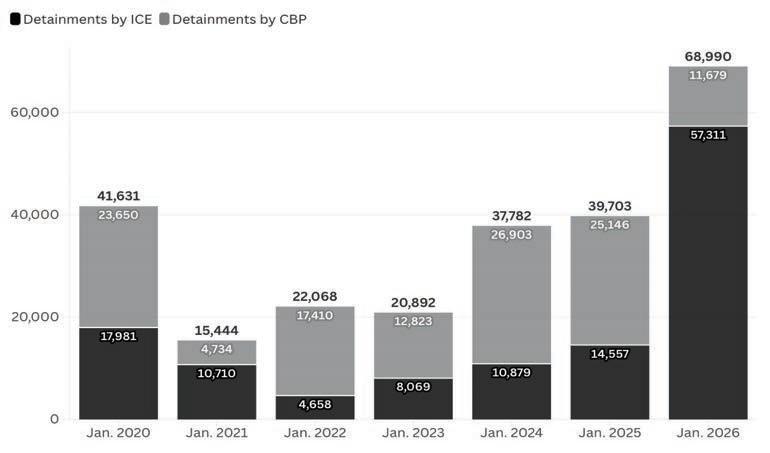
Detainments by federal organizations
In the last year, U.S. Immigration and Customs Enforcement, or ICE, has begun to detain more people than U.S. Customs and Border Protection, or CBP.
Muscatine County is involved in five lawsuits relating to the county’s contract with the .S. Marshals Service to house detainees that are arrested by the federal government, including those arrested by ICE.
The county has agreed to hold federal inmates since 1 , but the contract with ICE specifically is more recent, Talkington stated in an email to the DI. The county has contracted with ICE for ust under a year.
The average daily number of federal detainees in the county ail has decreased over the last several years, going from ust over 150 in 0 1 to nearly 0 last year, Talkington wrote. The actual day-to-day number varies, she added. The county also holds inmates from other nearby counties on occasion.
Muscatine County is one of six Iowa counties that have such contracts with the federal government. The other counties include Woodbury, Pottawattamie, Polk, Hardin, and Linn, according to the Iowa Migrant Movement of Justice, an immigration advocacy and legal service organi ation.
The details of the contract, however, are unclear as Muscatine County has referred a public records request filed by the DI to ICE for the agency to review. However, Talkington stated the county is paid 5 per day per federal detainee as of 0 0.
Randy Evans, president and chief executive of the Iowa Freedom of Information Council, a nonprofit dedicated to First Amendment rights and government accountability, wrote in an email to the DI that while uncommon, there are instances where a party may notify another involved party about a public records request to allow a chance to take legal action to block the records’ release.
However, after a “reasonable” amount of time and in the absence of such legal action, Evans said the county would be required to provide the requested records.
“I do not believe Muscatine County can avoid complying with the Iowa public records law simply by saying It’s up to ICE to respond to your request,’” Evans wrote.
The DI sent a request for the county’s contract on Feb. 5 and received a response acknowledging the request on Feb. 1 from Talkington. On Feb. 1 , Talkington informed the DI that “ICE equities have been identified in the documents that require ICE review.” Talkington added the request had been submitted to ICE and future correspondence regarding the request would come from ICE.
The county has also treated similar public records requests in the same way, according to reporting by Iowa Capitol Dispatch. As of the time of publication, the DI has not received the contract between ICE and the county.
Brett Johnson, an associate professor at the niversity of Iowa and licensed attorney, said there are no incentives for government transparency, and in fact, there is sometimes risk associated with a local government giving out information that regards a higher authority, such as the federal government.
“I think the general climate right now with ICE is it’s rather aggressive, if not outright bullying,” Johnson said. “So I think there probably is a lot of trepidation among any kind of local entities dealing with ICE.”
Muscatine County looks to help out law enforcement at the federal, state, and local level in whatever ways they can, Muscatine County Supervisors Chair Danny Chick said. The county has no control over which detainees it takes in, and they are typically only held in the county’s facilities for a short time as they make their way to a federal facility, he said.
“We support law enforcement activities at all levels, and if they need our assistance, we’re all about providing that assistance,” Chick said.
The ail’s long-term capacity is 55 inmates, and the short-term capacity is , Talkington wrote. Short-term detainees are held for less than hours, she added.
In the five lawsuits against Muscatine County and federal officials, which included .S. Secretary of Homeland Security Kristi oem and .S. Attorney General Pam Bondi, three are related to being held in detainment without a bond hearing and two are related to the writ of habeas corpus. The writ of habeas corpus is a constitutional right that allows a detainee to challenge the legality of their imprisonment.
Talkington wrote that none of the lawsuits have yet resulted in settlements or verdicts, and the county is represented by legal counsel through the Iowa Communities Assurance Pool, which is an insurance program for Iowa public entities. In its services, the program offers law enforcement and public officials liability coverage.
One of the lawsuits involves Jorge Gon le Ochoa, who was detained by ICE agents in September while he was working at Bread Garden Market in Iowa City. Stephen Locher, .S. district udge for Iowa’s southern district, granted Gon le Ochoa supervised release from detainment at the Muscatine County Jail after ICE continued to keep him incarcerated despite an order to be released.
According to court documents, Gon le Ochoa was ordered to be released from detainment at the county ail at 10 a.m. on Dec. 3, 0 5, by Chief .S. Magistrate Judge Stephen B. Jackson. Gon le Ochoa alleges that minutes before he was set to be released, county ail o cials reali ed there was no active ICE detainment order, so ICE sent an arrest warrant to the ail.
In those documents, there was no notice to appear, which is a formal document from the .S. Department of Homeland Security that starts the deportation process for a nonciti en in federal court, which Gon le Ochoa argued violated his legal rights. In court documents, Locher agrees with this logic, calling Gon le Ochoa’s detainment at this time “unacceptable.”
Locher states that ICE later did serve a notice to appear, but did so after 10 a.m. and through mail instead of in person as .S. law requires if physically possible. Because Gon le Ochoa was still being held in the county ail, Locher states this would make it possible to deliver the notice directly to him.
Because of this, Locher states “the only logical explanation” is that ICE created the notice later in the day, then delivered it via mail to make it seem like it may have been issued at the same time as the arrest warrant, thus making Gon le Ochoa’s detainment legal.
“In other words, ICE knew it should not have issued the arrest warrant and order to detain in the absence of a notice to appear but sought to cover its tracks.’ This is unacceptable,” Locher states in court documents. “With no pending removal proceeding, and no notice to appear, ICE was required to allow Gon le Ochoa to be released at 10 a.m., period not to arrest him and then scramble around later to backfill crucial missing documents in a misleading way.”
Gon le Ochoa was released on Jan. 10, and pled guilty to a charge of fraud and misuse of documents.
Iowa City advocacy organi ations, Iowa City Catholic Worker and Escucha Mi o , protested for his release and provided support after he was out of custody.
“Jorge Gon le Ochoa is home,” Iowa City Catholic Worker posted on social media. “They took Jorge. We took him back.”
Many immigrants in Iowa seek support through Escucha Mi o and the Iowa City Catholic Worker.
The advocacy programs work in tandem to provide housing, legal guidance, and facilitate community activism, such as accompanying people to ICE check-ins and hosting trainings.
The programs connect people with resources that already exist, Getsy Hernande , a community organi er for Escucha Mi o said.
Hernande said the organi ation has grown immensely over the past few months due to ICE enforcement in Chicago and Minnesota, where two Minneapolis residents were killed by ICE agents.
“People have been able to publicly see how bad things are,” she said. “So that made a lot of people wake up and be like, I need to stand up for my community, I need to stand up for my rights, and I need to do something.”
Along with an increase in volunteers, Hernande said she has seen a surge of people who need direct services, which range from helping with ob applications, Medicaid paperwork, or obtaining a driver’s license.
The person formerly detained in Muscatine County wants people to know, especially immigrants, that they are not alone.
“We’re not criminals,” the source said via a translator. “We, as immigrants, we have heart, we have lives we want to fulfill.”
It may feel like immigrants are vulnerable right now and need to hide, the source said, but there is support among community.
“ nity makes power,” the source said via a translator. “So if we can come together and unite and work together, we’ll be a lot stronger.”
Public opinion on immigration enforcement dips
Voters are still largely on board with Trump’s border policy, despite a contentious month in Minneapolis.
According to the Centers for Disease Control, 79,384 drug overdose deaths occurred nationwide in 2024.
Following a tumultuous month of immigration control under the second Trump administration, polls depict a dip in the president’s approval rating — but many Iowa voters are still on board with his border policy.
According to an AP-NORC poll released Feb. 12, about 60 percent of Americans think President Donald Trump has overreached in his deployment of U.S. Immigration and Customs Enforcement, or ICE, agents to U.S. cities.
The statistics come less than a month after the deadly shootings of protesters Alex Pretti and Renee Good by ICE agents in Minneapolis, Minnesota. The numbers demonstrate a sharp increase from the 37 percent of Americans who viewed ICE unfavorably during Trump’s first term in 2018.
Immigration control was a winning issue for Trump’s campaign. In Iowa, 60 percent of residents said securing the U.S. southern border was critical in a September 2024 Des Moines Register poll.
According to Pew Research, 82 percent of Trump supporters said immigration was a “very important” issue to their vote in the 2024 presidential election.
University of Iowa professor Tim Hagle attributed the decrease in favorability to declining opinions of no-party voters, who are less likely to pay attention to policy but likely saw footage of the confrontations on the streets of Minneapolis.
Hagle said Trump’s Republican base still heavily favors deportations and border control, but he’s seen moderate and strong Trump supporters grow weary of ICE’s contentious presence in Minnesota.
“There are going to be hardcore supporters of Trump who say this is ustified given the pushback [ICE] is getting from protesters,” Hagle said. “Some of the people that were maybe not as strongly in favor of Trump but picked him over Harris, maybe saying, ‘I don’t know about this’ or ‘We’re not as keen on this.’”
According to a New York Times/Siena Poll, 81 percent of Trump voters approved of how ICE has handled its job as of Jan. 12.
Mary Lindstrom, chair of Iowa Young Republicans and Eastern Iowa Young Republicans, said border security topped her list of issues when she voted for Trump in the 2024 election because of the amount of overdose deaths from illegal drugs brought over the border.
She said Trump has rightfully prioritized cracking down on illegal immigration in the first year of his second term and has effectively strengthened the border more quickly than she anticipated.
According to Pew Research Center, U.S. Border Patrol encounters with migrants dropped to 3 ,53 in fiscal year 0 5 the lowest level in more than 50 years. In fiscal
Minnesota is temporary. Hayes said he, and most Trump voters he knows, are still on board with the president’s approach, despite the contentious nature of recent immigration control.
Following the two-month-long surge in ICE agents in Minneapolis, the administration announced it would end the deployment on Feb. 12.
Hayes said he supports the decision and called it a “restrategization” as opposed to a capitulation to protesters. He said the pivot
year 2024, there were more than 1.5 million encounters at the U.S.-Mexico border.
Lindstrom doesn’t think the immigration crackdown in Minneapolis will impact Republican performance come election season. She said many conservatives voted for Trump because of his immigration enforcement, and that he is following through on those campaign promises.
“The loss of life is heartbreaking,” Lindstrom said. “It’s shattering. But I don’t think it’s going to deter Republicans.”
Bernie Hayes, chair of the Linn County Republican Party, said immigration was among his top issues when he voted for Trump in the 2024 election — along with anti-abortion values and fiscal policy. Hayes said Trump’s policies were the most likely to secure the border, which he said is necessary because there is a legal path to citizenship for immigrants entering the country.
“We’ve had people with ulterior motives come across and want to do us harm, and people that just absolutely don’t care,” Hayes said. “They rape and pillage and do whatever, and then they get released from whatever jail they’ve been held in and go do it again.”
According to research by the American Immigration Council, there is no statistically significant correlation between crime rates and the immigration share of the population in any U.S. state. The council found that U.S.-born individuals are statistically less likely to commit crimes than immigrants — including undocumented immigrants.
was a good move by the administration because of the organized pushback from protesters, which he said created the atmosphere that ultimately resulted in loss of life.
“It’s sad those events occurred,” Hayes said. “But when you delve into them, and you look behind the curtain, you see some of
followed through on his campaign promises to crack down on illegal immigration in his second term, though he said the approach has been more aggressive than predicted. Ludlow considers himself to have more moderate positions than much of Trump’s base and said while he doesn’t fully support the president’s approach to immigration policy, he still thinks the administration has a better handle on it than former President Joe Biden did or former Vice President Kamala Harris would have.
He thinks students have noticed and reflected on the aggressive nature of Trump’s immigration enforcement.
“Is that how an enforcement agency should operate?” Ludlow asked. “I don’t know. Is it necessary? I don’t know, but those are questions that should be raised, and I think have been raised among conservatives.”
Ludlow said local leaders in Minneapolis, such as Minnesota Gov. Tim Walz or Minneapolis Mayor Jacob Frey, failed to step up and unite the city in their response to ICE.
“Frey should have called for people to calm down,” he said. “Instead, I felt like he wanted people to stand up and fight ICE, which is the wrong sentiment in such a stressful and fragile situation.”
Hagle said the response to ICE from local public o cials may have contributed to a temporary decrease in public opinion or decline in Trump’s approval rating.
Hayes said Trump is living up to his expectations in terms of deportations and immigration control so far. He said a drop in approval rating following the immigration crackdown in
Remembering Iowa City’s first barrio
It’s been 90 years since the neighborhood was demolished and its history obscured.
Sweeping changes to immigration policy and increased deportations under President Donald Trump’s second term has caused fear among immigrants living in Iowa.
Many immigrant families have generational roots to the Hawkeye state, including the family of Vince Cano, who first arrived in the .S. almost 100 years ago and contributed to the maintenance of Iowa City’s railroads, establishing the city’s first barrio along the railroad tracks. Over half a century before the city of Iowa City acquired the small plot of land that would become Oak Grove Park in 1973, the 1.6 acres of land sitting along the railroad tracks was once home to the city’s first barrio, its history largely forgotten under the park’s playground and basketball court. Made up of converted boxcars and wooden “shanties,” one-room houses that would have been approximately 14’ x 20’ in size, the homes in the neighborhood lacked electricity and running water and often only contained a single kerosene lamp for lighting, but it was
here that the families who inhabited the neighborhood grew.
The neighborhood, which developed along Page Street near the freight depot and stockyards between South Van Buren and South Dodge Street in the early 20th century, was created by immigrants from Mexico who were hired by the Chicago, Rock Island, and Pacific Railroad Company, or CRI&P RW, to work on the railroads running east and west through Iowa City, as well as their families.
Vince Cano, who will turn 83 this year, is the youngest son of one of the five original families who lived in the neighborhood before it was destroyed by the CRI&P RW Company in 1936. While he didn’t live in the barrio, in a letter that Vince Cano sent to The Daily Iowan, he recalled his family’s story of immigrating from Guanajuato, Mexico, to the United States, searching for work as they rode trains into Texas and Minnesota before ultimately arriving in Iowa, where they would eventually find work on the very tracks on which they had traveled.
That was almost 100 years ago, with March 2 marking the 99th year since Magdaleno and María Cano, Vince Cano’s parents, first immigrated to the U.S.,
He said the leaders made the situation more volatile instead of calming the city.
“It doesn’t help when you have Democrats coming out and portraying it as murder in the streets,” Hagle said. “That helps to gin up the protests against the ICE and Border Patrol agents that had to protect themselves because of the aggressive protests that were occurring.”
with, it’s a wonder, sadly, that there haven’t been more.”
OPINIONS
We are all losing the meme war
Stop treating protest like viral content, it helps no one.
If you make something unserious, don’t be surprised when no one takes it seriously. This might sound stupid but it is exactly what is happening in the United States right now, down to the streets of Iowa City.
There has been a lot of criticism lately about how Democrats are handling President Donald Trump’s administration. People online repeatedly respond to the news cycle with “We aren’t mad enough.” But anger can’t survive if it’s met with mockery and jokes. And right now, mockery and jokes are winning.
On Oct. 18, 2025, hundreds of protesters flooded downtown Iowa City for the nationwide ‘No Kings’ protest against the Trump administration. One group wore red robes from “The Handmaid’s Tale,” as photographed by The Daily Iowan . On Feb. 5, middle and high schoolers took to the University of Iowa Pentacrest with signs and chants. One particular sign stood out to me, which read “History has its eyes on you,” referencing a song from “Hamilton,” a musical known for its proimmigration story.
While reading the signage at the Pentacrest that day, I felt both empowered and, unfortunately, a little embarrassed.
Some posters were as simple as “ICE OUT,” while others deepened the messaging with quotes from Anne Frank or George Orwell’s “1984.”
But at the same time, I saw pointless phrases like “I prefer my ICE crushed” or “ICE get out of our city, boii.” Online, I saw extremely tone-deaf signs like “ICE has tiny weenies” and “Don’t take our Latina baddies.”
Separately, and also recently, signs referencing HBO’s “Heated Rivalry” circulated across national and local demonstrations. Lines with double entendres like “ICE is not invited to the cottage” or “ICE belongs on hockey rinks” circulated. Another sign from Denver, Colorado read “the only ICE I like is the ice my 2 gay boyfriends skate on,” referring to the main characters.
The “Handmaid’s Tale” imagery worked because it was purposeful, symbolic, and relevant. You don’t need to have watched the show to understand what a woman in a red robe is trying to communicate.
But “ICE is not invited to the cottage” is an inside joke that is only clever to the people who get it.
The problem is that it means nothing to the people who actually need to hear it.
Justin Cosner, a UI English professor with an interest in media and political theory, said the best protests in American history have been specific and to the point.
“They say we want this law changed. We want this policy to end. In that way, some of the get ICE out protests are helpful; when there is a clear purpose, like legislation. But it risks getting diluted by this other vague messaging. There is something in the way protests are taking place that seems to strive for the same virality as landing a joke on Twitter,” Cosner said.
Cosner continued by explaining that when there are too many issues under scrutiny, like climate, immigration, tariffs, protests become, at best, a census of the opposition, and, at worst, a costume party that can be mocked.
Prashna Dahal, a UI third-year, believes protesting at the UI has its own implications.
“The problem is, which many come with going to a predominantly white institution, there doesn’t seem to be enough people who have that passion to turn anger into action.
That is where the bystander effect comes in, and because of that, sometimes it feels like we are just screaming into a void.”
It’s hard to push change if we make a spectacle and not a statement in response. The Trump administration understands that making a spectacle is the message.
“ICE itself is a spectacle,” Cosner said. “Trump doesn’t want this to be silent and unseen. He wants people to see a show of force. He wants immigrants to feel like they are not welcome, because they can turn on the news and see these masked people arresting people.”
It isn’t just on the streets.
Governments have long used highly shareable, sometimes ridiculous content to shape public perception, and Trump’s
White House has taken that further than most. Coined memetic warfare, this is a strategy expected from Trump.
White House communications director Kaelan Dorr posted on the social platform X, “The memes will continue,” in response to criticism of doctored images. There are too many examples of mockery in just The White House Instagram page itself, from deportations flight “ASMR” to AI reels of a glitzy Gaza resort.
“But I don’t think the response to that is making a spectacle of ourselves,” Cosner said.
Republicans and Democrats aren’t starting from the same place. One party is in power. The other isn’t. When the people running the government create a spectacle, it reinforces their control. But when the Democrats, in this case, try to do the same thing, it isn’t persuasive.
This isn’t just about protest signs and ICE. It’s about how political discourse now spreads, especially through social media.
Nowhere is this more clear than in how the Jeffrey Epstein files were handled. When the files were released, they should have been the last straw.
The files contain the names of powerful men, from the former U.K prince to Elon Musk, and records of child abuse and tra cking. But within hours, the reaction online became straight gossip.
Some users joked that the only reason people were angry was because they “weren’t invited to the party.” Others fixated on Musk allegedly emailing for an invitation to a future gathering. The actual victims, and any accountability for them, barely registered. The humor deflects discomfort and skews people’s perception of events, making everything feel light-hearted and scrollable.
This is the consequence when the purpose of engaging with the news is not to understand what is happening or to demand something change, but to signal which side you’re on.
We’re losing the capacity to be genuinely outraged.
We’re losing the ability to persuade anyone of anything because persuasion requires patience, evidence, and a willingness to address someone else’s actual concerns. But none of these will fit into a reel.
“We have become so desensitized from seeing people being taken from their families or being murdered in broad daylight… Those with privilege should speak up more, begin support groups for those affected by ICE, and cater to organizations and events that raise awareness so that no one is able to look away,” Dahal said.
Activism and protesting are an art form
Art is an important component in the fight against anti-immigration policy and ICE.
On the north side of Hot House Yoga, a minimalistic mural preaches: “Practice Love.” “Weaponize Your Privilege To Save Black Bodies,” reads another, visible from East Burlington Street, painted on the Capitol Street Ramp.
From songwriting and poetry to posters and murals, art has always and will always be a crucial component of protests and activism, whether it’s demanding systemic change or making vulnerable populations more visible.
Songs become anthems of hope and resistance. Bob Dylan’s timeless classic, “Blowin’ in the Wind” was an anthem for the Civil Rights Movement, and John Lennon’s “Imagine” envisioned a world without borders and divisions. Murals and gra ti transform public spaces into political forums. Written and spoken words articulate grievances, mobilizing audiences to action. Art matters.
Even dance and fashion offer some sort of resistance. The University of Iowa is set to have its annual multicultural fashion and dance show, Walk It Out, in April, to showcase diverse communities.
“Artists wield emotions as deftly as they wield paintbrushes, the pattern of their steps mirror our heartbeats and we feel their songs within us,” Ryson Stuart, an organizer for Indivisible Johnson County, said.
Not everyone can come to a physical, in-person protest. It may be a conflict of safety or accessibility. Not everyone can
afford to partake in a boycott. Art, across its various forms, opens doors for citizens who want to participate in democracy and make their voice heard.
Art is a form of connection that reaches across boundaries and disparities. It provides an outlet of expression and therapy.
Today, citizens are using their artistic inclinations to advocate against antiimmigration policies, and rightfully so.
Stuart likened the treatment facing many immigrants to his visit to Pinkas Synagogue in Prague and highlighted the importance of art in both. A museum he had visited in Prague showcased artwork that had been saved and collected from Jewish children.
“Those pieces of art demonstrated the variety of ways that kids tried to cope with their emotions through dark times, showing their dreams of a happier future, the traumas and horrors they suffered, and their attempts to find oy in their new lives,” Stuart said.
Art has been happening at our detention camps too.
“It reminds us that immigrants are humans, too, and that this same tragedy and horror has been visited upon millions of people throughout history that have been deemed ‘other,” Stuart said.
Despite the di culty in using these loaded words, comparing one tragedy to another, and the di culty in admitting it, it’s the truth. Our choice in words is an artform that makes a difference, too.
UI third-year student Caroline Börk has been working on a sculpture entitled “Little Soldier” which she explains “explores the themes of national instrumental parentification of young children in America as they are forced to fight issues larger than themselves, such as gun violence and ICE raids.”
The sculpture depicts a young student
holding a stapler like a firearm in selfdefense. The fear carefully sculpted into the features of the child reflects millions of children in the U.S. living in fear of separation from their loved ones in one way or another.
Art has long played a role in revolutions, protests, and social activist movements from the 18th century to the present, the Metropolitan Museum of Art states.
“Protest art, or artivism, has a powerful habit of seeping into the battlefields of multiple issues at one time. This is why I believe it is so critical to create art as resistance,” Börk said.
Increasingly, monarch butterflies are being utilized in art to show support for immigrants. The butterflies symbolize dignity and the universal right to move freely. Millions of monarchs fly thousands
of miles from their North American summer breeding grounds, to winter sites in Mexico or California, and then complete the journey back north with the journey being multigenerational.
“They are a symbol for our friends and neighbors who are being targeted despite their valiant journey to lands that we share,” Stuart said.
Art has a way of inspiring people into thought and action. It humanizes and enhances our emotional reception.
America was built on immigrants; we’re the melting pot for a reason. We need to be sympathetic to their plight and fight for people who have the right to have sought and found a better life. So whether you’re artistically inclined or not, find a way to speak your mind. Use your chosen medium to voice resistance.
where they sought better opportunities for their children and hoped to escape the violence of the Mexican Revolution as Mexico sought to rid itself of the dictator Porfirio D a .
“The struggles of the peón to free himself from the bondage that had been promoted in the last part of the 1 th century by D a still had not been successful by 1920,” ince Cano wrote in his 1 5 fictionali ed biography, “Leno and Mar a A Success Story,” which is held in the University of Iowa’s Women’s Archives. “Many who were sick of the violence and terror began looking North for refuge.”
As Trump enacts immigrant policy changes, many seeking refuge north of the U.S.-Mexico border in the present day face increased risk of deportation, challenges to accessing basic rights, and legal confusion, something Iowa City City Council member Mazahir Salih has noticed as the executive director of the Immigrant Welcome Network in Johnson County.
“The big issue right now is confusion and instability, people are really confused,” Salih said. “We are seeing work permits canceled or delayed and refugees losing access to assistance due to status. We see an increased need of immigration attorneys right now and people sometimes don’t have the money to pay for an attorney.”
When Magdaleno and Mar a Cano crossed into Texas with two of Vince Cano’s siblings, Elena Juliana and Mar a Guadalupe, they also faced instability as they searched for work and navigated a country Magdaleno had only visited once before. Shortly after arriving in Texas, though, they learned about a job opportunity in Crookston, Minnesota, to work on a sugar beet farm from contratistas, or labor contractors who often served as middlemen between immigrant laborers and companies seeking workers.
The work was physically demanding, requiring the Canos to wake up as early as 30 a.m. and work until there was no more daylight.
“There existed no agreement between the Mexican government and the United States concerning these workers,” Vince Cano wrote in his novel. “There were no prior guarantees as to salary or living conditions. Being very limited in the English language, they were left to the mercy of the contratista.”
The work was also short-term, and once the farming season was over, the Canos were forced to search for another way to support themselves.
It was following this brief stay in Minnesota and on the way to Chicago that the Canos arrived in West Liberty, Iowa.
While sitting at the train station, Vince Cano recalled that Magdaleno heard someone whistling a Spanish tune, and upon further investigation, met a young boy named John Ponce, whose family lived and worked in West Liberty and offered the Cano family housing. It was there the Canos learned of job opportunities with the CRI&P RW company working as traqueros, or track laborers.
The traqueros worked long hours repairing roadbeds, weeding and trimming plant growth, repairing
switches, and tightening bolts. Vince Cano eventually joined his father to work on the railroads as a way of paying his tuition at the UI. His father worked for the CRI&P RW for 40 years.
“I would jack up the rail with a jack while another would tap the gravel under the rail to level it out,” Vince Cano wrote in his letter. “This routine was done for miles under the hot sun. We ate our lunch by the side of the tracks and relieved ourselves under the nearest tree and/or bush. A typical day was eight hours.”
While this labor was initially done by young, single men who the CRI&P RW housed in the neighborhood on Page Street, the railroad company eventually introduced families into the neighborhood in the 1920s to establish a consistent labor force as opposed to the short-term labor provided by the young men who previously lived in the housing.
“For our family, it was a godsend as it provided a place to live, to work, to worship, and to be educated, and to improve our fates; opportunity is everything,” Vince Cano wrote.
The Cano family moved into the neighborhood in 1928, but before they arrived, two other families had already moved into the barrio.
UI graduate Nathaniel Otjen is the author of the essay, “Creating a Barrio in Iowa City, 1 1 1 3 Mexican Section Laborers and the Chicago, Rock Island, and Pacific Railroad Company,” which is housed in the Iowa Women’s Archive. In his essay, Otjen described four other “core families” who lived in the barrio alongside the Canos the Guti rre es who arrived in 1 1 and lived in 0 Page St. with five children, the Alcalás who arrived in 1925 and lived in 716 Page St. with two children, the Canos who lived in an open boxcar along the tracks, the Ram re es who arrived after the Canos and lived in 718 Page St., and the Sánchezes who lived in a boxcar before renting a home two blocks north of the freight depot.
“It was definitely an aha’ moment when I was sitting there looking through those newspaper clippings and found basically that there used to be a barrio that existed in what is now Oak Grove Park and that I had lived just next to that, across the street, essentially,” Otjen said.
Otjen, who learned about the barrio as he was researching for an honors project on immigrant gardeners, became interested in the neighborhood partially because of his own family history of Irish immigrants.
Shelton Stromquist, professor emeritus in the University of Iowa’s history department, said that following World War I, Irish, German, and Scandinavian immigrants who worked on the construction of the railroads were replaced by immigrants from Mexico and African Americans migrating from the South.
While immigrants and labor workers may have been separated by cultural or language barriers, one aspect that often united them was their status as a laborer under a large corporation and the unsafe labor conditions, unfair wages, and unjust treatment they received from employers.
“What they had in common with other immigrants from other cultures or with other workers who were not immigrants, was their status as employees of a big corporation, a big and powerful corporation that was, in general, seeking
to hold down their wages and to not give them much of a voice in the terms of their employment,” Stromquist said.
Similar issues continue to affect immigrant and low-wage workers in Iowa today, alongside facing threats of deportation under Trump’s second term as president.
“Immigrants, then and now, feel a certain vulnerability in the labor market, even more so now,” Stromquist said.
“That, combined with the fact that they were at the mercy of a very powerful corporation that could essentially dictate the terms of labor, meant that immigrant railroad workers were in a very marginal and fairly weak position in terms of bargaining for their rights.”
While the families in the barrios didn’t often receive support from their employers or the city, the families often supported one another.
Within his letter, Vince Cano provided chapters from another fictionalized biography he wrote about his family in 0 , “The Big Move Magdaleno Mar a Launch ew Generations Immigrating to the United States of America 1927-2002,” where he described the families of the barrio assisting the Canos in building an addition to their home that could serve as a kitchen.
“They were close to each other, as togetherness meant survival,” Vince Cano wrote to the DI. “Unlike today, we may not even know who our neighbors are and could care less.”
The five families established themselves in Iowa City and worked to sustain themselves in their neighborhood, raising chickens, goats, and pigs and cultivating gardens. The Cano family also grew to include seven children.
In 1 3 , the CRI P RW company required the families to relocate and demolished the neighborhood. With
nowhere else to go, the Canos and the other four families living in the barrio were forced to reestablish themselves, often facing housing discrimination due to their ethnicities, occupation, and family size.
“The environment in 1928-1940 was selective as to what citizens were accepted,” Vince Cano wrote. “The inhabitants did not interact with people outside of the barrio. Shopping for groceries and/or clothes and church attendance were tolerated, but you never forgot your place, lest you be reminded.”
The Canos moved from house to house until 1 3 , when they settled at 1300 S. Linn St., near what an October 0 3 Gazette article attributes to being near what is now South Gilbert and Second Street, before purchasing a house on South Capitol Street in 1952. Magdaleno would continue to work as a section laborer for the Rock Island Railroad and Mar a would begin work as a seamstress at Mercy Hospital. All seven of the Cano children would graduate from secondary school and go on to graduate from college, with Mar a Guadalupe going on to create the UI Health Care Spanish interpretation program.
While Vince Cano and his siblings have worked to document the history of the barrio through their writing, there is no physical reminder of the neighborhood where it sat in what is now Oak Grove Park.
Otjen said he attempted to have a plaque put up in honor of the neighborhood’s history.
“This is an important part of the city’s history and also the region’s history,” Otjen said “It’s something that absolutely needs to be thought about and recognized today. Building and creating better futures, that’s always premised upon historical pasts, so you have to recognize the through lines between those.”
Immigrantion organizations lead advocacy e orts
Community groups provide legal services and support to immigrant families.
especially because you never know what you’ll do in those situations,” she said.
As immigration policy continues to shape daily life for families across Iowa, community-led organizations are stepping in to provide advocacy, legal services, and accompany individuals to ICE check-ins for immigrants navigating an increasingly complex system.
Groups across the state include Escucha Mi Voz, Iowa City Catholic Worker, Iowa Migrant Movement for Justice, and the Immigration Welcome Network of Johnson County.
Throughout Iowa and Johnson County, much of that work is being led by immigrants themselves, who have built organizations designed to respond directly to the needs of their communities.
Stretching throughout the Iowa City area, Escucha Mi Voz is a faith-based nonprofit led fully by immigrants across eastern Iowa.
Getsy Hernandez, a community organizer with Escucha Mi Voz, said the organization assists its immigrant members with whatever they may need, including teaching English, providing various trainings, and housing.
The University of Iowa graduate student said her parents are immigrants, and they are her biggest motivation for helping provide resources to immigrants and their families in the Iowa City area.
“I grew up seeing a lot of inaccessibility for immigrants, so seeing the struggle that my parents went through, I know that I want to be a change in that,” Hernandez said.
As a kid, she translated for her parents, an experience that made her want to enter into advocacy work.
“I want to make a difference for my community, and especially with everything going on now, that makes me want to be that change and make that difference even more,” she said.
Hernandez said Escucha Mi Voz provides many different trainings, including “Know Your Rights Trainings,” which inform immigrant communities on their constitutional rights and how to assert them with law enforcement.
“It’s a way for them to practice using those rights and feeling more comfortable in exercising those rights,
Clare Loussaert, lead English teacher at Escucha Mi Voz and a third-year student at the UI, said the organization’s English classes cater to members at all proficiency levels.
“It’s a really low point of entry. Everyone can participate, but it’s a high ceiling in that you could go really far with it,” she said.
Loussaert said the class is more than just an English lesson.
“The class is just a unique format in that it’s really community-based,” she said. “And of course, we’re working on the English language in terms of vocabulary and grammar, but we also touch on different social issues, like being bilingual in the U.S., or educating people on their rights.”
Hernandez said Escucha Mi Voz also participates in civic engagement, which includes ICE accompaniments, helping with paperwork, and registering kids into schools. They also attend city council meetings and lobby at the Iowa legislature.
“We stay very connected with local resolutions or bills that are being passed,” she said. “We stay up to date with the actual state government, and we try to push for them to not pass those anti-immigrant bills.”
At the Department of Homeland Security’s Cedar Rapids office, Escucha Mi Voz accompanies immigrant families for their ICE check-ins on the first Tuesday of every month.
“We build community there,” she said. “We’ve had really good turnout with community members showing up every month, and that’s just been a way to show solidarity and support to immigrant families who really need it.”
Iowa City Catholic Worker is a sister organization with Escucha Mi Voz, meaning they depend on each other’s resources to hold protests, training, and affordable housing for immigrants.
Inspired by Catholic Social Teaching, a body of moral doctrine from the Catholic Church that provides a framework for building a just society, the organization is fully volunteer-based and
provides meals, showers, laundry, and legal support.
Along with Escucha Mi Voz, Iowa City Catholic Worker has opened two “houses of hospitality” in Iowa City — one on Sycamore Street and a second downtown Victorian home — that offer transitional housing, meals, and support for immigrant and refugee families.
Hernandez said these houses currently hold 15 immigrant families.
“That’s just a resource for families who have just come to the U.S., and they need support to get on their feet and gain that independence,” she said.
Hernandez said there are many volunteer opportunities at Escucha Mi Voz and Iowa City Catholic Worker, including driving immigrants to their ICE check-ins, joining a neighborhood rapid response team, or delivering groceries to a family.
“One of the most meaningful ways that goes overlooked, sometimes, of how to support the immigrant community, is
simply getting to know them,” she said. “Building those connections with them and finding ways to get involved.”
The Immigration Welcome Network of Johnson County is a nonprofit working to provide housing, community resources, and advocacy for immigrants across Johnson County.
The network provides temporary Welcome Houses to help prevent homelessness, and assists with navigating resettlement, job placement, health care, and education, according to their website. In November 2025, the organization opened a two-unit supportive housing duplex at Catskill Court in Iowa City to support and house immigrant families.
Economic plight of immigration
Experts stress long term implications of increased detentions, court backlog.
Casillas-Hoffman pointed to broader spending increases within the U.S. Department of Homeland Security, saying the scale of investment sends a “very clear signal” about national priorities.
As federal immigration enforcement spending accelerates under President Donald Trump, new reports show record detention levels, rapidly expanding infrastructure, and mounting taxpayer costs — prompting renewed debate over whether those investments reflect the country’s priorities.
A 2026 report from the American Immigration Council found Congress authorized $45 billion in new detention funding in July 2025. The report warned, if fully implemented, the detention system could more than triple in size over the next four years.
Separate data compiled by the American Immigration Council estimates the amount of money spent on a single year of a deportation regime would be enough to cover over 12 times what the annual budget the National Institute for Health spends on cancer research each year.
A January 2026 ICE Flight Monitor update from Human Rights First documented a dramatic increase in flights removing or relocating U.S. Immigration and Customs Enforcement, or ICE, detainees during the first year of Trump’s second term. Between Jan. 20, 2025, and Jan. 20, 2026, the project tracked 14,426 enforcement flights — an 89 percent increase.
That total includes deportation flights and domestic transfers. The largest growth occurred in domestic transfers, or “shu e flights,” flights that move people already in ICE custody between detention centers across the country. The report recorded ,0 domestic shu e flights during the first year of Trump’s second term, a 13 percent increase compared to the previous year. In January 2026, 1,100 domestic transfer flights were conducted.
Deportation flights were documented by Human Rights First at , 53 removal flights during the same January-toJanuary period — a 46 percent increase
“We know what our communities need,” she said. “We would love to see money invested in education. We would love to see money invested into health care. We’d love to see money invested, here in Iowa, into water quality things that can really create long-term sustainable change for our communities.”
In Iowa, Casillas-Hoffmann said, the impact of expanded enforcement is visible even when large-scale raids are not dominating headlines.
“ICE is absolutely active in Iowa,” she said. “ICE is absolutely detaining people in Iowa, and ICE is absolutely deporting people from Iowa.”
The communications specialists said families are grappling with sudden detentions and the trauma that follows.
“Families are ripped apart,” she said. “People are having to make really awful decisions about how to keep their family together, how to keep going to their job, how to care for their children after a parent has been deported.”
Beyond the financial and logistical costs, she said the emotional toll is profound.
“ I’m terrified. I’m so scared’ that’s what we hear,” Casillas-Hoffman said. “People are afraid to go to work. Children are afraid to go to school. People are afraid to go to places of worship.”
She said the fear is not limited to undocumented immigrants.
“We have naturalized citizens that are telling us they’re walking around with passports,” she said. “This feeling of terror is broad-reaching.”
Casillas-Hoffman said redirecting even a portion of the billions allocated for detention could expand legal services and stabilize families. She said there are an estimated 3,000 immigrants and refugees for every one immigration legal service provider, leaving many without representation as detention and deportation numbers climb.
“The need for immigration legal services has never been higher,” she said.
— including 187 deportation flights in January 2026. The report tracked removal flights to countries, reflecting the global scope of U.S. deportation operations.
Flight attendants have been instructed to deprive passengers on ICE charter planes of necessities, including food and water, according to Human Rights First, an international human rights organization.
Human Rights First also said individuals on removal flights are typically restrained with shackles at the wrists, waist and ankles. Long-haul international flights can last more than 30 hours, including layovers and refueling stops. The report also noted an increase in third-country removals — deportations to countries where individuals are not citizens, which has potential to raise due process concerns.
Elena Casillas-Hoffman, communications specialist with Iowa Migrant Movement for Justice, said, in Iowa, those figures raise questions about what the federal government is choosing to prioritize.
“It’s been made abundantly clear that the focus has been on expanding and advancing the deportation pipeline,” Casillas-Hoffman said. “Pouring money into the deportation pipeline does not make any of us safer.”
Jessica Malott, an immigration lawyer in Iowa City, runs a small, private law firm in which the effects of case sta ng limitations are heightened.
“When you take on a new case and someone’s detained, you could be taking on multiple cases, very likely, such as requesting a bond,” Malott said.
Kaitlin Hall, operations manager at Malott Law, said in a statement to The Daily Iowan their firm charges an initial consultation fee that varies depending on the case, as each case has its own unique circumstances and procedural history to navigate.
Hall said cases that require a federal habeas filing generally end up costing more than other types of cases due to the length of time it takes to navigate the legal process and court backlog.
According to the Brennan Center for Justice, a federal habeas filing occurs when someone who has been detained challenges their detention in court.
In the U.S. Southern District of Iowa, the cost to file a federal habeas case is a $5 fee. However, attorney costs may vary,
escalating the price depending on the fee charged by a firm.
At Malott Law, Hall said these cases are billed hourly and the cost falls on the client since it is a private firm.
The cost of applying for lawful permanent residence, asylum, and citizenship often take a toll on clients as well.
Malott said there are different avenues immigrants can take toward obtaining lawful permanent residency in the U.S., including family-based petitions where a U.S. parent or spouse petitions for a noncitizen spouse.
The cost of these applications can vary. According to the U.S. Customs and Immigration Services website, the cost of an I-130, or family-based petition, is 5 if filed by paper and 5 if filed online.
Many file humanitarian-based petitions, such as applying for asylum. Malott said this is often seen with those who are victims of abuse.
“There is a huge power imbalance there,” Malott said. “For example, a U.S. citizen spouse chose not to help their spouse apply for lawful permanent residence, but that is part of the cycle of power and control in that situation.”
Many individuals utilize pro bono resources, or legal services provided by a law firm for free, to combat the cost.
Hall said many of Malott Law’s pro bono resources are often reserved for victims of domestic violence or tra cking.
Asylum seeking is applied for once an individual is in the U.S., Malott said. When an individual is seeking refugee status, it is from another country.
According to the U.S. Customs and Immigration Services website, the cost of an I-589, or asylum application, is free. An annual asylum fee of $102 will need to be paid after filing the petition as it remains pending.
Malott said she is upset for her clients and what any immigrant is going through right now.
“I have been doing this a long time, and it is simply not right,” Malott said.
Growing up as an Army brat, Malott first became interested in immigration law when her family moved to Caracas, Venezuela.
Majoring in Spanish in college, Malott’s interest in the legal field grew. During her three years of law school, Malott worked
Comparison of national deportation and cancer research spending
According to the American Immigration Council, the cost of a year of millions of deportations would cost over 12 times the annual budget of cancer research for the National Institute for Health.
for the Iowa Coalition for Domestic iolence, a nonprofit aiding those who have experienced domestic violence, learning from immigrants who were victims of crime in the U.S.
“Working there opened my eyes to some other specific areas of immigration law that I hadn’t really contemplated before,” Malott said.
During her time at the coalition, Malott met immigrants whose U.S. citizen spouse had abused them and the vulnerable position that placed them in.
Now, with over 15 years of experience as an immigration lawyer, Malott has witnessed the effects of the changing landscape of immigration on migrants, .S. taxpayers, and lawyers in the field. Malott has experienced many policy changes made by the U.S. Department of Justice and the Executive Office of Immigration Review, a branch of immigration courts housed under the Department of Justice, altering what immigration court looks like.
Malott cited the federal immigration case Matter of Yajure Hurtado, a case that ruled federal immigration did not have jurisdiction to grant an individual a bond hearing or grant bond if they are unlawfully present in the U.S., according to the American Immigrant Lawyers Association.
According to the U.S. Citizenship and Immigration Services, unlawful presence is defined as entering into the .S. without being lawfully admitted, paroled, or overstaying an authorized presence.
On Feb. 19, the case was vacated following a ruling by Sunshine Suzanne Sykes, a district court judge in the Central District of California, reinstating the right for detainees to request bond.
Malott said policy changes such as this will alter the legal landscape.
“By vacating those cases, it should mean that everybody who would normally be eligible for a bond should be eligible for a bond hearing,” Malott said.
For an individual to be granted bond, Malott said, their criminal history, prior court appearance, and whether or not they are a flight risk or a danger to the community are considered.
Malott said an increase in bond hearings will flood immigration courts, which continue to be backed up.
According to the Executive Office of Immigration Review, immigration courts nationwide saw over 700,000 cases completed in the first 11 months of fiscal year 2025.
Malott said working in a small firm means she has case-sta ng limitations.
“When you take on a new case, and someone’s detained, you could be taking on multiple cases very likely, such as requesting a bond,” Malott said.
Nationally, the debate continues over whether increased enforcement spending strengthens public safety or diverts resources from other pressing needs. The administration has defended its approach as necessary to restore order and enforce immigration law, while critics argue the scale of spending reflects a punitive rather than pragmatic strategy.
With detention levels at record highs, enforcement flights up nearly 0 percent year over year and billions more authorized for detention infrastructure, the trajectory of federal immigration policy — and its fiscal footprint appears set to expand further in the years ahead.
Casillas-Hoffman said these actions from the Trump administration are not going to make the country or Iowa safer or better.
“It’s been clear, and it continues to be clear, where this administration’s priorities lie,” Casillas-Hoffman said. “It also sends a clear message about who they’re going after. They’re not going after a certain type of immigrant; they’re going after every immigrant.”
City, helped the nonprofit secure and furnish the houses.
with trauma, but the resources they have help uplift them and give them a sense of belonging.
To get involved with the Immigration Welcome Network of Johnson County, they welcome anyone to volunteer by signing up through their Instagram or Facebook page to assist with direct support, including donating to their Welcome Houses.
Headquartered in Des Moines, the Iowa Migrant Movement for Justice is a statewide membership-based nonprofit providing legal services and advocacy for immigrants.
Elena Casillas-Hoffman, communications specialist from the Iowa Migrant Movement for Justice, said the organization works to support immigrants throughout Iowa whenever they need it.
Justice also provides legal clinics across the state.
According to Iowa Health and Human Services, immigrants and refugees have limited access to legal services, and Casillas-Hoffman said the organi ation tries to provide more access for those in need.
“We know the ones that are here often are unaffordable for individuals, or, quite frankly, just out of the way, and there is danger that can be imposed on community members who don’t feel safe getting in their car and driving,” she said. “So we try to go to them.”
To get involved with Iowa Migrant Movement for Justice, Casillas-Hoffman recommended signing up for their newsletter, following their social media accounts, or stay updated on their website. To report an ICE sighting, she said to call their hotline number at 515-505-8805.
Casillas-Hoffman said the organization can help create a safer state for immigrants.
Local community organizations including Houses into Homes, The Housing Trust Fund of Johnson County, and Resilient Sustainable Future for Iowa
Mazahir Salih, executive director of the Immigration Welcome Network of Johnson County and Iowa City City Council member, said in a previous interview with The Daily Iowan immigrants come to the Welcome Houses
“The idea is walking alongside and being led by immigrants and refugees, not only in their day-to-day, but long-term goals and visions of ‘How can we help?’” she said. “How can we all come together and make Iowa a more welcoming and inclusive state?”
The Iowa Migrant Movement for
“We believe we can and will create an Iowa that is more welcoming and inclusive to all,” she said. “But we only can do that if we work alongside a broad coalition of people that are across the state of Iowa, of all different backgrounds, all different beliefs, and of all different socioeconomic statuses.”
International students denounce proposed fee increase
UI international students feel dwindling control as the Iowa Board of Regents discuss the potential change.
A potential international student fee increase brought to the Iowa Board of Regents by the University of Iowa is creating additional pressure for international students.
Between travel bans, demographic limits, and the proposed student fee hikes, several factors are contributing to growing uncertainty for international students at the University of Iowa as U.S. international student numbers drop.
The Iowa Board of Regents’ Feb. 26 agenda featured the first reading of a proposed 80 percent increase in international student fees across two categories, from $125 per semester to $225 per semester, and $162.50 in the summer, starting fall 2026.
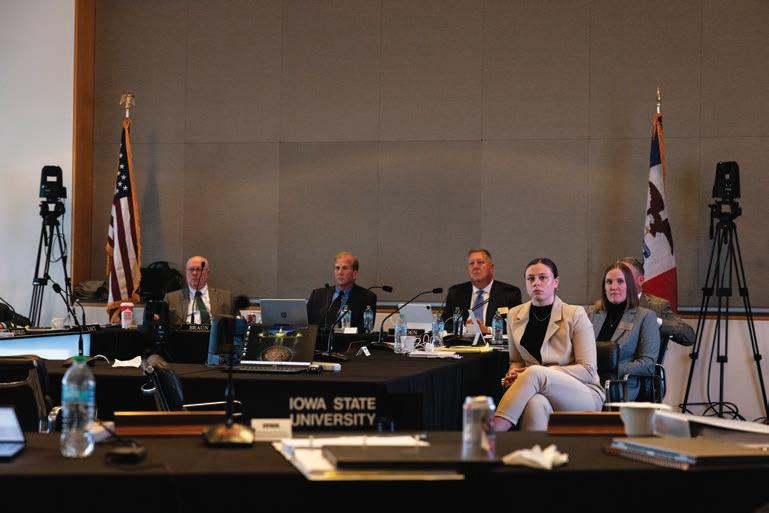
Regent Christine Hensley a rmed she would vote “no” in the board’s April meeting.
At a discussion following public comments the day prior, UI graduate students spoke out against the proposed increases, calling them problematic for international students.
According to data provided by UI International Programs, the university’s proposed international student fee increase is the greatest increase since the fee was implemented in the 2000-01 academic year.
In 2000-01, the fee was $40 each semester and $20 in the summer before increasing to $60 per semester in 2007 and to $70 three years later. In June 2018, the board approved a 78 percent increase to $125 each semester.
According to board documents, the UI’s reason for the increase request is “to cover increased program costs of International Student and Scholar Services.”
In a previous statement to The Daily Iowan , Russell Ganim, UI Associate Provost and Dean of International Programs, wrote the UI has “applied for modest increases in international student fees.”
Ganim denied the DI’s request for additional comment regarding the increase request.
The regents are set to vote on the proposed fees in April. The national OpenDoors report by the Institute of International Education states new international student enrollment has dropped 17 percent between fall 2024 and fall 2025.
According to regent documents, the UI’s international student population saw a 0.9 percent decrease in the 2024-25 academic year.
Hensley said the process to design and implement tuition and fee increases was poorly communicated among the board, saying she heard about potential tuition increases from the media.
“But we still have a big issue,” she said. “And to have to read about something that is really significant to the Board of Regents,
where we determine what the tuition is going to be, and I find out about that in the media, that’s not the way a board should work.”
Hensley went on to cite a 2026 Gallup Poll on higher education, naming affordability as a top issue among students.
“Affordability was at the top of the list, and I think we need to be sensitive to that,” she said.
One proposed increase is an 80 percent increase for the general per semester international student fee. Potentially increasing by 83.3 percent is a onetime payment for international student orientation, designed to provide a crash course in U.S. culture, values, and political systems to those coming from abroad, from $120 to $220, according to board documents.
Iowa State University and the University of Northern Iowa do not have an individual program fee for international students, but have orientation fees of $120 and $125, respectively. Regent documents show that only ISU is requesting an increase of 8.3 percent compared to the UI’s 83.3 percent request. The UI’s International Student and Scholar Services administers the mandatory orientation program.
UI International Students Committee Chair Milad Arzani said the committee is working with scholar services to voice concerns about the fee increases, even meeting with them the morning of Feb. 26, when the regents read the proposition on their agenda.
Arzani said the committee plainly asked scholar services not to raise the fee, but they said the increase was necessary and would need to happen.
Arzani said scholar services proposed alternative methods to financially support international students, such as fundraisers and requests to academic departments.
Scholar services did not respond to the DI’s request for comment at the time of publication.
In 2020, data from the National Immigration Forum reflected that 74 percent of U.S. higher education admissions directors said restrictive immigration policies place limits on international student recruitment.
At the end of President Donald Trump’s first term in 0 0, his administration had placed travel bans on 14 countries.
In just one year, Trump has placed travel bans on 75 countries, according to January 2026 data by the Council on Foreign Relations.
Arzani said travel bans bring rise to biased admissions for international students, resulting in economically based preferential treatment for non-international students.
“Whenever departments ask, ‘Here is a travel ban, should we consider this student for our application?’” he said. “They recommend that you should not consider nationality when doing this, but it will cause
bias eventually. Like an American wouldn’t cost as much as international, so why bother with it?”
In Iowa, legislators are poised to acquiesce to the Trump administration’s higher education compact. Iowa House Study Bill 548, which has passed through the House, would request Iowa’s three regent universities to join the compact.
The compact would offer specialized federal funding to universities that ban the use of race and sex in admissions, freeze tuition rates for five years, and, among a list of other conditions, place limits on international student enrollment.
“Universities that rely on foreign students to fund their institutions risk, among other things, potentially reducing spots available to deserving American students, and if not properly vetted, saturating the campus with noxious values such as anti-Semitism and other anti-American values, creating serious national security risks,” the compact reads.
The compact also limits student population participants in the Student Visa Exchange Program to 15 percent and no more than 5 percent from one country.
According to the OpenDoors report, 96 percent of a survey pool of 828 U.S. higher education institutions said the visa process, in general, is contributing to declining international student enrollment.
“It’s just another added stress,” Arzani said. “For me, eventually you will get numb from the country, you will get numb from the amount of stress.”
Arzani said graduate students employed at the UI are allowed to work 20 hours a week at maximum, which the university defines as a part-time position. With the fee increases and uncertainty in immigration at
the federal level, Ar ani said it is di cult as an international student to maintain savings to fall back on.
“So then, if we’re getting paid 20 hours, and we cannot do anything extra, things get tight,” he said.
During the Board of Regents public comment on Feb. 25, two members of the UI’s Campaign to Organize Graduate Students, or COGS, spoke out against the proposed fee increases. COGS President Olivia Jones said the fee increases would undermine a contract between COGS and the board providing a 3 percent wage increase in academic years 2024-25 and 2025-26, saying 10 percent of international graduate workers’ startof-semester paychecks would go to paying the fees.
“This creates more need for every graduate worker to rely on government assistance through food banks, mental health services, WIC, SNAP, and housing assistance,” she said. “You’re underpaying your workers and charging them at the same time.”
The board has a second reading of the fee and tuition increase set for its April meeting, where it will o cially vote on the directive. In the meantime, Arzani said the international student experience is shifting on all fronts without students’ input.
Following Jones, COGS Unity Chair Clara Reynen said the UI Center for Intellectual Freedom is an improper use of $1 million in appropriations funding from the state, saying the university’s and, by extension, the regents’ priorities are in the wrong place.
“We could’ve used it to pay teaching assistants, we could have used it to avoid international student fees going up,” Reynen said.
SPORTS Game within the game
Iowa basketball’s video coordinators view the sport through a screen, but they wouldn’t change their perspective.
Ben Lober boasts one of the best seats at Carver-Hawkeye Arena, but his eyes rarely glance at the court. Sitting just to the right of the scorer’s table, Lober stares at his Macbook, but he’s no disinterested viewer. Rather, he might be the most active spectator in the building.
His laptop screen is divided into a quadrant of pages. The first presents the TV broadcast of the Iowa women’s basketball game unfolding on the hardwood in front of him. The tape is delayed by 30 seconds but operates at sixtimes speed. A little aggressive, he said, but you get used to it. His eyes follow the
he calls the code window, which he uses to track what occurs on each possession.
For instance, a made three-pointer. Lober clicks pause on the broadcast. He notes the shooter, their position on the court, who made the assist, and what play the offense ran. All of these notations are colored rectangles he clicks on not with a mouse, but a streamdeck, essentially a large keyboard whose buttons mirror the options on his screen.
Every possession he tracks is then compiled on a timeline, which appears on another page. Finally, the timeline is merged with video in the fourth frame. His notation takes a few seconds. Then, he presses resume and repeats the process on the defensive end.
Diving toward the future
Zita Bernatsky chose Iowa diving over a professional cli diving career in Canada.
Seventeen-year-old Zita Bernatsky had to make a decision. Cliff diving or
diving? Stay in Canada with her family and friends, or move to the United States by herself? Pursue an immediate professional career or seek an education alongside competition?
It was a no-brainer for her to not only search out a diving career in the U.S., but to move 750 miles from Winnipeg to
Iowa City to join the Iowa swimming and diving program. Two years later, Bernatsky’s on the brink of NCAA qualification in her first season with the Hawkeyes.
“Coming here was probably one of the best decisions ever,” Bernatsky said. “It’s definitely a change I needed … I was ready for that change.”
In 2015, when Bernatsky was 8 years old, one of her best friend’s mom found a flyer for a local diving camp and showed
at the court and waiting so I can keep coding,” Lober said.
The average college game contains about 140 possessions, and not one sneaks past Lober, the video coordinator for the Iowa women’s basketball team. He and his counterpart on the men’s team, Jayce Smith, are two guys in their mid 20s living out a dream. They get paid to watch the sport they love while traveling with a Big Ten team. They occupy a spot on the coaching staff some might generali e or triviali e, but the pair recogni e their value.
“It’s not someone out there moving a camera,” Smith said. “I don’t touch a camera at all.”
The duo track stats, identify trends, and
assist on challenging calls — and that’s just the on-court responsibilities. Lober and Smith likely wouldn’t be recogni ed by fans, but how the Hawkeyes function depends on the guys in the chair. “I feel like I have a hand with almost everyone,” Lober said.
Lober and Smith’s initial journeys stayed close to home. The former hails from Dansville, just a half hour’s drive from East Lansing. Smith is from Powell, Wyoming, where the state’s only Division I school sits more than 300 miles away. Yet each wound up at their instate school.
Lober started as a student manager and his initial duties with the Spartans
Steady improvement
Iowa’s Katja Osteen navigates a season of new beginnings and rapid growth.
A fall, also known as a pin, is the act of pressing both of an opponent’s shoulders to the mat for a count of one second at the collegiate level. While it results in an immediate victory, it’s arguably one of the most high-level skills in women’s wrestling.
Redshirt senior Katja Osteen has done it eight times this season.
“It’s easier sometimes to tech, but going for those pins gets big scores, and that’s what we’re going to need as a team to win nationals,” Osteen said. “We’ve been working on a lot of pinning combinations, and it’s just exciting to keep doing what we’ve been doing all season and show everyone on the big stage.”
A native of Simi Valley, California, where she attended Royal High School, Osteen has spent the past two seasons, her final years of eligibility, at Iowa, partaking in a sport that has seen rapid growth.
While Hawaii sanctioned high school wrestling for girls back in 1998, California didn’t follow suit until 2011, with Osteen’s home state joining a growing list that included Texas and Washington.
As a freshman at Royal, Osteen earned USA Wrestling Athlete of the Week and won a state title. Her high school career also saw her be a two-time Team MVP and female athlete of the year. Despite Osteen’s accomplishments at the high school level, her eventual home at the University of Iowa came years after she entered the college world.
While the Hawkeyes were the first NCAA Division I, Power Four institution to field a program, Iowa wouldn’t compete as a team until the
2023-24 season. By that point, Osteen was a resident at the U.S. Olympic Training Facility, following two seasons at Simon Fraser, located in British Columbia, Canada.
“That was so awesome,” Osteen said. “That was right before the Olympics, so I was with that team and training with everyone, and that was so awesome. That’s a once-in-a-lifetime opportunity.”
Osteen also appreciated the effort poured into her, despite not personally having a chance to attend the games in Paris.
“Especially as someone who didn’t have an Olympic weight class, something to go for internationally, the fact that the coaches took me in and believed in me, kept developing me to be ready for my collegiate season, was pretty awesome,” Osteen said. By the time of the 2024-25 season, Iowa’s second as a program, Osteen was wrestling for the Hawkeyes at 180 pounds. She captured a 22-11 overall record, aided by eight tech falls and eight pins as well as a 2-0 showing in dual competition.
As the end of the 2025-26 season draws nearer, Osteen has shattered her previous numbers, this time wrestling at 207 pounds while her teammate, Kylie Welker, holds the line at 180.
“Katja is awesome,” junior Lilly Luft, one of Osteen’s teammates, said. “Katja, overall, is just a really great teammate. She’s always there, encouraging and super strong, and we know that we can always rely on her. Being able to even bump up a weight is super incredible.”
In the competitions leading up to this season’s NCAA Regional Championships, Osteen nabbed a perfect 18-0 record, with her fastest pin coming in 30 seconds at a home dual against Otterbein. At Regionals, battling a recent case of strep throat, the senior placed second at 207, following a 4-1 decision
Climbing to starter status
Nick Terhaar’s confidence and maturity have been on full display this season.
Iowa baseball freshman ick
Terhaar began his Hawkeye career by tossing two perfect innings in his debut start against Wisconsin-Platteville.
Terhaar, a Saginaw, Minnesota, native, struck out two of his six batters faced in his collegiate debut and didn’t allow a single baserunner. While the sample size was small and the opponent wasn’t a world-beater, Terhaar’s performance earned him a spot in the regular rotation.
“I felt like ick really set the tone for that ball game,” head coach Rick Heller said after Terhaar’s debut on Feb. 1 . “He ust went out and attacked and pounded the one, super aggressive likely going to give him the start on Sunday.”
The freshman got his start in the Hawkeyes’ series finale at Florida Atlantic on Feb. . While the result was a 3- loss for Iowa, Terhaar logged another solid outing.
Terhaar pitched three innings, allowing two runs on five hits and striking out four. The freshman threw 3 pitches over his three frames, with 33 of them landing in the strike zone.
“I think it went pretty good,” Terhaar said. “It was not the perfect start, but I think it went pretty well for the first one, ust getting the nerves out of the way. I wasn’t mad at it because I knew the guys behind me would come in and get it done for me.”
While Terhaar was nervous for his first weekend start, his confidence and calmness took over, allowing for a solid start. Terhaar credits
his parents for raising him in a way to prepare him for that type of moment.
“It ust comes from the way I was raised,” Terhaar said. “My parents tried to get me to do things on my own, ust so that I could be ready when I have to move away and figure things out on my own. I feel like that translates to my baseball game a lot because I can get myself through hard innings and calm myself down easily.”
Terhaar’s maturity and confidence have gained the attention and praise of his teammates, including his battery mate, redshirt sophomore catcher Max Burt.
“He comes in as a freshman, but he doesn’t pitch like a freshman,” Burt said. “He comes in with a lot of confidence. He knows he’s got good stuff, and he ust comes out on the attack and pounds the strike one.”
Terhaar was the second-ranked overall recruit in the class of 0 5 in Minnesota and was a two-time Perfect Game Preseason All-Region Team selection.
The -foot-3 flamethrower posted an improved earned run average over each season in high school, pitching to a 0. ERA in his senior season while hitting a schoolrecord 1 home runs. Terhaar also holds the school record for most career strikeouts.
Terhaar’s senior season numbers at Proctor Senior High School earned him a Minnesota Class AA All-State selection and the 0 5 ews Tribune All-Area Co-Baseball Player of the ear. The high school resum for Terhaar caught the interest of top college programs such as anderbilt, orth Carolina, and Florida State,
but he ultimately chose Iowa. “At Iowa, it kind of felt more like a family,” Terhaar said. “The teammates, the coaches, it felt like they truly cared about you, which is the true case here. ou really feel like you’re part of a team, and part of a family here, and that was really big for me.”
Heller said he and the staff knew Terhaar had a good chance of winning the third rotation spot before the season even started. The only hiccup was that the freshman’s indoor practices and simulated games didn’t go as they hoped, as Terhaar struggled to find the strike one, something he didn’t struggle with in the fall. Terhaar said while facing -year-
GymHawk talks dance background
family come to the meet.
When not practicing and competing, what are you doing?
The Daily Iowan: What is your favorite memory with the squad over the years?
Marissa Rojas: I feel like each year
I make new memories that always top each other.
What or who got you into gymnastics?
I started as a dancer for 10 years, then took an [acrobatics dance] class. I just really liked it, and it brought me to gymnastics.
What is your favorite place you have been with Iowa gymnastics?
I would say I loved going to Michigan because I am from Michigan and had a lot of
olds as a young, 1 -year-old pitcher can get to his head, the coaching staff reminded him that he’s exactly where he needs to be.
“They’ve ust helped me prepare myself and know that my training has gotten me where it needs to get me, and that it will perform for me in itself,” Terhaar said.
The right-hander said the goal is to remain as the Sunday starter for the Iowa rotation, and he understands what he needs to do to keep that job.
“The way I can keep that spot is to ust keep performing the way I have been,” Terhaar said. “That’s how I see myself keeping that spot, ust keep doing what I’m doing and stay composed and level-headed.”
I love to hang out with my friends and my roommate, either watching T or just relaxing.
If you did not do gymnastics, what sport would you play and why?
I feel like I would have continued on the dance path.
Biggest difference between Iowa and Michigan?
This is more corn here, but also the culture here is very family-oriented.
What is your favorite pre or postgame meal?
The day before a meet, I always have some type of pasta.
Would you ever want to coach gymnastics one day?
I feel like it is always at the back of my head. I love this sport and would love to continue to be a part of it.
Of all the seasons you have been with the program, what year has been your favorite?
I would say this year, there is ust something about it that makes it better than the ones before.
What do you miss most about home? Probably my family. We are really close.
Who will win the World Baseball Classic?
Sports reporters Jackson Miller and Jackson Mendoza present cases for the U.S. or Mexico to claim the title.
It seems like just yesterday that Japan took down the United States in the World Baseball Classic final, with Shohei Ohtani striking out his then-Los Angeles Angels teammate, Mike Trout, to win the title.
The World Baseball Classic is back, and as an avid MLB fan, I couldn’t be more excited. The U.S. team has consistently been considered the most talented team in the Classic almost every time it has been played, though the success hasn’t always been there.
In the first Classic in 00 , the U.S. didn’t make it past the quarterfinals, losing to Mexico, -1. In 00 , the .S. made the semifinal but fell to Japan, - . It wasn’t until 01 that Team SA made the final, and they dominated Puerto Rico, -0, to claim the title. If we’re being honest here, Japan is the only threat to the U.S. in this tournament. Japan has won three titles, including the first two in 00 and 00 , and the country doesn’t look like it plans on stopping its domination anytime soon. Ohtani will play for Japan in this year’s
tournament but will only serve as a designated hitter. Last year, the star double threat had nearly 150 runs scored out and 1 hits.
The 0 3 Team SA roster had good talent, but a lot of players on that team were aging veterans who just wanted to get the tournament over with and oin their respective MLB squads for the regular season. The pitching staff was especially bad compared to the 0 squad we are set to see. In 0 , Team SA’s pitching staff will be headlined by the 0 5 American League and National League Cy Young Award winners, Tarik Skubal and Paul Skenes.
Add flamethrower Mason Miller to the bullpen to pair with closer David Bednar, who was on the 0 3 team, the pitching staff looks unstoppable for the team.
The lineup for Team SA also got younger and more talented for 0 , with up-and-coming stars Pete Crow-Armstrong and Roman Anthony roaming the outfield and 0 5 AL M P runner-up Cal Raleigh behind the plate.
The AL M P winner, Aaron Judge, will also participate in this year’s tournament, giving Team SA plenty of firepower to win the title.
Team SA paired young stars with veteran presence, which always bodes well for WBC teams. Japan is always going to be tough to beat, but if any Team SA squad can do it, it’s the 0 roster.
The last time Mexico competed in the World Baseball Classic, they were defeated by the eventual champions, Japan. This year, they’re building on their magical run from last time and taking the crown.
The biggest addition for this year’s Mexico squad is catcher Ale andro Kirk. The Toronto Blue Jays catcher withdrew from the tournament last year due to the birth of his son. This time around, Kirk is bringing his World Series experience to team Mexico. The breakout star of the last WBC, Randy Aro arena, is back in the environment where he thrives the most. Aro arena made iconic plays with his glove and his bat in the last tournament, and there is no doubt he will play his best to represent his country.
Joining Arozarena in the outfield, Mexico has Jarren Duran, who was selected to the All-MLB Second Team a year ago. If you think Duran is fast, wait until you see Alek Thomas fly around and make plays. Mexico’s outfield
has a great mix of speed and experience, which sounds like winning to me.
The highlight of the infield comes from first baseman Joey Meneses. While you may not know his name, you probably remember his two home run game over Team SA last WBC. Meneses may not light it up in MLB, but his track record shows that the WBC is his time to shine.
Mexico also has the home run hitting Jonathan Aranda, who was featured in the Home Run Derby this past season. Rowdy Telle is another first baseman on the roster who is capable of hitting it out of the ballpark. Luis ri s is the final piece of the infield pu le, who has been garnering MLB experience for years and brings a veteran presence to the Mexico locker room. Finally, when you look at the pitching crew for Mexico, you may not recogni e all of the names on the list, but do not let that deter you. Javier Assad of the Chicago Cubs had an incredible WBC last time around and looks to continue that dominance. Andr s Mu o and Tai uan Walker are other big league arms on the roster who are very capable of giving Mexico valuable innings. Mexico will probably not be picked by any of the experts, but don’t let that discourage you from cheering for the best underdog story in the WBC.
involved the typical activities like rebounding and setting up drills at practice. But as an economics and quantitative data analytics major, Lober carried over his impact to the team’s metrics department. He created a player e ciency measurement system on Excel that would assign a player a certain score based on certain statistics or actions in a game or practice.
For example, a made two-pointer adds two points to the total, while a miss subtracts one. But the system expands beyond the box score, including “hustle plays,” like tallying pass deflections and screen assists.
“Whatever was asked, I pretty much did. Just because I love basketball,” Lober said.
Smith played basketball in high school, and after returning to campus after studying abroad, he wanted to get back in the sport. The only job opening on Wyoming’s men’s team was the video coordinator, and Smith soon found himself with extra homework. A kinesiology and health promotion major, Smith took separate classes on Excel, learned how to code in Python.
He stayed at Wyoming to pursue his master’s degree and briefly met Iowa men’s basketball coach Ben McCollum when McCollum worked at Northwest Missouri State. The school had just accessed Hudl, a sports technology software, and Smith said he walked McCollum through the process. The pair reunited when McCollum took the job at Drake, although not in Des Moines. Rather, Smith served a remote role, working by day as a middle school teacher in North Dakota.
Smith said McCollum gives him some “free reign” on how he operates. Whether it’s creating, breaking down, and categori ing game film or creating stat-tracking templates for practices, Smith’s distant contribution helped the Bulldogs to 31 wins and a trip to the second round of the CAA Tournament. When Iowa hired McCollum after that season, Smith followed, this time making the move in-person.
“It’s important to have guys that you trust,” McCollum said. “It’s important to have guys that will have your back.”
After spending one year as a graduate assistant at Canisius College in Buffalo, New York, Lober returned to the Midwest after the Iowa position opened. In his interview, he presented the same player e ciency rating he built, which now could be automated.
Lober and Smith prioriti e e ciency. Saving time is essential when coaches want information as soon as possible. For instance, having clips of ball screen coverages ready by halftime. Postgame, the pair organi e film clips by various categories, through automation and their own judgement. The coordinators evaluate their performance based on the team’s success.
“I’m always looking to do more or learn something new,” Smith said. “When we win, I feel like I’ve done something. When we lose, I feel like I could’ve done more.”
Lober and Smith interact with other coaches throughout the game. Lober said he’ll remind head coach Jan Jensen the success rate of a certain play. Smith will send specific video clips to a coach’s iPad upon request. Perhaps the most immediately consequential role for the coordinators is the challenge system.
whether its out-of-bounds possession, block or charge, or basket interference. However, the coordinators have no more than 10 seconds to reach a verdict, choosing whether or not to risk burning a timeout. Jensen relies on Lober’s judgement, admitting he’s right more often than not. The two have a contest on who is more accurate regardless of time limit, and Lober leads.
“Ben can handle it, and I trust him unequivocally with it,” Jensen said. “It’s fun. It doesn’t always work where I’m acting unilaterally.”
With the praise of their respective coaches McCollum called Smith “the best film guy in the country” the two coordinators appreciate their value, but they also find joy in the nature of their job. Ask Lober or Smith the least favorite part of their occupation, and they scoff at the question. Smith lets out a laugh. He’s previously worked in construction and landscaping, but he can’t see himself working anywhere but on the sidelines, keeping track of everything on the court. “To be honest, I love this ob,” he said.
With the T broadcast at their finger tips, the two will review a suspect whistle,
“Just coming here to the campus felt so homey, and it’s like I could envision myself living here.”
Iowa diving coach Todd Waikel has been with the program for 13 years, and Bernatsky was the first Canadian he’s ever reeled in. Through the first few days of practice, he was impressed by how polished
her mom, Zsuzsa, suggesting they’d enroll their daughters together. And that’s exactly what happened.
Bernatsky’s natural abilities proved superior as she qualified for nationals in ust her second year with Revolution Diving Club. Almost everyone she went up against was at least two years older than she was.
“I was ust there for the fun of it,” Bernatsky said. “I went there, I did my dives, and I ust left with a smile on my face. It didn’t even matter if I did good or bad, I was ust there for the experience.”
She continued to dive all the way through her senior year of high school, minus the two-year window heavily affected by the CO ID-1 pandemic doing online workouts five times a week while the world was shut down.
Bernatsky needed a source to spark some post-pandemic motivation. Enter cliff diving.
While cliff diving was primarily a sport
poised for post-college athletes, Diving Plongeon Canada, a nonprofit organi ation and a member of the World Aquatics, started up a youth program. Then-15-yearold Bernatsky gave it a try, and from there later competed in the Red Bull Cliff Diving World Series.
Between high diving and cliff diving, she spent her high school years traveling constantly for competitions, whether that was within national borders in Montreal or international locations in Austria, Bosnia, Turkey, Australia, or the .S.
“I would miss about a week of school every month,” Bernatsky said.
A future with cliff diving was certainly there, but her long-term vision pushed her toward high diving and furthering her education in the .S. Despite great interest from several colleges, she only scheduled visits with Iowa, ebraska, and Pittsburgh.
Bernatsky’s first stop was the niversity of Iowa. She consciously committed on the spot.
“I ust loved the team here, loved the environment, loved the coaches,” she said.
loss to o. Rewa Chababo of Wartburg.
she was as a diver.
“Her skillset and her talent level, I could tell she was very well trained in Canada, and that’s a huge plus,” he said. “And she was actually, believe it or not, stronger than what I thought she was. Just from the videos and things like that that I’d seen of her.”
And it proved true as Bernatsky accomplished a number of feats throughout the 0 5- season.
She led all Hawkeye divers from 3-meters with a season-best 3 1. 0 against Minnesota on Oct. 31. Then in January, she ranked ninth all-time at Iowa from the platform, scoring . 0 against Illinois and Nebraska.
A member of the All-Big Ten Freshman Team, she thrived in the postseason, placing 1 th from the 1-meter at the Big Ten
Championships and qualifying for the CAA one Diving Championships from 1-meter, 3-meter, and platform one of two Iowa divers on the team to do so.
While those goals certainly make all her hard work worth it, Bernatsky showed love to her teammates for making her impressive first season all the more special. To receive great love from those around her everyday while walking into what she called “one of the best pools in the country” at the Campus Recreation and Wellness Center gives her that joy to compete at her best. However, her freshman season isn’t over ust yet. Bernatsky and other qualifying divers will travel to College Station, Texas, for ones, CAA Diving’s specialized qualifying competitions, from March -11 and compete for a chance to qualify for the CAA Championships from March 1 - 1 in Atlanta.
“This is what I’ve worked for since September when I started,” Bernatsky said. “So pretty much ust reminding myself that I know what I’m doing, and this is what I’ve worked for. It’s time for the curtains to open and to perform.”
“I really empathi ed with her and her situation when she was here, but she’s a fighter, and her presence brought a lot of great, positive energy,” redshirt junior yla alencia said about Osteen. “Even though she didn’t get the outcome she wanted, she’s still just as deserving to go to ationals. I’m really happy that she was here. She’ll bounce back.” Osteen, for her part, has expressed excitement as well as determination to make a run in her final season.
“It’s kind of a lot of pressure, but pressure makes diamonds,” Osteen said. “I know a lot of us are ust itching to get on that mat and show what we can do.”
BACK IN THE DEN
The No. 9 Iowa women’s basketball team defeated Wisconsin in a 81-52 victory at the Kohl Center in Madison, Wisconsin, on March 1. The Hawkeyes are now 24-5 on the 202526 season, capping this victory as their 33rd consecutive win against the Badgers.
Crawling for confections
Pastry fans went store to store collecting deals and delectale treats.
As the air chilled once again, flocks of blue-tin carrying locals filled the streets of downtown Iowa City, hopping from shop to shop in search of creamy and crunchy cookies to fill their afternoon.
The Iowa City Downtown District hosted its annual Cookie Crawl on Feb. , inviting members of the Iowa City com munity to explore downtown shops and taste a variety of delicious treats along the way. For 0, participants received a commemorative navy-blue cookie tin with a variety of smil ing cartoon cookies on the lid as their ticket for the event.
With 1 participating venues, Cookie Crawlers filled their tins with an assortment of treats, ranging from homemade pastries to store-bought ones, taking advantage of the special sales accompanying the cookies.
Katie Biegger, director of special events for the Iowa City Downtown District, said the district replicated the idea of the Fall Shop Crawl, but with cookies instead of drinks.
“We’ve done shop crawls like this for quite some time now, and they are very popular,” Biegger said.
The Cookie Crawl has taken over the streets of downtown since 0 and has grown each time, bringing in new busi nesses and participants.
Arriving on the scene of the Cookie Crawl shortly after it began, participants were met with a long line of fellow patrons outside the new Iowa City Downtown District o ce, anxiously waiting to retrieve their cookie tins and begin the hunt. Piles of empty tins were stacked on a table ready to be filled, and maps outlining the participating stores and their
Icy weather e ects IC’s outdoor food carts
Popular outdoor food carts are taking a hit during the freezing months of Iowa winter.
Jynx Egan, a Marco’s employee for nearly three years, said the restaurant struggles as the temperatures drop.
It’s no secret that winters in Iowa City come with baggage blustering gusts of wind, single-digit temperatures, and fro en-stiff limbs are inarguably part of the Iowa experience. As walking to class becomes painful and the motivation to leave their warm, co y room dwindles, niversity of Iowa students tend to brave the outside world only when necessary, leaving restaurants that rely on students for a large portion of their business as victims of the bone-chilling months.
The restaurants that have found a lot of success catering to Iowa City’s popular nightlife crowd are taking a hit from the lack of consumerism.
When the weather permits, several local establishments, such as Marco’s Grilled Cheese, have taken to setting up food carts near the bars during popular nights, serving as a great business opportunity and an irresistible attraction to those out on the town.
The corner found between Brother’s Bar and Grill and DC’s Sports Bar becomes a gathering point for vendors, foot tra c, and hungry college kids during cold nights.
Outdoor businesses in the Midwest are unreliable however, infamous glacial winter conditions will not hesitate to bring a steep decline to all outdoor activity.
“It’s ust horrible business when it’s cold, no one’s out. We definitely see fewer students at our vendors, and when it gets to the point where it’s too cold and snowy, we don’t even go out there anymore,” Egan said.
With a restaurant location that requires a slightly longer walk for many students living on or near campus, fewer people make the trip to dine in at Marco’s.
“Business isn’t even much better in the restaurant when it gets worse out there. It’s a struggle financially for us, for sure,” Egan said.
Egan noted that between post-football season and spring break is approximately when Marco’s business takes the biggest hit, customer and earnings-wise. The icy months simply leave students less moti vated to go out and en oy Iowa City’s nightlife, and definitely less inclined to dilly-dally at a food cart in the frigid out side air.
Students involved in the late-night city scene have taken note of the change as well. Marco’s food cart, a popular destination to wrap up the night with a buttery grilled cheese or tasty sandwich, has become a very missed delicacy to those who previously indulged.
“I absolutely miss the food carts ,” Olivia Blake, a I third-year student, said. “We’re walking all over downtown after the bars.
Blake said she doesn’t necessarily have a favorite food cart however, Marco’s Grilled Cheese was always a frequent stop that never disappointed. Marco’s isn’t the only business that has halted their food carts, either. Several regular restaurants
that send vendors out are inhibited by the weather, leaving the once-populated food-ridden corner near Brother’s barren.
“People do miss that the vendors aren’t really out anymore,” Bella Santry, a I fourth-year student, said.
‘A Knight of the Seven Kingdoms’ is impeccable
The newest installment in the “Game of Thrones” universe does not disappoint.
It’s been a while since I’ve been as tuned into a show as I was for “A Knight of the Seven Kingdoms.” Following the disappointing second season of fellow “Game of Thrones” spinoff “House of the Dragon,” I was admittedly skeptical of the show at first, unsure if it would live up to the heights of its franchise.
However, I had no reason to worry, as I was quickly charmed by the duo of Dunk and Egg, whose adventures the series is based on.
Clocking in with only 30 to 0-minute run times, each of the six episodes makes use of every second to build on the characters and story details, making the debut season of “A Knight of the Seven Kingdoms” a tight, well-crafted story with a ton of rewatch value. Every Sunday, I was left wanting more of ust about everything, but ultimately feeling satisfied with the story I got.
Dunk, or Ser Duncan the Tall the very knight from whom the series is named is brought to life by Peter Claffey. Throughout the show, Dunk attempts to prove himself as a true knight of the realm, displaying traits of honor and dedication, if with a bit of naivety.
Claffey’s version of Dunk is a character you cannot help but root for, and I found myself invested in his story and perspective.
Dunk is honorable and stands up for what he believes is right, giving a rousing speech at the end of episode four that had me punching the air in agreement. I was also endeared by the way he looks up to both his mentor Ser Arlan of Pen-
nytree, who haunts the narrative and influences every choice Dunk makes, and Prince Baelor, who is probably one of the most honorable and least problematic members of the Targaryen family that we meet across all three “Thrones” shows. ot only is Dunk a fun protagonist to follow, but his story is heightened through his dynamic with mischievous young squire Egg.
Dexter Sol Ansell, who plays Egg, has to be one of the best child actors I’ve ever had the pleasure of seeing on screen. From Egg’s very first appearance, I immediately loved his wit, sass, and humor, and the way he interacts with Dunk.
Ansell also stole the screen in one of my favorite scenes in the season, when he con fronts his tumultuous feelings toward his brother. o words are spoken, but the ten sion is felt, and the expressions on both Egg and his father, Maekar’s, face convey layers of emotion.
Lyonel Baratheon makes a grand debut when Dunk first meets him. Clad in a large, antlered crown, golden cloak, and giant grin, the character gives off an immediate larger-than-life vibe, and everything from his clothing to his armor reflects the great House he represents. Similarly, each member of the famed House Targaryen gets specially crafted armor and red-and-black clothing to mark their allegiance to their house.
Though I don’t en oy his actions in the show, Aerion Targaryen’s armor is particularly well designed and off-putting, with his helmet being molded to reflect a dragon-like version of his face perfect for a man who believes himself to be a dragon in human form.
ot only is the armor well-crafted, but so are the fight scenes, which have to be
realistic in modern media. Brief moments flash by where bits of action are glimpsed, before someone gets knocked off a horse or slashed by a sword. In short, it’s awesome and showcases ust how brutal the fighting in a medieval setting can be.
Though “A Knight of the Seven Kingdoms” works with only a fraction of the budget of the high points of “Game of Thrones,” the set design, fight scenes, and
Though the story of Dunk and Egg is enhanced by knowledge of the original show, one doesn’t have to be a “Game of Thrones” head to en oy it, as the story stands on its own. Overall, I highly recommend “A Knight of the Seven Kingdoms” to anyone who wants to be drawn in by an unlikely knight and squire duo. I know I’ll be eagerly awaiting the second season, which I can only hope is ust as great as the first.
Social media comments and empathy
A dissection and personal explanation of the trend of insensitive social media comments.
A video last month from The Daily Mail on TikTok went viral after announcing that a 12-year-old Austrailian boy was pronounced brain dead after being attacked by a shark.
One of the comments to go viral off of this situation simply expressed disappointment that the child wouldn’t get to play Grand Theft Auto 6 when it releases later in 2026.
This trend did not stop with one comment on one video.
Though inappropriately timed comments are not singularly an internet issue or a present day one, there seems to be an influx of these comments making light of tragedies and serious recent news events that should be taken seriously.
These kinds of comments take the dark
humor and inconsiderate behavior found online and mix it into one .
Though it is hard to express emotions and interpret them through the internet, there is an evident lack of empathy seeping from these comments.
These comments can be seen especially under topical issues in the nited States. The two most prominent being the Epstein files and immigration enforcement.
Empathy has already been seeing its fair share of criticism lately. Empathy is something of a lost art, and people are becoming increasingly detached.
Commentary YouTuber Haylo Hayley in her video “TikTok Comment Sections Have Become An Absolute Nightmare…” covered this concerning trend in the comment sections.
“A lot of social media users pretend to care about the topic, but all they care about is getting tens of thousands of likes,” Hayley said.
Her statement references the likes and shares that every one of these poor taste so-called dark humor comments recieves,
Five best house plants for a college student
A guide to know which plants are best suited for dorm or apartment life.
Room decor can be a nightmarish challenge for a busy student. Whether the issue is space, budget, or a poor understanding of the ancient practices of feng shui, it can be hard to even think about decorating your space. Thankfully, the greatest exterior designer of all time, Mother Nature, has blessed us with some simple, easy decorations: plants. If you don’t want every plant you own to become a wilted brown corpse, it’s important to know which plants have what it takes to live in less-than-perfect conditions.
These gorgeous sprawling plants will thrive especially well when hanging from that weird little pipe in the corner of your dorm room.
Pothos are tough and can handle a little less sunlight and varying temperatures, so keeping the curtains shut all day and cranking the air conditioner at night won’t prove very harmful to it. Additionally, these plants are as vocal as plants can be and will let you know when they’re alarmingly parched. Their leaves tend to droop significantly when they need watered. The aesthetic benefit of these plants significantly outweighs the effort they take to manage.
These exceptionally hardy plants are considered signs of good luck in some cultures. Their unique leaves are defined by a bold splash of pink-red. Low indirect light spots on a shelf or a desk are good places to keep them year-round. They can be watered as needed. When the soil in the pot starts to get dry two inches down, take that as a sign to water. However, heed with
regardless of the content of the post above them.
The more absurd, the more likes they seem to have, regardless of the topic at hand.
“ obody wants to take things seriously,” Hayley said later in the video. “ obody wants a discussion anymore.”
This issue is not ust floating around online but affecting how we interact in the real world.
University of Iowa second-year student
Annabelle Ruhrer-Johnson has seen her fair share of this kind of discourse online and believes it can be attributed to the overreliance of phones in general.
“It makes us prone to not ust misunderstanding situations but having the capacity to understand the severity of different things,” she said. “The use of technology in every capacity of our lives normalizes abnormal behavior. Even out of the comment sections out of our phones, I’m finding myself having conversations with people who feel robotic.”
Ruhrer-Johnson connected this issue
caution, as Chinese evergreen plants can be toxic to dogs and cats. If your furry friend likes to go places and do things they’re not allowed to, it might be best to consider something else.
This plant, affectionately referred to as a mother-inlaw’s tongue, is an optimistic, gorgeous succulent. They thrive in light but are sensitive to abrupt changes in light level. If you need to move your snake plant away from a window for a bit, move it a little further every day or so to keep it happy. Additionally, they can go pretty long without a drink and be fine. Snake plants are described as “droughttolerant” for their ability to withstand a long interval between waterings.
to the greater concern of leaving out the actual situations and people these videos try to uplift in favor of commenting for likes. Attachment to social media has led to detachment from reality.
“In not being able to converse with the empathy and severity necessary, we find ourselves leaving marginalized communities unaddressed while not being protective and legitimate citizens,” Ruhrer-Johnson said.
There is a pattern of these comments being everywhere and then dying down. But the cycle does not last very long. As soon as these comments seem to go away and people mature, they pop back up all over again.
Right now the internet seems to be in a wind down period of these comments as seen in the date many that went viral have on them.
But this does not mean that they are gone from the internet, just a bit buried at the moment.
Soon, another tragedy will take place, and more comments will follow suit.
Christmas cacti like the room colder at night. In fact, cooler temperatures during sleeping hours help initiate blooming.
Christmas cacti blossoms are stunning, bright pink cones scattered all over the plant. Their blooming season is typically from late November to early February, so those radiant blossoms will be a shining beacon of hope as you wrap up the fall semester.
Spider plants are champions of low-maintenance. There’s no need to overthink when caring for this plant. Only water when the soil feels dry two inches deep, but if you go on vacation for two or three weeks and leave it all alone, that’s all right. On top of that, the long, dangly ivy of the spider plant requires no pruning, fertilizing, or any other special care to thrive at all.
during the crawl, with the extra care that goes into them shining through in their flavor.
This year, Biegger was excited to welcome new business Le Crave to the event. The Mediterranean-inspired restaurant and other participating businesses used the opportunity show off the baked goods they make in-house.
“I’m going to be partial to it because I’ve actually made them before, but the red velvet cake cookies are my favorite,” Jennifer Hummell, a Cookie Crawl participant, said.
“They’re so easy; it’s three ingredients: red velvet cake mix, an egg, oil, and that’s it.”
Le Crave’s red velvet cake cookies were scrumptious, simple, and decadent-looking. Their soft interior melted in the mouth and provided a rich, red velvet flavor throughout, easily making it a fan-favorite of the event.
It was also the Kitty Corner Social Club’s first time participating in the crawl. Owner Katy Brown personally put each cookie together, making about 350 in total, ensuring that there were enough for everyone who came by.
“I know she had to go to several different stores to make sure there were enough eyes for all the cookies,” Susan McCabe, a Kitty Corner employee, said.
McCabe was in charge of handing out cookies during the event and helped navigate customers participating in the Cookie Crawl and Kitty Corner patrons looking to spend some time with feline friends.
Kitty Corner gave out Oreos dipped in chocolate adorned with chocolate chip ears, a sprinkle nose, and two sugary eyes, combining to form an adorable cat-like cookie that fit the shop’s theme impeccably. The union of the milk chocolate coating and the classic chocolate Oreo provided for both a cute and tasty treat.
Glassando, a handmade jewelry shop in downtown Iowa City, opted for an easier route to cookie production, while also supporting local Girl Scout troops by offering a popular Girl Scout Cookie favorite, Thin Mints, as its choice for cookie distribution. The classic minty, chocolate flavor was a satisfyingly familiar taste.
“We’ve gotten really good community feedback,” Biegger said. “This has become people’s favorite way to shop, and it’s nice because a whole family or group of friends can share a cookie tin.”
Her ultimate goal for the crawl was to offer people a chance to walk around downtown, discover new stores, and maybe purchase some items with their cookie-inspired discounts. The event was meant to make people feel like a part of the community and explore the downtown area, she said.
Some of Biegger’s personal favorite cookies from the crawl include AKAR Design’s
Gifts’ pink umbrella cookie.
AKAR Design’s walnut baklava was a common favorite of the event. The treat was located in the back of the shop, allowing for Cookie Crawlers to browse an arrangement of gorgeous furniture pieces as they hunted for the promised pastry. The walnut baklava itself was a tasty combination of sweet, soft filling and a layered, crunchy top.
“I’m not really a cookie eater,” Patty Burger, a Cookie Crawl participant, said. “But the baklava was my favorite one on the list.”
One of the more intriguing cookies from the long list of pastries was the corn cookie from Discerning Eye. With a sweet, subtle corn flavor, the cookie complied tastefully with the classic Iowa corn essence and fit well within the Iowa City theme.
Leaving the Discerning Eye, crawlers merely had to turn the corner to arrive at The Shop Iowa City.
Walking into The Shop, customers were immediately met with a selection of various clothing, jewelry, vintage furniture, and handcrafted artwork. During the Cookie Crawl, customers were not only invited to check out The Shop’s array of aesthetic products but also offered peanut butter blossom cookies with either a chocolate-peanut butter flower or Hershey’s Kisses in the center.
Jessica Meyer, co-owner of The Shop, handed out cookies during the crawl. About a half hour into the four-hour crawl, Meyer said she’d already given away about 100 cookies of the 350 that fellow co-owner Kate Dreyer made for the event.
“We’ve done the Cookie Crawl in the past, and we also do the hot cocoa crawl. They’re some of our busiest events,” Meyer said.
“We love it because not only does it get new people in the store that may not have been here before, but Iowa City does a great job at putting out events like this.”
With around 315 tickets sold to the Cookie Crawl, participating shops needed to be well-prepared for the high demand for cookies.
Pitaya, one of the closest stores to the Cookie Crawl check-in location, ran out of cookies barely halfway into the event, as marked by a sign on the shop’s door. Despite this, the store remained packed with eager shoppers looking to take advantage of Pitaya’s sale.
Fans of downtown Iowa City crawls do not have to wait long for another reason to traverse the unique offerings of the city’s most popular shops.
Biegger said Downtown Iowa City plans to host a summer shop crawl on May 29 and will also be bringing back the annual Fall Shop Crawl in late October.
“These crawls are nice activities that you can do alone, but you can also do with a large group, and we’ve had a great time,” she said.
The Baking Bible by Rose Levy Beranbaum Hop directed by Tim Hill