Jorge González Ochoa pled guilty to a charge of fraud and misuse of documents.
court documents.
According to court documents, González Ochoa was in possession of a permanent residence card in or around May 2025 with the name “Elijah Rodriguez” and an alien identification number ending in 806.
Literary past influences IWP’s present
Former director of the program reflects as new leadership looks to the future.
On the second floor of Shambaugh House, down the echoing wooden hallways of the historic Iowa City building, rests a large desk covered in books from around the world and across genres. Sunlight shines through the office’s blinds and casts a glowing beam of light onto the busy workspace of Cate Dicharry, the new director of Iowa’s International Writing Program, or IWP.
Despite a year of faculty transitions and political decisions influencing the program’s financial situation, Dicharry is hopeful for a bright future.
Since 1967, the program has been hosting writers from around the world during its 11-week fall residency to interact with the literary community.
Dicharry, author of “The Fine Art of F— Up” returned as associate director of the IWP right after the program learned of its defunding.
Despite the financial setback, Dicharry said she remains positive because without the priorities of the State Department to consider, the program has far more freedom in who to admit and where to focus program initiatives.
“There’s a way in which now we have an opportunity to do anything we want,” Dicharry said. “We can dream big. We can totally reinvent what we’re doing.”
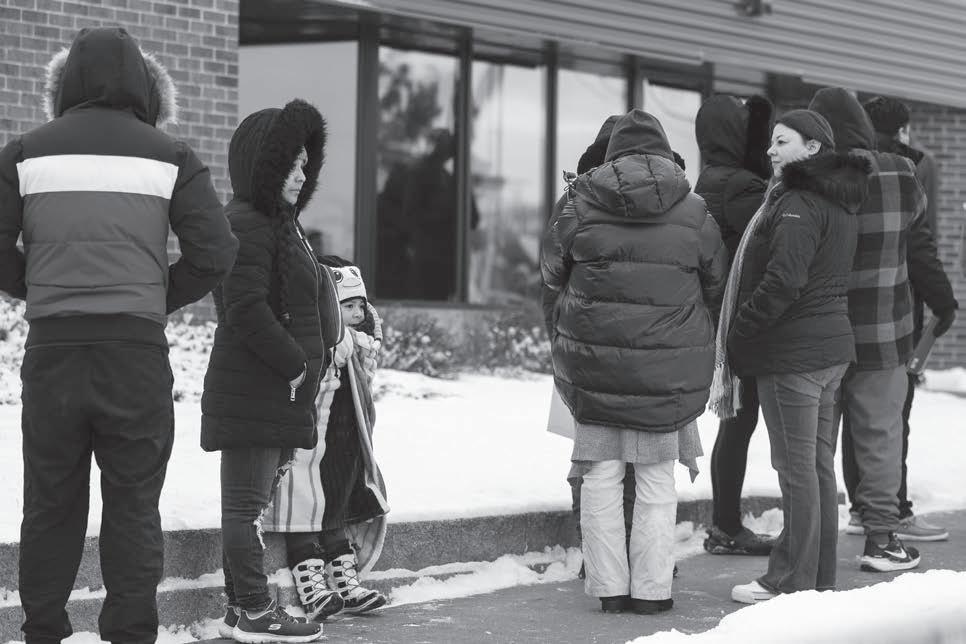
DAVENPORT, Iowa — Making small talk in the hallway before his plea hearing, Jorge González Ochoa, an Iowa City man who was detained by ICE agents in September, shifted in demeanor once he entered the courtroom. Brows furrowed and head angled toward his interpreter for the duration of his court proceeding, González Ochoa pled guilty to fraud and misuse of documents.
The 28-year-old appeared in the U.S. District Court Southern District of Iowa on Feb. 17 after entering a plea agreement on Feb. 13. His sentencing hearing is set for June 10.
Detained by plainclothes U.S. Immigration and Customs Enforcement, or ICE, agents in Bread Garden Market in Iowa City on Sept. 25, González Ochoa was also charged with the use of an immigration identification document not lawfully issued and the false representation of a Social Security number. These charges will be dismissed at the time of sentencing, according to
González Ochoa was aware the documents were false and used them to obtain employment. Creating, possessing, and counterfeiting false documentation, including visas and all other immigration documents, fall under violation of the code, according to the U.S. Department of Justice.
Stephen Jackson, chief magistrate judge for the Southern District of Iowa, ruled González Ochoa will remain on release until his sentencing.
Jackson said he will uphold the previous ruling of Judge Stephen Locher, U.S. district judge for the Southern District of Iowa, who found González Ochoa is not at risk of fleeing and needs to be there for his child.
Jackson said González Ochoa cannot withdraw his guilty plea and will not be subject to a trial. He will be judged solely on the basis of his plea by Locher.
González Ochoa could face a maximum statutory sentence of 10 years in prison, a maximum fee of $250,000, and a
Public concern drives Flock camera pushback
Coralville city leaders propose revisiting the program’s contract.
for reasons unrelated to public safety. The organization has called for clear limits on who can access the data, how long it is stored, and how it can be shared.
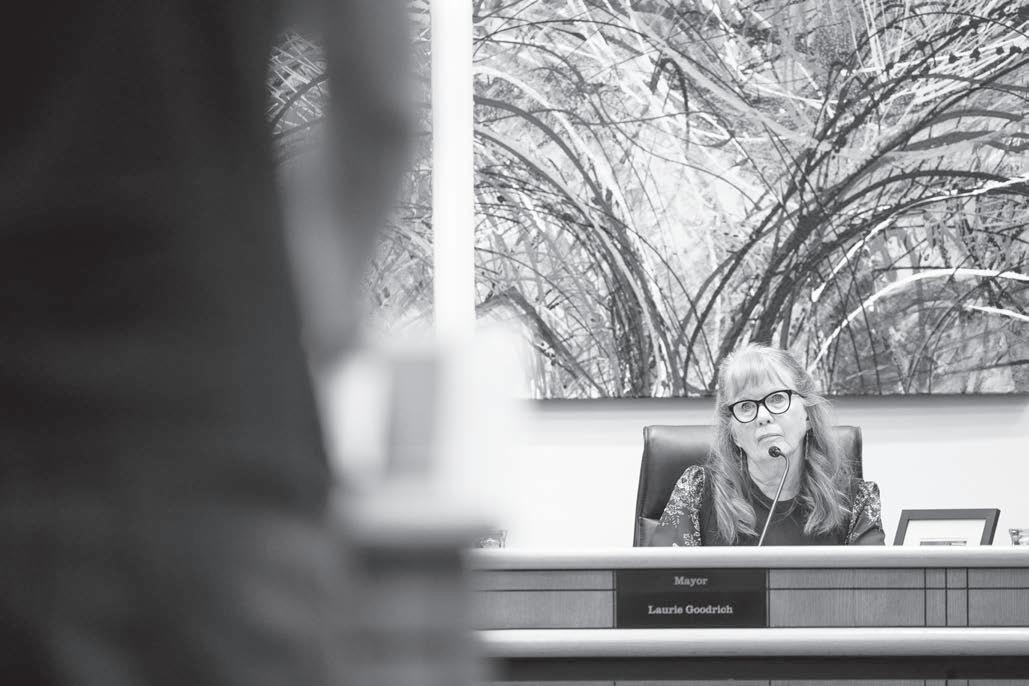
Coralville city leaders are preparing to revisit their contract with Flock Safety license plate reader cameras as residents ur e officials to re o e the ca eras o er privacy and immigration concerns.
The city council will reconsider the use of Flock cameras after Iowa Attorney eneral s ffice re uested the oral ille drops its policy limiting the use of the cameras for immigration enforcement.
Flock cameras, also known as automated license plate readers, are mounted near roads and capture images of license plates and vehicle details such as make and color. The information is stored in a searchable database used by law enforcement to locate stolen vehicles or assist investigations.
he e eetin as not the rst time residents pushed back. Previous meetings have included protests and public comment, with some community members voicing opposition to the cameras for months. At the most recent council meeting, the message from the public was unanimous: remove the Flock cameras.
The American Civil Liberties Union of Iowa argues that without strict rules, the technology can be misused or accessed
“We are asking for sensible guidelines,” Veronica Fowler, communications director for the ACLU of Iowa, said.
Fowler said the group is not opposed to technology that helps solve crimes but wants stronger safeguards to protect residents’ privacy and prevent overreach.
Automated License Plate Readers are used by U.S. Customs and Border Protection to scan plates and track vehicles. According to AP News, the Trump administration’s $2.7 billion budget increase for border patrol to expand a border surveillance system is increasing the agency’s surveillance capabilities and Flock camera data has been searched and used for immigration enforcement investigations around the country.
In Evanston, Illinois, Secretary of State Alexi Giannoulias discovered that Flock had allowed border patrol to access cameras in a “pilot program” against state law. Evanston terminated the contract
On. Feb. 26, 2025, the IWP’s grant agreement with the U.S. Department of State was terminated, resulting in a loss of nearly $1 million in federal funding per year. A few months later, Christopher Merrill announced his retirement from the program he had run for 25 years.
Options have been presented to align more closely with other departments at the university, including those Dicharry said she has worked with in past roles to engage international writers. Engaging with community partners, like Porch Light Literary Arts Center, is also a way Dicharry plans to keep the IWP on track.
In the face of recent challenges, however, Dicharry is adamant that the IWP will continue to operate as it always has, with more emphasis on the community and university allies around it.
“I’ve been here for a long time. This place has my heart and soul,” she said. “This is one of those places where you get very invested in what we’re trying to accomplish.”
Dicharry has been involved in the IWP’s mission for cultural advocacy since joining the program in 2016 as the leader of youth programs and later developing grant-funded initiatives to bring visiting residency writers together across geopolitical, religious, and cultural divides.
Bridging those gaps is still important even today, Dicharry said.
“There’s a lot of conflict, there’s a lot of division in the world,” she said. “We say we’re about crosscultural exchange and mutual understanding, so the uestion eco es What does successful mutual understanding look like right now?”
After a brief period leading writing and humanities programs at the Carver College of Medicine,
“We’ve been talking with Cate about programming things the writers will like,” Jennifer Colville, director of Porch Light, said. Porch Light is a local space for writers to collaborate through writing events, classes, and readings. “‘The Lights On Salon’ series has been going for a few years and brings writers together, but we’re excited to see how it can grow.” Deeper integration into community
supervised release of up to 3 years.
Jackson said González Ochoa will have to remain in custody for the entirety of his sentence, as federal court does not grant parole.
According to court documents, González Ochoa pleading guilty may restrict his ability to challenge removal from the U.S. in the future, and he may be subject to immediate removal from the U.S. after serving a sentence.
“Since you are not a U.S. citizen, it is likely
on Sept. 18. The cameras were covered with plastic y anston city sta and are no longer recording information.
In Coralville, the Flock contract controversy intensi ed a ter oral ille received letters from the Iowa Attorney General’s ffice on ec questioning whether the city’s license plate reader policy complies with Iowa’s immigration law.
Under Iowa law, cities are not allowed to adopt policies that “prohibit or discourage” the enforcement of immigration laws or restrict how law enforcement works with federal i i ration officials
Solicitor General Eric essan said in the rst letter on sent on ec the city ust remove a “Strict Access” statement on its website and delete a section of policy that bans using license plate reader data solely for immigration purposes.
Coralville city attorney e in lson wrote back to the state on an n the letter he cited Section o the e art ent
Policy Manual that states, “Members shall honor an immigration detainer request issued by United States Immigration and Customs Enforcement and comply with any related instructions,” and said that the “Strict Access” statement would be removed. The statement is no
that you will be deported right after serving your prison sentence and won’t be able to return to the U.S. during supervised release,” Jackson said to González Ochoa. Jackson said if González Ochoa were to reenter the U.S. while on supervisory release, an additional two years could be added to a sentence for illegally entering the U.S.. t ay a ect your a ility to e er le ally enter the U.S.,” Jackson said.
González Ochoa admitted to entering the ille ally ro olo ia in cto er according to court documents.
González Ochoa was released from custody in January after a federal judge deemed he was illegally detained and ordered his release with supervision while the case proceeded toward a trial.
Escucha Mi Voz, an Iowa City immigrant advocacy organization that advocated for González Ochoa’s release from ICE detainment and provided support at his ICE check-ins in Cedar Rapids, Iowa, declined to comment.
Elena Casillas-Hoffman, communications specialist for the Iowa Migrant Movement for Justice, declined to comment on the case, but spoke about the negative impacts of ICE on Iowa’s communities.
Casillas-Hoffman said ICE’s presence in Iowa is not new, but the tactics and scale of immigration enforcement cause fear and terrorize communities.
“We know that the scale of what they’re doing here in Iowa is escalated, and the terror that they are in ictin on our co unities is ore heightened than ever,” she said.
Many community members are isolating themselves because of a fear of the threat of ICE, asillas- o an said
“The threat is again all encompassing,” she said. “And as more and more of this information comes out, we hope that it leads to an educational opportunity for allies to know what immigrants and refugees are going through and have historically gone through under immigration enforcement.”
longer on the website.
In a follow-up letter on an olicitor eneral Eric Wessan said the state found Coralville’s policies mostly comply with the law and noted the city con r ed it honors ede-
ral immigration detainer requests.
The letter also pointed out that Coralville’s contract with Flock requires the city to follow all federal, state, and local laws, including immigration law.
Wessan asked the city to make the changes within
days nce the city con r s the u date he wrote in his letter over email, the complaint will be closed with no further action.
Many Coralville residents have said, however, the technology will do more harm than good.
“I’m here to ask you to remove the Flock cameras,” Judy McRoberts, a Coralville resident of years said at comunity comment. “The cameras now represent a danger to our immigrant families and those who support them.”
McRoberts said she believed the council originally aimed to protect residents, but that state and federal actions changed the situation. She urged the city to stop collecting data that could be used against community members.
Former council memer ill odds said she
once trusted the city’s safeguards.
“These are the privacy protections you ut in lace odds said, referring to Policy hich li ited data use, including for immigration enforcement.
She called the attorney general’s request to remove parts of the policy government overreach and urged council members to stand with constituents.
Other residents questioned how much control Coralville has over data once it is collected, includin an ohlers a Coralville resident of years ho said the promises made when the program began are no longer holding up. He said canceling the contract could cost the city about ut uestioned whether that financial concern should outweigh community trust.
“The state is effectively demanding that Coralville leave the door wide open for federal agencies like ICE,” Wohlers said.
Coralville City Councilor Mike Knudson said his concerns about the cameras are tied to immigration enforcement and how the national climate has shifted since Coralville approved the program.
Knudson said he was concerned about the timing of implementing the Flock system, given current immigration enforcement and federal policy. He said he did not expect the situation to escalate as much as it has.
“I really, at that time last fall, I had no idea how far it would go,” Knudson said.
Knudson said those developments have shaped how he views the program and signaled openness to reconsidering it.
Councilor Hai Huynh spoke about her perspective as an immigrant. She saud the current climate has left many residents feeling vulnerable.
“As an immigrant, I am not safe. I have never been safe,” Huynh said.
Huynh said declining the technology does not mean opposing police.
“Support doesn’t mean blindly signing the paper and call it good,” she said. She also addressed the financial side, saying the rou hly cost to end the contract “is not worth any human life.”
Huynh said she wants the contract brought back to the agenda and the cameras physically removed.
Councilors did not vote e ut se eral said they want the issue placed on an upcoming agenda.
life is at the center of the IWP’s future, but any attempt to understand this crucial moment in the program’s life cannot be made without an understanding of the institution’s storied past.
Merrill, in his decades of leadership, once faced an intersection point, too. Throughout his tenure, he acted as poet, teacher, advocate, and intitutional architect and faced political and cultural challenges on a similar scale to those present in 2026.
The security of the IWP has ebbed and o ed in the hal -century since its o enin as has Merrill’s life. But the ethos behind it has always kept it steady.
When Merrill was about 12 or 13 years old, he attended his usual hometown Fourth of July parade in Brookside, New Jersey, where he grew up. A town of roughly 1,800 people, Brookside’s parade usually consisted o re en a in ro retruc s and candy ein thro n ro at eds ut that year si youn eo le dressed all in black appeared at the end of the town’s main road and marched just behind the procession.
hey carried a coffin silently ithout pomp or circumstance, a mile down the road to the town center. Merrill was too youn to understand the si ni cance ut the Vietnam War was at its height and protests were seen as an intrusion rather than a welcome dissent.
Once the protesters reached the town center, Merrill’s baseball coach grabbed one of them and slammed him into a batting cage. Emotions were high in Brookside — the coach’s nephew had been killed in Vietnam two weeks earlier.
Decades after the parade, Merrill would write a poem about what he saw that day the coffin the silence and the sudden violence. It would eventually be u lished in his rst oetry collection ut when he read a version of it at the Bread Loaf Writers’ Conference at Middlebury College in Vermont, where Merrill got his bachelor’s degree, he was approached by Stephen Kramer, who revealed he was one of the protesters.
Kramer was a fellow poet and grew up in Brookside, too. The connections to Brookside throughout Merrill’s life don’t stop there.
Thomas Gustafson, whom Merrill called “Tim” when they were neighbors growing up, became a famous writer and
Growing up in Brookside, his ambitions were twofold. Merrill wanted to become a professional soccer player and write poetry. Despite the literary history that would eventually blossom from his community, at the time, the environment around him wasn’t overtly literary. His father, a banker, met Merrill’s dreams with skepticism.
Soccer came before writing, and he found some success in the sport, as playing it throughout adolescence eventually got him a full ride to Middlebury College.
“I was a passionate player and a good technical player, but my body broke down a lot,” Merrill said.
When his time on the pitch at Middlebury had elapsed, he pursued a Master of Arts in creative writing from the University of Washington. In Seattle, he et his i e isa o dy- errill a classical violinist who would travel with hi in an era o a li e de ned y relocatin ter ritin his rst a or oe oy Juggling a Soccer Ball,” his former college coach o ered hi a osition coachin the -tea at iddle ury e acce ted the o er and too the ost or a ti e e ore deciding once and for all that writing was what he was meant to be doing.
lon side o dy- errill he tra eled between Vermont, Washington, Louisiana, and Oregon. For a time, he edited “Quarterly West,” a literary journal based at the University of Utah, while freelancing for newspapers to make ends meet.
ean hile o dy- errill as layin with orchestras and chamber groups, which ultimately led the couple to Santa e or the rst ti e here she layed or the anta e era he air ere ndin success in their respective arts while traveling, but another momentous shift was about to enter Merrill’s life.
hile on a readin tour or his rst oo “Workbook,” Merrill met Aleš Debeljak, a Slovenian poet. They got along instantly, and Debeljak invited Merrill to hike across the mountains of Slovenia together. He agreed.
Writing at the core of everything he did, Merrill turned the trip into an assignment for “Sierra” magazine, pitching a story about two poets walking the landscape after the Cold War. By the time the duo arrived in 1991, though, the war in Yugoslavia had begun.
n the iddle o their three-day hi e they came across a hut they thought they’d stay in for the night but instead found it full of war refugees from Bosnia.
“My friend said he didn’t have the heart to ask them questions, but I did.
a department.
Merrill hesitated. The family finally had a sense of comfort after the period of traveling and work, and the Holy Cross job o ered sta ility till errill ound the o er co ellin ndin the challen e o re uildin the program interesting.
“My wife said at some point, ‘You know, if you don’t take it, you might spend the rest of your life wondering whether you should have taken it,’” Merrill said. “I think that was probably true.”
In August 2000, Merrill arrived in Iowa City with his wife, a daughter, and another on the way. Despite not thinking he would be traveling much after moving to Iowa, the job required frequent trips.
“Those first few years were just miserable,” Merrill said. “I just felt like I as uttin out res e ery here turned Thanks to the support of former U.S. e i each - o a and then- ice President for Research David Skorton, Merrill felt supported. The program stabilized, with annual fall residencies up and running successfully. This also strengthened the IWP’s relationship to the U.S. Department of State’s Bureau of ducational and ultural airs here it received a majority of its funding.
This bond resulted in new programming under Merrill, including summer writing programs, international conferences, digital projects, and advancements in cultural diplomacy.
for Literature.
“I think of him as a poet, in the classical ost odern sense in that he has a uasireligious devotion to poetry in the world. I remember him saying poetry and prayer are similar practices,” Glass said. e reached or a lo stac on the allsi ed oo shel that lines his office and plucked out Merrill’s autobiography, el - ortrait ith o ood identifying the dogwood plant on the cover.
“He engages with poetry as nature, as a connection to our world. I often think about him in terms of cultivation and mysticism,” Glass said.
Merrill’s work to recognize the poetry of the environment and bring people together brought him goodwill with the State Department and laid the groundwork for Iowa City’s designation as a UNESCO City of Literature in 2008.
But still, in February 2025, Merrill received a brief email from U.S. Secretary of State Marco Rubio stating the program no longer aligned with national interests, and all grants were terminated. This marked the end o a nearly -year artnershi ith the IWP. Merrill’s previously negotiated retirement would go into effect late in the year.
“They didn’t care about the Nobel Prizes,” Merrill said. “They asked why there weren’t any Americans on the list.” The untying from the federal o ern ent as ore than nancial it also delegitimized the IWP to important international networks where the program had previously visited.
professor at the University of Southern California. “American Pastoral,” Philip oth s canonical or o ction errill said, features an image of Brookside’s post office on the co er
“It’s very strange. These moments are just kismet,” Merrill said.
These convergent moments, where history seems to loop in on itself, have recurred in Merrill’s life both personally and professionally.
Now 68, Merrill is living in Santa Fe, Ne e ico here he and his i e li ed decades earlier before his storied career had fully taken shape. Recently retired after over two decades as director of the IWP, he discusses his move to Santa Fe unsentimentally.
It wasn’t a decision rooted in symbolism nor was it a lifelong plan. The decision was instead made based on housing availability, the presence of old friends, and the familiarity of the environment.
“It’s a physically incredibly beautiful place, especially so if you like mountains and desert,” Merrill said. “There is a rich i o cultures too as it is a out a third Hispanic, a third Native American, and a third white.”
Ne e ico is also a lace sha ed y layers of historical convergence and cycles, following a similar pattern to Merrill’s story ust as his retire ent o ered the institution o the to re ect on here it will go in the future, Merrill has had time to look at how far he has come after feeling the sting of the State Department’s funding cut.
I thought, ‘This is a story I can tell,’” errill said s ent si ee s in lo enia before I returned and told my editor, ‘OK, this probably isn’t going to be what you thought.’”
The story went out anyway, and it hooked Merrill on writing. He returned to Slovenia for three months a second time and pitched a book on the war when he returned. Then a second book idea came up, and with it, more months of reporting from the Balkans.
This continued reporting resulted in his first two prose books, “Only the Nails Remain” and “The Old Bridge.” He found his instincts as a poet, witness, and listener lent nicely to nonfiction journalistic writing.
Once the war wound down, he took a position at the College of the Holy Cross in Massachusetts. It was an ideal job, Merrill said. He taught two classes a semester, wasn’t on any committees, didn’t go to any meetings, and had plenty of time to write.
“It was a sort of prestigious job, and I was ne otiatin y lon -ter stay hen ot this call ro onnie rothers the lontime administrator at the IWP in Iowa, in 2000,” Merrill said. “I told my wife I had this weird call from Iowa, of all places and thought maybe they want me for a reading. But they wanted me to apply for the job.”
By the late 1990s, the IWP was in a crisis after years of mismanagement.
It was on the brink of academic receivership, when a university’s administration takes control of
“I had argued that we think about cultural di lo acy as a t o- ay street not just bringing scholars and writers and artists and the like to the U.S. via programs like the IWP or Fulbright or what have you, ut thin in o it as a t o- ay o eration so that we are listening as much as we are giving,” Merrill said.
Cultural diplomacy was always at the forefront of the IWP’s philosophy during his directorship, and it remains so under icharry ho e erienced errill s assion rsthand in their years or in to ether is co it ent to ndin ne ways to connect Iowa City to the world was visible even from other departments in the university.
“I always knew Merrill as the resident cultural entrepreneur of the university,” Loren Glass, chair of the UI Department of English, said. “He’s highly motivated and restless, but I choose that word because of the way he got institutions started, money raised, and connected people. He’s a mover and shaker in the sense that he always got writers connected with the community and the rest of the world.”
Glass has known Merrill since 2004, when Glass was hired at the university and the IWP was already well underway in its transition period. Despite not working together frequently, Glass’ path occasionally crossed that of Merrill’s, and he’s even interviewed the former IWP director for the Los Angeles Review of Books in the past.
In Merrill’s time at the IWP, the program held events in Fez, Morocco; Paros, Greece; and Konya, Turkey, bringing together writers from the U.S., Iran, Afghanistan, Syria, and Pakistan. The IWP had hosted more than 600 writers from 160 countries, and three alumni would win Nobel Prizes
“It’s part of a larger isolation,” Merrill said. “And the world is moving on without the U.S.” Merrill had already begun negotiating his retirement before the news hit. So when the nal residency closed he ot in his car and drove to Santa Fe.
Even without funding, the strength of the organization’s programming in the last several decades has turned it into a staple of the community, according to Colville, Porch Light’s director.
“It’s a very centering place,” Colville said. “As a destination for writers and for the literary community here, the IWP is very centering.”
Dicharry worked with Merrill for close to a decade, and the mindset he carried to constantly foster connection is still ingrained in the organization; it is simply going to adapt to the new cultural and political needs of the time, Dicharry said.
“There’s a lot of division in the world, and e say e re a out cross-cultural e chan e and mutual understanding,” Dicharry said. “So we’ve had a lot of conversations since I’ve been in the directorship, about what successful mutual understanding looks like right now.”
While the conversations regarding the mission of the IWP continue to evolve from the inside, the impact the institution has made on the community is palpable.
“I think [Merrill] turned us into an international literary capital,” Glass said. “Iowa City has become a sort of pit stop and cultural capital. As Chris once said, we punch way above our weight. I think the IWP has powerfully contributed to the cosmopolitan culture and the diverse demographics of Iowa City.”
OPINIONS
Holt’s horrible solution for crime
Representative Holt’s proposed bill is unsustainable and useless.
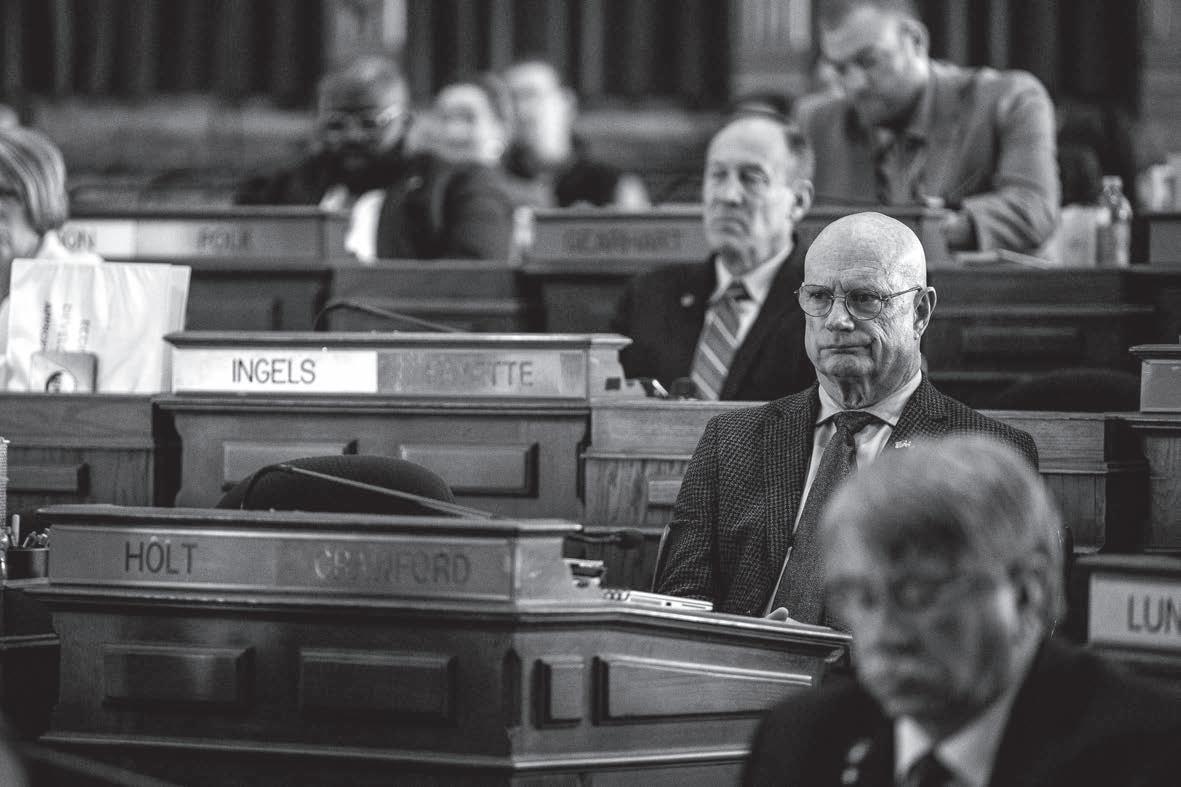
Representative Steven Holt’s idea of solving crime seems to have come from someone who’s been hit in the head with a bat or hasn’t looked at the state of incarceration in Iowa. At least that’s the most charitable explanation I can find for why anyone would propose a “tough on crime” bill while Iowa’s prisons are already operating at 23 percent over capacity, according to the Daily Statistics on the state’s offender search website.
On Jan. 28, Holt appeared in a purple plaid suit, flanked by Rep. Charley Thompson and Rep. Mike Vondran, as he listlessly prattled on about “those who demonstrate through their continued lawless actions that they are not willing to be rehabilitated … will not see the outside of a prison for a long time to come.” These remarks were captured in a recording by Iowa’s News Now.
Keeping with the baseball theme, Holt’s proposed bill, ominously being House Bill 666, would introduce a three-strike system to the Iowa judiciary system. Under the bill, full “strikes,” or points, would be assigned for felony convictions and certain aggravated misdemeanors, including organized retail theft and possession of a controlled substance. Half-strikes would be given for other aggravated misdemeanors and some serious misdemeanors.
specific motives or the bill’s prospects, but the theory offers a plausible explanation — even if the legislation stalls, the headline alone may suffice.
If that is the case, the bill is less about public safety than political safety.
The bill is messaging dressed up as policy. In the process of delivering this
messaging, Iowa inches closer to expanding a prison system that is already overcrowded and costly.
But if this proposal represents a serious, evidence-based attempt to
improve public safety, it is harder to accept. It would only confirm that Rep. Holt has the sensibilities of Looney Tunes’ Elmer Fudd.
The result would be an influx of
A protein epidemic is upon us
New dietary guidelines align with current questionable food trends.
Earlier this year, the Trump administration released new dietary guidelines for U.S. citizens. Theb announcement was a part of Health Secretary Robert F. Kennedy Jr.’s Make America Healthy Again, or MAHA, movement.
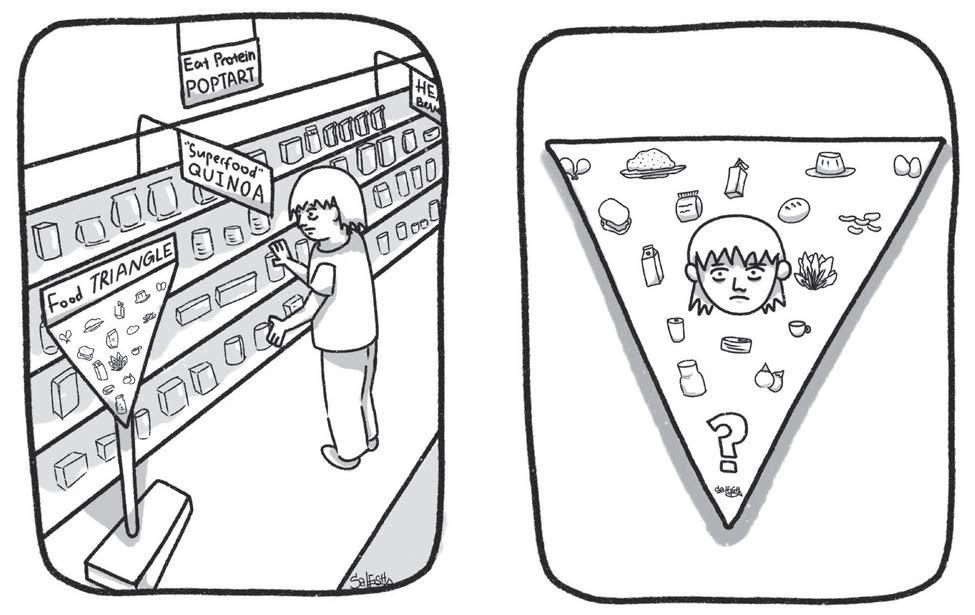
These guidelines included a food yra id that is i ed u side do n he new pyramid places greater emphasis on consuming protein, dairy, and healthy fats. Some foods pictured on the pyramid are steak, ground beef, a block of cheese, and whole milk.
his is not the rst ti e the ood yra id has undergone changes, but it is by far the most drastic. The most recent version was the My Plate graphic that had been used since and si li ed ood ser in s into quadrants on a plate. These guidelines placed emphasis on primarily vegetables and grains, with fruits and proteins being last, and then a small portion of dairy for everyday consumption.
However, the new pyramid has put grains at the otto o the in erted ure and shrunk the serving sizes exponentially.
Other than the fact that the new guidelines contradict previous food recommendations, another troubling fact is that several of the authors of the new guidelines have ties to the food industry, s eci cally the ee and dairy sectors hich brings into question the legitimacy of some o the reco endations s eci cally or meats, fats, and dairy.
The reality is that the new food pyramid and guidelines are not new ideas and are a result of internet food and diet trends that have increasingly complicated what the idea of a proper diet looks like.
As mentioned, the recommended amount of protein has grown by a noticeable amount. Previously, the guideline was that a person should eat 0.8 grams of protein per kilogram of body weight; now that number has nearly doubled, with the new recommended amount being 1.2-1.6 grams.
While protein is good for the body, the quality and type of protein can play a major factor into nutrition and a person’s physiological health.
Stephanie Borst, University of Iowa assistant professor and registered dietician,
has kept up to date with the new guidelines and wants people to remember to diversify their sources of protein.
“In addition to choosing a protein at each meal, we should consider the other nutrients within that protein source,” Borst said in an email to The Daily Iowan.
Borst said that choosing lean and plantbased proteins helps lower a person’s saturated fat intake. Plant-based proteins, especially, were something she wanted to highlight as consumption of those would increase a erson s er inta e
Third-year UI law student Joe Rychwalski also emphasized the need for fiber and worried that its need in people’s diet is being overlooked.
“Fiber seems to be getting lost,” Rychwalski said. “If you are eating too uch rotein and not enou h er that s hindering your digestion.”
esearchers ha e ound that a hi h- er diet is linked to lower colon cancer rates. It is i ortant to note that accordin to cienti c American, as of 2023, colon cancer had jumped to the leading cause of cancer deaths in Americans under the age of 50.
The National Cancer Institute found that red meats and processed meats, which are higher in fats, are associated with higher
rates of colorectal cancer. Those are the same high-fat red meats pictured as part of the new food pyramid.
So if people want to jump on the trend of eating a high-protein diet, they need to be conscious o their er inta e and ay e look into plant-based options for protein.
Plant-based proteins, though, have not been trending on social media. Instead, what has been trending on social media is “high protein” versions of consumers’ favorite foods.
Originally, these “high protein” versions of food were reserved for energy bars, but have now made their way into some of the most popular U.S. snacks. Some of the new high-protein options consumers have are Doritos, Pop-Tarts, popcorn, cookie dough, and countless other absurd options.
The trend has also made its way into fast food, as Chipotle has been advertising its high-protein meals, including a cup of only chicken.
There is also Dunkin’ Donuts, which has gone viral after the store announced its protein milk option.
Borst has kept up with new products that have protein injected into them and a label advertising their “high protein” content, and she advises against them as
healthy alternatives.
“Adding protein to processed foods does not change the fact that it is still processed food,” Borst said in an email. “Processed foods often contain added sugars and are low in vitamins and minerals.”
Despite the new options for protein, Borst still urges consumers to get their daily protein intake from foods that are naturally high in protein.
Rychwalski has noticed these products in stores and advertised online, and he does not view them as healthy or appealing.
“I personally am going nowhere near them,” Rychwalski said.
While Rychwalski understands that some of these options can be quick and easy options for protein, he’s concerned about the ingredients inside them and would rather stick with natural foods.
“My mantra is try as much as possible to be natural,” Rychwalski said.
So, as the government, advertisers, and social edia trends ood your eed ith conflicting ideas regarding nutrition, it is always a safe bet to stick with natural foods, to diversify your protein intake, and to listen to the experts rather than groups looking to make a profit off of your confusion.
UI receives grant to study metabolic, oral health
As Iowa ranks 11th in the nation for obesity, researchers stress the importance of the study.
University of Iowa researchers are working to study the correlation et een oral and eta olic health a category Iowa particularly falls behind in according to Iowa Health and Human Services. Iowa ranks 11th in the nation for adult obesity and one of 19 states with an adult obesity rate at or above 35 percent. The researchers were awarded an over $3.5 million grant from the National Institutes of Health to study the correlation between metabolic and oral health. u irth anesan associate ro essor in the UI College of Dentistry and the rinci al in esti ator o the study said the total amount of the grant per year de ends on the ederal ud et ut it ill e ceed illion or the e-year duration.
According to the American Council on ducation at the e innin o the year the ouse o e resentati es passed a budget that gave the National Institute of Health $48.7 billion and re ected a ercent cut ro the ru administration.
Ganesan said the grant runs for up to e years durin hich atients will be tracked as they improve their eta olic health throu h losin ei ht usin edications and i ro in diet and exercise to see if their oral health follows suit.
Ganesan said the study follows a re ious cross-sectional study or a study analyzing a population from a single oint o ti e in hich atients with metabolic issues such as obesity or diabetes were closely analyzed to determine whether the patients had oral acterial ro les that rese led those seen in u disease e en e ore clinical symptoms appeared.
o er ti e rather than analy in the at a single point in time. Ganesan said he and his team will examine how improvements in eta olic health a ect oral acteria eta olites or tiny che icals the ody produces when processing food and ener y n eo le ith o esity chan es in metabolites can encourage the growth of harmful mouth bacteria and increase in a ation
studies approaching the idea of the connection between oral and metabolic health any o their indin s are contaminated by patients who already ha e had u disease other diseases such as ty e t o dia etes or ho arta e in habits that negatively impact oral health such as s o in
he cross-sectional study ound that even though the patients’ teeth and u s loo ed healthy on a dental e a the bacteria living in their mouths looked similar to what would be seen in people with severe gum disease.
factors in the studies because some eo le start s o in so e eo le drin alcohol or they ha e oor oral hy iene he said. “Understanding the mechanism connecting oral health and systemic health is lac in
Ganesan said his patients were intentionally picked if they showed healthy mouths and did not have a history of other factors independent of metabolic health that could a ect their oral health such as smoking.
Ganesan said he hopes his study will make the public aware that oral health is an indicator of overall health. Ganesan noted the mouth is the gateway to the body and the start of the digestive syste a in it closely connected to
eta olite sa les in the study said i the team is able to understand how oral health changes with metabolic health and how the patient’s mouths compare to those ith u disease they can ro ide more preventative care.
t s li e did the chic en or the e co e irst aylor said ith the di erences that e see e can otentially use them as prognostics to understand disease tra ectory Taylor said measuring obesity is complex; it can be measured by the ratio
o at to lean ass ut the indi idual dri ers o the condition and in turn the Taylor said he hopes the study’s findings will be a step toward incentivizing the emerging tactic of recision edicine a health care approach that customizes disease prevention and treatment based on the
“Anything that we can learn to move the needle that will change understanding o o esity that can in or treat ents or o esity certainly can hel ithin the shutosh an ala a ro essor o pathology in the UI’s Carver College of edicine and a colla orator in the study said he helped to mentor Ganesan before Mangalam said the two have had a good relationship since he mentored Ganesan. Managalam said the two have submitted a request for a Managalam said the grant focuses on how oral health and bacteria can contribute to or worsen Multiple clerosis an autoi une disease oo in at anesan s current ro ect Managalam said he is proud and unsurprised that Ganesan received the large grant.
t is a a in he said e s ore li e a collea ue than ein entored ecause he is ery hard or in and he has clarity on what he does. So it has been a lessin to e entor o hi and no he s tenured and an associate ro essor
County gives funds for sobering, detox services
JoCo Supervisors approve $580,000 for expanded addiction resources.
The sobering and medical detox services at Iowa City’s GuideLink center have been a valuable resource for members of the co unity o er the ast e years as the rate o o erdoses has een increasin ut undin staffin and resource shorta es are a in it difficult or those in need to receive help.
Johnson County’s rising drug issues make GuideLink’s services useful for county residents. According to the District ro ile and lan a co rehensi e summary of southeastern Iowa’s eha ioral health dru -in ol ed overdoses from 2018 to 2023 have been si ilar or hi her than o a s a era e with the rates of these overdoses only increasin ran in ro to deaths er ince o enin uide in has or ed to co at this issue ut a lac o undin a es this difficult re resentati es o the center said.
anya a li - ith the lead e er ency edical technician at uide in de ned the sobering center as a place for people to co e i they re under the in uence or wish to refrain from using substances before going to other substance use treatment facilities.
The Johnson County Board of Supervisors has been discussing the budget
une u er isor od ulli an ho has een involved throughout the partnership ith uide in said the oard has s ent substantial time talking with Michelle De a i a o unity and a ily esources e ecuti e director and he is a reciati e o the service’s willingness to lay out all the nancial in or ation
ulli an said since the early s Johnson County has always paid for the detox of people who are neither on private insurance nor edicaid in other counties and this has never changed.
“Because of the lack of providers around the state it s ro a ly ended u eco in more of a problem for us. Because of the old issues o le al settle ent e et eo le ho co e here to recei e ser ices Sullivan said.
ristina ron the lead ara edic at uide in esti ated that around to 35 percent of people utilizing GuideLink’s services come from outside of Johnson ounty de endin on the onth
Around a year before GuideLink o ened ulli an and ice hair isa reen- ou lass had co e u ith an a era e nu er o which they felt represented how much the county had already been spending on these services without GuideLink. Sullivan said that number is al ost no and is not an unreasonable increase.
“So it seems that we are continuing to pay
Kron said this lack of state funding for sobering and detox services creates any issues or uide in the reatest ein staffin e try to sta an assistant in there so e re not y oursel es ith any ody ut many times we have to operate on our own because we don’t have enough funding to ha e an assistant ron said uide in uses sta ro the ohnson ounty ulance er ice ith our ullti e e loyees on sta at all ti es ron said this can create challenges because GuideLink does not want overtime for these employees. She said the paramedics and EMTs on staff are valuable because they can act as an emergency room diversion so they do not have to send every patient to the emergency room for minor complaints or rst aid issues
ro ra s also o er any resources such as snac s electrolyte drin s and toiletries for patients. Kron said these expenses are difficult to usti y ith no state undin coming in. he challen e ould e ndin those unds hether that e throu h rants or ust the enerosity o ohnson ounty and the oard o u er isors o erin to und those ser ices ron said a li - ith said a lac o state undin puts the organization in a tough situation because they do not generate revenue.
for Iowa City’s GuideLink Center at its past e eetin s here they re ie ed an October 2025 invoice for Community and Family Resources for their medical detox and so erin ser ices hich the oard had been funding for a period of 120 days.
n e the su er isors a ro ed a proposal to continue funding GuideLink and extend the billing process through
or e actly hat e e aid or or years ut the di erence is the so erin ser ice
Sullivan said.
Sullivan said services in Johnson County were introduced after GuideLink opened. Sobering services are not recognized as a billable service by the state and therefore recei e no undin ro the state lea in the nancial urden to the county
Kron said the lack of funding and staffing prevents them from taking in every person who needs help because they are ca ed ased on the nu er o sta available. If they were to receive more undin she said they ould s end it on staffin so that they could ta e on ore clients at a time. GuideLink’s sobering and detox
“The county sees us as an important service that they want to allow to all of the people of Johnson County and outside counties as ell to co e to ut it s at a cost to the hich is not a chea cost hen you loo at yearly a es ene ts that ind o stu she said a li - ith said uide in is a aila le to e eryone no atter hat insurance or issues they i ht ha e and is nonin asi e “A lot of things that people hold really private are things that don’t necessarily matter in our situation because we’re not charging their insurance and e re not
SNAP changes spark checkout confusion
Grocers in Iowa are grappling with new SNAP restrictions on the items on their shelves, and must navigate what quaies under u dated uidelines i osed y the state.
n anuary o a e an en orcin one o the nation’s most restrictive” Supplemental Nutrition Assistance Program, or SNAP, ai ers and consu ers rocery stores and ood antries are ein le t ith concerns and questions regarding the updated nutrition rst olicy er o ans recei e N ene ts accordin to the o a e art ent o ealth and u an er ices ter o a s ne N ai er ent into e ect it no li its eli i le urchases to nonta a le ood ite s such as ruits eeta les eats dairy ite s and rains to etter ali n N eli i ility to the state s ta code accordin to the o a e art ent o ealth and u an er ices
e ore these uidelines ere i leented ite s includin ita ins su ary drin s and rocessed oods ere eli i le to e urchased under N he ne chan e ill direct eo le to ard oods that ro ote ood nutrition and a ay ro soda and candy accordin to the o a e site he u date as ro oted y o i eynolds ad ocated or y the a e erica ealthy ain caai n and a ro ed y the e art ent o riculture
In the governor’s annual Condition o the tate ddress in anuary she as ed the o a eneral sse ly to aintain a nutrition rst ocus or the SNAP program.
he days o o ern ent ro ra s that ena le chronic illness are o er eynolds said t s ti e or a ne era o accounta ility and health.”
ou hly ore than a onth a ter the restrictions ent into e ect local rocers e ress con usion and orries hrou hout ohn s rocery in do nto n o a ity si ns read candy soda and other ta a le rocery ite s are no lon er co ered y N hris oore eneral ana er at ohn s rocery said it s een difficult or the store ecause ood ite s that are N eli i le ha e eco e si ni cantly ore e ensi e or the to ha e in stoc t is ind o disa ointin he said here s ust not a lot o ood o tions that are a orda le or hat they ant
lot o the uice that stores carry doesn t contain a hi h enou h ercenta e o uice to e considered N eli i le he said not totally a ainst that ut e erythin that is ercent uice is ery e ensi e en arah rone arriott - indsor ei hts said lar er rocery stores in o a includin y- ee and are ay ha e na i ated N chan es y ein a le to indicate hat is eli i le throu h si ns and digital tags. or s aller retailers ho e er rone Garriott said it is more challenging to i ure out hat ood ite s all under N eli i ility so e ody is rin in u roceries they re oin to ha e to e lain to eo le hy they can t use their card to ay or it she said nd don t no i the rocers are doin that education ith their sta Smaller, independent grocers have complained to the Southeast Linn Comunity enter and e ecuti e director Nicole c le ander said they are having a harder time than larger retailers in implementing the changes. t as ery challen in or the to na i ate to try to u date their syste to accommodate the new restrictions,” she said. hey re ha in to deal ith a lot o con used and rustrated custo ers and there s not enou h uidance or the stores on ho to manage these changes.”
ric reach tea lead at the o a ity location o Ne ioneer o- said since chan es to N are ade o ten there is al ays so e con usion ro custo ers ith this ne ai er ho e er he said it is ore u settin to see certain oods ta en a ay ro atrons ho are on N his articular ti e it see s dia olical he said
rone arriott said hile N chan es are ai ed at ro otin healthier ood choices, the unclear language makes it conusin or o ans ho are eli i le or the ene ts he a era e consu er does not know what, according to Iowa code, is ta a le or not and it s not as si le as so ethin s healthy or so ethin s not healthy she said hile soda and candy are a on the rohi ited ite s su ar-s eetened eerages, such as sweet tea and lemonade, are anned alon ith ero-calorie and
rocery store that cuts ruit and sells it in a cu ay e allo ed to acce t N unless the cu includes a or old deli sand iches ay e ineli i le i the store has a icro a e a aila le or custo er use e en i the custo er does not intend to heat the ood rone arriott said she recently ound out that drin s such as edialyte all under the ta a le restrictions and heard co laints ro so e ho ere shoc ed to see it did not all under their N ene ts you re a arent you no hat edialyte is and it s really a hel ul thin or your ids hen they re sic rone arriott said es it does contain su ar ut there s a reason it does.”
c le ander said the N chan es have increased stigma and complications a on those ho are eli i le or the ene ts tal ed to se eral eo le ho said they re no ery ner ous a out usin their N ene ts ecause they re not sure hen they o to the counter i they e ic ed the ri ht things,” she said.
c le ander said the ai er isn t ro otin healthy eatin hey ust a e tri s to the rocery store ore co licated and challen in ut don t actually i e the any additional unds to urchase the ore e ensi e healthy ood she said t ust eels li e unish ent and di iculty rather than incenti i in healthy eatin
N enroll ent in o a is at an -year lo accordin to the ost recent data ro the ensus ureau u e l in a olicy and ad ocacy ana er at the o a un er Coalition, said the decline in enrollment leads to an increased need at ood antries which he said could mean there are a multitude o eo le ho are not ein ser ed y N e en thou h they uali y hile enroll ent is declinin linga said due to past trends, he doesn’t antici ate a noticea le hit in N enroll ent until arch N enroll ent has decreased ercent in o a ust ro u ust he said No e er had a hu e dro e anticipate SNAP enrollment is going to continue decreasin e also antici ate that the need or ood antries is oin to increase at the sa e ti e and not ust ol s losin access to SNAP.” l in a ho also or s as the co unications ana er at the es oines rea eli ious ouncil ood antry or said hile the ood antry has seen an increase in de and o er the ast cou le o years he antici ates it to o u e en ore or instance re u ees and asylees are no lon er eli i le or N so there are eole ein ic ed o the ro ra he said hese ne or re ortin re uire ents ent into e ect and that s oin to lead to ccordin to the e art ent o Agriculture, the general work requirements include re isterin or or artici atin in N e loy ent and trainin and not oluntarily uittin a o or reducin your or hours elo a ee tudyin in school or ein art o a trainin ro ra ein una le to or due to hysical or ental li itations or ta in care o a child under the a e o ill e cuse a erson ro the eneral or re uireents and allo the to still e eli i le l in a said due to the antici ated increase in reliance on ood antries is ain ad ust ents to acco odate hi her needs e said the or ani ation is tryin to train volunteers on the SNAP application
and recerti cation rocess hich he said ill hel eo le na i ate so e o these ne restrictions and ensure they don t lose access to their ene ts yan o st e ecuti e director at the North i erty o unity antry said the ood antry has conducted sur eys ith atrons o er the ast cou le o years and any ti e there is a disru tion in N the de and at the ood antry increases e said e ore the - ande ic only ercent o sur ey res ondents said the ood antry ro ided ost o their household ood or the ee o e er durin and a ter the ande ic that nu er rose to a out ercent hen a ilies rely on N to eed their households and then don t ha e that they are co in to us or the rst ti e ecause on N they e een a le to a e it so ar o st said hey re or in they are eli i le they re contri utin to the co unity and they re ettin y ith that assistance.” o st said to na i ate an increase in de and the North i erty ood antry has een relyin on its artners or donations hich include the o a un er oalition and the ohnson ounty ood Access Network. e are tryin to source ore ood he said e re tryin to do so e collective work together to make sure that all o our antries and eal sites and ood rescue or ani ations in ohnson ounty can continue to ro ide a hi h le el and hi h- uality ser ice and ood to our nei h ors
A month into the waiver, some advocates are cha ionin or the o a le islature to in est in charity- unded nutrition incenti e ro ra s li e ou le ood uc s rone arriott said she has een ushin or a chan e in N le islation or a e years he has een an ad ocate or o a s artnershi ith ou le ood uc s and said it does a etter o at ro otin healthier ood choices than the ne ai er t atches u to a ee er N artici ant to uy healthy resh ood rone arriott said t can e used at uali yin ar ers ar ets uali yin rocery stores on resh roduce and that is a really reat ay to incenti i e healthy choices and hel shi t eo le to ards those ic s l in a said ad ocates had een or in on the in est ent or ou le ood uc s or years includin introducin a ill in that ould ha e ro ided illion to the ou le ood uc s ro ra ut it did not pass. ith the u dated restrictions and ood eli i ility the ill as reintroduced to the o a enate enate ile in that i assed ould add a illion a ro riation or ou le ood uc s No ith the
Ki y Corner marks one year in Iowa City
With over 280 adoptions, the store helps families find new cat companions.
Cats lounge across couches and window perches, playing and stretching as people of all ages gather to enjoy them at Kitty Corner in downtown Iowa City.
What many now consider an Iowa City staple began with four weeks of renovations that transformed a former nail salon into a cat café. As the business marks a year since opening, Kitty Corner Social Club has facilitated 280 cat adoptions, with about 90 percent of its cats adopted by the end of each week, according to co-founder Cooper Brown, son of owner Katy Brown.
The idea behind Kitty Corner was never meant to be a business model built on numbers, Cooper Brown said.
“It was honestly just a joke between us that we thought it would be something fun to have downtown Iowa City,” Cooper Brown said. “The plague of vape shops and bars was people would be interested in having something new and a little special to do that also could serve a good purpose.”
String lights hang across the ceiling, casting a glow over purple and turquoise walls lined with framed cat portraits, art prints, and posters as cats weave between visitors’ feet.
Cats come every Monday from Iowa City Animal and do tion enter u u ue e ional u ane ociey the Cedar County League for Animal Welfare, and the Scott County Humane Society. Adoption fees are $150 per cat, and all cats are spayed or neutered, microchipped, and vaccinated. Adoptions are review Thursdays, and adopted cats go to their new homes on Sundays.
For Cooper Brown, Kitty Corner’s success goes beyond the adoptions, it’s about the community that formed around them.
“It’s been awesome to be able to create a space where so any di erent eo le rou s and co unities ant to use,” he said. “There’s such a disconnect between students and longer-term residents of Iowa City. I think it’s been really interesting seeing how this space bridges that gap a little bit.” For many families in Iowa City, that sense of connection e ins ith a sin le cat he toner a ily s e erience is just one of many shaped by Kitty Corner.
The Stoner family has had many cats, but none that have een a le to ee u ith their -yearold dau hter ylee besides Louise.
“Our other cats, they’re kind of scaredy cats, and they ere retty ti id o ylee ut ouise she s not ti id o her at all and she ust ill lay ne t to her e en hen ylee is ind o a cra y ouncy toddler n ela toner ylee s mom, said.
Louise is a female orange cat. Stoner described Louise as having dog-like qualities, always wanting attention and to be snuggled by her owners.
When Stoner walked into Kitty Corner Social Club in February 2025, one month after the adoption cafe opened, she asn t e ectin to et a cat ter dinner ith a riend the two walked into the small shop on Clinton Street.
“They opened, and I’ve always wanted to go into a cat cafe, but I’ve never been to one before,” Stoner said. “And
so I went with my friend Alison just to check it out and hang out with cats because we both love cats, and of course, I met Louise and just fell in love with her instantly.”
Seeing Louise’s orange fur, Stoner took it as a sign to take her home.
“I’ve always wanted an orange cat because my grandma’s cat growing up, which was my favorite cat ever, was an orange, and I also really loved it,” Stoner said. “I learned that female orange cats are actually pretty rare.”
When describing Kitty Corner, Stoner said the cafe stands out as a place that genuinely cares about cats. he sta are ust really assionate a out cats and ta in care o cats and they re really e cited to e a art o the Kitty Corner,” Stoner said.
Every day, 8-yearold Lucy Breher comes home to her three cats, Walter, Moonbeam, and Momo, who meet her at the door. Lucy said she looks forward to it every day.
“I love cats,” Lucy said, with pink cat ears on top of her head.
ucy as the rst in her a ily to o to itty orner Social Club, going with her summer camp to see the cats.
Since then, Lucy has gone many more times, calling her and itty orner s o ner aty ro n riends e citedly sharing that a picture she had drawn is on Kitty Corner’s wall.
“I think they could just really tell how Lucy has a love for cats and how good she is with cats,” Tonia Breher, Lucy’s mom, said.
Lucy grew up with Momo and another cat. After the other cat died, Momo was the only cat left in the house. Lucy’s family later decided to adopt another cat, so Momo would
not be alone, bringing Walter into their home.
Breher said Kitty Corner set itself apart amongst the other pet suppliers because of the way they advertised their pets.
“I think that she does a great job with describing their personality so you can kind of get a sense of what the cats are like and if those are cats that you think you’d like to meet,” Breher said.
Walter was a complete surprise for Lucy; the day the Breher’s adopted Walter began with Lucy’s mom telling her daughter they were going to the library, but instead took her to Kitty Corner. as so e cited and could ust not ait to ta e hi home,” Lucy said. Lucy described Walter as a black shorthaired ener etic cat callin hi a little e lorer
Soon after, the cat, soon to be known as Moonbeam, was seen on the Kitty Corner social media pages. Breher said after seeing the post, she just had to have him.
“We discovered that Walter really wanted to play, and Momo, being an older cat, did not really have that energy that Walter was looking for. So we realized that we thought it would be best for Walter and Momo if we got a cat that was Walter’s age that would be willing to run around and wrestle with him,” Breher said.
Now, Lucy said that Walter and Moonbeam keep her busy as the three of them chase each other around the house and play an assortment of games.
“Sometimes I hold like a stick toy with a feather at the end and I see how high they can jump. Walter’s is always really good at it,” Lucy said.
Historic Haunted Bookshop withstands challenges
Iowa City’s last used bookstore continues despite rising property taxes, changing market.
Nialle Sylvan and her husband, Josh Sylvan, are the owners of the historic Haunted Bookshop, a used books business, which is situated in the even more historic Jacob Wentz House on North Gilbert Street in downtown Iowa City. After decades, the store is the only used bookshop still open in Iowa’s literary capital, and continues to operate despite a series of new challenges.
For the past few years, the business has struggled a ainst increasin nancial issues ith ro erty ta es dou lin ro hen Nialle yl an rst ou ht the business over 20 years ago to $12,000 today.
ccordin to the o ans or a elie oundation ro erty ta es throu hout the state ha e risen y ercent since 2004, when the Sylvans bought the store, an increase that endangers small businesses like this one, es ecially hen they don t lan on e ansion
he sho e clusi ely sells used oo s or an a era e o $6 per book. Other stores in Iowa City do sell used books, such as Prairie Lights and the public library’s shop, The Book End. However, the Haunted Bookshop is unique in that it e clusi ely sells used oo s no ne releases e hasi in sustaina ility and a orda ility hile this stands out among the city’s book retailers now, that wasn’t always the case, Nialle Sylvan said.
Iowa City has been home to seven used bookstores, all within walking distance from each other, with all but the Haunted Bookshop closing downtown. Such stores included e unct oo s ur hy- roo eld oo s he Bookery, and Northside Book Market, all of which have either closed permanently or relocated online.
“People would drive from all over the country just so they could walk from store to store,” Nialle Sylvan said. “And of course, this is Iowa City, so the stock we have is very high quality. You know, we have more poetry, we have more literature and translation than many other cities. And I missed that aspect.”
Nialle Sylvan describes how she absorbed the various businesses as they closed down, acting as a culmination of much of Iowa City’s literary history. She tries to ha e di erent as ects o these ast stores re resented from bookshelves to themed sections, creating a distinctive environment.
Nialle Sylvan took over ownership of the business in 2004 from former owners Tom and Jen Fast, and met her husband soon after. The two ran the bookstore together hile raisin their son re ectin the usiness s history having been modeled after the 1912 novel “The Haunted Bookshop” by Christopher Morley, which tells the story of a married couple who own a bookshop together.
Seth Kuhlman, 44, of North Liberty, has been visiting the bookstore for several years. He views it fondly as a unique destination within Iowa City.
t s ust nice ndin stu you don t ty ically nd e erywhere else,” Kuhlman said. “You know, used bookstores, you tend to run across stu you i ht ha e issed elsehere ou don t run across stu li e this he closest thin to this is the al rice oo store u in edar aids, and it doesn’t have nearly the same charm or kind of wonder that this place has. Or the cats.”
The building the Haunted Bookshop occupies is also unique. The store relocated to the Jacob Wentz House, situated on 219 N. Gilbert St. on the north side of downtown Iowa City, in 2013, after fellow book seller Murphy-Brookeld oo s o ed ully online
The Jacob Wentz House stands as one of the few re ainin e a les o the once-do inant ree e i al architecture style in Iowa City. Built in 1847, it is listed on the National istoric e ister eanin it is reco ni ed y the ederal o ern ent as a historically si ni cant building worth preserving.
Despite the building’s historical legacy and programs that help with the cost of restoring the property, the help that o a ity can o er is li ited i the ta ase continues to rise.
“Across America, more and more high-dollar investment properties are developed, which pushes people like me out because I don’t have any intention of turning this into a multi-million dollar facility,” Nialle Sylvan said.
Such high-dollar investment properties across the U.S. include ulti- a ily co le es ric -and- ortar retail s aces industrial ro erties and office uildin s yl an also oints to the rise in in ation as another obstacle, admitting that many customers may simply no longer have enough money to spend on books.
he store has also aced ore indirect nancial challenges. Cutbacks in federal funding have adversely a ected any ro ra s that the ni ersity o o a o ers particularly writing programs, which bring together writers ro around the orld he ost nota le e a le is the International Writing Program, which lost over $1 million in funding last year.
These programs not only create a more connected community of writers because of the high volume of people visiting Iowa City, but also support many of its industries, Nialle Sylvan said.
“This town is very reliant on the university and on the writing community for its motion. Taking away the funding is like taking away the water from the shark. It has to keep swimming in order to stay alive. It has to stay in water,” Nialle Sylvan said. “And if you take that away from Iowa City, the resources that allow it to be this heartbeat of the country, the stagnation will be terrible.”
Gwendolyn Neal, a worker at the Haunted Booksho rst learned a out the store throu h one o these writing programs.
“It felt like I was witnessing a real cultural Mecca the rst ti e in y li e li e it i ht as ell ha e een Manhattan for me,” Neal said. “I come in here, and I am immediately in love with the place, and I’m visiting it every single time I’ve come to Iowa City for the past decade. So when I saw that they were hiring and I was in between
o s it as not a difficult choice t eels really ood to know that I’m supporting an institution that is so genuinely magical and has meant so much to me and means so much to other people.”
hile Neal e ressed concerns or ho econo ic olicies at the state and ederal le els ill a ect the ar et that small businesses like The Haunted Bookshop depend on, she said she is generally optimistic for the future.
“I’m not that worried about it, at least as compared to other kinds of commerce,” Neal said. “I can’t really imagine a community letting go of something like this, especially not one like Iowa City.”
Even though it stands as the last of a historic industry in Iowa City, Nialle Sylvan said she is willing to adapt and or to ards a ri hter uture or the store he e ects the ne t ste or the usiness ill e to a e the oo store into more of a ‘destination’ location in the city, meaning it serves a unique role in the community that people actively seek out.
“I don’t think that the real estate market can keep doing what it’s doing,” Nialle Sylvan said. “There comes a point when playing Monopoly with people’s lives just doesn’t pan out. There comes a point when you just can’t lter do n to the est o e erythin and e ect eo le to come. If you want to be a destination, you have to have character, and that means you can’t just have steel and glass everywhere.”
Nialle Sylvan said she may have to relocate the store arther a ay ro do nto n o a ity i ro erty ta es continue to rise. However, the business will still retain its oo s its history its t o cats and Nialle yl an s e erience re ectin on other o ners o used oo stores in Iowa City’s past, such as Joe Michaud, owner of the nowclosed store The Bookery.
“When Joe got into the business in the 1970s, you could still ay o a house and run your store and still ha e enough to retire on,” Nialle Sylvan said. “And that’s not the case anymore. We’re gonna have to be pretty creative if I want to retire before I hit 80. But I am the kind of person who still wakes up every morning and thinks, ‘I have the keys to a bookstore, I’m getting away with something.’”
FRIDAY, LAUNDRY DAY
Beneath the spotlights of Gabe’s, the four-member indie pop band LAUNDRY DAY performed in Iowa City on Feb. 13. The band, formed in 2016 in New York City, is currently traveling across the country for their “Time of Your Life” tour after the release of their newest album release in October, “EARWORM.” Gabe’s was the ninth stop of 20 locations across the U.S.
SPORTS Iowa baseball gears up for 2026
the Philadelphia Phillies and Cleveland Guardians, respectively. Reece Beuter also left via graduation, leaving the Hawkeyes with no returning starters.
As the gloves pop and the metal bats ring throughout Duane Banks Field, Iowa baseball head coach Rick Heller prepares for his 13th season as the Hawkeyes’ head coach.
After finishing just one game behind UCLA and Oregon for the best Big Ten record last season, Iowa was stung by the transfer portal, losing multiple key contributors.
Catcher Reese Moore and first baseman Blake Guerin were among the top Hawkeyes to leave via the portal, with Moore committing to South Carolina and Guerin landing at South Alabama.
Iowa also lost its top three starting pitchers from 2025, with Cade Obermueller and Aaron Savary drafted by
Closer Anthony Watts was a potential starter in 2026, but the St. Louis Cardinals selected him in the MLB Draft after his sophomore year.
While the Hawkeyes lost plenty of pitching, Heller and staff found replacements in the transfer portal, landing Joe Husak and Tanner Perry from Illinois State and Logan Runde from Florida International.
Iowa also retained flame-throwing two-way player Tyler Guerin, a 6-foot-6 sophomore who made 14 appearances last season.
Built for the grind
Heavyweight Ben Kueter relies on his elite mindset to return to Hawkeye wrestling.
Guerin played both ways in his limited time last season and struggled to balance pitching and hitting, but he believes he and the coaching staff have nailed down the process for the 2026 season.
“Last year, it was a little hard. It was obviously new for me, and it was new for the coaching staff, and it was a little bit of a struggle at the beginning,” Guerin said. “But now, at this point, we kind of have it down to a science, so it’s not super hard.”
The Hawkeyes added a multitude of freshmen pitching talent, headlined by Tate Slagle, who posted a 1.03 earned run average in his senior season at Algona High School.
At media day on Feb. 5, Heller was impressed with the new pitchers’ confidence and competitiveness.
“Starting in the fall, a lot of the freshmen handled themselves differently,”
Heller said. “Their mound presence was just that of an older player. They didn’t seem scared, and they just went out and competed, and that was great to see because it’s not always like that.”
Despite losing Moore and Guerin in the transfer portal, Iowa retained most of its infielders, including team captain Gable Mitchell, who started all 56 games for the Hawkeyes last season and posted a .329 batting average.
Mitchell, a shortstop, was a captain last season as well. While his role as a leader won’t change this season, he hopes to add more tools to his game in his final season.
“My goal would be to steal more bases, just continue to get more extra base hits,” Mitchell said. “I’m a very competitive player, and I hope to rub off on the
A season defined by growth, leadership, and joy
Gianna Masella’s energy, positivity, and experience shape Iowa’s young roster.
who we do it for.”
The road back to competition is often unforgiving; however, Hawkeye heavyweight Ben Kueter is no stranger to overcoming adversity.
“I was off the mat for two to three months,” Kueter said. “So I was not doing anything.”
Coming to the University of Iowa as a dual football and wrestling commit, there were many question marks surrounding Kueter’s name on the Iowa wrestling roster this season. News broke last April that Kueter would miss his anticipated return to football due to hip labrum surgery.
The corrective hip injury was long overdue, as the dual-sport phenom had been suffering with the nagging issue since he first injured his hip during the 2024 U-20
World Wrestling Championships.
While the surgery moved Kueter’s return to the gridiron back, the Iowa City native kept an optimistic outlook and eventually made a return to the mat.
“It started with 10 minutes, 15 minutes, and then 20 minutes on the mat,” Kueter said. “So it definitely got better as time went on, but it was definitely rough at first.”
Even though Kueter was not competing at full health, he finished with a 21-9 record in his first year, securing third place at the Big Ten Championships and eighth place at the NCAA tournament. Kueter also picked up 10 wins over ranked foes in his first full season in the black and gold. This success comes as little surprise, as Kueter was named USA Today AllIowa Male Athlete of the Year in 2022 and was also named USA Today Boys
When it comes to
“Team 49” and the Iowa gymnastics 2026 season, many will note the newcomers and returning veterans that make up its roster. One of those returners is Gianna Masella, who has been a pivotal competitor for the program over the past three years.
Hailing from Palm Harbor, Florida, Masella has competed in 40 of Iowa’s 42 meets over her collegiate career. Staring mainly at bars, vault, and floor, where she quickly made herself known, earning high scores and podium finishes at almost every meet she participated in.
Since her freshman year, Masella has learned, adapted, and grown in her training and preparation for events in both the practice gym and competitions, gaining skills like pointing her toes more on landings and thinking more highly of herself as a person and as a competitor.
“I have definitely learned a lot mentally, like trusting the reps and my preparation,” Masella said. “I also have a much more positive outlook on things, rather than going to the negatives all the time, which helps make gymnastics more fun, and when it’s fun, it’s easy.”
One of the biggest changes not only Masella has been able to experience but also many of the returning Gymhawks have is the new coaching style that head coach Jen Llewellyn has brought to the program over the past two seasons.
“I think everyone has been able to find that love for gymnastics again with the help of Jen,” Masella said. “In the past, the mindset was negative, and now we have a better understanding of why we are doing what we do and
Now in her senior season, Masella has competed in all six meets, two of which she competed on both bars and vault, putting her on par to have only missed two meets in her collegiate career.
“I think I am in a very relaxed mindset of enjoying every moment and not being too focused on every single score,” Masella said. “It has just been great to have so much fun with my teammates.” Masella, over the years, has been a notable competitor on vault and floor in addition to her bars routine, but an early-season back injury sidelined her from those two events.
“I was very focused on rehab and being the best teammate I could be, and when I was cleared to do those events again, I wanted to be ready for the team, especially when they needed me,” Masella said.
And needing they did. Masella, just a few weeks ago in the meet against Nebraska, tied her collegiate career best score on vault with a 9.900 to help the team break their program team record the same night.
But competing has not just been the only thing Masella has done for the program. Over the years, she has been able to help many of her fellow Gymhawks by relaying some of her gymnastics knowledge and some skills she acquired over her career.
“Sometimes after a meet, it is hard to come back to the gym and have the same energy, and she just reminds us by bringing that energy, silliness, and fun every single day throughout the season,” sophomore Aurélie Tran said. It has not only been her fellow Gymhawks who have noticed her impact but also her coaches. Many have noted how she leads the program and improves everyone alongside herself.
Cooper Koch’s journey to the hardwood
The forward’s two-year tenure with Iowa men’s basketball has been a tale of two teams.
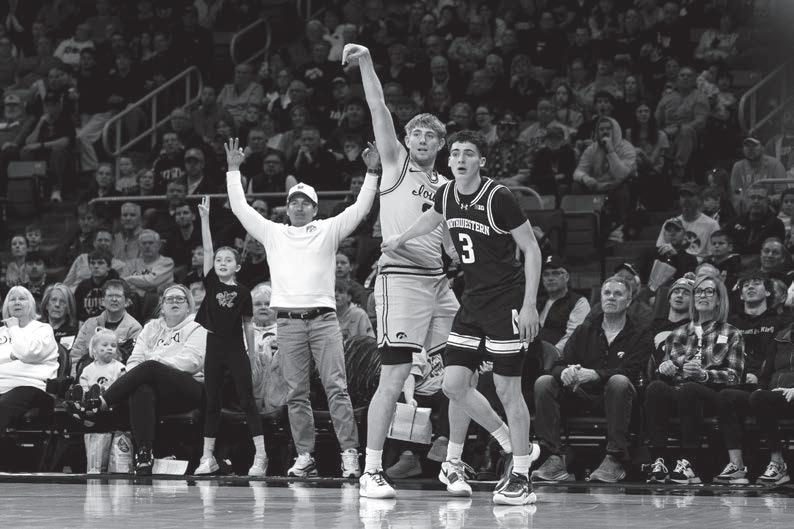
utside o the rst coachin chan e in years, a 180-degree rotation in playstyle priorities, and a newfound level of support from the Hawkeye fanbase, the 2024-25 and 2025-26 Iowa men’s basketball teams have one thing in common: Cooper Koch.
He didn’t see the court much on Fran c a ery s s uad last year or reasons other than basketball. And for that, Cooper Koch could’ve gone out and sought a fresh start elsewhere like everybody else. But yet again, it makes sense that he’s the only scholarship player that returned to the Hawkeyes.
One thing about Iowa fans is they remember anyone that suits up in the black and gold. Older fans remember the 1998-99 season, the last time the Hawkeyes reached the Sweet 16 of the NCAA Tournament. Forward J.R. Koch, Cooper Koch’s father, was a staple of that team’s success. So when Cooper Koch began his own basketball journey, the University of Iowa was always a place he wanted to be, it was just a matter of if the opportunity came along. And it did — when he was 14 years old.
After Cooper Koch carried his team to the cha ionshi ictory at one o c a ery s youth summer basketball camps, the thenIowa head coach told him to “come play for the Hawks.” He couldn’t tell whether it was a formal offer or not, but ran with the idea regardless.
“I remember thinking, ‘Wow, that’d be pretty cool,’” Cooper Koch said. “That’d be my dream school to o to t as ust di erent ecause knew I still had a long way to go. But to know that something was out there, that this was actually a possibility, was pretty surreal.”
It wasn’t until a year after when his second o er ca e in ro radley hen a a e o o ers followed after a year playing the AAU circuit after his resh an hi h school season includin e other Big Ten schools. oo er och tal ed ith di erent schools such as Purdue and Wisconsin throughout his so ho ore year ut his heart re ained ated on the Hawkeyes. He committed to Iowa ahead of his junior year.
“I think he wanted to go down the path and kind of have his experience at Iowa,” J.R. Koch said. “He went through that process, e isited a lot o di erent schools tal ed to
a lot of coaches… And he came to that decision and said, ‘You know what, this is where I want to be.’”
The 2024-25 season was far from the ideal start Cooper Koch hoped to see. After redshirting his freshman season due to medical conditions, the man that recruited him since the eighth grade was dismissed from his position, and all but one of his teammates left the program. So it was a no-brainer for him to enter the transfer portal and see what’s out there. But that journey was short-lived — one visit to DePaul before Ben McCollum reeled him back in.
The main factor was McCollum’s defensive mindset. Cooper Koch realized defense is where he wants and needs to improve in order to take his game to the next level. So far this season, he’s been taking on the opposition’s best wing player night-in and night-out for an Iowa team that leads the Big Ten in opponent points per game, with just over 64 a game.
He’s also turned into one of the best shooters on the team, shooting 38 percent
Iowa wrestler’s love for reading
Folk of the Air series. Probably that world, since it’s kind of a modern world, but there’s also another parallel, fantasy world to it.
from three on three-and-a-half attempts a game.
“He brings a winning culture, as people have learned, and a style of defense that I knew I needed,” Cooper Koch said. “I knew that was de nitely an o ortunity to ro in that area o the game.”
oin ro an o ense- rst laystyle to a swarming defensive approach has been a tale of two years for Cooper Koch. He sees just how much the Hawkeye faithful appreciates the newfound energy, especially on defense.
“Last year, seeing it half empty, was kind of just disappointing,” he said. “But this year, obviously there was more excitement, and we’ve been able to sustain that excitement through an entertaining style of basketball.”
One thing Cooper Koch constantly told his father growing up is that he’d help the Hawkeyes get back to the Sweet 16 of the NCAA Tournament. And it’s the same reason why he stayed in Iowa City that he believes this is the year the Hawkeyes get back.
“We’ve got a deep team. We can play eight to 11 guys, depending on the game, and I think that our style of defense can shut down almost any other team,” he said. “And being able to shut down a team is crucial to winning games come March Madness.”
take in the surroundings.
What is your favorite memory of Iowa wrestling so far?
The Daily Iowan: If you could have lunch with one famous person, who would it be?
Bella Williams: It would probably have to be an author of a book, that way I could get information on books before they release them. So, Holly Black, or really any author.
If you could live in any book universe, which one would it be?
Maybe “Elfhame,” which is Holly Black, The
What’s one thing you think most people don’t know about Oklahoma?
They might know this, but Oklahoma is a pretty rich state for wrestling history, with OSU and OU oth ha in ro ra s there here s de nitely a lot of wrestling history in that state.
What’s your favorite type of music?
I like a lot of alternative pop or rock, but I don’t listen to a whole lot of music at a tournament settin de nitely try to stay disconnected and
hat ould de nitely ha e to e the tri e too to South Carolina for the Blue Hose Challenge tournament. To spend an extra day in South Carolina, downtown Charleston, was a very fun trip in terms of competing and hanging out with the team.
What’s a hobby you have that not everyone knows about?
I really like reading, and I collect a lot of books.
What will Iowa softball’s record be?
With a start to the 2026 season, many fans question if Iowa will make a third 30-plus winning season.
Iowa softball certainly has some room to grow, but recent seasons have indicated the program is improving, not declining, in overall competitiveness.
In 2024, Iowa went a meager 18-28 on the season, dropping winnable games to schools like UC Davis, Santa Clara, and Purdue. The following season, however, the Hawkeyes improved to 35-18 overall.
Did the 2025 season have big losses? Sure, but 11 of Iowa’s 18 dropped contests were to ranked teams such as national title contenders Tennessee and Texas Tech. Iowa was actually a run short of besting No. 15 Missouri, and even managed victories over No. 5 UCLA, 7-4, and No. 20 Nebraska, 5-2. Iowa started last season 2-3 in its rst e a es allin to three different ranked opponents in three days. This year, the Hawkeyes
started 3-2 in the same amount of time, coming from behind to beat UConn, 10-9, and nabbing back-toback triumphs over Samford, 9-1 and 3-2.
Outside of the record books, the Hawkeyes have kept together a consistent team for this season, returning key starter and senior Tory Bennett and recruiting senior Serayah Neiss and junior Leah McAnally from the portal, the latter two joining freshman Mariah Myers on the 2026 Big Ten Softball Players to Watch list. Meanwhile, Iowa alum Stacy May-Johnson returns to Iowa City for her first season as the head coach, boasting over 20 years of coaching experience. May-Johnson remains in the top-15 in program history in career games played, hits, runs, doubles, home runs, RBIs, and batting average. Her recent coaching tenure at Fresno State was one of improvement, notching 112 wins in four seasons, 37 of which came last season If the Hawkeyes focus on winning games outside of the Power Five conferences, contests against opponents like McNeese State on Feb. 26 and Memphis on Feb. 27, as well as playing consistently against ranked opponents, 2026 has every right to be a winning season.
With the 2026 NCAA DI softball season just underway, there still remains a lot of time for the Iowa softball team to rebound after an early exit from the Big Ten Tournament last year.
Iowa has recently embarked on an upward trend, with two of the last three seasons seeing 30-plus wins. Notable for this season is the new head coach Stacy May-Johnson. With 20 years of coaching experience, it may be the Hawkeyes’ best opportunity to learn and be coached by one of the best. The Hawkeyes lost star players to the transfer portal, but new additions of players and returners have no real importance when it comes to making the NCAA tournament. Rather, the schedule a es the di erence Last year, the Hawkeyes
went 2-10 against seven ranked opponents.
This year, Iowa is set to match u ith e ran ed tea s o er games. The Hawkeyes 3-2 start in Florida already saw one of those matchups, with No. 7 Florida State outscoring Iowa, 12-3. Following this road trip, the Hawkeyes will have 14 games against unranked opponents before their next ranked matchup against current 10th-ranked LSU. Nonetheless, all of these games are on the road or at neutral sites. o a s rst ho e a e isn t until game 28 of the season. Adding to the weak schedule is Iowa’s choice of Big Ten opponents. The Hawkeyes will match up against eight conference opponents, three of which are ranked in the top 25.
Of course, it’s highly unlikely Iowa doesn’t drop a game or two in these matchups and against some non-conference opponents throughout the season. Poor performance is inevitable in long seasons. ith the lac o difficult o onents and ranked teams, Iowa will have to win when expected and rebound when needed to even have a chance at consideration for this year’s NCAA tournament.
young guys that we have now, especially on the pitching side, and just help us as a whole.”
The Big Ten Conference added four West Coast teams in the 2024-25 academic year, with Washington, Oregon, USC, and UCLA joining the league.
All four of those teams had dominant runs in the Pac-12 Conference, with a multitude of NCAA Tournament appearances among them, including five straight for Oregon.
All four West Coast teams finished in the top five of the Big Ten Standings last season, with Oregon earning the regular-season title after sweeping Iowa in the final series of 2025.
The Hawkeyes fell to UCLA in the Big Ten Tournament semifinal in Omaha last year, before Nebraska claimed the title over the Bruins.
The dominance shown by the former Pac-12 teams in the Big Ten last season is a look into what the future of the conference holds, and Iowa looks to continue competing with those squads.
In 2025, the Hawkeyes had just four losses in conference play heading into May, then came the collapse. While in a nearly perfect position to reach the NCAA Tournament, Iowa would go on to lose five of its last six Big Ten games as part of a 1-8-1 stretch to finish the season.
The falloff caused widespread concern among Hawkeye fans, who questioned whether the one historic season was fraudulent, as Iowa picked up most of its conference wins against the bottom half of the league.
The Hawkeyes were the 3-seed at the Big Ten Tournament, and the end-ofseason struggles continued to show up despite a semifinal appearance. Iowa scored just seven runs across three games at the tournament, including a shutout loss to Indiana in group play.
While the finish to last season was disappointing for the Hawkeyes, a new opportunity awaits in 2026. The Hawkeyes will be tested early with a trip to Frisco, Texas, on Feb. 27 through March 1, where they will face off with Alabama, Houston, and Oregon State.
The Big Ten slate will be tough with Iowa welcoming UCLA for the home-opening conference series in late March. The Hawkeyes will also travel west to USC for a three-game series against the Trojans on April 10 through April 12.
While the schedule will be trying, it provides a great opportunity for Iowa to climb the Rating Percentage Index, something it struggled to do in 2025 as the Hawkeyes finished at 80, well below many mid-major teams.
There are promising aspects of the 2026 Iowa team for fans to look forward to, especially the defense, with Mitchell up the middle at shortstop, who logged a team-high 124 assists last season.
“I think this team can be one of the best teams in the Big Ten, defensively,” Heller said. “I think, in my opinion, a top 20 type team in the country, defensively. So that’s been the battle cry to the pitchers is, hey, get ahead with strike one. Make them put it in play, and you’ve got a great defense playing behind you.”
Not only do the returning infielders provide a spark of excitement, but the battle for the two corner outfield spots in the Iowa lineup could create some buzz as well.
Senior Miles Risley has locked up the center field spot for the Hawkeyes, having started all 56 games last season. Risley posted a .299 batting average with a team-high 45 RBIs in 2025, along with six home runs.
With Ben Wilmes and Andy Nelson graduating after last season, Iowa will try to fill both left and right field spots.
The Hawkeyes took strides to find replacements at those corner outfield spots, landing Iowa native Bryce Phelps
from Wagner and Dallas Baptist transfer Joey Nerat.
Phelps hit for a .399 average last season with the Seahawks, driving in 33 runs and recording 75 hits. Nerat started 35 games for the Patriots in 2025, posting a .285 average with three home runs and recording three outfield assists to pair with a .967 fielding percentage.
Iowa also returns Kellen Strohmeyer to the outfield mix. The redshirt junior made 38 appearances with 17 starts last season, batting .270 with four doubles and three homers.
While the corner outfield positions for the Hawkeyes are certainly up in the air, the potential that each option brings could lead to a plug-and-play or platoon situation in one, if not both, corner outfield spots.
The Hawkeye bullpen is another component Heller is looking forward to in 2026, with senior Justin Hackett and
Wrestler of the Year for 2022-23 as a Little Hawk. At City High, Kueter accumulated a perfect 111-0 record and added four Iowa high school state championships to his resume.
Now, towards the tail end of his second season, Kueter has experienced ups and downs, going 5-5 and facing a grueling Big Ten schedule along the way.
The heavyweight opened this season on the right foot, defeating Bellarmine’s Daulton Mayer, 8-2.
“He’s superhuman,” Brands said. “How’s that?”
Holding accolades such as the 2023 Iowa Class 3A Dan Gable Mr. Wrestler of the ear and ein only the th erson in history to win a world championship as a high schooler, it’s no wonder that Brands
Southeastern Community College transfer Maddux Frese headlining the Iowa relief core.
Hackett finished last season with a 1.45 ERA and struck out 36 batters in ust innin s hile rese struc out 43 and posted a 3.54 ERA with the Blackhawks.
“We’ve got some good options if we can keep them in that role,” Heller said about his bullpen. “And that would be like Justin Hackett, who fits that mold perfectly. Tough guy, isn’t afraid, goes out and really competes. He has some unique pitches to get swing and misses off of and pounds the strike zone.”
As competition begins, the Hawkeyes are looking to see some action against teams not wearing the black and gold.
“You can really sense it with the players that it’s time to go play somebody else, and time to get outside and see where we’re at,” Heller said.
has such high praise.
However, Kueter has been put to the test this year, missing six duals and holding a 5-5 record on the season for the Hawkeyes. Every one of Kueter’s losses has come from top-10 opponents.
Despite the season losses, Brands believes that Kueter has the right tools for success.
“He had a little setback with his most recent loss, and we just got to be at our best and focus on doing what we’re capable of doing,” Brands said. “And I said it two minutes a o he de nitely has it under the hood
Through all the hurdles Kueter has had to navigate in recent years, Iowa’s starting heavyweight’s mindset has yet to falter. thin a i thin is ein con dent in myself. There’s no reason for me not to be con dent in ysel ueter said No that I know that, I have no reason to go out there and wrestle a 2-1 or 3-1 match. I feel in my head that it is silly.”
“She has gone through a lot over her four years, and through those learning moments and life lessons, I think she has been able to shed light on and be an example to each and every fresh-
men in whatever they need her to be,” Llewellyn said.
As her senior season nears its end, Masella looks to not only cherish the last remaining meets but also look forward to what life after college gymnastics may look like.
a oin to lea e y a ility to i in the past, but I do still want to impact little girls in sports and continue push that route through social media and coaching in addition to my pursuit of becoming a dentist,”
Masella said.
Though Masella has accomplished a multitude of goals and aspirations over the years, she still says some have yet to be claimed and that she won’t stop trying to achieve them till after the last routine at the last meet.
“I still want to break a 9.900 on bars, but again, going into senior year, I just want to have the most fun I have had in all my four years,” Masella said.
The No. 15 Iowa Hawkeyes women’s basketball team rolled into Pinnacle Bank Arena to take on the Nebraska Cornhuskers in Lincoln, Nebraska, on Feb. 16. The Hawkeyes held the lead for all but 18 seconds of the game, defeating the Cornhuskers 80-67.
many minds, and instilled in routines.
“Here’s what I eat in a day as a skinny influencer who hits their step count, tracks calories, follows 'food rules,' lives an active lifestyle but secretly takes a GLP-1, and poses with my tiny waist showing in front of the camera at the beginning of the video to keep my 'legging legs,' 'looks-maxx' to my full potential, and stay as dangerously small as I possibly can!”
Welcome back to the buzzword-filled unattainable body epidemic — if we ever
truly even left it. The beast of normalized eating disorders, encouraged body insecurities, “skinny culture,” and '90s “heroin-chic thinspo” is rearing its ugly head. After a movement of body positivity and celebrating the prioritization of health over how little space your body can take up, our society has been slipping back down an incredibly damaging slope. Namely, social media has been glorifying the basis of self-worth on small waists and the Kate Moss body type. Society has seen this act before, and plenty of times at that. The thin ideal has long been valued, ingrained in
However, a short-lived body positivity movement began to come into play in the late 2010s and early 2020s, encouraging people via social media that they are beautiful and to love themselves regardless of what their body looks like.
Recently, however, social media has been shoving body positivity out and replacing it with dwindling scale numbers — praising bone exposure and encouraging weight loss, even done unhealthily.
“It seems like all of the online influencers and celebrities are suddenly showing off that they’re getting unhealthily thin or becoming even skinnier than they were
before,” Aubrey Croatt, a UI second-year, said t s de nitely har in the ay eople view themselves and their bodies.”
Several online content creators, many of whom falsely label themselves as “fitness influencers” and “health gurus,” are pushing dangerous narratives with hashtags including “#skinnytok” or “#thinspiration.” Under this facade of health, examples of undereating and a lifestyle entirely based around staying extremely thin are multiplying.
Although this genre of content is prevalent on social media apps such as
Which ‘Game of Thrones’ show is the best?
The shows
have captured the popular consciousness over the years.
If you aren’t tapped into HBO’s latest installment in the ever-growing “Game of Thrones” universe, you are severely missing out. I’m not the biggest fan of the original show; I’ve seen it, sure, but could hardly recount most of what happens. Every moment of “A Knight of the Seven Kingdoms” has had me compelled. I find it easy to get bogged down in the lore and history of these big epic fantasy stories; it’s not really my genre. But the premise here is so simple, I love it. A tall, poor knight named Duncan wants to establish himself among his peers alongside his sassy little bald kid squire named Egg.
With just two central characters and a single location for the first season, “Knight of the Seven Kingdoms” dives
as deep into it’s characters and themes as “Game of Thrones” does, just on a smaller scale and condensed time frame. To me, that’s perfect.
While the huge scale end-of-theworld or kingdom conflicts in “Game of Thrones” can get monotonous — how many times can you say “Winter is Coming” before it gets stale — I remain hooked by “Knight of the Seven Kingdoms” just by the characters alone. Egg is adorable, Duncan is the coolest guy I’ve seen in my life, and Lyonel Baratheon is super goofy. I could watch these guys hang out forever.
While the show is still airing, with Season 1 set to end on Feb. 21, the end of episode four is already among my favorite scenes in any “Game of Thrones” series. In such a short amount of time, this show built to a climactic crescendo that rivals the most triumphant or shocking moments of mainline “Thrones.” I haven’t stopped thinking about it.
“A Knight of the Seven Kingdoms” keeps its story simple in favor of compelling and rich character stories rather than CGI dragon spectacle and world-ending threats. It’s so refreshing to see.
Even if you haven’t watched a second of “Game of Thrones,” you’ve probably heard at least an inkling about the iconic characters, memorable dialogue, and political machinations that make the show one of the greatest of all time.
First gracing the small screen in 2011, “Game of Thrones” became so appealing through its complicated story. There is a reason that, years later, people are still arguing over actions made by characters such as Daenerys Targaryen and Jon Snow, and writing detailed dissections over plot twists like the “Red Wedding.”
“Thrones’” twists and turns have had such an impact that — as a writer interested in fantasy — it is almost impossible to escape its intrigue and impact, as so many shows are clamoring to become the next “Game of Thrones.”
Iconic moments, such as Dany hatch-
FilmScene first theater to
in her dra ons the rst in o er a hundred years — have captured the popular imagination, bringing in a dedicated audience that stretches beyond fans of high fantasy, making “Thrones” a show anyone can and has enjoyed. Fantasy, realism, politics, and history lo ers ill all nd so ethin to li e in the sprawling world of Westeros.
The show makes its name through its high stakes and kingdom-wide storylines that are shown through grounded and realistic characters we get to know over the course of several seasons.
So much of its runtime is dedicated to the aneu erin o di erent a ilies each of which wants to protect its own and position itself closer to power and the throne. Even with an admittedly poor ending, the show has still kept up enough of an interest that millions of people have tuned in to its t o s in-o series ouse of the Dragon” and “A Knight of the Seven Kingdoms,” which, by the way, would not exist without the historical intrigue built up in the original.
The lore and characters presented in “Thrones” have pulled people back in again and again throughout the years, and its highs are some of the best in television history.
screen ‘Twin Peaks’
The theater will be the first venue to screen David Lynch’s entire iconic series.
Palmer is murdered. FBI agent Dale Cooper is brought in to solve the mystery, thus launching the series’ iconic original run.
There is a man in a smiling bag. The owls are not what they seem. Without chemicals, he points.
These are just a few of the many mysteries permeating the iconic 1990s television series “Twin Peaks” that fans debate to this day. One such fan, FilmScene Programming Director Ben Delgado, first encountered David Lynch’s filmography in high school and was compelled to seek out the show’s original run.
“It moved me deeply,” Delgado said. “I consider Season 1 of Twin Peaks to be one of the most important works of art from the past 50 years.”
“Twin Peaks” is the brainchild of Mark Frost and Lynch, two distinct creative voices whose experience in procedural television and surreal dramas, respectively, came together to concoct a distinct vision of an idyllic Pacific Northwest small town whose foundation is shaken when high schooler Laura
In 2017, the show was born anew with “Twin Peaks: The Return,” an 18-episode event that picked up the story 25 years later. With Lynch’s voice more present than ever before, many regarded “The Return” as his masterpiece, with Rolling Stone calling it “the most groundbreaking TV series ever.”
In January 2025, Lynch fans everywhere lamented the filmmaker’s passing at the age of 78. FilmScene held tribute screenings of his work, including “Blue Velvet” and “Mulholland Drive,” but Delgado felt that more could be done to honor such a visionary artist.
“We wanted to air at least some, but the rights were complicated, and we couldn’t manage it,” Delgado said.
Later that year, almost serendipitously, Paramount opened up to licensing the show.
“We decided if we had the chance to do
Incarcerated artists work displayed at PS1
Organized by Inside Out, the exhibition focuses on self-expression and second chances.
ith a eetin thou ht he eels co elled
Inside Iowa City’s Public Space One, the annual “Art from the Inside Out” exhibition lls the allery ith aintin s dra in s and poems. r ani ed y the non ro t or ani ation
Inside Out Reentry Community, the show features the creative work of incarcerated and formerly incarcerated people as expressions of humanity beyond a prison sentence. on the contri utors is artist e ie randsta hose ritin e lores lo e re ret and ersonal chan e e had three poems on display. “Your Love I Feel” centers on devotion and emotional connection nother oe he an er in our ain turns in ard e a inin responsibility and the consequences of one’s actions.
is oe orty traces a li e sha ed y ti e and conse uence t re ects on a in behind bars, fatherhood at a distance, and the ra ile or o re uildin he oe closes on a powerful note: “love doesn’t al ays et to stand in the li ht ut it stands anyway.”
randsta said his three children are his ins iration hey in uence oth his su ect atter and his dri e to ee ritin
“Sometimes I think of a line, and I need to rite it do n randsta said e descri ed ho oe s o ten e in
to capture. All poems are presented simply as ty ed a es encoura in ie ers to slow down and read closely. The format irrors the ritin s intros ecti e yet simple nature. ichelle ein e ecuti e director o Inside Out, said the exhibition is a way to share the creative work she and others ere already seein ro eo le in the le al syste e re seein all this incredi le art and e really anted to ust et it out to the co unity ein said rt is really uni yin ery ody lo es art t s such a reat or o sel -e ression any artici atin artists cannot attend the show in person, so Inside Out invites visitors to write feedback notes. Those notes are mailed to the artists. en thou h they can t e there to see their art on display, they can still hear what the attendees felt about their artwork,” ein said he lo istics can e co licated ein said co unication o ten ha ens throu h letters and mailed artwork rather than ace-to- ace interaction hich can slo coordination. Still, the show continues to ro each year ith ne artists su ittin or a ter hearin a out it ro others or any artici ants it is their rst ti e sharin art u licly t s ery e o erin to no hey your art is beautiful and can be in a show,” ein said
The exhibition spans many media and stories. One piece features a peaceful landscape by Selvyn Tillett, inspired by ountain ran es he ad ired ro in u in eli e he aintin dis lays his lo e for landscapes. In his artist statement, Tillett describes disco erin aintin hile incarcerated a ter atchin o oss and e eri entin ith acrylics is or adds to the sho s roader the es o ersonal ro th
The pieces in “Art From the Inside Out” do not ask viewers for sympathy or raise nstead they o er li ses into re ection and ho e randsta s oe s sit comfortably within that space — not as declarations, but as honest moments on paper. he result is a allery that eels less li e a showcase and more like a conversation about humanity, creativity, and second chances.
University of Iowa Archives’ student life archivist unearths the forgo en tradition of social cards.
his is an install ent in a ulti- art series. Throughout the University of Iowa’s history, dances have found their home in recreational life. Though now seen as Greek Life formals and fraternity house parties, back when the university was still new, dances were much more common and treated with prestige. Student Life Archivist for University Archives Matrice Young sifts through a box filled with artifacts from when dances were present. These were known as dance cards.
The Daily Iowan: What were dance cards?
Young: ance cards in eneral ere social cards that were mostly used by o en at dances ut e eryone ot the They were mainly used by the students to keep track of who they danced with. That’s hy inside the cards there are a es ith lines, numbers, and people’s names on them. They were more of a social etiquette thin hey started in hi h society then started tric lin do n ut continued as class eti uette hey started adin out a bit around or after World War II.
What can be found inside one of these cards?
ccordin to the ni ersity o ri ona s collection, if a name written inside the
card has double x’s, it usually means the person who danced with the owner was also their date to the dance. Some of the dance cards came with enus on the inside i ood as ein served.
ut they also tell you here it s at hat the date is, and sometimes what dances are actually oin to e there ther ti es eo le i ht e ust ritten in hat son s ere layed that ni ht
Some of the cards in the back tell you i so eone is layin li e that ni ht he chaperones, the bands, the committee that ut the dance to ether a lot o decent information can be taken out of this. Some cards came with a pencil to write the names in. hat s here you et the hrase encil it in e cards co e in di erent ty es of materials, too.
What other organizations used these besides Greek Life?
They were basically for anyone. You have the military balls, some that are senior prom, there are a couple of ho eco in ones and holiday arties but they were mainly used by sororities.
Is there a particular reason as to why dance cards faded out?
thin it as ostly a chan e in social etiquette — they didn’t really need to do this anymore after a while. t didn t atter ho you ere dancin with as much.
Were there any particular cards from a dance the university might have put on?
ettin the i e that this one i ht be “Dad’s Day.” And this other one looks li e another s onsored y the ni ersity “April Falles: Sponsored by Students of The Graphic Arts.”
Why were there so many dances put on in the 1920s?
assu e it as ust to i e the students
so ethin to do and also ee the out of trouble. In maybe the 1920s or ‘30s, e had a ni htclu that the uni ersity s onsored here at the The club was called “The Silver hado and it as a dry ni htclu hey created it to ee ids ro ettin in car accidents on their way to bars in Cedar Rapids. It stayed open and lasted a couple of years but faded out sometime around World War II. he uni ersity as tryin to ee the students safe but also let them have fun.
Instagram and the social platform X,
TikTok is the common culprit. With a largely young audience and a calculating algorithm, the app makes it easy for influencers to spread their personal opinions, lifestyles, and goals, not an inherently harmful feature, yet one that supplements the ability to spread a “the thinner the better” agenda.
This skinny culture glorification inevitably plagues and misinforms the impressionable minds of our media-consuming society, warping what’s considered “healthy” and setting impossible standards to live up to. This misinformation and societal pressure work in tandem to contribute to a series of health issues, like eating disorders and malnourishment.
“Our culture holds thin bodies on these pedestals of health and beauty. The reality is that someone's weight tells us very little about their health, and one’s relationship with their body has little to do with their weight,” Susanna Kahnke, a clinical assistant professor in the University of Iowa Department of Psychiatry said. “You can love or hate your body at any size, and being underweight is usually more dangerous than being overweight.” Kahnke, a licensed psychologist and health service provider at UI Health care, said with experience working with patients suffering from eating disorders in the age of social media, she acknowledges the effect online platforms can have on body image and mental health.
“These posts can directly normalize and teach eating disorder behaviors — following ‘food rules,’ weighing yourself often, counting calories, etcetera,” Kahnke said. “There's also so much nutritional misinformation online, and that has a real impact on people’s eating behaviors and their relationships with food.”
With countless new diets, cleanses, fasts, “low-calorie” recipes, weight loss content, and dietary misinformation, social media has not only affected how we scroll and think online but also how we talk about our bodies and food on a day-to-day basis.
Kahnke mentioned how harmful but common, it is to say “I’m so bad” when eating a dessert or incessantly praising someone's appearance once they’ve lost weight.
These social normalities have made themselves especially present on college campuses. While students are at an age where they’re going through a process of identity development and trying to figure out their values, they’re also constantly consuming social media.
“College students are figuring out who they are as people, and this is often a time when the need for social acceptance
is at its peak,” Kahnke said.
A significant aspect of social acceptance worshipped by teenagers and young adults — and society in general — is appearance, and the pressure this standard induces is widely shared across campus.
“It’s so easy to feel the need to look better, to be skinnier and prettier and all this,” UI first-year student Ella Smith said. “It’s so frustrating, and it feels impossible because there’s always a new insecurity that replaces the old ones.”
For as long as there’s been beauty standards, there’s been a need within society to have what’s unattainable. The thin-ideal has long been this, placing a crushing amount of value on skinny limbs and microscopic waists.
Because of this inherent desire to fit in, to be praised and regarded highly in society, people tirelessly began chasing
this “dream body.”
A new factor has stepped into play, however: the infamous GLP-1.
Rachel Young, an associate professor at the UI’s School of Journalism and Mass Communication, explains that the labor — exercise, diet, and constant body-image stress — is no longer the only big factor in maintaining a thin body. Appetite-suppressing medication makes thinness viable through means that haven’t been seen before.
“Because it’s an option for some, the expectation we should all look this way is returning,” Young said. “But because of the high cost and shortages, not everyone can have access, which just creates another way we compare and feel poorly about ourselves.”
The drug, originally meant for managing diseases like type 2 diabetes, has exploded into a tool for aesthetic purposes.
proven that no one will feel they are thin enough, never perfectly proportioned, never satisfied if they keep buying into the skinny culture cycle.
Social media preys on this cycle. All the algorithm cares about is what you’re paying attention to, which can be really damaging if it picks up on a vulnerable, personal topic.
“If you’re susceptible or sensitive or worried about your body, maybe just having a bad day or low self-esteem, the algorithm will pick up on that and just
encer you see online with every beauty standard met doesn’t look like that all the time, maybe not even at all. BetterHelp online therapy service suggests that social media is fake, even when it pretends not to be; filled with angles, filters, botox, butt lifts, and liposuction, there’s an endless amount of unreachable standards to constantly be met.
keep showing that stuff to you over and over again,” Young said.
Young pointed out that a person’s algorithm is almost designed to hurt them, to insult and berate, and feed into whatever insecurity they have, as long as they keep engaging with it. When the person realize this, when they accept that there’s more to life than the next scroll and the tiniest waist and how a shirt makes their arms look, they will begin to be free.
Gunderson Health System points out that not only does stepping on the scale every morning not help a person, but their weight should be, and is, the least interesting thing about them.
“My biggest hope for everyone stuck in this cycle and pulled into this mindset is that they eventually realize how thin isn’t equivalent to beautiful. If their weight isn’t causing serious health problems, it shouldn’t ever be something that people place this much importance on,” Olivia Williamson, a UI fourth-year student, said.
Just because celebrities or influencers with mass amounts of followers and supporters may participate in things like skinny culture, GLP-1s, health misinformation, fad diets, and other “thinspiration,” it doesn’t mean it’s right, and it doesn’t mean anyone has to buy into it.
Skinny culture is back. Maybe it never truly left.
However, the body positivity movement is real and has made an impact on society over the last couple of years online, but there’s a long way to go, and it’s not a linear slope.
This nasty, misinformed mindset has been seen before, is being witnessed now, and will undoubtedly resurface in the future. Yet, time and time again, it’s
It’s still here, especially if someone looks for it, and it will continue to be alive, well, and growing as long as society keeps working towards it.
it, we should do it now and do it all,” Delgado said.
FilmScene kicked off the series with Season 1 in November 2025, and nearly every screening sold out as fans flocked to experience the mystery together. After a month-long hiatus, the series returned with Season 2 in January and concluded on Feb. 5.
Logan Drake is one of many FilmScene patrons who seized the opportunity to experience the series on the big screen.
“I had never seen it before. It’s one of those shows I’d always heard about, and it’s always been on my watchlist,” Drake said.
“My wife and I are big fans of FilmScene, so this felt like the perfect opportunity to finally watch it.”
In addition to the larger venue, Drake appreciates how the audience enhances the experience.
“If we just watched Twin Peaks at home, we wouldn’t get ‘Ah, this is the one with the reveal,’ or ‘This is the one
with the weird dream.’ It’s fun seeing that in a community and seeing people’s reactions,” he said.
FilmScene concessions office worker Noah Jedlicka also leaped at the chance to experience “Twin Peaks” in theaters.
“I love David Lynch’s take on a wacky soap opera,” Jedlicka said. “They just kinda greenlit him to do whatever he wants. It’s a lot of fun when you just sit back and enjoy the ride.”
To those dedicated enough to catch every episode, a prize will be offered: a hand-painted commemorative log in homage to the show’s iconic “Log Lady.” In March, the series will recommence once more with the prequel film “Twin Peaks: Fire Walk With Me” paired with its deleted scenes compilation “Twin Peaks: The Missing Pieces,” as well as the 2017 revival “Twin Peaks: The Return,” which runs through May.
“Being able to present Twin Peaks in a theater has been a dream,” Delgado said.
“I’m super excited that people are coming out and seeing it and having a good time, but also appreciating David Lynch and his work. It means a lot to me.”