Mount Vernon-Lisbon
SPORTS | 15 & 16 Softball, baseball seasons end
MVLSUN.COM
THURSDAY, JULY 24, 2025 • $1.50
Mount Vernon School Board discusses budget, facility improvements, and policy Natalia Scales Mount Vernon-Lisbon Sun news@mvlsun.com
The Mount Vernon School Board convened Monday, July 15, to discuss ongoing projects, budget considerations, and important policy updates ahead of the 2025-26 school year. Superintendent Matthew Leeman opened with an update on the traffic study project and the middle school facade improvement plan. The district received approval from the Iowa Department of Transportation (DOT) for assistance through the Traffic Engineer Assistance Program (TEAP), significantly reducing the district’s costs by approximately $20,000 in consultation fees. “This opens us up to potential future grants, particularly around pedestrian safety and emergency access, which are two categories we might be strongly considered for,” said Leeman. The board approved a professional services agreement with architectural firm Shive-Hattery, amounting to $22,000. This agreement will allow Shive-Hattery to analyze and develop 3 potential design options for updating the Middle School facade. The project’s next steps will include further discussions on design choices and cost estimations. Additionally, Leeman highlighted that nearly all of the LED lighting installations are complete at the middle and elementary schools, creating significantly brighter and more energy-efficient environments. High school Advanced Placement (AP) test results were shared, showcasing strong academic performance. Mount Vernon students scored significantly above national averages, with more than 90% achieving scores considered proficient in several AP subjects. SCHOOL BOARD | 3
INSIDE Mount Vernon-Lisbon
Cemetery restoration held Nathan Countryman Mount Vernon-Lisbon Sun
nathan.countryman@mvlsun.com
The Mount Vernon Cemetery Commission hosted John Heider, a gravestone conservation specialist, for a number of workshops. After the Power Point presentations in the morning, attendees had the opportunity to get hands on repairs in the cemetery, resetting, leveling or repairing five gravestones in two hours. Mary Evans, cemetery commission member, said Heider did an extensive assessment of the Mount Vernon Cemetery in 2013. He identified over 100 grave markers in need of repair due to the age of the cemetery (1851), weather, neglect and vandalism. The Cemetery Commission invited him to return and repair 18 gravestones, with 13 being paid for by the Mount Vernon American Legion Hahn-Howard Post 480 and the Mount Vernon Masonic Lodge paying for repairs to Elijah D. Waln’s and Augustus Bauman’s gravestone repairs. Heider in the morning session at Mount Vernon City Hall Monday walked through ways gravestones can become damaged, as well as the proper ways to treat them. “The number one rule for any restoration is to not do anything that can’t be easily reversed,” Heider said. “The second most important rule is ‘do no harm.’” In Iowa, the state has delineations of cemeteries -registered and unregistered. Heider said it is important to get permission from someone who oversees whichever cemetery it is before any restoration work is completed. Damage to gravestones come from a number of factors, including manmade, chemical treatments, the way the stones were installed, vandalism, graffiti, cleaning with the wrong tools and just nature itself. One way they are damaged is just by mowers traversing the cemetery. Some stones will get hit by a mower blade and that gash will be there forever. Stones set in concrete is another way in which they get damaged. Concrete expanding and contracting over the years eventually leads to damage of the gravestone. Any chemical treatments applied in cemeteries can also damage gravestones. Some gravestones were put in place
Opinions - 4 & 5 | Records - 7 |
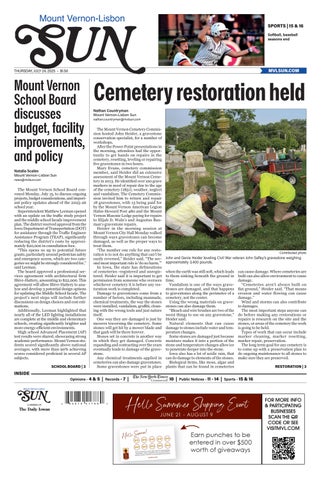
Contributed photo
John and Genie Heider leveling Civil War veteran John Safley’s gravestone weighing approximately 3,400 pounds. when the earth was still soft, which leads to them sinking beneath the ground in time. Vandalism is one of the ways gravestones are damaged, and that happens to gravestones along the perimeter of a cemetery, not the center. Using the wrong materials on gravestones can also damage them. “Bleach and wire brushes are two of the worst things to use on any gravestone,” Heider said. Natural elements that can cause damage to stones include water and temperature changes. Some stones are damaged just because moisture makes it into a portion of the stone and temperature changes allow ice to penetrate deeper into the stone. Iowa also has a lot of acidic rain, that can do damage to elements of the stones. Biological items, like moss, algae and plants that can be found in cemeteries
can cause damage. Where cemeteries are built can also allow environment to cause damage. “Cemeteries aren’t always built on flat ground,” Heider said. “That means erosion and water flowing can cause damage.” Wind and storms can also contribute to damages. The most important steps anyone can do before making any restorations or repairs is research on the site and the stones, or areas of the cemetery the work is going to be held. Types of work that can occur include marker cleaning, marker resetting, marker repair, preservation. The long term goal for any cemetery is to come up with a preservation plan to do ongoing maintenance to all stones to make sure they are preserved.
10 | Public Notices - 11 - 14 | Sports - 15 & 16
RESTORATION | 3