The Daily Iowan
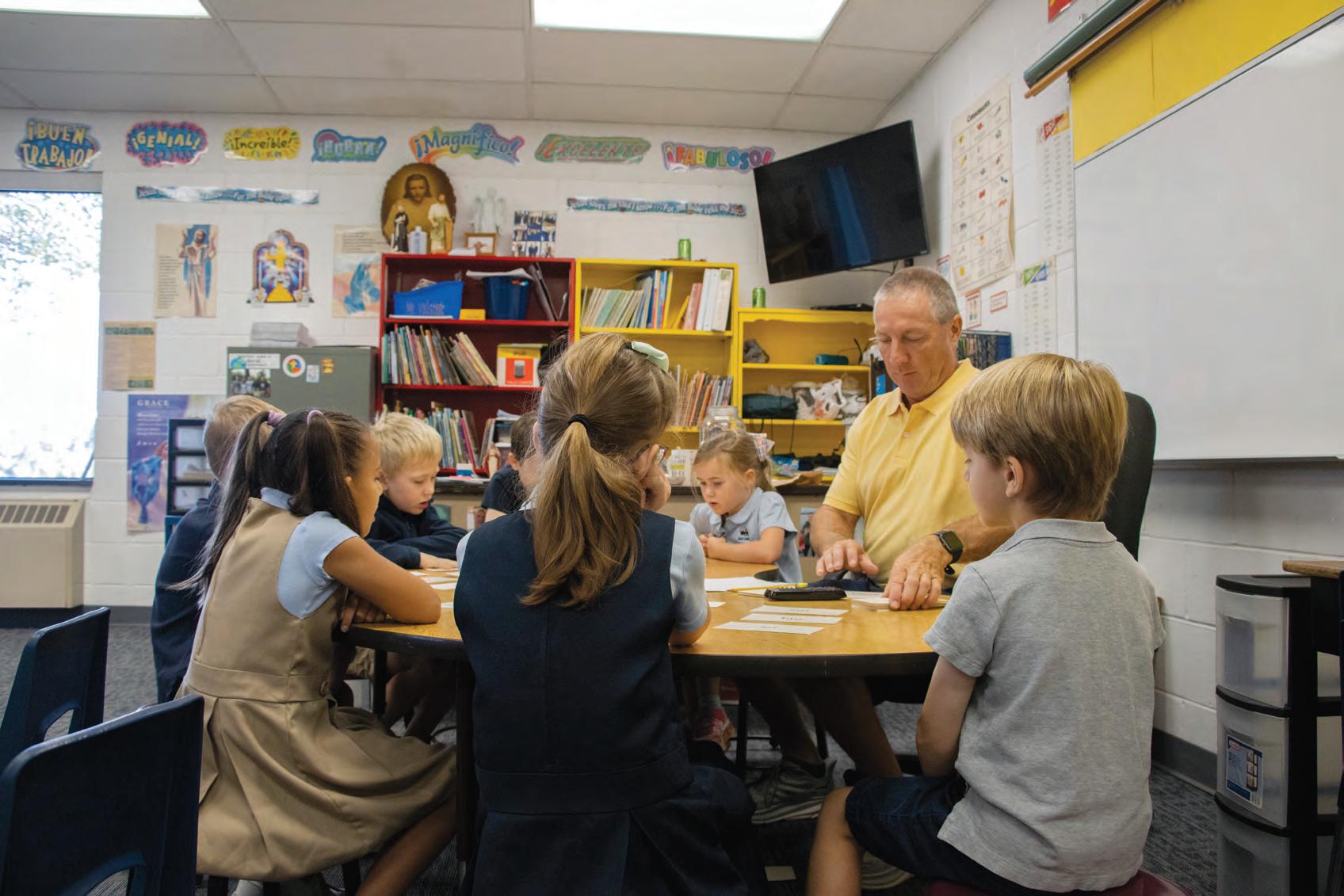

Iowa’s public schools have altered their approach to marketing.
Grace Olson Assistant News Editor grace.olson@dailyiowan.com
With the introduction of education savings accounts, or ESAs, more families in Iowa are choosing private education, causing Iowa’s public schools to expand marketing efforts in an attempt to keep families in their districts. In the past year, the Iowa City Community School District has undergone a complete reboot of its website to make it more attractive to parents and easier to navigate. Iowa City Community School District Superintendent Matt Degner said features like this make a big difference in this day and age to keep families interested.
“Most places we consume our content these days are social media or in some way online, so we’ve also taken a big effort to reboot our website
The North Liberty Community Pantry is opening a new
Bri Brands News Reporter news@dailyiowan.com
As food insecurity rates continue to rise in the state of Iowa, so has the number of people needing food pantry services. In response, North Liberty Community Pantry officals are expan ding their facilities.
The $4 million project, funded by donations, is expected to break ground at the end of the month, with anticipated completion by the sum mer of 2025.
The North Liberty Community Pantry has seen the number of people they serve rise recently. In just two years, the pantry has doubled the amo unt of food distributed, Ryan Bobst, the North Liberty Community Pantry executive director, said. He said clothing distribution has increased by around 500 percent and grocery deliveries by about 600 percent.
Natoshia Askelson, an associate professor of community behavioral health in the University of Iowa College of Public Health, has specifically researched food security in the state of Iowa.
Askelson said the state has a food insecurity rate of just over 10 percent, meaning one in nine people face hunger.
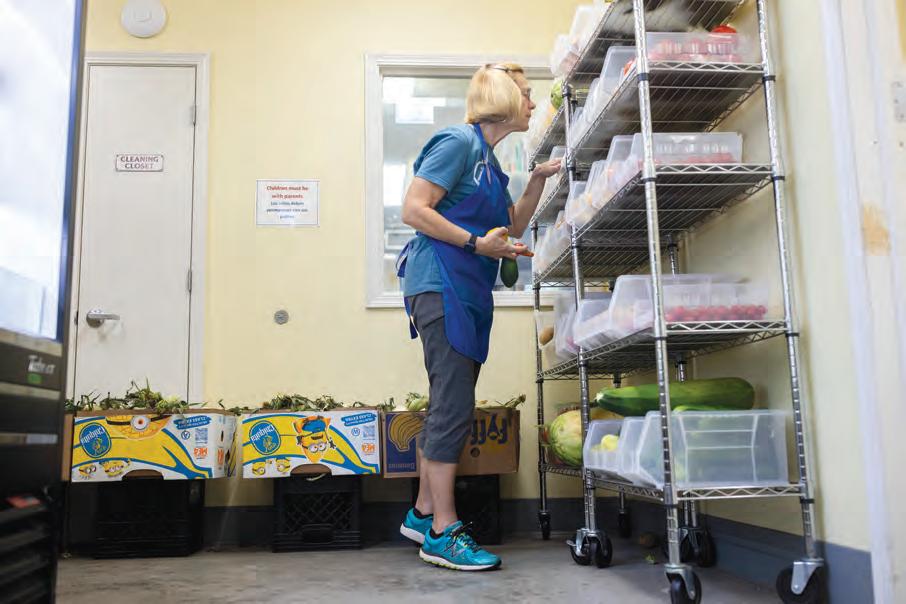
As part of her research, Askelson works with the educational component of the Supplemental Nutrition Assistance Program, or SNAP, teaching children and families how to make the most of those benefits.
A recent study by the National Council on Aging and the Urban Institute — which used census data from 2018 — showed Johnson County had the highest rate of older adults who were eligible for, but did not receive, SNAP benefits in Iowa.
Johnson County, in particular, struggles with higher food insecurity rates due to the large student body and large immigrant and refugee populations,
“There aren’t a lot of great paying jobs in many
Since Iowa City made public buses free, ridership has
For over a year, Iowa City has enjoyed free busing for all its residents — a decision that ramped up ridership and increased accessibility around town. Now, the city wants to continue that program while balancing new multi-million dollar projects for the transit department. The fare-free
busing for the city.
The city is planning a new transit facility and an expanded fleet of electric buses. Additionally, the department wants to see 1.9 million rides, or trips, per year by 2030, Nagle-Gamm said in an interview with the DI
According to transit statistics presented to the council, the upgrades would mean an incre-
ase of approximately 60,000 rides per year until 2030. Bus ridership dropped substantially in 2020 as a result of the COVID-19 pandemic. The resulting American Rescue Plan relief funding Iowa City received helped address the costs of the transit plans.
Nagle-Gamm said ridership has surpassed pre-pandemic levels. Federal funding, including a $23 million grant and pandemic relief money, has helped fund the fare-free program and will continue to do so for the next year. The increases in parking fares are one element expected to help cover the costs of fare-free once the allocated pandemic relief funding is expended. Approximately $40 million will be allotted to construct the new transit facility by no later than 2027. The current Public Works campus
[and] have a new look and feel with our district logo and branding,” Degner said. “You’d see a big difference there in the last 12 months about what that looks like.”
Beyond visual appeals, Degner said he wants to focus on sharing positive stories within the district and remind families of the quality of education their kids will receive across the public schools in Iowa City.
“As we continue to try to sell ourselves, we have the best programming here in Iowa City, and we want people to know that and hear about it,” Degner said. Iowa City Community School District Director of Community Relations Kristin Pedersen has expanded the district’s marketing efforts to set the district apart from other schooling options. She has spearheaded both social media and web campaigns to achieve this goal.
The most prominent campaigns focused on preschool and kindergarten enrollment. Degner said it is crucial to get families involved with the district early on so they are less likely to leave.
Pedersen said marketing has always been a focus for the Iowa City Community School District, but she feels it’s important, now more than ever, to let the community know what the district is all about.
“I think you could definitely say there’s been more of a marketing emphasis these last two years,” Pedersen said. “It’s something that [has] always been part of our work, but now we’re taking a different look at things, making sure that we’re presenting information in a way that really helps tell our story.” Pedersen said the district’s marketing strategies so far have been two-fold.
“While we are trying to tell our story and just explain the different opportunities that we offer, we want to do that for families who aren’t with us yet, but we also want our families who are with us to understand all those things and have that point of pride when it comes to knowing that they’re part of our district,” Pedersen said.
Degner said although the district has taken on this new role, it doesn’t mean that it should have to. He said other public

school systems around the country have already faced what Iowa City schools are dealing with, and it hasn’t panned out well.
“All of a sudden, we’re like a business,” Degner said. “We know that’s a failed approach. It’s been tried in several other states before. It does not raise achievement for students throughout the state, and I do not believe the [education] policy that’s being implemented is really anything to do with increasing the student experience. I really think it’s a playbook for something different. This is a multi-step process that has been outlined for the last number of years.”
What are ESAs?
ESAs are savings accounts for the public that use state funds to pay for tuition and fees associated with private education.
The Student Choice bill
gle future citizen a great education so they can be productive, well-informed, self-advocating members of society,” Levin said. “That is the charge of public schools. Private schools have no such responsibility to the future of our communities.”
Iowa City Community School District Board Member Lisa Williams said in the first year of ESAs, the state spent $107 million on sending students to private schools and is estimated to spend $132 million during the 2024-25 school year and $344 million by the end of 2026.
The district has already been taking measures to balance a dwindling budget. The board of directors voted to close Hills Elementary School earlier this year to save money — but it’s not enough.
During the vote in March, Williams said the district
Iowan that enrollment has gone up at the private school since ESAs were enacted.
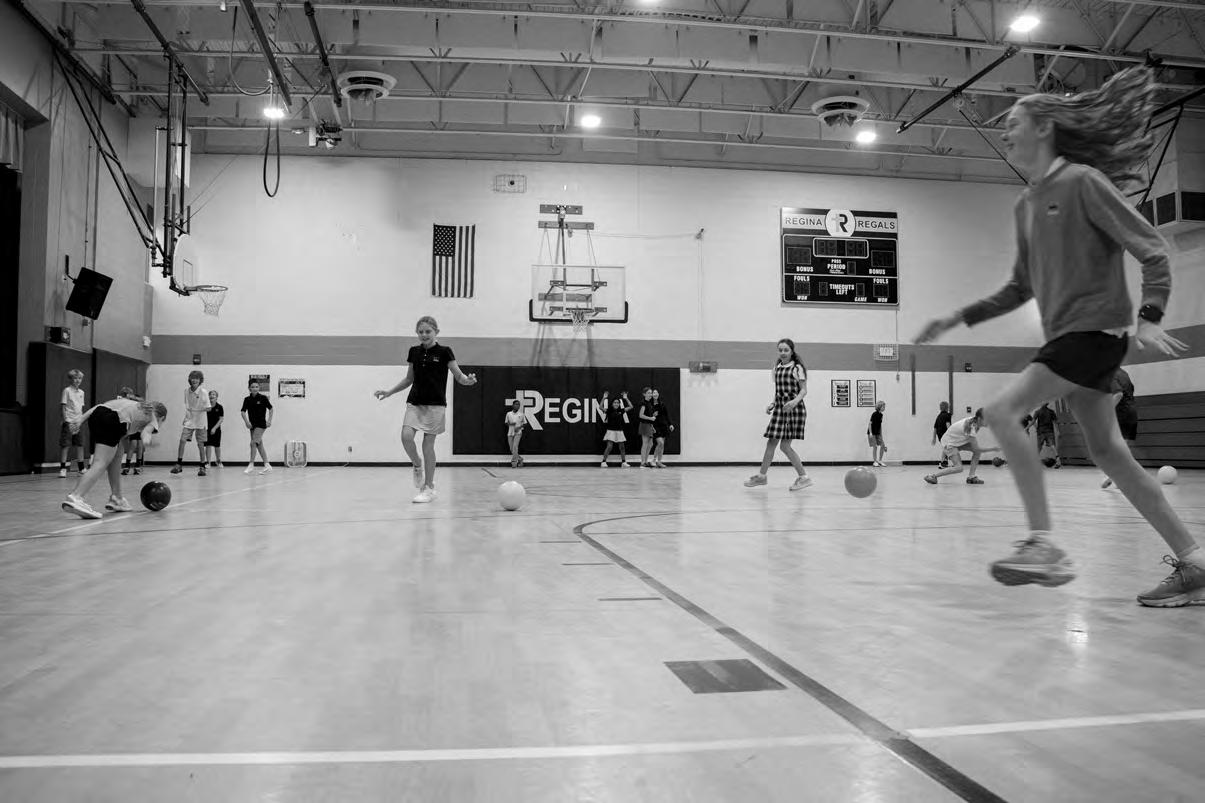
“Parents receive funds in the name of their child to help pay tuition,” Olson wrote in the email. “This has provided families new to Regina the choice they may not have been able to afford in the past.”
The standard tuition at Regina for the 2022-23 school year was $18,495 for ninth through twelfth grade, $12, 390 for seventh and eighth grade, and $9,990 for kindergarten through sixth grade.
The Iowa City Community School District is also taking measures to remain competitive with private schools through extracurricular and course offerings. Williams said the board is looking at adding academies to different ele-
“While we are trying to tell our story and just explain the different opportunities that we offer, we want to do that for families who aren’t with us yet, but we also want our families who are with us to understand all those things and have that point of pride when it comes to knowing that they’re part of our district.”
Kristin Pedersen Iowa City Community School District Director of Community Relations
passed in the Iowa House in early 2023 with a 55-45 vote. The act was highly debated and is still being criticized by teachers, administrators, and board members. Democrats unanimously opposed the bill.
The law works in three phases over three years.
Last year, $7,286 was allocated to families with an income 300 percent over the federal poverty line. This year the bar is raised to 400 percent, with no income limits for the 2025-26 school year.
Iowa’s public schools rely on per-pupil funding, meaning enrollment rates directly impact how much money these institutions receive. When enrollment numbers decline, so does funding.
Nearly 17,000 K-12 students in Iowa applied for an ESA last school year with nearly 30,000 applying this year.
Rep. Elinor Levin, D-Iowa City, voted against the bill and has been outspoken about its consequences since its approval.
“Public schools are about giving every sin -
always looks at operational efficiency before it considers cutting staff or programming when making budget cuts.
The Hills closure saved Iowa City schools $1.6 million for the following year out of a $3.75 million total budget reduction.
“We have been doing a lot of work to recognize that the budget picture isn’t going to get better, and it’s probably going to get worse,” Williams said. “I am sad to report that we aren’t done considering whether or not we have to retire other elementary schools.”
Generally, public school enrollment is trending downward nationwide.
The percentage of K-12 students enrolled in public schools has gone down by four percent between 2012 and 2022. National sources cite a rise in privatization across the country as one of the causes.
On the flip side, Iowa City private school Regina Catholic Education Center has seen growing enrollment. Regina’s Head of School Angela Olson wrote in an email to The Daily
mentary schools to allow students to focus on a specific subject area like STEM or performing arts.
The district is also opening its Center for Innovation, allowing students of all ages to focus more on technology and computerbased skills. The center will be located at 301 ACT Dr., which was purchased by the district last year.
Iowa City schools board member Mitch Lingo said the center will give students more opportunities to explore different curricular paths and seek out what they
actually want to learn about.
Superintendent Degner said the new middle school model for sixth-grade students and the addition of preschool to all elementary buildings will help to pull in and retain students.
Lingo said he agrees with bringing kids in earlier on and doing whatever it takes to make public school the best option for families.
“From what we’ve been told by administration, I tend to agree that it helps to bring students in earlier ... to get them more into Iowa City schools,” he said. “I have to look at it as a competitive aspect to when the private schools around here offer pre-K and offer early childhood education systems — you adapt to that.”
Lingo said on top of staying competitive with private schools, public schools also don’t have the ability to select the students they teach. Public school teachers may have to account for students with behavioral issues, language barriers, and learning disabilities, while private schools could decide to turn those students away.
“Your public school teachers are going to be there every day, busting their butt off for every student in their classroom — whatever student comes in their classroom,” Lingo said. “They don’t have any sort of mechanisms to skim students off and pick and choose.”
Lingo said reinforcing the idea that although the district may be losing funds or closing more schools, the main focus for the district is still education, and all Iowa City Community School District teachers will continue to do their jobs.
“Teachers are going to be there no matter what to provide the best of what they can provide,” he said. “It’s on us as school board members and as a general voting public to make sure that those teachers get the resources that they need.”

Arts
Audience
DITV
Valtman johnny.valtman@dailyiowan.com DITV Asst.
Director Jayce Bertrand jayce.bertrand@dailyiowan.com
DITV Sports Director AJ Reisetter aj.reisetter@dailyiowan.com
DITV Asst. Sports Director Brady Behrend brady.behrend@dailyiowan.com
DITV Tech Director Madison Johnson madison.johnson@dailyiowan.com
BUSINESS STAFF
Business Manager Debra Plath debra.plath@dailyiowan.com 319-335-5786
Advertising Director/ Circulation Manager Juli Krause juli.krause@dailyiowan.com
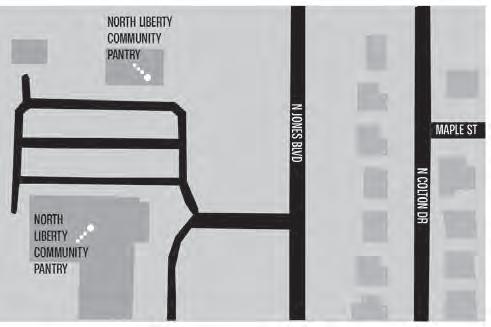
The current food pantry facility is just over 2,300 squ are feet and includes a shopping area, storage space, and two offices for seven staff members.
The limited space has caused several issues to arise, Bobst said.
Currently, clothing and food are kept in separate buildings. On two separate occasions this summer, the pantry ran out of freezer space and extra meat had to be store at other businesses in the community.
The new facility will be nearly four times the size of the old one at approximately 10,500 square feet, Bobst said. It will house six office spaces, ample storage, and allow the space to have food and clothing under one roof.
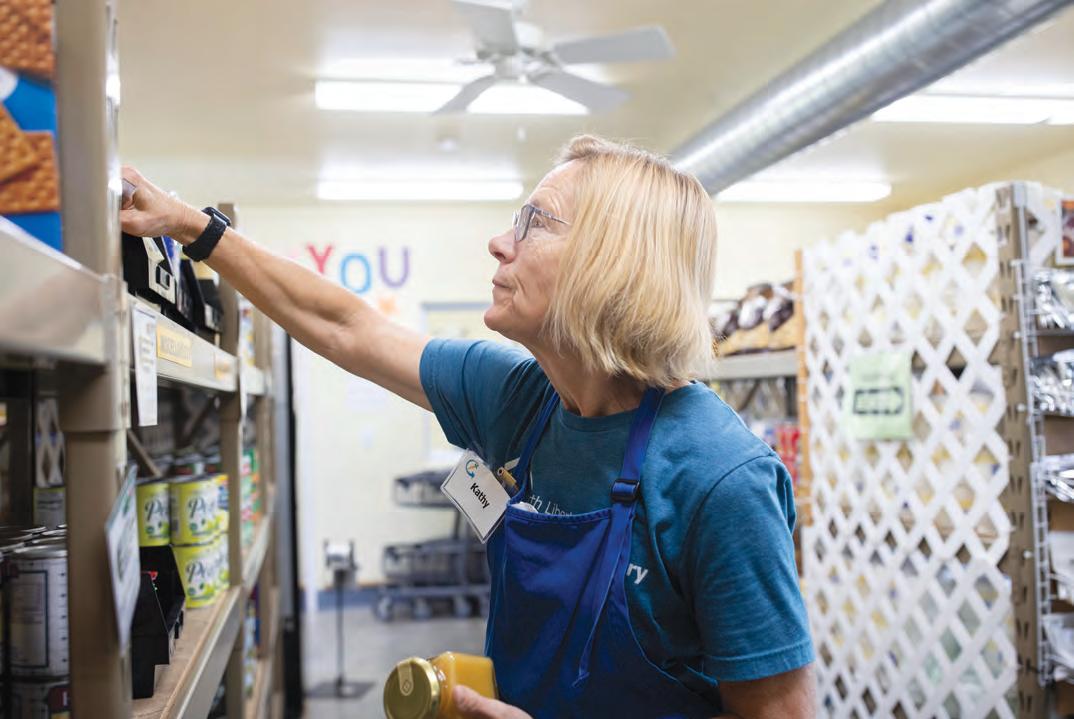
“Need is the reason that we are pursuing planting new roots and growing into a bigger space,” Bobst said.
Other food pantries in the area have seen unprecedented growth in the last couple years.
Loyal Ulm, the Coralville Community Food Pantry home delivery and operations manager, said their pantry serves approximately 400 shoppers and completes approximately 100 home deliveries per week.
“We’ve definitely continued to see expanded services used more in the last year,” Ulm said.
on the corner of McCollister Boulevard and Gilbert Street is the facility’s proposed location, Nagle-Gamm said.
She also said the current facility is “past its usable life.”
Additionally, the transit department hopes to replace
“Fare free is something the community wants. I hear about it all the time.”
its diesel buses with electric buses, which cost around $1.5 million per bus, Nagle-Gamm said. The new facility would be based around a fleet of electric buses in hopes of reducing carbon emissions substantially by 2030.
The Iowa City City Council discussed avenues to tackle these projects with Nagle-Gamm during her presentation on Aug. 20. Dunn said the council should be responsible for transit infrastructure in Iowa City, including investing in bus stops and benches. Dunn said this should not be the
The Coralville Community Pantry moved into a building almost twice the size of its previous one nearly two years ago and quickly filled the space, Ulm said. They have grown to make their hours more accessible and will likely expand those services in the future as well.
The expansion of North Liberty Community Pantry

responsibility of independent groups, such as the Iowa City Democratic Socialists of America, a local chapter of a national organization. The DSA in Iowa City has a bench initiative that includes crafting benches for bus stops in Iowa City.
“It will require the council’s will to put real dollars into [transit] to improve routes and general service,”
aims to combat the food insecurity rates in Johnson County, Bobst said.
“I am just so grateful for the community support, both for the campaign and for our mission,” Bobst said. “We could not distribute the volume of items we’re distributing to our neighbors without the community support.”
Dunn said.
Dunn also touched on funding, which he said incorporated the increase in parking fees, but he also said a potential utility tax, among other ideas, could be used to help the fare-free program continue.
Dunn said bus fares in Iowa City did not allow for profit in the transit system.
“The baselines of federal funding will still be there,” Dunn said.
During the city council work session on Aug. 20, Councilor Josh Moe addressed some of the possible funding opportunities the city has.
“Fare free is something the community wants. I hear about it all the time,” Moe said.
Moe said borrowing money from the funds going toward parking garages is likely not going to happen.
Additionally, Moe said he was in support of franchise fees on utilities, such as natural gas and electric power — a sentiment shared by Dunn.
Nagle-Gamm said federal funding to help transit agencies transition to electric technology will help the department’s plans going forward.
“It is a very interesting time to be in transportation because things are changing really rapidly,” Nagle-Gamm said. “It’s pretty amazing what can happen with the monumental leap forward in sustainability that’s happening.”
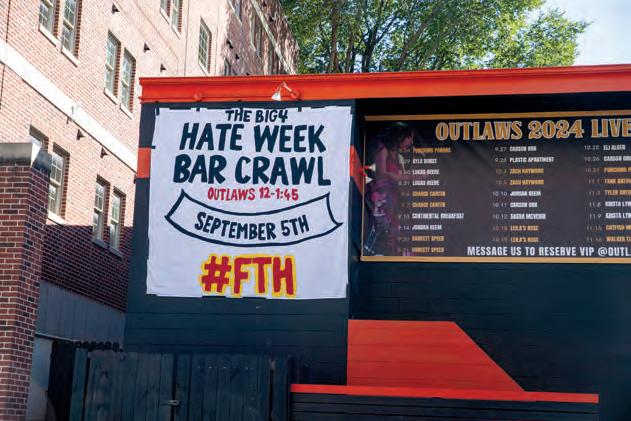
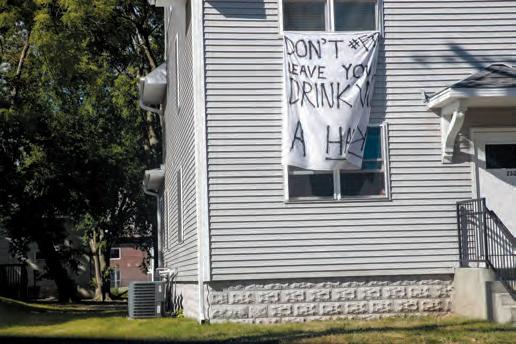
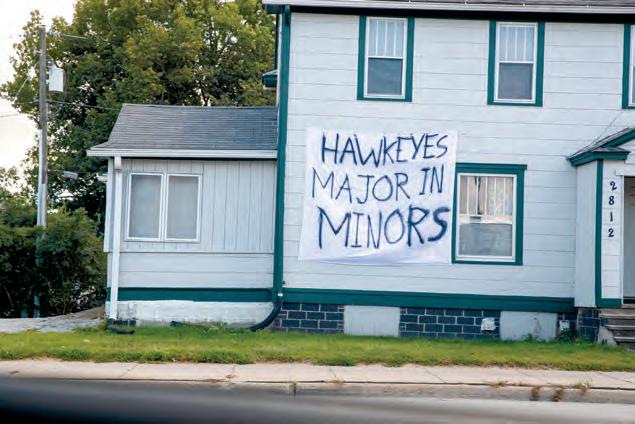
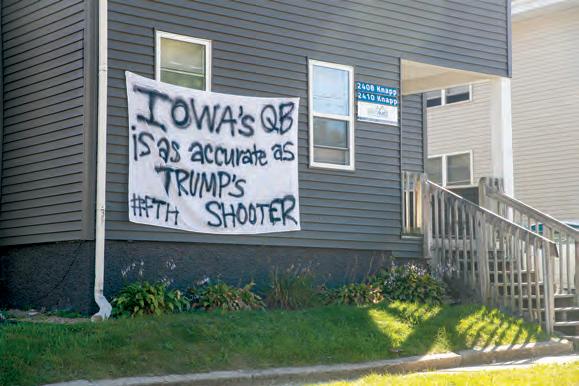
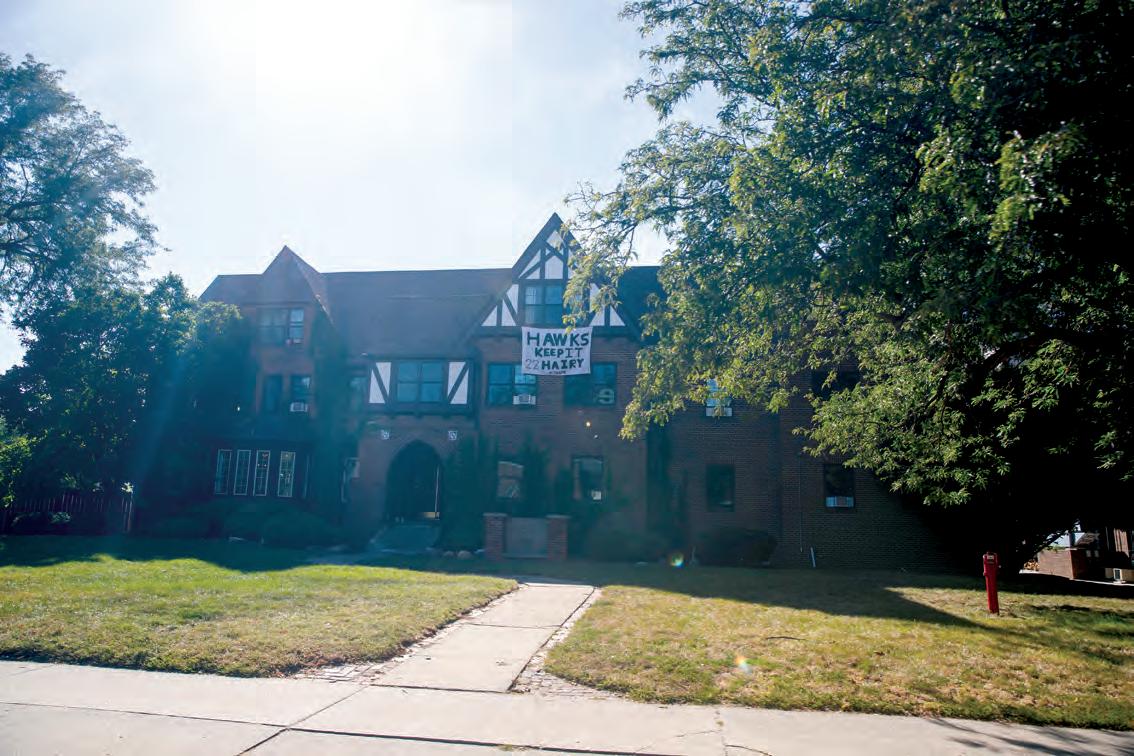
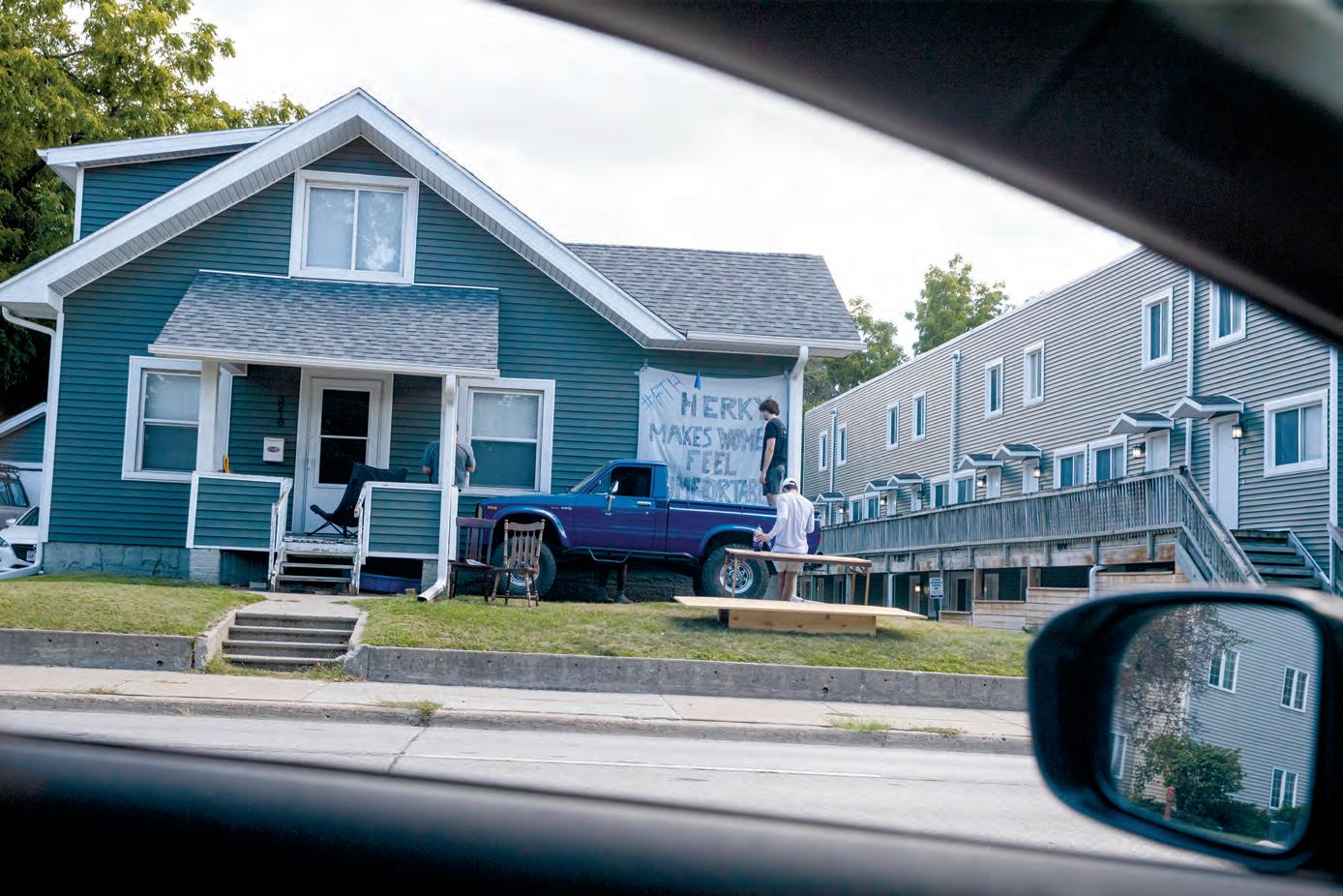
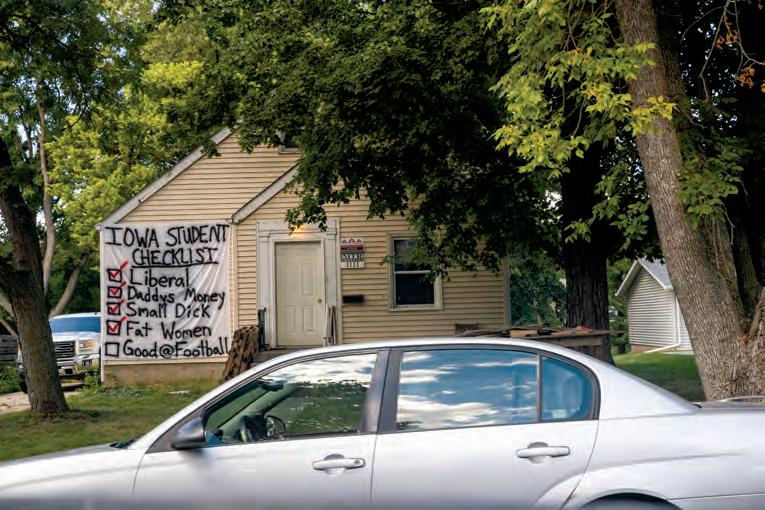
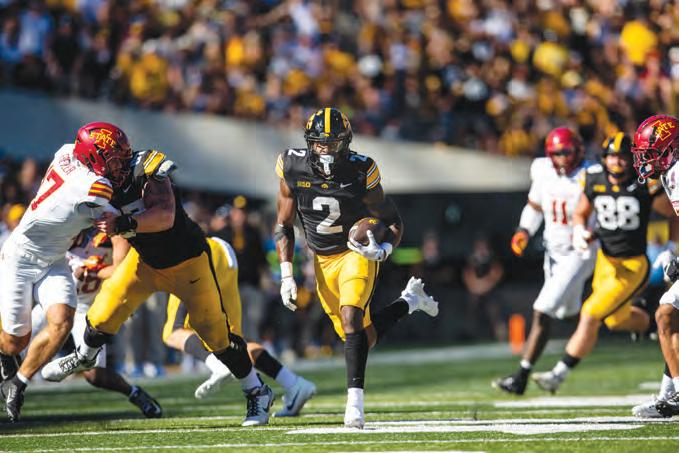
In the week leading up to the Cy-Hawk game at Kinnick Stadium, Iowa State and Iowa students alike participated in Hate Week. Students spray painted bedsheets and hung up signs mocking the opposing team before the annual face-off. DI Staff | The Daily Iowan
(Top) Hate Week signs are seen in Ames and Iowa City on Sept. 6. Hate Week occurs every season during the week leading up to the Cy-Hawk football game. (Middle) Nick Passanante interacts with the camera before a Cy-Hawk football game between then-No. 21 Iowa and Iowa State at Kinnick Stadium on Sept. 7. The Cyclones defeated the Hawkeyes, 20-19. Passanante was accompanied by his friends Tressa Peissig, Abby Clark, Matt Verdico, Emma Bingenheimer, Ty Anderson, and Tommy Dierbach. (Bottom right) Fans pose for a portrait before the Cy-Hawk football game. (Bottom middle) An Iowa State fan poses for a portrait before the football game between Iowa and Iowa State. (Bottom left) Hawkeye fans show off an anti-Iowa State shirt while tailgating prior to a football game between Iowa and Iowa State on Sept 7. Iowa and Iowa State fans gathered at various locations including the Main Library parking lot, Hancher Auditorium parking lot, and Kinnick Stadium to eat, drink, play games, and listen to music.
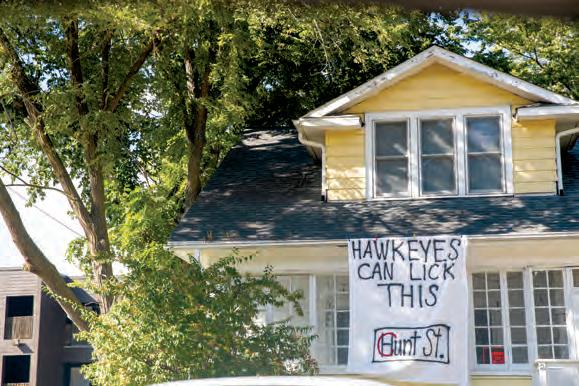

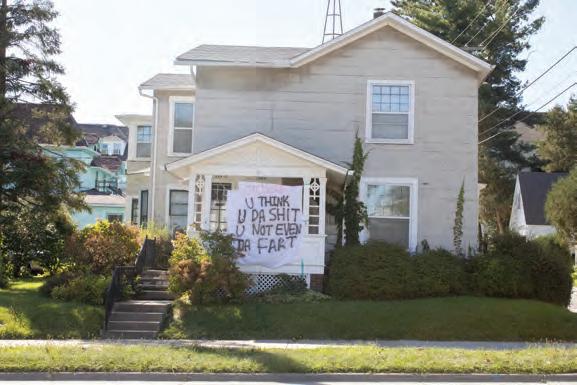




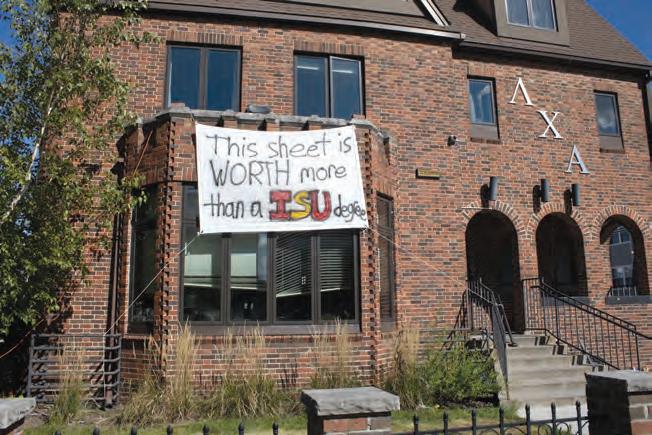

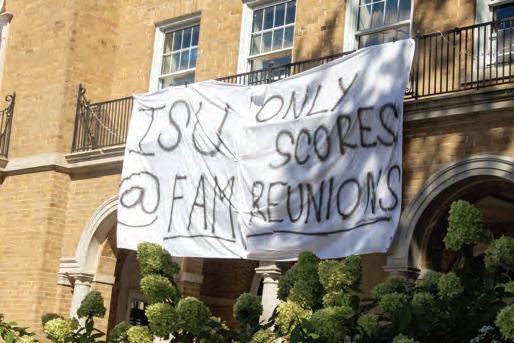
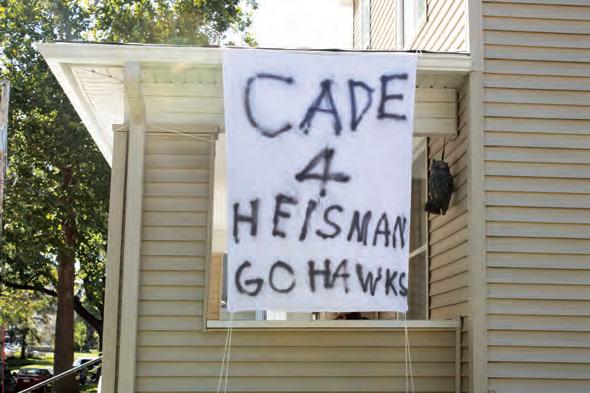
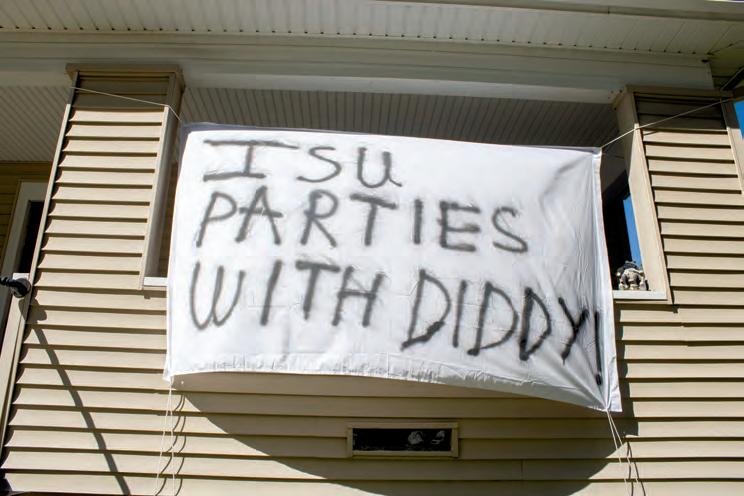
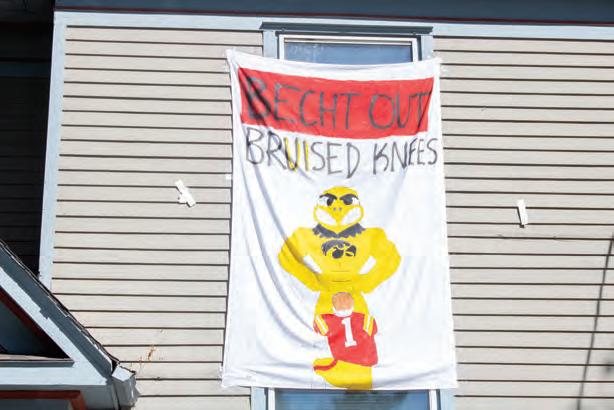

How Hate Week has become a contentious Iowa City staple.
Stella Shipman Managing Editor stella.shipman@dailyiowan.com
This past weekend, it was no surprise to longtime Iowa City residents and university students walking down the streets of the city to encounter white sheets scrawled with black spray paint hanging over banisters and porch railings.

What might have startled community members, however, was the profane content seen in some of the sheets’ messages rippling in the wind.
Hate Week, the week leading up to the historically rivalrous matchup between the University of Iowa and Iowa State football teams, seemed especially heinous this year.
Since 1977, the Hawkeyes and the Cyclones have faced off every year until 2020, when the COVID-19 pandemic prevented them from playing each other for the 43rd consecutive time. The football games resumed the following year in 2021, as did the brewing tensions between teams.
These tensions have continued to manifest as the sheet signs waving throughout
“Having a sign on our house is like being a part of something that everyone else is a part of.”
Jerzey Sheppard Iowa City resident
Iowa City, which has become a tradition among UI students and garners national attention on social media.
Every year, Instagram reels and posts of various Hate Weeks signs flood the Barstool Iowa Instagram page. Students like third-year UI student Tyler Kuecker and his roommates scrolled through these posts searching for inspiration for their own signs this year.
The group eventually settled on a sheet hanging over their porch with text reading “Cyclones can’t be within 500 feet of a school #hideyakids.”
“You look on Barstool and see what signs have been made so you don’t make a sign twice, and then we all just sat around and tried to come up with ideas, and this is what we landed on,” Kuecker said.
Barstool’s total embrace of the hate culture, as well as videos of students painting signs and getting ready for game day, encourages more students to become involved in the trend. Participating in Hate Week has become a way of bringing students together, despite the crude nature of some of the signs.
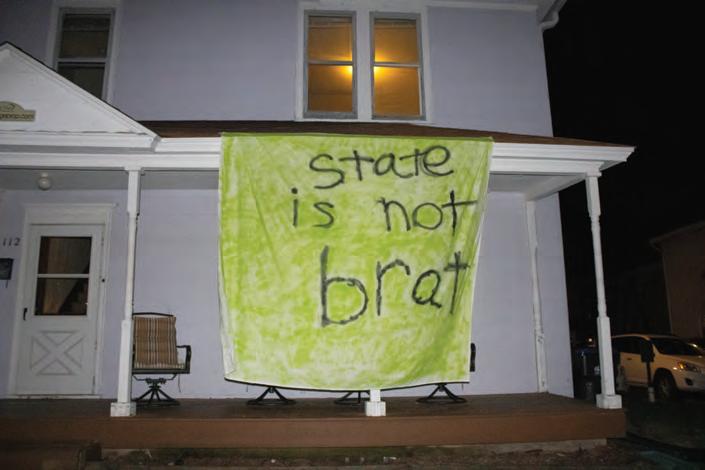
Other popular TikToks that are unrelated to the UI or Iowa State have found their way into the trend as well, becoming a pop culture language among students that only social media can decode. One sign, for example, made reference to the “ginger girl” TikTok sound. Another referenced Charli XCX’s album “BRAT,” with a sign reading “state is not brat.” Jerzey Sheppard and her housemates, all UI students, decided to hang a sign because this year is their last at Iowa, and they wanted to contribute to their school’s rivalry culture one final time. They believe that speaking through social media trends and showcasing UI pride makes them feel
in Hate Week has been just as impactful. First-year student Dane Butler helped coordinate the hate week signage in his Catlett residence hall at the beginning of Hate Week. He and students on adjacent floors each hung a letter in the windows that vertically spelled out “F*** State.”
Before starting at the UI, Butler hadn’t realized how intense Hate Week was in Iowa City, but engaging in the tradition with other students was a positive experience.
“It was really fun and really interesting,” Butler said. “You get a chance to meet more people.”
As a house of women across the street from a sorority, Sheppard and her roommates wanted to be conscious of writing a message on their sign that did not target women who go to Iowa State, as several other signs throughout Iowa City do, including a sheet on Gilbert Street that suggested women who go to Iowa State were “cows.”
“We definitely want to steer clear of stuff like that,” Sheppard said. “We’re a house full of girls. We don’t want that on our front porch.”
Instead, the group geared their particular insult toward Rocco Becht, the Cyclones’ quarterback.
Opinions on the more misogynist signs throughout Iowa City targeted at women who attend Iowa State University varied. Kuecker believed they were insulting but did not take any of them too seriously.
“It’s funny. Maybe in 20 years, I’ll think it’s not that funny, but it’s Hate Week,” Kuecker said. “I don’t think either side really takes it to heart.”
In the middle of the night, though, when UI and Iowa State fans are walking home from the bars, Hate Week can take a more serious turn.
On the Thursday before the game, Kuecker’s sign was ripped down by an Iowa State fan passing by and shouting profanities before he was ushered away by his friends. The moment was caught on the house’s Ring camera.
With a house on a main thoroughfare for foot traffic between the bars and local residences, Kuecker and his roommates are accustomed to ding-dong-ditches and trash being tossed onto their porch, so when they woke up to their sign on the ground, they were upset but unsurprised.
Kuecker said the worst aspect of the profane signs is that there are kids living in the surrounding neighborhood who might see them.
“I think it probably does have — not a negative impact — but it’s probably not the best,” Kuecker said. “But also people walking home drunk and screaming in the middle of the night is not great. I feel like that’s probably worse.”
At the end of the day, though, UI students consider Hate Week to be an integral aspect of Iowa City culture, and they don’t despise Iowa State students nearly as much as their signs suggest. The sheets are more of an intimidation factor in an ongoing, iconic turf war.
“I think, honestly, no matter if you’re an Iowa or Iowa State fan, we’ll still be friends,” Kuecker said. “It’s like a fun rivalry, and it’s just been a part of my life growing up.”



In today’s day and age, body image and media go hand and hand. Whether that be reinforced through TV, social media, or Google searches, the impacts are widely felt.
sessed with this content.
The pervasiveness of reality dating shows set on beaches featuring contestants in swimsuits 95 percent of the time is preying on our desire to be as unrelatable as possible.
Not only do these shows awaken my body dysmorphia, but they also create unrealistic dating standards.
Although I’m in a six-year, committed — and happy, might I add — relationship, I still find myself comparing the televised relationships to my own.
According to Psychology Today, “two contestants from the show ‘Love is Blind’ report damage to their mental health from appearing on the show.”
“Love is Blind” only allows contestants 10 days to form a connection without ever seeing each other. After the show, they live together and get married – that is, if they stay together.
“Love is Blind” is also under scrutiny for claims that producers forced contestants to drink excessive amounts of alcohol on an empty stomach, causing

mental health issues and dating problems.
Online marketplaces are increasing impulsive spending among young people.

Muskan Mehta Opinions Columnist opinions@dailyiowan.com
Social media is a trap — and it’s too easily given to young hands.
In the age of online marketplaces, kids have immediate access to anything they might desire. Oftentimes, this results in a cart of unnecessary products inspired by various trends circulating on social media.
Whether it be fashion, skincare, accessories, or household items, there’s always something new.
So many people, especially younger generations raised with social media, are falling into an endless cycle of shopping.
This shopping pattern comes at a price, though, and it’s not cheap.
With almost 50 million active internet users aged 17 and under in the U.S., it’s entirely too easy to fall victim to influencers and marketing.
Constant videos and posts promoting products as well as heightened accessibility to shopping sites have given way to a new wave of materialism.
According to a 2024 report studying consumer trends, 40 percent of Gen Z users claim social media is the best way to discover new products. The study also concluded that approximately 43 percent of Gen Z users have purchased a product
directly from an app.
Nowadays, social media influencers encourage their audiences to buy items that, upon further evaluation, are useless.
Making money through commissions, these influencers have found a niche that preys on young viewers.
These trends have reached the point where “de-influencers” — people on social media who are telling their watchers what not to buy — have emerged.
Spending habits develop at a young age, and a majority of kids don’t yet have the education or willpower to develop sensible, sustainable habits for their financial future.
Seeing materialistic and impulsive behavior online can blind kids to the consequences of spending. Some might even adopt the mindset that they have endless funds to spend on food, drinks, clothing, and more.
While some people might believe consumerism stimulates the economy leading to an increase in production, the negative impacts of consumerism seem to outweigh the positive.

More than five billion consumers in the world create an increase in demand for energy, food, clothing, and more.
An overconsumption of these materials will deplete the resources we are trying so hard to preserve. This materialism often comes at the expense of personal well-being.
Excessive screen time and constant comparison to curated online personas can contribute to mental health issues,
such as anxiety and depression.
The pressure to conform to an idealized image can lower self-esteem and lead to a cycle of dissatisfaction and compulsive buying.
In addition to personal wellness concerns, it’s important to make smart financial decisions for the good of the environment.
Many kids and teens make small, seemingly insignificant purchases, but these can add up over time, causing pollution and an excess of waste.
Promoting a balanced approach to social media use with a focus on authentic connections and meaningful content can mitigate some of the negative impacts associated with excessive materialism.
Iowa’s active voter registration is rising with help of local get-out-the-vote efforts.
Liam Halawith Elections Editor liam.halawith@dailyiowan.com
Roxy Ekberg Politics Editor roxy.ekberg@dailyiowan.com
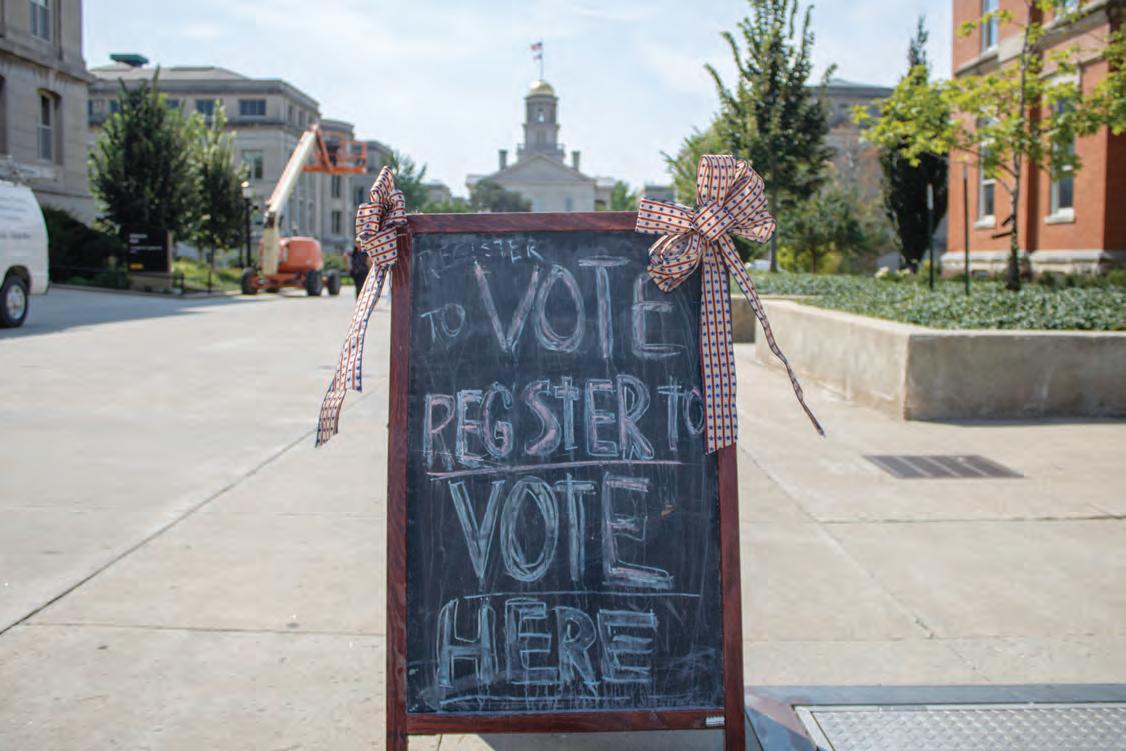
In the middle of Iowa’s sweltering August heatwave, volunteers with Johnson County Democrats set up a non-partisan voter registration tent outside of downtown Iowa City’s Yotopia, one of many local get-out-the-vote efforts prefacing the upcoming presidential election.
Targeting younger voters and college students needing to re-register after an address change, the volunteers guided people through the process of ensuring their vote could be cast in the upcoming presidential election.
Talia Lavorato, a first-year student at the University of Iowa, registered to vote for the first time at the tent. She said she took the time to register in the oppressive heat because she believes young voices need to be heard.
“People from different backgrounds are able to vote on the same type of topics,” she said. “There could be some topics that aren’t really talked about enough, and so if more people were to vote on those topics, [they would] get seen more.”
Lavorato was one of hundreds of young people who registered to vote in Johnson County through local get-out-the-vote efforts.
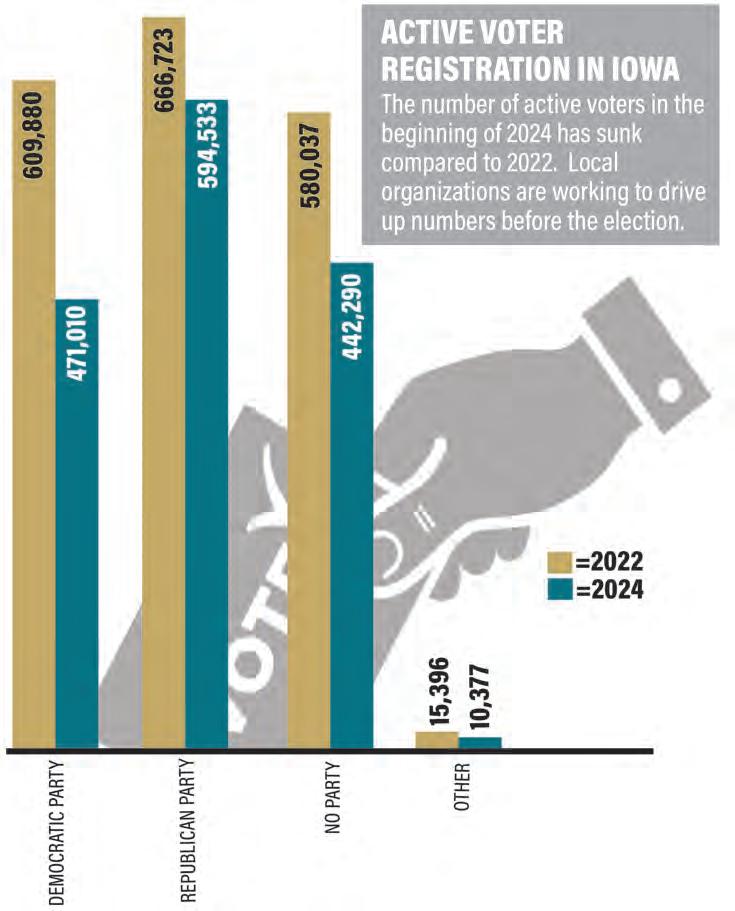
Despite grassroots efforts within the county and around the state, Iowa voter registration totals are still below the levels seen during the 2022 midterm elections. However, this year’s numbers are currently on the rise.
Local organizations including Johnson County Democrats and Hawk the Vote are driving voter registration in the lead-up to the 2024 presidential election.
After a sweeping state elections law moved more than a half million voters’ registrations from active to inactive, the number of voters with active registration status remains below 2022 election levels.
tus from active to inactive does not impact the ability to vote. However, it does move the voter’s registration closer to being canceled.
Mack Shelley, a political science professor at Iowa State University, said excitement and trepidation about the coming Nov. 5 election have helped increase voter registration.
Registered voters made inactive through the list maintenance process can return to active status by requesting an absentee ballot, voting in an election, submitting a new registration, or updating their voter registration, Shane said.
said. “They don’t like that impression that’s always given off of politicians, so that’s why I think sometimes it pushes people to stay at home or to not get involved.”
Hawk the Vote introduces new course
The law requires registered voter’s status to change from active to inactive after failing to vote in any general election. Under the law, more than a quarter of Iowa’s 2.2 million registered voters were moved to an inactive status.
Mack Shelley Iowa State University Political Science Professor
Shelley said voter registration typically rises during presidential election years, and historically, younger people are less likely to cast a ballot because voting is a habitual process.
Local organizations look to boost voter registration
“Once you’ve been through the cycle, you get registered, you vote — it’s a whole lot easier to sort of like, lather, rinse, repeat, and then just keep going through it.”
Before the law, a voter’s registration status did not change unless the voters failed to cast a ballot in two consecutive general elections.
After a voter roll update in April 2023, there were 1,328,793 active registered voters in Iowa. Numbers released at the beginning of August totaled 1,558,076 active registered voters — an increase of 229,283 voters with active registration status.
Voter registration numbers increase
The new law kicked more than 30,000 voters in Johnson County to inactive status after it went into effect. The numbers have bounced back to more than 76,000 active voters in the most recent report released in early August, compared to a little more than 68,000 following the law’s enactment. Iowans with an inactive voter status are still able to vote, as moving a registration sta-
“There are all these things that are societal pressures, sort of time of life things. Income considerations and things like that can overwhelm younger people who haven’t been through the cycle yet,” Shelley said. “Once you’ve been through the cycle, you get registered, you vote — it’s a whole lot easier to sort of like, lather, rinse, repeat, and then just keep going through it.”
Shelley described voting as a cyclical process, and after people begin the voting process, they are very likely to continue — it is just a matter of taking the step to register to vote.
“You have to be registered to be able to play the game of actually voting,” Shelley said.
Voter registration numbers can also increase for a combination of factors, including election type, candidates on the ballot, key issues, and boosts from headlines or events that generate national interest, Johnson County Auditor Erin Shane said in an email to The Daily Iowan
Registering to vote is a key part of the voting process, and voting is better for democracy, said Eric Johnson of Iowa City, who is one of the dozens of volunteers with the Johnson County Democrats holding voter registration drives on the pedestrian mall and T. Anne Cleary Walkway in Iowa City.
“I think the more people that have secure access to voting, the better it is,” Johnson said. “Because it’s people taking a hand in deciding their political fate, deciding the outcomes of the government that affects their lives.”
Johnson County Democrats and Hawk the Vote are two of many organizations across Iowa looking to drive voter registration to make it easier for Iowans to vote at the polls in November.
Dan Feltes, the First Vice Chair of Johnson County Democrats, said the organization has put up these tents in high-traffic areas to help get voters, especially
Hawk the Vote was founded in 2018 by Jocelyn Roof, a political science student at the UI, to drive the civic engagement of the university’s more than 20,000 students. Now, six years later, the group is taking a step into uncharted territory — hosting a one-credit-hour course focused on engaging voters in a new way. Hawk the Vote’s main goal for the past six years of its existence has focused on grassroots efforts to drive voter registration at the UI. A mixture of educational events, voter registration drives, and social media posts looking to drive civic engagement, and voter registration has become the group’s mainstay.
However, this year’s group wants to take a new approach to educating young voters with a one-of-its-kind course titled “Special Topics in Politics: History and Politics of Voter Registration and Civic Engagement.”
The course will host a series of local government officials, university officials, state lawmakers, and even a congressional
“We really want to emphasize that there is more to participating in democracy than just voting. That’s certainly a very important part — but there is a lot more to it than that.”
Jaden Bartlett Hawk the Vote Executive Director
the number of young voters concentrated on the UI campus who might be registering for the first time, to register to make “election day go smoother.”
“Everybody has a right to have their voice heard, and voting is the way to do it,” Feltes said. “It’s the way to have your voice heard and encourage everybody who isn’t registered to go ahead and get registered. Don’t wait to register. Get it done.”
Hawk the Vote battles voter apathy
Hawk the Vote Executive Director Jaden Bartlett said the group has been working with large campus and Greek life organizations to drive voter registration at their events this semester.
However, Bartlett said overcoming voter apathy has been the group’s biggest hurdle in driving young people to register and, in turn, to the polls.
“It’s really easy to relegate that to just being a presidential thing,” Bartlett said.
“Maybe if you don’t see a candidate that represents the values or behaviors or beliefs that you’d like to see at the presidential level. That’s fine, but there are all these down-ballot candidates who actually can make almost a more noticeable difference in how things run in your community.”
Karson Johnson, a first-year student at the UI, first registered to vote when he turned 18 and recently re-registered after moving to Iowa City. Johnson said young people are turned away from politics because of the increasing age of politicians.
Former President Donald Trump rings in at 78 years old, and President Joe Biden is 81 years old. Vice President Kamala Harris is 59 years old, a stark difference she has utilized as a campaign tactic to target younger voters.
“There’s certain people out there — which I kind of see the point — they don’t like seeing 70-year-olds in office. They don’t like seeing 70-year-old white guys,” Johnson
candidate to show students how voting plays a role in civic engagement, Noah LeFevre, the education coordinator for the group, said.
The course requires students in the class to be members of Hawk the Vote and participate in several events outside of class time for credit.
LeFevre said the reason the group decided to offer a course was to build civically engaged leaders.
“But this year, we’re looking to not only have people show up for events and activities and register people,” LeFevre said. “We want to create leaders as well as people who are engaged with their local political systems.”
Bartlett said the group decided that this year, being a presidential election year, was the perfect year to start the course — when the public’s attention is already drawn to politics.
“It seemed like a very salient time to implement the idea,” Bartlett said.
Bartlett said the group decided a course would be the best way to advance their civic engagement goals.
“We really want to emphasize that there is more to participating in democracy than just voting,” Bartlett said. “That’s certainly a very important part — but there is a lot more to it than that.”
The course will not only focus on voting but also on interacting with elected officials and engaging in politics more than going to the ballot box. This includes talking with local and state officials about issues that directly affect them.
LeFevre said he wants to make sure that students aren’t just engaged for presidential or congressional races but also local races that can make an impact on daily life.
“I just hope that people are more aware of elections,” LeFevre said. “I want people to be out there and be able to understand just the overall American political system but also understand the importance of democracy and voting.”

The Iowa football team has shown two sides to the same offense this season.

Hawkeyes, 20-19.
Colin Votzmeyer
Sports Editor colin.votzmeyer@dailyiowan.com
Brad Schultz
Assistant Sports Editor brad.schultz@dailyiowan.com
Where the Iowa football offense looks promising at one moment, it resembles the past at others. The offense bore the brunt of the crit -
icism from the college football world throughout the 2023 season, as it averaged just 15.4 points per game in 14 games played. In the air, Iowa quarterbacks averaged 12.1 completions on 24.9 attempts for 118.6 yards per game and .6 touchdowns. On the ground, where the Hawkeyes were much more dependent, Iowa rushed a per-game average of 115.9 yards for .8 touchdowns. The total offense average of 234.6 yards
per game was the worst in all of the Football Bowl subdivision.
The inability to generate momentum and move the ball certainly contributed to three shutouts by ranked opponents: 31-0 to Penn State, 26-0 to national champion Michigan in the Big Ten Championship, and 35-0 to Tennessee in the Citrus Bowl.
So, doubts within the Iowa football circle blossomed and grew strong, especially amid disappointment with the team’s struggle to make an offense click with its
top-tier defense and special teams units. Was Cade McNamara the answer? Was Deacon Hill a reliable backup? Could Brian Ferentz have continued to run the offense? Matter of fact, can Kirk Ferentz continue to run this team?
After the Hawkeyes spent the offseason wrestling with these questions, the Iowa offense looks worlds different this time around.
OFFENSE | 3B
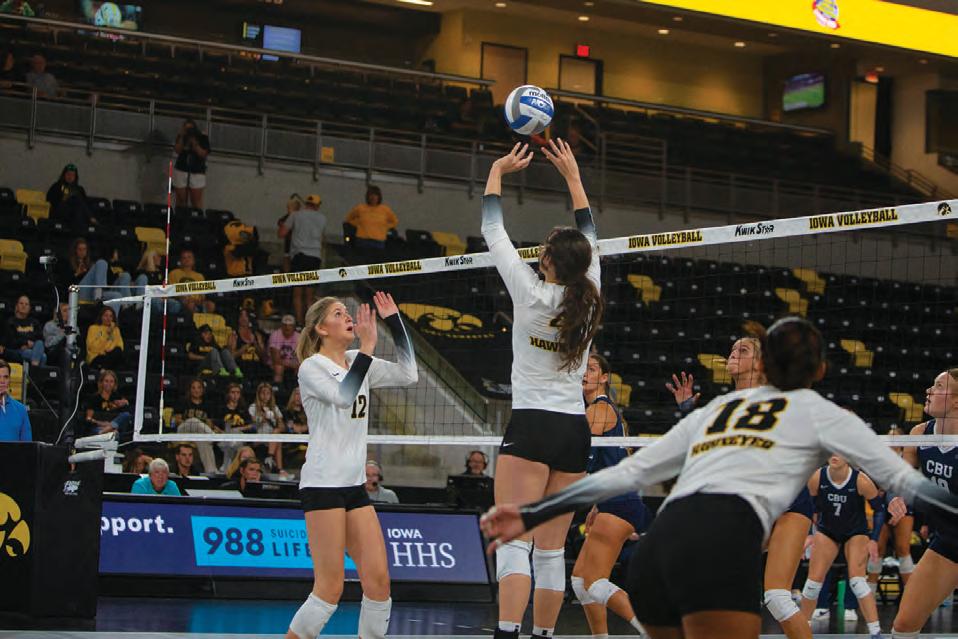
“We had some pushback from Providence, and it forced us to really turn to each other and trust each other and work together,” fifth-year libero Joy Galles said. “They weren’t easy games, Liberty and Providence. They’re both solid teams that played some really passionate volleyball. It was great for us.”
Ammeraal, who transferred from Central Michigan in the offseason, acknowledged her teammates for contributing in each game.
“You can only get assists if your hitters are getting kills,”
Zoe Smith Sports Reporter sports@dailyiowan.com
The Iowa men’s golf team added a familiar face to its coaching staff in the offseason as they prepare for the 2024-25 season.
Steven Ihm was named assistant coach of the men’s golf team on July 9 after previously serving as the volunteer assistant coach. Ihm played for the Hawkeyes from 2011-14, earning three All-Big Ten honors and four first-place tournament finishes, becoming one of the most decorated players in school history.
After his college career, Ihm moved to the professional level for seven seasons, including stints on the PGA Tour. Near the end of his tenure, he quickly discovered a passion for developing young golfers’ talents.
“I grew a lot as a person and my golf game developed a lot,” Ihm said. “I think it’s a privilege to work with high-aspiring individuals and to feel like I have the experience to help them onto the next level if they choose to take that path.”
For Ihm, the chance to return to his alma mater was a no-brainer.
“I always wanted my first coaching job to be at Iowa, so when I called Coach Stith and told him I was interested in coaching, he offered me the volunteer assistant position, and I felt like I had to take it,” Ihm said.
After serving a few seasons as a volunteer assistant, assistant coach Charlie Boyle was named head coach at Alabama-Birmingham, opening the door for Ihm to take over the role.
“It’s a great way to get your foot in the door and get some coaching experience at a high level right away,” Ihm said. “I had to jump at that opportunity, and I was excited for it to be at Iowa.”
Ihm is hoping to bring new life to the team this season in his new position.
“It will be exciting to see them play and to help them through the gauntlet that is competition golf,” Ihm said. “I hope to bring competitiveness and confidence to tournament play.”
Competitive edge
Former Tennessee Assistant Coach Nic Robinson was named associate head coach of the women’s golf team on Aug. 1.
Football
Saturday, Sept. 14
Troy Iowa City, Iowa
3 p.m.
Soccer Thursday,
Assistant Sports Editor Brad Schultz takes a look at Troy, Iowa football’s week three opponent, following Iowa’s 20-19 fall to Iowa State.
Brad Schultz
Assistant Sports Editor brad.schultz@dailyiowan.com
Following a devastating home loss to Iowa State, the Iowa football team looks to rebound at Kinnick Stadium against the Troy Trojans, who enter the contest with an 0-2 record.
The Trojans entered the season as the two-time defending Sun Belt Conference champions, but they were dealt a tough blow when head coach Jon Sumrall was hired away at Tulane in the offseason.
Wednesday, Sept. 11 Iowa State Ames, Iowa
6:30
TWO QUICK HITS YOU’VE MISSED
In light of Iowa football’s groundbreaking offensive performance against Illinois State on Aug. 31, four-star wide receiver Terrence Smith of the 2025 recruiting class committed to the Hawkeye offense.
Iowa’s performance against the Redbirds silenced thousands of doubters in the college football world about the offense’s capabilities after last season as quarterback Cade McNamara threw for 250 yards and three touchdowns — two to freshman Reece Vander Zee and another to transfer Jacob Gill. Like Vander Zee, Smith stands at 6-foot-4 and 185 pounds. He hails from Aurora, Illinois, by way of West Aurora High School. Smith, a senior, is ranked eighth in the state and 326th in his class. He chose the Hawkeyes over offers from the likes of Minnesota, Iowa State, Purdue, and Western Michigan. He boasts a dominant figure deep in the field, capable of rising over backs and backers to snag high throws with impressively soft hands. His frame gives him long strides that are tough to track down and inherently makes him difficult to tackle. In the field, Iowa freshman thrower Bryce Ruland won the discus event in the U20 World Championships in Lima, Peru, on Aug. 31. The athlete from Waterford, Wisconsin, won gold on behalf of the U.S. in the event with a personal record throw of 62.59 meters. He beat out Jarno van Daalen of the Netherlands and Mico Lampinen of Finland for the title. Ruland will embark on his search for a Big Ten title and more as the Hawkeyes kick off the 2024-25 track season in December.
It has been a rough debut for new head coach Gerad Parker, as his squad suffered a two-point home loss against Nevada and a 21-point beating on the road at Memphis.
To fully digest this matchup, let’s take a deeper look at where Troy stands.
Despite many transfers entering the mix, third-year Goose Crowder earned the starting quarterback job after serving as the backup in 2023. Crowder fared well against Nevada, tossing one touchdown and 200 yards through the air. But he suffered an injury in the blowout loss to Memphis, leaving his status for the game against Iowa in question.
The Trojans will likely rely on running backs Damien Taylor and Gerald Green to power their rushing attack, which has averaged 191 yards in two games.

Third-year wideout
Devonte Ross is Troy’s leading receiver, recording 102 total yards and a touchdown in the young season. Ross tallied 428 yards during the 2023 season and could become one of the top playmakers in the Sun Belt this year.
Last season, the Trojans featured the Sun Belt’s best defense, allowing only 17.1 points per game — but they lost several
members of their vaunted pass rush, including standout defensive end Javon Solomon. Solomon recorded 16 sacks in 2023 and was drafted in the fifth round of the NFL Draft by the Buffalo Bills. Though Solomon’s departure hurts the Trojan defense, it does return third-leading tackler Jordan Stringer as linebacker and rising free safety Dell Pettus. New defensive coordinator Dontae Wright hopes Pettus can help mentor an inexperienced secondary that fea-
tures four transfers. Throughout the first two weeks of the season, Troy’s defense has allowed 28 points per game. Safety Justin Powe leads the team with nine tackles.
teams
Third-year Scott Taylor Renfroe is the starting kicker for the Trojans, and he has rewarded them by knocking in all of his field goals and extra point attempts thus far. Fourthyear Robert Cole enters
Trey Benson Sports Reporter sports@dailyiowan.com
The Daily Iowan: What type of emotions were you feeling after scoring your first collegiate goal for the Hawkeyes?
Berit Parten: It was really great, especially to put us up 1-0 in the game. I have had two goals that did not count earlier [in the season], and to finally just break that was really great.
Did you think there was any chance of scoring another goal?
I definitely thought that I could have, but I just took some chances for granted. But my teammates had some really good plays that help set me up.

Where some Big Ten athletic programs excel in one area, they fall far short in others.
What were your teammates’ reactions to you achieving a multi-score game?
I just think that they were all really happy for me. They set me up so well to get those [two goals], so I honestly just owe it to them.
What’s the highest number of goals you’ve scored at any competition level that you’ve played in?
season
games.
Final analysis
Troy has been one of the dominant Group of Five teams in college football the past two seasons and brings plenty of talent and energy into this matchup, but the Hawkeyes have more than enough talent to take this one at home, especially after their loss to Iowa State.

In high school I scored a total of 150 [over the course of four years]. But most in the game would have to be six.
How has senior leadership helped you as a first-year starter?
It’s been really helpful to have great seniors and graduate students who really just help all the freshmen on what to expect and what to do. Even just helping us along the way by pushing
us to make ourselves better without getting too
How do you stay focused in a game when I really just try to keep thinking that we are behind or that we are the underdogs and that we got to get back. Even if you play well and it’s a 0–0 game, just one goal or one mistake can give the other team a chance. I just always want to be on the right foot and take it to the team.
How does it feel to win Big Ten Player of the Week honors?
It was really good. I was definitely really happy to get that. It also just makes me want more and especially want more for the team. I would really like to see us keep getting those types of awards.
too, including some of the best in the league.

While the men’s basketball team has had its fair share of mediocrity under the tenure of Fran McCaffery, a consistent NCAA Tournament team that won the Big Ten Tournament in 2022 is still a solid program — espe cially as it produced Naismith Player of the Year Luka Garza and current Sacramento Kings young gunner Kee gan Murray. Of course, much of the starlight that makes Iowa the best Big Ten athletics school is the women’s basketball program.
“We’re just worried about how we can play our best every single week.”
Iowa football quarterback Cade McNamara on the improving Iowa offense
QUOTE OF THE WEEK STAT OF THE WEEK
$10,492
How much a signed Caitlin Clark WNBA debut ticket sold for
Take Ohio State, for example. The Buckeyes have consistently produced one of the strongest college football programs ever, including a national championship in 2014 and the likes of Nick Bosa and Marvin Harrison Jr. in the NFL.
But beyond that, to name a few: The men’s basketball team hasn’t produced a solid season since the early-2010s
• The women’s basketball team has made one Elite Eight in 30 years The baseball team hasn’t appeared in the NCAA Tournament in five years
This is not the case, however, for the University of Iowa.
The Hawkeye football team has been consistently ranked over the last decade, including No. 21 after the first game of the season and as high as No. 2 in 2021, with a reliable bowl appearance rate.
The program has produced a solid slate of NFL players each year,
The fact that Megan Gustafson’s Naismith Player of the Year win is overshadowed by Caitlin Clark — debatably the greatest female collegiate athlete of all time — tells you everything you need to know about where Iowa stands athletically.
And that’s not to mention back-toback NCAA National Championship appearances that currently leave this program in a beautiful spot to continue to recruit four- and five-star players.
Although the softball team struggles, Iowa baseball has produced a handful of postseason appearances lately. The gymnastics team as well as a handful of track and field units are consistently ranked among the top 25 in the nation. Both men’s and women’s wrestling programs are also national champions this decade.
When you combine each sport, it’s hard to find an athletic department as versatile as Iowa’s.
To pick the best athletics program in the Big Ten is no easy process. The addition of the four West Coast schools only makes it that much harder for me to make a conclusive decision.
Iowa certainly makes a strong case for the title — no bias involved. We’re certainly one of the best all-around athletic schools in the conference. And as much as I don’t want to say it — as much as I don’t want to give this school praise — I have to go with Nebraska on this one.
I know, I know. How can I pick Nebraska over schools like Ohio State and Michigan? Let me explain. The argument is deciding the best athletics program right now . I looked into the past year of Big Ten athletics and found Nebraska to be the only team in the top half of all sports, most of which were in the top five. Take football, for example. Nebraska isn’t in the top five in
football, but it’s well into the top half of the conference right now. That’s as low as it gets for all of its major sport programs throughout the past year. In conference play throughout the 2023-24 school year, Nebraska finished first in women’s volleyball, second in baseball, third in men’s basketball, third in men’s wrestling, fourth in softball, and fifth in women’s basketball. Nebraska defends well against the best of the best. Now, Michigan was up there because of football, but both of its basketball programs and its volleyball program are subpar at best. But the Wolverines are very good at track and field — the only major sport that Nebraska isn’t strong in. Ohio State was also very close to being my top choice, mainly because of football and women’s basketball, but it’s not consistently among the top teams in each sport like Nebraska is. UCLA and USC had strong resumes as well. I hope someone fact-checks me on this because, even for myself picking Nebraska, it’s hard for me to believe Nebraska’s athletic program is top-tier.
Because honestly, who the heck wants to be a Cornhusker?
Jake Olson Sports Reporter sports@dailyiowan.com
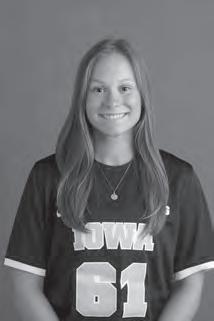
Heading into the 2024 offseason, Iowa field hockey head coach Lisa Cellucci knew she would lose a lot of senior talent from the 2023 season.
The departure of forward Sofie Stribos and defender Esme Gibson has forced Cellucci to start seven underclassmen in her rotation so far this season.
But Cellucci still had the veteran presence of third-year goalkeeper Mia Magnotta.
“As I tell the team all the time, and I am biased because I was a goalkeeper, but the goalkeeper is the most important and the most athletic,” Cellucci said. “If you have great goalkeeping and a goal scorer you are always in contention, and Mia is going to keep us in every game.”
In her debut season with Iowa in 2023, Magnotta had the tough task of replacing former goalkeeper Grace McGuire, who started 57 games for the Hawkeyes during her career.
In her first full season playing collegiate field hockey, Magnotta was the driving force for Iowa’s eight defensive shutouts throughout the season.
Magnotta posted a 12-5 record while holding opponents to 1.09 goals per game — good for sixth best in the country.
First, Green Bay Packers offensive analyst Tim Lester replaced Brian Ferentz as the offensive coordinator as Northwestern transfers Brendan Sullivan and Jacob Gill joined the team to respectively compete with McNamara — who spent the last year healing an ACL tear — and deepen a wide receiver room headlined by breakout junior Kaleb Brown.
And with Luke Lachey and Addison Ostrenga molding into NFL-caliber tight ends, pushing the “tight end university” moniker the Hawkeyes have developed things looked optimistic as Iowa neared a breeze of a schedule with just one preseason-ranked opponent in Ohio State.
Still, fears lingered that Hawkeye fans would receive the same old, same old stalling offense — and such fears looked founded in the first half against Illinois State on Aug. 31.
Up just 6-0 at halftime, the offense stalled and struggled to even glance at the end zone as McNamara was unable to hit a receiver with a pass in the numbers.
In the second half, though, something clicked.
The Hawkeye coaching staff sped up the offensive tempo, opting for more of a pro-style approach on the first drive that lasted just three minutes as it culminated in McNamara hitting freshman Reece Vander Zee for a seven-yard touchdown.
“I think overall, when stuff wasn’t going our way at the beginning, our tempo wasn’t very good,” McNamara said after the game.
Then he laid a pass in Gill’s lap for 31
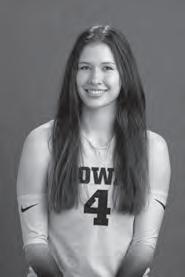
Ammeraal said. “It’s good to know that I’m putting people in good positions.”
Despite being on campus for only a few months, Ammeraal received praise from Iowa head coach Jim Barnes for her talent and impact on the Iowa program.
“She’s one of the best setters in the country,” Barnes said. “I really enjoy training setters and especially offensive setters. Claire is the most offensive setter in the country, so there’s kind of a match made in heaven.” Galles also praised Ammeraal for making plays in key moments.
“Our passing was pretty solid in Puerto Rico, and that gave Claire the ability to be the best she could,” Galles said. “If the
Robinson played golf from an early age but realized he didn’t have a future in professional golf, so he turned to teaching and coaching.
“I tried playing, and I honestly wasn’t good enough, so I fell in love with the teaching side pretty early,” Robinson said.
Robinson landed his first coaching job in 2012 as the head coach of Lexington Christian Academy in Kentucky. He then moved to the college ranks in 2014, where he had successful coaching careers with Asbury, Charlotte, and Tennessee.
Robinson fondly remembers the impact his prior coaching stints have had on his career.
“Being in the [Southeastern Conference] the last few years and being in a top-30 program at my former two schools brings a different level of experience and different points of view,” Robinson said.
Iowa head coach Megan Menzel said
Before the 2024 campaign, Cellucci and her coaching staff challenged Magnotta to become a better player not only for herself, but for her teammates as well.
“We just needed her to take strides in her vocal leadership and just her ability to command the defense,” Cellucci said. “She is more of a quiet and reserved person, so it was a struggle for her early on. But she has really taken that to heart and done a fantastic job organizing it. They really tune into her. They listen and they respond, and I think it has been a huge difference in how well our defense has played.”
Magnotta credits much of her defined vocal leadership to Cellucci and her coaching staff, knowing she doesn’t have the same vocal inflections when both on and off the field.
“She has really taught me how to own and be confident in my voice,” Magnotta said. “I know it sounds like a scream, but I am just trying to help them and be loud to help them do their job. It’s definitely all Lisa’s doing.”
Outside of becoming a more on-field presence, Cellucci encouraged Magnotta to grow and strengthen her knowledge of the Hawkeye defense.
“Her strength is that she is unbelievably athletic, super fast, and sees the ball really well,” Cellucci said. “We challenged her with the tactical side of the game.”
Magnotta is already showcasing her offseason improvements in 2024.
In three games so far, Magnotta has allowed just two goals, guiding the Hawkeyes
yards and six points. And another prayer to Vander Zee for 19 yards and six more.
“I know everything he’s gone through,” Iowa starting linebacker Nick Jackson said of McNamara. “He’s a leader on this team … it’s just been really cool to see how Cade came back and battled.”
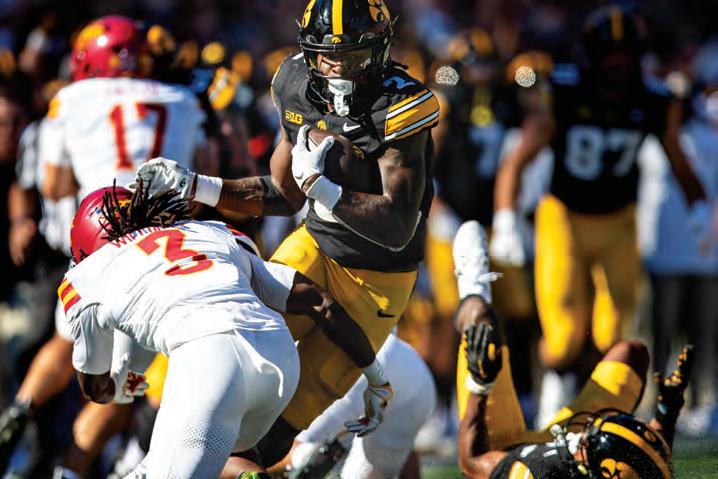
That’s before running back Kaleb Johnson capped it off with a pair of rushes for touchdowns of 64 yards and 18 yards.
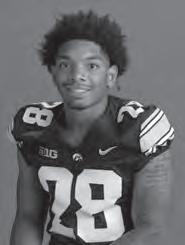
“It felt great because that’s what we were working on,” starting running back Kamari Moulton said of Johnson’s performance that cracked open the run game. “We were telling each other that something was going to break throughout the game.”
Within the blink of an eye, the Hawkeye offense left the Redbird defense and the naysayers in the dust as McNamara’s 251 yards, three touchdowns, no interceptions, and no sacks produced a 40-0 blowout win.
“Honestly, the points don’t really matter to me,” McNamara said. “I thought overall that wasn’t our best today. We don’t want to start a game like that.”
Still, the Michigan transfer and 2021 Big Ten Champion’s efficiency against Illinois State did not, and should not, go unnoticed or underappreciated. In fact, for the first time in some time, the man under center for the Black and Gold gave glimpses of the light at the end of the tunnel.
“In the first half, I was frustrated. It was the same song and dance,” lifelong Hawkeye fan Lincoln Poldervaart said.
passing is on, she’ll be able to use her skill set.”
Ammeraal believes the new dynamic surrounding the roster has helped the team succeed. The Hawkeyes brought in seven transfers in the offseason to bolster their roster after last season’s dismal ending.
“When things are new, everyone’s really excited to be here,” Ammeraal said. “They’re all working hard, and it’s their first time in the Big Ten, too, so we’re all kind of going through it together.”
Iowa still has an uphill battle to assert itself as a contender in the loaded Big Ten, but Barnes credits Ammeraal and the rest of his squad for working hard and believing in themselves through the tough times.
“We’re working on getting a little better every day,” Barnes said. “We got some great competition coming in to play us, so we’ll be ready.”
Robinson’s same expertise will prove to be helpful in many ways.
“In the recruiting world, he has a lot of great contacts, he is super personable, and the players have been able to quickly relate to him,” Menzel said.
Menzel is excited to work with Robinson in the process of getting the team back to where they want to be and reaching not only the coach’s goals but the team’s goals as well.
“We certainly didn’t finish where we wanted to in the Big Ten last year. They have goals to win a tournament and improve their standing in the Big Ten,” Menzel said.
Robinson echoed Menzel’s goals and hopes his players can “believe that they belong here.”
The transformation will not happen overnight, but the Hawkeyes hope Robinson’s new philosophies and Menzel’s veteran experience can propel the Hawkeyes to new heights.
“Do the little things really well, you don’t have to reinvent the wheel,” Robinson said. “Just do the simple things well.”


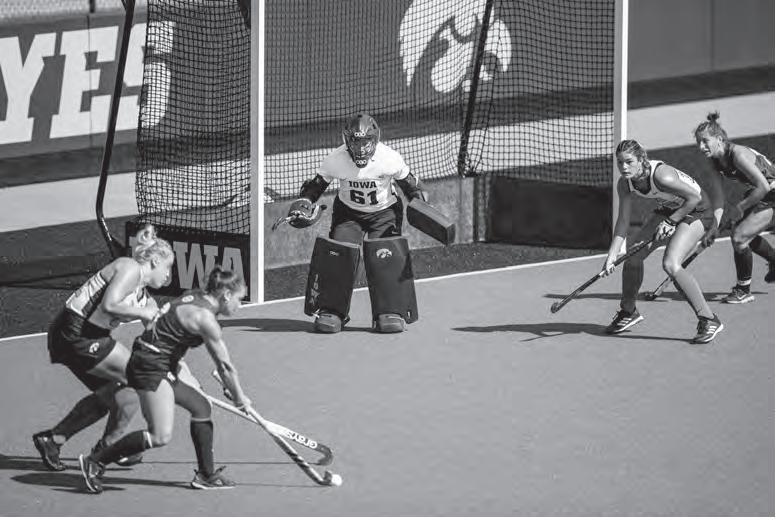
to two shutouts in the process.
For Iowa to be competitive in the Big Ten this season, they will need Magnotta to continue to show growth in her role.
“My main focus is just how I can grow as
“In the second half, it felt like a breath of fresh air. It reminded me of the offense from the early years.
Such a performance led to the next set of questions, though. Namely, ‘Was it a fluke?’
“I was writing the preview for the Cy-Hawk game, and I was thinking to myself, ‘When was the last time I have been this encouraged by the Iowa offense?’” Sean Bock of 247Sports added on the Swarmcast podcast.
But after a 20-19 loss to Iowa State on Sept. 7, it seems it’s just the personnel that changed — not the efficiency.
Although Johnson’s run game has stayed consistent, rushing for 187 yards and two touchdowns in the game, a lot of visible weight continues to rest on McNamara.
He threw for 99 yards on 13-of-29 with two interceptions and no touchdowns, simply missing reads and making costly wrong decisions.
“[Iowa State] made it tough on us … and we probably missed some plays, maybe some misreads or missed some plays where maybe we could have averted that,” Iowa head coach Kirk Ferentz said after the game.
Still, like last year, the quarterback approach remains unchanged.
“I’ve been saying for a while now, [McNamara is] working his way back,” Ferentz said. “He’s still trying to get back in game shape, if you will, or game mode,
a leader,” Magnotta said. “I think becoming a senior and stepping into a role as someone who has had three years under their belt. I want to pass on what I know to the girls below me.”
and he’s working hard. He’ll do just fine.” Either way, McNamara looked 100 percent against Illinois State, but his performance on Saturday — 10-of-19 for 80 yards in the first half, 3-of-10 for 19 yards
“In the first half, I was frustrated. It was the same song and dance,” lifelong Hawkeye fan. In the second half, it felt like a breath of fresh air. It reminded me of the offense from the early years.”
Lincoln Poldervaart
Longtime Hawkeye fan
in the second — looked the opposite. Moving forward, a lot rests on the upcoming week as the Hawkeyes welcome the Troy Trojans to Kinnick Stadium on Sept. 14. The Trojans are 0-2, their defense surrendering 28 points to Nevada and 38 to Memphis. So, this contest serves as an adjustment to “make things click” a week before Big Ten play begins at Minnesota. Although the Hawkeyes’ College Football Playoff hopes have almost certainly been dashed, there are 10 games left in the regular season, and nobody ever complained about a bowl game win.







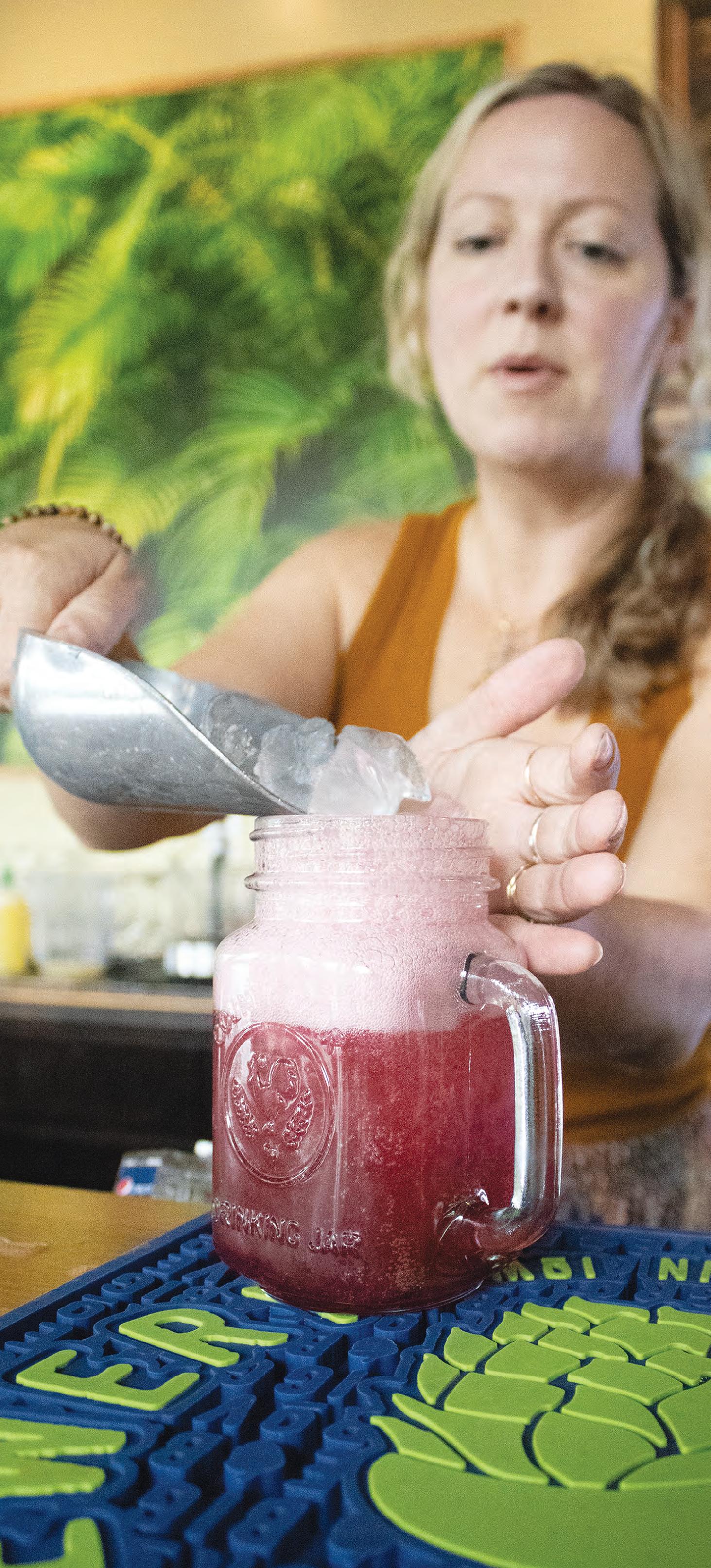
ARTS & CULTURE | WEDNESDAY, SEPTEMBER 11, 2024
The author discusses the process and inspiration for her debut book, ‘Another Woman.’ Charlotte Ericson Arts Reporter arts@dailyiowan.com

Hannah Bonner is a recent postgraduate student at the University of Iowa’s Creative Nonfiction MFA program. She has worked as a film and literary critic in addition to her writing career. Bonner is a 2023-24 National Book Critics Circle Emerging Critic Fellow and the poetry editor for Brink. Her newly released debut collection of poems, “Another Woman”, follows a trajectory of the rise and fall of a relationship, paralleling the seasons: summer, fall, winter, and spring. Throughout the book, several pop culture and mythological figures are brought to life, bringing new perspectives to the overarching story.
This interview was edited for length and clarity.
The Daily Iowan: What was your writing process? Were these poems written recently?
Bonner: You know, it’s funny, because I was looking at the book, and I think there are three poems I wrote in college that are in the collections. But most of the book I wrote during the winter of 2020 — amid the height of the pandemic lockdown. The writing process for that was one of the most pleasurable writing experiences I’ve ever had. I would go on these long, night walks in the evenings around 10 p.m., and then I would come home and write until like 2 in the morning.
I think what was pleasurable about that process was that I never expected any of these poems to be read, published, or seen because there was still so much uncertainty about the future then. So, as I was writing, I wasn’t concerned with the audience.
Instead, I would ask myself “How can I make this the best poem it can be for me? How can I get to a point where I’m content with this poem or excited about what this poem is doing?” It felt like I was writing for myself, first and foremost. And I think especially with school, you always have an audience, and there was something very liberating about letting go of that for a while. What is your relationship with the characters in your book?
I think there’s something about characters from things like myths and pop culture or archetypal characters that allow us to better express heightened emotional states in
I think adopting the persona of these women allows me to bring to the floor more anger, desire, heartache, or pain. I think they become containers in which you can express more extreme emotional states. It feels a bit like acting, like I’m costuming myself in these characters and expressing what I think they would be thinking or feeling.
How does this book reflect where you are as a writer right now?
It’s funny, because I completed the book in 2022, so it feels a bit like a time capsule to me. It’s interesting because there’s always a gap between when you finish a project and when it comes out. And so the work I’m currently doing feels pretty different from this book.
I think I’ll always write about femininity and the natural world, but in terms of form — of how I write poetry now — that has shifted a bit. I think my poetry now is a bit sparser and more terse. There’s more attention to the economy of language. I think this collection was very lyrical. What themes were you thinking about while writing the book?
The book focuses on the composite nature of self. So many factors make up an identity, so that’s part of the reason why I write from the voices of other women from history or mythology in the book. And I think that this notion of “another woman” instead of “the other woman” highlights how many factors, voices, influences, and relationships make up a single identity, and that was something I was interested in expressing. Did you write a lot in your childhood? Is this something you’ve been pursuing for a while?
Yeah, I wanted to write for as long as I can remember. I was thinking the other day about publishing this book [that] this is exactly the life that I dreamed about for myself when I was nine. I got the life that I wanted, and I don’t know if a lot of people can say that. So, I feel lucky. Did you feel a connection to your younger self while writing?
I did. I think about how often I would sit outside and write poems as a kid, athat’s what I was doing as I wrote this book. I had the space and time to do it, in part because of the pandemic. Partly just because of where I was in my life and so, yeah, actually, it did in some ways feel like being a kid again, just getting to play and getting to learn. There was a lot of work involved, but there was a lot of work


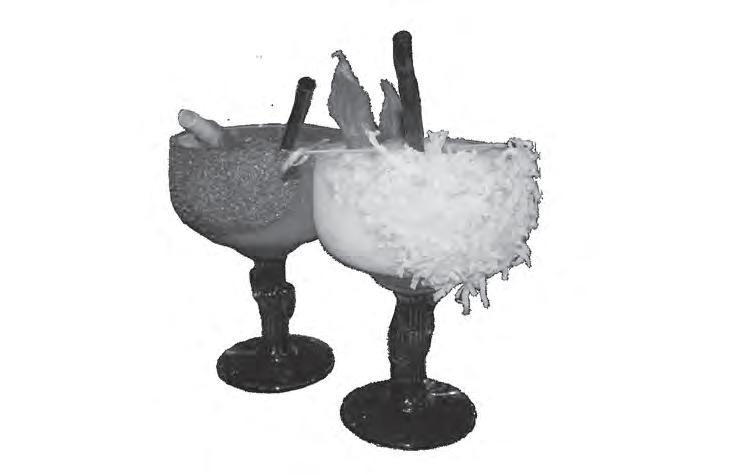
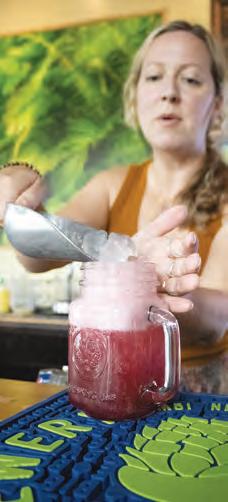
House-infused jalapeño tequila, fresh lime juice, house-made mango purée, chamoy and tajin rim, tamarind candy straw
Tequila, frozen house-made pineapple purée, pineapple and maraschino cherry skewer, pineapple leaves

‘Sing Sing’ is 2024’s most triumphant film
A24’s new drama based on a true story is as inspiring as it is devastating.
Charlie Hickman Arts Editor charlie.hickman@dailyiowan.com
Despite the foreboding walls the Sing Sing Correctional Facility, an infamous maximum-security prison in New York, sunlight consistently finds a way through the barred windows, no matter the time of day. At least, this is the reality portrayed in Greg Kwedar’s “Sing Sing,” a film so full of warmth that you’d be forgiven for forgetting it’s set entirely in prison.
The new A24 film has been highly discussed in the film community since its debut at the Toronto International Film Festival. It’s been slowly rolled out to several theaters over the past few months, garnering more Oscar buzz than any other film this year.



Roger Donaldson
While we are still half a year away from Hollywood’s most prestigious awards show, I am excited to say “Sing Sing” is the strongest film I’ve seen all year. Despite coming from a relatively green director and not receiving a massive release, the film is incredibly confident in every storytelling and craft choice.
Chief among those choices was to film the interior of “Sing Sing” with glowing light. When I typically think of prison films, I think of an intensely dreary color palette and an assaulting sense of isolation throughout the plot. But “Sing Sing” isn’t a prison movie — it’s a character drama set in a maximum-security prison.
This is not to undersell the importance of the setting in the film, though. It’s hard to walk away from the film without reevaluating views on the prison system and rehabilitation.
Based on a true story, the film follows Divine G — played by Colman Domingo — who is a prisoner involved in a theatre program as he tries to aid in the rehabilitation of another prisoner, Clarence Maclin, who plays himself. We follow Divine G and his cohort of performing prisoners for six months.
Considering how large the cast is, I was surprised I made a genuine connection with every character. The film is deeply empathetic in this way, spending much of its runtime on how characters feel rather than dwelling on their convictions.
The film follows the troupe as it arranges a ridiculous comedy play incorporating everything the characters like: Hamlet passages, time travel, Roman Colosseum fights, and ancient Egyptian politics make up a hilarious rehearsal process.
Along the way, the film guides audiences through the process of Divine G’s parole hearing, a routine we learn he has been trapped in for decades. This scene stands out as Domingo’s audition for the Oscars, a scene so devastating and frustrating it has stuck with me for over a week. Despite being top-billed on the poster and receiving the most screentime, Domingo’s character isn’t the heart of the film. Rather, Maclin emanates humanity in his role as the skeptic to the rest of the troupe’s flamboyant stage shenanigans, acting as the true heart of the film. “Sing Sing” unpacks layers of masculinity as the hyper-macho Maclin goes from shaking down new inmates in the yard to demolishing Shakespearean drama. Maclin’s evolution is one of the most endearing and triumphant character arcs I’ve seen in a film all year. It wouldn’t be as impactful without the remarkable work done by Domingo, as the relationship between the level-headed Divine G and standoffish Maclin is the foundation upon which the themes of the film are built. Without giving away the transcendent final minutes of the film, the themes of rehabilitation and positive masculinity collide and deliver an incredibly powerful final shot. The image will remain ingrained in my mind for a long time, but the credits are equally as striking.
Rather than showing us the fictionalized version of the play the brotherhood of inmates put on, the credits collect real-world recordings of the productions. Many of the performing prisoners play themselves in the film, like Maclin, but it’s indescribably heartwarming to see the true footage.
The choice to have many of the prisoners play themselves goes one step further in making the story feel more authentic and personal. There is a sense throughout the entire film that everyone involved in the production is emotionally invested in the story they are trying to tell. This brings me back to the rays of golden sunlight streaming into every cell of the prison. While the story is one of both triumph and tragedy, the deep empathy infused in every grain of film onscreen is what audiences will leave with.
While audiences may also discover a newfound disappointment in the U.S. prison system after watching “Sing Sing,” they will ultimately have an inspired appreciation for the unifying power of art.
Iowa
Kate Wolfe Arts Reporter arts@dailyiowan.com
Kayla Person Arts Reporter arts@dailyiowan.com
In January 2024, Unimpaired, the only dry bar in Iowa City, closed its doors for good after being in business for just over two years. Its failure was a stark contrast to the thriving downtown Iowa City nightlife scene surrounding it, where the streets are flooded with students all chasing the same thing: cheap, plentiful liquor.
On a Saturday night, chaos reigns in downtown Iowa City. Bars line the streets, each offering variations of the same scene: crowded lines, blaring music, and a constant flow of pitchers and shots. Yellow and black signs echo the University of Iowa’s school colors while advertising promotions like “Whiskey Wednesday” and “Two Dollar Tuesday.”
At times, students in bar crawl T-shirts can be seen stumbling through the streets of Iowa City. It’s only 6 p.m., but they’ve been drinking since early afternoon and have hours left to go.
The culture is consumption, the value of a night out is measured in quantity rather than quality, and when it comes to bars to drink in, the options are endless.
For most students, the concept of a bar is so intertwined with drinking culture that the idea of a bar without alcohol is simply unthinkable. Unimpaired, despite its best efforts to offer an alternative environment, simply couldn’t seem to sustain itself in a culture where binge drinking is the norm.
For undergraduate student Esti Brady, Iowa City nightlife is a familiar scene.
“[My friends and I] are very in tune with what bars have which deals on what days of the week. $2 drinks, $3 drinks — that’s a hard deal to say no to,” Brady said. “Then, once you’re consuming those drinks, it’s hard to not want to get as much bang for your buck as you can. Maybe you only intend on having three or four drinks when you go out, but it’s a slippery slope sometimes.”
“I’m already thinking about how I need to start trying to practice sober socializing. Right now, that feels like a skill that many people just don’t have and are genuinely going to need.”
Esti Brady UI undergraduate student
Brady describes this behavior as normal in their social circle. While some students acknowledge their drinking is unhealthy, attempts to change their habits are few and far between.
“There’s a vague understanding that people drink too much, but it’s not seriously acknowledged. We joke like, ‘Oh you can’t have a drinking problem until you graduate,’ but in all honesty, I am genuinely kind of concerned about how hard it’s going to be to break these habits once we graduate and enter the normal adult world,” Brady said.
Brady is scheduled to graduate in spring 2025 and knows that for many people, that window of denial is closing fast.
“I’m already thinking about how I need to start trying to practice sober socializing. Right now, that feels like a skill that many people just don’t have and are genuinely going to need,” Brady said.
Unhealthy drinking habits have been a prominent topic of discussion for years for UI staff and administration. One university initiative to combat this culture is the Alcohol Harm Reduction Advisory Committee. The AHRAC aims to implement strategies on campus and throughout the broader Iowa City community to curb high-risk drinking and minimize the negative effects of alcohol use among the student body.
Committee c-chairs Shelly Campo and Tanya Villhauer warn that many students who come to the UI enter with the idea that alcohol and “the college experience” are inherently intertwined.
“There are underlying messages that many students enter the UI with the idea that, ‘Oh you’re going to experiment, you’re going to drink,’” Villhauer said. “[Students] want to

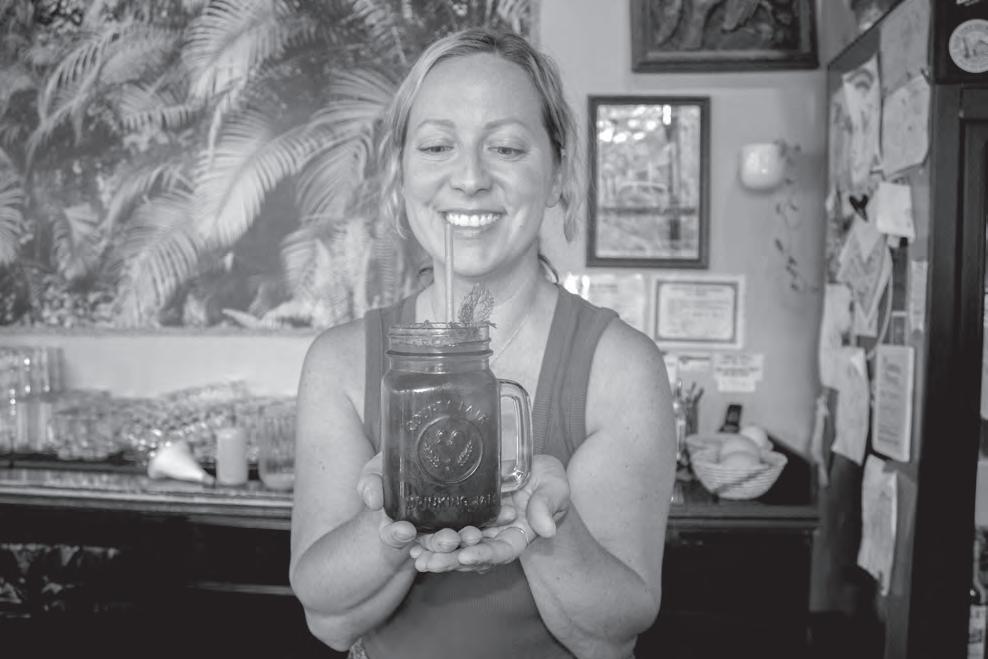
fit in, find their group, belong. To do that, maybe everyone in their residence hall is going downtown. They don’t want to be the only one not going.”
Villhauer is quick to point out, however, that binge drinking culture is not exclusive to college students, and that many of the issues seen on the UI campus mirror issues people of all ages across both Iowa and the broader Midwest region face.
According to a report by the Iowa Department of Health and Human Services in 2022, Iowa had the fourth highest binge drinking rate in the nation.
“We often look at our college students under a microscope, but we have to understand the contexts and the environments in which they are brought up. Many of them are born and raised in states that have a high adult drinking rate. You have to understand that this is not just a college effect — it’s a broader culture,” Villhauer said.
To promote alternatives to this culture, the UI’s AHRAC provides Late Night Grant Funding to collaborate with local businesses, supporting options for social activities that do not revolve around drinking. Late-night grants can be used for student groups and organizations to fund safe, healthy, and sober events at night.
The organization has funded local businesses, including Bijou and FilmScene, to support events like FilmScene’s Four Dollar Fridays, providing students with a cheap opportunity to experience downtown Iowa City without alcohol.
The idea that students don’t have enough options besides drinking is a common one. Brady described the sheer number of bars downtown as being almost oppressive.
“So much of the downtown is bars — it’s almost inescapable,” Brady said. “It doesn’t feel like there are a whole lot of other ways to socialize that don’t involve alcohol. If you want to meet new people or hang out with friends, you almost feel obligated to participate in the drinking culture.”
Cecilia Sileo, 21-year-old Kirkwood Community College graduate, shares a similar feeling. Sileo has been sober for four years but still joins her friends at the bars, expressing that if she didn’t go out to the bars, she would not be able to fully participate socially with her peers.
“There are some other options for things to do, obviously, but the places where people congregate at night are bars,” Sileo said. “If you’re someone who isn’t comfortable going to the bars, you’re kind of out of luck when it comes to hanging out with your friends past 6 p.m.”
Despite both students’ desire for an alternative to the
Edited by Will Shortz No. 0807
binge drinking culture, Unimpaired, the dry bar, did not satisfy what either of them was looking for.
“When it was opening up, I thought it was a great idea, but I never went there myself,” Brady said. “Supporting something in theory and supporting something financially are two very different things. Unfortunately, most college students have limited income and just don’t see the point in spending their money on a drink that isn’t going to get them drunk.”
Sileo, who is sober, did go to Unimpaired, but primarily just to experience the novelty of a dry bar. Despite her different circumstances, her opinion echoed Brady’s.
“Their drinks had fake liquor that tasted like real alcohol. I tried that after getting sober just because I was curious, but I didn’t like it because it felt too much like I was actually drinking. It just felt pointless to me as a sober person. I only ever drank to get drunk, I didn’t drink for the scrumptious taste of liquor,” Sileo joked.
There are many possible explanations as to why Unimpaired did not last long in Iowa City, but ultimately, its closure reflects a broader issue. Binge drinking culture has so deeply permeated the landscape of Iowa City that establishments promoting alternatives to drinking are perceived as gimmicky and out of place, even by those who crave more options.
“If you’re someone who isn’t comfortable going to the bars, you’re kind of out of luck when it comes to hanging out with your friends past 6 p.m.”
Cecilia Sileo Kirkwood graduate
For some students, spending money on a drink that doesn’t get them drunk feels unjustifiable. For others, drinks with fake liquor miss the mark as a misguided attempt to emulate an already existing culture.
Campo points out, however, that binge drinking rates are decreasing, and narratives around alcohol are subject to change. Villhauer encourages people to think about the narratives and the culture they are perpetuating about alcohol consumption.
“We have tried to look at helping families think about how they talk about alcohol before our students getting to campus,” Villhauer said. “What we normalize becomes an expectation.”

Javi Rivera, the general manager of Iowa City’s Coa Cantina, shares two recipes.
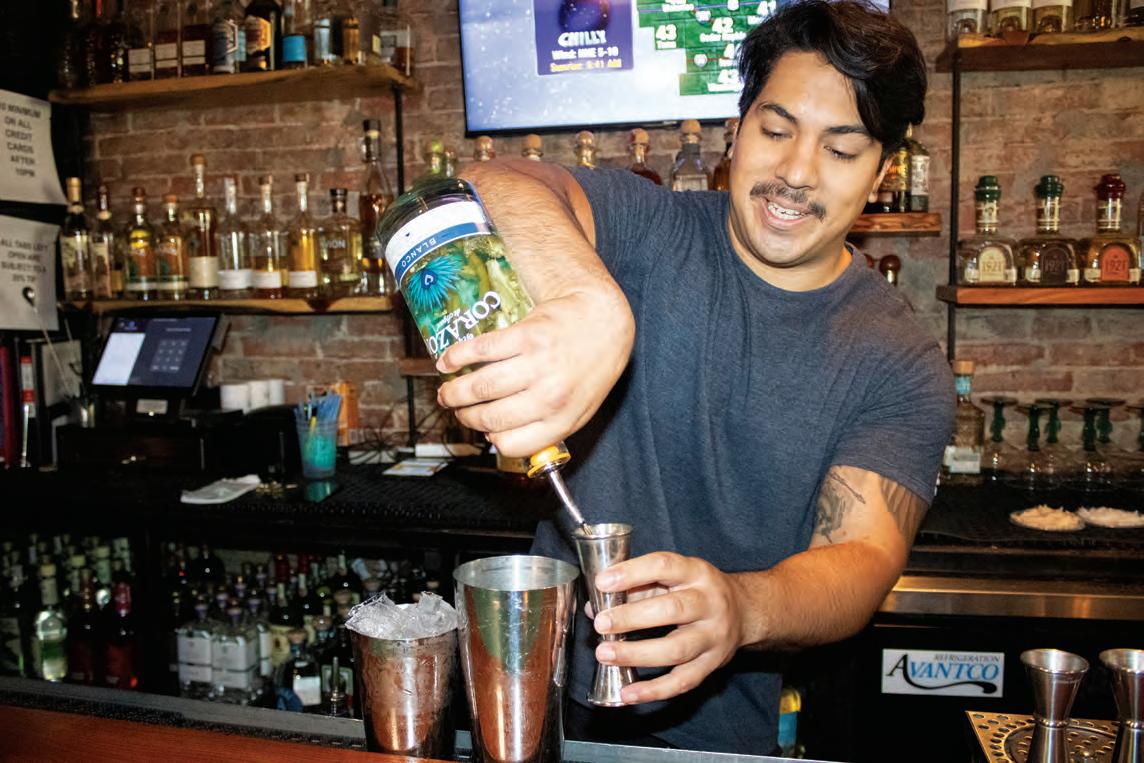
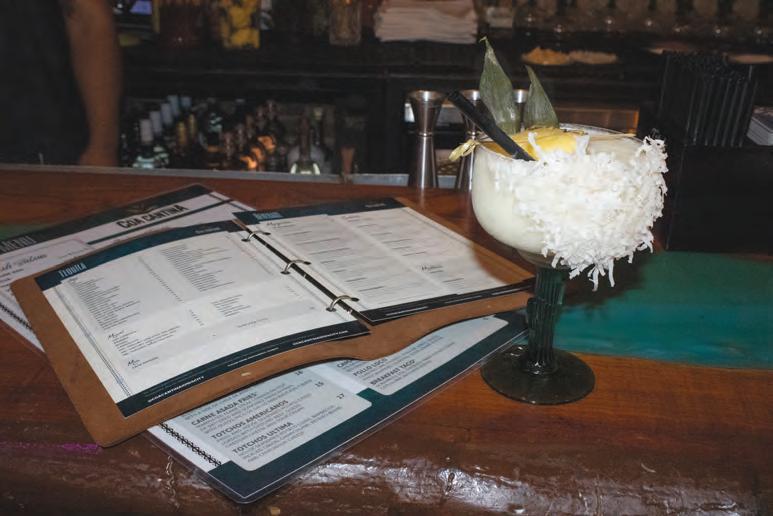
Stella Shipman Managing Editor stella.shipman@dailyiowan.com
Just up an eerily lit stairwell off of Clinton Street, bass music pounding louder with each step, are the sleek wooden bars and brick studio walls of Coa Cantina, Iowa City’s beloved tequila bar.
Despite its fairly recent opening in February 2023, Coa Cantina has been embraced by college students and city locals. It has been featured on several of Iowa City’s bar crawls hosted by LineLeap, and locals love grabbing dinner and margaritas before the nightlife takes over the streets.
When it comes to margaritas, Coa Cantina pulls out all the stops. With fresh ingredients, impeccable presentation, and good-natured bartenders, every drink is a delicious work of art and represents the bar’s mission to ensure everyone simply enjoys themselves.
“It’s very friendly, welcoming, and just a great environment to work in,” Javi Rivera, the general manager of Coa Cantina, said.
After bartending at Pints, a since-closed bar previously located on Clinton Street, for three years, Rivera said he needed a change. When the position for general manager at Coa Cantina started hiring, he tossed his hat in the ring — and has been there ever since.
On Friday, Rivera concocted two cocktails for The Daily Iowan — a spicy mango margarita and a frozen piña colada made with tequila instead of rum.
Rivera’s hands moved deftly between ingredients as he explained his process. For the spicy mango margarita, a cocktail carried over from Coa Cantina’s Des Moines location, Rivera began with pours of freshly squeezed lime juice and house-made mango purée sweetened with special syrup over ice in his shaker.
He finished the mixture off with house-infused jalapeño tequila — the jalapeño seeds still in the glass bottle — which takes the bar about five days to make per batch. After giving the beverage several generous shakes, Rivera gave a cactus glass a chamoy rim and poured the margarita over ice, completing the look with a tamarind candy straw.
Anyone who likes a little extra kick in their sweet drinks will love the spicy mango margarita, with the jalapeño just strong enough — but not overpowering.
On the opposite end of the flavor spectrum is the all-sweet piña colada, for which Rivera coated the rim of a cactus glass in coconut cream and sprinkled it with shaved coconut. He then filled the glass with the bar’s premade frozen tequila piña colada mixture, which consists of a pineapple purée filtered several times to remove all the pulp and eliminate any consistency issues for customers.
He completed the presentation of the glass with a pineapple skewer — which would typically also include a maraschino cherry — and two pineapple leaves.
This refreshing beverage was introduced in July and has since been one of Coa Cantina’s most popular drinks, Rivera said. It serves as a saccharine, dessert-like contrast to the spicy mango margarita.
“Everyone loves it,” Rivera said. “We go through it a lot.”
Both cocktails — like every other beverage on Coa Cantina’s menu — do not have to be enjoyed exclusively by customers over 21. For those underage, any alcohol can be substituted with non-alcoholic counterparts so that the flavors of the drinks won’t change.
Rivera hopes these cocktails, along with the bar’s updated food menu and daily specials, will continue to attract locals and college students.
“I love the fact that we’re in the nightlife,” Rivera said. “People come and have a great time, you see people dance to the DJ, and it’s just, in my eyes, very welcoming.”