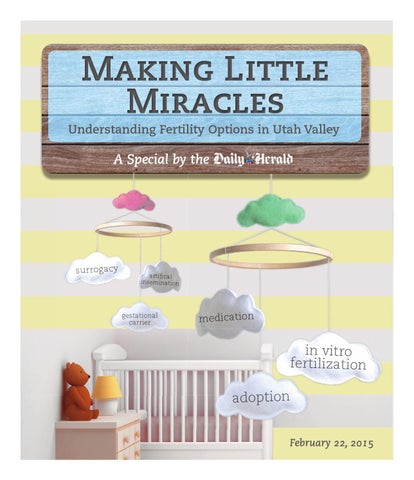
Making Little Miracles
Understanding Fertility Options in Utah Valley
A Special by the
surrogacy
artifical insemination
gestational carrier
medication
in vitro fertilization
adoption February 22, 2015
Utah Fertility Center Meet our Board Certified Fertility Specialists
Russell A Foulk MD
Shawn E. Gurtcheff MD, MS
Deirdre A. Conway MD
When it comes to your family, you deserve the best!
www.UtahFertility.com (801) 785-5100
1446 W. Pleasant Grove Blvd. Pleasant Grove UT Like us on FACEBOOK
Offices in St. George & Murray
Join us for one of our free monthly seminars Visit www.UtahFertility.com for details
We were all once miracles in the making
Making Little Miracles A Special by the
There is help and hope for the infertile
4
Factors that affect fertility
6
Before the quads: Gardners share infertility ups and downs
8
Gestational surrogacy creates bond between two mothers
12
Family overcomes struggles and frustration
15
At last: Success for infertile couple
16
10 things to consider when someone is going through infertility
17
Infertility: God did for me what I could not do for myself
19
What can my insurance do to cover my fertility treatments?
21
Spiritual confirmation plays important role in fertility choice
21
Santaquin couple chooses adoption after infertility
22
Publisher Executive Editor Digital Editor Cover Design Photography Writers
Bob Williams To read these stories Jennifer Durrant online go to Stacy Johnson HeraldExtra.com/fertility Lisa Kane Spenser Heaps, Grant Hindsley Sammy Jo Hester Barbara Christiansen, Keri Lunt Stevens, Genelle Pugmire, Ganel-Lyn Condie Amy McDonald, Jennifer Durrant, Carrie Ann Oscarson Rhodes
I found one of my baby books the other day and flipping through the many, ohso-familiar photographs, I came across my favorite two images. One photograph is my very first picture — my first mother-daughter portrait. My mom smiling sweetly, glowing with pride as she introduces her first-born baby girl to the world. What a beautiful beginning to life! The second image, even more beloved to me, is a portrait of my mother, shortly after she discovered she was pregnant with me. My dad snapped this photo of Mom dressed in her fashionable 1970s best, holding a beautiful bouquet of pink roses. What you can’t actually see in the photo is that she is also donning a stunning, new ring of three perfect pearls. It had been three long years of marriage for my parents as they struggled to begin their family. Three years of infertility in the ‘70s — a time without our modern-day technologies of advanced testing, ovulation-promoting medications, intrauterine insemination, in vitro fertilization or even gestational surrogacy. Instead, like many other parents during that era, my mom and dad likely listened to doctors say things like “just relax and let nature take its course” or “take a break from each other for a month or two and see what happens.” No matter the words of advice from doctors, encouragement from friends and family, personal research and lots of prayer, each month without a positive pregnancy result was heartbreaking for my parents. So this portrait of my mom, while simple and sweet at first glance, means so much more to me and to my parents.
Courtesy of Jennifer Durrant
It was right around Valentine’s Day in 1973 when Elizabeth King, after three years of trying to conceive, learned she was finally pregnant. About eight months later, she proudly cradles her newborn daughter, Jennifer, after struggling with infertility for three years. Those three long years, each represented by one of those pearls in that gold ring, are a constant reminder of just how very happy my parents were about announcing my birth. That ring was later given to me, some 21 years later, when I graduated from college. Writing, editing and compiling this special section on fertility, I am reminded of just how many families are affected by the heartbreak of negative pregnancy tests each month, unexplained infertility, miscarriages and even stillbirths. As you read the inspiring stories of successful fertility treatments, unconventional birth stories and even miraculous tales of adoption in this special section, I would hope you might find comfort in your own struggles to build a family, or feel compelled to share the kind words, advice and even hope found in these pages with those you may know who are struggling. Jennifer Durrant, Daily Herald Marketing Director/ Special Sections Editor
Daily Herald February 22, 2015
FERTILITY IN UTAH VALLEY
3
there is help and hope for the
infertile
Barbara Christiansen
T
DAILY HERALD
here’s almost no place people can go without seeing children, especially in Utah County it seems. A mall, restaurant, pool, library, gym, family reunion or just walking along the sidewalk — it seems happy families are everywhere. For those who have hopes to have a baby, things don’t always seem to be so happy. Often they feel they are alone in the world.
4 FERTILITY IN UTAH VALLEY
Alone and misunderstood, in most cases. They may remove themselves from social settings in which others may ask them uncomfortable questions. They may read nonverbal messages into glances parents, siblings and neighbors give them. However, the aloneness is far from the truth. Approximately 15 percent of couples who are trying to have a baby struggle with infertility. “It is a pretty significant number,” Diane Fletcher, practice liaison with Utah Fertility Center in Pleasant Grove, said.
February 22, 2015 Daily Herald
The Mayo Clinic notes similar statistics. “If getting pregnant has been a challenge for you and your partner, you’re not alone,” its website says. “Ten to 15 percent of couples in the United States are infertile. Infertility is defined as not being able to get pregnant despite having frequent, unprotected sex for at least a year for most people and six months in certain circumstances.” There can be many reasons why a couple has difficulty conceiving a child. In approximately one-third to 40 percent of the
cases, the cause is only the male. A similar number relates to the female. The remaining portion may be caused by the combination of the two or no cause can be determined. Diagnosis can take time and is often a matter of testing and trying. “There are certain things we can test for; others you have to go through a whole process,” Fletcher said. Male infertility can be caused by abnormal sperm production or function or problems with the delivery of the sperm.
SAMMY JO HESTER PHOTOS, Daily Herald
Amman Bayles, left and above, an embryologist, studies semen in the lab at the Utah Fertility Center in Pleasant Grove on Friday, Jan. 9, 2015. Female infertility could be the result of ovulation disorders, uterine or cervical abnormalities, fallopian tube damage or blockage, endometriosis, pelvic adhesions, or thyroid problems. Both partners may be affected by being overweight or underweight, having cancer treatments, other diseases, overexposure to chemicals and toxins, including pesticides, tobacco smoke, alcohol, marijuana or steroids. There are numerous other factors which affect a couple’s ability to have a child. In some cases, they are able to conceive, but unable to carry the child through to birth. Some are able to have one child, but have trouble having a second. That is called secondary infertility. If it sounds complicated, it’s because it is. But there is help — and hope. One of the most well known treatments is in vitro fertilization. It is known not only for its success, but for its cost, which can run more than $10,000 each time, plus the cost of medications. The good news is that it works. “It is incredibly successful, in part because of screenings,” Fletcher said. Those screenings are to determine whether the couple is a good match for the procedure. But many facing the problem hesitate to seek help because they have heard of the high price tag
associated with in vitro fertilization. Fletcher said that treatment is used in only approximately 25 percent of the cases. “Cost is a real thing to consider, but the majority of patients don’t have to face those bigger costs,” she said. “Fortunately, there are many safe and effective therapies for overcoming infertility,” the Mayo Clinic website says. “These treatments significantly improve the chances of becoming pregnant.” Dr. James Heiner of the Reproductive Care Center in Pleasant Grove encouraged those interested to seek help. “Don’t spend a lot of money or time before you come to a specialist to get appropriate testing and treatment,” he said. With emotions running high among those considering seeking help, they may consider a number of sources. Dr. Russell Foulk, medical director for the Utah Fertility Center, urged caution. “These are vulnerable people and sometimes people prey on them,” he said. “They should make sure they get care from a doctor who is a board certified reproductive endocrinologist and be properly trained.” “It is a means to overcome infertility as long as you go to the right doctor,” he said. Over his career he has helped
Semen is pulled from liquid nitrogen in the lab at the Utah Fertility Center in Pleasant Grove on Friday, Jan. 9, 2015. more than 15,000 babies and approximately 5,000 in Utah since relocating to the state in 2006. When there is success, the couples have cause to celebrate. So do the medical personnel. “This is the greatest feeling in the world,” Foulk said. “Where else do you get to help people achieve their dreams? It is the most incredible feeling.” Infertility often brings with it a feeling of frustration, which he said is natural. It can be helped through receiving information and options. “The greatest joy I have is being
able to help people overcome that frustration with good outcomes and a healthy baby,” he said. Those who help provide fertility have an unusual situation in that they see patients until they succeed in conceiving. At that point, often the couples then are transferred to obstetricians, and don’t see the fertility doctors again. Foulk implements a way to keep in touch occasionally. The families also enjoy meeting one another. “Every two years we do a miracle baby reunion,” he said. “It is an opportunity for patients to get to know each other.”
Daily Herald February 22, 2015 FERTILITY IN UTAH VALLEY 5
factors that affect
fertility Ways couples can boost their chances of conception
Keri Lunt Stevens DAILY HERALD
F
irst comes love, then comes marriage, then comes ... sometimes an empty baby carriage. Life can be incredibly frustrating and equally heartbreaking for a couple who is struggling to conceive. Among weeding through feelings of anxiety and insecurity, couples often experience a loss each month a pregnancy test doesn’t show a positive sign. But there is hope, and most couples have a high chance of conceiving. “Nine times out of 10, it’s very easily treated with either diet and lifestyle adjustments or minor fertility medications to help promote ovulation,” said Dr. Shawn E. Gurtcheff, a physician specializing in Reproductive Endocrinology Fertility at Utah Fertility Center. In the first couple months of trying, Dr. Gurtcheff and other doctors suggest couples consider the factors that affect fertility and try to boost their chances of conception on their own.
Age
The older a woman is, the less likely she is to conceive. That’s because the number of egg-containing follicles a woman has decreases as she ages, according to Dr. Mark Saunders, an American Fork-based OB/GYN. Because of this, a woman’s best reproductive years are in her 20s. Once she reaches her 30s — especially age 35 — a woman’s fertility starts to decline. To illustrate, the American Society for Reproductive Medicine put together a guide on age’s impact on fertility. According to the organization, each month a healthy, fertile 30-year-old woman tries to get pregnant, she has a 20 percent chance of actually doing so. By age 40, that number drops to a five percent chance per cycle. “Don’t delay,” Dr. Saunders said, especially to couples in their 30s. “If you’re having a difficult time and it’s been more than a year or is approaching a year and you haven’t been able to conceive, then by all means come in and get help.”
Weight and diet
What both men and women eat and how
6 FERTILITY IN UTAH VALLEY
much they weigh can affect their fertility, experts say. “People who consume high doses of caffeine have lowered fertility,” Dr. Gurtcheff said. “Additionally, alcohol, in more than moderate doses, can negatively affect fertility.” Weight can also affect a woman’s menstrual cycle and a man’s sperm. “Several studies have suggested that women who are overweight or underweight [struggle with] fertility,” Dr. Gurtcheff said. “Trying to maintain a healthy weight is very important.” Extreme athletes, such as long distance runners, sometimes struggle with infertility because of their low body weight. When a woman stops having a monthly period because of excess exercise, it’s often referred to as exercise-induced amenorrhea. In these cases, Dr. Saunders said, it’s smart for women to rethink their fitness routines for a few months. “Sometimes gaining just 10 pounds can help someone’s fertility,” he said.
Timing
Studies have suggested that a couple’s highest fertility comes with daily intercourse, Dr. Gurtcheff said. “Intercourse at least every other day is pretty much just as good,” she said. “If every day is stressful, I usually tell people every other day is fine.” But no matter how much intercourse a couple has, they won’t be successful if they don’t have sex around the time a woman is ovulating. If a woman has a regular, predictable cycle, she’ll usually ovulate between day 10 and 20 of her cycle, Dr. Gurtcheff said. “It can be as simple as having regular intercourse during that week and a half,” she said. But having intercourse before ovulation is usually even more beneficial than waiting until ovulation, Dr. Saunders said. That’s because sperm can live in a woman’s body for about five days while an egg only lives for 12 to 24 hours. “A lot of people think they need to wait until they ovulate to have intercourse but that’s actually the wrong thing to do,” Dr. Saunders said. “I actually tell people to start
February 22, 2015 Daily Herald
having intercourse right after they have their period on day eight or nine. You can have intercourse on day nine, ovulate on day 14 and the sperm that’s been there since day nine can actually fertilize the egg. Those little sperm can live for a long time.” There are multiple ways to track a woman’s ovulatory phase, including monitoring cervical mucus, basal temperature tracking and over-the-counter ovulation kits.The American Fork obstetrician does however recommend that after intercourse a woman lay on her back with a pillow under her buttocks to help keep the semen close to her cervix. It’s not necessary but it could help, he said.
Stress levels and mind set
Relaxation, which is easier said than done, may help a couple boost their chances of conception. “There is some evidence that shows stress really does play a role in conceiving,” Dr. Saunders said. He suggests after a few unsuccessful months of calculating ovulation and timing intercourse that couples take a break. They can still have sex, but without the stress of daily charts, he said. Doing so may help them clear their minds and hopefully lessen any tension. Then in a few months they can try again, if they haven’t gotten pregnant already. If a couple is struggling with a known issue, such as irregular cycles or low sperm motility, doctors encourage them to seek help and to not lose hope. There are methods that can help the vast majority of people conceive, both Dr. Saunders and Dr. Gurtcheff said. “It’s not a matter of are you going to be able to have a baby — it’s what are we going to have to do to get you there,” Dr. Gurtcheff said.
Infertility
Diagnosis & Treatment options 3 things needed to achieve a healthy pregnancy: healthy egg, healthy sperm, & healthy uterus.
Testing Hormone assay blood test to measure hormone levels and ovarian (egg) reserve. Evaluation of hormone disorders blood test, ultrasound, physical exam and history. Semen analysis measures sperm volume,
Treatments
concentration, ph, motility, and may include morphology. Hysterosalpingogram radiologic procedure to show if both fallopian tubes are open and if the uterine cavity has a normal appearance. Evaluation of recurrent pregnancy loss factors evaluated by ultrasound, bloodwork, lab testing and review of female exposure to toxins.
sperm in a laboratory, and then transferring the embryo to the uterus.
Ovulation induction involves the use of medication to stimulate the development of one or more mature follicles in the ovaries.
Advanced reproductive surgery laparoscopic, robotic or hysteroscopic routes for congenital or acquired anomalies.
Intrauterine insemination placing laboratory prepared/washed sperm into the uterus by catheter at the time of ovulation.
Fertility Preservation Preserving female eggs, male sperm, or embryos for future use using vitrification or cryopreservation techniques.
Recurrent pregnancy loss (RPL) treatment Three or more consecutive pregnancy losses. Treatment is based on findings.
Gestational Carrier program Egg and sperm are fertilized using IVF and the embryo is transferred to the gestational carrier’s uterus.
(IVF) In vitro fertilization including ICSI, PESA/TESE, PGD/PGS, and gender selection Fertilization by manually combining an egg and
Ovum donation IVF in combination with egg donation.
Seek an evaluation after
12 months
of trying to conceive. Daily Herald February 22, 2015
FERTILITY IN UTAH VALLEY
7
quads Keri Lunt Stevens
L
DAILY HERALD
ike most girls, Ashley (Weisenburger) Gardner started her menstrual cycle when she was about 13 years old. Along with it came the usual change in her hormones and, when she was 15, an unusual — and excruciating — pain in 8 FERTILITY IN UTAH VALLEY
her abdomen. “I went to the doctor and he told me it’s just part of being a woman,” she said. “In not so many words, he said buck up, it’s not a big deal, everyone goes through it.” During the next couple of years, Ashley gritted through the pain, often inconsolable two or three days a month when she was hit with the worst of the pain.
February 22, 2015 Daily Herald
“I wouldn’t go to school. I wouldn’t get out of bed,” she said. “It hurt too bad to even straighten my body out. It felt like everything was ripping.” Her complaints took her back to the doctor, who would give her a shot for the pain each month. “I remembering saying I don’t want pain medication I want this fixed,” Ashley said. “I don’t want to just put a Band-Aid over it.
There is something wrong.” But doctors didn’t find — or look for — anything wrong, so she lived with the pain.
Searching for answers
In August 2005, 18-year-old Ashley married Tyson Gardner. The two spent their first year of marriage getting to know each other and strengthening their relationship.
In year two they decided to start trying to have a family. With still no baby in sight as they were approaching year three, the couple consulted with their doctor. “He said oh you’re young, it’s fine, sometimes it just takes time,” Ashley said. “We were told it was no big deal.” It was really frustrating to hear the doctor brush it off, Tyson remembers. To go through that first year of infertility, which seems like nothing now, was really frustrating. So they kept trying for another six months, until Ashley talked to a friend who was struggling with Polycystic Ovary Syndrome (PCOS), a condition in which a woman has an imbalance of hormones that often affect fertility. “I started looking into PCOS and it wasn’t quite matching up
with what I had,” Ashley said. But then endometriosis, a disorder in which displaced tissue grows outside a woman’s uterus, came up in a related search. “I clicked on it and I had every symptom on the whole entire list,” Ashley said. “It wasn’t just a few it was every single thing.” She spent hours poring over articles on the Internet, learning the cause of endometriosis as well as how to treat and prevent it. “I took the information to my doctor and told him about my research,” Ashley said. “He told me no you’re fine. Everything is fine.” Tired of getting the same answer, she decided to find another doctor and over the next few years saw several. “Each doctor didn’t believe me,” Ashley said. Instead they’d want to test
her thyroid or start with something small Ashley knew wasn’t the problem. “The frustrating thing for me was that I had done so much research on it and I knew what it was doing to me,” Ashley said of the endometriosis. “I knew it was just going rampant in there and was getting me so much further away from ever being able to have a baby. Yet no one would believe me. No one would fix it.” So they took a break and gave up on doctor visits for a while.
Surviving the shame
In the meantime, the couple dealt with questions from family, friends and even strangers who wondered when they would have kids. “People would say a lot of insensitive things, not because they mean to just because they
don’t know. It’s not talked about,” Ashley said. “I can’t tell you how many times I went home crying because people were so insensitive.” Tyson is the oldest of 10 and says infertility was a word he didn’t even know. “It was really confusing,” he said. And hard. Friends and family would joke and ask if they were “doing it right.” “We got a lot of ignorant comments,” Tyson remembers. “People just don’t understand infertility.” His thick skin helped him through, but Ashley often internalized the pain. “There’s a lot of shame in infertility,” she said. “I’d wonder, why isn’t my body working? What’s wrong with me? No one believes me. No doctor will diagnose me.
hold up sonogram photos Ashley and Tyson Gardner ls. their quadruplets, all gir
of
Photos sourtesy of Gardner Family
Ashley and Tyson Gardner, new parents of quadruplet girls, had fun announcing the gender of their babies a several months ago.
Daily Herald February 22, 2015
FERTILITY IN UTAH VALLEY
9
GRANT HINDSLEY, Daily Herald
Ashley Gardner holds Indie Mae, one of her four quadruplets that were born in December, at UVRMC in Provo, on Wednesday, Feb. 4, 2015.
Maybe I’m crazy. Am I not good enough? Is God punishing me? Maybe he doesn’t think I’m fit to be a mother.”
Finally a diagnosis
More Online Want to continue following the Gardner Quad Squad, including videos, photo galleries, stories and even thoughts directly from the new parents? Log on to heraldextra.com/ quads.
10
FERTILITY IN UTAH VALLEY
In September 2012, the Gardners finally found a doctor who listened. They were referred to Julie Grover, a Provo doctor who specializes in obstetrics and gynecology. “During my first exam she said you for sure have endometriosis,” Ashley remembers. Within weeks she underwent surgery. The laparoscopy verified that Ashley had endometriosis — something that can’t yet be
February 22, 2015 Daily Herald
confirmed without surgery. But it also confirmed that she had had it for a while, and it has spread into stage three or four. The doctor cleaned out as much scar tissue as she could, and the couple was encouraged to try again for the next six months, the amount of time it takes for the scar tissue to build back up. With still no baby, the Gardners were told that their next option was to see a fertility specialist.
Receiving treatments
In the summer of 2013, they began four consecutive months of intrauterine insemination, a type of artificial insemination often referred to as an IUI.
“IUI are extremely difficult to go through,” Ashley said. “I can honestly tell you an IUI is way more difficult than IVF, for me at least.” The couple not only felt physical stress from doctor appointments and invasive testing, but emotional stress from hopes, expectations and, of course, medication. “I want to cry even thinking about it right now,” Ashley said. “Literally within a 60 second period you feel happy, you’re crying, you’re sad, you’re screaming, you’re yelling and then back to crying again. You have no control. It’s brutal. Clomid is brutal. If you know someone on Clomid just give them a hug because it is so hard to go through.” The first failed attempt was hard, but with each failure the couple grew more depressed. “I was beaten and I was done,” Ashley said. “I threw my hands up and said I’m never going to have kids. I give up.” Up to that point, they had paid about $4,000 out-of-pocket for the IUIs, as well as thousands more for co-payments, semen analyses, medications, testing and other procedures not covered by insurance. “That was a very frustrating year for us,” Tyson said. “2013 was a hard year.”
Choosing IVF
After a break, Ashley agreed to give it one last shot. Their final option was in vitro fertilization or adoption. “I’ve seen both sides,” Ashley said. “Neither are cheap and neither are easy.” So they started saving. Earlier that summer, Ashley had written a blogpost about their situation, finally sharing their struggles with the world. The positive response they saw was surprising, and the amount of friends who shared similar struggles was astounding.
Indie Mae Gardner is held by her mother, Ashley Gardner, for a portrait at UVRMC in Provo, on Wednesday, Feb. 4, 2015. “You think you’re so alone because no one talks about it,” Ashley said. “People I thought never in a million years had issues were struggling with it. I’d been missing out on a support system I desperately needed. I didn’t know I needed it. I thought I was strong enough to handle it with just me and Tyson on our own.” With that kind of support, within weeks Ashley started a small business selling homemade headbands to raise money for their fertility treatment costs. The money she earned went toward first their IUIs and then later toward IVF. With money in the bank, the
couple decided to do one round of IVF. If they were unsuccessful, they’d focus on adoption. “We were very, very lucky to get pregnant on our first try,” Ashley said. “We’re grateful for that.”
Becoming the Gardner Quad Squad In June 2014, Ashley had two embryos implanted in her womb. In July the couple learned both eggs had split and stuck, giving them two sets of identical twins. On Dec. 28, at 29.5 weeks pregnant, Ashley delivered four baby girls. Now nearly two months old, the
babies are working hard to gain weight and go home. “We learned over time that things don’t happen on our time,” Tyson said. “We had to struggle with that for many years but today we know why. It came better than we could have ever imagined. Aren’t we grateful it didn’t happen how we wanted it and when we wanted it? It happened in God’s time and that was better.” He noted the compassion, empathy and understanding they’ve gained along the way. “I can truly, honestly say, looking back into the infertility storm, that I am 100 percent grateful for
GRANT HINDSLEY, Daily Herald
the trial of infertility,” Ashley said. “I wouldn’t trade it for anything. It made me into who I am; it has shaped us into who we are. As hard as it was to go through, I can honestly say I’m grateful for it. We wouldn’t be where we are today without it.” With hundreds of thousands of Facebook friends from around the world, the couple hopes their story will give strength to those who struggle with infertility. “I hope to give people a little bit of power to have the courage to come out and talk about it,” Ashley said. “It’s not something to be ashamed of.”
“I can truly, honestly say, looking back into the infertility storm, that I am 100 percent grateful for the trial of infertility,” Ashley Gardner
Daily Herald February 22, 2015
FERTILITY IN UTAH VALLEY
11
GRANT HINDSLEY PHOTOS, Daily Herald
Cristi Bastian talks with gestational surrogate mother Robin White while holding the two families’ children before a check up at the doctor’s office in American Fork, on Jan. 7, 2015.
FAMILY EXPANSION Gestational surrogacy creates bond between two mothers
12 FERTILITY IN UTAH VALLEY February 22, 2015 Daily Herald
Jennifer Durrant
S
DAILY HERALD
haring personal stories of infertility can be extremely difficult, even painful for some couples. Opening up your medical history and recalling heartwrenching moments — dozens of negative pregnancy tests, chemical pregnancies and miscarriages — for the entire world to scrutinize is hard. Two Utah moms — Cristi Bastian and Robin Wright — however, have been documenting their unique story for thousands to read, share and find comfort in. Robin, a mother of three children from Bluffdale, is pregnant for a fourth time. This baby however, is not her own. She is a gestational surrogate. She is carrying a baby boy for Cristi and her husband Jeff Bastian. These two 30-something ladies are chronicling their entire gestational surrogacy experience on the blog WeAreMakingAMiracle. blogspot.com.
Cristi’s story
Cristi is already the proud momma of two rambunctious little boys — Leo, age 5, and Rex, age 3. But becoming a parent did not come easily for this former Lindon resident. In fact, with several known health concerns, Cristi knew the quest for motherhood would be a battle. Cristi and Jeff have struggled for a total of 10 years with infertility. They have gone through endless doctor’s appointments, testing, treatments and more as they analyzed every option to bring a baby into this world. Eager to get their family started, the Bastians officially became a family when they adopted Leo as a newborn five years ago. Naturally wanting a sibling for Leo, Jeff and Cristi enlisted the help of the fertility specialists at the Utah Fertility Center in Pleasant Grove and were blessed to conceive their second boy, Rex, through their second attempt at in vitro fertilization. Pregnancy proved difficult for Cristi, especially when she was ordered on bed rest at the 20th week. Even then, little Rex was born via emergency
Cristi Bastian rubs Robin White’s tummy to feel their baby, at the White’s home in Bluffdale, on Jan. 9, 2015. The families got together for a final night of fun before the Bastian’s moved to California the next week.
Cristi Bastian smiles as Dr. Timo Hoggard talks with surrogate mother Robin White during a check up, in American Fork, on Jan. 7, 2015. Cesarean section at 36 weeks. Hoping once again to add to their family, Cristi endured three more difficult rounds of IVF. “We thought, let’s just try again. If I’m meant to get pregnant, I’ll get pregnant,” she said. After Cristi’s last round of in
vitro, in fact the night before she was scheduled to take a blood test to determine if she was pregnant, she said she had a spiritual confirmation that there was an alternate way for her to bring another baby in to her family. “I had this thought, ‘Maybe
you’re not the one that’s supposed to carry your baby.’” She immediately began researching surrogacy. As active members of The Church of Jesus Christ of Latterday Saints, Cristi knew the Bishop’s Handbook stated the church “strongly discourages surrogate motherhood.” “But why am I getting this feeling?” she wondered. After a few months of struggling through possibilities and looking for answers, the Bastians decided to counsel with their bishop on the idea of gestational surrogacy. Receiving thoughtful encouragement from their bishop, they were counseled to seek a more definitive answer from their stake president. “Another baby is in our future,” Cristi said. “This is something we have to do.” Crafting a letter that was sent to church headquarters, the Bastians soon received an answer from the First Presidency which indicated that gestational surrogacy should be considered on a case by case basis and should be a prayerful decision between the couple and the Lord.
Daily Herald February 22, 2015 FERTILITY IN UTAH VALLEY 13
If the First Presidency had said no, Cristi said, “we would never have pursued this.” With peace of mind, the Bastians reached out to the Utah Fertility Center to inquire about the gestational surrogacy option. “That’s where [Robin] comes in and saves the day,” Cristi said.
“They know that Mommy’s not bringing a baby home, that I’m just taking care of him.
Robin’s story
After the birth of her third and last baby, Robin had the strong desire to become a gestational surrogate, initially for her sister who was struggling with her own infertility. “She ended up having [a baby] through IVF,” Robin said. Still wanting to help a couple add to their family, Robin contacted the Utah Fertility Center. After a few months, Robin met Cristi and Jeff. That first meeting was “pretty much a cry fest,” Robin said. “It was nerve-wracking, to be honest with you,” Robin said of the decision to become a gestational carrier. “There’s a lot to think about before doing something like this. It’s a really scary decision,” she said before adding, “This is obviously something I’m meant to do.” “I had to have the right couple. This isn’t something I could do for just anybody,” Robin said. “I knew, walking out of that office that they (the Bastians) were the right couple to do this for.” That initial meeting was in February 2014. For the next few months both women were put on hormone therapies to encourage both women’s cycles to align, help Cristi produce healthy eggs and help Robin’s womb prepare for the embryo implantation. The entire process was a success and Robin is due to deliver Cristi and Jeff’s new baby boy the first week of April. Through all of the joy and excitement, the sonograms, ultra sounds and continued doctor’s visits, Robin has had an entire cheering squad. Of course her husband, Kevin, has been by her side as she has suffered through an exceptionally difficult first trimester, but she has also had the love and support of Cristi, Jeff and the baby’s
That’s how we try to phrase it on a 4-year-old level.” bringing a baby home, that I’m just taking care of him. That’s how we try to phrase it on a 4-yearGRANT HINDSLEY PHOTOS, Daily Herald old level.” Kevin White soothes his son Micah, 2, while eating dinner with the “It’s fun for our kids, because Bastian’s at his home in Bluffdale, on Jan. 9, 2015. they all came from somebody else,” Cristi said. So 5-year-old Leo will gladly point out “’I came from Kayli’s tummy [his birth mom], Rexy came from Mommy’s tummy. Our next baby’s in Robin’s tummy. Mommy came from Grandma’s tummy. Daddy came from Mimi’s tummy.’ In his world it’s totally normal.” As the baby’s due date nears, the excitement continues to build for both mothers. Robin is preparing for her extended family to come to Utah to help her recover after the delivery and hospital stay. And Cristi and Jeff, who have recently relocated to California, are booking flights and preparing a nursery in their new home. Throughout the remaining Jeff Bastian corrals his children, Rex, left, and Leo, as movers pack their weeks, and even after delivery home in Lindon on Jan. 13, 2015. The Bastian’s moved to California for a the two moms will continue to change of scenery, a job opportunity and to help with a family food allergy. share their story on the blog. “We wanted to do that … to be soon-to-be big brothers. “My life on,” Cristi said. “They underopen,” Cristi said. “I’ve suffered is her life right now,” Robin said. stand that our baby is in Robfrom infertility for 10 years. I The two families have also in’s tummy.” know that’s a thing a lot of people become quite close with friendRobin’s children also have a struggle with. It’s hard. I feel like ships growing not only between glimmer of what’s going on. They it’s something that can help peoCristi and Robin, but their huswill often come up and rub Robin’s ple, our decision to be open about bands as well. “We were meant to tummy and say, “Hi Cristi’s baby.” this journey, especially. be friends with Robin and Kevin,” In fact, part of the screening “I’ve gone through the whole Cristi said. and preparatory process for gesgamut. I’ve been through adopThroughout the entire pregtational surrogacy is preparing tion. I’ve been through in vitro. nancy both moms have taken the children. And now a gestational carrier. It’s careful consideration to effectively “So when I talk to them it’s a unique experience to be open communicate exactly what is hap- very much … ‘Cristi’s baby in my about the options available.” pening to their young children. tummy is growing. He’s kicking To continue following Cristi and “Our kids are both really little, me right now,’” Robin said. Robin’s story, log on to WeArebut they understand what’s going “They know that Mommy’s not MakingAMiracle.blogspot.com.
14 FERTILITY IN UTAH VALLEY February 22, 2015 Daily Herald
Family
overcomes struggles and
frustration Getting pregnant for the second time, with baby Xaen, wasn’t quite as easy for Charlotte and Dirk Malan. After the birth of their first boy Brehmin, Charlotte finally found success in fertility treatments. Courtesy of Charlotte Malan
Barbara Christiansen DAILY HERALD
W
hen Charlotte and Dirk Malan decided to have a second baby, they didn’t have as easy a time as they did with their first, Brehmin. “After about a year and a half we went to my regular doctor,” Charlotte said. They tried some of the easy fixes, with preliminary testing. “She said everything looked OK,” Charlotte said. “She suggested we go to a specialist.” That was cause for consideration. “We had to think about that because our insurance didn’t cover that,” she said. It turned out that was not all they had to consider. The more testing and consulting they did with the family doctor, the more difficult it became. “It started getting frustrating,” she said. “It was almost more frustrating because there wasn’t an answer. I am not a very patient person. Being left open-ended was frustrating for me.” So they started having more in-depth testing done with a
specialist in an attempt to find a cause. “The first day they explained a lot of possibilities,” Dirk said. The specialists were realistic, telling the couple that procedures don’t always work for everyone, but that it takes time to discover the right treatment option. It’s natural to start some the less expensive options, so that is what they did, trying hormone therapies. That had its own problems. “It was so gut wrenching,” Charlotte said. “It was hard to focus on work, either positive or negative. My boss was very understanding, however. With all the hormones I was a mess anyway.” Then there was the cost. While not the most expensive, it was not easy to fund. “It was $5,000 a month,” she said. “We didn’t have a lot of extra money lying around. After three months we decided to try one more time before we gave up. I said, if it doesn’t take this month I will be done.” “If it doesn’t work we will go to adoption,” she said. At the first sign she was pregnant, she was afraid to believe it.
“The night before I was going to take the pregnancy test I was pretty low,” she said. “I was prepping myself for that ‘no’ call and trying to be OK with it. I wasn’t supposed to cheat, but I had a dollar store pregnancy test. It said positive, but I thought it was wrong. I didn’t believe it.” Then she had the official test and found out it was true. “I had the test and they told me it was positive,” she said. “I just about lost it. You are crying, but you are also smiling.” Those smiles were warranted and when she was five days overdue, the doctors induced labor. Ten hours later she had a Caesarean section, followed by the arrival of Brehmin’s brother Xaen. He will be 2 in April. Dirk had empathy for his wife. “The struggles she had, it was emotional and hard,” he said. “I remember we were — why is my heart falling out?” He appreciated the process, and of course, the result. “I remember enjoying going with you every time,” he told Charlotte. “With each milestone we were figuring out a solution.”
Some memories are crystal clear; others are not so — and by design. “I am shutting the details out of my mind now,” Dirk said. “It was so frustrating and exhausting,” Charlotte said. “But seeing the interactions between the two of them you can tell they just love each other so much. Every day Brehmin thanks me for Xaen.” “He adds craziness and happiness to our lives,” she said of Xaen. “He is a very unique little person.” During the time they were trying to become pregnant, they had mixed reactions from friends and family. “I had people coming out of the woodworking and asking what we were going through,” Charlotte said. “Others gave me pointers.” Despite the plethora of advice and concern, she said she was glad to have others care. “It is good to know I was not alone,” she said. “I am grateful I went through it,” she said. “Now I can help others. Going through it made me a little more compassionate for others.”
Daily Herald February 22, 2015 FERTILITY IN UTAH VALLEY 15
At last:
success for infertile couple
Scott and Lana Soelberg are anticipating the birth of their first child. They have undergone fertility treatments after several heartbreaking issues. Courtesy of Lana Soelberg
Barbara Christiansen DAILY HERALD
L
ana Soelberg’s first reaction to seeing her fertility doctor after several months’ absence was to give him a big hug. Couples who spend a lot of time with those medical professionals develop a close relationship with them, which is often hard to give up once they get pregnant and transfer to an obstetrician. A reunion evokes a plethora of emotions. Lana and her husband, Scott, are among those couples. Their baby was due Feb. 21; at press time no information was available except that it was a boy. This is their first child, and the journey has been a difficult one. Some people pay to ride roller coasters and enjoy the experience. Not so with the Soelbergs. “It has been a roller coaster of emotion,” Scott said. The Cedar Hills residents have been married since 2009 and decided to wait two years before having children. When it came time, however, they hit the first of many hurdles. “I never had a normal cycle,” Lana said. “In October we decided
I should go to the doctor and we found out I wasn’t ovulating.” So she started with hormone therapy, without success. “My testosterone levels were off the charts,” she said. “We went to an endocrinologist from February to May without results.” They were referred to Utah Fertility Center and felt comfortable from the start. “It was kind of like a spiritual experience coming here,” she said. “He [their doctor] loved us from the very beginning.” “It was very calming,” Scott said. “He was very confident.” One of the first steps they took was to have injections to start making her eggs grow. It seemed to work, and the roller coaster ascended. “In August I got pregnant,” Lana said. “Everything was going alone fine. At seven weeks we went in for an appointment and found out the baby was small. The next week there was no heartbeat.” And the roller coaster dropped. Dr. Russell Foulk, the center’s medical director, helped the couple through the process, even coming in after hours to meet
16 FERTILITY IN UTAH VALLEY February 22, 2015 Daily Herald
with them. After several more attempts, they decided to try in vitro fertilization, one of the most complicated and expensive methods. In the beginning, things looked positive. They retrieved 28 eggs and 27 of those were fertilized. Six of those were deemed viable. The doctor implanted two embryos, but Lana started bleeding before she reached seven weeks. Foulk did genetic testing and discovered Scott had a condition called translocation, in which some of the chromosomes are incorrectly linked. So they turned to the other four embryos which had been frozen. Three of those made is through the thawing process, but only one of those had balanced chromosomes. Another quick up and down on the roller coaster, when they found that Lana had been pregnant but it was considered a chemical pregnancy, in which an embryo attaches to something that can’t hold the embryo. There was another round of in vitro fertilization and they harvested 15 eggs, 13 of which were
able to be fertilized. Five of those were viable embryos. Only one of those had balanced chromosomes. “That is the baby I am pregnant with now,” Lana said. “We knew it would be a boy.” It was their lucky day on Friday, June 13, when they found out they were pregnant. Despite the often-changing emotions, they are pleased. “It is definitely worth it,” Lana said. “We have had a really hard experience but I would do it all over again. I would come here because of the love we have felt.” It wasn’t always like that. “At first I felt like an experiment,” she said. “After we knew how everything worked it was all hope.” Her husband agreed with the assessment. “We have been able to see the entire process like it was in slow motion,” he said. “It has definitely been worth it.” And, yes, they plan on saving up their money and doing the same process in a couple of years. Since the groundwork has been laid, the ride should be a little easier next time.
I N F E R T I L I T Y
10 THINGS to consider when someone is going through infertility GanelLyn Condie EVERYDAY FAITH
M
y first baby is 17 years old. He is a beautiful, tall 6-foot-7inch young man. I was also blessed to also be the mother of an amazing 11-year-old girl. Parenthood has been one of the greatest but also most challenging stewardships of my life, and reaching that ultimate role of parent was extremely challenging. Seven years of infertility made my 53 pounds of weight gain and months of nausea more of a pre-gift to the greatest gift of a 10-pound baby. Finally being pregnant was worth everything. Our struggle to have a baby ended with ... a baby. This isn’t always the ending for many infertile couples of the world. During those emotionally charged years of hoping for a baby, I gained some personal insights into what was helpful and supportive. During the infertility years, I also collected a list of what would be considered unwelcome advice. This column isn’t intended to paint a broad brush picture on the subject of infertility. But hopefully it will shed light on a dark struggle for many couples in the world. What to say, what not to say, to one of those 7.4 million women struggling to become a mom? Here are 10 things to keep in mind when a loved one or friend is struggling with INFERTILITY.
Interest
Showing genuine interest is the greatest support you can give someone who is hurting. Ask if they want to talk about their struggles. Chronic issues related to infertility or illness can extend over a long time period. With no immediate solution, the struggle of infertility can last for years. No quick solution means that initial support and interest, from friends and
family, can slowly, overtime neutralize and disappear. Be the person who is willing to show interest long after the news of infertility is no longer news.
Not knowing why is the hard part
Majority of couples, dealing with issues of infertility, deal with some degree of uncertainty. At the time we were trying to have our first baby I already knew about my lupus diagnosis. All the signs pointed to the high possibility of being able to conceive. If we were able to get pregnant, our miscarriage rate was at 50 percent. The truth of the matter was I wasn’t even getting pregnant. Doctors weren’t sure why. The not knowing why became the hardest part. When our boy was about to turn 4 years old, we felt it was time to try to have another baby. After consulting with our doctor, we began again. It should be easier to have a second child, right? Wrong. Many couples experience infertility while trying to conceive after already having a child. For three more years we tried to conceive. Once again, not knowing why things weren’t working, or how to answer people’s questions, added to the emotional experience.
Faith
Definition of faith is the hope in things not seen. I remember the day I received a letter from a college roommate. We had been trying to have our son for more than five years. Her letter was a story of how quickly they had conceived, how little weight she had gained during her pregnancy and how easy her delivery had been. To say I was bitter is an understatement. I threw a good old fashion fit. Faith had started to run out. I kept saying, “This is a righteous wish. We are responsible adults, so why isn’t God sending us a baby?” Faith was trusting that others had
faith when I didn’t. Faith was knowing that God wanted my eternal happiness even if the immediate situation felt unhappy. So I continued to pray, do my part and trust in the timing of God. And I had a few cry fits along the way.
Encouragement
The journey to parenthood is painful. The months pass. More negative pregnancy tests. Another baby shower invite. It starts feeling like the entire world is having a baby, except for you. Encourage someone dealing with infertility that they will be an amazing parent someday. The journey through infertility becomes its own strange land. I remember feeling like the goal of parenthood sometimes got lost in the many treks back and forth to doctor’s appointments and fertility drugs. I fondly recall when my husband’s secretary, who knew of our situation, bought us an African fertility god. Each time we looked at that ebony statue, we smiled.
Relax really isn’t advice
Everyone knows someone who had trouble conceiving but then finally became pregnant once she “relaxed.” Couples who are able to conceive after a few months are not infertile. By definition, infertility is diagnosed only after a couple has tried unsuccessfully to become pregnant for a full year. Telling a person that they just need to relax, so they can have a baby, is just insulting.
Tenderness goes a long way
The National Infertility Association states, “Infertility treatments are very private and embarrassing, which is why many couples choose to undergo these treatments in secret. Men especially are very sensitive to letting people know about infertility testing, such as sperm counts. Gossiping about infertility is not usually done in a malicious way. The gossips are usually well-meaning people
Daily Herald February 22, 2015
FERTILITY IN UTAH VALLEY
17
The gossips are usually wellmeaning people who are only trying to find out more about infertility so they can help their loved ones.” Infertility is a tender subject. Being tender doesn’t mean hiding your own pregnancy good news from an infertile friend. Not hearing the good news of a friend, when everyone else knows but doesn’t want to upset you, isn’t fun.
Ignorance
For some reason, some people seem to think that infertile couples or childless women are unrealistic about the responsibilities of parenthood. I don’t follow the logic, but I remember several people telling me just how difficult being a parent was, inferring I should enjoy being child free. The point is, don’t assume childless people don’t understand children.
Listen
When you have a friend who is struggling with infertility, let them know you want to listen. Don’t just ask them how they are doing, wait to hear the answer. Listening is a gift we give one another. Letting someone know they are heard and seen makes such a difference.
In vitro isn’t for everyone
In vitro fertilization (IVF) is a method in which the woman harvests multiple eggs, which are then joined with the man’s sperm in a petri dish. People often ask, “Why don’t you just try IVF?” in the same casual tone they would ask, “Why don’t you try shopping at another store?” Every treatment isn’t meant for every family. So if someone is trying to raise money for fertility treatments, do what you can to support, even your pennies will make a difference.
Talk
It feels uncomfortable talking about uncomfortable subjects. When we avoid talking we make things worse. Talk to your friends dealing with conception issues. Talk about your own infertility so that people know you are willing to talk about it. If your loved ones are religious, let them know you are praying for them. Offer the same support you would offer a friend
who has lost a loved one. Just knowing, they can count on you, lightens the load and lets them know that they aren’t going through this alone. After my sister’s death, it was surprising who wouldn’t talk to me about her suicide. It was touching to connect with those who pushed through their own awkwardness to signal they would talk. Talking doesn’t always come easily. Not talking is a guarentee to make hard times harder. Don’t worry about saying just the right thing. Worry more about not saying anything at all. Tell your friends that you are there to talk, anytime, about any part of their infertility experience.
You can’t always just ‘adopt’
A well-meaning friend said to me once, after we had just been told by doctors that we may never have biological children, due to my lupus diagnosis, that I “could always adopt.” No, not true. If there is a serious, chronic illness the chances of a birth mother picking us for her baby were dramatically lower. The cost of adoption, too, is often out of reach for many families. You can’t just walk down the baby aisle in Target and “pick up a baby.” Adoption is a beautiful opportunity for some, but it isn’t an option for all families. Adoption is a complicated and sensitive decision for families to make. It is not only an emotional investment but also a big financial committment. Don’t throw adoption around as if it is an automatic solution to infertility. A little over 17 years ago, I delivered and welcomed a 10-pound, dark-haired baby boy into my life. The moment they handed me Cameron, I whispered to him, “Mommy, is here. She loves you.” It was in that instant when all the seven years of waiting, crying, hoping and praying for a baby were washed away. When speaking to others, who are managing through infertility or dealing with other hard things, I promise that there will come a day when the pain washes away. It is the moment when they hand you a baby, whether through adoption or birth, the lessons of infertility learned never leave. Your strength of character and softened hearts don’t disappear. But the hurt and
18 FERTILITY IN UTAH VALLEY February 22, 2015 Daily Herald
Courtesy of Ganel-Lyn Condie
My miracle children came after a collective total of 10 years of infertility. empty feeling of childlessness does when you finally become a parent. For those who never will be called Mom or Dad, in this life, my faith says to trust God anyway. He is using you in other powerful ways. He knows your pain and knows your loss. He knows all the dreams still unfulfilled. Share your heart and hurt with the Father of us all. Ask Him to help you heal and hope. Pray for those who are hurting, when you have no idea what else to
do. And if you don’t have enough faith, lean on mine. I know, you and I can do hard things with God. Ganel-Lyn Condie’s first book, “I Can Do Hard Things with God, Essays of Strength from Mormon Women,” [compiled by Ganel-Lyn Condie, published by Covenant], available for purchase on Amazon, Deseret Book and Seagull Book February 2015.
infertility:
God did for me what I could not do for myself Carrie Ann Oscarson Rhodes SPECIAL TO THE DAILY HERALD
Excerpted from “I Can Do Hard Things with God,” compiled by Ganel-Lyn Condie (Covenant, February 2015). odd and I had been married for five years before we realized we were having problems getting pregnant. We weren’t clueless; we were just busy — enjoying each other, enjoying our jobs, and enjoying our nieces and nephews. We were enjoying life! I was thrilled that my brothers and sisters and friends were getting married and having children. Their happiness was my happiness. I guess that was what made my experience with infertility somewhat atypical. Mine is not necessarily a story about personal anguish or my wrestle before God (although there is some of that). My story is about how I learned to accept service. I was a happy kid who grew up to be a happy adult. I’m sure I have had as much bad luck as anyone, but I can always see a silver lining. This seems incongruous with my serious cadre of social anxieties and periods of depres¬sion, but even in my darkest moments, like Annie, I know the sun will come out tomorrow. I know that by helping others I help myself. When I feel low, I find someone to serve, even if all I can do is my husband’s laundry. In fact, in the years before our more serious fertility issues, I was the go-to family member when someone needed help. I was the
T
available aunt, the extra adult, the in-house babysitter. I really loved being able to help my siblings, particularly with their kids. There were middle-of-the-night hospital visits, where kids were dropped off at our house; countless hours of free child care; cousin parties that gave parents a date night; meals brought in when there was illness; craft projects for busy little hands; etc. I was worth my weight in gold. Being available and helpful felt good. Besides, I liked being busy. In 2006, we began to seek answers about our inability to conceive, but after two years of tests, procedures, and an operation, we were told the medical diagnosis was “unexplained infertility.” We had done everything within our power up until this point, and we felt that we were at a dead end. We considered all of our options and were prayerfully seeking out the best solutions. Of course, I was struggling with questions in my mind and heart, but I felt that the Lord was pleased with the path we had taken thus far. Well-meaning friends and family members would occasionally press us for information: Had we considered this option or that option? Did we eat enough flax seed? Did we have a good acupuncturist? Was our bed oriented east to west? We had tried traditional and holistic medicines, alternative therapies, artificial insemination, and one round of in vitro fertilization. It had cost us $12,000 just for the IVF alone, basically our
entire liquid savings at that point, and nothing had been successful. We were so disappointed; the IVF had been our Hail Mary. We would have liked to have tried IVF again, but we couldn’t do it without incurring considerable debt. Even while we were struggling to get pregnant month after month, I never felt bitter, angry, or overly sensitive when others had success — except once. A girl I am acquainted with seems to lead a charmed life. She is a successful designer, she married the love of her life, she’s beautiful, she has a substantial trust fund, and she is so charming and kind that it’s impossible to hate her for all of it. When she announced on her blog that she was expecting, I think I actually groaned out loud. I thought, Of course! Not my most graceful moment. It was the first time it was hard for me to see someone else where I wanted to be. With little joy, I followed her baby showers and her decorating the baby’s room. I felt jealous. This is hard to admit because being so petty goes against my nature, and unfortunately, I learned my lesson at her expense when she lost her baby girl during her sixth month of pregnancy. The baby was stillborn. I was devastated for her, and I honestly felt sorrow and the need to repent of my feelings toward her. I’d had my own struggles, but no amount of my sadness at not
conceiving could compare to the sadness she felt at her loss. I decided I would rather go a lifetime with no children than lose one like that. Even though some truly wonderful things have happened for this friend since (starting her own successful business, living in exotic locales, having a darling baby girl, and an equally darling boy), I still feel sadness for her loss and for my failure to maintain a positive attitude throughout my trial. Soon thereafter, I had a phone conversation with my younger sister, Sarah, in which she pressed me harder than usual about what we had been doing since the IVF. She left me with the uncomfortable impression that she thought there was more we could be doing, but I had assured her we were doing everything within our power, particularly within our financial power. Sarah decided to become our fertility savior. She created a website, a blog (www.babyrhodesbud.blogspot.com), a logo, and a PayPal account. She contacted friends and family far and wide and invited them, along with friends of friends, to donate to the Baby Rhodesbud fund. Many of these people set up websites and accounts to sell their crafts and hobbies, and the proceeds went into an account for us. Others simply sent us a check. Sarah felt that we deserved to have a baby
Daily Herald February 22, 2015
FERTILITY IN UTAH VALLEY
19
and that if money was the only thing standing in our way, she would do everything in her power to remove that obstacle for us so we could explore the IVF procedure again. It is so difficult to explain what it is like to be the recipient of this type of charity. I remember writing thank you notes to complete strangers and struggling to find the words to adequately thank them for helping us start a family, to create life. Todd and I felt so humbled by the outpouring of love and support. In my blog, I expressed my feelings: “But my thoughts and feelings are never far from those who have made this round [of IVF] possible. It is so humbling to be the recipient of funds, time, energy, industry, and prayer. I am way more comfortable being on the other end, but I am so grateful . . . beyond words, song, art, dance, or any other form or expression. If I could stage a fireworks show for all of you, over the water, on a warm summer’s evening, after a delicious barbecue dinner and chocolate cake . . . that would only begin to express it. I love you. I have needed you. Thank you for being there.” That year we hosted my family for Christmas Eve. As it came time to exchange gifts, Todd and I were surprised to be presented with the only gift of the evening. All of the nieces, nephews and family siblings had decided to forgo giving and receiving presents from each other that year, and we were presented with envelopes from each family containing cards, drawings, checks and cash. I still have one crumpled envelope with a few bills and some loose change that I still can’t bring myself to open, let alone deposit. It is a reminder for me of that night and of that precious gift from one particular 6-year-old niece. Our nieces and nephews served us in other ways as well: they fasted for us and prayed for us in each family and personal prayer. That Christmas will always be a touchstone experience for our family, one we will all remember and cherish. In all, the Baby Rhodesbud fund raised over $25,000. The pressure, then, for these expensive procedures to work was intense. We began the IVF process again and e-mailed our family and friends to ask them to pray for us and to let
them know what was going to happen on what dates. This time, as a result of the hormones, I became very ill with a condition called ovarian hyperstimulation syndrome (OHSS), in which a woman’s ovaries go into hyperdrive and enlarge, causing extreme pain and discomfort. We were not able to implant the fertilized eggs, and we had to freeze them instead. Life continued to move forward whether we were ready or not. Sometimes it felt easy, and sometimes there were seasons of stress. The next few months were the stressful kind. We did two implantations using the frozen eggs; one round resulted in an ectopic pregnancy and the other in a nonfetal mass. After miscarrying the mass, we found ourselves in our darkest hour. We were living in someone else’s home while our new home was being completed, and we missed our creature comforts, not to mention we were dealing with all of this in the darkness of deep
20 FERTILITY IN UTAH VALLEY February 22, 2015 Daily Herald
winter. Even our dog, Fiona, was depressed. It was almost comical how bad and pathetic things were. Todd and I did a lot of talking, praying, and soul-searching at this time. Shortly thereafter, this is what I wrote on the Baby Rhodesbud blog: “Here comes the hard part for some people to digest: I am OK with not having kids. This doesn’t mean that we will not continue to pursue options, pray, fast, seek and ask, but I want people who care about me to know (and to accept) that children may not be part of our earthly path, and while that may be sad for some, I have had 10 years to come to grips with it, and I am OK. I do feel sad that we don’t have kids to share the fun things with: holidays and family traditions are so much more fun and more meaningful with children. “I do feel really sad that Todd and I might grow old with no one to look after us or care for us or visit us. Our posterity ends here.
But I have dealt with all of these sce¬narios and ramifications, and I can handle them — I have to. This is what my life is! “Coming through that time of darkness, I really felt OK. I felt at peace. I felt happy. I felt lucky. I felt blessed. I had so many great things going for me. I was healthy, I loved my husband and he loved me, we each came from wonderful families, I had great friends, I loved my job, and we lived in a beautiful home exactly where we wanted to be. We really had a lot going for us. So what more could I ask of my Heavenly Father?” Todd and I enjoyed the next year by not thinking or worrying about our infertility — it was a fertility vacation. I thought I had learned my lesson to accept help and service from others, although I felt sad that their sacrifices had not resulted in a typical happy ending. We still had a little money left in the Baby Rhodesbud fund and had a little more from the sale of our home. After much thought and prayer, we decided to make one more sacrifice. We wanted to lay our material goods on the altar of life and show God that our desire for family was more important to us than worldly wealth. This time we kept it a secret. To make a very long story short, I had a wonderful pregnancy. I was not sick, I was not unreasonably tired, and I got to spend the entire summer in Connecticut with Todd, who was on a work assignment. I often hung out at the pool with a friend, and I visited friends and family up and down the East Coast all summer. It was a serious blessing, and there was no stress! I have often said Oliver does not belong to Todd and me; he belongs to everyone. It may take a village to raise a child, but in our case, it took a village to get a child here. I continue to search out the lessons God has taught me throughout this long journey. I was obviously oblivious to His guidance since He repeated the lesson of “you cannot do this alone; you cannot do this without me” over and over again. I can see so clearly now how this experience has taught me about the Atonement. — To read the entire story, pick up a copy of “I Can Do Hard Things with God.”
how can Spiritual confirmation
insurance
cover fertility treatments?
Amy McDonald DAILY HERALD
W
hile many Utah couples are aware of the steep costs of conceiving a baby using fertility treatments, the law surrounding insurance coverage for those treatments may be a bit more vague. Utah state law requires insurance companies, in their maternity benefits, to allow up to $4,000 in benefits for adoption. And last year, the legislature passed HB47, which allows that $4,000 adoption benefit to be transferred to infertility treatment costs. That means insurance companies are permitted — but not required — to use the $4,000 adoption benefit in their insurance plan to be transferred to infertility treatment. Since the law was implemented in May 2014, the original sponsor of the law, Rep. Lavar Christensen, R-Draper, says many aren’t aware of the potential benefit. That law also requires insurance companies to offer infertility treatment coverage as an option to patrons. But again, Christensen says even many insurance companies don’t know about it. That’s why Christensen is running another bill, this year’s HB152. If passed, the law would not make many changes, except to require insurance companies to let couples know of the infertility coverage they may include to purchase as part of their insurance plan. “Over the years, there have been so many young people, young parents and newlyweds to whom this has been something
of a heartache,” Christensen said. “This is something that they’re reaching out for, and hoping to find a solution.” Christensen said he has also worked to make the legislation something insurers, as well as the insured, can support — that means not mandating insurance companies to provide a benefit. Many who advocate for fertility treatment coverage nationwide thought the Affordable Care Act may mandate insurance companies to provide the benefit, but it does not. Dr. Russell Foulk of Utah Fertility Center, says cost is one of the main barriers for couples seeking fertility treatment. He said he hasn’t seen a lot of people using insurance coverage allowed by the state legislature last year, but many more people are asking, he said. Foulk says he doesn’t necessarily want insurance coverage for infertility to be mandated by the government. But he would like to see individuals and companies step up to provide their employees with infertility coverage. Some companies, like Fidelity Investments and Adobe, fully cover infertility treatments in their insurance plans, Foulk says. “It requires someone to be proactive with their human resources person, and fully explore what’s available,” Foulk says. He says companies need to recognize that when their employees are happy, they work harder. “The goal of providing insurance is to make sure you have happy, healthy employees,” he said. “If people suffer from infertility, they’re not productive at work because they’re worried about something other than the work — which is what the employer wants them to focus on. Many companies that are logical, think, we should provide what makes our employees more productive.”
plays an important role Genelle Pugmire DAILY HERALD
S
he has four beautiful children of her own, but for Kara Ford, a desire to help others enjoy the blessings of parenthood has led her through an amazing journey. Ford, 31, an active member of The Church of Jesus Christ of Latterday Saints, has been a gestational surrogate for two couples. Last year she delivered a baby girl for one couple, and is currently carrying twins for Chris and Sarah Tuttle. All are Latter-day Saints as well. Ford didn’t exactly understand surrogacy, but read an article about it just after she had her fourth child. “I woke up in the middle of the night and knew that is what I was suppose to do.” Ford was talking about “gestational surrogacy” — the fertility process when a couple’s combined sperm and egg are fertilized and transferred into a gestational carrier to be an incubator for the baby as it grows to term. Another form of surrogacy — where a man’s sperm is combined with the surrogate’s egg — is actually not legal in Utah due to the extended legal requirements. With no genetic ties, the intended mother of the baby would need to go through an adoption process. Ford was grocery shopping soon after her early-morning experience and met a couple there. They started visiting and by the end of the conversation, she had offered to carry their child. “I prayed about it, and went to the temple,” Ford said. “I needed to make sure I was doing the right thing.” She went to her LDS bishop. He went to the handbook. There was one line for guidance: “The church strongly discourages surrogate motherhood.” “[The bishop] told me that he was not going to tell me that I could or couldn’t do it,” Ford said. “He was leaving it up to me.” Ford went ahead with the pregnancy. Soon a new bishopric was put into place. Her old bishop was now in her stake presidency. She was 15 weeks pregnant.
She was called to the stake president’s office. He was inclined to not let her have a temple recommend, but took it to higher authorities for direction. The inquiries made it to the First Presidency, Ford said. “They wanted to make sure they were doing things right,” Ford said. “Every situation is so individual.” Ford was doing what she was inspired to do. A few days later she was called to her bishop’s office. “My bishop said, ‘We got word back. What you are doing is great, and we have been told to give you your temple recommend,’”Ford said. “When it’s right, I think Heavenly Father wants it,” Ford said. “I have received blessings doing it. It’s service. It’s a miracle.” Ford never thought she would do it again, but then Chris and Sarah Tuttle came into her life. The Tuttle’s had been trying various fertility treatments for seven years. To read the Tuttle’s journey and for more information, photos and stories visit www.tuttletown.com Not all Christian beliefs are the same when it comes to fertility treatments. According to the United States Conference of Catholic Bishops website, John M. Haas, president of the National Catholic Bioethics Center said, children are a gift from God. A document known as Donum Vitae addressed the morality of many fertility procedures. It concluded that some methods are moral, while others — because they do violence to the dignity of the human person and the institution of marriage — are immoral. On the official website for the Jehovah Witnesses it said, “The development of the IVF opened the way to other procedures that definitely conflict with God’s thinking as reflected in the scriptures. When fertilization involving eggs or sperm (or both) from someone not within the marital union occurs, this amounts to what the Bible terms as sexual immorality.” In visiting protestant websites the consensus is that God’s gift of children through science is good, should be used and explored for those unable to have children and is not considered a sin.
Daily Herald February 22, 2015
FERTILITY IN UTAH VALLEY
21
Left: Tina and Chad Mortensen have a pizza picnic in their living room with their children Schaffer, 5, and Aria, 4, during Family Home Evening at their home in Santaquin on Monday, Jan. 26, 2015. After dealing with infertility, the Mortensens chose to adopt two children and are adopting a third soon. Bottom: Tina and Chad Mortensen gather at the piano to sing a song with their children Aira, 4, and Schaffer, 5, during Family Home Evening at their home in Santaquin on Monday, Jan. 26, 2015. SPENSER HEAPS PHOTOS, Daily Herald
Santaquin couple chooses
adoption after infertility
Keri Lunt Stevens DAILY HERALD
N
ewlywed and in their early 20s, Chad and Tina Mortensen spent the year 2003 young and in love. After 15 months of marriage, they thought they’d do what other couples their age had done — become parents. But for them and thousands of couples nationwide, it didn’t happen as easily as expected. When we started trying to get pregnant and it wasn’t happening, we felt selfish for waiting, Tina said. It was one of many emotions they’d experience in the next five years. After a year of trying — the usual time it takes couples to conceive, according to the Mayo Clinic — Tina and Chad both underwent testing. It was back and forth, back and forth, Tina said. Doctors couldn’t find anything wrong with either of them.
Eventually, the couple was referred to a specialist — the fourth or fifth they’d seen since they started. Before he would treat us, the doctor asked to see the results from all of our previous tests, she said. After reviewing them, the doctor apologized. “He said ‘I don’t know who told you your husband was OK,’” Tina said. In March 2007, Chad was diagnosed with a low sperm count and abnormal sperm motility, both of which decrease the odds of sperm meeting and successfully fertilizing an egg. Up until that point, the couple had spent years and more than $3,000 on treatments and testing not covered by insurance. “When we found out, it was basically closure,” Tina said. “Some people never find out, so for me it was a blessing.” When Chad learned the news, he said he had sort of a “come to
22 FERTILITY IN UTAH VALLEY February 22, 2015 Daily Herald
Jesus moment.” “I felt totally inadequate as a man and as a person,” he said. For months, the two swam through feelings of inadequacy, anger and pain as they assessed their options. “I wanted to be a mother since I was three,” Tina said. “To me, adoption was like me letting go of being able to bear a child, and I didn’t want to let go of that.” Eventually family pushed them forward, and Chad said Tina’s mom wouldn’t let them make excuses about starting the adoption process. We needed that, Chad said. It was easy to say we couldn’t afford it when in reality we couldn’t imagine it, he said.
Accepting adoption
In December 2007, Chad, 28, and Tina, 25, began their search for a son or daughter to call their own. Through their first adoption agency, the couple enrolled in adoption education classes. They filled
out their online profiles. They paid extra to be featured on sites where birth parents search for adoptive couples. They made informational fliers the size of business cards and handed them out every chance they could. “It’s kind of like dating,” Chad said of the process. “You have to show you’re awesome.” And then they waited. It’s hard not to feel judged or like you aren’t good enough, Tina said, referring to the times she and Chad were repeatedly passed over. But being chosen by a birth mom wasn’t the end of the road either. During the adoption process, they were prospective adoptive parents to 30 birth parents, chosen by nine and had three change their minds after the babies were born. “You basically experience miscarriage,” Tina said of the emotions tied to having a birth parent back out. “You experience death [of what you had hoped could be].”
Finding their son
After more than a year, Tina and Chad needed a change. In May 2009, they decided to switch agencies and started working with Heart to Heart, a full service adoption agency with a location in Sandy. Within a month, they were chosen by a birth mom who was due in July. We were excited, so excited, but we had to protect our hearts, Tina said. They’d been disappointed before, so they didn’t set up a nursery or let themselves get too excited about the possibility of becoming parents. After Schaffer — a healthy 7-pound 7-ounce baby boy — was born, his birth mother called Tina and Chad into her hospital room. “She looked at us and asked ‘Don’t you want to hold your baby?’” Chad said. When the paperwork was done, the young couple drove away from the hospital with their daysold son asleep in his carseat. It had been an emotion-packed couple of days, with many tears shed by all three parents. “When we first started the process we were very naive about birth parents,” Tina said. “It was amazing the change that took place and ... how much love we’ve had for these women.” Choked up, Chad agreed. “[My son’s birth mother] is probably one of the most amazing women I’ve ever met ... because she’s so selfless,” he said.
A sister and a surprise
When Schaffer turned one, Chad and Tina started talking. Since it had taken them years to adopt their son, they decided to start the process early in hopes of finding him a sibling. Soon after, they were chosen by a birth mother. Their sweet and sassy baby girl Aria was born in November 2010. “Our kids are 16 months apart,” Chad said. “Most people think they are twins.” According to their parents, Schaffer, 5, and Aria, 4, have a love-hate relationship — they fight and yet are best friends. The joys of parenthood were just what Chad and Tina had hoped they
SPENSER HEAPSPHOTOS, Daily Herald
Aria Mortensen, 4, and her brother Schaffer, 5, play Uno with their parents, Chad and Tina Mortensen, during Family Home Evening at their home in Santaquin on Monday, Jan. 26, 2015. would be. Everything was fine until this past summer when Schaffer started talking about his little brother, Chad said. He was telling everyone, and people in our neighborhood would ask us if we were pregnant or adopting again, Chad said. They weren’t. Then during a drive in December, while sitting in the passenger seat of their car, Tina checked her email and started to cry. Not three hours earlier our caseworker had sent a message to an email address we rarely check, Chad said. It said Schaffer’s birth mother is pregnant with a baby boy, and she wants us to be his parents, Chad said. “The whole time she was pregnant my son knew,” Chad said. “It’s incredible. He knew.” The baby is due mid-February, so the family is busy preparing for a newborn. For the first time ever, they’ve even set up a nursery.
Tina Mortensen sings with her children Schaffer, 5, and Aria, 4, during Family Home Evening at their home in Santaquin on Monday, Jan. 26, 2015. Daily Herald February 22, 2015 FERTILITY IN UTAH VALLEY 23
DA
TH E
ILY
HERA
LD
BEST OF
AD
2014
AR
RE
ER
DS
UTAH VALLEY AW S’ C HOICE
Voted Best Fertility Center 2010-2014
se the Best to help. Where families grow, hope is felt and dreams are achieved.
Russell A Foulk, MD Shawn E. Gurtcheff, MD, MS Deirdre A. Conway, MD 1446 W. Pleasant Grove Blvd. Pleasant Grove UT Offices in St. George & Murray
www.UtahFertility.com
(801) 785-5100
Like us on FACEBOOK