
Q&A with President Melissa Gilliam
BY EMMA CLEMENT AND JACK SCHWED Campus Co-Editors

clarity and brevity. The entire interview is published online.
I
University, even though I know we’re also at a time of tremendous amounts of change.
Many people wrote to me during that time. Even from the beginning, this was not always leaders, but a lot of times faculty. I’m continuing to meet with faculty and students to hear their perspectives. I was interested in their perspective but also in some larger questions about how we as a University communicate work together. When the community disagrees, how do you come together and have a conversation about that? What does it take to have a community where people feel empowered to be a part of decision making? We worked very closely with the leaders of the LGBTQIA faculty, staff and student centers. We have a policy that is now connected very specifically with that community. Part of why the policy is paused is through these conversations with the LGBTQIA community. We know that despite our intentions, there’s the combination of the outcome and the effect of the policy. We realized that for this campus, there’s too many additional effects, and so we paused it.
Gilliam: Universities, like many institutions, are facing financial pressures. What times like these force you to do is to say, ‘How are we spending both our financial resources and how are we spending our time?’ If we look at our student experience, if we say our top goal is the success of our students and our student experience, then where should we put our time and attention? Then you start to make choices. We are a tuition-dependent institution. Therefore, we’re going to have to think carefully about how we spend our money and how we spend our time. One of the things that we see, and one of the things I hear from students, is that there’s a lot of bureaucracy — that when they try to do things or try to find out information, there’s redundancy. So you can say, ‘yes, we have financial challenges.’ But you can also use this as an opportunity to think about administrative modernization and to transform the administrative experience. What many families [and students] are asking is, ‘what is the return on investment from going for education?’ I want people to think not only about money, but also about time as money. We make choices, and are there things we should stop doing and things we should start doing if we’re going to have a student-first approach to how we work.
Gilliam: Initially, every other day, we spoke and met with our federal office, and it’s a small group of people who analyze new policy changes, making sure that we keep abreast of federal shifts. I and other presidents have been speaking to Congress, much more than [other branches]. We now have a new person in D.C., who is specifically focused on research and conversations with the National Institutes of Health and the National Science Foundation, trying to understand health and scientific policy. There’s a big investment in thinking about AI called the Genesis Mission, and they’re thinking both about AI for science but also the future workforce, and so making sure that BU is at the table. We’ve also invested in our own research development infrastructure here within the Office of Research, to enable University grants of all calibers. The “You Are Why” campaign is meant to be a way of speaking broadly to the American public. I think it’s really important for us to talk to parents, future students and stakeholders about the importance of higher education. So “You Are Why” is saying, higher education research is about doing good for society, but there’s disinvestment in the scientific pipeline, which detriments graduate students training to be future scientists. We’ve been working on raising money for graduate student stipends so we can continue to create future scientists.
Continued on page 11
Inside BU’s effort to fix its unsustainable budget
BY KARYNA CHEUNG, AAYUSHI DATTA, ELLEN DONG, GRACE WHINNERY AND ALEXIA NASTASIA Investigative Team
Boston University’s most recent financial statements and administrative letters show a continuing downward trend that has led to budget cuts and strain across departments. This decline has led some faculty and staff members to question the University’s integrity and commitment to education.
FEATURES PAGE 4
BU student band performs at homeless shelter
Since 2014, the earliest year with a published financial statement, BU has made more money than it has spent. However, independent audits indicate that its financial standing is increasingly unstable.
The Daily Free Press previously reported in May 2025 that University expenses were rising at a faster rate than its earnings. This trend continued for the 2025 fiscal year. The University earned roughly $48 million more than what it spent, $36 million less than the previous year’s earnings. The difference between revenue and expenses was
less than 2%, the smallest margin since 2014.
BU’s net assets, which include university properties, endowment and investments subtracted from any debts, have increased each year since 2022. Assets are not always correlated with expense and revenue, said Lawrence Schall, president of the New England Commission of Higher Education. Growing expenses means the University has had to make budget cuts across campus, a trend driven by a variety of factors, Schall said.
Continued on page 10
GALLERY PAGE 6
Boston Marathon revelry captured in photos
BY SICHENG “CHRIS” CHE DFP Writer
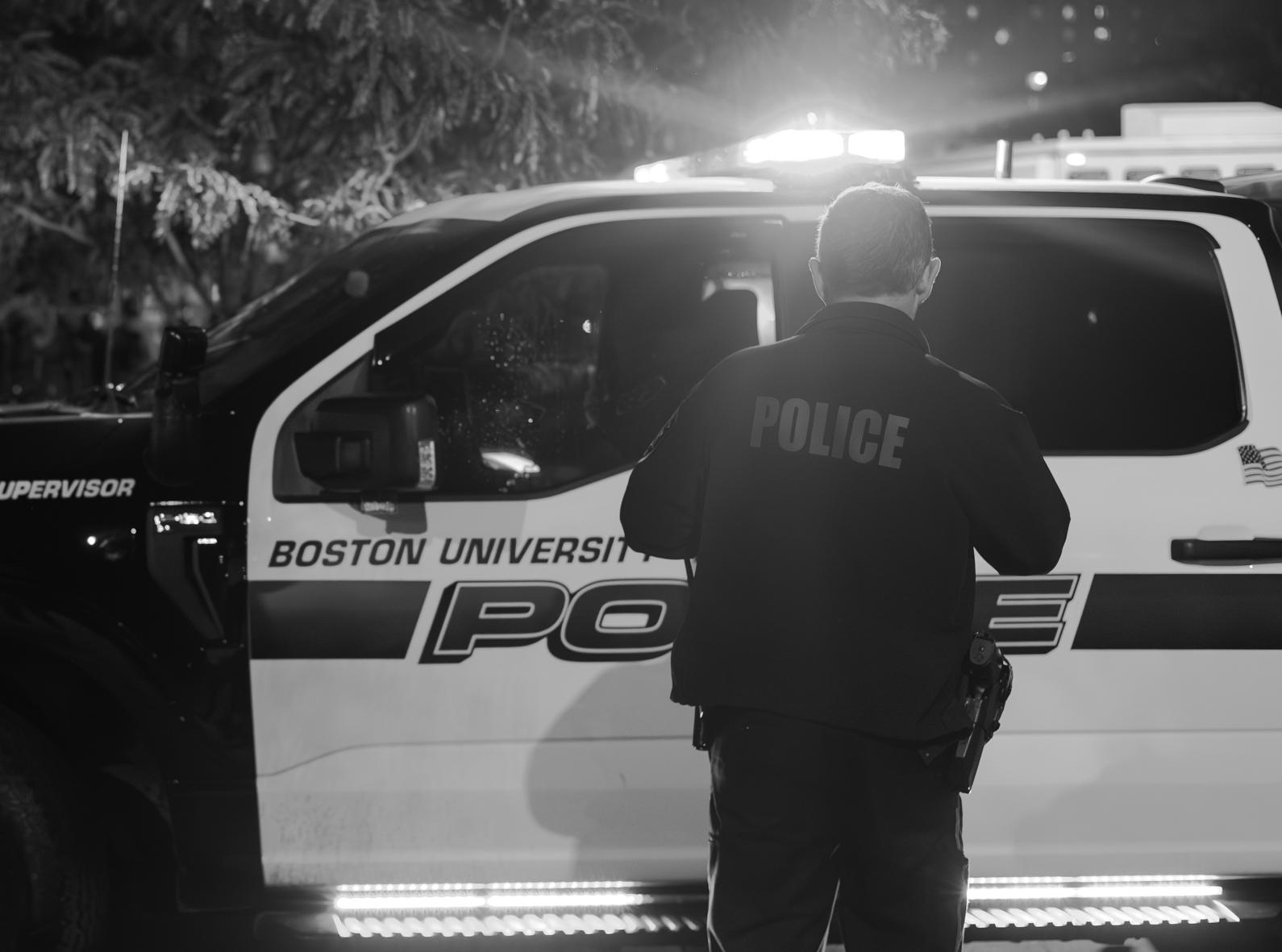
Janathan Rivera, a BUPD officer since 2024, was fired by Beth Israel Deaconess Medical Center in 2023, where he was a public safety officer, for use of excessive force on a 69-year-old hospital patient, state records show.
In security camera footage obtained by the Daily Free Press through a public records request, Rivera is seen grabbing the patient by the collar. The video then shows the patient falling to the ground, which the patient later alleged was because Rivera handled him “forcibly.”
While several BUPD officers have faced disciplinary actions from 1984 to April 13, 2026, either by a previous employer or BUPD itself, Rivera is the only officer currently employed by the University who was previously fired, state officer disciplinary records show.
Rivera later filed a complaint with the Massachusetts Commission Against Discrimination against BIDMC — a teaching hospital of Harvard University Medical School — alleging he faced racial discrimination and retaliation.
BIDMC’s legal counsel issued a statement in response to the complaint in March 2024, stating the claims were baseless. The Daily Free Press found no results for “Janathan Rivera” or the docket number in MCAD’s searchable database for hearing decisions. Rivera did not respond to multiple requests for a comment or interview.
“The Boston University Police Department maintains a rigorous hiring process that includes comprehensive background checks, oral interviews, and medical and
LAX supports teammate’s father in
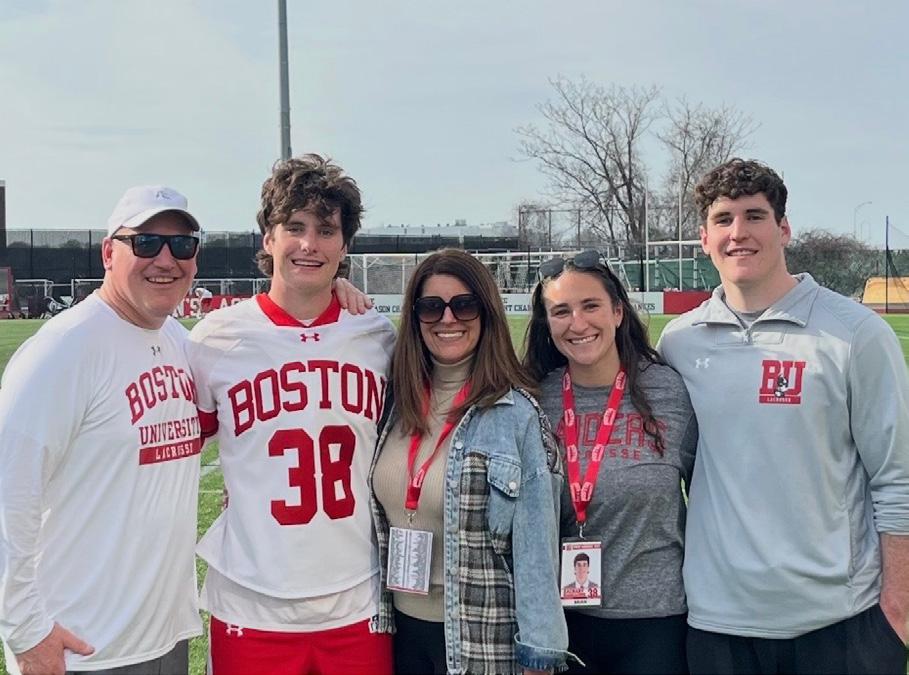
more on page 7
LETTER PAGE 11
Editor-in-Chief
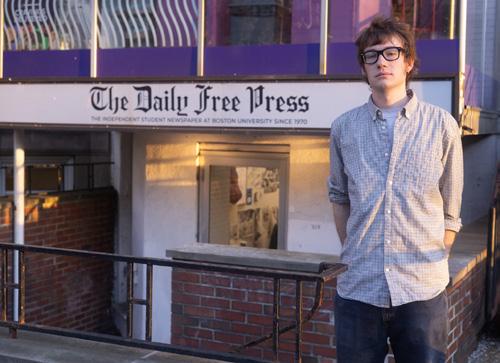
Truman Dickerson signs off
STELLA FEINSTEIN | DFP PHOTOGRAPHER
DANIEL GARBER | DFP PHOTOGRAPHER
JENNY CHEN | PHOTO CO-EDITOR
JENNY CHEN | PHOTO CO-EDITOR
BU President Melissa Gilliam speaks to The Daily Free Press in her office.
In your letter to the BU community, where you announced the pause on the ban of outward-facing signage, you said you met with a lot of community leaders. Could you talk about who those leaders were and what those conversations looked like?
think it’s an exciting time for Boston
DFP: In your interview with The Daily Free Press last year, you said you’re in consistent communication with BU’s Office of Federal Relations. What does that look like, and have there been discussions about research funding with Trump administration officials?
DFP: Earlier this month, in your StuGov Town Hall appearance, you talked about BU losing significant amounts of money since August. How would you explain what that means for students? Read
TAVISHI CHATTOPADHYAY Senior Writer AND ALEXIA NASTASIA Contributing Writer
The Daily Free Press interviewed Boston University President Melissa Gilliam Thursday afternoon to discuss the past academic year, the state of higher education and the future of BU. The conversation has been edited for
FreeP investigation finds BUPD officer’s previous misconduct
Continued from page 1
psychological exams,” BUPD Chief Robert Lowe wrote in an email to The Daily Free Press.
“In addition, BUPD officers are required to complete a Massachusetts Police Training Committee Certified police academy and are required to be Massachusetts P.O.S.T. Commission Certified,” he added.
After the incident, the patient — whose name was redacted in documents — raised concerns over Rivera’s conduct to BIDMC’s patient relations department, who then communicated the complaint via email to BIDMC Public Safety’s Lieutenant David Hoffman.
The patient said to patient relations that he had been hospitalized many times, was known by staff and security and had a “reputation for bad behavior,” the email states.
After being discharged from BIDMC on July 30, the patient was told by an Uber driver that their car was waiting at a local Dunkin’ Donuts, but when the patient arrived, the car was gone, the email states.
The patient told patient relations he defecated on himself — as he cannot control his bowel movements — and entered a bathroom in the emergency department, took off his pants and began “cleaning himself,” the email states. The patient said he was upset and yelling.
A security guard told the patient he had to leave and threatened to pull him out if he did not comply, the email states. Three officers stood outside the bathroom when the patient emerged.
The patient alleged in his complaint that Rivera forcibly grabbed him by the collar and threw him to the ground. At the time, the patient was exposed and only wearing a shirt, the email states.
Afterward, another officer gave the patient pants and ordered him another Uber, the email states, and it was suggested the patient call patient relations to report Rivera’s alleged use of excessive force.
It is not clear in the email who told the patient to file the complaint.
The patient’s complaint prompted an internal investigation into Rivera, BIDMC’s incident report states. Rivera was placed on administrative leave while Hoffman reviewed the incident, documents show.
Hoffman wrote in the incident report that he reviewed security footage of the incident and agreed with the patient’s allegations of Rivera’s excessive force. Hoffman also spoke with Rivera and the other two officers involved in the incident, he wrote in the report.
One officer said physical force had been used, but the patient fell to the ground without being pulled. Another officer said Rivera grabbed the patient and forcibly pulled him to the ground.
Rivera told Hoffman he tried to escort the patient out of the building and grabbed “just above the left elbow,” when the patient either fell or threw himself to the ground.
Hoffman concluded that Rivera violated multiple hospital policies, including failure to direct security officers to guide the patient, failure to submit a Department of Public Safety report after the incident and demonstrated a disregard of respect for the patient.
Rivera was fired from his position at BIDMC on Aug. 11, 2023.
Professor Shira Diner, a criminal law clinic professor at Boston University School of Law, said Rivera’s actions seemed like “really poor policing” after reviewing the security footage.
“They’re in a crowded space like that, taking someone down in that way,” Diner said. “Unless it was a real emergency, [it] also has the potential not only to hurt that individual, but people around them.”
Diner said the allegations regarding not taking care of the patient after the officers potentially injured him are “incredibly problematic.”
Rivera was hired at Beth Israel Deaconess Medical Center in Jan. 2018.
Rivera previously attended the Boston Police Academy, but was dismissed after just two months for “academic issues,” according to a 2024 position statement written by
BIDMC’s legal counsel.
BIDMC legal documents identified Rivera as an officer with shortcomings in report writing whose day-to-day performance “reflected instances of poor judgment and carelessness.”
During his employment at BIDMC, Rivera was also allegedly found to have an invalid firearm license the day before an upcoming Massachusetts State Police inspection of the public safety department.
Diner said the Massachusetts POST Commission has improved transparency efforts for departments under private organizations.
“I think that they’re sometimes allowed to get away with behavior that wouldn’t be acceptable if they were employed in the public sphere as law enforcement,” she said.
While the incident alone does not yield enough information to determine whether Rivera’s actions were legally justified, Diner said, the situation could have been handled differently.
“It does not seem like this is a good way to help people who are in crisis by any stretch of the imagination,” she said.
Jack Schwed contributed to the reporting of this article.
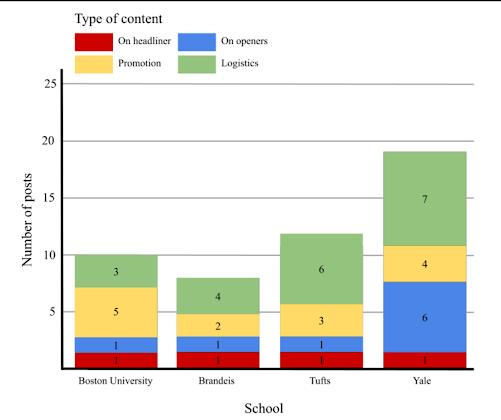
Zara Larsson will headline spring concerts at multiple New England universities. How does BU’s rollout compare?
BY KATHERINE WU AND ELENA PEJIC Senior Writers
Swedish pop sensation Zara Larsson will headline Boston University’s inaugural “RhettRockz” spring concert May 3 at Agganis Arena.
BU, however, won’t be her only stop — Larsson is also slated to perform at several other New England schools in the next two weeks, including at Tufts University, Brandeis University and Yale University.
Tufts, Brandeis and Yale provided free tickets to undergraduates, with Tufts selling $40 graduate student tickets. BU, on the other hand, has a ticket fee of $15 for undergraduate students, which aligned with the $10 to $17 benchmark used in past festivals.
BU Student Government Vice President Tony Wu said the planning team wanted the festival to be more “student-focused” this
year.
“In the past three years of the concerts, we were in partnership with Agganis Arena, so even nonBU students, like the public, could attend these concerts,” Wu said.
“This is the first year that we are entirely booking an entire arena just for BU students and guests.”
While this is the first year that BU will host a student-only event, Brandeis and Tufts have hosted annual student festivals for decades.
“For the most part, Springfest has always been free,” said Naomi Ihueze, the Brandeis Campus Activities Board concert chair. “For all our club budgets, what funds it is a portion of students’ tuition, so you technically already paid. We close it off to guests because we don’t have the capacity to have food and spacing for all those people.”
BU’s planning team also wanted to include guest tickets, but at a higher price, and the $40 fee they charged seemed “fair,” Wu said.
RhettRockz is funded by BU’s $77 community service fee that every undergraduate student

contributes each semester as part of their tuition, as well as ticket sales.
Wu said that they were able to get Larsson at the same “standard industry rate” as other local universities but could not disclose the exact amount Larsson will receive.
BU’s Campus Activities Board merged with StuGov to form the StuGov Campus Activities Board, which planned this year’s spring concert. This merger helped in coordinating a larger-scale festival, StuGov officials said.
The event will consist of an opening act from student musician Enrico supported by the band SLIGHTLYHAMMERED, food truck vendors and a “few [other] student groups” that have yet to be announced, Wu said.
BU’s official headliner announcement came on April 7, despite initially claiming it would occur on March 30. Tufts and Brandeis announced Larsson on the respective days they advertised.
Tufts was the earliest university to start planning for the event, starting preparations in the summer, focusing on the “energy we wanted the concert to have,” said Quinn Sobieraj, live entertainment coordinator for Tufts University Social Collective.
“We also were really conscious of trying to pick artists and pick a concert vibe that we thought would please and capture the vibe of the entire student body,” said Luke Steiner, the other TUSC live entertainment coordinator.
BU started planning RhettRockz in September 2025, said CAB co-director Kate Dougherty, and Brandeis posted a Springfest recommendation survey for students the same month.
BU’s planning team was not particular about the artist they
wanted, but they wanted someone who could “bring together our whole community,” and Larsson was at the “very top of our list,” Dougherty said.
The team began by reaching out to a couple of different production companies and settled on Pretty Polly, who then handled all the communication with potential performers.
Brandeis’ festival on April 26 will feature local artist opener Notebook P, student openers DJ JAGA, Hazel Drew, 1 Night Only and Marakosa, who auditioned last November, and host vendors with glitter tattoos, food trucks, photo booths and spray paint T-shirts to “fit Zara’s theme.”
Tufts’ April 25 Spring Fling festival will feature alternative rock band Grouplove and student DJ openers, brothers mc cece and jacobccmixes, in addition to Larsson. The university will also have a photo wall, lawn games,
crafts and giveaways.
BU is the only of the four New England schools that will feature solely university-affiliated opening acts.
Tufts had to raise its offer to secure Larsson because another school wanted her for the same date and time, Sobieraj said.
“We feel really good about the decision, and I think it’s really exciting that she’s going to be at so many New England campuses, because it really shows a sense of community even beyond the individual schools,” Sobieraj said.
Dougherty said it is impressive that BU was able to get such a “massive artist” to perform at RhettRockz.
“I think it just goes to show how important the work we’re doing is,” she said. “The fact that we’ve been able to pull it off is really amazing.”
Zara Larsson performs in Boston on Nov. 11, 2024. BU is one of several New England universities where Larsson will perform this spring.
TALIA LISSAUER | DFP FILE
MELISSA LEMIEUX | Graphics Co-Editor
A BUPD officer talks to another officer driving a BUPD truck during an on-campus protest Sept. 15, 2025. Current BUPD officer Janathan Rivera was previously fired by Beth Israel Deaconess Medical Center for use of excessive force against a 69-year-old patient.
JENNY CHEN | PHOTO CO-EDITOR
CAMPUS & CITY
‘Congress is trying to repress my
teaching’: MIT professor sues Congress for antisemetic label in committee report
CITY BY ISABELLE ZHANG AND ELIZABETH MEHLER
City Co-Editors
A professor at the Massachusetts Institute of Technology sued the House Committee on Education and Workforce over a March 17 report on antisemitism on college campuses that identified him as a promoter of “antisemitic conspiracy theories.”
Michel DeGraff, a faculty at large professor at MIT who teaches linguistics, filed a complaint March 28 against MIT, the House Committee on Education and Workforce and its chairman, Rep. Tim Walberg, alleging they violated his First Amendment rights.
The complaint alleges the Committee is punishing and suppressing DeGraff’s free speech by publishing their report, “How Campuses Became Hotbeds: The Rise of Radical Antisemitism on College Campuses,” that characterizes him as antisemitic.
The report, which names DeGraff, found faculty members in universities across the U.S. “have played a significant role in legitimizing and amplifying antisemitism on college campuses.”
“I have the right to express my views, and as a professor, I also have a right to teach about any issue that I find is germane to my expertise, which is linguistics,” DeGraff said in an interview with The Daily Free Press. “In this particular case, Congress is trying to repress my teaching and my speech.”
The complaint also alleges the Committee violated DeGraff and other MIT community members’ right to privacy by repeatedly requesting school records about antisemitic incidents, which could be used to “identify, isolate and endanger” the mentioned individuals.
A federal judge on March 30 issued a summons for the Committee, MIT and Walberg.
In a statement to The Daily Free Press, Walberg wrote that DeGraff’s
complaint “lack[s] merit.”
“Congress has not only the Constitutional authority but also the duty to conduct credible oversight of institutions that accept federal dollars — especially when it comes to antisemitism and discrimination,” Walberg wrote. “The Committee looks forward to defending its authority in court.”
The congressional report included information from a 2025 lawsuit filed against DeGraff by William Sussman, a former MIT Ph.D. student and president of GradHillel. Sussman alleged that DeGraff harassed him after he criticized DeGraff for hosting a seminar speaker who said organizations like Hillel helped support a Zionist “mind infection.”
to The Daily Free Press, Sussman wrote that DeGraff targeted him on social media.
I pointed out that his message
DeGraff for antisemitism, but the investigation was closed when Sussman declined to participate.
A federal judge dismissed Sussman’s lawsuit in January 2026, stating “anti−Israeli sentiment is not, without more, antisemitic messaging.”
In a statement to The Daily Free Press, Sussman wrote that he believed the court’s ruling was not based “on the merits of [his] claims.”
“Instead, the Court declined jurisdiction over the state claims because the federal claims against MIT were dismissed,” Sussman wrote.
seeking injunctive relief preventing the Committee from seeking or releasing any more “confidential, personally identifying information” about him from MIT. He also seeks compensatory damages against MIT “in an amount to be determined at trial” and to cover attorneys’ fees and costs.

the professor began targeting me personally in X posts to his 10,000 followers,” Sussman wrote. “He did so over and over again. In his sixth post, for example, he referred to me as ‘an excellent case study.’”
DeGraff said the term “mind infection” is not antisemitic, as it was first coined by Nurit PeledElhanan, an Israeli professor, who used it to describe Israeli education.
“For Congress to call me antisemitic for quoting work by an Israeli Jewish scholar who’s trying to show how to improve Israeli education [is] so outrageous,” DeGraff said.
Following Sussman’s complaints of harassment, MIT’s Office of Human Resources investigated
because “it culminated in Sussman dropping out of his PhD program because of safety concerns,” a judge wrote in a motion to dismiss Sussman’s lawsuit.
Despite the investigation being dropped, DeGraff alleged he suffered emotional and monetary losses from Sussman’s lawsuit. He said this included being denied a pay raise from MIT for not teaching his regular course load — a consequence of his proposed course about Palestine having been rejected by MIT Linguistics— and harassment from Sussman’s social media followers “to the point that Cambridge Police had to provide extra protection to [his] home.”
As a result, DeGraff is
The Speech or Debate Clause in the Constitution protects members of Congress from civil lawsuits for “legislative acts,” including publishing committee reports, that are integral to the legislative process.
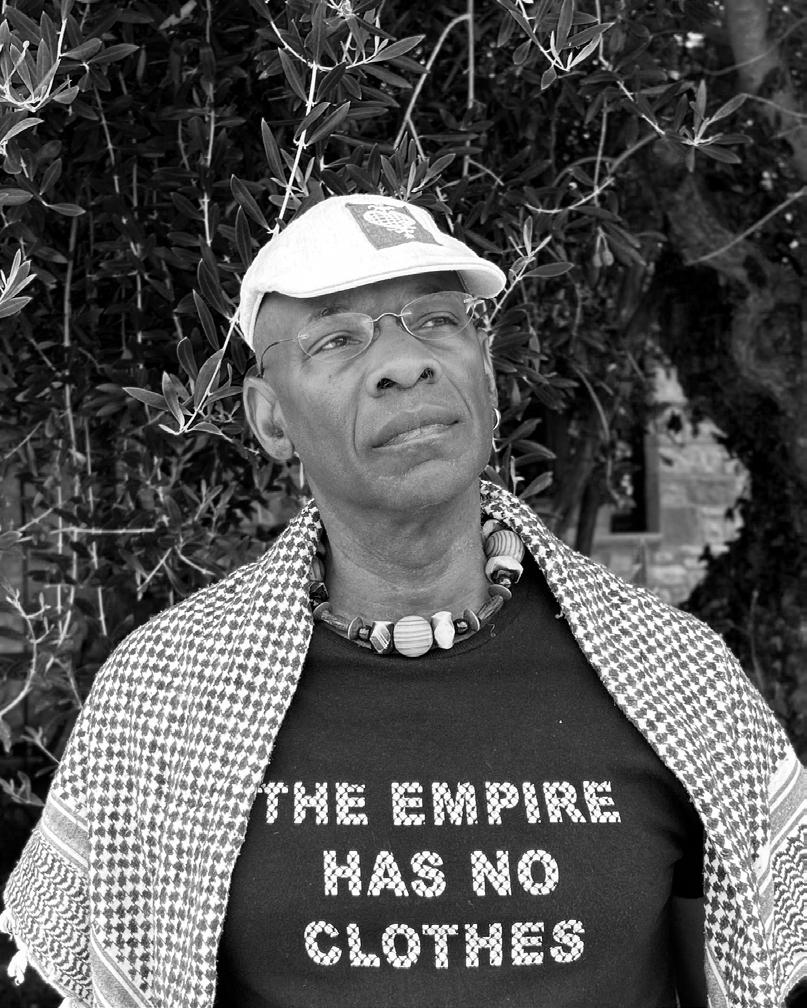
COURTESY OF MICHEL DEGRAFF
MIT professor Michel DeGraff. DeGraff is suing the House Committee on Education and Workforce for being named as antisemetic in a March 17 report on antisemitism on college campuses.
But DeGraff said his complaint aims to “establish that Congress should not be immune” from legal action, especially in cases where their actions are unrelated to legislation, but to to fulfill a “political agenda.”
Richard Solomon, an MIT Ph.D student who has worked with DeGraff in pro-Palestinian campus movements, said he hopes DeGraff’s legal action raises awareness about the “neo-McCarthyite campaigning by the Republican Party and by the Trump administration” against student activists.
“Students need to be able to learn about Palestine, and professors like Michel DeGraff should be able to teach in their substantive expertise without party diktat and political influence forcing them out,” Solomon said.
DeGraff said it will be difficult to teach about the history of Zionism if MIT adopts the International Holocaust Remembrance Alliance definition of antisemitism, which includes anti-Israel sentiment, as encouraged by members of
Congress.
“[They] conflate Judaism with Zionism, which are two different things,” DeGraff said. “Judaism is a religion. Zionism is a racist political agenda. How can you equate a religion that promotes love with [a] political agenda that promotes hatred and genocide?”
DeGraff’s complaint alleges MIT is complicit in the Committee’s agenda to chill free speech “by turning over confidential files, and by giving in to the pressure to harass, surveil, jawbone and sanction” community members under the guise of fighting antisemitism.
DeGraff said the goal of the lawsuit is to encourage MIT to protect free speech and “push back” against the Trump administration’s tactics.
“What’s at stake here is nothing less than a democracy,” DeGraff said. “Because a democracy depends on our freedom to inquire and to dissent, especially when it comes to fascism. If we don’t have that, then that’s it. Our democracy is dead.”
As Rümeysa Öztürk leaves the US, questions grow over international student retention
CITY
BY AVERY FOX Associate Campus Editor
Rümeysa Öztürk, a Tufts University graduate student who was detained by ICE last year, returned to her home country, Turkey, after completing her PhD program in February.
Öztürk, who received a doctorate in child studies and human development, said that she did not wish to lose more time to the “stateimposed violence and hostility” she
experienced in the United States.
“After 13 years of dedicated study, I am very proud to have completed my Ph.D. and to return home on my own timeline,” Öztürk said in a statement. “The time stolen from me by the U.S. government belongs not just to me, but to the children and youth I have dedicated my life to advocating for.”
Öztürk’s decision to return to Turkey has sparked conversation amongst advocacy groups and legal scholars about the future of international students in the United
States, as well as high-skilled positions often filled by immigrants.
Todd Pomerleau, a Bostonbased lawyer who has represented several high-profile targets of the Trump administration’s deportation operation, said international students’ fear of speaking up could have “grave consequences” for freedom of expression in the country.
“We’re seeing this trend throughout the country, and it’s deeply disturbing to anyone who cares about civil liberties and anyone who’s studied the history of the Constitution,” Pomerleau said.
“[The United States could] be effectively like a tunnel vision society, where only certain viewpoints are cherished, and others are castigated and even prosecuted.”
Masked Immigration and Customs Enforcement agents detained Öztürk in March 2025 after she co-authored a pro-Palestinian op-ed in the Tufts student newspaper, an action the Department of Homeland Security said amounted to supporting the terrorist group Hamas. A federal judge ordered her released from custody in May 2025.
Following Öztürk’s decision to leave, federal government parties reached a settlement to resolve outstanding legal issues in federal court and moved jointly to dismiss her immigration proceedings.
Lokesh, the chair of a socialist organization at Northeastern University who requested to only
be referred to by their first name for privacy reasons, said Öztürk’s decision to leave the United States was “completely understandable.”
“The conditions in the United States right now are really untenable for anyone that’s on any visa,” Lokesh said. “If I was in her position, I would absolutely leave as well.”
Lokesh said the Trump administration’s deportation policies often target international students, who are “behind a lot of the cutting-edge research that we see in Boston,” she said.
“They work tirelessly,” Lokesh said. “They’re working not just for themselves, but in many cases, for their families as well, and you can see it in their work.”
Hayat Bearat, a clinical professor and the Director of the Domestic Violence Institute at Northeastern University School of Law, said current or prospective international students don’t wish to live under the “magnifying glass of our government” or in fear of potentially losing everything.
“Nobody is safe from our stateimposed violence in the United States right now, and immigrants are all targeted,” Bearat said.
International graduates from U.S master’s and doctoral programs have a 50% and 75% retention rate, respectively, while the overall retention rate for all international degree recipients is 41%, according to a 2024 report from the Economic
Innovation Group, a public policy organization.
“The reality is that a school, like any other business, is always seeking to recruit the best talent possible,” Pomerleau said.
Lokesh said international students don’t want to put their name on anything that could be viewed as “anti-government” over fear of being deported, and are hesitant to participate in political activity, including labor union organizing.
“When I talk to international students that are in the labor union at Northeastern, they say they’re very scared to organize,” Lokesh said. “The TAs, the RAs, are all quite underpaid, and they can’t get better wages, better conditions because of the fear that Trump has instilled.”
An immigration judge ruled in February 2026 that the government had no grounds to deport Öztürk; however, the DHS appealed that decision to the Board of Immigration Appeals soon thereafter.
“DHS is glad to see Ozturk selfdeported from the U.S.,” a DHS spokesperson wrote in a statement to The Daily Free Press, “Visas provided to foreign students to live, study, and work, in the United States are a privilege, not a right.”
As part of her settlement, Öztürk was free to return to Turkey without further interference from DHS and the government acknowledged she was in lawful status at all times while studying in the U.S., according to the ACLU.
PHOTO BY TRUMAN DICKERSON
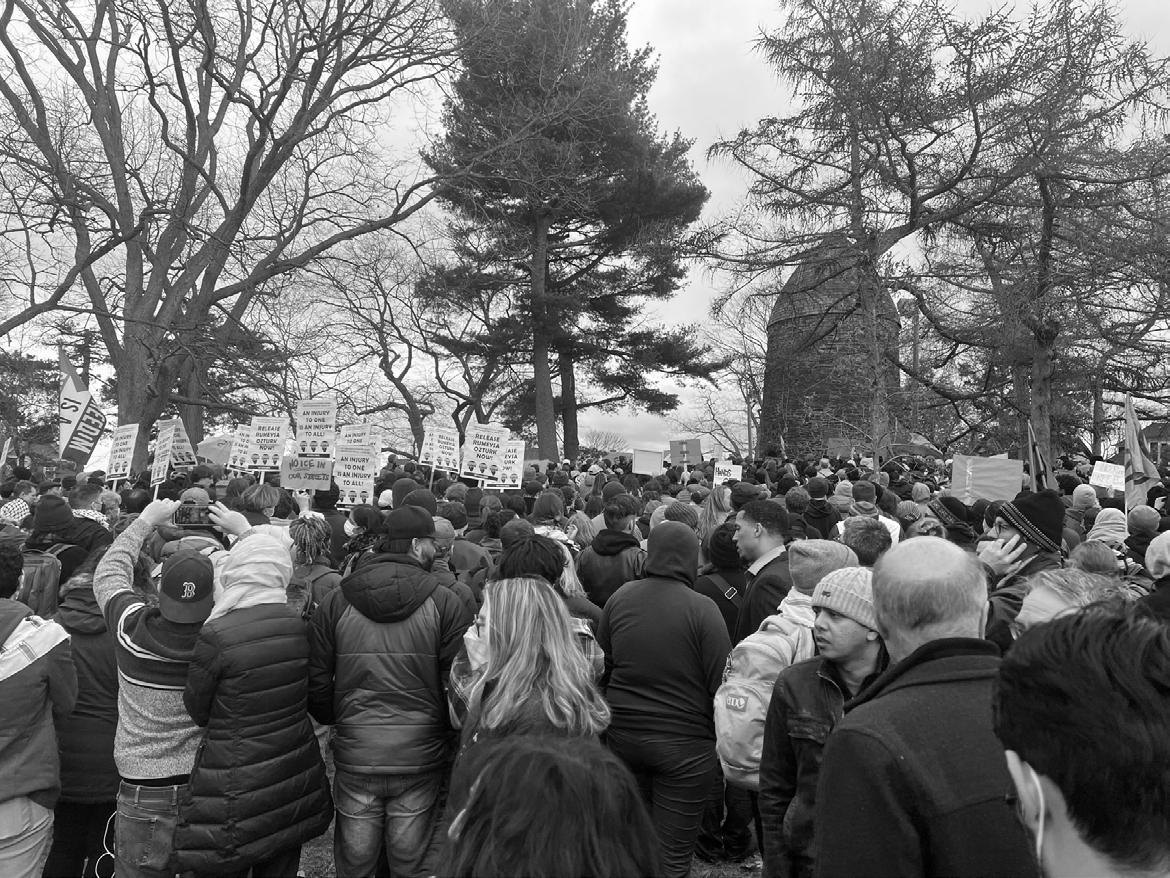
People gather at a park in Somerville on March 25, 2026 to protest Rümeysa Öztürk’s detainment by ICE agents. Öztürk has since returned to Turkey, her home country, after completing her PhD at Tufts University.
MELISSALEMIEUX |Graphics Co-Editor
BU student band ‘The Janks’ bring live music to Boston homeless shelters
BY MARY GOETZ Associate Arts Editor
On a Friday afternoon in Roxbury, Boston University’s student rock band The Janks set up for a live gig — not in a bar or an Allston basement, but in the United States’ first women’s homeless shelter.
The Feb. 28 concert at Rosie’s Place was the one of the first of several charity gigs for The Janks, which have since played at shelters
is composed of founding members Rohan Saji and Mukund Balaji, bassist Nathan Manasseh, guitarist Yuwen Wang and Darling.
The band initially formed after Balaji, Saji and a friend of theirs decided to record a cover of “Sultans of Swing” by the Dire Straits over their winter break in 2025.
Needing an album cover to upload alongside their recording, the trio posed in front of a halfbroken “physics problem” of a tripod duct-taped to a branch to keep it steady. From there, The
and community organizations across the greater Boston area.
“It feels good to play for these crowds as well, just to know that we’re bringing music into these people’s lives,” said singer and BU freshman Peyton Darling.
The band, which unofficially began playing together last winter,
Janks were born.
Though the band never intended it, charity has been a cornerstone of their performance history since the beginning.
One of the band’s first official performances raised money for the New England nonprofit Music Drives Us where they raised $280,
according to Darling.
“I think really the most valuable thing from that concert was just making good connections,” he said. “That was a really, really fun experience.”
After their Music Drives Us performance, Saji, who also plays in a jazz combo at BU, had heard from one of the drummers that Rosie’s Place was looking for bands to perform at the shelter.
From there, Saji emailed the Heart and Mind Foundation, a nonprofit that connects bands with shelters and community organizations. Founded by BU junior Aryaa Venkatesh and Wellesley College sophomore Tara Sawhney, the foundation works with community centers and clinics to not only entertain them but “provide emotional support and human connection” to those in need, according to Venkatesh.
Today, the foundation has nearly 15 locations across the U.S. and Canada.
“Music and art have such a profound way of reaching people in ways that words can’t,” Venkatesh said. “I wanted to help create something that made those experiences more accessible, especially for populations that might not have had access to them originally.”
When The Janks performed at Rosie’s Place, Venkatesh recalled the women in the shelter dancing and, afterward, asking for the band’s business cards.
“It was just so nice to see all these faces in the room light up,” she said.
As for their future performances, Saji and Balaji, who are both staying in Massachusetts for the summer, said they hope to continue
playing throughout the summer.
“For me, as long as we can continue to keep playing together and just making music … that’s really the only thing that matters for me,” Darling said.
In the final weeks of the school year, they’re doing just that.
The Janks performed again at Rosie’s Place on April 18, and will head to Boston Health Care for the Homeless Program, an organization
with over 30 clinics around greater Boston to provide care at the intersection of mental health and homelessness, on April 28.
“My main goal as a musician [is] to … give people something that they can kind of hold on to and just enjoy despite them being in a situation that sucks,” Manasseh said. “That’s something I want to continue to do throughout my life.”
‘Running for something bigger than yourself’: Three BU seniors reflect on running the Boston Marathon for charity
COMMUNITY
BY KIERAN SNOW Contributing Writer
For most Boston University seniors, the only finish line they’re concerned with is graduating on time. Few would choose to add training for a marathon and raising thousands of dollars for charity to their plate.
But BU seniors Chloe Trudel, Sean Tomany and Grace Sciacca, took the challenge on headfirst.
On April 20, the three ran in the 130th Boston Marathon to raise money for the Dana-Farber Cancer Institute, Joe Andruzzi Foundation and Newton-Wellesley Hospital, respectively.
Trudel watched the Boston Marathon for the first time after transferring to BU two years ago, and wanted to run the race ever since.
“I remember sophomore year watching the Boston Marathon from Kenmore and being like, ‘Oh my gosh, this is something that I need to do,’” Trudel said. “I sort of made a promise to myself: ‘Senior year, I’ll push myself to do this.’”
When her senior year arrived, Trudel applied to run for the DanaFarber Cancer Institute, a Bostonbased cancer care and research institute.
Her interest in the institute came from personal experiences with relatives being diagnosed with cancer and her desire to “run for an organization that meant something to [her] and [her] family,” she said.
Trudel was accepted into the marathon last November, and committed to raising $13,100 for the institute — over $1,000 more than the organization’s required fundraising commitment.
From then on, she received
support from Dana-Farber and the organization’s other runners, which she credited with helping her stay motivated while she was training.
“Even on the days where my runs sucked and were brutal, it’s just remembering who you’re running for,” Trudel said. “The ‘why’ behind all the people that are running with you makes it so motivating and special.”
Trudel also received support from her professors and friends at BU, including her roommate, senior Winnie Eber.
“I think it’s pretty cool and powerful, because it’s running for something bigger than yourself,” Eber said of her roommate running the marathon. “And it’s running with the whole team of people who are also [sharing a] common goal of
raising money for this one cause.”
But it’s Trudel’s mindset that has been most inspiring, Eber said, because “it’s really easy to complain” about running.
“It’s just about getting to your mindset of ‘I get to run six miles today,’ and how much of a privilege that is, to be able to do that, and to be able to do it for an organization like Dana-Farber,” Trudel said.
But Trudel wasn’t the only Terrier on the course.
Tomany’s interest in running the Boston Marathon started much like Trudel’s — watching his first race as a sophomore.
“I had no idea anything about [the marathon], but I said, ‘That’d be cool to run sometime, especially while I’m here as a student,’” he said.
Tomany has always been willing to try new and challenging things “and not feel nervous about not being good,” said his mother, Jeannette Tomany.
“He’s just like, ‘I’m learning. I’m going to get out there and try it,’” she said. “And I think that’s a great skill to have in life.”
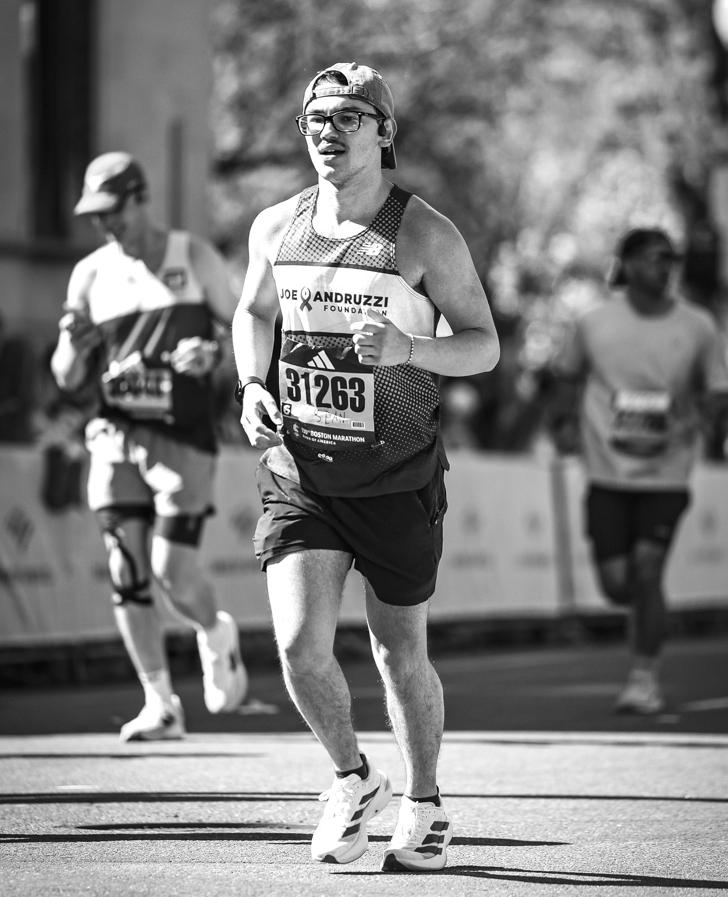
Tomany connected with the Joe Andruzzi Foundation — a nonprofit that provides financial assistance to cancer patients in New England — and set a fundraising goal of $12,500.
“All the money that I’ve raised will help families across New England, so that’s super important, and the charity [itself] has helped support me,” Tomany said. “It’s a team of people, and we all have each other’s backs.”
BU senior and Tomany’s roommate Jonah Rothman helped his friend get in touch with the Joe Andruzzi Foundation. Most of his support, however, has been encouraging Tomany and helping
“hype him up” before his runs.
“It’s inspiring seeing someone campaign around a good cause, and … his determination is pretty inspiring too,” Rothman said.
Trudel and Tomany were joined by Sciacca — who raised money for an organization that she couldn’t have run a marathon without.
For Sciacca, the Boston Marathon offered her a chance to fundraise for Newton-Wellesley Hospital, a comprehensive medical center that has been treating her for nearly a year.
Sciacca was diagnosed with Eosinophilic Granulomatosis with Polyangiitis — a life-threatening autoimmune disease — last summer.
A longtime runner who was already interested in running the marathon, Sciacca saw the race as an opportunity to “give back to a place that gave so much to [her].”
“They’ve continued to take such great care of me, and to be able to give back in any way has just been such a rewarding experience,” Sciacca said. “I’m just really grateful for them.”
With her autoimmune disease and asthma, Sciacca’s training process was challenging, but the support from BU and NewtonWellesley helped her navigate the “ups and downs” of preparation, she said.
Despite the difficulty, running the marathon was a powerful reminder that anyone can achieve their goals inside and outside of running, Sciacca said.
“If there’s an organization or something you’re very passionate about, there’s nothing stopping you from helping out in any way, whether it be fundraising or volunteering,” Sciacca said. “It’s such a rewarding experience.”
STELLA FEINSTEIN | DFP PHOTOGRAPHER
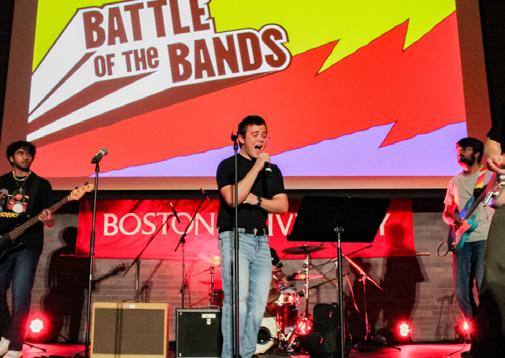
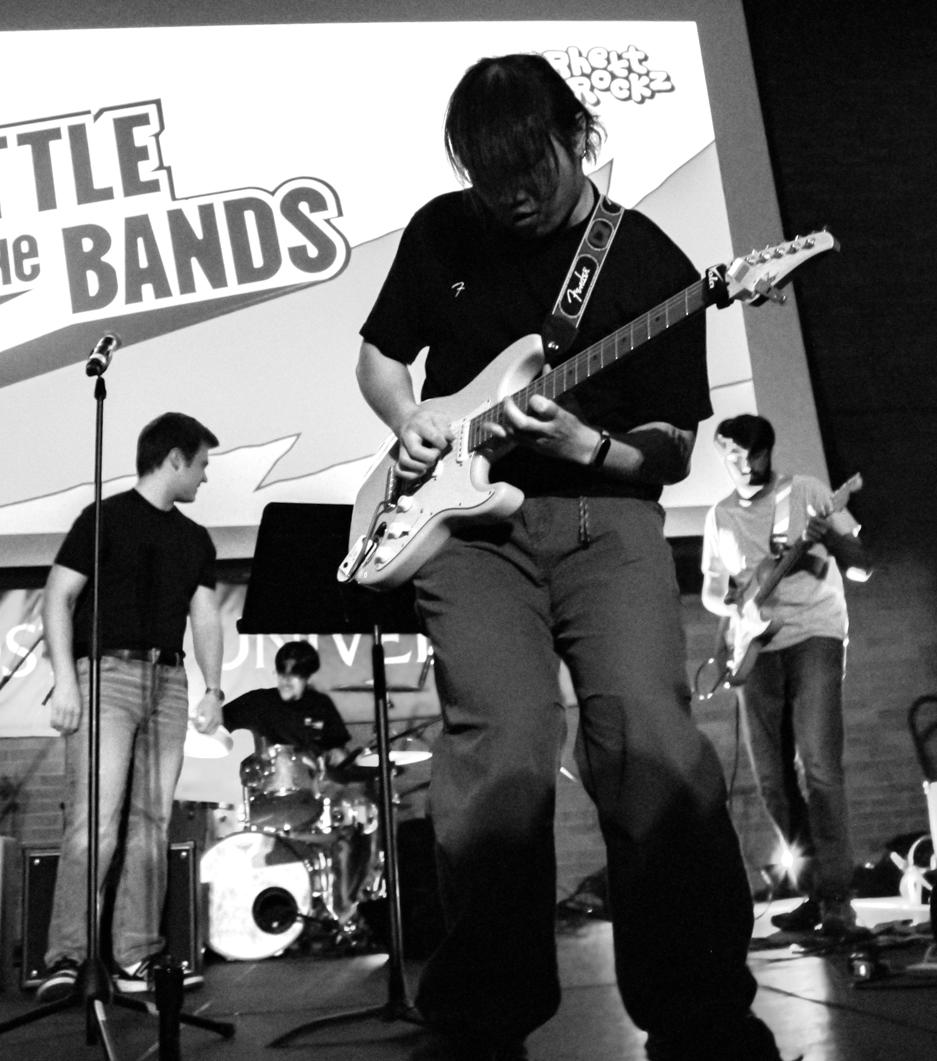
The Janks compete in “Battle of the Bands” at the George Sherman Union on March 30.
COURTESY OF MUKUND BALAJI
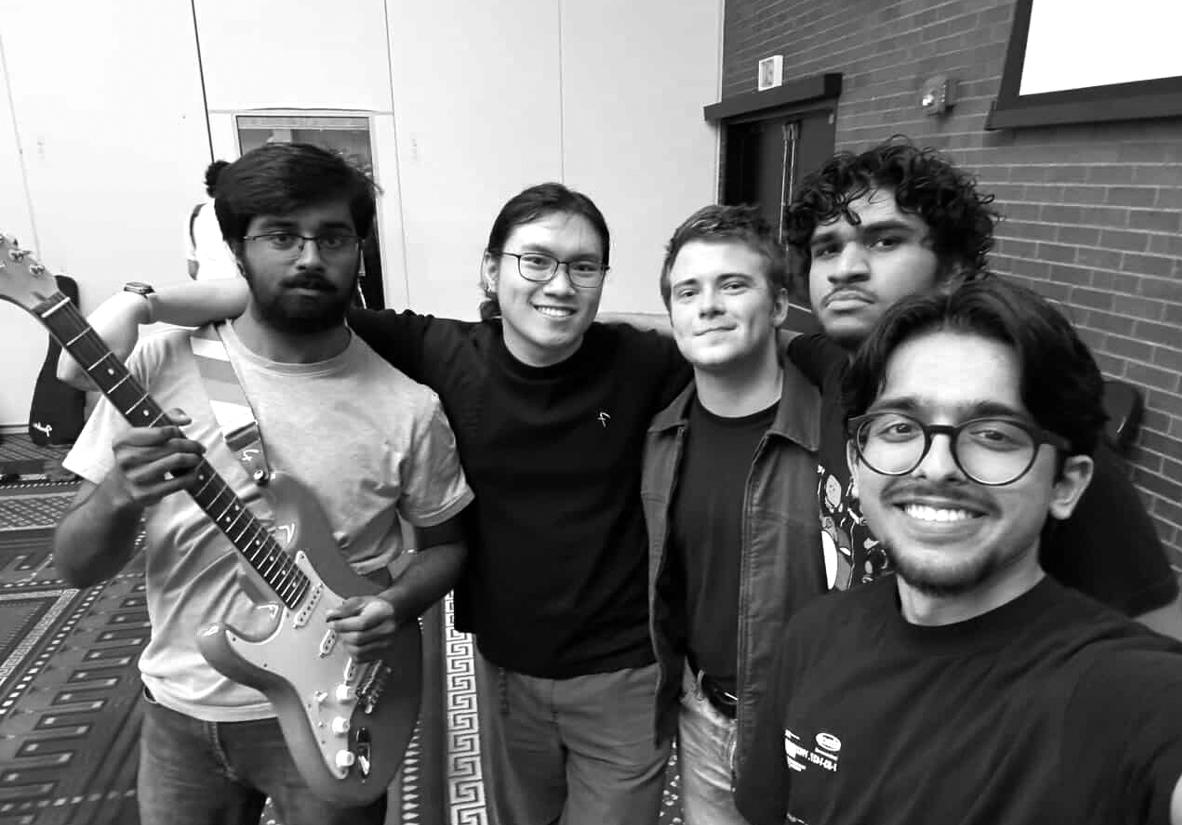
The Janks pose for a selfie. The band has played several charity gigs in the Boston area.
COURTESY OF SEAN TOMANY VIA PETE WOOD
Boston University senior Sean Tomany runs for the Joe Andruzzi Foundation. Tomany and his peers fundraised for charities for the 130th Boston Marathon. locations across the U.S.
CDS prepares to send off first ever matriculant students, reflects on growth
BUSINESS
BY CARINA MCCALLUM Associate Science Editor
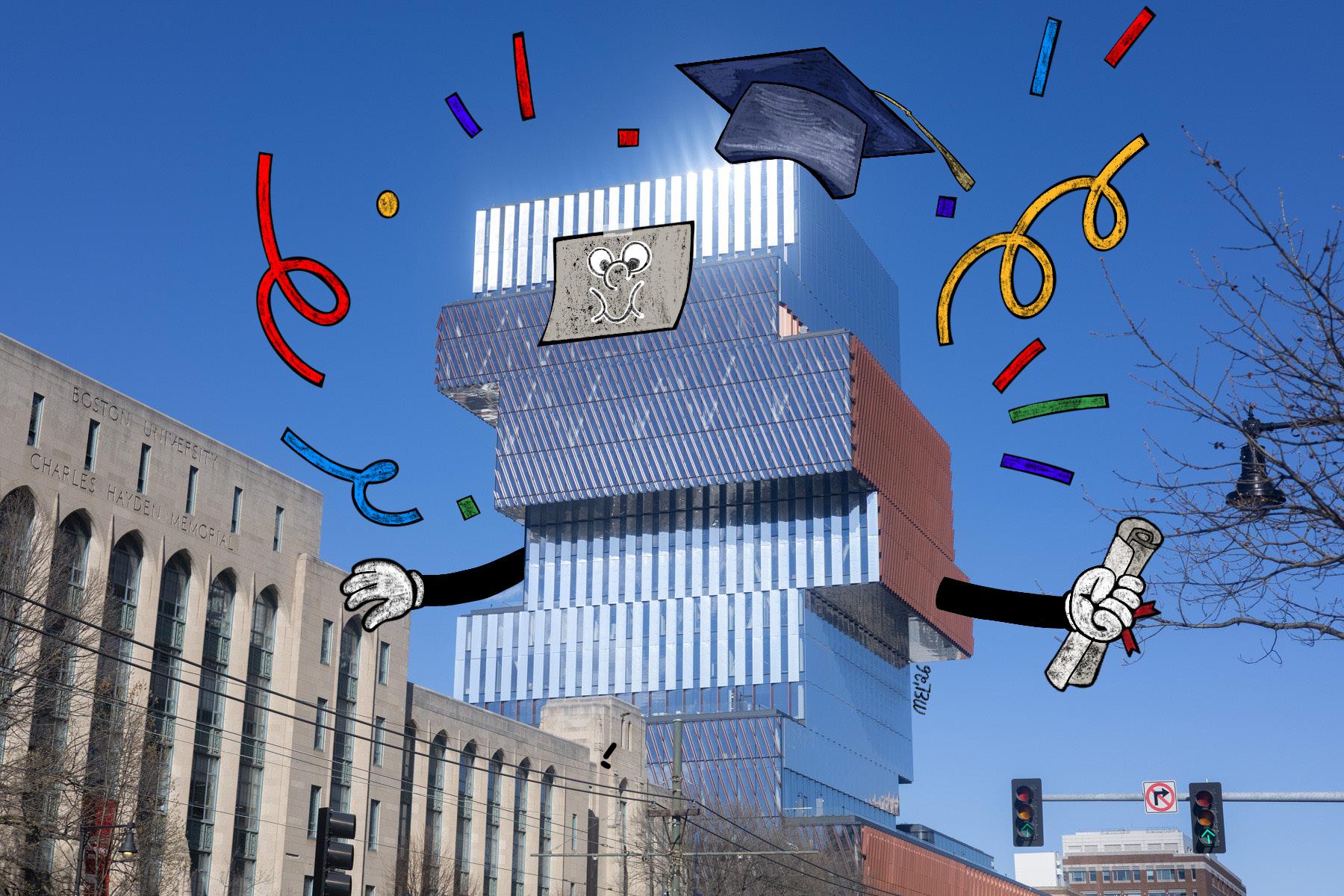
Every college at Boston University celebrates its graduating class each May— but for members of Computing and Data Sciences, the class of 2026 is particularly special.
The weekend of May 14, CDS will celebrate the graduation of its first-ever undergraduate class. The cohort first entered the program in 2022, and have helped develop CDS in its formative years since its founding in 2019.
Vijay Fisch, a graduating senior in CDS and copresident of CDS Student Government, said he has helped foster a community within CDS as part of the first undergraduate class.
“It’s a really new program, which has been honestly amazing,” Fisch said. “We’ve honestly gotten to be involved in the process of shaping what the program looks like.”
Data science is a rapidly growing field in the U.S., with employment of data scientists projected to grow by 34% from 2024 to 2034 — much faster than the average for other occupations — according to the U.S. Bureau of Labor Statistics. This growth, according to CDS, is “driven by the increasing need for datadriven decision-making across industries.”
According to Azer Bestavros, BU professor and associate provost for CDS, the school was created to integrate computing, data science and AI across disciplines.
“What discipline today is not being impacted, transformed [or] changed by data, by computation, and more recently, by AI?” Bestavros said. “Because it is such
SPH
a cross-cutting theme across all the disciplines, it should not be seen as a standalone college. It should be seen as an academic unit that cuts across all the other ones.”
Since CDS’s creation, the fields of data science, computing and AI
it with them, and they have helped us come up with basically the blueprints for that policy, which we adopted,” Bestavros said. “I don’t think there is another group of students who are going to have to face and go through this more
studying data science — said his class content was constantly changing.
“[It] happened to me many times where I would learn one thing and the next week it would be obsolete,” Gentile said. “It’s a
have progressed rapidly. ChatGPT was released in November 2022, just two months after the class of 2026 started college.
By March 2023, CDS announced their Generative AI Assistance Policy, which was proposed by students.
Bestavros said the policy is reflective of how collaboration between students and faculty has laid the groundwork for CDS.
“We had to develop that policy while the students were taking the courses, and we had to think about
than this one class.”
Mark Crovella, professor and chair of academic affairs at CDS, said building an undergraduate degree in a field with such explosive growth has been a “building experience.”
“We’ve been continuously adding new things,” Crovella said. “It’s going to be pretty fast in evolution, and it’s just the way the field works.”
CDS students have witnessed this evolution firsthand. Zach Gentile — a graduating senior
good challenge. We’re keeping on top of how things are evolving.”
Many students graduating from CDS this May said they felt prepared to enter the job market.
Jabir Ahmed, a graduating senior and course assistant, said he attributes “all his success” to CDS. While working a business technology internship at ZS Solutions, a global management consulting firm, he said his data science background was immensely helpful.
SCIENCE
BY AVALON KAIL Contributing Writer
Two studies led by researchers at Boston University’s School of Public Health are the first to identify a connection between redlining, a historically racist housing policy, and a lower likelihood of pregnancy.
“Our hypothesis here was that we know that Black populations have higher rates of infertility. We know they’re also more likely to be exposed to historical neighborhood redlining,” said Mary Willis, an assistant professor of epidemiology at SPH who co-authored the first paper and was first author on the second.
“There’s a high probability that we would see that living in a redlined neighborhood would impact the risk or the probability of conception in a given menstrual cycle,” Willis added.
Redlining, a practice that dates to the 1930s when a federal agency meant to help people pay for their homes, began evaluating neighborhoods on an A through D scale based on their perceived risk of providing loans and mortgages — A being the “safest” and D being the most “hazardous.”
According to New York City’s Environment and Health Data Portal, the federal agency often graded neighborhoods with a higher proportion of people of color the lowest, citing their “infiltration” as a “detrimental influence.”
Banks would then refuse to give loans to people in “hazardous” neighborhoods, stopping them
from owning homes and redirecting investment towards whiter, higherranked communities.
Though redlining was officially outlawed in 1968, the practice prevented marginalized communities from building generational wealth. These areas continue to have limited access to healthcare and are exposed to higher levels of pollution.
“Redlining, living somewhere that doesn’t have a lot of the needed infrastructure, or have that economic investment [in] the present day, can have so many impacts on your health,” said Kendra Sims, an assistant professor in the department of epidemiology at SPH and coauthor of the second study. “It may expose people to a lot of stressors that can really get under your skin and make conceiving a little bit harder.”
Redlined neighborhoods in Boston include most of Roxbury and the South End, Mattapan, Chinatown, Dorchester and parts of cities like Cambridge and Milton.
Mary Willis said that since neighborhoods that were previously redlined often suffered more air pollution, hazardous industry and limited green space, their study considered the connection between Black populations that experienced redlining and infertility rates.
“In practice, [redlining] became really clearly based on race or ethnicity or other characteristics a lot of the time,” Willis said. “At the same time, we have this other problem emerging in society where about 15% of reproductive-age couples suffer from infertility.”
“There’s a high probability that we would see that living in a red
lined neighborhood would impact the probability of conception,” she added.
The first study, published last December, analyzed 1901 female participants in Pregnancy Study Online, a retrospective study that recorded which women were planning to become pregnant, had miscarriages or were struggling to conceive, comparing their data to where they lived.
In the second study, published in March, researchers used data from over 600 women from the Black Women’s Health Study, which asked Black women to report health issues including fertility every two years.
Both studies found that infertility, which Sims said is more common in Black women, is associated with currently residing in a historically redlined area.
The first study found that living in a neighborhood marked “D” or “hazardous” was associated with a 14% decline in fecundability — the ability to conceive — while the second study found an 18% decline.
The studies are the first to find that fertility had been negatively impacted by redlining decades after it became illegal.
“Fertility research is very white, predominantly white,” Sims said. “And that is despite the fact that Black women have more fertility issues, or have harder issues with conceiving.”
According to Sims, while accounting for education made the association weaker, infertility issues still surfaced.
“We usually consider things like higher education as being this kind of gateway into health, and
Ahmed advised future CDS students to try new things, talk to new people and professors and expand their networks.
“The most beneficial thing you can do is leave the university with a network built, and it’s not a challenging task,” Ahmed said. “This department itself does a good job of making that an easy task, because everyone’s so approachable.”
CDS is still new, and there are plans to expand in the near future.
According to Crovella, CDS plans to add different data science concentrations for students soon, and discussions about other potential degrees or undergraduate majors are ongoing.
“The fact that we’re graduating a bunch of really successful, accomplished students is a testimony to those students who came in and had faith in BU… it’s also really a testament to the teaching faculty, and the faculty as a whole here at CDS.” Crovella said. “Everybody has had to do something new in order to make this work.”
Bestavros said he was proud of the graduating students who trusted in CDS during its early stages.
“In a way, [students] were partners in what the program is today,” Bestavros said. “It’s one thing to think big … but it’s another thing to see it really come to this moment where these students are going to walk across and I’m gonna hand them their diplomas.”
“You have no idea how proud I am of that class,” he added.
“I realized that everything I learned in the data science department was being directly applied to the actual job that I was doing,” Ahmed said. “All of those tie together, which I think was very unique in terms of the CDS department itself.”
studies link infertility to living in redlined neighborhood, decades after redlining outlawed
it’s protected for a lot of health outcomes.” Sims said. “But, though it made the association a little weaker, it didn’t completely get rid of that association.”
Jordan Bolton, a junior at BU studying health science and public health, said she thought it was important that these types of studies be done so that people can understand the magnitude of issues like redlining.
“You’re way more likely to deal with something like [stress] if you’re a person of color, especially a woman of color,” Bolton said. “And then you add that with the fact that now they’re kind of stuck in these areas.”
Willis described the studies could lead to work to repair these inequities later on.
“Future work could look at how you can reinvest in these neighborhoods and potentially undo some of these disparities, like efforts to develop equitable policies and resources basically undoing the consequences of structural racism,” Willis said. “So, a bit more complicated than just putting some money in a neighborhood.”
Sims said this work reflects a desire in public health to look at factors beyond the individual.
“I think this work is part of an ongoing public health push to move blame away from individuals,” Sims said. “And I do think that moving away from blaming people who are experiencing such reproductive hardship is a great way to identify next steps forward.”
MELISSA LEMIEUX | Graphics Co-Editor
JENNY CHEN | PHOTO CO-EDITOR
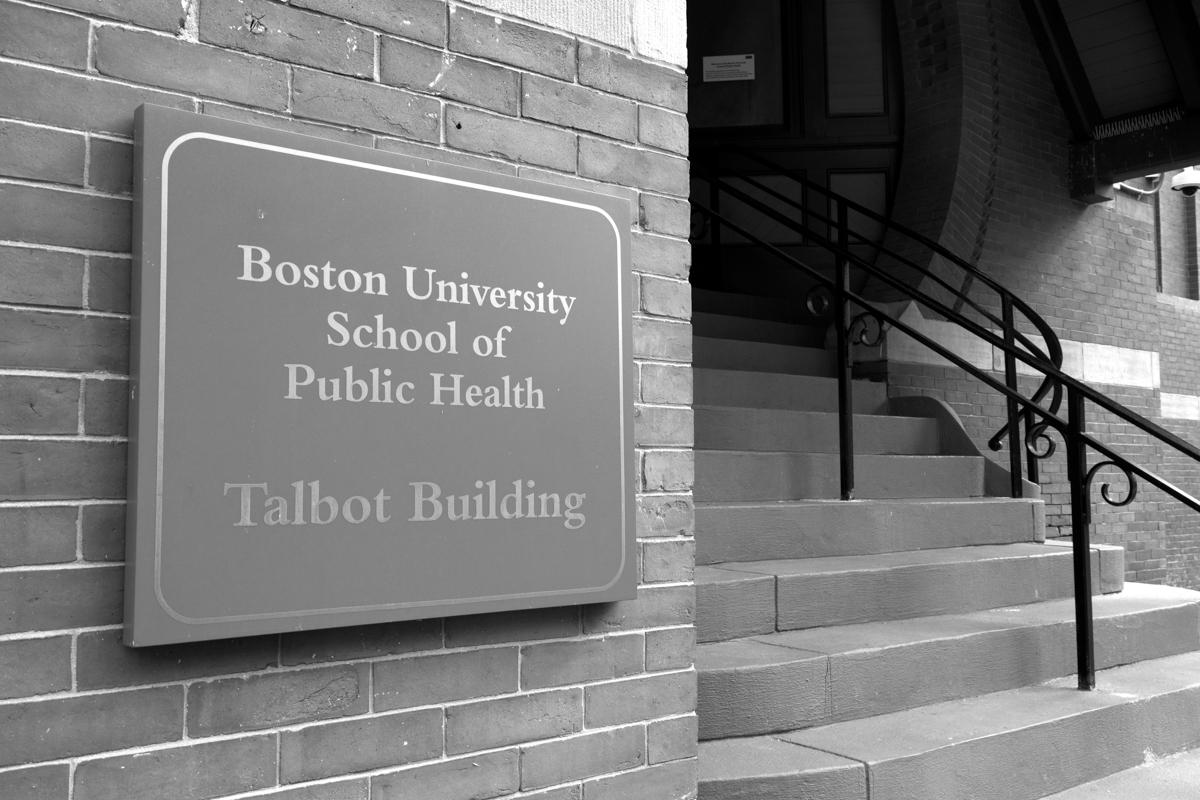
The steps of the Talbot Building at the School of Public Health. Living in a redlined area is associated with infertility, two Boston University School of Public Health studies show.
LEE DWYER | DFP PHOTOGRAPHER
Racers rush, Boston cheers for Marathon Monday
BY SUMMER LAROSE
Photo Co-Editor
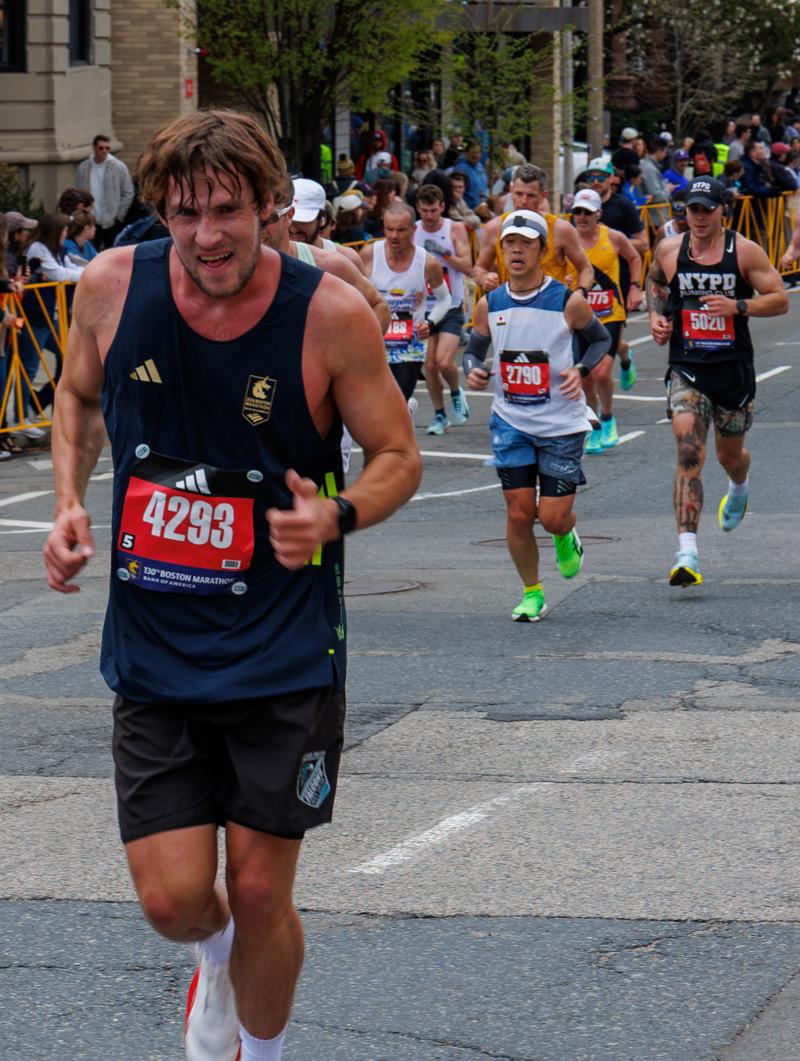
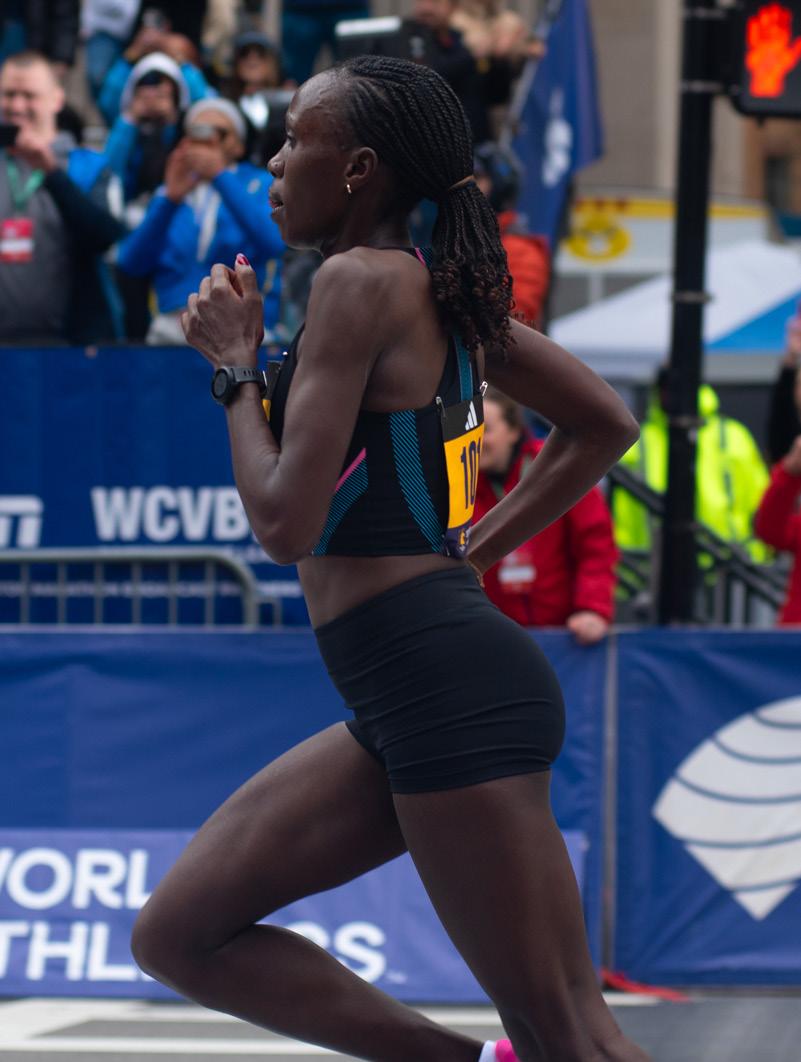
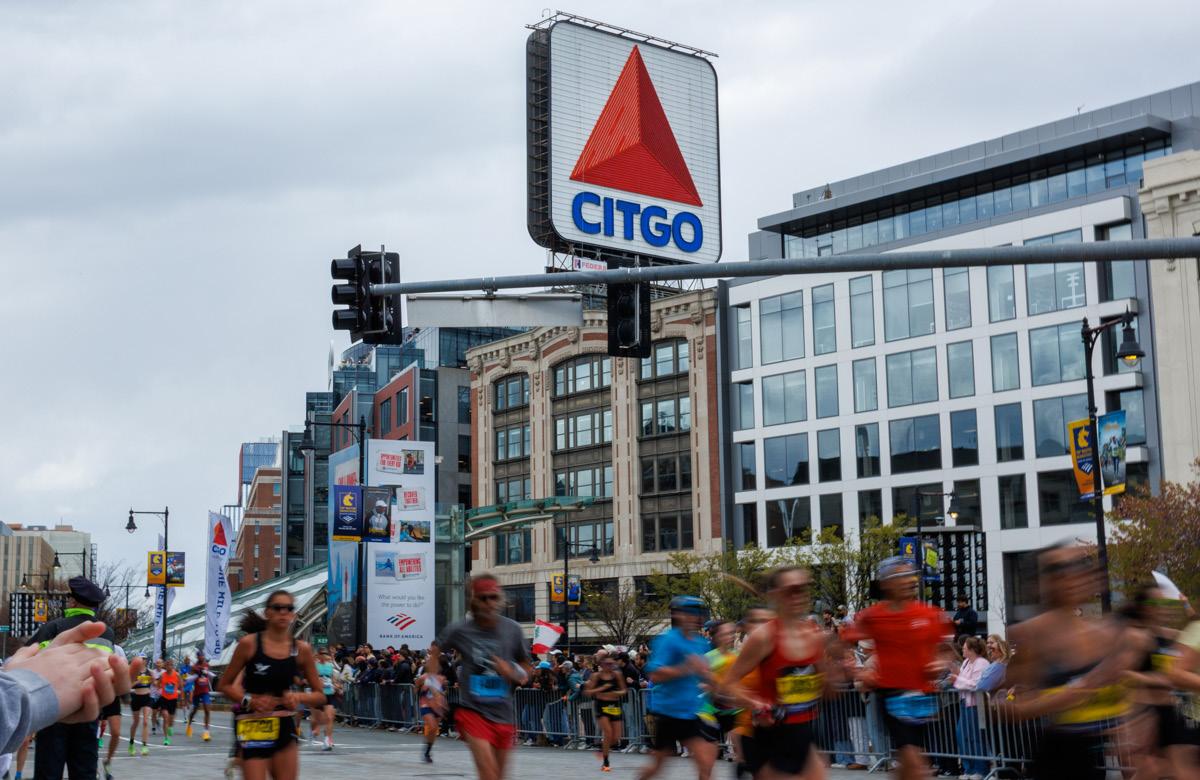
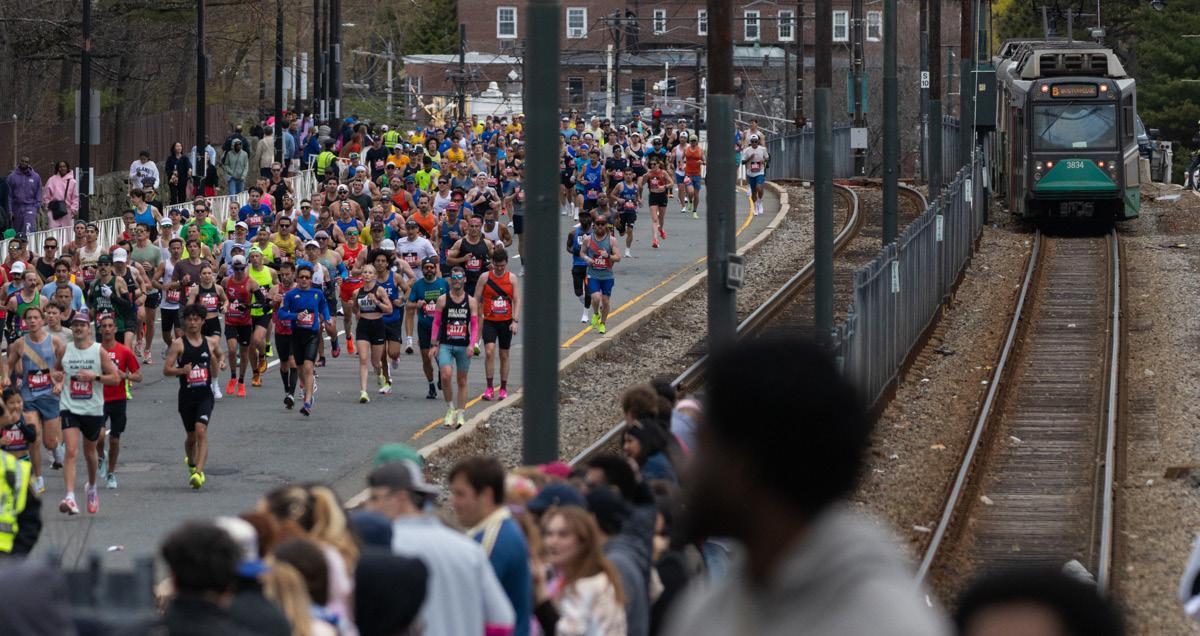
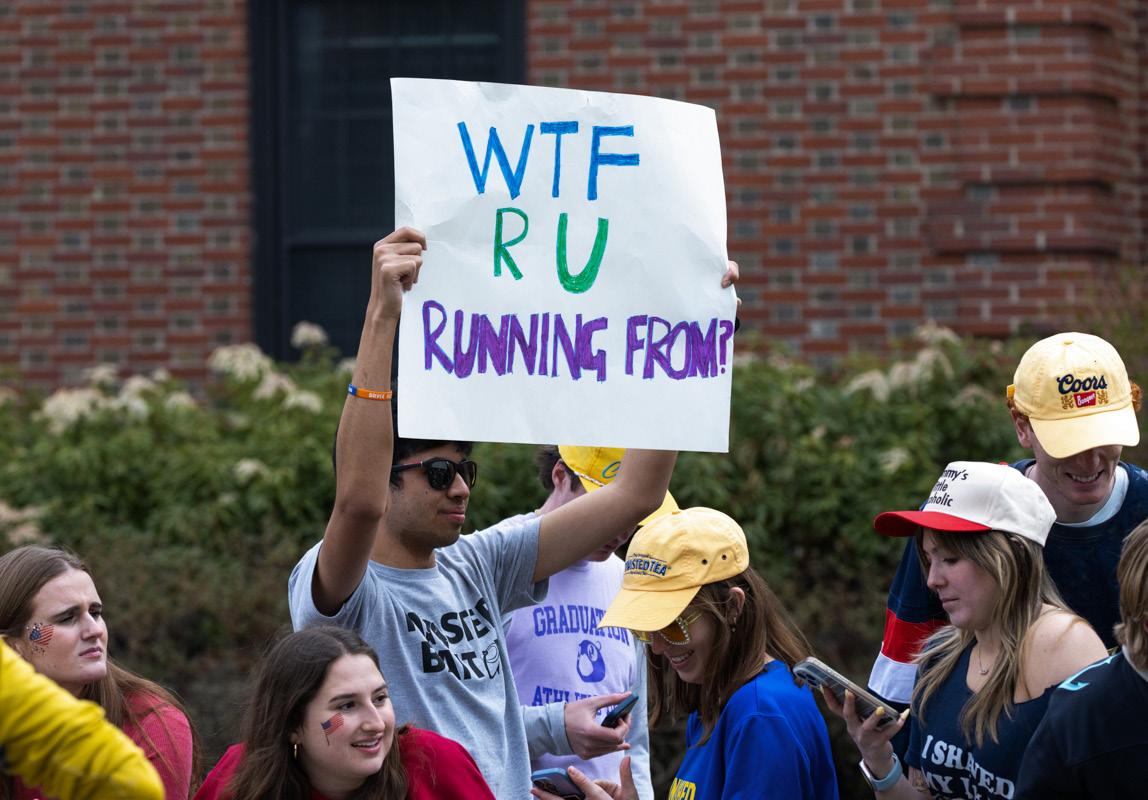
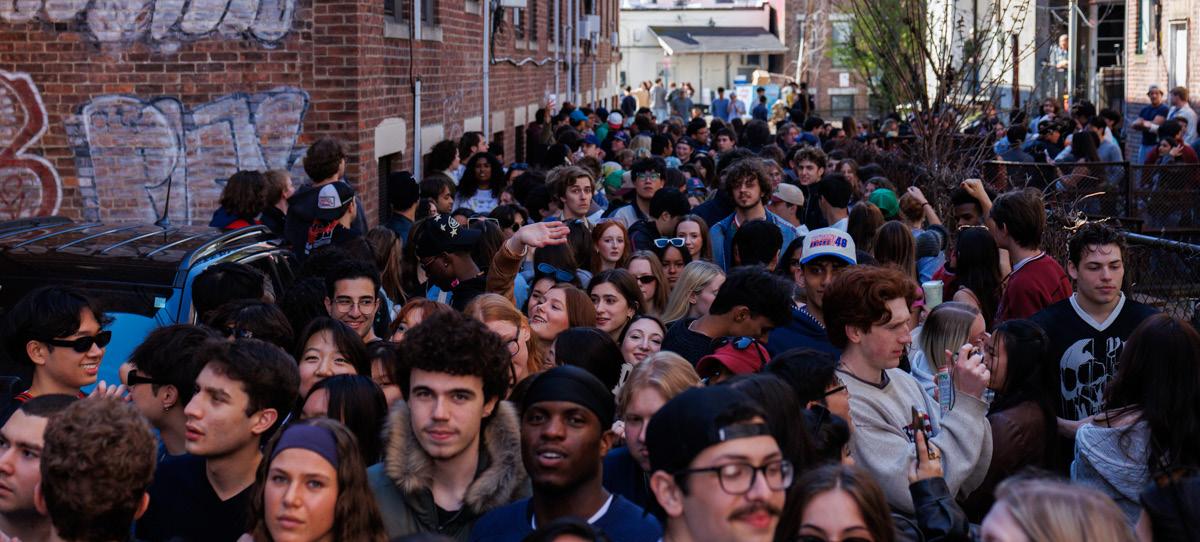
Tens of thousands of people ran in the 130th Boston Marathon on April 20. Kenyan runner John Korir won the elite men’s division, setting a time record. In the women’s division, Sharon Lokedi emerged victorious for a second consecutive win. Even more spectators filled city streets, leaning over metal barricades to holler at runners while hoisting up handwritten signs. Away from the racecourse, many celebrated “Marmon” at the One-Mile-To-Go Block Party.





DANIEL GARBER | DFP PHOTOGRAPHER
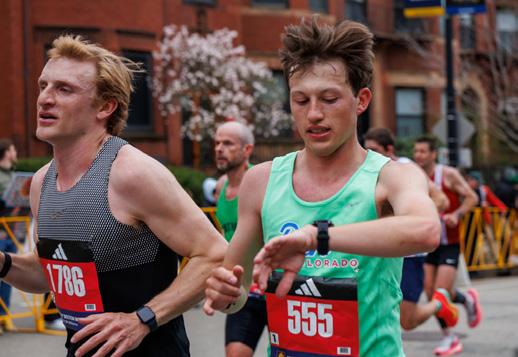
First-wave runner Thomas Flora races down Beacon Street, grimacing from the exertion.
DANIEL GARBER DFP Photographer
SUMMER LAROSE | PHOTO CO-EDITOR Women’s winner Sharon Lokedi dashes towards the finish line.
DANIEL GARBER | DFP PHOTOGRAPHER Runners pass through Kenmore Square to cheers from the crowd.
ADAM STROBEL DFP Photographer AND YOLANDA WANG DFP Photographer
SUMMER LAROSE | PHOTO CO-EDITOR
The men’s champion, John Korir, nears the finish line at a record-smashing pace.
SUMMER LAROSE | PHOTO CO-EDITOR Racer Geert Schipper looks towards the finish line.
ADAM STROBEL | DFP PHOTOGRAPHER Racers run parallel to the B-train.
ADAM STROBEL | DFP PHOTOGRAPHER Third-wave runner Kathryn McCarthy returns a scream to spectators.
ADAM STROBEL | DFP PHOTOGRAPHER A spectator near Boston College raises a poster.
YOLANDA WANG | DFP PHOTOGRAPHER A costumed spectator shouts at racers.
SUMMER LAROSE | PHOTO CO-EDITOR
A pair of marathon revellers lean in to chat with Rhett at Kenmore Square.
DANIEL GARBER | DFP PHOTOGRAPHER Party-goers congregate at an alley in Allston.
BU athletes’ academic and athletic achievements celebrated in Scarlet and White Awards ceremony
BY JANE GUAY DFP Writer
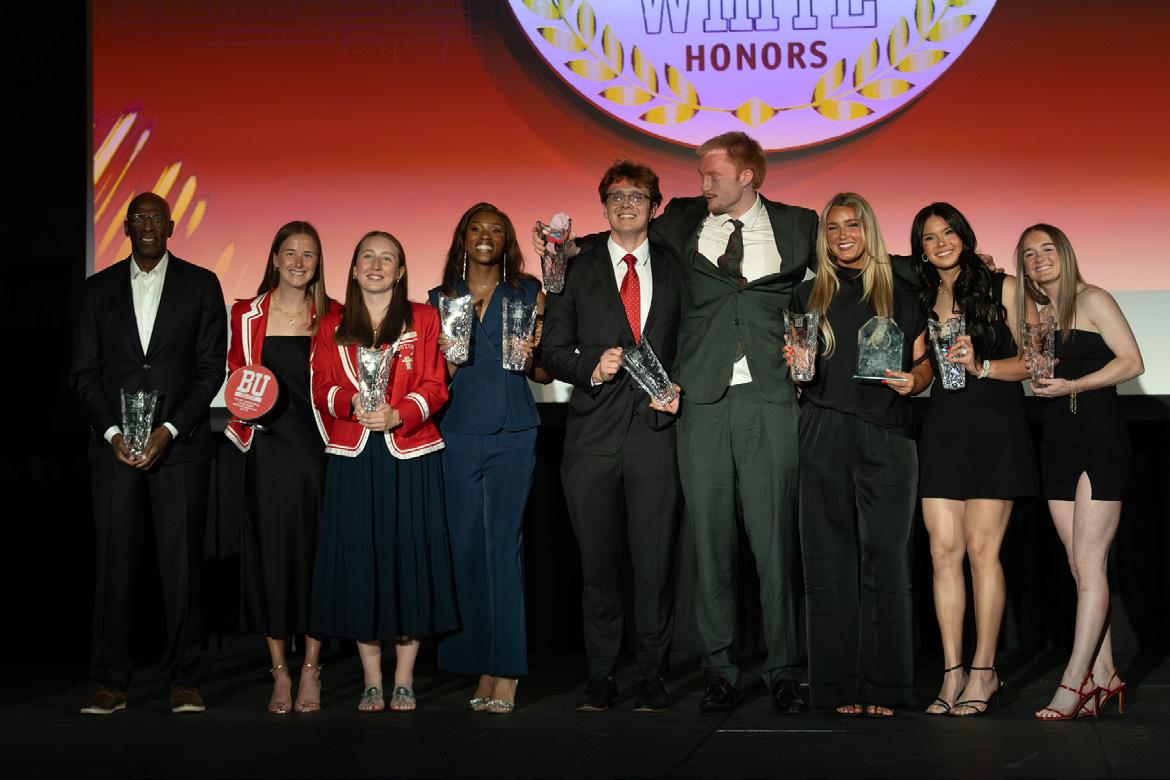
Men’s basketball’s Otto Landrum, men’s swimming & diving’s Tony Ponomarev and softball’s Kasey Ricard were among the Boston University student-athletes honored at the annual Scarlet and White Awards ceremony on Tuesday.
At the ceremony, BU studentathletes, coaches and athletic personnel gathered in the Metcalf Ballroom at the George Sherman Union to celebrate BU studentathletes’ academic and athletic accomplishments.
BU leadership, including President Melissa Gilliam and director of athletics Drew Marrochello, emphasized the importance of both individual and community accomplishments in their opening remarks.
“This night is a celebration,” Marrochello said. “It’s a celebration of great individual
achievements, it’s a celebration of great teams, and above that, it’s a celebration of us, of our community.”
The Scarlet and White Awards honor student service, scholarship, leadership, school pride and overall athleticism. 17 awards were given to various BU athletes and teams.
“Many of you reached your goals … and many of you exceeded them,” Gilliam said. “Hopefully, along the way, you had fun, you made friends, you pushed yourselves, you learned a lot and you had a lot of teamwork.”
Senior forward Otto Landrum of the men’s basketball team took home the John B. Simpson Award, presented to seniors who “have demonstrated enthusiasm and leadership,” according to BU Athletics’ website.
Landrum stepped up as both a leader and a teammate this season, despite being sidelined due to a season-long injury.
“Every joke, every laugh, every smile, every hug, that’s all real,” Landrum said. “That’s all joy. That’s all love. This school gave me more than basketball or academics. It gave me something I’ll love forever and a group of people I will love forever.”
Senior swimmer Tony Ponomarev of the men’s swimming and diving team earned the E. Ray Speare Award, given to BU’s top male scholar-athlete, honoring his academic achievements outside of his sport.
“It’s been a lot of work these last four years, and so it is really great to see it pay off.” Ponomarev said. “This season has been everything to me.”
Ponomarev currently holds a 3.73 cumulative GPA as a computer science and mathematics major in the College of Arts and Sciences.
Senior pitcher Kasey Ricard, of the BU softball team, won the Mildred Barnes Award, presented to the school’s top female athlete.
Ricard is the all-time BU and Patriot League leader in career pitching wins, with 101. She highlighted her strong senior season with two no-hitters this year.
Ricard said her biggest area of growth at BU was “learning how to deal with failure and how to bounce back quickly from it.”
“Our sport is full of failure, and you‘re going to fail a lot, and you’re going to fail when you try your hardest,” Ricard said. “Being able to bounce back the next time, quicker, more efficiently, and be able to shake off the losses and just focus on the goal ahead has been the big changer for me.”
To close out the night, senior Peace Omonzane of the women’s track and field team won both the Gretchen Schuyler Award and Woman of the Year.
Omonzane was also named Patriot League Indoor Track & Field Scholar-Athlete of the Year title for the 2026 season.
This season, she swept the long jump and triple jump gold medals at the Patriot League Indoor Championships for the third consecutive year while setting meet and personal records along the way. Omonzane, a psychology major in the College of Arts & Sciences, has won Patriot League All-Academic Team honors three times in her collegiate career.
“[I] never really took into account that the people who are having an impact on me may also consider that I was having an impact on them,” Omonzane said.
Omonzane, a transfer student, said she learned a lot about herself as an athlete in her three years at BU.
“Coming off of two school records last year, I knew what I wanted to do,” Omonzane said.
“To be given the opportunity to
do it has meant so much, and to do it with this team, to come back and to win our first Patriot League title in like 10 years … I’m really, really fortunate.”
Also presented were the StudentAthlete Choice Awards, voted on by the athletes themselves.
Junior Marcus Guidry of men’s track and field and senior Ellie Roan of women’s track and field took home the “Unsung Hero” awards.
Sophomore Thomas Cowan of men’s track and field and junior forward Ava Maguire of women’s soccer were honored as “breakout athletes.”
Freshman guard Chance Gladden of men’s basketball and freshman utility player Irys Kline were named “Rookies of the Year.”
While some of these athletes may be moving on, younger Terriers will feel the culture their leadership has left behind for many more successful seasons to come.
How the BU men’s lacrosse family rallied around one of its own in the fight against cancer
BY CHRISTIAN MARSHALL Senior Writer
On April 11, sophomore defender Zac Maggiacomo took his position on the wing for the opening faceoff of Boston University’s men’s lacrosse’s mid-season clash against Bucknell University.
As the whistle blew, Maggiacomo sprinted towards the center circle to join his teammates in the battle for possession. Once the Terriers established themselves on the offensive end, Maggiacomo promptly sprinted off the field and let his attacking teammates take his place — his job was finished.
Maggiacomo never touched the ball on the opening possession, and in the sophomore’s first start of the season, he did not record any stats. Yet, the roar from the BU sideline as Maggiacomo came off the field was just as loud as the cheers for any goal the Terriers scored in their 13-12 overtime win over the Bison.
That enthusiasm is an example of how Terriers’ lacrosse and their staff continue to support Zac and his family as his father, Brian Maggiacomo, battles against colon cancer.
At Friday’s practice before the matchup against the Bison, BU head coach Ryan Polley announced to rousing applause from his teammates that Maggiacomo would start in Saturday’s game. Polley also unveiled shirts with Brian’s initials, BM, the Terriers logo and the Blue Ribbon for colon cancer awareness across the chest — which the Terriers wore
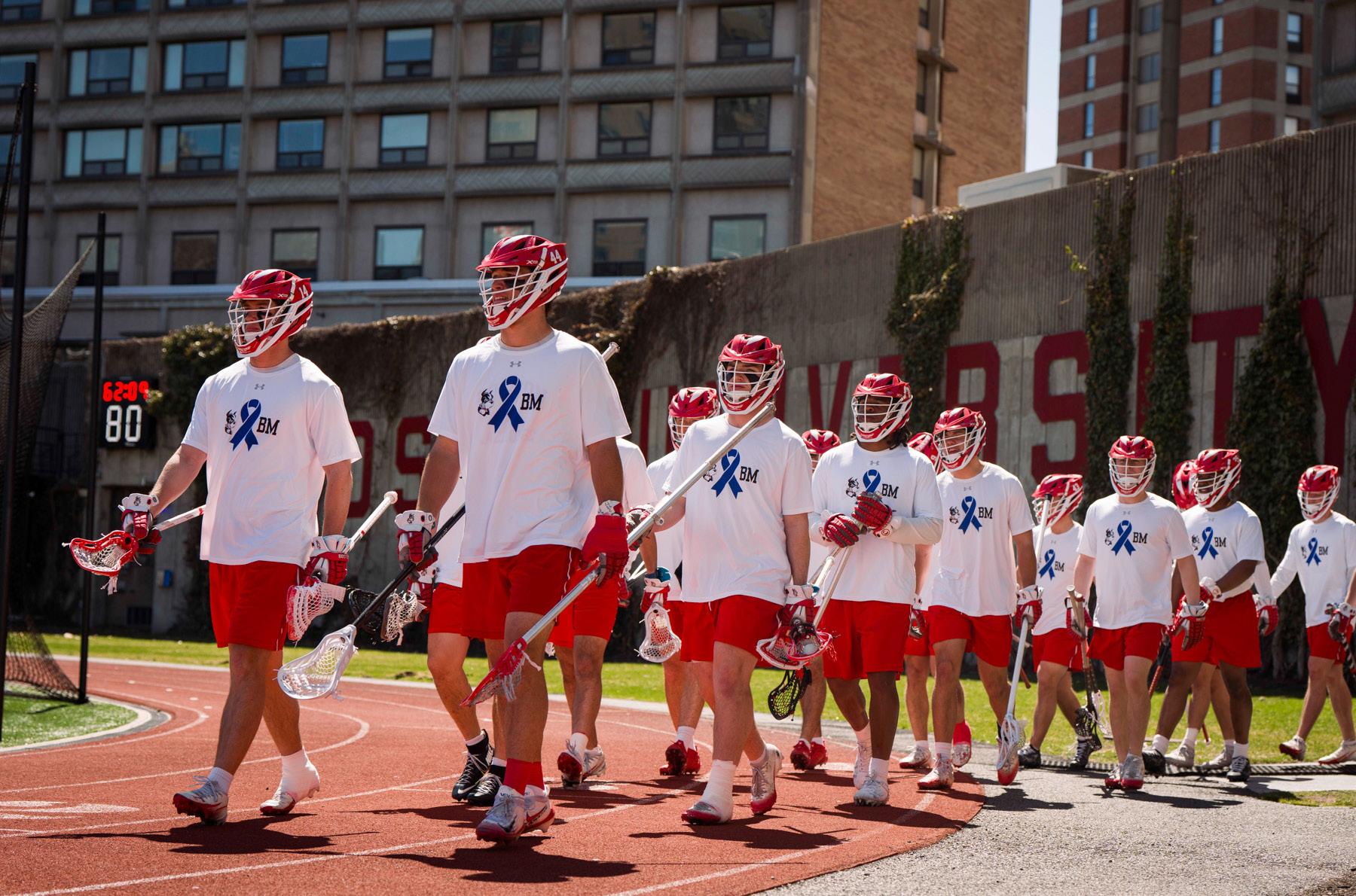
in warm-ups before Saturday’s game. BU also debuted helmet stickers with the same design, which they will wear for the rest of the season.
“When [Polley] told me I was really surprised at first, and then I was pretty pumped up to get the start,” Maggiacomo said.
“But then to know that my whole team’s behind me … [and] my dad with the shirts and the stickers, I was excited to tell him more than hear it myself.”
Maggiacomo said the team announcement was a special moment for his father, who watches every BU lacrosse game from his home in Medford, N.Y.
“He was extremely surprised, obviously a little emotional not being there, but he was really pumped too when he saw everyone wearing their shirts,” Maggiacomo said. “He didn’t realize the stickers until I told him. So he was pumped about that, too.”
Earning the start against Bucknell became a full-circle moment for Maggiacomo, who learned of his father’s diagnosis at the end of the 2024-25 season and has since found a way to balance school, lacrosse and supporting his family in New York by leaning on his lacrosse family in Boston.
“Emotionally, I balance it from talking to my teammates, talking to my coaches, talking to really anyone in the BU lacrosse
community,” he said. “Here, it’s very open … everyone’s open to talking to you and helping you and making you feel more comfortable.”
The Terriers pride themselves on their strong team culture, with “family” often referenced as one of the pillars of the program. That support in the Terrier locker room showed in the Bucknell game, where coaches and players cited the opening moment and tribute to the Maggicomo family as the catalyst for their win.
“When we won that first faceoff, and Zac was out there, and he’s sprinting off the field, guys are telling him what a great job he’s doing,” Polley said. “I think that gave us some energy … and Zac deserved that.”
“One of our main pillars is the family. So just being able to come out there and just get the win for the team and for the Maggiacomo family, it’s just so awesome,” said sophomore attack Timothy Shannehan, who scored the gamewinning goal in overtime against the Bison.
The Terriers have faced obstacles on and off the field this season, none more significant than what the Maggiacomo family is going through currently. But the sophomore doesn’t view what he and his family are fighting as simply a sad story, but rather as motivation that can put the Terriers on top.
“Instead of using it as a distraction … we see it as an encouraging thing, as something that can inspire us,” he said. “If anyone doesn’t really have a ‘why’ to play for, it gives them an extra ‘why’ to play for.”
COURTESY OF ELIZA NEUSTRO/BU ATHLETICS
The BU men’s lacrosse team walks out for warmups for their matchup against the Bucknell University Bison on April 11. The team wore t-shirts honoring Brian Maggiacomo, sophomore defender Zac Maggiacomo’s father, who is facing an ongoing battle with colon cancer during their game facing the Bison.
JENNY CHEN | PHOTO CO-EDITOR
Most of the award winners pose for a photo after the ceremony. Boston University student-athletes were honored at the annual Scarlet and White Awards on Tuesday.
JENNY CHEN | PHOTO CO-EDITOR
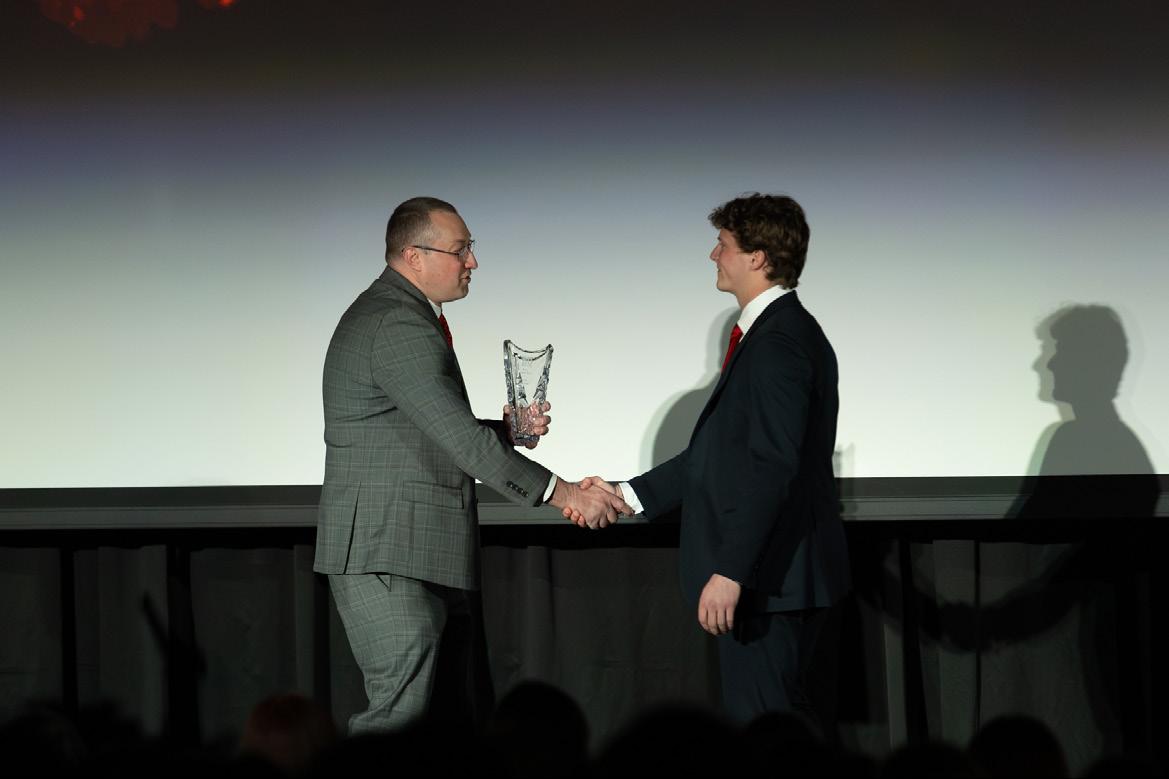
Men’s lacrosse sophomore attack Timothy Shannehan (right) shakes hands with Master of Ceremonies Brian Maurer (left) to accept the Mickey Cochrane Award, which is given to the year’s top male athlete.
Research as/is resistance | Geek Chic
COLUMN
BY ANJOLA ODUKOYA Managing Co-Editor
Somewhere between the invention of the smartphone and the widespread implementation of artificial intelligence, modern culture has convinced itself that speed is the supreme virtue, and that any unoptimized time is a waste.
Just look at the rise of the “zero-click search.” Recent data reveals nearly 60% of Google searches end without a single website click as users increasingly prefer AI overviews. In one of the earliest user experience studies conducted on Google’s AIOs, roughly 86% of participants briefly skimmed the overviews for “helpful points or recognizable sources,” spending between 30 to 45 seconds engaging with the content.
In a consumer-driven economy like the United States, conversations surrounding the zero-click search are largely focused on how this phenomenon affects marketing tactics and purchasing patterns — every company wants to meet consumers where they are.
But at what point are corporations too blinded by profits to realize that the zero-click search is eroding one of our most basic and primal instincts: curiosity?
Our contemporary relationship with speed reframes the practice of research as resistance to society’s obsession with immediacy.
Nowhere is this more visible than in fashion — an industry faced with constant pressure from
fast fashion, accelerated trend cycles, dupe culture and AI. But it’s amid these threats that creatives’ in-depth research processes bring innovation and intention to the forefront of the field.
Take Chanel’s Matthieu Blazy as an example. Blazy, who was recently named one of Time Magazine’s 100 most influential people of 2026, is a living testament to how a researched approach breathes new life into an industry whose attention, let alone praise, is almost impossible to capture.
Blazy’s transition to Chanel’s creative director — following his departure from Bottega Veneta in December 2024 — was the most anticipated debut of the season amid a sea of new creative directors taking the helm at major fashion labels.
But for those who follow fashion closely, the intrigue surrounding Blazy’s introduction was less driven by spectacle than by curiosity surrounding the extensive research and references that would underpin the garments.
Blazy’s approach to his first haute couture show for the spring/ summer 2026 season demonstrates how research can take many shapes in the creative industry.
For Blazy, the starting point of his research journey was an anonymous haiku: “Bird on a mushroom / I saw the beauty at once / Then gone, flown away.”
Oftentimes, research is grounded by a fundamental question that propels exploration. At a preview, Blazy recalled stumbling across the haiku and asking himself, “Can I tell a story with those three
lines?”
According to Vogue Runway Global Director Nicole Phelps, the Chanel team took an immersive approach to ideating the collection from there.
In her review of the show, Phelps explained, “... because birds were the organizing motif — avians of every stripe were pinned to boards in the Chanel studio — there were feathers both real and in representation.”
Blazy’s research also led him to Chanel’s archives to better understand the heart and origin of the brand. For his modern reimagination of couture, Blazy ultimately sought to “do as Coco Chanel once did” — design for the women in motion.
Three lines and a deep commitment to the research process were enough for Blazy to transform the Grand Palais into a fairy-tale land complete with pink willow trees and oversized colorful mushrooms, garnering praise for his imagination and sending the media into a frenzy.
It’s clear Blazy’s inspiration and research paid off with his first collection, but what is the result of under-researched creative work?
Recently, I was scrolling on TikTok — which, by the way, is not a reliable source for research, but I digress. I stumbled across a video posted by American musician Moses Sumney that was so simple, yet so true.
“Mira, if you’re going to write essays on Substack, might I suggest kindly, also reading. [Because] a lot of you like to be read, but you don’t read, and it shows,”
Tuition is nearly 100k.
he said, painfully straight-faced.
The comment section was full of remarks echoing the same sentiment.
“We need to bring back MLA format. Sources. Studies. Articles!” one commenter wrote.
“I downloaded substack because I wanted to understand other people’s ideas through the nuance only reading could offer. little did
Recently, we’ve been convinced that resistance needs to be visible. Between boycotts publicized across social media platforms, protests, rallies and petitions — all of which are real means for change and their effectiveness should not be undermined — we forget that defiance of new social norms can happen on the individual level.
Today, researching topics of in-

I know that half of substack [is] just rants about pop culture packaged as essays,” another commenter wrote.
Both comments received thousands of likes.
In an already competitive and oversaturated attention economy, under-researched work is nothing more than lukewarm takes added to the echo chamber that social media continues to amplify.
terest in-depth before producing content, or even for your own enjoyment, puts you in the dwindling minority as the zero-click search flattens society’s perspective. So before you look to produce, ask yourself if your foundational understanding is even strong enough to add meaningful discourse to the conversation. If not, maybe reconsider. Or just do your
Why is BU asking for more of our money on Giving Day?
EDITORIAL
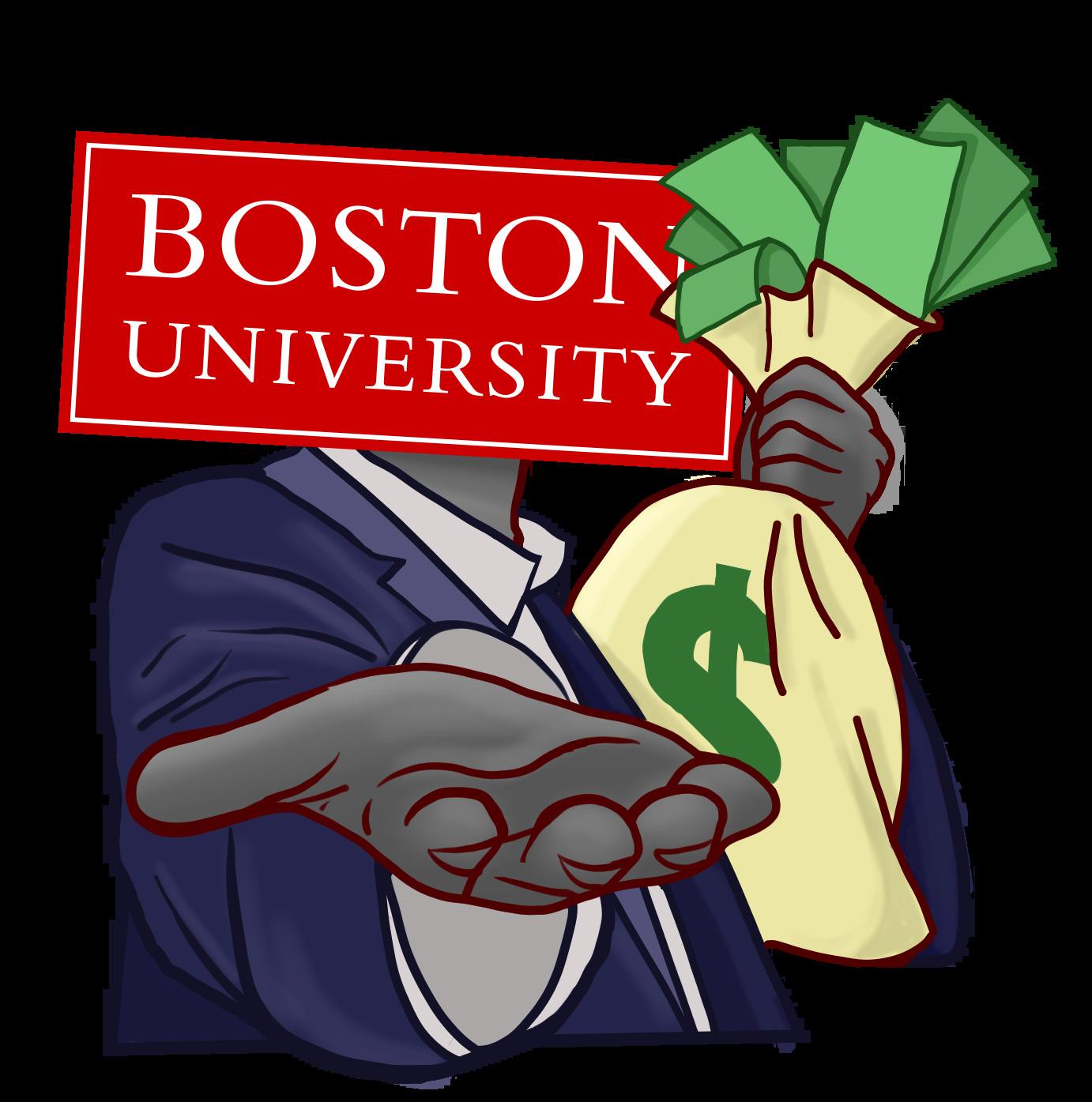
Every spring, Boston University launches its philanthropic, “Giving Day” campaign using language evoking community, encouraging students to “give back” and to “Do It for BU.” The messaging is upbeat, even celebratory, complete with hourly challenges and donor competitions designed to boost participation.
But behind the gamified generosity lies a more uncomfortable question: Why are students being asked to give more than they already are?
At a university where the cost of attendance now exceeds $98,000 per year and tuition continues to rise by roughly 4-4.5% annually, the framing of donation as communal goodwill feels disconnected from students’ lived realities. Many undergraduates are far from a position to “give” — they are still in the process of paying, often through loans that will follow them long after they graduate.
Yet we are still inundated with emails asking us to “fuel [BU’s] journey” towards becoming a global destination for human connection and education. But 49% of fulltime undergraduates applied for financial aid in 2024, 87% of that group demonstrating financial need.
“Giving back” suggests a completed exchange, something students should do in return after already receiving something of value. But for current students that exchange is ongoing and ex-
pensive. Graduating students are contacted to contribute “Class Gifts” as early as the fall semester of their senior year, with emotive emails emphasizing how they can “show off [their] generosity” with donations of just $20.26.
Asking students to donate before they have even graduated, let alone seen a return on their degree, shifts the meaning of giving from generosity to expectation.
Even as university expenses are growing faster than revenue in recent years, BU operates from a position of relative financial stability, with an endowment exceeding $4 billion and net assets exceeding $6 billion. However, endowment payouts cover only a small percentage of the operating budget, contributing 5% of the operating rev-
enue in 2025. And after the Trump administration’s cuts to federal research funding, University officials are concerned with “maintaining the quality” of its academic and research programs.
But the financial struggles of the University do little to distract from the tension students are feeling: Even if costs are rising consistently, why is fundraising directed at those already bearing the burden?
This tension becomes even more pronounced when considering how Giving Day is structured. Giving Day allows donors to direct funds toward specific student organizations, but this option exists within a system where institutional fundraising is far more visible, better resourced and more aggressively promoted, result- ing in a dynamic
where student initiatives risk being crowded out on the very day that is ostensibly about supporting them.
Even beyond Giving Day, the university’s fundraising apparatus extends year-round. Through programs like BU Telefund, students and families are contacted to contribute further.
At the same time, the University continues to promote initiatives like affordableBU, positioning itself as committed to accessibility. Yet Boston remains one of the most expensive cities in the country for students to live in. The gap between messaging and material reality is difficult to ignore.
There is also a geographic layer to this disconnect. Boston is now one of the most intensely gentrified cities in the United States, and neighborhoods surrounding the university, including Allston and Fenway, have seen rising rents and increasing displacement. As universities expand their footprint and attract student populations with greater purchasing power, long-term residents — disproportionately people of color — are pushed out.
Universities are not just educational institutions, they are powerful economic actors that fundamentally alter the cities they inhabit. When we are asked to contribute more to our schools, we must question how our contributions will fit into a system that is already extracting significantly from both students and surrounding communities. BU isn’t alone in its heavily promoted appeals for philanthropic contributions — and certainly isn’t the first to face criticism. In 2019, days before Northeastern University’s Giving Day event, satirical posters appeared across campus high-
lighting the irony of the campaign.
Yet, the broader landscape of higher education is beginning to shift in a different direction. Across Massachusetts, universities are increasingly framing access and affordability as the centerpiece of their student-facing messaging. BU’s approach, in comparison, feels increasingly out of step.
None of this is to say that giving is inherently misguided. When donations are directed toward student organizations, mutual aid efforts or scholarship funds, they can meaningfully support peers and improve campus life. But these forms of giving are arguably most effective when they are clearly separated from institutional fundraising — not folded into campaigns that risk conflating student generosity with university revenue generation.
If BU wants to foster a genuine culture of giving, it should start by addressing the conditions that make giving feel like a burden rather than a choice. That means confronting rising tuition, increasing transparency around financial priorities and reconsidering how and when students are asked to contribute.
Until then, the question remains: Is Giving Day about building community, or about asking those already paying the price to give even more?
This editorial was written by Opinion Co-Editor Sameeha Sood.
GIANNA HORCHER | Graphics Co-Editor
HAEIN SHON | Senior Graphics Member

EDITORIAL BOARD
THE INDEPENDENT STUDENT NEWSPAPER AT BOSTON UNIVERSITY
YEAR LVI. VOLUME B. ISSUE IV.
Published Friday, April 24, 2026.
The Daily Free Press is published Sunday through Thursday during the academic year, except during vacation and exam periods, by Back Bay Publishing Co., Inc., a nonprofit corporation operated by Boston University students. Copyright © 2026 Back Bay Publishing Co., Inc. All rights reserved.
Truman Dickerson, Editor-in-Chief
Liam Dunne, Managing Co-Editor
Anjola Odukoya, Managing Co-Editor
Emma Clement, Campus Co-Editor
Jack Schwed, Campus Co-Editor
Elizabeth Mehler, City Co-Editor
Isabelle Zhang, City Co-Editor
Nicole Abrams, Investigative Editor
Toby Moses, Sports Co-Editor
Ethan Pott, Sports Co-Editor
Sophie Shatzky, Arts & Community Editor
Brian Chan, Business & Science Editor
Sameeha Sood, Opinion Co-Editor
Velana Valdez, Opinion Co-Editor
Erica Schwartz, Lifestyle Editor
Jenny Chen, Photo Co-Editor
Summer LaRose, Photo Co-Editor
Emma Jee, Master of Games
Bri Thel, Multimedia Editor
Angelina Pires, Podcast Editor
Andrew Weindling, Video Editor
Elaine Liu, Layout Co-Editor
Anna Peelen, Layout Co-Editor
Gianna Horcher, Graphics Co-Editor
Melissa Lemieux, Graphics Co-Editor

ACROSS
1. “Japanese __,” Daniel Caesar song
6. Geneva, to a German
10. Egyption goddess
14. Quickly
15. Love, in Spanish
16. Superman’s alter ego
17. “Working __,” many a post-grad
19. Spanish girl
20. Summer coolers, briefly
21. Boat
22. Stereotypical University of Vermont student
24. Many a Greek initiation
25. “April __ bring May flowers”
26. First Amendment protection
29. Celestial streaker
30. Polishes, on a floor
31. Coke’s counterpart
32. Continually repeating
36. MarMon participant exclamation
37. An E.T., colloquially
38. “__ stage left,” swift departure
39. Baby’s first word, perhaps
40. Skateboarding shoes brand
41. Youtube: Shorts, Instagram: __
42. Lea Michele musical
44. Repaired
45. Postgrad degree
48. Fuse
49. Marie-Philip Poulin and Hong Chau to BU
50. Nothing
51. Intl. commerce group
54. Overimbibe
55. May, for Class of 2026
58. Afterward
59. Brontë main character
60. Army ROTC weapon
61. Location of Questrom, on BU’s campus
62. Lock up tight
63. Press-on accessories
DOWN
1. Nurse in “The Pitt”
2. 750 Commonwealth Avenue, for short
3. Grannies
4. Road hazard
5. Standards of measurements
6. Blunder
7. Transmit
8. Thanksgiving Recess mo.
9. Upcoming Class of 2030 member
10. Phoebe Bridgers’ song, what one might say afterm 55-Across
11. Paris river
12. Toward the center
13. Dallas NHL team
18. Swear
23. Part of a foot
24. Patriots Day event, for one 25. Shoe bottoms
26. __ and dive, NCAA sport
27. Prefix of “natural” or “legal”
28. Semester final
29. Loonies, e.g.
31. Registration subject
33. Fired
34. Annoy
35. Vet affliction
37. Medians, or means
41. Study again
43. Rooster’s mate
44. Remote button
45. Non-reflective makeup choice
46. Hello, in Hawaii
47. 16-Across’ hero nickname
48. Runway staple
50. Japanese deer locale
51. Eduroam, for a BU student
52. I-90 charge
53. Singles
56. Bread type
57. Aunt, in Spanish
The Rory Gilmore paradox
COLUMN
BY PRADIVYA LAKSHMI MALMARUKESAN DFP Columnist
This is for all of you who, like me, once believed that life could be perfectly organized into todo lists and five-year plans. For those who felt peace in knowing exactly where you were headed, only to devolve into a quiet panic when things didn’t go according to your agenda. This is for the ones who were so invested in building a future to be proud of that you sometimes forgot to fully enjoy the present.
Rory Gilmore, from “Gilmore Girls,” is the archetype of the “gifted kid.” She’s smart, hardworking and attends prep school before graduating from Yale. When we first meet her, she dreams of becoming a journalist like Christiane Amanpour.
Early Rory is a role model for so many of us. She’s on our Pinterest boards and our vision boards — I even had her famous quote, “Who cares if I’m pretty if I fail my finals?” pinned on my wall.
I was in second grade when I decided I wanted to move out of India for college. Most of middle school and high school was a mosaic of grades, music practice,
competitions and extracurriculars — a mosaic that, in hindsight, feels blurrier than I would’ve liked.
I didn’t go to a school that sent many students abroad, so I had to juggle all the extra work I needed to do to achieve this goal while my peers seemed to be having fun.
I don’t regret the work I put in.
In fact, I’m grateful for everything that got me where I am. But looking back, I can’t remember a time when I wasn’t thinking about what came next. I can’t remember doing something without it somehow connecting to my “future plans.”
Have you ever wondered why we put ourselves through all this stress? I mean, we tell ourselves it’s all about putting in the hard work now so we can enjoy the rewards later. But honestly, it’s kind of a never-ending cycle, right?
In high school, we’re all about getting into college. Then in college, it’s about landing a job. And once we get that job, what’s next? Retirement? It makes you think — when does it all pause? Do we ever just stop to enjoy the ride?
Sometimes, stopping to smell the roses might feel like you’re doing something wrong. And taking a day off to relax might feel like you’re betraying yourself. Since when did productivity
become a currency we’re expected to pay with? Why should I feel guilty for wanting to take a long nap in the afternoon, or for choosing to watch a movie instead of checking off another item on my to-do list?
This mindset of measuring self-worth by how much progress we make can be both tiring and relentless. Rory’s character arc over the course of the show explains this perfectly. When a Media Giant tells her that she doesn’t have what it takes to become a journalist, it takes her months to find her footing again. This is a story that resonates with many of us who grew up driven by achievement, because even minor setbacks can feel catastrophic if we haven’t learned how to bounce back.
Every time I faced a setback, like getting rejected from a job or not earning the grade I expected, I would retreat into bed for a day, overwhelmed by disappointment. Coming to college, the pressure only mounted. Between internships, clubs, networking and maintaining a strong GPA, there’s barely room to breathe.
But over time, I’ve started to realize that in trying to do everything perfectly for the future, we often miss out on the present. Living in the now doesn’t have to
be anything grand. Little things like watching a sunset, taking a walk down Commonwealth Avenue, feeling the snow on your face or catching up with friends can make all the difference. One of my professors said something that stuck with me: “Life is very long, you might not end up where you planned to in the first place.”
Circumstances shift faster than spring changes into summer. How can we expect our plans to remain
the same when their environment is constantly changing? All we can believe in is that if something is meant for you, you’ll find it. That’s the lens that I’ve started using to look at life. It helps me take setbacks less seriously and allows me to focus more on the present.
Rory Gilmore reminds us that ambition is a gift. But when it becomes our only lens, the little things that life has to offer can go unnoticed.

BU’s operating finances continue downward trend, faculty and staff express doubt over administration’s actions
BY KARYNA CHEUNG Senior Writer
AAYUSHI DATTA
DFP Writer
email to CAS faculty and staff that the College would reduce its budget by $7,645,000, which constituted 5% of its annual budget.
ELLEN DONG
DFP Writer
GRACE WHINNERY
Associate City Editor AND ALEXIA NASTASIA
DFP Writer
Continued from page 1
“There’s a whole series of things that have had serious implications from policy changes made at the federal level that have required institutions to make significant changes on the expense side that they’ve never had to do before,” he said.
The May 2025 Daily Free Press report also revealed that high-level BU officials, including President Melissa Gilliam and Chief Financial Officer Nicole Tirella, were aware of the “unsustainable” financial situation, citing declining graduate enrollment, the graduate workers’ union contract, and postCOVID inflation as factors, among others.
This year, The Daily Free Press spoke to several faculty and staff members about budget cuts impacting their departments, colleges and overall ability to work and educate. They expressed concern about a lack of transparency surrounding what the University was spending its money on, and a lack of communication on how to implement the changes demanded of them.
July 2025
In a July 7, 2025 letter the University announced that it would implement an average 5% budget reduction across all units for fiscal year 2026. They also announced they would be eliminating about 120 staff positions and about 120 vacancies, and changing the schedule of around 20 positions.
On July 15, 2025, Stan Sclaroff, dean of the College of Arts and Sciences, and Juliana Walsh Kaiser, senior associate dean of Finance and Administration, wrote in an
Each unit in the College was given a target amount to reduce its operating budget in the 2026 fiscal year, which were to be made on a “recurring basis,” according to the email.
of the BU American Association of University Professors and an American Studies professor, said many humanities programs have not admitted PhD students for the last two years, including her own.
Popular leftist politics are here. Democrats will do anything to
There were reductions to teaching costs, faculty research accounts, operating budgets and faculty and staff personnel costs, according to the email.
October
2025
In an Oct. 9, 2025 letter, the University announced a $30 million shortfall due to low graduate enrollment and missed revenue targets. BU’s administration said it would ask select areas of the University to identify savings to reach the $30 million target by November 14.
BU spokesperson Rachel Lapal Cavallario wrote in a statement to The Daily Free Press that administrators communicate the University’s financial condition and budget through Faculty Assembly, Town Hall meetings, communitywide memos and meetings with senior leadership in academic and administrative units.
November 2025
In November 2025, BU cut PhD admissions for a second year in a row. The Daily Free Press previously reported the University’s cancellation of 14 Graduate School of Arts and Sciences, or GRS, programs in multiple humanities and social science departments for the current academic year and reported on six program cancellations for the upcoming 2026-27 academic year. Admissions were reduced in other programs both years.
GRS administrators and a University spokesperson previously noted that the cuts came as a result of funding shortages, as well as the BU graduate workers’ contract and wage increase. The contract guarantees graduate student workers full funding and stipend support for five years, adding financial strain to the college.
Mary Battenfeld, co-president
“There are really deep, serious cuts that are eviscerating, in particular, the humanities,” Battenfeld said. “I am worried there is not going to be an American Studies program. That is the direction BU is going, using financial crisis as the reason.”
In November, the College of General Studies Dean Natalie McKnight informed the College’s faculty that only a limited number of professors will be able to join their student cohort in London this upcoming summer semester due to financial cuts from the University, according to a report by The Daily Free Press.
The two-year program, which involves a gap semester freshman fall, a spring semester on-campus and an abroad semester in the summer, will now feature 10 less professors for the summer term. These faculty members will instead be replaced by one London adjunct professor.
CGS master lecturer Scott Marr said he was “disturbed” by the program’s changes, and several current and former CGS students mentioned that the loss of this faculty in the summer will seriously harm the close student-professor relationships the program was able to foster.
End of 2025
Late last year, a former IT administrator at BU was informed that they were being laid off due to apparent “budgetary shortfalls.”
The administrator, who asked to remain anonymous because of possible future job opportunities at the University, said even before their own layoff, their work responsibilities were expanding in order to manage their department’s growing financial constraints.
“I was receiving more responsibilities every couple of weeks,” the administrator said. “When I was there, everybody was overworked.”
While there were several rounds of changes and layoffs that happened before their own, the
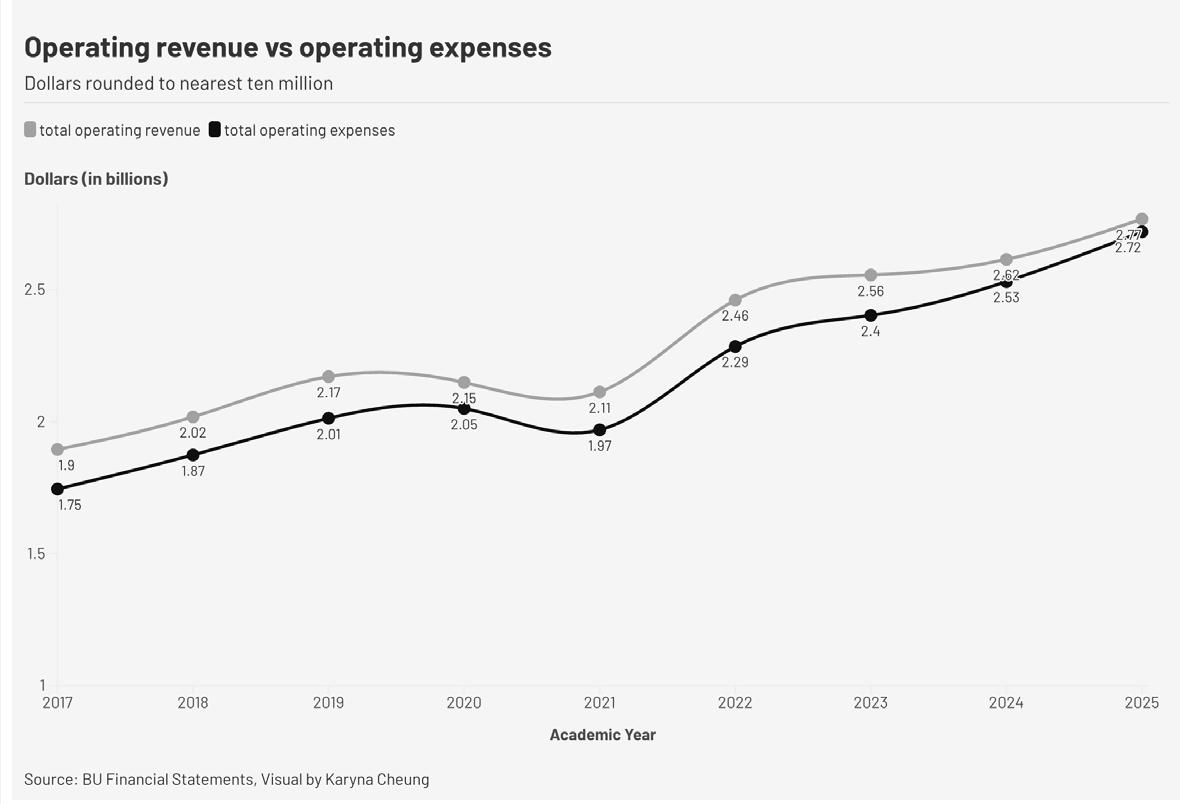
administrator said there was very little communication as to how these changes were actually helping BU out of its financial struggles.
“It seemed like the restructuring that was going on was not strategic,” the administrator said. “It was reactive.”
March - April 2026
In an April 2 Q&A with BU Today, BU Chief Financial Officer Nicole Tirella explained that the institution was in a position of financial strength, but that it faces mounting structural pressures that threaten its long-term stability and require operational change.
This created an apparent need to overhaul the University’s financial planning systems, Tirella said.
J. Keith Vincent, an associate professor of Japanese and Comparative Literature, said his department is also feeling the effects of the administration’s budget cuts.
“I feel like universities are under attack right now, and this is the result that we’re seeing,” Vincent said.
In a meeting with CAS Associate Dean Joseph Bizup on March 25, Vincent said he was informed that the World Languages Department would face a lack of course releases next year as a result of current budget constraints.
There are 10 coordinators in the department. Ordinarily, each of them would be allowed to teach one less class. Now, only one course release will be given to a singular coordinator, which will be decided
between department faculty based on necessity.
“Having that course release was something that made it possible for them to do their jobs effectively without too much personal sacrifice,” Vincent said. “It was hard to see that go.”
Vincent said much of the information he’s received regarding the institution’s budgeting constraints comes from either the dean of CAS or from the University’s intra-campus communications.
“They’re not really speaking our language when they are using language that, to me, just sounds like it came right off a slide deck of a consulting company and doesn’t do a lot in terms of actually giving us the fuller picture of what’s happening with the budget,” Vincent said.
Battenfeld said BU’s AAUP chapter and other campus groups are fundraising to conduct an independent audit of the University’s finances. BU’s AAUP chapter wants the University to establish a faculty-inclusive budget committee to address the lack of transparency from administration, she said.
“They’re basing their policies on these outside consultants that they paid a lot of money to, not conversation among our students, faculty and staff, who should be the ones determining our future,” Battenfeld said.
Raahi Mehta contributed to the reporting of this article.
JODI TANG | Senior Graphic Artist
Gilliam talks signage policy, affordability, inclusivity
DFP: You’re appointed by a Board of Trustees. Many students do not understand their responsibilities. Could you speak to how you appease or collaborate with both students and the trustees? How do you reconcile the two perspectives between what trustees say are important goals and what students say?
Gilliam: You’re assuming that those two things are in conflict. The board’s primary job is to hire the president, but many board members actually sit on our college-level advisory committees. Many of them are BU alumni, and they get up every day to volunteer their time to make this University a better place. Many students present to our board. In the most recent meeting, we focused on what is meant by student success, about our graduation rates and efforts to streamline advising. It’s quite a virtuous cycle of considering student perspectives — what they want, what they need, where they want to go — and how we transmit that to the board. For the “You Are Why” campaign, in hearing our challenges around graduate education, our board
allocated $6 million to create these endowed fellowships for graduate students. If you want to think about who is championing us globally and serving as ambassadors, that is what our board does. The BU administration does this daily, too. I don’t find conflict in this alignment at all.
DFP: Black student enrollment at BU decreased from 9% to 3% after the Supreme Court overturned affirmative action in 2023. The latest data is from the BU class of 2028. We have spoken to Black students who said they feel isolated on campus. What are you doing to provide a sense of community to these students?
Gilliam: We should check the numbers again. I don’t know if those were those two years in a row. The first thing we’ve done as a University is collaborate with our human resources, DEI offices, EOO offices and others that deal with the issue of people. This has taken us a while to restructure. We’re almost there, but we’ll have a new position, which will be the chief of people, belonging and culture. We’ve been spending time visiting these different centers, as well as the Howard Thurman Center.
I’ve also spoken with the African American and Black Diaspora Studies department. Their vision is to become a hub for our Black students. I realized they needed tables and gathering spaces. What I also saw is a place where our alumni of color are coming together, so we’re working on supporting it. The department resides in CAS, but because it’s such a central place, we’re working on supporting and remodeling to provide the resources they need. The last piece I’ll say, is really using our new orientation and this idea of instead of orienting students over the summer, but orienting everybody at once, and using that as a time to start to build community has also been an important way. I want to be completely honest: creating an inclusive culture at this highly polarized time in this country is challenging. I will not claim that we have it right, and I will not say that intentions always result in where we want to be, but it is incredibly important to us as a community, and it is essential. It is a work in progress, and we’re going to have to keep working on it.
DFP: Harvard, MIT, Tufts and
Brandeis are all private universities in our area that have ended tuition for students whose families earn less than $200,000. Is this a policy BU is considering?
Gilliam: We’ve now looked at a number of models, and this year, we introduced, for the incoming class, something called the “BU Promise.” It’s a simplified payment scheme with the full cost of attendance for families below a certain income, and at each level, it shows what a family will have to pay. Know that we’ve introduced similar programs. We’re different than those schools. We don’t have the endowment that they do, but we definitely have their same commitment to students. You’ll see this program, and I think you’ll get a sense of our direction.
DFP: With big investments like the CDS building and the emphasis on being a renowned research institution, how do you balance these big, seemingly STEM-focused investments with arts and humanities at BU?
Gilliam: CDS is everyone’s building. Have you seen how everyone uses it? So we have to consider these spaces as open and
common, but I think this is the time to talk about both the arts and humanities. In this advent of AI this is the time for a renaissance in humanities and the arts. We’ve launched an arts initiative and a new Office for the Arts. The dean of the College of Fine Arts is serving as the interim head, but we now have an Arts Advisory Committee. This is a group of international leaders in the arts who are saying, ‘How can BU really distinguish itself in the arts?’ It’s a ‘yes and’ when we talk about convergence. When people talk about issues of trust — whether it’s trust in science or trust in higher education — these things emerge because people do not feel seen, considered or treated with dignity. That’s where the humanities and empathy for others takes the stage. So the idea is that these aren’t in tension. They actually need to come closer together, which is why, you know, convergence becomes such a great metaphor or concept for how we can think about this University, its opportunities and the importance of interdisciplinarity I actually think being able to hold things in tension and still find resolution is the opportunity.
Letter from the Editor: Pedaling toward truth
BY TRUMAN DICKERSON Editor-in-Chief
Our reporting this semester has, on several occasions, led to real, on the ground change at Boston University. I could not be prouder of this fact.
We have, without fear or favor, reported tirelessly on a number of topics unsavory to BU’s administration. Examples include our pride flag coverage, our coverage of the COM dean’s connection to Jeffrey Epstein and our coverage of President Gilliam falsely claiming she attended a podcast about the Black experience at BU.
We did not report, write, edit and fact check these articles to cheaply demean the administration. On the contrary, we published them to inform students, and to push BU to become a better version of itself. Just like President Gilliam, I too want BU to succeed.
So yes, when a pride flag was raised above the Howard Thurman Center one day after President Gilliam announced a pause in the enforcement of BU’s signage policy — a story we’d been fleshing out for weeks — I was proud.
I was proud, most of all though, of the reporters and editors who stuck by the story for almost two months, consistently getting scoops before The Boston Globe, the New York Times and The Daily Mail. Their hard work forced powerful people at BU to have difficult conversations and ultimately
change, at least temporarily, a longstanding University policy. This is the true, noble goal of journalistic work, and at BU, The Daily Free Press is the only institution capable of doing it.
BU Today, for example, will never tell you about a former COM professor suing the University for $5 million. They’ll never tell you about protests on campus, or about English language services on campus quietly closing their doors.
It is only the FreeP, whose editors quietly type away in a dingy basement beneath Insomnia Cookies, that gets these scoops. And this semester, we have been especially successful in reaching students with our reporting.
Our Instagram account gained approximately 3,000 followers over the past four months, with over six million people viewing our page. In a changing media landscape, we are effectively adapting to reach students where they are.
Of course, though, none of this could have been possible without the dedication of the FreeP’s staff, all of whom are talented and bright beyond measure.
Anjola Odukoya and Liam Dunne, the two managing coeditors, stood by my side through every hard decision and late night.
Anjola, who is uniquely blessed with a gifted eye for style, was consistently a powerful, poised voice in the newsroom. And Liam, who can tell a joke like few others, edited quickly and could always be counted on to break the ice in tense
moments.
The campus co-editors, Jack Schwed and Emma Clement, were tireless in their pursuit of the truth. Many times this semester, the two of them skipped class to cover stories or interview sources. Without fail, I could rely on them for everything, whether it was staying late in the office to finalize a tricky story or running out to cover breaking news in the middle of the night.
The city co-editors, Isabelle Zhang and Elizabeth Mehler, were spectacular in quickly covering spot news, including a stabbing on Northeastern University and a shooting in Allston. Sophie Shatzky, the arts and community editor, consistently delivered highly read and relentlessly interesting stories, like a great one about “looksmaxxing” culture at BU.
Brian Chan, the business and science editor, was an ace at translating scientific jargon into words that someone much less cultivated, like me, can understand.
Ethan Pott and Toby Moses, the sports co-editors, outdid themselves in getting reporters to cover almost every game on campus, in addition to pumping out well-written features on athletes and coaches.
Bri Thel, the multimedia editor, expertly and efficiently turned 600 word articles into digestible Instagram posts. Andrew Weindling, the video editor, pioneered the video section, drawing on his expertise from watching hundreds of hours of reels on his own time
Jenny Chen and Summer LaRose,
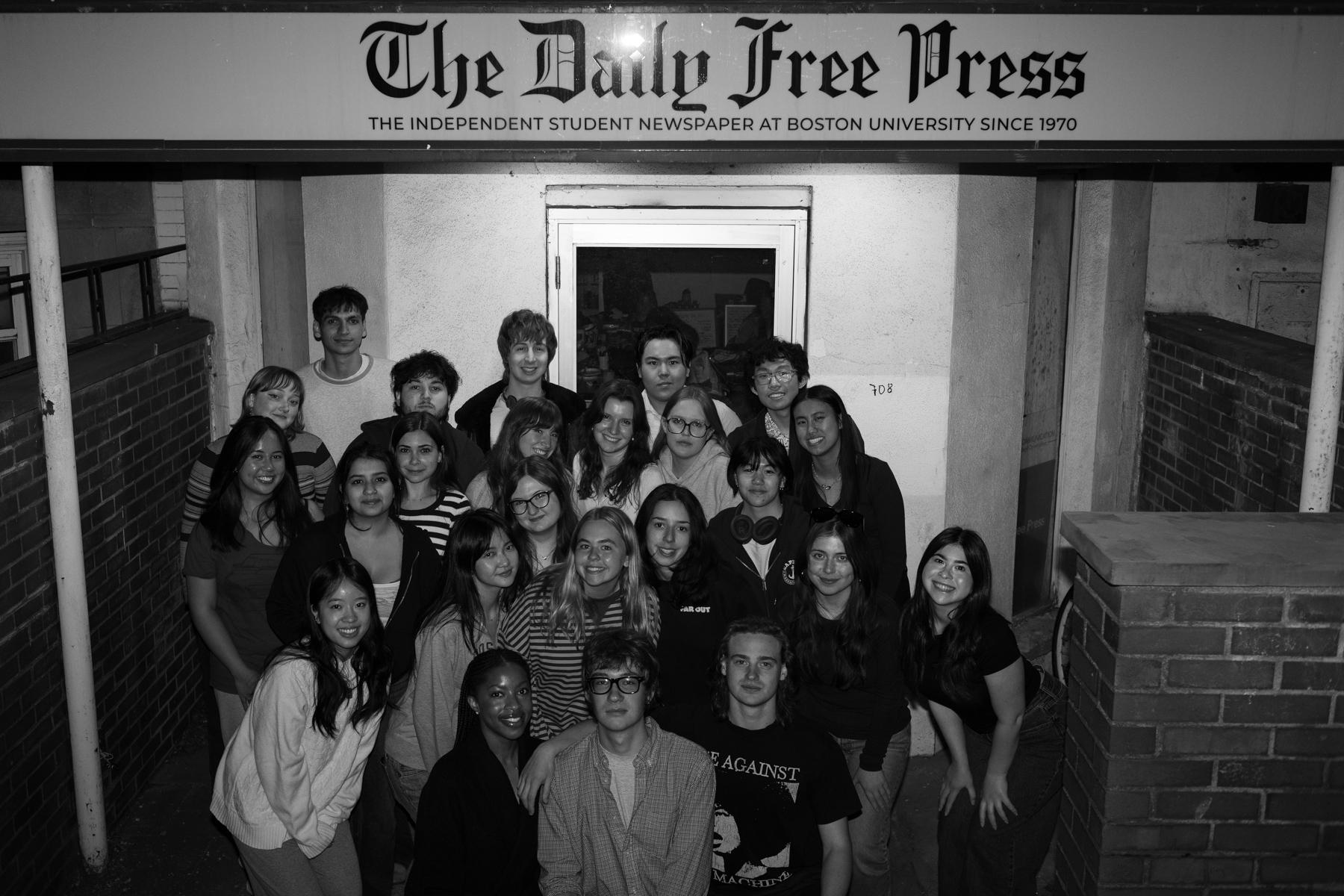
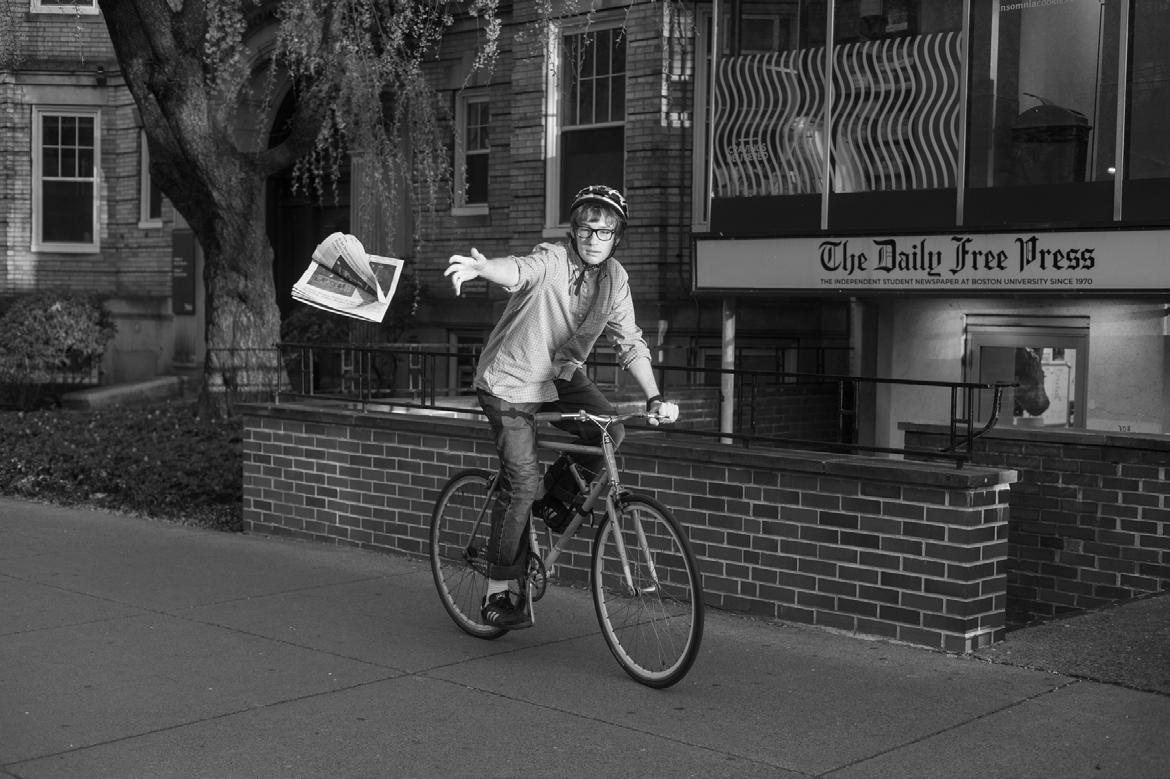
the photo co-editors, were staples in the office. Jenny is an absolute veteran of the FreeP, and worked far outside her role to help people in other sections. Summer is really a comedian at heart, and a tiger with the camera.
Sameeha Sood and Velana Valdez, the opinion co-editors, always delivered blistering editorials and illuminative opinion pieces. Erica Schwartz, the lifestyle editor, brought some much-needed brevity to readers with humorous, insightful articles.
Nicole Abrams, the investigative editor, turned in highly researched and expository pieces that addressed essential questions about BU.
Anna Peelen and Elaine Liu, the layout co-editors, produced brilliant print editions that mixed essential information with eye-popping color schemes. Melissa Lemieux and Gianna Horcher, the graphics co-editors, are both gifted artists
who expertly used their talents to express complex ideas in colorful illustrations.
And me? Well, I simply kept the ship sailing. Working at The Boston Globe for six months as an expressdesk reporter helped, and I tried to bring skills I learned there to the FreeP.
And now, as I prepare to graduate, I take comfort in knowing that the FreeP is in very safe hands, with Emma as EIC and Jack and Toby as managing co-editors. I hope — I know — that they will take on the job with the same ruthlessly incisive spirit that I had.
To many more stories, much more uncovering, and the same devotion to truth.
Yours,
SIENA GLEASON | ASSOCIATE PHOTO EDITOR
The Daily Free Press Spring 2026 Editorial Board.
JENNY CHEN | PHOTO CO-EDITOR Spring 2026 editor-in-chief, Truman Dickerson.
1. Anjola Odukoya
Truman Dickerson
Liam Dunne
Melissa Lemieux
Not pictured: Erica Schwartz