

Long Beach current
1250 Bellflower Blvd., LA4-203
Long Beach, CA, 90804
Editorial Office
Phone (562) 985-8000
Dante Estrada
Multimedia Managing Editor multimedia@lbcurrent.com
Grace Lawson
Community Engagement Editor community@lbcurrent.com
News Editor
Arts & Life Editor
Opinions Editor
Sports Editor
Design Editor
Chief Copy Editor
Photo Editor
Social Media Editor
Video Editor
Podcast Editor
News Assistants
Arts & Life Assistants
Opinions Assistants
Sports Assistants
Design Assistants
Copy Assistants
Photo Assistants
Social Media Assistants
Video Assistants
Podcast Assistants
Khoury Williams Editor-in-Chief eic@lbcurrent.com
Isabella Garcia Managing Editor managing@lbcurrent.com
Haley Lopez Business Manager business@gobeach.media
ON THE COVER DIEGO PEREZ/Long Beach Current Protesters stand on top of a Honda Element SUV, holding signs as incoming cars that drive down Ocean Boulevard honk at them in support of the third “No Kings” Day protest on March 28 at Bixby Park.
Creative Director
Web & Technology Director
PR & Marketing Manager
Distribution Manager
editors assistants advisers
Design Adviser
Content Adviser
Advertising & Business Adviser
Annette Quijada news@lbcurrent.com
Delfino Camacho arts@lbcurrent.com
Leyna Vu opinions@lbcurrent.com
Timothy Hessen
sports@lbcurrent.com
Rebecca Lavond design@lbcurrent.com
Angela Osorio copy@lbcurrent.com
Charlotte LoCicero photo@lbcurrent.com
Erinna Lam socials@lbcurrent.com
Skylar Stock video@lbcurrent.com
Gianna Echeverria podcast@lbcurrent.com
Ethan Brown Jayden Sandstrom
Josephine Robinson
Joshua Flores
Nasai Rivas
Ni Baliness
Jason Green
Lila Mukasa
Joseph Lee
Monica Garcia
Christian Robledo
Alexys DeMaria
Monica Badolian
Xavier Constantino
Brianna Apodaca
Alan Ibarra
Junior Contreras
Brooke Williams
Gabrielle Lashley
Leyla Crail
Sasha Marantz
Josephine Kim
Joshua Min
Diego Perez
Eddy Cermeno
Rehansa Kulatilleke
Jorge Hernandez
Ethan Cohen
Valentina Villarreal
Alejandra Guerra
Mikaela Perez
Kiara Fillingim
Eli Vice
Bryan Viteri
Ava Richards
Brandon Rodriguez
Crow Vides
Alicia Taylor creative@gobeach.media
Tasneem Iqbal web@gobeach.media
Ericka Lacy pr@gobeach.media
Seiana Spencer-Kendrick distribution@gobeach.media
Gary Metzker
Barbara Kingsley-Wilson
Jennifer Newton
CSULB earns national award for virtual student mental health training
BY EVA LEBLANC Contributor
Faculty and staff at Long Beach State are stepping into virtual conversations with student avatars, using a new digital simulation designed to help them recognize and respond to student mental health concerns before they escalate.
Beth Lesen, vice president of student affairs and enrollment, and her team noticed a pattern of students hesitating to ask for help and changed how they engage students facing challenging moments. Their work replaced traditional training with interactive, game-based learning, helping them earn the Harold E. Cheatham Innovative Practice Award.
This national award recognizes the significant work of a campus leader who uses an innovative approach to impact student communities, specifically student mental health support at CSULB.
Lesen will receive this award at the ACPA26 Convention in Baltimore from March 30 to April 2.
“We work on training our whole campus community to help,” Lesen said. “It’s also why we create a variety of different kinds of supports and why we do proactive outreach instead of waiting for students to come to us.”

A CSULB faculty member earns “empathy” points during an in-person demonstration of the Mental Health Ally Training.
Lesen found that many students face barriers to asking for help, including distrust of institutions or a preference for support over therapy.
To address this, she and her team created the Mental Health Ally Training, a virtual training for faculty and staff to practice interacting, connecting and supporting students facing difficult situations.
Click here for the full story.
land acknowlEdgmEnt
Here at the Long Beach Current we acknowledge that the school we report on is located on the sacred site of Puvungna, “the gathering place.” We are on the land of the Tongva/ Gabrieleño and the Acjachemen/Juaneño Nations who have lived and continue to live here.
We also acknowledge the Gabrieleño/Tongva (pronounced: GABRIEL-EN-YO/TONG – VAH) and Acjachemen/Juaneño (pronounced: AH-HACH-AH-MEN/JUAN-EN-YO) as the traditional custodians of the Los Angeles region along with the Chumash (pronounced: CHOO-MOSH) to the north and west, and the Tataviam (pronounced: TAH-TAH-VEE-YUM) and Cahuilla (pronounced: KAH-WEE-YAH) Nations to the east.
We respect and value the many ways the Tongva/Acjachemen cultural heritage and beliefs continue to have significance to the living people and remind us about the sacred and spiritual relationship that has always existed here at what we now call California State University Long Beach.
Editorials:
Editorials: All opinions expressed in the columns, letters and cartoons in the issue are those of the writers or artists. The opinons of the Long Beach Current are expressed only in unsigned editorials and do not necessarily reflect the opinions of the journalism department or the views of all staff members. All such editorials are written by the editorial board of the Long Beach Current.
lEttEr Policy

lEttEr Policy: All letters and emails must bear the phone number of the writer and must be no more than 300 words. The Long Beach Current reserves the right to edit letters for publication in regard to space.
Photo courtesy of MELISSA NORRBOM KAWAMOTO
CSU employee union begins campaign as student workers seek first contract
BY JAYDEN SANDSTROM News Assistant
The California State University Employees Union kicked off its contract campaign at Long Beach State, urging the CSU system to address student worker demands ahead of upcoming negotiations.
CSUEU statewide chapter President Catherine Hutchinson said the union’s current contract is set to expire June 30, aligning with ongoing efforts by student workers to secure their first contract with the CSU system.
Student workers are negotiating their first contract after unionizing in February 2024, when nearly 97% voted in favor, according to a CSUEU press release.
Hutchinson said student workers are pushing for sick pay, noting when students call out sick, they do not get paid. She said the state mandates sick pay, but the CSU has argued that student workers are exempt from the requirement.
Student workers are also advocating for higher pay, parking benefits, paid sick time and holiday pay, according to the CSUEU website.
Fourth-year CSULB student Tommy Diaz works as a student assistant for the Drawing and Painting program in the School of Art and said she’s excited to
fight for better wages and benefits for student workers.
“I’ve worked on campus for two years and the only raises I’ve got were from the minimum wage going up,” Diaz said. “We deserve more than the bare minimum. I also believe student workers should receive employee parking.”
Diaz said it’s unfair that student workers have to pay hundreds of dollars to come to campus to do their job.
“When student workers come together with staff, we are the largest employer group on campus,” Diaz said. “That means we have the power to win our demands this year.”
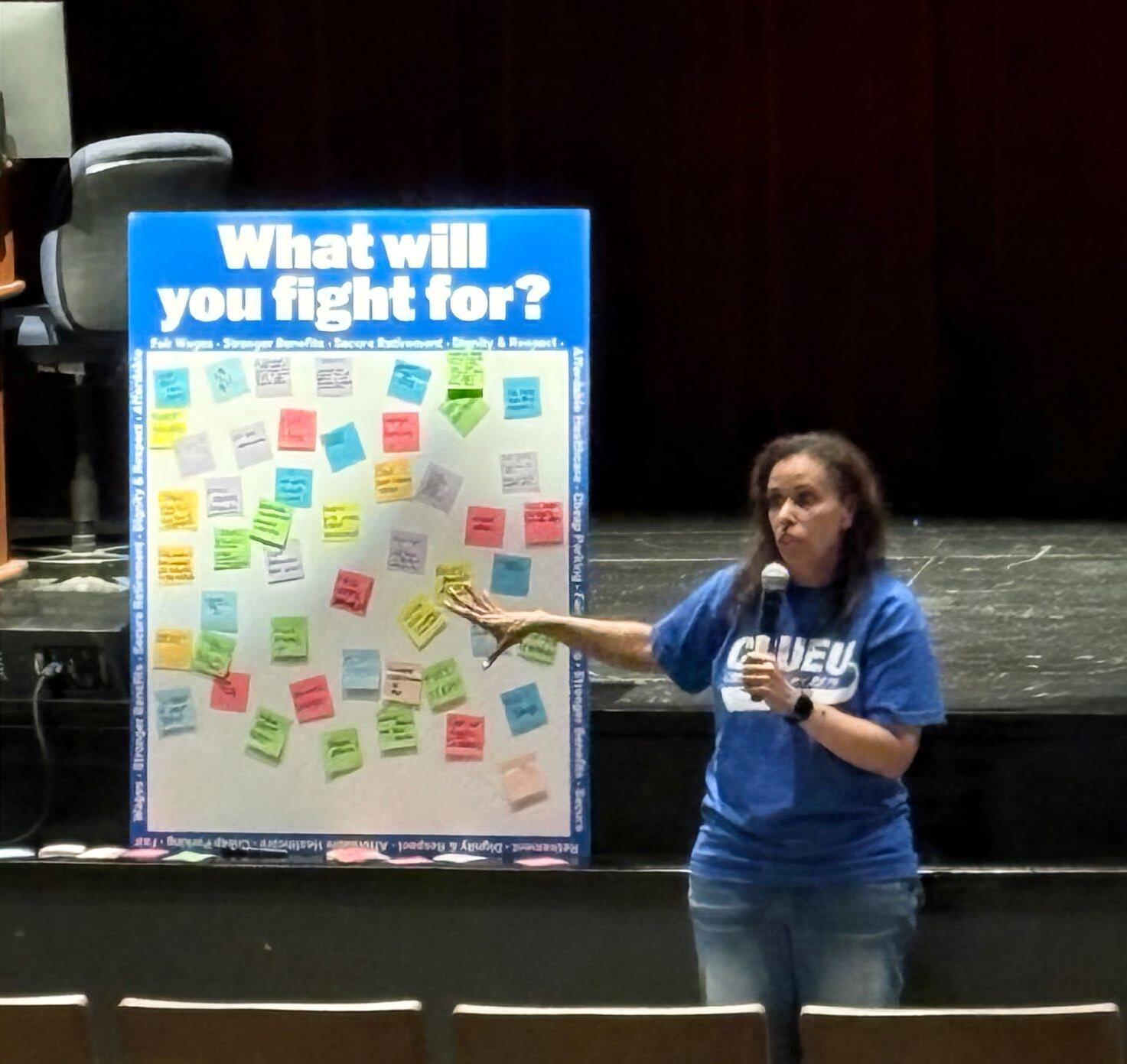
On Monday, March 22, CSUEU held a meeting on campus at The Pointe in the LBS Financial Credit Union Pyramid. The event drew a large number of members and later moved to the University Theater.
The meeting served as a drop-in session, allowing union members or other interested parties to speak with representatives and discuss priorities they want CSUEU to advocate for in negotiations.
Bethany Price, treasurer of CSUEU Chapter 315, said the event marked the beginning of the union’s contract campaign.
“What we are doing is a contract kickoff,” Price said. “We are getting ready to activate our union, attract our members and also attract people who are not mem-
JAYDEN SANDSTROM/Long
bers but are eligible. Our job right now is to get staff and student assistants fired up and ready for a potential strike in the fall.”
Price said the union is preparing for a possible strike due to concerns over contract negotiations with the CSU system.
“The CSU system and the Chancellor’s Office have been disingenuous in our contract negotiations,” Price said. “They agreed to terms that they have not followed through on, claiming they do not have the funding, while at the same time increasing salaries for chancellors, vice chancellors and campus presidents.”
In the coming months, Price said the union plans to organize both public and internal actions for a potential strike vote if negotiations do not progress.
“Our contract for 2023 was signed and agreed to, but when it came time to implement full steps in October of last year, the CSU said it did not have the money,” Price said. “We filed a complaint with the California Public Employment Relations Board, and last week we were notified that the board ruled in our favor.”
Price added that the current contract is set to expire soon, and the union is now seeking to negotiate a new agreement.
However, she said the CSU has not yet provided dates to begin negotiations.
“We’ve said, ‘Here is what we want to talk about, when can we have a sit-down,’ and the CSU has not given us a date,” Price said. “They are delaying, denying and reallocating funds away from workers.”
CSUEU Chapter 315 President Pedro Castro said the union is holding the meeting to gather member feedback.
“We are asking members to tell us what’s important to them so that we can bring that to the table,” Castro said. “We are collecting feedback through surveys, email and these in-person conversations.”
The meeting concluded with Hutchinson addressing attendees, saying October would be a strategic time for a potential strike as most staff are on campus.
She encouraged attendees to consider what actions they would be willing to take during negotiations and said this was one of several contract kickoff events planned.
“ Is there a plan to win? Yes, there is. What we are doing here today is leveling up to strike. We want everyone to get prepared and ready,” Hutchinson said.
Beach Current
CSUEU Statewide President Catherine Hutchinson closing speech to attendees of the union meeting.
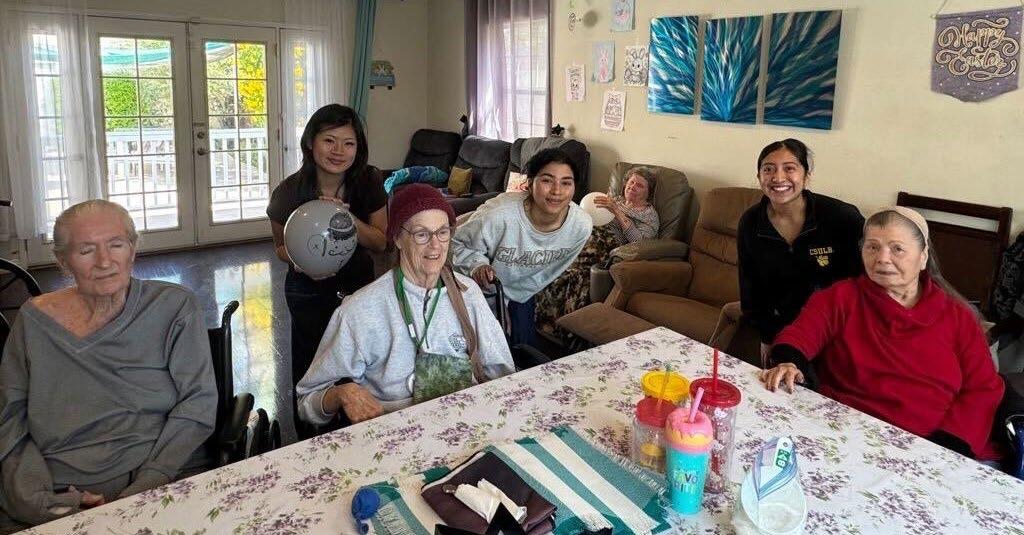
provide residents with activities and companionship.
New club connects student volunteers with Alzheimer’s patients
BY NICK MILLER Contributor
Anew student organization at Long Beach State is turning volunteer hours into meaningful connections, as National Alzheimer’s Buddies sends students into memory care facilities to build friendships with residents living with Alzheimer’s.
A memory facility is a specialized care center designed to support people facing memory issues, such as Alzheimer’s disease or dementia.
National Alzheimer’s Buddies is a nonprofit organization that has over 50 college chapters across the United States.
The club on campus started in January and has been meeting at Mom and Dad’s House Manor, both the Lakewood and Long Beach locations. Each student completes four shifts a week, during which they do activities that include reading, arts and crafts.
Third-year speech pathology major Ava Casas is the club’s president and founder. Casas said she has always been interested in starting a club like this.
“I was interested in working with older
adults, and also, my mom; as a kid, she always liked to visit nursing homes and elderly care facilities,” Casas said.
Casas said her mom taught her to be there for people who lack a support system from family members. She also views the club as a great way to connect with the Long Beach community.
Mary Vu, a first-year speech pathology major and the club’s secretary, said that once they get to know the residents at the facilities, they’ll do a variety of activities with them. She also mentioned that they create activities each week within the club’s budget.
Currently, the club has a $250 per-semester budget funded through fundraisers and its donation link.
Gavynne Alcantara, a third-year speech pathology major and the club’s vice president, said she learned how to be adaptable when it comes to planning around the club’s budget and interests.
“Sometimes we do plan out activities for the week, but when we do go to the location, sometimes residents may not want to do it, or sometimes we have to make modifications to it as well,” Alcantara said.
Because volunteers build one-on-one relationships with residents, flexibility and patience are key when planning visits, according to Alcantara.
“So I guess, being prepared for anything, for making accommodations, because at the end of the day, it’s the residents’ choice if they want to participate, and we have to respect that as well,” Alcantara said.
The club plans to stay active by expanding volunteer opportunities and continuing to work for more facilities. They also plan to promote their club to other health care and human service majors, as well as anyone interested in helping people with Alzheimer’s.
The club currently has about 20 members and hopes to recruit more by providing more volunteer shifts.
Zophia Saban, a third-year speech pathology major and the club’s chair, said there’s a specific resident who has taught her many lessons throughout her visits to the facilities.
“I have a resident there who is a little more there than the others, and she’s a blast. She always talks about how she went to school here at Cal State Long Beach
and all the things she’s done,” Saban said. “But I think it’s really sweet when another resident gets a little upset; she always helps them.”
Saban said hearing gratitude from one resident was especially meaningful, noting that the resident shared how the club helps reveal sides of residents that staff at the facility do not often get to see.
“It makes me tear up, hearing her [the resident] be like ‘Thank you for helping my friend. You don’t understand, she never does anything like this,” Saban said.
Saban said the residents are not the only ones grateful for the boost in morale. She said the residents’ personalities shine through, and that their children are grateful and happy to see it.
Casas said she has learned that visiting an hour a week can make such a difference in other people’s lives.
“They learn about us, and we learn more about them and we’re really forming friendships with these people,” Casas said. “The director has told us they always look forward to our visits. Just doing simple things like being in company, it can really make a difference.”
Long Beach State students volunteer at memory care facilities and
Photo courtesy of NATIONAL ALZHEIMERS BUDDIES
Film department pushes to adopt sustainability in filmmaking
BY DANTE ESTRADA Multimedia Managing Editor
Long Beach State’s Department of Cinematic Arts is advancing to implement sustainability in filmmaking from the classroom.
CSULB helped to co-found the Green Film School Alliance, an organization that has partnered with many other universities, providing tools, tips and productive ways to film while being environmentally conscious.
The professor behind this movement is co-founder Kent Hayward, who has been teaching at CSULB for a decade.
Over the span of two years, Hayward has been working on his new film course, CINE 313 Sustainability and Film, which launched this semester.
“Our students have been sustainability coordinators or sort of like supervisors for the sustainability of some of the student projects on campus,” Hayward said. “In a sense, it’s the training for how to do the sustainability monitoring and coordination in the classroom, and then students are doing sustainable projects outside.”
Hayward said he hopes the course can return next semester.
In the course, Hayward goes over alternative ways production departments in the film industry can be more sustainable, such as the lighting department.
“Filmmaking is an industry that’s made up of almost all the other industries, right? There’s camera, catering, acting, writing, construction, wardrobe, and, you know, it’s all a bigger community, a big web of life – just like sustainability is made up of all the other things,” Hayward said.
Hayward hopes as the industry constantly changes its filming methods and the way movies are seen, being environmentally conscious will become a permanent mark in filmmaking.
“Hopefully one day, there will be no need for people to talk about sustainable production,” Hayward said. “It’ll all just be production, and it will be sustainable.”
Hayward recalled that he attended a workshop from the Office of Sustainability where Sustainability Manager Holli

Fajack asked professors from various departments to consider how they can implement being eco-friendly into their own courses and departments.
“[Hayward] is inspiring the next generation of storytellers to care about the environment and climate change. We are so proud of the way he has put CSULB at the center of conversations about green filmmaking in higher [education] and in the industry,” Fajack said in an email to the Long Beach Current.
Claudia Villalta-Mejia, CSULB alumna, graduating in 2019 with a film and electronic arts major and minor in environmental science and policy, is also behind efforts pushing for sustainability.
She connected with Hayward after being referred to by a fellow film student
following her involvement on student film projects as a sustainability director.
After the Green Film School Alliance was launched, Villalta-Mejia joined to gather student interest.
Villalta-Mejia said she expanded her experience further as she worked as a sustainability and medical services specialist at Sony Pictures.
Directly being a part of the industry led her to realize that sustainability was not optional but a requirement on professional film sets.
Villalta-Mejia said she saw how emissions were reduced from shooting scenes with “The Volume,” a virtual sound stage created during the making of “The Mandalorian” that has since been adopted by many film and television productions.
“It was just really eye-opening to see, like, oh, a couple pages from a script may have created that, like how many minutes on screen was that? How much carbon dioxide was emitted just so that we could see three minutes on one TV show?” Villalta-Mejia said.
Villalta-Mejia described how the film industry is used to budgeting on what is most affordable such as throwing out used props or costumes, when the shift needs to focus on reducing waste.
“We need sustainability to remind people that, ‘Hey, we need to protect the planet, or else no one’s going to be here to watch these movies or make these movies,’” Villalta-Mejia said.
DANTE ESTRADA/Long Beach Current
Cinematic Arts professor Kent Hayward referenced how recently released films like “Bugonia” and “Hoppers” have included environmental issues and the push for a greener look in the world.
From Bluff Park to City Hall, thousands

BY ALEXYS DEMARIA Opinions Assistant
The usual calm of Long Beach’s Bluff Park gave way to whistles, chants and car horns Saturday morning. As yogis gathered for their 11 a.m. session just 20 feet away, a nearby protest filled the air with whistles, cheering, cowbells, and the bellowing call of a shofar.
Thousands of protesters gathered on Ocean Boulevard on March 28 in an organized effort by multiple Long Beach organizations for “No Kings” Day 3.0.
Following demonstrations on June 14 and Oct. 18, the protest marked the third in a growing wave of nationwide demonstrations opposing President Donald Trump and his administration, with protesters criticizing expanded ICE raids, immigration policies and the war in Iran.
“I came out here to support No Kings because Trump is ruining America,” protester Jerry Garcia said. Garcia set up a booth on the Bluff Park side of the protest, providing sign-making materials to the crowd. “People like us are struggling right now, and we need to bring awareness with Trump, and what he’s doing to America.”
Organizers gathered the crowd at Bixby Park around 1:45 p.m. before beginning a westbound march along Ocean Boulevard toward downtown.
As demonstrators marched, Long Beach police officers in riot gear set up blockades at Pine Avenue and Ocean Boulevard for southbound traffic, and Pacific Avenue and Ocean Boulevard for northbound traffic.
Protesters chanted, “Show me what democracy looks like — this is what democracy looks like,” as they arrived at Long Beach City Hall, where organizers Lara Foy and Anthony Bryson addressed the crowd once more.
Members of the Peace and Freedom Party, Democratic Socialists of America Long Beach, American Indian Movement and SoCal Uprising clustered around a speakers’ platform that hosted programming from multiple organizations during the demonstration.
“Long Beach is a working-class city, very diverse, so we have a lot of disenfranchisement for those who live in this city,” said Lara Foy, an organizer with SoCal Uprising, a primary promoter of the protest. “At my [acupuncture] clinic, it’s a low-income clinic, so a lot of my patients are on Medicare and Medi-Cal, and a lot of them are losing their f—ing healthcare right now.”
Foy led protesters through an affirmation exercise, between introducing speakers from different organizations
The rally continued with a musical performance by Capoeiristas for Change, followed by a prayer led by members of the American Indian Movement. To close the protest, organizers took to the microphone before opening it up for a community-wide discussion.
thousands rally for ‘No Kings’ Day 3.0

to the crowd, including Anthony Bryson, a community organizer and District 1 candidate for the upcoming city council race.
“When I came up here today, I didn’t want to talk to you as a candidate or a politician; I wanted to talk to you as an activist,” Bryson said.
His platform vouched for rent control, free transportation and legislative policy changes “holding landlords accountable” that will fill empty storefronts in the city of Long Beach.
“There’s a lot that we can do in this city to make it the city we all deserve,” Bryson said to the crowd. “I am an activist by design, by birth. As a Black, gay, disabled man by birth, I have no obligation but to fight back.”
Long Beach resident Lourdes Talamantes sat near a memorial table of those who were killed in ICE raids or within detention centers.
“They’re not just a statistic … Our aim is to give people

Photos by DIEGO PEREZ/Long Beach Current
From the far left: A variety of signs were made for the No Kings protest on March 28 as they marched down Ocean Boulevard. | Protesters prepared props ahead of time, including a Statue of Liberty mannequin, for the protest at Bixby Park. | Protesters march, chanting “we have the power.”
a name, give people a face, and there’s a story behind each one of them,” said Lourdes, who brought this display to events in Southern California along with a group of other Long Beach women.
Featured under the white floral centerpiece arrangement was a photo of Westminster resident Ismael Ayala-Uribe, who died in September 2025 following a raid at his workplace in Fountain Valley and detention at an ICE facility in Adelanto.
Local artist Susan Bach displayed a collection of her protest art in Bixby Park, at the corner of Ocean Boulevard and Cherry, describing the multimedia pieces as “a manifestation of my outrage.” She painted the first piece of the collection as a reaction to Trump’s re-election.
“I was appalled we elected [Trump] a second time,” Bach said. “The more I read, the more I was outraged about it all.”
Bach’s display included collages of President Trump’s
connections to Jeffrey Epstein, as well as a mannequin depicting Lady Liberty with a chain around her neck.
“If you have nothing else, you have to use your voice,” Bach said.
American, Mexican, Palestinian, Philippine, and American Indian Movement flags rippled in the ocean breeze. Residents along Ocean Boulevard watched through their windows, and some joined the march holding signs as it passed their front yard.
“‘No Kings’ has to be the mentality we use to fuel the resistance,” Bryson said to the crowd in front of City Hall. “The reality that they’re facing, is the reality that we can all conquer together.”
ASI Senate passes zero-emission resolution to reduce campus pollution

BY DANTE ESTRADA
Multimedia Managing Editor
Associated Students Inc., Senate, voted to approve a resolution to incorporate zero-emission technology on campus to reduce the reliance on industrial boilers, making Long Beach State the first CSU to adopt this initiative.
The efforts to implement this were made by the South Coast Air Quality Management District, a government agency focused on monitoring air pollution and improving air quality for residents of the Los Angeles, Orange, Riverside and San Bernardino counties.
Tomas Castro, an Orange County climate equity organizer for Climate Action Campaign, partnered with CSULB to implement these policies within ASI.
CSULB is home to 13 industrial boilers across campus, not to mention the sever-
al located in its surrounding area. These boilers are used to generate power, heat classrooms and provide air conditioning.
The use of industrial boilers has been cited as polluting air quality and damaging respiratory health.
They both shared that it is hard to identify where these boilers are located on campus due to their varying usage level and sizes.
“I can’t really point and be like, ‘Oh, it’s [at] the library, right?’ It’s just an overall change that needs to happen,” said Samuel Santiago Herrera, a graduate student in the master’s of science in geology program.
Green and Santiago Herrera said their focus is to implement these changes on the local level.
“A lot of these issues are actually very prevalent amongst marginalized communities too, which we can see heavily in the Long Beach area, especially,” said Tyler
Green, a fourth-year fashion merchandising major and minor in environmental science and policy. “We would see incredible health benefits and long-term social and health benefits from implementing these zero-emission boilers.”
Green and Santiago Herrera said they plan to find green alternatives and implement zero-emission technology on campus with the resolution.
“We would see a major decrease in nitrous oxides, which is a major pollutant that causes breathing problems, heart problems, reproductive issues, cancer and early death,” Green said.
Santiago Herrera added that replacing boilers with zero-emission technologies could save $47 billion in public health costs by reducing asthma attacks.
“So what that alternative would look like would be a healthier campus, a healthier community and just a net positive overall, just with this change,” Santi-
ASI senators passed a resolution to approve the usage of replacing industrial boilers with zero-emission technology. This was done with the South Coast Air Quality Management District, a government agency that overlooks all gas-burning boilers that release harmful substances into the air that pollute it and cause respiratory issues.
EDDY CERMENO/ Long Beach Current
ago Herrera said.
Castro said he partners with various groups, such as the Sierra Club and Earth Justice, under the Southern California Clean Manufacturing Coalition to push for the industrial decarbonization policy.
“Our university, they have kind of like a decarbonization timeline, and they are seeking to be net zero emissions by 2030, so this kind of win, or this passing of the resolution, is within the university’s track,” Green said.
Green and Santiago Herrera stated this resolution will not be implemented during the current spring semester, as they await further approval.
“I would say, currently, there are talks in ASI about the implementation. It really just comes down to the logistics of the university and contracting,” Santiago Herrera said. “So it’s not information that we have now. It would most definitely be after this semester, though, I will say.”
Beach Bash ‘Beware’: Big Sean headlines ASI’s spring concert
BY KHOURY WILLIAMS Editor-in-Chief
The Beach is “waking up in beast mode” as Detroit-based rapper
Big Sean will be headlining the stage at this year’s Beach Bash event at the LBS Financial Credit Union Pyramid on Friday, April 24, at 6 p.m.
Hosted by Associated Students Inc. and Beach Pride Events, the annual spring concert event “bounces back” with another chart-topping artist.
The Grammy-nominated and multi-platinum recording artist has sold over 50 million records, including hit songs such as “Dance (A$$),” “I Don’t F— With You,” “Bounce Back,” and “Beware.”
Big Sean’s headliner announcement
marks one of the highest profile artists to perform at ASI’s Beach Bash in recent years, following BLXST in 2025 and Swae Lee in 2024.
In an email sent to the Long Beach Current, Beach Pride Events Manager April Marie Castro said her team is prioritizing student safety as planning continues for the large-scale event.
“We are working with the LBS Financial Credit Union Pyramid to ensure the safety of those in attendance, including personnel support, signage and offering information ahead of time of what students may or may not bring to the venue,” Castro said.
Big Sean won’t be the only artist to take the stage—and if the lineup expands, students may leave feeling way up

and “blessed.”
Castro said her team is still finalizing the full lineup for next month’s concert.
“In previous years, we have had DJs and up and coming talent take the stage before our headliners,” Castro said in an email statement. “Our team is working on bringing back that experience this year.”
Tickets are available now via CSULB’s athletics ticketing website. Currently enrolled students who purchase tickets through their CSULB email accounts get to pick from floor seating at $30 or
bleacher seats for $20. Tickets for faculty, staff and alumni will be available on April 6 for $50.
With anticipation building across campus, the announcement has already generated buzz among students eager to “Live This Life” on a high-energy night.
“From what we have heard from students so far, folks are pretty excited,” Castro said. “We’re excited for those in attendance, whether they are huge fans of Big Sean or this will be their first time attending a concert.”
GRAD GRAMS

Photo courtesy of ASI
Multi-platinum rapper Big Sean is set to headline CSULB’s Beach Bash at the LBS Financial Credit Union Pyramid on April 24, bringing his chart-topping hits to The Beach.
ARTS & LIFE

Amargo, played by Christina Du Chene, who played Prospero in last year’s Cal Rep production of“Frantic/Tempest,” talks “chit” with her fellow crab friend Pootz, played by Himika Kaku, during a March 16 rehearsal of “Crabs in a Bucket.” Kaku played Little Cloud in last semester’s “Sometimes The Rain, Sometimes The Sea.” One of the show’s running gags is characters using the terms “chit” and “shuck” as curse word substitutes.
Photo courtesy of CAL REP
CalRep serves up crabs with a side of bitterness
BY DELFINO CAMACHO Arts & Life Editor
Have you grown crabby with age? Or are you still young and naive?
These questions are central themes in “Crabs in a Bucket,” CalRep’s third spring play that ran from March 18–28.
The play was written by Mexico City-born and Texas-raised playwright Bernardo Cubria and first brought to life on stage by director Alana Dietze, who directed last semester’s “Sometimes the Rain, Sometimes the Sea,” among other campus shows. “Crabs in a Bucket” premiered at the Echo Theater in 2023.
True to its title—literally and metaphorically—the play centers on four crabs stuck in a bucket with other crustaceans, with each one vying to “get out.”
The plot explores the characters’ relationships, focusing on their “crab mentality” that leaves them bitter and resentful of others’ success.
Cubria wrote the characters to be played as clowns in the theatrical tradition and intended the four leads to
be played by minorities, regardless of gender or race, adding that the “winner takes all” mentality is rampant in such communities.
CalRep’s version of “Crabs in a Bucket,” co-directed by Carolina Montenegro and Turner Munch, debuted in the Players Theater inside the Theater Arts Building on March 18.
Seating less than 100, the small space was strategically put to good use by scenic designer Saul Diaz and his team. Audience members found themselves sitting among the crabs inside the bright orange, jumbo-sized Home Depot bucket that made up the entirety of the set.
Constructed and designed to mimic an oversized shucking bucket complete with old nets and crab corpses littering the floor, the set allowed the actors a sandbox-like performance freedom.
The play opened on Amargo and Pootz, crab besties played by Christina Du Chene and Himika Kaku.
As played by Du Chene and Kaku, Amargo and Pootz are the definition of “two delusional besties telling each other, ‘exactly.’”
They reaffirm each other’s greatness
and how much everyone else sucks, in addition to reminiscing about the times they almost “got out” of the bucket.
Their bitterness is interrupted by bucket newcomer Beb, played by Celeste Ontiveros.
A naive and sweet young crab, Beb’s optimistic outlook immediately grinds with Amargo’s bitterly blunt outlook on life inside and beyond the bucket.
The personality clash is further impounded when Amargo’s old friend Mamon, as played by Ved Banerjee, returns to the bucket, years after abandoning Amargo and finding success outside.
The play also added a fifth character not in the original: the omnipotent Fisherman played by Jacob Koclanis. As the only human, The Fisherman exists in another realm of reality and serves as the play’s representation of God, life and chance all rolled into one.
The production adapts the script well. The constant cartoonishness makes the real dramatic moments shine, like when Amargo and Mamon confront one another’s past.
While every performance is strong, Ontiveros stands out as Beb, showcasing
serious comedy chops and razor-sharp timing. The actor does a good job of grounding the story’s optimism, without making it feel completely naive.
Each crab costume, designed by Sonia Giansiracusa and her team, is patchworked from customized clothes, subtly tailored to their personality.
A minor weakness is that the play starts off a bit slow, with performances taking some time to ramp up.
Once it hits its rhythm, the laughs keep coming—as does the pathos. The show hits when the crabs stop clowning each other and start cutting deep, eviscerating each other’s personalities.
For some audience members, it may even hit uncomfortably close.
At times, the show is reminiscent of the bleak 1944 play “No Exit” by JeanPaul Sartre, where a group of humans are trapped together in the afterlife—except instead of people, in this show, hell is other crabs.
Seek out when possible. While the comedy makes it an easy entry point for newcomers, the craft beneath the chaos rewards theater fans with big questions about success, bitterness and survival.
Vogue, drag, improv: Trans Week of Joy ends with campus
‘Care Fair’
BY MONICA GARCIA Arts & Life Assistant
Apair of knee-high faux leather stiletto boots strut down the stage.
A pink wig bounces, curls swinging in rhythm. Hands holding dollar bills reach out to drag queen Foxie Azhwé D’Vil, who vogues in a dazzling, rhinestoned leotard with a shiny pink F stitched on the chest.
D’Vil turned to the crowd, welcoming them to Long Beach State’s “Care Fair,” honoring Trans Week of Joy and the immigrant community in Long Beach.
The Radical Hope Project, a student-led initiative that aims to to uplift marginalized voices through digital media and creative expression, hosted “Care Fair” on March 26 at the Carolyn Campagna Kleefeld Contemporary Art Museum. The fair marked the final event in the LGBTQ+ Resource Center’s Trans Week of Joy series.

CHARLOTTE LOCICERO/Long Beach Current
“We have resources, not only for food insecurity, [but also] people experiencing fear from the immigrant raids that have happened and also [the] LGBTQ community,” said Vanessa Cervantes, co-founder and co-chair of the Radical Hope Project.
The Radical Hope Project launched in January 2025 after a diversity committee information session with master’s students, including those pursuing a master’s degree in social work. The group aimed to create a safe space for students after increasing ICE raids.
“We need voices and if it’s not gonna be our faculty, then it’s gonna be the student,” Cervantes said.
Various organization tables lined the museum patio, including The LGBTQ Center Long Beach, Aviva Pharmacy, Beach Wellness, Transitions in Motherhood, Free Mom Hugs and the Salvadoran American Leadership and Educational Fund.
Free STI testing opportunities and
meal packages were provided.
The event began with a resource fair and the opening of a temporary art exhibit honoring queer and immigrant communities.
After host introductions and a drag performance by D’Vil, the Rainbow Room opened to the public, a quiet space inside the museum for arts and crafts.
“I love seeing the community,” said third-year art major Alex Martinez after attending the event. “I hope more people can feel comfortable coming out and if they feel lonely, to come through and talk ‘cause everyone’s really accepting.”
The Notorious Black Improv Group from The Playful Stage improv school arrived later in the evening for a series of comedy sketches and personal monologues honoring queer Black joy.
Audience members clapped to the beat of a rhythm-based sketch, fighting for focus between laughter.
The Playful Stage hosts improv workshops and classes like “She Improvises,”
an all-levels women improv class taught by performer and instructor Liz Lanier.
“You don’t need to ask systems to show up for you; you can show up for yourself,” said Kevin Mora, co-founder of the Radical Hope Project and a master’s student in social work. “This is literally a group of students that all come from different walks of life … we all just banded together to show up for one another.”
The Care Fair concluded with a sound bowl bath and guided meditation to lead visitors through a decompression and gratitude practice.
“Love creates space for love to exist, and that’s really the takeaway,” Mora said. “Love is a powerful thing and love is an act of resistance.”
Foxie Azhwé D’Vil, a drag queen and CSULB student studying social work, performs at the ‘Care Fair’ located outside the Carolyn Campagna Kleefeld Contemporary Art Museum on March 26.
ARTS & LIFE

One mother’s journey toward adaptive fashion
BY JASON GREEN Arts & Life Assistant
When Mindy Scheier’s son Oliver was 8 years old, he felt disheartened by not being able to put on the same clothes his friends wore, due to his muscular dystrophy.
In response, Scheier came up with an idea that would change her career. A fashion designer with over 20 years of experience, Scheier designed a pair of jeans with magnetic button attachments, allowing Oliver to put them on himself.
“When I got to witness him independently dress himself for the first time in his life and wear products that he saw all of his friends wearing, the level of confidence that came over him was nothing that I’d ever seen in his 8 years of life,” Scheier said.
The jeans originally made for her son, now 21, have expanded into the Runway of Dreams Foundation. Founded by Scheier in 2014, the organization performs adaptive fashion shows around the world to
promote inclusive and adaptive fashion.
Runway of Dreams has collaborated with 13 mainstream brands and many more small businesses. The foundation’s inclusive fashion show has even been featured in New York Fashion Week, showcasing a revolution in the industry.
The foundation also made history by hosting the first-ever fashion show at this year’s Abilities Expo in the Long Beach Convention Center on March 27.
For those with physical disabilities, clothing can be especially inaccessible. Clothing with buttons and zippers, for example, can be difficult for those with low dexterity.
“It was miraculous, miraculous to see that [Oliver] had a sense of freedom, he had a sense of confidence, and he also had a sense of feeling like he could show up to the world how he wanted to,” Scheier said.
Seeing her son struggle with clothes, Scheier could not imagine the everyday fashion struggles of the 1.3 billion people in the world who have a disability.
In 2016, her organization, in partnership with Tommy Hilfiger, created the
first mainstream adaptive clothing line: Tommy Adaptive. One shirt, for example, does not use real buttons, but magnets.
Founded in 1979, Abilities Expo has become a place where people with disabilities gather to celebrate who they are. The expo also gives people the opportunity to see specialized products and learn about resources that can help in their daily lives.
Misty Diaz, who modeled in the fashion show, said Runway of Dreams is an example of how fashion is catching up, adding, “We need accessibility.”
Diaz has spina bifida, a disability where the spine doesn’t form properly.
She uses forearm crutches, wears leg braces and finds fashion to be generally inaccessible. While she looks for comfort in adaptive fashion, she did mention this category of clothing can be pricey.
“Accessibility is not only for people with disabilities, but it’s for everyone,” Diaz said.
Scheier said there are many inventions originally created for people with disabilities that are now used by everyone, like texting, wheeled suitcases and electric
Isaiah Piche, 34, modeled at the Abilities Expo’s first fashion show hosted by the Runway of Dreams Foundation at the Long Beach Convention Center on March 27. Piche saw a need for queer representation.
JASON GREEN/ Long Beach Current
toothbrushes.
She hopes more brands will consider this when it comes to adaptive fashion.
Scheier also created GAMUT Management in 2019, a consulting, talent and accreditation company.
“So Runway of Dreams is really the ‘why’ brands need to get into the space, and Gamut is the ‘how’,” she said Her second company launched the first certification for adaptive fashion, the Gamut Seal of Approval, to highlight brands making adaptive efforts.
The first company to receive the seal was Adidas.
A clothing item needs to reach 85% to receive the seal. The accreditation is evaluated by people with disabilities, a physical therapist, an occupational therapist and other experts in the field.
The Runway of Dreams Foundation has clubs at 25 universities and scholarships for designers who focus on adaptive fashion, a push for the future, since Scheier, now 54, said she can only do so much in her lifetime.
“For me [working in adaptive fashion], it’s personal and professional because I feel like anything that hopefully changing in this world is helping my son,” she said. “But from a professional perspective, I never imagined that doing something in the fashion industry could have led me to doing something I’m so proud of.”
‘Health equity doesn’t wait’: CSULB students rise to the call
BY NI BALINESS Arts & Life Assistant
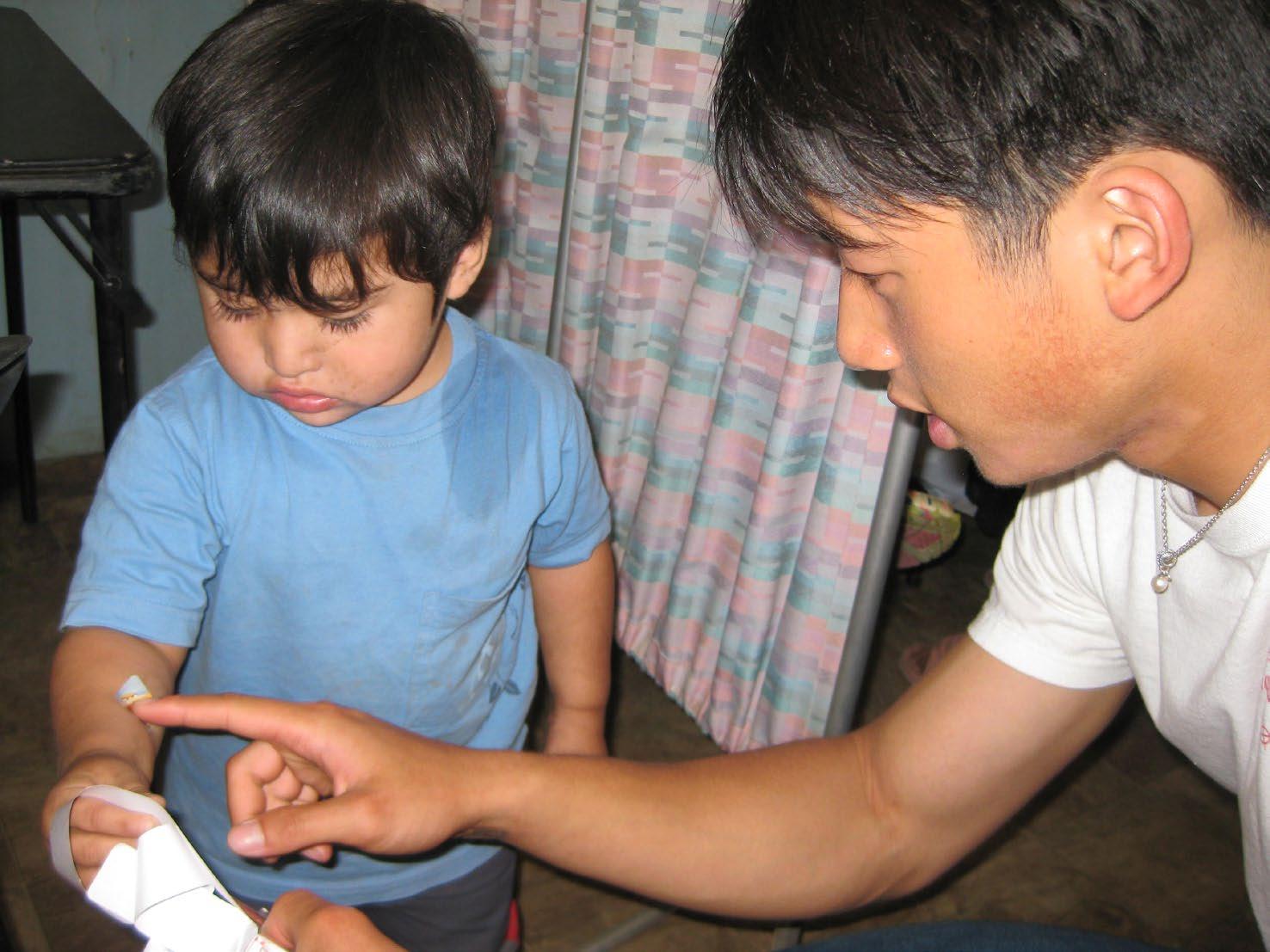
To go from holding a baby in their arms to watching that baby grow into a lively toddler, members of Long Beach State’s Flying Samaritans describe it as one of the richest experiences they can remember.
As a student-run non-profit organization, The Flying Samaritans at CSULB club’s mission is to bridge healthcare access to underserved communities in Long Beach and Tecate, Mexico.
They accomplish this by educating and doing monthly travels to set up healthcare clinics in Tecate.
Founded in 1961 after a chance landing in Baja California, Mexico, revealed the urgent health needs of a local community. The Flying Samaritans grew from pilots delivering aid into a medical organization dedicated to serving underserved communities.
CSULB is one of the organization’s many sub-chapters, which span across California. CSULB falls under the Palomar Chapter, which serves communities in Baja California alongside other Southern California universities.
Catherine Palm is a third-year biochemistry major and co-president of Flying Samaritans at CSULB. Palm says she started with a “naive” perspective on what healthcare access looked like.
“Access to healthcare isn’t as simple as going to the ER when you’re sick or making an appointment with your primary care provider,” Palm said. “Not
everyone has insurance or hospitals in that manner.”
Every third Saturday of the month from 4 a.m. to around 8 p.m., a team of 25 to 30 students, alongside a doctor and nurse practitioner, will drive down to Tecate to set up health stations, food and donations.
Being involved with Flying Samaritans and volunteering with non-profits has broadened Palm’s perspective and showed her even small efforts can create a bigger change towards health equity.
“I think being a part of facing the problem is really important, and also, it’s important to just open our eyes to see that the world isn’t as simple or limited as we think it is,” Palm said.
Like many student organizations on campus, funding is necessary to provide the prescriptions, equipment and gas used during clinic days. While some of the money comes from grant applications or the organization’s Palomar Chapter funds, the club’s other revenue comes from fundraisers.
Ethan Tarng, a third-year molecular cell biology and physiology major and product management chair for Flying Samaritans, recalls how his “cheeky” idea turned into successful earnings.
“In my role, I wanted to bring up the revenue that we have for Flying Samaritans, which funds all of our clinics,” Tarng said.
As a product manager, Tarng makes custom t-shirts on a screen-printing press, along with stickers, buttons and pins, so students on campus can spread the Flying Samaritans’ message.
“We have a shirt called ‘Tacos and Treatment’ [which] ties back to the community we serve and our love for tacos and treating people,” Tarng said.
To his delight, Tarng was able to “triple” the revenue by the first general meeting of the year.
“The most rewarding part is continuing this new side of Flying Samaritans and not only that but also building a team,” Tarng said.
During clinic days, families will go through reception, triage, meeting with the provider, pharmacy, public health and donations. Common health issues encountered during clinics include diabetes, high blood pressure, hypertension, common colds and the flu.
“There’s a lot of people who need regular primary health and it’s hard to see that [because] you can’t help everyone,” said Sarahi Rubio-Solano, a second-year social work major and vice president of Flying Samaritans.
After finding the club through Week of Welcome, Rubio-Solano learned how much time and dedication it takes to be a part of the club.
From emergency meetings to oncall shifts, she found that surrounding herself with others who share her goals makes it worthwhile.
Beyond medical care, they also serve communities by sharing food. Rubio-Solano remembers when the team decided
to cook carne asada, and one of their patients brought them salsa.
“I love how we usually have a lot of leftovers, so we give it out to the community to take home,” Rubio-Solano said.
Nathan Fernandez, a third-year molecular cell biology and physiology major and treasurer for Flying Samaritans, enjoys educating the children about hygiene.
Helping people access healthcare resources resonates with Fernandez on a personal level. He shared that when he visited the Philippines, he noticed that healthcare access was “similar” in both countries.
“When my dad was growing up in the Philippines, [he] didn’t have that privilege,” Fernandez said.
Similar to his co-president, the monthly clinic trip has shown Fernandez firsthand the privilege many people overlook. Being a Flying Samaritan allows him to take initiative to ensure more people see healthcare as a basic human right.
For Fernandez and other student members, community is the foundation of who the Flying Samaritans are.
“I’m glad this is the college experience I got to have because I wasn’t only able to find my people but also provide healthcare to those who are underserved,” Fernandez said.
Photo courtesy of ETHAN TARNG
Ethan Tarng, seen here helping a young child on Jan. 16, 2025 in Tacate, Mexico, said that building trust while also providing healthcare is essential when providing service.
OPINIONS
When an academic warning becomes a turning point
BY RAFA GABRIEL ADRID Contributor
As students begin their midterms, the effects of burnout loom ahead.College is a difficult endeavor.
While some students breeze through courses without a worry, others struggle with the heavy expectations that come with balancing coursework, mental health and outside commitments.
Once burnout sets in, grades gradually decline, and the motivation to attend class disappears. Then, that fearful academic warning comes, as panic and anxiety settle.
Students who are placed on academic warning have an overall GPA below 2.0 and must raise their GPA within the next semester.
Being placed on academic warning seems harsh, but in reality, it creates a sense of urgency for students who want to remain part of this university.
This is true, coming from my own experience on academic warning.
In fall 2024, as a computer engineering major, I struggled to manage my time. This led to a loss of motivation and Fs in classes. I was burnt out for most of, if not the whole semester; college was too much for me to handle at the time.
Then came the nail in the coffin: an email notifying me that I was placed on academic warning. I panicked. There was a gut-wrenching feeling that told me I was not good enough to attend this university.
I already spent so much time and

money to be a part of this program, and just like that, I wasted it. Higher education is a privilege, and the idea of losing that privilege created fear and anxiety that continues to persist within me.
The financial implications meant that I would have to pay an extra year of tuition to get my undergraduate degree.
I wanted to keep attending CSULB, but something had to change.
After receiving the notice, I immediately scheduled an appointment with a counselor to discuss my future.
The counselor urged me to switch majors because computer engineering was admittedly not for me. I told her I wanted to switch to an English major, with an emphasis on education. That decision turned out to be one of the best of my life.
My passions have always been tied to teaching and writing. Once I started college, there was this gnawing feeling that I wouldn’t be successful if I became a teacher.
I tried to play it safe by settling on computer engineering, but ultimately, I wasn’t motivated enough to continue, and I forced myself into that position.
What changed exactly? That academic warning gave me the motivation to pursue my passion, and for once in my life, I had a sense of direction. Sometimes, you need that one push to get to where you need to be.
Having that academic warning meant I had no choice but to succeed.
Before I switched, I was not taking classes seriously and felt overconfident that I could pass without worry. Since then, I started attending every class and finally immersed myself in the curriculum. Passing the classes became fruitful rather than a necessity to get the degree.
English undergraduate adviser Stephanie Johnson recalled several students who had to drop a class due to emergencies at home or difficulty keeping up with the workload.
One student, in particular, was considering withdrawing from the university midway through the semester due to the fear of being placed on academic warning.
“Students need to talk with [their] professors and advisers,” Johnson said, “It’s so important to communicate with them about your problems.”
There are resources on campus that are willing to help students, such as academic advising and Counseling and Psychological Services. Johnson encourages students not to be afraid of reaching out.
As for my advice from a student’s perspective, sit down and think carefully if you’re on the right path. Follow your passion. Slow down if you have to; there is no rush to accomplish your goals.
Don’t be afraid to explore different paths. Life rarely follows a straight line, and sometimes the unexpected turns lead to the most meaningful opportunities. No matter which route you take, you’ll find your way to what’s right for you.
Graphic by REBECCA LAVOND/Long Beach Current
Receiving an academic warning notification is scary for various reasons, but it can be helpful for students who need that extra push to continue pursuing their goals.
OPINIONS
Getting to know the real you

BY SASHA MARANTZ Copy Assistant
The icebreaker: a dreaded college experience.
An ask that becomes even more dreaded when you have no clue what interesting information to offer about yourself, prompting the question: How well do I even know myself?
When others ask the simplest question, the response can escape you at times—even if you know the answer.
My initial response to hearing the question “Who are you?” is to freeze. This question is far beyond the casual “What’s your favorite color?” or “What’s your favorite food?”
Naturally, I don’t know what to answer with—either due to a lack of information or too much information. I have yet to figure out which is the case.
During my freshman year of col -
lege—a perfectly normal time to have an identity crisis—I decided I wanted to try writing down everything that happened in my life from as far back as I could remember, transcribing every little detail.
Through this, I hoped I would be able to formulate a better understanding of who I was and how my experiences have shaped me. While I didn’t get very far in the writing process, it was nice to reflect and witness everything that has contributed to the person I am today.
However, there is more to you than the things you’ve experienced, like your passions, goals and ambitions. Portraying your “true self” can always be a bit tricky.
People with social anxiety often find themselves overthinking how others perceive them, worrying about being judged or seen negatively.
One day in therapy, I was talking about how I didn’t know how to view myself because I was so focused on how
others might see me. My therapist then instructed me to ask my friends how they perceived me.
Though I often avoid thinking about it, it was a cathartic experience to receive answers to the unknown question of “How do others see me?” Despite the positive responses, I still had doubts that I could be perceived in such a way, keeping me confined to my own judgment.
It can feel odd when someone tells you something about yourself that you didn’t even realize. As our own worst critics, we naturally overlook these aspects of ourselves that others pick up on.
While I occasionally struggle with my identity, something I have no doubts about is that I am a lover of cartoons.
In one of my favorite cartoons, “Bee and PuppyCat,” PuppyCat asks Bee what she wants to be when she grows up. Bee replies with “everything.”
Though it may seem silly, this scene
has greatly shaped my outlook on life.
While Bee’s character struggles with getting her life together, she still dreams of bigger things. To me, wanting to be “everything” means fulfilling your ambitions to the furthest extent.
As an affirmation, I now tell myself: “I contain multitudes.” I want to maintain that hopeful life perspective that I can do anything if I set my mind to it.
Being human is like a jigsaw puzzle; you have all the pieces, but you may struggle to put them together. Navigating life’s trials is part of growing up, which can create more pieces of the puzzle you have to connect.
Connecting these pieces may be harder if you don’t spend much time with yourself.
If you treat yourself like a friend you’re getting to know every day, you may find that the trials that come your way will become easier to navigate.
Graphic by SASHA MARANTZ/Long Beach Current People can be seen as complex mysteries begging to be solved, but sometimes the mystery is within you.

The unseen challenges facing international student-athletes
BY ALEXA CAMACHO Contributor
For Rosie Akot, going home isn’t just a weekend trip — it’s a long and expensive 20-hour flight across the world.
The first-year international student-athlete from Adelaide, Australia, is one of many Long Beach State athletes navigating life far from home.
Along with demanding schedules and NCAA Division I compliance requirements, international student-athletes must also adjust to language barriers, cultural differences, visa regulations and growing uncertainty around immigration policies.
International student-athletes face more than the transition to a new campus or city.
“I feel like [domestic student-athletes] don’t realize the trials and tribulations that international athletes have to go through,” Akot said.
Navigating cultural and academic adjustments can be overwhelming at times. All student-athletes must be full-time students, but international students must also comply with special NCAA regulations to maintain their visa status and remain eligible to compete.
Emily DeMots, LBSU’s NCAA compliance officer, said she has observed increasing concern among international athletes amid recent policy shifts.
“I have seen more fear and confusion from students when it comes to changes in immigration laws,” DeMots said. “Visa regulations, immigration threats abroad, and in the U.S., tax withholdings on scholarships, changing treaty details, understanding how to properly exit and return to the country when traveling, and much more.”
For Akot, recent immigration policies have added yet another layer of uncertainty to her experience as an international student athlete.
She said concerns about what she hears on social media have made her feel less secure about her future in the U.S.
Leaning on teammates, coaches and friends is a way for her to navigate the distance.
For Petar Majstorovic, sophomore international business major on the men’s basketball team, born in Serbia but raised in France, his experience has been rewarding but exhaustive.
Majstorovic’s days often follow a packed
routine: classes from 9:30 a.m. to 12:15 p.m., the weight room at 1 p.m., watching film at 2:15 p.m., practice at 2:30 p.m. and homework at 5 p.m., until his evening workout at 8 p.m.
One of the most difficult challenges he admits to is mastering the English language.
“The language barrier is hard sometimes in class when I’m trying to answer a question where I know how to explain the thing in my language, but can’t find the words to say it in English,” Majstorovic said.
While the challenges of being an interna tional athlete are numerous, Majstorovic said he is not overly concerned about his immi gration status.
“I have all the necessary papers to be in this country, so hopefully I’ll be fine,” Ma jstorovic said.
For KiiKii Brown, a fourth-year kinesiology major and captain of the women’s track and field team from England, the academic differ ences became clear during her freshman year.
“I really had no expectation, like it’s so different from back home that I didn’t know what to expect,” Brown said.
Much of Europe uses a different grading system that does not rely on GPA but instead on final examinations. Additionally, all stu dent-athletes are regularly monitored by pro fessors, academic advisors and coaches for progress and eligibility, adding another level of scrutiny.
Looking past the classroom, she acknowl edges the struggles of being so far from home.
“That can be very exhausting emotionally because it can feel lonely and you can feel dis connected from both life in the USA and life at home,” Brown said. “I think often interna tional students feel extra pressure to perform as they have travelled so far to be a part of NCAA athletics. For me personally, that has made me work extra hard in both track and the classroom.”
Beyond all of this, they too must navigate the financial and legal boundaries different from those of domestic students.
“As an international student, you can’t ac cept Name, Image and Likeness deals, or if you do, you have to be really careful about how you do them or manage them because you can risk losing your visa status,” Brown said.
As graduation nears, Brown said she re mains cautious.
Photo courtesy of LBSU ATHLETICS
facing LBSU’s student-athletes
“It has crossed my mind that it might be more difficult to figure out what I’m doing once I graduate in the spring,” Brown said. When it comes to NIL opportunities, DeMots explained that international students can participate in activities required by their NIL deals only when they are outside the U.S. This restriction significantly limits international student-athletes’ ability to secure deals.
International student-athletes at LBSU are competing at one of the highest levels in college sports while navigating changing policies, eligibility requirements, language barriers and distance — realities Akot, Majstorovic and Brown confront daily.
Reaching NCAA Division I-level athletics is a rare achievement, attained by less than 1% of all students. They may all wear the same jerseys, but what they carry off the field or court feels far heavier.
“Being an international student-athlete has shaped the person I am today,” Brown said. “ Despite the challenges I’ve faced and the sacrifices I’ve had to make, it has brought me so much happiness and growth. I wouldn’t change any of it.”

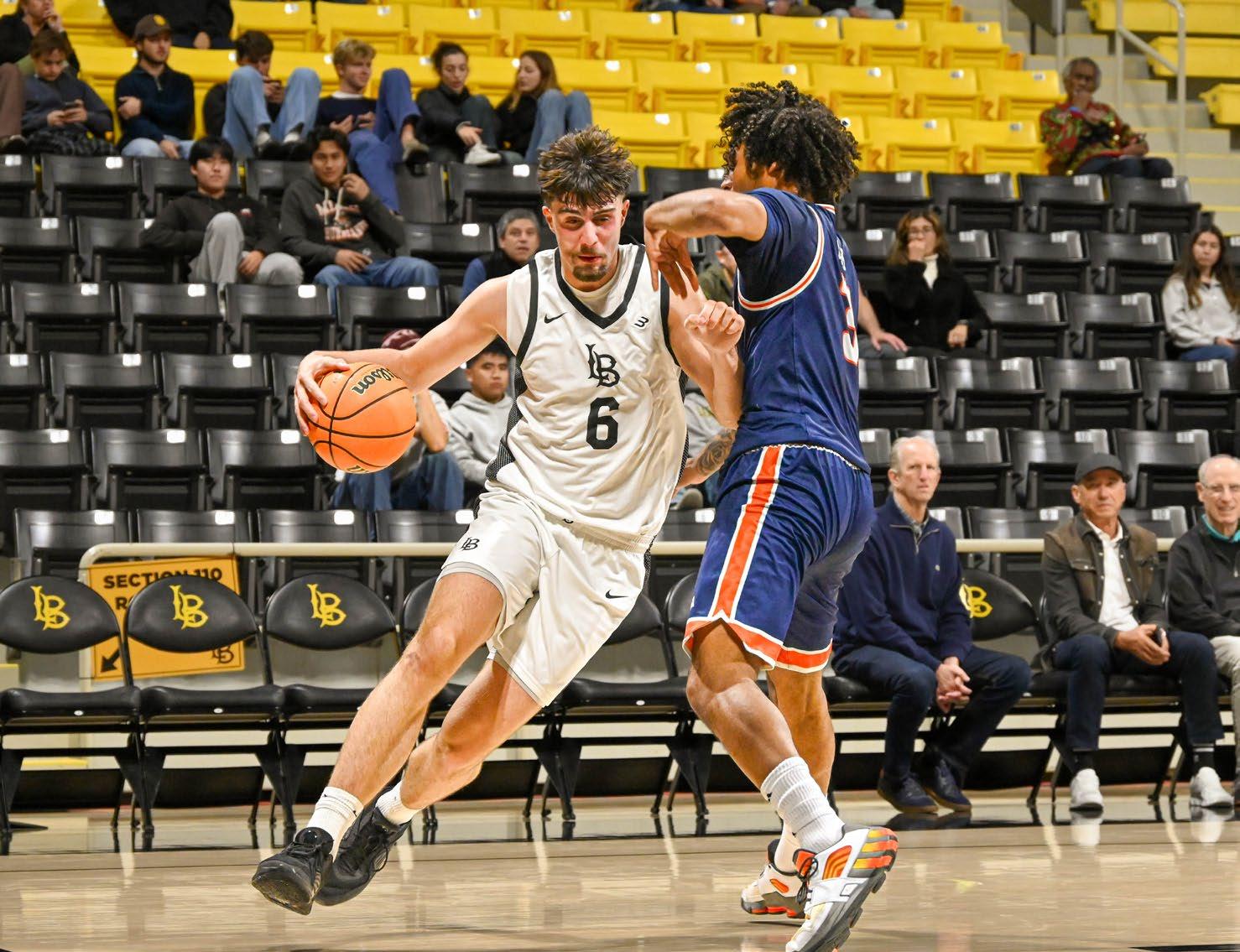
Clockwise from far left: A captain of the women’s track and field team at LBSU, senior KiiKii Brown has become accustomed to the unique challenges facing international athletes in the NCAA. | After playing club basketball in Adelaide, Australia for seven years, LBSU forward Rosie Akot has become a key building block for The Beach after her first season. | In his first season with The Beach, sophomore forward and Serbian transfer Petar Majstorovic finished second in points per game for LBSU with 14.4.
REHANSA KULATILLEKE/Long Beach Current
REHANSA KULATILLEKE/Long Beach Current
No. 3 LBSU cruises past No. 18 CSUN
BY DUPREE DE LA PENA Contributor
After Friday’s five-set road victory in a Big West home-and-away series, No. 3 Long Beach State swept No. 18 Cal State Northridge 3–0 at the LBS Financial Credit Union Pyramid on Saturday.
The Beach (16–4) were looking for a home win after losing two against the No. 2 Hawai’i Rainbow Warriors.
“Tonight back at home we executed at a very high level,” head coach Nick MacRae said. “Last week we left week one of the Big West with a great locker room conversation, we needed to up our training and we did that this week.”
The extra training paid off as senior middle blocker Ben Braun wasted zero time spiking an immediate kill to spark a 5–1 run to start the first set.
The dominant start from LBSU ended quickly as CSUN (12–8) fought back to close the deficit behind two consecutive
kills and a service ace from redshirt junior Jalen Phillips to tie the set at 14–14.
A quick 5–0 run led by LBSU’s junior opposite Daniil Hershtynovich singlehandedly took the game over with a kill and two service aces to help extend the Beach’s lead at 19–14.
“We have a good competition between [Hershtynovich] and [freshman opposite Wojciech Gajek] competing for a starting spot,” LBSU senior opposite Skyler Varga said. “Daniil wasn’t able to play the past couple weeks, he settled into yesterday well, but today was kind of his day.”
Varga also helped keep LBSU’s lead by recording two blocks, reaching 200 blocks for his career. He now sits in the elite club of players with 750 kills, 300 digs and 250 blocks.
CSUN was unable to make up the deficit as LBSU closed out the first set 25–21 behind a kill from sophomore outside hitter Alex Kandev.
The second set started off neck and neck, as the set already had seven ties
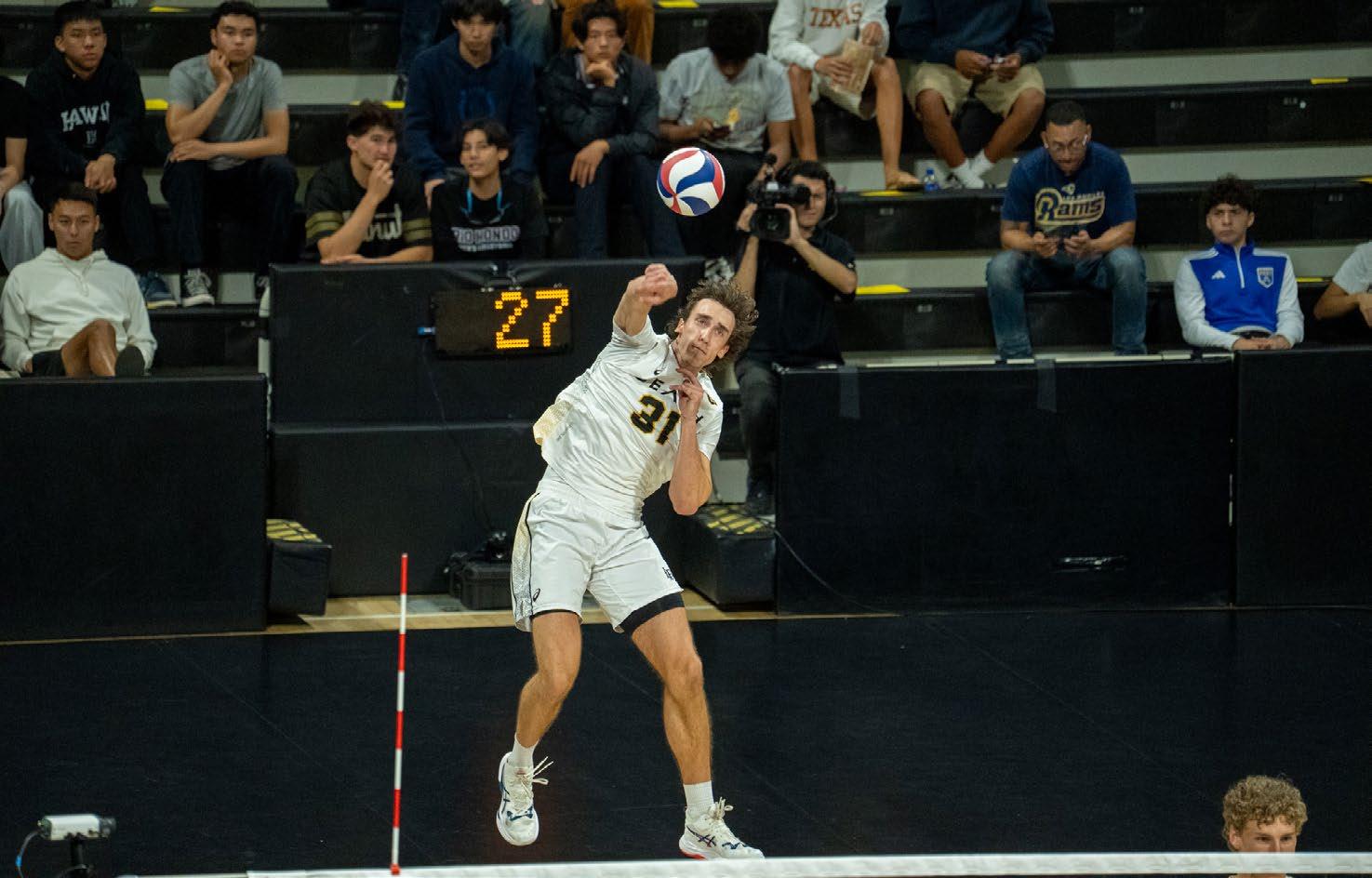
Photo courtesy of OSCAR FUENTES CALLES/LBSU Athletics
LBSU junior opposite Daniil Hershtynovich racked up 11 kills in The Beach’s 3–0 sweep of Cal State Northridge on March 28 at the LBS Financial Credit Union Pyramid.
when the score was 7–7.
However, once the Beach took the first lead of the set, they never looked back.
Consecutive kills from Hershtynovich, Braun, and Kandev completely changed the set as LBSU took a 15–8 lead.
During the Beach’s run, LBSU’s redshirt freshman setter Jake Pazanti made a diving effort to keep the ball in play, injuring his left shoulder.
Pazanti exited the game to the locker room with trainers ultimately coming back to the bench with his left shoulder wrapped up.
In the midst of tending to Pazanti’s injury, LBSU continued with its commanding lead, ending the set 25–16.
Click here for the full story.
Catching The Wave: Taking the Madness out of March
BY TIMOTHY HESSEN Sports Editor
For the second straight year, not a single mid-major program has reached the Sweet 16 of men’s college basketball’s NCAA Tournament.
Affectionately known as March Madness for the storybook moments of David vs. Goliath upsets and surprising Cinderella runs like Loyola Chicago’s magical Final Four run in 2018, the “Madness” of the biggest stage in college sports refers to the anything-can-happen nature of the NCAA’s 64-team, single elimination tournament to crown each year’s national champion.
However, while the excitement of March Madness has turned it into the most bet-on sporting event in the nation, the age of Name, Image and Likeness deals and the transfer portal has taken the Madness out of March.
For back-to-back years, the Sweet 16 is composed solely of programs from power conferences. Smaller mid-major programs like Long Beach State are faring
worse in the first two rounds than ever before.
From 2011–2021, the last decade before NIL was introduced to college sports, power conference teams recorded 59 blowout wins of 20-plus points over mid-majors in the NCAA Tournament, which averages out to 5.9 per year, according to data cited on Fox Sports One’s First Things First.
From 2022–2026, in the first five years of the NIL era, there have been 50 such games, marking an increase to 10 per year.
The key culprit for this change in NIL, which allows college athletes to profit off of their name, image and likeness.
As bigger schools with bigger fanbases and brands can offer more lucrative NIL deals, the talent gap between the blue bloods of college basketball and smaller mid-major programs has widened dramatically.
Additionally, the freedom of the transfer portal that allows athletes to move schools easily has ensured that the rich will always get richer in college basketball.
In the past, if a mid-major school found a diamond
in the rough in high school recruiting, they could hang on to that player all four years of his collegiate career.
Today, as soon as a player makes a name for himself at a smaller school, he has the option to depart for a power conference program and an NIL deal often worth millions of dollars.
This process has rendered mid-major programs like LBSU into feeder schools for larger programs.
LBSU fans saw it firsthand two seasons ago, when former five-star guard Devin Askew came to The Beach after stints at Kentucky, Texas and Berkeley, built his stock back up as LBSU’s leading scorer, and then transferred to another blue-blood in Villanova University.
Ultimately, the advent of NIL was a necessity for college sports.
The ethics of collegiate athletics being the base of a billion-dollar industry without the athletes themselves being legally allowed to see a dime was deeply flawed.
However, it cannot be denied that in 2026, the thrilling unpredictability that was once the hallmark of NCAA basketball is no longer what it once was.

Long Beach State senior third baseman Dylan Lina celebrates with teammates after hitting a two-run homer to deep left field against the UCI Anteaters on March 27. This is Lina’s sixth homer of the season.
ETHAN COHEN/ Long Beach Current
‘Eaters erase deficit, stun The Dirtbags in extra innings
BY JUNIOR CONTRERAS Sports Assistant
Season-long bullpen woes continued for Long Beach State baseball on Saturday after the pen relinquished multiple four-run leads as UC Irvine clawed its way back after trailing a combined nine-runs to execute a 12–9 extra-inning comeback road victory at Blair Field.
Just six outs away from taking the Black and Blue rivalry series after an offensive clinic, command issues spiraled away a four-run eight inning lead for the Dirtbags (9–17).
Five walks gave the Anteaters two free runs off two bases-loaded walks with two outs to the second worst offensive team in the Big West before UCI (10–16) junior infielder Noah Alvarez hit a 2RBI single up the middle to tie the game at nine as the Anteaters completed their second four-run deficit comeback.
“I think today was all self-inflicted,” LBSU head coach TJ Bruce said. “Just
too many freebies…and when you do that when you play a really good-coached team, it’s tough to overcome.”
Freebies is the constant theme of the LBSU bullpen, which leads the Big West in walks at 147 and hit by pitches with 49, allowing opponents to capitalize on the gifted bases.
“Let’s go ‘Eaters” chants erupted in the 11th from the UCI faithful who had reached hour four of the game as the Anteaters loaded the bases after a single and back-to-back walks on four-straight balls.
“I think part of it is the emotions,” Bruce said. “You got to do the best you can at having a slow heart rate and being in the moment, in the present time, and that’s really hard to do.”
A flyball drifted down just as LBSU redshirt sophomore Reid Montgomery did as the ball landed past the diving leftfielder, rolling all the way to the leftfield wall for a bases clearing 3RBI triple for UCI redshirt junior Alonso Reyes, giving the Anteaters their first lead of the game at 12–9 in the 11th.
Reyes roared on third base, just as Anteater redshirt senior pitcher Danny Suarez did on the mound after closing out the Dirtbags in the 11th to end their 10 game-losing streak, 12–9.
The Dirtbags looked to have the series win locked up twice in the game as LBSU freshman starting pitcher Luke Howe went five clean innings while having a five-run lead.
A 2RBI missile single sizzled right past the head of Howe before his career-high ninth strikeout as the freshman was just one out away from escaping the sixth.
Soaring over 100 pitches, fatigue may have captured Howe as he gave up a single and a 2RBI double as UCI cut the five-run lead to just one.
Bruce decided to leave Howe out on the mound as the freshman gave up an RBI single to tie the game at five, giving life to the once quiet Anteater crowd.
“As you saw by the result of the game, there’s a reason why we left him out there as long as we could…I think leaving him out there will pay dividends for his career
down the road and the program,” Bruce said. “I think it shows him confidence from a coaching staff perspective, may or may not been the right move, I think it was the right move for that time.”
LBSU responded back with a fourrun sixth inning led by Montgomery with a pinch-hit, full-count, 2RBI single up the middle past the diving UCI shortstop as Dirtbag fans stomped their feet ahead 9–5.
“I’m most proud of the offense because they responded twice,” Bruce said. “Anytime you score nine runs at Blair field…you should be able to come out and give yourself the best chance to win.”
The Dirtbags used six different arms and combined for a total of 12 walks compared to five walks over seven different arms for the Anteaters. Bullpen fatigue will play a factor in the series finale on Sunday afternoon.