

Long Beach current
1250 Bellflower Blvd., LA4-203 Long Beach, CA, 90804
Editorial Office
Phone (562) 985-8000
Dante Estrada
Multimedia Managing Editor multimedia@lbcurrent.com
Grace Lawson
Community Engagement Editor community@lbcurrent.com
News Editor
Arts & Life Editor
Opinions Editor
Sports Editor
Design Editor
Chief Copy Editor
Photo Editor
Social Media Editor
Video Editor
Podcast Editor
News Assistants
Arts & Life Assistants
Opinions Assistants
Sports Assistants
Design Assistants
Copy Assistants
Photo Assistants
Social Media Assistants
Video Assistants
Podcast Assistants
Khoury Williams Editor-in-Chief eic@lbcurrent.com
Isabella Garcia Managing Editor managing@lbcurrent.com
Various tribal flags representing CSULB alumni were placed around the arena where the category dance competitions took place on March 14, located at the Intramural Rugby and Soccer Fields. The event also featured crafts and food throughout the day until 10 p.m.
Annette Quijada news@lbcurrent.com
Delfino Camacho arts@lbcurrent.com
Leyna Vu opinions@lbcurrent.com
Timothy Hessen
sports@lbcurrent.com
Rebecca Lavond design@lbcurrent.com
Angela Osorio copy@lbcurrent.com
Charlotte LoCicero photo@lbcurrent.com
Erinna Lam socials@lbcurrent.com
Skylar Stock video@lbcurrent.com
Gianna Echeverria podcast@lbcurrent.com
Ethan Brown Jayden Sandstrom
Josephine Robinson
Joshua Flores
Nasai Rivas
Ni Baliness
Jason Green
Lila Mukasa
Joseph Lee
Monica Garcia
Christian Robledo
Alexys DeMaria
Monica Badolian
Xavier Constantino
Brianna Apodaca
Alan Ibarra
Junior Contreras
Brooke Williams
Gabrielle Lashley
Nhi Ho
Leyla Crail
Sasha Marantz
Josephine Kim
Joshua Min
Diego Perez
Eddy Cermeno
Rehansa Kulatilleke
Jorge Hernandez
Ethan Cohen
Valentina Villarreal
Alejandra Guerra
Mikaela Perez
Kiara Fillingim
Eli Vice
Bryan Viteri
Ava Richards
Brandon Rodriguez Crow Vides
Business
Creative Director
Web & Technology Director
PR & Marketing Manager
Distribution Manager
editors assistants advisers
Design Adviser
Content Adviser
Advertising & Business Adviser
Alicia Taylor creative@gobeach.media
Tasneem Iqbal web@gobeach.media
Erika Lacy pr@gobeach.media
Seiana Spencer-Kendrick distribution@gobeach.media
Gary Metzker
Barbara Kingsley-Wilson
Jennifer Newton
Library officials detail plans for research center, archives
BY ALFREDO MENJIVAR Contributor
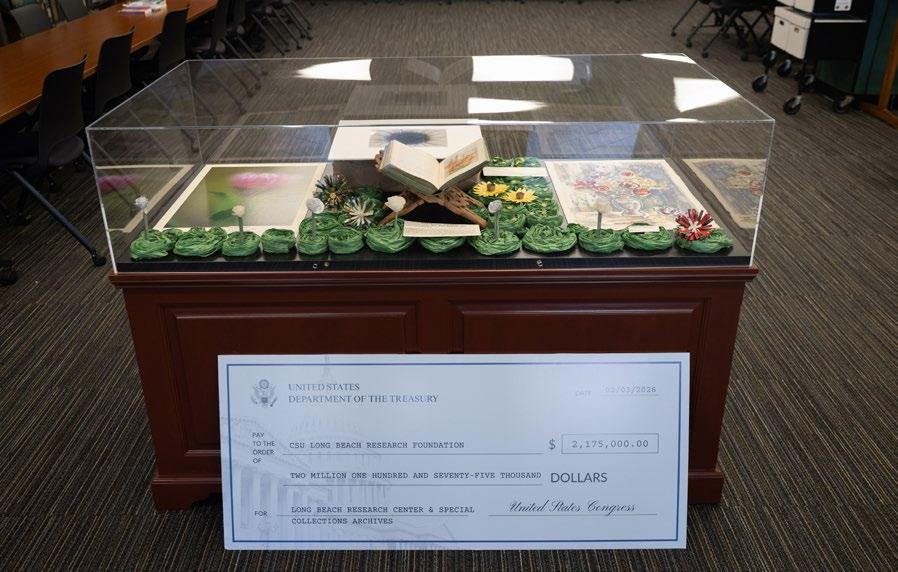
On Feb. 13, U.S. Congressman Robert Garcia presented Long Beach State with a $2.1 million check to fund the University Library’s new Long Beach Research Center and Special Collections.
Elizabeth Dill, dean of the University Library, worked with Erica Lucia, director of government relations at CSULB, to receive the funding. Dill said the library will always require more funding, as it took them two years to get it.
“Our resources, our databases and books, increase in cost year after year due to inflation,” Dill said. “This year, our resources increased 7%. Unfortunately, our library budget does not increase year after year, so this creates a deficit that we are always struggling to keep up with. Funding is crucial to help fill in that gap so we don’t lose our valuable resources.”
The new spaces at the library will include areas to do homework as well as digital archives.
The renovations for the Long Beach Research Center and Special Collections will commence in six to eight months due to the need to complete federal paperwork, as faculty have no time frame for the renovations. Challenges have yet to be faced.
land acknowlEdgmEnt
JORGE HERNANDEZ/ Long Beach Current
A check of $2.1 million presented by U.S. Rep. Robert Garcia was layed next to a display at the Special Collections and University Archives on Feb. 25, at the University Library.
The archives are a collection of old newspapers and magazines, including those from the Long Beach Current, formerly known as the Daily Forty-Niner, catalogs, yearbooks, and photographs.
Heather Steele Gajewski, University archivist, said the updated reading room and classroom will reflect modern archival research and exhibition standards, with improved lighting, flexible teaching space and enhanced technology.
Click here for the full story.
Here at the Long Beach Current we acknowledge that the school we report on is located on the sacred site of Puvungna, “the gathering place.” We are on the land of the Tongva/ Gabrieleño and the Acjachemen/Juaneño Nations who have lived and continue to live here.
We also acknowledge the Gabrieleño/Tongva (pronounced: GABRIEL-EN-YO/TONG – VAH) and Acjachemen/Juaneño (pronounced: AH-HACH-AH-MEN/JUAN-EN-YO) as the traditional custodians of the Los Angeles region along with the Chumash (pronounced: CHOO-MOSH) to the north and west, and the Tataviam (pronounced: TAH-TAH-VEE-YUM) and Cahuilla (pronounced: KAH-WEE-YAH) Nations to the east.
We respect and value the many ways the Tongva/Acjachemen cultural heritage and beliefs continue to have significance to the living people and remind us about the sacred and spiritual relationship that has always existed here at what we now call California State University Long Beach.
Editorials:
Editorials: All opinions expressed in the columns, letters and cartoons in the issue are those of the writers or artists. The opinons of the Long Beach Current are expressed only in unsigned editorials and do not necessarily reflect the opinions of the journalism department or the views of all staff members. All such editorials are written by the editorial board of the Long Beach Current.
lEttEr Policy
lEttEr Policy: All letters and emails must bear the phone number of the writer and must be no more than 300 words. The Long Beach Current reserves the right to edit letters for publication in regard to space.
Haley Lopez Business Manager business@gobeach.media Monday, March 16, 2026

Student government candidates outline 2026 goals on debate stage
BY JOSEPHINE ROBINSON News Assistant
Candidates for the Associate Students, Inc. vice president of finance, executive vice president and president joined the stage on Wednesday at the ASI Executive Candidate Debate to illustrate their goals for student voters.
Voting will be open March 16-19, accessible via an ASI link that students will receive in their Outlook email accounts.
The presidential candidates are current ASI President and third-year political science major Sonny Ciampa, ASI Chief Justice and second-year political science major Asleiram Hernandez-Rodriguez and second-year biology major Nathan Garcia.
What they hope to accomplish if elected:
As president, Ciampa said he will continue to put student needs first and strengthen campus life, especially now that the University Student Union is under construction.
“My plan for next year is simple: keep our students engaged with this USU closure,” Ciampa said. “By claiming stronger partnerships with our cultural research centers and clubs, we can ensure our students remain engaged during these challenging times ahead.”
Ciampa’s platform is focused on increasing student engagement on campus, expanding access to study classrooms and affordable food, supporting students with necessities and more.
Garcia ran on transparency between ASI leaders and their constituents, parking equity reviews and protecting undocumented students on campus.
“I’m going to push for parking equity reviews, and I’m going to make sure to continue to strongly support protection for our undocumented students,” Garcia said.
Hernandez-Rodriguez said as president, she will prioritize student representation and support.
“I know it’s a really scary time, a lot of us are uncertain of what our futures are gonna look like,” Hernandez-Rodriguez said. “I hope as your president, I can reassure you that your campus leadership is doing everything in their power to put you first.”
How they plan to rebuild the campus amid the construction:
Hernandez-Rodriguez said she hopes to host town hall meetings with campus resources and night markets for students who are on campus later.
“Through innovative planning, we can really come together and rebuild that sense of Beach pride,” Hernandez-Rodirguez said.
On the other hand, Garcia wants to establish accountability within departments and ASI leaders.
“I will make sure everybody is involved, and that they’re doing their part when it comes to the department or the role they’re in,” Garcia said.
Ciampa said he will continue to go directly to students and ask what they need to feel supported, either through ASI events or through outreach programs.
“We have to make it a priority to go to them, because if we rely on them to come to us, they’re not gonna come to us,” Ciampa said.
Debate addressing student fee, tuition and affordability concerns:
Vice President of Finance candidates were third-year economics major Desti-
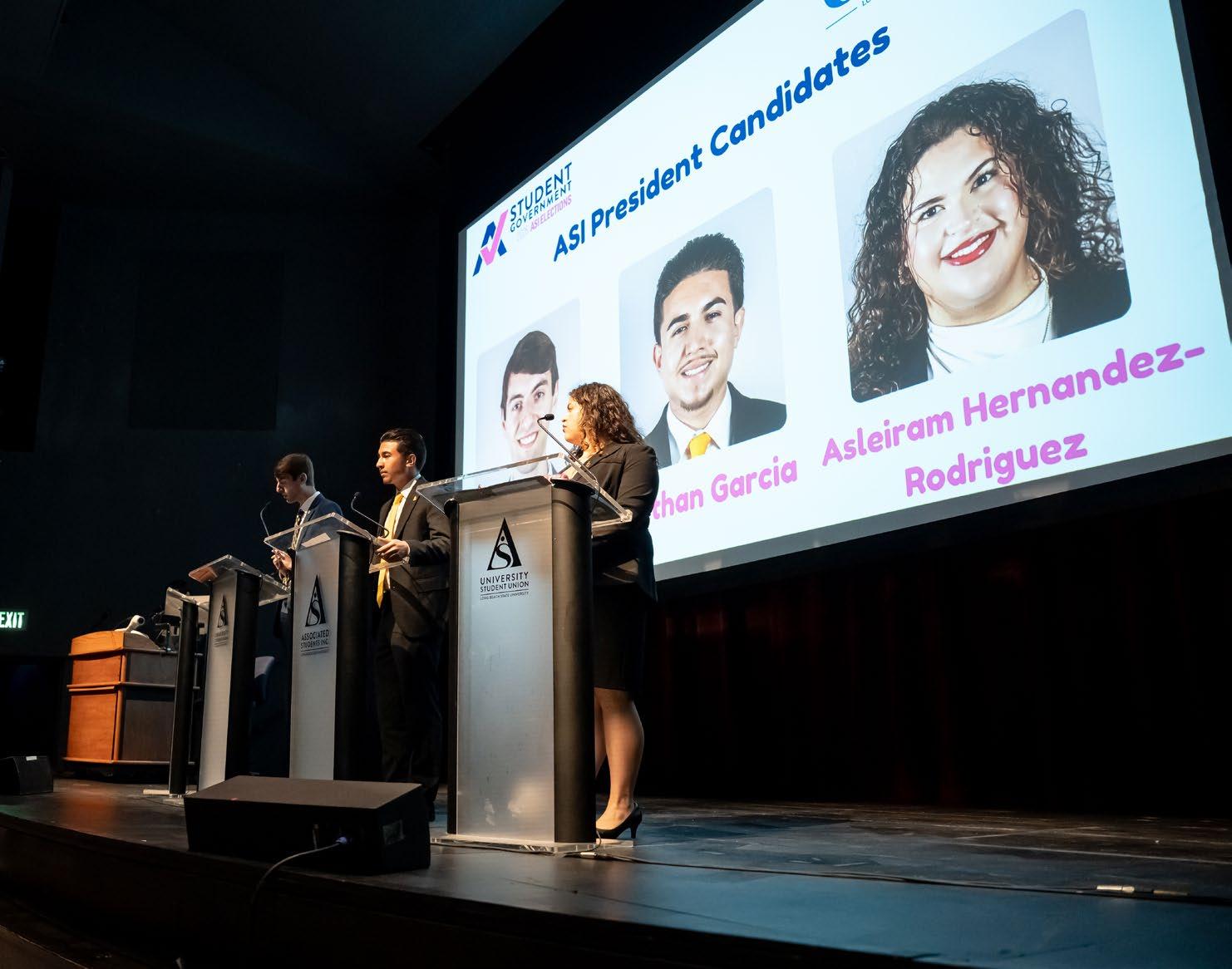
CHARLOTTE LOCICERO/Long Beach Current ASI student government debates the election for the next ASI President at CSULB on March 11. From left: Third-year undergraduate in political science Sonny Ciampa; second-year biology major Nathan Garcia; and third-year political science major Asleiram Hernandez-Rodriguez.
ny Garcia, ASI Arts Senator and thirdyear Arts major Itzel Huerta, third-year management information systems and accountancy major Wasi Mahin and third-year business finance and management major Jayden Sandstrom.
How they plan on making future funding decisions and student fee info:
“I understand where confusion occurs, but I still want to understand that students are the ones who should be making these decisions,” Mahin said, “We can always refer back to students.”
Sandstrom addressed the frustrations many students have with the USU construction and funding decisions.
“We need to do a better job at making sure the student body is all on the same page, like where we think funding may need to be cut or what needs additional funding,” Sandstrom said.
Garcia shared frustrations many students have about the construction and plans to see if she can allocate certain funds so they can go back to students.
“I would like to see if I could take some of those student fees so food isn’t so expensive and students can have cheaper options now that the USU is gone,” Garcia said.
Huerta plans to make student fee information clearer so students know exactly where their money is going.
“Transparency goes a long way. With having a fee called ‘USU fee,’ it misguides us into believing we’re investing in something we will never see,” Huerta said. “In reality, we are investing in our present experience now.”
VP candidate addresses communication between the student body and ASI:
Samantha Renee Valdez, UREC Board of Trustees Vice Chair and second-year business marketing student, was the only candidate running for executive vice president.
Valdez said she would strengthen connections between ASI representatives and their constituents, allowing for more open communication.
Valdez’s goals include rebuilding the campus community by offering future alumni discounts once Future U is built, clearer academic clarity among students, professors and academic advisers and providing a campus heat map to help organize events and increase club and event turnout.
“It’s really important to hear student feedback and see where we can meet grounds with them, meet in the middle or completely take in their input,” Valdez said.
Multiple campus cultural resource centers remain wheelchair inaccessible
KHOURY WILLIAMS/Long Beach Current
BY ALEXYS DEMARIA Opinions Assistant
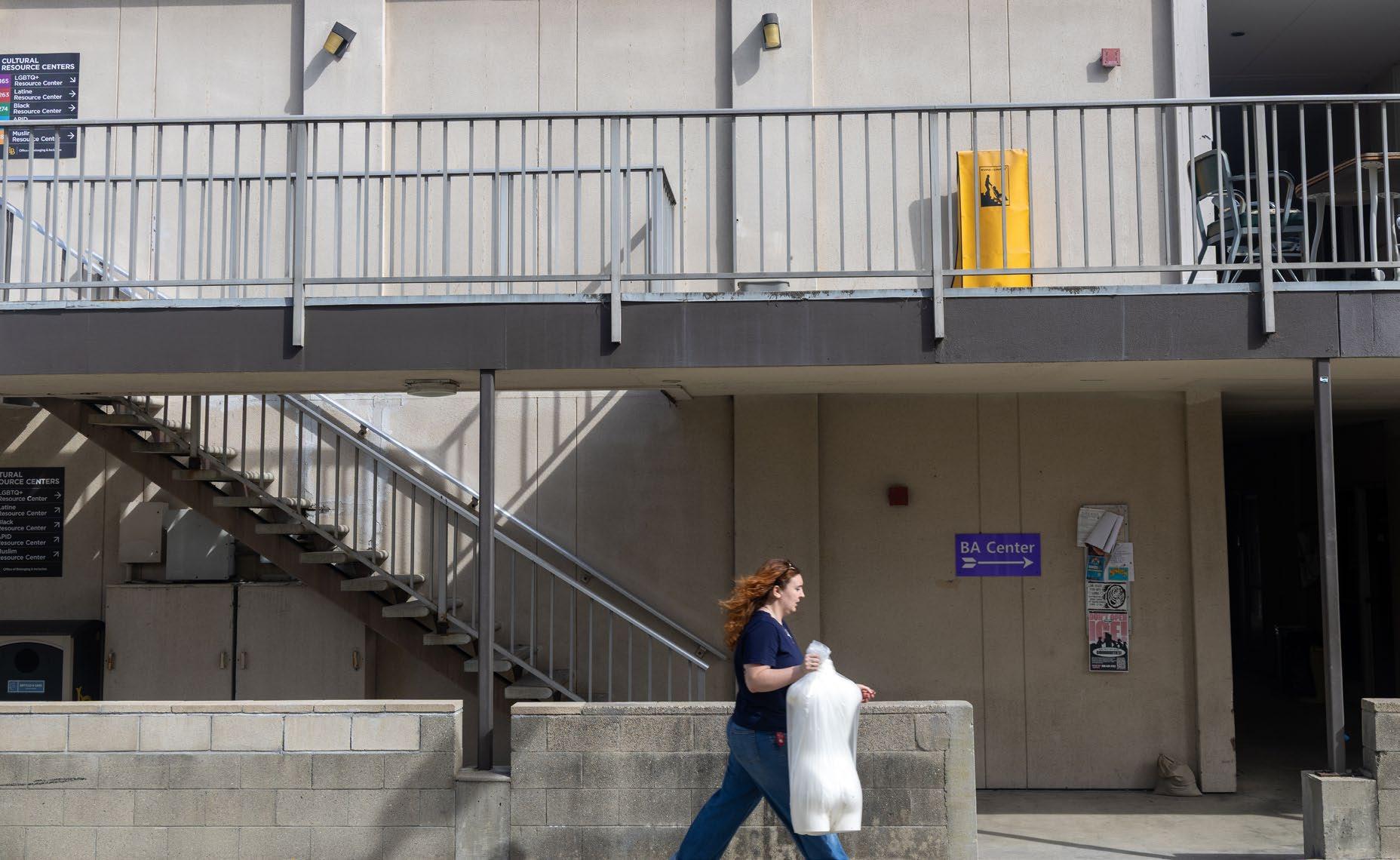
Behind Fine Arts 4 and north of the Fine Arts 3 building on upper campus lies the Faculty Office 4 building, which houses five of six student cultural resource centers at Long Beach State.
Most campus buildings were constructed between the 1950s and ‘80s, before the Department of Justice adopted the United States Access Board’s Americans with Disabilities Act Accessibility Guidelines in 1991.
The FO4 building, constructed in the 1970s, is not fully wheelchair-accessible; the second floor is accessible only via two narrow staircases.
“There are always buildings created during a timeframe where the ADA compliance was potentially different from what it is now,” Bob Murphy Access Center Director Mary Nguyen said.
Multiple student cultural resource centers remain on the second floor of the FO4 building. This includes the Asian, Pacific Islander and Desi Resource Center, the Black Resource Center, the Muslim Resource Center and the Latinx Resource Center.
Joemhar Ferrer, a third-year history and Asian American studies major, has three years with the Asian, Pacific Island-
er and Desi Resource Center.
“I usually give campus tours or the resource center tours, and sometimes we’d have students in wheelchairs … we would just have to keep the tour on the first floor and just tell them, ‘This is where these spaces are at,’” Ferrer said.
Ferrer experienced this inaccessibility after needing a mobility scooter following an injury. He worked at the Office of Belonging and Inclusion in the FO3 building temporarily because he “couldn’t even get up” to the APID Resource Center to work.
“There are a lot of students in wheelchairs that want to experience our centers, and they can’t really access them,” Ferrer said. “The centers wouldn’t be the centers without the students. I feel like everyone should have access to it.”
Ferrer added that ventilation issues were recently fixed in the FO4 building, but power outages add to the persistent signals of decay.
“You can honestly smell how old the building is,” Ferrer said.
Previously, the Long Beach Current reported on the building’s isolated location and inaccessibility in other coverage of the student cultural resource centers, chronicling Beach Building Services’ need for funding to rebuild.
“We’ve known for the longest that we need to demo [FO4],” said Melissa Soto,
manager of capital project development at Beach Building Services.
Soto oversees the management and maintenance of over 85 buildings on campus.
A BBS study recommended demolishing Peterson Hall 1, FO4 and FO5 due to age and inaccessibility. A wheelchair lift was added to FO5, making the second floor of FO5 and PH1 wheelchair-accessible via a connected walkway.
Peterson Hall currently houses Associated Students, Inc., 22 West Magazine and multiple other student organizations displaced by University Student Union construction.
CSU campuses annually present their Capital Project Plans to the Chancellor’s office as a bid for state funding. Beach Building Services has presented the plan to demo PH1 as its top project for several years, Soto said.
The state has not given CSULB new funds for academic building projects for the past 16 years. The last state grant of this kind to the university was for the Hall of Science, completed in 2011 and partially funded by the university following a state budget stalemate, totaling millions of dollars.
CSULB has received partial state grants for the expansion of the Child and Family Center in 2019 and for building the La Playa student housing project.
Soto said the building, designed to replace the footprint of PH1, FO4 and FO5, is a 130,000-square-foot facility for the College of Health and Human Services, consolidating 11 departments into one location.
Designed by Cannon Design, Soto said the plan for the facility, which includes a community health clinic, is already approved.
“We don’t have a revenue stream… It’s an academic facility. So that’s why we’re lagging on doing that project in particular,” Soto said. “I’m really hoping with the new president, and just because we’ve been waiting in line so long [for funding], it’s our turn.”
The Student Cultural Resource centers will remain in FO4 until the 2028 opening of the Student Union.
“What’s great about the centers going into the USU is that it’s purpose[ly] built for them, for their function,” Soto said. “It’s not a classroom; it’s their research center for whatever they want.”
Nguyen said that BMAC can adjust classroom locations in inaccessible buildings following student complaints on a case-by-case basis.
“If a student has a classroom in an inaccessible building, I work with the campus to move that classroom where I can, and so that is something that I’m committed to, and I work to do,” Nguyen said.
The cultural resource centers located in Faculty Office 4 are only accessible via stairway, leaving wheelchair users and people with mobility disabilities unable to access the building.
Meet the director of the Dream Success Center: A firstgen leader advocating for immigrant students
MAIZI MERKLEIN/Long Beach Current
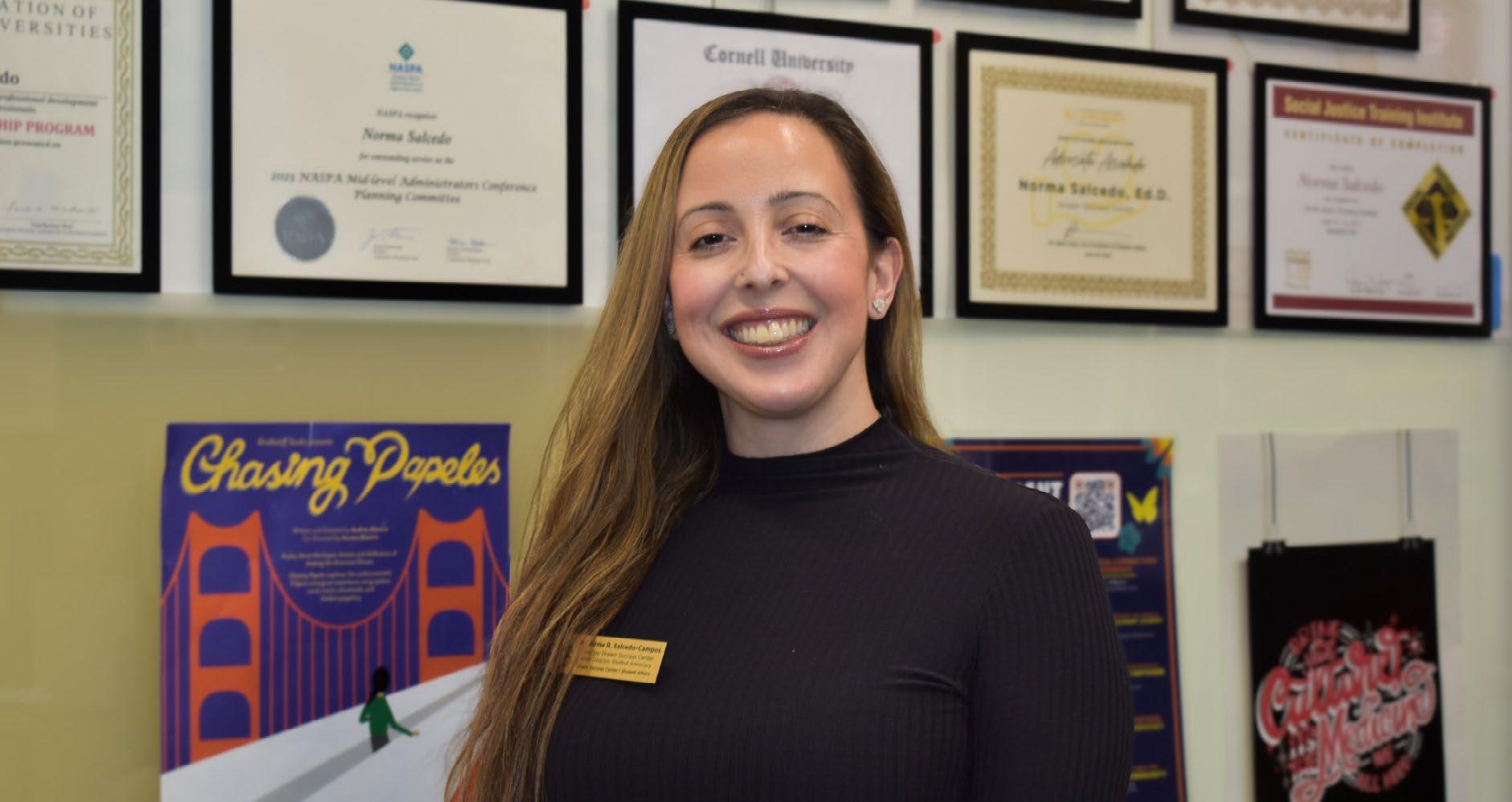
Norma Salcedo, director of the Dream Success Center, has been working in student support services for 10 years. Growing up in a mixed status family has allowed her to transform that experience into advocacy and building a community. When students come to Salcedo with a problem out of her scope, she admits it takes a toll. “It really hurts me knowing that I can’t give you a solution.”
BY FERNANDA MOCTEZUMA AND MAIZI MERKLEIN Contributors
At 10 years old, Norma Salcedo was learning legal terminology adults struggle to understand. Salcedo translated immigration documents for her parents, helped them navigate shifting legal statuses and advocated for them when discrimination followed them.
“I found myself constantly feeling the need to be their person to support them,” Salcedo said.
Salcedo, now 37, serves as the director of Long Beach State’s Dream Success Center, where she supports students navigating immigration concerns. This support is essential during a time of heightened fear within the community.
Recently, Salcedo was promoted to senior director of student advocacy, an opportunity for her to expand her work across campus.
Growing up as the eldest daughter in a mixed status family shaped Salcedo’s approach when advocating for students.
“I think my parents taught me the true meaning of what it means to be an advocate and an ally to a community that you personally might not be a part of, because I was not navigating the same experience my parents were,” Salcedo said.
As a first-generation college student, Salcedo balanced three jobs, helped her younger sisters navigate their college experience and supported her disabled father with medical appointments.
“I needed to make sure my sisters had the resources that they needed to be successful…I didn’t want them to struggle the way I did,” Salcedo said. “Just because I was a first, I made sure I wasn’t the last.”
In 2020, Salcedo earned her doctorate in educational leadership from San Francisco State. Reflecting on the memory of her parents hooding her, Salcedo credited them as inspiration to work at universities.
“I wanted to make sure that I also continue to support students,” Salcedo said. “There’s always that first experience that a student is navigating.”
Salcedo’s leadership helps serve her community and motivates those who work alongside her.
“I met [Salcedo] when I was an undergraduate student myself and the passion she carries for her work has only grown,” Erick Peraza, DSC coordinator, said in an email.
Salcedo’s professional path toward immigrant student advocacy solidified while she was in graduate school at the University of Kansas. While at KU, she was an instructor for a TRiO-funded summer program, serving students connected to field and meat packing
labor. She witnessed the impact of the Deferred Action for Childhood Arrivals announcement in 2012 on her students.
“Seeing their faces lit up for the first time and being like, ‘Miss Norma, is this for me?’” Salcedo said. “That’s what made my heart so happy.”
Salcedo also emphasized the DSC’s collaboration with CARECEN, a state-funded legal services provider that serves multiple CSU campuses. Salcedo said she is proud that CSULB is the only campus with CARECEN on-site, offering legal representation for family petitions, removal defense and general consultations among other services. Beyond programming, Salcedo describes the heart of her work as emotional support.
“There’s always been a fear of the unknown … we can’t control what’s happening outside of these walls, but we’ll remain a safe space where [students] can feel comfortable sharing how they’re feeling,” Salcedo said.
In 2024, the DSC held a staff meeting following President Donald Trump’s re-election.
“[Salcedo] was very upset…and those that have been impacted by immigration were very upset,” Valentina Jimenez, fourth-year Spanish and French major and DSC fellow, said. “She was ready to be with us and be by our side if we ever needed her support.”
As someone who considers herself a fixer, there are moments, particularly
with legal cases, when the weight of the work hits Salcedo hard. There are days when she doesn’t have a solution for students.
“Those [situations] are always hard when it’s beyond my scope…maybe I should go to law school,” Salcedo joked.
To maintain balance and a healthy mind, Salcedo said she wakes up at 5 a.m., meditates and weightlifts at an all women’s gym to center herself and get ready for the day.
Outside of the university and DSC’s staff, Salcedo has another support system at home.
“I’m grateful for my husband who is my person that I can go to,” Salcedo said. “[He] helps me find joy in times when it gets really heavy.”
While managing a full schedule, Salcedo makes it a priority to show up for students and her staff alike.
“She’s handling a lot and I mean her being able to make the time for us, I feel like it’s something very inspiring,” Jimenez said.
Salcedo’s career is deeply rooted in personal experience. As her community is faced with uncertainty, Salcedo plans to remain steadfast in her commitment to students.
“So as things shift in different ways, we’re going to shift with it,” Salcedo said. “The students are gonna drive that shift… regardless of what’s happening.”

shed some tears at Reinne’s Place
KIMBERLY ROSS
Contributor
Even in its temporary home on Seventh Street, Reinne’s Place has already become a vital community space.
Tommy Le founded the cafe last year after the passing of his fiancee, whose memory continues to shape the heart of the business. What began as a personal way to grieve and process loss has grown into a space centered on community and emotional connection.
Customers are invited to write short reflections, called “Reinne’s Checks,” about their emotions—grief, healing or personal milestones—and leave them behind for others to read. During my visit, I watched people pick up these notes, pause and even tear up at times.
The Vietnamese and Filipino-inspired coffee and matcha drinks may draw people in, but the emotional connection—quietly reading someone else’s story, realizing they’re not alone—is what makes people stay.
With its permanent storefront still under construction, Reinne’s Place is currently operating out of Open Gallery, about three miles from campus. Despite the temporary setup, the pop-up has drawn steady attention.
Here is my honest review of four drinks: the seasonal strawberry matcha, blue jasmine matcha, reinne’spanner
and baguio banana. I also tried their bibingka, the only available food option at that time.
Strawberry Shortcake Match
$8.50 4/5 waves
The strawberry shortcake matcha is a seasonal drink that feels thoughtfully crafted rather than overwhelming.
Visually, this drink does most of the talking. The grass-green matcha layered over a soft pink with crumbles of strawberry shortcake on top makes it almost too pretty to sip.
The drink excellently balances sweetness and earthiness, with the strawberry adding a creamy, dessert-like element without completely overpowering the matcha. It’s indulgent but not too sweet.
Blue Jasmine Matcha
$7.50 4/5 waves
The blue jasmine matcha was a standout. The jasmine adds a subtle floral note that elevates the drink beyond a standard matcha latte. It’s less sweet than the strawberry option and has a smooth, aromatic flavor that’s not too heavy.
For those who prefer complexity over sweetness, this is the drink to order—especially if you’re a matcha lover.

KIMBERLY ROSS/Long Beach Current
From left: baguio banana, strawberry shortcake matcha, blue jasmine matcha and the classic reinne’spanner. All syrups and ingredients are made in-house.
Reinne’spanner
$7.50
3/5 waves
Reinne’spanner, a Vietnamese-style espresso topped with a dollop of cream and toasted coconut, is a standard go-to coffee. The espresso is bold and slightly bitter, balanced by the thick layer of cream.
It’s a solid drink, but compared to the diverse matcha options, it feels more conventional than memorable.
Baguio Banana
$8
2/5 waves
The baguio banana didn’t quite hit the same heights as the other drinks.
It features 72-hour fermented banana with jackfruit-infused brown sugar, made in house. The banana flavor wasn’t too strong, but you can definitely taste the jackfruit.
The flavor profile wasn’t balanced like other drinks, but was reminiscent of a Southeast Asian-style dessert.
$7
3/5 waves
Bibingka
Bibingka is a Filipino baked rice cake that is simple and comforting. Soft with
a slight chew and mild sweetness, it pairs well with the coffee drinks and is recommended to dip in the cream topping. While the food menu is limited for now, the bibingka adds a cultural warmth that matches the cafe’s overall atmosphere.
As Long Beach waits for the permanent storefront to open, Reinne’s Place is already building something everlasting.
Reinne’s Place is located at Open Gallery at 1738 E. Seventh St, Long Beach. Its hours of service are Monday–Friday from 7 a.m. to 2 p.m. and Saturday–Sunday from 8 a.m. to 4 p.m.

Illustration by GABRIELLE LASHLEY/Long Beach Current
by DANTE ESTRADA/Long Beach Current
CHARLOTTE LOCICERO/Long Beach Current
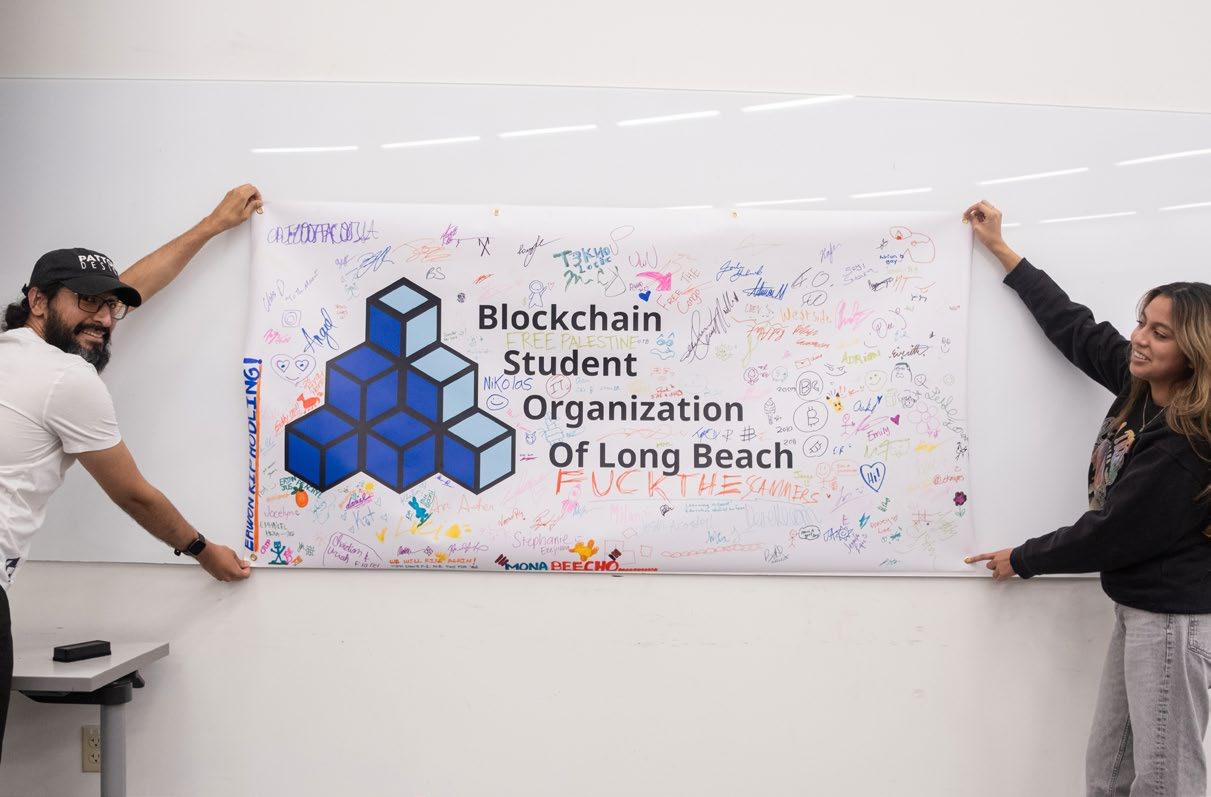
President Allan Rojas, master’s in information systems (left) and Treasurer Financial Transparency Officer Katherine Hernandez, master’s in information systems, of the newly formed club called Blockchain Student Organization of Long Beach on Feb. 11.
Building blockchains at The Beach
BY ARGENTINA TALLEY
Contributor
Allan Rojas, a 28-year-old information systems major, found passion in something that not only has the potential to improve others’ quality of life but also to eliminate fees for almost anything — the blockchain.
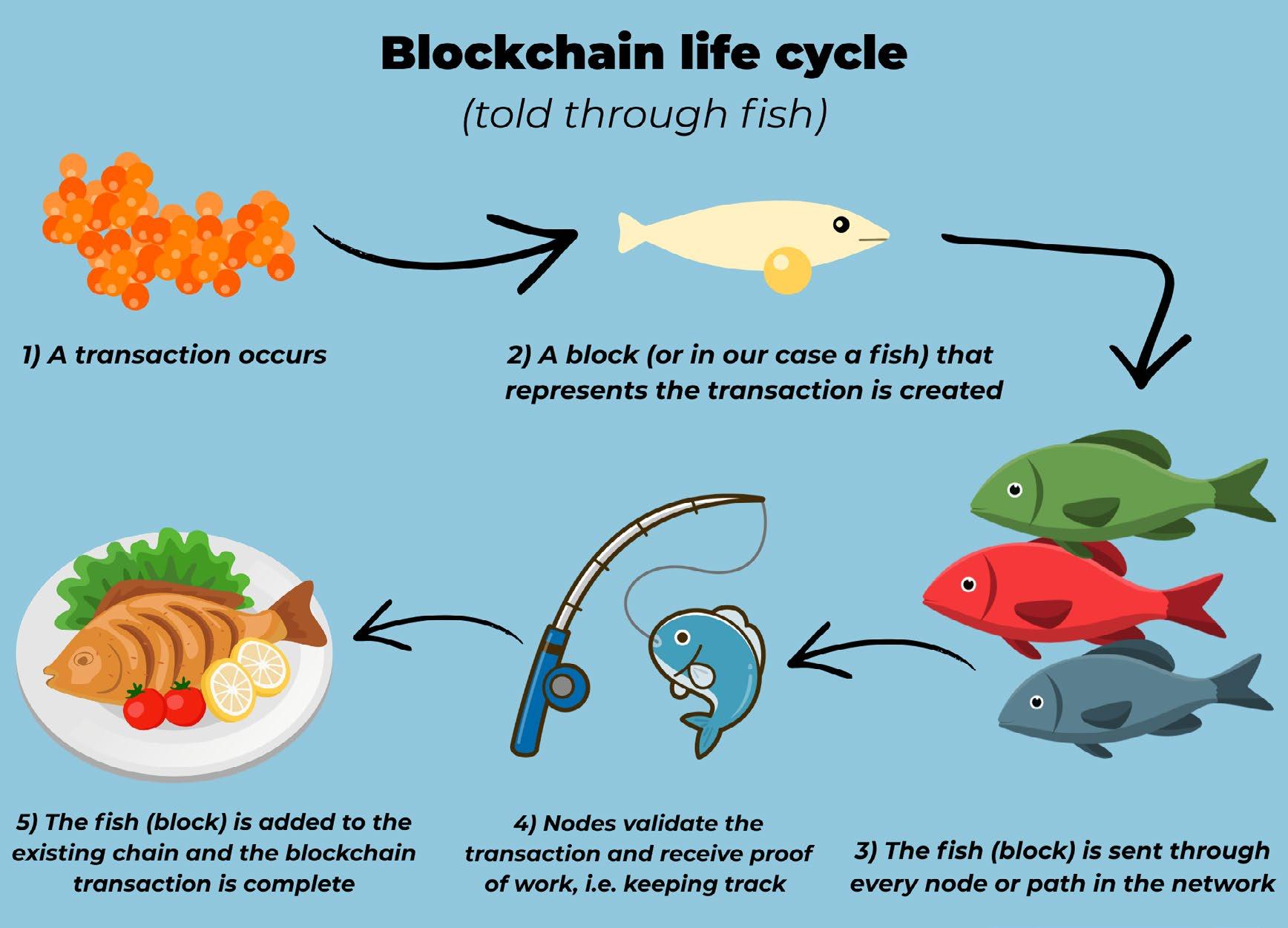
Blockchains are a series of data tied together through a network of computers. If one set of data is changed, the rest doesn’t work. Blockchains help ensure data integrity without a central authority, offering consumers more freedom in the digital realm.
In simpler terms, it’s like keeping track of a fish as it moves from place to place until it ends up in a restaurant.
Blockchains are accessible to anyone, with downloadable software that can be used regardless of experience.
After attending many conferences and events across Los Angeles and Orange Counties, Rojas launched the Blockchain Student Organization of Long Beach, a student club he hopes will destigmatize blockchains and inform
students about them.
Rojas and club members promoted their organization during Week of Welcome.
The club’s name was designed to avoid confusion about the group’s focus.
“If you hear ‘blockchain,’ you have some ideas,” Rojas said. “ It would’ve been worse if I said ‘crypto club,’ because people would have more associations and assumptions.”
Rojas hopes to garner interest in the club through small, colorful postcards.
“I have taped my postcards to various information stations around upper campus and the College of Business,” Rojas said. “The postcards are technically collectible, so they are free for people to grab.”
In blockchains, every transaction or activity has some data attached, which applies to any system that tracks specific data points.
Blockchains are encrypted, making them one of the safest systems to use to prevent fraud – no other transactions would be made in your name.
Forouzan Golshani, professor of Computer Engineering and Computer Science, explained that if you design
a system where each new transaction is permanently linked to all previous ones in an unbreakable chain, the result would function like a blockchain.
In protecting these blockchains with strong code, encryption uses two keys — a public key, which people can use to identify you, and a private key, which is a code known only to the owner.
“It’s 64 characters of a hexadecimal system, so it’s a very long string of characters, to the point that guessing what those characters are takes millions of years to guess,” Golshani said.
There are many ways to use blockchains, including cryptocurrency, supply chain management, food systems and smart contracts between individuals and companies.
“This is [a] substitute,” Golshani said. “It is something that parallels the banking system as you have it. You have a credit card, right? So you have done transactions already, and the next transaction is added above or below all previous transactions.”
Rather than going through an intermediary to sell or buy something, such as an online platform like eBay or a financial institution, people can exchange
something of value to them with another person for free.
“Blockchains enable individuals to enter into transactions without having to pay fees. That is the best part of blockchains.” Golshani said.
Club member Marco Amador, 25, is in the information systems master’s program and is also the community outreach director, or “sentimental director.”
“I think it would be a great opportunity to learn and network with a lot of different people,” Amador said.
Future plans for the Blockchain Student Organization of Long Beach include a Hack-a-Thon in partnership with USC, a blockchain conference, a Block the Walk event featuring a Bitcoin run and becoming an academic organization by creating a degree/minor or certificate program.
“Watching crypto and all that stuff gives me a sense of hope and fulfillment. And I see a lot of pessimism amongst my peers, especially when it comes to money, and I wanna show them that it doesn’t have to be this way, [and] we can make a better life for ourselves,” Rojas said.
Graphic
ARTS & LIFE
Puvungna Powwow brings tradition back to The Beach

BY JOSEPH LEE Arts & Life Assistant
Ababy girl in a multicolored tribal-patterned onesie toddles toward the center of the arena, waving a red flag.
Behind her, a middle-aged man with feathers adorning his head, bones across his chest and bells fastened to his ankles follows closely.
Without word or expression, he swiftly scoops her up by the back of her onesie and carries her off the floor, drawing chuckles from the crowd.
As he totes her away, the man walks past a ring of flags—each representing the tribal nations of CSULB al-
ums—that surround the grassy gathering space.
Each banner tells the story of students and community members who helped shape the powwow into what it is today — a bookmark in the story left behind for those dancing in the arena to build upon.
The lighthearted moment unfolded on Saturday, March 14, during the first day of the 53rd annual CSULB Pow Wow, a free two-day gathering held on the intramural rugby and soccer fields.
The event was presented by a collection of on-campus organizations, including the American Indian Studies Program, American Indian Student Council, American Indian Student Services, Division of Student Affairs, Student Life and Development and Associated Students, Inc.
Like many powwows, this one—held on Puvungna grounds—is intertribal, drawing dancers, drummers, ven-
dors and visitors from nations across the country, including Apache, Navajo and Pawnee communities.
Among the dancers who traveled across the country was Rey Vega, 22, a Southern Traditional dancer from Houston, Texas.
Vega, who is Nahua and Choctaw, identifies as Two-Spirit and works as an educator at the American Indian Center of Houston, where they teach workshops in traditional crafts, including rattle-making, moccasin-making, ribbon skirt sewing and hand drum construction.
Their regalia—styled after late 1800s Southern Plains designs—is mostly handmade.
“Usually for powwows, we do travel out of state,” Vega said. “We travel long distances for powwows because they’re so much fun. It’s not every day that we get to dress in our regalia and dance… I love showing off all the rega-
ARTS & LIFE

Clockwise from the far left: Zachary Gallegos, a 14-year-old, participated in the intertribal dance, featuring his regalia made by his father, at the 53rd annual Pow Wow celebration on March 14 at the Intramural Rugby and Soccer Fields. | Tribal dancers performed throughout the day at the Powwow. The dancers only took a two-hour break until 6 p.m., resuming later in the evening. | After learning his results of the men’s Southern traditional dance competition, he returns back to his family. | Traditional native foods were offered by four different vendors. This included red chili stew, Indian tacos, veggie taco frybread, native nachos, fry dog and red chili stew. The prices varied from $8 to $15.
Photos by DIEGO PEREZ/Long Beach Current

lia that I make.”
Traveling long distances to powwows isn’t merely about the experience for Vega, but about the right to be able to dance freely.
“I can’t go to a powwow and dance in Texas like this,” Vega said. “If I want to dance in their powwow, they’re going to register me as a male, and I can only dance in male categories. I don’t have male regalia. I don’t do the male dances, so respectfully, I’m not gonna come to [their] powwow.”
That powwow, they said, was hosted by the Alabama-Coushatta Tribe of Texas, which sits roughly an hour and 45 minutes north of Houston. With only two reservations in Texas, Vega often has to cross state lines to dance in spaces that welcome their Two-Spirit identity. For organizers, the powwow is equal parts a celebra-
tion and continuation of family history.
Les Peters, a CSULB alumnus and part-time lecturer for the American Indian Studies program, has helped run the powwow for decades.
“It makes me proud to know that people are aware of this celebration,” Peters said. “They’re coming from Arizona, New Mexico, Utah [and] Oklahoma just to be here.”
He calls powwows “a place of beginnings,” noting that many of the staff’s “parents and grandparents were here” to organize the event. Today, it welcomes dancers, drummers and community members who continue that legacy.
“I’m looking forward to the next 25, 30 years to see where it goes,” Peters said. “It’s coming back full circle.”
The powwow also draws alumni such as 30-year-old Ryan James Nieto-Yorac, who returns to celebrate Indigenous culture and community.

Nieto-Yorac works in guest services at the Los Angeles County Museum of Art and said he sees the event as an opportunity to foster awareness and connection.
“The spirit of this [event is] to show more awareness and to have more moments of pride and acceptance and commiseration with each other,” Nieto-Yorac said. “I think it’s important, not losing hope for that better tomorrow. It’s real now, we can’t lose faith in the next generation.”
ARTS & LIFE

Five
Culture Fest brings global block party to The Beach
BY NATALY VALENCIA
Contributor
Students met up to share their ethnic experiences and dive into flavors from all over the world. The Thursday event offered a moment to recognize and celebrate the diversity at Long Beach State.
Traditional mariachi music filled the air as students slowly gathered at the Speakers’ Platform, some sitting at tables with their friends and enjoying the various cultural foods, games, and performances set up on the lawn.
Previously held at the USU, the third annual Culture Fest instead took place in
the central quad on Thursday, from 5 to 8 p.m., and was hosted by Beach Pride Events and the ASI Student Government.
According to Student Leadership Coordinator Iliana Rodriguez, this event highlights and celebrates the diverse cultures on our campus, including different ones each year.
“Our student leaders hear from students and students want more cultural engagement on campus,” Rodriguez said. “This came from students’ wants and concerns, especially in today’s political and social climates. Students want to have a sense of community. They want to feel hopeful.”
The event hosted four cultural clubs:
Hermanas Unidas de Long Beach, Chicanx Latinx Studies Student Association, Vietnamese Student Association and the Hispanic Students Business Association, along with booths for the Office of Belonging and Inclusion and the University Library, which displayed a selection of cultural children’s books.
Students were welcome to enjoy activities such as a photo booth, origami, painting and shuffleboard.
Culturally diverse restaurants, including Crepes Avenue, Pickle Banh Mi Co., Edna’s Kitchen, Stacked Pasta, Aniapaar Restaurant, Nick the Greek and Georgia’s, lined up in a row and gave out free food to students who visited two clubs or departments and engaged in an activity, proving their participation with a stamp card.
“I think it’s eye-opening for some people that don’t get to see as much, especially the food,” third-year sociology major Timothy Zempoalteca said.
“There’s more on the plate than I can even talk about that comes from all over,” Zempoalteca said, gesturing at his
DIEGO PEREZ/Long Beach Current
plate filled with portions of potato salad, turons, pork lumpias, baked beans, and mac and cheese. “I really enjoy [trying] new things from different cultures, so I think that part was actually really good, especially since food can bring people together.”
The stars of the show were the five performers who played music for students: the OC Mariachi Company, the African Drums OC, Hawaiian musician Bruddah Vince, the Polynesian Manea Dancers and the Long Beach Drums.
The live performance noticeably improved the atmosphere, with people swaying and dancing to the music.
Attendees slowly dwindled as the sky darkened, the event concluding to the beat of the final performance by the Long Beach Drums.
“I think diversity is always important,” Zempoalteca said. “We’re told that America’s a melting pot of cultures and [this event] just makes me really feel it in person.”
different performers, four of whom were hired, performed at the “Culture festival” on March 12 at the Speakers’ Platform. Dramane Kone, a performer with African Drums OC, lifted the audience and had them dancing along, setting the tone for the event.
The paradox of pleasure from sad songs
BY SUZUNOSUKE IDA Contributor
We’ve all been there. Driving down Pacific Coast Highway, with the windows down and a sad song playing. But why does our sadness feel lighter when we listen to sad music? Researchers explain sometimes people have to experience the bad in order to feel good.
Sadness is often avoided in everyday life, but when it comes to music, we seek out sad songs to listen to. The logic behind listening to sad songs to feel better sounds counterintuitive, but that’s why researchers call it The Tragedy Paradox.
Life-Sadness vs. Music-Sadness
According to a study published in “Frontiers in Human Neuroscience,” people often find sad music “pleasurable in an aesthetic context.” One of the reasons why is that it provides listeners with a safe space to experience sadness without real-world consequences.
Most of us experience sadness as a result of events such as a breakup, a death or a failure.
Those situations involve real losses or negative consequences, but this is not the case with music.
Emotivists argue that “‘music-sadness’ cannot be the same as ‘life-sadness,’” because sad music doesn’t have real-life consequences.
Sad music allows us to experience sadness without the added pressure of figuring out or dealing with the pain that caused the sadness.
You are also in control of sadness while listening to music. You can pause, skip or put it on repeat because you missed that chorus you really liked.
Personal Connection
According to CSULB sociology professor Oliver Wang, similar forms of “cultural expression” can also be found

in literature, art and film.
However, he said music differs from other forms of media due to one distinct aspect: the connection — whether that’s by connecting with the artist or feeling like the song was written just for you.
Another form of connection could be meeting someone who likes the same song as you, but not just any song, a sad song.
“There is something about the depth of emotion that a sad song brings out, and when you encounter someone else in the world who resonates with that same sad song, you have a point of connection,” Wang said.
Sad songs elicit emotions that are personal and intimate, which you normally wouldn’t be so eager to open up about. Music helps us explore the most vulnerable and intimate aspects of our lives with others, thereby strengthening our connections.
Ali Zamani, a fourth-year communications major, said he feels a deep connection to the song “See You Again” by
Wiz Khalifa and Charlie Puth. Zamani connected with the song’s lyrics because they helped him process his cousin’s death.
His late cousin was someone who sparked his love for cars. Given that the song is a tribute to Paul Walker in “Furious 7,” its context made it more relatable to Zamani.
“The song is synonymous with grief, but also a huge part of cherishing the memory of who he was,” Zamani said.
Now, twelve years after his cousin’s death, he still holds a special connection with the song, stating that “what was a reminder of pain is now a badge of growth and healing.”
A song I resonate with is “End of Beginning” by Djo, which carries themes of nostalgia and a sense of the past. A line in the song goes, “When I’m back in Chicago, I feel it. Another version of me, I was in it.” This line discusses being a different person from the one you were in your hometown.
We may not all be from Chicago, but
we all have had a ‘Chicago’ in our lives. Somewhere that started it all.
For me, it’s Japan. I was born in Japan and moved to the United States when I was 7 years old. Every time I step back into Japan, I feel like a younger, different version of myself.
Songs like this remind me of how far I’ve come from when I first moved to the U.S. I have lost many loved ones along the way, but my experience has also taught me that nostalgia is the most beautiful form of pain.
These kinds of lyrics create a connection between you and the song. They make you feel better because they understand you. They resonate with you.
We all experience sadness, but sad songs allow us to explore the human connection in a safe, gentle way, improving our understanding of others and ourselves. Whether that’s by listening to Taylor Swift or Noah Kahan, we’ll keep looking for sad songs to listen to on the highway.
Graphic by DANTE ESTRADA/Long Beach Current
Driving down the highway while blasting your favorite sad song is the most bittersweet feeling.
Students deserve access to the technology their careers depend on
BY MAKENZY BOWEN Contributor
Students in the public relations, journalism and media programs at Long Beach State see firsthand the dedication our professors bring to prepare us for careers in communication.
However, there is one challenge we cannot ignore: many faculty members are asked to teach industry-standard practices without access to the very platforms expected in professional settings.
In an industry driven by real-time analytics, media lists and digital distribution systems, access to professional-grade tools is not just a luxury; it is essential.
Public relations professionals rely on press distribution platforms daily, yet students are not adequately trained to navigate them in the classroom.
This gap is not a reflection of faculty error. Our professors often go to extraordinary lengths to bridge the gap between graduation and employment by creating mock campaigns, designing alternative assignments and helping students find internships to equip them with the skills of the professional field.
It is no surprise that many former communication majors and current public relations professionals said the classroom did not adequately prepare them for work as entry-level practitioners.
As the only Public Relations Student
Society of America chapter from the CSU system competing in this year’s Bateman Case Study Competition, the team has been conducting research on behalf of ACCESS Newswire to evaluate how access to industry tools supports learning.
They’ve hosted focus groups, oneon-one interviews, surveys and mixers to investigate how ACCESS Newswire’s new educational program can benefit students in today’s competitive employment climate.
The results have been overwhelmingly clear: while nearly 60% of surveyed students reported they are currently learning about press releases and media relations, only 6.7% said they have access to professional-grade press release distribution tools.
Approximately 80% cited cost and paywalls as the primary barrier. In other words, students are being taught the strategy behind modern media outreach but are largely unable to apply it on the platforms professionals use every day.
Students are ready to learn and professors are ready to teach, yet the university faces complex financial realities.
In a recent campus budget update, Karyn Scissum Gunn, provost and senior vice president for Academic Affairs and Scott Apel, CFO and vice president of Administration & Finance, reported that the budget for 2025-26 is solid but “not ideal and will require us to closely monitor our spending,” as they have to meet “ongoing obligations without cutting di-

by
When thinking about the digital divide, i.e., the disparity between individuals with and without access to key information infrastructure, CSULB is the last place one would expect to be impacted by outdated technology.
vision budgets and manage a $2 million base budget shortfall.”
This message reflects both stability and constraint. While the university maintains a strong revenue base, non-essential spending remains limited.
Allocating budget toward software platforms that mirror professional workflows is not an indulgence. Students who graduate with direct experience using professional tools have a clear advantage in a competitive job market.
When educators have active access to current platforms, they can innovate in their teaching, create stronger assignments and confidently mentor students on the relevance of what they teach.
There are practical ways the university can support this goal. Departments can explore negotiated campus-wide licenses that reduce per-user cost while expanding access.
Academic divisions might build technology line items into their annual budgets specifically for tools related to instruction and professional preparation.
However, ACCESS Newswire designed its educational program to specifically combat this rising issue. Their program, now available to professors and students alike, is working to make handson experience low-cost and high-impact.
When such an opportunity presents itself to any university, they need to be quick and decisive in adopting the program for the benefit of their professors and students.
Regardless of how they adopt professional-grade technology into their university’s resources, students gain practical experience that bridges classroom learning and workplace expectations.
Educators receive the support they need to teach at the cutting edge of practice, and the university strengthens its reputation as a place where students are prepared to succeed from day one.
We appreciate the dedication our professors show every single day. Their commitment to student success is evident in every lecture, project and mentorship moment.
It’s time for universities, and even individual professors, to take full advantage of low-cost educational technology already within reach.
Graphic
DANTE ESTRADA/Long Beach Current
OPINIONS
A good class schedule is a graduation present students have earned
Priority registration should cater to seniors to ensure they graduate on time
BY NELSON GODFREY Contributor
One of my most frustrating experiences as a Long Beach State student has been tediously creating a workable class schedule, only for some of the classes I need to be filled up long before my registration time.
A common response I received from academic advisers and the Finish in Four program was that I would receive a significantly better registration date for my last semester, a policy designed to help students encounter fewer obstacles to a timely graduation.
The unfortunate reality was that my graduating peers and I still had a disappointingly stressful and difficult time registering for our last semester. This is because some of the classes we needed to complete our degree programs were already filled by students in various priority groups.
Priority registration applies to students living with diverse circumstances, including those with disabilities, those with dependent children, veterans and student athletes.
In my case, shifting the days I have on-campus classes complicated my internship schedule and my extracurricular activities, such as study groups and student clubs.
I have had to make the hour-long trip to Long Beach more days than usual,
which has restricted the time I have left for homework during an already-stressful last semester.
Many of the other students in my class had to adjust their work schedules, change the days they commute to campus, commute more frequently or accept a different proportion of online classes than they were comfortable with.
Any combination of these situations can contribute to stress and time management issues that threaten academic performance, putting students at a greater risk of not passing classes and needing to extend their time in college into summer or fall.
Fourth-year communication studies major Mia Hawkins said she felt a lack of support and accessibility from the school during her senior year due to her late registration appointment.
For the last required class for her major, the section she planned to enroll in filled up before she had a chance to register, causing her “stress and pressure to quickly arrange a viable schedule” that would accommodate her full-time job.
“It’s disappointing not to get to take classes with professors and friends that you’re hoping to work with in your last moments at this school,” Hawkins said.
Despite the university’s commitment to allowing graduating students to register early, I believe they should receive greater priority than they currently do.
University Registrar Meghan Griffith-Piña said in an email that federal, state and institutional policy determine

CSULB’s priority registration policy. Registration appointments outside priority groups are based on graduation status, class level and units earned.
“Within that framework, the university ensures students enrolling in their final semester can register as early as possible, even if they do not fall into a designated priority group,” Griffith-Piña said.
According to Griffith-Piña, about 11% of students who could register for the spring 2026 semester had priority over graduating students because they belonged to the designated priority groups.
She said that graduating students typically receive registration appointments about two days after those groups but before all other students.
Because the university’s core objective should be supporting all students in graduating as soon as possible, students slated to graduate after the next semester should be included with other designated priority groups instead of registering days later.
This would help minimize the possibility that seniors will be taking up seats in classes after their intended last semester, solely because they could not get a necessary class that worked with their schedules.
Though such a change would mean some students in priority groups who are not yet graduating receive less priority than usual, they generally have more flexibility in which classes they can take, as they can postpone some classes to later semesters.
By the time they reach their final semester, they would still be registering before graduating students who have no other priority, keeping things balanced. Ultimately, a slight adjustment to the registration policy, without taking accommodations away from other students who need them, could go a long way toward helping students end their time at CSULB on a good note.
Graphic by REBECCA LAVOND/Long Beach Current Many graduating students are frustrated with their last-semester schedules because of fully enrolled classes.
How does fortune favor the prepared?
BY ALEXIS MUNOZ Contributor
From a sweater to a ritual, luck comes in many forms. But the secret to fortune is that it’s found within ourselves.
We all believe in luck to some degree. Whether we find a face-up penny on the ground or a four-leaf clover, these symbols are historically seen as “lucky.”
What is luck, and why is it important?
Luck carries a different meaning for everyone, skeptic or believer. I interviewed four students to see whether they believe in luck, and each had similar but varying answers to the role luck has played in their lives.
First-year mechanical engineering major Ryan Hwang does not believe in luck, as he believes success depends on
one’s skillset. While Hwang does not own anything lucky, culturally, he owns clothing that symbolizes luck.
Second-year business economics major Aidan Delgado believes that if you can control certain aspects of the environment, then it is not luck. If you cannot control the environment at all, however, then it is luck.
For Delgado, his oversized sweater from Pac-Sun is his lucky jacket. “When I go gambling, I wear that jacket because I won $3,000 once,” Delgado said.
Second-year political science major Melany Flores and her friend Myles Parker, a first-year music education major, believe that if you put in the effort, you can create luck. While Flores does not own anything that makes her feel lucky, Parker previously did.
“When I was in high school, and I had a marching band competition, my sec-

by BROOKE WILLIAMS/Long Beach Current Luck is not something you leave to chance; it is entirely of your own design.
tion would do a little prayer to the music gods, a.k.a, well, not anymore, Nicki Minaj, Lizzo and Beyonce for good luck during our performances,” Parker said.
After this pre-show ritual, his team placed third in the state championships last year, Parker said.
Asking myself the same question, their responses solidified my initial belief that luck is not a lucky item or action but a mindset. If I sit in my room doing nothing all day, I cannot expect luck to come to me.
Click here for the full story.
GRAD GRAMS

Graphic
LBSU women’s basketball star snubbed from All-Big West team
BY JOSHUA MIN Copy Assistant
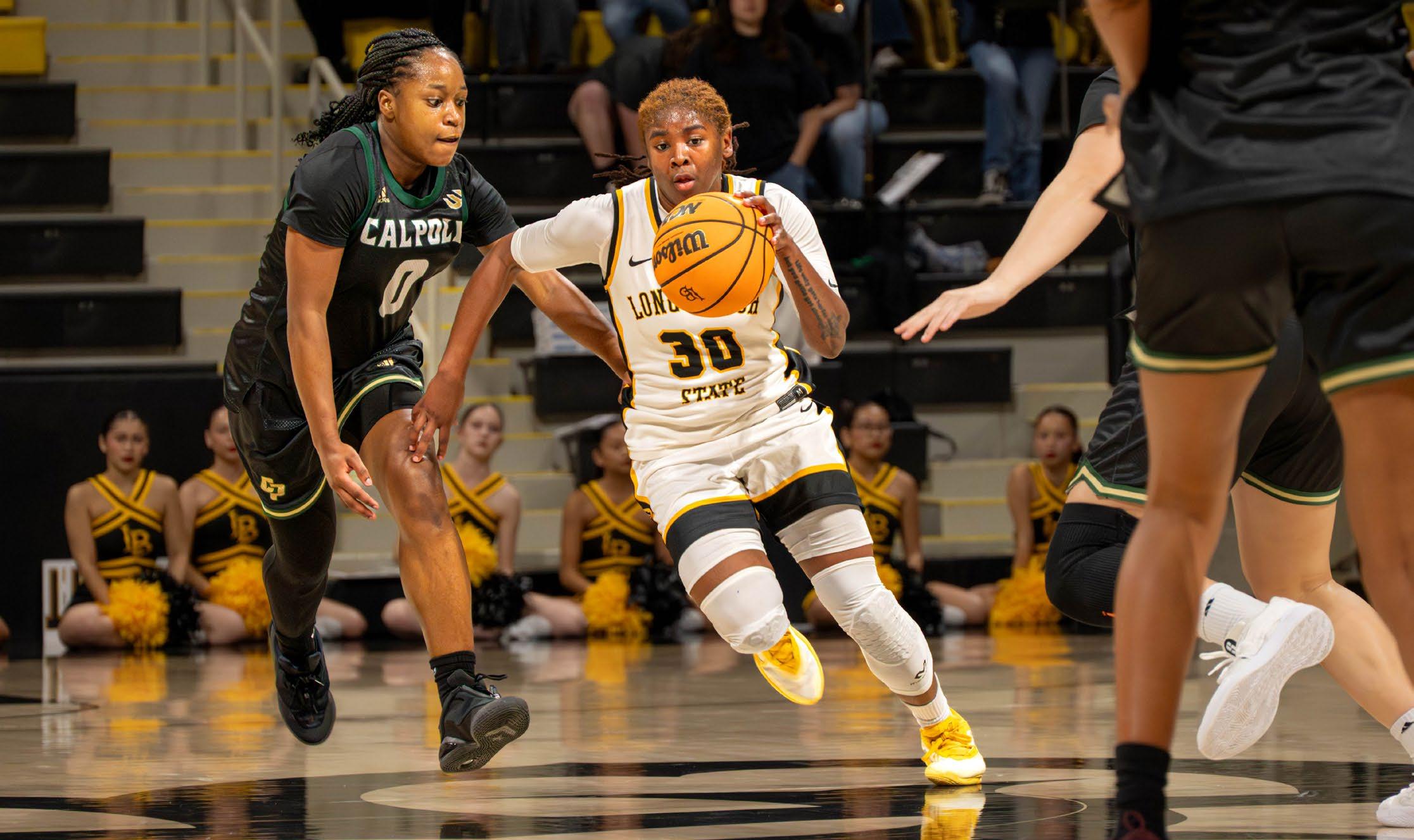
Here is the full list of guards to average at least 17 points, six rebounds and two assists per game while playing over 1000 minutes in a single season in Big West women’s basketball history: JaQuoia Jones-Brown.
That’s it.
Jones-Brown averaged 17.6 points, 6.7 rebounds and 2.3 assists per game while leading the conference in 37.4 minutes played. That’s 2.6 minutes of rest per game, which is barely enough to take a sip of water.
That impressive season earned JonesBrown the “honor” of All-Big West honorable mention, but that’s just sugarcoating the fact that she was left off the
2025–26 all-conference team.
Four guards were named to the AllBig West First Team and two were named to the Second Team, which means the voters egregiously thought Jones-Brown was, at best, the seventh-best guard in the Big West.
In that company, the Long Beach State guard’s averages rank:
• Third in points
• Third in rebounds
• Fourth in assists
• Fourth in field goal percentage
• Fifth in steals
Perhaps Jones-Brown did not produce the top-end numbers to warrant a First-Team selection but she absolutely deserved a spot on the Second-Team.
There were 11 games this season when Jones-Brown scored at least 20 points, the fourth-most in the Big West.
That’s as many as Second-Team selections Ryann Bennett of UC Davis and Bailey Flavell of the University of Hawai’i had combined.
Aside from scoring, Jones-Brown can also clean the glass.
The 5-foot-6 Jones-Brown put on a spectacular rebounding clinic this season for someone her height.
Nobody at her height in Big West history came close to her rebounding average. In fact, even players who have three inches of height on Jones-Brown can’t match her 6.7 boards per contest.
The rebounding numbers are not a fluke. As a freshman, Jones-Brown averaged 5.2 rebounds in 24.0 minutes per game last season, which equates to 8.7 rebounds per 40 minutes.
Her total rebounding percentage of 10.6 last year dipped to 9.8 this year.
Jones-Brown’s rebounding regressed as a sophomore and it still resulted in historic numbers.
The snub is perplexing because the conference had no issue awarding JonesBrown Big West Player of the Week three times this year. Only UC Irvine’s Hunter Hernandez had more with five.
UC Riverside’s Hannah Wickstrom won three, tying Jones-Brown. However, Bennett won one and neither Makayla Rose nor Flavell won the weekly award.
Was team record an issue? The Beach
LBSU sophomore guard JaQuoia JonesBrown ranked third in the Big West in scoring this season at 17.6 points per game.
REHANSA KULATILLEKE/
Long Beach Current
posted a 5–25 overall record and a 4–16 conference record, failing to qualify for the annual Big West Championship tournament.
That did not seem to be a problem when Jones-Brown picked up the second week of the season’s Player of the Week honors despite The Beach being winless at the time with a 23-point loss mixed in.
Is the scoring volume not impressive because it was not efficient enough? The best scorers raised the bar. Wickstrom’s 23.3 points per game on .586 true shooting percentage is one of the decade’s best across all of Division I.
Jones-Brown’s .506 true shooting percentage is good for the 62nd percentile among all Big West players who attempted at least 50 field goals this year. That’s fine.
If that was not gaudy enough, remember most of the defensive attention was focused on stopping Jones-Brown, especially after starting sophomore forward Judit Oliva Fernandez missed 12 games. Even with those obstacles, JonesBrown still managed to create shots and provide an offensive spark to a team in desperate need of it.
Honorable mentions do not get remembered. They do not end up on a player’s Sports Reference page. The year Jones-Brown had should have been recognized and celebrated by the Big West.
Across the ocean to The Beach: South African transfer star shines for water polo
BY ALAN IBARRA Sports Assistant
From an early age, No. 8 Long Beach State women’s water polo star utility Lucy Miszewski loved the water.
Though she started as a swimmer, Miszewski’s junior high school officials allowed her and her classmates to play water polo at age 13.
“It was something I was always looking forward to,” Miszewski said. “You know when you’re not allowed to do something and then finally you are, there’s that extra bit of excitement.”
Since then, she has known that water polo is something she wants to pursue.
“People that play at universities back home, it’s more on the side, but I knew that water polo [was] my main thing,” Miszewski said.
When opportunities seemed scarce
at home in South Africa, she knew that pursuing something more in the sport would require help from someone with a similar path to getting to America.
One of her coaches growing up was an Arizona State alumna and South African native, attacker and former South African coach, Sarah Harris, who helped her transition to a higher level of play.
“I went from playing only a couple hours a week to training 20 hours a week and just adapting to a level that was so much higher than what I’d be used to,” Miszewski said.
Miszewski then came to the U.S. and played for the San Jose State Spartans for three seasons before coming to The Beach.
After redshirting in her senior year due to a wrist injury, Miszewski found her home at LBSU. By her side was head coach and Collegiate Water Polo Association Hall of Famer Shana Welch and

DIEGO PEREZ/Long Beach Current
LBSU star senior utility Lucy Miszewski has transitioned smoothly to The Beach in her first season, ranking sixth in the conference with 38 goals on the year.
assistant coach Katie Card Neidermire, who coached Welch during her career.
“When she went in the transfer portal, she was back in that mix and had some conversations,” Welch said. “She fits the mold for what we’re looking for here, great grades and also a good player to back that up … she checked all those boxes for us.”
“When I came on an official visit, it was so weird, it seemed so cliche, but
from the beginning, I just felt like I was just a part of the team,” Miszewski said. “I just really clicked with the team and the coaches, which I hadn’t in other schools that I was speaking to.”
In the Big West Conference, Miszewski ranks second on the team in goals with 38, breaking her season record.
Click here for the full story.
Catching The Wave: What’s next for women’s basketball at The Beach?
BY TIMOTHY HESSEN Sports Editor
It is not incredibly difficult to make the Big West Tournament in women’s basketball, as eight of the 11 teams get an entry into the postseason bracket.
This season, for example, a struggling 6–14 Cal State Northridge team snuck into the big dance as the No. 8 seed.
However, for the first time since the 2008-2009 season, Long Beach State women’s basketball (5–25) has failed to qualify for the tournament, marking a new low point in the program’s history.
After a 16–14 season a year ago, The Beach saw the departure of several key players who reached the end of
their college careers, including the Big West’s leading scorer, rebounder and second-leading assister in guard Savannah Tucker, forward Rachel Loobie and guard Patricia Chung, respectively.
One could argue that a year later, LBSU head coach Amy Wright’s squad simply did not have the talent to match up in the Big West.
Outside of sophomore guard and All-Big West Honorable Mention Jaquoia Jones-Brown, The Beach did not have a single player reach 10 points per game this season.
The program is in a rebuilding stage, as evidenced by the youth of its roster. Junior forward Kennan Ka and senior guard Khylee Pepe are the team’s only upperclassmen this season.
However, inexperience aside, The Beach lacked a cohesive offensive identity this season.
Through her tenure at LBSU, Wright has consistently preached an offensive philosophy that encourages fast-paced play and getting up threes.
And yet, the outside shooting proved to be an unfixable problem for The Beach, who shot 28% from beyond the arc on the year, good for just ninth in the Big West out of 11 programs.
To push the ball up the floor quickly, you need a distributor, but The Beach’s leading assisters in Ka and Jones-Brown averaged 2.5 and 2.3 assists per game, respectively, which ranked just 16th and 17th in the conference.
To climb back up to the top of the
ladder of the Big West next season, The Beach will be looking for massive inhouse improvements.
Jones-Brown’s breakout sophomore season was the lone bright spot for LBSU, as the Atlanta native blossomed from a 7.4 points per game auxiliary scorer to the focal point of the offense, averaging 17.6 points per game this year.
Names to watch to potentially emerge as pivotal players for The Beach in their sophomores are freshmen Brynna Pukis and Rosie Akot.
The Australia native in Akot showed flashes of strong defensive play this season while also being fourth on the team in scoring, while Pukis was The Beach’s most reliable three-point shooter, hitting from beyond at a 34% clip.
LBSU evens series against Hawai’i after early 3-run homer
BY JUNIOR CONTRERAS Sports Assistant
Long Beach State baseball ended its seven-game losing streak against the Hawai’i Rainbow Warriors after a four-run first inning knocked Hawaii’s ace pitcher out of the game in the second inning.
The Bow’s ninth-inning solo home run wasn’t enough to complete the comeback on Saturday, as the Dirtbags hung on to win 7–6 on March 14 at Bohl Diamond at Blair Field.
What looked to be a pitchers duel on paper as both teams best starting pitchers took the mound on the night took a wild turn as a combined 12 runs were given up in just the first three innings.
The Dirtbags (5–13) went ahead four after the first inning courtesy of a threerun bomb from LBSU senior infielder Dylan Lina.
LBSU found themselves fighting for their lead back in the bottom half of the third after Hawai’i (10–9) went on to score five in two innings.
Hawai’i took a page out of LBSU’s book, giving the Dirtbags bases loaded in the third off two hit by pitches and a single before more free passes were given by the Rainbow Warriors.
LBSU senior infielder Ty Borgogno, who was given his first start of the season, forced a full count RBI walk after being behind 1–2 in the count, giving The Dirtbags back the lead before another freebie was given to LBSU freshman outfielder Trevor Goldenetz with an RBI HBP as LBSU led 7–5.
“He’s [Borgogno] just a veteran player that we have to have, we have to solidify the shortstop position,” Bruce said. “Ty comes from a baseball family and he really solidified I thought the defense tonight, older guy, veteran leadership.”
After having to use five different pitchers in last night’s game, LBSU freshman starting pitcher Luke Howe came up huge for the bullpen after keeping Hawai’i scoreless for four innings, finishing the seventh inning with a career-high 108 pitches, keeping the lead safe.
LBSU head coach TJ Bruce called Howe’s performance a huge deal for the bullpen, as the pen should be back at

After dropping the first game of the series, the Dirtbags bounced back on March 14 at Blair Field with their first Big West victory of the season over the University of Hawai’i.
“full strength” if The Dirtbags can get a quality start from LBSU freshman starting pitcher Jason Gerfers tomorrow.
Two outs away from keeping the Rainbow Warriors scoreless for sixstraight innings, LBSU senior pitcher Alex Ramos gave up a solo home run to Hawaii graduate student outfielder Gabe Wright before surviving the rest of the ninth to end The Dirtbags seven game losing streak, 7–6.
“It felt a little different tonight, we challenged them [LBSU] last night in terms of the mental toughness and challenged them that this is their deal, they have to be the ones to turn it around,” Bruce said. “I felt there was a little bit different energy that they had…there was more belief that they have to bond together and do it themselves.”
A bunt single and a walk set up Lina who leads the team in RBIs (23) to cause
even more damage to Hawai’i junior starting pitcher Hekili Robello, who entered the game 3–0 with a 1.14 ERA, 27 strikeouts over 23.2 innings pitched.
Lina answered the call, going deep to left field, bringing the 1,847 in attendance to their feet as the right-handed hitter slammed his helmet into the dirt before entering back into the dugout, giving LBSU a 4-0 lead, the most runs Robello has given up all season in just the first inning.
“Over film, we had a good scouting report, I know he likes to start off right handers with a lot of off speed pitches, so honestly, my mentality going to my first at bat was hopefully to see one up, maybe sit off speed, and I got a good pitch to hit,” Lina said.
Hawai’i junior infielder Tate Shimao who had 4 RBI’s in game one started it off for Hawai’i with a RBI single before
scoring on a 2 RBI single from sophomore catcher Jake Redding to bring the Bows just behind one in the second.
LBSU sophomore infielder Trotter Enright gave the Dirtbags a two-run lead off a RBI single before The Bows forced two more earned runs out of Howe to tie the game at five in the third off a sac fly and RBI single from graduate student infielder Kody Watanabe.
The two freebie runs for The Dirtbags came back to haunt the Bows as it was enough to give LBSU its first Big West win of the year and the chance to take the series win on Sunday, March 15.
With the Friday night starting pitching position being open after Friday LBSU starting pitcher Jake Fields gave up three earned runs, five walks in one inning pitched, Bruce believes that Howe can be the man for the job in the next week or two depending on recovery.
Photo courtesy of LBSU ATHLETICS