

Long Beach current
1250 Bellflower Blvd., LA4-203 Long Beach, CA, 90804
Editorial Office
Phone (562) 985-8000
Dante Estrada
Multimedia Managing Editor multimedia@lbcurrent.com
Grace Lawson Community Engagement Editor community@lbcurrent.com
News Editor
Arts & Life Editor
Opinions Editor
Sports Editor
Design Editor
Chief Copy Editor
Photo Editor
Social Media Editor
Video Editor
Podcast Editor
News Assistants
Arts & Life Assistants
Opinions Assistants
Sports Assistants
Design Assistants
Copy Assistants
Photo Assistants
Social Media Assistants
Video Assistants
Podcast Assistants
Khoury Williams Editor-in-Chief eic@lbcurrent.com
Isabella Garcia Managing Editor managing@lbcurrent.com
Haley Lopez Business Manager business@gobeach.media
Callum Hedge was ranked third during the Mobil Pro Class, the highest level of competition in the Porche Carrera Cup North America with a final score of 31 on Friday, April 17. The 2023 Formula Regional Americas Champion raced for two years in Indy NXT, placing fourth in 2024.
Annette Quijada news@lbcurrent.com
Delfino Camacho arts@lbcurrent.com
Leyna Vu opinions@lbcurrent.com
Timothy Hessen sports@lbcurrent.com
Rebecca Lavond design@lbcurrent.com
Angela Osorio copy@lbcurrent.com
Charlotte LoCicero photo@lbcurrent.com
Erinna Lam socials@lbcurrent.com
Skylar Stock video@lbcurrent.com
Gianna Echeverria podcast@lbcurrent.com
Ethan Brown Jayden Sandstrom
Josephine Robinson
Joshua Flores
Nasai Rivas
Ni Baliness
Jason Green
Lila Mukasa
Joseph Lee
Monica Garcia
Christian Robledo
Alexys DeMaria
Monica Badolian
Xavier Constantino
Brianna Apodaca
Alan Ibarra
Junior Contreras
Brooke Williams
Gabrielle Lashley
Leyla Crail
Sasha Marantz
Josephine Kim
Joshua Min
Diego Perez
Eddy Cermeno
Rehansa Kulatilleke
Jorge Hernandez
Ethan Cohen
Valentina Villarreal
Alejandra Guerra
Mikaela Perez
Kiara Fillingim
Eli Vice
Bryan Viteri
Ava Richards
Brandon Rodriguez
Crow Vides
Business
Creative Manager
Web & Technology Manager
PR & Marketing Manager
Distribution Manager
Advertising Manager
editors assistants advisers
Design Adviser
Content Adviser
Advertising & Business Adviser
Alicia Taylor creative@gobeach.media
Tasneem Iqbal web@gobeach.media
Ericka Lacy pr@gobeach.media
Seiana Spencer-Kendrick distribution@gobeach.media advertising@gobeach.media”
Gary Metzker
Barbara Kingsley-Wilson
Jennifer Newton
ASI election investigation concludes, results stand and president re-elected
BY ANNETTE QUIJADA News Editor
The investigation into a potential campaign violation during the Associated Students Inc. presidential election has concluded and the election results will stand as announced.
In an email statement, ASI Communications Manager Shannon Couey said, due to the “confidential nature of election investigations,” they are unable to share additional details or documentation.
The ASI elections review process included the government elections officer and the associate dean of students.
The previous allegations focused on re-elected ASI president Sonny Ciampa approaching voters with his phone, asking students to vote for him. It was unclear whether the QR code Ciampa provided voters with led to a voter form or a ballot, which could have violated Part IV of the ASI elections handbook.
The investigation included a form that ASI created for individuals to submit a report in case they witnessed a potential campaign violation.
Ciampa said he’s happy the review process has concluded and that the election results remain unchanged.
“From the beginning, I knew I ran a fair and honest campaign and followed all of the rules in the
Land acknowLedgment
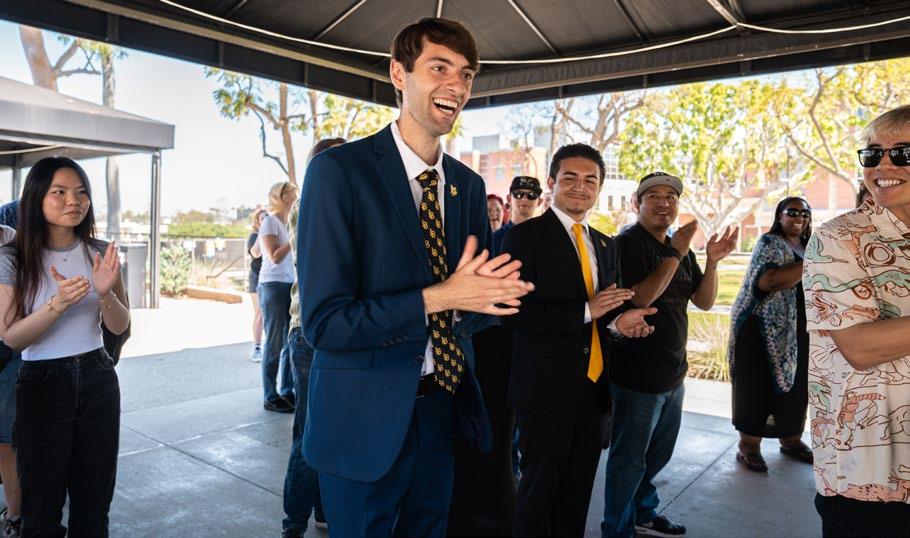
CHARLOTTE LOCICERO/Long Beach Current ASI President Sonny Ciampa won for the second time, with 1,856 votes, leading the top 51% among the two other candidates at the speaker’s platform on March. 20.
ASI Elections Handbook accordingly,” Ciampa said in an email statement. “It is truly an honor to have been re-elected as ASI President, and I am grateful for the trust students have placed in me to continue serving them.”
Ciampa, a third-year political science major, was re-elected in March with 1,865 votes. He said his decision to run again stemmed from a strong commitment to continue supporting students during a historic time marked by the University Student Union’s closure.
Ciampa said the experience of an investigation such as this showed him how important it is to allow processes to run their course before drawing conclusions.
Here at the Long Beach Current we acknowledge that the school we report on is located on the sacred site of Puvungna, “the gathering place.” We are on the land of the Tongva/ Gabrieleño and the Acjachemen/Juaneño Nations who have lived and continue to live here.
We also acknowledge the Gabrieleño/Tongva (pronounced: GABRIEL-EN-YO/TONG – VAH) and Acjachemen/Juaneño (pronounced: AH-HACH-AH-MEN/JUAN-EN-YO) as the traditional custodians of the Los Angeles region along with the Chumash (pronounced: CHOO-MOSH) to the north and west, and the Tataviam (pronounced: TAH-TAH-VEE-YUM) and Cahuilla (pronounced: KAH-WEE-YAH) Nations to the east.
We respect and value the many ways the Tongva/Acjachemen cultural heritage and beliefs continue to have significance to the living people and remind us about the sacred and spiritual relationship that has always existed here at what we now call California State University Long Beach.
editoriaLs: All opinions expressed in the columns, letters and cartoons in the issue are those of the writers or artists. The opinons of the Long Beach Current are expressed only in unsigned editorials and do not necessarily reflect the opinions of the journalism department or the views of all staff members. All such editorials are written by the editorial board of the Long Beach Current. editoriaLs:
Letter PoLicy

Letter PoLicy: All letters and emails must bear the phone number of the writer and must be no more than 300 words. The Long Beach Current reserves the right to edit letters for publication in regard to space.
CSULB could house Olympic athletes in 2028
BY RILEY MURRAY AND NELSON GODFREY
Contributors
As Los Angeles prepares to host the 2028 Olympics, Long Beach State could soon house worldclass athletes in the lead-up to and during the Games.
Early discussions are underway to house Olympic athletes during the summer, a move that would temporarily shift the rhythm of campus life.
Plans are still ongoing and it is not yet confirmed which athletes and teams will come to campus, according to Housing and Residential Life executive director Eric Rollerson.
Rollerson said the athletes’ stay is expected to begin after the spring 2028 semester and conclude before fall 2028. During that time, there will be substantially fewer students living on campus compared to the regular academic year, he added.
He expects Olympic athletes to trickle in during June, with housing occupancy increasing through the start of the Games in July. The numbers should dwindle toward the end of July, once the Olympics are over.
According to Rollerson, Hillside Village Buildings A, B and C and the International House will be reserved for summer students and certain summer programs, meaning no athletes or Olympic officials will have access to those buildings. Rollerson said these locations are separated from the other residences by the Hillside Gateway building.
“The rest of the housing is up for grabs for LA28,” Rollerson said.
Initially, CSULB only planned to house Olympic officials, including organizers and timekeepers. Rollerson learned in March that athletes would be coming to campus, though he expects
a maximum of one or two teams. He said LA28 wanted to occupy the campus’ entire housing area, but the university declined this proposal to avoid holding back summer students.
While the current plan still includes a significant takeover of campus housing, it is a small number of guests compared to UCLA, which will be the official Olympic and Paralympic Village.
Dining logistics are yet to be determined, but the Olympics will be using the dining halls operated by Beach Shops and have the potential to bring in their own caterers.
“As far as I know, they’re asking a lot,” Rollerson said.
To manage traffic, Rollerson suggested establishing separate hours for students and athletes to access dining halls, though longer meal wait times remain a possibility. Rollerson said LA28 would prefer to have exclusive access to the dining halls, but this will not be possible due to the need to house students.
Miles Nevin, associate vice president and executive director of Student Auxiliary Enterprises, said the renovated University Student Union is currently on track to be completed in July 2028, but it will not be available for visiting Olympic athletes.
“We’re going to be spending that summer learning how to use the building, moving back into it, getting all the spaces ready for students in the fall,” Nevin said.
Students and faculty will be able to enter the USU after its summer reopening, but it will not be available to reserve for any major events. Because Olympic athletes will not be using the building, Nevin said he does not anticipate the Future U project impacting their stay at CSULB.
Preparations will go beyond routine summer maintenance as the university plans upgrades to residence halls for po-
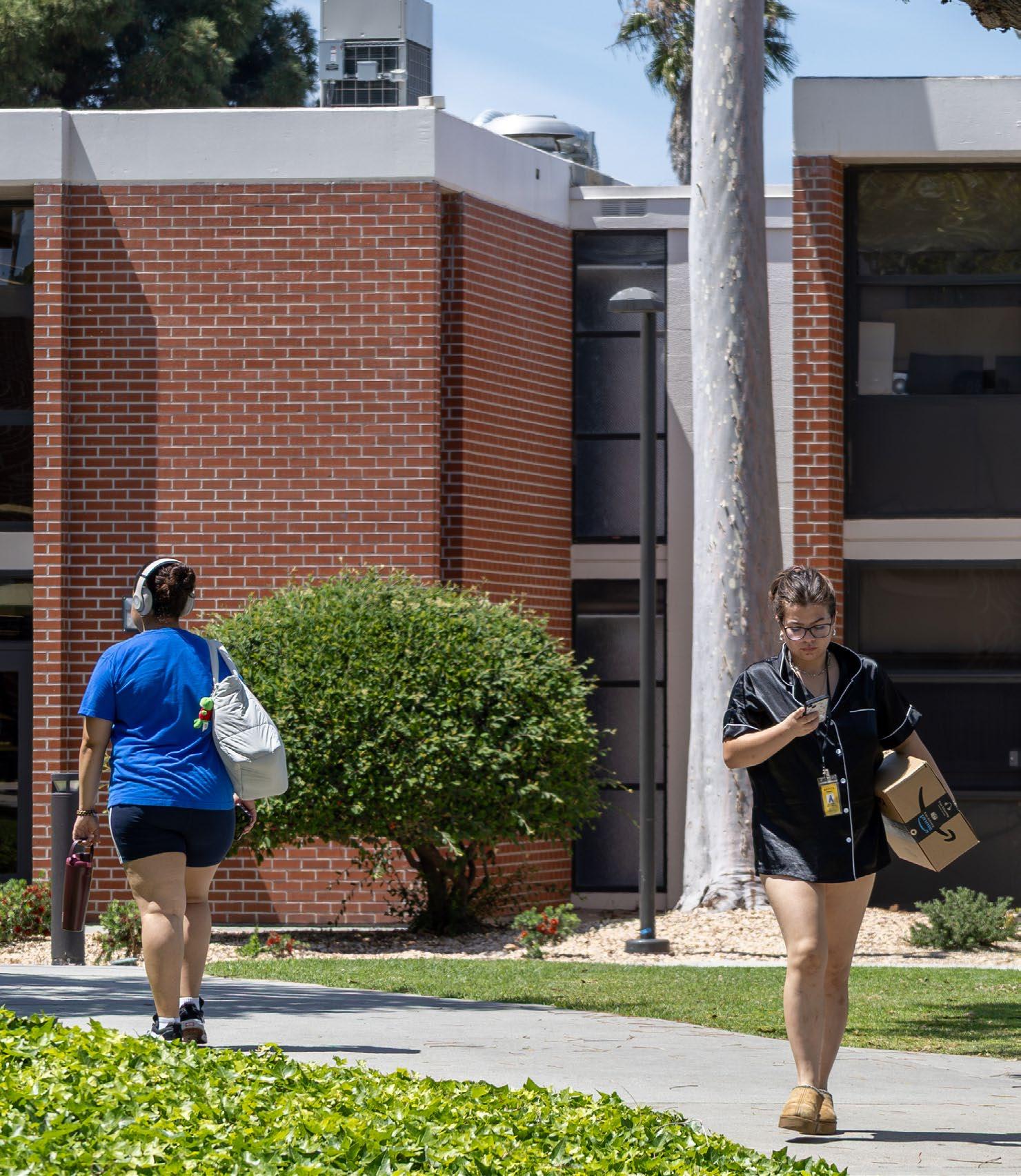
EDDY CERMENO/Long Beach Current Long Beach State students walk around the Hillside Village buildings on Wednesday, April 15. There are early discussions for CSULB to possibly house Olympic athletes or officials in 2028, but the Hillside Village Buildings A, B and C and the International House will be reserved for students and programs.
tential Olympic guests.
Rollerson said staff will carry out cosmetic improvements including repainting, window cleaning and flooring replacements — work that is typically done each year — along with ongoing efforts to convert gas boilers to electric systems.
The scope of improvements could be more extensive than usual, depending on final housing plans for visiting athletes, he said.
Second-year liberal studies major Alexa Ochoa, who dorms on campus, does not oppose housing Olympic athletes in summer 2028.
“A lot of [students] don’t stay on campus during the summer, so I don’t have a problem,” Ochoa said, adding that other sports organizations have already used the dorms over the summer.
Ochoa is unconcerned about the
athletes’ presence impacting students because many do not stay on campus over the summer. She said she is fine with the athletes’ use of the dining halls, which she noted are already open to non-residents who wish to pay for meals.
According to Rollerson, Olympic organizers will pay the university an undetermined amount to house athletes and officials. LA28 will also cover all expenses related to the athletes’ and officials’ stays.
ASI Senator at-Large Sebastian Rosano Alvarado confirmed that no funding for Olympics-related housing will come from Associated Students, Inc.
“Our money only supports students here on campus and should only be used for that purpose,” said Rosano Alvarado. Additional details are expected in coming months as planning is underway for summer 2028.
Campus tours continue amid construction with minimal negative reactions

EDDY CERMENO/Long Beach Current
A construction worker sprays water to help prevent a lot of dust from getting in the air while excavators move debris around in the Future U construction project area on Tuesday, April 14. Long Beach State has been hosting campus tours this spring semester amid ongoing construction.
BY NELSON GODFREY Contributor
Jackhammers pounded as a group of roughly 20 people toured the Long Beach State campus for the first time on an April afternoon, listening to tour guide Jose Ramirez project his voice over the droning construction noise.
Ramirez, a fourth year choral-vocal music education major who works as a tour guide with University Outreach & School Relations, focused his commentary at each stop of the tour on the buildings and resources currently unaffected by the construction.
Ramirez spoke minimally about the Future U Project and the temporary absence of the University Student Union building, instead letting the group take in the prevalent sights and sounds of the construction along the tour route.
Ramirez has adhered to this strategy since becoming a tour guide in the fall 2025 semester, when construction was already underway. The project has substantially altered the appearance of the campus and the tour route for first-time visitors, but Ramirez said he has found the people he takes on tours to generally express few reservations about the construction.
There was no mention of the con-
struction in the introductory commentary of Ramirez’s tour, but the Future U project remained represented by ceaseless drilling sounds. The breaks in speech as the group walked between stops were dominated by the sound of power tools and the revving of large construction vehicles.
However, when Ramirez initially brought up an “elephant in the room” of the campus, he was referring to the LBS Financial Credit Union Pyramid.
Only after guiding the group down the stairs and onto the Friendship Walk, directly adjacent to the fences of the main construction site, did Ramirez mention the “probably bigger elephant in the room,” briefly saying the USU is under construction. He emphasized that the resources from the USU have been relocated across campus along with new diverse food options. The construction did not come up again for the remainder of the tour.
Director of University Outreach and School Relations Drew Agbay said his department has assumed a role of being transparent about the construction to touring families. He said the department met with university staff involved in the construction to learn about the project and get talking points for tour guides. The tour route was adjusted for accessibility, but the construction site is clearly visible during the route.
“Are we avoiding taking them around the renovation? Absolutely not,” Agbay said.
According to Agbay, the tour guides receive suggested talking points about the construction and necessary information to answer common questions, but each guide has the freedom to put their own spin on their commentary.
In discussions with his staff, Agbay has heard very little negative feedback about the construction from guests. His interpretation is that prospective students and parents tend to understand the benefits and drawbacks of the construction, especially in the case of students whose time at CSULB will extend beyond the opening of the renovated USU.
Agbay said that construction on campuses is very common, adding that he had a similar experience during a previous position at San Jose State University.
Agbay said the number of people who tour the campus varies every semester, and there were 40,000-45,000 guests during the last fiscal year, with tours occurring several times per day. There has been no decline in tour attendance since the start of the construction, which Agbay calls “the storm before the great end result, which is new facilities for our students.”
Among the visitors on the tour guided by Ramirez was Paige Stowers, a junior
in high school, who is touring all CSU campuses to decide where she wants to apply. Rather than seeing the construction as a downside to CSULB, she is positive about the future of the campus.
“I think that it was kind of loud, but in a good way,” Stowers said.
Ramirez said his experience as a tour guide has been consistent with Agbay’s report of limited negative feedback. He said many visitors do not even ask about the construction, which surprises him, and those who do simply inquire about the end date.
“The most negative [reaction] is they’ll probably make a face” upon learning how long the construction will last, Ramirez said.
He added that the reaction depends on when prospective students would be at CSULB, as the construction is more likely to disappoint incoming transfer students who may not benefit from the outcome of the Future U Project.
For students like Stowers, whose time in college would not completely overlap with the construction, the noise and disruption they hear on the tour is often not a concern, according to Ramirez.
“This is a beautiful campus,” Stowers said. “There’s a lot of amazing things that you can do here, and I think [the construction]’s not a deterrence.”
EDDY CERMENO/Long Beach
Current
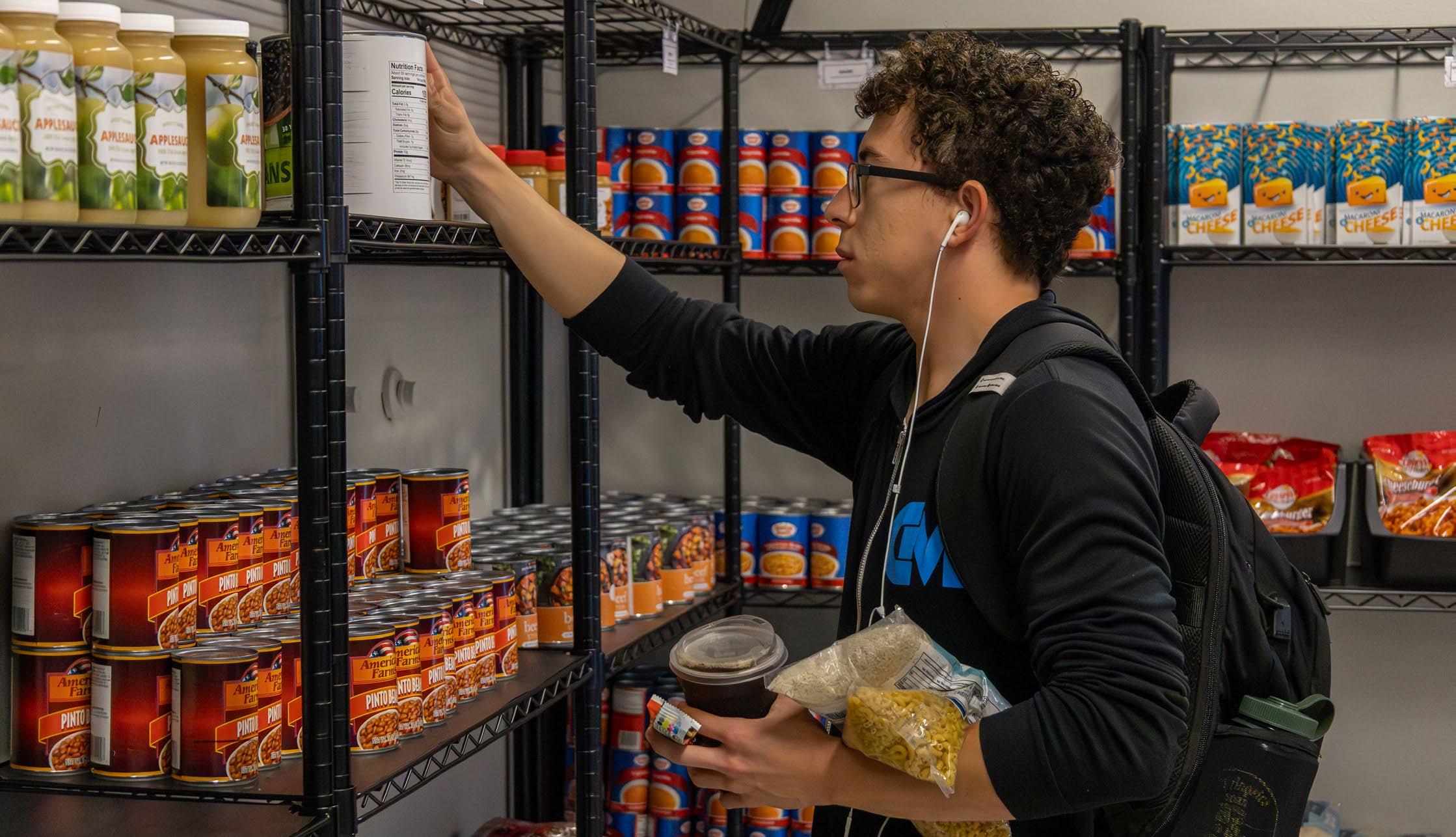
Joshua Elitzer, a third-year history major, looks at the nutrition information of a can of dry black beans in the Laurén Chalmers ‘83 Beach Pantry on Thursday, April 16. Parking and Transportation Services has a Donation for Citations program where students can donate qualifying items to the pantry as an alternative to paying a campus parking citation.
Parking tickets turn into pantry support
BY CHLOE NGUYEN Contributor
The Long Beach State Donations for Citations Program, which allows students to exchange food donations for a discounted parking ticket, has seen a 377% jump in donations in one year.
The program allows students to donate five items to the Laurén Chalmers ‘83 Beach Pantry, along with paying a $20 fee, as an alternative to handing over $60 for a citation.
In 2023, the rules limited this tradeoff to once per year. When initially launched, students were only able to use the alternative once in a lifetime.
“We actually lose money in that program,” Chad Keller, the spokesperson for Parking and Operations, said. “It’s not a great program for us, but it is a good exchange for both students and the Beach Pantry.”
The Donations for Citations program was introduced in August 2019 after a student came to Parking and Transportation Services concerned about the number of students facing food insecurity at CSULB. Parking and Transportation Services partnered with them to help those facing food insecurity and relieve students from a parking citation.
Food insecurity has been an ongoing
problem for college students globally. A study conducted by the UCLA in January 2025, surveyed 4,165 students at two Cal State universities, two University of California campuses and two community colleges with the CalFresh program, a federally funded food assistance program. They found that 50% of the students surveyed experienced food insecurity and 28% regularly skipped meals because they couldn’t afford food.
“It’s a full circle of helping someone lower their ticket, but then also helping feed someone,” Christina Limon, the Assistant Director of the Beach Pantry, said.
In 2023-24, 1,460 items were donated to the Beach Pantry through the program. The following year, the number of donations increased to 6,970, meaning that 1,394 citations were cleared through the program alone.
“It was very surprising,” Keller said. “I mean, it goes up a little bit every year, but we didn’t think it would almost quadruple. It was something we noted and… we were celebrating that the awareness was increasing and also that the Beach Pantry was benefiting.”
Eligible citations include not having the correct permit for the lot the vehicle is parked in, parking motorcycles in auto spaces or bike areas, having no valid permit and other violations.
If the citation type is “No valid permit”, the student is required to purchase
a monthly, semester or academic year parking permit after completing the Donations for Citations alternative. Students are charged for the parking permit and $20 fee at the Parking and Transportation Services Office directly after the items are donated.
Dylan Csicsai, a senior majoring in liberal studies, has used the program twice since attending CSULB. Her first citation was for parking in an employee lot with a general permit, and her second was for not having a permit at all.
“I think the program is a good alternative,” Csicsai said. “However, you do have to ultimately pay for a parking pass [after] … I think this might be important for people to know, since so many people do Donations for Citations to relieve a financial burden and not realize that they have to make an even bigger purchase.”
If students choose to use the program, they are required to purchase one item from each of the following categories: Canned Food Soup Carb Canned protein Hygiene
The items must be taken to the Parking and Transportation Services Office where they are cleared and then distributed to the Beach Pantry once a week.
Limon said she typically sees about
400 students coming into the Beach Pantry per day, looking for essentials. Since students have to donate from different categories, Limon has seen a better inventory flow of additional resources for students to pick up because of the program.
“It’s a great program that is able to provide a resource where students [don’t] have to pay such a high fee to cover their parking citation and provide essential resources for students,” Limon said.
Jackson MacDonald, a third-year psychology student, chose to pay off his citation through the program after reading about it on the back of his parking ticket. MacDonald parked in a residential dorm lot with an invalid parking permit.
“I told myself I’m going to spread the word about this,” MacDonald said. “It allows people who don’t have a lot to still be able to help and pay back the wrong they did. It is good on the wallet and good for the people.”
Keller expressed his hopes for all students on campus to be aware of the Donations for Citations program, in order to offer a discounted ticket option and continue fighting food insecurity among students.
“I’d rather students know about it and say, ‘I know about it, but I choose not to use it,’ rather than ‘I’ve never heard of it,’” Keller said.

Health Science Department celebrates 60th anniversary
BY ALEXIS MUÑOZ Contributor
The College of Health and Human Services celebrated its 60year anniversary at Long Beach State, highlighting the college’s history, student achievements and future plans.
Established in 1965, CHHS is one of the largest academic colleges on campus with over 8,000 enrolled students and 11 departments offering 21 bachelor’s and 22 master’s degree programs.
Interim Dean for the CHHS, Grace Reynolds-Fisher, said the department was founded to improve the health and well-being of individuals, families and communities, through education, research and service.
“What began as a small academic unit has evolved into a vibrant, interdisciplin-
ary community that crosses professions, sectors and orders in pursuit of healthier futures for all,” Reynolds-Fisher said.
As she looks toward the next 60 years, she said it is important to view them through a lens of complexity and possibility in health sciences and public health.
“The challenges are real, but so is the talent, creativity and the sense of responsibility represented [in the CHHS],” Reynolds-Fisher said.
The department held a celebratory event on April 16, opening with undergraduate and graduate students presenting their long-term projects on the health crisis children in Long Beach face and on countries, including Tajikistan, that are susceptible to disease.
Fourth-year nutrition and food science major Katelyn Chu felt proud of her year-long research poster, “Residential Area and its Association to Fruit
and Vegetable Intake Among Children in Long Beach,” and the LatinoHealth Community’s collaboration to create diverse community health initiatives.
“I think it’s very admirable being able to be part of this project, but also seeing my coworkers and colleagues be a part of this amazing project,” Chu said.
Following the student presentations were speeches and panels by professors and alums, including CHHS chairman and global health policy professor Kamiar Alaei.
During his time as chairman, Alaei introduced interdisciplinary partnerships, joint health-technology degree pathways and shared doctoral programs.
Recently, Alaei established the Doctor of Public Health Program in fall 2025, which provides community health education and public health training in urban areas.
“I called all 23 [CSU’s], and some
asked why they should care about it [the DrPH program], and I told them, what they care about today, they can benefit in the next 5 years,” Alaei said.
One student in the program is Damian Zavala, who also serves as executive director of Student Health Services.
“Of course, with any new program, you have some growing pains, but the faculty and staff have been very supportive,” Zavala said. “I look forward to the next classes and the learning, even though it’s a lot on my plate, but it’s well worth it.”
Alaei said he hopes to expand the program and encourage student participation beyond those in public health.
“We can do more non-traditional approaches, and adjust public health educators to be involved in policy, advocacy, implementation, evaluation and adaption,” Alaei said.
EDDY CERMENO/Long Beach Current
A construction worker sprays water to help prevent a lot of dust from getting in the air while excavators move debris around in the Future U construction project area on April 14. Long Beach State has been hosting campus tours this spring semester amid ongoing construction.
ARTS & LIFE
Too high, too fast: The cost of cannabis misuse
BY MONICA GARCIA Arts & life Assistant
Heart pounding in your ears, mouth dry and palms sweating. Somehow, the room is spinning, and something worse — nausea. There’s a dreadful paranoia, a feeling of unfaltering danger and a desperate need to ask for help, but no one can be trusted.
Greening out is a colloquial term for a “bad trip” when consuming cannabis products. High levels of tetrahydrocannabinol, or THC, can overwhelm brain receptors and create uncomfortable physical and psychological responses.
Diego Carrasco, retail manager at The Syndicate dispensary in Long Beach, said he meant to split what he thought was a 500-milligram brownie with his brother.
A boldly written “500” was listed on the package. He said even the budtender who sold him the edible thought it was 500 milligrams.
“Turns out that it was actually six servings of like 500, so you do the math, that’s like 3000 milligrams,” Carrasco said.
About an hour and a half after consumption and not feeling the effects, Carrasco and his brother checked the label closely and noticed the actual serving size.
“I couldn’t make a left turn to save my life… I was high for two days,” Carrasco said. “But learn your lesson. Read the label carefully.”
Besides the discomfort that could be prolonged anywhere between a few hours and a few days, as in Carrasco’s case, depending on the dosage, people still continue to consume cannabis products.
First-time users are the most vulnerable to greening out.
“I remember the first time I ever smoked. I smoked a full blunt by myself, not the best idea,” Jacqueline Dourigan said, a cannabis specialist at Haven dispensary.
A report from Northwestern University advises first-time users to take only one hit from a joint or bowl and to consume edibles with five milligrams or less.

“I remember I felt nauseous. I threw up the tiniest bit. But after that, I just remember petting my dog and thinking that she was just so magical and beautiful, and I just kept petting her,” Dourigan said. “At least, we’ve got edibles that are labeled now, and you know how much to smoke.”
Many who are prone to anxiety often see the greening out experience as a rite of passage to getting high.
“The thing that’s, for me, really interesting is that cannabis — like drinking and all that — tends to be a more social event,”
Robert Chlala, sociology professor at Long Beach State, said. “You know, like you pass the joint around, you share data, you do all these things, and so you want to be part of that.”
Chlala is currently teaching Sociology 490, Special Topics: Drug Policy, Politics and Markets. The course focuses on how drug usage reflects on societies in terms of money, violence, war and other factors that influence them.
The course is also being offered in the fall semester.
“We lack a lot of spaces… where people can actually connect with other people,” Chlala said. “So it’s like a trade off, you know; like, is it worth the challenge?”
Chlala was involved in a cannabis project published in 2025 and housed at the UCLA Labor Center, which aimed to understand the high stakes of California’s cannabis workforce.
Over 1,000 surveys were conducted
with the cannabis workforce to highlight the ways in which an education-driven approach can help elevate California’s cannabis industry, starting with its workers.
“Like 80% of them, especially the front end, the retail end and the cultivators wanted more training and how to actually support people and comprehensive education,” Chlala said.
Chlala said that retail workers wanted to focus on harm reduction by educating consumers better on cannabis products.
“We know that people are having upside-down experiences now. We want the resources to do better because we actually care about people having a good experience and the medicinal aspects,” Chlala said.
Photo Illustration by REHANSA KULATILLEKE, MONICA GARCIA and GABRIELLE LASHLEY/Long Beach Current Greening out can induce uncomfortable psychological and physical responses with an over-consumption of THC compounds within the body. Marijuana users often report feelings of paranoia, dizziness and sickness while greening out.
ARTS & LIFE
How cannabis can be a medical necessity
BY JASON GREEN Arts & Life Assistant
Tammy Centers, 23, was diagnosed with ovarian cancer at 16 years old. The day after being diagnosed, she underwent surgery to remove the cancerous tumor, with a chance of it returning in a more aggressive state.
Unfortunately, the tumor returned.
Sometimes the pain medication does not bring her much relief; when that happens, she has a stronger remedy for the discomfort: cannabis.
In 2022, Centers was given a stage three cancer diagnosis.
“I have stage three ovarian cancer, and it can cause really bad abdominal pain and stomach pain in general,” Centers said. “When my usual pain medicine doesn’t do enough, that’s when I turn to weed as an alternative. Kind of a boost, I guess.”
Since 2024, cannabis has helped Centers build an appetite, as the combination of ileostomy and cancer makes eating difficult. She consumes gummy edibles from the Zen Cannabis brand.
Having cancer has taken an emotional toll on Centers.
“It’s really stressful; obviously, it makes me sad sometimes because I can’t really go out to hang out with friends as much as I’d like because I’m just so physically tired most of the time,” she said. “It’s very mentally draining, you know, because I can’t really eat as much as I’d like either. It’s part of the reason why I do weed.
Matthew Yoklavich (right) is Tammy Centers’ boyfriend and her caretaker for the past two and a half years. photo courtesy of Matthew Yoklavich
Centers’ caregiver is also her partner, Matthew Yoklavich, a transfer student at
Cal State Long Beach studying design. Yoklavich, 24, has been her caregiver for two and a half years. They both live with his parents.
The couple said that while it remains easy to access cannabis, they pay out of pocket for the products they buy, and do not possess a Medical Marijuana Identification Card.
Centers considers cannabis to be a medical necessity.
“Before my cancer diagnosis, I never used it at all. I never even considered, to be honest,” Centers said. “The reason why I started using it in the first place was because actually one of my surgeons had recommended that I give it a try.”
Yoklavich’s father has a stigma toward cannabis, but he tolerates Centers’ usage of the substance due to her cancer. The couple also receives stigma from people around their age when they hear about their journey.
“They get really uncomfortable, and we’ve actually lost friends because of everything that we have going on, because it was just too much for them,” Centers said. “It’s very isolating.”
Centers said that she considers herself to be a person with a disability, as she hopes her conditions are only temporary. She does not want to live in this state of health for the rest of her life.
Even after beating cancer, Centers said she would likely still use cannabis on occasion
Long Beach State student Lauren Jackson, a junior studying ASL linguistics and deaf cultures, also uses cannabis for a medical condition.
“I started smoking as soon as I turned 18,” Jackson said. “I got my medical marijuana card just because I had been dealing with some stomach issues my entire life and they were progressively getting worse when

I turned 18.”
Jackson has cyclic vomiting syndrome, which causes sudden episodes of severe nausea and vomiting.
She began smoking weed during the COVID-19 pandemic, and it has worked to fight her nausea.
Jackson said weed helps her focus on her studies as a junior at CSULB studying ASL linguistics and deaf cultures. Jackson has ADHD.
With her medical card, she often gets discounts on her purchases.
With her medical card, she often gets discounted purchases and can be used for job protection, as any cannabis use would be seen as a medical treatment. Having a medical card can also allow carriers to claim tax exemptions.
Laurren Jackson, a junior at CSULB studying ASL linguistics and deaf cultures, uses cannabis for her condition called cyclic vomiting syndrome. Photo courtesy of Laurren Jackson
The negative effects of weed do not come from the plant itself, for Jackson, but rather it is the doctors who judge her. She said that the doctor told her that the stomach issues stem from her weed use, but the condition predates smoking marijuana.
“Though it’s legal, it is still not accepted by everyone and having a medical card gives a little more legitimacy to the use,” said Maryanne Diaz, professor of criminology and criminal justice, in an email statement.
Jackson calls herself a “productive stoner,” proven by high grades last semester, using weed to focus with her ADHD.
“I’m at a point in my life where if someone’s going to judge me for my weed use and not care about the fact that it helps me, I feel like I don’t need that person in my life.”
Jackson said explaining her cannabis use to her mother was initially difficult, as her mother follows what she described as “the good path” and does not support drug use.
To help bridge the gap, she shared articles outlining the potential benefits of cannabis use, and over time, she said her mother became more understanding.
“I’ve kind of come face to face with [smoking weed]. I would rather be feeling good and feeling better and have my life a little bit shorter from that than to live a long life of suffering, if that makes sense,” Jackson said.
Photo courtesy of Matthew Yoklavich Matthew Yoklavich (right) is Tammy Centers’ boyfriend and her caretaker for the past two and a half years.
Single by choice: Why youth are prioritizing themselves
BY JOSHUA FLORES News Assistant
She chose to put herself and her education first, at the cost of ending a two-year relationship, to focus on personal success.
“I definitely could have done both a relationship and a career but I know myself,” Luciana Berrospi Indo, a 23-yearold third-year industrial design major, said via Reddit. “I also know relationships take sacrifices and I just was not willing to make any for this relationship.”
Relationship commitment is decreasing among young adults due to personal choice and life circumstances. While young men and women are showing an increased trend toward being single, men are at a higher rate when compared to women, per researchers.
The Long Beach Current reached out to students via the CSULB subreddit to inquire as to why some students are single by choice.
“Broke,” one user wrote. “No time between jobs. Responsibilities and choosing yourself kinda feels better right now.”
Others chimed in saying that some people are afraid of commitment, just want casual sex instead of a relationship or that they struggle with the dating pool.
“I know women on both sides, those who stopped going to school because their partner is the breadwinner and others that go to school to finish it,” Berrospi Indo said. “I do see a lot of women in school who are also in a relationship and they seem to manage it well.”
A three panel study published by the American Psychological Association, interviewed 17,000 respondents from ages 16 to 29 who have never had a partner. It found that young adults with lower well-being were typically male, had higher education and were living alone or with parents and stayed single longer.
While researchers say that psychological theories of singlehood are lacking, those who conducted the study in the U.K. and Germany proposed a few theories as to why long-term relationships are decreasing among youth.
“It is increasingly socially acceptable to remain single, and this reflects broader changes in values, economics and social structures,” Zoe Engstrom, professor of Family and Consumer Sciences said via email.
One theory suggests that the emerg-

Graphic by JOSHUA FLORES/Long Beach Current
An increasing number of young adults are choosing to not be in a relationship with a partner. While research is still new, evidence suggests changing attitudes in society are the cause. More young adults are prioritizing their education and career over relationships.
ing adulthood stage, ages 18 through 29, is characterized by identity exploration and formation, leading to delays in a stable commitment to relationships as it is seen as less of a priority now.
“Individuals today are more likely to view life paths as flexible rather than predetermined, and remaining single is seen as a legitimate and even fulfilling option rather than a temporary state,” Engstrom said.
Another theory on the relationship between wellbeing and singlehood, is that certain age-graded, normative social roles such as the first romantic relationship are important in adolescence or early adulthood. These social roles contribute to maturing, a stabilization of the self-concept and adaptive well-being development.
“There has been a noticeable cultural shift toward prioritizing individual development, particularly among younger adults,” Engstrom said. “This is not necessarily a rejection of relationships, but rather a reordering of timing in life.”
Engstrom also said that there is less social stigma attached to being unmar-
ried, compared to past decades. She said that changes in media representation, shifting gender roles and changing expectations around marriage have all contributed to this normalization.
“Over the past few decades, higher education, career building and financial independence have become more central to how people define success,” Engstrom said. “Economic pressures such as student debt, housing costs and job instability have also reinforced the societal idea that one should establish a stable personal foundation before committing to a long-term partnership.”
In addition to changing societal attitudes, technology and social media specifically have played a role towards the shift of prioritizing relationship commitment.
“Social media has for sure had a big hand on setting up high expectations, false hopes and unrealistic standards for everyone,” 20-year-old first-year child development and family studies major Nataly Diaz said. “You need to know what you want in life first and with yourself until you can actually choose the
person you’re with.”
Diaz said that her mother and father were teen parents who decided to put their careers aside in order to raise their children; a decision she said led to her growing up in a toxic household due to her parents’ incompatibility as partners.
“Social media just mostly loves to portray the fast life, no commitment, just nothing serious [and] honestly that’s scared me into being in a relationship with a man,” Diaz said. “I always said to myself that I will always be open to the idea of being in a relationship… I do believe maybe there is true love and someone out there for me.”
Many of those who responded said that they felt they were not ready to be in a relationship because they are not certain about their own situation in life. Committing to a relationship is a big decision among others like career path and education.
“I think I will be comfortable to pursue a relationship once I feel comfortable where I am at in life,” Berrospi Indo said. “Once I find someone that I believe will be [right] I want to marry [them].”
ARTS AND LIFE
College of the Arts reestablishes ‘new’ student run-council
BY ANGELINA AZCUE Contributor
Arts Ink, one of several college councils at Long Beach State, plans to rebuild a student community and introduce student leadership after spending the previous five years being run by Student Life and Development coordinators.
Arts Ink represents over 20 College of the Arts clubs and organizations on campus, managing finances and organizing events for these clubs – while also leading the planning for the annual winter sale.
Prior to this transition in leadership, there weren’t consistent meetings or student focused votes for changes coming from within the College of the Arts. Now, with student leadership set to return, there is hope for renewed passion and fresh ideas within Arts Ink – as it was initially intended to be: student-run.
This semester, Arts Ink plans to host events showcasing all the organizations within the arts community.
Arts Ink displayed a table at Week of Welcome to showcase what they offer students and recruit new members on January 28. Photo Courtesy of Art Ink Council
In spring 2024, fourth-year illustration student Jean Manley wanted to create a club with cross-disciplinary opportunities for art majors. She found that one already existed; it was just lacking student participation for years.
Last fall, Manley served as vice president for Arts Ink and was the only student on the board.
“I know when I first started attending the school I was lost, I thought, ‘Oh, there has to be one place with all the arts clubs,’ but there really was not,” Manley said. “I wanted to create a place where everyone could come together.”
Manley noticed a common concern shared among her colleagues in the College of the Arts: a lack of community. Students tended to stick to certain peers within their major. With this in mind, she encouraged those peers and other students to join Arts Ink.
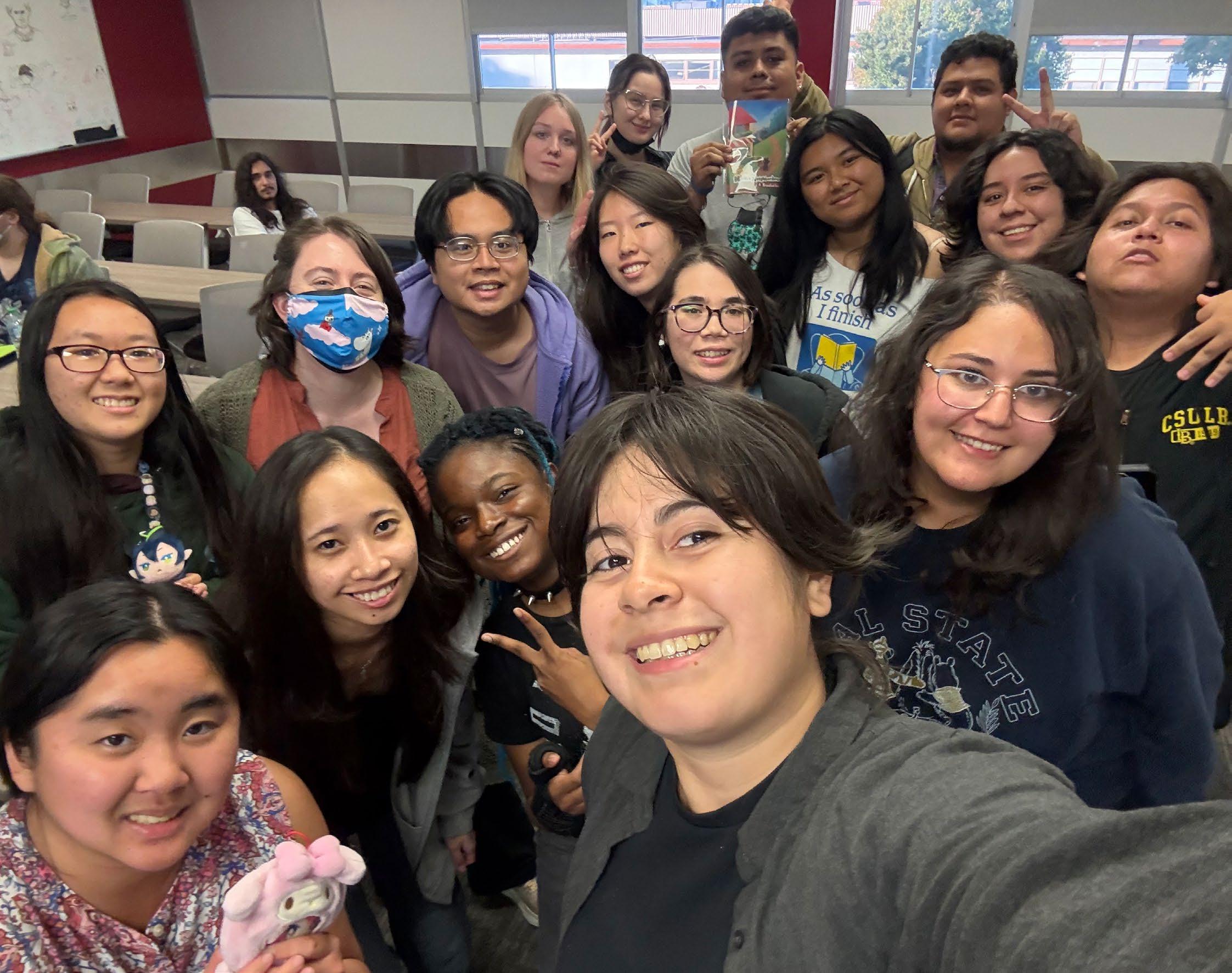
A Passi, a Student Life & Development adviser who previously led Arts Ink, worked closely with Manley to grow the student community
“What I hope to see for all the organizations, I advise is for them to grow in membership, work within their specialty, hosting events that outreach to the CSULB community and exemplifying joy, academic excellence and their passion,” Passi said.
Katherine Suarez Rubio, a fourthyear studio art major, is the social media coordinator for the Student Illustration
Production club, or SIPs.
Suarez Rubio said the biggest struggle for art students is finding out about these leadership roles, as they are often not advertised by faculty. She was glad Arts Ink reached out to her club in efforts to build a strong student body.
“I’m really glad that the students are now in charge, because that’s the only way for students to know more,” Suarez Rubio said. “Students wouldn’t know about these clubs if students weren’t the ones running them and telling other students about it.”
Suarez Rubio said there has always been a community within the arts department; it’s just not as well-known as others on campus.
“The intention behind the College Council is to represent the students within that college through advocacy, events and networking,” Passi said. Arts Ink meets biweekly on Tuesdays from noon to 1 p.m. and is open to students of all majors. More information can be found on their Instagram @ artsinkcsulb or on the Student Life & Development website.
Photo Courtesy of Art Ink Council
Kat Suarez Rubio, other officers and active members of SIPS club at a general meeting.
Banda night shakes up CSULB with Latin Pride

BY MONICA GARCIA Arts & life Assistant
Students dove into the air, striking an iguana pose on the ground and jumping over each other. Their tejana hats surrounding them, bouncing to the beat of Mexican huapango hit song: La Iguana
The dance, traditionally performed by male dancers who dive around a female dancer, was one of the classic moves performed at CSULB’s Kinesiology Courtyard lawn.
The Los Angeles banda group Los Del Bosque performed at the Latinx Student Union’s first Noche de Banda and fundraiser on April 17.
“There’s not really a lot of Latin musical cultural events around campus,” said Brittany Galvez, fourth-year computer science major and event lead. “Since we make up
52.4% of the population on campus, more than half, I was like, ‘Why not bring this?’ Other campuses do it.”
Partners and singles spun around the courtyard to Mexican party hits like Tamarindo, La Chona and Cumbia de la Cobra.
MCP Catering provided traditional Mexican treats, including tortilla chips, churros and esquites.
Students could also purchase sarape graduation sashes, tote bags and custom bandanas, as well as enter an opportunity drawing for a CSULB merchandise basket.
According to Galvez, Noche de Banda profits would be used to plan future Latinx Student Union events.
“I say that we should all support one another,” Los del Bosque singer and accordion player Felipe Gutierrez said. “To all Latinos, I send a special thanks to the people who are undocumented and all of Latin America.”
The banda group has been active for six years and originated in Los Angeles. It has been growing its social media following and has performed for Pico Landia at the Pico Rivera Sports Arena and for local quinceañeras.
“Honestly, we were stoked about it … we haven’t been to an event like this in a minute,” Omar Velasquez, first-year biochemistry major said. “People would definitely feel more secure knowing that there’s a community out there that they belong to.”
Attendees could get free air-brush tattoos from over 40 options by Twist & Shout Events. Students could also receive a simplified realism drawing of themselves by cartoonist Jasmine Ochoa.
The Latine Resource Center, Housing and Residential Life, Hispanic Serving Institution Initiatives and Beach Pride Events collaborated with the Latinx Student
Union to host the event.
The Men’s Success Initiative announced their upcoming Compa Conecta community event that evening, a space for men of color to connect and build community.
The Compa Conecta launch is scheduled for 9:30 a.m. on April 25 at Long Beach City College’s Trades, Technology and Community Learning Campus in Dyer Hall.
As the night went on, Noche de Banda drew massive dance circles, zapateado and multiple conga lines of students to fill the courtyard. A DJ from 22 West Media kept the crowd engaged while the band rested.
“It’s something that everybody can take pride in,” Isac Pelayo, an invited guest, said. “The fact that everybody can come here, even with the big time of fear, [everybody] is able to show out, show up, and feel pride in themselves and pride for others.”
MONICA GARCIA/Long Beach Current
The musical groip Los del Bosque played during the April 17 event. From left to right, the members are Junior Trujillo, Felipe Gutierrez, Cristopher Pascual, Darik Morales and Randy Gutierrez.
Does independence change your relationship with your parents?

BY NICK MILLER Contributor
Now that I am a young adult, I realize that friendships may come and go, but I wouldn’t be the person I am today without my mom. Even as a 23-year-old student, I can still open up to and lean on my mom for advice, emotional support and meaningful conversations.
Whether it is an in-person conversation or a phone call, my mom is someone who truly knows me. Looking back, I know my relationship with my mom has grown stronger, even as we continue to grow older.
Every person deserves to have a relationship with at least one family member who allows them to express their emotions and be their true selves at all times.
With that said, I was curious whether other people my age share a similar bond with their loved ones.
A 2024 study from PewResearch.org found that 59% of young adults ages 18 to 34 have an excellent relationship with their parents, and 69% can be their genuine selves around them.
Contrary to this statistic, however, I’ve found that some students become distant from their families after moving out and getting busier in life.
Communications major Manning Lemoine is one student who said he feels content without having a family member who fully understands him.
“I have been independent for so long; I feel like I’m kind of used to that and comfortable with that,” Lemoine said. “Not that I would be against feeling more like people are on the same level with me, but if I feel like I can regulate my emotions well on my own, I don’t need them.”
Lemoine shared that he and his family do not see the world the same. As a result, he said he prioritizes self-reflection
and good habits to keep himself grounded independently, rather than relying on others.
Similar to myself, however, creative writing major Ellie Barsam said her mom truly understands her and would like to see that relationship grow.
“When something great or not-sogreat would happen in my life, she’d always be there to either give me advice, comfort me, cheer me on,” Barsam said. “The more I’ve grown up . . . I feel like our conversations are deeper, and she respects me more, and I definitely respect her more.”
Some young adults may want to get closer to their parents but might not know where to start. As responsibilities pile up and priorities shift, closing the gap between an individual and their parents can be difficult.
Upon reflection, I believe one way I can get closer to my mom is by being more transparent. Maybe if other stu-
dents shared more with their parents, too, they would receive sound advice, and their relationships would only grow stronger.
Barsam mentioned that if she were to strengthen her relationship with her mom, she would focus on sharing everything.
“You talk to your parents about some big things; sometimes, you keep it a secret. But at the same time, it’s the little things in life that matter,” Barsam said.
Building a stronger relationship with a family member can be difficult at this age because it requires effort and sacrifice during a busy period in one’s life.
Some young adults thrive on doing things alone and not needing to rely on others, whereas others need to lean on parents who know them better than they do.
If you want to get closer to your family, it doesn’t hurt to share the little things.
Graphic By GABRIELLE LASHLEY/Long Beach Current Young adults can sometimes grow apart from their parents, due to increased responsibilities. Though, increased maturity can deepen the relationship that young adults have with family members.
OPINIONS
When high standards become harmful
BY RILEY MURRAY
Contributor
Long nights at Long Beach State’s University Library can turn into a frustrating cycle — rereading, revising and rewriting, only to feel like your paper still isn’t where you want it to be.
The cursor blinks at the end of the paragraph while you read over the same collection of sentences for the fourth time, convinced that there must be a better way to say it.
This cycle may sound familiar if you struggle with perfectionism. The goal starts as wanting to produce high-quality work, but eventually, it turns into a never-ending attempt to eliminate every possible flaw.
According to the Newport Institute, perfectionism is more than having high standards; it involves setting unrealistic expectations, harshly criticizing performance and connecting one’s self-worth to meeting impossible standards.
A study by the American Psychological Association found that the number of young people, particularly college students, experiencing perfectionism has been increasing. While the desire to succeed can be a positive motivator, too much of this pressure can become harmful to mental health.
Imposter syndrome often develops alongside perfectionism. The National Library of Medicine describes imposter syndrome as “a behavioral health phenomenon described as self-doubt of intellect, skills, or accomplishments

Behind long nights and endless rewrites, struggling with perfectionism and imposter syndrome can make even your best work feel like it’s not enough.
among high-achieving individuals.”
Consequently, even when someone performs well academically, they may still feel as though they are not truly capable and that any success they achieve is undeserved.
As a fourth-year college student only months away from graduating, I have yet to find the cure for imposter syndrome and perfectionism. However, I have learned a few strategies to manage them and prevent them from taking over my work and mindset.
Experiencing these feelings is not a sign of weakness. In many ways, it can simply indicate that you care about your work and want to perform at your best. What I have found to be helpful is to focus on what you can control rather than
becoming overwhelmed by what you cannot.
One strategy that has helped me is keeping a record of achievements, previous work and positive feedback from professors or peers. When you start to feel self-doubt, refer to tangible evidence to counter it.
Despite performing well as a student, I do not think I will ever be completely free of these overbearing feelings, which is completely okay. The goal is not necessarily to eliminate them but to learn how to reframe them more healthily.
Additionally, you should learn to lean on the people around you. Talking openly about these feelings to trusted friends, peers or mentors can help break the cycle of isolation and constant overthink-
ing.
When I find myself rereading my work repeatedly, I’ve discovered that asking others to read it and provide honest feedback can be especially helpful. More often than not, they point out strengths that I may have overlooked while focusing only on mistakes.
Perfectionism and imposter syndrome may never fully disappear, especially in environments such as college that constantly push us to perform at our best. We are more capable than we realize, and it starts with learning to give ourselves the same understanding and patience that we often give others.
Graphic by GABRIELLE LASHLEY/Long Beach Current
Engine, energy and 51 years of tradition: Long Beach sends off its Grand Prix in style
BY XAVIER CONSTANTINO
Sports Assistant
On Sunday, the city hosted the final day of the 51st Acura Grand Prix of Long Beach, and while the sound of racing engines has gone quiet, the memories made will linger well past Sunday evening.
In the headline event, four-time NTT IndyCar Series champion Alex Palou claimed his first career victory at Long Beach in the No. 10 Honda for Chip Ganassi Racing, using a faster pit stop to steal the lead from pole-sitter Felix Rosenqvist in the No. 60 Honda for Meyer Shank Racing late in the 90-lap race and pull away to a 3.9-second victory.
The Swedish driver had dominated much of the afternoon, leading 51 of the race’s 90 laps.
However, when debris triggered the race’s only caution on lap 57 and the entire field pitted two laps later, Palou’s crew managed a 7.3-second pit stop compared to Rosenqvist’s stop of 8.4 seconds. That one-second difference was all Palou needed to secure the victory.
Open AI's No. 10 driver, Alex Palou pivots from 9 to turn 10 during the final NTT IndyCar race. Palou placed first place at the IndyCar Series at the Grand Prix in Long Beach on Sunday, April 19. Rehansa Kulatilleke | Long Beach Current
“Super proud of everybody’s job but especially this crew,” Palou said. “Incredible to finally win here in Long Beach.”
When asked where this race win
ranks among his others, Palou said it is now near the top of his list.
“I feel like every win is so special, obviously the [Indianapolis] 500 is always gonna stay up top,” he said. “This probably ranks top three. It’s super, super cool.”
The IndyCar main event was not the only racing story on the streets of Long Beach this weekend.
The Historic Motorsport Challenge 2 kicked things off for the final time in the 562, with Chris Hines taking the win once again.
The next race that followed was the Porsche Carrera Cup North America Race 2, where British driver Tom Sargent swept both rounds in the No. 32 GMG Racing Porsche 911 Cup, winning back-to-back on Saturday and Sunday to cap a dominant weekend at the circuit.
Porche Motorsport North America
Selected Driver, Tom Sargent celebrates his win of the Mobil Pro Class for GMG Racing at Victory Lane in the Grand Prix in Long Beach on Sunday, April 19. Rehansa Kulatilleke | Long Beach Current Sargent was one of the few drivers with prior experience at this track, noting that that knowledge helped with his success.
“I had a little bit of an advantage coming back to this year, being one of the only people in the field that’s actually been to this circuit before,” Sargent said. “When you can’t test, that experience is so important.”
The final race before the IndyCars took to the track was the Stadium Super Trucks Series Race 2, where Matt Brabham earned the victory by just 0.220

seconds ahead of Robby Gordon.
Off the track, the energy in the grandstands meant something more than just another race. The Grand Prix is a tradition as much as it is a race weekend.
Fred Stine from Hell’s Kitchen in Manhattan, New York, witnessed the grand prix for the 41st time out of the 51 grand prix held at Long Beach.
“I’ve been going to races my whole life. It’s cleaner, it’s nicer, it’s just a great event,” Stine said.
Stine also said that the Grand Prix of Long Beach has not changed much over the years he has attended.
“It’s just race cars and people.”
Not everyone has been able to attend for decades. Sydney Oliff, who moved to Los Angeles from Sydney, Australia, about a year ago, attended her first Grand Prix on Sunday, bringing along colleagues for a day of racing and team bonding.
“I love the drama, I love the high speed, I love the crashes, all of that,” Oliff said.
Oliff got into motorsports through shows like the Netflix series “Drive to Survive” and said IndyCar felt like a natural extension of her love for the sport.
“IndyCar was the closest thing I could get to F1,” she said. “I’m just a fan of motorsports, so I thought this would be fun.”
Between a first-time visitor from Australia and a fan who has attended 41 of the race's 51 editions from New York, the 51st Long Beach Grand Prix found what it always seems to find: people are willing to travel a long way for the sound of engines and a day well spent on the Southern California waterfront.
The streets of Long Beach will begin to return to normal in the coming days. Yet, fans will already be counting down the days to next year's edition of the Acura Grand Prix of Long Beach.


Clockwise from the top: Connor Bloum passes through turn 10 during the first round of the 2026 Porche Carrera Cup North America. Bloum placed fifth on April 18 at the 2026 Grand Prix in Long Beach. | Fans near turn 1 cheered from the stands as the Weathertech SportsCar Champions started on April 18. The No. 93 Grand Touring Prototype (GTP) of Acura Meyer Shank won the title of champion. | Alex Palou (center) celebrates his win at the Victory Lane at the Grand Prix in Long Beach after completing the final lap of the NTT IndyCar Series. Felix Rosenqvist (left) placed second and Scott Dixon (right) placed third.

Photos by REHANSA KULATILLEKE Long Beach Current
No. 3 LBSU delivers statement road victory over No. 5 UCI
BY BRIANNA APODACA
Sports Assistant
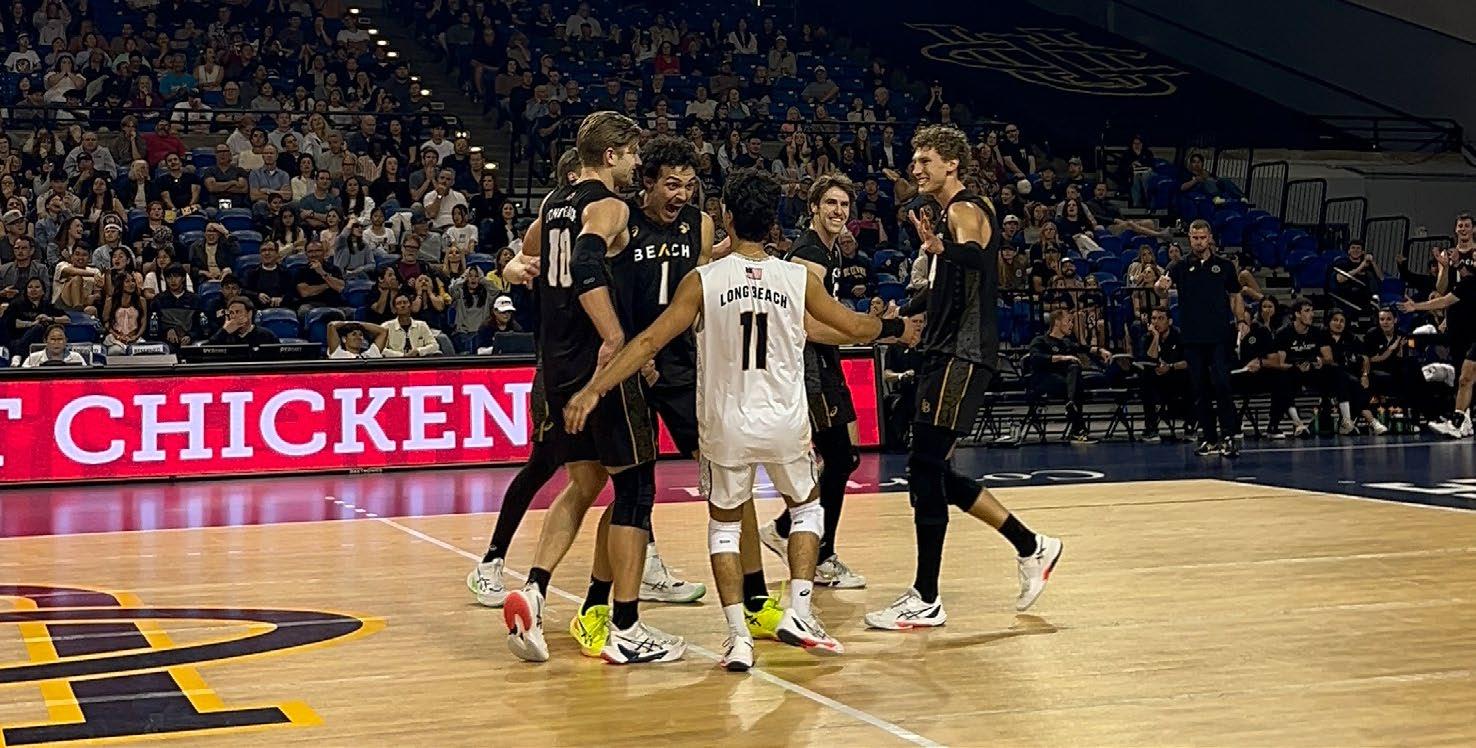
IRVINE, Calif. - In front of an electric Anteater crowd on Saturday night at the Bren Events Center, No. 3 Long Beach State men’s volleyball picked up right where they left off from the previous night with a 3-1 win over No. 5 UC Irvine, capping its season with a sweep in the Black-and-Blue Rivalry.
The Beach (22-4) relied on a dominant presence at the net and an efficient offensive performance, finishing with a .309 hitting percentage while holding the Anteaters (17-7) to .188.
The tone was set early as The Beach pulled away late in the opening set for a win before delivering its most dominant stretch of the night for the second set. The Beach hit .609 in the set while limiting the Anteaters to .000, cruising to a 25-13 victory and taking a two-set lead.
Coming off a five-set match the night before, The Beach created separation early and held off a late push to lock down the win.
“After a five-set match, both sides were going to have some tired legs,” LBSU head coach Nick MacRae said. “From our end,
we wanted to be better with our legs and take advantage of that.”
The Anteaters came for blood in the third set as they began to find their offensive rhythm and extended the rally to take a win over The Beach to force a fourth set.
“A lot of teams get beat by other teams, but I think we lose games to ourselves,” senior middle blocker Ben Braun said. “We focus on that 30-second response. If something doesn’t go our way we can’t let it turn into 20 points.”
During the nail-biting fourth set, The Beach leaned on their defense and blocking to bring the competitive set to a close and secure the match win.
LBSU senior outside hitter Connor Bloom led the night with 15 kills and 20 points followed by freshmen opposite hitter Wojciech Gajek adding 12 kills and 15 points.
Senior outside hitter Skyler Varga pitched in 10 kills, followed by freshman middle blocker Jackson Cryst finishing with eight.
Redshirt freshman setter Jake Pazanti distributed the offense with 41 assists as The Beach totaled 56 kills on the night.
The Beach controlled the match defensively at the net by outblocking The
Anteaters 16.5 to 5.5. They also applied pressure from the service line with 11 aces, disrupting The Anteaters rhythm throughout the match.
“We wanted to be disciplined with our block and do our job,” MacRae said. “Even if they hit over us we knew if their legs were tired they were going to hit more into our block.”
Defensively, sophomore libero Kellen Larson anchored down the back row with a career-high 18 digs, helping The Beach
limit The Anteaters offensive consistency throughout the match.
Despite The Anteaters third-set push, they were unable to sustain the momentum against The Beach’s defensive pressure. With the regular season complete, The Beach now turns its focus to the Big West Tournament which will be back at Bren Events Center next Saturday.
Catching the Wave: Top LBSU star athletes to watch this semester
BY TIMOTHY HESSEN Sports Editor
Long Beach State beach volleyball’s star senior duo of Taylor Hagenah and Malia Gementera has one last shot at competing in the NCAA Championships.
While the majority of LBSU sports fans’ attention is spent on programs like men’s volleyball or the floundering basketball programs, the pair of Hagenah/ Gementera have quietly cemented themselves as two of the greatest athletes in the school’s history.
After already breaking the program’s record for career wins as a pair in their junior seasons, the duo reached the milestone of 100 wins this February and have continued to stack them since.
Competing in the first flight, Hagenah/Gementera
have led The Beach to two Big West titles and one runner-up finish in three seasons.
LBSU has qualified for the NCAA Championships in each of the last three seasons, bowing out in the first round in each appearance.
As The Beach’s regular season has come to a close, LBSU ranks No. 10 in the country heading into the postseason, starting with the Big West Tournament.
Starting on April 23, the Big West Tournament is a double-elimination tournament featuring all seven conference teams.
LBSU will have to contend with the two other nationally ranked Big West programs, No. 6 Cal Poly San Luis Obispo and No. 16 University of Hawai’i.
The Beach handily defeated the Rainbow Wahine 4-1 on March 20, but were swept 5-0 by the Mustangs on March 22.
A date between LBSU and Cal Poly would be a rematch of last season’s Big West Championship Final, where The Beach defeated the Mustangs 3-1.
In addition to their star top-flight duo, The Beach will rely heavily on the fifth-flight pair of sophomore Kealoha Phillips and junior Brooke Birch, the only LBSU duo other than Hagenah/Gementera to win a Big West Beach Volleyball Pair of the Week award.
The Beach are peaking heading into the postseason, as Friday concluded with two wins over No. 11 Grand Canyon University and No. 12 Arizona State.
The next step will be carrying that momentum into the postseason, as LBSU can erase any doubt of its inclusion in the NCAA Championships by clinching the auto-bid awarded to the conference champions.
ERINNA LAM/Long Beach Current
No. 3 LBSU celebrates a point during its 3-1 victory over UC Irvine on Saturday, April 18 to close the regular season.
Dirtbags swept by UC Riverside to extend four-game Big West losing streak

BY DUPREE DE LA PENA
Contributor
Long Beach State baseball stranded runners in scoring position and failed to capitalize on eight walks in a 7-2 loss to UC Riverside, which completed a three-game Big West conference sweep at Blair Field on Sunday.
With the series sweep by UCR (13-25), LBSU (12-27) has now dropped its last four games against Big West opponents.
“It is really hard for us right now, but you have to keep putting in the work,” LBSU head coach TJ Bruce said. “Ultimately, the battle always lies between you and you. I get wins and losses, but you can’t allow yourself to sink to a level of feeling sorry for yourself.”
Bruce and third base umpire Andrew Burke made it through their first full game together this series, with the second-year head coach being ejected in the previous two games.
“I think there’s mutual respect and understanding,” Bruce said. “There’s no hard feelings, [umpires] have a job to do and so do we. I’m sure they want to get to the College World Series too.”
The previous Big West matchup saw a great pitching duel between LBSU freshman pitcher Luke Howe and UCR senior pitcher Matthew O’Brien, where no runs were scored until the bottom of the sixth inning.
However, the three-game series finale between the Dirtbags and Highlanders was quite the opposite.
Both LBSU freshman pitcher Jason Gerfers and UCR freshman pitcher Jayden Avina had mound visits in the first inning.
The top of the Highlanders batting order in sophomore designated hitter David Gibbs, junior second baseman Lucas Bonham and sophomore left fielder Isaiah Hernandez scored a run for UCR, jumping out to a quick 3-0 lead.
With Avina walking batters into scor-
ing position, the Dirtbags scored on bases loaded after being walked in, but could not muster up a single hit, with that being their only run.
Avina’s day would end after pitching 1.2 innings with 5 walks and 1 earned run.
Luckily for UCR, seven different batters were able to contribute with a hit.
A deep solo shot by UCR senior catcher David Whittle to left field fired up the Highlanders’ bench while Hernandez applied more pressure on the Dirtbags with a sacrifice fly RBI to put UCR out in front with a 7-1 lead.
Gerfers’ outing would end after pitching 4.0 innings with four strikeouts, seven hits and seven earned runs.
The Dirtbags would finally put a ball in play after getting their first hits in the bottom of the fourth inning from sophomore left fielder Murchael Turner and freshman catcher Damon Valdez.
LBSU junior outfielder Taylor Tomlin and Turner, who do not normally start, were the only Dirtbags to have
multiple hits in the game.
“[Turner] and [Tomlin] haven’t played a lot this year,” Bruce said. “There haven’t been a lot of at-bats [for them], but I do think it’s really important for people to persevere and stand tall.”
In the bottom of the seventh inning, the same opportunity would present itself for the Dirtbags with bases loaded and zero outs.
LBSU senior first baseman Conner Stewart would get an RBI-groundout to bring in one run, but that would be the only score of the inning.
Senior second baseman Camden Gasser grounded out with runners on second and third base, making the game 7-2.
The offense of the Dirtbags and Highlanders stalled out, with UCR sweeping the three-game series.
LBSU will attempt to get back in the win column as they host a non-conference matchup against Fresno State at Blair Field on Tuesday, April 21.
Photo courtesy of LBSU Athletics
The Dirtbags fall to the bottom of the Big West standings after being swept by UC Riverside at Blair Field on April 19.