
Long Beach current
1250 Bellflower Blvd., LA4-203
Long Beach, CA, 90804
Editorial Office
Phone (562) 985-8000
Dante Estrada
Multimedia Managing Editor multimedia@lbcurrent.com
Grace Lawson
Community Engagement Editor community@lbcurrent.com
News Editor
Arts & Life Editor
Opinions Editor
Sports Editor
Design Editor
Chief Copy Editor
Photo Editor
Social Media Editor
Video Editor
Podcast Editor
News Assistants
Arts & Life Assistants
Opinions Assistants
Sports Assistants
Design Assistants
Copy Assistants
Photo Assistants
Social Media Assistants
Video Assistants
Podcast Assistants
Khoury Williams Editor-in-Chief eic@lbcurrent.com
Isabella Garcia Managing Editor managing@lbcurrent.com
Haley Lopez Business Manager business@gobeach.media
One of many Long Beach dispensaries, King’s Crew sells prerolled Gramlin’s “Midnight Snacks.”

Annette Quijada news@lbcurrent.com
Delfino Camacho arts@lbcurrent.com
Leyna Vu opinions@lbcurrent.com
Timothy Hessen sports@lbcurrent.com
Rebecca Lavond design@lbcurrent.com
Angela Osorio copy@lbcurrent.com
Charlotte LoCicero photo@lbcurrent.com
Erinna Lam socials@lbcurrent.com
Skylar Stock video@lbcurrent.com
Gianna Echeverria podcast@lbcurrent.com
Ethan Brown Jayden Sandstrom
Josephine Robinson
Joshua Flores
Nasai Rivas
Ni Baliness
Jason Green
Lila Mukasa
Joseph Lee
Monica Garcia
Christian Robledo
Alexys DeMaria
Monica Badolian
Xavier Constantino
Brianna Apodaca
Alan Ibarra
Junior Contreras
Brooke Williams
Gabrielle Lashley
Leyla Crail
Sasha Marantz
Josephine Kim
Joshua Min
Diego Perez
Eddy Cermeno
Rehansa Kulatilleke
Jorge Hernandez
Ethan Cohen
Valentina Villarreal
Alejandra Guerra
Mikaela Perez
Kiara Fillingim
Eli Vice
Bryan Viteri
Ava Richards
Brandon Rodriguez
Crow Vides
Business
Creative Director
Web & Technology Director
PR & Marketing Manager
Distribution Manager
editors assistants advisers
Design Adviser
Content Adviser
Advertising & Business Adviser
Alicia Taylor creative@gobeach.media
Tasneem Iqbal web@gobeach.media
Ericka Lacy pr@gobeach.media
Seiana Spencer-Kendrick distribution@gobeach.media
Gary Metzker
Barbara Kingsley-Wilson
Jennifer Newton
How cannabis taxes add up in Long Beach
BY JOSEPHINE ROBINSON News Assistant
The Adult Use of Marijuana Act, or Prop. 64, legalizes the use of recreational marijuana for adults over 21 in California. However, it also comes with a tax—or taxes.
Californians who purchase marijuana automatically pay a 15% excise tax on all cannabis sales, which is added on to state and local sales taxes. However, depending on where retailers are located, customers also face additional taxation implemented by local policy.
In Long Beach, this additional tax is imposed by Measure MA.
Measure MA “sets a gross receipts tax on sales of both medical and recreational marijuana, establishing a tax on marijuana cultivation, processing, testing and distribution in the City,” as stated on the Long Beach City Council website.
The policy imposes a 7% tax on recreational marijuana and a 6% tax on medical marijuana, while also requiring separate retailers who distribute, process and transport marijuana to pay an additional 6% tax.
With the combination of excise taxes, state and local sales tax, and taxes imposed by Measure MA, Long Beach residents and retailers pay a total of 33.5% in taxes purchasing recreational marijuana.
“It’s not pretty on the pocket,” said Luis Carrasco, manager for The Syndicate dispensary. “We do try and lower our prices, try to keep the price the same, to
land acknowlEdgmEnt

MATTHEW SUMMER/Associated Press
On Jan. 1, 2018, a customer purchases marijuana at the Harborside marijuana dispensary in Oakland.
swallow that dollar, but customers aren’t happy.”
But where does this money go?
“I know they’ve [Long Beach residents] been making a push for more services in Long Beach. Creating more funds via tax would create more opportunities for those types of programs,” said Maryanne Diaz, a lecturer in the School of Criminology, Criminal Justice and Emergency Management who specializes in drug use and policy.
Click here for the full story.
Here at the Long Beach Current we acknowledge that the school we report on is located on the sacred site of Puvungna, “the gathering place.” We are on the land of the Tongva/ Gabrieleño and the Acjachemen/Juaneño Nations who have lived and continue to live here.
We also acknowledge the Gabrieleño/Tongva (pronounced: GABRIEL-EN-YO/TONG – VAH) and Acjachemen/Juaneño (pronounced: AH-HACH-AH-MEN/JUAN-EN-YO) as the traditional custodians of the Los Angeles region along with the Chumash (pronounced: CHOO-MOSH) to the north and west, and the Tataviam (pronounced: TAH-TAH-VEE-YUM) and Cahuilla (pronounced: KAH-WEE-YAH) Nations to the east.
We respect and value the many ways the Tongva/Acjachemen cultural heritage and beliefs continue to have significance to the living people and remind us about the sacred and spiritual relationship that has always existed here at what we now call California State University Long Beach.
Editorials:
Editorials: All opinions expressed in the columns, letters and cartoons in the issue are those of the writers or artists. The opinons of the Long Beach Current are expressed only in unsigned editorials and do not necessarily reflect the opinions of the journalism department or the views of all staff members. All such editorials are written by the editorial board of the Long Beach Current.
lEttEr Policy

lEttEr Policy: All letters and emails must bear the phone number of the writer and must be no more than 300 words. The Long Beach Current reserves the right to edit letters for publication in regard to space.
Prop. 64 was passed 10 years ago.
How has it impacted the cannabis industry?
BY ANNETTE QUIJADA AND ALEXIS MUÑOZ News Editor and Contributor
As California nears a decade since the legalization of cannabis, state officials say the cannabis industry has brought both positive progress and challenges.
In 2016, The Adult Use of Marijuana Act, also known as Proposition 64, legalized the personal use and cultivation of marijuana for adults 21 and over while also reducing the crime penalties for marijuana- related offenses for adults and juveniles in California.
The act passed with a 57% voter approval, making California the fifth state to legalize the recreational use of marijuana.
Jordan Traverso, deputy director of public affairs of the Department of Cannabis Control said that ten years after Prop. 64, California’s cannabis story is one of building and not inheriting—the largest regulatory system of its kind.
The DCC was established in 2021, combining three previous state cannabis agencies: the Bureau of Cannabis Control, CalCannabis Cultivation Licensing and the Manufactured Cannabis Safety Branch.
“In a decade, California didn’t just regulate cannabis, it proved that even the most complex, fragmented starting point can be transformed into a functioning, evolving system,” Traverso said. “The foundation is now in place, stronger each year, for the largest legal cannabis market in the world.”
Traverso also highlighted that building this foundation did not come easy. He said California faced an illicit market older, larger and more entrenched than anything on the legal side.
“But step by step, systems strengthened, operators were supported, consumers protected and the market grew steadier,” Traverso said.
One of the key supporters of Prop. 64 was Gov. Gavin Newsom. His Chief Deputy of Communications, Diana Crofts-Pelayo, said 10 years ago voters chose to move past the failed war on drugs and adopt a smarter, more just approach to cannabis through Prop. 64.
“We’ve made real progress to build a strong regulatory framework,” Crofts-Pelayo said. “We are proud of the work done to tackle criminals and the illicit cannabis market that seek to undermine that progress.”
“This anniversary is both a marker of how far we’ve come and a reminder of the work still going on to fulfill the will of the voters,” Crofts-Pelayo added.
In the city level, beyond regulation and enforcement, equity is a key focus when it comes to legalization efforts.
In Long Beach, the Cannabis Equity Program’s goal is to support equitable opportunities in the cannabis industry by making legal cannabis ownership and employment more accessible to those impacted by marijuana criminalization.
Chelsey Magallon, the Long Beach Department of Economic Development & Opportunity spokesperson, said the program acts as a mechanism for restorative justice when helping communities disproportionately affected by the war on drugs.
“Between 1970 and 2010, annual
cannabis arrests in the U.S. significantly increased from 188,000 to over 850,000,” Magallon said. “Nationally, Black individuals were 3.73 times more likely than white individuals to be arrested for cannabis possession, despite similar usage rates.”
Magallon said the program was created to address these local disparities by lowering barriers to entry for those harmed by these enforcement trends.
The program serves Long Beach residents who meet low income thresholds and have a past cannabis conviction and have lived in Long Beach for at least five years.
Additionally, the program offers resources such as direct grants, fee waivers, expedited application and facility plan check review, and cultivation tax deferrals, for individuals looking to open an equity business.
“The face of the Long Beach cannabis industry is evolving, we are seeing diverse ownership through a measurable rise in businesses owned by individuals of color, aligning more closely with the 70% non-white population of Long Beach,”
Magallon said.
She said through equity hire requirements, licensed businesses are recruiting from high-unemployment census tracts, providing stable jobs and professional development to residents who were previously marginalized by the legal system.
Working to meet their goal, Magallon said they wish for their equity businesses to become successful and a recognized brand in the state. They also wish to see direct reinvestment into the neighborhoods most impacted by past enforcement.
“Drawing back to the city, restorative excellence that continues to show Long Beach as the gold standard on how a city can successfully transition from a history of criminalization to a future of inclusion is the permit goal for the future to come,” Magallon said.
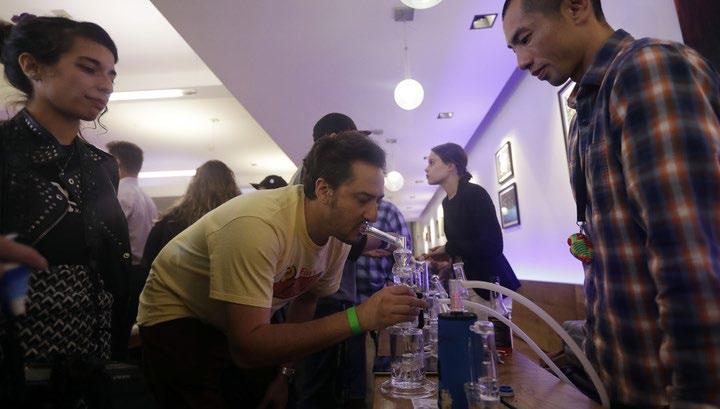
MARCIO JOSE SANCHEZ/Associated Press
Seibo Shen, at right, provides marijuana to smoke for supporters of Prop. 64 during a rally at Sparc Dispensary Nov. 8, 2016, in San Francisco.
Cannabis-friendly concerts, events coming soon to Long Beach

BY KHOURY WILLIAMS Editor-in-Chief
Long Beach City’s live event and concert scene could soon look and smell a little differently. Fol-
lowing a March 24 vote by the City Council, officials approved cannabis special events, opening the door for select private and public festivals and gatherings to legally incorporate weed into their programming.
Under the new policy, a limited number of permitted events will allow the sale and on-site use of cannabis products, including pre-rolled joints, edibles, CBD and THC-infused alcoholic beverages, oils and other products.
According to official research presented at the council meeting, the policy is intended to boost tourism and create new economic opportunities for local businesses and the city’s growing cannabis industry.
City officials proceeded with planning for cannabis special events after surveying 730 residents in September 2024 to gauge interest. Nearly half of all respondents reported that they use cannabis regularly, while 9% declined to answer.
Out of the respondents who admitted to using cannabis products, over half
responded favorably to wanting to attend cannabis special events in the city, whether indoor or outdoor.
Following a 6-2 vote, council members agreed to revisit the policy for final approval. Once adopted, the ordinance will go into effect, allowing the city to begin accepting permit applications for cannabis special events through the Office of Special Events and Filming.
The planned Long Beach Amphitheater was listed by city officials as one of several potential sites for cannabis special events, alongside locations such as the Queen Mary and Shoreline Park.
Unfortunately, the new policy is not expected to be fully implemented in time for the Amphitheater’s June 6 grand opening concert, which will be headlined by Grammy award-winning rapper and cannabis enthusiast Snoop Dogg.
Designated 21 and older cannabis special events are still in the early stages of planning and development, with no confirmed events scheduled, according to Office of Cannabis Oversight Manager Valencia Romero.
As city officials prepare for cannabis special events, Romero said organizers will have to meet a series of safety and compliance requirements.
“Like any special event hosted in the city, cannabis special event organizers will
be required to submit an event security plan,” Romero said. “Under our cannabis special events ordinance, event organizers will be required to promote responsible cannabis consumption and safe alternatives to driving.”
For additional safety precautions, Romero mentioned that most cannabis use would take place in designated areas not visible to attendees seeking to avoid exposure to secondhand smoke.
“Mobile air purification and filtration systems may be used to help minimize the cannabis smoke,” Romero said. “These events are typically outside, open air and far removed from the general public.”
According to Romero, the city plans to evaluate the program’s impact after its first year, with a status report sent to the council that may include attendance, revenue and community feedback.
Matthew Martinez, a Long Beach State student who does not use cannabis, expressed concerns that some concert-goers might take advantage of the new weed policy. While he is OK with cannabis special events, he argues that limits should be set.
“I guess I’m OK [with the policy] because people are going to have fun there and weed smokers should have fun too, but to a certain extent,” Martinez said. “It should never get to the point where it becomes too much.”
Maryanne Diaz, a CSULB lecturer in the School of Criminology, Criminal Justice and Emergency Management, said regulated cannabis events could create opportunities for education and harm reduction.
“In general, I think this is a positive move forward for the Long Beach community,” Diaz said in an email response. “Right now, cannabis is still being consumed at events and in public spaces. The issue, though, is that when something is prohibited, there are fewer opportunities for education and safety. With cannabis consumption being allowed at these public events, those who potentially have a bad experience with cannabis can seek help without fear of getting in trouble.”
She said she hopes that city and venue owners will feature harm reduction organizations during their events to promote safe cannabis use.
When addressing the common concern that policy shifts like this pose a risk for increased DWI, Diaz said it only mirrors commercial alcohol consumption.
“Bars, restaurants, concerts, even CSULB all sell alcohol and allow alcohol consumption on site,” Diaz said. “Again, increased education and harm reduction, not prohibition, is what will ultimately prevent harm.”
DONALD TRAILL/Invision/Associated Press
Rappers Wiz Khalifa and Snoop Dogg are seen performing during Hot 97’s Summer Jam at MetLife Stadium on June 1, 2014 in East Rutherford, New Jersey.
Selling weed with a woman’s touch
BY NI BALINESS Arts & Life Assistant
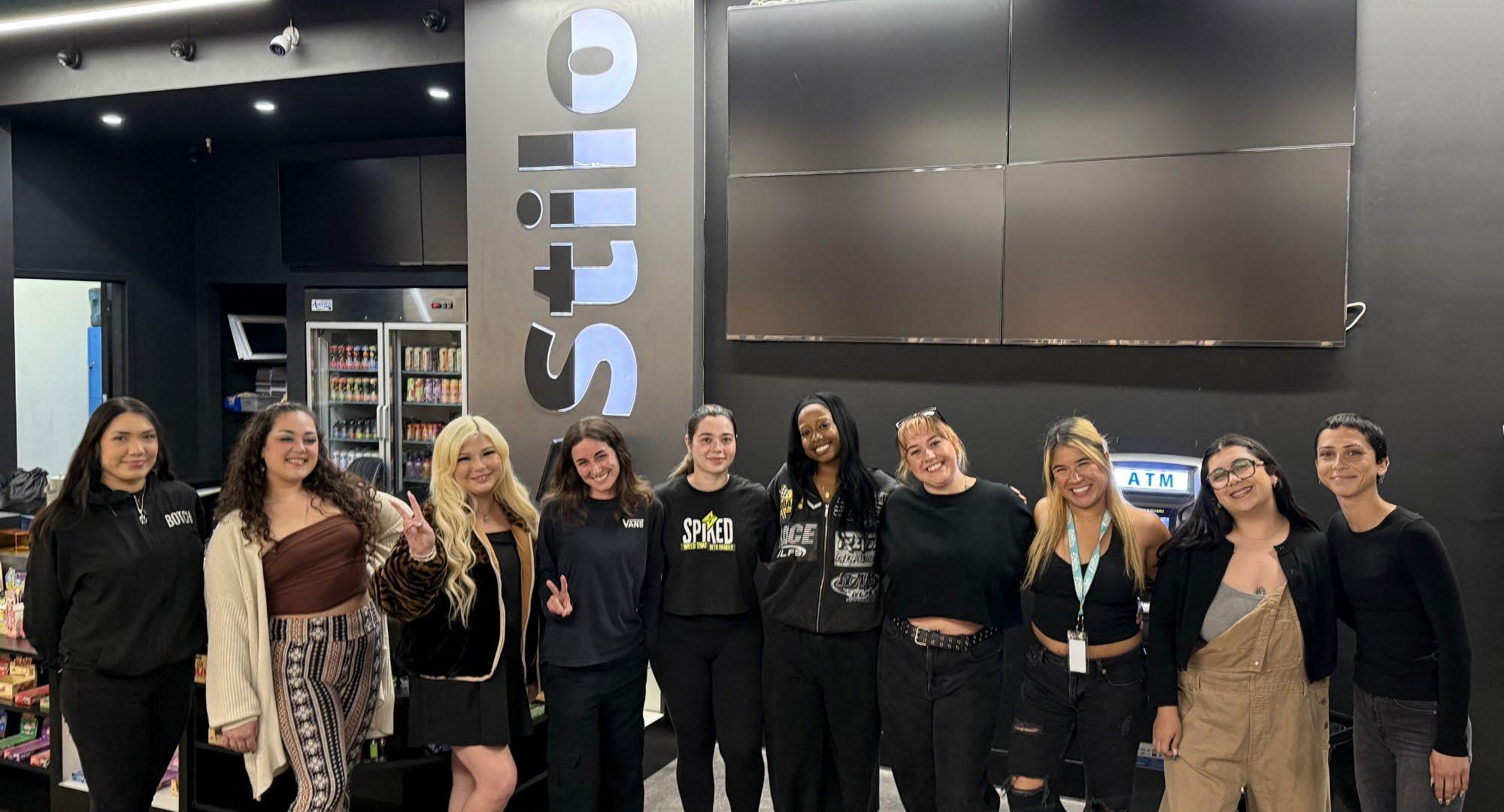
Renee Gaumond didn’t know much about cannabis until she attended her first trade show. She described the experience as a “culture shock,” but quickly adapted. Today, Gaumond runs her own business as general manager of Stilo Supply Weed Dispensary in California Heights.
From the outside, the name “Stilo” sits on a cream wall. Inside, customers are greeted with bright colors, curated displays and a range of cannabis products, from flower and vapes to edibles and concentrates.
As a women-owned business, Stilo Supply also prioritizes women-owned brands, including High Gorgeous, Kikoko, Yummi Karma and Space Gem — many discovered through trade shows and word of mouth.
“It’s cool being able to create a culture with strong women and being able to stand out in that way,” Gaumond said.
Jenna Rez, marketing manager for HyperWolf, a Southern California cannabis delivery service, said Stilo’s approach reflects a broader shift.
“A woman-first approach is infused in all aspects of the business,” Rez said.
While Rez said she has positive experiences in the cannabis industry, she noted that women still aren’t included in conversations about leadership and expertise.
In a traditionally male-dominated industry, Stilo leaders said building a business run by women is rewarding, but they also want to be recognized for more than that.
“I want everybody to think of me as an equal… not just because I’m a woman but because I am capable,” Gaumond said.
What sets Stilo apart from others is the “little touches” such as the placement and aesthetics. Gaumond also believes it’s “her girls” who create an environment where everyone feels comfortable.
Assistant manager Ava Griffen said helping customers find relief is the most
fulfilling part of her job. Many visitors come in seeking help with anxiety, sleep issues or everyday stress.
“Finding something that works for them makes my heart so happy,” Griffen said.
Griffen often recommends products containing cannabigerol, also known as CBG, a cannabinoid similar to CBD that some users seek for anxiety, nausea and muscle relief.
Griffen’s own cannabis journey began at 19, when she was prescribed Ambien for insomnia. After waking up outside during treatment, she began researching alternatives and eventually turned to cannabis.
“Once I started doing it, I was all in,” Griffen said.
She also credits Stilo for providing a supportive workplace.
“This has genuinely been the most positive environment I’ve been in,” Griffen said.
As April 20, Stilo prepared special deals to celebrate the unofficial cannabis holiday. But for Gaumond, the focus remains on
PAID ADVERTISEMENT
personalized service year-round.
“Being able to curate a product selection for each customer by having a conversation is very important,” she said.
Some of Gaumond’s recommendations include Microbar by DIME Industries, flower from Decibel Gardens and BLEM, Birdies Classic pre-rolls and edibles from Camino and WYLD.
Like Griffen, Gaumond also recommends gummies containing CBG, or cannabichromene, for customers seeking relaxation without heavy sedation. For something stronger, Rez prefers Dr. Norm’s snickerdoodle edibles, which contain indica and valerian root.
Beyond products and profit, Gaumond said she’s proud to create a space customers want to return to.
For Rez, working with Stilo aligns with her career goals of supporting small businesses.
“I mean, at the end of the day, we’re selling weed,” Rez said. “How fun!”
Celebrate 4/20 at these 4 dispensaries near campus
BY ALEXYS DEMARIA AND SKYLAR STOCK Opinions Assistant and Video Editor
The identities of Long Beach and weed culture coexist in the public psyche.
However, turbulent legislation that backpedaled the industry’s legality at times threatened the viability of dispensary businesses in the city. But now, legislation reducing the impact of the war on drugs on marginalized cannabis entrepreneurs, recent state tax breaks and city council approval of designated future large cannabis consumption events are supporting the cannabis industry’s future in the commercialized, legalized world.
With several dispensary options in Long Beach tailored to the community’s needs, here are four dispensaries to ring in the 4/20 weekend.
SKYLAR STOCK/Long Beach Current
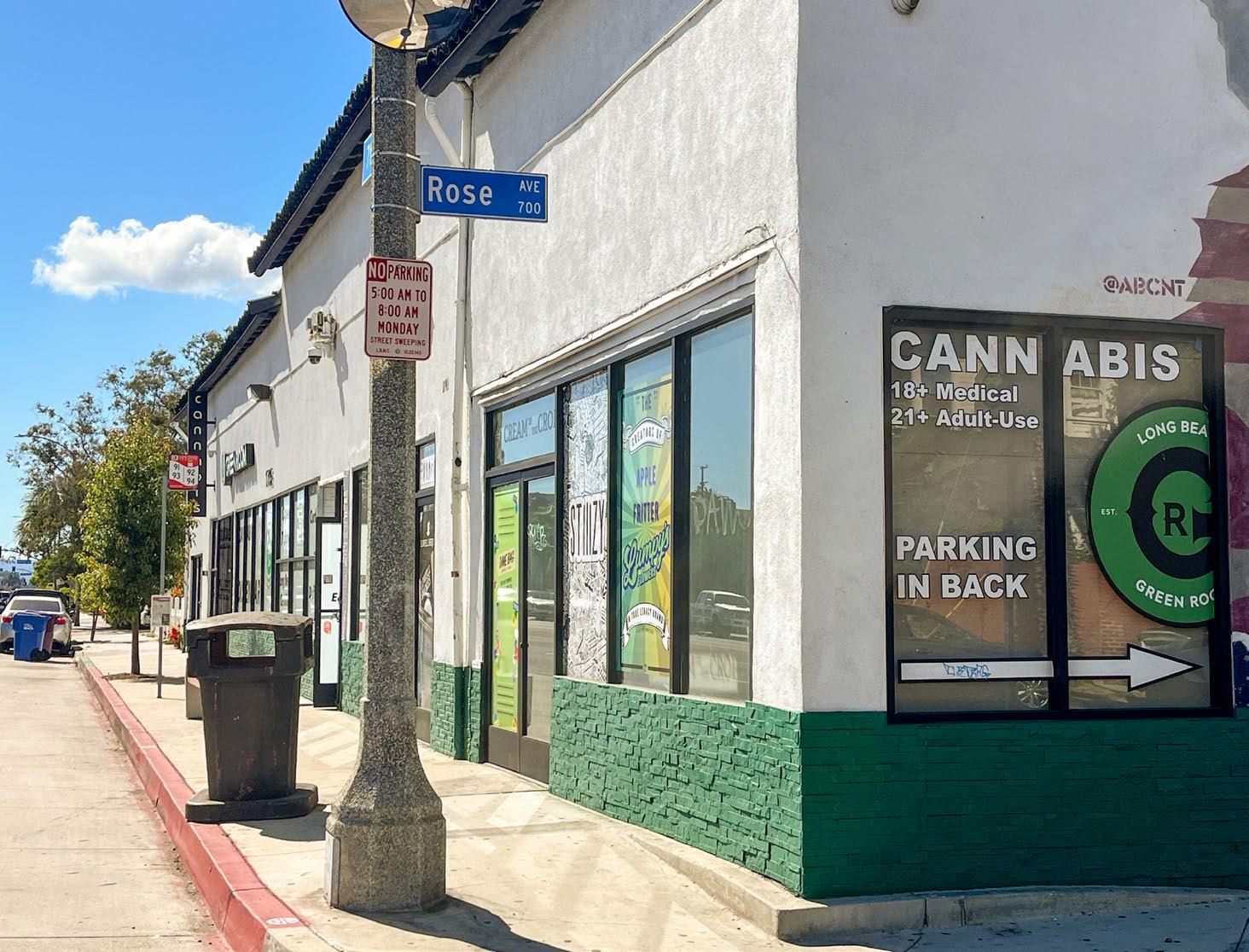
Long Beach Green Room sits on the corner of Rose Avenue and Seventh Street. In 2017, the dispensary was the first to earn a business license in the city.
Long Beach Green Room
1735 E. Seventh St., Long Beach
Hours: Sunday–Monday: 8 a.m. to 10 p.m. 4/20 deals begin April 18
Living cannabis history sits on the corner of Rose Avenue and Seventh Street.
In 2010, before weed was even legal in Long Beach, the Long Beach Green Room started its cannabis operation. Throughout the years, the shop lobbied to get cannabis legalized and garnered over 50,000 signatures for the ballot in 2016. Their work paid off, and in 2017, they became the first dispensary in Long Beach to obtain a business license, reopening legally.
“We’re the pioneers,” general manager Tarick Fouz said.
The Green Room is “vertically integrated,” which means they grow their organic, pesticide-free flower in house. By cultivating their own product, they can maintain quality and keep prices down, according to Fouz.
Customers can find a wide variety of bud and live resin, along with passionate budtenders eager to connect with shoppers.
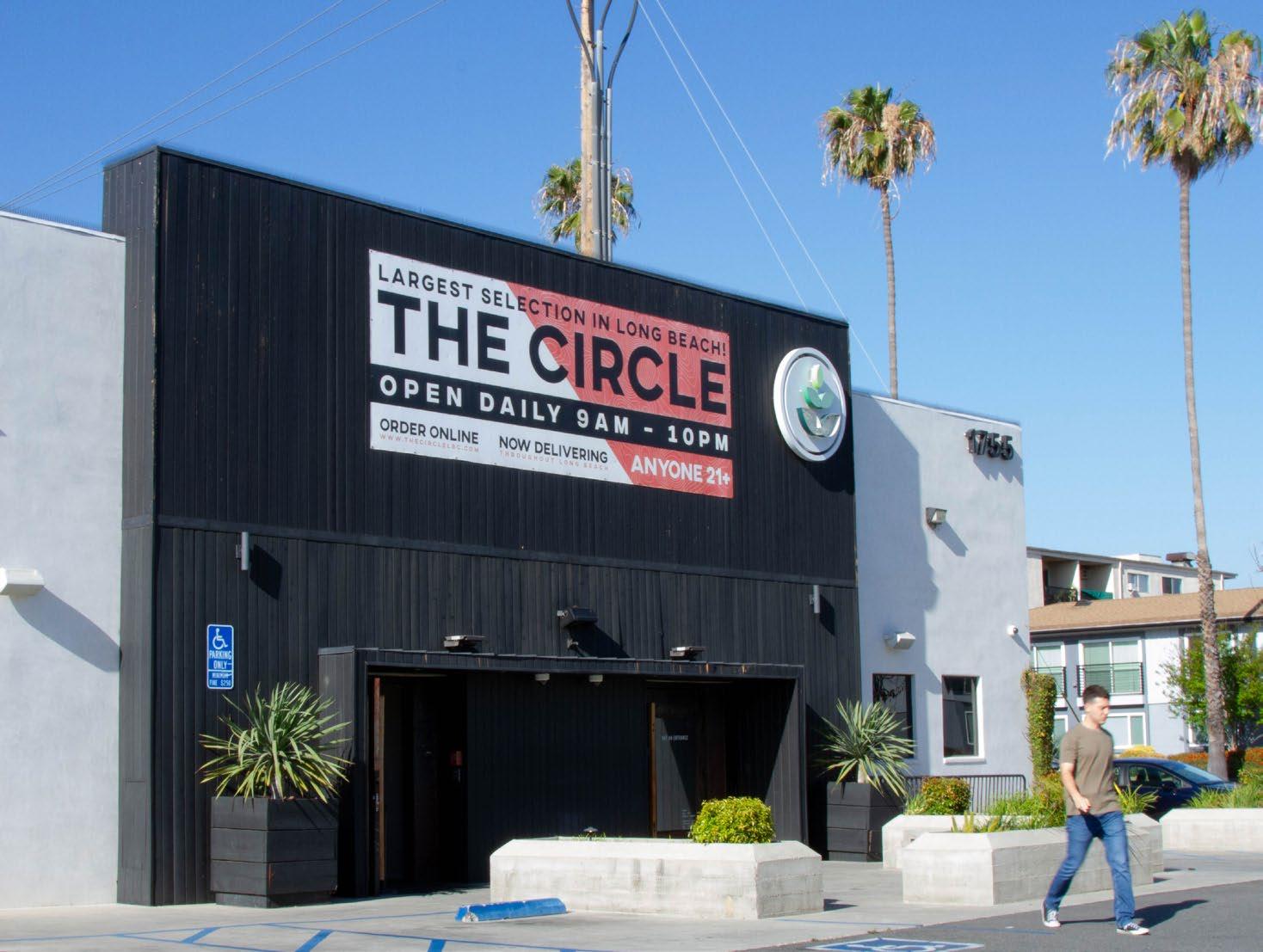
ALEXYS DEMARIA/Long Beach Current. Long Beach’s largest dispensary, The Circle, handles some growing and packaging operations in-house.
The Circle
1755 Ximeno Ave., Long Beach
Hours: Sunday–Monday: 9 a.m. to 10 p.m.
Long Beach’s largest dispensary lies on the fringe of the Los Alamitos Traffic Circle. The Circle’s diverse offerings include in-house-grown and packaged flower, in addition to respected outside labels and delivery services. Windows open up some of the eight growing rooms within the facility, used for its in-house brand Hex and other Long Beach dispensaries.

The Syndicate
3730 E. Broadway, Long Beach
Hours: Sunday–Monday: 8 a.m. to 10 p.m.
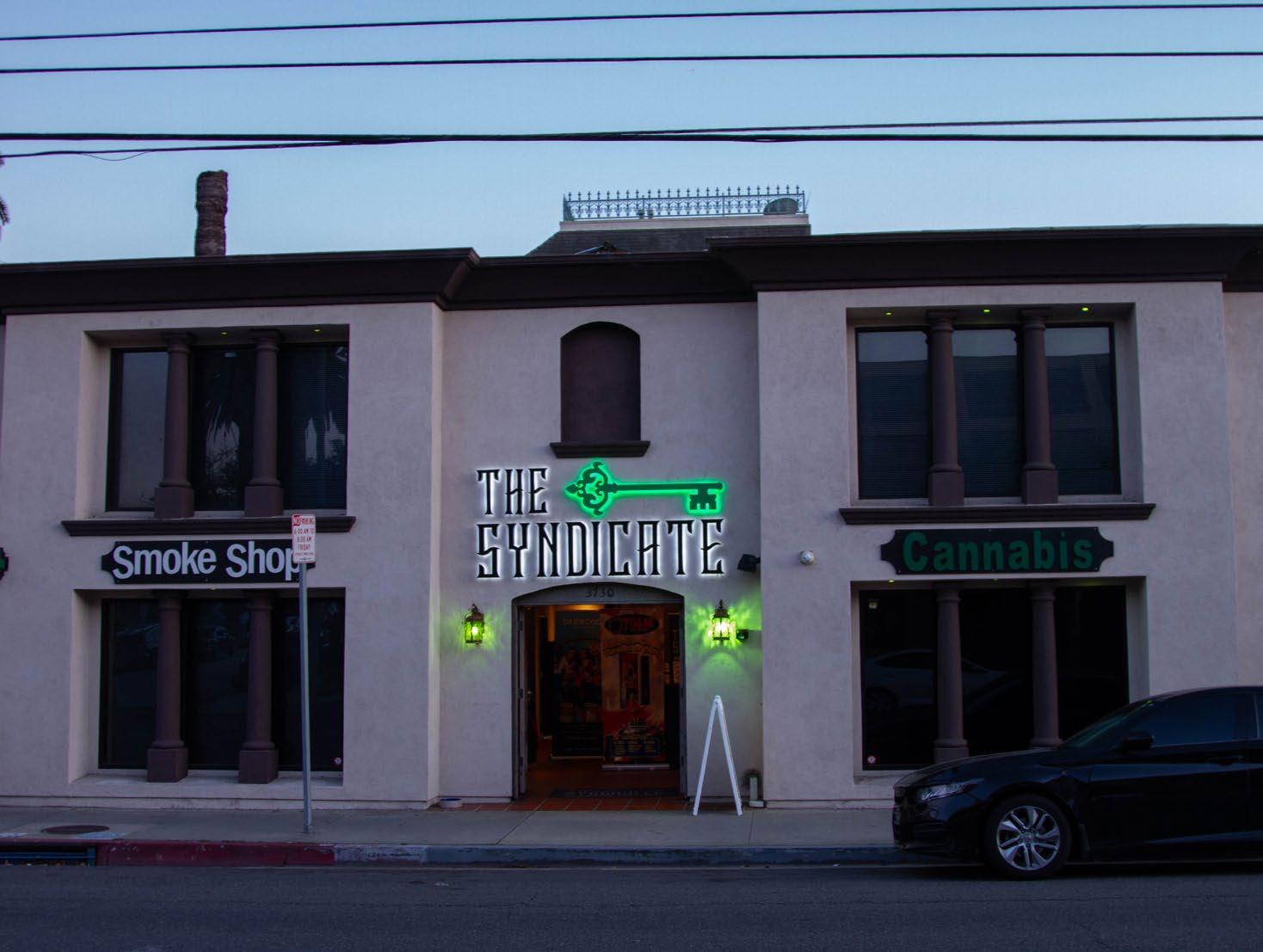
Customers use a secret bookshelf entrance to access The Syndicate, consistent across the chain’s multiple locations in Southern California. Founder Gabriel Guzman participated in L.A.’s cannabis social equity program after the city’s commercialization of the industry allocated funds to marginalized industry veterans to promote equitable ownership.
The Prohibition-era speakeasy theming doesn’t stop at decorative purple velvet wallpaper and mobster portrait cutouts; it embraces the camp with display cases full of medicated gummies, bath bombs, oils, tinctures and lotions, diversifying the selection.
King’s Crew
5630 E. Pacific Coast Highway, Long Beach
Hours: Sunday–Monday: 9 a.m. to 9:45 p.m.
50% off the entire store throughout April
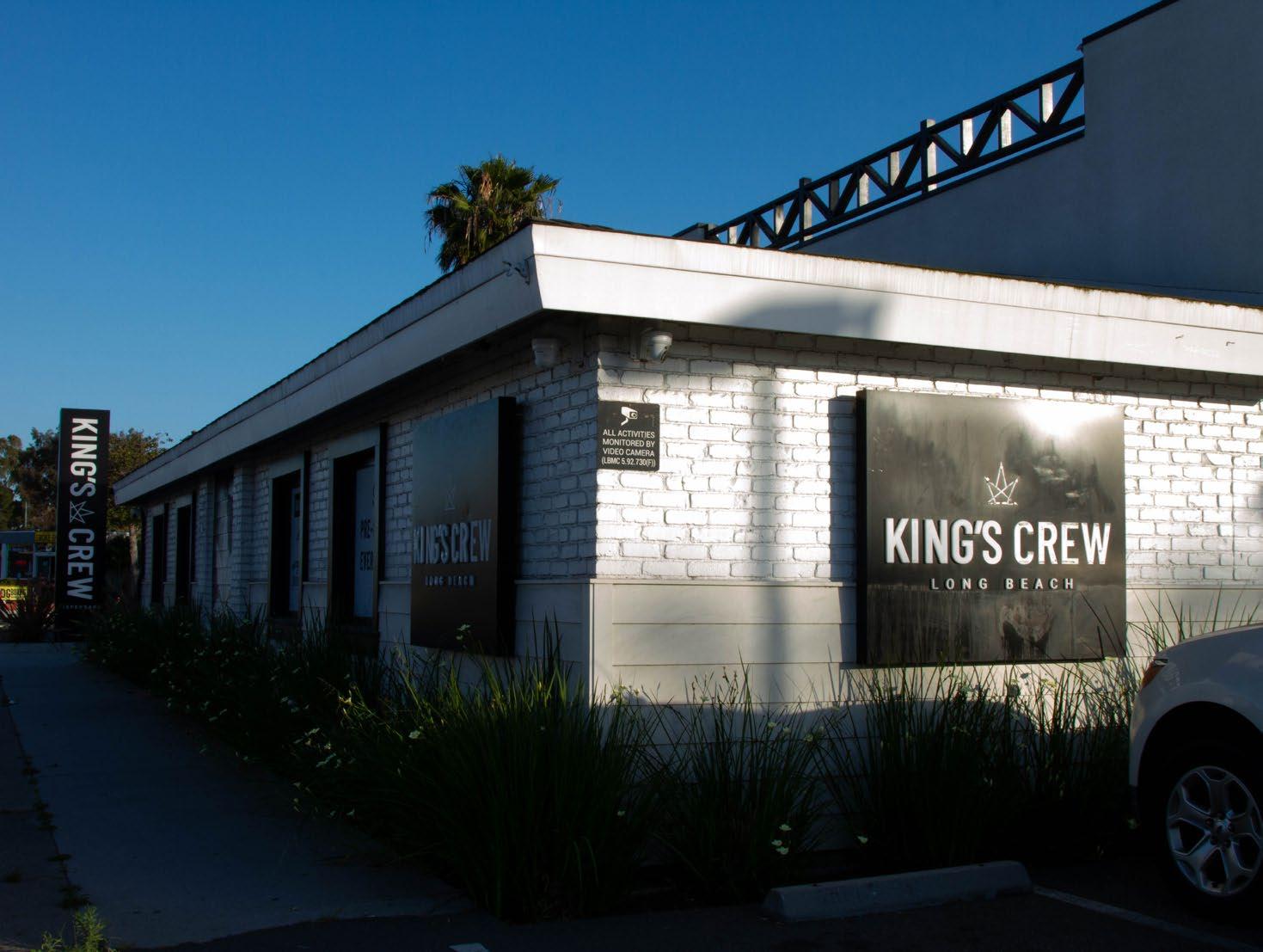
The closest to campus on this list, King’s Crew, was remodeled earlier this year after a change in ownership and is now a STIIIZY franchise. Older patrons remember when the location was a restaurant, Mexican Affair, 20 years ago, which later became Thiptara Thai and, finally, King’s Crew in 2019.
Restocked weekly, store manager Brenda Diaz manages the inventory of products based on customer recommendations and industry changes.
“It’s only going to get better. From the way growers are growing their flower,” Diaz said. “They just take so much pride into their products.”
ALEXYS DEMARIA/Long Beach Current
The Syndicate’s Belmont Heights location is the only dispensary on Long Beach’s iconic Broadway corridor.
ALEXYS DEMARIA/Long Beach Current King’s Crew, on PCH between Bellflower Boulevard and Seventh Street, is the closest dispensary to campus.
Watch the video here.
Why LB Budtenders love to serve the city
STORY AND PHOTOS BY
Opinions Assstant
ALEXYS DEMARIA
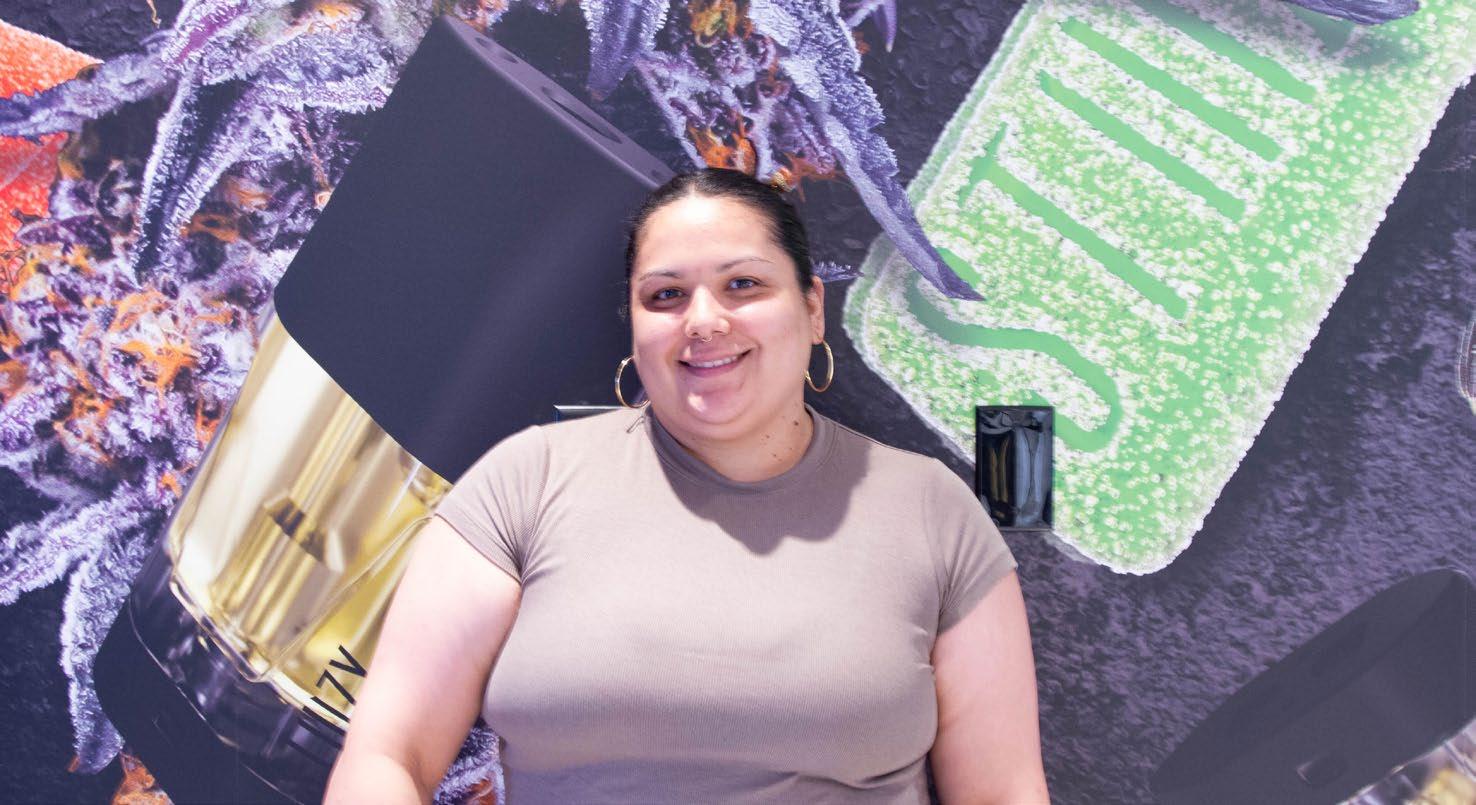
Meet Brenda Diaz, Los Angeles resident
Position: Kings Crew Store Manager
King’s Crew sits on Pacific Coast Highway between the split intersections of 7th Street and Bellflower Boulevard, some of the most populated intersections in Long Beach.
“I decided to come back to cannabis because of how it really helps, and I just want to be a part of that,” Diaz said. “I take pride when people come in looking for medicinal uses, which is the reason why I got into it.”
The city’s diverse customer base demands an equally diverse offering of products.
“We are always creating a new running list of products that we can introduce to our inventory,” Diaz said. “A lot of customers have been buying the seltzers and the one hundred milligram beverages, which I feel is kind of … taking the place of alcohol. I think it’s a lot better with the negative effects that alcohol really has.”
What makes your dispensary special: “I didn’t work at dispensaries where we had a lot of our geriatric customers … We have a lot of customers that have been smoking since they were fifteen years old in the ‘60s and ‘70s.”
Smoking hot take: “Cannabis itself is a trial and error. What works for me might not work for you.”
Budtenders are representatives of the cannabis industry, guiding customers through purchasing products within dispensaries. Long Beach budtenders share their experiences and opinions of the industry.
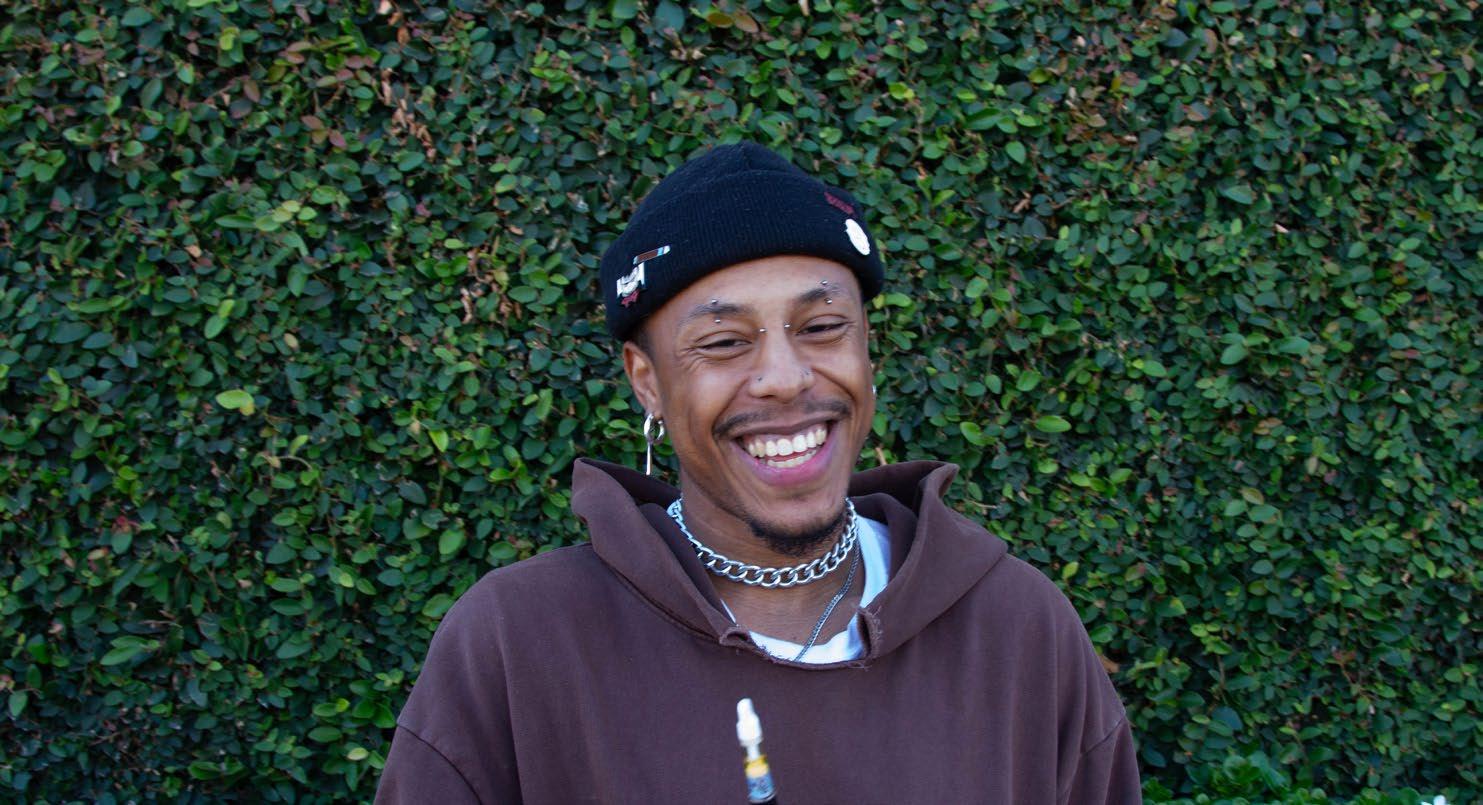
The largest dispensary in Long Beach, The Circle’s showroom features windows facing the hydroponics-equipped growing facilities. The dispensary carries legacy brands such as Camino and Alien Labs, along with its own strains grown and packed in the facility.
“I find it easy to just talk to people,” said Jordan, a budtender at The Circle who declined to give his last name due to privacy concerns. “I’m also a DJ outside of this. So making people feel good and making them feel nice is like ‘That’s what I do.’”
What makes your dispensary special: “Everything being done in-house, and the location.”
Smoking hot take: “Edibles don’t do sh-t for me.”
On geriatric customers: “You would think a dispensary kind of has more of a younger clientele. I mean, we do, but it’s mainly the older folks that come in for random sh-t to get high … Oddly enough, they come in for sex gummies. A lot of them.”
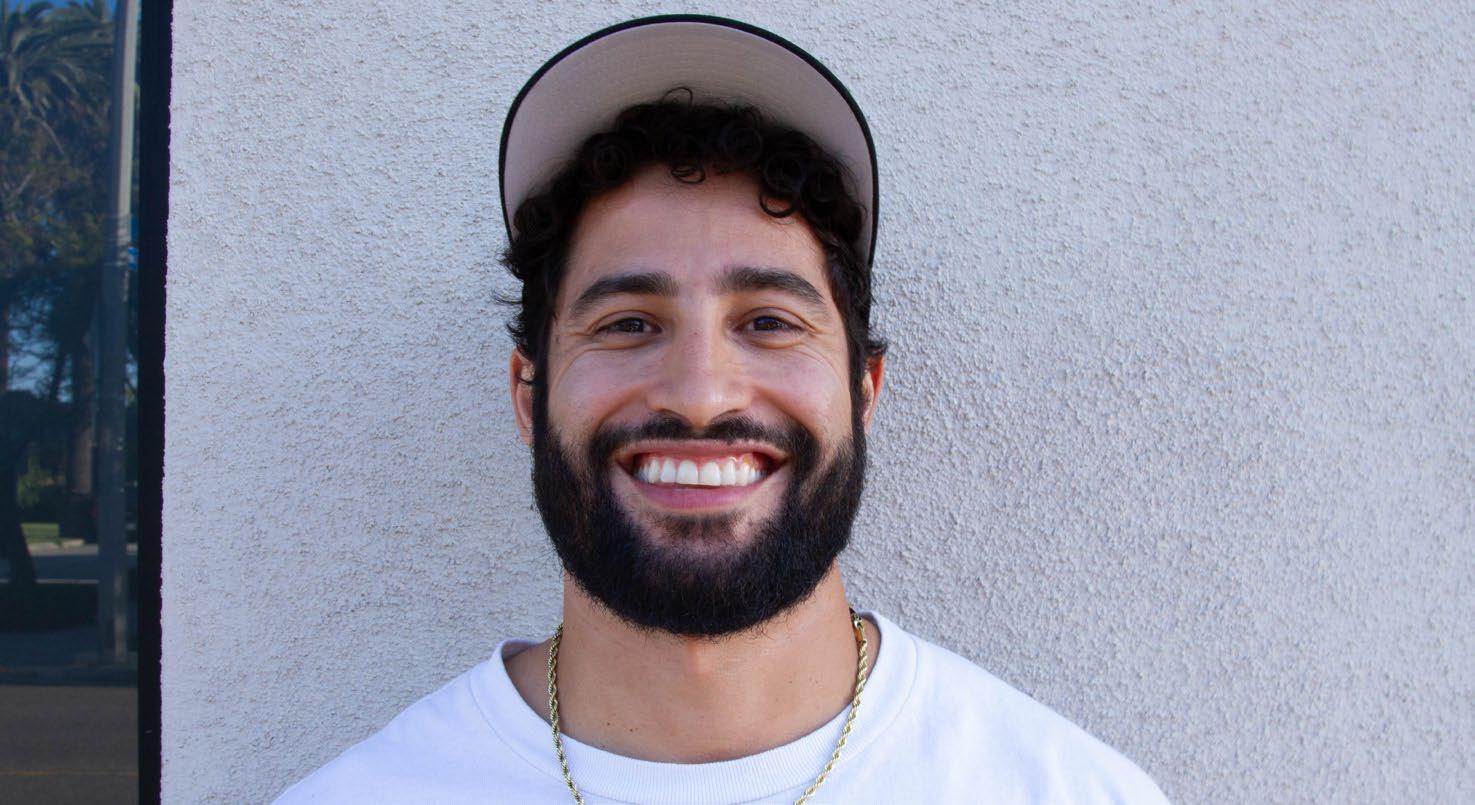
Meet Luis Carrasco, Long Beach resident
Position: District Manager of The Syndicate, Long Beach and Highland Park
Founded in 2017, The Syndicate’s 10 locations are spread across Southern California, from Tarzana to Desert Hot Springs and communities in-between. The Belmont Heights location and proximity to Retro Row means some local customers have often walked past the combined dispensary-smoke shop before first deciding to stop by.
“Honestly, no matter where me or my coworkers go around town, it’s impossible for us not to run into one of our customers,” Carrasco said. “What separates us is that connection to the community.”
The faux bookcase trap door entrance, purple velvet wallpaper and customer service focus is standard at every location.
Smoking hot take: “I think concentrates will take over within the next 25 years. They’ll be more popular than flower due to the fact that it is more discreet … and it’s more of a better high.”
Meet Jordan, Carson resident
Position: The Circle Budtender
This CEO believes in cannabis, community and serving to lead
BY DELFINO CAMACHO Arts & Life Editor
Elliot Lewis still considers himself a hustler.
But at 48, the Long Beach native’s relentless nature has helped carry the husband, father of four and CEO of Catalyst Cannabis – California’s second largest consumer cannabis company – far from his childhood days, hustling for the best Dodgers baseball cards.
Based in Long Beach, Catalyst has over 34 locations statewide today.
Growing up in the ‘90s, Lewis said he developed a methodical mindset from his father and a more social personality from his mother.
“I always say that I got my analytical side from Pops and a little more gangster flavor from Moms,” he said.
He began consuming, growing and selling cannabis before legalization reshaped the industry, which he credits with sparking his entrepreneurial instincts.
“At that point, I was just a little, smalltime hustler,” he said. “I would say that a lot of my entrepreneurial side just came out then, that also got me introduced to the weed game.”
Lewis graduated from UC Berkeley in 2001 with a degree in philosophy.
DELFINO CAMACHO/Long Beach Current
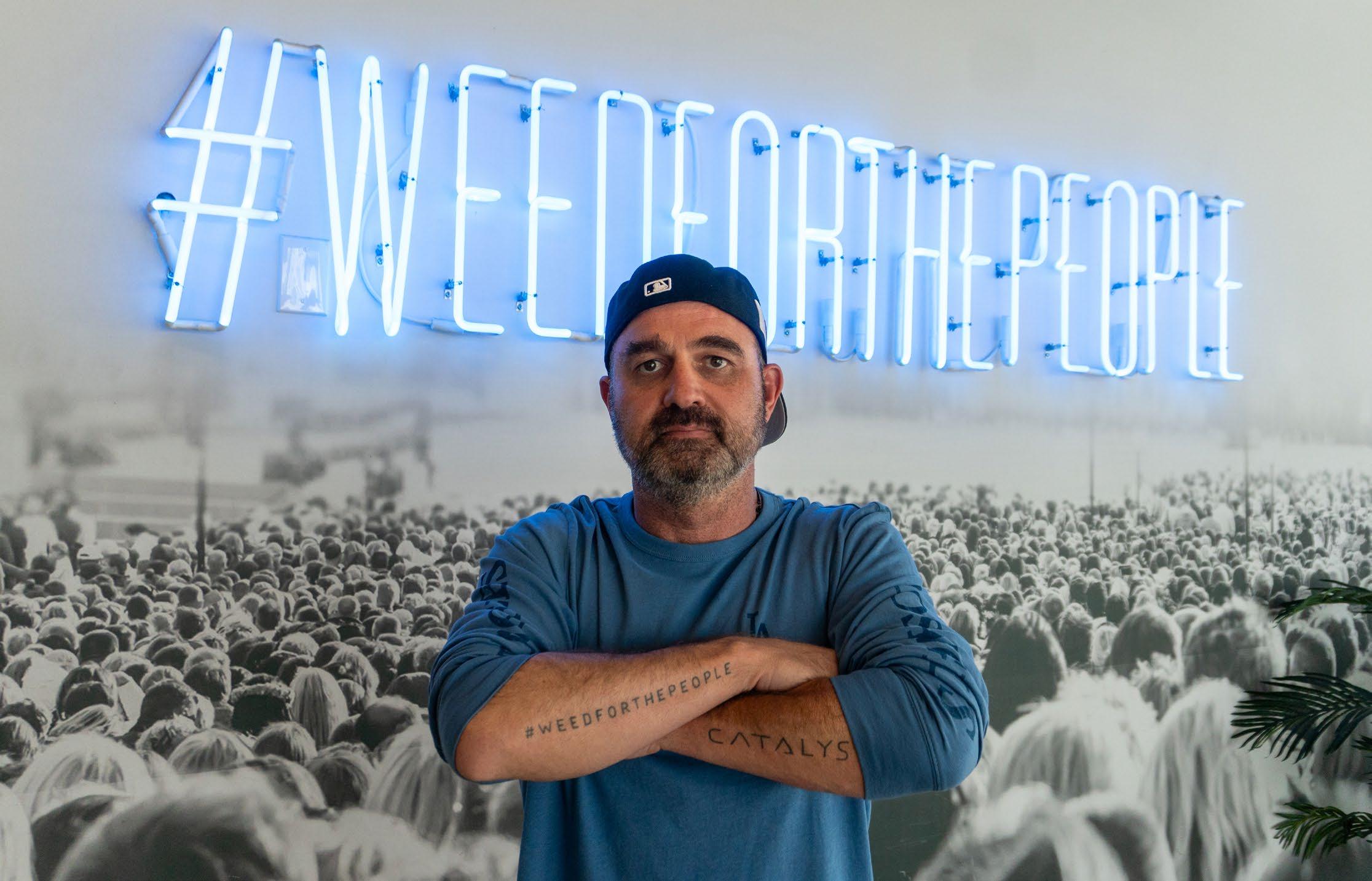
Elliot Lewis, CEO of Catalyst, shows off his “Weed For The People” and “Catalyst” tattoos inside the Pine Avenue location on April 9. Catalyst has grown from four stores to over 25-plus.
After college, he traveled and, in 2004, settled into real estate, earning his real estate license at age 26. By 2005, Lewis was a top earner at his firm and began taking out loans to fund his own realty investments.
He also began experimenting with substances besides marijuana.
By 2007, he struggled with harder drugs and was involuntarily hospitalized under a 5150 hold.
By 2008, in the shadow of the Great Recession, Lewis declared bankruptcy. Then came another turning point: Lewis met the woman who would become his wife and began rebuilding his life, entering a 12-step program.
“This whole company that I formed, Catalyst, is based on the 12 Steps,” Lewis said. “Just ‘be of service to your fellow man,’… the whole idea was just to try to be a good corporate citizen and be of service to the community.”
David Rivera, general manager of Catalyst’s Pine Avenue store, said this mindset was what attracted him to the organization.
“When I was doing my market research before I started here, I wanted to see what the impact was,” Rivera said. “I was able
to find pictures of this actual street before Elliot’s touch on it… it didn’t really seem like it had a heart or soul compared to what I’m seeing now.”
After completing a 12-step program, Lewis turned to foreclosure investing, securing backing through a family connection.
“We were crushing,” Lewis said. “Probably did a total of 700 little flips.”
By 2016, Lewis sensed another shift.
While real estate margins tightened, California’s cannabis industry was entering a clearer legal era. When Long Beach prepared to vote on a cannabis ordinance, Lewis read it closely.
Blending his real estate expertise with old cannabis connections, Lewis acquired distressed storefronts and positioned himself ahead of the vote. Eight years after bankruptcy, he helped seed the first Catalyst locations.
For years, the company stalled at four stores. Lewis credits his and his team members’ admittedly relentless and dogged willpower. When cities rejected or denied licenses, Catalyst wouldn’t go quietly.
“A good chunk of our portfolio to this day is basically just relentless pursuit,” Lewis said.
By 2023, persistence paid off. Catalyst opened 13 locations in a single year.
Still, Lewis works hard to remain focused on details, an approach that resonates with employees. London Riddle, a dispensary manager, said Lewis stays accessible despite the company’s size.
“His management style is pretty much, he takes care of business,” Riddle said. “People reach out to him directly… and he will always get back to them.”
Catalyst continues to expand across California, but Lewis remains anchored in Long Beach. Beyond cannabis, he invests in other local businesses.
Recently, in a full circle moment, Lewis invested in a pizza joint named after his wife – Anna’s Belmont Shore – which now occupies the same space his small real estate office once did.
Despite the growth, for Lewis, leadership means service.
“As a leader, it’s funny when people use that word; my goal is to be a servant,” he said. “If I’m doing that well, the rest of it always seems to fall into place… I’m just an ordinary guy. I was just trying to get one store.”
OPINIONS
Top 3 “Adventure Time” episodes to watch while high
BY SASHA MARANTZ
Copy Assistant
If you think of “Adventure Time” as a classic childhood show, you may want to reconsider it as a show to watch when you’re high.
Created by Pendleton Ward, the show follows Finn the Human and Jake, his magically stretchy dog best friend, and their various adventures in the Land of Ooo—a post-apocalyptic world in a “remote future.”
As a kid, my parents would often say, “This show is a trip,” or “The people who made this were on drugs,” after witnessing a particularly strange episode.
To me, that’s just a part of the show’s bombastic personality.
If you want a trippy experience, here are some of the best (or worst) episodes of “Adventure Time” to watch while high.
“A Glitch is a Glitch” –Season 5, episode 15
This episode is a visual nightmare — even if you watch it sober; its 3D animation is almost jarring in comparison to the softer 2D style we are used to.
In the episode, the Ice King is about to destroy the Land of Ooo as a result of a worm he put in Finn and Jake’s computer.
The episode depicts the destruction with its 3D animation being used to its full extent, making it appear as though the show itself is glitching.
In order to save the day, Finn and Jake have to journey to the “universal source code,” a sequence reminiscent of zooming nonstop into a colorful whirlpool.
The visual effects throughout the episode, paired with occasional distorted audio, create an unsettling viewing experience that keeps you on your toes.
I didn’t think the episode would phase me as much as it did, but at some point I felt like I was melting into my mattress— and I don’t know if it was the weed or the episode that did it.
“Food Chain” – Season 6, episode 7
This episode follows Finn and Jake through their firsthand experiences being magically transformed into an ecosystem’s food chain — with no explanation as to why.
The first scene of their transformations starts with the two characters walking down a hallway, the angle making it look as if their feet are extending a bit too long. Suddenly, the screen turns white, and the calm walking sequence turns into a musically energized flying sequence as Finn and Jake are turned into birds.

Graphic by DANTE ESTRADA/Long Beach Current Despite its primary reputation as a children’s cartoon, Cartoon Network’s “Adventure Time” may just be the best show to watch while high.
Later, Finn gets transformed into a larger bird but dies when he is unable to capture food. The slow scene of his death is immediately contrasted with his rapid decomposition, as the camera pans over thousands of moving “Finn particles.”
This episode provided psychedelic visuals with its colorful images and swift transitions, taking the characters from small birds to bacteria, flowers and caterpillars.
While this episode may offer a more relaxed vibe than the previous one, it can still throw you for a loop, especially since it ends in the exact same way it started.
“Beyond the Grotto” –Season 8, episode 3
The episode “Beyond the Grotto” feels like it’s going on a journey with you.
Finn and Jake take an impromptu ad-
venture to another dimension in pursuit of a sea lard—a made-up creature that looks as weird as it sounds. The longer they remained in the dimension, the more they forgot their purpose and themselves.
As Finn and Jake lose their way, the episode loses its clarity with them—and, if high, so will you.
At one point, Finn describes the setting they have found themselves in as “wonky,” being “familiar but weird,” which was exactly how I felt while watching the episode.
Throughout my personal journey, this episode made me question whether what I was watching was real.
Similar trippy cartoon fan favorites include “Regular Show,” “The Amazing World of Gumball” and “The Midnight Gospel,” also created by Pendleton Ward.
Waves of Wisdom: Should I do weed to fit in?
BY CHRISTIAN ROBLEDO Opinions Assistant
This advice column draws on the insights and experiences of the Long Beach Current’s staff, offering practical and relatable guidance. As the column grows, we plan to feature questions and stories from our readers, creating a space for honest conversation and shared experiences with a little support when you need it most.
Q: “I’ve never used weed before, and I’m a little scared to, but all my friends already do it. Should I do it with them so I can fit in?”
- Cannabis Conscious Kristy
A: Dear Kristy,
I understand your predicament, and I can tell you that if you’re scared to try something, you definitely don’t need to for people who claim to be your friends.
Although your question is specifically referring to weed, I believe that among friends, you should never feel like your participation in a given activity is a mandatory requirement for you to be a part of the group. If they’re really your friends, they’ll support you whether you use weed or not.
If you find yourself wanting to overcome your fear of weed and are inspired by friends rather than peer-pressured, I suggest you approach your first time with caution.
You should do it among the people you feel safest with— most likely your more experienced friends—and make sure that whatever type of weed you consume is properly proportioned and safe.
I also advise you to arrange accommodations or find a
designated driver in advance to avoid unforeseen accidents. Additionally, if you try something, I advise you to take only a small dose and no more if you don’t feel anything immediately. With substances, it’s important to remember that many variables and differences in habit can contribute to how weed affects your friends versus how it will affect you.
If you feel nothing within the first hour and a half, I would say eat something – get those munchies covered – and then decide if you would like another dose. This way, you can avoid accidentally dealing with the effects of two doses on your body during your first time, risking an unpleasant and unsafe episode.
In the end, what you choose to do regarding substances is your choice. Don’t let yourself be peer-pressured into anything you don’t want to do. College is a time of exploration, so if you do choose to try anything, please do so responsibly.
4 albums guaranteed to spark your 4/20

BY JOSEPH LEE Arts & Life Assistant
Peanut butter and jelly. Thunder and lightning. Shaquille O’Neal and Kobe Bryant.
Some combinations just make sense. Often less celebrated, but no less enduring, is the relationship between marijuana and music. As April 20 approaches, it’s time we recognize a pairing that, for decades, has shaped how people listen, feel and unwind. Sometimes, there’s nothing better than a night with a good joint and some jams.
Exodus – Bob Marley & The Wailers
Few artists are as closely associated with weed as Bob Marley. “Exodus,” released in 1977, is widely considered to be his greatest cumulative work.
Its message is potent and still applicable today, evident through songs, such as “One Love/People Get Ready.” The album carries the storied cultural and political weight of the era it was birthed in, marred by intense political violence and economic turmoil.
The emotional and political undertones of the record helped solidify reggae’s identity globally. Its association to marijuana is
often traced back to Rastafarianism, a spiritual movement that views cannabis as a sacrament used to facilitate meditation and a connection to the divine. For Rastafarians, weed, or ganja, is much more ritual than it is recreational.
As reggae spread through artists like Bob Marley, the context of weed as a spiritual conduit was simplified and stretched to encompass an air of idealism, ease and discreet disobedience that still exists to this day.
Journey in Satchidananda –Alice Coltrane
Last year, I attended the Hammer Museum’s “Alice Coltrane, Monument Eternal” exhibit. At the time, while I’d been familiar with the work of John Coltrane, Alice was an unknown quantity to me.
As I traversed through the exhibit, I came across a projector screen showing what looked to be a home video of Alice Coltrane alone in performance. She sat with her golden harp, completely absorbed with eyes closed, the music flowing through her and emanating in a way that felt almost otherworldly.
Some time later, I returned to her music, finally sitting down with “Journey to Satchidananda.”
From impromptu dance rituals to spiritual awakenings, the tandem of weed and music can make possibilities seem endless.
Graphic by BROOKE WILLIAMS/ Long Beach Current
Released three-and-a-half years after her husband’s death, the album is not only a musical triumph but a spiritual one. With music acting as an incorporeal tether to him, Coltrane delivers a transcendental performance alongside free jazz saxophonist Pharoah Sanders.
As Pitchfork’s Josephine Livingstone writes, “You should listen to Journey beginning to end while lying on the ground with your eyes closed,” an approach that mirrors Coltrane’s own liner notes inviting listeners to envision themselves “floating on an ocean” of spiritual devotion.
The Best of the Classic Years –King Sunny Ade
While brainstorming for this article, I turned to music forums in search of the perfect “weed album.” After some trial and error, I landed on a compilation: “The Best of the Classic Years” by Nigerian jùjú artist King Sunny Ade.
As his Spotify biography describes, the genre is a “dance-inspiring hybrid of western pop and traditional African music,” blending talking drums with electric guitars to create grooves that feel almost impossible to sit still through. It’s the kind of music that can shift the energy of a room in an instant,
making it the ideal choice for a more upbeat, social high.
Niandra LaDes And Usually Just A T-Shirt – John Frusciante
Best known as the longtime guitarist for the Red Hot Chili Peppers, John Frusciante’s 1994 debut solo album remains an underappreciated outlier in his catalog.
A glance at the cover art makes that clear: a sepia-toned, grainy photograph of Frusciante dressed in drag, echoing a 1921 photograph of Rrose Sélavy, the female alter-ego of French artist Marcel Duchamp. Few covers in either his solo work or the band’s catalog feel as deliberately provocative as this one does.
Defined by stream-of-consciousness songwriting, avant-garde arrangements and a drug-fueled, home-recorded process, “Niandra LaDes And Usually Just A T-Shirt” captures the more unstable side of altered states. While the project may lack polish—and even good singing for that matter—it offers a raw, unfiltered and, at times, unsettling case study into the self-destructive lows that can come from substance abuse.
For listeners willing to follow it there, the project can push a high into deeper, more introspective and uncomfortable territory.
OPINIONS

Opening one’s “third eye” often refers to opening your mind to a higher level of understanding. It’s a state where someone’s perception of reality is on a higher plane, one that’s metaphysical. Historically, people have used psychedelics during religious practices to reach such a state.
BY JOSEPHINE KIM
Copy Assistant
Throughout history, cannabis and psychedelics have influenced how humans construct belief systems, perceive reality and relate to one another.
To dismiss them entirely as mere recreational indulgences would be to overlook their deeper role in the human story.
The Oracle of Delphi was a stoner.
Maybe not intentionally, but that is one of the leading theories among modern scholars regarding the priestess’ prophetic speech and visions.
The theory suggests that the temple sat atop geological fault lines that emitted gases, such as ethylene and methane, which induced altered states interpreted as communion with the divine.
Although plausible, we’ll never know whether this hypothesis fully explains the phenomenon. However, the implication is
evident: one of the fundamental institutions of Western spirituality may have been arbitrated by chemically induced realities.
This pattern is not found solely in ancient Greece. Across various cultures and religions, psychedelics and substances have been used as entheogens to cultivate the divine within oneself.
Strikingly enough, cannabis has a long and complex history in this role.
Archaeological evidence suggests that ancient civilizations, including China and Central Asia, used cannabis for ritual use, but nowhere is its entheogenic role more visibly preserved than in Hindu tradition.
In ancient texts like the “Atharva Veda,” marijuana is referred to as a sacred plant. It has strong associations with the god Shiva – a deity that is often linked to meditation, asceticism and the annulment of illusion.
Shiavite monks ritualized cannabis and often smoked during prayer as a means of quieting the mind and distancing themselves from the ego.
Unlike countercultural experimentation in the modern West, Hinduism presents altered states as neither unorthodox nor rebellious but as integrated. It suggests that shifts in perception, when viewed through a cultural lens, become pillars of a belief system.
As I’ve been doing extensive research, I’ve noticed a consistent theme across these historical moments: intoxication changes not just feelings but beliefs.
The recreational use of psychedelics helped spur movements that challenged war, inequality and rigid social norms. In each case, altered states contributed to the formation or transformation of belief systems.
My conclusion is that the human desire to alter one’s consciousness has always been a constant. Whether it’s through ritual, recreation or experimentation, people have long desired to step outside their ordinary perceptions and understandings of the world.
The story of marijuana is not about a
Stoner?
I barely know her: How altered states shape human thought
“feel-good” drug. It is about perception and the realization that the world we see and perceive is fluid rather than fixed.
If perception is something that can be altered, but one’s belief systems are built on this perception, then the belief itself can become less absolute and concrete than we might like to think.
The next time you smoke a joint or pop an edible, try to be more conscious of the world around you. Write down some thoughts you have while you’re high and compare them to when you’re in a sober state. Are there any differences? If there are, don’t just brush them off – sit with them.
Ask yourself why your perspective shifted and what that might say about how you normally move through the world. Whether those insights are profound or fleeting, they emphasize the idea that your reality isn’t as fixed as it feels.
The more you become aware of that, the more intentionally you can shape how you see and understand the world.
Graphic by GABRIELLE LASHLEY/Long Beach Current
Departures, new arrivals leave Big West searching for its identity
BY XAVIER CONSTANTINO Sports Assistant
It’s been a long, long time since the Big West looked this different.
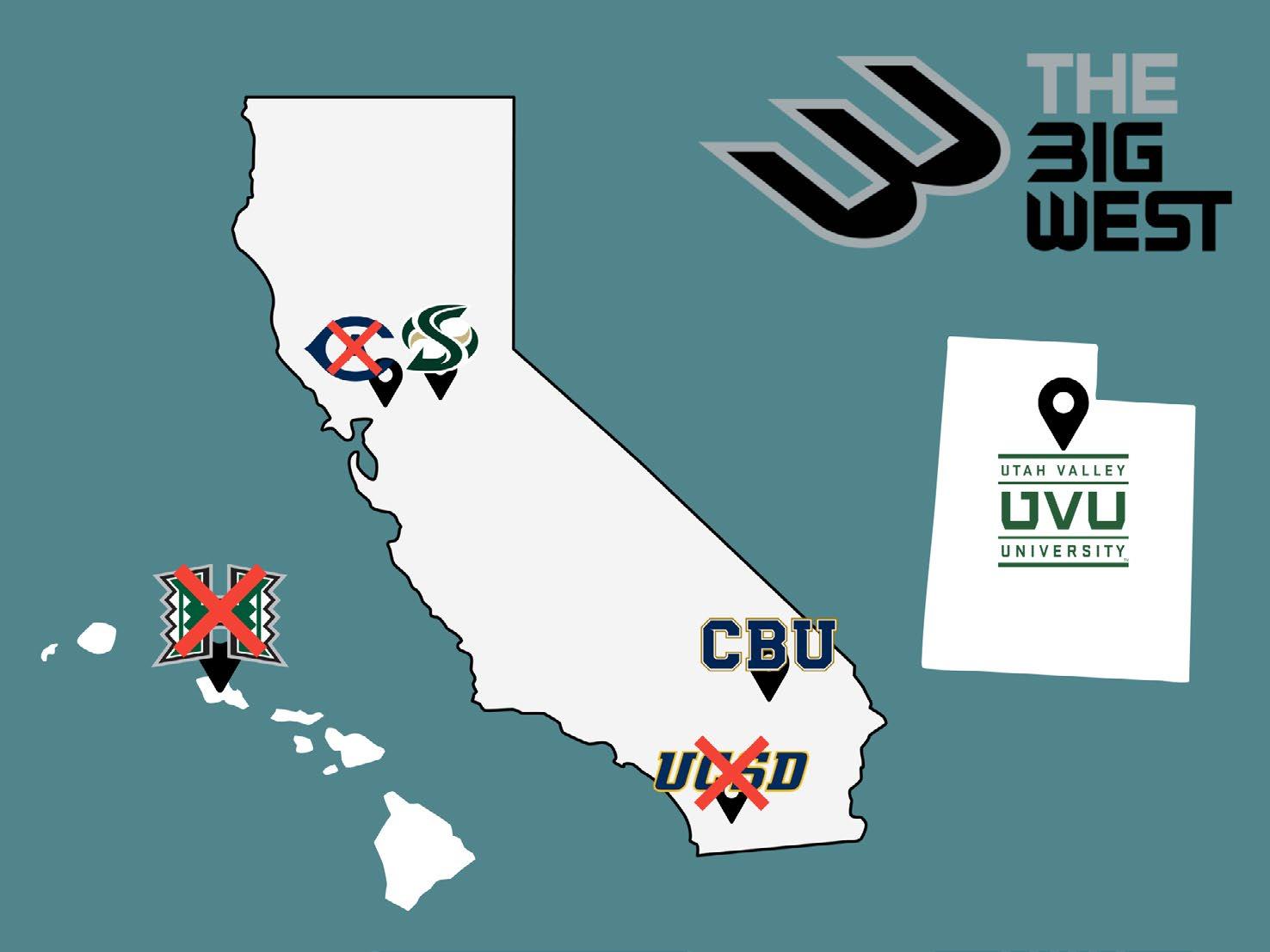
By July, two of the conference’s most established programs, the University of Hawai’i and UC Davis, will exit as full members, to be replaced by Cal Baptist University, Utah Valley University and Sacramento State.
UC San Diego, which completed its reclassification to full Division I eligibility just two years ago and immediately became a March Madness program, will follow them out the door in 2027, heading for the West Coast Conference.
Bobby Smitheran, who arrived as Long Beach State’s executive director of athletics in August 2023, knew the writing was already on the wall.
“It’s not surprising that at some point realignment was going to land on our doorstep,” Smitheran said. “So much of this is obviously driven by the economics of college athletics.”
The logic behind the moves makes sense.
Hawai’i is under the Football Bowl Subdivision, the highest level of collegiate football in the NCAA. It is the only one in the Big West with an FBS-level program, and has long been misaligned with a conference that does not support football.
Hawai’i will remain a Big West affiliate in men’s volleyball, beach volleyball and women’s water polo, preserving some competitive ties even after full membership ends.
“Hawai’i has been a great member of the Big West family, has a proud history in The Big West that includes 36 conference titles and three national championships,” commissioner Dan Butterly said in a press release. “We look forward to having the Rainbow Warriors and Rainbow Wahine compete for Big West titles in all sports over
the next two seasons.”
UC Davis announced its departure in December 2024, with no statement from Butterly and no stated reason from the Aggies, only a written notice of their intent to exit by June 30, 2026. The Aggies won 26 Big West titles in 23 years as a member, including six each in women’s and men’s golf.
Then there is UC San Diego’s departure, which is the most confusing.
The Tritons gained full Division 1 postseason eligibility only on July 1, 2024. They used that first-eligible season to reach March Madness and chose to leave for the West Coast Conference, a basketball-first league that does not sponsor men’s volleyball, women’s water polo or swimming and diving, all of which UCSD competes in through the Big West.
They will spend one final season as a Big West member before that door closes.
The message is difficult to miss: in the era of revenue-sharing college athletics and the House v. NCAA settlement, conference strength and financial power are driving decisions that sports history alone cannot override.
Long Beach State sits at the center of the identity question posed by the departing schools. The men’s volleyball program claimed its fourth title in 2025, marking the 16th national championship for LBSU.
The volleyball programs departing are not minor contributors. Hawai’i won national titles in 2021 and 2022 and will exit this summer.
UCSD, still a Big West member through 2026-27, has been a consistent contender. The arriving programs, CBU, UVU and Sac State all sponsor men’s volleyball, but none carry a comparable national championship pedigree.
The incoming schools, however, offer the Big West something it has lacked: geographic reach into Utah and stronger men’s basketball depth. Smitheran said the addi-
tions made sense on multiple levels.
“You look at geographical fit, Cal Baptist is a travel partner with UC Riverside, a Southern California Institution that keeps it close,” Smitheran said. “And you look at all three institutions, they’re making investments in their athletic programs. They’re competitive. They’re going to come in and compete for championships.”
For LBSU, the realignment’s consequences extend well beyond marquee sports. The Beach sponsors 19 Division 1 programs, and the financial pressure of the House v. NCAA settlement makes conference revenue more urgent than ever.
Under the settlement, the NCAA significantly expanded scholarship limits. Smitheran said those increases compound across every program simultaneously.
“Across all of our programs, it’s an excess of 200 additional full scholarships that we are not presently providing,” Smitheran said. “So we have to really get focused on how do we generate as much revenue as we possibly can.”
Looking at IRS Form 990 filings for the 2023 fiscal year, the Big West generated $18.8 million in revenue and distributed $5.6 million among its 11 member schools.
LBSU’s share: $461,331.
In the same fiscal year, the Mountain West generated $92.8 million and distributed $83 million to its 13 members. Hawai’i collected $2.1 million from its new conference that year, more than four times its share of the Big West distribution. It’s important
to note that football is a main driver of revenue, along with broadcasting deals, which make the conference plenty of money.
UCSD’s move, however, is not a financial upgrade. The WCC generated $13.7 million in total revenue in the 2024 fiscal year and distributed just $3.06 million to its nine member schools. For the Tritons, the draw is basketball prestige and geographic fit, not a bigger paycheck.
Despite those constraints, Smitheran was firm on where LBSU belongs. Asked whether The Beach had ever seriously considered leaving, his answer was immediate.
“It’s a clear fit for us,” Smitheran said. “The grass isn’t always greener. Something may look nice and shiny, but when you get there, it’s not what you thought it was.”
Smitheran said “nobody really knows” of the next five years.
“But we’ve got to stay focused on the moment. How do we continue to meet the moment for our student athletes and arm our coaches with the resources they need to be successful?”
For LBSU Athletics, a founding Big West member since 1969, that question has never been more pressing.
The conference is changing around them, and more powerful schools and conferences are taking away talent from teams across all 19 programs. Schools that defined the Big West’s identity are headed for the exits. Whether the conference that replaces them can sustain what the old one built is the story the next five years will tell.
LBSU freshman pitcher Luke Howe pitched seven innings in the Dirtbags’ 7-6 victory
Graphic by DANTE ESTRADA/Long Beach Current
The Big West will be seeing significant realignment in the coming years, with the University of Hawai’i, UC Davis and UC San Diego all exiting the conference.
SPORTS Breaking records as the sun sets for this Spanish water polo star
BY ALAN IBARRA Sports Assistant
For nearly 20 years, the all-time goal and assists records for Long Beach State’s women’s water polo team has been held by Long Beach native and 2013 Hall of Fame inductee Cassie Azevedo.
But on Feb. 1, Spanish water polo star Elisa Portillo decided to put a stamp on her already illustrious collegiate career and broke the all-time goals record in the 11th game of her senior season.
“When I came here, I wasn’t aware that they counted goals,” Portillo said. “This year, they suddenly [told] me, ‘You’re only 30 away from breaking the record.’”
While Portillo’s time at The Beach is reaching its sunset stage, the accolades she
has worked to achieve will be set in the record books for years to come.
Long before Long Beach State, her story began at home in Madrid, Spain.
Portillo’s first experience with water polo was not as a competitive sport but as an extracurricular activity.
“Me and my sister were like ‘Well what is this?’” she said.
She immediately fell in love with the game.
“Honestly, within that same week, we said, ‘This is our sport,’ and it became serious to me. I didn’t see it as a job,” Portillo said.
The Portillo sibling rivalry helped forge the competitiveness and winning traits that shaped Elisa into the player she is now.
“I played alongside my sister for almost 10 years on the same team, and because of

REHANSA KULATILLEKE/Long Beach Current
LBSU star attacker Elisa Portillo scores one of her four goals against Cal State Fullerton in the first round of the Big West Championship Tournament on April 10.
that, we would become very competitive against one another,” Portillo said. “You become better much faster.”
Portillo continued putting that competitive edge into practice. Just two months after beating the university’s all-time goal record, she went on to break the program’s all-time assists record in a 22–6 victory over Cal State Northridge on March 28.
“This is important, and honestly, I am
very happy in being able to achieve it and do it… But above all, that is the work that I have put in throughout the years, is being reflected and getting that recognition,” Portillo said.
Portillo is also a two-time First-Team All-Big West selection for 2025 and 2023 and was a Second-Team selection in 2024.
Click here for the full story.
Catching The Wave: LBSU can’t afford to rebuild in the portal era
BY TIMOTHY HESSEN Sports Editor
Despite Long Beach State men’s basketball’s major fall from grace in the first two seasons of head coach Chris Acker’s regime, there seemed to be building blocks in place for a return to relevancy in the Big West.
Long Beach State finished 10-22 and ninth in the Big West in Chris Acker’s second season, which will mostly be remembered by LBSU fans for the catastrophic 15-game losing streak the team ended its season on.
But the lone bright spots offering hope for the program’s future were two stars who made standout first impressions during their first seasons at The Beach.
True freshman guard Gavin Sykes developed quickly into an offensive firecracker, establishing himself as one of the best scorers and three-point shooters in the Big West.
Sykes emerged as one of the Big West’s top scorers, averaging 19.4 points and winning Freshman of the Year.
Leading The Beach, along with Sykes, was Syracuse transfer forward Petar Majstorovic, who added 14.4 points and 6.4 rebounds.
However, as the college basketball season and March Madness have come to a close and programs build their teams out for next season, both Sykes and Majstorovic have hit the transfer portal, leaving LBSU after one season.
This marks the second straight year that LBSU’s top scorers have entered the portal.
Guards Devin Askew and TJ Wainwright left the program after a 7-25 season in 2024-2025, transferring to Villanova University and Pacific University, respectively.
When recruiting for a mid-major, it is a fact of life that, in the modern college sports climate, players can always leave for a bigger opportunity.
In fact, it can often be part of the sales pitch, as LBSU assistant coach John Montgomery told the Current ahead
of the start of this year’s regular season.
“We use [Askew] a lot in selling ourselves to recruits,” Montgomery told the Current. “It’s like, ‘Look what happened to him.’ He came here, and now he’s getting millions at the high-major level, and you guys will have that same opportunity.”
Montgomery’s words proved prophetic, as LBSU served as a stepping stone for both Sykes and Majstorovic, providing opportunities to go on and flourish in another program.
If this is the reality for mid-majors such as LBSU, then there is no such thing as a patient rebuild anymore. If the team isn’t immediately competitive, top players leave, and the cycle starts over.
To develop a cohesive unit and keep players in the program for more than a single season, Acker must quickly assemble another roster capable of contending in the Big West.
Whether that can be accomplished in the Acker era at LBSU remains to be seen.
Sophomore tennis phenom demonstrates the ‘jogo bonito’ style
BY ALAN IBARRA Sports Assistant
J“ogo bonito” or “The beautiful game,” is mainly referred to in the realm of soccer, popularized by the late Pelé and the Brazilian national team.
The term refers to an innovative play style characterized by its artistry, flashiness and creativity.
At Long Beach State, a young Brazilian phenom exemplifies that style in her own sport, dominating the tennis courts and claiming three Big West Player of the Week awards this season.
“During the beginning [of the season], I wasn’t playing my best tennis,” said the 2025 Big West Freshman of the Year, Cecilia Costa. “When the first [award] came, it was very good to see that it was paying off.”
However, before the start of her breakout season, Costa was riddled with a back injury that kept her out of practice during the winter break.
“I was focusing on just coming back to practice and getting better every day,” Costa said. “It was basically two and half months of not playing and it was just a matter of time to get back into the rhythm, and keep grinding again.”
The sophomore from Recife, Brazil has made noise in the Big West with her performances in the singles and doubles competitions.
Costa boasts a 59% overall win rate in singles, according to the Intercollegiate Tennis Association.
“The way she fights on the court… she can serve solid ground strokes but is also very skilled in slicing and drop shooting,” LBSU head coach Gertjan De Wilder said. “It’s something you don’t really see that often in women’s tennis, especially the way she does it.”
Costa has played 19 of her 23 doubles matches alongside senior Paulina Franco Martinessi, having a win rate of 68%.
“I would see her in some tournaments that we played around South America,” Costa said. “It was actually fun to see that she was going to be my teammate, I didn’t know what to expect.”
The pair make up The Beach’s best doubles pairing since Jan. 30, according to the ITA.
“We clicked pretty fast,” Costa said. “We have a good relationship and I think that’s why we do well on the court because we understand each other and we’re very close friends.”
Back in Brazil, before touring around South America with Franco Martinessi, Costa was a multi-sport athlete.
“I always tried to play some sports twice a week,” Costa said. “My parents would tell me just to get out of my house a little bit and make some friends.”
During the trial of experiencing different sports, Costa stumbled upon tennis randomly while swimming and the rest was history.
“I passed by a tennis academy with my dad and then he suggested that I start,” Costa said. “I really liked it and that’s why I kept playing… I have no athletes from my family or anything.”

Costa and the LBSU women’s tennis team have one more game this season at home against UC Irvine on Saturday, April 18, at the Rhodes Tennis Center.
Currently tied for fifth in the conference standings, Costa and Coach De Wilder are gearing up for the Big West Women’s Tennis Championship tournament in San Diego at the Barnes Tennis Center starting on Wednesday, April 22.

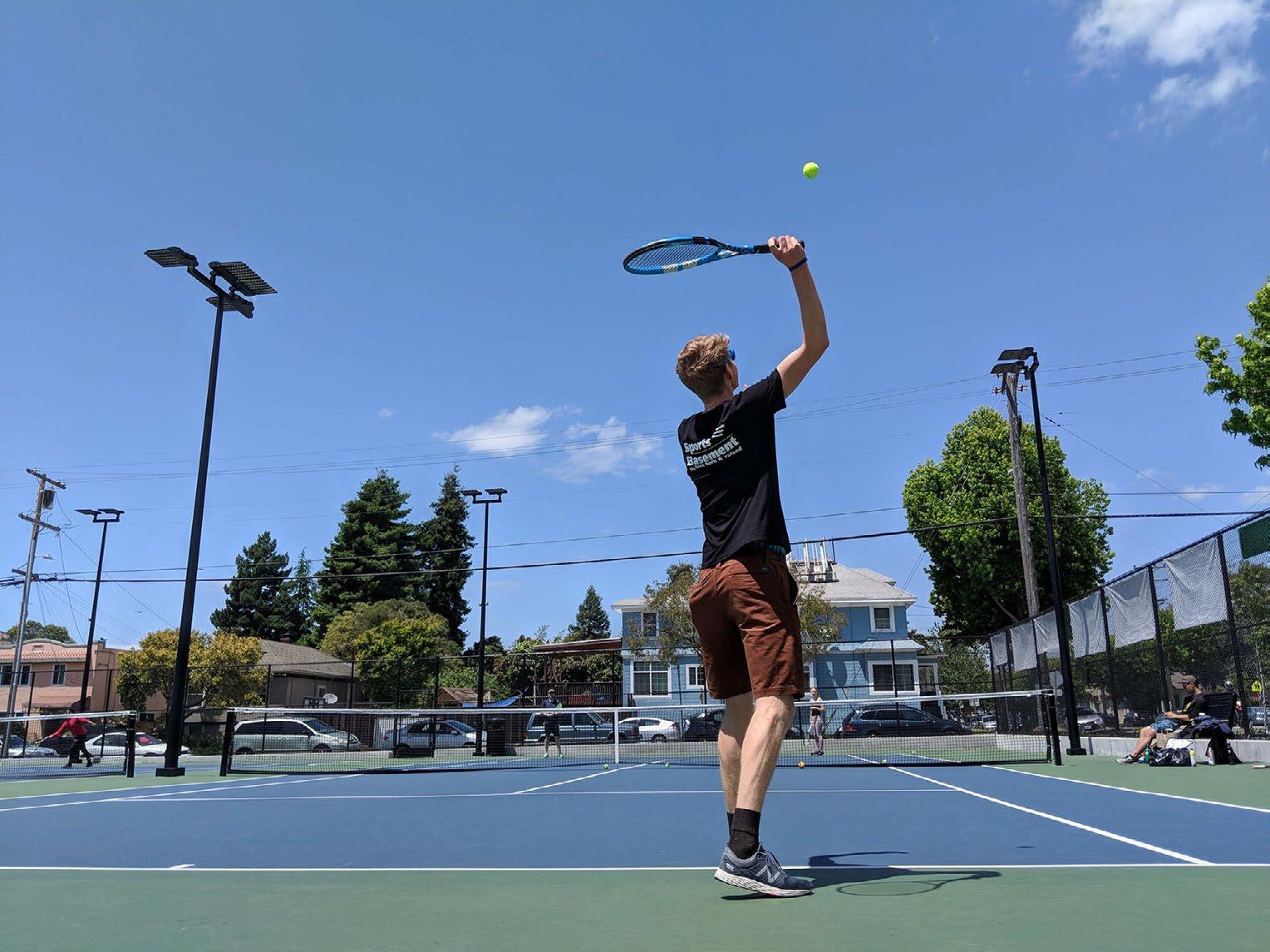
“I would say our top lineup is healthy, we’re just getting ready for the conference,” De Wilder said.
DEVIN MALAST/Long Beach Current
After being named Big West Freshman of the Year in 2025, LBSU sophomore tennis star



Cecilia Costa has continued her dominance in her sophomore season, winning Big West Player of the Week three times.






ACROSS
2. A funny way of saying weed
4. When you want a late night snack
6. Slang for low-quality cannabis
7. A flower before it blooms
9. 1936 fearmongering film (two words)
10. Long Beach native rapper (two words)
11. Collected at the bottom of a grinder
DOWN
1. The end of a joint
3. A person who is a dispensary guide
5. A type of snake or post-smoking problem
8. Spider-Man’s girlfriend or an alternative name for weed (two words)
LEISURE ANSWERS
ACROSS
2. A funny way of saying weed
4. When you want a late night snack
6. Slang for low-quality cannabis
7. A flower before it blooms
9. 1936 fearmongering film (two words)
10. Long Beach native rapper (two words)
11. Collected at the bottom of a grinder
DOWN
1. The end of a joint
3. A person who is a dispensary guide
5. A type of snake or post-smoking problem
8. Spider-Man’s girlfriend or an alternative name for weed (two words)