SHAPING CLAY
WOMEN ARTISTS IN CONTEMPORARY JAPANESE CERAMICS
SHAPING CLAY
WOMEN ARTISTS IN CONTEMPORARY JAPANESE CERAMICS
DIGITAL CATALOGUE
Dai Ichi Arts, Ltd is a fine art gallery exclusively dedicated to celebrating modern and contemporary works of ceramic art from Japan
Since our inception in 1989, we have focused on placing important Japanese ceramics at the center of New York’s contemporary art scene. The gallery has introduced pieces to the permanent collections of several major museums, including The Metropolitan Museum of Art, The Art Institute of Chicago, the Minneapolis Institute of Art, the Indianapolis Museum of Art, the Princeton University Art Museum, and many more
We are committed to providing authoritative expertise to collectors, liaising with artists, and showcasing inspiring exhibitions and artworks We welcome you to contact us for more information
Shaping Clay: Women artists in contemporary Japanese ceramics
Exhibition catalog
On view: May 21 – June 4, 2026
18 East 64th Street, Ste. 1F
New York, NY, 10065, USA
www daiichiarts com

K A T O M A M I 加 藤 真 美
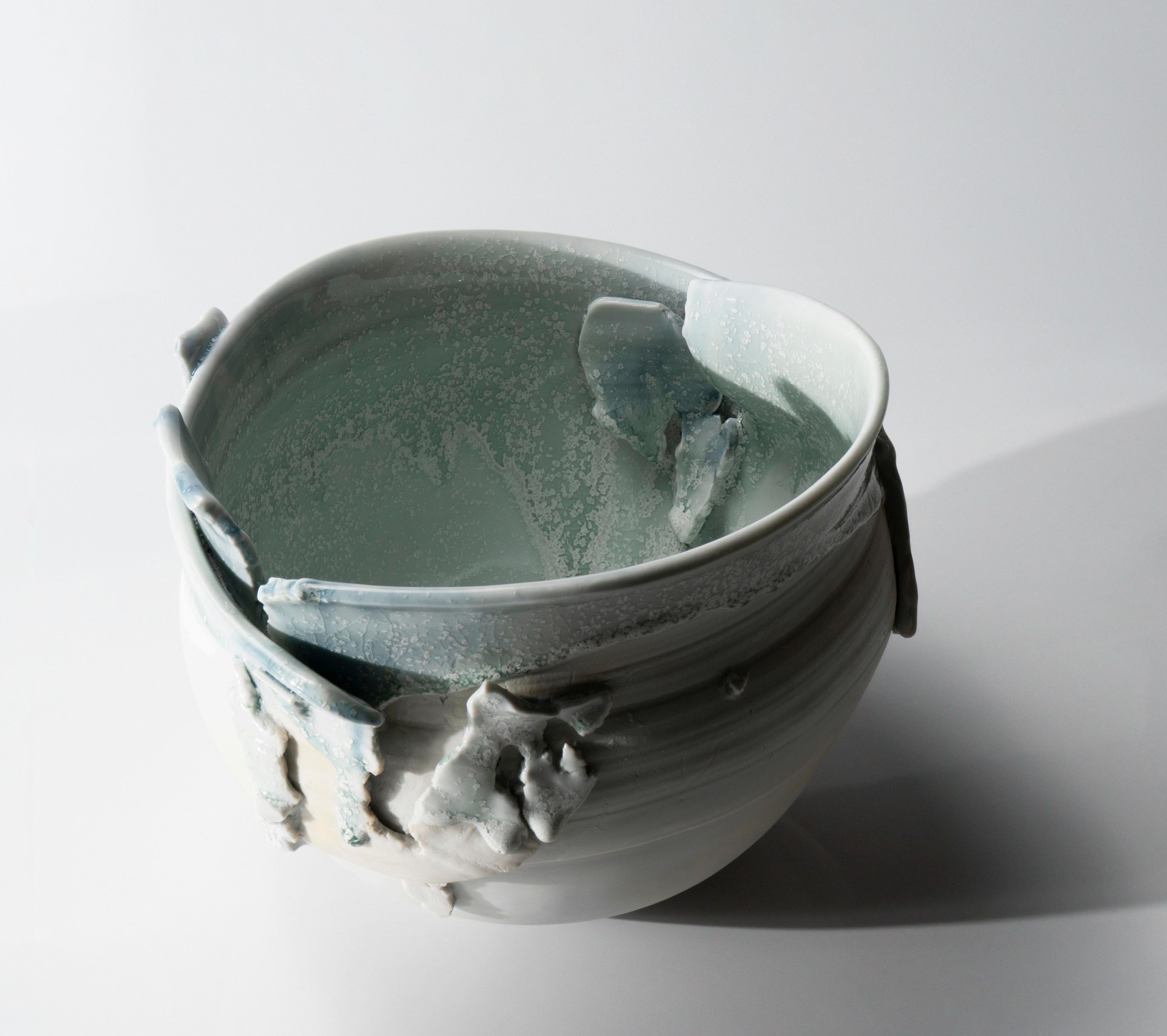
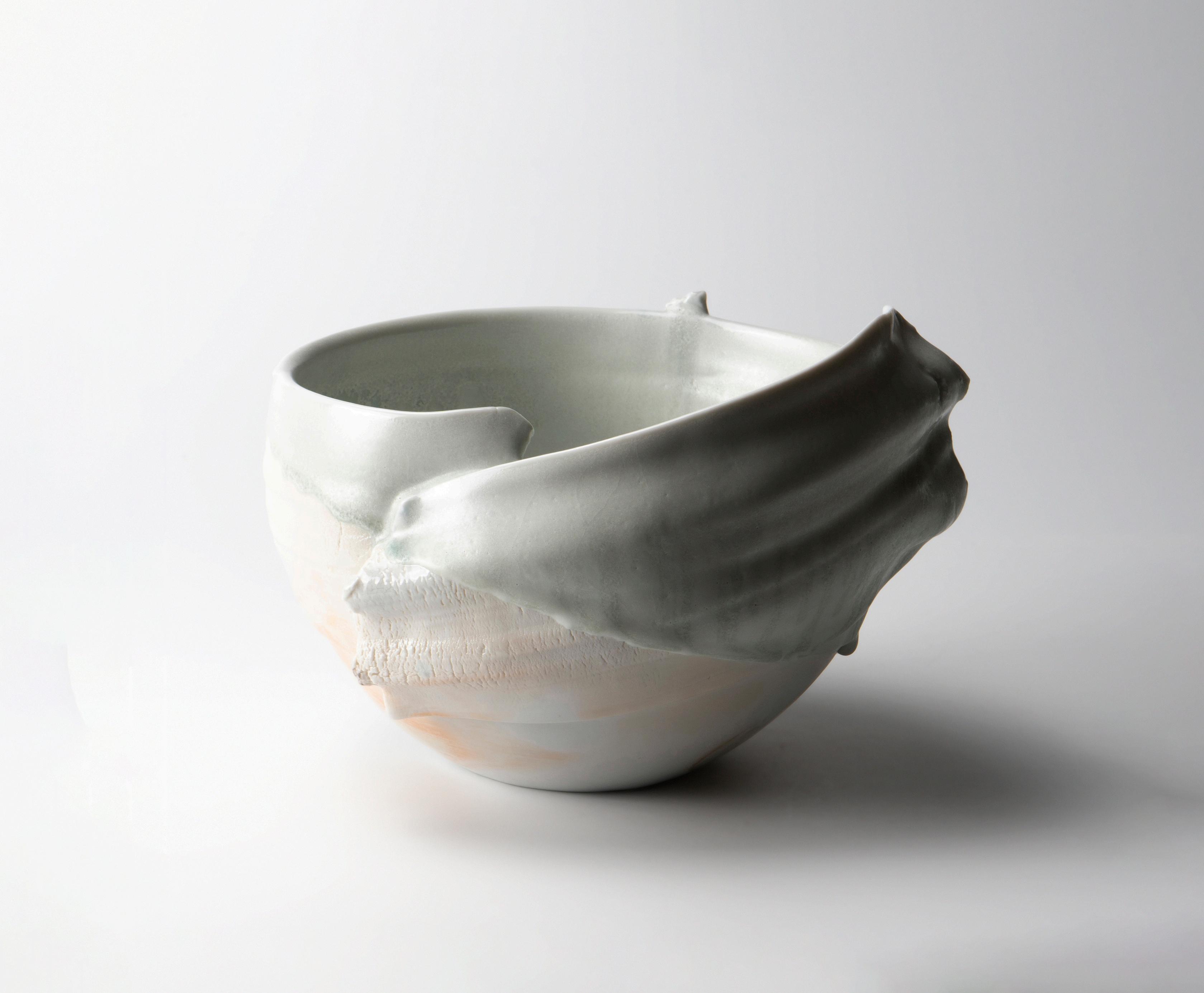
Tokoname-based ceramic artist Kato Mami (b 1963) approaches the ceramic vessel not just as a container, but as a receptacle for acceptance and forgiveness. In her work, vessels become contemplative sites of connection between object and beholder. Central to her practice is the idea of the vessel’s interior: not an empty void, but a living space that receives, envelops, and holds “I was captivated by the inside of everyday vessels,” Kato reflects “It is not just empty space, but a space filled with a kind of presence, like a soul ” For Kato, the relationship between interior and exterior forms the essential nature of the vessel itself Working primarily with porcelain slabs, thin sheets and ribbons of clay are folded, layered, and draped into asymmetrical forms that offer a formal sharpness that is juxtaposed by the inherent fluidity of clay
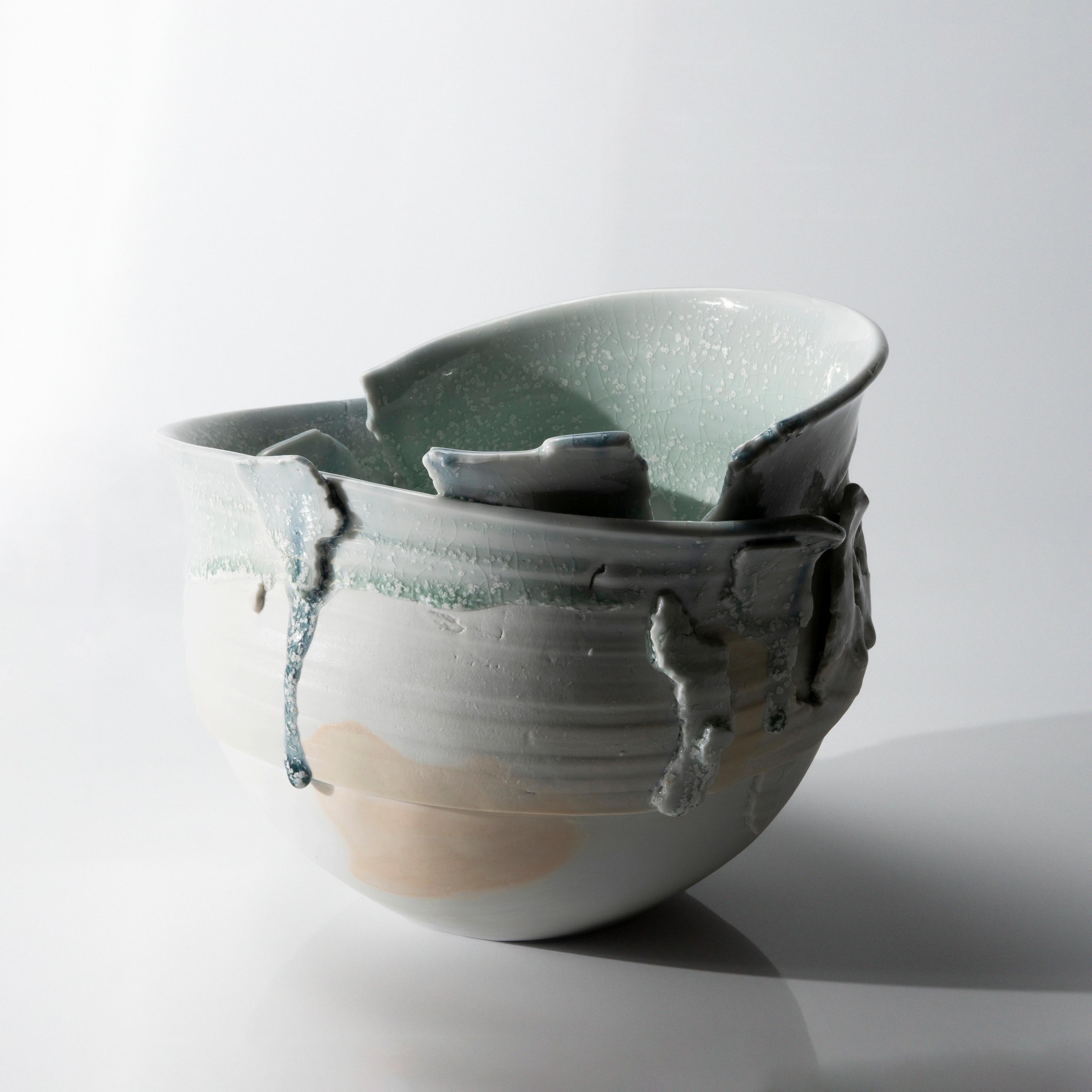
Her crystalline glazes often pale greens and blues recall ice, frost, and distant celestial surfaces, while angular contours cast dramatic shadows that shift under light Despite their cool, mineral-like appearance, her works retain a palpable warmth and vitality Through meticulous processes of slab-building, glazing, and gas firing, Kato creates vessels that appear geological and ethereal
Kato is an internationally acclaimed ceramic artist She was the first woman to win the Shōroku Award Chawan Exhibition (now known as the Mino Chawan Exhibition) in both 2014 and 2024, a milestone that marked a significant moment in contemporary Japanese ceramics, and in particular, tea ceramics In 2021, she received the Grand Prize at the 22nd Japan Ceramic Art Exhibition, where jurors praised the tension in her work between icy, crystalline surfaces and an underlying sense of warmth and vitality Across her oeuvre, Kato continues to expand the expressive possibilities of the ceramic vessel, balancing containment and openness, monumentality and intimacy in scale
Over time, Kato’s vessel forms have continued to evolve She meditates upon how vessels outwardly connect and communicate with subjects and viewers In 2024, she was nominated for the prestigious Paramita Ceramic Art Grand Prize Exhibition Most recently, she has begun exploring vertical forms that reach upwards in her flower vessels, using gravity and weight to guide the form
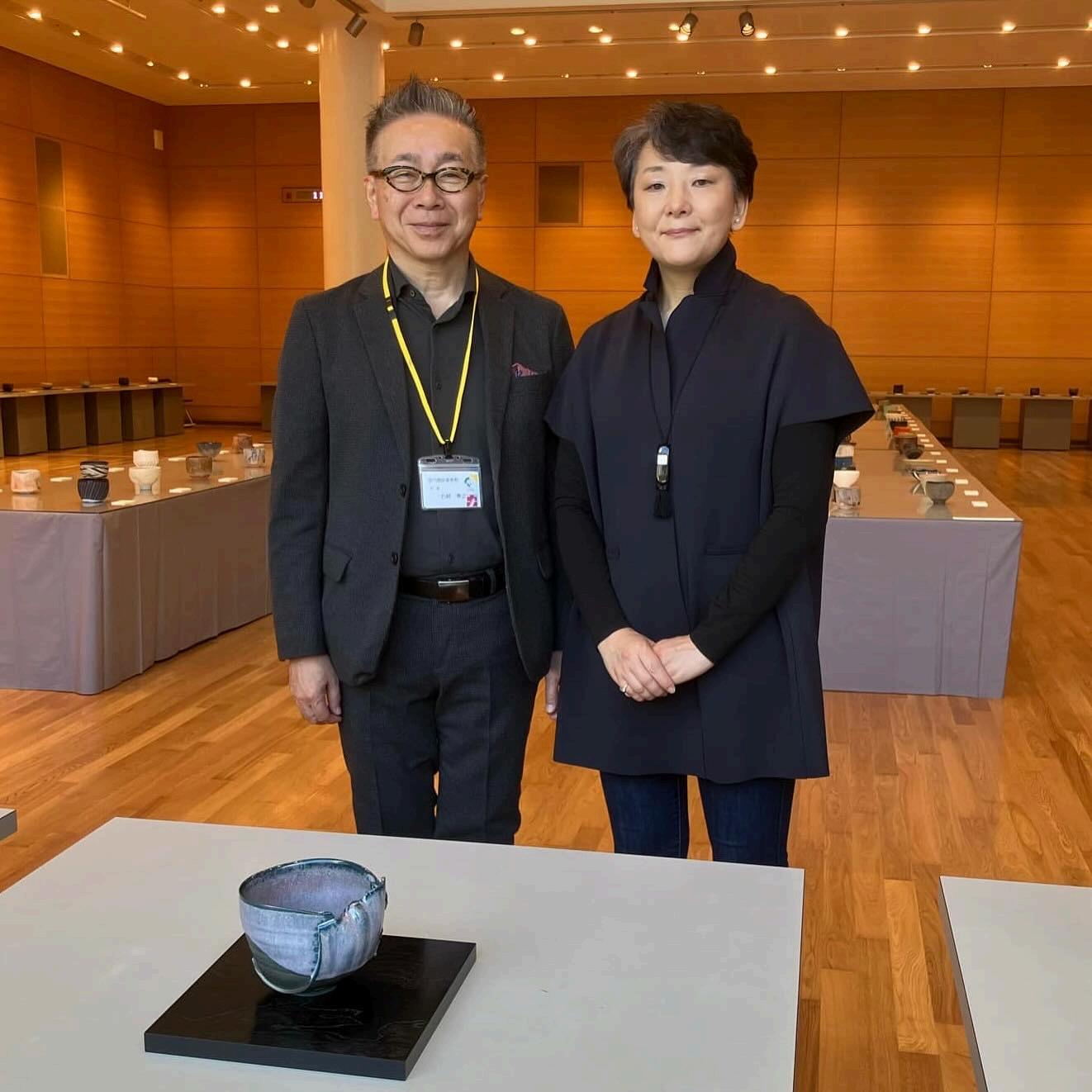
Kato Mami pictured with judge Ishizaki Yasuyuki during the Mino Chawan Exhib tion award ceremony, 2024 Image courtesy of the art st
Kato Mami 加藤 真美
Gekka 3 (Beneath the Moon), 2025, with signed wood box, Seto porcelain
7 7/8 × 11 × 9 1/4 in (20 × 28 × 23 5 cm)
Kato Mami 加藤 真美
Bowl, "Cho On" 潮⾳, 2025, with signed wood box, Seto porcelain
6 1/4 × 9 × 8 1/4 in. (16 × 23 × 21 cm)
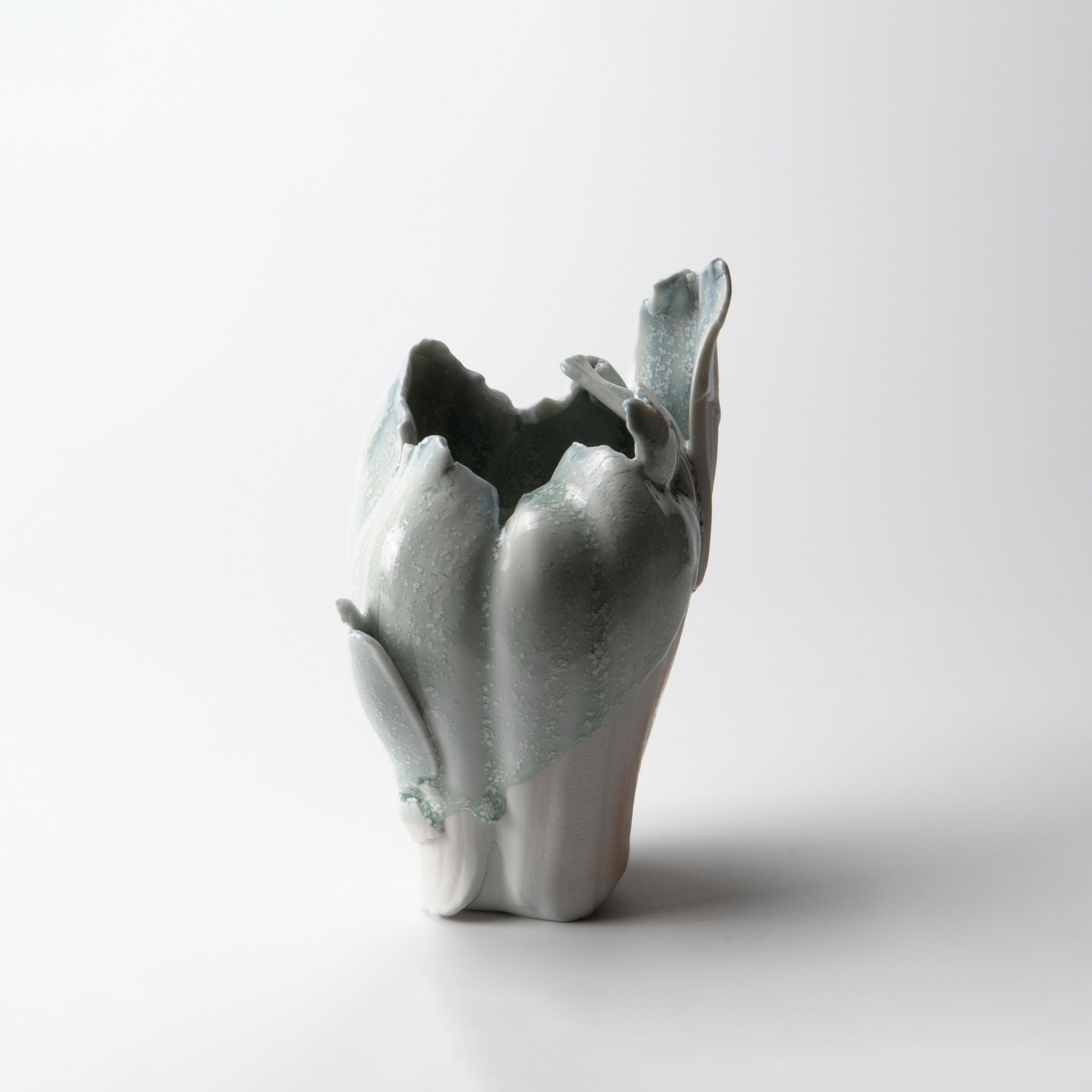
8 1/4 × 4 7/8 × 6 1/2 in (21 × 12 5 × 16 5 cm)
Kato Mami 加藤 真美
Small flower vase 花⼊, 2025, with signed wood box, Seto porcelain
K
A
T S U M A T A C H I E K O 勝 間 田 千 恵 子
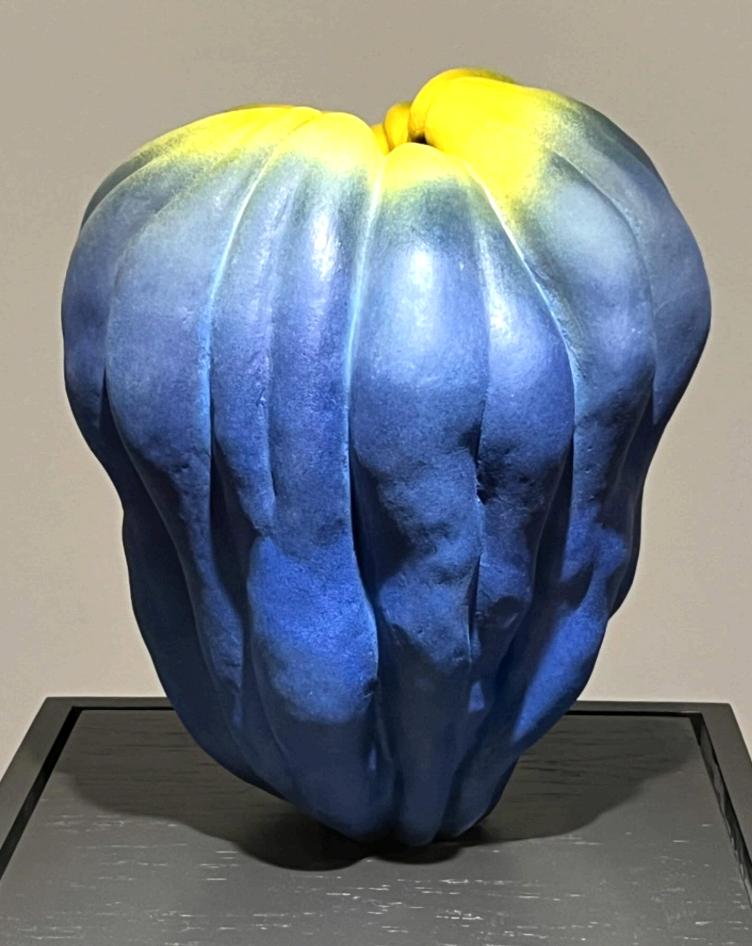
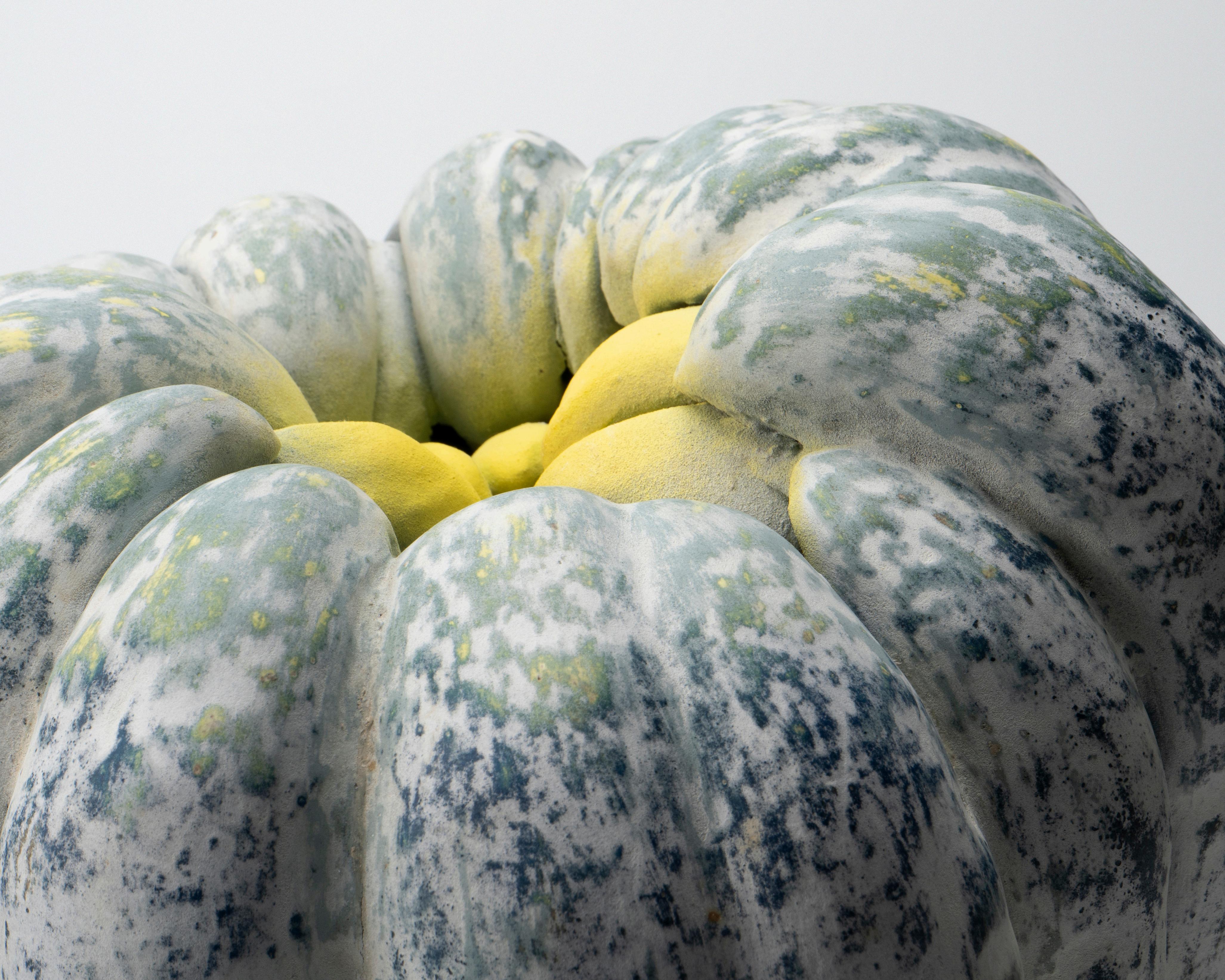
Katsumata Chieko (b 1950)’s sculptures are distinctly biomorphic, evoking vegetal forms such as bell peppers, pumpkins, squash, and fruit Arranged together, they resemble a fantastical garden of organic growths and seedlike forms Working with Shigaraki clay, Katsumata applies metallic pigments and chamotte using cloth and various fabrics rather than the use of traditional Japanese brushwork. This technique enables seamless gradations between contrasting colors, such as yellow and blue Through repeated applications and firings, the surfaces acquire a soft, velveteen texture Katsumata also draws inspiration from other vivid phenomena in nature, creating works that encourage viewers to look at the world from the perspectives of coral reefs, plants, insects, animals, and more life forms
Their sensuous contours and vividly colored surfaces heighten this impression, creating works that feel both natural and otherworldly Katsumata received her formal artistic education in France, at the L'École Nationale Supérieure des Arts Appliqués et des Métiers d'Art (ENSAAMA). Upon returning to Kyoto in 1978, she began developing this experimental series of ceramic sculptures, introducing innovative approaches to the application of color on clay
Katsumata Chieko, Akoda (Pumpkin), 2015 Glazed stoneware; 45 7 x 53 3 x 48 3 cm (18 x 21 x 19 in )
Image courtesy of the Art Institute of Chicago and Chicago Gallery News
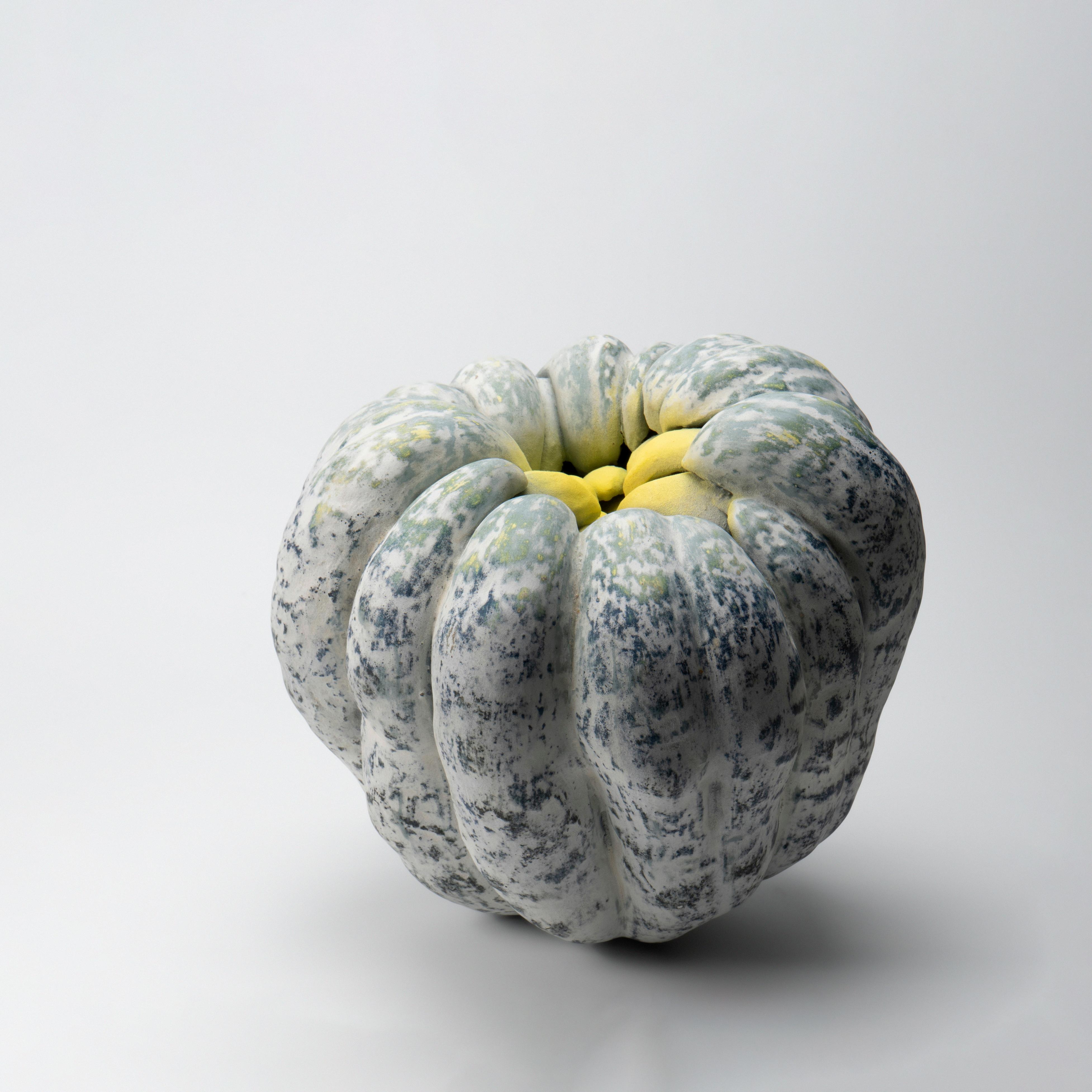
Katsumata Chieko 勝間⽥ 千恵⼦ (Untitled) biomorphic sculpture, 2011, with signed wood box, glazed stoneware encrusted with chamotte (crushed fired porcelain); Height 9 1/2 in (24 cm)
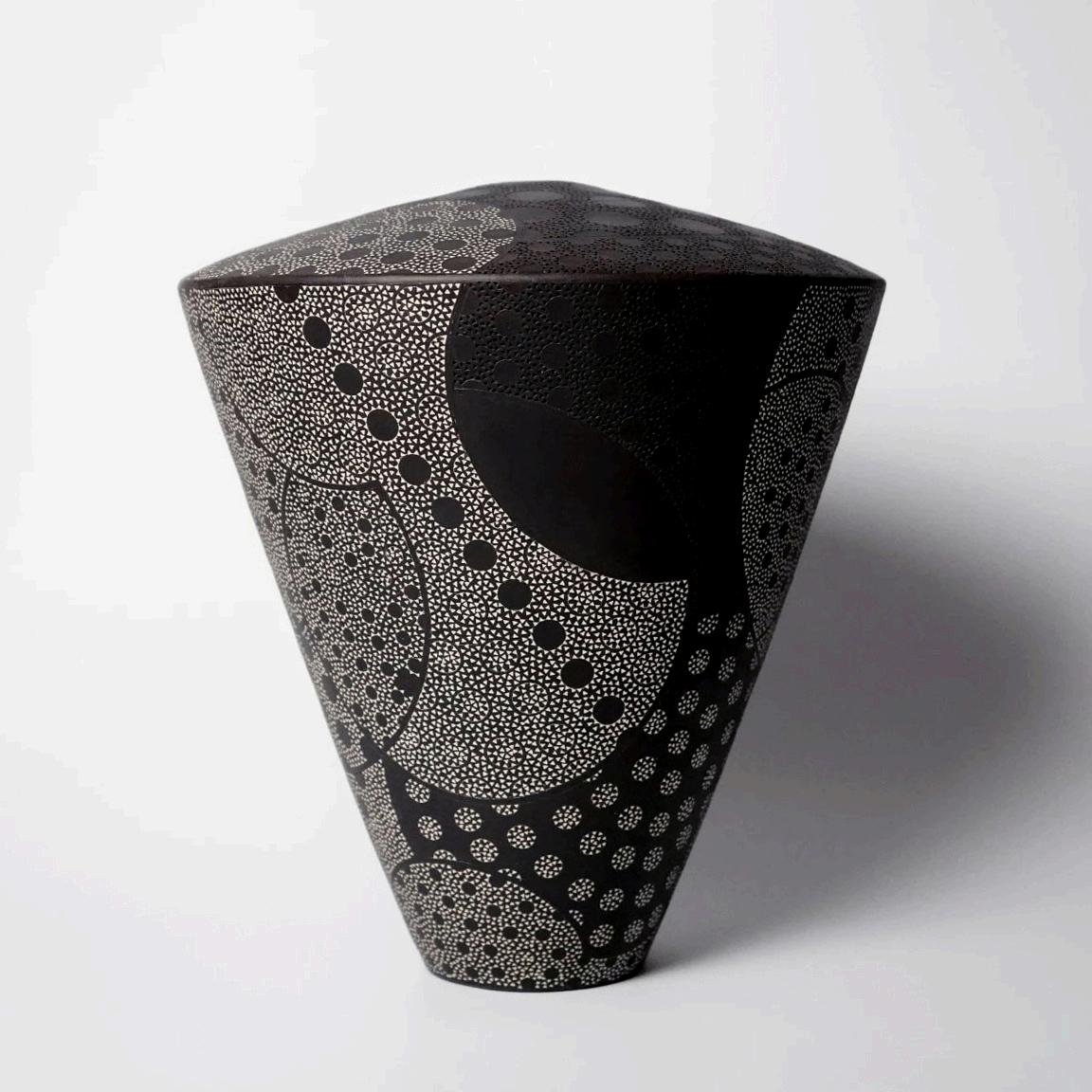
Vessel, 2022, with signed wood box, stoneware; 13 × 11 5 in (33 × 29 2 cm)
Kitamura Junko 北村 純⼦
K I T A M U R A J U N K O 北 村 純 子
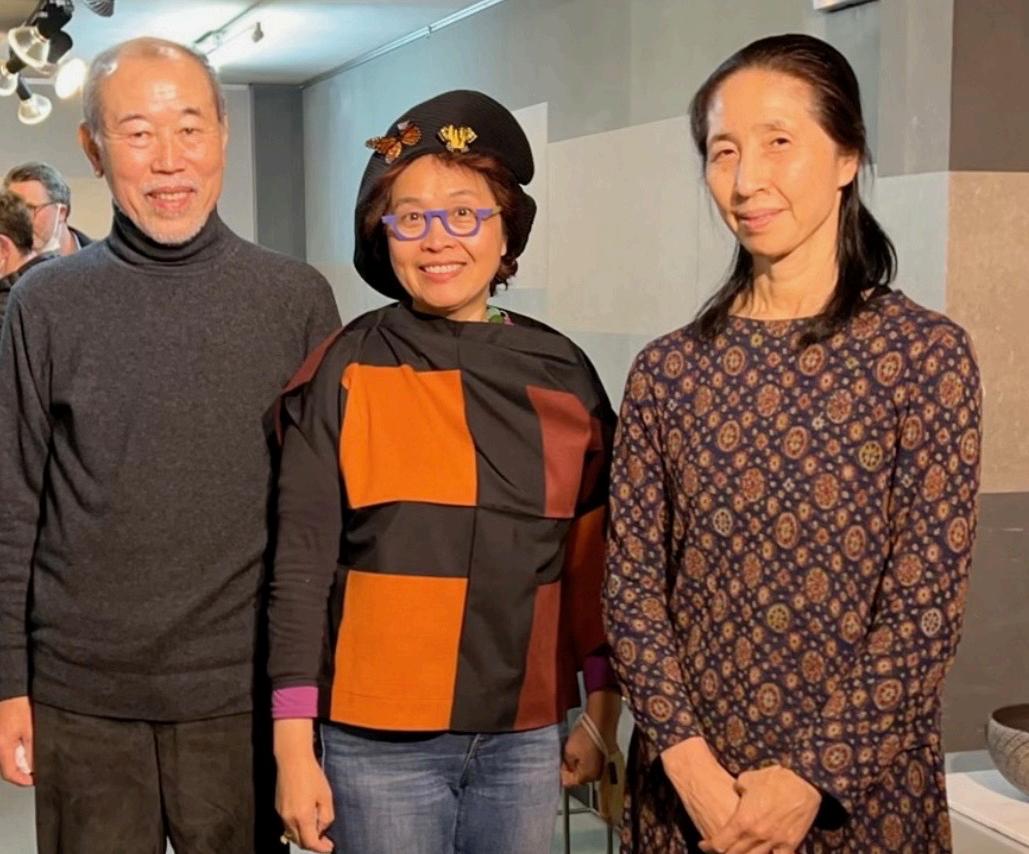
Artists Akiyama Yō and Kitamura Junko pictured with gallery director Beatrice Chang in Kyoto, 2022.
The geometric and sculptural works of Kitamura Junko (b 1956)’s oeuvre are internationally celebrated Trained under the important Sodeisha pioneer Suzuki Osamu 鈴⽊ 治 (1926-2001), Kitamura’s sense for abstract, sculptural form shines through in her functional vessels She also studied under the Living National Treasure, Kondō Yutaka 近藤 豊 (1932-1983), whose techniques are palpable in her work
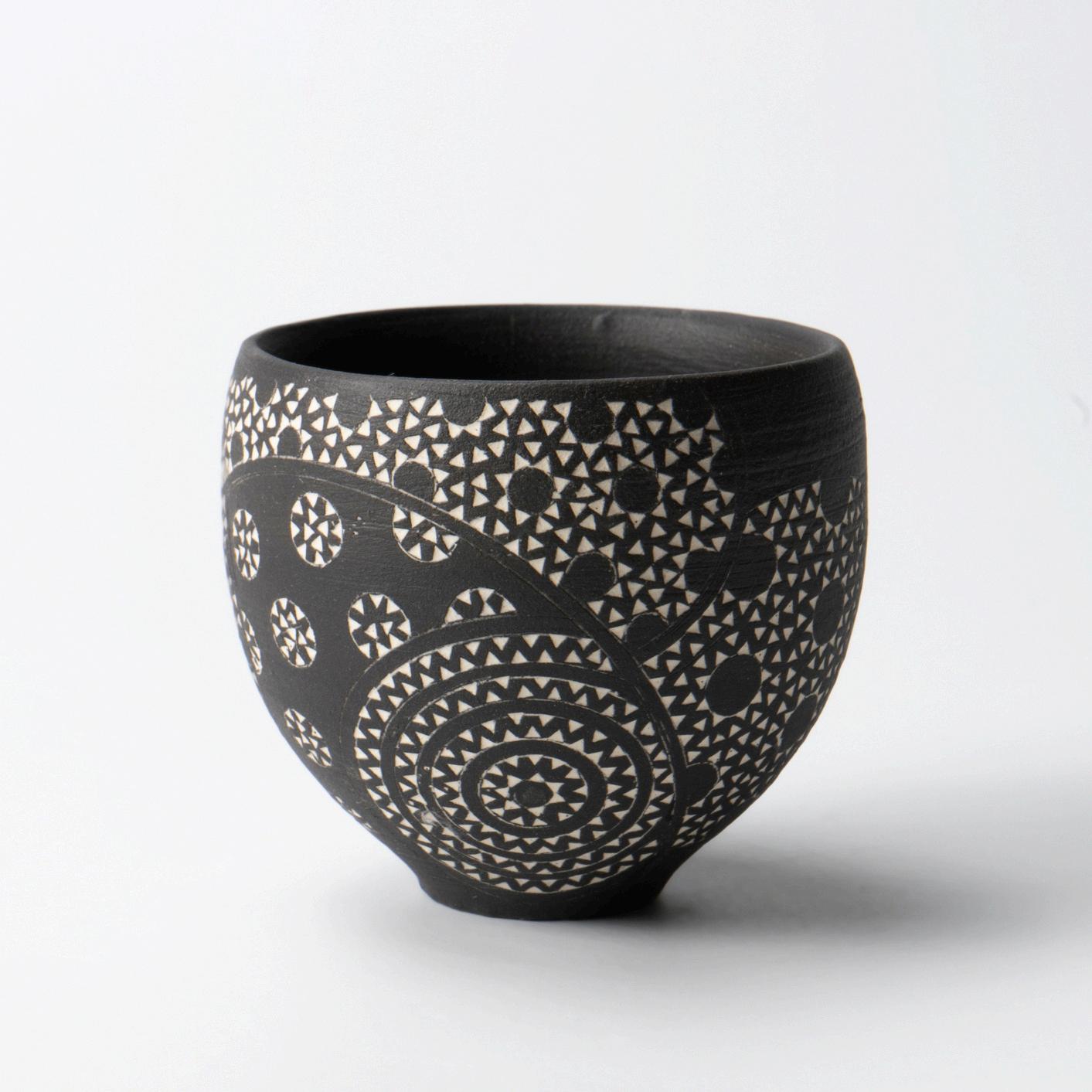
Her intricate patterns draw on Korean Buncheong pottery techniques, which reached the height of their popularity during the Joseon dynasty and were introduced to Japan following the Imjin War (1592–1598) Her work incorporates concentric, dotted, and impressed surface designs inlaid with viscous white slip, reinterpreted through a contemporary visual language of geometric clusters that unfold in tessellated formations across the bodies of her black-glazed vessels Simultaneously, her work evokes Japan’s rich history of decorative arts, recalling the intricate linear motifs of textile design through scrolling patterns that traverse the surfaces of her monochromatic clay forms.
Guinomi No 5, stoneware with slip inlay
2 1/4 × 2 5/8 in (5 8 × 6 6 cm)
A celebrated artist, Kitamura earned her MFA from Kyoto City University of Arts Her work is included in the permanent collections of major institutions such as the British Museum, the Brooklyn Museum in New York, the Museum of Fine Arts, Boston, and the Arthur M Sackler Gallery at the Smithsonian Institution, among others Throughout her career, she has received numerous accolades, including awards from the Shiga Prefecture Art Exhibition (1983), the Kyoto Art and Crafts Exhibition (1984 and 1985), and the World Triennial Exhibition of Small Ceramics in Zagreb, Croatia (1997)
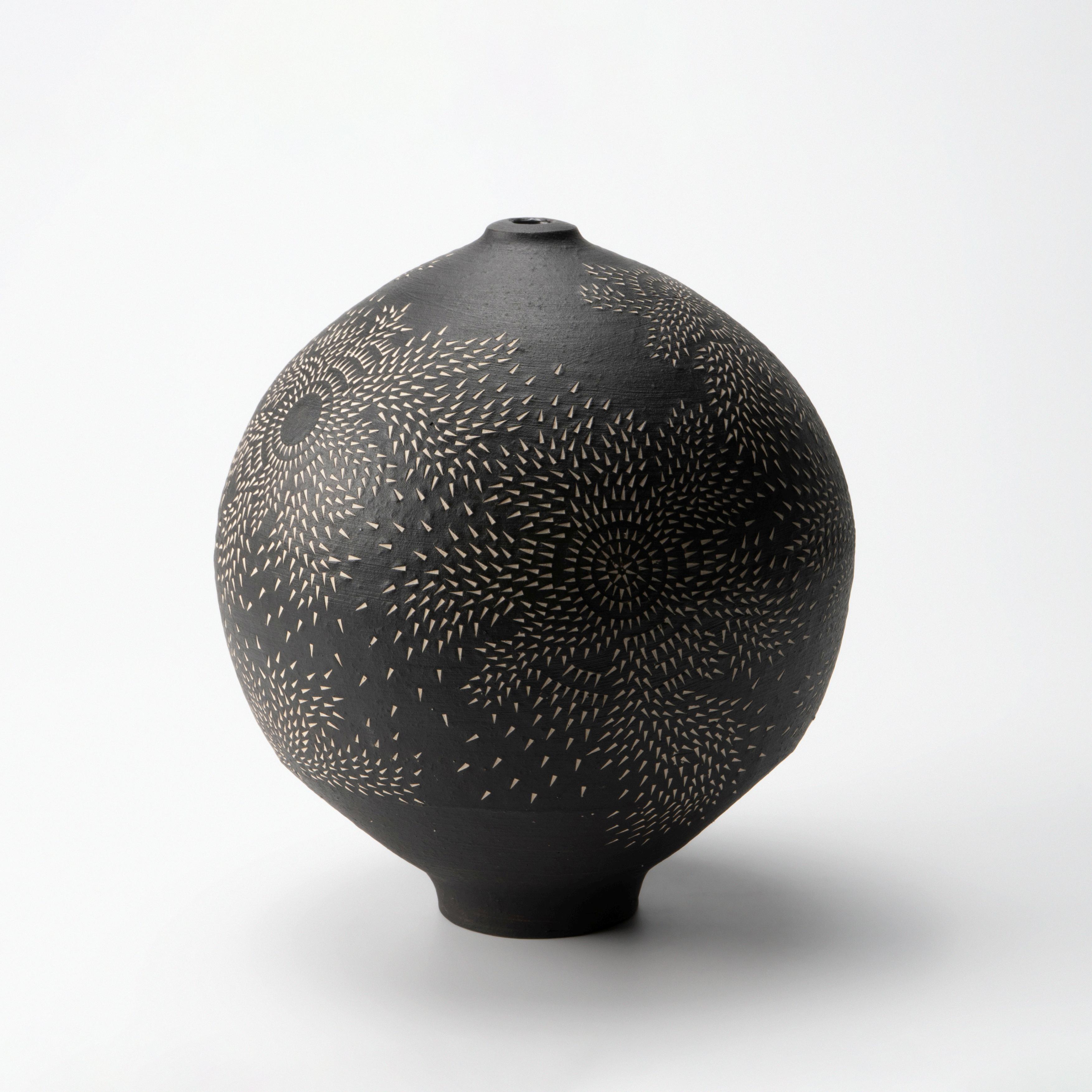
7 1/2 × 6 1/2 in (19 1 × 16 5 cm)
Kitamura Junko 北村 純⼦
Flower jar, with signed wood box, stoneware
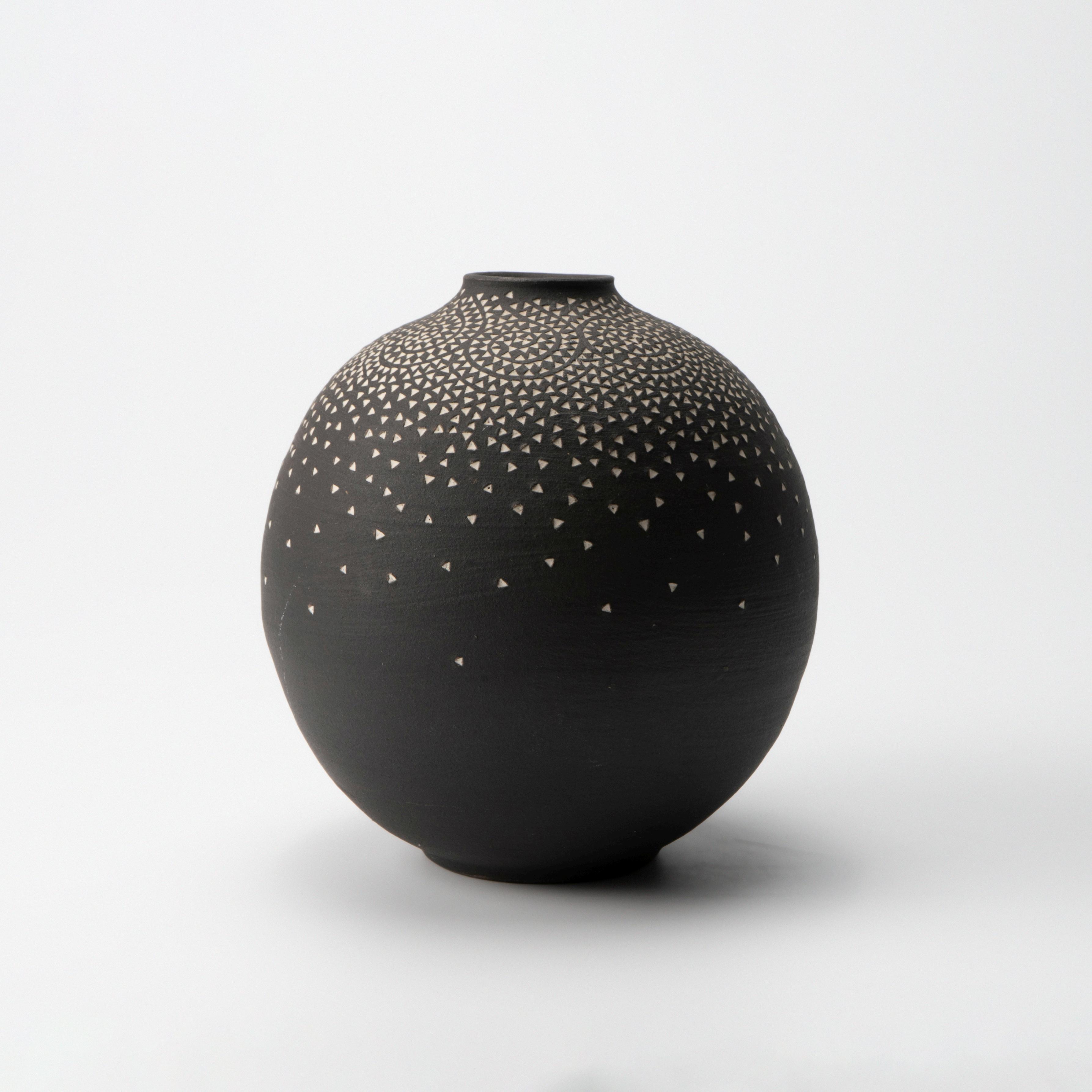
4 1/4 × 4 1/8 in (10 8 × 10 5 cm)
Kitamura Junko 北村 純⼦
Small flower jar, with signed wood box, stoneware with slip inlay
K
O I K
E S
H O K O 小 池 頌 子
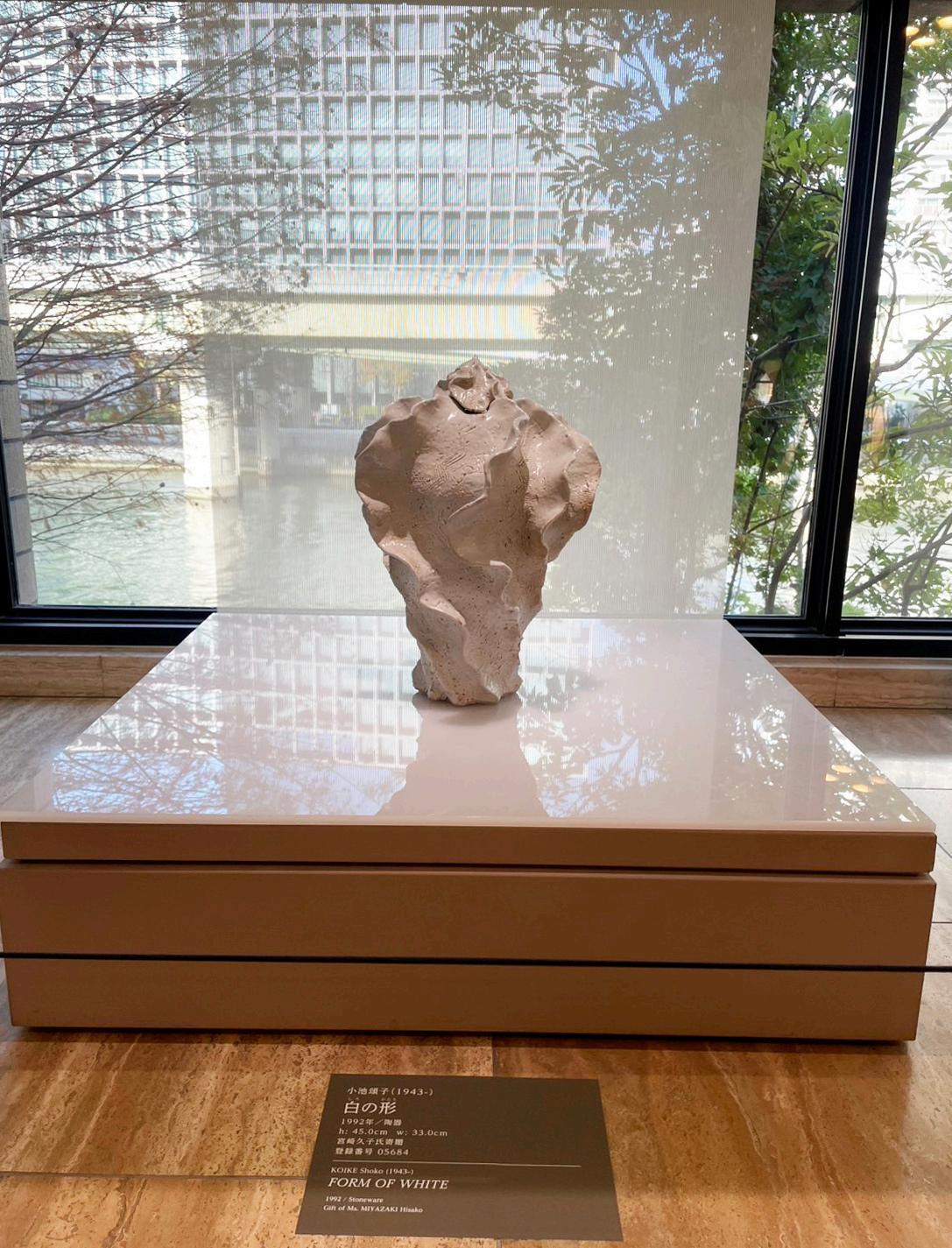
Photographed on view at the Museum of Oriental Ceramics, Osaka in December 2025
Born in Beijing, Koike Shoko (b. 1943) was raised in Japan and emerged as one of the most significant ceramic artists of the postwar Japanese pottery movement In 1962, she became the first woman to graduate from the ceramics department at Tokyo University of the Arts, marking the beginning of a pioneering career in sculptural ceramics. Over the decades, Koike has developed a remarkable body of work that challenged and expanded the boundaries of ceramic practice within postwar Japanese art
Beginning in the 1990s, she developed a celebrated series of undulating white lidded vessels inspired by the forms of seashells and snail shells Approaching clay as a material to be folded and shaped into organic, natural forms– much like fabric– Koike creates works that evoke the structures and textures of the natural world Their surfaces echo the geological textures and tones of stone, earth, cliffsides, and expansive landscapes Working primarily in Shigaraki clay, she applies spontaneous sgraffito markings and richly textured white slip, producing tactile and expressive surfaces over formally innovative clay bodies
Koike Shoko, FORM OF WHITE, 1992
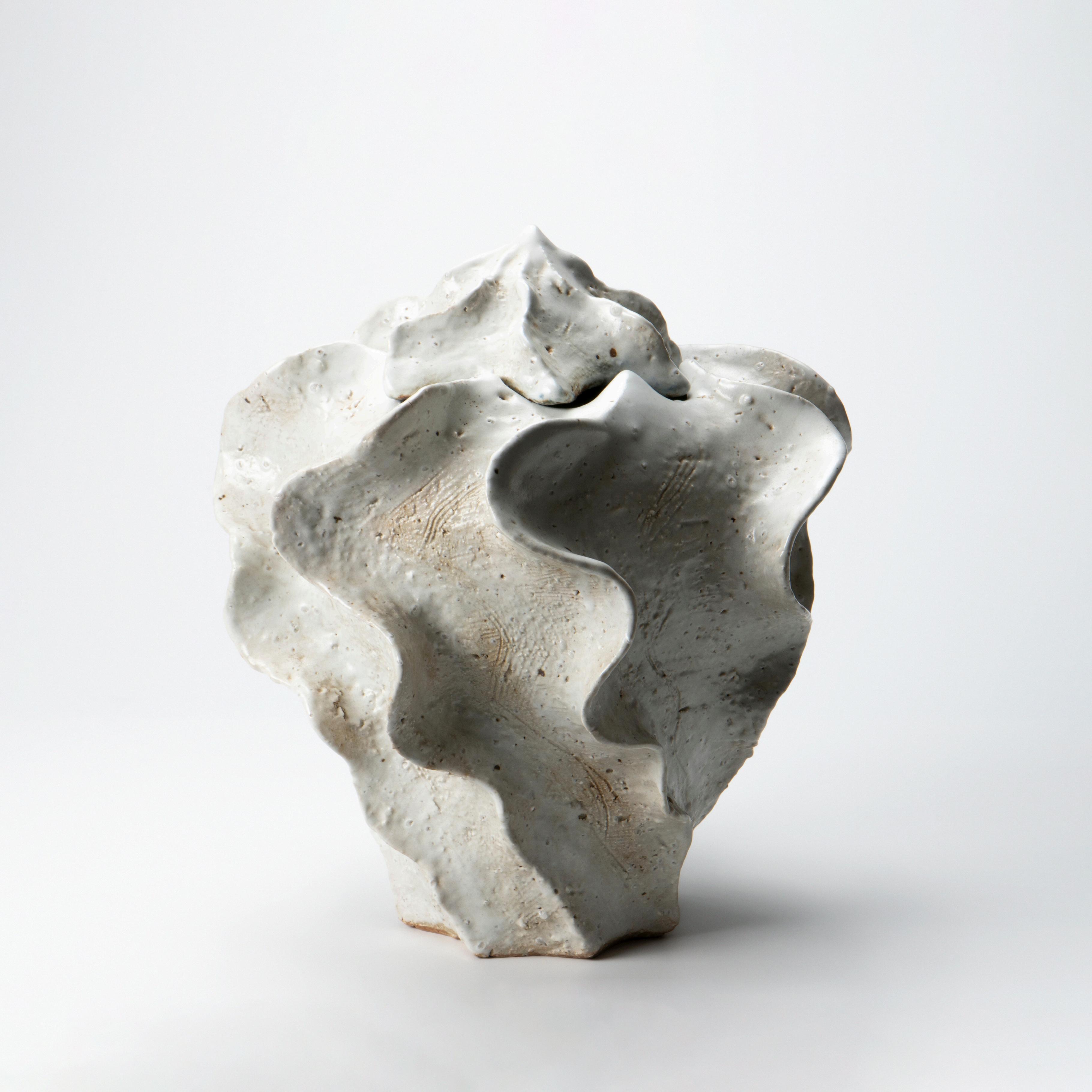
Koike Shoko ⼩池 頌⼦
Shell-shaped lidded vessel with white glaze, 1992, with signed wood box, stoneware 11 1/8 × 10 1/8 in (28 2 × 25 6 cm)
M A T S U D A
Y U R I K O 松 田 百 合 子
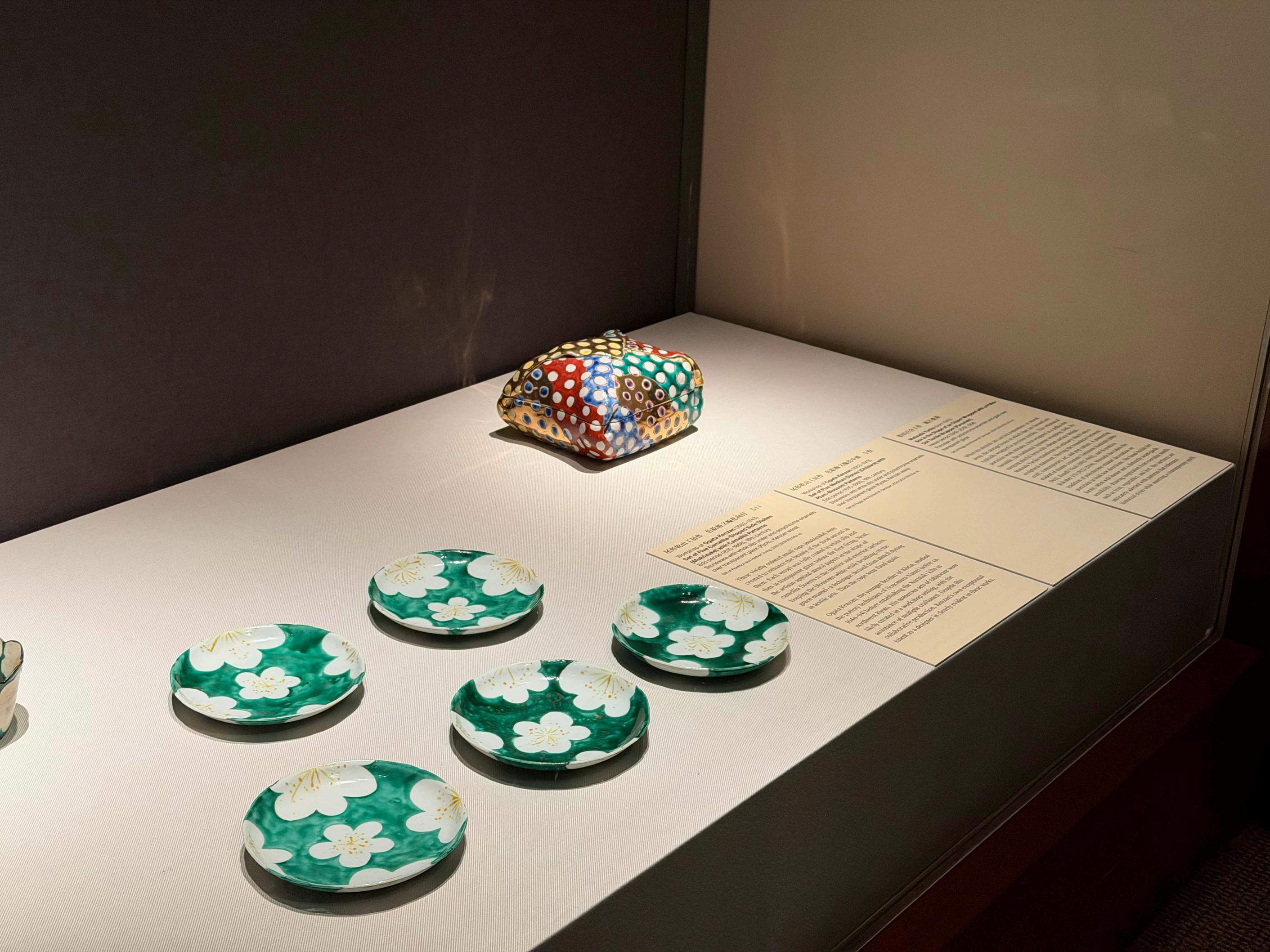
March 2026
rtist Matsuda Yuriko (b 1943) has olychrome porcelain decoration hly imaginative ceramic practice ilt porcelain forms, she creates d with a sense of wit, elegance, and piration from subjects as varied as et, legs, and the human body, e in densely layered decorative echniques and aesthetics ware, and sometsuke her works nature, ornament, surface, and the under some of the most influential th century, including Tomimoto ūzō (1902–85), Fujimoto Nōdō ei VII (1922–2006)
the timeless motif of Mount Fuji irit. Here, the iconic peak is al lens, its surface alive with by the decorative style of Ogata In her celebrated Mt Fuji himmer with touches of silver and Kutani colors blue, green, purple, ncy, movement, and delight to ng body, fashion, and identity also s exhibition, particularly In Her ated imaginative porcelain works that blur the boundary between sculpture and function Drawing on traditional Chinese and Japanese decorative vocabularies, her richly ornamented surfaces celebrate the expressive power, pleasure, and vitality of decoration
Matsuda Yuriko, Box in the Shape of an Object Wrapped with a Polka-Dot Textile Wrapper (Furoshiki), 1998
Photographed on view at the Metropolitan Museum of Art, New York in
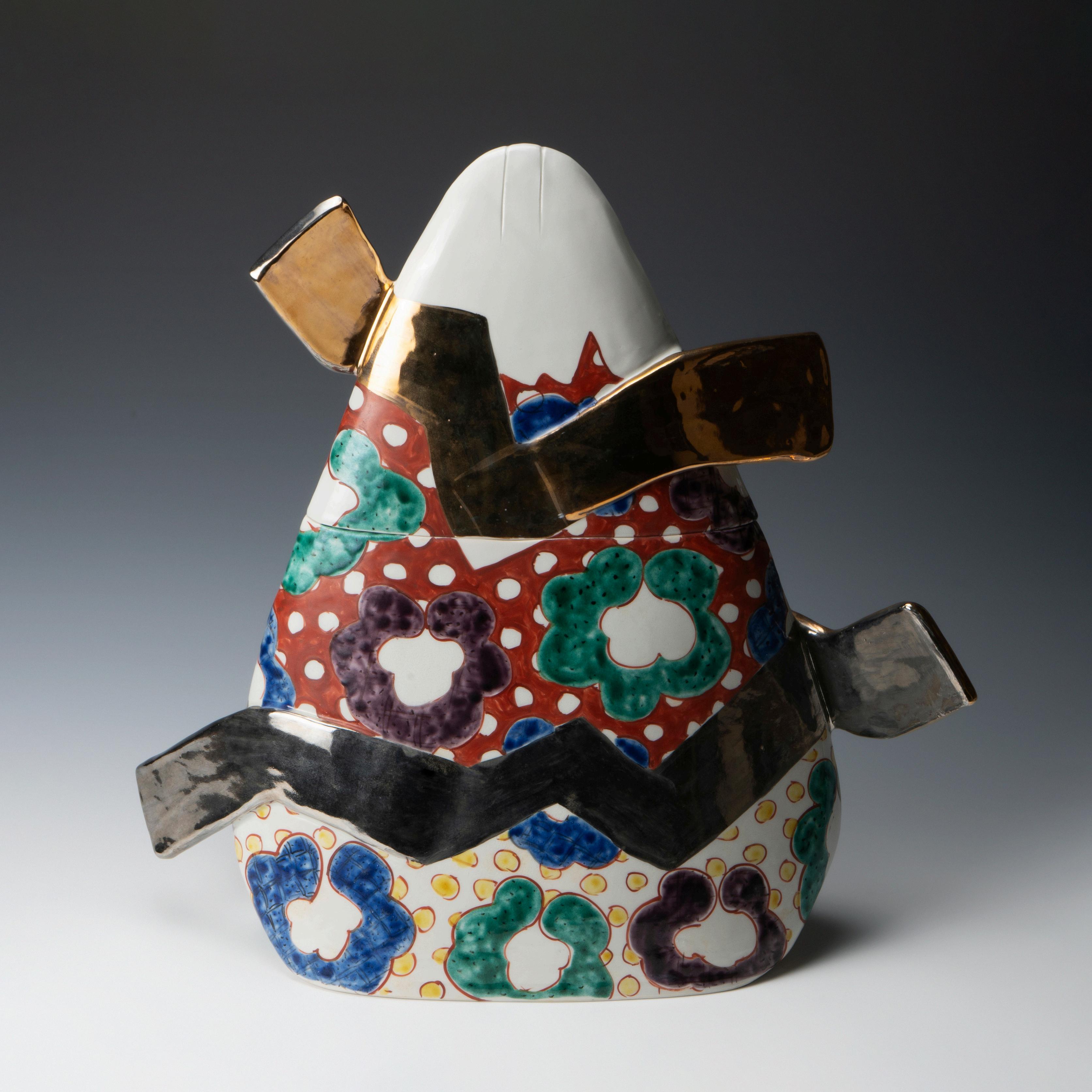
Mt Fuji, 1993, with signed wood box
Porcelain, gold, enamel, and silver
16 1/2 × 9 3/4 × 5 7/8 in (42 × 25 × 15 cm)
Gold ribbon stretch: 17 3/4 in (45 cm)
Matsuda Yuriko 松⽥
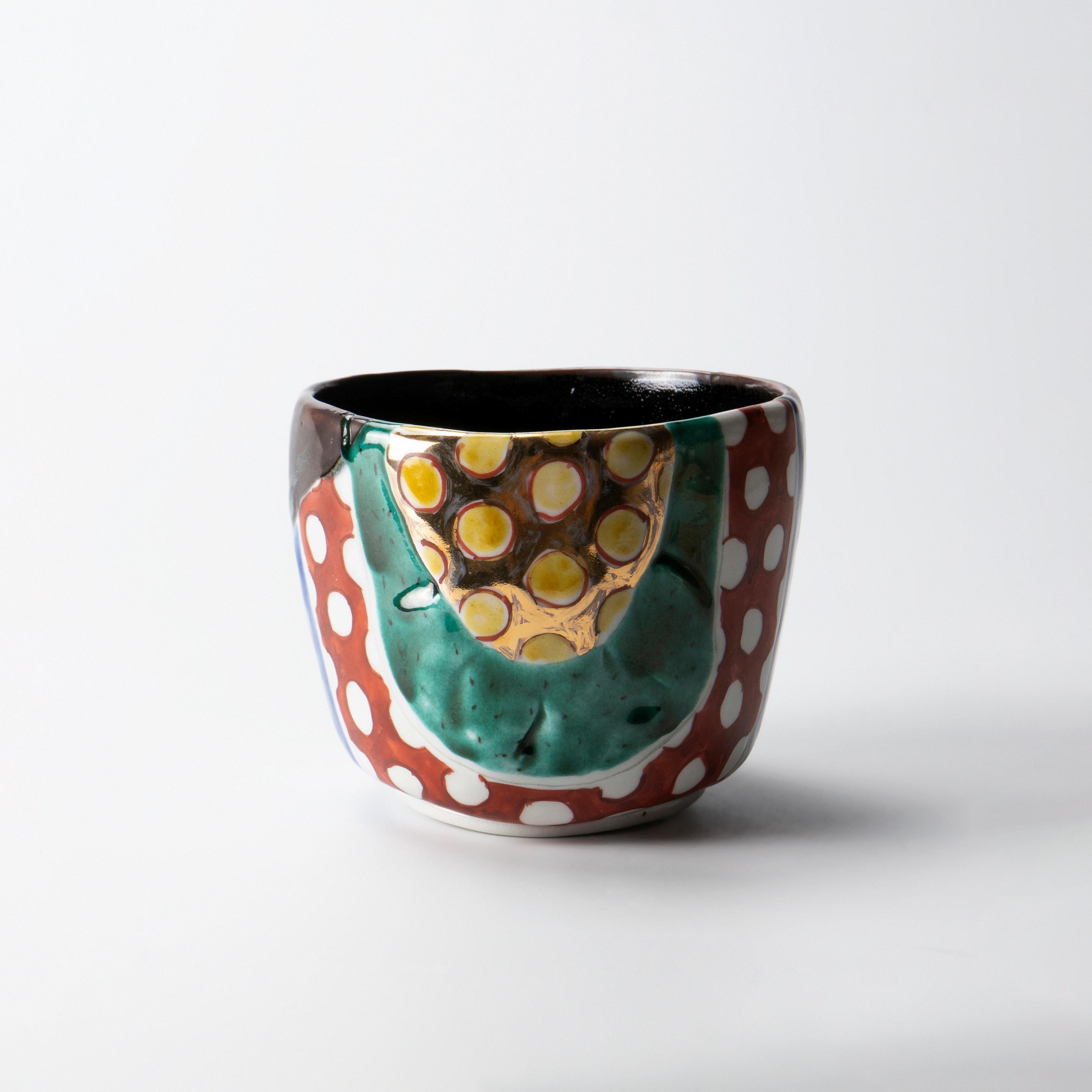
Matsuda Yuriko 松⽥ 百合⼦
Tea bowl, with signed wood box, enamel glazed porcelain
3 1/2 × 4 3/8 in. (8.9 × 11.1 cm)
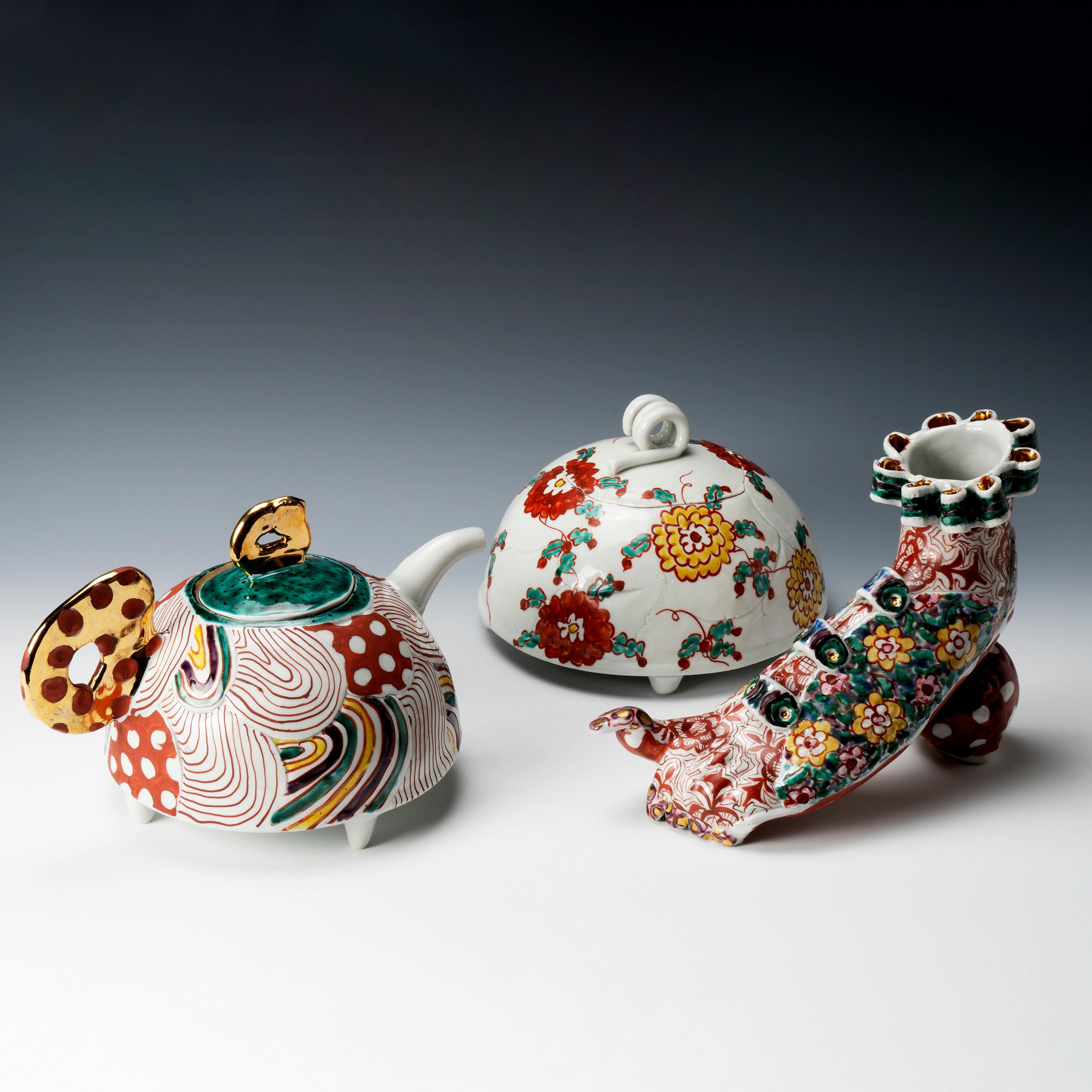
with signed wood box, enamel glazed
× 9 3/5 × 7 in (15 3 × 24 6 × 17 8 cm)
(Middle) Covered jar with floral decorations, with signed wood box, enamel glazed porcelain
(Right) In her Shoes 2, 2008, with signed wood box, enamel
Three works by Matsuda Yuriko
(Left) Water pitcher,
porcelain
S H I G E M A T S U A Y U M I
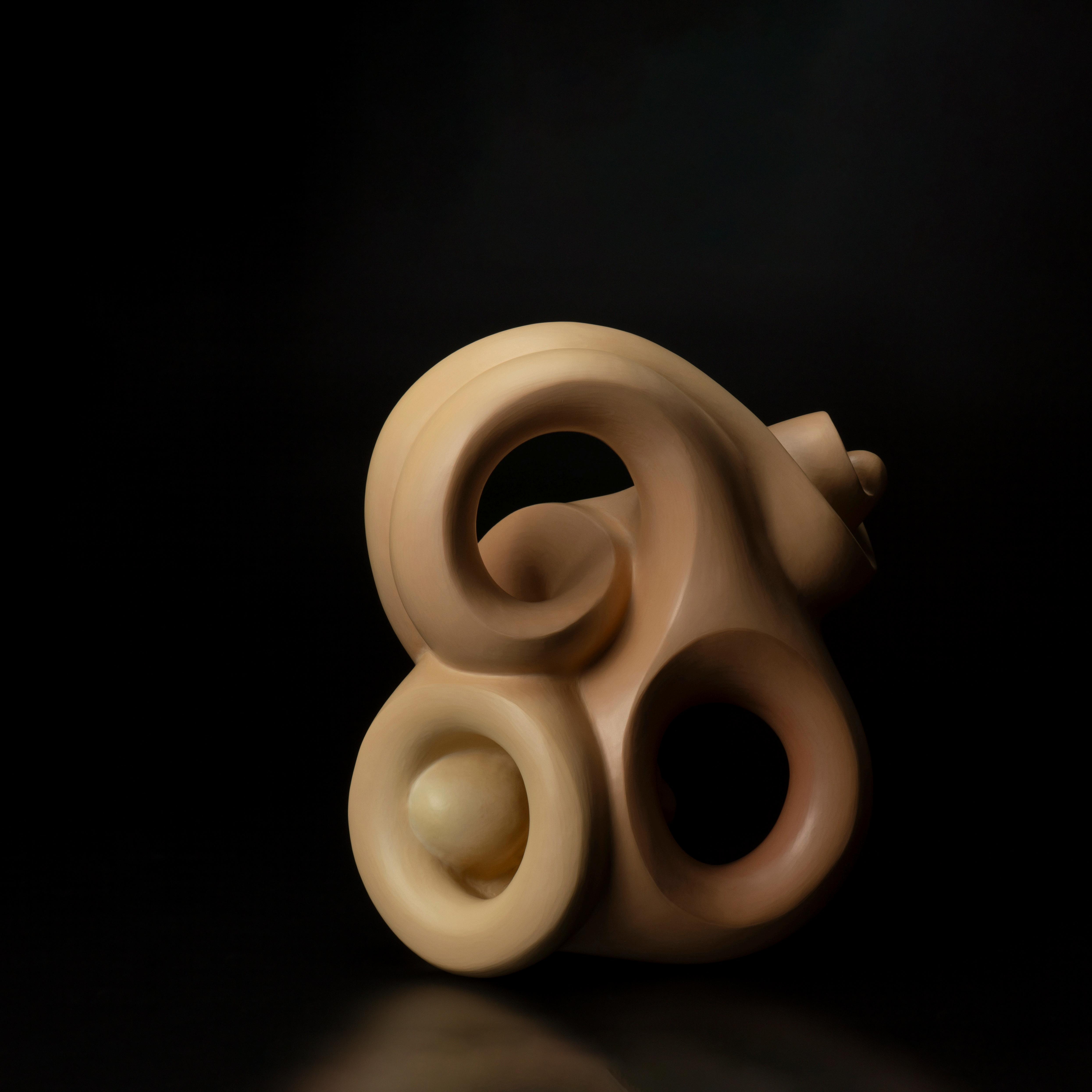
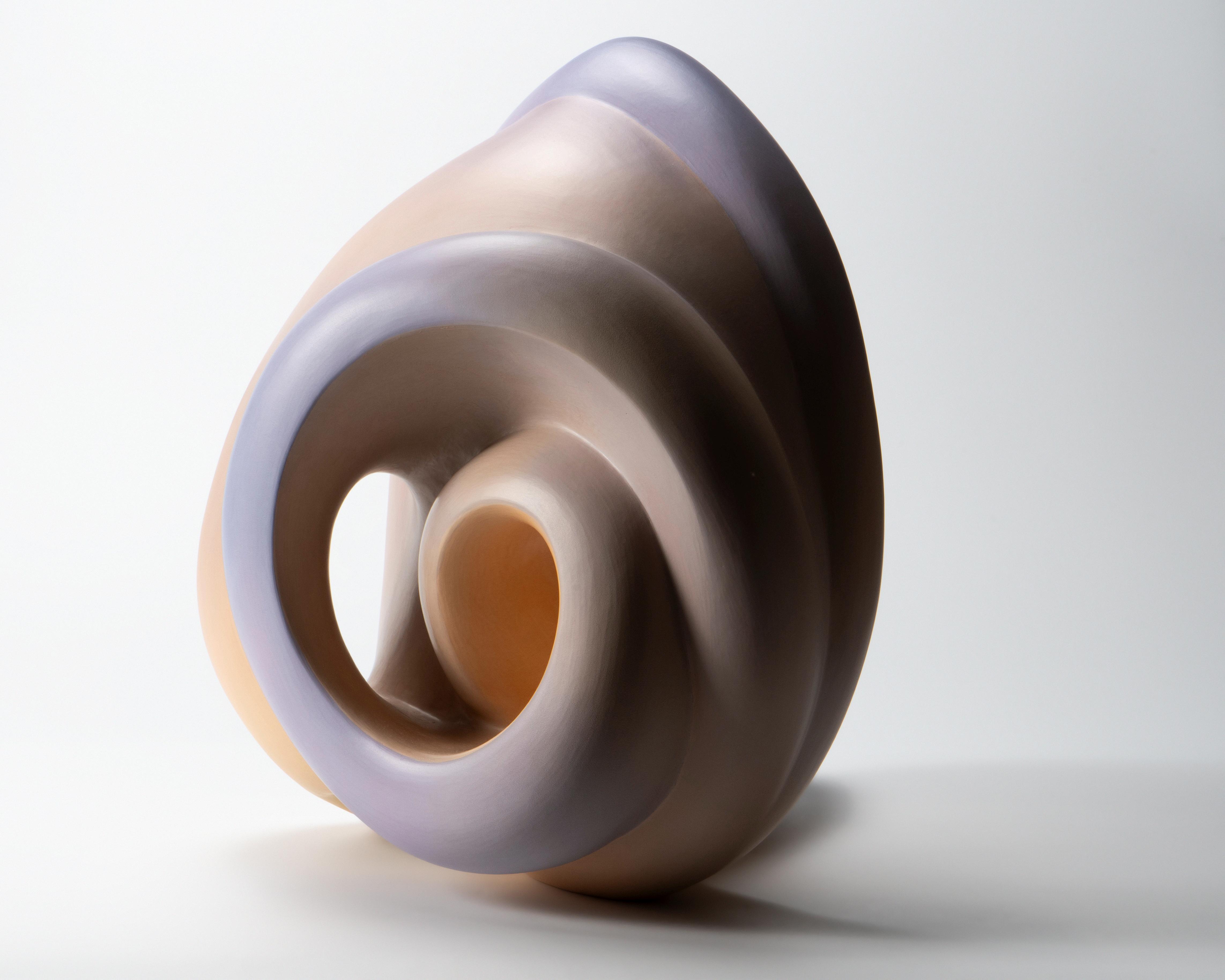
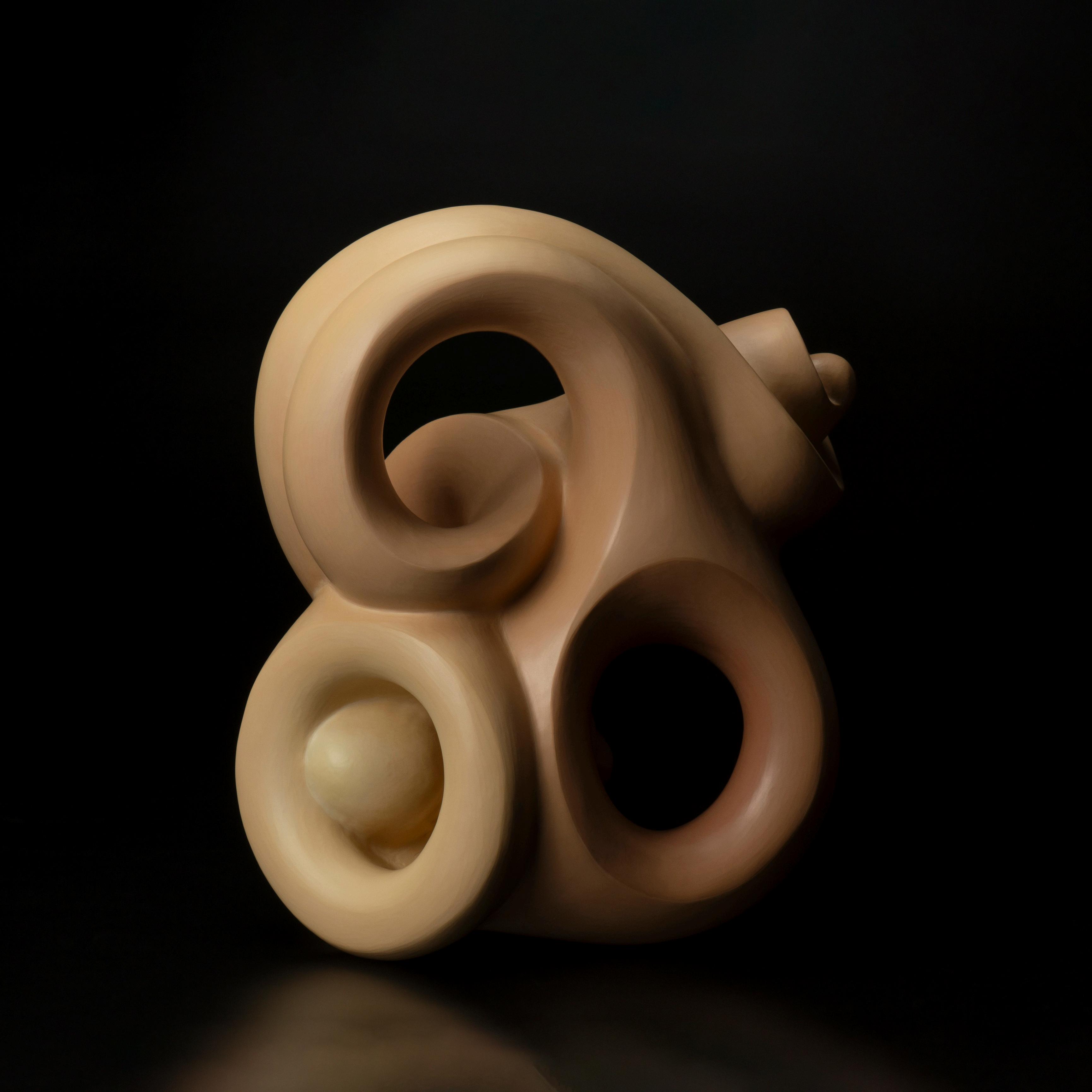
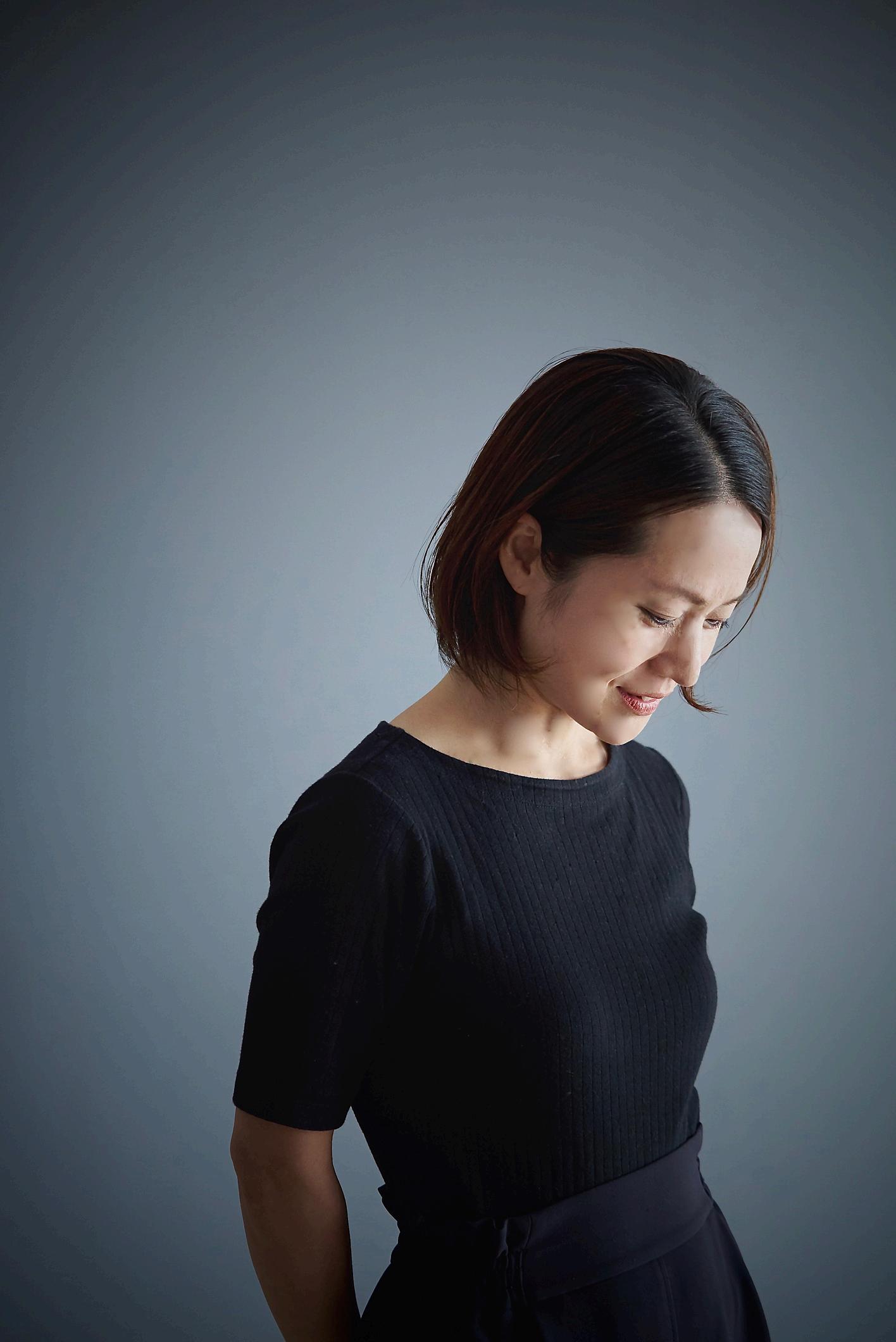
Born in 1958, Shigematsu Ayumi is an internationally celebrated ceramic artist who is part of a pioneering generation of post-war Japanese women artists After studying at Kyoto University of Arts under Sodeisha pioneer Suzuki Osamu 鈴⽊ 治 (1926-2001), she eventually became one of the first few women professors of ceramics at her alma mater Suzuki’s sculptural, organic and abstract influence is evident, yet Shigematsu’s approach is tactile and intuitive, allowing the natural weight and pull of wet clay to shape her creations Her work embraces formal tension by juxtaposing a delicate pastel palette with bold, abstract forms, diverging from traditional aesthetics in Japanese pottery that express the aesthetic principle of wabi, which embraces imperfection and restraint Rather than adhering to the notion that clay should only express its own raw qualities, she challenges this concept through a simple principle: that clay does not have to look like clay
Her works take formal inspiration from Japan’s Jomon heritage, reinterpreting elements of Suien (smoke) and Kaen (flame) ceramic wares. Rounded loops, lugs, and handles, along with the organic, curved forms of these archaeological ceramics, treasured in museums across Japan, emerge in large-scale sculptures that fold over one another At the same time, by referencing the sensuous body, she reimagines the body as the vehicle through which histories are embodied In an interview with the artist, she states:
“In my work, I explore abstract forms that can be achieved solely through the medium of string-making ceramic modeling. This involves utilizing the foundational elements of the bracelet pattern The continuous inner and outer structure evokes an image of a “Calvin Klein perfume bottle,” with holes as the basic elements. On the other hand, the tubular structure also serves as a metaphor for progress, growth while also evoking associations with the human body The holes at the openings also give the impression of sensory organs, akin to those of swallowing, speaking, and hearing, mirroring the role of the human mouth and ears as conduits between the external and internal realms ”
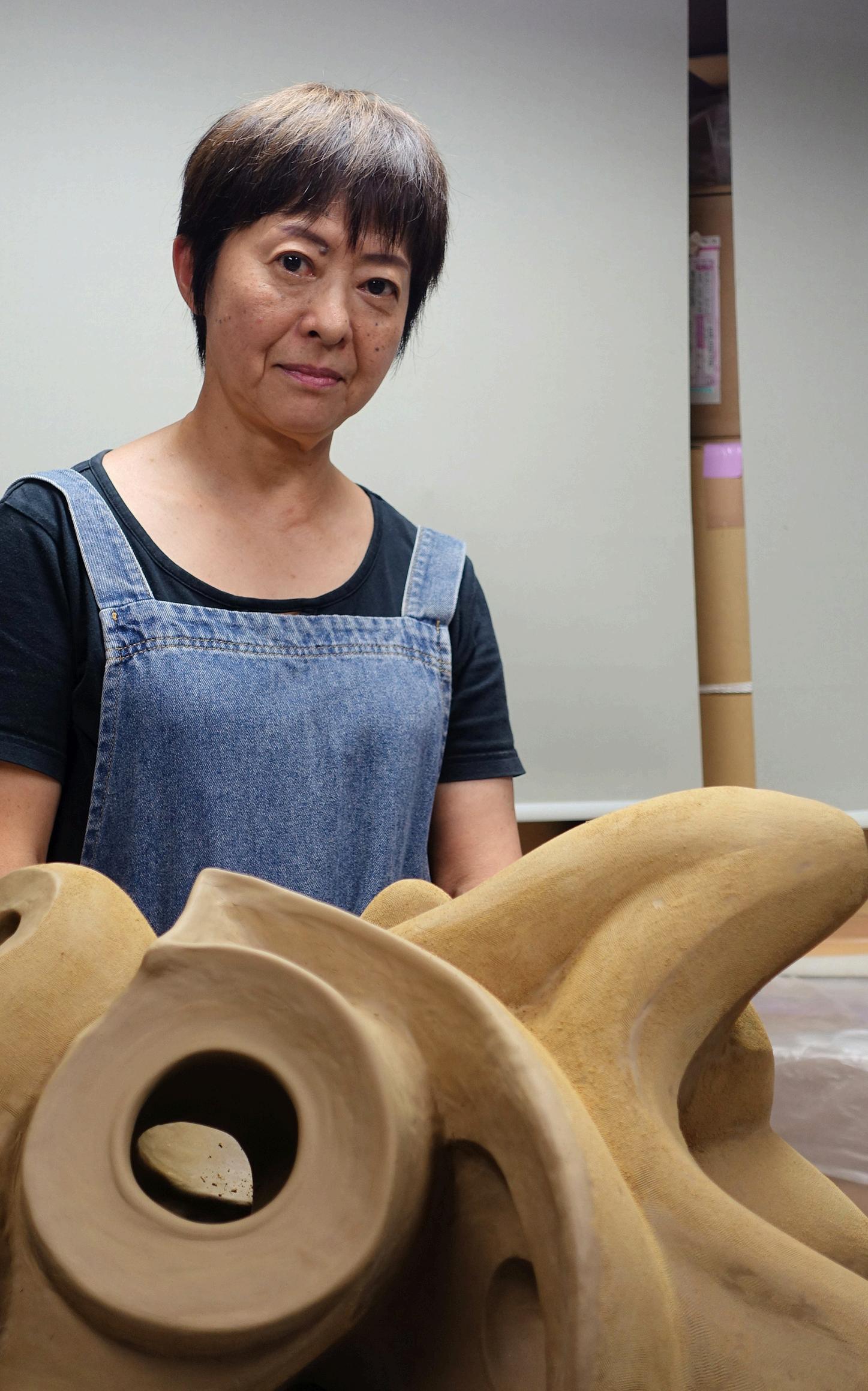
Shigematsu Ayumi in her studio, photographed in 2023
Shigematsu Ayumi 重松 あゆみ
Sculpture, Yellow Jomon, 2018, stoneware
12 7 × 11 0 × 10 4 in (32 5 × 28 × 26 5 cm)
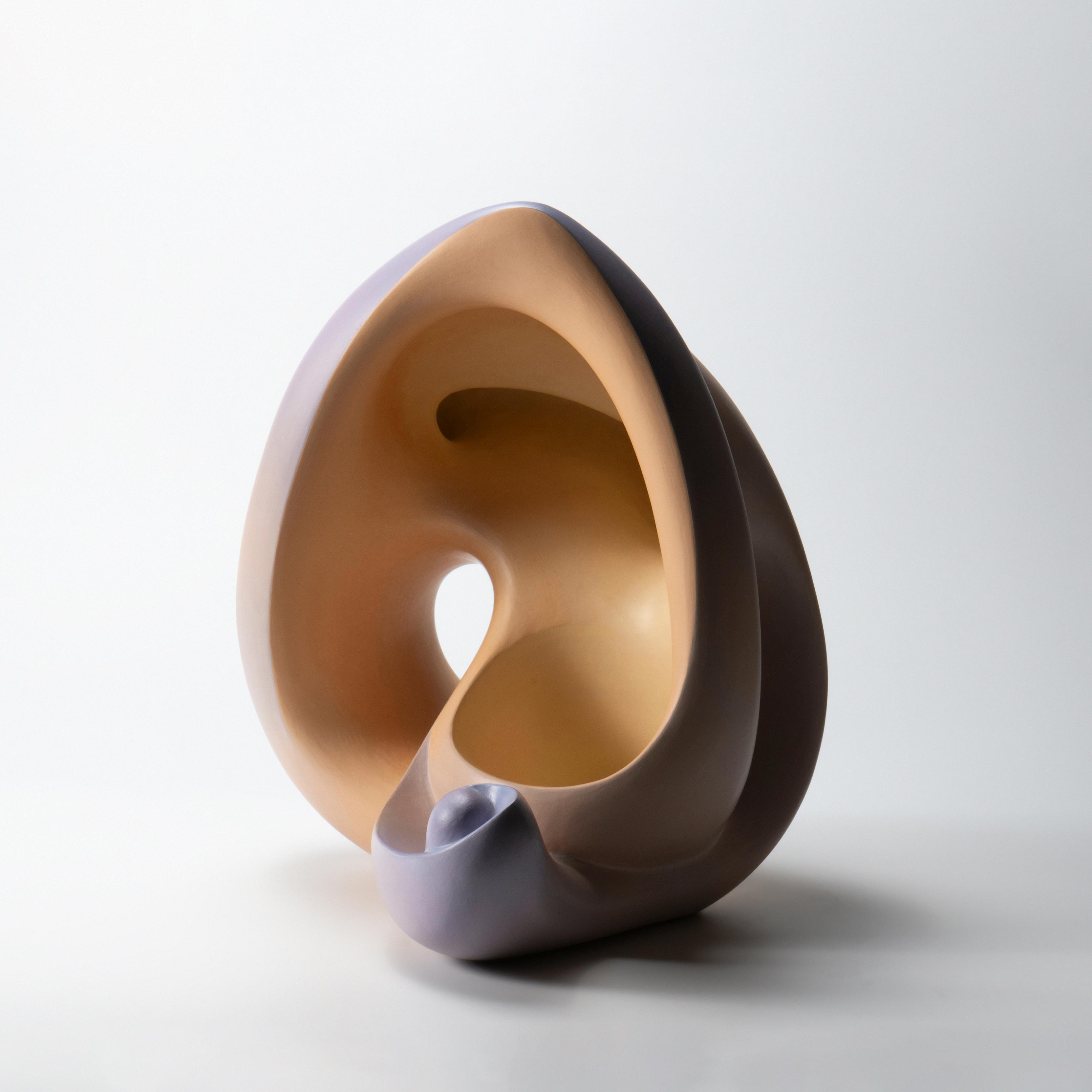
Shigematsu Ayumi 重松 あゆみ
Sculpture, Jomon spiral, 2015, stoneware 14 5 × 12 5 × 13 9 in (37 × 32 × 35 5 cm)
S H I N G U S A Y A K A 新 宮 さ や か
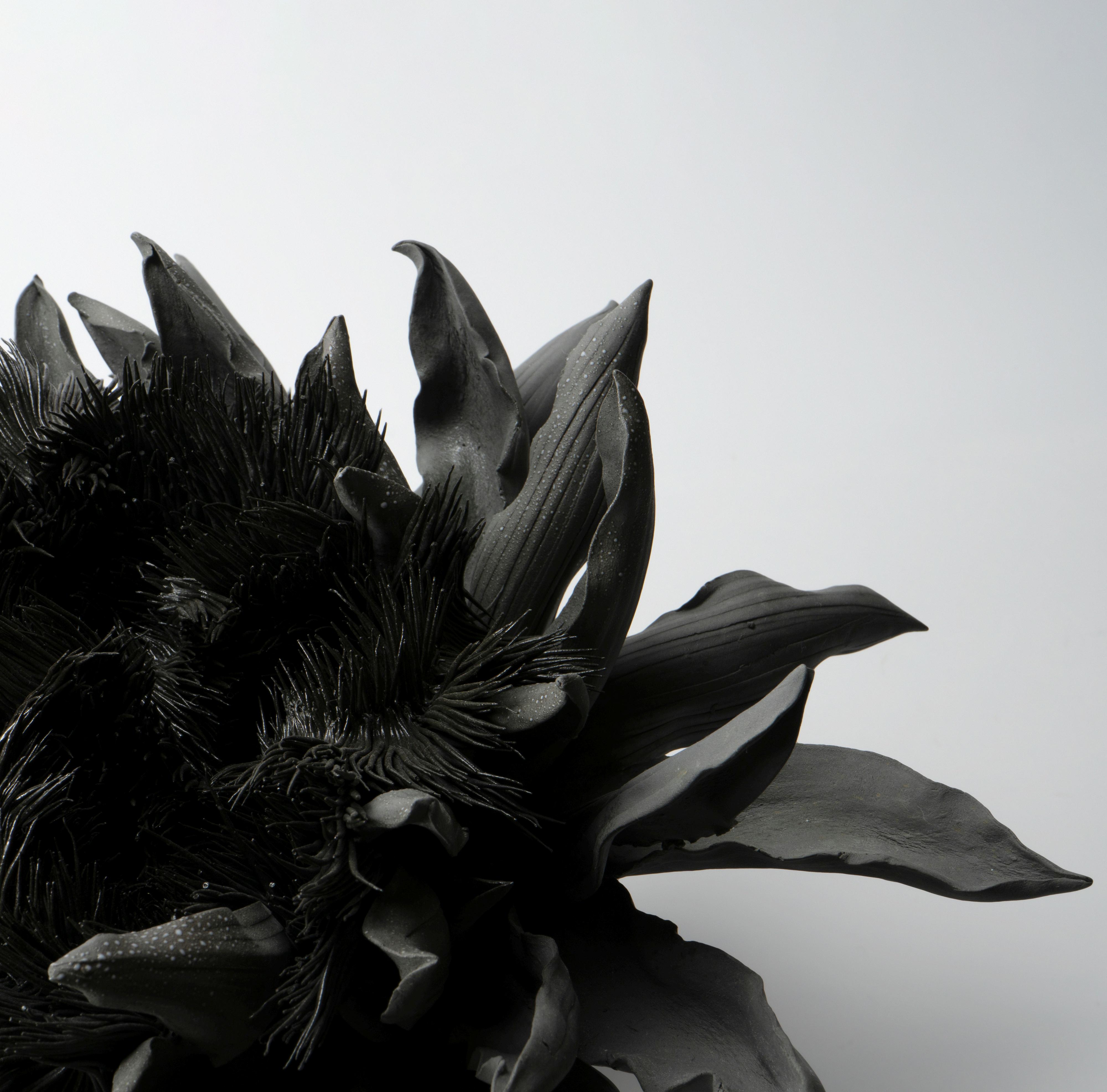
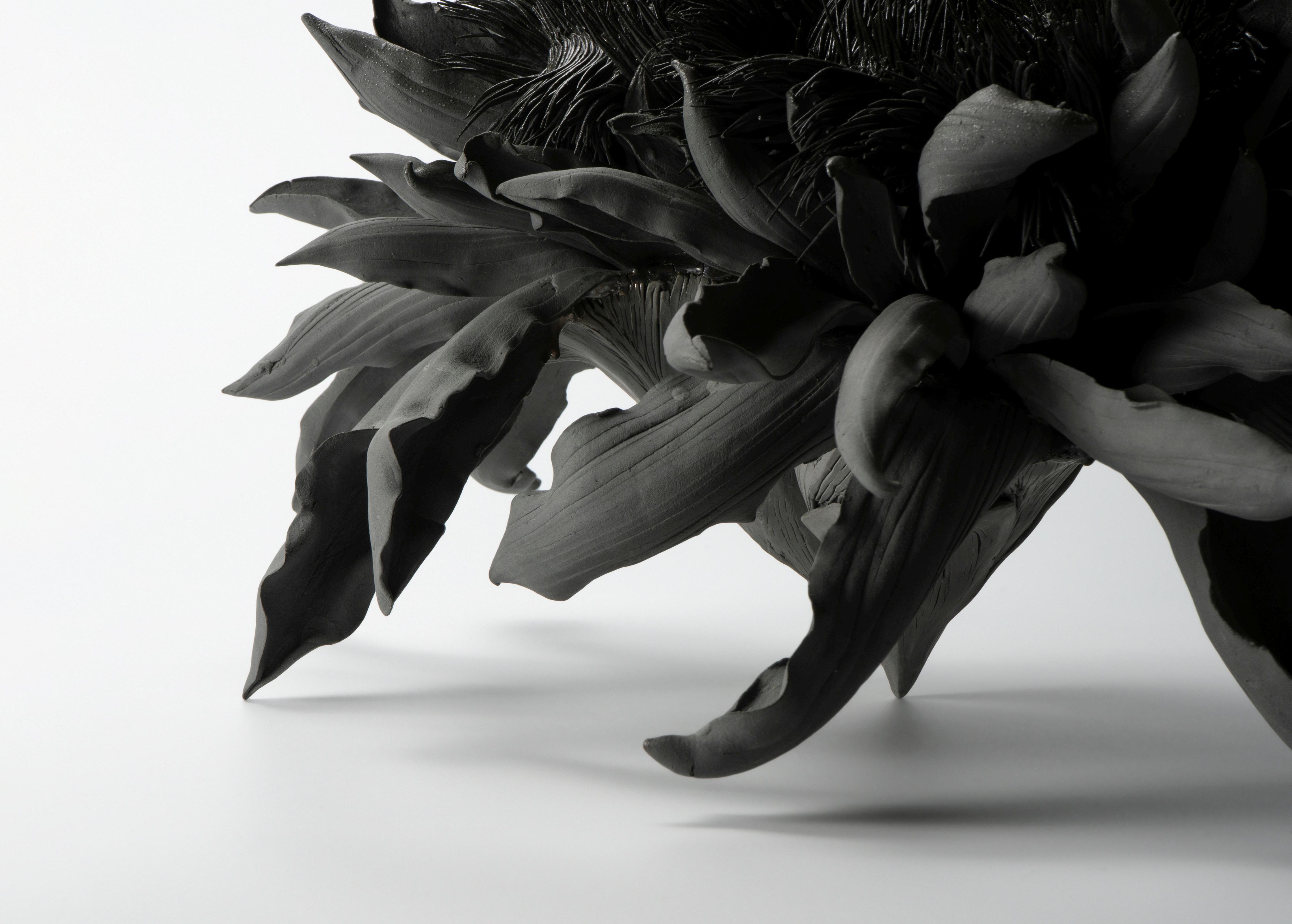
Shingu Sayaka (born 1979) is a contemporary ceramic artist based between Kyoto and Osaka After having graduated from the Osaka University of Arts in 2003, she joined an apprenticeship program at the Shigaraki Ceramic Cultural Park in Shiga, Japan, where she was deeply moved by the work of contemporary ceramic artist, Sugiura Yasuyoshi (b 1949) Her work is perhaps most celebrated for her meticulous, hand-built ceramic works in monochromatic naturalistic forms, particularly for her sculptures of cut flowers, which are constructed from mixed clay with slip and glaze using intricate hand building and glazing methods that embody great care and restraint in her craft.
Shingu’s sculptures showcase an extremely meticulous process, entirely hand-built from clay At first glance, it's hard to believe the pieces are made of ceramic, as they evoke the realism of a cut flower, invoking the image of morning dew on silvery glazes on the petals, as well as the tiny pistils of a flower in bloom In her vessels, thin slabs of pigmented clay fold and overlap, often edged with several delicate strands of fired clay that extend outward in fine, tapering filaments, as in the pistils of her ceramic sculptural flowers These tendrils gather and part like a soft, fibrous fringe, evoking shifting textures as if the vessel were gently breathing or just beginning to unfurl Her works walk the line between permanence and impermanence: while ceramic, by nature, is fragile and brittle, the flower it portrays remains eternally pristine and unwilting
Her work has received significant attention and awards, including selection for the 42nd Asahi Ceramic Art Exhibition and exhibitions at the Art Institute of Chicago, Kyoto Arts and Crafts Biennale (The Museum of Kyoto), The Portland Art Museum, and more
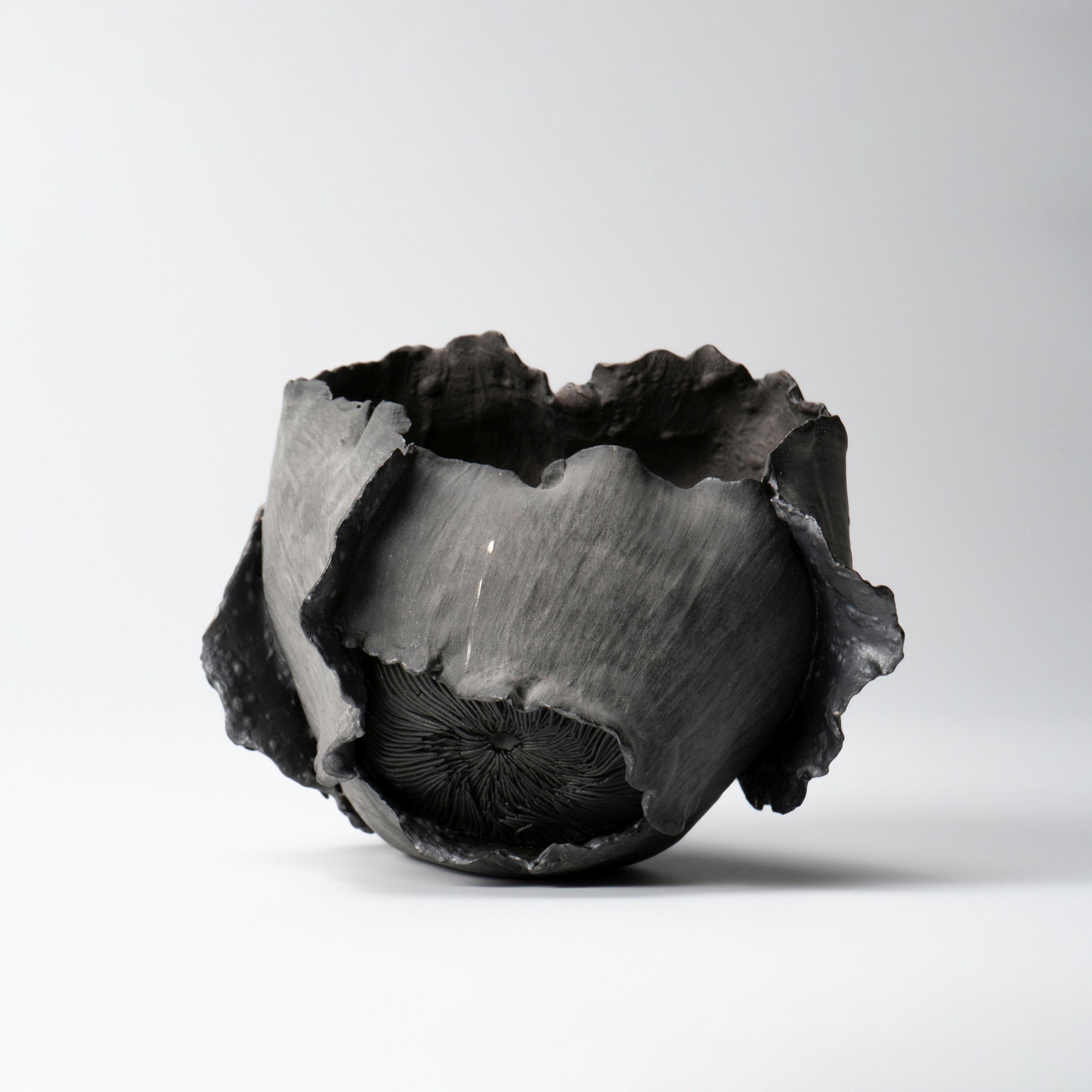
Shingu Sayaka 新宮 さやか
"Calyx" bowl, with signed wood box, mixed clay with glaze slip
4 1/8 × 5 3/8 in. (10.4 × 13.7 cm)
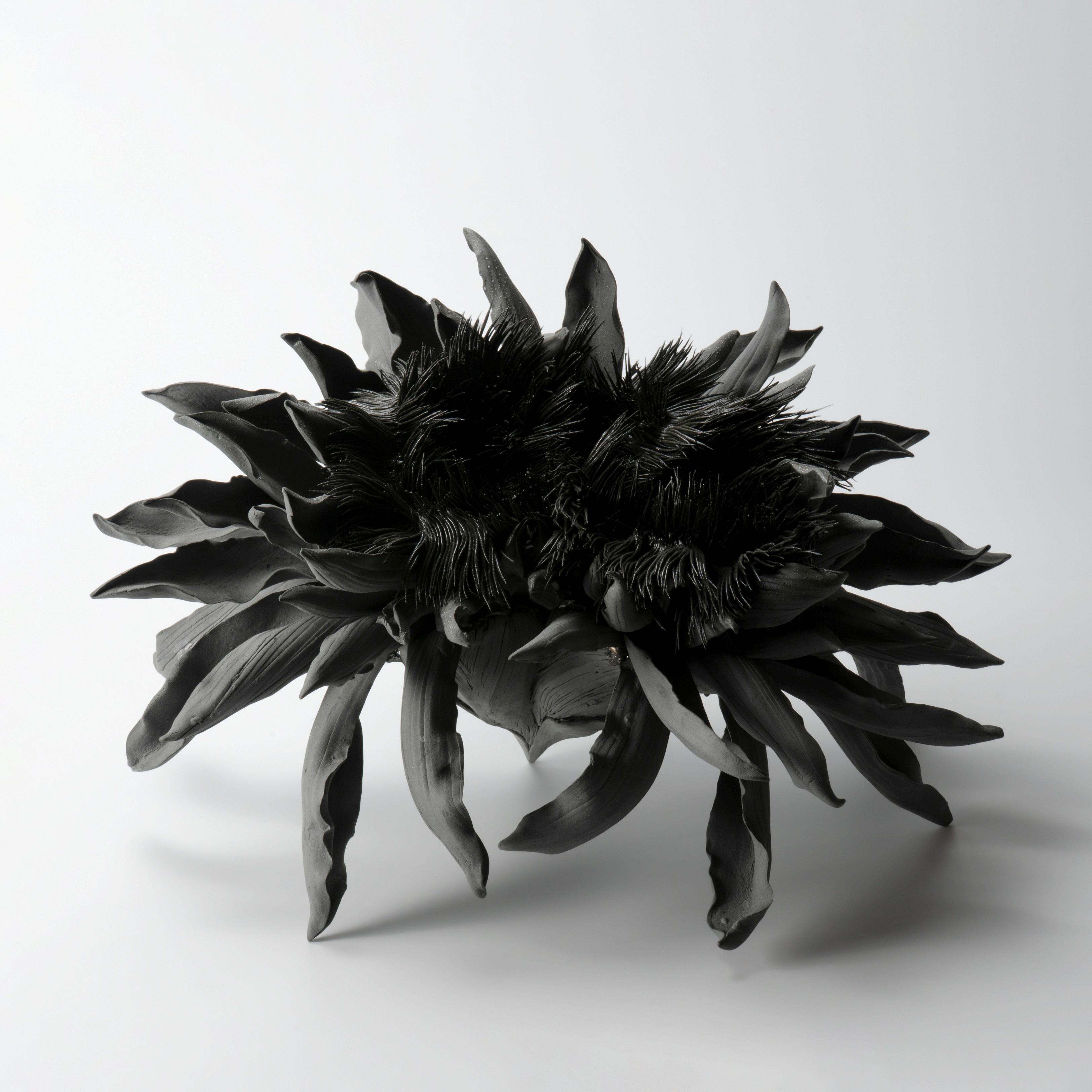
Shingu Sayaka 新宮
Sculpture, Erosion '22 -2, 2022, mixed clay with glaze and slip 9 1/2 × 14 15/16 × 14 1/2 in (23 5 × 38 × 37 cm)
H I R U M A K A Z U Y O 昼 馬 和 代
Semi-autobiographical in nature, Hiruma Kazuyo (b. 1947)’s ceramic practice is best known for their slab-built forms that evoke geological landscapes and natural phenomena This distinctive visual language emerged after a transformative journey to Arizona in the late 1980s, a place she had previously encountered only through photographs. During a two-week stay, the desert terrain profoundly altered her artistic direction:
“Dark brown earth, dry sand and wind on my cheeks, row upon row of surf-like forms that seemed to have been pulled from Earth’s core, concealing the processes by which living creatures had come down to the present: a testament to life transported from beyond a now-invisible ocean, a uniformly skin-toned landscape that makes us doubt our importance as denizens of this world. After offering up a prayer to the gods that our ancestors once worshipped on this very spot, I took my leave ”
Excerpt from a 2024 interview with the artist conducted by Joe Earle, curator and specialist of Japanese art.
This revelatory experience led Hiruma to develop her internationally celebrated series such as Kioku suru Daiichi (Memories of the Earth) and Suibun ni kansuru kioku (Memories of Water), which have since become central to her oeuvre. Unlike some contemporary women ceramic artists who describe their engagement with clay as a dialogue with the material’s inherent unpredictability, Hiruma approaches the medium with deliberate control and precision She formulates her own clay mixtures, carefully adjusting tones ranging from flesh-like hues to dry mineral grays To evoke the slow passage of geological time, she applies multiple thin layers of heat-resistant clay, creating stratified, wave-like surfaces that emerge through repeated glazing and firing processes
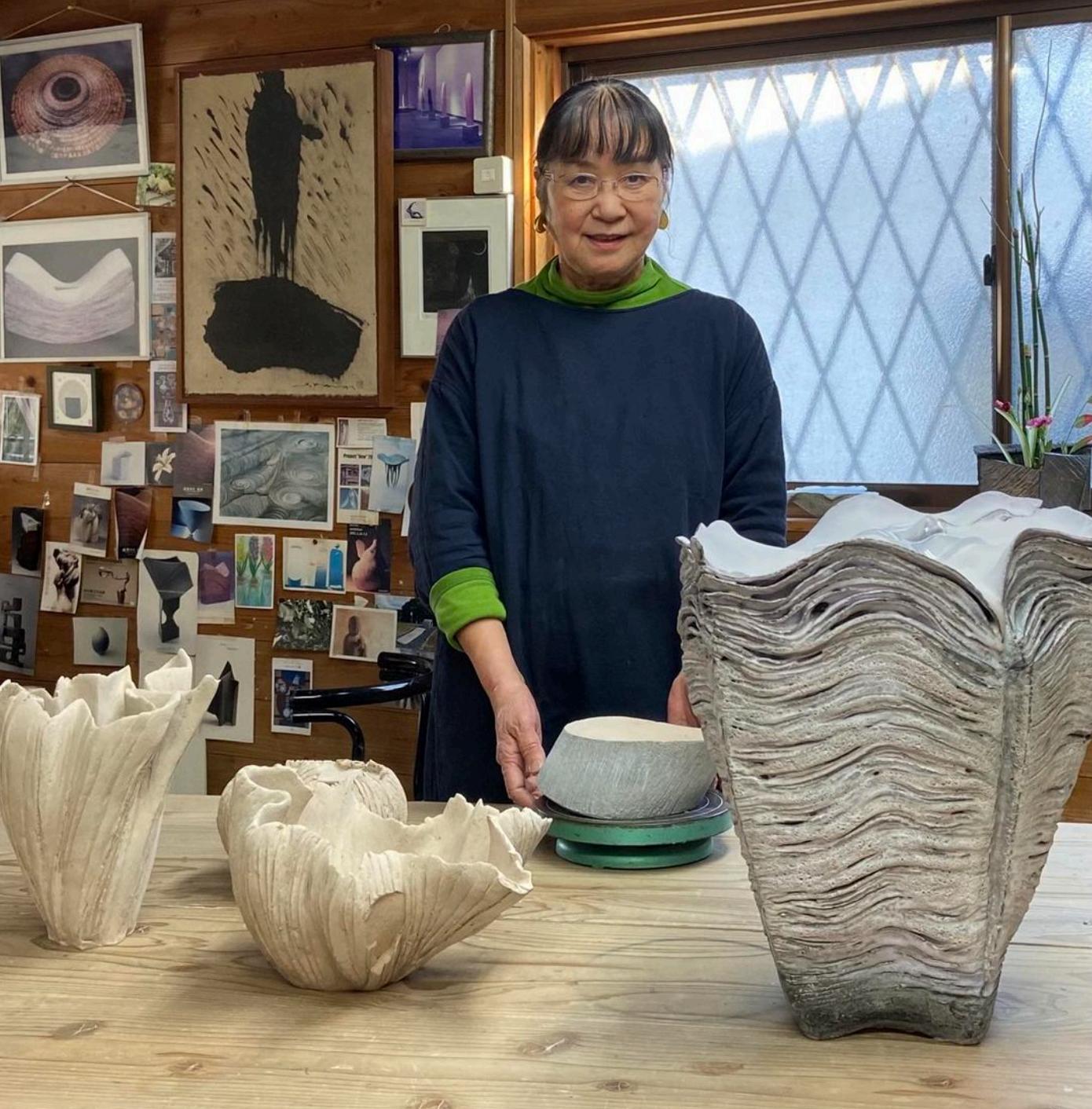
Hiruma Kazuyo in her studio workspace, 2024
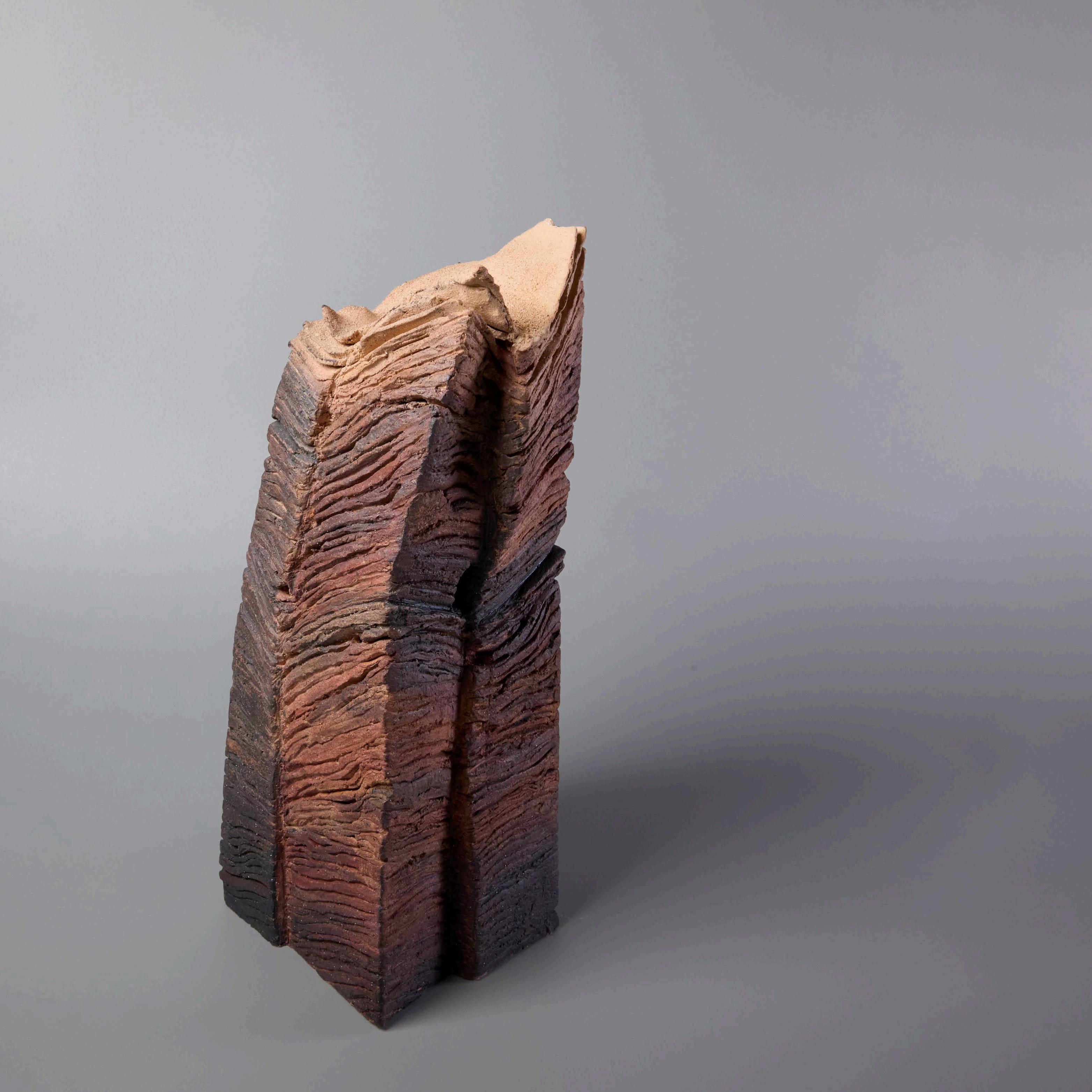
Hiruma Kazuyo 昼⾺ 和代 Fortress at dusk ⼣暮れの砦, 2026, with signed wood box, stoneware 15 3/8 × 8 7/8 × 5 7/8 in (39 × 22 5 × 15 cm)
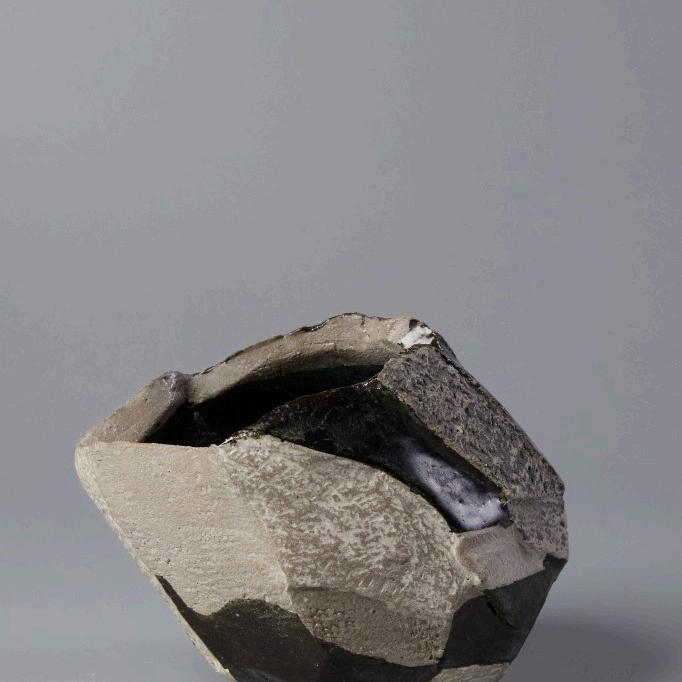
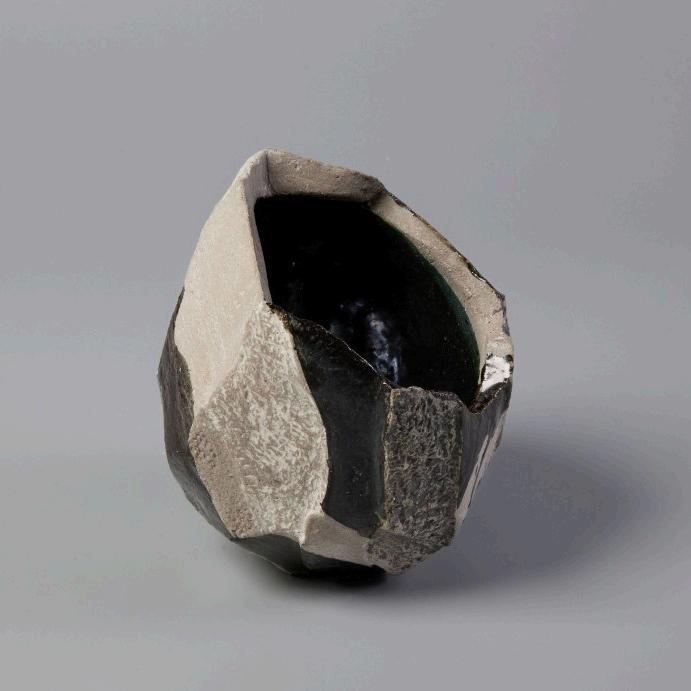
Hiruma Kazuyo 昼⾺ 和代
Flower vessel, 2026, with signed wood box, stoneware
4 3/8 × 5 3/4 × 5 1/4 in. (11 × 14.5 × 13.5 cm)
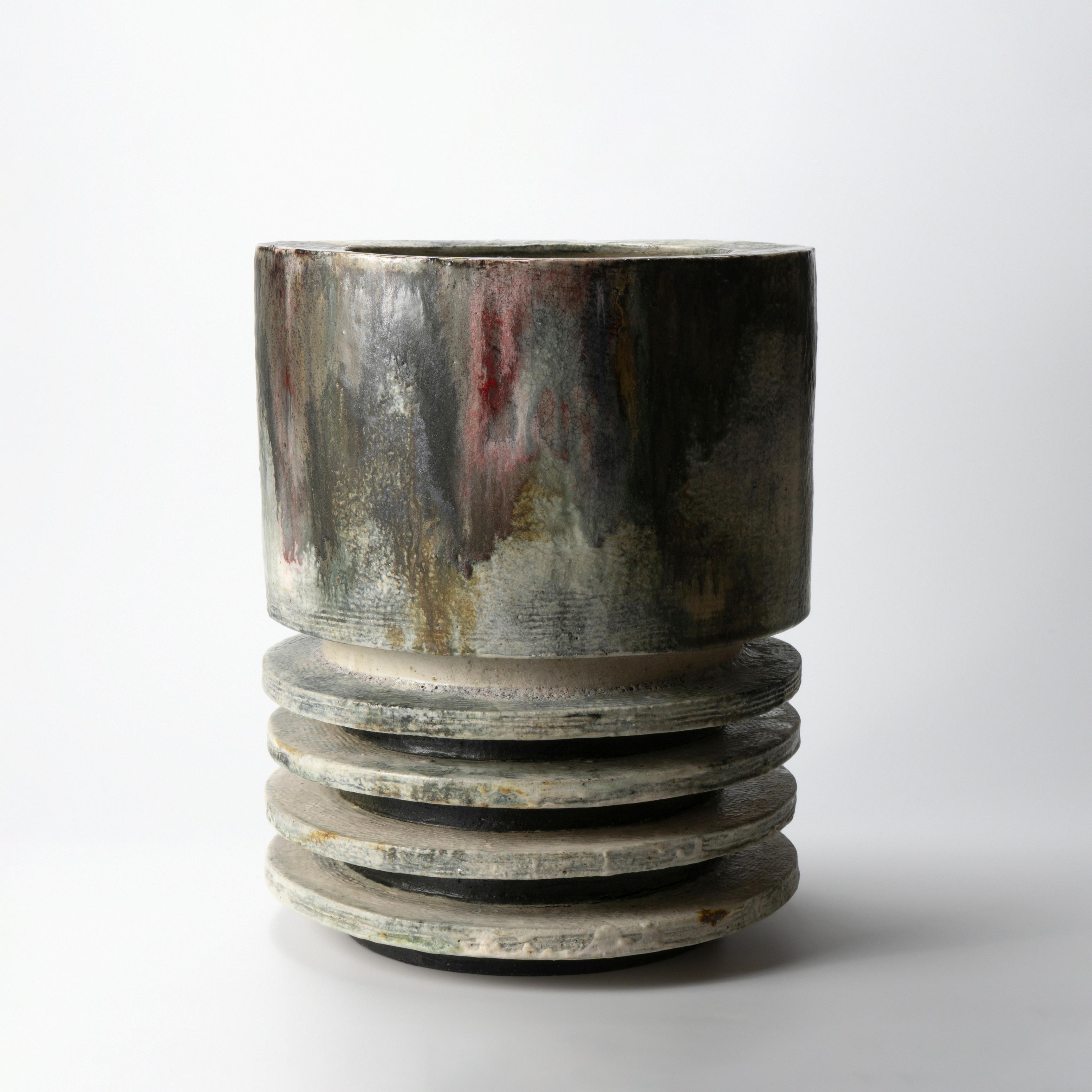
Sculpture, TOWA 2, 2026, with signed wood plate, stoneware
16 1/8 × 13 in (41 × 33 cm)
Usami Shuri 宇佐美 朱理
U S A M I S H U R I 宇 佐 美 朱 理
Ceramic making is deeply tied to decision-making, with each choice permanently preserved in the final fired form, accumulating the artist’s own experiences in making This aspect of the medium is especially meaningful to Usami Shuri (b 1980), an award-winning artist who trained under two celebrated figures whose practices embody distinctly different ceramic traditions: Hayashi Kaku 林 ⾹ 君 (b 1953) and the acclaimed Living National Treasure Miura Koheiji 三浦 ⼩平⼆ (1933–2006)
Usami’s vessels comprise particularly compelling surfaces, allowing for richly layered expressions that embody the passage of time Their surfaces, created via sgraffito and gradual layers of slip built upon one another, resemble urban concrete walls marked over time: moss, human hands, graffiti, and the residue of lived experience In this way, her works reward slow-looking The longer one gazes, the more elusive forms and abstract impressions begin to emerge from the surface, as though the vessel’s history had been partially obscured by the passage of time and the accumulation of countless accumulated layers of strata. This emergent experience mirrors our own memory and more precisely, recollection This embodiment of temporal depth in her vessels, are fact, the singular result of a series of incredibly successful glazing and firing.
In 2024, the Kikuchi Kanjitsu Memorial Tomo Museum in Tokyo hosted its 10th biannual ceramic competition. Among its awardwinners was a vessel by Usami, from her “TOWA” series of vessels On this series, Usami reflects on her work:
“Through the firing process, irreversible marks are inscribed, and between accident and control, surfaces emerge that resemble memory itself I am drawn to the boundaries where inside and outside, light and shadow, hope and pain, life and ending coexist simultaneously ”
Memory unfolds across Usami’s surfaces, recording countless traces of the artist’s hands and decisions She expands on this idea further in her work, noting that even “imperfection, fluctuation, and distortion are things I wish to affirm as evidence of having lived.”
After graduating from Bunsei University of Art
(Bunsei geijutsu daigaku), where she later became a full-time lecturer and instructor, Usami has steadily gained prominence within Japan’s contemporary ceramic landscape Her vessels are materially innovative, featuring experimental glaze applications shaped by the making process itself The two works presented in this exhibition reinterpret the form of the traditional Japanese wooden potter’s wheel through a contemporary lens, recalling the history of Japanese ceramic technologies and the gradual mechanization of pottery tools in modernity
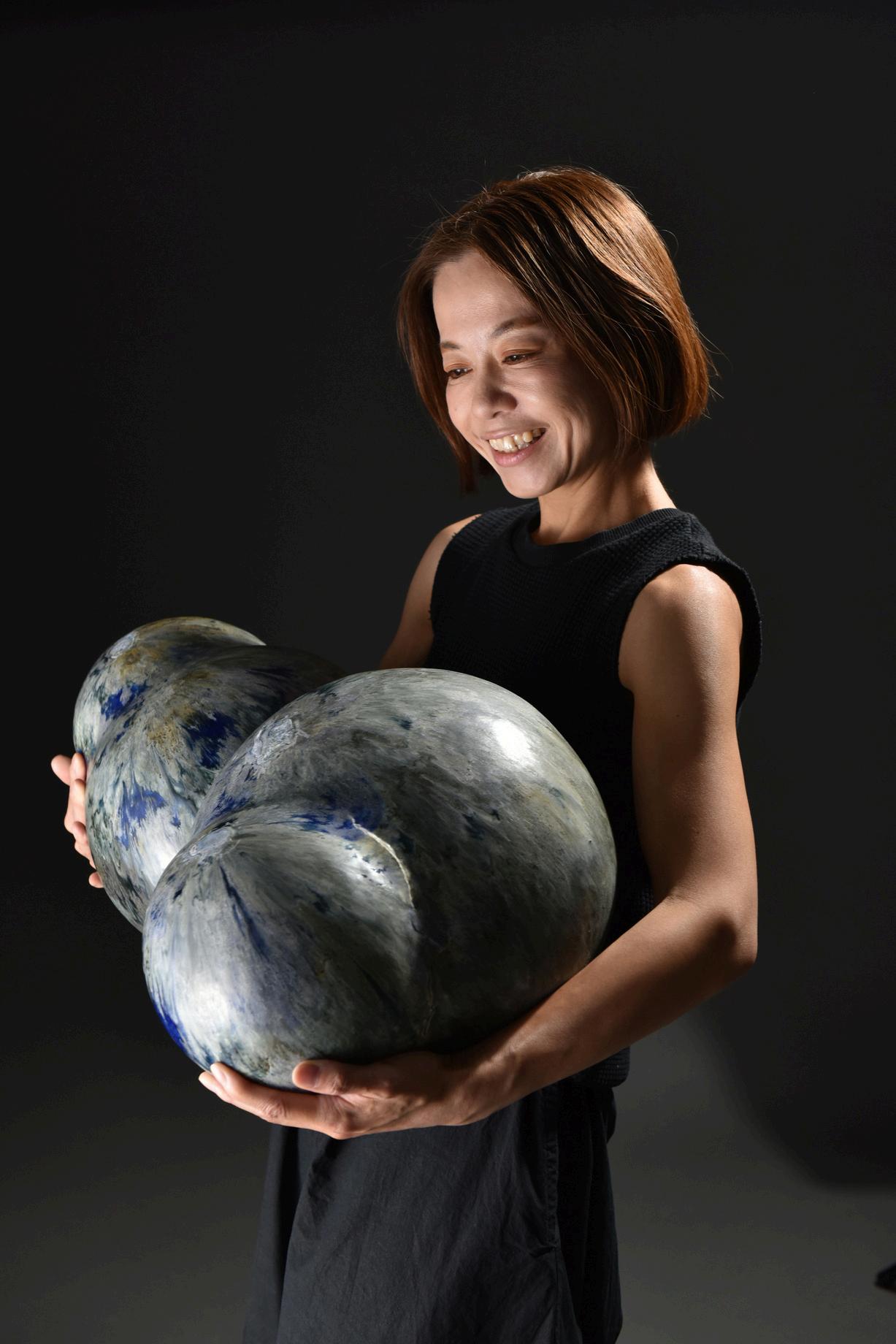
Portrait of Usami Shuri, 2025 Image courtesy of the artist
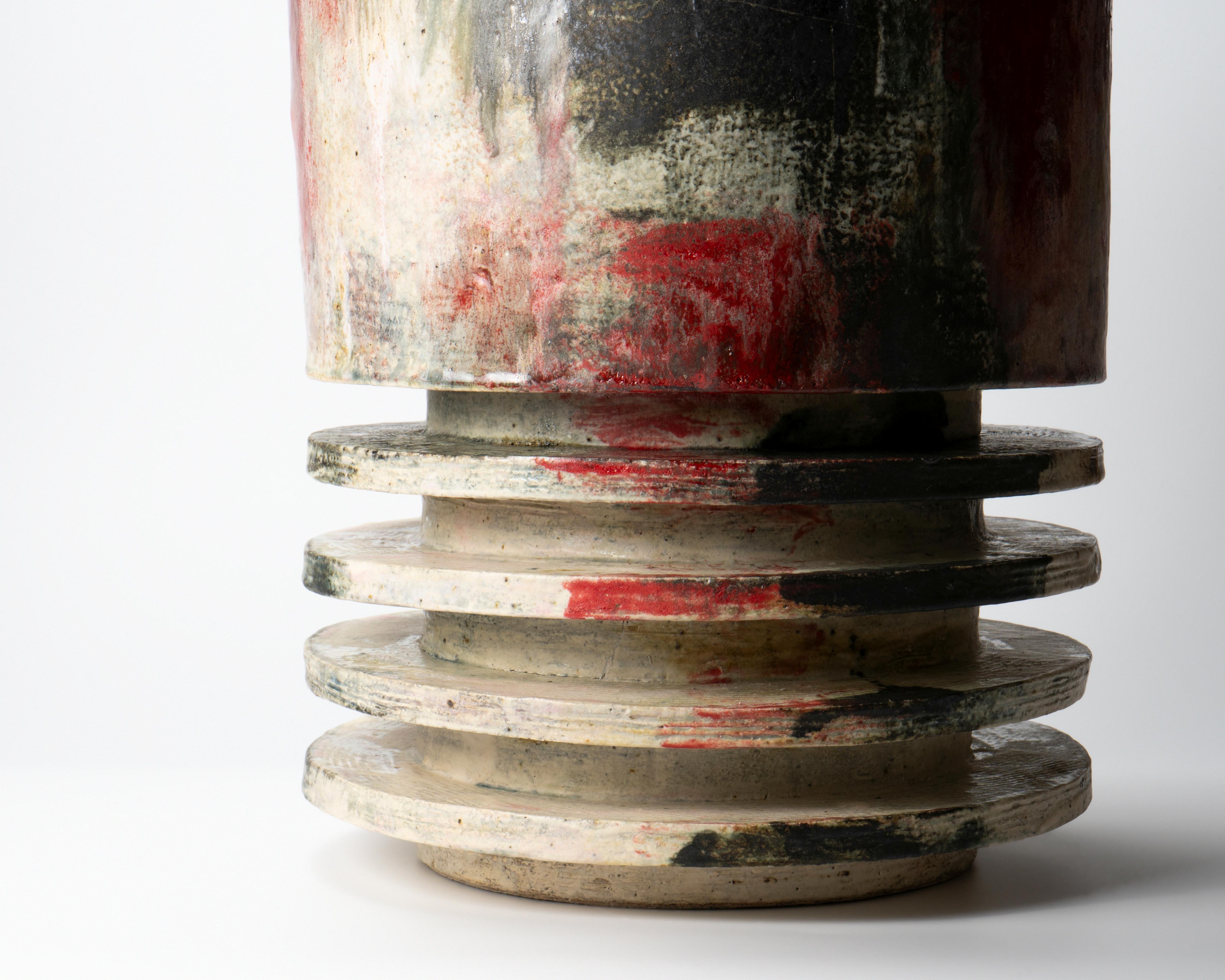
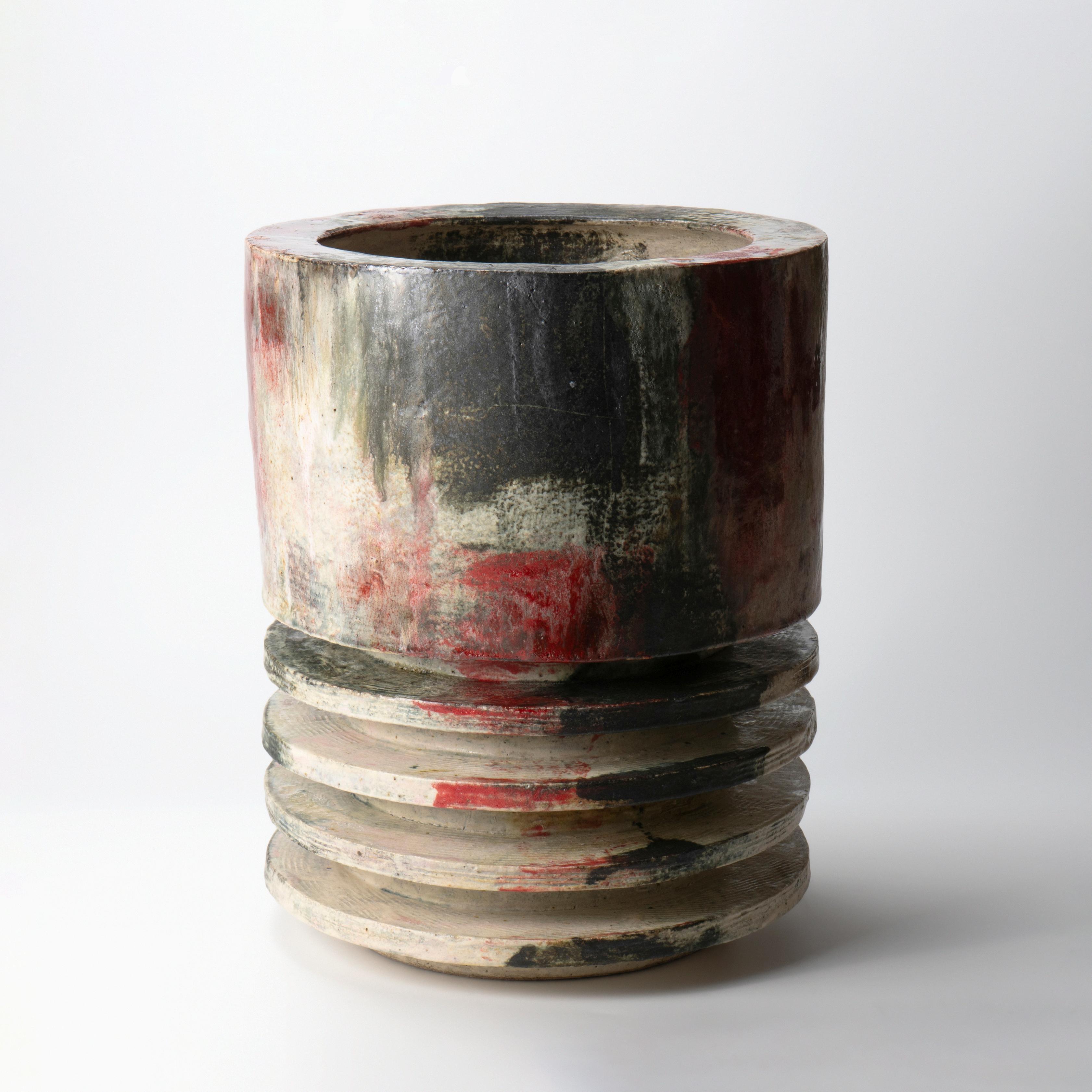
Sculpture, TOWA 1, 2026, with signed wood plate, stoneware 16 1/8 × 13 in (41 × 33 cm)
Usami Shuri
大 石 早 矢 香
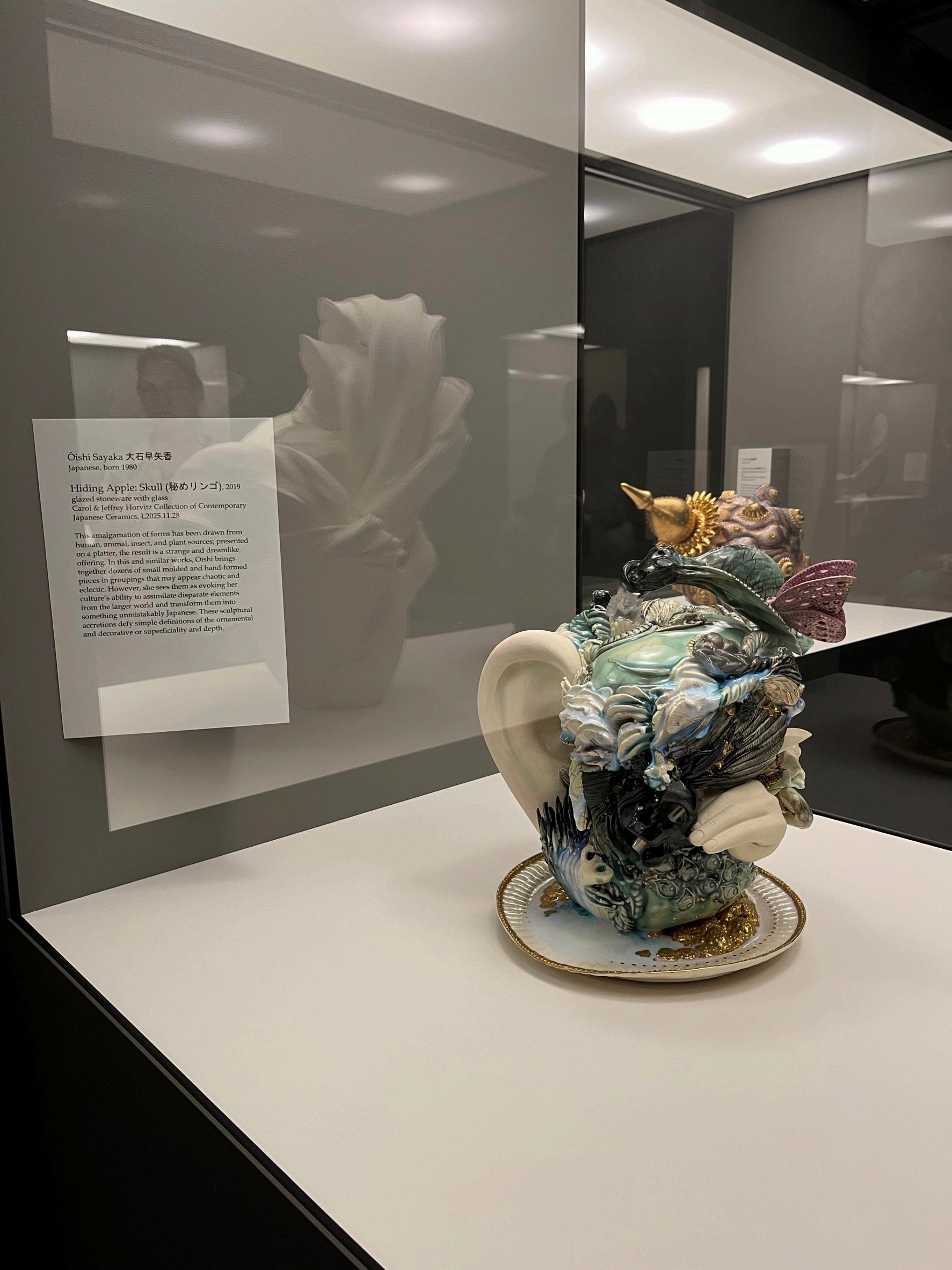
After receiving her BFA from Kyoto University of the Arts in 2003, Oishi Sayaka (b 1980) has developed a richly maximalist visual language to create fantastical ceramic surfaces across both sculptural and functional vessel forms What may initially appear as a spontaneous amalgam of life forms and fragmented organisms gradually reveals itself as a deeply humanistic expression of life, affirming a sense of coexistence within the natural world Through her vibrant and densely layered compositions, Oishi’s ceramic works conjure entire worlds, instilling in the viewer a palpable sense of empathy and wonder
Oishi’s sculptures evoke the Japanese concept of mono no aware (物の哀れ), often translated as “the pathos of things” or “ a sensitivity to ephemera ” The term reflects an awareness of impermanence (mujō, 無常), the transient nature of life, and a bittersweet appreciation of beauty’s fleetingness Her works embody a quiet, wistful meditation on the passage of time while simultaneously confronting the grandeur of nature with subtle strength Though delicate in appearance, her sculptures possess an unexpectedly commanding sense of scale and presence, echoing nature’s vastness and cyclical rhythms
Centering her practice around “decoration,” Oishi uses ornamentation and surface patterning to express complex, often ineffable emotions, inviting a sense of wonder through every piece.
Among her many achievements, Oishi’s work has been exhibited throughout the United States, including at the Art Institute of Chicago, the Phoenix Art Museum, the Ackland Art Museum, and the Dallas Museum of Art as part of Radical Clay, the traveling exhibition of women artists from Japan drawn from the celebrated Carol and Jeffrey Horvitz Collection
Oishi Sayaka’s “Apple” sculptural series on view in the traveling exhibition Radical Clay; Photographed on view at the Ackland Museum of Art, North Carolina in 2024
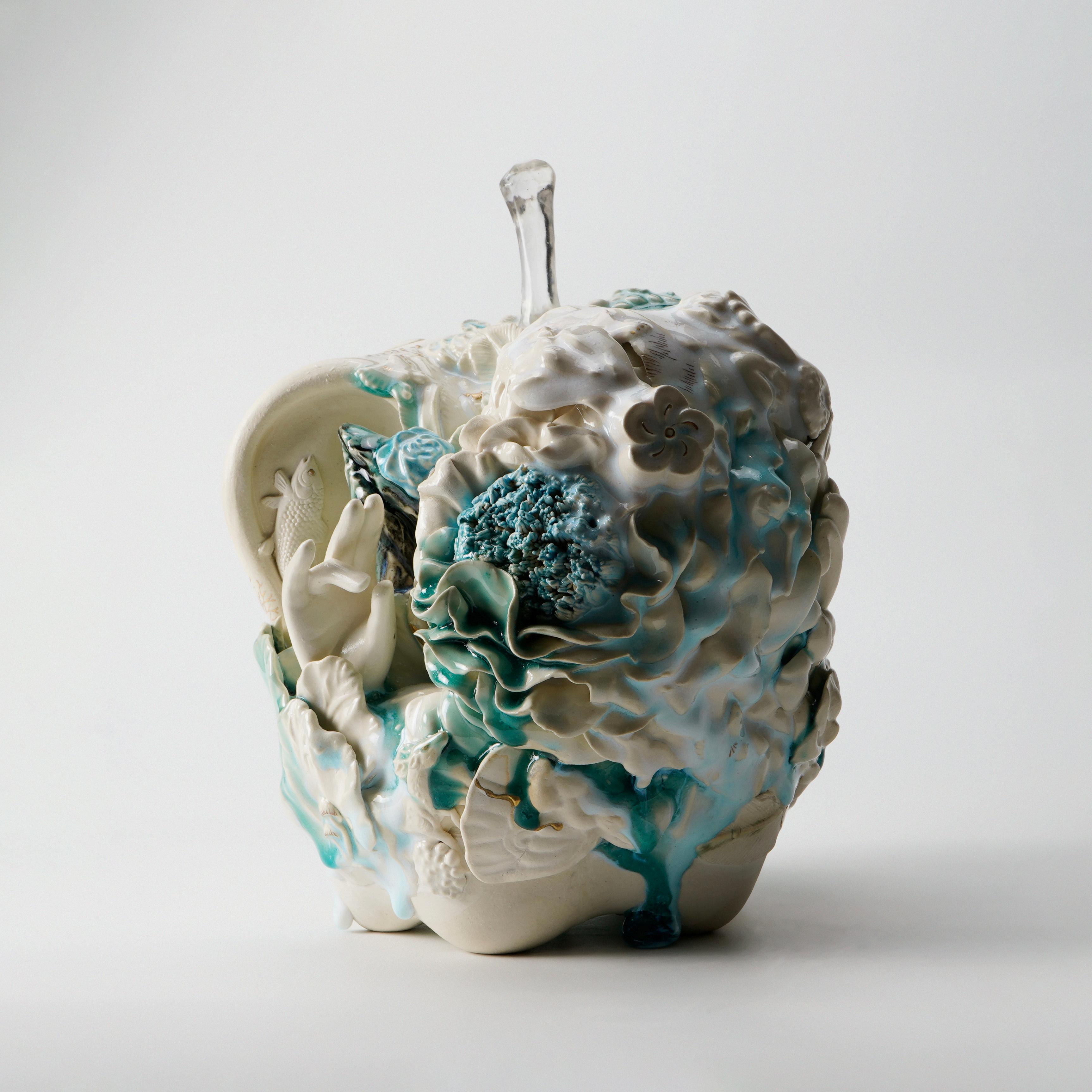
Sensitive apple, flower, 2024, with signed certificate, stoneware, glass 9 7/16 × 7 7/8 × 7 7/8 in (24 × 20 × 20 cm)
Oishi
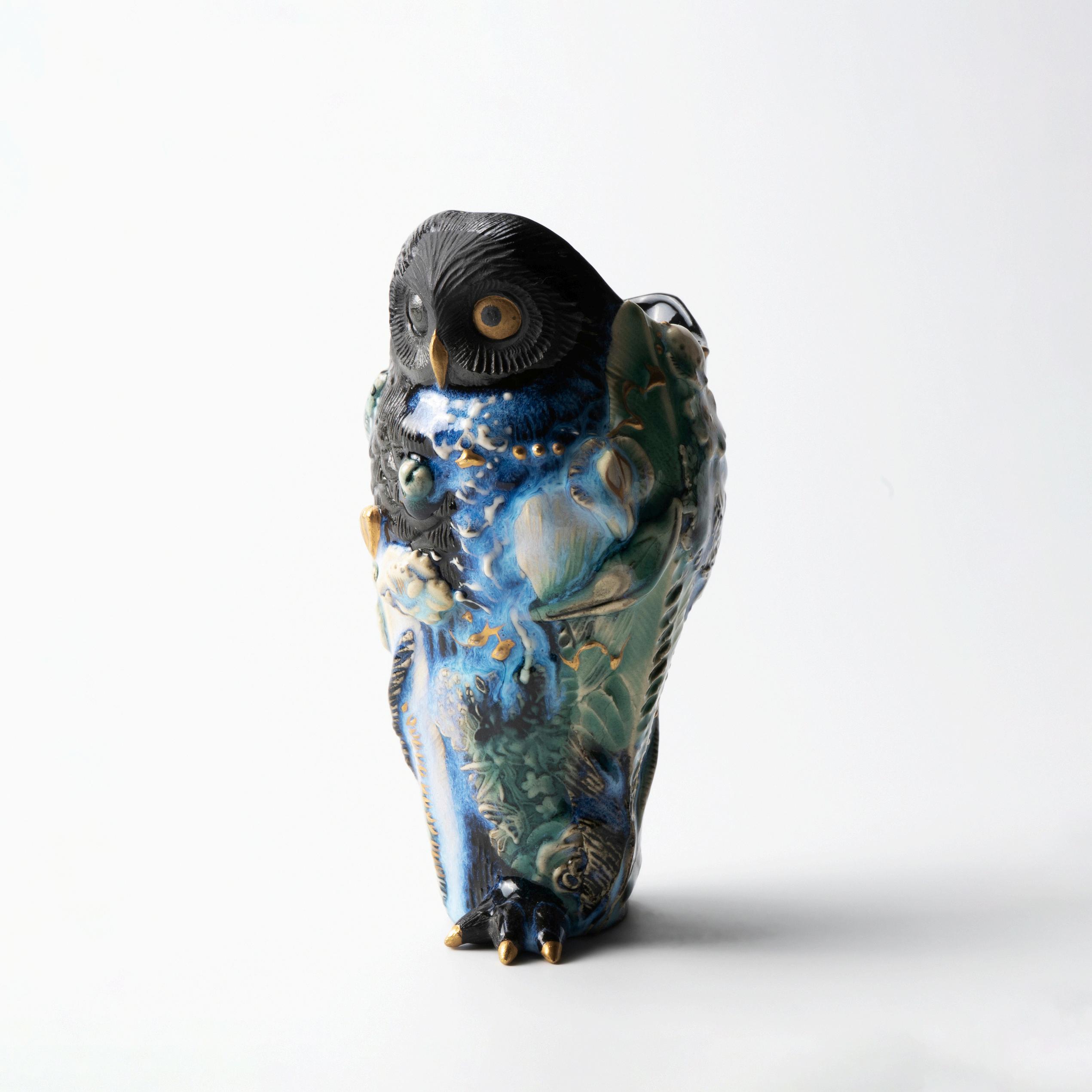
6 1/8 × 3 1/2 × 3 1/8 in. (15.5 × 8.8 × 7.9 cm)
Oishi Sayaka ⼤⽯早⽮⾹
Barry, black, 2021, with signed wood box, stoneware
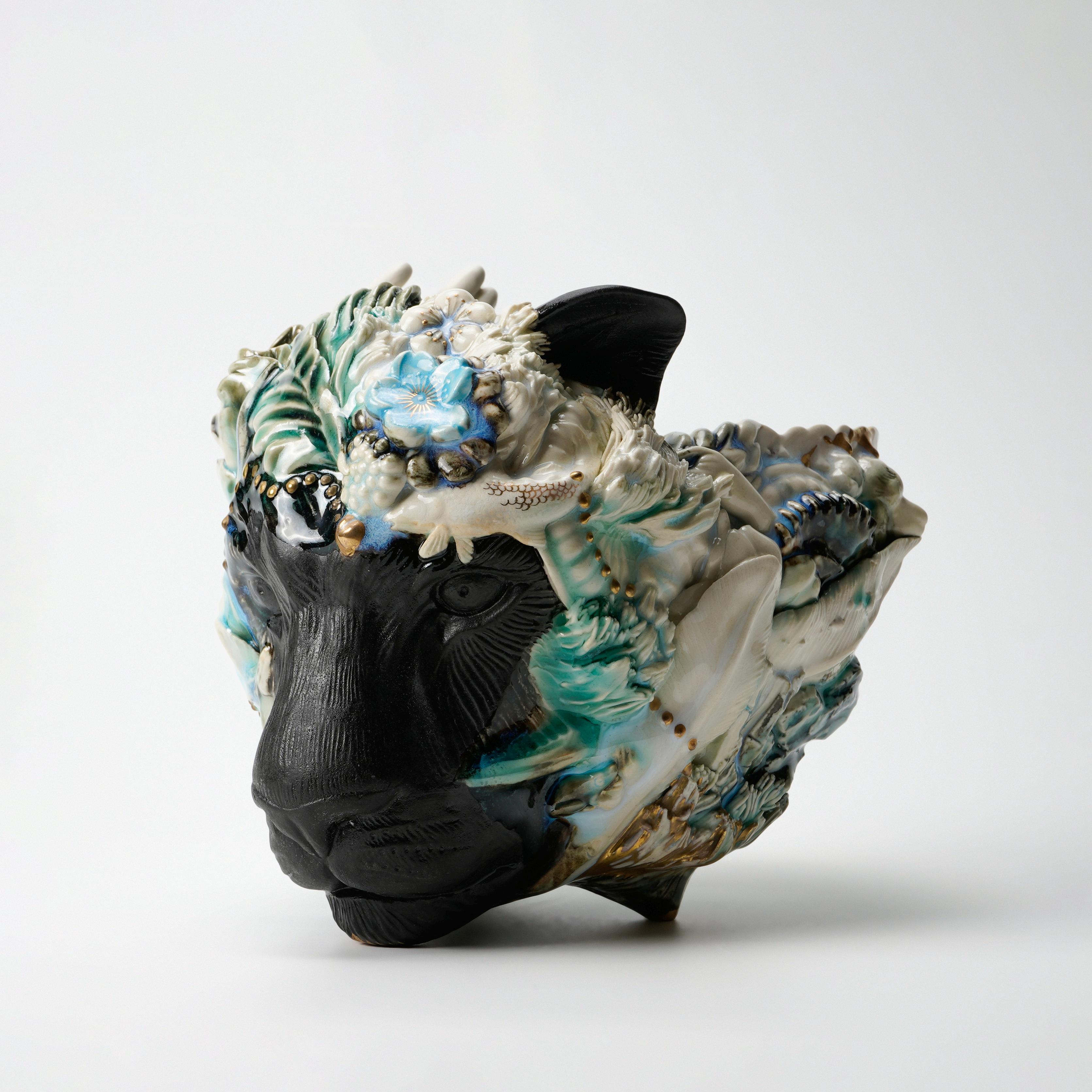
ANIMA bowl (Lion) , 2024, with signed wood box, stoneware 6 1/4 × 7 7/8 × 5 1/2 in (16 × 20 × 14 cm)
Oishi Sayaka
K O Y A M A A T S U K O 小 山 厚 子
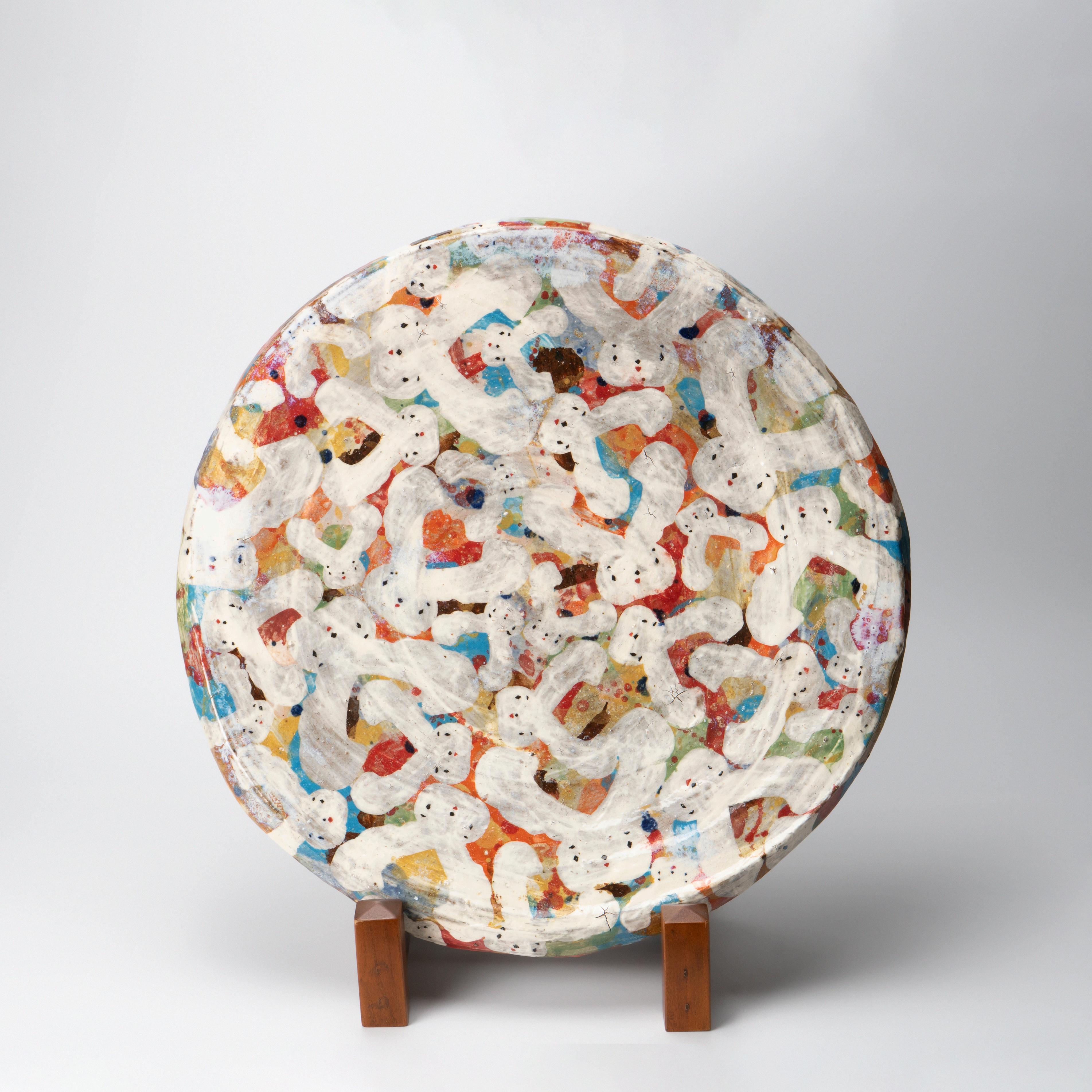
Koyama Atsuko ⼩⼭ 厚⼦
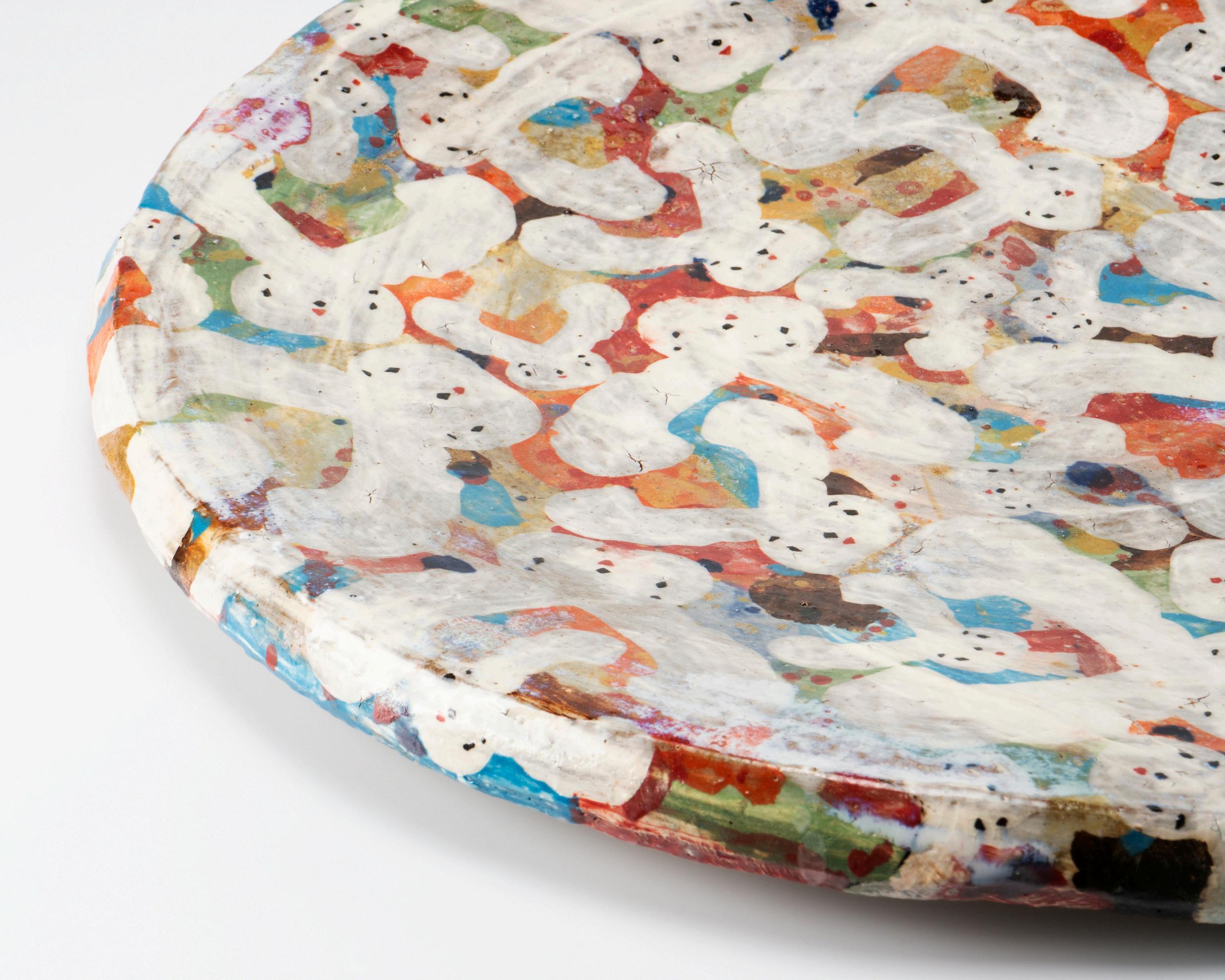
Plate with rabbit patterns "Tsukuyomi (Moon Poem)", 2024, with signed wood box, stoneware
1 3/8 × 19 1/8 × 18 1/2 in (3 5 × 48 5 × 47 cm)
uko (b 1979) is a celebrated ceramicist zen pottery Born into a distinguished ceramic udied under her father, Koyama Suehiro ⼩⼭ 8). She continues to work alongside him in ama Prefecture.
s inherited the powerful kiln effects c of traditional Bizen pottery such as yōhen ransformations) and hidasuki (scarlet fire Koyama has also developed a highly individual uished by its softness, subtle asymmetry, and orms Her works often present painterly d unexpected combinations of clay and glaze, g finishes rarely associated with traditional ncluding Oribe, Karatsu, ash glazes, and vividly olychrome surfaces.
in her approach to glazing, Koyama pairs e treatment with forms that are energetic and eating works that simultaneously honor and ramic tradition The result is a body of work hes Bizen with a playful and contemporary emaining rooted in the firing traditions of the
uvre comprises mostly functional pieces, with aily use as well as larger platters, flower vases, and jars for display and floral arrangements. This combination of technical mastery and personal expression has established her as a ceramic artist whose work and style cannot easily be imitated
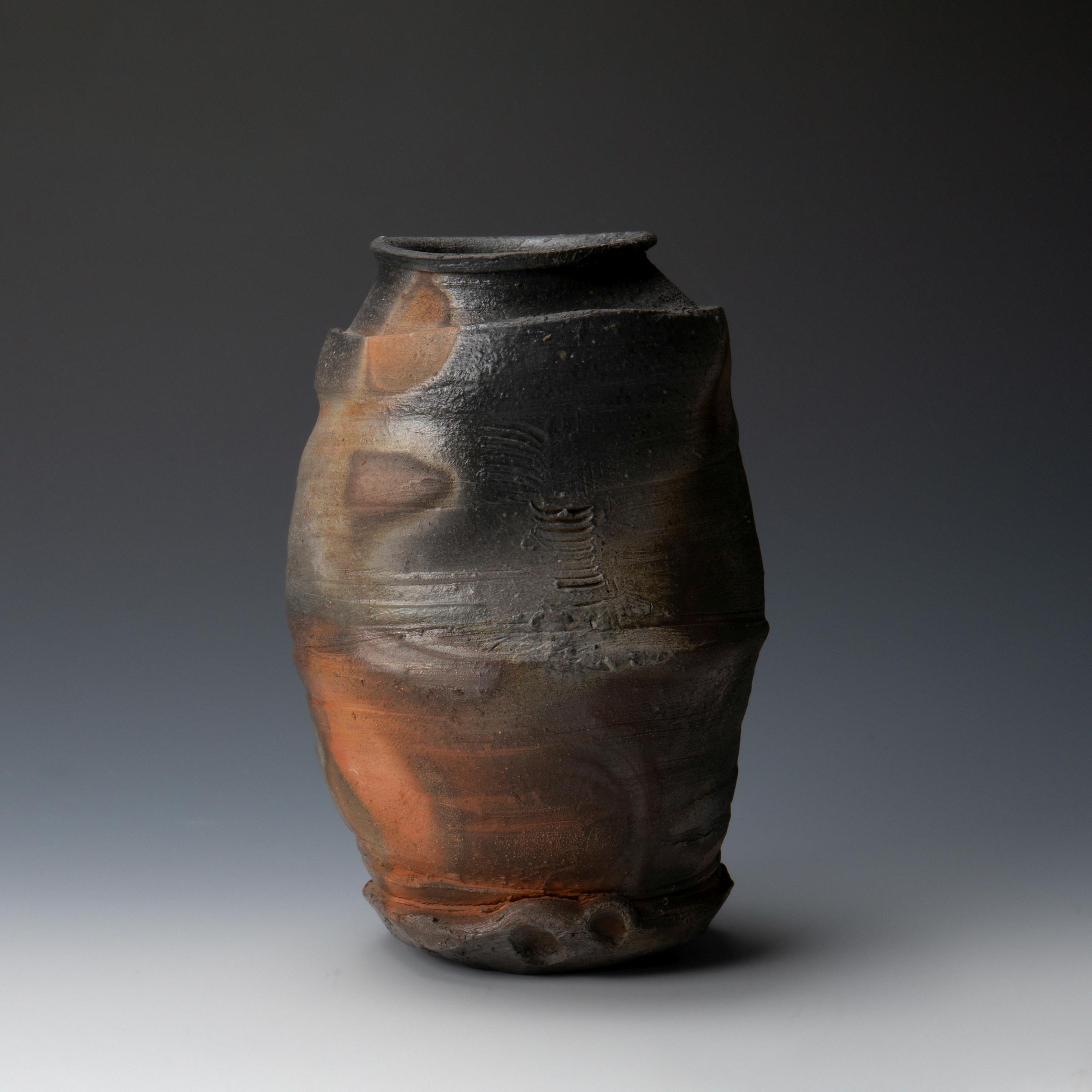
7 5/8 × 4 3/8 × 4 in (19 3 × 11 × 10 2 cm)
Koyama Atsuko ⼩⼭ 厚⼦
Bizen flower vase, 2024, with signed wood box, stoneware
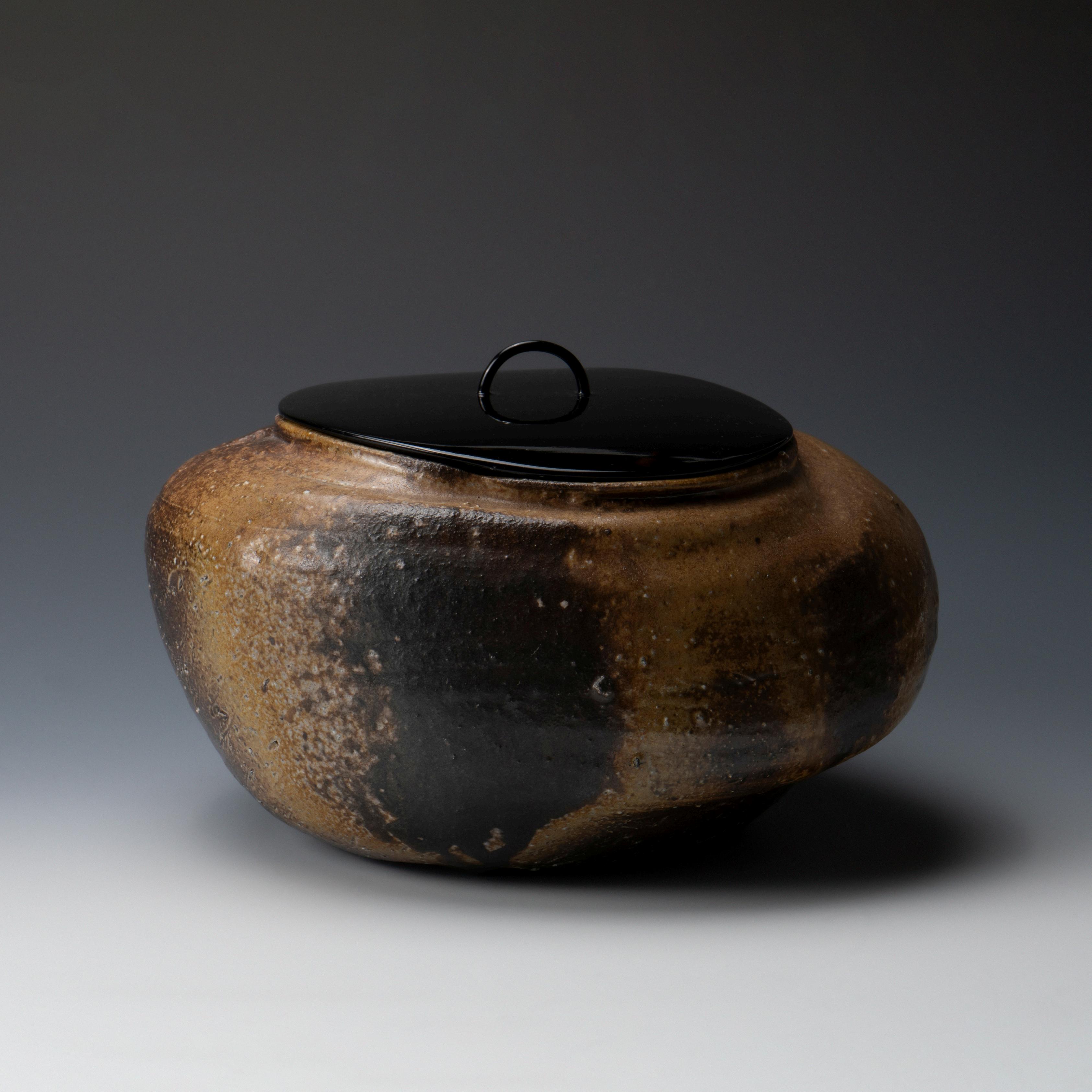
Bizen water jar “Tortoiseshell”, 2024, with signed wood box, stoneware 6 × 8 5/8 × 5 1/2 in (15 2 × 22 × 14 cm)
Koyama Atsuko ⼩⼭ 厚⼦
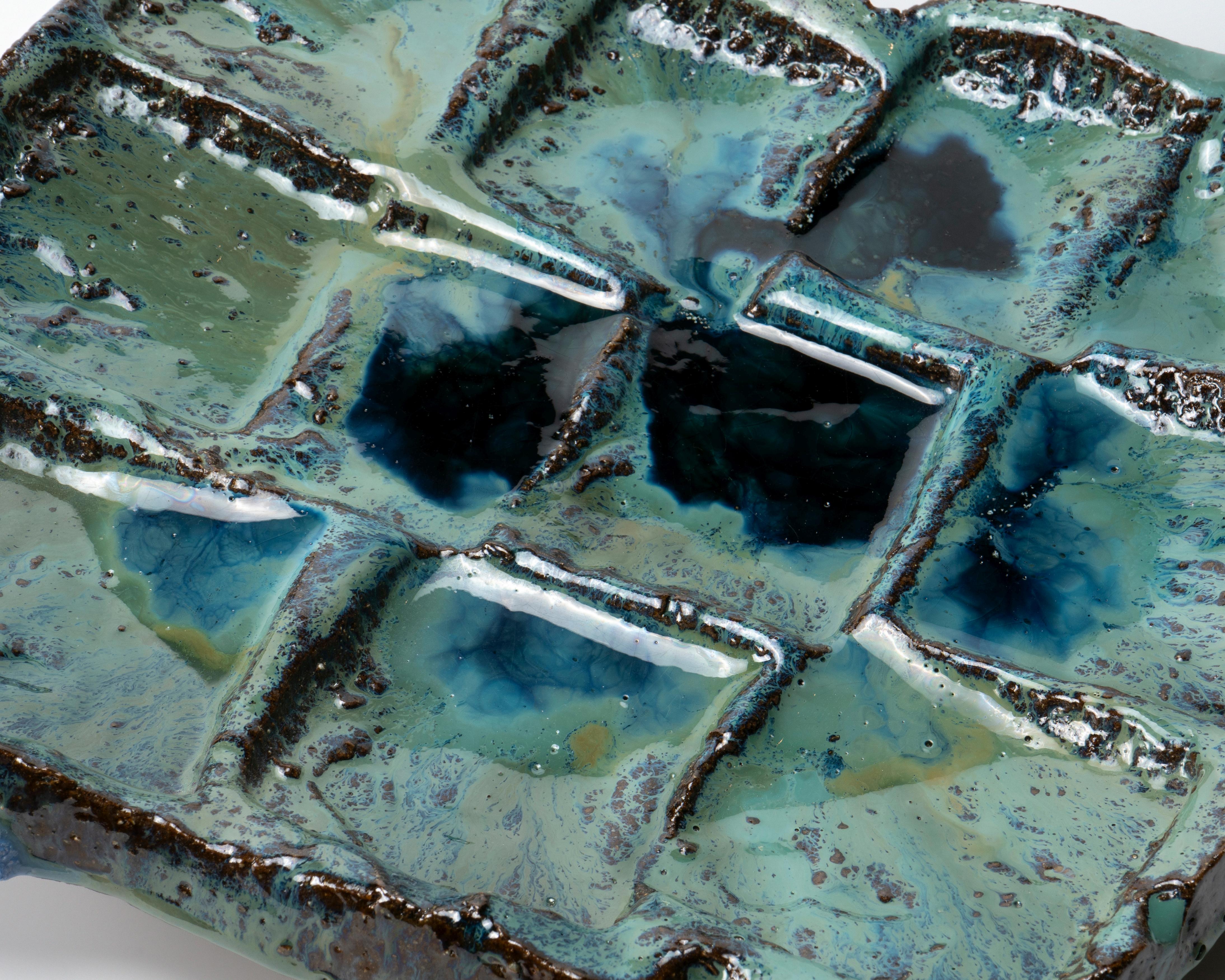
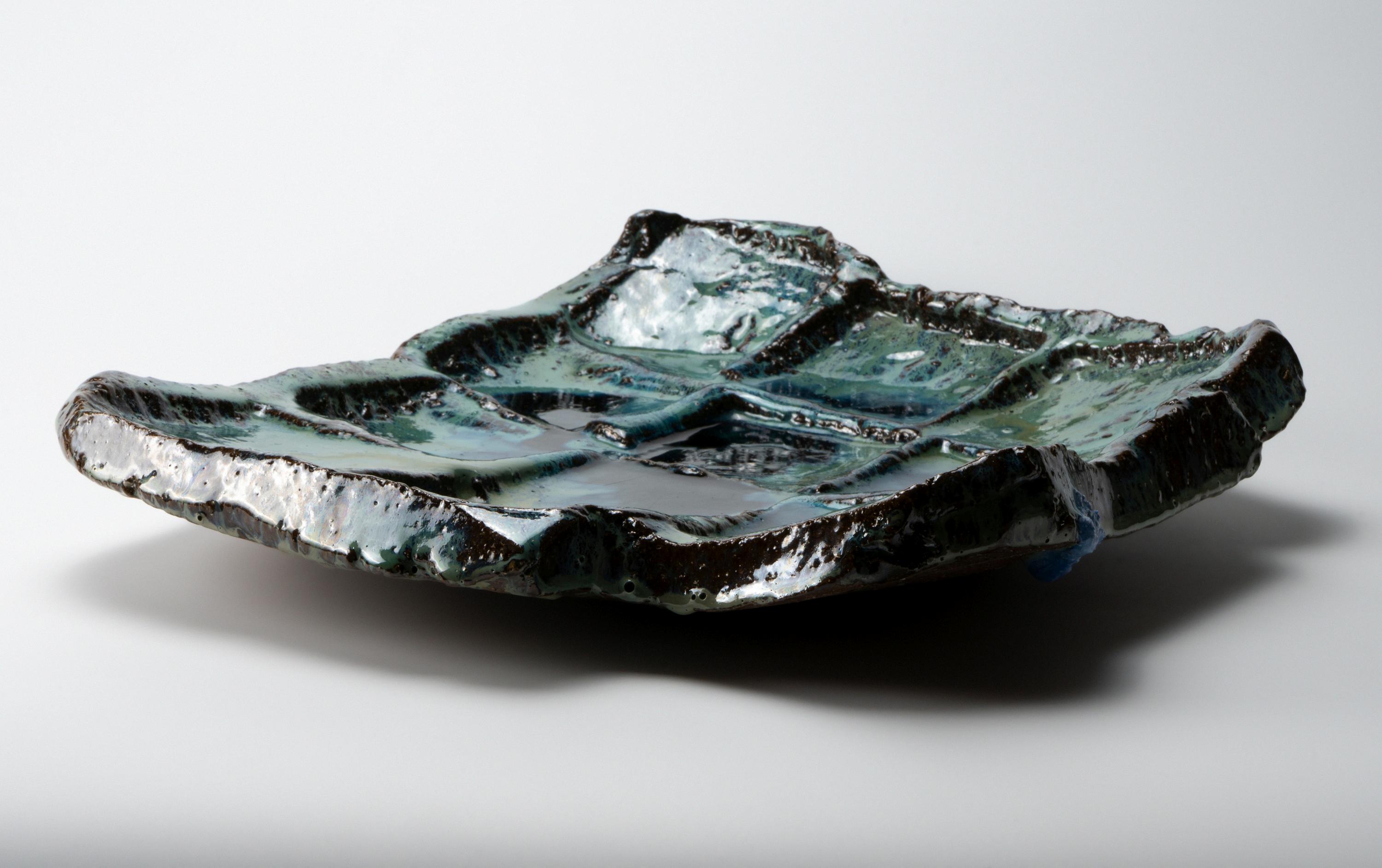
2 1/2 × 15 3/4 × 14 3/4 in. (6.5 × 40 × 37.5 cm)
Koyama Atsuko ⼩⼭ 厚⼦
Platter with Oribe Glaze over Bizen clay, 2024, with signed wood box, stoneware
T A S H I M A
E T S U K O 田 嶋 悦 子
n Osaka and a graduate of Osaka University of Arts, Tashima o (b 1959) combines two historically distinct craft traditions casting and ceramic sculpture into works that explore the lay of light, shadow, and color Her sculptures investigate the on between opacity and translucency, allowing light to eate and transform through material while color emerges gh reflection and surface
g studied under the pioneering ceramic artist Yanagihara uo (b 1934), Tashima inherited his celebrated yellow Oribe as well as the bold chromatic sensibility shaped by American action and expressionism of the 1970s.
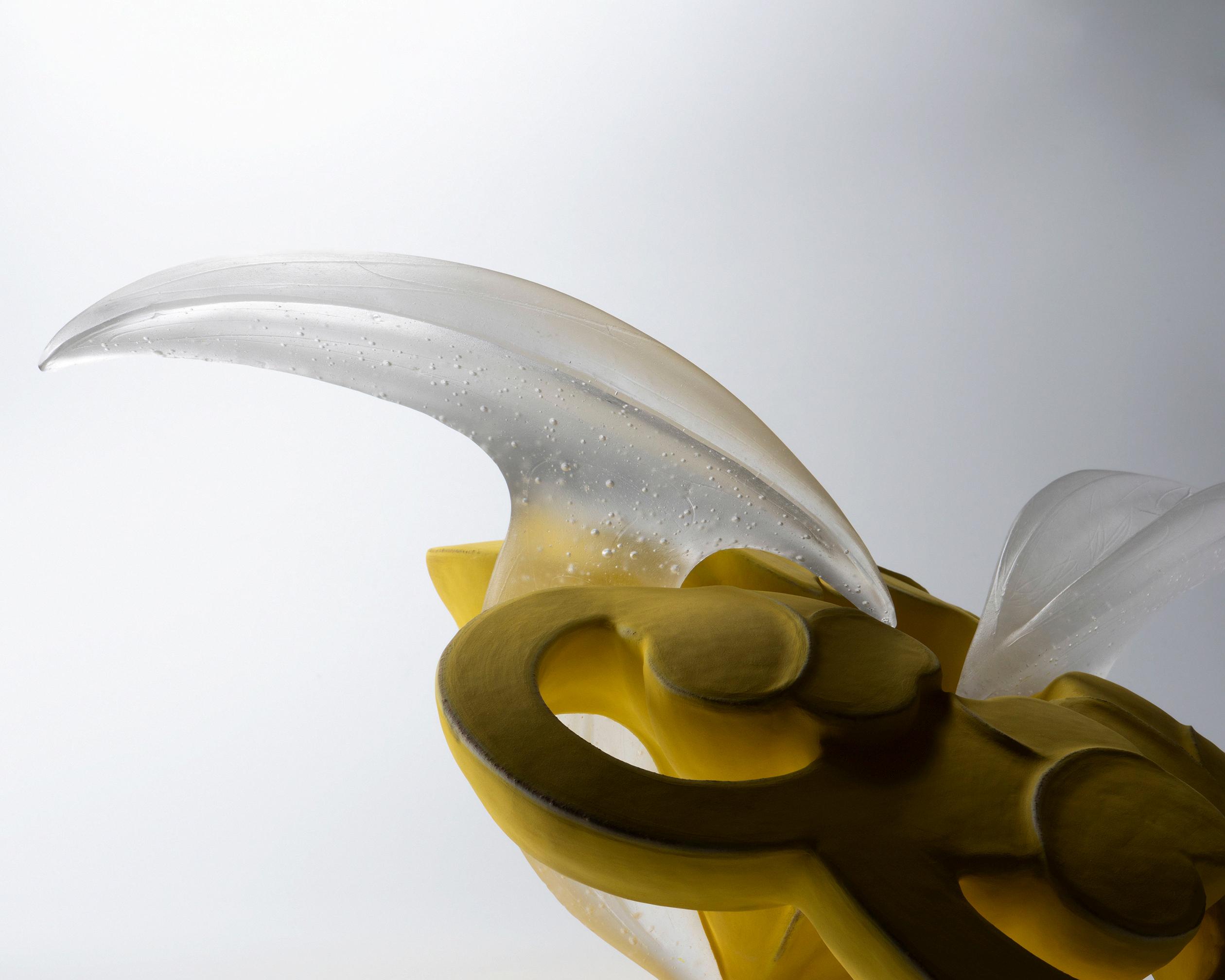
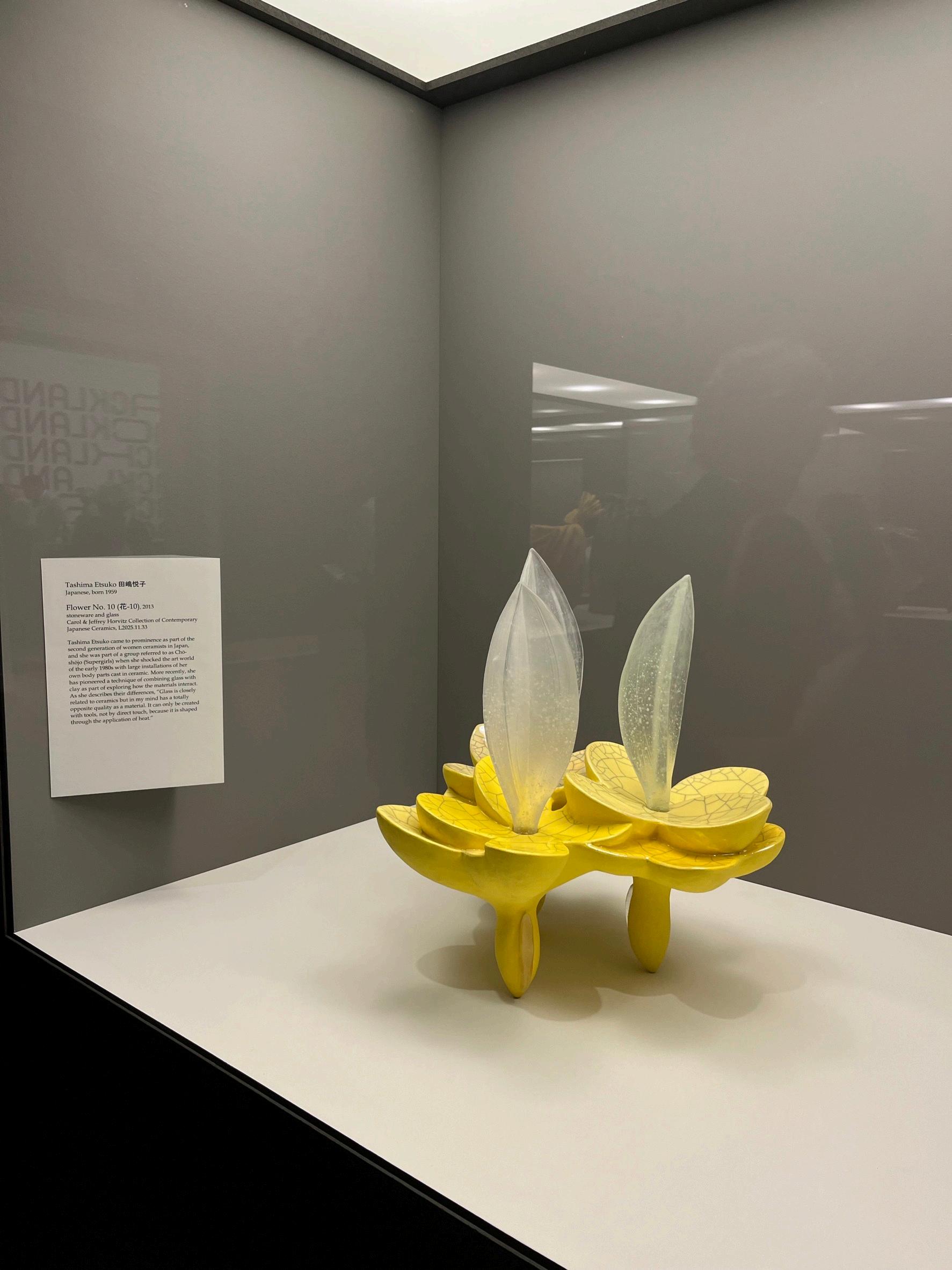
ma ’ s forms are characteristically streamlined and biomorphic, en in works from her Cornucopia series Cast glass elements e the delicate structure of glass wings that invoke bodies of s, paired with vivid yellow ceramic bodies with luminous chromatic glazes that pay homage to centuries-old ceramic ons in Japan Those bodies offer subtle upward curvatures uggest organic growth and movement, like a cocoon. The title ucopia alludes to themes of natural abundance and fertility
untering her sculptures can feel akin to examining a living ism through a magnifying lens, where surface, translucency, orm invite close and contemplative viewing As the first tenured e faculty member at Osaka University of Arts, Tashima gs to a pioneering generation of postwar Japanese women s whose practices engage deeply with ideas of nature, ality, and the body
Tashima Etsuko’s “Cornucopia” series on view in the traveling exhibition Radical Clay; Photographed on view at the Ackland Museum of Art, North Carolina in 2024
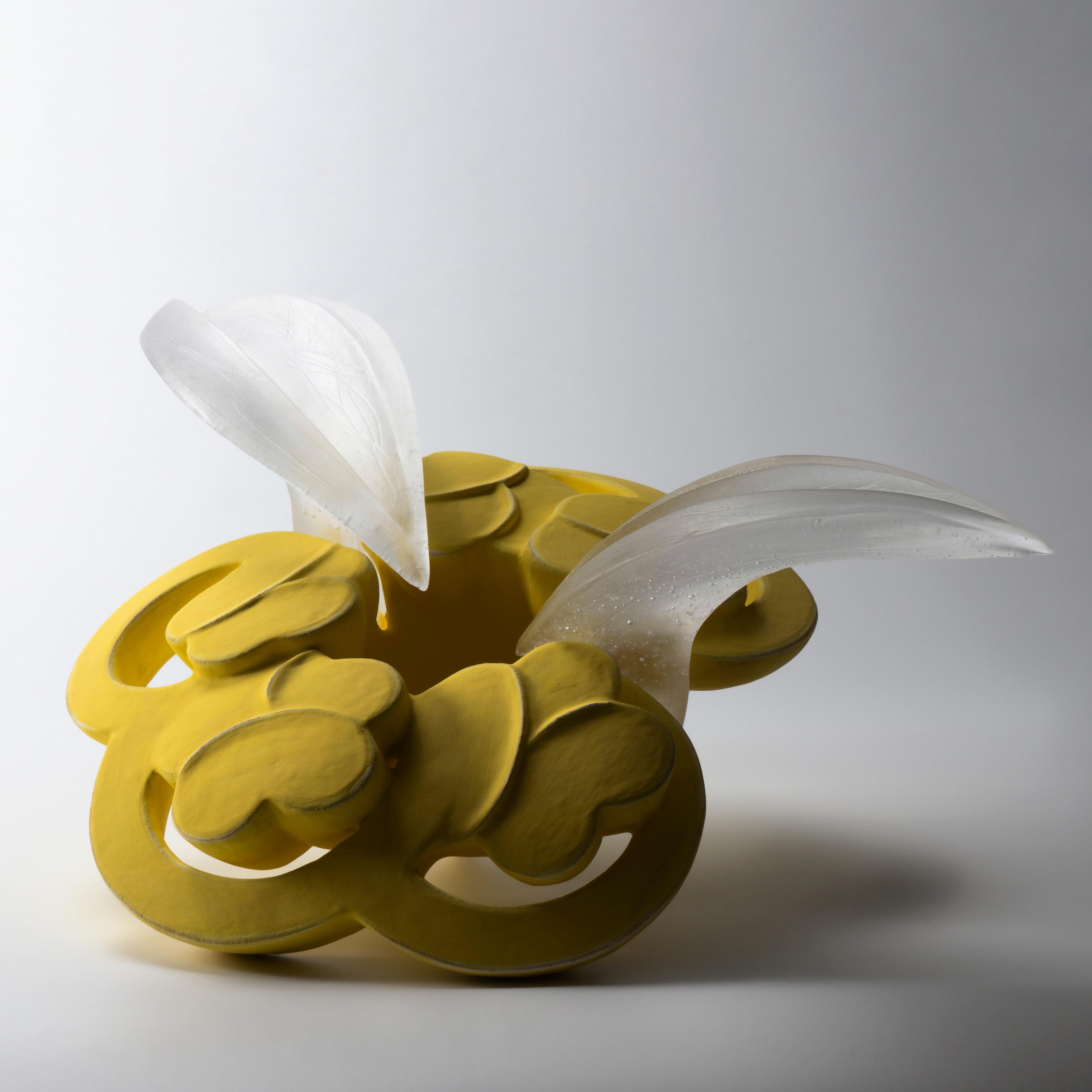
Tashima Etsuko ⽥嶋 悦⼦
Cornucopia 09-Y9, 2009, stoneware, glass
10 1/8 × 19 3/4 × 13 1/3 in (26 × 50 × 34 cm)
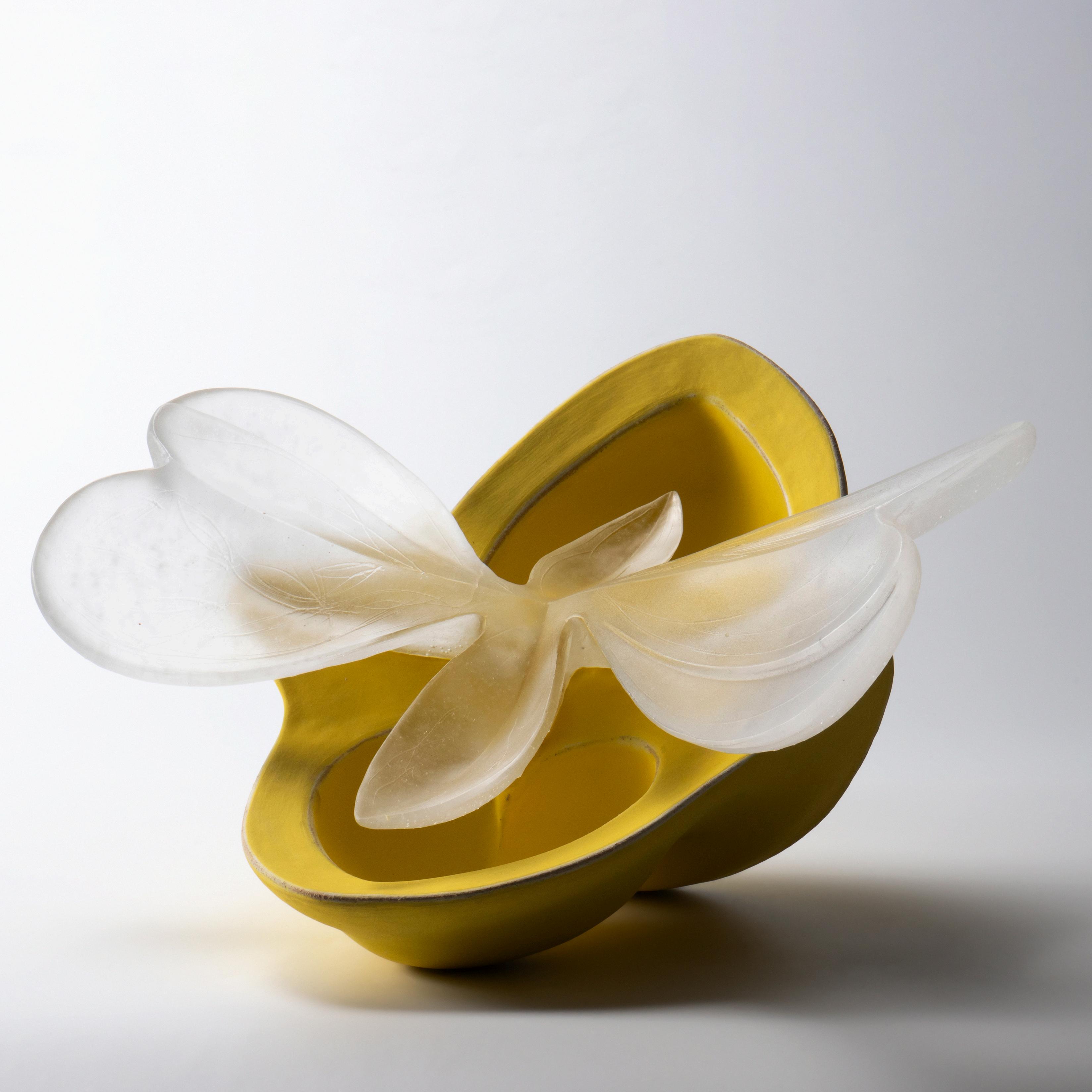
Tashima Etsuko ⽥嶋 悦⼦
Cornucopia 09-Y12, 2009, stoneware, glass
8 3/5 × 16 1/2 × 14 1/10 in (22 × 42 × 36 cm)
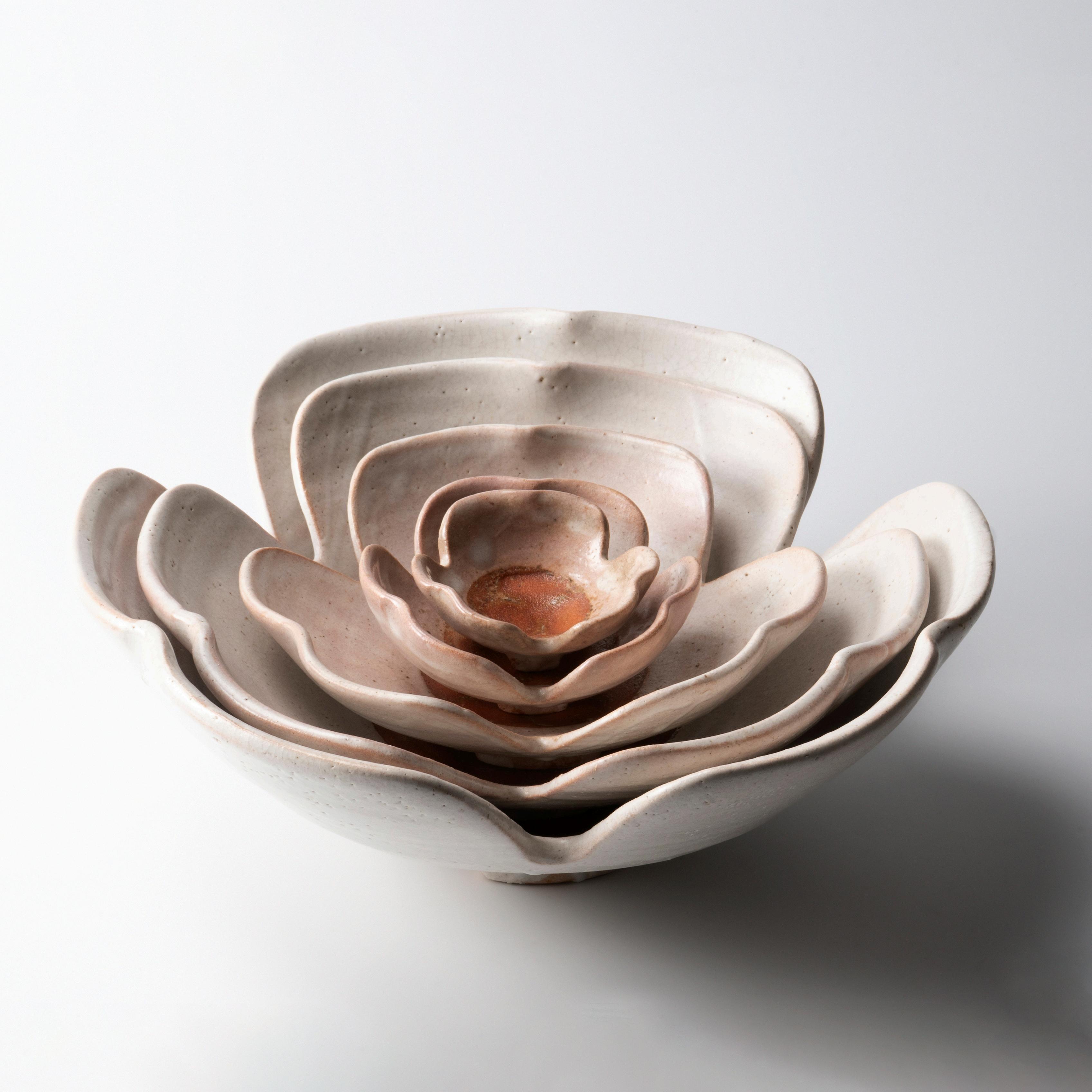
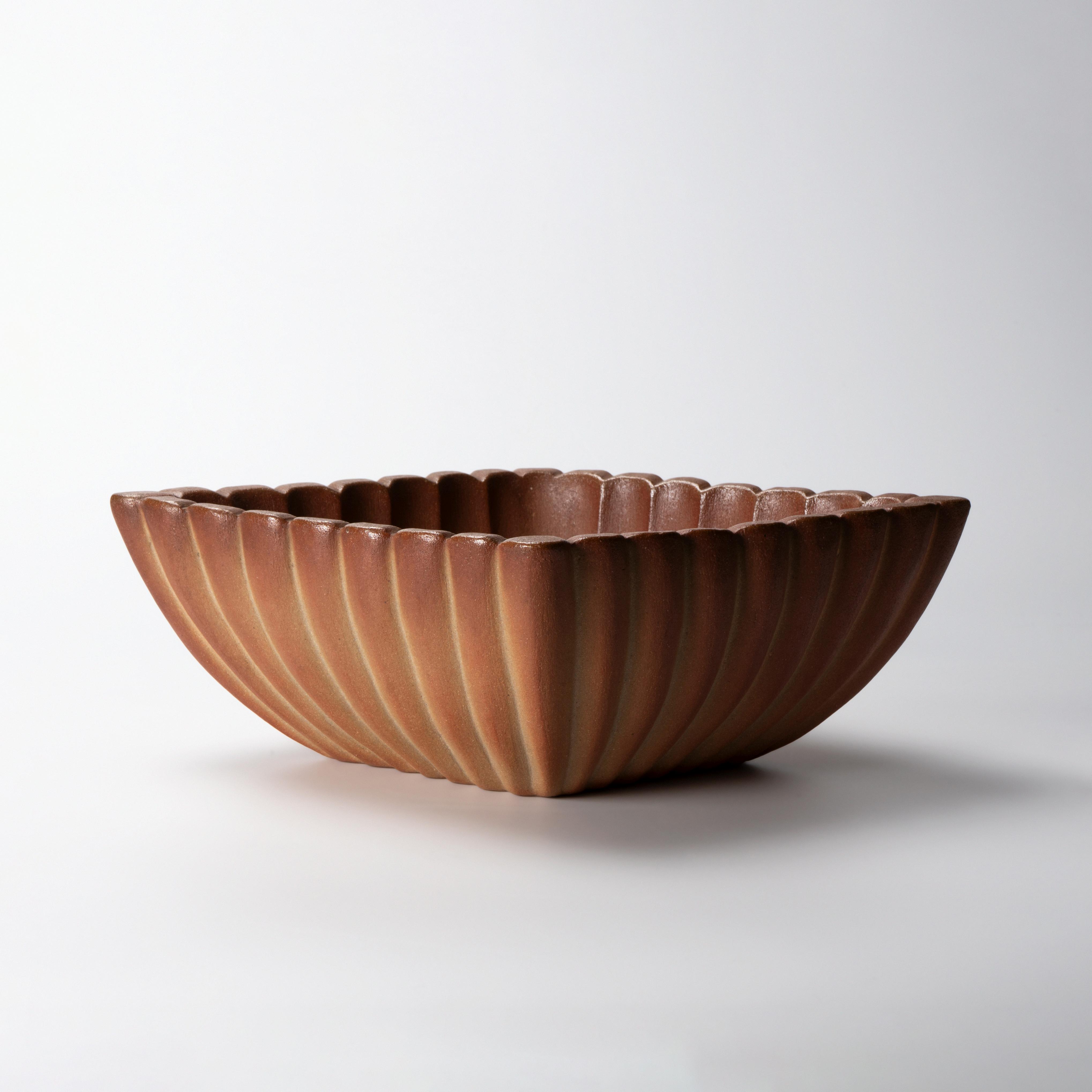
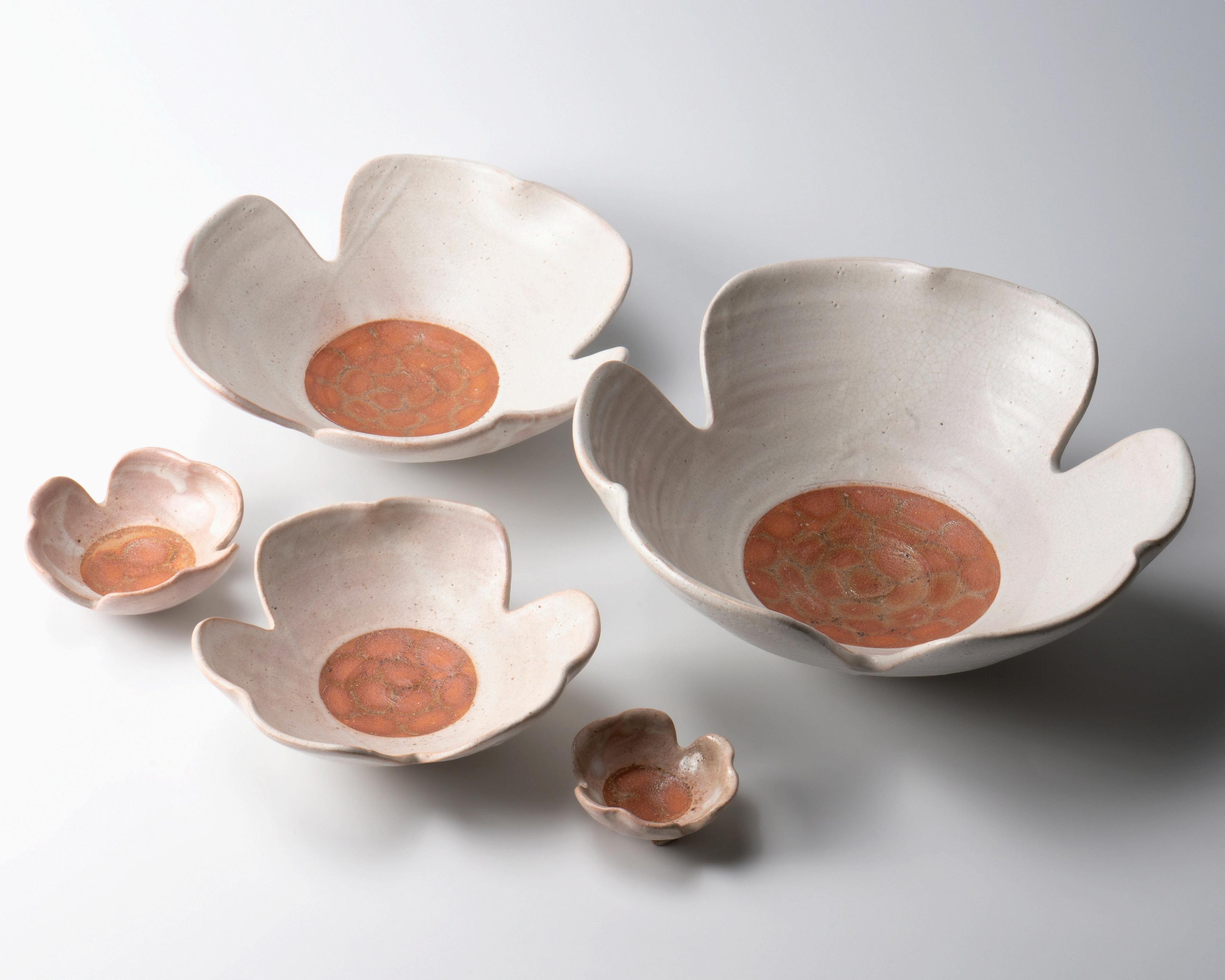
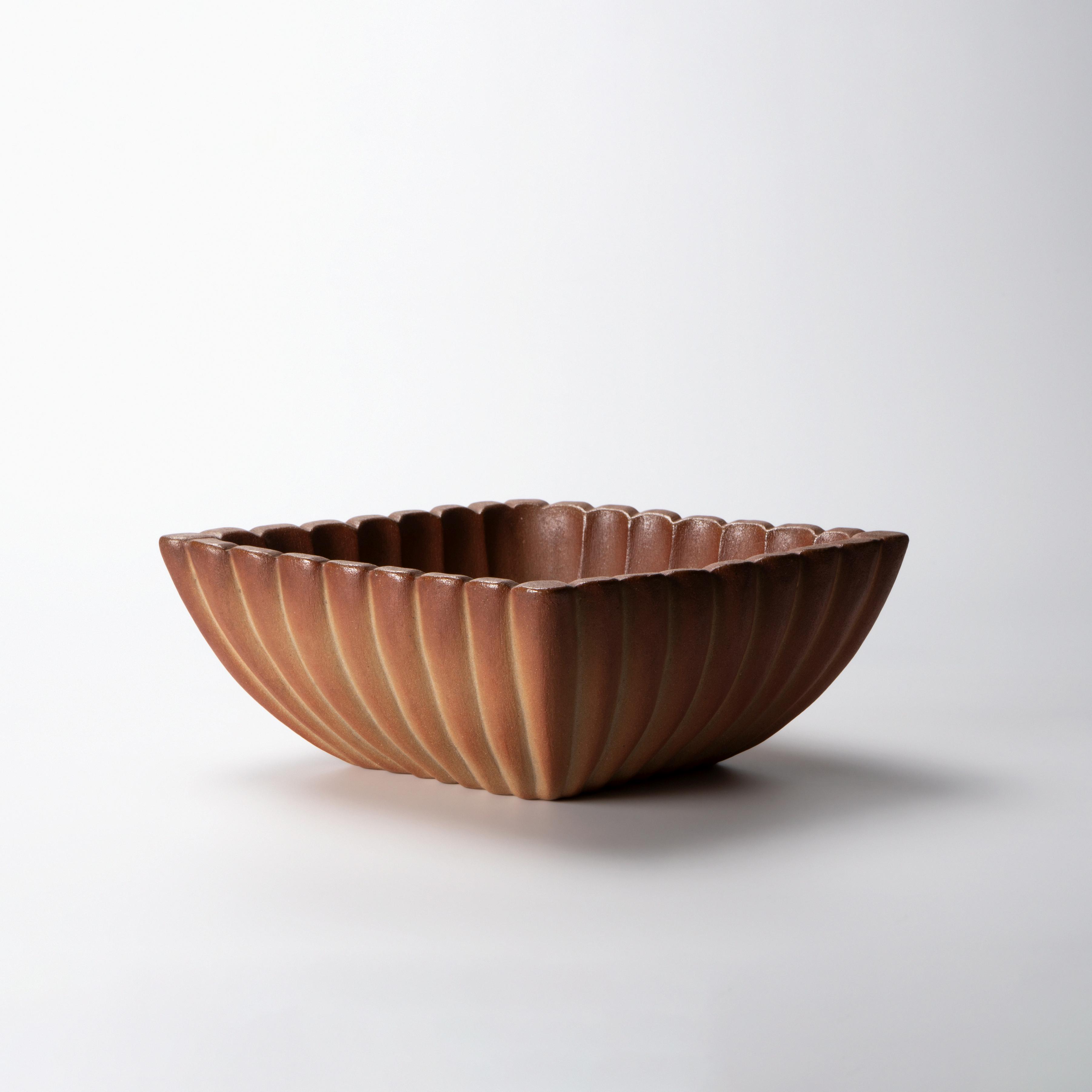
Few artists of the postwar period were able to elevate Japanese tableware into the realm of fine art Among the pioneering women ceramicists in postwar Japanese ceramics, Tsuji Kyō (1930-2008) established her voice early, exhibiting as early as 1961 and adopting the name “Kyō” from “Kyoko” to navigate gender bias Her work, comprising primarily functional vessels for daily use and display, reflects a refined sensibility for clay form, exceptional firing techniques, and a distinctive command of Shigaraki clay
Tsuji Kyō 辻 協
White camellia bowls, set of 5 stacking dishes, circa 1980's, signed with the potter's seal at the base Illustrated in The Contemporary Potters and Works in Japan, p 86, exhibited at “Soaring Voices - Contemporary Japanese Women Ceramic Artists”, traveling exhibition to Japan, France and the USA, 2007, red stoneware with translucent to opaque white glaze; 4 3/8 × 11 in (11 × 28 cm)
Tsuji Kyō 辻 協
Diamond-shaped Bowl, 1996, signed Kyo カ at back, stoneware 4 3/8 × 13 13/16 × 10 1/2 in (11 2 × 35 1 × 27 cm)
T A N A K A Y U 田 中 悠
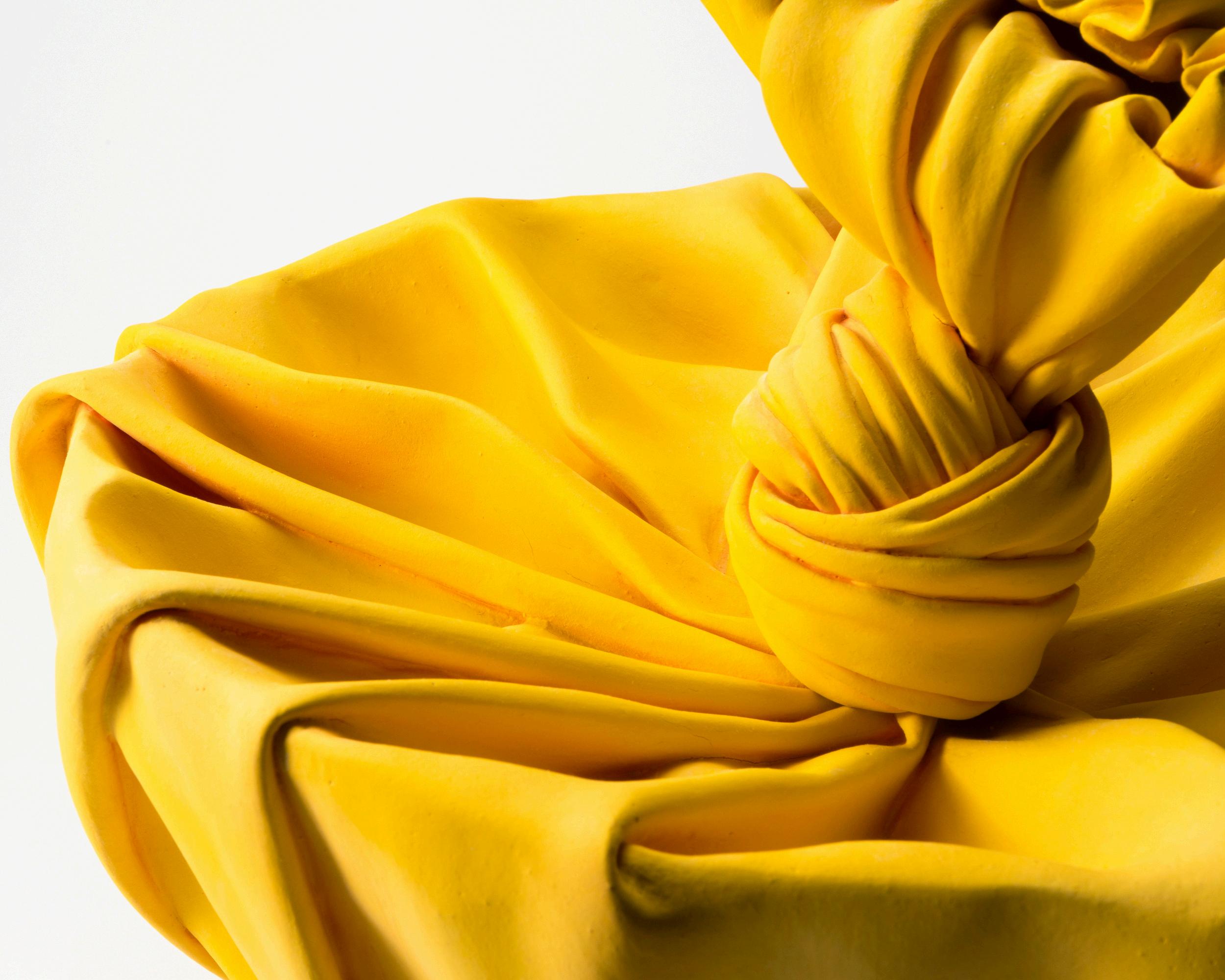
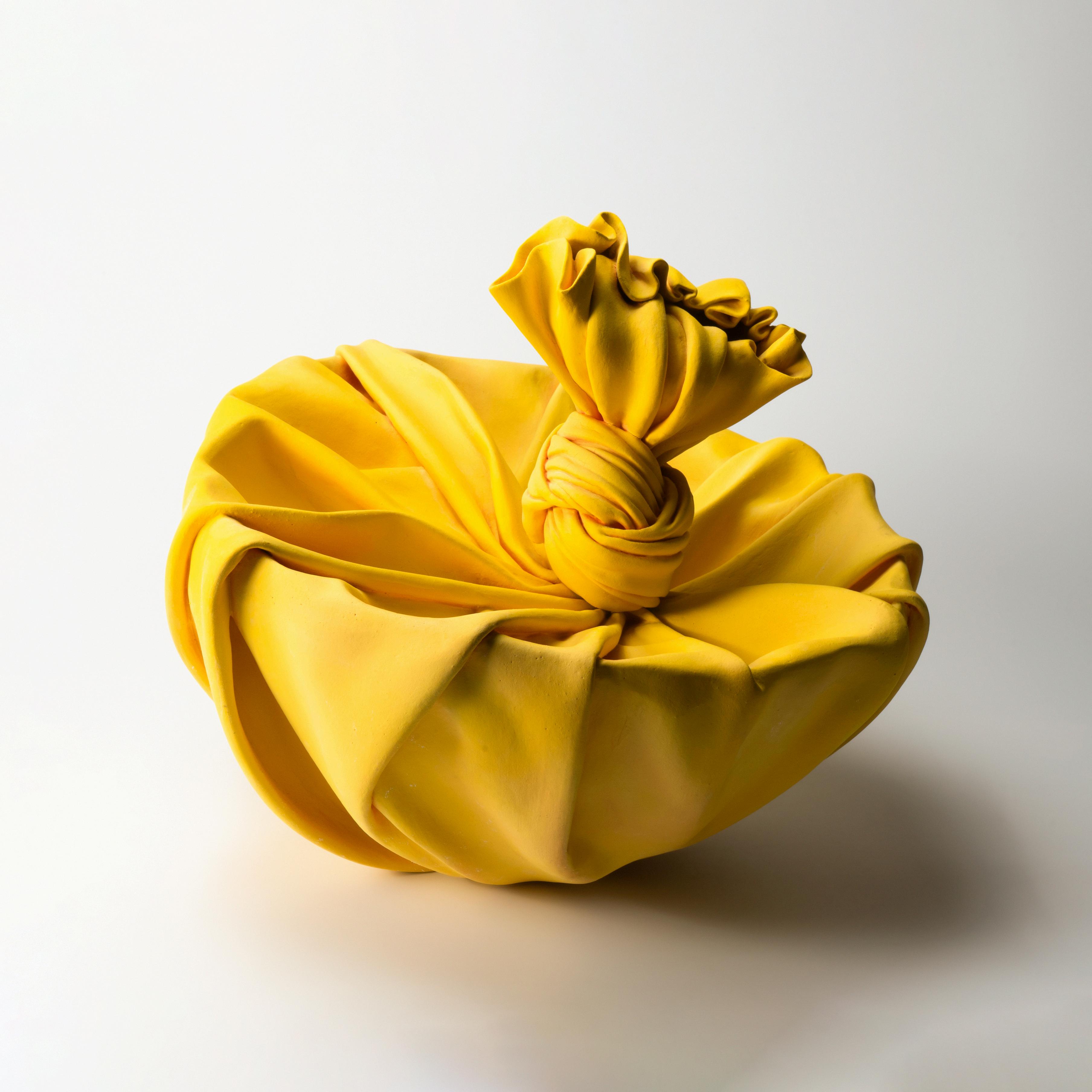
Yellow sculpture in the shape of a Furoshiki, 2018 stoneware,
13 3/4 × 16 1/4 × 16 1/4 in (34 9 × 41 3 × 41 3 cm)
Shikoku-born, Tanaka Yu (b 1980) is an internationally celebrated ceramic artist Having graduated from Kyoto Saga University of Arts and now based in Kyoto, her works are predominantly non-functional objet d’art; autonomous sculptural forms exemplified by the large work included in this exhibition catalogue
In recent years, Tanaka has risen to international prominence for her celebrated series of Tsutsumimono and Fukuromono, sculptures that convincingly evoke Furoshiki, the traditional Japanese wrapping cloth, carefully folded around “concealed” vessels Remarkably, however, no vessel exists beneath the surface. Each work is entirely hand-built, constructed solely through ceramic techniques that create the illusion of soft, pliant, dyed velveteen or silken fabric. To achieve the appearance of dyed textile, she carefully applies thin layers of pigmented slip to the unfired clay using a sponge, before brushing the remaining surfaces with the same pigment to create an even, seamless coloration. Achieving such uniform tonality across the entire form is deceptively demanding Two additional layers of pigment are applied prior to the initial firing Although most of her works possess a matte finish, the subtle interaction between pigment and clay softly refracts light, producing a velvety surface animated by shifting shadows and gently undulating folds
Tanaka has exhibited widely in galleries and museums the United States, Japan, France, the United Kingdom and beyond, and her work is recognized across the fields of contemporary art, design, and contemporary craft
Tanaka Yu ⽥中 悠
matte glaze
For full object catalogue entries, metadata and captions, please visit our website www.daiichiarts.com
We warmly welcome you to contact us with your inquiry.