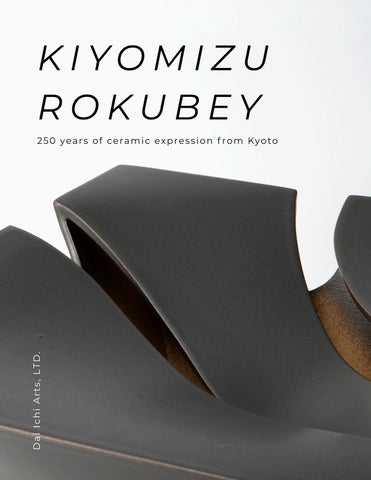
KIYOMIZU ROKUBEY
Dai Ichi Arts, LTD.
2 5 0 y e a r s o f c e r a m i c e x p r e s s i o n f r o m Ky o to
KIYOMIZU ROKUBEY 2 5 0 y e a r s o f c e r a m i c e x p r e s s i o n f r o m Ky o to A landmark exhibition celebrating eight generations of ceramic innovation f rom the Kiyomizu Rokubey family
CONTENTS
9 13
Foreword Beatrice Chang
Inheriting a Lineage: The Kiyomizu Rokubey Family Daicho Tomohiro
21
Kiyomizu Rokubey V & VI
39
Kiyomizu Rokubey VII
53
Kiyomizu Rokubey VIII
75
List of Works
Kiyomizu Rokubey IV
二代 古藤 六兵衞
Kotō Rokubey II (1797–1847) Born as Kotō Shōjirō Gō (stylization): Seisai
古藤 六兵衞 (1737–1799) 古藤 栗太郎 愚斎
Kotō Rokubey I Born as Kotō Kuritarō Gō (stylization): Gusai
古藤 正次郎 静斎
四代 清水 六兵衞 (1848–1920) Born as Shimizu Shōjirō 清水 正次郎 Gō (stylization): Shōrin 祥麟
三代 古藤 六兵衞 清水 六兵衞 祥雲
Kotō Rokubey III (1820–1883) Also known as Shimizu Rokubey Gō (stylization): Shōun
八代 清水 六兵衞 清水 柾博
Kiyomizu Rokubey VIII (b. 1954) Born as Kiyomizu Masahiro
Succeeded his father as Kiyomizu Rokubey in 2000 as the eighth generation head of Kiyomizu Pottery; concurrently professor emeritus of contemporary ceramics at the Kyoto University of the Arts
清水 六兵衞
Kiyomizu Rokubey VI (1901–1980) Born as Kiyomizu Shōtarō Gō (stylization): Rokusei
六代 清水 六兵衞
清水 正太郎 禄晴
五代 清水 六兵衞 清水 六兵衞 清水 栗太郎 祥嶺
Kiyomizu Rokubey V (1875–1959) Also known as Shimizu Rokubey Born as Shimizu Kuritarō Gō (stylization): Shōrei
京都芸術大学
七代 清水 六兵衞 塚本 廣 洋 裕詞 清水 九兵衞
Kiyomizu Rokubey VII (1922–2006) Born as Tsukamoto Hiroshi Later also stylized as: Hiroshi , Hiroshi Sculptor name: Kiyomizu Kyūbey
8
9
F O R E WO R D Beatrice Chang
At the foot of Kiyomizu Temple in Kyoto stands a quiet, unassuming family house. Behind it is a small museum filled with the work of generations of the Kiyomizu Rokubey family, progenitors of Kiyomizu ware, one of the defining lineages of Kyo-yaki or Kyoto ware. For more than 250 years, each generation has reinterpreted this tradition, carrying the language of Kyoto ceramics into modern and contemporary life. Within the museum, one can view works created by the hands and minds of the first through eighth generations of Kiyomizu Rokubey (also spelled as, “Rokubei” using Hepburn romanization). Early works are closely tied to the material culture of tea, while later generations expanded into vessels for food, flowers, ink painting, and daily use. The family also produced works for the Imperial household which places the Rokubey lineage at the core of the history of Kyoto ceramics. As you investigate this progression of works in their family museum, you might be surprised by a sudden and dramatic visual distinction between the sixth and seventh generations. Suddenly, long-necked vases and iron-painted jars are replaced by geometric vessels that appear like sculptures. There is a sudden departure from traditional vessel forms to a highly sculptural and sophisticated formula of vessel and sculptural expression between these two generations. During one of my many visits to the Kiyomizu household, I discussed this dramatic divergence with the current head of the family. Masahiro-san, the eighth Kiyomizu Rokubey, spoke with me about how each generation had found its own path. In his work, that evolution continues through influences ranging from modern architecture to contemporary sculpture and the vessel. If we work backwards from the current eighth generation, we need look no further than Masahiro-san's father, Rokubey VII. Trained in metal sculpture, he brought a distinctly sculptural sensibility to clay. His works, often finished with metallic and iron-rich glazes, have the structure and tension of cut and folded metal, with warped ceramic planes that can appear like thin sheets of iron. Rokubey VIII inherited aspects of this language, including its metallic surfaces, but pushed it in his own direction. With a background in architecture, his work draws upon modernist ideas of structure, material, and form: his manipulation of clay also suggests steel, iron, concrete, or an architectural surface. Surfaces visually associated with construction and utility are transformed into objects of expression, while formally his vessels become a site to investigate both exterior surface and interior space.
10
Kiyomizu Rokubey VIII and Beatrice Chang at Rokubey kiln in Kyoto, Japan. Photographed in 2026.
11
These two generations, the seventh and eighth, were my own introduction to the Kiyomizu Rokubey dynasty. They fascinated me precisely because their work seemed to depart so boldly from the more formal and functional vessels of their predecessors. They were so different from the traditional Sancai, iron, and wabi-cha traditions of their predecessors. With nearly 250 years of ceramic history behind him and an education in architecture, Rokubey VIII has carried the family tradition into a site of contemporary artistic expression. What stayed with me most, however, was the position of the next generation. Rokubey VIII has two sons, both working in ceramics. I found myself thinking about the responsibility that comes with inheriting such a name. It is a great honor, but it also posits challenging questions. How does one move forward while remaining connected to what came before? How does one find an individual voice within such a powerful lineage? I became deeply curious about how each generation has renewed tradition continuously. This question is also at the center of the present exhibition. The Rokubey lineage embodies this lifelong discipline of shaping one's own path while carrying the spirit of the previous generations. It reminds us that tradition can be an incredibly strong foundation and stepping stone. It is with this in mind that I am honored to present this inaugural family exhibition of the Kiyomizu Rokubey lineage in New York City. A small selection of earlier works from the Kiyomizu V and VI generations provides a glimpse into the tradition from which the family emerged, while the heart of the exhibition focuses on the seventh and eighth generations. There is something extraordinary about an unbroken lineage of individuals who have chosen ceramic expression as a lifelong pursuit. The Kiyomizu Rokubey family embodies one of the most distinctive qualities of ceramics in Japan: tradition does not remain fixed in the past. It is carried forward, transformed, and renewed. For a deeper understanding of the history of the Kiyomizu Rokubey family, I am deeply grateful to Daicho Tomohiro, Senior Curator at the National Museum of Modern Art, Kyoto, and expert on research into the Kiyomizu family. His essay in this catalogue examines the important evolution of the Rokubey lineage and reveals just how distinctive each generation has been. We are also honored to welcome Kiyomizu Rokubey VIII (Masahiro) to New York for this occasion. I sincerely hope visitors will come, meet him, shake his hand, and ask their own questions. What has inspired him? What has sustained his practice? What has given him the confidence to carry this remarkable history forward while continuing to change it? Through this exhibition, I invite you to look not only at the works themselves, but also at the generations behind them, and at the discipline and courage required to carry on.
12
13
INHERITING A LINEAGE T h e K i y o m i z u R o k u b e y Fa m i l y
D a i c h o To m o h i r o
大長 智広
S e n i o r C u r a to r , N a t i o n a l M u s e u m o f M o d e r n A r t Ky o to
The Kiyomizu Rokubey family has been active in Kyoto for approximately 250 years, spanning eight generations from the mid-Edo period to the present day. As a family that has inherited and passed down its craft from one generation to the next, it is often described using the word “tradition.” Although the term generally suggests the preservation and transmission of inherited practices, Kōjien (Japan's authoritative dictionary) defines tradition as "the beliefs, customs, institutions, thought, scholarship, and arts cultivated and transmitted over a long history by a people, society, or organization, especially the spiritual ethos that lies at their core." It further explains that tradition "refers to something that serves as a symbol, not merely by pointing to an abstract concept, but by condensing and embodying a holistic image within its own intrinsic, figurative value." What is significant here is that tradition is understood both as "spiritual ethos" and as "something that serves as a symbol" In other words, tradition does not consist simply in perpetuating superficial similarities over time. Rather, tradition comes into being only when the underlying spirit at the root of things is consciously recognized, inherited, and made manifest in new forms. More than forty years ago, in 1982, the exhibition Kyoyaki no Honryu, rekidai Kiyomizu Rokubey meihinten ( , The Mainstream of Kyoto Ware: Masterpieces by Successive Generations of Kiyomizu Rokubey) toured venues in Niigata and Hyōgo prefecture. At that time, shortly after succeeding to the family name, the Seventh Rokubey contributed a statement to the exhibition catalogue, remarking that, upon viewing the assembled works, he had "once again confirmed a single thread running through the individuality of each generation.” He went on to quote his father, the Sixth Rokubey, who often said, "This family has endured because each generation pursued its work in its own way." The Seventh concluded that the true family tradition lay in the fact that "The techniques with which each generation had become intimately familiar since childhood accumulated naturally within the subconscious." His observation perceptively identifies the essence of the Rokubey lineage. This exhibition Kiyomizu Rokubey: 250 years of ceramic expression from Kyoto, presented by Dai Ichi Arts, brings together works by four generations, from the Fifth through the Eighth Rokubey. Through these works, one can gain a clear understanding of what it truly means to inherit a family tradition.
京焼の本流 歴代清水六兵衞名品展
14
尾形 乾山
Style of Ogata Kenzan (1663–1743) Square Dish with Spring Flowers and Grasses Circa 18 th century 2 1/16 × 14 7/16 × 12 7/16 in. (5.2 × 36.7 × 31.6 cm) Permanent collections of The Metropolitan Museum of Art Image © The Metropolitan Museum of Art
野々村 仁清
Nonomura Ninsei (active: 17 th century) Tea-leaf Jar with a design of wisteria Circa 17 th century Permanent collections of MOA Museum of Art, Shizuoka Image © MOA Museum of Art
15
(Left) Kiyomizu Rokubey VI
六代 清水 六兵衞 (Rokusei 禄晴 , 1901–1980)
Tea bowl with overglaze red enamel and gold, fern design, 1928 Porcelain Permanent collections of the National Crafts Museum, Japan Image © National Crafts Museum (Right) Kiyomizu Rokubey V
五代 清水 六兵衞 六和
(Rokuwa , 1875–1959) Ornamental square dish with bracken sprout design Stoneware with overglaze enamels and gold Permanent collections of the National Crafts Museum, Japan Image © National Crafts Museum
The fifth Rokubey (b. 1875), second son of the fourth, received formal training in painting under Kōno Bairei (1844–1895), a leading figure of the Kyoto art world, thereby acquiring a strong foundation in form. His career unfolded during a period when the fervent overseas demand for Japanese ceramics in the early Meiji era had begun to subside. As a result, the Japanese ceramics industry, while still oriented toward export, sought new directions in technique, style, and design.
幸野 楳嶺
Although Kyoto is often characterized as an ancient capital steeped in tradition, it was equally a site of progressive innovation, exemplified by Japan’s first commercial hydroelectric power station and electric railway. In ceramics, the Kyoto Municipal Ceramic Research Institute (established in 1896, later nationalized) played a key role in advancing research into glazes, materials, and design based on Western technologies. The Kiyomizu family was closely involved in its founding, and the fifth Rokubey conducted extensive experimentation there. He also formed the design group Yūtoen with painters, designers, and ceramicists, seeking to integrate science, material technology, form, and design through the sensibilities of a new age. Notable works include “Otowa ware,” inspired by Western majolica, and “Tairei porcelain,” a form of colored porcelain. At the same time, he revisited the work of Edo-period masters such as Nonomura Ninsei (active: 17th century; exact dates of birth and death unknown) and Ogata Kenzan (1663–1743) producing works that combined classical reference with innovation.
野々村 仁清
尾形 乾山
The sixth Rokubey (b. 1901), eldest son of the fifth, studied Japanese painting at what is now Kyoto City University of Arts. Japanese painting, with its emphasis on line and the modulation of ink and pigment, provided a conceptual framework not only for surface decoration but also for the construction of ceramic form, in which contour, plane, and glaze operate in concert. During the Meiji period (1868–1912), such developments in painting were understood to directly inform innovation in the applied arts, and many painters were actively engaged in craft design. The era of the fifth and sixth Rokubey also marked the broader recognition of ceramic practitioners as artists pursuing independent creative expression. While the fifth established his practice through research into technique, design, and classical precedent, the sixth inherited these foundations and expanded them into a richly varied decorative vocabulary. His work evolved from early expressionistic and design-oriented approaches into a wider range encompassing Sancai, Gen’yō, Sabiyū, and Kokisai. Sancai, in particular, emerged at the time as a cutting-edge decorative technique through archaeological discoveries in China. The latter approaches reveal a refined Japanese sensibility through subtle interactions between clay body and glaze, often articulated through motifs drawn from the natural world.
16
七代 清水 六兵 京都国立近代美術館
Digital poster presenting the retrospective travelling exhibition of Kiyomizu Rokubey VII (Kyūbey, 1922–2006), 2022. Image © The National Museum of Modern Art, Kyoto Design: Kurasawa Hiroki
衞
倉澤 洋輝
17
(Left) Kiyomizu Rokubey VII
七代 清水 六兵衞
(Kyūbey, 1922–2006) Flower vase (Object, Eye, Cube), 1955-66 Stoneware Permanent collections of the National Craft Museum, Japan Image © National Crafts Museum (Center) Kiyomizu Rokubey VII
七代 清水 六兵衞
(Kyūbey, 1922–2006) Wall, 1966 Metal sculpture Image © Chiba City Museum of Art (Right) Kiyomizu Rokubey VIII
八代 清⽔ 六兵衞
(Masahiro, b. 1954) WAVE MOTION-88, 1988 Semi-porcelain Permanent collections of the National Crafts Museum, Japan Image © National Crafts Museum
The seventh Rokubey (b. 1922) was born in Nagoya as the third son of the Tsukamoto family. He studied architecture at Nagoya Technical School and metal casting at Tokyo University of the Arts. In 1951, he became the adopted heir of the sixth Rokubey and entered the field of ceramics. Unlike his predecessors, his formative training lay not in painting but in architecture and metalwork. In his early practice, under the name Hiroshi, he produced works that explored the materiality of clay through thickwalled forms, flattened vessels, and deliberately distorted shapes. These works exerted a transformative influence, articulating a critical stance toward the conventions of ceramic production grounded in rationality and efficiency. However, he later developed an aversion to what he perceived as the excessive expressiveness of clay, and in the late 1960s he turned to metal sculpture under the name Kiyomizu Kyūbey, becoming one of Japan’s leading sculptors. Following the sudden death of the sixth Rokubey in 1980, he assumed the name of the seventh and resumed ceramic production. His mature works are based on slab construction, integrating apertures, cuts, and incisions, with restrained surface treatment that emphasizes the movement of clay during firing. In this way, the expressive qualities inherent in clay—so distinct from the reticence of metal—are allowed to emerge directly as form. The eighth Rokubey (b. 1954), eldest son of the seventh, graduated from the Department of Architecture at Waseda University in 1979. Like his father, his formative thinking developed outside the traditional framework of ceramics. Although he was surrounded by ceramic production from an early age, his conscious engagement with making began during his university years, when assisting with his father’s sculptural work inspired a desire to create. After returning to Kyoto, he acquired the fundamental techniques of ceramics; however, his true artistic development began when he came to understand the transformative effects of firing, reinterpreting them as a dynamic interplay between intention and natural forces. To articulate this, he introduces slits, removes planes, and alters structural supports within slab-built forms, manipulating the tension and strength of surfaces. These interventions produce warping and distortion under the influence of gravity during firing. In addition, materials such as opal luster, which reflect the surrounding environment, and black glazes that harmonize with ambient light, contribute to the spatial sensibility that characterizes his work.
18
Portrait of Kiyomizu Rokubey VIII
八代 清⽔ 六兵衞 in his studio in Kyoto, Japan. Image courtesy of the artist.
19
Two ceramic installation works by Kiyomizu Rokubey VIII
八代 清⽔ 六兵衞
(Above) CERAMIC CIRCLE – 91, 1991 Solo exhibitions: Gallery Haku, Osaka; Masuda Studio, Tokyo Collection of the Kyoto City KYOCERA Museum of Art
京都市京セラ美術館 所蔵
Image courtesy of the artist
(Below) CERAMIC CIRCLE – 89, 1989 Solo exhibitions: Gallery Nakamura, Kyoto; INAX Gallery, Tokyo Collection of Fauchon Hotel Kyoto
フォションホテル京都 所蔵
As is evident, there are marked stylistic differences between the fifth and sixth generations and the seventh and eighth. These differences stem from variations in forming techniques—such as wheel-throwing versus slab construction—as well as divergent approaches to decoration through painting and glazing. Yet when we encounter the works of the eighth generation, whose practice is firmly rooted in a contemporary context, we nonetheless recognize them instinctively as works of “Rokubey.” This recognition arises from an underlying continuity of aesthetic sensibility that is not immediately visible. In this sense, to inherit the name Rokubey is, as the seventh suggested, to internalize the work of previous generations, to bear it as history, and to graft contemporary consciousness onto it. It is precisely this attitude that has enabled the name “Rokubey” to endure to the present, even as each generation has transformed its practice in response to its time.
20
21
KIYOMIZU ROKUBEY 5TH AND 6TH GENERATIONS
26
23
24
25
26
Page of a group of bowls, cups, and vases by designed by Louis Comfort Tiffany, for Tiffany Glass & Decorating Co., Stourbridge Glass Co. Corona glassworks, 1902 Permanent collections, The Victoria and Albert Museum Image courtesy of the museum
Long-Necked Bottle, Japan, Nara period (710–794) Stoneware with natural ash glaze and incised decoration 8 1/2 × 6 3/4 × 6 3/4 in. (21.6 × 17.1 × 17.1 cm) Permanent collections, The Metropolitan Museum of Art Image courtesy of the museum
“This flower vase (pictured right) presents an intriguing contrast between its small lower body and the large trumpet-shaped upper section that dramatically opens from the neck to the rim. The upper and lower portions were wheel-thrown separately and later joined together. Genyō is one of the decorative styles most characteristic of Rokubey VI. Through the effects of salt glaze firing, the black glazed surface develops irregular tonal variations and fine textural unevenness. Gold pigment is then applied over the surface as decoration. The interaction between the textured, non-smooth surface and the decorative treatment lends the work a subtle and mysterious elegance. Although Rokubey VI is particularly known for painted motifs inspired by nature—flowers, birds, landscapes, and seasonal imagery—the design of this work takes a different direction. Here, geometric patterns are organically softened and abstracted. It is a mature expression unique to an artist who, from a young age, was also deeply familiar with the Art Deco style.” – Daicho Tomohiro, June 2026
27
28
29
30
31
32
37
33
34
35
36
37
38
39
KIYOMIZU ROKUBEY 7TH GENERATION
40
41
42
“Rokubey VII, who had worked as the sculptor Kiyomizu Kyūbey, succeeded to the name Rokubey after the sudden death of Rokubey VI in 1980. Seven years later, in 1987, he held a commemorative exhibition, Kiyomizu Rokubey: Katōyō Exhibition, at Takashimaya in Tokyo, Kyoto, and Osaka. His ceramic practice began with the question of how to unify the vessel’s opening with sculptural form. Having previously worked in abstract sculpture as “Kyūbey,” his work as “Rokubey” explores how utilitarian vessel qualities can be redefined as contemporary sculptural form. This work features an elongated, bread-like form with horizontal and diagonal incisions that create deformation and suggest an opening emerging from within the body. It is covered in a rich bluish-white glaze. It is likely that this piece was made around the time of the 1987 commemorative exhibition, and may have been included in it. Works of this type, which incorporate structural distortion through incision, were soon regarded more as abstract sculptural objects, and in the following year Rokubey VII shifted toward compositions based on circular openings.”
花陶容 拾五 七代 清水 六兵衞
– Daicho Tomohiro, on the work Flower Vase, Katōyō XV (pictured above) by Kiyomizu Rokubey VII
43
44
45
46
(Left) Kiyomizu Rokubey VII (Kyūbey, 1922–2006) Flower vase (30), 1987 Stoneware Permanent collections of the National Crafts Museum Image © National Crafts Museum
清水 六兵衞
七代
“In 1988, the year following his succession as the seventh-generation Rokubey, he held a solo exhibition titled Ichirin-zashi Katōyō at Ichibata in Matsue, Shimane Prefecture. Based on the box inscription and title of this work, it is likely that this piece was exhibited in that presentation. While the Katōyō series presented in the succession exhibition was characterized by forms created through linear incisions into pre-formed bodies, from 1988 onward he began to construct form through incisions originating from small openings. This shift allowed a more explicit integration of “mouth,” distortion, and overall sculptural form. In this work, a bullet-like form is cut with incisions running horizontally and diagonally, generating openings and distortions within the body. The surface is covered with Irabo glaze combined with a reddish-brown glaze, applied in bands that correspond to the openings and cuts. This use of “bands” as a decorative device had already appeared in his earlier “Hiroshi / Hiroshi ” period as a young artist. Here, however, it functions as a method of visually articulating the structural qualities of the form.”
洋
裕詞
– Daicho Tomohiro, on the work Irabo Glazed Sculptural Vessel (Ichirinzashi Katōyō) (pictured right and above) by Kiyomizu Rokubey VII , June 2026
一輪指花陶容 七代 清水 六兵衞
47
48
49
50
37
51
52
53
KIYOMIZU ROKUBEY 8TH GENERATION
54
55
56
57
58
“Having studied architecture at university, the eighth-generation Rokubey has, since the beginning of his career, explored sculptural forms in which structural strength is altered through cuts and incisions in constructed bodies, with these transformations revealed through firing. In this sense, his practice can be seen as an extension of the seventh-generation Rokubey, though he moves away from functional concerns toward a more open exploration of form, material, and the process between ‘making’ and ‘becoming.’ This work is a representative example of this approach. A trapezoidal slab-built form is cut with geometric yet irregular slits, followed by the removal of selected planes in response to these incisions. The side walls remain structurally supported by vertical and diagonal elements, while the upper surface, unsupported at its center and edges, sags under its own weight during firing. The contrast between the matte black exterior and the yellow interior directs the viewer’s gaze into the luminous inner space, emphasizing a sense of interior emptiness and reinforcing the dialogue between construction and transformation that defines the work. Through this process, the originally clear geometric form is transformed, revealing a sense of ‘naturalness’ unique to ceramics as a medium.”
軌跡) 1230–B (pictured right and 八代 清⽔六兵衞, June 2026
– Daicho Tomohiro on Sculpture Kiseki ( above) by Kiyomizu Rokubey VIII
59
60
61
62
63
64
50
65
66
50
67
68
69
70
71
72
73
74
75
LIST OF WORKS
KIYOMIZU ROKUBEY 5TH AND 6TH GENERATIONS
五代 清水 六兵衞
1. Kiyomizu Rokubey V (1875–1959) Ceramic tile in ink on gold Nihonga style, landscape scene
御本布目⼭⽔画 額 Wood storage box inscribed: Gohon nunome sansuiga 御本布目山水画 額; signed: Rokubey saku 六兵衞作; sealed: Kiyo 清 Framed ceramic tile with gold and ink Tile: 11 × 17 in. (27.9 × 43.2 cm) Frame: 16 1/2 × 22 3/4 × 1 5/8 in. (41.9 × 57.8 × 4.1 cm)
六代 清水 六兵衞 玄窯鉄絵線⽂花瓶
2. Kiyomizu Rokubey VI (1901–1980) Vase with iron-painted linear designs , circa 1950s Artist’s mark impressed on base Wood storage box inscribed: Gen’yō tetsue senmon kabin (Abstract vase with iron-painted line decoration); signed: Rokudai Kiyomizu Rokubey saku (made by the sixth-generation Kiyomizu Rokubey), Shichidai Kiyomizu Rokubey shiki (inscribed by the seventh-generation Kiyomizu Rokubey); sealed: Kiyo Stoneware 10 1/2 × 7 1/8 × 7 1/8 in. (26.7 × 18 × 18 cm)
玄窯鉄絵線文花瓶
六代 清水 六兵衞 作
七代 清水六兵衞 識
清
六代 清水 六兵衞
3. Kiyomizu Rokubey VI (1901–1980) Flower vase with abstract linear designs , c. 1950s Artist’s mark impressed on base Wood storage box inscribed: Gen'yō sen bun kabin (Abstract flower vase with geometric linear designs); signed: Rokubey ; sealed: Rokusei and Kiyo Stoneware 9 3/4 × 6 1/4 × 6 1/4 in. (24.6 × 16 × 16 cm)
六兵衞
玄窯線⽂花瓶 玄窯線⽂花瓶 禄晴 清
六代 清水 六兵衞 三彩藍泑花瓶 三彩藍泑花瓶 六兵衞
4. Kiyomizu Rokubey VI (1901–1980) Flower vase with blue Sancai glaze Wood storage box inscribed: Sansai aiyōu kabin (Tricolor blue-glazed vase); signed: Rokubey ; sealed: Rokusei and Kiyo Porcelain 11 × 3 1/2 × 3 1/2 in. (27.9 × 8.9 × 8.9 cm) Lip diameter: 2 1/2 in. (6.3 cm)
禄晴
清
六代 清水六兵衞 流泑花瓶
5. Kiyomizu Rokubey VI (1901–1980) Flower vase with flowing glaze Artist’s mark impressed on base Wood storage box inscribed: Ryū yōu Kabin (Flower vase with flowing glaze); signed: Rokubey sealed: Kiyo Stoneware 11 1/4 × 6 1/2 × 6 1/2 in. (28.6 × 16.5 × 16.5 cm)
流泑花瓶 六兵衞;
清
六代 清水 六兵衞
6. Kiyomizu Rokubey VI (1901–1980) Large flower vessel with purple green glaze Artist’s signature at the base Wood storage box inscribed: Shisui yōu kabin (large flower vessel with a purple-green glaze); signed: Rokubey ; sealed: Kiyo Stoneware 11 × 12 × 12 in. (28 × 30.5 × 30.5 cm)
衞
紫翠泑花瓶 紫翠泑花瓶
清
六代 清水 六兵衞
7. Kiyomizu Rokubey VI (1901–1980) Flower vase Artist’s mark impressed on base Wood storage box inscribed: Kakebun kabin (Flower vase with two toned glaze); signed: Rokubey ; sealed: Kiyo Stoneware 6 5/8 × 3 1/4 × 3 1/4 in. (16.8 × 8.1 × 8.1 cm)
掛分花瓶
掛分花瓶
六兵衞
清
六代 清水 六兵衞
8. Kiyomizu Rokubey VI (1901–1980) Crane’s neck flower vase with glossy black glaze Artist’s mark impressed on base Wood storage box inscribed: Kuroki yōu tsurukubi kabin (crane’s neck flower vase with glossy black glaze); signed: Rokubey (Sixth generation); sealed: Kiyo Stoneware 9 7/8 × 4 3/4 × 4 3/4 in. (25 × 12 × 12 cm)
黒輝泑鶴首花瓶
六兵衞
黒輝泑鶴首花瓶 清
六兵
六代 清水 六兵衞 笹之画茶盌
9. Kiyomizu Rokubey VI (1901–1980) Tea bowl with bamboo leaves motif Artist’s mark impressed on base Wood storage box inscribed: Sasano e chawan (tea bowl with bamboo leaves motif); signed: Rokubey sealed: Kiyo Stoneware 3 3/8 × 4 1/2 × 4 1/2 in. (8.5 × 11.5 × 11.5 cm)
笹之画茶盌 六兵衞;
清
六代 清水 六兵衞 釉斑泑花瓶
10. Kiyomizu Rokubey VI (1901–1980) Mottled-glaze flower vase with lugs Artist’s mark impressed on base Wood storage box inscribed: Yūhan yōu kabin (mottled-glaze flower vase); signed: Roku sei Rokubey (Sixth generation Kiyomizu); sealed: Kiyo Stoneware 7 1/4 × 3 3/4 × 3 3/4 in. (18.5 × 9.5 × 9.5 cm)
清
釉斑泑花瓶 六世 六兵衞
六代 清水 六兵衞 金彩歯朶⽂⾹爐 六兵衞 金彩歯朶文香爐 六兵衞 禄晴 清 岐阜髙島屋開店⼗周年記念 六代 清⽔六兵衞展
11. Kiyomizu Rokubey VI (1901–1980) Incense burner with gold fern designs , 1987 Signed on the base: Rokubey Wood storage box inscribed: Kinsai shidamon kōro (incense burner with gilt fern-patterns); signed: Rokubey ; sealed: Rokusei and Kiyo Published: “Gifu Takashimaya kaiten jū shūnen kinen: Roku Dai Kiyomizu Rokubey ten (Gifu Takashimaya 10th Anniversary Exhibition: The Sixth Kiyomizu Rokubey),” Gifu Takashimaya, 1987 Porcelain 4 × 4 1/4 × 4 1/4 in. (10.2 × 10.8 × 10.8 cm)
六代 清水 六兵衞 水墨画きのこ図 昭和 十九年 六兵衞
12. Kiyomizu Rokubey VI (1901–1980) Ink painting: mushrooms , 1944 Ink on washi paper with silk mount Inscribed: Showa 19 (the year 1944); signed: Rokubey sealed: Kiyo 78 3/4 × 13 in. (200 × 33 cm)
清
KIYOMIZU ROKUBEY 7TH GENERATION
七代 清水 六兵衞 花陶容 拾五 花陶容 拾五 六兵衞 清
13. Kiyomizu Rokubey VII (1922–2006) Flower vase (ceramic form), Katōyō 5 , 1988 Artist’s mark impressed on base Wood storage box inscribed: Katōyō jūgo (Ceramic form for flowers, number fifteen); signed: Rokubey ; sealed: Kiyo Published: “Seitan hyakunen: Kiyomizu Kyūbey / Rokubey kaikoten (Kiyomizu Kyūbey / Rokubey Centenary Retrospective),” National Museum of Modern Art, Kyoto, 30 July – 25 September 2022 Stoneware 5 7/8 × 12 3/8 × 5 1/4 in. (15 × 31.3 × 13.5 cm)
七代 清水 六兵衞 一輪指花陶容
14. Kiyomizu Rokubey VII (1922–2006) Irabo-glazed flower vessel, Katōyō Artist’s mark impressed on base Wood storage box inscribed: Ichirin-zashi Katōyō (Irabo-glazed sculptural flower vessel); signed: Rokubey ; sealed: Kiyo Stoneware 8 5/8 × 5 1/2 × 5 1/2 in. (22 × 14 × 14 cm)
一輪指花陶容
六兵衞
清
七代 清水 六兵衞
15. Kiyomizu Rokubey VII (1922–2006) Incense burner (ceramic form), Sekitōyō 9 , 1989 Artist’s mark impressed on base Wood storage box inscribed: Sekitōyō Kyu (Sekitōyō nine); signed: Rokubey ; sealed: Kiyo Published: “Shichidai Kiyomizu Rokubey: Sekikatō-ten (The seventh generation Kiyomizu Rokubey: Exhibition of ceramics for arranged flowers, November 23 – 29, 1989),” Nihonbashi Takashimaya, Tokyo, November 1989 Stoneware 8 5/8 × 4 3/4 × 4 5/8 in. (21.8 × 12.2 × 11.7 cm)
六兵衞
席陶容 九 席陶容 九 清
七代 清水六兵衞 席花陶展
七代 清水 六兵衞 席陶炉 参拾五
16. Kiyomizu Rokubey VII (1922–2006) Incense burner, Sekitōro 35 , 1989 Artist’s mark impressed on base Wood storage box inscribed: Sekitōro sanjūgo (ceramic incense burner thirty five); signed: Rokubey sealed: Kiyo Stoneware 9 7/8 × 4 7/8 × 4 3/4 in. (25 × 12.3 × 12.2 cm)
清
席陶炉 参拾五 六兵衞;
七代 清水 六兵衞
17. Kiyomizu Rokubey VII (1922–2006) Incense burner with black lustre, Setsudoyō kokuyō 16 , 1998 Artist’s mark impressed on base Wood storage box inscribed: Setsudoyō kokuyō kōro, jūroku (Setsudoyō No. 16, ceramic cut form, blacklustered incense burner); signed: Rokubey ; sealed: Kiyo Stoneware 8 5/8 × 8 5/8 × 6 1/8 in. (22 × 21.8 × 15.5 cm)
截土容黒燿⾹炉 拾六 截土容黒燿香炉 拾六
六兵衞
清
KIYOMIZU ROKUBEY 8TH GENERATION
八代 清⽔ 六兵衞 - 軌跡 - 八代 六兵衞 清
18. Kiyomizu Rokubey VIII (b. 1954) Sculpture "Kiseki" 1230 C Artist’s mark impressed on base; signed: R. Kiyo on base Wood storage box inscribed: Kiseki 1230 C (Trajectory 1230 signed: Rokubey 8 ; sealed: Kiyo Stoneware 5 7/8 × 14 3/8 × 14 in. (15 × 36.5 × 35.5 cm)
軌跡
八代 清⽔ 六兵衞 - 軌跡 - 八代 六兵衞 清
-C);
19. Kiyomizu Rokubey VIII (b. 1954) Sculpture "Kiseki" 1230 B Artist’s mark impressed on base Wood storage box inscribed: Kiseki 1230 B (Trajectory 1230 signed: Rokubey 8 ; sealed: Kiyo Stoneware 5 3/4 × 14 1/8 × 14 3/8 in. (14.5 × 36 × 36.4 cm)
軌跡
-B);
八代 清⽔ 六兵衞
20. Kiyomizu Rokubey VIII (b. 1954) Development C (Iron-glazed boat-shaped vessel) Artist’s mark impressed on base Wood storage box inscribed: Development C; signed: Masahiro sealed: Masahiro Stoneware 3 1/2 × 17 3/4 × 10 1/2 in. (9 × 45 × 26.8 cm)
柾博
八代 清⽔ 六兵衞
柾博;
21. Kiyomizu Rokubey VIII (b. 1954) Octagonal tea bowl with variegated glaze Artist’s mark impressed on base Wood storage box inscribed: Yōuhen hakkaku chawan (Octagonal tea bowl with a distorted or variegated glaze); signed: Rokubey 8 ; sealed: Kiyo Stoneware 1 5/8 × 2 × 2 in. (4 × 5 × 5 cm)
泑変八⻆茶盌
泑変八⻆茶盌
八代 六兵衞
清
八代 清⽔六兵衞
22. Kiyomizu Rokubey VIII (b. 1954) Cube-shaped lidded vessel with black glaze Artist’s mark impressed on base Wood storage box inscribed: Kokuyū kokusenki (Black-glazed vessel with incised lines); signed: Rokubey 8 ; sealed: Kiyo Stoneware 3 1/2 × 3 1/2 × 3 1/2 in. (9 × 9 × 9 cm)
八代 六兵衞
黒釉刻線器 黒釉刻線器
清
八代 清⽔ 六兵衞
23. Kiyomizu Rokubey VIII (b. 1954) Incense container with variegated glaze Artist’s mark impressed on base Wood storage box inscribed: Yōuhen kōgō (incense box with a variegated glaze); signed: Rokubey 8 ; sealed: Kiyo Stoneware 3 × 3 1/8 × 3 1/8 in. (7.6 × 7.9 × 7.9 cm)
八代 六兵衞
泑変香合 泑変香合
清
八代 清⽔ 六兵衞
24. Kiyomizu Rokubey VIII (b. 1954) Sculpture, 1987 Artist’s mark impressed on base: Masahiro ; inscribed at the base: M. Kiyomizu Inscribed wooden storage box or kifuda (signed wooden plate) available to order Stoneware 10 3/4 × 17 5/8 × 14 1/4 in. (27.3 × 44.8 × 36.2 cm)
柾
八代 清⽔ 六兵衞 熱の痕跡
25. Kiyomizu Rokubey VIII (b. 1954) Remnants of Heat 26-I, 2026 Artist’s mark impressed on base Inscribed wooden storage box available to order Stoneware 10 × 11 × 10 in. (26 × 27.5 × 26 cm)
八代 清⽔ 六兵衞 熱の痕跡
26. Kiyomizu Rokubey VIII (b. 1954) Remnants of Heat 26-F, 2026 Artist’s mark impressed on base Inscribed wooden storage box available to order Stoneware 9 × 9 × 9 in. (22.5 × 23 × 23 cm)
八代 清⽔六兵衞 熱の痕跡
27. Kiyomizu Rokubey VIII (b. 1954) Remnants of Heat 26-G, 2026 Artist’s mark impressed on base Inscribed wooden storage box available to order Stoneware with celadon glaze 7 × 9 × 9 in. (18 × 24 × 23 cm)
八代 清⽔ 六兵衞 熱の痕跡
28. Kiyomizu Rokubey VIII (b. 1954) Remnants of Heat 26-K, 2026 Artist’s mark impressed on base Inscribed wooden storage box available to order Stoneware 14 × 7 × 7 in. (35.5 × 19 × 18.5 cm)
八代 清⽔六兵衞
29. Kiyomizu Rokubey VIII (b. 1954) Inner space 26-B, 2026 Artist’s mark impressed on base Inscribed wooden storage box available to order Stoneware 9 × 13 × 13 in. (23 × 32 × 32 cm)
八代 清⽔六兵衞
30. Kiyomizu Rokubey VIII (b. 1954) Inner Space 26-C, 2026 Artist’s mark impressed on base Inscribed wooden storage box available to order Stoneware 11 × 13 × 13 in. (28 × 33 × 33 cm)
八代 清⽔六兵衞 熱の痕跡
31. Kiyomizu Rokubey VIII (b. 1954) Remnants of Heat 26-D, 2026 Artist’s mark impressed on base Inscribed wooden storage box available to order Stoneware 12 × 14 × 13 in. (29.5 × 36.5 × 33 cm)
八代 清⽔六兵衞 熱の痕跡
32. Kiyomizu Rokubey VIII (b. 1954) Remnants of Heat 26-E, 2026 Artist’s mark impressed on base Inscribed wooden storage box available to order Stoneware 11 × 14 × 13 in. (29 × 35 × 32.5 cm)
95 88
89
CONTRIBUTORS
Beatrice Chang is founder and director of Dai Ichi Arts, LTD. Since founding the gallery in 1989, she has introduced several ceramic artists and important works of Japanese ceramics to major institutions including the Metropolitan Museum of Art, the Art Institute of Chicago, the Minneapolis Institute of Art, the Portland Art Museum, the San Diego Museum of Art and more. Chang is an expert and specialist of Japanese and Chinese ceramics and advises museums and private collectors on building significant contemporary ceramic collections internationally. She is the author of “Fired with Passion: Contemporary Japanese Ceramics” (2006).
Daicho Tomohiro is an art historian, researcher, and curator specializing in Japanese ceramics and crafts. He received his M.A. in Art Studies from Kyoto City University of Arts. After serving as a curator at the Aichi Prefectural Ceramic Museum (2004–2017), he joined the National Museum of Modern Art, Kyoto, where he is currently Senior Curator. His research focuses on modern Japanese crafts and postwar ceramics. Among the major exhibitions he has curated are KIYOMIZU Kyūbey / Rokubey VII Retrospective (2022) and The Sodeisha Group: An Era Born Out of Avant-garde Ceramics (2023).
95
Kiyomizu Rokubey: 250 years of ceramic expression from Kyoto Exhibition catalogue September 10–24, 2026 | Asia Week New York 2026 Authors: Beatrice Chang, Daicho Tomohiro Editor: Kristie Lui Catalogue production: Haruka Miyazaki, Kristie Lui, Yoriko Kuzumi, Naomi Saito Photography: Yoriko Kuzumi © Dai Ichi Arts, Ltd. 2026 All rights reserved ISBN 979-8-9985525-6-4
DAI ICHI ARTS, LTD. 18 EAST 64TH STREET, STE. 1F NEW YORK, NY, 10065, USA WWW.DAIICHIARTS.COM