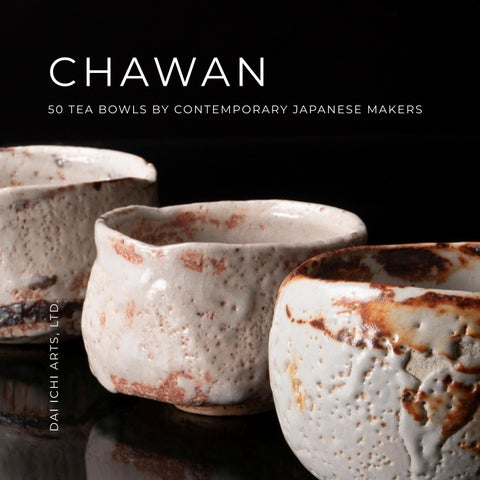
C H AWA N
D A I I C H I A R T S , LT D.
5 0 T E A B OW L S B Y C O N T E M P O R A R Y J A PA N E S E M A K E R S
C H AWA N 5 0 T E A B OW L S B Y C O N T E M P O R A R Y J A PA N E S E M A K E R S
E XH I B I T I O N CATA L O G U E
Dai Ichi Arts, Ltd. is a fine art gallery exclusively dedicated to celebrating modern and contemporary works of ceramic art from Japan. Since our inception in 1989, we have focused on placing important Japanese ceramics at the center of New York’s contemporary art scene. The gallery has introduced pieces to the permanent collections of several major museums, including The Metropolitan Museum of Art, The Art Institute of Chicago, the Minneapolis Institute of Art, the Indianapolis Museum of Art, the Princeton University Art Museum, and many more. We are committed to providing authoritative expertise to collectors, liaising with artists, and showcasing inspiring exhibitions and artworks. We welcome you to contact us for more information.
CHAWAN: 50 Tea bowls by contemporary Japanese makers Pop-up exhibition in London, United Kingdom On view from August 20–September 1, 2026 Exhibiting at: 67 York Street Gallery, 67A York St, London W1H 1QB, United Kingdom www.daiichiarts.com
WHAT’S IN A TEA BOWL?
The first encounter with a Japanese tea bowl is a moving, visual and physical experience: before it is used, it is seen, turned, and felt in the hands. Perhaps a subtle raised foot invites curiosity, and the beholder feels grateful that the artist has created a graceful grip for the bowl. A drip of glaze might move you deeply when it catches the eye; a particular quality of the Shōmen (or the main “face” of the tea bowl) might capture the heart, drawing out a sense of affection and connecting you with the object. A bold design may delight or unsettle, stirring an unexpected emotion or prompting a new way of seeing.
茶の湯
The beauty of a ceramic tea bowl first resides in its utility. Chanoyu , the Japanese practice of preparing and sharing matcha, began to take form roughly 650 years ago and developed in part within samurai culture. For the samurai class living amid a feudal society, the discipline of preparing and drinking tea offered periods of focus, calm, and composure. Over time, this meditative ritual evolved into a refined practice involving dedicated tea rooms, carefully selected utensils and deliberate procedures. At its most basic level, Chanoyu is often translated as “hot water for tea.” One selects a tea bowl, boils fresh water, prepares matcha, and drinks with attention. Through this repeated act, the senses become more alert and qualities associated with wabi – qualities of simplicity, restraint, and an appreciation of imperfection– may gradually come into view. Today, across its many contemporary schools, Chanoyu is a living cultural tradition within Japan and internationally. It is a celebrated practice rooted in the material, cultural and art histories of Japan, that offers a valuable aide for fostering empathy and connection between people and things.
侘び
In Chanoyu, the tea bowl serves as a functional vessel as well as a ritual anchor. Its character is defined its appearance, and also by its weight, balance, texture, and changing temperature while it is held and used. During the tea ceremony, these qualities can make a bowl feel delicate and ethereal or powerful and robust. Within the apparent constraints of this archetypal form, defined by the anatomy of the bowl, contemporary artists explore new expressions.
ANATOMY OF A TEA BOWL Mikomi
見込み
The well or interior space of the tea bowl
Chakinzure
茶巾摺れ
Kuchizukuri
The rim of the bowl that is wiped by the Chakin (tea cloth used during the tea ceremony), including the interior
口造り
The “lip” or rim of the tea bowl where the mouth touches
Dō
胴
The “torso” or wall of the tea bowl
Koshi
腰
The exterior part of the bowl that connects from the wall to the foot of the tea bowl; the “hip” of the vessel
Kōdai
高台
The “foot” or base of the tea bowl
Chasenzure
Shōmen
正面
The front “face” of the tea bowl; the side with the most beautiful design or glaze
茶筅摺れ
The interior part of the bowl where the Chasen (tea whisk) touches during the tea ceremony
Without words, the ceramic bowl conveys an immediate sense of tactile connection. It creates warmth and feeling, offering a site through which beauty can be experienced through the body as fully as through the eye. Its parts—the body, foot, torso and mouth— are named in relation to the human form, reinforcing its intimate and tactile presence. This embodied language, together with the meanings and associations a tea bowl can carry, makes the form an expansive field for creative expression. Contemporary ceramic artists make this diversity apparent, interpreting the form and elevating the tea bowl into the realm of artistic expression beyond its basic utility. The works presented in this exhibition highlight the tea bowl as a site of artistic experimentation and expression. Take, for example, the sculptural vessels of gallery artists Goto Hideki, Shingu Sayaka, Ichikawa Toru, and Kato Mami. Their works bring form and surface together to express new takes on what a tea bowl can be. Their glazes spill, gather, and flow across hand-built forms, while the unexpected weight or temperature of the vessels deepen this physical encounter. Masters like Yanagihara Mutsuo, by contrast, use pops of colour—swirling, confectionery pinks and reds—to animate the simple, traditional wan-nari profile, a form historically associated with wooden vessels. Contemporary makers also sustain and renew the glaze traditions that hold an important place in the material history of Japanese ceramics. For example, Yamada Hiroki, a potter based in Aichi, draws on the Shino firing traditions of the Momoyama period. The celebrated artist Kato Yasukage XIV, meanwhile, incised the walls of his tea bowl with contemporary cuts, and brought a sharper sensibility to the soft and tender qualities of classic Shino glaze. Tea bowls belong to a wider constellation of carefully considered implements. Among these are Shifuku : bespoke cloth pouches used in the Japanese tea ceremony to protect and honour precious tea wares, particularly Chaire (tea caddies) and tea bowls. As bespoke objects, Shifuku also offer rich possibilities for contemporary craft, design and artistic expression in close relation to the ceramic medium. This exhibition also highlights this through the work of British maker Kyle Whittington of Studio Shifuku. Whittington’s work is situated within a living culture of tea and making, while also reflecting the long history of exchange in tea and ceramics between Britain and Japan.
仕服
茶入
This catalogue marks the gallery’s inaugural summer exhibition in the United Kingdom, bringing together works from Japan and New York that show the tea bowl’s expressive and interpretative possibilities. Each tea bowl is capable of captivating the heart, engaging the hand, and opening new ways of seeing. We warmly invite visitors to encounter these tea bowls both as functional vessels and as objets d’art: works that linger in the mind long after your first encounter.
Two celadon glazed works by Ito Hidehito
伊藤 秀人 (b. 1971)
中島 宏
Nakashima Hiroshi (1941–2018) Celadon tea bowl, 2000s, with signed wood box, stoneware, 2 1/4 × 3 3/8 × 3 3/8 in. (5.6 × 8.6 × 8.6 cm)
川瀬 忍
Kawase Shinobu (b. 1950) White glazed teabowl, with signed wood box, stoneware, 2 3/4 × 5 in. (7.0 × 12.7 cm)
市川 透
Ichikawa Toru (b. 1973) Tea bowl, with signed wood box, stoneware, 3 7/8 × 4 7/8 in. (9.8 × 12.4 cm)
星野 暁
Hoshino Satoru (b. 1945) “Spring snow” tea bowl 2, with signed wood box, stoneware, 3 1/2 × 5 5/16 in. (8.9 × 13.5 cm)
Three tea bowls with Shino glaze by Yamada Hiroki
山⽥ 洋樹 (b. 1972) and Kato Ryotaro 加藤 亮太郎 (b. 1974)
十四代 加藤 康景
Kato Yasukage XIV (1964–2012) Shino tea bowl, with signed wood box, stoneware, 3 5/8 × 5 × 5 in. (9.3 × 12.7 × 12.7 cm)
後藤 秀樹
Goto Hideki (b. 1973) No. 2 Shino Watatsumi tea bowl, 2026, with signed wood box, stoneware, 4 5/8 × 7 1/2 × 6 5/8 in. (11.8 × 19 × 16.7 cm)
後藤 秀樹
Goto Hideki (b. 1973) No. 4 Shino Watatsumi tea bowl, 2026, with signed wood box, stoneware, 4 3/4 × 7 1/2 × 5 7/8 in. (12 × 19 × 15 cm)
後藤 秀樹
Goto Hideki (b. 1973) No. 3 Shino Watatsumi tea bowl, 2026, with signed wood box, stoneware, 4 1/4 × 7 1/8 × 6 1/4 in. (10.7 × 18 × 16 cm)
後藤 秀樹
Goto Hideki (b. 1973) Shino Watatsumi tea bowl, 2023, with signed wood box, stoneware
後藤 秀樹
Goto Hideki (b. 1973) No. 1 Shino Watatsumi tea bowl, 2026, with signed wood box, stoneware, 5 1/4 × 4 3/8 × 5 1/8 in. (13.5 × 11 × 13 cm)
柳原 睦夫
Yanagihara Mutsuo (b. 1934) Red Oribe tea bowl, 1991, with signed wood box, stoneware, 3 3/8 × 5 1/2 × 5 1/2 in. (8.7 × 14 × 14 cm)
鯉江 良二
Koie Ryoji (1938–2020) Tea bowl, with signed wood box, stoneware, 3 1/2 × 4 1/8 in. (8.9 × 10.4 cm)
鯉江 良二
Koie Ryoji (1938–2020) Black iron glazed teabowl (Hikidashi style), with signed wood box, stoneware, 3 3/8 × 5 1/2 × 5 in. (8.6 × 14 × 12.8 cm)
昼馬 和代
Hiruma Kazuyo (b. 1947) Tea bowl "Sōfu", 2026, with signed wood box, stoneware, 3 3/8 × 4 3/4 × 4 3/8 in. (8.5 × 12 × 11 cm)
新宮 さやか
Shingu Sayaka (b. 1979) No. 1 Tea bowl "OOZE," 2026, with signed wood box, mixed clay with glaze slip, 4 × 5 1/2 in. (10 × 14 cm)
新宮 さやか
Shingu Sayaka (b. 1979) No. 2 Tea bowl "OOZE," 2026, with signed wood box, mixed clay with glaze slip, 3 1/2 × 5 1/2 in. (9 × 14 cm)
新宮 さやか
Shingu Sayaka (b. 1979) No. 3 Tea bowl "OOZE," 2026, with signed wood box, mixed clay with glaze slip, 3 1/2 × 5 1/2 in. (8.8 × 14 cm)
加藤 真美
Kato Mami (b. 1963) Frost glaze tea bowl, 2026, with signed wood box, Seto porcelain, 3 × 4 × 3 1/2 in (7.6 × 10.2 × 8.9 cm)
加藤 真美
Kato Mami (b. 1963) Frost glaze tea bowl "Sui En," 2026, with signed wood box, Seto porcelain, 4 1/8 × 4 5/8 × 5 1/2 in. (10.5 × 11.7 × 14 cm)
加藤 真美
Kato Mami (b. 1963) No. 3 Frost glazed tea bowl (black), 2025, with signed wood box and accompanying contemporary Shifuku by Studio Shifuku, Seto porcelain, 4 3/8 × 5 1/4 × 5 1/8 in. (11 × 13.5 × 13 cm)
加藤 真美
Kato Mami (b. 1963) Frost glazed tea bowl "Izutsu," 2026, with signed wood box, Seto porcelain, 3 7/8 × 3 3/4 × 3 7/8 in. (9.9 × 9.7 × 9.9 cm)
加藤 真美
Kato Mami (b. 1963) Frost glazed tea bowl, 2025, with signed wood box and accompanying contemporary Shifuku by Studio Shifuku, Seto porcelain, 4 1/8 × 6 1/4 × 4 3/8 in. (10.5 × 16 × 11 cm)
加藤 真美
Kato Mami (b. 1963) Tea bowl “Konohana," 2025, with signed wood box, Seto porcelain, 4 3/8 × 5 1/8 × 5 1/8 in. (11 × 13 × 13 cm)
大石 早矢香
Oishi Sayaka (b. 1980) No. 1 Bowl "Sumika," 2026, with signed wood box, porcelain, 3 3/4 × 7 1/2 × 6 3/4 in. (9.6 × 19 × 17 cm)
大石 早矢香
Oishi Sayaka (b. 1980) No. 2 Bowl "Sumika," 2026, with signed wood box, porcelain, 3 7/8 × 7 1/8 × 6 3/4 in. (9.8 × 18 × 17.2 cm)
佐伯 守美
Saeki Moriyoshi (b. 1949) Zōgan inlaid tea bowl with tree motifs, 1998, with signed wood box, stoneware, 2 3/8 × 3 3/8 × 3 5/8 in. (6.1 × 8.6 × 9.1 cm)
佐伯 守美
Saeki Moriyoshi (b. 1949) Neriage Zōgan tea bowl with tree motif, 1989, with signed wood box, stoneware, 2 3/4 × 3 3/4 × 3 3/4 in. (6.9 × 9.7 × 9.7 cm)
宇佐美 朱理
Usami Shuri (b. 1980) TOWA Tea bowl (red), 2025, with signed wood box, stoneware, 2 5/8 × 3 1/8 × 3 in. (6.6 × 7.9 × 7.6 cm)
宇佐美 朱理
Usami Shuri (b. 1980) TOWA Tea bowl (green), 2025, with signed wood box, stoneware, 2 7/8 × 3 1/4 × 3 1/2 in (7.4 × 8.4 × 8.9 cm)
辻村 塊
Tsujimura Kai (b. 1976) (Left) Kohiki tea bowl, 2025, with signed wood box, stoneware, 2 × 6 3/8 × 6 3/8 in. (5.2 × 16.3 × 16.3 cm)
辻村 塊
Tsujimura Kai (b. 1976) Hikidashi-kuro tea bowl, 2025, with signed wood box, stoneware, 3 1/2 × 4 3/4 × 4 1/4 in. (8.9 × 11.9 × 10.7 cm)
杉本 貞光
Sugimoto Sadamitsu (b. 1935) Kohiki tea bowl "White Horse," 2025, with signed wood box, stoneware, 2 1/2 × 5 3/4 × 1 3/4 in. (6.5 × 14.5 × 4.5 cm)
菊池 克
Kikuchi Katsu (b. 1972) Black-glazed faceted tea bowl, 2023, with signed wood box, stoneware, 3 1/4 × 4 5/8 × 4 5/8 in. (8.2 × 11.8 × 11.8 cm)
菊池 克
Kikuchi Katsu (b. 1972) Karatsu tea bowl, with signed wood box, stoneware, 3 5/8 × 4 5/8 × 4 5/8 in. (9.3 × 11.6 × 11.6 cm)
石井 隆寛
Ishii Takahiro (b. 1977) Tea bowl, with signed wood box, stoneware, 5 × 5 5/8 × 3 3/8 in. (12.6 × 14.4 × 8.5 cm)
隠崎 隆一
Kakurezaki Ryuichi (b. 1950) Black tea bowl with natural ash effects, with signed wood box, stoneware, 3 3/8 × 5 5/16 × 4 11/16 in. (8.6 × 13.5 × 11.9 cm)
大岩 智之
Oiwa Tomoyuki (b. 1977) Kuro Bizen tea bowl with salt glaze, 2023, with signed wood box, stoneware, 3 1/2 × 5 1/4 × 5 1/8 in. (9 × 13.5 × 13 cm)
大岩 智之
Oiwa Tomoyuki (b. 1977) Kuro Bizen tea bowl, 2021, with signed wood box, stoneware, 3 3/4 × 5 1/2 × 4 3/8 in. (9.5 × 14 × 11 cm)
CHAWAN: 50 tea bowls by Contemporary Japanese Makers Exhibition catalogue Photography: Yoriko Kuzumi, Isabella Fowden, Kristie Lui Shifuku by Studio Shifuku © Dai Ichi Arts, Ltd. 2026 ISBN 979-8-9985525-5-7
DAI ICHI ARTS, LTD. 18 EAST 64TH STREET, STE. 1F NEW YORK, NY, 10065, USA WWW.DAIICHIARTS.COM