The DACOR Bacon House is built on the Indigenous lands of the Nacotchtank (Anacostan) and later Piscataway people. The House was built in 1825 by enslaved laborers. Enslaved people lived and worked in the DACOR Bacon House until 1862 when the District of Columbia Emancipation Act was signed.
DACOR Programs & Policies
LUNCHEON TALKS
Members, along with guests they accompany, are invited to attend luncheon talks which are held weekly throughout the year. Unless otherwise noted, these talks begin at noon with a cash bar reception in honor of the speaker. Lunch starts at 12:30 pm, followed by the speaker’s remarks which conclude by 2:00 pm; attendees are free to leave at that time.
The charge is $35 per DACOR member and reservations are required. (The charge for attending only the speaker portion of the program from 1 – 2 pm is $15.) Changes and/or cancellations to programs are announced in our e-blasts and on our website.
OTHER EVENTS
All members of DACOR are invited to attend ADST/DACOR book launch receptions, receptions for newly-commissioned FSOs, and DCM/PO receptions for DCMs and Principal Officers. There is no entry charge, but reservations are necessary. Members are also welcome at the Sunday afternoon Huston Musicales; a fee of $35 per DACOR member and $45 for guests is collected at the door. Children under 18 are admitted free.
Disclaimer: DACOR encourages vigorous expression and questioning of points of view, while striving for balance. No endorsement of speakers’ views or of their charitable, professional or commercial bona fides should be inferred.
MEMBERS’ LUNCHEONS
Members and their guests are invited to lunch on Tuesdays and Thursdays, reservations are required. Members' Luncheons include a biscuit/bread, an entree, a dessert, and a cup of coffee/tea and cost $35. A cash bar is available from 12 and lunch is served from 12:30 to 1:30.
NO-SHOWS & CANCELLATIONS NOT RECEIVED BY 9 AM THE BUSINESS DAY BEFORE AN EVENT WILL BE BILLED.
— TO MAKE OR CANCEL RESERVATIONS — Register through the Calendar of Events at www.dacorbacon.org Or contact us at programs@dacorbacon.org or 202.682.0500 x120.
DACOR routinely takes photos at its events. Members and guests should notify the DACOR photographer if they want to restrict the use of their names and images.
DRESS CODE
DACOR maintains a professional business attire dress code in the DACOR Bacon House. While suits, ties and heels are always welcome, they are not required. For individual events, or categories of events, DACOR may apply a formal business attire dress code where men are expected to wear a suit or jacket and tie, and women should wear commensurate attire. Promotional material for these events will specify that formal business attire is required. During summer months, from Memorial Day to Labor Day, business casual may be worn.
I write to you this month as immediate past president of DACOR, acting Vice President, and interim Executive Director. In accordance with the DACOR bylaws, I stepped down from the presidency at the Board meeting on May 22; the bylaws limit the tenure of a president to two one-year terms. Unfortunately, the succession plan had not yet crystalized, and I am temporarily filling a leadership gap until such time as a new President and Vice President, combined with a new Executive Director, have been recruited and are ready for action. Obviously, this is a critical transition for DACOR and the Foundation, and we must meet the moment with creativity and conviction. I had thought that DACOR might escape a direct frontal attack from the changing national landscape because we receive no federal funding. However, that hope was dashed in early May as DACOR was disinvited from its usual role on stage at the State Department awarding the DACOR Foreign Service Cup to a distinguished senior exemplar of our profession. It was the first time since 1965 that DACOR had not been present for Foreign Service Day (aka Foreign Affairs Day), an event that it co-founded, and the first time ever that we were obliged to award the Foreign Service Cup in a locale other than the Department. What a fortuitous moment to have at the ready . . . a House of our own.
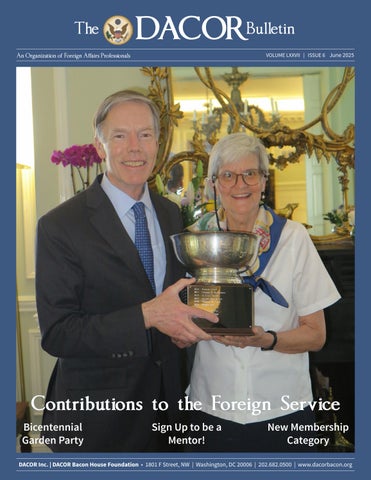
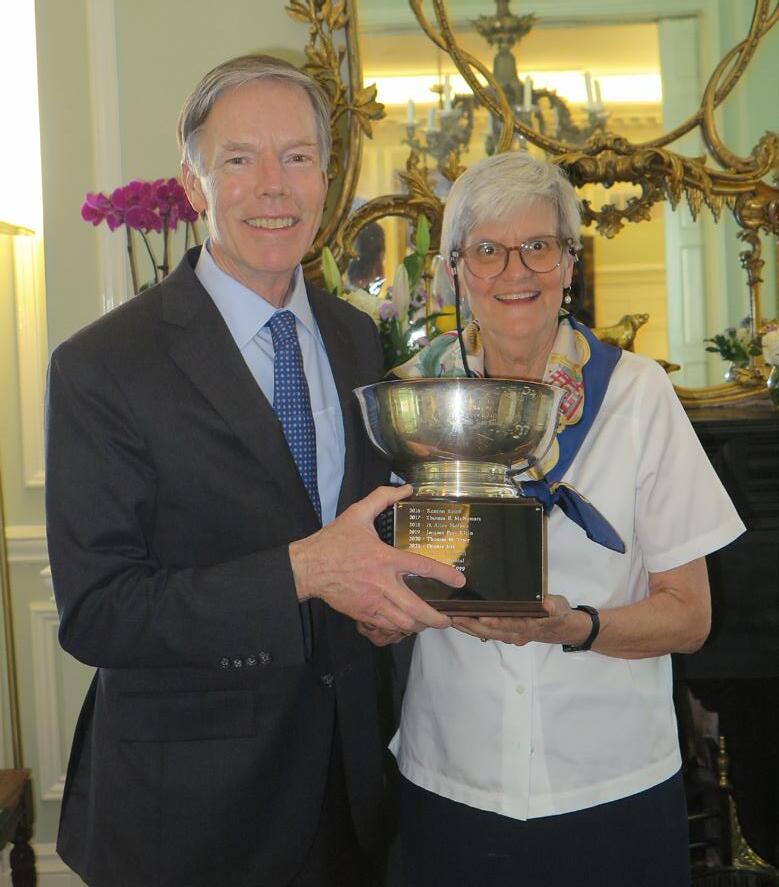
DACOR members and staff rebounded with high spirits and were able to produce our own ceremony on the patio at DACOR Bacon House. It was my honor to present the Foreign Service Cup to Ambassador Nick Burns, whose latest accomplishment in a very long and distinguished career was service as President Biden’s ambassador to China. We also enjoyed a luncheon in honor of Ambassador Burns in the comfort of our own House. You can read the remarks of our honoree in this edition of The DACOR Bulletin
In another unprecedent situation, and for want of a President to preside, I represented DACOR for the third time at our annual Memorial Day ceremony on May 26. Given the anomalous circumstances at play in Washington, there was no official State Department representative to stand with me. Thus I asked three distinguished female leaders to make remarks—Susan Johnson, president of ADST and past president of AFSA; Tina Wong, Vice President of AFSA for the Department; and Lucy Melbourne, a writer and former Fulbright Scholar whose family is buried in the DACOR section of Rock Creek Cemetery and whose father worked with Loy Henderson in its creation. Meanwhile, to our surprise and delight, who should appear in the audience but Director General and Ambassador Marcia Bernicat, the Department’s official representative at this same ceremony the previous three years? Ambassador Bernicat’s unexpected attendance capped off an unforgettable Memorial Day. Continued on page 8.
Upcoming DACOR PROgRAms & EvEnts
Thursday • June 5 • 10:30 am - 12 pm • Virtual
thE FutuRE OF nAtO
Join us for our next TransAtlantic Dialogue with the Foreign Commonwealth & Development Office Association, the Canadian Ambassadors Alumni Network, and the Canadian Foreign Service Alumni Forum, our counterparts in the United Kingdom and Canada.
The program will be moderated by Stephanie Smith Kinney, U.S. Foreign Service, retired. The panel will be comprised of Ambassador Kerry Buck, Canada's Ambassador to NATO 2015-2018; Dame Mariot Leslie, the UK's permanent representative to NATO 2010-2014; and Ambassador Robert Hunter, the US's Ambassador to NATO 1993-1998.
Stephanie Smith Kinney is a 25-year veteran of the U.S. Foreign Service. Her diplomatic career included tours of duty in Europe and Latin America as well as multilateral diplomacy under the auspices of the United Nations. A career diplomat, Kerry Buck was Political Director and Assistant Deputy Minister for International Security and Political Affairs, Canadian Representative at the UN, G7, NATO, OAS, and OSCE, and Assistant Secretary to the Treasury Board, Economic Sector. Dame Mariot Leslie's prior appointments included head of the Foreign Office’s policy planning staff; minister and deputy head of mission in Rome; ambassador in Oslo; director defence and strategic threats and counter-terrorism envoy; and director-general for defence and intelligence. Robert Hunter was Vice President for International Politics at CSIS, a member of the NSC Staff, foreign policy advisor to Senator Edward Kennedy, senior fellow at the Overseas Development Council, and research assistant at the IISS amongst other positions. Full bios may be found in the online program announcement.
Tickets are limited and selling fast so do not wait to register! This event is open to members and non-members. This event features valet parking. Registration available at https://tinyurl.com/yt5mb9zc
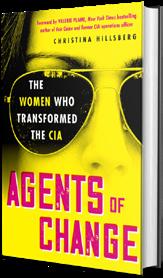
Ms. CHRISTINA HILLSBERG
Author; former CIA Intelligence Officer
AgEnts OF ChAngE: thE WOmEn WhO tRAnsFORmED thE CIA
Join DACOR for a conversation with Christina Hillsberg on her new book Agents of Change Years after her successful and impactful career at the CIA, Hillsberg became enthralled with the stories of the trailblazing women who forged new paths within the Agency long before she began her career there in the aughts. These were women who sacrificed their personal lives, risked their safety, defied expectations, and boldly navigated the male-dominated spy organization.
Through exclusive interviews with current and former female CIA officers, many of whom have never spoken publicly, Agents of Change tells an enthralling and, at times, disturbing story set against the backdrop of the evolving women’s movement. It was the 1960s, a “secretarial” era, when women first gained a foothold and pushed against the one-dimensional, pop-culture trope of the sexy Cold War Bond Girl. Underestimated but undaunted, they fought their way, decade-by-decade, through adversity to the top of the spy game.
Hillsberg takes readers inside the Agency in a way that’s never been done before, paying long overdue tribute to the survivors and thrivers, the indispensable groundbreakers, and defiant rabble-rousers who made the choice to change their lives and in turn, changed history. A full bio may be found in the online program announcement.
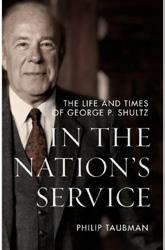
Mr. PHILIP TAUBMAN
Author; Lecturer, Center for International Security and Cooperation, Stanford Univeristy
thE LIFE AnD tImEs OF gEORgE P. shuLtz
Join DACOR for a discussion of the difinitive biography of George P. Shultz, US Secretary of Labor, Secretary of the Treasury and Secretary of State with author Philip Taubman.
Taubman's book, In the Nation's Service: The Life and Times of George P. Shultz, explores how this distinguished public servant was pivotal in steering the great powers towards the end of the Cold War. Deftly solving critical but intractable national and global problems was the leitmotif of George Pratt Shultz's life. No one at the highest levels of the United States government did it better or with greater consequence in the last half of the 20th century, often against withering resistance. His quiet, effective leadership altered the arc of history. While political, social, and cultural dynamics have changed profoundly since Shultz served at the commanding heights of American power in the 1970s and 1980s, his legacy and the lessons of his career have even greater meaning now that the Shultz brand of conservatism has been almost erased in the modern Republican Party.
Philip Taubman is a lecturer at Stanford University's Center for International Security and Cooperation. Before joining CISAC, Mr. Taubman worked at The New York Times as a reporter and editor for nearly 30 years, specializing in national security issues, including intelligence and defense policies and operations.
A full bio may be found in the online program announcement.
the Date 135th Birthday Celebration of Virginia Murray Bacon
Afternoon Tea
Thursday, September 4 2:30 - 4:30 pm
The Bicentennial Year was launched by Bicentennial Honorary Chair Ambassador Thomas Shannon and President Angela Dickey on August 6, 2024, with a celebration of “200 Years of French Connections,” featuring H. E. Laurent Bili, the French Ambassador to the U.S.
Upcoming Bicentennial Programs
October 5, 2025, 3 - 5 PM, Music Performance
"An Evening of 19th Century Song in the Carroll Home at 18th and F Street."
Featuring music performed by the Jubilee Singers from the volume of sheet music owned by Alida Carroll, 1866. Plus a rendition of the "Esterhazy Ripple," composed to honor of her sister Sally Carroll Countess Esterhazy.
October 30, 2025, 6 - 8:30 PM, Dinner and Talk
"The Civil War and Foggy Bottom."
How the Carroll Family and their neighbors in Foggy Bottom played out the terrible conflict. Panel discussion with local historian Frank Leone on Camp Frye, Jessica Barnes on the F Street House and its connection with Gen. Grant and his family, and Terry Walz, DACOR Historian, on the multiple contributions of the Carrolls to the war effort. Co-sponsored by the Civil War Roundtable of the District of Columbia.
December 7, 2025, 3 - 5 PM, Music Performance
Holiday Musicale
An exploration of the music of America over the 200 years of the DACOR Bacon House.
Bicentennial Program Co-chairs: Meredith Whiting and Terry Walz
Bicentennial Garden Party Chair: Dana Linnet
Watch Recent and Past DACOR Speaker Programs from Home!
DACOR records many speaker programs, including its virtual programs -- Watching is easy!
• Visit www.dacorbacon.org. Place your pointer over Members Portal in the top menu and click on the Past Programs option in the dropdown menu that appears.
• You will be asked to log in. (For password help, see page 21.)
• A list of recorded programs is visible on this page – they’re organized by season and then reverse chronological order.
• Once you've located your program of choice, simply click play.
• Sit back and enjoy!
If you have questions contact us at dacor@dacorbacon.org.
Have a program idea? We want to hear from you!
In an effort to streamline our program suggestion process and make it easier for any member to suggest a program topic and/or speaker, the Program Committee has a Speaker Suggestion Form.
Simply go to dacorbacon.org, and under the Members Portal menu option, select, “Share a Program (Speaker/Topic) Suggestion.” You will be directed to the form to make your suggestion. ALL suggestions are considered periodically and voted upon by the committee*.
A few FYIs:
• *If your suggestion is better suited for a different committee or task force, it may be considered by a program-organizing-team other than the Program Committee.
• You may be contacted for more information or a request for assistance in bringing your suggestion to fruition.
• Please know that while we appreciate and encourage all your suggestions, we are unable to hold a program/event for every suggestion.
• Contact information is invaluable!
Continued from page 3.
The very meaningful speeches given by Susan, Tina, and Lucy will be printed, along with the invocation of Father John Hurley, in the July-August issue of this magazine.
2025 calls for courage and resilience. If the winds buffeting the foreign affairs community were not chaotic enough, DACOR’s financial fortunes are in a vulnerable state, burdened with high costs, limited income, and the specter of repaying a USG Payroll Protection Plan loan that we received, and for which we were forgiven, during the pandemic.
Let us lean into these headwinds, thinking deeply about who we are, what we stand for, and how we can collectively buttress the fortunes of DACOR and our 200-old House. If you have not paid your dues invoice, please do so now. And if you have a bit more to give when others are losing their jobs, please pitch in a bit more.
My Buddhist teacher, Roshi Joan Halifax, recently reflected that the history of social movements and enduring social change is not the work of single individuals, "but of communities living the narrative of connection, of interbeing, of ethical, courageous, and caring solidarity, interconnected communities dedicated to the well-being of all."
Angela Dickey
Introducing the Young Professional Membership Subcategory
The DACOR Board of Governors adopted a resolution to start a new Young Professional membership subcategory for DACOR members at their March meeting:
RESOLVED, that beginning on June 1, 2025, a Young Professional subcategory of Regular Members is established, who will be assessed dues at the following discounted rates, based on their age as of January 1 for the applicable year (rounding up or down to a more convenient figure is permitted):
i. Under 30—20% of the full rate, $0 initiation fee
ii. 30 to 34—50% of the full rate, $0 initiation fee
iii. 35 and above—full rate
In 2025, these rates are:
Resident Non-resident
Under 30
30-34
35 and above
$99
$248
$495
$35
$86
$171
IMPORTANT NOTE: In order to be billed at the Young Professional rate, one must provide DACOR membership staff one’s date of birth.
Since we are starting this new subcategory in the middle of our dues year, members eligible for the young professional rate who paid their 2025 membership dues at the regular rate will receive a credit for the difference that will be applied to future dues going forward. Members who qualify should contact Christine Skodon at clskodon@ dacorbacon.org and provide their date of birth if not already in the database.
In 2026, provided we have their date of birth, those eligible for the young professional rate will be billed accordingly, after taking into account any applicable credit.
All DACOR members are encouraged to help spread the word about our new young professional rates. Visit https:// www.dacorbacon.org/membership for more information about dues rates and benefits.
Thursdays 5 - 7 pm
200 YEARs OF DACOR BACOn hOusE hIstORY
DACOR Bacon House is celebrating its bicentennial year 2024-2025 with a series of programs that highlight important events in the house’s history and the contributions its occupants made to our nation’s capital and to our national history. We have divided the two-hundred-year period into significant eras. For this month, June 2025, we begin our study of the years when Virginia and Robert Low Bacon occupied the DACOR Bacon House beginning in 1923. They would raise a family of three daughters in the house while Robert was a Congressman representing the 1st District of New York.
Terry Walz, DACOR Historian
Elizabeth Warner, DACOR Archivist
1923 - 1935 Representative and Mrs. Robert Low Bacon Come to Washington
1923
Robert Low Bacon and his wife, the former Virginia Murray, first came to Washington for several months in 1918 when Robert was a major in the U.S. Army during World War I. Virginia wrote her father-in-law that the “combination of the countrybumpkiness of it and the interesting people one is constantly with is quite rare.”1 After Robert won election to the House of Representatives in 1923 the couple returned with their three young daughters and a retinue of animals and servants, this time renting the fine Federal mansion at 1801 F Street. The Bacons furnished their new abode with a combination of items purchased abroad, things brought down from their estate in Westbury, Long Island, and things left behind by previous occupants, including the Chippendalestyle giltwood mirror that sits in the North Drawing Room.
1. VB to RB Sr, 1918-12-18
2. VB to FMM 1928-07-1928
1925
After renting for two years, the Bacons purchased 1801 F Street in a transaction that occasioned some drama. Owner Alice Copley Thaw announced an intention to sell early in the year, but Robert preferred to go on renting. Virginia dutifully looked at other houses but wanted to stay where she could see the Washington Monument from her front windows and keep horses in the carriage house. While Robert was reluctantly dickering over financing terms, Thaw sold the house to a speculator who demanded $10,000 more for it than they would have paid had they acted a few weeks earlier. The Bacons scrambled to get their act together and signed a contract with the speculator three days later to become the proud owners of what was then known as the John Marshall House for $87,500 (close to $2 million in today’s dollars) in March 1925.
1928
By 1928 Robert was in his third term as a Congressman, running for a fourth, and Virginia was regularly entertaining cabinet officials and foreign diplomats at 1801 F Street, continuing a century-long tradition at the house. The Bacons were confident enough of long-term residence to reconfigure some interior rooms to accommodate more servants. “I am not thinking of
To be continued in the July/August edition
1932
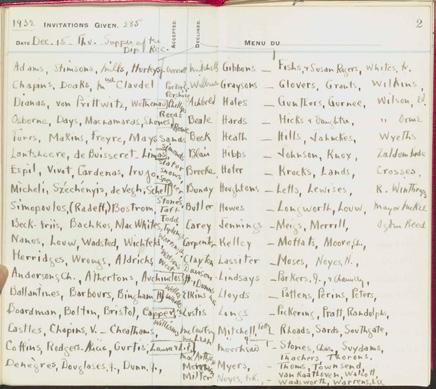
The Depression did not seem to affect the Bacons very much financially, although it was a momentous time to be in Congress. Robert Bacon is best known now for the Davis-Bacon Act, adopted in 1931 and still extant, which requires Federal construction contractors to pay “prevailing wages” where the work is taking place. In 1932 Robert announced his support for repealing the 18th Amendment (which happened two years later). As in much of the rest of the country, official and social Washington regarded Prohibition largely as a nuisance that merely entailed taking certain precautions. Certainly, Virginia would not have allowed it to interfere with the soiree she gave for 200 or so guests in December of that year.
1935
But storm clouds were gathering. Hitler came to power in early 1933, and by 1935 was openly preparing for war and genocide. In addition to the perils of fascism looming in Europe, tragedy struck closer to home. Virginia lost three close family members in less than two years’ time, beginning with
her father in March 1934, her brother in June 1935 and her oldest daughter Alexandra in December. There would be worse to come, for the Bacons and the entire world
Guest list for a late supper hosted by the Bacons on December 15, 1932, after a diplomatic reception at the White House. Courtesy, Booth Family Center for Special Collections, Georgetown University.
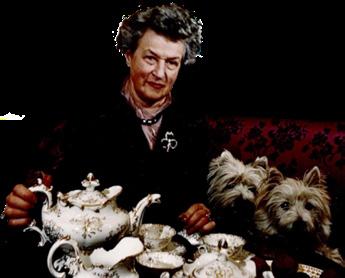
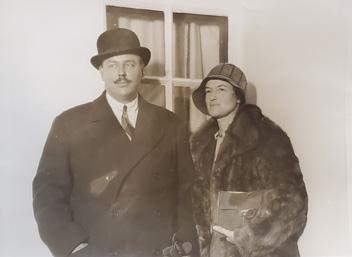
Above: Robert and Virginia Bacon, around 1930. Courtesy, Booth Family Center for Special Collections, Georgetown University.
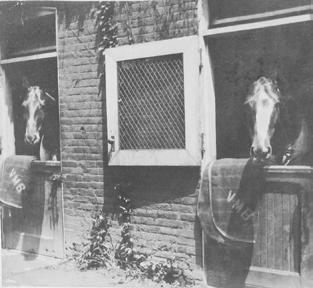
Left: Two of Virginia’s horses at home in the Mews overlooking the garden in 1924 Courtesy, Booth Family Center for Special Collections, Georgetown University.
DACOR’s Own Terry Walz Wins Supreme Court Historical Society’s Writing Award
Dr. Terence Walz, DACOR’s historian-in-residence, will be recognized at ceremonies on June 2 in the Courtroom of the Supreme Court for his article, "'Judge' Eugene Brooks: Supreme Court Messenger, Proponent of Black Awareness, 18811926." His article, which appeared in the November 3, 2024 issue of the Journal of Supreme Court History, published by the Supreme Court Historical Society, was judged to be the best article published in the Journal in 2024 and named winner of the Hughes-Gossett Prize.
Terry currently serves on DACOR’s Executive Committee and co-chairs the Bicentennial Committee where he advises on the history of Washington, D.C. and the families who resided in historic DACOR Bacon House during the period 1835 to 1985, the year it was acquired by the DACOR Bacon House Foundation.
The Hughes-Gossett Prize, which carries a stipend of $1,500, has been awarded annually to distinguished legal historians for more than thirty years. It is named after Elizabeth Hughes Gossett, the daughter of Chief Justice Charles Evans Hughes and a founder of the Supreme Court Historical Society.
In the introduction to the Journal’s Nov. 3, 2024 edition, the chair of the Journal’s board of editors Timothy S. Huebner praised Terry’s article as “providing a compelling assessment of a previously unknown member of the Court’s staff. In the midst of the era of Jim Crow segregation, as Terence Walz tells us, Eugene Brooks made his mark… [Mr. Brooks] became a fixture at the Court for decades while he also rose to prominence within D.C.’s Black community.”
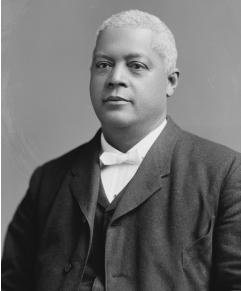
Supreme Court Messenger Eugene Brooks, 1881-1926.
Terry’s prize-winning article tells the story of Eugene Brooks, a native Washingtonian born in c. 1849, who came to serve as a personal messenger for two Supreme Court chief justices, Morrison R. Waite of Ohio and Melville W. Fuller of Maine. In 1881, at age 31, Brooks had the good fortune to be selected on the recommendation of a friend to serve as messenger to Chief Justice Waite. The duties of messenger varied widely based on the preferences of each justice, but typically involved accompanying justices to appointments, delivering draft opinions to other justices, and enrobing their justice ahead of proceeding into the court’s chambers.
Terry’s research explored the many ways in which Eugene Brooks’s life changed after his appointment as messenger to Chief Justice Waite. As a Black man residing in a segregated city in the post-Civil War era, Brooks made time to become active in many of Washington’s civic organizations open to AfricanAmericans. Due to his association with the chief justice, Brooks’s friends soon added the title “Judge” to his name. In the 1890s, he joined relief organizations dedicated to assisting Black families, assuming a leadership role in the Frederick Douglass Relief Association. Toward the end of the century, that organization was focused on campaigning for expanded employment opportunities in Washington for the growing number of educated young Black men and women in need of jobs.
Because of his service on the vestry of St. Luke’s Episcopal Church, his work with the masonic lodges, and especially his association with the highest-ranking member of the Supreme Court, as Terry notes in his Journal article, Brooks emerged at the turn of the twentieth century “ as a prominent figure in Washington’s African-American community.“ Brooks assumed a leadership role on subcommittees “for Colored Citizens” involved in the Theodore Roosevelt and William Howard Taft inaugurals. Under Presidents Woodrow Wilson and Warren G. Harding, inaugural festivities were not held; however, as president of the Association of the Oldest Inhabitants (Colored) of Washington, D.C., Brooks organized a gala for Harding’s inauguration anyway, further enhancing his reputation as a civic leader in Washington.
Terry’s full story of Eugene Brooks’s career in the Supreme Court and his active role in the civic life of Washington at the turn of the century is available on the Supreme Court Historical Society’s website, https://supremecourthistory.org/wp-content/ uploads/2025/02/Volume-49-Number-3-2024.pdf
Dr. Terence Walz
NAME TAG ORDER FORM
$19.00 each
Available in 3 formats: Pin, Magnet or Pocket Slide
Please note that anyone with a pace maker should not use the magnetic name tag!
Name as you wish it to appear: Type:
Pin ___ Magnet ___ Pocket Slide ___
Pin ___ Magnet ___ Pocket Slide ___
Pin ___ Magnet ___ Pocket Slide ___
NAME TAG ORDER FORM
I am ordering ______ name tags @ $19.00 each and enclose $____________.
$12.00 each
Available in 3 formats: Pin, Magnet or Pocket
Please make checks payable to DACOR.
Please let us know where we should send the tags:
Please note that anyone with a pace maker should not use the magnetic name tag!
Name: ____________________________________
Address: __________________________________
Name as you wish it to appear:
Mail to: DACOR
Email in case of questions: ________________ 1801 F Street, NW Washington, DC 20006
Name tags may also be purchased through the online DACOR Bacon House Boutique.
I am ordering ______ name tags @ $12.00 each and enclose
WORLD AFFAIRS TRAVEL PROGRAM
Finland ~ Arctic Magnificence led by Jackie Miller Dec 10 - 18,
Circumnavigation of Ireland & Northern Ireland led by Paul Nugent
Sept 11 - 20, 2025
LEARN MORE
LEARN MORE
LEARN MORE
They Did It Despite the Obstacles: Women in Diplomacy and Intelligence
By Greg Rushford, Public Outreach Committee & Veteran Washington Journalist
President Donald Trump's flurry of executive orders aimed at ridding the federal government of what the president has called "illegal and immoral" Diversity, Equity and Inclusion hiring-and promotion practices reflects an unsettling historical ignorance. A brief look at the many contributions women --- including women of color --- have made to diplomacy and intelligence highlights why any occupant of the White House should offer praise, not insults. For sadly, discrimination within the federal service based on gender, race, religion, and so on has long tarnished our history.
The president and his Seventh Floor loyalists on Foggy Bottom understand --- and are exploiting --- the unfortunate fact that current popular resentments against the so-called Deep State have deep cultural roots. Conspicuously displayed in the DACOR Bacon House's main meeting room are quaint 1870's Vanity Fair caricatures of snobby, elitist gentlemen "cookie pushers" wearing striped pants.
Historian Homer Calkin's seminal 1978 "Women in the Department of State" and many more recent oral histories and books reveal an inspiring story of women's rise to prominence in foreign affairs --- breaking cultural taboos at the same time.
It took a while.
Asked in 1807 about women serving in government, President Thomas Jefferson recoiled: “The appointment of a woman to office is an innovation for which the public is not prepared, nor am I.”
Some 126 years later --- President Franklin D. Roosevelt dispatched Ruth Bryan Owen to Denmark in 1933, as America’s first female envoy and minister to a foreign country. Minister Owen, a political appointee, was well-received in Copenhagen. Her diplomatic accomplishments included helping smooth over lingering tensions from the notorious 1930 Smoot-Hawley tariffs.
In 1949, President Harry Truman tapped Eugenie Moore Anderson as America’s first female diplomat with the rank of ambassador. Also posted to Denmark, Amb. Anderson worked skillfully to advance U.S.-Danish mutual security interests, including negotiating Greenland’s contributions to NATO defense.
There’s much more.
Francis Willis, picked in 1953 by President Dwight Eisenhower as ambassador to Switzerland, was the first career female foreign service officer to become ambassador. (Her appointment created something of a stir, as Swiss women wouldn’t get the right to vote in federal elections until 1971.)
More recently, DACOR member Amb. Mattie R. Sharpless was dispatched by President George W. Bush to the Central African Republic in 2001. Born in rural North Carolina, this future American ambassador walked two miles to her segregated grade school, which --- unlike the whites-only school --- had no indoor bathrooms.
But Sharpless’s teachers inspired a lifetime intellectual curiosity, leading to her enrollment at North Carolina College. Her interest in foreign affairs was sparked by encounters with the school’s foreign exchange students.
Having started as a clerk-typist in USDA’s Foreign Agricultural Service, Amb. Sharpless retired from the U.S. Foreign Service in 2006. Her 41-year career service included high-level international trade negotiations, with plum assignments including Paris, Rome, and Brussels.
DACOR member Ambassador Ruth Davis, who passed away in May, was the first African-American woman named Career Ambassador (in 2002). Her many other “firsts” included being the first African-American director of the Foreign Service Institute.
Interviewed by the Foreign Service Journal in 2016, Amb. Davis summed up the importance of encouraging a diverse diplomatic corps. “Unless there is clear and visible support from the highest levels of the [State] Department," she observed, "very little effective action is taken to advance diversity interests.”
There are similar inspiring stories of women’s successful --- if belated --- struggles to rise to prominence in U.S. intelligence. The CIA’s first woman overseas station chief was appointed only in 1978.
Virginia Hall, renowned for her daring OSS exploits during WWII, was shunned by the postwar old-boy network during her subsequent CIA service. Today, however, the Agency has a building named in her honor.
On June 25, DACOR will host author Christine Hillsberg, who will relate more tales of struggle from her new book, Agents of Change: The Women Who Transformed the CIA.
Ambassador Eugenie Moore Anderson, Ambassador to Denmark (1949-1953) and Bulgaria (1962-1964).
First-Person Account: The National Arts Club
By Leo Cecchini, Reciprocal Clubs Committee Chair
My wife and I stayed at the National Arts Club the other month. The club is located on New York City's only private park, Grammercy Park in the heart of Manhattan. Access to the park is limited to residents of the area. The club is much like DACOR Bacon House in that it is housed in an elegant mansion but only 125 years old. The club also has an adjoining four story home that serves as its annex.
The club was originally opened to house practicing artists of all stripes - painters, sculptors, writers, playwriters, poets, actors, singers, architects, musicians, composers and more. It still has several resident artists. The main rooms of the club, the lounge, the dining room, and library, have art works done by the residents over the decades. In addition the main feature of the club are several galleries with rotating exhibits. All in all the club truly lives up to its name.
The club has a dining room with bar that serves lunch and dinner Monday to Friday. Since we were there over the weekend we were not able to dine or have drinks there but did see the elegant dining room and bar decorated with large paintings done by former residents.
There are 30 apartment style rooms meaning fitted with small kitchens, bathrooms and large bedrooms. Of the 30, eight are for overnight guests and the remaining for resident club members. Overnight stays are $300 plus tax. The annex has 8 rooms with 3 available for overnight stays. These rooms have shared bathrooms and are only accessible by two flights of stairs. These rooms are $150 a night plus tax.
Very comfortable beds. WiFi service and fully equipped kitchen are included. We had a corner apartment style corner room with views over adjacent buildings. A nice touch were the terry bathrobes.
While club members have access to the park visitors are not allowed in but you can see the park thorough the surrounding wrought iron fences.
The club has a convenient location at the terminus of Lexington Avenue. Our main reason for our visit was to see a favorite opera star of ours, Angel Blue, sing accompanied by Lang Lang, the foremost pianist of today at Carnegie Hall. We also caught a Broadway show and visited some of our old haunts. The club was a good choice for our visit.
Our stay on the park was a special treat for us since we lived in New York City when my wife was the head of State´s Office of Foreign Missions in the city. We always wondered what living on that park would be like. We lived in Manhattan our first year there, a two bedroom apartment in Turtle Bay Towers on Second Avenue. However, even though we had a small terrace, a real find in Manhattan, it proved to be too small for me, my wife, our two daughters and two dogs. So we moved to the "suburbs," a row house in Brooklyn with three bedrooms, a real dining room, living room and special facilities for this most intense urban scene, a garage and a garden. A short ride for my older daughter to her school, Brooklyn Poly Prep, which, sitting in a small forest in the middle of Brooklyn´s asphalt jungle, looked like a New England prep school. A long subway ride for my younger daughter who attended what is the most "famous" high school in America, yes, "Fame," the Laguardia School for the Arts seen in the movie and television series of that title.
A special treat to stay on the park we always admired and the perfect home for reliving a bit of our old life in the "Big Apple."
Logging into DACOR's Website QUICK GUIDE
• Go to www.dacorbacon.org, click Members Portal and then select the menu option you want.
• When the login page appears, enter your username and password if you have them and continue to the last bullet point below. If not, or if you need to reset them, go to the Reset Your Password section and enter your email we have on file. Click the Reset my Password button.
• Look for the reset email in your inbox. Don't see it? Check your spam folder.
• Take note of your username in the email (you can change it if you want to) and click on the reset link.
• Follow the prompts to reset your password.
• Enjoy all DACOR's website has to offer!
Need additional help? Contact Seou at spark@dacorbacon.org or 202.682.0500 x111.
EDuCAtIOn
Jaclyn Messemer
School of International Service at American University
Graduate School Focus: Conflict-sensitive development
Title of Dissertation: Non-western Experiences of Trauma: Identification and Treatment Alternatives in Post-conflict Contexts
Undergraduate School: Colgate University
Hometown: East Hampton, NY
The Ben H. & Clare Roy Thibodeaux Memorial Fellowship
• What has been the most memorable moment for you during your studies?
The most memorable moment of my studies occurred during the second meeting of my class, “Peacekeeping and Humanitarian Interventions.” We were meeting just one week after the announcement of Executive Order 14169, "Reevaluating and Realigning United States Foreign Aid." Instead of continuing business-as-usual with our agenda for the evening, Professor Susanna Campbell opened the classroom floor for students to share their questions and insights regarding the policy and its potential impacts on our fields of study and work. The next hour of discussion was marked by confusion, honesty, frustration, and deep concern for the well-being of aid beneficiaries as well as for the career professionals in the field. Hopelessness, however, was not in the room. The great uncertainty of the moment clearly had had no bearing on our collective certainty that the work needed to continue. I left the class inspired by the resolve of my peers and renewed in my commitment to pursuing longterm conflict prevention and climate resilience strategies.
• Where have you worked or interned during your studies? What have you gained from the experiences?
I worked as a Digital Community Engagement Intern at Artisan Business Lab Creative Learning. I gained valuable insight into practices of localization in development programming, particularly within “fragility, conflict, and violence” (FCV) contexts. Working with the Artisan
Business Lab team in cooperation with local NGO partners taught me how to leverage virtual platforms to collaborate and receive direct feedback from project stakeholders. I learned how to receive and communicate this input to project staff in order to ensure that ongoing initiatives were responsive to the evolving needs and priorities of beneficiaries.
I also worked as a Graduate Student Research Assistant to Professor Hrach Gregorian of the International Peace and Conflict Resolution Program, School of International Service at American University. This position has greatly contributed to my qualitative research and writing abilities. I have learned more about how culture, context, and history frame individual experiences of trauma and the subsequent treatment methods that prove most effective. This has broadened my understanding for the determinative role of cultural sensitivity in peacebuilding initiatives.
• Where have you traveled during your studies?
As an undergraduate, i traveled to Salamanca, Spain. As a graduate, I traveled to Cali, Colombia.
• What are your goals for the future?
During the fall of 2024, I was fortunate enough to attend the 16th meeting of the Conference of the Parties (COP) to the Convention on Biological Diversity (CBD), held in Cali, Colombia as a student researcher. During the meetings, I listed to the testimonies of civil society actors from Continued on page 19.
WELCOmE nEW mEmBERs
Magnus FAIN and Spenser BOMHOLT FAIN
Magnus Fain is a Foreign Service Officer with the Department of State. He transferred from USAID, where he served four years as an analyst, working on food security and poverty reduction. Prior to his time at USAID, he worked for the World Food Program in Niger and Republic of Congo.
Sarah Anne Moore GASPARINI
Sarah Anne Moore Gasparini joined the Foreign Service on January 13, 2025, as a Foreign Service Specialist / Human Resources Officer.
Grant Irvin GLEISNER and Karin Beata GLEISNER
Starting as a family member employee in 2008, Grant Gleisner worked in the Diplomatic Technology (IRM) section at four posts: Dar es Salaam, Tanzania; Maputo, Mozambique; Colombo, Sri Lanka (2018-2021); and Jakarta, Indonesia (2022 - 2024). He entered the Foreign Service as a direct-hire Diplomatic Technology Officer in January 2025. He is headed to La Paz, Bolivia for his first directed tour in mid-2025.
Mark JOYCE
While at the US Environmental Protection Agency, Mark Joyce managed Federal Advisory Committees that
2025 Membership Dues
Please check your email and/or mailbox for your 2025 membership dues invoice. Can't find an invoice or need help paying? Contact us at dacor@dacorbacon.org or 202.682.0500.
Thank you for being a DACOR member!
produced recommendations to the President, the Congress, the Administrator of EPA, and other Federal Departments and Agencies. His portfolio included environmental and infrastructure issues along the US - Mexico border and environmental issues affecting the US, Canada, and Mexico. His awards include the US EPA Gold Medal for serving on the Inter-Agency Working Group negotiating the environmental side accords to the North American Free Trade Agreement, and a US EPA Special Act Award for contributions to the US National Report for the UN Conference on Environment and Development. He was introduced to DACOR by Marilyn Wong Gleysteen.
Susan RIGGS and Lance LAUCHENGCO
A Foreign Service Officer since 2004, Susan Riggs is currently Deputy Economic Counselor in Malaysia. Her previous posts included Consular and Economic Officer, Islamabad Pakistan (2005-2007); Political Officer, Baghdad (2007-2008), Watch Officer (2009-2010); Lebanon Desk Officer (2010-2011); Pakistan Desk Officer (2011-2013); Deputy ESTH Counselor, Moscow (2014-2017); Pol/Econ/PD Officer, Calgary (2017-2019); Iraq Desk (2019-2022).
Sarah SOJA
Sarah Soja is an incoming Foreign Service Officer.
COntRIButIOns
In hOnOR OF
The officers and trustees of the DACOR Bacon House Foundation acknowledge with gratitude the following donation in honor of living individuals:
Richard K. MCKEE
Sarah McKee
Towards the Secretary George SHULTZ Dining Room
DACOR Prepares to Register
New and Returning Mentors for the GWU and UDC Programs
Since 2019, when DACOR piloted a graduate partnership with George Washington University (GWU), DACOR’s mentoring program has continued to attract both mentors and students. The program experienced its largest expansion in 2021 with the addition of graduate students from GWU’s International Development Studies Program to those in the Asia Studies Program and undergraduate students in the Global Studies program at the University of the District of Columbia.
Despite recent turbulence affecting international studies programs nationwide, DACOR will begin recruiting mentors in early June using an easy-to-use on-line registration program. “We’re launching mentor recruitment earlier this year in hopes that we might increase the number of mentor-mentee pairings over the 51 we matched during the 2024-25 academic year,” said Tom Brannan, a member of the Public Outreach Committee that oversees the program. “Our mentors reported especially high levels of engagement with their students this year due to career uncertainties associated with the decimation of USAID, and the loss of federally funded work-study grants, fellowships, and paid internships at federal agencies including the State Department,” he said.
Mentoring coordinators overseeing the GWU program hosted two on-line briefings in mid-May for veteran Elliott School mentors to finalize plans for the coming year and to receive feedback on the past year’s activities. A similar “touching bases” feedback session with mentors participating in the UDC program is planned for later in the summer.
Mentor registration for the coming academic year – for both the GWU and the UDC programs – will open June 1. Registration for the coming year’s mentoring programs is required of both returning mentors and new mentors. Prospective mentors can sign up for their preferred mentoring program by going to https://forms.gle/284gzQnAKg23ikgz7. Before signing on the registration site, it is recommended that users prepare a brief paragraph listing countries where they served, foreign language fluency, agencies or organizations where they worked, and their specialties. This information will be very useful when mentoring coordinators sit down with university directors to match students with mentors.
The Votes Are In
In April, all non-legacy Regular Members had the opportunity to vote for new members of DACOR’s Board of Governors and DACOR Bacon House Foundation’s Board of Trustees. Membership selected the following people to join the board:
Gene Christy
Gene Harris*
Maggie New
Julianne Paunescu
Eric Rubin**
Daniel Stoll
Ellen Thorburn
Meredith Whiting*
* indicates elected for a second term
**R. Clarke Cooper who was voted to a second term on the board had to step down from the position. Eric Rubin was appointed by the President per the ByLaws of DACOR, Inc. to fill his vacant board position.
Our eight new volunteer leaders will serve with our continuing Board members.
Continued from page 17. around the world as well as negotiations between party states regarding joint efforts to slow biodiversity loss, land degradation, and extreme climate shocks. This experience made clear that any effort to achieve sustainable peace in post-conflict settings must jointly seek to achieve climate resilience. I therefore intend to pursue work in the environmental peacebuilding field.
• What has your scholarship/fellowship allowed you to do that you would not otherwise have been able to do?
This fellowship allowed me to apply for opportunities I would not have otherwise pursued, like attending COP 16 in Colombia and working as a student researcher for the peace and conflict studies department. These experiences changed the course of my academic and professional career in no small way. For this and much else, I am incredibly grateful to the DACOR committee.
Foreign Service Cup 2025 Awarded at DACOR Bacon House on May 2, 2025
Remarks by Presenter Angela Dickey, President of DACOR:
I am Angela Dickey, the president of DACOR, an organization of approximately 1,700 current and retired members of the foreign affairs community. Our mission at DACOR is to support the professional U.S. Foreign Service, diplomacy, public understanding of diplomacy, and the preservation of the 200-year-old DACOR Bacon House. This House has provided hospitality and community for Foreign Service since 1985. For more than a decade, DACOR has been not just an organization of retired FSOS, nor just for the Foreign Service. We welcome our civil service colleagues, active duty and retired, as well as contractors and other professionals working across the foreign affairs agencies and the national security spectrum. Our members come not only from the State Department but also USAID, the media agencies, and the Departments of Agriculture, Commerce, Treasury, and Defense, the National Security Council, and the intelligence agencies, among others. They also include Peace Corps volunteers, journalists, businesspeople, leaders of non-profit organizations, and academics.
Today we gather as retired and active-duty Foreign Service and civil service professionals to honor the ideals of selfless, nonpartisan service to our nation. I would invite you all to stand with me as I read aloud the words of the oath that we all took when we joined the career Foreign Service and associated services.
“I do solemnly swear that I will support and defend the Constitution of the United States against all enemies, foreign and domestic; that I will bear true faith and allegiance to the same; that I take this obligation freely, without any mental reservation or purpose of evasion; and that I will well and faithfully discharge the duties of the office on which I am about to enter. So, help me God.” That, my friends, is required of us by Public Law September 6, 1966, 80 Stat. 424.)
I am standing here today because in November 1965 the Department of State, AFSA, and DACOR organized the first Foreign Service Day to bring together career diplomats, journalists, academics, and businesspersons to discuss international matters of concern to the United States. DACOR awarded the first Foreign Service Cup to Loy Henderson—three-time ambassador, undersecretary of state, and a founder of DACOR—in 1967.
At its origin and ever since, DACOR has stood up for the professional, non-partisan Foreign Service. DACOR’s Foreign Service Cup is awarded to a retired Foreign Service Officer who has demonstrated a distinguished Foreign
Service career and has made significant post-retirement contributions to the broad field encompassed by the term "foreign affairs." It is DACOR's highest honor.
Today we are honoring an individual whose life and career has embodied service to the U.S. Constitution and the American people. In a recent article in the Harvard Crimson magazine, our honoree recalled getting a phone call from President Biden asking him to return to what a previous president, Teddy Roosevelt, called “the arena of public service.”
As our honoree explained to the Crimson, “I had been urging all of my students for many years to go into that arena, so how could I refuse?” At that point, our honoree had been out of Government for 13 years, but he agreed to the President’s request to return to the biggest arena of all, the U.S. Mission in China, possibly the country with which our country has its most complicated relationship.
Our award winner was nominated for the Foreign Service Cup by a colleague, Ambassador Heidi Bronke Fulton, who wrote movingly of her friend’s distinguished Foreign Service career, including his leadership roles in formulating U.S. policy on every major issue and region, as well as his role as mentor and support of members of the Foreign Service at all levels. She noted his strong and inspirational advocacy of diplomacy and promotion of diplomacy as a craft, including shaping the minds of future diplomats and policy practitioners in the period between his retirement from the Foreign Service and recall to public service as the U.S. Ambassador to the People’s Republic of China.
Our honoree is the Roy and Barbara Goodman Family Professor of the Practice of Diplomacy and International Relations at Harvard University’s Kennedy School of Government. He is the Founder and Faculty Chair of the Future of Diplomacy Project, and a Faculty Affiliate at Harvard’s Fairbank Center for Chinese Studies. He is Vice Chair of the Cohen Group and Co-Chair of the Aspen Strategy Group and Aspen Security Forum. He is a member of the American Academy of Arts and Sciences, and the Council on Foreign Relations.
As U.S. Ambassador in Beijing from 2021-2025, he led public servants from forty-eight U.S. government agencies at our U.S. mission to China. During his tenure, he helped to stabilize relations with Beijing while competing with China on military, technology, economic, and human rights issues.
This year’s winner of the Foreign Service Cup served six presidents and nine secretaries of state with distinction. He was Under Secretary of State for Political Affairs, or “P” — the State Department’s third-ranking official, from
2005-2008, overseeing our relations with the entire global community. He was U.S. Ambassador to NATO when the Alliance invoked Article 5 of the NATO Treaty on 9/11 in defense of the United States. He served as Ambassador to Greece as well as State Department Spokesman.
Other postings included the National Security Council; the American Consulate General in Jerusalem; and the American Embassy in Egypt. He interned at the U.S. Embassy in Mauritania.
(I, too, am a veteran of that Embassy and am so pleased to share something in common with our honoree: We can both pronounce properly the name of the capital city, “Nouakchott.”)
I could more easily list the awards and distinctions that our colleague has NOT received. But to summarize, our colleague has received fifteen honorary degrees from around the nation as well as the full spectrum of awards from official Washington.
Who else can claim the title “New Englander of the Year”? Only our nominee, who received his BA in History from Boston College. He also achieved an MA in International Relations from the Johns Hopkins School of Advanced International Studies.
By now, you must have guessed our honoree, but in case you have not, here is your Jeopardy Question: Who is a lifelong member of Red Sox Nation?
It is my honor to present the 2025 DACOR Foreign Service Cup to one of our most senior and distinguished professional diplomats, an unparalleled intellectual, as well as teacher of and inspiration to the next generation of diplomats: Nicholas Burns.
The citation reads:
To R. Nicholas Burns, for his contributions to the art and practice of diplomacy throughout a three-decade career in government and a variety of academic and policy positions advocating for the importance of diplomacy in the modern world.
Remarks by 2025 Foreign Service Cup Recipient :
I am honored to be with so many of my Foreign Service colleagues on Foreign Service Day.
I am equally honored to receive the Foreign Service Cup from DACOR in this beautiful and historic building, two centuries old this year.
My Foreign Service career began 45 years ago this summer. I was perhaps the lowest-ranking person in the history of the Service as the sole intern at our tiny diplomatic outpost in the Sahara Desert in Nouakchott, Mauritania.
I considered myself, however, to be the luckiest 24-year old in the world. It was my first opportunity to represent the United States of America, to stand beside our flag, and to do my bit for our great country.
I’ll bet everyone here remembers why you joined, remembers your first job in the State Department, remembers your first 4th of July reception in a distant land, remembers your first stint as a Visa Officer, our Foreign Service rite of passage, deciding who would and would not enter our country.
In honoring me, you honor the Foreign Service and, especially, our brethren serving today across the globe in our hundreds of American embassies and consulates.
You honor our time-honored tradition that all of us are part of a larger team of men and women of differing religions, races and ethnicities in our E Pluribus Unum Foreign Service.
Government in general and the Foreign Service specifically are team sports.
In China during the past three plus years, I could not have accomplished a single thing had it not been for our terrific Mission China team representing 48 U.S. government agencies at our embassy in Beijing and Consulates General in Shenyang, Wuhan, Guangzhou and Shanghai.
I am thinking especially of them today—of their professionalism, commitment, dedication, skill, knowledge, expertise and patriotism. They are truly deserving of this honor on Foreign Service Day.
They are resolutely non-partisan—the non-partisanship explicit in the Hatch Act and implicit in our Constitutional oath.
Like all of you, I never asked a Foreign Service colleague which political party he or she may have identified with. I never asked whether they were red or blue.
It would have been wrong to pose such a question and contrary to what is embedded deep in our Foreign Service DNA. We work for both parties in our careers, for whomever the people elect to office.
We can be trusted to put America first in all we do. We rise, like our military and intelligence community colleagues, above politics.
I’ve had a long career serving six Presidents and nine Secretaries of State. When I held my final staff meeting in China in mid-January, I asked my team to please give President Trump and my successor, former Senator David Perdue, one hundred percent effort and support as they had given to President Biden and to me during these past few years.
I meant it. And they are doing so now because that is the Foreign Service way.
It is important to recall on this day that the Foreign Service of the United States is one of America’s greatest institutions. We were created 101 years ago because farsighted leaders understood that America, as an emerging world power following the First World War, needed a modern, professional and non-partisan officer corps to help advance our interests overseas.
They created the modern Foreign Service back then to
do away with the 19th and early 20th century spoils system of political appointments when we had no true and trained corp of diplomats.
The modern, non-partisan Foreign Service has delivered for America in countless ways since its creation.
It was a Foreign Service Officer, George Kennan, who conceptualized the entire post-World War Two containment strategy of the U.S. in his Long Telegram from Embassy Moscow.
In the most difficult days of the Vietnam War, young Foreign Service Officers, such as the late Frank Wisner and the late Richard Holbrooke, volunteered to serve in the provinces of Vietnam, co-located with our military.
Ambassador Rozanne Ridgway, smashed the glass ceiling for women officers when she became Assistant Secretary for Europe at the end of the Cold War.
At the start of this century, we did not have to order Foreign Service Officers to serve in the dangerous war zones of Afghanistan and Iraq. They raised their hands and volunteered to go.
And in recent years, Under Secretary of State for Political Affairs Victoria Nuland exemplified extraordinary determination, intellectual depth, grit and courage in standing up to Vladimir Putin after his invasion of Ukraine.
I saw many of these same characteristics of greatness in our younger officers in China. The current Foreign Service generation is rising to the challenge of leadership and service as did our generation.
We should thus be very proud of the Foreign Service today—of our distinguished past and of our younger friends and colleagues leading us into the future.
Let me offer a final thought about the elephant in the room.
This is obviously a time of great challenge for the Foreign Service and its future.
It is surely one of the most difficult challenges we have faced in our long history.
It is a time of perplexity.
Some of the most important institutions in our government are being summarily torn down with no careful assessment of the damage to our country. The names of some of them have been chiseled off marble buildings here in the capital.
Agencies vital to American power and purpose have been extinguished in a matter of days with seemingly nothing to replace them.
Nothing like this has ever happened in the history of the United States.
When I watched as USAID, Voice of America and Radio Free Asia were forced to disappear in days, I knew from my time in China that its aggressive, authoritarian government, our strongest adversary, would rush in to take advantage all over the Indo-Pacific and Global South.
In Beijing, the government crowed and offered Chinese aid to replace us as USAID was forced to retreat from the world. You can be sure Chinese leaders also breathed a sigh of relief that the brilliant light VOA and Radio Free Asia had shined on China’s horrific human rights abuses had suddenly and foolishly been dimmed.
With all this in mind, this is an especially sad and distressing time.
It is a moment for those of us who want America to be its best and do its best as the most important world leader to pause and reconsider this unilateral disarmament of America’s diplomatic institutions and strength.
I hope and pray that will be the case.
At this difficult time, however, we should hold our heads high.
Our buildings may be torn down but the history of the Foreign Service cannot be erased.
What we stand for cannot be cast aside. Our long record of achievement endures. Our collective oath to the Constitution remains secure in our hearts.
We know the truth and it will be our North Star.
At some point the pendulum will swing back. Americans will need and call for a revival of the Foreign Service to lead our country once again overseas.
With this in mind, we should resolve today to help the current generation of American diplomats to lead us forward once more.
Thank you again for the great honor of the Foreign Service Cup.
Long live the Foreign Service of the United States!
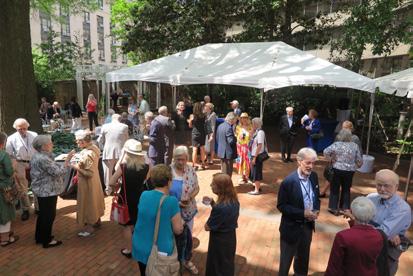
Before DACOR's Foreign Service Cup was presented, folks gathered in the garden of DACOR Bacon House to support recipient Ambassador Burns and DACOR.
Show Your Support for the Home of the Foreign Affairs Community
Dear Fellow DACORians and Friends,
As you know, over the past few years we have issued four formal philanthropic invitations each year, seeking your contributions for the preservation, maintenance, and modernization of our iconic House. Each year, we invite your support in celebration of Foreign Affairs Day and in honor of the countless Foreign Affairs Professionals our House has served.
This is especially appropriate since it was DACOR, along with the Department of State and AFSA, which organized the first Foreign Service Day in November 1965, to bring together career diplomats, journalists, academics and businesspersons to discuss international matters of concern to the United States. In 2001 the Secretary of State broadened this event to Foreign Affairs Day in order to honor the Department’s Civil Service employees as well. More than a decade ago, DACOR itself broadened its membership beyond retired Foreign Service Officers to all Foreign Affairs Professionals, including active duty and retired members of the Foreign and Civil Services across the interagency, as well as academics, journalists, businesspeople, and NGO professionals.
DACOR’s mission supports the professional U.S. Foreign Service, diplomacy, and the preservation of our 200-year-old DACOR Bacon House. Since 1985—when it officially became the DACOR Bacon House—the House has provided hospitality, community, shelter, respite and continuing education for DACOR members, their guests, and more than 1,000 Foundation scholarship recipients and fellowship awardees.
Even in normal times, this important role of the House calls on our efforts and contributions to preserve, maintain, and modernize it so that its mission continues for successor generations. This is all the more true today. Given the truncation of the Foreign Affairs Day observance at the Department this year, we held our celebration in our historic House on May 2nd, inviting the rest of the foreign affairs community to join us.
The central element of this celebration has been the awarding of DACOR’s Foreign Service Cup to a retired FSO who had a distinguished career and has made significant postretirement contributions to the broad field encompassed by the term “foreign affairs.” This is DACOR’s highest honor, and it was my distinct pleasure to award the cup to Ambassador R. Nicholas Burns. After this ceremony on the patio of our beautiful garden, we moved indoors for a celebratory lunch in the elegant rooms of our mansion. If you were not able to join us, you can watch a video at https://dacorbacon.org/spring_season_2025_ april_-_ju.php.
In this bicentennial year of our House, and in observance of Foreign Affairs Day and all that it symbolizes, I invite you to join me in making a special, generous tax-deductible donation to ensure that our House retains a central and unifying role for our entire community now into its third century of service.
Donations may be made online at https://tinyurl.com/3au5xawf, or by filling out and mailing the included envelope.
Sincerely,
Angela R. Dickey President, DACOR and DACOR Bacon House Foundation
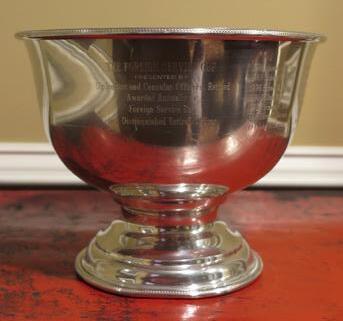
The Foreign Service Cup.
COntRIButIOns In mEmORIAm
The officers and trustees of the DACOR Bacon House Foundation acknowledge with gratitude the following memorial contributions:
Richard ARMITAGE
Hon. Jacques Paul Klein
John Phillip BECKER
Hon. John Todd Stewart
Hon. Patricia M. BYRNE
Patricia Rubin
Hon. Paul CLEVELAND
James Dandridge II & Margarete Dandridge
Hon. Ruth DAVIS
James Dandridge II & Margarete Dandridge
Burton GERBER
Dudley Sipprelle & Linda Sipprelle
Marion Streett GUGGENHEIM
Hon. Raymond C. Ewing & Penelope Yungblut
Hon Lino GUTIERREZ
Hon. Raymond C. Ewing & Penelope Yungblut
Michael JAKUB
James Dandridge II & Margarete Dandridge
JoAnn Jenkins & Robert Jenkins
Hon. Alan LUKENS
James Dandridge II & Margarete Dandridge
Robert “Bob” MACCALLUM
Brenda Creed
Hon. Raymond C. Ewing & Penelope Yungblut
Hon. Thomas M.T. NILES
Hon. John Todd Stewart
Hon. Daniel Anthony O'DONOHUE
James Dandridge II & Margarete Dandridge
Bronson Edwards PERCIVAL
Matthew Daley
Hon. Raymond C. Ewing & Penelope Yungblut
Hon. Richard W. Teare & Jeanie W. Teare
Hon. Ed ROWELL
James Dandridge II & Margarete Dandridge
Theodore SELLIN
Hon. Raymond C. Ewing & Penelope Yungblut
John SHUMATE
Paula Jakub
Hon. Terence A. TODMAN
James Dandridge II & Margarete Dandridge
Hon. Johnny YOUNG
James Dandridge II & Margarete Dandridge
Remember a friend or colleague with a contribution to the
DACOR BACOn hOusE FOunDAtIOn
Tax-deductible Tribute Gifts to the DACOR Bacon House Foundation House Operating Fund in memory of / in honor of [living] Foreign Affairs siblings are always welcome. Please note “IMO” or “IHO” along with the Full Name in the memo line of your check or in the appropriate fields on our on-line form available through the QR code.
In REmEmBRAnCE OF thEIR sERvICE tO thEIR
The officers and governors of DACOR note with deep regret the deaths of the following DACOR members and extend sympathy and condolences to members of the families and to colleagues and friends.
Hon. Ruth A. DAVIS, who grew up in the segregated South and rose through the Foreign Service to become the first Black woman to lead its training and personnel operations and achieve the rank of career ambassador, died May 3, 2025, in Washington, D.C., at the age of 81.
Ruth Amy Davis was born May 28, 1943, in Phoenix, Arizona. She received a bachelor’s degree from Spelman College and a master’s degree from the University of California, Berkeley’s School of Social Work in 1968. At Berkeley, she protested on picket lines to start a Black studies program and was involved with community organizing groups in the Bay Area. She joined the Foreign Service in 1969.
Ambassador Davis spent the first decade of her career doing consular work in Zaire (now the Democratic Republic of Congo), Kenya, Japan, and Italy. Early on, she was showcased in an Ebony magazine article as a Black woman who had broken into the predominantly White diplomatic service.
As consul general in Barcelona from 1987 to 1991, Ambassador Davis helped plan U.S. participation in the 1992 Barcelona Olympics and lobby successfully for the 1996 Games in Atlanta. She befriended Juan Antonio Samaranch, the International Olympic Committee president, and found a palace in Barcelona where Atlanta civic and business leaders could entertain Olympic dignitaries and decisionmakers in high style.
Ambassador Davis’s work in Spain was followed by stints as ambassador to the small and newly democratic West African nation of Benin and as
principal deputy assistant secretary for consular affairs. In her overseas career, she embraced the beauty of various cultures — becoming an opera aficionado in Italy, for example — and confronted complicated historical legacies. In Benin, she visited the country’s port city of Ouidah, which had played a central role in the transatlantic slave trade.
From 1997 to 2001, Ambassador Davis was the first African American director of the Foreign Service Institute, the State Department’s chief language and training school, where she helped create the School of Leadership and Management in 1999. She was the first Black woman to become director general of the Foreign Service, overseeing human resource and personnel issues for the State Department’s then approximately 36,000 employees from 2001 to 2003. She was promoted to career ambassador in 2002. She retired in 2009 as senior adviser in the Bureau of African Affairs.
Following retirement, Ambassador Davis worked with groups promoting women’s economic empowerment and advocating for more minorities in the diplomatic service.
Her sister, Eugenia Davis Clements is her only immediate survivor.
Hon. Howard Kent WALKER,
former ambassador and retired Foreign Service Officer, died February 19, 2025, in Bethesda, Maryland at the age of 89.
Ambassador Walker was born December 3, 1935, in Newport News,
Virginia. He served 2 years in the Air Force as an intelligence officer, after which he received bachelor’s and master’s degrees from the University of Michigan and a doctorate from Boston University.
Ambassador Walker’s overseas posts included Nigeria, Jordan, Tanzania, and South Africa before serving as ambassador to Togo. He was ambassador to Madagascar as well as ambassador to the Federal and Islamic Republic of Comoros. He also served as vice president of the National Defense University in Washington and deputy commandant of the NATO Defense College in Rome. After a 33-year career in the Foreign Service, he retired in 1997.
In retirement, Ambassador Walker taught international relations at universities in Washington, Rome, and South Africa and was a frequent lecturer aboard American cruise lines. He was a member of DACOR and the Washington Institute of Foreign Affairs. He loved nature, gardening, hiking, water sports, and tennis.
Ambassador Walker is survived by his wife of 64 years, Terry; two children, Gregory and Wendy; and two granddaughters.
The officers and governors of DACOR were saddened to learn of the deaths of the following colleagues and friends.
Hon. Michael Hayden ARMACOST,
distinguished American diplomat, ambassador, scholar, and public servant, died March 8, 2025, in Hillsborough, California, at the age of 87.
Ambassador Armacost was born April 15, 1937, in Cleveland, Ohio. He received a bachelor’s degree from Carleton College and a master’s and doctorate from Columbia University. He taught government at Pomona College from 1962 to 1968. He served as a visiting professor of international relations at the International Christian University in Tokyo from 1968 to 1969 and later lectured at Johns Hopkins University and Georgetown University. He became a White House fellow in 1969 and then joined the Department of State.
Ambassador Armacost shaped US diplomatic and security relations through a variety of roles, including the Department’s policy planning staff (1969-72;1974-77) special assistant to the ambassador in Tokyo (1972-74), National Security Council (1977-78), deputy assistant secretary of defense (1978-80), and deputy assistant secretary of state for East Asian and Pacific Affairs (1980-82). In 1982, he was appointed ambassador to the Philippines. He later served as under secretary of state for political affairs (1984-89). In 1989, he was appointed ambassador to Japan. His exemplary service earned him the President's distinguished service award, the Defense Department's distinguished civilian service award, and the Secretary of State's distinguished service award. In 2007, Japan honored him with the grand cordon of the Order of the Rising Sun.
After retiring, Ambassador Armacost became president of the Brookings Institution (1995-2002). He later joined Stanford University’s Walter
H. Shorenstein Asia-Pacific Research Center as a Fellow, contributing to academic discourse on international relations until his retirement in 2021.
Ambassador Armacost is survived by his wife of 66 years, Roberta “Bonny”; three children, Scott, Tim, and Chris; six grandchildren; and three siblings, Peter, Samuel, and Mary.
Hon. Richard L. ARMITAGE,
who served as deputy to Colin Powell at the State Department from 20012005, during the turbulent era of the 9/11 attacks and the start of America’s retaliatory wars in Afghanistan and Iraq, died April 13, 2025, in Arlington, Virginia, at the age of 79.
Ambassador Armitage was born April 26, 1945, in Wellesley, Massachusetts. He received a bachelor’s degree from the Naval Academy in Annapolis, Maryland, and served on a destroyer off the coast of Vietnam following graduation. He volunteered to be an adviser to Vietnamese forces and served three tours with them, earning a Bronze Star. After leaving the military, he entered government in 1975 as a Pentagon consultant and later was an aide to Senator Bob Dole of Kansas.
Ambassador Armitage was a foreign policy adviser to Ronald Reagan in the 1980 presidential campaign and then joined the Reagan administration as an assistant secretary of defense for East Asia and the Pacific. From 1983 to 1989, he was assistant secretary of defense for security policy.
Under President George H.W. Bush, Ambassador Armitage was an emissary to King Hussein of Jordan during the 1991 Persian Gulf war and an ambassador to East European states after the fall of the Soviet Union. As deputy secretary of state, he played a role in outing a CIA officer, Valerie Plame, whose husband was a critic of
the Iraq War.
After leaving government service in 2005, Ambassador Armitage ran his own consulting firm and traveled frequently to East Asia, where he maintained contacts with the highest echelons of governments in Japan, South Korea and other countries allied to Washington.
Ambassador Armitage’s survivors include his wife, Laura; eight children; a brother and a sister; and 12 grandchildren. He and his wife were also foster parents of many children.
Steven Allen CANDY,
retired Foreign Service Officer, died February 18, 2025, in Gilbert, Arizona, at the age of 72.
Mr. Candy joined the Foreign Service as a political officer. His overseas assignments included Mexico City, Stockholm, Panama City, and Brussels; at the Department of State, he served in the Bureau of International Organizations, Bureau of European and Eurasian Affairs, and Bureau of Western Hemisphere Affairs. After 27 years of government service, he retired in 2009 from the Bureau of Diplomatic Security, Office of Foreign Missions in San Francisco, where he was acting regional director.
Mr. Candy enjoyed traveling, hiking, and spending time with his family.
Mr. Candy is survived by his wife of 46 years, Diane; two daughters, Allison and Stephanie; and a grandson.
Katherine Loanna DINSMOOR,
retired Foreign Service Officer, died February 24, 2025, in Midway, Utah, at the age of 73.
Ms. Dinsmoor received an associate’s degree from Brigham Young University (BYU) in 1989. She then moved to Washington and
started work on Capitol Hill in the office of Senator Jake Garn. She then spent 6 years as a petty officer in the U.S. Navy Reserve working for the Supreme Allied Command Atlantic unit. Upon her military discharge, she joined the Foreign Service.
Ms. Dinsmoor’s overseas posts included Japan, Greece, and Canada, among others. In 1998, she traveled to China with a group organization and adopted her daughter, MacKenzie, who was 14 months old. They moved to Ottawa, where Ms. Dinsmoor finished her Foreign Service career.
Ms. Dinsmoor loved to travel. She was a devoted member of her church, and loved animals, nature, and BYU sports.
Ms. Dinsmoor is survived by her daughter, MacKenzie; three siblings, Jeanette, Camille, and Joseph; and several nieces and nephews.
Phyllis GAIN,
retired member of State Department Foreign Service staff corps, died March 9, 2025, in Brooklyn, New York, at the age of 86.
Ms. Gain was born May 5, 1938, in Brooklyn, New York. In 1967, she joined the Foreign Service as an executive assistant.
Over the course of 35 years, Ms. Gain served at posts in Brazil, Pakistan, the Soviet Union, Bangladesh, Thailand, Greece, Colombia, Syria, and Mexico. She retired in 2002.
After retirement, Ms. Gain followed her family from Virginia to London. She found joy in her family and enjoyed evenings out, including going to dinner and a show.
Ms. Gain is survived by a daughter, Angela; grandchildren; greatgrandchildren; and other extended family.
Ambassador Gutierrez was born in 1951, in Havana, Cuba. He received a bachelor’s degree from the University of Miami and a master’s degree from the University of Alabama. He began his career as a social studies teacher for the Dade County School System and the Urban League in Miami, Florida before joining the Foreign Service in 1977.
Over the course of his 30-year diplomatic career, Ambassador Gutierrez served overseas in Latin America and Europe and stateside at the Department of State and the National War College. He held several venerable positions, including principal deputy assistant secretary for Western Hemisphere affairs and acting assistant secretary for Western Hemisphere affairs at the State Department. He was appointed ambassador to both Nicaragua and Argentina.
Following retirement from Foreign Service, Ambassador Gutierrez served as executive director of the Una Chapman Cox Foundation as well as an adjunct professor at George Washington University and Johns Hopkins University. He loved teaching and took great joy in mentoring the next generation of public servants.
Ambassador Gutierrez is survived by his wife of 45 years, Miriam Messina, daughters Alicia (James), Diana (Jim) and Susie, and six grandchildren, Nico, Isa, Silvia, JJ, Luca and Hugo.
Hon. J. Christian KENNEDY,
ambassador and career Foreign Service Officer of 35 years, died February 17, 2025, in Fairfax, Virginia, at the age of 77.
Latin America and Europe. He served as the senior advisor for linguistics education to the Foreign Service career development program in Washington, D.C. He also served as the minister counselor for political affairs at the U.S. embassy in Mexico City, deputy director for the Summit of the Americas, deputy chief of mission in Guyana; consul general in Poland; and principal officer at the Consulate General in Hermosillo, Mexico, amongst many other duties. In 2006, he was appointed U.S. ambassador and special envoy for post Holocaust Issues.
In his retirement, Ambassador Kennedy and his wife split their time between their farm in Colombia and the D.C. metro area. He volunteered with several organizations that promote tolerance and education, most notably The Defiant Requiem Foundation.
Ambassador Kennedy is survived by his wife, Luz-Marina; daughters MaryKathryn “M-K” (Victor Horcasitas) and Veronica; son John-Christian; and two grandchildren.
Dorothy Krebs SARRO,
retired Foreign Service Officer, died February 9, 2025, in Falls Church, Virginia, at the age of 69.
Ms. Sarro was born July 10, 1955, in Louisville, Kentucky. She received a bachelor’s degree from Regis College in Denver, and a master’s degree from Thunderbird School of Global Management in Glendale, Arizona. She started her career in banking and international finance but later transitioned to the Foreign Service.
Hon.
Lino GUTIERREZ,
former ambassador and retired Foreign Service Officer, died May 3, 2025, in Alexandria, Virginia, at the age of 74.
Ambassador Kennedy was born May 10, 1947, in Johnson City, New York. He received a bachelor’s degree from the University of Chicago in 1968. He spent 6 years teaching English in Colombia and another 4 years as the director of the Centro Colombo-Americano Binational Center in Bucaramanga, Colombia. He joined the Foreign Service in 1980.
Ambassador Kennedy’s distinguished career focused on
In a career spanning 26 years, Ms. Sarro served in Mexico, Chile, Kosovo, Croatia, Bosnia, Argentina, and Washington. She returned to Mexico City for her final post before retiring in 2018.
Ms. Sarro is survived by three sisters, Marie, Theresa (“Tess”), and Charlotte; her former spouse, Steve; her best friend, Paul; and many extended family members.
Hollis Sturgeon SUMMERS
retired Foreign Service Officer, died February 15, 2025, in Springfield, Virginia, at the age of 79.
Mr. Summers was born July 14, 1945, in Lexington, Kentucky. He received his bachelor’s degree from George Washington University in 1967 and a doctorate from University of Illinois Champaign–Urbana in 1979. After several years of teaching, including instruction aboard U.S. Navy ships, he joined his brother, David Summers, in the Foreign Service in 1986.
Mr. Summers’ overseas assignments included Bosnia and Herzegovina, Cabo Verde, Eritrea, and Pakistan. Among his Washington assignments, he relished a tour at the Bureau of Oceans, Environment, and Science that involved a project in Costa Rica saving turtles from fishing nets. He also worked in the State Department’s personnel office and in refugee affairs and volunteered on the editorial board of The Foreign Service Journal.
In retirement, Mr. Summers resumed teaching at Northern Virginia Community College. He was an avid
swimmer and biker, equipping his garage to hold seven bikes and assorted gear. He nurtured a large crop of mint. He was also known for meticulous recordkeeping, both of rainfall totals and of his efforts to control the evergrowing bamboo sprouts in his backyard. His front yard sported tomato plants and a gingko grove that provided saplings for friends and family.
Mr. Summers is survived by his spouse, Colien Hefferan; daughter Margaret; brother David; sisters-in-law Beatrice Camp (also a Foreign Service officer), Anne Shotton, and Stephanie Nelson; and two nephews and their children.
Susan
Mary
SUTTON,
retired Foreign Service Officer, died March 20, 2025, in Austin, Texas, at the age of 67.
Ms. Sutton was born July 12, 1957, in Norwalk, Connecticut. She received a bachelor’s degree from Boston University in 1979 and a master’s degree from Tufts University in 1983.
Ms. Sutton’s overseas posts included London, Bucharest, Chisinau, Vientiane,
Bangkok, Sofia, and Hanoi. She was one of few diplomats who opened two new U.S. Embassies: Tirana, Albania, in 1991, and Chisinau, Moldova, in 1992. In Washington, she was the director of the office of maritime Southeast Asia, with responsibility for the Philippines, Indonesia, Malaysia, Brunei, Singapore and Timor-Leste. Previously, she served in the Bureau of Democracy, Human Rights and Labor, and as country officer for Bulgaria and Albania. Her final post was on the faculty of the National War College. She retired from the Foreign Service in 2021.
In retirement, Ms. Sutton moved to Austin. She was an active member of St. David’s Episcopal Church, the Harry Ransom Center, and the Austin Film Society. She and her husband David frequented performances by the Texas Early Music Project, Panoramic Voices, and Mazel Tov Kocktail Hour. Susan became a certified voter registrar in Travis County, Texas, and could often be seen in and around the streets, bars, and festivals of downtown Austin with a clipboard and a stack of information cards, urging people to exercise their rights.
DACOR maintains two burial sections at Rock Creek Cemetery in honor of DACOR members who served their country through Foreign Service. Currently, ground and niche sites are available; each site accommodates two caskets or urns. The sections are wellmaintained by the DACOR Memorial Committee and include a granite monument inscribed “In Remembrance of their Service to their Country” as well as a sitting and reflection area.
Ms. Sutton was preceded in death by her brother Kevin. She is survived by her husband David McAuley, her brother Thomas, and her sister-in-law Ellen, and nephew Colin.
Keith A. SWINEHART,
special agent, Department of State, Bureau of Diplomatic Security, died February 19, 2025, in Alexandria, Virginia, at the age of 66.
Born in Evergreen Park, Illinois, Mr. Swinehart received a bachelor’s degree from Southern Illinois University in 1984 and then joined the U.S. Army. He completed criminal investigator training at Federal Law Enforcement Training Center in Glynco, Georgia and entered the Foreign Service in 1987.
Mr. Swinehart held the positions of diplomatic courier, regional security officer, assigned to overseas posts in Lima, Karachi, Addis Ababa, Jerusalem, Manama, Riyadh, Baghdad, Manila, and Islamabad. He also served in Washington, D.C., including as the regional director for Near Eastern and South Central Asia Affairs before his retirement in 2018.
In retirement, Mr. Swinehart enjoyed traveling, visiting friends, taking in a ballgame, and most importantly, spending time with his family. He is survived by three siblings, Susan, Linda, and Kevin; a niece, a great-niece, and a nephew.
Kenneth WALKER,
veteran journalist, who shared an Emmy award for his reports on apartheid South Africa for ABC News’s “Nightline,” died April 11, 2025, in Washington, D.C., at the age of 73.
Kenneth Reginald Walker was born August 17, 1951, in Washington, D.C. He joined the Washington Star while attending Catholic University on scholarship. He remained at the Star for 13 years, conducting reporting from South Africa. His four-part series about apartheid South Africa won an award from the National Association of Black Journalists, soon after the paper folded in 1981. The group later bestowed on him a lifetime achievement award.
In 1981, Mr. Walker joined ABC News bureau in Washington, where he was a political and White House correspondent, and substitute news anchor. Upon leaving ABC News in 1988, Walker was named anchor for the USA Today syndicated television series. He went on to become an independent television producer and correspondent, and a columnist. A high point of his career was his work at “Nightline” from 1981 to 1988, starting as a general assignment reporter and eventually covering the Justice Department and the White House.
After leaving “Nightline,” Mr. Walker was the finance segment anchor of “USA Today: The Television Show” in 1988 and 1989, followed by a year as
senior producer of “The Jesse Jackson Show,” a short-lived syndicated talk show. He was an independent TV producer before reporting for NPR as Africa bureau chief based in Johannesburg. After leaving NPR in 2011, Mr. Walker remained in South Africa as communications director for the humanitarian organization CARE before returning to Washington in 2015. Mr. Walker’s survivors include two stepsisters and three grandchildren. A daughter from his first marriage, Maisha Hunter, died in 2017.
DACOR Bulletin Obituaries
DACOR welcomes receiving obituaries of foreign affairs professionals, whether DACOR members or otherwise. They are reviewed by Obituaries Editor Frances Burnet, primarily for length; 500 words usually suffices.
The deadline for submissions is the 1st day of the previous month; i.e. for the July/August issue, please email the obit by June 1st to Christine Skodon at: clskodon@dacorbacon.org
The obituaries that are featured in the DACOR Bulletin are adapted from a variety of sources: information provided by loved ones of the deceased; the Washington Post, New York Times, Foreign Service Journal and other periodicals; ADST's Oral History Collection; historical documents; and others. Please contact DACOR for sources used for a specific obituary.
Memorial Services
DACOR offers special rates for Memorial Services
For details contact Meg Sharley at: msharley@dacorbacon.org or 202.682.0500 x110