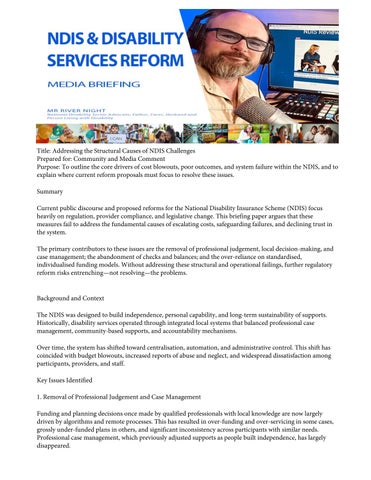
Mr River Night Media Briefing 20260421

Page 1


Title: Addressing the Structural Causes of NDIS Challenges

Prepared for: Community and Media Comment

Purpose: To outline the core drivers of cost blowouts, poor outcomes, and system failure within the NDIS, and to explain where current reform proposals must focus to resolve these issues.

Summary

Current public discourse and proposed reforms for the National Disability Insurance Scheme (NDIS) focus heavily on regulation, provider compliance, and legislative change. This briefing paper argues that these measures fail to address the fundamental causes of escalating costs, safeguarding failures, and declining trust in the system.

The primary contributors to these issues are the removal of professional judgement, local decision-making, and case management; the abandonment of checks and balances; and the over-reliance on standardised, individualised funding models. Without addressing these structural and operational failings, further regulatory reform risks entrenching—not resolving—the problems.

Background and Context

The NDIS was designed to build independence, personal capability, and long-term sustainability of supports. Historically, disability services operated through integrated local systems that balanced professional case management, community-based supports, and accountability mechanisms.

Over time, the system has shifted toward centralisation, automation, and administrative control. This shift has coincided with budget blowouts, increased reports of abuse and neglect, and widespread dissatisfaction among participants, providers, and staff.

Key Issues Identified

1.Removal of Professional Judgement and Case Management

Funding and planning decisions once made by qualified professionals with local knowledge are now largely driven by algorithms and remote processes. This has resulted in over-funding and over-servicing in some cases, grossly under-funded plans in others, and significant inconsistency across participants with similar needs. Professional case management, which previously adjusted supports as people built independence, has largely disappeared.

2.Failure

to Implement

Evidence-Based Recommendations

More than 70% of the 222 recommendations from the Disability Royal Commission and previous NDIS reviews remain unimplemented, despite providing a clear reform roadmap.

3.Loss of Safeguards and Accountability

Basic checks and balances ensuring quality, safety, and financial accountability have been removed and replaced with an honour-based system reliant on provider declarations rather than active oversight.

4.Shift Away from Independence as a Core Goal

Traditional disability practice focuses on increasing independence over time. The current NDIS model incentivises static or increasing support levels, making cost escalation inevitable and undermining participant outcomes.

5.Centralisation and Loss of Local Decision-Making

Local NDIS offices contacts and partners with authority to resolve issues were dismantled soon after rollout. Participants must now engage with remote staff lacking local knowledge and authority, increasing delays and mistrust.

6.Planning Failures for High-Cost Participants

High-cost plans are frequently rolled over without meaningful review. Historically, lack of progress would have prompted intervention and plan adjustment.

7.Absence of Participant Accountability

Where funded supports are consistently unused or misaligned with goals, no proactive reassessment mechanism exists through professional case management unless provider driven and unfunded.

Assessment of Current Reform Proposals

Real-Time Payment Verification

Existing systems lack co-design, increase complexity, and remove responsiveness. Minor issues frequently become long-term sources of unnecessary escalation and negative impacts on participants.

Provider Registration Reform

Registration is a compliance mechanism rather than an outcome measure. Many provider failures have involved registered providers, highlighting the need for active oversight rather than additional paperwork.

Reducing Red Tape

Claims of reducing bureaucracy conflict with increased administrative control. True red-tape reduction requires shifting frontline decision-making to NGOs capable of flexible, real-time responses.

Conclusion

The NDIS is struggling not due to insufficient regulation but because it has abandoned foundational disability principles: professional oversight, local accountability, and a focus on building independence. Until these are restored, costs will continue to rise with diminishing outcomes.

Contact: media@dacexpo.com.au

Turn static files into dynamic content formats.

Create a flipbook
Mr River Night Media Briefing 20260421 by dacexpo - Issuu