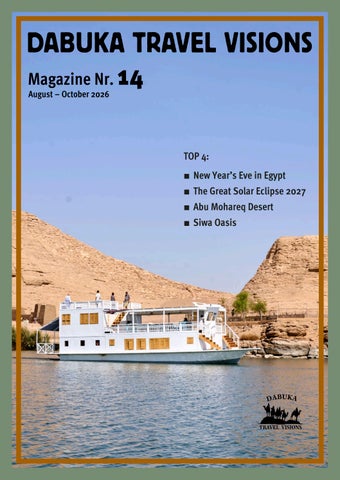
DABUKA TRAVEL VISIONS Magazine Nr. 14 August – October 2026
TOP 4: ■ New Year’s Eve in Egypt ■ The Great Solar Eclipse 2027 ■ Abu Mohareq Desert ■ Siwa Oasis
Dear Readers, by the time you are holding this issue – at least in a figurative sense – summer has likely passed its peak in many places. Temperatures are becoming more pleasant, and attention is slowly turning toward the upcoming season. As has become a welcome tradition, we would like to accompany you once again with stories and insights – this time often drawn from everyday life here. Recently, one thought has stayed with me: it is no longer easy to find truly positive examples in daily life. Everyone is trying their best, yet the “big issues” – war, inflation, the environment – often overshadow everything else. And perhaps that is exactly why it matters more than ever to focus on what is positive. We recently visited an initiative dedicated to recycling plastic while contributing to cleaning the Nile and promoting education. The young woman leading the project impressed us with her energy and conviction – and encouraged others to simply start and take action. My son also returned inspired from a workshop. What stayed with him most:
A thought I, too, will take to heart. Because learning brings a deep sense of fulfillment.
■
Leadership begins with understanding yourself.
■
Influence comes from understanding interests, not authority.
And even our street dogs, whom we had almost given up on, have now returned – five of them. They bring chaos, but also a great deal of life.
■
Strong teams are built on trust and shared purpose.
His conclusion: leadership is not a title, but a skill that can be practised every day.
With this in mind, we would be delighted to turn your travel dreams into reality. Because every beautiful memory makes the world just a little brighter. Warm regards Dorothee und Tarek
Cairo, August 2026
EDITORIAL
3
Table of Contents
Editorial
I. Introduction
DABUKA TRAVEL VISIONS ISSUE 14
3
Editor:
Table of Contents, Imprint, Contact
4
Dorothee Rieche
Customer Testimonials
5
Editorial
Art Director: Andreas Klostermaier
II. News
Contributor: Shada Mamdouh
Current Situation in Egypt
6
The History of the HIACE
8
Transport Options in Egypt
10
Best Time to Visit Egypt?
14
III. Spotlights - Country & People Egypt and the 2026 FIFA World Cup
16
Culture – An Evening with “Cairo Steps” – A Band Building Bridges
17
Sahel – An Egyptian Holiday
20
Marketing & Advertising: M. Ibrahim
Contact (Magazine): magazine@dabuka.de
Contact: +20 101 506 9061
Email: service@dabuka.de
Homepage:
IV. 4 of the best
www.dabuka.com
Special Tours:
New Year’s Eve in Egypt
24
www.eclipse-2027.com
The Great Solar Eclipse 2027 – Egypt in the Shadow of the Moon
26
Egypt Desert Expedition: 12 Days through the Abu Mohareq Desert
28
All texts and images in this magazine are protected by copyright.
Siwa Oasis, Egypt – Between Change and Continuity
32
Photos: Andreas Klostermaier, Steffen Kirchner, Tarek El Mahdi, Dorothee Rieche, et al.
V. Various Interview with Mohamed Samir, Founder of Sam’s Story Hotel, Maadi
34
Outlook on New Formats
36
Inside Dabuka – 30 Years of Dabuka – A Retrospective
37
Call it a dream! 4 TABLE OF CONTENTS
Customer Testimonials 30 Years of Dabuka – Voices of Our Guests
„Dabuka = Tarek El Mahdy.“ A line that comes up again and again. And says more than a long explanation ever could.
What remains after 30 years? Many journeys. Many places. And above all: many voices.
“At some point, I learned what ‘Dabuka’ actually means.” “A moving camel caravan.” “It felt instantly right.”
“Memories.” A simple word – and yet the most common first response. “The feeling of truly getting to know Egypt.” Not just seeing it. But understanding it.
And then there are the everyday impressions: “If you live in Maadi, you keep seeing their 4x4s around.” “It feels like Dabuka has always been there.”
“That sense of calm on Lake Nasser…” “… travelling without any rush.” “No pressure, no fixed pace – just time.”
And the people behind it? The answers come quickly. Without hesitation: “Kind.” “Attentive.” “Professional.” “Dedicated.” “Truly passionate.” “Highly organized.” “Yet always flexible.” “It feels like a family.”
“For me, it’s the tailor-made journeys.” “Everything fits – without ever feeling complicated.” “You can tell: someone really listened.”
Many voices. Many perspectives. And in the end, always the same feeling: Dabuka is more than a journey. It’s a way of travelling. INTRODUCTION
5
Current Situation – Safety in Egypt Perhaps it is human nature to adapt quickly to political tensions. And yet, safety in travel has become a more prominent topic than ever before. For a destination like Egypt, the question arises again and again: how safe is it really? A realistic view of the situation Egypt is geographically located in a sensitive region and is therefore indirectly affected by developments in the Middle East. At the same time, the government has consistently managed to keep the country out of direct conflicts. For travelers, this means something very concrete: Daily life in Egypt continues as normal. Attractions are open, travel programs run as planned, and movement between major destinations is smooth and reliable.
International authorities, including those in the United States and the United Kingdom, do not advise against travel to these tourist areas.
What this means for your journey Egypt is not a risk-free destination – but very few places are today. The key question is how professionally and responsibly a trip is organized. And this is where the difference lies.
Practical travel advice ■
What visitors do notice is a strong presence of police and military. This results in regular checks – unusual for some, but a key component of the national security structure.
Official European perspectives A look across Europe shows a remarkably consistent assessment: ■ ■
No European country has issued a general travel warning for Egypt. Countries such as Germany, France, Switzerland, Austria, and the United Kingdom all apply similar guidance: increased vigilance and partial advisories for specific regions
These have remained unchanged for years and mainly concern: ■ ■
the northern Sinai Peninsula border areas with Israel, Libya, and Sudan
Importantly: Egypt’s main travel destinations – Cairo, Luxor, Aswan, Nile cruises, and the Red Sea resorts – are not affected.
6 NEWS UNTERWEGS
■
■
Entry requirements: A passport valid for at least six months is strongly recommended Visa: Visa on arrival: currently USD 30 E-visa in advance: USD 25 On-site arrangements: Desert trips, diving excursions, and boat tours should only be booked through licensed operators
In regions such as the oases, informal and unlicensed providers do exist. Travelers should be aware that saving money in such cases may come at the expense of safety and reliability.
Our responsibility at Dabuka As a fully licensed tour operator with many years of experience, Dabuka Travel Visions takes this responsibility seriously. We work exclusively with trusted partners, carefully design our itineraries within approved frameworks, and continuously monitor the situation on the ground. Most importantly: Should conditions change significantly, we inform our guests early, clearly, and transparently.
Conclusion Egypt remains an extraordinary destination – and under current conditions, it is safe and well accessible when approached responsibly. Choosing a professionally organized journey makes all the
difference. With Dabuka, you are not just traveling – you are traveling with insight, structure, and care. �
UNTERWEGS NEWS
7
The Story of the HIACE There is no such thing as standing still at Dabuka, and luckily, ideas also turn into action. After launching our boat, the Dabuka Blue, two years ago, our fleet has now grown by another member: From now on, we proudly call a small bus our own. The HIACE, which we immediately renamed TRAILACE.
It can transport 12 passengers and has one very special feature: It is designed for desert conditions and is therefore the first vehicle of its kind in Egypt! With this, Dabuka remains true to its pioneering spirit. However, this project once again required a great deal of patience and perseverance. The story began already one year ago, when Tarek had the idea for this bus and started researching. It quickly became clear that the vehicle would have to be imported – and with that, the problems were
8 NEWS UNTERWEGS
actually already programmed. Anyone who has ever tried to bring larger purchases into Egypt knows that bureaucracy feels very much at home here. I do not want to go into all the details at this point, but would rather mention just a few milestones: After extensive research, we finally bought the bus in Dubai, where it was manufactured under the supervision of an Australian. From a distance, the project quickly began to take shape. An idea became a vehicle.
But then, once again, everything turned out differently than planned. The war with Iran broke out and the sea route between Dubai and Egypt could no longer be travelled directly. Our Trailace first had to be loaded and transported through Saudi Arabia before finally arriving by ferry in Safaga – and therefore on Egyptian soil.
Finally – when we had almost stopped believing it would happen – our new addition suddenly arrived in our garage. But now it had to be registered. And that again caused some serious headaches for certain officials, as there were no reference values available. A vehicle like this had never existed in Egypt before. Oh!
I will spare you the details of all the excitement and challenges until the bus actually reached Egypt. But anyone who now thinks: “All’s well that ends well”, will quickly realise that the end was not quite there yet. The vehicle was stuck in customs. And stayed there. And stayed there. Because now, responsible authorities had to be found who would grant the necessary approval for it to at least continue its journey to Cairo. Another weeks-long process.
But – as mentioned at the beginning – pioneers need patience, and they usually have it. And now our bus will quite literally start moving. Many groups are already waiting to travel with it. We will certainly need a little time to get used to each other, but slowly a feeling of pride is beginning to grow. We did it!
�
UNTERWEGS NEWS 9
Getting Around Egypt – Choosing the Right Transportation Sometimes it is the practical aspects of a journey that make all the difference. And since Egypt is a vast country, travelling from one place to another is simply part of the experience. Anyone planning to visit more than one destination should think about the best means of transport in advance. Most visitors combine Cairo with Upper Egypt or a beach holiday on the Red Sea. We are often asked which form of transportation we recommend. The answer always depends on the overall itinerary, but in general there are three main options.
10 NEWS
1. Domestic Flights Besides your international arrival, Egypt also has an extensive domestic flight network. Regular flights operate to Aswan, Abu Simbel, Luxor, Alexandria, Assiut, Sohag, Hurghada, Marsa Alam and Sharm El Sheikh. The last three airports are already familiar to many visitors, as they are also served by international charter flights.
The routes between Cairo and Luxor or Aswan are by far the most popular. Unfortunately, these flights are also among the most expensive domestic connections, especially during the high season. For this reason, we often recommend booking them together with your international flight, as this is frequently less expensive than purchasing them separately once you are in Egypt. Today, EgyptAir is joined by Air Cairo and Nile Air on many domestic routes, giving travellers several departures each day. The flight between Cairo and Luxor or Aswan takes just under one hour.
2. The Overnight Sleeper Train One of the most memorable ways to travel is by sleeper train between Cairo, Luxor and Aswan. There is something undeniably special about falling asleep in one part of Egypt and waking up in another. Passengers travel in private cabins, each attended by a dedicated steward. He serves dinner in the evening and breakfast the following morning. While the meals may not quite match five-star hotel standards, they are perfectly adequate. In the evening,
the steward converts the seating area into comfortable beds and takes care of the passengers throughout the journey. Each cabin has a small washbasin with running water and a mirror, while the toilets are located in the corridor. When it comes to cleanliness, however, some compromises are necessary. The train clearly reflects a time when it was considered very comfortable, but it has not always been maintained to modern standards. The windows could certainly use a thorough cleaning, and the shared toilets can sometimes be an adventure of their own. Even so, the journey has a charm that is difficult to describe. For around 12 to 14 hours, the train gently rolls through the Egyptian night, and in the morning you find yourself in a completely different landscape. Tickets are relatively expensive—although you do save one hotel night—and they often sell out well in advance. Early booking is therefore highly recommended.
NEWS 11
12 NEWS
3. By Car Travelling by car is another excellent option. Although the journey can be long, it offers by far the greatest flexibility and allows you to travel entirely at your own pace. For two travellers, a private car is often even the most economical solution. We frequently recommend an overnight drive to Aswan. Since we work with a range of vehicles and experienced drivers, itineraries can be tailored entirely to individual wishes. The greatest advantage is flexibility. You can combine destinations that are difficult to reach by public transport—for example, visiting Alexandria before continuing to Siwa Oasis, or creating your own personalised route through Egypt.
These are the transportation options that can be booked directly through us. Independent travellers can also use long-distance buses. Go Bus serves almost every major town and city in Egypt and has earned a reputation for being reliable and comfortable. Whichever option you choose, it is important to allow enough time for travelling. Egypt is a large country, and covering long distances is simply part of discovering it. We are always happy to help our guests choose the transportation option that best suits their itinerary. �
NEWS 13
14 NEWS
Best Time to Visit Egypt? It is widely known: every destination has seasons that feel more pleasant than others—often depending on where you are coming from and what kind of experience you are looking for. For Egypt, autumn and winter are generally considered the best time to travel. Temperatures are milder, making it ideal for classic cultural journeys to Luxor or Aswan.
Summer in Cairo – Program Overview
But what happens if you think a little “outside the box”? Cairo in summer can be surprisingly rewarding. Yes, temperatures are high—but daily life largely takes place in air-conditioned spaces. Hotels, restaurants, and shops offer consistent comfort, meaning the heat is often less intense than expected.
6 days / 5 nights – Cairo, intensive yet relaxed ■
Day 1: Arrival in Cairo, meet & assist, private transfer to a Nile-view hotel. Time to settle in.
■
Day 2: Visit to the Grand Egyptian Museum, followed by a private felucca sail on the Nile at sunset.
■
Day 3: Excursion to Saqqara and Dahshur – the origins of pyramid construction.
If you are willing to explore the city in the cooler morning and evening hours and spend the hottest part of the day enjoying your hotel—by the pool or in the spa—you will be rewarded with a more intimate experience, a slower pace, and often more attractive rates for high-end stays.
■
Day 4: Pyramids of Giza and the Sphinx, optional microlight flight over the plateau.
■
Day 5: Old Cairo, National Museum of Egyptian Civilization, and Khan elKhalili bazaar.
Sometimes, it is simply worth rethinking the usual advice. �
■
Day 6: Departure.
At the same time, the city reveals a different side of itself: quieter, calmer, almost relaxed. Many locals spend the summer months along the North Coast, and international visitor numbers are noticeably lower.
Accommodation: Fairmont Nile City (Bed & Breakfast)
Included services: All transfers, entrance fees, and a professional English-speaking guide throughout the program.
Price: from US$ 980,– p.p. Available as a private, fully tailor-made tour. More details: dabuka.com
NEWS 15
Egypt and the 2026 FIFA World Cup Rarely have I heard the following sentence so often lately: “I’m actually not interested in football at all, but this time…” That’s exactly how it was for us as well. Word of mouth, it seems, works even for football. At first, I had barely paid attention to the tournament this year. Then my son pointed it out to me, celebrating Germany’s first victory—which, however, quickly turned into an early exit. And yet, I found myself unable to resist checking the results of the various matches on my phone. Before long, it even became a topic of conversation between Tarek and me: “Who do you think will win against whom?” At first, that’s a fairly neutral question. But then, suddenly, Egypt was still in the running—and with it, a sense of home. In my view, Egyptians are almost even more passionate about football than many other nations. And since they did not exit the tournament as early as Germany, a particular sense of excitement began to fill the air. Who would they play next? How far could they go? The frequency with which I checked my phone increased noticeably. And since some matches took place in the middle of the night in our time zone, it wasn’t unusual for Tarek and me to greet each other at breakfast with words like: “Have you seen? XY won last night—that means they’ll now play against YZ…” And then came the decisive match against Argentina.
I don’t want to go into whether everything was fair or not, or whether the referee made the right calls. What mattered far more was something else entirely: the atmosphere. Even during the day, you could almost physically feel the tension hanging in the air. Again and again, you would hear people say: “Rationally, I think Argentina will win—they simply have more experience. But with all my heart, I’m hoping for Egypt.” And that is so typical here. It’s not just about reason—everything is felt deeply. That evening, I caught myself walking down the street to the nearest café showing the match live. The atmosphere felt like a major happening: people standing close together, cheering, holding their breath. And then the unbelievable happened: Egypt suddenly led 2–0. David had the upper hand over Goliath. Perhaps it is difficult to understand if you have not experienced it yourself. But in that moment, it was no longer just a football match. It became a story of hope, of unity—perhaps even of peace. The harder, then, the fall, when everything turned around in the final minutes. I, too, was not entirely free of the thought that perhaps an Egyptian victory at that point was not meant to be. And for a moment, “Messi” almost became an unspoken word. Of course, there were rational explanations for Egypt’s defeat. But what remains is something else: Hope. Hope that next time, it will be enough. Hope that football can remain free from politics. And the hope that miracles are, in fact, possible. �
16 COUNTRY & PEOPLE
An Evening with Cairo Steps I have always enjoyed cultural events—whether theatre, ballet or concerts. For a long time, however, I found it much easier to attend them in Germany, simply because I knew where to look and had easier access to the wide range of performances on offer.
Of course, Cairo has a vibrant cultural scene as well. I have visited the Opera House several times, but a few weeks ago I experienced a real highlight together with Tarek—who is not normally much of a theatre or concert enthusiast. Friends had been telling me about Cairo Steps for years, insisting that I simply had to see them perform. And sometimes, the time is just right.
The venue alone made the evening special. The concert took place at Ewart Memorial Hall, located on the historic campus of the former American University in Cairo (AUC) in Downtown Cairo. Surrounded by a peaceful garden, with elegant columns, soaring ceilings and an atmosphere that seems to breathe history, it is a remarkable place in its own right.
I spotted a poster, got a little help with the online booking, and before long I was holding two tickets in my hands. Surprisingly easy—and surprisingly affordable.
Opened in 1928, Ewart Memorial Hall has long been one of Cairo's cultural landmarks, hosting generations of lovers of literature, music, theatre and the arts. It was designed by architect A. St. John Diament in an Arabesque style, with beautiful decora-
COUNTRY & PEOPLE 17
tive details on the doors, windows, lamps and even the seating. Above the stage is the inscription "Let Knowledge Grow from More to More, But More of Reverence in Us Dwell," taken from Alfred, Lord Tennyson's In Memoriam and rendered in a design inspired by Kufic calligraphy. In a place like this, the experience begins long before the first note is played. I always enjoy taking a few quiet moments to look around, settle into my seat and let the atmosphere sink in. As the lights dimmed and the conversations around us faded away, the anticipation grew. And we were not disappointed. Cairo Steps was founded in 2002 by Egyptian-German musician and producer Basem Darwisch. The ensemble combines traditional Egyptian and oriental rhythms with modern jazz improvisation, classical music and contemporary sounds, creating a unique musical style that effortlessly bridges different cultures. In 2018, together with Quadro Nuevo, the group received the German Jazz Gold Award for their album Flying Carpet. Their vision is to cross cultural, political and religious boundaries and build bridges between East and West.
18 COUNTRY & PEOPLE
That vision could truly be felt throughout the concert. Some pieces were energetic and rhythmical, others calm and almost meditative. One particularly moving aspect was that both a blind singer and a blind orchestra member performed as an integral part of the ensemble. Whenever needed, they were quietly guided by their fellow musicians—without any fuss, simply as part of making music together. Basem Darwisch led the audience through the evening in German, English and Arabic with warmth and humour, creating a wonderfully personal atmosphere. There was always a sense of curiosity about what would come next. One guest singer had such an extraordinarily beautiful voice that I found myself close to tears. And even Tarek thoroughly enjoyed the evening. As we walked back to our car through the warm summer night, the music stayed with us long afterwards. It was wonderful to discover yet another facet of Cairo's rich cultural life. We will certainly be back for the next Cairo Steps concert. �
COUNTRY & PEOPLE 19
An Egyptian Holiday The idea of “holiday” is widely discussed everywhere and has become something of a universal concept. People often look forward for an entire year to those precious weeks, planning, comparing, saving… The role of a travel company is to turn this time into something truly special—no matter the traveler’s taste.
Egypt is a very popular destination, offering a wide variety of experiences for guests from around the world: water, desert, culture, historical sites—there is something for everyone. However, if you shift perspective and look at holidays from an Egyptian point of view, things work a little differently. In summer, it feels like “everyone” in Egypt who can afford it heads to the North Coast, which begins near Alexandria and now stretches far along the coastline to the west. Locals simply say they are
20 COUNTRY & PEOPLE
going to “Sahel.” This usually means having a house or apartment—either owned or rented—in one of the many compounds lined up like pearls along the shore. By early July, families often relocate there for weeks, and those who still have to work commute back and forth as often as possible. There are, of course, huge differences in levels of luxury. Anyone going to what is jokingly called “Sahel cherir” must be prepared to spend significant amounts of money, as it is also about “seeing and being seen.” People go to the beach wearing jewelry and designer bags and gather in the evenings
around tables overflowing with food. Much of it is never eaten—but the point has been made: one can afford it. I myself have never been there; I only know it from many stories. Fortunately, there is also another side of Sahel. Some compounds have existed for decades and were originally created for specific professional groups—there are compounds for professors, journalists, and others. These are quiet, well-kept oases with dedicated staff who ensure cleanliness and order.
like to be wrapped in a wet layer from head to toe. Another option is the beach. The sea is turquoiseblue, just like in a postcard, and the sand is soft and white. People sit in groups under umbrellas, observing the scene. The sea here often has strong waves and currents, so proper swimming is not always possible—but that does not seem to matter. Standing in the water and talking is often enough. Connection—that is a key word. Holidays “Egyptian style” are not spent alone.
I was recently invited to stay in such a compound. Perhaps the best part was the fresh air—something that simply does not exist in Cairo during the summer. You immediately feel more refreshed and at ease.
A friend we recently met spoke enthusiastically about his love for Sahel holidays. For him, the most important aspect is that during these weeks, he gets to see all his friends. Even if they are not in the same compound, they are usually nearby, and visiting each other is part of the routine. People meet, exchange news, eat a lot, and simply enjoy being together.
It was also a pleasure to swim laps in a large pool every day—preferably as early in the morning as possible. Egyptian holidaymakers tend to sleep until midday, but then they appear in large numbers. Many women wear traditional full-body swimwear, and I often wonder what it must feel
It is just part of life. In summer, you go to Sahel. There, Egyptians find everything they need. And when temperatures drop and the Sahel season ends, the crowd moves on to Ain Sokhna on the Red Sea. Those who belong to a certain social class usually have a second residence there as well.
COUNTRY & PEOPLE 21
I found it fascinating to gain a glimpse into “Egyptian-style holidays,” and I truly enjoyed the time. For me, the quiet moments—at least when not surrounded by larger groups—were especially valuable after the noise and intensity of Cairo. Being alone can sometimes be deeply restorative – for foreigners).
I did not encounter other foreigners—nor are they usually to be found there. When their holiday season begins in autumn, after the intense summer heat, the locals have long returned to their daily routines. From October onwards, the compounds fall into a kind of sleeping beauty slumber, only to awaken again a year later.
Glowing sunsets added to the holiday feeling, and enjoying freshly prepared fish in a nearby Bedouin village made life feel perfectly in balance.
And one thing is certain: they always do.
22 COUNTRY & PEOPLE
�
COUNTRY & PEOPLE 23
4 of the Best:
New Year’s Eve in Egypt New Year’s Eve does not have to be loud to be memorable. In Egypt, it can become something very different: a journey shaped by landscape, history and a sense of space that is hard to find elsewhere. New Year on Lake Nasser – A Journey into the New Year For those looking for a truly special way to start the year, Lake Nasser offers one of the most unique settings in Egypt. Aboard the Dabuka Blue, New Year’s Eve is not just a single night – it is part of a carefully designed journey. The experience begins in Aswan, followed by an overnight stay on Heissa Island before embarking on the boat. From here, the route leads south across the vast waters of Lake Nasser, with visits to remarkable and often remote temples such as Kalabsha, Wadi Seboua, Dakka, El Maharraqa and Amada. Life on board follows a gentle rhythm: sailing,
24 FOUR OF THE BEST
exploring and returning to the quiet comfort of a small, privately run boat. With only five cabins and a maximum of ten guests, the atmosphere remains personal and relaxed throughout. New Year’s Eve itself is celebrated on board – with music, a specially prepared dinner and a festive atmosphere. It is not a large-scale event, but a carefully curated celebration in a small group, perfectly in tune with the setting. When weather permits, the evening unfolds under the open sky, surrounded by water, desert and stars. The journey continues towards Kasr Ibrim and Abu Simbel, before returning to Aswan, where there is time to explore sites such as Philae Temple or simply let the experience come to a close.
New Year on Lake Nasser – Key Facts Dates: 27 December 2026 – 3 January 2027
Duration: 8 days / 7 nights
Route:
New Year in the Desert – Tailor-Made and Personal For travellers seeking even more solitude, a New Year’s experience in Egypt’s Western Desert offers a powerful alternative. Whether in Fayoum or further out towards the great dune systems such as Abu Mohareq, these landscapes create a setting that is vast, silent and reduced to the essentials.
Aswan – Lake Nasser – Abu Simbel – Aswan
Price: from €2,030 per person (double cabin)
Group size: min. 4 / max. 10 guests
Accommodation: Dabuka Blue (5 cabins), plus 2 nights on Heissa Island Dabuka offers this New Year journey on Lake Nasser as a small-group experience or private charter aboard the Dabuka Blue.
A private camp, a dinner by the fire and the first sunrise of the year over the dunes turn New Year’s Eve into a moment of calm rather than celebration in the traditional sense. Dabuka designs tailor-made desert journeys for New Year, typically between 2 and 5 nights, often combined with Cairo and adapted entirely to individual preferences. New Year in Egypt can be more than a single evening. �
FOUR OF THE BEST 25
4 of the Best:
The Great Solar Eclipse 2027 – Egypt in the Shadow of the Moon Insiders have been planning for years. We, too, have been preparing for this extraordinary event for quite some time – because what will unfold in the sky on August 2, 2027 is far more than a rare natural phenomenon. It is a moment that captivates even experienced travelers and astronomers alike.
The total solar eclipse of 2027 is considered the astronomical event of the century – and Egypt stands right at its very center.
tronomical alignment: the Earth is near its aphelion, making the Sun appear slightly smaller, while the Moon is near perigee and appears larger – perfectly sized to fully cover the Sun.
Once again, Egypt delivers superlatives. What makes this eclipse so remarkable is above all its exceptional duration. While most total solar eclipses last only two to four minutes, the Moon will completely cover the Sun over Egypt for up to 6 minutes and 23 seconds. This makes it the longest total solar eclipse over inhabited land until well into the next century. This rare spectacle is made possible by a unique as-
26 FOUR OF THE BEST
Beyond its duration, another key factor speaks in Egypt’s favor: the weather. In August, the statistical probability of cloud cover is below five percent. For observers and photographers, this means near-perfect conditions to witness the solar corona in full clarity – and even to spot planets in the darkened midday sky. However, not every location offers the same experience. What truly matters is being within the path
of totality – the narrow band where the Sun is completely obscured. This path runs like a ribbon across the country and defines where the phenomenon can be experienced at its fullest. Many travelers naturally gravitate toward wellknown destinations such as Luxor. Yet here, high demand and limited capacity quickly lead to rising prices and crowded conditions. There are alternatives. Away from the classic routes, regions such as Egypt’s Western Desert – including the area around Bahareya Oasis as well as the Black and White Deserts – offer outstanding viewing conditions, combined with a far more immersive and tranquil setting. For many visitors, the eclipse is the reason for their first journey to Egypt. Naturally, the desire is to combine this unique moment with further discoveries. Careful planning is therefore essential – with air-conditioned accommodations, well-paced itineraries, and sufficient time for rest, even in the summer heat. Our approach deliberately follows a different path: rather than focusing on the obvious hotspots, we design routes that offer space, quiet, and a more distinctive perspective. Alongside carefully selected desert locations, we also work with lesser-known viewing spots, embedded within varied and thoughtfully curated journeys.
One such itinerary is: The Great Egyptian Eclipse Journey: 16 days – Cairo, Western Desert, Dakhla, Kharga, Assiut, Sohag, Abydos, Luxor It combines Egypt’s major cultural highlights with remote landscapes – leading to places where the experience becomes more personal and more intense. A total solar eclipse is not an ordinary moment. The light changes, the temperature drops, the world grows still – and for a few minutes, time itself seems to stand still. In 2027, a rare opportunity presents itself. And Egypt is the place where this natural phenomenon reveals its full intensity. �
FOUR OF THE BEST 27
4 of the Best:
Egypt Desert Expedition: 12 Days Through the Abu Mohareq Desert For those who know that feeling – the quiet urge to return to the desert, to drive into the sand once more and reconnect with that distinct atmosphere you can easily become addicted to.
This 12-day expedition explores one of the most remote regions of Egypt’s Western Desert: the Abu Mohareq dune system. The route connects Bahariya, Kharga and Dakhla, covering long distances entirely off-road.
Departure Dates ■
13 Oct – 24 Oct 2026
■
19 Nov – 30 Nov 2026
■
16 Jan – 27 Jan 2027
The expedition is designed for experienced desert travelers who are comfortable with basic conditions and extended off-road travel.
Overview ■
Duration: 12 Days / 11 Nights
■
Route: Cairo – Bahariya – Abu Mohareq – Kharga Outer Desert – Dakhla – White Desert – Cairo
■ ■ ■
Accommodation: Hotel in Cairo (BB), mobile desert camps Style: Fully guided expedition, 4x4 off-road, remote camping Requirements: Good physical condition, experience with basic travel conditions
28 FOUR OF THE BEST
Route Highlights ■
Bahariya Oasis: entry point to the desert, petrified wood areas
■
Abu Mohareq dune system: multi-day dune crossings
■
Djara Cave: lunch stop inside the cave
■
Khurafish region: remote desert edge of Kharga
■ Fossil landscapes: coral formations and prehistoric sites ■
Mamar El-Maganin (“Pass of Madness”)
■
Umm Dabadib: historical and prehistoric remains
■
Abu Jarrah: rarely visited desert zone
■
Dakhla area: dunes and Shawshaw Mountain
■
Transition to the White Desert with ammonite fields and rock formations
■
Crystal Mountain, Black Desert and return to Cairo
Itinerary Summary ■
Day 1–2: Cairo (arrival, Pyramids, Grand Egyptian Museum)
■
Day 3: Transfer to Bahariya, start of desert crossing
■
Day 4–10: Expedition through Abu Mohareq and Kharga Outer Desert toward Dakhla with mobile camps
■
Day 11: Return via White and Black Desert to Cairo
■
Day 12: Departure
Services Included ■
All transfers and 4x4 transport
■
Full board during desert expedition
■
Camping equipment and logistics
■
Local desert guides
■
3 hotel nights in Cairo (BB)
Price from €2,040 per person
FOUR OF THE BEST 29
30 FOUR OF THE BEST
FOUR OF THE BEST 31
4 of the Best:
Siwa Oasis, Egypt – Between Change and What Remains Siwa Oasis has been talked about for years—in travel articles, blogs, and social media. It may seem as if everything has already been said. Yet Siwa remains one of Egypt’s most interesting destinations—despite the many changes it has undergone.
At first glance, it may no longer feel as untouched as it once did. At the same time, it has preserved many of its unique characteristics and continues to be well worth the journey. Its remote location still defines the experience. From Cairo, the drive takes around ten hours. Those with more time can break up the journey with stops in Alexandria or Marsa Matruh—depending on how much time is available. However, at least four days should be planned for a meaningful visit.
32 FOUR OF THE BEST
Accommodation has also diversified, with options now ranging across different price categories, from simple guesthouses to luxury lodges.
Between Reality and Story A different perspective on Siwa can be found in Usiwa by Marcel Seyppel. The novel follows the traces of a mysterious WWII plane crash, moving between fact and fiction. This ambiguity reflects the character of Siwa itself, where not everything is clearly defined and interpretations often remain open.
What Shapes a Visit Beyond the landscape—palm groves, salt lakes, and desert surroundings—several places and experiences define a stay: ■ ■ ■ ■ ■
the salt lakes the Temple of the Oracle of Amun the Mountain of the Dead Cleopatra Spring the ruins of Shali
Desert excursions are also part of most visits. Bir Wahed, combining a hot spring with dune landscapes, is one of the best-known locations—no longer remote, but still a regular part of many itineraries.
A Personal Perspective Recently, friends of ours traveled to Siwa for the first time—simply because it had long been on their list. Their reaction was immediate. What stayed with them was not luxury or specific highlights, but something much simpler: ■ ■ ■
the silence of the desert at night the light over the salt lakes the feeling of being far removed from anything familiar
And perhaps most tellingly, how quickly they adapted to the slower pace. Their experience reflects something many people mention, but only fully understand once they arrive: Siwa is not just interesting—it changes your sense of time.
Changes on Site Siwa has changed, both visibly and in detail. Traditions such as the former Syaha Festival no longer take place, reflecting ongoing developments within the oasis.
Planning Your Trip Given its remote location and specific travel conditions, visiting Siwa requires careful planning. We are happy to assist in organizing individual journeys to Siwa, tailored to available time, preferred routing, and personal interests. �
FOUR OF THE BEST 33
Interview with Mohamed Samir, Founder of Sam's Story Hotel Dorothee: Thank you for taking the time to answer a few questions for our magazine. Sam's Story has only recently opened in Maadi – what inspired you to create a hotel in this particular location?
Mohamed: Maadi has a character unlike anywhere else in Cairo. It's peaceful, full of greenery, and has a community that appreciates authenticity and quality. I wanted to create a destination that feels like an escape from the city's pace without asking guests to leave Cairo. Sam's Story was built to offer a more personal and intimate hospitality experience than a traditional hotel.
Dorothee: What makes your hotel unique, and why did you choose the name 'Sam's Story'? Is there a story behind it?
Mohamed: Yes, there is. My name is Samir, and 'Sam' comes from my name. I wanted to create more than just a hotel—I wanted to create a place where every guest becomes part of my story. That's why it's called Sam's Story. Every person who stays with us adds a new chapter through their experiences, memories, and moments here. Our goal is for guests to arrive as visitors but leave feeling like they've been part of something personal. That's what makes Sam's Story different—it's not just my story anymore, it's shared with everyone who walks through our doors.
Dorothee: What were the biggest challenges you faced while opening the hotel?
Mohamed: Like any new project, there were many challenges—from construction and design details to assembling a team that truly believes in our vision of hospitality. The biggest challenge was refusing to compromise. We wanted every detail, no matter how small, to reflect the experience we envisioned for our guests.
Dorothee: What detail or feature of the hotel are you personally most proud of?
Mohamed: If I had to choose, it would be our library and our poolside sitting area, where our restaurant and shisha lounge come together. The library is a quiet
34 VARIOUS
space where guests can slow down, read, or simply unwind, while the pool area creates a completely different atmosphere—relaxed, social, and full of life. Seeing guests enjoy breakfast by the pool, spend the afternoon with friends, or end the evening over dinner and shisha is exactly the experience I envisioned. Those spaces truly reflect the heart of Sam's Story.
Dorothee: Have you always worked in the hospitality industry, or did you come from a different professional background?
Mohamed: I've always worked in hospitality. Growing up in Aswan, I remember watching the Nile cruises sail by every day. I was fascinated by them and always wondered what it was like to welcome people from all over the world and create memorable experiences for them. That's where my passion for hospitality first began. When I started my career,my very first job was in hospitality in Aswan, and from that moment I knew this was the industry I wanted to dedicate my life to.
Dorothee: We understand that you are originally from Aswan – do you feel more at home there or in Cairo?
Mohamed: Aswan will always be home. It's where my roots are, and it has shaped who I am. Cairo, however, has become the city where I built my vision into reality with Sam's Story. I feel fortunate to belong to both places.
Dorothee: Tourism in Egypt often faces recurring stereotypes. From your perspective, what makes this country truly special beyond the well-known highlights?
Mohamed: Egypt is much more than its famous monuments. It's the diversity of its people, its landscapes, its food, and its culture. What makes Egypt unforgettable is not only what you see, but how people make you feel while you're here. Egyptian hospitality is one of our country's greatest strengths.
Dorothee: Could you imagine living abroad for an extended period of time?
Mohamed: I already have. I lived in Dubai for over 18 years, and it was an incredible journey that shaped my career in hospitality. It gave me the opportunity to learn from world-class hotels, work with people from different cultures, and understand what truly exceptional service looks like. But I always knew that one day I wanted to come back to Egypt. My goal was to bring everything I had learned home and build a hospitality experience that reflects international standards while staying true to Egyptian warmth and character. That's exactly what I'm doing with Sam's Story.
Dorothee: If a guest has only 24 hours in Cairo, what
maintaining the personal touch that makes it unique. Second, I hope to contribute to raising the standard of hospitality in Egypt. Finally, I want to continue creating places where people can connect, relax, and create unforgettable memories while helping showcase the true beauty of Egyptian hospitality. �
would you recommend they experience?
Mohamed: I'd recommend starting the morning with breakfast at Sam's Story before taking a walk through the beautiful streets of Maadi. Then I'd visit the Egyptian Museum or the Pyramids. In the evening, I'd suggest exploring Old Cairo before ending the day with dinner overlooking the Nile.
Dorothee: What does hospitality mean to you on a personal level?
Mohamed: Hospitality is about making people feel genuinely cared for. It's about treating every guest as if they were welcoming someone into your own home. When people leave with memories they'll cherish and feel that they've experienced something authentic, then you've done your job. For me, hospitality has always been about people first.
Dorothee: If you had three wishes for the future, what would they be?
Mohamed: First, I'd like to see Sam's Story become one of Egypt's leading boutique hospitality brands while
VARIOUS
35
Perspektiven Women’s Journey Cairo 5 days – Classics & contemporary perspectives This journey connects Cairo’s major highlights with insights into everyday life today. The program includes the Pyramids of Giza, the Grand Egyptian Museum, and historic and religious Cairo. At the same time, it deliberately creates space for context and exchange: conversations with women from cultural and everyday backgrounds, a visit to a local initiative focused on sustainability, and glimpses into private environments. A special moment is the visit to a Cairo host: cooking together, sharing a meal, and talking – direct, personal, and unstaged. A compact format for those who want to not only experience Egypt but understand it better.
Birdwatching on Lake Nasser 6 days – Abu Simbel & Dabuka Blue 17 – 22 January 2027 The journey begins in Abu Simbel, with time for focused birdwatching around the temples, lakeshore, and wetlands – especially in the quiet hours of morning and evening.
36 VARIOUS
It then continues aboard the Dabuka Blue across Lake Nasser. Navigation along the shoreline alternates with targeted landings, following the rhythm of landscape and birdlife. Accompanied by Dr. Sherif Baha El Din, a unique habitat unfolds where Nile and African species meet. Observations take place on foot and from the water – calm, focused, and with time for detail. Let us know if you’d like to learn more: service@dabuka.de
�
30 Years of Dabuka – Looking Back Time is a curious thing. If there is one certainty about it, it is that it always seems to pass far too quickly. It is hard to believe that it has already been almost two months since we celebrated Dabuka's 30th anniversary—another important milestone in our journey. All the more, we were delighted that, in the end, a wonderfully diverse and carefully selected group of
Naturally, we had prepared the event with great care. From personally designed printed invitations and thoughtful planning of the culinary experience to arranging garden furniture, lighting, and even detailed directions for our guests. As the day approached, the excitement continued to grow. We had also prepared a presentation, because telling stories has always been an essential part of Dabuka. What we had not taken into account was that our chosen date fell on the second-to-last day of the Eid holidays. As a result, many of the invited guests were away. There is also one aspect of doing business here that I still find difficult to get used to: people confirm enthusiastically—and then simply do not show up because their plans have changed. Well... that's life.
VARIOUS
37
■ "What makes the desert so beautiful is that somewhere it hides a well. Yalla ya Bir Dabuka—to the next 30 years!" (Bir means "well" in Arabic.) One of the evening's most emotional moments was when I presented Tarek with a medal. Quite simply, Dabuka would not exist without him. From its very first day until today, he has devoted himself wholeheartedly to the company, driven it forward with tireless determination, enriched it with new ideas, and remained true to his convictions throughout. Anyone who knows Tarek also knows that he prefers working behind the scenes rather than standing in the spotlight. But on this evening, he had no choice but to accept being the one who was celebrated. guests joined us and enjoyed the evening together. Some met old friends they had not seen for years, while others met for the first time and discovered new connections. Our international clients and friends were also able to be part of the celebration in a very special way. Many of them sent us heartfelt video messages, sharing their memories of Dabuka. We were incredibly proud to see how much our network has grown over the years—and even prouder to realize how warmly people think of Dabuka whenever our name comes to mind. The evening also gave birth to new ideas, projects, and partnerships. That, to me, is one of the most beautiful things about anniversaries: they celebrate the past while simultaneously creating the future. That has always been the idea behind Dabuka: bringing people together, creating meaningful encounters, and providing spaces where shared experiences can grow into new ideas, friendships, and collaborations. The fact that this still happens after 30 years may well be the greatest gift this anniversary has given us. We had spread a large poster across several tables where every guest could leave a personal message. Among them were: ■ "Grateful 4 today, knowing tomorrow will be even better. Go and let your light shine, Dabuka." ■ "Dabuka is the Godfather of ecotourism companies in Egypt. Go Dabuka, go!"
38 VARIOUS
Our British friend Martin once again sat down at the piano, filling the garden with gentle melodies that gave the evening its own unmistakable atmosphere. After the last guest had said goodbye and our wonderful helpers had already begun tidying everything away, I wandered once more through the garden. An empty glass. A napkin blown from a table. The last piece of cake—the visible traces of a memorable evening. �
VARIOUS 39
Call it a dream!
TELEPHONE: +20 101 506 9061 – EMAIL: SERVICE@DABUKA.DE – HOMEPAGE: WWW.DABUKA.COM