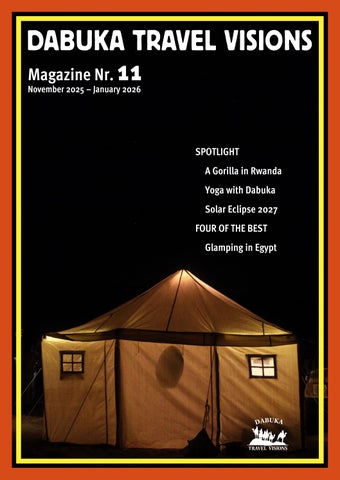
Dabuka Travel Magazine Issue #11 - English

Page 1


Dear readers,

Warm greetings to all of you! We are delighted and proud to present Issue 11 of our travel magazine — true to the motto “Dabuka is picking up speed” — on land and water alike.

Do you know that wonderful feeling when you sense that “things are moving,” that everything is falling into place, knots are loosening, and new perspectives are emerging? That’s exactly where we are right now.

In this issue, we invite you to celebrate New Year’s Eve with us in a very special way — with a glamping experience under the stars.

Or would you rather experience ballet in the sand dunes? That’s how we’ll be starting the new year.

And for all yoga lovers, we’re thrilled to announce that Dabuka Blue will soon be hosting yoga journeys — professionally guided by a true insider.

Even the gorillas of Rwanda send their greetings and invite you to visit them, and there are promising signs that doors to Libya may soon reopen — a destination where we already have many years of experience. As you can see, we have plenty of new ideas and offers coming your way.

Sometimes, it feels as if when the time is right, things just fall into place — almost as if they drop from the sky. Just like the three street dogs who now live with us.

Neither Tarek nor I ever wanted pets again — we wanted to stay free because of our travels.

But one day, a few months ago, a mother dog and her three puppies appeared in front of our house, looking at us expectantly. We couldn’t resist and started to pet them.

That was it — they decided to stay. First the front yard, then the garden, and now occasionally inside the house. One disappeared, but the three remaining ones — Lexa, Sira, and Rico — have become

part of our family, just like children. They are fed, cuddled, and even educated (well, sort of — Rico loves chewing on everything). When Sira came back one night with a swollen snout, Tarek was completely distraught.

Still, they are and remain street dogs — you never know how long they’ll stay. But for some reason, they chose us, and we accepted their choice.

Just like these dogs, new encounters and perspectives keep finding their way to us. We stay in the flow and hope to welcome you soon — here with us or somewhere out in the world.

As this is our last magazine issue of 2025, it’s already time to wish you a joyful start into the new year.

We want to thank you for your interest, your support, and your inspiring ideas.

“The best way to predict the future is to create it yourself.”

Let’s shape a joyful future together.

With warm regards,

Dorothee und Tarek Kairo, November 2025

Table of Contents

I. Introduction Editorial3

TableofContents,Imprint,Contact4

Follow—Share—Win5

CustomerTestimonials 6

II. News

BookRecommendation: Usiwa–ThroughtheDesert8

StoriesbesidetheMainstream:Intothe Unknown—CrossingtheKalanshoSandSea9

III. Spotlight

AGorillainRwanda:“IBurpWhenI’mHappy”12 YogawithDabuka—TheJourneyWithin14

TheDaytheSundisappears— PreparingfortheSolarEclipse202716

Re-ThinkingTourism— CanTourismsavetheWorld?18 Siwa2025—BetweenSilenceandRenewal20

IV. FouroftheBest

BalletintheDunes—AFeastfortheSenses26 GlampinginEgypt–DesertLuxury27 NewHorizonswithDabuka: RethinkEgyptTwice29

ASeatattheTable—DiscoveringEgypt ThroughFoodandFriendship30

V. Various

InterviewwithourfriendKatharina32 DabukaInternal33

ByChance:TheGayer-AndersonMuseum— AHiddenGeminOldCairo34

Editorial

DABUKA TRAVEL VISIONS ISSUE 11

Editor:

Dorothee Rieche

Art Director: Andreas Klostermaier

Contributor: Shada Mamdouh

Marketing & Advertising: M. Ibrahim

Contact (Magazine): magazine@dabuka.de

Contact: +20 101 506 9061

Email: service@dabuka.de

Homepage: www.dabuka.com

Special Tours: www.eclipse-2027.com

Become a Winner!

Show us your best Dabuka moments!

Show us your best Dabuka moments!

Have you recently traveled with Dabuka?

Send us your favorite travel photos — we’ll feature a selection in our next magazine.

The community will vote for their favorite image — and the winning photo will receive a $ 100 voucher!

Send your photos to : service@dabuka.de

(Subject: Magazine Competition)

Submit by January, 15th, 2026 and let’s keep exploring together!

This time the winner in this issue is: Rami Battani (BattaJ)

For all existing Dabuka clients please join our EXCLUSIVE Facebook group “Dabuka insiders”!

Unforgettable Moments

We

love to hear about your amazing experiences with us and all your wonderful feedback is most welcome!

May

2025

My husband and I joined several tailor-made tours with Dabuka around Cairo. Even though we only had five days, they turned into fantastic excursions and experiences.

One day, we started very early into the desert with the goal of reaching Wadi al-Hitan. Since I work as an editor for UNESCO publications, this was one of the highlights for me — to visit the Valley of Whales in person. Tarek was also a wonderful driver of our Jeep.

Several more trips followed, each one special thanks to Dorothee and Tarek’s deep local knowledge and experience — from leisurely walks through Cairo’s bazaars to visits to exquisite gold shops, and a sunset felucca cruise on the Nile with a delicious buffet.

We will definitely come back — next time with a little more time in our luggage!

Many thanks for your passionate ideas, hospitality, and unforgettable experiences.

Isabel & Max, Germany

August 2025

My Dreams Came True in Egypt with Dabuka

Really, really thanks to Dabuka for everything! I felt completely comfortable from start to finish. The organization was incredibly helpful — my friend and I were so, so happy.

We visited the pyramids and truly felt the spirit of ancient Egypt. The golden sand, the atmosphere — it was all magical! Our remarkable tour guide, Nagwan Helal, made the trip even more special, especially during our visit to the Grand Egyptian Museum, where she explained everything in detail. It was such an unforgettable experience in Egypt. I’m so happy — and I will definitely come again!

Sandra, Germany

September 2025

Best Company and Great Experience! I recommend Dabuka to everyone who values authenticity, quality, and care.

Omar, Italy

Book Recommendation: USIWA – Through the Desert

This novel is based on a true story — the downing of a civilian aircraft by NATO jets over the Tyrrhenian Sea in 1980. What followed was a web of cover-ups, denials, and, eventually, silence. Not in Italy, where it happened, but across Europe and the United States — nations complicit in the tragedy, Germany among them. Eighty-one people lost their lives.

This “Massacre of Ustica” left behind a long trail of blood — witnesses silenced one by one. USIWA tells the story of the “last witness,” the man who walked through the desert.

The journey takes us from Italy and Germany to Egypt during the Arab Spring — to the landscapes once crossed by Rommel. Along the way, three generations meet somewhere between East and West, all searching for the “last witness”: a Libyan pilot hiding in the oasis of Siwa, to be brought to justice in Rome.

From the book blurb:

In 1980, over the island of Ustica, an air-to-air missile tears through flight Itavia 870. “Guarda!” shouts the pilot — and then the radio falls silent. The wreckage sinks into the depths of the sea, more than three thousand meters below. At the same time, Muammar al-Gaddafi is flying to a Warsaw Pact summit. Was it a terrorist attack, as high-ranking officers claimed? Or was Gaddafi himself the intended target?

A key witness could be the pilot of one of two Libyan MiG-23s flying in the radar shadow of the DC-9. But that man vanishes — into the oasis of Siwa.

Eight years later, Jae, the stepdaughter of the Itavia 870 pilot, disappears without a trace — and returns completely changed. Investigators are convinced her disappearance is linked to the crash.

In 2010, light artist Torsten Winkel uncovers secrets in his late father’s estate. What role did his father play during World War II? The trail leads to a mysterious inheritance in the Siwa Oasis — where Torsten unexpectedly meets Jae. But the shadows of the past are waiting for them both. �

Stories beside the Mainstream: Into the Unknown – Crossing the Kalansho Sand Sea

In the far west of the Egyptian desert, beyond the shimmering horizon of Siwa, lies a sea not of water but of sand — a place so vast and silent that maps long refused to name it. This is the Kalansho Sand Sea, one of the least explored dune fields on Earth. For explorers, it is both a dream and a trial — a shifting world of ridges and light where orientation depends on instinct as much as on maps.

The First Explorers

In 1873, the German explorer Gerhard Rohlfs became the first to discover and name the Great Sand Sea, a vast expanse of dunes stretching between Egypt and Libya. Almost sixty years later, in 1932, Pat Clayton, a British inspector working with the Desert Survey of Egypt, made the first motorized crossing from east to west. At the western edge, he built a stone cairn he called “Big Cairn,” marking what he believed to be the end of the Great Sand Sea.

At that time, Libya was under Italian occupation. In 1926, Italian forces had seized Giarabub (Ghar-

bub) to suppress the Libyan resistance led by Omar Mukhtar. A year later, in 1927, Clayton returned to the region with a joint Egyptian-British border commission to meet an Italian team and define the frontier between Egypt and Libya. Starting at the Mediterranean, they marked the line with posts, which the Italians later reinforced with a barbedwire fence stretching 350 kilometers south.

When both delegations reached the Serir Dalma, they agreed to use the 25th meridian as the southern boundary. The Italians considered the Great Sand Sea a natural defense barrier — impossible to cross. What they didn’t know was that the same Pat Clayton would soon find a hidden way through.

The Discovery of the Kalansho Sand Sea

When the Second World War erupted, Clayton’s deep knowledge of the desert became invaluable. In August 1940, he was ordered to survey the area west of Serir Dalma and to monitor the Jalo–Kufra route for enemy movement. Starting from Siwa Oasis, he drove south with two vehicles and five

New Zealanders. After crossing the Egyptian border, he came upon a dune field unknown to any map — an enormous region of sand and silence.

He had discovered the Kalansho Sand Sea. Though he crossed it safely and reported no enemy presence, his findings revealed a new and formidable desert region — one that remains scarcely known to this day.

Crossing Kalansho Myself

In the 1990s and 2000s, I often crossed the Kalansho Sand Sea myself — traveling from Gharbub to Gebel Uweinat, tracing its length from north to south. Only once, in 2006, did I cross it from east to west. That expedition, however, turned into an unexpected adventure. One of our cars — deliberately sabotaged by a former employee from Bahareya named Lushi — broke down with a serious engine failure deep in the dunes. I had to tow the vehicle myself while simultaneously navigating and setting the route for the rest of the convoy. The Libyan maps were imprecise, and at that time, satellite imagery was not yet available, so we had to rely solely on visual navigation, crossing each dune in sight, one after another. Getting stuck and pushing the cars out of soft sand became part of the routine.

During lunch, I decided to scout ahead with another car and lay a track for the convoy. I estimated the task would take about an hour — half an hour each way. I sped off at nearly 80 km/h and more, counting dunes and watching the light shift on the sand.

After nearly half an hour, I checked my position on the map. According to the coordinates, I should have been almost out of the dunes — near the very

I turned to my co-driver: “Are you okay?” He nodded. We both jumped out. My first thought was for the second car — I sprinted up the dune to signal them. Fortunately, Hans, the driver, had seen us and stopped in time.

The impact had broken our front axle; the car was finished. We had no choice but to head back with Hans’s vehicle to the camp. The guests, already worried when only one car returned, sighed with

edge of the sand sea. But my eyes told me otherwise. The horizon ahead was still rolling, still golden, still infinite. So, I kept going — another ten minutes, then twelve. Still dunes. The map had lied; the desert hadn’t.

Then, while climbing yet another ridge, I felt something. I eased off the accelerator — but too late. The car was still making 80km/h and seconds later the car went airborne.

For a few surreal seconds, we were flying — the entire desert frozen in silence. We landed hard, all four wheels slamming into the sand. The heavily loaded roof rack tore loose, flew ten meters ahead, and lay ten meters infront of the car fully packed on the ground.

relief once I explained what had happened. That evening, we camped near the wreck — surrounded by silence and stars — the kind of night only the desert can give.

A Desert of Mystery

Even today, the Kalansho Sand Sea remains one of the most remote and mysterious places in the Sahara — a region of hypnotic beauty and quiet danger. Few have crossed it, and fewer still have returned with stories to tell. For those who venture into its heart, the Kalansho is not just a landscape — it’s a test of judgment, courage, and faith in one’s own instincts. �

A Gorilla in Rwanda: “I Burp When I’m Happy”

I’m Kibo, a silverback — the leader of my family here in the green heart of Africa. I weigh almost 200 kilos, strong yet peaceful. We gorillas are the largest living great apes, and although we look impressive, we are gentle beings. Our groups consist of females, their young, and me — the silverback — who keeps order by beating his chest.

We spend most of the day eating — leaves, herbs, fruits, roots. When I’m full and content, I burp. For us, that’s a sign of happiness. We communicate through looks, gestures, and sounds. We mourn our dead and show empathy — not only toward each other.

Sometimes, when I sit high up in the trees (yes, even with my size I can climb — up to 40 meters!),

I watch the humans appear in Volcanoes National Park in Rwanda. They stand still, whispering in awe as they look at us. I think they sense how similar we are — in our emotions, our families, our compassion.

We gorillas are vital for our forest. By spreading seeds, we help life continue to grow. Without us, there would be less diversity, less green, less future.

Gorillas in Rwanda

Rwanda is one of the few countries where mountain gorillas still live in the wild — in the mist-covered forests of the Virunga volcanoes. Thanks to decades of conservation work, their

population has risen to over 1,000. Only twelve gorilla families in Volcanoes National Park are habituated to humans, and only eight visitors per day are allowed to spend one hour with a group — always accompanied by experienced rangers.

Trekking to meet them is an experience for all the senses: damp earth underfoot, birds calling, branches cracking — and suddenly, so close, a gaze that feels deeply familiar.

A Country of History and Hope

Rwanda has a complex past — from its ancient kingdom and colonial times to the tragedy of the 1994 genocide. Today, it is one of Africa’s safest and greenest countries, shaped by reconciliation, sustainability, and pride.

Gorilla tourism plays a key role in this progress: ten percent of the revenue from permits goes to local community projects. Once a year, Rwanda celebrates Kwita Izina — a traditional naming ceremony for newborn gorillas that honors both people and nature.

Looking Ahead: New Journeys to Rwanda

Starting next year, Dabuka will offer special journeys to Rwanda in collaboration with an exper-

ienced local partner — to meet the mountain gorillas in Volcanoes National Park, experience cultural encounters in Kigali, and explore the diverse landscapes of volcanoes, tea plantations, and rainforests.

Perhaps you’ll meet one like me — who burps, because he’s happy. �

Rwanda at a Glance

Location: East Africa, bordered by Uganda, Tanzania, Burundi, and the DR Congo

Capital: Kigali

Languages: Kinyarwanda, French, English

Special Feature: Home to more than half of the world’s mountain gorilla population

Best Travel Time: June–September & December–February

Highlight: Gorilla trekking in Volcanoes National Park (permit required)

Sustainability: 10% of gorilla permit fees go to local community projects

Yoga with Dabuka — The Journey Within

Between Heaven and Earth – What Yoga Truly Means

A Path to Balance and Awareness

Today, yoga is everywhere – in studios, online courses, and retreats around the world. But what is the deeper meaning behind this ancient practice from India?

The word yoga comes from the Sanskrit root yuj, meaning “to unite” or “to harness.” It refers to the

union of body, mind, and soul – and ultimately, the realization that everything is one.

Originally, yoga was primarily a meditative practice. The well-known postures, or asanas, were simply meant to prepare the body for long, quiet sitting. Today, yoga has evolved into a vast field – from physically dynamic styles like Vinyasa or Ashtanga to more meditative ones like Yin or Jivamukti Yoga. Most forms combine movement, breath (pranayama), meditation, and spiritual mindfulness.

Yoga in Numbers

Yoga is no longer a niche. According to a 2024 study by the German Yoga Teachers Association (BDYoga), around 3.2 million people in Germany practice yoga regularly – about one in five, which is four times more than in 2018.

What’s especially striking is that more and more men are discovering yoga, and young people between 18 and 24 are among the most enthusiastic practitioners. One-third of those who don’t yet practice yoga say they could imagine starting soon – often driven by the wish for greater physical and mental balance.

What Yoga Teaches Us Today

Yoga is not a sport, but a way of life. It’s about inner peace, clarity, and connection – with ourselves and with the world.

A yogi practices mindfulness in everything – at

work, while cooking, or walking. Yoga reminds us that balance is not something you have but something you continuously seek.

When we stand on one leg, wobbling and realigning ourselves, it mirrors life itself: we fall, we rise, we find our center again.

And in that process lies the freedom yoga offers –moksha in Sanskrit – the liberation from whatever binds or limits us.

Yoga Is Not a Religion – But a Philosophy

Though yoga has roots in Hinduism and Buddhism, it is not a religion. It offers a framework for personal growth without prescribing belief systems.

Some find peace in meditation, others in chanting mantras – or simply by putting their phone away for an hour. What remains is a deep sense of calm that lingers long after.

Yoga Journeys with Isabelle Morin Larbey

We are delighted to welcome Isabelle Morin Larbey, an experienced French yoga teacher and trainer, to lead Dabuka’s exclusive yoga journeys.

Starting in November 2026, Isabelle will guide retreats both aboard the Dabuka Blue on Lake Nasser and in the desert. Both settings are perfect for yoga – tranquil, vast, and powerful – ideal places to unwind and recharge.

An Invitation to the Inner Journey

Whether you’ve practiced yoga for years or are just beginning, this journey will help you experience what yoga truly means: stillness, clarity, and connection.

At the same time, you’ll explore one of Egypt’s most beautiful landscapes.

Sometimes, all it takes is a shift in perspective – and suddenly, everything flows. �

Yoga & Stillness on Lake Nasser

November 20th–30th, 2026

A journey between water, temples, and inner reflection:

From Aswan, the Dabuka Blue sails to Abu Simbel and back. Along the way, we visit the temples of Kalabsha, Wadi Sebua, Amada, Qasr Ibrim, and Abu Simbel.

Each day includes several yoga sessions with Isabelle – sometimes on deck, sometimes in magical spots along the shore.

The lake’s serene, spiritual atmosphere creates the perfect setting for meditation, movement, and self-discovery.

Prices:

Double cabin (per person):€ 2,490

Single cabin:€ 3,290

Minimum 6 participants (in double cabins)

Included:

Transfers from Aswan airport or train station, full board, entrance fees, yoga sessions, guide, and permits.

Not included: Tips and travel to Aswan.

The Day the Sun disappears

Preparing for the Solar Eclipse 2027 – A Report by Didier

As we at Dabuka look ahead to the great solar eclipse of 2027 – one of the most impressive natural events of this century in Egypt – we are exchanging thoughts with those who have already experienced such moments.

Our friend Didier Basset, a passionate desert traveler and seasoned eclipse observer, has kindly shared with us his personal account of the 2006 eclipse.

His story takes us deep into the Libyan Desert and reveals the beauty and emotion of witnessing day turn into night.

Black Sun over the Libyan Desert by

Based on a report by Didier Basset about the 2006 solar eclipse in the Libyan Desert. Edited for publication by Dabuka.

March 29, 2006. The sun rises above the dunes, scattered with tufts of ephedra. We are deep in the Libyan Desert, west of the oasis of Tazerbo. A small group of desert lovers prepares for a magical en-

counter: today, the sun will meet the moon – and us.

Yet there is tension in the air: will the vehicles make it? 150 kilometers still to go, a third across the challenging dunes of the Erg Rabiana. Many of my companions are seasoned desert travelers but firsttime eclipse watchers. For me, it’s the ninth meeting between the mighty Sun and pale Selene.

The Magic of the Unrepeatable

Why chase the night in the middle of the day? Perhaps because it remains one of the last true adventures. A total solar eclipse is almost impossible to describe – each one unique, each one overwhelming.

The pink solar prominences, towering hydrogen flames many times larger than Earth, rise above the dark lunar edge. The corona, that silver-white halo, changes its shape with solar activity. And then there is time itself – four minutes of eternity before light returns.

Into the Shadow’s Realm

We reach our observation site: a vast plain of sand and rock at the foot of Djebel Al-Maruf. The sky is perfectly clear. The first small bite appears on the sun’s rim – the beginning of the show.

Slowly, the shadow advances. Voices fade, the air cools. A light breeze rises – the “wind of the eclipse.” The light takes on a strange violet tone, shadows grow sharp and long. Then, in a single instant, darkness falls.

Venus shines bright on the horizon. The temperature has dropped by twelve degrees. The sun has vanished, replaced by a glowing crown of light – totality. Everything stands still. Silence. Breath held.

Four long minutes stretch into infinity. Then, suddenly, a dazzling flash – the diamond ring –and daylight returns. Laughter, voices, relief. But something remains: the quiet awe of having witnessed the perfect union of light and darkness. �

Re-Thinking Tourism — Can Tourism save the World?

Our friend and companion Prof. Dr. Fekri Hassan has given us the pleasure this time of enriching our magazine with his own article. As an archaeologist and Egyptologist, he has devoted much of his work to the subject of “Cultural Heritage.”

For decades since the Brundtland report, entitled “Our Common future” in 1987, we now have the UN Sustainable Development Goals, as well as the 2016 operational guidelines, for sustainable tourism that makes clear and direct reference to cultural heritage. Today, there is greater need to mobilize culture change toward a sustainable future, and I argue here that tourism, the means by which millions of humans (1.4 billion in 2024) from all kinds of different backgrounds, holds a great potential for saving the world.

This means that we have to move away from the comfort of business as usual, to creative, innovative

tourism through a transformational framework of action on the basis of the creative potential of individuals and the of the platform of partnerships between and among individuals, the private sector, NGOs, as well as national and international organizations in order to overcome current shortcomings in the world system. In this regard, tourists, tourist operators and companies have a key role to play.

The transformation begins with the Tourist Experience in the context of mutual understanding, genuine interpersonal, intercultural dialogue, and a way for reflexive knowledge and creativity through thoughtful interpretations of tourist resources and destinations, promoting tolerance, peace, and cooperation on the basis of mutual trust and respect for traditional cultures and cultural diversity.

This, for example, includes awareness of social structures and dynamics of social transformations

in the past, and the realization of the unity of humankind and their common bonds, hopes and worries. This approach has a great emancipatory potential and can spiral into exhilarating experiences. Standing in awe in a vast desert that was once a green lush landscape is an unforgettable experience exposing the fragility of our conditions and unleashing the powers of action to mitigate environmental risks. Grasping the organization and effort behind the great monuments illuminate the intricacies of managing complex state society and power of religious beliefs. In this context, culture should be presented and interpreted in its totality with no artificial divisions between tangible and intangible, with an emphasis on “Living Heritage” inclusive of crafts, cuisine, festivals, traditional performances, and lore, as well as the cultural landscape.

Gathering at the end of a day full of exploration and discovery, around camp fire in the middle of nowhere, reveals the core of our humanity and the warmth of companionship. A truly transformational tourism (TT) must deal with the ecological threat to our planet and promote livability and proactive nature conservation. Tourism, in fact, provides an ideal situation for transforming aptitudes among local communities and tourists alike of ecologically sound practices to maintain the vitality of the planet. This can be achieved by increasing awareness among tourists and host communities of the risks of environmental degradation and climate change, of the linkage between humans and ecosystems. Aware that ecosystems and “natural heritage” are enmeshed in cultural notions and social constructs of nature and culture and that ecosystems cannot be fully understood without the role of anthropogenic factors.

We have to keep in mind that, nature-orientetourism cannot be conceptualized without joint efforts including those by local communities in the “management” of such destinations. Properly designed ecotours and ecolodges have a key role to play in enhancing a deeper understanding of the cultural landscape and its dynamics. Such ecotours should include visiting sites that bear witness to past climate change. We stand together in a rapidly changing world threatened by the vagaries of climate change. Ecotours, cherishing the wonders of nature, can open the door to a better understanding of past climatic events and how ancient societies coped with such events.

Given its educational and emancipatory value, cultural heritage has to be protected, preserved and conserved by enhancing awareness of the value of such resources and their significance, combat illicit digging and trade in heritage properties, and the repatriation of stolen artefacts.

This means that there is a great need for capacity building - a prerequisite for any project that aims to ensure transformational sustainability. Both workforce management and knowledge management play crucial roles in the viability and sustainability of tourist endeavors. Tourism is one of the leading sources of income, generating funds that properly managed can contribute to better future and even greater revenues. In this regards, tourism should endeavor to serve as the basis for “participatory” projects to create viable institutional arrangements including governance boards to set social and economic development goals, manage sites, facilities and infrastructures, marketing, capacity building, conservation and interpretation. In this regard, tourism should not be restricted to just create jobs and increase revenues to local communities from traditional crafts but to find means to empower and vitalize host communities through transformational education so that they can improve their life conditions and have the same opportunities as those of other privileged socioeconomic groups, to enable them to become agents in developing their own creative potentials and facilitate their engagement as co-developers and coagents. One important element of transformational education is the promotion and support of courage and innovation, as in the case of “Creative Industries”. Only together with an eye to people and the habitats that support human life can we hope for a better future for all.

Siwa 2025 — Between Silence and Renewal

A guest contribution for DABUKA Magazine by Marcel G. Seyppel

When the Moon No Longer Dances

Only a weathered sign still recalls the Syaha Festival, once the most important celebration of the Siwa Oasis. For three nights, residents danced, sang, cooked, and rejoiced at the foot of the sacred Dakrour Mountain—to make peace and end old feuds.

Today, all is quiet. Since the pandemic, the festival has lain dormant. Too many tourists had crowded in among the celebrants—selfies instead of reconciliation. Costs rose, authorities grew wary—and so a piece of living culture disappeared.

I had hoped to witness Syaha again, but in vain. Yet even without the festival, I can savor life in the oasis. Amid change, Siwa remains a place of wonder—full of contrasts between tradition and new beginnings.

In the Heart of Shali

My first stop is the open-air restaurant Abdu in the center of Shali, the oasis town—a meeting point for travelers, craftsmen, and guides. Here I meet Hussein, a potter from Tunis-Fayoum who settled in Siwa years ago.

“Fayoum became chaotic,” he says. “But Siwa stays calm. Here there’s still space, stillness, peace.”

Despite the sputtering engines, honking horns, and shouts from the dusty street before us, he means it. You just have to step a little outside Shali’s bustling center to feel it. Freedom, he says, is more important to the people here than possessions.

“Money? Only paper,” he laughs—and I believe him.

Growth in Slow Motion

Siwa is a world of its own: 90 by 40 kilometers of date palms, olive groves, hot springs, and tranquil salt lakes. But change is in the air. More than 30 lodges and hotels now line the oasis; new cafés and souvenir shops cluster along the roads.

At the market stalls, a lively gold rush spirit prevails—tea included. More and more travelers from Asia are discovering Siwa anew. And yet, despite the influx, the atmosphere remains relaxed.

Evening Gold over the Fortress

At sunset, everyone heads to the old fortress of Shali. Built from salt mud and palm wood, it was lovingly restored after its destruction a century ago. Today it’s a walkable labyrinth of walls, stairs, and arches.

From the rooftop terrace of Café/Restaurant Salama, I watch the sun bathe the walls in warm gold. The food is excellent, the prices fair. Down in the alleys, life hums—tuk-tuks, donkey carts, children’s laughter.

Those seeking rest find it in the salt lakes to the east, where you float weightlessly on the water’s surface—or in quiet hot springs like Hayat to the

south. Around the legendary Cleopatra Spring, small cafés now invite visitors to linger.

A Garden Full of Time

Later I visit Saleh, an old friend. “Retired,” he laughs, “but the collecting never stops.” His garden at the foot of the Dakrour Mountains is a small museum: meteorites, fossils, old clay vessels—treasures from his walks and desert rides.

“Siwa comes from within,” Saleh says. “It’s an attitude.”

His words stay with me. Perhaps that’s the secret of this oasis: despite all the change, it has kept its soul. No fast-food chains, no glaring malls, no graffiti. Only low houses, palm trees, light. Five times a day, the muezzin’s call drifts softly, steadily through the oasis.

The Future of Stillness

And yet, new things rise: a villa on the hill, a modern guesthouse—another chapter in this place’s long story. Even in the 19th century, officials reused ancient temple stones to build their residences. That too is Siwa: transformation and reuse.

Those who visit the oasis should take their time— for the pharaohs’ tombs in the Mountain of the Dead, for the view over the endless sea of palms, for a ride on an Arabian stallion into the desert. Asphalt roads are still rare—and perhaps that’s a blessing.

Because maybe that is the key to gentle tourism: slowness. To blend into the rhythm of the people, the light, the silence.

Siwa is changing, yes. But it remains a place where you can feel how precious simplicity can be. And when the full moon rises over Dakrour Mountain, you might just hear—very faintly—the old song of the Syaha Festival echo once more. �

Ballet in the Dunes — A Feast for the Senses

Over the years, we’ve often shared stories of extraordinary moments — events that turned our dreams, and those of our guests, into reality. Whether it was an Iftar, an open-air film night, or a musical performance — everything that normally happens indoors takes on a completely new dimension in nature.

Back in 2012, we organized our very first ballet evening in the sand dunes — a magical, unforgettable experience beneath the open sky.

More than ten years later, the idea has returned. When we recently reunited with Tatiana, our Ukrainian friend and former prima ballerina (featured in Issue 10), it was immediately clear: we have to do it again! Similar to back then — yet entirely new.

On 6 February 2026, the dunes will once again become a stage. Tatiana, together with her students, will perform a choreography full of grace, strength, and emotion.

Our British friend Martin, who captivated the audience at the piano during our Ain Sokhna event last May, will also return to provide the musical accompaniment.

Of course, the evening wouldn’t be complete without a stylish dinner under the stars, and for the first time, guests will have the chance to stay overnight in one of our new glamping tents

We already know how it will go: just before the event, we’ll ask ourselves why we’re doing this again — and afterwards, we’ll smile, happy about yet another unforgettable Dabuka experience

Tickets are now available!

Contact us for details — and don’t miss our earlybird offer. �

Glamping in Egypt – Desert Luxury

At Home in the Sand

I’ve always loved sleeping “in the sand.” My first night under the stars was in Algeria — so powerful that I cried. Since moving to Egypt, the desert has become part of my everyday life, yet it never stops inspiring me.

Into the Abu Mohareq Dunes

This time, we headed to the Abu Mohareq dunes, one of the world’s longest dune systems stretching between Bahareya and Kharga. After hours on the road, it’s time to let air out of the tires and enter the sea of sand. Driving becomes a rhythm — up and down, smooth and steep. When a car gets stuck, everyone joins in. Adventure and teamwork at their best.

The Golden Hour

As the sun softens and shadows grow, the most beautiful part of the day begins. Usually, that’s when we set up camp. But this time, our glamping tents were already waiting — a small desert village with real beds, carpets, lamps, and even a bathroom tent.

Luxury in the Wild

At first, I wondered: is this still real desert adventure? But over dinner under the stars, I knew it was. Our cook stirred pots over the fire, we sipped tea, and let the silence of the desert surround us. When the lights went out, the stars seemed close enough to touch.

A Home in the Sand

The next morning, we set off for new discoveries, knowing our tents await — like a home in the

dunes. This year, we’ll welcome the new year exactly here: surrounded by stars, silence, and friends.

For me, glamping means happiness, light, adventure, magic — and a new beginning beneath the open sky.

New Year’s Eve Desert Glamping — celebrate under the stars

Celebrate the New Year in the heart of the Egyptian desert — far from the crowds, surrounded by silence and stars.

For the first time, we offer an exclusive New Year’s Eve Glamping Tour with limited places and a truly unique atmosphere.

Our safari-style camp features spacious canvas tents with real beds, soft linens, and warm lighting that create a cozy retreat after a day of exploration. A shared bathroom tent with showers and toilets provides comfort without taking away the adventure.

On New Year’s Eve, gather around the campfire for a freshly prepared dinner, music, and the peaceful magic of the desert night.

As midnight approaches, watch the stars and welcome the new year in a way you’ll never forget — elegant, simple, and close to nature. � Book your New Year’s Eve Desert Glamping 2025 now — and welcome the new year under a million stars.

New Horizons with Dabuka: Rethink Egypt Twice

Scientific Tours beside the Mainstream

Dabuka continues to explore new paths. Since we have always stood for unique experiences – and believe that Egypt has much more to offer than diving safaris and Nile cruises – we are proud to present our upcoming travel series: RETHINK EGYPT TWICE – Scientific Tours beside the Mainstream.

This themed travel program combines culture, science, and creative reflection. It’s designed for curious minds and conscious travelers who wish to experience Egypt through archaeology, history, and dialogue rather than tourism clichés.

What participants can expect

■ Daily excursions to archaeological, cultural, and natural landmarks, guided by local experts.

■ Interactive lectures linking historical knowledge to present-day questions.

■ Sunset sessions with art, music, storytelling, or guided reflection.

■ Evening programs such as guest talks, films, and open discussions.

■ A closing roundtable to share insights and perspectives.

This series offers more than sightseeing—it’s a platform for inspiration, learning, and rethinking Egypt’s cultural narratives.

Each tour will feature a specialist from the fields of archaeology, geology, or astronomy.

More details will soon be available on our second website:

www.eclipse-2027.com

Example: Aton and Ra — In the Footsteps of the Sun Gods

Concept

and realization by

A journey guided by the sun itself.

We look upward to the pyramids, eastward to the sunrise at Amarna, and westward to the sunset over tombs and mortuary temples. Along the way, we explore the Egyptian sun gods Aton and Ra, and the symbolic power of the sun in ancient thought.

A Seat at the Table — Discovering Egypt Through Food and Friendship

“The only way to get rid of a temptation is to yield to it.”– Oscar Wilde

To truly understand a country, you need to do more than visit its landmarks. You have to taste it. Between simmering pots, the aroma of freshly baked bread, and warm laughter, stories come alive that no guidebook could ever tell. In Cairo, travelers can experience exactly that — by joining a local family for a home-cooked Egyptian dinner.

A Glimpse Behind the Scenes

Cairo is a feast for the senses, offering everything from street food to elegant restaurants. But what makes this experience unique is its intimacy. After a simple registration, guests are welcomed into a private home to prepare and share a traditional Egyptian meal together with their host.

The air is filled with the scent of spices. On the menu: creamy tahina, smoky baba ghanoush, stuffed vine leaves, rice dishes, and a variety of flavorful meat specialties. The meal is enjoyed together at one big table — just like in a typical Egyptian household.

Food as a Bridge

As vegetables are chopped and sauces stirred, conversations flow naturally. Guests learn about daily life in Cairo, traditions, and small personal stories that paint a far more vivid picture than any sightseeing tour. The atmosphere is relaxed, warm, and genuinely welcoming.

And that’s what makes this evening so special: instead of observing the culture from a distance, you become part of it — even if only for a few hours.

An Experience to Remember

When you step back out into the bustling streets of Cairo, you carry more with you than just the taste of cumin and warm bread. You take with you a feeling of connection — the kind that turns a trip into a lasting memory. �

Good to know:

■ Advance registration required

■ Small groups for a personal experience

■ No cooking skills needed — just curiosity and an appetite

■ Price per person (minimum of 5): 75,00 Euro (including transportation)

Interview

with our friend Katharina

Dorothee: Dear Katharina, we haven’t known you for very long — we met through a mutual friend — but we immediately clicked. So we’re all the more delighted that you’re taking the time today to tell us a bit about yourself and your life in Cairo. What brought you here? And where did you work before?

Katharina: Thank you for inviting me to this conversation! It was my profession that brought me to Cairo. I’m a zoological manager and previously worked in the United Arab Emirates. During my last position at an international consulting firm, I heard about the project to redesign the Giza Zoo — and I immediately fell in love with it.

The Giza Zoo was opened back in 1891 and has an impressive history. The opportunity to help establish international standards here was extremely appealing to me. When I first saw the zoo, I was especially fascinated by the beautiful grounds and the old trees.

Before coming here, I worked in Nuremberg, Dubai, and Abu Dhabi — most recently for a consultancy with international projects. Since June, I’ve been permanently based in Egypt.

Dorothee: And how do these different places compare — especially in terms of your day-to-day work?

Katharina: The differences are really huge. In Germany, the standards are high, the professional training for zookeepers is excellent, and there’s a relatively high proportion of women in the field — but unfortunately, the salaries are low and there’s a shortage of skilled workers. There are many qualified people, but too few who actually want to work in this area.

In the UAE, the teams are very international and mostly male-dominated. The standards are high and the pay is good — but there’s no regulated training system. You learn a lot directly on the job, which can be quite challenging — especially in such intercultural teams.

In Egypt, most zoo employees are locals. There’s not yet any formal training system, and professional experience with animal care is limited. But for me, that makes it an exciting task: to pass on knowledge, establish new standards, and build something sustainable in the long term.

Dorothee: And in everyday life — how do you experience the cultural differences?

Katharina: Many of the classic stereotypes are actually true: Germans are very planning-oriented and punctual, while Egyptians tend to be more spontaneous and flexible. Family is very important here — much more than in Germany, where work often comes first.

What I particularly like about Egypt is the warmth of the people! You’re immediately welcomed with kindness. In Germany, it can be a bit harder to make connections. The way people treat animals also differs — here, their needs aren’t always taken as seriously as they are in Germany.

Dorothee: Since we also live in a German-Egyptian context ourselves — what do you personally like about Cairo?

Katharina: I really love Cairo! After more than ten years in the UAE, where everything felt very organized and sometimes a bit artificial, I truly enjoy the liveliness here. You see people on the streets, real life happening everywhere.

Egypt is so diverse — in terms of landscapes, culture, and history. I’m constantly discovering new things and really enjoy being here. Of course, not everything is easy — but it’s definitely an exciting place to live and work.

Dorothee: Apart from your work — what do you enjoy here, and what do you perhaps find more challenging?

Katharina: Well, the trash and constant noise can be a bit exhausting at times. But if you create your own little retreat, it’s manageable. Luckily, I have an apartment where I feel very comfortable — my balcony is my little sanctuary.

Dorothee: Have you always been interested in animals? And do you have a favorite one?

Katharina: Yes, I’ve always been fascinated by animals. I read a lot, spent time around stables, and trained rescue dogs — animals have always been a way for me to balance everyday life.

I used to especially love horses and dogs. Today, what matters most to me is the individual connection with each animal. I’ve had very special bonds with lions, hyenas, and rhinos — but in general, I’m especially fascinated by predators, which I’ve also worked with professionally quite a bit.

Dorothee: Your current project sounds quite demanding, and Cairo is a city full of energy. How do you handle stress?

Katharina: Sometimes the only thing that helps is sleep. (laughs) But I also love reading, traveling — and as I said, my apartment is an important retreat for me. I can really relax and recharge on my balcony.

Dorothee: You’ve gotten to know our company a bit by now. Would you be interested in joining us for a tour — and if so, where would you like to go?

Katharina: Absolutely! I’d love to go with you to Lake Nasser. I’m already looking forward to it!

Dorothee: And what about your future plans — do you have a clear vision, or do you prefer to live in the moment?

Katharina: I think the saying fits perfectly: “Man plans — and God laughs.” I’d like to stay in Egypt for now and find some stability here. At the same time, I want to stay open to whatever comes next. Let’s see where the journey leads.

Dorothee: Dear Katharina, thank you so much for this fascinating insight into your life! We wish you continued joy and success with your project — and we hope to welcome you aboard on Lake Nasser very soon! �

Dabuka internal

Next year, we will be there:

Second website

We’re excited to announce the launch of our second website — dedicated entirely to our Solar Eclipse Tours and everything leading up to these celestial events.

Our new Science Tour Series will also be featured there, along with fascinating stories and insights about the wonders of the sky.

Take a look at www.eclipse-27.com and discover what’s coming next!

New Design

And — as many of you have surely noticed — our magazine now looks more professional than ever. A big thank-you goes to our friend Andreas, a true expert in this field, who offered to take on the redesign. The goal was to keep Dabuka’s recognizable style while giving it a fresh, modern edge.

We’re thrilled with the result — and we’d love to hear what you think!

Send us your feedback at service@dabuka.de

By Chance The Gayer-Anderson Museum — A Hidden Gem in Old Cairo

Tucked away beside the Mosque of Ibn Tulun in Islamic Cairo lies one of the city’s most atmospheric and beautifully preserved historic homes –the Gayer-Anderson Museum. This 17th-century house offers a rare glimpse into the elegant lifestyle of Cairo’s wealthy families during the Ottoman period and preserves the spirit of an era long gone.

The museum actually consists of two houses, built in 1631 and 1632, joined together by a wooden bridge. Their architecture reflects traditional Islamic domestic design, featuring shaded courtyards, intricately carved mashrabiya windows, and cool, quiet rooms arranged around open-air spaces. These features were not only aesthetic but also practical, providing privacy and natural ventilation against Cairo’s heat.

The house gained new life in the 1930s when Major Robert Gayer-Anderson, a British officer and passionate collector, rented and restored the property with the approval of the Egyptian government. He filled it with his vast collection of art, furniture, carpets, manuscripts, and curiosities gathered from Egypt, Persia, Syria, Turkey, India, and China. When he left Egypt in 1942, he donated the house and its treasures to the Egyptian people, and it was turned into a museum bearing his name.

Each room tells a story – from the Harem Room with its colored glass windows and mother-of-pearl furniture to the Damascus Room, covered in ornate wooden panels painted with gold and calligraphy. The rooftop terrace offers beautiful views over the minarets of Ibn Tulun Mosque and the surrounding old quarter.

The Gayer-Anderson Museum is not just a historic residence but a journey through cultures. It reflects a unique blend of Egyptian, Islamic, and European influences – a place where East and West meet in harmony. For film lovers, it may also look familiar: parts of the James Bond film “The Spy Who Loved Me” (1977) were shot here, adding yet another layer to its fascinating story.

A visit to this hidden gem is a step back in time –intimate, authentic, and deeply evocative of Cairo’s timeless charm. �

Turn static files into dynamic content formats.

Create a flipbook