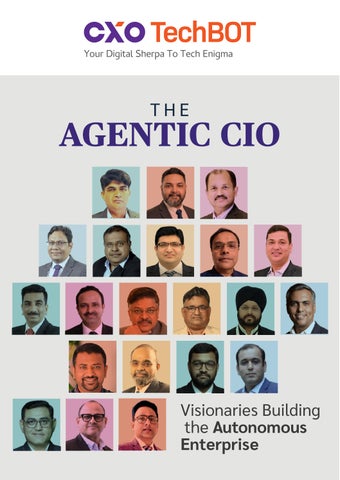
AGENTIC CIO


Visionaries Building the Autonomous Enterprise
The Agentic Mindshift:
Celebrating the CIO Leadership who are rewriting the rules of enterprise intelligence.

Swati Gupta Founder and CEO

There are moments in the history of enterprise leadership that only reveal their true significance in retrospect- the arrival of the internet, the shift to cloud, the democratisation of data. The emergence of agentic AI is one of those moments. And unlike those that came before it, this one is being led by a generation of Chief Information Officers who have chosen to stand at the intersection of possibility and responsibility, and lead from exactly that uncomfortable place. This foreword is not a summary of what follows. The articles, case studies, and leadership reflections gathered here speak with more authority than any introduction can replicate. This is something else: a deliberate pause, before the insights begin, to name what we are witnessing- and to honour the people making it happen.
What a Mindshift Actually Feels Like
The word "mindshift" is used frequently in technology discourse, often loosely. We use it here with precision. A mindshift is not the adoption of a new tool or the deployment of a new platform.
"It is the moment a leader's foundational assumptions about their role and the boundaries of what is possible are permanently altered- and they cannot return to how they thought before."
Ask any CIO in this yearbook to describe their mindshift moment, and you will not hear a story about a product demo or analyst report. You will hear a story about a decision- a specific, consequential moment when they chose to extend trust to an autonomous system, and it got measurably better. That moment of calibrated courage, repeated across organisations and industries, is what the agentic revolution actually looks like from the inside.
It requires a willingness to redesign governance frameworks before they are needed, to have difficult conversations with boards not yet fluent in autonomous risk, and to build cultures that can collaborate with agents as naturally as they collaborate with colleagues. None of this is easy. All of it is necessary.is easy. All of it is necessary.
Why This Generation of CIOs Deserves Celebration
The CIOs of the agentic era are not just solving problems. They are building something genuinely new- an architecture of enterprise intelligence with no historical precedent. They are making decisions for which there is no established best practice, operating under regulatory frameworks that haven't caught up with the technology, managing expectations from boards, CEOs, and workforces who are simultaneously excited and unsettled.
They are doing this while keeping the lights on. While managing legacy debt. While navigating talent shortages. While absorbing the relentless pace of AI advancement. The quiet heroism of this- the sheer professional endurance it demands- deserves genuine celebration.
The Qualities That Define This Leadership Moment
Three qualities unite every CIO in this yearbook. The first is intellectual courage- the willingness to hold uncertainty and act decisively within it. The second is architectural empathy- designing systems not just for what they can do today, but for the humans and agents that will inhabit them tomorrow. The third, and most underappreciated, is communicative leadershiptranslating the complexity of agentic AI into language that boards, regulators, and frontline teams can engage with meaningfully.
"The agentic era does not reward the leaders who moved fastest alone. It rewards those who brought their organisations with them- who built the trust, designed the governance, and made the case so compellingly that the enterprise chose to lead, not follow."
To Every CIO in These Pages
To every CIO who contributed: you chose to share your experience because you believe the quality of leadership in the agentic era will be determined not just by individual organisations, but by the strength of the community those organisations form together. This yearbook is our celebration of you. Not of the technology- of the leaders. Not of the agents- of the humans who had the wisdom to deploy them well.


The CIO as Orchestrator-in-Chief Redefining
the CIO Role
From System Keeper to Agent Network Architect
The CIO who still defines success by uptime percentages and ticket resolution times will be obsolete within three years. The new metric is agent throughput- how much meaningful work your AI network autonomously completes on behalf of the business."


A Role Reinvented
For more than three decades, the Chief Information Officer has been the enterprise's most trusted systems guardian- the executive charged with keeping the lights on, the data secure, and the technology roadmap aligned to business objectives. It was a role defined by infrastructure, vendor relationships, and the quiet discipline of operational excellence. That definition is now being dismantled- not by budget cuts or boardroom politics, but by the emergence of agentic AI.
Agentic AI- systems capable of autonomous goal-directed action, multi-step reasoning, and cross-platform execution- doesn't just add another tool to the CIO's portfolio. It fundamentally rewrites the job description. The CIO of the agentic era is no longer a system keeper. They are an Orchestrator-in-Chief: the architect of a living, breathing network of intelligent agents that act, decide, and deliver on behalf of the entire enterprise.
From Infrastructure to Intelligence
Consider what a modern agentic IT environment actually looks like. At a leading global logistics firm, the CIO has deployed a mesh of specialized agents- one monitoring supply chain anomalies, another autonomously rerouting shipments based on real-time disruption data, a third continuously renegotiating spot freight rates within pre-approved parameters. None of these require a human in the loop for routine execution. The CIO's role shifted from managing the systems that humans use, to governing the agents that act on the enterprise's behalf.
This is the critical mindshift. Traditional IT management was about enabling human workers- giving them faster tools, cleaner data, more reliable platforms. Agentic IT management is about deploying non-human workers, defining their authority, calibrating their judgment thresholds, and building the governance layer that ensures they operate within ethical and business boundaries. The CIO must now think less like a plumber and more like a conductor.
The Architecture of Orchestration
What does it practically mean to architect an agent network? Forward-thinking CIOs are approaching this across three layers. The first is the integration layerensuring that existing enterprise systems, APIs, and data
pipelines are accessible to agents in a structured, governed way. The second is the orchestration layerdefining how agents hand off tasks to one another, how they escalate to humans, and how they log decisions for auditability. The third, and most critical, is the trust and governance layer- establishing what agents are permitted to do autonomously, what requires human approval, and how liability is assigned when autonomous decisions produce unintended outcomes.
CIOs who get this right are finding that their organizations can scale decision-making capacity without proportionally scaling headcount- a breakthrough that CFOs are increasingly treating as a core competitive lever rather than an IT experiment.
The Uncomfortable Truth
The transition is not without friction. Many CIOs are discovering that their existing IT governance frameworks- built for deterministic, rule-based systemsare poorly equipped for agents that reason, adapt, and occasionally surprise. The instinct to slow down, to demand exhaustive testing, to retrofit old compliance models onto new autonomous behaviours, is understandable. But it is also dangerous. While cautious IT leaders are perfecting governance frameworks, their competitors are deploying agents at scale and accumulating the operational intelligence that only comes from real-world execution.
The Opportunity Ahead
The CIOs who will define the next decade are those who embrace the identity shift fully. They are investing in agent engineering capability alongside traditional software engineering. They are building centres of excellence not just for AI models, but for agent design patterns, orchestration architecture, and autonomous workflow governance. They are positioning IT not as a cost centre that supports the business, but as the intelligence centre that runs significant parts of it.
The title of CIO was always somewhat aspirational- the 'I' for Information suggesting a strategic remit that operational realities often compressed into something narrower. In the agentic era, that aspiration is finally achievable. The information officer becomes the intelligence officer. The system keeper becomes the network architect. The conductor lifts the baton- and the orchestra plays on, autonomously, around the clock.
Winning with Agentic AI Turning Intelligence into Enterprise Advantage

AI is not just about automation. It is about accelerating human judgment, amplifying strategic clarity, and turning intelligence into a decisive competitive advantage.
Artificial Intelligence is no longer an experimental capability. It is becoming the defining force behind decision velocity, operational excellence, and competitive differentiation. At its core, the journey begins with a simple objective: accelerating decision cycle turnaround time by converting fragmented signals into actionable insight.
Modern AI strategies now follow a structured value chain. Real-time data capture across applications and systems feeds into robust data engineering foundations. Advanced data science uncovers patterns and predictive signals. Finally, intuitive AI interfaces deliver contextual intelligence directly to business leaders. The impact is measurable: up to 30 percent reduction in turnaround time, 10 to 30 percent improvement in analytical accuracy, and 5 to 15 percent uplift in decision value.
The next transformation is the rise of agentic AI systems. Enterprises are moving beyond prompt-based tools toward autonomous agents capable of managing end-to-end workflows. From supply chain optimization and financial forecasting to hyper-personalized customer engagement, AI is evolving into a strategic execution
engine. Multimodal systems integrating text, voice, image, and video will further enhance intuitive interactions across industries.However, scaling AI requires more than technology. Sustainable success depends on aligning initiatives with measurable business outcomes, investing in strong data foundations, implementing MLOps for continuous monitoring, and embedding governance frameworks that ensure transparency, fairness, and privacy. Ethical AI is no longer optional. It is foundational to building trust and long-term adoption.
Workforce transformation is equally critical. The future belongs to professionals who combine AI literacy with strategic thinking, emotional intelligence, and critical reasoning. Organizations must foster continuous learning cultures, promote human-in-the-loop design, and position AI as augmentation rather than replacement.
For emerging innovators, the mandate is clear: shift from AI-first experimentation to value-first execution. Focus on solving real industry problems, integrate proprietary data to create defensible advantage, and design systems that enhance human judgment.
SANTOSH RAI
Global CDIO - PGP Glass Pvt. Ltd.
Santosh Rai is an highly accomplished technology leader with over two decades of experience driving digital transformation, AI innovation, and cloud modernization. Raised in an Air Force family in Gorakhpur, he developed adaptability and resilience through diverse early-life experiences across India. He holds a strong academic foundation in computer applications and a Master’s in Information Technology. Prior to his current role, he served as CIO and Group Head of IT at Asahi India Glass Limited and held senior leadership positions at International Tractors Limited and Vardhman Textiles. In 2026, he joined PGP Glass as Global Chief Digital and Information Officer, leading enterprise-wide digital, data, and cybersecurity initiatives.


A Human-First Stand on Artificial Intelligence
The real danger is not that machines will begin to think like humans, but that humans will begin to think like machines.” — Sydney J. Harris
My journey into Artificial Intelligence began with curiosity but evolved into responsibility. I was always inspired by technology- not just for what it could automate, but for what it could unlock. The idea that humans could design intelligent systems capable of advancing medical research, enabling space exploration, and solving problems at unprecedented scale shaped my early thinking. At its best, AI represents collective human intelligence, amplified. As AI capabilities accelerated, so did the need for caution. Powerful systems require disciplined intent. While AI can dramatically improve quality of life, we must be vigilant not to create autonomous entities devoid of human values or ethical boundaries. A truly self-directed intelligence, sitting unchecked at the top of the decision hierarchy, could pose risks far greater than its benefits. AI must remain a tool guided by human purpose- not a force that defines it.
Over the next decade, AI will be the most transformational force businesses and societies have encountered since the industrial and IT revolutions. Unlike previous shifts, its impact will be exponential. AI learns continuously, scales instantly, and adapts faster than any technology before it. In research and medicine alone, AI has the potential to extend average human lifespan by nearly a decade by accelerating discovery, precision diagnostics, and personalized treatment.
The next major inflection point will see enterprises increasingly operated by AI-driven systems and intelligent bots. Operational decisions will become faster, data-led, and continuous. Human involvement will shift decisively toward areas machines cannot replace- emotional intelligence, ethical judgment, creativity, and social
responsibility. In this future, AI will not reduce human relevance; it will elevate it.
Ethical AI must be embedded by design, not treated as an afterthought. Today’s models are extraordinarily powerful, and the temptation to prioritize speed or profit over responsibility is real. Leaders must ensure AI systems remain transparent, explainable, and aligned with human values. Clear boundaries around autonomy, accountability, and governance are essential to prevent unintended consequences and preserve trust.
Inclusivity and bias mitigation are collective responsibilities. Governments, regulators, organizations, and individuals must collaborate to build enforceable frameworks- systems that are informed, decisive, and empowered to intervene when ethical lines are crossed. Responsible AI governance is not about slowing innovation; it is about sustaining it.
For future AI leaders, technical expertise alone will not suffice. Critical thinking, adaptability, ethical reasoning, and a commitment to lifelong learning will define success. Organizations must approach AI as a transformation journey- cutting across functions, embedding accountability, and ensuring intelligence is scalable and transferable.

My advice to emerging AI professionals is simple: master the fundamentals, keep evolving, and build ecosystems of shared learning. When knowledge is open and communities collaborate, AI progress benefits not just a few- but many.

AMAN WALIA
Group CIO - Kanodia Group
Aman Walia is a strategic enterprise technology leader with 19+ years of exemplary experience driving digital transformation, AI innovation, and scalable technology ecosystems. He has led high-impact supply chain digitization initiatives and enterprise-wide AI implementations across sales, marketing, logistics, and manufacturing, delivering significant revenue acceleration and EBITDA improvement. With deep expertise in cloud migration, cybersecurity frameworks, IT-OT convergence, and regulatory compliance including DPDP Act, NIST, and ISO standards, he builds resilient, data-driven enterprises. Known for achieving substantial productivity gains and sustainability-led efficiencies, Aman transforms technology into a measurable growth engine powering AI-enabled, future-ready organizations.
Building the Agentic Enterprise Embedding AI as a Core Operating Layer

The real power of AI is not in replacing people, but in amplifying human intelligence at a scale we’ve never seen before. The winners in AI won’t be the ones with the biggest models- they’ll be the ones with the cleanest data, strongest governance, and best integration.”
The evolution toward Artificial Intelligence within enterprises often begins with a practical objective: reducing complexity and enabling better decision-making at scale. Initial efforts typically focus on extracting intelligence from fragmented systems to improve efficiency, visibility, and operational control. Over time, however, AI matures from a productivity enabler into a strategic capability that augments human intelligence and reshapes how organizations think, decide, and operate.
In the coming decade, AI is set to become a foundational operating layer across businesses. Real-time intelligence, adaptive decision systems, and personalized experiences will define competitive advantage. Beyond commercial outcomes, AI will also expand access to knowledge and opportunity, influencing broader societal progress when deployed responsibly.
A critical inflection point in this journey is the shift from isolated AI pilots to scalable, governed adoption. Establishing an enterprise AI assist fabric that embeds intelligence directly into daily workflows enables measurable gains in productivity, faster decision cycles,
and a stronger culture of self-service analytics. As this model scales, leaders increasingly oversee hybrid teams of humans and AI agents, with greater emphasis placed on decision quality, governance, and trust rather than execution alone.
Responsible AI must be embedded by design. Governance frameworks should precede scale, ensuring that every use case is assessed for privacy, security, bias mitigation, and explainability. Human accountability remains essential, supported by diverse data practices, cross-functional collaboration, and continuous bias monitoring.
Successful enterprise-wide adoption requires prioritizing people, process, and trust over technology alone. By addressing real business challenges, delivering visible early wins, integrating AI into familiar workflows, and investing in ongoing upskilling, organizations can transform resistance into momentum.
In the Agentic era, AI leadership will not be defined solely by advanced models, but by how seamlessly intelligence is integrated, responsibly governed, and trusted to deliver sustainable business value at scale.

AI IN ACTION

DEBASHIS SINGH
CIO - Persistent Systems
Debashis Singh is an industry veteran and a strategic CIO with over 30 years of global experience, he has led technology innovation, AI-powered automation, and enterprise-wide transformation across startups and large multinational organizations. He specializes in aligning IT strategy with business objectives to deliver secure, scalable, and cost-efficient digital solutions. With deep expertise in cloud adoption, enterprise architecture, cybersecurity, and data-driven decision-making, he consistently drives measurable impact. Known for strong governance, risk management, and agile execution, he leads cross-functional teams to deliver complex IT programs on time and within budget, building resilient, future-ready technology ecosystems that enable sustained business growth.
Agentic Shift From Automated Factories to Autonomous Enterprises
Autonomy is not about removing humans from the loop; it’s about designing systems that know when to act, when to advise, and when to escalate.”
In Indian manufacturing, automation is no longer a differentiator, it is the baseline. Most plants today run on ERP-driven planning, automated production lines, barcode-based inventory, and digitized finance. Yet, despite years of investment, leaders still spend disproportionate time firefighting: material shortages, production plan overrides, delayed dispatches, and post-facto explanations. This is where the Agentic Shift begins, moving enterprises from automation that executes, to autonomy that thinks and acts with intent.
I have seen this shift emerge not as a big-bang transformation, but through very real operational pain points. For instance, production schedules may be system-generated, but planners still intervene daily because demand signals change, vendors underperform, or capacity assumptions break. Automation faithfully follows rules; it does not question them. Agentic systems do. They sense deviations early, evaluate trade-offs across procurement, production, and finance, and recommend or take corrective action within defined guardrails.
In a manufacturing environment, autonomy shows up in practical ways. A planning agent that dynamically reshapes the MRP run based on supplier reliability and plant constraints. A finance agent that flags margin erosion while orders are still in execution, not after month-end closure. An IT operations layer that detects abnormal system behaviour and resolves issues before
users even raise tickets. These are not futuristic ideas, they are natural extensions of systems enterprises already operate, when intelligence and context are layered thoughtfully.
However, autonomy does not emerge from algorithms alone. In my experience, it is built on disciplined master data, standardized processes, and strong business ownership. When material masters, BOMs, and customer data are inconsistent, no agent can be trusted. When decision rights are unclear, autonomy creates anxiety instead of value. The Agentic Shift therefore forces enterprises to mature, not just technologically, but organizationally.
What changes most is the role of people. Teams stop chasing transactions and start shaping outcomes. Plant heads engage with scenarios, not spreadsheets. IT shifts from being a system custodian to an enterprise enabler. Leadership conversations move from “why did this happen?” to “how early can we see this coming?”
The Agentic Shift is not about removing humans from the loop. It is about building systems that work with human judgment, systems that know when to act, when to advise, and when to escalate. For Indian manufacturing enterprises navigating scale, complexity, and volatility, autonomy is not a luxury. It is the next logical step toward sustainable, intelligent growth.

ABHISHEK KUMAR SINGH
Chief Information Technology Officer
TechNova Imaging Systems (P) Ltd.
Abhishek Kumar Singh is an highly accomplished technology leader and proud alumnus of Indian Institute of Technology (Banaras Hindu University) with over 20 years of exemplary experience in IT strategy, digital transformation, and enterprise technology operations. His career spans leading organizations including Deccan Herald, Blue Star Limited, Steel Authority of India Limited, SAP Labs, and Wipro. Currently serving as Chief Information Technology Officer at Technova Imaging Systems, he leads enterprise digital platforms, IT infrastructure, and transformation initiatives. With deep expertise in cloud, ERP, mobility, and data analytics, he focuses on driving innovation, operational excellence, and data-driven decision making while building high-performance technology teams that create sustainable business value.


architectures to fuel autonomous decision-making
We spent five years building a beautiful data meshdomain-owned, federated, governed. Then agentic AI arrived and asked a question our architecture wasn't ready to answer: not 'where is the data?' but 'what should we do with it, right now, without asking anyone?' That gap between insight and autonomous action is where the next wave of CIO leadership is being decided."

Two Revolutions, One Convergence
The data mesh movement gave enterprises something they had long struggled to achieve: distributed ownership of data, domain-aligned responsibility, and a federated governance model that could scale without centralising everything through an overwhelmed data engineering team. For many CIOs, it represented the culmination of years of painful lessons about data lakes that became data swamps and centralised platforms that became bottlenecks.
At roughly the same time, agentic AI began its own ascent- systems capable of reasoning across data sources, executing multi-step tasks, and making
consequential decisions without human intervention at every step. The collision of these two architectural revolutions is now one of the most consequential challenges on the CIO's desk. A data mesh built for human analysts and BI dashboards is architecturally quite different from a data mesh built for agents that
What Agents Actually Need From Data
Understanding this architectural gap requires understanding what autonomous agents actually demand from a data environment- and how those demands differ fundamentally from those of human
Human analysts tolerate latency. They can wait for a nightly batch job, navigate a data catalogue, and use judgement to fill in contextual gaps. Agents cannot. Autonomous decision-making requires data that is fresh, semantically rich, and accessible via machine-readable interfaces with defined trust levels attached. An agent executing a pricing decision needs to know not just what the data says, but how recent it is, who owns it, how reliable it has historically been, and whether it is authorised to act on it in this context.
This is where most data meshes- even well-designed ones- reveal their limitations. They were built around discoverability and ownership, not around action-readiness. The agent layer demands a new data contract: one that includes not just schema and lineage, but latency guarantees, confidence scores, authorisation scopes, and the semantic metadata that allows an agent to reason about data rather than simply retrieve it.

THE THREE DATA CONTRACTS AGENTS REQUIRE
1. Action-Readiness Contract - Data freshness guarantees, latency SLAs, and real-time availability for autonomous consumption.
2. Semantic Trust Contract - Confidence scores, lineage metadata, and domain-certified quality indicators agents can reason over.
3. Authorisation Scope Contract - Explicit, machine-readable permissions defining what an agent can access, infer, and act upon autonomously.
The CIO's Architectural Response
Progressive CIOs are responding not by dismantling their data mesh investments, but by extending them with what practitioners are beginning to call the agent layeran architectural tier that sits above the data mesh and translates distributed data products into agent-consumable intelligence streams.
At a major European retail bank, the CIO's team spent eighteen months retrofitting their data mesh with what they describe as "agent-ready data products"- domain data assets that have been enriched with semantic metadata, real-time streaming interfaces, and embedded governance rules that agents can read and respect programmatically. The result: a credit risk agent that autonomously processes SME loan applications up to a defined threshold, drawing on fourteen domain data products across the mesh, with every decision logged against the data contracts it consumed.
The architectural shift required was less about new technology and more about new discipline- specifically, the discipline of treating data products as services with defined consumers that include both humans and machines, and writing contracts accordingly.
Governance at the Speed of Agents
The governance implications of this convergence are significant and cannot be an afterthought. When a human analyst uses data to form a recommendation, there is natural friction- review cycles, sign-offs, peer challenge- that acts as a quality and compliance buffer. When an agent uses data to execute a decision autonomously, that buffer disappears. The governance must therefore be embedded in the architecture itself. CIOs are finding that federated data governance- the cornerstone of the data mesh model- needs to be explicitly extended to cover agentic consumption. Domain data owners must now think not only about who can query their data, but what agents can do with it, at what speed, and with what accountability trail. This requires governance tooling that can evaluate agent behaviour in real time, flag anomalies in data consumption patterns, and provide regulators and auditors with a coherent narrative of autonomous decision lineage.
From Data Strategy to Decision Architecture
The most forward-thinking CIOs are beginning to reframe their data strategy through a new lens: not "how do we make data available?" but "how do we make data actionable- autonomously, at scale, and within trust boundaries?" This is the question that connects the data mesh to the agent layer, and it is one that requires the CIO to operate simultaneously as data architect, AI governance officer, and enterprise decision engineer.
The data mesh gave enterprises the infrastructure to own their data at scale. The agent layer gives them the capability to act on it without bottlenecks. The CIOs who connect these two architectural movementsthoughtfully, with governance embedded from the startwill not just have better data. They will have a genuinely intelligent enterprise
"The data mesh gave us ownership. The agent layer gives us velocity. Governance is what makes the combination safe. CIOs who get all three right will define what intelligent enterprise actually means in practice."

The Agentic AI Era From Intelligent Automation to Autonomous Enterprise Systems
From automation to autonomy, the agentic shift teaches enterprises not just to do things faster, but to think, adapt, and act with purpose at scale”
Artificial Intelligence has evolved rapidly over the past two decades, transforming from a niche research discipline into a core driver of enterprise innovation. Early AI implementations focused primarily on solving complex analytical problems through machine learning models and predictive algorithms. Organizations used these technologies to optimize operations, forecast demand, and analyze large datasets. These early applications laid the groundwork for a broader digital transformation in industries such as manufacturing, financial services, retail, and telecommunications.
As enterprises advanced their digital capabilities, AI began moving beyond analytics into operational systems. Intelligent automation platforms enabled organizations to streamline workflows, improve customer engagement, and enhance decision-making processes. Conversational AI, digital assistants, and recommendation engines became increasingly common across customer support and CRM environments, helping businesses deliver faster, more personalized services at scale.
The emergence of generative AI and large language models marked another significant milestone in this journey. These technologies introduced a new level of interaction between humans and machines, enabling systems to interpret context, generate insights, and assist with complex knowledge-based tasks. As organizations adopted these tools, AI began shifting

from task-based automation toward intelligent collaboration, supporting employees in research, decision-making, and operational planning.
However, the next frontier in enterprise AI lies in the rise of agentic intelligence. Unlike traditional automation systems that follow predefined rules, agentic AI systems are designed to sense changes in their environment, reason across multiple data sources, and take actions within defined governance frameworks. These systems operate as intelligent digital agents capable of coordinating workflows, optimizing processes, and adapting to dynamic business conditions.
Over the coming decade, agentic AI will fundamentally reshape how organizations operate. Enterprises will move from static technology infrastructures to adaptive systems that continuously learn, improve, and respond to real-time data. Business functions such as supply chain management, financial decision-making, customer engagement, and energy optimization will increasingly rely on autonomous agents that enhance both speed and precision.
Despite these advancements, responsible governance will remain essential. Organizations must ensure transparency, fairness, and accountability in AI-driven systems. Strong data governance, ethical frameworks, and human oversight will be critical to building trust in autonomous technologies.
Ultimately, the future of enterprise AI will not be defined solely by technological sophistication, but by the ability to combine intelligent systems with human judgment. The organizations that succeed will be those that integrate innovation with responsibility, building AI ecosystems that empower people while driving sustainable and scalable business outcomes.
AI Evolution
• Predictive Systems
• Intelligent Automation
• Generative AI
• Agentic Intelligence
BHAGVAN KOMMADI
Joint VP, Development - Greenko Group
Bhagvan Kommadi is a tech pioneer with over 22 years of exemplary experience driving innovation at the intersection of digital infrastructure, financial inclusion, and large-scale ecosystem transformation. He has a proven track record of building scalable, compliant platforms aligned with regulatory frameworks while leading organizations through growth and funding stages. As a GenAI visionary, Bhagvan actively drives the adoption of advanced technologies across organizations, working with cross-functional teams to develop AI and machine learning solutions. His work spans predictive analytics, AI-driven cybersecurity, regulatory compliance, and customer experience transformation, enabling organizations to leverage intelligent technologies for sustainable growth and impactful digital innovation.


BUILDING AI-NATIVE ENTERPRISES
Where Humans and Machines Co-Evolve
AI Should Not Replace Human Judgment. It Should Elevate It.
The True Agentic Shift Begins When Intelligence Becomes A Trusted Partner In Every Decision.
The journey towards AI leadership often begins not in labs, but on the factory floor. In safety-critical PPE manufacturing, where product quality directly impacts human lives, traditional digitization proved insufficient. While digital systems accelerated workflows, they did not fundamentally enhance intelligence. Manual judgment and reactive analysis still dominated decision-making.
This realization sparked a shift from automation to intelligence transformation. AI was introduced not to replace expertise, but to amplify it. A defining breakthrough was the deployment of computer vision–driven, real-time quality assistance on production lines. In high-precision processes such as polyurethane sole bonding, AI delivered instant feedback on temperature, pressure, and adhesive accuracy without overriding operator authority. The result was a 67 percent reduction in field returns within three months and a powerful cultural transformation. Employees no longer felt monitored. They felt supported.
This marks the essence of the Agentic Shift. Enterprises are evolving from workflow automation to embedded decision intelligence. The next phase of AI transformation will be defined by enterprise-wide integration, where AI becomes a seamless co-pilot across ERP, maintenance, quality, and leadership dashboards.
Organizations will move toward governed AI ecosystems supported by MLOps frameworks, real-time risk visibility, and self-service intelligence tools.
Crucially, this shift is human-centric. The rise of “Amplified Experts” will define the coming decade. Seasoned professionals will combine intuition with AI-driven insights to monitor more assets, detect risks earlier, and mentor teams with data-backed clarity. AI will elevate judgment, not eliminate it.
Scaling AI from pilot to enterprise adoption requires a structured roadmap: quick wins to build belief, expansion into cross-functional programs, and deep integration into daily workflows. Success depends on transparency, human oversight, strong data governance, and cross-functional ownership.
The future of AI leadership is not about deploying more models. It is about building intelligent organizations. Enterprises that embed ethical stewardship, continuous learning, and augmentation-first design will transition from automation to autonomy. In this new era, AI becomes a quiet but powerful partner, enabling safer operations, smarter decisions, and sustainable competitive advantage.
AMIT BHATIA

Amit Bhatia has joined KARAM as the Global CIO & CISO, he has over 25 years of distinguished IT leadership experience, he brings a wealth of expertise in driving IT strategy, digital transformation , enterprise technology solutions and aligning technology strategy with business goals. His proven track record in managing large-scale projects across diverse industries, combined with advanced education from IIT, IIM, and ISB, and certification in cybersecurity from the Data Security Council of India, uniquely positions him to lead KARAM’s global technology roadmap, aligning IT initiatives with business objectives to foster innovation, agility, and operational excellence.
Prior to KARAM, Amit held senior leadership positions at renowned organizations including HCL Technologies, Jaquar Group, Azure Power, and Bharti Infratel. He has consistently delivered results in areas such as global IT transformation, infrastructure management, business process optimization, and cybersecurity. His expertise also extends to Industry 4.0 technologies, ERP deployments, and advanced data analytics.
As KARAM’s Global CIO, Amit will focus on strengthening cybersecurity frameworks, enhancing digital infrastructure, and championing innovation to future-proof operations. With a track record of stakeholder collaboration, team leadership, and delivering high-impact digital outcomes, Amit is poised to play a pivotal role in driving KARAM’s tech-enabled growth and global competitiveness.
The Race to Autonomy Innovation, Risk, and the Future of Agentic AI
True progress in AI is not measured by autonomy alone, but by how responsibly we guide intelligence to serve humanity and enterprise alike.”
The shift from automation to autonomy is no longer theoretical. Enterprises have successfully built powerful AI foundations, from large language models capable of generating text, voice, image, and video content to workflow engines that automate repetitive tasks. Early-stage autonomous agents now assist in decision support and task execution, though with limited predictability. Yet, the vision of a fully agentic workforce, one that can independently understand context, plan complex objectives, and execute without constant human supervision, remains a work in progress.
Significant advancements are being driven by leading nations such as the United States and China, alongside major technology innovators. However, accelerated development brings heightened risk. Rapid deployment without adequate governance could result in under-regulated systems operating at enterprise scale. While Agentic AI demonstrates reasoning capabilities, it still lacks essential human attributes such as deep critical thinking, emotional intelligence, ethical judgment, and contextual creativity. Human oversight, therefore, remains indispensable.
The real challenge is governance. Organizations must establish strong guardrails to ensure safety, reliability, transparency, and regulatory compliance. Operational risks including AI errors, cybersecurity threats, reputational damage, and non-compliance with evolving
legal frameworks must be actively managed. Security strategies must evolve alongside autonomy, embedding resilience into every layer of the technology stack.
Leadership must also transition from control to orchestration. Agentic AI should function as a trusted partner, augmenting human intelligence rather than replacing it. This requires a clear talent strategy focused on reskilling and upskilling, along with phased transformation roadmaps that progress from foundational infrastructure to scalable enterprise integration. Every layer, from cloud architecture to user experience, must be intentionally designed.

The ultimate success of Agentic AI will not depend on the number of tools adopted, but on how effectively organizations harness them to drive efficiency, productivity, and innovation. The transformation from automation to autonomy is real. The responsibility to shape it wisely rests with today’s leaders.


SUBHASHISH SAHA
Technology Adviser and Ex. Divisional CIO , ITC Corporate - ITC Limited
Subhashish Saha is a distinguished technology leader and alumnus of the Indian Statistical Institute, bringing over 35 years of impeccable experience in enterprise IT strategy and digital transformation across FMCG, logistics, hospitality, retail, shipping, plantations, and R&D. He has served as Divisional CIO at ITC Limited, Group CTO at Apeejay Surrendra Group, and held leadership roles at Hindustan Unilever. His expertise spans IT governance, SAP-led ERP programs, AI and advanced analytics, cloud modernization, cybersecurity, and ITSM frameworks. A CIO 100 finalist and multiple industry award recipient, he now advises organizations on IT strategy, transformation acceleration, and governance excellence.
Cyber Trust in the Agentic Era
Securing Autonomous Intelligence at Scale
Technology creates possibilities, but data-driven insight turns those possibilities into measurable business value.”
As enterprises transition from automation to autonomy, the concept of Cyber Trust must evolve. In the Agentic Era, where AI systems act independently, Cyber Trust represents measurable confidence that autonomous systems will operate securely, ethically, and predictably, even without constant human oversight. It extends beyond traditional principles of confidentiality, integrity, and availability to include explainability, intent validation, behavioral assurance, and clear accountability. Trust is established when AI agents remain aligned with enterprise objectives, are continuously monitored, and are engineered to fail safely without triggering cascading risk.
To defend against autonomous and self-evolving threats, security architectures must shift from static controls to adaptive ecosystems. Modern enterprises are extending Zero Trust principles beyond users to AI agents themselves. Continuous behavioral monitoring is replacing signature-based detection, while AI model governance and integrity validation ensure systems remain uncompromised. Security-as-code and policy-as-code are embedded directly into development pipelines, enabling compliance and protection by design. Autonomous response mechanisms are deployed within clearly defined ethical and risk guardrails, allowing machines to act at speed without exceeding governance boundaries. In this model, security evolves at machine speed rather than human speed.

A transformative initiative in this journey has been the implementation of enterprise-wide Zero Trust combined with identity-driven security and automated compliance monitoring. By replacing manual reviews with real-time trust scoring, organizations significantly reduced attack surfaces and strengthened stakeholder confidence through measurable, proactive security.

Balancing rapid AI adoption with responsible governance requires guardrails rather than gatekeeping. Governance must be embedded into AI lifecycles, accountability clearly defined, and human oversight maintained for high-impact decisions.
The enduring legacy for the next generation of CISOs should position cybersecurity as a pillar of digital trust, a strategic enabler of innovation, and a discipline grounded in ethics, resilience, and societal responsibility.
Cyber Trust Framework
• Explainable Intelligence
• Intent Validation
• Behavioral Assurance
• Zero Trust for AI
BANTESH SINGH
Chief Information Officer - Ozonegroup
Bantesh Singh is an highly accomplished IT leader with over 20 years of experience driving technology excellence across IT infrastructure, ERP implementation, data center management, cybersecurity, and data analytics. He has successfully led large-scale initiatives that strengthened operational efficiency, enhanced data security, and modernized enterprise platforms. Known for aligning technology strategy with business objectives, Bantesh champions data-driven decision-making to enable informed, agile, and growth-focused enterprises. His leadership approach integrates strong technical expertise with deep business insight, delivering resilient, scalable solutions that empower organizations to innovate, optimize performance, and sustain competitive advantage in an evolving digital landscape.


When Systems Begin to Think The Rise of Agentic AI in Modern Enterprises
The future of enterprise technology lies not in systems that merely automate tasks, but in intelligent platforms that understand intent, learn from outcomes, and collaborate with humans to drive smarter decisions and better business results.
Across nearly three decades of building and leading technology functions across FMCG, CPG, manufacturing, construction, and healthcare, I have seen enterprises evolve in waves. The first wave focused on digitization, the second on automation, and today organizations are preparing for the next transformation: agentic autonomy.
In earlier phases of my journey, the mission was clear: standardize, stabilize, and scale. Implementing enterprise platforms, from SAP to Microsoft ERP ecosystems, and strengthening service delivery helped create repeatable and dependable operations. Over time, however, it became clear that traditional automation, while valuable, eventually reaches its limits in environments where business context shifts faster than rules can be rewritten. This is where the agentic shift becomes transformative, moving from systems that simply execute workflows to systems that understand intent, learn from outcomes, and recommend or take actions within defined guardrails.
I have already seen early signals of this future in practical and measurable ways. We designed a customer loyalty program where AI and machine learning enable hyper-personalized suggested orders at Point-of-Sale (POS) terminals in our retail outlets across two of our largest markets, enrolling more than 37,000 customers. This is further complemented by WhatsApp-based nudges that are personalized for each customer and

timed to their expected purchase cycle. These reminders highlight products that may be running low in their outlets, encouraging them to include those items when they visit our retail stores. This goes beyond automation. It represents systems interpreting behavior, predicting needs, and guiding next-best actions.
In my view, true autonomy must be built on strong foundations. That is why I have consistently invested in ITSM-based operating models, modern workplace productivity solutions, Zero Trust Network Access (ZTNA), and resilient disaster recovery systems. Agentic systems cannot be trusted without strong governance, cybersecurity controls, and operational observability. At the same time, I have driven enterprise-wide data and decision backbones, including AI-driven demand forecasting for S&OP and predictive pricing recommendations to manage slow-moving and obsolete inventory. These initiatives help shift analytics from simple reporting to intelligent decision-making.
The true promise of agentic autonomy lies not in replacing human judgment but in amplifying it. Humans bring purpose, ethics, and business context, while intelligent agents bring speed, scale, and analytical precision. When both work together, supported by secure platforms, integrated ERP ecosystems, and governed data frameworks, enterprises evolve from reactive operations to organizations that continuously sense, decide, and improve.
HEMAL SAVLA
CIO - Shalini Healthcare
Hemal Savla is a visionary IT leader with over 27 years of exemplary experience driving technology strategy and digital transformation across global and Indian enterprises in industries including FMCG, healthcare, manufacturing, CPG, fast fashion, and construction. He has extensive expertise in technology strategy, enterprise applications, advanced analytics, IT infrastructure, and large-scale program management. Hemal has successfully led complex initiatives such as ERP implementations, M&A technology integrations, and business process re-engineering to enhance operational efficiency and business performance. Known for his strong leadership and problem-solving capabilities, he focuses on leveraging innovation, data-driven insights, and modern technologies to help organizations adapt, grow, and remain competitive in rapidly evolving markets.


Agentic AI Shift
Redefining Real Estate, Logistics, and Manufacturing
The enterprise technology narrative is rapidly evolvingfrom automation to autonomy. While automation has delivered efficiency and cost optimization, it remains rule-based and reactive. The next frontier is Agentic AI: intelligent, goal-driven systems capable of reasoning, adapting, and acting with minimal human intervention. For asset-heavy and operations-intensive sectors like Real Estate, Logistics, and Manufacturing, this shift is not incremental- it is transformational.
The real estate sector has embraced IoT-enabled smart buildings, energy management systems, and digital tenant platforms. Agentic AI takes this further by transforming properties into autonomous assets. Intelligent agents can dynamically optimize energy consumption based on occupancy patterns, predict maintenance needs before equipment fails, and even recommend leasing strategies based on market demand signals. In facilities management, AI agents can coordinate vendors, schedule preventive maintenance, monitor compliance, and adjust service levels in real time. The outcome is not just operational efficiency, but enhanced asset value, sustainability performance, and tenant experience.
Logistics has always been data-rich but decision-fragmented. Agentic AI introduces autonomous orchestration across supply chains. Intelligent agents can monitor global shipment data, anticipate disruptions due to weather or geopolitical risks, and reroute cargo proactively. Warehouse operations can become self-optimizing ecosystems where AI agents coordinate robotics, workforce allocation, and inventory placement based on live demand patterns. Rather than waiting for human escalation, systems interpret goals on-time delivery, cost efficiency, service reliability and adjust
operations continuously. This level of agility is critical in a world where supply chain volatility has become the norm.
Manufacturing is entering the era of autonomous production. Predictive maintenance, quality analytics, and industrial IoT have laid the groundwork. Agentic AI builds on this foundation by enabling systems that can recalibrate production lines, optimize machine parameters, and balance throughput with energy consumption autonomously.
In smart factories, AI agents can detect micro-variations in quality metrics, trace root causes instantly, and recommend corrective actions without halting operations. The result is improved yield, reduced downtime, and faster innovation cycles.
For technology leaders, the Agentic AI shift demands more than tool adoption. It requires building interoperable data architectures, embedding cybersecurity and governance frameworks, and ensuring explainability in autonomous decision-making. Trust, resilience, and scalability must be engineered into every layer of the digital ecosystem.
Agentic AI does not eliminate human expertise- it augments it. The role of leadership is to create a balanced model where human judgment sets direction, and intelligent agents execute with precision and speed. The organizations that move beyond automation to autonomy will not only operate more efficiently; they will compete more intelligently. In Real Estate, Logistics, and Manufacturing, the future belongs to enterprises that can sense, decide, and act at scale and in real time.

Badar Afaq
Group Head IT - KCT Group
Badar Afaq is a tech pioneer with over 25 years of experience driving technology strategy and enterprise transformation. As Group Head IT at KCT Group, he leads IT governance, digital transformation, cybersecurity, and scalable infrastructure initiatives across a diversified portfolio spanning real estate, logistics, financial services, and aquaculture. He focuses on aligning technology investments with long-term business objectives while ensuring operational resilience and efficiency. With impeccable expertise in IT project management, information security, and infrastructure modernization, Badar delivers business-aligned, future-ready solutions that support growth, strengthen governance, and address evolving technological and organizational demands.
The Delegation Paradox
When leaders learned to trust AI agents with mission-critical tasks
The hardest thing I've done as a CIO wasn't implementing a new ERP or surviving a ransomware attack. It was the morning I approved an agent to autonomously renegotiate contracts worth $40 million- and then deliberately walked away from my desk. That walk was the mindshift.
The Paradox at the Heart of Agentic Leadership
Delegation is one of the oldest and most studied challenges in organisational leadership. Every management framework, every executive coaching programme, every MBA curriculum has grappled with the same fundamental tension: the more consequential a task, the harder it is to hand over- and the more important it becomes to do so. Leaders who cannot delegate at scale cannot lead at scale. It is a truth so well understood it has become cliché.
Agentic AI has introduced a new and far more psychologically complex dimension to this ancient challenge. Delegating to a human colleague involves trust built through shared experience, observable judgement, and mutual accountability. Delegating to an AI agent involves something altogether different- a form of trust that must be engineered rather than earned, calibrated rather than cultivated, and verified through architecture rather than relationship.
This is the delegation paradox of the agentic era: the leaders who trust AI agents most effectively are not
those who trust them blindly, nor those who trust them least. They are those who have done the hard architectural and philosophical work of defining precisely what they are trusting, why that trust is warranted, and how it will be verified continuously.

The Trust Gap Nobody Talks About
The early narrative around enterprise AI adoption focused heavily on capability- what these systems could do. The conversation that is now consuming the most thoughtful CIOs is about something more subtle: the gap between what an agent can do and what a leader is comfortable delegating to it- and the often irrational factors that determine where that comfort threshold sits.
Research in organisational behaviour has long established that humans apply asymmetric standards to human and algorithmic decisionmakers. We tend to forgive human error more readily than algorithmic error, even when the algorithm's error rate is demonstrably lower. A procurement agent that makes a suboptimal vendor selection once will face far greater scrutiny than a human procurement manager who makes poor
THE FIVERUNG TRUST LADDER
How leading CIOs are progressively extending delegation to AI agents:
Rung 1 - Observe - Agent monitors, analyses, and surfaces insights. Humans retain all decision authority.


decisions repeatedly. CIOs navigating agentic deployment must contend with this cognitive bias- in themselves, in their leadership peers, and in their boards.
The CIOs who have moved furthest in resolving this paradox have done so by reframing the question entirely. Rather than asking "can we trust this agent?", they ask: "what is the cost of the trust we are currently extending to human processes- in time, in error rate, in missed opportunity- and how does that compare to the calibrated risk of agentic delegation?" This shift from absolute to comparative trust is where the mindshift begins.
Rung 2 - Recommend - Agent proposes actions with confidence scores. Human approves or override every action.
Rung 3 - Execute (Low Stakes) - Agent acts autonomously within tightly defined parameters. Humans review outcomes, not inputs.
Rung 4 - Execute (High Stakes) - Agent acts on mission-critical tasks within preapproved boundaries. Human reviews are exceptions only.
Rung 5 - Orchestrate - Agent coordinates other agents and systems autonomously. Human sets strategy and governance thresholds.
Case Study: The $40 Million Walk
The CIO quoted at the opening of this article leads technology for a multinational manufacturing group. Over eighteen months, her team built and trained a contract negotiation agent, feeding it five years of vendor negotiation data, pricing benchmarks, approved rate corridors, and a detailed set of escalation criteria. The agent was tested exhaustively at Rungs 1 through 3 on their internal trust ladder- observing, recommending, and then executing lowstakes renewals autonomously.
The decision to elevate to Rung 4- autonomous execution of major contract renewals- was not taken lightly. It required boardlevel signoff, a custom audit trail architecture, and a legal review of accountability frameworks. But the decision was also informed by eighteen months of comparative data showing that the agent's negotiated outcomes were, on average, 7.3% more favourable than the human team's, with a fraction of the cycle time.
"The hardest part wasn't the architecture or the governance," she reflects. "It was the culture. My procurement team felt threatened. My CFO felt uneasy about accountability. My board wanted to understand who was responsible if the agent made a mistake. What I realised is that the delegation paradox isn't really a technology problem. It's a human problem wearing a technology costume. You solve it the same way you solve every human problem in leadership- with transparency, with communication, and with evidence."
"The delegation paradox isn't really a technology problem. It's a human problem to wear a technology costume. You solve it the same way you solve every human problem in leadership- with transparency, communication, and evidence."
Designing for Accountable Autonomy
The most practically useful insight from CIOs who have resolved the delegation paradox is this: trust in an AI agent is not a feeling- it is an architecture. It is built from audit trails that make every agent decision legible. It is built from escalation logic that routes genuinely novel situations to humans before action is taken. It is built from boundary conditions that are explicit, tested, and reviewed regularly as the agent accumulates operational history.
CIOs are also discovering that accountable autonomy requires a new kind of documentation discipline. When an agent takes a consequential action, there must be a clear record not just of what it did, but why- the data signals it weighted, the boundary conditions it evaluated, and the escalation criteria it determined were not triggered. This decision narrative is not just good governance; it is the evidence base from which trust is built over time, both within the organisation and with external regulators.
The Courage of the Calibrated Trust
There is a kind of courage required to delegate meaningfully- to resist the gravitational pull of control and accept that the system's outcomes will sometimes differ from what you yourself would have decided. That courage does not become easier when the delegate is an AI agent. In some ways, it becomes harder, because the social contracts that mediate human delegation- loyalty, shared purpose, the ability to have a difficult conversation- do not exist in the same form.
But the CIOs who have made this journey report something unexpected on the other side of the paradox: not a loss of control, but a liberation from the wrong kind of control. When you delegate well to an agentwith clear boundaries, transparent logic, and continuous verification- you are not stepping back from leadership. You are practising it at a level of precision and scale that was previously impossible.
The leaders who walked away from their desks- and watched their agents execute with confidence- did not do so because they had stopped caring about outcomes. They did so because they had built an architecture that let them care about outcomes at a scale no individual leader could ever achieve alone. That is not the abdication of leadership. That is its highest expression in the agentic era.


From Data to Decisions The Real Promise of AI in the Enterprise
The future of enterprise leadership will belong to organizations that can transform data into trustworthy intelligence and use AI to drive faster, fairer, and more informed decisions.
Artificial Intelligence is often described as the next big technological revolution. But for many leaders who have been working with enterprise data for years, AI feels less like a sudden breakthrough and more like the missing piece that finally makes decades of data meaningful.
Organizations have been collecting massive volumes of information for a long time. Yet much of that data remained locked inside systems, dashboards, and reports that were rarely used to their full potential. AI has changed that equation. It has given enterprises the ability to process information faster, extract patterns, and convert raw data into real insight.
My own journey with AI began through digital transformation initiatives where the biggest challenge was not technology- it was turning information into decisions. Over time, it became clear that AI works best when it is not treated as a standalone technology but as part of a broader ecosystem that includes enterprise architecture, data governance, and business processes.
What excites me most about AI is not just automation or predictive analytics- it is the possibility of building organizations that make smarter decisions faster. Over the next decade, we will see a shift from decisions based primarily on experience to decisions supported by intelligent systems that continuously analyze data and

provide recommendations in real time.
One of the most impactful transformation programs I worked on involved designing enterprise architecture where AI was embedded directly into the data ecosystem. The goal was simple: make sure every stakeholder- from operational teams to leadership- could access trusted data and get meaningful answers to business questions without long delays.
When organizations achieve this level of integration, the impact is visible across the business. Decision cycles become faster. Insights are easier to access. And leaders gain a clearer understanding of what is happening across the enterprise.
To move forward, organizations must prioritize modernizing their digital architecture and strengthening their data foundations. Within the Pharmaceutical Digital Capability Framework, these elements are treated as foundational capabilities required to enable enterprise-wide AI adoption.
Another critical aspect of AI transformation is governance. Responsible AI requires clear boundaries. It is important to define not only what AI should do, but also what it should not do. Questions around bias, transparency, and accountability cannot be afterthoughts.
Effective AI governance is a shared responsibility that requires teams across finance, legal, compliance, marketing, and operations to work together. When these perspectives come together, organizations can build AI systems that are both innovative and trustworthy. Equally important is the human side of this transformation. Future AI leaders will need more than technical expertise; they will need the ability to connect technology initiatives with real business outcomes. They must foster collaboration and build a culture where data and analytics become part of everyday decision-making.
To truly scale AI, organizations need to design initiatives with production in mind from the very beginning. I often summarize this with a simple principle: If it is not governed, measured, and owned- it is not transformation, it is experimentation.The organizations that thrive in the AI era will not necessarily be the ones with the most advanced technology. They will be the ones that combine vision, strong architecture, and responsible leadership to turn intelligence into action.

SANDIIP BANSAL
CIO, A-One Steels India Limited
Sandiip Bansal is a digital transformation leader and enterprise architecture strategist focused on building technology ecosystems that drive measurable business outcomes. He is the creator of the Pharmaceutical Digital Capability Framework, a structured model designed to help pharmaceutical organizations scale digital maturity across research, manufacturing, supply chain, and commercial operations.


The Agentic Mindshifts Architecting Enterprises That Think
The true Agentic Enterprise is not powered by automation alone, but by intelligence governed with purpose and led with accountability.
The evolution of the modern enterprise reflects the evolution of its leadership. Over three decades spanning global infrastructure operations, cybersecurity governance, SOC establishment, Zero Trust implementation, and compliance architecture across ISO 27001, PCI-DSS, and GDPR frameworks, one principle has remained constant: resilience without intelligence is temporary.
Early technology initiatives focused on automation to streamline operations, reduce downtime, and strengthen infrastructure stability. However, automation alone optimizes execution. The emerging frontier is autonomy. This Agentic Mindshift represents the transition from systems that merely execute tasks to systems that reason, adapt, and operate within defined governance guardrails.
Today’s enterprises must embed AI into core business and security operations to drive productivity and accelerate decision cycles. From a cybersecurity perspective, AI enhances SOC capabilities through predictive threat analytics, strengthens compliance via intelligent control mapping, and enables infrastructure that can detect, adapt, and respond in real time.
Automation improves efficiency. Agentic intelligence improves judgment.

The next generation of digital enterprises will not be defined solely by cloud adoption or infrastructure modernization, but by cognitive capability. AI systems, governed by Zero Trust principles and embedded compliance oversight, can augment human decision-making at machine speed while preserving accountability. Governance by design ensures transparency, bias monitoring, explainability, and ethical deployment remain integral to innovation.
Leadership in the Agentic era demands more than technical expertise. It requires cultivating systems thinking across teams, positioning AI not as a tool but as an enterprise capability. Mentorship and continuous upskilling are essential to building organizations prepared for intelligent autonomy.
The CIO’s role is evolving from technology operator to orchestrator of enterprise cognition. The Agentic Shift does not replace human leadership; it scales it. Enterprises that embrace this cognitive transformation will redefine how they sense, decide, and act in an increasingly autonomous world.

HEMANG DOSHI
Director - IT Infrastructure & Security
Hitech Digital Solutions
Hemang Doshi is a seasoned technology leader with over 30 years of impeccable experience in IT infrastructure, digital transformation, cybersecurity governance, and cloud modernization. As Director – IT Infrastructure & Security at Hi-Tech Digital Solutions, he drives secure, resilient, and scalable enterprise environments aligned with global standards and business agility. He has led end-to-end IT operations, data center strategy, cloud migrations, and compliance programs across ISO 27001, SOC 2, GDPR, and PCI-DSS. Recognized among the AI Ready Future 100 Next100 CIOs and CIO500 Leaders 2025, he delivers cost-efficient, cyber-resilient, and innovation-driven technology ecosystems that enable sustainable business growth.
Securing the Autonomous Future: Cyber Defence in the Age of Intelligent Agents
In the age of autonomous systems, security is not about restricting innovation. It is about designing intelligence that can protect itself while advancing progress.”
The rise of autonomous AI agents marks a defining shift in the evolution of enterprise technology. We are moving beyond systems that simply respond to commands toward intelligent entities capable of reasoning, planning, and executing complex tasks independently. This transformation promises unprecedented speed and efficiency, but it also dismantles long-standing cybersecurity assumptions. In this new landscape, trust, resilience, and intelligence must be fundamentally redefined.
Traditional perimeter-based security models are rapidly eroding. When AI agents can replicate behavioral patterns, decision logic, and communication styles, static credentials and conventional authentication mechanisms are no longer sufficient. Cyber threats are evolving from simple phishing attempts to sophisticated influence operations targeting the reasoning engines of intelligent systems. Data poisoning, prompt injection, and logic manipulation can distort outcomes without breaching visible defenses. Trust, therefore, must shift from binary validation to continuous, algorithm-driven verification.
Resilience in this era cannot rely on building higher digital walls. Instead, enterprises must design adaptive immune systems for their digital ecosystems. Self-healing architectures that detect anomalous behavior and isolate threats autonomously are essential.
Adversarial robustness must be embedded into AI models to recognize manipulation attempts. Critical decisions should be cross-validated across diverse systems to eliminate single points of failure. Cyber defence must operate at machine speed, matching the velocity of potential attacks.

Intelligence itself has become a strategic battleground. Autonomous cyber-offense is emerging, with malicious agents capable of high-speed reconnaissance, adaptive exploitation, and real-time evasion. Defensive strategies must evolve toward proactive hunting, deploying intelligent systems to predict, deceive, and neutralize threats before they penetrate core infrastructure.
Cybersecurity is no longer a support function. It is an enterprise-wide strategic imperative that governs how autonomy is enabled without compromising control. Sustainable digital growth will depend on embedding governance, transparency, and inclusivity into every layer of intelligent systems.


SHAILENDRA SINGH GOTHRA
Chief Digital Officer - STL Digital
Shailendra Singh Gothra is a visionary global IT leader with a strong track record of driving business growth through strategic technology leadership and digital transformation. He plays a pivotal role in solution advisory and enterprise transformation initiatives, collaborating closely with Global CXOs to design strategic roadmaps and guide large-scale technology implementations that deliver measurable business outcomes.
He has enabled significant revenue growth through strategic account expansion and improved operating margins through optimized resource management and innovative delivery models, including POD and Center of Excellence frameworks. Shailendra has successfully led complex SAP S/4HANA transformation programs across Europe, scaled global teams, and established regional Centers of Excellence to strengthen delivery capabilities across the APAC region.

From Data to Direction AI and the future of Enterprise Decision

AI has made intelligence abundant. Direction still comes from experience.
Artificial Intelligence is no longer about experimentation, it is about sharpening data based decisions where they matter most. For this global technology leader, the AI journey began with a persistent organizational challenge: abundant data, yet decisions still driven by instinct. In manufacturing and complex supply chain environments in markets such as India, UAE, Dubai and West Asia, that gap translates into costly inefficiencies, expedited logistics, quality deviations, downtime, and missed dispatches impacting revenue and customer trust.
Initially viewed as a tool for automation, AI soon revealed a greater purpose, enhancing decision intelligence across multi-country operations. The focus evolved toward predictive analytics, forecasting models, and 360-degree operational visibility that support CEOs, boards, and management teams with actionable insights. From AI-enabled hiring digitization to yield optimization and production combined with sales intelligence and AI powered eCommerce, these initiatives delivered measurable cost savings and operational resilience. If automation accelerates execution, AI illuminates direction- like driving with headlights instead of navigating in the dark.
The next decade will see AI embedded directly into workflows across planning, procurement, quality, sales,
finance, and CEO’s Office. Agentic AI will move beyond dashboards to proactive action, advising leaders not just on performance, but on the next best step to improve outcomes. In manufacturing and retail, this translates to reduced downtime through predictive maintenance, defect reduction, improved customer experience and upstream downstream automation that minimizes disruption, maximizes efficiency and improves quality.
However, scaling AI requires trust. Responsible deployment begins with strong governance frameworks, data usage controls and data sanctity, audit trails, performance monitoring, and a “human-in-the-loop” model for high-impact decisions. Bias testing, ethical AI principles, transparent accountability and stakeholder aligned outcomes are essential to sustainable adoption.
Future AI leaders will be defined by clarity, not coding depth - clarity on problem framing, data interpretation and judgment to apply AI to right business processes. Organizations must build AI confidence at scale through role-based upskilling and citizen AI enablement, ensuring teams understand not just what AI recommends, but why.
AI has made intelligence abundant. Competitive advantage will belong to those who apply it with clarity, discipline, and decisive leadership.

NAVIN NATHANI


Navin Nathani is a global CIO with over two decades of experience leading enterprise technology strategy, digital transformation, and intelligent manufacturing initiatives across multinational organizations in the Middle East, UK, US, LATAM, and India. As CIO at Cohizon Life Sciences, he drives SAP modernization, cybersecurity across IT and OT, cloud transformation, and data-driven operational platforms. Recognized among the World CIO 200 and multiple CIO100 awards in Asia, he is known for translating technology investments into measurable business impact.
From GCC to Cognitive Enterprise Scaling AI with Pragmatism and Purpose
Technology creates impact only when it is aligned with people, purpose, and measurable business value.”
The era of the Global Capability Center (GCC) as a mere corporate back-office is officially dead. For me, the shift began five years ago during an internal hackathon, when a simple NLP chatbot sparked a profound realization: we are no longer just support staff; we are the core architects of enterprise innovation. By establishing a dedicated AI Center of Excellence (COE), we moved beyond merely optimizing workflows. Today, our COE fundamentally reinvents them, acting as a true innovation center for builders to deliver massive scale and unprecedented agility.
Transitioning AI from isolated Proofs of Concept (POCs) to enterprise-wide adoption requires ruthless pragmatism. Within our COE, we view AI scaling much like early cloud migration, it is never a simple "lift and shift." Success demands an uncompromising data foundation, alignment with stakeholders on pragmatic maturity models, and deploying cross-functional "Red Teams" for rapid execution. Most importantly, our COE prioritizes business domain expertise over pure technology. Without clean data and a deep understanding of legacy workflows, even the most sophisticated AI will stall.
The AI COE’s most transformative breakthrough was not about deploying flashy technology; it was solving a critical operational bottleneck. Across IT, HR, and Customer Support, teams were drowning in monotonous workloads. By integrating intelligent automation and
fundamentally reengineering processes, the COE eradicated 40% to 50% of workloads. The true ROI was cognitive reallocation. We empowered our workforce to shift from mere operators to active builders, focusing on complex problem-solving that exponentially improved both Customer and Employee Experience.
Looking ahead, the next monumental shift is the rise of Agentic AI autonomous systems actively architecting solutions and building applications at unprecedented speed. To thrive in this "Human + Agentic AI" paradigm, we are shaping our COE into an innovation center for builders where the most critical asset is fungibility. We no longer need siloed engineers tied to a single tech stack; we need cross-functional problem solvers who orchestrate multiple AI tools to drive end-to-end business outcomes.
For emerging leaders navigating this frontier, my blueprint is simple: First, obsess over the business problem, not the technology. Second, cultivate radical fungibility within your own AI COE. Finally, never skip the fundamental work, clean data pipelines and map the architecture before writing a single line of AI code. The anxiety surrounding AI replacing jobs is misplaced. Professionals who effectively orchestrate AI will unequivocally replace those who do not. We are in an era where you must actively build the future, or risk obsolescence. Embrace the disruption, empower your builders, stay fungible, and focus on undeniable business value.


MAHESH RAMACHANDRA
Senior Director, Global IT - Okta
Mahesh Ramachandra is a transformational technology leader with 25 years of global experience building and scaling Global IT Centers of Excellence (GCoEs/GCCs). He partners closely with C-suite stakeholders to align IT strategy with business objectives, enabling sustainable growth and enterprise-wide digital transformation. His expertise spans AI-driven automation, ITSM maturity, enterprise SaaS optimization, and large-scale modernization programs that enhance agility and customer experience. Known for developing high-performing global teams and fostering a people-first culture, Mahesh consistently translates complex technology initiatives into measurable business outcomes, driving innovation, operational excellence, and long-term enterprise value.

Architecting Responsible AI From Experimentation to Enterprise Intelligence
AI will not replace leaders; it will amplify those who combine strategic clarity with ethical responsibility.”
Artificial Intelligence is rapidly evolving from a productivity enhancer to the foundational operating system of modern enterprises. For Madhusudan C Warrier, a seasoned technology leader in the BFSI sector, the AI journey has been driven by a clear vision: to move beyond traditional coding models and build intelligent systems that function as intuitive digital colleagues.
In the early stages, AI initiatives focused on identifying strong use cases and improving operational efficiency. Through collaboration, proof-of-concept development, and continuous refinement, that experimentation matured into structured AI strategies aligned with business value. Today, AI is no longer viewed as a standalone tool but as an enterprise capabilityembedded into workflows, governance frameworks, and decision-making systems.
Warrier believes the next decade will mark a decisive shift toward agentic AI- autonomous systems capable of planning, acting, and collaborating across enterprise platforms such as ERP, analytics engines, and communication systems. From predictive customer engagement and AI-powered executive decision support to intelligent compliance monitoring and automated security controls, AI will transform both boardrooms and back offices.

AI is no longer viewed as a standalone tool but as an enterprise capability.
However, scaling AI from pilot to enterprise-wide adoption requires more than technology. It demands clean data foundations, workforce upskilling, ethical governance, and transparent accountability. Responsible AI deployment- through bias testing, explainability, GDPR-aligned data privacy, and continuous monitoringis central to building long-term digital trust.
As CTO at Mirae Asset Sharekhan, Warrier continues to integrate AI-driven modernization with cybersecurity resilience, regulatory compliance, and operational excellence. His leadership philosophy emphasizes that innovation must be industrialized, monitored, and aligned with measurable business outcomes.
Looking ahead, organizations that embed AI into their operational DNA- rather than treating it as an add-on—will lead the next wave of intelligent enterprise transformation.

MADHUSUDAN WARRIER
CTO - Mirae Asset Sharekhan
Madhusudan Warrier is an highly accomplished IT leader with over 20 years of experience in IT infrastructure, project management, IT operations, and financial services across mutual funds, broking, NBFCs, treasury, and pension businesses. He specializes in automation, portfolio management systems, fund accounting, cybersecurity governance, business continuity, and digital transaction platforms. A recipient of multiple industry recognitions including NEXT100, CIO Power List (2019–2023), Cloud Leadership Award 2023, and BFSI IT Excellence Award 2023, he is widely acknowledged for driving innovation and enterprise transformation. Warrier is also a respected jury member for national digital transformation awards and an influential voice in BFSI technology leadership.
Agentic AI and the Autonomous Enterprise Redefining Digital Leadership
AI driven digital transformation that combines automation, analytics and autonomy with agentic systems enable enterprise to have real-time operational intelligence"
The next frontier of digital transformation is no longer automation alone, it is autonomy. Enterprises that once focused on digitizing workflows are now architecting AI-driven ecosystems where automation, analytics, and agentic systems converge to deliver real-time operational intelligence.
For years, digital transformation centered on efficiency, reducing manual effort, optimizing costs, and standardizing processes. While these remain foundational, the emergence of AI and ML has shifted the conversation from “How do we automate?” to “How do we enable systems to think, learn, and act?” Agentic AI introduces a paradigm where systems not only analyze data but make contextual decisions within defined governance frameworks. This marks the transition from reactive enterprises to predictive and autonomous organizations.
However, autonomy without governance is unstable. As AI systems gain decision-making capabilities, enterprises
must embed robust GRC frameworks, cybersecurity controls, and ethical AI principles into their core architecture. Intelligent enterprises must be secure by design, compliant by default, and sustainable by strategy. Integrating ESG considerations, risk management, and corporate governance into digital roadmaps is no longer optional, it is a leadership imperative.
In large enterprises, especially during mergers, acquisitions, and carve-outs, AI-driven transformation must balance speed with structural integrity. Modern IT architectures must be scalable, interoperable, and cloud-ready while ensuring business continuity and cyber resilience. The organizations that will lead the next decade are those that align AI investments directly with


DR. MAKARAND SAWANT
Director & CTO - SEAFB
Dr. Makarand Sawant is a distinguished technology visionary, board member, and Director & CTO at SEAFB with 26 years of impeccable experience in AI-driven digital transformation. He specializes in automation, analytics (AI/ML), Industry 4.0, enterprise IT architecture, cybersecurity, and GRC frameworks. An expert in M&A technology integration and large-scale enterprise modernization, he aligns digital innovation with ESG and governance principles to drive sustainable growth. A recipient of multiple national and international awards, he is a respected speaker, published thought leader, and author on Business IT and Analytics, widely recognized among India’s top digital technology leaders.


From Insight to Execution Building Enterprise AI That Drives Trust and Measurable Impact
AI creates real advantage when it is embedded in decisions, governed with discipline, and trusted by the people who rely on it every day.
The real leadership challenge is not access to information, it is decision velocity in today’s data-rich environment. As enterprises scale, decision-making often slows under the weight of fragmented systems, inconsistent data, and reactive workflows. This is where Artificial Intelligence (AI) shifts from experimentation to enterprise necessity.
With over two decades of experience across Insurance, InsurTech, and FinTech environments, this technology and AI transformation leader has approached AI not as a fascination with algorithms, but as a solution to a leadership bottleneck: moving organizations from hindsight-driven reporting to foresight-enabled execution.
Early AI initiatives focused on pragmatic, high-impact use cases- automation, anomaly detection, risk controls, and recommendation engines that reduced friction for customers and frontline teams. The real breakthrough, however, came from building a governed, reusable enterprise decisioning capability. Rather than deploying isolated AI pilots, the emphasis shifted to creating production-grade platforms with strong data foundations, MLOps rigor, model monitoring, explainability, bias controls, and clearly defined human override mechanisms.
Scaling AI beyond proof-of-concept required disciplined execution. High-value workflows were selected based on
measurable business outcomes- improving turnaround time, reducing manual intervention, tightening fraud detection, and enhancing customer personalization. AI was embedded directly into existing enterprise systems to ensure seamless adoption, while governance frameworks ensured accountability, auditability, and risk alignment.
Looking ahead, the next evolution is the transition from “AI that answers” to “AI that executes.” Agentic systems will increasingly coordinate multi-step workflows, while leaders retain accountability and oversight. Success will depend not only on advanced models, but on trust- data quality, security, fairness, transparency, and continuous monitoring.
For organizations preparing for AI-driven transformation, the mandate is clear: modernize the data foundation, redesign end-to-end workflows, and build governance that accelerates scale rather than restricts innovation. AI becomes sustainable only when it is embedded into how an enterprise thinks, operates, and delivers value.


MAYUR TANNA
Group CIO - TransformHub
Mayur Tanna is a seasoned technology leader with over 20 years of experience driving platform modernization, cloud adoption, data and AI enablement, and operating model transformation in complex, regulated environments. He has successfully built and scaled Global Capability Centers and multi-geo teams of up to 400 professionals, combining deep engineering expertise with strong executive stakeholder engagement. His strengths span cloud-native architecture, real-time data platforms, cybersecurity-by-design, and AI/ML adoption including MLOps and agentic workflows. Known for governance rigor and metrics-driven delivery, Mayur consistently delivers measurable outcomes in speed, resilience, cost efficiency, and customer experience.


Architecting the Autonomous Enterprise The Next Phase of Digital Transformation

The future belongs to enterprises that move beyond automation and build intelligent systems capable of sensing, deciding, and evolving on their own
Enterprises today stand at the cusp of a defining transformation, moving beyond automation into true autonomy. Over the past two decades, digital transformation initiatives such as ERP modernization, workflow digitization,AI Automation, robotic process automation (RPA), and real-time dashboards have significantly improved efficiency and transparency. Yet, these systems largely depend on human intervention for decision-making. The next decade will be shaped by a more profound evolution: the rise of the agentic enterprise.
An agentic enterprise is not just automated- it is intelligent, adaptive, and self-optimizing. Powered by an integrated ecosystem of ERP, IoT, AI, advanced analytics, and cybersecurity frameworks, it functions as a unified digital nervous system. In this model, predictive maintenance prevents downtime before it occurs, AI-driven agents resolve customer interactions across languages, financial anomalies are proactively flagged, and supply chains dynamically rebalance in response to market shifts. Leadership decisions are guided by predictive and prescriptive insights rather than retrospective reports.
Importantly, the Agentic Shift is not about replacing human capital- it is about amplifying it. When AI agents
manage routine decisions and surface risks with recommended actions, leaders gain the strategic bandwidth to focus on innovation, resilience, and growth. Operational teams transition from repetitive data processing to higher-value problem-solving and customer-centric initiatives.
However, autonomy demands responsibility. Sustainable transformation requires strong governance models, ethical AI frameworks, cybersecurity resilience across IT and OT environments, and transparent data architectures. Organizations must evolve from siloed systems toward interconnected intelligent platforms that collaborate seamlessly across finance, manufacturing, supply chain, customer engagement, and risk management.
Drawing from over 20 years of cross-industry experience, it is evident that enterprises embedding intelligence into their operational core achieve superior agility, asset optimization, and customer trust. Autonomy is not merely a technology upgrade- it is a leadership mindset shift.
The competitive advantage of the future belongs to organizations that build intelligent systems capable of sensing, deciding, and continuously evolving in a dynamic business environment.
SANDEEP PANDITA
Group CIO
Africare Global Business Ventures Pvt Ltd
Sandeep Pandita is a Transformational CIO with 20+ years of experience leading enterprise-wide digital, IT/OT, and AI-driven transformation across multi-plant manufacturing, healthcare networks,, Pharma, Steel, automotive, real estate, retail, Telecom, and ITSM. Known for building system-driven, secure, and scalable enterprises that deliver measurable business growth, cost optimization, and operational excellence across India, the Middle East, and East Africa, conglomerates.
Recognized among India’s Top 100/500 CIOs and the Global Top 200 CIOs, he has led 10+ enterprise-wide transformation programs and multiple SAP S/4HANA Greenfield implementations. His expertise spans Digitization, AI/ML Automation, Industry 4.0, cloud transformation, cybersecurity, and enterprise architecture. Partnering closely with CXOs, he aligns technology with business KPIs to deliver scalable, secure, and data-driven operational excellence.


From Digital Transformation to Decision Intelligence Preparing Enterprises for the Agentic AI Era
The true value of AI lies not in replacing human intelligence, but in elevating leadership judgment through connected, trustworthy, and anticipatory systems.
Artificial Intelligence has evolved significantly over the past two decades, moving from experimental algorithms to a strategic enterprise capability. Early explorations in technologies such as fuzzy logic and spatial computation introduced the idea that machines could interpret uncertainty and analyze complex signals rather than rely only on binary logic. These foundations demonstrated how data-driven models could support smarter decision-making and operational efficiency.
As organizations accelerated digital transformation across sectors such as aviation, logistics, manufacturing, and retail, the focus shifted toward modernizing enterprise platforms and improving operational visibility. Large-scale ERP implementations, integrated IT and operational technology environments, and unified monitoring systems enabled organizations to digitize workflows and automate processes. However, while systems generated large volumes of data, intelligence often remained fragmented across functions.
This realization marked the shift from traditional digital transformation to decision intelligence. AI is increasingly being embedded as an architectural layer across enterprise platforms to connect signals across operations, finance, supply chains, and security environments. By integrating advanced analytics,

automation, and real-time monitoring, organizations are moving from static reporting toward dynamic insights that support faster and more informed decision-making.
One of the most impactful developments in this journey is the emergence of AI-driven enterprise intelligence. Intelligent systems now enable predictive supply chain planning, real-time operational visibility, automated workflows across HR and finance, and improved engineering productivity through knowledge access platforms. Security and resilience frameworks, including Zero Trust architectures and integrated monitoring across IT and OT environments, ensure that innovation scales responsibly while protecting mission-critical infrastructure.
Looking ahead, the next wave of transformation will be driven by agentic AI systems. These intelligent agents will operate within governed enterprise frameworks, correlating signals across multiple platforms and providing proactive decision recommendations. Instead of reacting to events, organizations will increasingly anticipate disruptions, simulate scenarios, and orchestrate responses across business functions.

Dr. PRINCE JOSEPH
Group CIO - SFO Technologies
Dr. Prince Joseph is a seasoned Global CIO with over 20 years of impeccable experience driving enterprise technology and cybersecurity strategies across industries including aviation, hospitality, logistics, healthcare, manufacturing, and supply chain. Having held leadership roles at organizations such as Emirates, Premier Inn, ISYX, NTC Logistics, and NeST Group, he has led complex global transformations including ERP modernization, Industry 4.0 initiatives, AI-driven analytics, cloud migrations, and enterprise cybersecurity programs aligned with international standards. Recognized with numerous industry awards, he focuses on translating technology investments into measurable business value while building resilient digital ecosystems and high-performing global teams that support sustainable enterprise growth.

Beyond Automation When Algorithm Pauses, Leadership Steps in
AI is moving faster than org charts, job descriptions, and traditional leadership paradigms. The question is no longer what AI can do it’s what leadership will do next. AI may deliver intelligence at scale, but leadership ensures that intelligence serves purpose, people, and principle”
The modern enterprise dashboard NEVER SLEEPS. Algorithms continuously refine forecasts, optimize staffing, and anticipate customer behavior with remarkable precision. Artificial Intelligence has evolved from a support tool into a strategic backbone, driving efficiency, speed, and operational clarity. In many organizations, functioning without it is no longer conceivable.
Yet the true Agentic Shift is not defined by the moment AI generates a recommendation. It is defined by the moment leadership pauses to interpret it. When an AI system proposes adjusting service levels to protect efficiency, the logic may be flawless and the data robust. The system performs exactly as designed: it optimizes. However, optimization alone does not define enterprise success. Leadership completes what algorithms begin.
AI could see patterns across million of data points, but it couldn’t see human expectation, team morale, brand trust, or long-term societal impact. These dimensions require contextual intelligence. They require discernment.
As enterprises move from automation to autonomy, leadership must evolve alongside it. The most effective leaders do not choose between AI and human judgment—they connect and integrate both. Three capabilities become critical.
First, contextual intelligence: understanding when data
provides sufficient clarity and when broader business nuance must shape the final call.
Second, ethical judgment: AI optimizes for what it’s told to value. Leaders decide what should matter—fairness, transparency, and responsibility when efficiency alone isn’t enough.
Third, systems thinking: AI doesn’t change one role or function; it reshapes workflows, incentives, and culture all at once. Future leaders understand how a single recommendation can ripple across teams, customers, and society.
But skills alone don’t prepare an organization. The real shift is mindset.
When autonomy is thoughtfully integrated, transformation does not appear disruptive. It becomes seamless. Operations improve. Decisions strengthen. Confidence grows.
“Organizations that succeed INVEST in BOTH: Powerful AI and Prepared People”- In the era of autonomous intelligence, AI may accelerate insight. But it is leadership that assigns meaning, safeguards values, and ensures progress remains profoundly human.
“AI will scale INTELLIGENCE and Only humans can scale WISDOM”
And the moment AI has every answer— is the moment leaders must ask better questions.
Ashish Kumar Singh

Ashish Kumar Singh is an accomplished author & seasoned technology leader with over 22 years of experience delivering business outcomes across Aviation, QSR, FMCG, Retail, Transport and Logistics, and large-scale enterprises. His career spans deep technical execution to board-level strategy, built on early foundations at Wipro, HCL, and Religare across enterprise architecture, infrastructure, IT operations, and resilience. Over the past decade, he has led digital transformation, AI and data strategy, customer experiences, revenue generation, enterprise modernization & transformation, digital trust & cybersecurity, and large ICT programs. Currently CIO at Adani Airports, with prior leadership roles at IndiGo Airline and Jubilant FoodWorks, he aligns scalable technology platforms with governance, risk management, and business value.


The
Self-Healing IT Environment When Technology Fixes Itself

In the modern digital enterprise, IT infrastructure has become the backbone of almost every business function from customer engagement and financial transactions to product development and internal collaboration. As organizations continue to adopt cloud platforms, distributed systems, and AI-powered applications, the complexity of IT environments has increased dramatically. With this growing complexity comes a rising number of incidents, performance issues, and service disruptions that can impact productivity and customer experience.
Traditionally, IT teams have relied on monitoring tools and human intervention to manage these incidents. A typical workflow begins when a system alert is triggered or when an employee notices an issue and raises a helpdesk ticket. The IT support team then investigates the problem, diagnoses the root cause, and works toward resolution. While effective, this process can be timeconsuming and reactive, often leading to downtime, operational disruption, and increased pressure on IT teams.
However, a new paradigm is emerging in the SelfHealing IT Environment.
A self-healing IT environment leverages AI-powered agents, intelligent automation, and predictive analytics to detect, diagnose, and resolve infrastructure issues automatically- often before users even notice a problem. Instead of waiting for a helpdesk ticket to be raised, AIdriven systems continuously monitor the health of applications, servers, networks, and cloud resources in real time.
These intelligent agents analyze vast amounts of operational data such as logs, system metrics, performance patterns, and network behavior. By using machine learning models and historical incident data, they can detect anomalies that may indicate a potential problem. For example, if a server begins showing unusual CPU spikes or memory leaks, an AI agent can immediately recognize that this behavior deviates from normal patterns.
Once an anomaly is detected, the agent moves to the next stage diagnosis. Using automated root cause analysis, the system correlates multiple data sources to identify the underlying issue. This could involve examining configuration changes, recent deployments, application dependencies, or network traffic anomalies.
After identifying the problem, the system can take automated corrective action. This is where the true power
of a selfhealing environment becomes evident. Instead of waiting for human intervention, the AI agent may automatically restart a failing service, roll back a faulty software update, reallocate computing resources, or spin up additional cloud instances to handle unexpected load.
Consider a practical example. Imagine an ecommerce platform during a major sales event. A sudden surge in traffic begins to overload certain application servers. In a traditional environment, this may lead to slow response times, failed transactions, and a flood of support tickets. In a selfhealing IT ecosystem, AI agents detect the abnormal spike in traffic instantly. Within seconds, they scale up additional computing resources, balance the workload across servers, and ensure that the platform continues to operate smoothly without any manual intervention.
Beyond immediate issue resolution, selfhealing systems also contribute to proactive IT operations. By learning from past incidents, these systems continuously improve their predictive capabilities. Over time, they can forecast potential failures such as disk degradation, network bottlenecks, or application crashes and resolve them before they impact business operations.
The benefits for organizations are significant. Selfhealing IT environments reduce system downtime, minimize operational disruptions, and dramatically improve service reliability. They also free up valuable time for IT professionals, allowing them to focus on strategic initiatives rather than routine troubleshooting tasks.
Moreover, as enterprises increasingly adopt Agentic AI architectures, where autonomous AI agents collaborate and make decisions independently, the concept of selfhealing systems will become even more powerful. Future IT environments may operate as intelligent ecosystems where multiple AI agents work together to maintain system health, optimize performance, and continuously adapt to changing conditions.
In essence, the self-healing IT environment represents a shift from reactive IT support to autonomous digital resilience. It transforms IT infrastructure from a system that simply responds to failures into one that actively prevents them.
As organizations move deeper into the era of AI-driven enterprises, self-healing infrastructure will not just be a technological advantage, it will become a fundamental requirement for building reliable, scalable, and intelligent digital ecosystems.