www.cxoinsightme.com
ISSUE 19
INSIDE WINNERS REVEALED
CHANNEL INSIGHTS SUMMIT AND AWARDS 2026 TWO DECADES, ONE SHARED VISION:
ELITSER TECHNOLOGIES AND MANAGEENGINE
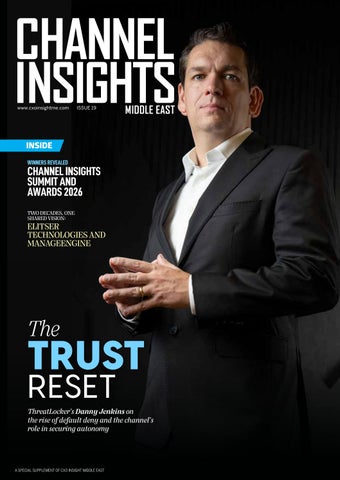
The
TRUST
RESET
ThreatLocker’s Danny Jenkins on the rise of default deny and the channel’s role in securing autonomy
BRIDGING TECHNOLOGY WITH OPPORTUNITY We connect leading global technology brands with local market opportunities.
DRIVING GROWTH TOGETHER We add value at every step, helping partners grow and succeed.
WHAT WE DO
VALUE ADDED DISTRIBUTION
TECHNICAL EXPERTISE
STRONG PARTNER NETWORK
MARKETING & DEMAND GENERATION
AFTER SALES SUPPORT
Delivering a wide range of technology products from leading global brands.
Pre-sales support, product expertise and solution guidance for our partners.
Building long-term relationships based on trust, performance and mutual success.
Supporting partners with marketing tools, campaigns and lead generation programs.
Reliable post-sales support ensuring customer satisfaction and loyalty.
Sales@Digidisti.com
+971 52 209 8485 UAE | KSA | Iraq | Pakistan | GCC
SCAN TO VISIT OUR WEBSITE
Digidisti.com
www.cxoinsightme.com
CONTENTS 06 NEWS
CISCO EXPANDS SECURE AI FACTORY WITH NVIDIA FOR THE RACK-SCALE ERA
23
OMNIOPS AND HPE TO ADVANCE SOVEREIGN AI SOLUTIONS IN SAUDI ARABIA
AMIVIZ PARTNERS WITH VEEAM TO STRENGTHEN DATA RESILIENCE
16
38
LEAD STORY
THE TRUST RESET 42
PUBLISHED BY INSIGHT MEDIA & PUBLISHING LLC
SECURITY 12 THE CONSOLIDATION SHIFT
DECADES, 42 TWO ONE SHARED VISION
CHANNEL 24 HONOURING EXCELLENCE
46 DATA BEYOND STORAGE
38 THE AI ARMS RACE
DISTRIBUTION 51 FROM TO VALUE CREATION
ISSUE 19 / 2026 | CHANNEL INSIGHTS MIDDLE EAST
3
EDITORIAL
THE TRUST EQUATION Ruchika Sharma contributing editor, Channel Insights Middle East
According to Gartner’s survey, only 22% of organisations have successfully scaled AI across multiple business units, even as global AI spending is forecast to reach $2.7 trillion this year. The gap between investing in AI and actually scaling it is becoming one of the technology industry’s biggest challenges. And as AI moves deeper into business operations, closing that gap will depend not just on technology, but on how confidently organisations can secure and control increasingly autonomous systems. That makes trust the defining question of the AI security conversation. Our cover story puts this issue under the spotlight as Danny Jenkins, CEO of ThreatLocker, examines why AI is testing detection-led security and why default-deny approaches are gaining relevance as organisations give autonomous systems greater access. Just as importantly, he looks at the role channel partners will play in helping customers navigate this changing security landscape. Yet securing AI is only one part of a much broader challenge. As organisations add more technologies to their security environments, complexity itself is becoming a problem. Our lead feature explores how platform consolidation is changing the way cybersecurity technologies are bought, sold and supported, and why the partner opportunity is moving beyond products towards integration, expertise and long-term value. That changing role for the channel was also central to the Channel Insights Summit 2026, where industry leaders explored how partners can turn disruption into opportunity while embracing innovation, strengthening relationships and protecting profitability. The discussions reinforced a broader reality: as customer needs evolve, so must the value the channel brings to the table. That evolution comes through in our conversations with channel leaders across the region. Fayez Ibbini of Alpha Data discusses staying close to customers and building for long-term growth, while Avinash Advani of CyberKnight examines the emerging AI arms race between attackers and defenders. Tiger Technology’s Ajith Surendran and Martin Man explore evolving data priorities and partner opportunities, while D3’s Faisal Qureshi looks at how distribution is moving beyond products and pricing towards technical expertise and solution-led growth. And while technology and business models continue to change, some foundations remain remarkably consistent. Our spotlight on Elitser Technologies and ManageEngine marks two decades of partnership built around trust and collaboration. We also explore the mid-market opportunity with SolarWinds’ Abdul Rehman Tariq Butt, before closing with a more personal perspective in A Day in the Life of Dharmendra Sawlani. Enjoy reading!
Published by
Managing Editor Adelle Geronimo adelleg@insightmediame.com +97156 - 4847568
Commercial Director Merle Carrasco merlec@insightmediame.com +97155 - 1181730
Operations Director Rajeesh Nair rajeeshm@insightmediame.com +97156 - 4110215
Publication licensed by Sharjah Media City @Copyright 2026 Insight Media and Publishing
Production Head James Tharian jamest@insightmediame.com +97156 - 4945966
Administration Manager Fahida Afaf Bangod fahidaa@insightmediame.com +97156 - 5741456
Designer Anup Sathyan
While the publisher has made all efforts to ensure the accuracy of information in this magazine, they will not be held responsible for any errors
ISSUE 19 / 2026 | CHANNEL INSIGHTS MIDDLE EAST
5
NEWS
Cisco expands Secure AI Factory with NVIDIA for the rack-scale era
Supermicro, adding high-density liquid- and air-cooled compute systems to its full-stack AI infrastructure portfolio. The collaboration will give enterprises, neoclouds and sovereign cloud providers access to rack-scale and dense GPU systems validated as part of Cisco’s AI infrastructure architecture. The offering will support demanding AI workloads, including trillion-parameter training and high-throughput inference, while 6
CHANNEL INSIGHTS MIDDLE EAST | ISSUE 19 / 2026
enabling customers to manage AI and non-AI workloads within a unified environment. The expanded architecture combines Supermicro’s liquid-cooled servers with Cisco’s liquid-cooled AI networking systems, alongside NVIDIA platforms including Vera Rubin NVL72 and HGX Rubin NVL8. Cisco and Supermicro will also focus on reducing deployment complexity and accelerating time to value through validated infrastructure,
global support and enhanced observability. Cisco’s new Validated Infrastructure Services will help certify that infrastructure is deployed according to reference architectures, while its AI Lab will develop tools and test software to support future deployments. The partnership strengthens Cisco’s push to deliver secure, scalable and simplified AI infrastructure for enterprise and sovereign cloud environments.
NEWS
AmiViz partners with Veeam to strengthen data resilience
L-R: Ramkumar Balakrishnan, CEO of AmiViz and Charbel Zreiby, Channel Director for EMEA East at Veeam
AmiViz has announced a strategic distribution partnership with Veeam, expanding its Data & Resilience and Cybersecurity practices across the Middle East. Announced during LEAP 2026 in Riyadh, the collaboration will help
organisations strengthen data protection, cyber resilience and recovery capabilities as they accelerate digital transformation and AI adoption. Through the partnership, AmiViz will bring Veeam’s capabilities in data protection, backup, recovery and ransomware resilience to enterprises across hybrid, cloud and sovereign environments. The offering is designed to help organisations protect and recover mission-critical workloads while maintaining business continuity and regulatory requirements. The partnership also addresses the growing need for trusted, recoverable data as AI adoption expands. Veeam’s capabilities around ransomware detection, immutable storage, secure backup and rapid recovery will support organisations in improving visibility and governance across their data environments while reducing cyber risk. The collaboration further strengthens AmiViz’s fourpractice strategy spanning Cybersecurity, Data & Resilience, Sovereign Cloud & AI, and Digital Infrastructure. Veeam’s recognition as a Champion in Omdia’s latest Global Managed Backup and Disaster Recovery Leadership Matrix further reinforces the partnership. Together, AmiViz and Veeam aim to help organisations move beyond basic data protection towards stronger trust, governance and resilience—creating a more secure foundation for AI adoption and long-term digital transformation.
Dell and Armada partner on edge data infrastructure Dell Technologies and Armada have announced the signing of a Memorandum of Understanding (MoU) to join forces in delivering containerised Mobile and Edge Data Centre solutions across Saudi Arabia. The MoU was signed during LEAP 2026 in Riyadh between Mohamed Talaat, Vice President, Saudi, Egypt, North Africa & Levant (SENAL), Dell Technologies and Rabee El Mohammadi, Vice President, Sales and Partnerships, MEA at Armada. The MoU establishes a strategic framework to address high-demand projects that require fast, flexible access to localised compute and storage capabilities. Under the MoU, Dell’s enterprise hardware and modern infrastructure stack is envisaged to be integrated with Armada’s specialised mobile,
L-R: Mohamed Talaat, Vice President - SENAL, Dell Technologies and Rabee El Mohammadi, Vice President, Sales and Partnerships, MEA, Armada
containerised data centre solutions, enabling high-performance infrastructure for customers across the Kingdom. The joint initiative will focus on key sectors including energy, telecommunications, manufacturing and public infrastructure by expanding reach to enterprise
customers through Dell’s authorised regional channel partner network. By bringing compute and storage closer to where data is generated, the collaboration is intended to support realtime Edge AI applications, strengthen data sovereignty and help maintain operational continuity in remote and resource-constrained environments. ISSUE 19 / 2026 | CHANNEL INSIGHTS MIDDLE EAST
7
NEWS
OmniOps and HPE to advance sovereign AI solutions in Saudi Arabia
L-R: Mohammed Altassan, Founding CEO, OmniOps and Mohammad Alrehaili, VP & Managing Director for the Middle East, HPE
OmniOps announced at LEAP the signing of a Memorandum of Understanding (MoU) with HPE to develop sovereign AI solutions that bring together HPE’s ‘Saudi Made’ infrastructure and OmniOps’ Saudideveloped AI platforms and in-country deployment capabilities. Aligned with HPE’s Saudi Made, Developed & Deployed (SMDD) initiative, the collaboration aims to help government and enterprise organisations accelerate AI adoption while strengthening digital sovereignty and local technology capabilities. Combined with OmniOps’ deployment infrastructure and enterprise AI management capabilities, this collaboration creates an end-to-end stack in which the servers, infrastructure and AI management layers are built in Saudi Arabia and operating within its jurisdiction. 8
CHANNEL INSIGHTS MIDDLE EAST | ISSUE 19 / 2026
While data residency and local model deployment have become central to sovereign AI strategies, organisations are increasingly looking further down the technology stack at the infrastructure their workloads run on. By integrating locally produced compute with locally operated AI infrastructure and software, OmniOps is extending that control from hardware through deployment and enterprise AI management. Through the collaboration, HPE and OmniOps plan to combine locally produced infrastructure with Saudi-developed AI platforms and in-country deployment expertise to help organisations move from AI experimentation to production. Reflecting the vision of the SMDD initiative, the companies aim to develop sovereign AI solutions that can be validated,
deployed and supported within the Kingdom, while creating new opportunities to commercialise Saudi technology innovation. OmniOps’ offering is anchored by Bunyan, its AI inference platform, which enables organisations to deploy and manage AI workloads across cloud, on-premises and airgapped environments according to their security, regulatory and operational requirements. Bunyan gives organisations access to leading LLMs hosted in the Kingdom, alongside the infrastructure and building blocks needed to securely adopt and deploy GenAI across their organisations. It’s hardwareagnostic architecture also allows OmniOps to integrate locally produced compute while preserving customer choice across different AI infrastructure providers.
NEWS
Salesforce and Anthropic announce Claudeforce
Salesforce and Anthropic have announced Claudeforce, an expanded strategic partnership that brings Anthropic’s Claude AI together with Salesforce’s enterprise data, workflows, business logic and governance to enable secure agentic experiences across the enterprise.
The partnership launches with Salesforce in Claude, a new Claude Plugin featuring 37 prebuilt sales skills. The capabilities allow sellers to use live Salesforce revenue data to prepare for meetings, assess deal health, review pipelines and automate
updates, while routing actions through Salesforce to ensure existing business rules and permissions are maintained. The companies are also deepening the integration of Claude inside Salesforce. Claude is available in Agentforce as a reasoning model for the Atlas Reasoning Engine and powers Agentforce Vibes and Agentforce Coworker. Through Amazon Bedrock, Claude can also operate within the Salesforce Trust Boundary, supporting customers with stringent security and regulatory requirements. The expanded partnership extends to Slack, where Claude will serve as the default model, powering Slackbot and supporting collaboration, decisionmaking and coding workflows. Users will be able to move from conversations and reasoning in Slack to governed actions in Salesforce. Salesforce and Anthropic are also strategic customers of one another, with Claude becoming Salesforce’s preferred AI assistant across its engineering and knowledge-work environments.
NTT DATA to launch AI Experience Lab in Riyadh NTT DATA has announced plans to launch the NTT DATA AI Factory Lab in Riyadh, Saudi Arabia, in September 2026, aimed at helping organisations accelerate the adoption and scaling of AI. The lab will combine NTT DATA’s AI solutions and services expertise with technologies from ecosystem partners including Cisco and NVIDIA. It will offer executive briefings, AI strategy workshops and handson demonstrations to help organisations identify highimpact use cases, validate business outcomes and move AI initiatives towards production. The facility will showcase applications spanning employee productivity, customer experience, intelligent operations, cybersecurity, networking, software development and industry-specific processes. It will also demonstrate how agentic AI can automate workflows, support decision-making and unlock value from enterprise data. A key experience will be the Cisco Secure AI Factory with NVIDIA, highlighting the infrastructure, security, data and governance capabilities needed to deploy and scale enterprise AI securely. Cisco will provide networking, security, observability and collaboration technologies,
while NVIDIA will supply accelerated computing and AI software capabilities. Located in Riyadh, the lab will support Saudi Arabia’s Vision 2030 ambitions by helping public and private sector organisations turn AI investments into secure, scalable business outcomes. ISSUE 19 / 2026 | CHANNEL INSIGHTS MIDDLE EAST
9
NEWS
ServiceNow and Aramco Digital sign collaboration agreement
ServiceNow and Aramco representatives
ServiceNow and Aramco Digital have signed a collaboration agreement to enable AI-powered workflows and accelerate enterprise transformation across the Aramco ecosystem. Under the agreement, Aramco Digital will leverage ServiceNow as a foundational platform to standardise and govern digital workflows across Aramco’s affiliates, subsidiaries and joint ventures operating in more than 50 countries. The initiative 10
CHANNEL INSIGHTS MIDDLE EAST | ISSUE 19 / 2026
aims to reduce fragmentation, modernise enterprise processes and establish a consistent AIenabled foundation across the wider ecosystem. The collaboration will focus on four key areas: AI-powered workflows, customer experience, group shared services and ERP modernisation. These include automating enterprise processes, creating more consistent service
standards, standardising shared business functions and modernising legacy ERP environments to reduce technical debt and improve efficiency. The partnership is intended to provide a unified platform for managing operations across Aramco’s geographically dispersed enterprise network while supporting greater efficiency, governance and scalability.
FEATURE
THE SECURITY CONSOLIDATION SHIFT As organisations look to simplify increasingly complex security environments, platform consolidation is changing how cybersecurity technologies are bought, sold and supported. Channel leaders share their views on the evolving partner opportunity and what it takes to thrive in a more consolidated security landscape
12
CHANNEL INSIGHTS MIDDLE EAST | ISSUE 19 / 2026
Maya Zakhour
Director of Partner Ecosystem, BeyondTrust From products to outcomes According to Maya Zakhour, the traditional channel model is evolving from product-led selling towards outcome-led partnerships. As customers seek fewer platforms, simpler architectures and greater value from their security investments, partners need to move beyond individual product transactions and help organisations build integrated security strategies that address broader business and security priorities. Services as the new value As consolidation puts pressure on standalone product and licensing revenues, Zakhour sees opportunities in expertise, services and long-term customer outcomes. Partners can create value through advisory services, implementation, integration, managed services, optimisation and ongoing security assessments. By understanding
the customer environment and helping organisations maximise the value of their security platforms, partners can build deeper relationships and recurring revenue opportunities. A more strategic partner role Zakhour believes consolidation can strengthen the role of the right partners. Customers still need trusted advice to select platforms, integrate them into complex environments and drive measurable outcomes. Rather than vendors and partners competing for ownership of the customer relationship, she sees the strongest model as one where both work together around shared customer objectives. Expertise will differentiate The partners that thrive will combine deep technical expertise with an understanding of customer business challenges. Zakhour highlights
capabilities across identity security, AI, cloud and emerging technologies, alongside stronger advisory and services expertise. At BeyondTrust, partners can guide customers through a step-bystep identity security journey, helping secure identities across environments. Ultimately, differentiation will come from solving complex customer problems rather than simply selling more products.
Biju Unni
Vice President, Cloud Box Technologies Rebuilding the channel model Biju Unni believes the traditional channel model, which relies heavily on selling multiple security products, will face pressure as customers consolidate their technology stacks. While consolidation can reduce integration gaps, complexity and overhead, it also creates an opportunity for partners to rethink their role. Rather than adding another security tool, partners can focus on designing integrated security systems, managing platforms and delivering measurable outcomes. Services drive new revenue With fewer standalone tools being sold, Unni sees high-margin services becoming increasingly important. Partners can offer 24/7 SOC services, threat monitoring and detection, incident response, optimisation and training around integrated security
platforms. Strategic advisory services can also create value through vendor selection, stack rationalisation and risk management. The focus shifts towards lifecycle management, consulting and managed services that can generate recurring revenue. The trusted-advisor opportunity Unni sees both sides of the consolidation equation. Vendors may gain greater influence through standardised services, unified licensing and stronger customer engagement. However, partners can strengthen their position by acting as vendor-agnostic trusted advisors. Cross-platform expertise enables them to guide customers through integration challenges, platform complexities and potential vendor lock-in while providing high-touch managed services and building relationships beyond individual technologies.
Cross-platform expertise In a more consolidated market, partners will need expertise across tools, APIs, platform architecture and complex integrations. Unni believes traditional transaction-based licensing models will increasingly give way to recurring managed services, SLA-driven security outcomes and consulting. A strategic, vendor-agnostic approach can also help partners advocate for solutions that deliver strong performance while protecting customers from unnecessary lock-in. ISSUE 19 / 2026 | CHANNEL INSIGHTS MIDDLE EAST
13
FEATURE
Scott Goree
SVP, Channel & Alliances, Delinea Simplifying the technology stack For Scott Goree, consolidation makes the channel more important, but changes its role. Enterprise customers can have 55 to 60 technologies in their stack and increasingly want those technologies to work together rather than add complexity. With AI introducing hundreds of new vendors and technologies, partners have an opportunity to help customers determine what they actually need, what works together and how to build a cohesive technology stack around their business requirements. Services beyond the sale Goree sees services as the major opportunity as product revenues come under pressure. Consolidation can free up budgets that customers can redirect towards new priorities, particularly AI. Partners can help organisations rationalise existing technologies, design
and implement new solutions, and manage their environments. By helping customers optimise their technology investments and put new technologies to work, partners can create value beyond the initial product sale. A broader customer relationship Consolidation can make partners more strategic by giving them a broader view of the customer environment. Instead of advising on one part of the stack, partners can help customers understand how technologies work together, where they can simplify and where they should invest next. This creates a deeper relationship and positions partners as a more valuable resource for customers managing increasingly complex technology environments. Unlocking budget for what comes next The partners that thrive will be those that help customers unlock budget for new
priorities. Technology rationalisation and integration can eliminate unnecessary spend and complexity, creating room for investment in areas such as AI. Goree believes partners that can help CISOs rationalise their environments, free up resources and direct those resources towards new initiatives will be best positioned to win.
Mohammed Al-Moneer
Sr. Regional Director, Türkiye, France, Africa & Middle East, Infoblox A new role for the channel Mohammed Al-Moneer believes consolidation does not eliminate the channel; it changes its role. As customers buy fewer disconnected tools, they still need help making their environments work as one coherent system. The partner therefore moves from product fulfilment towards architecture, integration and lifecycle ownership, helping customers simplify operations, improve visibility and stop threats earlier. Services become the growth engine As licence lines shrink, Al-Moneer sees services becoming a key growth engine. Partners can build repeatable offers around managed security, threat exposure, asset visibility, automation and compliance. By using shared DNS and network data, they can deliver measurable outcomes such as fewer 14
CHANNEL INSIGHTS MIDDLE EAST | ISSUE 19 / 2026
critical incidents, faster response, clearer risk and lower operational overhead. The model moves from bespoke projects towards subscriptions and outcome-aligned services, creating recurring revenue around customer results rather than the number of tools deployed. Owning the customer context Consolidation can strengthen or weaken the channel depending on who owns the customer relationship. For Al-Moneer, the key issue is who owns the context around the platforms. Independent judgment and measurable accountability remain critical to the partner’s value. Four capabilities for growth Al-Moneer identifies four capabilities that will differentiate successful partners: outcome selling, cross-domain
expertise across NetOps, SecOps and CloudOps, repeatable managed services, and ecosystem fluency covering hyperscaler marketplaces, integrations and co-selling. The strongest partners will simplify complex environments without hiding that complexity, turning unified platforms into practical customer change. Technical depth builds credibility, commercial discipline makes the model scalable and customer relationship makes it durable.
Maurice Raad
EMEA Partner Manager, Trellix From products to outcomes Maurice Raad believes consolidation does not make the channel less relevant; it changes where partners create value. Customers increasingly want fewer platforms, better integration and less complexity, shifting the conversation from what products can be sold to what security outcomes partners can help customers achieve. Solution design, integration, deployment and optimisation therefore become increasingly important areas for the channel. Services around the platform As customers buy fewer individual products, Raad sees opportunities in the services surrounding the technology. Assessment, migration, integration, implementation and ongoing optimisation can create new revenue streams, alongside professional services, consulting, managed security
and support. This represents a shift from transactional product revenue towards deeper and longer-term customer relationships. Becoming the complexity navigator Consolidation can work in either direction for partners. Those focused mainly on fulfilling product sales could see vendors gain greater control of the customer relationship. Partners that take ownership of the broader conversation around architecture, integration and business outcomes, however, can become more strategic. Raad sees the opportunity for the channel in helping customers navigate complexity rather than simply selling technology. Expertise and customer relationship The partners that thrive will combine technical expertise, services capabilities and customer relationship. They will need to architect, integrate, deploy
and optimise platforms while building ongoing services around them. Ultimately, Raad believes the winners will be those that can reduce complexity, improve security outcomes and demonstrate measurable value, rather than simply maintaining the largest product portfolio.
Bashar Al Daoud
Team Leader UAE and Oman, Axis Communications The shift to solution-led selling The traditional channel model is evolving as customers look to simplify their environments and reduce the number of standalone systems they manage. Customers still need choice, but increasingly they need partners that understand how technologies work together, how they integrate into the wider IT and security environment, and how to build solutions around specific business or operational needs. This is moving the channel from a product-led conversation towards a solution- and outcome-led approach. Value beyond the sale Partners can create value beyond product sales through integration, consulting, cybersecurity, lifecycle management and managed services. As physical security becomes more connected to IT, video, access control,
analytics and IoT can also drive operational and business value, creating opportunities for longer-term, recurring relationships. A stronger partner role Consolidation can strengthen the channel when vendors and partners recognise the value each brings to the customer relationship. Axis maintains a strong belief in the channel and an open approach to technology. The strongest outcomes come when vendors, partners, consultants and technology partners work together, with each contributing their expertise. Expertise that simplifies complexity The partners that thrive will combine technical expertise with a strong understanding of the customer’s business and risk environment. Customers will increasingly value
partners that can simplify complexity by bringing together the right technologies, securing them properly and demonstrating how the overall solution supports long-term security and business objectives. ISSUE 19 / 2026 | CHANNEL INSIGHTS MIDDLE EAST
15
LEAD STORY
THE TRUST RESET AI is testing the limits of detection-led security. As enterprises give more access to autonomous systems, Danny Jenkins, CEO, ThreatLocker, discusses why default deny is gaining relevance — and why channel partners will be critical to making it work
16
CHANNEL INSIGHTS MIDDLE EAST | ISSUE 19 / 2026
ISSUE 19 / 2026 | CHANNEL INSIGHTS MIDDLE EAST
17
LEAD STORY
C
ybersecurity has spent years becoming better at detection. Enterprises have added behavioural analytics, automated response and increasingly AI into the security stack, giving security teams more information and more ways to act on it. Attackers have gained many of the same advantages. Reconnaissance can be automated, phishing produced at scale and malicious code modified faster than signaturebased defences were designed to accommodate. “The challenge is that traditional security has always fallen short, and it has always failed to detect certain malware and threats,” says Danny Jenkins, CEO, ThreatLocker. “The difference now is the amount of cybercrime organisations that are making real businesses out of attacking companies with ransomware and phishing. It has always been impossible to detect every threat, but now it actually hurts businesses. It shuts down hospitals, takes businesses offline, wipes data from computers and steals data.” AI is shortening the window further. Malware no longer needs to remain unchanged long enough to become widely recognised, while security teams still have to distinguish legitimate activity from something that only appears legitimate. “Five years ago, you could create a piece of malware, use it 50 times, and then it became useless because everybody had it in their database,” says Jenkins. “Today, AI can create malware in milliseconds that has never been seen before.” Changing the default ThreatLocker, a zero trust cybersecurity company, has built its platform around the opposite premise: permit the applications and activity an organisation needs, while restricting everything else unless explicitly approved. 18
CHANNEL INSIGHTS MIDDLE EAST | ISSUE 19 / 2026
The company has also been extending the model beyond application control. In March, it introduced Zero Trust Network Access and Zero Trust Cloud Access, adding device-based verification before users can connect to corporate networks or cloud services. Valid credentials alone are not sufficient; the device must also meet the conditions for access. Jenkins reduces the thinking behind it to a physical-security analogy. “For the last 30 years, we’ve approached cybersecurity a bit like securing a building without putting a lock on the front door.
We’ve added motion sensors, cameras, AI cameras, and increasingly sophisticated ways to detect an intruder, but the door itself is still open,” he says. “The focus should be on stopping an attacker from getting in in the first place. Keep the door closed, open it only for the people, applications or systems that need access, when they need it, and close it again when they don’t.” Applying that principle across an enterprise is more complicated. Applications, dependencies and business processes cannot be restricted indiscriminately, and tighter security becomes counterproductive if legitimate
Our partners helped us understand how organisations here think about their security challenges, how those issues are discussed internally and how decisions are made”
work continually gets caught in the middle. “Imagine you let everybody into your house unless they had a criminal record. That would be crazy. We should think about our computer systems in the same way,” says Jenkins. “Zero trust doesn’t mean stifling innovation. It doesn’t mean blocking everything. It means allowing what you need, and not just you, but your computer and your programme.” Drawing the line for AI AI makes the access question harder to ignore. Organisations have to contend with employees
adopting tools without approval, while also deciding how much authority should be given to AI systems that have been sanctioned by the business. ThreatLocker can block unauthorised AI applications or restrict browser-based tools, while its Ringfencing technology limits how approved applications interact with files, networks, scripts, cloud services and other resources. Similar controls can be applied to agentic tools capable of executing commands or operating across SaaS applications and external services. The issue becomes less about whether an AI system is trusted ISSUE 19 / 2026 | CHANNEL INSIGHTS MIDDLE EAST
19
LEAD STORY
and more about the authority attached to it. “It’s not really a question of whether you trust an AI agent or not. The question is what it needs to do, and what access is relevant to that task,” explains Jenkins. “I might trust an agent to build a report, access certain emails or work with specific systems. That doesn’t mean I should give it access to everything. The moment
20
CHANNEL INSIGHTS MIDDLE EAST | ISSUE 19 / 2026
you do that, you create a much broader set of risks.” Agents able to act across several systems can extend the impact of a compromised account, manipulated instruction or unintended action well beyond a single application. Permissions therefore become part of the security architecture enterprises have to design deliberately, rather than inherit by default.
That also raises the bar for those implementing the technology. As access policies extend across applications, identities, cloud services and AI agents, understanding how the customer actually operates becomes increasingly important. Where the channel earns its place Applying those controls effectively requires more than product expertise. Channel partners need to understand which systems are critical, how applications interact and where restrictions can be introduced without disrupting the business. That local understanding has been important to ThreatLocker since establishing its Middle East operation. “When we first started looking at the region, we didn’t yet have the local relationships or the depth of market understanding we have today,” says Jenkins. “Our partners helped us understand how organisations here think about their security challenges, how those issues are discussed internally and how decisions are made. That local knowledge has been critical to building the business.” ThreatLocker’s relationship with UAE cybersecurity specialist MMA Infosec reflects the type of engagement it is looking for. One of its first partners after establishing a regional operation, MMA Infosec has since worked with the company on more than 10 customer wins across ports, hotel groups and holding companies. “MMA Infosec specialises in cybersecurity, and that depth of expertise is really important,” says Jenkins. “They’re able to articulate and understand customer problems and align solutions with those problems, as opposed to just saying, ‘I’m going to resell something, stick a sticker on it and move along the way.’ They have been very integral in understanding where the customer is vulnerable to a
We sell zero trust tools, but in many ways what we are really selling is trust” cyberattack and then aligning that with the ThreatLocker solution.” As security portfolios become larger and more complex, more of the partner opportunity sits before a product is selected. Knowing how systems are being used, where risk is concentrated and what the customer is trying to protect gives the channel a more substantive role in shaping the security strategy. There is also an element of trust that technology alone cannot establish in a new market.
“We sell zero trust tools, but in many ways what we are really selling is trust,” says Jenkins. “We are asking customers to trust us to help secure their environments, and that depends on having the right partner network, strong engineering support on the ground and a good team of account executives. Our partners have been instrumental to that.” ThreatLocker is now preparing to scale that model further. Its UAE office opened in June 2024 after several years of serving customers in the region, and the company plans to triple regional headcount, add more engineers and account executives, and extend its reach from Dubai across the Middle East and Africa, Turkey, the CIS and the Levant. That expansion is backed by a $190 million Series F funding round led by Elephant, announced in July, with investment earmarked for AI security, the
wider Zero Trust platform and international growth. ThreatLocker says it now protects more than 70,000 organisations globally. The next phase of growth will be about taking that broader platform into more enterprise environments while building the local engineering and partner depth to support it. As AI increases the number of applications and autonomous systems operating inside the enterprise, the demand for tighter control over what they can access and execute is unlikely to remain an endpoint conversation. For ThreatLocker, that creates room to expand both the technology and its presence in the region. For the channel, it moves the opportunity closer to the customer’s operating model, where understanding what should be allowed, and why, may become as important as the security products used to enforce it. ISSUE 19 / 2026 | CHANNEL INSIGHTS MIDDLE EAST
21
INTERVIEW
STAYING AHEAD, STAYING CLOSE
Fayez Ibbini, CEO, Alpha Data, discusses the importance of staying close to customers, adapting to evolving technology needs, and maintaining a long-term approach to growth and innovation quarter, which marked its bestever quarter. Overall, Alpha Data has delivered strong growth and profitability, while maintaining healthy shareholder distributions, demonstrating the resilience of its business and the strength of its more than four-decade track record.
H
ow would you describe Alpha Data’s business performance so far this year? The year has been positive for Alpha Data, despite the uncertainty created by the geopolitical situation. Following some initial disruption, the company’s strong relationships with more than 2,000 major clients helped sustain confidence and investment momentum, with customers continuing with their planned projects and budgets. The company reported healthy first-quarter results, followed by an even stronger second
What has been the key to Alpha Data’s success over more than four decades? That success over more than four decades comes down to perseverance, a continued focus on technology and, importantly, timing. As the industry evolved from personal computers and networking to the internet, cloud, mobility and IoT, the company remained focused on staying relevant and building the capabilities needed for the next stage of growth. In business, the right opportunity often emerges when technology, market conditions and customer demand align. Alpha Data’s ability to remain viable and committed through changing market cycles has allowed it to capitalise on those moments. Ultimately, it is about having the patience to stay the course, while maintaining enough momentum and capability to seize the opportunity when the timing is right. What leadership philosophy has guided your approach to leading Alpha Data and sustaining its success year after year? Very early on, I adopted a
leadership philosophy that has served Alpha Data well, built around a simple principle: stay close to the customer. By understanding their requirements, growing alongside them and building trust, we have been able to evolve with the organisations we serve. Today, we have more than 2,000 large, forward-looking customers, with strong trust on both sides. This philosophy also shapes how we approach technology. We do not believe in adopting a technology simply because it is new or attracting attention. Instead, we focus on understanding where customers are on the technology adoption curve and introducing solutions that are relevant, proven and aligned with their requirements. In the end, it is about ensuring that when we implement a technology, customers receive the value they have invested in, rather than pursuing something simply because it is the latest trend. How does Alpha Data ensure that technology adoption is aligned with a clear business purpose and customer requirement? Technology adoption at Alpha Data begins with a clear understanding of the customer’s requirements. Customers are best placed to understand their own business challenges and objectives, whether they are government entities, financial institutions or other large organisations. By staying closely aligned with customers, Alpha Data can also identify the technologies and providers that may best address their needs. The company then conducts a thorough assessment to ensure the technology is suitable for the local environment and capable of delivering the expected value. This balance of customer insight and technology expertise enables Alpha Data to identify and implement the right technology for the right requirement. ISSUE 19 / 2026 | CHANNEL INSIGHTS MIDDLE EAST
23
HONOURING CHANNEL EXCELLENCE At Channel Insights Summit 2026, industry leaders unpacked how the channel can turn disruption into opportunity by embracing innovation, strengthening partnerships and protecting profitability
The Channel Insights Summit 2026, powered by Dubai Computer Group (DCG) and hosted by Channel Insights Middle East and Insight Media & Publishing, brought together leading technology and channel executives to explore how businesses can navigate disruption, strengthen partnerships and build sustainable growth. Held under the theme “Resilient Channel,” the summit examined the evolving dynamics shaping the regional channel ecosystem, from emerging technologies and partner relationships to profitability, innovation and long-term business resilience. Taking the stage at the summit, Faisal Ameer Malik, CTO, Enterprise Business, Middle East and Central Asia at Huawei Technologies, delivered the keynote, “Advancing Industrial Intelligence & Building an Ecosystem,” exploring the rise of agentic AI and the role of the channel in turning new technologies into real enterprise outcomes. “The next phase of AI will be built through ecosystems, with partners turning technology into industry-specific solutions and real enterprise value,” said Faisal Ameer Malik.
Faisal Ameer Malik, Huawei
24
CHANNEL INSIGHTS MIDDLE EAST | ISSUE 19 / 2026
The conversation then shifted to the changing nature of partner relationships, with Premchand Kurup, CEO of Paramount Computer Systems, taking the stage for his presentation, “The Loyalty to Innovation Dividend.” He highlighted the importance of constant reinvention, sharper specialisation and stronger collaboration in an increasingly competitive market.
“Don’t think of loyalty in terms of loyalty to a vendor. Think in terms of loyalty to innovation — loyalty to re-innovation on a continuous basis,” said Premchand Kurup. The summit also featured a panel discussion, “Margins Under Pressure: How the Channel Is Protecting Profitability in 2026,” moderated by Dharmendra Sawlani, Board Member, Dubai Computer Group, with Santosh Varghese, Managing Director, Tosh Nxt Tech Ventures, Aliasgar Dohadwala, Founder and CEO, Visiontech Systems International and Manish Keshwani, Managing Director, TLM International. The discussion examined margin pressures, pricing challenges, differentiation and the strategies channel organisations are adopting to build sustainable businesses. Premchand Kurup, Paramount Computer Systems
ISSUE 19 / 2026 | CHANNEL INSIGHTS MIDDLE EAST
25
CHANNEL VISIONARY
Santosh Varghese
Aliasgar Dohadwala
Ned Baltagi
Nikhil Kothari
Fadi Kanafani
Avinash Advani
Tosh Nxt Tech Ventures
SANS
Yas Holding Technology
26
CHANNEL INSIGHTS MIDDLE EAST | ISSUE 19 / 2026
Visiontech Systems International
Intertec
CyberKnight
CHANNEL LEADERSHIP EXCELLENCE
Toni El Inati
Hamid Ansari
Sabir Saleem
Manish Keshwani
Barracuda
Syscom Distribution
MBUZZ
Kamran Khayal Trigon
TLM International
Mounir Sarkis Logicom
Harish Kanjani Computer Care Group
ISSUE 19 / 2026 | CHANNEL INSIGHTS MIDDLE EAST
27
CHANNEL IMPACT LEADER
Zaid Ghattas
Ms Megha VK
AMD
Arkan Security Management Solutions
Prajoth Janadas
Mohammed Zabi
Site Technology Integrated Systems
Elitser Technologies
CHANNEL STRATEGY CHAMPION
Behnaz Ansari
Newcom Computer Systems
Sakkeer Hussain D-Link Middle East
ISSUE 19 / 2026 | CHANNEL INSIGHTS MIDDLE EAST
29
CHANNEL GROWTH LEADER
Mohit Pandey
Murad Ali
Rehbar Merchant
Stephen Fernandes
Satish Narasimhan
Hasan Odeh
Seagate Technology
Lenovo
Ingram Micro
30
CHANNEL INSIGHTS MIDDLE EAST | ISSUE 19 / 2026
Logitech
Planview
GBM
CHANNEL MARKETING GURU
Amrita Nag
Dharmendra Parmar
ASUS
AmiViz
Eleni Papapostolou Vectra AI
CHANNEL ENGAGEMENT LEADER
Seema Wadhwa Exclusive Networks
Ahmad Naiem ASBIS Middle East
Hussam Sheikh Ali StarLink
ISSUE 19 / 2026 | CHANNEL INSIGHTS MIDDLE EAST
31
DAP-X2810 AX1800 WI-FI 6 DUAL-BAND POE ACCESS POINT
SIMPLE‑TO‑MANAGE AND EASY‑TO‑SCALE WI‑FI 6 FOR YOUR BUSINESS. The Wi-Fi 6-ready DAP-X2810 provides businesses of all sizes with incredible speeds, significantly increased capacity and interferencefree coverage, combined with centralised management by Nuclias Connect.
Next‑gen Wi‑Fi 6 performance that turbo boosts your business
Manage your business network with ease
RETAIL TRANSFORMATION LEADER
EDITOR’S CHOICE: CHANNEL OT LEADER
Rajat Asthana
Amit Kumar
EROS Group
MMA Infosec
CHANNEL ELITE
Premchand Kurup Paramount Computer Systems
ISSUE 19 / 2026 | CHANNEL INSIGHTS MIDDLE EAST
33
Switch to Speed. Scale Without Limits.
Meet the SwitchBlade x908 GEN3 The SwitchBlade x908 GEN3 is our most advanced modular switch, delivering blazing speed and scalable growth for future-ready enterprise and data center networks.
Blazing Bandwidth: Up to 400G connectivity for high-performance workloads.
Scale Without Limits: 12.8 Tbps of power in a compact 3U chassis.
Flexible & Modular: Compact chassis with versatile interface options.
Smart Management: Zero-touch provisioning and centralized control with AlliedWare Plus™.
Whether you’re scaling a data center or optimizing enterprise networks, the SwitchBlade x908 GEN3 keeps your network fast, flexible, and fail-proof.
Take control. Stay ahead. Transform your network today. For more information, please contact one of our Allied Telesis Account Managers today.
© 2025 Allied Telesis, Inc. All rights reserved.
+971 +97144454 4548740 8740 | | AlliedTelesis.com AlliedTelesis.com
FEATURE
PARTNER WATCH A roundup of the latest partner programme developments COHESITY • Cohesity has updated its Aspire Global Partner Programme, effective August 1, with a stronger focus on simplicity, services and recurring revenue. • Rebates have been expanded, including teamed deals and increased incentives for data security and data insights solutions. • Professional Services Specialisation has been introduced, with additional specialisations in technical support and cyber resilience planned. • Training requirements have been simplified, with guided learning paths to help partners reach certification faster. • A new partner dashboard provides a single view of training, certifications and billing requirements. • The updates are based on partner feedback and are designed to make Aspire easier to navigate and more aligned with partners’ evolving business models.
Partners told us they need a programme that recognises the full value they bring to customers, from identifying opportunities through to delivering and scaling services. That is exactly what we have built into the latest Aspire updates. By simplifying the programme, expanding incentives and introducing new specialisations, we are giving partners clearer opportunities to differentiate, grow their services practices and deliver stronger security outcomes for customers” Hassan Aoun, Senior Channel Director, International Emerging Region, Cohesity
ISSUE 19 / 2026 | CHANNEL INSIGHTS MIDDLE EAST
35
FEATURE
DELINEA • Delinea has launched its new Partner Advantage Programme, designed to address key channel concerns around margin protection, channel conflict and ease of doing business. • Built on three pillars — Protect, Align and Scale — the programme introduces clearer deal registration, teaming protections and earned incumbency discounts. • AI-powered enablement includes just-in-time training, certifications and a new AI-powered partner portal. • Streamlined processes and automation aim to simplify the quote-to-cash journey and reduce administrative complexity for partners. • The programme offers three tiers — Elite, Premier and Select — based on partner engagement, expertise and scale. • The programme is currently open to selling partners, with MSP, GSI, advisory and technology partner roles planned for a later phase.
Partners don’t care about your partner programme. They care about technology that works, protected discounts, and a vendor that’s easy to work with. We built this programme around what partners told us they actually need” Scott Goree, Senior Vice President of Channel and Alliances, Delinea
36
CHANNEL INSIGHTS MIDDLE EAST | ISSUE 19 / 2026
OPTRO • Optro has launched Optro Partner Connect, replacing its legacy partner frameworks with a modular programme designed to support partner growth, services and customer outcomes. • The programme initially offers Advisory Partner and Solution Provider tracks, with a transparent tier structure where benefits increase as partners grow. • Partners gain access to training, certification, technical support, coselling and co-marketing resources, as well as opportunities to develop solutions and integrations with Optro. • A dedicated Partner Centre of Excellence (PCoE) will support onboarding and ongoing partner development. • Optro also plans to integrate AI across the partner experience, helping automate administrative tasks, personalise onboarding and provide realtime co-sell guidance. • A Partner Advisory Board will give selected partners a voice in Optro’s product roadmap and go-to-market strategy.
Partners are a critical growth engine for Optro, and Optro Partner Connect ensures our ecosystem’s experience matches the enterprise-grade quality of our platform. By moving away from transaction-only metrics and adopting a holistic evaluation of capacity and competency, we are giving our partners a clear blueprint to build highly profitable services practices around our GRC Intelligence Platform” Scott Whitlock, Global VP of Alliances and Channels, Optro ISSUE 19 / 2026 | CHANNEL INSIGHTS MIDDLE EAST
37
INTERVIEW
THE AI ARMS RACE Avinash Advani, Founder and CEO, CyberKnight, examines how AI is reshaping cyberattacks and defence, creating a new arms race that is changing the pace, scale and nature of cybersecurity
F
or decades, cybersecurity has been defined by a familiar imbalance: attackers innovate, defenders respond. Every new attack technique creates the need for a corresponding security capability, keeping the industry in a constant cycle of adaptation. Artificial intelligence, however, is changing the pace and scale of that contest. AI is now being adopted on both sides of the cybersecurity equation. Defenders are using it to analyse threats, automate security operations and strengthen their ability to respond, while attackers are using increasingly sophisticated capabilities to automate attacks, create convincing deception and potentially operate with far less human intervention. The result is a new cyber arms race in which the ability to deploy AI effectively could become as important as the technology itself. For Avinash Advani, Founder and CEO of CyberKnight, this shift is not entirely unexpected. The cybersecurity industry had been experimenting with AI well before generative AI became mainstream. What has changed is the acceleration brought about by ChatGPT and the emergence of large language models and agentic AI. “Everybody knew. Everyone perceived and predicted that AI was going to be a big part of defence in the future,” Advani says. “But the acceleration happened with ChatGPT.” The significance of this acceleration is that AI is no longer simply another technology being incorporated into cybersecurity products. It is increasingly influencing how attacks are developed and executed, while simultaneously changing how organisations defend against them.
38
CHANNEL INSIGHTS MIDDLE EAST | ISSUE 19 / 2026
AI enters the offensive The offensive use of AI has evolved rapidly. While automation has been part of cyberattacks for years through mechanisms such as bots and botnets, the emergence of generative and agentic AI introduces a different level of capability. One of the most visible examples is the use of AI to create convincing digital deception. Emails, videos, text and voice recordings can increasingly be generated in ways that make them difficult to distinguish from legitimate communications. For organisations and individuals, this creates a new challenge: the very channels through which trust is established can become instruments of attack. “When AI can create an email, or a video, or a text file, or a voice note that is identical to reality, it’s very scary,” Advani says. The concern extends beyond deceptive content. Advani points to the emergence of agentic AI ransomware as an indication of where AI-enabled attacks could be heading. He refers to the detection of an AI capability that could autonomously progress through multiple stages of a ransomware campaign, from initiating and spreading through an environment to compromising systems and extracting data. “I’m just envisioning an AI that can cover the entire attack cycle, the attack life cycle of a ransomware attack from beginning to end without any human intervention,” he says. The significance of this development lies in the potential shift from AI assisting an attacker with individual tasks to AI independently managing an entire attack lifecycle.
vendors began developing AI capabilities for areas such as security operations and network detection and response. CyberKnight itself onboarded an AI-based security operations centre technology in its early days, at a time when the market was still learning how to understand the technology. “It was way ahead of its time,” Advani recalls. “The market wasn’t ready, so it was a lot of education that happened.” The arrival of ChatGPT changed that dynamic. AI moved from being an emerging capability within specialised cybersecurity products to becoming one of the industry’s central areas of discussion. Today, Advani says, virtually every cybersecurity vendor is introducing some form of AI functionality. However, he sees a clear distinction between vendors adding AI simply to remain relevant and those using it to develop genuinely new security capabilities. “Today, all the features coming out around AI by most vendors, most not all, are just to be able to stay current,” he says. The vendors that are ahead, in his view, are those using AI to address specific security challenges rather than simply adding AI functionality to existing products.
The defence race accelerates The same technology that is expanding the offensive capabilities available to attackers is also transforming cyber defence. Advani traces the early adoption of AI in cyber defence to around 2018–2019, when cybersecurity
The catch-up challenge The growing adoption of AI on the defensive side does not eliminate the traditional imbalance between attackers and defenders. Advani considers that imbalance fundamental to the cybersecurity industry.
AI will no longer be a differentiator. It will just be a new normal”
“There has never been a time since the beginning of cyber attacks where attackers were not ahead of defence,” he says. “That’s why we are in business.” What has changed is the potential scale and speed of the attacks that organisations must contend with. In Advani’s assessment, the defences currently deployed by organisations are not sufficient to deal with today’s threat landscape. “Today’s defences capable of handling today’s attacks? Definitely not. No way. No chance,” he says. The challenge is not limited to technology. Geopolitical developments, economic conditions and competing investment priorities all influence how much organisations can allocate to cybersecurity. While AI-specific budget lines are increasingly appearing, Advani believes investment has not yet fully caught up with the requirement to defend against AI-enabled threats. The double-edged AI challenge For organisations, this creates a distinct challenge: AI needs to be treated both as a technology that requires protection and as a capability that can strengthen cybersecurity. Advani believes organisations should begin by defining why they are adopting AI and identifying the specific use cases they intend to address. They then need to determine how those use cases will be implemented, whether through on-premises, hybrid or SaaS environments, while taking local regulatory requirements into consideration. The next priority is securing the AI environment itself. This includes governance, data privacy, data leakage, hallucinations and vulnerabilities associated with AI systems. Only after these foundations are established can organisations consider how AI can be applied to cybersecurity. This creates two distinct but connected security requirements. “There’s two parts to it,” Advani ISSUE 19 / 2026 | CHANNEL INSIGHTS MIDDLE EAST
39
INTERVIEW
explains. “How you can use AI either agentic or generative for cybersecurity, and two, how do you secure against agentic AI attacks?” The AI arms race therefore creates a dual responsibility: organisations must protect the AI they deploy while also using AI to strengthen their wider security posture. Moving beyond the AI feature race This dual requirement is also shaping CyberKnight’s approach. Rather than focusing simply on adding AI capabilities to its portfolio, the company has developed what Advani describes as an AI blueprint to help organisations navigate the different stages of AI adoption and security. The blueprint begins with defining AI use cases and determining how they should be implemented in the context of cybersecurity and local regulations. It then addresses the architecture and technologies required, followed by governance and security around the AI environment, including the data being used. The framework also considers how AI can be applied directly to cybersecurity through capabilities such as AI-driven security operations and offensive security.
Its final component focuses on securing agentic AI, an area CyberKnight is currently exploring as it develops the next capabilities within its portfolio. AI becomes the new normal Despite the current intensity surrounding AI, Advani does not expect the technology itself to remain a differentiator indefinitely. As AI becomes embedded across products and industries, simply having AI capabilities will no longer distinguish one technology or cybersecurity vendor from another. “AI is so core and fundamental that it’s going to become a feature, a natural feature set for any vendor,” he says. “AI will no longer be a differentiator. It will just be a new normal.” That evolution will also change the industry’s conversation around AI. Rather than being treated as a standalone innovation, it will become part of established cybersecurity frameworks, products and strategies. “It’s a part of the framework. It’s part of the strategy,” Advani says. The road to autonomous AI The more consequential question, however, lies further ahead. Advani describes the evolution
of AI as a journey from today’s chatbot and intelligent search capabilities towards increasingly autonomous systems. That progression introduces questions that extend beyond conventional cybersecurity. As AI systems become capable of making decisions and taking actions with less human intervention, the industry will need to consider not only how to use these capabilities but also how to establish effective guardrails around them. “Will Terminator ever happen?” Advani asks. “The question is, no one knows.” While he believes the assumption is that appropriate safeguards will be established, he argues that the industry needs to engage more seriously with the possibility of unintended consequences before autonomous AI becomes widespread. For Advani, this remains one of the less developed conversations around AI. The technology may still be a couple of years away from fully autonomous operation, but the implications warrant consideration now rather than after the technology has matured. No room to stand still The cybersecurity industry is therefore entering a phase in which AI will increasingly shape both sides of the cyber battlefield. Attackers are gaining new capabilities to automate and scale their operations, while defenders are turning to AI to analyse threats, strengthen security operations and respond more effectively. The long-term outcome of this race will depend not simply on who adopts AI first, but on how effectively organisations integrate it into their broader security strategies and governance frameworks. For Advani, the direction of travel is already clear. “We’re in the right place at the right time,” he says. “From an AI perspective, this is where the industry is heading.” His conclusion is equally direct: “Anyone that doesn’t jump on the AI bandwagon will be left behind.” ISSUE 19 / 2026 | CHANNEL INSIGHTS MIDDLE EAST
41
SPOTLIGHT
TWO DECADES, ONE SHARED VISION Twenty years on, Elitser Technologies and ManageEngine reflect on the trust, collaboration and shared vision behind one of the Middle East’s longest-running channel partnerships
42
CHANNEL INSIGHTS MIDDLE EAST | ISSUE 19 / 2026
A
s ManageEngine and Elitser Technologies mark two decades of partnership, their journey offers a compelling example of how trust, shared values and a customer-first approach can turn a vendorpartner relationship into a longterm strategic alliance. What began with a single deal in the UAE has grown into a relationship spanning more than 20 years, encompassing 850+ enterprise customers across 20+ industries and more than 3,000 successful projects. Reflecting on the journey, Jignasu Rathod, CEO of Elitser Technologies, and Nirmal Kumar Manoharan, Vice President at ManageEngine, offer perspectives from both sides of the partnership, looking back at the milestones that shaped their relationship, the principles that have sustained it, and the opportunities they see ahead. For Rathod, the foundation of that longevity is straightforward: “The key factor behind the longevity and success of our 20-year partnership has been trust, mutual respect and a common value system.” Technology, markets, customer expectations and business cycles have all changed, he notes, but the organisations have remained aligned through trust, transparency and mutual respect. From the outset, both organisations shared a vision centred on delivering customer value rather than simply selling products, offering the right solutions at reasonable pricing without compromising on features or functionality. ManageEngine continued to develop solutions ahead of market needs, while Elitser translated those technologies into business outcomes through services, support and customer success. Most importantly, the relationship has never been transactional. Rathod says, “Over two decades, it has evolved into
a partnership built on shared values, shared aspirations, and a genuine commitment to each other’s success.” The two organisations have supported each other through both favourable and difficult periods, operating more like an extended family than a conventional vendor-partner relationship. From the first deal to 3,000 projects The partnership’s origins can be traced to Elitser’s search for technology vendors in 2006, when the UAE was entering a new phase of technological evolution. Organisations were investing in modern IT infrastructure to improve operational maturity and digital capabilities, while the IT management market itself was still relatively young. Rathod vividly recalls the first deal. An Infrastructure Manager at a leading Abu Dhabi bank approached him after becoming dissatisfied with one of the dominant IT management vendors. The bank’s existing ITSM provider had imposed rigid practices and was charging significant fees to generate basic reports from its helpdesk platform. The experience ultimately led the bank to adopt ManageEngine as its preferred IT service management solution.
Over two decades, it has evolved into a partnership built on shared values, shared aspirations, and a genuine commitment to each other’s success” Jignasu Rathod
That initial success became the starting point for a much larger journey. Over the following two decades, the partnership established a strong presence in the UAE, serving more than 850 enterprise customers across more than 20 industries and delivering over 3,000 successful projects. Customer retention has exceeded 94 per cent, while across most industries, Elitser serves four to five of the top 10 enterprises. As customer requirements became more sophisticated and technology evolved, ManageEngine continued to respond by listening to the market, enhancing existing products and introducing new solutions. Its portfolio has grown from around 7–10 core products to more than 60 solutions. That evolution also changed Elitser’s role. The company moved beyond implementation to become a trusted advisor, shifting from a product-centric approach to a solution-driven and customerfocused engagement model. It developed stronger technical expertise, delivery capabilities and support infrastructure, while its teams continued to invest in new technologies and best practices. The partnership also became increasingly involved in market development, from joint go-tomarket strategies and marketing initiatives to sharing customer intelligence and influencing product enhancements. “Today, our position is not just that of a partner but of a long-term stakeholder, deeply invested in customer success, continuous innovation, and sustainable market growth,” Rathod says. Built to last Trust and collaboration have remained central to the relationship. “Trust is not built overnight; it is earned through commitment, consistent actions, transparency, and standing by each other during both successes and challenges,” Rathod says. Over the years, commitments have ISSUE 19 / 2026 | CHANNEL INSIGHTS MIDDLE EAST
43
SPOTLIGHT
People remain central to this model. Elitser has a workforce of more than 350 employees, including over 100 consultants dedicated exclusively to ManageEngine, making it one of the largest and most specialised teams within the global ManageEngine partner ecosystem.
been honoured, communication has remained open, and both organisations have operated with mutual respect and a shared sense of purpose. Collaboration has been equally important. ManageEngine has treated Elitser as an extension of its own team, working together on go-to-market strategies, marketing events, market intelligence, complex business challenges, product enhancements and new capabilities. The relationship was particularly tested during economic uncertainty, market disruption and the pandemic. Rather than focusing on contractual boundaries or assigning blame, both organisations remained focused on finding solutions, supporting customers and helping each other succeed. That approach has translated into tangible customer value. Elitser has built its ecosystem around ManageEngine’s products, combining the vendor’s technology with local expertise, consulting capabilities and end-to-end service delivery. 44
CHANNEL INSIGHTS MIDDLE EAST | ISSUE 19 / 2026
That depth is significant in any partner ecosystem, especially one operating at this scale in the region” Nirmal Kumar Manoharan
The model is closely aligned with globally recognised frameworks and standards including ISO 20000, ISO 27001 and COBIT. Elitser established a Consulting Division to design processes and policies required for these standards and align technology implementation with them. Its Managed Services Division then helps customers operate those environments and generate the evidence needed for compliance.
The strategic value of Elitser From ManageEngine’s perspective, Elitser’s value lies in three areas. Manoharan points first to its deep understanding of the UAE market, including relationships, decision-making culture and sectors investing in IT management solutions. Second is its focus on customer outcomes. “Elitser’s approach is to understand the business challenge first, then architect the right solution around it,” Manoharan says. This gives customers confidence in Elitser’s recommendations and ensures ManageEngine deployments are driven by the right business intent. The third differentiator is Elitser’s ability to go beyond implementation. Its consulting practice around IT governance frameworks such as ISO/IEC 20000 and ISO/IEC 27001 positions ManageEngine technology as part of a broader enterprise compliance strategy. “That depth is significant in any partner ecosystem, especially one operating at this scale in the region,” Manoharan says. Elitser has also helped strengthen ManageEngine’s credibility among enterprise customers. Successful deployments have become customer references, creating trust and opening doors to new organisations. Combined with ManageEngine’s platform reliability, Elitser’s implementation expertise has helped expand the vendor’s presence across multiple industries. Its role extends beyond deployment, with managed services helping customers
continue to optimise their environments and sustain longterm value from their investments. New frontiers of growth The next phase of the partnership will unfold against a rapidly changing Middle East technology landscape. Both organisations see significant opportunity in the region’s continued investment in digital transformation, particularly across Artificial Intelligence and Automation, Cybersecurity, Enterprise Service Management, Full-Stack Observability, and Identity and Access Management. AI and automation are expected to increasingly drive productivity, operational efficiency and user experience through intelligent automation, predictive analytics and AI-powered decision-making. Cybersecurity will remain a priority as threats become more sophisticated and regulatory requirements become more stringent, increasing demand for integrated solutions focused on visibility, governance and resilience. Enterprise Service Management represents another major opportunity as organisations extend service management beyond IT into HR, Finance, Facilities and Shared Services. Meanwhile, hybrid and multi-cloud adoption is increasing demand for Full-Stack Observability across applications, infrastructure, networks, databases and user experiences. Identity and Access Management is also becoming a strategic business requirement rather than simply a security function, driven by remote work, cloud adoption and digital services. Organisations increasingly require identity governance, privileged access controls and zerotrust security frameworks. Together, ManageEngine’s portfolio and Elitser’s consulting, implementation and managed services capabilities provide a foundation for addressing these opportunities. “Our shared vision is not only to help organisations
adopt new technologies but also to ensure they realise measurable business outcomes from their investments,” Rathod says. The Middle East’s AI ambitions are also creating new possibilities for the partnership. Regional initiatives such as the UAE 2031 Vision are driving demand for AI-powered operations, intelligent infrastructure and stronger cybersecurity across government and enterprise environments. Manoharan sees the relationship becoming even more strategic as a result. “It will no longer be just about delivering software but about helping customers simplify IT operations, automate routine tasks, strengthen cyber resilience, and make better business decisions using AI-driven insights.” The focus will also remain on helping customers adopt these technologies confidently while meeting local compliance and data residency requirements. The road ahead For Elitser, the growth agenda extends beyond its established UAE base. Over the last 20 years, the company has expanded across the GCC, India and parts of Southeast Asia, and plans to replicate its customer-first model in new markets. The company aims to deepen relationships with existing clients by improving retention and expanding revenue through new products, solutions and services. It also plans to add at least 100 new customers year-on-year, while its workforce is expected to double over the next few years to support the expansion. Elitser also sees an opportunity to contribute more broadly to ManageEngine’s global ecosystem. “We aspire to act as an extended delivery arm of ManageEngine’s global partner ecosystem, contributing to worldwide customer success and extending our capabilities to support ManageEngine’s clients across multiple geographies,” Rathod says.
For organisations looking to build similarly enduring channel relationships, Rathod’s advice is to move beyond a transactional, “box-moving” approach. Partners need to understand customers’ business challenges, identify their pain points and deliver solutions that create outcomes. Investment in people and continuous learning is equally important because customers place their trust not only in technology but also in those who implement, support and manage it. As the two companies celebrate the milestone, Rathod’s message is ultimately one of gratitude, pride and optimism. He credits customers for their trust and for challenging the organisations to continuously improve, while recognising the teams at both Elitser and ManageEngine whose expertise, resilience and customerfirst mindset have driven the partnership’s success. He also acknowledges the wider partner ecosystem for its collaboration, trust and shared vision. “Strong partnerships are built over time,” Rathod says, emphasising that the milestone is less about looking back at what has been achieved and more about recognising the people who made it possible and embracing what lies ahead. After 20 years, the partnership is therefore entering its next chapter with the same principles that shaped its foundation, but with a broader ambition. As AI, automation, cybersecurity and increasingly complex IT environments reshape the region, ManageEngine and Elitser are looking to build on their combined strengths to help organisations navigate this transformation with greater confidence. The milestone is not simply a celebration of two decades of collaboration, but a marker of what the partnership can achieve next, across new markets, new technologies and an increasingly connected global ecosystem. ISSUE 19 / 2026 | CHANNEL INSIGHTS MIDDLE EAST
45
INTERVIEW
DATA BEYOND STORAGE Ajith Surendran, Regional Business Manager - Middle East, Turkey & Africa (META), Tiger Technology and Martin Man, Global Channel Manager, Tiger Technology, explore evolving data priorities and the growing opportunities for channel partners How are AI, data growth and data sovereignty influencing the way customers approach their storage and cloud strategies? Ajith: AI is changing the calculus most: models need fast, reliable access to file data, so latency and retrieval speed now matter as much as capacity. Regulatory pressure is adding another layer - cross-border data transfer rules and residency requirements mean where a file physically sits can determine whether a company is compliant or exposed. And as data volumes keep climbing, largely through M&A and years of accumulated project archives, customers are wary of solutions that lock them into a single cloud provider’s format. The common thread is flexibility: customers want to keep switching providers, meet local regulations, and feed AI workloads, all without re-architecting their existing environment.
W
hat are the biggest data management challenges organisations are facing today, and how are these changing customer requirements? Ajith: The biggest shift is that data management is no longer just about storage capacity - it’s about resilience. Enterprises are sitting on massive volumes of unstructured file data, much of it “dark”: stored but never analysed, spread across fragmented systems and silos. That fragmentation isn’t just an 46
CHANNEL INSIGHTS MIDDLE EAST | ISSUE 19 / 2026
efficiency problem anymore, but a continuity risk. If mission-critical data isn’t protected, replicated, and reachable across on-premises, cloud, and edge environments, a single outage, ransomware event, or hardware failure can bring operations to a halt. This is changing what customers ask for. They no longer want a onetime migration or a bolt-on backup job - they want continuous, policydriven protection and placement that works on the infrastructure they already have, with zero disruption to daily operations.
What prompted Tiger Technology to launch its Channel Partner Programme, and what are you looking to achieve through it? Martin: Tiger Technology has spent 20 years building close partner relationships, and one thing became clear: Tiger Technology’s versatility - spanning cost-effective storage, data protection, and AI-readiness - gave partners far more to build on than a single license sale. Yet without a structured framework, that versatility wasn’t translating into a consistent, ongoing practice. The Partner Programme was built to unlock that value, with three pillars: deal registration that genuinely protects margin,
enablement deep enough that partner engineers can be first-line support, and incentives tied to net-new pipeline built jointly with us. The goal isn’t more logos on a slide, but partners who can stand in front of a customer and confidently position Tiger as their own product, essentially operating as an extension of our team. What opportunities do you see for partners to build new revenue streams around hybrid cloud and data management? Martin: Partners have a real opportunity to build recurring revenue around effective data lifecycle management practices. As enterprises
AI is changing the calculus most: models need fast, reliable access to file data, so latency and retrieval speed now matter as much as capacity” Ajith
shift from “cloud-first” to selective, policy-based placement of data across on-prem, cloud, and edge, that ongoing decision-making creates continuous engagements rather than one-off migration projects. Partners can package services around continuous data protection, recovery, cost optimisation, and AI-readiness - all high-value, high-frequency conversations with customers. How important is the wider technology ecosystem to Tiger Technology’s channel strategy, and what role do partners play within that ecosystem? Martin: The wider ecosystem is central to our strategy. Tiger Technology is tech-agnostic by design, working across major hyperscalers and private cloud providers, which means it can slot into a wide variety of architectures rather than locking customers into one stack. As data sovereignty, access control, and business continuity become mandates rather than checkboxes, that versatility matters more every year. Partners are the ones who turn it into a solution - acting as architects who layer services on top of our technology, and as trusted advisors with vertical expertise we don’t have in-house. In many ways, partners are our go-tomarket: they’re closest to the customer and resolve the technical challenges day-to-day, while we enable that work behind the scenes. What are Tiger Technology’s priorities for the channel in the Middle East, and where do you see the biggest opportunities over the next 12–18 months? Martin: Tiger is a global business, and the Middle East is fast becoming one of our most important growth markets, with its own unique set of challenges. Data sovereignty regulation is pulling hybrid cloud budgets forward. AI adoption is forcing a rethink of data architecture. And government digitisation and giga-projects across Saudi Arabia and the UAE are creating large, multi-year infrastructure programmes. All three are converging faster here than almost anywhere else. We already have a solid surveillance business in the region, with clear room
Tiger Technology is tech-agnostic by design, working across major hyperscalers and private cloud providers, which means it can slot into a wide variety of architectures rather than locking customers into one stack” Martin
to expand into Oil & Gas, AEC, and Public Sector, where those pressures are most acute. Our near-term priority is closing partner coverage gaps across the GCC, building on the strong local relationships we’ve already established. Over the next 12-18 months, we expect that to help us double our presence and market share. ISSUE 19 / 2026 | CHANNEL INSIGHTS MIDDLE EAST
47
HOSTED BY
OFFICIAL GOVERNMENT CYBERSECURITY PARTNER
OFFICIALLY SUPPORTED BY
MIDDLE EAST AND AFRICA’S LARGEST CYBERSECURITY EVENT
SCAN HERE
GET FREE VISITOR PASS
SPONSORS & PARTNERS
#gisecglobal gisec@dwtc.com
OPINION
THE MID-MARKET OPPORTUNITY By Abdul Rehman Tariq Butt, Regional Director Middle East, SolarWinds
F
or many technology partners, the SME segment has historically been difficult to get excited about. Deal sizes were smaller, customers were highly price-conscious, and the effort required to pursue an opportunity could be difficult to justify when the same sales team could focus on a much larger enterprise deal. These perceptions weren’t necessarily misplaced. They were grounded in years of experience selling into a segment where controlling upfront technology costs was often the overriding priority. But markets mature, and across the Middle East, the economics behind many of those assumptions are beginning to change. SMEs themselves have changed considerably, as have the technology environments they now operate. The organisation may still be relatively small, but its
technology estate increasingly isn’t. That is forcing a reassessment of what technology really costs and, in turn, creating an opportunity for channel partners willing to reconsider how they approach the commercial market. The fragmentation bill comes due For years, the logical approach for many smaller organisations was to solve each technology requirement individually. When a new need emerged, they found a product that addressed it at an attractive price. Another requirement emerged, and another solution was added. Each decision could make perfect sense in isolation, particularly for an organisation trying to avoid the upfront investment associated with a broader enterprise platform. The problem becomes apparent when those decisions accumulate. An
organisation can find itself operating numerous technologies, each with its own licences, renewal cycles, vendor relationships, partner relationships and training requirements. The individual products may have been costeffective, but the environment they collectively create is not necessarily so. Add overlapping functionality and the operational burden of making disconnected systems work together, and the cost that was saved during procurement can quickly reappear elsewhere. This is particularly significant because the teams responsible for managing these environments haven’t necessarily expanded alongside them. Commercial organisations are increasingly asking relatively lean IT functions to manage technology estates that have grown steadily in both scale and complexity. The SME’s traditional advantage was simplicity. Once that simplicity disappears, the economics behind buying technology piecemeal begin to look very different. When cheap technology becomes expensive IT This is where the distinction between acquisition cost and total cost of ownership becomes important. Comparing the price of two products is relatively straightforward. Quantifying the cost of training people across multiple technologies, managing numerous renewals, ISSUE 19 / 2026 | CHANNEL INSIGHTS MIDDLE EAST
49
OPINION
Abdul Rehman Tariq Butt, SolarWinds
maintaining several vendor relationships and troubleshooting across disconnected systems is much harder. For a large enterprise with specialist teams, some of that complexity can be absorbed. For an SME with a smaller IT function, it can become disproportionately expensive. This is why more commercial customers are beginning to look beyond what a technology costs to buy and towards what their overall environment costs to operate. Consolidation, once difficult to justify against the upfront price of individual tools, starts to make considerably more sense when viewed through that wider lens. This also changes an important assumption about the SME opportunity for the channel. Enterprise-grade technology does not necessarily have to move downmarket by competing aggressively on price. Instead, SMEs are moving up the maturity curve. Having experienced the hidden costs associated with fragmented environments, they are increasingly capable of recognising the value of investing more upfront if the result is simpler management, greater integration and a technology estate their teams can realistically support. A different kind of sales motion That doesn’t mean the channel can simply take its enterprise 50
CHANNEL INSIGHTS MIDDLE EAST | ISSUE 19 / 2026
sales model and apply it to smaller customers. Commercial sales cycles tend to be shorter, customers expect quicker responses, and individual deal values will still often be considerably smaller. A salesperson accustomed to pursuing US$100,000 or US$200,000 opportunities may understandably struggle to prioritise a US$5,000 opportunity, even when that deal makes perfect commercial sense within a highervolume business. The opportunity therefore requires a different way of thinking about value. Instead of assessing every commercial customer against the economics of a large enterprise transaction, partners need to consider the potential created by shorter sales cycles, greater frequency and a much broader addressable market. Dedicated commercial specialists can help here, as can repeatable offerings and sales structures designed around velocity rather than the size of any individual transaction. This distinction is important because SMEs may increasingly want enterprise-grade technology, but they don’t necessarily want an enterprise-style procurement experience. Partners that can combine sophisticated technology with a sales and support model appropriate to a smaller organisation will be better positioned than those that simply treat commercial customers as scaled-down enterprise accounts. Scaling the opportunity Distribution also becomes increasingly important as this market expands. Vendors can maintain deep relationships with a relatively concentrated group of strategic partners and major enterprise accounts. Replicating that level of engagement across hundreds, or potentially thousands, of smaller commercial opportunities is far more difficult. Distributors already have relationships across broader reseller communities, along with the technical expertise and partner
enablement capabilities needed to extend that reach. This opens the market to a wider range of partners too. Smaller resellers and managed service providers often have close relationships with commercial customers and a detailed understanding of their technology environments. With the right support from distribution, those relationships can become an effective route for introducing more consolidated, enterprise-grade approaches without requiring the vendor to engage directly with every opportunity. Recognising the new mid-market opportunity For the channel, the mistake would be to interpret all of this as evidence that the mid-market has simply become a new battleground for cheaper enterprise technology. The more significant change is happening on the customer side. These organisations have experienced what happens when years of individually sensible purchasing decisions accumulate into an environment that is expensive and difficult to manage. Their understanding of value is evolving accordingly, and that makes them increasingly receptive to technology investments that might previously have been considered beyond the requirements, or budgets, of a commercial account. Capitalising on this will require the channel to evolve alongside the customer. Partners need to reconsider which accounts are worth pursuing, how they structure their sales teams, how quickly they respond to opportunities and how effectively they use distributors and specialist resources to achieve scale. Those that continue treating the mid-market according to yesterday’s assumptions risk overlooking one of the more interesting growth opportunities emerging in the channel. Those that recognise how much the segment has matured, and adapt their strategy accordingly, will be much better placed to capture it.
INTERVIEW
FROM DISTRIBUTION TO VALUE CREATION
Faisal Qureshi, Regional Sales Director, D3, on how distribution is evolving beyond products and pricing to deliver deeper technical expertise, enablement, and solution-led growth for channel partners across the GCC
H
ow is the role of distribution changing as channel partners look for more value beyond products, pricing and availability? Historically, distributors primarily provided logistics, credit, inventory, and vendor relationships. That model is changing. Successful distributors increasingly need capabilities such as solution architecture, presales engineering, proof-of-concept facilities, training centres, cybersecurity expertise, AI infrastructure specialists, financing, marketplace platforms, and managed services. At D3, we see ourselves as the connective layer of a three-party ecosystem, linking vendors, channel partners and end-users, not just acting as a pass-through. Partners today expect us to bring enablement, technical depth and hands-on market awareness, helping them build a business around a solution, not just move a box. As a value-added distributor, we empower our presales and post-sales teams to support customers with complex, modern enterprise solutions, including architectural design, proof-ofconcept testing, after-sales support and training. How does D3 evaluate new vendors and technologies before adding them to its portfolio? D3 differentiates itself by focusing on market gaps rather than simply expanding its vendor portfolio. We evaluate what our partners and customers are struggling to solve, ISSUE 19 / 2026 | CHANNEL INSIGHTS MIDDLE EAST
51
INTERVIEW
then bring in leading technologies that are technically strong and commercially viable. The goal is to build solutions and an ecosystem, not just distribute products. We look at regional, customerdriven requirements, mapping what the market lacks in terms of capability and service levels rather than simply adding SKUs. We validate gaps through partner and customer feedback, then identify vendors that fit those requirements and can deliver and support outcomes such as availability, performance, security and uptime locally and end-to-end. At D3, our focus is on investing in niche brands and how well they complement our existing portfolio across networking, data storage and backup, surveillance, physical security, power backup and cybersecurity. That’s the thinking behind our strategic partnerships with Quantum, Seagate, Paxton, Aeroskop, Tiandy, K7, K-Star, Keystrike, CrashPlan and Tecnoware. We also consider a vendor’s willingness to invest with us in the channel ecosystem through training, webinars, enablement and joint go-to-market initiatives. What are channel partners asking for today, and how is D3 adapting its support and enablement to meet those needs? Today, partners expect more than products and pricing. They need support in building complete solutions, reducing technical complexity, generating demand and, most importantly, creating predictable margins and recurring revenue streams. Partners are asking for more enablement, including hands-on technical expertise and pre-sales consultancy around solution design. We have responded by strengthening our enablement and testing teams, with a focus on product training and certification, new product orientations, joint customer meetings, proof-of-concept assistance, marketing support, rebate and incentive programmes, and webinars.
At D3, we see ourselves as the connective layer of a three-party ecosystem, linking vendors, channel partners and endusers, not just acting as a pass-through”
At D3, that means moving from traditional distribution towards enablement-led, value-added distribution. We bring together the right technology, expertise and localmarket understanding so partners can deploy solutions faster and with greater confidence. The objective is simple: make the partner more capable, not just more supplied. How can distributors help partners build more valueadded and recurring revenue businesses? Distributors can help partners move beyond one-time product sales by developing service-led offerings around deployment, monitoring, maintenance, optimisation, backup, security and lifecycle management. A hardware or software transaction can become a recurring relationship through managed infrastructure, managed security, storage-as-aservice, backup, disaster recovery or monitoring. They can also make emerging technologies easier for channel partners to sell by providing technical training, solution blueprints, demos, proof-ofconcepts, certifications and pre-sales resources. This reduces the partner’s investment and can shorten the sales cycle. Ultimately, the distributor’s role is changing from “moving boxes” to “building businesses.” The best distributors will help partners identify the opportunity, design the solution, acquire the
skills, win the customer and then create an ongoing revenue stream. That is where we see D3’s biggest opportunity: connecting global technology vendors with local channel expertise and turning products into repeatable, profitable solutions. What are D3’s priorities for the GCC channel over the next 12–18 months, and where do you see the biggest opportunities? Our focus is deepening partner enablement and continuing to widen our vendor portfolio to match where regional demand is heading, from data infrastructure to surveillance, AI, cybersecurity and data centre solutions. The biggest opportunity we see in the coming months is the region’s push for resilient digital and physical infrastructure, which is driving demand across every sector we serve. Storage demand is rising as organisations address data growth, modernisation and hybrid cloud use cases. Cybersecurity is accelerating across identity, cloud security and ransomware readiness as organisations tighten compliance and protection. We also see growth in backup and disaster recovery, secure networking and data protection platforms for regulated sectors such as government, healthcare and finance. D3’s priority for the GCC channel remains to be a solution partner, connecting customers to the right technology with services that reduce risk and speed deployment. That means stronger technical pre-sales, adoption support and managed golive assistance, including security planning, architecture guidance and partner enablement. For a regional distributor such as D3, we see significant opportunities in the UAE, KSA and Iraq, particularly across government, banking, telecom operators and large enterprise sectors. Rapid growth in data, AI, surveillance and digital infrastructure is creating strong demand for highperformance storage, cybersecurity and intelligent infrastructure. ISSUE 19 / 2026 | CHANNEL INSIGHTS MIDDLE EAST
53
A DAY IN THE LIFE
A DAY IN THE LIFE OF
DHARMENDRA SAWLANI
5:00 AM – 9:00 AM My day starts at 05:30 AM with family time as my wife and I wake our son for school. I then transition into 45 minutes of exercise, outdoors or indoors depending on the season. By 08:30 AM, I spend 15 minutes in prayer and quiet reflection, followed by reviewing my calendar, filtering critical emails and setting the day’s priorities. I also share a quiet breakfast with my wife before starting the workday.
11:00 AM – 1:00 PM I follow an intermittent routine and eat only twice a day, so there is no conventional lunch break. Instead, I use this period for pending internal discussions and a brief mental pause to recalibrate before the afternoon.
2:00 PM – 5:00 PM Twice a week at 02:30 PM, I pick up my son from school and return to the office by 04:30 PM. On other days, I focus on my investments in India across equities, startups, commodities and other businesses, while connecting with entrepreneurs and advisors for fresh perspectives
7:00 PM ONWARDS I wrap up with a daily audit and next-day priorities. Once home, I disconnect from work and unwind with at least 30 minutes of reading before bed.
54
CHANNEL INSIGHTS MIDDLE EAST | ISSUE 19 / 2026
9:00 AM – 11:00 AM My mornings are intensely structured because my focus and cognitive energy peak during this time. I reserve these hours for high-stakes decision-making around banking, corporate finance, regulatory compliance and one-on-one strategy sessions with my leadership team. I prefer tackling the most complex challenges while my mind is sharpest.
1:00 PM – 2:00 PM My afternoons balance corporate priorities with personal responsibility. I use this transition period to stay connected with family and prepare for the afternoon’s business and investment activities.
5:00 PM – 7:00 PM At 05:30 PM, I have my second and final meal of the day at my desk. As the Dubai workday winds down, our international operations gear up. I begin transitioning into global management, overseas calls and tracking my US equities and global commodities investments as Western markets open.
Dharmendra Sawlani, Managing Director, Savvy Impex FZCO Board Member & Former President, Dubai Computer Group
Most rewarding part of your day The early morning hours, when my energy and creative bandwidth are completely uncompromised.
Unique habits The dual engine of morning movement and focused quiet time are the non-negotiable structural pillars of my psychology.
Best career advice you’ve received Be disciplined, remain completely focused on the task at hand, but never lose sight of the bigger picture.
Quote to keep you motivated Sustained success is built on patience, compounding execution, and showing up to do the small things excellently day after day.
Can’t do without Physical movement at dawn, and continuous learning at dark.
ISSUE 19 / 2026 | CHANNEL INSIGHTS MIDDLE EAST
55
APPOINTMENTS
Harry Ault, WSO2
56
Pieter Bil, GBM
WSO2 NAMES HARRY AULT AS CEO
PIETER BIL JOINS GBM AS CHIEF EXECUTIVE OFFICER
WSO2 announced the appointment of Harry Ault as Chief Executive Officer. He is working closely with the executive team to advance the company’s strategy and drive continued momentum across its global customer base. Ault joins WSO2 with more than 20 years of experience in revenue leadership, strategic partnerships, corporate development, and goto-market strategy across global markets. Prior to taking up this role, he was Chief Revenue Officer at SambaNova Systems, a pioneer in AI inference chip technology, where he led the company’s global sales, marketing, field engineering, and global support organisations. Throughout his career, Ault has built a track record of driving above-market growth, leading successful M&A integrations, and scaling go-tomarket strategies across diverse industries. His appointment follows a year of significant leadership expansion at WSO2, which has added a new Chief Financial Officer and Chief Marketing Officer. Ault succeeds Founder and former CEO Dr Sanjiva Weerawarana, who stepped down from the role in May 2026. Devaka Randeniya, WSO2’s Chief Revenue Officer, has served as Acting CEO during the transition period and will continue to partner closely with Ault as he steps into the role.
Gulf Business Machines (GBM) announced the appointment of Pieter Willem Bil as its Chief Executive Officer. In this role, Pieter will lead GBM’s strategic growth across regional markets, focusing on empowering enterprise and public sector customers to accelerate Artificial Intelligence (AI) adoption, modernising resilient digital infrastructure, and navigate complex technology transformations with trusted strategic counsel. Pieter brings more than 30 years of executive leadership experience driving business transformation, growth and digital modernisation for Fortune 500 enterprises and government entities. He joins GBM from Kyndryl, where he served as Senior Vice President & Managing Director for Middle East and Africa. Pieter has a proven track record of guiding enterprises through complex digital transformations, scaling operations, and driving sustainable business growth. His deep understanding of the regional market, combined with extensive experience leading large-scale transformation partnerships, AI integration initiatives, and complex multivendor environments, will be instrumental as GBM continues to expand its regional footprint.
CHANNEL INSIGHTS MIDDLE EAST | ISSUE 19 / 2026
Michelle Graff, Veeam
Naveed Malik, Sophos
VEEAM APPOINTS MICHELLE GRAFF AS SVP OF GLOBAL PARTNERS AND CHANNEL
NAVEED MALIK IS THE NEW SENIOR DIRECTOR, EMEA MSP CHANNEL SALES AT SOPHOS
Veeam Software announced the appointment of Michelle Graff as Senior Vice President (SVP), Global Partners and Channel responsible for leading Veeam’s global partner ecosystem across channel, service providers, distribution, resellers and alliances, accelerating growth with the company’s worldwide ecosystem. Graff brings more than 25 years of experience building and scaling global partners, channel, and alliance organisations across data protection, cloud, and cybersecurity. Most recently, she served as Senior Vice President, Global Partners & Channel Sales at Commvault, where she led global partner strategy and ecosystem execution, overseeing global partner sales for hyperscalers, MSPs, resellers and alliances, as well as the vision and execution of partner strategy and programmes. In her new role, Graff will focus on delivering greater partner advantage through a unified ecosystem approach, helping partners expand services and solutions opportunities, improving consistency across routes to market, and accelerating joint customer outcomes around data resilience, cyber readiness, and trusted data for AI across any environment. This includes enabling partners to help customers ensure the data used by AI systems is secure, compliant, recoverable, and trusted so organisations can adopt AI faster and with greater confidence.
Sophos announced the appointment of Naveed Malik as Senior Director, EMEA MSP Channel Sales. In this role, he will lead Sophos’ EMEA MSP partner strategy, focused on accelerating MSP growth and scaling recurring revenue through managed services-based cybersecurity partners. In his new role, Malik will focus on expanding Sophos’ engagement with MSPs, strengthening partner relationships and supporting the company’s channel-led growth strategy across the region. The appointment comes as MSPs play an increasingly important role in helping organisations address growing cybersecurity demands. Malik brings experience in the technology and channel sectors to work with Sophos’ partner community to identify new opportunities, strengthen collaboration and drive greater value for MSPs and their customers. The appointment underlines Sophos’ continued investment in its partner ecosystem as the company looks to expand its reach across EMEA and deepen its relationships with managed service providers.
ISSUE 13 / 2025 | CHANNEL INSIGHTS MIDDLE EAST
57
PRODUCTS
Apple unveils foldable iPhone Duo as it expands AI-powered product lineup
Apple has unveiled its latest product portfolio, with the iPhone Duo marking the company’s first entry into foldable smartphones. The device combines a 7.6-inch inner display with a 5.4-inch outer display and is powered by Apple’s A20 Pro chip. Its foldable design also supports new multitasking and camera experiences through iOS 27. The company also introduced the iPhone 18 Pro and iPhone 18 Pro Max, featuring a new 48MP Fusion Main camera with variable aperture, A20 Pro processing and an upgraded thermal system designed to support sustained
58
CHANNEL INSIGHTS MIDDLE EAST | ISSUE 19 / 2026
performance. Apple has further expanded its Apple Intelligence capabilities across the new devices. In wearables, the Apple Watch Series 12 introduces a new Health Sensing System for higherfrequency heart rate and heart rate variability measurements, alongside a new readiness feature. The Apple Watch Ultra 4 adds extended battery life and enhances outdoor workout capabilities. Completing the launch, AirPods 5 brings Active Noise Cancellation to Apple’s open-ear design, alongside improved sound quality, Adaptive EQ, Siri AI and Live Translation. The launch underlines Apple’s broader push towards AI-enabled, health-focused and increasingly personalised technology, while its move into foldables opens a new competitive front for the iPhone.
e& brings on-device AI to the enterprise laptop
e& has launched its first AI-powered enterprise laptop, the AI Laptop by e&, in the UAE, designed to enable secure, on-device AI processing for government, enterprises and regulated industries. Developed with Qualcomm Technologies, the AI Laptop by e& is powered by Snapdragon X Series processors and features built-in large language models (LLMs), allowing selected AI workloads to run directly on the device without internet connectivity. This enables organisations to keep sensitive data and AI processing local, supporting greater privacy, security and data sovereignty. Targeted at government, financial services, healthcare, education, logistics and other regulated sectors, the laptop is available with Snapdragon X Elite and X Plus processors and runs Windows 11 Pro.
Huawei launches WATCH GT 7 Series
Huawei has unveiled its new WATCH GT 7 Series, bringing upgrades across health monitoring, outdoor sports, performance tracking and battery life. Available in 46mm and 41mm versions, the smartwatch introduces wrist-based turn detection and G-Force detection, while enhanced cycling features include route planning, slope alerts, and sharp-turn warnings. AIpowered cycling insights will also be added through an OTA update.
On the health side, Huawei has upgraded Health Insights with features such as Physical Readiness scoring and smarter health analysis, providing users with more actionable wellness recommendations. The GT 7 Pro adds a nano-tech ceramic bezel and titanium alloy frame for increased durability. The launch positions the WATCH GT 7 Series as a more comprehensive wearable for users seeking a combination of fitness tracking, health management and everyday performance.
ISSUE 19 / 2026 | CHANNEL INSIGHTS MIDDLE EAST
59
THE WORLD'S LARGEST TECH, AI & STARTUP SHOW 200,000+
6,800+
400+
2,200+
1,300+
1,184
TECH EXECUTIVES FROM 180+ COUNTRIES
STARTUPS
EXHIBITING COMPANIES
INVESTORS WITH $1 TN AUM
GOVERNMENT ENTITIES
SPEAKERS
Scan the QR code to
#GITEXGLOBAL | gitex.com
GET INVOLVED
MARKETING
MARKETING MINDS As buyer expectations evolve and marketing comes under greater scrutiny, marketing leaders share strategies for driving relevance, ROI and engagement across the Middle East Faraz Ali Khan
Marketing Director, ASBIS Middle East
Buyer evolution ASBIS is shifting towards more solution-led, partner-focused and measurable marketing as B2B buyers seek greater relevance, business value and solution expertise. Its approach combines demand generation, partner enablement, training, digital campaigns, webinars, events and localised communication to drive engagement, leads and sustainable growth. Marketing ROI ASBIS measures marketing success against the objective of each programme, balancing digital channels such as email, social media and webinars with relationship-driven activities including events and training. The focus is on quality engagement, leads, pipeline, conversion and partner behaviour, with integrated channel strategies delivering the strongest results. Local relevance Localisation is essential across the diverse Middle East and Africa markets. For ASBIS, it goes beyond translation to include market-specific messaging, partner targeting, communication channels and business needs. Its local presence helps translate global vendor strategies into relevant regional opportunities while building trust and stronger partner relationships.
ISSUE 19 / 2026 | CHANNEL INSIGHTS MIDDLE EAST
61
MARKETING
Advisory engagement As cybersecurity buyers become more informed and outcome-focused, marketing is shifting from product promotion to advisory-led engagement. The emphasis is on real-world use cases, peer validation and practical Zero Trust journeys that connect security investments to risk reduction, compliance and faster value. Field impact While LinkedIn remains valuable for executive visibility and campaign amplification, high-touch field marketing delivers the strongest ROI. CISO roundtables, invitation-only summits and regional engagements help drive quality pipeline and account progression, with success measured through partnerinfluenced revenue and long-term awareness.
Swapna Nair
Director Marketing – MEA, CyberKnight
Market fit For this director, localisation goes far beyond translation— it means being culturally, regulatorily and commercially relevant. Strong local teams provide the context needed to tailor campaigns and relationships, while ensuring that products themselves address regional needs. Marketing and product strategy therefore need to work hand in hand.
Informed buyers As buyers conduct extensive research before engaging vendors, the focus is on educational content that helps them make informed decisions independently. Building credibility through third-party sources, reviews and recommendations is equally important in reaching audiences beyond owned channels. Conversion content Product-specific, later-stage content such as demos and webinars delivers the strongest results by allowing prospects to explore features and ask questions directly. Interactive tools, including ROI calculators, further help buyers assess solutions against their specific environments and build a personalised business case.
Vera Irodanova
Director Marketing, Tiger Technology
62
CHANNEL INSIGHTS MIDDLE EAST | ISSUE 19 / 2026
Regional insight Localisation plays a critical role in addressing the distinct storage and data management challenges of Middle Eastern markets. Understanding local customer needs, maintaining a Dubai presence and participating in regional industry events help strengthen relationships and ensure solutions remain relevant.