

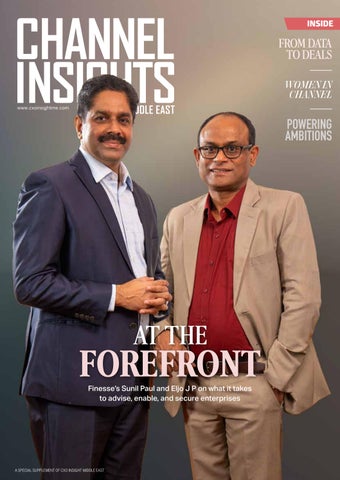
AT THE FOREFRONT
Finesse’s Sunil Paul and Eljo J P on what it takes to advise, enable, and secure enterprises


UIPATH AND DELOITTE ROLLS OUT AGENTIC ERP


SENTINELONE, CLOUDFLARE EXPAND TIE-UP FOR REAL-TIME ENTERPRISE THREAT DETECTION
FORTINET ADVANCES SOC PLATFORM

CHASING AI WHY FRONTLINE WORKERS MUST BECOME FRONTLINE DEFENCE
CONVERGE, SCALE, SECURE


EXECUTION IS THE EDGE
The pace of artificial intelligence adoption across the Middle East has reached an inflexion point. According to IDC, AI spending in the Middle East, Türkiye, and Africa (META) totalled $4.5 billion in 2024 and is projected to reach $14.6 billion by 2028, driven by national digitalisation programmes, sovereign AI initiatives, and growing enterprise demand for automation and intelligent decision-making. Yet investment alone does not equal impact. McKinsey’s latest State of AI survey found that 88 percent of organisations now use AI in at least one business function, yet only approximately one-third report having begun to scale their AI programmes, with the majority still in experimentation or pilot mode. The gap is not one of ambition or capital; it is one of execution. Infrastructure is being built, models are being selected, and pilots are being launched. Yet the disciplines that drive success like strategy, data governance, security, and operational readiness, separate leaders from those that fall behind.
places those disciplines at the centre of the conversation. Our cover story features Finesse’s Sunil Paul and Eljo J P, whose threepillar framework for advising, enabling, and securing enterprise AI offers one of the most grounded perspectives on what transformation actually demands in this market. In addition, our ‘data to deals’ feature maps where channel partners are generating meaningful revenue today, from managed analytics and observability to compliancedriven engagements, while our ‘women in channel’ feature gives voice to the leaders reshaping the region’s IT ecosystem and the changes still needed.
We also feature insights from HPE’s Gilles Thiebaut and Ahmad Alkhallafi, who unpack their hybrid by-design philosophy powering the UAE’s AI ambitions. Meanwhile, Dr Ahmed Rubaie from Anomali addresses why enterprises are struggling to trust AI-driven insights. And ManageEngine’s Nirmal Kumar Manoharan and Sujoy Banerjee make the case for unified IT management in a fast-evolving channel landscape.
Furthermore, Acronis’s Ryan Davis argues that frontline workers must become defenders in the new OT era, and we close with an intimate look at a day in the life of Hamid Ansari
Sales Director
Merle Carrasco
merlec@insightmediame.com +97155 - 1181730
Administration Manager Fahida Afaf Bangod fahidaa@insightmediame.com +97156 - 5741456
Operations Director
Rajeesh Nair
rajeeshm@insightmediame.com +97155 - 9383094
Designer Anup Sathyan
While the publisher has made all efforts to ensure the accuracy of information in this magazine, they will not be held responsible for any errors
IFS launches AI-powered logistics platform

IFS has announced the launch of IFS.ai Logistics, an AI-powered logistics intelligence platform purpose-built for enterprises operating complex, multi-carrier, multi-region transport networks. Built on the foundation of 7bridges technology — acquired in 2025 — the platform extends IFS’s Industrial AI capabilities into the physical movement of goods, addressing what the company describes as one of the most persistently ungoverned cost centres in enterprise operations.
The business case is significant. Enterprises typically spend five to ten percent of revenue on transportation, yet logistics data remains fragmented across carriers, regions, legacy systems,
UiPath
and spreadsheets — leaving teams in reactive mode and unable to act on information they cannot trust or compare. For large manufacturers and logistics providers, a one-percent inefficiency in freight spend can represent hundreds of millions of dollars in avoidable annual cost. Against a global logistics market valued above nine trillion dollars today and projected to approach 20 trillion within the decade, IFS positions the platform as structural transformation rather than incremental automation.
IFS.ai Logistics delivers a single closed operational loop across four capability areas. AI-driven transport planning and carrier selection replace manual
and Deloitte rolls out Agentic ERP
UiPath announced it is expanding its alliance with Deloitte through the launch of Deloitte’s Agentic ERP offering. The offering helps organisations modernise and optimise complex ERP environments using agentic automation and end-to-end process orchestration powered by UiPath Maestro, reducing manual work and accelerating the shift from assisted automation to more autonomous execution at scale.

decision-making with intelligence-led optimisation across modes, legs, and trade lanes. Zero-touch automated execution eliminates booking errors and manages real-time shipment visibility with intelligent exception handling. A finance-grade freight audit engine validates every invoice at line-item level, applying automated GL coding, surfacing billing discrepancies, and managing dispute workflows to recover leakage. A network intelligence and simulation layer enables continuous what-if scenario modelling spanning carrier strategy, cost forecasting, emissions planning, and procurement consolidation.
Underpinning all four capabilities is a logistics-native data model that standardises fragmented transport data into a single trusted intelligence layer for reporting, forecasting, and continuous network improvement.
The platform operates within IFS Cloud alongside Enterprise Asset Management, Field Service Management, ERP, and Supply Chain Management, and is composable with third-party platforms to reduce adoption friction. Combined with the recently acquired IFS Softeon for warehouse management, IFS.ai Logistics completes an integrated intelligence layer connecting warehouse operations through to final delivery across the full supply chain.
Enterprise platforms may be digital, but the work around them often isn’t. In many enterprises, ERP sit at the centre of a patchwork of spreadsheets, email chains, portals, and point solutions — forcing users to manually switch between multiple systems in pursuit of data reconciliation, evidence collection, and exception management. The result is slower cycle times, inconsistent experiences, higher run costs, more rework, and added control strain that shows up in audits and decision making.
Deloitte’s Agentic ERP, powered by UiPath Agent Builder and UiPath Maestro, moves organisations from
task automation to end-to-end process orchestration across workflows like Record to Report, Source to Pay, Lead to Cash, and Data/Master Data. It coordinates AI agents, robots, enterprise systems, and people to keep work moving and route exceptions to humans with the right context and oversight.
The value is measurable: higher productivity, lower run costs, and faster operations backed by a traceable value model that ties process improvements to bottom-line results.
UiPath is embedded into Deloitte’s AI-native, plug-and-play Agentic ERP North Star architecture, built alongside packaged ERP programmes to unlock AI at scale. It is model agnostic (“bring your own LLM”), while standardising orchestration, security, and policy enforcement across the enterprise. The UiPath AI Trust Layer provides governance and controls by design, ensuring autonomy scales responsibly.
Agentic ERP helps transform the workforce. Agents and robots handle high-volume execution and follow-
through alongside users, while humans stay in control of exceptions, approvals, and decisions — with a persona-led experience that brings the right work, context, and next-best actions into the tools users already use.
In addition to the Agentic ERP offering, the alliance includes UiPath’s support of a Deloitte SAP AI & Innovation Centre in EMEA — an accelerator focused on integrating AI and emerging technologies into SAP environments to support responsible, compliant, and high-impact adoption.
SentinelOne, Cloudflare expand tie-up for real-time enterprise threat detection

SentinelOne and Cloudflare are expanding their partnership to provide joint customers with AIdriven insights through an intuitive, unified experience. The combination of Cloudflare’s global infrastructure network and SentinelOne’s Singularity AI SIEM will strengthen real-time threat detection and response for enterprises of all sizes. Through a new integration, joint customers can automatically apply AI-driven correlation from Cloudflare Logpush telemetry and SentinelOne’s native signals across endpoint, cloud, identity, and AI. As a result, security teams can automate detection, investigation, and response to threats
as they move from the internet edge into adjacent environments. Security data is exploding, and attack surfaces are expanding. To keep up, organisations are fundamentally rethinking autonomous threat detection. Security teams are moving beyond disjointed point products and siloed signals. Instead, they need integrated platforms that correlate data across edge, endpoint, cloud, identity, and more. This unified approach reduces complexity and improves outcomes. Most importantly, it frees security analysts to focus on the threats that actually matter.
The new integration brings Cloudflare’s Zero Trust and edge
network telemetry data, including Gateway, Access, and WAF logs, directly into SentinelOne’s Singularity Platform. For joint customers, this creates a single, unified command centre that provides better visibility, context, threat investigation, and response to modern threats and sophisticated adversarial techniques. Customers can configure Singularity Platform in just a few clicks to become the native Logpush destination within the Cloudflare Dashboard, delivering immediate time-to-value.
SentinelOne’s Singularity AI SIEM provides security teams with the essential technology that drives the vision for an Autonomous SOC, that is built to operate on live data, not static logs. With a built-in data pipeline, AI SIEM applies intelligence directly to streaming telemetry, identifying and filtering risk earlier in the attack lifecycle to reduce noise and enable faster, more efficient detection. By fusing real-time telemetry with Agentic AI and Hyperautomation, Singularity AI SIEM automates endto-end investigation and remediation, removing manual steps between detection and action. The result is a SOC that moves from reactive alert handling to proactive automated response, enabling analysts of any skill level to investigate and neutralise threats with speed and confidence.
Lenovo accelerates productionready Enterprise AI with NVIDIA
Lenovo has used NVIDIA GTC to unveil a significant expansion of its Hybrid AI Advantage with NVIDIA portfolio, introducing solutions designed to accelerate AI adoption across personal, enterprise, and cloud environments. The announcement marks a strategic shift from AI model training toward real-time inferencing — which Lenovo positions as the new frontier of enterprise AI value.
At the device level, Lenovo is introducing next-generation workstations and laptops powered by NVIDIA RTX Pro Blackwell GPUs, including the ThinkPad P14s Gen 7, ThinkPad P1 Gen 9, and the ThinkStation PGX — an AI developer device capable of supporting up to 200 billion parameter models with one petaflop of AI compute. A worldfirst 1,000Wh/L Silicon-Anode Battery proof of concept for laptops and workstations was also announced, promising improved battery life without increasing device footprint.
For enterprise environments, Lenovo’s expanded Hybrid AI platforms — integrated with NVIDIA AI Enterprise software and NVIDIA-Certified Systems — are delivering up to 8x lower cost per token compared to comparable cloud IaaS, with ROI achievable in under six months. New inferencing-optimised ThinkSystem and ThinkEdge servers support real-time AI across retail, manufacturing, healthcare, and smart city deployments. The portfolio also includes a Lenovo Hybrid AI inferencing starter platform delivering up to 3x performance gains for vision AI applications.
At gigawatt scale, Lenovo is a launch partner for the NVIDIA Vera Rubin NVL72, delivering fully liquid-cooled, rack-scale AI systems engineered for hyperscale and

sovereign cloud providers — achieving up to 10x higher throughput and 10x lower cost per token compared to previous generations.
Underpinning the entire portfolio is an expanded Lenovo AI Library featuring agentic and physical AI solutions across sports, retail, manufacturing, and mobility — developed in collaboration with partners including AiFi, RocketBoots, and Vaidio through the Lenovo AI Innovators ecosystem.
The announcements are supported by the Lenovo 360 channel framework, enabling partners globally to guide customers from AI pilot to production across the full hybrid AI stack.
Fortinet advances SOC platform

Fortinet has unveiled major innovations across its Security Operations Platform at Fortinet Accelerate 2026, introducing nextgeneration capabilities designed to help organisations defend against an increasingly AI-accelerated threat landscape. The announcements centre on four areas: SOC modernisation, agentic AI execution, managed services, and simplified endpoint security.
The headline introduction is FortiSOC, a cloud-delivered offering currently in preview that consolidates FortiAnalyzer, FortiSIEM, FortiSOAR, and FortiTIP into a single integrated service. FortiSOC supports log ingestion, normalisation, correlation, automation, case
management, behavioural analytics, and identityfocused investigations through a unified console and data model — ingesting telemetry from both Fortinet and third-party environments. Built-in SOC best practices drawn from Fortinet’s own global operations are embedded alongside AI and machine learning capabilities, with simplified subscription licensing and elastic cloud scale designed to streamline deployment.
Alongside FortiSOC, Fortinet is significantly expanding FortiAI across its SecOps portfolio — moving beyond interactive copilot functionality toward agentic execution that connects telemetry, tools, and response actions across the SOC. A dedicated agent now automates alert triage, investigation, and threat hunting, with Model Context Protocol support maintaining shared context and execution continuity across detection,
investigation, and response workflows.
For organisations requiring continuous managed coverage, FortiGuard SOC-asa-Service has been enhanced with third-party log source support for multivendor monitoring, expanded Security Fabric integrations, and FortiNDR and FortiCNAPP telemetry to strengthen detection and cloud visibility across hybrid environments.
On the endpoint front, FortiEndpoint introduces single-agent unification across ZTNA, SASE, EPP, EDR, and DLP — consolidating multiple products, reducing agent sprawl, and simplifying licensing and management. Fortinet also introduced FortiAI-powered application visibility and control, enabling organisations to detect and govern AI application usage, reducing unsanctioned access and data exposure risk.
Presight unveils first AI fund investments under intelligence innovation ecosystem

Presight has announced the first six companies selected for investment through its AI Innovation Ecosystem, marking a significant milestone in its strategy to build a pipeline of breakthrough AI technologies for deployment at national and enterprise scale. The investments are made through the Presight–Shorooq Fund I, a US$100 million global early-stage fund established in partnership with Shorooq, following an assessment of
more than 1,000 companies in just 120 days.
The six portfolio companies — spanning the United States and UAE — cover four distinct areas: world model architecture, sovereign AI infrastructure, vertical intelligence for capital and industry, and secure edgenative systems. AMI, founded by Turing Award winner and former Meta Chief AI Scientist Yann LeCun, is developing world model AI architectures that enable machines to reason, plan, and
interact with the physical world across manufacturing, aerospace, robotics, and biomedical applications. NodeShift provides enterprises with a secure, on-premises AI platform that keeps all data within their own infrastructure, and has entered into a strategic commercial agreement with Presight following its participation in the Presight AI Accelerator Programme.
In the vertical intelligence space, Hebbia targets institutional research and financial workflows in regulated capital markets, Candid Intelligence applies AI to procurement and bidding processes in publicsector environments, and Crunched delivers AIpowered financial analysis and decision-grade insights for investors and operators. Completing the portfolio, Blue provides a voice-action model layer enabling multistep task completion directly on devices without API dependencies.
The investments are embedded within Presight’s broader AI Innovation Ecosystem — comprising an AI Investment Fund, an AI Accelerator Programme, and Research and Development Labs — designed to take companies from early innovation through structured incubation to real-world deployment within complex, regulated environments. Portfolio companies receive mentorship, access to world-class compute infrastructure, and fasttrack commercialisation pathways within the G42 and Presight ecosystems. Looking ahead, Presight indicated that future cohorts and capital initiatives will target energy systems, industrial autonomy, sovereign data infrastructure, and AI-native public services — reinforcing Abu Dhabi’s ambition to cement its position as a global hub for applied AI.
Presight advisory board
Mindware signs value-added distribution partnership with SUSE

Mindware has signed a strategic distribution partnership with SUSE. The agreement aims to accelerate the adoption of SUSE’s enterprise portfolio across the Middle East and North Africa (MENA), supporting
organisations seeking secure, flexible, and sovereign IT infrastructure.
Under the partnership, Mindware will distribute SUSE’s portfolio, including SUSE Linux, SUSE Cloud Native as well as SUSE Edge and
SUSE AI solutions. The collaboration will focus on channel recruitment and enablement, joint go-to-market initiatives, demand generation, and comprehensive technical support.
The partnership comes as organisations across the region reassess their infrastructure strategies in response to rising virtualisation costs, evolving regulatory requirements, and increasing demand for digital sovereignty. By combining SUSE’s enterprise-grade open source technologies with Mindware’s regional expertise and partner ecosystem, the companies aim to deliver costeffective and scalable infrastructure solutions across key industry verticals.
Mindware will provide value-added services, including architectural design, proof-of-concept (PoC) support, marketing-as-a-service, specialised logistics, and dedicated product management to ensure strong vendorpartner alignment.
Nutanix unveils Agentic AI solutions
Nutanix has announced the Nutanix Agentic AI solution, a purpose-built software stack designed to accelerate enterprise adoption of agentic AI for business transformation. The announcement addresses what Nutanix identifies as the defining infrastructure challenge of the current AI moment, not building individual agents or selecting models, but managing the complexity of running thousands of agents securely and at scale.

The solution integrates with NVIDIA AI Enterprise at the Agent Builder layer and orchestrates NVIDIA-certified AI factory ecosystems. Nutanix and NVIDIA collaborate on integration with the NVIDIA Agent Toolkit and the NVIDIA OpenShell open-source runtime.
The platform is structured across three capability layers. The first is an AI PaaS and Kubernetes layer, anchored by the latest release of Nutanix Enterprise AI, version 2.6, which introduces an AI Gateway for unified policy control over cloudhosted and private large language models, new Model Context Protocol server support, fine-tuning capabilities, and support for NVIDIA’s Nemotron family of open-source AI models. An open Kubernetes platform with a pre-built catalogue of AI developer tools, including Notebooks, Vector Databases, and MLOps engines, enables rapid deployment of NVIDIA NIM microservices in production.
The second layer addresses infrastructure optimisation and security, with enhancements to Nutanix’s AHV hypervisor for GPU-aware resource allocation and Flow Virtual Networking updated to offload network processing to NVIDIA BlueField, reducing host CPU consumption and lowering cost per token.
The third layer delivers foundational data services through Nutanix Unified Storage, built on the NVIDIA AI Data Platform reference design, providing a scalable, low-latency data fabric that maximises GPU efficiency across enterprise AI workloads.
L-R: Nicholas Argyrides, Vice President, Gulf & East Africa, Mindware and Ismail Ibrahim, Sales Director & General Manager for CEMEA, SUSE


business and ideal for mass deployment
ZONE VIBE WIRELE SS
Over-the-ear headphones with for business and perfec t for hybrid work
HOW CHANNEL PARTNERS ARE TURNING DATA INTO GROWTH FROM DATA TO DEALS:
As data volumes surge across Middle East enterprises, channel partners are moving beyond infrastructureled conversations to unlock greater strategic value from data. Distributors, systems integrators, and MSPs are evolving their offerings into managed services, insights-as-a-service, and outcome-driven engagements. We gathered perspectives from industry leaders to explore where meaningful revenue is being generated today, from analytics and observability to data security and compliance, and how enablement, execution, and ecosystem collaboration are shaping the region’s emerging data economy
Afif Hamdan, Regional Head of Channels & Alliances, Middle East, Africa & Turkey, Submer

Where MEA channel partners are finding real revenue in data
The era of easy hardware margins is over in the Middle East and Africa. Meaningful revenue today sits at the intersection of data ambition and physical infrastructure reality. With sovereign AI programmes accelerating across Saudi Arabia and the UAE, customers are not simply procuring GPUs, they are investing in the ability to run them at scale. Power availability, rack densities exceeding 40–50kW, cooling efficiency, and time-topower have become commercial gating factors. The highest-margin partners are those leading with advisory, feasibility studies, TCO modelling, and infrastructure master planning, securing deal control and capturing downstream Design–Build–Operate opportunities through unified architecture that integrates compute, power, cooling, and lifecycle services into scalable, recurring revenue models.
Convergence over silos
While organisational silos persist in traditional enterprise and public-sector structures, MEA’s infrastructure constraints are forcing convergence.
Partners capable of bridging IT strategy with infrastructure feasibility are gaining disproportionate influence by reducing execution risk and compressing delivery timelines”
Power scarcity, high ambient temperatures, and sustainability mandates do not respect departmental boundaries. In sovereign environments, data governance and energy policy further demand early cross-domain alignment between CIOs, facilities leaders, and regulators. Partners capable of bridging IT strategy with infrastructure feasibility are gaining disproportionate influence by reducing execution risk and compressing delivery timelines.
Alexandre Nevraumont, Director ChannelSouth Europe, Middle East & Africa, Infoblox

Building scalable revenue from data
The partners gaining ground in the Middle East are those who have moved decisively from project-based engagements to platform-plus-services models, monetising continuous data flows through recurring offerings rather than one-off integrations. Three areas are showing strong traction: managed security and threat exposure services that give CISOs a clearer risk picture; asset and observability services that map devices, workloads, and identities across hybrid environments; and compliance and data governance services tailored to regulated sectors. The scalable models share a common structure, subscription and outcome-aligned tiers built on replicable, standardised platforms with vertical-specific use cases layered on top, co-sold through hyperscaler marketplaces for sustained, high-margin growth.
Ecosystem roles and enablement at scale
Building data-driven practices is a collective effort requiring distinct contributions at every layer. Vendors must provide rich telemetry, open APIs, and clear service blueprints so partners can focus on execution rather than reinvention. Distributors serve as architects of scale, curating vendor combinations, packaging repeatable
Distributors serve as architects of scale, curating vendor combinations, packaging repeatable solutions, and enabling partners to pivot toward recurring revenue models”
solutions, and enabling partners to pivot toward recurring revenue models. Systems integrators and MSPs lead the last mile, building specialised practices that translate data into daily customer outcomes. Elite partner communities are also proving their worth, creating environments where data-driven offers are tested, refined, and taken to market with speed.
Haider Amjed, Head of Technology - UAE, NTT DATA

Monetising data across the region
Meaningful revenue across the GCC is being generated where data directly impacts profitability, risk, and operational resilience. In the UAE, recurring managed analytics services are replacing one-time implementations across government, aviation, retail, and financial services. In Saudi Arabia, Vision 2030 and giga-project demands are driving growth in predictive maintenance, industrial IoT analytics, and sovereign cloud-aligned platforms, with data localisation requirements turning governance into a standalone business opportunity. Qatar’s financial services and critical infrastructure sectors are prioritising observability and automated regulatory reporting.
Meaningful revenue across the GCC is being generated where data directly impacts profitability, risk, and operational resilience”
Across all three markets, the commercial shift is consistent, recurring, outcome-linked models built around managed data platforms, Insights-as-a-Service, and compliance-as-a-service are delivering stronger margins and longer client lifecycles than transactional infrastructure sales.
Ecosystem
coordination as the new competitive advantage
The data opportunity across the GCC cannot be addressed in isolation, it demands coordinated ecosystem execution. Systems integrators are translating national regulations such as the UAE’s PDPL and Saudi Arabia’s SDAIA frameworks into secure, scalable architectures, while managed service providers operationalise these environments for ongoing compliance and performance. The differentiating layer is no longer technical capability alone but the ability to combine global delivery expertise with deep regional regulatory understanding. Partners who embed privacy-bydesign, security-by-design, and sovereignty-aware architectures from day one are capturing the full lifecycle, advisory, implementation, governance, and managed optimisation, and building sustainable competitive positions as a result.
Hani AlHendi, Sales Manager Middle East –META, Milestone Systems
Turning video data into scalable revenue
Having a strong ecosystem of channel partners is vital. Our channel partners in the Middle East provide invaluable regional insights and local expertise, helping tailor solutions to customer needs while creating scalable, high-value opportunities. They also generate meaningful revenue by offering extensions and integrations such as video analytics, managed services, and data security solutions. AI-driven analytics, for instance, for crowd management, traffic optimisation, and retail behaviour analysis, turn video data into actionable intelligence, amplifying the impact of video technology for users.
An open platform built for ecosystem collaboration
Milestone’s open platform enables seamless integration

Our channel partners in the Middle East provide invaluable regional insights and local expertise, helping tailor solutions to customer needs while creating scalable, high-value opportunities”
of AI analytics, cloud services, IoT devices, and access control systems to deliver industry-specific solutions. Through targeted training, certification programmes, and vertical-focused workshops, partners like system integrators and MSPs are equipped to prioritise outcomes over products. Equally, managed video services such as Video Surveillance-as-a-Service (VSaaS) are allowing partners to move from one-off infrastructure sales to recurring, predictable revenue models. Distributors lead in enablement and financing, integrators drive solution architecture and expertise, MSPs manage services and cybersecurity, and ISVs innovate in analytics.
Kinda Baydoun, Senior Director, EMEA Channel Sales, Veeam
Recurring, service-led models are where data revenue is concentrating Across the Middle East, the strongest data-driven revenue is flowing to partners who have moved decisively beyond one-off infrastructure projects into managed, subscription-based service models. Managed data protection, cyber resilience, compliance

The most successful partners are those who have packaged their expertise into repeatable, multitenant offerings”
monitoring, and observability are leading the way, driven by customer demand for continuous assurance rather than point-in-time solutions. Microsoft 365 data management, backup and recovery operations, and data visibility services are proving particularly scalable because they align with predictable operational needs and subscription economics. The most successful partners are those who have packaged their expertise into repeatable, multi-tenant offerings, resilience-as-a-service and compliance-as-a-service frameworks that can be deployed across customer bases with minimal re-engineering, delivering consistent margins at scale.
Shared responsibility across the ecosystem is accelerating the transition Building sustainable data-driven practices requires coordinated effort at every layer of the channel. Technology vendors are enabling this by delivering API-driven, service-friendly, multi-tenant platforms that allow partners to build differentiated offerings without reinventing foundational capabilities. Distributors are increasingly acting as service accelerators, providing reference architectures, enablement programmes, and financing models that help mid-market MSPs scale without carrying excessive upfront risk. Systems integrators are best positioned to lead complex data modernisation and compliance engagements, while MSPs and cloud
partners take ownership of ongoing operations, optimisation, and lifecycle management. The partnerships gaining the most ground are those built on deliberate collaboration across these roles rather than attempting to own the entire value chain independently.
Mostafa Kabel, CTO, Mindware

Generating meaningful revenue from data Across the Middle East, the strongest revenue growth is coming where partners connect technology investments directly to measurable business outcomes. Three areas are leading the way: analytics and AI enablement, observability across hybrid environments, and data security and compliance. Enterprises are investing heavily in modern data platforms built for AI readiness, spanning data integration, governance, and model preparation, while organisations across regulated sectors continue to prioritise cyber resilience and regulatory compliance as non-negotiable spending categories. The most scalable business models are recurring managed services built around subscriptionbased monitoring, governance, backup, and security, complemented by packaged solution bundles that combine multiple technologies into outcome-focused offerings with clear delivery frameworks.
Three areas are leading the way: analytics and AI enablement, observability across hybrid environments, and data security and compliance”
Ecosystem enablement and the evolution of channel roles
Ecosystem players are moving well beyond product enablement, with the most effective programmes combining technical training, reference architectures, proof-of-value toolkits, and structured go-to-market support. Distributors are playing an increasingly strategic role, aggregating multi-vendor solutions, standardising architectures, and equipping partners with integrated solution stacks and pre-defined delivery frameworks that accelerate adoption. Systems integrators lead on translating data strategies into operational solutions, while managed service providers take ownership of ongoing governance and performance optimisation. When these roles are clearly defined and supported by strong ecosystem collaboration, partners are far better positioned to build sustainable, repeatable data-driven practices.
Narayanan Venkataraman, Head of ChannelMiddle East, Saudi Arabia, Africa, HP

Device intelligence and lifecycle services are redefining
partner revenue
The most meaningful revenue shift for channel partners in the Middle East is not coming from new product categories, it is coming from a fundamental change in how partners engage with customers. Fleet assessments, refresh roadmaps, and technology lifecycle programmes aligned to business priorities
are replacing purely transactional sales conversations. Managed device services and proactive support agreements are proving the most scalable models precisely because they are built around continuous engagement rather than single transactions. Data is the connective tissue, informing long-term service relationships that improve both revenue predictability for partners and operational outcomes for customers, creating a commercial structure where retention and growth reinforce each other.
From reactive selling to informed, outcomefocused
engagement
HP Amplify is central to how partners are making this transition, equipping them with visibility into industry spending trends, technology adoption patterns, and install base intelligence including upgrade recommendations. Solutions like the HP Workforce Experience Platform take this further, using predictive data models to surface issues before they escalate and automating repetitive tasks so partners can shift from reactive support to proactive service delivery. The ecosystem works best when each role is clearly defined: MSPs lead on recurring service execution, resellers strengthen their advisory positioning, system integrators connect data-driven services to broader transformation programmes, and distributors provide the commercial frameworks that make service adoption scalable across the market.
Nassif Yazbeck, Channel Sales Director METCA, Vertiv

The ecosystem works best when each role is clearly defined”
AI-ready infrastructure is where partner revenue is concentrating
Channel partners working with Vertiv are finding their strongest growth at the intersection of AI ambition and critical infrastructure reality. Hyperscale expansions,
Vertiv supports this transformation by embedding intelligence directly into critical infrastructure”
sovereign cloud initiatives, and GPU-intensive data centre projects are driving concentrated demand for high-density UPS systems, advanced thermal management, and prefabricated modular infrastructure designed specifically for AI workloads. Revenue is no longer tied solely to infrastructure supply, consultative design, system integration, commissioning services, and lifecycle support are now integral to how partners win and retain business. The most scalable models combine infrastructure deployment with recurring digital services including remote monitoring, predictive maintenance, and energy optimisation, with technically sophisticated partners consistently outperforming traditional resellers in this environment.
Embedding intelligence into infrastructure to enable service-led growth
Ecosystem enablement is accelerating the shift from product supply to performance-led service delivery. Vertiv supports this transformation by embedding intelligence directly into critical infrastructure, giving partners the operational data needed to deliver predictive maintenance and efficiency optimisation as genuine value-added services. Large system integrators lead complex, multi-phase AI campus deployments, while regional integrators and value-added resellers differentiate through deployment excellence, local expertise, and managed services. Distributors extend reach through solution aggregation and financing capabilities. The partners gaining the strongest footing are those taking ownership of infrastructure performance data and translating it into quantifiable business outcomes for their customers.
Ranjith Kaippada, Managing Director, Cloud Box Technologies
Driving recurring revenue
Regulatory compliance, observability, and managed analytics are leading to data-based revenue in the Middle East. Companies are now looking for constant visibility and lower risk, which will give them a clearer way to repeat revenue.
The most scalable models now bring together Insights-as-a-Service with managed services. They use subscription or consumption-based pricing. The demand for this is increasing, especially in the Government, BFSI, and Retail sectors. Partners who

The most scalable models now bring together Insights-as-aService with managed services”
package data engineering, governance, and AI readiness into repeatable frameworks are currently capturing the fastest growth and the strongest margins.
Specialisation and ecosystem orchestration over isolated effort
Vendors and distributors are speeding up time-tomarket by investing in partner enablement, reference architectures, and pre-integrated stacks. While hyperscaler programmes and certifications build channel muscle, specialisation is what really has value. Systems integrators should lead by connecting data strategies to specific industry results. MSPs should focus on the daily processes in environments that are complex.
Meanwhile, distributors bring together multi-vendor toolchains and offer financing flexibility. In this region, success isn’t a solo act; it depends on tight ecosystem orchestration rather than isolated efforts.
Salman Kazmi, Area Vice President - META, BMC Helix
IT operations, AIOps, and automation are defining the data revenue opportunity
The most meaningful data-driven revenue across the Middle East is emerging where data translates directly into operational efficiency and measurable cost savings. IT service management, AIOps, security

The partners gaining the strongest commercial positions are those who have repositioned themselves as strategic advisors”
operations, and digital workplace initiatives are the primary growth areas, with partners increasingly moving away from project-based engagements toward recurring, platform-led service models. Managed IT operations, automation-asa-service, and subscription-based service management are proving the most scalable, combining data, AI, and automation into reliable, long-term offerings that generate annuity revenue. The partners gaining the strongest commercial positions are those who have repositioned themselves as strategic advisors rather than technology resellers, building steady, outcome-linked engagements that compound in value over time.
Clearly defined roles are making ecosystems more effective
Ecosystem players are accelerating partner success by simplifying the path from raw data to business outcomes through AI-ready platforms, pre-built integrations, structured training, and collaborative go-to-market programmes. Vendors are focusing on platform innovation and co-selling, distributors are driving enablement and market reach, and system integrators are leading complex transformation initiatives. Regional and local partners remain essential for managed services and industry-specific solutions that require proximity and contextual expertise. The ecosystems delivering the greatest impact are those where roles are clearly delineated, enabling partners to collaborate fluidly across the value chain and deliver end-to-end, data-driven services with measurable customer outcomes.
Outcomes or Silos: Where does the region really stand?
Afif Hamdan, Submer
Infrastructure constraints are forcing the convergence that silos once prevented
Alexandre Nevraumont, Infoblox
Metrics over dashboards, the conversation is shifting, but progress is uneven
Haider Amjed, NTT DATA
From technology deployment to shared success, the region’s procurement mindset is evolving
Hani AlHendi, Milestone Systems
Large enterprises are leading the shift while the mid-market catches up
Mostafa Kabel, Mindware
Regulated sectors are paving the way as the broader market matures
Narayanan Venkataraman, HP
Growing interest in outcomes, but commercial and operational alignment is still developing
Nassif Yazbeck, Vertiv
AI workloads are compelling the enterprise market to think beyond siloed procurement
Kinda Baydoun, Veeam
From deployment to guaranteed outcomes, mature enterprises are raising the bar
Ranjith Kaippada, Cloud Box Technologies
KPI-linked contracts are gaining ground at the top, while the mid-market awaits its catalyst
Salman Kazmi, BMC Helix
Measurable impact is the bridge between modernisation projects and long-term value contracts


AT THE FOREFRONT
Sunil Paul, Co-Founder & MD, and Eljo J P, Chief Business Officer & Director at Finesse, on what it takes to advise, enable, and secure enterprises through the most consequential technology shift of the decade and why the real work begins long before the first model is deployed

As artificial intelligence transitions from strategic priority to operational reality across the Middle East, Finesse stands at the forefront of guiding that transformation. Channel Insights ME spoke with Sunil Paul, Co-Founder and Managing Director, and Eljo J P, Chief Business Officer and Director at Finesse, about what it takes to advise, enable, and secure enterprises through the most consequential technology shift of the decade.
Finesse has established itself as a prominent technology partner across the Middle East. How has the company evolved, and how do you position yourselves in today’s AI landscape?
Sunil Paul (Sunil): Finesse was founded with a clear intent: to bring meaningful, positive change to how organisations adopt and benefit from technology. In the early years, much of the work centred around software integration, and while that delivered value, we recognised that organisations could unlock far greater impact when technology was aligned more closely with business strategy, data, and risk management.
That realisation shaped our evolution. We expanded into a more holistic role, working with clients not just to implement systems, but to help define what they should
build, how they should scale, and how they should secure it. In practice, this means connecting business objectives to technology decisions and ensuring those decisions translate into measurable outcomes.
We approach AI in the same way. What is different today is the pace and scale; AI is no longer experimental; it is increasingly shaping how organisations make decisions and operate on a day-today basis. For us, AI is an extension of digital transformation, and its value is realised when it is embedded into the business rather than deployed in isolation. Our three-pillar model of Advising, Enabling, and Securing ensures AI is aligned to business goals, implemented effectively, and scaled responsibly.
Your approach to AI is anchored in three pillars: advising, enabling, and securing. How does Finesse translate this framework into tangible outcomes for enterprise clients?
Sunil: Many organisations invest in digital transformation but struggle to translate that investment into consistent, measurable business outcomes. The gap is typically not in the technology itself, but in how initiatives are prioritised, executed, and sustained across the organisation, and with AI, the expectation for faster, more visible outcomes has only increased.
Our three-pillar model of Advising, Enabling, and Securing ensures AI is aligned to business goals, implemented effectively, and scaled responsibly”
Our approach ensures that business objectives remain central throughout. We begin with Advising, where our 1CXO division works with leadership to define priorities, identify high-impact use cases, and establish the necessary data and governance foundations. This ensures every initiative is tied to a clear outcome, whether improving efficiency, reducing cost, or enhancing customer experience.
With our Enabling practice, those identified priorities are translated into meaningful business solutions across analytics, automation, and various other enterprise platforms.
At the same time, Securing those enterprise applications is accomplished through our Cyberhub 24/7 Cognitive SOC, which provides continuous monitoring, AI-driven threat detection, and resilience across environments.
This continuity across advisory, execution, and security is what ensures transformation efforts deliver sustained, measurable outcomes rather than isolated gains.
The Middle East is witnessing significant national investment in AI infrastructure and digital transformation. Which sectors are demonstrating the most meaningful progress, and where do the greatest opportunities remain untapped?
Sunil: We are seeing the strongest momentum in sectors such as public sector, banking and financial services, energy, and healthcare. These industries benefit from strong regulatory push, clear use cases, and access to structured data, enabling them to move from experimentation to scaled adoption. AI is already being applied in areas such as fraud detection, predictive maintenance, citizen services, and operational optimisation.
However, the larger opportunity lies in sectors such as mid-sized enterprises, logistics, retail, and education. These organisations often have strong use cases but are earlier in their journey, particularly
Sunil Paul
in terms of data readiness, governance, and execution frameworks.
The gap is not ambition, but structure. AI adoption is accelerating across the region, but structured adoption is what will ultimately separate leaders from followers. Organisations that address these foundational elements early will be best positioned to scale and compete effectively.
As AI deployments accelerate across the region, cybersecurity has emerged as a critical concern for enterprise leadership. How is Finesse addressing the security imperatives that accompany large-scale AI adoption?
Eljo J P (Eljo): As AI adoption increases, so does complexity, and with that comes risk. Greater data volumes, interconnected systems, and automation expand the attack surface significantly.
Our approach is to embed security directly into the transformation journey. Through our Cyberhub 24/7 Cognitive SOC, we leverage AI, machine learning, and behavioural analytics to detect and respond to threats in real time, shifting from reactive to predictive security.
We also implement Zero Trust architectures to ensure continuous validation across users, devices, and systems, reducing exposure and limiting the impact of potential breaches.
By combining intelligent detection with automated response, we enable organisations to scale AI with confidence, ensuring resilience is built into the environment from the outset rather than introduced later.
A considerable number of organisations find themselves unable to move beyond the pilot stage when it comes to AI initiatives. In your experience, what are the principal barriers to scaling AI in production environments, and how does Finesse help clients overcome them?

Eljo: Many organisations are able to launch AI pilots, but far fewer are able to scale them into production. The challenge is not a lack of technology, but a lack of alignment and readiness.
There are three common barriers. First, weak data foundations, AI initiatives are often built on fragmented or poor-quality data, leading to unreliable outputs. Second, lack of clear business alignment, many pilots are not tied to measurable outcomes, making scaling difficult to justify. Third, the absence of operational and governance frameworks required to support AI at scale.
We address these systematically. We begin by strengthening data and governance, then prioritise use cases linked to clear business outcomes, and finally design solutions with scalability and security built in from the outset.
Scaling AI is not about moving faster; it is about building the right foundations to scale with confidence.
Data sovereignty, compliance, and regulatory frameworks present distinct challenges for AI adoption in this region. How does Finesse navigate these considerations while
Sunil Paul

ensuring clients can pursue their transformation objectives without compromise?
Eljo: Data sovereignty and regulatory compliance have become central to digital transformation in the Middle East, particularly with increasing focus on data residency, privacy, and crossborder data flows. The challenge is ensuring these requirements are consistently applied across strategy, architecture, and operations.
Our approach is to treat compliance as an integral part of the transformation journey rather than a separate workstream. We work with organisations early to align transformation plans with regulatory requirements, embedding governance, data privacy, and risk considerations from the outset.
We then ensure that architectures and solutions are designed to meet data residency and localisation requirements, supported by regional capabilities that provide confidence around how data is managed.
Finally, we implement controls such as encryption, identity and access management, and continuous monitoring to ensure compliance is enforced consistently across systems and processes.
The channel ecosystem is undergoing considerable change as AI reshapes technology consumption and delivery models. What does this mean for partners and resellers, and how is Finesse supporting the channel in adapting to this new reality?
Eljo: AI is fundamentally changing the role of the channel. Traditionally built around product distribution and implementation, the model is shifting toward delivering business outcomes. Partners are now expected to understand business context, identify the right use cases, and guide clients through adoption and scale. This requires capabilities in advisory, data, and integration, not just deployment.
At the same time, AI introduces
greater complexity, with solutions spanning multiple systems and environments. This makes ecosystem collaboration essential.
Our role at Finesse is to support this transition by enabling partners with structured frameworks, domain expertise, and execution capabilities that help them deliver outcome-driven solutions. The channel is increasingly defined not by what it sells, but by the outcomes it enables.
AI transformation is as much an organisational and cultural undertaking as it is a technological one. How do you counsel enterprise leadership on aligning their people, processes, and strategy alongside their technology investments?
Eljo: AI transformation requires alignment across leadership priorities, operating models, and organisational culture. In many cases, the challenge is not access to technology, but ensuring the organisation is prepared to adopt it in a way that delivers sustained value.
We begin with advisory through our 1CXO division, working with leadership on readiness, transformation roadmaps, governance, and data foundations. Just as importantly, we focus on how these changes connect to people and process decisions. This includes identifying where skills need to evolve, where processes need to be redesigned, and how success should be measured. When these elements are aligned, AI becomes a capability that the organisation can absorb and scale effectively, rather than a series of isolated initiatives.
The competitive landscape for AI advisory and enablement services is becoming increasingly crowded. What differentiates Finesse, and what is it about your approach that continues to resonate with clients across the region?
Eljo: A large part of the market
is built around specialised capabilities, strategy, implementation, or security. Each works well in isolation, up to a point. The challenge is how effectively they come together when organisations try to scale, which is where misalignment typically begins to surface.
We focus on addressing that point of breakdown. We work with clients to identify where real business value can be created, and ensure those solutions are implemented, integrated, and sustained within the organisation.
Across hundreds of engagements, this has given us a practical understanding of where initiatives stall, whether due to data quality, governance gaps, or integration complexity, and how to address those early.
Our emphasis is on ensuring the underlying foundations are strong enough to support scale. Many organisations can initiate AI efforts, but the real challenge lies in making them hold up at scale, and that is where we focus.

We work with clients to identify where real business value can be created, and ensure those solutions are implemented, integrated, and sustained within the organisation”
Eljo J P
Looking ahead, what is your strategic outlook for enterprise AI in the Middle East, and what advice would you offer to senior technology leaders?
Eljo: Over the next few years, AI will move from being a set of initiatives to becoming embedded in how organisations operate. The shift will be from experimentation to operationalisation, where AI becomes part of core business processes across customer engagement, operations, and decision-making. We are already seeing this transition begin, particularly with generative AI accelerating how quickly organisations expect to move from idea to impact.
The Middle East is wellpositioned for this shift, given strong national investment and regulatory momentum. However, as adoption scales, the focus will move toward sustainability, how well systems perform, integrate, and are governed over time.
For technology leaders, the priority should be to get the fundamentals right, data readiness, governance, and security. It also means being selective about where AI is applied, focusing on areas that deliver measurable business impact. Ultimately, success will not be defined by how quickly AI is adopted, but by how effectively it is embedded and scaled within the organisation.
Eljo J P

IN CHANNEL:
STRATEGY, RESILIENCE, AND WHAT COMES NEXT WOMEN
Female channel leaders across the Middle East are reshaping the region’s IT ecosystem, and they have a lot to say about what it takes, what still needs to change, and where the channel goes from here


Anastasia Platon, Director – Regional Channel MEA, emt
Building a resilient channel ecosystem in the Middle East demands clarity, long-term thinking, and disciplined execution. Across the region’s leading channel organisations, a consistent message emerges that sustainable growth comes from structured partner enablement, joint accountability, and measurable performance, not reactive, volume-driven activity.
As AI and cybersecurity reshape partner models, the channel is evolving from traditional distribution toward strategic ecosystem leadership. Partners are increasingly expected to support enterprise transformation, align with national digital agendas, and lead value-based conversations with customers. Technical depth must be matched with commercial ownership for ecosystems to remain competitive and scalable.
On the question of women in the channel, progress is real but uneven. Structural barriers, limited access to revenue-critical roles, informal networks, and outdated
Those who combine commercial strength with technical depth will shape the region’s transformation”
perceptions of leadership continue to hold back advancement. Real change requires practical action: executive sponsorship, clear promotion pathways, and ensuring women lead strategic discussions, not simply attend them.
Women-led innovation brings collaborative leadership, ethical grounding, and outcome-driven thinking, qualities that are increasingly essential as the channel grows in complexity.
The next phase of growth in the Middle East will be defined by advisory capability, integrated ecosystems, and diverse leadership. Those who combine commercial strength with technical depth will shape the region’s transformation.
Ghada Ali, Head of Strategic Alliances, Ankabut
The most critical foundation of a healthy ecosystem is relationships. Strong partnerships flourish through credibility, respect, and trust, and those sincere
Resilient women overcome structural and cultural barriers through professionalism, credibility, and emotional intelligence”

relationships create the impact that supports long-term success. Once this foundation is established, it must be reinforced with structured processes and governance that ensure accountability, transparency, and scalability. Resilient ecosystems are built on three pillars: people, systems, and strategic alignment, all shaped by a deep understanding of the Middle Eastern business landscape.
The IT industry has traditionally been male dominated, but meaningful progress is taking place. Resilient women overcome structural and cultural barriers through professionalism, credibility, and emotional intelligence. Progress comes from persistence, learning from setbacks, and having the courage to move forward. More women are stepping up and driving change across the ecosystem, creating a culture that captures resilience and fosters growth.
As AI and cybersecurity reshape partner models, authenticity remains essential. These technologies must not be adopted simply because they are trending, they must be integrated responsibly to support modernisation and long-term impact. Women in leadership offer a balanced approach, driving transformation while remaining grounded. When leaders stay genuine and disciplined in navigating change, ecosystems adapt naturally, enabling healthier and more sustainable growth.
Maya Zakhour, Director of Partner Ecosystem, BeyondTrust
Building a strong channel ecosystem starts with relationships and shared purpose. In the Middle East, partnerships cannot be transactional; they must be built on trust and long-term alignment. My approach centres on three things: clarity, capability, and

Real change requires practical steps: mentoring programmes, clear promotion paths, and ensuring women are part of key discussions”
collaboration. Aligning early on clear goals, investing in real technical and commercial capability within partners, and working closely together to plan, solve challenges, and evolve with market needs. Resilience comes from adaptability; the partners who succeed are those willing to continuously learn and specialise.
Progress on women in the channel is real but incomplete. Women don’t always get early exposure to revenue-focused roles or executive sponsorship, and representation at senior levels still has room to grow. Outdated perceptions of what a successful sales leader looks like persist, yet the channel today demands strategy, collaboration, and ecosystem thinking, not just aggressive selling. Real change requires practical steps: mentoring programmes, clear promotion paths, and ensuring women are part of key discussions.
As AI and cybersecurity reshape how partners operate, women-led innovation brings the balanced, long-term perspective the channel needs. Leaders who prioritise collaboration, ethics, and customer impact will define what comes next. Diverse leadership will ensure the region’s ecosystems are innovative, inclusive, and built to last.
Nehal Sharma, Senior Vice President, Global Product & Alliance, Cloud & Software, Redington
Building a resilient channel ecosystem in the Middle East requires balancing regional nuance with strategic clarity. This is not a homogeneous market, each country operates with different levels of maturity, regulatory frameworks, and partner sophistication.
Long-term capability building, not short-term volume, has always been the priority. That means equipping partners with the tools to evolve their business models, supporting the transition from transactional to recurring revenue, and encouraging specialisation across AI, cybersecurity, and cloud computing. Consistent engagement, leadership presence, and cross-border collaboration have ensured sustained momentum even through market volatility.
The biggest structural barrier remains legacy thinking, transactional models built on product movement and volume-based incentives. Driving


Driving change requires structured enablement, leadership alignment, and incentive models that reward long-term value creation”
change requires structured enablement, leadership alignment, and incentive models that reward long-term value creation. Transformation is achieved through sustained execution, not announcements.
The old partner model is dead. AI is not gradually reshaping channel economics, it is breaking them open. Vision 2030, the UAE’s AI ambitions, and largescale public sector digitisation are live budgets, not aspirations. Partners repositioning around AI-enabled outcomes now will own the next cycle.
Leadership’s job is to make uncomfortable bets early, building propositions from the ground up, not adapting global templates. The channel leaders who matter will be the ones who forced the transition, not managed it.
Palak Shah, Senior Director – Commercial Sales MEA, Sophos
Building a strong channel ecosystem in the Middle East starts with transparency, clear rules of engagement, and
close collaboration. Over 18 years at Sophos, I’ve learned that long-term success comes from a shared mindset of “we win together.” That means setting clear expectations, executing consistently, and supporting partners through outcome-driven coaching and disciplined pipeline management. Continued investment in high-demand areas like MDR and network security keeps partners competitive, relevant, and profitable.
Women in the channel are still too often in support roles rather than in positions that build future senior leaders, owning strategic partner plans, leading negotiations, and shaping high-value alliances. What makes a real difference are practical, accountable actions: sponsorship KPIs rather than mentoring alone, greater visibility through recognition and speaking opportunities, and real ownership in
When women are given genuine access, visibility, and responsibility, leadership in the channel moves from being the exception to becoming the norm”
partner QBRs. When women are given genuine access, visibility, and responsibility, leadership in the channel moves from being the exception to becoming the norm.
As AI and cybersecurity redefine partner models, women-led innovation brings an agile, collaborative, and outcome-focused approach that the channel needs. Women leaders combine smarter data-driven decisionmaking with empathy, trust, and strong relationshipbuilding, helping build ecosystems that are more resilient, customer-centric, and future-ready.
Shaista Ahmed, Director – Channel & Ecosystem MEA, Nutanix
At Nutanix, we prioritise deep technical enablement, advanced certifications, and specialisation across hybrid multicloud, AI-ready infrastructure, and cybersecurity. Structured pathways to Champion and Premier status reward capability over pure revenue, enabling partners to build recurring services, lead AI transformation initiatives, and monetise measurable business outcomes. Our platform-based selling approach, supported by more than 1,700 technology alliances, enables partners to address the entire IT stack, positioning them as trusted advisors who strengthen customer relationships and retain long-term mindshare.
Women in channel sales and distribution still face both structural and cultural barriers, limited access to career-defining roles, sponsorship, and specialised training, compounded by persistent stereotypes and a lack of visible female role models. Progress is being made through formal mentorship and sponsorship programmes, transparent career paths, flexible work arrangements, and leadership accountability for DEI

At Nutanix, we have multiple initiatives to engage and empower women across our partner and distribution community”
metrics. At Nutanix, we have multiple initiatives to engage and empower women across our partner and distribution community.
As AI and cybersecurity reshape channel ecosystems, women-led innovation is uniquely positioned to drive the next phase of growth. By bringing diverse perspectives, ethical grounding, and collaborative leadership, women innovators ensure AI solutions and cybersecurity programmes are practical, scalable, and inclusive, helping shape regional channels that are sustainable, responsible, and built to last.


POWERING AMBITIONS
Gilles Thiebaut, SVP & Global Head of Hybrid Cloud, and Ahmad Alkhallafi, Vice President & Managing Director, UAE & Africa, HPE, reveal how their ‘hybrid by design’ philosophy is powering the UAE’s AI ambitions and smart infrastructure, blending public sector scale with private agility, minus the complexity
Can you unpack the ‘HPE is hybrid by design’ philosophy for the UAE audience?
Gilles Thiebaut (Gilles): At HPE, we identified very early that hybrid cloud would become the de facto operating model for enterprises and the public sector. That was our North Star at a time when not many were talking about hybrid the way we were. Fast forward to today, and that vision is now a reality. The challenge we see with most customers is that they’ve ended up in what we call “hybrid cloud by accident”. They moved some workloads to Azure,
individual business units pushed others to different public clouds, and they still have legacy infrastructure on-prem alongside private cloud setups. The result? Unmanageable complexity. That’s the number one concern we hear from customers.
So “hybrid by design” is about taking a step back and being intentional. For us, cloud is not a destination; it’s an experience. It means having the same ease and elasticity regardless of where your workload lives.
That’s why we built the HPE GreenLake Cloud Platform, which delivers that consistency across the
entire stack – networking, compute, storage, and private cloud.
We’ve also made two strategic acquisitions to help customers manage the hybrid environment. OpsRamp gives you a single pane of glass across your entire estate with AI-powered observability and troubleshooting. And Morpheus lets you automate workload provisioning across any environment, public or private, through one consistent tool. That brings real simplicity and cost efficiency.
The philosophy is simple: we want customers in the UAE and across the region to move from complexity to control – hybrid cloud, by design.

How does it specifically address the tension between innovation and the strict data residency requirements in regulated sectors like government and finance?
Gilles: A trend that has really accelerated over the last three to four years is sovereignty, and it’s very relevant here in the UAE, across the EU, and in regulated markets globally. The core question customers are asking is: “Where is my data, and who controls it?”
What people want is more control over their data, stronger security, and at the same time, they don’t want to sacrifice the cloud experience. AI is probably the most powerful example of this tension playing out in real time. We’re seeing customers start their AI journey with experimentation in the public cloud, which is fine for early-stage work. But when they need to scale AI into production, they move it on-prem. The reasons are consistent: they don’t want their sensitive data leaving their environment, they have regulatory obligations, and frankly, the cost economics shift significantly at scale.
To address this specifically, we co-developed with NVIDIA a private cloud offering purpose-built for AI, a fully pre-integrated solution that brings the AI factory experience
on-premises. So, for a government entity or a financial institution in the UAE that cannot move its data to a public cloud, they don’t have to compromise. They get a productiongrade AI environment, within their own walls, with full data sovereignty intact.
Innovation and compliance don’t have to be in conflict.
What separates basic AI adoption from the “AI factories” you’re powering locally?
Gilles: Studies suggest that between 80 to 90 percent of AI proofs-ofconcept don’t make it to production. We’re seeing that trend shift, but currently, there are two distinct challenges holding customers back from moving ahead with AI. The two root causes are consistent: unclear use cases and the complexity of building the data foundation and infrastructure needed to actually run AI at scale.
Building an AI factory inside an enterprise, especially for the 80 percent of the market that isn’t a hyperscaler or a highly specialised tech organisation, is genuinely hard. Most of these businesses don’t have deep AI infrastructure skills inhouse, and integrating the data layer on top of that adds another layer of complexity entirely.
That’s exactly the gap our Private Cloud AI is designed to close. We’ve done the integration work, the testing, the validation, so our customers don’t have to. What would typically take six months to stand up, a fully functional AI inferencing environment inside an enterprise, can now be done in a matter of weeks.
For a business in the UAE looking to move from experimentation to real, production-grade AI, that difference in time-to-value and cost is significant. The AI factory concept isn’t just about hardware; it’s about removing the complexity that’s been the single biggest reason AI projects stall between pilot and production.
UAE is advancing towards smart cities, and we have massive projects as well for that. So why do you think edge processing is
critical here compared to markets relying on the centralised public clouds? And how does HP’s hybrid approach enable real-time decision making?
Ahmad Alkhallaf (Ahmad): The UAE has genuinely been a pioneer in Smart Cities, and HPE is proud to have been a key technology partner in landmark projects. The boldness this country has shown in adopting and scaling new technologies has always been remarkable.
Recently, UAE officials indicated that the direction is clear, with a commitment to what they call the “ruthless adoption” of agentic AI, and ambitions to deploy AI agents at a truly national scale. When you consider what it takes to deliver that at scale, latency becomes the defining challenge. Agentic AI applications cannot reliably serve millions of end users through a centralised public cloud model without encountering performance bottlenecks.
Edge processing becomes critical here. While deploying AI-driven services that need to touch end users in real time, across a smart city, government services, or connected infrastructure, the compute needs to be closer to where the action is. And underpinning all of it is networking. Connectivity, low latency, and security is genuinely underestimated in most conversations about AI adoption. Connecting everything together without bottlenecks and doing it securely at scale is the real infrastructure challenge.
This is precisely where HPE’s acquisition of Juniper becomes highly relevant for the UAE. It gives us edge capabilities and networking capabilities that are purpose-built for exactly this kind of large-scale, latency-sensitive deployment.
HPE has been working on liquid cooling technology for decades. That’s not a talking point; it’s decades of intellectual property that directly addresses one of the most pressing infrastructure challenges that comes with deploying AI at a national scale. That depth of experience positions us well for whatever the next wave of challenges looks like here.
Gilles Thiebaut, HPE


Any custom wins or pilots which are demonstrating hybrid cloud, closing the execution gap for governance initiatives?
Ahmad: There are two references in the UAE that we’re particularly proud of and that I think speak directly to our ability to deliver real hybrid transformation, not just in concept, but in execution.
The first is the Commercial Bank of Dubai. This is a meaningful example of the kind of transformation we’ve driven in the financial sector, an industry where the stakes around data, security, and continuity are as high as they get.
The second is Emirates Global Aluminium. What makes this one stand out is that it didn’t just resonate locally; it captured global attention for the sheer uniqueness and scale of the transformation. We played a central role in it, and I think it’s a compelling case study in what hybrid cloud delivery looks like when it’s done at an industrial scale.
These two engagements are a testament to what HPE can deliver in this market, across financial services and heavy industry, two very different sectors with very different demands. And in both cases, the hybrid cloud wasn’t a theoretical framework. It closed an actual execution gap for organisations operating at a significant scale in the UAE.
How does HPE tailor the hybrid solutions for this region’s unique blend of public sector ambition and private sector agility?
Gilles: This region is genuinely at the forefront of the thinking around sovereignty, cloud strategy, and technology investment, and that’s something we pay close attention to, because what works here often becomes a blueprint for other markets globally.
On sovereignty specifically, one capability that’s particularly relevant for the UAE’s public sector and sensitive industries is what we call our air-gapped solution. It’s a special instance of the HPE GreenLake Cloud Platform that is completely disconnected from the internet — so you get the full platform experience,

all the cloud capabilities, but in a totally secured, isolated environment. That’s a hard requirement in defence, certain government functions, and other sensitive sectors. And frankly, the demand we see for this in the UAE mirrors what we’re seeing in the EU and other sovereignty-conscious markets around the world. The requirements are more similar than people might expect.
The other major theme we’re seeing, and it’s as significant for many customers as AI, is infrastructure modernisation. That shift has fundamentally changed the virtualisation landscape for many organisations, and there’s cost pressure that comes with it. We’re hearing from customers that rising virtualisation costs are actually limiting their ability to invest in new priorities like AI.
Our response to that is HPE Morpheus VM Essentials, a costeffective, agile alternative to traditional virtualisation that gives customers a credible path forward without the financial burden. It’s something we’ve made a strategic decision to lean into, both for our customers and our partners, because the need is real and urgent.
So tailoring for this region is about combining sovereign-grade security with the commercial agility
to modernise infrastructure and free up investment for the next wave of innovation.
For enterprises hesitant about hybrid due to cost or complexity, what’s the clearest ROI story from your recent UAE deployments?
Gilles: Most aren’t hesitant about the direction; they’re asking how to make the financials work. We start with a Cloud Physics Assessment: a full analysis of where workloads sit, how infrastructure is utilised, and what it’s costing. More often than not, we find infrastructure running at 60 to 70 percent capacity, with ageing equipment driving disproportionate energy costs.
We come out with a concrete recommendation and a business case, not just a technology conversation, but a financial one. And we have a Solution Centre here in the UAE, one of a handful globally, with in-country technologists to deliver that whiteglove experience at scale. Global capability, genuine local depth. That’s what makes the ROI story real.
What should UAE CIOs prioritise in hybrid infrastructure to futureproof against evolving AI demands and sovereignty regulations?
Ahmad: Readiness. True hybrid capability gives a CIO the diversity to provision workloads wherever makes sense. The pressure from boards and C-suites to move fast on AI is universal, but the answer isn’t to rush in without the right foundation. Start at a truly expandable scale. Our private cloud for an AI appliance, co-designed with NVIDIA, is plug-andplay, scalable from a minimum viable capacity upward. It condenses what is genuinely complex infrastructure into something deployable without months of engineering effort. These appliances are already live in the UAE, powering services used by millions. That’s not a pilot, that’s production.
Get the hybrid foundation right. Build sovereignty and security from day one. And adopt an AI infrastructure that lets you start small and scale fast. The technology is ready. The question is whether your infrastructure is.
Ahmad Alkhallafi, HPE
CHASING AI
While artificial intelligence is advancing rapidly, most organisations lack the unified data strategies and decision frameworks needed to trust and act on its insights effectively. Dr Ahmed Rubaie, CEO, Anomali, explains why enterprises are struggling to keep pace with AI

Nearly 95 percent of AI initiatives reportedly fail, not because of technology, but due to broader systemic challenges. What are the most common root causes behind these failures?
The first and biggest issue is data. AI is only as good as the data it’s trained on and connected to. In large enterprises, data is often fragmented across multiple systems, inconsistent, poorly governed, and siloed. When AI is deployed on top of that environment, it produces unreliable outputs or “hallucinations” because it’s drawing from conflicting or lowquality inputs. Without a unified data strategy across both structured and unstructured data, AI cannot deliver meaningful results.
The second major cause is that organisations treat AI purely as
a technology deployment, when in reality it represents a business model shift. Many initiatives are built bottom-up, starting with tools and pilots, instead of being driven top-down by clear business outcomes. AI needs to be anchored in a well-defined data strategy and aligned with how it will create measurable value for the business. If you ask the wrong question or feed in the wrong data, you won’t get the right answer, and that’s exactly what’s happening in many enterprises today.
How should organisations think about using AI?
For the past few years, most AI conversations have centred around copilots. A copilot is simply a system that assists a human; it augments decision-making but
keeps the human in control. That’s valuable, but copilots can still hallucinate, so they must be carefully designed, governed, and connected to reliable data.
The more strategic conversation today is about agentic AI Agents that go beyond assistance; they can take action. In the agentic model, there are five levels of automation, with the highest level representing full autonomy. While many talk about full automation, very few organisations are operating at that level today.
The key realisation for organisations, including those in the UAE seeing success, is that there is no such thing as a single, universal agent. You need a fleet of specialised agents: one for finance, one for HR, one for security, one for executive workflows, and so on. These agents must interoperate seamlessly, just as human teams do. And they must be intelligent and well-governed, because if one agent hallucinates and passes flawed output downstream, the entire chain of decisions becomes compromised.
Organisations should therefore think of copilots as level one, augmentation, and agents as part of a broader automation and transformation strategy. Moving to agents is not just a technical upgrade; it’s an organisational shift. It impacts workflows, accountability, skills, and workforce planning.
Just as robotics gradually transformed factory floors and surgical theatres, agentic AI is now beginning to reshape white-collar work. Routine, level-one tasks will increasingly be automated. That’s not inherently negative, but it does mean cognitive expectations for human roles will rise.
Each organisation must decide: Where do we want augmentation? Where do we want autonomy? And how does a fleet of agents align with our long-term business strategy?
Where does Anomali fit into this agentic AI landscape?
Anomali sits at the intersection

of big data and agentic AI. We are fundamentally in the big data business, helping organisations unify their data in a single cloudnative platform. When data is better managed, AI performs better, and that’s the foundation for everything that follows. AI maturity evolves in stages; while many customers are still at the early levels, others are progressing quickly. Our role is to support them across that entire journey.
We provide a comprehensive agentic SOC platform that can be deployed flexibly. While our primary focus is security operations, the platform’s capabilities can extend into IT use cases as well. Customers can adopt the full platform or leverage us specifically for intelligence, the model is designed to be adaptable.
Looking three to five years ahead, I see Anomali operating within an open ecosystem of intelligent agents. Organisations will bring their own agents, and we will enhance and enrich them. Others will do the same. The future is collaborative and interoperable, and that shift is not optional, it’s simply the direction the industry is moving toward.
You emphasised on clean data. What should organisations actually do about their data? The key is to have a single, unified data lake that manages all your data. This works best in the cloud, but even if you’re on-premises, hybrid, or air-gapped, you can still optimise and clean your data. It may not be perfect, but it will be sufficient to drive real value.
When I say “cloud” in the UAE context, I mean sovereign cloud. It doesn’t have to be a US-based public cloud. For example, we’ve just launched a cloud instance with AWS in the UAE and will do the same in Saudi, with more instances planned across other hyperscalers.
The first step for any organisation is a clear data strategy. If you can adopt cloud or sovereign cloud, you’re on the right path. If you already use an open data lake, that’s excellent, we can enhance it, make it smarter, and more secure. There are multiple approaches, but it always comes back to having a deliberate data strategy that works for your organisation, not someone else’s.
Given the high failure rate of AI projects, what should CISOs and CIOs do differently?
The common mistake is focusing on tools and technologies in isolation, without a clear view of business goals. Optimisation starts at the top, with strategy, not the middle with processes.
My advice is to think less about “CISO” and “CIO” as separate roles, and more about the business itself. Where is the business headed? What are its strategy and data priorities?
Once you understand that, bring it into your organisation. In some cases, it even makes sense to unify the CIO and CISO functions, they’re both working with the same data. The goal is to align data management and security with the company’s strategic direction. From there, you can ask: “Can we create a single, unified data lake?” If not, what smaller steps can we take to optimise data use?
What is Anomali doing in the GCC, and what does the future hold for the region?
We’ve made significant investments in the GCC, working with some of the region’s largest public and private sector organisations. Our approach is to co-innovate with customers rather than impose a one-sizefits-all solution — we want to hear their problems first and explore solutions collaboratively.
One of the region’s biggest advantages is the absence of legacy technology debt. Enterprises here are modern, with a young, educated workforce built on the latest cloud architectures. The UAE has clear ambitions in AI, and the region’s energy resources make large-scale deployments genuinely feasible. That’s why we’ve deployed a local cloud instance and plan to expand further across a multi-cloud model. That said, the local threat landscape is intense, which makes securing AI even more critical. The hype often focuses on “AI native”, chips, data centres, infrastructure, but the real enterprise impact comes from “AI enhanced,” where AI is applied in daily operations. Looking ahead, the shift for CISOs and CIOs globally will be from multiple point solutions to a single, unified data fabric. Intelligence will increasingly come from smart agents, and organisations will be expected to do more with less as data volumes grow and threats become more sophisticated. It’s a chess game against increasingly sophisticated attackers.
For Anomali, the focus remains on data intelligence – filtering and managing data to deliver measurable outcomes. One client improved critical incident detections by 90 percent year over year with our support. Over the past few years, we’ve more than tripled our business in the GCC, and our goal is to triple again, or achieve 10x growth. With major enterprises, oil companies, and government entities in the region, I’m highly optimistic about what’s ahead.
Dr Ahmed Rubaie, Anomali
WHY FRONTLINE WORKERS MUST BECOME FRONTLINE DEFENCE
Ryan Davis, Senior Director, Enterprise Sales, Acronis, explores how the convergence of IT and OT is reshaping industrial security, and why empowering frontline workers is key to faster recovery and true cyber resilience in the AI-driven era
Operational technology is undergoing a major transformation. As manufacturers and critical industries embrace Industry 4.0, the once-isolated systems that ran factories, utilities and transport networks are becoming deeply connected to the wider enterprise. Sensors feed data to the cloud, analytics platforms shape decisions in real time, and previously rigid control layers are now woven into broader IT architectures.
But this openness brings exposure. OT environments evolved on the assumption of air gaps and physical separation, and cybercriminals know it. Reports show that 75 percent of organisations using OT experienced a cybersecurity intrusion such as ransomware, malware or phishing. As connectivity grows and adversaries industrialise their operations with AI, the likelihood of successful attacks is only rising.
A regulatory shift: From defence to recovery
The good news is that regulators are responding with clearer, more robust frameworks tailored to today’s risks. In the Gulf, we’ve seen a notable shift


from an afterthought to a strategic priority. Organisations are expected not only to protect systems, but to restore them quickly and safely, especially in critical sectors where downtime is measured in more than inconvenience.
Why recovery is harder in OT
in how governments approach OT resilience. Saudi Arabia’s National Cybersecurity Authority (NCA) has strengthened its Essential Cybersecurity Controls to require offline backups, restoration testing and disaster-recovery planning
What unites such standards is a recognition that defence alone is no longer enough. Yes, prevention will always be vital, but regulators now acknowledge the inevitability of disruption. Recovery has moved
Restoring a failed laptop in an office is relatively straightforward. Restoring a failed SCADA server in a remote processing plant is another matter entirely. OT environments present recovery challenges that simply don’t exist in traditional IT. Many facilities still rely on heavily air-gapped networks. While this minimises exposure, it also restricts remote access, meaning central IT teams cannot simply log in and initiate a recovery. Many industrial sites are also geographically remote which makes dispatching IT staff to troubleshoot an outage not only slow, but costly.
Ryan Davis, Acronis

Then there’s the fragility of legacy systems. Many plants run on antique, sometimes unpatchable, operating systems that were never designed for today’s threats. A hardware failure or a single misconfiguration can take out mission-critical equipment. When that happens, production grinds to a halt, and with significant impact. In the automotive sector, for example, the cost of an hour’s downtime is now estimated at over US$2 million.
In short, when something breaks in OT, restoring it isn’t just an IT issue, it’s a business-critical event.
Putting frontline workers at the heart of recovery
This is where a mindset shift is needed. Organisations cannot rely exclusively on central IT teams to recover OT systems. The people best placed to respond quickly are often those already on site: operators, production supervisors, engineers and technicians. They may not have IT expertise, but
with the right tools and the right procedures, they can become the first line of recovery.
Technology is enabling this shift. Modern OT-friendly resilience platforms now offer genuinely simplified restoration capabilities designed for non-technical users. A one-click local system recovery, for example, allows a frontline employee to bring a SCADA server, HMI terminal or DCS node back online in minutes using a preconfigured local backup. Instead of waiting hours or days for IT staff to travel, production can resume almost immediately.
This capability also helps in environments where air gaps make remote troubleshooting impossible. If an operator can trigger a bare-metal recovery to identical or even new hardware with only a few keystrokes, the dependence on centralised support shrinks dramatically. It also avoids the logistical nightmare of shipping experts, and sometimes replacement hardware, into difficult locations.
But technology alone isn’t enough. Empowering non-IT staff requires deliberate policy choices. Clear procedures, well-defined chains of command and regular training sessions must sit alongside the technical infrastructure. Many organisations already run emergency drills for safety incidents. But now cyber recovery exercises should be treated the same way. Staff need to know when to act, what steps to follow and how to escalate issues when necessary.
Creating “digital twins” of OT systems (virtual replicas used for safe testing) can also play a role. They allow teams to validate patches, updates or configuration changes before rolling them out to production machines, reducing the chances of preventable outages.
The shift is as much cultural as it is technological. When frontline staff feel confident and equipped to act during an incident, organisations gain precious time. They reduce costs, limit operational disruption and build resilience from the ground up.
The human advantage in a growing threat landscape
There’s no denying that the OT threat surface is expanding. Greater connectivity, more data flows and increasingly sophisticated cyber tools all raise the stakes for industrial operators. Yet the same technological evolution that introduces risk also offers new defences.
With the right platforms, recovery can be fast, intuitive and accessible to people without an IT background. With the right policies, organisations can turn training, preparedness and clarity into powerful defence mechanisms. Regulations across the region already reflect the belief in the soundness of this approach.
Resilient organisations aren’t the ones that never experience incidents, rather they’re the ones that get back on their feet quickly. By empowering non-IT staff to restore critical systems, businesses can close the gap between attack and recovery and ensure that resilience becomes everyone’s responsibility.
CONVERGE, SCALE, SECURE
Nirmal Kumar Manoharan, Vice President of Sales, and Sujoy Banerjee, Regional Business Director – UAE, ManageEngine, on why unifying IT management, embedding AI, and doubling down on localisation is the only formula that makes sense for the region’s fast-evolving channel landscape

How is ManageEngine’s move toward a more unified platform changing how partners engage with customers?
Sujoy Banerjee (Sujoy): The unified platform wasn’t an overnight decision; it was a long-term strategic vision that we’ve been building towards for years. Most vendors take the opposite approach: start with individual point products and stitch them together later. We did it differently. From the very beginning, the goal was to serve the complete IT requirements of any organisation, regardless of size, sector,
or geography. Whether you’re a fiveperson IT team or an organisation with hundreds of thousands of users, like some of our largest customers in Saudi Arabia, the platform is designed to scale with you.
Nirmal Kumar Manoharan (Nirmal): Over time, as we expanded to 60-plus products across four core verticals, it became clear that this wasn’t just a product portfolio. It was a complete IT solution. Customers enter through a single point, experience the value, and naturally expand across the portfolio. From their perspective, it’s a single-
vendor approach: one relationship, one accountability, and a 360-degree solution for all their IT needs. The Middle East has always been a region that demands customisation, and our platform is built with that flexibility at its core, adaptable to the specific requirements of each customer without being dependent on any one sector or use case.
How is embedding AI across your solutions reshaping opportunities for channel partners?
Nirmal: AI adoption in this region is at an inflection point. Both Saudi
Arabia and the UAE are very deliberate about data sovereignty: how data flows, where it resides, and how it’s processed. That creates both a challenge and an opportunity. Partners who can build AI capabilities on top of our management platform, or who can develop vertical-specific models, will find significant headroom to grow. The managed services layer is where a lot of that value will crystallise.
Sujoy: We’re not doing AI for the sake of it. It has been a core part of our product development for over a decade. We established our AI lab more than ten years ago, anticipating exactly the kind of transformation we’re seeing today. What’s changed is the pace and scale of adoption. The majority of our product development is driven by customer requirements, and AI will continue to be embedded more deeply across the entire portfolio in response to what customers are asking for. It’s an ongoing process, not a one-time feature release.
What new capabilities or business models is ManageEngine enabling for MSPs as managed services demand grows?
Sujoy: Honestly, we’re still in the early stages of this journey for MSPs. Our products have historically been built with end customers in mind, and we’re now working to develop purpose-built MSP versions across our product verticals. It can’t be a single product adapted for MSPs, the architecture and business model are fundamentally different. We’re working through both the technical and commercial dimensions of that, and should have something remarkable in the next twelve months. The market expectation is high, and we’re building towards it.
With IT and security increasingly converging, how is ManageEngine helping partners address both through a single engagement?
Sujoy: Security is no longer a
separate workstream, it runs through everything. Service management, operations management, endpoint management, security is embedded in all of it. Over the last two years in particular, we’ve concentrated heavily on making every product more secure by design, and that thinking extends to how we train and enable our partners.
When we work with partners today, there are two parallel tracks, IT management and Security, and they run together, not sequentially. We’ve seen this play out in our partner training sessions as well: the same people completing the service management track are also completing the security track. The knowledge transfer is integrated because the customer requirement is integrated. Security is not an addon. It’s a foundation.
What do these developments mean specifically for channel partners in the MENA region?
Nirmal: One of the real challenges in the region today is that major AI infrastructure, the large language models, the processing capabilities, is still largely not hosted locally within the UAE or Saudi Arabia. That creates a genuine limitation for data-sensitive use cases. Governments have ambitions to change that, and we fully expect local AI infrastructure to mature. But right now, it remains a constraint.
What we can offer today is meaningful: our products come with the right AI and LLM models already integrated, and we have local GPU infrastructure as part of our data centre ecosystem. That means we’re able to deliver localised AI capabilities that keep data within the region, which is increasingly what customers and regulators expect.
Sujoy: We now have our 19th and 20th data centres, two of them sitting side by side in neighbouring countries in this region. That’s unprecedented globally for us. Saudi Arabia and the UAE each have their own full-stack Zoho data


centres, and the localisation goes far deeper than just data residency. The models used to architect these data centres have been built using local integrations and local frameworks, modules that wouldn’t be appropriate for other geographies have been removed, and locally relevant ones have been built in their place. That level of true localisation is something we take seriously, and I believe it’s a very strong message for both customers and partners in the region.
Nirmal Kumar Manoharan, ManageEngine
Sujoy Banerjee, ManageEngine
INTO NEW WORLDS
You’re One LEAP Away
From 13-16 April 2026
Riyadh Exhibition and Convention Center - Malham, Saudi Arabia

SECURE YOUR PASS NOW

PARTNER WATCH
A look into some of the latest partner programme updates

VAST DATA
• VAST Data launched a unified global partner programme within its Cosmos Community at VAST Forward 2026.
• The VAST Cosmos Partner Programme brings together resellers, service providers, systems integrators, technology partners, distributors, cloud providers, and hyperscalers under one framework.
• VAST Cosmos Community is a global community of developers, builders, and AI experts focused on advancing innovative AI solutions.
• The programme aims to simplify how partners engage with VAST and align collaboration based on partners’ business models and customer needs.
• It offers a clear growth path for partners through structured onboarding, tiered benefits, and enablement resources.
• A centralised partner portal provides access to training, deal registration, technical validation, and joint go-to-market resources.
• The initiative supports enterprises operationalising AI faster through validated architectures, integrations, and repeatable services.
Cosmos was created to transform how organisations build and advance AI by bringing AI practitioners together in a comprehensive, supportive community that nurtures innovation, collaboration, and growth. Now, with the addition of the Cosmos Partner Programme, we’re expanding that mission by giving technology, cloud, and channel partners a unified framework to build and validate solutions, differentiate service offerings, and bring the VAST AI Operating System to customers –across the data centre, cloud, and at the edge”
John Mao, Vice President, Global Technology Alliances, VAST Data
• The programme aligns partners around the VAST AI Operating System, enabling solution development across data centre, cloud, and edge environments.
• Partner tracks include technology partners, ISVs, hardware/platform partners, hyperscalers, CSPs, VARs, GSIs, consulting and services partners.
• The ecosystem also integrates a developer community, providing technical resources, labs, learning pathways, and collaboration opportunities to accelerate AI innovation.
CONFLUENT

• Confluent launched ‘Sell With Confluent’, a new reseller programme designed to help system integrators grow their businesses in the data streaming market.
• The programme provides partners with automated quotes, instant approvals, and co-marketing funds to accelerate sales and expand market reach.
• According to the 2025 Data Streaming Report, 86 percent of IT leaders consider data streaming a strategic priority, creating strong demand for real-time data solutions.
• The initiative aims to remove common challenges in traditional reseller models, such as complex approvals, unclear incentives, and long deal cycles.
• ‘Sell With Confluent’ enables partners to sell faster and capture opportunities in the rapidly growing data streaming platform market.
• The programme focuses on accelerated profitability and incentives, offering partners competitive rewards and opportunities for doubledigit discounts.
• High-velocity automation allows partners to generate instant quotes through self-service tools with automatic discounts applied.
• The programme includes deal protection, ensuring partners retain ownership of opportunities they source.
• Through the Business Investment Fund (BIF), partners gain access to co-investment for marketing activities, including workshops, regional events, and customer engagement programmes.
• ‘Sell With Confluent’ is part of Partner Nexus, a central platform supporting 1,400+ global partners with programme resources, tools, and collaboration opportunities.
Our partners see the demand every day; businesses need a data streaming platform now. ‘Sell With Confluent’ removes what’s been holding them back: slow approvals, murky pricing, complicated processes. We’ve made it simple so they can capitalise on the opportunity in front of them”
Kamal Brar, Senior Vice President, Partners and Technology Group, Confluent

• Proofpoint launched the Proofpoint Partner Network, a new global partner programme designed to help partners grow faster, improve margins, and deliver greater customer value.
• The programme introduces a simplified structure and enhanced investments aligned with evolving customer buying behaviour and recurring business models.
• It reinforces Proofpoint’s partner-led growth strategy, offering deeper incentives, stronger deal protections, and expanded service opportunities.
• The initiative focuses on helping partners build differentiated services around Proofpoint’s AIdriven, human-centric security platform.
• Proofpoint’s strong customer base, with over 90 percent renewal rates and long-term relationships, provides partners with opportunities for predictable recurring revenue.
• The programme includes enhanced incentives for new customer acquisition and renewals, along with expanded demand generation funding.
• Additional data security investments will help partners capitalise on one of the fastest-growing segments in cybersecurity spending.
• Stronger deal protections and incumbency safeguards ensure partners retain ownership of sourced and co-sell opportunities throughout the customer lifecycle.
• The programme introduces three partner tiers — Select, Elite, and Elite+ — offering clear progression paths and increased benefits, including NFR licenses for advanced technical enablement.
• Proofpoint is expanding routes to market through AWS and Microsoft Azure marketplaces, while enabling partners to build security services such as health checks and certified deployments to generate new revenue streams.
The
Proofpoint Partner Network reflects how the market is evolving, built to help our partners win with stronger economics, clearer protections, and the tools they need to build successful, long-term practices around the most trusted human-centric security platform in the market. By aligning our investments to partner growth, simplifying engagement, and leading together in the agentic security era, we’re delivering a programme that helps our partners win today and well into the future”
Stan de Boisset, Senior Vice President of Global Channels, Proofpoint
PALO ALTO NETWORKS

• Palo Alto Networks introduced the next generation of its NextWave Partner Programme, aimed at redefining partner profitability in the AI-driven security era.
• The updated programme shifts focus from transactional sales volume to rewarding partners delivering platform-based security outcomes.
• It encourages partners to move away from pointproduct security and adopt platformisation, integrating security across network, cloud, and SOC environments.
• The initiative is designed to reduce security complexity for customers while increasing highmargin, partner-led services opportunities.
• The revamped programme is built on direct feedback from the global partner ecosystem.
• Enhanced partner margins are supported through streamlined rebates focused on Next-Generation Firewalls (NGFW), Next-Generation Security (NGS), and platform solutions.
• Accelerated deal velocity is enabled through improved Configure, Price, Quote (CPQ) tools and automated deal registration processes.
• A new Partner Development Fund (PDF) reinvests partner-earned rebates into demand generation, training, and solution development.
• The programme introduces tailored engagement paths for different partner types within the ecosystem.
• These include Managed Security Service Providers (MSSPs), Distributors, Global System Integrators (GSIs), and Authorised Services partners, each supported with specialised incentives and enablement resources.
In the Middle East, customers increasingly want outcome-based security delivered fast and operated continuously; the new NextWave Partner Programme is built for this reality. It increases partner profitability by rewarding partners who invest in specialisation and platformisation, and it removes friction to help partners execute faster through enhanced CPQ and automated deal registration, also with the increased demand on MSSP in the region the new programme addresses predictable, tiered pricing to build highmargin managed services to ensure accelerated outcomes”
Samer El Kodsi, Regional Vice President of Sales Gulf & North Africa, Palo Alto Networks
SERVICENOW

• ServiceNow announced major enhancements to its global Partner Programme to accelerate AI agent innovation across its ecosystem.
• The company introduced a reimagined Build Programme that expands opportunities for ISVs, developers, and technology partners to build solutions on the ServiceNow AI Platform.
• More than 1,000 partners will transition to the revamped programme, strengthening the ecosystem’s focus on AI-powered innovation.
• The updated programme enhances the ServiceNow Store as a global marketplace for partner-built AI agents and enterprise solutions.
• The initiative enables partners to build, test, certify, and distribute AI-powered applications, connectors, and agents for enterprise customers.
• ServiceNow’s partner ecosystem now includes over 2,700 partners globally, supporting enterprises as they move from AI experimentation to large-scale deployment.
• The redesigned Build Programme introduces new partner tiers — Registered, Select, Premier, and Elite — along with an Access Tier for new and aspiring partners.
• A unified partner investment portfolio for 2026 provides stronger support across the partner lifecycle through incentives, rewards, and co-marketing initiatives.
• Key investment programmes include the Market Development Fund (MDF) for demand generation and the Strategic Investment Fund (SIF) for highimpact customer opportunities.
• ServiceNow is also introducing a simplified pricing model with a single annual membership fee, making it easier for partners to innovate, differentiate, and scale on the ServiceNow AI Platform.
ServiceNow is building a vibrant partner ecosystem for the AI-native future. By simplifying how partners build on the ServiceNow AI Platform and expanding our commitment to partner co-innovation, we’re making it easier than ever for partners to create differentiated AI-powered solutions. Together, we’re accelerating customer outcomes and unlocking the next chapter of AI value for enterprises around the world”
Michael Park, Senior Vice President, Global Partnerships and Channels, ServiceNow
A DAY IN THE LIFE OF HAMID ANSARI
6:00 AM – 9:00 AM
I start my day with a few minutes of meditation and prayers to create a sense of calm and clarity. Then follows a simple wellness ritual of warm lemon water with soaked figs or fenugreek, before enjoying a light breakfast. Mornings are also a special time to share relaxed conversations with my partner, making these quiet moments of connection the most meaningful start to the day.
11:00 AM – 1:00 PM 2:00 PM – 5:00 PM
This is the most focused part of my day, dedicated to high-priority decisions, strategic discussions, and work that requires deep thinking. I minimise distractions and focus on the issues that truly require my involvement, while empowering my team to handle others. For me, productivity is about impact, and by noon, I aim to have made meaningful progress on at least one key priority.
Afternoons are often filled with client meetings, strategic reviews, and discussions around growth and innovation. This is also when creative brainstorming happens — exploring new opportunities, evaluating partnerships, and looking at how we can stay ahead in a changing industry.
7:00 PM ONWARDS 9:00 AM – 11:00 AM 1:00 PM – 2:00 PM 5:00 PM – 7:00 PM
Evenings are reserved for family and personal time, which I value deeply. I also stay active through walking, playing padel, or enjoying a game of cricket, activities that help me unwind while keeping me energised and connected to the outdoors. Staying active isn’t just a habit for me; it’s an important part of maintaining balance, focus, and overall well-being.
This part of the morning focuses on setting direction rather than diving immediately into emails. I take a step back to identify the key decisions or conversations that will move the business forward. Occasionally, I also hold a brief alignment meeting with my managers to ensure everyone is synchronised and clear on the day’s priorities.
Lunch is usually light, typically protein with salad, and often becomes an opportunity to connect with team members or industry peers, as informal conversations often spark the best ideas. I also take a short walk, as even a brief break away from the desk helps reset perspective and restore focus.
Before I leave, I reflect on what was accomplished and what needs attention tomorrow. I make brief notes so I can start the next day with clarity. Sustainable leadership requires energy, and energy needs to be recovered.
Most rewarding part of your day
Taking a walk or playing sports outdoors to unwind, recharge, and reset after a focused day at work.
Unique habits
Fuelling the body with a nourishing breakfast and daily steps sets the foundation for sustainable self-care.
Best career advice you’ve received
Never lie!
Quote to keep you motivated
Stay committed to the vision, flexible in execution.
Can’t do without
Decision-making clarity, knowing what matters most today.

Hamid Ansari, Managing Director, Syscom Distribution


Apple unveils budget-friendly MacBook Neo and iPhone 17e
Apple has expanded its entry-level device lineup with the launch of the MacBook Neo and iPhone 17e, two new products designed to deliver premium Apple experiences at more accessible price points.
The MacBook Neo is Apple’s most affordable Mac to date. The 13-inch laptop features a Liquid Retina display, an aluminum design available in colours such as blush, indigo, silver, and citrus, and is powered by the A18 Pro chip, enabling smooth performance for everyday tasks and AI-enabled applications. It offers up to 16 hours of battery life, a 1080p FaceTime HD camera, Magic Keyboard, and dual speakers with Spatial Audio, all running on macOS Tahoe with deep integration across the Apple ecosystem.
Alongside the new laptop, Apple also introduced the iPhone 17e, positioned as the most affordable member of the iPhone 17 family. The device is powered by the A19 chip and features a 48MP Fusion camera, MagSafe support, and 256GB of base storage—double that of its predecessor. The phone includes a 6.1-inch Super Retina display with the tougher Ceramic Shield 2 and supports Apple Intelligence features through its Neural Engine.
Both devices reflect Apple’s strategy to broaden access to its ecosystem by offering capable, lower-cost hardware while maintaining key features such as strong performance, advanced cameras, and ecosystem integration.
ASUS unveils ExpertBook Ultra
ASUS unveiled the ExpertBook Ultra during its Partner Excellence Night 2026, held at Fairmont The Palm in Dubai. The event brought together partners from across the region, who were given an exclusive first look at the company’s upcoming flagship commercial device. Designed for next-generation professionals, the ExpertBook Ultra weighs less than one kilogram and measures just 10.9 mm thin. It is powered by up to an Intel Core Ultra X9 Series 3 processor and features up to 50 TOPS NPU, enabling efficient on-device AI performance without compromising battery life.
The laptop comes pre-installed with ASUS MyExpert, a suite of AI-powered tools combined with enterprise-grade security features to safeguard sensitive data. Speaking at the event, Tolga Özdil, Regional Commercial Director, Middle East, Turkey and Africa at ASUS, expressed enthusiasm about introducing the highly anticipated ExpertBook Ultra to partners in the region.

Seagate Technology introduces next-gen Mozaic 4+ HAMR storage platform
Seagate Technology has announced the production rollout of its next-generation Mozaic 4+ storage platform, the industry’s only heat-assisted magnetic recording (HAMR)–based platform currently deployed at scale. The platform has now been qualified and is shipping in volume to two leading hyperscale cloud providers, supporting capacities of up to 44TB.
Designed to address the rapidly growing demand for scalable and high-performance storage, Mozaic 4+ enables hyperscale data centres to manage the massive volumes of data generated by artificial intelligence, cloud computing, and enterprise digital transformation. The platform integrates advanced recording technology, enhanced architecture, and a next-generation systemon-a-chip to deliver higher storage densities while maintaining enterprise-grade reliability.
According to Dave Mosley, Chair and CEO of Seagate, the increasing value of data across industries is driving the need for storage solutions that can deliver greater

capacity, efficiency, and performance. He noted that Seagate’s HAMR-based Mozaic platform is designed to help organisations unlock the full potential of their data while supporting modern AI-driven workloads.
With additional customer qualifications underway, Seagate plans to continue scaling the technology toward higher per-disk capacities, with a long-term roadmap targeting hard drives of up to 100TB.
Samsung launches Galaxy S26 and Buds4 Series in UAE
Samsung Gulf Electronics announced that the Galaxy S26 Series and Galaxy Buds4 Series are now available in the UAE. With the launch of Galaxy S26 Ultra, Galaxy S26+ and Galaxy S26, Samsung is advancing the shift from traditional smartphones to AInative phones, where intelligence is built into the foundation of the device experience rather than added on as a separate layer.
Early global demand for the new Galaxy 26 Series has reflected strong momentum following Galaxy Unpacked, with preorders recording double-digit growth and Galaxy S26 Ultra emerging as the model of choice for the majority of customers. The response underlines growing interest in a new kind of mobile experience, one built around proactive intelligence, more natural interactions, and features designed for how people actually use their phones every day.


GBM STRENGTHENS TECHNOLOGY LEADERSHIP WITH DR FERAS AL JABI’S APPOINTMENT
Gulf Business Machines (GBM) has named Dr Feras Al Jabi as General Manager of Technology, reinforcing its executive leadership and strengthening its focus on delivering customer-centric digital transformation across the UAE.
In his new role, Dr Feras will lead GBM’s technology strategy, overseeing the company’s solutions portfolio and delivery capabilities to ensure alignment with evolving market demands. He will focus on advancing GBM’s cloud, data, AI and automation capabilities, expanding strategic partnerships with global technology providers and aligning the company’s innovation roadmap with the Gulf region’s national digital priorities.
Dr Feras joins GBM from ITQAN, where he spent 28 years building and scaling technology businesses across the UAE and the wider GCC. During his tenure, he led major national and enterprise transformation programmes across government, healthcare, energy and infrastructure sectors. He brings extensive experience in systems integration, multicloud environments and enterprise digital transformation, alongside a strong strategic focus on growth, capability building and longterm digital roadmap development.


CENSYS APPOINTS
MERIAM ELOUAZZANI AS META VICE PRESIDENT
Censys has appointed Meriam ElOuazzani as its first dedicated Vice President for the Middle East, Turkey, and Africa (META) region. In her new role, Meriam will lead the company’s end-to-end regional growth strategy, including revenue expansion, partnerships and ecosystem building, as well as establishing the organisation’s position as the default external attack surface intelligence layer for organisations across the region.
At Censys, Meriam will focus on expanding strategic partnerships across government and enterprises, including channels, MSSP, and hyperscaler alliances, to scale efficiently across diverse markets.
Censys helps security teams identify exposures, monitor changes, and detect threats before they are exploited by continuously mapping internet-facing assets, services, and critical infrastructure. Its platform enables governments and enterprises to make confident decisions by delivering accurate, comprehensive insights into their digital footprint.With this new appointment, the company is further reinforcing its commitment to supporting national cybersecurity priorities and driving long-term regional growth.
Dr Feras Al Jabi, GBM
Meriam ElOuazzani, Censys


SECURONIX NAMES BASSAM SARTAWI AS SENIOR DIRECTOR MEA


Securonix has named Bassam Sartawi as Senior Director for the Middle East and Africa, tasking him with leading the company’s regional sales strategy, accelerating market expansion, and strengthening customer and partner relationships.
Sartawi brings over two decades of cybersecurity and IT leadership experience to the role, with a strong track record of driving growth and building channel ecosystems across the region. He joins Securonix from ThreatQuotient, where he served as Director for the MEA region and played a significant role in expanding the company’s customer base and partner network across the Gulf. His career also includes leadership positions at Z Services, Excel Networking Services, and Datwyler Cabling Solutions.
In his new role, Sartawi will be responsible for strengthening Securonix’s presence and channel ecosystem across the region, building strategic alliances, and enabling organisations to enhance their threat detection and response capabilities through the company’s advanced AI-powered SIEM platform.
Sartawi is based in Riyadh, Saudi Arabia, and holds a Bachelor of Applied Science. Securonix’s regional partner ecosystem includes DigiGlass by Redington, AmiViz, Help AG, and RNS Technology.


HANAFIEH JOINS VEEAM AS SALES DIRECTOR FOR MIDDLE EAST & CIS
Amin Hanafieh joins Veeam Software as Sales Director for the Middle East and CIS region. This strategic hire reflects Veeam’s ongoing commitment to driving innovation and growth across key markets.
Amin Hanafieh brings more than two decades of enterprise technology leadership, with a proven track record in building highperforming teams and delivering customer success across the Middle East, CIS, and Africa. Prior to joining Veeam, Hanafieh held senior roles at VMware by Broadcom, Hewlett Packard Enterprise, Injazat Data Systems, and Cisco, where he led regional expansion, professional services, and sales operations. His experience spans data centre infrastructure, hybrid cloud, and enterprise solutions, with a reputation for market-building and partner engagement.
Hanafieh, Veeam
Bassam Sartawi, Securonix
Exploring how AI is reshaping marketing, redefining ROI, and elevating partner impact in a rapidly evolving digital landscape
MARKETING MINDS


AI reshaping marketing strategy
By integrating AI tools into our marketing strategies, we gain deeper visibility into evolving market needs and shifting trends. This intelligence allows us to segment better and target specific audiences/industries with precision, ensuring our marketing strategies and vertical use cases are perfectly aligned with real-world demand.
Proving marketing ROI beyond leads
The primary challenge lies in moving beyond simple lead generation to tracking lifecycle engagement and outcome-based metrics. We utilise dashboards and closed-loop reporting to overcome data silos, ensuring every dollar spent links directly to pipeline growth and business impact.
Driving partner marketing impact & visibility
We drive impact through data-driven comarketing and localised, outcome-focused campaigns. By aligning on shared KPIs and providing continuous enablement, we ensure partners are positioned as trusted advisors rather than transactional resellers.
AI amplifying marketing thinking
AI is helping marketers move faster and think broader. In my view, it hasn’t replaced marketing thinking; rather, it has amplified it. With quicker access to research, insights, and inspiration, marketers can explore more perspectives and challenge assumptions. The real value lies in combining AI’s speed with human judgment to create ideas that are both relevant and meaningful.
Measuring ROI beyond campaigns
Marketing ROI is rarely about a single activity. Many outcomes are the result of consistent visibility, content, and engagement over time. The challenge is demonstrating how those cumulative efforts influence pipeline, customer trust, and long-term business growth.
Elevating partner marketing visibility
We focus on integrating partners into our broader marketing ecosystem. This includes co-branded campaigns, joint thought leadership, and shared visibility across digital platforms and industry events.
Uzma Yusuff Senior Field Marketing Manager, SentinelOne
Himali Salot Marketing Manager, Ampconnect


Switch to Speed. Scale Without Limits.

Meet the SwitchBlade x908 GEN3

The SwitchBlade x908 GEN3 is our most advanced modular switch, delivering blazing speed and scalable growth for future-ready enterprise and data center networks.
Blazing Bandwidth: Up to 400G connectivity for high-performance workloads.
Scale Without Limits: 12.8 Tbps of power in a compact 3U chassis.
Flexible & Modular: Compact chassis with versatile interface options.
Smart Management: Zero-touch provisioning and centralized control with AlliedWare Plus™.
Whether you’re scaling a data center or optimizing enterprise networks, the SwitchBlade x908 GEN3 keeps your network fast, flexible, and fail-proof.
Take control. Stay ahead. Transform your network today.