STRONG SIGNAL
D-Link Middle East’s Sakkeer Hussain on growth, resilience, and what comes next

CYBER RESILIENCE FOR THE NEW REALITY WHERE DOES CHANNEL VALUE BEGIN? THE GREAT

Protect









D-Link Middle East’s Sakkeer Hussain on growth, resilience, and what comes next
CYBER RESILIENCE FOR THE NEW REALITY WHERE DOES CHANNEL VALUE BEGIN? THE GREAT
Protect
The conversation in the Middle East’s technology channel has shifted from ambition to endurance. After years of rapid expansion, growing investment, and an unrelenting pace of digital transformation, the question facing vendors and partners alike is no longer how fast they can grow, but how well they can withstand pressure without losing momentum. According to industry analysts, managed security and cloud-managed services continue to outpace traditional product-led growth across the region, a clear signal that the channel’s old transactional foundations are being tested in real time. The businesses built only for the close of a sale are finding it harder to keep pace with a market that now demands continuity.
This edition of Channel Insights ME places that test of resilience at the centre of the conversation. Our cover story features Sakkeer Hussain of D-Link Middle East, who explains how the company navigates uncertainty while pushing the Wi-Fi 7 agenda forward, proof that resilient networking infrastructure is no longer optional for businesses across the region.
In addition, our channel leaders feature unpacks what partners now expect from vendors when markets shift beneath them, and why trust, not incentives, is what holds an ecosystem together under strain. Running alongside it, our feature on the convergence of systems integrators and MSSPs explores how cybersecurity is being rebuilt around one shared goal: continuous, recurring protection that customers can actually rely on.
We also speak with Cohesity’s Gregg Petersen on what cyber resilience truly means in the age of wiper attacks, Salah Suleiman of TrendAI on the governance that keeps agentic AI safe at scale, ITSEC’s Amir A. Kolahzadeh and Nadenne Adame on why compliance has become a measure of organisational resilience rather than a formality, and Arun Sadagopan of Jedox on how integrated planning keeps businesses steady through volatility.
Furthermore, Karim Azar of Confluent makes the case for where lasting channel value truly begins, and we close with a different kind of resilience altogether, the everyday kind, in A Day in the Life of Jignasu Rathod.
Enjoy reading!
Published by
Publication licensed by Sharjah Media City
@Copyright 2026 Insight Media and Publishing
Managing Editor
Adelle Geronimo
adelleg@insightmediame.com
+97156 - 4847568
Production Head
James Tharian
jamest@insightmediame.com
+97156 - 4945966
Commercial Director
Merle Carrasco
merlec@insightmediame.com
+97155 - 1181730
Administration Manager Fahida Afaf Bangod
fahidaa@insightmediame.com
+97156 - 5741456
Operations Director
Rajeesh Nair
rajeeshm@insightmediame.com
+97156 - 4110215
Designer Anup Sathyan
While the publisher has made all efforts to ensure the accuracy of information in this magazine, they will not be held responsible for any errors
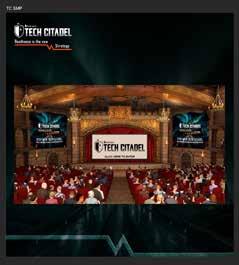
Redington launched Tech Citadel by Redington across global markets – a large-scale digital platform and ecosystem initiative designed to help channel partners navigate change, build resilience, and unlock new opportunities in an increasingly complex technology landscape.
Designed as an immersive digital experience, Tech Citadel combines live engagement, interactive environments, networking, and gamified participation into one connected ecosystem, enabling channel partners to engage with technology brands, explore industry conversations, and discover
new business opportunities even amidst evolving market conditions and uncertainty.
Launched on 13th May 2026, Tech Citadel was an overwhelming success, bringing together more than 2,000 attendees from across multiple markets – India, Middle East, Africa, Turkey, South Asia – and generating strong engagement across the partner ecosystem. The platform saw active participation from channel partners through networking, ecosystem conversations, and deal registration opportunities, creating meaningful business momentum beyond the event itself. With ongoing collaboration and ecosystem-driven initiatives planned over the coming months, Tech Citadel is set to continue extending partner engagement well beyond the launch experience.
Built around the idea of helping partners move forward with momentum, Tech Citadel focuses on some of the most important conversations shaping the industry today, including AI, cybersecurity, cloud, infrastructure, digital transformation, and the evolving demands of the modern enterprise, while helping organisations stay prepared, resilient, and ready for what’s next.
NTT DATA and Nutanix have established a strategic partnership to accelerate hybrid multicloud adoption, infrastructure modernisation and AI readiness in Middle East and Africa (MEA).
Across MEA, organisations are increasingly prioritising infrastructure that can support long term innovation. Hybrid cloud, AI and data sovereignty are no longer isolated trends, but interconnected pillars shaping the future of enterprise technology. NTT DATA and Nutanix work together to combine their expertise in systems

integration and cutting-edge cloud software to help businesses modernise their infrastructure with confidence.
The collaboration also supports the adoption of AI by enabling organisations
The platform also featured insights from global guest speakers including Nenad Pacek, Founder and President of EMEA Business Group, who shared perspectives on geopolitical and economic shifts shaping global markets, and Sheena Wee, Principal Analyst | Channels Analysis APAC at Omdia, who spoke about resilience, ecosystem collaboration, and how partners can adapt to a rapidly evolving technology landscape.
Following the platform’s leadership sessions and ecosystem conversations, partners are now taking the next step through the Deal Registration portal, translating insights into real business opportunities. Over the next three months, Tech Citadel will continue driving engagement, collaboration, and partner momentum across the ecosystem, culminating in Redington’s Tech Ventures incentive programme, where top-performing partners will earn an exclusive experience in Bali.
With participation from leading global technology vendors and thousands of partners across multiple markets, Tech Citadel reinforced Redington’s commitment to enabling innovation, ecosystem growth, and long-term partner success across global markets.
to deploy and test workloads in secure, private environments, helping address concerns around cost, control and compliance.
The relationship aligns with NTT DATA’s broader growth strategy in MEA, enhancing its full-stack offering and expanding its position in large enterprises across the region.
By working together, NTT DATA and Nutanix are reinforcing a collaborative approach to infrastructure modernisation, NTT DATA continues to position itself at the centre of this transformation, supporting organisations as they modernise with confidence, scale efficiently and realise greater value from their digital investments.

The UAE has established the Artificial Intelligence and Data Authority, a new federal entity tasked with overseeing the country’s artificial intelligence, data and digital government agenda.
The authority was approved by His Highness Sheikh Mohammed bin Rashid Al Maktoum, Vice President and Prime Minister of the UAE and Ruler of Dubai, and will operate under
the leadership of Omar Sultan Al Olama, Minister of State for Artificial Intelligence, Digital Economy and Remote Work Applications.
According to the announcement, the authority will be responsible for developing policies, strategies and legislation related to artificial intelligence, data and digital government. It will also oversee

Cloudflare has acquired VoidZero, the open-source company behind the widely used JavaScript toolchain anchored by Vite, marking a significant move to integrate modern web development tooling directly into its global developer platform. VoidZero’s ecosystem includes Vite, Vitest, the Rust-based Rolldown
bundler, and the Oxc toolchain, which together have become a highperformance foundation for web application development, with Vite alone seeing over 130 million weekly downloads.
The acquisition brings VoidZero’s team—led by Vite creator Evan You—
the governance and management of government data, support the integration of digital services across federal entities and contribute to efforts aimed at enhancing government efficiency and service delivery.
The move forms part of the UAE’s broader efforts to strengthen its digital infrastructure and expand the use of advanced technologies across government operations.
The authority will work alongside federal and local government entities to support the implementation of AI and digital government initiatives, while helping to ensure the effective use of data in policymaking and public services.
The announcement comes as the UAE continues to invest in artificial intelligence, digital transformation and data-driven government services as part of its long-term economic and development strategy.
into Cloudflare’s Emerging Technology and Incubation group. The focus will be on deep integration between VoidZero’s tooling and Cloudflare Workers, enabling a seamless workflow from local development to global deployment on Cloudflare’s edge network.
Cloudflare plans to unify the development lifecycle through a tighter Vite-based deployment experience, allowing developers and AI coding agents to move from idea to production with minimal friction. A key ambition is “intent-based infrastructure,” where applications can automatically provision required Cloudflare services such as databases (D1) or object storage (R2) directly from code.
Despite the acquisition, Cloudflare has committed to maintaining Vite, Vitest, Rolldown, and Oxc as opensource, vendor-neutral projects under MIT licenses, and will establish a $1 million fund to support the broader Vite ecosystem.
DXC Technology has launched DXC Engineering, a new specialised service line within its Consulting & Engineering Services (CES) business, aimed at strengthening its position in high-complexity, missioncritical engineering and AI-enabled systems development.
Built on the 20-year digital engineering legacy of Luxoft, which DXC acquired in 2019, DXC Engineering brings together more than 11,000 engineers delivering largescale transformation and product engineering across industries including financial services, automotive, manufacturing, telecommunications, and energy.
The company said the new organisation is designed to unify three core capabilities: deep industry domain expertise, a specialised AI and technology partner ecosystem, and Physical AI-enabled intelligent product design—a capability focused on integrating software, hardware, and AI into real-world operational environments.
According to DXC, the goal is to eliminate the traditional separation between industry knowledge and engineering execution, enabling clients to work with a single partner across the full lifecycle of complex systems. The offering spans solutions such as trading risk engines for financial markets, autonomous driving software stacks, and realtime telecom network platforms designed for large-scale resilience and performance.
A key pillar of DXC Engineering is its partner ecosystem, which spans silicon and AI compute providers, enterprise platform vendors such as Murex and Temenos, and

emerging technology startups. DXC positions itself as an integration layer that combines these capabilities into end-to-end enterprise solutions with bespoke engineering support.
The company is also advancing its focus on Physical AI, where AI is embedded into physical systems and industrial environments. This includes applications in autonomous vehicles, smart manufacturing, telecom infrastructure, and operational analytics, often in collaboration with technology partners such as NVIDIA.
DXC highlighted its existing scale across industries, including serving 17 of the world’s top 20 banks, supporting software in over 50 million vehicles, and delivering more than 3,000 projects across 150+ clients in multiple sectors. The Engineering unit operates across 29+ countries and 51 delivery sites, reinforcing DXC’s global delivery footprint.
With DXC Engineering, the company is positioning itself as a key player in the next phase of AI-driven industrial transformation, where software, data, and physical systems increasingly converge into unified intelligent platforms.
Cisco has launched Cloud Control, a unified platform built for the agentic AI era, bringing networking, security, compute, observability, and collaboration into a single interface for both humans and AI agents. The platform enables organisations to manage infrastructure at machine speed through autonomous agents that

Jeetu Patel, President and Chief Product Officer, Cisco
can detect, fix, and validate IT issues in real time, while keeping humans in control. It also introduces tools like AI Canvas and Cloud Control Studio for building custom agents, integrates with ecosystems such as AWS and ServiceNow, and embeds real-time security and automation across operations.
Cisco is positioning it as the foundation of its AgenticOps model, with broader rollout planned for 2026.

As part of the recently announced major global expansion of NVIDIA’s DRIVE Hyperion robotaxiready platform ecosystem, HUMAIN will be leading the platform’s entry into the Middle East.
The global expansion, which brings together leading automakers, manufacturing and autonomous vehicle (AV) software ecosystem partners, and ride-hailing mobility providers to build and expand Level 4-ready robotaxi fleets across Asia, Europe, and the Middle East, will see HUMAIN leverage its AI and mobility
ecosystem alongside NVIDIA’s DRIVE Hyperion to support the development and deployment of Level 4-ready autonomous transportation solutions in Saudi Arabia and across the region.
The partnership is underpinned by significant infrastructure investment, with HUMAIN planning to build AI factories with a projected capacity of up to 500 megawatts and deploy several hundred thousand NVIDIA GPUs over the next five years. An initial phase featuring an 18,000GPU NVIDIA GB300 Grace Blackwell supercomputer
and InfiniBand networking is already underway, establishing the sovereign compute foundation needed to support autonomous vehicle training, simulation, and fleet validation at scale.
NVIDIA is the only company offering a Level 4-ready platform that enables the global automotive industry to build and scale robotaxi and AV fleets. Built on the NVIDIA Halos full-stack safety system for physical AI, NVIDIA’s DRIVE Hyperion combines high-performance NVIDIA DRIVE AGX in-vehicle compute and NVIDIA Halos OS — the
software foundation of Halos, built on the safetycertified NVIDIA DRIVE OS operating system — with a compatible multimodal sensor suite and NVIDIA DRIVE AV software purpose-built for highly automated and autonomous driving capabilities.
As NVIDIA continues to scale its collaboration with automakers, tier 1 suppliers and mobility providers across the Middle East and beyond, HUMAIN’s participation marks a defining step in Saudi Arabia’s journey toward becoming a global leader in AI-driven transportation infrastructure.

Censys announced a partnership with EVAD to expand availability of the Censys Platform across the Middle East and Africa. Through the partnership, organisations in key regional markets, including the UAE, Saudi Arabia, Egypt, Kuwait, Qatar, and Bahrain, will be able to access Censys through EVAD’s
established partner ecosystem, regional technical expertise, and inmarket commercial support. EVAD will support customers and partners from evaluation through deployment, helping security teams adopt Internet intelligence as a foundation for stronger exposure management and security operations.
The Censys Platform brings Censys’ Internet intelligence into the security tools and workflows teams already use, enriching SOC operations with the data needed to triage, investigate, hunt, and defend more effectively. By providing continuously updated intelligence on Internet infrastructure, exposures, and threat context, Censys helps security teams make faster, better-informed decisions across detection, investigation, and response. For organisations across MEA, this capability is becoming increasingly important as digital environments expand across cloud environments, subsidiaries, third parties, remote services, and critical systems.
Censys integrates with widely adopted security tools and workflows, including Splunk, Microsoft Sentinel, CrowdStrike, and ServiceNow, helping organisations operationalise Internet intelligence across existing SOC, vulnerability management, and incident response processes. Together, Censys and EVAD will help accelerate adoption of intelligence-led security operations across a region with growing demand for stronger external visibility, faster investigation, and more effective exposure management.
AVEVA has partnered with Snowflake to create a zerocopy integration between its CONNECT industrial intelligence platform and Snowflake’s AI Data Cloud, enabling seamless access to industrial and enterprise data without complex data pipelines. The collaboration shifts organisations from traditional data movement models to a modern data-sharing approach that simplifies integration, reduces technical debt, and accelerates industrial AI adoption.
The integration unifies IT and OT data into a governed enterprise foundation, leveraging Snowflake’s security and compliance features such as dynamic masking and fine-grained access controls. It also enables AI-driven use cases via Snowflake Cortex AI, allowing intelligent agents to optimise operations, predict failures, and support decision-making within a controlled human oversight framework.

Turn fragmented data into decisive action. Our SIEM eliminates blind spots, providing the real-time insights you need to detect, investigate, and neutralize threats before they disrupt your operations.
Spot ransomware, phishing, and insider threats instantly.
Stay compliant
Automate audit logs for GDPR, HIPAA, and PCI DSS.

Respond Faster
Automate incident response to slash recovery times.
Unify Everything
One view for cloud, on-prem, and remote teams.

As market disruption, shifting customer consumption models, and expanding direct-to-market strategies reshape the ICT landscape, vendors and partners across the Middle East, Türkiye, and Africa are being pushed into deeper alignment. Channel leaders share how expectations are evolving beyond incentives, why trust is becoming the new currency, and what will define resilient ecosystems in the years ahead

Tolga Özdil Regional Commercial Director, META, ASUS

Tolga Özdil highlights that disruption is now a constant condition rather than an exception, and partners increasingly expect vendors to act as operational enablers rather than transactional suppliers. While traditional incentives and rebates still play a role, they are no longer sufficient on their own.
At a practical level, partners want frictionless deal support—fast quotation handling, smooth deal registration, and stronger protection for active opportunities. As market volatility pushes costs upward, price protection mechanisms and predictable commercial terms are becoming essential. Equally important is direct and responsive communication from vendors, particularly when escalation or deal intervention is required.
From a distribution perspective, extended credit terms and stock availability remain critical concerns, especially in fast-moving markets. Özdil also stresses the importance of enablement as a differentiator. Training, workshops, and engagement programmes—particularly those tied to incentives—help strengthen partner capability and motivation.
He notes that in the META region, competitive pricing and inventory readiness are decisive factors in winning deals. Partners increasingly expect vendors to contribute value directly into proposals, whether through technical positioning, bundled offerings, or supporting sales execution. Beyond transactions, relationship-building activities such as training trips and partner engagement events continue to play a role in reinforcing loyalty and alignment.
Ultimately, Özdil positions the vendor–partner relationship as one that must remain commercially responsive, operationally agile, and consistently supportive throughout shifting market conditions.
Director of Partner Ecosystem,
Maya Zakhour emphasises that in disrupted markets, partners are looking for stability and clarity more than anything else. Incentives matter, but trust and continuity are what truly define vendor preference. Partners want early engagement in the conversation—visibility into product direction and clarity on how to position solutions with customers.
She stresses that partners want assurance that vendors will remain present even when market conditions deteriorate.

At BeyondTrust, this translates into a commitment to long-term partnership through complexity, evolving requirements, and changing customer environments.
A key theme in her response is simplification through platform strategy. Rather than fragmented portfolios, a unified approach enables partners to build deeper expertise and scale more effectively. This strengthens their ability to
Channel Leader, South & East EMEA, BMC Helix
Pablo Legarda frames disruption as a shift from transactional partnerships to strategic growth alliances. From a BMC Helix perspective, partners expect predictability, faster innovation cycles, and operational excellence from vendors.
He highlights the growing importance of enabling partners around AI, AIOps, observability, automation, and service management use cases. These capabilities are now essential for helping customers achieve resilience and efficiency in complex IT environments. Vendors are expected to actively collaborate on go-to-market strategies, provide pipeline visibility, and support flexible commercial structures.
have coherent customer conversations and develop resilient practices.
On shifting buying models, Zakhour notes that managed services are fundamentally reshaping the channel. Customers increasingly demand security delivered as an ongoing outcome rather than a one-off product sale. Identity security, in particular, is becoming central to this shift due to expanding threat landscapes and regulatory pressure.
She highlights the importance of actionable insights, pointing to Identity Security Insights as a tool that helps partners engage customers with evidencebased conversations around risk. This strengthens credibility and creates a natural pathway into broader platform adoption.
Across all areas, her message is consistent: partners want vendors who provide clarity, continuity, and meaningful differentiation that enables them to grow sustainably rather than depend on transactional opportunities.

of results—not just implementation.
Legarda stresses that vendors must support recurring revenue models and lifecycle engagement, while embedding AI-driven innovation into their offerings. This creates deeper alignment across hybrid cloud and digital operations environments.
On channel conflict, he emphasises that trust depends on transparency and clearly defined engagement models. Partners need assurance that their investments are protected through rules of engagement, account planning, and structured opportunity management.
He also notes that hyperscaler ecosystems should be viewed as collaborative rather than competitive, with partners remaining central to implementation, managed services, and ongoing optimisation.
Customer behaviour is also evolving, with organisations prioritising outcomes over upfront technology purchases. This shift places partners in the role of transformation advisors responsible for optimisation, adoption, and delivery
Looking ahead, resilience will be defined by agility, accountability, and co-innovation, with both vendors and partners needing to adapt to consumption-based pricing and outcome-driven delivery models.
Paul Flannery focuses on simplicity and consistency as the core expectations from partners during disruption. Beyond incentives, partners want clear direction, strong enablement, and reliable support in market execution.
He underscores the shift from transactional sales to long-term customer relationships, where success is measured across the lifecycle rather than at the point of sale. This naturally demands tighter alignment between vendors, partners, and customer outcomes.
In this evolving model, roles are becoming more clearly defined and complementary. Vendors and partners must work as a unified ecosystem focused on sustained value creation rather than isolated transactions.
Sujoy Banerjee
Regional Business Director, ManageEngine VP Channel Sales, International, Epicor

of governance and transparency. Fair deal registration and consistent rules of engagement are critical to maintaining trust. Equally important is avoiding surprises in how opportunities are handled.
He reinforces that partners bring essential capabilities that vendors cannot replicate alone—particularly in customer intimacy, domain expertise, and execution depth. Vendors that recognise and support this role are more likely to build durable relationships.
On channel conflict, Flannery stresses the importance
Looking ahead, resilience will depend on adaptability and shared purpose. Vendors must continue investing in cloud, security, and data foundations, while simplifying engagement models. Partners, meanwhile, must evolve their service offerings and capabilities to stay relevant in a subscriptiondriven economy.
Sujoy Banerjee highlights that partners are increasingly prioritising stability, transparency, and faster collaboration over purely financial incentives. In volatile markets, they expect vendors to act as true business enablers, not just technology providers.
He points to the need for quicker decisionmaking, stronger technical enablement, and localised support structures. Joint go-to-market planning is also becoming essential as partners take on a more advisory role in customer engagements.

A key shift he identifies is the transition from reselling to managed services and lifecycle-based engagement. Partners are now expected to guide customers through hybrid IT environments and subscription-led
consumption models, focusing on long-term value rather than one-time deals.
For vendors, this means building stronger alignment with partners across customer success and lifecycle management. It also requires enabling partners to develop recurring revenue streams instead of relying on transactional sales.
On channel conflict, Banerjee emphasises clarity and structured engagement. Clear rules of engagement and transparent deal registration processes are essential to avoid friction, particularly as vendors expand direct and hyperscaler-led motions. Looking ahead, he believes resilience will come from adaptability and continuous innovation. Both vendors and partners must invest in AI, cybersecurity, cloud management, and customer experience capabilities. Upskilling will be critical as conversations become more strategic and outcome-driven.
Business Unit Manager, Mindware
Fahad Chinoy emphasises that in uncertain markets, partners seek stability, responsiveness, and commercial flexibility. Incentives alone are no longer sufficient; partners expect vendors to actively support them through shifting market conditions.
He highlights the importance of clear communication, faster decision-making, and adaptability in commercial structures such as credit terms, targets, and payment cycles. Just as important is consistent engagement and problem-solving collaboration.

Partners are also looking for stronger enablement in emerging technologies and better access to technical resources. Vendors are expected to support go-to-market execution and provide visibility into evolving customer demand.
On customer buying models, he notes a clear shift toward
Sr.
Manager
recurring revenue and lifecycle engagement. Partners are becoming responsible for ongoing adoption, optimisation, and customer success, rather than just initial sales.
This transition requires vendors to rethink incentive structures and invest more in services capability and consultative selling enablement. The relationship is becoming more interdependent, with shared accountability across the customer lifecycle.
On channel conflict, Chinoy stresses the importance of clear roles, transparent deal registration, and strong governance frameworks. Vendors must ensure that partners see themselves as a core part of the goto-market strategy rather than an optional layer.
Looking ahead, resilience will depend on shared accountability, adaptability, and continuous innovation focused on customer outcomes.
Channel Sales & Alliances, GCC, Riverbed
Ghassan Abou Rjeily highlights that during disruption, partners prioritise stability, transparency, and visible vendor engagement. Financial flexibility becomes increasingly important as project complexity and pipeline risk grow.
He emphasises that partners value vendors who actively participate alongside them in customer engagements. Joint visibility in strategy discussions, technical workshops, and execution builds confidence and reinforces long-term commitment.

Clear deal registration and opportunity protection remain central to maintaining trust. Without transparency, partners are less willing to invest in pipeline development during uncertain periods.
On evolving buying models, he notes that relationships are becoming more strategic and lifecycle-driven. Partners
are shifting into advisory roles, supporting architecture, integration, and ongoing optimisation.
Recurring revenue models create greater predictability and open opportunities for expansion through upselling and cross-selling. Vendors must therefore provide stronger technical enablement, flexible pricing, and deeper collaboration across the customer lifecycle.
On channel conflict, he reinforces the importance of defined rules of engagement and predictable partner protection frameworks. Vendors must demonstrate consistently that partners are a long-term route to market.
Looking ahead, resilience will depend on ecosystem collaboration across increasingly complex environments, including multi-cloud, AI, and cybersecurity-driven architectures. Simplified engagement models and automation will be key to reducing friction and accelerating outcomes.
Ezzeldin Hussein positions partners as strategic growth enablers in an AI-driven disruption cycle. Beyond incentives, partners want predictability, faster enablement, and actionable innovation they can take directly to customers.
He highlights the importance of AI-based security, automation, and outcomedriven platforms that help partners differentiate in crowded markets. Trust and long-term investment from vendors are central to building resilient relationships.
Customer buying behaviour is shifting toward consumption-based models and managed services, particularly in cybersecurity. This is transforming partners into lifecycle-focused advisors responsible for architecture, integration, and continuous optimisation. For vendors, this requires providing intuitive platforms

that support automation and hybrid environments while enabling partners to build recurring revenue streams.
On channel conflict, Hussein stresses transparency around account ownership, engagement rules, and value distribution. Partners must remain central to customer success across implementation and operations.
He also notes that hyperscaler ecosystems should be seen as complementary growth drivers rather than competitive threats. Partners remain essential for governance, compliance, and local expertise. Looking forward, resilience will depend on AI readiness, adaptability, and shared outcomes. Vendors and partners must invest in enablement, simplify engagement models, and co-create value in an increasingly automated digital environment.
Samih Moussly
Area VP Global Partnerships & Channels, EMEA South, ServiceNow
Samih Moussly argues that partners in disrupted markets first and foremost want to be heard. Pressure from AIdriven delivery models, shifting economics, and regional constraints is reshaping partner expectations fundamentally.
He notes that vendors must understand the impact of these shifts on partner profitability and adapt accordingly. In MEA, longer payment cycles, regulatory complexity, and geopolitical volatility add further strain.

A key message is focus. Generalist partners are becoming less viable, while specialised expertise is increasingly valuable. Vendors must actively help partners define their domain focus and align resources accordingly.
Enablement is another critical pillar. Partners want tools that genuinely improve capability and reduce time-to-value, not just certification programmes. Speed across the lifecycle—sales, delivery, and outcomes— is essential.
On channel conflict, Moussly emphasises that trust depends on enforcement, not messaging. Rules of engagement must be applied consistently, and overridden deal registrations must be addressed transparently.
He also discusses hyperscaler collaboration models, stressing that they must be additive rather than substitutive. Partners must continue to receive credit and value recognition across all routes to market. Looking ahead, resilience will come from depth over breadth. Vendors must shift to lifecycle-based economics, while partners must specialise, productise services, and embrace AI-driven delivery models to remain competitive.
Afif Hamdan highlights that in advanced infrastructure markets, partners expect upstream access to architectural decisions rather than downstream transactional engagement. In large-scale AI deployments, influence begins long before procurement.
He notes that partners are increasingly required to advise on complex technical domains such as power density, thermal architecture, and long-term TCO. This shifts the vendor role toward co-authoring solutions rather than simply selling products.
Customer buying models are evolving toward capacity and outcome-based consumption. This requires shared financial models, aligned SLAs, and deeper collaboration between vendors and partners across the lifecycle.

must enable this shift through commercial frameworks and shared accountability structures.
On channel conflict, he argues it must be structurally designed out through clear role separation. Vendors lead architectural design, partners handle delivery and operations, and hyperscalers manage consumption layers.
He stresses that trust emerges when each layer understands its value contribution and boundaries. Conflict typically arises when roles overlap without clarity.
Looking ahead, resilience will depend on a designed ecosystem architecture where vendors, partners, and EPCs operate in clearly defined layers. Vendors must focus on design authority, partners on execution capability, and distributors on scale.
Hamdan emphasises that in emerging GPU-as-aService and AI infrastructure environments, partners are becoming operators rather than resellers. Vendors
He concludes that the MEA region’s AI infrastructure boom will reward ecosystems built on interdependence, not loose collaboration.
Kinda Baydoun emphasises that partners are seeking clarity, alignment, and strategic direction in addition to commercial incentives. They want visibility into market evolution and guidance on how to respond effectively to changing demand.
She highlights the importance of helping partners de-risk innovation as organisations accelerate cloud, AI, and complex hybrid adoption. Vendors must ensure that solutions are secure, resilient, and scalable.

The partner role is increasingly shifting toward full lifecycle engagement, covering adoption, optimisation, and ongoing value delivery. This requires vendors to support recurring revenue models and stronger integration across environments.
On channel conflict, she stresses transparency and clearly defined value positioning. Partners need assurance that their role in customer engagement is consistent and respected.
She notes that hyperscaler expansion must reinforce rather than replace partner value, ensuring that success is shared across the ecosystem.
Looking ahead, resilience will depend on alignment around outcomes, strong data foundations, and adaptability. Vendors must invest more in enablement and flexible engagement models, while partners must deepen capabilities in AI, security, and data management.
Ultimately, she concludes that future channel success will be defined not by scale alone, but by the ability to consistently deliver trusted, outcome-driven value in a rapidly evolving market.

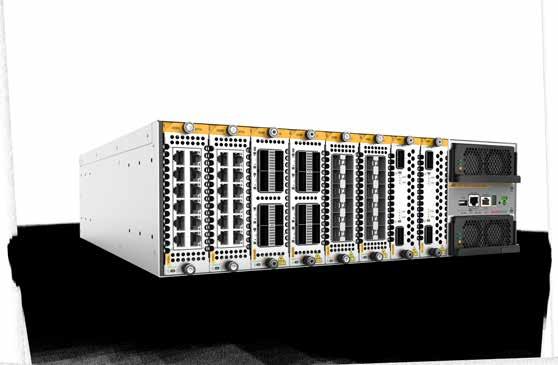
The SwitchBlade x908 GEN3 is our most advanced modular switch, delivering blazing speed and scalable growth for future-ready enterprise and data center networks.
Blazing Bandwidth: Up to 400G connectivity for high-performance workloads.
Scale Without Limits: 12.8 Tbps of power in a compact 3U chassis.
Flexible & Modular: Compact chassis with versatile interface options.
Smart Management: Zero-touch provisioning and centralized control with AlliedWare Plus™.
Whether you’re scaling a data center or optimizing enterprise networks, the SwitchBlade x908 GEN3 keeps your network fast, flexible, and fail-proof.
Take control. Stay ahead. Transform your network today.

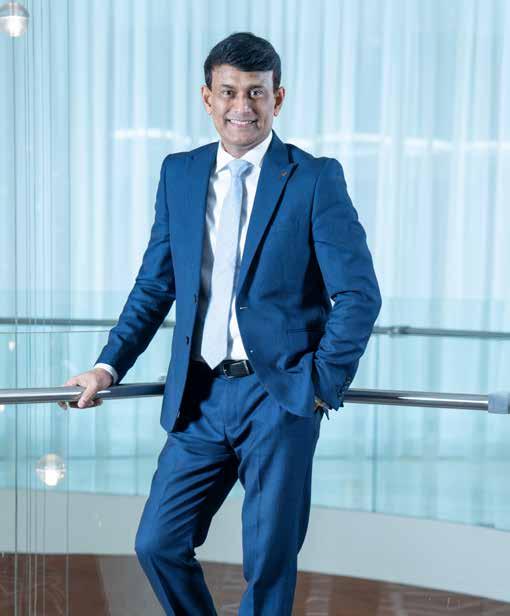
Sakkeer Hussain, Director of Sales and Marketing, D-Link Middle East on navigating uncertainty, the Wi-Fi 7 revolution, and why intelligent networking is no longer optional for businesses across the region

The conversation around networking has changed. What was once a background function, a means to connect devices and move data, has quietly become the single most critical layer of modern business infrastructure. Every cloud workload, every AI application, every digital service depends on it. And in a region where digital transformation is accelerating at a pace few markets can match, the quality of that foundation has never mattered more.
For D-Link Middle East, this shift is not a challenge to navigate, it is an opportunity to lead. With over two decades of presence in the region and a portfolio that has evolved far beyond its consumer networking roots, the company is positioning itself at the intersection of connectivity, intelligence, and accessibility. At the helm of that commercial push is Sakkeer Hussain, Director of Sales and Marketing, whose view of the market is both grounded and forward-looking.
Resilience in uncertainty
The Middle East is no stranger to volatility. Economic headwinds, geopolitical shifts, and fluctuating energy revenues have tested businesses across every sector. For technology vendors, the pressure to demonstrate clear return on investment has intensified. Yet Hussain sees the current environment less as a constraint and more as a clarifying force.

D-Link is expanding its portfolio with AI-driven solutions such as Aquila Pro AI, advanced Wi-Fi 7 connectivity, and cloud-managed platforms”
“The Middle East continues to present strong opportunities despite ongoing economic and geopolitical shifts,” he says. “D-Link is focusing on resilience through a balanced portfolio of SMB and enterprise-ready networking solutions. By combining innovation with market responsiveness, we help both businesses and consumers stay connected and prepared for the future.”
That balance is deliberate. Rather than pivoting entirely toward high-margin enterprise deals or doubling down on volume-

driven consumer sales, D-Link has maintained a dual focus, ensuring that its portfolio speaks to the full breadth of a market where small businesses and large enterprises often operate within the same supply chain. Hussain points to investment in partner training and enablement as a key part of that strategy, ensuring that the channel is equipped to translate product innovation into practical customer outcomes.
The company’s current flagship technologies, Wi-Fi 7, Aquila Pro AI, Smart Home solutions, D-Lite
Cloud, and intelligent switching, reflect a portfolio built for this moment. Each addresses a different layer of the connectivity stack, but together they form a coherent response to what the regional market is asking for: performance, simplicity, and intelligence.
If there is one theme shaping technology investment across the Middle East right now, it is artificial intelligence. Governments are legislating for it. Enterprises are piloting it. And the
channel is being asked to support deployments that would have seemed ambitious just three years ago. What is less discussed, but equally important, is what makes all of this possible: the network underneath.
Hussain is direct about D-Link’s role in this ecosystem. “As AI, cloud, and digital services become central to business operations, reliable networking has never been more important,” he says. “D-Link is expanding its portfolio with AIdriven solutions such as Aquila Pro AI, advanced Wi-Fi 7 connectivity,
and cloud-managed platforms. Our focus is on delivering intelligent, scalable, and easy-to-manage networks that support businesses of all sizes.”
Aquila Pro AI represents D-Link’s most visible step into AI-enhanced networking. By embedding intelligence directly into the access point, it enables networks to self-optimise, adjusting to traffic patterns, minimising interference, and improving performance without requiring manual intervention. For businesses operating with lean IT teams, that kind of automation is not a luxury. It is a necessity.
Wi-Fi 7, meanwhile, is not simply the next generation of wireless connectivity. It represents a fundamental shift in what wireless networks can deliver, higher throughput, lower latency, and the ability to handle the density of connected devices that modern workplaces and public spaces demand. Hussain sees its adoption as a marker of broader digital maturity across the region, and D-Link’s early positioning in the WiFi 7 market reflects a calculated bet that demand will accelerate quickly.
Cloud and AI: From pilot to standard
The trajectory of cloud-managed and AI-driven networking in the Middle East is moving in one direction. What began as an advanced option for early adopters is becoming the baseline expectation for organisations undergoing digital transformation. Hussain sees this shift as both inevitable and necessary.
“Cloud-managed and AIdriven networking are key pillars of D-Link’s long-term strategy in the region,” he says. “Solutions like D-Lite Cloud and Aquila Pro AI enable smarter network management, predictive optimisation, and reduced operational complexity. As organisations continue to modernise, we see intelligent cloud networking becoming the standard rather than the exception.”
The economics support this view. Reducing the overhead associated with network management, whether through automation, remote monitoring, or predictive maintenance, frees IT teams to focus on higher-value priorities. For organisations under pressure to do more with constrained budgets, that efficiency dividend is a compelling argument.
D-Link built much of its regional reputation on serving small and medium-sized businesses, and that segment remains central to its strategy. But the SMB of 2026 looks very different from its predecessor. Cloud adoption, remote work, and the proliferation of connected devices have raised the complexity of what these organisations need to manage, even as their IT resources have remained lean.
“Today’s SMBs are looking for solutions that are secure, scalable, easy to manage, and cost-effective,” Hussain notes. “They increasingly want enterprise-grade performance without the complexity of traditional IT infrastructure.”
D-Link’s response has been to bring simplicity to sophistication. The D-Lite Cloud platform exemplifies this approach, offering cloud-managed networking that removes the need for on-premise management infrastructure while giving IT teams centralised visibility and control. For a business managing multiple sites or a growing number of remote users, the ability to monitor and configure the entire network from a single dashboard is a significant operational gain.
Hussain is careful to note that product innovation alone is not sufficient. “We continue to support our partners with training and practical workshops to help SMB customers adopt new technologies confidently.” Technology adoption in the SMB segment is often slowed not by cost or availability, but by a lack of understanding. Closing that gap is as much a people challenge as a product one.
A channel built for value D-Link’s go-to-market model in the Middle East has always been channel-led, and that remains unchanged. What has evolved is the nature of the relationship. The transactional dynamic that characterised much of the industry’s earlier growth phase has given way to something more collaborative, a model in which distributors and resellers are treated less as delivery mechanisms and more as strategic extensions of the business.
“Our channel strategy has evolved from a transactional model to a more collaborative and value-driven approach,” Hussain explains. “Over the past year, we have expanded partner training programmes, technical workshops, and solution-focused enablement initiatives to keep partners ahead of emerging technologies.”
This investment reflects a broader truth about the channel in 2026: partners who cannot speak to the business outcomes of the technology they sell are losing ground to those who can. D-Link’s enablement programmes are designed to close that gap, giving resellers and distributors the technical depth and commercial confidence to position solutions effectively in an increasingly competitive market.
Looking further ahead, Hussain is clear about where he sees the most significant growth opportunities for D-Link and its partners. Next-generation connectivity, smart environments, and cloudmanaged infrastructure all feature prominently, but the specific verticals are equally telling.
“Wi-Fi 7 will play a major role in supporting higher-performance applications across homes, SMBs, hospitality, education, and retail sectors,” he says. “IoT adoption will continue to drive demand for reliable and scalable network foundations. These trends create opportunities for partners to deliver integrated solutions
that combine connectivity, management, and security.”
For the Middle East, the hospitality and education sectors are particularly relevant. The region’s hospitality sector, driven by a sustained push toward tourism diversification, demands seamless, high-density wireless connectivity across properties of increasing scale and complexity. Education, meanwhile, is undergoing its own digital overhaul, with institutions investing in connected campus infrastructure to support hybrid learning and next-generation teaching models.
While the oppotunities are significant, organisations must also contend with tighter budgets and increased scrutiny. Hussain says, “Our goal is to make advanced networking technologies accessible without compromising performance or reliability. Solutions like D-Lite Cloud help reduce operational costs while simplifying network management. This approach allows organisations to modernise their infrastructure while maximising the value of their technology investments.”
Over the past year, we have expanded partner training programmes, technical workshops, and solutionfocused enablement initiatives to keep partners ahead of emerging technologies”
As D-Link Middle East looks toward the next twelve months, Hussain’s priorities reflect both continuity and ambition. Innovation and partner development remain at the core, but the emphasis on specific growth segments signals a sharpening of focus.
“Small and medium-sized businesses remain a major focus as they accelerate digital adoption and cloud migration,” he says. “We also see strong opportunities in smart homes, hospitality, education, retail, and managed services, where reliable and intelligent networking continues to be a critical enabler of growth.”
The managed services angle is particularly significant. As more
businesses seek to outsource network management rather than build internal capability, the opportunity for channel partners to move up the value chain, from product resale to ongoing service delivery, is growing. D-Link’s cloud-managed portfolio is well-positioned to support that transition.
In a region defined by ambition, D-Link Middle East is making a straightforward but important argument: that the infrastructure enabling every bold digital initiative must itself be intelligent, resilient, and ready for what comes next. On the evidence of its current trajectory, that argument is landing.
Industry leaders explore how the convergence of systems integrators and MSSPs is reshaping the cybersecurity channel, driving continuous security operations, recurring services, and greater resilience for customers across the region
As customer expectations evolve and the threat landscape intensifies, the traditional boundaries between systems integrators and managed security service providers are dissolving. The cybersecurity channel is converging around continuous operations, recurring services, and operational resilience, and the implications for partners, vendors, and customers across the region are profound.
The wall comes down For years, the cybersecurity channel operated along a clear division of labour. Systems integrators built and deployed
infrastructure. MSSPs monitored and managed it. Each had a defined lane, and the model worked, until it didn’t. Today, that separation is eroding rapidly. According to Ziad Nasr, General Manager at Acronis Middle East, the shift is being driven by a fundamental change in what customers expect. “A few years ago, many projects ended once the technology was deployed. Today, customers expect continuous protection, monitoring, recovery, and operational support after deployment.”
This shift is not happening in isolation; it is being reinforced by the growing
complexity of enterprise IT environments across the region. Ranjith Kaippada, Managing Director at Cloud Box Technologies, points to the complexity of modern infrastructure as a key accelerator. “Enterprises have started disassociating themselves from static infrastructures and moving towards hybrid, multi-cloud, remote, or AI-enabled ecosystems that demand round-the-clock security protection.” In that environment, customers want both functions, build and operate, from a single partner.
Meriam ElOuazzani, Vice President for Middle East, Turkey and Africa at Censys, puts it plainly: “In the past decade, customers stopped caring about the distinction. They don’t want a firm that builds the architecture and another that monitors it at 2 AM. They want someone accountable for both.”
The talent crunch has amplified this pressure. When organisations, particularly regional banks or government ministries across the Gulf, cannot hire and retain a full in-house security operations team, they turn to a single partner capable of designing, integrating,
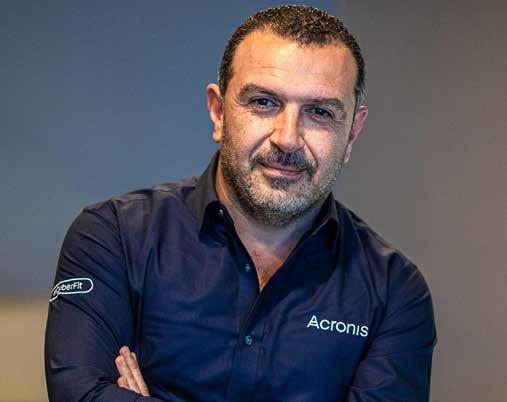
Customers want visibility, detection, incident response, recovery, and guidance around operational risk, all working together as part of an ongoing service model”
Ziad Nasr
and operating. SIs recognised that demand and moved toward managed services. MSSPs, confronted with increasingly complex environments, began acquiring integration capability. The market, as ElOuazzani observes, followed the client’s pain.
The convergence is not merely structural, it reflects a deeper renegotiation of what customers expect from their security partners. The conversation has shifted from outsourcing functions to owning outcomes, and that distinction carries significant weight.
Nasr describes the change succinctly: “It is no longer enough to implement endpoint protection or deploy backup infrastructure. Customers want visibility, detection, incident response, recovery, and guidance around operational risk, all working together as part of an ongoing service model.”
Kaippada echoes this, noting that customers no longer view cybersecurity as a one-off IT
Customers are constantly on the lookout for partners that can provide end-to-end services, from designing to implementing to managing”
project. “The industry suggests that the growing sophistication of attacks could ultimately lead to system downtime or data breach, which is catastrophic.” In response, customers are demanding fewer vendors, unified dashboards, predictable subscription pricing, and SLAs tied to business outcomes
rather than technical metrics.
ElOuazzani points to a harder dimension: accountability. “When third-party involvement in breaches doubled in a single year, boards stopped treating managed security as a cost line and started treating it as a liability question,” she says. Partners who cannot demonstrate continuous visibility, not periodic reporting, are losing the conversation before it begins. “Customers no longer accept the rhythm of weekly reports and monthly reviews instead they want partners who operate at the speed of their adversaries,” adds ElOuazzani.
Across the Middle East specifically, this dynamic is intensified by the scale of the resource gap. As Nasr notes, many organisations are dealing with limited in-house security expertise while operating increasingly complex environments, driving demand for managed services that simplify operations and reduce response times without adding internal overhead. The expectation, he says, is no longer
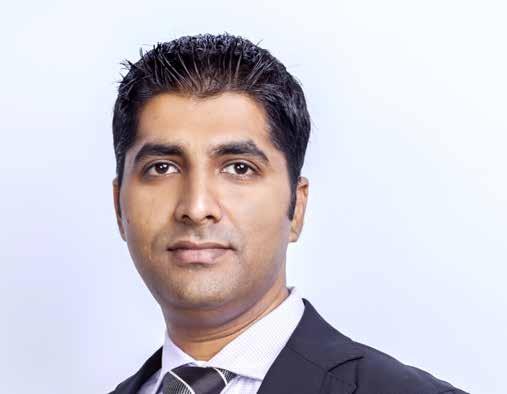
simply “deploy and support”, it is “help us continue operating when something goes wrong.”
Recognising the opportunity and capturing it are two very different things. As partners adapt their models to deliver continuous, recurring security services, they are confronting significant operational and commercial challenges.
For Nasr, the central issue is scale. “Delivering continuous security services requires 24/7 monitoring, skilled personnel, automation, and consistent processes. Building and maintaining those capabilities is difficult, especially as the shortage of cybersecurity talent continues across the region,” he says. Beyond capability gaps, the commercial transition is equally demanding. Moving from project-based revenue to recurring operational services changes how teams are structured, how pricing works, and how customer relationships are managed.
Kaippada highlights the cash flow reality of that transition. “With project-based models, a large upfront revenue stream opens. However, subscriptionbased models require managing services with gradually incoming revenue streams,” he says. Any disruption during this period can create significant losses, while also leaving systems exposed.
Fragmentation adds another layer of complexity. Many partners still manage customer environments with multiple security, backup, and management tools operating independently. Nasr notes that coordinating detection, response, and recovery across disconnected systems creates operational strain and slows response during incidents, making automation and integrated operational models increasingly essential.
ElOuazzani frames the challenge at its sharpest: “Partners often underprice services to win deals, then discover the operational costs
of ongoing delivery don’t leave room to grow. That’s not a pricing problem. That’s an unsustainable business.” She adds that most partners built their teams to implement, not to operate, and that a deployment mindset and a continuous monitoring mindset require different people, different processes, and different accountability structures.
Where the market is heading Looking ahead, the direction of travel is clear, but the destination is more nuanced than full convergence suggests.
Nasr believes the market will continue moving toward integrated operational models, while acknowledging that not every partner will follow the same path. “There will still be organisations that focus primarily on implementation, consulting, or specialised integration work,” he says. What is changing, he argues, is that operational capability is becoming increasingly important across the ecosystem. Even implementation-led partners are being pulled toward ongoing service delivery. Many will address this through co-managed approaches, vendor-supported MDR services, or strategic partnerships rather than building full 24/7 security operations internally.
Kaippada advocates for a hybrid approach. “Customers are constantly on the lookout for partners that can provide end-to-end services, from designing to implementing to managing,” he says. At the same time, he acknowledges that some partners will specialise in areas such as email security or MDR, leveraging deep expertise to serve customers and diversify risk. The future, in his view, is one where SIs and MSSPs work in tandem, underpinned by automation, AI, and unified security ecosystems, with an outcome-driven, servicecentric model at the centre.
ElOuazzani offers perhaps the most candid assessment. “Over

Customers no longer accept the rhythm of weekly reports and monthly reviews instead they want partners who operate at the speed of their adversaries”
Meriam ElOuazzani
the past five years, the boundary between ‘we implement’ and ‘we operate’ has been quietly dissolving, not because vendors pushed it that way, but because the threat environment made the old model
indefensible,” she says. When attackers are moving in under 30 seconds, separating the people who build defences from those who run them becomes a structural problem, not a design choice.
Full convergence, she cautions, is not inevitable everywhere. In this region, trust is built in person, and many organisations still want an implementation partner with deep contextual understanding. “The harder conversation is whether those same partners can sustain operations at the speed that threats now demand. Most cannot do both well,” she explains. What actually wins, she concludes, is clarity about where accountability lies across the seam between implementation and operations. “That’s the honest version of the advice,” adds ElOuazzani.
The great convergence, then, is less a destination than a direction, one that is reshaping the channel, raising the bar for partners, and ultimately redefining what it means to deliver security in an always-on world.


Gregg Petersen, Regional Director for the Middle East, Cohesity, explores cyber readiness, the rising threat of wiper attacks, and why resilience is now the defining measure of a modern enterprise
The conversation around cyber risk has shifted from “if” an attack will happen to “when.” What does that mean for how organisations should be preparing? The numbers speak for themselves. Around 59 percent of UAE organisations have experienced a material cyberattack, and that’s only among those surveyed. The real figure is likely higher. So the question is no longer about whether you’ll be attacked. The question is: how fast can you recover?
When an attack happens, leadership needs to know what their minimum viable company looks like. What does the business need to be up and running within hours? That is where technology like data classification and what we
call a digital jump bag becomes critical, knowing exactly what to bring back first when everything goes down.
I always use the analogy of flying on airlines. Every time you board a flight, you trust that if something goes wrong, the pilot has already simulated that exact scenario. That level of preparation and orchestration is what organisations need to build into their cyber readiness today.
Take Active Directory, over 90 percent of organisations depend on it, and it’s almost always one of the first things attackers target. Through our partnership with Semperis, we’ve helped customers reduce Active Directory recovery time from over six days to under six hours. That’s the kind of outcome the right technology and the right partnerships make possible. And
at the end of the day, faster recovery directly translates to less money lost. This readiness isn’t a box you tick once a year. It needs to be part of the conversation every single day.
There’s often debate about whether to prioritise prevention or resilience and recovery. Where do you stand? I wouldn’t prioritise one over the other, they are equally important. It’s like asking whether the infrastructure team or the security team is more responsible for data protection. The answer is both. Neither can operate without the other. Prevention has been the bread and butter of data protection for years; it’s the insurance policy. But having a backup is no longer enough on its own. The real question today is: how resilient
are you, and how fast can you recover when the worst happens?
We’re also seeing the nature of attacks evolve. Wiper attacks, where bad actors simply delete data rather than encrypt it, are increasingly common. There’s no ransom demand, no negotiation. The data is just gone. That makes recovery capability not just important, but existential.
With backups now becoming a prime target for attackers, how should organisations rethink backup security, vaulted recovery, and clean-room resilience strategies?
Backups are your last line of defence, which is exactly why they’re the first thing attackers go after. We’ve evolved from the 3-2-1 rule — three copies of data, two locations, one off-site — to a 3-2-1-1 model, where the fourth copy is a vaulted version of your data.
We’ve been announced as one of the Google Cloud Partners of the Year because of our ability to vault data. Since February, our most requested product has been Cohesity Fort Knox, which gives customers that critical fourth copy.
The flexibility matters too. Fort Knox can live in hyperscalers, on-premises, or with local managed service providers, which is important given that data sovereignty is still a very real concern in this region.
The other challenge is contamination. If a bad actor is already inside your environment when you take a backup, you’re backing up the threat. You carry it to your DR site, then to your vault and suddenly none of your backups are clean. That’s why the ability to recover from a clean room has become a way of life, not just a best practice.
This is also why we don’t believe you can fight this fight alone. We pull in hundreds of thousands of threat feeds every day from partners like Semperis, Datadog, Google, Amazon, and Microsoft. Those feeds run into our AI model, which is tied directly to our backup process, constantly running anomaly detection to check whether a bad actor has already arrived. Because if you go to recover a backup and the threat is sitting inside it, it’s already too late.
For organisations that believe they already have strong data protection in place, where are the gaps most likely hiding?
Visibility. That’s the most common gap we see. Organisations don’t always know where their data sits, which applications and databases they’re protecting, or what they’d need to bring back first in a crisis.
You’d be surprised how many organisations don’t back up their databases, because they don’t trust legacy backup applications to do it reliably. Cohesity uses a modern single file system, SpanFS, that allows us to perform a live mount directly from the backup, taking database recovery from hours down to minutes or even seconds.
The other thing I’ll say is this: compliance is necessary but not sufficient. Ticking the backup box is no longer good enough. The real questions are: can you actually recover those backups? And how long will it take? With capabilities like instant mass restore, we can recover thousands of machines in under 45 minutes. That is the standard organisations should be holding themselves to.
Governments across the region are tightening their cybersecurity directives. How is that shaping enterprise behaviour?
It’s influencing both enterprises and vendors. You can’t engage with UAE government entities today without certifications. These requirements are raising the bar across the board.
The goal of the UAE government and the National Cybersecurity Council is to make it one of the safest places in the world for data. We’ve got work to do. The UAE is ranked second globally for the number of cyberattacks. But that pressure is building real resilience, and the Council is leading the way.
That push is being felt globally, too. The common thread is this: it’s no longer just about preventing access to personal data. It’s about ensuring you can still recover it if you’re attacked, whether that’s medical records, banking data, or personal information.
For us, this has meant investing heavily in the region: in certifications, yes, but also in people. The

conversations we’re having with customers have shifted completely. Backup speed is not the focus of discussion anymore. It is resilience, clean rooms, anomaly detection, digital jump bags, and recovery orchestration.
What is your advice for businesses looking to strengthen their data protection posture right now?
Don’t wait. Simulate the disaster before it happens. Build the orchestration layer. Simplify wherever you can, complexity has historically been one of ransomware’s greatest allies. The more disparate technologies you have, the more doors you’re trying to protect. Get visibility across all your data through a single pane of glass, and reduce that complexity down to a manageable number of trusted solutions.
One more thing: make sure your infrastructure and security teams are talking to each other. Five years ago, maybe 10 percent of organisations had that alignment. Today it’s closer to 50-60 percent, but it’s still not good enough. When those two teams work together, recovery becomes faster and more reliable.
The threat is coming to everyone, regardless of size. So whether you’re a large enterprise or a small business, reach out to the specialists, get the right partnerships in place, and be ready.


Salah Suleiman, Managing Director – South Gulf, TrendAI, highlights how organisations can secure Agentic AI systems by embedding governance, visibility, and control from the outset to ensure safe, responsible, and scalable AI adoption
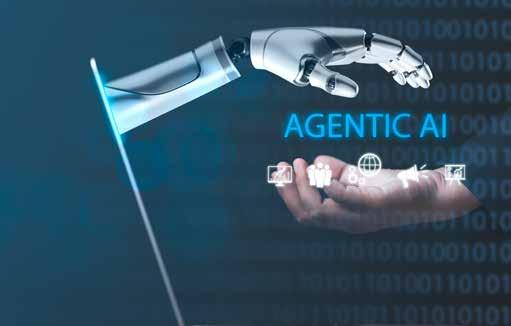
The UAE is moving rapidly toward Agentic AI adoption across government services and key sectors. From a cybersecurity perspective, what does this shift mean for organisations in the region?
AI adoption is one of the most ambitious and transformative initiatives taking place globally today. Governments and organisations are accelerating their AI strategies. Like for example, the UAE government has announced targets of up to 50 percent of business processes incorporating AI by 2028. So, the challenge is no longer whether to adopt AI, but how to adopt it securely and responsibly. Today, governments and enterprises across every sector are integrating AI into their operations, making it a foundational layer of modern business. This is where TrendAI plays a critical role by
not only protecting the underlying infrastructure but also securing the AI agents and agentic AI systems. As adoption accelerates, maintaining the right balance between innovation and security becomes essential.
Why should cybersecurity be treated as a foundational layer of AI adoption rather than a supporting function that comes in later? Why is this distinction so important right now, and where do you still see organisations getting it wrong? Cybersecurity has to be built in from the start, not bolted on later. Think about building an airport: you design the security checks into the airport during the design phase. You don’t construct the whole airport first and then decide where the security checks should go. AI is exactly the same. One of the biggest mistakes some organisations make
is rushing into AI deployment without first establishing the necessary governance, security controls and risk management frameworks. The benefits of AI are significant, but adoption cannot come at the expense of security, privacy, compliance or trust. To have a properly secured AI journey, you need to have a balanced approach from the outset - one that does not compromise the business but builds the right controls in alongside it.
As the UAE accelerates AIled transformation across government and financial services, what are the biggest cyber risks leaders should be preparing for now?
The biggest risk in AI adoption is the lack of a balanced, controlled approach, and at the centre of that is governance and visibility. Organisations need clear policies defining what data AI systems can access, what actions they can perform, and what decisions they are authorised to make. Without that, the risks are real: unauthorised access to sensitive information, poor decisionmaking, compliance violations, security breaches and loss of trust. From a security perspective, our main principles for securing AI, the models and the agents are visibility, intent, control and oversight. The starting point is visibility. Clear visibility into what information AI systems are accessing, how they are accessing it, and how they are making decisions. AI governance is not optional; but a critical foundation for responsible and sustainable AI adoption.

Agentic AI is often described as a fundamentally different security challenge compared to traditional AI or chatbots. What makes autonomous AI systems more complex to secure?
Traditional AI is primarily question-and-answer based. A user asks a question, and the AI provides information or a recommendation based on available data. Agentic AI goes much further. Instead of simply answering questions, it can execute tasks, build complete project plans, generate reports and dashboards, and coordinate actions across multiple systems by interacting with business applications, databases and enterprise platforms to gather information. It further analyse data and take action on behalf of users. The biggest challenge with agentic AI is integration: to deliver real value, the agent has to connect directly and securely with your existing databases, applications and systems. Once those integrations are in place, the question becomes what data the agent can access and how it treats that data. In essence, traditional AI provides information, while agentic AI delivers outcomes,
and that is why securing it is a completely different, fast-evolving challenge.
Public–private collaboration keeps being cited as central to getting the UAE’s AI agenda right. What does effective collaboration actually look like in practice, beyond the usual MOUs and statements of intent?
In the UAE, significant work has been done to strengthen cybersecurity governance through close collaboration between the public and private sectors. The government has established policies, frameworks and initiatives aimed at enhancing the nation’s cyber resilience and protecting critical infrastructure. The UAE Cyber Security Council plays a central role in aligning cybersecurity strategies across government entities and private organisations by fostering information sharing, risk management and coordinated responses to threats. That partnership has helped create a resilient digital ecosystem and positioned the UAE among the leading countries in cybersecurity readiness. The alignment between the Council and the public and private sector is at its best level, and what they are doing is very important.
There’s a real tension between moving fast on AI to stay competitive and building in the resilience and governance you’re describing. How do you advise leaders to resolve that without stalling innovation? AI security and governance should not be seen as barriers to progress. The goal is not to slow AI adoption in a negative light, but to enable it responsibly and at scale. It comes back to the airport example I shared - you don’t delay the construction; you build the security in parallel. Organisations should keep advancing their AI initiatives at pace while implementing the necessary security, governance and risk controls alongside them. AI adoption and governance must evolve together. The key is to strike the right balance by accelerating adoption to capture the business value, while ensuring proper security, compliance and governance frameworks are in place to manage the risks effectively.
According to you, what will define a secure and trusted AI ecosystem in the UAE over the next few years?
This is where TrendAI plays a critical role by not only protecting the underlying infrastructure but also securing the AI agents and agentic AI systems”
With the rapid adoption of AI, the cyber threat landscape is expanding on a daily basis, making cybersecurity more important and critical than ever. Most organisations have already adopted AI or have plans to integrate it into their operations in the near future. As that adoption grows across industries, cyber threats are becoming more sophisticated and complex, so cybersecurity has to keep evolving to stay ahead of emerging AI-driven technologies, risks and attack methods. Over the next few years, what will define a secure and trusted AI ecosystem in the UAE is the ability to strengthen security strategies, invest in advanced threat detection, and build robust governance frameworks so that AI is deployed securely and responsibly. And, we at TrendAI will keep innovating to make sure that happens with our solutions that align with the government and enterprise needs.
Karim Azar, AVP & GM, Confluent Middle East, explains how channel partners can create lasting value by helping customers maximise existing technology investments and strengthen long-term business outcomes
At the start of 2026, the outlook for the Middle East channel was clear. IT spending across the region was set to rise sharply, with Gartner projecting that IT spending in MENA would reach $169 billion this year, an 8.9 percent increase on 2025. For partners, the playbook that followed naturally was to focus on growth, drive new business, and help customers invest in the next phase of their digital transformation.
But in recent weeks, the ground has shifted, subtly, but meaningfully. Across the region, organisations are still moving forward. The ambition hasn’t changed. But priorities are being recalibrated in real time. There is a greater emphasis on maintaining business continuity, strengthening cyber resilience, and ensuring operational stability. And there is intent to meet these objectives by getting more out of what is already in place, rather than committing to large-scale new projects. This changes the equation for the channel. Because in this environment, winning the next deal matters less than remaining relevant after the last one.
Customers are starting to ask harder questions. Are we fully using what we’ve already invested in? Can
this platform do more for us right now? How quickly can it adapt to shifting priorities? And, crucially, is it still delivering value in the way we need it to today? In many ways, this is not a new dynamic. But it is being brought into much sharper focus.
This is where the channel’s role is being redefined, and where the biggest opportunity now lies. In many organisations, the first use case is only the beginning. Platforms are implemented to solve an immediate need, but their broader potential often remains untapped.
In more stable times, that untapped value can sit dormant. Today, it has become too important to ignore. The most effective partners are already leaning into this by helping customers rediscover value within existing investments. Take real-time data platforms as an example. A solution initially deployed to support operational data flows can quickly evolve into something far more strategic.
In the current climate, I’ve seen organisations using real-time streaming to amplify the value of internal communication systems, delivering instant updates on office

access, travel disruptions, or changes in operating procedures. It’s a simple shift, but an important one. When employees have timely, accurate information, organisations can respond faster, maintain continuity, and reduce uncertainty. The technology hasn’t changed, but the value it delivers has.
That is the difference between implementation and partnership. And it doesn’t happen by accident. It requires partners to step in with intent and ask better questions, challenge assumptions, and actively look for where more value can be unlocked. Not as an upsell, but as a way of making the existing investment work harder. Because in moments like this, customers don’t need more technology. They need more outcomes from the technology they already have.
Why experience has become the differentiator
This is where many partner

relationships are tested. When everything is going well, most vendors look the same. The solution works, the dashboards are green, and the engagement ticks along. But when priorities shift, or pressure builds, the customer experience becomes far more visible, and far more important.
This is the part of the relationship that can’t be packaged into a proposal or captured in a feature list. It’s built over time by being present when it matters, understanding the customer’s world beyond the technology, and showing a genuine commitment to their outcomes. In today’s environment, that’s not a “nice to have.” It’s what protects revenue.
All of this points to a broader shift in how channel partners need to operate. Of course solution selling remains critical. But it is no longer the end goal. It is the entry point.
When employees have timely, accurate information, organisations can respond faster, maintain continuity, and reduce uncertainty”

What follows is where long-term value is either created or lost. That might mean identifying new use cases within an existing platform. It might mean helping customers redefine how success is measured. Or simply being the partner who shows up with ideas when others stay quiet.
Technology vendors, in turn, have a role to play in enabling this model. They must provide platforms that can support multiple use cases over time, while equipping partners with the tools and support needed to engage beyond the initial implementation.
While strategies set at the start of the year may have shifted, adapting to the current environment presents a clear opportunity for the channel that can actually create competitive advantage for years to come.
Because ultimately, this is not a temporary adjustment. It is an acceleration of an existing trend. Forrester’s research shows that customer experience can outweigh price as a driver of loyalty, while McKinsey has found that moving from average to exceptional experiences drives disproportionately higher retention and long-term value. In other words, what happens after the sale is now more commercially important than the sale itself. It’s no longer about who can sell the next solution fastest, but in who can stay relevant the longest.
Arun Sadagopan, Regional Director - MEA, Jedox, shares insights on the evolving planning landscape and how organisations can drive better business performance through integrated planning.

Jedox has been positioning itself as a platform for Integrated Business Planning. Why are organisations moving beyond traditional budgeting and forecasting tools?
Organisations are moving beyond traditional budgeting because static spreadsheets can’t keep pace with volatile markets, complex
entities, and faster decision cycles. A global quick-service restaurant chain faced Excel errors and slow collaboration. Through a digital transformation project focused on IBP, it eliminated these challenges. A leading luxury watch retailer achieved 50 percent faster budgeting with real-time store data. Meanwhile, a major industrial equipment distributor
in the Middle East created a trusted data foundation for planning, budgeting, forecasting, and reporting after automating 90 percent of reconciliations. In the Middle East, CFOs need this agility: one source of truth, faster cycles, and confident scenario planning.
Many businesses still rely heavily on spreadsheets for planning. Why does this remain such a challenge, and how is Jedox helping organisations overcome it?
Spreadsheets remain a challenge because they are familiar yet ultimately limited. Everyone’s education is built around the spreadsheet, but they create fragmented data, manual reconciliation, version-control issues, as well as security and compliance challenges. At a certain scale, these challenges are insurmountable. Jedox helps by leveraging the Excel experience users know, while adding a governed, cloud-based planning platform with real-time data, automation, and one source of truth.
How are AI-powered forecasting and planning capabilities changing the way finance teams operate in the Middle East?
AI-powered forecasting is moving Finance teams in the Middle East from reactive reporting to proactive decision-making. Instead of spending cycles consolidating data and debating assumptions, teams can model revenue, cash flow, demand, and scenarios faster, with explainable forecasts. JedoxAI understands the business context around financial and operational drivers, to support explainability and decision lineage as conditions change. For Middle East organisations, that means finance becomes a strategic business partner to Sales, Operations, and the board.
Jedox integrates with platforms such as SAP and Microsoft. How

important is interoperability for customers pursuing digital transformation?
Our platform lets partners build industry-specific planning models, integration services, reporting packs, and ongoing optimisation offerings around FP&A, consolidation, S&OP, and integrated business planning”
Interoperability is critical. Our customers are not looking to replace every core system; they want to unlock more value from SAP, Microsoft, Salesforce, and other investments. Jedox integrates these systems into one governed planning environment, bringing actuals, forecasts, and master data together through Jedox Integrator (ETL and certified connectors). This near-real-time integration reduces silos, manual uploads, and reconciliation effort, while allowing Finance to plan in a familiar Excel-like experience. For digital transformation, this means faster adoption, lower risk, and more connected enterprise decisions.
What are the biggest planning and performance management gaps you see among organisations in the GCC today?
The biggest gaps I see in the GCC are fragmented planning, heavy spreadsheet dependence, limited driver-based forecasting, and fragile links between strategy, Finance, HR, Sales, and Operations. Basically, they are
early on in their journey towards the integrated business planning mindset. Many organisations still plan annually, while their markets move monthly or even weekly. That creates slow decisions and limited visibility into cash, margin, workforce, and demand scenarios. Jedox helps by creating an authoritative source of truth, automating data collection, enabling rolling forecasts, and connecting financial and operational plans so leaders can respond in real time.
How is Jedox enabling partners in the region to build new consulting and managed services opportunities around planning and performance management? Jedox is helping partners in the region move beyond one-off implementations into repeatable advisory, consulting, and managed services. Our platform lets partners build industry-specific planning models, integration services, reporting packs, and ongoing optimisation offerings around FP&A, consolidation, S&OP, and integrated business planning. In the GCC, that means partners can become long-term transformation advisors, not just system integrators.
At ITSEC’s Beyond Compliance 2026 event in Dubai, Group CEO Amir
A. Kolahzadeh
and Head of Compliance
Nadenne Adame explored how compliance is evolving into a driver of business resilience, governance and trust in an increasingly complex regulatory environment
What was the driving vision behind Beyond Compliance 2026, and why is it particularly relevant today?
Amir A. Kolahzadeh (Amir): Compliance today is no longer about having a documented policy sitting on a shelf. A few years ago, having a manual signed off by a compliance officer was sufficient for regulators. That has completely changed.
Regulators across the UAE are now actively enforcing compliance. If you look at authorities like VARA or SCA, they are conducting inspections, identifying violations, and issuing fines. Market and consumer protection, especially in sectors like crypto and FX, has become a top priority.
This shift means organisations must demonstrate execution, not just documentation. They must show how compliance is implemented in real time, how KYC is conducted, how controls are enforced, and how decisions are made.
This event is centred around that transformation. We introduced Compliance X, a platform that integrates multiple tools required for cybersecurity and regulatory compliance into a single environment.
What are the biggest challenges organisations face in cybersecurity and compliance readiness?
Nadenne Adame (Nadenne): One of the main challenges is a lack of understanding of regulatory

We introduced Compliance X, a platform that integrates multiple tools required for cybersecurity and regulatory compliance into a single environment”
Amir A. Kolahzadeh
requirements. When organisations don’t fully understand what is expected, they tend to opt for the cheapest providers rather than the most competent ones.
There are many compliance service providers in the market, but not all of them have the depth of expertise required. Proving the value of a qualified, experienced team against low-cost alternatives becomes a real challenge.
Amir: Another major issue is that most organisations aim to meet only the minimum regulatory requirements.
In many cases, companies approach us only after facing fines or suffering cybersecurity incidents, sometimes losing millions. Before that, they were technically compliant, but only at a baseline level.
The problem often lies with consultants offering minimal solutions to retain clients. At ITSEC, we take a different approach, we present the full picture, even if it means losing the client. Our priority is ensuring proper compliance, not just onboarding.
How is ITSEC helping organisations address these challenges?
Nadenne: In many regulated entities, especially in the UAE, a single compliance officer is responsible for everything. Managing compliance manually: tracking, reporting, documentation which is extremely time-consuming and inefficient. That’s where our platform comes in. It consolidates everything into
one place, making compliance more manageable and structured. Importantly, the platform is designed not just by developers, but validated by both cybersecurity and compliance experts.
Amir: Our platform is built from real-world cybersecurity and compliance scenarios. It sits on top of an organisation’s existing systems, whether fintech, healthcare, or banking, and continuously monitors them.
It provides a dashboard view showing areas of non-compliance, cybersecurity gaps, and required corrective actions. It doesn’t fix issues automatically, that responsibility remains with the organisation, but it ensures complete visibility and awareness.
Is Compliance X platform easy-to-use, and how important is real-time capability in the current regulatory environment?
Amir: Yes. The platform delivers real-time monitoring and insights. It integrates directly with existing systems via APIs and continuously audits policies and configurations. For example, in a recent case involving a crypto wallet breach, incorrect policies led to a significant loss. With our platform, such misconfigurations would have been identified instantly.
Real-time capability is no longer optional. Regulators now require advanced measures such as KYT (Know Your Transaction), particularly in crypto. Organisations must verify transaction sources, assess risks, and take action instantly, this level of scrutiny cannot be achieved without the right tools.
Nadenne: Regulators are moving beyond documentation and now expect proof of operational effectiveness.
Processes that were once manual, like reporting to financial intelligence units using spreadsheets, are now expected to be fully auditable and instantly
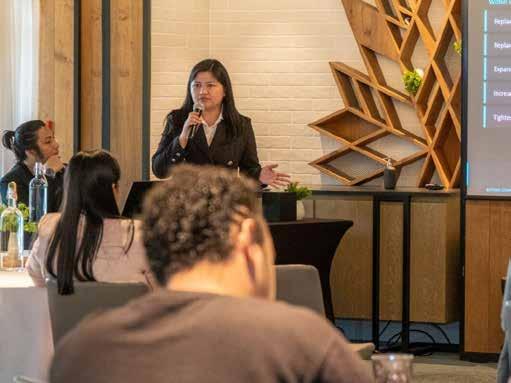
When organisations don’t fully understand what is expected, they tend to opt for the cheapest providers rather than the most competent ones”
Nadenne Adame
retrievable during inspections. Additionally, the UAE operates at a much faster pace compared to other regions, with near realtime transactions. As a result, compliance monitoring must also be real-time to keep up.
What role do AI and automation play in compliance today?
Nadenne: AI and automation significantly reduce manual workloads, especially in areas like policy drafting and reporting. This allows compliance teams to focus
more on high-risk areas. However, human oversight remains critical. Accountability cannot be delegated to AI.
Amir: AI enhances customisation and decision support. Previously, compliance frameworks were often templated and generic. AI enables tailored approaches more efficiently. That said, we do not rely on AI for decision-making. Compliance decisions carry significant risk, and human judgment is essential. AI is used as a support tool, not a replacement.
What is the key message for organisations?
Amir: If you operate in a regulated industry, you must act now. By 2026–2027, organisations without proper compliance tools will struggle to meet regulatory requirements. It is no longer feasible to manage compliance through spreadsheets or manual processes. Regulators expect full audit trails, decision transparency, and realtime monitoring. Without the right systems in place, organisations risk fines, violations, or even shutdown. The message is simple: get ahead of the curve, or you will fall behind.
7:00 AM – 9:00 AM
The first hour is for physical fitness, strength training, cardio, or a Padel session with friends if I’m up for some competition. On good days, a morning outdoor walk is my “me time.” It sets the tone, energy and clarity for the day ahead. Then it’s a healthy breakfast with a quick scan of the news, local and global.
11:00 AM – 1:00 PM
This is when energy and focus peak, so I prioritise high-impact work, key client meetings, leadership discussions, and conversations with strategic vendors or partners exploring growth opportunities. Important emails from earlier get cleared in between.
2:00 PM – 5:00 PM
Post-lunch is dynamic and execution-focused, internal team reviews, problem-solving, and decisions to keep day-to-day operations running smoothly. Financial planning and review also fit here, keeping the business on track with its strategic and performance goals.
7:00 PM ONWARDS
The latter part of my day is for unwinding, usually a few rounds of table tennis with colleagues to recharge. After that, it’s dedicated family time: dinner together, catching up, and often a movie or series to wind down the day.
I start by reviewing priority emails to stay aligned and responsive, then scan business dashboards across group companies and departments to catch performance signals early. From there, it’s focused conversations with business heads and managers, quick, decisiondriven, problem-solving.
I prefer healthy, home-cooked meals, and since I live close to the office, I usually head home for lunch. Other times, it’s an informal lunch meeting with team members, clients, or vendors, good for candid, productive conversations away from the desk.
9:00 AM – 11:00 AM 1:00 PM – 2:00 PM 5:00 PM – 7:00 PM
This is when I reflect on the day, what got done, the wins, and where outcomes fell short, whether it’s a delay, a missed opportunity, or an inefficiency worth fixing. Capturing these patterns helps me learn and close gaps. I close out by mapping the key focus areas for tomorrow.
Achieving small wins—closing deals, gaining customers, solving problems, and helping my team succeed, while contributing to the organisation’s growth.
Prioritising time, discipline and consistency, I follow a simple yet effective routine: start with data, act through conversations, and close with reflection.
Best career advice you’ve received
Develop into a technocommercial professional
Quote to keep you motivated
Quality is never an accident. It is always the result of intelligent effort.
Can’t do without
Real-time data, along with my extended monitor that consolidates it.

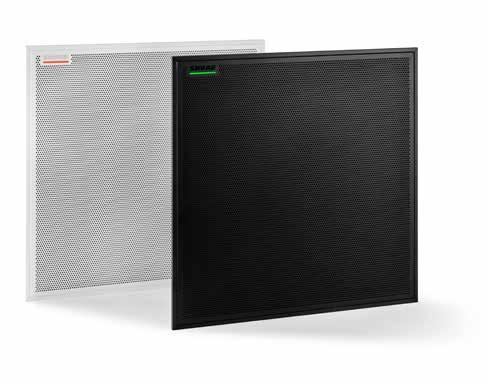

Shure introduced the MXA925 Ceiling Array Microphone, the latest flagship of its Microflex Advance (MXA) portfolio, designed to deliver the highest quality audio performance in even the most challenging acoustic spaces. Alongside the launch, Shure announced a firmware update to the MXA901 Ceiling Array Microphone, expanding its premium audio capture, flexibility and control from small to large meeting rooms. Across the Middle East and Africa, these latest MXA advancements arrive at a time when organisations are investing in smarter meeting environments, hybrid collaboration spaces, and AI-supported workplace tools that depend on clear, reliable audio capture. Marking 10 years of the MXA portfolio, Shure continues to advance array technology with exceptional audio capture, simplified AV installation, and enhanced security and remote management. For consultants, AV integrators, IT teams, and enterprise customers across MEA, the MXA925 and expanded MXA901 enable easier deployment and more consistent meeting experiences across spaces.
Logitech has introduced Mobi Fold, its first foldable mouse designed specifically for professionals who work on the move. Combining portability with productivity, the compact mouse unfolds into a full-sized device and automatically powers on, making it easy to work from airports, cafés, hotels, or any remote location. Mobi Fold features Adaptive Touch Scrolling for precise navigation, customisable controls through the Logi Options+ app, and multi-device Bluetooth connectivity supporting up to three devices across major operating systems. Built for durability, it is drop-tested, dust-resistant, and equipped with a hinge rated for up to 15 years of daily use. The mouse also offers quiet-click technology, fast charging, and up to 30 days of battery life on a full charge. Reflecting Logitech’s sustainability goals, Mobi Fold incorporates recycled materials and responsibly sourced packaging.

Huawei introduced a new generation of innovative devices at its ‘Now Is Your Spark’ global product launch in Bangkok, designed to elevate everyday experiences across fitness, creativity, and productivity. Headlining the launch were the HUAWEI WATCH FIT 5 Series, the powerful nova 15 Max smartphone, and the ultra-slim MatePad Pro Max tablet, each combining advanced technology with lightweight, user-centric design. Together, these new wave of products reinforce Huawei’s vision of a seamlessly connected ecosystem that delivers intelligent, all-scenario experiences for users worldwide.

HUAWEI WATCH FIT 5 Series: Smart wearables for the next generation
Huawei also introduced a fresh lineup of smart wearables tailored for the young generation. The HUAWEI WATCH FIT 5 Series retains its iconic square design, now enhanced with a sleek, vibrant aesthetic. It guides users through engaging and accessible mini-workouts, encouraging a more active lifestyle. The series also supports a wide range of competitive sports, including cycling, golf, trail running, and tennis. With advanced tracking, analysis, and guidance features, it caters to diverse needs, from daily fitness routines to competitive sports.
The HUAWEI WATCH KIDS X1 Series features a 110° ultra-wide-angle front camera and a 1.82-inch AMOLED screen, offering a larger display and broader field of view. It also includes a detachable and rotatable device body and an interactive AR feature, enabling kids to capture every precious moment of their explorations.
HUAWEI nova 15 Max: Power and durability
Featuring a massive 8,500 mAh Super Battery that powers all-day use, the HUAWEI nova 15 Max eliminates battery anxiety. The Extra-Durable Body is drop-resistant, so everyday bumps are no longer a worry. Combined with a

Vivid OLED Screen and Symmetrical Stereo Dual Speakers, the phone offers an immersive media experience. Equipped with a 50 MP RYYB Ultra Vision Camera, it delivers trueto-life colours even in low light or backlit conditions.
HUAWEI MatePad Pro Max: The ultra-slim flagship tablet Huawei globally debuted the HUAWEI MatePad Pro Max at this launch. Combining refined design, a premium display, PC-level productivity, and a full suite of creative tools, the HUAWEI MatePad Pro Max provides flagship tablet performance in a remarkably thin and light form factor. The standard version of the tablet comes in at just 499g and measures just 4.7mm thin, making it the thinnest and lightest 13-inch tablet. Even the exclusive PaperMatte Edition weighs just 509g.



Koen van Erp, Cloudera

Cloudera announced the appointment of Koen van Erp to lead EMEA Alliances and Channels. Van Erp joins Cloudera with more than 15 years of experience building partner ecosystems and commercial teams across global technology companies and fast-growing start-ups. He spent 12 years at Google, where he scaled the EMEA partner sales organisation for Google Cloud Security to more than $100 million in annual recurring revenue. Most recently Van Erp served as COO of IronCloud, where he helped shape the company’s goto-market model for its AI-driven Security Operations as a Service platform.
In his new role, Van Erp will support Cloudera’s EMEA sales organisation and lead the company’s channel strategy across the region. His appointment comes as Cloudera executes a fully ecosystem-led strategy globally, empowering partners as true multipliers, delivering enhanced customer value, and increasing market coverage. Van Erp will focus on regional system integrators, especially those with a strong emphasis on Sovereign Cloud requirements as part of its strategy to execute globally with regional precision to meet local market needs, particularly in EMEA. He will also deepen strategic growth partnerships with key alliances like AWS, Nvidia, Dell Technologies, AMD, and IBM.


HPE announced the appointment of Michael Langeveld as UAE Country Director, effective immediately. In his new role, he will lead HPE’s UAE business, driving growth, strengthening customer and partner relationships, and supporting the UAE’s national ambitions across AI, hybrid cloud, and digital infrastructure. Under the strategic leadership of Ahmad Alkhallafi, VP & Managing Director for Emirates and Africa, Langeveld and the expanding UAE team is set to invigorate customer engagement and operate as one cohesive go-to-market organisation.
Langeveld’s promotion comes at a pivotal moment for HPE in the UAE, as enterprises and government entities accelerate investment in AI, sovereign cloud, and next-generation networking. To meet this demand, HPE has restructured its UAE organisation around an integrated go-to-market model, bringing together the local customer and partner focused teams under unified leadership.
Langeveld brings nearly two decades of experience in technology strategy, business development, and leadership. Since joining HPE in 2022, he has held progressive roles across South Africa, the UAE, and Africa, building regional capability and refining execution.


Ramkumar Balakrishnan, AmiViz
AmiViz announced the appointment of Ramkumar Balakrishnan as its new Chief Executive Officer, marking a significant milestone in the company’s evolution and long term strategy across the Middle East and Africa. His appointment reflects AmiViz’s ambition to accelerate its transformation into a services led, consultative technology leader spanning cybersecurity, Agentic AI, digital infrastructure, data resilience and hybrid cloud deployment.
Ramkumar’s proven track record, regional credibility and deep understanding of partner ecosystems position him to scale the business, expand the technology portfolio and deliver long term value to partners and customers. With more than twenty five years of leadership experience across India, the Middle East, Africa and EMEA, he has held senior roles at IBM, Redington Gulf and Amazon Web Services. He is widely recognised for architecting and expanding Redington Gulf’s value added distribution business, and in his most recent role at AWS, he led the channel across the EMEA region. Over his career, he has built high growth businesses, onboarded more than seventy global technology vendors and pioneered digital delivery models that reshaped partner engagement and accelerated cloud adoption across the region.



Huawei has appointed Corey Deng as Chief Cybersecurity and Privacy Officer (CSPO) for its Middle East and Central Asia Region, underscoring its continued focus on strengthening cybersecurity and privacy governance across the region.
In this role, Corey Deng will lead Huawei’s regional cybersecurity and privacy strategy, overseeing frameworks spanning cybersecurity, data protection, AI security, and privacy compliance. He will work closely with customers, partners, and regulators to further advance Huawei’s end-to-end cybersecurity assurance system and support the region’s evolving digital landscape.
Corey Deng brings over 18 years of experience within Huawei, having joined the company in 2008. His career reflects a combination of technical depth and international leadership across both mature and emerging markets.
Under Deng’s leadership, Huawei will continue to integrate cybersecurity and privacy protection into its products, solutions, and internal governance practices. This appointment reflects the company’s ongoing commitment to supporting a secure and trustworthy digital environment across the Middle East and Central Asia.

From building trust to balancing business goals, marketing professionals share strategies for effective brand communication during periods of disruption

Support, trust, and continuity are the foundations of a strong partner ecosystem. Since vendors don’t market directly to customers, they rely entirely on their partners, which means understanding their challenges, communicating clearly and consistently, and providing the right tools and support at the right time. This is where brand and marketing teams play a critical role, empowering partners through quick quotations, smooth deal registration, timely product status updates, transparent pricing communication, and ongoing engagement through training and incentive programmes, all while staying flexible enough to adjust plans and communications as circumstances shift.
Rather than promoting aggressive sales, emphasis should be on grasping the situation and changing the communication tone in line with the situation. Remain relevant, empathic and partner-centric. The message needs to appear helpful and realistic rather than disassociated from the partner/customer’s struggles at the moment. Brands can retain their relevance and visibility by providing helpful information rather than irrelevant promotion. This information includes the availability of products, price assistance or solutions that solve existing problems. Collaboration and partnership are crucial and can be fostered by empowering the partner with the necessary communication and tools to do business efficiently.

Leading with humanity in times of uncertainty
Humanity comes first. Before any message goes out, the question to ask is simple, does it add value, comfort, or clarity to people navigating uncertainty? Audiences remember how a brand made them feel during difficult moments far longer than they remember any campaign. Lead with empathy, and commercial relevance follows naturally.
Staying visible through care and relevance
Visibility doesn’t mean showing up the same way everywhere, what resonates in the UAE may misfire in Oman or KSA in the very same week. Staying present means staying attuned, replacing hard sells with genuine usefulness: partnering with regional voices, supporting communities, and leading with CSR that reflects local priorities. Visibility earned through care never feels disconnected.

Building trust through meaningful communication
The top priority is building trust through clear, transparent, and relevant communication. Brands must stay aligned with evolving customer needs while reinforcing their core values. At EverTech, we focus on customer support, adaptability, and meaningful engagement over aggressive selling, strengthening long-term relationships and credibility.
Balancing business goals with empathy
Striking this balance starts with leading through empathy and purpose-driven communication. Messaging needs to stay sensitive to the moment while still delivering real value, not retreating from business goals, but reframing how they’re pursued. A solution-led narrative, paired with responsible communication, allows brands to support customers, protect credibility, and maintain a consistent presence, even when circumstances shift.