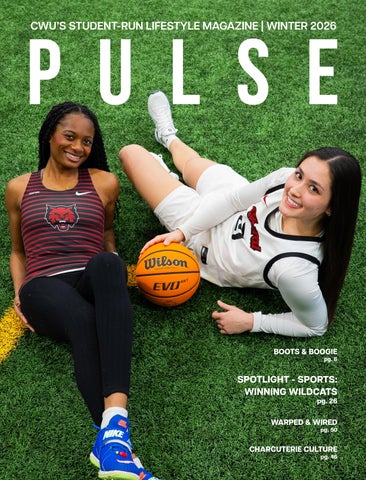
Winter 2026

Page 1


SCHEDULE

photo by Tyler Diltz
photo by Tyler Diltz design by Katrina Nolan

LETTER FROM

THE EDITOR

This magazine in your hands may be pristine without bends or folds, smelling like fresh ink and paper right off the press. Or just maybe, you found it laying on a shelf when the pages have begun to tear and a thin layer of dust has settled on the cover. Time goes by and life continues, but stories? Stories are a time capsule — the experiences and information will remain relevant. Luckily, no matter when you are reading, PULSE has plenty of stories for you.

It has been nearly a year since PULSE launched its campaign in conjunction with our sister publication, The Observer, to save student media from being defunded. There was uncertainty about our future, yet with triumph we can proudly say we are still here. You might recall another time that felt uncertain, likely one on a more global scale. If you’re thinking what I’m thinking, the 2020 pandemic comes to mind. On page 16. you can read all about the impact of the COVID-19 pandemic on mental health in “Five Years Later”.

In my first and second year at CWU I struggled to find a place where I fit. I hadn’t started my film courses, and I was unable to pursue my passions of storytelling and photography. I met friends who encouraged me to join PULSE as a photographer. I was unsure, but when Fall 2024 came around, suddenly I was a part of something much greater than I. Joining PULSE led to some of my greatest memories at CWU.

The move from Director of Photography to Co-Editor-in-Chief and now the Editorin-Chief was a difficult adjustment. I never expected to be in this position, but I truly

enjoy being this connected to the people around me. It is now my fourth year at Central, and thanks to this community I have traveled to places I had never seen: Long Beach, CA, Washington, D.C. and the small towns surrounding our wonderful ‘Burg. Community can be everything, even if it starts with just a few friends.

So, if you and your friends are looking for some fun, check out “Line Dancing” on page six, shuffle your feet down to the Fitterers building and in line, because that’s what this story is all about. The energy is high and the community is a blast — this is a beat you don’t want to miss.

If dancing isn’t your forte, but you yearn for that excitement, flip on over to our sports section. Start with “Pickleball” on page 22 for a photospread of our ‘home-grown’ sport. Keeping it local, cheer on our Wildcat athletes in “Winning Wildcats” on page 26. You’ll read all about our Wildcat successes, and hear directly from the athletes and coaches themselves. These last seasons have been spectacular and success isn’t easy to come by. So when our Seattle Seahawks led a drive all the way to a Super Bowl victory, we just had to cover it. On page 32 in “Seahawks Super Season” our staff has put together an article covering key moments leading to this historical revenge against the New England Patriots.

photo by Katrina Nolen design by Alex Littman

TOP ROW (LEFT TO RIGHT): TYLER DILTZ, EDITOR-IN-CHIEF | BLAKE KJELLESVIK, ASSOCIATE EDITOR BOTTOM ROW (LEFT TO RIGHT): KEATON WEYERS, DIRECTOR OF PHOTOGRAPHY | ALEX LITTMAN, CO-CREATIVE DIRECTOR | KATRINA NOLAN, CO-CREATIVE DIRECTOR

Winter

TOP ROW: THEA BATCH, DESIGNER BOTTOM ROW (LEFT TO RIGHT): TAYLOR DOWNARD, DESIGNER | FAE JOHNSON, DESIGNER

photo by Keaton Weyers, Javier Angulo, and Tyler Diltz design by Katrina Nolan

TOP ROW (LEFT TO RIGHT): CHARLIE BARR, WRITER | QUIN FORD, WRITER

MIDDLE ROW (LEFT TO RIGHT): LUCAS PIERRON, WRITER | GRACE

THOMPSON, WRITER BOTTOM ROW: ANDREW VENNEBERG, WRITER

NOT PICTURED: KASEY PAQUETTE, WRITER

Staff

TOP ROW (LEFT TO RIGHT): LAURA ALLEN, PHOTOGRAPHER | JAVIER ANGULO, PHOTOGRAPHER BOTTOM ROW (LEFT TO RIGHT): BECKEN MURPHY, PHOTOGRAPHY | ORION PHILLIPS, PHOTOGRAPHER

Scan for more videos and photos!

ABOVE (top to bottom):(left to right) Ashley Gorman, Blake Nixon and Kora Preston strike a pose during line dancing night.
LEFT: Blake Nixon teaches footwork for a new dance

BOOTS & BOOGIE line dancing

Feet shuffling and boots tapping to the beats of country hits. Laughter fills the room as beginners and seasoned dancers alike find their rhythm. The dance floor is warm, loud and alive. Lined with floor to ceiling windows framing downtown Ellensburg, the night begins as the room fills and the glass slowly fogs over from movement. Hearts and smiling faces are written in the condensation on the windows and when each song ends, clusters of dancers exchange high fives and smiles making this night only the beginning.

Ellensburg Friday nights can be a bit repetitive, but Woody’s Bar downtown transforms into a lively dance floor, offering something different without trying to reinvent the wheel. Central Washington University students and local residents step in sync as line dancing has become a regular fixture at Woody’s, offering a structured but casual way for people to spend a fun night out. Long time residents and newcomers share steps and familiar music, creating room for conversation and connection, turning a bar into a space that makes people keep coming back.

Woody’s is owned by Woodin Enterprises, a locally based company that operates several boutique stores across Central Washington. According to Ashley Gorman, director of operations for Woodin Enterprises, the vision for the building was always geared toward community engagement.

“We envisioned the building being an event center,” Gorman said. “Line dancing has been the one event that has really hit and resonated with the college kids.”

What is Line Dancing?

Country music, which would later become closely associated with dancing, developed from regional folk songs of American settlers. These songs varied widely by state, county and town, each with distinct rhythms and styles. The dances performed alongside this music were equally localized, reflecting the customs and social life of individual communities.

Line dancing took more shape in the 1970s, marked by widespread dance trends and social dancing across the United States. While the era is most commonly associated with disco, it started to transform within country music. It grew in popularity and widespread choreographed group dances became more common.

Today, line dancing continues to evolve across many musical genres but maintains its accessible culture. Changing musical trends and social spaces, it still remains closely tied to country music and Western bars. Modern line dancing is performed to a wide range of musical styles, including pop, hiphop, Latin and even rock. The many genres help line dancing stay relevant to today’s younger audiences. Platforms like Tiktok, a dancing app, and many creators made line dances that are now danced to in bars around the country which helps keep line dancing a continued fun social event that brings in many different age groups.

Unlike the typical bar environment, line dancing follows a structured format that can make social interaction more accessible. For students interested in trying a new activity but hesitant about unfamiliar social spaces, the organized

design by Taylor Downard
story by Grace Thompson
photo by Tyler Diltz

nature of line dancing offers an alternative. For dancers such as Kora Preston, a freshman majoring in secondary math education and stem teaching at CWU. She learned about the event through Instagram, the experience has extended beyond a single night out.

“There’s a large majority of college students who are underage and can’t get into bars,” Nixon says. “So how do you fill those niches? This gives people something fun to do without a barrier.” For many CWU students, this is appealing because of the accessibility and atmosphere. “The classes naturally blend students and locals, creating a rare social overlap.” Nelson says. “I see a little bit of both, and it honestly just brings everyone together. Everyone gets to dress up, have fun, and do the same thing.”

That welcoming atmosphere is what convinced Preston to attend her first line dancing night at Woody’s. After seeing an Instagram post shared by a friend, Preston says she decided to push past their social anxiety and go. “The opportunity to never stop learning new dances is what keeps me coming back,” Preston wrote. “Learning the routines and then repeating them over and over again for the duration of the song is super therapeutic to me.”

Line dancing plays a key role in the event’s appeal. Dancers don’t need partners, and everyone follows the same steps, eliminating much of the social anxiety that can come with unfamiliar nightlife spaces. Having line dancing in Ellenburg also gave Preston a sense of familiarity and comfort after moving away from home.

“The atmosphere at Woody’s is electric,” she says. “Everybody is always so supportive and nonjudgmental to new learners. The vibes are always so high even though we all get way too sweaty in that little room.”

Nelson’s advice? “Don’t be nervous.” She recalls: “The first time I went line dancing, I was laughing at myself to the point where I had tears coming out of my eyes. It’s really just about being there for the experience.”

Inspiration

The idea for line dancing emerged during a slower winter season, when Woody’s was searching for ways to consistently bring people into the downtown space, part of the repurposed Fitterer’s Building. Gorman says that when she moved to Ellensburg, she personally missed having a place to go line dancing and saw an opportunity to introduce something new. Instead of hiring an outside company, the idea was turned over to Blake Nixon, store manager of downtown shop Woody’s Classic Man, and Chloe Nelson, an employee at Ellensburg Sweet Spot (both businesses in the Fitterer’s Building), who stepped in as instructors.

“I overheard my boss talking about wanting to start line dancing,” Nelson recalls. “I told her I knew how to line dance, and they basically said, ‘Go for it.’ It’s been great ever since.” Nixon says he taught himself dances through online videos to add to his previous dance experience in preparation of teaching his first class. “I flew by the seat of my pants the first time we taught.” Nixon says. “But it’s been successful and growing from there.”

Both instructors talk about how the line dances are easy to learn and upbeat, which helps create an inclusive atmosphere and keeps newcomers engaged while also

keeping regulars coming back week after week. The dancing draws a mix of students and locals; it isn’t uncommon to see people decades apart in age laughing and dancing side by side. “You’ll see 50-year-olds and 22-year-olds having a conversation and a good laugh,” Nixon says. “That sense of community had been lacking for a while, and it’s really cool to see it come back.”

Nixon says energy matters as much as simplicity. He says he wants to include everyone and keep the energy high. “One of my favorite ones to randomly throw in at the end of the night is ‘Church Clap,’” Nixon says of his favorite dance. “It’s like six steps. It’s super simple, everyone has fun with it, it’s high energy and anyone can do it.”

For Nixon, the accessibility of the dance is key, especially for a beginner who may feel intimidated stepping on the dance floor for the first time. It’s minimal steps but fast-paced and high-energy, with a routine that allows dancers with any to all skill levels to join in and have fun. Instructor Nelson says her current favorite is “Mr. Weatherall,” which she calls a “high energy, fun, super easy dance that just gets everyone up and jumping.”

Gorman says line dancing consistently draws new customers to her business who may not have otherwise ever entered the store. Recent line dancing nights have reached capacity, with participants clapping after each routine and encouraging one another despite the crowded space. “I worried people wouldn’t have fun because it was so full,” Gorman says. “But that wasn’t the case at all. Everyone was just happy to be there.”

ABOVE (left to right): Two women practice their line dancing.

It’s college. Everybody’s broke, it’s okay to admit it. But when it comes down to it, everybody also needs to eat. Finding affordable food options can be difficult, especially when it feels like every time you enter the grocery store, it’s almost impossible to get out of there without spending at least 50 bucks. Every once in a while, it’s nice to eat out, but once again, it feels like you can’t get a good meal anywhere nowadays without spending $20 to $30 minimum. It’s absurd! Is there any

PULSE has you covered. Not every Ellensburg restaurant has the same high prices. This little college town has a lot to offer, so even a college kid can enjoy a real, tasty meal from time to time without having to

$ budget$$ bites

restaurants, some suggested by

ELLENSBURG WASHINGTON

GOOD MOOD FOOD

$5-12

chicken donuts $9

good mood food truck is a food truck that offers american comfort food such as burgers and fries with asian accents. they also offer some asian foods, and something called chicken donuts, which are basically shredded chicken shaped into a donut and deep fried.

BOWL $5-16

taiwan spicy beef pot $15.99

pop pot & bowl offers asian cuisine at a low price, specializing in boiled hot pot, where you can customize your own pot with a selection of meats, vegetables, and dipping sauces.

$ $ $$

SNACK’D $5-15

mini pancakes - $10 a small shop

CENTRAL WASHINGTON UNIVERSITY

ISLAND FUSION $5-20

student special chicken - $9.99

island fusion owner and cwu alum karla secka says, “we keep [our prices] low because we love the community, and we want to be inclusive to everyone to try different types of foods from different cultures.” island fusion offers african, jamaican and hawaiian food as well as some mexican desserts and drinks. they also offer the use of wildcat bucks for those of you on student meal plans, a student special for $9.99 and eventually plan on having student discounts.

EL LOCO FOOD TRUCK $3-13

quesatacos $5

ELLENSBURG ART DISTRICT

el loco food truck is a mexican food truck that offers tacos, quesadillas, massive burritos and more!

DAILY BREAD & MERCANTILE $5-16

ordered half & half combo - $9.53

daily bread & mercantile is a family owned christian business that offers fresh baked goods, specialty bulk foods, deli meats and cheeses, and a healthy option for lunch with sandwiches, soups and salads.

Picture this: It’s 8 a.m. and you just got up for class. You’re exhausted after a long night of studying and you desperately need an energy fix. Typically, students and working people alike are going to whip up some coffee or drink one of their favorite energy drinks before they kick off the day.

Caffeine is a stimulant and can be a simple fix for various reasons, whether it’s exhaustion, alertness issues or even increasing sexual stamina. While there are plenty of benefits, there are also disadvantages – especially when you take too much. The importance of ensuring that you’re balancing your caffeine intake with food is essential to maintaining a healthy lifestyle, and a great place to find the two are at cafes.

If you’re looking for the perfect cafe in Ellensburg, you might be in over your head because there are so many in Ellensburg, it can be overwhelming. By taking ambience, location, pricing and hours of operation into account, you will have a much easier time finding your perfect option.

Ambience at The Burg Coffee & Kitchen

It’s a chilly winter day in Ellensburg and you’re in need of an open space with comfortable seating and good lighting for you and your friends to enjoy yourselves. Don’t know where to go? The Burg Coffee & Kitchen can meet all of these demands. In an informal survey of 17 students and locals, The Burg Coffee & Kitchen was voted as Ellensburg’s cafe with the best ambience. The spacious interior and warm smell of coffee beans creates, as The Burg Coffee & Kitchen’s employee Makenna Smelser says, “a very comforting and welcoming environment [that is] great for studying.” D&M Coffee’s downtown location is also a great option when you consider ambience. It has a low-lit, warm environment that is cozy enough to take a nap in.

Affordability at D&M Coffee

If ambience isn’t as important as getting a cheap but quality cup of joe, there is a perfect place for you. Price is a top concern for many full-time students, and in our survey, D&M Coffee on North Pearl Street was voted the most affordable cafe in Ellensburg. If you’re in need of an inexpensive energy fix, this cafe is a must visit. D&M Coffee’s Barista, Kaden Stark, breaks down the pricing. “On the very low end, $2 [for the drip coffee and teas]. ... You get more expensive when you get the lattes [$8].” It’s clear these prices won’t break the bank. The Bistro and Cat Trax East and West on campus also offer affordable drip coffee for $3.25 or under and lattes for $5.65 or less.

Convenient Hours of Operation at Palace Cafe

It’s late at night and every other cafe in town is closed. Where do you go? The answer is the Palace Cafe. One of the oldest operating businesses in Ellensburg, the Palace has been open since 1892. Hours run from 7 a.m. to 10 p.m. on Fridays and Saturdays, and 7 a.m. to 9 p.m. Sunday through Thursday. Many cafes in Ellensburg don’t stay open this late, and many close as early as 4 or 5 p.m. Also unlike most of its competitors, the Palace Cafe is a full-fledged restaurant. Menu items range from seared ahi tuna salad to flat iron

story by Quin Ford photo by Javier Angulo design by Fae Johnson

steak to sandwiches and salads. They even have a bar inside, so those who are 21+ can grab a drink, unwind and enjoy non-traditional cafe food.

Locations of Winegars Coffee & Creamery

For many college students, a car might not be something in their inventory. Don’t worry, because Winegar’s Coffee & Creamery has you covered. They have two locations in town and each is located less than a mile from campus. Whether it’s Winegar’s employee Skyler Weidenbach’s personal favorite, the Italian soda, or some of their delicious ice cream flavors, Winegar’s and their convenient locations give your taste buds something to look forward to. It’s true that The Burg Coffee & Kitchen is also just a block from Tomlinson Stadium on the other side of campus.

Don’t Forget!

While these cafes check off some of the main reasons to visit, don’t forget to check out some of the other great options in town, including Country Cafe downtown, The Knotty Pine Cafe & Espresso just south of the Pilot gas station, and Jimmy B’s and The Village all located on campus. With this many cafes available, there is bound to be an option that’s just right for you.

class cache

What has 52 pages and from your major or minor, giving rarely mentioned outside their

story by Charlie Barr photo by Keaton Weyers design by Thea Batch

DaNce

ARE YOU MORE ATHLETIC ACADEMIC HOW ABOUT sILLY sERIOUs

Introduction to Jazz Dance (DNCE 107) is just one of these classes. Similar classes include Introduction to Ballet Dance (DNCE 117) and Introduction to Modern Dance (DNCE 120).

PhYsIcal eDUcaTION

Other classes in the Physical Education category are Frisbee (PEF 131) and even Cornhole (PEID 146).

Introduction to Creative Writing (ENG 263), Introduction eNglIsh

Physical education classes tend to be 1-2 credits and are usually focused around a specific activity or practice, such as Women’s Self Defense (PEF 132) or Weight Training (PEF 113).

ARE YOU CREATIvE

UNIversITY

Career Exploration (UNIV 103) is a class that’s meant to help students find their career goals and make decisions for their career paths. Others include Tutoring Strategies (UNIV 201) and Career Management (UNIV 301).

CAREER ORIENTED

preservation. Confusion. Anxiety. Anticipation. The uncertainty of the future can be felt everywhere.

It has been five full years since the COVID-19 pandemic first began to affect lives around the globe. Since then, the World Health Organization estimates that over 779 million people around the globe have at one point in their life caught a case of the coronavirus. Whether this time was marked for you by being forced to stay at home, struggling to connect with friends or the joy of finding a new hobby, the pandemic was a time that challenged and changed many of us.

How do these changes continue to impact CWU students today?

The Anxiety of Reemerging

“I think even prior to the onset of COVID, we were noticing changes in trends of student mental health back when I first started in college counseling,” says Cindy Bruns, director of counseling at CWU. “Our number one presenting concern would be depression, and then probably anxiety, and then probably relationship concerns. Those tend to be the top three.”

“Even before COVID,” Bruns notes, anxiety was overtaking depression “in terms of frequency of presenting concerns.” During COVID, she says, when social events were called

pandemic, “We have seen somewhat of a reduction in generalized anxiety and some increase in social anxiety.”

A study done by the University of Oxford underscores her points. Participants who had been infected with the COVID-19 virus were tested on how their cognitive skills had changed over the course of the pandemic two to three years after their initial infection. What the study then revealed was that a majority of the participants had shown “severe symptoms of depression (about 1 in 5 people), anxiety (1 in 8), fatigue (1 in 4), and subjective memory problems (1 in 4), with these symptoms worsening over time.”

“Re-emerging and having to interact with larger numbers of people, more face to face contact, things like that, we’ve certainly seen an increase in people having difficulty managing that reengagement socially and feeling more anxious about it,” Bruns says.

This is all compounded by the reality that today’s students were hit by the COVID-19 pandemic in that sensitive time of development that occurs during middle and high school, “That time where in terms of identity development, social development, that’s where folks are turning from family to peer groups and practicing all of those skills that everyone’s bad at,” says Bruns. “Folks didn’t get a lot of that practice and skill-building, just as part of their natural day-to-day life.”

Students’ experiences align with Bruns’ perspective. “It was remarkable to have that time period of my life be effectively removed and sort of replaced with this sort of lonely existence, where you kind of just stay at your house all the time. In essence, it felt as if social experiences were stunted,” says Koah Ghrist, a first-year computer science major.

As Bruns puts it, “COVID didn’t happen just in isolation.” Reflecting on the political state of the world during COVID-19, she notes, “There were a lot of things happening culturally during that time in terms of the murders of George Floyd and Breonna Taylor and Black Live Matters and then the focus on violence towards Asians as a way of blaming COVID on a particular group.”

“When people are fearful for a variety of reasons, whether that’s your physical safety because you’re a group that’s targeted with violence, if that is economic safety, if that’s just

ideological safety. … If your general way of life has been disrupted, then we tend to pull … towards comfort, towards safety, towards sameness,” says Bruns. “It takes more to get over the hurdle of reengaging in the complexity of life.”

Online Versus InPerson Classes

Did the pandemic create a deeper longing for in-person relationshipbuilding in your life? Well, if so, you’re not alone. In an informal campus survey of 34 students, 82 percent of them said they prefer inperson classes to online.

Craig Chapo, academic advisor for English and Communication and a CWU alum, remembers what the campus was like when he was a student a decade ago. “You saw a lot more students. They were out walking around. There were a lot more students present in the SURC… At least from what I saw, there wasn’t a whole lot of isolation happening from students. It was very much enjoying the college experience, making new friends, taking classes with your cohort. It changed drastically [with] COVID.”

Bruns suggests going fully online had other impacts. “A lot of what people had to do were things that were online and shifting quickly. … I’m not anti-social-media, but we do know that very short frequent switches in attention cause detriments to sustained attention and concentration.”

While Bruns sees “ways that we can leverage technology and very positive ways to support each other,” she also expresses concern brought about by seeing technology as a replacement for in-person relationships. “From a neurobiological standpoint, we need that face-to-face interpersonal connection with folks as ways of

creating comfort and safety, as well in our nervous systems.”

Chapo adds, “Since COVID, I’ve noticed that there are students who are just totally okay with online classes, and it’s just the convenience. Maybe they’re also working jobs at the same time because they have bills to pay, or they have other obligations outside of college.” For Chapo, online classes provide an equally consistent and structured approach to the class and college experience, while keeping the accessibility high for those who are potentially juggling many responsibilities in their life.

Appreciating What We Have

Despite all the experiences of the pandemic, some students saw this time as a wake-up call to challenge their current status quo. “Being home that long, not getting to see people and have that interaction, it’s nice to go out and see people, do things. Makes you appreciate it,” says Casey Lusted, a first-year aviation major. The pandemic “really made me make sure that I’m going out, spending time with people.”

Ghrist agrees. “You’re not always going to get to have the liberty to be around people, even strangers. There is inherently a value in participating with people around in society. It makes you feel good.” For Ghrist, the realities raised by COVID built up an expectation that social interaction is never guaranteed, and that has led him to a place of being more intentional with his relationships.

As Bruns puts it, “We need to find meaning in order to find purpose in our lives and to feel valued and important. … Sometimes we don’t realize what’s important to us until [we] can’t have it.”

AI AnD YOu: FRIEnD OR FOE?

When the deadlines pile up and the stress kicks in, many students turn to AI platforms for quick answers. But as it becomes more common in classrooms, questions are growing about where helpful support ends and overreliance on technology begins.

Concerns about AI extend to the environment and raise questions about ethics. AI can be a powerful tool when used responsibly, but are the tradeoffs worth it?

AI In THE CLAssROOM

According to a study by Campbell Academic Technology Services, 86 percent of students use AI in their studies, a little over half (54 percent) use it weekly and nearly one in four use it daily.

Plenty of people know someone who uses ChatGPT to do all of their assignments for them, and that means professors have to shape their curriculum and

teaching around AI’s inevitability. Because large language models (LLMs) can vomit out a three-page essay on any topic with ease, the skill of human writing must be drawn out of a student’s submitted work.

Ali Ünal, an assistant professor in the creative writing program, says, “Something that I always tell my students though: you can utilize large language models in your creative work, and there is a very healthy approach to that … You can start a project, or you can get help in the middle of a project with artificial intelligence, but please don’t end it there. I think that’s a big difference.”

Accepting that some students will use AI on their writing assignments is merely the first step to Ünal’s philosophy. Many creative writers have experienced “writer’s block,” he admits, and AI tools may be helpful for pulling you out of that rut – for example, by suggesting ideas and topics, or asking for criticism and feedback. Doing so can help your natural writing process spark back to life.

story by Kasey Paquette & Lucas Pierron

design by Taylor Downard

The trouble begins when students rely too heavily on the tools for the whole assignment. “In my literature classes, unfortunately, I’ve been getting a lot of AI slop, AI-created, AI-assisted assignments,” Ünal says. What students may not realize, he notes, is that “95 percent of the product will come out of the revision process, the grind.” Good writing “actually happens in the editing process.”

And, Ünal adds, doing original work in school can pay off later in the workplace. There are “all sorts of sectors where you’re required to provide articulated thoughts, create talking points. And as a creative writer, you will be more than qualified to do all that.”

Despite its helpful uses, some students still have their own concerns about AI use in an academic setting. “This is the thing you’re being graded on. It’s supposed to be reflective of your understanding,” says Adam Dean, a senior creative writing major. “If it gives you an A-plus, then you’re probably not going to take the studying as seriously. You’re going to have an inflated sense of your own understanding.”

Ai on tHe Job

Arguments for the use of AI in career paths other than writing can differ a lot. For example, junior-level roles in computer science and information technology (IT) fields have been subject to layoffs and volatility in recent years, leaving some to blame employers who shift their attention from low-level roles and training towards automation with AI tools.

Within the IT industry, newbie college graduate roles typically involve entry-level positions with lots of human interaction: answering phones, helping people with technical problems and following pre-written instructions for diagnosing common issues. These are commonly known as ‘tier one’ jobs, and make up the backbone of the entry-level IT industry.

“At first, there were some who were saying tier one is going away because AI will handle it,” David Douglas, a senior lecturer in the information technology program, says. “Actually, we’re now saying tier two … things like student support, or computer support services,

you need to have that level of interaction to find what the problem is. Then, we can use AI to solve that problem.”

The human need for social interaction will likely continue, but the same cannot be said about every job position in the future. “We’re going to have an evolution of jobs,” Douglas suggests. “There are going to be jobs that [will] go away, but there are going to be jobs that [will be] created. We’re never going to take away the need for humans to do certain roles.”

If AI can help create efficiencies that help solve more complicated issues in computer science and IT, that can be a positive. But if there is still a distinct demand for the baseline human communication within these industries and a lack of positions available for those employees, AI may not be able to replace it any time soon.

PrivAcy in tHe Ai Age

Concerns with AI usage also extend into things like data privacy and compliance law. Douglas offers the example of a graduate student who now works in healthcare IT. “Right now, we’re relying on individual decision-making with AI, and that’s where this is a different realm … he works in healthcare, and in his organization, they have made the decision for right now: no use of AI for anyone. There’s so much concern with HIPAA … that’s where my concerns are. It’s the privacy.”

HIPAA, the health insurance portability and accountability act of 1996, refers to patient privacy in compliance law, a set of rules and regulations that ensure information about patients within a hospital data system remains private. When hospital systems begin interacting with AI programs, the concern is how that interaction stays within the laws that try to prevent issues such as leaking private data.

If you feel like you’re living in the wild west for AI assistance, you’re not alone. Depending on the industry and the specific role, AI adoption can range from a mild concern in the back of your mind to a tangible threat to your job security. Common sense may dictate that AI won’t directly impact physical, blue-collar employment anytime soon, but at the current rate of change, some concerns about changing entire industries may be valid.

PercePtions of Ai

AI has traditionally been depicted in the media as a futuristic assistant, an innovative and efficient way for humans to get things done faster. It was intended to be a way to help guide humanity without actually replacing individual, critical thinking. It’s easy to understand the appeal of AI tools in the present, like ChatGPT. For students, it can quickly and easily complete very complicated tasks, such as writing an entire essay from scratch or summarizing an entire book into a few paragraphs.

The “AI economy” refers to three parts of the industry responsible for keeping consumer AI available: data centers, AI-related chip manufacturing and power generation. Discussion of AI is now typically defined by troubling concerns about water consumption, data center construction and ethical image and video creation. For example, according to the World Economic Forum, “Right now, the AI economy consumes 23 cubic kilometers of water a year. … The AI economy creates water demand in places where resources are limited; competition for water is heating up as weather extremes make the water cycle less reliable; and water systems are struggling already after decades of underinvestment.”

These are real, palpable fears, and they are beginning to make people question if AI is even worth it in the first place. But until institutions adopt strict, formal policies about using AI tools in productive ways, it’s unlikely that their usage will slow down.

Ai And MentAl HeAltH

Privacy and job security aren’t the only concerns. When technology starts to replace genuine human intimacy, the conversation stops revolving around convenience and shifts to the concerns surrounding mental health. In a study for Vantage Point Counseling Services, therapist Micheal Salas found that just over 28 percent of adults claim to have at least one intimate or romantic relationship with an AI, a figure that signals an important shift in how people are seeking emotional connection in the AI age.

When nearly one in three adults reports having romantic involvement with artificial intelligence, it raises questions about the type of dependency, social withdrawal and long-term psychological effects substituting human intimacy with computer generated responses could have. AI companionship may seem odd at face value, but it speaks to a larger societal issue with relationship dependency between humans and AI.

It’s clear that the dynamic between AI and the people who use it on a regular basis is in a transformative stage, and it has garnered a legitimate stake in our lives. As Ünal and Douglas point out, AI has its uses but also its limits. Finding that balance is up to each person — and humanity at large.

ABOVE: Photos of Madisyn Joyner (she/her), film major, 4th year, and Josie Schampera

(she/her), secondary mathematics education major, 2nd year.

photo by Javier Angulo and Keaton Weyers design by Thea Batch

Originating in Bainbridge Island, Washington, pickleball is considered the fastest growing sport in the U.S. A rise in popularity during the 2020 pandemic propelled pickleball to the forefront of all-ages outdoor activity, fun for the whole family.

Grab your paddle and hit the court! It’s time to pickle!

WIlDcaTs

The student section’s booming voices are matched by the roaring sounds of the band, the mix filling Nicholson Pavilion as a nail-biter of a game is close to concluding. The cheers coming from all directions motivate the Wildcat athletes to make that final push to protect home court. Welcome to CWU Athletics, where experiencing a captivating atmosphere like this one will leave a long-lasting impression.

CWU is home to 11 NCAA Division II athletic teams seen in football, softball, baseball, women’s volleyball, women’s soccer, cross country, track and field and both men’s and women’s basketball teams. Each of these squads, except football, belongs to the Great Northwest Athletic Conference (GNAC), which was founded in 2001, when CWU joined the conference. In total there are 10 DII colleges that compete within the association in Washington (4), Alaska (2), Oregon (1), Montana (1), Idaho (1) and Canada (1). Formerly a part of GNAC, CWU’s football team stands alone in the Lone Star Conference and has been an active member since July 2022

Winning in Motion

Holding it down at home with a 12-1 record, the women’s basketball team ended the 2024-25 season going 23-8 and 14-4 in conference play. While the regular season may have ended, the team’s playoff hopes did not. Senior Exercise Major and Guard Asher Cai, who holds the GNAC scoring record and GNAC three point record, says that, “coming to each game one game at a time” allowed the team to ball out all the way to the third round of the DII Tournament, taking down both three seed Point Lima with a 74-53 point victory and seventh seed Chico State with a final score of 79-73. The team’s season came to an end with a 47-70 point loss to runner up and number one seed Cal State Dominguez Hills. Regardless of the outcome, Head Coach Randi Richardson willed the team the furthest any CWU women’s basketball coach has ever gone in the tournament. She says this was accomplished through “talent … work ethic … and the fact that we’ve been able to build with players being around from multiple years.” To add to Richardson’s impressive resume, in the nine years that she has been the head coach for the Wildcats, she has never had a losing record.

Q&A with Senior Guard and Exercise Major Asher Cai

Q: This season you broke the GNAC three-point record. What went through your head as you hit that shot, and how does it feel to hold such an impressive record?

A: “Honestly, going into that game, I didn’t even know I was going to break the three-point record. I had tied it and Randy pulled me over, [saying], ‘Okay you need to make one more three and we’re pulling you out.’ I was just letting it fly. … I couldn’t do it without the opportunities my coach has given me. My teammates get me the ball where I need it.”

Q: When taking a look at the success and accomplishments you’ve had as an athlete, what do you hope young female athletes can take away from your hard work and exceptional performances?

A: “I think the biggest thing is that it’s not always going to be an upward process. There’s going to be slumps, that’s how you know you’re growing. It’s not always going to be a straight line. Just be persistent and keep working hard when nobody’s looking because it’s going to pay off.”

story by Quin Ford
photo by Tyler Diltz, Laura Allen, and Becken Murphy design by Alex Littman
LEFT: Emy Ntekpere and Asher Cai

Whatever it Takes

It’s the final possession for the CWU men’s basketball team at Nicholson Arena. Their opponent isn’t letting up, but you’d be a fool to think the Wildcats are taking their foot off the pedal. With the game on the line, Junior Guard Jordan Clark takes the ball upcourt in hopes of sending the competitors back home with a loss. As time ticks down, Clark hoists up a three and to no surprise the net curls as the ball swishes in. If you get the chance to attend one of Central’s men’s basketball games, you may get to witness a thrilling performance like this.

The team, run by eighth-year Head Coach Brandon Rinta, wrapped up the 2024-25 season with an impressive 22-10 and 14-4 conference play record. A record like this takes, as Clark says, “unity as a team” and “doing whatever I could to help out the team, whether I was scoring, getting people involved, creating plays for each other … whatever it took to win.” Clark’s contributions did not go unnoticed. Being the third leading scorer on the Wildcats, he put up nearly 12 points per game, leading the team second in assists and ending the season with the leading free throw percentage with an incredibly accurate 91 percent.

Q&A with Junior Guard and Communications/Sports Management

Major Jordan Clark

Q: If you were to compare your play style and attributes to a current NBA player, who do you feel you resemble the most?

A: “I would say Jalen Brunson. That’s what a lot of people say. He uses a lot of pump fakes, pivots, gets to his spots, can hit some threes [and has] great footwork. … [He also] hits a lot of mid ranges [and] he can get to the rim. I would say like a right handed Jalen Brunson, my own type of way though.”

Q: What are your hobbies outside of playing basketball?

A: “I love listening to music. … Some of my favorite artists [are] Tame Impala … Baby Face E, Lil Baby, just all types of different artists. … Me and my teammates will link up [and] play some video games. … The main video games I play [are] either 2K [or] NCAA College Football.”

Clark’s dominance, with the help of then-guards Calvin Holden and Garret Anderson, led the team to the second round of the NCAA Division II Tournament last year, defeating three-seed Chico State in an overtime thriller with a final score of 82-79. With a 65-77 point loss to second seed Cal State Dominguez Hills their season came to an end. Still, the team’s well-rounded performances throughout the year can be credited to, as Clark puts it, “A good team that knew how to play together, so it was easy to go on to the court and play well.”

Point

ABOVE:
Guard Jordan Clark shoots a free throw RIGHT: Emy Ntekpere posed with her 2025 D2 Triple Jump Champion award

contributions have contributed to the development of standout junior track and field athlete Emy Ntekpere.

Ntekpere knows how to wow a crowd. Whether she’s winning the 2025 Indoor and Outdoor Women’s Field Athlete of the Year, or shattering Central’s women’s outdoor high jump and triple jump (indoors and outdoors) record,

year and it’s nice to know that we can all be friends and not just competitors. I really love that my team is here to compete with me and I get to travel with them [and] go on different little adventures to different states or meets. … I really appreciate spending time with them, getting to know them better as people … and getting to know what they want to accomplish in their season and in their lives”

Q: Do you have any hobbies outside of Track and Field?

A: I like to crochet purses, stuffed animals, little blankets [and] hats. … I like to go to the community libraries and when they have book sales I buy a bunch of random books and try to spend the summer reading them all. … My favorite book … is ‘The Song of Achilles’ … it’s in the Greek mythology type of genre.”

Dominating the Opposition

Wind, cheers and the sweet smell of victory. If you’re imagining a CWU football game, you would be correct! Former Junior and 2nd Team All-LSC quarterback Kennedy McGill, two time Offensive Lineman of the Year winner and Senior Slade Edwards, as well as Defensive Lineman of the Year and sophomore Tyler King helped lead the Wildcats to a dominating 10-2 record along with an undefeated conference record of 9-0. The Wildcats’ stellar regular season performance ultimately led to the team winning their first Lone Star Conference title and the Wildcats hosting their first playoff game in a longawaited eight years. Victory came so close, but ended in hard fought defeat to 15-seed Western Colorado with a score of 20-27.

There have been a few notable changes during the offseason, including McGill transferring to Division I (FCS) Western Illinois, as well as former Head Coach Chris Fisk departing to Division I (FCS) Portland State. Since then, the team has essentially rebuilt its entire coaching staff with some qualified faces in former University of Wisconsin defensive backs coach and former CWU defensive coordinator in 2016-’17 Scott Powers, who has been re-hired as the head coach for the Wildcats. Additionally, the team signed former Upper Iowa University Offensive Coordinator (OC) and now OC and QB Coach for CWU Heath Parling.

The team even signed two more coaches: Assistant Offensive Line Coach at Boise State University, now O-line coach for CWU Kooper Richardson, and last but not least, Jake Vang, the former edge rushers coach at Sacramento State and now Wildcats defensive coordinator and linebacker coach.

With the departure of McGill, sophomore and former Utah Tech (FCS) Quarterback Skyler Cassel is set to be a potential starting QB for the team. Sylen KieselKauhane out of Richland High School who is a three star edge rusher and ranked No. 31 in Wash in 2026 has also committed to becoming a Wildcat for the upcoming 2026 season. Although a lot has changed, the successes of last season remain the same, giving fans and students alike something to look forward to next year. Senior and communications major Cooper Maxey says he’s looking forward to “seeing a team full of attitude, passion and pride for the game”

Q&A with Head Coach Scott Powers

Q: After a dominating last season, the team finished with a 10-2 record, was undefeated in conference play and hosted their first playoff game at Tomlinson Stadium after a long-awaited eight years. What do you hope to bring to the table to pick up where you left off last year?

A: “What makes the job appealing is that there has been a long history of success. … When you look at my history of success combined with success at this place, I think it’s more about operating in the way that I’m comfortable with and the way that I’ve done it here. … It will be a combination of continuing some of the things that are in place here, but also putting a stamp on my own style and things that I’ve learned since I left in 2017.”

Q: What should fans expect to see for the 2026 season?

A: “We are going to work daily to build a team they can be proud of, a team that plays hard, smart and together. Wildcat fans can be proud of how hard and how disciplined we play.”

A Stellar Set-Up

“I feel like our culture sets us apart,” says first year volleyball Head Coach Lauren Herseth about her team’s identity. The Wildcats concluded the 2024-25 season with a 19-8 record and ironically having the same 14-4 conference play record as the Central men’s and women’s basketball teams. With the help of Senior Education Major and Outside Hitter Scottie Ellsworth, alongside Senior Psychology Major and Outside Hitter Ella Bines, the Wildcats found themselves with seventh-seed placement in the Division II Tournament, beating a great two seed in Simon Fraser 3-2. Their season came to an end the next day against three seed Fresno Pacific with a score of 2-3. Given the fact that this is the 12th consecutive season that the volleyball team has qualified for DII tournament play, fans can expect as Herseth says “A lot of firepower … good arms and kids who can fly around and play defense.”

Q&A with Head Coach Lauren Herseth

Q: What do you hope to carry over from last season to the 2026 season?

A: Coach Herseth: I think the legacy and tradition of what is Central volleyball [and] ... our culture sets us apart. We have this huge alumni following and I think that speaks to the type of experience that these women are getting in this program … but also honoring what Central volleyball means to all these women and carrying that over next year. … [Also] finding our identity [and] the momentum that we built is definitely going to carry us over into the offseason and make our training make sense, which makes me really excited for this upcoming fall.

Q: What’s your favorite part(s) about coaching at Central?

A: Coach Herseth: This group is really fun. They are funny individuals that get along really well, so they feed off of each other. What’s cool is we know when to dial it in, focus and be intentional at practice. The second practice is over, we are hanging out in the gym [and] people are usually doing some sort of TikTok dance or explaining some sort of new trend. … This group [also] loves to play games, so anytime we’re on the bus, or at a restaurant, or at a team dinner, there’s always some sort of new game being played.

SEAHAWKS’ SUPER SEASON

It’s a windy fall day at Lumen Field and the Seahawks are knotted up in a close game. The crowd is erupting as momentum is shifting towards the home team — the sweet smell of victory is near. This scenario has been seen time and time again throughout the 2025-26 season. Brilliant draft selections, trades, new coaches and most importantly a winning mentality from the whole organization, allowed the team to make the push from being first round playoff exits, to Super Bowl 60 winners. Here is a timeline of the key moments that took the Seahawks from one Super Bowl win to another.

The Seahawks set a new franchise record in wins this 2025-26 season with a dominant 14-3 record, going 8-1 on the road and winning their last seven regular season games. Ending with the best record in the NFC, the Hawks earned the No.1 seed in the division, earning them a bye week and home field

advantage. The team picked up right where they left off and added an eighth straight win to the season by dismantling the San Francisco 49ers in the divisional round of the playoffs. After repeatedly failing to find the endzone, the Niners ended the game with two field goals and defeat came with a sweet score of 41-6.

Eight days later, the Hawks needed one more win to advance to Super Bowl 60, but one problem stood in their way: the Los Angeles Rams. Seahawks quarterback Sam Darnold delivered in the bright lights, throwing for 346 passing yards and three touchdowns, alongside his wide-receiver one and 2026 Offensive Player of the Year Jaxon Smith-Njigba, who caught 153 of those yards and scored a touchdown. The team finished strong protecting home turf and sent the Rams back to LA with a 31-27 point loss. With the New England Patriots beating

the Denver Broncos in the AFC Championship, Super Bowl 60 was a rematch of Super Bowl 49, this time with a different outcome. Seattle’s defense held its ground against the young Patriots offense, racking up a game total of six sacks and holding them scoreless going into halftime. Offensively Seahawks running back Kenneth Walker III ended the game with 135 rushing yards on 27 carries, earning him the SB MVP award and most importantly helping to win the franchise’s second Lombardi Trophy — redemption came with a score of 29-13.

The Rebuild

Sunday Feb. 2, 2014 holds significant meaning to Seahawks fans from around the world. Why? It’s the day they crushed the Denver Broncos 43-8 in Super Bowl 48 to claim the franchise’s first Lombardi trophy. Considering that was 12 years ago, the team is completely

story by Quin Ford photo contribution by William Pedelaborde design by Alex Littman

SEAHAWKS’ SEASON

different from today’s Hawks. Notable changes — such as the retirement of all of the “Legion of Boom” players and Marshawn “Beast Mode” Lynch, Pete Carroll’s stepping down and quarterback Russell Wilson leaving for another team — has allowed for the creation of a new elite squad. While the nostalgia may be hitting you right about now, don’t get too worked up because there is plenty of great news. The Seahawks are back to their glory days.

Let’s start with arguably the most impactful decision the front office took to get the team to where they are now, the Russell Wilson trade of 2022. Ironically, contract disputes led to Wilson going to the team that he dominated in Super Bowl 48, the Denver Broncos. Because of Wilson’s productive 10-year tenure on the team, the Hawks scored five picks in the draft by trading him, ultimately leading to drafting four players who started in Super Bowl

60. They included left tackle Charles Cross (2022 ninth overall pick), cornerback Devon Witherspoon (2023 fifth overall pick) and rush ends Boye Mafe (second round, 2022) and Derick Hall (second round, 2023). Additionally, the Hawks used their own draft picks to pick up another two key players — Kenneth Walker III in 2022 and Jaxson Smith-Njigba in the 2023 draft.

Another monumental change happened in 2023 when 14-year Head Coach Pete Carroll decided to step down. Seahawks General Manager John Schneider and Carroll had significant impacts on leading the team to back-toback Super Bowl appearances in 2014 and 2015. Because of his contributions, Carroll is now considered an all-time great in the city of Seattle. Without a head coach, it was Schneider’s job to replace Carroll and restore greatness to the once dominant

Seahawks team. Just three weeks later, Schneider made a big decision and hired former Baltimore Ravens Defensive Coordinator Mike Macdonald. Considering Macdonald’s expertise lies in the defensive scheme of football, he contributes to a large portion of the team’s defense and to their new nickname, “The Dark Side.”

The 2024-25 season marked Macdonald’s first year as the Hawks’ new head coach. After a mediocre first year with a 10-7 record and a missed playoff opportunity, it was time to make some tough decisions.

The team, then led by quarterback Geno Smith, combined for 23 total touchdowns paired with 15 interceptions in Macdonald’s first year as the head coach for the Hawks. While Smith had an unexpected three seasons with Seattle, it soon became evident that the chances of the team making a deep playoff run and potentially

winning a Super Bowl did not lie in Smith. By the end of the 2024-25 season he was traded to the Las Vegas Raiders. Fans questioned the decision made by the front office as it wasn’t that Smith was a bad quarterback, he was just becoming inconsistent. Just six days after Smith was traded, the Seahawks signed quarterback Sam Darnold after his one-season stint with the Minnesota Vikings.

Darnold had an exceptional 2024-25 season with the Vikings, ending the season 14-3, along with 36 combined touchdowns and 12 interceptions. Although he and the team had a great regular season, they ended the year in disappointing fashion — losing in the wildcard round to the Los Angeles Rams. Fast forward to the current season with the Hawks, Darnold led the team to his second straight 14-3 record — placing him in the NFL history books alongside seven-time Super Bowl winning quarterback Tom Brady, as the only QB’s in NFL history to win 14 games in back-to-back seasons. If this isn’t impressive enough, Darnold is the only QB in NFL history to lead his team to 14 win seasons consecutively with two different franchises.

Victorious once again, the Seahawks capitalized on an exceptional season, bringing the Lombardi trophy back to the Emerald City. With the young core the team has, it wouldn’t be a surprise to see them continue to make playoff runs each season. Who knows, maybe another Super Bowl win is a possibility in the near future. The 12s are ready to keep the celebration going.

NOTABLE SEATTLE SEASONS

Mariners

Catcher Cal Raleigh and the Seattle Mariners ended the 2025 regular season winning their last 7 of 10 games, finishing with a 90-72 record, winning the division for the first time since 2001 and more importantly a spot in the playoffs. The M’s had the most thrilling post season run since that 2001 season where the team broke the MLB record with 116 wins in a season — 24 years later, this achievement still belongs to them. With a chance to make it to their first World Series, in game seven of the ALCS the team fought hard but unfortunately ended the season with a devastating loss to the Toronto Blue Jays. Considering the team was so close to the championship they could taste it, fans and spectators alike can expect to see them making another deep playoff run sooner rather than later.

Sounders

What do the Seattle Sounders and losing have in common? Absolutely nothing!

The team had a sensational 2025 season, which led to them taking down former World Cup winner Lionel Messi’s Inter Miami’s team in Aug to take home the League Cup. After taking home the cup, the Sounders found themselves in a league of their own as the only MLS team to win all five North American trophies: the MLS Cup (2016,’19), the U.S. Open Cup (2009,’10,’11,’14), the Supporters Shield (2014) and the Concocaf Champions Cup (2022).

Seattle Torrent

Allow me to introduce you to the newest professional women’s sports team in town, the “Seattle Torrent.”

Founded in April 2025, Seattle’s new professional women’s hockey team is just the eighth women’s team in the U.S. The team hosts their home games in the same facility as the professional men’s hockey team the “Seattle Kraken” at Climate Pledge Arena. Make sure to keep a lookout for the five-time women’s hockey Olympian and Forward for the Torrent Hilary Knight. After the 2026 Winter Olympics, Knight now holds the record for the most goals and points scored all-time in U.S. hockey history.

In addition to Knight’s Olympic appearance, five other Torrent players were selected to compete. Joining her on Team USA were Torrent alternate captain Alex Carpenter, along with three-time Olympian Cayla Barnes and Hannah Bilka who made her first Olympic appearance. Lastly, first-time Olympian Julia Gosling represented Team Canada and Aneta Tejralová made her second Olympic appearance representing Team Czechia.

With all the star studded talent on the Torrent, mixed with Olympic appearances, it’s safe to say the team has a lot to look forward to in the future.

SCENTS FOR CLASS, NOT THE CLUB

Smelling good doesn’t have to break the bank. With tuition, rent and groceries to manage, college students often assume luxury fragrances are out of reach — but with a few smart tricks, it’s easy to discover an every day scent that smells amazing, feels personal, and fits your budget.

Your signature scent can be a meaningful part of personal identity, often tied to memory and emotion. For those still searching for their scent-mate, there are plenty of accessible options, including gentle, hypoallergenic fragrances for those with sensitive noses. Fragrances come in all shapes and sizes, and finding a scent that best fits you is more achievable than you might think.

General Fragrance Etiquette

In college classrooms, strong scents can be distracting or even uncomfortable for others. “I hate smelling anything super strong, especially cologne that is sprayed way too much,” says Twilah McAdam, a senior English and Social Services major. “I also am not a fan of overly fruity ones; they give me a headache most of the time. She recommends going for body mists from Victoria’s Secret, or Billie Eilish’s original Eilish Eau de Parfum for those who want to go a little fancier.

When students spend long periods sitting close together, scents affect everyone in the room, not just the person wearing them. Being

mindful of how much fragrance you wear creates a more comfortable shared space. Your fragrance should complement you, but not overwhelm. If you can smell it from across the room, chances are, others can too. It is often better to avoid heavy usage when in shared spaces. Layering your scents, such as lotion and perfume, also helps them to last without being overpowering — less is more.

Budget-Friendly Recommendations

For many students, affordability plays a major role in fragrance purchases. College students often don’t have the budget to afford prestige fragrance brands due to their hefty price tag. However, it is becoming more common among brands to produce ‘dupes’ of popular

photo
design by Fae Johnson

fragrances so that they can still be enjoyed without the price tag getting in the way. According to a study done by The Daily Californian in 2025, “The appeal of perfume dupes among students … is a matter of accessibility; high-end fragrances often retail for hundreds of dollars, a steep expense for students with limited budgets. Dupes offer a way to access similar scent profiles without the financial strain.”

Ainsley Peery, a English Language and Literature major, says, “I can’t justify spending a lot of money on perfume, so I end up wearing a lot of Bath & Body Works.” For those on a budget, she recommends Heirloom Rose or Snowflakes & Cashmere from Bath & Body Works.

Trinity Heath, a sophomore Communication major says, “I like to smell like Sol de Janeiro Cheirosa 76.” She recommends any scent from SdJ, as they are affordable and headache-friendly.

Sniffer Sensitivities?

No Problem!

How do you know what to choose though? The good news is, there are plenty of budget-friendly options at retailers like Marshalls, Bath & Body Works and Ulta, which have something to offer for everyone. Natural alternatives also exist for

those who are migraine prone, or suffer nauseous reactions. Essential oils, solid perfumes, unscented or hypoallergenic perfumes, and body mists are great, affordable options to control the strength of the scent.

Assistant Director in the Office of Health Promotion at CWU, Alexandra Collyer, strongly recommends essential oils and aromatherapy for those looking for more natural and less overpowering options. She recommends the brands Eden’s Garden, Plant Therapy and Guru Nanda. For those interested in researching essential oils, she suggests her favorite book, “The Complete Book of Essential Oils and Aromatherapy” by Valerie Ann Warwood.

For seasoned fragrance fans, however, she recommends the Juliet Has a Gun Vanilla Vibes Eau de Parfum. “[Ultimately] I just want us to be

aware of the way our bodies are reacting, and the way we may be having other people feel in our presence with those things. So, I would say, find what works for you,” Collyer says.

Body Chemistry = Fragrant Reaction

As much as you might desire for a classmate’s signature scent to smell the same on you, fragrances react differently depending on skin type and pH. To test if a scent works with your body chemistry, spray it directly on your skin, let it dry down, and see how it smells. If it doesn’t smell ‘right,’ it might not be a good fit, and you may need to look for something else. Some fragrances smell great in the bottle but change when sprayed on your skin, and that’s okay, because it’s totally normal. You can always experiment with testers and samples to find your skin’s scent-mate before committing to the full-size.

Finding your signature scent is fun and personal, but it doesn’t necessarily have to be expensive or strong to work for you. Being aware of fragrance etiquette when it comes to choosing will make it easier to find your signature scent. Your scent is part of your personality, so find one that fits you.

Office Chic

You’ve got a new job at an office in town. It’s pretty laid back, but T-shirts and jeans are a no-go. You don’t want to have to shop for a full suit and tie, and who even knows how to wear those comfortably? So what do you have that works as an in-between?

Take a quick gander at this office over here. These students don’t look too uncomfortable, do they? A good mix of comfy and corporate. Do their fits remind you of anything you have in your closet? Relax, this just may work out.

story by Charlie Barr photo by Laura Allen and Keaton Weyers design by Katrina Nolan contribution by Javier Angulo

ANNALISE WOOSTER

Art Education and Art History Major

ABOVE (top to bottom): It’s all in the details: wearing complimentary and matching colors is a great way to dress in style and accessories make for a visually enticing ensemble. | Various jewelry pairs like in Annalise’s look are the perfect way to bring an outfit together. | Alex Gamache’s combination of wool and houndsdtooth compliment each other as do the gold of her necklace and red of her sweater. | Gabe Genzel completes his look with a wristwatch and pens in his shirt pocket.

LEFT (top to bottom): Kayla Phitsamay accessorizes with hoop earrings, a chain necklace and a white knit tennis cardigan. | Alex Gamache uses the sandwich method and embraces her favorite color by matching her red sweater to her red heels. | Annalise Wooster adorns herself with rings, earrings, and necklaces to elevate her business-casual look. | Gabe Genzel dresses up his office fit with a floral tie, belt, watch and jacket.

Biomedical Science Major

GABE GENZEL

Film Major, Philosophy and Communication Minor

Film Major

Behind (Left to Right): Alexandra Gamache, Gabe Genzel, Annalise Wooster, and Kayla Phitsamay show off their best business wear.

CHARCUTERIE Culture

ABOVE : PULSE staff preparing a charcuterie board.

Have you ever heard someone say that baking is science and cooking is art? I’ll take any chance I can get to defend the art of baking a delicious pie or tray of muffins, but I concede that following a recipe can be a relatively simple process. However, there is one form of food preparation that is distinct from both of these traditional forms, and invites artistic creativity like no other — the charcuterie board.

photo by Laura Allen design by Thea Batch

The art of a perfect charcuterie board is something that cannot be understated. Effort and preparation runs deeper than just preparing food, it applies to the experience as a whole. Proper ingredients must be picked carefully, while their arrangement and accessibility in a communal environment is designed to entice guests. Cold cuts, cheeses, crackers, nuts, sauces and jams — there is something for almost anybody.

Accessibility is one of the most important and underlooked aspects of making a charcuterie board. Individual dietary restrictions should not dictate someone’s participation in charcuterie culture. A variety

of options available in a shared environment encourages the social and communal aspects of eating without forcing someone who may be vegan or allergenic from enjoying party food with people around them.

Sage Carson, a junior art and design student at CWU, seemed open to the idea of using alternative ingredients in place of traditional meat-based charcuterie options, saying, “I think vegan products have come quite a long way, so there’s a lot of options for meat substitutes. I’ve never heard of vegan salami, but I know there are little vegan sausages … that might be good. Anything you can put a toothpick in, I think can go in a charcuterie board.”

Tradition dictates that charcuterie boards contain items from a few distinct categories: something salty, something carb-heavy, something sweet and something creamy. Boiling it down further, you’ll typically find some form of cured meat, crackers or bread, jams, candy and a variety of cheese and nuts.

Unfortunately, these specific options also represent some of the most common allergenic or dietary restrictions. Nut allergies and veganism may buck traditional food trends, but the freedom that charcuterie boards can offer allows for plenty of creative expression without sacrificing the needs of people with alternative diets.

ABOVE and BELOW : Sweet and savory charcuterie preparation.

Professional Opinion

If you’re still a college student, you may have only experienced a proper charcuterie board where the adults in our lives hung around – like family functions, wedding receptions, bridal and baby showers. To get started making your own, where should you begin looking? The answer could be found locally.

Dana Henning, owner and operator of The Grazing Table on 4th, a gourmet market and specialty food store, has offered charcuterie spread

designs to clients in need. The Grazing Table specializes in selling small, locally-sourced, artisanal ingredient preparations. Henning offers her perspective on the design process behind a good charcuterie board.

“I approach the charcuterie spreads from a couple different angles. One, it needs to meet the clients’ expectations … so communication is super key, right up front before putting anything together. Then there’s a lot of, believe it or not, math involved. You have to know how

many people you’re feeding, and roughly what the average number of ounces of cheese or meat or fruit that an average person can consume … You don’t want to be short, but you don’t want to overspend and have a lot of food loss or spoilage.”

Henning continues, “It sounds like a lot of technical, and the less glamorous part of putting it together.” But, she notes, as far as the aesthetics of a great board, “that can come from a natural inclination to create.”

ABOVE : Dana Henning, owner and operator of The Grazing Table on 4th, stands behind the checkout counter at her store.
BELOW : The Grazing Table on 4th.

The Culture of Charcuterie

In traditional settings where you can find charcuterie boards, guests are encouraged to grab a plate and create an array of their own choosing. Layer down a few crackers or pieces of bread as a base, and slowly build an assortment of sweet and salty snacks to keep your social battery charged. Charcuterie boards break down the traditional barriers of communal eating: they invite us to stand and walk around, talk with our friends and family in between bites, and best of all, try something new without committing to a full plate.

So, now you’re fully committed. You’re hosting a party and want to show off to friends how good you are at keeping a party fed, all without busting out the cookware and following an online recipe. But what do typical CWU students think about charcuterie boards, and what do they like to see? Cormac Arenson, a CWU alum in anthropology, gave a quick list of their top items to see sitting out at a college function.

“I’d definitely like to see some funkyass cheeses. The ones that are a little crazy, like smoked gouda. Some good crackers too. They need to be a good, thin, crispy cracker. Also, some good jams. I like a good jam … I like stuff that you can make little sandwiches

out of.” Arenson continues, “I think they’re really important for gatherings. People love to eat and love to share and it’s a great tool for building community. It’s something you can bond over … You can share your interests and your likes.”

Whether you’re looking to flex your artistic muscles, discover new and inviting flavors, or just want to feed your community function, a proper charcuterie spread gives you the perfect opportunity. Next time you’re planning a college party, think twice about filling your dining table with red cups, mixers and cheap vodka. Instead, consider giving your community something tasty and filling.

ABOVE : Assembled charcuterie assortments.

SCAN FOR A MORE IN-DEPTH LOOK!

&

Imagine sitting on your dorm room bed, staring down into hatched lines of the linoleum floor, and slowly your vision begins to morph and warp. For all intents and purposes, this menial flooring has turned into a living, breathing backdrop for the next few hours of your life. Looking up, the world around you follows suit.

Hallucinogenic effects, deep introspection and an indescribable state of mind — these are the hallmarks of a psychedelic drug trip. Psychedelic substances are illegal in the US, and they carry a negative social stigma for many. It can be difficult to talk openly about their use.

But according to Kevin Feeney, a senior lecturer with the anthropology department at CWU, psychedelics may be having a moment. “I won’t say it’s mainstream, but when you’re watching late night and they’re making jokes about people going to an ayahuasca ceremony, or … microdose jokes,

you know … it’s becoming part of the broader culture,” says Feeney, who has published extensively on cultural, religious and legal issues around psychedelic drugs.

Those kinds of jokes and references didn’t happen 20 years ago, he notes, or back in 1970 when psychedelics were classified as a Schedule 1 drug. “That’s a significant kind of shift that we’re seeing.”

So what’s behind the shift?

Cultural Attitudes

(commonly known as “magic mushrooms”) and LSD, along with other natural forms including DMT and mescaline, the drug compounds found in ayahuasca and peyote plants.

Psychedelics have been used by indigenous populations for thousands of years for medicinal and cultural purposes, such as among the Shipibo-Conibo people in the Amazon Rainforest who use ayahuasca in traditional shamanic practices.

In the US, psychedelics have gone from being fashionable in the 1960s to people being scared off by horror

“I think there’s a couple things going on,” Feeney says. “One, I think there’s increased interest in the medical potential, therapeutic potential, of some of these substances,” Feeney notes. “And I think culturally, there’s been a significant shift in how we view some [drugs]. … I think we see a big shift, particularly with the changing views on marijuana starting in the mid 90s, and I think the psychedelics have kind of come along with that.”

What exactly are psychedelics? They represent a very specific form of hallucinogenic drugs known for creating altered mental states, also known as trips. Some forms include psilocybin mushrooms

WIre A DISCUSSION ABOUT PSYCHEDELICS

Psychedelic Experiences

What does a psychedelic trip actually feel like? One CWU student, who asked to remain anonymous to discuss their experience with psilocybin mushrooms, says, “The first experience was fantastic. No complaints. People talk about bad trips… no, that couldn’t have even possibly entered my mind that that was going to happen. … [It was] the perfect experience, crazy visuals, all those kinds of wonderful things that people talk about — a spiritual experience.”

But, their later trips weren’t nearly as positive. “I started to have some really kind of brutal interactions with what you could call a bad trip. … I don’t think I ever came out of a bad trip thinking ‘Oh, I have no idea what happened,’ right? I didn’t feel like I went crazy or anything like that,” the student continues. “I could probably point to a point in all of those experiences where it ruined the entire experience. I guess you could say, playing horror games while coming up, or, deciding to listen to a podcast that makes it sound like someone’s in the room with you, that’ll do wonders. And I mean that sarcastically.”

A second CWU student, who also requested anonymity in talking about these substances, shares their experience with psilocybin mushrooms. “The first mushroom trip I ever did … right before I did them, I did as much research as I could and I just realized that you can’t fight the mushrooms. Because if you fight it, you’re gonna have a really bad time.”

The second student continues, describing how they felt on a hike. “The first thing I noticed is that my perceived level of happiness was completely dictated by how loud the sound of the water was from the river. The closer I got to the river, the happier I got, and the further away I was, I started to feel lonely and sad. It was a really cool experience, honestly.”

There’s your personal state which can be referred to as ‘set.’ “Are you coming in feeling positive or are you coming in with good expectations? Or are you coming in nervous or feeling pressured to participate? All of those things are important.” Where you get the drugs can also impact the experience, Feeney says. If someone is using psychedelics they get from a place that they don’t fully trust, they may be more likely to feel discomfort, which can negatively impact their experience.

Set and Setting

It’s not a coincidence that both students’ external influences affected their experiences. There are two key concepts at the core of understanding how psychedelic trips affect people, and they should be front of mind for anyone interested in trying psychedelics for the first time: set and setting.

“Your setting is [also] very important to the experience,” Feeney notes about how outside factors can influence psychedelic trips. “Not just your physical surroundings, but who are the people in that space, and what are the broader cultural understandings that are going on?” It’s important to consider these factors because you may be in this situation for extended periods of time. Psychedelic trips can last from only a couple of hours all the way up to 12 hours.

Note:This article is purely informative. PULSE does not advocate the use of drugs.

TURN IT DOWN !

The Dangerous Reality of Constant Aural Stimulation

In a world characterized by constant stimuli, can you remember the last time you sat and embraced silence? From advertisements to technology, it feels like our every sense is under constant bombardment in a grab for attention.

Whether it be attending concerts or wearing headphones, it can be hard to realize just how much sound permeates daily life. Is there an

inherent danger to being in a culture that is absorbed in constant sound? What’s the possible harm? And what can be done about it?

Constant Sound

Latin Grammy Award-winning recording engineer Darío Peñaloza explains how our ears are lined with little hairs that, when bombarded by sound, will eventually die off. And there’s no way to regenerate

them. “When you are in a concert, a modern concert of any pop star in an arena or a big stadium, the level is around 100 decibels,” Peñaloza warns. “When you are in that venue for around two hours or so, you’re [experiencing hearing loss].” But his primary concern, he says, is how damage comes from long periods of consistent loud sound rather than short bursts of extremely loud sound. Most students are not

story by Andrew J Venneburg
photo by Laura Allen design by Fae Johnson

abusing their hearing by going to concerts that last several hours, or sporting events every weekend. However, lots of students are using headphones on a near daily basis.

In an informal survey of 14 students on the Central campus, 85 percent rate their headphone use at a three on a scale of one to five (with five being the highest), while 42 percent rate themselves at a five. Jaron Xayabandith, a first year molecular and cell biology major student CWU, explains how he uses his headphones “on the way to class, right now, when I’m studying. … It’s like white noise.”

Jerry Crawford, a 2nd year film major, says of his headphone use, “I think it is a good distraction. I think it helps me find my head and my mood.” Headphone use might offer an escape, a way to, even if briefly, unplug from the world of distractions and find a more centered, calmer space. But what are the potential consequences of so much plugging in? “We are literally [wearing] headphones all day long, either we are in the gym ... doing exercise or we are going against the street that is 75 dB and I want to listen to music over that noisy city,” Peñaloza says. People are battling sound with more sound, escaping one sound space for a louder one to drown out unpleasant noise. Is there an alternative?

Embracing Silence

If you find yourself constantly wearing headphones or noticing the hum of a nearby fan or the chatter of people walking by, you might be overstimulated. If you scroll social media for hours every day, you might be overstimulated too.

“It’s hard to find silence, it really is,” notes Jason Tucholke, senior lecturer in the Theater & Film Department with a specialization in sound design and technology. He cites others who say that sitting in silence can tell you a lot about yourself: “If you can sit with yourself in silence, you have to have reached a level of actualization in order to be comfortable with it.”

You may have seen Instagram reels encouraging you to try out just sitting in silence, or embarking on a dopamine detox of less ambient noise in all its iterations. One group promoting that is known as the Boredom Movement. On their website, they say they promote “a cultural shift away from the attention economy” to find “intentional moments of boredom and digital detox.”

Their mission? “To create spaces— both physical and mental—where people can slow down, think deeply, and live more mindfully in harmony with nature.” Sounds pretty good, and it could save your hearing too.

READ PULSE

BRAINROT Anthology

WHAT IS BRAINROT?

In 2025, the term “brainrot” reached mainstream popularity. Typically a term used to categorize obscurist, nonsensical comedic online content, brainrot took the internet by storm. While many people think brainrot originated in more recent years, such as with the “Italian Brainrot” or “Skibidi Toilet,” brainrot has been a staple

of alternative internet humor since the dawn of meme culture. Without Annoying Orange, would we have Tung Tung Tung Sahur? The world may never know. These four categories best encompass the four most distinct and transformative eras of internet, which shaped our meme content into the brainrot we consume today.

MODERN BRAINROT

“SHUT

BITCH

A PULSE REPORTER GOES UNDERCOVER… AND GETS HA RASSED

One night winter quarter, as I was playing an innocent game of Fortnite posing as a girl, a player with an anonymous gamertag asked for my Snapchat and requested that I send him nude pictures. I lied and told him I was only 16. He replied, “That’s not an issue.”

As a man myself, I was shocked. But apparently, this kind of treatment of female gamers isn’t that uncommon. Women in the gaming community say they experience harassment and toxicity of all kinds on the daily. Whether it be degrading words such as “bitch” or “slut,” sexual

comments and harassment or just straight up misogyny, it seems difficult for women to even speak in game chats. I decided to go undercover for PULSE, using a voice changer and an alias, to get a firsthand experience of what it’s like to be ostracized just for being a woman. In nearly half of the games I played posing as female, I ended up getting harassed in one way or another. This experience, along with the words of other gamers, helped me gain a much clearer view of this unsettling reality for female gamers.

SHUT UP,

BITCH”

Undercover Gamer Girl

When I first came up with the idea to go undercover, I wasn’t exactly sure what I was getting myself into. I knew that I wouldn’t ever be able to know exactly how it would feel to be a woman in the online gaming space, but I hoped that with this experience, I could gain some perspective to compare to the stories I heard from others.

Once I finally got into a game of Battlefield 6’s battle royale mode, REDSEC, where people were using their mics, it didn’t take long before my first interaction. I didn’t even have to say anything. My gamer tag,

“Maddi<3,” was enough for someone to immediately, before even fully starting the game, say, “Fuck, we’re definitely not winning this game.” When one of his friends asked why, he said, “Because we got a girl on our team. Just back out.” All three of my teammates then backed out and left me stranded, all because of my name.

Within less than a minute, I realized that this wasn’t just about name-calling or being creepy. Some men don’t even trust women to be able to play video games with any level of skill and simply write them off before giving them a chance.

Throughout my next few interactions, I used my mic and the reactions to my voice were more along the lines of what I was expecting. When I was simply asking if anyone had some extra ammo for me, one man said, “Shut up, bitch, find it yourself.” Another time, I was giving a callout about an enemy on our left, and one guy said, “We know. We’re not fucking blind, bitch.” When this same enemy killed him a minute later, which I found funny yet frustrating at the same time after he had completely disregarded my callout, I said, “I thought you said you saw him,” and he yelled back the uninspired and lazy comeback, “Shut the fuck up, and make me a sandwich.”

I probably heard “get back in the kitchen,” or “make me a sandwich,” followed by “bitch,” every three or four games from men. Caveat: I am assuming the players with names and voices that sounded like men were, in fact, male.

Along with the blatant misogyny and sexism, there was a very unsettling and creepy vibe to some of these male players who figured that making sexual comments and flirting was okay, even though I was clearly

not reciprocating. And when I displayed that I was uncomfortable, it rarely made a difference. Remember that instance with the guy requesting nudes even though I told him I was only 16? What made it even worse was that two other people in that game had spoken earlier and heard the entire interaction, but chose to say nothing. In general, I found a lack of people willing to stand up for me in these situations. The one time someone, another girl who hadn’t spoken in the game yet, did decide to back me up, she ended up getting harassed just as badly as I did.

While the harassment was fairly constant, it’s important to mention that not everyone directly mistreated me during this experience. I did play a few games where people were genuinely nice to me, and never said anything directly harmful, which was reassuring. Unfortunately, I would still often get treated differently. In one game of REDSEC, my three teammates, all men, kept protecting me and making sure I didn’t die. While I understood that they intended to be kind, it made me feel like they didn’t trust that I could handle fights on my own, simply because they thought I was a girl. Another time, I was playing with just one other teammate on Fortnite and he took control over all the choices, basically ignoring all of my suggestions.

During these experiences, I felt I saw a lot of what women have to deal with in the online gaming community. It’s a cruel place a lot of the time, and even when it isn’t, women are still often treated like outsiders or even intruders. It hasn’t necessarily changed my view of the gaming world entirely, but it opened my eyes up to how many different ways women can get harassed in online videogames. I also learned how it could make someone feel, when all they really want to do is enjoy the game like everybody else.

LEFT: Ping wheels are a common way to communicate general messages and strategy to teammates without using voice chat. Unfortunately, in some online games, players spam certain pings to harass other teammates instead.

Women Speak Out

I talked with four women about this subject, and all of them said that they frequently get harassed in online game text or voice chats. As a result, they all claimed that they tend to shy away from using the feature at all. Veda Hanson, a Running Start student majoring in law and justice in her first year here at CWU, says that when she does get mistreated, it makes her “obviously uncomfortable.” She continues: “I don’t enjoy being talked to like that, therefore I turn voice chat off, and I don’t let my siblings use it either because of that.”

Fourth-year Film major Kayla Phitsamay says, “It sucks because a lot of these games are team-based, so it does require communication to perform well, but it’s hard to communicate when you know that your team hates you already for something that you can’t even change.” She and others expressed disappointment or anger at the fact that they feel they can’t use voice chat freely without being harassed.

Why is it that women are so frequently targeted this way in the gaming community?

Annabel Morris, a second-year masters student in the Psychological Science program at CWU who is writing her thesis on gender bias and perceptions of competence in esports coaches, says, “From the research that I’ve done, gaming is seen as a male activity, and when women enter that space, they threaten the hierarchy. There’s potential for the woman to surpass him on the ladder, which he sees as a threat. Not all men do it, but this is just the general research, of course.”

Although it’s predominantly men who are the main culprits of this kind of activity, Mitchell Neville, a first-year geology major here at CWU, says, “Women do it too…. I feel like there’s a survival instinct in some women where they feel if they’re a part of it, they won’t get made fun of.” It is shocking to hear that some women would treat other women with the same disrespect that they receive, but what’s even more shocking is that they feel the need to do so. The mere idea that some women are so worried about being harassed that they have to hop on the train of harassment towards others, just to avoid it themselves, is both sad and terrifying.

The Marvel Rivals Incident

On Jan. 18, an all-female team in a $40k Marvel Rivals tournament got their one male teammate, Kingsman265, kicked out because he was adamant about winning, whereas they were not. He reportedly said that he needed the money for college, and the team leader, Twitch

streamer Cece, along with others, mainly another Twitch streamer Zazza, said that they “didn’t care” and were in the tournament for “vibes.” According to reports, Cece and Zazza continued to be nasty and toxic towards him and eventually got him kicked off the team midtournament. Overall, the online consensus was that Cece and Zazza were completely in the wrong.

Why is this important? Because people have used this situation to wrongly justify disrespecting all women in the gaming community. Phitsamay says, “Being a woman and playing [Marvel Rivals] is even worse now. I mean, before, it was pretty bad, but now it’s even worse, to the point where I don’t even bother talking…. Men who already held misogynistic values definitely use that situation as leverage to act like that towards women.”

Women in Competitive Gaming

The gaming community is generally viewed as maledominated, but it’s even worse in the competitive gaming space. Morris, who is also a competitive gamer and former president of the esports club at CWU, says, “Gender bias is something that’s really prevalent in the esports scene. It’s like 95 percent male at the competitive level.” She continues: “Female players have a hard time getting into competitive gaming in the first place. A lot of coaches, generally, just don’t accept them onto their teams…. And when they do get on teams, sometimes their teammates will blame them for the team’s shortcomings.”

With this norm already established in such a massive industry, the question is how can positive change for women be made? “You have to change the culture,” Morris suggests. “Finding those women that are willing to be guinea pigs, per se, and insert themselves into that space and prove that… they just can be good at the game.”

To those harassing women in the online gaming space, Phitsamay asks, “Would you treat your mom this way? Or would you feel okay with someone treating your mom this way?” And to those who find themselves harassed, Morris says, “Keep trying. There will eventually be a space for you. Don’t push too hard, but do keep trying.”

Turn static files into dynamic content formats.

Create a flipbook