A Taste of Soul at CWU Page 5
Black History in The Observer Headlines Pages 6-7
CWU Theatre presents, ‘Twelfth Night’ Page 9
Vol. 133 NO. 5
March 12, 2026
FACULTY EXPRESS
FRUSTRATION WITH PRESIDENT WOHLPART, BOARD OF TRUSTEES
IN OPEN FORUMS, FACULTY REFLECT ON WOHLPART’S RESPONSE, REMOVAL OF DEI, FEMALE FACULTY. Parker Wood & Kyley Glenn Sports Editor & News Editor
T
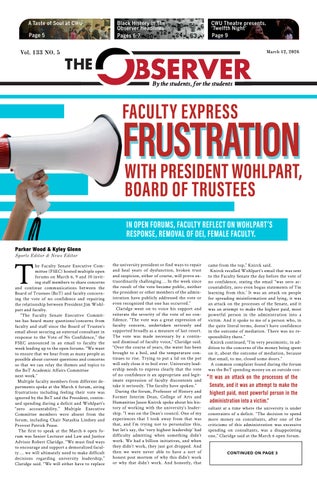
he Faculty Senate Executive Committee (FSEC) hosted multiple open forums on March 6, 9 and 10 inviting staff members to share concerns and continue communications between the Board of Trustees (BoT) and faculty concerning the vote of no confidence and repairing the relationship between President Jim Wohlpart and faculty. “The Faculty Senate Executive Committee has heard many questions/concerns from faculty and staff since the Board of Trustee’s email about securing an external consultant in response to the Vote of No Confidence,” the FSEC announced in an email to faculty the week leading up to the open forums. “We want to ensure that we hear from as many people as possible about current questions and concerns so that we can relay the themes and topics to the BoT Academic Affairs Committee next week.” Multiple faculty members from different departments spoke at the March 6 forum, airing frustrations including feeling their vote was ignored by the BoT and the President, continued spending during a deficit and Wohlpart’s “zero accountability.” Multiple Executive Committee members were absent from the forum, including Chair Natashia Lindsey and Provost Patrick Pease. The first to speak at the March 6 open forum was Senior Lecturer and Law and Justice Advisor Robert Claridge. “We must find ways to encourage and support a demoralized faculty … we will ultimately need to make difficult decisions regarding university leadership,” Claridge said. “We will either have to replace
the university president or find ways to repair and heal years of dysfunction, broken trust and suspicion, either of course, will prove extraordinarily challenging … In the week since the result of the vote became public, neither the president or other members of the administration have publicly addressed the vote or even recognized that one has occurred.” Claridge went on to voice his support and reiterate the severity of the vote of no confidence. “The vote was a great expression of faculty concern, undertaken seriously and supported broadly as a measure of last resort. The vote was made necessary by a continued dismissal of faculty voice,” Claridge said. “Over the course of years, the water has been brought to a boil, and the temperature continues to rise. Trying to put a lid on the pot will only close it to boil over. University leadership needs to express clearly that the vote of no confidence is an appropriate and legitimate expression of faculty discontents and take it seriously. The faculty have spoken.” During the forum, Professor of History and Former Interim Dean, College of Arts and Humanities Jason Knirck spoke about his history of working with the university’s leadership. “I was on the Dean’s council. One of my experiences that I took away from that was that, and I’m trying not to personalize this, but let’s say, the ‘very highest leadership’ had difficulty admitting when something didn’t work. We had a billion initiatives, and when they didn’t work, they just got dropped. And then we were never able to have a sort of honest post mortem of why this didn’t work or why that didn’t work. And honestly, that
came from the top,” Knirck said. Knirck recalled Wohlpart’s email that was sent to the Faculty Senate the day before the vote of no confidence, stating the email “was zero accountability, zero even bogus statements of ‘I’m learning from this.’ It was an attack on people for spreading misinformation and lying, it was an attack on the processes of the Senate, and it was an attempt to make the highest paid, most powerful person in the administration into a victim. And it spoke to me of a person who, in the quite literal terms, doesn’t have confidence in the outcome of mediation. There was no responsibility there.” Knirck continued, “I’m very pessimistic, in addition to the concerns of the money being spent on it, about the outcome of mediation, because that email, to me, closed some doors.” A common complaint found during the forum was the BoT spending money on an outside con-
“ It was an attack on the processes of the Senate, and it was an attempt to make the highest paid, most powerful person in the administration into a victim.”
sultant at a time where the university is under constraints of a deficit. “The decision to spend more money on consultants, after one of the criticisms of this administration was excessive spending on consultants, was a disappointing one,” Claridge said at the March 6 open forum. CONTINUED ON PAGE 3