Students respond to vote of no confidence
Is there a culture of fear at CWU?
page 3
Wohlpart accused of ‘authoritarian’ leadership
page 4-5
page 7
February 12, 2026
Vol. 133 NO. 3
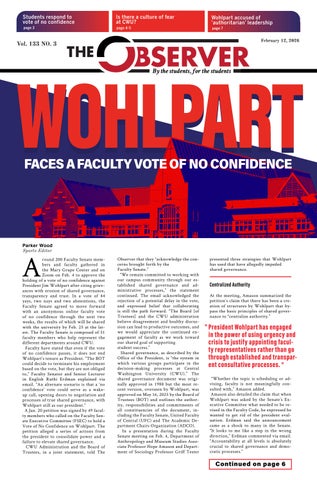
WOHLPART FACES A FACULTY VOTE OF NO CONFIDENCE
Parker Wood Sports Editor
A
round 200 Faculty Senate members and faculty gathered in the Mary Grupe Center and on Zoom on Feb. 4 to approve the holding of a vote of no confidence against President Jim Wohlpart after citing grievances with erosion of shared governance, transparency and trust. In a vote of 44 yays, two nays and two abstentions, the Faculty Senate agreed to move forward with an anonymous online faculty vote of no confidence through the next two weeks, the results of which will be shared with the university by Feb. 25 at the latest. The Faculty Senate is composed of 51 faculty members who help represent the different departments around CWU. Faculty have stated that even if the vote of no confidence passes, it does not end Wohlpart’s tenure as President. “The BOT could decide to terminate his employment based on the vote, but they are not obliged to,” Faculty Senator and Senior Lecturer in English Ruthi Erdman explained via email. “An alternate scenario is that a ‘no confidence’ vote could serve as a wakeup call, opening doors to negotiation and processes of true shared governance, with Wohlpart still as our president.” A Jan. 20 petition was signed by 49 faculty members who called on the Faculty Senate Executive Committee (FSEC) to hold a Vote of No Confidence on Wohlpart. The petition alleged a series of actions from the president to consolidate power and a failure to elevate shared governance. CWU Administration and the Board of Trustees, in a joint statement, told The
Observer that they “acknowledge the concerns brought forth by the Faculty Senate.” “We remain committed to working with our campus community through our established shared governance and administrative processes,” the statement continued. The email acknowledged the rejection of a potential delay in the vote, and expressed belief that collaborating is still the path forward. “The Board [of Trustees] and the CWU administration believe disagreement and healthy discussion can lead to productive outcomes, and we would appreciate the continued engagement of faculty as we work toward our shared goal of supporting student success.” Shared governance, as described by the Office of the President, is “the system in which various groups participate in the decision-making processes at Central Washington University (CWU).” The shared governance document was originally approved in 1988 but the most recent version, overseen by Wohlpart, was approved on May 16, 2025 by the Board of Trustees (BOT) and outlines the authority, responsibilities and commitments of all constituencies of the document, including the Faculty Senate, United Faculty of Central (UFC) and The Academic Department Chairs Organization (ADCO). In a presentation during the Faculty Senate meeting on Feb. 4, Department of Anthropology and Museum Studies Associate Professor Hope Amason and Department of Sociology Professor Griff Tester
presented three strategies that Wohlpart has used that have allegedly impeded shared governance.
Centralized Authority
“
At the meeting, Amason summarized the petition’s claim that there has been a creation of structures by Wohlpart that bypass the basic principles of shared governance to “centralize authority.”
President Wohlpart has engaged in the power of using urgency and crisis to justify appointing faculty representatives rather than go through established and transparent consultative processes. ” “Whether the topic is scheduling or advising, faculty is not meaningfully consulted with,” Amason added. Amason also detailed the claim that when Wohlpart was asked by the Senate’s Executive Committee what needed to be revised in the Faculty Code, he expressed he wanted to get rid of the president evaluation. Erdman said the announcement came as a shock to many in the Senate. “It looks to me like a step in the wrong direction,” Erdman commented via email. “Accountability at all levels is absolutely crucial to shared governance and democratic processes.”
Continued on page 6